FM 3-34.5/MCRP 4-11B ENVIRONMENTAL CONSIDERATIONS (February 2010) - page 2
Chapter 3
Issue
Lack of contract oversight results in improper disposal of HW.
Discussion
During operations in support of the War on Terrorism, the United States hired a local
national contractor to haul waste oil from U.S. force positions. The contractor
dumped the oil in a local landfill and sold the barrels. Lack of direct oversight of the
contractor resulted in a $1.25 million claim by the foreign nation for compensation
(later negotiated down to a reasonable fine). The U.S. government should have hired
a reputable contractor to dispose of the waste oil according to applicable disposal
standards
(typically foreign nation or U.S. standards). Contracting officer
representatives and contracting officers in theater must ensure that contractors are
supervised for compliance of the contract terms.
Units must remain aware of contract personnel working in their area. They should
inform their command and the local contracting agency if they see contractors
performing illegal, improper, or unethical actions.
Techniques and Procedures
To prevent illegal, improper, or unethical contractor actions, the following must occur:
• The contracting officer will include the proper procedures for waste removal into
the contract statement of work.
• The contracting officer’s representatives and occasionally the unit receiving the
services will ensure the proper execution of the contract statement of work.
• Unit leaders will remain cognizant of contractors working in their area and report
all incidents that create potential safety, health, or environmental risk.
BASE CAMP AND INSTALLATION OPERATIONS
3-35. Establishing base camps and occupying existing facilities (such as ports and airfields) require
extensive integration of environmental considerations. These sites, sometimes approaching the size of
small cities, require tremendous allocations of resources. In addition, they generate waste in quantities
similar to small cities, only without the existing infrastructure to support them. Planning for base camp and
installation operations must begin as early as possible in the operation—to include establishing
environmental guidelines, oversight authority, site selection, and camp operating procedures. Appendix E
and Appendix G provide detailed guidance on base camp site selection, construction, and operation.
SENSITIVE SITE EXPLOITATION
3-36. Exploiting sensitive sites may be a significant part of operations. In some circumstances, the
existence of these sites may be the primary reason for the use of military force. These sites include WMD
storage sites, research facilities, and sites that include possible evidence of criminal actions, such as mass
graves.
3-37. Investigating these sites presents inherent environmental considerations, particularly with regard to
FHP. The presence of CBRNE contamination presents significant hazards regarding conventional WMD
hazards and TIM and IED hazards. The military must take measures to identify and contain the possible
spread of contaminants and to protect Soldiers and Marines involved in the mission. Investigating other
sites (such as mass graves) may also present health hazards, and personnel must be properly trained in site
recognition, exploitation, and evidence preservation.
3-16
FM 3-34.5/MCRP 4-11B
16 February 2010
Environmental Considerations and Force Projection
3-38. Planners involved in exploiting these sites must plan to include personnel who are properly trained in
the safety and health measures required. In addition, special detection equipment and PPE may be required
to determine the possible contaminants present, to prevent or monitor the potential spread of the
contaminants, and to assist in site cleanup.
HISTORICAL, CULTURAL, AND RELIGIOUS SITE PROTECTION
3-39. Historical, cultural, and religious sites are often vital to a nation’s sense of identity. As such,
protecting these sites may be crucial to furthering stability. Hostile forces, including organized military
forces, insurgents, and criminals, may damage or loot these locations (such as archaeological sites and
museums). This creates a need to provide adequate security forces to safeguard these sites.
3-40. Planners must anticipate which sites may be present and which may be the greatest targets for
damage or looting. The planning process must include identifying and allocating security assets to these
locations to support stability operations. Military personnel assigned to these missions should be briefed on
the importance of the site and recognizing and protecting the critical aspects of each site. Forces should
also avoid establishing long-term operating bases at these locations to avoid damage and to return them to
the foreign nation as soon as possible.
3-41. Despite the best efforts of U.S. forces, damage to these sites may occur. Units must report the
damage immediately and take steps to protect them from further degradation. In addition, military forces
should not undertake the restoration of these sites without coordination with foreign nation representatives
and SMEs.
RECONSTRUCTION OPERATIONS
3-42. Reconstruction operations will play a significant part in stability operations. These efforts may
include repairs to damage caused during the conflict and damage resulting from previous practices. In
some circumstances, these operations may be focused on environmental issues, such as restoring and
protecting specific habitats and cleaning up contaminated areas.
3-43. Damage to, or a general lack of, infrastructure supporting environmental considerations is typical for
much of the developing world. Stability operations may include the reestablishment or creation of sewer,
water, electrical, academics, and trash cleanup services. Planners must assess the need for experts in
infrastructure rehabilitation and identify those assets to ensure that they are in place early in the
reconstruction process. In addition, adequate funding and financial contracting safeguards are established
to ensure efficient construction efforts.
3-44. Reconstruction efforts must also integrate environmental protection measures into practice.
Environmental risk assessments are conducted in support of reconstruction projects, and proper
environmental protection measures are instituted.
REDEPLOYMENT
3-45. As military forces redeploy, they must dispose of large quantities of waste and materials or return
them to their home stations. In some cases, forces may hand over material to replacement units or to the
local government. In other cases, it may be necessary to return large quantities to home stations. In
addition, forces may need to clean up any contamination resulting from the activities of U.S. forces.
Planners must include the time, forces, and material resources in their redeployment planning and the
guidelines to ensure that appropriate measures are taken. Early decisionmaking on the disposal of materials
and good environmental stewardship during the operation will speed up the redeployment process. In
addition to the environmental issues, departing military personnel will require postdeployment health
surveys to document their overall health and ensure that possible exposures to environmental hazards are
recorded. Redeployment guidelines are provided in table 3-4.
16 February 2010
FM 3-34.5/MCRP 4-11B
3-17
Chapter 3
Table 3-4. Redeployment guidelines
Category
Guidelines
• Return the area to its predeployment state when contingency operations
end
General
• Return the area to the foreign nation, and ensure that it is not
contaminated
• Turn in all HW to the designated accumulation site for proper shipment
• Label and package HW properly for safe transport
• Label all containers and transporting vehicles with the Department of
Transportation (DOT) label/placard
Waste
Transportation
• Make sure contents are compatible with all other contents
• Check MSDS for proper packaging requirements
• Block and brace for shipping
Provide the following:
• Installation and background (a brief description of the installation)
• Base camp map (a map to indicate spill sites, septic tanks, and other
environmental hazards)
• Summary of environmental conditions (a list of significant
environmental events)
Findings and determinations:
• Provide an assessment on whether the camp area will impact the
environment
• Document all environmental damage before departing to enable a
Environmental
comparison to the original EBS. The report should include the
Documentation
following:
Installation and background
Base camp map
Summary of environmental considerations
Findings and determinations
• Return the area to its predeployment state when contingency
operations end
• Return the area to the foreign nation, and ensure that it is not
contaminated
• Turn in all HW to the designated accumulation site for proper
shipment
Provide the following:
• Base camp map (a map to indicate spill sites, septic tanks, and other
ECR to
environmental hazards)
Replacement Unit
• Summary of environmental conditions (a list of significant
environmental events)
BASE CAMP AND INSTALLATION CLOSURE
3-46. Closing or transferring operating base camps may present significant environmental issues. In many
circumstances, forces will need to deal with HM/HW, landfills, sewage systems, and POL spills. Planners
should develop redeployment camp closure guidance as early as possible to allow tenant units adequate
time to make preparations. In certain circumstances, planners may develop this guidance in cooperation
3-18
FM 3-34.5/MCRP 4-11B
16 February 2010
Environmental Considerations and Force Projection
with the foreign nation. In addition, as units redeploy from camps that are to remain in operation, it is
necessary to plan for them to recover, clean up, or transfer materials to incoming units. Units must perform
an environmental site closure survey to track and document all critical environmental issues and related
remedial activities before closing or transferring camps and installations. This survey will document
conditions at the time of closure compared to conditions at the opening of the camp or installation, to
protect U.S. forces against undue liability. The vignette on page
3-20 highlights an example of
environmental issues that may affect base camp closure. Some issues to consider in planning to close base
camps and installations include—
z
Developing closure guidance.
z
Executing the closeout survey.
z
Returning HM/HW to the nearest appropriate accumulation point.
z
Removing survivability measures, to include filling in fighting positions and removing wire.
z
Cleaning up HM/HW and POL spills.
z
Disposing of medical supplies and infectious wastes.
z
Closing latrine and gray water facilities.
z
Establishing, and later closing of, vehicle and aircraft wash racks.
z
Removing structures, to include making decisions on material recycling or transferring/selling to
foreign nation representatives.
16 February 2010
FM 3-34.5/MCRP 4-11B
3-19
Chapter 3
Issue
Unreported fuel spill affects base camp expansion during Operation Iraqi Freedom.
Discussion
A 300-gallon fuel tanker overturned on a U.S. forces base camp. A supervisor
coordinated for a unit to clean up the spill site and haul the contaminated soil to a
temporary storage location. Due to mission priorities, a senior supervisor
countermanded the cleanup. The spill was never officially reported, and the site was
not properly marked.
Base camp planners were not aware of the spill and planned to construct troop-
sleeping areas over the spill site. As the first tents went up, the original supervisor
notified base camp officials, leaving the camp planners with two options:
1)
remediate the site or 2) resite the troop sleeping areas. Either option would cost the
unit additional time and resources.
During the time of inaction, the size of the plume increased and required a more
costly remediation effort. Furthermore, Soldiers and Marines unaware of the spill
might have used dirt from the spill site to fill sandbags and HESCO Bastion
Concertainers® placed around their living facilities. In addition to safety and
remediation cost concerns, a spill of this magnitude could seep into the ground and
contaminate the local water supply. This can have long-term effects on friendly
forces and civilian populations.
Techniques and Procedures
Use the following measures to assist in the prevention of a reoccurrence:
• Ensure that command emphasis is placed on proper environmental procedures
and CRM.
• Ensure that all Soldiers and Marines are trained to comply with spill response
procedures as outlined in Graphic Training Aid (GTA) 05-08-017.
• Incorporate all spill procedures into unit SOPs. An example of a unit
environmental SOP can be found in Appendix J.
• Ensure that the unit has the proper equipment on-site to respond to spills.
• Report all spills using the electronic spill report message format found in
FM 6-99.2.
TRANSPORTATION
3-47. Transportation of vehicles, equipment, and material to the home station is subject to the same
requirements as initial deployment. Equipment must be inspected, and personnel must address proper
safety, legal, and administrative issues. In addition, planners must integrate customs inspections of
personnel and equipment into the deployment plan to prevent the transport of prohibited materials. These
include war trophies and possible biological contaminants, such as foreign plants and insects. Planners
should also integrate recycling centers into redeployment camps to reduce the amount of material returned
to the home station and to put usable items back into the supply system. Equipment must also be washed
before returning to home station, and the wash racks used must meet environmental restrictions.
3-20
FM 3-34.5/MCRP 4-11B
16 February 2010
PART TWO
Command Environmental Program
Unit commanders develop command environmental programs to ensure that their
units are prepared to meet environmental requirements in garrison, in field training,
and during deployments. These programs ensure that personnel have the required
training to protect themselves and the environment. This part of the manual
describes the establishment of the command environmental program, its integration
with installation and deployment considerations, and the environmental
responsibilities of commanders and staff at various echelons.
Chapter 4
Establishing the Command Environmental Program
Whether conducting operations on a training installation, supporting a disaster
recovery mission, or conducting contingency operations, the military’s actions impact
the environment and the environment impacts the mission. The Army and the Marine
Corps manage millions of acres of land that may be scrutinized by public regulators,
Congress, or the courts. The military needs that land to conduct training and other
mission activities. In addition, there is the very practical need to sustain
environmental resources in a manner that supports the mission and provides a high
quality of life for our Soldiers and Marines; their families; and others that live on,
work on, or visit those facilities. As well as sustaining resources on installations, the
military must protect and sustain resources in foreign nations during deployments and
contingency operations. The military also has legal requirements to conserve, protect,
and restore natural and cultural resources while accomplishing its mission. By
integrating proper environmental management into the mission, the military not only
complies with federal, state, local, and foreign nation regulations but also enhances
its mission through sustaining operations and realistic training conditions.
FOSTERING ENVIRONMENTAL STEWARDSHIP
4-1. Fostering environmental stewardship and sustainability in units provides a framework for Soldiers
and Marines to integrate environmental considerations into daily operations. When Soldiers and Marines
automatically analyze environmental impacts and keep environmental issues in mind, they avoid adverse
actions and conditions. The command climate of a unit is the basis for fostering a sound environmental
ethic.
COMMAND CLIMATE
4-2. From every philosophical or moral perspective, environmental stewardship and sustainment is the
right thing to do. As humans make more demands on the shrinking resource base, ethical issues become
16 February 2010
FM 3-34.5/MCRP 4-11B
4-1
Chapter 4
clearer. Senior leaders must create ethical climates in which subordinate leaders recognize that the natural
resources of the earth are exhaustible, that the environment has an impact on human health, and that they
must take responsibility to protect the environment. This ethical climate also guides decisions in areas such
as the law of land warfare. Ethical behavior is not restricted to the letter of the law when it comes to
specific written laws, regulations, and treaties. Instead, it captures the ethos that generated those laws in the
first place. By educating subordinates and setting the example, leaders enable their subordinates to make
ethical decisions that in turn contribute to excellence.
4-3. Acknowledging considerations for environmental protection during training, operations, and
logistics activities reduces environmental damage and costs. Consistently protecting the environment
ensures that land will continue to be available to conduct realistic training and environmental problems will
not disrupt operations. In short, environmental considerations must be instilled as an institutional and
personal ethic. To be successful, the military must incorporate environmental considerations as a proactive
measure rather than a reaction to laws and regulations. Commanders must train their subordinate leaders on
stewardship and sustainability, counsel them on doing what is right, lead by example, and enforce
compliance with laws and regulations.
4-4. Commanders must promote an ethical climate to ensure that subordinates make good decisions
concerning environmental issues. Routine decisions may be as simple as emptying a bucket of solvent onto
the ground or carrying it to an appropriate accumulation point. A commander must encourage his
subordinates to make ethical decisions by ensuring that each of them ask the following questions when
confronted with an environmental dilemma:
z
What are my orders? Look to leaders for guidance and ensure that you understand what they
expect. If instructions are unclear or confusing, ask for help. Review unit SOPs for
environmental guidance.
z
What have I been trained to do? Ask this question in the absence of specific orders or guidance.
z
What does my concept of right and wrong tell me to do? Ask this question in the absence of
training and orders. Most personnel know when an action will harm the environment. Do not
perform environmentally related tasks without the proper guidance, especially if you have not
been trained on the task or you doubt it is correct.
POLICY
4-5. Commanders establish a command environmental policy (see appendix I) to set forth procedures and
responsibilities for integrating environmental considerations into planning and operations. Command
policies help ensure that all military personnel and civilians in the unit make informed decisions regarding
compliance with laws and regulations.
STANDING OPERATING PROCEDURES
4-6. SOPs provide units with standardized procedures for the execution of routine actions. Units develop
SOPs that contain a detailed list of actions that are necessary to fulfill the daily environmental
responsibilities of the unit to maintain environmental compliance with federal, state, local, and foreign
nation laws and regulations (see appendix J).
ESTABLISHING THE PROGRAM
4-7. A unit’s command environmental program is the basis by which unit commanders ensure that their
personnel adhere to laws, regulations, and procedures and promote the sustainable use of natural resources.
In addition, command environmental programs help to ensure that proper techniques and procedures are
implemented and that unit members receive proper environmentally related training.
4-2
FM 3-34.5/MCRP 4-11B
16 February 2010
Establishing the Command Environmental Program
ESTABLISHING A UNIT-LEVEL PROGRAM
4-8. To establish effective unit environmental program requirements, the unit leader should—
z
Assess the unit to understand the activities that affect the environment and the state of the
command environmental program.
z
Ensure that all unit personnel have had environmental awareness training.
z
Designate an environmental officer who is properly trained and qualified. The Marine Corps has
a specific military occupational specialty
(MOS)
9631
(Environmental Engineering
Management Officer) who deals with environmental matters. These individuals interface with
appropriate environmental personnel and ensure that their units comply with environmental laws
and regulations. Appendix H provides an example.
z
Meet with key higher-unit staff counterparts (operations staff officer [S-3]/logistics staff officer
[S-4] for a battalion-size organization), installation, and base camp personnel who deal with
environmental issues. Find out their requirements concerning environmental training,
qualifications, and certification of unit personnel; the Environmental Performance Assessment
System (EPAS) (defined as the examination of an installation’s environmental program
review to identify possible compliance deficiencies [the definition was shortened, and the
complete definition is printed in the glossary]) inspections affecting the unit and common
environmental problem areas; and problem avoidance.
z
Ensure that the unit SOP addresses environmental issues and procedures applying to the unit
(coordinate environmental requirements with appropriate installation/chain-of-command
personnel). Appendix J provides an example.
z
Conduct environmental risk assessments before training and deployment operations.
4-9. The following are common unit, installation, and base camp environmental programs that
commanders establish:
z
HAZCOM.
z
HM management.
z
HW management.
z
POL management.
z
P2 and HW minimization.
z
Recycling program.
z
Spill prevention and response training.
z
Sustainable range program.
TRAINING
4-10. The best use of available resources toward adequately training selected groups or individuals will
positively impact quality of life, sustainment efforts, and unit compliance status. Personnel should know
how to accomplish their tasks in a manner that has no or minimal impact on the environment, while
complying with environmental regulations. Army Regulation
(AR) 200-1 and Marine Corps Order
(MCO) P5090.2A require that the military provide training to appropriate personnel and maintain training
and certification records according to governing laws and regulations.
4-11. Many environmental laws require specific training requirements for personnel performing certain
tasks or activities. These details are normally within federal or state regulations, which usually include
refresher training requirements and specific recordkeeping. Sometimes the qualifications of the trainer are
specified in the regulations. Required training types include the following:
z
HW generators and accumulation points, shipping, and permitted storage or waste treatment.
Annual training is required.
z
Packing, receiving, transporting, and certifying HM shipments. Refresher training is required
every two years.
16 February 2010
FM 3-34.5/MCRP 4-11B
4-3
Chapter 4
z
Working with hazardous or toxic chemicals (except for personnel performing military-unique
tasks). Some specific chemicals require training even if workers are infrequently exposed to the
hazards. Initial training must be supplemented if hazards change.
z
Uncontrolled HW site investigations and cleanup. Annual training is required for individuals
working, visiting, or supervising workers at these sites.
z
Asbestos demolition and removal, maintenance, and repair work involving asbestos disturbance
and asbestos sampling. Refresher requirements vary.
z
Exposure to lead-based paint during building maintenance, repair, demolition, or removal.
Refresher requirements vary.
z
Discovery and response to spills of oil or hazardous substances. Annual training is required.
ENVIRONMENTAL PROGRAMS
4-12. Units are required to implement or establish training for a variety of environmental programs to
ensure that their units meet the necessary requirements and promote sustainability. The extent of these
programs will vary with the nature of the unit and the unit’s specific requirements, along with the
requirements of the installation or base camp where the unit is located.
HAZARD COMMUNICATION
4-13. An effective HAZCOM program will assist leaders in determining what hazardous chemicals are
present in their units, how to protect their personnel from hazards those chemicals present, and how to
properly store and use those chemicals. The installation or base camp safety officer is the point of contact
for most HAZCOM matters, the MSDS program, and the HAZCOM training program.
Key References
4-14. The following laws and regulations are source documents that support the HAZCOM program:
z
AR 40-5.
z
AR 385-10.
z
AR 700-141.
z
Part 1910, Title 29, Code of Federal Regulations (CFR) (29 CFR 1910).
z
United States Army Center for Health Promotion and Preventive Medicine (USACHPPM)
Technical Guide (TG) 217.
z
Technical Bulletin (TB) Medical (MED) 593.
Unit Actions
4-15. In support of HAZCOM, unit leaders should—
z
Ensure that their subordinates receive adequate training on the HM to which they are exposed,
according to the Occupational Safety and Health Standards, Occupational Safety and Health
Administration (OSHA) requirement.
z
Maintain an up-to-date list of all HM/HW known to be present in the area.
z
Ensure that containers of hazardous chemicals are labeled, tagged, or otherwise marked to
identify the material and warn personnel of hazards.
z
Maintain an MSDS for every HM in the unit (see Appendix K).
z
Ensure that personnel are trained to recognize, understand, and use the MSDS and labels for the
HM to which they are exposed.
z
Ensure that personnel use proper procedures when working with hazardous chemicals and wear
PPE.
z
Refer to applicable HAZCOM references.
4-4
FM 3-34.5/MCRP 4-11B
16 February 2010
Establishing the Command Environmental Program
HAZARDOUS MATERIALS MANAGEMENT
4-16. The military’s objective is to minimize health hazards and environmental damage caused by the use
and misuse of HM. Hazardous material is defined as any substance that has a human health hazard
associated with it; special storage, use, handling, and shipment safety procedures and protocols must
be followed to help protect against accidental exposure; hazardous materials are specifically
identified under federal law. It is a material that, due to its 1) quantity; 2) concentration; or 3) physical,
chemical, or infectious characteristics, may—
z
Cause or significantly contribute to an increase in mortality in serious, irreversible, or
incapacitating reversible illness.
z
Pose a substantial present or potential hazard to human health or the environment
when
improperly treated, stored, transported, disposed of, or otherwise managed.
Key References
4-17. The following source documents provide guidelines for the proper handling of HM:
z
AR 200-1.
z
AR 700-141.
z
AR 700-68.
z
MCO P5090.2A.
z
29 CFR 1910.
z
Part 761, Title 40, CFR (40 CFR 761).
z
Technical Manual (TM) 38-410.
z
USACHPPM TG-217.
z
DOD 4715.05-G.
Unit Actions
4-18. To effectively manage HMs, leaders should—
z
Ensure that the best management practices are followed for all HM.
z
Comply with all applicable regulations, policies, inspections/evaluations, and procedures.
z
Order and use only what is required; do not stockpile HM.
z
Use nonhazardous substitutes to the maximum extent practicable.
z
Conserve resources through recovering, recycling, and reusing.
z
Maintain records of all material on hand, received, or issued, to include MSDSs.
z
Report HM use, storage, and acquisition by established policy.
z
Establish procedures to identify and correct management deficiencies.
z
Establish a training program and ensure that required personnel are properly trained.
z
Ensure that drivers transporting HM are qualified. According to DOT HM 181 and 126F (see 49
CFR), transporters of HM must (by law) be trained.
z
Ensure that adequate spill prevention and control equipment is on hand.
z
Coordinate training requirements with the chain of command and the environmental
management or safety office.
z
Ensure compliance with special disposal and turn-in procedures for batteries.
z
Establish HM spill procedures.
z
Establish HM fire/explosion procedures.
z
Establish emergency first aid procedures.
z
Ensure that adequate protective equipment is available.
z
Refer to applicable HM references.
16 February 2010
FM 3-34.5/MCRP 4-11B
4-5
Chapter 4
HAZARDOUS WASTE MANAGEMENT
4-19. The presence of HW is a cause for concern among installation/base camp personnel and nearby
residential populations. However, hazardous chemicals are an unavoidable part of military activities and
ultimately result in some waste generation. The proper handling and disposal of these wastes will minimize
hazards and ensure the safety of people and the environment.
Key References
4-20. The following laws and regulations are source documents that provide guidelines for properly
handling and disposing of HW:
z
AR 200-1.
z
MCO P5090.2A.
z
Department of Defense Instruction (DODI) 4160-21-M.
z
29 CFR 1910.
z
Parts 259, 260-281, 300-302, 761; Title 40; CFR (40 CFR 259, 260-281, 300-302, 761).
z
Parts 106-178, Title 49, CFR (49 CFR 106-178).
z
USACHPPM TG-217.
z
TB MED 593.
Unit Actions
4-21. When a unit generates HW, it must take the following actions:
z
Establish an HW management program to comply with HW regulations.
z
Identify HW properly. Label accumulated waste and the containers that hold HW with the
correct hazard warning labels. Inspect containers for leaks, corrosion, or damage.
z
Ensure that wastes do not accumulate beyond allowable quantity and time limits. Ensure that
accumulation areas contain secondary containment.
z
Maintain records of all material on hand, received, or issued.
z
Employ HW minimization techniques as a part of P2 efforts.
z
Comply with off-post HW transportation requirements. Public road use increases transportation
requirements. Contact and coordinate with the installation Directorate of Logistics (DOL) or
Facilities Management Office and the Defense Reutilization and Marketing Office (DRMO).
z
Ensure that drivers transporting HW are qualified. According to DOT HM 181 and 126F,
transporters of HM must (by law) be trained.
z
Establish an HW training program and ensure that personnel attend proper training. Most
installations conduct HW train-the-trainer programs.
z
Maintain a liaison with key chain of command and installation/base camp personnel.
z
Ensure that unit personnel use their PPE when handling HW.
z
Ensure that adequate spill prevention and control equipment is on hand.
z
Establish HW fire/explosion procedures.
z
Establish HW spill/leak procedures, and ensure that the unit conducts drill procedures annually,
at a minimum.
z
Establish emergency first aid procedures.
z
Ensure that unauthorized storage or disposal of HW does not occur. HW must be stored only in
authorized containers and disposed of as directed by the environmental management office,
DRMO, or as directed in the OPORD (for contingency operations).
PETROLEUM, OIL, AND LUBRICANTS MANAGEMENT
4-22. Requirements for POL are an unavoidable consequence of modern military operations. Products
sustaining the military each day (such as motor oils, paints, cleaning compounds, and aircraft fluids) are
4-6
FM 3-34.5/MCRP 4-11B
16 February 2010
Establishing the Command Environmental Program
significant health, safety, and environmental issues and management challenges. At a minimum, personnel
must know how to handle, transport, and dispose of POL products.
Key References
4-23. References for managing POL products are similar to those applicable to HM/HW, HAZCOM, P2,
HW minimization, recycling, and spill prevention and response. They also include CFR (40 CFR 110, 112,
and 302); FM 10-67; FM 10-67-1; Parts 110, 112, and 302 (Hazardous Substances); and Title 40.
Unit Actions
4-24. The following actions are required when receiving, storing, and using POL products:
z
Requisition only the amount of POL products required.
z
Practice inventory control, to include monitoring (defined as the assessment of emissions and
ambient air quality conditions [the definition was shortened, and the complete definition is
printed in the glossary]) HM shelf life and HW accumulation dates.
z
Store POL products in approved containers and locations.
z
Maintain an MSDS for each POL product.
z
Provide proper PPE for products handled by personnel.
z
Supply labeled 55-gallon liquid-waste containers for the following waste streams:
Used oil.
Waste fuel.
Waste antifreeze.
POL-contaminated solids.
z
Ensure that adequate spill prevention and control equipment is on hand.
z
Ensure that adequate secondary containment exists for HM/HW storage facilities.
z
Ensure that containers are properly marked and in good condition.
z
Provide drip pans for vehicles and refueling operations.
POLLUTION PREVENTION AND HAZARDOUS WASTE MINIMIZATION
4-25. This program complements the HM, HW, and HAZCOM programs. HW minimization reduces the
amount and toxicity of the HW generated or produced. P2 reduces the amount of material, hazardous or
not. For example, recycling reduces the amount of trash that goes into landfills. The reduction in waste
supports deployment operations by reducing transportation, storage, and landfill requirements and helping
to reduce financial liability resulting from claims against U.S. forces.
Key References
4-26. P2 and HW minimization references include the following:
z
AR 200-1.
z
MCO P5090.2A.
z
Executive Order (EO) 12856.
z
Section 41, Part 262, Title 40, CFR (40 CFR 262.41).
z
Pollution Prevention Act.
Unit Actions
4-27. Unit leaders should ensure that their units conduct proper inventory control. A unit should not
stockpile HM. If an HM has an expired shelf life, it can cost much more to dispose of the item than it did to
obtain it since the HM will have to be handled as an HW.
4-28. Product substitution is an easy way to reduce the HW a unit generates. Unit personnel should review
the HM inventory in their areas and check to see if nonhazardous or less hazardous substitutes are
16 February 2010
FM 3-34.5/MCRP 4-11B
4-7
Chapter 4
available. Examples are using biodegradable degreasers instead of solvents or replacing the sand used in
sandblasting operations with plastic beads, which last longer and can be recycled.
4-29. A process change can reduce the amount of HW generated. For example, a vapor degreaser could be
replaced by a soap and hot water parts cleaner.
RECYCLING PROGRAM
4-30. Source reduction is the decrease of hazardous waste generation at its sources. This reduction is
to be achieved through product substitution, recycling, and inventory control and by developing new
industrial processes that use less hazardous materials, such as bead blasting rather than solvents to
remove paint. The military promotes
1) separating products, substituting materials, and changing
procedures to avoid using hazardous substances and 2) recycling to reduce the volume of solid waste. Most
permanent installations have a recycling program that units should incorporate into their SOPs. While
recycling programs during contingency operations may be minimal, most established base camps will
develop programs to recycle Class II and Class IV materials.
Key References
4-31. The following references provide the basis for recycling programs:
z
AR 200-1.
z
MCO P5090.2A.
z
EO 13101.
Unit Actions
4-32. To support the recycling program, unit personnel should—
z
Recycle all recyclable materials. Recyclable materials include computer printouts (after ensuring
all sensitive material is shredded), corrugated cardboard, card stock, newspaper, high-grade
white paper, aluminum cans, plastics, oil, solvents, glass, steel, and brass. Check with the
installation environmental office to verify the material recycled locally.
z
Separate materials to be recycled by type.
z
Refer to applicable recycling references.
SPILL PREVENTION AND RESPONSE PLANNING
4-33. It is military policy and a Clean Water Act requirement to prevent oil and hazardous-substance spills
and to provide prompt response to contain and clean up spills. A spill response plan must be available at
each operation storing or accumulating HM/HW, such as maintenance facilities, supply activities, and
tactical-refueling areas. The plan should address, at a minimum, site-specific response procedures and spill
response equipment requirements for each operation. Exceptions will be made in cases of extreme
emergency, where the discharge is—
z
Considered essential to protect human life.
z
Authorized by a discharge permit or installation on-scene coordinator during a spill incident
response.
Key References
4-34. The following references are applicable to spill prevention and response plans:
z
AR 200-1.
z
MCO P5090.2A.
z
40 CFR 110.
z
40 CFR 302.
z
Part 355 (Extremely Hazardous Substances), Title 40, CFR (40 CFR 355).
z
TB MED 593.
4-8
FM 3-34.5/MCRP 4-11B
16 February 2010
Establishing the Command Environmental Program
Unit Actions
4-35. Units should take every reasonable precaution to prevent oil and hazardous-substance spills. The unit
leader should—
z
Provide facilities that store, handle, or use oils and HMs, and implement proper safety and
security measures.
z
Appoint (in writing) a spill coordinator and members of the unit spill response team.
z
Maintain an up-to-date spill response plan. This requirement is generated by the installation.
z
Conduct appropriate training and periodic spill response drills.
z
Ensure that sufficient equipment and supplies (PPE and absorbent materials) for spill responses
are on hand and pre-positioned in the unit.
z
Locate all drains, drainage ditches, streams, ponds, and other water sources/outlets in the area,
and plan how to prevent a spill from reaching them.
z
Coordinate with the installation safety office, preventive medicine office, and environmental
management office to determine proper PPE. Know when to attempt to clean up a spill and
when to leave the area and contact the installation spill response team for cleanup. The
installation environmental management office or installation on-scene coordinator will
determine when to dispatch a spill response team.
z
Maintain a copy of the installation spill contingency plan. This plan, available from the
environmental management office, contains critical/necessary information.
z
Maintain a current point of contact list of who to contact in case of an emergency (for example,
the fire department, safety office, provost marshal, preventive medicine, and environmental
management office).
z
Maintain an up-to-date inventory of all HM/HW, and provide a copy to the installation fire
department for use in case of a chemical fire.
z
Ensure that pollutants are not discharged into storm or wash rack drains or poured on the
ground.
z
Ensure that small spills are properly attended to, cleaned up, and collected and disposed of.
z
Strictly control the discharge of ballast water from watercraft.
z
Ensure the management of waste or used oil complies with all applicable federal, state, and local
requirements.
z
Ensure that wastes produced during the cleaning of fuel storage tanks and combustion engine
components are collected and managed as required before disposal.
z
Monitor wastewater discharges containing oil or hazardous substances to comply with permit
limits.
z
Ensure that oil, fuel, or other hazardous pollutant spills are reported to the environmental
management office and higher headquarters. The S-4/Assistant Chief of Staff, Logistics (G-4)
and the post environmental management office can provide information on reportable spill
quantities.
z
Establish HM/HW fire/explosion procedures.
z
Establish emergency first aid procedures.
z
Refer to applicable spill prevention references.
SUSTAINABLE RANGE PROGRAM
4-36. Unit mission training presents a difficult environmental challenge. Unit leaders must exercise caution
with noise pollution, waste disposal, spill prevention, water pollution, and cultural and natural resource
protection.
16 February 2010
FM 3-34.5/MCRP 4-11B
4-9
Chapter 4
Key References
4-37. When conducting an FTX, references relating to HM/HW, HAZCOM, HW minimization, recycling,
and spill prevention apply. The following also apply:
z
AR 350-19.
z
AR 385-10.
z
USACHPPM TG-217.
z
Local regulations for range operation.
z
Unit SOP.
Unit Actions
4-38. As the unit prepares for FTXs, leaders and the environmental officer must coordinate with
installation training staff to obtain environmental guidance due to differing local, state, or foreign nation
regulations. They—
z
Review the OPLAN/OPORD for environmental requirements/considerations.
z
Ensure that a recent environmental risk assessment has been performed.
z
Confirm coordination with installation and operational staffs concerning applicable
environmental laws, regulations, and considerations.
z
Determine whether a recent site reconnaissance has been performed.
z
Conduct rehearsals to ensure that all safety and environmental considerations are satisfied.
z
Review the environmental protection portion of the unit SOP, especially those areas concerning
spill response and reporting.
z
Make provisions for handling medical wastes.
z
Make provisions for handling human and solid wastes.
z
Ensure that HMs (explosives/POL) are properly labeled and that an MSDS is on hand for each
chemical/product before transporting.
z
Have tools, equipment, PPE, and materials available to respond to environmental emergencies.
z
Ensure that personnel designated for the spill response team(s) are properly trained and aware of
their assignment.
z
Ensure that team members are aware of the procedure for requesting additional spill assistance
when required.
z
Verify areas of environmental concern during site reconnaissance.
z
Ensure that personnel understand their responsibilities with regard to reducing HW generation
and minimizing damage to the environment.
z
Brief all personnel on range or maneuver restrictions; endangered species; vegetation use; and
archaeological, cultural, and historic resource considerations.
z
Discuss the identified environmentally related risks during planning.
PROGRAM ASSESSMENT
4-39. With the implementation of the Federal Facility Compliance Act, federal or state regulators may
inspect an installation without prior notice. Often, the first indication that federal, state, or other inspectors
are on post is when they visit the installation environmental management office or the provost marshal's
office, asking for directions to a specific site on the installation. Preparing for regulatory inspections should
be a necessary part of the day-to-day routine.
Note. If an environmental regulator arrives for an inspection without an escort from the
installation environmental management office, contact the environmental management office or
commander immediately.
4-10
FM 3-34.5/MCRP 4-11B
16 February 2010
Establishing the Command Environmental Program
4-40. Regular meetings between the commander and the environmental management team (which may
consist of the environmental coordinator, the PAO, the legal advisor, the safety and occupational health
manager, the preventive medicine officer, the resource manager, and the land manager) can demonstrate
command emphasis and serve to nourish a healthy environmental program. The environmental
management team should brief the commander regularly on specific installation environmental issues.
4-41. Installation environmental compliance status may be determined in two ways. The first is through a
formal inspection by a regulatory agency, such as the Environmental Protection Agency (EPA) and state
agencies. The second way and the Army’s preference is through the EPAS.
4-42. OCONUS commanders determine the scope for the EPAS within their commands. They often
implement procedures to ensure compliance with applicable foreign nation, SOFA, FGS, AR 200-1, and
MCO P5090.2A requirements.
4-43. The commander ensures that the unit’s environmental program is effective through self-assessment.
The unit may use a self-assessment general checklist to assess its environmental compliance status. Units
also use EPAS checklists as a supplement to the self-assessment checklist. Unit leaders, with the assistance
of the installation’s environmental staff, determine the frequency of self-assessment checks.
4-44. The environmental officer uses self-assessment checklists to check the following unit areas:
z
Program management.
z
Accumulation sites.
z
HM/HW management.
z
Solid waste management.
z
Spill prevention and response.
z
Recycling program.
z
Wash racks.
z
Storm water management.
z
P2/HW minimization.
z
Environmental training.
16 February 2010
FM 3-34.5/MCRP 4-11B
4-11
Chapter 5
Garrison and Training Considerations
This chapter discusses environmental considerations in routine unit actions while in
garrison and during training activities. Integrating environmental considerations is a
constant in planning, as is CRM, but specific risks or considerations may be of
reduced importance. During garrison and training activities, environmental
considerations typically receive higher priority and are more focused on
sustainability. Federal, state, and local environmental laws and regulations tend to
dictate unit actions. Violating these statues may result in punitive actions.
Commanders must be aware of the various installation and other requirements and
integrate these requirements into their command environmental programs.
GARRISON CONSIDERATIONS
5-1. Military units occupy installations, which contain varying environmental requirements. In addition,
USAR units must comply with their own federal, state, and local requirements. Commanders develop
command environmental programs to ensure unit compliance with outside requirements and in support of
unit operations during deployment.
5-2. Installations must adhere to a multitude of federal, state, and local laws and regulations in which
most are integrated into various Service manuals. As commanders develop their command environmental
programs, they must be aware of these requirements—which are generally much more stringent than
during force projection operations and can impact the way in which units conduct their daily
administrative, logistic, maintenance, and training operations. Units must be familiar with installation,
range, and training area requirements and maintain a liaison with installation environmental and public
works managers to ensure that the development of command environmental programs meets the necessary
requirements.
5-3. Industrial operations, acquisition services, and training area management support the installation’s
routine missions. They also provide significant support to operations during mobilization/demobilization
and deployments/redeployments. Units may avoid unanticipated costs and delays with proper
environmental considerations and integrated planning functions. They must therefore coordinate with
installation personnel when support requirements are expected to increase, as in the following
circumstances:
z
Number of troops. Large numbers of troop units may cause an installation to exceed its air,
wastewater, and storm water discharge permit levels.
z
Operational pace. Additional natural resource or special use permits are required as the
operational pace in the training area increases.
z
Transportation. Temporary marshalling areas are required at points of departure or railheads to
relieve overcrowded transportation facilities.
z
Temporary storage. Offloading fuel and POLs at points of departure and railheads increases the
likelihood of spills and places additional requirements for temporary storage on installation
industrial operations.
16 February 2010
FM 3-34.5/MCRP 4-11B
5-1
Chapter 5
Environmental Management System
5-4. To comply with EO 13423 and other environmental laws and regulations, the Army uses an
Environmental Management System based on the International Organization for Standardization (ISO)
14001 model. The ISO 14001 provides a set of internationally recognized criteria for an Environmental
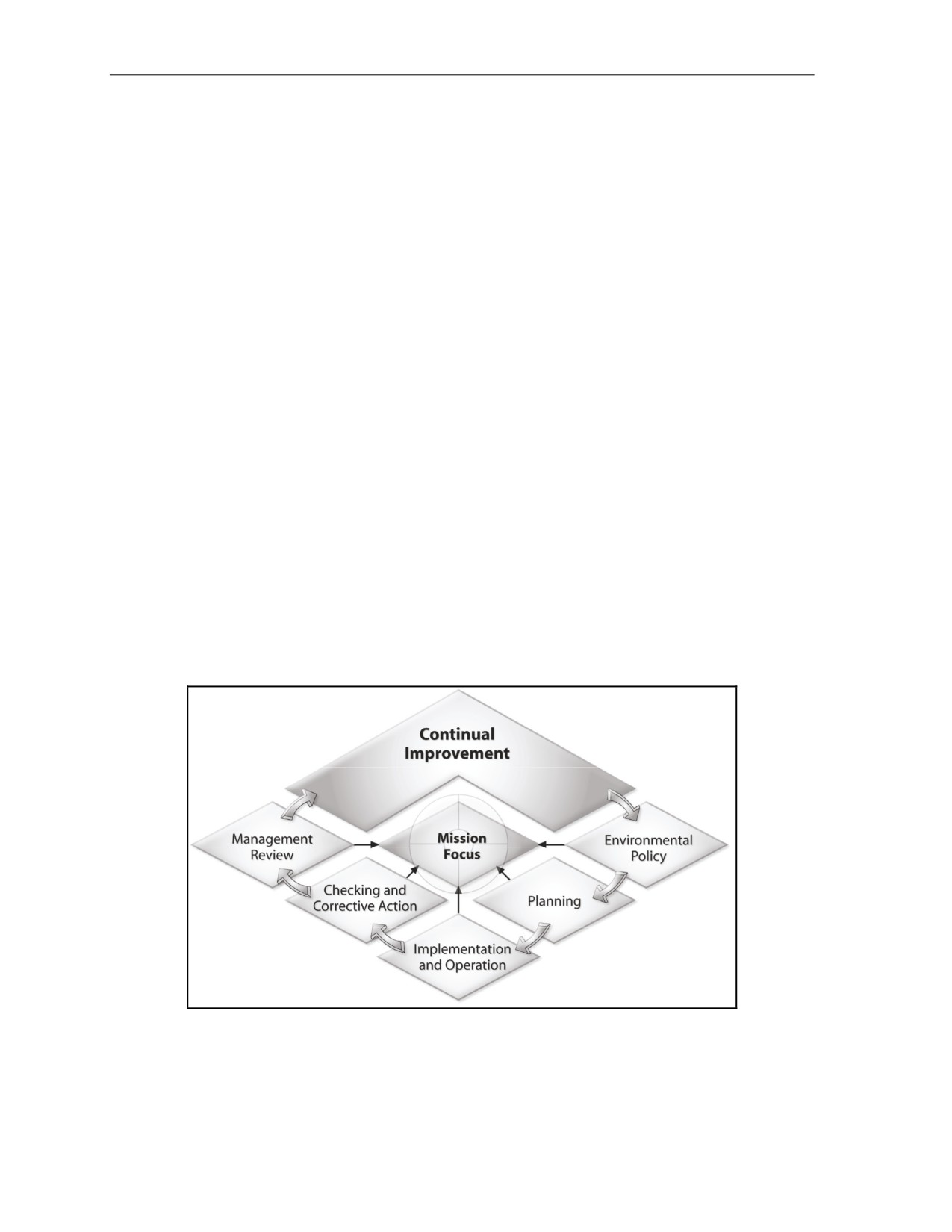
Management System. It employs a continual cycle of environmental policy, planning, implementation, and
operation; checking and corrective actions; and management review. An Environmental Management
System helps to avoid environmental problems by increasing awareness and developing sustainable
activities and processes. Units must be aware of the installation’s Environmental Management System
program and develop their command environmental programs accordingly.
Installation Sustainability
5-5. Many installations have recently embraced the concept of sustainability and taken initial steps
toward creating a sustainable military. A sustainable military simultaneously meets mission requirements
worldwide, safeguards human health, improves quality of life, and sustains the natural environment. This
comprehensive revision of doctrine, force structure, training, and equipment provides a unique opportunity
and the obligation to integrate and institutionalize environmental protection and stewardship with
installation sustainability throughout the military. Commanders develop plans to support installation
sustainability goals, including the following areas:
z
Energy conservation.
z
Fuel conservation.
z
P2.
z
Recycling programs.
z
HM/HW minimization.
z
Soil and water conservation.
z
Installation natural resource management plans.
5-6. Figure 5-1 describes the continual improvement process. The continual improvement process forms
an integral part of installation sustainability.
Figure 5-1. Continual improvement
5-2
FM 3-34.5/MCRP 4-11B
16 February 2010
Garrison and Training Considerations
TRAINING CONSIDERATIONS
5-7. Operational readiness depends on sufficient land for training individuals and units. Without adequate
training areas, training opportunities would rapidly diminish. This decline would cause a reduction in
military ability to effectively train to conduct its mission across full spectrum operations. Therefore, to
ensure that the military maintains a highly trained force, it must identify ways to sustain the natural
environment while executing its mission across full spectrum operations.
5-8. Integrated training area management (ITAM) is a key part of the Army's commitment to realistic
training according to doctrinal-based standards and under realistic combat conditions. The purpose of
ITAM is to achieve optimum sustainable use of training lands by implementing a uniform program that
includes—
z
Inventorying and monitoring land conditions.
z
Integrating training requirements with carrying capacity.
z
Educating land users to conduct their activities in a way that minimizes adverse impacts.
z
Providing for land rehabilitation and maintenance.
5-9. Along with the ITAM, units must consider all aspects of the natural environment. Laws impacting
training are integrated into installation regulations and impact the way that units train. These laws include
the following:
z
National Environmental Policy Act (NEPA).
z
Clean Air Act.
z
Clean Water Act.
z
ESA.
z
Sikes Act.
z
National Historic Preservation Act.
z
Noise Control Act of 1972.
z
Resource Conservation and Recovery Act (RCRA).
5-10. To help ensure sustainable practices and to comply with these and other environmental policies,
laws, and regulations, leaders and personnel should—
z
Avoid operations in or near cultural, archaeological, or historical sites, artifacts, and structures.
z
Identify and reduce sources of air pollution (such as dust control in training areas, excessive
emissions from poorly maintained vehicles, or parts washer emissions).
z
Ensure that riot control and smoke agents are used only in authorized training/tactical scenarios.
z
Plan and conduct training and operations to avoid surface water
(defined as all water
naturally open to the atmosphere [rivers, lakes, reservoirs, ponds, streams, impoundments,
seas, or estuaries] and all springs, wells, or other collectors directly influenced by surface
water) and groundwater (defined as a body of water, generally within the boundaries of a
watershed, that exists in the internal passageways of porous geological formations
[aquifers] and flows in response to gravitational forces) areas where possible.
z
Supervise to ensure that released or spilled vehicle fluids do not contaminate surface water or
groundwater by taking immediate corrective action should a spill occur.
z
Plan missions to reduce the possibility of erosion, and prohibit using live vegetation for
camouflage (unless permitted), driving or parking vehicles close to trees, and cutting trees
without permission from range control or from the installation forester.
z
Avoid tactical maneuvers in erosion-susceptible areas and refill fighting positions.
z
Make maximum use of existing roads and trails.
z
Recognize threatened and endangered species habitat, and avoid it during training and
operations. Also, avoid actions that could harm protected plants and animals and their habitats.
z
Mark environmentally sensitive areas as restricted movement areas during field training.
16 February 2010
FM 3-34.5/MCRP 4-11B
5-3
Chapter 5
z
Write HM/HW and solid waste collections, disposals, and turn-ins into the training scenarios as
they would be experienced in the operation (local landfills, recyclers, transport to centralized
facility) to enforce realistic training. Compliance with U.S./installation policy should be
transparent to the unit.
z
Incorporate restricted areas into training/tactical scenarios
(for example, identify them as
minefields or other restricted terrain).
5-4
FM 3-34.5/MCRP 4-11B
16 February 2010
Chapter 6
Environmental Responsibilities and Duties
Commanders, staffs, subordinate leaders, and individual Soldiers and Marines must
understand their individual duties and responsibilities for environmental sustainment
and become environmental stewards. To practice stewardship, all personnel must
understand the basic environmental management responsibilities that apply to their
work area or assigned duties. They must also understand what their roles and
responsibilities are with respect to incorporating environmental considerations into
the conduct of operations. This includes not only the specific planning process for
those missions but also the integration of environmental considerations into all the
training their unit undertakes.
COMMAND RESPONSIBILITIES
6-1. Command and staff environmental responsibilities vary by echelon and position. While certain
elements include more extensive or better-defined environmental responsibilities, almost all positions
contain an environmental component.
BRIGADE/BATTALION LEVEL
6-2. An effective brigade/battalion environmental program begins with the establishment of command
policies and SOPs. These documents integrate installation and operational requirements into daily routines.
Command environmental programs always include guidance for subordinate commanders, staffs,
subordinate leaders, and personnel.
COMMANDER
6-3. AR 200-1; AR 700-141; DA Pamphlet (Pam) 700-142, Part 651, Title 32, CFR (32 CFR 651); and
MCO P5090.2A specify the commander’s environmental responsibilities. These include—
z
Complying with the installation environmental policy and appropriate federal, state, and local
laws and regulations (see appendix A).
z
Developing an environmental SOP
(see Appendix J) and ensuring that it contains all
environmental considerations and regulatory requirements right for the level of command.
z
Promoting environmental stewardship.
z
Understanding the links between environmental considerations and the associated impact on
safety and other aspects of protection and FHP.
z
Appointing an environmental officer (see Appendix H) and an HW coordinator (these duties
may be combined into a single position) at the proper level and ensuring that they are properly
trained.
z
Ensuring that all environmental training mandated by law occurs.
z
Addressing environmental concerns throughout the training cycle.
z
Conducting an environmental self-assessment or an internal environmental performance
assessment.
6-4. When deployed, commanders will often work with base camps. Base camps—though not
installations—are comparable to small towns and require many of the considerations applied to
installations. A mayor assists the base camp commander with the control of base operations. A base camp
16 February 2010
FM 3-34.5/MCRP 4-11B
6-1
Chapter 6
coordination agency may provide expertise and support to the commander, largely through its subordinate
base camp assistance/assessment team. This team maintains environmental expertise, supports the base
camp commander and the designated mayor of the base camp, provides technical recommendations, and
maintains appropriate standards.
EXECUTIVE OFFICER
6-5. As the commander’s principal staff officer, the executive officer directs staff tasks and coordination
and ensures efficient and prompt staff response. The executive officer is responsible for integrating CRM
into operations planning and execution. As a supervisor, the executive officer also ensures that all staff
members analyze operational effects on the environment and assess the environmental status, while the S-3
integrates environmental planning and execution into the operations.
COMMAND SERGEANT MAJOR
6-6. The command sergeant major is the senior enlisted trainer and spokesperson, who enforces
established environmental policies and standards for enlisted personnel and ensures that subordinate
noncommissioned officers (NCOs) do the same. Command sergeant major duties include—
z
Providing advice and making recommendations to the commander and staff on matters
pertaining to environmental sustainability.
z
Assisting with inspecting command activities and facilities as prescribed by the commander.
z
Ensuring adherence to command environmental policies.
z
Ensuring that newly assigned enlisted personnel are instructed in command regulations or
policies relating to environmental stewardship.
z
Assessing environmental training at all levels and providing feedback to appropriate
commanders and leaders.
z
Noting environmental deficiencies and initiating appropriate corrective action.
PRIMARY STAFF
6-7. Whether developing the running estimate, the protection levels, or the EBS, environmental
protection requires that each staff member actively participate. Environmental factors may influence a wide
range of activities or require a significant expenditure of resources. A single point of contact for all
environmental considerations is neither effective nor efficient.
6-8. Unit staffs are responsible for certain environmental actions within their areas of expertise. While
some of these responsibilities may depend on the command or commander, all staffs undertake many of
them. Unit SOPs at battalion and company levels incorporate specific responsibilities.
6-9. Unit staffs also integrate environmental considerations into the planning and execution processes.
Common staff duties provide the basis for some environmental responsibilities while FM 5-0 provides a
basis for others.
PERSONNEL STAFF OFFICER
6-10. As the principal staff officer for all matters concerning human resources and personnel, the
personnel staff officer
(S-1) ensures that the command maintains the requisite expertise to fulfill
environmental requirements. Depending on the level of the command, experts may include both military
and civilian personnel. The S-1 is the coordinating staff officer for the medical officer, the SJA, and the
PAO and coordinates environmental issues between these personnel and across the staff.
INTELLIGENCE STAFF OFFICER
6-11. As the staff officer responsible for conducting IPB and defining and characterizing the AO, the
intelligence staff officer
(S-2) is responsible for incorporating significant environmental factors.
6-2
FM 3-34.5/MCRP 4-11B
16 February 2010
Environmental Responsibilities and Duties
Additionally, the S-2 must collaborate with other staff officers to effectively coordinate environmental
intelligence requirements.
OPERATIONS STAFF OFFICER
6-12. The S-3 is responsible for ensuring that any significant collateral environmental damage caused by
command-directed operations is understood and approved by the commander in the MDMP. The S-3
establishes and supervises the command training programs. These programs include providing
environmental skill and awareness training to support the unit’s mission. The S-3 also ensures that the unit
protects and maintains training areas. As the overall ground manager and planner for troop movements,
bivouacking, and quartering, the S-3 understands and considers environmental vulnerabilities during
operations. The S-3 also requires and coordinates for the initial and the final EBSs before occupying or
leaving a site.
6-13. The S-3 may assign special missions to tactical units to secure and safeguard critical environmental
resources, such as wastewater treatment plants in urban areas. When appropriate, the S-3 prepares
counterterrorism and security plans to combat possible environmental sabotage. The S-3 must coordinate
with the engineer coordinator (ENCOORD), the S-2, the CA staff officer, and the unit surgeon to establish
environmental vulnerability protection levels.
LOGISTICS STAFF OFFICER
6-14. As the principal staff officer integrating supply, maintenance, and services for the command, the S-4
oversees many functions with a potential for generating HW. Significant environmental issues for
logisticians include procurement, transportation, storage, distribution, and disposal of HM/HW. The S-4
establishes procedures for requisitioning, storing, reducing, and controlling HM and recommends
command policies for solid waste and HM/HW disposal. The S-4 also recommends command policies for
P2 and, in coordination with the S-3, oversees and coordinates the preparation of spill prevention and
response plans.
6-15. In staff planning and in supervising food, bath, and laundry services, the S-4 ensures that the staff
exercises and implements appropriate controls over wastes and effluents. The S-4 is responsible for
constructing facilities and installations and for controlling real property, including EBSs, upon occupation
and redeployment.
6-16. The S-4 coordinates property disposal actions (such as the disposal of HM/HW and medical waste)
and establishes the authority to conduct nonstandard supply operations for HM requisitioning. The S-4
office tracks disposal actions on the unit’s document register, prepares the proper turn-in documentation,
and maintains turn-in receipts. To perform these actions, the S-4 coordinates with the appropriate DOD
activities, to include DRMO, the Defense Logistics Agency, and the Logistics Civilian Augmentation
Program.
CIVIL AFFAIRS STAFF OFFICER
6-17. As the principal staff officer for all matters concerning CA, the CA officer is familiar with the
relationships between the local populace and their environment. These relationships include an
understanding of the underlying causes of the conflict, the threats to public health, and knowledge of
critical vulnerabilities to the disruption of environmental services, such as clean water or useable
croplands. Environmental services are defined as the various combinations of scientific, technical, and
advisory activities (including modification processes such as the influence of man-made and natural
factors) required to acquire, produce, and supply information on the past, present, and future states
of space, atmospheric, oceanographic, and terrestrial surroundings for use in military planning and
decisionmaking processes or to modify those surroundings to enhance military operations.
6-18. In conjunction with the SJA, the CA officer advises the commander of the legal and moral
obligations regarding the long- and short-term effects (economical, environmental, and health) of military
operations on civilian populations. The CA officer also must coordinate with the fire support coordinator to
protect culturally significant sites and targets. In many areas of the world, these obligations include
16 February 2010
FM 3-34.5/MCRP 4-11B
6-3
Chapter 6
protecting critical environmental resources. Along with the SJA, the CA officer should also be familiar
with local environmental laws, especially in overseas deployment areas. The CA officer may supervise CA
units assisting local governments with environmental protection services. Finally, the CA officer also
serves as the coordinator for foreign nation support and indigenous labor and coordinates with the SJA on
civilian claims against the U.S. government for environmental damage.
SPECIAL STAFF
6-19. Special staff officers have functional environmental responsibilities. The following are the key
special staff officers with environmental protection expertise and responsibilities.
MEDICAL OFFICER
6-20. The medical officer advises the commander and the staff on regional health matters within the
commander’s area of interest. The medical officer will—
z
Advise on medical threats, including environmental, endemic, and epidemic diseases.
z
Conduct pre- and post-health assessments.
z
Conduct medical surveillance activities.
z
Monitor environmental and occupational health hazards, pest management, food service
sanitation, drinking water supplies, field hygiene, and sanitation activities.
6-21. The medical officer also maintains direct access to environmental, preventive medicine, and public
health services. He provides health risk assessment guidance to support the commander’s CRM
decisionmaking process. The medical officer relates the effects of environmental hazards to the
environmental health of personnel. In more demanding situations, the medical officer may rely on the
capabilities of the Army Medical Laboratory and USACHPPM to assist in providing recommendations to
the commander. The commander and the unit staff may call on the medical officer to assist in determining
the public health implications of damage to critical environmental resources.
CHEMICAL, BIOLOGICAL, RADIOLOGICAL, AND NUCLEAR OFFICER
6-22. The CBRN officer is the special staff officer responsible for using and requiring chemical assets,
CBRN defense, and obscuration operations. A CBRN officer exists at every echelon of command and
integrates chemical reconnaissance assets to assist in performing site assessments. In conjunction with the
medical officer, the CBRN officer advises the commander with information to understand the current and
predicted situation while providing actual and potential impacts of CBRN hazards and their effects on
personnel and equipment.
ENGINEER COORDINATOR
6-23. The ENCOORD is the special staff officer for coordinating engineer assets and operations for the
command. As the senior engineer officer in the force, the ENCOORD will—
z
Advise the commander on environmental issues.
z
Work with other staff officers to determine the impact of operations on the environment.
z
Assist the commander in integrating environmental considerations into the MDMP.
z
Integrate geospatial engineering throughout the operations process.
z
Plan and coordinate environmental protection, critical areas, and protection levels.
6-24. The ENCOORD works with the S-4 in performing site assessments for installations and facilities. He
and the SJA advise the commander on the necessity for environmental assessment (defined as a study to
determine if significant environmental impacts are expected from a proposed action). When a project
has mitigating environmental impacts that do not call for a complete environmental impact statement, the
agency can develop an environmental assessment for site-specific projects to meet foreign nation or
EO 12114 requirements. The ENCOORD is also responsible for advising the S-2 on significant
environmental factors and integrating these impacts into the IPB process.
6-4
FM 3-34.5/MCRP 4-11B
16 February 2010
Environmental Responsibilities and Duties
TRANSPORTATION OFFICER
6-25. The transportation officer plans and supervises administrative movements. When these movements
contain HM/HW, the transportation officer ensures that unit personnel follow applicable laws and
regulations. These requirements include the following:
z
Training personnel.
z
Manifesting cargo.
z
Inspecting loads.
z
Segregating loads.
z
Marking vehicles.
z
Arranging for hazardous cargo routes (as necessary).
MAINTENANCE OFFICER
6-26. The maintenance officer plans and supervises maintenance and repair activities. In many instances,
these activities require significant quantities of HM and generate HW. The maintenance officer ensures
safe use, storage, and disposal of these materials—which often includes operating temporary storage areas
for products, such as used oils, contaminated fuels, paint residues, spill cleanup residues, and solvents.
Since maintenance personnel work with hazardous chemicals, the maintenance officer must ensure that all
personnel comply with HAZCOM requirements.
PERSONAL STAFF
6-27. Some staffs involve personal staff officers who work under the immediate control of the commander,
giving him direct access to them. The commander establishes guidelines or gives specific guidance to the
personal staff officer who informs or coordinates with the chief of staff or other members of the staff.
STAFF JUDGE ADVOCATE
6-28. The SJA advises the commander on compliance with environmental laws, regulations, treaties, and
conventions. He also writes or interprets SOFAs. The SJA provides legal advice and assistance concerning
contracts, health care, environmental matters, and compensation matters. The SJA helps other staff officers
to understand the legal aspects involved in their respective specialties.
PUBLIC AFFAIRS OFFICER
6-29. Public perceptions of environmental threats may be more significant to mission accomplishment than
the threat itself. The PAO advises the commander on methods of conveying information and responding to
information from the public. When deployed overseas, the PAO coordinates with appropriate staff and
commanders to plan and execute public relations efforts in support of the mission objectives. In CONUS,
various environmental laws require public involvement. The PAO identifies and prepares plans for meeting
these requirements.
UNIT-LEVEL RESPONSIBILITIES
6-30. In addition to senior command and staff responsibilities, small units must meet similar requirements.
In general, these requirements mirror those of senior commands but are directed to a different scale and
echelon.
16 February 2010
FM 3-34.5/MCRP 4-11B
6-5
Chapter 6
UNIT COMMANDER
6-31. The commander's role in environmental sustainment centers on building an environmental ethic
within personnel by training and counseling subordinates on environmental stewardship, leading by
example, and enforcing compliance with laws and regulations. Commanders will—
z
Communicate environmental ethics to assigned personnel while training them to be good
environmental stewards.
z
Develop and sustain a positive and proactive commitment to environmental protection.
z
Protect the environment during training and other activities.
z
Train peers and subordinates to identify the environmental effects of plans, actions, and
missions.
z
Counsel personnel on the importance of protecting the environment and the possible
consequences of noncompliance.
z
Understand the links between environmental considerations and the associated impacts on safety
and other aspects of protection and FHP.
EXECUTIVE OFFICER/OPERATIONS OFFICER
6-32. As the commander’s principal company officer, the executive officer is responsible for the day-to-
day operations of the company. The executive officer/operations officer will—
z
Identify environmental risks associated with individual, collective, and mission-essential tasks.
z
Plan and conduct environmentally sustainable actions and training.
z
Analyze the influence of environmental factors on mission accomplishment.
z
Integrate environmental considerations into unit activities.
z
Ensure that personnel are familiar with unit SOPs and supervise their compliance with laws and
regulations.
z
Incorporate environmental considerations into after-action reviews (AARs).
z
Oversee the environmental officer’s performance.
FIRST SERGEANT
6-33. As an essential member of the command team, the first sergeant must be tactically and technically
competent and totally committed to the Soldiers and Marines, their mission, and the military. The first
sergeant will—
z
Manage the field sanitation section of the unit SOP (see Appendix J).
z
Train the field sanitation team.
z
Incorporate personal hygiene and preventive medicine measures.
z
Maintain water supply in the field.
z
Maintain waste disposal in the field.
z
Inspect unit activities and facilities to identify environmental issues and discrepancies and
initiate corrective action.
z
Assist the commander in planning, conducting, evaluating, and assessing unit environmental
training.
z
Ensure that personnel providing environmental training are training to standard.
MAINTENANCE OFFICER
6-34. The maintenance officer/NCO plans and supervises maintenance and repair activities. In many
instances, these activities use significant quantities of HM and generate HW. The maintenance
officer/NCO ensures that personnel are safely using, storing/accumulating, and disposing of these
materials. This may include operating temporary storage areas for products such as used oils, contaminated
6-6
FM 3-34.5/MCRP 4-11B
16 February 2010
Environmental Responsibilities and Duties
fuels, paint residues, spill cleanup residues, and solvents. Since maintenance personnel work with
hazardous chemicals, the maintenance officer must ensure that all personnel comply with HAZCOM
requirements. Maintenance supervisors—
z
Maintain MSDS for their AO (see Appendix K).
z
Provide required PPE.
z
Set up field expedient satellite accumulation points for HW collection.
z
Ensure that personnel wear the proper PPE.
z
Ensure that maintenance personnel properly manage HM/HW (see Appendix F).
z
Ensure that sufficient HW containers are available.
z
Prepare a spill response plan.
z
Provide trained spill response teams.
SUPPLY PERSONNEL
6-35. HM and HW should be managed through the unit supply channel. Support platoons within the
maneuver and forward support battalions supply HM to tactical units at designated logistics release points
and should, at the same time, retrograde HW for proper storage and disposal. Supply personnel—
z
Supply HM within the company.
z
Retrograde HW from the company to the battalion storage area.
z
Maintain a log of all HW accumulated within the company storage area (see Appendix F).
z
Coordinate with the unit environmental officer, as appropriate.
z
Complete the appropriate turn-in documents for HW generated by the company.
z
Coordinate with the battalion S-4 for final transport or disposal of HW.
PLATOON LEADER/SERGEANT
6-36. The platoon leader/sergeant role in environmental sustainability centers on building an
environmental ethic in their Soldiers and Marines by training and counseling subordinates in
environmental stewardship, leading by example, and enforcing compliance with laws and regulations.
Leaders—
z
Communicate the environmental ethic to Soldiers and Marines while training them as good
environmental stewards.
z
Develop and sustain a positive and proactive commitment to environmental protection.
z
Understand the links between environmental considerations and their associated impact on
safety and other aspects of protection and FHP.
z
Identify environmental risks associated with individual, collective, and mission essential tasks.
z
Plan and conduct environmentally sustainable actions and training.
z
Analyze the influence of environmental factors on mission accomplishment.
z
Integrate environmental considerations into unit activities.
z
Counsel Soldiers and Marines on the importance of protecting the environment and the possible
consequences of noncompliance.
z
Ensure that Soldiers and Marines are familiar with unit SOPs (see Appendix J) and supervise
their compliance with laws and regulations.
z
Incorporate environmental considerations into AARs.
z
Coordinate with unit environmental officer(s), as appropriate.
ENVIRONMENTAL COMPLIANCE OFFICER
6-37. The environmental compliance officer accomplishes environmental compliance requirements on
behalf of the commander. While this position is not a formal staff position, the environmental compliance
officer is critical to the commander’s environmental program (see Appendix H).
16 February 2010
FM 3-34.5/MCRP 4-11B
6-7
Chapter 6
SOLDIERS AND MARINES
6-38. Soldiers and Marines maintain inherent professional and personal responsibility for understanding
and supporting the unit environmental program. Soldiers and Marines—
z
Comply with environmental requirements in unit and installation SOPs (see Appendix J).
z
Attend the required environmental awareness training.
z
Maintain environmental awareness throughout daily activities.
z
Provide recommendations to the chain of command on techniques to ensure compliance with
environmental regulatory requirements.
z
Identify the environmental risks associated with individual and team tasks.
z
Support recycling programs.
z
Report HM/HW spills immediately.
z
Make sound environmental decisions based on guidance from the chain of command, training
received, and individual concepts of right and wrong.
6-8
FM 3-34.5/MCRP 4-11B
16 February 2010
Appendix A
Environmental Regulations, Laws, and Treaties
Environmental issues are a major concern for our military forces. With new laws and
regulations emerging, environmental protection will continue to have a growing
impact on operations. Violations of federal, state, or local environmental laws can
result in both civil and criminal penalties. Military personnel and leaders must
understand these laws and respond accordingly. They must apply the respective
regulations, ensure that unit personnel are properly trained, and ensure that all legal
and regulatory guidance and requirements
(military and civilian) are met. This
appendix provides a brief description of the primary environmental regulations and
principal environmental laws applicable to military activities. It is not inclusive of all
requirements; some regulations are applicable to overseas or force projection
operations, while others apply primarily to CONUS requirements. Military facilities
are subject to federal, state, local, and foreign nation environmental laws. When
requirements differ, facilities should apply the most stringent regulations. The U.S.
military does not expect commanders to be legal experts, but they must understand
the requirements of environmental laws and regulations. The unit’s supporting
environmental management office staff is the best source of assistance to ensure unit
compliance with environmental laws and regulations.
SOURCES OF ENVIRONMENTAL LAWS AND REGULATIONS
A-1. Federal, state, local, and foreign nation governments have established laws and regulations to protect
human health and to protect natural and cultural resources from environmental degradation. Heightened
public and federal environmental awareness has led agencies to develop policies to support regulatory
compliance and stewardship. The President of the United States also directs the federal government
through the use of EOs, and DOD complies with these directives, as it does with any other federal law. The
regulations, orders, and pamphlets identified in this appendix provide additional guidance for commanders.
The U.S. military will comply with these laws and regulations as they pertain to individual localities or
installations, deployments, or operations.
A-2. At most locations, installation environmental support personnel are available to help unit leaders
understand the various laws and regulations. These support personnel include the chain of command and
key installation personnel (DPW/environmental officer, SJA attorneys, and range officers). Unit leaders
should consult with these environmental personnel on the specific requirements for each location. Given
state and local differences in environmental laws, military personnel must understand that what is
environmentally permissible on one installation may not be permissible on another.
LAWS, REGULATIONS, AND EXECUTIVE ORDERS RELATING TO
PREDEPLOYMENT AND DEPLOYMENT OPERATIONS AND
TRAINING
A-3. Preparation is the key to any endeavor. As military forces prepare for deployment, various laws and
regulations govern the conduct of the operations. Reviewing these requirements will assist military forces
in the early integration of environmental considerations.
16 February 2010
FM 3-34.5/MCRP 4-11B
A-1
Appendix A
ARMY REGULATION 200-1
A-4. This regulation implements federal, state, and local environmental laws and DOD policies for
preserving, protecting, conserving, and restoring the quality of the environment. This regulation provides
guidance on the following areas:
z
Environmental components of installation sustainability.
z
Environmental support to the Army training and testing mission.
z
Environmental support during deployments and contingency operations on and off the
installation, and operations at Army facilities that are not officially designated as installations.
z
Compliance-related cleanup program.
z
Army Defense Environmental Restoration Program.
z
Formerly used defense sites.
z
Defense and State Memoranda of Agreement/Cooperative Agreement Program.
z
P2.
z
Compliance with environmental legal mandates.
z
Natural resources.
z
Cultural resources.
z
Environmental protection aspects of pest management.
z
Environmental training for military and civilian personnel.
z
Base realignment and closure environmental program.
z
NEPA requirements.
z
Operational noise.
z
Environmental quality technology.
z
Environmental Legislative/Regulatory Analysis and Monitoring Program.
z
Environmental reporting and information management.
z
Environmental considerations in real estate and materiel acquisition programs.
z
Army Environmental Management System.
ARCHAEOLOGICAL RESOURCES PROTECTION ACT OF 1979
A-5. This act stipulates that anyone excavating archaeological resources on federal lands must have a
permit or be subject to civil or criminal penalties. Persons requesting an Archaeological Resources
Protection Act permit should be directed to the installation archeologist or the United States Army Corps of
Engineers
(USACE) district engineer. Installation law enforcement personnel should be aware of
archaeological resources in need of protection, and sites should be monitored regularly.
A-6. Unit leaders—
z
Avoid digging or conducting operations in or near cultural sites or structures.
z
Brief military personnel on the importance of avoiding, protecting, and safeguarding
archaeological sites, to include refraining from collecting artifacts.
z
Report the discovery of any artifacts and wait for clearance to resume training.
COMPREHENSIVE ENVIRONMENTAL RESPONSE, COMPENSATION, AND LIABILITY ACT OF
1980
A-7. This act, known as Superfund since its enactment in 1980, regulates the past releases of HM into the
environment and establishes personal liability for the release of HM. In 1986, the Superfund Amendments
and Reauthorization Act (SARA) amended the Comprehensive Environmental Response, Compensation,
and Liability Act of 1980 (CERCLA). Together, these laws establish the Superfund program for the
cleanup of HW sites. The corresponding DOD program for SARA and CERCLA laws is the installation
restoration program. This program helps to identify, investigate, and clean up the contamination that occurs
on DOD property.
A-2
FM 3-34.5/MCRP 4-11B
16 February 2010
Environmental Regulations, Laws, and Treaties
A-8. Unit leaders—
z
Report suspected contamination sites to the chain of command.
z
Ensure that military personnel understand the environmental ethic and apply it to avoid future
liabilities.
z
Dispose of all HM/HW properly.
EMERGENCY PLANNING AND COMMUNITY RIGHT-TO-KNOW ACT OF 1986
A-9. The Emergency Planning and Community Right-to-Know Act (EPCRA) provides a mechanism for
informing local populations about possible chemical hazards in the community. Also known as the SARA
Title III, the law originally applied only to industry. EO 12856 extended the EPCRA to federal facilities,
including DOD. The law requires military installations to plan for effective emergency procedures in the
event of a spill or an uncontrolled release of HM.
A-10. The EPCRA also requires local governments to prepare for the emergency release of HM by
appointing a local emergency planning committee. Facilities with HM operations submit nonclassified
inventories and immediately notify the committee when any release of HM occurs in quantities greater than
permissible levels. Installations prepare annual reports of HM released through accidents and normal
operations.
A-11. With regard to EPCRA, unit leaders—
z
Train military personnel on spill prevention planning, reporting, and cleanup according to the
installation spill contingency plan.
z
Maintain a current HM inventory and an MSDS for each HM in the unit. Unit leaders provide a
copy of the HM inventory to the fire department or installation environmental management
office.
z
Comply with the installation spill contingency plan.
ENDANGERED SPECIES ACT OF 1973
A-12. As amended, the ESA protects threatened or endangered plants and animals, to include fish, insects,
and invertebrates. All federal agencies are to ensure that any action (authorized, funded, or carried out by
it) is not likely to jeopardize the continued existence of any listed species or result in destruction or adverse
modification of the critical habitat. The National Defense Authorization Act for fiscal year 2004 amended
the ESA by allowing installations to be excluded from critical habitat if such designation would impact
national security.
A-13. The ESA prohibits anyone from “taking,” which includes harassing or harming, a listed fish and
wildlife species unless permitted by the law. Additionally, the ESA makes it unlawful to remove or
maliciously damage or destroy listed plants in areas under federal jurisdiction. Laws imposed on federal
agencies include requirements to—
z
Conserve listed species.
z
Not jeopardize listed species or cause destruction or adverse modification of critical habitat.
z
Consult on actions that may affect listed species or critical habitat or to confer if the species is
proposed for listing.
z
Conduct biological assessments for major construction activities.
z
Not take listed species.
A-14. The ESA prohibits the destruction, capture, trading, selling, or buying of the listed species. DOD
consults with the appropriate agency (National Oceanic and Atmospheric Agency-Fisheries or the United
States Fish and Wildlife Service) before taking any action that may affect, adversely or beneficially, a
listed species or designated critical habitat.
A-15. It is Army policy to proactively manage species at risk to prevent ESA listings that could severely
degrade military readiness. The Army identifies species at risk as those species that are official candidates
for ESA listing, classified as critically imperiled on a global scale, or a concern for the ESA listing in the
16 February 2010
FM 3-34.5/MCRP 4-11B
A-3
Appendix A
foreseeable future. Implementing proactive measures to prevent the listing of a species at risk would be
beneficial to both the Army and the species.
A-16. Unit leaders—
z
Enforce range control and installation environmental regulations.
z
Avoid actions that could harm protected plants and animals and their habitats on the installation
and on any off-post training areas.
z
Recognize threatened and endangered species’ habitats and avoid them during training,
operations, and logistics activities.
z
Avoid actions that could harm species at risk and their habitats on Army property, if feasible.
z
Mark environmentally sensitive areas as restricted movement areas during field training.
z
Consult and coordinate with the environmental office for other local requirements relating to
wildlife and natural vegetation.
z
Avoid brush and tree cutting for camouflage.
z
Coordinate with preventive medicine personnel.
z
Avoid damage to marked wildlife food plots and watering areas.
z
Comply with the installation endangered species management plan.
z
Provide the environmental office with information, when applicable, on the impacts that critical
habitat designated on the installation would have on the mission.
EXECUTIVE ORDER 11987
A-17. EO 11987 directs all federal agencies to prevent the introduction of exotic species (all plants and
animals not occurring, either presently or historically, in any ecosystem of the United States) into the
natural ecosystems of the United States (United States means all 50 states, the District of Columbia, the
Commonwealth of Puerto Rico, American Samoa, the Virgin Islands, Guam, and the Trust Territory of the
Pacific Islands). This order is of special importance when addressing redeployments to the United States
from areas OCONUS.
EXECUTIVE ORDER 11990
A-18. EO 11990 addresses the actions federal agencies must take to identify and protect wetlands.
Additionally, it directs agencies to take into consideration the effects of actions within wetlands. The intent
is to preserve and enhance the natural values of wetlands and to minimize the risk of wetland destruction.
EXECUTIVE ORDER 12088
A-19. EO 12088 links federal environmental regulations with federal facilities. It directs all federal
facilities to control and monitor environmental pollution (defined as the condition resulting from the
presence of chemical, mineral, radioactive, or biological substances that alter the natural
environment or that adversely affect human health or the quality of life, biosystems, the
environment, structures and equipment, recreational opportunities, aesthetics, or natural beauty)
according to federal environmental regulations.
A-20. This order also established the A-106 (1383) reporting process, now referred to as environmental
program requirements. In November 1988, the EPA issued The Yellow Book: Guide to Environmental
Enforcement and Compliance at Federal Facilities, which establishes a comprehensive and proactive
approach by which federal facilities may comply with federal regulations.
EXECUTIVE ORDER 12580
A-21. EO 12580 (amended EO 12088) delegates CERCLA duties and powers (as amended by the SARA).
It provides for a national contingency plan to provide national and regional response teams to plan and
coordinate HM/HW preparedness and response actions. The response teams may include representatives
from state and local governments.
A-4
FM 3-34.5/MCRP 4-11B
16 February 2010
Environmental Regulations, Laws, and Treaties
EXECUTIVE ORDER 13007
A-22. EO 13007 provides direction to federal agencies on managing Native American sacred sites. It
requires that federal agencies allow Native Americans reasonable access to lands that contain sacred sites.
Further, federal agencies must avoid adversely affecting the “physical integrity” of sacred sites and ensure
that reasonable notice is provided to Indian tribes when land management policies may restrict future
access or adversely affect sacred sites.
EXECUTIVE ORDER 13101
A-23. EO 13101 (replaced EO 12995 and EO 12873) requires federal agencies to incorporate waste
prevention and recycling into their daily operations and implement cost-effective procurement preference
programs for recycled and environmentally preferable products and services. P2 whenever feasible is
national policy. Pollution that cannot be prevented should be recycled; pollution that cannot be prevented
or recycled should be treated in an environmentally safe manner. Disposal should be employed only as a
last resort. Federal agencies shall comply with executive branch policies for the acquisition and use of
environmentally preferable products and services and implement cost-effective procurement preference
programs favoring the purchase of these products and services.
EXECUTIVE ORDER 13423
A-24. EO 13423 requires federal agencies to lead by example in advancing the nation’s energy security and
environmental performance by achieving goals in the area of—
z
Vehicles. Increase purchase of alternative fuel, hybrid, and plug-in hybrid electric vehicles when
commercially available.
z
Petroleum conservation. Reduce petroleum consumption in fleet vehicles by 2 percent annually
through the year 2015.
z
Alternative fuel use. Increase alternative fuel consumption at least 10 percent annually.
z
Energy efficiency. Reduce energy intensity by 3 percent annually through the year 2015 (30
percent by the year 2015).
z
Greenhouse gases. Reduce energy intensity by 3 percent annually (30 percent by the year 2015)
in order to reduce greenhouse gas emissions.
z
Renewable power. At least 50 percent of current renewable energy purchases must come from
new renewable sources (in service after 1 January 1999).
z
Building performance. Construct or renovate buildings according to sustainability strategies,
including resource conservation, reduction, and use; siting; and indoor environmental quality.
z
Water conservation. Reduce water consumption intensity by 2 percent annually through 2015.
z
Procurement. Expand purchases of environmentally sound goods and services, including
biobased products.
z
P2. Reduce use of chemicals and toxic materials and purchase lower-risk chemicals and toxic
materials from the top priority list.
16 February 2010
FM 3-34.5/MCRP 4-11B
A-5
Appendix A
z
Electronics management. Annually, 95 percent of electronic products purchased must meet
Electronic Product Environmental Assessment Tool standards where applicable; enable Energy
Star® features on 100 percent of computers and monitors; and reuse, donate, sell, or recycle
100 percent of electronic products using environmentally sound management practices.
z
Environmental management systems. Implement Environmental Management System at all
appropriate organizational levels to ensure use of Environmental Management System as the
primary management approach for addressing environmental aspects of internal agency
operations and activities.
FEDERAL FACILITY COMPLIANCE ACT OF 1992
A-25. The Federal Facility Compliance Act applies only to RCRA requirements. However, this act
represents a growing consensus that federal facilities should comply with environmental laws in the same
manner as private, nongovernmental civilian agencies.
A-26. Originally passed in 1992, the Federal Facility Compliance Act subjects DOD employees at all levels
to personal criminal liability for environmental violations of any federal or state solid waste or HW law.
Criminal sanctions under federal HW law (the RCRA) include a maximum fine of up to $250,000, a jail
sentence of up to 15 years, or both. The Federal Facility Compliance Act also allows regulatory agencies to
issue notices of violation (NOVs) (defined as a formal written document provided to an installation by
a regulatory agency as a result of environmental noncompliance) and impose civil fines and
administrative action for solid waste and HW violations. Unit leaders—
z
Cooperate with environmental inspectors.
z
Perform assessments of the military personnel work areas to ensure compliance with
environmental guidelines.
z
Inform the chain of command when environmental problems are discovered.
FEDERAL INSECTICIDE, FUNGICIDE, AND RODENTICIDE ACT OF 1972
A-27. The Federal Insecticide, Fungicide, and Rodenticide Act requires pesticide products to be licensed or
registered by the EPA. It also requires proper management of pesticide use, storage, and disposal. Only
certified personnel or someone under the direct supervision of a certified person may use restricted-use
pesticides.
A-28. Unit leaders—
z
Ensure that field sanitation teams are properly trained in the use of HM in the field sanitation kit
(for example, pesticides, rodenticides, insecticides
[insect repellent], and fungicides
[foot
powder]).
z
Employ procedures according to FM 21-10 and FM 4-25.12.
z
Notify the installation DPW or G-4 concerning pest control in unit billets and dining facilities.
FEDERAL HAZARDOUS MATERIALS TRANSPORTATION LAW OF 1975
A-29. Formerly known as the Hazardous Material Transportation Act, this federal HM law authorizes the
U.S. DOT to issue interstate and intrastate regulations related to transportation of HM. DOT oversight
applies to packing and repacking, handling, labeling, marking, placarding, and routing.
A-30. In addition, the Federal Hazardous Materials Transportation Law establishes recordkeeping
requirements and a registration program for shippers, carriers, and container manufacturers. Units most
commonly haul HM in the form of POL products and ordnance. Units comply with these requirements
during operations and deployments requiring vehicle movement or convoys on federal and state highways.
Unit leaders—
z
Train military personnel on proper transportation procedures, to include vehicle placarding,
material packaging, vehicle loading, operator requirements, safety precautions, and spill
procedures.
A-6
FM 3-34.5/MCRP 4-11B
16 February 2010
Environmental Regulations, Laws, and Treaties
z
Ensure accountability for all HM.
z
Apply the CRM process to each unit movement requirement.
MARINE CORPS ORDER P5090.2A
A-31. MCO P5090.2A provides policy and responsibilities for cultural resources management and
identifies applicable statutory and regulatory requirements for cultural resource and Native American
programs. It provides guidance to Marine forces operating ashore after disembarking. For guidance while
afloat, see Naval Warfare Publication (NWP) 4-11 to incorporate environmental considerations into naval
doctrine and reference Chief of Naval Operations Instruction
(OPNAVINST) 5090.1B for specific
guidance.
A-32. This MCO also establishes specific Marine Corps policy and responsibilities for compliance with
federal, state, and local environmental legislative and regulatory requirements. It addresses the following
major areas:
z
Protection of human health and the environment.
z
Compliance with appropriate laws and regulations.
z
Remediation of past contamination.
z
P2.
z
Preservation of natural, historical, and cultural resources.
MILITARY MUNITIONS RULE OF 1997
A-33. This rule amends RCRA and identifies when conventional and chemical munitions become HW
under the law. It is a minimum federal standard for the management of waste military munitions and
provides new procedures for the storage, transport, and disposal of such waste. DOD, other federal
agencies, and government contractors who produce or use military munitions for DOD are affected by this
rule. States may adopt military munitions requirements more stringent than the federal rules.
A-34. Unused munitions become waste when abandoned (for example, buried, placed in landfills, or
dumped at sea); detonated (except as a consequence of intended use); burned, incinerated, or treated before
disposal; removed from storage for treatment/disposal; deteriorated or damaged beyond repair; recycled or
reused; or declared as waste by an authorized military official.
A-35. Military munitions are not waste when used for their intended purpose, such as training; as a part of
research, development, testing, and evaluation activities; or during range clearance activities on active and
inactive ranges. This rule excludes unused munitions that are repaired, reused, recycled, reclaimed,
disassembled, reconfigured, or otherwise subject to materials recovery activities. Assignment of a
particular condition code or placement in one of DOD’s demilitarization accounts is not an indicator of
whether an item is a waste, since many of these materials are subject to recovering, reusing, and recycling
activities. (See actions associated with the Federal Hazardous Materials Transportation Law of 1998). Unit
leaders—
z
Train military personnel on proper procedures for the transportation, storage, handling, and
return of military munitions.
z
Ensure accountability for all munitions.
z
Report all problems with damaged or malfunctioning munitions through the chain of command
and the issuing/turn-in facility.
NATIONAL ENVIRONMENTAL POLICY ACT OF 1969
A-36. The NEPA affects virtually every proposed action on military installations. Installations pay
particular attention to actions that may present a danger to the health, safety, or welfare of civilian and
military personnel or cause irreparable harm to animal or plant life. The act requires federal agencies to
consider the environmental impacts of their actions during planning and decisionmaking.
16 February 2010
FM 3-34.5/MCRP 4-11B
A-7
Appendix A
A-37. Installations document these considerations while ensuring public involvement in the planning
process. Only those actions categorically excluded from NEPA documentation requirements are exempt.
(See appendix B, Section II, of 32 CFR 651 for a list of categorical exclusions). EO 12114 extends the
application of the act philosophy to major federal actions in foreign nations. No impact to any resource
shall be implemented until an environmental assessment or an environmental impact statement is
completed according to the NEPA document. Unit leaders—
z
Identify areas of environmental concern.
z
Identify mission-related environmental risks.
z
Identify potential effects of environmental factors on missions and operations.
z
Discuss environmental risk in training meetings and briefings.
z
Identify alternative training scenarios and techniques.
z
Consult installation environmental office personnel regarding requirements for NEPA
documentation.
NATIONAL HISTORIC PRESERVATION ACT OF 1966
A-38. The National Historic Preservation Act requires federal agencies to consider the effects of their
actions on cultural and historical resources, such as with regard to construction, leases, land transactions,
and base realignment and closure. It seeks to safeguard against the loss of irreplaceable historical
properties, especially those located on federal land. Many Army facilities are located on historical and
archaeological sites, to include prehistoric settlements and 19th century cantonments.
A-39. Unit leaders—
z
Identify and recognize possible archaeological and historical artifacts, sites, and structures.
z
Plan and conduct training, operations, and logistics activities to avoid damage to archaeological
or historical artifacts, sites, or structures.
z
Instruct military personnel to leave historical artifacts in place and report newly discovered
items to the chain of command.
z
Report vandalism, theft, or damage to historical, cultural, or archaeological sites.
NATIVE AMERICAN GRAVES PROTECTION AND REPATRIATION ACT OF 1990
A-40. The Native American Graves Protection and Repatriation Act ensures the protection and rightful
disposition of Native American cultural items, including human remains, from federal lands. It establishes
a consultation process for the intentional excavation or inadvertent discovery of protected cultural items.
Military personnel must immediately report the discovery of Native American remains and artifacts.
A-41. Unit leaders—
z
Identify and recognize possible Native American historical artifacts, sites, and remains.
z
Plan and conduct training, operations, and logistics activities to avoid damage to Native
American historical artifacts, sites, or remains.
z
Instruct military personnel to leave Native American historical artifacts, sites, or remains in
place and report newly discovered items to the chain of command.
z
Report vandalism, theft, or damage of Native American artifacts, sites, or remains.
NOISE CONTROL ACT OF 1972
A-42. Through the Noise Control Act, the President established a national policy to promote an
environment free from noise jeopardizing the public health and welfare. The act also regulates noise
emissions from commercial equipment, such as transportation and construction equipment. The act
exempts noise from military weapons or combat equipment.
A-8
FM 3-34.5/MCRP 4-11B
16 February 2010
Environmental Regulations, Laws, and Treaties
A-43. Unit leaders—
z
Comply with local and installation noise restrictions.
z
Maintain equipment to perform to specifications.
z
Check with range control to confirm installation compatible use zone program requirements.
OIL POLLUTION ACT OF 1990
A-44. The Oil Pollution Act is far more comprehensive and stringent than any previous U.S. or
international oil pollution liability and prevention law. It is divided into nine titles, focused on oil spills by
vessels and facilities. This act serves principally as a response to events such as the grounding of the Exxon
Valdez and several subsequent accidents in 1989 and 1990. It establishes a standard for measuring natural
resource damage applicable to all actions for such damage.
A-45. In addition, the Oil Pollution Act emphasizes the federal direction of public and private efforts both
to avert the threat of an oil spill and to respond to remove oil that has been spilled. The act specifies federal
preeminence in undertaking and directing response actions, but preserves state authority over significant
aspects of removal activities. Unit leaders—
z
Train unit spill prevention/response teams.
z
Report all known or suspected spills through the chain of command and according to the unit
SOP.
z
Comply with the installation spill contingency plan.
z
Ensure that the unit has appropriate spill kits and PPE.
z
Apply the CRM process to each operation to reduce the probability and severity of potential
spills.
PART 651, TITLE 32
A-46. This regulation implements NEPA within the Army, which sets forth Army policies and
responsibilities for the early integration of environmental considerations into Army planning and
decisionmaking. The NEPA process described in this regulation applies to installations and units. This
regulation establishes criteria to determine whether Army actions are covered under categorical exclusion
or if an environmental assessment or environmental impact statement (defined as a detailed description
of the effects, impacts, or consequences associated with designing, manufacturing, testing, operating,
maintaining, and disposing of weapon systems or automated information systems. Under the
National Environmental Policy Act, an environmental impact statement is required when cultural
resources may be damaged or significantly adversely affected) is required.
POLLUTION PREVENTION ACT OF 1990
A-47. The Pollution Prevention Act established the national policy that pollution should be prevented or
reduced at the source whenever feasible. Preventing pollution offers important economic benefits, because
avoiding pollution reduces the need for expensive investments in waste management or cleanup.
A-48. The Pollution Prevention Act is multimedia (in this context, multimedia refers to water, air, and
land). Source reduction practices do not focus on treatment and disposal of waste from one media, such as
air. Instead, source reduction seeks to eliminate pollutants in all media—water, air, and land.
A-49. Under Section 6602(b) of the Pollution Prevention Act, Congress established a national policy. The
policy states the following:
z
Pollution should be prevented or reduced at the source whenever feasible.
z
Pollution that cannot be prevented should be recycled in an environmentally safe manner
whenever feasible.
16 February 2010
FM 3-34.5/MCRP 4-11B
A-9
Appendix A
z
Pollution that cannot be prevented or recycled should be treated in an environmentally safe
manner whenever feasible.
z
Disposal or other release into the environment should be employed only as a last resort and
should be conducted in an environmentally safe manner.
A-50. Unit leader actions include complying with all legal requirements by promoting P2 as the preferred
means of achieving environmental compliance, protecting human health and the environment by reducing
the use of HM to as near zero as possible, and reducing costs by integrating cost-effective P2 practices into
all DOD operations and activities, while ensuring performance of DOD's mission.
QUIET COMMUNITIES ACT OF 1978
A-51. The Quiet Communities Act amended the Noise Control Act to allow local communities to develop
ordinances controlling unnecessarily loud noises. To minimize contention between installations and
surrounding communities, DOD established the installation compatible use zone program. Objectives for
this program include the following:
z
Assess the environmental impacts of noise produced by proposed actions by both on-post and
off-post noise sources.
z
Comply with federal regulations.
z
Ensure installation mission compatibility with local land use.
z
Minimize environmental noise (defined as the outdoor noise environment consisting of all
noise [including ambient noise] from all sources that extend beyond, but do not include,
the workplace) impact through engineering, operational controls, physical location, and
architecture.
z
Protect the health and welfare of all individuals adjacent to the installation.
A-52. Unit leaders—
z
Comply with local and installation noise restrictions.
z
Maintain equipment to perform to maintenance specifications.
z
Confirm installation compatible use zone program requirements with range control.
RESOURCE CONSERVATION AND RECOVERY ACT OF 1976
A-53. The RCRA (originally the Solid Waste Disposal Act), with amendments, establishes guidelines and
standards for HW generation, transportation, treatment, storage, and disposal. All states require RCRA
operating permits for HW treatment, storage, and disposal facilities. The act also covers the laws
surrounding the disposal of solid waste, to include solid waste management, landfill regulation, recycling,
and affirmative procurement.
A-54. RCRA regulations require training for military personnel handling or managing HM. They also
require management of underground storage tanks and cleanup of hydrocarbon contamination. Unit
leaders—
z
Comply with the installation HW management plan.
z
Support the installation recycling program (ensuring that Soldiers and Marines understand its
importance).
z
Remove expended brass, communications wire, concertina, and trip wires from waste (see the
Military Munitions Rule).
z
Conduct police calls to collect and dispose of solid waste (trash).
z
Dispose of kitchen waste only as authorized and prohibit garbage burning/burying.
z
Ensure that the unit SOP covers HM/HW, including spill contingencies.
z
Collect and turn in HM/HW according to local and installation procedures, both in garrison and
in the field.
z
Clean up, report, and document hazardous spills properly.
z
Transport HW according to local and installation procedures.
A-10
FM 3-34.5/MCRP 4-11B
16 February 2010
Environmental Regulations, Laws, and Treaties
z
Conduct maintenance and allow the use of HM only after military personnel have been properly
trained.
z
Ensure that the unit environmental officer is properly trained and that the training is
documented.
z
Maintain a current HM inventory and an MSDS for every HM in the unit. Provide a copy of the
HM inventory to the fire department or installation environmental management office.
SAFE DRINKING WATER ACT OF 1974
A-55. The Safe Drinking Water Act regulates drinking water quality by basing assessments of water
quality on levels of pollutants present in the water. Water supply facility managers analyze treated water
regularly. If water quality is below standards, water supply providers must notify their customers.
A-56. Unit leaders—
z
Enforce the installation water conservation plan.
z
Brief military personnel on the impact of polluting water sources.
z
Employ P2 practices.
z
Report all concerns regarding water quality through the chain of command.
SIKES ACT OF 1985
A-57. The Sikes Act, as amended in November 1997, requires the development and implementation of
integrated natural resource management plans on installations where the Secretary of the Army determines
significant natural resources exist. Integrated natural resource management plans are comprehensive plans
that assist the installation commanders in their efforts to conserve and rehabilitate natural resources
consistent with the use of military installations to ensure the preparedness of the armed forces. Installation
integrated natural resource management plans reflect a cooperative and mutual agreement between the
installation commander, the regional office of the United States Fish and Wildlife Service, and the agency
designated by the host state.
A-58. Unit leaders—
z
Enforce range control and installation environmental regulations.
z
Avoid actions that could harm protected animals and their habitat on the installation and any off-
post training areas.
z
Recognize threatened and endangered species’ habitats and avoid them during training,
operations, and logistics activities.
z
Mark environmentally sensitive areas as restricted movement areas during field training.
z
Consult with the environmental office for other local requirements relating to fish and wildlife.
z
Avoid damage to marked wildlife food plots and watering areas.
z
Comply with the installation endangered species management plan.
z
Participate in the planning, development, and implementation of the installation integrated
natural resource management plan.
TOXIC SUBSTANCES CONTROL ACT OF 1976
A-59. The Toxic Substances Control Act places restrictions on certain chemical substances. These
restrictions seek to limit human and environmental exposure to highly toxic substances, including
chlorofluorocarbons (CFCs), polychlorinated biphenyls (PCBs), and asbestos. The act requires chemical
testing of substances entering the environment and regulates the release of these chemicals.
16 February 2010
FM 3-34.5/MCRP 4-11B
A-11
Appendix A
A-60. Unit leaders—
z
Report any suspected asbestos-containing material or PCBs to the installation environmental
management office.
z
Train all military personnel performing maintenance on any air conditioning system on proper
procedures for the use, recovery, recycling, or disposal of refrigerants.
STATE AND LOCAL LAWS
A-61. Each state maintains its own regulatory organization charged with developing and implementing
environmental regulations. Many state regulations parallel federal environmental regulations and are often
more stringent.
A-62. Local laws and ordinances address the concerns of the local communities. Generally, they are based
on federal and state laws. However, each municipality or community may place restrictions that are more
stringent on certain activities, such as noise restrictions during certain hours of the day.
LAWS, REGULATIONS, TREATIES, AND DEPARTMENT OF
DEFENSE INSTRUCTIONS RELATING TO FORCE PROJECTION
OPERATIONS
A-63. Specific guidelines govern the operations conducted by our military forces. These guidelines include
both specified and implied tasks relating to environmental considerations. Identifying and understanding
these tasks and requirements will assist commanders in executing operations in a manner that protects
Soldier and Marine health and the environment, while also protecting commanders from liability for
environmental damage or violation of the LOW.
FINAL GOVERNING STANDARDS
A-64. The U.S. military is committed to actively addressing environmental quality issues in relation to
neighboring communities and assuring that consideration of the environment is an integral part of all
decisions. Installations and units OCONUS that are not subject to federal environmental regulations
promulgated by EPA will comply, in areas where an FGS/SOFA is not published, with the OEBGD,
AR 200-1, and 32 CFR 651. In countries where an FGS/SOFA are published, they will be used according
to the executive agent of that country.
A-65. DOD Publication
4715.05-G provides criteria, standards, and management practices for
environmental compliance at DOD installations overseas. It provides the baseline information and
standards from which all FGS for individual nations are devised.
CHAIRMAN OF THE JOINT CHIEFS OF STAFF INSTRUCTION 5810.01C
A-66. This instruction establishes joint policy, assigns responsibilities, and provides guidance regarding the
LOW obligation of the United States. It supports Department of Defense Directive (DODD) 5100.77,
which provides policy guidance and assigns responsibility within DOD for a program to ensure compliance
with the LOW.
DEPARTMENT OF DEFENSE DIRECTIVE 4715.1E
A-67. This directive emphasizes the following DOD policies. Additionally, it includes general guidance for
supporting international activities consistent with national security policy relating to environmental
security programs. DODD 4715.1E—
z
Demonstrates environmental leadership by considering environmental issues along with other
relevant issues.
z
Ensures full compliance with all environmental statutes.
z
Protects and restores environmental quality.
z
Prevents adverse impacts to the environment.
A-12
FM 3-34.5/MCRP 4-11B
16 February 2010
Environmental Regulations, Laws, and Treaties
DEPARTMENT OF DEFENSE DIRECTIVE 6050.7
A-68. DODD 6050.7 (enacted in 1974 and certified as current in 2004) provides policy and procedures to
enable DOD officials to be informed and take environmental considerations into account when authorizing
or approving certain major federal actions that significantly harm the environment at OCONUS locations.
Its sole objective is to establish internal procedures to achieve this purpose, and nothing in it shall be
construed to create a cause of action.
DEPARTMENT OF DEFENSE DIRECTIVE 6490.2E
A-69. DODD 6490.2E (formerly Comprehensive Medical Surveillance) establishes policy and assigns
responsibility for routine, comprehensive health surveillance of all military Soldiers and Marines during
active federal service. It also designates the Secretary of the Army as DOD executive agent for the Defense
Medical Surveillance System and DOD Serum Repository according to DODD 5101.1.
DEPARTMENT OF DEFENSE INSTRUCTION 6490.03
A-70. DODI 6490.03 (formerly DODI 6490.03) implements policy and replaces—
z
Assistant Secretary of Defense for Health Affairs, policy memorandum, Human
Immunodeficiency Virus Interval Testing, 29 March 2004.
z
Under Secretary of Defense for Personnel and Readiness memorandum, Enhanced
Postdeployment Health Assessments, 22 April 2003.
z
Assistant Secretary of Defense for Health Affairs memorandum, Policy for Use of Force Health
Protection Prescription Products, 24 April 2003.
z
Under Secretary of Defense for Personnel and Readiness memorandum, Improved Occupational
and Environmental Health Surveillance Reporting and Archiving.
A-71. It assigns responsibilities for deployment health activities under DODD 6490.2E. Lastly, DODI
6490.03 implements policies and prescribes procedures for deployment health activities for joint and
Service-specific deployments to monitor, assess, and prevent disease and nonbattle injury; to control or
reduce occupational and environmental health risks; to document and link occupational and environmental
health exposures with deployed personnel, including exposures to CBRNE-warfare agents; and to record
the daily locations of deployed personnel.
DEPARTMENT OF DEFENSE INSTRUCTION 4715.5
A-72. DODI
4715.5
(enacted in
1996) establishes policy, assigns responsibilities, and prescribes
procedures for establishing the implementing environmental guidance and standards to ensure
environmental protection at DOD facilities and installations in foreign countries. This instruction applies to
the actions of DOD components at installations OCONUS, its territories, and possessions.
DEPARTMENT OF DEFENSE INSTRUCTION 4715.8
A-73. This instruction
(enacted in
1998) establishes policy, assigns responsibilities, and prescribes
procedures for the remediation of environmental contamination on DOD installations and facilities or
caused by DOD actions OCONUS. This instruction is for the internal management of DOD and does not
create any independent right enforceable against DOD; the United States; or their officers, agents, or
employees. It authorizes the cleanups that the United States is obligated by international agreement to
perform and contamination that is known to present imminent and substantial endangerment to human
health and safety caused by current operations.
EXECUTIVE ORDER 12114
A-74. EO 12114 addresses the environmental effects of major federal actions abroad. It establishes
procedures so that federal agencies in foreign countries and global communities can consider the effects of
their actions on the environment. The Department of State supervises and coordinates these efforts
16 February 2010
FM 3-34.5/MCRP 4-11B
A-13