FM 4-20.197 Multiservice Helicopter Sling Load: Basic Operations and Equipment (FM 4-20.197) - page 4
Chapter 8
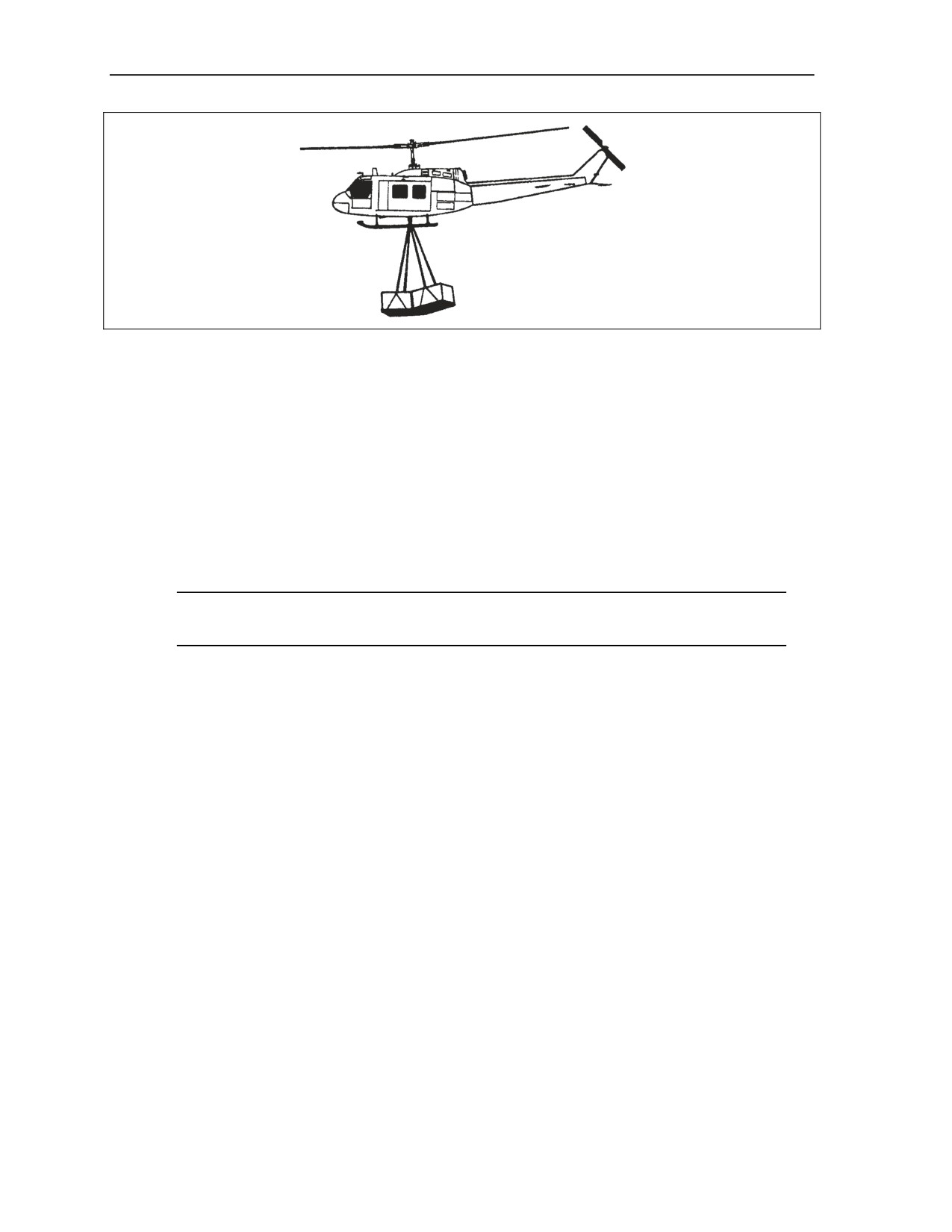
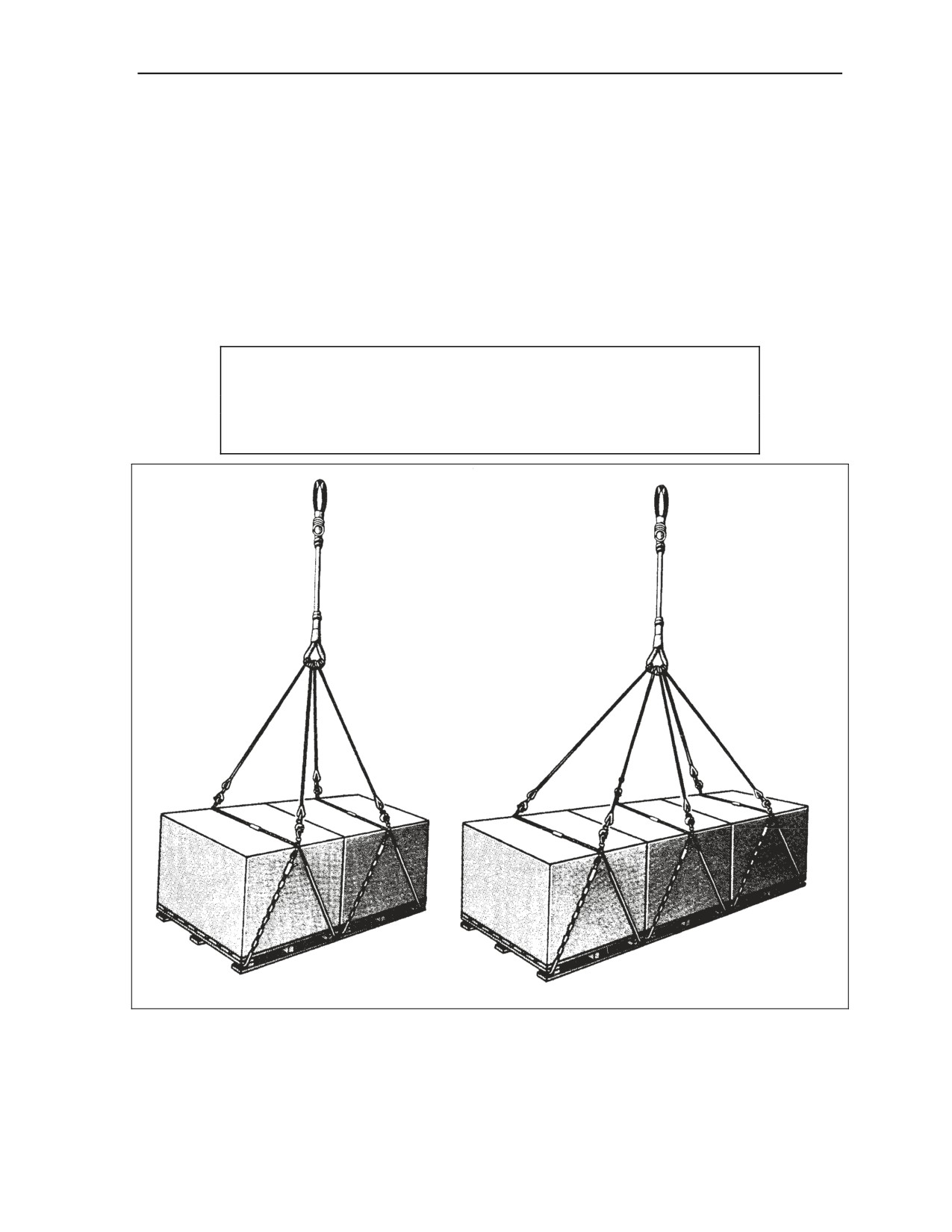
Figure 8-26. Multipallet Load
z
Cleaning and Lubricating Pallet Slings. To clean and lubricate Mk86 and Mk100 pallet
slings, you need fresh water, a wire brush, dry cleaning solvent (P-D-680), clean rags, and
lubricating grease and oil. Step by step procedures are as follows:
Remove salt residue and other foreign matter from tensioners, tubing, and fittings with
water or solvent, if necessary.
Clean exposed areas of wire rope using a wire brush. Make sure all foreign matter and
lubricants are removed from the valleys between the standards and the spaces between outer
wires.
Apply at least three drops of oil to the pivot areas, spring, and locking detent. Wipe off any
excess oil. Exercise latches when lubricating to distribute lubricant.
Lubricate exposed areas of wire rope.
Note: Lubrication should be thin enough to penetrate the strands to the core, but not so thin as
to run off the rope or not so thick that it merely covers the rope.
Store the sling hanging up off the ground.
z
Inspecting Pallet Slings. Inspect pallet slings before using and after exposure to salt water
spray. Also inspect inactive pallet slings every 6 months. Use leather gloves to protect your
hands from any broken wire strands. Perform the inspection by following these steps:
Verify that the following test data is stenciled on equipment or etched on the metal test tag
attached to equipment:
─ Testing facility.
─ Safe working load.
─ Date tested.
Verify that the date tested is within past 18 months.
Inspect plastic tubing on basket legs for tears, cracks, and deterioration.
Inspect rubber or plastic tubing on bridle for cracks and deterioration. Verify that color
coding is correct.
Inspect each swage stop for cracks, deformation, and looseness.
Engage and release both tensioners on a minimum of three different swage stops. Verify
that:
─ Latches function easily.
─ Latches lock firmly.
─ Some effort is required to unlock latches.
Inspect wire rope and fittings for:
─ Outside wires worn to approximately one-half their original diameter.
─ Corroded and pitted wire.
FM 4-20.197/MCRP 4-11.3E, VOL I/NTTP 3-04.11/
8-14
AFMAN 11-223 (I), VOL I/COMDTINST M13482.2B
20 July 2006
A-22 Cargo Bags, Pallet Slings, Pendants, and Supplemental Equipment
─ Two or more broken wires in the valley of a rope lay.
─ Distorted wire rope.
─ Cracked or distorted fittings and thimbles.
─ Washers installed on each leg preventing the plastic tubing from sliding over the
swage stops.
─ One or more broken wires at the thimble or adjacent to a swage fitting.
─ Six or more broken wires in a pitch length or lay of 6 x 19 wire rope, and nine or
more broken wires in a 6 x 37 wire rope.
─ Torn, cracked, or worn plastic chafing tubes.
─ Proper operation of over-the-center latches. If the pallet slings fail inspection, attach
out-of-service tags to the slings, remove from service, and inform your supervisor.
HELI-BASKET
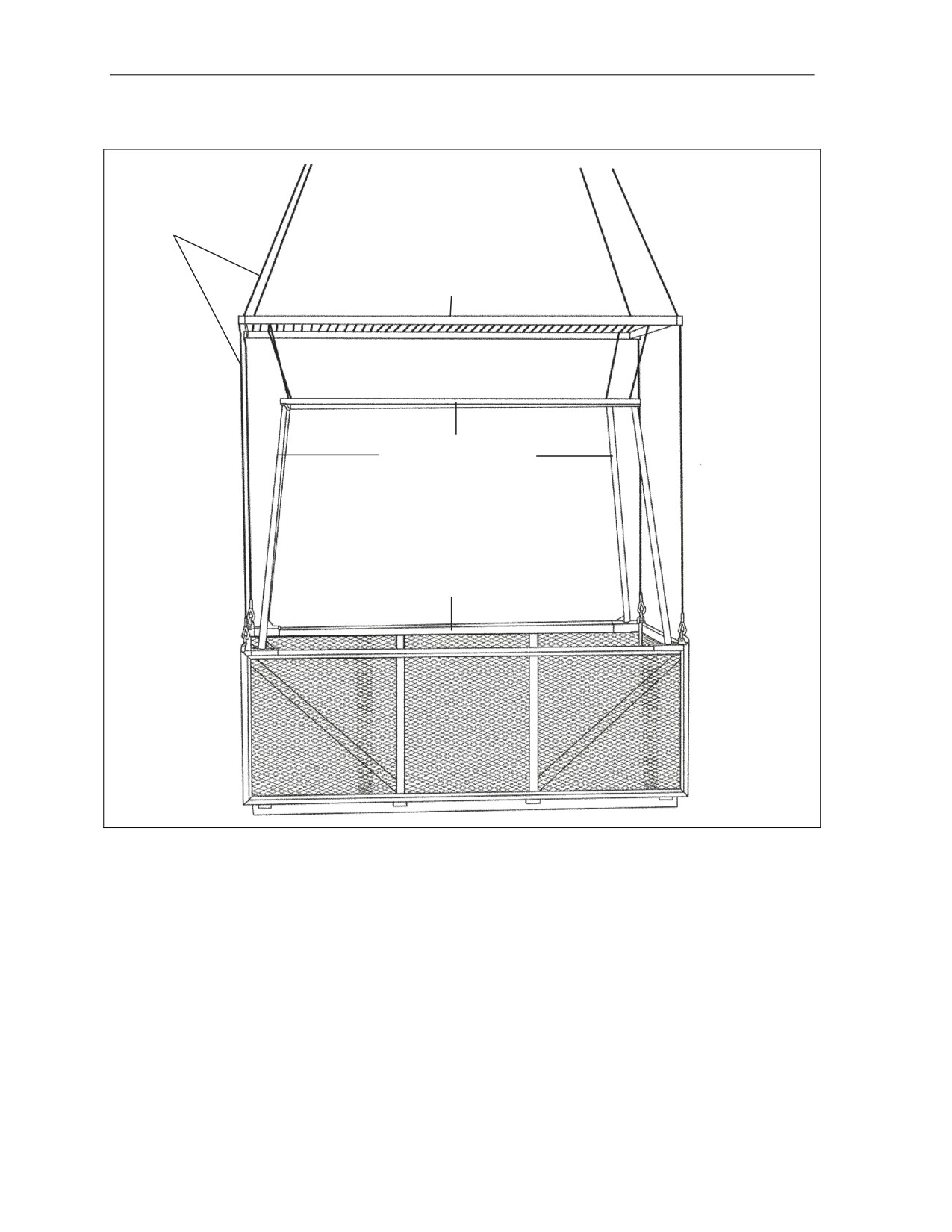
8-6. The HB2000 Heli-Basket consists of the Heli-Basket, protection cage assembly, spreader frame, and
long line. The HB2000 Heli-Basket has a 4,500-pound carrying capacity and weighs about 640 pounds.
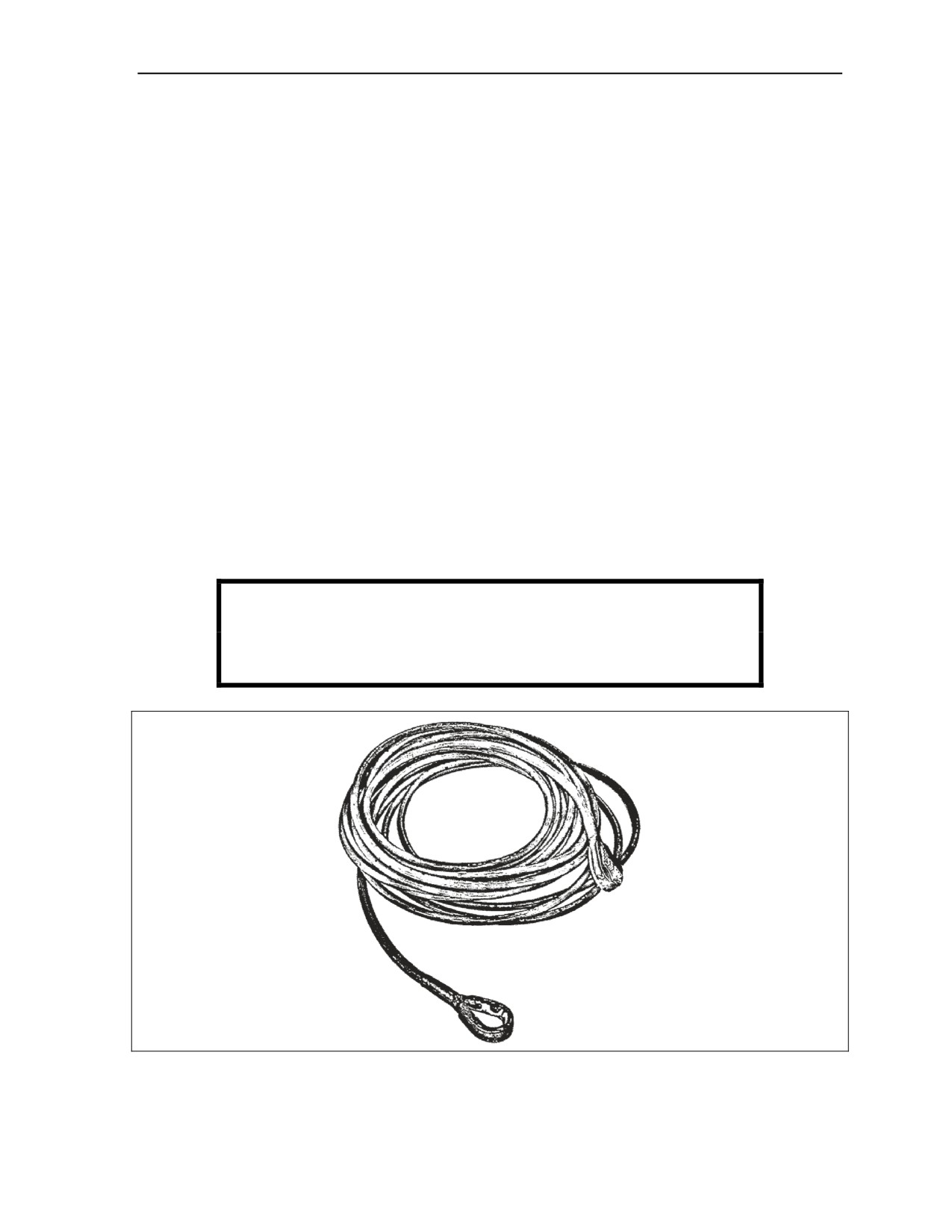
The non-electric long line has a working load limit (WLL) of 6000 pounds and is 120 feet long. This line is
used in conjunction with the HB2000 Heli-Basket (Figure 8-27). Figure 8-28 identifies the parts of a Heli-
Basket. Inspect and assemble the HB 2000 Heli-Basket according to the instructions provided by the
manufacturer. When loading the Heli-Basket, the load must be below the sidewalls and centered on the
base section. The items in the Heli-Basket are secured with CGU-1/B cargo tie down straps or 15-foot tie
down straps with D-rings and load binders. The total rigged weight for the Heli-Basket and cargo is 5,100
pounds. The Heli-Basket may be flown empty at a weight of 640 pounds. This is a single-point load and
demonstrated stable flight speeds at 100 knots when loaded and 120 knots when empty.
DANGER
Do not use the Heli-Basket to move personnel or live cargo.
Figure 8-27. 120-Foot Non-Electric Longline
FM 4-20.197/MCRP 4-11.3E, VOL I/NTTP 3-04.11/
20 July 2006
AFMAN 11-223 (I), VOL I/COMDTINST M13482.2B
8-15
Chapter 8
CABLE HARNESS
ASSEMBLY
SPREADER FRAME
PROTECTIVE CAGE
HELI-BASKET
Figure 8-28. HB2000 Heli-Basket
REACH PENDANTS
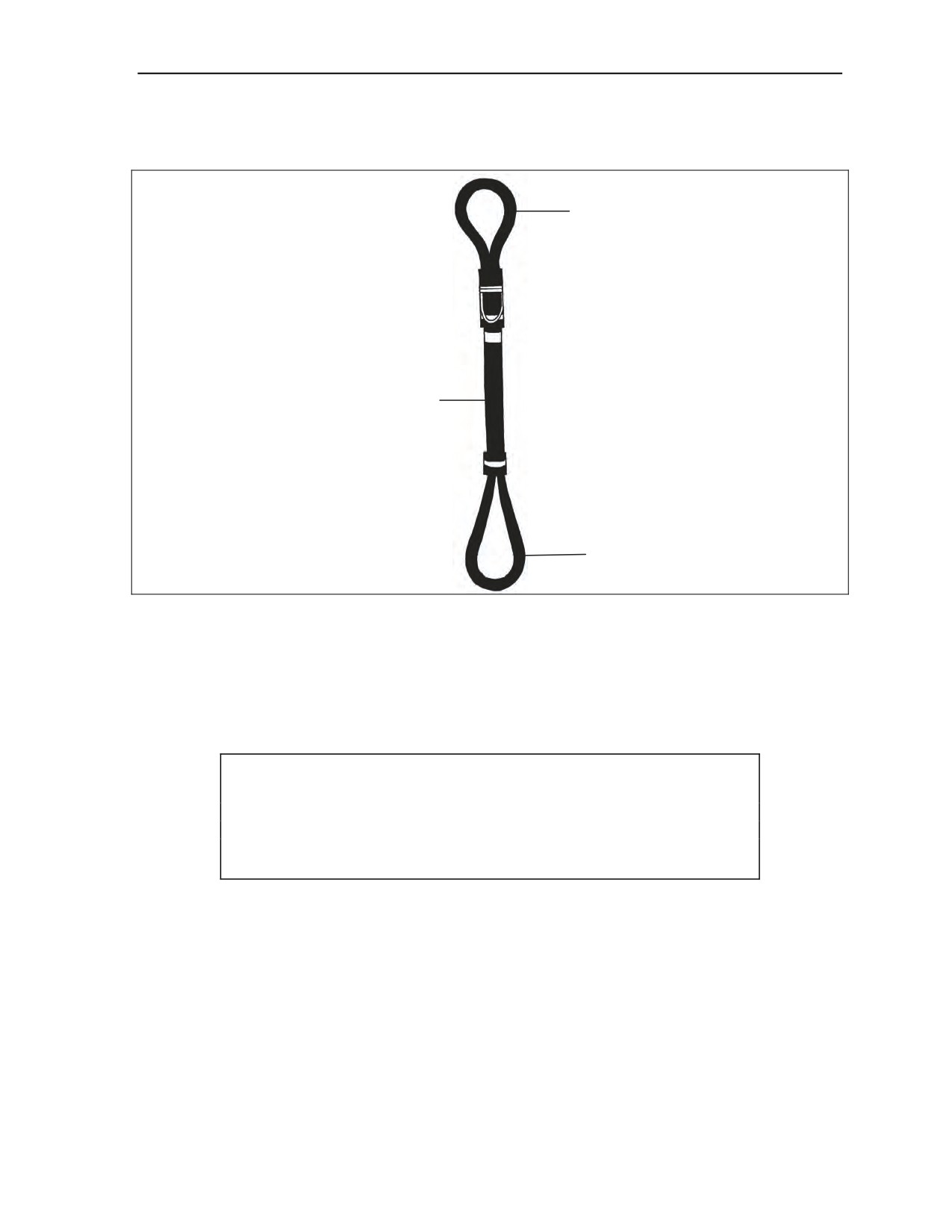
8-7. A reach pendant is a synthetic rope assembly with an attached stiffened reach tube and a loop on
each end. The built-in reach tube enables the hookup man to place the pendant’s top eye on the helicopter
cargo hook while the helicopter hovers at a higher distance over the load. There are two authorized reach
pendants for use on sling loads, the 11,000-pound capacity reach pendant (11-K), the 25,000-pound
capacity reach pendant (25-K).
z
The 11,000-Pound Capacity Reach Pendant. The 11-K, NSN 4020-01-365-3115, part no.
DSG-5-11K, is a reach pendant approximately 5 feet long with an 11,000-pound safe working
load capacity. The top eye is black and has a smaller diameter loop, while the bottom eye is
green with a larger diameter loop. The safe working load capacity is stamped on the reach tube
FM 4-20.197/MCRP 4-11.3E, VOL I/NTTP 3-04.11/
8-16
AFMAN 11-223 (I), VOL I/COMDTINST M13482.2B
20 July 2006
A-22 Cargo Bags, Pallet Slings, Pendants, and Supplemental Equipment
(Figure 8-29). Remove the sling set apex fitting pin; place the pendant lower eye in the apex
fitting; and reinstall the apex fitting pin to use the pendant with a sling set.
TOP LOOP
REACH TUBE
BOTTOM LOOP
Figure 8-29. 11,000- and 25,000-Pound Capacity Reach Pendants
z
The 25,000-Pound Capacity Reach Pendant. The 25-K, NSN 4020-01-337-3185, part
number BOS-14-K7, is a reach pendant approximately 5 feet long with a 25,000-pound safe
working load capacity. The top eye is black and has a smaller diameter loop, while the bottom
eye is black with a larger diameter loop. The safe working load capacity is stamped on the reach
tube (Figure 8-29). Remove the sling set apex fitting pin; place the pendant lower eye in the
apex fitting; and reinstall the apex fitting pin to use the pendant with a sling set.
CAUTION
An older, 25,000-pound capacity reach pendant, issued with an aircraft
aerial recovery kit (ARK), P/N 1670EG093-1 is not authorized for use
in sling load operations.
z
Inspection. Inspect the reach pendants BEFORE AND AFTER use. Check for cuts and tears
in the nylon-urethane plastic sheath on each loop. If the white or red strength member (3rd
layer) is visible, remove the pendant from service. Check for cracked or broken pipes. If the
pipe is cracked with jagged edges or broken; remove the pendant from use. Single-point lift
with a reach pendant can be a problem because of load twisting. Use the following guidance for
use of the reach pendant during a single-point lift:
If there is no twisting and the potting material is visible, the strength is alright and the
flight/lift can continue safely. After that lift the reach pendant should be removed from service.
If the load spins more than 360° the strength of the reach pendant weakens and the lift
should be stopped immediately. If the load spins 360° and then does not start to spin in the
opposite direction the load is unacceptable for use with a reach pendant.
FM 4-20.197/MCRP 4-11.3E, VOL I/NTTP 3-04.11/
20 July 2006
AFMAN 11-223 (I), VOL I/COMDTINST M13482.2B
8-17
Chapter 8
Cleaning. Clean the reach pendant with a mixture of warm water and mild dish or laundry
detergent. Oil and grease may be removed by using varsol or mineral spirits. The top and
bottom eyes may be treated with silicone spray. Do not use silicone spray on the reach tube.
CAUTION
Do not use chemical cleaners on reach pendants. Chemicals may
weaken the strength members of the pendant. If a pendant becomes
contaminated with chemicals, remove it from service.
VERTICAL PENDANTS
8-8. Roundslings and sling legs used as vertical pendants are used in some helicopter sling load
operations to increase the clearance between the helicopter and the load. These pendants are helpful in
situations where blowing dust/snow, tall surrounding obstacles, or reduced visibility impairs the aircrew’s
ability to see the load and/or hookup team. Vertical pendants are used between the helicopter hook and the
sling set used to rig the load or the load itself. Vertical pendants differ from pendants provided by the
aviation unit (refer to Figure 2-1) in that the vertical pendants do not have a supplemental releasable swivel
hook that allows the aircrew to release the load without dropping the pendant. Vertical pendants also
differ from reach pendants in that no rigid portion is provided to assist in ground hookup. Items used for
vertical pendants in order of preference are the polyester roundsling and sling legs from the 10,000-pound
and 25,000-pound sling sets.
z
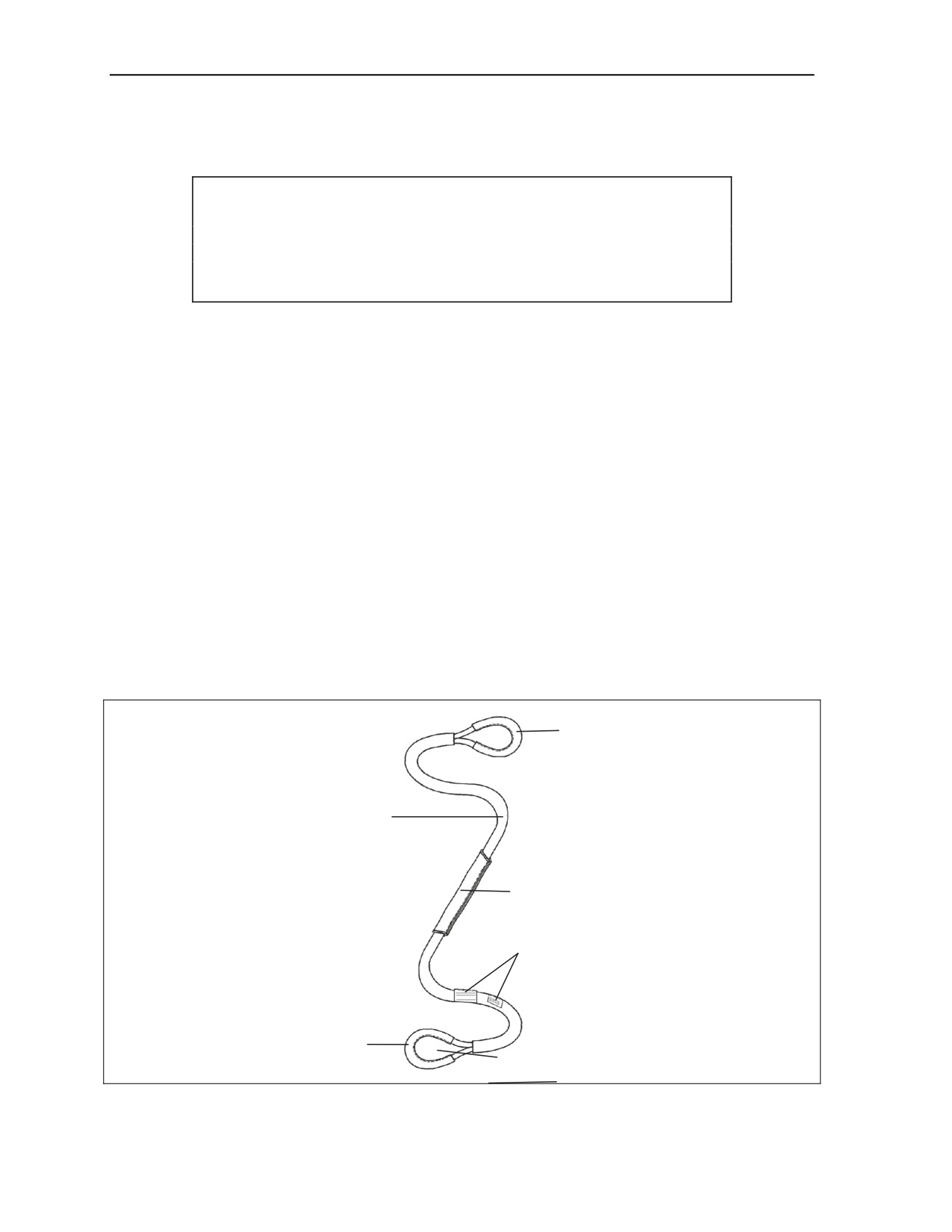
Polyester Roundslings. Polyester roundslings are used as the primary vertical pendant
(Figure 8-30). Roundslings can be attached to the load using the three hitches described in
Chapter 6. The lifting capacity of polyester roundslings vary with the size of the sling and the
type of hitch used to attach the load. Each sling has two identification tags permanently sewn to
the eye and eye sleeve identifying the size and capacity, as well as other important information
necessary for the safe use of roundslings. These slings are also color coded to designate the
capacity of the sling. Refer to Table 8-1 for sling lengths and lift capacities.
EYE
EYE AND EYE
SLEEVE
(COLOR CODED)
SLIDING WEAR PAD
REACH TUBE
IDENTIFICATION TAGS
EYE WEAR PAD
EYE
Figure 8-30. Polyester Roundslings
FM 4-20.197/MCRP 4-11.3E, VOL I/NTTP 3-04.11/
8-18
AFMAN 11-223 (I), VOL I/COMDTINST M13482.2B
20 July 2006

A-22 Cargo Bags, Pallet Slings, Pendants, and Supplemental Equipment
Table 8-1. Safe Working Loads for Polyester Roundslings
PART NO
LENGTH IN
COLOR
LIFT CAPACITY BY HITCH TYPE
WEIGHT IN
FEET
POUNDS
CHOKED VERTICAL
BASKET
PRS2E008
8
GREEN
4,200
5,300
10,600
4
PRS2E017
17
GREEN
4,200
5,300
10,600
10
PRS3E008
8
YELLOW
6,700
8,400
16,800
5
PRS3E017
17
YELLOW
6,700
8,400
16,800
11
PRS5E030
30
RED
10,600
13,200
26,400
26
PRS7E065
65
BLUE
17,000
21,200
42,400
75
PRS7E070
70
BLUE
17,000
21,200
42,400
81
Inspection. Inspect the polyester roundsling before and after each use. Remove the
roundsling from service if any of the following are found:
─ Both identification tags are missing or are not readable.
─ Acid or alkali burns.
─ Melting, charring or weld splatter of any part of the roundsling.
─ Holes, tears, cuts, snags, embedded particles, or abrasive wear that exposes the core
fibers.
─ Broken or worn stitching in the cover that exposes the core fibers.
─ Knots in any part of the roundsling.
─ Distortion, excessive pitting, corrosion or broken fitting(s).
─ Any condition which causes doubt as to the strength of the roundsling.
CAUTION
Do not drag roundslings on the floor or over rough surfaces. Do not
twist or join roundslings together using knots.
Storage. Store roundslings in a clean, dry, cool area, out of direct sunlight. Prolonged
exposure to sunlight will deteriorate the strength of roundslings.
z
10,000- And 25,000-Pound Capacity Sling Sets. Each nylon rope sling leg has stored energy
because the nylon rope stretches when carrying a load. If the lifting provision on the load, or the
sling leg itself, were to break, this stored energy would cause the sling leg to rebound upward
and possibly damage the helicopter. Therefore whenever possible, avoid connecting single sling
legs together end to end. If your situation requires more than one sling leg length, join pairs of
sling legs side by side using a sling set apex fitting instead of just single sling legs connected
end to end. The safe working load capacities of a sling leg from a 10,000- or 25,000-pound
capacity sling set when used as a vertical pendant are 2,500 and 6,250 pounds, respectively.
z
Nylon and Chain Multileg Sling Set. The nylon strap portion of the sling leg does not stretch
as much as a nylon rope sling leg. Single legs from the multileg sling set can be connected end
to end using a large clevis (MS 70087-3) or a Type IV link connector. Each sling leg, when
used as a vertical pendant, has a safe working load capacity of 8,800 pounds.
SUPPLEMENTAL EQUIPMENT
8-9. Supplemental equipment is defined as items that are used with slings and other lifting devices to
guard against damage to equipment and to expedite the sling load operation by minimizing the number of
personnel required.
z
Tape. Pressure-sensitive tape is used to hold loose equipment in place. Do not use tape as a
load bearing item. The tape should be woven cloth tape (duct tape), pressure-sensitive,
FM 4-20.197/MCRP 4-11.3E, VOL I/NTTP 3-04.11/
20 July 2006
AFMAN 11-223 (I), VOL I/COMDTINST M13482.2B
8-19
Chapter 8
waterproof, and at least 2 inches wide. Some of the most common applications of tape are as
follows:
CAUTION
Pressure-sensitive tape can leave adhesive residue on the sling legs
causing premature wear.
To prevent loose chain ends from whipping and damaging equipment.
To attach protective padding to slings or the load itself.
To secure chain loop or sling legs in place before load is lifted.
z
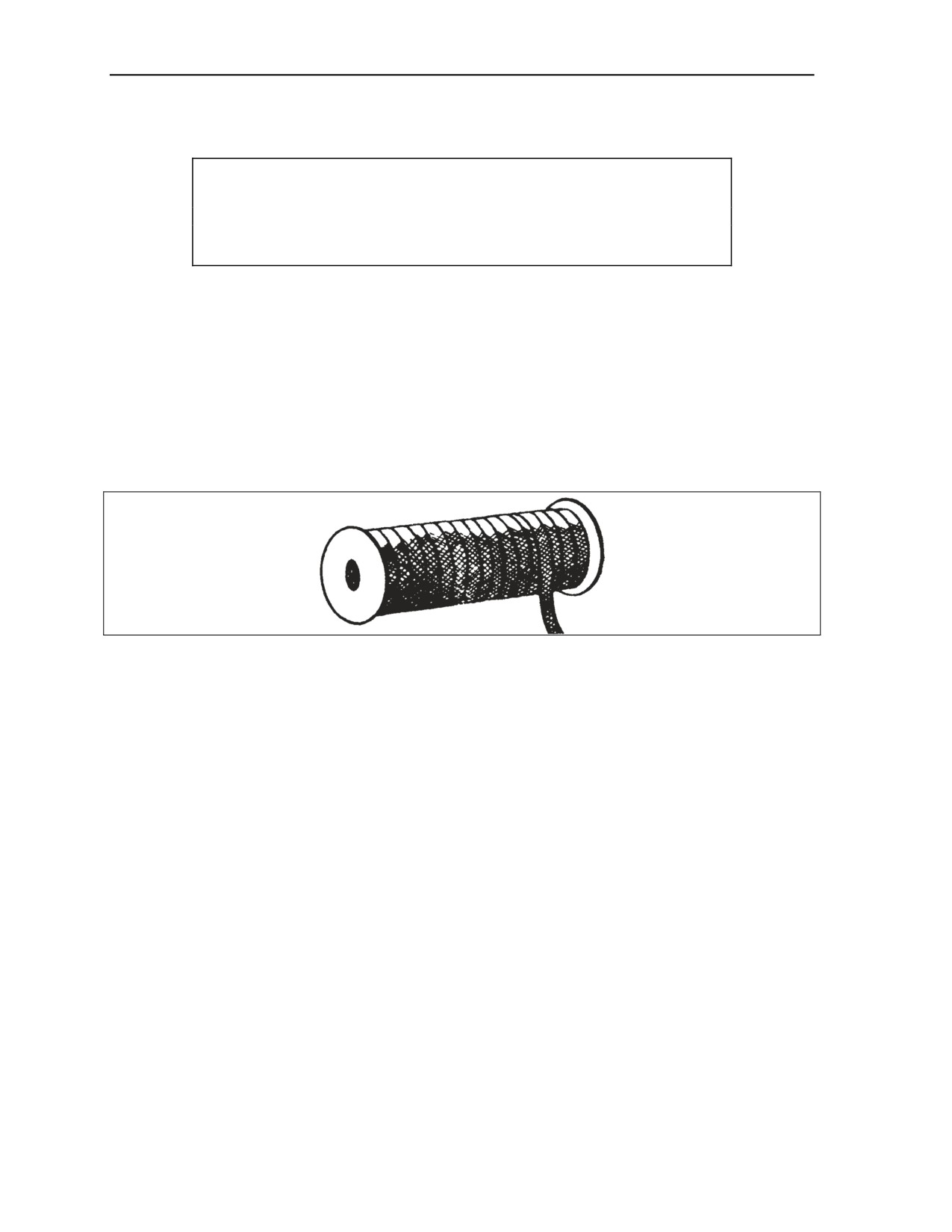
Cotton Webbing. Cotton webbing is used as an alternative to pressure-sensitive tape. The 1/4-
inch wide Type I cotton webbing (Figure 8-31) is rated at 80 pounds breaking strength. Cotton
webbing is also used to combine and hold the legs of the cargo sling on top of the load after the
sling legs are attached. Once tension is applied to the sling, the webbing will break, freeing the
sling legs for normal weight-carrying configuration. This breakaway technique reduces the risk
of the sling legs fouling on the load during hookup and lift-off. The distance between
breakaway ties is approximately 3 feet.
Figure 8-31. 1/4-Inch Cotton Webbing
z
Nylon Cord. Type III nylon cord has a breaking strength of 550 pounds. Because of its high
breaking strength, nylon cord is not used in situations that require the breakaway technique.
Nylon cord is used to secure loose equipment, padding, and excess chain. Type III nylon cord is
also used as a barrier to prevent sling legs from becoming entangled in the equipment to be
moved.
z
Protective Padding. To prevent chafing damage to equipment during sling load operations, any
chain end of a sling connected to or resting against the lightweight metal surface of a piece of
equipment should be wrapped with padding to prevent damage. The padding is also wrapped
around the nylon portion of the sling legs and taped or tied to protect the legs from
sharp objects which could damage the sling legs or cause fusing or melting of the
nylon due to friction. The padding may also be secured to the load to prevent
damage. Cellulose padding is commonly used and recommended. Cellulose,
however, can easily be damaged by water. Felt sheeting may also be used as
padding. Other materials may be used, such as rags and inner tubes, but they
must be able to withstand rotor wash and wind during flight.
z
Clevises. Clevises may be used to rig equipment that does not have lifting shackles attached to
the lifting provisions or lifting provisions not large enough for the chain to pass through the
lifting points. Large, medium, small, and small screw-pin clevises may be used in sling load
operations.
FM 4-20.197/MCRP 4-11.3E, VOL I/NTTP 3-04.11/
8-20
AFMAN 11-223 (I), VOL I/COMDTINST M13482.2B
20 July 2006
A-22 Cargo Bags, Pallet Slings, Pendants, and Supplemental Equipment
CAUTION
The nut and bolt assemblies of different size clevises are not
interchangeable. See Appendix B for bolt and nut NSNs for each
clevis assembly.
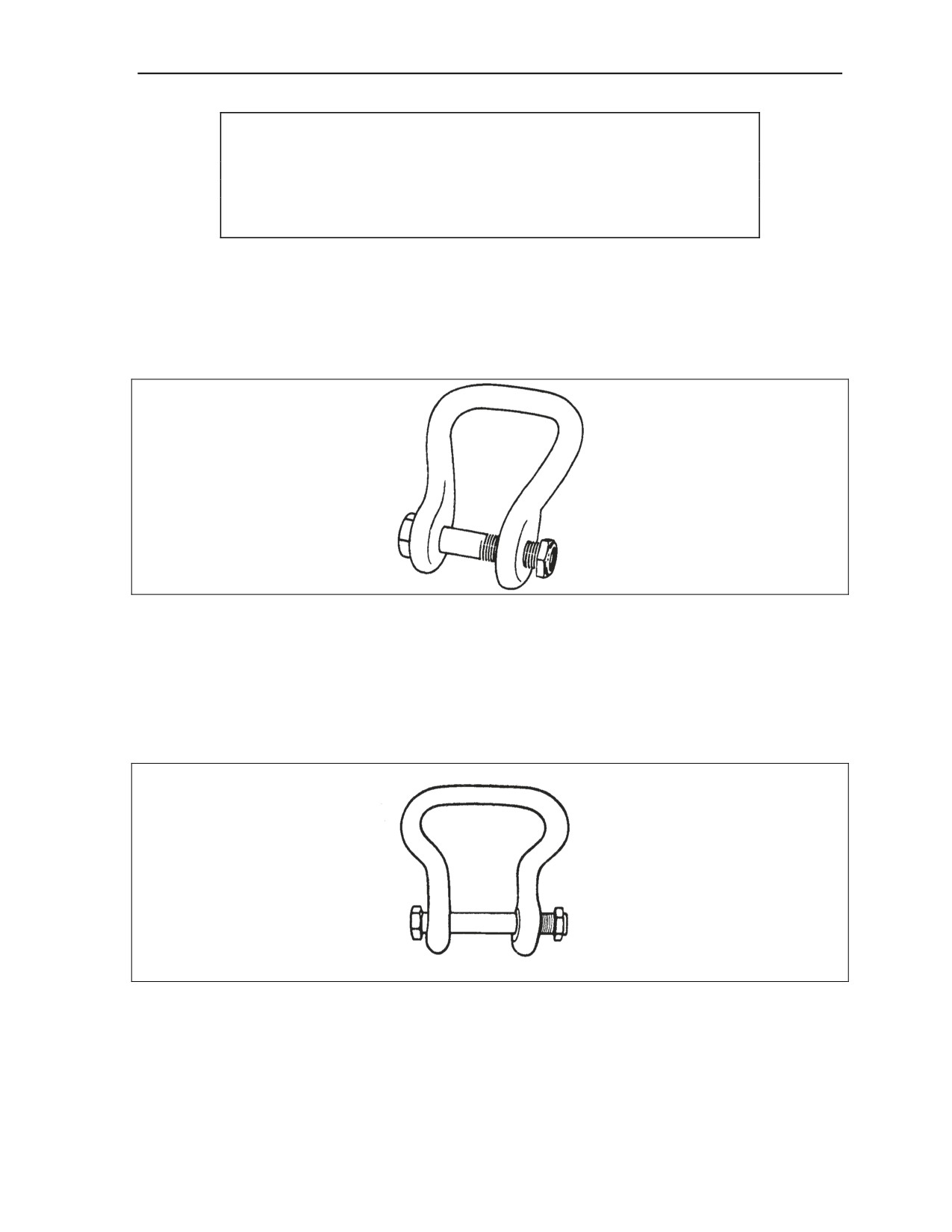
Large Clevis. The large clevis (Figure 8-32) can be used to lift a load that weighs up to
12,500 pounds if it has only one attachment point. If the load has four attachment points and a
large clevis is used at each lifting point, the maximum load weight that can be lifted is 31,500
pounds. If the load has two or three attachment points, the maximum load weight is 15,750 and
23,625 pounds, respectively. The large clevis is often used as a junction point when suspending
an accompanying load under a howitzer. The large clevis uses a 1-inch bolt and nut.
Figure 8-32. Large Clevis Assembly (Part No. MS 70087-3)
Medium Clevis. The medium clevis (Figure 8-33) can lift single lift point loads up to a
maximum weight of 6,250 pounds. It also can be used to attach sling legs of a four-legged sling
set to a load weighing up to 15,000 pounds. If the load has two or three attachment points, the
maximum load weight is 7,500 and 11,250 pounds, respectively. It is commonly used to join
the four suspension web straps on the A-22 cargo bag. The medium clevis has a 3/4-inch bolt
and nut.
Figure 8-33. Medium Clevis Assembly (Part No. MS 70087-2)
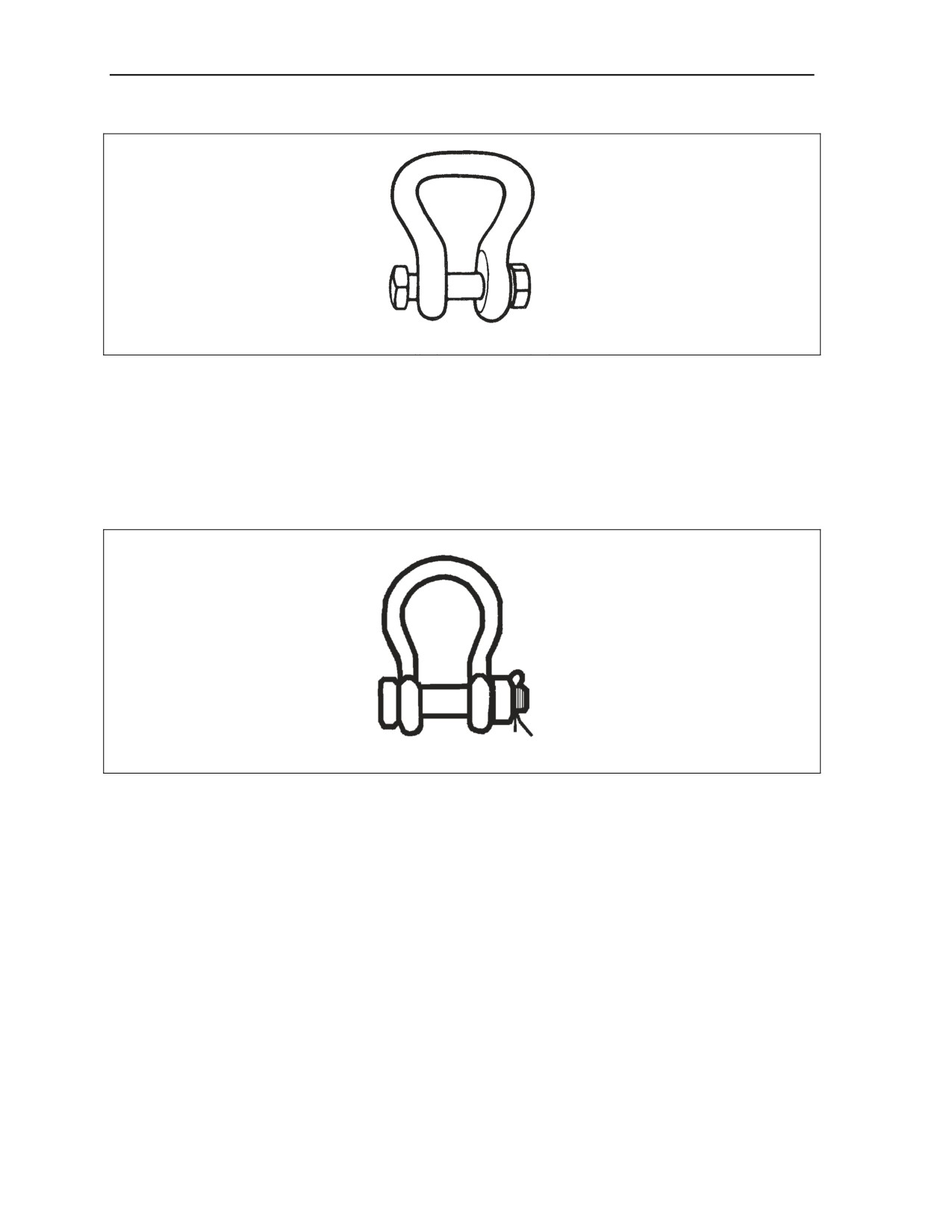
Small Clevis. The maximum load weight that can be lifted using a small clevis (Figure 8-
34) at the ends of a four-legged sling set is 15,000 pounds. If the load has two or three
attachment points, the maximum load weight is 7,500 and 11,250 pounds, respectively. The
small clevis can also be used to lift a load that weighs up to 6,250 pounds if it has only one
attachment point. The small clevis is identified by a 5/8-inch bolt and nut.
FM 4-20.197/MCRP 4-11.3E, VOL I/NTTP 3-04.11/
20 July 2006
AFMAN 11-223 (I), VOL I/COMDTINST M13482.2B
8-21
Chapter 8
Figure 8-34. Small Clevis Assembly (Part No. MS 70087-1)
Anchor Shackles
(Figure
8-35). Anchor shackles are used to attach sling legs to
equipment that does not have shackles attached to the lift provisions. After installing the
shackle, place the nut on the bolt and safety the nut with the cotter pin. This keeps the pin from
backing out in flight. The safe working load capacities of several sizes of anchor shackles are
listed in Table 8-2. The capacity of the anchor shackle is marked on the shackle.
Figure 8-35. Anchor Shackles
z
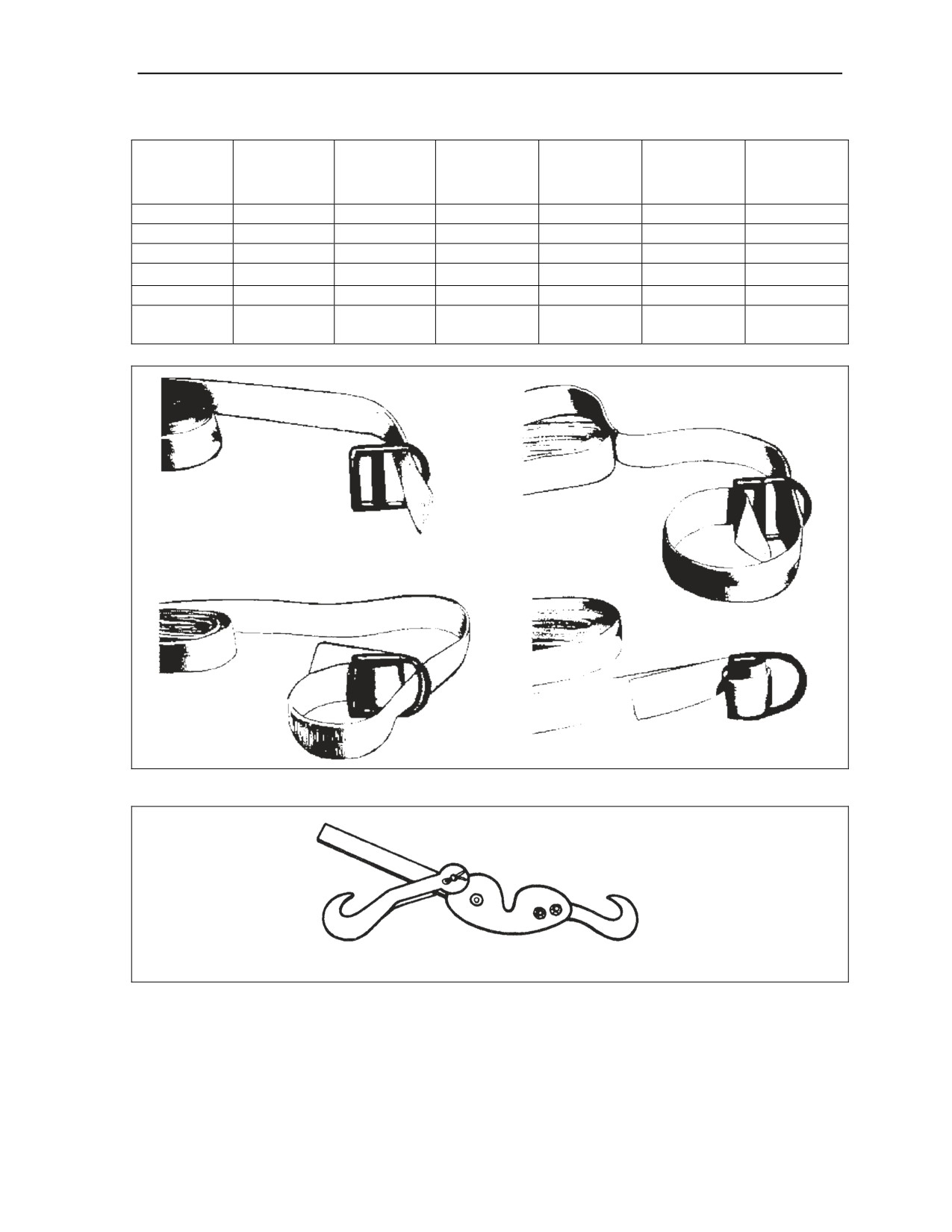
15-Foot Tiedown Strap. The 15-foot tiedown strap is made of 1 3/4-inch wide Type V low-
elongation polyester textile webbing with a D-ring at one end. The cargo tiedown straps are
used with heavy duty D-rings and load binders to secure bulk or palletized cargo making up a
single load or for lashing cargo to a vehicle. The procedure for using the heavy duty D-ring
(Figure 8-36) is outlined in the following steps:
Step 1. Run the free end of the tiedown strap up through the large opening in the D-ring.
Step 2. Run the strap around and through the small opening in the D-ring.
Step 3. Run the strap back through the large opening in the D-ring.
Step 4. Pull the strap taut.
Roll and tape the loose end of the strap.
z
Load Binder. The load binder (Figure 8-37) is a locking device which is used to tighten and
secure lashing straps. Each binder consists of two body plates which attach at one end to a short
hook and at the other end to a handle that holds a pivoting long hook. Use the following
instructions to use a
15-foot tiedown strap with the heavy duty D-ring and load binder
(Figure 8-38).
FM 4-20.197/MCRP 4-11.3E, VOL I/NTTP 3-04.11/
8-22
AFMAN 11-223 (I), VOL I/COMDTINST M13482.2B
20 July 2006
A-22 Cargo Bags, Pallet Slings, Pendants, and Supplemental Equipment
Table 8-2. Safe Working Load Capacities for Anchor Shackles
PART
NSN
DIA.
ONE
TWO
THREE
FOUR
NUMBER
ATTACHMENT
ATTACHMENT
ATTACHMENT
ATTACHMENT
4030-
(INCH)
POINT
POINTS
POINTS
POINTS
(POUNDS)
(POUNDS)
(POUNDS)
(POUNDS)
G-2130-3/8 IN
00-378-4842
3/8
2,000
2,570
3,850
5,100
G-2130-1/2 IN
00-804-2307
1/2
4,000
5,100
7,700
10,300
G-2130-5/8 IN
00-804-2308
5/8
6,500
8,300
12,500
16,700
G-2130-3/4 IN
00-343-5433
3-4
9,500
12,200
18,300
24,400
G-2130-7/8 IN
00-373-1120
7/8
13,000
16,700
25,000
33,400
G-2130
01-282-3470
1
17,000
21,800
32,700
43,600
8-1/2 TON
STEP 1
STEP 2
STEP 3
STEP 4
Figure 8-36. Tiedown Strap Routed Through the D-ring
Figure 8-37. Load Binder
FM 4-20.197/MCRP 4-11.3E, VOL I/NTTP 3-04.11/
20 July 2006
AFMAN 11-223 (I), VOL I/COMDTINST M13482.2B
8-23
Chapter 8
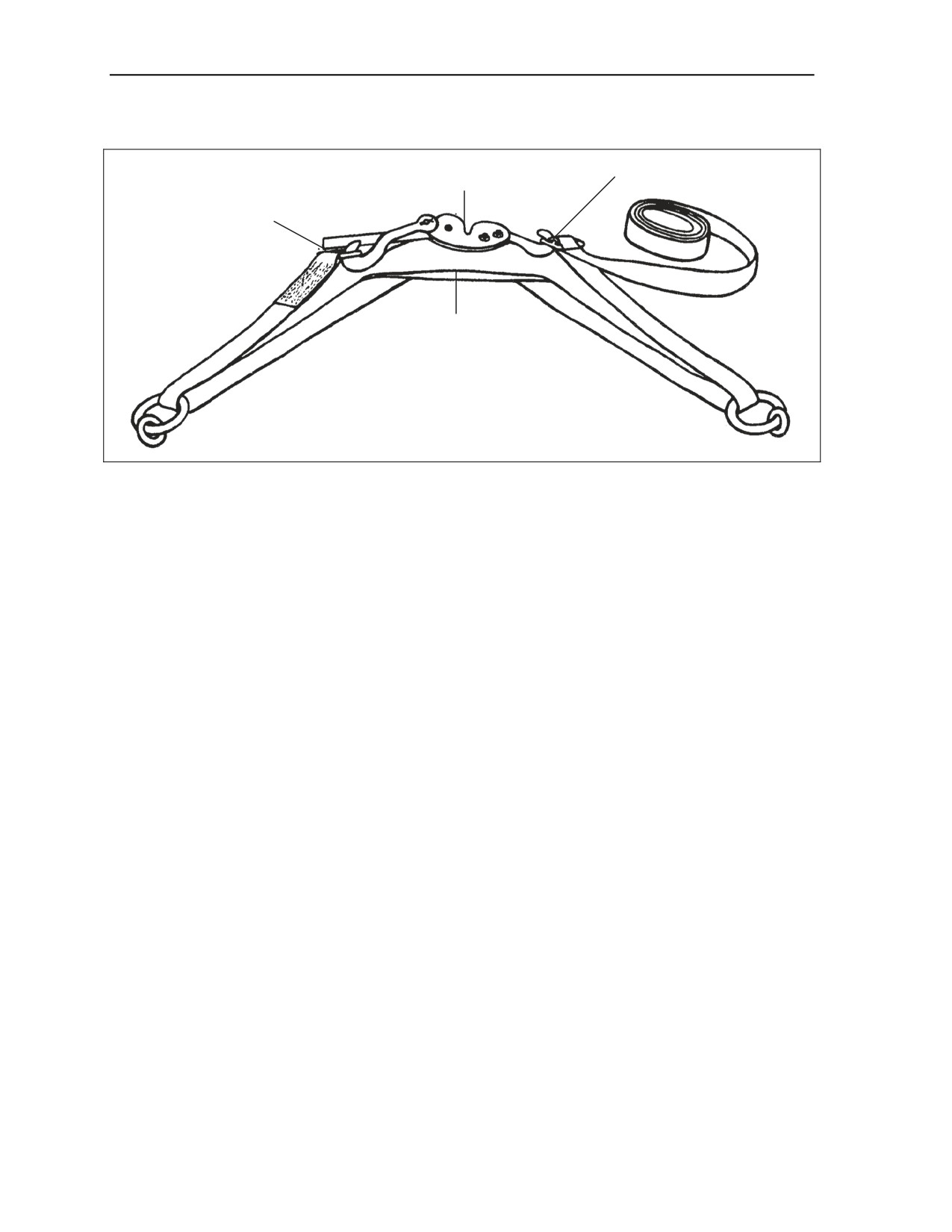
HEAVY DUTY D-RING
LOAD BINDER
SEWN D-RING
15-FOOT TIEDOWN STRAP
Figure 8-38. Tiedown Strap, Load binder, and Heavy Duty D-ring Combined
Pass the free end of the tie-down strap up, over, around, or through the tie-down provision,
then back toward the sewn tie-down strap D-ring.
Attach a heavy duty D-ring to the running end of the tiedown strap.
Attach the sewn D-ring of the tie-down strap to one open hook of the load binder and the
heavy duty D-ring to the other open hook.
Apply tension to the lashing by pulling on the free end of the tie-down strap and closing the
load binder while pulling on the free end of the tie-down strap.
Fold the excess strap and place it alongside the load binder handle. Then tape or tie the
folded excess strap by passing tape or 1/4-inch Type I cotton webbing around the strap, load
binder, and load binder handle. The combination of tie-down strap, load binder, and heavy duty
D-ring is most often used to secure loose cargo in a vehicle or trailer.
z
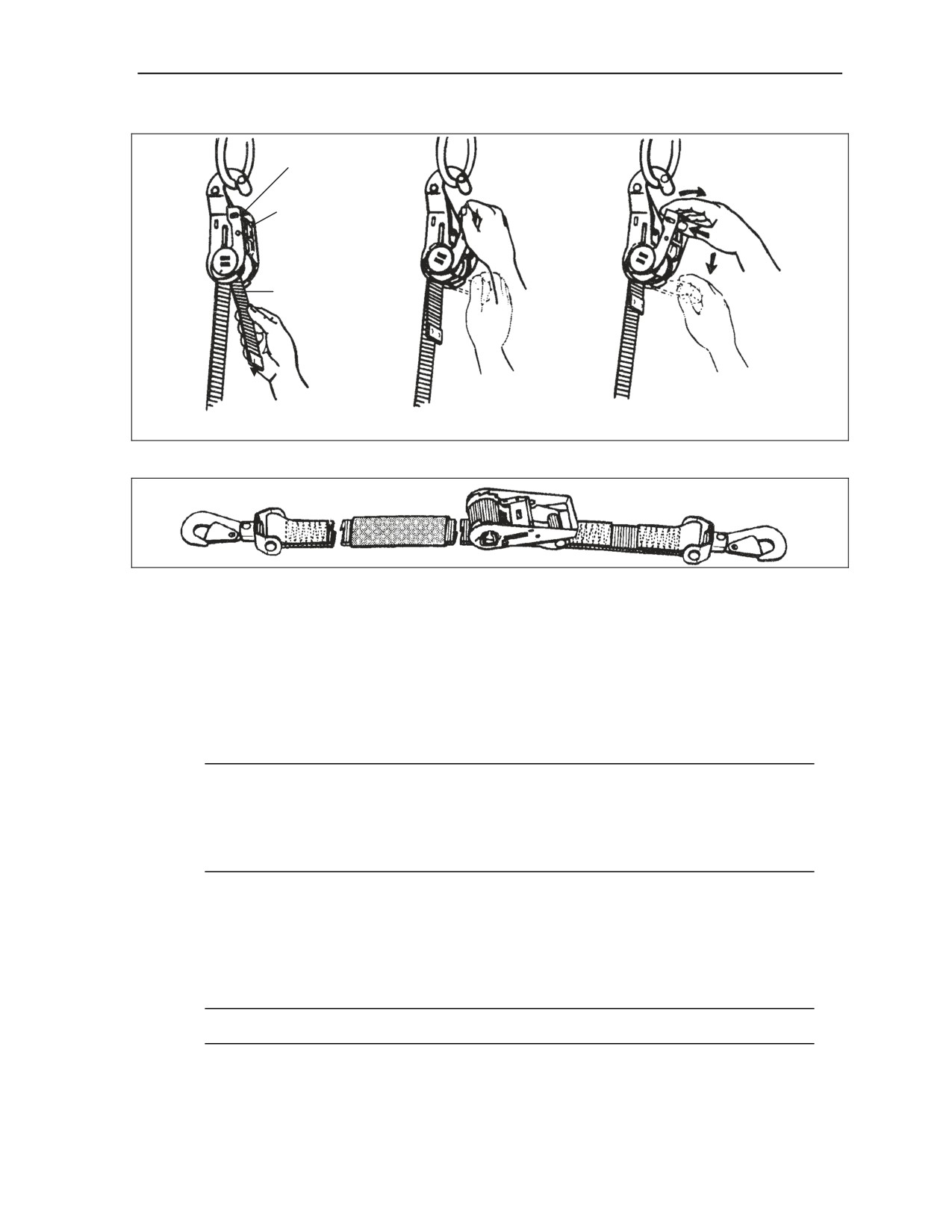
Cgu-1/B Cargo Tiedown Strap. The CGU-l/B 5,000-pound capacity cargo tiedown strap is
used to restrain cargo in vehicles and trailers (Figure 8-39). The tiedown strap is also used
between the prime mover and towed or tandem loads, such as M998 truck and M101 trailer to
prevent the truck and trailer from pivoting in flight. To operate the tiedown strap, attach the
fixed hook of the strap to the cargo or over the cargo to a tiedown ring if the cargo does not have
tiedown provisions. Then attach the hook and ratchet end to a tiedown. Make sure that the
spool on the ratchet is completely unwound. Apply tension by pulling on the end of the
webbing that passes through the spool. While holding the webbing, operate the handle with a
rocking motion to tighten spool. Do not force with added leverage. To release, depress the
release bar handle in while turning handle to the full open position.
z
Special Webbing Strap. The 5,000-pound capacity special webbing strap (Figure 8-40) is
similar to the CGU-l/B cargo tiedown strap. The main differences are the swivel hooks and the
short strap attached to the ratchet device. Two moveable nylon sleeves on the 20-foot strap
section can be positioned at chaffe points on the load to protect the strap from damage.
FM 4-20.197/MCRP 4-11.3E, VOL I/NTTP 3-04.11/
8-24
AFMAN 11-223 (I), VOL I/COMDTINST M13482.2B
20 July 2006
A-22 Cargo Bags, Pallet Slings, Pendants, and Supplemental Equipment
BAR LEVER
HANDLE
SPOOL MUST
BE UNWOUND
WEB STRAP
PULL
TIGHTENING
RELEASING
TAKING UP SLACK
Figure 8-39. CGU-1/B 5,000-Pound Capacity Tiedown Strap
Figure 8-40. Special Webbing Strap (P/N 9392419)
z
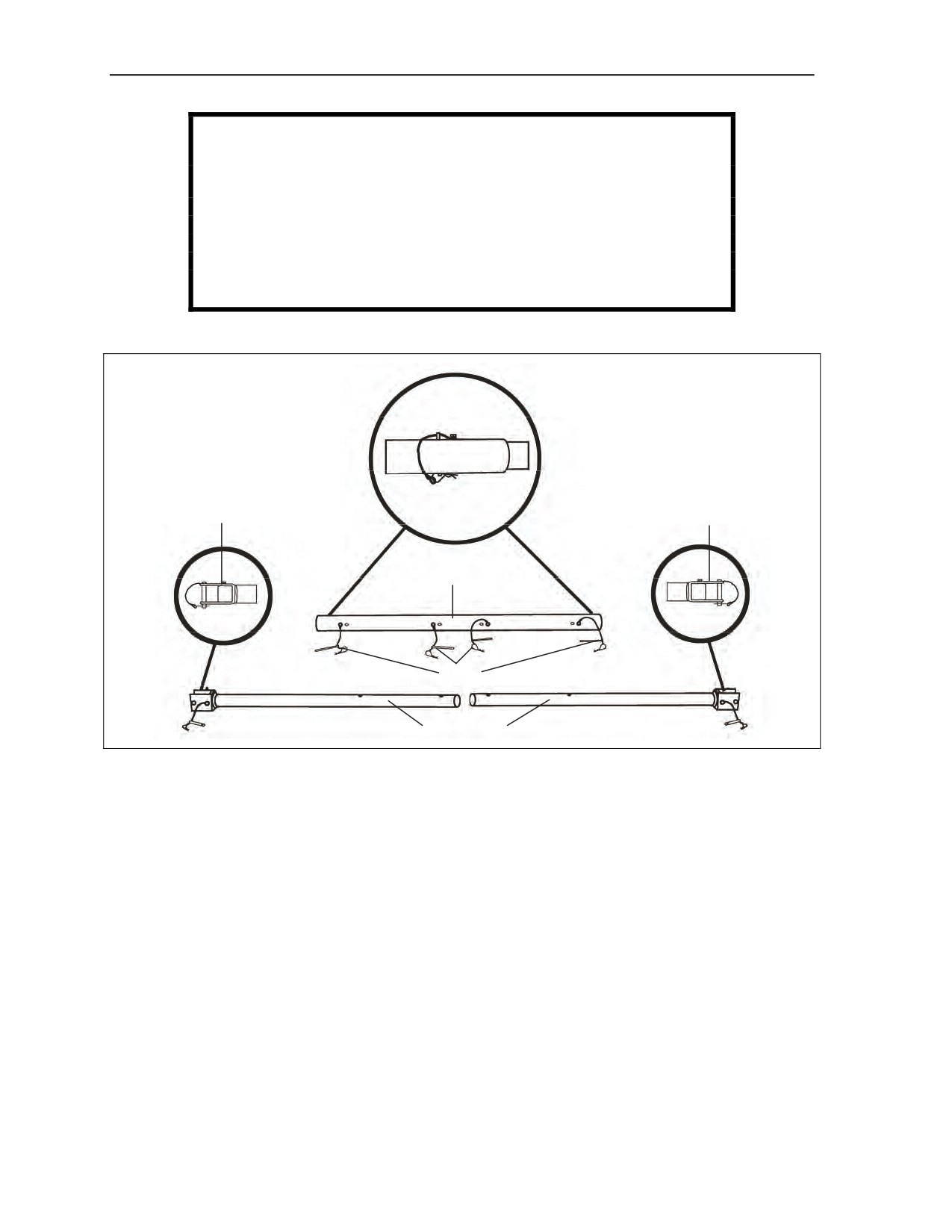
15,000-Pound Spreader Bar. The 15,000-pound spreader bar (Figure 8-41) is used to keep the
sling legs from contacting or damaging the load during sling loading, The 15,000-pound
spreader bar may be used on single-point, dual-point, or tandem loads but only when authorized
in the rigging instructions for that load. The 15,000-pound spreader bar consists of three
interlocking aluminum tubes with an overall length of 104-inches and a working length of 100-
inches. The sling legs are attached to the 15,000-pound spreader bar by removing the sling
guide pins, placing the sling legs in the sling guides, and reinserting the sling guide pins. The
NSN and part number are listed in Appendix B.
Notes: 1. The 15,000-pound spreader bar is not interchangeable with the HMMWV ambulance
spreader bar. Do not substitute the HMMWV ambulance spreader bar with the 15,000-pound
spreader bar.
2. Do not use the 15,000-pound spreader bar unless the specific rigging instructions for
the load call for it.
Inspect the 15,000-pound spreader bar before and after each use. Check for dents, cracks,
bending of the aluminum tubes, and burrs on the sling guide surface. Remove the spreader bar
from service if the aluminum tubes of the 15,000-pound spreader bar is cracked, dented, or bent.
File any burrs on the sling guide interface. Remove the spreader bar from service if the sling
guide interface is cracked, crushed, grossly deformed (no longer a rounded surface), of has
sharp edges that cannot be filed smooth.
Note: Minor denting on the sling guide interface is acceptable.
Remove any foreign material from the 15,000-pound spreader bar.
The 15,000-pound spreader bar should be stored in a clean dry area.
FM 4-20.197/MCRP 4-11.3E, VOL I/NTTP 3-04.11/
20 July 2006
AFMAN 11-223 (I), VOL I/COMDTINST M13482.2B
8-25
Chapter 8
WARNINGS
1. All four pins must be installed through both the inner and
outer tubes of the spreader bar. Failure to install the pins will
cause the spreader bar to fail.
2. Do not use spreader bars that are dented or bent. Dented or
bent spreader bars may fail during flight causing loss of the load.
SLING GUIDE
SLING GUIDE
CENTER TUBE
PINS
END TUBE
Figure 8-41. 15,000-Pound Spreader Bar (P/N 11-1-4703)
FM 4-20.197/MCRP 4-11.3E, VOL I/NTTP 3-04.11/
8-26
AFMAN 11-223 (I), VOL I/COMDTINST M13482.2B
20 July 2006
Chapter 9
Vertical Replenishment (USN, USMC, USCG)
INTRODUCTION
9-1. Transferring cargo from or to a ship by helicopter using a cargo sling is called vertical replenishment
(VERTREP). VERTREP is often more practical than receiving the helicopter on deck, so it is used in most
Navy and Coast Guard sling load operations. VERTREP increases the capability of the alongside
replenishment operation. This chapter provides general instructions and specific rigging procedures for
VERTREP operations. For more detailed information on VERTREP, refer to NWP 14, NWP 42, or
COMDTINST M3710.2. Should conflicts arise between the procedures found in this chapter and those
found in NWPs and COMDTINSTs, the NWPs and COMDTINSTs will govern. The decision to land the
aircraft or use VERTREP will depend on various factors: size, shape, and weight of the cargo; stability of
the flight deck; and urgency of the mission.
VERTICAL REPLENISHMENT AIRCRAFT
9-2. The Navy and Coast Guard use several aircraft for VERTREP operations. The H-46 is the most
widely used Navy VERTREP helicopter; its tandem rotor configuration allows maneuverability without the
wind restrictions of tail rotor helicopters. Therefore, the ships may vary course and speed while
undergoing VERTREP. The H-2, H-3, and H-60 helicopters have VERTREP capabilities but their use is
limited due to mission design and requirements. The H-53 is used by the Marine Corps for vertical lifts
and by the Navy for vertical onboard delivery (VOD) operations. The UH-1 has a weight-limited
VERTREP capability. All Coast Guard helicopters have VERTREP capability. Refer to NWP 42,
COMDTINST M3710.2, and Chapter 2 of this manual for each helicopter’s general capabilities.
COAST GUARD DANGEROUS CARGO VERTREP
9-3. When moving dangerous cargo, the provisions of AFMAN(I) 24-204 must be followed. Although
AFMAN(I) 24-204 specifically prescribes rules for carrying dangerous materials internally aboard military
aircraft, the Coast Guard applies the rules to sling load cargo as well. Air movement of hazardous
materials (internal and external) will be in accordance with AFMAN(I) 24-204. However, the preferred
method to move such cargo is by sling loading. Waivers to the provisions of AFMAN(I) 24-204 and
authorization to move hazardous materials not listed in AFMAN(I) 24-204 may be requested from
Commandant (G-OAV) via the chain of command.
Note: When operating in remote areas, when the mission is adversely affected, or when the
health and welfare of personnel is jeopardized by a delay in obtaining a waiver, the
Commanding Officers of the air capable cutters may authorize the movement of "single dagger"
items (as annotated in Table 4-1, AFMAN(I) 24-204) aboard their deployed aircraft.
FACTORS AFFECTING VERTREP
9-4. For VERTREP, the helicopter must hover over the ship. The difference between engine power
required to hover without a load and maximum available engine power is the excess power which can be
used to carry cargo.
FM 4-20.197/MCRP 4-11.3E, VOL I/NTTP 3-04.11/
20 July 2006
AFMAN 11-223 (I), VOL I/COMDTINST M13482.2B
9-1
Chapter 9
z
Wind. A relative wind of 15 to 30 knots is considered ideal. The helicopter should take off,
make approaches, and hover into the relative wind.
z
Temperature and Atmospheric Pressure. Any increase in temperature or decrease in
atmospheric pressure will decrease maximum lift capability. This loss in lift is a result of
reduced engine performance and reduced aerodynamic performance of the rotor blades. Thus, a
cold, dry day with high barometric pressure and a strong, steady relative wind is ideal for
VERTREP.
z
Helicopter Fuel Loading. A full load of fuel adds substantial weight to the helicopter and
reduces the amount of cargo that can be lifted. As the fuel is used, more cargo can be lifted.
The amount of cargo to be transferred, distance to be flown, and wind and weather conditions
are some of the factors to be considered in determining the fuel load.
VERTICAL REPLENISHMENT EQUIPMENT
9-5. Certain cargo-handling, load-carrying, and auxiliary equipment is needed for VERTREP. Some
items have been used for alongside replenishment or cargo handling for a number of years. A few have
been designed specifically for VERTREP. The VERTREP equipment is generally different from other
equipment used to sling load cargo and equipment (Chapters 6, 7, and 8).
z
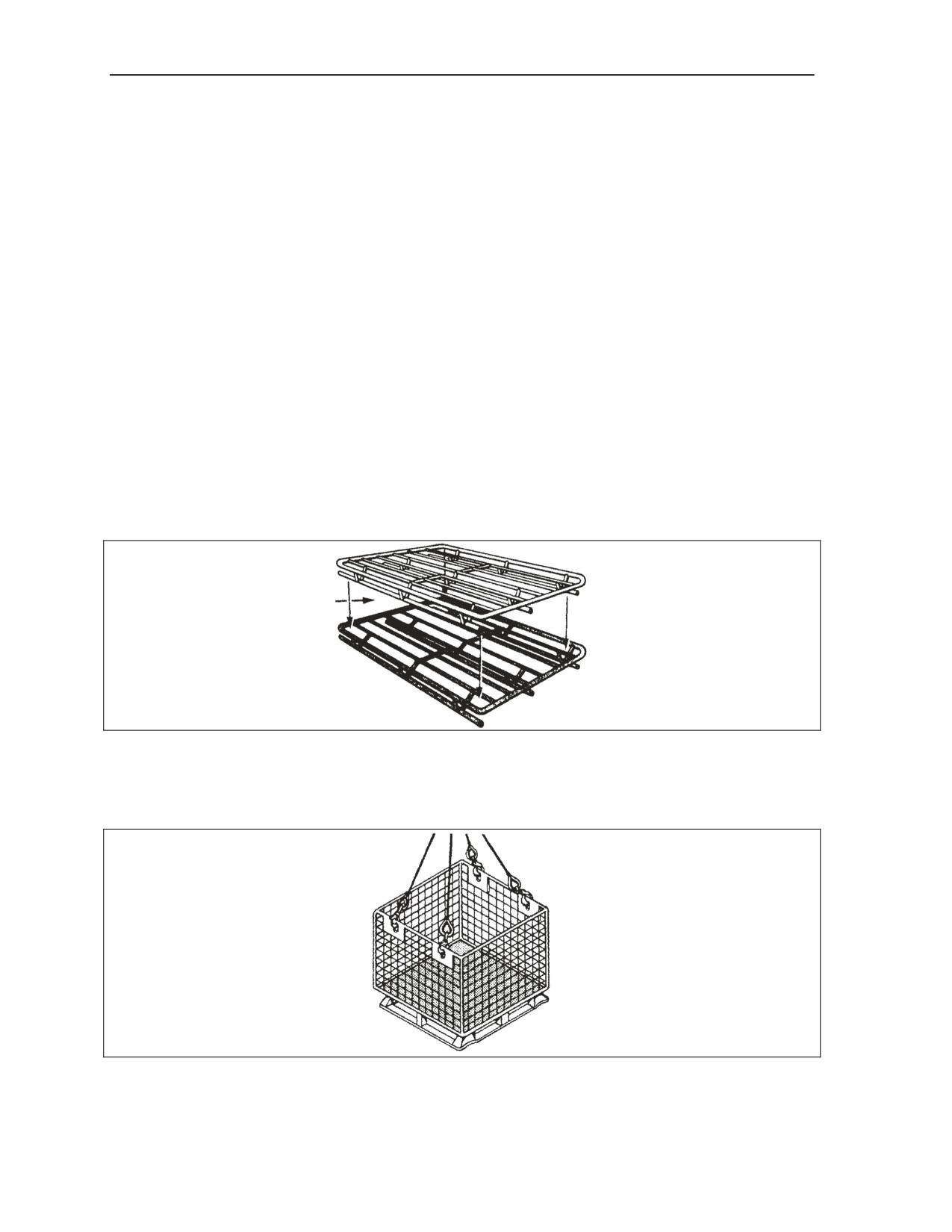
Pallets. Four-way pallets are platforms 40 inches by 48 inches by approximately 4 inches high,
constructed of welded steel (Figure 9-1) or hardwood, usually oak. They are designed to be
lifted by a forklift truck from either side. Cargo should be banded or strapped to pallets to
provide a stable and secure load.
PALLETS NESTED
FOR STORAGE
Figure 9-1. Four-Way Pallet (Nestable Tubular Steel)
z
Cargotainers. A cargotainer is a pallet with wire mesh sides that fold down for compact
storage (Figure 9-2). The cargotainer is ideal for transferring loose and odd-shaped items.
Figure 9-2. Hoisting Sling Hooked to Cargotainer
FM 4-20.197/MCRP 4-11.3E, VOL I/NTTP 3-04.11/
9-2
AFMAN 11-223 (I), VOL I/COMDTINST M13482.2B
20 July 2006
Vertical Replenishment (USN, USMC, USCG)
z
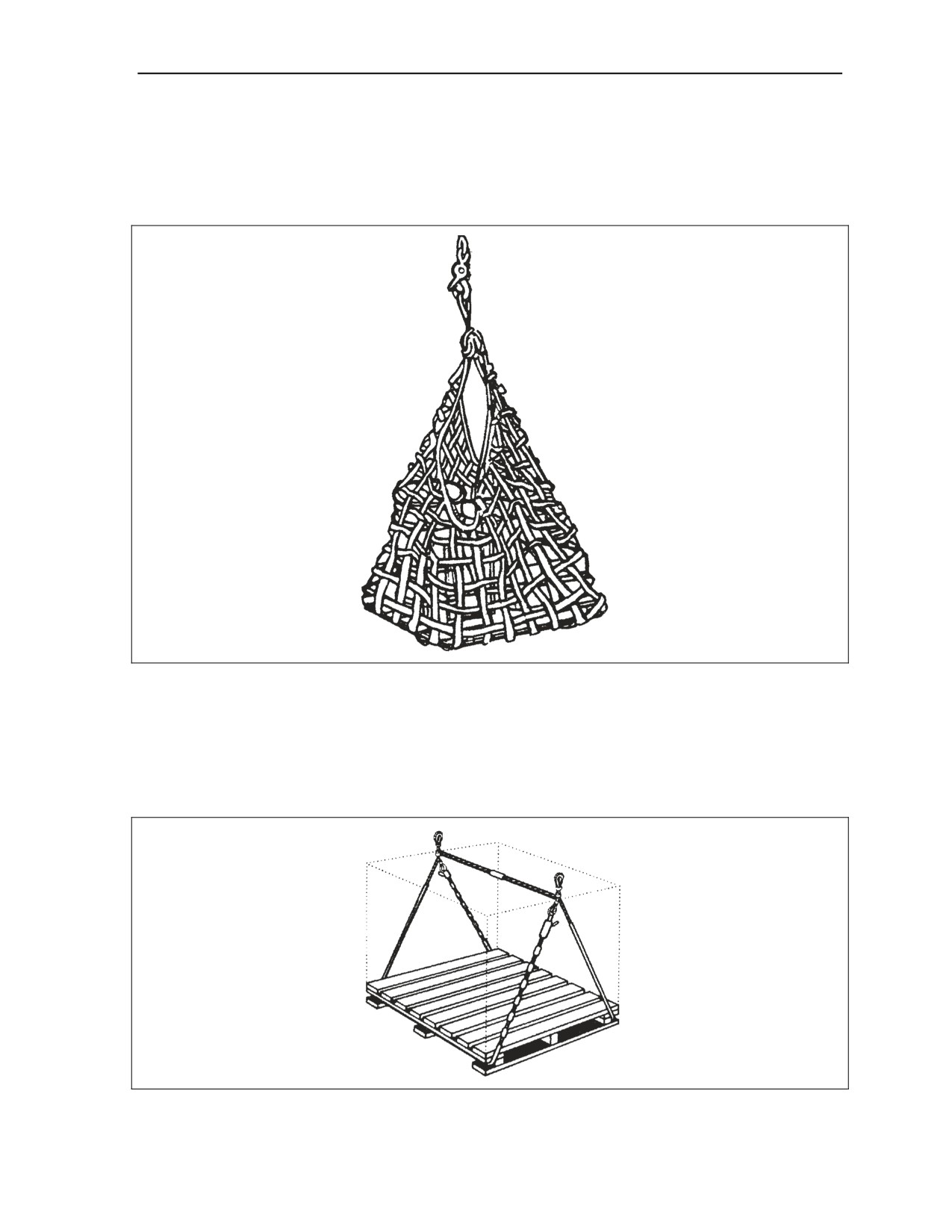
Cargo Nets. Most VERTREP cargo is moved in nylon cargo nets made of 1 1/2-inch wide
nylon webbing (Figure 9-3). Overall net size is 12 feet by 12 feet or 14 feet by 14 feet. Oval
metal rings on each of the four corners are used to lift the net. Rough handling, such as
dragging, causes extensive damage to nylon webbing and should be avoided.
Figure 9-3. Nylon Cargo Net, Mk106 Mod 0 Cargo Pallet Net, and Becket
z
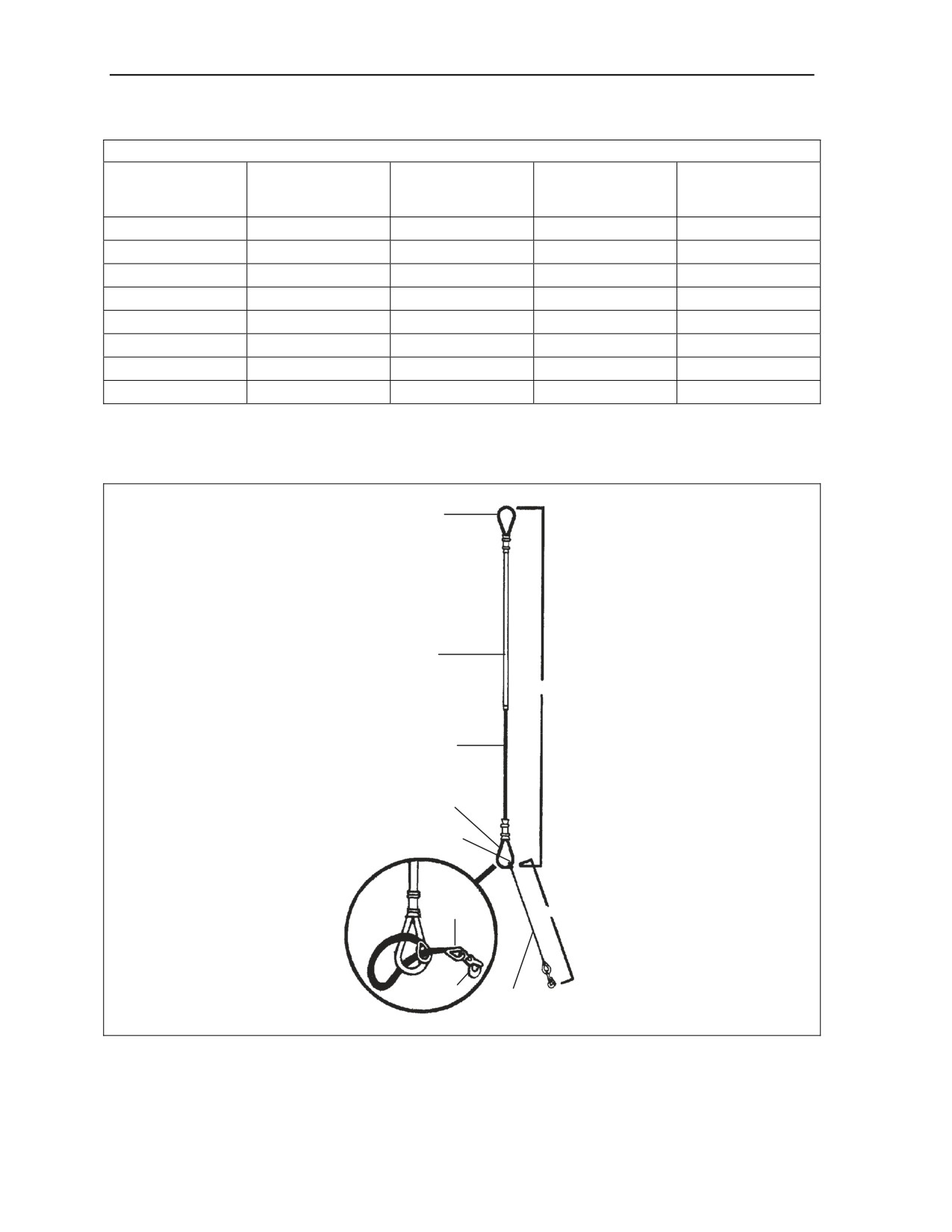
Pallet Sling. The pallet sling is a two-loop wire rope sling used to lift loaded pallets without
using a cargo net (Figure 9-4). Lifting eyes provide the attachment points for the hoisting sling
used to carry the load by helicopter. There are four models of this sling; each model
accommodates a different size load and a color-coded tube on the cable between the two lifting
eyes indicates the sling size (Table 9-1).
Figure 9-4. Pallet Sling
FM 4-20.197/MCRP 4-11.3E, VOL I/NTTP 3-04.11/
20 July 2006
AFMAN 11-223 (I), VOL I/COMDTINST M13482.2B
9-3
Chapter 9
Table 9-1. Sling Models and Sizes
SLING MODELS AND SIZES
Mk
COLOR OF
LOAD HEIGHT ON
CAPACITY
WEIGHT
CODED TUBING
40- X 48-INCH
(POUNDS)
(POUNDS)
PALLET (INCHES)
85
RED
13
2,200
13
16
2,800
13
20
3,400
13
24
3,950
13
25 TO 31
4,000
86
BLACK
29 TO 40
4,000
13
87
GREEN
36 TO 50
4,000
14
100
YELLOW
48 TO 70
4,000
15
z
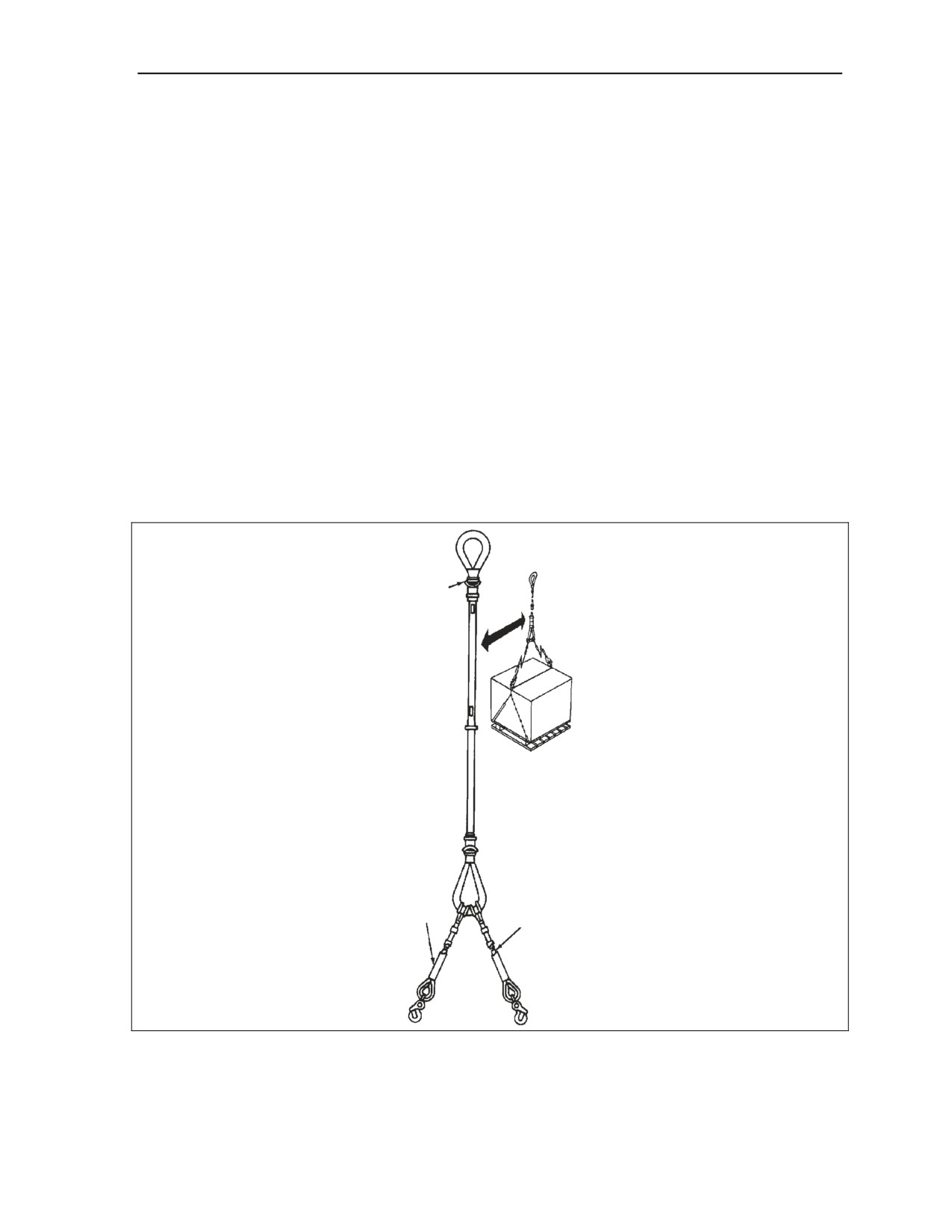
Hoisting Sling Mk105. This sling, called the multileg-pole pendant or reach pendant, is
approved for all types of VERTREP loads up to 6,000 pounds (Figure 9-5). The Mk105
consists of two parts: the pendant section and the leg assemblies.
UPPER EYE
STIFFENED REACH TUBE
PENDANT
1-1/8” DOUBLE BRAIDED NYLON
LOWER EYE
CHOKER HITCH
THIMBLE
LEG(S)
SAFETY
HOOK
7/8” DOUBLE BRAIDED
NYLON ROPE LEG
Figure 9-5. Mk 105 Hoisting Sling (Multi-Leg Pole)
The pendant, made of 1 1/8-inch diameter, double-braided nylon rope, is approximately 12
feet long. The silicone-impregnated eye at the lower end of the pendant aids in removing the
FM 4-20.197/MCRP 4-11.3E, VOL I/NTTP 3-04.11/
9-4
AFMAN 11-223 (I), VOL I/COMDTINST M13482.2B
20 July 2006
Vertical Replenishment (USN, USMC, USCG)
attached legs from the pendant. The upper eye is encased in flexible tubing and allows the
pendant to slip off or on the cargo hook when released or attached. A 6-foot plastic reach tube
encases the upper portion of the pendant and provides the rigidity needed to place the upper eye
over the cargo hook.
The legs are made of color-coded, 15/16-inch diameter, double-braided nylon rope with an
open eye splice at one end and a positive-closing, self-locking cargo hook at the other end. The
regular leg (orange) is 85 inches long and the long leg (green) is 116 inches long. As many as
six legs may be attached to the pendant’s lower eye by means of choker hitches (Figure 9-5
inset). The number of legs used is determined by the number of attachment points on the load.
Four regular legs are provided with each pendant at the time of issue. The safe working load for
an Mk105 pendant with a single leg is 4,000 pounds. The maximum capacity of the Mk105
pendant is 6,000 pounds when two or more legs are attached. The nylon rope also acts to absorb
the shock of the load during pickup by the helicopter. As the helicopter lifts up, the weight of
the load is transferred from the flight deck to the pendant. This action stretches the pendant and
the result is a smooth load pickup with minimum shock and stress to the aircraft and load.
z
Hoisting Sling Mkl28 Mod 0. This sling consists of two parts: the pendant and the legs (two
per unit). The pendant has a spliced eye at each end and a stiffening tube to allow for extended
hookup (Figure 9-6). One eye attaches to the cargo hook. The other eye is for attachment of the
leg assembly. The legs, color-coded green, have a spliced eye at one end and a hook at the other
end. The legs are fastened to the eye of the pendant with a choker hitch. The entire assembly
with one or more legs is rated at 4,000 pounds.
PENDANT ASSEMBLY
PROTECTOR
LEG ASSEMBLY
Figure 9-6. Hoisting Sling Mk 128 Mod 0
FM 4-20.197/MCRP 4-11.3E, VOL I/NTTP 3-04.11/
20 July 2006
AFMAN 11-223 (I), VOL I/COMDTINST M13482.2B
9-5
Chapter 9
CAUTION
Components of different load capacity or type sling assemblies are not
interchangeable. Mixing of components of different capacity or type
slings can result in unpredictable lifting characteristics or failure of the
sling assembly.
LOAD PREPARATION
9-6. The primary concern in load preparation is to provide a load that will ride safely in flight and arrive
at the destination undamaged. VERTREP loads are subject to extremely high winds from rotor wash
during hover and flight. Detailed procedures in NAVSEA S9750-AA-MMA-010, used for preparing
ordnance loads for VERTREP, can also be used to prepare other loads of similar configuration.
z
Pallet Assembly (Figure 9-4). In assembling loads to be moved on pallets, the following rules
apply:
Stack and strap small boxes and crates to the pallets to provide a stable and secure load.
Loosely packed loads on pallets are a safety hazard and should not be transported by helicopter.
Interlace load layers whenever possible.
Band pallet loads tightly and adequately. Add nylon strapping to prevent the load from
shifting when the pallet is moved by forklift truck or while it is in flight.
Check for load integrity of any cargo that was palletized at the Naval ammunition depot or
supply center. Reband as necessary.
z
Cargotainer Loading
(Figure
9-2). When preparing cargotainer loads, remember the
following:
Raise and lock the sides of the cargotainer.
Avoid lightweight (less than 100 pounds) loads because of their instability during flight. It
is possible that a lightweight load may be blown against the bottom of the helicopter.
z
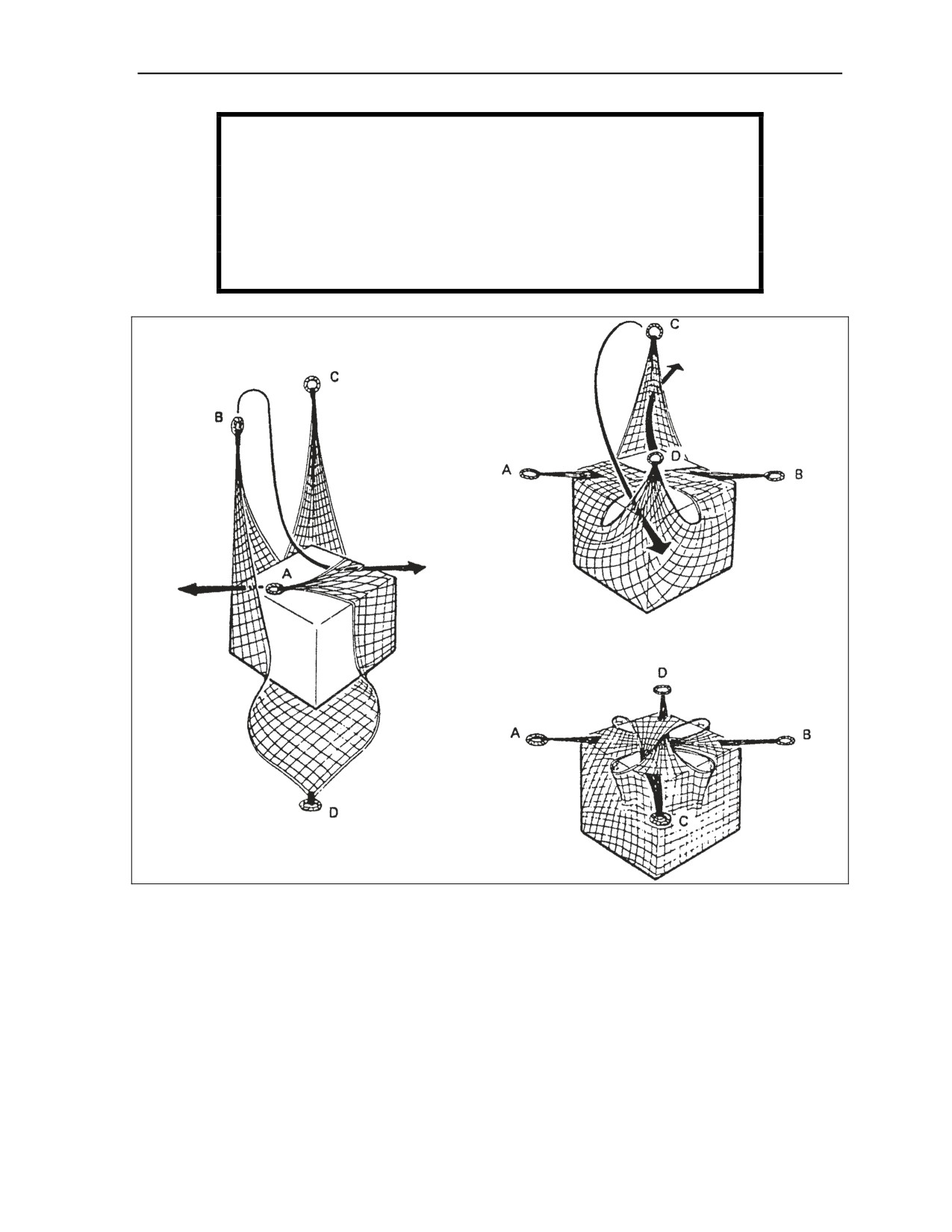
Cargo Net Loading (Loose Cargo) (Figure 9-7). Use nets for transferring general cargo.
Observe the following rules when loading cargo nets:
Avoid lightweight (less than 100 pounds) loads because of their instability during flight.
Do not load small cartons on the bottom of the net where they could be forced out through the
openings in the net.
Cover or secure lightweight or small items together to keep them from blowing out of the
net. Once they are packed together, place them on top of the larger loads.
Note: One method of safeguarding small items against loss in flight is to secure the corners of
the net together by taking opposing corner rings and weaving them through at least two web
straps in the webbing below the opposite rings. Figure 9-7 illustrates the steps to be used.
Fasten the sling leg through all four corner rings. When the helicopter lifts the net, the weight of
the load will cinch the net and prevent the items from being lost through the net.
Secure the net (corners) rings with a becket.
To move the pallet by forklift, carefully insert the forklift tines through the net webbing
straps and into the pallet.
FM 4-20.197/MCRP 4-11.3E, VOL I/NTTP 3-04.11/
9-6
AFMAN 11-223 (I), VOL I/COMDTINST M13482.2B
20 July 2006
Vertical Replenishment (USN, USMC, USCG)
WARNING
Do not place a palletized load that is rigged within a net on an
empty pallet to move by forklift. When the helicopter lifts the
load, the empty pallet may become a loose object because of
rotor wash. The pallet within the net is adequate for moving the
load by forklift.
STEP 2
STEP 1
STEP 3
Figure 9-7. Cargo Net with Loose Cargo Secured
WEIGHT AND IDENTIFICATION OF LOADS
9-7. As each load is prepared, mark it with its weight and other required information for the helicopter
crew and receiving unit. Use chalk, a felt-tipped pen, or color-coded tags for identification. Load marking
facilitates load-pairing and combining light loads to provide the most efficient weight for a helicopter.
Combine loads to achieve the best distribution of weight for each lift. As many as four pallets may be
carried per lift. The average weight of a single or combined load (using an H-46 helicopter) is 3,000
pounds. Heavier loads may be carried under ideal weather and atmospheric conditions, depending on the
helicopter’s fuel load and pilot approval.
FM 4-20.197/MCRP 4-11.3E, VOL I/NTTP 3-04.11/
20 July 2006
AFMAN 11-223 (I), VOL I/COMDTINST M13482.2B
9-7
Chapter 9
CAUTION
Paired loads should be approximately the same configuration to
reduce the possibility of tipping over on pickup or delivery.
ATTACHING SLINGS TO LOADS
9-8. Several items are used to move cargo.
z
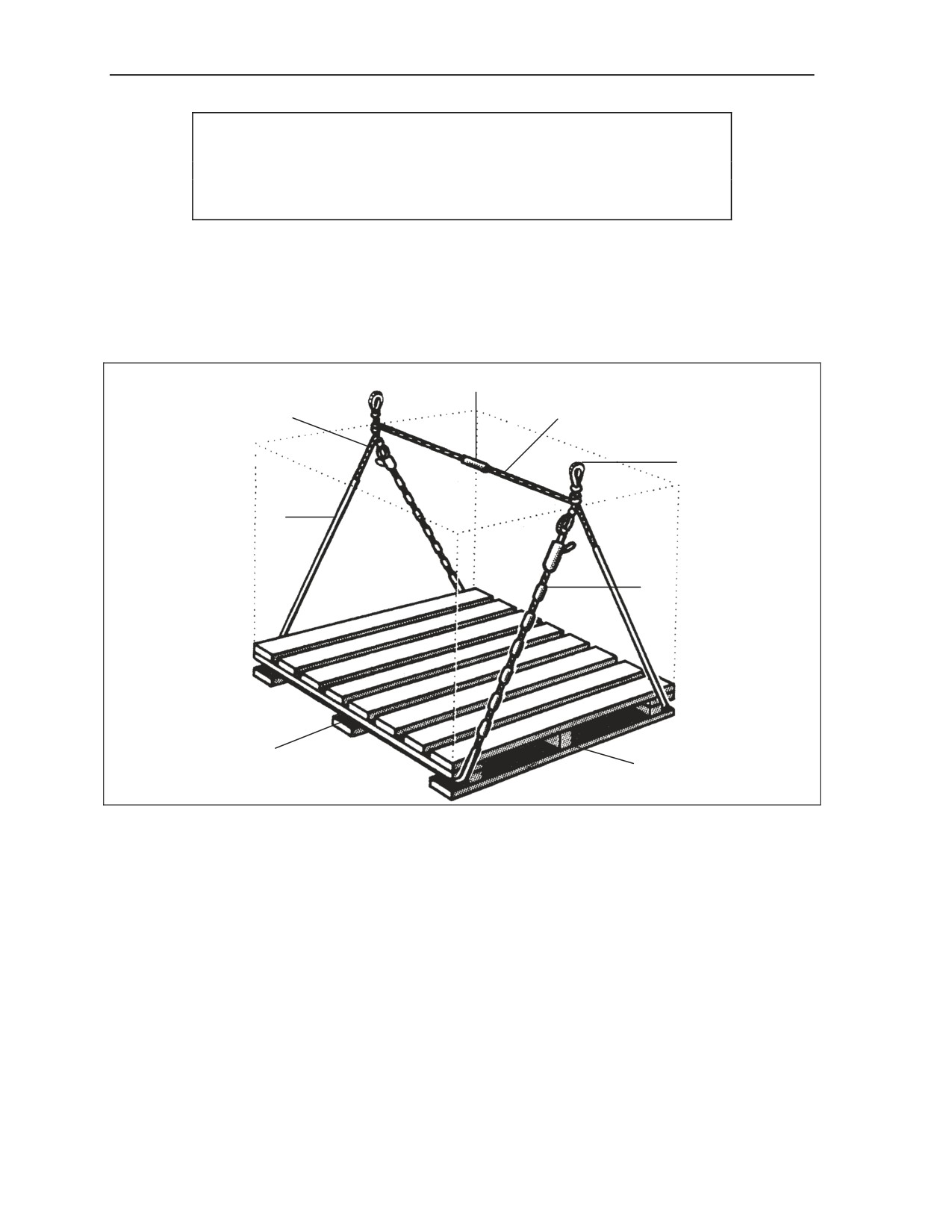
Adjustable Pallet Slings. Palletized ordnance may be transferred without cargo nets using the
adjustable pallet sling (Figure 9-8). In order to attach the sling to the load, follow these steps:
COLOR CODE TUBING
BRIDLE POSITIONED PARALLEL
BASKET LEGS
TO PALLET WING
LIFTING EYE
CHAFE PROTECTIVE
TUBING
SWAGE STOPS
PALLET
ANY WINGED PALLET
WOOD OR METAL
Figure 9-8. Adjustable Pallet Sling Mk85, 86, 87, and 100
Select the proper (color-coded) sling length according to the height of the load. (Refer to
Table 9-1.)
Pass each loop of the sling under the overhang made by the upper boards on the sides of the
pallet.
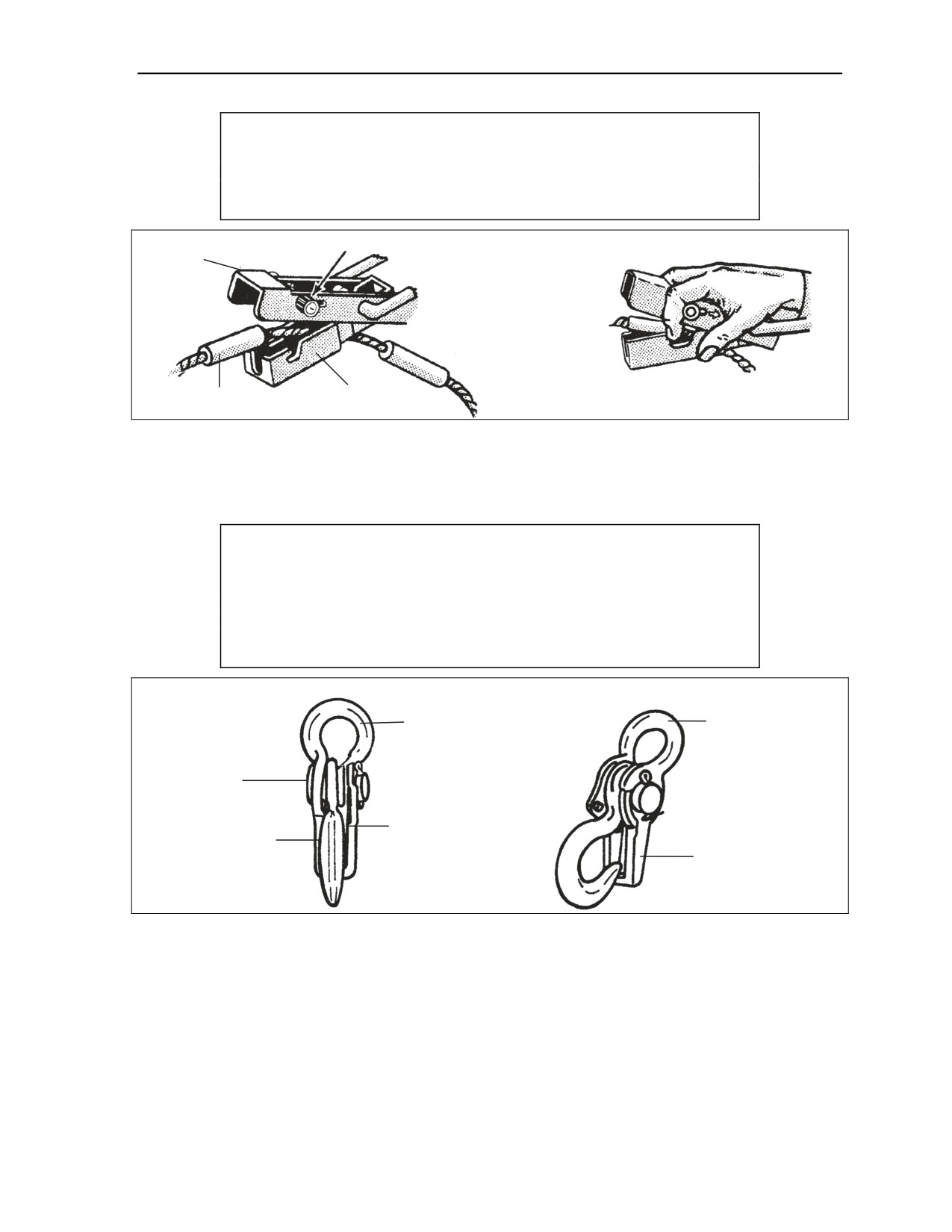
Pull the ends of the sling cable containing the swage stops through the sling tensioners
(Figure 9-9) until the bridle is tight across the top of the load and slack is out of the cable.
Adjust the sling so that the lifting thimbles are centered and at an equal height from the
pallet.
Place each tensioner over the nearest swage stop, lower the latch to the stirrup, and lock the
tensioner.
FM 4-20.197/MCRP 4-11.3E, VOL I/NTTP 3-04.11/
9-8
AFMAN 11-223 (I), VOL I/COMDTINST M13482.2B
20 July 2006
Vertical Replenishment (USN, USMC, USCG)
CAUTION
The last swage stop in each sling leg is a safety bead and will not be
used.
RELEASE KNOB
LATCH BAR
OPERATION OF
TENSIONER
STIRRUP
SWAGE STOP
Figure 9-9. Tensioner and Its Operation
z
Safety Hook Operation. The safety hook is the only moving part of the hoisting sling
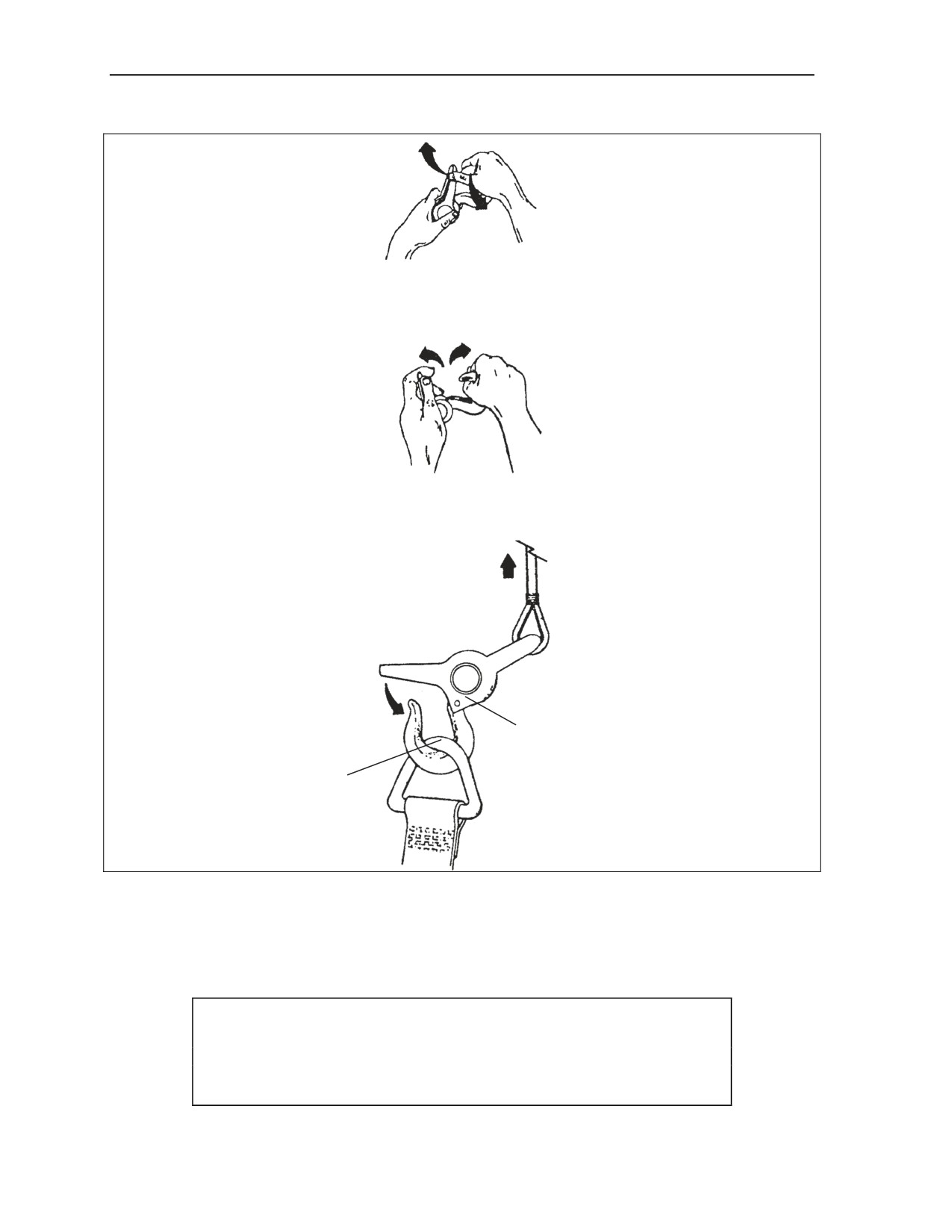
assembly legs (Figure 9-10). You must be able to operate the safety hook before you can attach
the hoisting sling to a load. Instructions for hook operation (Figure 9-11) are as follows:
CAUTION
Do not insert the safety hook through all four of the cargo net’s oval
metal rings and do not hook backward towards the bight of the lifting
sling or sling leg. To do so would damage the lifting sling, sling leg,
thimble, or hook latching assembly.
O-RING
BAIL
PIVOT PIN
WASHER
LOCKING LUG
GATE
HOOK
Figure 9-10. Safety Hook
To open the hook, grasp the hook in one hand and the yoke in the other hand so that your
forefinger passes under the yoke. Hold the hook while twisting the yoke to the right and lifting
it at the same time.
To close the hook, press the yoke down over the hook.
FM 4-20.197/MCRP 4-11.3E, VOL I/NTTP 3-04.11/
20 July 2006
AFMAN 11-223 (I), VOL I/COMDTINST M13482.2B
9-9
Chapter 9
TWIST HOOK AND YOKE IN OPPOSITE DIRECTIONS, PULLING AT THE SAME TIME
PULL TO THE FULL OPEN POSITION
DIRECTION OF MOVEMENT FOR CLOSING
LUG
LOAD LIFTING POINT
Figure 9-11. Operation of Safety Hook
z
Hoisting Slings.
For loads with a single lifting point, such as a cargo net, use an Mk105 hoisting sling with
one single sling leg. Connect the sling leg safety hook to the load’s apex fitting or lifting
provisions.
CAUTION
The sling leg on the Mk105 hoisting sling reduces the safe working
load of the sling from 6,000 pounds to 3,000 pounds.
FM 4-20.197/MCRP 4-11.3E, VOL I/NTTP 3-04.11/
9-10
AFMAN 11-223 (I), VOL I/COMDTINST M13482.2B
20 July 2006
Vertical Replenishment (USN, USMC, USCG)
For loads with two attachment points, such as a pallet rigged with a pallet sling, attach two
legs to the lower eye of the Mk105 hoisting sling by means of a choker hitch; then connect the
safety hooks on the legs to the lifting thimbles on the pallet sling (one leg to one thimble). An
alternate hoisting sling for a load with two attachment points is the Mkl28 Mod 0. Attach it in
the same manner as the Mk105 sling. After the hooks are attached, secure the legs with the
hook-and-pile fastener strap to ensure that the strap legs do not work loose under the load and
tip over during pickup.
When using the Mk105 hoisting sling to lift loads with two attachment points, ensure that
both lifting legs are the same length (identified by color).
For loads with four attachment points, such as a cargotainer, use the Mk105 hoisting sling
with four legs. When pairing loads (from two to six lifting points), use the Mk105 hoisting sling
with a leg for each lifting point (Figure 9-12).
CAUTION
The sling leg on the Mk105 hoisting sling reduces the safe working
load of the sling from 6,000 pounds to 3,000 pounds.
Figure 9-12. Hoisting Sling Mk105 with Two and Three Pallet Loads
FM 4-20.197/MCRP 4-11.3E, VOL I/NTTP 3-04.11/
20 July 2006
AFMAN 11-223 (I), VOL I/COMDTINST M13482.2B
9-11
Chapter 9
CAUTION
Remove any legs on the Mk105 that are not attached to a lifting point
on the load.
z
Special Procedures for Nonstandard Loads. Refer to NAVSEA S9750-AA-MMA-010 for
attaching adapters to containers and rigging missile dollies for VERTREP. Large, bulky, or
odd-shaped loads that cannot be carried on a pallet or in nets will be provided with slings or
lifting eyes for attaching pendant/sling. The pilot will always be consulted about the feasibility
of moving nonstandard loads.
CAUTION
When rigging a special load, carefully inspect the load attachment
points to ensure that they are the correct/designated points. What
appears to be a lifting eye or lifting point may be a provision for other
purposes (for example, a tie-down point) and may not be intended for
helicopter external lifting.
CARGO STAGING
9-9. Prior to actual flight operations, the maximum possible amount of cargo is staged on the flight deck.
Primary considerations in preparing and executing the flight deck cargo staging plan follow:
z
Consideration 1. All cargo must be staged within the hover area bounded by marked lines
and/or hover limit line(s) and be accessible for pickup by the helicopter.
z
Consideration 2. When possible, allow sufficient room between loads for the hookup man to
move about freely and have an emergency escape route.
z
Consideration 3. Allow sufficient room between loads to reduce the possibility of a load
snagging or overturning adjacent loads during pickup.
z
Consideration 4. Tarpaulins used to cover staged VERTREP loads during flight operations
must be secured with cargo nets. This ensures that the tarpaulins will not be blown off the load
and into the helicopter rotors.
z
Consideration 5. When possible, load height will be constructed so that the hookup man can
conduct his tasks without climbing on the loads.
STATIC ELECTRICITY DISCHARGE WAND
9-10. Use the static electricity discharge wand regardless of the type of sling or aircraft (USN does not use
the wand except with CH-53 helicopters). Static electricity buildup in the helicopter hook must be
grounded before hookup with the sling. Static discharge wand contact with the aircraft’s hook must be
maintained continuously until hookup is complete. Static electricity is dangerous and can cause serious
injury or death.
LOAD TRANSFER PROCEDURES
9-11. Before starting operations, pilots must be provided with the destination and exact weight of each
load. One method for displaying the weight of a load is to write the load weight with chalk on the side of
the upper eye of the Mk105 sling, where it can easily be seen by the helicopter crew chief. The aircraft
approaches the load into the wind if at all possible. The pilot requests clearance to hover for VERTREP.
After receiving clearance, the landing signal officer/landing signal enlisted (LSO/LSE) gives hand-and-arm
FM 4-20.197/MCRP 4-11.3E, VOL I/NTTP 3-04.11/
9-12
AFMAN 11-223 (I), VOL I/COMDTINST M13482.2B
20 July 2006
Vertical Replenishment (USN, USMC, USCG)
signals to aid the pilot in positioning the aircraft over the load. The pilot maintains visual contact with the
LSO/LSE at all times.
z
The Coast Guard LSO must be stationed forward of the VERTREP line. During VERTREP
operations with a Coast Guard cutter, hovering on headings from 045 to 090 degrees relative
will only be attempted with a pilot in the left seat at the controls. As the helicopter approaches,
its approach is announced over the ship’s public address system. All personnel must clear the
landing and pickup zone, except for the hookup men. Hookup men take their position alongside
the LSO on a Coast Guard cutter or beside the load in a Navy operation to hold the pendant up
to signal the location of the load to the pilot. The helicopter crew chief, viewing the pickup
zone through the open cargo hook access hatch or aircraft door, advises the pilot via the
helicopter’s internal communications system as to the final maneuvering needed to place the
helicopter exactly over the load. The Coast Guard crewman signals the hookup team to
approach the load and prepare for hookup. As the helicopter hovers over the load, the hookup
man grounds the helicopter hook. He then raises the pendant, slips the eye over the helicopter’s
hook, and returns to his position beside the LSO/LSE.
z
When conditions prevent the hookup man from placing the pendant/sling on the aircraft cargo
hook, the hookup man passes the pendant/sling to the crew chief and then clears the area,
moving toward the LSE. The crew chief then places the pendant over the helicopter hook and
ensures that the load is secure and ready for lifting.
WARNING
Hookup personnel must never stand on the load or between the
load being picked up and another load unless operational
requirements dictate.
z
The aircrew member aboard the helicopter directs load placement while the helicopter hovers
over the pickup or drop area. The LSO/LSE continues giving hand-and-arm signals as a backup
to internal communication and to indicate any emergencies to the pilot or aircrew. Radio
transmissions to the pilot hovering over the VERTREP zone are distracting and should be of an
urgent nature only.
WARNING
Personnel must not enter the flight deck landing zone or attempt
to steady the load while the load is suspended above the deck.
z
After the sling load is hooked up and the hookup team is clear, the crew member aboard the
helicopter then gives pickup and lift-off directions to the pilot in order to clear the load from the
pickup area.
LOAD DELIVERY
9-12. During the final approach to the ship, the pilot is guided by the LSO/LSE and the helicopter crew
member. Once over the VERTREP area, the pilot follows the LSO/LSE and his crew member’s directions
to position the load over the cargo landing point. He relies on the crew member’s directions for precision
spotting and lowering the load. As soon as the load is on deck, the crew member informs the pilot. When
the pendant slackens, the LSO/LSE signals the pilot. The pilot or crew member releases the cargo hook.
The crew member informs the pilot when the load is released.
FM 4-20.197/MCRP 4-11.3E, VOL I/NTTP 3-04.11/
20 July 2006
AFMAN 11-223 (I), VOL I/COMDTINST M13482.2B
9-13
Chapter 9
CAUTION
Do not release the load before there is slack in the sling legs.
Premature release can cause the pole pendant to damage the load or
cause personnel injury.
WARNING
Personnel clearing stores must remove all banding strips, paper,
and other debris from the VERTREP area before the next
helicopter approaches to prevent injury to personnel and damage
to helicopter engines and rotor blades.
CLEARING THE VERTREP AREA
9-13. Once the load is released and the helicopter has departed, cargo handlers will prepare the load for
distribution to the users or relocate it clear of the landing area.
z
Unloading the Cargo. Nets, beckets, and cargo wraparound straps shall never be cut.
Assigned men open the net and cut any banding or strapping on the load. Cargo handlers,
who have been standing by clear of the VERTREP area, move in, pick up a portion of the cargo,
and leave the VERTREP area. The last ones remove the net and loose debris from the
VERTREP area, and place them in a staging area. The nets are folded for later return to the
helicopter.
Do not wave off a loaded helicopter with a sling load solely because the VERTREP area is
not completely clear of the previous load. If space is available for additional cargo, the load
being worked should be temporarily secured by pulling the net up over the load and threading
the hoisting sling leg through the net ends. All personnel must then clear the area while the next
load is being deposited. Speed is second only to safety in clearing the VERTREP area.
z
Retrograde Operations. As pallets, nets, cargotainers, and hoisting slings accumulate on the
flight deck, cargo handlers should assemble and prepare the VERTREP equipment for return.
Retrograde operations must start at the request of the delivery ship.
Pallets. Prepare pallets for return in the following manner:
─ Stack pallets to assemble a load between 16 and 68 inches high. Four to 14 wooden
pallets or six or more metal pallets may be stacked to make up the load.
─ Rig the pallets with the appropriate size pallet sling. Secure pallets to prevent loss
during flight.
─ Attach a hoisting sling (two attachment points) to the pallets.
CAUTION
When preparing tubular steel pallets for return, use a minimum of six
pallets per stack to ensure flight stability.
Note: Three loads of pallets may be returned in the same lift if there is sufficient clearance to
lift the load clear of the flight deck. In this case, attach the hoisting sling (six sling legs) after
the loads are spotted on the flight deck (Figure 9-12).
FM 4-20.197/MCRP 4-11.3E, VOL I/NTTP 3-04.11/
9-14
AFMAN 11-223 (I), VOL I/COMDTINST M13482.2B
20 July 2006
Vertical Replenishment (USN, USMC, USCG)
Nets and Pallets. If you are moving nets and pallets together, follow these procedures:
─ Stack four or more wooden pallets or six or more metal pallets in the center of the
net.
─ Fold the unused nets to the same width and length as the pallets and place them on
top of the pallets.
─ Pull the bottom net corners up around the entire load and secure the rings.
─ Attach a hoisting sling (one attachment point).
Cargotainers. Return cargotainers by folding and placing them inside one cargotainer.
Place extra straps and slings inside the cargotainer. Connect one sling (four attachment points)
to the load. An alternate method is to place folded cargotainers in a net.
WARNING
Do not, under any circumstances, hook an empty net to the
helicopter without at least four wooden or six metal pallets or
equivalent weight in the net. To do so could cause damage to the
helicopter by allowing the net to be blown into the helicopter’s
rotors. If in doubt, consult the pilot.
Slings and Pendants. Slings and pendants must be returned to the delivering unit/platform
so that they can be used for future VERTREP missions. Thread one leg of a sling through the
lifting eyes of the pendants/slings that will be moved. A minimum of 10 pendants/slings with
legs attached is recommended in order to maintain stability in flight. Attach a safety hook
around the sling legs to keep them together during flight. Proceed with hookup.
SAFETY
9-14. Safety is the primary consideration in all VERTREP operations. The following precautions must be
taken:
z
All personnel except the LSO/LSE, static wand person, and hookup man (when required) must
clear the landing area during delivery, pickup, takeoff, and landing. Do not attempt to steady
the load.
z
Cargo handling personnel must wear life jackets, helmets with chin strap, goggles, safety shoes,
and ear protection. Loose articles of clothing will not be worn. Remove covers, rags, and other
loose articles from pockets.
z
All personnel in the vicinity of the helicopter must remove their covers when the rotors are
turning.
z
All personnel at the landing area must be trained to clear the area around the helicopter
immediately on command of the officer in charge.
z
Personnel working near the helicopter must observe the aircraft carefully for any sign of a
malfunction such as smoke, oil, or a hydraulic leak, and immediately report any such conditions
to the pilot or VERTREP officer.
z
The flight deck must be cleared of all objects which can be blown about by rotor wash or
ingested into the helicopter engines.
NIGHT VERTREP
9-15. Night VERTREP operations take longer than day VERTREP operations because of reduced
visibility. Night VERTREP is carried out in the same manner as day VERTREP, subject to the limitations
set forth in this chapter. The final decision regarding whether a particular ship can be vertically
replenished at night is left to the pilot. Factors affecting night VERTREP are as follows:
FM 4-20.197/MCRP 4-11.3E, VOL I/NTTP 3-04.11/
20 July 2006
AFMAN 11-223 (I), VOL I/COMDTINST M13482.2B
9-15
Chapter 9
z
Helicopter Limitations. The helicopter must be capable of instrument flight.
z
Weather/Sea State. Adverse weather conditions further reduce night VERTREP capabilities.
z
Ship Lighting. Ships certified for night helicopter operations are properly lighted. As a
minimum, ships shall use lights as follows:
Obstructions in the vicinity of the VERTREP area should be illuminated.
Red flood lights should be focused on the flight deck at a point forward of the cargo
VERTREP area.
NIGHT VERTREP PROCEDURES
9-16. Essentially the same procedures are used for night VERTREP as during the day. However, night
cargo pickup and delivery require increased care and precision. A wider flight pattern is necessary under
low visibility conditions. Delivery rates, therefore, are lower than during daylight hours.
z
Coordination. The commanding officer is responsible for employing a course that will keep
the ship’s stack gases away from the helicopter in the VERTREP area, as night vision may be
affected.
z
Communications. The following communication procedures must be performed in night
VERTREP:
The LSO must use green or white/yellow tinted wands for helicopter direction signals.
The LSO must use the landing signal light kit (battery powered).
Information concerning identification such as, bearing, distance, and load weight must be
transmitted by radio. USN uses other methods during emergency communications (EMCOM)
such as placards, notes, or messengers relaying information to the pilot.
FM 4-20.197/MCRP 4-11.3E, VOL I/NTTP 3-04.11/
9-16
AFMAN 11-223 (I), VOL I/COMDTINST M13482.2B
20 July 2006
Appendix A
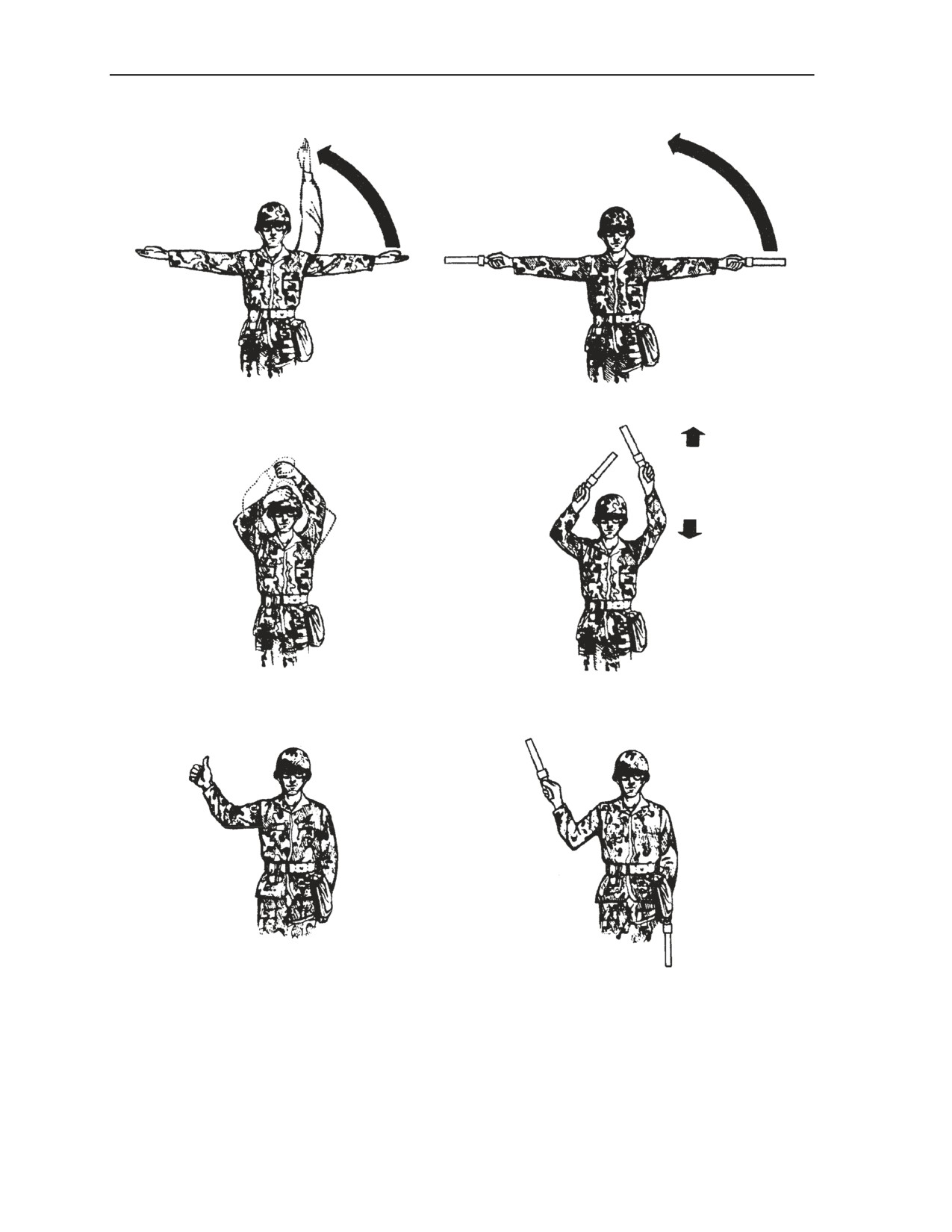
Hand-And-Arm Signals
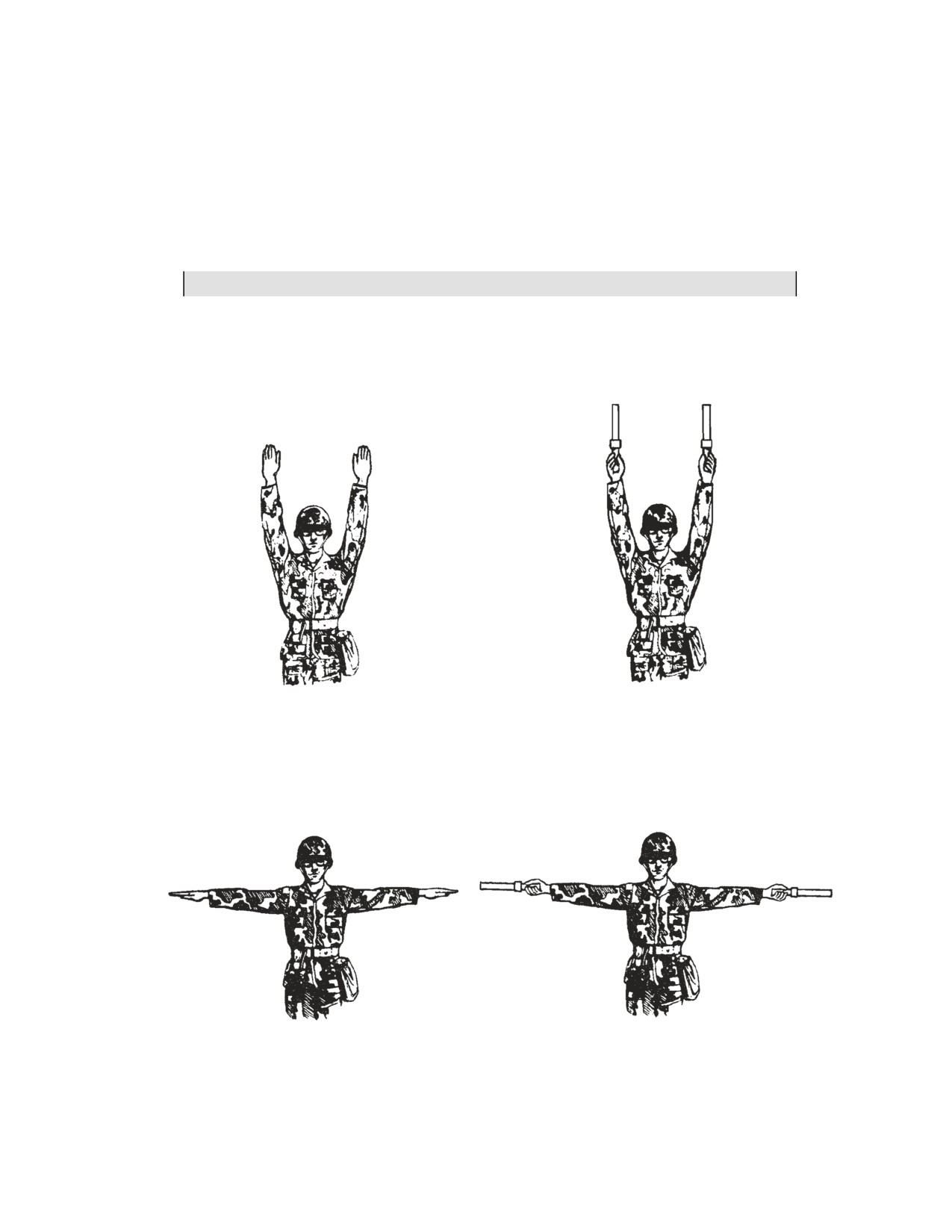
EXTRACT OF STANAG 3117
ASSUME GUIDANCE
ARMS EXTENDED VERTICALLY STRAIGHT UP, PALMS FORWARD
HOVER
ARMS EXTENDED HORIZONTALLY SIDEWAYS, PALMS DOWNWARD
FM 4-20.197/MCRP 4-11.3E, VOL I/NTTP 3-04.11/
Publication Date
AFMAN 11-223 (I), VOL I/COMDTINST M13482.2B
A-1
Appendix A
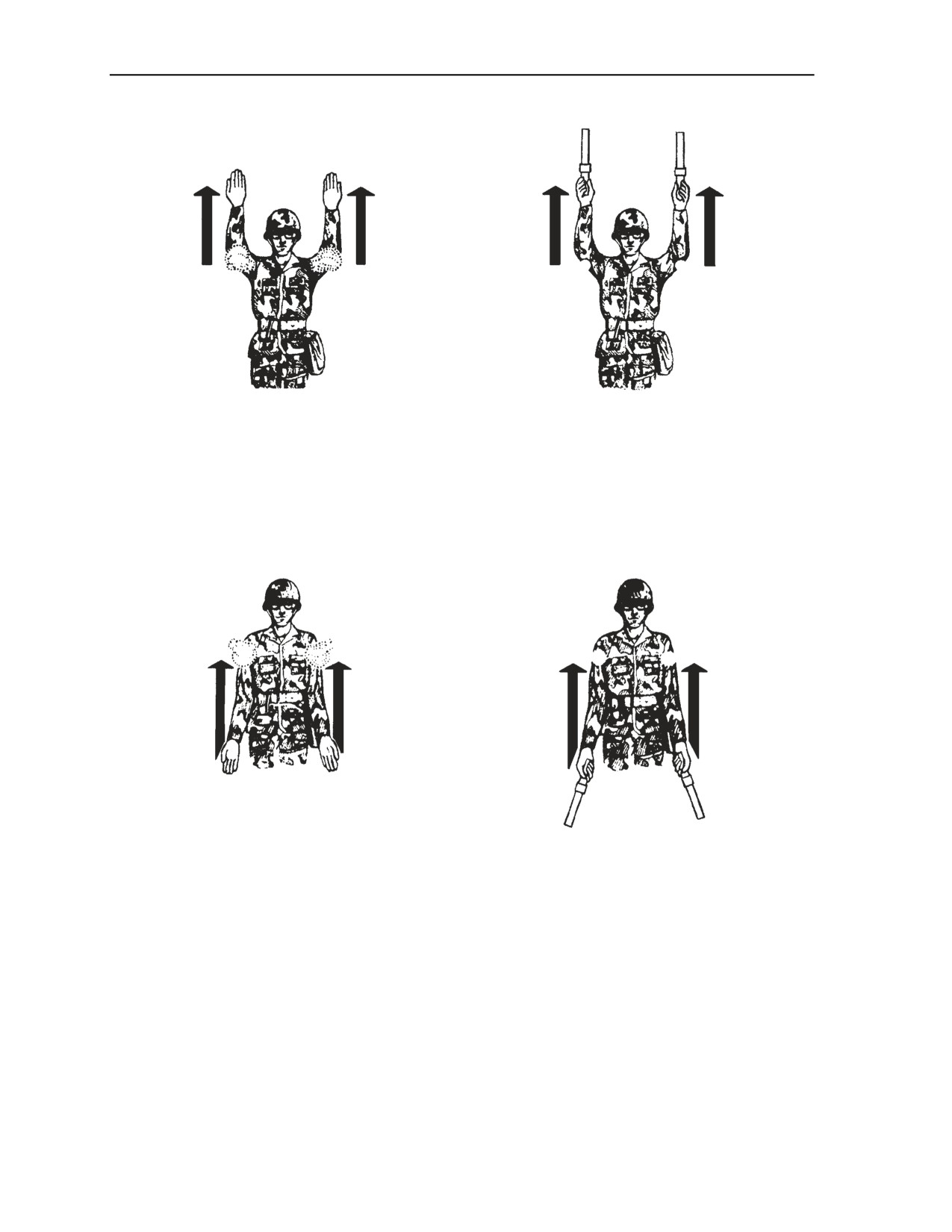
MOVE FORWARD
ARMS A LITTLE ASIDE, PALMS FACING BACKWARDS, AND REPEATEDLY MOVE UPWARD-
BACKWARD FROM SHOULDER HEIGHT
MOVE BACKWARD
ARMS BY SIDE, PALMS FACING FORWARD, ARMS SWEPT FORWARD AND UPWARD TO
SHOULDER HEIGHT
FM 4-20.197/MCRP 4-11.3E, VOL I/NTTP 3-04.11/
A-2
AFMAN 11-223 (I), VOL I/COMDTINST M13482.2B
20 July 2006
Hand-And-Arm Signals
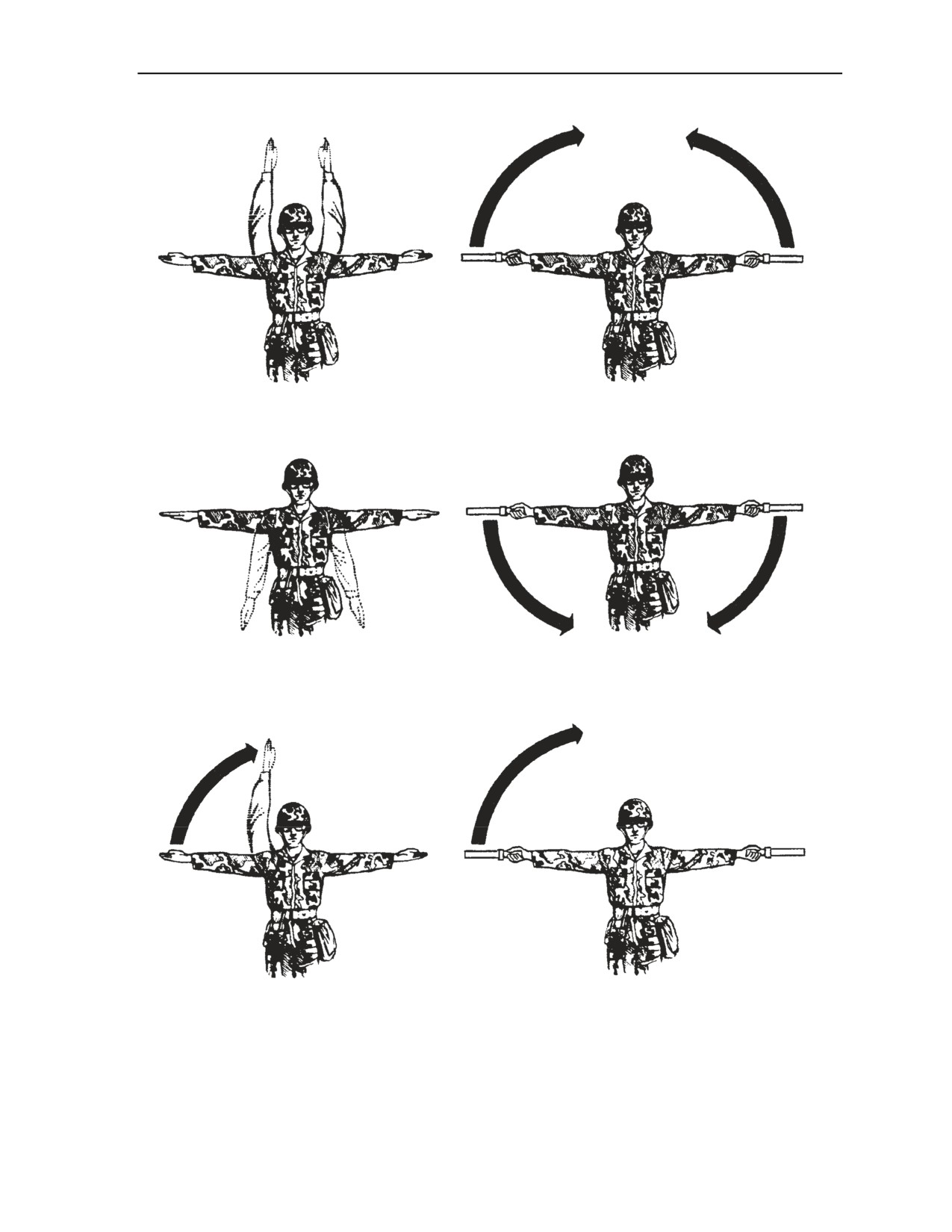
MOVE UPWARDS
ARMS EXTENDED SIDEWAYS, BECKONING UPWARDS, WITH PALMS UP
MOVE DOWNWARDS
ARMS EXTENDED SIDEWAYS, BECKONING DOWNWARDS, WITH PALMS TURNED DOWN
MOVE TO RIGHT
LEFT ARM EXTENDEDHORIZONTALLY SIDEWAYS IN DIRECTION OF MOVEMENT AND
OTHER ARM SWUNG OVERHEAD IN SAME DIRECTION, IN A REPEATING MOVEMENT
FM 4-20.197/MCRP 4-11.3E, VOL I/NTTP 3-04.11/
20 July 2006
AFMAN 11-223 (I), VOL I/COMDTINST M13482.2B
A-3
Appendix A
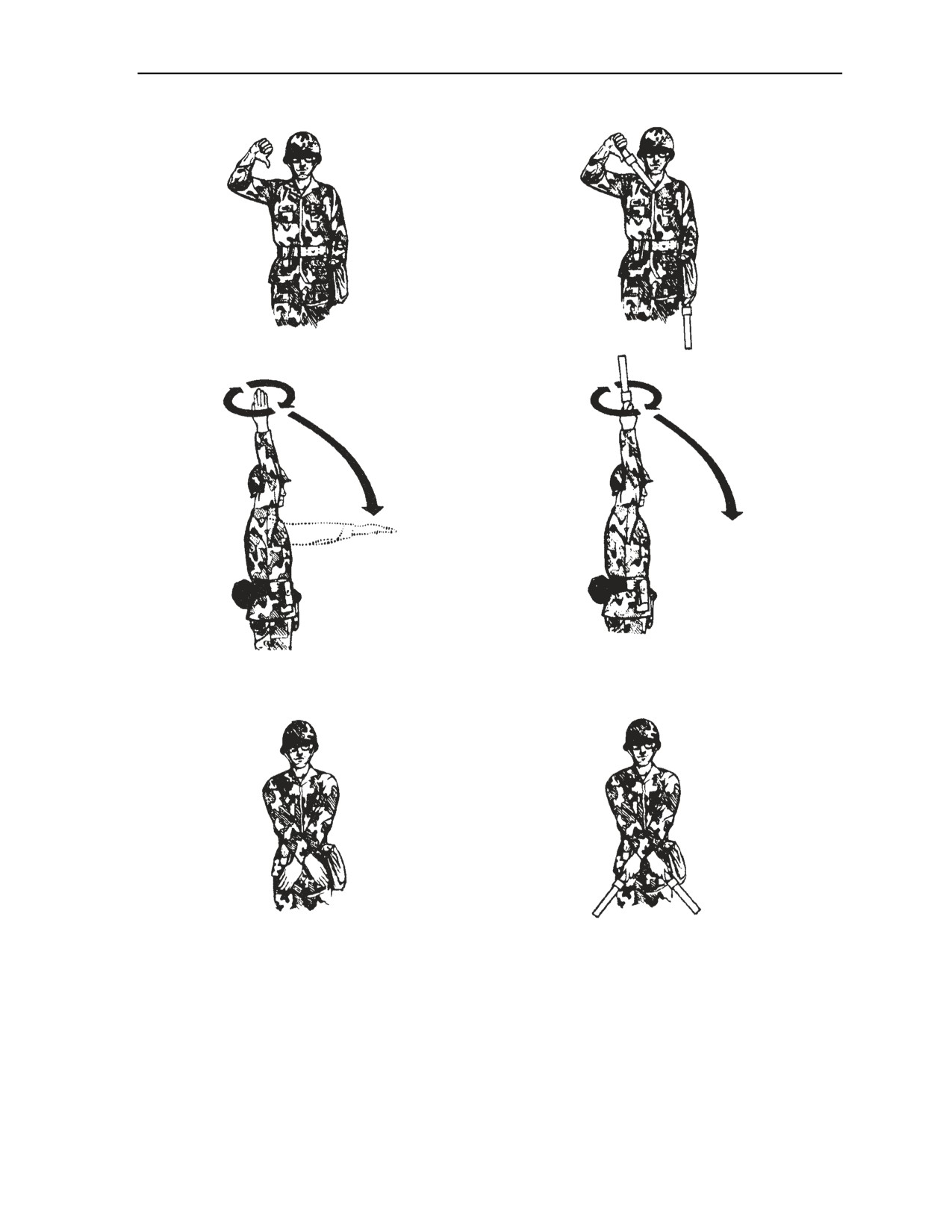
MOVE TO LEFT
RIGHT ARM EXTENDED HORIZONTALLY SIDEWAYS IN DIRECTION OF MOVEMENT AND
OTHER ARM SWUNG OVERHEAD IN SAME DIRECTION, IN A REPEATING MOVEMENT
HOOKUP
RAISE HANDS ALTERNATELY ABOVE THE HEAD IN A “ROPE CLIMBING” MOTION TO TAKE
UP SLACK
AFFIRMATIVE SIGNAL
HAND RAISED, THUMB UP
FM 4-20.197/MCRP 4-11.3E, VOL I/NTTP 3-04.11/
A-4
AFMAN 11-223 (I), VOL I/COMDTINST M13482.2B
20 July 2006
Hand-And-Arm Signals
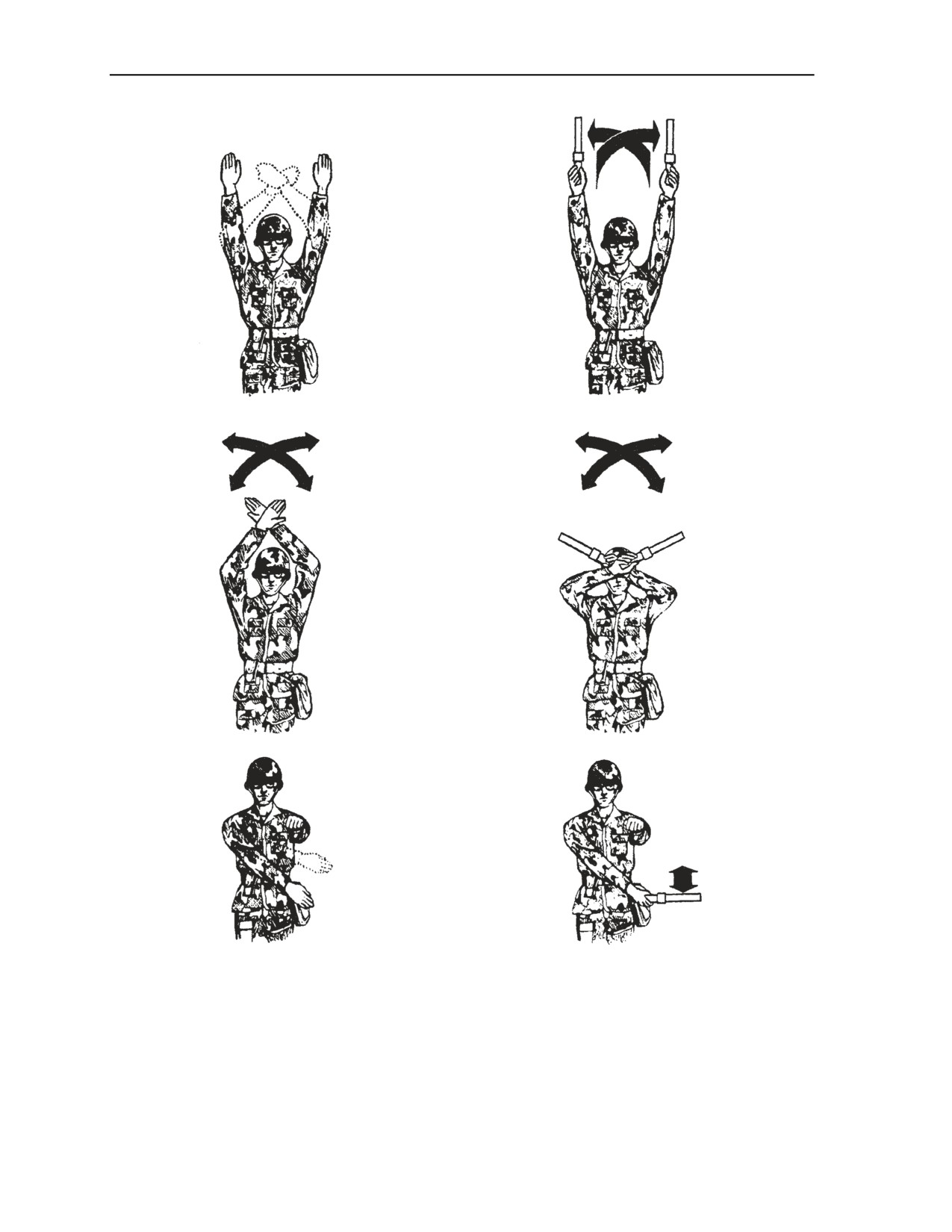
NEGATIVE SIGNAL
HAND RAISED, THUMB DOWN
TAKEOFF
MAKE A CIRCULAR MOTION WITH RIGHT HAND OVERHEAD ENDING IN A THROWING
MOTION IN THE DIRECTION OF TAKEOFF, ALSO MEANS LOAD CLEAR, HOOKUP GOOD
LAND
ARMS CROSSED AND EXTENDED DOWNWARDS IN FRONT OF THE BODY
FM 4-20.197/MCRP 4-11.3E, VOL I/NTTP 3-04.11/
20 July 2006
AFMAN 11-223 (I), VOL I/COMDTINST M13482.2B
A-5
Appendix A
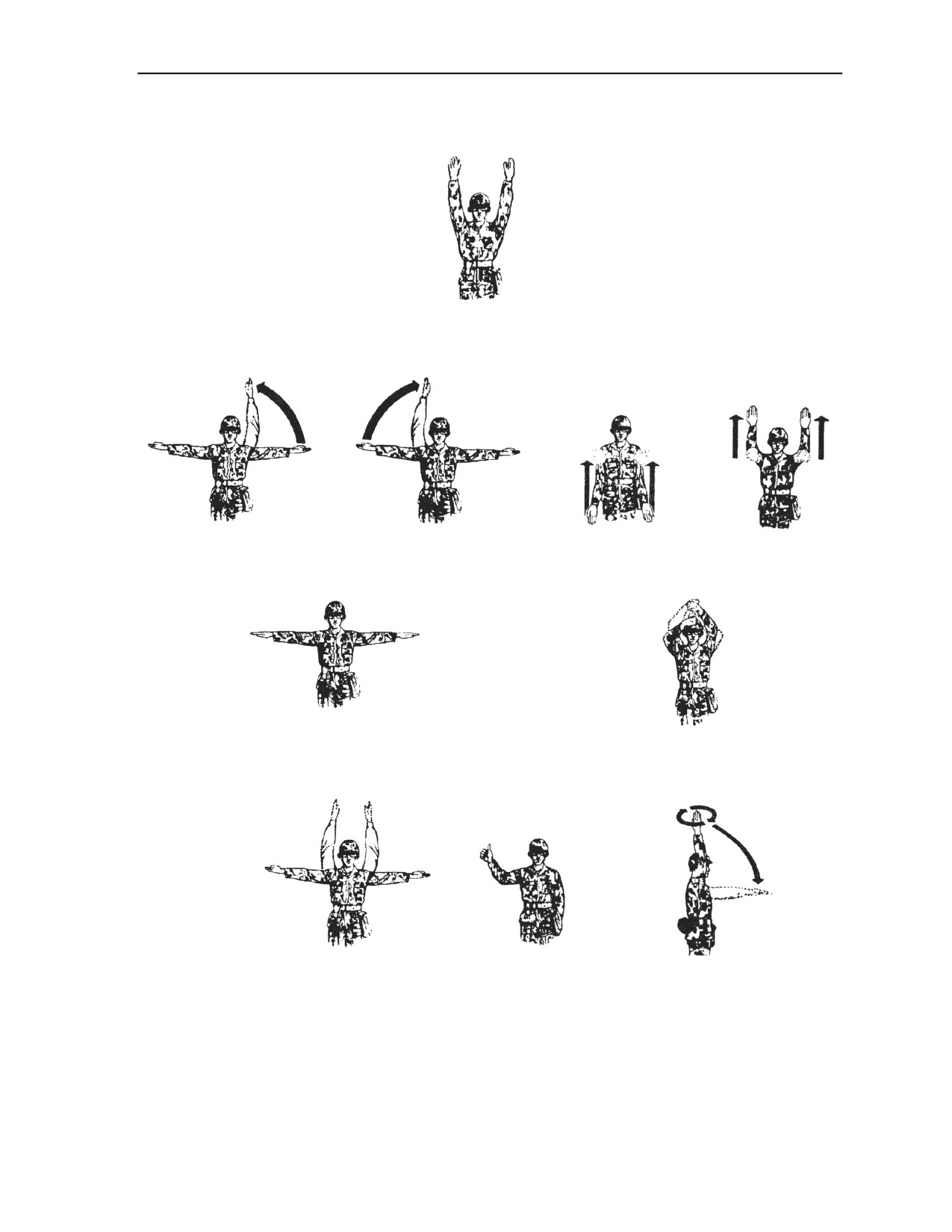
STOP
HOLD ARMS CROSSED OVERHEAD, DO NOT MOVE
WAVE OFF - DO NOT LAND
CROSS ARMS REPEATEDLY OVERHEAD
RELEASE SLING LOAD
LEFT ARM EXTENDED FORWARD HORIZONTALLY, FIST CLENCHED, RIGHT HAND MAKING
HORIZONTAL SLICING MOVEMENT BELOW THE LEFT FIST, PALM DOWNWARD
FM 4-20.197/MCRP 4-11.3E, VOL I/NTTP 3-04.11/
A-6
AFMAN 11-223 (I), VOL I/COMDTINST M13482.2B
20 July 2006
Hand-And-Arm Signals
ASSUME GUIDANCE
MOVE YOUR AIRCRAFT
LEFT
RIGHT
BACK
FORWARD
HOVER
HOOKUP
(YOUR LOAD IS ATTACHED)
MOVE UPWARD
AFFIRMATIVE SIGNAL
TAKEOFF
AN EXAMPLE SERIES OF HAND SIGNALS FOR A PICKUP ZONE DURING A ONE AIRCRAFT
OPERATION
FM 4-20.197/MCRP 4-11.3E, VOL I/NTTP 3-04.11/
20 July 2006
AFMAN 11-223 (I), VOL I/COMDTINST M13482.2B
A-7
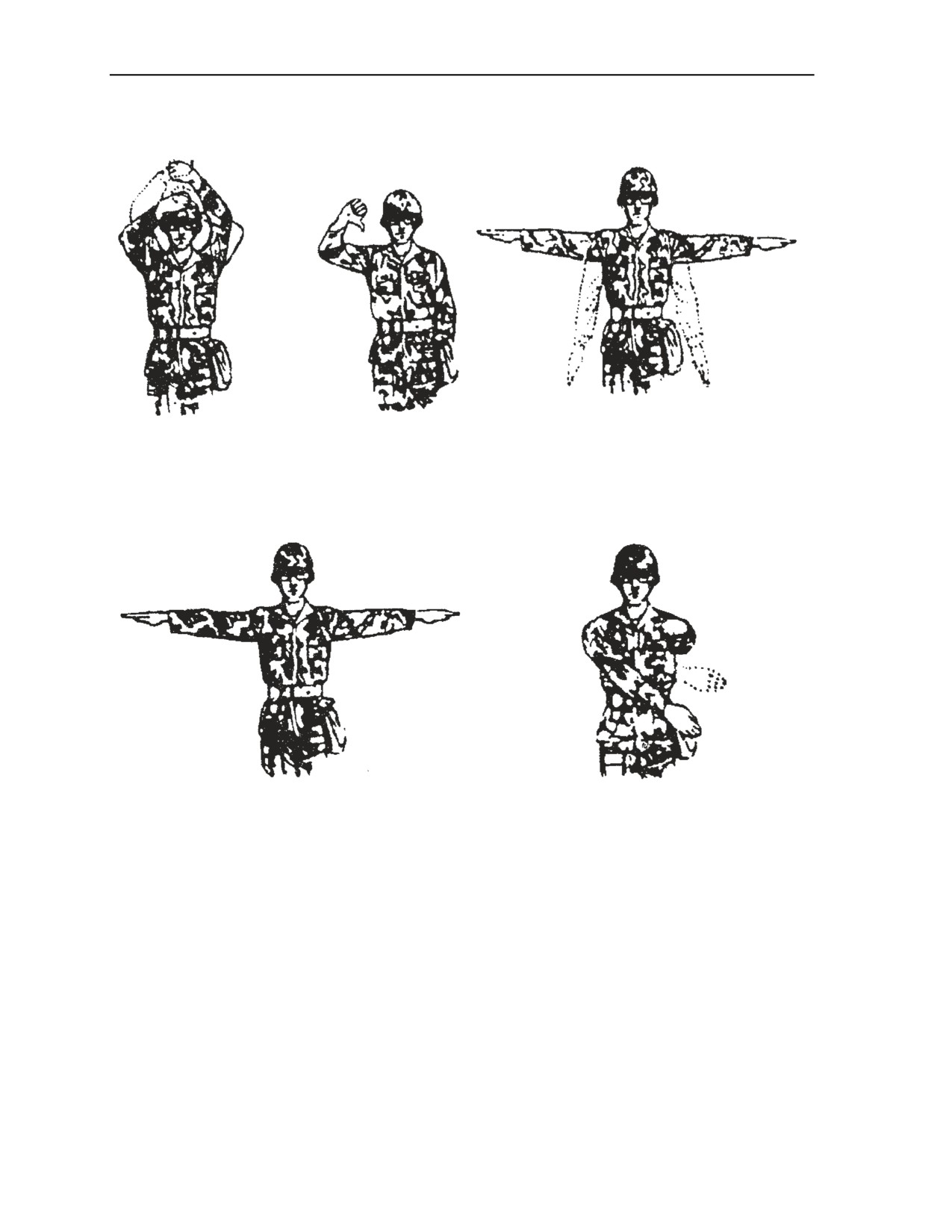
Appendix A
IF A PROBLEM OCCURS ON A LOAD WHEN THE AIRCRAFT RAISES UP AND THE SLINGS
TIGHTEN, FOLLOW THESE DIRECTIONS
MOVE DOWN WARD
HOOKUP
(FOLLOWED QUICKLY BY
A NEGATIVE SIGNAL)
HOVER
RELEASE SLING LOAD
(WHILW THE GROUND CREW
(IF NECESSARY)
CORRECTS THE LOAD)
ONCE THE LOAD IS CORRECTED GO BACK TO NORMAL HOOKUP PROCEDURES
IF THE PROBLEM CANNOT BE CORRECTED BY THID METHOD, GIVE THE PILOT THE RELEASE THE
LOAD SIGNAL
FM 4-20.197/MCRP 4-11.3E, VOL I/NTTP 3-04.11/
A-8
AFMAN 11-223 (I), VOL I/COMDTINST M13482.2B
20 July 2006
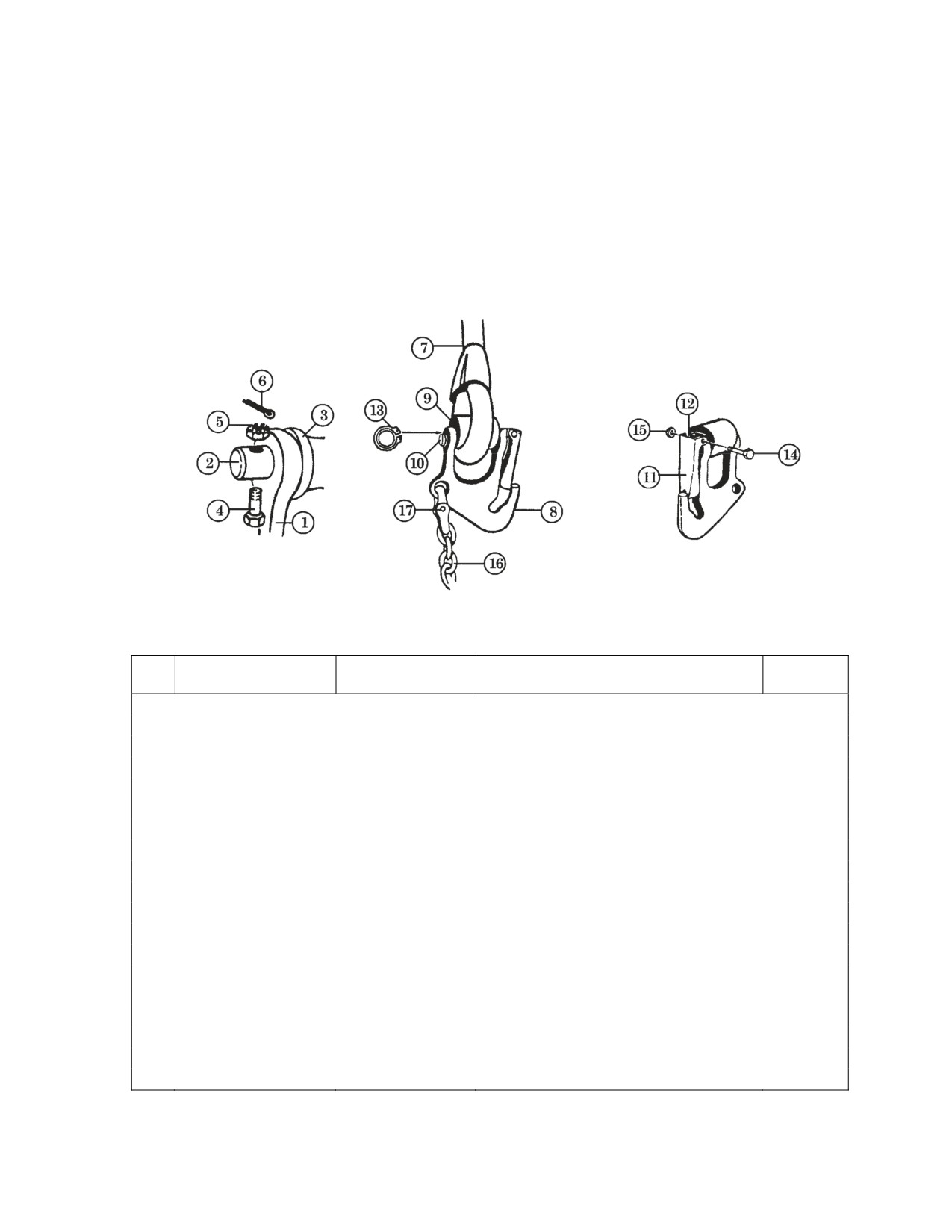
Appendix B
National Stock Numbers for Slings, Nets, and Spare Parts
10,000- OR 25,000- POUND CAPACITY SLING SET (CIRCLED NUMBERS CORRESPOND WITH
NSNs OF IDENTIFIED PARTS)
10,000-POUND CAPACITY SLING SET COMPONENTS
NSN
PART NUMBER
DESCRIPTION
QTY PER
SET
1670-01-027-2902
38850-00001-043
Sling Set Assembly Complete LIN T79003
1 ea
1
4030-01-048-4045
38850-00004-045
Shackle Assembly
1 ea
2
5315-01-115-3482
38850-00008-101
Pin, Apex Fitting
1 ea
3
5365-01-235-0908
38850-00015-104
Spacer, Apex
1 ea
4
5306-00-944-1536
NAS1306-16D
Bolt
1 ea
5
5310-00-207-9274
AN 320C6
Nut, Castellated
1 ea
6
5315-00-2341864
MS 24665-302
Cotter Pin
1 ea
7
4020-01-047-6814
38850-00009-055
Rope Assembly
4 ea
8
4030-01-048-4046
38850-00011-041
Grabhook Assembly
4 ea
9
5364-01-109-2543
38850-00015-101
Spacer, Grabhook
4 ea
10
5315-01-121-0497
38850-00008-103
Pin, Spacer
4 ea
11
4030-01100-1684
38850-00017-101
Keeper, Grabhook
4 ea
12
5360-01-115-6833
38850-00019-101
Keeper, Spring
4 ea
13
5325-01-046-3670
MS 3217-1050
Snap Ring
4 ea
14
5306-00-771-7621
NAS 1303-21
Bolt, Shear
4 ea
15
5310-00-807-1467
MS 21042-3
Nut, Lock
4 ea
16
4010-01-058-4772
38850-00053-101
Chain, 8-foot Length
4 ea
17
4010-01-231-3388
5779125/664228
Link, Coupling
4 ea
18
8460-00-606-8366
Mil-41835
Kit Bag, Flyer's
1 ea
FM 4-20.197/MCRP 4-11.3E, VOL I/NTTP 3-04.11/
20 July 2006
AFMAN 11-223 (I), VOL I/COMDTINST M13482.2B
B-1
Appendix B
25,000-POUND CAPACITY SLING SET COMPONENTS
NSN
PART NUMBER
DESCRIPTION
QTY PER
SET
1670-01-027-2900
38850-00001-044
Sling Set Assembly Complete LIN T79009
1 ea
1
4030-01-048-4045
38850-00004-045
Shackle Assembly
1 ea
2
5315-01-115-3482
38850-00008-101
Pin, Apex Fitting
1 ea
3
5365-01-235-0908
38850-00015-104
Spacer, Apex
1 ea
4
5306-00-944-1536
NAS1306-16D
Bolt
1 ea
5
5310-00-207-9274
AN 320C6
Nut, Castellated
1 ea
6
5315-00-2341864
MS 24665-302
Cotter Pin
1 ea
7
4020-01-047-6814
38850-00009-055
Rope Assembly
4 ea
8
4030-01-048-4046
38850-00011-041
Grabhook Assembly
4 ea
9
5364-01-109-2543
38850-00015-101
Spacer, Grabhook
4 ea
10
5315-01-121-0497
38850-00008-103
Pin, Spacer
4 ea
11
4030-01-100-1685
38850-00017-101
Keeper, Grabhook
4 ea
12
5360-01-115-6833
38850-00019-101
Keeper, Spring
4 ea
13
5325-01-046-3670
MS 3217-1050
Snap Ring
4 ea
14
5306-00-771-7621
NAS 1303-21
Bolt, Shear
4 ea
15
5310-00-807-1467
MS 21042-3
Nut, Lock
4 ea
16
4010-01-058-4772
38850-00053-101
Chain, 8-foot Length
4 ea
17
4010-01-231-3388
5779125/664228/
Link, Coupling
4 ea
WA60U
18
8460-00-606-8366
Mil-41835
Kit Bag, Flyer's
1 ea
15,000-POUND CAPACITY MULTILEG SLING SET ASSEMBLY
NSN
PART NUMBER
DESCRIPTION
QTY PER
SET
1670-00-902-3080
3900061
Sling Multileg Assembly, LIN T79009,
1 ea
TAMCN B2030
1
1670-00-946-8719
AC6000292
Web Ring Assembly
1 ea
2
1670-00-719-6243
MS24553-1
Link Assembly, Web Ring
1 ea
3
1670-00-946-8631
3110167
Sling Leg Assembly
4 ea
4
N/A
3910112-5
Keeper, 5-inch, Leg Assembly
4 ea
5
N/A
391011-1
Keeper, 6 1/4-inch, Leg Assembly
4 ea
6
1670-00-719-6243
MS24553-1
Link Assembly, Sling Leg
4 ea
7
N/A
31610
Grab Link
4 ea
8
N/A
FE 7623-3
Keeper, Grab Link
4 ea
9
N/A
34012-18
Spring Keeper, Grab Link
4 ea
10
5310-00-167-0818
AN960-10
Pin, Keeper, Grab Link
4 ea
11
5315-00-812-3765
MS20392-2033
Latch, Safety Hook
4 ea
12
5315-00-839-2325
MS24665-132
Cotter Pin, Keeper, Grab Link
4 ea
13
N/A
31611
Coupling Link
4 ea
14
N/A
34080-4
Chain
4 ea
FM 4-20.197/MCRP 4-11.3E, VOL I/NTTP 3-04.11/
B-2
AFMAN 11-223 (I), VOL I/COMDTINST M13482.2B
20 July 2006
National Stock Numbers for Slings, Nets, and Spare Parts
40,000-POUND CAPACITY SLING SET COMPONENTS
NSN
PART NUMBER
DESCRIPTION
QTY PER
SET
3940-01-183-2118
TAMCN B 2035
Sling Set Assembly Complete
1 ea
1
4838-01-199-9562
FE8109-1
Apex Shackle Assembly
1 ea
2
N/A
FE8109-5
Shackle
1 ea
3
N/A
FE8109-3
Pin, Shackle, Apex
1 ea
4
N/A
FE8109-2
Spacer, Shackle, Apex
1 ea
5
5306-00-944-1538
NAS1306-21D
Bolt
1 ea
6
5310-00-176-8110
AN 320C6
Nut, Castellated
1 ea
7
5315-00-234-1864
MS 24665-302
Cotter Pin
1 ea
8
3940-01-194-9364
JETSWMC-2000
Sling Leg
4 ea
9
4030-01-197-1629
FE8103-1
Grab Link Assembly
4 ea
10
N/A
FE8103-4
Spacer, Grab Link
4 ea
11
5306-00-151-1482
AN12-42
Bolt, Grab Link
4 ea
12
5310-00-167-1292
AN310-12
Nut, Grab Link
4 ea
13
5315-00-285-7161
MS24665-377
Cotter Pin, Grab Link
4 ea
14
N/A
FE7623-3
Keeper, Grab Link
4 ea
15
5310-00-812-3765
MS20392-2033
Pin, Keeper, Grab Link
4 ea
16
N/A
34012-18
Spring, Keeper, Grab Link
4 ea
17
5310-00-167-0818
AN960-10
Washer, Keeper, Grab Link
4 ea
18
5315-00-839-2325
MS24665-132
Cotter Pin, Keeper, Grab Link
4 ea
19
4010-01-081-5114
577-0815
Link, Coupling
4 ea
20
N/A
607050
Chain, 8-Foot
4 ea
TYPE XXVI NYLON MULTILOOP LINE
NSN
Description
1670-01-062-6301
2-loop, 3 foot
1670-01-062-6306
4-loop, 3 foot
1670-01-062-6304
2-loop, 9 foot
1670-01-062-6305
4-loop, 9 foot
1670-01-063-7760
2-loop, 11 foot
1670-01-062-6310
4-loop, 11 foot
1670-01-062-6303
2-loop, 12 foot
1670-01-062-6307
4-loop, 12 foot
1670-01-063-7761
2-loop, 16 foot
1670-01-062-6308
4-loop, 16 foot
1670-01-062-6302
2-loop, 20 foot
1670-01-064-4453
4-loop, 20 foot
FM 4-20.197/MCRP 4-11.3E, VOL I/NTTP 3-04.11/
20 July 2006
AFMAN 11-223 (I), VOL I/COMDTINST M13482.2B
B-3
Appendix B
ROUNDSLINGS
NSN
PART NUMBER
CAPACITY
LENGTH
1670-01-388-6789
PRS 2E008
5,300-pound
8 foot
1670-01-388-3845
PRS 2E017
5,300-pound
17 foot
1670-01-388-8480
PRS 3E008
8,400-pound
8 foot
1670-01-388-8479
PRS 3E017
8,400-pound
17 foot
1670-01-388-3917
PRS 5E030
13,200-pound
30 foot
1670-01-388-3901
PRS 7E065
21,200-pound
65 foot
1670-01-388-3965
PRS 7E070
21,200-pound
70 foot
5,000- AND 10,000-POUND CAPACITY CARGO NETS AND COMPONENTS
NSN
PART NUMBER
DESCRIPTION
QTY
1670-01-058-3811
6018-5
Net, 5,000-pound capacity,
1 ea
LIN N02776, TAMCN J3121
1670-01-058-3810
6018-10
Net, 10,000-pound capacity,
1 ea
LIN N02708, TAMCN J3120
1670-01-070-5276
6019
Apex fitting
1 ea
1670-01-067-9989
6020
Hook
4 ea
4020-01-118-5826
6018-15
Repair cord, used on part no. 6018-5
As req
4020-01-119-5994
6018-20
Repair cord, used on part no. 6018-10
As req
8030-01-152-2286
2300-3
Antiabrasion compound, olive drab
As req
8030-01-154-2327
WB1003 black
Antiabrasion compound, black
As req
1080-00-108-1155
13226EO964-2
Transportease
1 ea*
8460-00-606-8366
MIL-K-41835
Kit bag, flyers
1 ea*
* Alternate NSN is 1080-00-107-8580. These cases are designed and marked for use with the
camouflage screen. Camouflage system markings should be replaced with “Helicopter
External Cargo Net, 10,000-pound capacity.”
PROTECTIVE EQUIPMENT
NSN
Description
4240-00-052-3776
Eye goggles
8415-01-158-9445
Gloves, electrical workers, size 9
8415-01-158-9446
Gloves, electrical workers, size 10
8415-01-158-9447
Gloves, electrical workers, size 11
8415-01-158-9448
Gloves, electrical workers, size 12
8415-00-268-7859
Gloves, leather
4240-00-759-3290
Protector, hearing
8415-00-071-8786
Helmet, flight deck (USN/USMC/USAF)
6515-00-137-6345
Plugs, ear, hearing protection
FM 4-20.197/MCRP 4-11.3E, VOL I/NTTP 3-04.11/
B-4
AFMAN 11-223 (I), VOL I/COMDTINST M13482.2B
20 July 2006