FM 4-20.197 Multiservice Helicopter Sling Load: Basic Operations and Equipment (FM 4-20.197) - page 2
Chapter 4
Landing Site Selection and Preparation
INTRODUCTION
4-1. The selection of a usable landing site is extremely important. Logistical and tactical considerations
must be analyzed and taken into account to assure that the landing sites are located at the best place to
support the mission. The area must also be accessible to the aircraft that are going to use the site. Since
helicopters carrying sling loads may also be carrying internal loads and therefore have to land, this chapter
covers the selection and preparation of a complete landing site. The supported or receiving unit
commander, in coordination with the aviation liaison officer, if available, selects and prepares the landing
sites. The aviation unit liaison officer or aircraft pilot makes the final decision concerning minimum
requirements or the suitability of the sites. A landing site is an area within a landing zone (LZ) that
contains one or more landing points.
LANDING ZONE DESIGNATION
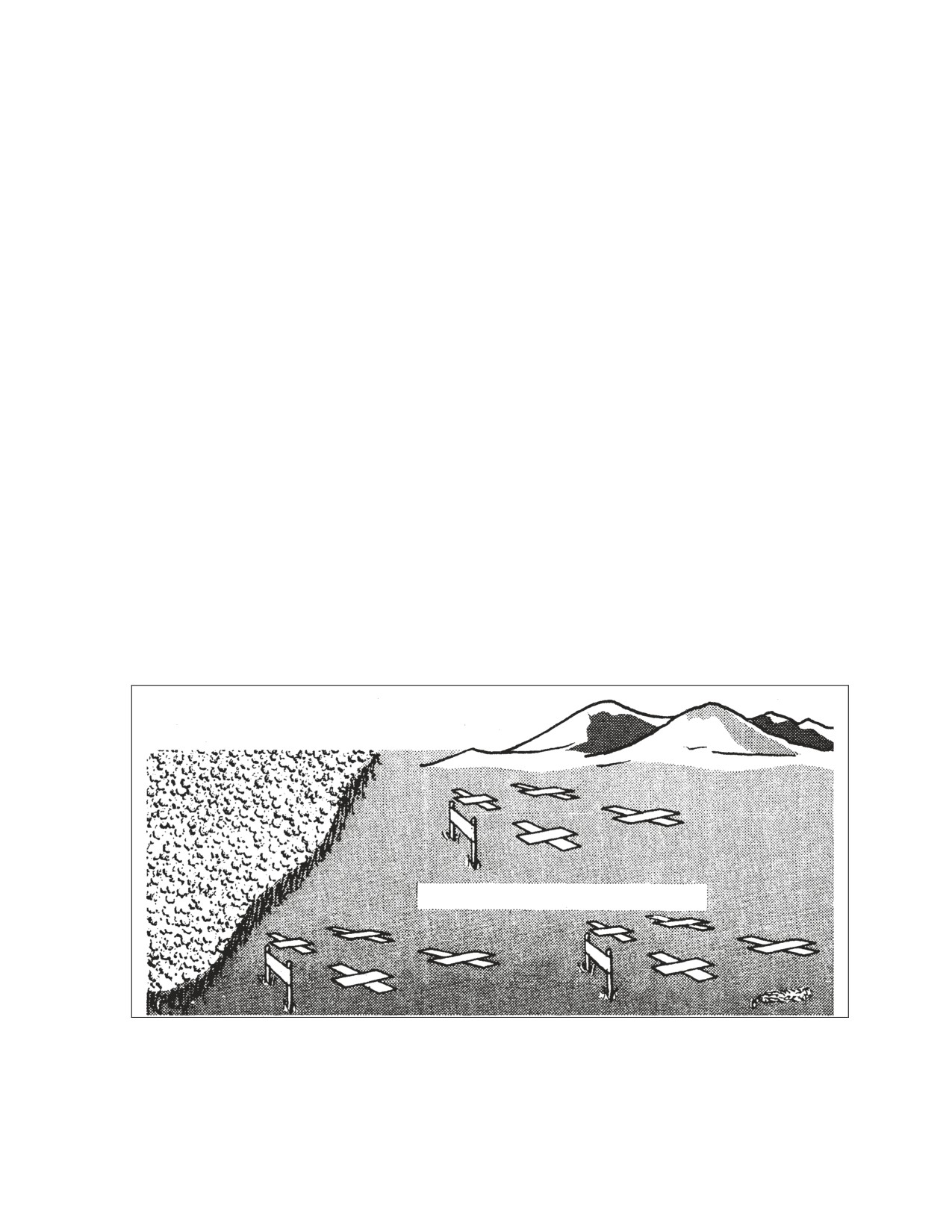
4-2. An LZ is an area used for helicopter landing operations. The aircraft may not actually have to land
on the ground but may only need to hover over a load. An LZ may include a number of landing sites with
various landing points for individual helicopters (Figure 4-1). Landing zones may be designated by a
series of code names. Landing sites and points are marked as designated by the aviation unit. Marine
Corps landing sites are designated by color and landing points are identified by two-digit numbers such as
11, 15, or 32. The number of landing sites required for an operation depends upon the mission, terrain,
number of aircraft, and the amount of equipment to be lifted.
LANDING ZONE CROW
Figure 4-1. Typical Landing Zone Layout
FM 4-20.197/MCRP 4-11.3E, VOL I/NTTP 3-04.11/
20 July 2006
AFMAN 11-223 (I), VOL I/COMDTINST M13482.2B
4-1

Chapter 4
LANDING SITE SELECTION
4-3. The supported or receiving unit, with advice from the aviation unit liaison officer, selects the
location of the helicopter landing sites to best support the operation. The following factors should be
considered in the selection of a landing site:
z
Security and Concealment. Landing sites should be located in areas that allow for maximum
security or protection. They should be shielded from enemy observation by wooded areas or by
masking the terrain. The selection of the approach and exit routes should also be based on the
availability of good masking features.
z
Convenience. Landing sites that are used primarily for supply or resupply should be located
near storage or supply points to reduce ground movement of cargo after it is delivered.
z
Size. The size of the landing site depends upon the number of landing points within it, the size
of the landing site, and the tactical dispersion required between the landing points. Minimum
distance between landing points within a landing site is measured from the center of one landing
point to the center of another. The diameter of the landing point for each type helicopter is
shown in Table 4-1.
Table 4-1. Required Landing Point Sizes
Helicopter Size
Minimum Diameter of Landing
Type of Helicopter/Operation
Point
1
80-Feet (25 Meters)
OH-6/OH-58
2
125-Feet (35 Meters)
UH-1/H-65
3
160-Feet (50 Meter)
UH-60/H-2
4
264-Feet (80 Meters)
CH-47/CH-53/H-3
5
328-Feet (100 Meters)
Sling Load Operations
6
410-Feet (125 Meters)
Sling Load Long Line Operations
7
492-Feet (150 Meters)
Sling Load Night Vision Goggle
(NVG) Operations
CLEARING OBSTACLES
4-4. Each landing point must be level and firm enough to keep a fully loaded aircraft’s landing gear from
sinking into the ground. The ground is firm enough for size 1 and 2 helicopters if it can support a 1 1/4-ton
truck. If the ground can support a 5-ton truck, size 3 through 5 helicopters can land without risk of
sinking. The entire landing point must be cleared of any loose material or debris to prevent it from being
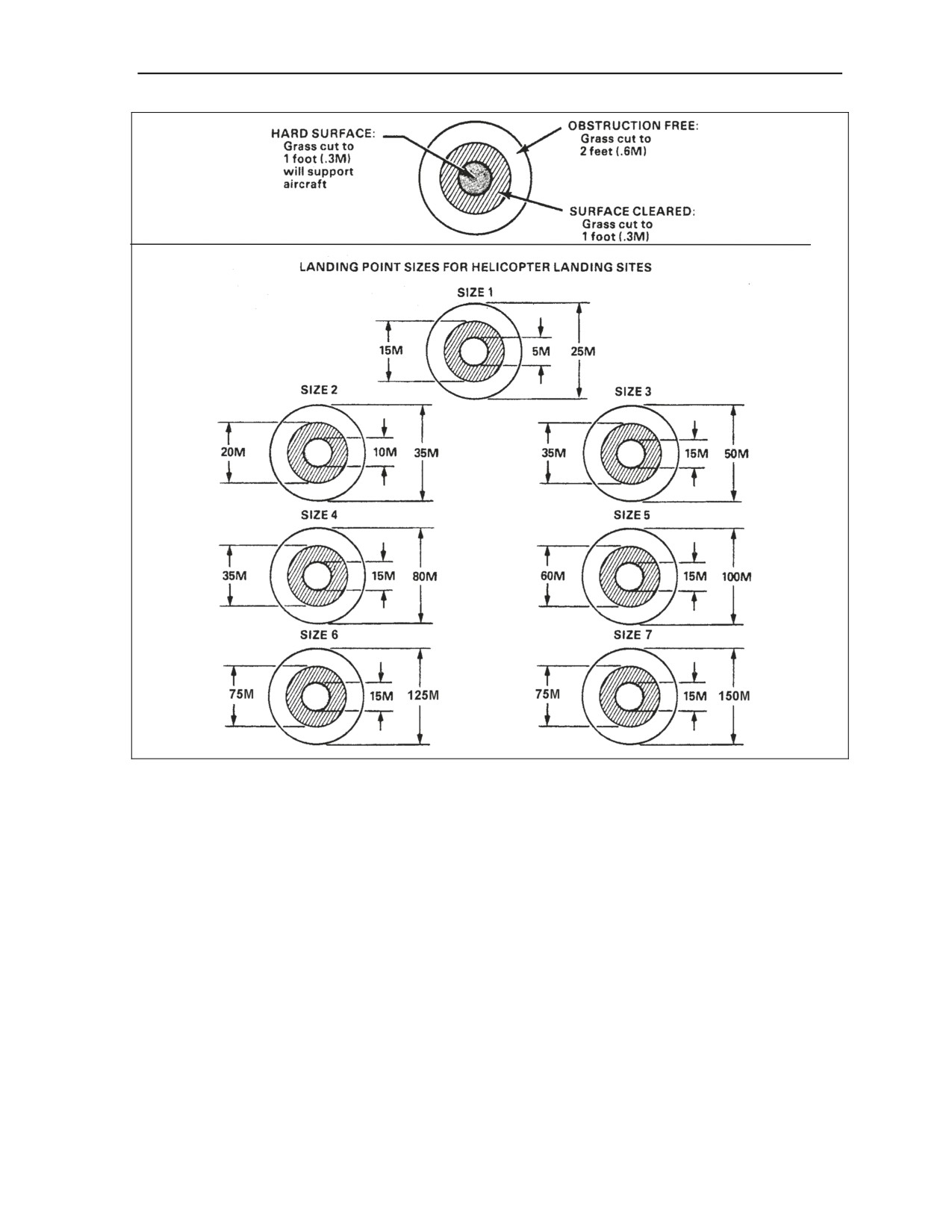
blown into the ground crew or rotor blades, or drawn into the helicopter engines. Figure 4-2 shows the
three different areas and conditions for each size landing point.
CAUTION
All trees, brush, stumps, or other obstacles that could cause damage
to the rotor blades or the underside of the aircraft must be cleared
around the landing points. If trees must be cut, stumps in the
immediate vicinity of the landing points must be cut as close to ground
level as possible. It may be necessary to use axes, machetes, chain
saws, or demolitions to clear underbrush and trees. It is not necessary
to clear grass shorter than 1 foot that covers a level field unless a fire
risk exists. Hard packed sod makes the best natural landing area.
FM 4-20.197/MCRP 4-11.3E, VOL I/NTTP 3-04.11/
4-2
AFMAN 11-223 (I), VOL I/COMDTINST M13482.2B
20 July 2006
Landing Site Selection and Preparation
Figure 4-2. Required Landing Point Characteristics
SLOPE OF SURFACE
4-5. Although helicopters can touchdown hover (one or two but not all of the wheels are placed on the
ground) on any sloping ground which also provides the necessary rotor clearance, landing sites should be
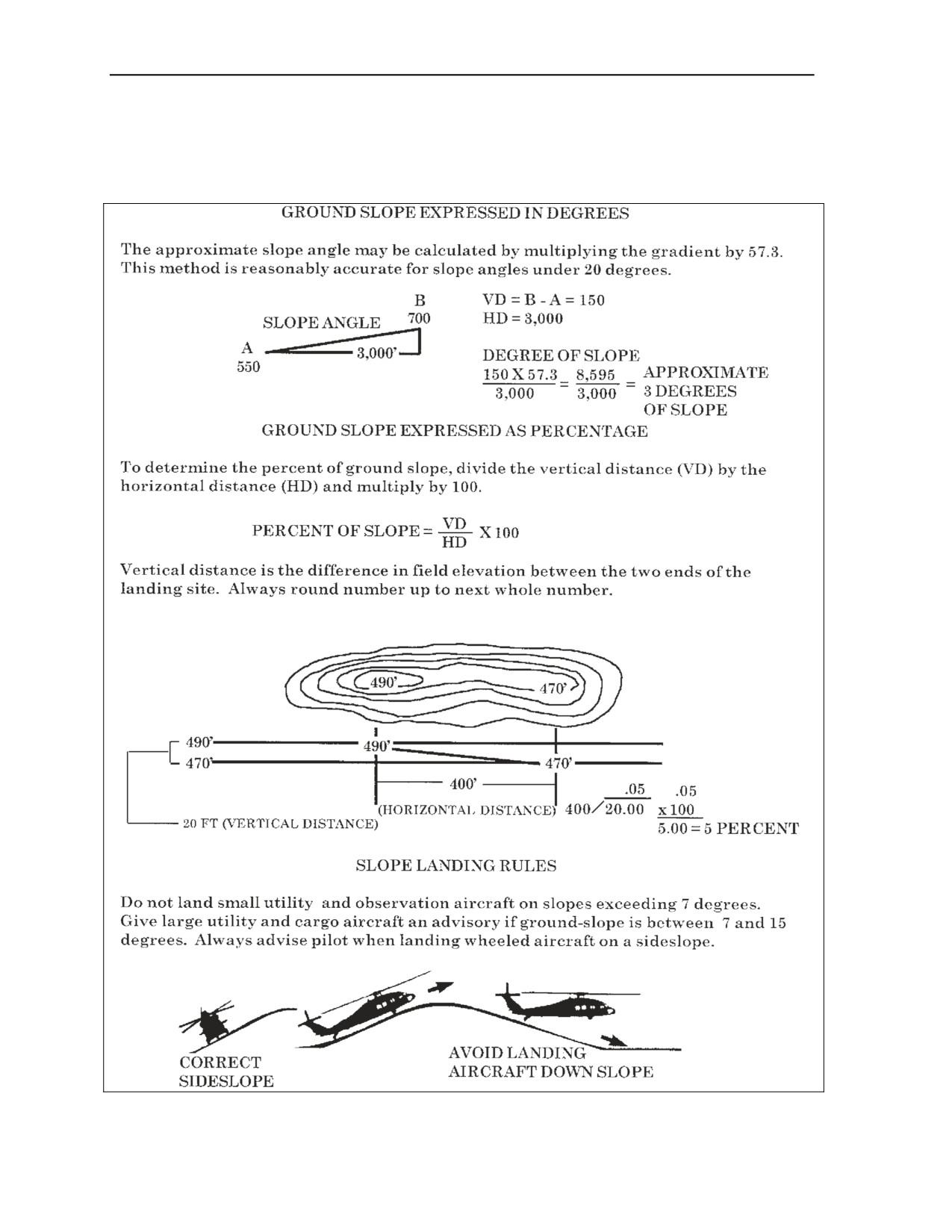
selected that are as level as possible. Where a slope is present, it should be uniform (Figure 4-3). You
must confirm the landing site with the aviation unit, if the following criteria cannot be met:
z
Daylight Approaches. During daylight approaches, the slope should not exceed 7 degrees or
13 percent if the helicopter must land. A greater slope may be acceptable for hover operations.
z
Night Approaches. During a night approach, a downslope as viewed from the approach path is
not normally acceptable. Forward and/or lateral slopes should not exceed 3 degrees or 5
percent.
APPROACHES TO LANDING SITE
4-6. It is not desirable to establish landing sites that require the helicopter to take off or land vertically
without any forward flight. Helicopters require greater power to ascend or descend vertically, thereby
reducing their allowable payload. The helicopter will require less power if it can depart with some forward
FM 4-20.197/MCRP 4-11.3E, VOL I/NTTP 3-04.11/
20 July 2006
AFMAN 11-223 (I), VOL I/COMDTINST M13482.2B
4-3
Chapter 4
airspeed. Ideally, there should be an obstruction-free approach and exit path into the wind. These
approach and exit paths should meet the following criteria. Approaches which do not meet these criteria
may be acceptable, depending on the nature of the operation. However, when these criteria cannot be met,
the supported or receiving unit must coordinate with the aviation unit or liaison officer.
Figure 4-3. Determining Ground Slope
FM 4-20.197/MCRP 4-11.3E, VOL I/NTTP 3-04.11/
4-4
AFMAN 11-223 (I), VOL I/COMDTINST M13482.2B
20 July 2006
Landing Site Selection and Preparation
z
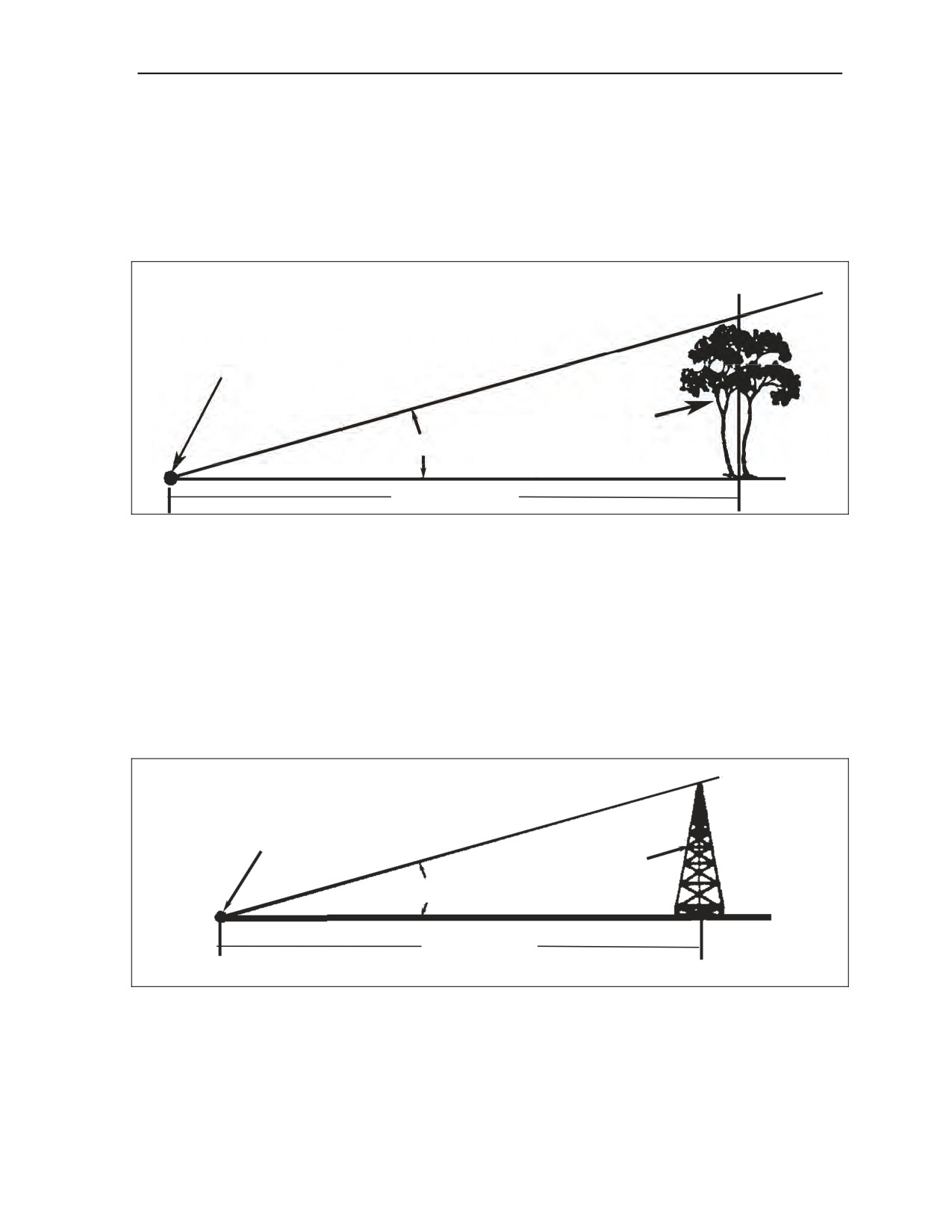
Day Approach. Within the day approach and exit path, the maximum obstruction angle should
not exceed 6 degrees measured from the landing point center to a distance of 500 meters
(1,640 feet) (Figure 4-4). The maximum obstacle height at 500 meters is 52 meters (171 feet).
The 10:1 ratio (a field expedient formula) is that for every meter of vertical obstacle, you must
have 10 meters from the center of the landing point to the obstacle. That is, a landing point
center must be 200 meters from a 20-meter (66-foot) tree if the helicopter must approach or
depart directly over the tree.
LANDING POINT
171 FT
(52 M)
6°
1,640 FT (500 M)
Figure 4-4. Maximum Angle of Approach (Daylight)
z
Night Approach. Within the night approach and exit path, the maximum obstruction angle
should not exceed 4 degrees measured from the center of the landing point to a distance of
3,000 meters (9,843 feet) (Figure 4-5). The maximum obstacle height at 3,000 meters is
210 meters (689 feet). The field expedient formula is that for every meter of vertical obstacle,
you must have 14 meters of distance from the center of the landing point to the obstacle. That
is, a landing point must be 280 meters from a 20-meter tree if the helicopter must approach or
exit directly over the tree. Another night operation planning consideration is the helicopter
approach and exit path area and the maximum obstacle height within that area. Remember, this
criteria applies to both the approach path to the landing point as well as the exit path from the
landing point. First we must define the area that is the approach and exit path.
LANDING POINT
689 FT
(210 M)
4°
1,640 FT (500 M)
Figure 4-5. Maximum Angle of Approach (Night)
z
Approach and Exit Path. The approach and exit path is a 16-degree (277 mils) sector or arc
extending outward and is measured from the center of the landing point (Figure 4-6). The V-
shaped approach and exit path is depicted by the dashed and dotted line in the illustration. The
4-degree maximum obstruction angle applies to the entire area within the approach and exit path
FM 4-20.197/MCRP 4-11.3E, VOL I/NTTP 3-04.11/
20 July 2006
AFMAN 11-223 (I), VOL I/COMDTINST M13482.2B
4-5
Chapter 4
(both the dark and light shaded area) measured from the landing point center to a distance of
3,000 meters.
16°
4°
Figure 4-6. Approach and Exit Path
z
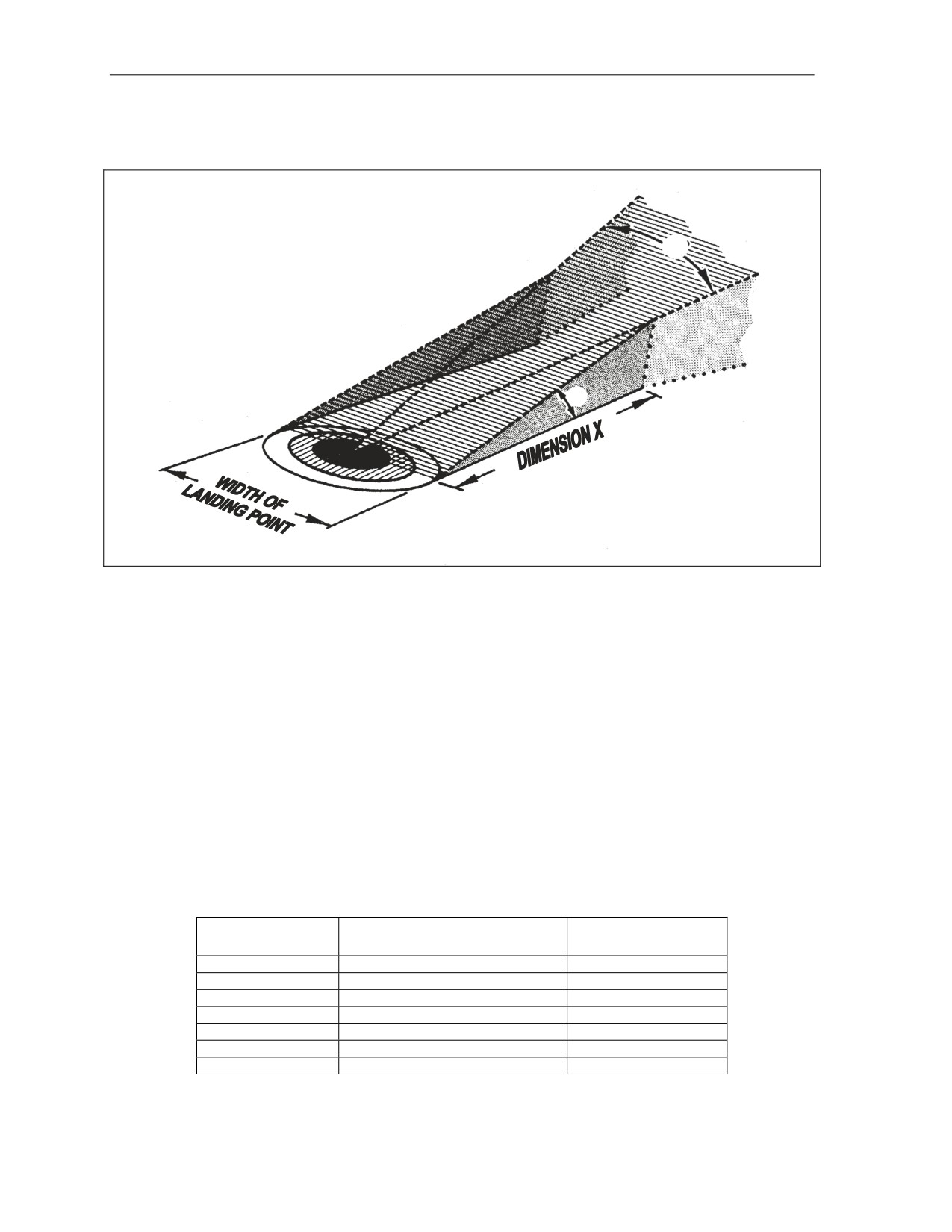
Night Operations. During night operations, as the pilot gets closer to the landing point, he
needs a wider area for a safe approach than just the 16-degree sector. Therefore, the minimum
width of the approach and exit path, illustrated by the darker shaded area, must be equal to or
wider than the width of the landing point that must be cleared to a maximum height of 2 feet
(Figure 4-2). The length of the minimum width area, dimension X, will vary depending on the
size of the landing point, (Table 4-2). Follow along as we use a UH-60 Blackhawk as an
example to help clarify the night approach and exit path criteria. Table 4-1 identifies the UH-60
Blackhawk as a size 3 helicopter. Next we must determine the landing point area that must be
free from obstructions and grass cut to maximum height of 2 feet. Figure 4-2 indicates 50 meters
as that area for a size 3 landing point. Therefore, the minimum width of the night approach and
exit path is 50 meters. The minimum width distance intersects the 16-degree V-shaped arc
(night approach and exit path) 180 meters from the center of the landing point. In other words,
the night maximum obstruction angle applies to the complete approach and exit path; both the
rectangular-shaped wedge (dark shaded area of the diagram) as well as the 16-degree V-shaped
arc (light shaded area and dotted line).
Table 4-2. Length of Minimum Width Area
Landing Point
Width of Landing Point
Dimension X (Meters)
Size
(Meters)
1
25
90
2
35
125
3
50
180
4
80
285
5
100
355
6
125
444
7
150
533
FM 4-20.197/MCRP 4-11.3E, VOL I/NTTP 3-04.11/
4-6
AFMAN 11-223 (I), VOL I/COMDTINST M13482.2B
20 July 2006
Landing Site Selection and Preparation
AIRCRAFT FORMATION APPROACH (USA)
4-7. In large tactical relocations or resupply missions, the helicopters will normally fly in formation. The
landing site and the ground crew must be prepared to receive them. When possible, helicopters should
land in the same formation in which they are flying. However, planned formations may require
modification for helicopters to land in some areas. If a modification in flight formation is required for
landing, the change requiring the least shift of helicopters should be used and the flight leader notified as
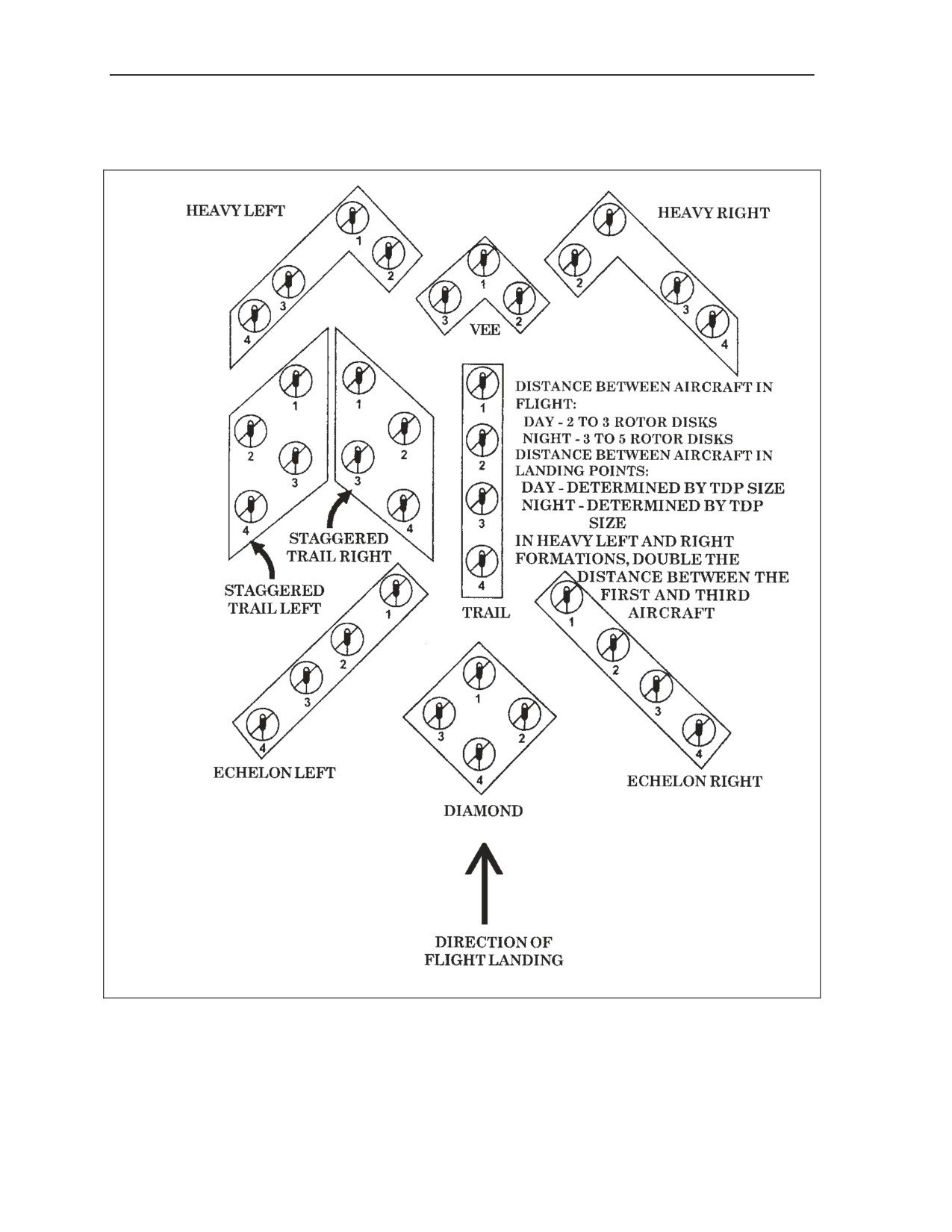
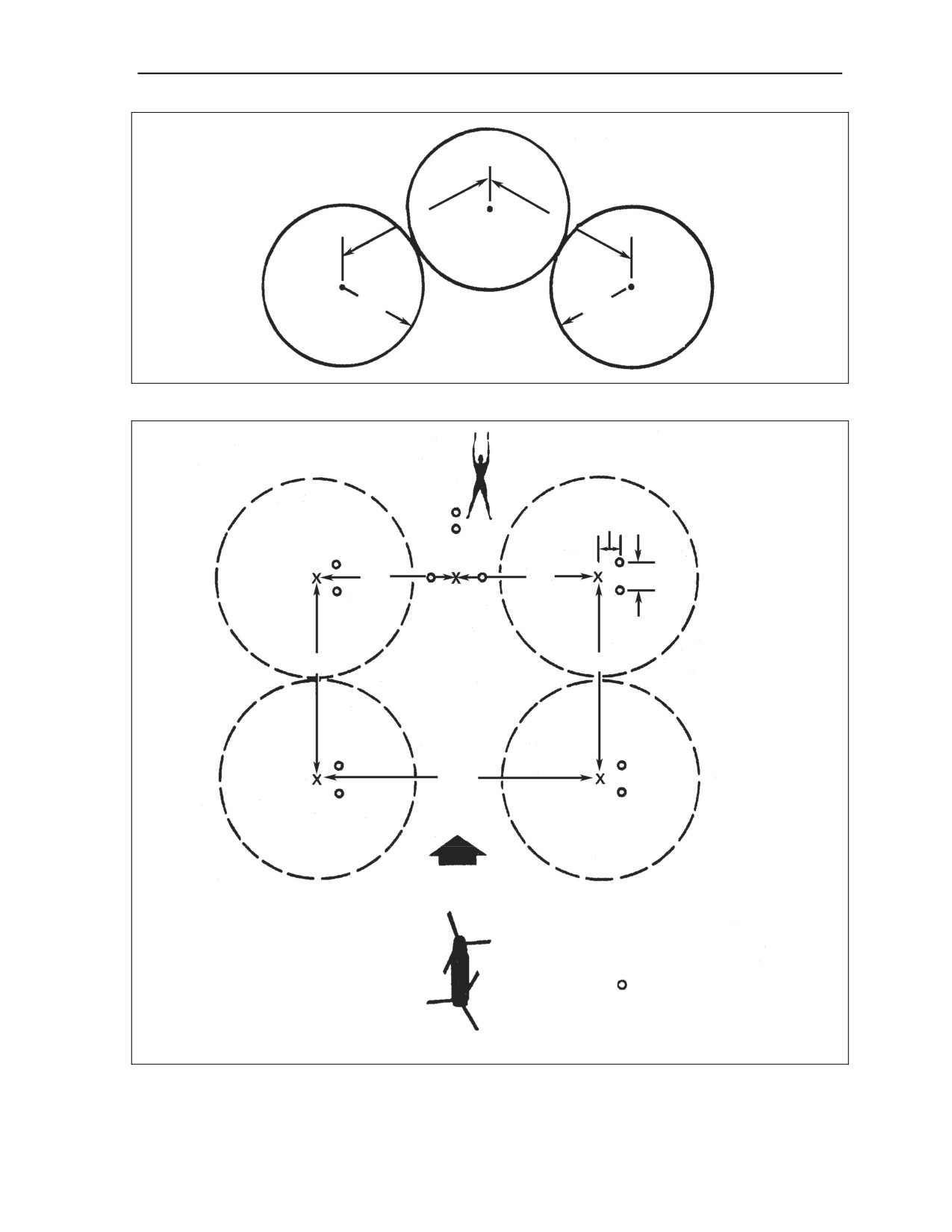
soon as radio contact is made. For common aircraft formations, see Figure 4-7. Figure 4-8 illustrates a
landing site for three size 3 helicopters landing in a vee formation. Many times size 4 helicopters will not
fly in standard flight formations and therefore will be received one or two at a time. In such cases, the
landing site configuration in Figure 4-9 is suggested. Each aircraft initially approaches and hovers at the
inverted “Y” light formation and is then guided to its cargo pickup point by the signalman.
z
Daylight Markings. The landing site should be marked with marker panels or other visual
means. Smoke may be used, but it also may disclose your position to the enemy. If marker
panels are used alone, the wind direction is indicated by placing the crossmembers or top of the
“T” into the wind. The marker panels must be securely fastened to prevent the helicopter rotor
wash from tearing them from the ground. If smoke is used, only release it after the pilot
requests smoke. The pilot will then identify the color and relay it to the ground crew. Make
sure the smoke canister is far enough away from the landing point that the rotor wash does not
pick up the smoke and obstruct the aircrew’s vision.
z
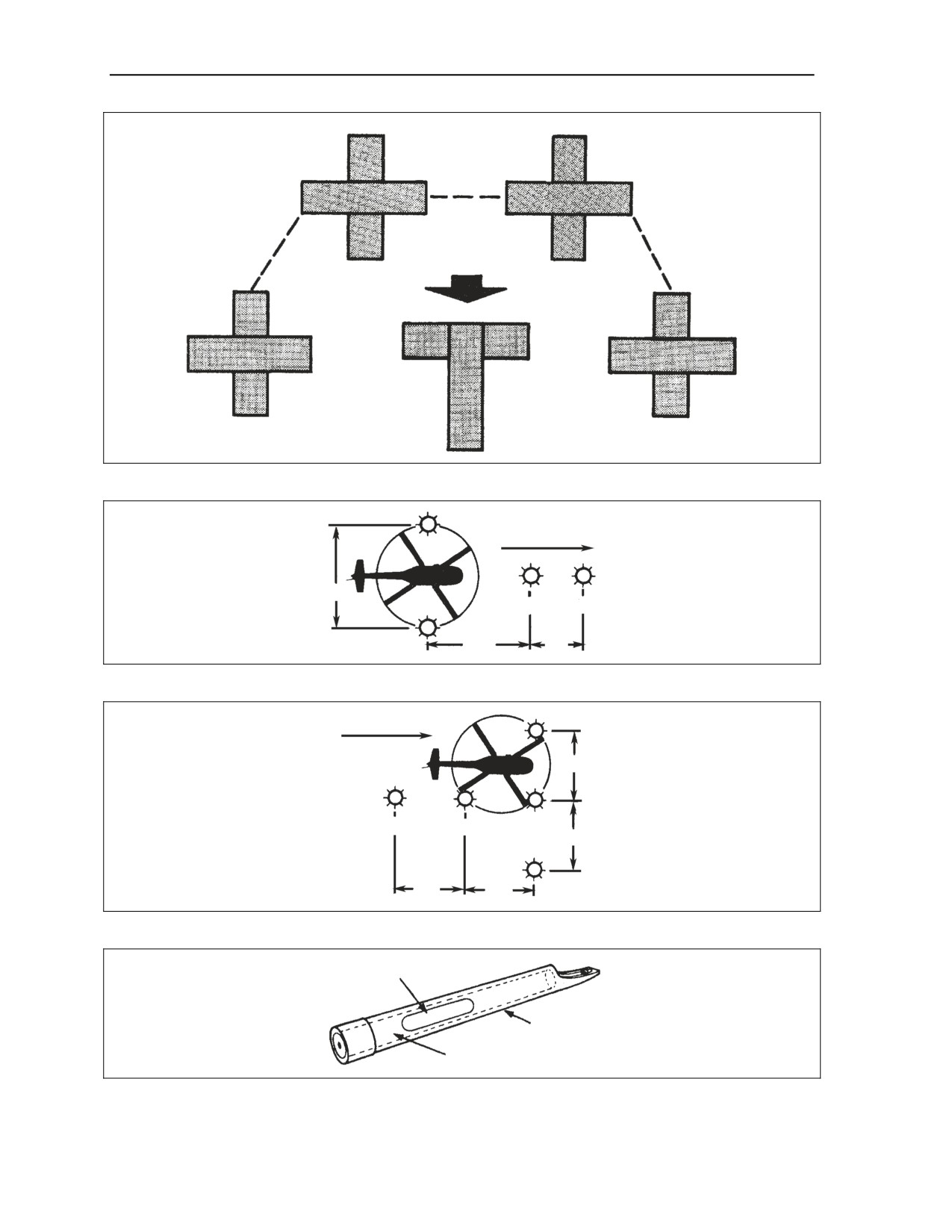
USMC Markings. When using marker panels to identify landing sites, the panels must
correspond to the color name of the landing site. If a wind sock is used, position it securely in
the center of the landing site. Landing points are indicated by placing the corresponding colored
marker panels in the form of a cross on the landing point (Figure 4-10). Smoke may also be
used to identify landing points.
z
Army Markings. Army signalmen identify the landing site by either holding both arms
vertically overhead or by holding a folded VS-17 marker panel (NSN 8345-00-174-6965) chest
high. He then points to the correct landing point.
z
Night Markings. Landing sites and landing points used during night operations are carefully
marked because the terrain features used during daytime operations are obscured. Two methods
are used: the “T” or inverted “Y” light pattern or the glide angle indicator light (GAIL) system
(USMC). The “T” or inverted “Y” light system is used to assist the pilot in locating, landing,
and maneuvering within the site. Keep the following factors in mind:
Bright lights, especially intense or high beams, will temporarily blind the pilot. Only use
dim lights in the vicinity of the landing site.
Chemlights, wands, or flashlights can be used to mark landing sites and points.
Night vision goggles (NVG) compatible (blue-green) lighting must be used when the
aircrew is using NVG.
z
The Inverted "Y" Light Formation. The inverted "Y" light formation is set up using four
lights positioned according to Figure 4-11. The cargo is placed between the two stem lights and
aligned with the base and directional lights. The single aircraft or lead aircraft in a formation
flight will touch down or hover into the “Y,” midway between the legs of the “Y.”
z
The "T" Light Formation. The “T” light formation is set up using five lights placed according
to Figure 4-12. The cargo is positioned 5 meters to the left of the base light and midway
between the base light and stem light. The lead aircraft lands to the left of the base light and just
short of the stem lights.
z
Lights. Beacon (bean bag) lights are used for both the inverted “Y” and “T” light formations.
If beacon lights are unavailable, several alternate methods can be used to mark the landing site.
Cyalume light sticks (commonly referred to as chemlights) are often used to mark the landing
site. These lights (Figure 4-13) are plastic tubes filled with a liquid chemical and a glass vial
inside containing another chemical. When the glass vial is broken (by squeezing the plastic
tube), a chemical reaction between the two liquids produces a glowing light. Depending upon
the size of the tube, the glow lasts from 30 minutes to 12 hours. The chemlights can be taped or
FM 4-20.197/MCRP 4-11.3E, VOL I/NTTP 3-04.11/
20 July 2006
AFMAN 11-223 (I), VOL I/COMDTINST M13482.2B
4-7
Chapter 4
tied to stakes and positioned in the landing site. Chemlights are available in different colors and
glow times (see Appendix B).
Figure 4-7. Standard Flight and Landing Formations
FM 4-20.197/MCRP 4-11.3E, VOL I/NTTP 3-04.11/
4-8
AFMAN 11-223 (I), VOL I/COMDTINST M13482.2B
20 July 2006
Landing Site Selection and Preparation
50M
50M
25M
25M
Figure 4-8. Aircraft Landing Site for Three Size 3 Helicopters in Vee Formation
10M
50M
50M
10M
80M
80M
100M
APPROACH DIRECTION
LIGHTS FOR
NIGHT OPERATIONS
Figure 4-9. Size 4 Helicopter Landing Site
FM 4-20.197/MCRP 4-11.3E, VOL I/NTTP 3-04.11/
20 July 2006
AFMAN 11-223 (I), VOL I/COMDTINST M13482.2B
4-9
Chapter 4
LP22
LP23
WIND
DIRECTION
LANDING
POINT
PLASTIC TUBE
WIND TEE
21
LP24
Figure 4-10. Daylight Landing Site Markings (USMC)
LEFT
FLIGHT
STEM
DIRECTION
14M
BASE DIRECTIONAL
14M
7M
Figure 4-11. Inverted “Y” Light Formation
FLIGHT
LEFT
DIRECTION
STEM
10M
BASE DIRECTIONAL
10M
10M
10M
Figure 4-12. “T” Light Formation
GLASS VIAL
PLASTIC TUBE
LIQUID CHEMICAL
Figure 4-13. Chemlight Stick
FM 4-20.197/MCRP 4-11.3E, VOL I/NTTP 3-04.11/
4-10
AFMAN 11-223 (I), VOL I/COMDTINST M13482.2B
20 July 2006
Landing Site Selection and Preparation
z
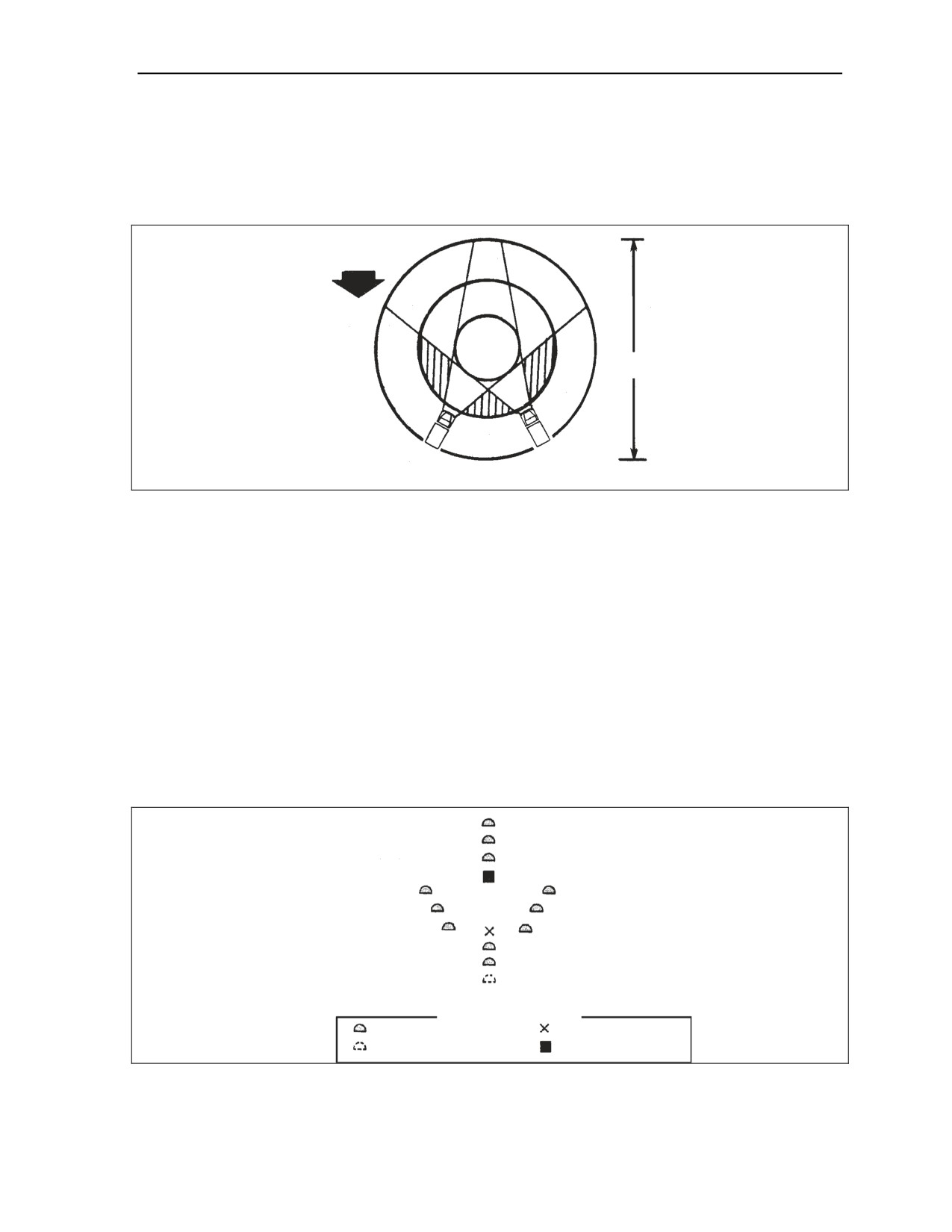
Emergency Lighting. During an emergency, various lighting patterns can be used with proper
coordination between the aircrew and ground personnel. A common method using vehicles is
shown in Figure 4-14. This method should only be used in an emergency because it impairs the
pilot’s night vision and can disclose the landing site position. Refer to NWP-55-9-ASH for
other variations of night landing patterns (USMC).
WIND DIRECTION
100M
APPROACH PATH
Figure 4-14. Emergency Lighting Pattern
z
Glide Angle Indicator Light (GAIL).
(USMC) The GAIL system is used whenever possible
(Figure 4-15). The GAIL is positioned to project its beam along the preferred direction of
approach. The glide path angle must provide clearance over the highest obstacle along the
avenue of approach. Glide path angles from 3 to 8 degrees are common and acceptable. Angles
greater than 8 degrees are considered too steep and could cause difficulty in maintaining the
aircraft on the glide path. Since the GAIL has a narrow beam width, assist the pilot in finding it
by placing additional lights in the landing site. Remember, the preferred direction of approach
is into the wind. However, when the landing site size does not allow the glide path to be
directed into the wind without exceeding 8 degrees, the GAIL system should be shifted left or
right to a glide path of less than 8 degrees. Approach azimuth and glide path angle information
are transmitted to the pilot in the briefing. When adjusting the GAIL scope, make sure that it is
far enough away from the front marker lights (normally 30 meters) to give the pilot enough
distance to maneuver over the landing point. It may be necessary to secure the GAIL scope to
the ground using sand bags or tent pins, so that it is not blown over by the helicopter rotor wash.
LEGEND
CARGO DROP AND
STEADY LIGHTS
PICKUP POINT
BLINKING LIGHTS
GLIDE SLOPE INDICATOR
Figure 4-15. GAIL System
FM 4-20.197/MCRP 4-11.3E, VOL I/NTTP 3-04.11/
20 July 2006
AFMAN 11-223 (I), VOL I/COMDTINST M13482.2B
4-11
Chapter 4
z
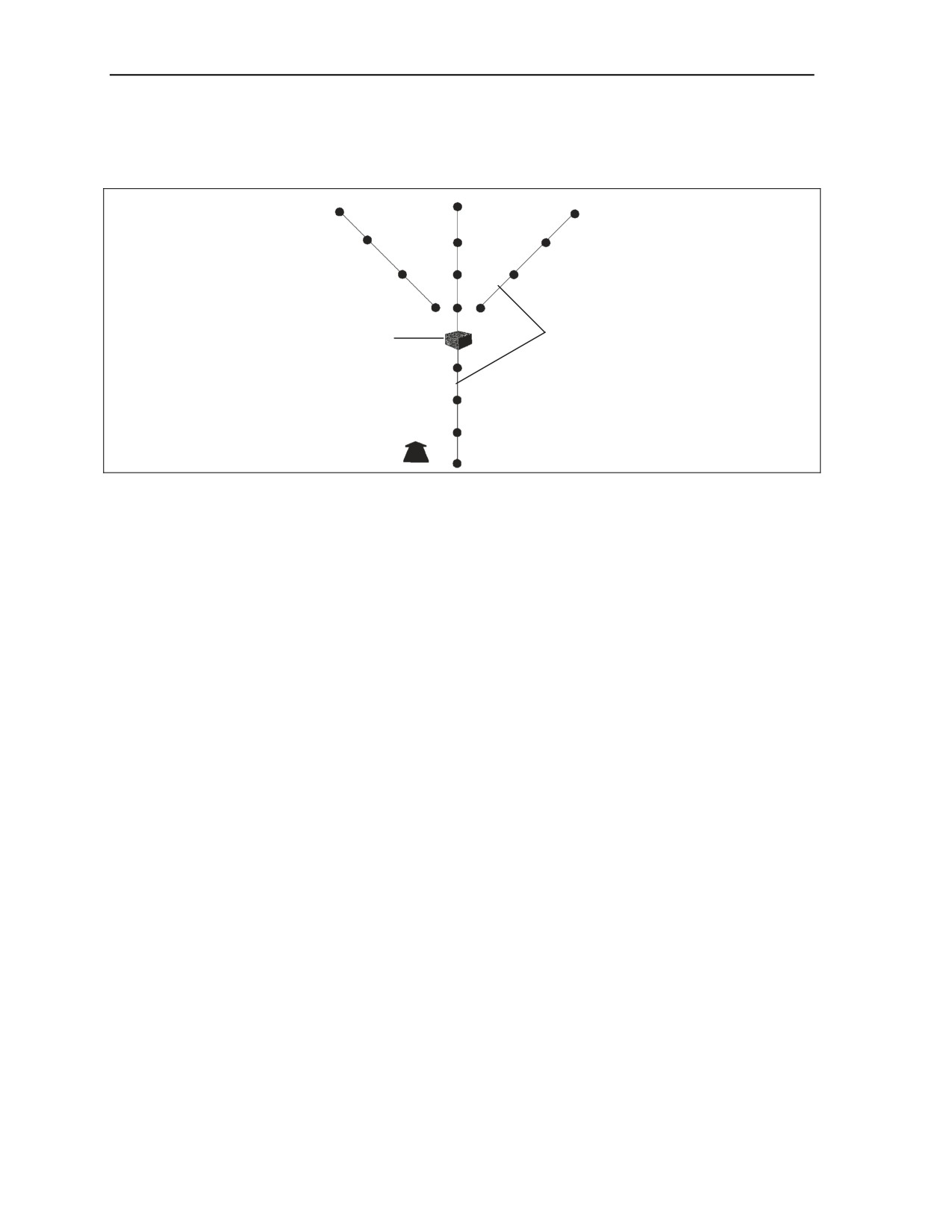
Crow's foot.
(USMC) The crow's foot is an optional lighting system used during night
operations. Infrared chemlites are attached to tent stakes at 15 meter intervals as shown in
Figure 4-16.
15 METERS
CARGO
BETWEEN LIGHTS
APPROACH
Figure 4-16. Crow’s Foot System
MARKING LANDING POINTS
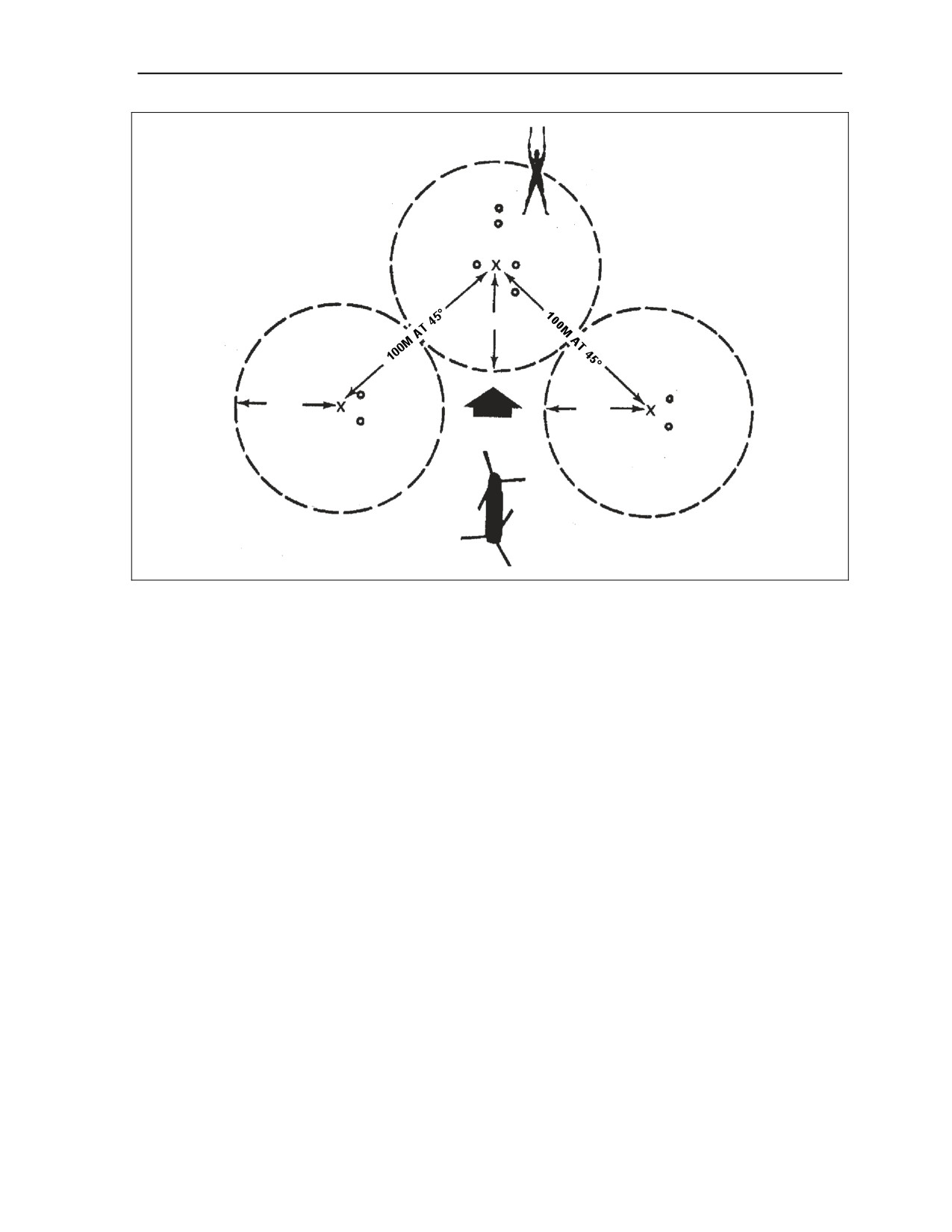
4-8. The inverted “Y” and “T” light formations identify the landing site. Multiple landing points must be
marked within the landing site so that the pilot will know where the load is located. Landing points for
size 1 through 3 helicopters are marked with a single light. Landing points for size 4 and 5 helicopters are
marked with two lights spaced 10 meters apart. The aircraft lands to the left of the lights. Figure 4-17
illustrates how to mark individual landing points for size 5 helicopters. As an additional reference point to
assist the pilot, three lights may be placed in a triangular formation 25 meters upwind of the landing point.
The three lights are positioned 5 meters apart from each other with two of the lights placed in a straight line
with the landing point. The third light is placed to the right of the line midway between the two lights.
Whenever the landing site permits, the landing points should be increased to the next larger size to provide
an extra margin of safety for night operations.
MARKING OBSTACLES
4-9. During daylight operations, obstacles that are difficult to detect or impossible to remove, such as
wires, holes, stumps, and rocks, are marked with red panels or any other easily identifiable means. Use red
lights (NSN 6230-00-115-9996) to mark obstacles for detection at night. The tactical situation may not
permit you to mark all obstacles in the approach or exit path. However, red lights should be used
whenever possible to mark all obstacles and hazards. Inform pilots of all unmarked hazards and obstacles.
FM 4-20.197/MCRP 4-11.3E, VOL I/NTTP 3-04.11/
4-12
AFMAN 11-223 (I), VOL I/COMDTINST M13482.2B
20 July 2006
Landing Site Selection and Preparation
50M
50M
50M
APPROACH
DIRECTION
Figure 4-17. Landing Points Marked for Size 5 Helicopter
FM 4-20.197/MCRP 4-11.3E, VOL I/NTTP 3-04.11/
20 July 2006
AFMAN 11-223 (I), VOL I/COMDTINST M13482.2B
4-13
Chapter 5
Hookup and Release Procedures and Related Operations
INTRODUCTION
5-1. This chapter discusses general load hookup and release procedures and related operations including
types and preparation of some loads. It also discusses operations under difficult conditions, such as desert,
snow, aboard ship, and at night.
GENERAL HOOKUP PROCEDURES
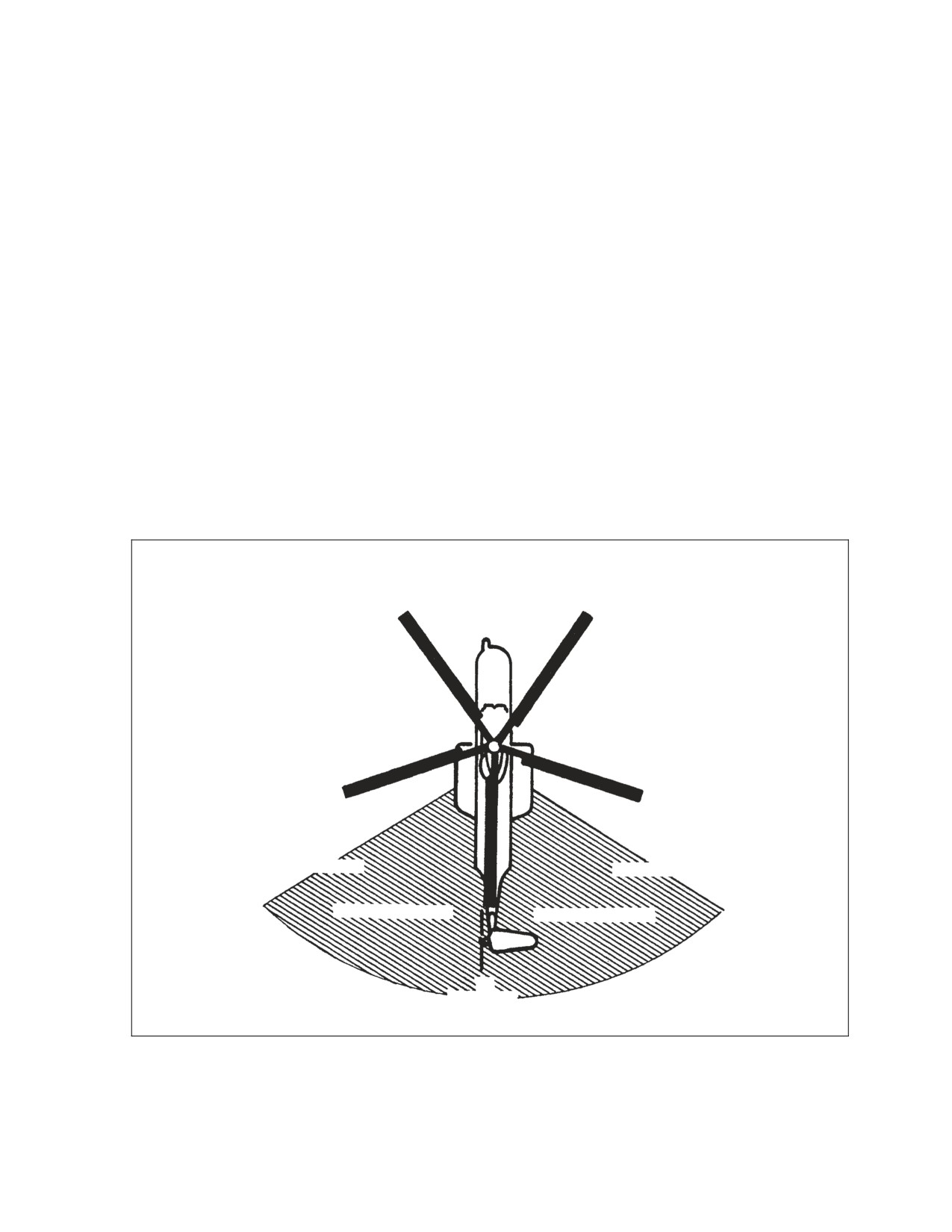
5-2. Positions in relation to the aircraft are referred to by an o’clock system (Figure 5-1): 12 o’clock
position is the nose of the aircraft, 3 o’clock position is the right (starboard) side, and 9 o’clock is the left
(port) side. Avoid approaching or departing under the aircraft from the 4 o’clock position clockwise
around to the 8 o’clock position due to hazards presented by landing gear, tail rotor, and the inability of the
aircrew to monitor the ground crew.
12
O’CLOCK
10
2
O’CLOCK
O’CLOCK
3
9
O’CLOCK
O’CLOCK
8
4
O’CLOCK
O’CLOCK
DANGER AREA
DANGER AREA
6
O’CLOCK
Figure 5-1. Typical Landing Zone Layout
FM 4-20.197/MCRP 4-11.3E, VOL I/NTTP 3-04.11/
20 July 2006
AFMAN 11-223 (I), VOL I/COMDTINST M13482.2B
5-1
Chapter 5
z
Planning. Thorough planning is a very important phase of any sling load mission. Select the
landing site area that avoids flight over vehicles, buildings, or congested areas and provides
optimum safety. Avoid areas of dust, mud, snow, or ice.
z
Surface Conditions. Grassy fields, edges of runways, ramps, or paved roads normally provide
good surface for sling load operations. Once the commander has designated the areas to be
used, ground crew personnel clear the landing site and set up markings to identify the area from
the air. When the situation permits, they coordinate with the pilot to determine which way the
helicopter will go in an emergency.
z
Cargo Preparation. Before the operation starts, the ground crew must make sure that the cargo
has been correctly prepared, rigged, and inspected for sling loading. If vehicles or equipment
are not prepared properly, they could be damaged when lifted by the helicopter. Loads should
be pre-positioned to expedite hookup.
z
Static Wand. The static wand person drives the grounding rod into the ground on the side of
the load opposite the rendezvous point/exit path. See Chapter 3 for detailed instructions
concerning the grounding rod and static discharge wand.
z
Positioning Personnel (ARMY). As the helicopter approaches the landing site, the ground
crew personnel put on their equipment and take up their positions. The signalman positions
himself upwind of the load, facing the load and the aircraft (Figure 5-2).
SIGNALMAN
Figure 5-2. Ground Crew Initial Position
z
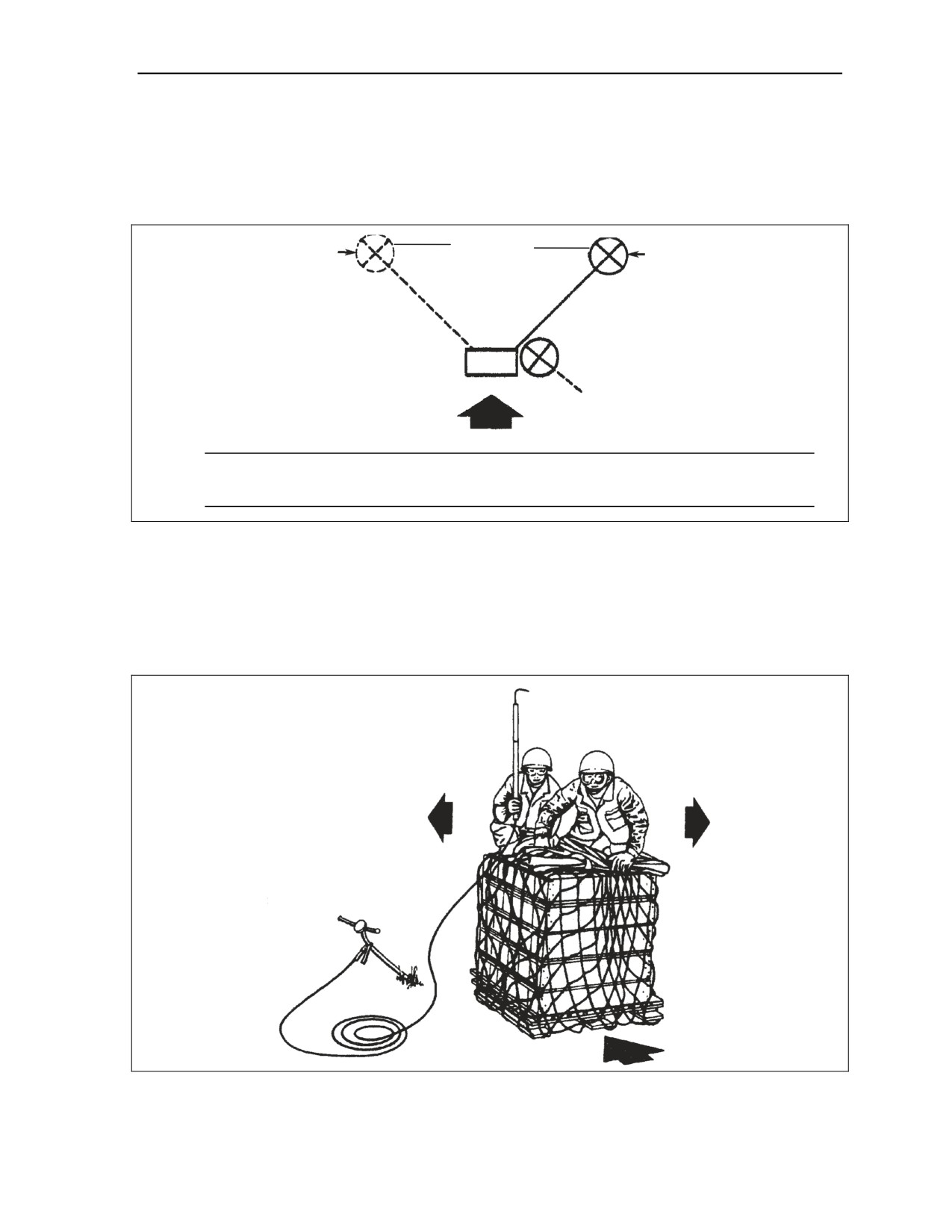
Positioning Personnel (USMC). Marine Corps HST operations require different positions for
the HST personnel (Figure 5-3). As the helicopter approaches the landing site, the outside
director is at a position of 2 (or 10) o’clock upwind of the load. From this position he is able to
guide the helicopter over the load with assistance from the inside director. The helicopter
crewman may also provide directional information to the pilot as the helicopter approaches the
load when immediate response is required.
z
Positioning Hookup and Static Wand Personnel. The hookup man and static wand person go
to their positions on top of the load. The hookup man is the first to depart the load; therefore, he
should be on the side of the load closest to the rendezvous point exit path. The static wand
FM 4-20.197/MCRP 4-11.3E, VOL I/NTTP 3-04.11/
5-2
AFMAN 11-223 (I), VOL I/COMDTINST M13482.2B
20 July 2006
Hookup and Release Procedures and Related Operations
person is the last person to leave the load, so he should be on the opposite side of the load. The
hookup team may be stationed on the ground along the side of the load if the load is difficult or
unsafe to stand on. Any extra personnel, such as equipment operators, will be positioned so that
they are clear of the hookup area and away from the approach and exit paths. No personnel
should be positioned on the ground in the approach path between the load and the aircraft.
10 O’CLOCK
2 O’CLOCK
OUTSIDE
POSITION
DIRECTOR
POSITION
LOAD
INSIDE
DIRECTOR
APPROACH
Note: The outside director will position himself on the side of the aircraft from which the
controlling pilot is seated.
Figure 5-3. HST Initial Position
z
Hookup Team Procedures. Hookup team personnel should kneel down, brace themselves, and
hold securely to the load because of the rotor wash. The hookup man will have the apex
fitting/web ring in his hands ready for hookup. The static wand person will hold the static
discharge wand so that the red line or the DO NOT HOLD area is above the hookup team’s
helmets, as in Figure 5-4.
STATIC DISCHARGE
HOOKUP MAN
MAN
AIRCRAFT EMERGENCY
SAFETY SIDE TO
LANDING AREA
RENDEZVOUS
POINT
AIRCRAFT
APPROACH
DIRECTION
Figure 5-4. Hookup Team Position
FM 4-20.197/MCRP 4-11.3E, VOL I/NTTP 3-04.11/
20 July 2006
AFMAN 11-223 (I), VOL I/COMDTINST M13482.2B
5-3
Chapter 5
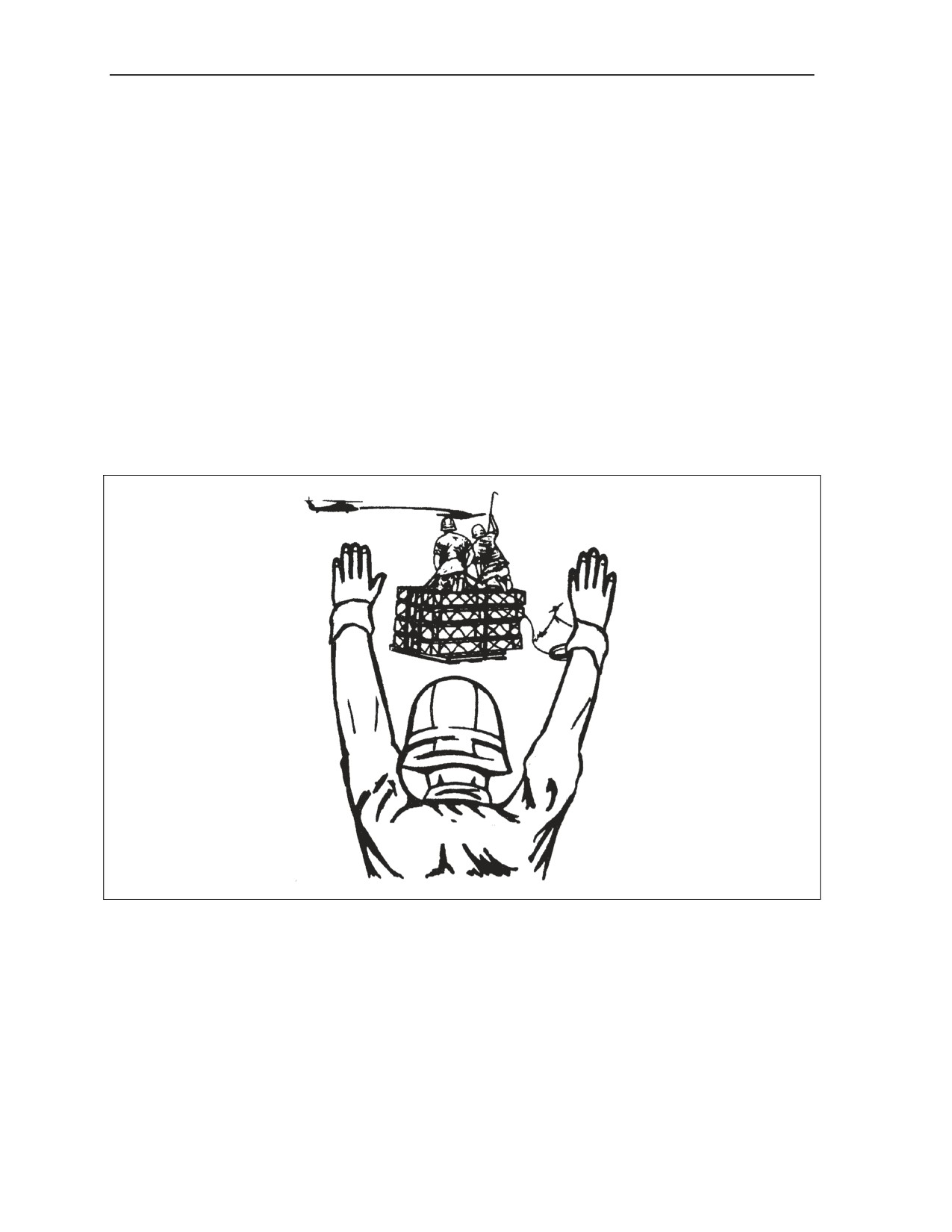
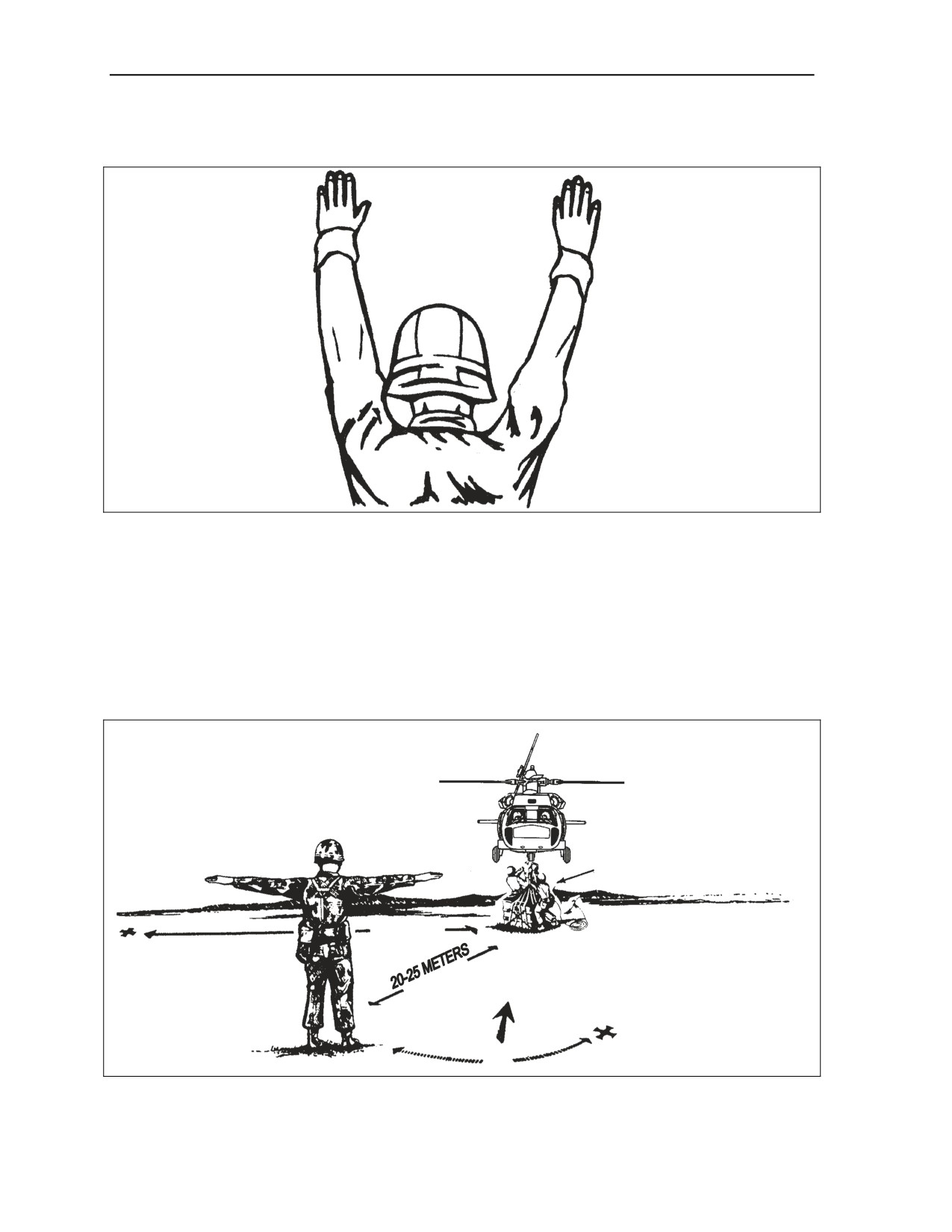
The signalman identifies himself and the load for the pilot by holding up both arms, as in
Figure 5-5.
Figure 5-5. Assume Guidance
The signalman positions himself at the aircraft’s
10 o’clock position if the aircraft
emergency landing procedure is to the right or at the 2 o’clock position if the aircraft emergency
landing procedure is to the left. Ensure that the pilot controlling the aircraft and the signalman
maintain visual contact at all times throughout the hookup.
The signals must be precisely given to prevent any misunderstandings between the
signalman and the pilot. While the helicopter is hovering, the signalman is responsible for the
safety of the hookup team. The hookup team must alertly watch the helicopter during the
complete operation (Figure 5-6).
HOOKUP TEAM
50 FT
SIGNALMAN
45°
Figure 5-6. Relationship of Aircraft, Signalman, and Hookup Team
FM 4-20.197/MCRP 4-11.3E, VOL I/NTTP 3-04.11/
5-4
AFMAN 11-223 (I), VOL I/COMDTINST M13482.2B
20 July 2006
Hookup and Release Procedures and Related Operations
The helicopter approaches the load with the pendant or hook prepared for hookup. The
pilot maneuvers in position over the load as directed by the signalman and the aircrew member.
The aircrew member normally gives final maneuver and hookup instructions to the pilot over the
aircraft interphone.
After the nose of the aircraft passes over the hookup team, the rotor wash decreases. At that
time, the hookup team stands up and watches for the cargo hook or moves under the aircraft for
hookup on signal from the aircrew if not pre-positioned on or by the load. Once the helicopter
is in a stable hover and correctly positioned, the signalman signals the pilot to maintain his
hover and the ground crew begins the hookup.
The static wand person grounds the cargo hook prior to any contact by the hookup man and
maintains that grounding contact until the hookup is complete. If the static discharge wand
contact is broken with the aircraft hook, hookup personnel should not touch the cargo hook until
wand contact is reestablished. The hookup man maintains visual contact with the static wand
person and does not attempt hookup until the hook is grounded. If using the H-53E dual-point
hookup system, each hook must be grounded before the sling is connected to the cargo hook.
This requires one static wand person for each hook. The CH-47D dual-point system requires
only one static wand person.
WARNING
Helicopters are susceptible to high levels of stored static
electrical energy. Severe electrical shock may result from
improper grounding of the cargo hook.
Note: When a reach pendant is used, a static discharge wand is not required.
The hookup man places the apex fitting/web ring on the cargo hook as soon as he can reach
it after the hook is grounded. Make sure that the apex fitting/web ring is connected in the proper
orientation. If the apex fitting is backwards when it is placed on the cargo hook, the load will be
carried opposite to the direction it was rigged. After hooking up the apex fitting to the cargo
hook, check to make sure the hook is locked by giving a sharp pull on the sling legs. The
hookup man lets the signalman know if there is anything wrong with the hook or the load by
gesturing.
After completing the hookup, the hookup man climbs off the load. The static wand person
breaks contact with the cargo hook and then drops the static discharge wand to the ground. He
must make sure the wand is in the vicinity of the grounding rod so no one will trip on the
grounding wire while dismounting the load. The hookup team departs the hookup area forward
of the aircraft’s 8 o’clock or 4 o’clock position to the rendezvous point or other briefed location.
After the hookup team is clear, the signalman signals to the pilot that the load is hooked up.
He then signals the pilot to move upward to take the slack out of the sling legs. The inside
signalman, if used, ensures that all ground crew personnel are clear of the load before the
aircraft lifts the load. As the aircraft rises, the signalman and hookup team watch the load for
any problems with the rigging or if the load may require correction. If the rigging is correct, the
signalman gives the pilot the affirmative signal.
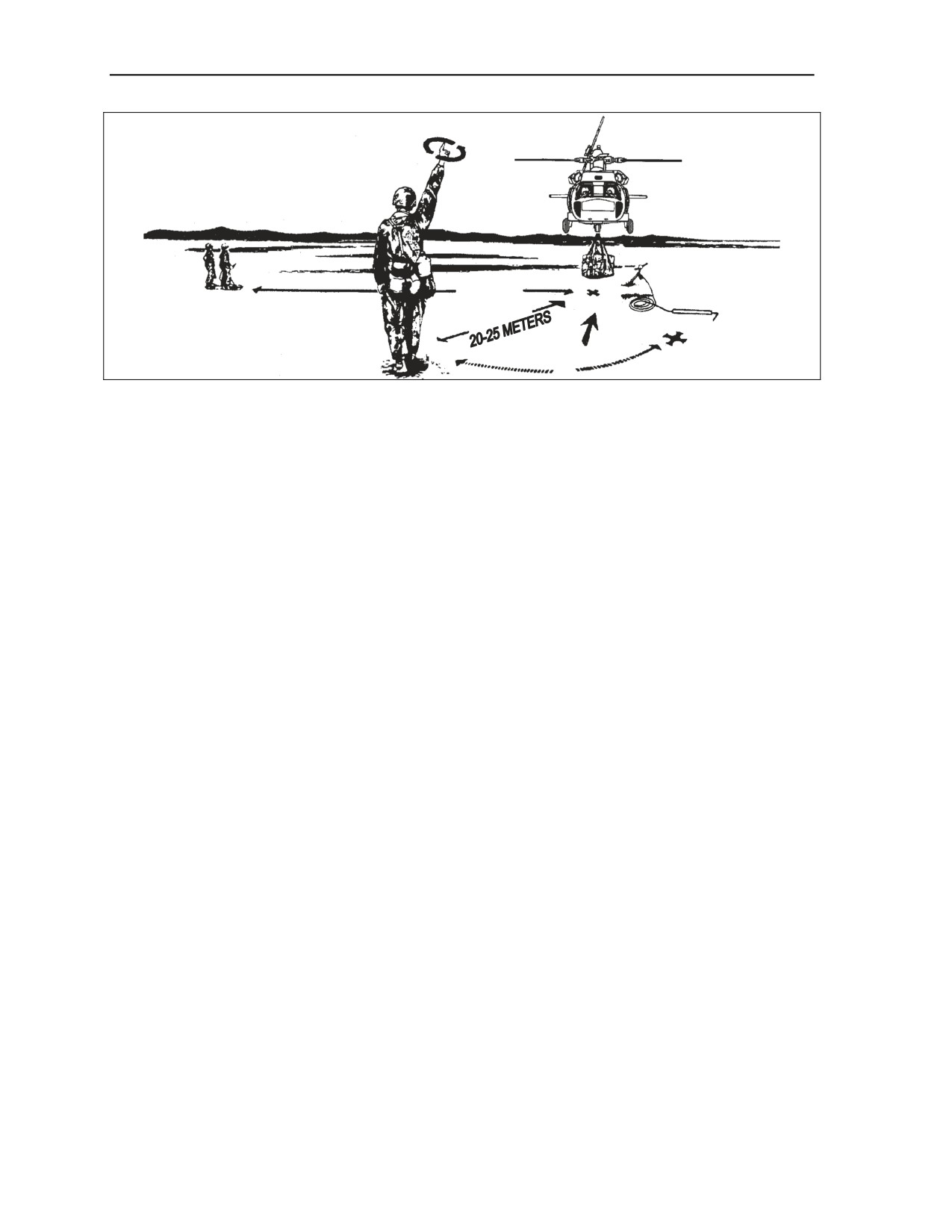
When the load is 10 to 20 feet higher than the surrounding loads or obstacles, the signalman
gives the takeoff signal in the direction he wishes the pilot to depart the landing site. When
pointing, the signalman steps off in the same direction as he is pointing to make his signal more
pronounced. He then moves out of the way so the helicopter does not pass directly overhead.
After the pilot completes any required aircraft checks, he departs the area (Figure 5-7).
FM 4-20.197/MCRP 4-11.3E, VOL I/NTTP 3-04.11/
20 July 2006
AFMAN 11-223 (I), VOL I/COMDTINST M13482.2B
5-5
Chapter 5
50 FT
HOOKUP TEAM
SIGNALMAN
45°
Figure 5-7. Ground Crew Position During Helicopter Takeoff
If the sling legs could not be tied (breakaway technique) to prevent them from becoming
entangled during lift-off, the hookup team or additional personnel may be required to guide the
sling legs as the aircraft lifts up and removes the slack from the sling legs. These personnel
must use extreme caution so that they do not become trapped between the sling legs and the
load. Proper breakaway technique tieing prevents the sling legs from becoming entangled on
the load. If the helicopter settles back down once the load is hooked up, make sure the sling
legs are not entangled on the load.
If the load is not correct (for instance, tangled slings or uneven loads), the signalman gives
the pilot the “hookup” signal followed by the “negative” signal. He directs the pilot to lower the
load to the ground. If the problem can be easily corrected, he signals the hookup team or sling
leg team to return to the load to guide the sling legs as described in the previous paragraph. If
the problem is more serious, he signals the pilot to release the load so that the sling legs can be
untangled and the hookup repeated. The pilot hovers away from the load, if required, so that the
ground crew and sling legs are not blown about by the rotor wash.
SAFETY PRECAUTIONS FOR HOOKUP PERSONNEL
5-3. The following safety precautions are recommended for hookup personnel:
z
Clear the area around the load of all objects that could be blown around by the rotor wash.
z
Limit the number of personnel involved in the hookup operation.
z
Wear protective equipment. A protective mask or helmet with a visor, such as the MC-140
helmet, is recommended to aid vision during high winds and turbulence caused by the rotor
wash. At a minimum, wear head, eye, ear, and hand protection. Wear clothing that will protect
against blowing sand and dust and not become snagged on the cargo.
z
Place the apex fitting/web ring and sling legs on top of the load (or to the side of the load) so
that during the hookup or lift-off, the legs will not become entangled on the load.
z
Use hand-and-arm signals to direct the helicopter as shown in Appendix A.
z
Maintain adequate clearance between the hovering helicopter and ground personnel at all times.
z
Wear gloves as applicable and use a static discharge wand during all hookups.
z
Exercise sound judgment and common sense when stationing yourself by or on a sling load so
that if the load is either accidentally dragged along by the hovering helicopter or prematurely
lifted from the ground, you can move clear to avoid injury.
z
For UH-1N cargo sling operations the flight crew will brief the actions to be taken by each team
member. This information will be prebriefed prior to commencing cargo sling operations.
z
For more details concerning these safety precautions and the designated rendezvous point
(USA), see chapters 1 and 3.
FM 4-20.197/MCRP 4-11.3E, VOL I/NTTP 3-04.11/
5-6
AFMAN 11-223 (I), VOL I/COMDTINST M13482.2B
20 July 2006
Hookup and Release Procedures and Related Operations
LOAD RELEASE PROCEDURES
5-4. Landing site preparation, safety precautions, protective equipment, and ground crew requirements
for load release are similar to those required for hookup. The signalman is located in the same position
with respect to the helicopter and landing point and directs the pilot to the load release point. When the
load is over the release point, he signals the pilot to lower the load to the ground and hover to the side
before giving the pilot the “release-load” signal. The pilot hovers to one side of the load to prevent the
apex fitting from falling on the load and causing damage. If spreader bars are used in rigging the load, the
pilot should hover low enough to rest the spreader bars on the load before releasing the apex fitting. If the
aircrew cannot open the cargo hook, the pilot will notify the signalman. After the aircrew signals to the
ground crew, they approach the cargo hook to manually release the load. The static wand person uses the
static discharge wand to contact the cargo hook. The hookup man either depresses the spring-loaded
keeper on the cargo hook or rotates the manual release knob/lever. When the load is released, the
signalman gives the “affirmative” signal, followed by the “take-off’ signal.
DUAL-POINT HOOKUP PROCEDURES
5-5. The same basic safety and hookup procedures apply during dual-point load hookup as during single-
point hookup. An extra hookup person is required for the additional apex fitting. The H-53E requires a
static wand person for each cargo hook. Since the CH-47D requires only one static wand person, he may
maintain contact with any one of the three cargo hooks, but because no hookup man is at the center hook, it
usually is the easiest hook to contact.
z
Dual-point Procedures. Dual-point load rigging procedures may be different from single-point
rigging procedures, when possible, coordinate with the aircrew before attempting a dual-point
hookup. Either cargo hook can be connected first. Do not mistakenly connect one of the slings
to the center cargo hook.
z
Aircraft Position. The hookup teams must constantly be aware of the position of the aircraft
and cargo hook. It is difficult for the aircrew member to watch both hookup teams as the
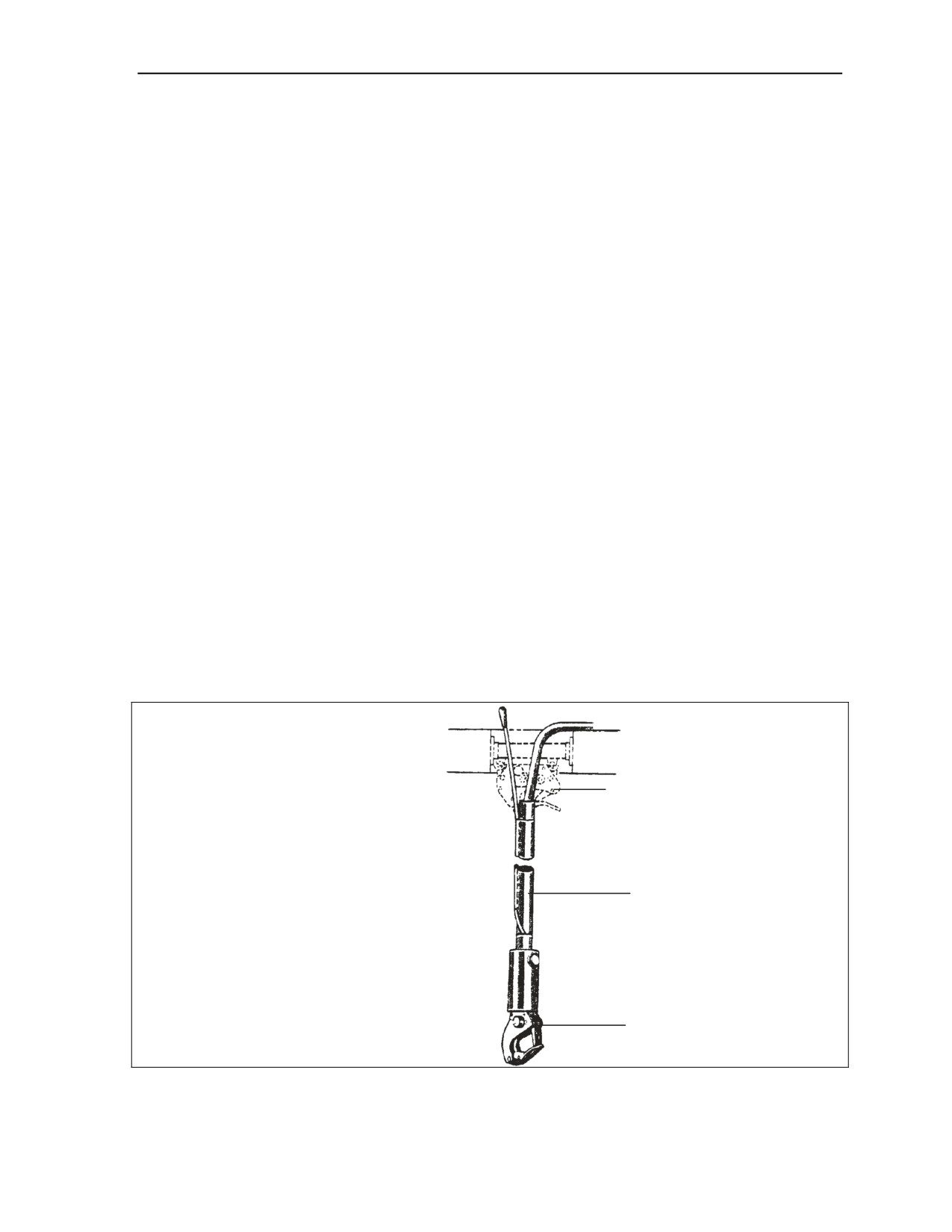
aircraft hovers over the load. The pendant system on the H-53E (Figure 5-8) enhances hookup
team safety by increasing load separation. The cargo reach pendant enhances hookup team
safety by increasing load separation on the CH-47.
CH-53E FORWARD OR
AFT CARGO HOOK
SLING LEG
ASSEMBLY
SWIVEL HOOK
ASSEMBLY
Figure 5-8. H-53E Dual-Point Pendant System
FM 4-20.197/MCRP 4-11.3E, VOL I/NTTP 3-04.11/
20 July 2006
AFMAN 11-223 (I), VOL I/COMDTINST M13482.2B
5-7
Chapter 5
WARNING
Use extreme caution when attaching the apex fitting to the cargo
hook during a dual-point hookup. The aircraft must hover close
to the load which could cause the aircraft to strike the load or
personnel. Special care must be taken when connecting the aft
hook. The rear of the aircraft has a tendency to dip down if the
pilot has to move to the rear.
MULTIPLE SINGLE-POINT LOAD PREPARATION
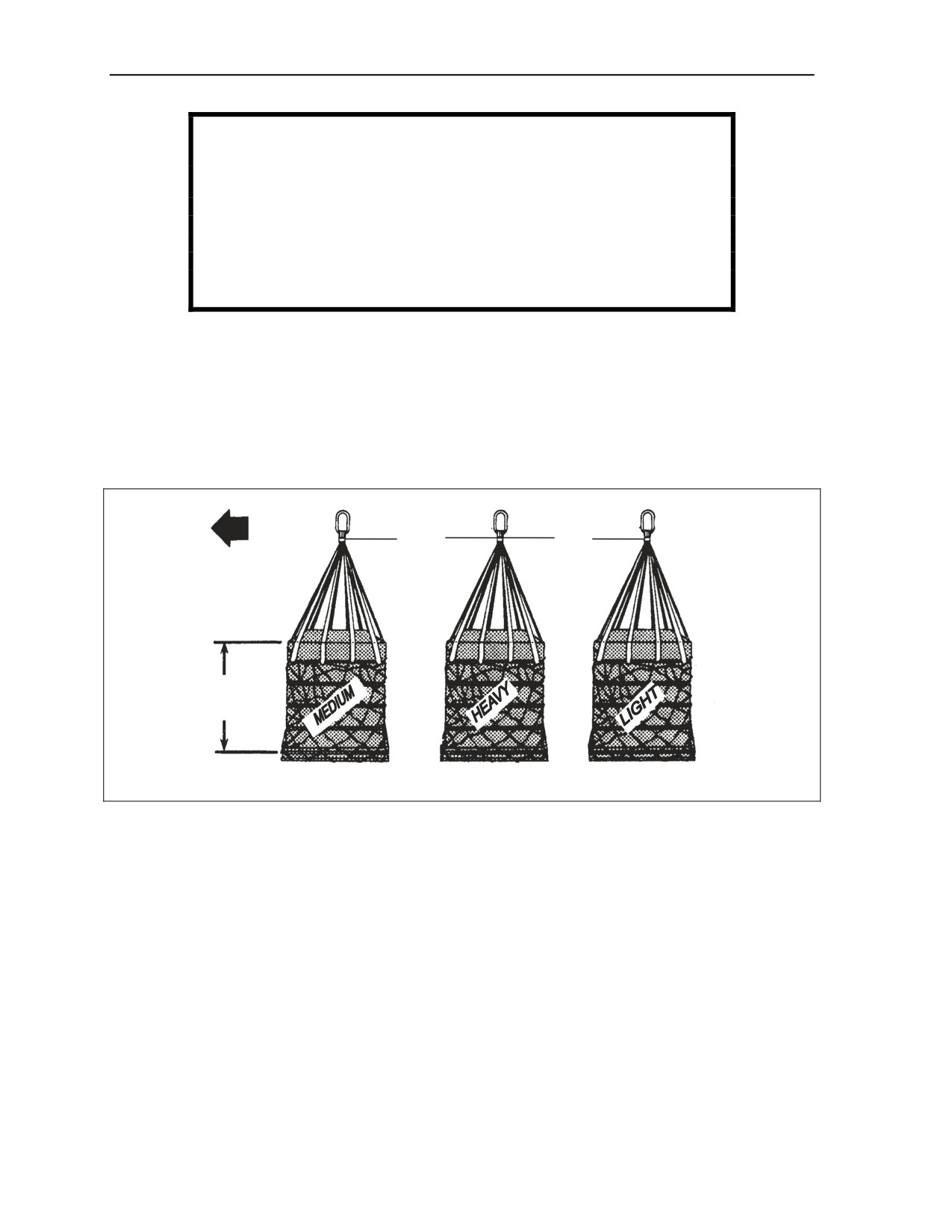
5-6. Cargo nets, fuel drums, and water drums are common multiple single-point loads transported by the
CH-47D (Figure 5-9). Load height and weight must be considered during the planning phase. Keep in
mind that when the aircraft is at a hover, the rear cargo hook is lower than the front hook. In order to keep
the aircraft center of balance within the allowable limits, if the loads will be released at different landing
sites, the heaviest load should be connected to the center hook and the lightest load to the aft hook.
FWD
6 ½’
6 ½’
APPROXIMATELY
THE SAME SIZE
Figure 5-9. Multiple Single-Point Loads
PIGGYBACK/ACCOMPANYING LOADS
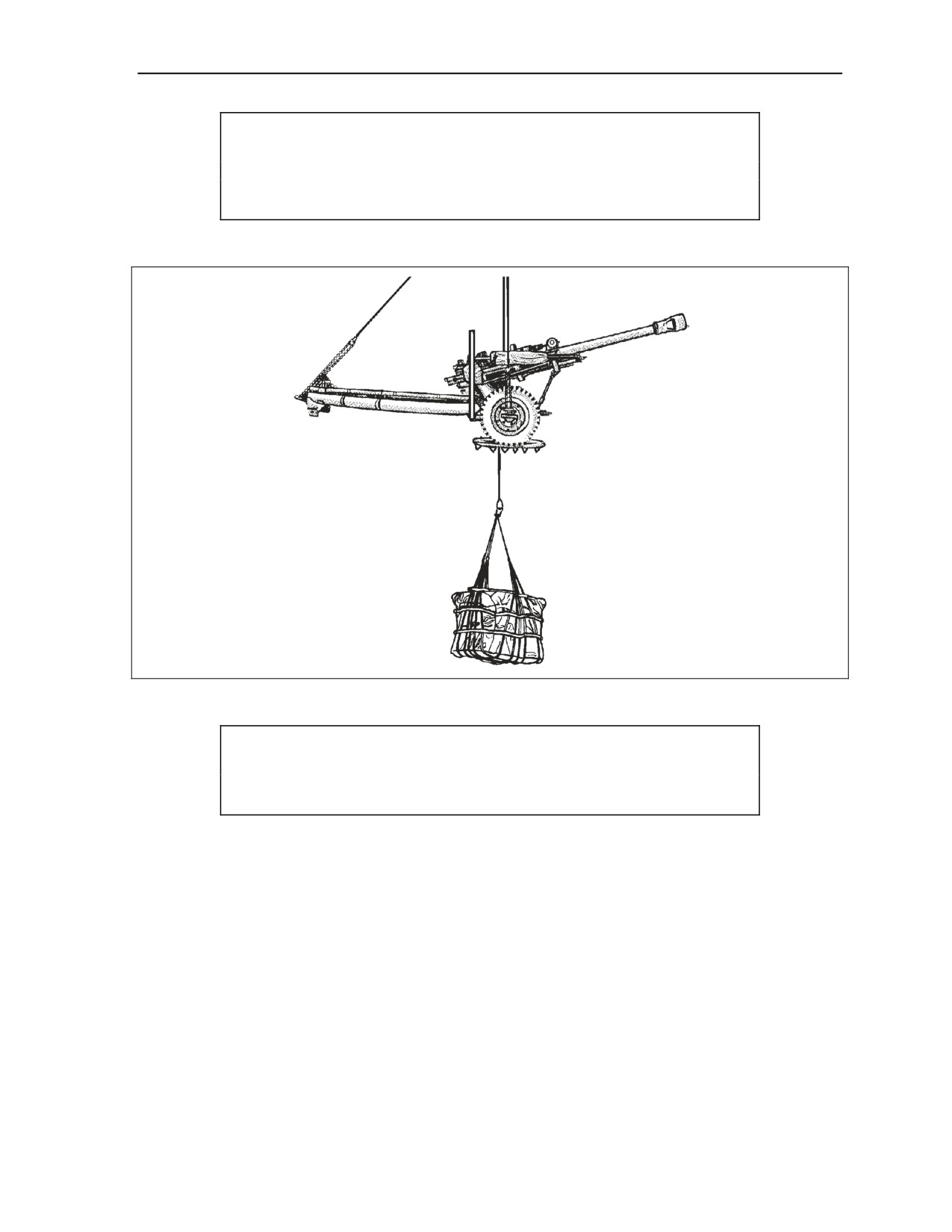
5-7. Piggyback or accompanying loads are used to expedite the movement of weapon systems and
ammunition at the same time. Small quantities of ammunition are bundled on the howitzer trails. Larger
quantities are carried in cargo nets or A-22 cargo bags attached to the weapon using one or more sling legs.
The weapon and accompanying load are positioned next to one another. The hookup man stands on the
weapon to hook up the load. The helicopter lifts the weapon clear of the ground, hovers over the top of the
accompanying load, and continues its vertical lift of the A-22 cargo bag or cargo net until it clears the
ground (Figure 5-10).
FM 4-20.197/MCRP 4-11.3E, VOL I/NTTP 3-04.11/
5-8
AFMAN 11-223 (I), VOL I/COMDTINST M13482.2B
20 July 2006
Hookup and Release Procedures and Related Operations
CAUTION
Accompanying loads must be authorized for sling load in the
appropriate rigging procedures.
Figure 5-10. Piggyback/Accompanying Load
CAUTION
Do not exceed sling set, cargo hook, and aircraft limitations.
LONGLINE SLING PROCEDURES
5-8. The longline sling improves tactical efficiency and preserves the integrity of the crew and the sling
load (for example, a howitzer, ammunition, and assigned gun crew). These procedures eliminate the need
for a static wand person because the static electricity is discharged when the aircraft lands. Also, all of the
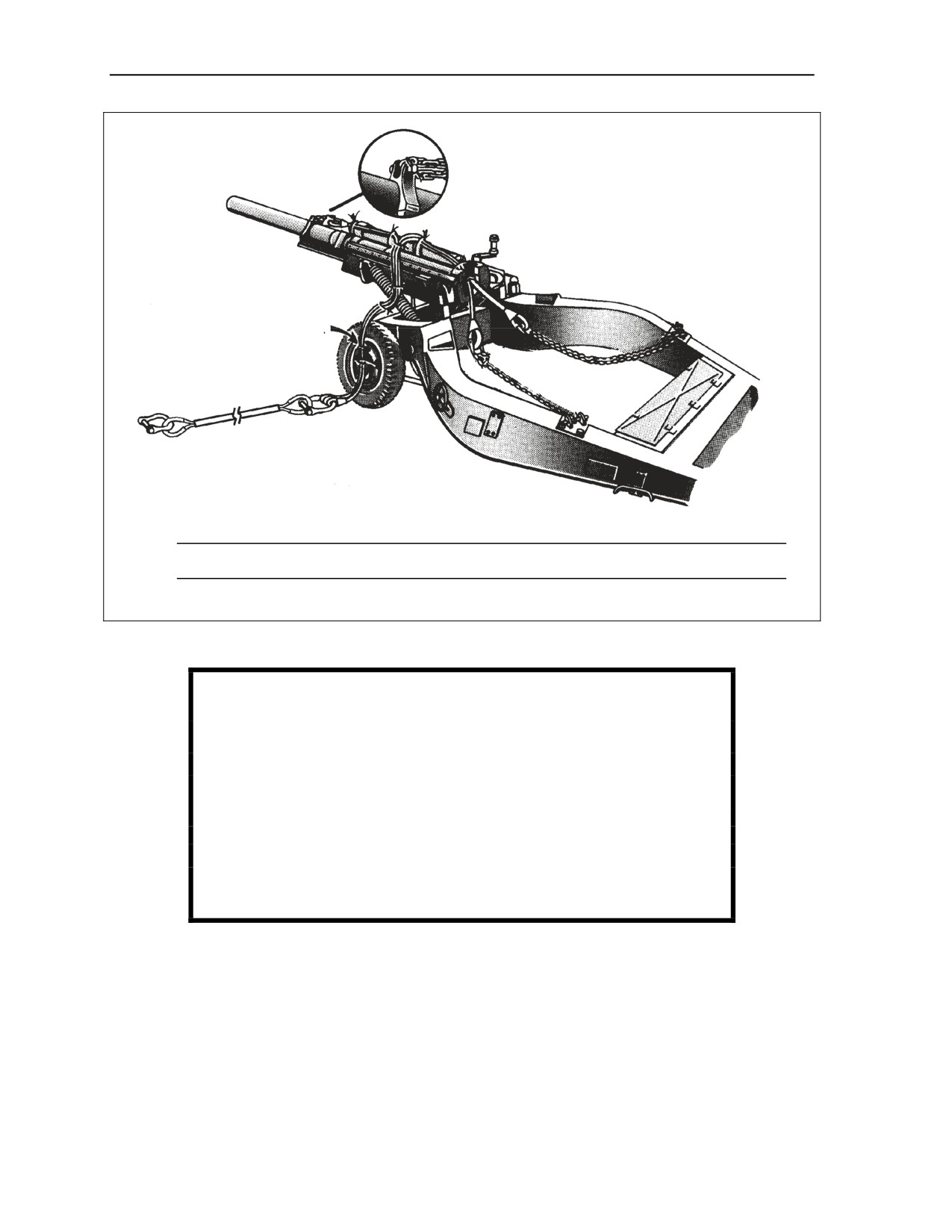
equipment, and crew can be moved in one lift. A vertical pendant is connected to the apex fitting of the
normally rigged load. A second apex fitting is used on the other end of the vertical pendant to hook to the
helicopter (Figure 5-11). A polyester roundsling of suitable capacity or a leg from a 25,000-pound
capacity sling set may be used. The helicopter lands next to the rigged load. The hookup man takes the
apex fitting, crawls under the helicopter, and places the apex fitting on the cargo hook. The entire crew, to
include the signalman and hookup man, waits for the aircrew member to signal them to board the aircraft.
Make sure you follow their directions. The aircrew member watches the load and directs the pilot over the
load as the aircraft lifts off the ground.
FM 4-20.197/MCRP 4-11.3E, VOL I/NTTP 3-04.11/
20 July 2006
AFMAN 11-223 (I), VOL I/COMDTINST M13482.2B
5-9
Chapter 5
SECURE TO
WHEEL
VERTICAL PENDANT
Note: Use multiple breakaways to prevent slings from entangling with the item to be lifted.
Figure 5-11. Longline Sling Procedures
WARNINGS
1. The rigged load must weigh less than the capacity of the
vertical pendant.
2. Aircraft must land when using the longline sling procedures. If
the load is on a slope, make sure the area upslope of the load is
clear to allow the helicopter to land on the upslope side of the
load.
3. Longline sling procedures are not authorized on tandem loads.
CARGO HOOK LOADING POLE
5-9. Some aircraft are equipped with a cargo hook loading pole (shepherd’s hook). Using this pole
eliminates the need for ground hookup personnel. The aircrew member uses the pole to pick up the apex
fitting and connect it to the aircraft cargo hook as the aircraft hovers over the load. This method is only
used on the center hook after coordination with the aviation unit.
FM 4-20.197/MCRP 4-11.3E, VOL I/NTTP 3-04.11/
5-10
AFMAN 11-223 (I), VOL I/COMDTINST M13482.2B
20 July 2006

Hookup and Release Procedures and Related Operations
COLD WEATHER OPERATIONS
5-10. When helicopter sling load operations are conducted in a cold climate, ground personnel must know
cold weather hazards and safety practices. Cold weather adversely affects personnel performance which
increases the hazards of conducting helicopter sling load operations. Personnel could become careless and
that could lead to misrigging cargo and improper hookup. Personnel may also be more likely to fall off
equipment.
z
Special Considerations for Operating in Cold Weather. When conducting sling load
operations in cold weather, maintain a high level of combat readiness and morale, by doing the
following:
Plan ahead. Know the immediate environment, weather conditions, emergency medical
procedures, and support sources.
Prepare personnel and equipment for cold weather exposure.
Use heated shelters, if available. If construction is limited, rotate personnel to a heated
shelter. Ten-man tents with a heater can serve this purpose.
Ensure ground crews wear required protective equipment. Clothing should provide
protection from the elements, including rotor wash, snow, water, and ice particles, without
restricting movement of personnel. In order to prevent hands from freezing to cold metal
surfaces, personnel should wear anticontact gloves. For the Marine Corps, the cold weather
squad survival kit is required for each ground crew team.
z
Windchill Precautions. Cold weather causes your body to lose heat through convection and
the loss is accelerated as wind velocity increases. The combined cooling effect of wind and cold
air is called windchill factor. Table 5-1 shows the effect of wind on temperature. Helicopter
rotor wash has the same windchill effect as wind. Arctic windchill near a hovering aircraft can
freeze exposed flesh quickly. Personnel must be aware of this hazard and must be briefed on the
increased chances of frostbite. All personnel should be trained to recognize the signs of
hypothermia and frostbite and how to apply proper first aid.
Table 5-1. Windchill Temperatures
FM 4-20.197/MCRP 4-11.3E, VOL I/NTTP 3-04.11/
20 July 2006
AFMAN 11-223 (I), VOL I/COMDTINST M13482.2B
5-11
Chapter 5
z
Static Discharge Precautions. In dry arctic air, static electricity from a hovering helicopter can
produce a large voltage shock. The dry air, colder temperatures, and blowing snow increase the
amount of static electricity generated by and stored in the aircraft. Proper grounding of the
aircraft’s cargo hook is absolutely essential. Snow and low temperatures increase the problem
with proper grounding due to snow depth and frozen ground. The grounding rod must be
inserted into the ground a minimum of 6 inches. This may require the ground crew to dig out
the snow and break up the ground so that the grounding rod can be properly inserted.
z
Equipment Precautions. Do not store cargo slings and nets in extremely cold weather for long
periods of time. Store them in heated areas, if possible. It is especially important to keep all
lifting devices dry in cold weather operations. The coating on the 40,000-pound capacity sling
set may become brittle. Slings and nets may also become brittle, reducing their useful life and
increasing the chances of sling failure. All sling loads should be moved slightly before pickup
to ensure that they are not frozen or otherwise held fast to the surface. If the load is icy, use
extreme caution to keep your footing when walking or standing on it, especially during hookup.
z
Landing Site Preparations. Information in Chapter 4 also applies to landing site selection
considerations in cold weather. Blowing snow from the rotor wash (whiteout) causes a loss of
vision for the aircrew and ground crew. Site preparation and marking may deviate from
standard operations because of snow conditions (for instance, depth of snow, extent of coverage,
presence of ice, frozen ground, and possible low visibility). To prepare a snow covered landing
site, follow these procedures:
The ground crew determines the depth of the snow in the appropriate locations for
helicopter landing points.
If time and snow density allow, pack the snow or compress the snow to prevent it from
blowing and to provide a solid surface for the helicopter to land.
Make sure all personnel remain clear of the rotor blades, as they may be closer to the
ground than normal because of the snow height.
Probe the snow under the landing point for obstacles such as large rocks, stumps, and
uneven or steep terrain which could damage the helicopter. If the area cannot be cleared for safe
landing, select a new landing point.
If more than one helicopter will be landing simultaneously, the landing points should be at
least 100 meters apart to prevent blowing snow from obstructing the view of other helicopter
crews.
z
Marking the Landing Site. Marking the landing site and landing points is critical because of
the rotor wash which causes blowing or driven snow (whiteout condition). This condition can
blind both the aircrew and ground crew. The helicopter crew must be provided with markings
to be used as reference points at each landing point.
The landing site or point can be marked using conventional panels, GAIL lights, strobe
lights, or similar indicators. The area can also be marked by using rescue survival dyes, food
coloring (or food items such as Kool-Aid), dirt sprinkled in the snow, or any dark material.
A smoke grenade can be used to mark the landing site or point and also to indicate wind
direction, but it must be placed on a hard surface to prevent it from sinking or melting into the
snow. Do not use white smoke.
(USMC) Landing guides are used to guide the pilot to a safe landing or hover at each
landing point. Landing guides are ground personnel who stand at the helicopter’s 12 o’clock
position and act as additional reference points. They do not provide hand-and-arm signals. The
landing guides should wear international orange vests and face masks. If landing guides are not
available, large, dark colored bags filled with snow and placed in the landing guides’ positions
may be used as landing point indicators. Advise the aircraft unit as to the depth of snow
(packed or unpacked), type of snow (powder, crusted, or hard), and any special considerations
that will delay hookup.
FM 4-20.197/MCRP 4-11.3E, VOL I/NTTP 3-04.11/
5-12
AFMAN 11-223 (I), VOL I/COMDTINST M13482.2B
20 July 2006
Hookup and Release Procedures and Related Operations
DESERT OPERATIONS
5-11. Many of the same problems or considerations found in cold weather operations are also present in
desert operations. Brownout (loss of vision from blowing sand) presents the same visual and reference
problems as whiteout. The procedures of using additional reference points and paddles are considered
essential for safe and efficient sling load operations. High temperatures and excessive dust particles
greatly increase the buildup of static electricity. Again, proper grounding is required to adequately protect
the ground crew. Drive the grounding rod as far into the ground as possible and wet the area around the
base of the grounding rod to increase conductivity.
NIGHT OPERATIONS
5-12. Since it is more dangerous to conduct sling load operations during darkness, extensive training and
detailed planning become increasingly important.
z
General Considerations. It is important to realize that certain problems will exist at night that
do not occur during daylight operations. Common night problems include increased time
required for hookup, tendency for helicopter to drift during hover, and lack of depth perception
for crew members and ground personnel. During night operations, hand-and-arm signals are the
same as in day operations except that flashlight wands with night vision goggles (NVG)
compatible lighting or infrared chemlites are used.
z
Night Equipment. Whenever possible, and if the tactical situation permits, personnel should
wear reflective vests. At a minimum, the signalman should wear NVG. Chemlights attached to
the top of the load assist the aircrew in identifying the load; likewise, a chemlight attached to the
cargo hook aids the hookup team during the hookup operation. Some helicopters are equipped
with lights positioned by the cargo hook. The aircrew identifies which cargo hook to use by
illuminating the corresponding light.
z
NVG Operations. The preferred method of conducting night sling load operations is with fully
trained ground crews or HST support and with utilization of night vision goggles (NVG).
Normal nighttime illumination (white or red lights) can temporarily blind personnel wearing
NVG. Therefore, you must use NVG-compatible lights (blue-green) when conducting NVG
sling load operations. Infrared chemlights, blue-green chemlights, or flashlights with blue-green
lens covers and plastic wands are effective during NVG operations.
SHIPBOARD OPERATIONS AND SAFETY PROCEDURES
5-13. Helicopter sling load operations aboard ships require a greater level of awareness than shore
operations because of the increased hazards.
z
Operations. Some of the major hazards are:
Confined helicopter operating area.
Pitching and rolling decks.
Wet and slippery decks.
Helicopter rotor wash and ship’s movement.
Potential of being blown overboard.
Increased instability of hovering helicopters due to winds and turbulence.
Increased potential of being struck by helicopter rotor blades.
z
Training. The most important factor in shipboard sling load operations is thoroughly trained
personnel. During shipboard operations, designated ship personnel are responsible for
supervising and controlling all sling load operations. On a landing ship dock (LSD), landing
helicopter assault (LHA), landing platform helicopter (LPH), landing ship tank (LST), and
landing platform dock (LPD), embarked Marines or soldiers are assigned to assist the combat
cargo officer (CCO) and the flight deck officer.
FM 4-20.197/MCRP 4-11.3E, VOL I/NTTP 3-04.11/
20 July 2006
AFMAN 11-223 (I), VOL I/COMDTINST M13482.2B
5-13
Chapter 5
Note: Other services’ equipment may be different from the Navy’s and require different
hookup procedures. It may be necessary to request modification of the safety requirements
listed in NWP-42, Shipboard Helicopter Operating Procedures. Personnel participating in sling
load operations must be thoroughly trained and wear the required protective clothing. In all
cases, safety is the primary consideration.
z
Types of Operations. Shipboard operations involve three types of sling load missions: vertical
replenishment (see chapter 9), vertical on board delivery, and logistical missions involving ship-
to-shore movement. All of these missions require strict adherence to established shipboard
safety procedures.
z
Planning. During planning for shipboard sling load operations, the supported unit and
transporting unit should review NAVAIR 00-80T-106, LHA/LPH NATOPS manual; or when
sling load operations are to be conducted from an LPD or LSD, review NWP-42. A liaison
meeting should be conducted with a representative from the following ship’s divisions:
operations, air, deck, and combat cargo. A complete inventory of each unit’s equipment is
contained in the unit’s embarkation/debarkation plan and specific equipment that is planned to
be lifted by helicopter must be provided to the CCO.
z
Safety Procedures. During sling load operations, personnel must be thoroughly trained on
safety procedures and wear appropriate protective clothing. During shipboard operations, all
personnel must adhere to the following:
Strict compliance to signals by the landing signal enlisted (LSE).
During hookup, all personnel except the LSE, the hookup man, and static wand person must
clear the pickup or delivery area.
Flight deck personnel and ground crew must wear approved life jackets, helmets with chin
straps and fasteners, goggles, safety shoes, and ear protection. Loose articles of clothing should
not be worn. Personnel must remove all loose articles (such as covers and rags) from their
pockets.
All personnel in the vicinity of the helicopter must remove their soft covers/hats while the
helicopter rotors are turning.
Observe the aircraft carefully for any sign of malfunction and immediately report any such
conditions to flight deck personnel in charge.
Personnel must be instructed concerning the danger created when rotor blades strike a solid
object.
The flight deck must be cleared of all objects which can be blown around by the rotor wash
or ingested into the engines.
Do not attempt to steady a load or move towards the load until the load is on the deck.
FM 4-20.197/MCRP 4-11.3E, VOL I/NTTP 3-04.11/
5-14
AFMAN 11-223 (I), VOL I/COMDTINST M13482.2B
20 July 2006
THIS CHAPTER IMPLEMENTS STANAG 2949
Chapter 6
Cargo Slings
INTRODUCTION
6-1. The various loads described in FM 10-450-4/MCRP 4-23E, VOL II/NWP 3-04.12/AFJMAN 11-
223, VOL II/COMDTINST M13482.3A and FM
10-450-5/MCRP
4-23E, VOL III/NWP
3-
04.13/AFJMAN 11-223, VOL III/COMDTINST M13482.4A are sling loads that use four different
capacity cargo slings. This chapter discusses the characteristics, use, maintenance, and inspection of the
10,000-pound, 15,000-pound, 25,000-pound, and 40,000-pound capacity sling sets along with the aerial
delivery slings and multi-loop nylon lines. Physical characteristics of the four sling sets are shown in
Table 6-1. Appendix B, page B-1, contains NSN information for each sling set.
Table 6-1. Identifying Characteristics of Sling Sets
IDENTIFYING CHARACTERISTICS OF SLING SETS
CAPACITY (LB)
10,000
15,000
25,000
40,000
Sling Leg Material
Nylon Rope
Nylon Web
Nylon Rope
Kevlar Rope
Leg Color
Olive Drab
Olive Drab
Black
Blue
Diameter/Width
7/8-inch
1 ¾-inch
1 ¼-inch
1 1/8-inch
Leg Length
12 Feet
15 Feet
12 Feet
12 Feet
Apex Fitting Material
Aluminum
Nylon Donut
Steel
Steel
Apex Spacer
Aluminum
None
Aluminum
Steel
Length Adjuster
Grabhook
Grab Link
Grabhook
Grab Link
Chain links
110-115
64
84-88
70
Chain Length
8 Feet
6 Feet
8 Feet
8 Feet
Weight (LB)
52
84
114
175
WARNING
Components of different capacity sling sets are not
interchangeable. Sling or load failure may result if components of
different capacity sling sets are intermixed.
CAUTION
The use of any sling load lifting device not listed in this manual is not
authorized.
10,000- AND 25,000-POUND CAPACITY SLING SETS
6-2. The 10,000- and 25,000-pound capacity sling sets are discussed together because of their similarity.
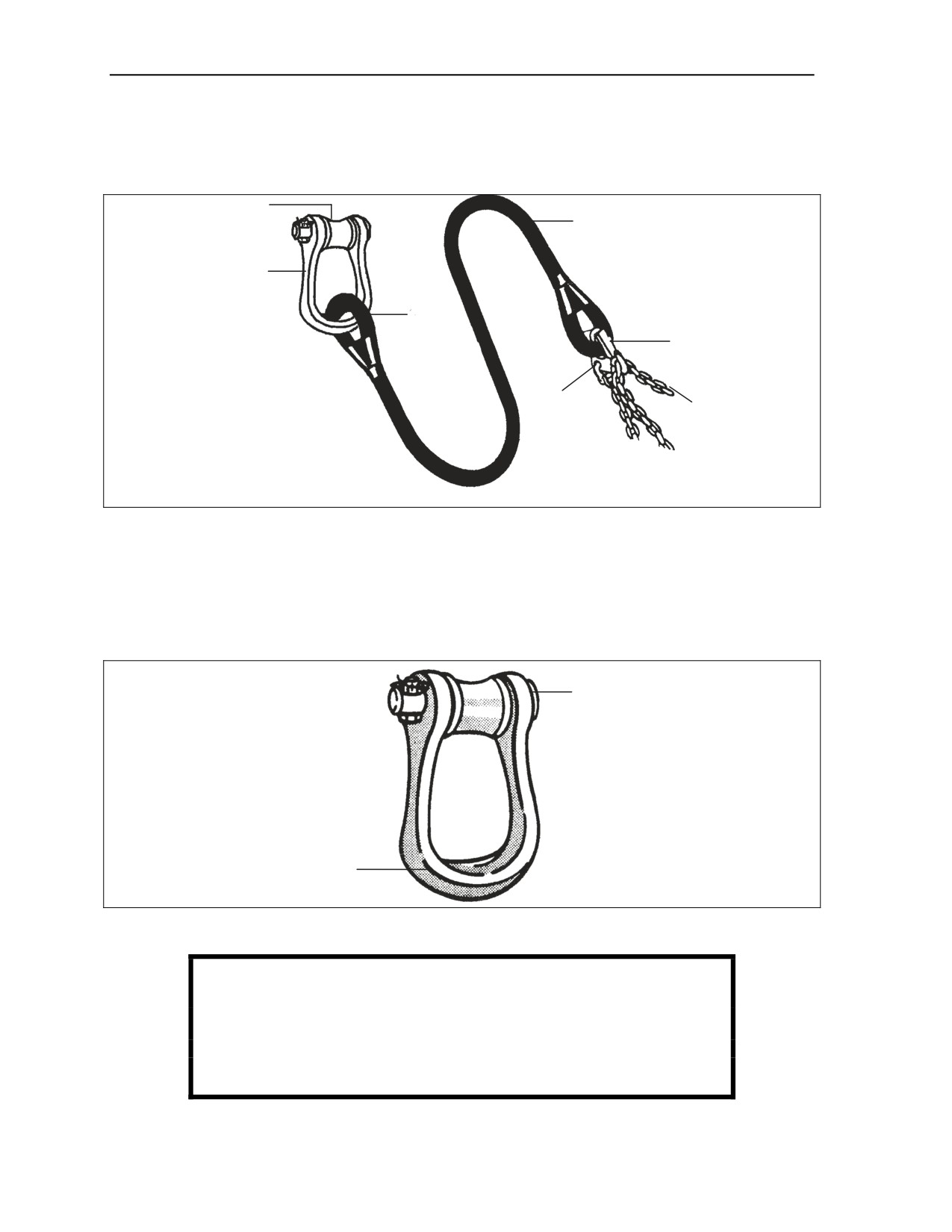
For clarity, only one of the four lifting legs is shown in Figure 6-1. Become familiar with the parts of the
FM 4-20.197/MCRP 4-11.3E, VOL I/NTTP 3-04.11/
20 July 2006
AFMAN 11-223 (I), VOL I/COMDTINST M13482.2B
6-1
Chapter 6
sling set and their locations. Both sling sets are similar, except for a few minor differences. All parts are
clearly marked; take care not to mix up the sets. If a part is damaged, each component of the sling set is
replaceable.
SPACER
NYLON ROPE
APEX FITTING
EYE
GRABHOOK
COUPLING
CHAIN LINK #1
LINK
Figure 6-1. 10,000- and 25,000-Pound Capacity Sling Set Components
z
Apex Fitting. The metal apex fitting (Figure 6-2) gathers the sling legs and attaches the sling
set to the helicopter hook. Each apex fitting consists of a clevis, pin, spacer, and castellated nut
and cotter pin. The 10,000-pound capacity clevis is made of aluminum and uses a 1 1/8-inch
diameter pin. The 25,000-pound capacity clevis is made of alloy steel and is fitted with a 1 1/2-
inch diameter pin
AIRCRAFT CARGO
HOOK GOES HERE
SLING LEGS GO HERE
Figure 6-2. Apex Fitting Components
WARNING
Each apex fitting pin must be secured with a bolt, castellated nut,
and cotter pin. Pip-pins or any other devices are prohibited from
use.
FM 4-20.197/MCRP 4-11.3E, VOL I/NTTP 3-04.11/
6-2
AFMAN 11-223 (I), VOL I/COMDTINST M13482.2B
20 July 2006
Cargo Slings
The pin on both apex fittings is secured with a 3/8-inch bolt and a castellated nut and cotter
pin. The bolts on the 10,000- and 25,000-pound capacity apex fittings are different lengths and
are not interchangeable.
The castellated nut and a cotter pin are a more positive means of securing the bolt since the
cotter pin is easily visible. Tighten the nut until the cotter pin can be placed through a
castellation in the nut and the hole in the bolt. Spread the ends of the cotter pin apart to keep the
nut from loosening.
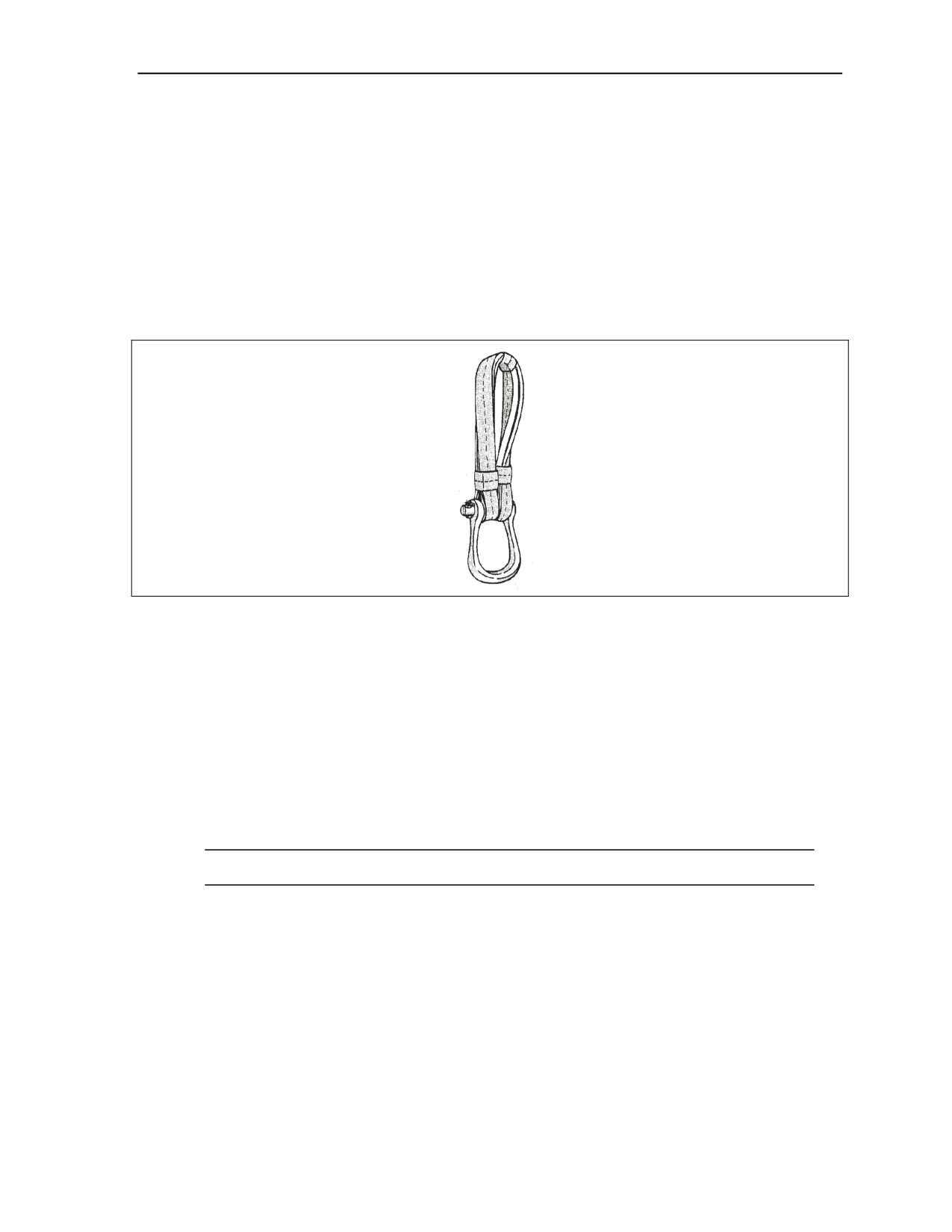
The apex fitting pin is placed directly onto the cargo hook, except for the UH-1. A 3-foot
nylon aerial delivery sling or 10-inch nylon donut must be used between the sling and aircraft
hook because of the unique shear pin design on the UH-1 hook. Use a basket hitch to place the
3-foot nylon aerial delivery sling on the apex fitting (Figure 6-3).
Figure 6-3. Three Foot Sling, Basket-Hitched on an Apex Fitting for a UH-1
All new sling sets are furnished with an improved apex fitting assembly which includes an
aluminum spacer. This spacer is required on the 10,000-pound capacity apex fitting when the
load is lifted by a UH-60 helicopter. The spacer prevents the apex fitting from working under
and raising the spring-loaded keeper. The spacer also centers the apex fitting on any cargo hook
and reduces the shock load to the cargo hook caused by oscillating and rotating loads. Since
these spacers are made of aluminum, some deformation or gouging of the surface is to be
expected. This in no way affects the serviceability of the apex fitting. File down any burrs or
gouges.
You can continue to use apex fittings without spacers on other aircraft, but you should
update your sling sets by ordering the proper spacer. The 25,000-pound capacity apex fitting
with a spacer will not pass through the opening in the UH-60 cargo hook.
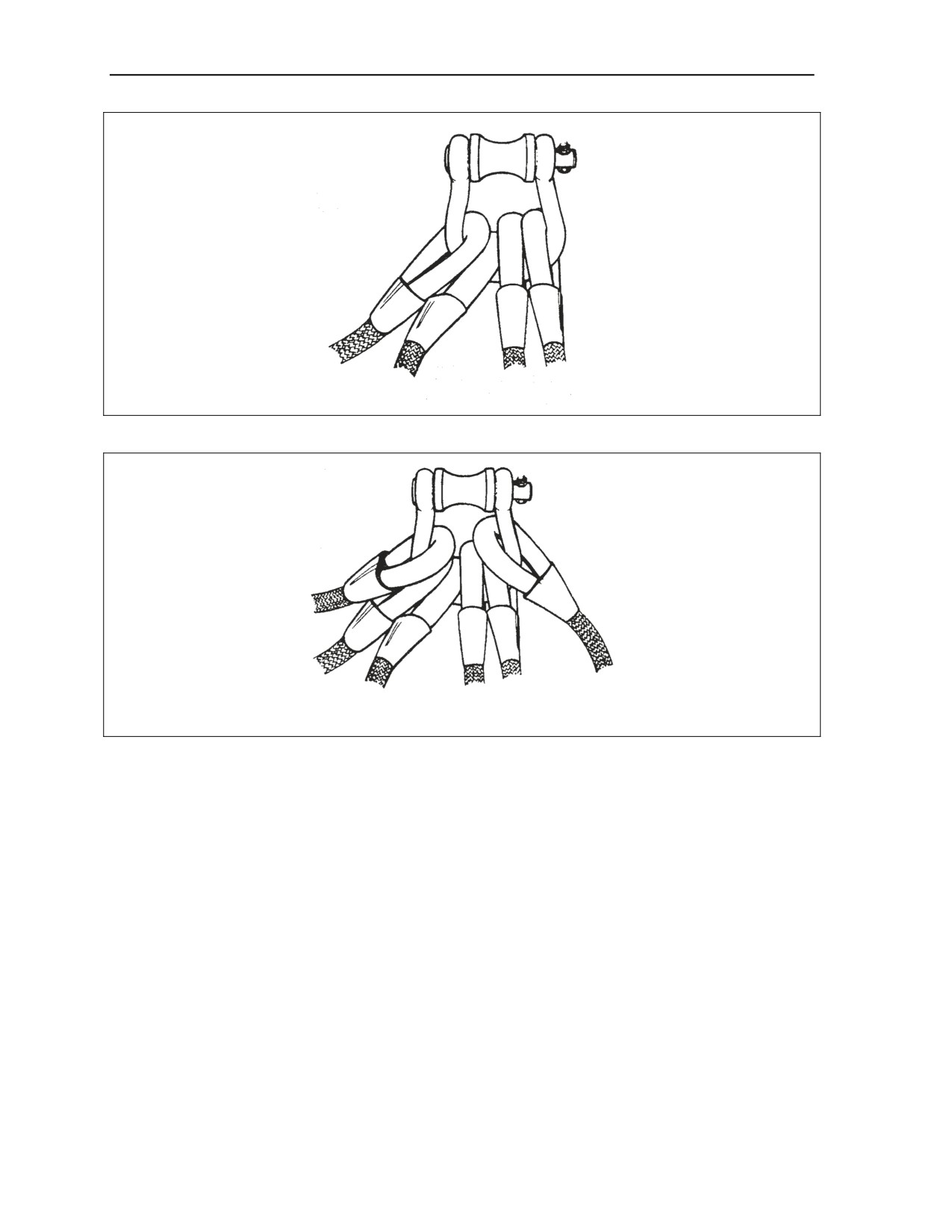
Note: The pin always goes up and attaches onto the aircraft cargo hook (Figure 6-4).
Four nylon rope legs are usually attached to the apex fitting. Six rope legs can be attached
to one apex fitting if the load requires it. In order to keep the sling legs from becoming tangled,
sling legs are numbered in the following sequence: 1 and 2 are the outer sling legs, 3 and 4 are
the inner sling legs, and if necessary, 5 and 6 are the innermost sling legs (Figure 6-5). Odd-
numbered sling legs are connected to the left side of the load; therefore, they are on the left side
of the apex. If a load is rigged with only one sling leg, you can attach the top eyelet of the sling
leg directly on the cargo hook, eliminating the need for the apex fitting.
FM 4-20.197/MCRP 4-11.3E, VOL I/NTTP 3-04.11/
20 July 2006
AFMAN 11-223 (I), VOL I/COMDTINST M13482.2B
6-3
Chapter 6
1
2
3
4
Figure 6-4. Proper Orientation of Apex Fitting
1
3
2
4
6
5
Figure 6-5. Sling Leg Numbering System
z
Nylon Rope Assembly. The nylon rope assembly is made from double-braided nylon rope with
an eye splice at each end. Cutting and splicing of the rope is carefully controlled to produce an
assembly which is approximately 12 feet long. During manufacture, the outer braid is covered
with a liquid nylon which, when dry, provides protection against scuffing and shields the rope
against ultraviolet radiation. This process and other environmental conditions during shipment
and storage can result in considerable shrinkage in the rope assembly length. Much of this
shrinkage is temporary and the specified length should be restored with use. To ensure proper
load distribution, the variation in length of the rope legs used in a sling assembly depends upon
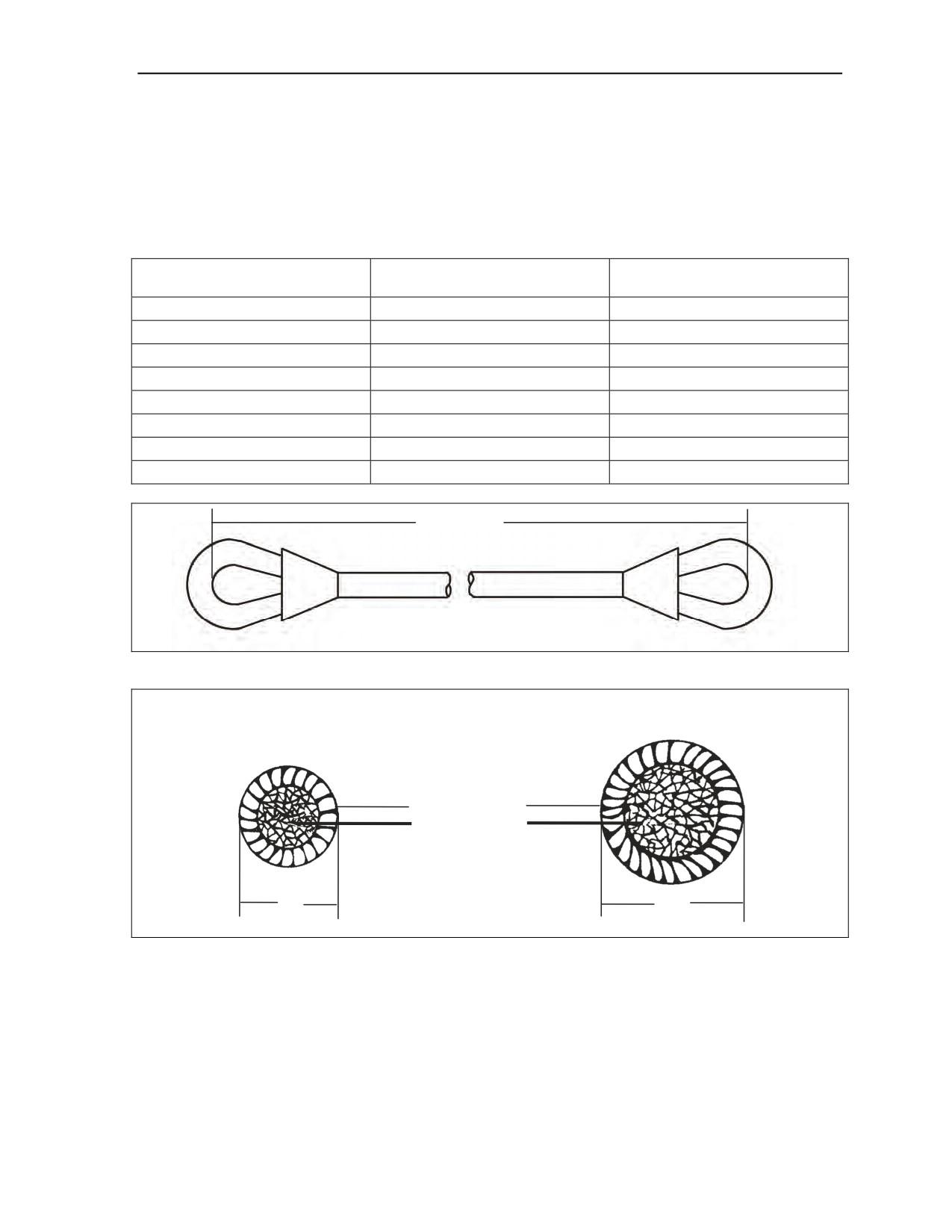
the load configuration and should not exceed the guidelines in Table 6-2 and Paragraph 6-3e.
Individual sling leg length is measured from inside of one eye to the inside of the other eye,
while being manually pulled taut (Figure 6-6). The 10,000-pound capacity sling set has olive
drab colored ropes while the 25,000-pound capacity sling set ropes are black. Each sling leg
assembly has one-fourth of the capacity of the complete sling set. Therefore, the capacity of one
sling leg from a 10,000- and 25,000-pound sling set is 2,500 and 6,250 pounds, respectively.
Outer jacket yarns in the olive drab 2,500-pound capacity rope are identified by a braided strand
about 3/32 inch in diameter. In the black 6,250-pound capacity rope, yarns are about 1/8 inch in
diameter. An additional polyurethane coated outer braid is used as a thimble at each eye splice
to protect the nylon rope from cuts or abrasion. Polyurethane is also potted into the V-shaped
FM 4-20.197/MCRP 4-11.3E, VOL I/NTTP 3-04.11/
6-4
AFMAN 11-223 (I), VOL I/COMDTINST M13482.2B
20 July 2006
Cargo Slings
portion of the eye splice to prevent sand or other material from entering and damaging the rope
fibers. The part number, NSN, manufacture date, and capacity of the individual legs are
embossed on one side of this cone-shaped potting. The part number and NSN of the complete
sling set is embossed on the other side of the potted area. Figure 6-7 shows two cross-sectional
drawings that are the actual size of the rope legs used with the 10,000- and 25,000-pound
capacity sling sets.
Table 6-2. Sling Leg Length Variations
CONFIGURATION
NUMBER OF SLING LEGS
AUTHORIZED LENGTH
VARIATION (INCHES)
Single-Point
2
6
Single-Point
3
12
Single-Point
4
12
Single-Point
6
12
Dual-Point
4
12
Tandem
8 (2 Sling Sets)
6
Side-by-Side (Shotgun)
8
12
Cargo Nets/A-22 Cargo Bags
2-4
6
LENGTH
Figure 6-6. Sling Leg Measurement
6,250-LB CAPACITY NYLON
2,500-LB CAPACITY NYLON
ROPE ASSEMBLY
ROPE ASSEMBLY
OUTER BRAID
NYLON CORE
7/8”
1 ¼”
Figure 6-7. Cross Section View of Nylon Ropes
z
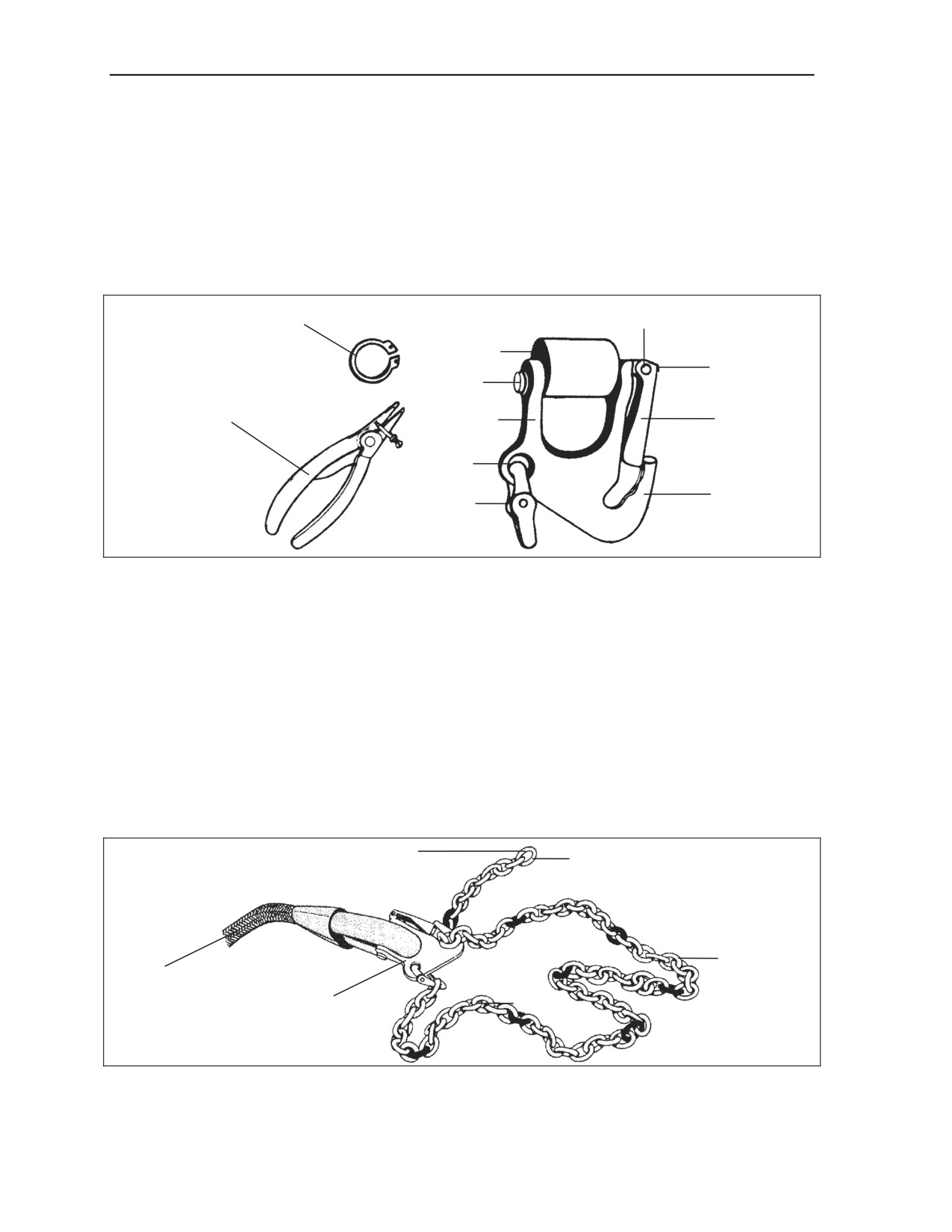
Grabhook Assembly. The grabhook assembly (Figure 6-8) is attached to the lower eye of the
nylon rope and attaches the nylon rope assembly to the chain. It is used to adjust the chain
length. The upper part of the grabhook (the yoke) contains a pin and spacer that are used to
attach the nylon rope to the grabhook. A snap ring holds the pin in place. The spacer provides a
large diameter surface for the eye of the nylon rope. The bottom part of the grabhook has an eye
at one side. The attached coupling link connects the chain to the grabhook assembly. Opposite
the eye is a hook into which any selected chain link is inserted to vary the length of the chain
FM 4-20.197/MCRP 4-11.3E, VOL I/NTTP 3-04.11/
20 July 2006
AFMAN 11-223 (I), VOL I/COMDTINST M13482.2B
6-5
Chapter 6
loop when rigging a load. The chain is kept in the grabhook by a spring-loaded keeper. The
same type of grabhook is used on the 10,000- and 25,000-pound capacity slings; however, the
grabhooks are different in size and should not be interchanged. The slot on the 25,000-pound
capacity sling set grabhook is too large to adequately secure the chain from a 10,000-pound
sling set. The assembly part number and capacity are embossed on the side of the grabhook.
The spring-loaded keeper is secured with a bolt and locknut. Grabhooks with roll pins will be
replaced with a bolt and locknut to reduce the possibility of losing the keeper and having the
chain fall out of the hook. Redrill the keeper using a 13/64-inch diameter drill and install the nut
and bolt to upgrade the grabhook. See Appendix B for the bolt and nut NSNs.
SNAP RING
BOLT AND LOCKNUT
SPACER
SPRING
PIN
REMOVE SNAP RING
WITH SNAP RING
YOKE
KEEPER
PLIERS
EYE
HOOK
COUPLIING
LINK
Figure 6-8. Grabhook Assembly
z
Chains. The welded steel-alloy chains for both sling sets are 8 feet long. Since the chain is
used as a loop, this length allows for adjustments from approximately 0 to 4 feet. There are 110
to 115 links in the 8-foot section of the 10,000-pound capacity sling set and 84 to 88 links in the
25,000-pound capacity sling set. The links in the 25,000-pound capacity sling set are larger than
those used in the 10,000-pound capacity sling set. Every tenth link is painted to help when you
count the links. The chain is attached to the grabhook so that the free end will contain 10 links
to the first painted link (Figure 6-9). If the tenth link from the free end is not painted, ensure the
chain is correctly attached to the grab hook (not reversed). If the chain is attached correctly you
may want to remove the paint from all of the painted links and repaint the links making sure you
paint each tenth link starting from the free end. When rigging a load, always count the chain
links from the free end. If an additional chain length is required by the rigging procedures, use a
coupling link to add it to the existing chain.
COUNT FROM THIS END
LINK # 1
CHAIN
NYLON ROPE
GRABHOOK
Figure 6-9. Chain Attached to Grabhook by Coupling Link
FM 4-20.197/MCRP 4-11.3E, VOL I/NTTP 3-04.11/
6-6
AFMAN 11-223 (I), VOL I/COMDTINST M13482.2B
20 July 2006
Cargo Slings
WARNINGS
1. Do not use a 10,000-pound capacity sling set when a 25,000-
pound capacity sling set is required.
2. Breakage or other sudden separation at the load (chain) end of
the nylon rope leg assembly will result in the rope and chain
snapping back, causing damage to the aircraft and possible
serious injury to personnel. Riggers must ensure that the
attachment points on all equipment are sound and that proper
rigging procedures are used. Chapter 8 contains information on
connecting sling legs used as vertical pendants.
CAUTION
Nylon cord or pressure-sensitive cloth-backed tape (duct tape) should
be used to secure the excess chain. Tying off the excess links just
below the grabhook will help keep the chain in the slot and prevent the
chain from damaging the item being lifted. If the rigging procedures
prescribe a
10,000-pound capacity sling set, but a
25,000-pound
capacity sling set is the only one available, use the conversion table in
Appendix C to cross-reference the chain links.
z
Making the Sling Set Fit the Load. A complete sling set comes with four legs. However,
some loads may have more than four lifting provisions and others may have less. The following
information explains in detail how to add or remove legs from either sling set.
The overall capacity of the sling set changes as we add or subtract sling legs. If you add
legs to a sling set, the capacity of the clevis does not change. Therefore, a six-legged 10,000-
pound capacity sling set will still safely carry only 10,000 pounds. If one leg is removed, the
10,000-pound capacity set will be able to carry only 7,500 pounds while the 25,000-pound
capacity sling set can carry 18,750 pounds.
WARNING
Each of the four legs of the 10,000- and 25,000-pound capacity
sling sets will carry only one-fourth of the overall capacity of the
set.
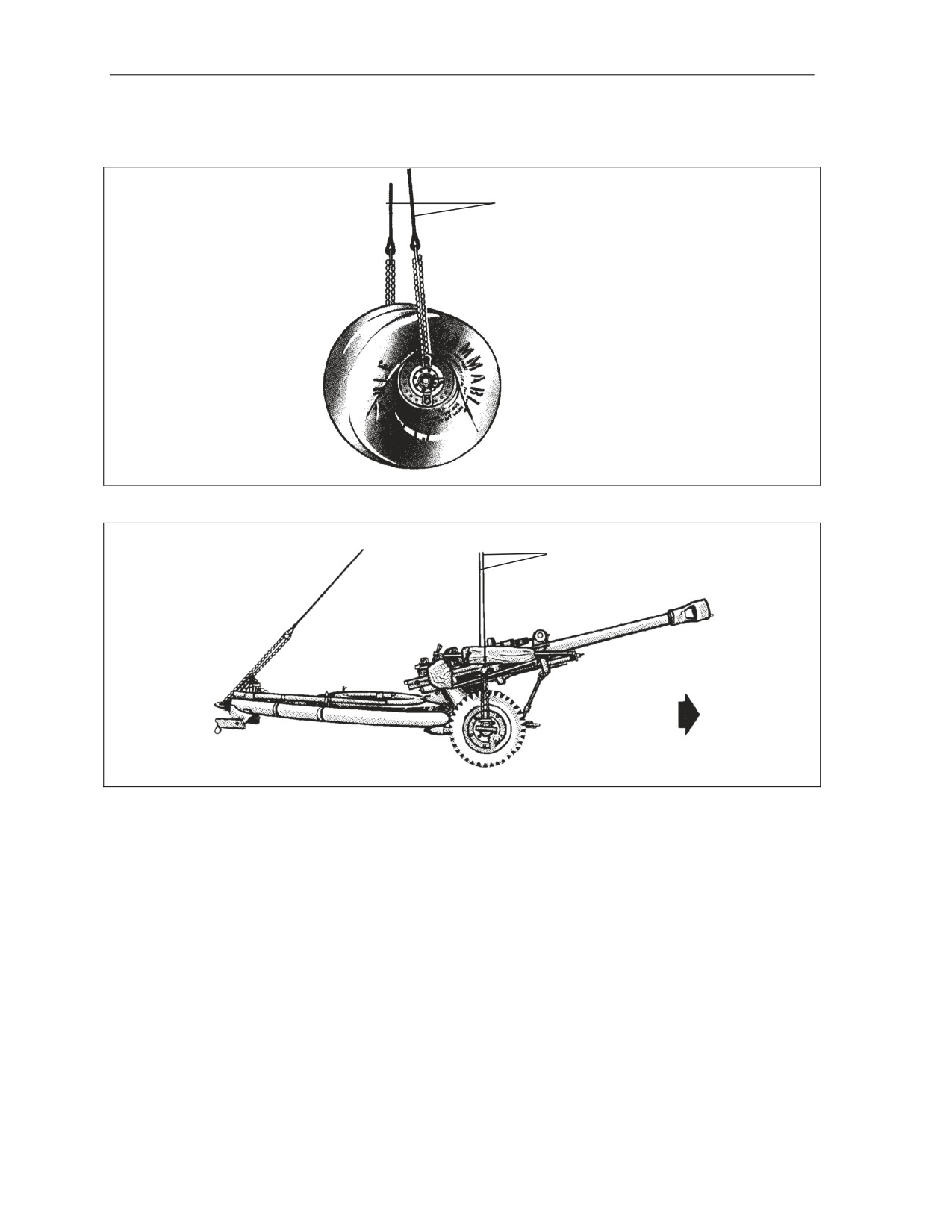
You may rig a load such as a fuel drum that has only two lift points. In this case, you may
run two chains through each hookup point. This will allow the full capacity of the sling to be
used. When using four sling legs and two lift points, all sling legs may not vary more than 6
inches in length. If the load is less than half the capacity of the sling set, you can use just two
sling legs, one leg to each hookup point as shown in Figure 6-10. When using two sling legs,
each sling leg of the pair may not vary more than 6 inches in length.
You may also use this method when hooking up a load with only three lift points
(Figure 6-11). Route the extra chain leg through one of the hookup points and use the same
FM 4-20.197/MCRP 4-11.3E, VOL I/NTTP 3-04.11/
20 July 2006
AFMAN 11-223 (I), VOL I/COMDTINST M13482.2B
6-7
Chapter 6
chain link number. You will be less likely to lose the fourth sling leg, and the sling set will be
ready for another load.
ALL SLING LEGS MAY NOT
VARY MORE THAN 6
INCHES IN LENGTH
Figure 6-10. Load with Two Lift Points
THE PAIRED SLING LEGS MAY NOT
ALL SLING LEGS MAY NOT
VARY MORE THAN 6 INCHES IN
VARY MORE THAN 6
LENGTH
INCHES IN LENGTH
Figure 6-11. Load with Three Lift Points
─ When using four sling legs and three lift points, all sling legs may not vary more than
6 inches in length.
─ When using three sling legs and three lift points, the two sling legs paired as front or
rear may not vary more than 6 inches in length and all three sling legs may not vary
more than 12 inches between the shortest and longest sling leg. The front sling legs
should be the longest of the three sling legs.
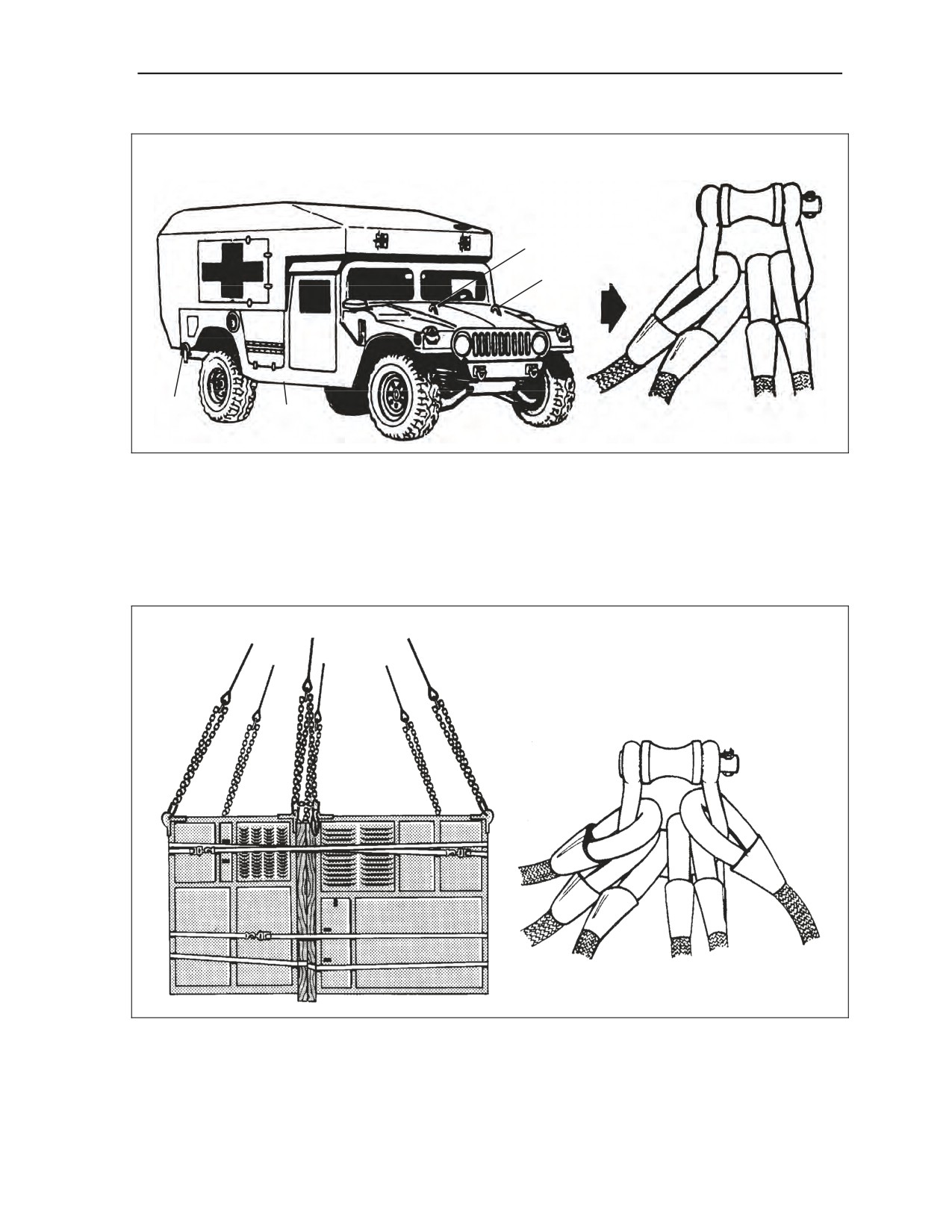
Most loads use four lift provisions and four sling legs (Figure 6-12). Each pair of front
sling legs (sling legs 1 and 2) may not vary more than 6 inches in length and should be the
longest two sling legs of the four. Each pair of rear sling legs (sling legs 3 and 4) may not vary
more than 6 inches in length and should be the shortest two sling legs of the four. The difference
in length between the shortest and longest sling leg may not exceed 12 inches.
FM 4-20.197/MCRP 4-11.3E, VOL I/NTTP 3-04.11/
6-8
AFMAN 11-223 (I), VOL I/COMDTINST M13482.2B
20 July 2006
Cargo Slings
THE FRONT AND REAR PAIR OF SLING LEGS MAY NOT VARY MORE THAN 6 INCHES
IN LENGTH AND ALL SLING LEGS MAY NOT VARY MORE THAN 12 INCHES IN LENGTH
2
1
1
3
2
4
3
4
Figure 6-12. Load with Four Lift Points
Some loads use six lift provisions and six sling legs. Figure 6-13 shows that the apex fitting
was disassembled and two additional legs were added. Each pair of sling legs (sling legs 1 and
2, 3 and 4, and 5 and 6) may not vary more than 6 inches in length, from each other. The
difference in length between the shortest and the longest sling leg of the set may not exceed 12
inches.
4
2
6
2
5
3
1
REAR
FRONT
MIDDLE
1
3
2
4
5
6
Figure 6-13. Load with Six Lift Points
─ Sling legs 1 and 2 (front sling legs) will be the longest sling legs.
─ Sling legs 3 and 4 (middle sling legs) will be the next longest sling legs.
FM 4-20.197/MCRP 4-11.3E, VOL I/NTTP 3-04.11/
20 July 2006
AFMAN 11-223 (I), VOL I/COMDTINST M13482.2B
6-9
Chapter 6
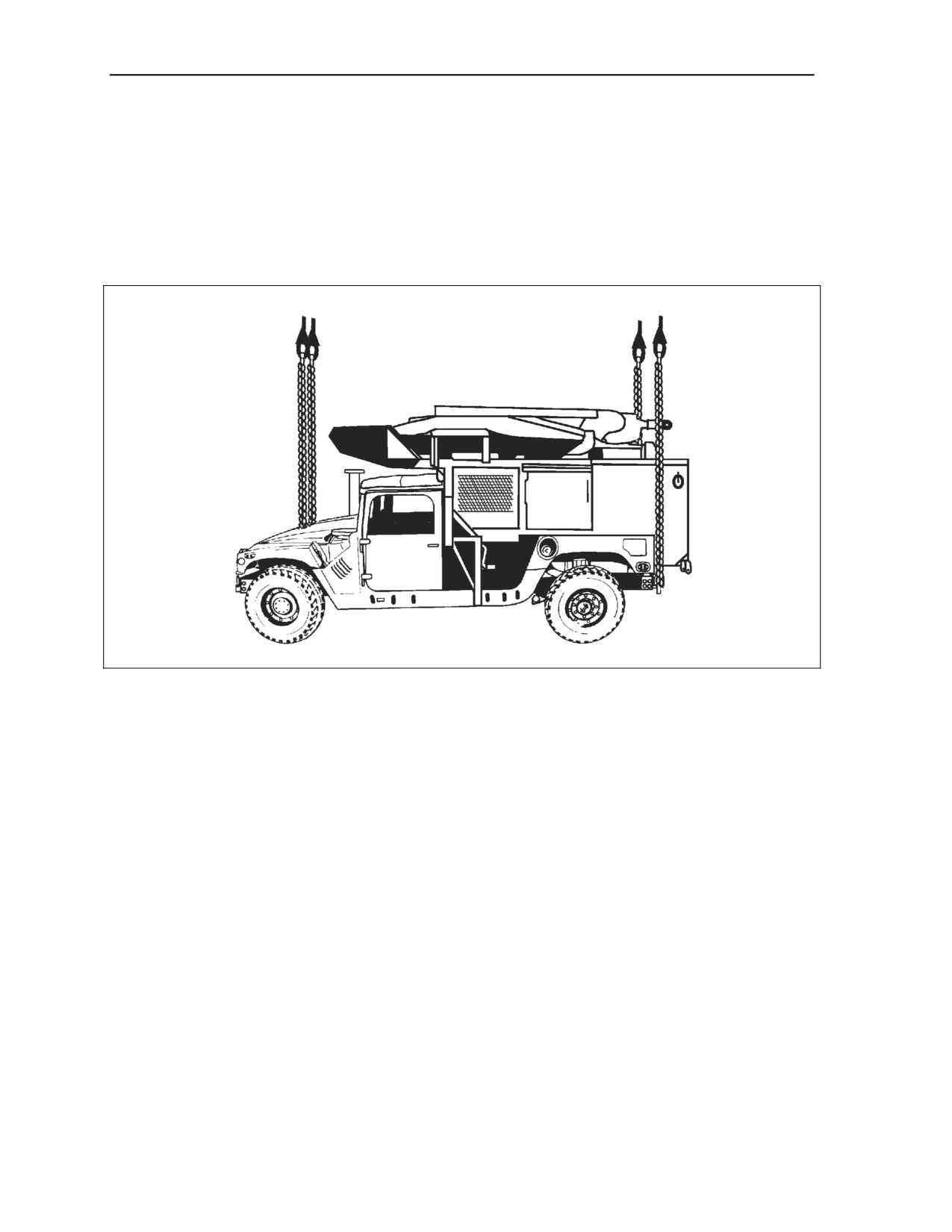
─ Sling legs 5 and 6 (rear sling legs) will be the shortest sling legs.
─ Remember, this sling set can still only carry 10,000 pounds of cargo. Even though
the six sling legs could carry 15,000 pounds, the apex fitting can only carry 10,000
pounds.
Some loads can be carried in the dual-point configuration. Dual-point loads require an
additional apex fitting for the extra sling set (Figure 6-14). Dual-point loads have the same sling
leg length requirements as listed in paragraph 6-2, page 6-1 for three lift points, and page 6-8 for
four lift points.
FORWARD CARGO HOOK
AFT CARGO HOOK
Figure 6-14. Dual-Point Load
Some loads can be carried in the side-by-side (shotgun method) configuration. Side-by-side
loads require an additional sling set (Figure 6-15). One sling set is used on the front of the load
and the other sling set is used on the rear of the load.
─ The front sling set (sling legs 1, 2, 3, and 4) may not vary more than 6 inches in
length. The front sling legs must be the four longest sling legs of the eight sling legs
being used on the load.
─ The rear sling set (sling legs 1, 2, 3, and 4) may not vary more than 6 inches in
length. The rear sling legs must be the four shortest sling legs of the eight sling legs
being used on the load.
─ The difference in length between the shortest and the longest sling leg of the eight
sling legs being used may not exceed 12 inches.
Some loads can be carried in the tandem (one load in front of the other) configuration. Tandem
loads require an additional sling set (Figure 6-16). One sling set is used on the front load and
the other sling set is used on the rear load. Normally eight sling legs are used but seven may be
used as determined by the rigging procedures for a specific load. The difference in length
between the shortest and the longest sling leg of the seven or eight sling legs being used may not
exceed 6 inches.
z
Adding or Subtracting Sling Legs. Follow these five steps when adding or subtracting sling
legs:
Remove cotter pin and nut from the apex fitting pin bolt.
Remove the bolt from the pin (Figure 6-17).
FM 4-20.197/MCRP 4-11.3E, VOL I/NTTP 3-04.11/
6-10
AFMAN 11-223 (I), VOL I/COMDTINST M13482.2B
20 July 2006
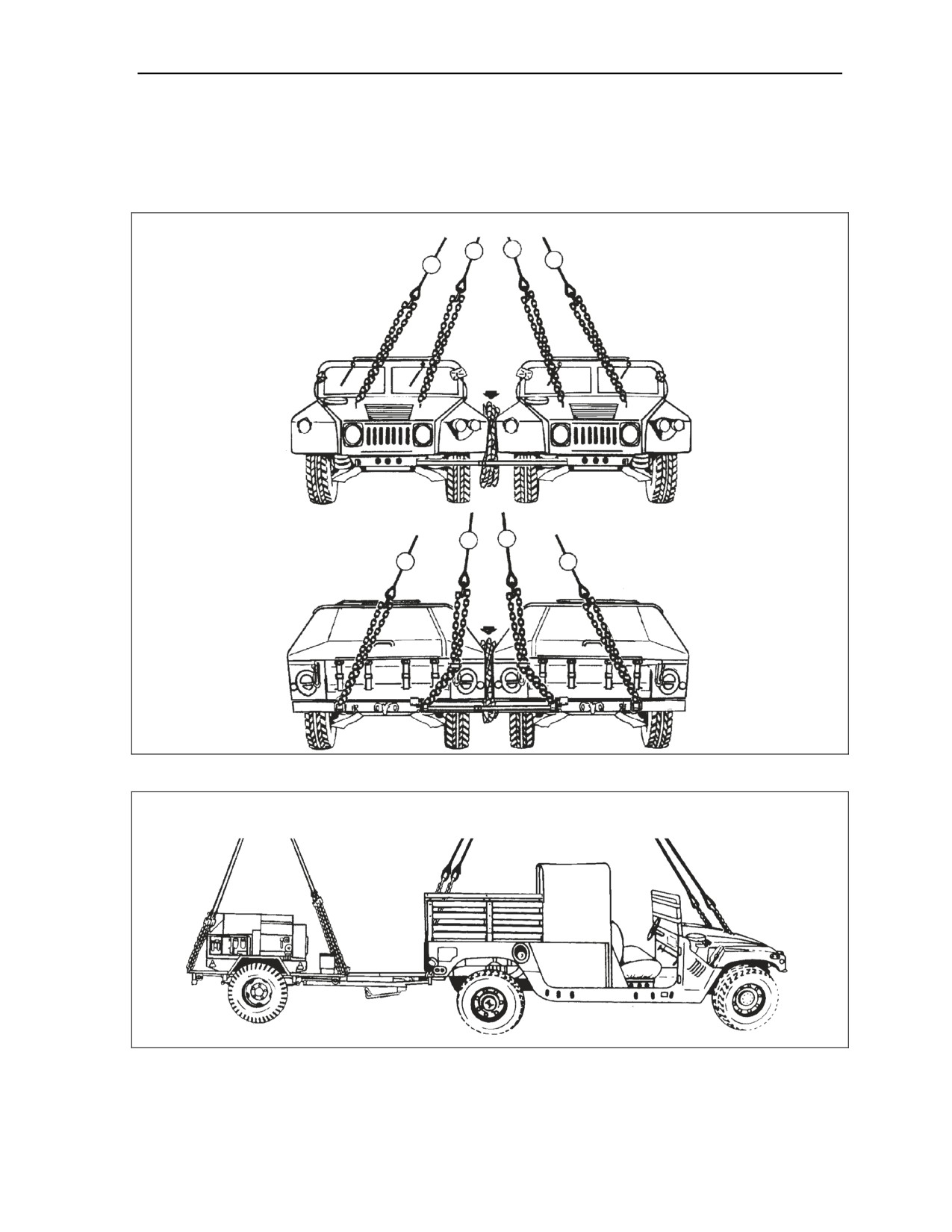
Cargo Slings
Pull the pin and spacer out of the clevis.
Add or remove the sling legs as required.
Place the apex fitting spacer in the clevis opening. Install the pin, bolt, and nut and secure
with the cotter pin.
4
3
1
2
FRONT
VIEW
3
4
1
2
REAR
VIEW
Figure 6-15. Side-by-Side (Shotgun) Load
ALL SLINGS MAY NOT VARY MORE THAN 6 INCHES IN LENGTH
Figure 6-16. Tandem Load (One Load in Front of the Other)
FM 4-20.197/MCRP 4-11.3E, VOL I/NTTP 3-04.11/
20 July 2006
AFMAN 11-223 (I), VOL I/COMDTINST M13482.2B
6-11
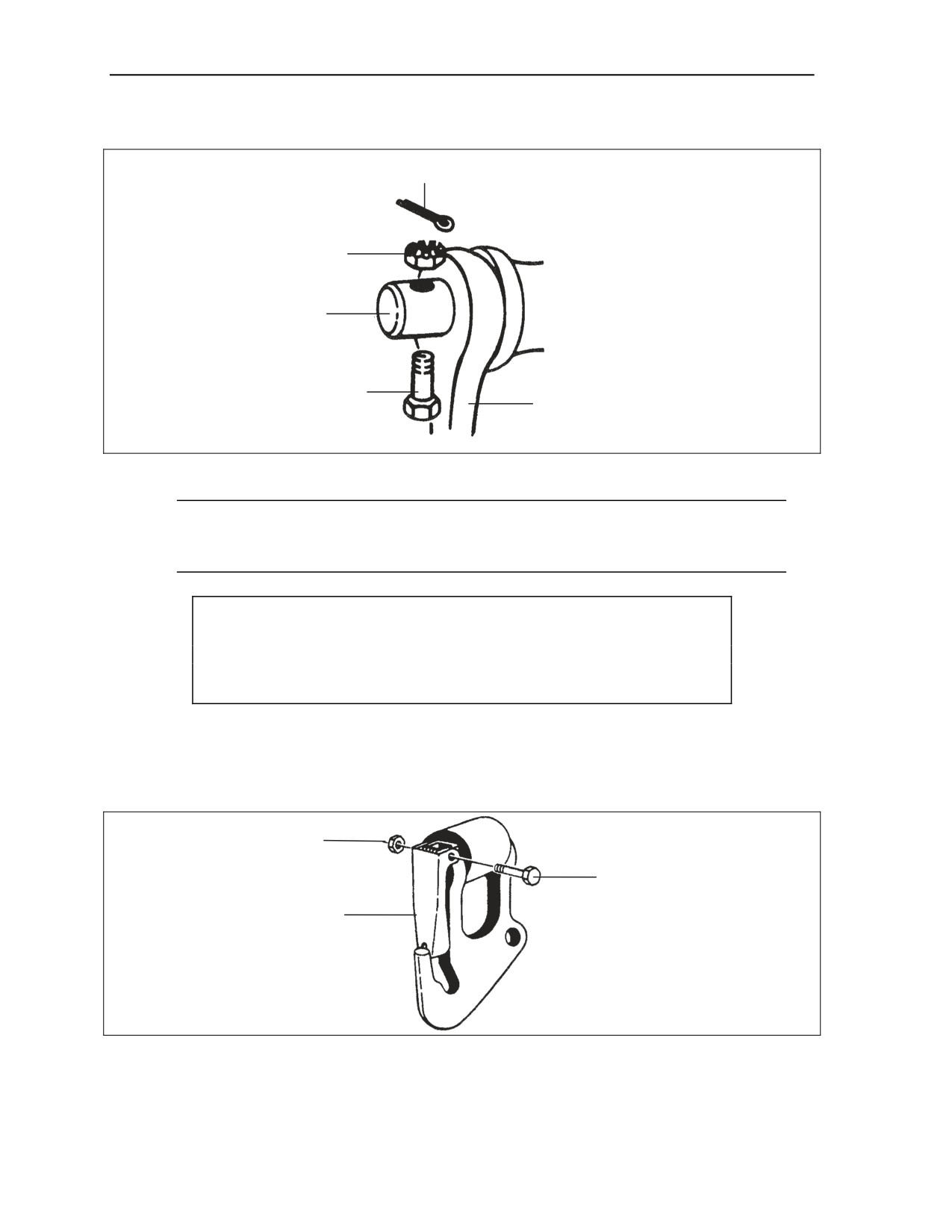
Chapter 6
COTTER PIN
CASTELLATED NUT
APEX PIN
DRILLED BOLT
APEX
Figure 6-17. Bolt Assembly
Note: If the nylon rope portion of the sling leg is severely damaged, you must replace the nylon
rope assembly of the sling. Besides removing one end from the apex fitting, you must also
remove the other end from the grabhook assembly.
CAUTION
Check to ensure the nut is tight and the cotter pin is installed on the
castellated nut before every lift.
z
Disassembling the Grabhook Assembly. The following steps explain how to replace a rope
assembly or component of the grabhook assembly. Disassemble the keeper and pin as follows:
Using a pin punch and hammer, drive out the roll pin. If the roll pin has been replaced by a
bolt and nut, unscrew the nut and remove the bolt (Figure 6-18).
NUT
BOLT
KEEEPER
Figure 6-18. Bolt and Nut Removed from Grabhook
Tilt the grabhook and remove the spring and keeper (Figure 6-19).
FM 4-20.197/MCRP 4-11.3E, VOL I/NTTP 3-04.11/
6-12
AFMAN 11-223 (I), VOL I/COMDTINST M13482.2B
20 July 2006
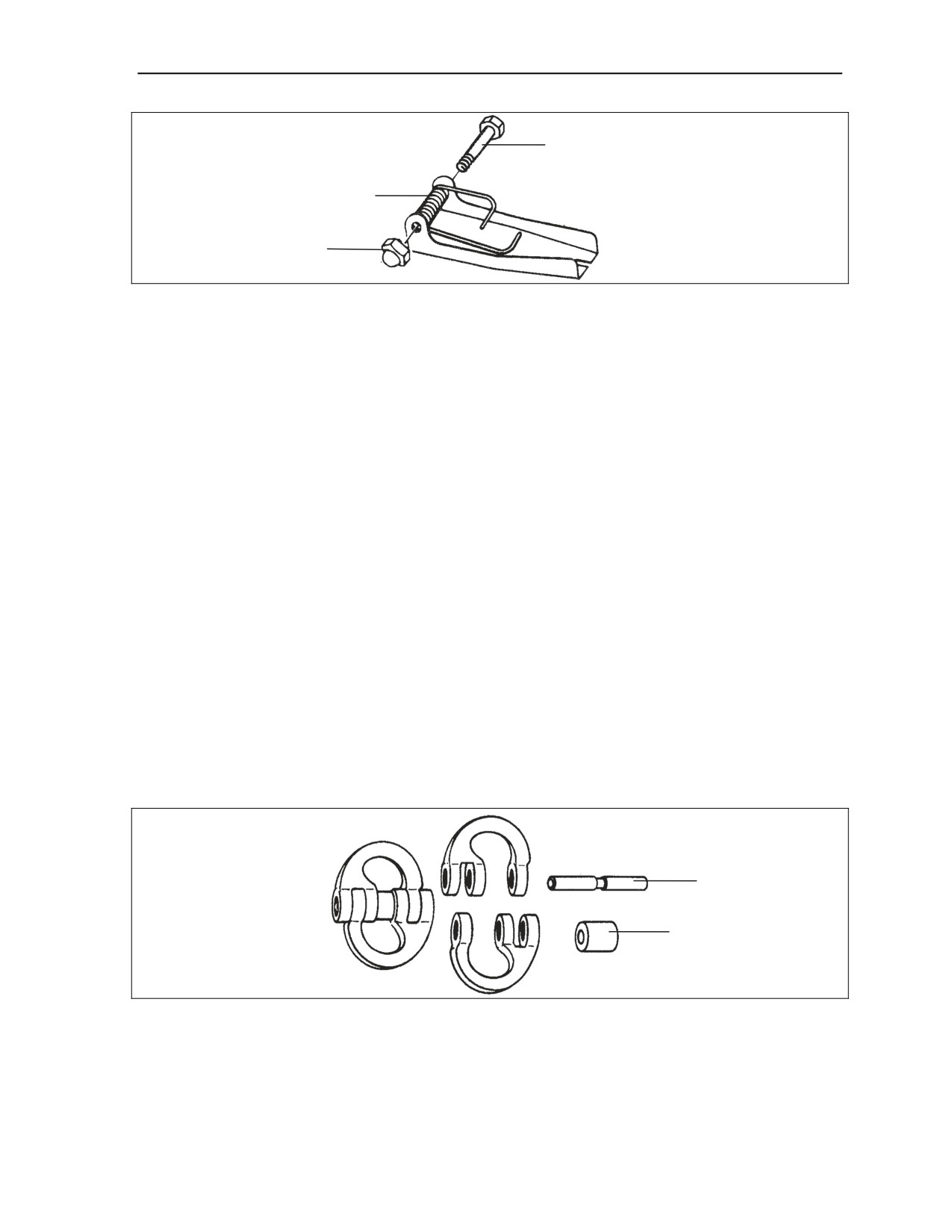
Cargo Slings
BOLT
SPRING
NUT
Figure 6-19. Spring-Keeper Assembly
Remove the snap ring that secures the pin. Do not over-expand the snap ring because this
may cause it to break or not spring back into shape.
Remove the pin and the spacer.
Replace the sling leg, if necessary.
z
Reassembling the Grabhook. Reassemble the grabhook as follows:
Place the spacer inside the sling leg eyelet and position the sling leg in the grabhook
opening. Install pin through grabhook and spacer so the head of the pin is on the keeper side.
Reinstall the snap ring. Do not reuse a snap ring if it does not seat uniformly into the snap ring
groove.
Position the long end of the keeper spring against the inside edge of the keeper with the
short end against the pin.
Position the small end of the keeper so that the notch cut is centered on the protruding
portion inside the hook. Push down on the other end of the keeper to align the holes.
Use a pointed tool, such as an ice pick or awl, to help align the spring, grabhook, and
keeper. Slowly withdraw the tool as you install the bolt. All roll pins must be replaced with a
bolt and nut (see grab hook assembly, page 6-5).
Install the nut on the bolt. Do not overtighten the nut because the keeper must be free to
move.
z
Removing and Reinstalling Coupling Links. Removing and reinstalling the coupling link is a
simple operation. Use a hammer and a small pin punch to remove the securing pin from the
coupling link or hammer lock. A spring inside the spacer secures the pin. Drive out the pin.
Reassemble the coupling link in reverse order of disassembly. Replace the coupling link if the
spring does not secure the pin inside the spacer. Figure 6-20 shows the coupling link that is
used to attach the chain leg to the grabhook.
PIN
SPACER
ASSEMBLED
Figure 6-20. Coupling Link
z
Sling Set Proof Load Testing. Neither initial nor periodic proof load testing of the 10,000- and
25,000-pound capacity sling sets is required to be performed by using units. Each sling set
component is proof load tested by the manufacturer before delivery. In addition, breaking
strength testing of the rope assemblies is done on a sampling basis. Proof load testing of
FM 4-20.197/MCRP 4-11.3E, VOL I/NTTP 3-04.11/
20 July 2006
AFMAN 11-223 (I), VOL I/COMDTINST M13482.2B
6-13
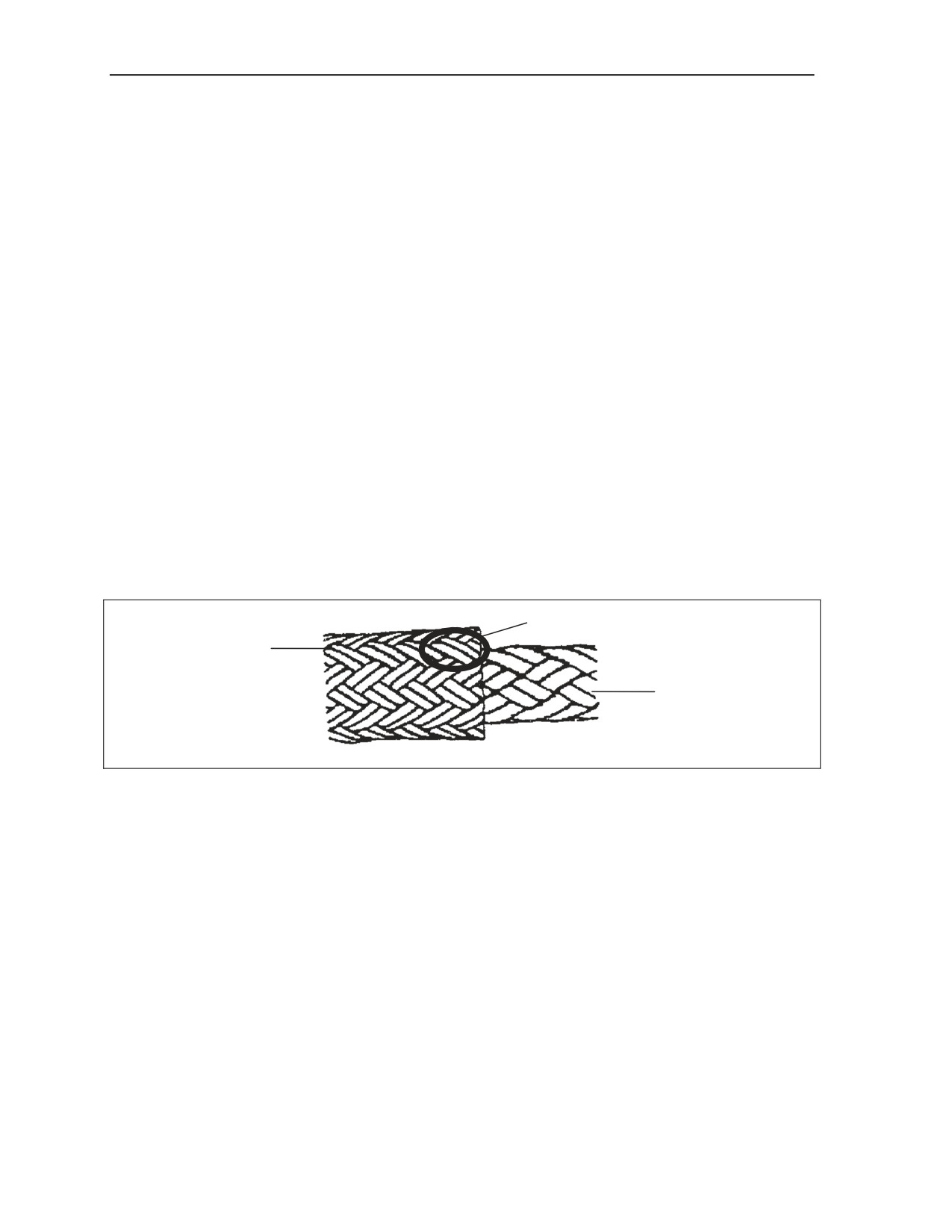
Chapter 6
repaired sling sets is not required since the only authorized repair is by replacement of tested
components. The above proof testing satisfies the requirements of Army TB 43-0142 for the
10,000- and 25,000-pound capacity sling sets. If these slings are inspected according to the
requirements of the next paragraph and Table 6-3 that follows, there should be no fear of
dropping a sling load through failure of the sling components.
z
Sling Set Inspection. Inspect the sling set by using the procedures in TM 10-1670-295-23&P.
Table 6-3 is a guide to assist in determining the type of damage on a sling set. Sling sets must
be inspected before and after each use.
Before using a sling set, inspect all metal components for proper operation, rust, corrosion,
cracks, bends, distortions, burrs, sharp edges, grease, oil, acid, or foreign matter. Check for any
missing components. If bends, cracks, distortions, or other damages are present, the sling
cannot be used until you have compared the damage with the damage criteria chart. Replace
any components that are damaged beyond the allowable limit.
Determining the serviceability of the sling legs is the most difficult and important part of
inspecting the sling set. Serious damage or weakening of sling legs can occur without visual
damage to the fibers. Ropes that are known to have been severely overloaded or shock
loaded, such as the remaining legs of a sling set after one leg has broken, should be
removed from service. Ropes can also be severely weakened by exposure to certain chemicals.
Ropes with rust stains or stains from a foreign substance should be removed from service.
Each sling leg should be individually inspected for cuts, snags, or worn strands. Pulled strands
should be worked back into the rope. The outer braid of the leg is constructed with 24 strands
(Figure 6-21) which allows for a certain amount of damage as listed in Table 6-3. No damage to
the core braid is allowed. Some fuzziness on the outer surface of the nylon leg is normal. If
surface roughness increases or nylon slivers or splinters are present, remove the leg from
service. If any doubt exists as to the condition of the sling leg, remove it from service.
TWO YARNS ARE LAID SIDE BY SIDE
AND BRAIDED AS ONE STRAND
OUTER BRAID
CORE BRAID
THE OUTER BRAID IS MADE WITH 24 STRANDS.
Figure 6-21. Outer Braid and Core Braid of a Sling Leg
Each link of the chain should be inspected for damage such as denting, bending, and
stretching. If any link is damaged, the complete chain section must be replaced. This type of
damage will normally occur where the links contacted the load lift provision or where the chain
was inserted in the grabhook. The best time to inspect the chain is before rigging and again after
derigging a load.
z
Sling Set Care and Storage. The ground crew or unit personnel may perform maintenance on
the 10,000- and 25,000-pound capacity sling sets. The sling sets are inspected by the user
before and after each use. At the present time, these sling sets have no predetermined service
life. The six basic steps to prepare slings for storage at the organizational level are as follows:
Wash off dirt and contaminants with a mild detergent or hand soap.
After washing, rinse thoroughly and then air dry the sling sets. (Do not wring water out of
the rope nor dry the legs in the sun.)
Remove corrosion from metal parts with a wire brush or emery cloth.
Remove burrs or sharp edges from metal parts with a file.
Replace any defective components.
FM 4-20.197/MCRP 4-11.3E, VOL I/NTTP 3-04.11/
6-14
AFMAN 11-223 (I), VOL I/COMDTINST M13482.2B
20 July 2006