FM 3-07.31 PEACE OPS Multi-Service Tactics, Techniques, and Procedures for Conducting Peace Operations (OCTOBER 2003) - page 2
(6) Availability of adequate cordon or protection troops.
f. Search Pattern Planning Factors. Assume that every operation is observed and
documented. When planning, be mindful that rigid search patterns often invite
surprises for the search teams. Varying procedures and drills is useful, but planners
cannot and should not vary some procedures to ensure consistency and safety. The
recommended planning factors for a search operation are:
(1) The objective. Once decided, coordinate the search objective with other
military operations during the same period. This consideration should provide the
guidelines of time and duration for the search.
(2) The ‘Need to Know’ principle. Introduce commanders and staffs to the plan
according to a carefully calculated planning sequence.
(3) Deception plan. A deception plan is paramount to achieve surprise or protect
sources. Planners may deem it necessary to conceal the true nature of the operation
from the participants until just before the operation to ensure it is not compromised.
(4) Intelligence. Reliable intelligence is the basis for search operations. When
unavailable, utilize other intelligence assessment tools.
(5) Tasking. Clear direction covering the operational, legal, and political
considerations is required before any searching commences.
(6) Training. The AO will dictate the requirements for training and types of
specialists required. If beyond unit resources, obtain advice and support from
engineers.
(7) Systematic work pattern. This applies to the planning and conduct of search
operations. Carefully and systematically approach search operations in detail to avoid
error or oversight.
(8) Thoroughness of work. Search operations require a high level of
thoroughness before, during, and on completion of any task.
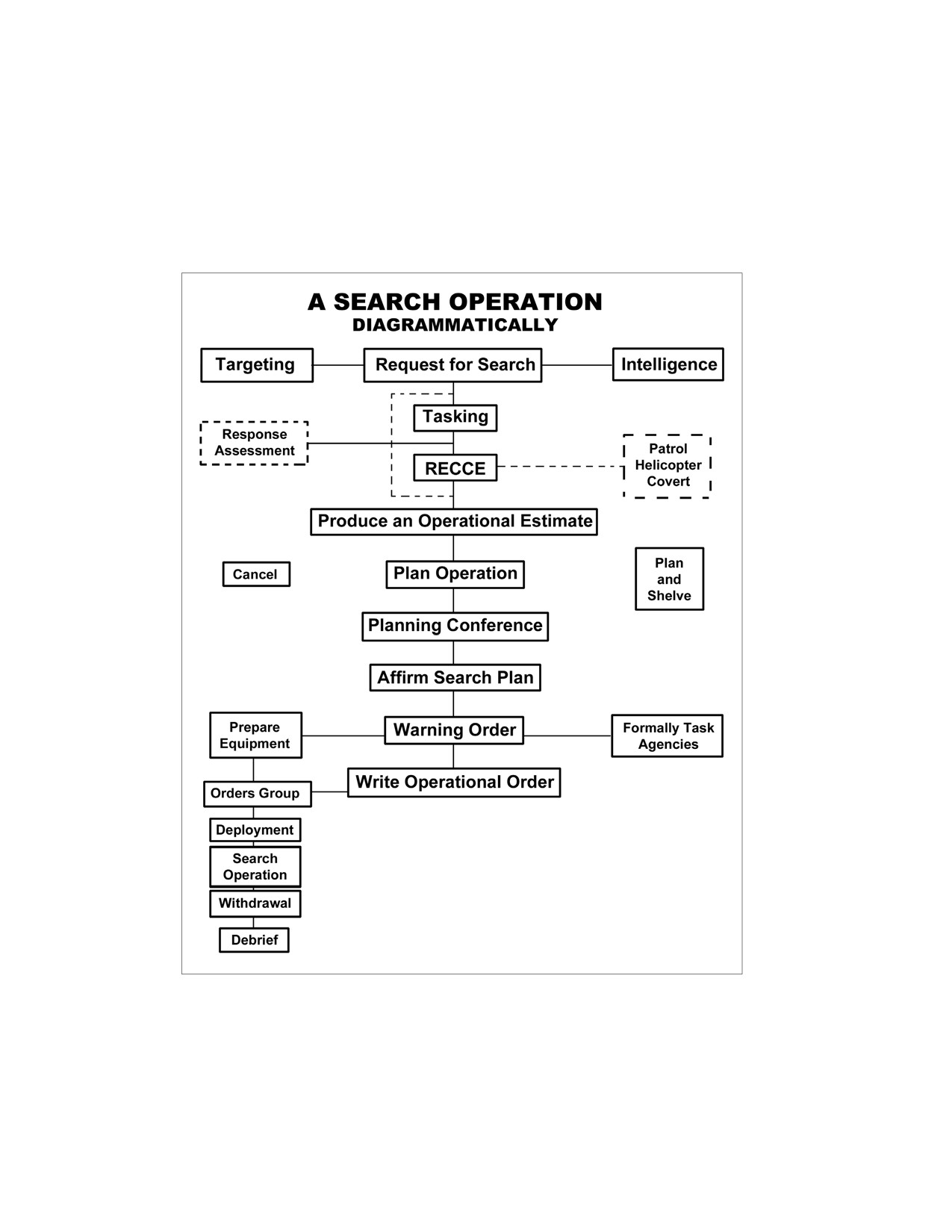
g. The planning sequence of a search (Figure III-7). Having covered the main
factors that affect planning of a search operation, it is necessary to consider the more
detailed planning. These points include:
(1) Anticipation of hostile action. Constant assessment is required to pre-empt
reactions of belligerent parties. The commander should determine the threat and
whether the search forces may make themselves targets or antagonize the local
populace.
(2) Isolation of the target area. The use of a cordon or other form of protection
party is recommended. At no time allow any person in or out of a search area, once the
operation has started.
(3) Coordination of action. Coordinate all actions to ensure a systematic and
integrated search operation. Coordination should include:
(a) Interaction within a search team and between different teams.
(b) Coordination between search teams, troops, and the local authorities.
(4) Minimizing risks. Normally, a search is most dangerous upon or soon after
arrival in the area. If belligerents are surprised, violent action may rapidly ensue. If
civilians are involved, attempts to distract or delay the search may occur. Once military
control isestablished, risks occur if searches move out of sequence or a sudden “find”
III-15
leads to neglect of procedures. Be aware of “Find’s” acting as decoys to divert attention
from more valuable targets.
(5) Maintenance of records. Records are invaluable in the case of finds and the
provision of evidence in subsequent prosecutions. Additionally, records provide
information about the area and are useful for future operations. If a search uncovers
evidence, record and preserve the evidence in compliance with established procedures.
Figure III-7 Search Operations Flow Diagram
III-16
Chapter IV
PEACE OPERATIONS TASKS
1. Patrolling
a. Patrolling is the basis of operations in a hostile area. It is aimed at acquiring
information, identifying and apprehending persons, and neutralizing hostile groups.
The kind of patrol depends on the mission and can be either mounted or dismounted.
b. Types of patrols can include the following:
(1) Presence patrols. PO forces use presence patrols when the situation in the
area is stabilized and there is no direct danger for the forces. The patrol is recognized
as a unit of the PO force. The intention is to show the local people that forces are in the
area and alert. The patrol is armed, but is acting in a friendly and frank way. The
patrols are conducted during daylight hours.
(2) Combat patrols. In areas where PO forces may encounter armed groups, it
may be necessary to conduct combat patrols. In such circumstances, imposing a curfew
will ensure that the combat patrol is not placed at a disadvantage it will usually be
sensible to impose a curfew so as not to place the combat patrol at a disadvantage.
(3) Ambush patrols. Ambushes are sometimes useful in rural operations. If
conducted under cover of a curfew and the necessary precautions are taken to ensure
that innocent people do not get involved, it is possible to set a conventional style
ambush designed to capture hostile persons.
(4) Reconnaissance patrols. Reconnaissance patrols play a major role in PO for
several reasons. They will need to visit all outlying communities in order to both
acquire information and provide the reassurance of a security force presence. These
patrols may have to search areas and they may need to set up hasty roadblocks.
(5) Air and space assets. Use air and space assets to cover large areas and gain
certain types of information quickly. For example, the use of thermal imaging cameras
can gain timely information, both day and night, for monitoring movement and activity.
The threat of applying lethal air power can limit movement of hostile forces.
(6) Naval Patrolling. Naval assets provide operational support, including
anything from patrolling inland waterways to major ocean coastlines. Other missions
commonly performed can include search and rescue (SAR) operations, observation and
reporting on pollution damage to the marine environment, and combined training
missions with ground elements of the PO force. Examples of training missions include
insertion and extraction of personnel at coastal remote sites, resupply, SAR exercises,
small arms live fire exercises, and familiarization rides to encourage mutual
understanding and cohesion among contingents. As with their land and air
counterparts, naval patrolling activities ensure round the clock presence in their area of
responsibility while also performing joint training missions.
2. Observing and Reporting
a. An OP is the basic working platform for military observance. Observing and
reporting are the cornerstones of PO. Observers, both military and nonmilitary, observe
and report information on activities within their operational areas. Observers must
14 April 2009
FM 3-07.31/MCWP 3-33.8/AFTTP 3-2.40
(CH 1) IV-1
provide timely and accurate reports on every situation or incident that develops in their
operational area. Factual and impartial reporting constitutes the basis of all successful
PO and, when required, includes maps, field sketches, diagrams, videotapes,
photographs, and references to specific agreements or instructions. Likewise,
inaccurate and biased reporting can adversely affect the operational situation, thus
damaging the image and credibility of the PO force. A thorough analysis of these
reports by the force commander’s staff is critical. Observation requires a complete
understanding of the situation and the political and military implications resulting from
PO actions.
(1) Observation tasks commonly cover--
(a) The status of military installations,
(b) Activities within the operational area related to personnel or weapons,
(c) Violations of international agreements or conventions,
(d) Observance of BZ and DMZ restrictions, and
(e) Adherence to approved local agreements by the parties of the dispute.
(2) Observers report any violations of agreements, such as--
(a) Movements of the disputing parties’ forces,
(b) Shootings, hostile acts, or threats made against the PO force or civilians,
(c) Improvements to the defensive positions of the disputing parties, and
(d) Overflights by military or civilian aircraft when air movement in the BZ
is restricted.
(3) Observers exercise discretion in official business. They do not communicate
any official information, except in the course of their duties or when authorized by
higher authority.
b. Observing and reporting is accomplished using OPs. The purposes of OPs are
to--
(1) Demonstrate the presence of the peace force to all parties and to the
population,
(2) Enhance confidence building in the peace process,
(3) Monitor, record, and report actions in support of the stipulations of the peace
agreements, and
(4) Prevent violations of the peace agreements.
c. Principles of Observing and Reporting.
(1) Only report what is observed.
(2) In the event of uncertain observations - verify.
(3) Submit clear, unambiguous, and timely reports.
d. Types of OPs.
(1) Static. The static OP is semi-permanent site established for long term
observation.
(2) Mobile. The mobile OP is temporary in nature and is useful to detect and
deter violations to the peace process to include smuggling and infiltration.
e. Planning Considerations.
(1) Site selection criteria are as follows:
IV-2
(a) What needs to be observed according to the task?
(b) Where are the opposing parties located?
(c) Where are the borders/frontiers?
(d) Where are the villages and camps of refugees/DP?
(e) What is the geography of the location?
(f) Where are the access routes?
(g) Can it be tactically and logistically supported?
(h) From what distance can it be seen, and how many people will see it?
(i) What are the traffic and movement patterns of the locals?
(2) Preparation of OP.
(a) Conduct IO to support the establishment. Inform the conflicting parties
and the local population of the location and purpose of the OP.
(b) Develop manuals of instructions for the OP that includes ROE and QRF.
(c) Select the site and obtain the materials.
(d) Conduct risk assessment of the site.
(3) Establishment of OP.
(a) Occupy the site.
(b) Clearly mark the location.
(c) Establish communication.
(d) Establish force protection procedures.
(e) Rehearse initial reaction force.
(4) Improvement of OP.
(a) Continue to improve the position.
(b) Maintain contact and an active information program with the local
community and the parties.
(c) Communication. Maintain constant, reliable, redundant, and secure
communications with the next superior authority and other OPs as the situation
dictates. Timely reporting of activities is the key to success. Consider communication
security, especially if the belligerent parties are intent on taking advantage of the
situation.
(5) Logistics. The type and amount of equipment and support will depend on the
mission but the following are general guidelines:
(a) Sufficient observation equipment to support a 24-hour mission.
(b) Keep sufficient supplies on hand to sustain the OP for a period if cut off
from support. This should include Class I (food), III (fuels, petroleum, oils and
lubricants [POL]), IV (construction materials), and Class V (AMMO). The unit
commander determines appropriate levels.
(c) Locate firefighting and first aid material onsite.
(d) The OP may require power and lighting support.
(e) Provide signs and identification markings.
(6) Command and Control (C2).
14 April 2009
FM 3-07.31/MCWP 3-33.8/AFTTP 3-2.40
(CH 1) IV-3
(a) Establish clear lines of C2, especially with a multinational OP.
(b) Conduct reaction drills to ensure that everyone understands the
authorities and responsibilities of the OP. This should include a media plan to address
informational aspects of any crisis.
(c) Rehearse and understand ROE.
3. Movement Control (Roadblocks and Checkpoints)
a. Roadblocks and CPs are a means of controlling movement on roads, tracks, and
footpaths. A roadblock is used to block or close a route to vehicle or pedestrian traffic.
Checkpoints may have a more limited and specific purpose, usually apparent from their
title, as vehicle CP, personnel CP etc. For simplicity, they are all referred to as
roadblocks. Roadblocks are set up for one or more of the following reasons:
(1) Maintain a broad check on road movement to increase security and the
assurance of the local population.
(2) Frustrate the movement of arms or explosives.
(3) Assist in the enforcement of movement control of people and material.
(4) Gather information and related data on suspected persons, vehicles, and
movement.
b. Types of roadblocks are as follows:
(1) Deliberate. Permanent or semi-permanent roadblocks placed on a main road,
perhaps near a border, on the outskirts of a city, or on the edge of a controlled area.
View deliberate roadblocks as a deterrent to movement. They are unlikely to be
productive sources of information/contraband material once their positions and
activities are observed.
(2) Hasty. Make roadblocks easy to set up and dismantle. Ground troops,
already on patrol, or a rapid reaction force deployed by helicopter can deploy the
roadblock. Two vehicles placed diagonally across and road with a search area in
between is a simple roadblock. In a rural area, helicopters can place hasty roadblocks,
in which case, forces can improve obstacles, such as narrow bridges or level crossing
gates, with a single coil of barbed wire.
(3) Triggered. This is a variation of the hasty roadblock, usually used under
circumstances where it is often easy for anyone to take avoiding action on sighting a
block in operation. This roadblock is particularly effective in defeating the use of
convoys and ‘scout cars’ by hostile groups. Allowing a suspected ‘scout car’ to pass
through the roadblock triggers the roadblock to catch the target vehicle. Units
operating the roadblock must occupy covered and concealed positions and wait for
selected targets. Additionally, they can stop and search personnel out of sight of anyone
approaching on the road. As with hasty roadblocks, a covert protection force and a
helicopter borne reaction force are required. Foot and vehicle insertion, from a carefully
sited patrol base, are most common.
(4) Reactionary. This is a version of the hasty roadblock, but is used in reaction
to an incident or attack in another area. Ground or helicopter based, this roadblock is
useful in interdicting hostile activity following the occurrence.
c. Tactical guidelines for setting up a deliberate roadblock are as follows:
IV-4
(1) Concealment. Site the roadblock tactically where people cannot see it from
more than a short distance away. Sharp bends or dips in the road provide good
positions if the requirements of road safety are met. Leave no room for an approaching
vehicle to take avoiding action by turning, leaving the road, or reversing.
(2) Security. Assign enough troops to protect the roadblock, particularly during
the initial occupation. Site sentries to act as backstops on both sides, well clear of the
search area, to watch approaching traffic and prevent evasion. Where the threat of an
attack on a roadblock is likely, then the block must have a back up force.
(a) A roadblock is vulnerable to attack by car bombs. Possible counters to
this are:
• Stopping vehicles well short of the block.
• Using rock ramps to shake up vehicles.
• Means to puncture tires.
(b) Booby-traps and ambushes.
• Check likely roadblock sites against booby-trapping and ambushes.
• Avoid patterned use of roadblocks.
• Sniping.
• Uniformed and nonuniformed threats.
(3) Construction and Layout. A simple construction is two parallel lines, each
with a gap across the road approximately 50 meters apart. Then use the enclosure as a
search and administrative area. The search area there could contain--
(a) Separate male and female search areas,
(b) Vehicle waiting area,
(c) Vehicle search area,
(d) A holding area for detaining persons before their being handed over to the
local authorities,
(e) Roadblock headquarters, and an
(f) Administrative area.
(4) Manning. The number of troops required will depend upon the number of
roads and expected volume of traffic. If searching women, forces must have women
searchers, and provide special accommodation. The military commander should have,
where possible, the rank of sergeant or above. Keep a police presence at a military
roadblock, whenever possible, especially when military powers of search, arrest, or
control of movement is limited. Interpreters are also useful. Normally, man a control
point with at least a platoon, but relate the strength required to the number of roads
controlled and the anticipated traffic. At a minimum man the roadblock at the
following:
(a) Control point headquarters. Commander, signaler, and runner.
(b) Barrier Sentries. One noncommissioned officer (NCO) for each road or
lane of traffic blocked, and one sentry for each barrier.
(c) Covering party. Two military personnel covering each set of barrier
sentries.
IV-5
(d) Assault Force. A designated unit is critical in the event an element
breaks through a roadblock or CP.
(5) Overwatch. Where possible, man an overwatch on a nearby rooftop.
(6) Surveillance Devices. Early warning devices are valuable to give warning of
approaching vehicles. Use of airborne surveillance assets may assist in triggering
vehicles or warning of vehicles approaching the roadblock.
(7) Search Equipment. Forces searching heavy vehicles or certain types of load
may need additional special search equipment.
(8) Communication. External communication is essential to give revised
instructions. Use communication to report quickly information about wanted persons
passed and incidents at the roadblock. Internal communications within a large
roadblock can speed reaction time.
(9) Legal Issues. Troops operating roadblocks must know their powers and
duties under the law with regard to search, arrest, and use of force.
d. Checkpoints (CP)
(1) Principles. Routinely, CPs are established to check and control traffic, and or
prevent the movement of illegal items i.e. weapons, drugs or persons.
(2) Missions. CPs are normally established pursuant to:
(a) Monitoring actions.
(b) Security actions.
(c) Separation of forces.
(d) Route opening and maintenance.
(e) Presence or relief actions.
(3) Types. There are normally two types of CPs: static or mobile.
(a) Static CPs are routinely associated with fixed or semi fixed structures i.e.
guard shacks, barriers etc. When planning the location of a static CP consider:
• The road network and traffic patterns in and out of the AO.
• Traffic in or out of the areas by one or more of the belligerent parties.
(b) Position static CPs where walking and mounted traffic cannot bypass it.
Narrow valleys, routes through marshy areas, embankments, dams, and bridges are
well suited for a static CP. Craters, pits, 50-gallon drums, or barbed wire
entanglements are examples of obstacles to channel traffic for a CP. Often, static CPs
are established or positioned on or near:
• Existing borders/frontiers (internationally recognized).
• Cease fire lines.
• Infiltration routes.
• Towns and villages.
• Vital ground.
(c) Position static CPs so unit personnel can observe and react to traffic in a
timely fashion. Additionally, a thorough reconnaissance of the area is recommended on
the chance a minor shift in the CP location is required. Unlike the traditional
warfighting scenario, CPs in a PO should be clearly marked to be easily recognized
IV-6
(CH 1)
FM 3-07.31/MCWP 3-33.8/AFTTP 3-2.40
14 April 2009
from both the ground and air. While this practice also applies to OP, it is particularly
important for CPs since belligerents frequently set up illegal CPs.
(d) Mobile CP. Use of mobile CPs is effective since belligerents do not know
when and where PO forces will establish them. A mobile CP is often established where
suspected mandate or treaty violations occur, possibly because of information received
from OPs, other units, patrols, or the local populace. It is further recommended the unit
have the capability to establish a mobile CP on short notice (within 30 to 60 minutes).
Locate the mobile CP to create complete surprise for the motorist, much the same as a
civilian police speed trap. While it is important to mark clearly the CP, place it so
approaching traffic can only spot it when immediately close to the CP. Locations
immediately following a hairpin turn or some other concealing terrain feature are ideal.
Additionally, approaching traffic should have no possibility of bypassing the CP. In
addition, if the location of a mobile CP is compromised, it is recommended it move to a
new location.
(4) Collocation. Collocation of CPs and OPs is another effective technique in PO.
Location of an OP is often predetermined by terrain features or fields of observation
that preclude the relocation of the OP to a CP site. Collocation is also beneficial due to
the synergy effect of increased security for both the OP and CP. Organizing a combined
OP/CP, instead of two separate posts, conserves forces, equipment, and facility
considerations (i.e. communication equipment, generators, shelters, water tanks,
showers, and latrine facilities).
(5) Interim Static Checkpoint. At the start of an operation, establish an interim
static CP as soon as possible. However, only construct semi-permanent or permanent
facility once the best CP location is determined. An example of an interim CP could
consist of a vehicle (tank or other armored vehicle with crew) and a couple of signposts.
Do not confuse an interim CP with the mobile CP established if a sudden need arises to
monitor traffic in a particular area.
(6) Manning. Normally, a CP is manned on a 24-hour basis. However,
commanders may decide to man the site by only day or night. Situation dependent, if a
24-hour, CP is established with relief, no less than four personnel, two on duty, and two
resting (reserve), is the recommended number of personnel. If OPs were positioned near
a CP, it is advisable for CP personnel to ‘live’ on the OP and be committed from there.
This also conserves resources when establishing a CP. Heavily trafficked CPs require
an increase in personnel to properly carry out their duties and be prepared to quickly
deny passage to anyone trying to force their way through or bypass the CP.
(7) Procedures. Often, the frequency of checks and CP location are part of the
cease fire agreement. Alternating the CP routine of checking is also important. Both
total and spot-check methods are effective, especially spot checks because incoming
traffic is unaware which procedure is being used. Procedures for CP operations are
categorized as individual personal checks or vehicle checks. Procedures are further
categorized as:
(a) Total check occurs when everyone passing the CP is searched. This form
of checking is hard on resources (both time and personnel) and is often performed only
when the CP is located on borders, frontiers, etc. (e.g., national frontiers or cease fire
lines).
(b) Spot-checks refer to a certain number of persons/vehicles being searched.
The remainder can pass freely, be briefly questioned, or will have to show their identity
IV-7
cards. Over a period, spot checks should prove effective in curtailing illegal movement
of people or material in the AO. This method conserves resources compared with the
total check method.
(8) Higher headquarters will determine the performance of individual and
vehicle checks. Guidelines should include:
(a) Which persons/vehicles are allowed through a CP?
(b) Forms of identification required.
(c) Illegal items (i.e. weapons, ammunition, explosives, narcotics, etc.)
(9) Communication. Normally covered by the unit’s standing operating
procedures (SOP), all CPs should possess reliable communication with higher
headquarters (company or battalion) and adjacent units. Communication is important
for a variety of reasons, i.e. advanced warning of vehicles attempting to force passage.
(10) Equipment. Again, usually a unit SOP item, CP type and amount of
equipment and materiel depends on the mission. After a CP has been established,
equipment requirements may change based on experience gained. Additional
equipment may include:
(a) Technical manuals for the dismantling/stripping of vehicles.
(b) General list of ‘hiding places’, found in vehicles.
(c) Tools, jack, mirrors, etc. for vehicle checks.
(11) Organization. In general, a CP is organized as follows:
(a) Unit Headquarters.
(b) Observation tower(s)/platform(s) to monitor all surrounding.
(c) Speed limiting capabilities (i.e. speed bumps, oil drums, and sign posting).
(d) Barriers, gates, etc. to close or open CP.
(e) Check areas.
(f) Waiting areas.
(g) Living quarters (rest, recuperation, cooking, showers, latrines).
(h) Shelters.
(i) Local defense positions.
(j) Generators.
(k) POL stockpile.
(l) A helicopter-landing site.
e.
Establishing a Roadblock or Checkpoint
(1) Site Criteria. Use the following criteria when choosing a roadblock or CP
site:
(a) Avoid bends of the road, brows of hill, etc., so vehicle have sufficient time
to stop after seeing the roadblock/CP.
(b) Place the roadblock/CP in an area where there are no turnoffs between
the roadblock/CP and the first time vehicle operators can view it.
(c) Establish cut offs, where military members from the roadblock/CP can
give early warning, allowing time to add extra blocking equipment if needed.
(d) The patrol is mutually supported.
IV-8
(e) The area is thoroughly checked before use.
4. Establishing Search Operations
a. Insertion Drill. Assuming a patrol contains at least 12 service members, an
insertion drill could be as follows:
(1) Patrol is operational, ideally with the commander watching the area of the
roadblock. The patrol commander carries out a visual check of the area, and then
decides to put all teams on the road, have one in a watch location, or one conducting
satellite patrol activity.
(2) The patrol commanders’ team, which will be the road party, remains in
overwatch while cut offs insert.
(3) Cut-offs approach their locations, establish positions, and carry out clearance
checks on their positions. The patrol commander and lead service member (or team
member) occupy a position by the road. Have the remainder of the patrol cover the
position from an overlook position at least 50 meters away. The lead scout should
position barriers or caltrops to lay across the road. Make sure everyone stays concealed.
The tactics the commander decides to employ will dictate who remains.
(4) Road party carries out a check of their position. Detailed tasks include:
(a) The patrol leader remains off the road, uses radio to run a check of vehicle
registration number, and selects vehicles to be searched. The patrol leader must have
an alternate signal, e.g., a whistle, to trigger the cut offs.
(b) A stopper stops vehicles, speaks to the occupants, and completes
appropriate forms.
(c) The searcher, once tasked with searching a vehicle, removes personal web
gear and weapon and leaves it with the cover-man. The searcher then targets areas of
vehicle to search and searches the occupants.
(d) The cover-man covers the vehicle occupants, from a concealed position,
and protects the searcher's equipment. The road party should not close in to a small
space, but stay spread out in case a problem should arise.
b. Extraction Drill. Normal extraction drill could be as follows:
(1) Road party moves off to an overwatch position.
(2) Cut-offs regroup, collect roadblock equipment, and extract from their
positions.
(3) Consider deception when moving off as hostile persons could have pinpointed
the patrol in the intervening period of disengagement.
c. Action Drills at Roadblocks or CPs: Below are listed several common occurrences
encountered in past operations.
(1) Complete the following at the discovery of illegal items and persons:
(a) Inform the operations center.
(b) Arrest, search, bag, restrain, and reconsider the application of minimum
force.
(c) Treat the vehicle as a crime scene.
(d) Consider forensic evidence preservation.
(e) Cut-off personnel affect a cordon of area until they can receive assistance.
IV-9
(2) Person Refusing to Allow Search. In the event of the person refusing the
search of their vehicle, the patrol commander should:
(a) Inform the operations center and request police assistance.
(b) If police are unavailable, ask again for an agreement to search the
vehicle.
(c) If a person refuses to comply with a legitimate search then take action
against that person in accord with the SOPs prevailing at the time.
(d) If nothing is found in the subsequent search, complete a report form
(driver to retain a copy,) and allow the driver to continue on his way.
(e) Report full details on return to base.
(3) Persons Trying to Leave Vehicle while Search in Progress:
(a) Ask to stay with vehicle.
(b) Explain legal powers. Use common sense.
(c) Use minimum force to retain occupants with vehicle until search is
complete. Keep the operations center updated.
(d) Arrest only as a last resort.
(e) Several suggestions are provided below for roadblocks in urban areas
(figure IV-1), rural areas (figure IV-2), and for a mobile roadblock (figure IV-3)
IV-10
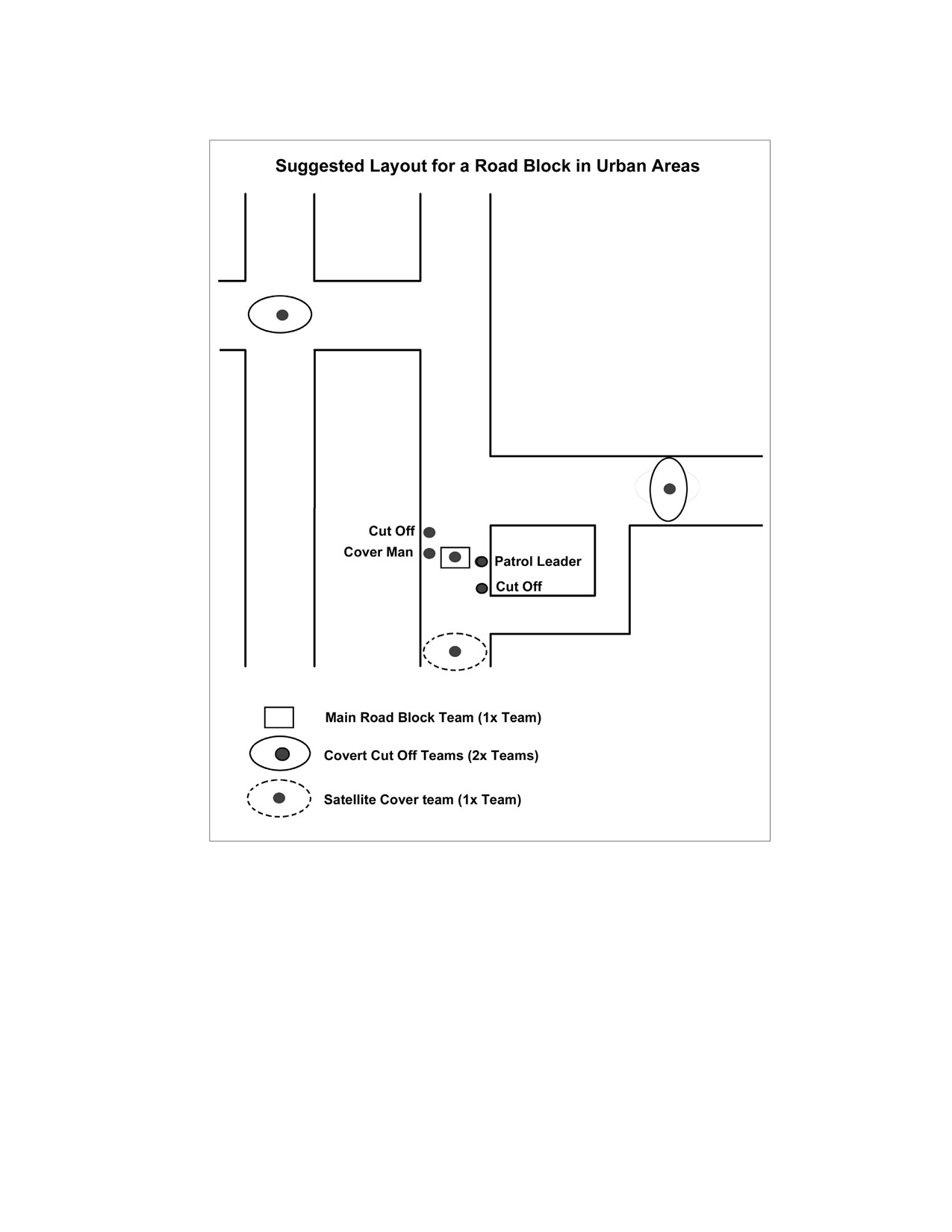
Figure IV-1 Suggested Roadblock in Urban Areas
IV-11
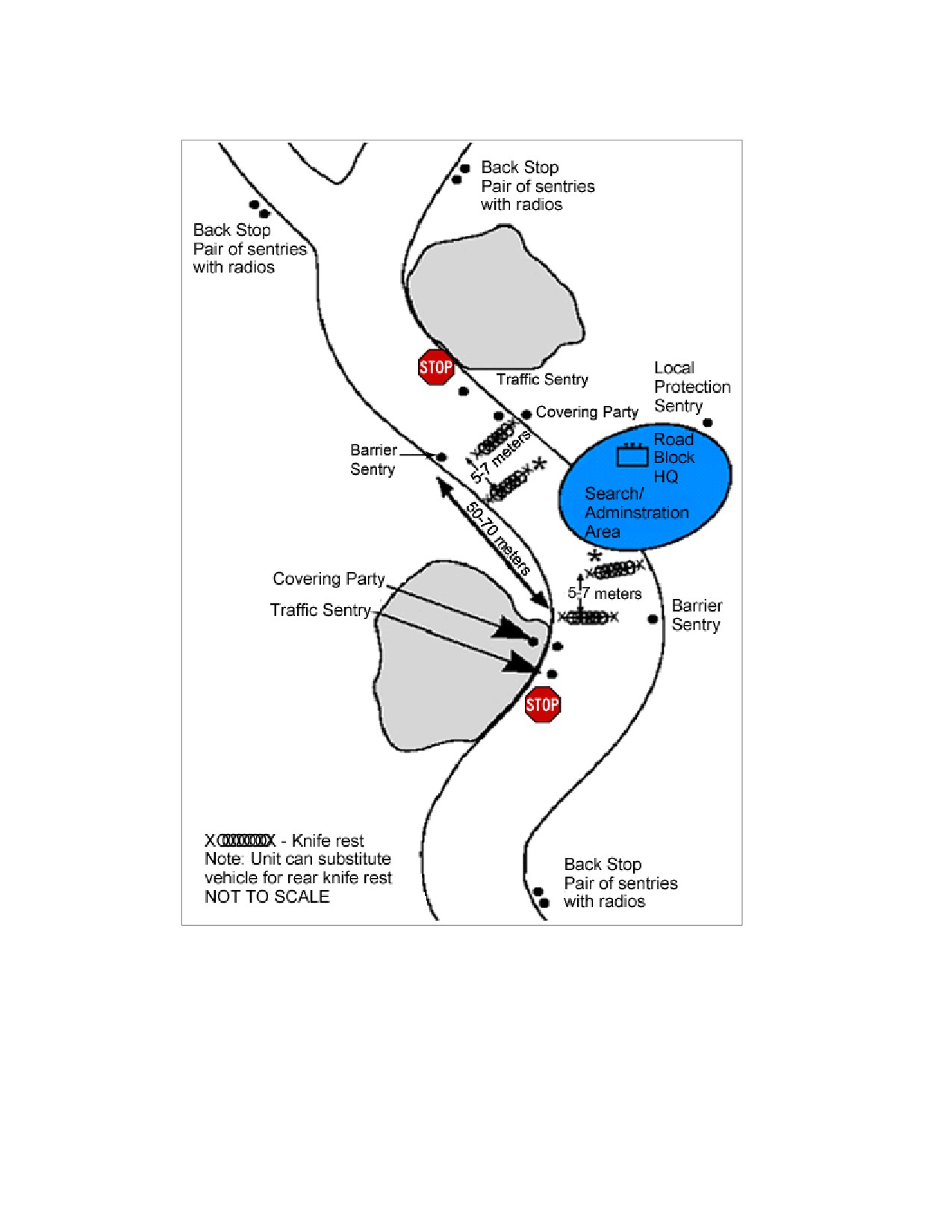
Figure IV-2 Suggested Roadblock in Rural Areas
IV-12
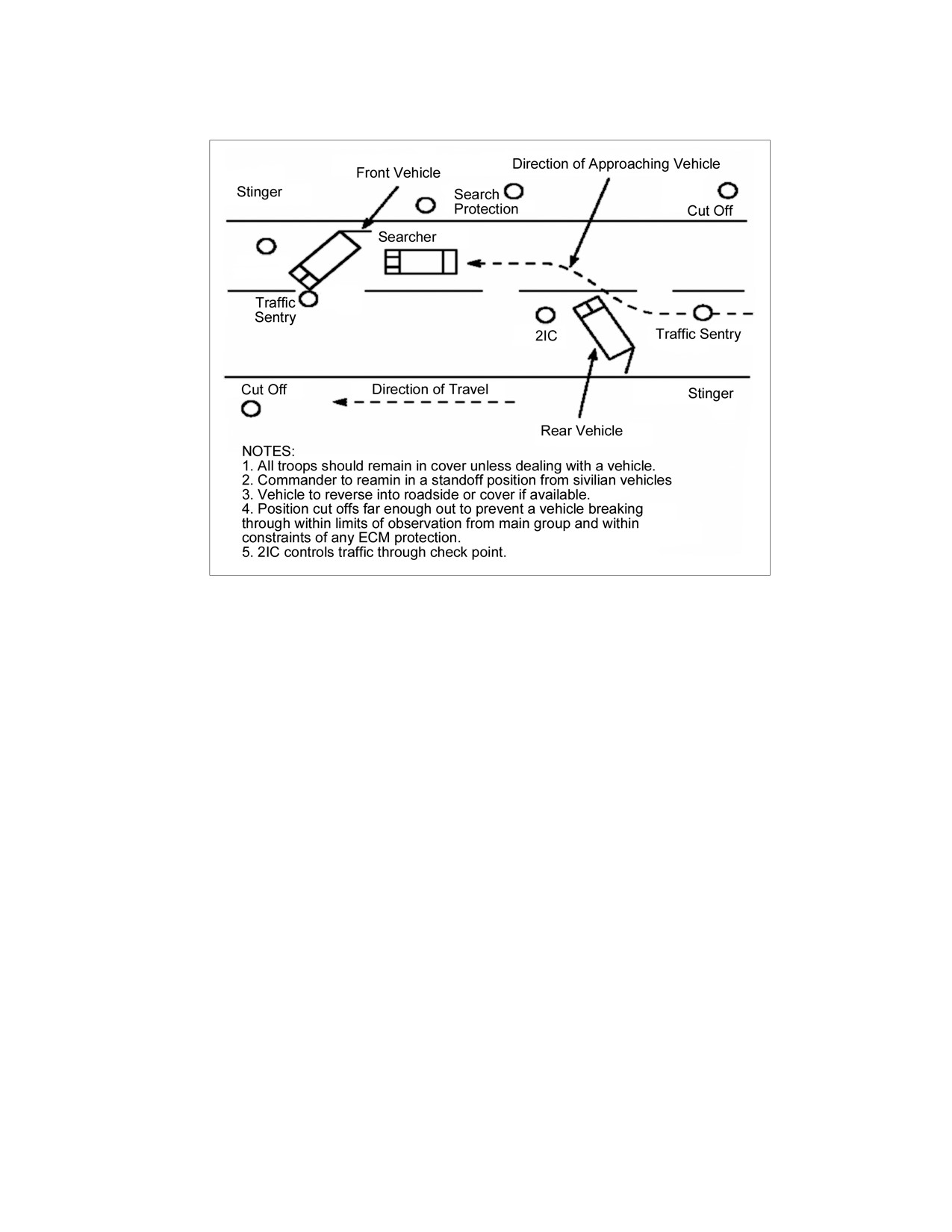
Figure IV-3 Suggested Mobile Roadblock
d. Conducting Searches
(1) Personnel Search.
(a) Conduct searches in accordance with the appropriate authority. Make
search personnel aware of that authority. Authority normally available for personnel
searches include:
• As a routine, where they voluntarily enter a building or area and the
search is a condition of entry.
• At a security or post incident CP.
• When reasonable grounds for suspicion exist (i.e. possible possession of
illegal or prohibited items).
• When a person is taken into custody.
• As a precautionary measure while in custody.
(b) Take care when conducting personnel searches, due to allegations of
brutality or unethical behavior. Belligerents often attempt this tactic when trying to
discredit the PK force. Therefore, conduct these operations demonstrating
professionalism and courtesy at all times. Factors for consideration in conducting
personnel searches include:
• Search circumstances are legally justified.
• Follow predetermined procedures that minimize accusations by
belligerents.
• Female search personnel available to search women and children.
IV-13
(c) Constraints involving personnel searches normally include:
• Same sex searches are important. When possible, conduct same gender
searches; however, this is not always possible due to speed and security considerations.
Therefore, perform mixed gender searches in a respectful manner using all possible
measures to prevent any action that could be interrupted as sexual misconduct or
assault.
• Normally, no legal authority exists requiring removal of other than outer
garments in public (i.e. coat, jacket, or gloves). When not done in public and under
protest legal authority may exist to search beyond the norm.
(d) The two categories for search of persons include quick body search (in the
public eye) and detailed body search (out of the public eye).
• Quick body search (in public). Normally carried out when dealing with a
large number of people. Can also be part of a detailed search detecting anything that
could be used to harm the searcher, the person being searched, or others. The quick
body search is also used to preserve evidence that could be quickly disposed of or
destroyed.
• Procedure. If possible, work in pairs, one person doing the physical
searching, the other observing (both the searcher and the subject). The second person
acts as cover for the first. Pertinent points to consider are shown in Table IV-1.
Table IV-1 Quick Body Search Considerations
DO NOT stand directly in front or behind the subject to avoid confrontation.
DO NOT become distracted. Avoid eye contact with the subject.
WATCH for non-verbal communications, e.g., increased nervousness or silent
gestures to others.
DO NOT cross the line of fire of the cover man.
POSITION the subject with legs slightly apart and arms extended parallel to the
ground. Do not spread-eagle the subject as this may interfere with the collection of
forensic evidence.
CONDUCT the search quickly and systematically from head to toe, down one side
and up the other, covering all body parts, front, and back. PAY ATTENTION to
pockets and waistbands. PAY ATTENTION when searching the small of the back,
armpits, crotch areas and closed hands.
USE a stroking squeezing movement when searching. When searching limbs, both
hands are used with thumbs and index fingers touching. This method increases the
chances of detecting foreign object through the clothing.
SEARCH and be respectful of any baggage or removed clothing.
The use of metal detectors or X-ray machines can be a force multiplier especially
when searching large groups (i.e. CP operation).
• Detailed body search (not in public). Normally carried out when
reasonable doubt exists.
• Procedure. Conduct a detailed body search using the same procedures as
the quick body search, considering the points in Table IV-2.
IV-14
Table IV-2 Detailed Body Search Considerations
Establish the identity of the subject and the ownership of baggage and other
articles.
Invite the subject to empty all pockets and remove all items.
If necessary to remove clothing, the subject may do so voluntarily (should be
recorded) or powers exist to require the removal of certain items in or out of the public
eye. Typically, the outer coat, jacket, and gloves may be removed in public. In private,
there may be grounds to remove other clothing. Note that only outer clothing may be
removed.
PAY ATTENTION to every detail i.e. clothing seams, waistbands, belts, collars,
lapels, padding, shirt, and trouser cuffs. Socks and shoes provide easily missed hiding
places. Medical dressings are always suspected and medical personnel should examine
dressings if necessary. Clothing nametags, manufactures labels, and laundry tags can
be valuable.
DO NOT SHOW EMOTION upon finding illegal or prohibited items. Significant
articles should not be separated from others but all should be out of reach of the subject.
(e) Records and Reports. For all categories of search, apart from initial
searches, a record should be maintained containing:
• Details of the person.
• The reason for the search.
• The probable cause for the search.
• The date and time group.
• The location.
• Details of anything significant.
• Details of damage or injury to person or property.
• If done in conjunction with an investigation, do not identify search team
members. Call signs or other identification should be used.
(2) Vehicle Search
(a) Search techniques are divided into three categories. The categories vary
according to the intensity of the search. There is no clear boundary between the
categories and the extent of the investigation as each stage depends on the suspicion
aroused. Categories include:
• Initial check. The initial check is the first part of the searching process
carried out on all vehicles and used to select vehicles for a more detailed examination.
This check is normally carried out without the occupants dismounting, although search
personnel may ask the driver to open the trunk and hood. Search personnel at the
entrance to barracks and other installations should know the threat from large vehicle
mounted bombs. Up to three personnel are required for the search, and the search
normally takes about 3 minutes per vehicle.
• Primary search. The primary search is done on the vehicles selected for a
more detailed examination, due to either intelligence or suspicion aroused during the
initial check. During the primary search, if any of the search unit becomes suspicious
for any reason, a more detailed search may be conducted.
IV-15
• Secondary search. The secondary search is a thorough search of highly
suspect vehicles. It is recommended that search unit members work in pairs, examining
the relevant section of the vehicle. For a more detailed search, have the occupants exit
the vehicle, and then search them.
(b) Hostile parties are likely to use all types of vehicles to move their
resources. The search of vehicles at CPs or other types of vehicle control points deter
movement and subsequent evidence enhances prosecution. The volume of vehicles can
make search operations appear difficult. Use efficient intelligence to back up vehicle
searches. This involves close liaison with police records, vehicle registration authorities,
etc. The alertness and intuition of search personnel can achieve much. Suspicious
persons will try to avoid being searched. Search personnel must watch for the following:
• Those avoiding the search and signaling to others (e.g., by flashing brake
lights or the using radios).
• Exiting vehicles before the CP.
• Disturbances that cause congestion at the CP.
(c) Take consideration into the following during a search:
• Be quick, thorough, and efficient. This will reduce complaints.
• Children, babies, pets, old people, young women, and infirmed civilians
should not deter operations. If necessary, request special or additional assistance.
• Do not damage the vehicle
(d) Make searchers aware of the general vehicle appearances that indicate
the vehicle is suspect. Personnel should note the following points:
• Use common sense. Look for anything unusual, i.e. scratched screw
heads, repaired upholstery, new bodywork etc.
• Remembering details of searched vehicles could be useful in future
operations.
(e) Vehicle searches are divided into area 1 (interior), area 2 (exterior), area 3
(trunk), area 4 (engine compartment), and area 5 (undercarriage). Figure IV-1
describes the specifics of searching each area.
IV-16
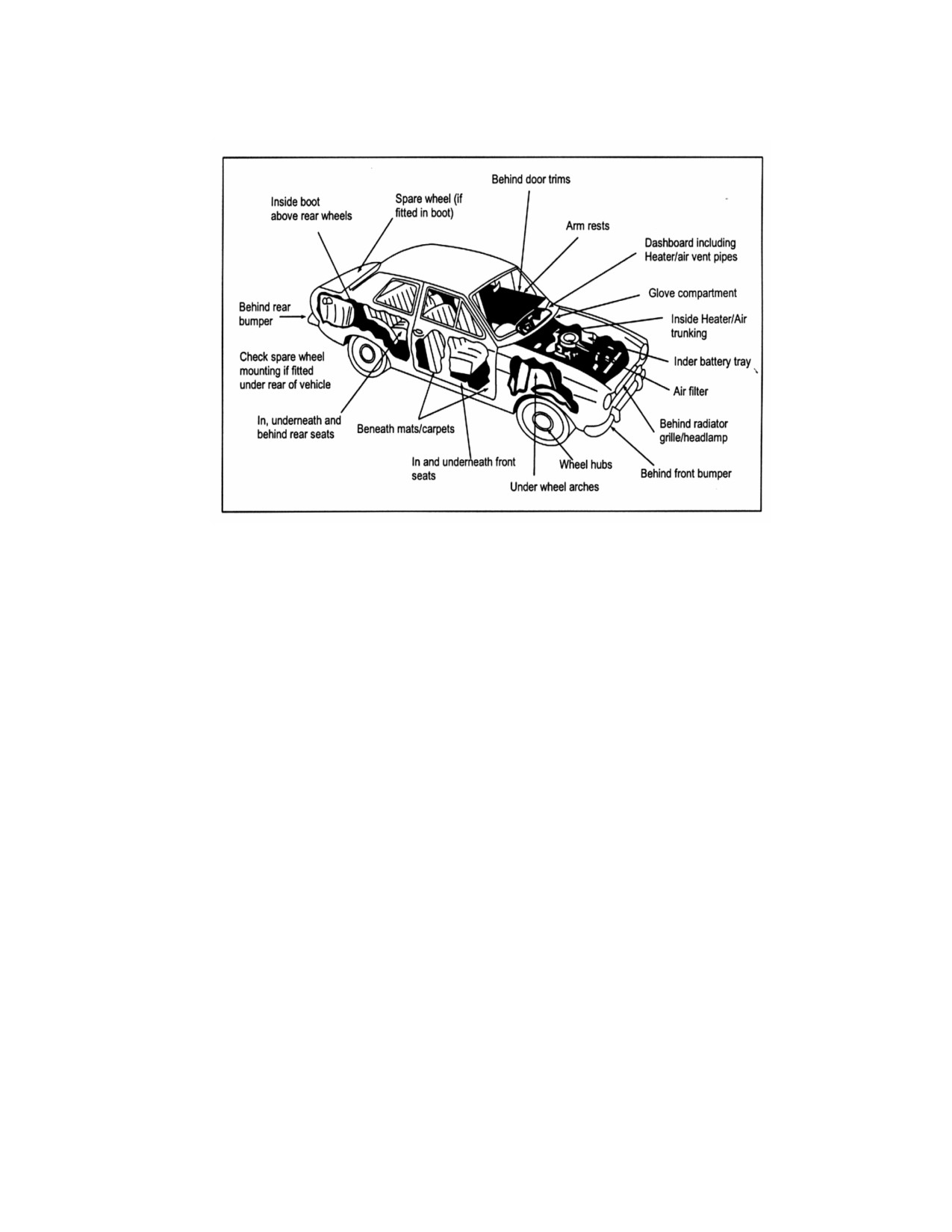
Figure IV-4 Diagram of Passenger Car
(f) Privately owned vehicles/Passenger cars. Searches should follow the
guidelines outlined in table IV-3 through table IV-7.
IV-17
Table IV-3 Area 1 Interior Vehicle Inspection
Ensure search team members are clean. Areas to check include:
Roof Linings. Access gained by removing door sealing strips or if sunroof fitted by removing trim.
Sun visors.
Front, rear, and center window/door pillars.
Door Panels
Wind down window first. Can the search be conducted without removing trim? Avoid damage to spring clips, etc.
Rear Side Panels. (2 door vehicles etc)
Remove and check through the trunk.
Back Seat.
Cushion - some spring in, some bolted in.
Back Rests.
Front Seats.
Space under seats
Check inside padding.
Dashboard Area.
Check battery disconnected - be mindful of wiring etc.
Behind dashboard panels.
Ventilation and heater hoses.
Radio, speakers, etc.
Glove compartment - behind and above.
Ashtray - contents.
Console area.
Front Foot Wells.
Remove panels - access to wing space, door seals etc.
Floor.
Remove carpets - mats.
Check for signs of false floor - welding etc.
Table IV-4 Area 2 Exterior Vehicle Inspection
Areas to check include:
Check headlights, sidelights, rear lights. Alignment- leave as found.
Bumpers,
Check wheel trims and hubs. Check tires pressures. Bleed small amount of air-smell.
Examine under wheel arches, bolt-on mud deflectors.
Check for signs of recent welding or new undercoating (soft?). Tampering with bolts on mud deflectors.
Does the shape of the inside of the wing conform to the outside?
Examine bodywork and roof for signs of adaptation.
Front and rear panels and spoilers.
IV-18
Table IV-5 Area 3 Trunk Vehicle Inspection
Before searching stand back and look at the contents. (including load space of station wagon,
hatchbacks, etc.). Check the following:
That the contents are as described by the driver.
For any glue, undercoating, pop rivets, etc.
For spare gas tanks or false tank.
Spare wheel - deflate, check thoroughly.
Check floor, roof, back, and sides of trunk.
Remove all mats, carpets, etc.
Any signs of weld, new paint, or lack of dirt.
Check for double skins and carpet stuck down.
Check and pay particular attention to the space between the trunk and rear seat.
Spaces in wings etc., of station wagon type cars.
Natural false floor.
Space in tailgate.
Table IV-6 Area 4 Engine Compartment Vehicle Inspection
Areas to check include:
Under battery tray.
Windshield washer bottle.
Heater and ventilation hoses and vents.
Heater and ventilation motor.
Air filter.
Hood,
Sound deadening material under the hood or heat shield.
Table IV-7 Area 5 Undercarriage Vehicle Inspection
Areas to check include:
Chassis sections.
Drain plugs in seals.
For new welding or undercoating,
Exhaust system
Oil pan.
Gas tank. Beware of the FIRE RISK! (Hardest detection to make), but also:
How does fuel gauge behave, full tank?
Does the tank match the vehicle? Age, etc.
IV-19
Fifth wheel
m ou n t in g
(t r a iler cou plin g)
in floor
alternative
access at front
som et im es
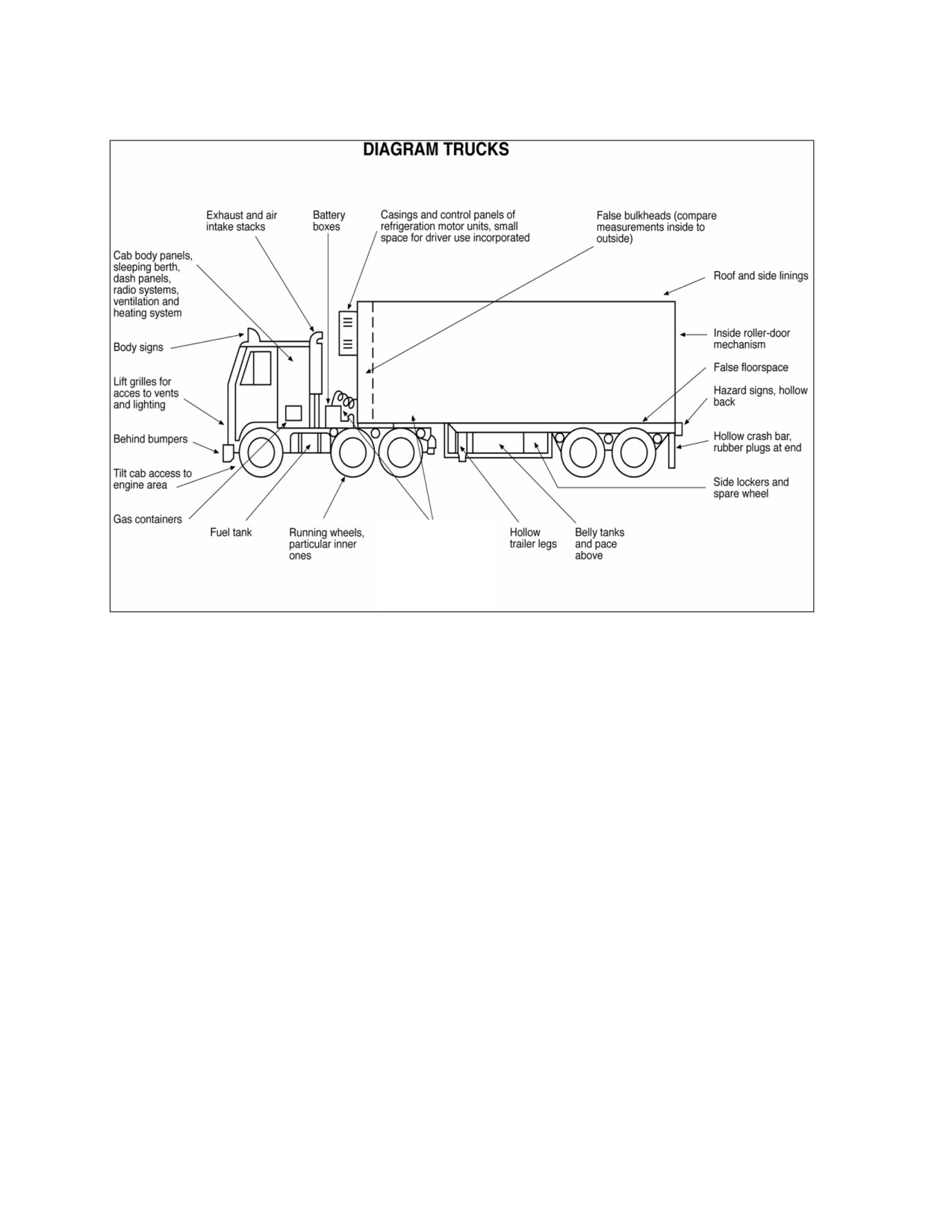
Figure IV-5 Truck Diagram
(g) Commercial vehicles. Search commercial vehicles the same as passenger
vehicles. However, pay particular attention to the following:
• Fifth wheel. There is a hollow compartment above the trailer hitch, or
fifth wheel, on most trailers. Gain access underneath the trailer and check the
compartment with a flashlight and mirror. Fiber-optic search instruments when
available are recommended for searching the fifth wheel area; they are simple to use
and more versatile than a flashlight and mirror. Sometimes the only way into the
compartment is remove the floorboards inside the trailer.
• Fuel tanks and side lockers. Some trailers are fitted with belly tanks for
extended range. There is usually a space between the top of the tank and the floor of
the trailer where goods are attached to the top of the tank. Also, check the tank for
recent welds or bolted panels. In addition, often there is space between the back of the
side lockers and the chassis.
• Spare wheel. Prime place for concealment and usually mounted under
the trailer.
(Positions vary).
• Chassis cross-members. Most trailers are constructed with two ‘U’ section
girders. Drivers can construct a large concealment area by placing boards on the
reverse ledges bridging the gap between the girders.
• Battery boxes. There is usually space behind the battery. To open the
box, remove the wing nuts.
IV-20
• Crash bar. Located at the rear end of most trailers, the crash bar is
hollow and usually plugged at each end with rubber plugs. Plugs are easily removed to
gain access.
• Open trailers. Where the wiring goes from tractor to trailer, the
connections on the trailer are contained in a triangular shaped plate.
• Refrigerator motors, refrigerated trailers.
• Refrigerator motors usually consist of a diesel engine mounted outside the
trailer on the front bulkhead. The motor drives a cooling unit mounted on the inside of
the bulkhead.
• Open the engine compartment and the compartment behind the switch
panel for inspection. Panels are normally held in place by screws, which require a half
turn with a screwdriver to undo. The size of this possible concealment area varies but
some are large.
• There is usually an inspection panel on the interior unit, which also
reveals a space. Drivers have used The cold air plastic hoses to conceal illegal or
prohibited items.
WARNING: Make sure the whole unit is switched off before searching. Units
are thermostatically controlled and switch on when temperature rises
unless the motor is switched off. The exposed fan is particularly
dangerous.
• Search door panels and side panels at the rear of the cab. Some cabs also
have space behind the roof linings.
• Check the space behind console and glove compartment and the space
behind radio speakers.
• Air Filters. Usually accessible from beneath the vehicle. Clips hold the
cover and are sometimes filled with oil.
• False floors and bulkheads. Usually found in single units.
• Belly tanks. Any sign of recent welds/clean area - tank and trailer.
• Loads. Excess packing, use of pallet spaces. These are just some of the
concealments that have been used. There are others both under and inside tractor units
and trailers.
IV-21
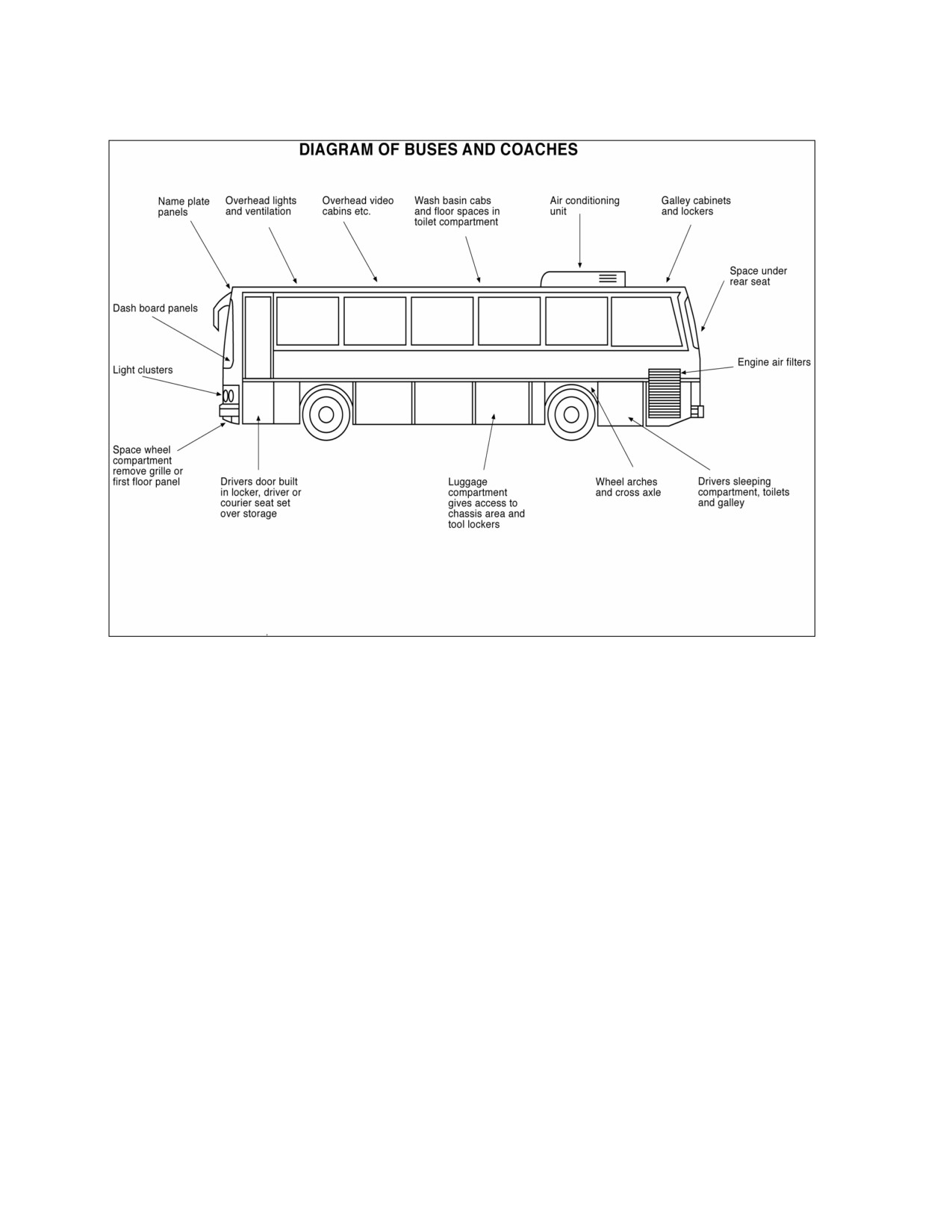
Figure IV-6 Diagram of Buses and Coaches
(h) Camper type vehicles. The construction of camper type vehicles makes
them ideal for concealment. It is recommended to consider the following:
• Do panels look unusually thick?
• Does refrigerator work - insulation intact?
• Gas (butane/propane) bottles adapted?
• Does water tank contain water?
• Is toilet in use?
• Any access to space between skins?
(i) Additionally, general points to consider checking include:
• Check for smell of fresh glue, paint, etc.
• Smell of cannabis, etc?
• Towing trailer or boat?
(3) Urban Areas (Inhabited).
(a) Referred to as cordon-and-search operations, this subparagraph discusses
the principles, command, control, and procedures for this type of search. When
intelligence identifies the search requirement, an operation is mounted. It is
recommended to use police when practicable. Base the search on probable casue and act
on the warrant issued by the appropriate legal authority. In circumstances that are
IV-22
more dangerous, i.e. PEO, emergency laws, and regulations may dispense temporarily
with some of these legal protections. Use the least severe method to accomplish the
mission. Care should be taken to preserve evidence for future legal action.
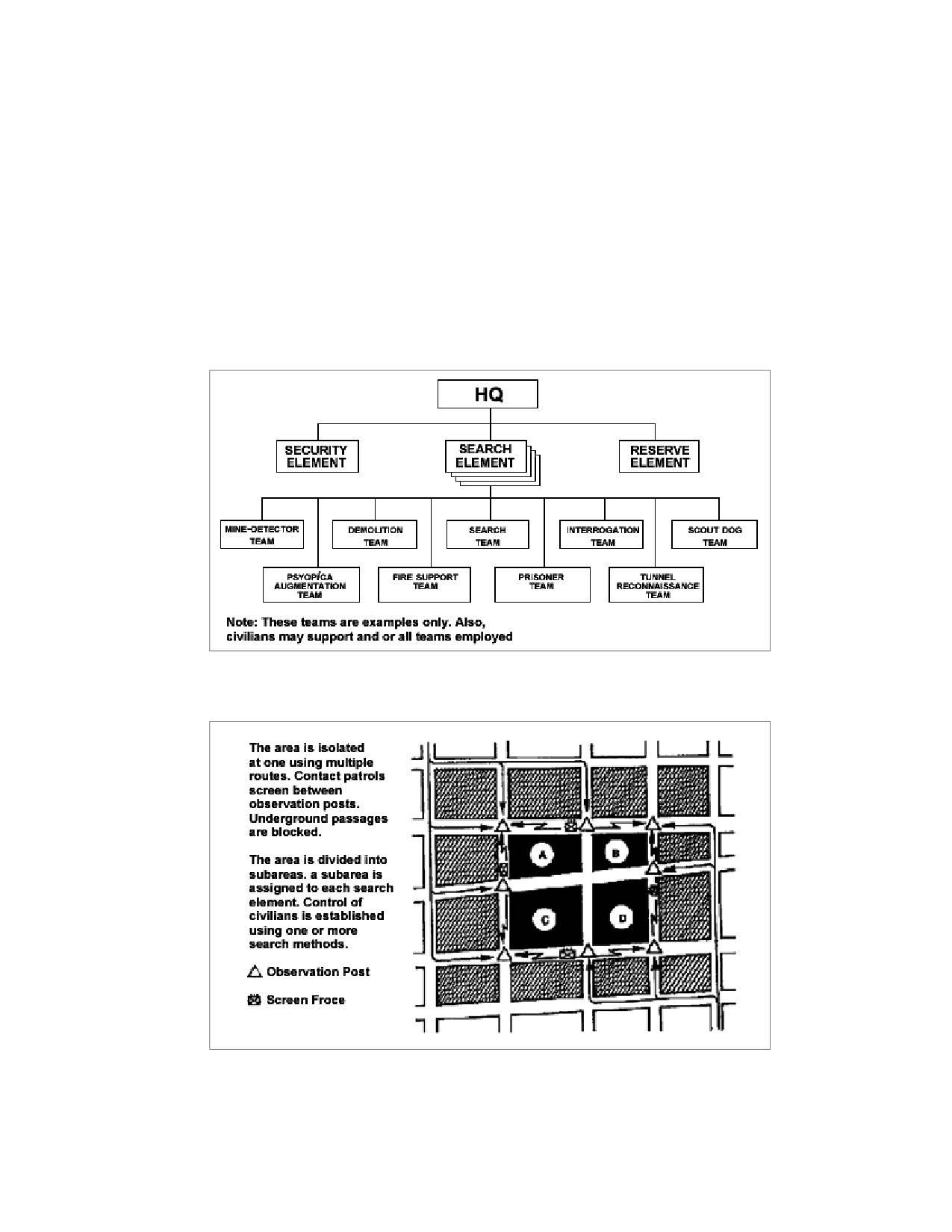
(b) Cordon and Search. Plan this operation like a raid. Divide built-up
search areas into zones and with search parties assigned to each. A search party
consists of the following:
• Security element (to encircle the area, to prevent entrance and exit, and
to secure open areas).
• Search element (to conduct the search).
• Reserve element (to help as required). Figures IV-7 and IV-8.
Figure IV-7 Typical Organization for Search Operations
Figure IV-8 Conduct of Search
IV-23
(c) Establishing the cordon. An effective cordon is critical to the success of
the search effort. Cordons are designed to prevent escape and protect the forces
conducting the operation. Forces can establish the cordon without being detected in
remote areas. In volatile urban areas, forces may have to use a double cordon to protect
the operation from outside threats and the other to prevent the escape of those inside
the cordon. Know and strictly enforce the ROE. Develop plans to handle detained
personnel. The unit will accompany police and intelligence forces that identify,
question, and detain suspects. The principal role of the unit is to reduce any resistance
that may develop and provide security, but it may also conduct searches and assist in
detaining suspects. Keep the use of force to a minimum. Deploy rapidly, especially if
belligerents are still in the area. Ideally, surround the entire area at once. The security
element should surround the area while the search element moves in. Members of the
security element focus mainly on people evading the search but may be used to monitor
and stop reinforcement efforts by belligerents. CPs and roadblocks are established. It
is also recommended that subways, sewers, and other subsurface routes of escape be
secured and searched.
(d) Conducting the search. Conduct searches of built-up areas with limited
inconvenience to the populace. However, inconvenience the populace enough to
discourage belligerents and sympathizers from remaining in the locale, but not drive
them to collaborate. Often a large-scale search of a built-up area is a combined civil
police and military operation. Plan and rehearse such a search in detail. Physical
reconnaissance of the area immediately before a search is not recommended. Obtain
terrain information from a variety of sources; including aerial photographs. In larger
towns or cities, local police may have detailed maps showing sizes and building
locations. To ensure success, make the search plan simple and conduct it swiftly. The
search element conducts the mission assigned for the operation. The element is often
organized into teams. These teams can include personnel and special equipment for
handling of prisoners, interrogations, documentation (using a recorder with a camera),
demolitions, PSYOP/CA, mine detection, fire support, employment of scout dogs and
tunnel reconnaissance. Three methods used to search populated areas include:
• Assemble inhabitants in a central location. This method provides the
most control, simplifies a thorough search, denies an opportunity to conceal evidence,
and allows for detailed interrogation. The disadvantage is looting may occur while
homes are vacated, increasing the potential for ill feelings.
• Restrict inhabitants to their homes. This prohibits movement of civilians,
allows them to stay in their dwellings, and discourages looting. The disadvantages are
control and interrogation is difficult and gives inhabitants time to conceal evidence.
• Control the heads of the households. The head of each household is told
to remain in front of the house while everyone else in the house is brought to a central
location. During the search, the head of the household accompanies the search team.
This method allows the head of the household to observe the search team in operation
giving confidence they will respect the dwelling. This is the best method for controlling
the populace during a search.
(e) Objective. The object of a house search is to screen residents to determine
if any are belligerents, sympathizers, and look for controlled items. It is recommended a
search party assigned an occupied building consist of at least one local police officer, a
protective escort, a female searcher and interpreter. Arrange escort parties and
IV-24
transportation before the search. Forced entry is necessary the property is vacant or
the occupant(s) refuse entry. If a house is searched while the occupant(s) are away,
secure it to prevent looting. Before departure, the commander should arrange for
security of the houses until the occupant(s) return.
(f) Other Considerations. Additionally, pay attention to anything appearing
out of place i.e. freshly excavated ground etc.
• Reserve element. The reserve element is a mobile force located in a
nearby area. Its mission is to assist the other elements where required. They can
replace or reinforce either of the other two elements if needed.
• Booby-traps. Treat any material found as booby-trapped until proven
otherwise.
• Below ground. Search underground areas and waterways thoroughly.
Use mine detectors or dogs to locate metal objects underground and underwater.
(g) Aerial Search Operations. Leveraged, wherever and whenever possible,
helicopters and fixed wing assets, as they provide the unit with exceptional search
capabilities . However, use helicopters only when sufficient intelligence is available and
in conjunction with ground operations.
(4) Urban Areas (Uninhabited)
(a) Assume all buildings are booby-trapped. Check SOP and other
publications for the following. Usually lethal explosives, booby-traps are designed to
catch the unwary. They are aimed at creating uncertainty, lowering morale, and
hindering movement. Often constructed from household items (i.e. clothes pegs,
mousetraps, flashlight batteries etc), they are usually set off by opening a door,
switching on a light, or walking on the floor. An effective operator knows the methods
of working and habits of search teams. The trap can be activated in several ways
including:
• Pull - Opening a drawer
• Pressure - Standing on a floorboard or sitting in a chair.
• Release/Antilift - Picking up an object.
• Tilt - Turning an object on its side to look underneath.
• Tremor - Vibration or movement.
• Collapsing circuit - Cutting or breaking a circuit. Will also go off when
the battery expires.
• Light sensitive - Functions when either exposed or hidden from light.
• Anti-Submerge - Placing in water will activate device.
• Anti-Probe - Relies on a search probe or prodder to complete the circuit.
• Combination - Can have more than one means of activation.
(b) Procedures of approach and entry into an unoccupied building include:
• Initiate a visual reconnaissance of the building and area.
• Check for wires leading to a command-detonated device.
• Team leader sets up a control point and decides upon a place of entry.
• Details a two-man team to enter and check for booby traps.
IV-25
• Enter building through one of the main entrances. While considering the
obvious, it saves time and makes subsequent access easier if cleared early.
(c) The searching of an unoccupied building takes place by checking the
building for booby traps, then performing a detailed and systematic search. If the
search personnel cannot use the front door, they should clear a path to another door.
The team leader then clears the outside of the door and opens it, preferably using some
device to protect search personnel from a possible blast, i.e. pulling cable. While
clearing for traps consider the following points:
• Never open any door, until both sides are cleared of traps.
• Leave all doors, drawers, and cupboards open after checking.
• Make extensive use of tools, i.e. pulling cable or weights for remote
opening of doors, etc. to ensure safety of search personnel.
• Clearly mark routes cleared of traps with white tape.
(d) Check SOP and other publications for the following. Search teams must
be alert to the presence of booby traps. Clues to assist the teams include:
• Attractive items in the open.
• Spoils, wrappings, sawdust, etc. in unlikely places.
• Out of place pegs, wires, or lengths of cord.
• Loose floorboards, window ledges, or stair treads.
• Fresh nails or screws.
• Lumps or bulges in chairs or under carpets.
(e) After clearing the house/building, the team leader enters and initiates a
detailed search.
(5) Search of Rural Areas
(a) General. Open areas are often used as hiding places because belligerents
have the advantage of observing from nearby dwellings without being detected.
Although normally associated with a rural environment, open spaces also occur in an
urban setting, i.e. parks, gardens, or vacant lots. Therefore, using this procedure may
vary depending on the area and circumstance.
(b) Planning. Area searches are especially dependent on good planning. The
IPB process is essential before conducting a search. Re-evaluate planning the search
progresses to consider the following:
• The location of the center of the area is indicated by an eight-figure grid
coordinate (with an address if possible). The boundaries are recorded as a series of
eight-figure grid coordinates.
• The identity of the owner or tenant.
• Use of air reconnaissance, avoid giving advanced warning.
• Details of local belligerents and sympathizers.
• This covered in Other Considerations.
(c) Divide area into sections and assigned to teams. Boundaries clearly
defined and marked by features such as hedges and ditches. Each team should
complete the search area in one day.
(d) Other Considerations:
IV-26
• Ensure that engineers are present not only to detect mines and obstacles
but also to repair damages to structures caused by the search.
• Consider using military working dogs (MWD) trained to detect explosives.
They are useful to speed up searches especially around outside areas.
• Take sufficient number of metal detectors.
• Record everything on digital camera not just for evidence but also for
PSYOP and counterpropaganda. This supports transparency.
• Take large quantities of confiscated items and property damage forms and
use them.
• Take gloves and other protective garments, as many search situations will
be unsanitary.
• Insist that personnel conducting searches maintain their professionalism
and under no circumstances will they remove property for personal gain or as a
souvenir.
(e) Consider using aerial assets both for reconnaissance, security, and
guidance for the units on the ground in urban areas.
5. Verification of Weapons and Forces
a. This section concerns verification of the location, movement, readiness, and level
of weapons and forces as specified by agreements and understandings. Commanders
must understand their responsibilities under these agreements and understandings.
Often peace agreements or subsequent international accords will establish the
parameters for weapons verification and force reductions.
b. Principles.
(1) HNs and belligerent forces are responsible for compliance with the
agreements and their accountability.
(2) The PO force is responsible for verifying compliance, and, in the case of peace
enforcement, compelling compliance.
(3) The PO force must have total access to all sites and locations. This is a
fundamental issue of freedom of movement.
c. Weapon and Force Levels.
(1) Cantonment and Storage Sites. Divide these into four categories:
(a) Combat sites, consisting of heavy weapons, air defense, air fields, naval
ports, barracks, operational munitions stocks, and combat loads.
(b) Infrastructure sites, consisting of support activities such as logistics,
communications, headquarters, and depots.
(c) Police sites, consisting of weapons, vehicles, and munitions.
(d) Ordnance sites, consisting of civilian production plants and factories,
production storage, and new weapons holding areas.
d. Procedures.
(1) Commanders should establish the priority of inspections related to the above
four categories of sites. Combat sites and police sites usually will have the highest
priority.
IV-27
(2) Schedules for inspection should include a combination of pre-inspections,
announced inspections, and unannounced inspections.
(3) IO should support the program of inspections.
(4) A verification board should coordinate the inspection and develop a collection
plan.
(5) The reporting system, when feasible, should include nonmilitary organization
such as the Organization for Security and Cooperation in Europe, the International
Police Training Force (IPTF), or representatives of some international body overseeing
the agreement.
e. Military Movements and Exercises
(1) Types of Movements.
(a) Operational: Activities of ground, air, or maritime forces or of war related
materiel that are connected to training, operations, or readiness.
(b) Nonoperational: Activities of ground, air, or maritime forces or of war
related materiel that are connected to ceremonies, or funerals.
(2) Procedures. Establish rules, in accordance with agreements, for notifying
peace forces before various types of operational and non-operational activities.
Establish, and ensure all servicemembers comply with, criteria and approval authority
for these events. Apply different levels of monitoring to these events. The following are
levels of monitoring:
(a) Be Advised: This does not require action by the peace force. The peace
forces retain the option to check, control, or escort the activity. There is no need to
monitor more than 10 percent of these activities.
(b) Check: Check these activities daily. Check movement missions at their
destination to ensure that movement of all approved items has occurred.
(c) Control: Similar to Check missions, but with the observer present at the
beginning of the event.
(d) Escort: Providing continuous physical presence during the entire event
from start to finish.
f. The following are various possible sanctions. Determine the exact type of in
coordination with the senior civil authority overseeing the peace operation.
(1) Restricting movement and training.
(2) Destroy systems and munitions.
(3) Impound systems and munitions.
(4) Close facilities.
(5) Increase the level of monitoring. Inform all parties of the violation.
6. Demilitarization
a. Background. Demilitarization or arms control may be one of the tasks given to a
military force under the terms of its mandate, or they may be local, tactical initiatives
attempted to reduce tension in a specific area. In general, the possiblity of
demilitarization and arms control measures will only arise once a cease fire or peace
agreement is in place.
IV-28
b. Methods of demilitarization and arms control. Demilitarization and arms control
will normally be a progressive process. Steps, which will require considerable
verification and policing by the military force, are likely to be as shown in the following
paragraphs:
(1) Withdrawal from front lines. Following a cease fire agreement, military
forces are normally deployed along the old front lines the ADL. The first stage of
demilitarization is a withdrawal from these wartime positions, either to barracks or
behind a BZ. The aim of this zone is to move the belligerents back, beyond small arms
range and ideally outside line of sight.
(2) Withdrawal of heavy weapons. Withdrawing heavy weapons a specified
distance from the cease fire line will offer a significant confidence building measure.
Heavy weapons should include main battle tanks, towed and self-propelled artillery
pieces, mortars, and all types of armored fighting vehicles.
(3) Decommissioning of air defense (AD) weapons. Make military forces aware of
the AD capability of former belligerents. Neutralize all active AD systems and then
remove them as soon as possible as they pose a high potential threat to all types of
aircraft and helicopters.
(4) Return to barracks/cantonment sites. Having separated the former
belligerents, the next step is to return the troops to barracks or to new cantonment
sites. The aim of this is to move troops into peacetime locations that the PO forces can
monitor. Such a move will also assist with the demilitarization of the civilian
population as weapons are collected. Establish ad hoc cantonment sites because it is
unlikely that there will be sufficient tailor-made military barracks available to
accommodate all troops and equipment in the appropriate areas. Base the cantonment
sites around large public buildings, factories, or tented camps. Sites that use the
civilian infrastructure may, in the long-term, cause problems for community recovery if
they continue to be occupied by military forces and denied for their primary purpose.
Depending on the mandate or the peace agreement, the military force may or may not
have authority to allocate sites.
(5) Force levels and restructuring. The next stage in demilitarization and arms
control is the agreement of force levels and the restructuring of former belligerents into
peacetime organizations. Force levels are normally agreed on at the national level,
often as part of any cease fire agreement or peace agreement. The restructuring will
generally follow direction from the senior military headquarters and involve suitability
assessments, verification, and advice from units at the tactical level.
(6) Restructuring. Restructuring will normally include the following elements:
(a) Setting a ceiling on military personnel by unit and/or location.
(b) The confinement of arms to designated armories.
(c) The separation of arms and ammunition.
(d) Military approval for proposed sites with regard to the potential for a
future threat.
(e) The relocation of heavy weapons to authorized sites.
(7) Verification will depend on the mandate. If the situation allows, the military
force may restrict all military movement and training. In such cases, authorized
activities are monitored to ensure compliance. Similarly, the military force may inspect
IV-29
and monitor activities within barracks and cantonment sites. This provides an
assessment of readiness, capability, intent, morale, and any attempt to deploy forces.
(8) Enforcement will also depend on the mandate and may involve restrictions
on a faction’s military activity, training, or movement; it may involve punitive
inspections or even confiscations of weapons or equipment.
7. Civil Disturbances
a. The likelihood of civil disturbances during PO is high. The handling of these
incidents can have a decisive effect on mission accomplishment. Handled poorly, the
reaction to a civil disturbance can quickly escalate out of control with potential long-
term negative effects for the mission. Conversely, a well-handled situation will lead to
an enhanced view of the PO force’s discipline, professionalism, and potentially result in
fewer such incidents in the future.
b. A possible TTP description could be: isolate, dominate, maintain common
situational Awareness, and employ multidimensional/multiecheloned actions (IDAM).
(1) Isolate, in time and space, the trouble spot from outside influence or
interaction. Unit tactical operation centers in the theater must develop TTP that
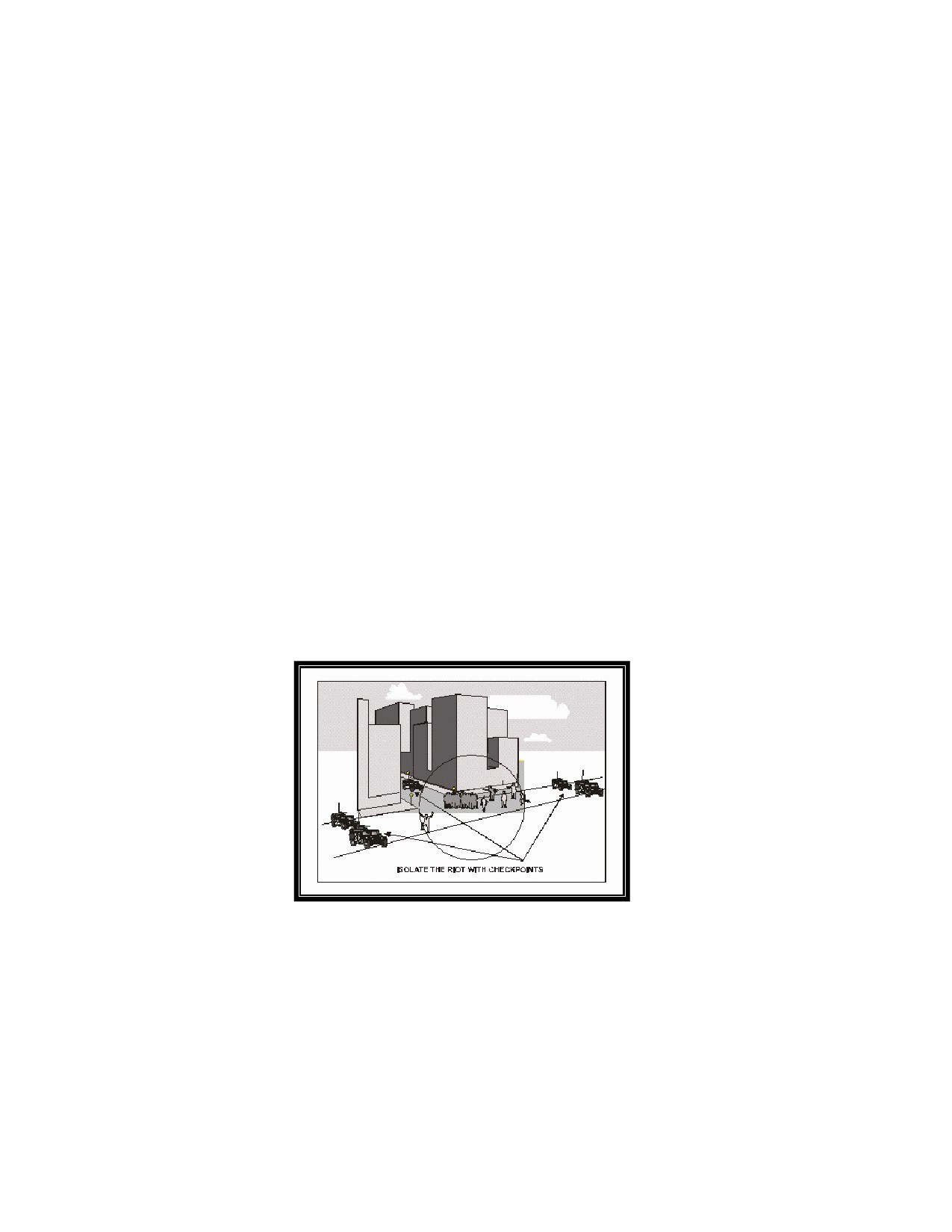
"isolate" riots or demonstrations to keep them from spreading into bigger and
potentially more violent explosions of emotional expression. The idea is to close access
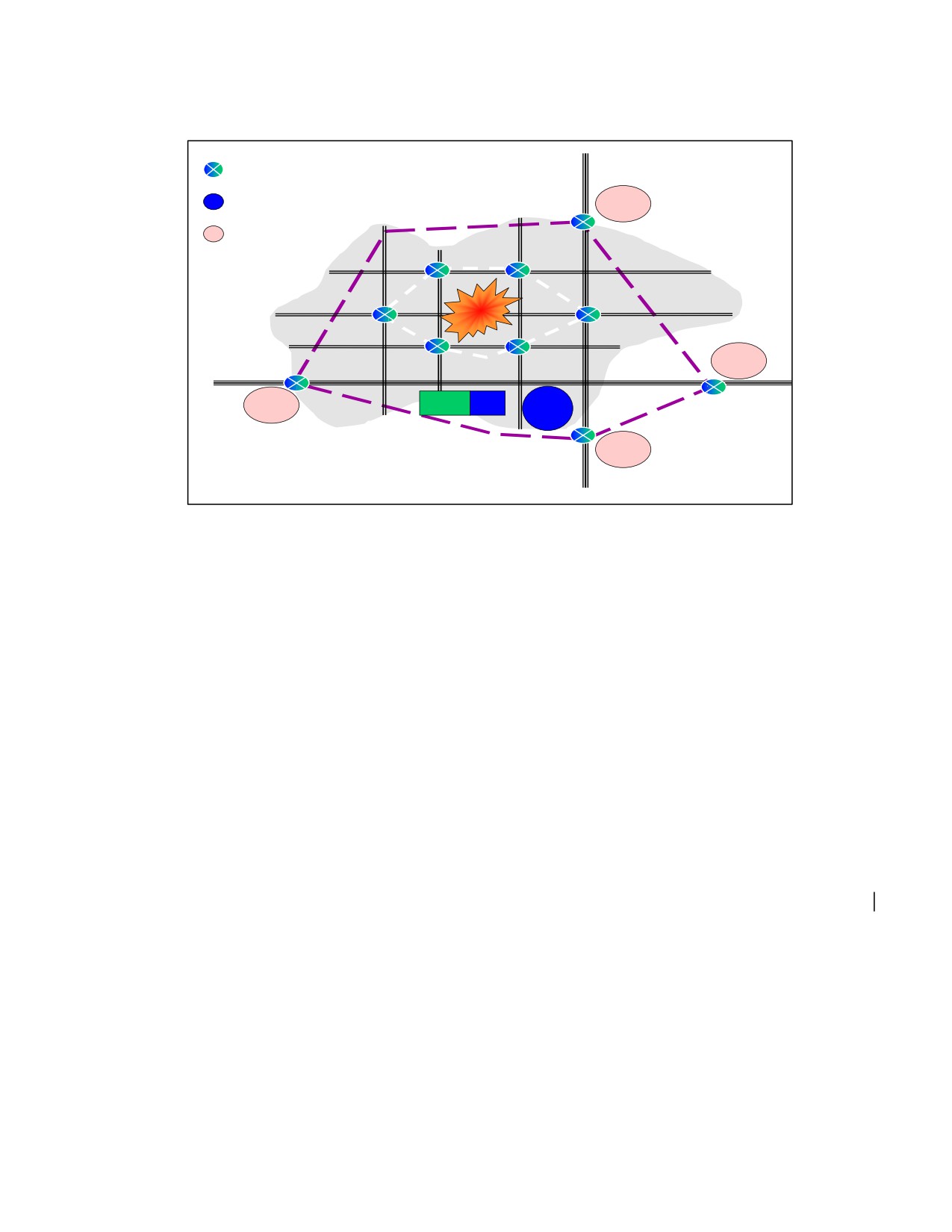
in and out of the demonstration location (figure IV-9). Once access is closed, rioters
tend to tire within hours, and the demonstration dies down, eventually resulting in a
peaceful conclusion. Figure IV-10 provides a technique for positioning a tactical control
point, given the mission to isolate a riot. Controlling the major road networks into and
out of the demonstration area increases their effectiveness, if the riot escalates.
Figure IV-9 Isolate the Disturbance
IV-30
Checkpoints
Marshalling Area
Holding Area
Inne
r Ring
CIVPOL
Mil
HQ
HQ
Outer Ring
Figure IV-10 Isolate the Riot with Checkpoints
(2) Dominate the situation through force presence and control of information
resources. Units can demonstrate an overwhelming show of force at CPs, and dispatch
attack helicopters to conduct over flights above demonstrations and massing civilian
mobs. In addition, using appropriate air assets can give commanders a "bird's-eye view"
of events on the ground. Over flights provide real-time situation reports, ensuring units
know the "ground truth" at all times. This knowledge gives commanders a decisive
advantage in both negotiations with potentially hostile elements and tactical
maneuvers.
(a) Units can dominate a civil disturbance using nonlethal munitions.
However, it is important to consider force protection issues. Always have nonlethal
weapons and munitions accompanied by lethal munitions and the capability to employ
them. One technique is to have M-203 grenadiers carry sponge rounds while other
personnel carry the same equipment and ammunition they would use in a combat
situation. In addition, if aviation assets are available, attack helicopters can provide a
show of force.
(b) The task organization that has emerged as the "minimum required" to
respond to a civil disturbance is an infantry rifle company, or like-sized unit, augmented
with battalion scouts/snipers, a CA team, and a tactical PSYOP team. One platoon is
positioned either to prevent collateral damage from occurring or to separate opposing
factions; one platoon assists with the linkup of local police or the IPTF; and one platoon
postures to serve as a QRF. If aviation is available, it can provide an excellent bird's-eye
view of vehicular movement into and out of the civil disturbance. In addition, the rotor
wash of a helicopter is an excellent nonlethal technique that is used effectively to
disperse crowds.
(c) Forces may need to detain group leaders or instigators to dominate a civil
disturbance. An instigator is identified as a person that is "prodding" others to commit
disruptive acts or the one who is orchestrating the group. Often, an instigator carries a
April 2009
FM 3-07.31/MCWP 3-33.8/AFTTP 3-2.40
(CH 1) IV-31
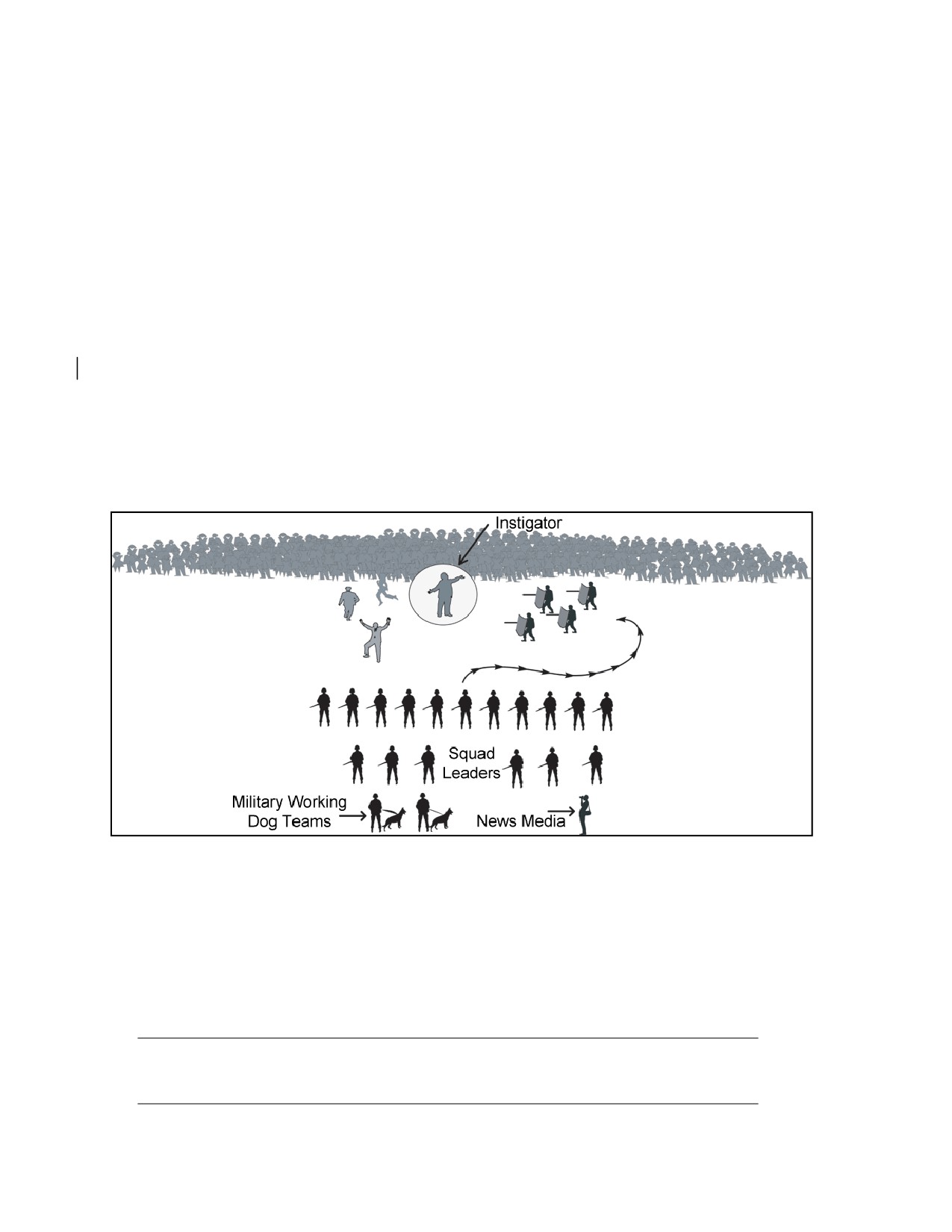
bullhorn or hand-held radio. Forcibly snatching instigators from demonstrations or
riots can alleviate organized violence in a crowd. The nonlethal TTP that has been
developed for a unit conducting riot-control operations is to first positively identify
instigators, and then send in a "snatch-and-grab" team to forcibly remove them.
(d) The smallest unit that can employ the "snatch-and-grab" technique is a
platoon. Before a platoon deploys to quell a riot, identify a four-person snatch-and-grab
team, two to secure the individual and two to provide security. Once an instigator is
identified in a hostile crowd, the snatch-and-grab team deploys into the crowd, grabs the
assailant, and returns back behind the friendly picket line. Figure IV-11 portrays this
technique.
(e) It is imperative that the four-person snatch-and-grab team wears the
Kevlar helmet with face shield and flak vest, but the team should not bring weapons or
load bearing equipment with them into the crowd. The four-person team should only
carry batons into the crowd. The snatch-and-grab team needs to remain in contact with
the adjacent PO forces on the line formation as they pass through. That formation
should remain ready to respond to any crowd actions that threaten the snatch-and-grab
team. Once the snatch-and-grab team has apprehended the riot instigator, it needs to
go directly to a secure location out of the crowd's line of sight.
Figure IV-11 Deploying a “Snatch-and-Grab” Team
(f) Employing MWD teams in conjunction with riot-control formations can
increase the crowd's apprehension about approaching or engaging the formation. Place
the MWD teams behind the crowd-control formation, in plain sight of the crowd, but in
front of the command element. The MWD teams work back and forth behind the
formation as an intimidation measure. The presence of MWDs, coupled with the
presence of personnel prepared to conduct civil disturbance operations, produce a
profound psychological effect on the crowd.
CAUTION: MWD teams must depart the area before the use of riot-control
agents (RCA). MWD teams must move a safe distance from the crowd
to ensure the safety of the dogs.
IV-32 (CH 1)
FM 3-07.31/MCWP 3-33.8/AFTTP 3-2.40
April 2009
(g) Per Executive Order 11850, the President of the United States must
approve the use of RCA. The US policy is to employ RCAs in limited circumstances
during PO and/or armed conflict, though never as a method of warfare. Yet,
commanders should be conscious that use of RCAs might pose a risk of escalation or
public panic as use of RCAs may invite the erroneous perception that a chemical
weapon is being used.
(h) Another element that is crucial for successful civil disturbance operations
is the use of combat camera personnel. Document events to hold personnel, factions,
and gangs or groups accountable. To ensure that the right message is being presented,
control the information environment through the synchronized efforts of the PAO, Staff
Judge Advocate (SJA), PSYOP, and CA offices.
(3) Awareness is maintained through timely, accurate, and complete multi-
source reporting. Commanders can receive reports from a broad spectrum of sources.
Unit CPs, air assets, and close liaison with international police and other civil monitors
all contribute to an accurate assessment of any situation. In addition, use unmanned
aerial vehicles, such as Predator and Pioneer, to better observe large sectors of an AO.
Analyze the reports produced and relay them to each unit involved in the operation.
(4) As part of IDAM, multi-dimensional/multi-echeloned actions could require
the following considerations:
(a) Policy and legal considerations.
(b) ROE.
(c) Standards of conduct.
(d) High visibility of civil disturbance operations with the media and for
leaders who must interact with the media.
(e) Crowd dynamics.
(f) Communication skills for leaders who must manage aggressive and
violent behavior of individuals and crowds.
(g) Use of electronic warfare to monitor and control belligerent control and
communications.
(h) Tactics.
(i) Lethal overwatch.
(j) Search and seizure techniques.
(k) Apprehension and detention.
(l) Neutralization of special threats.
(m) Recovery team tactics.
(n) Cordon operations to isolate potential areas of disturbance
8. Curfews
a. Commanders may impose a general curfew over a wide, but clearly defined, area
such as a city, district, or region or restrict it to a small area such as a town center, a
housing estate, or a particular series of streets. The size of the area and the duration of
time for which a curfew is imposed will depend on the situation.
b. Commanders may need the curfews to—
IV-33
(1) Assist the security forces in re-establishing control after rioting and serious
disturbances have taken place, by restricting civil movement and allowing tempers to
cool.
(2) Prevent civil movement in a selected area while a search or incident
investigation is carried out.
(3) Disrupt hostile groups by making movement of individuals difficult.
(4) Allow the security forces greater freedom of operation.
c. Cautions. Do not impose a curfew for punitive reasons or as a threat to impress
on the civil population the inconvenience and hardship that could arise should hostile
activities take place. The population will usually obey a curfew, but boredom, shortage
of food, or even the feeling that the curfew is being unfairly or ineffectively enforced can
lead to curfew breaking and consequential incidents. Good planning based on a proper
understanding of local conditions is essential.
d. Guidance.
(1) Planning. The civil authorities are responsible for imposing a curfew, but as
the need is usually a military one, always consult the security forces, especially if they
will have to enforce it. Effective curfews always absorb large numbers of police and
troops.
(2) Area. Clearly define the area. In towns where houses are close together and
streets narrow, forces may find it necessary to either enlarge the area under curfew
until a clearly defined perimeter is achieved, or to prohibit movement into the street
that constitutes the boundary. The integrity of the perimeter of the curfew area is
essential to exercise full control. The civil authorities in conjunction with the security
forces must decide on the curfew area.
(3) Timing. Commanders can impose a curfew for short periods without
hardship. If it is unduly prolonged, it can cause grave difficulties to innocent civilians.
A study of the pattern of local conditions can be helpful in arriving at timings, which are
both effective and workable. Forces will find it useful to know—
(a) The time that the inhabitants normally get up, go to work, and return
home.
(b) The time that shops normally open and close.
(c) The time it will take to implement the curfew after the public
announcement has been made.
(4) Security. If a curfew is imposed unexpectedly, the PO forces may catch
hostile groups unprepared without time to adjust their plans, disrupting and their
courier services. An unpredicted curfew, swiftly imposed, also avoids undesirable street
gatherings where agitators may try to influence people to break the curfew. Security of
planning is essential.
(5) Example Sequence of Events. The likely sequence of events is:
(a) The decision to impose a curfew is made by the civil authorities in
consultation with the police and military commanders.
(b) Plans are made to cover timings, area, boundaries, troops required, and
administrative arrangements.
(c) Local representatives of the police and military should make detailed
plans. Avoid overt reconnaissance of the area.
IV-34
(d) Cordon parties, road and static patrols move rapidly into position.
(e) The curfew and subsequent control instructions are announced by the
appropriate means, e.g., press, radios, siren, and police announcements by loud hailer.
Forces can also use helicopters and light aircraft as voice aircraft to make public
announcements.
(6) Imposing a Curfew. The existing security force headquarters should control a
curfew coordinating all aspects affecting the civil authorities, the military, and the
police. If no joint headquarters exists, set one up.
(7) Curfew Passes. The civil administration and the police are normally
responsible for the issue of passes. Certain people, such as doctors, nurses, clergy, and
workers in essential services, need to move about more or less freely, and the civil
authorities should devise a pass system, easily understood by troops, well in advance.
(8) Patrols. Mobile patrols and static posts will establish the curfew. Once
operational, reduce the number of static posts and maintain the curfew mainly by
mobile patrols. Forces may use Standing patrols on rooftops to watch for illegal
movement between houses and to help cover street patrols.
(9) Surveillance. Surveillance devices will assist in the enforcement of the
curfew and will reduce the number of static posts.
(10) Control of Visiting Vehicles and Personnel. Imposing curfews may strand
some residents outside the area. Prepare a system of removing and checking such
people. Do not allow them re-entry into the area during the curfew.
(11) Curfew Breakers. Clearly define the actions troops are allowed to take
against curfew breakers. Normally, arrest, search, and hand them over to the civil
police. Take care to ensure that evidence of the offence and arrest is recorded for
subsequent production in court.
(12) Police Duties. The police are responsible for—
(a) Announcing the curfew to the public.
(b) Issuing any curfew passes.
(c) Disposing of all curfew breakers, including any that may be arrested by
troops.
(d) Providing police patrols in conjunction with the military forces in the
operational area.
(13) Administrative Issues. The civil authorities are responsible for devising
measures to meet administrative difficulties that will arise if a curfew is imposed for a
long period, but they may need military help. The sort of problems that could arise are:
(a) Lack of water in houses.
(b) Shortage of food in shops.
(c) The need to purchase essential food.
(d) Essential food deliveries in areas with no shops.
(e) Clearance of refuse from houses and streets.
(f) Fuel supplies for lighting, cooking, and heating houses.
(g) Treatment of the sick and maternity cases.
(h) Care of animals.
(i) Lack of indoor sanitation.
IV-35
(j) Homelessness.
9. Convoy Operations
a. Basic convoy techniques are described in FM 55-30, Army Motor Transport Units
and Operations and in FM 55-50, Army Water Transport Operations, and MCWP 3-
35.4, Doctrine for Navy/Marine Joint Riverine Operations.
b. The PO forces organize convoys to ensure the safe movement of forces,
humanitarian supplies, and support civilian/commercial movements authorized or
required to implement the peace agreement(s).
(1) Convoys are allocated road space in accordance with theater policy,
standardization agreements, and the law of the HN, as applicable to the situation. JP
4-01.3, Joint Tactics, Techniques, and Procedures for Movement Control, provides more
detail regarding movement control procedures.
(2) Types of Convoys. Conduct convoys on highways, roads, rivers, along
coastlines.
(a) Ground convoy elements are normally organized into march units, serials,
and columns as described in FM 55-30, Army Motor Transport Units and Operations.
Other countries often use the term “packet” to describe the concept of march and serials.
(b) Watercraft convoy operations are also described in FM 55-50, Army Water
Transport Operations, and MCWP 3-35.4, Doctrine for Navy/Marine Joint Riverine
Operations.
(3) Security Elements.
(a) Advance Elements. The column head is the first vehicle of each column,
serial, and march unit. The security element positioned with the column head is called
the advance guard. The advance guard serves as the point element for the convoy and
consists predominantly of security vehicles. It should travel far enough ahead to enable
small obstructions to be cleared without getting the main body involved (The USA
Military Police standard is 3-5 minutes ahead of the main body to ensure that if the
advance guard is hit, there is still time for the main body to react). Position a point
patrol element in front of (but within visual range of) the advance guard to provide
surveillance of the route, monitor CPs before arrival of the convoy, and detect mines or
booby-trapped areas.
(b) The Main Body. The Main Body includes the majority of the
cargo/passenger-carrying vehicles/vessels. Intersperse escorts with or on board these
elements. A typical order of march could be as follows:
• Armored vehicles.
• Convoy vehicles/VIP vehicles.
• APC/infantry fighting vehicle containing the column commander.
• Mounted infantry.
(c) The Rear Guard/Trail. The trail is normally equipped to provide recovery,
maintenance, and medical support. When the threat is high, give consideration to
locating a rear guard security force with the trail. The rear guard defends the rear of
the convoy and prevents infiltration from the rear. It also assists the advance guard or
main body should a local counterattack be required. The rear guard should move far
enough behind the main body to allow freedom of action if the latter is held up or
IV-36
attacked. The commander may task a helicopter borne QRF as a reserve force. Ideally,
this should include at least two helicopters to allow for greater flexibility of movement
and action.
(4) C2. Establish clear lines of C2 for each convoy. This is especially difficult
with multinational and mixed civilian/military convoys. Civilian elements of the convoy
are not part of the military C2 structure; however, the convoy commander must exercise
control over their actions. This is true regardless of the rank of military/civilian VIPs
traveling with the column.
(5) Communication. The convoy commander commands the column from his
position in the convoy. Maintain good secure radio communication throughout the
column and with the local security force, any mobile reserve forces, supporting artillery,
aircraft, and other security forces operating on or astride the route. Use light signals
and colored smoke grenades with a prearranged code for passing information and for
indicating targets.
(6) OPSEC. The PO forces must avoid establishing regular patterns of
movement. Make every effort to create irregular patterns in the routes followed, in
convoy composition/organization, and in vehicle speeds and convoy timings. Failure to
do this places lives and equipment at risk. Never divulge plans in advance to anyone
who does not have a need to know them; always consider deception measures.
(7) Liaison. The staff responsible for arranging the move must coordinate with
local commanders concerning the measures to protect the convoy as it passes through
their areas. This includes the means of travel, the route, timings, the size of the escort,
and the presence of soft skinned vehicles if there is a risk of incident.
(8) Intelligence. Convoy planners must obtain timely, accurate intelligence
regarding potential hostile activity on proposed routes, and must conduct careful
reconnaissance. Conduct reconnaissance using suitable deception measures to ensure
preservation of secrecy. Aerial imagery and photographs can assist this process,
without compromise or risk to personnel. Current observations of activity along the
route may assist in providing quality intelligence. Collect and process information from
all convoy commanders, drivers, operators, and security elements at the completion of
each convoy mission. Use latitude/longitude coordinates when possible to report—
(a) Identification and location of belligerent elements.
(b) Identification, affiliation, ethnicity, location, and status of CPs along the
route.
(c) Problem or hazardous areas along the route.
(d) Areas where crowds have been observed or are likely to assemble.
(e) Local weather conditions.
(f) Road/sea conditions along the route
(9) Recovery and repair of vehicles. Plans should exist for the prompt recovery
and repair of vehicles. Include recovery vehicles in any large convoy with vehicle
mechanics in each group. Include a recovery and repair policy in convoy orders. A
convoy element will normally halt long enough to take a broken down vehicle in tow, or
to hand it over to a recovery section traveling with the convoy. However, forces may
deal with circumstances when it is necessary to abandon a vehicle rather than hold up
the convoy.
IV-37
(10) Medical assistance. Include medical vehicles in any large convoy with
medical personnel in each group. Include the medical policy in the convoy orders. In
case of emergency, it is possible for evacuation by helicopter, CASEVAC.
10. Convoy Security
a. General. Convoy defense techniques are described in FM 55-30, Army Motor
Transport Units and Operations, FM 55-50, Army Water Transport Operations; and
MCWP 3-35.4, Doctrine for Navy/Marine Joint Riverine Operations. Security forces
must accompany convoys where contact is likely. The composition of the escort will
depend upon the threat, the size of the vehicle column, and the forces available. High
threats may require the use of combined arms escort forces comprised of armor,
infantry, artillery, aviation, and engineer elements for ground convoys. Similarly, water
convoys may require escort forces comprised of patrol boats and aviation assets.
b. Position. Position security elements where they can best support the convoy. If
only one security element (or vehicle) is available, consider placing it at the rear of a
ground convoy column; it is usually easier for vehicles to move forward on a road in
reaction to a threat.
c. Ambush tactics are described in FM 3-90, Tactics. Passive ambush defensive
measures include the vehicle preparation, command, control, and communications
measures described earlier. Devise the C2 arrangements so that there is always a
march unit, serial, or convoy commander on the spot with the necessary
communications to call for supporting fire and air support. Although no single
defensive measure, or combination of measures, will prevent or effectively counter all
ambush situations, passive and active defense measures have proven effective.
d. Securing a Route. Screening is a means of securing a road or track by
dominating the route for a limited period, allowing the safe passage of a convoy. It
requires additional security elements; only carry it out when there is a grave threat of
ambush, or when other methods of protecting the route are impracticable.
(1) Establishing security. The security force is made up of an advance guard, a
main body (to include the screening force) and a rear guard.
(a) The advance guard clears a designated area.
(b) The main body establishes the screens.
(c) The rear guard calls in the screens when the convoy has passed.
(d) The screening force may move on foot or in vehicles depending on the
terrain and the nature of the convoy, and may need to include armor, mortars, and
artillery to support screens movement into position and cover their withdrawal.
(2) Distance between Screening Positions. The initial task of a screening force is
to ensure that there is no ambush in position. Thereafter, dictate the distance between
screens by the nature of the terrain. Although ideal, it unrealistic to cover all
intervening ground by fire. Screening certain parts of the route or selected features
may be necessary.
(a) Although, in this case there is a risk that an ambush is set up in an
intervening position, the existence of screens and uncertainty amongst an ambush party
as to their whereabouts is an important deterrent.
(b) The distance at which screens are established from the convoy route also
depends on the nature of ground and on the time available. Ideally, site screens at such
IV-38
a distance as to prevent direct fire from small arms and hand-held antitank weapons
being brought to bear on the convoy.
(3) Size of a screening force. Relate the size of a screen to the threat and the
type of terrain. If forces are already operating in the area through which a convoy route
passes, use them to screen the route.
(4) Communication. Communication is particularly important in close country.
There is an obvious danger of confusion should a hostile force evade the screens and
succeed in attacking a convoy. Each screening element must have a radio or be in direct
contact by hand, voice, or light signals with a post that has a radio.
e. Rehearsal. Convoy commanders should ensure that the following are included in
the mission rehearsal:
(1) Rehearse the movement using maps, photographs, and terrain models.
(2) Rehearse communications procedures.
(3) Conduct reaction drills to ensure everyone understands the ROE and
procedures for individual and collective action/reaction to potential situations:
11. Demining and Unexploded Ordnance
Demining and UXO issues are detailed in the MTTP, Multi-Service Procedures for
Unexploded Ordnance Operations, (FM 3-100.38, MCRP 3-17.2B, NTTP 3-02.41, and
AFTTP 3-2.12). This publication is also found on the World Wide Web at:
https://wwwmil.alsa.mil/mttp/uxo.html.
12. Refugees and Displaced Persons
a. Refugees and DPs are a central feature of many PO. Military forces do not have
primary responsibility for the international response that assists refugees and DPs.
However, they may support the activities of their civilian partners. Refugees and DPs
operations are a subset of DC operations under populace and resources control (PRC).
For a full discussion of PRC, see JP 3-57, Civil Military Operations.
b. IDPs are frequently confused with refugees or other DPs. The distinction
between the two categories is essentially a matter of location. A refugee gains that
status crossing an international border. An internally DP, on the other hand, remains
within the boundary of their country of origin.
c. Responsibilities.
(1) The distinction between refugees and IDPs has less to do with reasons for
movement and more to do with technical and legal considerations associated with the
individual’s ultimate destination. Both the refugee and IDP may be fleeing the same
threat, and both may experience the same requirements to alleviate the threat.
Virtually every humanitarian agency has the flexibility to respond to the needs of both
refugees and IDPs. The UNHCR, whose mandate specifically charges the organization
to respond to the needs of refugees, can serve the interests of IDPs on a case-by-case
basis. Moreover, the UN Office for the Coordination of Humanitarian Affairs must work
to ensure the UN system protects and assists persons who are not covered by other UN
mandates. This office, as the title implies, coordinates the humanitarian response to
emergencies, and advocates the interests of the internally displaced community.
14 April 2009
FM 3-07.31/MCWP 3-33.8/AFTTP 3-2.40
(CH 1) IV-39