FM 3-07.31 PEACE OPS Multi-Service Tactics, Techniques, and Procedures for Conducting Peace Operations (OCTOBER 2003) - page 1
FM 3-07.31
MCWP 3-33.8
AFTTP 3-2.40
FM 3-07.31
US Army Training and Doctrine Command
Fort Monroe, Virginia
MCWP 3-33.8
US Marine Corps Combat Development Command
Quantico, Virginia
AFTTP 3-2.40
Curtis E. Lemay Center for Doctrine Development and Education
Maxwell Air Force Base, Alabama
26 October 2003
Incorporating Change 1, 14 April 2009
PEACE OPERATIONS
MULTI-SERVICE TACTICS, TECHNIQUES, AND PROCEDURES
FOR CONDUCTING PEACE OPERATIONS
TABLE OF CONTENTS
Page
EXECUTIVE SUMMARY
ix
CHAPTER I INTRODUCTION TO PEACE OPERATIONS
I-1
1.
Background
I-1
2.
Characteristics of Peace Operations
I-2
3.
Fundamentals of Peace Operations
I-2
4.
Transition
I-6
CHAPTER II PLANNING CONSIDERATIONS
II-1
1.
Background
II-1
2.
Staff Considerations for Personnel
II-2
3.
Staff Considerations for Intelligence
II-2
4.
Staff Considerations for Operations
II-3
5.
Staff Considerations for Logistics
II-7
6.
Staff Considerations for Communications
II-8
7.
Other Staff Considerations
II-8
CHAPTER III OPERATIONAL DESIGN
III-1
1.
Creating a Secure Environment
III-1
2.
Protected Areas
III-2
3.
Site Security
III-3
4.
Separation of Forces (Interpositioning)
III-3
5.
PO Interposition Tactics
III-6
6.
Nonlethal Weapons
III-11
7.
Search Operations
III-14
14 April 2009
FM 3-07.31/MCWP 3-33.8/AFTTP 3-2.40
(CH 1) v
CHAPTER IV PEACE OPERATIONS TASKS
IV-1
1.
Patrolling
IV-1
2.
Observing and Reporting
IV-1
3.
Movement Control (Roadblocks and Checkpoints)
IV-4
4.
Establishing Search Operations
IV-9
5.
Verification of Weapons and Forces
IV-27
6.
Demilitarization
IV-28
7.
Civil Disturbances
IV-30
8.
Curfews
IV-33
9.
Convoy Operations
IV-36
10.
Convoy Security
IV-38
11.
Demining and Unexploded Ordnance
IV-39
12.
Refugees and Displaced Persons
IV-39
13.
Environmental Restoration
IV-41
CHAPTER V FORCE PROTECTION
V-1
1.
Background
V-1
2.
Definition
V-1
3.
Threat Assessment
V-2
4.
Threat Countermeasures
V-3
5.
Terrorist Tactics
V-3
6.
PSYOP in Force Protection
V-4
7.
Intelligence
V-5
8.
Medical Role in Force Protection
V-5
9.
Force Protection Checklist
V-6
CHAPTER VI CIVIL-MILITARY OPERATIONS
VI-1
1.
Background
VI-1
2.
Principles
VI-1
3.
Foreign Humanitarian Assistance
VI-2
4.
Civil Administration
VI-3
5.
Elections
VI-4
6.
Rule of Law
VI-8
7.
Restraints
VI-10
8.
Police
VI-10
9.
Judiciary
VI-12
10.
Penal
VI-12
CHAPTER VII CONFLICT RESOLUTION
VII-1
1.
Introduction
VII-1
2.
Negotiations
VII-2
3.
Mediation
VII-4
4.
Arbitration
VII-5
APPENDIX A SETTING UP AND CONDUCTING MEETINGS
A-1
1.
Background
A-1
2.
Preparation
A-1
3.
Meeting Management Techniques
A-1
APPENDIX B LIAISON OFFICER
B-1
1.
Liaison Officer
B-1
2.
LNO SITREP Form
B-1
APPENDIX C INTERPRETERS
C-1
1.
Background
C-1
vi
(CH 1)
FM 3-07.31/MCWP 3-33.8/AFTTP 3-2.40
14 April 2009
2.
Selecting an Interpreter
C-1
3.
Training the Interpreter
C-4
4.
The Interview
C-4
5.
Communication Techniques
C-5
APPENDIX D INFORMATION OPERATIONS
D-1
1.
Information Operations
D-1
2.
Nature of Information Operations in Peace Operations
D-1
3.
Fundamentals
D-2
4.
Information Support Agencies
D-3
5.
Media
D-3
APPENDIX E CIVIL INTELLIGENCE PREPARATION OF THE BATTLESPACE AND
TEMPLATING
E-1
1.
Civil IPB
E-1
2.
Civil Areas, Structures, Capabilities, Organizations, People and Events
E-2
APPENDIX F CONTROL OF LARGE AREAS
F-1
1.
General
F-1
2.
Controlling Urban Areas
F-1
3.
Controlling Underground Areas
F-3
4.
Controlling Rural Areas
F-5
5.
Gaining Control of an Area
F-6
6.
Land Borders
F-6
7.
Firm Base
F-7
8.
Local Defense
F-8
APPENDIX G NONGOVERNMENTAL ORGANIZATIONS/INTERNATIONAL
ORGANIZATIONS
G-1
1.
Background
G-1
2.
Organizations
G-1
APPENDIX H JOINT COMMISSIONS
H-1
1.
General
H-1
2.
Objectives of Joint Commissions
H-1
APPENDIX I KEY DOCUMENTS
I-1
1.
Background
I-1
2.
Mandate
I-1
3.
Status of Force Agreement
I-1
4.
Terms of Reference
I-2
5.
Rules of Engagement
I-2
6.
CJCS Standing Rules of Engagement
I-2
7.
Rules of Engagement Card
I-2
8.
General Orders
I-4
9.
NATO Documents
I-4
APPENDIX J TRAINING
J-1
REFERENCES
REFERENCES-1
GLOSSARY
GLOSSARY-1
INDEX
INDEX-1
14 April 2009
FM 3-07.31/MCWP 3-33.8/AFTTP 3-2.40
(CH 1) vii
FIGURES
Figure III-1 Control Zones
III-4
Figure III-2 Armistice Demarcation Line Trace
III-7
Figure III-3 Deployment of PO forces Along an ADL
III-8
Figure III-4 Withdrawal of Disputing Forces Behind Lines of Demarcation
III-9
Figure III-5 Establishment of BZ
III-10
Figure III-6 Establishment of AOL
III-11
Figure III-7 Search Operations Flow Diagram
III-16
Figure IV-1 Suggested Roadblock in Urban Areas
IV-11
Figure IV-2 Suggested Roadblock in Rural Areas
IV-12
Figure IV-3 Suggested Mobile Roadblock
IV-13
Figure IV-4 Diagram of Passenger Car
IV-17
Figure IV-5 Truck Diagram
IV-20
Figure IV-6 Diagram of Buses and Coaches
IV-22
Figure IV-7 Typical Organization for Search Operations
IV-23
Figure IV-8 Conduct of Search
IV-23
Figure IV-9 Isolate the Disturbance
IV-30
Figure IV-10 Isolate the Riot with Checkpoints
IV-31
Figure IV-11 Deploying a “Snatch-and-Grab” Team
IV-32
Figure VI-1 Election Support Form
VI-8
Figure A-1 Meeting Worksheet
A-4
Figure B-1 SITREP Format
B-2
Figure B-2 SITREP Example
B-3
Figure E-1 Seasonal Civilian Events
E-7
Figure I-1 Example ROE Card
I-3
TABLES
Table IV-1 Quick Body Search Considerations
IV-14
Table IV-2 Detailed Body Search Considerations
IV-15
Table IV-3 Area 1 Interior Vehicle Inspection
IV-18
Table IV-4 Area 2 Exterior Vehicle Inspection
IV-18
Table IV-5 Area 3 Trunk Vehicle Inspection
IV-19
Table IV-6 Area 4 Engine Compartment Vehicle Inspection
IV-19
Table IV-7 Area 5 Undercarriage Vehicle Inspection
IV-19
Table V-1 Task Standards
V-7
viii
(CH 1)
FM 3-07.31/MCWP 3-33.8/AFTTP 3-2.40
14 April 2009
EXECUTIVE SUMMARY
PEACE OPERATIONS
Multi-Service Tactics, Techniques, and Procedures
for Conducting Peace Operations
In accordance with joint doctrine, peace operations (PO) encompass multiagency and
multinational crisis response and limited contingency operations. It involves all
instruments of national power with military missions. Its objective is to contain
conflict, redress the peace, and shape the environment to support reconciliation and
rebuilding, and facilitate the transition to legitimate governance. PO includes
peacekeeping, peace enforcement, peacemaking, peace building, and conflict prevention
efforts (Joint Publication [JP] 3-07.3, Peace Operations).
The purpose of the PO publication is to provide a single-source tactics, techniques, and
procedures (TTP) reference focused on training, planning, and conducting joint or multi-
Service PO at the tactical level of warfighting. In general terms, the tactical level refers
to those operations conducted at the O-6 level of command or below. The PO MTTP
publication provides a basic understanding of joint and multinational PO, an overview
of the nature and fundamentals of PO, and detailed discussion of selected military tasks
associated with PO.
Chapter I Introduction to Peace Operations
Chapter I describes the five PO categories and fifteen joint fundamentals of PO. The
chapter also discusses transition planning for PO missions to other PO categories or to
relieving forces/civilian agencies.
Chapter II Planning Considerations
Chapter II provides planning factors for multinational/multi-agency personnel issues,
intelligence operations, and PO. It also highlights logistics and communications
planning factors to account for capability differences between United States (US) forces,
multinational forces, and civilian agencies. The chapter lists additional responsibilities
for key PO staff members to include: political advisors, chaplains, provost marshals, and
public affairs officers.
Chapter III Operational Design
Chapter III sets the conditions for successful non-military peace-building activities. The
discussion focuses on protecting civilians and infrastructure using protected areas, site
security, and compliance monitoring. It also provides methods for separation of opposing
forces, including: interposition, establishing areas of separation, buffer zones, and
demilitarized zones.
14 April 2009
FM 3-07.31/MCWP 3-33.8/AFTTP 3-2.40
(CH 1) ix
Chapter IV Peace Operations Tasks
Chapter IV describes tactical-level tasks for PO forces. Discussion includes the six
types of patrols, mobile/fixed observation techniques, and movement control through the
use of roadblocks/checkpoints. It also provides techniques for vehicle, personnel, and
urban searches. Additionally, the chapter provides techniques for controlling civil
disturbances and handling refugees or displaced persons.
Chapter V Force Protection
Chapter V provides checklists and basic considerations for force protection to include:
threat assessment, force protection condition procedures, and potential terrorist tactics.
It also includes TTP for intelligence usage, preventive/reactive medicine, and
psychological operations.
Chapter VI Civil-Military Operations
Chapter VI lists the principles of civil-military operations (CMO) and the aspects of
governance associated with PO. It provides TTP to integrate civilian and military
activities for foreign humanitarian assistance, civil affairs operations, and election
support. Additionally, this chapter provides special considerations/restrictions for
military support to the rule of law, including legal restrictions on the use of restraints,
assistance to police, and support to judiciary/penal systems.
Chapter VII Conflict Resolution
Chapter VII provides techniques and considerations for conflict resolution focusing on
negotiation, mediation, and arbitration.
x (CH 1)
FM 3-07.31/MCWP 3-33.8/AFTTP 3-2.40
14 April 2009
PROGRAM PARTICIPANTS
The following commands and agencies participated in the development of this
publication.
Army
HQ TRADOC (ATDO-A), Fort Monroe, VA 23651
Combined Arms Center (CAC), Combined Arms Doctrine Directorate, Fort
Leavenworth, KS 66027
US Army Military Police School, Fort Leonard Wood, MO 65473
XVIII Airborne Corps, Fort Bragg, NC 28310
US Army Civil Affairs Command, US Army John F. Kennedy Special Warfare Center
and School, Fort Bragg, NC 28310
Psychological Operations Division, DOTD, US John F. Kennedy Special Warfare Center
and School, Fort Bragg, NC 28310
US Army War College, Center for Strategic Leadership, Peace Keeping Institute,
Carlisle Barracks, PA 17013
Marine Corps
Marine Corps Combat Development Command, Joint Doctrine Branch, Quantico, VA
22134
4th Civil Affairs Group, Washington, DC 20373
Marine Corps University, Quantico, VA 22134
Air Force
Headquarters Air Force Doctrine Center, Det 1, Langley AFB, VA 23665
HQ ACC/CEXO(REDHORSE), Langley AFB, VA 23665
HQ USAF/XOF, Rosslyn, VA 20330
HQ AFSFC (Security Forces) Lackland AFB, TX 78236
xi
This page intentionally left blank.
xii
(CH 1)
FM 3-07.31/MCWP 3-33.8/AFTTP 3-2.40
14 April 2009
Chapter I
INTRODUCTION TO PEACE OPERATIONS
1. Background
a. Changes in the political, military, and strategic environment of the post-Cold
War era caused the United States (US) military to begin developing new doctrine. This
doctrine addressed a broad range of military operations, including crisis response and
limited contingency operations. The US adopted the term peace operations (PO) for
these types of joint operations, while others, such as the North Atlantic Treaty
Organization (NATO), adopted the term peace-support operations (PSO).
b. PO are crisis response and limited contingency operations conducted by a
combination of military forces and nonmilitary organizations. PO include peacekeeping
operations (PKO), peace enforcement operations (PEO), conflict prevention,
peacemaking (PM) processes, and peace building (PB) post-conflict actions. PO are
conducted in conjunction with the various diplomatic activities necessary to secure a
negotiated truce and resolve the conflict.
(1) PKO are military operations, undertaken with the consent of all major
parties to a dispute, designed to monitor and facilitate implementation of an agreement
(ceasefire, truce, or other such agreement) and support diplomatic efforts to reach a
long-term political settlement. The Stabilization Force operations in Bosnia-
Herzegovina are an example of PKO.
(2) PEO are the application or threat of military force, normally pursuant to
international authorization, compelling compliance with resolutions or sanctions
designed to maintain or restore peace and order. Units from the 26th Marine
Expeditionary Unit, Special Operations Capable (MEU[SOC]) and units of the 82nd
Airborne Division conducted PEO during the early stages of Kosovo ground operations
in 1999. PEO also include air operations such as Operation DENY FLIGHT,
NORTHERN WATCH, and SOUTHERN WATCH.
(3) Conflict Prevention. A peace operation employing complementary
diplomatic, civil, and, when necessary, military means, to monitor and identify the
causes of conflict, and take timely action to prevent the occurrence, escalation, or
resumption of hostilities. Activities aimed at conflict prevention are often conducted
under Chapter VI of the United Nations Charter. Conflict prevention can include fact-
finding missions, consultations, warnings, inspections, and monitoring. (Joint
Publication [JP] 1-02) An example of military support to conflict prevention is
Operation ABLE SENTRY, where US forces deployed in 1993 in support of the United
Nations (UN) effort to limit the spread of fighting in the Former Yugoslav Republic of
Macedonia.
(4) Peacemaking. The process of diplomacy, mediation, negotiation, or other
forms of peaceful settlement that arranges an end to a dispute and resolves the issues
that led to conflict. Military support to the peacemaking process may include military-
to-military relations, security assistance, or other activities to influence the disputing
parties to seek a diplomatic settlement. An example of military support to peacemaking
was the involvement of the Supreme Allied Commander Europe (SACEUR) and the J-5,
Joint Staff during the development of the Dayton Accord in 1995.
(5) Peace Building. Consisting of post-conflict actions, peace building is
predominantly diplomatic and economic operations that strengthen and rebuild
14 April 2009
FM 3-07.31/MCWP 3-33.8/AFTTP 3-2.40
(CH 1) I-1
governmental infrastructure and institutions in order to avoid a relapse into conflict. It
provides reconstruction and social rehabilitation, which offers hope to resolve the
conflict and sustain the peace. Military forces have a limited, yet essential, role in
supporting peace building. Peace building usually begins while PKO or PEO are
underway and continues after PKO or PEO have been concluded. The military support
to the national elections in Bosnia-Herzegovina in 1996 by the Implementation Force
(IFOR) is a recent example of operations in support of peace building. See JP 3-07.1,
Joint Tactics, Techniques, and Procedures for Foreign Internal Defense (FID), and JP 3-
57, Civil Military Operations.
2. Characteristics of Peace Operations
a. The PO operational area is characterized by complex, ambiguous, and, at times,
uncertain situations that may have some or all of the following: asymmetrical threats,
failed states, absence of rule of law, gross violations of human rights, collapse of civil
infrastructure, or presence of displaced persons (DP) and refugees.
b. Political influence will extend down to tactical formations. In PO, actions at the
tactical level can directly affect the strategic objectives. An incident may occur in PO
where the actions of a unit, as small as a squad, may have strategic implications.
c. Risk management is a central theme. PO are dangerous. Leaders at every level
must continuously assess the risk to their forces and take appropriate actions to
mitigate that risk.
d. PO involve multiple agencies within the US government, for example,
Departments of Defense (DOD), Department of State (DOS), United States Agency for
International Development (USAID), and Department of Justice (DOJ). Additionally,
most PO also involve international organizations, like the UN and NATO. Because of
this, civil-military operations (CMO) are a central focus of PO with the military usually
in a support role.
e. Most PO are multinational in character. This multinational aspect brings
legitimacy to the operation. However, it also creates challenges as each nation brings
with it individual perspectives and unique capabilities.
f. US participation in these operations is based on US national policy. The US may
participate under the auspices of the UN, with regional organizations (e.g., NATO), in
cooperation with other countries, or unilaterally. Refer to Appendix I, “Key
Documents,” for additional information on PO mandates.
g. Commanders may impose a force cap that will reflect domestic and international
political decisions. This is usually accomplished after a troop-to-task analysis has been
conducted and it may require military units to conduct nontraditional military
operations upon arrival.
h. There is no standard mission for PO. PO are unique, with their own political,
diplomatic, geographic, economic, cultural, and military characteristics. These
fundamentals guide actions and provide the basis for sound military decisions during
PO.
3. Fundamentals of Peace Operations
a. Establishing a presence, which inhibits hostile actions by disputing parties and
bolsters confidence in the peace process, is the peacekeeper’s main function.
I-2 (CH 1)
FM 3-07.31/MCWP 3-33.8/AFTTP 3-2.40
14 April 2009
b. There are fifteen fundamentals that apply specifically to PO. These fundamental
principles are listed below, but are discussed fully in JP 3-0, Doctrine for Joint
Operations, and JP 3-07.3, Peace Operations.
(1) Consent. Consent is a critical issue in PO. Actions by forces during PO can
build or destroy consent. Consent may vary from genuine desire for peace by all parties
to commitment of only the leaders signing the peace agreement to consent by only one
party.
(a) If consent exists, then the UN may deploy a peace operation force under
the UN Charter, Chapter VI, Pacific Settlement of Disputes. If consent is in doubt, then
the UN may deploy a PO force under the UN Charter, Chapter VII, Action with Respect
to Threats to the Peace, Breaches of the Peace, and Acts of Aggression.
(b) If consent is lost during PO, the assigned forces may no longer be capable
of dealing with the situation. New political decisions, mandates, ROE, or force
compositions will be necessary. The PKO’s force may have to be replaced with a PEO’s
force or total withdrawal from the mission. Many of these circumstances arose during
the conduct of operations by the UN protection force in the Balkans in 1995.
(c) Commanders should always seek ways to promote consent through an
active participation with PO forces, representatives from disputing parties, and
nongovernmental organization (NGO)/international organization. The promotion of
consent is fundamental to achieving the political end state in all PO. Closely linked to
consent is the compliance with the agreement or mandate. The enforcement of
compliance may be a necessary condition to maintain consent.
(2) Impartiality. Impartiality distinguishes PO from armed conflict.
Impartiality requires the PO force to act on behalf of the peace process and mandate,
and not show preference for any faction or group over another. Corrective actions are
taken for noncompliance rather than a desire to support or oppose a particular party.
The degree to which the PO force acts in an impartial manner and the degree to which
the belligerent parties perceive the force to be impartial combine to influence the PO.
Even-handed treatment of all sides in the conflict can improve the prospects for lasting
peace and security; even when combat operations are underway. Compromised
impartiality may trigger an uncontrollable escalation from PKO to PEO or from PEO to
conflict situation and jeopardize the success of the ongoing PO.
(3) Transparency. The PO forces must make the parties and the populace aware
of the operational mandate, mission, intentions, and techniques used to ensure
compliance. Transparency serves to reinforce legitimacy and impartiality. It is more
difficult to challenge the impartial status of an operation with informed parties. A
failure to communicate will foster suspicion and may erode the development of the trust
and confidence on which the long-term success of the operation depends. Integrated and
synchronized information operations (IO) are necessary to facilitate transparency.
Civil-military programs, joint commissions, and an effective liaison system reinforce
transparency. Commanders must balance need for transparency against the need for
operational security. See Appendix D for more information concerning IO.
(4) Credibility. Credibility is essential to ensure mission accomplishment.
Credibility reflects the belligerents’ assessment of the capability of the PO force to
accomplish its mission. The force must have the proper structure and resources with
appropriate ROE to accomplish the mandate. It must discharge its duties swiftly and
firmly, leaving no doubt as to its capabilities and commitment. All personnel must
consistently demonstrate the highest standards of discipline, control, and professional
behavior on and off duty.
14 April 2009
FM 3-07.31/MCWP 3-33.8/AFTTP 3-2.40
(CH 1) I-3
(5) Freedom of Movement. Freedom of movement equates to maintaining the
initiative. As amplified in the mandate, no restrictions are allowed against the
movement of the peace force or the civilian population. As restrictions increase, consent
decreases. Freedom of movement is a necessary condition to maintain consent and
allow the process toward peace to continue. If the parties persist in denying freedom of
movement, the authorizing political organization must assess the situation to determine
if the mandate must change or the force must withdraw.
(6) Flexibility and Adaptability. The complex multinational and interagency
environment in which the PO force operates requires commanders at all levels to place a
premium on initiative and flexibility. Commanders and staffs should continually
analyze the impact of political climate and operational environment on their mission
and change tasks, missions, and operations as appropriate.
(7) Civil-Military Harmonization and Cooperation. Harmonization is a central
feature of PO that enhances the credibility of the PO force, promotes consent and
legitimacy, and encourages the parties to the conflict to work toward a peaceful
settlement, therefore facilitating the transition to civil control. See Chapter VI for
detailed discussion of CMO.
(8) Restraint and Minimum Force. PO forces will apply military force prudently,
judiciously, and with discipline. A single act could cause significant military and
political consequences. Restraint requires a careful and disciplined balance between the
need for security, achievement of military objectives, and attainment of the end state.
The use of excessive force could antagonize the parties involved, thereby damaging the
legitimacy of the PO force while potentially enhancing the legitimacy of the opposing
party. Commanders at all levels must take proactive steps to ensure personnel are
properly trained at all levels. The ROE for PO is generally restrictive, detailed, and
sensitive to political and cultural concerns. In some cases, a nation’s domestic law may
be more restrictive concerning the use of force than coalition or allied force ROE.
Commanders must be aware of national restrictions. The use of nonlethal capabilities
(i.e., psychological operations [PSYOP]) should also be considered as an additional
option for PO forces. ROE are discussed in Appendix I, “Key Documents.”
(9) Objective/End State.
(a) Military personnel at all levels should understand the objectives of the
operation and, more importantly, the potential impact of inappropriate military actions.
(b) Commanders should remain aware of objective changes and make
adjustments to the military operation as required.
(c) Mission Creep. PO are susceptible to mission creep, due to the
uncertainty of the tactical environment and the dynamics associated with operations
involving NGO, international organizations, and changing political objectives. Tactical
commanders must remain focused on the mission, intent, and objectives stated in plans
and orders.
(10) Perseverance. Forces conducting PO must be prepared for the measured and
sustained application of military capabilities in support of strategic objectives. Most
operations require long-term commitments involving more than military-only efforts.
This is particularly true as forces conducting PO routinely rotate in and out of the
mission area. PO participants should continually emphasize the long term nature of
PO, without giving the impression of permanency.
(11) Unity of Effort.
(a) PO requires the synchronized efforts of military and civilian instruments
of national power, NGO, international organizations, and, usually, efforts of foreign
I-4 (CH 1)
FM 3-07.31/MCWP 3-33.8/AFTTP 3-2.40
14 April 2009
governments. These organizations must work together and/or coordinate with each
other. This cooperation or coordination constitutes unity of effort.
(b) The US may participate in PO under various command and control (C2)
arrangements. These arrangements might include unilateral US operation,
multinational operation with the US as the lead nation or in the context of a standing
alliance; parallel command arrangement; or operational command provided to another
nation’s commander.
(c) Force Tailoring. The unique nature of PO will result in the migration of
some support below the doctrinally assigned echelon. For example, civil affairs (CA),
public affairs (PA), military police (MP), and psychological operations (PSYOP) units
normally assigned to higher echelons may find themselves operating in support of
brigades, battalions, and even companies. When operating inside a multinational
organization, commanders should expect to integrate units down to the company level
for combat units, and to the individual military member for support units.
(d) Interagency Coordination. Commanders should integrate military
activities with the activities of other US governmental agencies. This optimizes the
effectiveness of the total effort and prevents military actions that may be
counterproductive to the overall mission. Commanders should place emphasis on early
establishment of liaison to the various agencies supporting PO. The establishment of
interagency coordinating centers, such as civil-military operations centers (CMOC), is
one means of fostering unity of effort in achieving objectives of the operation. The joint
interagency coordination group (JIACG) is another resource for the PO commander
which provides the capability to collaborate at the operational level with US
Government civilian agencies and departments. For detailed information, refer to JP 3-
08, Interagency, Intergovernmental Organization, and Nongovernmental Organization
Coordination During Joint Operations, Vol II.
(e) NGOs/International Organizations. Collaboration with NGO and
international organizations is essential. The NGO and international organization
community attempt to work together through consultation, coordination, consensus, and
cooperation. For detailed information on specific NGOs and international organizations,
refer to JP 3-08, Interagency, Intergovernmental Organization, and Nongovernmental
Organization Coordination During Joint Operations, Vol II, or Appendix G
“NGO/International Organizations.”
(f) Multinational Cooperation. Several factors are essential for success when
operations are conducted in cooperation with other nations. For detailed information,
refer to JP 3-16, Multinational Operations.
• Mutual respect and professionalism.
• Mission assignments.
• Management of resources.
• Harmony.
(12) Legitimacy. Legitimacy is initially derived from legal documents authorizing
and proscribing the operation. Forces sustain the perception of legitimacy by
conducting operations with regard to international norms on the use of military force
and humanitarian principles. Remaining impartial is a key component of legitimacy.
(13) Security. Force protection considerations are central to all aspects of the
planning and execution of PO, particularly when the mission involves interposition
between former belligerent forces. Even in relatively benign environments,
commanders should employ force protection measures commensurate with the security
14 April 2009
FM 3-07.31/MCWP 3-33.8/AFTTP 3-2.40
(CH 1) I-5
risks to the force. For more information on force protection, refer to Chapter V, “Force
Protection.”
(14) Mutual Respect and Cultural Awareness. Developing mutual respect,
rapport, and cultural awareness among multinational partners takes time, patience,
and the concerted efforts of leaders at all levels of command. Key ingredients for success
in the multinational environment include clear and common understanding, mutual
respect, and common goals among supporting allies. Equally challenging is the
professional conduct and interaction of the PO force in treating the local population with
respect to their cultures, languages, and customs.
(15) Current and Sufficient Intelligence. The intelligence requirements in support
of PO are similar in nature, but may be much larger (by volume), to those required
during major operations. Intelligence provides assessments that help the JFC decide
which forces to deploy; when, how, and where to deploy them; and how to employ them
in a manner that accomplishes the mission. Intelligence is essential to force protection.
Intelligence efforts must simultaneously support PKO while providing the JFC with
indications and warnings of any possible escalation of violence.
4. Transition
a. The relationships established in the initial stages, coupled with accurate
assessments of progress achieved in civil-military implementation, is crucial to affecting
a smooth transition of responsibility and the ultimate extraction of the military force.
The PO forces will eventually hand over responsibilities to other military forces,
governmental agencies, NGOs, or host nation (HN) governments. Similar to a
traditional “relief-in-place,” the PO forces will carefully plan, coordinate, and manage
the transition to the relieving force, agency, or civilian police (CIVPOL).
b. Commanders should plan for transition and termination before deployment or as
soon as possible during the initial phase. The units involved will present a seamless
transfer of responsibility, both for efficiency and effectiveness, but also to prevent any
divergence or discrepancy that a hostile party or adversary might exploit. Transitions
between military forces may take the form of relief-in-place, or transition-by-function
(such as medical and engineer services, communications, logistics, and security).
Examples of types of transitions include the following:
(1) Transition from US unilateral to UN led coalition. In Haiti, the US led
mission, UPHOLD DEMOCRACY, transitioned from a US unilateral operation to an
UN-led coalition with the US taking a leading role. A similar type of transition
occurred in East Timor with Australian forces taking over the lead role from coalition
forces.
(2) From PEO to PKO. If PO are successful, the mission can transition from
PEO to PKO. When IFOR initially entered Bosnia in 1995, it was a peace enforcement
operation. By 2000, the mission transitioned to a peacekeeping operation with vastly
reduced force structure.
(3) From military to civilian control. Transitions may involve the transfer of
certain responsibilities to civilian control. Examples include passing refugee assistance
missions to international organizations such as the United Nations Office of the High
Commissioner for Refugees (UNHCR) or NGO, or law enforcement missions to CIVPOL.
c. The ultimate goal is to transition all the functions performed by the PO force in a
smooth and orderly fashion. Whether functions are transitioned to international
I-6 (CH 1)
FM 3-07.31/MCWP 3-33.8/AFTTP 3-2.40
14 April 2009
organizations or local organizations, they require detailed military planning. Once all
transitions are complete, the PO force can depart.
14 April 2009
FM 3-07.31/MCWP 3-33.8/AFTTP 3-2.40
(CH 1) I-7
Chapter II
PLANNING CONSIDERATIONS
1. Background
a. The environment in which a military unit operates in PO is complex and distinct
from other operations. The commander and staff must work with other countries’
militaries as well as agencies and organizations of the international community that
represent an integral part of most PO. This chapter attempts to broadly outline the
many considerations the PO planning staff has to face during each phase of the PO.
b. The PO staff should develop a firm grasp on the military, political, economic,
social, informational, and historical aspects of the region as they affect execution of the
mission at the tactical, operational, and strategic levels. Working on political issues
associated with the local communities in the area of operations (AO) will likely become a
major focus of attention for the staff.
c. The PO staff should understand the interests of the diverse elements of the
international community in country. The many agencies and organizations of the
international community represent an integral part of most PO, often present in
country throughout a conflict and staying after withdrawal of the last of the PO forces.
Their agendas range widely across human rights, refugee resettlement, disaster relief,
economic development, election support, education, child welfare, and other areas.
Communication with them is essential, but the command must appreciate that the
agencies usually want distinct and independent consideration from one another as well
as from the PO forces. Be sensitive to the activity of these agencies; most do not want
control or interference by the military. Whenever the command can leverage the
international community agencies to support common civilian-military goals, those
organizations should receive credit for the successes.
Note: The relationship with the UN mission, if present, will likely be a much
closer working relationship.
d. The staff should gain a greater appreciation for the capabilities and limitations
of all nonorganic organizations that will augment the unit’s capabilities by receiving
briefings, talking with their leaders, and training with them (or skilled role players)
prior to deployment. As a result, the staff may benefit from the assets not normally a
part of the unit.
e. The PO staff should develop, as early as possible, the concept of how they will
operate. The staff may use military police and interpreters as new elements in the
existing staff for the PO. In many cases the following are new components of higher
headquarters’ staffs: political advisor (POLAD), Joint Military Commission structure,
Combined Press Information Center, Information Operations Cell, Force Protection
Working Group, and other working groups.
f. Early on, the staff should establish mechanisms such as weekly meetings,
coordination committees, or joint commissions to facilitate support with UN agencies,
NGOs, and other international organizations. The staff might need similar mechanisms
to work with the local population leaders and government.
II-1
2. Staff Considerations for Personnel
a. The personnel staff officer may face multinational issues for units attached. The
personnel officer should understand and anticipate those requirements, be they
emergency leaves or unit rotations.
b. PO may involve a myriad of statutory, regulatory, and policy considerations, both
foreign and domestic. Some instances may involve conflicting bodies of law. Operations
may require that commanders at all levels become involved with local governments
and/or conduct and participate in negotiations among competing factions.
c. Determine the legal and fiscal restraints involved in logistics and material
assistance to nonmilitary organizations and other nations’ forces. Be proactive in
seeking all necessary assistance to gain the authority needed to execute the mission in a
multinational and interagency context.
3. Staff Considerations for Intelligence
a. During PO, the commander and staff will develop intelligence much in the same
process used in war. The principal difference between intelligence preparation of the
battlespace (IPB) for conventional war and PO is the focus. Political, economic,
linguistic, ethnic, and other factors influence populations and determine the “people”
relevance to the mission. The analysts must determine what factors make a given
population segment important to the commander and communicate this to the
command.
b. Consider the following as possible intelligence sources during PO planning:
(1) The UN, International Committee of the Red Cross (ICRC), UNHCR, special
forces, CA, and PSYOP units, as well as other organizations, which may have been in
the area for many years, may have useful studies and valuable resources for the
intelligence planner.
(2) The leaders of the disputing parties.
(3) Military and political leadership from the regions bordering the AO.
(4) Civilian populations (including their expected level of support, indifference,
or hostility to the force, as well as the potential for violence between different
segments).
(5) Insurgent elements.
(6) Police and paramilitary forces.
(7) Patterns of criminal activity.
(8) Historical context (including cultural, ethnic, and religious factors and
relationships).
(9) Economic conditions.
(10) Unique environmental threats.
(11) Internal and external political factors.
(12) The mandate will normally require tracking and recording the activities of
the disputing parties.
(13) Personnel from NGO, international organizations, and the UN may provide
general information to corroborate other sources. However, an active collection against
such organizations is strongly discouraged.
II-2
c. Only release classified US information in accordance with the multinational
sharing agreements. All commanders must understand these agreements.
d. A successful information collection plan must leverage the unique capabilities of
CA, combat camera, MP, criminal investigation division (CID), Air Force Office of
Special Investigation (AFOSI), Naval Criminal Investigative Service (NCIS), PSYOP,
and multinational partners. Consider the availability of intelligence information from
aerial reconnaissance vehicles.
e. Battle damage assessment (BDA) guidance focuses on assessing the results of
the operations as well as compliance to the accords. It is a tool for determining the
measure of effectiveness for an operation. Assessment of information operations may
take long periods of time.
f. Synchronization.
(1) Understand information management and intelligence sharing issues.
(2) Give special consideration to multinational participants, many of whom will
not have intelligence sharing agreements with the US.
(3) Direct special attention toward integrating the NGOs, international
organizations, HN/police, CIVPOL, and others into the process.
(4) Pay special attention to human intelligence (HUMINT) organization. For
example PO forces may develop an allied military intelligence.
g. The staff should anticipate integrating intelligence assets from higher levels.
h. Situational development relies on situational awareness. Situational awareness
is the process of continually collecting and integrating intelligence and information.
Units maintain situational awareness by producing and updating the intelligence
estimate.
4. Staff Considerations for Operations
a. Pre-deployment Site Survey. Members of the staff should make at least two
reconnaissance visits throughout mission preparation, since the nature of the operation
and available assets will change over time.
b. This survey must include NGO and international organizations, as well as the
HN and neighboring national inputs. Planners must coordinate with other nations’
forces that are contributing to the PO effort to eliminate redundancy. Accomplish the
survey as soon as feasible and consider the surveys and studies done by the UN, ICRC,
UNHCR, and other organizations who may have been engaged in this area for many
years. It should identify all potential tasks required to support the civil missions such
as infrastructure and refugee support. A good survey will help mitigate “mission creep.”
The CMO staff officer leads this process with intelligence contributions. See Appendix
E, “Civil IPB and Templating,” for more detail.
c. Both the design of the command structure and the physical location of the
various parts of the command carry significant meaning in PO. Bosnia and Kosovo are
examples of national sectors being based on the local political reality and the desires of
each contributing nation. The selection of certain nations to participate and location of
those contingents on the ground can either enhance or retard the peace process.
d. HN political realities.
II-3
(1) Are US forces tolerated in this area or would forces of another nation be able
to gain rapport easier?
(2) What are the local political, social, and economic boundaries?
(3) Design the PO force boundaries to capitalize on the administrative political
boundaries of the HN. The operations officer must continuously assess:
(a) The threat to US forces.
(b) How to accommodate the agendas of the contributing nations.
(c) The compatibility of other national military structures with the US
systems.
(d) Bilateral or multilateral agreements with the US for support and funding.
(e) The historic connections of other nations’ involvement in the life of the
HN.
(f) ROE. The ROE may vary among national forces participating in the
mission.
e. Since tours of duties for units normally are shorter than the peace operation, the
staff must prepare transitional records. These records need to capture the civilian-
military work that the unit has conducted to provide context for the new leaders as they
meet with officials who are now dealing with a new chain of command.
f. Because individuals or organizations better qualified to perform certain tasks are
not in the area in the early stages of a peace operation, the military unit may have to
perform some of these tasks. Commanders and staff should ensure these tasks are
conducted in a way that provides for a smooth handover of functions to the appropriate
civilian organizations to sustain the new tasks.
g. Negotiations. The commander and his subordinates need to understand how to
negotiate. See Chapter VII “Conflict Resolution.”
h. Media. Prepare the staff to deal with US, international, and HN radio,
television, and press media.
i.
To ensure missions selected for special operations forces (SOF) are compatible
with their capabilities, familiarize commanders the following special operations
characteristics:
(1) Mature, experienced personnel compose SOF. Many maintain a high level of
competency in more than one military specialty. Most special operations personnel are
regionally oriented for employment. Cross-cultural communication skills are a routine
part of their training. They require a detailed knowledge of the cultural nuances and
languages of a country or region where employed. Selected special operations personnel
can survey and assess local situations and report these assessments rapidly. SOF work
closely with regional military and civilian authorities and populations.
(2) SOF are not a substitute for conventional forces, but a necessary adjunct to
existing conventional forces’ capabilities. Depending on requirements, SOF can operate
independently or with conventional forces. SOF can assist and complement
II-4 (CH 1)
FM 3-07.31/MCWP 3-33.8/AFTTP 3-2.40
14 April 2009
conventional forces so that they can achieve their objectives. The special skills and low-
visibility capabilities inherent in SOF also provide an adaptable military response in
situations or crises requiring tailored, precise, focused use of force. For additional
information on SOF see JP 3-05, Doctrine for Joint Special Operations.
j.
PSYOP units support US forces during PKO by inducing or reinforcing attitudes
and behavior. PSYOP forces can provide key support and information for the civil
military aspects of the mission. Integrate PSYOP capabilities into the unit’s operations.
Examples of the tasks PSYOP forces can accomplish in support of the peace operation
mission are:
(1) Disseminating information concerning the safety and welfare of the
indigenous civilian population.
(2) Influencing a civilian population’s attitude toward US policy and exploiting
the goodwill created by US humanitarian efforts in the area of medical and veterinary
aid, construction, and public facilities activities.
(3) Conducting assessments before and after an operation to determine the most
effective application of effort and document the results.
(4) Amplifying the effects of PO.
(5) Overcoming propaganda broadcast by spoilers against the peace process.
(6) Increasing consent by interacting with various audiences.
k. Hazardous Material(s) (HAZMAT): Chemical, Biological, Radiological, and
Nuclear (CBRN)
(1) CBRN staff officers may advise on toxic industrial materials (TIM) as well as
on the collection, packaging, storage, disposal, and cleanup of hazardous materials and/
or wastes. This latter capability became important in Operation JOINT ENDEAVOR,
where environmental assessment and reconnaissance teams encountered hazards
associated with the misuse and improper disposal of industrial hazards and their by-
products.
(2) Staffs need to consider the requirement for specialized teams
(HAZMAT/environmental/technical escort) for the recovery and reclamation of TIM that
could pose a hazard to US forces. Damaged or abandoned medical facilities,
universities, and industrial facilities may contain material that could pose a significant
hazard to individuals performing PO and to the local populace. Additional guidance and
response procedures are available in JP 3-11, Operations in Chemical, Biological,
Radiological, and Nuclear (CBRN) Environments, and FM 3-11.21/MCRP 3-
37.2C/NTTP 3-11.24/AFTTP 3-2.37, Multi-Service Tactics, Techniques, and Procedures
for Nuclear, Biological, and Chemical Aspects of Consequence Management.
l.
Engineer
(1) Military engineer effort may form the bulk of the initial surge, but over time
this will probably transition to civilian contractor effort (logistics civilian augmentation
program or other sustainment contractors) as contractors have time to mobilize, hire,
and train a local workforce. Take care to avoid “overbuilding” and ensure good
stewardship of resources. As peace building succeeds, transition activities to local
control. As some activities are closed down due to changes in the peace process, modify
force structures and concepts around the availability of materials and equipment.
14 April 2009
FM 3-07.31/MCWP 3-33.8/AFTTP 3-2.40
(CH 1) II-5
(2) Consider engineer organizations as one of the sources for intelligence
information to satisfy the priority intelligence requirements (PIR). By conducting on-
site reconnaissance and discussions with local officials, civil engineers can determine
the viability of local infrastructure to support military operations and enhance engineer
planning in support of operations.
m. Medical
(1) Determine if there are any requirements for forensic support to war crimes
investigation.
(2) Be aware of special technical agreements with other Services on casualty
evacuation (CASEVAC) and emergency care and health care logistics.
(3) The health support estimate should include:
(a) Number of troops to support.
(b) Population at risk.
(c) Expected casualty or combat intensity rates.
(d) Expected disease and non-battle injury casualty rates.
(e) Bed availability.
(f) Expected admission rates.
(4) Determine the medical concept for support of foreign humanitarian
assistance (FHA).
(5) Theater evacuation policy. The theater evacuation policy will state the
maximum period that injured military members or patients, not expected to return to
duty, are held within the theater for treatment before evacuation. The Secretary of
Defense established this policy upon advice of the Joint Chiefs of Staff (JCS) and
recommendations of the designated unified combatant commander.
(6) Determine the medical concept for support of FHA. (FM 8-42, Combat Health
Support in Stability Operations and Support Operations).
(7) Medical programs such as medical civic action programs, dental civic action
programs, and veterinary civic action programs may be operating in rural areas of a
country. Make the unit aware of these programs so it can benefit from their presence by
guiding the civilian populace to them.
n. Combat Camera is an effective tool for documenting search operations, patrols
use of nonlethal weapons (NLW), and is a combat multiplier for IO and supports both
internal and external public affairs plans.
o. Unexploded Ordnance (UXO). Prepare staff to provide the following information
to support UXO/explosive ordnance disposal (EOD) teams:
(1) Priorities. Staffs must prioritize tasks when dealing with UXO. For
example, remove the wounded and fatalities, act to prevent loss of life and property
damage, or remove hazardous munitions or explosives.
(2) Area security.
(3) Medical support.
(4) Fire fighting support.
(5) Finally, see FM 3-100.38/MCRP 3-17.2B/NTTP 3-02.4.1/AFTTP 3-2.12, Multi-
Service Procedures for Unexploded Ordnance Operations; AFI 32-3001,
II-6 (CH 1)
FM 3-07.31/MCWP 3-33.8/AFTTP 3-2.40
14 April 2009
Explosive Ordnance Disposal Program; and AFJI 32-3002, Interservice Responsibilities
For Explosive Ordnance Disposal; for more information regarding UXO.
p. Nonlethal. Tactical employment of NLW are detailed in the multi-Service
publication, FM 3-22.40, MCWP 3-15.8, NTTP 3-07.3.2, AFTTP 3-2.45, Tactical
Employment of Nonlethal Weapons.
5. Staff Considerations for Logistics
a. Logistic planning and support in PO are the same as in war; however, the
demand for food, water, billeting, waste disposal, movement control, environmental and
safety concerns, and HN supplies and services may increase substantially above the
force’s own requirements depending on the magnitude of the DPs situation, the status of
the nation’s infrastructure, and the requirements of the peace implementation
agreement.
b. Contractors. Contractors provide a range of support, expertise, and assistance to
the military and the civil dimensions of the operation. The staff needs to understand its
responsibilities for oversight and discipline of contractor personnel.
c. Fiscal.
(1) Determine the authority to provide or receive coalition support to the local
procurement process. Determine the additional financial support needed for peace
related programs like weapons bounties.
(2) Recommend proactive measures to determine the amount of UN or alliance
fiscal shortfall.
(3) Understand the common funding arrangements.
d. The logistic support concept should include the concept for multinational force
support as well as anticipated NGO/international organization requirements. Also, it
should identify what areas will come under multination control, US unilateral control,
and what areas will remain under HN control. This should also identify who is the lead
nation for the operation and who has specific responsibility for providing each class of
supply.
e. The organization and structure required for logistical support. Understanding
the unique logistics capabilities of each member of the multinational force will assist in
organizing and structuring for logistical support.
f. The requirements, shortfalls, and necessary arrangements; to include support for
multinational elements as well as support for civil military operations.
g. The availability of HN support and contracting.
h. Redeployment and recovery plans for transition should include plans for
transition to a UN force, if appropriate.
i.
Specific technical agreements. Understand special agreements, such as
environmental clean-up, exemption from customs duties, HAZMAT storage, and transit
restrictions. The status of forces agreement (SOFA) is a key document described further
in Appendix I, “Key Documents.”
j.
Special Equipment Requirements. Technologically advanced equipment can
improve the ability of the force to perform its mission. This equipment can improve the
probability of detecting violations of agreements, enhancing weapons verification,
14 April 2009
FM 3-07.31/MCWP 3-33.8/AFTTP 3-2.40
(CH 1) II-7
supporting weapons destruction, and enhancing force protection. Support of the zones
of separation, check points (CP), and observation posts (OP) may require special
equipment.
k. Dislocated civilians (DC) can pose a significant logistical challenge. See Chapter
III “Operational Design.”
l.
Inform staff logistic officers of the impact of the PO force on the local economy.
Although the presence of the force may stimulate growth in the local economy, there are
potential negative impacts on the economy, which commanders must understand.
Develop policies to reduce these impacts, such as regulating the amount of US dollars
US personnel are allowed to convert to local currency and paying local civilians hired to
support the PK force the prevailing wages for the area. Also consider the economic
impacts of leave, pass, liberty, and rest and relaxation.
m. Movement Planning.
(1) Limited availability of movement and transport resources require planning,
coordination, and cooperation among all participants. Multinational deployments are
inherently difficult to coordinate because each nation is responsible for obtaining
movement resources and planning and controlling the movement of their forces, their
components of multinational forces, and when acting as a lead nation, the multinational
headquarters group. This also requires coordination with the HN so that nations do not
deploy redundant capabilities already available, such as port operations forces.
(2) In NATO context, see Allied Joint Publication 4-0, Multinational Joint
Logistics. If it is a NATO operation, there are normally both a US and a NATO joint
movement center (JMC). In such a case, the NATO JMC, sometimes called the
multinational deployment agency, is the lead movement agency.
n. In other multinational operation, the US may have the JMC and liaison officer
(LNO) from national contingents coordinating directly with the US JMC.
6. Staff Considerations for Communications
a. Communications connectivity in PO include the standard communication
architecture and extension to support civil military operations. These operations
require multiple liaison teams with a significant communications requirement. The
unit may need to utilize nonmilitary communication systems.
b. Interoperability is often constrained by the least technologically advanced
nation. In addition to problems of compatibility and security, many multinational units
do not have enough communications equipment to meet mission requirements. This
will be an issue if such a unit is assigned to operate under US control.
7. Other Staff Considerations
a. POLAD. Of all the new staff members, the POLAD stands out as probably the
most important for the PO staff, since the political aspects of PO will often carry greater
significance than the military aspects.
(1) It should be clear that the POLAD is a key member of the staff, as such,
includes it in all relevant decision-making.
(2) Expect that the POLAD would probably be sent from another organization,
preferably an experienced senior Foreign Service Officer from the State Department.
II-8
(3) Use the POLAD as a sounding board, advisor, salesman, and marketer. If
the job is done correctly, the POLAD is a key player in the decision support group and a
source of advice for the commander.
(4) The POLAD will expect the military to be good professionals first, rather
than politicians. Even if the military leaders are not politically astute, they should
develop an approach that demonstrates political sensitivity and an understanding of
how the system works.
b. Chaplains. In addition to their traditional missions, chaplains have a key and
unique role in PO. Most of these complex contingencies have significant religious
issues. The chaplain can assist the commander by serving as a liaison, with CA and
intelligence representatives, to local religious leaders, NGOs, and international
organizations.
c. Provost Marshal (PM).
Note: For the purposes of this multi-Service TTP (MTTP), MP will encompass
the terms “military police,” as used by the Army, and “security force,”
as used by the Air Force.
(1) The PM for each level of command advises the commander on how MP
support PO across the spectrum of the core MP functionalities: maneuver and mobility
support operations, area security, police intelligence operations, law and order, and
internment and resettlement operations.
(2) Maneuver and Mobility Support Operations. MP support the commander
through maneuver and mobility support operations in a variety of measures to include:
(a) Supporting straggler and DP operations.
(b) Conducting route reconnaissance and surveillance.
(c) Enforcing regulations along any main supply routes (MSR) within the
AO.
(d) Performing presence patrols throughout an AO.
(e) Assisting in the collection of information for analysis by military
intelligence.
(3) MP operations within the mission of area security include:
(a) Reconnaissance operations.
(b) Area damage control.
(c) Can perform as a reactionary force to the command.
(d) Conduct critical site, asset, high-risk personnel security to include
security of convoys and very important persons (VIP).
(e) The MP deploying during PO can provide early force protection to an
initial aerial port/seaport of debarkation security.
(f) The MP’s mobility, firepower, and communications provide critical
reconnaissance, information-collection, and response-force capabilities to the command.
(4) Police intelligence operations.
(a) A police intelligence operation is a network of law enforcement.
(b) Security and intelligence organizations collect, analyze, fuse, and report.
II-9
(c) Information/intelligence regarding threat/criminal groups for evaluation,
assessment, targeting, and interdiction. MP conduct police intelligence operations
through integrated patrols, mounted/dismounted, and coordination with joint,
interagency, and multinational assets. MP patrols greatly assist in confirming or
denying the commander’s critical information requirements (CCIR).
(5) Law and order operations in PO ensure stability and security is maintained
throughout the AO. MP perform various tasks under this function, such as the
following:
(a) Conducting law enforcement missions throughout the AO; to include
coordination of joint security patrols with host-nation assets.
(b) The conduct of criminal investigations through coordination and
synchronization with CID assets.
(c) MP are also the ideal force for conducting crowd and riot control
operations, including the extraction of mob leaders. MP also control antagonistic
masses engaged in rioting, looting, and demonstrating.
(6) Internment and resettlement operations in PO maintain stability within a
given AO. Tasks performed under this function in a peace operation are as follows:
(a) Dislocated Civilian (DC). DCs are civilians who left their home for
various reasons. Their movement and physical presence can hinder military operations.
DC is a generic term that is further subdivided into the following categories:
(b) Displaced Person: A civilian who is involuntarily outside the national
boundaries of his or her country.
(c) Refugees: People who, owing to a well-founded fear of being persecuted
for reasons of race, religion, nationality, membership in a particular social group, or
political opinion, are outside the country of their nationality, and are unable to or, owing
to such fear, are unwilling to avail themselves of the protection of that country.
(d) Evacuees: Civilians who are removed from their place of residence by
military direction because of personal security or other requirements of the military
situation.
(e) Stateless Person: A civilian who has been denationalized, whose country
of origin cannot be determined, or who cannot establish a right to be nationality
claimed.
(f) War victim: Civilians who have suffered injury, loss of a family member,
or damage or destruction of their homes because of war.
(g) Migrant: A worker who moves from one region to another by chance,
instinct, or plan.
(7) Internal displaced persons (IDP): A person forced to flee from home for the
same reason as a refugee, but has not crossed an internationally recognized border.
(a) Expellees: Civilians who are outside the boundaries of their country of
nationality or ethnic origin and are being forcibly repatriated to that country or a third
country for political or other purposes.
(8) Finally, for a further discussion of the role of the Military Police in PO see
FM 3-19.1, Military Police Operations, and FM 3-19.40, Internment/Resettlement
Operations.
d. Public Affairs (PA).
II-10
(CH 1)
FM 3-07.31/MCWP 3-33.8/AFTTP 3-2.40
14 April 2009
(1) The relationship the commander and his PA staff develop with the media will
be critical.
(2) Other nations’ forces are familiar with their national media organizations
and their methods, but other nation’s media elements may operate under different
rules. The Public affairs officer (PAO) and PA staffs must realize these differences and
work closely with the media to develop an open environment with a minimum of ground
rules to maintain operational security.
(3) Develop media policy before deployment and update periodically.
(4) To help in handling the media and providing maximum coverage of important
events, the command should deploy with PA assets as part of the command Task Force
headquarters. Initially, public interest in military operations is high. A robust PA
element is necessary to handle high volumes of media calls. It is better to deploy more
PA assets than needed and scale back, rather than lose initial control of the media
impact on operations.
(5) Ensure that the PAO is part of the planning process and advise the
commander on all PA implications of the operation. Ensure that the PAO or
representative is part of the information coordination group, joint targeting process, and
coordinate PA operations within the operations coordination group.
e. Space Support.
(1) Space operations provide space-related tactical planning and support,
expertise, advice, and liaison regarding available space capabilities.
(2) Space operations personnel should:
(a) Determine space support requirements and request, plan, and integrate
space capabilities into operations (See JP 3-14 Joint Doctrine for Space Operations,
chapter II, paragraph 9 for possible space support resource).
(b) Coordinate space support with national, service, joint, and theater
resources.
(c) Prepare the space support plan.
(d) Provide space products to support planning.
(e) Provide estimates on the status, capabilities, and limitations of space-
based intelligence, surveillance, and reconnaissance (ISR), weather, navigation and
timing, and communication satellites for friendly, threat, and commercial systems.
II-11
Chapter III
OPERATIONAL DESIGN
1. Creating a Secure Environment
a. The goal of the peace force is to create the conditions for other political, economic,
and humanitarian peace building activities to achieve the political objective stated in
the mandate and to transition from military to civil control. The peace force must
separate and neutralize belligerent forces to ensure public security, establish/maintain
freedom of movement, and protect FHA.
b. Principles.
(1) Focus the operation at the tactical level.
(2) Sustain consent for the operation.
(3) Keep the entire operation transparent.
(4) Act as liaison to all key parties and local authorities.
(5) Belligerents must fully participate for success.
(6) The PO force must have full freedom of movement.
(7) Observing, reporting, and monitoring are the essential tools.
(8) IO are key.
(9) Maintain law and order.
c. Military Tasks.
(1) The peace force must physically occupy key terrain to establish control over
urban and rural areas. (Chapter III, Sec 4).
(2) Separate belligerent forces. (Chapter III, Sec 5).
(3) Disarm, demobilize, and reintegrate.
(4) Control weapons.
(5) Control borders. Commanders must regulate the movement of persons or
goods across borders. They may task units to guard ground, maritime, or air (or a
combination of all) borders. They must clearly state all instructions regarding
permitted or prohibited movements of peoples, units, or goods.
(6) Secure key sites. (Chapter III, Section 3)
(7) Establish control measures that are visible and known to the local
population. See OPs, CPs/roadblocks, and curfews.
(8) Ensure freedom of movement.
(9) Establish secure base(s).
(10) Establish and maintain presence in the AO.
(11) Establish protected areas.
(12) Ensure public security. (See Chapter III, Section 6,“Nonlethal Weapons”;
Chapter III, Section 7, “Search Operations”; Chapter IV, Section 7, “Civil Disturbances”;
Chapter IV, Section 8,“Curfews”; and Chapter VI, Section 6, “Rule of Law”)
d. Planning Considerations
(1) Commanders and staffs must conduct a thorough analysis of the peace
agreement.
III-1
(2) Commanders should have and use legal advisers during all planning and
operations to establish a secure environment.
(3) Urban environments require special considerations.
(4) Joint military commissions provide the cornerstones for settling problems
associated with establishing a secure environment.
2. Protected Areas
a. Commanders may elect to require the PO force to establish and maintain a
protected area. A protected area is a geographic area, inside of which the military force
provides security and facilitates humanitarian aid for people at risk. This area has had
several names in the past: security zone, safe area, humanitarian zone, and safe haven.
b. Principles
(1) The commander may use force to compel compliance. The PO force should
have the appropriate ROE and capability.
(2) The local population must perceive the PO force as impartial. This will
require a significant IO plan and constant command attention.
(3) Demilitarized Zone. Aggressively enforce military prohibitions within the
demilitarized zone.
(4) PO forces must enforce freedom of movement to and from the area.
(5) The commander must build consent through all means to eliminate the need
for a protected area.
c. Military Tasks
(1) Establish the protected area.
(2) Establish and enforce weapons exclusion zone.
(3) Establish and maintain cantonment areas and weapons holding areas.
(4) Dominate avenues of approach.
(5) Establish CPs, OPs, and other control access measures.
(6) Establish curfew.
(7) Conduct presence patrols.
(8) Develop and rehearse reinforcement contingency plans.
d. Planning Considerations for Protected Areas.
(1) The commander must insist on clear and unambiguous guidance. The
commander must make clear the objectives of the mission and the criteria for success.
(2) The selected area must afford at least the minimal military requirements to
ensure protection. The selected area will have significant political dimensions driven by
a humanitarian crisis. The military commander must provide input as to the military
feasibility behind the political decision.
(3) Commanders should establish quick response forces (QRF) and establish
criteria for their employment. The commander must understand and rehearse the use
of the QRF.
(4) Coordinate the extent of humanitarian support with NGOs, international
governmental organizations, and HN. If the military must assist, this will influence the
force size and force mix.
III-2 (CH 1)
FM 3-07.31/MCWP 3-33.8/AFTTP 3-2.40
14 April 2009
(5) Coordinate and understand the extent of the PO effort and responsibilities
for villages and towns in the area.
(6) Understand the plan for dealing with the media.
(7) Understand and rehearse ROE.
(8) Establish an LNO with local law enforcement officials. Establishing a liaison
is a key ingredient to PO, as it produces trust from all sides involved.
3. Site Security
a. PO forces may provide site security at various locations within their AO. These
sites include, but are not limited to:
(1) Religious sites, such as mosques, temples, churches, or shrines.
(2) War crimes sites.
(3) Governmental buildings.
(4) Election sites.
(5) Schools.
(6) Culturally or historically significant sites.
b. Commanders may deem these requirements temporary or permanent in nature.
Commanders should make a thorough IPB of the AO to determine those sites that may
require security. Based on threat conditions and forces available, the commander must
then conduct a risk assessment to determine if and how to provide the security.
c. Fixed Site Security techniques. Commanders may combine and vary these
techniques according to the local situation.
(1) Periodic observation by patrols, to include over flights.
(2) Obstacles.
(3) Electronic monitoring.
(4) Guards - periodic or permanent.
(5) Patrols should make periodic, random checks of guard posts; however, make
these checks part of the unit’s patrol plan and involve coordination with the elements
conducting the guard. Commanders may use QRFs as part of this type check during
rehearsals and route recons. Depending on the size and location of the guard force
required, security of fixed sites may require area reconnaissance patrols on a periodic
basis.
(6) The type of site requiring security will determine the amount of coordination
required with local authorities, owners, and NGO/international organization. The
situation may require entrance rosters for those sites with limited access, such as war
crimes sites. School and church officials should assist guards at entrances during
periods of high volume; i.e., start and end of the school day and scheduled services.
(7) If not already instituted by local authorities, commanders should encourage
and formalize relations with neighborhood watch programs. Normally, create this
relationship through the local police or international police monitors.
4. Separation of Forces (Interpositioning)
a. Means of separation. One, or a combination, of the following, may delineate the
geographical separation in any environment (figure III-1):
III-3
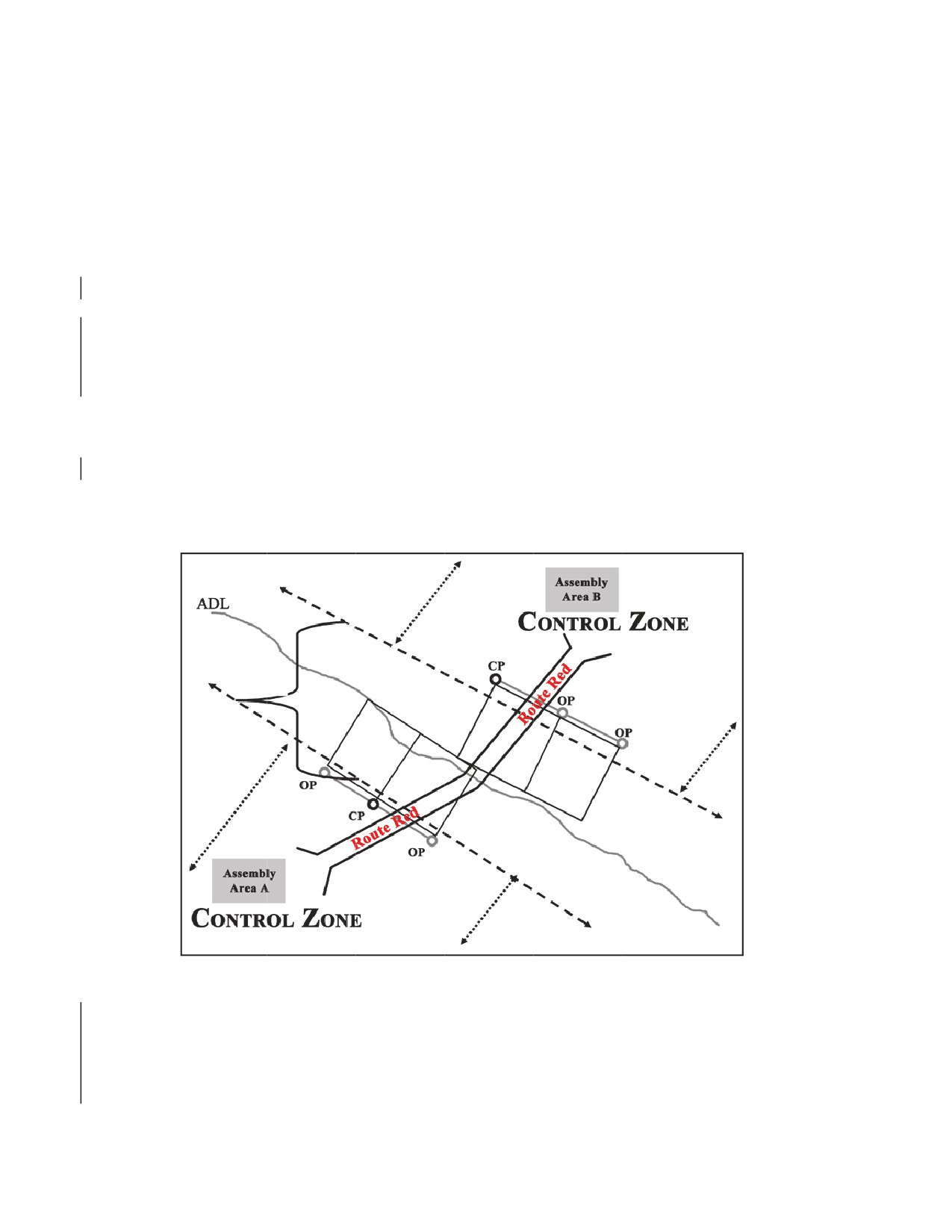
(1)
Cease-Hostilities Line. This is the place where the fighting stopped. This
line marks the forward limit of
the positions occupied
by the troops of the opposing sides
at the suspension of
hostilities.
. The exact
location of
this line is
often contentious and a
topic of discussion in
the peacemaking process. This is just a reference point
and not a
control measure, unless so negotiated by the settlement.
(2)
Armistice
Demarcation Line (ADL). A geographically
defined line
from which
disputing or belligerent forces disengage and withdraw to their respective sides
following
a truce or
cease fire agreement.
The agreement of cease fire lines
may pave
the way
for the establishment of buffer zones (BZ), areas of separation (AOS), or
demilitarized zones
(DMZ), as well as the withdrawal
of forces.
(3)
BZ and AOS: A defined area controlled by
a PO force from which
disputing or
belligerent forces have been excluded. A buffer zone is
formed to
create an area of
separation between
disputing or belligerent forces and
reduce the
risk of renewed
conflict.
Also called
area of separation in some United
Nations operations. A
BZ may
contain residences,
farmland, or other assets that the
force may need to patrol or
monitor
to ensure that FHA is
delivered, and protected. If it is the sovereign
territory of
one of the belligerents, coordinate the administration
and policing of the inhabitants.
The supervising authority will
usually control and limit access to
a BZ, and
generally
the air space above
it. Any maritime zones should specify infringements to
international shipping rights.
BZ
Figure III-1
Control Zones
(4)
DMZ. A
defined area in which
the stationing or concentrating of
military
forces, or
the retention or establishment of
military installations
of any description, is
prohibited.
(5)
Line of Demarcation. A line defining the boundary of
a buffer zone or area of
limitation. A line of
demarcation may also
be used to
define the forward limits of
III-4 (CH 1)
FM 3-07.31/MCWP 3-33.8/AFTTP 3-2.40
14 April 2009
disputing or belligerent forces after each phase of disengagement or withdrawal has
been completed.
(6) Areas of Transfer: Turn over these areas to one party or another and do not
relate to the ADL.
b. Means of separation. The following principles apply:
(1) Focus the operation at the tactical level.
(2) Sustain consent to the separation.
(3) Keep the entire operation transparent.
(4) Liaison to all key parties and the local authorities is essential.
(5) Full participation of the belligerents is the only hope of success.
(6) The peace force must have full freedom of movement.
(7) Observing, reporting, and monitoring will be the essential tools.
c. Military Tasks.
(1) Occupying key terrain. The PO force normally separates belligerents by
physically occupying a corridor between the two parties.
(2) Establishing and marking the ADL, DMZ, and BZ. The initial and most
important task is to determine accurately the location of the agreed geographic locations
and mark them. The unit commander must negotiate the details with the belligerent
forces.
(a) Where possible, the trace should follow identifiable natural or manmade
terrain features.
(b) Promptly survey and physically mark the ground by an acceptable means,
such as the placement of painted barrels, oil drums, stakes, single strand wire, or coiled
wire is important. A global positioning system (GPS) may assist most units to conduct
marking accurately.
(c) Clearly identify markers so all parties can see them from 100m in
daylight and from both directions in travel. Locate permanent in the most heavily
trafficked areas.
(d) If possible, use belligerent forces to do the marking. This gives them
more ownership of the peace process and provides needed labor to mark the area
quickly.
(e) Determining the location of all forces. The belligerent forces must provide
maps and overlays of the disposition of their forces and equipment.
(f) Establish communication with all belligerent forces. Ensure that all
elements have communication with the belligerent forces and that liaisons from those
forces are located in the tactical operation centers of the peace operation.
(g) Establish control measures.
• Make all control measures visible and known to the local population.
• These control measures will enable the PO force to supervise the
withdrawal of the belligerent forces via designated routes to assembly areas where
initial disarmament of key weapons systems will take place.
• Move belligerents to barracks. Take confiscated weapons to cantonment
or weapons storage sites or destroy them.
• Examples of control measures are CPs, OPs, access routes, belligerent
assembly areas, and weapons cantonment sites.
(h) Clear key areas of mines, obstacles, and fortifications. Minefields,
craters, tank ditches, berms, bunkers, and fortifications will block roads and access into
and out of the zone. The PO force cannot separate belligerent forces or establish
14 April 2009
FM 3-07.31/MCWP 3-33.8/AFTTP 3-2.40
(CH 1) III-5
freedom of movement until cleared areas are established. The belligerents who must
clear the minefields and remove obstacles, bunkers, and fortifications fall under the
supervision and assistance of the PO force. PO forces may have to provide material to
the belligerent forces to accomplish this task.
• Establish surveillance, verification, and collection systems to monitor and
demonstrate progress. One technique is to establish a reconnaissance board modeled
after a targeting board whose function is to synchronize intelligence information,
reconnaissance, assets, and verification requirements into a workable, comprehensive
plan. Make this a coordinated effort among all ground, air, maritime, and technical
assets of all of the nations participating. The collection plan can then focus on named
areas of interest to monitor key belligerent force locations.
(i) Controlling BZ. The series of observation and control measures supported
by active ground, air, and maritime patrolling is essential for controlling the zone. Set
clear guidelines on whom and what is allowed inside or to transit the zone. Clearly
state the authority and role of CIVPOL. Regulate agricultural activities inside the zone.
Clearly state, so that all members of the PO force can understand, all procedures for
handling violators and confiscated weapons and ammunition. Establish clear
communication among all players. Use joint military commissions or other such
consultative body to settle disputes arising from control of the zone.
5. PO Interposition Tactics
a. As in a preventive deployment, give an interposition force sufficient combat
power available to match whatever threat could develop. PO will require the
interpositioning of the PO force to supervise the orderly disengagement and withdrawal
of the parties to the dispute.
b. Defusing sensitive or potentially explosive situations may require commanders
to interposition the PO force. This gives the disputing parties confidence that their
withdrawal will not give an advantage to another disputing party or parties.
c. Interpositioning places PO forces between the disputing parties in an effort to
supervise the withdrawal of the disputing parties’ forces and establish a BZ. This
operation requires careful and accurate timing to reduce the inherent risks to the PO
III-6 (CH 1)
FM 3-07.31/MCWP 3-33.8/AFTTP 3-2.40
14 April 2009
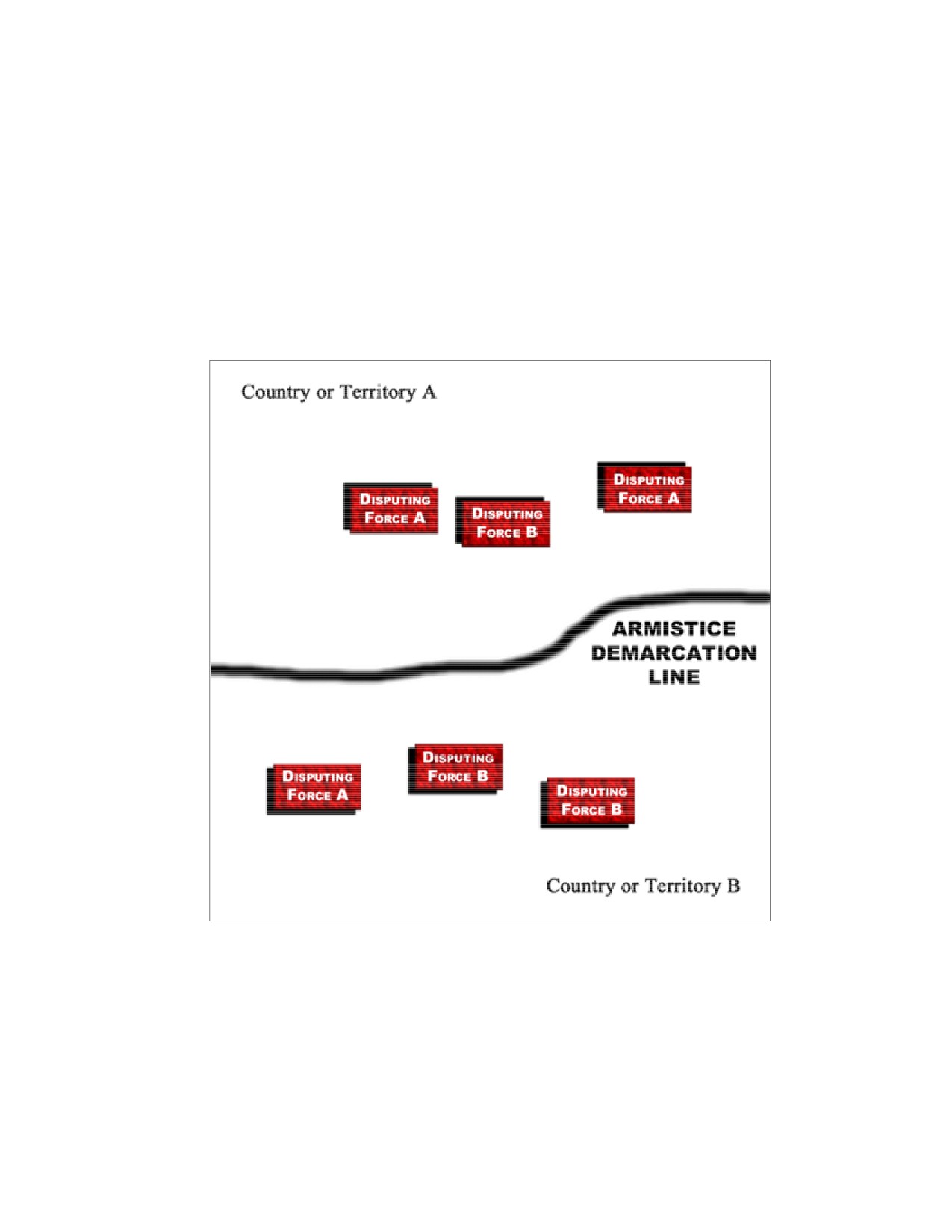
force. Maintain the PO force credible and impartial in order to interpose successfully.
If possible, the PO force should take advantage of the lull in hostilities to interpose as
the parties in the conflict disengage.
d. If interpositioning occurs after disengagement or withdrawal has begun,
accomplish it quickly to prevent clashes that could lead to renewal of the conflict or a
general breakdown in the cease fire. The possible sequence of separation may be as
follows:
(1) After a truce or cease fire is in effect and the disputing parties reach
agreement on the trace of an ADL as shown in Figure III-2, PO can begin. Some
operations call this line a cease fire line.
Figure III-2 Armistice Demarcation Line Trace
(2) The JTF commander coordinates the deployment of PO forces with the
disputing parties and their forces.
(3) PO forces deploy along the ADL between the disputing forces as shown in
Figure III-3 and supervise the disengagement and withdrawal of the disputing forces
behind their respective sides of the ADL. The ADL becomes the forward limit for the
disputing forces. The purpose of the interpositioning is to establish a presence and
III-7
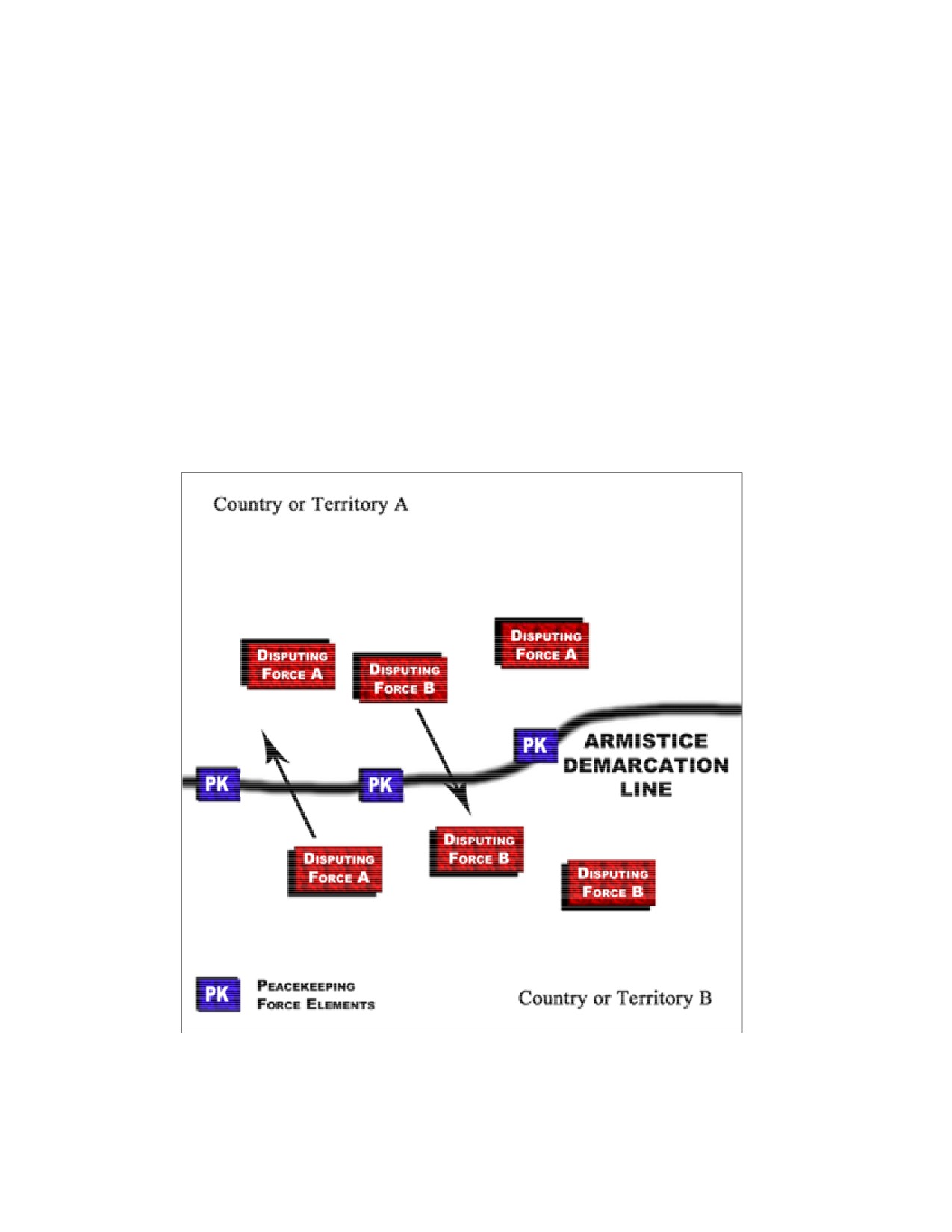
place a buffer force between disputing forces. Carefully planned interpositioning
considers the following implied tasks:
(a) Where possible, the trace of the ADL should follow identifiable natural or
manmade terrain features. Make artillery or engineer survey qualified PO force
personnel responsible for carrying out demarcation duties. Monitoring of the line is
required to ensure that the markings are not moved. PO forces may use ADL markers,
which are difficult to remove and have a GPS signature.
(b) Make the size of the interpositioning force sufficiently credible to provide
the disputing parties with the confidence needed to disengage and withdraw safely from
their positions.
(c) The utmost care is needed during initial interpositioning because of the
likelihood of disagreements and misunderstandings. Commanders may employ mine
clearance operations to deploy safely the PO force along the line.
(d) Commanders must promptly mediate localized disagreements or potential
clashes at the lowest practical level to prevent a recurrence of conflict.
Figure III-3 Deployment of PO forces Along an ADL
(4) Once there is agreement on the formation of a BZ, PO forces can establish
lines of demarcation on each side of the ADL. The PO force then supervises the
III-8
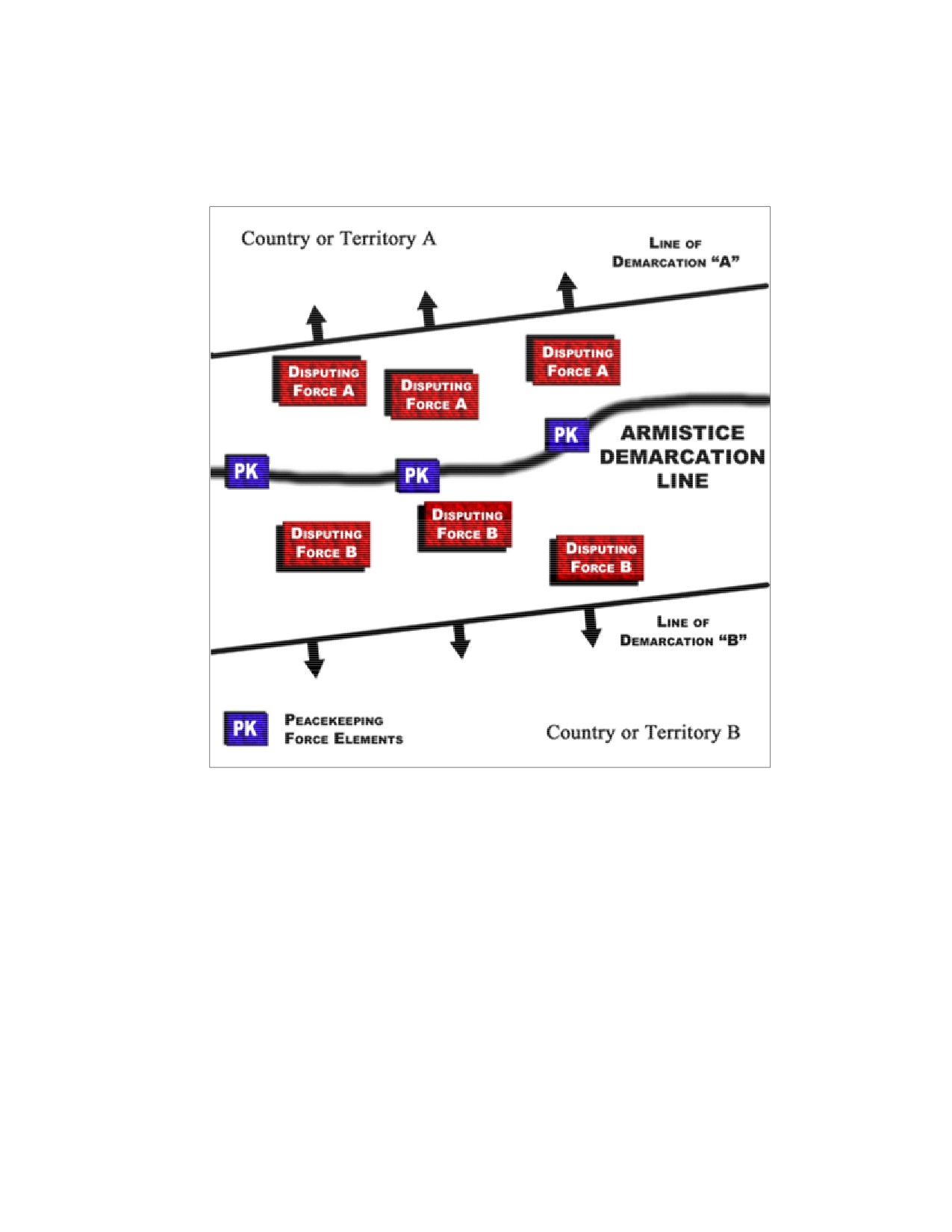
withdrawal of the disputing forces to positions behind their respective lines of
demarcation, as shown in Figure III-4, to prepare for the establishment of the BZ. The
lines of demarcation are now the forward limits for the respective disputing forces.
Figure III-4 Withdrawal of Disputing Forces Behind Lines of Demarcation
(5) PO forces establish the BZ, begin observation, and patrol activities as shown
in Figure III-5. Some UN PO refer to the BZ as the area of separation. A BZ is
normally only a zone or area from which the disputing forces are excluded. Observation
posts (OP) provide visual coverage within the BZ. Patrols supplement the OP by
patrolling areas out of effective visual coverage. Access to the BZ is normally restricted
to the PO force or observer group. Commanders may negotiate special arrangements
between the disputing parties and the PO force to allow restricted access to local
civilians, such as farmers or fishermen. At any point where commanders may permit,
by the agreement, people or vehicle traffic to pass into or through a BZ, peacekeepers
may control access at CPs and can restrict hours to daylight. Commanders will
determine staffing of such CPs based on their analysis of the mission and other factors.
III-9
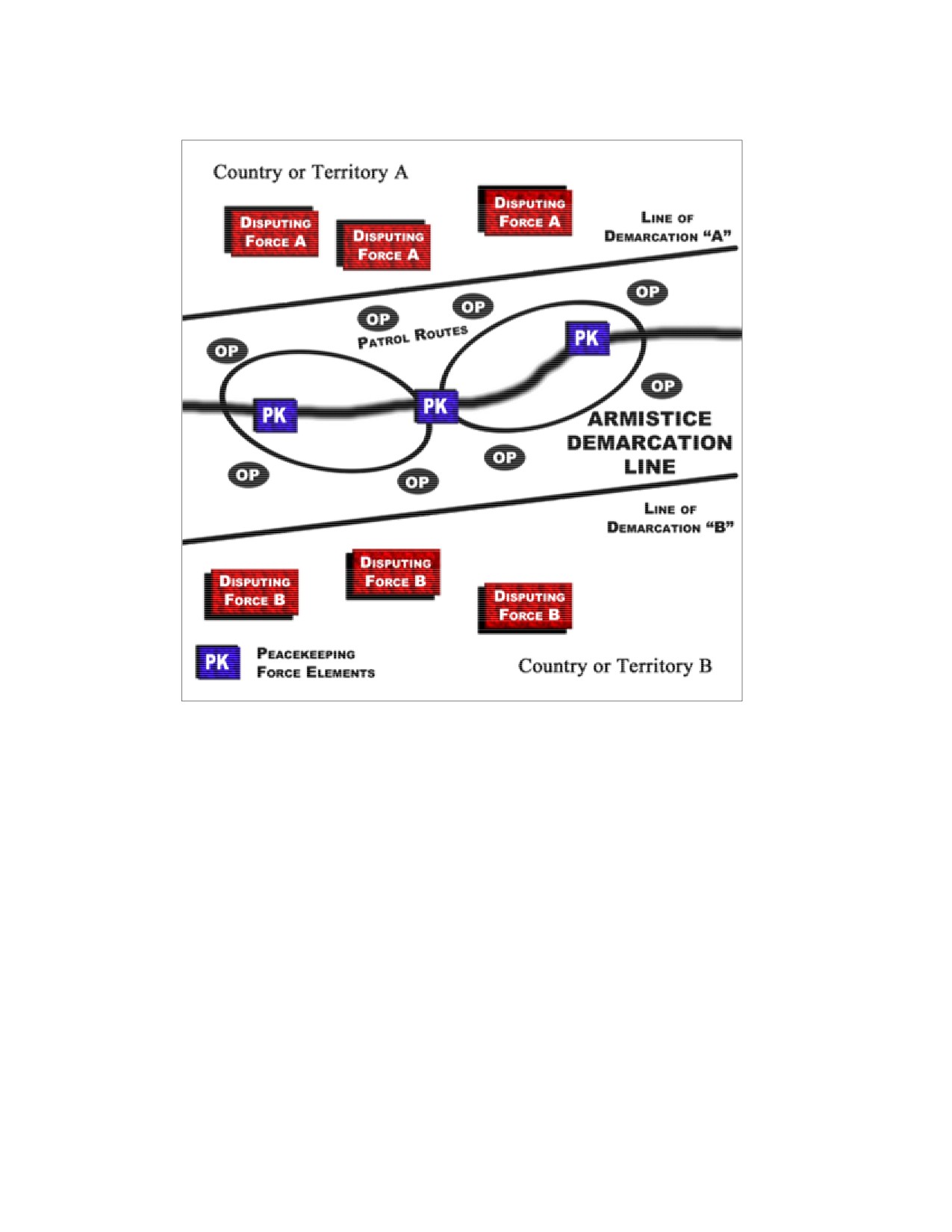
Figure III-5 Establishment of BZ
(6) Subject to negotiated diplomatic agreements, the disputing parties may agree
to extended areas of supervision called areas of limitation (AOL), as shown in Figure
III-6, where peacekeepers may inspect the strength and fortifications of the disputing
parties. The usual arrangement is for the disputing parties to agree to maintain equal
numbers of small, lightly armed forces in the area immediately adjacent to the BZ.
Agreements between disputing parties may allow larger forces in other areas of the
AOL, but the agreement will specify an upper limit for the number and type of
formations, tanks, and antiaircraft weapons and artillery (by caliber) permitted. The
PO force or observer group will monitor each side’s compliance with the personnel and
armaments limitations. Lines of demarcation define outer boundaries of the AOLs.
AOLs constitute an additional measure for improving the security of the BZ and
increasing the confidence of the disputing parties.
III-10
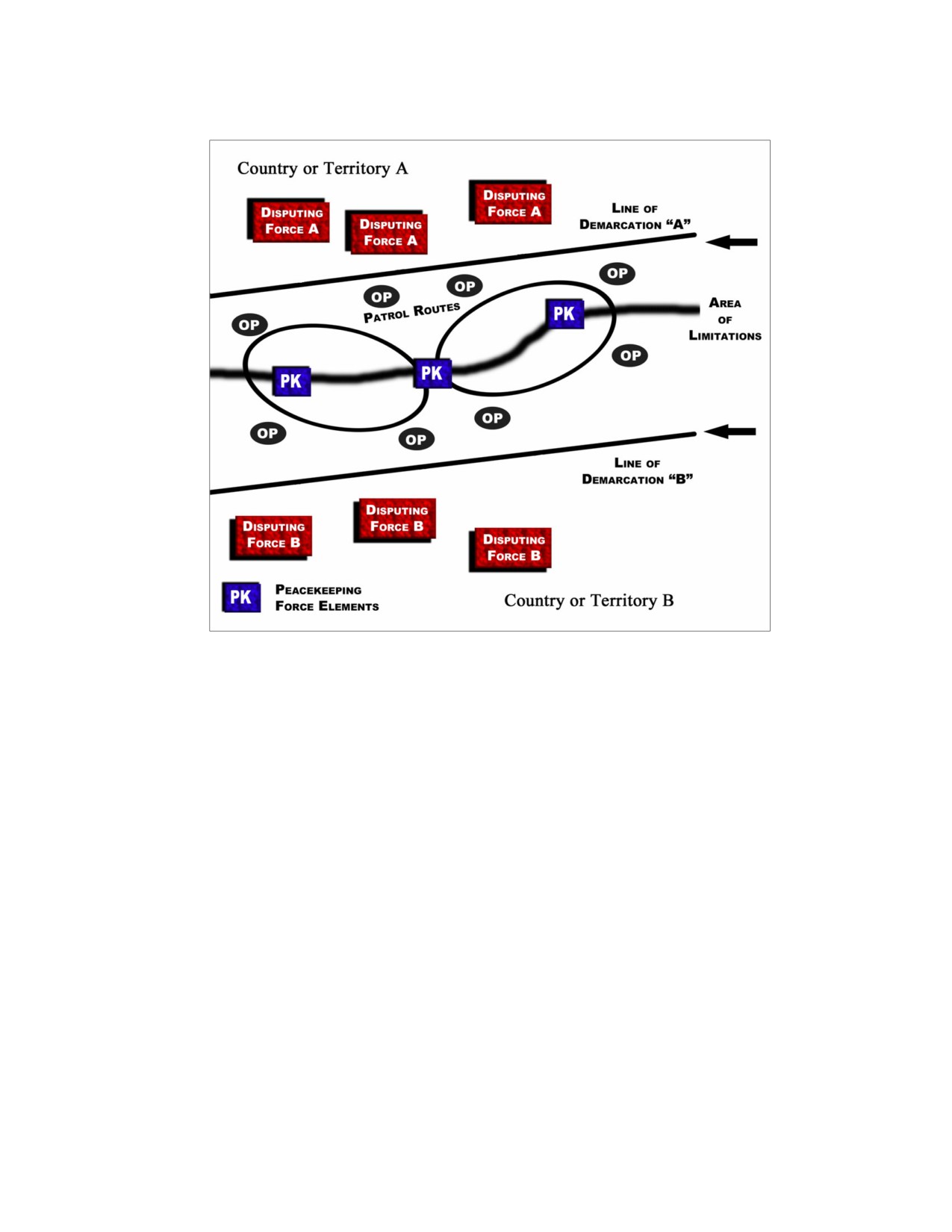
Figure III-6 Establishment of AOL
(7) The BZ may eventually become a DMZ, following further diplomatic activity.
In contrast to BZs, PO forces do not occupy DMZs, but observe and patrol with observer
groups. A DMZ is created to neutralize certain areas from military occupation and
activity. Generally, a DMZ is in an area claimed by two or more of the disputing sides
and where control by one party could constitute a direct threat to the others. Lines of
demarcation define DMZ boundaries. Make these boundaries easily recognizable and,
ideally, do not run them counter to locally accepted political and cultural divisions. The
airspace over a DMZ is also denied to aircraft of the disputing parties.
6. Nonlethal Weapons
a. NLW are weapons explicitly designed and primarily employed to incapacitate
personnel or material, while minimizing fatalities, permanent injury to personnel, and
undesired damage to property, and the environment. Make all parties understand that
the term “nonlethal” is a function of intent and goal, not a guarantee that these
weapons will not produce serious bodily injury, death, or other severe adverse effects.
NLW add flexibility to all types of operations, but are especially useful in civil
disturbances and PO by limiting the risk of unnecessary casualties and collateral
damage.
b. NLW should enhance the abilities of military commanders to conduct missions
across the range of military operations. NLW provide tools that enable the individual,
team, or unit to anticipate and/or respond to provocation when the use of deadly force is
III-11
not appropriate. Essentially, NLW provide US forces with a capability for effectively
controlling the nontraditional battlefield of PO, within the constraints levied by ROE,
by mitigating casualties and minimizing collateral damage.
c. Planning Considerations:
(1) Consider the use of NLW as an integral part of PO. Due to the increasing US
armed forces involvement in PO and the advances in communication technology, the
public is able to see operations unfold in real time. Such public scrutiny has highlighted
the difficulties of military forces responding to a situation because they often have no
weapons capable of generating anything less than lethal force.
NOTE: Per CJCSI 3121.021A, Standing Rules of Engagement for US Forces
(SROC), 15 January 2000, all US forces specifically retain the
inherent right of individual and unit self defense.
(2) As with any other capability, NLW have limitations on their usage. Political
leadership and media personnel may misunderstand the appropriate applications of
NLW across the full range of military operations. NLW allowing the completion of PO
without causalities is incorrect and may lead to conflicting expectations between
political and military leaders. Leaders are encouraged to again refer to multi-Service
procedures for the Tactical Employment of Nonlethal Weapons, for more in-depth
information on the use of NLW.
(3) Operations may involve nonlethal or lethal weapons, or both, and force
cannot limit any one situation to a specific level of damage. NLW could contribute to
the application of military force in pursuit of military/political aims and objectives.
Employing Combat Camera to document NLW use, provides support for positive media
coverage and assurance against hostile misinformation and propaganda
d. The services are procuring nonlethal capability sets (NLCS) that are versatile
packages of NLW comprised of commercial off-the-shelf and government off-the-shelf
equipment and munitions. Advanced developmental technologies are also being
explored for future procurements. In addition to addressing contingency requirements,
the Services’ NLCS address training requirements by providing limited sustainment
training ammunition and appropriate sustainment training equipment. Services can
divide NLCS components into four distinct categories: personnel protectors, personnel
effectors, mission enhancers, and training devices. The following examples of NLCS are
not all-inclusive:
(1) Personnel protectors include items such as ballistic face shields and riot
shields that protect the individual from blunt trauma injuries inflicted by thrown
objects, clubs, etc.
(2) Personnel effectors include items such as riot batons, malodorants, stingball
grenades, pepper sprays, and other kinetic rounds (e.g., sponge grenades) designed to
discourage, disorient, or incapacitate individuals or groups.
(3) Mission enhancers include items such as bullhorns, spotlights, and caltrops.
These items are designed to facilitate target identification and crowd control, and to
limit personnel and vehicular movement.
(4) Training devices include items such as training suits, training rounds,
training batons, and inert pepper sprays. They are designed to facilitate realistic
hands-on scenario training in preparation for operations.
III-12
e. The generic NLCS is designed to provide a battalion-sized infantry element with
limited, tactically deployable NLW. Fielding of this capability set enhances the
operation of systems and equipment already fielded and planned within the joint
community. The generic NLCS components are compatible with military equipment
that is already fielded or planned for future use. Capability set munitions are either
hand thrown or fired from 12-gauge shotguns or 40 millimeter grenade launchers.
f. The core capabilities associated with nonlethal effects fall into two major
categories: counterpersonnel and countermateriel.
(1) Counterpersonnel capabilities include:
(a) Non-lethal counterpersonnel capabilities enable the application of
military force with reduced risk of fatalities or serious casualties among noncombatants
or even, in some instances, among enemy forces.
(b) US forces require the capability to incapacitate personnel and stop the
disturbance behaviors. For the purposes of this document, “incapacitation” is achieved
when weapons effects result in physical inability (real or perceived) or mental
disinclination to act in a hostile or threatening manner. While the focus, at least
initially, is on capabilities that affect groups of people, NLW also provide capabilities to
incapacitate individuals without affecting those nearby.
(c) US forces require a nonlethal capability to deny personnel access to an
area. This capability can include the use of physical barriers or systems that produce
physical or mental discomfort to those who enter the denied area. Non-explosive
nonlethal area denial technologies would likely have none of the restrictions applied to
conventional land mines. Thus, they can provide new possibilities for barrier planning
in any type of military operation.
(d) US forces require a nonlethal capability to seize personnel. This may
include some combination of technologies inherent in other core capabilities.
Incapacitation methods or the use of entangling devices, such as those designed for area
denial, may aid in seizing personnel. This capability is intended to augment lethal
means used to capture specified individuals, such as enemy combatants or persons who
are inciting a mob or crowd to violence.
(2) Countermateriel capabilities refer to:
(a) The joint NLW approach focuses on three specific countermateriel
capabilities. US forces require a nonlethal capability to deny vehicles to air, land, and
sea areas. This requirement applies to wheeled, tracked, and surface effects vehicles, as
well as aircraft on the ground. US forces may include physical barriers or systems that
artificially reduce the trafficability of terrain in this requirement.
(b) US forces require the ability to disable ships and other maritime vessels
or deny their entry into targeted areas. US forces also require an enhanced ability to
disarm personnel or disable maritime vessels to facilitate boarding.
g. Tasks associated with NLW are derived from the commander’s and service’s
mission needs statements. These tasks are grouped under three core capabilities:
counterpersonnel, countermateriel, and countercapability.
(1) Counterpersonnel
(a) Control crowds.
(b) Incapacitate personnel.
III-13
(c) Deny an area to personnel.
(d) Clear facility/structure of personnel.
(2) Countermaterial
(a) Deny an area to vehicle, vessel and aircraft
(b) Disable/neutralize vehicles aircraft, vessels, and equipment.
(3) Countercapability.
(a) Disable or neutralize facilities or systems
(b) Deny use of weapons of mass destruction (WMD).
7. Search Operations
a. General. Searches are one of the opportunities when the security forces have the
initiative and can decide when, where and how to act. Search operations pressure
belligerent parties to move illegal items, thereby increasing their risk of discovery.
Search operations have become more advanced due to greater sophistication in hiding
weapons.
b. The purpose of search operations is to--
(1) Protect potential targets,
(2) Gain intelligence and information,
(3) Deprive belligerents of resources, and
(4) Gain evidence for subsequent prosecution.
c. Joint Search Operations. Search operations are often in conjunction with local
police forces with the objectives to--
(1) Capture wanted persons, arms, explosives or other equipment,
(2) Disrupt hostile activities, i.e. bomb making or weapon manufacture, and
(3) Eliminate influence of belligerent parties in a specific locality.
d. AO Assessment. An area assessment is required before conducting search
operations. Detailed procedures will depend on the environment, whether benign or
hostile and the technical threat. The following factors require assessment:
(1) Civil or military primacy.
(2) Level of opposition to law and order.
(3) Level of civilian support for opposition.
(4) Level of technical expertise and degree of extremism of belligerents.
(5) Access to arms and other combat related materials.
(6) Ability of civil authorities to handle crises.
e. Considerations. Search operations often require planning and liaison with other
units. Tenets of a successful operation include:
(1) Operation is based on accurate intelligence.
(2) Surprise based on good operations security (OPSEC).
(3) Adequate numbers of search teams and equipment.
(4) EOD team availability if required.
(5) Executed at the most opportune moment.
III-14
///////////////////////////////////////