FM 4-20.108 Airdrop of Supplies and Equipment: Rigging Military Utility Vehicles (SEPTEMBER 2007) - page 4
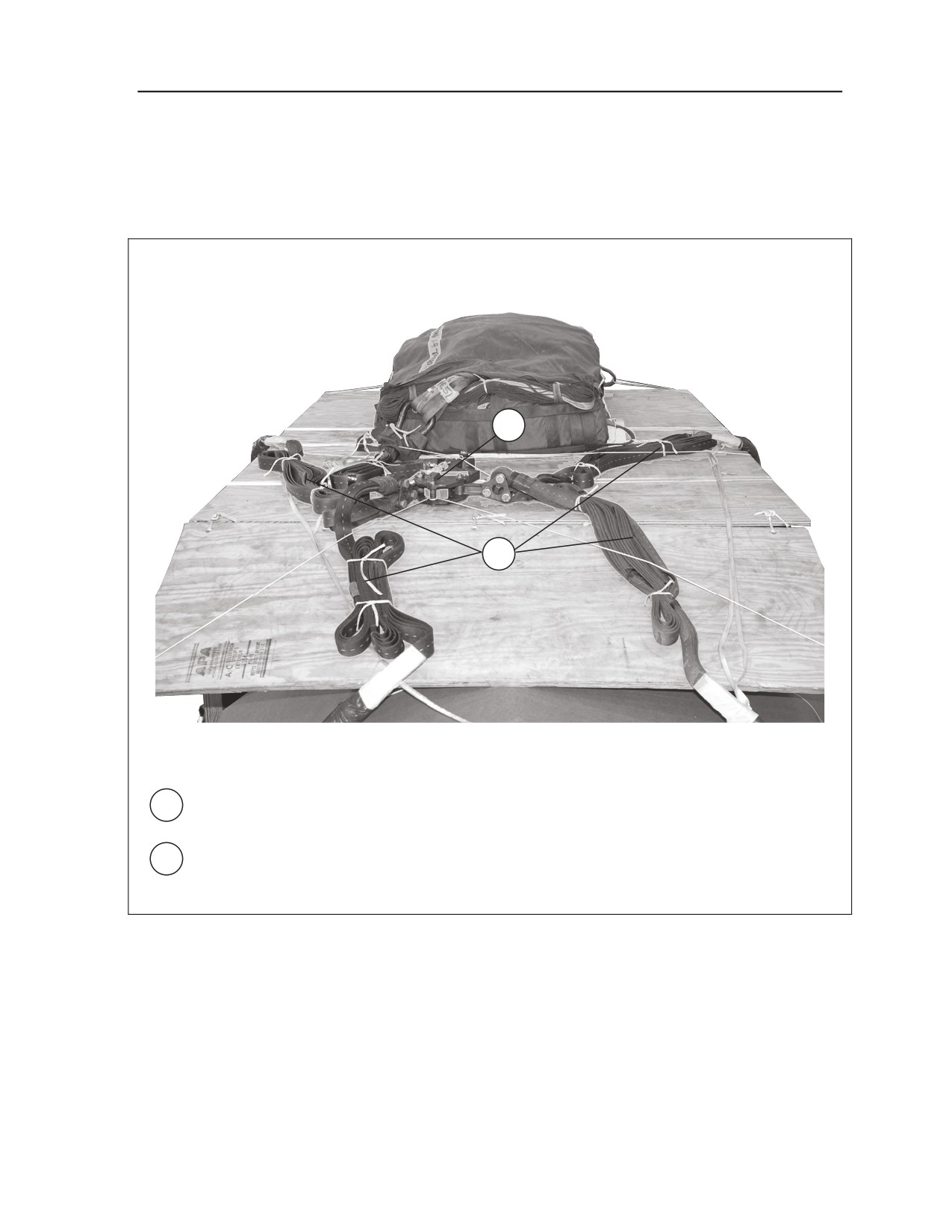
Rigging One Military Utility Vehicle (M-Gator) with the First Response Expeditionary (FRE) Fire Vehicle
and an A-22 Cargo Bag on a 12-Foot, Type V Platform for Low-Velocity Airdrop
INSTALLING PARACHUTE RELEASE
4-18. Prepare and install an M-1 cargo parachute release system according to FM 4-20.102/MCRP 4-
11.3J/NAVSEA SS400-AB-MMO-010/TO 13C7-1-5 and as shown in Figure 4-23.
1
2
1 Place the M-1 release on the M-Gator box, positioning the release centered and safety tied to
a convenient point on the load.
2 Fold and secure any slack in the suspension slings.
Figure 4-23. Parachute Release System Installed
10 September 2007
FM 4-20.108 /TO 13C7-2-491
4-37
Chapter 4
POSITIONING EXTRACTION PARACHUTE
4-19. Select the extraction parachute and extraction line needed using the extraction line requirements
table in FM 4-20.102/MCRP 4-11.3J/NAVSEA SS400-AB-MMO-010/TO 13C7-1-5. Place the extraction
parachute and extraction line bag on the load for installation inside the aircraft.
INSTALLING PROVISIONS FOR EMERGENCY RESTRAINTS
4-20. Select and install provisions for emergency restraints according to the emergency aft restraints
requirements in FM 4-20.102/MCRP 4-11.3J/NAVSEA SS400-AB-MMO-010/TO 13C7-1-5.
MARKING RIGGED LOAD
4-21. Mark the rigged load according to FM 4-20.102/MCRP 4-11.3J/NAVSEA SS400-AB-MMO-
010/TO 13C7-1-5 and as shown in Figure 4-24. Complete the Shipper’s Declaration for Dangerous
Goods. If the load varies from the one shown, the weight, height, tip-off curve, CB, and parachute
requirements must be recomputed.
EQUIPMENT REQUIRED
4-22. The equipment required to rig this load is listed in Table 4-1.
4-38
FM 4-20.108 /TO 13C7-2-491
10 September 2007
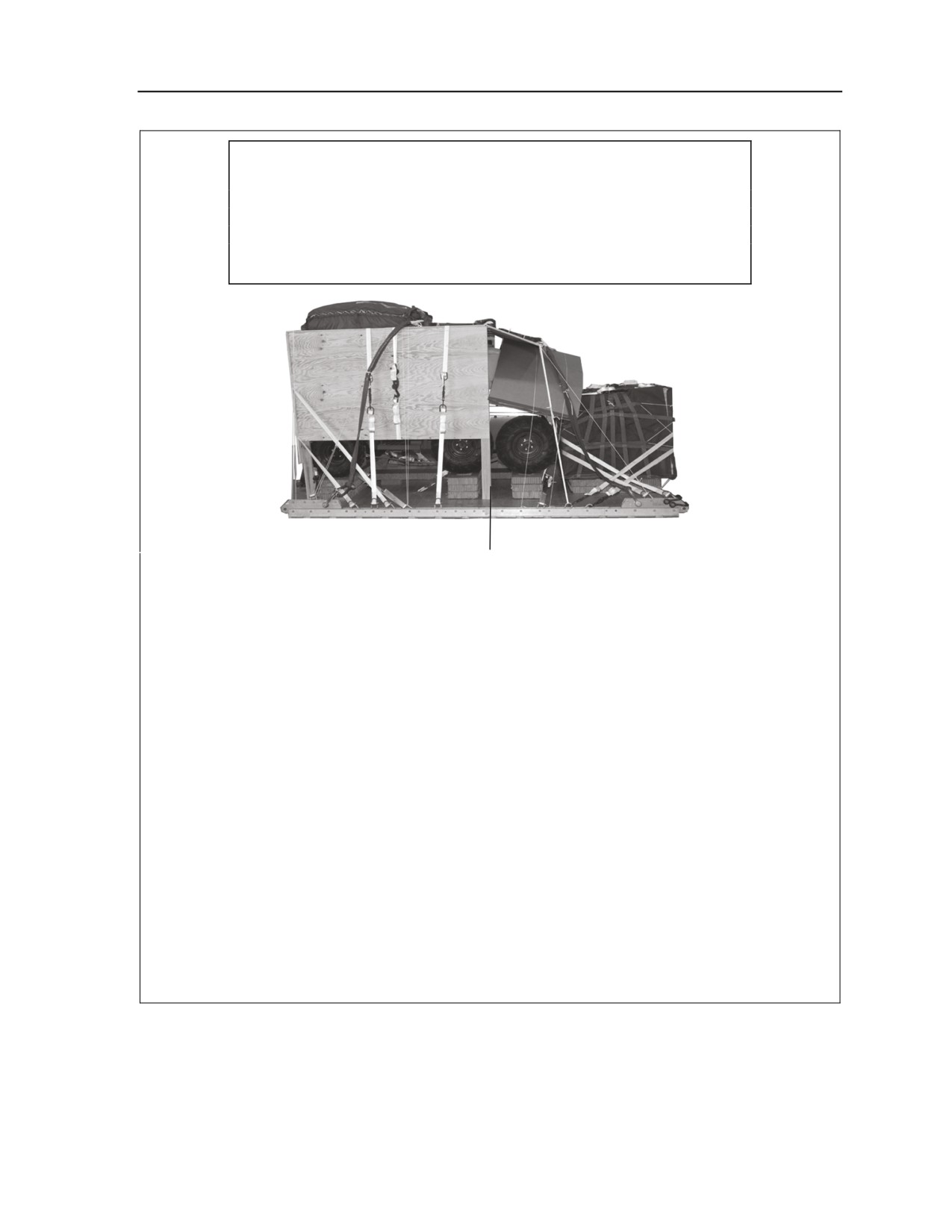
Rigging One Military Utility Vehicle (M-Gator) with the First Response Expeditionary (FRE) Fire Vehicle
and an A-22 Cargo Bag on a 12-Foot, Type V Platform for Low-Velocity Airdrop
CAUTION
Make the final rigger inspection required by FM 4-20.102/MCRP 4-
11.3J/NAVSEA SS400-AB-MM0-010/TO 13C7-1-5 and AR 59-4/
OPNAVINST 4630.24C/AFJ 13-210(I)/MCO 13480.1B before the
load leaves the rigging site.
CB
RIGGED LOAD DATA
Weight
4,980 pounds
Maximum Load Allowed
5,000 pounds
Minimum Load Allowed
4,600 pounds
Height
94 inches
Width
108 inches
Overall Length
168 inches
Overhang: Front (A-22)
6 inches
Rear
0 inches
Center of Balance (CB) (from front edge of platform)
70 inches
Extraction System with 12-foot cable (adds 18 inches to length of platform)
EFTC
Figure 4-24. M-Gator W/FRE Rigged on a 12-Foot, Type V Platform for Low-Velocity Airdrop
10 September 2007
FM 4-20.108 /TO 13C7-2-491
4-39
Chapter 4
Table 4-1. Equipment Required for Rigging the M-Gator with the First Response Expeditionary
(FRE) Fire Vehicle and an A-22 Cargo Bag on an 12-Foot, Type V Platform for Low-Velocity
Airdrop
National Stock Number
Item
Quantity
8040-00-273-8713
Adhesive, paste, 1-gal
As required
1670-00-587-3421
Bag, cargo, aerial delivery, A-22
1
1670-01-035-6054
Bridle, extraction line lead, (line bag for C-17)
1
4030-00-090-5354
Clevis, large
7
4030-00-678-8562
Clevis, medium
2
1670-00-360-0328
Cover, clevis, large
1
8135-00-664-6958
Cushioning material, packaging, cellulose wadding
As required
1670-00-434-5783
Coupling assembly, airdrop, EFTC, w / 12-ft cable
1
1670-01-475-1990
Extraction Parachute Jettison System (EPJS)
1
8305-00-191-1101
Felt, ½-inch
As required
8305-00-290-5584
Felt, 3/16-inch
As required
1670-01-183-2678
Leaf, extraction line (line bag)(add 1 for DES)
1
Line Multi-Loop:
For deployment line:
1670-01-062-6304
9-ft (2-loop), type XXVI nylon webbing
1
For drogue:
1670-01-064-4452
60-ft (1-loop), type XXVI nylon webbing (DES)
1
For extraction:
1670-01-064-4452
60-ft (1-loop), type XXVI nylon (C-130 aircraft)
1
1670-01-107-7652
160-ft (1-loop), type XXVI nylon (C-17 aircraft)
1
For lifting:
1670-01-063-7760
11-ft (2-loop), type XXVI nylon webbing
2
1670-01-062-6303
12-ft (2-loop), type XXVI nylon webbing
2
For riser extension:
1670-01-062-6301
3-ft (2-loop), type XXVI nylon webbing
1
For suspension:
1670-01-062-6303
16-ft (2-loop), type XXVI nylon webbing
4
Link:
1670-01-493-6418
Assembly small, two-point, 3 ¾-inch
1
1670-01-493-6418
Assembly small, two-point, 3 ¾-inch (C-17 drogue)
1
1670-01-072-5637
Jettison, C-130 (DES)
1
1670-01-483-8259
Link, parachute connector (TRM H-block) (C-17)
1
Lumber:
5510-00-220-6146
2-by 4-inch
As required
5510-00-220-6148
2-by 6-inch
As required
5530-00-128-4981
Plywood, ¾-inch sheet
8 sheets
Nail, steel wire, common:
5315-00-010-4659
8d
As required
1670-00-753-3928
Pad, energy-dissipating, honeycomb
12 sheets
4-40
FM 4-20.108 /TO 13C7-2-491
10 September 2007
Rigging One Military Utility Vehicle (M-Gator) with the First Response Expeditionary (FRE) Fire Vehicle
and an A-22 Cargo Bag on a 12-Foot, Type V Platform for Low-Velocity Airdrop
Table 4-1. Equipment Required for Rigging the M-Gator with the First Response Expeditionary
(FRE) Fire Vehicle and an A-22 Cargo Bag on a 12-Foot, Type V Platform for Low-Velocity
Airdrop (Continued)
National Stock Number
Item
Quantity
Parachute:
1670-01-016-7841
Cargo, G-11B
1
1670-01-063-3715
Cargo, extraction 15-ft
1
1670-01-063-3715
15-ft, Extraction Drogue (DES)
1
Platform, airdrop, type V, 12-ft:
1670-01-353-8425
Bracket assembly, component (EFTC)
1
1670-01-353-8424
Bracket, assembly, extraction
22
1670-01-162-2372
Clevis, load tie-down
4
1670-01-162-2381
Link, Tandem, link sups. assembly
1
1670-01-097-8816
Release, cargo parachute, M-1
1
7510-00-266-5016
Tape, adhesive, 2-in
As required
1670-00-937-0271
Tie-down assembly, 15-ft webbing
31
Webbing:
4020-00-240-2146
Cord, nylon, type III, 550-lb
As required
8305-00-268-2411
Cotton, type I, 1/4-inch
As required
8305-00-082-5752
Nylon, tubular, 1/2-in, natural
As required
8305-00-263-3591
Nylon, type VIII
As required
10 September 2007
FM 4-20.108 /TO 13C7-2-491
4-41
This page intentionally left blank.
Chapter 5
Rigging One Minibike for Door Bundle
DESCRIPTION OF LOAD
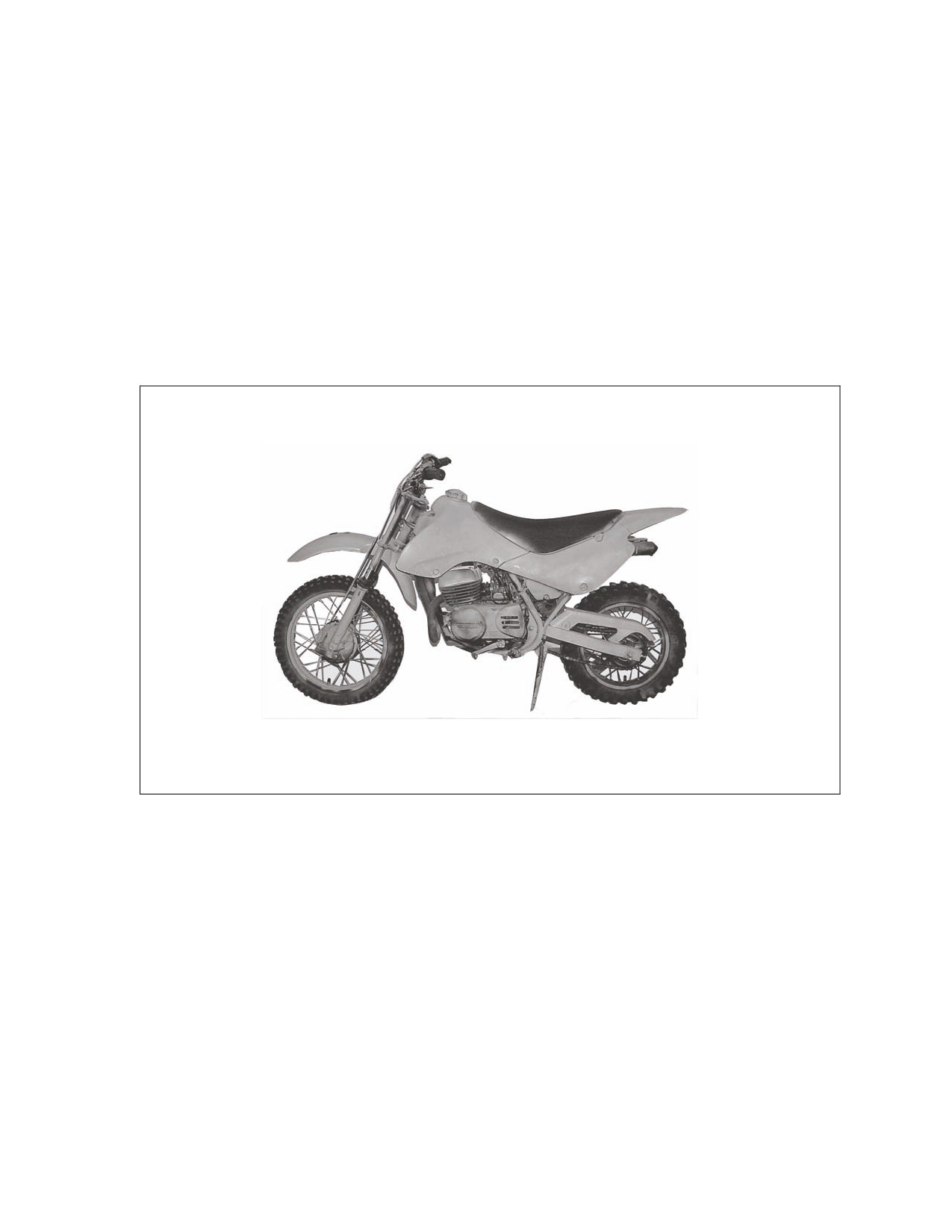
5-1. The minibike is rigged on a 16- by 48-inch Combat Expendable Platform (CEP) with one T-10 cargo
parachute. The minibike is 27 inches wide, 34 inches high and 61 inches long. It weighs 155 pounds and
is shown in Figure 5-1.
Figure 5-1. Minibike
10 September 2007
FM 4-20.108 /TO 13C7-2-491
5-1
Chapter 5
BUILDING THE COMBAT-EXPENDABLE PLATFORM (CEP)
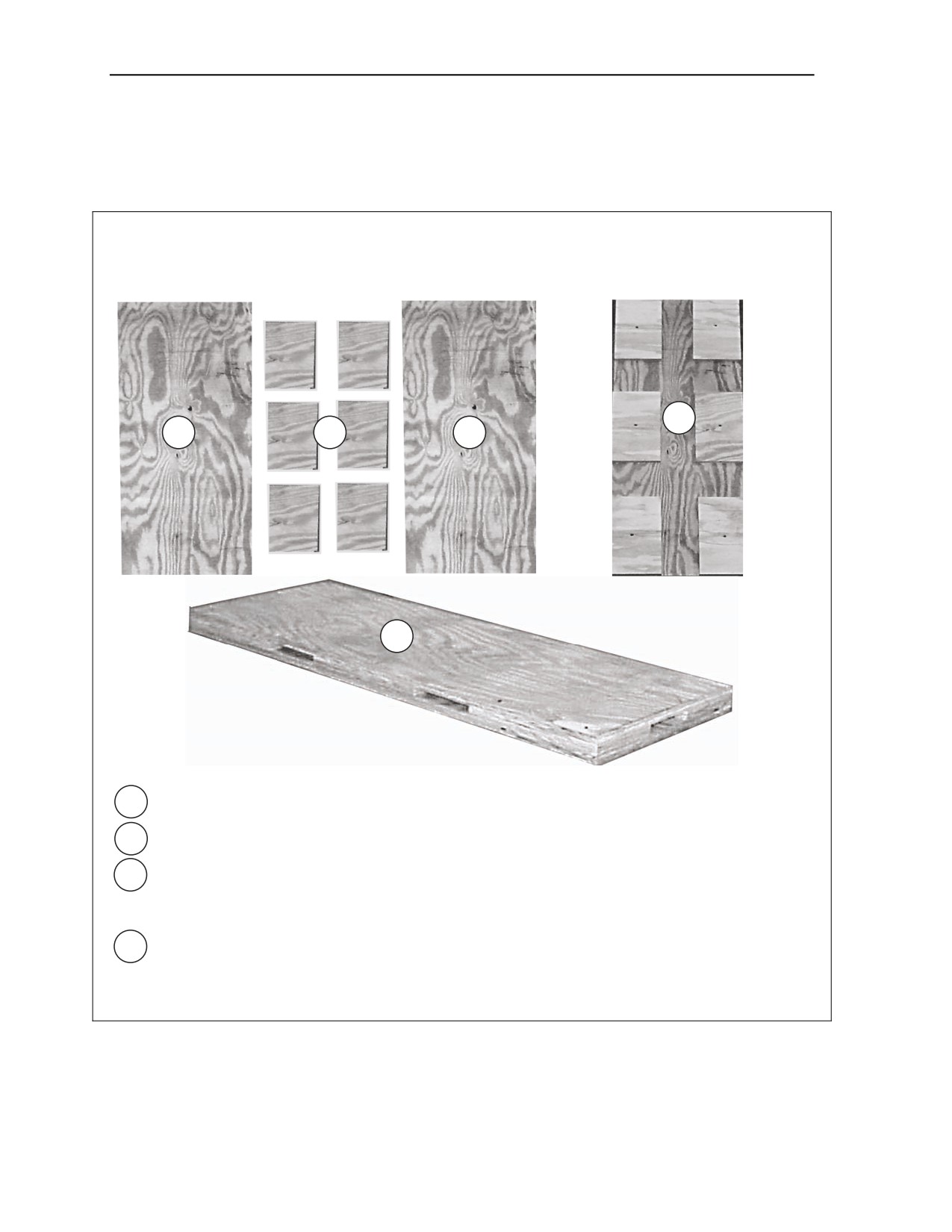
5-2. Build a 16- by 48-inch combat-expendable platform (CEP) as shown in Figure 5-2.
Notes.
1. Not drawn to scale.
2.
All dimensions are given in inches.
3.
Use 8d common nails or 2-inch long, #4 wood screws.
3
1
2
1
4
1 Cut two 3/4- by 16- by 48-inch pieces of plywood.
2 Cut six 3/4- by 6- by 12-inch pieces of plywood.
3 Nail or screw the six pieces of plywood from step 2 on top of one of the pieces of plywood from
step 1. Make sure the plywood is flush with the sides, one in each corner and centered in the
middle as shown above.
4 Nail or screw the second piece of plywood from step 1 on top of the plywood placed in step 3.
Make sure the plywood is flush with the sides.
Figure 5-2. Combat-Expendable Platform (CEP) Built
5-2
FM 4-20.108 /TO 13C7-2-491
10 September 2007
Rigging One Minibike for Door Bundle
PREPARING THE CEP
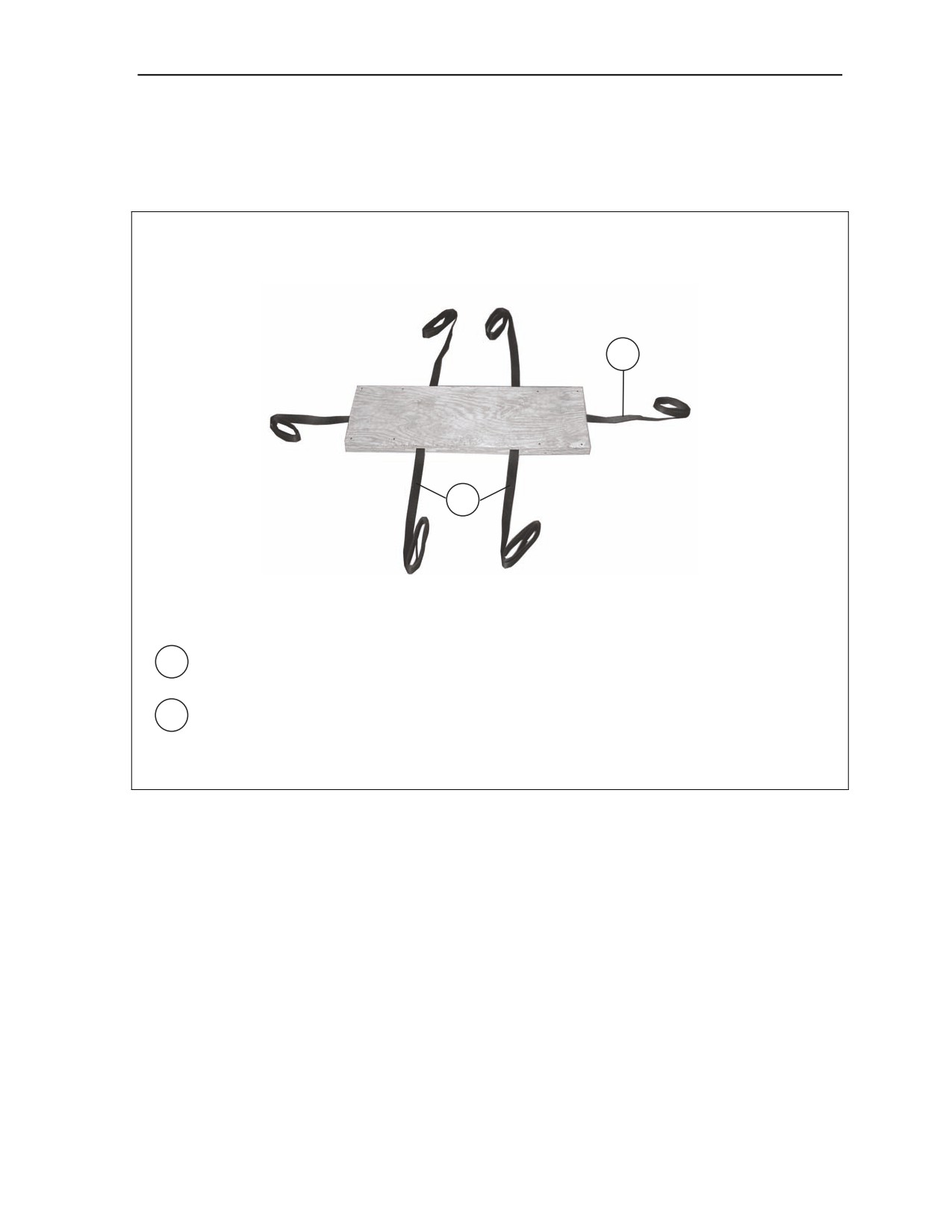
5-3. Prepare the platform as shown in Figure 5-3.
1
2
1 Route and center a 14-foot length of type X nylon webbing through the long channel of the
platform.
2 Route and center two 12-foot lengths of type X nylon webbing through the two short channels
of the platform.
Figure 5-3. Platform Prepared
10 September 2007
FM 4-20.108 /TO 13C7-2-491
5-3
Chapter 5
BUILDING AND POSITIONING THE HONEYCOMB STACK
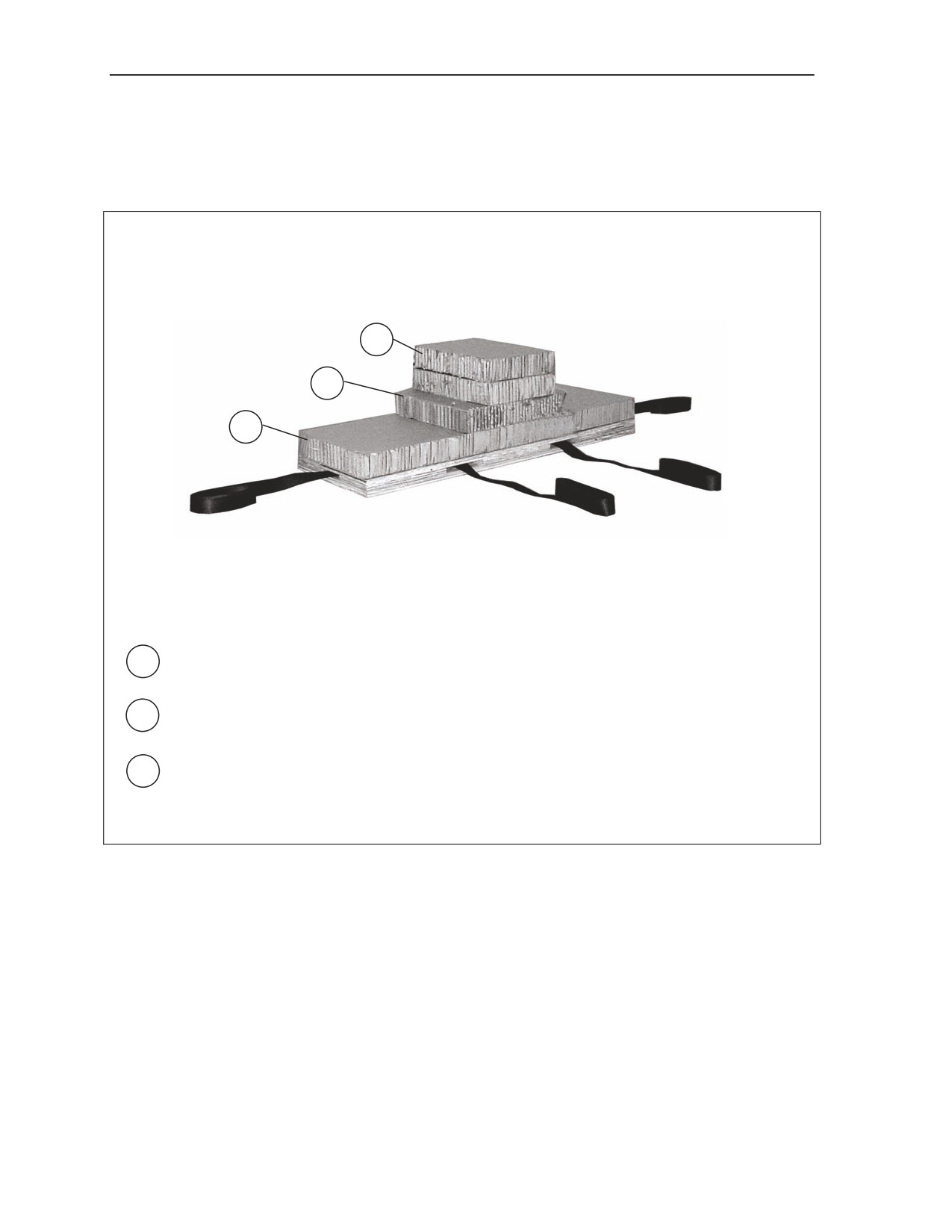
5-4. Prepare and position the honeycomb stack on the platform as shown in Figure 5-4.
3
2
1
1 Cut and glue a 16- by 48-inch piece of honeycomb on top of the platform built in paragraph 5-
2. Make sure it is flush with the sides.
2 Cut and glue a 16- by 18-inch piece of honeycomb on top of the honeycomb placed in step 1,
centered and flush with the sides.
3 Cut and glue two 12- by 16-inch pieces of honeycomb on top of the honeycomb placed in
step 2, centered and flush with the sides.
Figure 5-4. Honeycomb Stack Built and Positioned
5-4
FM 4-20.108 /TO 13C7-2-491
10 September 2007
Rigging One Minibike for Door Bundle
PREPARING AND POSITIONING MINIBIKE
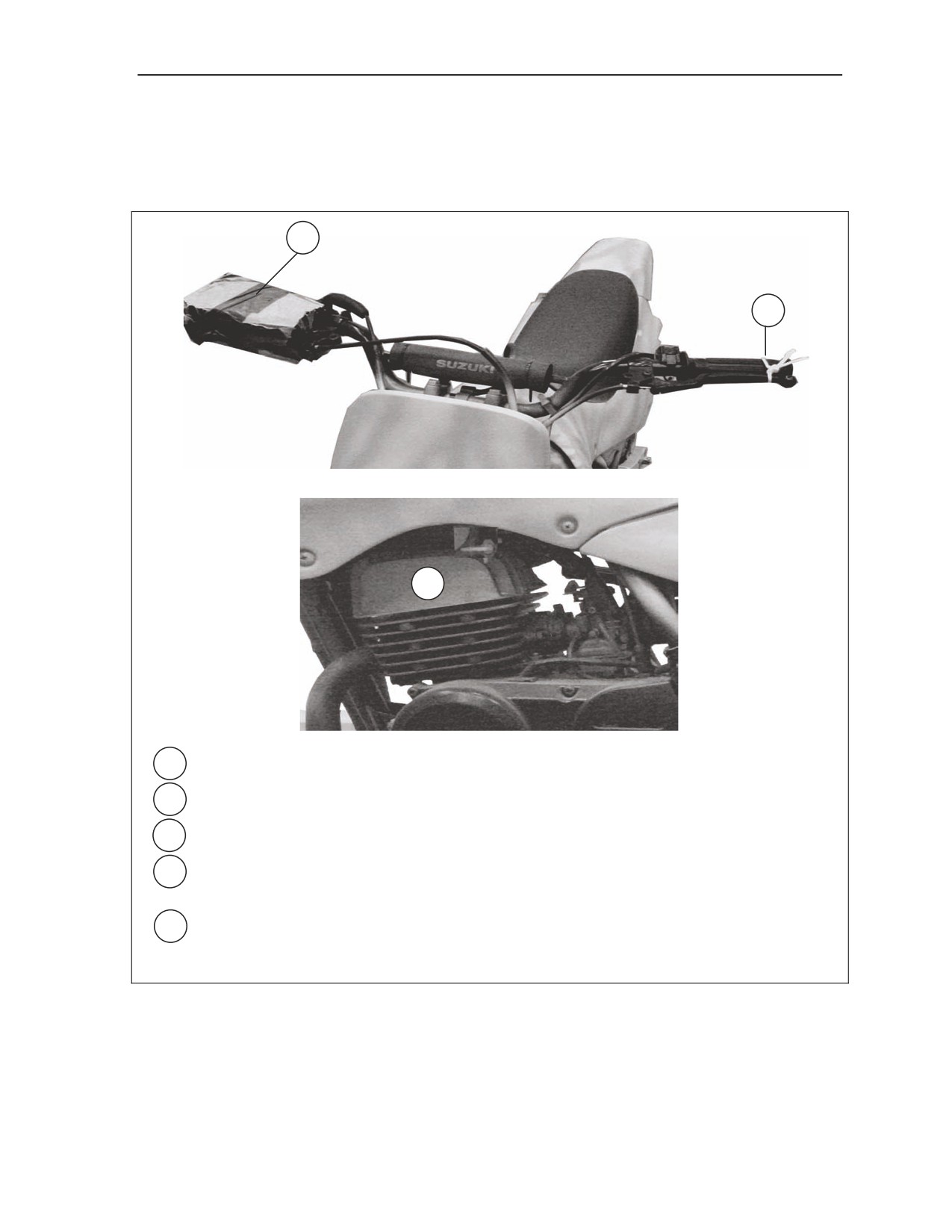
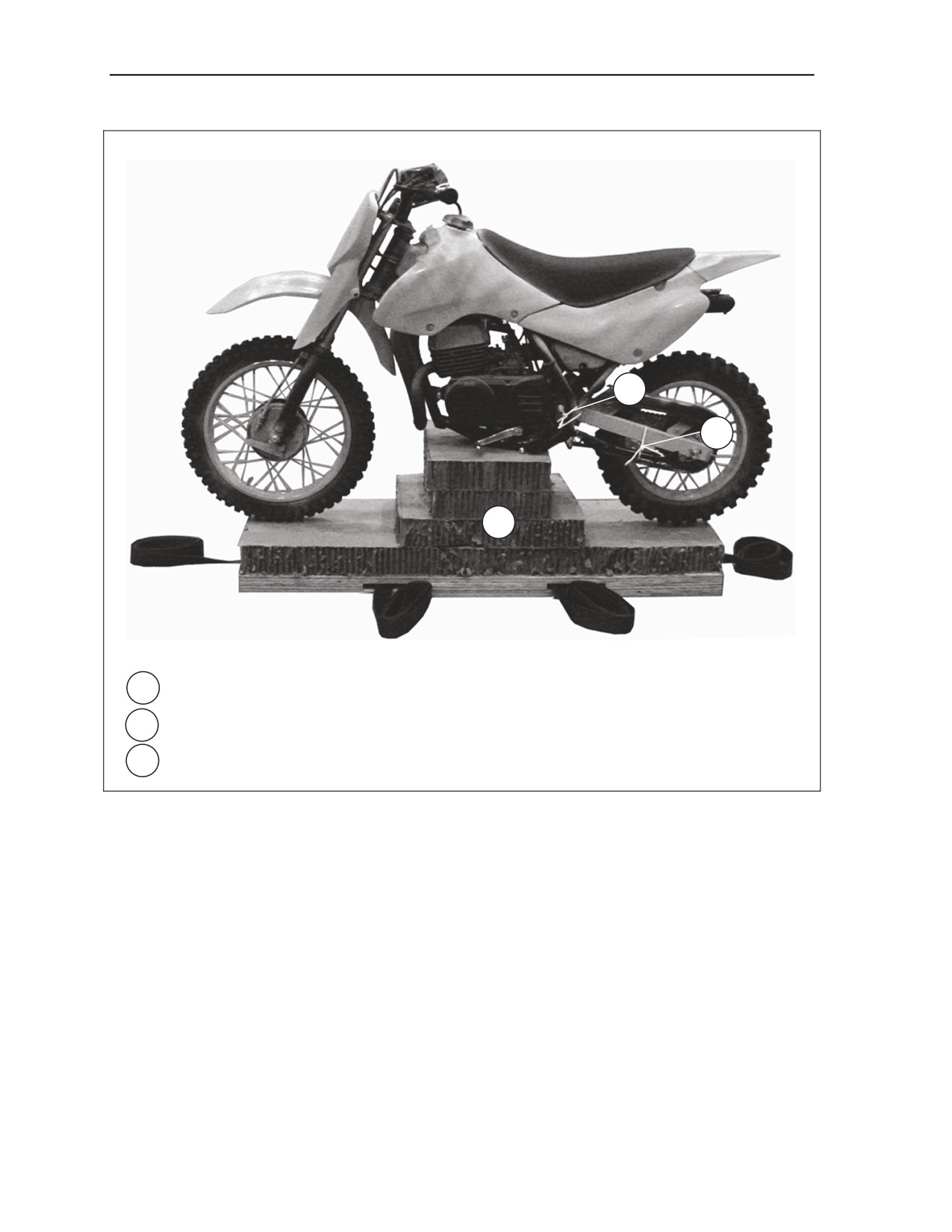
5-5. Prepare and position minibike as shown in Figures 5-5 and 5-6.
4
3
ON
OFF
5
1 Secure key with type III nylon cord (if equipped with a key) (Not Shown).
2 Make sure tank is at least half full, but no more than three fourths full.
3 Secure left handlebar lever to handlebar with type III nylon cord.
4 Wedge a piece of honeycomb between right handlebar and lever and secure with cloth-
backed adhesive tape.
5 Place gas valve in OFF position.
Figure 5-5. Minibike Prepared
10 September 2007
FM 4-20.108 /TO 13C7-2-491
5-5
Chapter 5
3
2
1
1 Place minibike on honeycomb centering engine on stack.
2 Secure kickstand in the up position with type III nylon cord.
3 Secure foot pegs up with type III nylon cord.
Figure 5-6. Minibike Positioned on Honeycomb
5-6
FM 4-20.108 /TO 13C7-2-491
10 September 2007
Rigging One Minibike for Door Bundle
PREPARING MINIBIKE AFTER POSITIONING
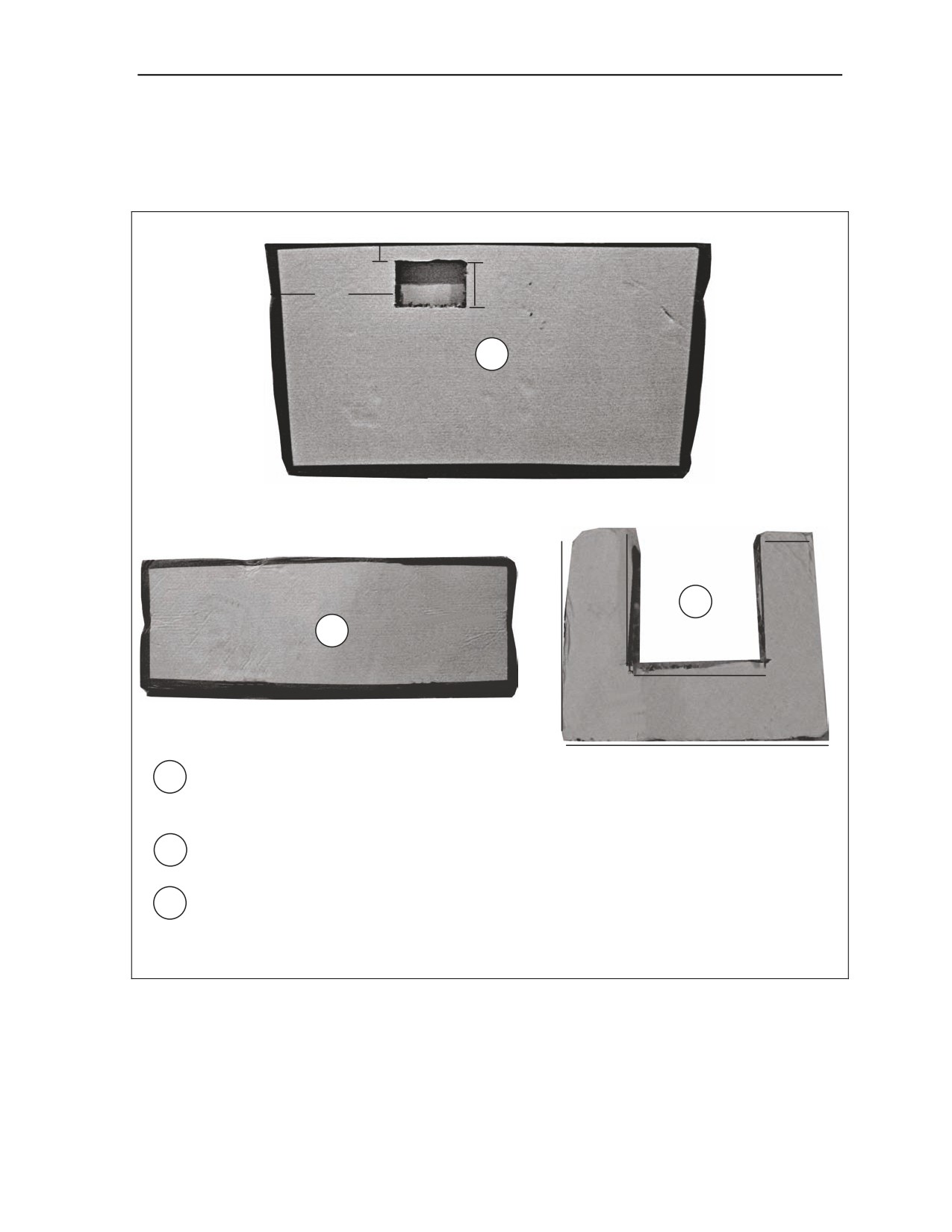
5-6. Cut honeycomb protectors and secure as shown in Figure 5-7.
2 1/2”
5 1/2”
14”
1
1 1/2”
5”
3
8”
2
7”
12”
1 Cut two 30- by 48-inch pieces of honeycomb. Make a 5 1/2- by 7 1/2-inch cutout in each
piece of honeycomb, 14 inches in from one side and 2 ½ inches down from the top as shown
above. Tape the edges with 2-inch cloth-backed adhesive tape.
2 Cut a 16- by 48-inch piece of honeycomb. Tape the edges with 2-inch cloth-backed adhesive
tape.
3 Cut four 8- by 12-inch pieces of honeycomb. Make a 5- by 7-inch cutout in each piece of
honeycomb, 1 1/2 inches in from one side and flush with the top as shown above.
Figure 5-7. Minibike Positioned and Prepared
10 September 2007
FM 4-20.108 /TO 13C7-2-491
5-7
Chapter 5
6
5
4
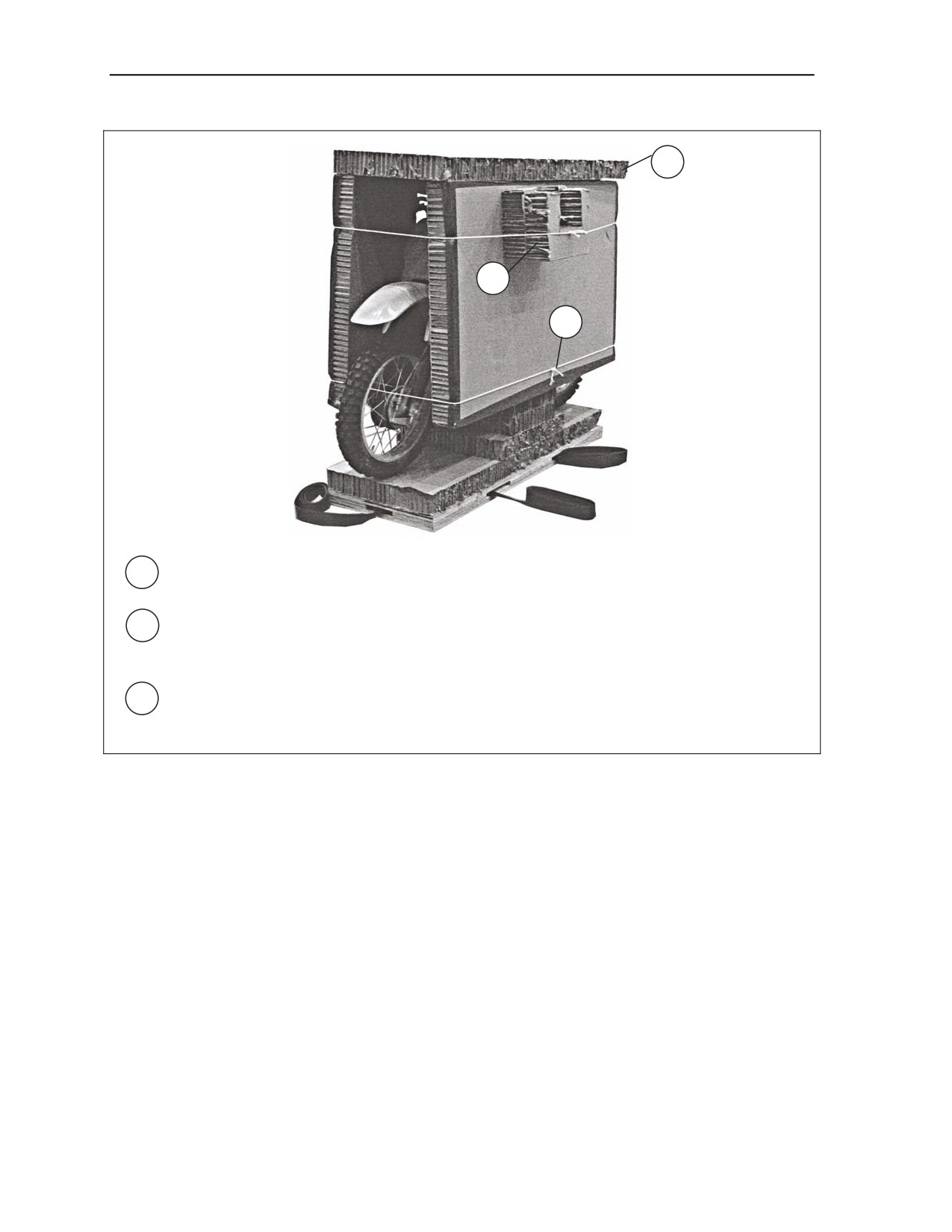
4 Secure the two 30- by 48-inch pieces of honeycomb. Place one piece on each side of the
minibike with type III nylon cord. Make sure the handlebars are sticking through cutout.
5 Secure two 8- by 12-inch pieces of honeycomb for each side. Place around the handlebars
with the open portion facing upwards and secure to the other piece of honeycomb from step
4.
6 Place the 16- by 48-inch piece of honeycomb centered and on top of the load.
Figure 5-7. Minibike Positioned and Prepared (Continued)
5-8
FM 4-20.108 /TO 13C7-2-491
10 September 2007
Rigging One Minibike for Door Bundle
SECURING THE MINIBIKE
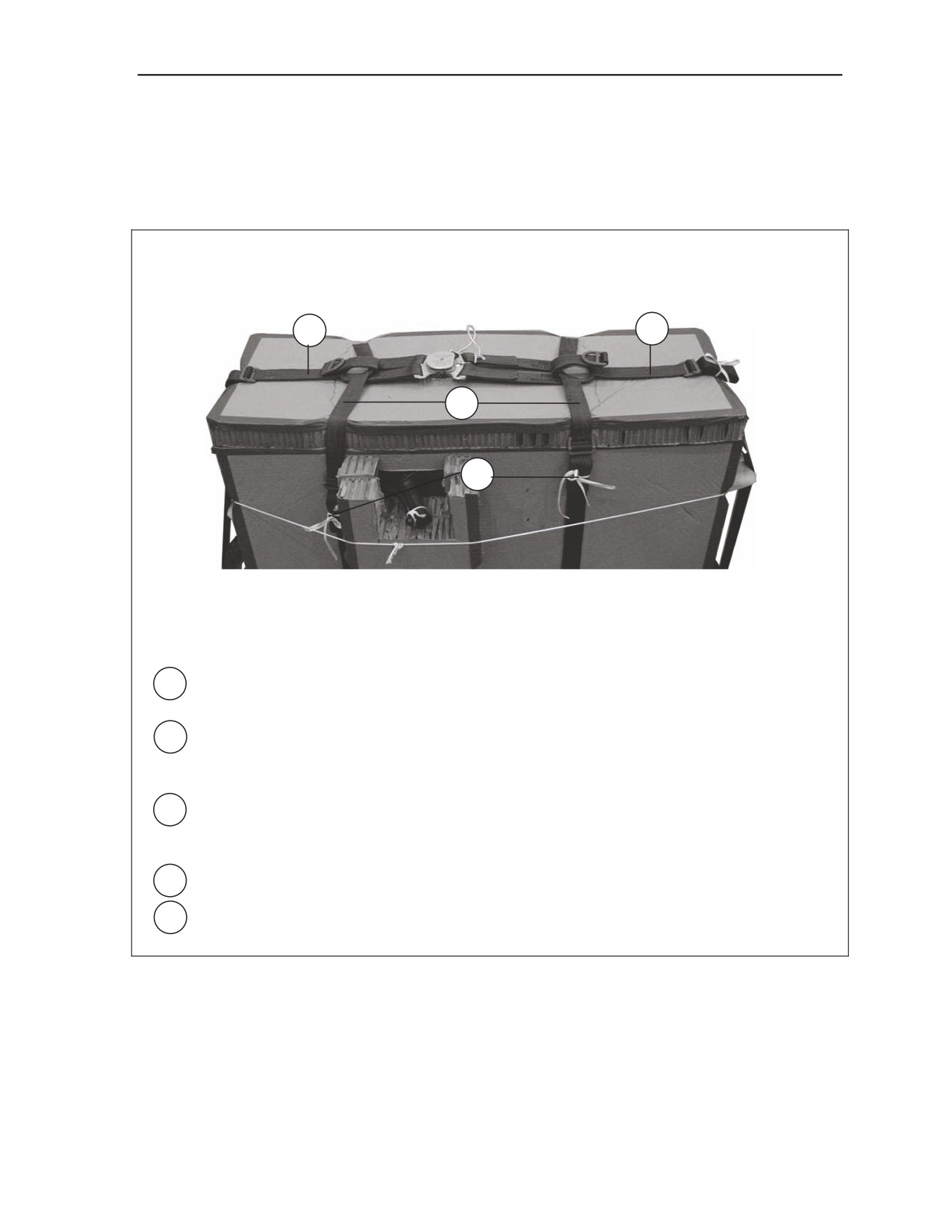
5-7. Secure the minibike to the CEP according to FM 4-20.103/MCRP 3-11.3C/NAVSEA SS400-AB-
MMO-010/TO 13C7-1-11as shown in Figure 5-8.
1
1
2
4
1 Lay two O-Ring straps on top of honeycomb. Pass the running ends of the 14-foot, type X
nylon webbing through each of the friction adapters.
2 Follow the procedures in FM 4-20.103/MCRP 3-11.3C/NAVSEA SS400-AB-MMO-010/TO
13C7-1-11, paragraph 6-4, steps 4-8, to attach the quick-release assembly and straps to the
running ends of the 12-foot, type X nylon webbing.
3 Keeping the quick-release assembly centered on the load, tighten the 14-foot, type X nylon
webbing strap. Make sure 14-foot strap is centered over the wheels, then tighten the 12-foot,
type X nylon webbing straps.
4 Secure the excess of each strap in place with type I, 1/4-inch cotton webbing or tape.
5 Tie the 14-foot strap to the wheels of the minibike with one turn doubled, type I, 1/4-inch
cotton webbing (Not Shown).
Figure 5-8. Minibike Secured
10 September 2007
FM 4-20.108 /TO 13C7-2-491
5-9
Chapter 5
STOWING CARGO PARACHUTE
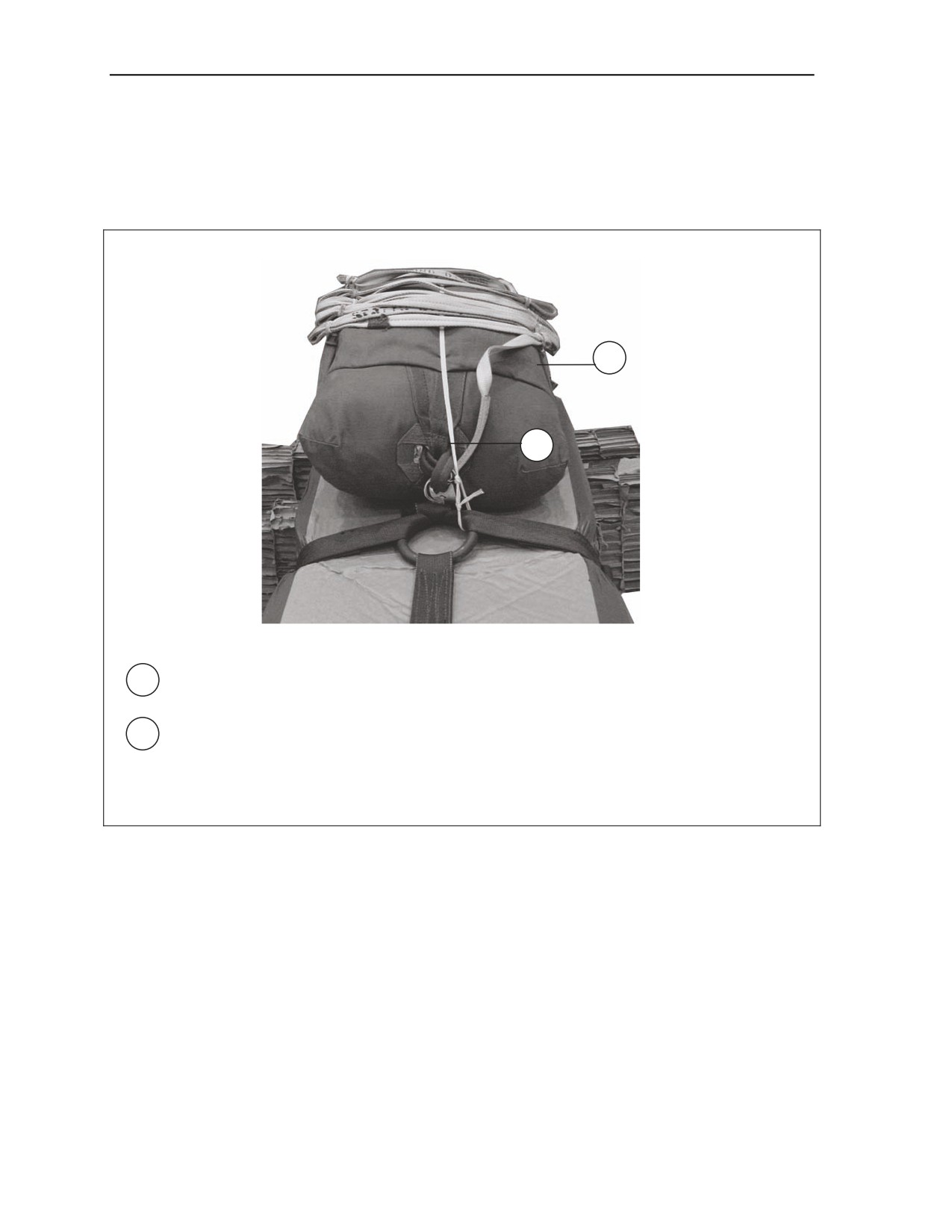
5-8. Prepare, stow, and restrain one T-10 cargo parachute centered according to FM 4-20.103/MCRP 3-
11.3C/NAVSEA SS400-AB-MMO-010/TO 13C7-1-11 and as shown in Figure 5-9.
1
2
1 Adapt procedures in FM 4-20.103/MCRP 3-11.3C/NAVSEA SS400-AB-MMO-010/TO 13C7-
1-11, paragraph 6-5, to install the T-10 cargo parachute on the load.
2 Secure the parachute to the load using a length of type I, 1/4-inch cotton webbing. Tie one
end to the O-ring on the front of the load. Route the webbing underneath the static line to the
other O-ring and secure with a trucker’s hitch.
Figure 5-9. Cargo Parachute Stowed
5-10
FM 4-20.108 /TO 13C7-2-491
10 September 2007
Rigging One Minibike for Door Bundle
POSITIONING EXTRACTION PARACHUTE
5-9. Select the extraction parachute and extraction line needed using the extraction line requirements
table in FM 4-20.102/MCRP 4-11.3J/NAVSEA SS400-AB-MMO-010/TO 13C7-1-5. Place the extraction
parachute and extraction line bag on the load for installation inside the aircraft.
INSTALLING PROVISIONS FOR EMERGENCY RESTRAINTS
5-10. Select and install provisions for emergency restraints according to the emergency aft restraints
requirements in FM 4-20.102/MCRP 4-11.3J/NAVSEA SS400-AB-MMO-010/TO 13C7-1-5.
MARKING RIGGED LOAD
5-11. Mark the rigged load according to FM 4-20.102/MCRP 4-11.3J/NAVSEA SS400-AB-MMO-
010/TO 13C7-1-5 and as shown in Figure 5-10. Complete the Shipper’s Declaration for Dangerous
Goods. If the load varies from the one shown, the weight, height, length, and parachute requirements must
be recomputed.
EQUIPMENT REQUIRED
5-12. The equipment required to rig this load is listed in Table 5-1.
10 September 2007
FM 4-20.108 /TO 13C7-2-491
5-11
Chapter 5
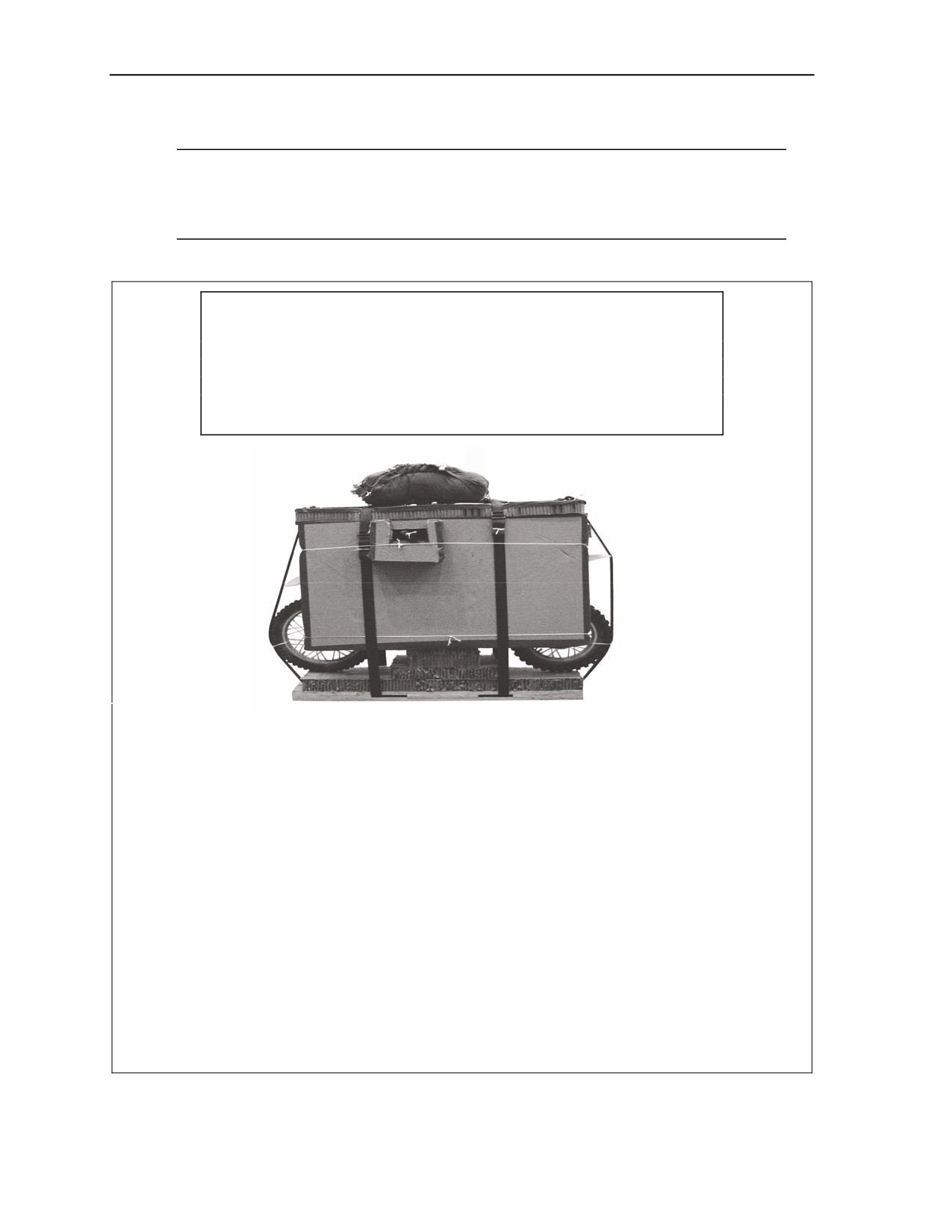
Note. This bundle is approved to exit the troop doors of the C-17 and the C-130 aircraft with
the 56 inches in the vertical/upright position and the 61 inches in the horizontal position. Two
qualified pushers must be used to eject this bundle from the troop door due to its awkward size.
Coordinate actions during Loadmaster/Jumpmaster brief prior to flight.
CAUTION
Make the final rigger inspection required by FM 4-20.102/MCRP 4-
11.3J/NAVSEA SS400-AB-MM0-010/TO 13C7-1-5 and AR 59-4/
OPNAVINST 4630.24C/AFJ 13-210(I)/MCO 13480.1B before the
load leaves the rigging site.
RIGGED LOAD DATA
Weight
210 pounds
Maximum Weight Allowed
500 pounds
Height
56 inches
Width
27 inches
Length
61 inches
Overhang: Front
0 inches
Rear
0 inches
Center of Balance (from front edge of platform)
0 inches
Figure 5-10. Minibike Rigged as Door Bundle
5-12
FM 4-20.108 /TO 13C7-2-491
10 September 2007
Rigging One Minibike for Door Bundle
Table 5-1. Equipment Required for Rigging the Minibike as a Door Bundle
National Stock Number
Item
Quantity
8040-00-273-8713
Adhesive, paste, 1-gal
As required
1670-00-753-3928
Pad, energy-dissipating, honeycomb
1 sheet
P/N 11-1-466
Parachute, cargo, T-10 (modified)
1
Plywood:
5530-00-128-4981
¾-in by 48- by 96- inch sheet
1 sheet
Nail, steel wire, common:
5315-00-010-4659
8d
As required
(or)
wood screws,1 1/2-inch
As required
1670-00-131-9695
Quick Release Assembly
1
1670-00-360-0533
Strap, quick release, fixed
1
1670-00-360-0532
Strap, webbing, quick release
3
1670-00-360-0542
Strap, webbing, ring
2
7510-00-266-5016
Tape, adhesive, 2-inch, OD
As required
7510-00-266-6710
Tape, masking, 2-inch
As required
Webbing:
4020-00-240-2146
Cord, nylon, type III, 550-lb
As required
8305-00-268-2411
Cotton, type I, ¼-inch
As required
8305-00-261-8584
Nylon, type X
As required
10 September 2007
FM 4-20.108 /TO 13C7-2-491
5-13
This page intentionally left blank.
Chapter 6
Rigging One Motorcycle for Low-Velocity Airdrop
DESCRIPTION OF LOAD
6-1. The motorcycle is rigged on a 32- by 88-inch Combat Expendable Platform (CEP) with one G-14 or
T-10C cargo parachute. The load is rigged for a low velocity, over the ramp airdrop from a C-130, C-141
or C-17 aircraft.
BUILDING COMBAT EXPENDABLE PLATFORM
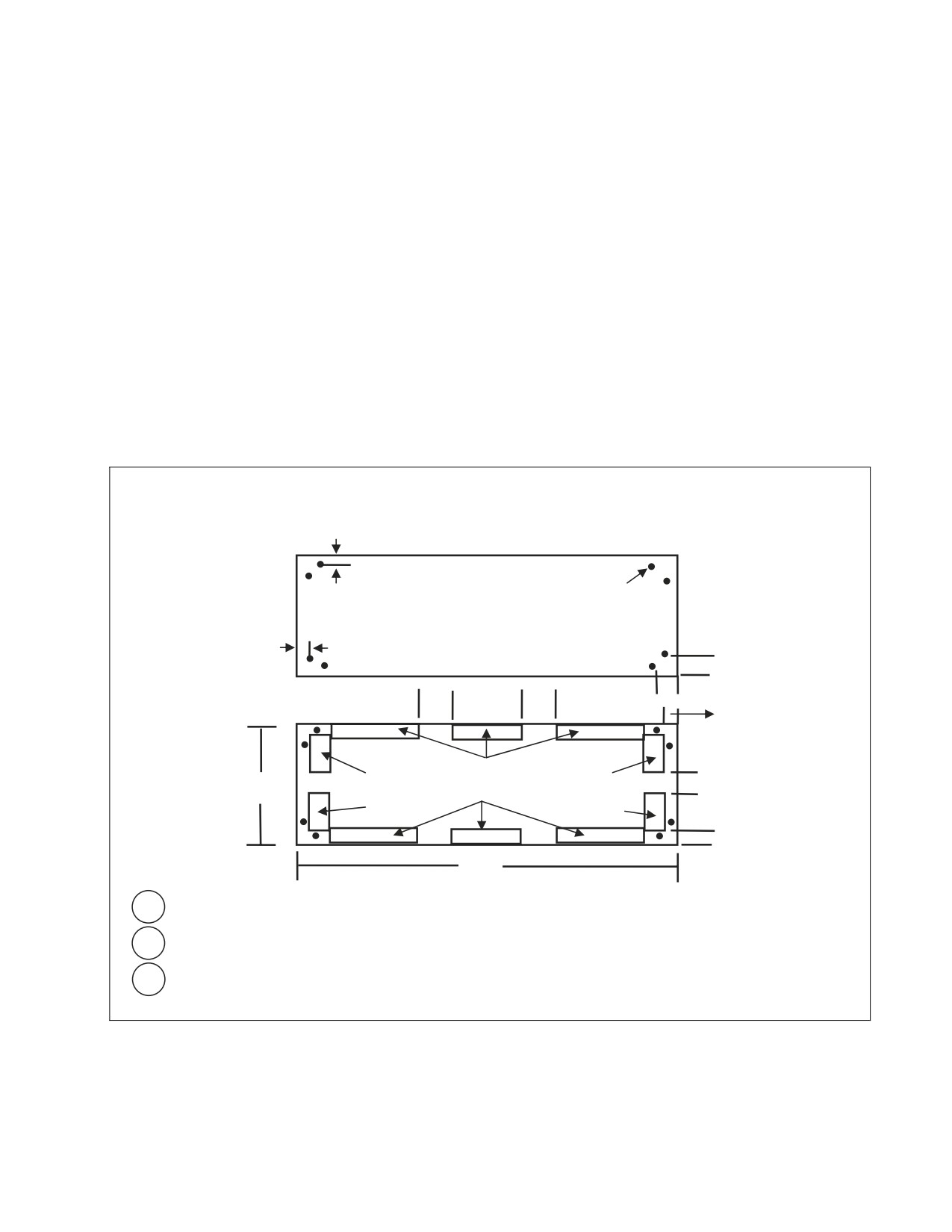
6-2. Build a 32- by 88-inch CEP as shown in Figure 6-1.
Notes.
1. Not drawn to scale.
2.
All dimensions are given in inches.
3.
All holes are 1/2-inch in diameter and 2 inches in from sides.
4.
Use 8d common nails or 2-inch long, #4 wood screws.
2”
1/2” Holes
¾” x 32” x 88” Plywood
2”
5”
5”
7”
7”
3”
2” x 4” x 20”
2” x 4” x 10”
2” x 4” x 10”
6”
32”
Lumber
Lumber
Lumber
3”
88”
1 Drill two 1/2-inch holes in each corner of both pieces of plywood.
2 Nail the lumber to one piece of plywood with 8d nails.
3 Nail the second piece of plywood to the lumber with 8d nails.
Figure 6-1. Building Combat Expendable Platform (CEP)
10 September 2007
FM 4-20.108 /TO 13C7-2-491
6-1
Chapter 6
PREPARING COMBAT EXPENDABLE PLATFORM (CEP)
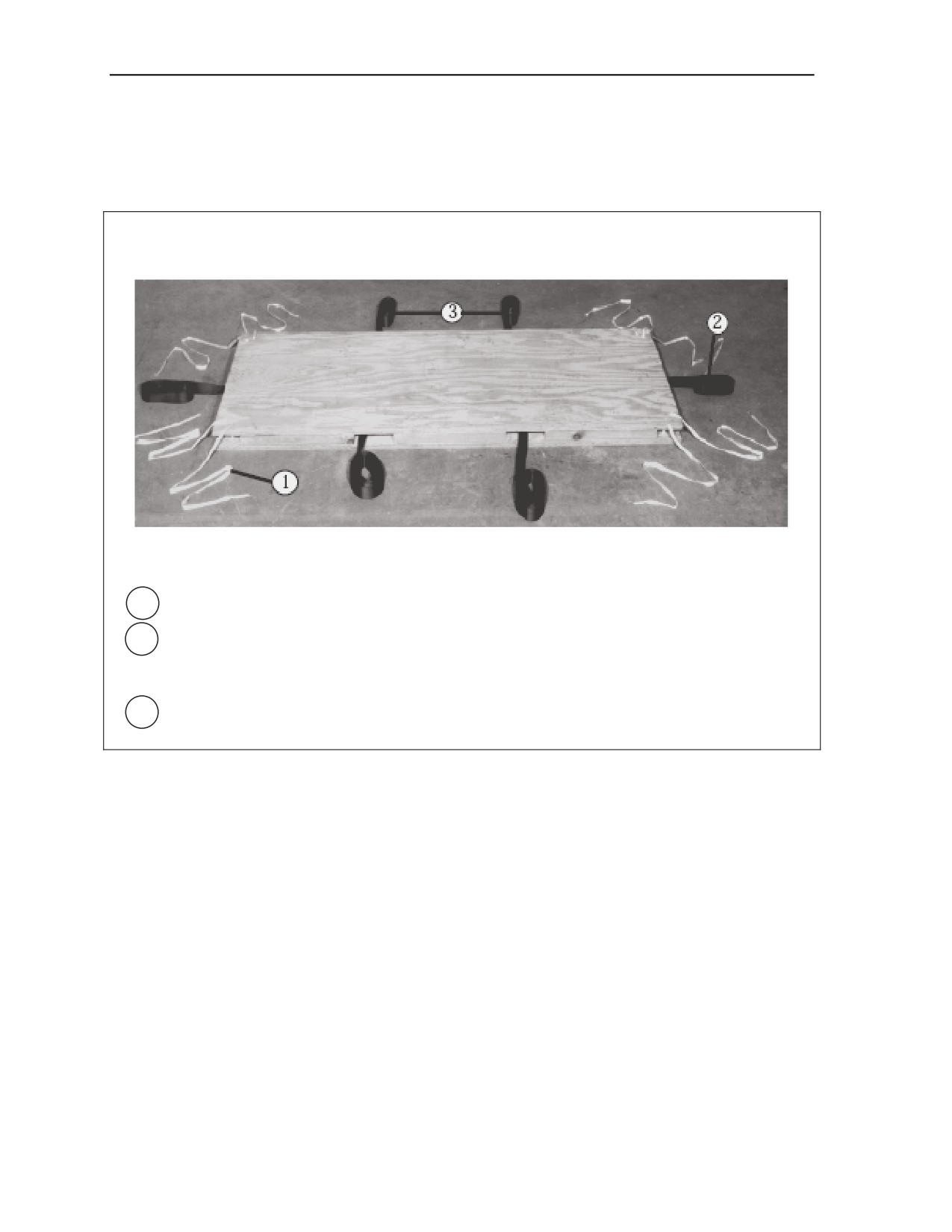
6-3. Prepare the platform as shown in Figure 6-2.
1 Run an 18-foot length of 1/2-inch tubular nylon webbing through each pair of corner holes.
2 Run a 24-foot length of type X or XIII nylon webbing lengthwise through the platform and fit a
D-ring to each end according to FM 4-20.102/MCRP 4-11.3J/NAVSEA SS400-AB-MMO-
010/TO 13C7-1-5.
3 Run two 18-foot lengths of type X or XIII nylon webbing crosswise through the platform.
Figure 6-2. Combat Expendable Platform Prepared
6-2
FM 4-20.108 /TO 13C7-2-491
10 September 2007
Rigging One Motorcycle for Low-Velocity Airdrop
BUILDING AND POSITIONING HONEYCOMB STACK
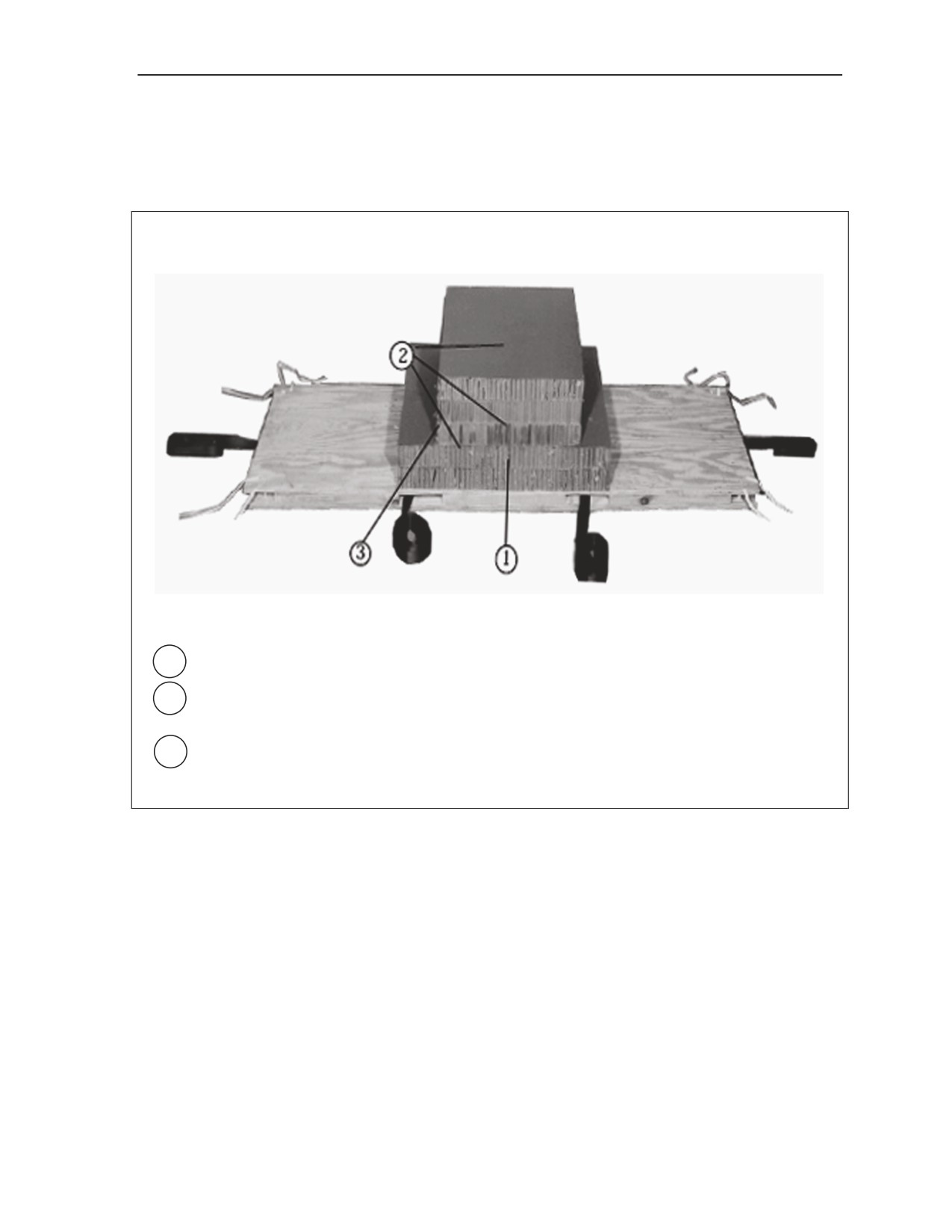
6-4. Build a honeycomb stack and position it on the platform as shown in Figure 6-3.
1 Glue two 32- by 36-inch pieces of honeycomb together.
2 Glue three 24- by 32-inch pieces of honeycomb together and glue the pieces to the top
center 32- by 36-inch piece of honeycomb.
3 Center the honeycomb from front to rear on the platform and glue it in place.
Figure 6-3. Honeycomb Stack Built and Positioned
10 September 2007
FM 4-20.108 /TO 13C7-2-491
6-3
Chapter 6
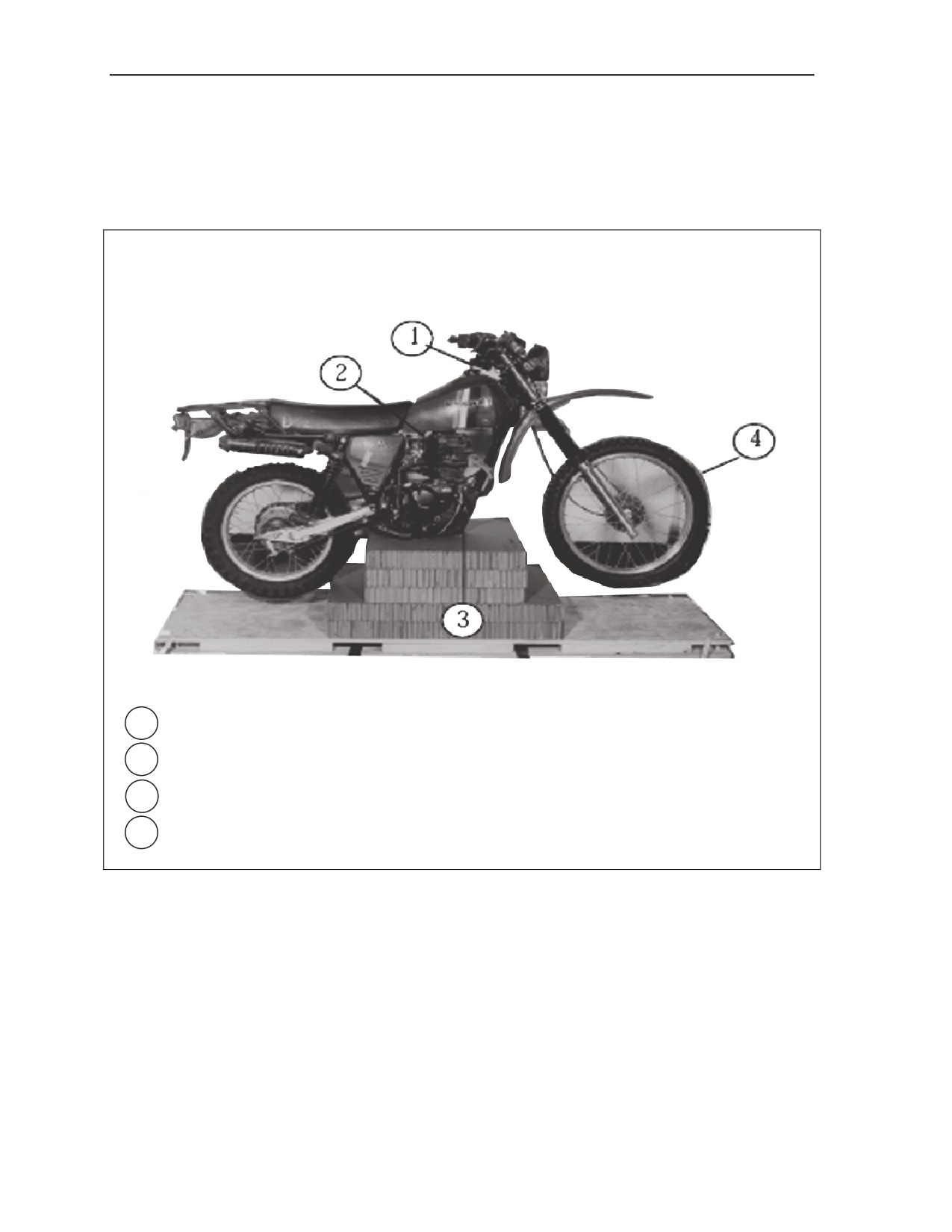
PREPARING AND POSITIONING MOTORCYCLE ON CEP
6-5. Prepare and position the motorcycle on the Combat Expendable Platform (CEP) as shown in Figure
6-4.
Notes.
1. Not drawn to scale.
2.
The fuel should be no higher than 3 inches below the filler cap.
3.
Make sure the frame protecting the engine is sitting on the honeycomb stack.
1 Make sure the fuel tank is at least half full but no more than three-fourths full.
2 Tie the kick-start lever up with type III, nylon cord.
3 Fold the foot-rest up.
4 Set the motorcycle on the honeycomb stack with the front tire flush with the front edge of the
platform.
Figure 6-4. Motorcycle Built and Positioned on Honeycomb
6-4
FM 4-20.108 /TO 13C7-2-491
10 September 2007
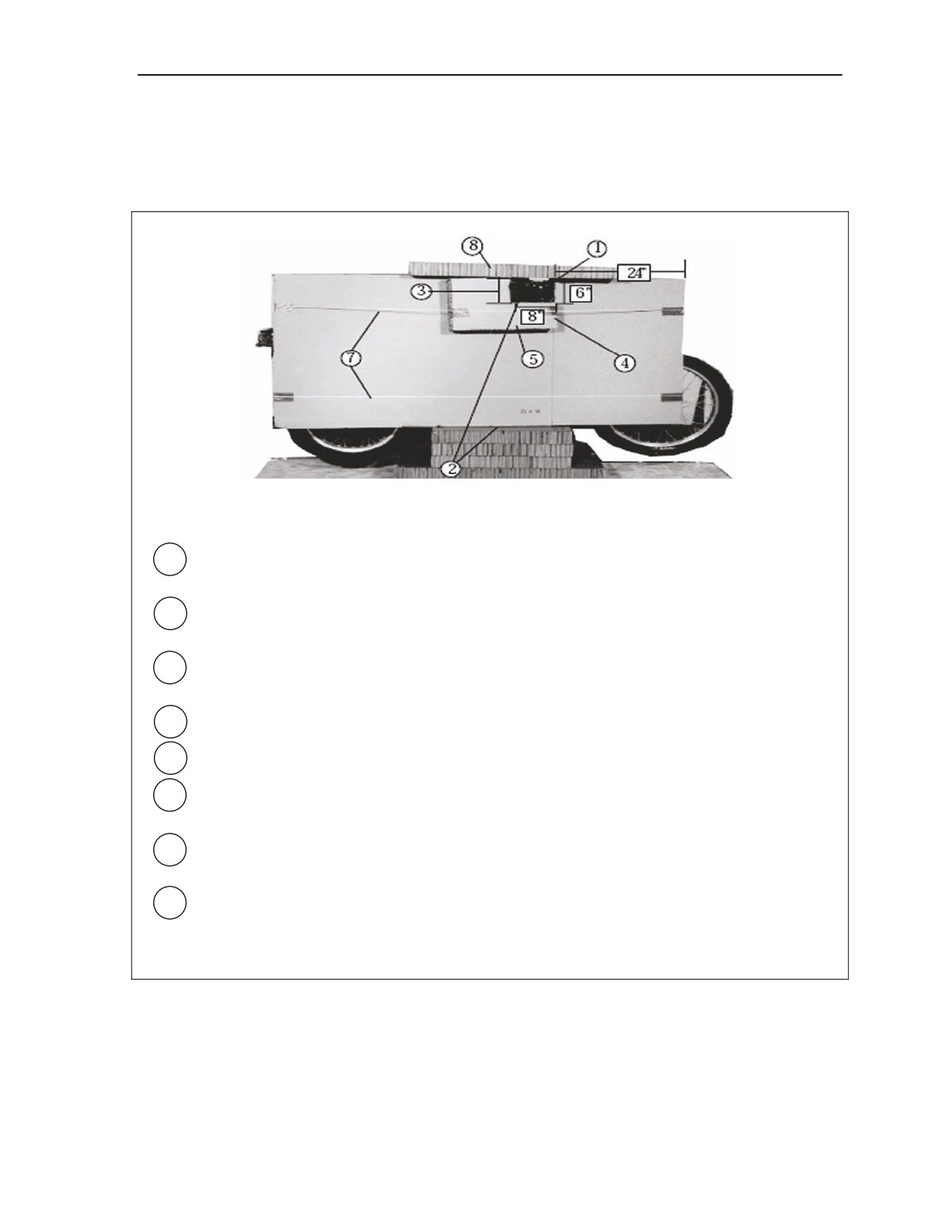
Rigging One Motorcycle for Low-Velocity Airdrop
PROTECTING THE MOTORCYCLE
6-6. Tie honeycomb protectors to the motorcycle as shown in Figure 6-5.
1 Make a 6- by 8-inch cutout in the 72-inch edge of a 36- by 72-inch piece of honeycomb, 24
inches from the front edge.
2 Set the protector on the right side of the motorcycle. Rest the bottom edge of the protector
on the honeycomb stack. Align the cutout with the handlebar.
3 Cut a 6- by 8-inch piece of honeycomb from a corner of two 12- by 18-inch pieces of
honeycomb per side.
4 Align the cutouts (protector) and glue the pieces together.
5 Place the 12- by 18-inch pieces of honeycomb to the rear of the cutouts.
6 Repeat steps 2 through 5 and set a second protector on the left side of the motorcycle (Not
Shown).
7 Tie the protectors in place with lengths of type III nylon cord. Use tape on the protectors to
keep the cord from cutting the protectors.
8 Lay a 32- by 36-inch piece of honeycomb on the protectors so that the 36-inch side of the
honeycomb is parallel with the long side of the platform.
Figure 6-5. Motorcycle Protected
10 September 2007
FM 4-20.108 /TO 13C7-2-491
6-5
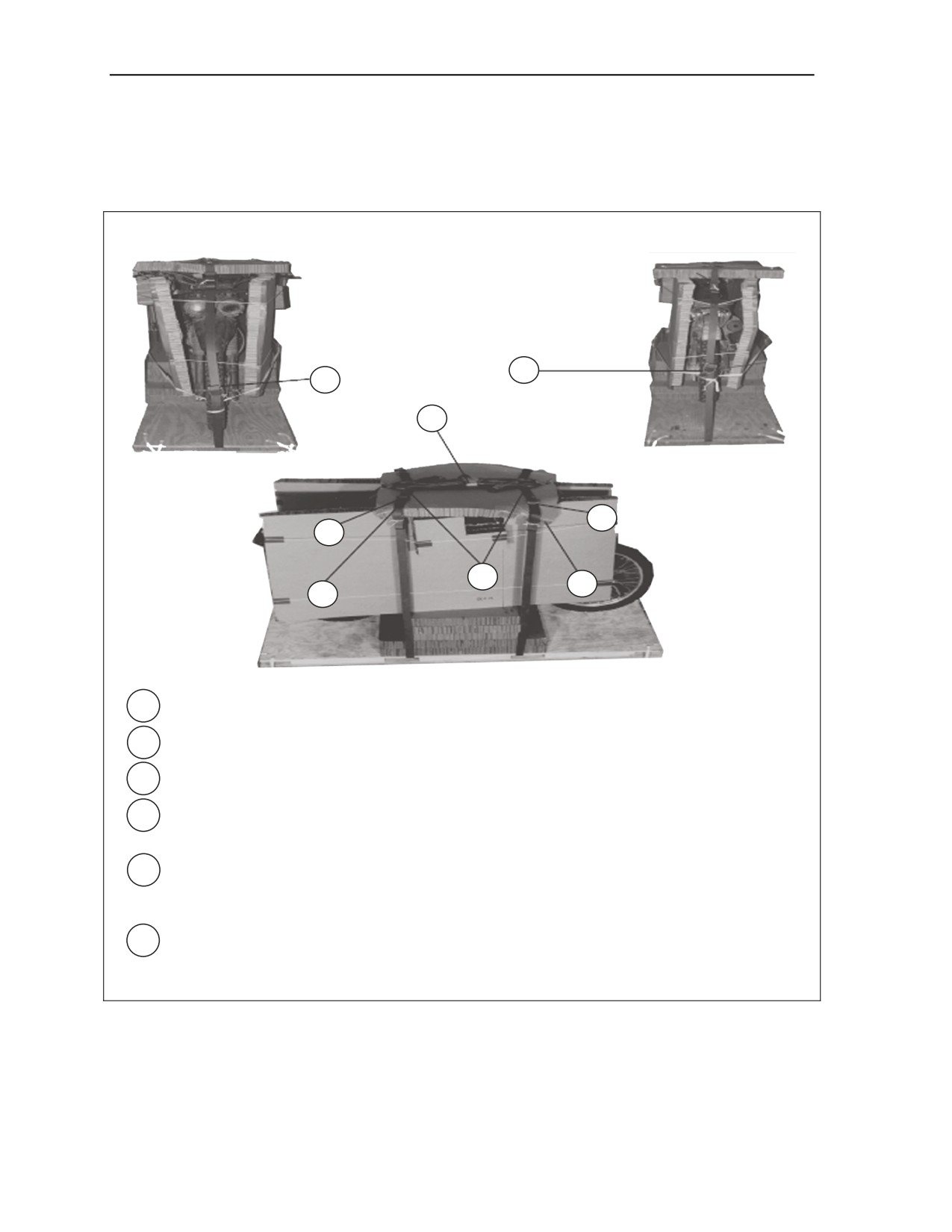
Chapter 6
SECURING THE MOTORCYCLE TO CEP
6-7. Secure the motorcycle to the Combat Expendable Platform (CEP) as shown in Figures 6-6 and 6-7.
Notes.
1. The D-ring found on the 24-foot straps is for aircraft release gate.
2.
Ensure the D-ring on the 24-foot straps remain 24 inches above the platform.
5
5
1
3
3
2
5
5
1 Lay the A-21 quick-release assembly on top of the honeycomb.
2 Fit the A-21 O-ring strap to both ends of the 24-foot strap.
3 Fit the A-21 quick-release strap on both ends of the 18-foot straps.
4 Adapt procedures in FM 4-20.103/MCRP 3-11.3C/NAVSEA SS400-AB-MMO-010/TO 13C7-
1-11 to close the A-21 sling assembly.
5 Pull the 18- and 24-foot straps taut, keeping the release box in the center of the honeycomb
and allowing the honeycomb to bend under the straps. Ensure the D-ring on the 24-foot
strap is 24 inches above the platform.
6 Fold the excess straps and tie the folds in place with type I, 1/4-inch cotton webbing. Tape
may be used in place of the webbing.
Figure 6-6. Motorcycle Secured to the CEP
6-6
FM 4-20.108 /TO 13C7-2-491
10 September 2007
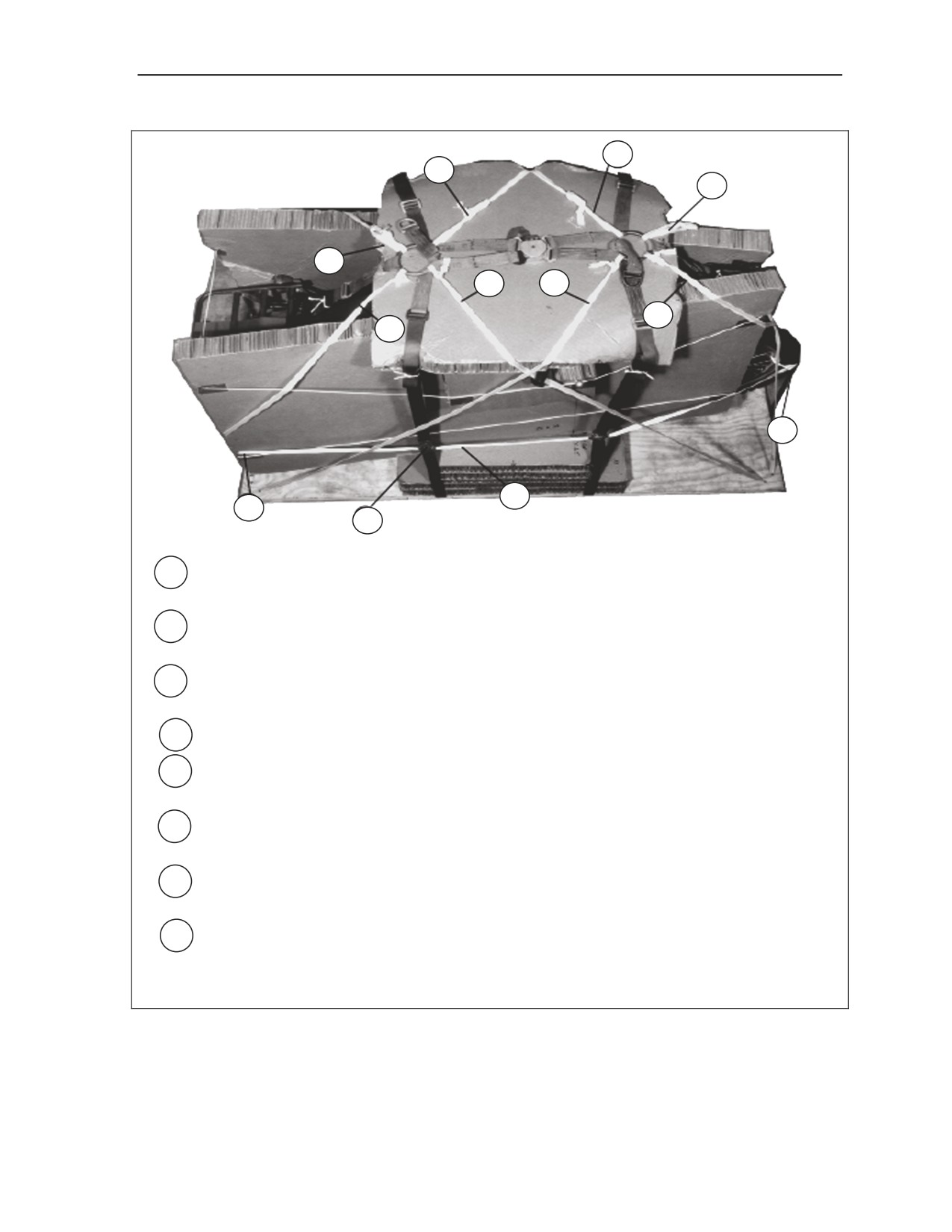
Rigging One Motorcycle for Low-Velocity Airdrop
14
12
11
13
11
13
12
14
7
8
9
10
7
Run an additional 20-foot length of 1/2-inch tubular, nylon webbing completely around the
front tire and the 24-foot, type X, nylon webbing. Safety the tubular nylon with a square knot.
8
Run the ends of the 1/2-inch tubular, nylon webbing along each side of the load. Tie it to
both 18-foot lengths of type X, nylon webbing on each side of the load with a square knot.
9
Run the ends of the 1/2-inch tubular, nylon webbing completely around the rear tier and the
24-foot, type X, nylon webbing. Safety the tubular nylon with a square knot (Not Shown).
10
Tape the tubular nylon ties to the 18-foot, type X, nylon webbing on each side of the load.
11
Pass one end of the right front skid board tie around the front wheel and tie it to the front
steel ring. Tie the other end of the skid board tie to the rear steel ring.
12
Pass one end of the left front skid board tie around the front wheel and tie it to the front steel
ring. Tie the other end of the skid board tie to the rear steel ring.
13
Tie one end of the right rear skid board tie to the front steel ring. Pass the other end of the
skid board tie around the rear of the load and tie it to the rear steel ring.
14
Tie one end of the left rear skid board tie to the front steel ring. Pass the other end of the
skid board tie around the rear of the load and tie it to the rear steel ring.
Figure 6-6. Motorcycle Secured to the CEP (Continued)
10 September 2007
FM 4-20.108 /TO 13C7-2-491
6-7
Chapter 6
STOWING CARGO PARACHUTES
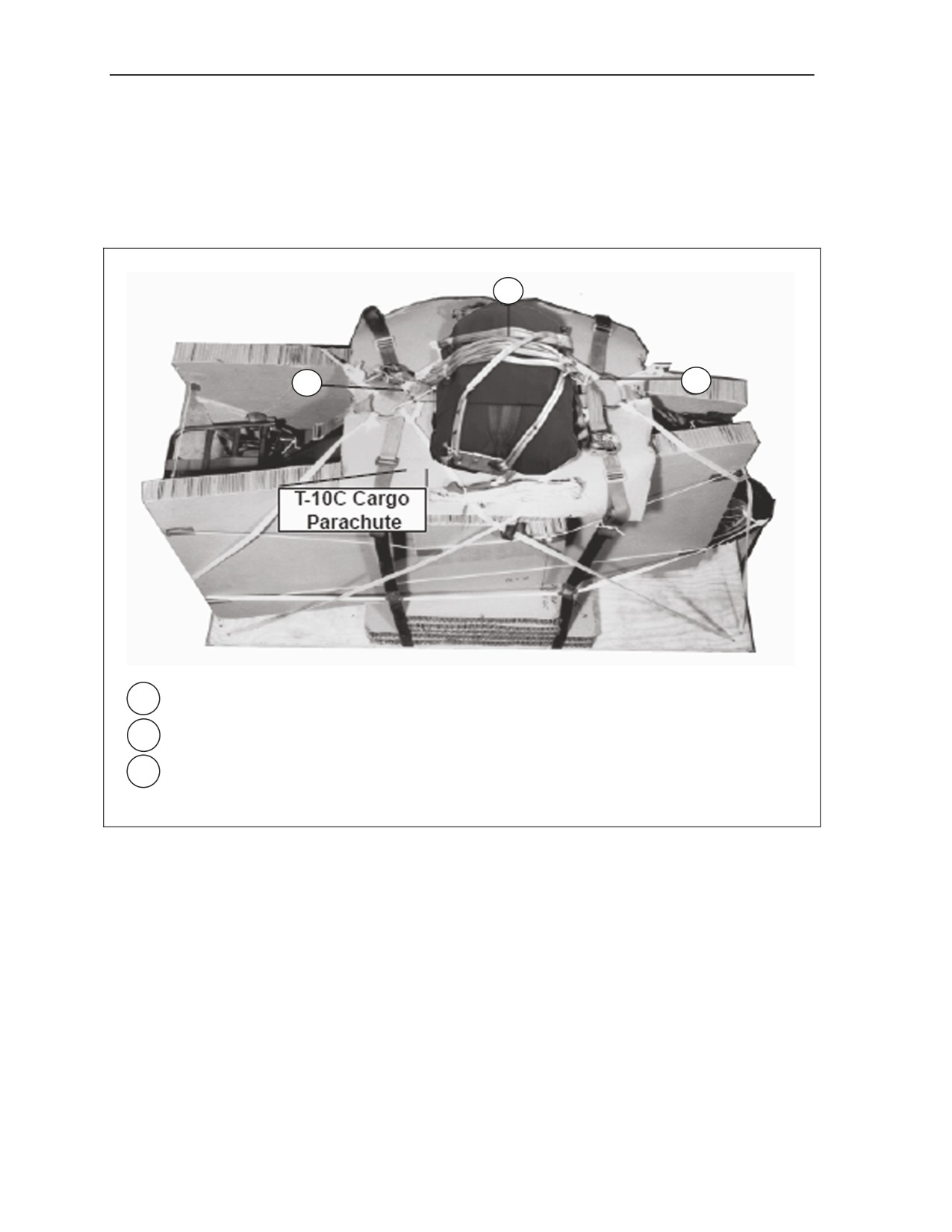
6-8. Select either a G-14 or T-10 cargo parachute. Attach a G-14 or T-10 cargo parachute to the load
according to FM 4-20.103/MCRP 3-11.3C/NAVSEA SS400-AB-MMO-010/TO 13C7-1-11. Secure the
parachute to the load as shown in Figure 6-7.
2
3
1
1 Tie one end of a length of type I, 1/4-inch cotton webbing to the front O-ring.
2 Run the type I, 1/4-inch cotton webbing over the T-10C cargo parachute.
3 Tie the free end of the type I, 1/4-inch cotton webbing to the rear O-ring.
Figure 6-7. Cargo Parachute Stowed
6-8
FM 4-20.108 /TO 13C7-2-491
10 September 2007
Rigging One Motorcycle for Low-Velocity Airdrop
POSITIONING EXTRACTION PARACHUTE
6-9. Select the extraction parachute and extraction line needed using the extraction line requirements
table in FM 4-20.102/MCRP 4-11.3J/NAVSEA SS400-AB-MMO-010/TO 13C7-1-5. Place the extraction
parachute and extraction line bag on the load for installation inside the aircraft.
INSTALLING PROVISIONS FOR EMERGENCY RESTRAINTS
6-10. Select and install provisions for emergency restraints according to the emergency aft restraints
requirements in FM 4-20.102/MCRP 4-11.3J/NAVSEA SS400-AB-MMO-010/TO 13C7-1-5.
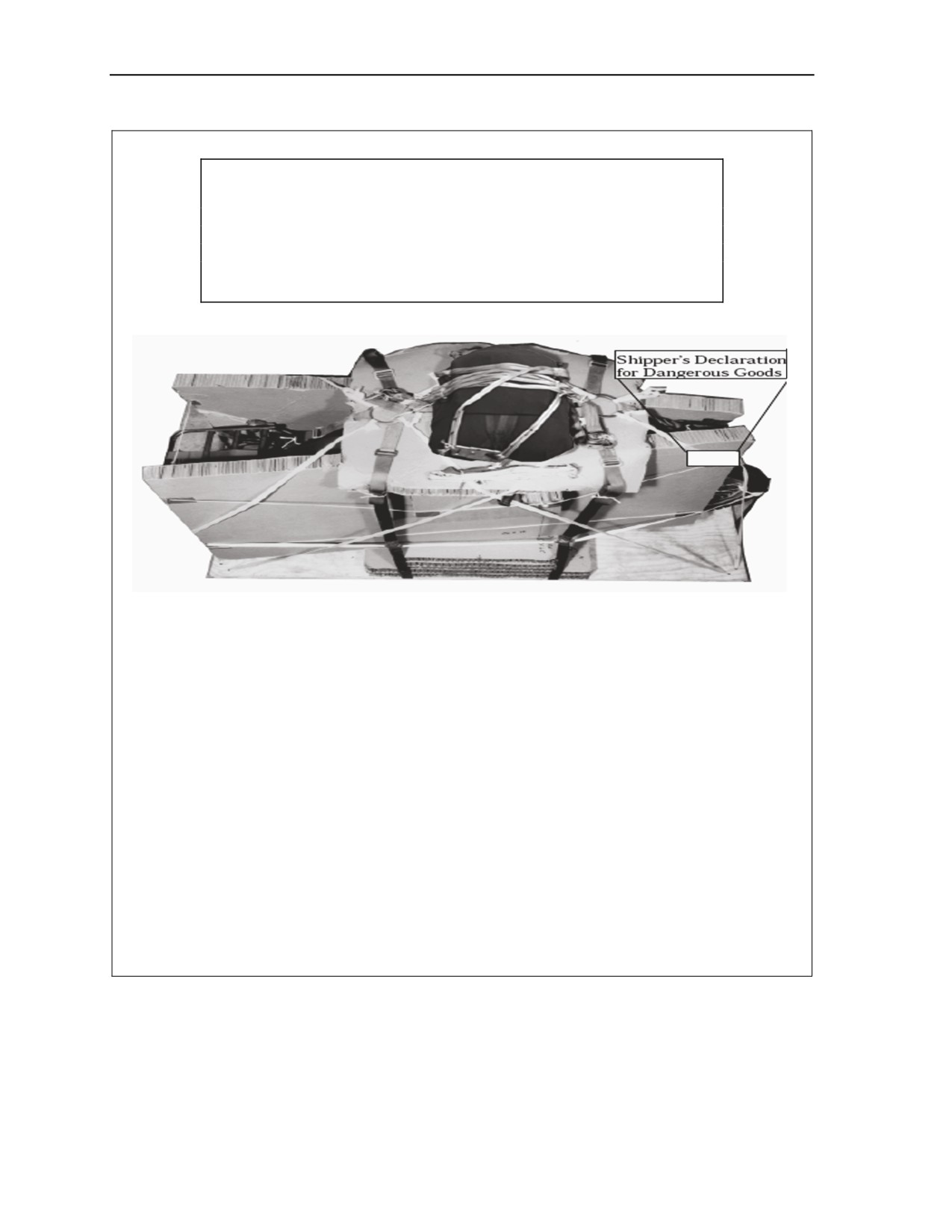
MARKING RIGGED LOAD
6-11. Mark the rigged load according to FM 4-20.102/ MCRP 4-11.3J/NAVSEA SS 400-AB-MMO-
010/TO 13C7-1-5 and as shown in Figure 6-8. Complete the Shipper’s Declaration for Dangerous Goods.
If the load varies from the one shown, the weight, height, length, center of balance (CB), and parachute
requirements must be recomputed.
EQUIPMENT REQUIRED
6-12. Use the equipment listed in Table 6-1 to rig this load.
10 September 2007
FM 4-20.108 /TO 13C7-2-491
6-9
Chapter 6
CAUTION
Make the final rigger inspection required by FM 4-20.102/MCRP 4-
11.3J/NAVSEA SS400-AB-MM0-010/TO 13C7-1-5 and AR 59-
4/OPNAVINST 4630.24C/AFJ 13-210(I)/MCO 13480.1B before the
load leaves the rigging site.
RIGGED LOAD DATA
Weight
485 pounds
Maximum Weight
500 pounds
Height
71 inches
Width
32 inches
Length
88 inches
Overhang: Front
0 inches
Rear
0 inches
Center of Balance (from front edge of platform)
0 inches
Figure 6-8. Single Motorcycle Rigged for Low-Velocity Airdrop
6-10
FM 4-20.108 /TO 13C7-2-491
10 September 2007
Rigging One Motorcycle for Low-Velocity Airdrop
Table 6-1. Equipment Required for Rigging a Single Motorcycle for Low-Velocity Airdrop
National Stock Number
Item
Quantity
8040-00-273-8713
Adhesive paste, 1-gal
As required
5365-00-937-0147
D-Ring
2
5510-00-220-6146
Lumber:
2- by 4- by 10-inches
4
2- by 4- by 20-inches
6
5315-00-010-4659
Nail, steel wire, common:
8d
As required
1670-00-753-3928
Pad, energy-dissipating, honeycomb
3 sheets
Parachute:
1670-00-999-2658
Cargo, G-14
1
P/N 11-1-466
Cargo, T-10C
1
5530-00-128-4981
Plywood:
3/4-in by 48- by 96- inch sheet
2
1670-00-131-9695
Quick release assembly
1
1670-00-360-0533
Strap, quick release, fixed
1670-00-360-0532
Strap, webbing, quick release
1670-00-360-0542
Strap, webbing, ring
2
7510-00-266-5016
Tape, adhesive, 2-inch, OD
As required
7510-00-266-6710
Tape, masking, 2-inch
As required
Webbing:
8305-00-268-2411
Cotton, type I, 1/4-inch
As required
8305-00-268-2453
Nylon, tubular, 1/2-inch, natural
As required
8305-00-261-8584
Nylon, type X
As required
(or)
8305-00-260-4586
Nylon, type XIII
As required
10 September 2007
FM 4-20.108 /TO 13C7-2-491
6-11
This page intentionally left blank.
Chapter 7
Rigging Two Motorcycles for Low-Velocity Airdrop
NOTICE OF EXCEPTION
The procedures in this Chapter are different from those in FM 4-
20.103/MCRP 3-11.3C/NAVSEA SS400-AB-MMO-010/TO 13C7-1-11.
An exception to FM 4-20.103/MCRP 3-11.3C/NAVSEA SS400-AB-
MMO-010/TO 13C7-1-11 is granted. The procedures in this Chapter
must be followed.
DESCRIPTION OF LOAD
7-1. Two motorcycles are rigged in two A-22 cargo bags on a 48- by 96-inch Combat Expendable
Platform (CEP) with one G-12E cargo parachute. The load is rigged for low-velocity airdrop over the
ramp from C-130 and C-17 aircraft. Each motorcycle is 35 inches wide, 49 inches high, 88 inches long,
and each weighs 275 pounds.
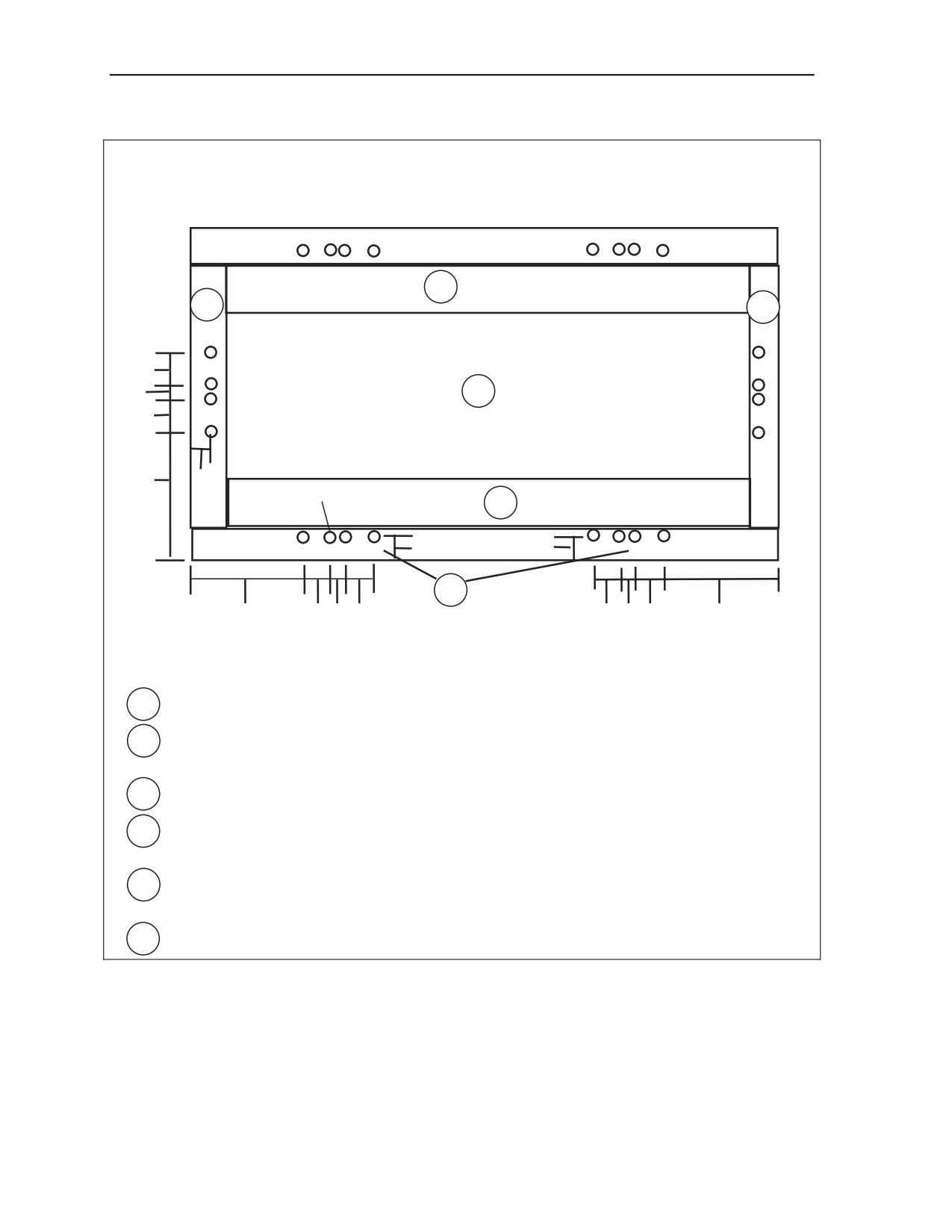
BUILDING COMBAT EXPENDABLE PLATFORM
7-2. Build the 48- by 96-inch CEP as shown in Figure 7-1.
10 September 2007
FM 4-20.108 /TO 13C7-2-491
7-1
Chapter 7
Notes.
1. Not drawn to scale.
2.
All dimensions are given in inches.
3.
All holes are 1/2-inch in Diameter.
4.
Use 8d common nails or 2-inch long, #4 wood screws.
4
2
3
5”
2”
FRONT
1
5”
18”
2”
1/2”
5
2”
2”
6
18”
5”
2”
5”
5”
2”
5”
18”
1 Place a ¾- by 48- by 96-inch sheet of plywood on a flat surface.
2 Nail a 2- by 6- by 42-inch piece of lumber on the front edge of the plywood, 3 inches in from
the 48-inch side.
3 Nail a 2- by 6- by 42-inch piece of lumber on the rear side the same as in step 2.
4 Nail a 2- by 6- by 85-inch piece of lumber to the right side of the plywood, 3 inches in from
the 48-inch side.
5 Nail a 2- by 6- by 85-inch piece of lumber to the left side of the plywood, 3 inches in from the
48-inch side.
6 Drill twenty-four 1/2-inch holes as shown above.
Figure 7-1. Combat Expendable Platform Built
7-2
FM 4-20.108 /TO 13C7-2-491
10 September 2007
Rigging Two Motorcycles for Low-Velocity Airdrop
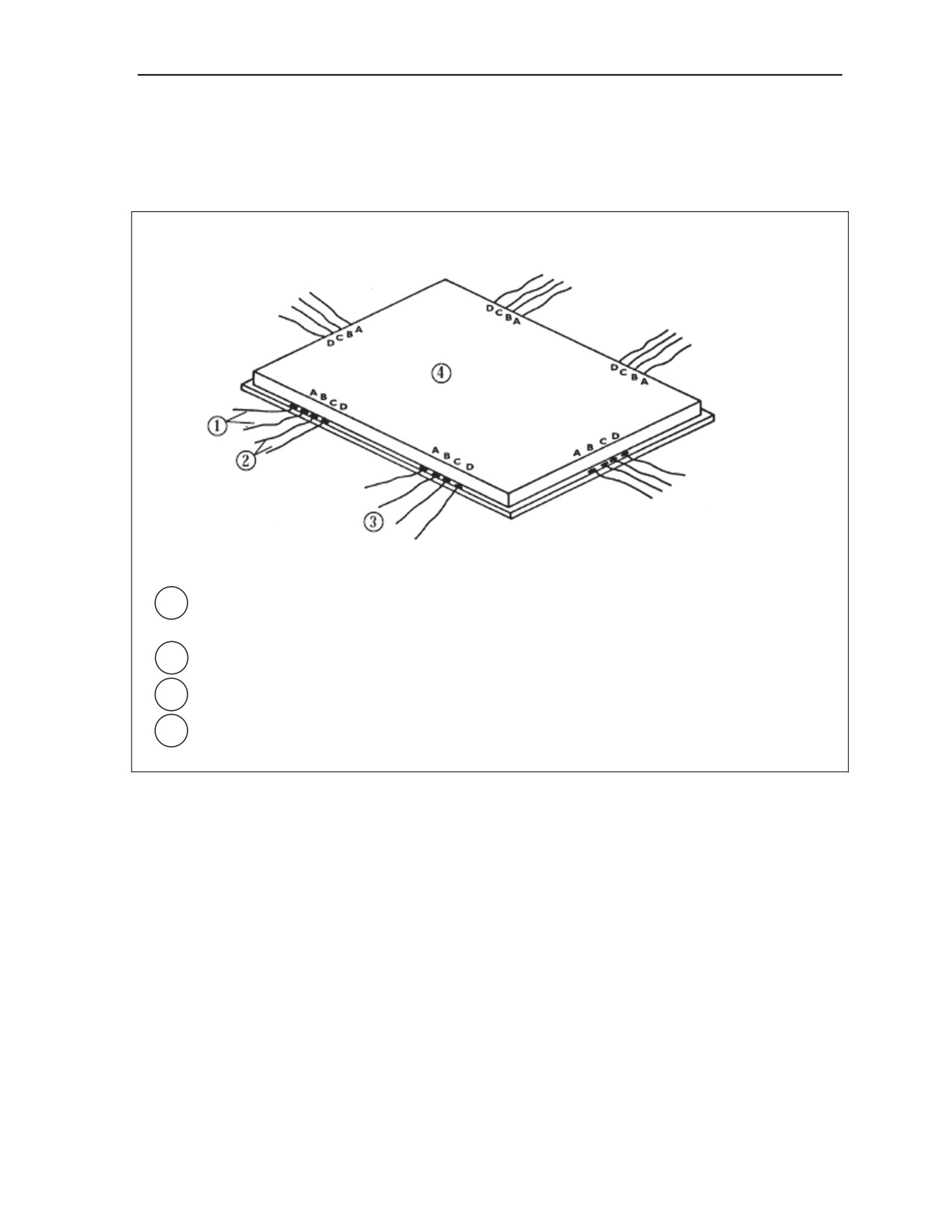
PREPARING COMBAT EXPENDABLE PLATFORM (CEP)
7-3. Prepare the 48- by 96-inch CEP as shown in Figure 7-2.
Notes.
1. Not drawn to scale.
2.
All dimensions are given in inches.
1 Cut twelve 8-foot lengths of 1/2-inch tubular nylon webbing. Route one end through hole A
and hole B, from bottom to top.
2 Repeat step 1 for holes C and D.
3 Repeat steps 1 and 2 for the other five sets of holes.
4 Lay a 36- by 96-inch piece of honeycomb on the platform.
Figure 7-2. Combat Expendable Platform (CEP) Prepared
10 September 2007
FM 4-20.108 /TO 13C7-2-491
7-3
Chapter 7
POSITIONING A-22 SLING ASSEMBLIES
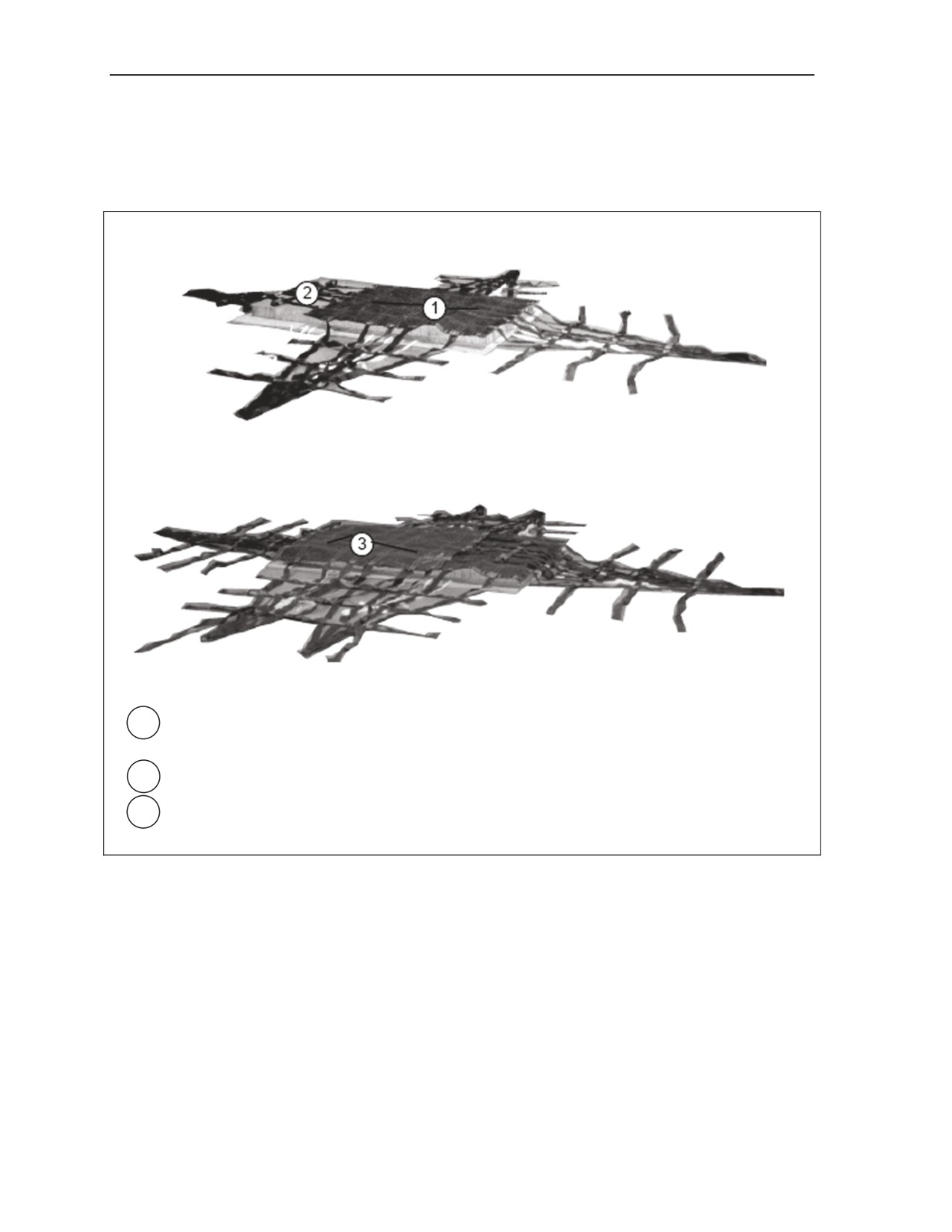
7-4. Lay two A-22 cargo bag sling assemblies on the platform as shown in Figure 7-3.
Notes.
1. Be sure that the support web D-ring extends over the rear edge of the platform.
2. Be sure that the support web D-ring of the top assembly extends over the front edge of the platform.
1 Place one A-22 sling assembly toward the front of the honeycomb. Extend all lateral straps
and support webbing. Make sure the support web D-ring at the rear extends off the load.
2 Fold and place all lateral straps on top of the rear support web.
3 Place the second A-22 sling assembly to the rear. Position it in the same manner as the front
assembly. Make sure the D-ring on the front support web extends off the load.
Figure 7-3. Two A-22 Sling Assemblies Positioned on the CEP
7-4
FM 4-20.108 /TO 13C7-2-491
10 September 2007
Rigging Two Motorcycles for Low-Velocity Airdrop
JOINING A-22 SLING ASSEMBLIES
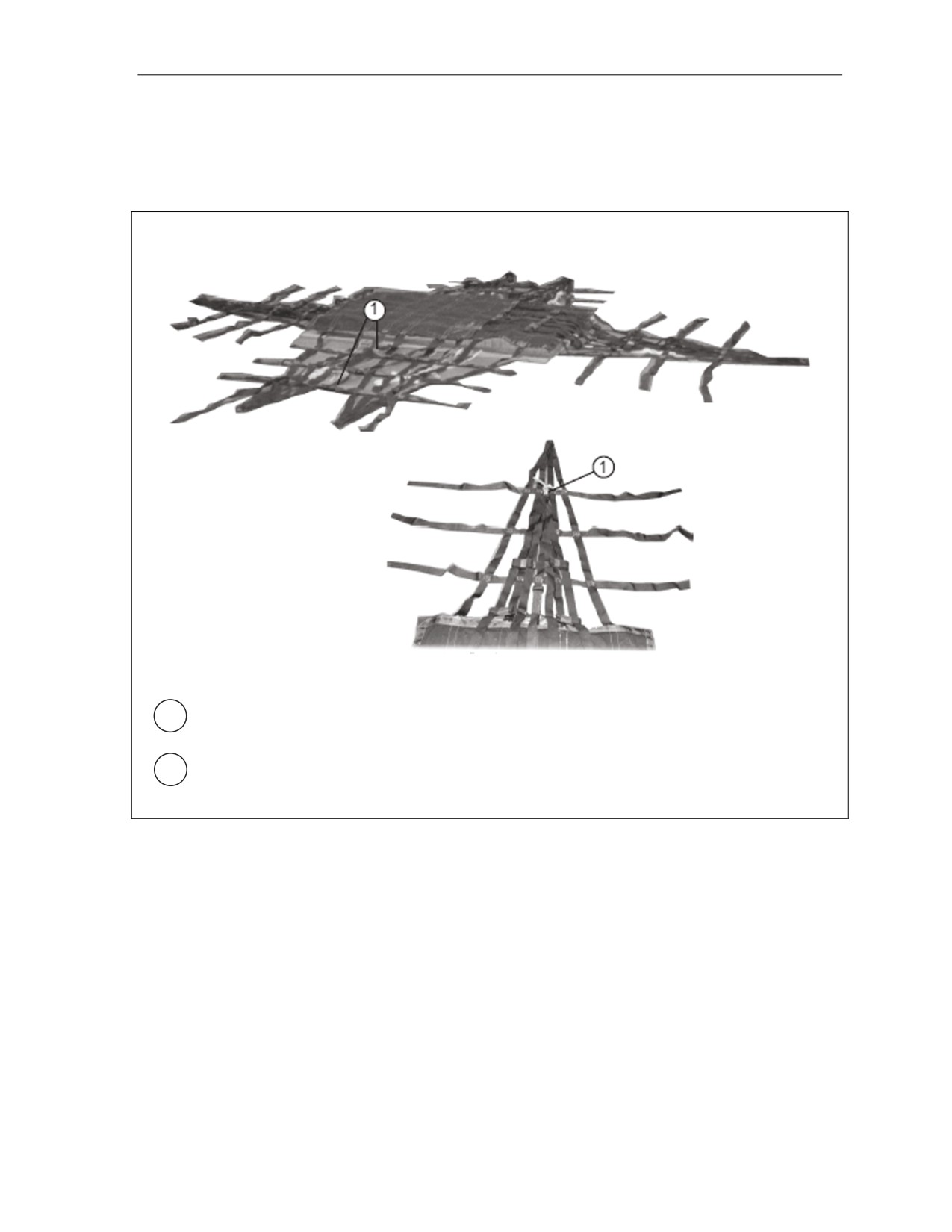
7-5. Join both A-22 sling assemblies as shown in Figure 7-4.
Note. Do not pull the webbing taut at this time. They will be tightened and tied when the sling assemblies are closed.
1 Use a length of type VIII nylon webbing to tie the support web D-ring exposed at the front and
rear of the load to the other A-22 sling assembly as shown.
2 Cut six lengths of type VIII nylon webbing. Route one length through each set of friction
adapters at the midsection of the load as shown.
Figure 7-4. A-22 Sling Assemblies Joined
10 September 2007
FM 4-20.108 /TO 13C7-2-491
7-5
Chapter 7
POSITIONING A-22 CARGO COVERS AND HONEYCOMB
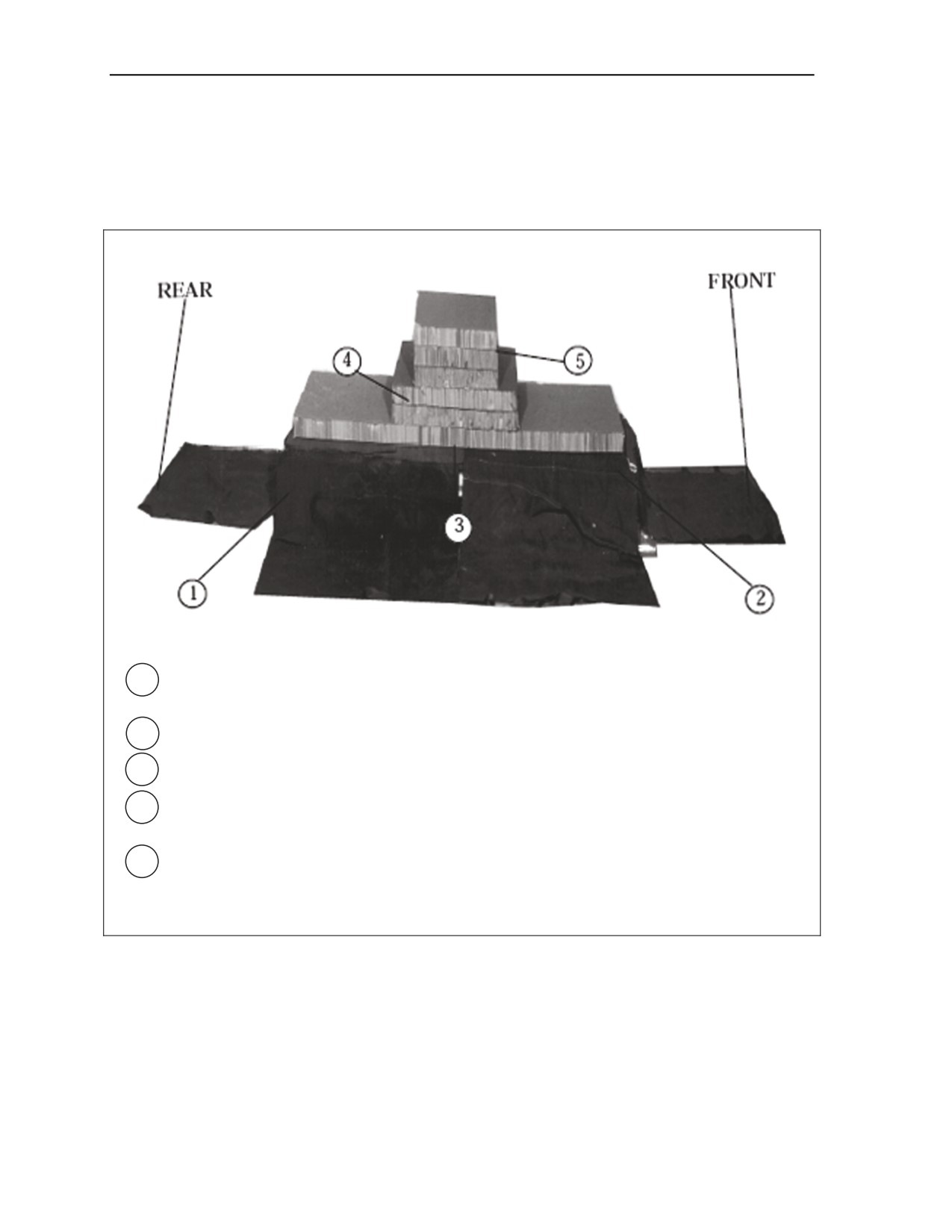
7-6. Lay two A-22 cargo bag covers on the sling assemblies. Set the honeycomb on the covers as shown
in Figure 7-5.
1 Lay an A-22 cargo bag cover on the rear sling assembly with the cover squarely on top of the
scuff pad. Fold the front end flap in even with the front edge of the platform.
2 Repeat step 1 and lay a cover on the front sling assembly. Fold the rear end flap in.
3 Center a 36- by 96- piece of honeycomb on the cargo bag covers.
4 Glue two 36- by 36-inch pieces of honeycomb together, and glue them to the center of the
36- by 96-inch piece of honeycomb.
5 Glue three 24- by 36-inch pieces of honeycomb together, and glue them to the center of the
36- by 36-inch piece of honeycomb.
Figure 7-5. A-22 Cargo Covers and Honeycomb Positioned
7-6
FM 4-20.108 /TO 13C7-2-491
10 September 2007
Rigging Two Motorcycles for Low-Velocity Airdrop
PREPARING, POSITIONING, AND PROTECTING THE TWO
MOTORCYCLES
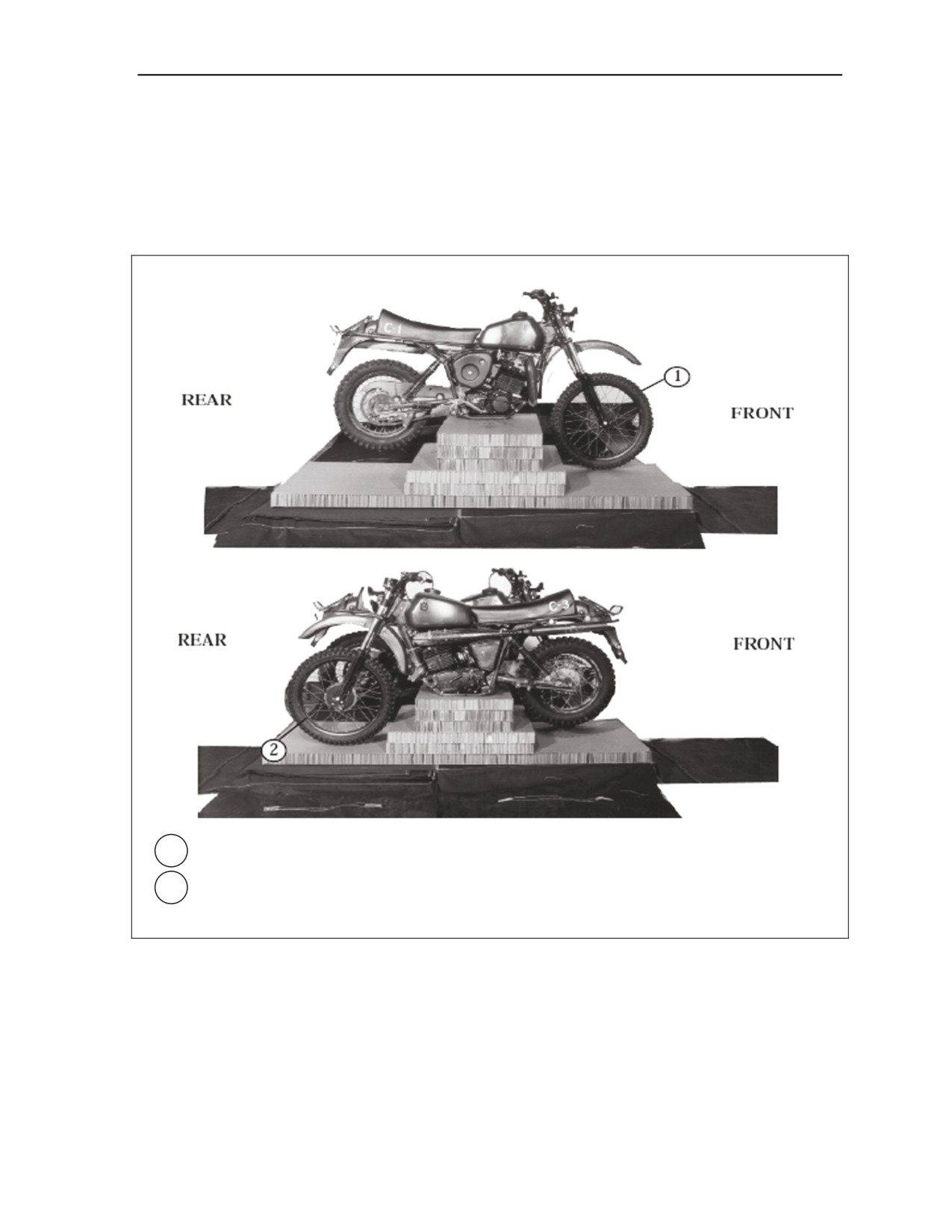
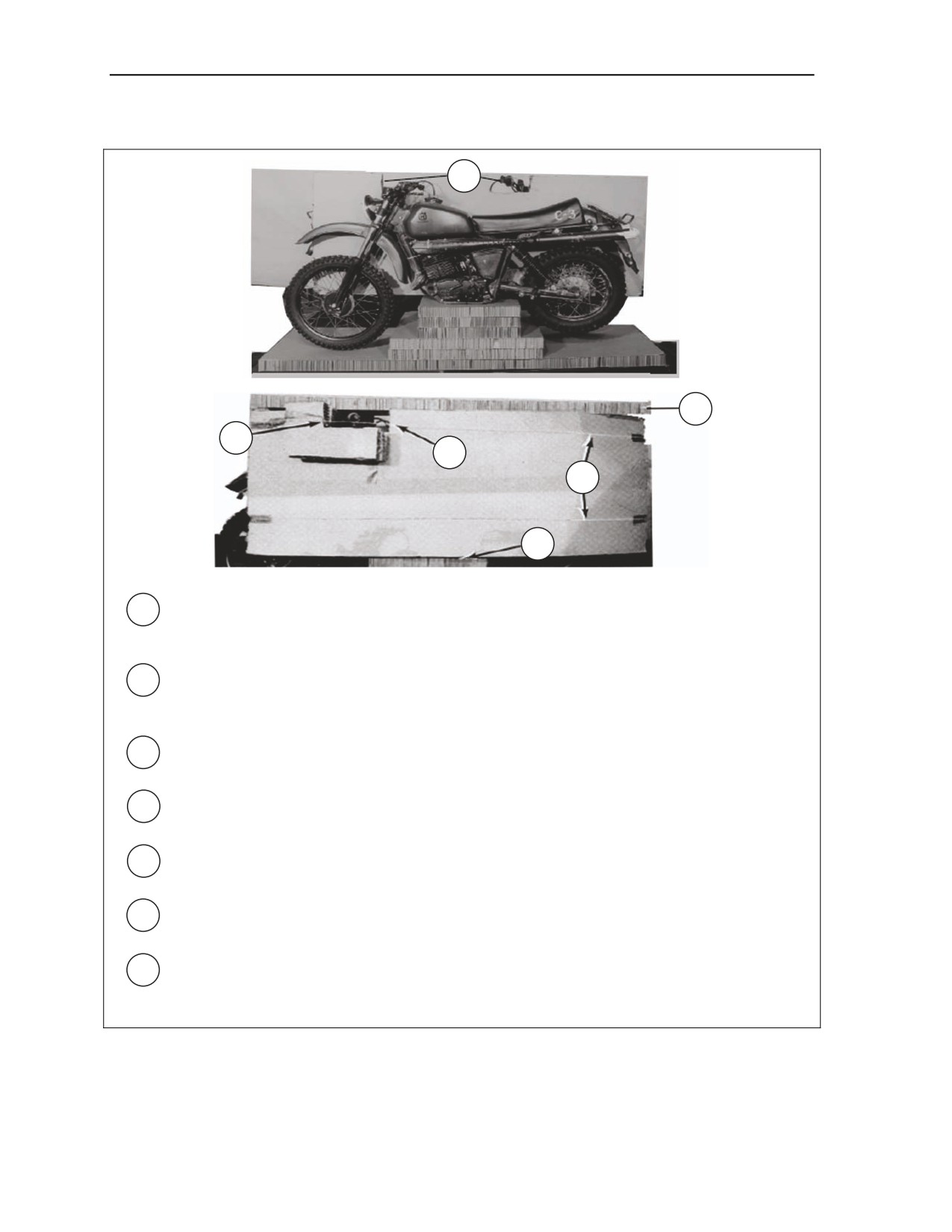
7-7. Prepare the two motorcycles as outlined in Chapter 6. Set them on the honeycomb as shown in
Figure 7-6. Tie honeycomb protectors to the motorcycles as shown in Figure 7-7.
Note. Make sure the frames protecting the engines are sitting on the honeycomb.
1 Set one motorcycle on the honeycomb with the front wheel toward the front of the platform.
2 Set the second motorcycle 3 inches from the first one with the front wheel toward the rear of
the platform.
Figure 7-6. Two Motorcycles Prepared, Positioned, and Protected
10 September 2007
FM 4-20.108 /TO 13C7-2-491
7-7
Chapter 7
3
9
5
4
8
6
3 Make two 6- by 8-inch cutouts in one 84-inch edge of a 36- by 84-inch piece of honeycomb
spaced for the handlebars of both motorcycles to fit in the cutouts. Rest the bottom of the
protector on the honeycomb stack.
4 Make a 6- by 8-inch cutout in the 84-inch edge of a 36- by 84-inch piece of honeycomb, 30
inches from the rear edge of the honeycomb. Bend the honeycomb just to the rear of the
cutout.
5 Cut a 6- by 8-inch piece of honeycomb from the corner of two 12- by 18-inch pieces of
honeycomb. Align the cutouts, and glue the two pieces of honeycomb together.
6 Set the protector on the right side of the motorcycles. Rest the bottom edge of the protector
on the honeycomb stack. Align the cutouts with the handles.
7 Repeat steps 4, 5, 6, and set a second protector on the left side of the motorcycle (Not
Shown). Make the cutout 30 inches from the front edge of the honeycomb protector.
8 Tie the protectors in place with lengths of type III nylon cord. Use tape on the protectors to
keep the type III nylon cord from cutting into the protectors.
9 Lay a 24- by 84-inch piece of honeycomb on top of the load as the top protector.
Figure 7-6. Two Motorcycles Prepared, Positioned, and Protected (Continued)
7-8
FM 4-20.108 /TO 13C7-2-491
10 September 2007
Rigging Two Motorcycles for Low-Velocity Airdrop
CLOSING THE A-22 CARGO BAG COVERS
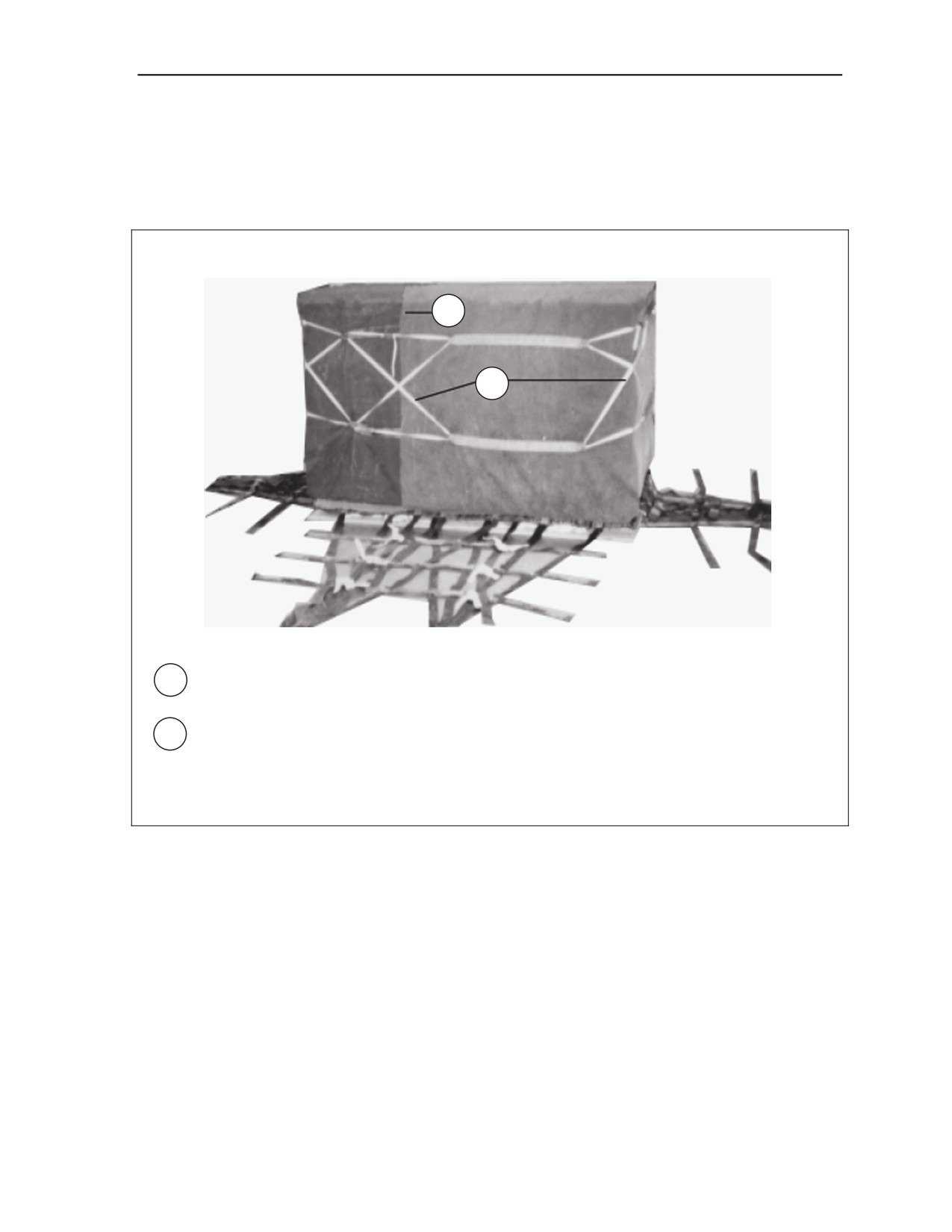
7-8. Close the A-22 cargo bag covers as outlined in FM 4-20.103/MCRP 3-11.3C/NAVSEA SS400-AB-
MMO-010/TO 13C7-1-11 and as shown in Figure 7-7.
1
2
1 Fold the bag covers over the front and rear first, then the sides over the top. Fold under the
excess side covers.
2 Use six lengths of 1/2-inch tubular nylon webbing to lace the bag closed. Pull the webbing
tight and tie the running ends in a surgeon’s knot and bow knot. Tape the excess and knot.
Leave one running end slightly exposed to allow rapid de-rigging.
Figure 7-7. A-22 Cargo Bag Covers Closed
10 September 2007
FM 4-20.108 /TO 13C7-2-491
7-9