FM 3-24 INSURGENCIES AND COUNTERING INSURGENCIES (MAY 2014) - page 4
Chapter 10
GENERATIONAL ENGAGEMENT
10-7. Generational engagement is a method that can be conducted in conjunction with other approaches
that seeks to get the host nation to educate and empower the population to participate in legal methods of
political discourse and dissent. This can be done in both high threat situations and situations where an
insurgency is at its infancy and combat is less intense. It is best that the host nation undertake this method
as soon as possible to affect the next generation. Generational engagement focuses on the population.
Generational engagement focuses on building new constituents in the host-nation population to counter
insurgent actions. Generational engagement is a method of political mobilization of the people. The
purpose of the method is to get population groups to side with the host nation.
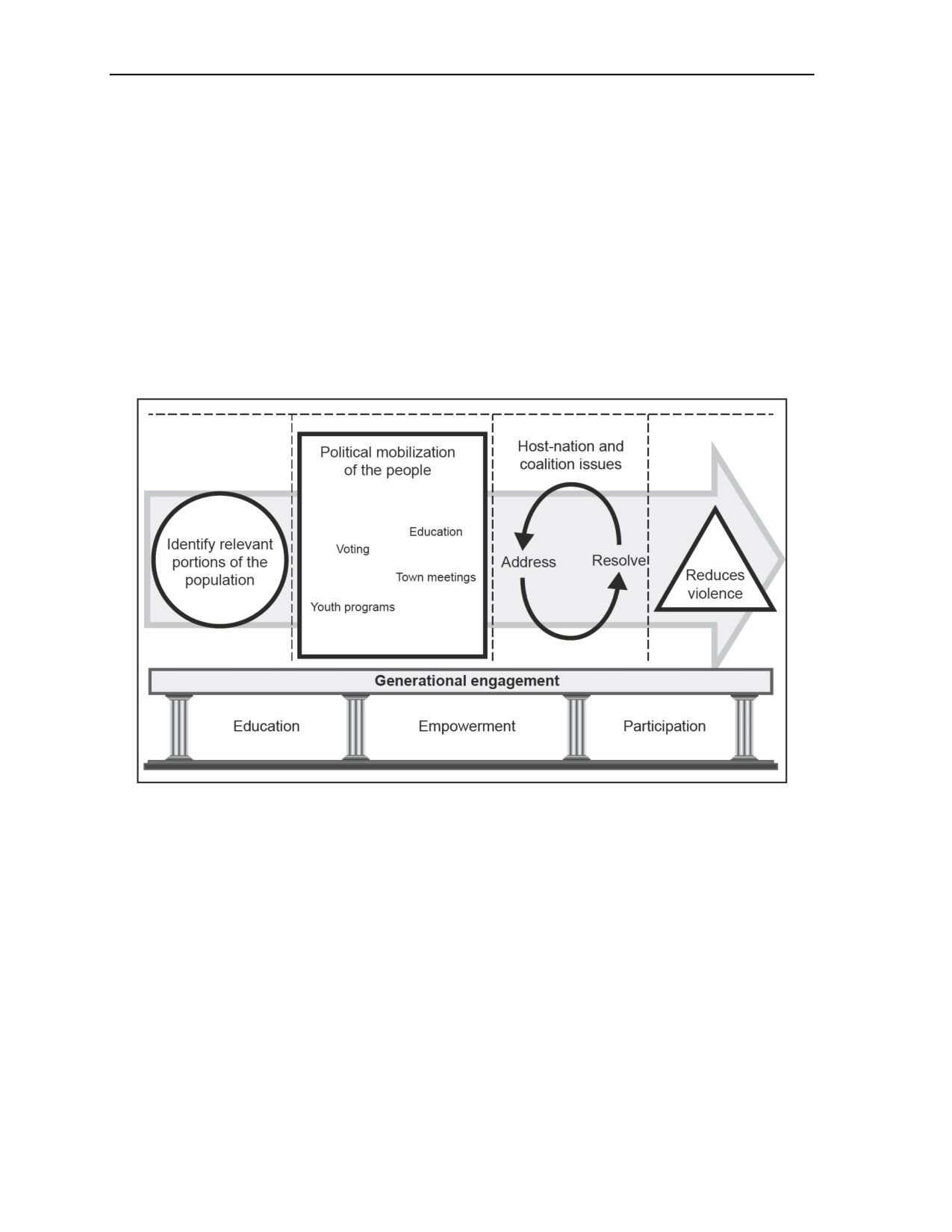
10-8. Figure 10-1 provides a general framework for generational engagement. First, counterinsurgents
identify the population that they wish to engage. This relevant population may politically engage and this
will encourage the host nation to redress any grievances. This may lead to a reduction of violence. This is
all built on a foundation of education, empowerment, and participation. (See figure 10-1.)
Figure 10-1. Generational engagement
10-9. Five principles are fundamental to generational engagement:
z
Groups with whom counterinsurgents partner (such as nongovernmental organizations [NGOs])
must be seen as indigenous, not as foreign constructs.
z
Independence of funding and resources are important. Support groups can lose credibility the
more they are perceived as solely reliant on foreign funding, possibly due to a shift in priorities
by a sole and influential benefactor. Organizations and their partners should identify alternative
sources of support, including local sponsors, funding from the relevant ministries, or collecting
dues from members.
z
In selecting partners, counterinsurgents should not limit themselves to the vocal intellectual elite.
If the insurgency is based on the root causes of a rural population, intellectual elites might not
have legitimacy among the rural poor. Therefore, counterinsurgents should balance support
between the central leadership and local branches in the provinces or townships (where youth
engagement is usually most important).
10-2
FM 3-24/MCWP 3-33.5
13 May 2014
Indirect Methods for Countering Insurgencies
z
Expansion and membership numbers should not be used as a key indicator of success. It can be
difficult to accurately track and confirm these numbers with national organizations. A more
accurate measure is the staff, number of offices, actual activity levels, and efficacy. Activity
reports and photos can verify progress.
z
A main role for organizations is to make the connections between the local administrations and
the provincial or national level government, as well as other stakeholders and peer organizations.
At some point the NGOs will not be present to facilitate government access, and will be most
effective when they facilitate cooperative and enduring relationships between the population and
the government.
10-10. Generational engagement works with factions from a population to get them to see the benefit of
participating in peaceful means to address their core grievances. Getting youths to understand the legal
means they have to address root causes of conflict is a critical tool for reducing violence. If commanders
and staffs believe that insurgencies may occur over extended periods, then some efforts must be made to
engage this next generation of leaders who can establish a lasting peace. Engagement also has to be made
with the intellectual elites of the country. They may still be residing in the country of conflict or in another
country that has significant influence over the insurgent cause.
10-11. Soldiers and Marines planning to use generational engagement must identify relevant portions of
the population through their planning. Plans and methods for engagements can vary, depending on the
operational environment and the culture. This method is used in conjunction with direct methods as part of
a comprehensive approach to combating insurgent forces. Counterinsurgents can make progress in
defeating insurgent forces, but if they neglect the younger generation of the population they may lose the
war. Continued and prolonged efforts must be made to ensure that counterinsurgents and the host-nation
government are seen as positive influences. The population must identify with and trust their government.
Counterinsurgent efforts are coordinated and tracked through continued assessments to ensure success.
10-12. Counterinsurgents engage with young factions of the population by implementing youth programs.
Counterinsurgents also participate in local council meetings that include representatives from different
generations of the population.
10-13. The idea behind these engagements is that they are initiated by the counterinsurgent forces and
eventually taken over or continued by the host nation. It is not enough for the host nation to just continue to
implement these engagements, rather the host nation must make every effort to ensure that these elements
of the population identify more with the government than with the insurgents. Local leaders who identify
with the government must be protected and supported.
10-14. Some examples of generational engagement can be as simple as ensuring that schools are open and
available to students and ensuring adequate access to medical attention as part of the effort to ensure
essential services. This can address younger portions of the population who, over the long term, will have a
positive view of counterinsurgents and the efforts of their own government to ensure for their care and
protection.
10-15. Some examples of generational engagement along the governance line of effort can include
recruitment of younger influential leaders and including others in the electoral process. This may be
difficult based on the culture in which counterinsurgents are operating because some cultures only allow for
leadership positions for older members of the population. If members of the younger generation cannot
assume roles in the government, they can still be encouraged to participate in the governance process and
feel that they have a place where they can make their views heard by their local government.
10-16. Local participation that builds civil society has proven important in countering an insurgency. This
can be essential in building legitimacy for a host government. For example, in Vietnam, the U.S. military
and Department of State, along with the government of South Vietnam, established several youth groups
that were very successful. One example, the 4-T Youth Club, was modeled after the American 4-H
organization. Over 2000 4-T clubs served as a model of success for organizing youths at the grassroots
level. A host government is essential in building local participation and a civil society. The Republican
Youth Movement, National Revolutionary Movements, and Personnel Labor Revolutionary Parties were all
models of successful youth engagement. These efforts increased the legitimacy of the host nation while
decreasing the ability of the insurgency to recruit. These programs were generators of self-esteem for the
13 May 2014
FM 3-24/MCWP 3-33.5
10-3
Chapter 10
participants and worked out pent-up student energy by deploying them to the provinces. In Vietnam, youth
programs proved beneficial.
10-17. Outside groups can be very effective at generational engagement. For example, the Afghanistan
Youth National and Social Organization is a non-profit, non-governmental organization that enrolls young
Afghani males. It has district chapters, made up of around 45,000 dues-paying members, it enjoys a great
deal of autonomy, and it organizes according to the needs of its local members. Its civic education program
educated Afghans about their political rights and obligations, and it strengthened dialogue between local
leaders and government officials. The importance of engaging local youth in Afghanistan was indicated in
after action reviews and outside groups play an important part in building civic society. In sum, a non-
governmental organization was effective at engaging the population and encouraging dialogue.
10-18. The first step that counterinsurgents can take to ensure that this happens is by leveraging key
leadership at the local and district levels to meet with and discuss significant issues with the population.
Just meeting with the younger elements of the population will not constitute completion of generational
engagement. There must be efforts to follow through on major discussion topics and resolve issues that are
significant to them. Where counterinsurgent forces are able to, they must continue to push local leaders to
not just meet with them but also to address and resolve issues. This can be done initially by
counterinsurgents and eventually by the host-nation government in concert with host-nation security forces.
10-19. Lastly, host-nation security forces must ensure that these actions are taken and that they are
perceived as supportive of all elements of the population. This may done initially with counterinsurgent
forces as the lead elements and later as host-nation forces develop their ability to take the lead on providing
security as a supporting element of government representatives.
NEGOTIATION AND DIPLOMACY
10-20. Negotiation and diplomacy are ways to resolve or defeat an insurgency. Counterinsurgents must
influence the host-nation government and its subordinate elements (for example, the office of land reform)
to remove the root causes that have led to acts of subversion and violence in order to seize, nullify, or
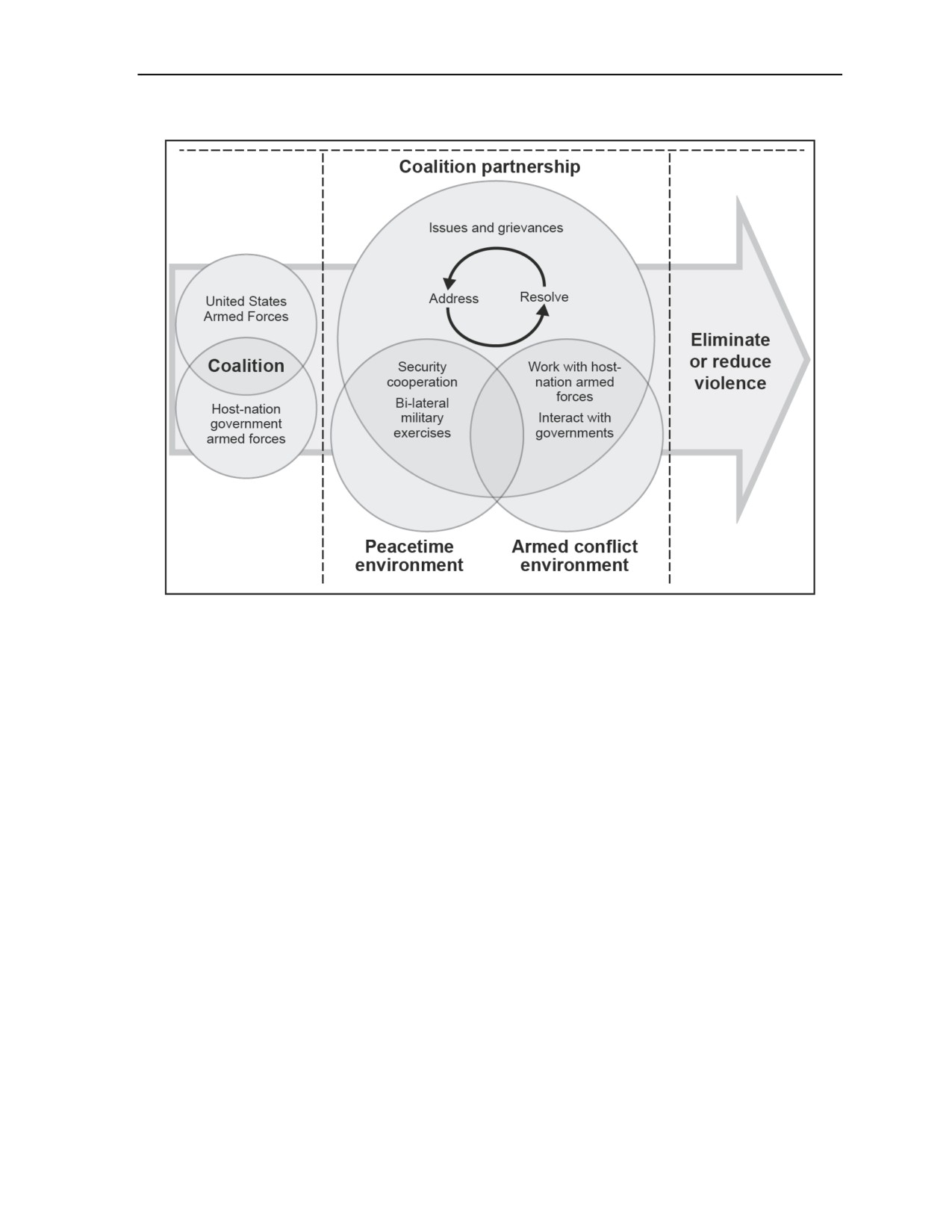
challenge political control of a region. (See figure 10-2 which shows the process of negotiation and
diplomacy.)
10-4
FM 3-24/MCWP 3-33.5
13 May 2014
Indirect Methods for Countering Insurgencies
Figure 10-2. Negotiation and diplomacy
10-21. The goal of negotiation and diplomacy is to address the insurgent root cause and therefore reduce
the causes for armed conflict. If a host nation can be influenced by U.S. government or military personnel
to peacefully address root causes, then the expected outcome is a reduction in violence and bringing the
insurgents into the political process to have their issues resolved peacefully. If the host-nation government
can do this successfully, the insurgency may not totally go away, but it may only use force of arms in a
limited context that would manifest as limited insurrections compared to a full blown armed insurgency.
10-22. The U.S. has many tools at its disposal to influence a host nation in addressing the root causes of
an insurgency. For example, economic and military aid can be tied to certain actions or standards of
behavior by a host nation. Counterinsurgents must also evaluate how their actions help shape the
environment. Contracting, for example, has direct links to the economy and the society. Using contracts to
encourage a host nation to address root causes is another possible tool. In sum, commanders should make
an assessment of how they are interfacing with a host nation and determine what tools are available to
enable and encourage the host nation to take the needed actions to defeat an insurgency.
10-23. In an armed conflict environment where U.S. forces have been sent in to assist a host nation to
fight its insurgency, U.S. military personnel can work with the host-nation armed forces to reduce causes
for conflict, and U.S. military personnel can also interact with U.S. and host-nation government personnel
to take steps to peacefully address core grievances and root causes of conflict.
10-24. In a peacetime environment where U.S. forces are not committed to help a host nation combat its
insurgency, U.S. military personnel can lessen the causes of a potential crisis or insurgency in the conduct
of security cooperation activities and bi-lateral military exercises. If one of the insurgents’ root causes is
against the host-nation military for human rights abuses or using heavy handed tactics with the local
population, U.S. military personnel can work with the military wing of the government to find alternative
ways of dealing with the population.
13 May 2014
FM 3-24/MCWP 3-33.5
10-5
Chapter 10
IDENTIFY, SEPARATE, ISOLATE, INFLUENCE, AND
REINTEGRATE
10-25. Identify, separate, isolate, influence, and reintegrate is a method that combines several activities
that affect relevant population groups. This can be done in both high threat situations and situations where
the insurgency is at its infancy and combat is less intense. This method works by, with, and through the
host nation; however, it may have some elements which Soldiers and Marines are directly interacting with a
local population.
10-26. Identify, separate, isolate, influence, and reintegrate is a proactive method of addressing root
causes before a full blown armed insurgency can develop. Its purpose is to identify and separate the
insurgents from the population. This is a primary requirement for forces conducting counterinsurgency. By
identifying who is an insurgent and who is not, and then applying resources to separate insurgents from the
population, commanders and planners can more effectively focus their efforts on making the insurgency
feel isolated. Insurgents may then believe that their causes for conflict are not supported by the population.
Once the insurgent leaders and members feel isolated from the population, peaceful efforts can be made to
influence insurgents to surrender, return, and be reintegrated into society.
10-27. Commanders conduct a detailed assessment of the insurgent and population networks before
executing the identify, separate, isolate, influence, and reintegrate method. This assessment guides the
application of individual means to disassemble the insurgent network. Joint forces and other actors may
enter the process at many different stages; therefore, assessment is a continuous process used to guide
decisionmaking throughout operations.
IDENTIFY
10-28. The identify, separate, isolate, influence, and reintegrate method is used to divide and conquer the
insurgency, including all elements of the insurgency listed in chapter 4. The U.S. Marine Corps refers to
these as identity operations (See Marine Corps order [MCO] 5530.17), while the Army uses identity
activities. The elements of an insurgency are the leadership (including the political cadre), guerilla units,
auxiliary forces, and the underground elements. Although all elements of the insurgent network should be
identified, the main target of the identify, separate, isolate, influence, and reintegrate effort is to identify the
guerillas and eventually neutralize them, since they are the main source of the violence. Military operations
should support the host nation in any thorough population screening to identify and eliminate insurgents
and to identify any lingering insurgent support structures.
10-29. Operations that support identity activities include—
z
Raids and cordon operations.
z
Base access, checkpoints, and protection of critical sites.
z
Area security operations.
z
Border control and ports of entry.
z
Site exploitation.
z
Population census using biometric data collection devices and mapping the human environment
and patterns of life
z
Medical capacity and tracking medical records.
10-30. Tools to support identity activities include—
z
Biometrics and biometrically enabled intelligence collection.
z
Tip lines.
z
Civil records (land documents and registration databases).
z
Reward programs (paying civilians to identify insurgents and their networks).
z
Forensics and forensics-enabled intelligence collection.
z
Document and media exploitation.
10-6
FM 3-24/MCWP 3-33.5
13 May 2014
Indirect Methods for Countering Insurgencies
SEPARATE
10-31. While killing or capturing insurgents in counterinsurgency operations may be necessary, an
alternate and still effective method in the long run is to separate an insurgency from the population, the
second phase of the identify, separate, isolate, influence, and reintegrate method. Counterinsurgents need to
isolate their adversaries from the relevant population, both physically and psychologically. At the same
time, counterinsurgents should also seek to bolster their own legitimacy and credibility to exercise
influence over that same population.
10-32. Establishing security forces in bases among the population furthers the continued separation of the
local insurgents and the population. The success or failure of the effort depends on effectively and
continuously securing the population. In some cases, it may be useful to physically secure an area using
barriers or other means.
10-33. Combined action programs, such as community stability operations, are local level stability
operations designed to augment wider counterinsurgency operations. Village or community stability
operations can work in areas with limited insurgent activity and attempt to establish security and stability
“bubbles” around rural communities. These cordons are created and ideally expanded to make the area
inhospitable to insurgents and enable legitimate local governance, which further separates the insurgents
from the local population.
(See JP
3-24, chapter
5, for more information on stability operations.)
Appropriate tasks for units include, but are not limited to, the following:
z
Helping host-nation security forces maintain entry control points.
z
Providing reaction force capabilities through the parent unit.
z
Conducting multinational, coordinated day and night patrols to secure the town and area.
z
Facilitating local contacts to gather information in conjunction with local host-nation security
force representatives.
z
Training host-nation security forces in leadership and general military subjects, so they can
secure the town or area on their own.
z
Conducting operations with other multinational forces and host-nation units, if required.
z
Operating as a team with host-nation security forces to instill pride, leadership, and patriotism.
z
Assisting host-nation government representatives with civic action programs to establish an
environment where the people have a stake in the future of their town and nation.
z
Protecting host-nation judicial and government representatives and helping them establish the
rule of law.
10-34. The lines of operations that support the separation process include—
z
Sweeps and cordon and searches.
z
Combat outposts.
z
Village and community stability operations.
z
Border operations and port of entry operations.
z
Strikes, raids, and ambushes.
z
Interdiction operations.
z
Military deception and military information support operations.
z
Electronic warfare.
z
Information collection.
ISOLATE
10-35. The isolation phase objective is to break the psychological and physical links between insurgents
and the remainder of the insurgent organization and its support base. The first step in this segregation is to
identify vulnerabilities of the insurgents. This requires a deep understanding of the operational environment
and, more specifically, an understanding of all the adversaries
(for example, the insurgent network,
transnational terrorists, and external supporters).
13 May 2014
FM 3-24/MCWP 3-33.5
10-7
Chapter 10
10-36. Counterinsurgents ensure efforts strive to physically isolate the insurgency in all domains (air,
land, maritime, and cyberspace) from other nodes of the insurgent network. Ultimately this means
controlling the physical and cognitive domains. However, completely controlling the domains at all times is
not realistic.
10-37. Patrolling and cordon and search operations can physically isolate insurgents through capture or
deterrence. Following these operations, counterinsurgents’ treatment of captured insurgents has immense
potential impact on insurgent morale, retention, and recruitment. Humane and just treatment may afford
counterinsurgents many short-term opportunities as well as potentially damaging insurgent recruitment.
Abuse may foster resentment and hatred, offering the enemy an opportunity for propaganda and assist
potential insurgent recruitment and support. It is important that unless they are entitled to another standard
based on status, all detainees or other persons captured in any conflict, regardless of how it is characterized,
shall be treated, at a minimum, in accordance with Common Article 3 of the Geneva Conventions of 1949.
10-38. Isolation must include operations to counter the insurgency lines of communication to recruit,
obtain funding, weapons, equipment, direct operations, or gain intelligence. Operations such as information
operations, electronic warfare, and cyberspace operations are examples of efforts designed to detect and
respond to enemy insurgent networks. These operations are vital as force multipliers to identify insurgent
activities and create conditions to deny or defeat their operations.
10-39. In addition to physical and psychological isolation, efforts to isolate the insurgency economically
are necessary, but must be narrowly focused on the activities of insurgents. These efforts seek to isolate the
insurgency as much as possible, as complete isolation of the insurgency is not realistic. If implemented too
broadly, efforts to isolate may have a negative effect on the population and strengthen the insurgency. (For
example, eradicating the poppy harvest in Afghanistan may have cut funding to the Taliban, but it also
alienated the farmers who subsisted on the illicit crop.) Economic efforts to isolate an insurgent require
both physical and informational interruption of financial, business, and criminal enterprises. Attempts to
isolate insurgents from the population economically must be narrowly focused on the insurgents and
minimize the effect on the population by offering viable replacement sources of employment and revenue.
A primary means of the financial isolation is through counter threat finance operations.
10-40. The lines of operations that support the isolation process include—
z
Border operations and port of entry operations.
z
Strikes, raids, and interdiction operations.
z
Counter threat finance.
z
Military deception and military information support operations.
z
Cyber electromagnetic activities.
z
Electronic warfare.
z
Intelligence operations.
z
Information collection.
INFLUENCE
10-41. The intent to influence the insurgent network is for the population to abandon support to the
insurgency’s efforts. Planned influence operations should convey selected information and indicators to
insurgent networks to influence their emotions, motives, objective reasoning, and ultimately the behavior of
insurgent network itself. While it is unlikely counterinsurgents will change insurgents’ beliefs, it is possible
to change their behavior. The counterinsurgency lines of effort (shown in figure 7-2 on page 7-9) support
this behavior modification, but to further mitigate the insurgent threat to the host nation, additional
programs should be offered as enticement solutions. In other words, counterinsurgents must leave a way
out for insurgents who have lost the desire to continue the struggle.
10-42. Effective amnesty and reintegration programs provide insurgents this avenue; amnesty provides
the means to quit the insurgency and reintegration allows former insurgents to become part of greater
society. Rifts between insurgent leaders, if identified, can be exploited in this fashion. Offering amnesty or
a seemingly generous compromise can also cause divisions within an insurgency and present opportunities
to split or weaken it. Counterinsurgents can also act to magnify existing rifts. If insurgent forces are
10-8
FM 3-24/MCWP 3-33.5
13 May 2014
Indirect Methods for Countering Insurgencies
expelled or have broken into smaller groups, they must be prevented from reentering the area or
reestablishing an organizational structure inside the area.
10-43. Amnesty programs provide a means for members of an insurgency to stop fighting. The essential
part of an amnesty program is that insurgents believe they will be treated well and protected from their
former comrades’ potential reprisal. Thus, counterinsurgents must have detailed information operation
plans to inform the insurgents about the program, to turn themselves in, and to support subsequent amnesty
efforts. Pragmatism must be the first consideration of amnesty programs, not ideology or vendetta.
Counterinsurgents also must have methods to protect the former insurgents. Incentives for disaffected
insurgents or their supporters are important, especially modest monetary rewards.
10-44. Turning former insurgents against their previous comrades can prove invaluable to
counterinsurgency efforts. Former insurgents can provide vital information and even become valuable allies
and combatants. However, information provided by a former insurgent must be evaluated and validated to
prevent misinformation and deception. Incentives and a sense of fair treatment by counterinsurgents are
vital to effective defector programs, which are also dependent on effective information operations so
insurgents are aware of their options. Insurgents may be prone to defect when conflict has been prolonged,
the broad population is weary of conflict, or if the insurgents have an uneven sense of purpose or drive.
Defector knowledge of how the insurgents are led, organized, and operate can prove invaluable. This can
include personality profiles of insurgent leaders, current communication procedures, plans, and tactics,
techniques, and procedures. This detailed intelligence is difficult to gain without defector operations.
10-45. The influence lines of operations include—
z
Information operations.
z
Military information support operations.
z
Military deception.
z
Cyber electromagnetic activities.
z
Engagement.
z
Stability operations.
z
Defense support to public diplomacy.
z
Negotiation and diplomacy.
z
Targeted strikes and raids.
z
Support to amnesty programs.
REINTEGRATE
10-46. The objective of reintegrating an insurgent is for the former insurgent to become a productive
member of the society. Military forces, governmental organizations, NGOs from the international
community, and the host nation must cooperate to plan and execute reintegration programs. Former
insurgents must develop confidence in reintegration and the organizations charged with implementing it.
To build this confidence, reintegration programs must be holistic and encompass efforts to restore the
society, the government, and the economy at all levels.
10-47. Reintegration programs should help protect and empower moderate insurgents from extremist
influence and encourage them to not rejoin the insurgency. Programs must be tailored for each area and
insurgency. They can include vocational, educational
(especially reading and writing), and religious
programs. The employment opportunities extended to former insurgents depend on an effectively governed,
viable economy with an active market sector. If the reintegration process does not provide alternative
economic opportunities to the former combatants, the likelihood of their return to violence substantially
increases.
10-48. Demobilization of insurgents normally involves the controlled discharge of active combatants from
paramilitary groups, militias, and insurgent forces that have stopped fighting. Demobilization under these
circumstances may include identifying and gathering ex-combatants for demobilization efforts.
Demobilization involves deliberately dismantling insurgent organizations and belligerent group loyalties,
replacing those with more appropriate group affiliations, and restoring the identity of former fighters as part
13 May 2014
FM 3-24/MCWP 3-33.5
10-9
Chapter 10
of the national population. The demobilization of insurgents enables the eventual development of value
systems, attitudes, and social practices that help them reintegrate into civil society.
10-49. Reintegration is the process through which former combatants, belligerents, and displaced civilians
receive amnesty, reenter civil society, gain sustainable employment, and become contributing members of
the local population. It encompasses the reinsertion of individual former insurgents into host-nation
communities, villages, and social groups. Reintegration is a social and economic recovery process focused
on the local community. It complements other community-based programs that spur economic recovery,
training, and employment services. It includes programs to support resettlement in civilian communities,
basic and vocational education, and assistance in finding employment in local economies. It accounts for
the specific needs of women and children associated with insurgent and other armed groups.
10-50. Insurgents, when properly protected, reintegrated, and well treated, can become positive members
of their community. Conversely, unprotected, poorly prepared, or poorly treated former insurgents will
become powerful propaganda opportunities for the insurgents. Reintegration processes and programs, such
as host nation-led moderate ideological or religious education and job training, should be started early in
the reintegration process.
10-51. Counterinsurgency operations ultimately support reintegration through the integration of the
stability functions in planning and execution. The stability functions are security, governance and
participation, humanitarian assistance, rule of law, and economic stabilization and infrastructure. Specific
consideration within stability operations to support the reintegration process include—
z
Civil-military operations and commander’s emergency response program funds for special
projects.
z
Support to civic education projects.
z
Support to employment programs.
z
Support to relocation to prevent reprisals.
z
Support to integration into the political process.
z
Support to transitional justice.
10-52. The importance of influencing members of an insurgency to surrender cannot be overstated. The
importance of how a former insurgent is reintegrated into a peaceful society is also critical because the way
a war is won will decide how long the peace will last.
10-53. Counterinsurgents should offer surrendered insurgents generous terms, and counterinsurgents
should follow those terms. By separating an insurgent from the population, commanders and staffs make
that insurgent feel vulnerable and also take from the insurgency a means for recruitment and logistic
support. Planners and commanders should work toward creating liberal and generous surrender terms.
Counterinsurgents must protect surrendered insurgents from reprisals from their former insurgent
colleagues.
OTHER INDIRECT ENABLERS
10-54. The U.S. can integrate enablers into a host nation’s counterinsurgency efforts. These enablers can
provide intelligence or prevent the flow of resources to a counterinsurgency. Various intelligence
capabilities, such as signals intelligence, human intelligence, and geospatial intelligence, may be essential
to a host nation’s counterinsurgency. Sharing of information from these sources may enable a host nation to
defeat an insurgency. Also, other enablers, such as airlift capabilities, might be important for
counterinsurgency. Another capability that can be integrated into a counterinsurgency effort is counter
threat finance. Counter threat finance works to detect, counter, contain, disrupt, deter, or dismantle the
transitional financing of state and non-state enemies threatening the U.S. Counter threat finance can deny
an insurgent access to vital funding streams by identifying the sources and conduits of funding. In
counterinsurgency, this can play an important role because of the connection between insurgencies and
black markets. It provides one means to prevent an insurgency from obtaining resources. (For more
information on counter threat finance, see ATTP 3-07.20/MCRP 3-33 and DODD 5205.14.)
10-10
FM 3-24/MCWP 3-33.5
13 May 2014
Indirect Methods for Countering Insurgencies
10-55. The effective integration and synchronization of many capabilities, organizations, and functions
that support the collection, analysis, exploitation and sharing of identity information leads to the
identification of threat personnel, groups, and networks. These capabilities include biometric data, forensic
data, document and media exploitation, intelligence, and other information exchanges. Identification of
personnel allows multinational partners to prevent or mitigate insurgents or counterinsurgents from
conducting operations among the innocent population. U.S. forces must comply with U.S. Army Forces
Command predeployment training requirements. These requirements
(such as training in personnel
recovery, mitigation of insider threats, biometrics, languages, and cultural awareness) will further enable
U.S. forces in a counterinsurgency environment.
INTEGRATED MONETARY SHAPING OPERATIONS
10-56. Integrated monetary shaping operations are the use of monetary resources, provided with various
types of aid (for example, economic, financial, humanitarian, or developmental), involving the voluntary
transfer of resources (for example, money, equipment, knowledge, or training other than military) from
U.S. or unified action partners to a host nation, directly or indirectly, for mutual benefit.
(See
ATP 3-07.20/MCRP 3-33.1G for more information on integrated monetary shaping operations.) Integrated
monetary shaping operations are the coordinated use of money, goods, or services to support the
commander’s objectives. They are a means to an end. Integrated monetary shaping operations are used to
attack sources of instability, build partnerships, and provide for economic stabilization and security.
Integrated monetary shaping operations have two major components:
z
Supporting operations by funding developmental assistance, infrastructure, and governance
support projects to win the support of an indigenous populace and erode support for the
adversary.
z
Denying adversaries sanctuary and operational flexibility by hindering their ability to reliably
fund operations.
10-57. Integrated monetary shaping operations can be an effective tool to stabilize the security
environment. However, they can also undermine both the local and national economies. One essential
consideration of counterinsurgencies is to understand that long-term counterinsurgency efforts have an
economic impact on the host nation. Additionally, the implementation of funding and projects can have
negative secondary and tertiary effects. Commanders should recognize decisions over which contractors,
communities, and individuals are chosen to receive funding could create winners and losers in their area.
These effects can exacerbate tensions in the area. Finally, a counterinsurgency can last many years, and this
effort can distort the pricing of goods and services within the local and national economy.
Counterinsurgents must understand that they can undermine their own efforts by demanding goods in such
quantities that they fundamentally alters market forces, which results in economic dependence on the
counterinsurgency. This can result in economic problems that can undermine the host nation’s stability
when the external counterinsurgent departs.
10-58. Integrated monetary shaping operations can be effective, but they should be linked into an overall
development plan. Without that link, the haphazard use of money can be highly destructive to an economy
because it creates an unsustainable economy once the counterinsurgent leaves. The basic point of integrated
monetary shaping operations is primarily to be a catalyst for long-term and natural development and only
secondarily to meet short-term needs or security concerns. Counterinsurgents must understand that
interactions with the local culture do have far-reaching effects. The host-nation economy is one area where
counterinsurgents can have both positive and negative effects.
10-59. Integrated monetary shaping operations can also inform a commander’s situational understanding.
Property ownership records include census records, deeds, and other means of determining ownership of
land and buildings. They help counterinsurgents to determine who should or should not be living in a
specific area and help them secure the population. In some cases, it may be necessary for Soldiers and
Marines to go door to door and collect census data themselves.
10-60. Financial records can provide information on sources of insurgent funding. Collection of financial
records often requires help from agencies like the Department of the Treasury and financial institutions. It
may require analyzing criminal activities or traditional means of currency transfer.
13 May 2014
FM 3-24/MCWP 3-33.5
10-11
Chapter 10
10-61. Property ownership and financial records can reveal information about the structure of a society.
Who owns and controls land and who controls debt provide some information on who may be a power
broker in a particular society. Finding these individuals or institutions provides greater situational
understanding for counterinsurgents.
10-62. Integrated monetary shaping operations can be used to aid stability efforts. Applicable funding
authorities guide what types of uses of money are authorized. If authorized for the area of operations, some
possible uses of money include—
z
Repairing damage resulting from operations.
z
Providing condolence payments to civilians for death or injury resulting from operations. This
type of payment must be in accordance with prevailing standards for payments of solatia, a
victim’s bereavement fund, or compensatory statutes provided by donor agencies and the United
Nations. (Counterinsurgents must be aware of the going rates and, as far as possible, ensure that
the right messaging is provided to the village or other district leadership where death or injury
has occurred resulting from operations.) Further, counterinsurgents must guard against payment
for injury or accident becoming a means of extortion or harassment.
z
Funding civic clean-up projects and other sanitation projects and equipment to provide those
services.
z
Funding small-scale infrastructure improvements to improve the quality of life of citizens.
z
Funding agricultural projects to improve farming practices, improve livestock health, or
implement cooperative farming programs. This type of activity should be conducted in
consultation with donor agricultural agencies or the host-nation departments of agriculture to
ensure that land rights and water rights of communities are not infringed and crop management
is according to agriculturally sustainable principles.
z
Repairing civic and cultural sites and facilities. Preservation of cultural heritage is a sensitive
issue and due respect to the site or culture and its practices must be adhered to.
Counterinsurgents might be better to maintain a low profile and let the cultural leaders take a
leading role in this initiative.
z
Repairing institutions and infrastructure critical to governance and rule of law (such as prisons,
courthouses, and police stations).
z
Purchasing education supplies or repairing infrastructure critical to providing education to the
local population.
z
Paying rewards, often discreetly, to citizens who provide information on enemy activities and
locations.
z
Supporting the creation, training, and operation of host-nation security forces.
z
Funding events and activities designed to build relationships with host-nation officials and
citizens.
Money Usage Principles in Counterinsurgency
10-63. Seven principles can help guide the commander and staff in integrated monetary shaping
operations in a counter insurgency. They are—
z
Host-nation ownership.
z
Capacity building.
z
Sustainability.
z
Selectivity.
z
Partnership.
z
Flexibility.
z
Accountability.
Host- Nation Ownership
10-64. Units must ensure that there is counterinsurgent and host-nation ownership of any project. The
local population and local government officials should view any project as their own and not one that has
10-12
FM 3-24/MCWP 3-33.5
13 May 2014
Indirect Methods for Countering Insurgencies
been imposed on them by outside agencies. A project that has been conceptualized, funded, and constructed
at the local level legitimizes the local government in the eyes of the population and further contributes to
stability. However, host-nation officials might lack the capacity to implement and manage the project.
Counterinsurgents often consult development agencies to promote adequate ownership and accountability
for projects.
Capacity Building
10-65. Capacity building involves the transfer of knowledge, techniques, and skills to the local people,
institutions, and government. This transfer enables those people to develop the capabilities to deliver
essential services to the population. Ultimately, the local officials and institutions that gain capacity are
better prepared to lead their regions through political, economic, and security-related issues.
Sustainability
10-66. The principle of sustainability states that commanders should design and select projects and
services that have a lasting effect on the local population. In other words, the impact of the projects under
consideration must endure after forces hand over the facility or service to local authorities and the unit (or
contractors) departure from the site. Sustainability implies that the local government has the necessary
resources to staff and maintain the project. There are examples where commanders have failed to conduct
adequate analysis and built new schools or medical clinics only to discover that too few teachers or doctors
were available to staff these facilities. Similarly, some commanders have purchased large generator systems
to address electricity shortfalls for neighborhoods within their areas of operation. However, without
addressing the fuel, maintenance, and service requirements of these systems, the machines eventually failed
and were unable to serve as a sustainable solution for the local electrical deficit.
Selectivity
10-67. The development community defines the principle of selectivity as the allocation of resources
based on need, local commitment, and foreign policy interests. These characteristics, while strategic, are
equally important at the tactical level. Commanders seldom receive all of the financial resources they
would like to have when implementing their essential service, economic, and governance lines of effort.
Therefore, commanders and staffs allocate the available resources into select areas where there is a strong
local commitment to the reconstruction program, where the project can positively impact the most people,
and where the project under consideration can simultaneously best achieve the commander’s intent.
10-68. Commanders and staffs carefully research nominations, adopt best practices, and design for local
conditions in their proposed projects. Commanders assess local conditions before investing financial
resources into any potential relief or reconstruction program. Commanders and staffs do not invest money
in an intelligence vacuum. They consider all available information about local conditions (such as the
population’s requirements, animosities, traditions, capabilities, and economics). A detailed assessment of
local conditions will best inform the commander on the project’s potential to deliver its desired effects.
Each project should have a clearly defined, decisive, and attainable objective. Commanders and staffs must
assess potential unintended results from their integrated monetary shaping operations. Many second or third
order negative effects from a project may potentially outweigh the benefits from the original commander’s
intent.
Partnership
10-69. The principle of partnership involves close collaboration with local governments, communities,
donors, nonprofit organizations, the private sector, international organizations, and universities. Partnership
plays a central role in any relief, reconstruction, or development program, as it supports each of the other
principles of reconstruction and development. In the context of money in integrated monetary shaping
operations, effective partnership ensures the unit’s financial resources are well invested and synchronized
to support the host nation’s internal defense and development programs and support other U.S. government
strategic objectives for the country.
13 May 2014
FM 3-24/MCWP 3-33.5
10-13
Chapter 10
Flexibility
10-70. The principle of flexibility mandates that units adjust to changing conditions, take advantage of
opportunities, and maximize effectiveness as part of their reconstruction and development program. Just as
the conditions for offensive and defensive operations are often changing and uncertain, so are the relief and
reconstruction tasks associated with stability operations. These conditions often require commanders to
change tactics to achieve desired objectives.
Accountability
10-71. Enforcing accountability, building transparency into systems, and emplacing effective checks and
balances to guard against corruption are important components to any relief, reconstruction, or
development program. Accountability in all actions, to include the unit’s integrated monetary shaping
operations, reinforces the legitimacy of the commander and operations, as well as the legitimacy of the
local government, in the eyes of the population. (See ATP 3-07.20/MCRP3-33.1G for more information on
integrated monetary shaping operations.)
10-14
FM 3-24/MCWP 3-33.5
13 May 2014

Chapter 11
Working With Host-Nation Forces
11-1. The use of security cooperation tools to build governmental capability, including building a host
nation’s forces, may be essential. In the eyes of a local population, the credibility of the host-nation
government is vital in counterinsurgency efforts to address the threat and conditions of instability. The host
nation’s military, police, and paramilitary forces are often the most visible elements of a host-nation
government’s power and authority. Therefore, building the capacity of a host nation’s security forces
should work toward improving the security force’s competence, capability, commitment, and confidence.
(See table 11-1.)
Table 11-1. Developing a host-nation security force
Developmental Area
Developmental Indicators
Competence
Host-nation security forces must possess and demonstrate
individual and collective skills in their respective warfighting or
law enforcement tasks. They must also support institutional
functions.
Capability
Host-nation security force organizations must be appropriately
sized to accomplish their respective missions. A host-nation
security force must be adequately manned and equipped at a
level that is sustainable, given that host nation’s own resources.
A host-nation security forces’ supporting institutions, such as
their national level force generation and logistic agencies, must
be organized and directed in a manner that adds value to the
lower-level, host-nation security forces’ mission requirements.
Commitment
A host-nation security force must be committed to the peaceful
transition of political power. It must also be committed to the
security and survival of the state, the rule of law, the
preservation of human rights, civil liberties for the population,
and to fighting hard (when necessary) to defeat the active
insurgency.
Confidence
A host-nation’s population must believe that its host-nation
security forces’ actions are always in the best interests of the
people. A host-nation government must believe that its
host-nation security force supports that government’s legal
authority. Also, the international community must see a host
nation’s security force as a force for good that respects human
rights and the international law of war.
11-2. To enable a host-nation security force to conduct counterinsurgency operations, United States (U.S.)
or multinational forces conduct various security cooperation activities. Commanders often view host-nation
security force development as an essential task and one of their primary lines of effort. The resulting
increase in a host nation’s ability to secure its own population yields significant benefits because
host-nation troops are normally more effective in conducting operations among the local population than
U.S. or multinational forces. Transitioning responsibility for operations to the host-nation security force
reduces the visible presence of U.S. or multinational troops, further enhancing the legitimacy of the
host-nation government.
11-3. Security cooperation can be an effective means to shape and aid a host nation’s counterinsurgency
efforts. In the case of El Salvador, the U.S. had limits on its level of direct involvement. The U.S. mainly
13 May 2014
FM 3-24/MCWP 3-33.5
11-1
Chapter 11
provided the government of El Salvador with security assistance. By following an effective strategy that
linked this aid to governmental and military reform, the U.S. was able to shape the ongoing
counterinsurgency and aid the government of El Salvador in defeating its insurgency.
Security Cooperation in El Salvador
In 1979, a group of disparate insurgent groups formed a coalition that would
become a significant threat to the Salvadoran government. They were opposed by
the Salvadoran armed forces, at that time a barracks-bound, defensively minded
organization with severe deficiencies in command and control, tactical intelligence,
tactical mobility, and logistics. The Salvadoran army did poorly in combat, and its only
significant successes early in the conflict were in intimidating and massacring the
civilian population.
The mid-1980s saw a massive U.S. aid effort, and considerable civilian and
military reform. Congressionally constrained to an initial limit of no more than 55
military advisors and no combat troops, U.S. aid consisted of arms, military trainers,
and reform and civic action programs. Several of these programs made slow
progress because many in the Salvadoran military resented their imposition by an
outside power.
Though resentful of the imposition, many in the Salvadoran military
recognized the incentive structure, where much U.S. aid was contingent on improving
El Salvador’s human rights record. Salvadoran Defense Minister Vides Casanova
said, “We know that improving our image is worth millions of dollars of aid for the
country.” Even if many Salvadoran counterinsurgents were principally motivated by
the flow of foreign aid, they did learn, they did increase their competence, and they
did improve their human rights behavior. The idea of focusing on all aspects of the
struggle, political, social, economic, as well as military, had taken root and continued
to the end of the war.
11-4. One issue with developing security forces in counterinsurgency is the issue of the quality versus the
quantity of host-nation counterinsurgency forces. In the case of counterinsurgency, quality tends to be more
important than quantity. While quantity and quality must be balanced to some degree and “quantity has a
quality all its own” to the extent that too small a force will not be able to accomplish its mission, quantity is
not a substitute for quality.
11-5. U.S. or multinational efforts to develop the capability and capacity of a host-nation security force
must focus on operational and developmental needs of host-nation counterparts. Developing a sound plan
to develop a host nation’s capability to address the root causes of the insurgency requires a deliberate,
comprehensive assessment of that host nation’s security force. The set of metrics that the U.S. or
multinational forces selects to assess a host-nation security force must be appropriate for the type of
security force being assessed. For example, assessment of a host-nation army may require a completely
different set of criteria from those used to assess a host-nation police force. Likewise, a host nation’s border
or customs police, local (city or county) police, and provincial, state, or national police must all be assessed
according to their specific mission requirements, while taking into consideration that host nation’s federal
or local laws, political considerations, culture, and tribal affiliations.
ASSESSING AND DEVELOPING A HOST-NATION FORCE
11-6. Assessment of host-nation army or land forces typically comes more naturally to U.S. or
multinational forces than assessing host-nation police forces. It is easier for a Soldier or Marine to assess
another Army or Marine Corps unit than it is for a Soldier or Marine to accurately assess a police precinct,
fire department, or sanitation department. Developing measures of performance and measures of
effectiveness based on their standards and how effective those standards are is important. (See chapter 12
for more information on assessments.)
11-7. One method to create an assessment framework is to form a working group of subject matter experts.
This working group will review any lines of effort and tasks identified by the host nation and recommend
11-2
FM 3-24/MCWP 3-33.5
13 May 2014
Working With Host-Nation Forces
additions and subtractions based on their expert opinion. They will then identify relevant objective and
subjective metrics that accurately measure the capability and capacity of the security force based on its
doctrine, organization, training, materiel, leadership, personnel, facilities, policies, and operations.
11-8. U.S. or multinational forces working to develop the capability and capacity of host-nation security
forces during the course of counterinsurgency operations must understand the difference between the
assessment of host-nation security forces and the fulfillment of higher headquarters’ reporting
requirements. Assessment requires a steady, persistent cycle of observation. Those observations help
inform plans for subsequent security cooperation activities. They are also generally included in reports that
help higher echelons make assessments of the overall effort. However, the data required for a report may
not be enough to assess a host-nation security force. Historical examples of these kinds of reports include
the operational readiness assessment submitted by advisor teams during operation Iraqi Freedom, and the
commander’s unit assessment tool prepared by advisors or partner units during operation Enduring
Freedom in Afghanistan. Higher headquarters reports rarely constitute a complete assessment of the
host-nation security force at the tactical level.
11-9. Learning from how a host nation fights could benefit U.S. and multinational efforts in countering an
insurgency. When the U.S. decides to become involved in an insurgency, U.S. forces need to learn how the
host nation fights. If possible, the U.S. should send officers and noncommissioned officers to the host
nation’s professional military schools. If the host nation does not have a developed institutional military,
the U.S needs to find ways for leaders to observe how the host nation operates. To the extent possible,
host-nation forces are built following host-nation doctrine or otherwise following the host nation’s
traditional organization and approach.
11-10. Security cooperation is a multi-echelon endeavor that builds the capability and capacity of a
host-nation security force at the executive direction, generating force, and operating force functions. During
counterinsurgency operations, U.S. or multinational forces may take a bottom-up approach to building a
host nation’s capacity to defeat the insurgency and defend its sovereignty by first developing host-nation
security forces at the small-unit level. This approach buys time and space for a host nation to develop
capacity at higher echelons. In time, a host-nation security force establishes the capacity to generate its own
forces through recruiting, vetting, and induction of enlistees as well as officer candidates; initial entry
training for all personnel, to include basic warrior or police skills and advanced technical, tactical, and
leadership training; and processes for promotion, noncommissioned officer training, and senior leader
training. A host-nation security force must also develop processes for acquisition and life-cycle
management of major end items, as well as processes for procurement of all classes of supply, and
contracting of other services or capabilities. At the executive direction levels, a host-nation security force
must establish policies and a system of orders and directives that supports that host nation’s statutory
framework and drives standardization of policies and procedures through a top-down flow of information
and a robust command inspection program. U.S. or multinational personnel charged with conducting
security cooperation activities in a counterinsurgency environment must look beyond the immediate tactical
conditions on the ground and collaborate with multiple agencies to develop the supporting infrastructure
required for a host-nation security force to sustain and regenerate itself over the long term.
11-11. A bottom up approach does not negate the importance of strategic and operational planning in
security cooperation. In fact, decisions made at the strategic level may have strategic value and yet make
little tactical or operational sense to local commanders and staffs. The is especially true with foreign
military sales. For example, the U.S. may sell a major weapon system to a host nation that has inadequate
means to maintain and support that weapon system. However, the sale may accomplish an essential
political goal, or it may ensure a continued relationship between the host nation and the U.S. If a host
nation is dependent on the U.S. for maintaining a major weapon system, this gives the U.S. influence over
that host nation’s decisionmaking process. Tactical leaders must understand how their actions fit into the
overall operational approach.
11-12. Counterinsurgency usually requires an adaptable campaign plan that includes specific objectives
for all lines of effort, to include host-nation security force development. Comprehensive assessments of
host-nation security force units conducted at regular intervals
(possibly aligned with reporting
requirements) provide critical information that can shape and inform U.S. or multinational units’ goals and
objectives for host-nation security force development. One proven technique for creating an adaptable
13 May 2014
FM 3-24/MCWP 3-33.5
11-3
Chapter 11
campaign plan is to prepare a draft plan prior to deployment, and then complete the plan once the initial
assessment is complete. Following every subsequent assessment, the U.S. or multinational commander
develops new goals and objectives based upon the developmental needs of the host-nation security force,
and then the commander issues a fragmentary order with specific tasks for the advisor teams or partner
units that support the new goals.
11-13. Host-nation security force developmental goals must include harmonized coordination among the
various branches of the host-nation security force, particularly between the land forces and the police. All
components of a host-nation security force must understand their own constitutional mandates and
limitations. For example, a host-nation army must know if or when it has the authority to detain individuals
suspected of a crime. Host-nation police forces must understand and support the rule of law, and ensure that
their actions harmonize with the nation’s criminal courts, as well as with the prison system. Finally, when
U.S. and multinational forces advise host-nation security force personnel, they must conduct the proper
troop-to-task analysis to ensure that land forces orient their operations according to host-nation army
doctrine, while police forces should be employed in a way that meets the expectations of a host-nation
government and the people they protect.
11-14. Monitoring of host-nation security forces serves multiple functions, including intelligence and
operations security. U.S. or multinational forces must always be aware of a host-nation security forces
leadership’s loyalty to its host nation and be sensitive to any perceived intentions on the part of a
host-nation security force that may run counter to legitimization of its nation’s government.
11-15. Unified action partners advise host-nation security forces to affect changes in the way they operate.
If host-nation security forces are efficient across all functions, no advising is necessary. However, the only
way a host-nation security force will undergo enduring growth and improvement is if the motivation comes
from within. Therefore, advisors must shape host-nation security force actions so that they make their own
processes and their systems work as intended. Prior to and during deployment, advisors must apply a
motivated approach to learning and understanding a host-nation security force’s organizational design. To
build effective working relationships, advisors need to possess a basic understanding of the host nation’s
culture, social mores, and taboos. Language capability (focused on rapport-building words and phrases
instead of just operational jargon) further enhances an advisor’s credibility and status. The ability to
negotiate and communicate diplomatically is essential for effective advising.
11-16. Once the U.S. or multinational forces gain an understanding of their counterparts’ culture and
organizational design and have completed an initial assessment of the host-nation security force unit’s
capabilities and capacity, advising activities can commence. Advisors consider culture, resources available,
and the base line assessment when choosing which advising task to employ when advising the host-nation
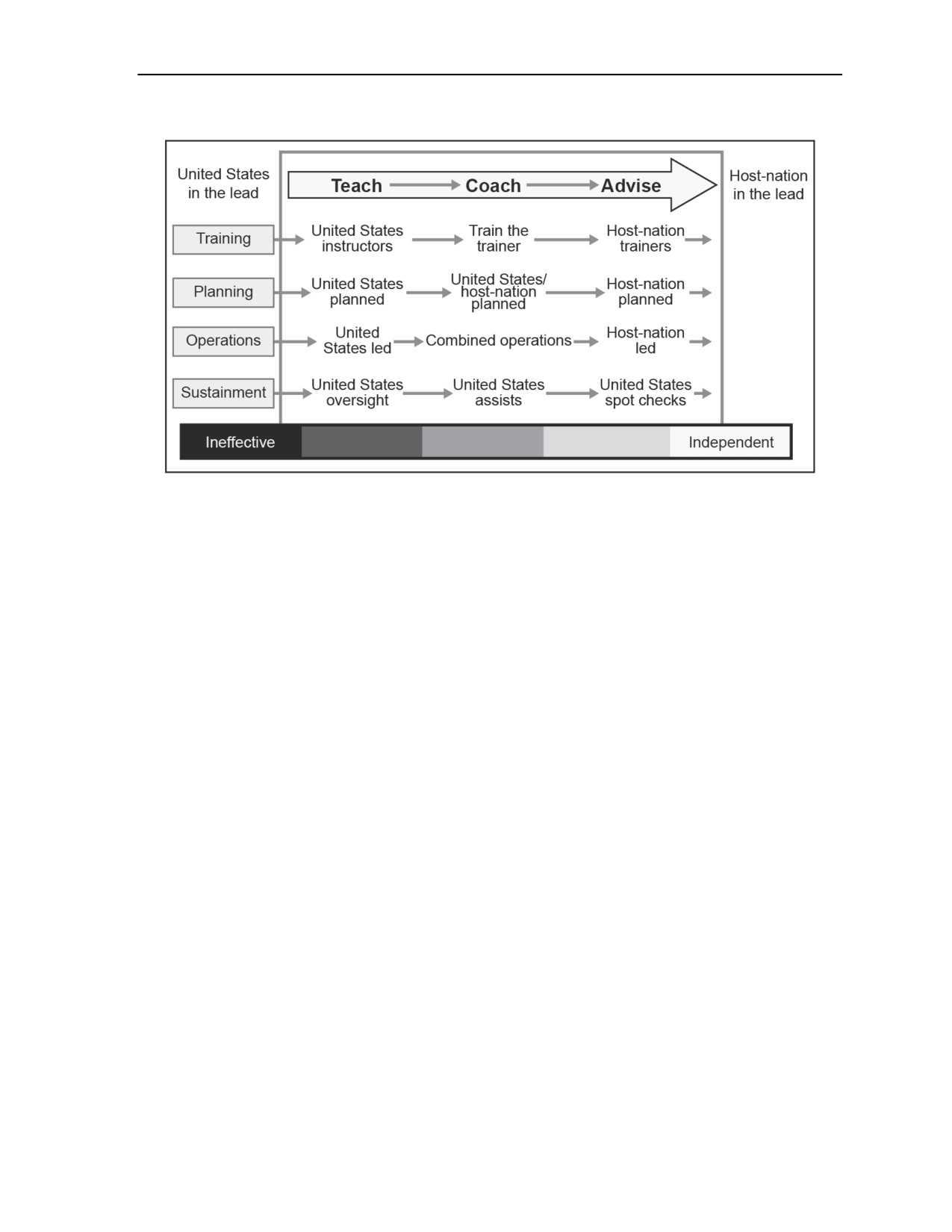
security force. There are three tasks that impart knowledge to the host-nation security force: teach, coach
and advise.
z
Teaching involves a number of activities designed to impart knowledge or skills to host-nation
security force counterparts, but the advisor or partner unit drives the process.
z
Coaching also involves the transfer of knowledge, skills, and abilities, but host-nation security
force units or individuals assume responsibility for applying what they have learned when
executing counterinsurgency tasks.
z
Advising simply involves providing advice to commanders and staffs on their actions. There is
no longer a need to actively transfer knowledge. Advising is passive and allows a host nation to
be the primary actor.
In many counterinsurgencies, the U.S. will only provide equipment, training, and advice. The host nation
has a better understanding of the operational environment and is able to better maintain its legitimacy if it
does not employ foreign forces directly. Advisors must keep in mind that they are also students and they
probably have a great deal to learn from their host-nation counterparts. (See figure 11-1.)
11-4
FM 3-24/MCWP 3-33.5
13 May 2014
Working With Host-Nation Forces
Figure 11-1. Host-nation security force meter
11-17. Regardless of the tasks taken to develop the capabilities of a host-nation security force, a key
interest of security cooperation in counterinsurgency is to legitimize a host-nation security force in the eyes
of its population. This is best accomplished by setting the conditions for a host-nation security force to
conduct security and law enforcement operations independently and professionally.
11-18. Assisting a host-nation security force in counterinsurgency means providing or augmenting a host
nation’s security forces with U.S. or multinational capabilities or resources that they cannot generate on
their own. Forms of assistance may include enablers such information collection assets and capabilities in
support of a host-nation security force’s intelligence collection efforts. U.S. or multinational forces may
provide assistance in the form of certain battlefield effects such as close air support, electronic warfare,
secure long-range communications, or information operations. Assistance to host-nation security forces
often complements their nascent logistics capabilities, such as transportation or mobility, medical
capabilities, or corrective maintenance support. Assistance may also come in the form of materiel support
across one or more classes of supply. For example, the U.S. may provide a host nation with fuel under a
bilateral agreement, even if that host nation could acquire its own fuel for operational efficiency.
Historically, host-nation security force personnel have shown few reservations about asking U.S. forces for
materiel or other forms of assistance. Before providing any of these types of assistance, U.S. forces must
ensure legal authorities permit the assistance. When pressed for assistance of any kind, U.S. or
multinational personnel should ask themselves three questions:
z
Do my counterparts really need this materiel or capability to accomplish their mission?
z
Is there any way host-nation security forces could procure or acquire this resource or capability
using their own systems, processes, or methods?
z
Can host-nation security forces sustain this system or capability over the long term?
11-19. Commanders and staffs should consider the following example. Host-nation security force
counterparts suspect that insurgent forces have established camps on the far side of a ridgeline where they
assemble and conduct final preparations prior to conducting attacks into major towns in the area. These
counterparts ask if the U.S. commander can arrange for unmanned aircraft systems to maintain persistent
surveillance over these suspected campsites to provide early warning of pending attacks. By posing the
three fundamental questions listed in paragraph 11-18, it may be possible to determine other courses of
action whereby a host-nation security force can produce and sustain the same effects. For example, the
commander might offer a host-nation security force instruction on how to build an information collection
plan and techniques for determining named areas of interest. Next, the advisors could coach their
13 May 2014
FM 3-24/MCWP 3-33.5
11-5
Chapter 11
counterparts on determining what capabilities they have at hand to observe those named areas of interest.
Can they establish permanent outposts or temporary observation posts that overlook these named areas of
interest? Can they establish or improve relations with local police forces or tribal networks to establish
hotlines linking the local population and the host-nation security force? Host-nation security force
personnel may often imagine U.S. or multinational technological or logistic capabilities as more powerful
than they truly are, and they may also fail to consider or neglect their own capabilities that can ultimately
create the same effect.
RELATIONSHIPS
11-20. Counterinsurgency operations require well-defined and understood relationships between U.S. and
multinational forces and a host-nation security force. Insurgent forces will quickly identify and exploit gaps
in counterinsurgents’ leadership and cohesion. Clearly defined relationships that evolve as a host-nation
security force’s operational capabilities grow are essential for effective mission command and facilitate a
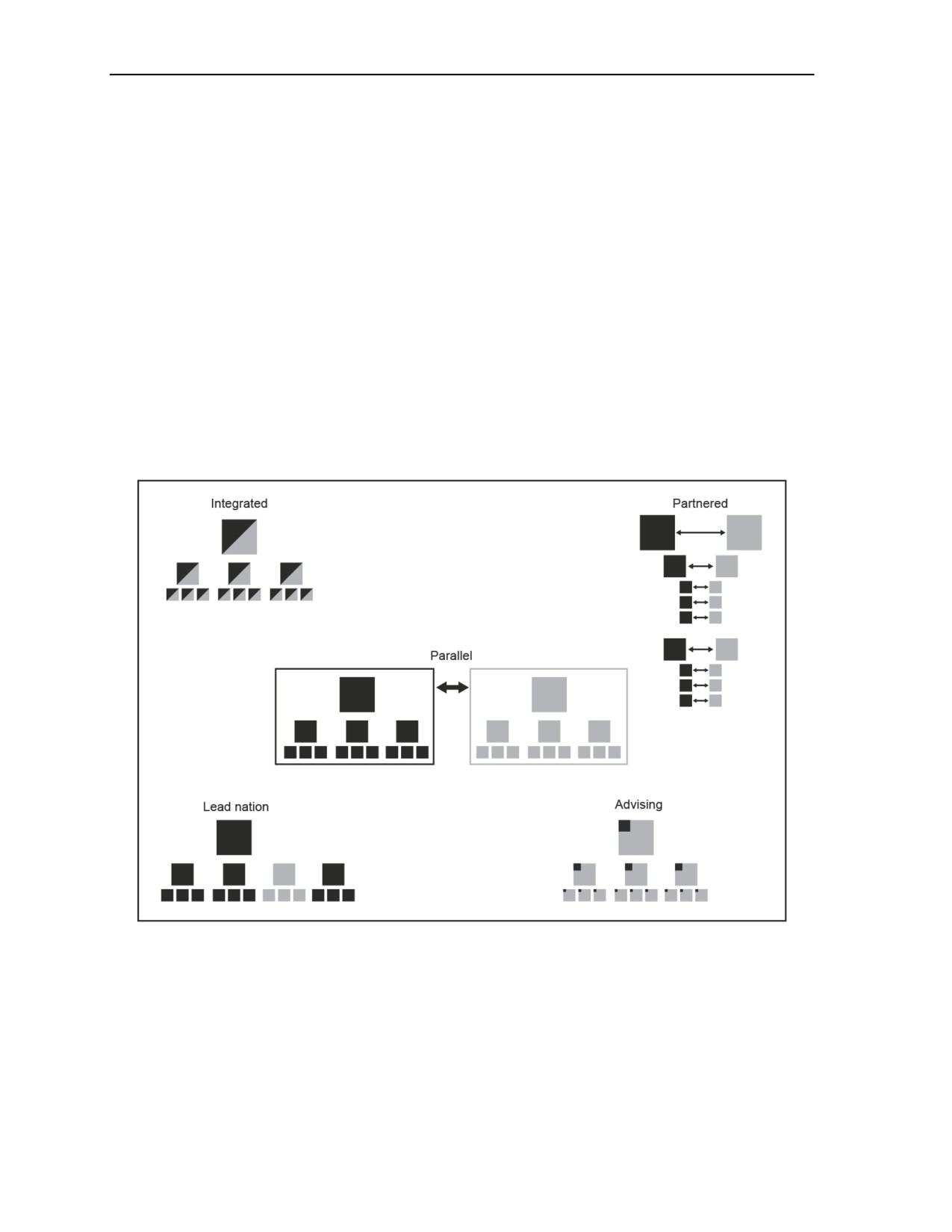
smooth transition to a host-nation security force lead for security. Broadly stated, five possible command
relationship types are worth considering for each specific counterinsurgency operation. These relationships
are parallel, lead nation, partnered, integrated, and advisory. Each of these relationships requires U.S. or
multinational forces to modify or adapt their organizations for combat to complement combined U.S. or
multinational and host-nation security force counterinsurgency goals. (See figure 11-2.)
Figure 11-2. Counterinsurgency command relationships
11-21. These relationships are useful for tactical and operational forces to understand. However, they are
also somewhat different than the relationships found in JP 3-16. While JP 3-16 outlines a command
structure in which the joint force can integrate multinational partners, paragraphs 11-22 through 11-26
provide information for understanding how to integrate forces at the tactical and operational level.
11-6
FM 3-24/MCWP 3-33.5
13 May 2014
Working With Host-Nation Forces
PARALLEL
11-22. A parallel command is when U.S. or multinational forces maintain their own command structure
with no integration or partnership with a host nation. Under a parallel command structure, no single force
commander is designated. This arrangement is suitable when a host-nation security force has well
established, mature operational and institutional capabilities, and U.S. or multinational forces deploy to
provide additional capabilities. The relationship may be based on U.S. forces being given a specific task.
For example, U.S. forces may only conduct raids or only gather intelligence for the national command
authority. It can also be based on the U.S. forces being given their own area of operations within a host
nation. This can be done for various reasons, including that the area is sensitive to host-nation forces and an
external counterinsurgent may provide a temporary stabilization of the area. This arrangement supports unit
cohesion, and it also supports unity of command.
LEAD NATION
11-23. A lead nation structure exists when all member nations place their forces under the control of one
nation. This relationship works with one nation’s forces in the lead, and the supporting nation provides a
unit or units that are attached to and under operational or tactical control of the lead nation. This
arrangement provides flexibility in that the U.S. or multinational force may initially serve as the lead
nation, and as the operational capacity of the host-nation security force grows, the host nation can
eventually assume the role of lead nation. In also provides a possible means for the U.S. to aid a host nation
in an ongoing insurgency. For example, the U.S. could provide a brigade to a host nation in an ongoing
insurgency. Like parallel command, this arrangement supports unit cohesion, and it also supports unity of
command.
PARTNERED
11-24. This arrangement differs from parallel command in that U.S. or multinational forces and
host-nation security forces are paired down to the small-unit level. Commanders and staffs must consider
how to manage unity of command, logistics challenges, and language and cultural barriers. Partnering has
the advantage of maintaining a degree of unit cohesion (individual units are still homogenous), and the
specific capabilities of each nation’s force can be leveraged down to the small-unit levels.
INTEGRATED
11-25. Integrate means to assemble forces from both the U.S. or multinational and a host-nation security
force, and meld them into a single, inseparable unit. Integration, also referred to as augmenting, poses many
challenges, but it has been used successfully in the past. For example, the Korean augmentation to the U.S.
Army was a very successful program that integrated individual South Korean soldiers into Army units. This
yielded units with enhanced manpower, and cultural and linguistic fluency, down to the squad level. The
drawback is that integration requires significant time to institutionalize and does little to enable a
host-nation security force as a whole to assume lead responsibility for operations. Integration requires a
single shared language for all personnel, so either the U.S. or multinational forces will have to learn the
host nation’s language or host-nation security force personnel will have to learn English. Furthermore,
integration of U.S. and host-nation security forces into a single coherent force requires significant
combined training in individual and collective tasks, which will result in a period at the beginning of the
deployment when the integrated force is not fully combat capable. This could result in extended
deployment periods to compensate for this operational integration and training period. Finally, integration
does little to build the capability and capacity of the host nation’s ministerial-level leadership or the
security forces’ supporting institutions.
ADVISING
11-26. When host-nation security force units achieve a certain degree of organizational maturity at a
specific echelon, U.S. or multinational forces may assign individuals or teams of advisors to perform any
number of advisory tasks. One advantage of this approach is that is imposes the smallest possible U.S. or
multinational force requirement. It also puts the host-nation security force in the most visible role of
13 May 2014
FM 3-24/MCWP 3-33.5
11-7
Chapter 11
providing security to local population. Finally, since the basing and force requirements are relatively small
for U.S. or multinational forces, it is the most flexible and adaptable relationship. Advisor teams can be
quickly reassigned to different host-nation security force units based upon capability gaps across the
host-nation security force. (See FM 3-22 for more information on advisors.)
SECURITY COOPERATION PLANNING
11-27. Security cooperation activities occur across the range of military operations. Two important
activities relevant to counterinsurgency are foreign internal defense and security force assistance. Foreign
internal defense is participation by civilian and military agencies of a government in any of the action
programs taken by another government or other designated organization to free and protect its society from
subversion, lawlessness, insurgency, terrorism, and other threats to its security (JP 3-22). Security force
assistance consists of the Department of Defense activities that contribute to unified action by the US
Government to support the development of the capability and capacity of foreign security forces and their
supporting institutions (JP 3-22). Moreover, security assistance, which includes activities in which the U.S.
provides defense articles, military training, and other defense-related services by grant, loan or credit, could
be important in equipping and resourcing a counterinsurgency force. Both foreign internal defense and
security force assistance represent important defense activities to build the capacity of a host nation to
defeat an insurgency. (For a further discussion on foreign internal defense, security force assistance, and
security assistance, see FM 3-22).
11-28. Security cooperation activities are part of both strategy and policy. In planning security
cooperation activities, combatant commanders start with the National Security Strategy issued by the White
House and expanded upon in overarching Department of Defense (DOD) guidance documents. The
National Defense Strategy influences the Guidance for Employment of the Force, which provides the
parameters for combatant commands to develop their theater and functional campaign plans, which are the
mechanisms to support the synchronization of the comprehensive civilian and military efforts specifically
designed to end insurgent violence and facilitate a return to peaceful political processes. The combatant
commander’s plans are comprehensive, as they consider design, organization, integration, conditions and
objectives for a region during steady state, crisis, and contingency (including counterinsurgency). DOD
develops its plans, taking into consideration all relevant stakeholders (including other partner nations and
international organizations.) These plans should incorporate the full range of capabilities that are required
to meet the desired end state. These plans set conditions for actions that take place throughout all phases of
joint operations. (See figure 11-3 for a graphic representation of this relationship.) (See FM 3-22 for a
detailed explanation on security cooperation activities and planning.)
11-8
FM 3-24/MCWP 3-33.5
13 May 2014
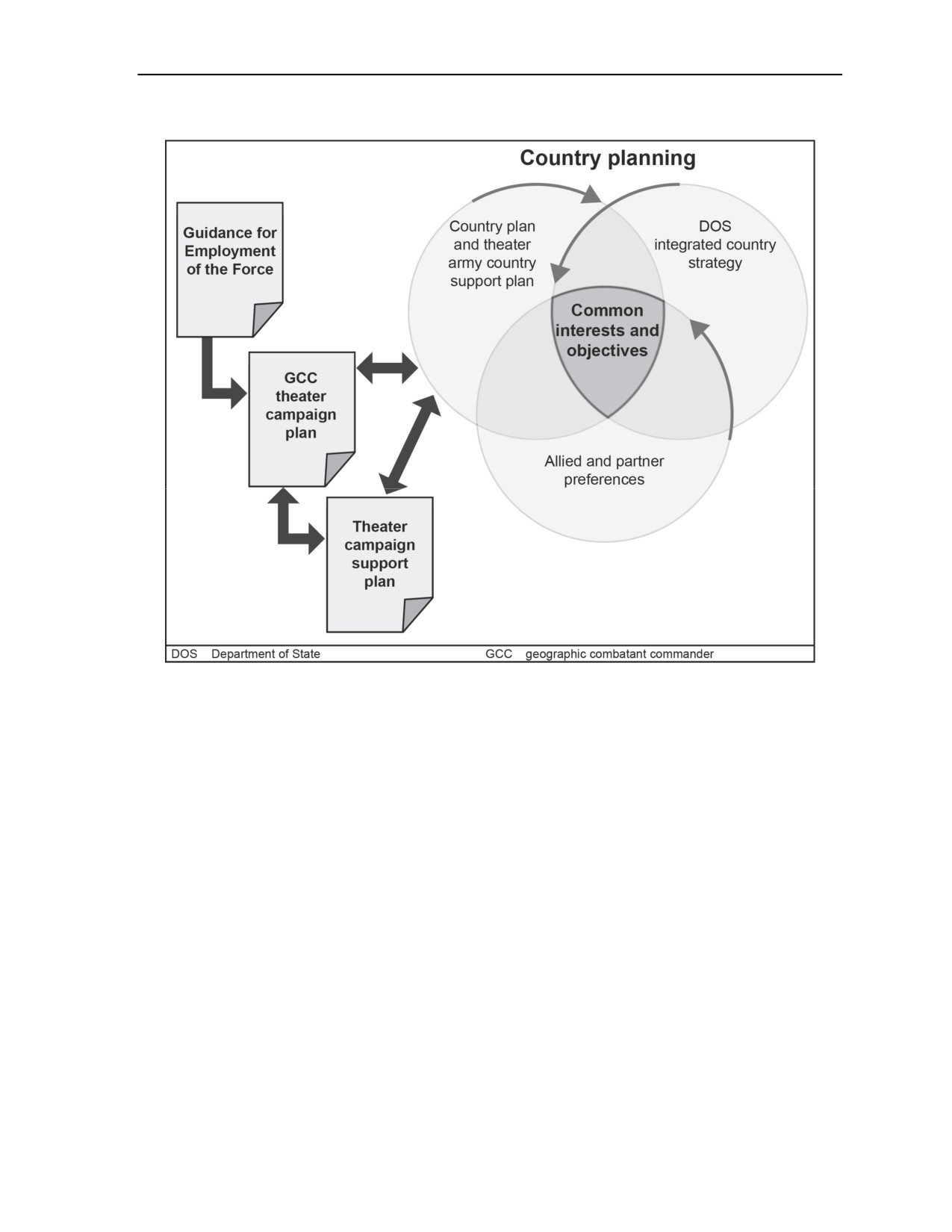
Working With Host-Nation Forces
Figure 11-3. Country planning
JOINT PHASING MODE
11-29. Security cooperation takes place during all phases of the joint phasing model. Counterinsurgents
may use security cooperation to prevent an insurgency before a major combat operation, during a combat
operation, and after a major operation. This can also apply to an active insurgency. While the joint phasing
model does not provide a universally prescriptive template for all conceivable joint operations, it does
provide a flexible model to arrange operations. The operation plan consists of six phases:
z
Phase 0, shape.
z
Phase I, deter.
z
Phase II, seize the initiative.
z
Phase III, dominate.
z
Phase IV, stabilize.
z
Phase V, enable civil authority.
11-30. Shape, or phase 0, operations of the joint phasing model are joint and multinational operations that
include normal and routine military activities. During phase 0, both the Army and Marine Corps perform
security cooperation activities as directed in higher plans and orders to indirectly support a host nation in
countering an insurgency. Since security cooperation operations can continue through all phases of the
operation, many of the activities, such as foreign internal defense direct support and foreign internal
defense combat operations, must have the unified application of U.S. forces to achieve the desired effects in
countering insurgent operations. This is critically important as these efforts are important elements in
phases II and III. Foreign internal defense, security force assistance, and other security cooperation
13 May 2014
FM 3-24/MCWP 3-33.5
11-9
Chapter 11
activities are essential throughout the phases of any operation. (See JP 5-0 for more information on the joint
phasing model.)
11-31. If the U.S. commits forces to a counterinsurgency conflict, it will normally deploy a joint task
force or multinational joint task force headquarters to provide planning and command and control. The
multinational joint task force’s desired end state is to terminate the operation plan at the conclusion of
Phase V, stand-down or redeploy the multinational joint task force headquarters, and revert to Phase 0
operations. The geographic combatant command and respective Service component commands, in
coordination with the country team, resume security cooperation activities directed by the country plan.
Counterinsurgency operations typically extend across all phases
(0 through V). Therefore, U.S. or
multinational security force assistance and foreign internal defense activities in support of the host-nation
security force’s counterinsurgency conflict may occur under the auspices of the American ambassador to
the host nation and the geographic combatant commander, or under the authority of the multinational joint
task force commander.
DEVELOPING HOST-NATION SECURITY FORCES
11-32. Both foreign internal defense and security force assistance can be used as part of a long term plan
to develop and deploy a host-nation force to defeat an insurgency. While the U.S. may intervene in a
country that only needs enablers to enhance an already effective military force, a host nation may lack an
effective military. If the host nation lacks an effective military, aid in the development of that host-nation
military could follow five phases: planning and resourcing host-nation security force, generation of
host-nation security force, employment of host-nation security force, transition of responsibility for security
to host-nation security force, and sustainment of host-nation security force. These phases are distinct and
independent of those in the joint phasing model. U.S. or multinational forces conduct parallel planning with
their host-nation security force counterparts to achieve strategic, operational, and tactical objectives in
support of the overall counterinsurgency campaign, while at the same time working toward milestones that
lead to a successful transition from U.S. or multinational lead to host-nation security force lead for security.
11-33. Typically, the first phase of building a host-nation security force, planning and resourcing, falls to
the responsibility of geographic combatant command-level planners in coordination with the country team.
Coordination of legal authorities and funding for security force assistance and foreign internal defense
activities is an interagency process because it typically involves resources provided under a number of
different sections of the United States Code (USC). Moreover, other security cooperation programs, such as
foreign military sales, may be essential in equipping another military to perform foreign internal defense
operations.
11-34. Generating the host-nation security force is the second phase in building a host-nation security
force. If the U.S. is deploying conventional forces, this will probably be the initial phase in which
regiments or brigade combat teams will actually have an active role. These forces can partner with
host-nation security forces of varying developmental levels in the conduct of counterinsurgency operations.
For example, while supporting recent counterinsurgency operations in Colombia and the Philippines,
host-nation security force counterparts had already fielded relatively sophisticated, well-developed
operational units supported by robust supporting institutions and well established executive-level or
ministerial leadership. In other U.S. historical counterinsurgency operations such as Afghanistan and Iraq,
the host-nation security force operational units, their supporting institutions, and the most senior-level
executive leadership functions were undeveloped or completely non-existent. In situations such as these,
U.S. and multinational forces must organize, train, and equip host-nation security force units while
assisting in the building or rebuilding of their supporting infrastructure. The organize, train, and equip
security force assistance tasks may be assigned to U.S. or multinational regiment- or brigade-sized units
while they are simultaneously battling the insurgents. At the same time, unified action must be taken to
establish a host-nation security force’s own sustainable force generation capabilities and capacity. U.S. or
multinational personnel, working with their host-nation security force counterparts, are placed in a difficult
predicament in that they must carefully select key host-nation security force leaders to be pulled away from
the immediate counterinsurgency fight to assume critical command and staff positions within the
host-nation security force’s organizations. Counterinsurgents must exercise restraint by not assigning all of
the best host-nation security force leaders to operating force units while neglecting to invest in their own
force generation capacity. (See figure 11-4.)
11-10
FM 3-24/MCWP 3-33.5
13 May 2014
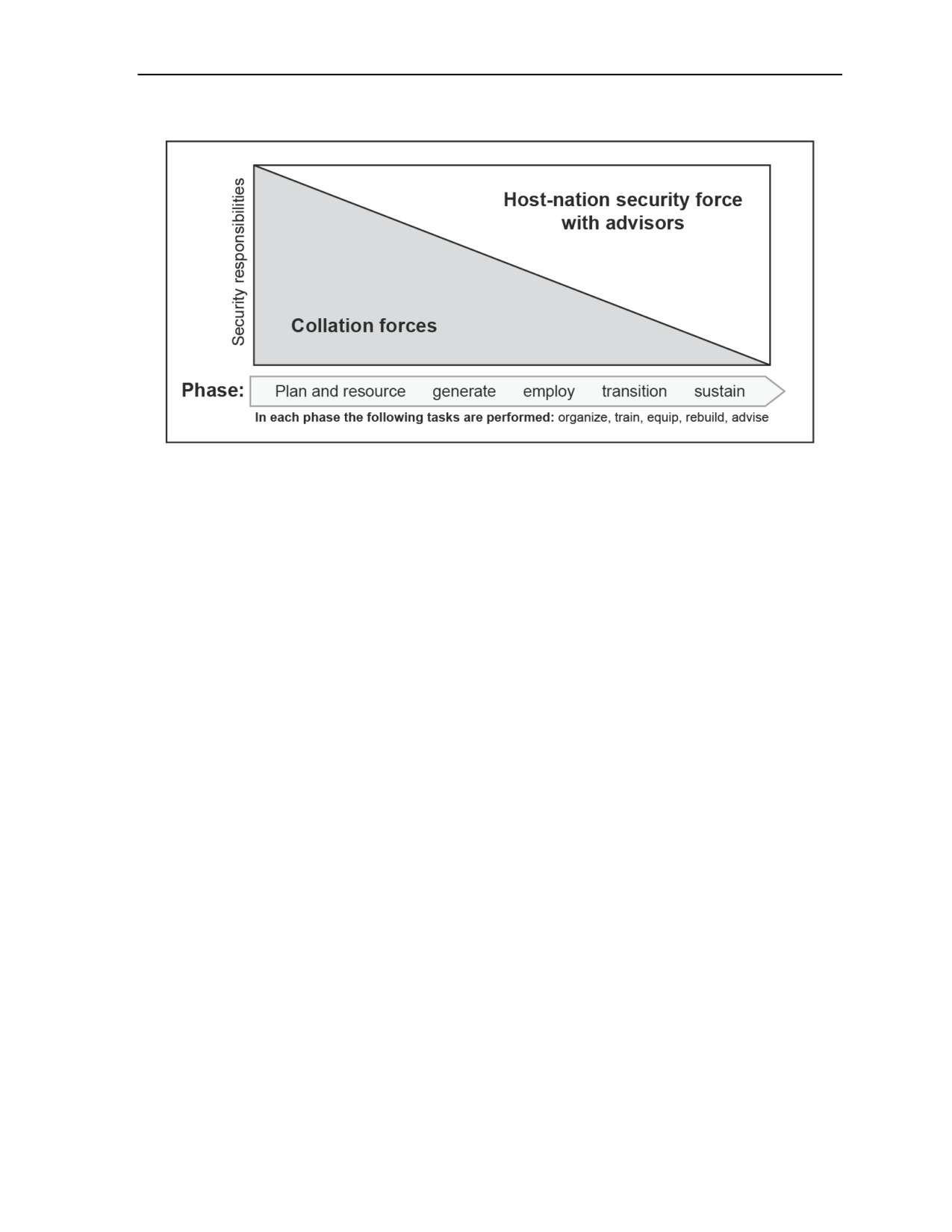
Working With Host-Nation Forces
Figure 11-4. Phases of building a host-nation security force
11-35. The third phase of building a host-nation security force is the employment of a host-nation security
force to protect the population and defeat the insurgents. During this phase, the primary focus shifts from
organizing, training, equipping, and rebuilding host-nation security forces to employing host-nation
security forces to perform the security tasks for which they were designed. As one host-nation security
force unit enters the employment phase, other units may have just begun the force generation process.
Meanwhile, there may be more seasoned host-nation security force units that are ready to transition to the
lead for security operations in their assigned area of operations. Additionally, it may be possible to generate
host-nation police forces more quickly than army units, since they can be employed individually or in small
station-level units, they do not need to conduct large-scale collective training exercises, and they typically
have fewer materiel requirements. However, it may take considerably longer for police forces to show their
effectiveness during the employment phase due to the length of time it takes for police forces to gain the
trust of the local population and build productive, enduring relationships with local or tribal leaders.
11-36. The fourth phase of building a host-nation security force in a counterinsurgency is the transition of
responsibility for security operations from the U.S. or multinational forces to a host-nation security force.
In some instances, such as in Colombia or the Philippines, a host-nation security force may already be
mature and highly capable in most or all operational realms (land, air, and maritime). Security force
assistance activities and the resulting transition to a host-nation security force lead may refer only to
specific functions such as intelligence or an even more discreet set of tactical tasks, such as employment of
remote sensors, that supports the host nation’s strategic or operational counterinsurgency goals. In these
instances, the U.S. may provide operational capabilities to meet the immediate threat, while conducting
security force assistance in the form of equipment or training to close the capabilities gap. Once the
capability gap is filled, a host nation’s security force assumes responsibility for that function, and U.S.
forces redeploy, with the country team providing the host nation access to long-term security assistance
programs as appropriate.
11-37. The defense attaché office and foreign area officers play an important role in long-term security
assistance programs. In other cases such as Iraq, U.S. or multinational forces may initially have to assume
responsibility for all security tasks in all operational realms, and across all security force functions (land
forces, police, and border security). In the latter case, transition is a lengthy process with no clearly defined
beginning or end date.
11-38. Transition will likely be conducted in steps or subphases, and the steps or subphases may be
geographic, functional, or a combination of both. For example, the transition to host-nation security force
lead for land force security operations may transpire one province at a time until the entire country has
transitioned. A second example might be for transition to occur for land forces across the entire country by
13 May 2014
FM 3-24/MCWP 3-33.5
11-11
Chapter 11
January 20XX, all police forces by June 20XX, and air and maritime forces by December 20XX. A
transition to a host-nation security force lead should be conditions or assessments-based, although the U.S.
or multinational forces may elect to use a set transition date as a forcing function to compel the host-nation
security forces to assume greater responsibility for securing their own country and their own people.
Transitions will rarely be simple. In cases where U.S. or multinational general-purpose brigade combat
teams deploy for extended tours such as 12-month rotations, units may find that they are supporting the
host-nation security force transition to lead for security when they arrive in-country and still supporting the
same transition when they redeploy one year later.
11-39. The fifth phase of building a host-nation security force in counterinsurgency is sustainment. In this
context, the term sustainment does not refer exclusively to logistic sustainment or sustainment functions.
Rather, sustainment is an ongoing set of security assistance activities (Title 22) and security cooperation
activities (Title 10) designed to enhance the capabilities and capacity of a host nation to provide for its own
security and to participate in regional or global multinational operations. These programs also seek to
develop enduring relationships with key leaders within the host-nation security force and to facilitate
peacetime or contingency access to host-nation facilities such as ports, airfields, and training venues. As the
transition to the host-nation security force lead for security draws to a close, there may be a number of
security force assistance tasks that require an extended period to be completed properly. Examples include
foreign military sales of new equipment such as tanks, artillery, helicopters, or watercraft and subsequent
deployment of mobile training teams to train the host-nation security force on the employment of these new
weapons systems. Enduring geographic combatant command-level security cooperation activities, such as
rotational deployment of U.S. forces to conduct combined exercises with the host-nation security force,
sustain and extend the development of the capability and capacity of a host-nation security force to deal
with residual insurgent threats and potential future external threats to that host nation’s sovereignty.
11-40. In a counterinsurgency, the host-nation security force’s executive and ministerial leadership, its
force generation capacity, and its operating forces’ capabilities must develop and mature quickly, while
U.S. or multinational forces initially provide time in the form of security to allow this process to succeed.
U.S. or multinational forces gradually reduce and eventually relinquish control of the counterinsurgency to
a host-nation security force. Parallel planning with a host-nation security force provides the blueprint for
what must occur from the U.S. or multinational side and a host-nation security force side of an operation.
Both entities plan for transition to host-nation security force lead, but they approach the transition from
different perspectives. Initially, teaching, coaching, and advising host-nation security forces in their
planning efforts is part of the overall process, but it ultimately should result in a host-nation security force
having the capability and capacity to defeat an insurgency on its own.
PARALLEL PLANNING
11-41. When enabling a host nation to develop a security force, parallel planning is essential. Parallel
planning is a time-saving technique that enables leaders at all levels from fire team to division to initiate the
operations process (plan, prepare, execute, and assess) prior to the receipt of a complete operation order.
Parallel planning allows units to generate tempo by conducting a multi-tiered planning process. This
reduces haste and provides all echelons more available time to prepare for future actions. Likewise, parallel
planning with host-nation security forces enables greater efficiency and the ability to conduct simultaneous
actions. It also serves as an essential step in the host-nation security force transition to the lead for security
in a counterinsurgency.
11-42. Parallel planning with the host-nation security force assumes adequate planning capabilities on the
part of at least some of the host-nation security force commanders and staffs. When making this
assumption, U.S. or multinational forces assume operational risks relating to the ability of the host-nation
security force staffs to deliver on their planning requirements. Considerations when conducting parallel
planning with the host-nation security force commanders and staffs may include, but are not limited to,
varying or competing agendas, lower literacy rates, access to computer technology, and use of graphics or
visuals. U.S. commanders and staffs conducting parallel planning consider these points:
11-12
FM 3-24/MCWP 3-33.5
13 May 2014

Working With Host-Nation Forces
z
U.S. or multinational forces have their own national security objectives, while host-nation
counterparts may have conflicting objectives from the national to the local level.
z
Literacy rates in many of the countries that the U.S. or multinational forces may partner with are
often far below that of the U.S. or other western countries. Lack of formal education, however,
does not preclude the host nation from being capable of understanding the western style of
military planning.
z
Access to computer technology in various host nations often does not match that of the U.S. or
western countries. Commanders and staffs may have to use manual methods of data collection,
storage, and dissemination.
z
Instructional programs, whether computer based or done on a terrain model, are based on
western preference for the presentation of information through visual modalities. Successful
counterinsurgency operations require U.S. or multinational advisors to imbue their host-nation
security force counterparts with the capability to process raw data into information that provides
knowledge and leads to an understanding of an operational environment.
z
Security classification of host-nation counterparts.
z
Foreign disclosure restrictions.
11-43. Regardless of the difficulties of parallel planning, U.S. and multinational forces make every effort
to understand host-nation planning capabilities prior to conducting operations. Despite the many challenges
presented by conducting parallel planning with host-nation security forces, U.S. and multinational forces
should be completely integrated into the planning process as early as possible because the host nation can
potentially bring to the counterinsurgency specific and essential abilities. (See table 11-2 for examples of
host-nation contributions.)
Table 11-2. Host-nation contributions
Task
Reason for contribution
Understand an operational
An area of operations is a host nation’s home and its
environment
culture; a host-nation force knows the language, the
different groups, the political situation, educational levels,
economic considerations, historical bad actors, and
unofficial community leaders.
Provide human intelligence
Host-nation security forces may be able to better gather
information that leads to human intelligence for many
reasons, including speaking the same language and
understanding the important players in the area.
Put the pieces together
Host-nation forces can often better integrate the different
fragments of intelligence into the context of an operational
environment.
Determine credibility of
Host-nation forces possess a vastly superior sense of
intelligence assets (sources,
cultural intelligence and may be able to assist in assigning
walk-ins, call-ins)
credibility to sources.
Validate and check
Host-nation forces can assist in confirming the locally hired
interpreters
interpreters’ abilities to interpret.
Identify and root out
Host-nation forces can pick out minute differences between
infiltrators
normal and abnormal behaviors.
Gain information superiority
Host-nation forces can help write messages that may
resonate with the local population.
Vet locally hired personnel for
Host-nation forces have access to resources not
counterintelligence and
necessarily available to U.S. personnel.
security purposes
11-44. Tactical-level planners in the U.S. military employ either the military decisionmaking process or
the Marine Corps planning process to gain an understanding of an operational environment, identify the
13 May 2014
FM 3-24/MCWP 3-33.5
11-13
Chapter 11
tactical problem, develop possible courses of action, and evaluate and select the best course of action to
most effectively address the tactical problem. Commanders and staffs first properly frame the problem.
When given a set of inputs, such as an order from higher headquarters or some other initiating directive,
certain intelligence products, and an initial commander’s visualization, commanders and staffs complete
the steps to work toward a specified output, such as a finished operation order. In cases where host-nation
security force leaders have been directly involved in combat operations over many years, those leaders who
survive often owe their lives to their own ability to improvise. As a result, many host-nation security force
leaders apply an intuitive, instead of a process-oriented, method of making decisions. They can
immediately size up a tactical situation, almost instantaneously recognize dangers and opportunities, and
decide upon a course of action. While this capability can serve in critical situations, it cannot be taught to
others, and it is of no use in situations unrelated to the leader’s own experiential learning. Therefore, U.S.
or multinational advisors may have to work patiently with their host-nation security force counterparts for
them to develop a planning and decision support process instead of allowing them to rely solely on the
intuitive approach.
11-45. U.S. and multinational planners ensure that they have conducted basic mission analysis prior to
parallel planning with host-nation partners. This allows advisors to develop and assess assumptions,
identify implied and specified tasks, determine what assets and capabilities are available, and formulate a
tentative timeline to coordinate advisory efforts throughout the planning process.
11-14
FM 3-24/MCWP 3-33.5
13 May 2014
Chapter 12
Assessments
12-1. Assessment is a continuous process that measures the overall effectiveness of employing joint force
capabilities during military operations. It is also a determination of the progress toward accomplishing a
task, creating a condition, or achieving an objective (JP 3-0). The assessment process monitors the effects
of actions on mission accomplishment. Operational assessments have three enduring purposes. First, they
monitor the nature, scope, and severity of a situation. Second, they track a military force’s implementation
of a plan in combination with collaborating agencies. Finally, operational assessments evaluate progress
towards achieving goals or objectives. Commanders and staffs must integrate assessments into the Army
design methodology and conceptual planning. Assessments are crucial for successful adaptation and
innovation by commanders within their respective areas of operation. Assessments are also essential in any
type of transition. They are a key ingredient in adapting and learning. Assessments must be part of initial
design. Commanders and staffs must conceptualize what is actually important and determine how to
question those assumptions from the beginning of understanding a problem. (See ADRP 5-0 and ADRP 6-0
for doctrine on assessments.) Assessment precedes and is integrated into every operations activity and
entails two broad, enduring tasks:
z
Continuously monitoring the current situation (including the environment as it affects friendly
forces, enemy forces, and the population) and the progress of the operation.
z
Evaluating the operation against established criteria, expected outcomes, and the desired end
state.
12-2. Commanders, assisted by their staffs, continuously evaluate an operation’s progress against the
established commander’s intent, mission, and concept of the operation. Based on their assessments,
commanders may adjust the operation and associated activities to better achieve the end state and adjust
assessment criteria to address the most credible and relevant activities.
12-3. The critical role of assessment necessitates establishing measures of effectiveness and performance
during planning. Commanders choose these measures carefully so that they align with the overall
operational design and the superior commander’s intent. These measures reflect the interrelationship among
the lines of effort. Commanders and staffs revise their assessment and measures of effectiveness and
performance as an operation progresses to most effectively focus limited collection and analytical
resources.
12-4. Sound assessment blends qualitative and quantitative analysis with the judgment and intuition of all
leaders. Commanders must apply assessments carefully, as counterinsurgency operations most often
involve complex societal issues that may not lend themselves to quantifiable measures of effectiveness.
Moreover, bad assumptions and false data can undermine the validity of both assessments and conclusions
drawn from them. Data and metrics can inform a commander’s assessment. However, they must not be
allowed to dominate it in uncertain situations. Subjective and intuitive assessment must not be replaced by
an exclusive focus on data or metrics. Commanders must exercise their professional judgment in
determining the proper balance.
ASSESSMENT FRAMEWORKS
12-5. Several assessment frameworks have been developed over the past decade. Depending on their
specific purpose, they can be used as tools to develop an interagency initial assessment, assess conflicts, or
measure progress. For example, the Interagency Conflict Assessment Framework is a recognized and very
useful initial assessment framework (See United States [U.S.] Government publication Interagency Conflict
Assessment Framework). Alternatively, units may use some form of systems analysis based on the
operational variables.
13 May 2014
FM 3-24/MCWP 3-33.5
12-1
Chapter 12
ASSESSMENT METHODS
12-6. Selecting the appropriate approach to assessment is the commander’s most important assessment
decision. Assessment methodologies may be centralized, decentralized, or both. A centralized methodology
requires units to collect and report information requirements to their higher headquarters for analysis and
situational understanding. This is a common methodology and is often described as pattern and trend
analysis. Pattern and trend analysis uses centralized quantitative analysis to produce a snapshot of the
operation’s momentum over time. Pattern and trend analysts tend to accept that counterinsurgency data will
be inaccurate and incomplete, but when viewed in aggregate this data will be sufficient to produce relevant,
centralized, and quantifiable analysis. Pattern and trend analysis measures progress, but it is not truly an
assessment. The problem with the centralized approach to assessment is that the decentralized nature of
counterinsurgency prevents the development of any centralized model to understand the important nuances
of local context. Decentralized assessments enable subordinate units to develop and measure progress
locally. The interaction between levels of command is critical to informing the higher commander.
Although decentralized assessments are preferred by the lower tactical levels, actual measurement of
progress is limited by the lack of a common starting point. This often gives the best picture of a local
situation, but it lacks the context of how it compares to other locations. Senior commanders must weigh the
results by comparing assessments with dissimilar measurements. This makes the development of an
aggregate analysis very difficult.
12-7. Military forces in counterinsurgencies usually use a combination of these two assessment methods,
choosing common reporting requirements for all subordinates but also requiring a subjective analysis from
each of the subordinate commanders to aid in informing the senior commanders’ situational understanding.
Units report qualitative statistics to enable pattern analysis, and commanders provide quantitative analysis
to fully depict what the statistics mean at the local level. The combined assessment involves a top down
planning, bottom-up refinement approach in which analysis is conducted at the level the data is collected
and reports to higher headquarters include narratives from local commanders. This type of assessment
eschews the establishment of core level metrics at the highest levels and allows commanders to establish
additional metrics in accordance with their situation and their resources. Combined assessment generally
results in more accurate reporting and efficient use of collection and analysis resources.
12-8. In geographically distributed, decentralized counterinsurgency campaigns, only a few activities
produce similar outcomes or are consistently implemented across the theater of operations. What is
important in one area may not be important in another. Similarly, what works in one area may not work in
another area.
ASSESSMENT CONSIDERATIONS
12-9. Assessment begins as soon as a military force receives an alert or warning and does not end until
after that force has ceased operations and left the area of operations. Assessment begins with an initial
assessment that serves as the basis for planning. Planning develops this into an operational assessment that
evaluates plan effectiveness and focus. The assessment is continually reassessed. Often plans are updated
because of the reassessment process.
12-10. The assessment should reflect the achievements of collaborating partners. Military forces cannot
defeat an insurgency alone. Assessors must realize that information about the underlying root causes for
social, cultural, political, and economic turbulence will probably be incomplete. Obtaining reliable
information can be costly and time-consuming. Assessors should be extremely wary of methods that claim
to provide this information quickly. An assessment based on faulty information can result in military force
actions that are counterproductive. It is better for assessors to monitor the situation, track what every
organization is doing, and be clear about what they do not know. The next step is to postulate, hypothesize,
and clearly state what assumptions the evaluation process is making. Assessors seek information to test
assumptions and revise estimates as operations continue.
12-11. At its core, a counterinsurgency environment is a political problem. Understanding and solving the
political problem is the essence of counterinsurgency operations. A counterinsurgency environment is
complex, with many lines of effort covering a variety of political, military, economic, social,
infrastructural, and informational activities. As such, developing a comprehensive assessment is a
12-2
FM 3-24/MCWP 3-33.5
13 May 2014
Assessments
time-consuming process that is difficult to perform properly and effectively. Counterinsurgents must assess
not only their own actions or inactions, but also those of insurgents and the population. In understanding
these actions and inactions, counterinsurgents must have a thorough knowledge of the history and culture
of their areas of operations. These assessments must include, among many other factors, the context for any
given situation, the perceptions of those involved, and the possible outcomes of actions or inactions.
12-12. Commanders are responsible for assessments. The commander’s direct and personal involvement
in the assessment process is critical. Moreover, assessments must contain both subjective and objective
elements. Assessments combine elements of science and art. They are not simply a collection of numbers
or indicators. Commanders and staffs must understand assessments in the context of the overall campaign,
not just from a military perspective.
12-13. Countering an insurgency most often involves an extended campaign. Counterinsurgents must
assess actions or inactions broadly, to include how they are viewed locally, within the multinational force
(if one exists), host nation, and the region. Counterinsurgents also assesses actions against host-nation
strategic goals. Without the backing of each of these levels, counterinsurgents risk loss of legitimacy and
potential failure.
12-14. Eliminating the root causes of an insurgency is the goal of a counterinsurgency. Assessment must
focus on those activities and actions that are most important in addressing these root causes. Assessment
must be focused on gathering the right information needed to understand what to do. The commander must
determine if counterinsurgents are doing things right, if counterinsurgents are doing the right things, and if
change is necessary.
12-15. Balanced assessments include information from all relevant and objective sources, including both
quantitative and qualitative data. This data includes the proper combination of centralized and decentralized
reporting. A balanced assessment includes countering opinions and data that contradict overall findings. A
combination of quantitative and qualitative types of indicators reduces the chance of misconstruing trends.
12-16. No assessment will ever show all the aspects of a counterinsurgency campaign. Efforts to show all
aspects of a counterinsurgency waste resources and place unrealistic demands on subordinate units that
often result in falsified reporting. Assessment should rely principally on information gathered through
ongoing intelligence and operational reporting. Demands for additional reporting should be minimized.
12-17. There is no substitute for seeing a battlefield as a means for understanding a situation. Battlefield
circulation is critical to establishing relationships between commanders at all levels. The view of a
commander who daily walks and lives in a particular area of operations provides a level of insight that no
statistic or report can replace. These first-hand encounters provide commanders a lens with which to review
and compare centralized reports and trend analysis with the intuition and local understanding of
subordinate commands.
12-18. Collecting, assembling, and analyzing information is a time and labor-intensive process.
Commanders balance time and resources for assessment just as they do across the planning, decision, and
execution continuum. To help achieve this balance, commanders and staffs ask the following questions:
z
What must be understood to begin planning?
z
What will be assessed and to what detail?
z
How will a particular task, objective, end state condition, or assumption be assessed?
z
What measures of effectiveness and measures of performance will be used?
z
What information requirements (indicators) are needed to support a particular assessment?
z
Who on the staff has primary responsibility for assessing a particular area?
z
What is the collection plan?
z
How can the host nation help?
z
How can the other agencies of the U.S. government assist?
DEVELOPING MEASUREMENT CRITERIA
12-19. Assessment requires determining why and when progress is being achieved along each line of
effort. Traditionally, commanders use discrete quantitative and qualitative measurements to evaluate
13 May 2014
FM 3-24/MCWP 3-33.5
12-3
Chapter 12
progress. However, the complex nature of counterinsurgency operations makes progress difficult to
measure. Subjective assessment at all levels is essential to understand the diverse and complex nature of
counterinsurgency problems. It is also needed to measure local success or failure against the overall
operation’s end state. Additionally, commanders need to know how actions along different lines of effort
complement each other; therefore, planners evaluate not only progress along each line of effort but also
interactions among lines of efforts.
12-20. The most common types of assessment measures are measures of effectiveness (MOEs) and
measures of performance (MOPs). A measure of effectiveness is a criterion used to assess changes in
system behavior, capability, or operational environment that is tied to measuring the attainment of an end
state, achievement of an objective, or creation of an effect (JP 3-0). MOEs focus on the results or
consequences of actions. MOEs answer the question,
“Are we achieving results that move
counterinsurgents towards the desired end state, or are additional or alternative actions required?” A
measure of performance is a criterion used to assess friendly actions that is tied to measuring task
accomplishment (JP 3-0). MOPs answer the question, “Was the task or action performed as the commander
intended?”
12-21. MOEs and MOPs for assessing counterinsurgency operations are designed with the same
characteristics. MOEs and MOPs are measurable, observable, distinctive, relevant, and responsive:
z
MOEs and MOPs have quantitative or qualitative standards against which they can be measured.
The most effective measurement is a combination of quantitative and qualitative measures to
guard against an inaccurate view of results.
z
Each MOE and MOP measures a separate, distinct aspect of the task, purpose, or condition.
z
MOEs and MOPs are relevant to the measured task, outcome, and condition. Host-nation local,
regional, and national leaders, and NGO personnel, may provide practical ideas, professional
ideas, and feedback to craft relevant MOPs and MOEs.
z
Assessment tools detect environmental and situational changes.
DESIGNING MEASURES OF EFFECTIVENESS AND PERFORMANCE
12-22. An MOE provides some information about how an operational environment is changing. An MOE
of a number of attacks on counterinsurgents can indicate a successful counterinsurgency, or it can indicate
insurgent control of an area and an unwillingness of counterinsurgents to contest that control. In this
example, commanders and staffs need to understand why the number of attacks are down. What is essential
to any MOE is the development of an effective measure that tells the commander critical information about
how an operational environment is changing.
12-23. Moreover, in developing MOPs, commanders and staffs measure a unit’s performance based on
the conditions of its area of operations. In other words, MOPs should be developed as a means to measure
if a unit is effectively doing the things that the commander and staff view as essential to defeating an
insurgency. MOPs are developed based on a counterinsurgency mission and an area of operations.
12-24. When designing MOEs and MOPs, commanders and staffs consider several points:
z
Raw counts of something is usually not as important as how many out of a possible total and
how important each one is.
z
Knowledge of the state of insurgent training may provide information about the overall
capability of the insurgency. If an insurgency can produce trained units, it may have a higher
military and sustainment capacity.
z
Training in other states could indicate support from another state.
z
A high number of un-coerced informant reports could be an important indicator of a breakdown
in insurgent security. Also, the position of the informer in the society might be an important
indicator.
z
The number of insurgent attacks is not always as important as the scale of an insurgent attack.
Large-scale attacks require a level of operational sophistication that may imply an increased
insurgent capability.
12-4
FM 3-24/MCWP 3-33.5
13 May 2014
Assessments
z
How many insurgents are caught and jailed may be an important MOE. However, the number
convicted and sentenced by government judicial authorities and remaining in jail over time is
also an important MOE of governmental capability and corruption.
z
The number of recruits available for an insurgency can be an important indicator of the
government’s and the insurgency’s legitimacy.
z
An MOP based on the number of patrols in a given area over a period may not be as effective as
the persistence of patrols in a given area over the same period of time.
z
An MOE based on the amount of money seized may not be as important as an MOE based on
denying funding sources. It may simply show an increased flow of funds into an area.
12-25. When developing MOPs and MOEs, commanders and staffs avoid developing MOPs or MOEs
that highlight what a commander and staff are actively doing to defeat an insurgency. For example,
building a number of schools can be used as an MOP, and the number of students in the school can be used
as an MOE. However, these activities may have no effect on an insurgency at all. Commanders and staffs
connect MOEs and MOPs to their operational environment and insurgency. Accepting the assumption that
what one is doing is actually relevant to defeating an insurgency is an easy means to undermine the
effectiveness of MOPs and MOEs. Commanders and staffs avoid the trap of thinking that because they do
something and measure it, it is important.
12-26. Commanders and staffs generally avoid measures that lack context. For example, the number of
enemy killed, without any context, is normally a dangerous MOP. The number of enemy killed can indicate
that the insurgency is increasing its recruitment and capabilities, thus more insurgents are being killed in
more attacks. Commanders and staffs establish some context in any measure that they use.
12-27. Vietnam highlights the importance of creating an assessment framework that is contextual to the
insurgency and is relevant to actually measuring success. In Vietnam, U.S. leadership made assumptions
about what were important measures of success without connecting those measurements to situational
understanding. Many U.S. leaders did not actively question their assumptions. Even worse, their ineffective
assessment framework had an influence on operations.
Measuring Effectiveness and Performance in Vietnam
Historical accounts of the conflict in Vietnam vary widely in the points
emphasized and the explanations offered. Disputes are facilitated by the different
personal experiences of many different direct observers who saw or participated in
sometimes very different slices of the conflict at different times, at different
operational levels, and in different parts of the country. What, if anything, could have
been done to change the outcome of the war and who to blame for that outcome
remains fairly hotly contested. What the outcome was, however, is not contested:
U.S. forces withdrew in 1973, and the Saigon government fell to the combined
pressure of the insurgency and North Vietnamese regular forces in April of 1975,
unequivocally a counterinsurgent loss.
The literature on the U.S. military’s Vietnam-era assessment process is
highly negative; even the most strident defenders of the assessment reports
produced during that period expressed some dissatisfaction with the process.
Assessments of the Vietnam War varied in type, purpose, and intended consumer.
The entire process changed and grew between the early 1960s and the early 1970s;
there was no single “Vietnam War assessment.” There were many assessment
processes, and many were burdened with murky objectives, measures that were
poorly connected to those objectives, and poor data collection. Quantitative data of
questionable veracity were used to make optimistic prognostications, such as the
illusion of a trend toward “a light at the end of the tunnel.” Distrust of Vietnam-era
military briefings became so endemic that members of the press corps referred to the
daily military press briefings as the “five o’clock follies.”
The Military Assistance Command, Vietnam, or MACV, was the theater-
level military command in Saigon, South Vietnam. MACV was the neck of the funnel
for nearly all field reports on operations, intelligence, pacification, and other data
13 May 2014
FM 3-24/MCWP 3-33.5
12-5
Chapter 12
categories. Some of the MACV reports and nearly all of the Secretary of Defense’s
reports relied heavily on aggregated quantitative data and pattern and trend analysis.
In some cases, data collection requirements were developed to meet perceived
operational or strategic needs; in other cases, they were specifically designed to
provide data that would show some kind of progress without context. For example, in
1968, MACV reported the number of cakes of soap it had issued to Vietnamese
villagers in 1967 (572,121), an irrelevant input metric. More famous (or infamous) is
the use of “body counts” as a primary progress metric. Not only were body counts a
poor proxy for progress driven by an untenable assumption about adversary attrition,
but data collected were wildly inaccurate because of the adversary emphasis on
reclaiming bodies, difficult terrain, duplicate reporting, and the temptation to
exaggerate, among other reasons.
Assessment of the Vietnam War was haphazard before MACV became a
theater combat command in the early 1960s. Between the mid-1960s and the early
1970s, MACV and the Office of the Secretary of Defense (with Central Intelligence
Agency assistance) created the single largest and most comprehensive military
counterinsurgency assessment apparatus in the history of warfare. It involved the
efforts of hundreds of thousands of military personnel, civilians, Vietnamese
nationals, intelligence experts, and analysts over the course of several years. These
contributors produced hundreds of millions of data items (in Department of Defense
[DOD] parlance), tens of thousands of tactical and operational analytic reports, and
hundreds of comprehensive assessments that addressed nearly every aspect of the
war. Data flowed up from the hundreds of thousands of troops on the ground,
province advisors, military advisors to Republic of Vietnam units, U.S. civilian
officials, and U.S. intelligence officers, as well as Republic of Vietnam military units,
government agencies, and civilian development teams. These data points were then
fed into catalogs and computer databases, including the Hamlet Evaluation System,
the Terrorist Incident Reporting System, the Territorial Forces Effectiveness System,
the Pacification Attitude Analysis System, the Situation Reports Army File, and many
others. “Data” could mean anything from a simple number (for example, rounds fired
in a single artillery attack) to a more complex set of ostensibly correlated survey data
(for example, hamlet evaluation data).
Assessment in Vietnam was non-trivial: A July 26, 1970, U.S. military
intelligence briefing listed 44 provinces, 257 districts, 2,464 villages, 11,729 hamlets,
and 1,500 miles of coastline from the demilitarized zone with North Vietnam to the
border with Cambodia in the Gulf of Siam. The challenges of assessment in Vietnam
are the same challenges faced in any counterinsurgency: How should policymakers
determine progress and decide strategy if all they have to choose from is inaccurate,
decontextualized, and aggregated numbers or thousands of pages of lengthy
narrative?
While it is not possible to state that poor assessment led to the loss of the
Vietnam War, the war was distinguished by internal confusion, poor decisionmaking,
and, ultimately, strategic defeat. It is apparent from analyzing the way in which
assessments were presented and used that they contributed to many of the poor
decisions that led to this defeat.
BROAD INDICATORS OF PROGRESS
12-28. Numerical and statistical indicators have limits when measuring social environments. For example,
in South Vietnam U.S. forces used the body count to evaluate success or failure of combat operations. Yet,
the body count only communicated a small part of the information commanders needed to assess their
operations. It was therefore misleading. Body counts can be a partial, effective indicator only when
adversaries and their identities can be verified. (Normally, this identification is determined through a
uniform or possession of an insurgent identification card.) Additionally, an accurate appreciation of what
insurgent casualty numbers might indicate regarding enemy strength or capability requires knowing the
exact number of insurgent armed fighters initially present. In addition, this indicator does not measure
12-6
FM 3-24/MCWP 3-33.5
13 May 2014
Assessments
several important factors. For example, it does not measure which side the local population blames for
collateral damage, whether this fighting and resultant casualties damaged the insurgent infrastructure and
affected the insurgency strategy in that area, and where families of dead insurgents reside and how they
might react. Within the essential services lines of effort, the number of schools built or renovated does not
equate to the effective operation of an educational system, nor is it as important as the number of children
in school. Moreover, counterinsurgents should question whether the number of children taught is an
important measure at all.
12-29. Planners start with broad measures of social and economic health or weakness when assessing
environmental conditions. Examples of possible counterinsurgency indicators include—
z
Acts of violence (numbers of attacks and friendly or host-nation casualties).
z
Dislocated civilians. The number, population, and demographics of dislocated camps or the lack
of lack of camps are indicators of overall security and stability. A drop in the number of people
in camps often indicates a return to normalcy. The numbers of people and families exiled from
or fleeing their homes and property and people returning to them are measurable and revealing.
Human movement and religious attendance. Religious activity can be used as a measure of
religious freedom and of how much confidence the population has in their government’s
security. Possible indicators include the ability or lack of ability of religious pilgrims to move
about the country.
Development and active use of places of worship.
Number of religious structures (for example, temples, churches, mosques, religious schools)
closed by a government.
z
Presence and activity of small- and medium-sized businesses. When danger or insecure
conditions exist, these businesses close. Patrols can report on the number of businesses that are
open and how many customers they have. Tax collections may indicate the overall amount of
sales activity.
z
Level of agricultural activity:
Is a province, region, or nation self-sustaining, or must life-support type foodstuffs be
imported?
How many acres are under cultivation? Are the fields well maintained and watered?
Are agricultural goods getting to market? Has the annual need increased or decreased?
z
Presence or absence of associations. The formation and presence of multiple political parties
indicates more involvement of the people in government. Meetings of independent professional
associations demonstrate the viability of the middle class and professions. Trade union activity
indicates worker involvement in the economy and politics.
z
Government services available. Examples include—
Police stations operational and police officers present throughout the area.
Clinics and hospitals in full operation, and whether or not new facilities sponsored by the
private sector are open and operational.
Schools and universities open, functioning, with increasing attendance over time.
z
Freedom of movement of people, goods, and communications. This is a classic measure to
determine if an insurgency has denied areas in the physical, electronic, or print domains.
z
Tax revenue. If people are paying taxes, this can be an indicator of host-nation government
influence and subsequent civil stability.
z
Industry exports.
z
Employment or unemployment rate over time. An increasing employment rate over time is
generally a sign of stability.
z
Amount of electricity produced. Increasing production of electricity is associated with provisions
for essential services. However, increased stability often results in greater demand so care must
be taken in the use of this indicator.
z
Specific attacks on infrastructure.
13 May 2014
FM 3-24/MCWP 3-33.5
12-7
Chapter 12
ASSESSMENT CELL
12-30. An assessment cell normally shadows the planning effort, looking for areas of the plan that may
require assistance in measuring progress toward planned goals and the purpose of the operation. Assessing
progress is the responsibility of all staff sections and not the sole responsibility of any one staff section or
command post cell. Each staff section assesses the operation from its specific area of expertise. However,
staff sections must coordinate and integrate their individual assessments and associated recommendations
across the warfighting functions to produce comprehensive assessments for the commander, particularly in
counterinsurgency operations.
12-31. The function and purpose of an assessment cell or working group must include not only the
assessment of the plan and progress of operations, but also the effects of those operations on operational
environments. To understand the effect, it is important to assess not only what happened or how, but why a
particular result was achieved. This level of understanding aids in informing future decisions and plans.
12-32. In counterinsurgency operations, especially in widely decentralized operations, assessment cells
with analysts are organized down to and including the battalion level. This capability greatly assists in the
development of bottom-up assessment metrics that provide context and balance for other types of
assessment.
DIRECTED TELESCOPE TECHNIQUE
12-33. The directed telescope technique aids commanders with assessments by providing eyes on the
ground. Military commanders often find value in a separate and objective source of information regarding
actions and events “on the ground.”
12-34. When using the directed telescope technique, commanders send trusted subordinates and teams to
the battlefield to swiftly assess and report. This helps commanders get a sense for what is transpiring in the
field. This technique does not take the place of regular after action reviews or reporting, but instead it helps
commanders confirm or deny the visual image they have of how operations are going and the impact their
troops efforts’ are having.
12-35. The duties of a team assigned to a directed telescope mission include a variety of skills and
qualities to be successful. They include—
z
Good judgment.
z
Unfailing tact.
z
Initiative.
z
Sympathy, which implies a desire to help rather than to criticize.
z
Acute perception, coupled with exactness and accuracy in determining facts.
z
Ability to express themselves and deliver impartial reports in the clearest and most concise
terms.
z
Good tactical knowledge.
12-36. Instead of spying or informing the commander on personnel or single events, the focus is to
provide advice to units based on their findings, report trends to the commander, and most importantly
provide recommendations that are feasible, acceptable, and suitable.
12-37. The directed telescope technique can work at various echelons and can be included when battalion
and brigade staff and personnel are supporting subordinate units in information analysis, operations,
planning, and training.
12-8
FM 3-24/MCWP 3-33.5
13 May 2014
Chapter 13
Legal Considerations
13-1. Counterinsurgency operations are complex and raise challenging legal issues for Soldiers, Marines,
and their commanders. Counterinsurgency commanders, staffs, and planners should consult their servicing
legal advisors often in their initial planning and as they encounter changing conditions that may change the
application of relevant legal authorities. This chapter is not intended as a complete legal guide or a
substitute for legal advice, but rather serves to alert counterinsurgency leaders of some of the more
common legal issues that may affect United States (U.S.) counterinsurgency operations. This summary
cannot replace a consultation with the unit’s supporting legal advisor.
13-2. All U.S. military operations, including counterinsurgency operations, are governed by U.S. domestic
law, the international law binding on the U.S. (to include the law of war), and U.S. policy and regulations.
A number of areas of the law are critical for counterinsurgency operations, including the authority to
deploy forces and conduct counterinsurgency operations in the first instance, the laws governing the
conduct of operations, and the laws that fund counterinsurgency operations. The law of war, including the
treatment of civilians and detainees, and the application of rules of engagement, in particular, are critical
issues that have a significant impact on the conduct of counterinsurgency operations.
AUTHORITY TO ASSIST A FOREIGN GOVERNMENT
13-3. In addition to the authorities to use military force, through a variety of statutes contained in Title 10,
United States Code (USC) and Title 22, USC, Congress has authorized and directed the Department of
Defense (DOD) and Department of State, respectively, to provide assistance to foreign governments
relevant to counterinsurgency. For example, U.S. forces may be called upon to provide foreign internal
defense or training to foreign security forces (such as military forces and police).
AUTHORITY FOR FOREIGN INTERNAL DEFENSE
13-4. The President or Secretary of Defense may issue a deployment or execution order, which may
authorize U.S. forces to make limited contributions during operations that involve foreign internal defense.
If the Secretary of State requests and the Secretary of Defense approves, U.S. forces can participate in
foreign internal defense. The request and approval may go through the standing statutory authorities in
Title 22, USC. Among other foreign relations programs, Title 22 contains the Foreign Assistance Act and
the Arms Export Control Act. Programs under Title 22 authorize security assistance, developmental
assistance, and other forms of aid. The request and approval might also occur under various provisions of
Title 10, as well. Title 10 authorizes certain types of military-to-military contacts, exchanges, exercises, and
limited forms of humanitarian and civic assistance in coordination with the U.S. ambassador for the host
nation. In such situations, U.S. military personnel ordinarily work as administrative and technical personnel
of the embassy. They are part of the U.S. diplomatic mission, pursuant to a status of forces agreement, or
pursuant to an exchange of notes. This cooperation and assistance is limited to liaison, contacts, training,
equipping, and providing defense articles and services. It does not include direct involvement in operations.
GENERAL PROHIBITION ON ASSISTANCE TO POLICE
13-5. The Foreign Assistance Act specifically prohibits assistance to foreign police forces except within
carefully circumscribed exceptions. The lead role in providing police assistance within those exceptions
normally has been delegated to the Department of State's Bureau of International Narcotics and Law
Enforcement Affairs. U.S. commanders are not able to train foreign law enforcement personnel unless
given specific legal authority. That said, Congress granted DOD the authority to train the police forces of
Iraq and Afghanistan. Moreover, Congress has provided limited authority for U.S. forces to train foreign
law enforcement personnel in counternarcotics and counter narco-terrorism operations
13 May 2014
FM 3-24/MCWP 3-33.5
13-1
Chapter 13
RULES OF ENGAGEMENT
13-6. Rules of engagement are directives issued by competent military authority that delineate the
circumstances and limitations under which United States forces will initiate and/or continue combat
engagement with other forces encountered (JP 1-04). Often these directives are specific to an operation.
Absent operation-specific rules of engagement, U.S. forces apply the standing rules of engagement. When
working with a multinational force, commanders must thoroughly coordinate the rules of engagement.
MISSION-SPECIFIC RULES OF ENGAGEMENT
13-7. The standing rules of engagement provide a mechanism for combatant commanders to develop
mission-specific rules of engagement by implementing supplemental measures within their discretion, or by
submitting a request for supplemental measures to the Secretary of Defense for approval. These
mission-specific rules of engagement are then passed down the chain of command in the form of a rules of
engagement execute order, fragmentary order, or other formal operational tasking. The combatant
commander and subordinate commanders must follow these mission-specific rules of engagement.
Combatant commanders may augment the rules of engagement as necessary by implementing supplemental
measures within their authority to approve. Both combatant commanders and subordinate commanders are
required to notify the Secretary of Defense of any restrictions placed on the Secretary of Defense-approved
mission-specific rules of engagement. Commanders at all levels are required to evaluate the rules of
engagement and request changes if they determine the rules of engagement are inadequate for the mission.
13-8. Taken as a whole, the rules of engagement regulate the conduct of U.S. forces for the application of
force for mission accomplishment and the exercise of self-defense. For instance, for mission
accomplishment, U.S. forces may be authorized to engage enemy forces declared hostile anywhere in the
area of operations at anytime without the need to observe a hostile act or demonstrated hostile intent. With
respect to self-defense, unit commanders always retain the inherent right and obligation to exercise unit
self-defense in response to a hostile act or demonstrated hostile intent. U.S. forces may exercise individual
self-defense in response to a hostile act or demonstrated hostile intent; however, unit commanders may
limit individual self-defense by members of their unit. The rules of engagement in counterinsurgency
operations change from time to time. To meet the ever-changing operational environment, supplemental
measures and the level of force commanders employ from day to day may change often. Commanders must
regularly review the rules of engagement for their effectiveness in a complex counterinsurgency
environment. Counterinsurgency leaders should frequently train their Soldiers and Marines in the
application of the rules of engagement to the situations they may encounter in the area of operations so
their actions become instinctive, effective, and legally sound.
MULTINATIONAL RULES OF ENGAGEMENT
13-9. U.S. forces assigned to the operational or tactical control of a multinational force follow the rules of
engagement of the multinational force for mission accomplishment, if authorized by the Secretary of
Defense. U.S. forces retain the right of self-defense. Apparent inconsistencies between the right of
self-defense contained in U.S. rules of engagement and the rules of engagement of the multinational force
will be submitted through the U.S. chain of command for resolution. While final resolution is pending, U.S.
forces will continue to operate under the U.S. rules of engagement. When U.S. forces, under U.S.
operational or tactical control, operate with a multinational force, reasonable efforts are made to develop
combined or common rules of engagement. If common rules of engagement cannot be developed, U.S.
forces operate under U.S. rules of engagement. The multinational forces will be informed prior to U.S.
participation in the operation that U.S. forces intend to operate under U.S. rules of engagement. U.S. forces
remain bound by international agreements to which the U.S. is a party even though other multinational
force members may not be bound by them. The U.S. does not interpret any international agreements, such
as status-of-forces agreements, to limit U.S. forces’ right of self-defense.
LAW OF WAR
13-10. Counterinsurgency operations may occur in both an international armed conflict (state versus state)
and a non-international armed conflict (state versus armed nonstate actor). Situations can occur, such as
13-2
FM 3-24/MCWP 3-33.5
13 May 2014
Legal Considerations
during occupation, where armed forces are engaged in combat with armed nonstate actors, or other persons
who are not part of a state’s armed forces. Any hostilities between state and non-state actors may rise to the
level of a non-international armed conflict. A non-international armed conflict may exist in the same area
of operations as an ongoing international armed conflict. An armed conflict exists whenever there is a
resort to armed force between states (in an international armed conflict) or protracted armed violence
between governmental authorities and organized armed groups or between such groups within a state (in a
non-international armed conflict). Regardless of the context, U.S. forces obey the law of war. The U.S. is
bound by the law of war treaties to which it is a party, as well as binding norms of customary international
law.
13-11. The law of war is the branch of international law applicable to the conduct of armed conflict and
concerns the rights and relationships among the participants and victims of armed conflicts. It is often
called the law of armed conflict or international humanitarian law. The law of war generally regulates the
use of force to the amount necessary to achieve the aim of the conflict and spares those who do not or no
longer directly participate in hostilities. The purposes of adhering to the law of war include—
z
Ensuring good order and discipline.
z
Fighting in a disciplined manner consistent with U.S. national values.
z
Maintaining domestic, international, and local support.
z
Protecting combatants, noncombatants, and civilians from unnecessary suffering.
z
Safeguarding persons who fall into the hands of an enemy.
z
Facilitating the restoration of peace.
13-12. The primary sources of the law of war include the various Hague Conventions, the four Geneva
Conventions of 1949, the 1980 UN Conventional Weapons Convention and its five protocols, and
customary international law. Many nations that have been recent coalition partners with the U.S. are also
parties to two additional 1977 protocols to the Geneva Conventions, Additional Protocol I and Additional
Protocol II. However, the U.S. is not a party to these two protocols. Without recognizing the authority of
these two protocols, the U.S. recognizes that many of their provisions, some of which are discussed in this
manual, are either an accurate statement of the law or consistent with U.S. practice.
13-13. The law of war is based on the following fundamental principles:
z
First, military necessity, that is, that a belligerent is justified in applying those measures not
forbidden by international law which are indispensable for securing the complete submission of
the enemy as soon as possible.
z
Second, humanity, which requires military forces to avoid inflicting gratuitous violence on the
enemy.
z
Third, discrimination, which posits that military attacks should be directed at combatants and
other military targets, not civilians or civilian property.
z
Fourth, proportionality, expressed in the concept that the expected incidental loss of civilian life,
injury to civilians, and damage to civilian objects must not be excessive in relation to the
concrete and direct military advantage anticipated.
MILITARY NECESSITY
13-14. The principle of military necessity is expressed in Article 23(g), of Hague IV Annex., which
forbids a belligerent to destroy or seize the enemy’s property, unless such destruction or seizure be
imperatively demanded by the necessities of war. While no law of war treaty defines military necessity, its
role is recognized in many treaties to which the U.S. is a state party. Moreover, the U.S. has defined
military necessity in its law of war manuals. Military necessity is that principle which justifies those
measures not forbidden by international law which are indispensable for securing the complete submission
of the enemy as soon as possible. (See FM 27-10 for more information on military necessity.)
13-15. Military necessity does not authorize all military action and destruction. Under no circumstances
may military necessity authorize actions specifically prohibited by the law of war, such as the murder of
prisoners of war, ill-treatment of prisoners of war or internees, the taking of hostages, or the execution of a
reprisal against a person or object specifically protected from reprisal. Civilian objects are generally
13 May 2014
FM 3-24/MCWP 3-33.5
13-3
Chapter 13
protected from intentional attack or destruction. However, civilian objects may lose their protections if they
are being used for military purposes, or there is a military necessity for their destruction or seizure. Civilian
objects may, in such circumstances, become military objectives, and if so, the law of war permits their
destruction. In treaties such as Hague IV and its annex and the Geneva Conventions, where an express
prohibition has been stated, neither military necessity nor any other rationale of necessity may override that
prohibition. In short, the principle of military necessity authorizes that use of force that is required to
accomplish the mission, but it does not authorize acts otherwise prohibited by the law of war. This principle
must be applied in conjunction with other law of war principles as well as other, more specific legal
constraints set forth in law of war treaties to which the U.S. is a party.
HUMANITY, UNNECESSARY SUFFERING, OR SUPERFLUOUS INJURY
13-16. The right of belligerents to adopt means of injuring the enemy is not unlimited, as Hague IV
Annex, Article 22, states. Article 23(e) then captures the essence of the Law of War principle of humanity
as it prohibits the employment of arms, projectiles, or material calculated to cause unnecessary suffering.
The principle of humanity is also called the principle of unnecessary suffering or superfluous injury. The
terms unnecessary suffering and superfluous injury are regarded as synonymous. Although neither of the
terms is defined, they are understood to refer to injury to persons, rather than damage to objects. The
prohibition of unnecessary suffering constitutes acknowledgement that the suffering of combatants is
lawful and expected, and may include severe injury or loss of life. As a general proposition, the suffering
inflicted by weapons or munitions would be deemed unnecessary only if—
z
Its use was calculated to cause unnecessary suffering.
z
The inevitable result of the normal use causes an injury the nature of which is considered by
governments as manifestly disproportionate in relation to the military advantage anticipated
from employment of the weapons or munitions.
13-17. Weapons’ or munitions’ effects must be weighed in light of comparable lawful weapons and
munitions in use on the modern battlefield. A weapon cannot be declared unlawful merely because it may
cause severe suffering or injury. The appropriate determination is whether a weapon’s or munitions’
employment for its normal or expected use would be prohibited under some or all circumstances. The
correct criterion is whether the employment of a weapon for its normal or expected use inevitably would
cause injury or suffering manifestly disproportionate to its military effectiveness. A state is not required to
foresee or anticipate all possible uses or misuses of a weapon or munitions, since almost any weapon or
munition can be misused in ways that might be prohibited.
13-18. Under the law of war, combatants may kill or wound enemy combatants and civilians taking a
direct part in hostilities; such acts are legitimate if accomplished with lawful means and methods. For
example, the prohibition of unnecessary suffering does not limit the bringing of overwhelming firepower
on an opposing military force in order to subdue or destroy it. What the law of war does prohibit is the
design, modification, or employment of a weapon or munitions for the purpose of increasing or causing
suffering beyond that required by military necessity.
DISCRIMINATION
13-19. The principle of discrimination, sometimes referred to as the principle of distinction, is the
international law obligation of parties to a conflict to distinguish between the civilian population (or
individual civilians not taking a direct part in the hostilities) and combatant forces when engaged in
military operations, directing the application of force solely against personnel belonging to the latter.
Similarly, military force may be directed only against military objects or objectives, and not against civilian
objects. A military objective is not limited to military bases, forces, or equipment, but includes other
objects that contribute to an opposing state’s ability to wage war. Additionally, a civilian object is immune
from intentional attack unless and until it loses its protected status through enemy abuse of that status. The
principle of discrimination also provides civilians immunity from direct attack for as long as they take no
part in hostile acts against military forces.
13-20. The principle of discrimination applies to military forces engaged in offensive or defensive
operations, and to governments providing protection for their civilian population and civilian objects. Each
13-4
FM 3-24/MCWP 3-33.5
13 May 2014
Legal Considerations
government and its military forces, as well as armed nonstate parties to a conflict, are obligated to separate
their military or other fighting forces and military objects from the civilian population and civilian objects,
to take steps to protect the civilian population (or civilians within its control) through affirmative steps such
as evacuation from the vicinity of military operations or air raid precautions, and to minimize or avoid
actions that might otherwise place the civilian population at risk from lawful military operations by the
opposing force. The employment of voluntary or involuntary human shields to protect military objectives,
individual military units, or military personnel is a violation of the law of war principle of discrimination.
13-21. Physical damage or destruction of property is an inevitable and lawful aspect of combat. Military
equipment (other than military medical equipment and transportation) is subject to lawful attack and
destruction at all times. Civilian objects, including cultural property, are protected from seizure or
intentional attack unless there is military necessity for their seizure or destruction, that is, they become
military objectives. Destruction of civilian objects that is expressly prohibited, or that is not justified by
military necessity, or that is wanton or excessive, is unnecessary destruction for which a commander may
be culpable.
13-22. The civilian population and individual civilians not taking a direct part in hostilities are protected
from intentional attack. Where civilians are present on the battlefield or in proximity to legitimate military
objectives, or they are being used to shield legitimate targets from an attack that otherwise would be lawful,
they are at risk of injury incidental to the lawful conduct of military operations. A law of war violation
occurs when—
z
The civilian population is attacked intentionally.
z
Civilian casualties incidental to an otherwise lawful attack become excessive in relation to the
concrete and direct military advantage to be gained and are attributed to the wanton conduct of
an attacking force, for which the defending force or individual civilians or groups of civilians
(such as voluntary human shields) bear no responsibility.
z
A defender or attacker employs civilians as voluntary or involuntary human shields. Each of
these acts constitutes a violation of the principle of discrimination.
13-23. The law of war does not expressly prohibit civilians from taking a direct part in hostilities. If they
do, however, they may be targeted for so long as they take a direct part. Civilians do not enjoy the
combatant’s privilege—that is, they do not have combatant immunity—and if captured, they may be
prosecuted for their belligerent acts under the domestic law of the captor. Civilians engaging in belligerent
acts not only forfeit their immunity from direct attack; they also make it more difficult for military
personnel to apply the principle of discrimination and, thereby, put all civilians at risk. There is no
definition of direct part in hostilities in treaty law or customary international law. At a minimum, it
encompasses actions that are belligerent per se, that is, by their very nature and purpose can be expected to
cause actual harm to an enemy. In general, the qualification of an act as direct participation in hostilities is
a fact-dependent analysis that must be made after analyzing all relevant available facts, in the
circumstances prevailing at the time.
13-24. Within an international armed conflict or a non-international armed conflict, the armed forces of a
state may engage in hostilities with armed nonstate actors. This is the classic counterinsurgency
environment. While most international armed conflict involves warfare between the armed forces of two or
more states, situations can occur, such as during occupation, where such armed forces and other armed
security forces of the state (including police forces) are engaged in combat with armed nonstate actors, or
other persons who are not part of a state armed force. These groups can take a variety of forms, including
an organized resistance movement that belongs to a state party but fails to meet the requirements for
prisoner of war status under the Geneva Convention Relative to the Treatment of Prisoners of War Article
4A (2), or a terrorist organization such as al Qaeda that, without regard to compliance with any of the other
requirements of Article 4A(2) (such as being under responsible command, wears fixed distinctive sign
recognizable at a distance, carries arms openly, and conducts operations in compliance with the law of
war), operates without any authorization or affiliation with a state and thereby falls outside of the Geneva
Convention’s protections. An individual who is formally or functionally part of an organized armed group
that is engaged in hostilities may be targeted at any time. In essence, membership in armed forces or armed
groups (such as the status of belonging to such a group) and direct participation in hostilities (such as a
conduct-based standard) are separate bases for targeting under the law of war.
13 May 2014
FM 3-24/MCWP 3-33.5
13-5
Chapter 13
13-25. U.S. practice is that the designation of an armed nonstate group as hostile (as such targetable at all
times) and its members as direct participants in hostilities, should only be made by an official authorized to
do so. Without such a designation, the determination of whether a civilian may be targeted depends on
whether that civilian is committing specific acts that amount to hostile acts or demonstrations of hostile
intent, in accordance with the standing rules of engagement. In addition, individual conflicts may involve
specific rules of engagement that incorporate direct participation in hostilities analysis.
PROPORTIONALITY
13-26. Proportionality requires that the anticipated loss of life and damage to property incidental to
attacks must not be excessive in relation to the concrete and direct military advantage expected to be
gained. Proportionality is process-oriented rather than result-oriented. Decisionmakers are expected to take
all feasible precautions in planning military operations, but they remain dependent on the (often imperfect
and incomplete) information available at the time to weigh the risk these operations may pose to the
civilian population. In this context, proportionality may be viewed as a fulcrum upon which military forces
and commanders must weigh the legitimate destructive effect of an attack (the law of war principle of
military necessity) against the undesirable incidental effects of an attack (such as the risk of death or injury
to civilians not taking a direct part in hostilities). Proportionality may be applied by decisionmakers at the
national, strategic, operational, or tactical level.
13-27. Proportionality does not prohibit destruction for which there is military necessity, or limit the
degree of engagement of enemy military forces in the absence of civilians or civilian objects. In particular,
it does not prohibit bringing overwhelming firepower to bear on an opposing military force to subdue or
destroy it. Nor does it prohibit injury to civilians that is incidental to lawful military operations. As used in
this context, proportionality constitutes an acknowledgment of the unfortunate inevitability—but
lawfulness—of incidental injury to civilians not taking a direct part in hostilities, or of the incidental
damage or destruction of civilian objects, despite precautions, in the execution of legitimate military
operations, particularly when these persons or objects have been intermingled with military forces or
objectives.
13-28. Proportionality is weighed by a commander in determining whether, in engaging in offensive or
defensive operations, that commander’s actions may be expected to cause incidental loss of civilian life,
injury to civilians, damage to civilian objects, or a combination thereof, that would be excessive in relation
to the concrete and direct military advantage anticipated by those actions. The military advantage
anticipated is intended to refer to the advantage anticipated from those actions considered as a whole, and
not only from isolated or particular parts thereof. Generally, military advantage is not restricted to tactical
gains, but is linked to the full context of a war strategy.
HONOR
13-29. Honor has long been a basis of warrior ethos and of the law of war. Honor demands a certain
mutual respect and trust between opposing forces. It denounces and forbids resort to dishonorable means,
expedients, or conduct that would constitute a breach of trust. An example of this form of honor is the use
of a white flag, which in land warfare represents a flag of truce. Its display is predicated upon good faith.
Its misuse is prohibited and constitutes a war crime. Another example of how honor applies comes from
law of war requirements regarding the treatment of persons hors de combat—that is, military personnel
who are no longer able to fight due to sickness, injury, or wounds, or because they are shipwrecked. The
principle of honor (and other humanitarian considerations) requires that an individual who is hors de
combat be treated and protected in the same manner as one would wish to be treated and protected by the
enemy if the roles were reversed. However, this principle is not dependent upon reciprocity.
THE SOLDIER’S AND MARINE’S BASIC RULES
13-30. It is DOD policy that members of DOD components comply with the law of war during all armed
conflicts, however such conflicts are characterized
(such as international armed conflict or
non-international armed conflict), and in all other military operations. The law of war principles discussed
in paragraphs 13-13 through 13-29 can be safely applied by Soldiers and Marines by adhering to the
following ten basic rules:
13-6
FM 3-24/MCWP 3-33.5
13 May 2014