FM 3-24 INSURGENCIES AND COUNTERING INSURGENCIES (MAY 2014) - page 2
Chapter 3
Culture
3-1. This chapter addresses culture and its role in a counterinsurgency operational environment. Culture
forms the basis of how people interpret, understand, and respond to events and people around them.
Cultural understanding is critical because who a society considers to be legitimate will often be determined
by culture and norms. Additionally, counterinsurgency operations will likely be conducted as part of a
multinational effort, and understanding the culture of allies and partners is equally critical.
3-2. Insurgents from a local area generally understand local culture, the perspectives of the population,
and the population’s concerns and grievances much better than any foreign military forces understand
them. Therefore, culturally, the insurgent may have an enormous advantage over a foreign military force.
This may not be true if the insurgents are not from the local area. If a military force is to succeed in gaining
support of the population, it must seek to understand the local people and their culture and incorporate the
perspectives and concerns of the population in their plans and operations as well as, if not better than, the
insurgents incorporate them.
3-3. There are many definitions of culture in use by the United States (U.S.) military. As a starting point,
this publication understands culture is a web of meaning shared by members of a particular society or group
within a society.
UNDERSTANDING CULTURE
3-4. To be successful in interacting with the local population to gain information on the enemy, or to
understand their requirements, military members must do more than learn a few basic facts or “do’s and do
nots.” They must understand the way that their actions can change the situation for the local population
(both positively and negatively) and the resulting perceptions of the population towards those actions. To
be successful, commanders and staffs consider four fundamental aspects of culture when planning and
executing military operations:
z
Culture influences how people view their world.
z
Culture is holistic.
z
Culture is learned and shared.
z
Culture is created by people and can and does change.
3-5. The way that a culture influences how people view their world is referred to as their worldview.
Many people believe they view their world accurately, in a logical, rational, unbiased way. However,
people filter what they see and experience according to their beliefs and worldview. Information and
experiences that do not match what they believe to be true about the world are frequently rejected or
distorted to fit the way they believe the world should work. More than any other factor, culture informs and
influences that worldview. In other words, culture influences perceptions, understandings, and
interpretations of events. Soldiers and Marines need to know that U.S. interpretations of events are often
quite different from the perceptions of these events by other people in an area of operations. If Soldiers and
Marines assume that the local population will perceive actions the way that they do, they are likely to
misjudge their reactions. The U.S. military refers to this pattern of assuming others see events in the same
way the U.S. does as mirror imaging. Mirror imaging is dangerous because it leads Soldiers and Marines
into thinking that their assumptions about a problem and its solution are shared by the population and
multinational partners, rather than employing perspective taking, and looking at the problem from the
population’s perspective.
3-6. Holism is based on the principle that all socio-cultural aspects of human life are interconnected.
While interacting with people in other cultures, Soldiers and Marines may be tempted to say their problems
“are all about [fill in the blank: tribalism, corruption, lack of work ethic, and so on.].” In truth, very few
13 May 2014
FM 3-24/MCWP 3-33.5
3-1
Chapter 3
counterinsurgency challenges boil down to one simple answer. Politics affects economics. Family structure
affects job choices. Religion affects politics. Every aspect of culture affects every other aspect in some
way, even if indirectly. By acknowledging these interconnections, military members can better assess how
the local population might react to their presence and actions. For instance, when Soldiers and Marines are
not thinking holistically, they may anticipate that closing down a local market will only have an impact on
the local economy. However, after closing the market, it may be that the local reaction seems to be about
religion or tribal concerns instead of economics. Even if Soldiers and Marines do not understand why, they
should be aware that their actions will have unknown second and third order effects. By understanding that
a marketplace is more than a place to exchange goods for money, and that economic conditions may affect
tribal power, the status of religious leaders, and other social conditions, Soldiers and Marines can see a
culture holistically. A holistic perspective helps military members understand the complex
interconnectedness of a culture and avoid being surprised by local reactions to military decisions.
3-7. Culture is learned and shared. Children learn the appropriate way to act in a culture by observing
other people; by being taught accepted values and ways of thinking about the world from their parents,
teachers and others; and by practicing (sharing) what they have learned on a daily basis. This process of
learning a new culture is called socialization. Culture can be learned at any age. Marines and Soldiers, for
example, learn military culture by going through basic training or officer training in their late teens or early
twenties. In fact, these initial training schools recognize their important role in socializing young men and
women into core Marine and Army values. As a result, Marine Corps and Army basic training curriculums
include not only classes on marksmanship, but also classes on ethics and core values. In counterinsurgency
operations, understanding that culture is learned and shared can offer an important operational and tactical
opportunity. Any Marine or Soldier can learn about the culture of the population simply by interacting with
the local people. One of the more successful adaptations of the U.S. military in Iraq and Afghanistan
occurred when service members realized they could learn a lot about the local culture quickly by talking to
and observing their interpreters. Their enhanced understanding of the cultures of their areas of operations
enabled them to better negotiate with leaders, to conduct operations that would be successful, and in a
number of cases (such as the al Anbar Awakening), to gain the support and assistance of the population in
fighting an insurgency.
3-8. One of the keys to success (and failure) in dealing with a population in a counterinsurgency operation
is understanding that cultures are not static; they can and do change, often rapidly. During times of conflict,
the usual methods for getting through the day may stop working for the local population, and they may try
adopting new ideas or start highlighting traditional ways of doing things. Alternatively, they may switch
rapidly among a range of possible behaviors. These changes can occur because of a number of factors were
at play, but probably the greatest cause of this during conflict is a rapid decline in security. As security
declines, the threat of attack, rape, and murder forces many changes in society. The rapid decline in the
status and opportunities for women in these countries, therefore, was not merely due to centuries-old tribal
beliefs, but to very real and pragmatic economic and social changes over time. As the cases of Iraq and
Afghanistan illustrate, cultural practices and attitudes are frequently influenced by changes in very real
physical conditions. Since the arrival of a large military, often accompanied by the destruction of physical
property and the erosion of the local economy and security, is undoubtedly an enormous change for the
local population, counterinsurgency planners need to recognize and plan for the impact that their operations
will have upon the people and cultures in an area of operations.
ASSESSING A CULTURAL SITUATION
3-9. Although it may seem that people around the world are extraordinarily different and have little in
common, in reality all human groups interact with their world and each other in some basic, predictable
patterns. The particular details of these patterns may vary. But the underlying patterns will not. Thus, all
people use, manage, and interact with their environments. All groups have some kind of economy for
exchanging goods and services. Every group has a social structure, with differing roles and status among
members. Political behavior can be found in the smallest community. All people have some kind of belief
system, whether based on religion, tradition, narratives, or history. By identifying these patterns wherever
they deploy, Marines and Soldiers will be in a better position to assess the cultural situation and the
influence of their operations upon the local population.
3-2
FM 3-24/MCWP 3-33.5
13 May 2014
Culture
3-10. All cultures have a unique and interdependent connection with their physical surroundings. The
physical environment (including climate, terrain, and resources) influences the people living in it by
providing a range of possibilities within which they act. People shape their environment by the choices they
make, creating a cultural landscape which reflects their social, cultural, economic, and political attitudes. A
careful reading, or interpretation, of the cultural landscape can provide useful information about the people
who create it, use it, and live in it. A military presence in an area of operations will affect a local population
and its use of the physical environment. For example, Marines and Soldiers may inadvertently divert or
impede access to resources, such as water or food, which in turn may cause real shortages or upset the
balance of power by allowing greater access to these resources by one group and harming another.
Counterinsurgency planners need to anticipate how their operations will impact local populations and their
use of their environment and recognize that since use of the environment is cultural, these impacts may
significantly differ from what might be expected in the U.S.
3-11. All cultures have specific systems for obtaining, producing, and distributing items people need to
survive (for example, food, water, and shelter) or luxuries and material things. This system, which does not
necessarily require money or a banking system, is called the economy of a culture. Frequently, insurgents
use the informal economy to obtain funding and support for their activities. Another aspect of the economic
system that is often overlooked is the concept of reciprocity, which is an exchange between people that
creates a relationship. Although in Western cultures exchange usually involves the exchange of goods and
services of equal monetary value, in other parts of the world exchange may be only partly about what
people expect regarding goods and services and also partly about building working relationships. If
Marines and Soldiers fail to see what the local people expect from the exchange, to include its impact on
interpersonal relationships, it will be hard for them to understand or anticipate people’s behavior.
3-12. In all cultures, people hold differing positions of status and power, often closely related to their roles
in a group. In the military, for example, one’s status and power is based on rank. Depending on a person’s
rank, a person fills different roles in an organization. The way that a group distinguishes among its
members according to their role, status, and power is reflected in its social structure. A person’s position in
the social structure may depend on many factors, including age, gender, class, family name, tribal
membership, ethnicity, religious identity, and even rank. In conflict environments, differing groups (for
example, ethnic, religious, or tribal) may each vie for power, often looking to outside militaries to support
them. In counterinsurgency operations, it is essential that military leaders understand which social groups
have traditionally held power in an area of operations. Otherwise, they are likely to be drawn into power
struggles among competing groups, and possibly even unwittingly end up aiding the insurgents. A concept
central to one’s place in society is that of identity. Identity is a broad term used to describe how people
conceive of themselves and how they are perceived by others. Identity shapes how people view themselves
and the world. Understanding identity is complex because people have multiple identities. In times of
conflict, people may choose to emphasize certain group identities such as nationality or religion, while at
other times different identities, such as one’s profession or gender, may matter more. Social structure and
identity are extremely important concepts for counterinsurgency planners and operators to understand, as
they affect people’s allegiances and influence how groups and individuals will interpret and respond to U.S.
actions.
3-13. In all cultures, people have a system that determines who leads the group and who makes decisions
about its welfare. Although people in the U.S. use an electoral system to select their leaders, this is not the
case in many other countries. In many places around the world, even when the official government is
elected, the local population may not view that government as legitimate or effective. In fact, one of the
primary motivations for people to support an insurgency is their sense that the official or formal
government has failed to provide for their needs. Frequently, insurgents may be providing a “shadow
government” which replaces and competes with the official government in certain parts of the country.
Shadow governments are one example of informal leadership. In most areas of operations, Marines and
Soldiers will find that communities or groups are influenced by a variety of leaders, most of whom are not
part of the government. In some areas, religious leaders may have great influence. In others, people may
look to tribal leaders or respected individuals within their ethnic group. Business leaders and warlords often
have great power and influence too. To be successful in counterinsurgency operations, military members
need to quickly and accurately identify the various community leaders and develop strategies to work with
13 May 2014
FM 3-24/MCWP 3-33.5
3-3
Chapter 3
each of them in order to increase government legitimacy. Without support from the various power brokers
in an area of operations, military action is unlikely to gain support from the local population.
3-14. Cultures are characterized by a shared set of beliefs, values, norms and symbols that unite a group.
These beliefs may come from many sources, such as a person’s background, family, education, religion or
history. Understanding the beliefs and values of a local population is critical for effective information
operations. Failure to respect or understand the beliefs of a local population can result in serious hostility
towards military intervention and attacks upon military personnel. Likewise, information operations that
assume the foreign audience shares the same jokes, history, or values that Soldiers and Marines do
frequently fail to deliver messages effectively. To gain an understanding of belief systems,
counterinsurgents read and monitor information available through media or books, and counterinsurgents
talk to people in the culture. Discussing history with local people can be a window into understanding the
way that people in that area define a problem, who they believe caused it, and who they think the heroes
and villains are. Stories, sayings and even poetry can reveal cultural narratives, the shared explanations of
why the world is a certain way. Frequently, advertising appeals to people by using these narratives, as do
effective information operations. Beliefs, however, are not perfectly shared or understood within a group.
There is usually a range of acceptable thoughts and behaviors. This is called variation. For example, in
reading about Islam, Soldiers and Marines may understand that Muslims are supposed to fast during
Ramadan. However, when deployed they might observe seemingly faithful Muslims drinking and eating
during Ramadan. Within U.S. culture, these internal mismatches and contradictions (variations) are often
accepted without much comment. In a cross-cultural interaction, these contradictions can seem jarring or
confusing. Often, working with others in a foreign culture requires the ability to suspend judgment. People
often act and work in ways that may be difficult to accept or understand. However, by recognizing that all
people share some fundamental patterns and seeking to understand and develop military plans and
operations that build upon these patterns, commanders and staffs can effectively work to counter an
insurgency within an area of operations.
3-15. Religion can be a powerful force in shaping beliefs. In many cultures religion and religious leaders
have significant influence over local populations. Religious ideology can incite conflict, but religion can
also be instrumental in stabilizing a culture by using universal religious concepts of justice, healing, and
transformation. Because religion is often an integral part of the values set of a local culture,
counterinsurgents conducting mission preparation and analysis examine the religion in an area of
operations. Religion can also play an important role in creating peace and stability. Religion can create
cultural instability, but in many cases it can alleviate problems in a society and be a unifying force. Many
religions have messages and themes of pacifism and forgiveness. In many insurgencies, religious leaders
have played an essential role in ending conflicts. The effect of a religion has to be understood within that
religion and within that society. Counterinsurgents conducting a mission analysis may find that insurgents
are using a radical interpretation of a religious text to incite violence. This can be countered by empowering
indigenous religious leaders who promote a different interpretation. For example, radical Muslims may cite
texts from the Quran that justify violence, but they may ignore the passages taught by more moderate
Muslims that advocate compassion, peace, and human dignity.
ORGANIZING TO UNDERSTAND CULTURE
3-16. There are three important methods for trying to understand the cultural element of a
counterinsurgency. First, all counterinsurgents must make every effort to experience and understand the
local culture, including by trying local food and learning local languages and customs. Second,
commanders can organize their staffs in order to concentrate on cultural understanding and inject this
understanding into their unit’s plans and operations. Third, commanders can rely on an outside capability to
allow commanders and staffs to understand the culture. Two techniques that involve organization of staffs
or outside capabilities are—
z
Green cell and cultural advisor.
z
Human terrain systems.
3-4
FM 3-24/MCWP 3-33.5
13 May 2014
Culture
GREEN CELL AND CULTURAL ADVISOR
3-17. The purpose of a green cell is to consider the population in order to promote a better understanding
of the environment and the problem. At a minimum, the green cell provides for the independent will of the
population. Planning teams must develop an understanding of civilian aspects of the area of operations and
the will of the population. There are many techniques to achieve this capability, and each unit may
approach this differently based on resources and available qualified personnel. Two techniques of note are
the green cell and cultural advisor. (See MCWP 5-1 for more information on green cells.)
3-18. A green cell is an ad hoc working group consisting of individuals with a diversity of education and
experience capable of identifying and considering the perspective of the population, the host-nation
government, and other stakeholders within an operational environment. Ideally, a green cell is composed of
individuals with cultural expertise across all warfighting functions. If a whole-of-government approach is
used, experts from other government agencies such as the Department of State should be included in the
cell. The green cell cooperates closely with the other members of the planning staff so that cultural factors
are considered throughout the range of military operations. The green cell also interfaces and coordinates
with joint and interagency groups, drawing upon the collective knowledge and experience of the
Department of State, nongovernmental organizations (NGOs), and foreign resources, such as provincial
reconstruction teams. (See MCWP 5-1 for more information on green cell activities.)
3-19. The commander forms the green cell during the receipt of mission and problem framing planning
steps to add to the commander’s and the operational planning team’s cultural understanding of an
operational environment. In order to support the operational planning team, the green cell understands the
operational planning team’s mission and tasks and is able to translate cultural information in a way that is
relevant to the mission.
3-20. The cultural advisor is a concept developed and employed in Operation Enduring Freedom in
Afghanistan. Cultural advisors are the principal subject matter experts on culture and planning related to
their designated geographic region of expertise, serving as the cultural and language advisors to the
commander. The cultural advisor is a special staff officer for the commander and a member of the planning
staff. This person not only serves on the planning staff, but also deploys and serves as an ongoing advisor
to senior leaders while they are in theater, if needed. The advantage of having a cultural advisor on staff is
that this advisor can often help explain to the commander what the advisor sees on the ground in the area of
operations. A foreign area officer or a civil affairs Soldier may be a good selection for a cultural advisor.
Both can provide an understanding of the host nation and its specific regional, religious, and ethnic
differences, and they may have foreign language skills. As a result, the commander can adjust operations in
response to a culturally challenging environment.
3-21. Overall, there are many options to task-organize staffs to incorporate culture into planning. While a
green cell creates expertise in one part of the staff, those concerns are also important for other staff
sections. It is important for commanders to create staffs that are well integrated across the warfighting
functions. One danger of creating a cultural cell within the staff is that it will relegate cultural concerns to
one staff element and inhibit cultural concerns being integrated into the planning process. Commanders
ensure that the staff integrates all operational and planning concerns, including cultural concerns.
3-22. Regardless of the particular planning configuration, commanders and planners find and use whatever
cultural resources are available to the unit. Commanders and staffs incorporate culture into planning during
the beginning of mission planning in order to understand an area of operations prior to developing any
course of action. Success is recognized not by stand-alone briefs that describe the culture of an operational
environment, but when all of the operational planning teams’ planning products reflect and have been
informed by the cultural analysis that has been performed by subject matter experts.
HUMAN TERRAIN SYSTEM
3-23. The human terrain system provides tactical to strategic level support to commanders. The human
terrain system conducts field research and analysis of the local population to determine the civil
considerations in order to help commanders better understand the operational environment from the
population’s perspective and assess how actions will potentially impact and be perceived by the local
population.
13 May 2014
FM 3-24/MCWP 3-33.5
3-5
Chapter 3
3-24. A human terrain team typically consists of a team leader, one or two social scientists, and one
research manager. When manning demands permit, human terrain team personnel are recruited and
deployed to promote engagement with elements of the population that typically have restricted access. For
example, in Afghanistan at least one woman is assigned per team to facilitate access to females within the
local population.
3-25. Human terrain teams, part of the human terrain system, represent a capability that traditionally falls
outside of military expertise. These teams are an additional enabler for commanders to gain situational
understanding of their operational environments through the socio-cultural running estimate and are an
important tool in the military decisionmaking process. (See FM 2-01.3/MCRP 2-3A for more information
on human terrain teams.)
3-6
FM 3-24/MCWP 3-33.5
13 May 2014
PART TWO
Insurgencies
Part two provides doctrine to help understand an insurgency. While the first part
provides the context of an insurgency, the second part provides a discussion of an
insurgency within that context. Chapter 4 provides information about insurgency
prerequisites and fundamentals. It helps commanders and staffs understand why an
insurgency may form and how and why it acts. Chapter 5 then provides a description
of an insurgency’s threat characteristics.
Chapter 4
Insurgency Prerequisites and Fundamentals
4-1. Several factors are important in analyzing any particular insurgency. Commanders and staffs must
perform this analysis within an insurgency’s operational environment. Commanders and staffs consider
when an insurgency could start or what the prerequisites are for a particular insurgency. Commanders and
staffs also consider a particular insurgency’s strategy and its eight dynamics. This provides a means to
analyze an insurgency.
INTRASTATE WAR
4-2. One way commanders and staffs view insurgencies is in the context of intrastate conflict. An
intrastate conflict is as war or conflict between a constituted government and its people or representative
factions from the people. It is a war within a state versus a war between two or more nation states.
Intrastate conflict directly relates to insurgencies. Other types of intrastate conflicts are insurgencies that
differ only in the amount of popular support or the amount of governmental capacity. Commanders and
staffs should not only consider an insurgency as an intrastate conflict. Insurgent movements may operate in
multiple countries, as their desired end state may be regional, transnational, or global. The types of
intrastate conflicts include rebellions (also referred to as insurrections), revolutions, civil wars, and coup
d’états.
4-3. A rebellion (also known as an insurrection) may be fomented by a group that challenges state
control. A rebellion is usually manifested by acts of violence when the state is unable or unwilling to
address the group’s concerns. Another insurgency may use a rebellion if it can gain enough popular support
to engage in large scale unrest or open conflict with the governing authority. Rebellions are forms of
insurgency in which an organized group is leading the population, the causes of instability exist, and the
movement enjoys some passive support among the population. Under most international laws it is a crime
to incite, assist, or engage in violent actions against a constituted government. The Geneva Convention
states that “Every government has a right to put down rebellion within its borders and to punish the
insurgents in accordance with its penal laws.” (See the final record of the Diplomatic Conference of
Geneva of 1949 vol. II section B, page 121 for more information on insurrections.)
4-4. A revolution is a popular insurgency with plans to overthrow a government and transform its society
and government from one form of government to another. Revolutions generally evolve from a rebellion,
but in revolutions popular support comes in the form of a fully mobilized population, which differs from
simply passive or active support. A fully mobilized population is a part of a revolution and it is generally
2 June 2014
FM 3-24/MCWP 3-33.5, C1
4-1
Chapter 4
seeking fundamental lasting change in a society’s political, economic, or social order. A significant
distinction between a revolution and a counterinsurgency is a requirement of the host-nation military,
government, and civil authorities to prepare, plan, and conduct counterrevolution, and not simply
counterinsurgency. The main difference is the need to reintegrate the mobilized population and not only
reintegrate members of the insurgency. Although a coup d’état can resemble a revolution in that it can
quickly overthrow a government, this overthrow is generally done rapidly and secretly during a coup d’état
versus a rapid fully mobilization of the population during a revolution.
4-5. Civil wars are condition-based conflicts beginning with an insurgency. Once the insurgency achieves
certain characteristics of organization and resembles an alternate government, the conflict reaches the state
of civil war. This is often characterized by performing tasks associated with a state and having a defined
government. If the insurgency loses the ability to meet these criteria, the status or state of the insurgency is
no longer that of a civil war. The insurgent movement may attempt to gain outside recognition by calling
the conflict a civil war, as a civil war tends to afford international recognition and legal implications as a
competing group and not an illegal movement. According to the Geneva Convention, the criteria of a civil
war is “that the insurgents must have an organization purporting to have the characteristics of a State; that
the insurgent civil authority must exercise de facto authority over persons within a determinate territory;
that the armed forces must act under the direction of the organized civil authority and be prepared to
observe the ordinary laws of war; that the insurgent civil authority must agree to be bound by the
provisions of the Convention.” (See the final record of the Diplomatic Conference of Geneva of 1949 vol.
II section B, page 121 for more information on civil wars.)
4-6. Recognized antigovernment elements in a civil war may be classified as belligerents and not
insurgencies. A belligerent, though generally a sovereign state, can be a non-sovereign state if it is
recognized by the international community (by two or more states or organizations like the United
Nations), organized, and is providing services to the population within its controlled areas. In the case
where antigovernment forces meet the criteria of a state during a civil war, they achieve sufficient
international recognition, and they may achieve belligerent status rather than insurgent status. Although
status may change, counterinsurgency operations, by government forces, generally remain the same at the
theater through lower tactical levels. The difference between a group being classified as an insurgency or a
belligerent can affect the overall status of U.S. involvement, as a belligerent has international recognition.
4-7.
+A faction that employs a coup d’état seeks to overthrow the governing authority by a quick decisive
action by an internal faction within the government. Usually, this is the military or part of the security
apparatus. A coup d’état may or may not result in an insurgency, as part of society may reject the change.
Moreover, it is possible for an active insurgency to use a coup d’état to seize control over a government.
With a coup d’état, a small group can kill or remove a leader and the leadership’s supporters and assume
control of a state. The main point of a coup d’état is that it is a means to change a regime by actors who are
part of the government.
4-8. Intrastate conflicts present different challenges than interstate wars, since they often take place
among the population and, therefore, human rights violations and sectarian violence are more likely.
Secondly, intrastate conflicts can spread to adjacent countries that have governments or portions of the
population that share beliefs or goals with one side or the other.
4-9. The nature of an intrastate conflict is a grievance between segments of a state’s population with its
constituted government. There can be a single root cause or a variety of causes perceived as so severe that
they impact the population’s social contract with its government. There are many likely contributors to
intrastate conflicts, including perceived weak, illegitimate, corrupt, or overly oppressive governments,
ethnic or racial tensions, religions conflicts, economic stresses, or a need for land reform. Often an
intrastate conflict causes the formation and growth of insurgencies and other intrastate conflicts.
Commanders and staffs must understand the nature of intrastate conflicts even if they are poorly defined. If
a commander and staff misdiagnosis an intrastate conflict, they can fail to properly identify and address the
root cause of instability and the nature of the threat.
4-2
FM 3-24/MCWP 3-33.5, C1
2 June 2014
Insurgency Prerequisites and Fundamentals
INSURGENCY PREREQUISITES
4-10. The three prerequisites of an insurgency, opportunity, motive, and means, provide a framework for
both planners and executers to plan for and prevent an insurgency. Planners and executers use the
prerequisites for planning and execution of operations in environments where insurgencies are likely, such
as a post-conflict environment. (See JP 3-24 for a further discussion of insurgency prerequisites.)
OPPORTUNITY
4-11. Opportunity refers to the emergence of significant gaps in the ability of the state or its local allies to
control its territory and population. States must have the capacity to detect the early stages of insurgent
organization and mobilization. This requires the cooperation of a significant portion of the population or
the establishment of an extensive program of domestic surveillance and intelligence activities. The state
must also be capable of suppressing the insurgency in a way that deters other potential rebels while
avoiding contributing to the insurgent narrative and provoking wider resistance.
4-12. For a land force, opportunity provides a means to evaluate the likelihood of an insurgency. For
example, after a victory during a major combat operation, if the former government prevented insurgencies
by an intelligence program, the commander and staff need to consider how likely and for how long an
occupying force can prevent an insurgency without gaining the active support of the population or
reestablishing intelligence programs. Understanding the opportunities for an insurgency in an area is
essential for land forces.
4-13. At the tactical and operational level, understanding opportunities for an insurgency provides a means
for commanders and staffs to analyze the local conditions and the likelihood of a successful insurgency
developing. Commanders and staffs actively make assessments on both the support of the population and
the intelligence capability and capacity of the local area. If the population is not supportive of the host
nation and the host nation has no means to prevent an insurgency in a hostile population, there is an
opportunity for an insurgency in that area. (For a further discussion on why a gap in state control might
happen, see JP 3-24.)
MOTIVE
4-14. A population that has grievances does not necessarily cause an insurgency. Grievances are necessary,
but not sufficient, conditions for an insurgency. Poverty, unemployment, economic inequality, inadequate
essential services, political marginalization, and repression are commonplace. These conditions exist in
many places where an insurgency does not. It takes established or emerging leaders to build a compelling
narrative that links grievances to a political agenda and mobilizes the population to support a violent social
movement. The narrative explains who is to blame for grievances, how grievances will be addressed, and
how the population and insurgency should work together to accomplish the goal. Ideology often provides a
coherent set of ideas that provide a compelling framework for a narrative. Where opportunity and motive
(grievances) intersect, individuals emerge to attempt to mobilize the population. When grievances mobilize
a population, they are a root cause of an insurgency. (See JP 3-24 for a further discussion on motive.)
4-15. The root causes of an insurgency are real or perceived grievances that insurgents use to mobilize a
population in support of an insurgency. Insurgents use these grievances to fuel an insurgency. Root causes
are not static and can change over the course of an insurgency. As conditions change, insurgent leaders
create different narratives to mobilize a population. The root causes that led to the insurgency in the first
place may not be the same ones that are sustaining an ongoing insurgency. Commanders and staffs perform
continued assessments and reassessments to determine what an insurgency is using as a root cause.
4-16. A root cause can be summarized as a broad perception of injustice linked to the government that
insurgents use to mobilize a population. If counterinsurgents take actions such as building schools and
roads, or creating jobs, but these actions do not address the perception of injustice, then they will not reduce
support for insurgency. Phrased differently, deprivation that is not considered unjust is much less
destabilizing than relative prosperity which is considered unjust. It is not the thought "I'm poor" that leads
someone to attempt to overthrow or force a change in the government; it is "I'm poor, this is not fair, and
13 May 2014
FM 3-24/MCWP 3-33.5
4-3
Chapter 4
the government is to blame." The solution to the latter thought is more complex than the solution to the
former.
4-17. Identity, based on cultural, religious, or other cultural groupings, can create a strong root cause. In
cases where groups are persecuted and underrepresented, the insurgents can use a narrative that uses this
underrepresentation or persecution as a root cause against the government. In some cases, groups are
concentrated in certain regions where the government exercises biased controls over those groups. This
might be an effective root cause to use for an insurgency based on a nullification of government control.
4-18. Religion can also be an effective root cause. Religious-based movements create a perception that a
certain type of religion should drive politics and groups should convert to that religion. Insurgents attempt
to present their ideology as the true and only correct form of their religion. Insurgents can use religion as
part of an identity based root cause if the government persecutes a certain religious group. However,
insurgents can also use religion to create an ideology that everyone should be a part of, and governed by, a
certain religion. In this case, a religious-based group could seek to overthrow its government and replace it
with a religious based government.
4-19. The presence of a foreign force can be the root cause of an insurgency. The presence of foreign
military forces can also be used as a means to mobilize popular support. The presence can come after a
major combat operation that replaces a government. As such, any major combat operation should include
planning for stability operations to prevent an insurgency. However, this could also be a root cause if there
are Soldiers or Marines stationed in a host nation. Insurgents can use the perception that outsiders exploit
the host nation or that the host-nation government excessively caters to foreigners as a root cause.
4-20. Land disputes concerning ownership, usage, and rights, especially to agrarian, mining, or other land
based livelihoods or identities, can be used as a root cause. Land disputes often manifest themselves as an
issue of income inequality. For example, landowners may have tenant farmers that pay the landowners’
rents. Insurgent groups can often use a narrative that exploits unequal land ownership as a root cause, and
promises redistribution of land and land reform to the tenant farmers as an effective justification for the
farmers to join the insurgency.
4-21. Corruption of the host-nation government can be a root cause. If institutional corruption is systemic,
ongoing, and considered unfair, insurgents can use that as an effective narrative. For example, corruption in
government development programs can cause resentment by the aggrieved group. Corruption can lead to
loss of host-nation legitimacy and can undermine government control of an area.
4-22. Insurgents can use a gap between a population’s expectations and the government’s capability to
meet those expectations as a root cause. The larger the gap, the greater the population’s perceived or real
sense of deprivation. This allows for the development of a narrative in which the insurgents promise to
close the gap.
MEANS
4-23. It takes considerable resources to mount a violent challenge to the incumbent political authorities and
the methods an insurgency uses to secure those means determines a great deal about its behavior. The
leaders of a potential insurgency must assemble and organize personnel, funds, weapons, and systems of
secure communications and logistics. The other prerequisites relate to the means. For example, recruiters
can use existing social networks to find new recruits. (See JP 3-24 for a detailed discussion on means.)
4-24. Commanders’ and staffs’ planning efforts should consider how an insurgent movement resources
itself. An insurgency will often depend on a local population for resourcing and recruitment. In these cases,
insurgents base an insurgency on social relationships to include, but not limited to, villages, clans, tribes,
ethnicities, or other groups. These groups will often freely give resources, but some coercion may be used.
In the cases where resources are freely given, the insurgency may have legitimacy. However, the use of
local resources also restricts an insurgency. For resources to be given freely, the insurgent is constrained by
the social norms of the groups. Moreover, because an insurgency may be seen as aligned to a certain group,
there is a certain amount of difficulty expanding the insurgency beyond its core group.
4-25. A local area’s insurgency and population could connect, through communications, with its diasporas
and attain resources from around the world. If its diasporas relate to the struggle, they may freely give
4-4
FM 3-24/MCWP 3-33.5
13 May 2014
Insurgency Prerequisites and Fundamentals
financial aid to an insurgency. In such cases, commanders and staffs need to determine possible means to
undermine this support. For example, the use of counter threat finance may prevent this funding. On the
other hand, resourcing can be local. Insurgencies can have access to black markets or other resources that
they can use to buy weapons. In these cases, stopping these transactions may be an effective means of
blocking insurgent resources.
4-26. An insurgency with state sponsorship has important advantages and disadvantages. State sponsorship
can offer resources, sanctuary, and training. These are important advantages for any insurgency because
they offer an insurgent group the ability to organize and become tactically and operationally more effective.
On the other hand, state sponsorship can undermine the support of the local population. An insurgency that
depends on outside state support can be perceived as artificial and may not have deep support from the
local population. While recruits may join an insurgency by increased resources, recruits attracted because
of the possibility of wealth may be less effective. However, if an insurgency uses outside support to build a
political base before starting military operations, insurgents mitigate these risks. For the counterinsurgent,
understanding the nature of state support allows the commander and staff to undermine that support before
an insurgency begins.
4-27. A group that already has resourcing could potentially become an insurgency. Groups tied to black
markets, such as those selling drugs, may seek to resist or nullify the government’s ability to stop their
activities. While they may exploit the population and create a root cause, the protection of their resources is
the essential reason for the development of their insurgency. The means for an insurgency can play an
interrelated role with the motive and opportunity.
4-28. When commanders and staffs desire an additional method of analysis other than opportunity, motive,
and means, the prerequisites of an insurgency can be represented as a vulnerable population, leadership for
direction, and a lack of government control. A population is vulnerable if the people have real or perceived
grievances that insurgents can exploit. Moreover, there must be an insurgent leadership element that can
direct the frustrations of a vulnerable population. The insurgency must act on real or perceived lack of
governmental control, which can allow insurgents to operate with little or no interference from security
forces or other agencies. This means that the government is not providing for the people. This may refer to
inadequate services or an overly harsh and repressive government. When all three exist in an area, an
insurgency can operate with increased freedom of movement, gain the support of the people, and become
entrenched over time.
INSURGENCY FUNDAMENTALS
4-29. Few insurgencies fit neatly into a rigid classification. However, insurgencies do have common
characteristics that can provide a basis for building a more accurate picture of an insurgency and help
commanders understand the situation. The fundamentals of insurgencies help commanders and staffs
analyze insurgent strategies, objectives, and tactics. Each fundamental is important independently, but
analyzing the interactions and relationships between the fundamentals as a whole is the key to
understanding an insurgency. The two insurgency fundamentals are—
z
Insurgent strategies.
z
Dynamics of insurgency.
INSURGENT STRATEGIES
4-30. An insurgency’s strategy is determined by its own ends, ways, and means. There are a range of ends
an insurgency might seek, to include replacing the state, separating from the state, changing the policy of
the state, nullifying state control in an area of a state, and securing a place in a state’s political system.
These basic ends will influence the ways an insurgency uses. However, that influence is not deterministic,
and the way an insurgency fights is also influenced by its resourcing. In addition, the relationships between
an insurgency’s ends, ways, and means is also influenced by numerous important variables. Those variables
include but are not limited to—
z
How an insurgency gains legitimacy and controls a population.
z
Whether the insurgency is political centric, violence centric, or economic centric.
z
The relationship of the insurgency to the economy.
2 June 2014
FM 3-24/MCWP 3-33.5, C1
4-5
Chapter 4
z
Organization.
z
Sense of time.
z
Adaptability.
Insurgent Legitimacy and Control
4-31. How an insurgency gains legitimacy and controls a population within a society helps determine
strategic behavior. Some insurgencies have a clear political message and bring that message to their
society. Others may try to use economic black markets and the wealth that comes from them to make their
population dependent on the insurgency. Others may try to use coercion to control their society. Most will
use a combination of many different methods. However, how an insurgency controls the local population or
tries to gain legitimacy helps determine that insurgency’s strategic behavior.
Political, Economic, and Violence-Centered Insurgencies
4-32. +All insurgencies have a political aim which may be to change their society or simply to protect a
black market. While all insurgencies involve violence, politics, and economics, some insurgencies are
focused on politics, some are focused on violence, and some are focused on economics. This can change
over time. Many insurgencies develop well defined political goals which shape their strategy and an
infrastructure to promote and refine them. In these insurgencies, the role of violence is probably secondary
to the role of building political support. In this case an insurgency’s aims are more likely to be changing
policy, fighting into the state’s political system, or replacing the state. Violence is likely to be more
organized as the political support grows for an insurgency. Other insurgencies are focused on violence,
lacking the ability or incentive to build a political infrastructure and gain wide political support. These
types of +insurgencies are more likely to develop networked organizations with connections to criminal
organizations or other insurgent groups with similar interests. Finally, an insurgency may be focused on
economics. These insurgencies are likely to want simply to stop state interferences with their activities. As
such, these insurgencies may limit the use of violence, unless the state attempts to interfere with their
economic base, whether in the legitimate economy or in black or gray markets.
The Relationship of an Insurgency to the Economy
4-33. Commanders and staffs must understand the relationship of the insurgency to the economy to
understand an insurgency’s strategic behavior. An insurgency could have little dependence on the local
economy and receive all its support from the outside. Insurgents could also gain resources from the formal
economy in which they operate and sustain themselves through kidnapping or theft. An insurgency could
also maintain an economic base on the black market, or it could control a war economy. In all cases, an
insurgency’s relationship with the economy will affect its behavior. For example, if it is dependent on
outside support, the aims of its outside support will influence the insurgency’s behavior. Moreover, outside
support influences tactical and operational behavior. An insurgency that does not depend on the local
population is more likely to use violence against the population. (See paragraphs 2-25 through 2-31 for
more information the economic variable.)
Insurgent Organizational Structure
4-34. The organization of an insurgency is also important. Insurgent organizations can be conceptualized
along a continuum from a formal and hierarchical structure to a networked structure. This structure affects
organization because it affects control over actions and the scale of tactical actions. Without a hierarchical
structure, it is difficult to control individuals or groups within an insurgency. This leads to attacks that can
affect the legitimacy of an insurgency. Moreover, while a networked organization may use terrorist tactics,
it is also difficult for a networked insurgency to mass combat power. It is also difficult to negotiate a
settlement with a networked insurgency because no single person or small group is in charge. A networked
insurgency changes the dynamics of individuals in an insurgency, as no one is likely to be essential to the
continuation of a networked insurgency. A hierarchical insurgency may be easier to penetrate than a
networked insurgency, as a few individuals may be essential to the insurgency and control the actions of
members of the insurgency. (See paragraphs 4-88 through 4-103 for more information on a networked
insurgency.)
4-6
FM 3-24/MCWP 3-33.5, C1
2 June 2014
Insurgency Prerequisites and Fundamentals
Sense of Time
4-35. An insurgents’ sense of time will also affect their actions. If insurgents feel time is on their side, they
are more likely to adopt a lower risk approach and avoid becoming decisively engaged. If they perceive
time as being against them, that will push them towards higher risk activities. Commanders and staffs must
determine an insurgency’s perception of time to determine its behavior. (See paragraphs 2-43 through 2-44
for more information on the time variable.)
Adaptability
4-36. Adaptability is also an essential element to understanding an insurgency’s strategic behavior.
Adaptability determines how well, how often, and how the insurgency adapts tactically, operationally, and
strategically. This can be directly linked to the organization of an insurgency. A networked insurgency may
be highly adaptable at the operational and tactical level, but not at the strategic level. On the other hand, the
reverse may be true for a hierarchal insurgency.
4-37. An insurgency's strategy is not static, and it can shift. Counterinsurgents must recognize and respond
to shifts in strategy. As the operational environment changes, it can affect an insurgency’s resourcing, the
ways an insurgency attempts to achieve its ends, and its calculation of what its ends should be. In a
networked insurgency, different elements of the insurgency may evolve differently than other elements of
the insurgency. An insurgency is not static, and it continues to evolve as conditions evolve.
Insurgent Approaches
4-38. An insurgency might take several approaches to achieve its objectives. In many insurgencies,
different elements of the same insurgency or related insurgencies will have different strategic calculations.
Commanders and staffs must understand an insurgency’s approach to develop effective programs that
attack the root causes of that insurgency. Commanders and staffs combine their understanding of the
insurgent’s ways to accomplish its ends, with the insurgent’s means to pursue those ends, to provide the
most probable and dangerous course of action for all insurgencies operating in an area of operation. This
provides an understanding of the insurgency’s approach.
4-39. Commanders and staffs must understand the insurgent’s ends to understand the insurgent’s
decisionmaking process, capabilities, future actions, current tactics, method of command and control,
recruiting, propaganda, and use of the local population. Examining the ends of an insurgency and the
insurgents’ attempts to achieve those ends through various ways, including combat actions, propaganda,
and subversion, enable counterinsurgents to undermine the enemy’s decisionmaking process. The
insurgents’ strategic ends may be overt and publicly championed or covert. Insurgent operations may have
immediate consequences or delayed effects aligned with long-term objectives. For example, car bombings
among a local population may seem counterproductive because they incite immediate anger against the
bombings and their perpetrators. However, a sustained campaign of massive violence can have two
long-term results, it can—
z
Weaken popular support for the government, which has failed to protect the people.
z
Make the population susceptible to insurgent intimidation.
Whatever the insurgent’s ends, approaching the problem from the perspectives of the insurgent and the
population can provide counterinsurgents the means to interdict the threat on a number of levels.
4-40. Counterinsurgents are likely to face insurgents who use several different approaches to achieve their
ends. Some common approaches at the tactical level and operational level are the urban (terrorist), military
focused, protracted, and subversive approaches. The urban (terrorist) and military focused are considered
basic approaches and the protracted and subversive are considered advanced approaches. Basic approaches
refer to the insurgent capabilities needed to achieve long-term strategic objectives. Basic approaches do not
mean insurgents are not efficient in tactics or other skills, but overall they lack the means to pursue a more
advanced approach towards achieving their goals. In contrast, advanced approaches probably have political
wings that govern the militant side of the movement and are focused on longer-term political goals.
4-41. Insurgents may use different approaches at different times, applying tactics that take advantage of
circumstances. Insurgents may also combine a number of methods that include tactics drawn from any or
13 May 2014
FM 3-24/MCWP 3-33.5
4-7
Chapter 4
all of the other approaches. In addition, different insurgent forces using different approaches may form
loose coalitions when it serves their interests; however, these same coalitions may fight among themselves,
even while engaging counterinsurgents. A single area of operations may have multiple competing entities,
each seeking to maximize its survivability and influence, and this situation may be duplicated several times
across a joint operations area. This may further complicate understanding both the insurgency and the
counterinsurgent operations necessary for success.
4-42. The urban (terrorist) approach is an approach in which insurgents attack government and symbolic
targets (for example an important religious building) to cause government forces to overreact against the
population. The insurgents want the government’s repressive measures to enrage the people so that they
rise up and overthrow the government. Although this type of method may develop popular support against
a government that is particularly brutal or corrupt, it may only result in shallow support for the insurgency.
The population may only see the insurgency positively because of the brutal response, not because they
identify with the insurgency.
4-43. An insurgency uses the military-focused approach to achieve its policy goals by military success. In
this approach, insurgents’ efforts focus on causing the government to lose legitimacy by military success
and inspiring a population to join the insurgents against the government. The most important idea behind a
military focused method is that it does not require building political support among the population. Instead,
military success and action will gain the support of a population.
4-44. A protracted approach is an advanced approach based on Mao Tse-Tung’s theory of protracted
popular war. It attempts to lengthen the conflict as much as necessary to assemble the resources and forces
necessary for success and to wear down the counterinsurgent forces and their political leadership. The
protracted war method is based upon three distinct phases: latent and incipient, guerrilla warfare, and war
of movement. Each phase builds upon the previous phase and continues activities from all or some of the
previous phases. The protracted method requires both a political wing and a military wing.
4-45. The subversive approach is another advanced approach. A subversive approach attempts to subvert
the government from within by using its political arm to become a legitimate political party and enter the
government. Subversive activities may occur as part of other ways, particularly the protracted war
approach.
DYNAMICS OF INSURGENCY
4-46. Commanders and staffs must understand the nature of an insurgency when conducting a
counterinsurgency. This requires understanding insurgent strategy. However, to understand an insurgent’s
strategy, commanders and staffs must understand insurgency dynamics. The dynamics of insurgency is a
framework for understanding an insurgency.
4-47. An operational environment may have multiple insurgent groups. These groups may be pursuing a
wide variety of goals and interests. As such, these groups may be collaborating, fighting each other, or
acting neutral towards each other. When commanders and staffs analyze an insurgency, they consider each
group and provide a different analysis for each group based on the eight dynamics of insurgency.
4-48. Eight dynamics or some combinations of these dynamics are common to most successful
insurgencies. These dynamics provide a framework for planners to analyze insurgencies. Each of these
dynamics can contribute to the strength of an insurgency, but each can also be used to find fracture points
and weak points in an insurgency. Fracture points are points of internal division within the insurgency. A
weak point is an underlying weakness, such as access to resources, of the insurgency. The eight dynamics
are—
z
Leadership.
z
Ideology.
z
Objectives.
z
Environment and geography.
z
External support.
z
Internal support.
4-8
FM 3-24/MCWP 3-33.5
13 May 2014
Insurgency Prerequisites and Fundamentals
z
Phasing and timing.
z
Organizational and operational patterns.
First Dynamic—Leadership
4-49. A group committing random violence is not an insurgency. In an insurgency, there is a political
rationale behind the violence. An insurgency requires leadership to provide vision, direction, guidance,
coordination, and organizational coherence. Leadership is required to mobilize the population by using a
root cause. Leadership is needed organize tasks to undermine the legitimacy of the host nation and to
establish legitimacy or acquiescence to their movement. The ability of insurgent leaders to organize and
their willingness to distribute power across their organization is vital to the long-term success of their
movement. Organizations dependent on key charismatic personalities to provide cohesion and motivation
for their movement are vulnerable to disruptions if those leaders are co-opted or killed.
4-50. The political leadership can be the same as its military leadership. However, sometimes this is not the
case and there is well-defined political leadership. When an insurgency has well-defined political
leadership, that leadership is called the political cadre. The political cadre may participate in the political
system or it may be clandestine and illegal. In either case, counterinsurgents define the political cadre of an
insurgency when there are insurgent leaders who are mainly involved in the political struggle and not the
armed struggle.
4-51. The political cadre are the force behind the ideology of an insurgency. They are actively engaged in
the struggle to accomplish insurgent goals. They may also work within a political party to work within the
political system and provide some legitimacy for the insurgency to the population. The cadre is active in
spreading the ideology of the insurgency, if the insurgency has an ideology. Modern noncommunist
insurgencies rarely, if ever, use the term cadre; however, these movements usually include a group that
performs similar functions. In a movement based on religious extremism, religious leaders can play a role
similar to political cadre.
4-52. The leadership of an insurgency is composed of leaders from the political cadre, guerrillas, and
auxiliaries. These may or may not be the same individuals. Moreover, they may work closely together or
operate in a decentralized manner, depending on their need for security or other operational concerns.
Insurgent leaders usually exercise leadership through force of personality, the power of revolutionary ideas,
and personal charisma. In some insurgencies, they may hold their position through religious, clan, or tribal
authority. These leaders may include supporting members, much like command and staff in a regular
military. These supporting members may include advisors, logistics and administration personnel,
spokespersons, and those leading operations. Insurgent leaders may attain positions within the government
and work to undermine the government.
4-53. Poor leadership can undermine an insurgency. Insurgent leaders who undermine their own legitimacy
with the population, for example, will significantly hamper the success of their insurgency. An analysis of
insurgent leadership provides information on how effective its leaders are in mobilizing the population and
effectively using resources to undermine the host nation.
Second Dynamic—Ideology
4-54. The insurgents must have a problem that justifies their actions in relation to the population’s
grievances and explains what is wrong with the status quo. Insurgents use a narrative to connect a
population’s grievances with its actions and demands. When an insurgency uses a narrative to mobilize a
population, these grievances become root causes. An essential part of the ability of an insurgency to
mobilize a population is an insurgency’s ideology. An ideology is the integrated assertions, theories, and
aims that constitute a sociopolitical program. Not all insurgencies are ideological, but an ideology provides
an insurgency with a message of change that is normally coherent and logical, based upon the insurgency’s
underlying assumptions.
4-55. Ideology is a factor that unifies the many divergent interests and goals among the insurgency’s
members and the general population. As a common set of interrelated beliefs, values, and norms, ideology
is used to influence the behavior of individuals within the group. It explains how the world works. Ideology
13 May 2014
FM 3-24/MCWP 3-33.5
4-9
Chapter 4
can serve as a rallying call for all members of the population to join a struggle. Commanders and staffs
answer several questions when analyzing insurgent ideology:
z
What is the problem the insurgents will fix, and how will they fix it?
z
Are there any ideological divisions within the insurgency or the population?
z
Is the ideology supported by outside groups?
z
What propaganda are the insurgents using to propagate their ideology?
Third Dynamic—Objectives
4-56. Insurgencies can have strategic, operational, and tactical objectives. Tactical objectives most directly
translate to actions. For example, a tactical goal of destroying a logistics convoy directly translates into an
attack against a logistics convoy. However, these actions are normally performed to achieve an operational
objective. In the example of the attack on the convoy, the operational objective might be to prevent logistic
support of host-nation forces. When insurgents achieve various operational goals, they can achieve the
strategic end state of their insurgency.
4-57. A strategic objective is the movement’s overall political goal or desired end state. An insurgency will
seek to—
z
Force significant political, economic, or religious change.
z
Overthrow the existing social order and reallocate power.
z
Generate resistance to outside occupiers or change within a society.
z
Nullify government control in an area.
z
Cause a region to secede.
4-58. An insurgency’s strategic objectives will influence the type of insurgency that develops, and its
ideology will influence an insurgency’s end state. For example, an insurgency focused on resistance against
outside occupiers or change in a society may unify many different groups based on that shared end state.
The strategic end state of the insurgency may be as simple as resistance to occupation or a conservative
insurgency’s general resistance to change in a society. Groups that seek to nullify government control may
have an objective of protecting criminal activities and black markets. These groups may be non-ideological,
but they will still need to mobilize the population to nullify governmental control. On the other hand,
groups that wish to force significant change in a society or overthrow an existing social order are likely to
be ideologically driven. There is a connection between an insurgency’s strategic goal and an insurgency’s
ideology.
Fourth Dynamic—Environment and Geography
4-59. The environment and geography affect insurgent actions. Insurgencies may form their base in urban
environments, rural environments, or in a combination of both. Insurgents located in rural areas can enjoy
the relative safety of remote terrain or safe heavens, such as jungles or mountains. These geographical
conditions make it possible for them to form larger units and conduct larger-scale operations. However,
there are some disadvantages to a rural based insurgency. Communications and supply lines are longer and
slower. Insurgents can be isolated from the population, and an insurgency can be destroyed with a decisive
military operation.
4-60. Urban insurgencies tend to operate within ethnic ghettos or enclaves of sympathetic supporters.
Operating in urban settings requires a high degree of compartmentalization, which makes it difficult for
groups to train and organize for larger-scale operations. Urban insurgencies often operate in small cells.
However, an urban setting does allow an insurgency to work within large population groups. The
opportunity for mobilization of the population is therefore higher than in a rural insurgency. Historically,
urban insurgencies have been easier to destroy than rural insurgencies. The lack of isolation is an advantage
for counterinsurgents because they can apply constant pressure on the urban population to undermine the
insurgency.
4-61. Other factors of the area of operations may affect an insurgency. Tribal, religious, and social factors
have relationships with insurgencies. The physical environment also effects insurgent movement and
4-10
FM 3-24/MCWP 3-33.5
13 May 2014
Insurgency Prerequisites and Fundamentals
planning. Commanders and staffs must understand the connections between a physical environment and its
effect on an insurgency. (See chapter 2 for more information on a physical environment.)
Fifth Dynamic—External Support
4-62. Historically, insurgencies are less likely to succeed without some form of external support. This
support can be in the form of—
z
Moral support.
z
Political support.
z
Resources, such as money, weapons, food, advisors, training, and foreign fighters.
z
Sanctuary, such as secure training sites, operational bases over a border, or protection from
extradition.
4-63. Governments providing support to an insurgency normally share interests or a common ideology
with the insurgency. Ethnic enclaves or diasporas in third-party countries can provide significant support,
even if a country’s government is not actively supporting an insurgency. For example, global diasporas can
provide significant resources for an insurgency, even if no government is providing active support. (See
FM 3-05, chapter 2, for more information on unconventional warfare.)
4-64. +However, with external support comes a degree of dependency on that support. Limiting access to
external support is a possible means of influencing or changing the actions of an insurgency. Limiting
external support provides one means to affect an insurgency indirectly. External support can help to shape
an insurgency and the outcome of an insurgency. In the case of the insurgency in Sri Lanka, external
support was essential to the success of the Liberation Tigers of Tamil Eelam. Large diasporas provided the
Liberation Tigers of Tamil sanctuary and resources. This allowed them to gain dominance over other
insurgent groups and to wage a long and bloody insurgency against the government of Sri Lanka.
2 June 2014
FM 3-24/MCWP 3-33.5, C1
4-11
Chapter 4
External Support for the Tamil Tigers
Eleven years of discrimination by the Sinhala majority against the Tamil
minority reached a breaking point in Sri Lanka during the Black July riots of 1983.
Soon after, the Liberation Tigers of Tamil Eelam emerged as the most capable Tamil
insurgent group, prepared to wage a campaign of violence and terror against the Sri
Lankan state and non-Tamil civilians. The operational environment was complex,
with insurgents fighting insurgents while also fighting the government, as occurred
with Sunni and Shia groups in Iraq. At various stages of the conflict, the Liberation
Tigers of Tamil Eelam fought against the Sri Lankan state but also against other
antigovernment insurgent groups. The most prominent of these groups was the
Janatha Vimukthi Permuna, a Marxist-Leninist group that blended violence and
left-wing politics before laying down its arms in the mid to late 1990s.
This case illustrates the importance of non-state actors in an operational
environment. While the Liberation Tigers of Tamil Eelam was indeed a non-state
actor in its own right, the group relied on its global diaspora for a range of support
activities. Following the ethnic riots of
1983, thousands of Tamil refugees fled
overseas to India, Australia, Canada, and the United Kingdom. This sowed the seeds
for the Tamil diaspora and the transnational nature of the Liberation Tigers of Tamil
Eelam’s insurgency. The global diaspora was a major part of the organization’s
fundraising and propaganda network. Furthermore, the transnational diaspora
network provided funding and weaponry to sustain the Tigers for most of the group’s
existence.
In addition to enjoying the largesse of a well-organized and entrepreneurial
diaspora, the insurgents relied on co-ethnics in India for sanctuary, which was
essential in the group’s early years. Since the Tamils effectively controlled the Jaffna
peninsula in the northeast of the country, the Liberation Tigers of Tamil Eelam had a
home base from which it could train, plan, and execute attacks against the military.
Furthermore, across the Palk Straits in Tamil Nadu, India, the Liberation Tigers of
Tamil Eelam was able to rely on the support—both active and passive—of thousands
of ethnic Tamils who sympathized with the group.
The Liberation Tigers of Tamil Eelam took advantage of the benefits of
globalization, developing a truly global network of contacts abroad, and soon
engaged in weapons procurement activities throughout East and Southeast Asia, in
Afghanistan, Pakistan, Ukraine, the Balkans, Lebanon, and other well-known arms
markets. At various points throughout the insurgency, the Tigers collaborated with
other terrorists groups as diverse as the Revolutionary Armed Forces Colombia, the
African National Congress in South Africa, Moro Islamic Liberation Front, Hezb-i-
Islami Gulbuddin in Afghanistan, the Japanese Red Army, and the Popular Front for
the Liberation of Palestine. In
1996, the insurgents acquired U.S. Stinger-class
missiles from the Kurdistan Worker’s Party and used these weapons two years later
to shoot down a Sri Lankan civilian Lionair jet.
Over time, the Liberation Tigers of Tamil Eelam distinguished itself as
perhaps the most lethal insurgent force in modern history. By the mid-late 1990s, the
group boasted a navy, an air force, and an elite suicide commando unit used to
assassinate several heads of state and numerous counterinsurgency force
commanders. As a pioneer of suicide techniques, the Tamil Tigers devoted
significant resources to two operational wings that functioned as suicide strike teams,
the Black Tigers and the Sea Tigers. A “no-holds barred” approach to the conflict led
the counterinsurgency force and the insurgents to routinely and systematically
slaughter each other, while also destroying Sri Lanka’s infrastructure and displacing
much of its civilian population.
4-12
FM 3-24/MCWP 3-33.5, C1
2 June 2014
Insurgency Prerequisites and Fundamentals
Sixth Dynamic—Internal Support
4-65. Internal support is any support provided from within the borders of the state where the insurgency is
active. An insurgency must have some internal support, even if it is limited. The level and type of support
varies by insurgency and area. Counterinsurgents must understand the specific nature of the support to
address and counter the relationship between the population and insurgents. This support may be either
willing or based on coercion.
4-66. A large populated area or region where insurgents can operate represents many different
communities that provide varying levels of support for different reasons. There are two types of internal
support: active and passive. Passive support is critical for successful insurgent operations. It provides
freedom of movement for members of the insurgency to reside, train, plan, and conduct operations in an
area without resistance from the local community. Passive supporters do not report insurgents to local
counterinsurgent forces out of sympathy for the cause, antigovernment sentiment, reluctance to get
involved due to peer pressure, threats of violence, or the benefits that the insurgency provides.
4-67. Active supporters provide open sympathy to the insurgency, participate in insurgent operations, and
find new recruits. Active supporters are usually central to the insurgency’s propaganda efforts. They may
provide material, intelligence, or assistance as requested or demanded by insurgents. Active support, like
passive support, may be volunteered or coerced.
4-68. When analyzing the type and amount of support an insurgency has, possible indicators are:
z
Reduction in local medical supplies or personnel absent from clinics and hospitals.
z
Increased black market activities and extortion for resources.
z
Increased theft or purchase of food and gas.
z
New presence of bodyguards.
z
New areas in which the local police are growing reluctant to patrol or conduct operations.
z
New or increased interaction with local civilian leaders by insurgents.
z
Intelligence confirming the presence of insurgents in areas where people gather and
communicate.
z
Increased assassinations of those opposing insurgents or for symbolic value to frighten locals.
z
A drop in the number of walk-ins and tips due to fear of retribution.
z
A rise in the reluctance of local civilians to be seen talking with counterinsurgent forces.
z
An increase in the absence of local reconstruction crews, police, and military or a decrease in
their willingness to be associated with counterinsurgent forces or to leave their families.
z
Suspension of local government or community meeting and events.
4-69. There is a relationship between internal and external support. Insurgents must have significant
strength in at least one of these dynamics (internal or external support) or they will not be able to meet their
tangible support needs. Both of these dynamics must be controlled and reduced in order for the
counterinsurgent to prevail; just eliminating internal support is not enough to defeat an insurgency with
robust external support (and vice versa).
Seventh Dynamic—Phasing and Timing
4-70. Successful insurgencies often progress through three phases (latent and incipient, guerrilla warfare,
and war of movement). Not all insurgencies progress through all three phases, and progression through all
three phases is not a requirement for success. Insurgent success can occur in any phase. In addition,
insurgencies can revert to an earlier phase and resume development when favorable conditions return.
4-71. Movement from one phase to another phase does not end the operational and tactical activities of
earlier phases; it incorporates them. Therefore, it is difficult to determine when an insurgency moves from
one phase to another. In addition, a single insurgency may be in different phases in different parts of the
country. Advanced insurgencies can rapidly shift, split, combine, or reorganize; they are dynamic and
adaptive.
13 May 2014
FM 3-24/MCWP 3-33.5
4-13
Chapter 4
4-72. The first phase is latent and incipient. During this phase, activities include the emergence of
insurgent leadership, creation of initial organizational infrastructure, training, acquisition of resources, and
political actions, such as organizing protests. A group that eventually becomes members of an insurgency
may simply be a legitimate political group at this stage. Governmental actions and changes in society can
transform political groups into insurgencies.
4-73. The second phase is guerrilla warfare. In this phase, successful insurgents use small-unit tactics to
attack security forces while continuing ongoing political efforts. Their goal is to undermine the
government’s legitimacy and replace the government’s legitimacy with the population seeing the
insurgency as legitimate. In this stage, insurgencies may begin performing limited governmental functions
for the population in areas they control.
4-74. The third phase is war of movement. During this phase, an insurgency may be trying to overthrow a
government or trying to force the withdrawal of an occupying power. For success, an insurgency does not
necessarily need to transform into a conventional military, but it must position itself to defeat the
government or occupying power. However, this phase may not be needed. In some cases, all an insurgency
must do is create a continual problem that cannot be solved and wear down the patience of the
counterinsurgents. This is especially true when the counterinsurgents are directed by an outside power. This
phase is characterized by increased military capability, popular support, logistics capacity, and territorial
control.
4-75. Many successful insurgencies go through a process similar to these three phases, but this is not a
uniform rule. Some insurgencies, for example, form rapidly and displace a government quickly. Figure 4-1
provides a model for understanding the possible evolution of insurgencies. This model provides a
simplification of reality in order to understand and analyze a phenomena. A phase-like evolution of an
insurgency tends to create a strong political and military organization with deep roots in a society. Such
organizations are difficult to undermine. However, historically the most likely outcome of an insurgency is
its rapid defeat. These insurgencies demonstrate little phasing beyond the beginning of violence followed
by the quick defeat of the insurgency. (See figure 4-1.)
4-14
FM 3-24/MCWP 3-33.5
13 May 2014
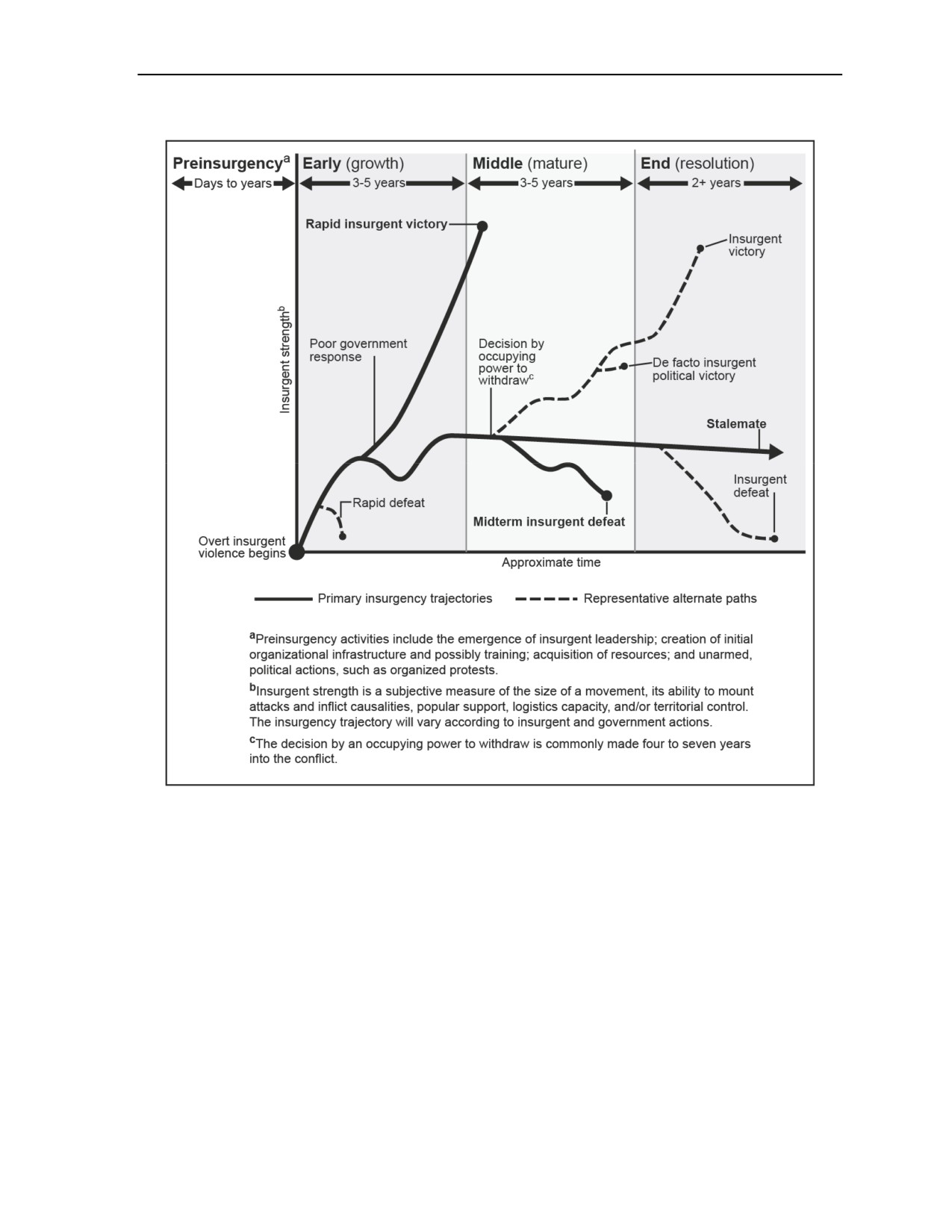
Insurgency Prerequisites and Fundamentals
Figure 4-1. Conflict resolution model
Eighth Dynamic—Organizational and Operational Patterns
4-76. Each insurgency’s organization is unique. The specific type and level of organization is an indicator
of the insurgents’ strategy and capabilities. Understanding an insurgency’s organizational and operational
patterns helps counterinsurgents predict the enemy’s tactics, techniques, and procedures, understand their
capabilities, and identify potential targets.
4-77. Insurgents may be organized into networks and require certain elements, characteristics, bonds, and
conditions to operate and survive. A network is a series of direct and indirect ties from one entity to a
collection of entities. There may be a central point of communication or influence (critical node) that
provides a critical vulnerability for targeting against the network. Insurgent networking extends the range
and variety of both insurgent military and political actions. Networks of communications, people, and
activities exist in all populations and have a measureable impact on the organized governance of a
population and, consequently, military operations. These networks tend to heal, adapt, and learn rapidly.
They may be a combination of insurgent, criminal, regular, or irregular forces, and foreign government
sanctioned forces. These networks exist within a population. Existing within a population enhances their
13 May 2014
FM 3-24/MCWP 3-33.5
4-15
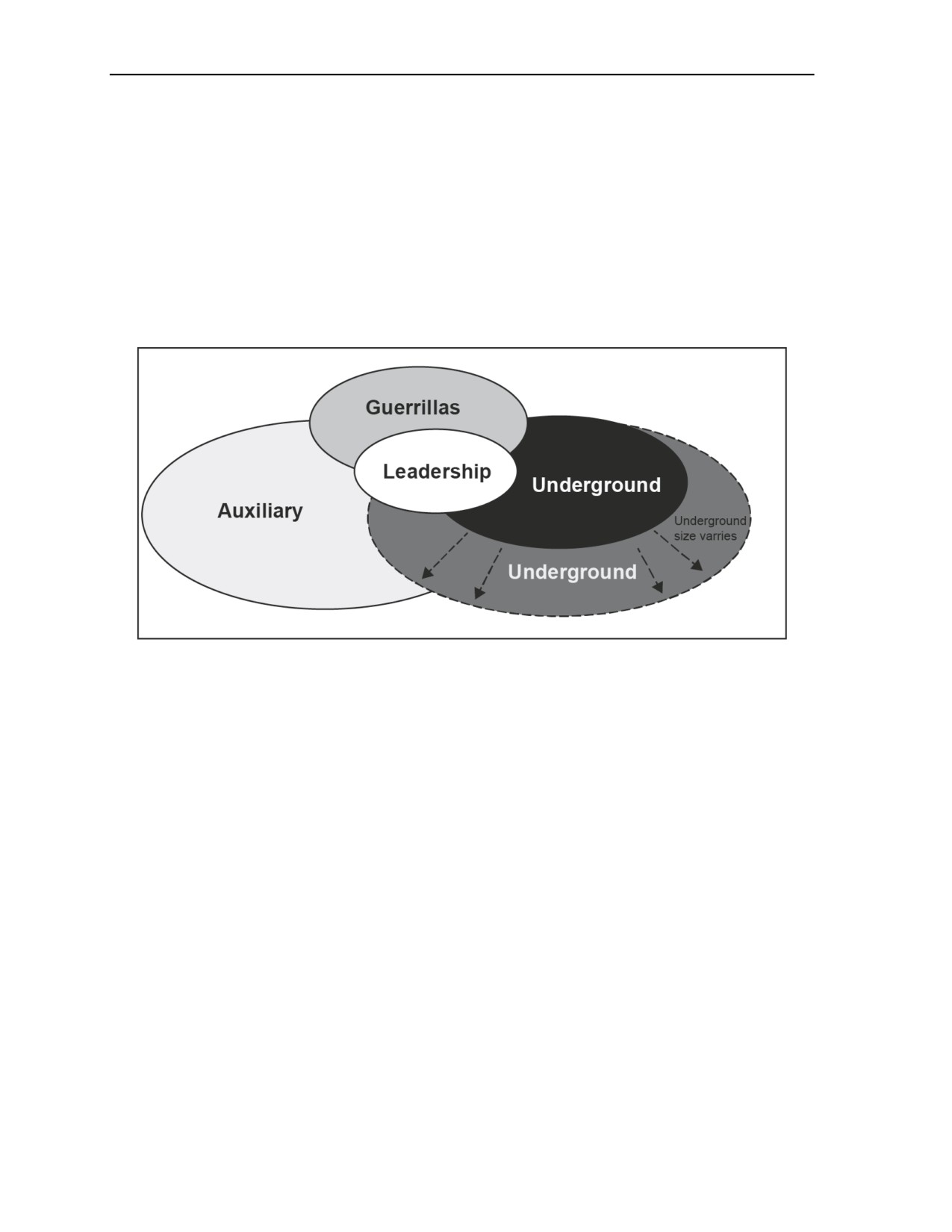
Chapter 4
capabilities to sow disorder, survive, and protract the struggle, presenting particularly difficult problems for
counterinsurgency forces. (See paragraphs 4-88 to 4-103 for more information on networked insurgencies.)
Organizational Elements
4-78. The basic organizational elements of an insurgency are the movement’s leadership, guerrillas,
auxiliary forces, and underground elements. While there are almost certainly members of the insurgency
who perform multiple functions, grouping an insurgency into these groups provides a model of
understanding how an insurgency functions. However, commanders and staffs must avoid the trap of mirror
imaging an insurgency against U.S. organizational structure. These groupings help the commander
understand groups that are involved in the various functions of an insurgency, but commanders and staffs
need to realize that insurgencies normally do not have fixed organizational structures. (See figure 4-2.)
Figure 4-2. Organizational elements of an insurgency
Leadership
4-79. An essential element of any insurgency is its leadership and its leadership structure. This can vary
greatly and is dependent on whether the insurgency is a networked insurgency or a hierarchical insurgency.
However, because of its importance, it is covered under the first dynamic.
Guerilla Units
4-80. Guerrillas are used for a wide range military purposes, but their primary purpose is to achieve a
political end. For example, attacks on host-nation forces may undermine host-nation legitimacy among a
population and create insurgent safe heavens. Guerrilla units can conduct small-unit tactical operations and
can mass for larger operations. Ambushes against convoys are examples of small-unit tactics an insurgent
group may use. These tactics have the advantage of preventing an insurgent group from becoming
decisively engaged. As an insurgency gains military power, guerilla units increase their ability to conduct
large scale attacks. During the final insurgency stage, war of movement, guerilla units can perform actions
meant to destroy the host-nation military force. This can be a decisive action for an insurgency. If
successful, a war of movement can overthrow the government or allow the insurgency to reach other
political goals. However, if the insurgency begins a war of movement too soon, the insurgency can deplete
its military power and undermine its political power.
Auxiliary Forces
4-81. Auxiliary forces are the insurgency’s support elements. Anyone involved in an insurgency can
perform logistic functions, and insurgents are probably involved in both logistics and combat. Creating this
division, however, groups certain essential functions of an insurgency in a single category.
4-16
FM 3-24/MCWP 3-33.5
13 May 2014
Insurgency Prerequisites and Fundamentals
4-82. The auxiliary includes cells and external elements. Cells include logistics, intelligence,
counterintelligence, propaganda, population control, and recruiting elements. These are elements that
perform tasks directly connected to an insurgency. External elements provide support for an insurgency,
but they are not directly part of the insurgency. For example, external elements may include drug
smugglers or external support from another state.
4-83. Women can play an essential role in the auxiliary force. Insurgencies generally require a robust
system of financing and supply. In many cases, a woman will have greater freedom of movement in a
society than a man who is actively engaging government forces. For example, a wife, niece, or daughter of
an insurgent might be able to send a message or make financial transitions much easier than the actual
insurgent.
4-84. Auxiliary forces also include economic support systems to fund the insurgency’s military and
political operations. Economic support systems include—
z
Fund raising and terrorist finance networks.
z
Pillaging, looting, extorting, and enslaving a population.
z
Business operations that include both direct control, joint ventures, and taxation of enterprises in
these industries:
Illicit trade in commodities and natural resources (such as oil, timber, and diamonds).
Criminal trafficking in narcotics, humans, and arms.
Sanctions busting.
Legal business enterprises (such as oil, shipping, motor transport, and hotels).
Banking and finance operations.
Underground
4-85. Underground cells conduct clandestine combatant and logistics operations in areas controlled by
government forces. Combat operations can include sabotage, assassinations, and small arms attacks.
Logistic operations can include maintaining safe houses, controlling hostages, moving weapons, and
providing communications. Underground cells include intelligence cells, logistic cells, and combatant cells.
4-86. The underground element includes those elements of the insurgency that conduct covert or
clandestine activities, especially in counterinsurgent occupied areas. Movement leaders may exist within
the underground if they are attempting to keep their affiliation or identity a secret. Insurgencies with
effective undergrounds tend to be more compartmentalized, secretive, vetted, trained, and indoctrinated
than insurgencies without them. For example, the underground can carry out terrorist acts, if desired, while
the insurgency has plausible deniability for these acts. The underground may remain in an area after
counterinsurgency clearing operations to gather information, intimidate civilians, attack members of the
security forces or government, emplace improvised explosive devices, or perform sniper operations. The
underground can be a major part of an insurgency. Its effectiveness
(or ineffectiveness) provides
counterinsurgent analysts with indicators of the skill, advancement, and strategy of the insurgency. An
advanced insurgency with an effective underground is capable of operations and tactics that differ from
those of a basic insurgency, with a less capable underground. The underground tends to be the most
difficult element to recruit and train; therefore, its size tends to fluctuate with time and capability.
4-87. Underground cells seek to be self-contained; they often have their own leadership, combatants, and
auxiliary forces. However, the underground can also use members of the auxiliary to provide materials,
intelligence, counterintelligence, and early warning. The auxiliary may also pass messages, propaganda,
and disinformation. This use allows the underground to conduct operations in areas where the regular
auxiliary is present, but the underground does not have a widespread presence.
Networked Insurgencies
4-88. While some insurgencies are hierarchical, it is also likely that an insurgency will be deeply
networked into a society. While auxiliary, guerrillas, leadership, and underground elements are a means of
viewing the basic functions of an insurgency, many insurgencies in the modern era are learning and
adapting networks. An insurgency’s members will often have connections to various resourcing means,
13 May 2014
FM 3-24/MCWP 3-33.5
4-17
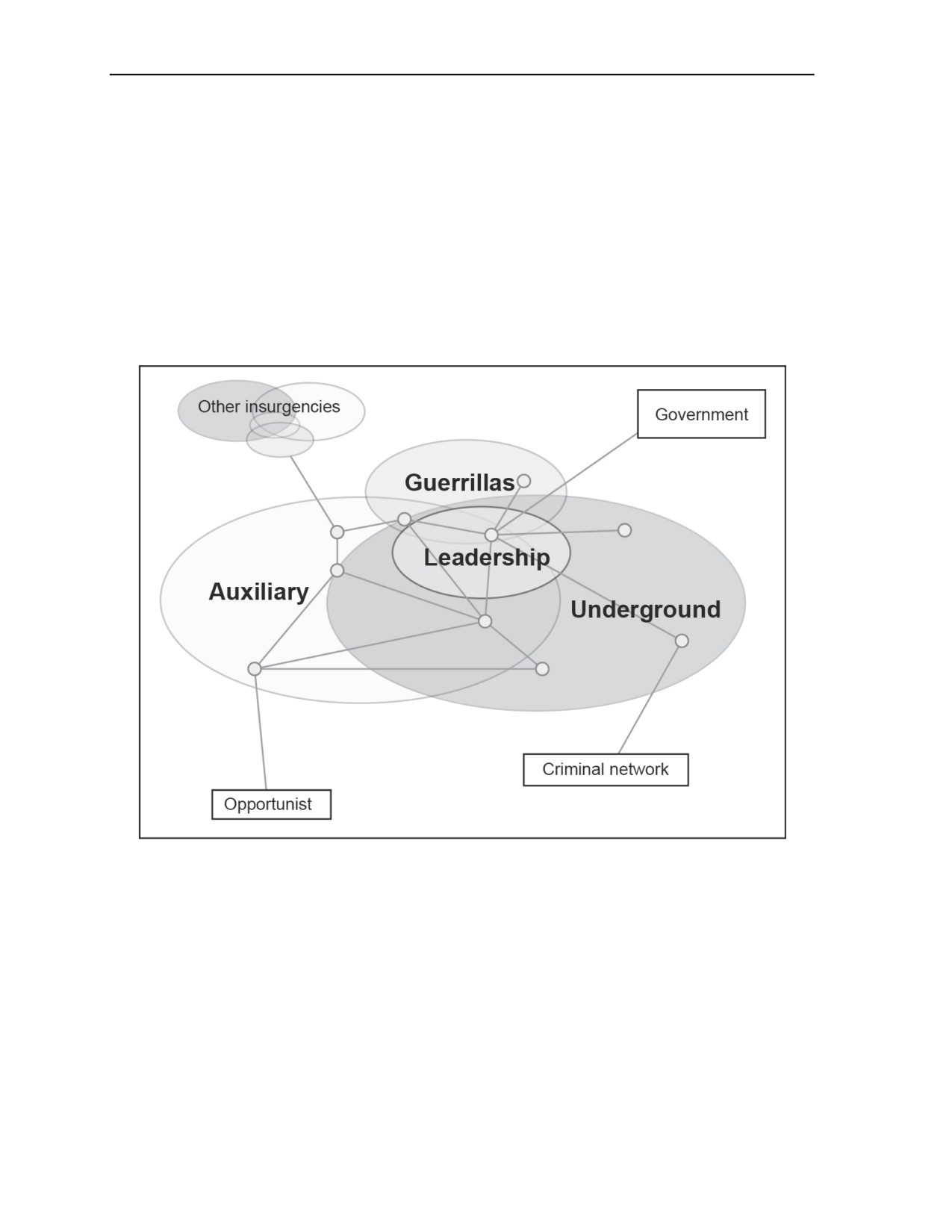
Chapter 4
such as the black markets or diasporas. Moreover, there are normally connections to various parts of a
society. Many insurgencies, especially modern insurgencies, have members that perform basic functions
but are also networked organizations that are interwoven with their societies. While it is possible for a
hierarchical style insurgency to exist, a networked structure is more likely today because of modern
communications.
4-89. Networked insurgencies will have many connections to their operational environment. Networked
insurgencies are not monolithic, and decisions are made by different elements within the insurgency. Some
parts of the insurgency may be willing to negotiate, while other parts may decide to keep fighting. In a
networked insurgency, the different elements of an insurgency may have overlapping functions and
connections to other similar insurgencies. A networked insurgency adds to the complexity of an area of
operations because they are not acting as a unified force and because of their complex set of connections to
the rest of society and each other. (See figure 4-3 for an example of a networked insurgency.)
Figure 4-3. Networked insurgencies
4-90. For an insurgency, a network is not just a description of who is in the insurgent organization; it is a
picture of the population, how it is put together and how members interact with one another. For example, a
tribal society already has affiliated social, economic, and military networks easily adapted to warfighting.
The ways in which insurgents works within a tribal network is an expression of inherent cultural and social
customs. In this example, the social dynamic that sustains ongoing fighting is best understood when
considered in tribal terms—in particular, from the perspective of a traditionally networked society. It is the
traditional tribal network that offers insurgents a ready-made social infrastructure from which to draw.
4-91. The full functioning of a network depends on how well, and in what ways, its members are
personally known and connected to one another. Strong personal ties, often ones that rest on friendship and
bonding experiences, ensure high degrees of trust and loyalty. To function well, networks may require
higher degrees of interpersonal trust than do other approaches to organization, like hierarchies. Kinship ties
are often a fundamental aspect of many terrorist, criminal, and gang organizations. Insurgents often form a
4-18
FM 3-24/MCWP 3-33.5
13 May 2014
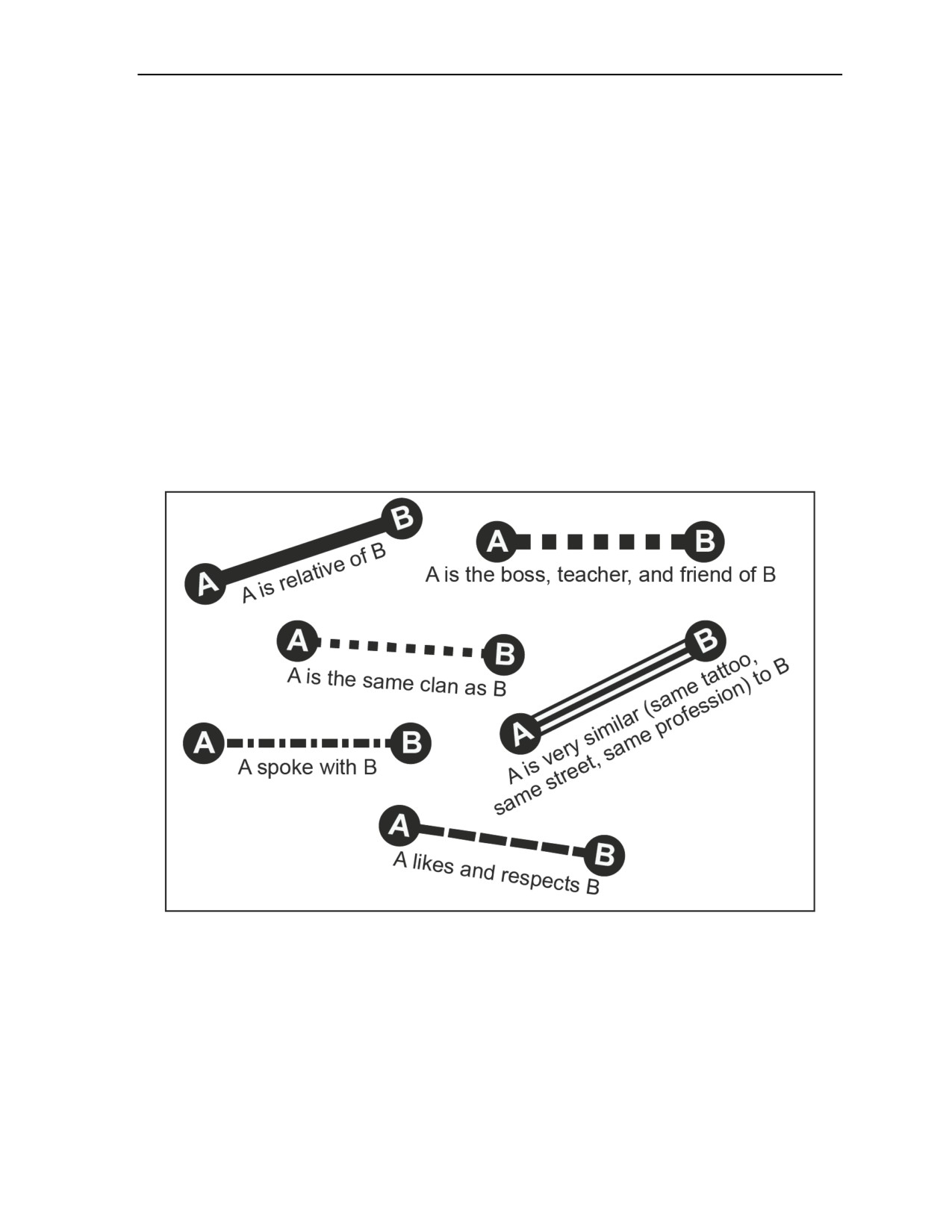
Insurgency Prerequisites and Fundamentals
networked organization embedded in a sympathetic population. Differentiating between insurgents,
insurgent supporters, neutrals, and the host-nation government supporters is difficult.
4-92. Insurgencies can be viewed from an overall organizational perspective to the perspective of an
individual. Networked insurgencies often have a great degree of internal complexity and this makes
understanding networked insurgencies difficult. The relationship between two individuals or two groups in
an insurgency may be hierarchal, based on a mutual peer to peer understanding, or a cultural understanding
based upon social norms. Understanding the relationship between groups and individuals within groups is
essential to understanding how an insurgency works and is a part of the overall intelligence preparation of
the area of operations and understanding mission variables. This understanding starts with an individual
level analysis.
4-93. Individual-level analysis characterizes members within an organization, identifies its key members,
describes the types of connections between members, and makes assumptions about unknown members.
Commanders and staffs can describe individuals based on their network position in relation to the network
position of other individuals in the network. A networked insurgency consists of individuals and
connections between them. Commanders and staffs can think of the individuals in an insurgency as actors
or nodes. The connections between nodes are called links. This connection between two people is called a
dyad. Understanding the various types of dyads is essential in understanding the nature of an insurgency.
Person A could be connected to Person B through a number a various types of connections and each type of
relationship represents an important type of dyad. (See figure 4-4 for examples of some of types of dyads.)
Figure 4-4. Examples of dyads
4-94. Individual connections and new connections matter to an insurgency. For example, a marriage
between a combatant and a member of the auxiliary opens new paths in a networked insurgency. Moreover,
the success or lack of success of the couple will now be important. In other words, in this example, both
individuals will be vested in one another, and other insurgents’ perceptions of them will be tied together.
The nature of the bonds between individuals and decisions on who to create new relationships with have a
future impact on both the insurgency and the individuals in the dyad.
4-95. Commanders and staffs must understand the role individuals play in a networked insurgency. One
node or a very few central nodes dominate a very centralized network. If these nodes are removed or
damaged, the network may quickly fragment into unconnected subnetworks. Hubs are nodes with high
13 May 2014
FM 3-24/MCWP 3-33.5
4-19
Chapter 4
degrees of centrality. A network centralized around a well-connected hub can fail abruptly if that hub is
disabled or removed. A less centralized network has no single points of failure, and it has multiple
connections between all members. It is resilient even if some nodes are removed. Many nodes or links can
fail while still allowing the remaining nodes to reach each other over other network paths.
4-96. Commanders and staffs can also understand how an individual fits into a network by looking at that
individual’s degree centrality and betweenness centrality. Degree centrality describes how active an
individual is in the network. Network activity for a node is measured using the concept of degrees—the
number of direct connections a node has. Nodes with the most direct connections are the most active in
their networks. Commanders and staffs determine where those connections lead and how they connect the
otherwise unconnected. If a node has many ties, it is either prominent or influential. Betweenness centrality
indicates the extent to which an individual lies between other individuals in the network, serving as an
intermediary, liaison, or bridge. A node with high betweenness centrality has great influence over what
flows in the network. Depending on position, a person with high betweenness plays a broker role in the
network.
4-97. Nodes on the periphery often receive very low centrality scores. However, peripheral nodes are often
connected to networks that are not currently mapped. The outer nodes may be resource gatherers or
individuals with their own network outside their insurgent group. These characteristics make them very
important resources for fresh information that is not available inside their insurgent group.
4-98. However, understanding a networked insurgency requires more than simply understanding
relationships between individuals. Commanders and staffs must understand an insurgency at the
organizational level. Organizational-level analysis provides insight about the insurgent organization’s form,
efficiency, and cohesion. Commanders and staffs must understand a networked insurgency’s overall
organization to understand the nature of the threat. An insurgency may consist of large numbers of
subinsurgencies. As a result, each group will have a range of capacities as compared to the other groups.
Commanders and staffs can describe organizational capacities using the concept of network density.
4-99. Network density is a general indicator of how connected people are in a network. Network density is
the proportion of links in a network relative to the total number of links possible. Network density within
an insurgency indicates which groups are most capable of conducting a coordinated attack or other type of
coordination. (See figure 4-5.)
4-20
FM 3-24/MCWP 3-33.5
13 May 2014
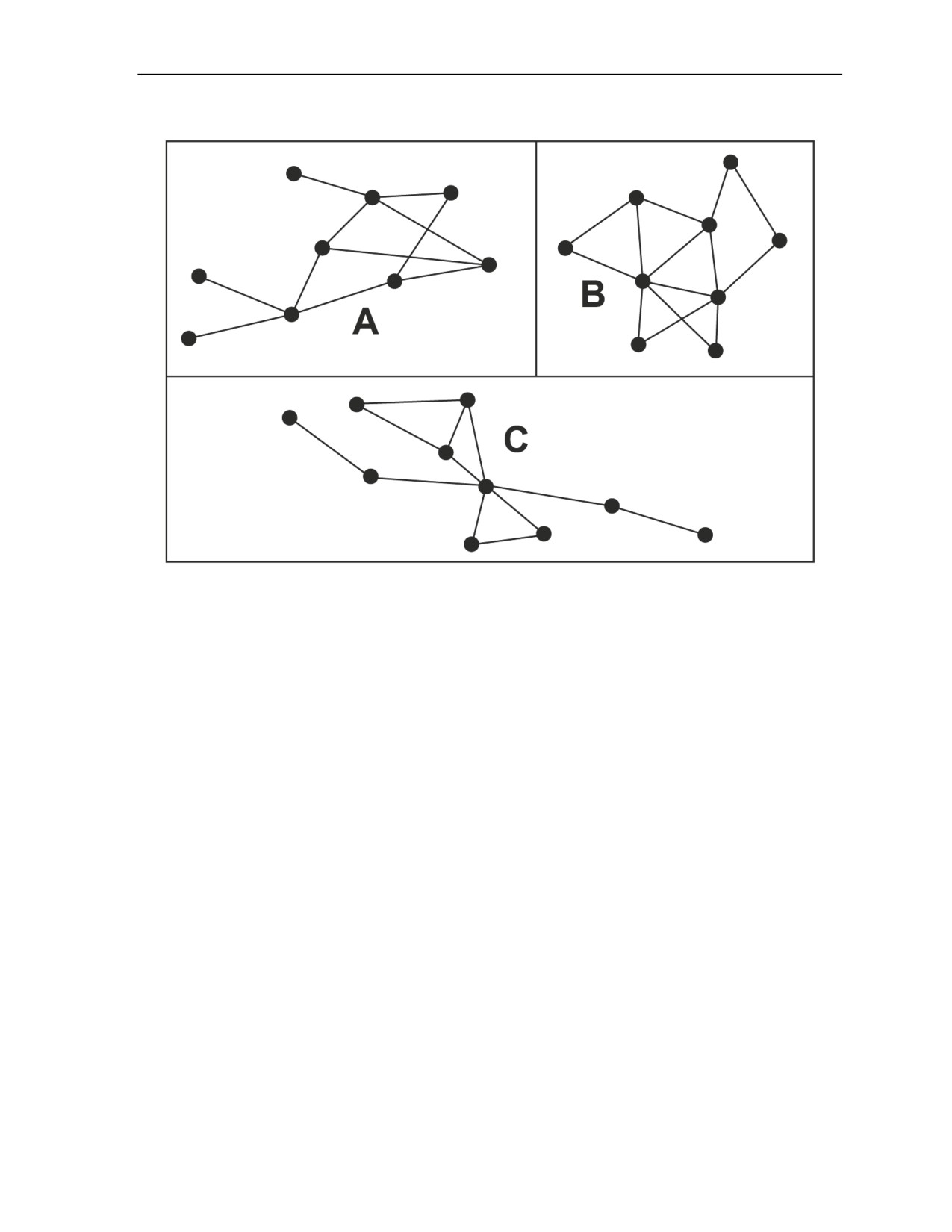
Insurgency Prerequisites and Fundamentals
Figure 4-5. Examples of dyad networks
4-100. Changes in network density can also show changes in an insurgency’s capabilities over time. A
decrease in network density means the group is reduced and becoming fragmented. This can be in response
to actions taken by counterinsurgents.
4-101. Most network measures, including network density, can be mapped out to evaluate performance
over time. Based on changes in network density over time, a commander can—
z
Monitor enemy capabilities.
z
Monitor the effects of recent operations.
z
Develop tactics to further fragment the insurgency.
4-102. Changes in network density can also show changes in the capabilities of an insurgency over time.
An increase in network density indicates an increased likelihood that the insurgent group can conduct
coordinated attacks. A decrease in network density means the group is reduced and becoming fragmented.
This can be in response to actions taken by counterinsurgents. An effective counterinsurgency may
eventually face only low-network-density subgroups. This is because high network-density subgroups
require only the capture of one or a few highly connected insurgents to degrade the network. So while
high-network-density groups are the most dangerous, they are also the easiest to disrupt. (See figure 4-6 on
page 4-22 for an example of the possible evolution of a networked insurgency.)
13 May 2014
FM 3-24/MCWP 3-33.5
4-21
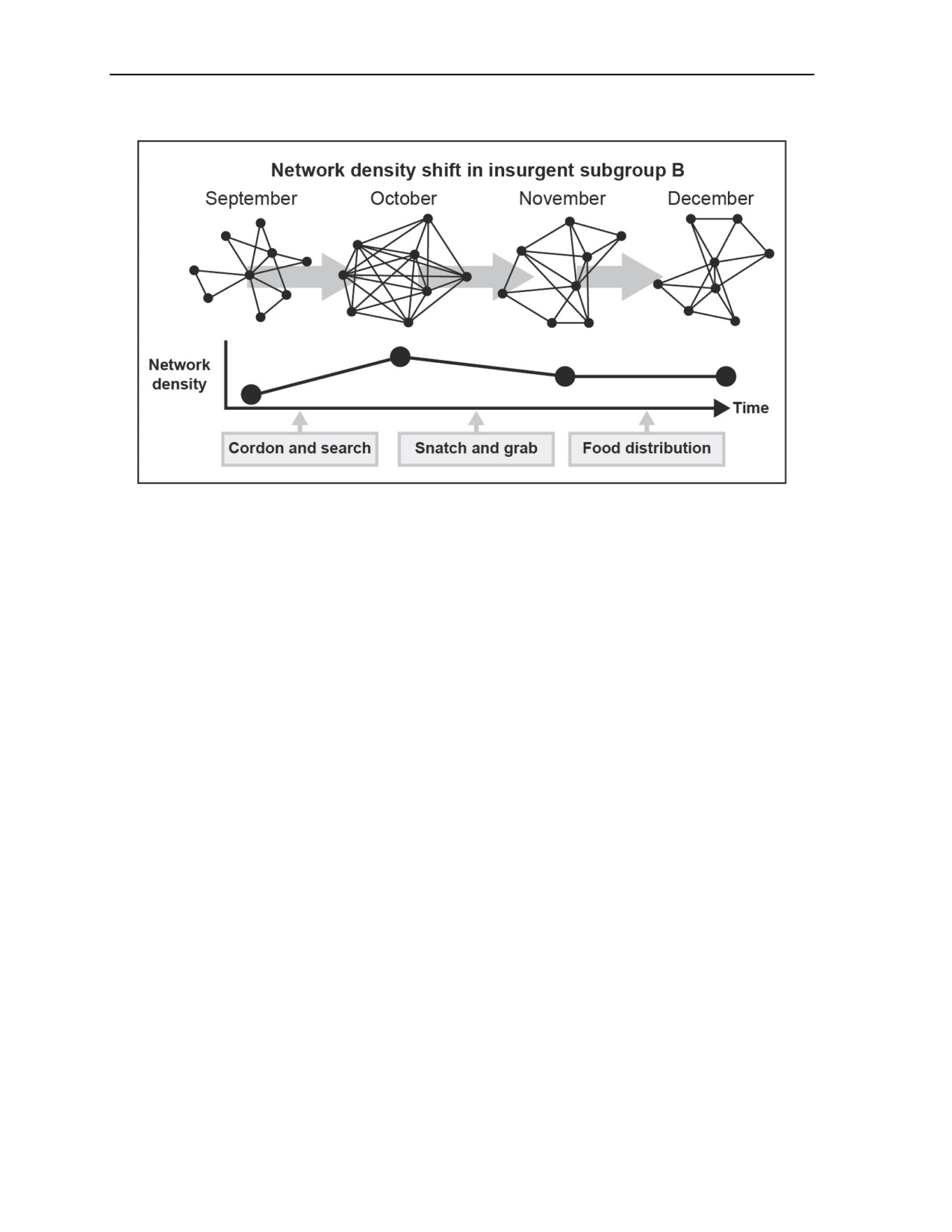
Chapter 4
Figure 4-6. Example of changes to tactics based on density shift
4-103. Individuals within a network can also shape an insurgency. If one individual or a small group of
individuals have relationships essential to maintaining an insurgency, counterinsurgents must understand
those relationships. One node or a very few central nodes could dominate a highly centralized network.
These nodes are called hubs and can be essential for an insurgency. A less centralized network may have no
single point of failure.
OTHER ANALYTICAL FRAMEWORKS
4-104. The district stability framework assists planners in identifying and mitigating sources of instability.
Because of the uniqueness of the stability environment in each district within an area of operations, the
district stability framework was designed to identify and mitigate sources of instability. This framework
works as a planning assessment tool and nests into the military decisionmaking process. There are three
steps to the district stability framework: analysis, design, and monitoring and assessment. (See ADRP 3-07
for more details on the district stability framework.)
4-105. The interagency conflict assessment framework is another framework used to understand conflict.
The purpose of the interagency conflict assessment framework is to develop a commonly held
understanding, across relevant U.S. government departments and agencies, of the dynamics driving and
mitigating violent conflict within a country. This common understanding informs U.S. policy and planning
decisions. It may also include steps to establish a strategic baseline against which U.S. government
engagement can be evaluated. It is a both a process and a tool available for use by any U.S. government
agency to supplement interagency planning. (For more information on interagency conflict assessment
framework, see the U.S. government publication Interagency Conflict Assessment Framework.)
4-22
FM 3-24/MCWP 3-33.5
13 May 2014
Chapter 5
Insurgency Threat Characteristics
5-1. Threat characteristics involve the composition, disposition, activities, and tactics of an insurgency.
The composition of an insurgency is covered under the eighth dynamic, organizational and operational
patterns. Tactics for an insurgency include political activities, criminal actions, and military tactics.
Counterinsurgents consider how these threat characteristics create strengths and weaknesses for an
insurgency.
DISPOSITION AND ACTIVITIES
5-2. The disposition is the geographic location of insurgent elements and the way they are deployed,
employed, or located. The dispositions of an insurgency are partially determined by an operational
environment and the operational variables. For example, if an insurgency has connections to a black
market, some of its dispositions will normally be to protect that market. Terrain will also affect the
dispositions of an insurgency. Commanders and staffs must understand an operational environment to
understand an insurgency’s dispositions.
(See chapter
2 for more information on an operational
environment.)
5-3. Insurgents who rely solely on violence to achieve their political goals are probably ineffective.
Instead, effective insurgents conduct a wide range of activities to achieve their goals. Many of these
activities are not enemy or terrain oriented, but political. Insurgents use a range of activities supporting
both military and political actions. Insurgent actions can include:
z
Political activities.
z
Population control.
z
Military tactics (including terrorist actions and conventional tactics).
z
Support activities.
POLITICAL ACTIVITIES
5-4. Insurgents may use political activities to achieve their goals and enhance their cause’s legitimacy. An
insurgency’s actions can come from inside the government’s political system or can be used to
communicate a message to the population. Political actions that happen within a government normally
happen in a democracy or a semidemocracy. In these systems, an insurgency and related political parties
can have some political power through elections. This gives groups the ability to launch official
investigations and a platform to question government actions. This was a technique used by the Irish
Republican Army and Sinn Fein.
5-5. Insurgent political actions within the government are limited to an autocratic regime, unless those
actions are secretive. An authoritarian regime can have members that are either sympathetic to or actual
members of an insurgency. However, those individuals must remain clandestine if they are to remain inside
the government. In these cases, insurgencies can use these individuals for intelligence and to influence
some governmental decisions.
5-6. The use of political activities to influence a society is another political activity of an insurgency.
Demonstrations, propaganda, strikes, and civil disobedience can be effective means to undermine the
legitimacy of a government and to disrupt a host nation. These actions show the level of support for the
insurgency and transmit the insurgents’ message to the rest of society.
5-7. Propaganda is one of the most important political tools an insurgency has. Propaganda provides the
means for the insurgency to communicate a message, often political, to the population. It allows the
13 May 2014
FM 3-24/MCWP 3-33.5
5-1
Chapter 5
insurgency to create a narrative of why the government’s actions are not legitimate, and how the insurgency
can eliminate the root causes of the conflict.
5-8. In areas of a country where an insurgency is in control, the insurgency can perform governmental
functions. These functions replace the functions of the host-nation government. When an insurgency
provides effective governance of a region or community, it can build local legitimacy.
5-9. At the national level, an insurgency can promote a shadow government. A shadow government offers
a known, tangible alternative to the present government to the population. This can be effective as a
propaganda technique, and a shadow government can be useful in creating a successful transition for an
insurgency. As propaganda, a shadow government allows an insurgency to identify and inform a population
of a known alternative to the current government. In practice, a shadow government allows a governmental
structure to quickly form in insurgent controlled areas. If an insurgency is successful, this allows for a
transition to a coherent national government.
POPULATION CONTROL
5-10. One of the primary goals of a local insurgency is population control. Once the government is
displaced from an area, an insurgency can act as the functioning government. With the use of force to
enforce local rules and norms, an insurgency can become a functioning instrument to control the
population. In such cases, it has displaced the government, at least locally. This control can be used to gain
legitimacy among the population. When an insurgency both controls a local population and is seen as
legitimate by the local population, it becomes more difficult to displace. The host nation must not only
regain control of the area, but maintain control when the population may not view the host nation as a
legitimate authority.
MILITARY TACTICS
5-11. Insurgents use violence to create a wide range of effects. For example, in the early phases of an
insurgency, insurgents plan attacks to achieve the greatest political and informational impact while not
becoming decisively engaged. During the war of movement, insurgents may try to destroy a host nation’s
security forces or its communication channels. Commanders need to understand the wide variety of
insurgent tactics. Insurgents may use both terrorist acts and conventional military tactics.
Terrorist Acts
5-12. Terrorist acts are meant to undermine the legitimacy of the government by demonstrating both the
inability of the government to protect the population and the strength of the insurgency. The perpetrator of
a terrorist act seeks to use the terror that the act produces among the population and the government to gain
some political objective. Insurgents generally select targets based on their strategic, operational, and
tactical importance and propaganda value. A terrorist attack will generally employ some deception and use
techniques outside of accepted norms.
5-13. The possibility of an insurgent group gaining access to weapons of mass destruction changes the
strategic effect of terrorist actions. If an insurgency gains a nuclear capability, which is an increased
possibility in an interconnected world, the threat of using a nuclear weapon would provide that insurgency
leverage for political negotiations. The actual use of a nuclear weapon would have regional and global
effects. The use of biological and chemical weapons would also have a strategic effect, but to a lesser
degree than nuclear weapons. An insurgent’s use of weapons of mass destruction would transform the
nature of a conflict.
Conventional Tactics
5-14. Insurgents use a wide range of tactics to attack counterinsurgents. The tactics insurgents use will be
based on their capabilities. During a war of movement, insurgents may try to destroy host-nation
government forces. However, this may expose insurgents if an attempt to destroy a host nation’s security
force is taken too early. Insurgents must correctly judge their capabilities versus the host nation’s
5-2
FM 3-24/MCWP 3-33.5
13 May 2014
Insurgency Threat Characteristics
capabilities. When the host nation has an advantage in capability, insurgents will probably use small-unit
tactics in order to not become decisively engaged.
5-15. Insurgents may use a wide range of conventional tactics. Insurgents often employ ambushes for
harassment and disruption. Snipers or sharpshooters may be an effective means of engaging government
forces without becoming decisively engaged. Insurgents may use indirect fire, such as mortar and rocket
attacks, to harass counterinsurgents or cause them to commit forces that can then be attacked by other
means. Weapons and munitions are frequently modified to best suit insurgent needs for a specific target or
mission. For example, insurgents may use direct fire rockets or missiles in an indirect manner to avoid
detection. Moreover, insurgents may have to improvise because they lack weapons.
5-16. Improvised explosive devices are effective tools that can be integrated into many different types of
attacks. Improvised explosive devices can be inexpensive to produce and, because of the various detonation
techniques available, may avoid risks to the perpetrator. Also, insurgents may use suicide bombing as an
employment method, and it can be very effective.
5-17. Insurgents may use cyber electromagnetic attacks. Cyber electromagnetic capabilities can give an
insurgency the ability to affect systems both within and outside the host nation. For example, a cyber
electromagnetic attack could undermine the financial system within a state. This may be an effective way to
undermine the legitimacy of a host nation. However, a cyber electromagnetic attack could also affect any
state or region. For example, cyber electromagnetic capabilities provide an insurgent the ability to attack a
country that supports the host nation. If an insurgency attains cyber electromagnetic capabilities, the nature
of the conflict changes.
SUPPORT ACTIVITIES
5-18. Although noticeable, violence may be only a small part of overall insurgent activity. Insurgent
support activities include training, logistics, and communications. These support activities sustain
insurgencies and allow for both military and political actions. They are enabled by an insurgency’s ability
to generate popular support. Insurgent support networks may be large, even when violence levels are low.
These networks can include support from other nations or from population groups outside the country. The
effectiveness of insurgent operations depends heavily on logistics.
5-19. In some parts of the world, a lack of access to weapons may forestall insurgencies. However, there is
widespread availability of weapons in many areas, with especially large surpluses in the most violent
regions of the world. Explosive hazards, such as mines and improvised explosive devices, are likely to be
common weapons in insurgencies. Insurgents can obtain weapons through legal or illegal purchases or from
foreign sources. A common tactic is to capture them from government forces. Counterinsurgency forces
should seek to cut off the flow of arms into an area of operations and eliminate their sources.
5-20. Income is essential, not only for insurgents to purchase weapons, but to pay recruits and bribe
officials. Money and supplies can be obtained through many sources. Foreign support is one possible
source of income. Local supporters or international front organizations may provide financial support.
Sometimes legitimate businesses are established to furnish funding. In areas controlled by insurgents,
confiscation or taxation may be used. Another common source of funding is criminal activity.
5-21. Funding greatly influences an insurgency’s character and vulnerabilities. The insurgents’ approach
determines the movement’s requirements. Protracted popular war strategies that emphasize mobilization of
the masses require considerable resources to build and maintain a counter state. In comparison, the
military-focused approach—which emphasizes armed action—needs only the resources to sustain a
military campaign. Counter threat finance is an important means to interdict an insurgency’s funding. (See
ATP 3-07.20/MCRP 3-33 for more information.)
TRAINING AND INDOCTRINATION
5-22. The quality and quantity of training depends on how advanced the insurgency is and what its specific
strategy is. Indoctrination is a part of training which seeks to maintain allegiance and to focus cells to
conduct continuous operations without frequent communications and direction from insurgent leadership.
The level of indoctrination can help analysts identify the strategy and sophistication of the insurgency and
13 May 2014
FM 3-24/MCWP 3-33.5
5-3
Chapter 5
includes more than just the overall objective of the insurgency. Subordinate leaders within an insurgency
are indoctrinated because they must execute the senior leadership’s intent and vision as well as guide
operations until redirected. With better indoctrination of intent and vision, insurgents may be more
effective in decentralized operations and being self sufficient.
5-23. Training also includes individual and collective training, depending on the role of the insurgent and
the specific skills of the insurgent (such as sniper, information operations, human intelligence, raid or
ambush, communications, logistics and caches, or bomb maker). More advanced training may include how
insurgents conduct themselves if captured, including resistance to interrogation and operations within
detention facilities (recruiting, clandestine communications, and maintaining control of other insurgents).
Other states may play an essential role in training an insurgency. Training can occur at sites in the
supporting country or covertly within the host nation. Many states maintain the ability to conduct
unconventional warfare. (See FM 3-05 for more information on unconventional warfare.)
COMMUNICATIONS
5-24. Communications in an insurgency cannot depend on open and traditional means. Ensuring an
effective network of communications is an essential support activity of an insurgency. Insurgents can
compensate for the lack of regular and reliable communications in numerous ways, including masking their
communications in radio, television, or Internet messages. They may also pass information in cameras,
high frequency, short-wave, and amateur (ham radio) sets, cellular phones, the mail, computers, or memory
storage devices transported by couriers. They may also avoid detection by use of couriers and face-to-face
meetings.
INSURGENT STRENGTHS AND WEAKNESSES
5-25. Insurgents usually have several strengths. They usually have a significant knowledge of an area of
operations. Usually they are operating in their own country and own ethnic group, making it extremely
difficult for friendly forces to identify insurgents in the community or to identify people connected with the
insurgency. Insurgents have intimate knowledge of the area of operations including things like the
characteristics of the local people and their culture, daily schedules, accents, and local slangs that enable
them to blend in with the local population, enhancing their ability to operate with secrecy. They will
probably wear similar clothing, have like postures, mannerisms and hand gestures, body movements,
walking speed, greetings, body motions, and maintain eye contact (or lack of) as the population of the area
of operations. They will also probably observe local social norms of food, drink, and sleeping schedules.
5-26. An insurgent is not usually responsible for maintaining normal governmental obligations to the local
population. While insurgents may conduct some governmental functions and set up a shadow government,
an insurgency does not normally have the same expectations from the population to provide governmental
services. This normally means that insurgencies spend few resources on governmental functions, which
frees more resources to conduct the insurgency.
5-27. Most insurgencies have limited personnel and resources. Long periods without resupply and loss of
key personnel can affect an insurgency’s ability to sustain a conflict. Counterinsurgents can apply pressure
on an insurgency by conducting raids on cell members; recovering enemy caches; interdicting supply
routes; searching or seizing resources from cars, homes, and personnel entering the area of operations;
isolating the insurgents from access to markets, smugglers, and black-market goods; and by conducting
offensive operations that diminish guerrilla numbers. Insurgencies usually fail when their ability to
replenish, either through counterinsurgent action, mismanagement on their own part, or withdrawal of the
support of an external actor, is undermined.
5-28. Insurgent movements are vulnerable to friendly force information operations that show their danger,
futility, privation, and numerical inferiority compared to government forces. In some cases, the fear of
being treated as a criminal if captured, and the fear of violence to an insurgent and the insurgent’s family,
can cause desertions and defections. In some societies, good treatment, pardons, protection, food, shelter,
and participation in the government may be stronger incentives than the fear of criminal punishment to
induce desertions. Other insurgent stress factors include sustained combat and a hostile environment that
weakens insurgent resolve.
5-4
FM 3-24/MCWP 3-33.5
13 May 2014
Insurgency Threat Characteristics
5-29. The decentralized nature of networked insurgencies that provides operations security can also be a
weakness as it is resource intensive, slows responsiveness, and causes information to move slowly. The
difficulty of insurgents receiving encouragement from superiors and members of the political wing, a lack
of direction in the face of counterinsurgent pressures, and an inability to openly call for reinforcements and
logistics due to their operations security plan can make insurgents feel isolated, alone, confused, and
unsupported. Analysts need to identify these points and recommend operations to demoralize and promote
defections among insurgents.
ASSOCIATED THREATS
5-30. Other threats can play interconnected roles in an insurgency. Insurgencies create change in a society
and this can create an opportunity for some organizations. Opportunists are important actors in this type of
operational environment. Two other groups are particularly important, criminal organizations and
nongovernmental militias. These groups can be supportive, neutral, or opposed to an insurgency. Moreover,
these groups can have important connections to an insurgency.
OPPORTUNISTS
5-31. An opportunist is one who takes advantage of any opportunity to achieve an end, often with no
regard for principles or consequences. In the context of counterinsurgency, opportunists often take
advantage of the conditions of instability in the pursuit of their own goals, such as smuggling contraband,
while security forces are distracted from protecting the border due to combating an insurgency.
Commanders and staffs identify opportunists, assess their impact on the mission and force protection,
consider them in planning, and mitigate their impact as needed.
5-32. There are several types of opportunists who, by nature, impede the regular and effective functions of
government and may act contrary to the well-being of the people. Opportunists may be existing local
people or external actors, including civilians, members of the government, or security forces. Opportunists
can be in direct support of the insurgency or outside actors. They can be state sponsored, sponsored by a
non-state actor, or unsponsored, all while taking advantage of unstable conditions. Opportunists understand
and exploit the conditions of instability inherent in counterinsurgency where lawlessness, subversion, and
insurgency are the norm. The extreme conditions of an insurgency may allow activities that are normally
countered with effective law enforcement and governance to proceed with impunity. These conditions
allow opportunists to pursue their political and economic interests.
5-33. Opportunists may tend to exploit populations by conducting kidnapping for ransom; revenge killings;
murder for hire; hijacking; extortion; black marketing; smuggling; and trafficking of drugs, humans, and
weapons. Opportunists use the conditions of instability to conduct activities that are often illegal to further
their interests. They may also work within the political system to further their interests. Insurgencies often
occur in a chaotic political environment. As such, opportunists can take advantage of the chaos to gain
political power.
5-34. Foreign opportunists, such as mercenaries, international criminal groups, and terrorists, may be
sponsored by an external state or non-state actor or act independently. These groups may also work in the
environment of an insurgency. They can act in a similar manner as internal opportunists, but they pursue
the interests of an external actor.
5-35. Opportunists can work for an insurgency, against an insurgency, or both. How they work and who
they work for is determined by an opportunist’s own interests. Opportunists can work both sides of a
conflict to maximize influence and profits while avoiding retribution. An opportunist can provide safe
passage for insurgents, while also providing intelligence to counterinsurgents. An opportunist is not bound
by the objectives of either the counterinsurgent or insurgent.
5-36. Reintegration initiatives, although favorable to resolve many insurgencies, can be exploited by
opportunists due to the inclusive and reconciliatory nature of these programs. Opportunists can infiltrate
local civilian security forces to avoid retribution, influence less secure communities, and provide
opportunities for vigilantism. Reintegration can also offer incentives for opportunists looking for
employment, benefits, or even amnesty from a seditious criminal, social activist, or political past.
13 May 2014
FM 3-24/MCWP 3-33.5
5-5
Chapter 5
5-37. Opportunists can be malign by design or by circumstance. Malign by design refers to the
opportunists whose purpose by character is criminal and counterproductive to effective government and a
population’s well-being. Malign by circumstance refers to opportunists whose purpose is not criminal by
design but which shifts to wholly or partial illicit activities to further their interests based on obstacles to
their original path. Groups like corporations, nongovernmental organizations, or security contractors may
be advocates for a functioning government, but due to conditions which present opportunities for them,
these groups or individuals may act counterproductively to counterinsurgent efforts. These opportunists are
very difficult to identify due to their favorable position and the potentially clandestine activities employed
to sustain their position.
5-38. In the planning process, counterinsurgents analyze the activities of opportunists, even though their
presence may not be apparent. The same conditions that may allow an insurgency to form and enjoy
freedom of movement also allow opportunists to act. Opportunists will probably take advantage of the
vulnerability of the population and exploit the lack of governmental control in pursuit of their goals.
5-39. The presence, actions, and impact of opportunists can affect the success of the mission to defeat the
insurgency and address the root causes of the conflict. This is especially true as opportunists may rely on
the presence of the insurgency and unstable conditions to achieve their ends. Commanders and staffs need
to include opportunists and their activities in understanding an area of operations and address them during
mission planning and in attack the network operations. In the intelligence preparation of the
battlefield/battlespace process, commanders and staffs may address opportunists within civil
considerations, or within the threat, depending on where they are appropriate. The mission analysis must
address identifying opportunists, understanding their impacts, and addressing or mitigating their impacts.
5-40. The commander’s intent may need to include dealing with opportunists, depending on the level of
interference or political nature of opportunists. Opportunists can impact the mission or force protection
operations. This is especially true if the opportunists are from a state sponsor or a border region where an
internal conflict can spread to another country. Overall, counterinsurgents need to understand how
opportunists can aid an insurgency, either directly or indirectly, and how they can undermine the efforts of
a host-nation government or a multinational effort to address the causes of instability.
5-41. Commanders and staffs need to analyze how their units’ actions can provide opportunities for
opportunists. Decisions concerning contracting, for example, can have various effects on giving
opportunities to opportunists. Commanders and staffs must analyze their units’ effects on the battlefield.
Some decisions that might seem to only effect a unit internally may also effect opportunists. Commanders
and staffs must think holistically about how their units interact with the environment in order to minimize
the effects of opportunist.
CRIMINAL ORGANIZATIONS
5-42. Insurgents commonly use criminal organizations to accomplish objectives. Common activities
designed to gain revenue or materials include theft, drug or human trafficking, smuggling of illicit
materials, prostitution, extortion, kidnapping, blackmail, counterfeiting, taxing of civilians, bank robbery,
and bribery. Criminal organizations can appear as street gangs, mafias, or cartels. Criminal organizations
may also assist insurgent groups in achieving objectives other than accumulating resources. Other
objectives may include intimidating government employees or candidates, conducting assassinations,
kidnapping key personnel, initiating sectarian violence, strikes, demonstrations, riots, and smuggling
high-value leaders, advisors, or weapons. Criminal organizations may also conduct operations deemed
unpopular with a civilian population at a distance from an insurgent movement to create deniability.
5-43. Many insurgencies degenerate into criminality. This occurs as the primary movements disintegrate
and the remaining elements become isolated, or the root cause is addressed. Insurgent disintegration is
desirable; it replaces a dangerous, often ideologically inspired body of disaffiliated individuals with a less
dangerous but more diverse body, normally of uneven character. The first is a security threat; the second is
a law-and-order concern. This should not be interpreted as denigrating the armed capacity of a
law-and-order threat. Successful counterinsurgents are prepared to address this disintegration. They
recognize that the ideal approach eliminates both the insurgency and any criminal threats the insurgency’s
elimination produces.
5-6
FM 3-24/MCWP 3-33.5
13 May 2014
Insurgency Threat Characteristics
5-44. However, criminal groups can develop into insurgencies. In the case of localities that depend on
black markets for their general welfare, the local population may depend on criminal activities. This creates
a closely interlocked relationship between the criminal element
(running the black market) and the
insurgents (linked to the black market). In some cases, this relationship feeds into the causes of an
insurgency. For example, a local population may support the insurgents because they want to stop
interference with their economic livelihood. An insurgency based on a black market generally has ties to
other black markets and resources through globalization. At its core, a black market requires trade and
contact with others. This can create a well-funded, trained, and equipped commercial insurgency.
5-45. An insurgency can begin with a political aim and then develop into a commercial insurgency because
of connections to a market. For example, the Revolutionary Armed Forces of Colombia started as a
communist insurgent group in 1964. However, through its involvement in the drug trade, it has become the
richest self-sustaining insurgent group in history. In the parts of Columbia that it controls, it is closely
linked to the population because the population depends on the drug trade for its economic well-being.
NONGOVERNMENT MILITIAS
5-46. As the host-nation government weakens and violence increases, people look for ways to protect
themselves. If the government cannot provide protection, people may organize into armed militias to
protect themselves. Moreover, some social structures, such as tribes, may have a militia structure.
Examples of militias include the following:
z
Loyalist militias formed in Northern Ireland.
z
Right-wing paramilitary organizations formed in Colombia to counter the Revolutionary Armed
Forces of Colombia.
z
Militias of various ethnic and political groups formed in Iraq during Operation Iraqi Freedom.
5-47. If militias are outside the host-nation government’s control, they can often be obstacles to ending an
insurgency. Militias may become more powerful than the host-nation government, particularly at the local
level. They may also fuel the insurgency and precipitate a downward spiral into a full-scale civil war.
However, they can also play a constructive role and provide local security. While this can undermine the
host nation’s government, it can also be a building block to help build legitimacy at the local level.
5-48. A militia can also shift into becoming an active insurgency and an insurgency can sometimes shift
into becoming a militia. A militia may not actively oppose the government and may be working within the
system. However, it represents a capability to challenge the host nation. Militias may become insurgencies.
An insurgency may also be integrated by a government and become a militia.
13 May 2014
FM 3-24/MCWP 3-33.5
5-7
PART THREE
Counterinsurgencies
Part three provides doctrine for how to counter an insurgency. How commanders and
staffs counter an insurgency is dependent on the strategic and operational context
(part one) and the type of insurgency (part two). Chapter 6 discusses command and
control and mission command. Chapter
7 discusses planning and operational
considerations. Planning is essential in framing the problem and the possible
solutions. Chapter
8 covers intelligence. Intelligence is fundamental in gaining
situational understanding. Chapter
9 discusses direct methods and chapter
10
discusses indirect methods to counter insurgency. These chapters provide a
framework to help commanders and staffs develop an overall operational approach
to counter an insurgency. Chapter 11 discusses working with host-nation forces.
Chapter 12 discusses assessments, which provide information on effectively using
measures of performance and measures of effectiveness in counterinsurgency.
Finally, part three discusses legal considerations in chapter 13.
Chapter 6
Mission Command and Command and Control
6-1. The operations process is the means by which a commander recognizes what needs to be done and
uses the mission command or command and control process to ensure appropriate actions are taken.
Sometimes this recognition takes the form of a conscious command decision, as in deciding on a concept of
operations. Sometimes it takes the form of a rules-based procedure, as in the guiding of an aircraft on final
approach. Other forms may require a degree of judgment and intuition so that they can only be performed
by skilled, experienced people, as in devising tactics, operations, and strategies. (See ADP 6-0, ADRP 6-0,
and MCDP 6 for more information on mission command and command and control.)
COMMAND IN COUNTERINSURGENCY
6-2. Command in counterinsurgency often involves a large geographic area and control over multiple
units performing different types of operations. In Western Iraq, Brigadier General W. Blake Crowe
commanded a large area that began along the Syrian border and extended to the Jordanian border. He
executed command over multiple units, performing multiple tasks in different areas. The vignette
“Command in Counterinsurgency” provides an insight into Brigadier General Crowe’s command during
the Iraqi War in 2006.
13 May 2014
FM 3-24/MCWP 3-33.5
6-1
Chapter 6
Command in Counterinsurgency
Our area of operations began along the Syrian border and extended down
to the Jordanian border. We were also responsible for the Marine expeditionary force
security area, which extended to Saudi Arabia. This was a large area, and it was not
possible to be everywhere. This situation forced us to work with the locals and to
work and play well with other units operating in the region, such as the special
operations forces (SOF). But there in 2006, we were the surrogate government. We
did not have mayors at the time. The provincial governor was in Ramadi, and he
stayed there. Twice we were able to get him out to western al-Anbar in the year I was
there, and it took a regimental-sized operation to get him out to cities such as
Baghdadi, Haditha, and al-Qa’im. We spent nearly thirty days’ worth of planning to
get him out there because for us he was more important than the President of the
United States. I think Marines here would understand that.
Our first mayor came in six months into my deployment in al-Qa’im.
Lieutenant Colonel Dale Alford, commander of the 3d Battalion, 6th Marines, was
involved in setting the conditions for that success. We didn’t have a mayor in Haditha
because we had to arrest him. He was an insurgent. We didn’t have a mayor in Hit
because the previous ones had been killed. So until December 2006, we were the
surrogate local government. We learned very quickly that if we allowed the Iraqis to
fail to build and provision their security forces, then we would have failed as well. So,
we had to step in and fill that surrogate role.
There is a debate concerning these operations and whether or not they are
counterinsurgencies, hybrid operations, or distributed operations. We did them all. In
al-Qa’im, we conducted what I would call a pure counterinsurgency (COIN) operation
because the conditions had been set by the previous regiment. We were still having
major manned gun, tank rounds, and combined arms in downtown Hit with more than
one hundred insurgents surging on twelve- to fifteen-man positions. Phasing,
synchronizing, supporting, and enabling formed what I thought was my primary role
there.
Every battalion commander wants to be the main effort. Every regimental or
brigade commander wants to be the main effort. We weren’t the main effort in Iraq.
And every battalion could not be the main effort, and that’s the hard thing for people
to reconcile. How come I’m not getting all these assets?
When I was in Afghanistan, I received everything. We were one Marine
battalion attached to the Army and we were given everything. In Iraq, I had five
battalions in my command and one reduced force reconnaissance company
commanded by six lieutenant colonels. At least one unit is not going to get what they
want in a timely fashion. The battalions, companies, and platoons had autonomy, but
autonomy doesn’t mean that they operated independently. That’s where
synchronizing comes in. It means going out and working very closely to the battalions
and blurring the borders between zones of responsibility and forcing commanders to
get together and have a cup of coffee. Just as we needed to have tea with the local
nationals, we also needed to do that among ourselves. We did that very well with the
SOF through liaisons. We established an ad-hoc tactical fusion center at the
regimental level.
[W]e raised close to 4,000 police officers. I waited a year and was told the
police stations are coming. They never did. So we created expeditionary forward
operating bases, because that way I could use Marine Corps money. I could put
police in them, although they could not be designated official Iraqi Police stations. If it
was designated as such, you would get reported because it would not be official. So,
there are things that you have to do. It’s not selective disobedience of orders, but
rather a creative way of getting the mission accomplished.
We had two force protection measures: the American standard and what
was acceptable to the Iraqis. Casualties were unacceptable to me as a commander.
6-2
FM 3-24/MCWP 3-33.5
13 May 2014
Mission Command and Command and Control
The first time you go to a scene where you’ve lost a soldier, it does not matter what
uniform he’s wearing. He is one of ours. He was brought in to serve with us, and I
don’t care what nationality he is. We needed to build it to one standard: checkpoints,
force protection, food, weapons, ammunition, all the way down. They fight with us
and we’re going to treat them to our standard. That’s just nonnegotiable.
Note: For Army users, JP 1 defines command as the authority that a commander in the armed
forces lawfully exercises over subordinates by virtue of rank or assignment. Command includes
the authority and responsibility for effectively using available resources and for planning the
employment of, organizing, directing, coordinating, and controlling military forces for the
accomplishment of assigned missions. It also includes responsibility for health, welfare, morale,
and discipline of assigned personnel. ADP 6-0 defines control as the regulation of forces and
warfighting functions to accomplish the mission in accordance with the commander’s intent.
6-3. Many actions contribute to successful mission command, including planning, training, and education.
Moreover, a well understood commander’s intent is essential for mission command. In a
counterinsurgency, the operational environment is changing and real-time guidance or direction will need
to change. Planning, whether hasty or deliberate, provides a foundation of shared understanding. Effective
training and education, which make it more likely that subordinates will take the proper actions in combat,
help ensure the success of mission command. A commander's intent, expressed clearly before an operation
begins, is an essential element of mission command. Likewise, analysis after the operation, which
ascertains the results and lessons of the action and so informs future actions, contributes to mission
command.
Note: For Marine Corps users, mission command does not replace command and control as a
warfighting function. Mission command is a type of command and control that promotes
innovation and requires the strong relationships of trust and mutual understanding necessary for
decentralized decisionmaking necessary to seize the initiative, degrade enemy cohesion, and
strengthen friendly cohesive relationships that are critical elements to any counterinsurgency.
Based on leader character and subordinate initiative, mission command offers no checklist for
success, but instead challenges the services to cultivate a bias for taking appropriate action and
accentuate the senior leadership virtues of trust, moral courage, and restraint. The mission
command philosophy asserts that people are the basis of all military organizations, and military
operations occur as human interactions. Commanders use the philosophy of mission command to
exploit and enhance uniquely human skills. Commanders implement mission command though
leadership, providing direction and guidance as part of command and understanding that
subordinates contribute to control. The other types of command and control are command by
direction and command by planning. For the Army, the philosophy of mission command is the
exercise of authority and direction by the commander using mission orders to enable disciplined
initiative within the commander’s intent to empower agile and adaptive leaders in the conduct of
unified land operations. (For more information, see MCDP 6 and ADP 6-0).
6-4. Due to the nature of counterinsurgency operations, the inculcation of the mission command
philosophy is beneficial in dealing with the local environment. Soldiers and Marines interact with a society
at the platoon, squad, and individual level. Tactical leaders must have the ability, within the commander’s
intent, to have freedom of action to work with a local society. As such, tactical leaders should act with a
conceptual understanding of an operational environment and how their action’s fit into that operational
environment.
6-5. A counterinsurgency involves simultaneous activities at every echelon. Platoons within a company
could be doing different tasks, and companies within a battalion could be doing different tasks, all in
support of a battalion’s method of counterinsurgency. Every task involves potential decisions that can have
an immediate impact on success or failure. Moreover, these tasks are interrelated. This means that junior
leaders will make decisions at the point of effort, relying on mission type orders. This applies to any
operational approach taken to defeat an insurgency. For example, if the commander integrates a direct
13 May 2014
FM 3-24/MCWP 3-33.5
6-3
Chapter 6
action force into a host nation’s counterinsurgency effort, that force will have to understand the operational
environment and the commander’s intent. Any mission can have unintended consequences, and this
includes missions with clear objectives. For example, a direct action mission taken with faulty intelligence
could result in the deaths of civilians. All commanders have to be empowered to make decisions that
positively impact mission accomplishment. Whatever operational approach the commander takes and
however the host nation is supported, mission command is essential.
6-6. When squads, platoons and companies are distributed over wide areas, they must frequently make
decisions, and their understanding of the environment is generally better than that of their higher
headquarters. In an effective counterinsurgency, there is a need for decentralization that puts a premium on
the higher headquarters establishing a clear commander's intent and providing subordinates with vision and
guidance particular to an insurgency and a host nation. In a counterinsurgency, commanders must
effectively execute the art of command, which is the creative and skillful exercise of authority through
timely decisionmaking and leadership. These decisions often have to be made in a time constrained
environment. As such, decentralized decisionmaking is essential, and it provides control over the
operations and activities inherent in a counterinsurgency.
HEADQUARTERS USE IN COUNTERINSURGENCY
6-7. While mission command allows for multiple actions to simultaneously occur at every echelon, every
echelon has an important role in ensuring that the various actions meet the desired end state. Control
requires a shared understanding of an operational environment and operational approach in a
counterinsurgency. A lack of effective control over these activities can create gaps that insurgents can
exploit. For example, if different brigades or different divisions set different prices for weapons buyback
programs or have different policies on wages, this sometimes creates situations that hamper the overall
policy. A lack of understanding of the economic variables within a country can produce policies that
undermine a weapons buyback program or distort the labor market. On the other hand, there might be cases
in counterinsurgents want to allow a local commander more flexibility in setting such policies. The balance
between local control and coordination of overall policy is one of the primary challenges facing the
commanders and staffs of brigades, battalions, and regiments.
6-8. A commander bases the level of flexibility and coordination of activities and policies on an
operational environment and a superior commander’s intent. Moreover, the type and experience level of a
unit may play a role in determining the level of flexibility and coordination. Conditions vary within a
country or region and the cities and towns within it. For example, while different policies on wages could
produce a disjointed overall policy, it is also possible that different wages are justified by the economic
environment in different areas in the country. One city could have low unemployment, while another city
could have high unemployment. The different conditions in the labor market is something commanders
should take into account when designing a policy on economic development and hiring local workers. Also,
an inexperienced unit or a unit that is not performing its traditional mission might have less flexibility than
an experienced unit performing its traditional mission.
6-9. In a counterinsurgency, operations are interrelated, and they must support the overall commander’s
intent. The various activities that different units perform must also work within the operational approach of
the joint commander. The joint commander is responsible for designing the overall operational approach of
the counterinsurgency campaign. The joint commander has to ensure that that various activities being
performed will meet stated United States (U.S.) policy goals. Subordinate commanders ensure that their
operational approaches and activities fit within the overall operational approach. The combination of
tactical actions must produce a strategic result, and every echelon of command shares a responsibility for
ensuring that this occurs. Commanders must understand the end state and the ramifications of their actions
in meeting that end state. The commander drives the operations process. The commander’s staff must
ensure that the commander understands the operational environment and can visualize the
battlefield/battlespace. This is accomplished through staff action during mission analysis. However,
because a counterinsurgency environment is complex, situational understanding is continually developing.
Understanding what counterinsurgents should do is more important than doing tasks that may be
counterproductive. Also, constant engagement of key leaders with the population is essential to enhancing
6-4
FM 3-24/MCWP 3-33.5
13 May 2014
Mission Command and Command and Control
understanding of the population and understanding of the counterinsurgency. Understanding the problem
and having key leaders engage the population may be more important than having a large number of troops.
6-10. Headquarters elements may be essential in coordination with the host nation, other government
agencies, or other unified action partners. Counterinsurgents tailor headquarters units to the requirements to
coordinate and enable subordinate units to be effective. A larger number of headquarters or a more robust
headquarters may provide a further ability to work with interagency and host-nation organizations.
Interagency organizations can integrate their capabilities more effectively if there is a robust headquarters
element to work with. The analysis and intelligence capabilities of a division or corps headquarters may be
essential in integrating interagency organizations’ capabilities. These division and corps capabilities
provide brigades the needed span of control to operate and integrate interagency organizations and their
capabilities. Using multiple headquarters provides a robust capability for working with host-nation
organizations, both military and civilian. Many programs meant to build capacity within a host nation are
national level programs. A robust headquarters element will help to ensure that these programs are
integrated and resourced to maximize the benefit to the counterinsurgency effort. This is needed to ensure
that these programs are effective at the local level.
6-11. A headquarters can also serve as a coordination center. A coordination center can provide a means to
unify multiple governmental, military, police, and civilian partners to gather and share information, provide
support to priority projects, conduct meetings with local leaders, promote a whole of government and
unified effort approach, and lend added credibility to the government. Coordination centers provide needed
flexibility to control and coordinate host nation and multinational actions. Coordination centers can also act
as joint tactical command posts and integrate various joint capabilities, such as air support.
6-12. An operational environment does not normally dramatically change at a unit boundary. It is essential
in a counterinsurgency to understand the actual economic, political, and social boundaries of an operational
environment and not use unit boundaries as the only planning consideration for operations. The
relationships between units that are adjacent is essential. While the conditions in their operational
environment may be different, commanders should understand their adjacent unit’s problem frame and
operational approach. They should also understand how their actions may affect the operational
environment of other units. This is of particular importance when integrating information-related
capabilities. Commanders at every echelon ensure adjacent units have relationships that allow for the
completion of the overall mission.
6-13. The same is true of forces operating in another unit’s area of operations, such as special operations
forces (SOF). While missions to capture an insurgent leader may be essential to the overall mission,
commanders must coordinate with other commanders and units to mitigate negative consequences of these
types of actions with effective information operations. Commanders and staffs at all levels must ensure that
the units under their command have productive relationships with other units. Establishing command and
support relationships helps create channels that streamline information dissemination by ensuring the right
information passes promptly to the right people. The three common channels for information dissemination
are known as command, staff, and technical channels. (See ADRP 6-0 for more information on command
channels.)
6-14. The effective link between planning and assessing the effects of operations in a counterinsurgency is
the foundation for establishing effective mission command. Success in a counterinsurgency is largely
dependent on making lasting changes to an operational environment. This requires that commanders and
staff continue to evolve in their situational understanding. A continuous assessment process is essential for
planning in counterinsurgency operations. (See chapter 12 for more information on assessments.)
CONVENTIONAL FORCES AND SPECIAL OPERATIONS FORCES
SYNCHRONIZATION
6-15. Counterinsurgency requires the integration of all capabilities of the U.S. and often requires this
integration for long periods of time. However, the integration of SOF capabilities into the effort to counter
an insurgency is of particular importance to both Army and Marine commanders. FM 6-05/MCWP 3-36.1
provides a doctrinal foundation for conventional force and special operating force integration. Also,
13 May 2014
FM 3-24/MCWP 3-33.5
6-5
Chapter 6
JP 3-05 provides an overview of special operations. The synchronization of conventional forces and SOF
have special considerations in counterinsurgency.
6-16. Conventional forces and SOF depend on each other. SOF lack long term sustainability without
conventional support. More importantly, if SOF are conducting direct action missions, it becomes vital that
conventional forces and SOF coordinate so that they do not produce negative effects on the operational
environment. However, SOF can provide conventional forces with important cultural and advising
capabilities. They also provide important offensive capabilities. SOF capable of conducting direct action
might be able to conduct raids and gain intelligence that conventional forces cannot.
6-17. Typically, SOF control a joint special operations area either long term or temporarily. A joint special
operations area is simply an area of land, sea, and airspace assigned by a joint force commander to conduct
special operations. This is a means to manage SOF, which tend to operate in small teams, separately from
conventional forces, which are larger in size and capabilities. Creating a joint special operations area is a
means to synchronize actions towards a common goal, prevent conventional forces and SOF from
interfering with one another, and prevent fratricide.
6-18. In some counterinsurgency operations involving a large direct approach and conventional forces that
are likely, at least for a time, to be the primary counterinsurgents, the land forces area of operations will
typically encompass any area where SOF may operate. Unlike other operations, where the joint commander
can separate forces by time and space, a counterinsurgency can involve large scale and long term
involvement by land forces. Joint commanders typically set up joint special operations areas, but joint
special operations areas are normally temporary, and these areas return to the control of the ground
commander once the special operations mission is completed.
6-19. In a long term and large scale counterinsurgency effort, SOF operations, if not coordinated, could
create problems. SOF actions, such as direct action missions, could be highly disruptive to a conventional
unit’s ongoing efforts to build the legitimacy of the host-nation government if not coordinated. For
example, a direct action mission that is not coordinated with information operations can alienate a local
population. In some cases, a direct action mission can undermine a unit’s progress in an area, even if
counterinsurgents attempt to mitigate the negative effects to the conventional unit’s missions. Commanders
and staffs must ensure synchronization of both conventional forces and SOF can to ensure neither force
undermines the overall effort. This synchronization can include decisions on how to perform missions and
decisions on whether or not to perform missions. Both conventional forces and SOF should support the
joint commander’s intent.
6-20. SOF and conventional forces complement each other’s capabilities. When SOF are operating on
short duration missions, if not coordinated, they might not be aware of some of the local knowledge of the
area. Commanders and staffs must share information to ensure progress. Combined operations can enhance
the effectiveness of both SOF and conventional forces. The ground commander will have the daily
experiences in an area and will understand the local population. On the other hand, a successful mission by
the SOF commander could have strategic effects throughout the country. Coordination with SOF by the
ground commander benefits both the SOF and conventional forces, who have to continue the longer term
mission in an area of operation.
6-21. Both the SOF and conventional commanders share responsibility for ensuring an effective
relationship. However, the joint force commander has overall responsibility for effective integration.
FM 6-05/MCWP 3-36.1 offers some important tools, such as the use of liaison officers, to ensure an
effective relationship. Ultimately, the joint force commander has overall responsibility for synchronization.
Both SOF and conventional forces’ commanders and staffs ensure their actions meet the joint forces
commander’s intent. The joint force commander ensures that the mechanisms for effective synchronization
are in place.
6-6
FM 3-24/MCWP 3-33.5
13 May 2014