FM 3-24 INSURGENCIES AND COUNTERING INSURGENCIES (MAY 2014) - page 3
Chapter 7
Planning and Operational Considerations
7-1. Planning is important for gaining understanding. Military planning processes provide a way to
understand an operational environment and understand the commanders’ intent within that operational
environment. Planning is often conducted simultaneously with other activities, such as execution and
assessment, and both informs, and is informed by, those activities. Planning as understanding, continually
refined and questioned through assessments, helps commanders maintain situational understanding in the
ever changing environment of counterinsurgency. This continued conceptualization of the operational
environment and problem is essential for the use of mission command. However, before commanders and
staffs can conceptualize the problem, they need to understand certain paradoxes of counterinsurgency.
COUNTERINSURGENCY PARADOXES
7-2. A commander planning a counterinsurgency requires a specific mindset before that commander can
plan or execute operations, and that mindset is the foundation for understanding how to counter an
insurgency. When the United States (U.S.) acts, even temporarily, as the primary counterinsurgent,
commanders operate carefully between fighting for a population and being seen as fighting against a
population. When acting indirectly to enable a host nation, these paradoxes provide a framework for
understanding and enabling the host nation. Throughout conceptual and detailed planning, the
counterinsurgency paradoxes described in paragraphs
7-4 through
7-12 provide a set of apparent
contradictions that aid commanders and staffs in developing a counterinsurgency mindset that helps
commanders and staffs operate effectively. These paradoxes are offered to stimulate thinking, not to limit
it. The applicability of the these paradoxes depends on the local situation and, in particular, the state of the
insurgency. For example, the statement that “sometimes, the more force used, the less effective it is”, does
not apply when the enemy is breaching the perimeter; however, that thought is applicable when effective
security has already been achieved in an area. In short, commanders and staffs should not reduce these
paradoxes to a checklist; they should be used with considerable thought.
7-3. The commander must be conscious of the problem of the observer effect, where the act of engaging
the population, itself, makes changes in the operational environment. Any action on the environment
generates a reaction, thereby altering the environment. This means the environment changes with every
interaction with a society. In other words, the very act of interactions with a society changes the operational
environment. Commanders must understand this reality and constantly consider its effects on their
assessment and planning processes. Moreover, this fact is at the heart of many of the paradoxes that follow.
Sometimes, the More You Protect Your Force, the Less Secure You May Be
7-4. Ultimate success in counterinsurgency operations is normally gained by protecting the population,
not the counterinsurgency force. If military forces remain in their compounds, they lose touch with the
people, appear to be running scared, and give the initiative to the insurgents. A possible path to success
could include an increase in outreach programs that focus on protecting the population. Commanders weigh
the effectiveness of establishing patrol bases and operational support bases against the security of using
larger unit bases. Establishing patrol bases ensures access to the intelligence needed to facilitate operations.
Sharing risks with the population reinforces the connections with them that help establish legitimacy.
Sometimes, the More Force is Used, the Less Effective It Is
7-5. Any use of force produces many effects, not all of which can be foreseen. Using substantial force
also increases the opportunity for insurgent propaganda to portray lethal military activities as brutal. In
contrast, using force precisely and discriminately could strengthen the rule of law that needs to be
established. The key to successful counterinsurgency operations is knowing when more force is needed,
13 May 2014
FM 3-24/MCWP 3-33.5
7-1
Chapter 7
and when it might be counterproductive. This judgment involves constant assessment of the security
situation and a sense of timing regarding insurgents’ actions.
The More Successful the Counterinsurgency is, the Less Force Can Be Used and the More Risk
Must Be Accepted
7-6. This paradox is really a corollary to the paradox described in paragraph 7-5. As the level of insurgent
violence drops, expectations of the population may lead to a reduction in direct military actions by
counterinsurgents. More reliance is placed on police work, rules of engagement may be tightened, and
troops may have to exercise increased restraint. Soldiers and Marines may also have to accept more risk to
maintain involvement with the people.
Doing Nothing is Sometimes the Best Action
7-7. Often insurgents carry out a terrorist act or guerrilla raid with the primary purpose of enticing
counterinsurgents to overreact, or at least to react in a way that insurgents can exploit. For example,
counterinsurgents opening fire on a crowd or executing a clearing operation may create more enemies than
it removes from the streets. If an assessment of the effects of a course of action determines that more
negative than positive effects may result, an alternative should be considered, potentially including not
acting.
Some of the Best Weapons for Counterinsurgents Do Not Shoot
7-8. Counterinsurgents often achieve the most meaningful success in garnering public support and
legitimacy for the host-nation government with activities that do not involve killing insurgents (although
killing clearly will often be necessary). Arguably, the decisive effort is to isolate the insurgents by denying
the local population as a base of support. This establishes the need for synchronizing information
operations across the various lines of effort in order to generate operational advantages for the commander
conducting counterinsurgency operations. Every action, including the use of force, must be supported by
adequate information. While security is essential to setting the stage for overall progress, lasting victory
may come from a vibrant economy and political participation that restore hope. Particularly after security
has been achieved, dollars and ballots may have more important effects than bombs and bullets. This is
dependent on the context of a particular insurgency and the strategy to counter that insurgency. As with the
other paradoxes, counterinsurgents cannot treat this as a uniform rule. However, a thriving economy may
be more important than ammunition. Depending on the state of the insurgency, therefore, Soldiers and
Marines should prepare to accomplish many nonmilitary missions to support counterinsurgency efforts. All
unified action partners have a role in supporting efforts to enable governance to counter an insurgency, not
just Department of State and civil affairs personnel.
The Host Nation Doing Something Tolerably is Normally Better Than Us Doing it Well
7-9. It is just as important for counterinsurgents to consider who performs an operation as to assess how
well it is done. Where the U.S. is supporting a host nation, long-term success requires supporting viable
host-nation leaders and institutions that are legitimate and capable. The longer that process takes, the more
U.S. public support will wane and the more the local population will question the legitimacy of their own
forces and government. However, if the host nation cannot perform tolerably, the counterinsurgents
supporting it may have to act. Experience, knowledge of the area of operations, and cultural sensitivity are
essential in deciding when such action is necessary.
If a Tactic Works This Week, It Might Not Work Next Week; If It Works In This Province, It
Might Not Work In The Next
7-10. Competent insurgents are adaptive. They are often part of a widespread network that communicates
constantly and instantly. Insurgents quickly adjust to successful counterinsurgency practices and rapidly
disseminate information throughout an insurgency. Indeed, the more effective a counterinsurgency tactic is,
the faster it may become out of date because insurgents have a greater need to counter it. Effective leaders
7-2
FM 3-24/MCWP 3-33.5
13 May 2014
Planning and Operational Considerations
at all levels avoid complacency and are at least as adaptive as their enemies. There is no single prescribed
set of counterinsurgency procedures. Commanders and staffs must constantly develop new practices.
7-11. The environment of an insurgency is not static and different factors may influence various areas. An
operation or a tactic that works well in one area may not work well in another because of different factors
in the environment. Village stability operations in Afghanistan demonstrate this. Soldiers had success in
one area but did not have success in another. The reason was that the operational environments and the
population’s responses to these environments were vastly different. Commanders and staffs must
understand the local area and not assume that the same methods will work in other areas, even in an
adjacent town.
If a Tactic Works in This Province, it Might Not Work in The Next:
The Case of the Dan Aw Patan District, Afghanistan, 2010
In the fall of 2010, U.S. Army units comprised of special forces teams and
infantry squads from the 1st Battalion, 16th Infantry Regiment introduced village
stability operations in the Dan Aw Patan district of Paktia Province in southeastern
Afghanistan and along the Pakistan border. Village stability operations were an effort
to empower Afghan villagers to defend themselves from insurgents. The primary U.S.
Army mission was to recruit Afghan men in each village to serve in the local police
that would provide physical security for their community and thereby decrease the
power of the Taliban. In the course of the next year Soldiers regularly visited the
villages of the district, meeting with local leaders and equipping and training
members of the local police.
Village stability operations in Dan Aw Patan enjoyed only partial success. In
the north and central areas of the district, U.S. units were able to form and train
squads of local police. The villagers generally supported these efforts, participated in
sustainment training, and provided useful intelligence. More importantly, the Soldiers
never felt they might be in imminent danger while working with the local Afghans. In
the southern part of the district, however, village stability operations failed. U.S.
Soldiers in this region never enjoyed the security their counterparts enjoyed further
north. Moreover, the police units that were established in these villages were far less
interested in conducting patrols than in receiving pay. Despite lengthy negotiations
with village leaders in which the Soldiers offered incentives such as medical
assistance and funds for new schools, bridges, and other infrastructure, these local
police squads never became the means of countering insurgent influence in the
district.
Why did village stability operations work in the northern and central villages
but not in those to the south? The answer was not obvious. The distances between
the central and southern villages were minimal, less than 10 miles in most cases. The
demographics in each region were essentially identical in terms of size, economics,
Pashtun ethnicity, religion, and culture. The U.S. approach was consistent in its
methods and leadership. In fact, the same Soldiers who led the successful efforts in
the north and central regions also worked with the southern villages.
The lack of full success in the southern villages resulted from less visible
factors. The southern area saw much more fighting during the Soviet occupation, and
the local people viewed any foreign troops as “Soviets.” More important was the
existence of insurgent “rat lines” in this part of the district. From the Teri Mangel arms
bazaar, located just across the border in Pakistan, historic smuggling routes crossed
the Afghan border into Paktia Province toward the provincial capital of Gardez.
Because of the routes’ importance to the insurgent campaign, the Taliban exerted
pressure on the southern villages to resist American efforts to deny freedom of
movement to the insurgents and keep the routes open. Village stability operations
were designed to counter exactly this type of influence. Yet because of Taliban
pressure that succeeded despite the U.S. presence, the southern villages never
accepted the program fully. U.S. units were not resourced to collect sufficient
intelligence to discover the extent of Taliban influence, and the newly-hired local
13 May 2014
FM 3-24/MCWP 3-33.5
7-3
Chapter 7
police proved unreliable but in a passive-aggressive manner, demonstrating little
initiative except in the collection of their salaries.
The case of Dan Aw Patan displays the importance of local conditions in the
counterinsurgent’s choice of tactics. In general, village stability operations
represented an innovative approach to the challenge of securing the Afghan
population at the village level. In this case, however, the counterinsurgent learned
that what worked in one village did not work in a neighboring village only a few miles
distant.
Many Important Decisions Are Not Made by Generals
7-12. Successful counterinsurgency operations require competence and judgment by Soldiers and Marines
at all levels. Indeed, young leaders often make decisions at the tactical level that have strategic
consequences. Senior leaders set the proper direction and climate with thorough training and clear
guidance; they then trust their subordinates to do the right thing. Preparation for tactical-level leaders
requires more than just mastering Service doctrine; they must also be trained and educated to adapt to their
local situations, understand the legal and ethical implications of their actions, and exercise initiative and
sound judgment in accordance with their senior commander’s intent.
CONCEPTUAL PLANNING
7-13. The complexity of insurgencies presents problems that have incomplete, contradictory, and changing
requirements. The solutions to these challenging problems are often difficult to recognize because of
interdependencies of the relationships of an operational environment. While attempting to solve these
problems, the solution to one problem may reveal or create another, even more complex, problem.
Operational design employs various elements to develop and refine the commander’s operational approach.
Operational design involves conceptual planning. Conceptual planning establishes aims, objectives, and
intentions, and it also involves developing broad concepts for action. It generally corresponds to the art of
war. The commander’s activities of understanding and visualization are key aspects of conceptual planning.
(See MCDP 5 for more information on the art of war and ADRP 5-0 for more information on
understanding and visualization).
7-14. Design is the conception and articulation of a framework for solving a problem, and it is critical to
conceptual planning. The purpose of design is to achieve a greater understanding of the environment and
the nature of the problem in order to identify an appropriate conceptual solution. While not prescriptive,
design is based on critical thinking, conceptual planning, visualization, emergence of a hypothesis, and
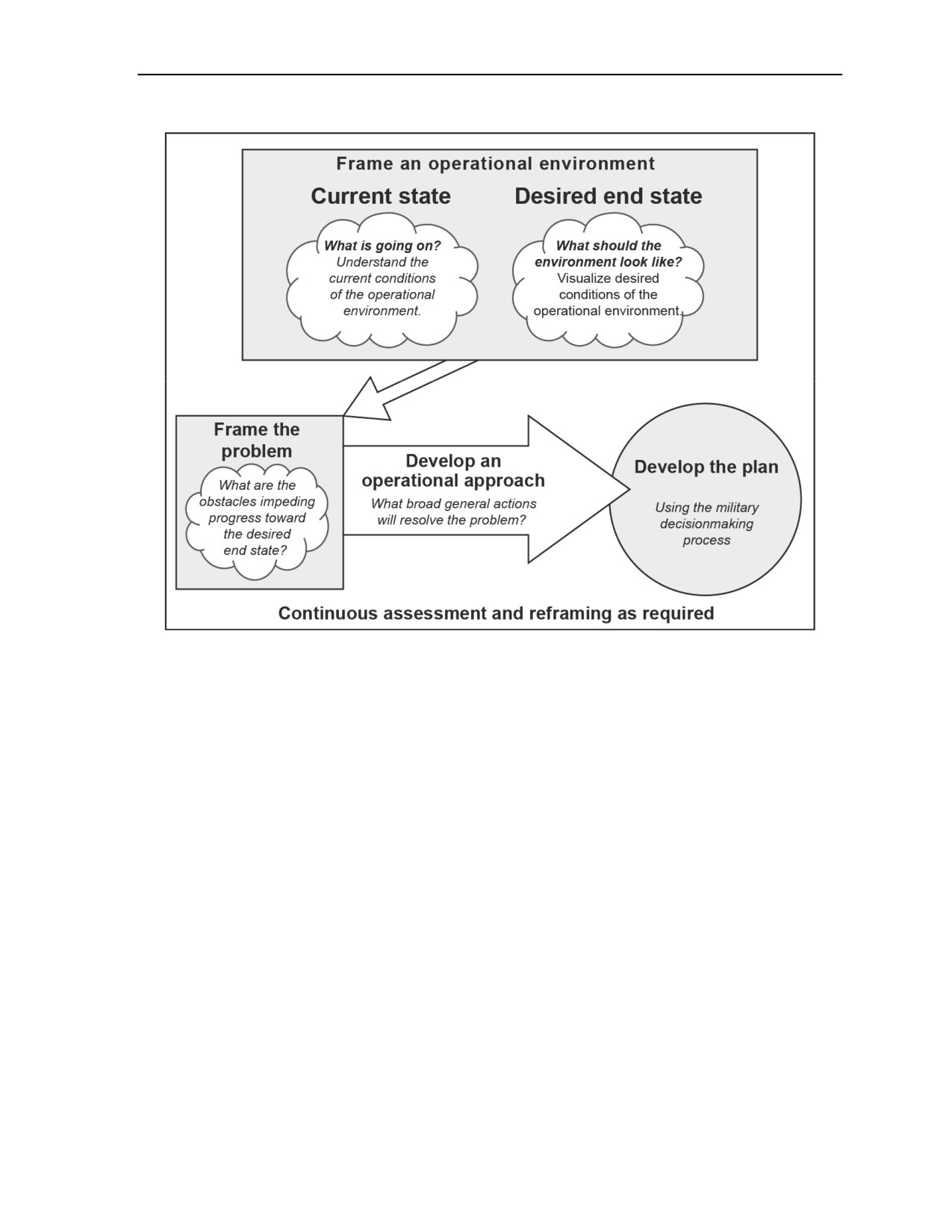
continuous activity. Design is the primary way to develop an operational approach. First, design helps
commanders and staffs create a shared understanding of the current operational environment and visualize
what the environment should look like. Understanding an operational environment is an essential
foundation of counterinsurgency. Second, design enables the collaborative, conceptual planning necessary
to understand a problem and develop broad approaches to solving it. From there, commanders can visualize
their operational approach and describe to staffs and subordinate commanders how to move the
environment from the current state to the desired end state. From an operational approach, the commander
conducts detailed planning. (See figure 7-1.) (See JP 5-0 for more information on design. See ADP 5-0 for
more information on Army design methodology and MCWP 5-1 for more information on Marine Corps
design. See chapter 2 for an understanding of an operational environment.)
7-4
FM 3-24/MCWP 3-33.5
13 May 2014
Planning and Operational Considerations
Figure 7-1. Design concept
7-15. By definition, design is iterative, and reframing the problem as necessary is essential. Reframing the
problem involves revisiting earlier hypotheses, conclusions, and decisions that underpin the current
operational approach. Reframing can lead to a new problem statement and operational approach, resulting
in an entirely new plan. By their nature, counterinsurgency efforts require repeated assessments from
different perspectives to see the various factors and relationships required for adequate understanding.
Assessment and learning enable incremental improvements to the operational approach. The goal is to
understand the problem, to construct a reasonable explanation of observed events, and to subsequently
construct a framework within which to solve the problem. The essence of this is determining the
mechanism or combination of mechanisms necessary to achieve success. These mechanisms may not be
military activities, or they may involve military actions in support of nonmilitary activities. Once
commanders understand the problem and what needs to be accomplished to succeed, they identify the
means to assess effectiveness and the related information requirements that support assessment. This
feedback becomes the basis for learning, adaptation, and subsequent reframing. (See ADRP 5-0 and
MCWP 5-1 for more information on design and reframing.)
7-16. In an ideal world, a commander engaged in counterinsurgency operations would enjoy clear and
well-defined goals for the campaign from the beginning. However, the reality is that many goals emerge
only as the mission develops and goals can change as a result of interacting with an environment. For these
reasons, counterinsurgents usually seek to achieve a combination of defined and emerging goals. Likewise,
the complex problems encountered during counterinsurgency operations can be so difficult to understand
that a clear operational approach cannot initially be developed and some assumptions must be made during
problem framing. Often, the best choice is to create iterative solutions (also known as discovery learning)
to better understand the problem. The use of design and the planning process allow commanders and staffs
to learn and achieve greater understanding as they interact with the environment. As this interaction with
2 June 2014
FM 3-24/MCWP 3-33.5, C1
7-5
Chapter 7
the population and insurgents occurs, it will reveal the validity of planning assumptions, test the strengths
and weaknesses of designs, inform the operational approach, and provide guidance to further planning and
engagement. Other considerations include:
z
Systems thinking.
z
Continuous assessment.
z
Structured learning.
7-17. Systems thinking involves understanding a problem in terms of systems and how they relate to, and
influence, each other. For counterinsurgents this includes not only how the various systems in an
insurgency interact, but how they interact and affect the various systems in the operational environment.
Additionally, systems thinking should drive commanders and staffs to develop an understanding of how
their lines of operations and lines of effort relate and influence each other. (See paragraphs 4-88 through
4-103 for more information on networked insurgencies.)
7-18. Continuous assessment is essential to learning and adapting within the inherent complexity of
counterinsurgency operations. No design or model completely matches reality, and reasonable and feasible
solutions at one moment can become ineffective at the next moment due to changes in the situation. The
object of continuous assessment is to identify where and how the actions and activities of the
counterinsurgent are working or failing and to consider adjustments to design and the operational approach.
(See chapter 12 for more information on assessments.)
7-19. The objective of structured learning is to develop a reasonable initial design and then learn, adapt,
and iteratively and continuously improve the initial plan as more about the dynamics of the
counterinsurgency problem become evident. The operational approach and framing of the problem can be
thought of as models. In counterinsurgency, these models must always be tested to determine how well
they match reality. In other words, counterinsurgents may believe they have an understanding and general
idea of how to solve a problem, but they review that belief to ensure it is still valid at any given time.
Counterinsurgents must understand the actual problem to ensure that tactical actions have an effect on the
environment.
CENTER OF GRAVITY
7-20. An important element of conceptual planning is center of gravity analysis. The center of gravity is
important in understanding both the environment and the enemy. A center of gravity is the source of power
that provides moral or physical strength, freedom of action, or will to act (JP 5-0). A center of gravity
construct is useful as an analytical tool to help counterinsurgency forces analyze the insurgency’s sources
of strength as well as its weaknesses and vulnerabilities. Centers of gravity may change over time, they
may be different at the operational and strategic level, and they could be different from location to location.
(See JP 2-01.3 for more information on centers of gravity.)
7-21. In an insurgency, the population is not necessarily the center of gravity for an insurgent. A center of
gravity could be external support from another country, it could be a group of core leadership or believers,
or it could be a host of other factors or vital functions. Center of gravity analysis begins with the
understanding that every environment is unique, and a center of gravity analysis must not begin with a
preconceived center of gravity.
7-22. Counterinsurgents must understand their own center of gravity and that of the host nation. In many
cases, political support is the strategic center of gravity for the U.S. Some tactical actions, such as war
crimes, can undermine political support for the counterinsurgency. Host nations may also have a wide
range of centers of gravity. Operational and tactical leaders must plan and execute operations that do not
undermine the host nation’s center of gravity.
LINES OF OPERATION AND EFFORT
7-23. Lines of operation and effort are important planning tools to move conceptual planning into detailed
planning. These planning tools help describe how a military force will turn a commander’s understanding
of the current situation into a desired end state. An end state is the set of required conditions that defines
achievement of the commander’s objectives (JP 3-0). The primary source for any commander’s end state is
7-6
FM 3-24/MCWP 3-33.5, C1
2 June 2014
Planning and Operational Considerations
the mission the commander received. The use of conceptual planning helps commanders visualize how to
generate the conditions that achieve that end state. Conceptual planning also allows commanders to
determine if the dictated end state is achievable, if additional resources are necessary, what level of risk
must be accepted, and if modification of the mission and expectations is required. The end state may
change as the situation changes. Lines of operations and effort help provide the detail necessary to turn the
commander’s visualization and the operational approach (how to move from the current situation to the
desired end state) into a detailed plan.
7-24. A line of operation is a line that defines the interior or exterior orientation of the force in relation to
the enemy or that connects actions on nodes and/or decisive points related in time and space to an
objective(s) (JP 5-0). Lines of operation are normally associated with the spatial aspects of a tactical
problem. Lines of operation are useful, especially when addressing the physical aspects of
counterinsurgency, such as infrastructure protection, control of movement, and locating and engaging
insurgent forces. Lines of operation and lines of effort can be used separately or in combination.
In Service-level doctrine, United States Marine Corps doctrine does not make a distinction
between lines of effort and lines of operation. MCDP 1-0 states that, “A line of operations helps
define the orientation of the force. In conventional operations, lines of operations connect
actions related in time and space to an objective. During counterinsurgency or other irregular
warfare operations, lines of operations, for example, could focus on major stability-related
objectives, such as security, restoration of essential services, and training host-nation military
and police forces. In either case, lines of operations reinforce the idea of the single battle, since
success or failure in any line of operations will have an impact on the other lines of operations.”
7-25. A line of effort is, in the context of joint operation planning, using the purpose (cause and effect) to
focus efforts toward establishing operational and strategic conditions by linking multiple tasks and missions
(JP 5-0). Because counterinsurgencies are often more oriented towards an intended outcome or purpose
than an enemy force, counterinsurgency operations generally use lines of effort. If a line of operation is
spatially oriented, then that line of effort is purpose oriented and is appropriate when positional references
to an enemy or adversary are not the determining factor in friendly action. Because counterinsurgency
operations involve many nonmilitary factors, lines of effort may form a way to link tasks, effects,
conditions, and the desired end state. Lines of effort help commanders visualize how to integrate their
military capabilities into the efforts of the rest of the unified action community. (See JP 5-0 for more
information on lines of effort.)
7-26. +Lines of effort are important tools to link conceptual planning to detailed planning. They are an
essential means that commanders can use to arrange tactical events in time, space, and purpose. The
benefits of using this type of framework include—
z
Aiding the commander in visualizing, describing, and directing operations toward a definitive
end state.
z
Unifying the efforts of joint, interagency, multinational, host-nation government, and host-nation
security forces toward a common purpose.
z
Allowing commanders and staffs to synchronize activities along all lines of operation and effort
to gain unity of effort.
z
Ensuring all efforts converge on a well-defined, commonly understood end state.
z
Combining the effects of long-term operations with short-, mid-, and long-term goals.
z
Helping commanders identify missions, assign tasks, allocate resources, and assess operations.
z
Enhancing mutual support between echelons and adjacent organizations.
7-27. Lines of effort depict how the actions of a counterinsurgent, over time, achieve the end state
visualized by the commander. In a counterinsurgency, lines of effort must also be nested into the actions
and activities of the host nation. From the tactical level to the strategic level, the goal of the
counterinsurgent may be to support the host nation, depending on the operational design of the
counterinsurgency. While that may require some tactical actions that do not involve host-nation forces, the
overall effort must be to support the host nation’s efforts at all levels. The counterinsurgent forces support
and integrate their efforts with the efforts of the host nation’s strategic and operational approaches.
2 June 2014
FM 3-24/MCWP 3-33.5, C1
7-7
Chapter 7
7-28. Commanders and staffs must consistently question and evaluate lines of effort as part of the
operations process. As assessment indicates changes to the situation (sudden opportunities to exploit,
failure of certain activities, new actors, and an actual change to the end state) the tasks and objectives of
various lines of operation and effort may no longer be relevant or appropriate. Worse, they can trap the
commander into a preconceived notion that accomplishment of various tasks will result in a successful
completion. Lines of operation and effort are useful means to help plan activities, but they are not measures
of mission success. All leaders must guard against the assumption that their actions are relevant because
they support any particular line of operation or effort. The underlying assumptions behind the tasks and
objectives of any detailed plan must be constantly questioned and evaluated. Just because counterinsurgents
take an action, that does not make that action relevant.
7-29. The effects of actions in one line of effort are not contained to only that line. For example, the
commander could have a line of effort to support the rule of law and a line of effort to support economic
development. However, a working legal system has a direct effect on the economic system. A system in
which contract law is enforced, for example, will have a much wider range of economic activity than a
system where contract law is not enforced. In this example, progress in the support economic development
line of effort may be hindered by struggles within the support rule of law line of effort. The use of systems
thinking allows commanders and staffs to use lines of operation and effort not only for planning and
conceptualization, but also for visualization of how they relate and influence each other.
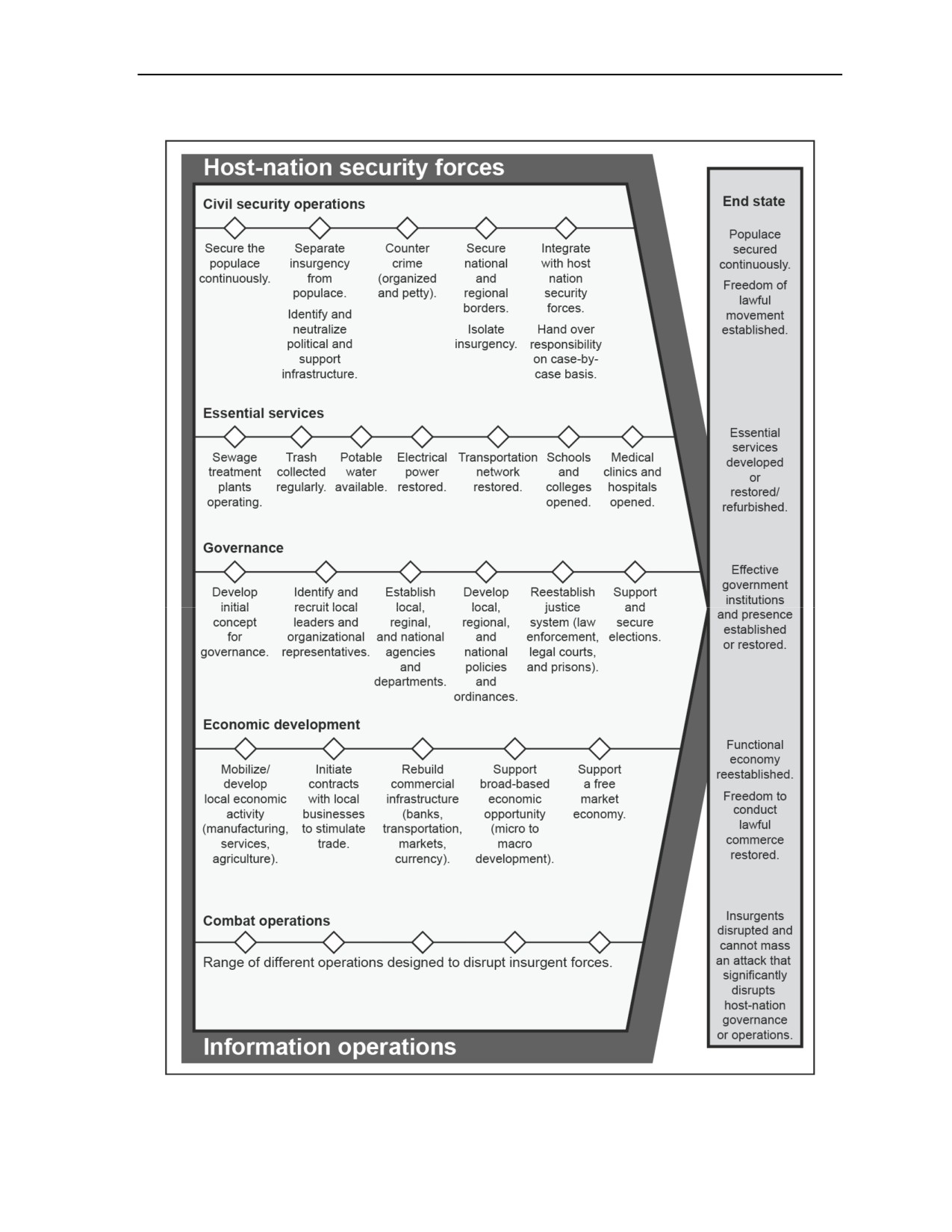
7-30. Figure 7-2 illustrates one example of lines of effort in a counterinsurgency. However, while this is an
example that may apply well to a counterinsurgency after large-scale combat operations, it may not apply
well to other counterinsurgency operations. The U.S. could be providing only enablers for a
counterinsurgency effort. For example, U.S. forces might be combining capabilities such as counter threat
finance, signals intelligence, and a direct action force to enable the host nation by stopping the insurgency
from attaining the means to fight, providing intelligence on an insurgency’s communications, and providing
a means to neutralize insurgent leadership. The host nation may have the capability to handle basic
functions such as governance. When designing lines of effort for a counterinsurgency, the context the
counterinsurgent is operating in is not important. If commanders and staffs reduce lines of effort to some
standard solution set, they are no longer using the tool, but they are being used by the tool. This illustrates
that complex problems in counterinsurgency require critical thinking and defy solution by checklist and
battle drill methodologies. When commanders and staffs use them properly, and when they are tied to
operational and strategic purposes, lines of operation and effort are means to help commanders and staffs
perform successful counterinsurgency operations. Figure 7-2 provides examples of possible tasks on each
line of effort. However, commanders and staffs must remember that these are sample lines of effort and
sample tasks on the lines of effort. Just as the individual lines of effort must meet the situation commanders
and staffs find themselves in, tasks on a lines of effort must fit an operational environment and its desired
end states. (See figure 7-2.)
7-8
FM 3-24/MCWP 3-33.5, C1
2 June 2014
Planning and Operational Considerations
Figure 7-2. Sample of individual lines of effort
2 June 2014
FM 3-24/MCWP 3-33.5, C1
7-9
Chapter 7
DEVELOP SIMPLE, FLEXIBLE PLANS THROUGH MISSION ORDERS
7-31. Effective plans and orders are simple and direct. During insurgency and counterinsurgency
operations, not all participates will understand military language and terms. Staffs must be careful to
prepare clear, concise orders that communicate to all organizations involved a clear understanding of the
operation using operational terms and symbols that are understood by all or enabling understanding through
liaisons or other coordination means.
7-32. Flexible plans help participates adapt quickly to changing circumstances. Commanders and planners
build opportunities for initiative into plans by anticipating events. This allows them to operate inside of the
enemy’s decision cycle or to react promptly to deteriorating situations. Identifying decision points and
designing branches ahead of time—combined with a clear commander’s intent—help create flexible plans.
7-33. Commanders stress the importance of using mission orders as a way of building simple, flexible
plans. Mission orders are directives that emphasize to subordinates the results to be attained, not how they
are to achieve them (ADP 6-0). Mission orders clearly convey the unit’s mission and the commander’s
intent. Mission orders provide subordinates information on what to do and the purpose of doing it, without
prescribing exactly how to do it.
7-34. +Commanders must also give guidance concerning risk when they issue mission orders. It is the
responsibility of commanders and staff to assess tactical and operational risk. Moreover, they should ensure
their forces are using techniques that take safety into account. That said, tactical initiative that supports
mission accomplishment should never be sacrificed because of safety. An over focus on safety undermines
the needed aggressive behavior to attack the enemy and take the needed risk to maintain contact with the
population. However, informing decisionmakers of hazards, recommended controls
(resources), and
residual risk allows responsible individuals to weigh benefit against risk, direct resources to best mitigate
the risk, and employ forces in the most efficient manner. (See ATP 5-19 for details on the risk management
process and processes for integrating the process in both deliberate planning and under real-time
constraints.)
TRANSITIONS
7-35. Transitions are fundamental to the planning and execution of any line of operation or effort.
Transitions may occur as a result of both success and failure in terms of friendly actions, host-nation
actions, and adversary actions. There are four types of transitions in counterinsurgency operations:
z
Transitions between changes in the environment.
z
Transitions between phases.
z
Transitions between units in an area of operations.
z
Transitions of responsibilities to host nation or other agencies.
7-36. Transitions are critical events. They are critical because they represent significant changes to the
situation and because a failure to properly execute them can stall or even negate progress. Whatever their
nature, transitions are milestones that require reassessment. Even if a transition is a result of success, such
as moving forward in phases, it is a cause to assess whether the basic assumptions and plans associated
with the next phase are still appropriate and relevant. In counterinsurgency, in addition to possible
transitions due to enemy actions, the commander and staff base transitions on changes in the population’s
perception of legitimacy.
Because transitions are based on the conditions of an operational environment, they must be a part of both
the planning process and based on assessments of an operational environment. Transitions in
counterinsurgency are essential because they generally measure progress towards the desired end state.
However, the commander must link transitions to an assessment process that allows that commander to
attain situational understanding. A transition to another phase or a transition to the host nation not linked to
the assessment process can undermine the achievement of the end state. For example, a transition to a
host-nation agency before that host-nation agency is ready to assume responsibility may ultimately have the
effect of undermining the legitimacy of the host nation as the host nation fails to meet the basic
expectations of the population.
7-10
FM 3-24/MCWP 3-33.5, C1
2 June 2014
Planning and Operational Considerations
7-38. Transitions and assessments should be planned and executed from the beginning of any
counterinsurgency. Commanders can build legitimacy by ensuring that the host nation takes responsibility
for basic functions when it can. Therefore, building towards and executing that transition to the host nation
is fundamental to the commander’s planning and operations. Transitions to other units or other agencies
maintain a coherent and logical progression towards an ultimate transition to the host nation. The
commander avoids allowing any U.S. element to transition with another U.S. or multinational element in a
way that sets back the mission. This is also true for transitions between phases. A transition to another
phase before the operational environment allows can have disastrous consequences.
7-39. Effective counterinsurgency is about effectively linking tasks to a purpose and achieving that
purpose. This is what makes lines of effort effective planning tools for a counterinsurgency. Whether
commanders and staffs are using direct or indirect methods, they must link those methods to an end state.
However, linking both assessments and transitions into each line of effort is just as essential. The end state
of every line of effort is the creation of the conditions that satisfy the requirements of mission
accomplishment. (See figure 7-2 on page 7-9.) In counterinsurgency, ultimate success comes when a
society maintains its own legitimate government and defeats its insurgency using its own resources, not
through outside enablers. Transitioning to that point requires a well planned effort that evaluates progress
and executes all transitions in a way that does not undermine the objective of the line of effort. (See chapter
12 for a further discussion on assessments.)
7-40. A transition is a sequence of actions required to reorient on a changed situation, change to the next
phase of action, or shift responsibility from one organization to another, not a specific point in time.
Transitions require adequate time to allow for all transitional tasks to be completed. Thinking of a transition
as a general series of actions rather than a point in time better aids commanders and staffs in recognizing
transitions, planning for them, and executing them seamlessly.
7-41. When transitions occur between organizations, whether between military units or from a military unit
to a civilian agency, all involved organizations must clearly understand the tasks and responsibilities being
transferred and the time expected for completion. Commanders and staffs enable coordination between
units, agencies, and organizations to reduce the friction normally associated with a transition. Commanders
identify a collaborative transition planning team early in the process.
7-42. Commanders and staffs identify the criteria and conditions that must be met prior to executing a
transition. For example, transitioning a strongpoint to host-nation control may require the host nation to
allocate specialized personnel to replace the specialized personnel previously provided by other forces.
Additionally, host-nation manning may need to be increased to offset the departure of transitioning forces.
Commanders identify criteria for all parties involved or gaps will develop in execution. One criteria is the
minimum sustainable effort of the host nation prior to transition. Getting the host nation’s minimum
sustainable effort right with the proper balance for sustained effectiveness and long-term maintenance may
reflect a less than optimal solution from the perspective of the counterinsurgent, but any higher level of
effort by the host nation may actually jeopardize the legitimacy of the host nation in the long term by being
too heavy-handed or too costly.
7-43. Counterinsurgents must understand that transitions occur at varying times and locations based on the
situation in a given area. A transition may be linear at the local level, but transitions may occur at multiple
levels in the aggregate. For example, one battalion or brigade may have three village clusters in a build
phase, one that has transitioned, and two that are in a clear phase without any geographic context. One
host-nation security unit may be more advanced in training and equipping than another. As a result,
counterinsurgent forces may have to tailor their approach on a daily basis depending on the area, village, or
unit where they are operating. Success in counterinsurgency operations requires small-unit leaders agile
enough to transition among many types of missions and able to adapt to change. (See chapter 9 for more
information on the shape-clear-hold-build-transition framework.)
7-44. Maintaining unity of effort is particularly important during transitions, especially between
organizations of different capabilities and capacities. Relationships tend to break down during transitions.
A poorly executed transition affects the success of the mission and places the new unit at risk. Ego and
unhealthy competition are often the greatest impediments to achieving an effective transition, and they
increase unnecessary risks to Soldiers, Marines, and the mission. Commanders must set the tone for their
forces to accomplish effective physical and contextual transitions.
13 May 2014
FM 3-24/MCWP 3-33.5
7-11
Chapter 7
7-45. A successful transition is achieved when it is executed properly and in synchronization with all the
relevant organizations, entities, and agencies. Planning for transitions is more than the identification of the
events that govern phases and branches for planning. It requires a holistic framing to develop the full
appreciation of the tasks, time, and resources required to execute effectively and efficiently in a
counterinsurgency environment. Well-planned transitions require proactive analysis and continuous
assessment during execution. Assessment of qualitative and quantitative criteria, supported by expert
opinion, should inform the decision to transition.
OPERATIONAL CONSIDERATIONS
7-46. There are certain operational considerations that have important consequences for planning and
executing counterinsurgency operations. Currently, insurgencies are likely to be networked. This makes
attack the network an essential operational consideration in understanding an insurgency and planning and
executing a counterinsurgency. Other considerations include remote area considerations, border
considerations, and basing. Counterinsurgency operations normally integrate information related
capabilities with other capabilities, and information operations are essential to most operational approaches.
This makes information operations uniquely important to counterinsurgents. (See paragraphs 4-88 through
4-103 for more information on networked insurgencies.)
ATTACK THE NETWORK
7-47. Attack the network operations can be essential in planning and an essential consideration for every
step in the operations process. When an insurgency is deeply networked into a society, it is important that
attack the network operations are integrated into planning, preparing, executing, and assessing operations.
Networked insurgencies must be understood and attacked.
7-48. Attack the network operations provide the primary means to attack an insurgent network or enable a
host-nation force to defeat a networked insurgency. As such, they must be integrated and used when
counterinsurgents are facing a networked insurgency. (See paragraphs 4-88 through 4-103 for more
information on networked insurgencies.)
7-49. Attack the network operations consist of activities that employ lethal and nonlethal means to support
friendly networks, influence neutral networks, and neutralize threat networks. Attack the network
operations are conducted continuously and simultaneously at multiple levels (tactical, operational, and
strategic) throughout the whole of government. Attack the network operations are constructed around six
fundamentals:
z Understand the mission.
z Understand the operational environment.
z Understand the networks. (See paragraphs 4-88 through 4-103 for more information on networked
insurgencies.)
z Organize for the fight.
z Engage the network.
z Assess.
7-50. While listed sequentially, these actions occur continuously and simultaneously and are designed as
an enhancement to planning processes and intelligence preparation of the battlefield/battlespace. Effective
attack the network operations occur when operations and intelligence efforts are synchronized. Failure to
synchronize efforts may hamper a unit’s ability to plan and operate in an efficient manner.
7-51. Attack the network operations predominantly support problem framing and mission analysis within
planning. During the initial stages of planning, intelligence preparation of the battlefield/battlespace must
include an analysis and graphical (geospatial) representation of an operational environment as a series of
interconnected networks
(friendly, neutral, and threat) in addition to weather, terrain, and civil
considerations. Threats to mission accomplishment can be presented by any network, not solely threat
networks.
7-12
FM 3-24/MCWP 3-33.5
13 May 2014
Planning and Operational Considerations
7-52. Attack the network operations enable greater understanding of the human networks and those
variables critical to insurgent and threat networks. Network mapping, charting, and social network analysis
are intelligence products that can aid in refined analysis and course of action developments, bridge
conceptual planning and detailed planning by visually depicting time sensitive intelligence and mission
requirements, and provide a shared understanding of the operational environment and design. Additionally,
these network analysis products assist commanders and staffs in recognizing dynamic and static network
relationships for targeting to support mission accomplishment. The evaluation and measurement of
targeting effects continually aid in refined understanding and provide potential follow-on targets to degrade
threat and insurgent networks.
7-53. Attack the network operations require that commanders and staffs understand social networks. A
social network analysis is a tool for understanding the organizational dynamics of an insurgency and how
best to attack or exploit them. A social network analysis allows analysts to identify and portray the details
of a network structure. It shows how an insurgency’s networked organization behaves and how that
connectivity affects its behavior. A social network analysis allows analysts to assess the network’s design,
how its members may or may not act autonomously, where the leadership resides, how leadership is
distributed among members, and how hierarchical dynamics may mix or not mix with network dynamics.
7-54. Attack the network operations provide a construct to identify, define, and engage any network,
regardless of its design. The framework for attack the network operations can be applied against any type
or combination of adaptive networks. It allows leaders to effectively engage neutral and threat networks
with the appropriate lethal or nonlethal targeting, once a network has been defined through information
collection and analysis. It also provides a means to protect friendly networks. Assessments of targeting and
the measurement of the effects on networks (friendly, neutral, and threat) in an operational environment
assist the staff in providing further targeting recommendations in sustainment of lethal or nonlethal
activities.
7-55. Attack the network operations are tactical, operational, and strategic operations that capitalize on or
create vulnerabilities to neutralize the threat network’s ability to function and enable success of the
operation. Adaptive networked threats present an enduring challenge to all military operations. Neutralizing
them may require an attack the network approach that includes the following activities:
z Support friendly networks.
z Influence neutral networks.
z Neutralize threat networks.
Support Friendly Networks
7-56. Friendly network actions are intended to establish, reinforce, or set the conditions necessary for
friendly networks to function effectively and increase capability. These operations also have indirect effects
on threat networks, driving down their capabilities and altering the environmental conditions those
networks require to survive and operate. Actions supporting friendly networks are intended to establish,
reinforce, or set the conditions necessary for the host nation or civil authorities to function effectively, add
capability, and increase capacity.
7-57. Commanders and staffs use all resources available, both Department of Defense
(DOD) and
non-DOD, in an area of operations to ensure a comprehensive approach to supporting and enabling friendly
networks. Host-nation networks such as government agencies, local business or religious organizations,
tribal or cultural communities, and educational institutions all have an impact on a population and can alter
its perceptions. Commanders can affect these organizations positively, thus altering public perceptions in
favor of supporting those organizations. This results in increased cooperation, support, and even active
rebuttal of threat networks. (See paragraphs 1-47 and 1-48 for more information on comprehensive effort.)
Influence Neutral Networks
7-58. Influence neutral networks activities include operations intended to alter the opinions and attitudes of
a population segment through information, influence, presence, and conduct. These activities reflect the
ability of friendly forces to operate within the cultural and societal norms of the local population while
13 May 2014
FM 3-24/MCWP 3-33.5
7-13
Chapter 7
accomplishing the mission. They require legitimacy. Developing legitimacy requires time, patience, and
coordinated, cooperative efforts across the operational area. Influencing neutral networks to be more
favorably disposed to U.S. and host-nation objectives has indirect effects on threat networks by making the
operational environment in which threat networks operate less hospitable to their formation, growth, and
sustainment.
Neutralize Threat Networks
7-59. Threat networks are typically the immediate concern for any unit arriving in an area of operations.
These networks must be neutralized in order to protect friendly forces and populations while creating time
and space for other attack the network operations. While local friendly networks are being bolstered, there
is a period when host-nation capabilities are insufficient to address the threat. U.S. forces and multinational
partners must take direct actions against threats, reducing their functionality and impact, in order to set
conditions for supporting friendly networks and influencing neutral networks. The goal is to change the
perceptions and behaviors of neutral audiences to support the achievement of U.S., multinational, and
host-nation objectives.
7-60. A solid understanding of threat networks helps commanders engage those networks to achieve their
desired end state. Knowledge of numerous characteristics of networks can assist in the engagement process.
Conditions for network formation can help commanders and staffs understand the cognitive domain of
networks. Knowing the strengths and types of links can help commanders determine whether or not they
want to target or engage key nodes within networks or all known and potential nodes and actors of a
network.
7-61. Attack the network operations require that commanders understand and integrate specific staffing
requirements. Commanders and staffs integrate organic capabilities with enablers including, but not limited
to, other government agencies, nongovernmental organizations (NGOs), intergovernmental organizations,
law enforcement professionals, and theater-specific joint task force explosive ordnance disposal elements to
conduct attack the network operations.
OTHER OPERATIONAL CONSIDERATIONS
7-62. Operations that occur in three additional types of environments have important considerations for
counterinsurgency. They include—
z
Remote area considerations.
z
Border considerations.
z
Basing.
Remote Area Considerations
7-63. Operations in remote areas may be conducted in rural areas where a decentralized array of forces can
be most effective. Operations in remote areas are generally conducted in insurgent-controlled or contested
areas to establish pockets of popular support for the host-nation government and deny support to
insurgents. These operations may be conducted to establish bases in unpopulated areas where insurgent
forces have established staging areas, training areas, rest areas, logistic facilities, or command posts. Units
operate in remote areas to interdict insurgent activity, destroy insurgent base areas, and demonstrate that the
host-nation government has not ceded control to the insurgents.
7-64. Operations in remote areas are usually conducted in areas that are either under insurgent control or
are contested. In these areas, ground or water modes of entry are often used, but air assault or parachute
operations can be employed. These operations may use offensive tactics such as raids, reconnaissance in
force, cordon and searches, hasty or deliberate attacks, and pursuit (or combinations of these tactics). Their
purpose may be to—
z
Harass insurgents to prevent the buildup of personnel and logistic resources.
z
Isolate insurgents from their support.
z
Demonstrate support for the government and for the populace in the local area.
7-14
FM 3-24/MCWP 3-33.5
13 May 2014
Planning and Operational Considerations
z
Expand controlled areas.
z
Destroy the insurgent force and its base complexes.
7-65. To the extent possible, the counterinsurgency force should include personnel indigenous to the
operational area. The type of force employed, along with its host-nation counterpart (regular forces or
paramilitary) depends on the objectives, characteristics of the area, attitude of the local population, political
considerations, and the equipment and logistic support available. The size and composition of the
host-nation unit is, in part, determined by the insurgent’s influence over the population and the
government’s ability to recruit and develop an adequate local force. When the unit is recruited from local
inhabitants, local leaders should be used even though their military ability may be limited. By using local
leaders, assisted by advisors, better control and motivation are possible. Training, indoctrinating, and
incorporating the local force into the governmental structure is facilitated by using local leaders.
7-66. Understanding the host nation’s population’s issues from their perspectives enables
counterinsurgents to address the prerequisites of the insurgency and obtain local support for remote area
operations. Success is more likely if—
z
A significant segment of the local population supports the program.
z
The host nation recruits local personnel for its remote area paramilitary or irregular force.
z
Host-nation forces conduct remote area operations to interdict infiltration routes in areas nearly
devoid of people. In this case, U.S. and multinational elements and host-nation forces operate in
a manner similar to that of the insurgents, but with access to superior sustainment resources.
7-67. In a rural environment, insurgents rely on friendly elements within the population to provide supplies
and intelligence. Rural insurgents prefer to operate in regions providing plenty of cover and concealment,
such as heavily forested and mountainous areas that hinder a counterinsurgency force from gaining access
to them. Often operating from their own home or village, rural insurgents often move to camps if security
does not permit them to remain at home. Insurgent camps are chosen with a view toward easy access to the
target population, access to a friendly or neutral border, prepared escape routes, and good observation of a
counterinsurgency force’s approach routes. When counterinsurgency operations force the insurgents from
their preferred base camps, insurgents tend to establish camps in rugged inhospitable areas that are not
easily penetrated. Like counterinsurgency in urban areas, remote counterinsurgency operations must focus
on both locating and eliminating insurgents and on severing the supportive element of the population from
providing supplies and intelligence to them.
7-68. Operations in remote areas typically call for use of combat outposts that are linked to the local
population. Commanders and staffs consider three perspectives
(the population, insurgents, and
counterinsurgents) when choosing combat outpost locations. Establishing an outpost close to the local
population does not serve to advance the counterinsurgency’s goals without certain factors. These
include—
z
Gaining acceptance of the local civilian leadership.
z
Maintaining a constant presence in the community.
z
Maintaining constant communications with the local community to provide immediate
emergency assistance.
z
Maintaining situational understanding and an awareness of any changes in the population’s
patterns of life. This includes movement of outsiders (such as visitors, merchants, nomads, or
seasonal labor).
7-69. Operations in remote areas may include civil affairs, defense support of civil authorities, intelligence,
population and resources control, and advisory assistance operations. Most remote operations are long term
and continuous. They are initially directed at disrupting the insurgent’s operations and then destroying the
insurgent armed forces. Counterinsurgents destroy the insurgent infrastructure as quickly as possible.
7-70. Initially, strong combat and sustainment forces establish secure operational bases. Counterinsurgents
may conduct remote area operations in areas with little or no population to interdict infiltration routes.
Counterinsurgents make maximum use of special equipment to provide continuous coverage of suspected
areas and routes. Firepower and combat forces, with air assault capabilities, should be prepared to quickly
attack identified targets. Because remote area operations can stress the capability of land forces to make
13 May 2014
FM 3-24/MCWP 3-33.5
7-15
Chapter 7
rapid responses, commanders can mitigate risk by coordinating with joint enablers for close air support,
tactical airdrops, information collection, communications relays, and personnel recovery forces.
Border Considerations
7-71. In a counterinsurgency environment, armed forces may be responsible for border security, and they
may have to help other security forces with immigration, customs, and internal security operations. The
specific threat level, however, may require combat-type border operations, particularly in remote areas. The
threat level may require units or advisor teams to advise and assist host-nation forces assigned to prevent or
interdict the infiltration of insurgent personnel and materiel across international boundaries. This method is
a terrain-centric approach to combating an insurgency. The commander’s intent is to isolate insurgent
forces from their external support and sanctuaries. Secondary purposes include locating and interdicting
insurgent land infiltration routes, destroying insurgent forces and bases in areas adjacent to the border, and
collecting and reporting information on insurgent capabilities and intentions. Border operations normally
require restrictive control measures for populations and resources that are particularly annoying to tribal
and ethnic border groups who do not recognize the international boundary. The host-nation government
must make a continuing effort to physically and psychologically gain and maintain the loyalty of the
affected population.
7-72. Designated border forces may be composed of border police and guards and may include
paramilitary forces and regular armed forces with supporting or direct responsibility for portions of the
national border or key internal routes to access other regions. Border operations are planned, conducted,
and supervised from the national level, to the regional level, and finally through commanders at the local
level. Border task forces are tailored units designed to meet requirements in their assigned areas. They
should contain sufficient sustainment warfighting function and sustainment elements to support civil
authorities’ operations for extended periods.
7-73. Tasks that may be performed in controlling the border include the following:
z
Security of populated areas.
z
Intelligence and counterintelligence operations.
z
Operation of authorized points of entry.
z
Refugee and internally displaced person control.
z
Enforcement of movement and travel restrictions.
z
Military information support operations.
z
Reconnaissance, surveillance, and target acquisition.
z
Attacks against insurgent forces.
z
Destruction of insurgent base areas.
z
Barrier and denial operations.
7-74. In a phase I insurgency, operations in border areas are normally a function of police, customs, and
other government organizations. Armed and paramilitary forces may assist these organizations, particularly
in remote areas. In phases II and III, denial of external support for the insurgency may require combat
operations in border areas. These operations require close coordination and cooperation between the armed
forces, paramilitary forces, and all government agencies involved. Attempts by insurgents to infiltrate can
be mitigated through the use of biometrics to identify subversive activities and limit or disrupt insurgent
mobility. (See paragraphs 4-70 through 4-75 for a discussion on the insurgency phases.)
7-75. Physically sealing a border may not be possible, since it could require the commitment of more
government forces and materiel than overall resources permit. Intelligence must be gathered by all means
available to determine the locations and extent of insurgent activities in border areas.
7-76. Commanders determine infiltration and exfiltration routes, support sites, frequency and volume of
traffic, type of transportation, number and type of personnel, amount and type of materiel, terrain and
traffic conditions, and the probable location of base areas and sanctuaries. Units conduct continuous and
detailed surveillance of these areas. Since placing forces and barriers at all possible crossings or entry sites
may be impossible, commanders establish priorities. Counterinsurgents use natural barriers wherever
possible. Using patrols, sensors, and obstacles in selected areas increase the effectiveness of natural
7-16
FM 3-24/MCWP 3-33.5
13 May 2014
Planning and Operational Considerations
barriers. Herbicides, if approved for the area of operations, may be used to enhance visibility in vegetated
areas.
7-77. A restricted zone is a carefully selected area, of varied width, that is contiguous to the border.
Counterinsurgents give public notice that all unauthorized individuals or groups encountered in the
restricted zone will be dealt with as infiltrators or insurgents. A friendly population buffer zone is an area in
which civilians living within the area of operations are limited to those believed to be loyal to the
government. Persons whose loyalty cannot be established are monitored. This concept offers a good
potential for establishing information nets and using loyal citizens in self-defense border units. It denies
insurgents potential civilian contacts and base areas for border-crossing activities. Commanders and staffs
direct a continuing military information support operation effort toward maintaining the morale and loyalty
of the population.
7-78. Counterinsurgents may employ aerial reconnaissance, unattended ground sensors, and ground
reconnaissance patrols to ensure adequate reconnaissance and surveillance of remote areas. Surveillance
and control of extensive coastal areas normally require the use of coordinated ground patrols on the
shoreline, coordinated offshore patrols, aerial surveillance, strategically located observation posts, and an
effective system of licensing and identifying friendly, military, and civilian watercraft.
7-79. Commanders and staffs must consider the population of the host nation’s neighbor country.
Counterinsurgent actions will be viewed and interpreted by local populations in neighboring countries.
Counterinsurgents must consider the impact their actions have on these populations. If the neighboring
local populations sympathize with host-nation insurgents or believe that counterinsurgent programs are
counterproductive to their individual goals, then negative perceptions can lead to increased foreign fighters,
weapons, and resource trafficking to support an insurgency. Counterinsurgents lack the physical means to
influence this population, but they can mitigate risk by performing effective information operations that
explain counterinsurgent programs and their benefits.
Basing
7-80. Counterinsurgency forces operate within a host country and must have a base from which to operate.
A base is a locality from which operations are projected or supported (JP 4-0). All bases must be securable
and defendable. Bases vary according to the size and missions of the units occupying a base. All types of
bases require clear command relationships. In counterinsurgency operations, forward operating bases and
combat outposts are important.
7-81. Normally, when U.S. forces are the primary counterinsurgents, at least one forward operating base
exists in an area of operations. The size of the area, its physical characteristics, and the number and size of
the units operating within the area often require additional operating bases. The forward operating bases
established by a brigade or battalion are often semipermanent and provide deployed units with command,
control, and communications facilities; sustainment; personnel systems support; staging areas; and
intelligence activities. They provide units with relatively secure locations from which to plan and prepare
for operations. During counterinsurgency operations, they aid in limiting insurgent mobility nearby and in
providing some security and contact to the local population.
7-82. There are a few differences between brigade and battalion forward operating bases. Brigade forward
operating bases are larger than battalion forward operating bases and provide a secure location for
nondeployed elements of the deployed battalions, such as battalion forward support companies. A battalion
forward operating base is normally staffed with the minimum personnel needed to operate and provide
security. Other assets are normally positioned in a brigade operational base. A battalion forward operating
base should maintain two methods for sustainment: by road and either air or water.
7-83. A combat outpost is a reinforced observation post capable of conducting limited combat operations
(FM 3-90-2). In counterinsurgency operations, combat outposts are often company and platoon-sized bases
inside of insurgent influenced territory. When U.S. forces are acting as the primary counterinsurgents,
combat outposts represent a cornerstone of counterinsurgency operations. Located in strategically
important areas, a combat outpost provides security in its immediate area and direct contact with the local
population not possible from remote bases. Although this method carries with it potential downsides in
13 May 2014
FM 3-24/MCWP 3-33.5
7-17
Chapter 7
terms of increased proportion of forces used for force protection, thus limiting combat power available,
combat outposts provide an increase in security for the population.
INFORMATION OPERATIONS
7-84. Information operations is the integrated employment, during military operations, of
information-related capabilities in concert with other lines of operations to influence, disrupt, corrupt, or
usurp the decisionmaking of adversaries and potential adversaries while protecting our own (JP 3-13). For
the Army, information operations integrates information related capabilities into the overall operational
approach. The joint and multinational communities continue to use the term information operations. The
joint construct for conducting information operations is the information-influence relational framework.
The framework describes the application, integration, and synchronization of information-related
capabilities to influence, disrupt, corrupt, or usurp the decisionmaking of target audiences to create a
desired effect to support achievement of an objective. An information-related capability is a tool,
technique, or activity employed within a dimension of the information environment that can be used to
create effects and operationally desirable conditions (JP 3-13). (See Army doctrine for more information on
integrating information-related capabilities.)
7-85. A target audience is an individual or group selected for influence (JP 3-13). Information operations
seek to generate effects against the decisionmaking of individuals, a group, or perhaps elements of a
population. In general, the integration of information-related capabilities is most effective when employed
against precisely selected targets to achieve clearly defined objectives.
7-86. Information-related capabilities generate effects that support achievement of the commander’s
objectives. There are many military capabilities that contribute to operations, and commanders and staffs
should consider them during the planning process. Some of these capabilities are:
z
Soldier and key leader engagement.
z
Civil-military operations.
z
Cyberspace operations.
z
Military deception.
z
Electronic warfare.
z
Operations security.
z
Military information.
z
Physical attack.
z
Physical security.
z
Counterintelligence.
z
Public affairs.
z
Combat camera.
z
Defense support to public diplomacy.
z
Space operations.
z
Special technical operations.
z
Intelligence.
z
Joint electromagnetic spectrum operations.
z
Information assurance.
7-87. A commander can use many other capabilities to enhance and reinforce the shaping of the area of
operations and the accomplishment of mission objectives in the information environment. (See JP 3-13 for
additional information on the use of information-related capabilities.)
7-88. Information-related capabilities, whether applied in shaping the operational environment to deter
conflict or in enabling decisive maneuver, must be recognized as an essential enabling activity that
facilitates development of an operational advantage for the commander. In current and future operational
environments, the integrated employment of information-related capabilities into operations is critical to
mission success. (See the Marine Corps operating concept for information operations for more information
on information-related capabilities.)
7-18
FM 3-24/MCWP 3-33.5
13 May 2014
Planning and Operational Considerations
7-89. The actions of Soldiers and Marines in an area of operations are the most powerful influence on
credibility of their commanders’ message. All audiences (including local, regional, and threat) compare the
friendly force’s message with its actions. Consistency contributes to the success of friendly operations by
building trust and credibility. Conversely, if actions and messages are inconsistent, friendly forces lose
credibility. Loss of credibility makes land forces vulnerable to threat counter propaganda and information
warfare and places Army and Marine forces at a disadvantage. (See FM 3-13 for more information on
messaging.)
7-90. Commanders, staffs, and unified action partners construct a narrative to help understand and explain
an operational environment, its problem, and solutions. Narratives are tied to actions in an operational
environment. A narrative is a brief description of a commander’s story used to visualize the effects the
commander wants to achieve in an information environment to support and shape an operational
environment.
7-91. The key to successful information operations during an insurgency is the commander’s intent. The
commander’s intent provides a focus for the coordination and synchronization of information-related
capabilities. Staffs and information operations planners must balance the use of different
information-related capabilities, such as civil affairs operations, physical attack, and cyberspace operations,
in order to communicate the intended message to the target audience with an understanding of possible
second and third order effects on the rest of the global population.
7-92. When commanders and staffs use the various types of information capabilities, there is a tension
between a broad message and engaging the population to achieve a two way understanding. The U.S. is
generally involved in counterinsurgencies to aid host nations. As such, commanders and staffs integrate
information capabilities with the host nation’s message to tell the population the reason for U.S.
involvement. Commanders and staffs have to establish relationships, seek two-way understanding, and
listen to what others think. Effective counterinsurgency normally requires an effective broad message and
engaging the population in a dialogue. Commanders and staffs must find the right balance between using
information capabilities to give a broad message versus creating a dialogue.
7-93. Commanders and staffs balance between controlling the message and allowing for complete freedom
of messaging. Having a perfectly controlled message does not allow for real, timely communication with a
population. Leaders must have some ability to actually engage a population and create a shared
understanding. However, if representatives of a command have total freedom of message, the population is
bombarded with contradictions and inconsistencies. Commanders and staffs must find the right balance to
allow real communication, but also to ensure that the command has a coherent message.
7-94. Public affairs and information operations are separate but related functions. Public affairs are those
public information, command information, and community engagement activities directed toward both the
external and internal publics with interest in the Department of Defense (JP 3-61). External publics include
allies, neutrals, and threats. When addressing external publics, opportunities for information overlap exist
between public affairs and information operations.
7-95. Information operations and public affairs personnel must maintain a common awareness of each
other’s support to operations to preclude the potential for information conflict. The information operations
cell provides an excellent place to coordinate and deconflict information operations and public affairs
activities that could result in information fratricide. Information fratricide is the result of employing
information-related capabilities in a way that causes effects in the information environment that impede the
conduct of friendly operations or adversely affect friendly forces (FM 3-13). Final coordination of public
affairs and information operations must occur within the operations process.
7-96. In a counterinsurgency, the insurgent often targets the U.S. population with themes and messages
concerning the insurgency. There are legal and professional reasons why the armed forces cannot attempt
to influence American public opinion; to do so would undermine civil control over the military. However,
the military has a responsibly to provide information to the U.S. public. Transparency and truthful
information allows policy decisions to be debated between decisionmakers and the public. Although
providing that information during an insurgency is a responsibility of the military, trying to influence the
actual debate is unethical and damages the military’s relationship with the society.
13 May 2014
FM 3-24/MCWP 3-33.5
7-19
Chapter 8
Intelligence
8-1. Intelligence must drive operations in a counterinsurgency. Commanders and staffs must understand
the area of operations in a counterinsurgency. The insurgency in Peru demonstrates that intelligence
capabilities can be integrated with information operations and integrated monetary shaping operations to
successfully undermine an insurgency. The Peruvian government was eventually successful in using
economic development and an information campaign to weaken the Shining Path insurgency. With the
gradual development of an effective military, Peru was able to continue its success. Intelligence, resulting
in the capture of the Shining Path’s leader, changed the nature of the insurgency and significantly reduced
the threat of the Shining Path to Peru.
Intelligence and the Shining Path
Peru suffered an unprecedented economic downturn in the 1970s and
1980s. The Peruvian government, though democratic, was characteristically
ineffective and unable to stem the worsening crisis. This opened the door for an
insurgent organization, the Sendero Luminoso (Shining Path), and its establishment
of alternative governance structures in the economically devastated Peruvian
highlands. Sendero Luminoso leaders purged local officials and established their own
authority in the villages, beating back control efforts by the Peruvian police.
In the first few years of the insurgency, the government did not take the
threat seriously. Opposition to the insurgents (such as it was) was organized by local
police, and the government made no effort to improve the desperate socioeconomic
conditions in the highlands or to define a clear mission for regional security forces.
With its superior organization and a lack of effective response by the government,
Sendero Luminoso made significant progress. Its operations and propaganda were
coordinated to create the perception that the group was a “winner” and was meeting
its Maoist strategic goals, in sharp contrast to the largely ineffective government.
Still plagued by a lack of internal unity both in the government and in the
military, the state moved forward with two competing counterinsurgency strategies:
one focused on development and the other focused on ideology and military force.
First proposed in 1984, the developmental approach finally got its turn in 1985. The
state recognized that the highlands were particularly hard hit by the economic crisis
and were the heartland of the insurgency, so its goal was to increase development
and job opportunities in these regions. Public investment in Ayacucho (a region in the
southern highlands) quadrupled between
1985 and
1986. Unfortunately, the
insurgents actively resisted this development, or co-opted it, forcing government
teachers to include Sendero Luminoso materials in their curricula. The government
did not provide the security necessary for development to have any effect.
Subsequent to 1986, development funding fell off, and embezzlement became
common. As a result, this initial push of development and investment fell far short of
meeting the needs of the economically disadvantaged population in the highlands.
The election of Alberto Fujimori in June 1990 raised new hopes of resolving
the conflicts within the government and making greater headway against the
insurgents. Fujimori promised a better human rights record and a new commitment to
development. In addition to renewed government legitimacy, the Fujimori
administration also brought two significant improvements to Peru’s approach to
counterinsurgency: first, the use of the police and the national intelligence service to
track the movements of Sendero Luminoso sympathizers and attempt to infiltrate the
group and, second, the arming of rondas, peasant civil-defense militias. These
13 May 2014
FM 3-24/MCWP 3-33.5
8-1
Chapter 8
rondas were possible only because the insurgents’ treatment of villagers in its areas
of operation had become so harsh that the locals were finally pushed to stand up for
themselves. Improved intelligence and an end to internal divisions within the military
allowed effective engagement of insurgent forces and effective (and rapid) support to
threatened rondas. For the first time in the conflict, the government, police, and
military made effective use of what would now be called strategic communication,
with a greater emphasis on government credibility, consistency between actions and
messages, and significant efforts to woo the population in the highlands away from
the insurgents (efforts of which the rondas were an integral part).
In 1992 good intelligence led to Abimael Guzmán’s (the leader of Sendro
Luminoso) capture. The capture of Guzman changed the ongoing insurgency and
significantly undermined insurgent efforts. At the time of his capture, the police seized
Guzmán's computer, in which they found a very detailed roster of his armed forces
and the weapons each formation had in each region of the country. His authoritarian
management of Sendero Luminoso had proven very effective when he was at large,
but when he was captured, it provided a wealth of information. This information was
used for further operations.
INTELLIGENCE FUNDAMENTALS
8-2. Intelligence is the product resulting from the collection, processing, integration, evaluation, analysis,
and interpretation of available information concerning foreign nations, hostile or potentially hostile forces
or elements, or areas of actual or potential operations (JP 2-0). Intelligence can be broken down into seven
disciplines, and it is an enabler of any counterinsurgency effort. Each discipline provides a means for the
counterinsurgent to gain a higher level of situational understanding. These disciplines include
counterintelligence, human intelligence, geospatial intelligence, measurement and signature intelligence,
open-source intelligence, signals intelligence, and technical intelligence. The intelligence disciplines are
integrated to ensure a multi-disciplined approach to intelligence analysis. Ultimately all-source intelligence
facilitates situational understanding and supports decisionmaking. All intelligence disciplines are important
in counterinsurgency. However, this chapter will focus on elements of intelligence that have unique
considerations in counterinsurgency. (See ADRP 2-0 for more information on intelligence.)
8-3. An essential part of understanding the operational environment is the process of intelligence
preparation of the battlefield/battlespace. Intelligence preparation of the battlefield/battlespace is a
systematic process of analyzing and visualizing the portions of the mission variables of threat/adversary,
terrain, weather, and civil considerations in a specific area of interest and for a specific mission. By
applying intelligence preparation of the battlefield/battlespace, commanders gain the information necessary
to selectively apply and maximize operational effectiveness at critical points in time and space
(FM 2-01.3/MCRP 2-3A). (See FM 2-01.3/MCRP 2-3A for more information on intelligence preparation
of the battlefield/battlespace.) In a counterinsurgency environment, intelligence preparation of the
battlefield/battlespace must take into account operational environment considerations. (See chapter 2 for
considerations about the operational environment and chapter
4 for considerations on analyzing an
insurgency.)
8-4. Culture is an element of the operational environment and, like the physical terrain, creates both
opportunities and challenges for Soldiers and Marines. A nation’s culture is a set of complex,
ever-changing, and interconnected social, historical, political, and environmental factors that shape the
perceptions, motives, and behaviors of its population. Cultural intelligence is the analysis and
understanding of groups of people and the reasons they do certain things. Cultural intelligence includes
gaining an understanding of the mindset of a local population to support the commander’s decisionmaking
and help drive operations. (See chapter 3 for more information on culture.)
8-5. The counterinsurgency force must understand the cultural foundations of the operational
environment in order to transform seemingly random and irrational activity into describable and
semipredictable acts. Commanders and staffs must devote as much effort to understand the local population
being supported as they do to understand the insurgents. Cultural intelligence requires historical perspective
as well as collection and analysis of current information, because cultures and cultural factors are
8-2
FM 3-24/MCWP 3-33.5
13 May 2014
Intelligence
consistently shifting. Periods of warfare, instability, and natural disasters increase the rate of cultural
change within a society.
8-6. Also, cyberspace is an essential domain for the gathering of intelligence in a counterinsurgency.
Cyberspace is a global domain within the information environment consisting of the interdependent
network of information technology infrastructures and resident data, including the Internet,
telecommunications networks, computer systems, and embedded processors and controllers (JP 1-02). The
commander and senior intelligence officer must be highly aware of the intelligence oversight implications
of collecting against United States (U.S.) persons, as the distinction of citizenship is difficult to assess in
cyberspace. The distinction is required because intelligence collection is enabled by and must comply with
all applicable U.S. laws and policy. However, cyberspace is used by insurgents and cannot be ignored by
counterinsurgents. Cyberspace and the technologies that enable it allow people of every nationality, race,
faith, and point of view to communicate, cooperate, and prosper like never before. Some adversaries clearly
understand the power of cyberspace. Terrorists employ the Internet for recruiting, training, motivating, and
synchronizing their followers. Adversaries frequently operate in cyberspace unrestrained, and they exploit
its potential. To be effective in defeating an insurgency, commanders and staffs must gather intelligence on
how an insurgency is using cyberspace.
ALL-SOURCE INTELLIGENCE
8-7. The Army defines all-source intelligence as the integration of intelligence and information from all
relevant sources to analyze situations or conditions that impact operations. (See ADRP 2-0.) The joint force
defines all-source intelligence as intelligence products and/or organizations and activities that incorporate
all sources of information in the production of finished intelligence (JP 2-0). All-source intelligence is used
to develop the intelligence products necessary to aid situational understanding, support the development of
plans and orders, and answer information requirements. Although all-source intelligence normally takes
longer to produce, it is more reliable and less susceptible to deception than single-source intelligence.
Intelligence organizations fuse data and information into all-source intelligence products to support
counterinsurgency operations. Analysis for counterinsurgency operations is challenging, due in part to
the—
z
Need to understand perceptions and culture.
z
Need to track hundreds or thousands of personalities.
z
Local nature of insurgencies.
z
Tendency of insurgencies to change over relatively short periods of time.
8-8. Commanders and staffs need data to analyze and synthesize insurgent activities and personalities.
Intelligence staffs should create a common searchable combatant command database of insurgent actions
and personnel, and another database(s) that provides discoverable, accessible, and retrievable data on
insurgent actions and personnel, and provide similar access to all intelligence reporting. This data should be
accessible by analysts both in and out of the theater as well as conventional, special operations forces, and
multinational units.
8-9. Because all echelons collect and use intelligence, all staffs are heavily involved in analysis. Units are
simultaneously intelligence producers and consumers. Intelligence capabilities are normally greater at
higher echelons of command. For example, battalion staffs have fewer personnel than brigade staffs to
collect patrol debriefs, analyze incoming information from multiple sources, produce finished intelligence
products, and disseminate products to appropriate consumers. In many cases, brigade intelligence sections
may be inadequately staffed to handle the vast amounts of information necessary to conduct operations in a
counterinsurgency environment.
8-10. Counterinsurgency requirements may require pushing analysts to battalion and brigade staffs to give
those echelons the required analytical support. Often analysts can be beneficial at the company level. In
these cases, developing company intelligence support teams may be useful. Many maneuver company
commanders organize small intelligence support teams from within their units to provide tailored
intelligence products to the company leadership. They may receive augmentation from the brigade military
intelligence company or other intelligence Soldiers and Marines to form the nucleus of a company
intelligence support team. The company intelligence support team combines information gained from
13 May 2014
FM 3-24/MCWP 3-33.5
8-3
Chapter 8
company operations with intelligence received from adjacent and higher units. The team analyzes and
reports information collected by the company while receiving, parsing, and reporting intelligence collected
by other organizations. The battalion intelligence cell is responsible for integrating the various company
reports into intelligence products. This is particularly useful when a maneuver company must collect large
amounts of information on the local population and insurgents. A company intelligence support team can
help focus collection, process information collected, and develop a common operational picture of an area
of operations. Pushing analysts to brigades and lower echelons places analysts closer to collectors,
improves the common operational picture, and helps higher echelon staffs receive answers to the
commander’s priority intelligence requirements. Commanders may need to be creative in developing
analytical capabilities within their units. Though it is not ideal, commanders can assign non-intelligence
personnel to work in the intelligence section.
(See TC 2-19.63 for more information on company
intelligence support teams).
8-11. In a counterinsurgency, a bottom-up flow of intelligence is important. Battalions and brigades
develop intelligence for their area of operations. Higher echelons fuse it into intelligence of the insurgency
throughout the combatant command. Higher echelons can also integrate the human intelligence that
battalions and brigades receive with the other intelligence disciplines. Comprehensive insurgency analysis
focuses on the people in the area of operations. It develops information about relationships among them and
the ideas and beliefs driving their actions. Comprehensive insurgency analysis brings together all other
forms of analysis.
FUSION CENTERS
8-12. A fusion center is an ad hoc collaborative effort between several units, organizations, or agencies that
provides resources, expertise, information, and intelligence to a center with the goal of supporting the rapid
execution of operations by contributing members. Fusion centers are primarily designed to focus collection
and promote information sharing across multiple participants within a specific geographic area or mission
type. These centers are not operations centers. Commanders at various echelons create fusion centers to
manage the flow of information and intelligence, focus information collection to satisfy information
requirements, and to process, exploit, analyze, and disseminate the resulting collection. Fusion centers are
most effective if they have participation from all the key elements in an area of operations and
representatives from all the warfighting functions. When possible, fusion centers include unified action
partners. The intelligence portion of a fusion center typically comprises intelligence representatives from
different tactical echelons, interagency partners, multinational organizations, host-nation organizations, and
nongovernmental organizations (NGOs) operating in the area of operations. (See ADRP 2-0 for more
information on fusion centers.)
8-13. In a counterinsurgency, commanders and staffs must create shared situational understanding. Fusion
cells are important in creating this understanding. The mixture of personnel and expertise allows for the
integration of information and analysis. This is an effective means of understanding the operational
environment from multiple perspectives. Fusion cells aid in understanding intelligence and informing
operations to avoid unintended consequences.
HUMAN INTELLIGENCE
8-14. Human intelligence is the collection by a trained human intelligence collector of foreign information
from people and multimedia to identify elements, intentions, composition, strength, dispositions, tactics,
equipment, and capabilities (FM 2-22.3). For the joint force, human intelligence is defined as a category of
intelligence derived from information collected and provided by human sources
(JP
2-0). Because
insurgency and counterinsurgency are struggles for legitimacy, human intelligence plays a vital role in
determining legitimacy. Human intelligence uses human sources for information collection and uses a
variety of collection methods, both passive and active, to collect information to meet intelligence
requirements and inform other intelligence disciplines. Interrogation is one of the human intelligence tasks,
along with screening, debriefing, liaison, and conducting controlled source operations in support of Army
operations. During counterinsurgency operations, a great deal of intelligence is based on information
gathered from people. However, military source intelligence operations are only conducted by human
intelligence collectors. A human intelligence collector is a person who is trained to collect information
8-4
FM 3-24/MCWP 3-33.5
13 May 2014
Intelligence
from individuals for the purpose of answering requirements. (See FM 2-22.3 for more information on
human intelligence.)
8-15. Operational reporting may have information of intelligence value that originates from a local
population. People may approach Soldiers and Marines during the course of their day-to-day operations and
offer information. Soldiers and Marines record information and report it to the intelligence section. This
allows for verification of information and establishes a means for human intelligence collectors to contact
individuals offering information of value.
8-16. People offering information on insurgents are often in danger as insurgents continuously try to defeat
collection operations. Commanders ensure that the appropriate personnel are trained in handling human
sources in accordance with Army, Marine Corps, and Department of Defense (DOD) standards and
policies. Human intelligence collectors are trained in procedures that limit risks to sources and handlers.
Counterinsurgents should not expect people to willingly provide information if insurgents have the ability
to violently intimidate sources. Human intelligence reporting increases if counterinsurgents protect the
population from insurgents and people begin to believe the insurgency is defeated.
8-17. People often provide inaccurate and conflicting information to counterinsurgents. They may spread
rumors or provide inaccurate information for their own reasons. For example, people may give inaccurate
information to settle tribal, ethnic, or business disputes. The accuracy of information obtained by Soldiers
and Marines is verified before using it to support operations. This means that information reported to
patrols should be verified with all-source intelligence. Improved accuracy will come from collecting
intelligence from the whole population. Information must be seen as part of a whole picture and parts or
segments of information cannot override the whole picture. An important part of gaining access from the
whole population is gaining access to restricted populations. These populations often include women, but
they can include any element that the counterinsurgent cannot access because of cultural considerations.
Restricted access teams may be helpful in ensuring that information is attained from the whole population,
including women.
COUNTERINTELLIGENCE
8-18. Counterintelligence also uses human sources to assist in collection of information on foreign
intelligence, international terrorist, or insider threat activities that may threaten the counterinsurgency.
Counterintelligence efforts may be directed toward assisting commanders in detecting and neutralizing the
insider threat by ensuring that counterinsurgency operations are not compromised by adversaries operating
inside a base. Counterintelligence operations, including the use of humans as sources, must be
accomplished by trained counterintelligence special agents.
INFORMATION COLLECTION AND INTELLIGENCE, SURVEILLANCE, AND RECONNAISSANCE
8-19. Information collection is an activity that synchronizes and integrates the planning and employment of
sensors and assets as well as the processing, exploitation, and dissemination of systems in direct support of
current and future operations. The deputy chief of staff, (G-2 [S-2]) and assistant chief of staff, operations
(G-3 [S-3]) staffs collaborate to collect, process, and analyze information the commander requires
concerning threats, terrain and weather, and civil considerations that affect operations. The information
collection tasks are—
z
Plan requirements and assess collection.
z
Task and direct collection.
z
Execute collection.
(See FM 3-55 for more information on information collection and planning requirements and assessing
collection.)
8-20. Intelligence, surveillance, and reconnaissance provides commanders with detailed and timely
intelligence. This intelligence helps commanders gain situational understanding of a threat and an
operational environment. This is accomplished by answering requirements focused in time and space and
identifying any threats to mission accomplishment. The intelligence staff provides commanders with
predictive assessments of threats, terrain and weather, and civil considerations. These assessments also
13 May 2014
FM 3-24/MCWP 3-33.5
8-5
Chapter 8
provide commanders with a running estimate regarding the degree of confidence the staff places in each
analytic assessment. A running estimate is the continuous assessment of the current situation used to
determine if the current operation is proceeding according to the commander’s intent and if planned future
operations are supportable (ADP 5-0).
INTELLIGENCE-RELATED CAPABILITIES
8-21. Commanders and staffs consider several capabilities for intelligence in a counterinsurgency. They
include—
z
Biometrics and biometric-enabled intelligence.
z
Forensics and forensic-enabled intelligence.
z
Site exploitation.
Biometric-Enabled Intelligence
8-22. Understanding biometrics-enabled intelligence requires knowledge of biometrics and its contribution
to Army and Marine Corps missions. The term biometric describes both a characteristic (biometric) and a
process (biometrics):
z
A biometric is a measurable physical characteristic or personal behavior trait used to recognize
the identity or verify the claimed identity of an individual.
z
Biometrics is the process of recognizing an individual based on measurable anatomical,
physiological, and behavioral characteristics (JP 2-0).
8-23. The Army and Marine Corps employ automated biometric systems to deny threat forces any freedom
of movement within the population and to positively identify known threats, threat forces, friendly
populations, local nationals, and third-country nationals throughout their areas of operation to separate
insurgents and foreign fighters from the general population. Biometric systems collect biometric data, such
as iris images, fingerprints, and facial images, and combine them with contextual and biographic data to
produce an electronic dossier on an individual. Automated biometric systems may support the following
tasks:
z
Positively identify high-value targets.
z
Screen and badge personnel.
z
Manage the population.
z
Perform force protection (local access).
z
Conduct detention operations.
8-24. Biometrics are important assets in any counterinsurgency operation. These tools allow the
counterinsurgent to gain both civil security and control. Through positive identification, biometrics allow
the counterinsurgent to effectively execute offensive operations against the insurgency while at the same
time protecting the civilian population by not detaining innocent civilians. If used correctly, biometrics
allow the counterinsurgent to effectively execute offensive operations against the insurgency and protect
the population. Moreover, the host nation can be enabled with these capabilities. Biometric abilities can be
essential in building legitimacy among the population.
(For more information on biometrics, see
FM 2-22.3, ATTP 2-91.6, TC 2-33.4, and TC 2-22.82.)
Forensic-Enabled Intelligence
8-25. Although not an intelligence discipline, police intelligence operations can support the overall
intelligence effort through the analysis, production, and dissemination of information collected from police
activities. Information gathered from military police operations may contribute to a commander’s critical
information requirement and focusing police forces on maintaining order. Criminal acts such as robberies,
kidnappings, terrorism, and extortion may be linked to insurgent psychological or money-gathering
activities. Police information, police intelligence, and criminal intelligence are subtasks of police
intelligence operations. (See ATTP 3-39.20 for additional information on law enforcement.)
8-6
FM 3-24/MCWP 3-33.5
13 May 2014
Intelligence
8-26. Forensics involves methodically gathering and analyzing evidence to establish facts that can be
presented in a legal proceeding. It applies multidisciplinary scientific processes to establish facts. Forensics
operations, to include site and document exploitation, further aid the positive identification efforts of a
counterinsurgent and help to separate insurgents from the general population, thus contributing to overall
situational understanding. Commanders and staffs should make every effort to operate within status of
forces agreements and combatant command requirements. (See ATTP 2-91.6 for more information on
forensics.)
8-27. For example, latent fingerprints discovered on pieces of improvised explosive devices provide
critical information that analysts need to link individuals, insurgent organizations, their capabilities, and
their activities. Forensics that includes site exploitation and forensic documents is of great benefit to
substantiating information if detainees are insurgents. The methods of forensics allow the counterinsurgent
to work towards situational understanding.
Site Exploitation
8-28. Site exploitation is a series of activities to recognize, collect, process, preserve, and analyze
information, personnel, and/or materiel found during the conduct of operations (JP 3-31). When countering
an insurgency, site exploitation of an insurgent location is essential. Computers, cell phones, and other
means of communication and storing information are vital to understanding the insurgent structure.
8-29. Site exploitation uses the full range of resources at the commander’s disposal, starting with the
Soldier’s basic cognitive skills to sophisticated analytical processes conducted by joint, interagency, and
intergovernmental organizations. Exploitation operations provide answers to the commander’s information
requirements regardless of whether the information was gained by a squad on patrol or through external
sensor platform outputs.
8-30. Site exploitation may require additional technical expertise not resident within the theater to process
the collected information, material, and personnel to maintain their unique physical or forensic attributes.
Detailed technical exploitation of collected items can divulge actionable information or intelligence that
can be used to positively identify any unique threat characteristics or threat networks for follow-on actions.
8-31. Knowledge management enables the effective dissemination of actionable information and
intelligence to units for their integration into the intelligence, targeting, and operations processes. This
facilitates follow-on operations and enhances commanders’ and staffs’understanding.
13 May 2014
FM 3-24/MCWP 3-33.5
8-7
Chapter 9
Direct Methods for Countering Insurgencies
9-1. The direct method of using United States (U.S.) land, maritime, and air forces in a decisive action
role is resource intensive when done on a large scale, but it is often necessary to fully support a
counterinsurgency effort. A direct method may be used, for example, when the success of a host nation’s
counterinsurgency efforts is critical to U.S. interests. The U.S. can use a direct method after or during a
major conflict or when U.S. interests necessitate stability in a failed or failing state. Leaders can also
integrate land forces into a host nation’s ongoing effort. Unfortunately, unintended consequences, such as
increased tensions among segments of society or resistance to U.S. involvement, often accompany a direct
approach. Leaders must carefully plan and execute operations before and during a direct response to avoid
negative consequences. However, using direct capabilities remains a valid option and an important
capability that the Army and Marine Corps provide the joint force.
9-2. The level of direct U.S. involvement can vary. In many cases, a host nation will be fully capable of
providing security for its population. However, integration of fires or a direct action force could enable a
host nation’s counterinsurgency efforts. The Army and Marine Corps bring many capabilities that can be
integrated into a counterinsurgency effort. When counterinsurgents consider direct involvement, they
should consider a wide spectrum of activities that range from a modest force conducting limited missions to
a large force that could be, at least for a time, the primary counterinsurgency force.
9-3. The U.S. has a wide range of capabilities that it can use to create many different operational
approaches to counter an insurgency. Direct involvement by U.S. forces can take place along a spectrum,
from little direct U.S. involvement to U.S. forces acting as the primary counterinsurgents. If U.S. forces are
acting temporarily as the primary counterinsurgents, the shape-clear-hold-build-transition framework forms
a tactical and operational background for battalion and brigade operations. While the shape-clear-hold-
build-transition framework must be enabled with other capabilities, such as security force assistance, the
shape-clear-hold-build-transition framework provides a framework for how Army and Marine forces will
defeat an insurgency at the tactical level. Moreover, this tactical background also creates a frame of
reference for understanding actions by the host nation to defeat an insurgency. This understanding is
essential in integrating U.S. capabilities into a host-nation effort.
9-4. Counterinsurgents should not think that all counterinsurgencies end the same way. The shape-clear-
hold-build-transition framework provides a good framework for a protracted struggle. Counterinsurgencies
are conducted using a wide range of different approaches. For example, the insurgency in Sri Lanka was
fought using conventional tactics and ended in a traditional offensive operation. It ended in something that
looked much more like a conventional offensive operation then an application of the shape-clear-hold-
build-transition framework. In some cases, the government or insurgents can impose their impose their will
and control the population. While counterinsurgents should remember that specific insurgencies are unique,
for many insurgencies, the shape-clear-hold-build-transition framework is a starting point for understanding
host-nation actions and then enabling those actions.
SHAPE-CLEAR-HOLD-BUILD-TRANSITION FRAMEWORK
9-5. For a tactical and operational ground commander acting as the primary counterinsurgent commander,
the shape-clear-hold-build-transition framework provides a foundation for detailed planning. Moreover, the
shape-clear-hold-build-transition framework is well-suited to those commanders and staffs engaged in
training, advising, or integrating capabilities into a host-nation effort. If a host nation is performing
operations, whatever the U.S. role in the counterinsurgency, Soldiers and Marines must have a framework
for understanding that host nation’s actions. Commanders and staffs cannot evaluate, advise, or train
another force unless they have a base of knowledge on the operations being conducted. In many
counterinsurgency efforts, a state will try to defeat insurgencies by performing a general operational
13 May 2014
FM 3-24/MCWP 3-33.5
9-1
Chapter 9
approach that is similar to the shape-clear-hold-build-transition framework at the tactical level. While this
is certainly not a uniform rule, having some framework in understanding another counterinsurgent’s actions
provides a point of reference for understanding. Commanders and staffs must have an understanding of
how to solve a particular problem before they advise or assist another commander solve that problem.
Understanding the shape-clear-hold-build-transition framework is a fundamental framework for
understanding what units are trying to accomplish in a counterinsurgency. This framework applies to all
units involved in the counterinsurgency, including, for example, an infantry battalion directly performing
actions, a member of a special forces team advising a host nation, or a member of a combatant command
integrating and evaluating various security cooperation capabilities.
9-6. Whether U.S. forces are executing the shape-clear-hold-build-transition framework or another state
is executing it, it can be very effective in defeating an insurgency. For example, in the Philippines, the
government was successful in using the shape-clear-hold-build-transition framework, even if it was not
called shape-clear-hold-build-transition by the counterinsurgents at the time. Commanders and staffs must
understand the shape-clear-hold-build-transition framework to understand what a host nation is trying to
achieve in its counterinsurgency efforts. This framework is used by U.S. and foreign forces.
Shape-Clear-Hold-Build-Transition: The Huks
The Hukbalahap, or “Huks,” were one of several guerilla organizations that
appeared in the Philippines during the Japanese occupation of World War II. By the
time of the country’s liberation from the Japanese occupation, the Huks were
well-armed with weapons taken from the Japanese or shipped to them from the U.S.
The Philippines gained independence from the U.S. on July 4, 1946, and
held its first national election in November
1946. The Huks participated in the
elections, and the head of the wartime Huk movement, Luis Taruc, won a seat in the
Philippine Congress. However, the newly elected President, Manuel Roxas, refused
to seat Mr. Taruc or his allies in Congress, leading many Filipino peasants to join the
Huk movement.
By late 1946, there was open fighting between the Huks and the forces of
the newly independent Republic of the Philippines. The insurgency was motivated by
vast economic inequality during the country’s transition to an export-led capitalist
economy, with abject poverty affecting 90 percent of the population.
The Huks’ primary tactics in the beginning of the conflict included bank,
payroll office, and train robberies, as well as small hit-and-run raids and ambushes
that allowed them to avoid contact with large government formations. During these
first few years, the Huks numbered 5,000 active insurgents, 10,000 lightly armed
reserves, and 35,000 other supporters. The Huks also enjoyed incredible levels of
internal support, with an estimated 250,000 peasants actively supporting them during
the early years of the insurgency.
The counterinsurgency force was unable to control the insurgency in the
early years. Shortly after the country was granted independence, the Philippine Army
was reduced from 132,000 to 37,000 men. Approximately 24,000 of these men were
in the Military Police Command, which was tasked with combating the insurgency.
However, the Military Police Command was poorly led and poorly equipped, and
pursued tactics that accomplished little beyond alienating the population between
1946 and 1948. In 1948, President Roxas reorganized the Military Police Command
into the Philippine Constabulary, which remained neither well-trained nor
well-equipped. It mainly practiced encirclement and sweeps, both of which were
easily evaded by the Huks, and systematically committed abuses against civilians:
raiding villages, stealing possessions, and treating the population worse than the
Huks did.
The Huks then began making strategic and operational errors, failing to
reach out to other disaffected groups to form a broad front, and employing many
common criminals in their ranks, causing peasants to fear the group. Probably most
catastrophic to the group’s public image was the assassination of Mrs. Aurora
Quezon, the well-liked and popular wife of the late former President, Manuel Quezon.
9-2
FM 3-24/MCWP 3-33.5
13 May 2014
Direct Methods for Countering Insurgencies
As a result of Mrs. Quezon’s murder, President Quirino appointed then-Congressman
Ramon Magsaysay as Secretary of Defense in 1950.
After this, the Huk Rebellion became a good example of successful
shape-clear-hold operations, with Magsaysay immediately instituting a
shape-clear-hold approach. Shaping operations focused on efforts to win popular
support for the counterinsurgency effort in preparation for future operations to clear
insurgent areas. These operations included putting a stop to the abuses of civilians
by the Constabulary and Army, firing many high-level military officers, placing the
Constabulary under Magsaysay’s personal control, suppressing troop brutality
towards the population, and increasing pay for enlisted troops to remove their
incentives for looting. They also involved the establishment of a civil affairs office
through which troops became involved in civic action projects (including digging wells
and building bridges) and the Army’s provision of medical assistance to villagers.
Additionally, Magsaysay pursued a population engagement strategy, even going so
far as to set up a telegraph system that provided a direct line to the Defense Ministry
for any villager on Luzon to use.
9-7. The shape-clear-hold-build-transition framework describes an operational approach that moves
through each of its phases to destroy insurgent capacity and empower host-nation capacity. The phases of
this method are not mutually exclusive, but the phases represent a general progression of operations. The
shape phase refers to making changes to the environment, through information operations or other methods,
that create the conditions for success of the other phases. The population needs to understand that there will
be an increase in security and initially local leaders should be contacted. The clear phase is an effort to
remove the open insurgent presence in an area. The hold phase is defined by providing security for the
population in an area so an open insurgent presence cannot return. The build phase entails efforts to
increase security and governmental capacity so that government and local forces can control the area and
prevent the return of insurgents. The transition phase is the transition of security to local and government
forces.
9-8. The commitment of resources, to include time, troops, money, development programs, and other
enablers depends entirely on the capacity of the insurgency, the capacity of the host nation’s institutions,
the capacity of the host nation’s security forces, and the capacity of the host nation’s population. The
capacity requirement for the external counterinsurgent is that capacity which overcomes the capacity
differential between the insurgents and the host nation’s systems. As the framework is predicated on the
conditions on the ground, the shape-clear-hold-build-transition framework is based on understanding areas
of operation and understanding the comprehensive threat. To transition between the clear, the hold, and the
build, a unit must be able to measure the conditions on the ground and how those conditions are achieving
the commander’s end state. This ties the shape-clear-hold-build-transition framework to assessments.
9-9. The shape-clear-hold-build-transition framework can be used as a method for constructing specific
tactical operations, planning short-range operations for a specific area, or developing a mid- to long-range
operational framework for a unit’s plan for countering an insurgency. The shape-clear-hold-build-transition
framework can be used as a campaign framework, guiding planning from the introduction of foreign forces
to conflict resolution. It can be used as campaign design to be executed by multiple units on a rotational
basis. The imperatives, structure, considerations, and conditions listed here apply no matter how the
shape-clear-hold-build-transition framework is applied.
9-10. Counterinsurgents must be aware that the shape-clear-hold-build-transition framework is not a phase
by phase linear process. The phase that a unit performs is determined by the environment in an area of
operations and each area must be assessed. Different villages, cities, or regions can be in varying degrees of
insurgent control to host-nation control. Moreover, different areas in one city or different towns in one
region might be along a spectrum of insurgent to host-nation control. Areas can reverse progress during a
counterinsurgency. While the shape-clear-hold-build-transition framework can be a phased operation in
each area, the environment must dictate its progress. The counterinsurgent uses the framework as the way
to synchronize subordinate unit actions, prioritize efforts, allocate resources, and direct specific effects to
achieve end state criteria in an ever-changing environment. The overall objective of using the shape-clear-
hold-build-transition framework is to transition responsibility for countering the insurgency to the host
13 May 2014
FM 3-24/MCWP 3-33.5
9-3
Chapter 9
nation’s institutions. The commander must understand that conditions associated with the clear, the hold,
and the build phases may be present at any time in different areas. U.S. ground forces can expect to carry
out a range of tasks simultaneously in varying combinations and varying intensity throughout the entirety
of shape-clear-hold-build-transition framework.
9-11. The shape-clear-hold-build-transition method has imperatives that help counterinsurgents turn the
method from theory into practical application. The imperatives are—
z
The conditions are assessed across several variables and cannot be taken in isolation.
z
The phase that the environment is in dictates the decisive operation, priorities, and resourcing.
z
In the clear, hold, and build phases, counterinsurgents must simultaneously conduct offensive,
defensive, and stability tasks.
z
Each area requires its own assessment and assessments change over time.
z
The shape-clear-hold-build-transition framework is not a straightforward path, as the operational
environment can change and cause the counterinsurgent to lose progress. However, the
methodology is meant to be progressive. Improving conditions in the environment allows for
progression from one phase to the next. In essence, the operational framework is determined by
the operational environment. Changes in the capacity of any element in the environment can
change the conditions on the ground and, therefore, change the priorities and actions of the
counterinsurgent, including the host-nation forces.
z
The shape-clear-hold-build-transition framework is only reactive if the unit on the ground
responds to conditions. The framework can be proactive if the counterinsurgents dictate the
conditions they want to establish and provide the resources and emphasis necessary to achieve
them.
z
Although an area is in a certain phase, this does not preclude operations associated with other
phases. For example, although a unit is in the build phase, that does not preclude that unit from
performing offensive operations against underground cells.
9-12. Executing operations in the shape-clear-hold-build-transition framework requires counterinsurgents
to continually address the root causes of the insurgency. Actions taken in the clear, hold, and build phases
are not executed in isolation. Instead, elements of each phase must be conducted simultaneously. The
shape-clear-hold-build-transition framework does not require phasing or stages of operations, but a
commander may create phases or stages of operations corresponding generally to shape-clear-hold-build-
transition phases in order to synchronize actions and priorities effectively.
9-13. The shape-clear-hold-build-transition framework is driven by the conditions in an area of operations.
To facilitate discussion of these conditions, figure 9-1 depicts the generic spectrum of counterinsurgency
conflict. The graph portrays the relationship of capacity between insurgents, the host-nation government,
the host-nation security forces, the host-nation population, and external counterinsurgents. Capacity
represents the ability to change the conditions in the environment towards insurgents or counterinsurgents.
As counterinsurgents are able to impact these conditions, the capability spectrum changes. The left hand
side of the graph depicts the worst-case scenario in which insurgents possess increased capacity compared
to the host nation. The right hand side of the graph depicts the best-case scenario in which the host-nation
capacity is sufficient to counter the insurgent capability without assistance from external counterinsurgents.
The shape-clear-hold-build-transition framework describes the process counterinsurgents take to progress
from the left of the graph to the right. (See figure 9-1.)
9-4
FM 3-24/MCWP 3-33.5
13 May 2014
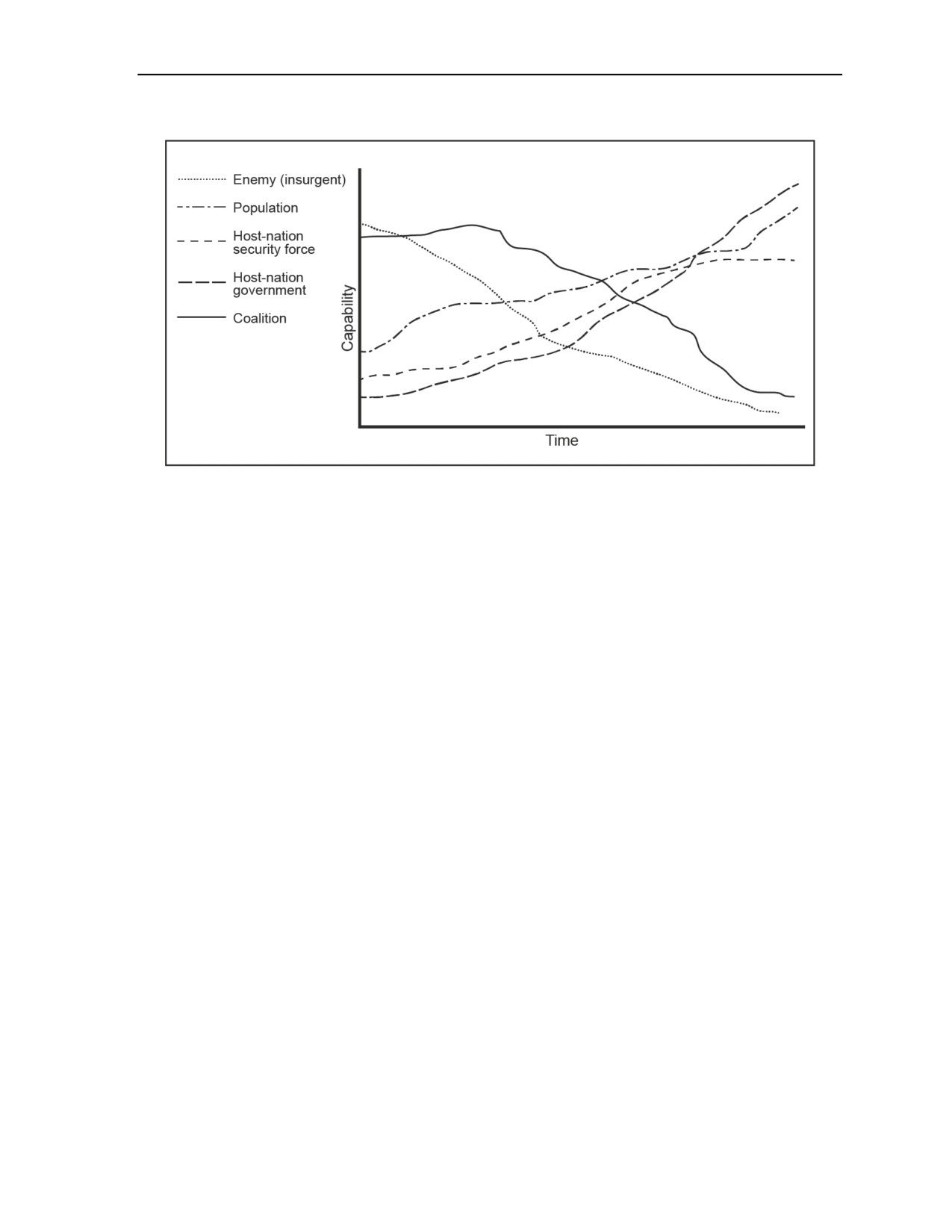
Direct Methods for Countering Insurgencies
Figure 9-1. The capability spectrum of counterinsurgency conflict
9-14. As part of developing understanding, counterinsurgents must identify the conditions that exist in
particular regions that lead to instability or allow the insurgency to impact the environment. Commanders
must decide where to focus actions and priorities to impact the conditions in a designated area for tactical
or operational reasons. In many instances, commanders specify a preparation phase or shape phase of the
shape-clear-hold-build-transition framework which clarifies the period of time, series of tasks, and effects
to be achieved before counterinsurgents begin taking deliberate action against insurgents. Whether phasing
is used or not, preparation of the environment is an absolute requirement to achieve conditions to progress
along the shape-clear-hold-build-transition framework.
SHAPE
9-15. Shaping operations involve identifying which areas in an operational environment exhibit conditions
that counterinsurgents can impact to change the capability differential between insurgents and
counterinsurgents. Commanders choose where to execute operations in the shape-clear-hold-build-
transition framework based on a host nation’s ability (and unified action partners’ abilities if the host
nation’s capabilities are still being built) to impact the root causes of the insurgency, alter or eliminate the
conditions which allow the insurgency to exist in that area, or isolate the insurgents from the population.
During preparation, commanders and staffs execute include information collection on the components of an
insurgency. An initial census in towns or cities using biometrics data collection devices is the most
effective tool to establish initial accountability for everyone. Additional information collection includes the
specific root cause or causes in the particular area, the expectations of the host-nation population, and the
capability of host-nation institutions such as government, security, and rule of law. Commanders and staffs
conduct disruption operations to impact an insurgency’s ability to influence an operational environment.
Counterinsurgents may conduct deception operations while preparing for shape-clear-hold-build-transition
framework operations to force the insurgency to alter its course of action. While preparing to execute the
shape-clear-hold-build-transition framework, counterinsurgents (and whenever possible the unified action
and host-nation partners) conduct information operations. Counterinsurgents conduct information
operations aimed at the insurgency, the insurgency’s support mechanisms (both internal and external to the
country), the host-nation population, and host-nation institutions such as governance and security functions.
9-16. U.S. ground forces do not prepare for the shape-clear-hold-build-transition framework in isolation.
Elements of the unified action partners are essential in shaping the area, the population, and the insurgency
for future operations. In some instances, the area indicated for shape-clear-hold-build-transition framework
operations may not be suitable for some partners to directly operate in, but other unified action partners
13 May 2014
FM 3-24/MCWP 3-33.5
9-5
Chapter 9
may have the capability to shape the environment in areas of limited access. U.S. special operations forces
(SOF) can conduct reconnaissance, information collection, and precision targeting. The United States
Agency for International Development has the capability to introduce implementing partners who have
access to initiate governance or development programs. The Department of State has the ability to
influence the diplomatic process to generate initial governmental structures prior to the introduction of U.S.
ground forces. Soldiers and Marines must recognize the potential that unified action partners have in
shaping an operational environment prior to shape-clear-hold-build-transition framework operations.
CLEAR
9-17. Once counterinsurgents have effectively shaped the environment, including host-nation partners and
enablers, and prepared all elements of the unified action partners appropriately, decided on where to focus
the counterinsurgent effort, and has developed the plan to progress through to transition to host-nation
responsibility, the force begins executing tasks associated with clear. Clear is as a tactical mission task that
requires the commander to remove all enemy forces and eliminate organized resistance within an assigned
area (FM 3-90-1). When used in this context, the term clear is considered the desired effect by U.S. ground
forces: to eliminate the insurgency’s combatants to enable the host nation to develop the capability to
address the insurgency’s root cause and eliminate the conditions that allow it to exist. While attempting to
achieve the clear, the insurgency’s underground and auxiliary elements probably remain in the area of
operations. While the counterinsurgent can target them along with the insurgency’s combatants, it is
unlikely that the counterinsurgent will be successful in removing all of the underground or auxiliary
elements.
9-18. During the clear phase, counterinsurgents should be actively securing the population.
Counterinsurgents must displace insurgents and enable basic governmental functions in their area.
Moreover, the population must have the confidence that counterinsurgents will remain and insurgents will
not control the area. During this period, the population may face intimidation, threats, and assassinations
from insurgent forces. To gain legitimacy during this period, counterinsurgents must focus on securing the
population.
9-19. Operations and tasks associated with achieving the clear begin by controlling access to an area and
then by controlling key points within that area. Security and influence can then spread out from this area.
Commanders and staffs should consider the following points for operations in the clear:
z
Create a secure physical and psychological environment.
z
Provide continuous security for the local populace.
z
Eliminate the insurgent combatants.
z
Reinforce culturally appropriate political primacy within the context of host-nation systems.
z
Enforce the rule of law.
9-20. Security tasks associated with the clear include—
z
Implement the provisions of a cease fire and control, capture, and disarm belligerents.
z
Provide territorial security until the host-nation national army can defend itself.
z
Protect the population—provide immediate law and order and humanitarian assistance.
z
Protect key individuals and sites—civilian government agencies, infrastructure, and institutions.
9-21. During the clear, counterinsurgents must execute offensive, defensive, and stability tasks. Offensive
operations are the priority for counterinsurgents. In most cases, the measure of effectiveness (MOE)
associated directly with impacting the insurgency’s combatants (for example, isolate insurgents from the
population) is the decisive operation. Offensive operations conducted during the clear include raid,
deliberate attack, cordon and search, seize key terrain, and movement to contact. Counterinsurgents execute
defensive operations as well, to include block access routes, establish and secure combat outposts, conduct
sniper operations, and secure the population. To set the conditions to progress through the framework,
counterinsurgents must execute stability tasks and operations at this point. Stability tasks include
identifying potential government or security leaders, identifying civic capacity requirements from the
population, establishing a local security force (in the context of host-nation systems) and beginning a
training program (if necessary), and identifying the root causes for that area. Throughout these operations,
9-6
FM 3-24/MCWP 3-33.5
13 May 2014
Direct Methods for Countering Insurgencies
the commander must consider securing the population and building host-nation capability. Actions taken
while achieving the effects necessary for clear should not alienate the population. The messages of
information operations are important while performing clear. Responsible use of force is essential.
9-22. Counterinsurgents conduct information operations to achieve the effects of the clear component. The
focus for information operations during the clear is the insurgency’s combatants, the underground and
auxiliary elements, and the host-nation population. Counterinsurgents’ information operations should
facilitate operations which eliminate the combatants from an area, facilitate effective information collection
on the combatants, and build a sense of security among the population.
HOLD
9-23. Counterinsurgents do not execute tasks associated with the clear component unless they have
developed the capability to execute tasks in the hold. Beginning shape-clear-hold-build-transition
framework operations requires resources in the form of manpower, time, money, and development
programs (but this framework is based on capacity, not resources). For this reason, these type of operations
cannot be conducted everywhere and must be prioritized. To meet the imperatives listed above, the
counterinsurgent must progress along the framework to continue to improve conditions in the environment.
Therefore, units should not clear an area that they cannot hold. Until those conditions exist, the
counterinsurgent may choose to continue to prepare or shape the environment for future
shape-clear-hold-build-transition framework operations.
9-24. As the capability of the insurgency decreases in an area based on counterinsurgency operations, the
capacity of the host-nation government and security force must increase. As the conditions improve to the
point that offensive operations aimed at eliminating the insurgency’s combatants are no longer the priority
and the host-nation population has freedom of movement, counterinsurgents can begin to execute tasks and
operations associated with hold. The hold involves disrupting insurgent activities in an area and providing a
good security environment for the population. The objective of the hold is to set the conditions for the
host-nation security apparatus to provide security for the population. For this reason, the hold lasts as long
as it takes to—
z
Develop the capability of the host-nation security forces.
z
Reduce the enemy strength in the area to the point that the host-nation security forces can take
lead responsibility for security.
9-25. Lead responsibility means that the host-nation security forces are the decision authority for allocation
of resources, priority of tasks and operations, and tactical decisions during operations. Counterinsurgents
continue to eliminate the insurgency’s leadership and infrastructure. However, perhaps more importantly,
counterinsurgents should focus on securing the population. During this period, proper basing of
counterinsurgent forces is essential. If an area is supportive of an insurgency, then a base of
counterinsurgent forces may sever the relationship between insurgents and the population. If the area is
neutral or has pockets of support for the government, then the base should be established where it can best
help in developing the area.
9-26. Contact with the population should be continuous, predominantly with host-nation entities (security
forces, law and order officials, and government representatives) leading and U.S. counterinsurgents in
support. Information operation activities provide opportunities for contact with the population. From the
start of operations, Soldier and Marine actions in these areas, if culturally astute, can build bonds with the
local population and in many cases change the attitudes of the people. Ultimately, the goal of this contact is
twofold: to gain a better picture of the actual situation and to turn the population’s support toward the
government.
9-27. Counterinsurgents must also secure key physical infrastructure. Because resources are always
limited, parts of the infrastructure vital for stability and vulnerable to attack must receive the priority of
protection, specifically the protection of capable host-nation security forces (if possible). This can be
accomplished by analyzing the risk and likelihood of attack on various sites in the area of operations.
9-28. Much like the clear, achieving the hold requires counterinsurgents execute offense, defense, and
stability tasks. While achieving the hold, defensive tasks and operations are the priority. However, to meet
the objectives of the hold, the line of effort associated with development of the host-nation security forces
13 May 2014
FM 3-24/MCWP 3-33.5
9-7
Chapter 9
is the decisive operation. Examples of stability tasks include manning, equipping, and training the
host-nation security forces, establishing local governance functions, and establishing culturally appropriate
rule of law systems within the host nation’s plan. Examples of some defensive tasks during the hold include
counter cache operations, area denial, combined security at fixed sites, block infiltration routes,
countermobility, and securing the population. Counterinsurgents must execute offensive tasks to attack the
insurgency’s underground and auxiliaries. Examples of offensive operations in the hold include raids
against insurgent leaders, ambushes, and disruption operations to impact support structures and local
sanctuaries. The amount and scope of stability tasks and operations increase during the hold.
9-29. Security operations to achieve the hold are dominated by developing the host-nation security forces
and then transitioning security responsibilities to them. Examples of security focus during the hold
include—
z
Reform of local security institutions—reestablish military and police forces which may include
the entire rebuilding of the enduring institution including recruiting, educating, training,
manning, equipping, sustaining and leader development for the Army, police, rule of law,
detention capacity, and court systems.
z
Develop the host-nation military to provide security and external defense of the nation; develop
the capacity to become self-sufficient in the development and conduct of their own enduring
training programs at individual and collective levels.
9-30. Counterinsurgents conduct information operations to achieve the hold as well, but the focus and
message changes as conditions improve. The focus for information operations during the hold is on the
remaining underground and auxiliary, the host-nation population, the host-nation security forces, and
host-nation governance institutions. Counterinsurgent information operations should facilitate operations
that improve the perception of security among the population, legitimize the host-nation security forces,
dissuade the underground and auxiliaries from continuing insurgent activities, and promote effective
host-nation governance solutions. During the hold, it is critical that the host nation becomes an integral part
of information operations.
BUILD
9-31. When the conditions in an operational environment allow the host-nation security forces to take lead
responsibility for security, counterinsurgents transition to the build. The build comprises carrying out
programs designed to remove the conditions that allow the insurgency to exist, specifically addressing the
root causes, tying inhabitants to host-nation security institutions, governing and rule of law, and
strengthening the host nation’s ability to provide legitimate and effective governance. Stability tasks
predominately build, with many important activities being conducted by nonmilitary agencies. Progress in
building support for the host-nation government requires protecting the local population. People who do not
believe they are secure from insurgent intimidation, coercion, and reprisals do not risk overtly supporting
host-nation efforts.
9-32. Counterinsurgents execute offense, defense, and stability tasks in the build as well. The priority for
tasks and operations during the build is on the stability tasks. The line of effort that addresses increasing the
host-nation government capacity becomes the decisive operation during the build. Examples of stability
tasks in the build include advising and assisting the host-nation security forces, developing professional
development programs
(including professional education) for host-nation security and governance
individuals, facilitating host-nation governance activities, support to local and national demilitarization,
demobilization, and reintegration programs, and development of host-nation rule of law and conflict
resolution mechanisms. However, U.S. forces execute offensive operations during the build. Examples of
offensive operations in the build include providing a quick reaction force for the host-nation security
forces, conducting tactical overwatch for specific host-nation security forces operations, conducting follow
and assume or follow and support for host-nation security forces operations, or conducting precision strike
operations in support of host-nation or U.S. objectives. Counterinsurgents execute defensive operations and
tasks as well, to include protecting the population, combined action with the host-nation security forces to
secure combined positions, and sanctuary denial and disruption operations.
9-33. U.S. counterinsurgents conduct information operations as part of the build in support of host-nation
programs. The focus of information operations during the build is on the host-nation population, the
9-8
FM 3-24/MCWP 3-33.5
13 May 2014
Direct Methods for Countering Insurgencies
host-nation security forces, and host-nation governance institutions. U.S. counterinsurgents conduct
information operations during build operations to facilitate host-nation leaders’ messaging and to
emphasize success in generating the conditions that further the connection between the population and the
host-nation institutions. U.S. ground force information operations reinforce the host nation’s ability to
counter an insurgency without the direct involvement of U.S. ground forces. Host-nation information
operations should focus on increasing the perception of security, increasing the legitimacy of the
host-nation government and security forces, and promoting the host nation’s ability to address root causes.
TRANSITION
9-34. Transition allows the counterinsurgent to delineate tasks associated with development of host-nation
institutions (governance, rule of law, security, and economic) with those tasks associated with transitioning
to host-nation lead of operations. To make transition effective, U.S. commanders incorporate planning and
execution of transition as part of the shape-clear-hold-build-transition framework.
9-35. This transition is not a onetime event. Counterinsurgents transition responsibility to host-nation
agencies when they are capable of taking over a function. This may mean multiple transitions to multiple
host-nation agencies at different times during a counterinsurgency. Transition is a continued process in
which the host nation assumes any responsibility that an external counterinsurgency may temporarily have.
9-36. Security tasks associated with transition represent the U.S. forces’ transition to security cooperation
tasks. During this phase, the U.S. ground force, under the combatant command and in conjunction with the
American embassy, helps generate and then implement theater engagement plans and programs.
9-37. The end goal of shape-clear-hold-build-transition framework is to create the conditions necessary for
the host nation to counter an insurgency independently. However, creating these conditions may not
eliminate the presence of external counterinsurgents. U.S. counterinsurgents may remain in an area during
and beyond transition to help train host-nation security forces or institutions, provide enablers, or begin
security cooperation tasks at the request of the host-nation government. (See FM 3-22 for more information
on security cooperation tasks.)
9-38. To better facilitate the integration of all components of the unified action environment into the
shape-clear-hold-build-transition framework, counterinsurgents may establish an area coordination center.
An area coordination center controls, manages, and coordinates shape-clear-hold-build-transition
framework operations. Commanders and staffs can establish area coordination centers and subordinate area
coordination center civil-military task forces from the tactical to the strategic level. An area coordination
center’s membership includes representatives of all multinational forces and host-nation agencies (military,
police, intelligence, political, and civil administration) operating at the regional and local level. To be truly
effective, Department of State representatives
(including United States Agency for International
Development personnel) should lead an area coordination center. As an area coordination center
coordinates all efforts that affect the ability to transition to host-nation control, the area coordination center
is responsible for generating host-nation capability beyond just the security realm. For that reason,
diplomatic and governmental leaders should run an area coordination center with the goal of turning over
decisionmaking and coordination authority to the host nation at the earliest opportunity. In the absence of
Department of State personnel, the military force assigned an area of operations should initiate and manage
an area coordination center until a government representative can take control. An area coordination center
coordinates the allocation of material and personnel resources, methods of policy implementation, and
evaluation of intelligence in the area within which it is organized.
9-39. The area coordination center consists of civilian and military elements necessary to plan the political,
economic, social, psychological, security, intelligence, and tactical operations within that area.
Commanders and staffs base operation plans on an integrated civil-military approach, and unity of effort is
essential. The leadership must have authority to control the allotted resources of all agencies and activities
operating within its respective area of responsibility. In those instances where U.S. or multinational forces
are operating in support of host-nation forces, an exceptionally high degree of cooperation must exist and
advisory efforts are critically important for success. All armed civilian defense forces and civilian
organizations normally remain under operational command of their respective area coordination center task
force chiefs: however, in cases where civilian administration is ineffective, military forces may provide
13 May 2014
FM 3-24/MCWP 3-33.5
9-9
Chapter 9
civil administration until civilian programs have taken effect. A composite view of the shape-clear-hold-
build-transition framework is provided in figure 9-2.
9-40. Transitions can also occur within the shape-clear-hold-build-transition framework. Soldiers and
Marines will have different tasks when an operational environment changes. For example, a unit must
understand when it transitions from eliminating the combatants in an area to creating an environment for
host-nation control. Units will change their mix of offensive, defensive, and stability tasks. More
importantly, they will have to change their mindsets. Figure 9-2 provides the changes of capacity over time,
the changes in the mix of tasks units could perform, and finally when a transition may occur. This graph
provides a snapshot of the shape-clear-hold-build-transition framework. In it, counterinsurgents are moving
from clearing, to holding, and then to building. During this movement, the local population is becoming
more supportive of the counterinsurgency, and the insurgency is losing capabilities and moving from being
in a possible war of movement back to being in phrase I. As insurgent capacity decreases and
counterinsurgent capabilities increase, several transitions take place that involve a different mindset and
performing different tactical tasks. This is in addition to the final transition to the host-nation lead, which is
the end point for the U.S. when it acts as the primary counterinsurgent. (See figure 9-2.) (See chapter 4 for
more information on the phases of an insurgency and chapter 7 for more information on transitions.)
9-10
FM 3-24/MCWP 3-33.5
13 May 2014
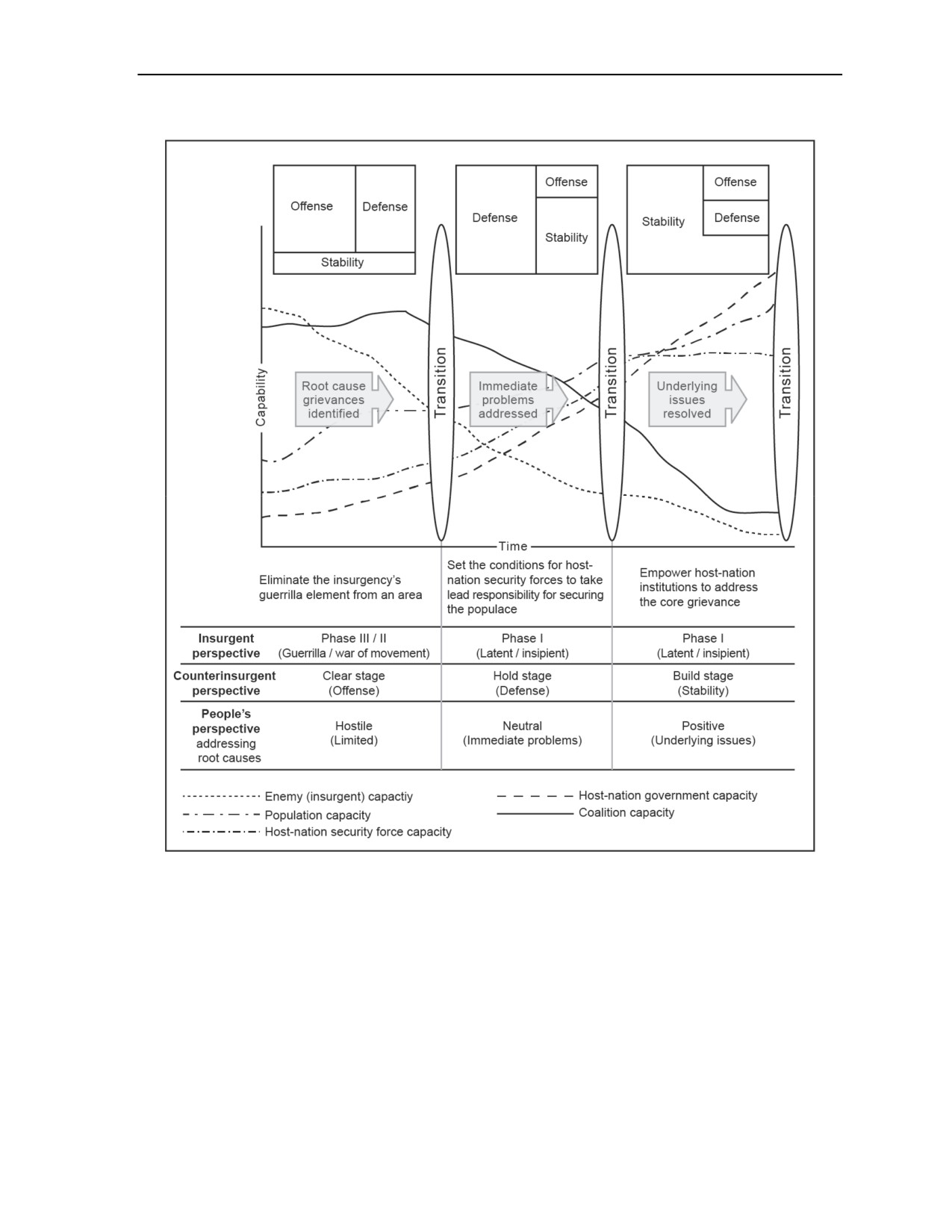
Direct Methods for Countering Insurgencies
Figure 9-2. Example of a possible transition framework
OTHER DIRECT ENABLERS
9-41. The Army and Marine Corps can also integrate other direct enablers into a counterinsurgency
operation. For example, indirect fires can be integrated into an ongoing counterinsurgency effort. Special
forces have the capability to perform direct actions. These are short-duration strikes. Special forces can also
conduct other small-scale offensive actions conducted in hostile, denied, or politically sensitive
environments that employ specialized military capabilities to seize, destroy, capture, exploit, recover, or
damage designated targets. As with indirect enablers, the Army and Marine Corps have a wide range of
direct capabilities that can be integrated into an ongoing counterinsurgency effort. Tactical units that can be
successfully integrated into a host nation’s efforts to perform cordon and searches or raids could be an
effective capability for any counterinsurgency operation.
13 May 2014
FM 3-24/MCWP 3-33.5
9-11
Chapter 9
9-42. As part of the joint force, the air component provides Army and Marine Corps units a number of
critical direct enablers. Airpower provides supported ground forces a significant asymmetric advantage
over insurgents as a result of their flexibility, situational understanding, freedom of maneuver, and access
to immediate joint fires. Direct air and space enablers include, but are not limited to, air mobility, casualty
evacuation, intelligence, surveillance and reconnaissance, communications, cyber, global positioning
system, personnel recovery, precision engagement (close air support and air interdiction), and electronic
warfare.
9-43. Two other important enablers are targeted threat infrastructure and strikes. Targeted threat
infrastructure provides a means for a counterinsurgent to attack the resources that an insurgency uses to
continue its effort. However, targeted threat infrastructure must always be conducted in support of other
efforts. Counterinsurgents must weigh the effect of the operations on the legitimacy of the host nation
among the local population. Strikes are conducted to disrupt an insurgency, and they can allow other efforts
to succeed. Targeted threat infrastructure and strikes are not to be conducted in isolation, and
simultaneously some force should be actively securing the population and building legitimacy.
TARGETED THREAT INFRASTRUCTURE
9-44. Targeted threat infrastructure is a method that seeks to destroy an insurgent force’s physical
infrastructure. This is a method that will normally only work if another force is securing the population and
building legitimacy. In other words, it is a method to enable another force. This method seeks to destroy the
necessary requirements of an insurgency to conduct combat operations. Targeted threat infrastructure
proactively targets the physical and societal mechanisms that support and fuel the insurgency. It involves
an aggressive spirit of the offense. When using this method, commanders and staffs must consider the law
of war principle of proportionality. The anticipated injury or damage caused to civilians or civilian property
must not be excessive in relation to the concrete and direct military advantage anticipated by an attack on a
military objective. Commanders and staffs using targeted threat infrastructure must also ensure it is not
contributing to the recruitment of insurgent fighters by using too heavy a hand against elements of society
that are not fully or willingly supporting the insurgency.
9-45. Targeted threat infrastructure must be integrated into an effective host-nation effort that is securing
the population. Targeted threat infrastructure can be an effective tool, if it is well planned and executed to
avoid possible negative consequences of alienating the population and decreasing the legitimacy of the host
nation. If the effect of targeted threat infrastructure is the physical elimination of the basic physical
infrastructure needed by an insurgency, and it avoids the negative effects of alienating the population, it can
be essential in a host nation’s counterinsurgency effort. However, it is a means to enable a host nation, not
a method that should be used without an additional effort to secure the population.
9-46. For targeted threat infrastructure to be effective, commanders and staffs must understand where an
insurgency is attaining its strength and attack those areas and facilities. These efforts must further the
desired overall end state and not undermine a host-nation government’s legitimacy. Commanders and staffs
plan for and limit second and third order effects of attacks. Moreover, attacks are only targeted against the
infrastructure the insurgency relies on. For example, crop eradication aimed at reducing cash flow is
unlikely to effect an insurgency with a large amount of financial resources. It may, however, hurt the
legitimacy of the host nation.
9-47. Illicit crops such as marijuana, coca, or poppy used to fuel and fund an insurgency can be the targets
threatened under the targeted threat infrastructure method. The cash from these crops may help arm, train,
and pay insurgent fighters or pay condolence payments to the families of terrorists who kill themselves in
suicide acts. Attacking such crops may hurt individual farmers. In some cases, farmers may be coerced by
insurgents and have no real choice in the crops they produce. In others, farmers may support the
insurgency. However, the illicit nature of these crops make them valid targets. To avoid creating new
insurgents through crop destruction, counterinsurgents can work with interagency partners and the United
States Agency for International Development to establish crop substitution programs that can help ease
hardships farmers may experience.
9-48. Another key target for the targeted threat infrastructure method is any material or physical item used
to fuel the insurgency. For example, a road network that is the primary means of movement for insurgents
9-12
FM 3-24/MCWP 3-33.5
13 May 2014
Direct Methods for Countering Insurgencies
needs to be interdicted by checkpoints or destroyed. This may inconvenience the local population, but if
consistent with the principle of proportionality this can be a valid course of action. Power systems and
water systems deep in insurgent controlled areas are prime targets for targeted threat infrastructure, but
targeting them requires careful proportionality analysis. As critical components of a society, power and
water are staples that the insurgents need to survive in their own region. By impairing these resources,
counterinsurgents may undermine the insurgency’s resources and its ability to continue the insurgency.
However, any effort to attack these resources must be balanced with the host nation’s legitimacy among the
local population that is affected. Aggressive strikes and raids are central to the targeted threat infrastructure
method to destroy the physical infrastructure that supports an insurgency. This tactic is not a slash-and-burn
technique, but consists of well-planned, pinpointed attacks on those critical enablers that the insurgency
needs to operate.
9-49. Another key target is the illicit funds used to fuel an insurgency. By establishing counter threat
finance fusion centers, commanders and staffs can work with the power of interagency law enforcement
and international legal partners to find, interdict, and seize huge sums of money that the illicit regime must
launder before it can be used again for legal currency. By using unit counter threat finance specialists in
targeted threat infrastructure operations, funds determined to have been gained through illicit means can be
targeted for seizure at the local level. For example, if a man is a small farm owner and lives in a palatial
home with three cars, he should be investigated, and his funds can be targeted if it is determined that his
wealth is from illicit means and those means are being used to fuel an insurgency.
STRIKE
9-50. A strike is an attack to damage or destroy an objective or a capability (JP 3-0). A strike may be
useful in disrupting an insurgency, especially in insurgent controlled areas. Strikes can be made on guerrilla
bases, large, enclosed or isolated compounds, and training camps. Normally these operations are meant to
disrupt an insurgency and allow for the success of other operations. Strike operations can be integrated into
a host nation’s operations to secure a population. The U.S. may contribute a force to perform strikes.
9-51. The purpose of a strike is to destroy insurgent forces and base areas, isolate insurgent forces from
their support, and interdict insurgent infiltration routes and lines of communications. Strikes are primarily
offensive operations. They are characterized by reconnaissance, intelligence gathering, and careful
planning, followed by vigorously executed, coordinated attacks or raids by small, highly mobile combat
forces operating in dispersed formations to locate and fix an insurgent force. Upon locating an insurgent
force, strike force commanders attack, pursue, and destroy that insurgent force. If contact is lost, the strike
forces resume aggressive patrolling to reestablish contact and destroy the insurgent force before it can rest,
reorganize, and resume combat operations.
9-52. Strikes can be conducted in support of shape-clear-hold-build-transition framework operations after
guerrilla forces are initially driven out of an area during the clear phase. Strikes are often employed to
assault objectives outside cleared areas to fix and destroy guerilla forces and prevent counterattacks against
government and reconstruction personnel. Counterinsurgents conduct assaults in areas where guerrillas
attempt to consolidate during the hold and build phases. Precision airpower weapons can be used to support
other units conducting strike operations or to conduct strike operations on their own.
9-53. Reconnaissance to locate and test insurgent dispositions and strengths or to develop additional
intelligence can be followed immediately by a hasty attack or raid. Reconnaissance should emphasize
thorough coverage of an area, and it is characterized by continuous, decentralized, small-unit operations.
Since strike campaigns are conducted in insecure areas, plans must provide for force withdrawal after
mission accomplishment.
9-54. Strike forces are generally task forces composed of military units and may contain intelligence,
police, and paramilitary elements. Civilian elements may be represented. Forces designated to conduct
strikes should be relieved of routine area defense responsibilities well in advance of an operation. Strike
forces can be controlled at the national, regional, or local levels. Strike forces are organized as
self-sufficient task forces capable of operating for extended periods in areas remote from home bases.
9-55. Once insurgent bases have been located, strike forces maneuver to destroy them. An insurgency’s
ability to hide weapons and to assume noncombatant guises in attempting to avoid capture may require a
13 May 2014
FM 3-24/MCWP 3-33.5
9-13
Chapter 9
thorough reconnaissance and search of the area. Suspects must be managed firmly but treated fairly to
avoid turning innocent suspects into insurgency sympathizers. When small units conducting reconnaissance
locate relatively large insurgent operating forces, surveillance should be maintained and reaction forces
quickly deployed to destroy them. In areas suspected of harboring insurgent forces or installations,
reconnaissance and surveillance should be conducted and followed with an immediate raid by reaction
forces when sufficient information has been developed on a target. Good communications and mobility are
essential for success in these combat operations.
9-56. Speed and surprise are important in strikes. The sudden and unexpected delivery of combat forces
into an insurgent held or contested area provides significant advantages to the forces conducting strike
operations. If caught by surprise, guerrillas may be unable to react effectively. Speed and surprise can be
achieved by using air assault tactics to insert the first forces into the area of operations. Subsequent forces
can be delivered on later airlifts or by other modes of transportation. Fires can be used to restrict escape
routes or areas that are not secured by land forces.
9-57. However, strikes do not address the root causes for beginning or sustaining an insurgency, nor do
they necessarily increase the legitimacy of the host-nation government. Strikes are integrated with other
approaches to counterinsurgency as part of the overall operational design. In some cases, the U.S. can
integrate this ability into an ongoing host-nation effort.
9-14
FM 3-24/MCWP 3-33.5
13 May 2014
Chapter 10
Indirect Methods for Countering Insurgencies
10-1. An indirect approach seeks to support existing governments, security forces, and groups through
increasing capacity to counter an insurgency and enabling existing capabilities. This approach indirectly
counters an insurgency by working through host-nation institutions or with groups in the society. The
United States (U.S.) can use nation assistance and security cooperation to aid a host nation in building its
institutions.
10-2. Beyond nation assistance and security cooperation, there are several methods that are indirect
methods for countering an insurgency. Among these are generational engagement, negotiation and
diplomacy, and identify, separate, isolate, influence, and reintegrate. Beyond these methods, there are
several indirect enablers that are important in any counterinsurgency. This includes integrated monetary
shaping operations.
NATION ASSISTANCE AND SECURITY COOPERATION
10-3. Nation assistance is assistance rendered to a nation by foreign forces within that nation’s territory
based on agreements mutually concluded between nations (JP 3-0). This civil or military assistance (other
than foreign humanitarian assistance) is rendered to a nation by U.S. forces within that nation’s territory
during peacetime, crises or emergencies, or war, based on agreements mutually concluded between the U.S.
and that nation. Nation assistance operations support the host nation by promoting sustainable development
and growth of responsive institutions. The goal is to promote long-term regional stability.
10-4. Nation assistance involves other government agencies that provide expertise in building civil
institutions. This is an essential element in counterinsurgency because the military lacks the expertise to
build civil control over the population, perform economic reforms, or aid in other basic functions that a host
nation may need to prevent or prevail against an insurgency. Using a whole-of-government approach is
essential in conducting nation assistance to prevent insurgencies from developing freedom of movement by
exploiting the root causes of conflict within an operational environment.
10-5. Security cooperation is all Department of Defense interactions with foreign defense establishments to
build defense relationships that promote specific US security interests, develop allied and friendly military
capabilities for self-defense and multinational operations, and provide US forces with peacetime and
contingency access to a host nation. (JP 3-22). This includes-
z
Military to military exchanges (for example, seminars and symposia).
z
Combined exercises.
z
Humanitarian assistance.
z
Security assistance.
When these activities are used to defeat an insurgency, they are part of a counterinsurgency operation.
While not all security cooperation activities are in support of counterinsurgency, security cooperation can
be an effective counterinsurgency tool. These activities help the U.S. and the host nation gain credibility
and help the host nation build legitimacy. These efforts can help prevent insurgencies or shape the host
nation’s ability to defeat or contain insurgencies.
10-6. When directed, the Army and Marine Corps provide forces to support security cooperation missions.
This requirement can include assistance in training, equipping, and advising the military forces of foreign
nations. Security cooperation includes security assistance, foreign internal defense, and security force
assistance. (See FM 3-22 and chapter 10 for more information on security cooperation activities. See
chapter 10 for more information on working with other forces by using security cooperation.)
13 May 2014
FM 3-24/MCWP 3-33.5
10-1