FM 1-05 RELIGIOUS SUPPORT (APRIL 2003) - page 4
FM 1-05__________________________________________________________________________________
· Religious support for soldiers who are doing the work.
· Special faith group requirements for burial.
RECONSTITUTION AND REDEPLOYMENT
6-59. Reconstitution (both reorganization and regeneration) restores combat
ineffective units to a specified level of effectiveness. The Army Service Com-
ponent Command (ASCC) plans and conducts operational and tactical recon-
stitution operations.
6-60. Regeneration involves large-scale replacement of personnel and equip-
ment and the rebuilding of units. This mission is usually assigned to the
TSC, COSCOM, or DISCOM, depending on the size of the unit. Division,
Corps, or ASCC UMTs assist in religious support to the units.
6-61. One or more UMTs may be assigned to a RTF to provide religious sup-
port to soldiers until the unit's assigned UMT has recuperated or been re-
placed. Religious support during reconstitution includes the ministry of
presence, group and individual counseling and debriefing (see Appendix C,
Critical Intervention Management and Critical Event Debriefings), worship
and memorial services, and prayer. RTF UMTs play an important role in re-
storing the soldiers' spiritual fitness and rebuilding the unit's cohesion and
morale.
6-62. Planning Considerations:
· RTF planning process and status.
· How many UMTs are required?
· Which UMTs are designated to join the RTF, how are they notified, and
by whom?
· Anticipated duration of mission.
· Criteria for determining when RTF UMTs end the mission and return to
their parent units.
· Logistical support for RTF UMTs.
THEATER RELIGIOUS SUPPORT
6-63. The Army Service Component Command (ASCC) serves as the senior
army echelon in a theater and is the service component command of a uni-
fied command. It includes the service component commander and all Army
personnel, organizations, units, and installations. The ASCC chaplain is the
senior Army chaplain in a theater of operations and provides staff supervi-
sion over all Army religious support in the theater. The ASCC chaplain is re-
sponsible for recommending religious support policy to the ASCC com-
mander. An example of an ASCC is Third U.S. Army, which is the ASCC of
USCENTCOM.
OPERATIONS
6-64. The ability to provide religious support in the 21st century battlespace
will depend upon five critical capabilities requirements: information access,
situational awareness, communication, connectivity, mobility, and force
structure. A deficit in any of these five requirements will radically impair
the ability to provide timely religious support.
6-14
_________________________
CORPS/ECHELONS ABOVE CORPS RELIGIOUS SUPPORT OPERATIONS
6-65. EAD UMTs must have real time operational awareness. They must be
able to determine an appropriate response and expeditiously communicate
that information to religious support personnel who will respond directly to
the situation. To enable religious support throughout the battlespace, UMTs
must be able to move and communicate seamlessly throughout the AO.
6-66. The complexity of coordinating religious support at EAD requires suffi-
cient religious support personnel to provide flexible tailoring and augmenta-
tion to support the mission. The senior theater UMT estimates and plans
campaigns with the staff and must focus on the different phases, determine
priorities, and manage the coordination and execution of religious support
tasks. When the theater commander establishes the combat zone (CZ) and
communications zone (COMMZ), the theater UMT plans for simultaneous
6-66. activities across the full spectrum of operations throughout both AOs.
Communication across both areas is critical for religious support synchroni-
zation; reach capabilities, reporting, and comprehensive planning. Division
rear operations and Corps MSR operations are linked as a part of the
battlespace management system, which includes tracking religious support
assets from COMMZ through assembly areas (AA) to corps rear to division.
STRATEGIC RELIGIOUS SUPPORT PLANNING
6-67. The combatant commander’s UMT’s strategic religious support plan-
ning provides the framework for the religious support assets in peacetime
and in crisis. During predeployment, the senior command UMT develops an
assessment that transitions the focus to crisis or war. Force projection and
assessment transitions religious
support assets to combat opera-
STRATEGIC RS ESTIMATE
tions. Religious support plan-
· Assigned objectives from combatant
ning is integrated into the com-
commanders.
batant commander’s staff plans
· Translation of combatant commanders
and estimation process. The re-
objectives applicable to theater RS.
sult is expressed in terms of re-
· Visualization of the strategic environ-
ligious support to mission objec-
ment; how it relates to the accomplish-
tives, concepts, vision, re-
ment of the commander’s RS objectives.
sources, and provides guidance
· Assessment of the threats of accom-
to subordinate command UMTs
plishment of assigned RS objectives.
for a broad range of religious
· Assessment of strategic alternatives to
support activities. Planning
available, with accompanying analysis,
should consider—
risks, and the requirements for RS plans.
· Impact of indigenous religions on opera-
· The command’s desired end
tions.
state and how religious sup-
· Considerations of available RS re-
port can support full accom-
sources, linked to accomplishment of
plishment of military objec-
assigned RS objectives.
tives.
· Risks associated with
METT-TC and the religious support assets.
· Religious support courses of action meeting mission objectives.
· Visualization of the religious support needs.
6-15
FM 1-05__________________________________________________________________________________
ARMY SERVICE COMPONENT COMMAND RELIGIOUS SUPPORT
6-68. The ASCC chaplain manages UMT, chaplain and chaplain assistant,
assignments throughout the theater for the commander. The senior chap-
lain assistant NCOIC advises the senior chaplain on all chaplain assistant
assignments. The ASCC command UMT provides training, policy, logistics,
and funding for all Army UMTs in the theater and serves as primary liaison
with the next higher commander’s staff chaplain. The ASCC UMT stays in
close communication with senior UMTs in each sector. They participate in
joint planning to ensure that the interest of the commander’s religious sup-
port goals and plan are represented and implemented. They coordinate with
the TSC UMT for movement, and transportation unit information and re-
sources. The Personnel Command (PERSCOM) UMT in theater coordinates
assignments for UMTs for the TSC command UMT. Functions of the ASCC
UMT include—
· Establish liaison with host nations religious leaders and other Joint Re-
ligious Ministry Support Teams at the highest levels in the theater.
· Coordinate fund transitions for logistical support.
· Coordinate religious support for force arrival in transfer of authority
(TOA) and RSOI sites.
· Coordinate religious support for contractors for the command as part of
the commander’s policy.
· Provide guidance to all senior Army UMTs to support the combatant
commander’s RSP.
· Plan and provide training for UMTs.
· Manage UMT assignments within the theater to ensure appropriate de-
nominational balance to all areas of the theater.
· Provide guidance for the employment of all Chaplain Detachments (CDs)
and SMART-PC in support of the religious support mission.
CHAPLAIN DETACHMENTS
6-69. When requested from a MACOM, the HQDA G3 will task USARC
through FORSCOM to mobilize and deploy the requested chaplain detach-
ments needed to support planned, current, or ongoing operations. The Chief
of Chaplains may request that HQDA G3 task USARC to mobilize and de-
ploy chaplain detachments in support of specific missions. (See Appendix G.)
ADDITIONAL CORPS/ECHELONS ABOVE CORPS RELIGIOUS PLAN
REQUIREMENTS
SPECIAL OPERATIONS
6-70. The mission, duration and scope of operations, security considerations,
signal capabilities, and the desired degree of control determine Special Op-
erations Force (SOF) command relationships. SOF units above group or
regimental level are Joint. Joint force commanders include unified, subordi-
nate unified, JTF, functional component, and commanders of specific opera-
tional forces. USSOCOM organizes, equips, trains, and provides Special Op-
erations Force for combatant commanders of regionally oriented unified
commands (European, Atlantic, Southern, Pacific, and Central) and for the
Commanding General, U.S. Forces, Korea. Combatant commanders delegate
6-16
_________________________
CORPS/ECHELONS ABOVE CORPS RELIGIOUS SUPPORT OPERATIONS
operational control of these SOF forces to their theater-level Special Opera-
tions Commands (SOCOMs). The six SOCOMs are the focal point for in-
theater SOF, form nuclei for the Joint Special Operations Task Force
(JSOTF), and furnish expertise needed to effectively employ SOF independ-
ently or in concert with conventional forces.
6-71. A unified command normally consists of the four service-specific con-
ventional forces and a SOCOM. The combatant commander or the SOCOM
may establish a JSOTF commanded by the Joint Force Special Operations
Component Commander (JFSOCC). SOF units from the three services are
normally under the OPCON of the JFSOCC.
6-72. ARSOF missions are often highly classified and sensitive. To provide
counseling, debriefing, and other religious support to ARSOF units, the
chaplain must have a Top Secret clearance. Chaplain assistants are required
to have a clearance equal to mission classification. The USASOC UMT rec-
ommends all ARSOF UMT assignments.
6-73. Normally, the JSOTF chaplain is a member of the service having the
majority of forces. (See JP 1-05, Chapter 2.) If the Army supplies the major-
ity of forces, an ARSOF chaplain is normally designated as the JSOTF
chaplain.
6-74. The JSOTF chaplain coordinates with the senior chaplain of the next
higher headquarters to ensure complete religious support for SOF units. The
JSOTF chaplain, in turn, supervises SOF religious support throughout the
theater. The chaplain coordinates for additional religious support when
other SOF chaplains are unable to provide religious support. SOF chaplains
may provide limited area support for conventional forces when it does not
conflict with SOF mission requirements
MEDICAL COMMAND SPECIAL MEDICAL AUGMENTATION RESPONSE TEAMS-
PASTORAL CARE
6-75. The U.S. Army Surgeon General (DASG) and the U.S. Army Chief of
Chaplains (DACH), in consultation with the Chief of Staff of the Army, the
Director of Military Support, and applicable Federal and Department of De-
fense regulations, requires designated DASG/MEDCOM/DACH assigned, at-
tached or associated individuals and organizations to develop and maintain
special organized, trained and equipped SMART-PC.
6-76. Operations consist of—
· Alert, assemble, and issue warning order within 6 hours of no-notice no-
tification.
· Deploy from home station within 6 hours of the warning order.
· Conduct mission: supporting commander without organic ministry team
or needing additional ministry team support for mass casualty or devas-
tating contingency operation; or provide professional pastoral care aug-
mentation (to include Critical Event Debriefing, Trauma Ministry, Mass
Casualty Ministry, and Spiritual Assessment) to local authorities in the
management of disaster/mass casualty incidents.
6-77. SMART-PCs deploy with enough food, clothing, personal hygiene sup-
plies, and equipment for self-sustainment in an austere environment for 72
hours. Team missions normally conclude in 72 hours. When extenuating or
6-17
FM 1-05__________________________________________________________________________________
mitigating circumstances require DASG/MEDCOM or DACH approval for
mission extension, SMART-PC members will procure locally or formally ob-
tain logistical support from supported units, or local civil or Lead Federal
Agency. SMART-PC members deploy on orders articulated on DD Form
1610.
6-78. At the direction of DACH and/or on order of DASG/MEDCOM, at re-
quest of commanders, and/or the request of legitimate civil, Federal, or De-
fense authorities, using appropriate, recognized, and approved channels
designated units will deploy SMART-PC to provide short duration, medical
ministry augmentation to:
· Regional, domestic, Federal and Defense agencies responding to disaster,
civil-military cooperative action, humanitarian and emergency incidents.
· Support units without organic ministry teams or who require additional
ministry team support for mass casualty or devastating contingency op-
eration.
6-79. SMART-PC is an addition to the list of required teams, which includes:
· Trauma/Critical Care (SMART-TCC).
· Chemical/Biological (SMART-CB).
· Stress Management (SMART-SM). (This team has one CH assigned, no
assistant.)
· Medical Command, Control, Communications, Telemedicine (SMART-
MC3T).
· Preventive Medicine/Disease Surveillance (SMART-PM).
· Burn (SMART-B).
· Veterinary (SMART-V).
· Health Systems Assessment and Assistance (SMART-HS).
6-80. SMART-PC is modeled on the standard Unit Ministry Team of one
chaplain and one chaplain assistant. Operationally, multiple teams are task
organized based upon METT-TC and medical-ministry/risk analysis to pro-
vide the appropriate level of response and technical augmentation to meet
mission needs.
6-18
_________________________
CORPS/ECHELONS ABOVE CORPS RELIGIOUS SUPPORT OPERATIONS
MANAGEMENT:
DASG, ASSISTANT SURGEON GENERAL, FORCE PROJECTION
Policy, supervision, and oversight to equip, deploy and redeploy SMART-PC.
Validate and resource special equipment requirements; periodically test and
evaluate individual SMART-PC teams; develop, monitor, and report readiness re-
porting requirements. Establish and maintain officer liaison with DACH.
DASG/MEDCOM, ASSIGNED REGIONAL MEDICAL COMMANDS
Organize, train, and equip
2-SMART-PC teams. On order, deploy assigned
SMART-PC within assigned regional medical boundaries. Be prepared to deploy
outside of regional boundaries in support of other SMART-PC or to other na-
tional/international sites.
EQUIPMENT: Configuration of SMART-PC deployment sets, kits, and outfits will
be man portable, and utilize commercial backpacks, suitcases, and rugged con-
tainers. Each equipment piece will meet commercial airframe size, weight, and
cube requirements.
MEDICAL COMMAND SPECIAL MEDICAL AUGMENTATION RESPONSE TEAM-
STRESS MANAGEMENT
6-81. The role of the chaplain assigned to a SMART-SM is to bring spiritual
aspects of stress management, as a clinician, in support of the team’s overall
tasks, which include:
· Critical event debriefings.
· Spiritual counseling.
CONTINGENCY FORCE POOL (CFP)
6-82. The FORSCOM Chaplain’s Office will coordinate with CONUSA
Chaplains where CFP chaplains are attached for duty to ensure that chap-
lain personnel are integrated into MSCA contingency training and planning
scenarios, and are included in contingency plans. The FORSCOM Chap-
lain’s office will coordinate with the CONUSA Chaplains to de-conflict
training and planning objectives. FORSCOM will ensure that CFP person-
nel support is placed in the Regional Planning Agents (RPA) MSCA hand-
book, in the DOD database to the Defense Coordinating Office (DCO) and in-
tegrate CFP training / certification with DOD Emergency Preparedness
Training and CONUSA MSCA contingency exercises. Upon request,
FORSCOM has the ability to cut orders for CFP personnel using
ARPERCOM Orders and Resource System (AORS) and can make one or
more CFP personnel immediately available depending on the crisis level. In
a small-scale contingency operation (SSCO) OCONUS response, CFP per-
sonnel will report to the CONUS MACOM for contingency support, provid-
ing religious support and liaison / coordination. During MSCA or Homeland
Defense / Security (HLD / HLS) CONUS contingencies, upon request by a
DCO and with appropriate funding for RS to DOD personnel, CFP personnel
become assets to the JTF Chaplain.
6-19
FM 1-05__________________________________________________________________________________
ROLE OF THE CORPS/ECHELON ABOVE CORPS UNIT MINISTRY
TEAMS
6-83. The personal delivery of religious support by the UMT will be impera-
tive in all operations. It is essential that the Corps/EAC HQs UMT is able to
rapidly tailor and modularize UMTs for operations. Corps/EAC UMTs must
organize to optimize and use information. Flexibility in applying METT-TC
is critical to accommodate specific missions. Rank structure and composition
of UMTs may change to support specific missions. RS planning must be ro-
bust and flexible enough to provide religious support across the full spec-
trum of military operations. Corps/EAC UMTs require the same level of
technology as the supported force. As technology advances the UMT automa-
tion, communication and transportation requirements must keep pace with
the command’s overall requirements.
GARRISON OPERATIONS
6-84. During garrison operations, all EAC UMTs, the Corps UMT, and sub-
ordinate UMTs support the training program of the installation chaplain.
They implement their CMRP to support the religious needs of the families
and soldiers. The EAD UMTs manages and supervises subordinate UMTs
assigned for the commander. They support the commander’s training pro-
gram through participation and planning and implementing UMT training.
The Corps UMT is a mentor to the BDE UMTs and will execute a mentor-
ship program. The Corps UMT supports the ASCC UMT RS plan.
SUMMARY
6-85. Corps and EAC UMT role is crucial to the warfighting religious support
mission success. AC and RC are fully integrated to supply combat ready
UMTs to provide religious support to the full spectrum force that meets the
needs of the joint force commander in war, conflict and peace. Command
UMTs are fully trained, ready, and staff integrated to meet the religious
support needs of soldiers, family members, and authorized civilians in all op-
erations. The UMTs are strategically and operationally responsive and pre-
pared to conduct prompt and sustained religious support operations as part
of joint, multinational, and interagency teams.
RESOURCES
6-86. The following is a list of main resources utilized for writing and up-
dating this doctrine.
· AR 165-1, Chaplain Activities in the U.S. Army
· JP 1-05, Religious Ministry Support for Joint Operations
· JP 5-00.2, Joint Task Force Planning Guidance and Procedures
· JP 3-05, Doctrine for Joint Special Operations
· JP 3-0, Doctrine for Joint Operations
· JP 3-07.3, Joint Tactics, Techniques, and Procedures for Peace
Operations
· JP 1-0, Doctrine for Personnel Support to Joint Operations
· JP 3-08, Interagency Coordination During Joint Operations
6-20
_________________________
CORPS/ECHELONS ABOVE CORPS RELIGIOUS SUPPORT OPERATIONS
·
JP 3-10, Joint Doctrine for Rear Area Operations
·
FM 1 (100-1), The Army
·
FM 16-1, May 1995, Religious Support
·
FM 3-0 (100-5), Operations
·
FM 25-100, Training the Force
·
FM 25-101, Battle Focused Training
·
FM 100-15, 29 OCT 1996, Corps Operations
·
FM 100-11, 15 JAN 1998, Force Integration
·
FM 100-9, 13 JAN 1992, Reconstitution
·
FM 100-8, 24 NOV 1997, The Army In Multinational Operations
·
FM 100-7, 31 MAY 1995, Decisive Force: The Army in Theater Opera-
tions
·
FM 100-6, 27 AUG 1996, Information Operations
·
FM 22-100, Army Leadership
·
DA Pam 165-3, Chaplaincy Training Strategy
·
National Military Strategy
·
Joint Vision 2010
·
Joint Vision 2020
·
Army Vision 2010
·
Concept for Future Joint Operations, May 1997
·
U.S. Army Chaplaincy Strategic Plan FY 2000-FY 2005
·
Chaplain Support Force XXI White Paper
·
Lessons Learned from past and current operation
·
Lessons Learned from the training centers
6-21
Chapter 7
INSTALLATION UNIT MINISTRY TEAM
RELIGIOUS SUPPORT OPERATIONS
7-1. The Army, Active and Reserve components, is designed, equipped, and
trained for force projection operations. Army installations function as force
projection platforms, providing support for deployed tactical units through-
out all stages of force projection. To ensure readiness, the Army continually
plans and trains for the full
CONTENTS
range of military operations.
Installation Description
7-2
7-2. Combat readiness also
Fundamentals of Installation
produces an Army whose
Religious Support Operations
7-3
organization, skills, leadership,
Mobilization Phases
7-7
and discipline can advance U.S.
Domestic Support
7-10
interests in a variety of opera-
Role of the Installation Unit Ministry
tions not characterized as war.
Team
7-10
These operations include, but are
Specialized Religious Support
7-13
not limited to, nation assistance;
Summary
7-15
humanitarian and disaster relief;
Resources
7-15
counter drug operations; peace
operations; antiterrorism; shows of force; attacks and raids; noncombatant
evacuation operations; insurgency and counterinsurgency support; civil dis-
turbance and support to domestic authorities.
7-3. Force projection is the military component of power projection and is a
critical component of U.S. strategy. AC and RC units, the mobilization base,
DA civilians, and the industry are directly involved projecting the force
anywhere in the world. Training, mobilization, deployment, employment,
sustainment, and redeployment are the processes utilized for force projec-
tion. They are continuous, overlapping, and interactive throughout an op-
eration. The process of force projection is an integral part of the Joint Opera-
tion Planning and Execution System (JOPES). JOPES is used to monitor,
plan, and execute mobilization, deployment, employment, sustainment, and
redeployment activities associated with joint operations. The Army force
projection process is imbedded within this system.
7-4. Religious support is a vital part of the combat readiness mission of the
installation in force projection. Force projection operations are inherently
joint and religious support planning and synchronization are required.
7-1
FM 1-05__________________________________________________________________________________
INSTALLATION DESCRIPTION
MISSION
7-5. Army installations, which include STARCs and Reserve Support Com-
mand (RSCs), contribute to the Army’s ability to support the National Mili-
tary Strategy (NMS). Peacetime missions include: counter-drug operations
on our national borders, nation building, counter-terrorism, WMD support,
deployment of land forces for a conflict, or fighting and winning the nation’s
war. Each installation, STARC, and RSC has a primary mission that deter-
mines its assignment to a MACOM or Component.
ORGANIZATION
7-6. Installations may host dozens of organizations that are either part of
the MACOM’s mission or simply tenants assigned to the installation for sup-
port. Installations are organizationally characterized by the nature of the
major activity they host. For force basing they would have Corps and Divi-
sion(s). For unit training they would host such units, as Combat Training
Centers (CTC), for example, the Joint Readiness Training Center (JRTC).
For the logistic support they would provide depot and commodity manage-
ment. Within the Army, an installation may be referred to as a post, camp,
station, fort, barracks, subpost, depot, arsenal, proving ground, base, labora-
tory, port, or ammunition plant. For the Army National Guard and Reserve
Component the term “installation” refers to the RSC for the RC and the
STARC for the ARNG.
As Part Of A Major Army Command
7-7. Army installations are assigned to and operate under commanders of
Major Army Commands (MACOMs) or MSCs where applicable, such as in
the Army Materiel Command (AMC), and the U.S. Army Reserve Command
(USARC). STARCs operate under the guidance of the National Guard Bu-
reau. Installations consume, provide, maintain, and otherwise control sig-
nificant resources while executing DOD, DA, and MACOM mandated policy
programs. These programs are reviewed, analyzed, and resourced at DA
level. Transformation Installation Management (TIM) will eventually trans-
form the relationships between installations and MACOMs, to include, the
relationships between MACOM Chaplains and Installation Chaplains. UMTs
should keep abreast of such changes.
KEY TERMS
As Part Of Full Spectrum Operations
· Joint Operation Planning Execution
System: (JOPES)
7-8. The entire installation manage-
· Area Support Group: (ASG)
ment system is a key component of de-
· Port of Embarkation: (POE)
veloping and sustaining a total force ca-
· Arial Port of Embarkation: (APOE)
pable of meeting the full spectrum of
· Seaport of Embarkation: (SPOE)
missions required by the National Mili-
· Port of Debarkation: (POD)
tary Strategy (NMS). The Army’s mis-
· Aerial Port of Debarkation: (APOD)
sion to expand and rapidly deploy
· Seaport of Debarkation: (SPOD)
trained and ready units is dependent
upon installation capabilities. Within
the installation support system is the Army’s mobility infrastructure. Total
force readiness is linked to installation operations.
7-2
_______________________
INSTALLATION UNIT MINISTRY TEAM RELIGIOUS SUPPORT OPERATIONS
7-9. Army installations are standardized to ensure that operations can be
effectively supported in peacetime. This effectiveness must continue
throughout the transition from peacetime to wartime (mobilization) and
during post conflict (post-deployment). Army installations provide the sus-
taining support necessary for units to accomplish their missions.
7-10. Installations provide this support by accomplishing both their primary
and support missions. The primary mission of the installation includes, but
is not limited to, readiness and preparation for operational deployment,
training, supply, and/or maintenance. The support mission includes real
property acquisition and upkeep, community service, and other personnel
support.
7-11. Sustainment includes the primary and support missions of the installa-
tion. Throughout each phase of deployment, the installation manages the
sustainment of units.
FUNDAMENTALS OF INSTALLATION RELIGIOUS SUPPORT
OPERATIONS
7-12. Military chaplains and chaplain assistants are specially trained and
assigned to provide for the government's interest to protect free exercise of
religion rights in the military, which is a unique pluralistic and multi-faith
environment. Military chaplains and chaplain assistants assigned in Table
of Distribution and Allowances (TDA) positions provide direct support to the
military commanders for the installation religious program, Family Life
Centers, units, hospitals, initial entry training (IET) units, Chaplaincy re-
sources management, Chaplaincy personnel management, Chaplaincy force
structure and training. The content of the religious support mission of the
chaplain and chaplain assistant is no different in the TDA than the TOE;
only the command context changes. It must be understood that the Chap-
laincy is not a social service under the city management context of the In-
stallation, but a direct support function to the commander. Religious sup-
port is the military commander's mission. TDA positions are required to de-
velop military religious support leaders and train religious support skills for
the full spectrum of military operations, from the sustaining base to the for-
ward edge of the battlespace.
7-13. Installation religious support has three major areas:
· To prepare and assist soldiers and families for military operations.
· To provide religious support for units and personnel on the installation.
· To sustain religious support operations during deployments and mobili-
zations.
· To train UMTs for comprehensive RS.
7-14. The installation chaplain is responsible for all religious support on the
installation including all religious services and activities. The installation
chaplain coordinates with tenant units to implement the CMRP. The in-
stallation’s UMTs provide a broad religious support programs for units, sol-
diers, and their families. Worship services, pastoral care, religious educa-
tion, and spiritual fitness training are provided for the religious support
needs of the installation population.
7-3
FM 1-05__________________________________________________________________________________
READINESS
7-15. Military chaplains and chaplain assistants in the TDA are necessary to
support peacetime deployments, as well as, to man operational units in mo-
bilization and provide wartime rotation, and rapid casualty replacement. All
TDA military chaplain and chaplain assistant positions are required to be
trained and ready to use combat skills and training to implement the mili-
tary religious support mission of the commander in any contingency.
7-16. The Reserve Component (RC) holds a significant portion of the mobili-
zation assets for the Chaplaincy. The RC Chaplaincy is a military combat
augmentation in direct support of the commander. RC chaplains and chap-
lain assistants in the TDA are necessary to support peacetime deployments,
as well as, to man operational units in mobilization, provide wartime rota-
tion and rapid casualty replacement. All RC TDA chaplains and chaplain
assistants are required to be trained and ready to use combat skills and
training to implement the religious support mission of the commander in any
contingency. The RC Chaplaincy provides the recruitment base for both the
AC and RC. The RC provides the training base for the Chaplain Candidate
Program. The IMA and Active Guard Reserve (AGR) chaplains and chaplain
assistants are in the TDA structure.
Assessment of Unit Ministry Team Readiness
7-17. As the commander’s personal staff officer for religious support, the
command installation chaplain is responsible for assessing the technical pro-
ficiency of UMTs in subordinate and tenant units. They conduct assess-
ments utilizing the units training program such as during field training ex-
ercises (FTXs), external Army Training and Evaluation Program (ARTEP)
events, unit training, Reserve component annual training and Command In-
spections. Observer controllers may provide additional assessment assis-
tance when the UMT is involved in Battle Command Training Program
(BCTP) events or Combat Training Center (CTC) rotations. They acquire, in
coordination with the senior unit UMT lessons learned to integrate into the
installation UMT training program. (See DA PAM 165-3, The Chaplain
Training Strategy.)
7-18. Chaplains and chaplain assistants participate in the installation’s
Command Master Religious Plan (CMRP) to help soldiers develop the per-
sonal spiritual readiness needed to sustain them during combat. Spiritual
readiness is also essential to sustain soldier families while the unit is de-
ployed. As part of the installation’s CMRP, the UMTs conduct worship
services, offer religious education, and provide spiritual fitness training and
other activities in installation chapels and facilities.
Training
7-19. Training is the cornerstone of preparation for military operations. The
Army's primary activity during peacetime is realistic, battle-focused training
oriented on the unit’s mission essential task list (METL). Installation chap-
lains are responsible for individual training, MOS 56A and 56M. The instal-
lation chaplain’s training managers coordinate with subordinate UMTs and
unit S3/G3s and ensure that UMTs have adequate technical and tactical
training for deployment and combat. This is implemented through the devel-
opment and execution of an annual Installation wide UMT training strategy
7-4
_______________________
INSTALLATION UNIT MINISTRY TEAM RELIGIOUS SUPPORT OPERATIONS
and plan (the religious support METL provides training tasks along with the
Chaplain Officer and Enlisted Critical Task Lists). This training is inte-
grated within the implementation of the Chief of Chaplain Training Strategy
(DA Pam 165-3) and higher headquarters training strategy.
7-20. Tactical proficiency is a demonstrated understanding of the Army's
war-fighting doctrine and tactics. To provide effective religious support in
combat, the UMT must know its unit's doctrine, tactics, techniques, and pro-
cedures. The UMT must also maintain the requisite skills of field craft es-
sential for survival in the battlespace. Tactical training is primarily the re-
sponsibility of the unit to which the UMT is assigned or attached.
7-21. Technical proficiency is the demonstrated ability to perform all tasks
related to one’s functional area. Technical proficiency is required for both
garrison and field missions. Technical proficiency is acquired from schools,
self-study and training with other UMTs in performing the unit’s and in-
stallation’s religious support mission. Training and continuing education
conferences, functional courses offered by USACHCS, and courses offered
through the AMEDD Center and School, and the NCO Education System
(NCOES) supplement the installation religious support training program.
7-22. UMTs must balance religious support training for combat and for gar-
rison. The UMT must participate fully in both unit and religious support
training to assure their tactical and technical proficiency. If training for ei-
ther combat or garrison operations is neglected, ministry teams will not be
prepared to provide comprehensive religious support to soldiers and their
families.
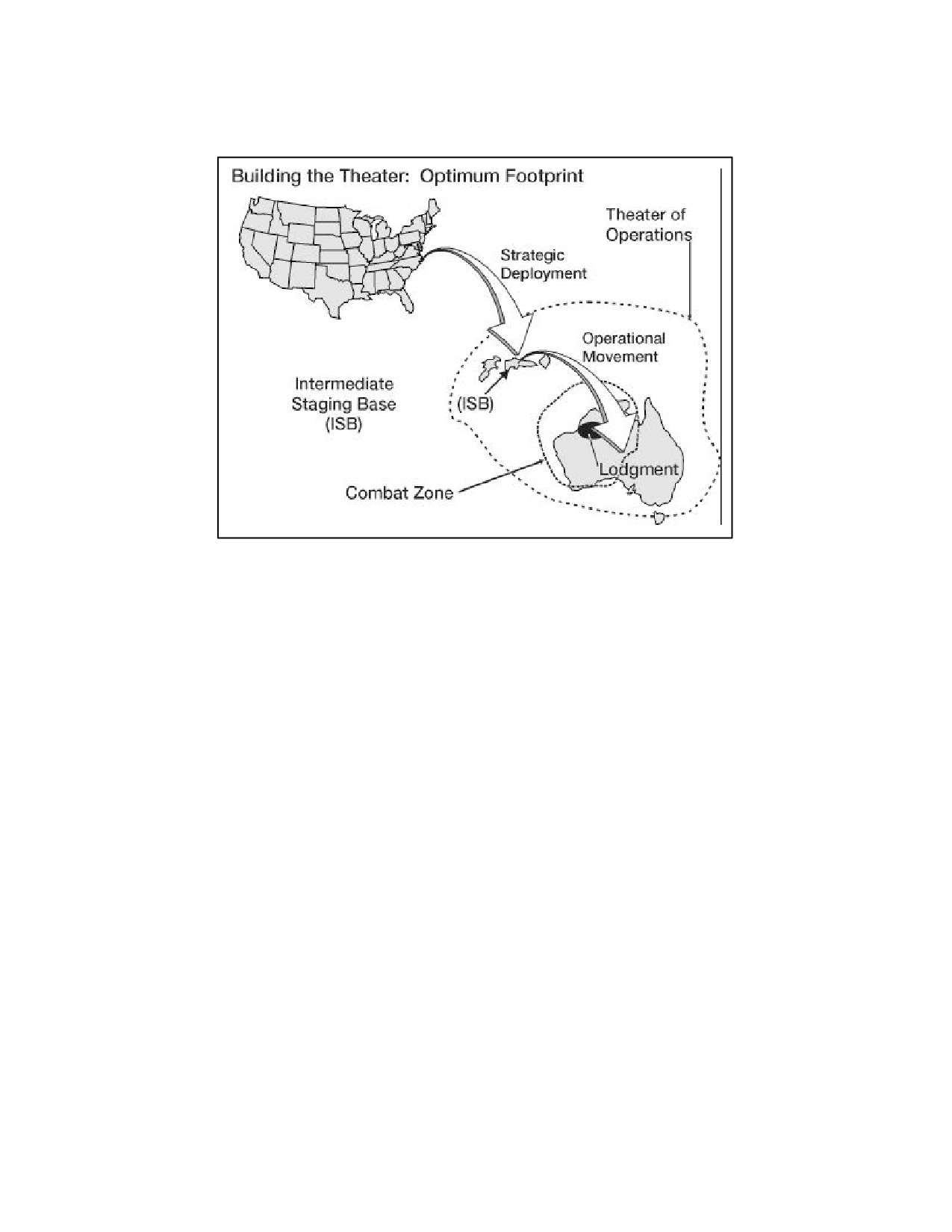
7-23. Many installations serve as mobilization bases. (See Figure 7-1.) Mobi-
lization can overwhelm the installation’s resources. Thorough planning and
realistic training reduces confusion. Mobilization training gives UMTs an
opportunity to practice their mobilization religious support missions and an
opportunity to assess the adequacy of mobilization plans. Installations assist
with the following RC UMT training events:
· Annual training (AT).
· The Individual Mobilization Augmentee (IMA) training.
· Individual training events, Individual Ready Reserve (IRR), and chap-
lain candidate training.
· AC/RC Sustainment Training.
· Annual Chaplaincy Regional Sustainment Training (CREST) as man-
dated by the Chief of Chaplains.
7-5
FM 1-05__________________________________________________________________________________
Figure 7-1. Building the Theater
FORCE PROJECTION
7-24. When the installation is serving as a force projection platform, the in-
stallation UMT must be prepared to provide as a staff the religious support
mission. The installation chaplain’s staff must be prepared to support all
phases and sustainment requirements of the mission. Provision is made for
religious support for all phases of deployment including pre-deployment,
movement to the POE, strategic lift, theater reception, and theater onward
movement. This includes counseling, training of UMTs, leadership training,
reunion briefings and counseling services (and as a family readiness group
resource). Installation UMTs will support peacetime deployments, as well
as, to man operational units in mobilization, provide wartime rotation and
rapid casualty replacement.
7-25. Force Projection planning includes—
· Mobilization, receiving, housing, processing, validating, deploying of sol-
diers including UMTs.
· Support the increased information communication requirements that
will occur.
· Assist in reception as the force shifts MRC priority and re-deployment of
forces.
· Maintain installation religious support requirements for the remaining
military community after deployment.
· Training of UMTs as required.
7-6
_______________________
INSTALLATION UNIT MINISTRY TEAM RELIGIOUS SUPPORT OPERATIONS
MOBILIZATION PHASES
(See CH 3 for more information.)
PLANNING PHASE
7-26. The installation chaplain becomes the mobilization station chaplain
and assumes a key role when RC UMTs mobilize. Before mobilization, the
installation chaplain designates a mobilization planner who does the follow-
ing:
· Updates and maintains the installation's RC MOB Plan book.
· Updates the religious support portion of the installation MOB PLAN.
· Identifies positions to be filled by IMAs or retirees.
· Clarifies cross-leveling responsibilities and coordinates with the
G1/Director for Personnel and Civilian Affairs (DPCA).
· Develops a mobilization-training plan for chaplains and chaplain assis-
tants.
· Prepares UMTs for deployment.
· Prepares for and participates in installation mobilization exercises
(MOBEX) and activities.
· Plans for demobilization activities such as after action reviews, reunion
briefings, awards, reports, etc.
· Maintains and improves combat readiness posture.
· Ensures all sites, such as RSOI, are fully manned by UMTs during all
phases of mobilization, deployment, and redeployment.
· Family Readiness Group (FRG) religious support.
· Prepare the UMT MOBTDA.
· Coordinates with and tracks RC units with and without UMTs scheduled
to report to the installation.
· Communicates with IMAs and retirees with orders to report to the in-
stallation upon mobilization.
7-27. This phase concerns all AC and RC UMTs efforts at all levels during
peacetime to plan and train for assigned wartime tasks. The installation
command UMT should ensure that the installation RS mobilization plan ad-
dresses civilian support for the mission. They must review the plan annu-
ally ensuring it is up-to-date and fully integrated into the installation com-
mander’s mobilization plan.
7-28. STARC UMT mobilization plans and SOPs clarify training and
MOBTDA personnel to provide religious support to families at family assis-
tance centers (FACs). Important consideration must be given to identifying
the religious support requirements of the FACs and developing MOBTDAs
with sufficient UMT personnel support.
7-29. The CONUSA UMT coordinates between the FORSCOM staff UMT
and RC UMTs within its geographic area. CONUSA staff chaplains and
NCOICs may redistribute UMT members in order to match anticipated UMT
mobilization requirements.
7-7
FM 1-05__________________________________________________________________________________
ALERT PHASE
7-30. This phase begins when an AC or RC unit receives notice of a pending
mobilization order. During this phase, the STARC and Army Reserve Com-
mand chaplains and NCOICs continue to cross-level individual members of
UMTs within their state or region to bring alerted units to required religious
support deployable status.
HOME STATION PHASE
7-31. This phase begins with the RC unit’s entry on active federal duty or the
AC’s preparation for deployment. Actions are preformed to bring units to ac-
tive status. Installation, STARC, and USARC Command UMTs continue
cross-leveling, as well as, ensuring critical UMT logistical support is in place.
MOBILIZATION STATION PHASE
7-32. This phase begins when the AC/RC unit arrives at the MS or mobiliza-
tion site. The unit UMT is validated to meet deployment unit validation cri-
teria resulting in assuring religious support mission capability. Necessary
chaplain and chaplain assistant individual and collective training are con-
ducted. Timeliness is critical. Integration to the Soldier Readiness Program
(SRP) for preparation of overseas movement (POM) activities for religious
support input is conducted.
PORT OF EMBARKATION PHASE
7-33. This phase begins with the arrival at the APOE or SPOE. Religious
support is critical to ensure the forces are spiritually prepared for deploy-
ment and combat. Worship, counseling, and other religious support tasks
are initiated. UMTs departing are ensured spiritual support.
DEPLOYMENT PHASE
7-34. In addition to routine religious support operations, the installation’s
TDA UMTs have the responsibility to plan and to prepare to sustain relig-
ious support operations on the Installation throughout the mobilization, de-
ployment, and redeployment and demobilization process.
7-35. The senior UMTs of the deploying units and the TDA UMTs coordinate
plans for religious support during deployment. Planning considerations in-
clude the following:
· The care of families and authorized civilians.
· Procedures for consolidating chapel programs.
· The close-out of chapels (if necessary).
· The accounting, turning-in, or securing of unit and installation property.
· Survivor and casualty assistance.
7-36. FORSCOM Regulation 500-3-2 (FORMDEPS II), Deployment Guide,
provides guidance and assigns responsibilities for support of the deployment
of units.
7-37. UMTs of non-deployed units are included in installation plans to sup-
port deploying units. A garrison support unit (GSU) may be available to
augment the installation’s UMTs during deployment and mobilization.
7-8
_______________________
INSTALLATION UNIT MINISTRY TEAM RELIGIOUS SUPPORT OPERATIONS
Along with the installation’s non-deployed UMTs, they assist with religious
support to families until the deployed forces return.
7-38. A thorough understanding and appreciation for the Transfer of
Authority of deploying units to the theater commander is critical to the in-
stallation chaplain's mission. At a time designated in the deployment order,
the chain of command shifts to the gaining unit, usually the theater com-
mander. When that TOA occurs, the relationship of the deploying UMTs to
the installation’s UMTs changes correspondingly. This new relationship re-
mains in effect until the unit redeploys.
SUSTAINMENT PHASE
7-39. To sustain the force projection platform, the installation UMT planner
must consider all sustainment requirements for the non-deployed units,
units at all deployment stages, and family members of both military and
authorized civilians. The continued training and readiness posture is main-
tained for sustaining the forward religious support mission.
Sustainment: Family Readiness Groups
7-40. Command sponsored Family Readiness Groups (FRGs) are a vital link
between soldiers, their families, the command, and the unit. Volunteer fam-
ily members lead FRGs. Each deploying unit establishes its own FRG. Es-
tablishing the FRG prior to the deployment alert is extremely helpful in de-
veloping support plans and operational procedures for providing assistance
to the unit’ families. Chaplains and chaplain assistants support these
groups.
Sustainment: Casualty Notification
7-41. Notification of the next of kin (NOK) is the commander's responsibility.
Chaplains are not notification officers, but they may be a part of the team
that makes the notification. In the event of a disaster or mass casualty
situation, they may serve on the Casualty Assistance Team. Religious sup-
port to grieving families is a priority for UMTs and appropriate training in
such religious support is a necessity.
REDEPLOYMENT AND DEMOBILIZATION PHASE
7-42. Religious support during the redeployment and demobilization phases
consists of the spiritual and emotional preparation of units from an area of
operation to follow-on designated CONUS or OCONUS bases. Redeployment
religious support must be planned and executed to insure the proper alloca-
tion of resources of an installation. Planning must encompass all phases of
an AC force returning to its home station, mobilized RC forces, and individu-
als through DMS back to their home stations.
7-43. This phase begins with the arrival of forces at the mobilization sta-
tion/installation. The installation UMT supports the commander in receiv-
ing the forces, receiving sustainment equipment and supplies, and helps de-
velop a reception and reconstitution or onward movement plan.
7-44. Demobilization is a critical factor for strategic reconstitution. The in-
stallation staff UMT plans and executes the commander’s demobilization
plan. Reunion support to soldiers, authorized civilians, and families are
7-9
FM 1-05__________________________________________________________________________________
given to ease the transition from mobilization/deployment to demobiliza-
tion/redeployment. Counseling, both individual and group, workshops, and
worship are critical for reconstitution. Demobilization of some units may oc-
cur at the same time other units are being mobilized, deployed or redeployed.
Religious support planning must encompass a possible ongoing planning and
execution process.
7-45. Religious support plans encompass—
· Reunion briefing for family members and friends.
· Reunion support for returning units.
· Back briefing from returning and TDA UMTs.
· Religious support to garrison command and staff.
· Critical event debriefing.
DOMESTIC SUPPORT
7-46. 7-46. A presidential declaration of a major disaster or emergency usu-
ally precedes Domestic Support Operations (DSO). The installation staff
UMT plans and executes the commander’s domestic support mission. As in
other operations, the UMT mission does not change. The installation be-
comes the force projection for Army forces to the area of operation. DOD Di-
rective 3025.15, Military Assistance to Civil Authorities (MACA) provides di-
rectives and guidance in responding to natural and manmade disasters and
includes military assistance to civil disturbance, counter drug activities,
combating terrorism, and law enforcement. Installation UMTs must know
their role and limitations in this type of operation. Installation UMTs sup-
port local, state, and federal civil authorities (see JP 3-07.7; JP 1-05; FM 100-
20).
ROLE OF THE INSTALLATION UNIT MINISTRY TEAM
7-47. The Installation Chaplain and staff provide seamless religious support
to the non-linear battlespace extending from the CONUS deployment and
sustaining base to the forward edges of the battlespace. The religious sup-
port mission extends throughout the full spectrum of military operations.
The community religious support mission encompasses all military units, ac-
tivities, organizations, and authorized personnel.
7-48. The importance and influence of the Chaplaincy to the spiritual and
moral health of the unit (to include the sustaining base or garrison) and in
spiritual matters has been valued throughout the history of the Army.
Commanders recognize the value of the chaplain and the total UMT both in
combat and garrison.
RESPONSIBILITIES AND ACCOUNTABILITY
Staff Responsibilities
7-49. The Installation Chaplain provides support and advice to the com-
mander and staff and to all installation agencies on all matters of religion,
ethics/morals, and morale as affected by religion. The Installation Com-
mander is responsible for the religious support and spiritual fitness of sol-
7-10

_______________________
INSTALLATION UNIT MINISTRY TEAM RELIGIOUS SUPPORT OPERATIONS
diers, family members, and authorized civilians. This includes insuring com-
prehensive worship opportunities that are part of the CMRP.
7-50. Army chaplains and chaplain assistants are the agents of trust repre-
senting the Army's values and the needs of the military in the commander's
religious support program. Chaplains and chaplain assistants are required
to provide religious support in all military units, activities, organizations,
and communities.
CHAPLAIN
(O-6)
CHAPLAIN ASSISTANT NCO (E-7/ 8)
Role
Role
Commissioned Officer/Staff
Noncommissioned Officer
Religious Professional
Specialized Assistant
Title 10 Protected
Religious Support Specialist
Mission
Mission
Advises commander on religious support
Advises Chaplain and NCO Chain.
and quality of life issues to support the
Provides specialized assistance in areas of religious
unit’s mission.
support to support the chaplain.
Performs/provides/coordinates the
Perform Garrison Staff functions.
religious support mission for the
Installation Religious Support NCOIC.
command.
Installation Director of Religious Support
Parallel Tasks
Parallel Tasks
1.
Supervise, mentor and assess
1. Supervise, mentor and assess subordinate
subordinate Chaplains.
chaplain assistants.
2.
Recommend personnel assignments.
2. Recommend Chaplain Assistant assignments.
3.
Supervises the contingency,
3. Prepares the contingency, mobilization plans.
mobilization plans.
4. Plans and conducts religious support training.
4.
Responsible for religious support
training and professional
development.
7-51. Installation Chaplains have staff responsibility for the following:
· Development and execution of the Command Master Religious Program
under the direction of the commander; which includes all worship serv-
ices, memorial services, religious activities, professional training, relig-
ious education, spiritual fitness and moral leadership training, mobiliza-
tion plans and contingency operation planning, and pastoral support for
soldiers, families, and authorized civilians.
· Conduct of officer personnel management and coordination enlisted per-
sonnel actions for Unit Ministry Team (UMT) assignments and profes-
sional development.
· Development of an annual training plan for chaplain and chaplain assis-
tant training.
· Development and execution of the installation commander's suicide pre-
vention program.
· Chaplain Family Life Centers which provide comprehensive programs
for training UMT members, and family programs, such as, marriage and
family counseling and family enrichment programs.
7-11
FM 1-05__________________________________________________________________________________
· Administration and management of the installation non-appropriated
chaplains' fund.
· Supervision of the use of chapels and religious facilities to include plan-
ning for new and renovated religious use facilities.
· The Installation Chaplain is the personal staff officer to the commander
for the religious support portions of planning, programming, force struc-
ture actions, budget input, crisis management, and force protection.
· Provide the commander unit spiritual fitness assessments.
·
Support the commander's METL through implementing a religious sup-
port installation METL.
7-52. The TDA force structure is required in the active and reserve compo-
nent to maintain adequate military rotation and surge capability for mobili-
zation and deployments and for military career progression of chaplains and
chaplain assistants. These TDA positions are required to train and develop
military religious support leaders in religious support skills for the full spec-
trum of military operations.
Relationship To The Chief Of Chaplains
7-53. The Installation Chaplain section implements the Chief of Chaplains
(CCH) Strategic Plan and guidance on providing religious support across the
full spectrum of operations from the power projection base to the theater of
operations and return. They plan and execute the Chaplaincy mobilization
and contingency plans. The installation staff UMT implements the CCH
training strategy for individual UMT members and collectively. They train
and prepare UMTs in support of the CCH guidance for the Army.
Relationship To Major Army Commands
7-54. Installations are part of Major Army Commands (MACOMs) or MSCs.
The installation will coordinate, review, and recommend assignment of
chaplains and chaplain assistants. They will support the MACOM or MSC
staff chaplain contingency plans. Also, they will implement the religious
program as set forth through the command. Again, as Transformation In-
stallation Management takes effect, the role between Installation Chaplains
and MACOMs will likely change. UMTs should keep abreast of such
changes.
SUPERVISORY RESPONSIBILITIES
7-55. The assignment instructions received by every chaplain at the time of
his/her receipt of permanent change of station (PCS) orders, contains the
following statement: “Chaplain will perform and/or provide direct and gen-
eral religious support in accordance with Unit Religious Support Plan and
Command Master Religious Program.” The installation staff UMT estab-
lishes staff supervision and implements the CMRP. They supervise the
training of UMTs for the CCH in cooperation and coordination with tenant
command UMTs. They supervise garrison religious support force structure
for the commander, both active and civilian. On an installation or in a com-
munity, the staff chaplain has overall staff responsibility for the religious
support mission. In fulfilling that responsibility, the staff chaplain will coor-
dinate and use total UMT assets from both the TDA and TOE units. The in-
7-12
_______________________
INSTALLATION UNIT MINISTRY TEAM RELIGIOUS SUPPORT OPERATIONS
stallation chaplain assistant NCOIC advises the chaplain on chaplain assis-
tant assignments, training, and other critical support issues.
SPECIALIZED RELIGIOUS SUPPORT
7-56. The Army is committed to supporting its families during routine opera-
tions and during deployment. Commanders employ the full range of installa-
tion resources to support families.
7-57. The provision of religious support to families is the responsibility of the
installation chaplain. The Family Life UMT and the hospital UMT assist in
their related areas in providing support. When not deployed, each unit’s
UMTs also have a responsibility to support their unit’s families.
7-58. When units are deployed the RC will provide UMTs to assists in sus-
taining support to families. UMTs support the commander’s Family Readi-
ness Group (FRG) initiatives and also provide a vital role in supporting
families when the unit’s soldiers are deployed. Though not specifically a
UMT responsibility, FRGs have a traditional relationship with the UMTs.
FAMILY LIFE UMT
7-59. The Family Life Chaplain’s primary mission is to train UMTs and to
direct the Chaplain Family Life Center (CFLC). Family life ministry con-
sists of three major elements: enrichment, prevention, and intervention.
These elements are expressed through educational programs, family well-
ness development programs, and marriage and family counseling.
7-60. The Family Life Chaplain consults with senior chaplains to determine
the specific training needs for subordinate units. Each Family Life Chaplain
tailors the training program to meet the needs of the installation and the
mission of the tactical units. Training could be in the form of technical as-
sistance, educational resources, and specific training for UMTs. In addition,
the Family Life Chaplain helps UMTs prepare families for the stress of mo-
bilization and deployment. This support is directly related to the installa-
tion's mission as the force projection platform. Each Family Life UMT sup-
ports the UMTs of the tactical units on the installation. They will tailor the
training program to meet the needs of the installation and the mission of the
tactical units on the installation. For example, a Family Life UMT will con-
sult with a Division UMT to determine the division’s specific training needs
in family life issues. By training the Division’s UMTs in family issues, the
Family Life Chaplain serves as a direct link between the installation chap-
lain and the UMTs in sustaining the force. Training topics include—
· Ministry to FRGs.
· Family stress.
· Communication skills.
· Family counseling skills.
· Reunion after deployment.
· Grief and loss.
7-61. A healthy home environment directly influences the soldier's perform-
ance of duty. With its support of the family, the family life ministry program
sustains the soldier's spiritual fitness in peacetime and during combat.
7-13
FM 1-05__________________________________________________________________________________
HOSPITAL UMT
7-62. The Army Medical Department preserves the fighting strength of the
Army, maintains the health of soldiers, and supports family members with
medical services.
7-63. Chaplains and chaplain assistants assigned to hospitals help patients
and families deal with medical problems and crises. Hospital chaplains at all
levels have special training and skills that equip them to do the following:
· Assist people with feelings of fear, loneliness, anger, failure, and loss of
faith.
· Provide pastoral care for those suffering from critical or chronic illnesses
or injuries.
· Prepare religious support contingency plans for mass casualty situations.
· Facilitate support groups for patients, their families, and staff.
· Serve as members of interdisciplinary case management teams and hos-
pital committees.
· Provide pastoral care to hospital staff.
· Provide training for staff members and UMTs.
CONFINEMENT UMT
7-64. Most Army installations do not have local installation confinement fa-
cilities. Soldiers are usually held in confinement by special arrangement
with local authorities. The installation staff chaplain provides pastoral care
for locally confined soldiers in keeping with the guidance of the installation
commander. The United States Disciplinary Barracks (USDB) is provided a
UMT for RS. UMTs provide religious support for both prisoners and facility
staff members. This religious support includes performing or providing for
the following:
· Worship
· Religious education
· Counseling
· Moral leadership
· Spiritual fitness training
· Family support
GARRISON SUPPORT UNITS
7-65. Garrison Support Units (GSU’s) come from the RC to support base op-
erations (BASOPS) during continuing operations, and assist in other instal-
lation missions during Annual Training (AT) periods. Each GSU has UMT
assets within their TDA. (See The Chief of Chaplains Crisis Management
UMT Assets Handbook, October 2000.)
7-66. When installations are called upon to act as projection platforms, they
require augmentation to meet their force projection responsibilities. The in-
stallation’s increased religious support mission also requires additional sup-
port and augmentation. The scope of the installation’s religious support mis-
sion encompasses support to soldiers remaining on the installation, soldiers
processing through the installation; families of soldiers assigned to the in-
stallation, families of soldiers processing through the installation, and in-
7-14
_______________________
INSTALLATION UNIT MINISTRY TEAM RELIGIOUS SUPPORT OPERATIONS
creased religious support to the installation hospital. The requirement for
religious support augmentation will increase as the level of mobilization in-
creases.
Training.
7-67. The supported Installation Chaplain will provide training to the GSU
UMT personnel.
Organization
7-68. UMTs will be embedded in the GSU. The number of UMTs required
varies from installation to installation. The number of UMTs is determined
by applying an allocation rule to the number of projected personnel associ-
ated with the each installation’s mobilization mission.
SUMMARY
7-69. The installation staff UMT is a critical part of the overall contingency
plans of the commander. They provide a trained ready force of UMTs to
meet the full spectrum operational mission of the U.S. Army. To adequately
support the future requirements of an Army capable to conducting prompt
and sustained operations, installation UMTs must plan and execute the re-
ligious support mission in support of the National Military Strategy, the
OCCH (Office of the Chief of Chaplains) strategic plan, and the installation
commander’s CMRP. The installation staff UMT must—
· Support the UMTs assigned to war-fighting units.
· Focus on Army and Chaplaincy core competencies.
· Implement the command CMRP for readiness, mobilization, and deploy-
ment.
· Provide quality and effective training for UMTs.
· Maintain stewardship of religious support assets.
· Provide the projection base for force projection and quality ministry for
families and tenant units.
RESOURCES
7-70. The following is a list of main resources utilized for writing and up-
dating this doctrine.
· AR 165-1.
· JP 1-05.
· JP 5-00.2.
· JP 3-0 (100-5).
· JP 3-10.
· FM 16-1.
· FM 25-100.
· FM 25-101.
· FM 100-11.
· FM 100-9.
· FM 22-100.
· FM 100-20.
7-15
FM 1-05__________________________________________________________________________________
· FM 100-19.
· DA Pam 165-3.
· National Military Strategy
· Joint Vision 2010
· Army Vision 2010
· U.S. Army Chaplaincy Strategic Plan FY 2000-FY 2005
· Lessons Learned from past and current operation
· Lessons Learned from the training centers
· The Chief of Chaplain’s UMT Crisis Assets Handbook, October 2000
7-16
Appendix A
RELIGIOUS SUPPORT IN CIVIL
MILITARY OPERATIONS
Throughout U.S. history, chaplains have supported commanders through
advisement on matters pertaining to the interface between Religious
Support Operations and Civil Military Operations (CMO). This appendix
provides the necessary guidelines for chaplains to engage in this role as
required by their commanders. (See Appendix G for discussion on CD-C)
UMTs are reminded that CMO support is a secondary responsibility and
that the personal delivery of religious support is always the UMT’s im-
perative.
ADVISING THE COMMANDER
A-1. Chaplains will support the commander through advisement in the fol-
lowing areas that may influence CMO:
· Indigenous religious, ethnic, and cultural influences.
· Beliefs, practices, and customs of religious groups in the AO.
· Religious issues related to displaced civilians.
· Human welfare needs as requested by religious NGOs and IOs.
· Relations with indigenous religious leaders when directed by the com-
mander.
A-2. Under Title X of the U.S. Code, Chaplains should not perform the fol-
lowing:
· Direct participation in negotiations or mediations as sole participant.
· Human intelligence (HUMINT) collection and/or target acquisition.
PROVIDE AND PERFORM RELIGIOUS SUPPORT
A-3. Chaplains will provide worship and pastoral care in Civil Military Op-
erations in accordance within the following guidelines:
· The priority of responsibility for Army Chaplains is to provide worship
opportunities and pastoral care to soldiers and authorized civilians in the
AO.
· Chaplains will provide for pastoral counseling, visitation, religious edu-
cation, spiritual fitness training, moral leadership training, critical event
debriefing and the provision of religious literature and items.
· Chaplains will identify and notify the command of meaningful opportu-
nities for soldiers to participate in Civil Military Operations to promote
the morale and spiritual well being of deployed soldiers.
A-1

FM 1-05__________________________________________________________________________________
· In coordination with the Civil Military Operations Center, chaplains may
provide certain religious support to refugees and displaced persons when
directed by the Commander, and after consultation with Staff Judge Ad-
vocate (SJA). In such cases, it is critical to avoid any activities that can
be construed as proselytizing among refugees or displaced persons.
· Every effort to include indigenous religious leadership to meet these
needs should be taken.
· CMO and RS tasks will need to be coordinated to ensure success.
CMO Tasks
Religious Support Tasks
Advise commander of legal obligations and moral consid-
Advise commander of moral considerations
erations.
as affected by religion.
Advise command on accommodating relig-
ious practices in AO.
Establish policy for the handling of dislocated civilians.
Monitor care of displaced civilians to ensure it
is moral/ethical.
Plan displaced civilian operations.
Coordinate displaced civilian operations.
Advise command on religious support plan
for displaced civilians.
Provide displaced civilian support.
Plan humanitarian/civic assistance activities.
Plan religious support activities. Assist CMO
personnel in coordinating with local religious
leaders for implementation of CMO activities.
Provide public welfare support.
Assist command in meeting human welfare
needs in conjunction with religious NGOs &
IOs -clothing, food shelter.
Coordinate health, welfare, and morale services.
Provide civilian supply support.
Provide food and agriculture support.
Provide information on cultural considerations.
Advise leadership on beliefs, practices, and
customs of religious groups in AO
Provide cultural affairs support.
Advise CMO personnel on the role/influence
of religion in cultural affairs.
Assess distinct religious, cultural, ethnic, and
gender ministry needs
Brief the commander of religious influences
on contingency operations
Provide language support.
Provide arts, monuments and archives support.
Advise command on impact of local religions,
sites and facilities which affect the mission
Advise command on the training of soldiers
with respect to religious beliefs, practices,
sites and facilities
A-2

________________________________________________________________________________________
CMO Tasks
Religious Support Tasks
Provide legal support.
Implement religious support in a Combined
and/or Joint Area of Operation with Consid-
eration to Host Nation Religious Background.
Prepare an area assessment.
Performs analysis of local religion as it affects
mission.
Prepare an area study.
Prepares the RS annex to the OPORD, which
includes impact of indigenous religions on AO
and mission.
Implement the command map program.
Provide input to CMO personnel regarding
local religions.
CMO must analyze the effect of FNS on the morale of U.S.Advise leadership on negative changes in
soldiers and on the psychological condition of the local
solder attitude on local population.
populace.
Plan disaster relief operations.
Provide religious support for humanitarian
assistance survey team (HAST) operations.
Plan noncombatant evacuation operations.
Commanders must segregate civilians from EPWs and
Coordinate religious support for Enemy Pris-
civilian internees to protect them as required by interna-
oners of War.
tional law.
Coordinate operations.
Coordinate religious support activities with
CMO personnel and local religious leaders.
Perform command functions.
Provide religious support to CMO personnel.
A-3
Appendix B
COMBAT AND OPERATIONAL STRESS
CONTROL
AND RELIGIOUS SUPPORT
References:
FM 8-51.
FM 22-51.
Textbook of Military Medicine: War Psychiatry, Part I; Warfare, Weaponry, and
the Casualty Office of the Surgeon General of the United States Army, Falls
Church, Virginia: 1995
INTRODUCTION
This appendix addresses the general role of the Unit Ministry Team in
the commander's program for Combat and Operational Stress Control.
Unit Ministry Teams, imbedded within units down to battalion level, pro-
vide immediate support to leaders in fulfilling their battle fatigue respon-
sibilities. Unit Ministry Teams also assist in training leaders to recognize
battle fatigue identification and intervention responsibilities. In coopera-
tion with unit medical personnel, Unit Ministry Teams serve as a primary
referral agency to mental health resources.
BACKGROUND
B-1. The negative impact of Combat and Operational Stress has been known
by many names throughout the history of warfare: Nostalgia, Soldier's
Heart, Shell Shock, War Neurosis, Combat Stress Reaction, and Battle Fa-
tigue. Combat Stress Behaviors cover the full range of behavior in combat
from the highly positive to the completely negative.
B-2. Positive Combat Stress Behaviors include heightened alertness,
strength, endurance, and tolerance of discomfort. Examples of positive
Combat Stress Behaviors would include the strong personal trust, loyalty,
and cohesiveness, which develops among, peers in small units, as well as be-
tween leaders and subordinates.
B-3. Dysfunctional Combat Stress Behaviors come in two forms: Misconduct
Stress Behaviors and Criminal Acts, and Battle Fatigue.
B-4. Misconduct Stress Behaviors and Criminal Acts range from simple
UCMJ infractions to outright criminal acts such as killing enemy prisoners
of war, threatening or killing superiors, or looting, pillaging, and rape.
B-5. Battle Fatigue, also referred to as Combat Stress Reaction or Combat
Fatigue, is the distress and impaired performance resulting from the accu-
mulated stressors of the combat or operational situation. Signs of Battle Fa-
B-1
FM 1-05__________________________________________________________________________________
tigue would include hyper alertness; fear and anxiety; grief, self-doubt, and
guilt; loss of confidence and hope; impaired duty performance; erratic actions
and outbursts; freezing and immobility; terror, panic, and flight; and im-
paired speech, vision, touch, and hearing. In extreme cases Battle Fatigue
may result in paralysis and hallucinations.
THE BASICS OF TREATMENT
B-6. The principles for stabilizing treatment of soldiers experiencing Battle
Fatigue are summarized by the acronym PIES.
· Proximity: Battle Fatigue cases are treated as far forward as tactically
possible and in close proximity with the soldier's unit with the goal of re-
turning the soldier to duty after a period of several days.
· Immediacy: Immediate initiation of treatment.
· Expectancy: Expectation of rapid and full recovery and return to duty.
· Simplicity: Simplicity of approach, according to the four Rs:
q
Reassurance: Reassurance of normality.
q
Rest
q
Replenishment: Replenishment of nutrition, hydration, hygiene and
sense of physical well being.
q
Restoration: Restoration of confidence through talk and activities.
B-7. It is important to note that the soldier's identity as a soldier is main-
tained and reinforced. Throughout treatment Battle Dress Uniforms are
worn, not hospital pajamas. Rank distinctions and military courtesy are
maintained, and these soldiers are responsible for self-care and helping oth-
ers.
RELIGIOUS SUPPORT AND COMBAT/OPERATIONAL STRESS CONTROL
B-8. Soldiers' inner resources are generally rooted in their religious and
spiritual values. In combat, soldiers often show more interest in their relig-
ious beliefs. When religious and spiritual values are challenged by the chaos
of combat, soldiers may lose connection with the inner resources that have
sustained them. Then they become targets of fear, and hopelessness, and
eventually fall victim to Battle Fatigue. Further, they become at risk for
Misconduct Stress Behaviors. The Unit Ministry Team is the primary re-
source available to soldiers experiencing these dilemmas and seeking to refo-
cus their spiritual values.
The Unit Ministry Team's Role
B-9. Unit Ministry Teams provide preventative, immediate, and restorative
spiritual and emotional support and care to soldiers experiencing Battle Fa-
tigue.
B-10. Preventative Religious Support. The Unit Ministry Team assists in
preventing Battle Fatigue and Misconduct Stress Disorders through Spiri-
tual Fitness training. Ministry of Presence with soldiers, assigned DA civil-
ian and contractor personnel is critical. The Unit Ministry Team provides a
stabilizing influence on personnel, and assists them in strengthening and
regaining personally held spiritual values. Preventative activities include—
· Worship opportunities.
· Private and group prayer opportunities.
B-2
_____________________________________________
COMBAT AND OPERATIONAL STRESS CONTROL
AND RELIGIOUS SUPPORT
· Religious literature and materials.
· Scripture readings.
· Sacraments and ordinances.
· Opportunities for working through frustration, fear, anxiety, and anger.
· Assistance to personnel and families prior to deployment, emphasizing
family strengths.
B-11. Immediate Religious Support. The Unit Ministry Team assists com-
manders in the identification of personnel experiencing negative reactions to
combat and operation stress: Battle Fatigue and Misconduct Stress Behav-
iors. The Unit Ministry Team works closely with the unit's leaders and
medical personnel to care for Battle Fatigue cases through religious support
and comfort. Immediate Religious Support activities may include—
· Presence with the soldier.
· Conversation focused upon fears, hopes, and other feelings.
· Conversation focused upon forgiveness.
· Prayer with personnel.
· Prayer for fallen comrades and Memorial Ceremonies and Services.
· Rites, sacraments, and ordinances, as appropriate.
· Sacred Scripture.
B-12. Restorative Religious Support. Following an operation, a unit may re-
quire reconstitution. Surviving soldiers may need to rebuild emotional, psy-
chological, and spiritual strength. Depending upon the spiritual, emotional,
and physical condition of the unit's soldiers, the organic Unit Ministry Team
may need augmentation from higher echelons or other units. Restorative
Religious Support activities may include—
· Worship, sacraments, rites, and ordinances.
· Memorial ceremonies and services.
· Religious literature and materials.
· Grief facilitation and counseling.
· Reinforcement of the soldiers' faith and hope.
· Opportunities for soldiers to talk about combat experiences and to inte-
grate those experiences into their lives.
B-3

FM 1-05__________________________________________________________________________________
COMBAT STRESS BEHAVIORS
POSITIVE
DYSFUNCTIONAL
COMBAT STRESS
COMBAT STRESS
BEHAVIORS
BEHAVIORS
MISCONDUCT
STRESS BEHAVIORS
BATTLE FATIGUE
AND CRIMINAL ACTS
UNIT COHESION
MUTILATING ENEMY
HYPERALERTNESS
LOYALTY TO BUDDIES
DEAD
FEAR, ANXIETY
LOYALTY TO LEADERS
NOT TAKING PRISONERS
IRRITABILITY, ANGER, RAGE
IDENTIFICATION WITH
KILLING ENEMY
GRIEF, SELF-DOUBT, GUILT
UNIT TRADITION
PRISONERS
PHYSICAL STRESS
SENSE OF ELITENESS
KILLING
COMPLAINTS
SENSE OF MISSION
NONCOMBATANTS
INATTENTION,
ALERTNESS AND
TORTURE, BRUTALITY
CARELESSNESS
VIGILANCE
KILLING ANIMALS
LOSS OF CONFIDENCE
EXCEPTIONAL STRENGTH
FIGHTING WITH ALLIES
LOSS OF HOPE AND FAITH
AND ENDURANCE
ALCOHOL AND DRUG
DEPRESSION, INSOMNIA
INCREASED TOLERANCE TO
ABUSE
IMPAIRED DUTY
HARDSHIP
RECKLESSNESS,
PERFORMANCE
DISCOMFORT
INDISCIPLINE
ERRATIC ACTIONS,
PAIN
LOOTING, PILLAGE, RAPE
OUTBURSTS
INJURY
FRATERNIZATION
FREEZING, IMMOBILITY
SENSE OF PURPOSE
EXCESSIVELY ON SICK
TERROR, PANIC RUNNING
INCREASED FAITH
CALL
TOTAL EXHAUSTION
HEROIC ACTS
NEGIGENT DISEASE,
APATHY
COURAGE
INJURY
LOSS OF SPEECH SKILLS
SELF-SACRIFICE
SHIRKING, MALINGERING
AND HEARING
COMBAT REFUSAL
WEAKNESS, PARALYSIS
SELF0INFLICTED
HALLUCINATIONS
WOUNDS
DELUSIONS
THREATENING/KILLING
OWN LEADERS
("FRAGGING")
ABSENCE WITHOUT
LEAVE
DISERTION
B-4
Appendix C
CRISIS INTERVENTION MANAGEMENT
AND CRITICAL EVENT DEBRIEFINGS
BACKGROUND
There are currently three major schools of Crisis Intervention Manage-
ment, of which Critical Event Debriefing (CED) by a variety of names, are
a part. These are the International Critical Incident Stress Foundation's
Critical Incident Stress Management (CISM), the National Organization
for Victim Assistance (NOVA) Group Crisis Intervention (GCI), and the
American Red Cross Disaster Response. In each case, CED is a compo-
nent of the larger Crisis Intervention model, and training and certifica-
tion requirements vary from model to model.
PURPOSE
C-1. Crisis Intervention helps small units soon after exceptionally traumatic
events to—
· Quickly restore unit cohesion and effectiveness.
· Reduce short-term emotional and physical distress.
· Mitigate long-term distress and "burnout".
· Facilitate the transition from traumatic event (s) to a sense of normalcy
and aids in future transitions.
REQUIREMENT
C-2. Leaders of small units should ordinarily conduct an after action review
(AAR) when a mission is completed. After an exceptionally distressing mis-
sion or event, when METT-TC dependent, unit leaders may coordinate crisis
intervention. Members of the Unit Ministry Team are equipped to provide
this intervention.
C-3. Situations that may warrant crisis intervention include—
· Death of the unit member.
· Death or suffering of noncombatants (especially women and children).
· Handling of human remains, management of carnage, extensive disaster
devastation.
· Friendly fire incident.
· Situation involving serious error, injustice, or atrocity.
C-4. Crisis intervention may be conducted by the Unit Ministry Team or
may be coordinated with Mental Health/Combat Stress Control or other
medical personnel.
C-1
FM 1-05__________________________________________________________________________________
PERSPECTIVE
C-5. Participants in crisis intervention are normal people who have survived
an abnormal situation. CED is a generic term for a specific tool within the
broader practice of crisis intervention management. CED is neither therapy
nor clinical counseling. Rather, it is basic and wise interventive mainte-
nance for the human spirit.
THE CRITICAL EVENT DEBRIEFING
C-6. WHO
· A functional organization: crew, team, squad, or platoon.
· Strangers, civilians, family members thrown together into a traumatic
situation by chance.
· Normally includes only those directly involved in the event.
· Chain of Command included only if involved in the event.
· Includes members of identified Crisis Intervention Team.
· Media and outsiders excluded.
C-7. WHAT
Normally, the team consists of a debriefing leader and an assistant, with
one additional assistant for every 10 people in a group of more than 20.
C-8. WHEN
· Most effective when conducted 12-72 hours after the event.
· Allow for enough rest and recovery for all to be alert and involved.
· After completing an operation with no expected intense follow-on opera-
tions for next 72 hours.
· Expected duration: 2-3 hours.
When ongoing tactical operations prohibit CED, a briefer "defusing de-
briefing" focusing on cognitive reactions to the situation can be substi-
tuted
C-9. WHERE
· An emotionally neutral place, relatively safe from enemy action, distrac-
tion, observation.
· Reserve position or assembly area.
· With enough light to see all participants.
· Shelter from bad weather.
C-10. HOW
· Introductory Phase
Purpose: To introduce the Crisis Intervention Team and explain the
process.
Chaplain or Leader, explains the grounds rules:
n
Personal information or feelings shared in the group during CED are
not to be shared outside the group
Note: This does not override legal or moral responsibility to report violations
of UCMJ or the Law of Land Warfare.
n
No notes or recordings.
C-2
______________________
CRISIS INTERVENTION MANAGEMENT AND CRITICAL EVENT DEBRIEFINGS
n
No breaks are scheduled, but anyone may leave as needed, returning
as soon as possible.
n
No one is expected to speak after the Fact Phase.
n
Each participant speaks for self, not others.
n
Everyone is equal during CED. All ranks speak frankly, with proper
courtesy.
n
CED is not an AAR, but a discussion to clarify what happened and to
restore sense of well-being.
n
Fact-finding, not Fault finding.
n
"Facts" include personal reactions the event.
n
The Team is available following the CED.
·
Fact Phase
Purpose: Reconstruct the event in detail, in chronological order, as an
unbroken "historical time line" viewed from all sides and perspectives.
Chaplain/Leader encourages all participants to start their stories before
the event occurred and to work up to it.
Participants—
n
The first person involved in the event is asked to tell his version of
the story- how it started, his role (duty position), and what he saw,
heard, smelled, and did-step by step.
n
One by one, participants are drawn into the first person's story and
then asked to describe their observations and actions.
n
The Chaplain/Leader encourages participation. Everyone is asked to
speak.
n
When disagreements over what occurred arise, the Chaplain/leader
elicits group observations to clarify memories.
·
Thought Phase
Purpose: To personalize the event.
Chaplain/Leader facilitates transition from facts to the personal.
Participants are asked to share—
n
"What were you thinking as the event started?"
n
"What went through your mind when you saw, smelled, or did…?"
n
"What was your first thought when you came off 'automatic' or
'autopilot'?"
·
Reaction Phase
Purpose: Identify and ventilates feelings (emotions) raised by the event.
Chaplain/Leader emphasizes that all emotional reactions deserve to be
expressed, respected, and listened to.
Participants are encouraged to share "reactions":
n
"What was the worst thing about the event?"
n
"How did you react when it happened?"
n
"How are you feeling about that now?"
n
"If you could change one thing about the event, what would it be?"
Chaplain/Leader listens for common themes, feelings, and mispercep-
tions—
n
Feelings of anger at others for not helping.
n
Blaming self or others for things beyond one’s control.
C-3
FM 1-05__________________________________________________________________________________
n
Feeling changed, different, worse than everyone else, cut off from
others.
Participants are asked to describe physical reactions to the event.
Common symptoms include—
n
Gastro-intestinal distress
n
Frequent urination
n
Loss of bowel and bladder control
n
Loss of sexual interest
n
Heart pounding
n
Shortness of breath
n
Muscle, back, neck, and head ache
n
Trembling, jumpiness, and startle reactions
·
Reframe Phase
Purpose: To transition from emotional reaction to the cognitive.
Chaplain/Leader facilitates the search for meaning in the event.
Participants are encouraged to derive personal meaning in the event.
n
"What lessons could be learned from this event?"
n
"What is something positive that you will take away from this expe-
rience?"
n
"What good can be found in this tragic situation?
n
"What are you proud of in this event?"
·
Teaching Phase
Purpose: To reassure by teaching the participants that feelings and
stress symptoms are normal reactions to abnormal conditions. Symp-
toms may last a while, but can be expected to resolve in time. If they
don't resolve in time, seeking professional help is advised.
Chaplain/Leader summarizes the thoughts, feeling, and symptoms ex-
pressed by the group, reemphasize normality; and reduce feelings of
uniqueness, weakness, or injury.
No predictions or glamorization of long-term disability should be given.
The Unit Ministry Team may schedule additional training in stress
management, coping strategies, grief process, and anger management at
later dates.
·
Reentry Phase
Purpose: Complete and close the CED.
Chaplain/Leader gives final invitation for comments and makes a sum-
mary statement. Follow-up resources are discussed.
It is important for Unit Ministry Team personnel to make themselves
available for follow-on conversations with individual participants fol-
lowing the CED.
C-4
Appendix D
INSTRUCTIONS FOR USING THE
MODEL RELIGIOUS SUPPORT MATRIX
GENERAL INFORMATION (ADAPTED FROM FM 101-5)
This appendix provides a sample Religious Support Matrix. The matrix
provides a highly visible, clear method to ensure all religious support pro-
viders are synchronized. It shows the relationships between activities,
units, support functions and key events. Although the unit order will not
appear in matrix format, the staff can write their annex as an execution
matrix. The religious support appendix as part of the Service Support
annex can be done in matrix format. An execution matrix depicts when
and where specific supporting actions must occur.
HEADER INFORMATION
D-1. Classification. Army Regulation 380-5 contains the detailed descrip-
tion of classification procedures. If the entire plan is unclassified, no classifi-
cation is required on the appendix.
D-2. Annexes, Appendixes, Tabs, and Enclosures. FM 101-5, 31 May 1997,
p. H-7ff gives details on how annexes, appendixes, tabs, and enclosures are
used. Follow unit SOP and include a matrix as shown in the sample in Fig-
ure D-1. The matrix should be included as an appendix to the Service Sup-
port Annex. An Arabic number designates the appendix; a capital letter
designates the Annex . The Service Support Annex should include the Re-
ligious Support Matrix in the list of appendixes along with the other appen-
dixes, such as Personnel and Legal.
D-3. References. References list information related to the matrix. The in-
formation should help the intended users understand the matrix. Map sheet
series numbers may be included. The unit SOP does not need to be refer-
enced. (Cf. FM 101-5, 31 May 1997 p. H-14)
D-4. Time Zone. The time zone used throughout the order is placed here.
Operations across several zones use ZULU time. If the local time is chosen,
the appropriate time zone suffix is used. The time zone is not based on geo-
graphical location but rather on the relationship to ZULU time. For exam-
ple, Central Standard Time would normally be SIERRA. However, during
daylight savings time ROMEO would be the appropriate suffix.
D-5. DTG. Date time group (DTG) refers to the time of signature in day,
hour with suffix, month, and year format. E.g. 260900S JAN04 would be 26
January 2004 at 0900 hr in the SIERRA time zone.
D-1
FM 1-05__________________________________________________________________________________
D-6. Task Organization. Task Organization is found in Annex A of the
OPORD/OPLAN. The UMT coverage plan is made by matching the UMTs
with the units listed in the Task Organization. The unit designator like
“Iron Horse” goes under the Unit name e.g. (2BCT). List the chaplain and
assistant who provide the coverage. When the units are Task Force organ-
ized the chaplain of the Task Force is automatically responsible for all the
units that would show up in their level Task Organization. If the coordi-
nated Religious Support Plan calls for chaplains to cover units that are not a
part of their unit’s Task Organization for the entire operation, note those ex-
ceptions under the units listed to the right. If the exceptions change by
phase, list the coverage in the concept of operation under units. List the
chaplain and assistant who provide coverage and indicate the denomination
or faith group of chaplains to more completely track coverage needs in the
unit AO.
·
Enemy Situation. Normally a reference to the Intelligence Annex will
suffice. This presupposes that the chaplain has coordinated with the
S2/G2 during the Religious Area Analysis (RAA) phase of planning. If
there is anything specific about the enemy related to the RS mission that
is not listed in the Intelligence annex, then it would go here.
·
Friendly Situation. Normally, the basic order can be referenced here.
Significant religious issues for the friendly forces are also added here if
necessary. Note Religious Preference Profiles (RPPs) that differ from the
norm. National Guard units can at times take local flavors. For in-
stance, a National Guard unit in Utah may have a high percentage of
soldiers who are members of the Church of Jesus Christ of Latter Day
Saints. The Hawaii National Guard might have a unique local flavor as
well. Anything that affects your religious support mission that is not the
norm is noted here.
·
Mission. State the Religious Support tasks and their purpose. Mission
is to ____________ in order to _______________.
·
Concept of Operations.
q
Location. Location answers the question, “Where will people go for
services.” During the different phases as the senior chaplain
changes location people may have to go different places in order to
receive or coordinate for Religious Support Services. Grid designa-
tors, Area of Operation, ISB chapel, are types of information that you
can use.
q
Units. Note here exceptions to the coverage plan from what is listed
under Task Organization. The purpose of the block is to state what
UMT is providing which unit service. If the aviation chaplain cover
the smoke platoon in the first phase but the field artillery chaplain
covers the smoke platoon in the second phase, then list it here.
q
Time Frame. The time that is referred to here is the time schedule
for services rendered. This is not the beginning and the ending of
the phase. The start and ending of a phase can be listed under the
Title of the Phase. Are there any special services or special religious
holidays that happen during the operation? These can be listed here.
At battalion level you may be able to state when you are going to
hold a service for a particular company.
D-2
__________________________
INSTRUCTIONS FOR USING THE MODEL RELIGIOUS SUPPORT MATRIX
q
UMT Priority of Support. UMT Priority of support refers to the
services rendered by the UMT. While the unit is in the ISB the pri-
ority might be generally nurture the living. Then you would want to
spell out just what that means: religious services, counseling oppor-
tunities, classes on stress, etc. During the battle the priority might
be caring for casualties in general. Then what does that mean spe-
cifically? You could list praying for casualties, ministering to care
givers, etc. During the post-battle phase honoring the dead might be
the priority. During redeployment nurturing the living might in-
clude reunion briefings.
q
Priority of Support. Priority of Support refers to the units that will
receive the services offered by the UMT. While in the ISB, you may
give priority to the scouts because of the danger of their mission and
because they will be hard to reach later. Often, the religious support
priority matches the commander’s priority of support as found in the
order. Normally, the main effort receives the priority of support.
D-7. Coordinating Instructions. Coordinating Instructions tells the unit
how they will coordinate for services. How do people coordinate for religious
services? How does the unit coordinate for Roman Catholic coverage or some
other minority faith need? Before chaplains go on a civil affairs type of mis-
sion what coordination needs to take place. How are extraordinary Minis-
ters of the Eucharist being used? How will denominational service leaders
(DSLs) function or will they?
D-8. Service Support. State how many days of supply each UMT will need.
State how re-supply is conducted. Normally, re-supply is through S4 chan-
nels.
D-9. Command. Report times and formats can be listed here. You can list
the specific chain of succession for this operation. You should have the gen-
eral procedures for the chain of succession in your TSOP.
D-10. Signal. List primary and alternate means of communication. List
specific information that is needed to contact the chaplain who is responsible
for the appendix. If it is a Brigade appendix it is the brigade chaplain. If it
is a battalion appendix, then it should be the battalion chaplain.
D-11. Safety. List specific safety concerns. Could state that the UMTs need
to do a Risk Assessment before certain types of missions (e.g. Civil Affairs or
movement to new locations).
D-12. Extraneous Information.
· Name and position example Dolinger, TF CH
· Time Zone: The time zone is the same one used throughout the order.
· OFFICIAL: If the commander signs the original this is not used. The
signed copy is a historical record and should remain in headquarters
files. The preparing officer signs under OFFICIAL when the commander
does not sign it.
· Types of services available
· Designation and location of unit or place providing the service.
· Schedules for services
D-3
FM 1-05__________________________________________________________________________________
· Specific missions for units (Special religious groups or holidays)
· Concept of operations.
q
Priority of effort
q
Location
q
Procedures
q
Policies
q
Requirements
q
Phases are specific parts of an operation that differ from those that pre-
cede or follow. Phases are indicated by time, distance, terrain, or event
occurrences. These will be identified in the order.
D-4
Appendix E
UNITED STATES CODES RELEVANT
TO RELIGIOUS SUPPORT
OPERATIONS
This appendix contains extracts from the USC relevant to RS. The ex-
tracts range from general military law to laws governing conscientious
objectors, accommodation of religious practices and Title 18, Posse Comi-
tatus Act.
E-1. Section 3073. Chaplains. There are chaplains in the Army. The Chap-
lains include—
· The Chief of Chaplains.
· Commissioned officers of the Regular Army appointed as
chaplains.
· Other officers of the Army appointed as chaplains in the
Army.
E-2. Section 3547. Duties: chaplains; assistance required of commanding of-
ficers—
· Each chaplain shall, when practicable, hold appropriate religious serv-
ices at least once on each Sunday for the command to which he is as-
signed, and shall perform appropriate religious burial services for mem-
bers of the Army who die while in that command.
· Each commanding officer shall furnish facilities, including necessary
transportation, to any chaplain assigned to his command, to assist the
chaplain in performing his duties.
E-3. Section 3581. Command: chaplains. A chaplain has rank without com-
mand.
E-4. Section 774. Religious apparel: wearing while in uniform—
· General Rule. - Except as provided under subsection (b), a member of the
armed forces may wear an item of religious apparel while wearing the
uniform of the member's armed force.
· Exceptions. - The Secretary concerned may prohibit the wearing of an
item of religious apparel.
n
In circumstances with respect to which the Secretary determines
that the wearing of the item would interfere with the performance of
the member's military duties; or
n
If the Secretary determines, under regulations under subsection (c),
that the item of apparel is not neat and conservative.
E-1
FM 1-05__________________________________________________________________________________
· Regulations. The Secretary concerned shall prescribe regulations con-
cerning the wearing of religious apparel by members of the armed forces
under the Secretary's jurisdiction while the members are wearing the
uniform. Such regulations shall be consistent with subsections (a) and
(b).
· Religious Apparel Defined. In this section, the term ''religious apparel''
means apparel the wearing of which is part of the observance of the re-
ligious faith practiced by the member.
E-5. Section 6031. Chaplains: divine services—
· An officer in the Chaplain Corps may conduct public worship according
to the manner and forms of the church of which he is a member.
· The commanders of vessels and naval activities to which chaplains are
attached shall cause divine service to be performed on Sunday, whenever
the weather and other circumstances allow it to be done; and it is ear-
nestly recommended to all officers, seamen, and others in the naval
service diligently to attend at every performance of the worship of Al-
mighty God.
· All persons in the Navy and in the Marine Corps are enjoined to behave
themselves in a reverent and becoming manner during divine service.
E-6. Section 8547. Duties: chaplains; assistance required of commanding
officers—
·
Each chaplain shall, when practicable, hold appropriate religious serv-
ices at least once on each Sunday for the command to which he is as-
signed, and shall perform appropriate religious burial services for mem-
bers of the Air Force who die while in that command.
· Each commanding officer shall furnish facilities, including necessary
transportation, to any chaplain assigned to his command, to assist the
chaplain in performing his duties.
DEPARTMENT OF DEFENSE DIRECTIVES
DODD 1300.6 - Conscientious Objectors
E-7. References:
· DOD Directive 1300.6, subject as above, May 10, 1968 (hereby canceled)
· DOD Directive 1332.14, “Administrative Discharges, “ December 20,
1965
· Section 6(j) of the Universal Military Training and Service Act, as
amended (50 U.S.C. App. 456(j))
· Section 3103, title 38, United States Code
Definitions
E-8. 3.1. Conscientious Objective 1-0. A firm, fixed and sincere objection
to participation in war in any form or the bearing of arms, by reason of re-
ligious training
E-9. 3.1.1. Class1-O Conscientious Objector. A member who, by reason
of conscientious objection, sincerely objects to participation of any kind in
war in any form.
E-2