FM 1-05 RELIGIOUS SUPPORT (APRIL 2003) - page 3

___
BATTALION, SQUADRON, BRIGADE, REGIMENT AND GROUP RELIGIOUS SUPPORT OPERATIONS
The Goal: Comprehensive/Synchronized Religious Support
Staff Action
UMT Action for input to staff
UMT Action for internal use
Receive the
-Mission Analysis: Can we support the
-Begin rehearsals of known
Mission
mission and how?
actions/drills.
-Coordinate with S4 and S1.
-Execute current RS plan.
-Coordinate with higher UMTs.
-Begin considering the unit’s
proposed COA’s for support of the
mission.
Conduct Estimates
-Prepare RS Estimate of
-Communicate issues to subunit
by each staff
current/projected unit condition.
UMTs.
section/
-Provide input to staff on AOR religions
-Continue Spiritual Care.
and culture.
Restated mission
-Review religious, moral, and ethical
-Continue prep for next mission.
to Cdr/ Receive
issues.
Initial Cdr’s
Guidance
Develop/compare/
-Input to COA’s for tactical mission.
-Further develop RS plan for support
recommend the
-RS Implications of each COA.
of the upcoming mission.
’best’ COA to Cdr
-How will we synchronize RS?
-Compare feasibility/ acceptability/
supportability of each COA that the
-Continue provide RS to unit and area
staff produces.
personnel.
Receive Cdr’s
-Refine RS concept to comply with
-Communicate with subunit UMTs
Estimate including
Cdr’s concept.
concerning their own preparation of
DECISION and
subunit RSP needs and issues.
Cdr’s CONCEPT
Prepare Plans and
-Submit RS annex/paragraph if
-Update RS Section NCOIC.
Orders
needed.
-Continue RS.
Receive Cdr’s
-Pray with Cdr, and give 1 min update
-Continue information gathering.
approval of Plans
of RS situation.
-Continue RS.
and Orders
Issue Plans and
-Attend OPLAN meeting; be prepared
-Communicate RS plan and provide
Orders
to brief.
support to higher RMSTs and subunit
UMTs.
Rehearsals and
-Attend rehearsals, insure RSP is
-Aggressively execute RS plan.
Troop Leading
integrated and understood.
Procedures
Conduct mission
-Begin planning for follow on mission,
-Provide prioritized RS.
sequels, branches.
-Battle track subunit UMTs.
4-135. The UMT must remain flexible and support changes to the plan due
to METT-TC considerations and the commander’s priorities.
PERFORM LOGISTICS AND COMBAT SERVICE SUPPORT
4-136. On reaching the objective, the unit eliminates remaining resistance,
consolidates its gains, and reorganizes as needed. The unit may immediately
continue the attack to a follow-on objective, or it may hold in place and set
up a hasty defense.
4-29
FM 1-05__________________________________________________________________________________
The UMT provides religious support to the force paying attention to leaders and
those who show signs of battle stress.
4-137. The time the TF spends during this part of the offensive operation
will depend upon subsequent missions. If there is sufficient time, the UMT
moves forward to maneuver elements. The UMT provides religious support
to the force paying special attention to leaders and those who show signs of
battle stress. The team may also conduct memorial services or ceremonies as
directed by command.
4-138. A successful assault may develop into an exploitation or pursuit. The
effectiveness of an exploitation or pursuit depends on rapid transition and
vigorous execution. The UMT must be prepared to make the transition
quickly with the least disruption to its operations.
TRAVEL IN THE BATTLESPACE
4-139. A UMT that travels to forward elements by itself is at great risk.
Travel with the TF LOGPAC convoy reduces the security risk and the
chances for getting lost. The LOGPAC moves from the field trains along the
MSR to an LRP where the company first sergeants take control of their com-
pany LOGPACs.
The UMT meets with company first sergeants at the LRP.
4-140. Based on the scheme of maneuver, the TF S4 selects LRPs well for-
ward. For security reasons, they are only used for short periods of time. The
UMT finds LRP times and locations in the OPORD.
4-141. The S4 and company first sergeants meet at the LRP to discuss fu-
ture logistical requirements. At this meeting, the UMT discusses the relig-
ious support needs of soldiers and coordinates for services and visits to the
line companies with the first sergeants. The UMT then may go to one of the
companies with the first sergeant and company LOGPAC
4-142. When the company has completed its re-supply, the first sergeant re-
turns his portion of the LOGPAC convoy to the LRP. The TF support platoon
leader reforms the convoy and leads it back to the field trains. The TF UMT
follows the first sergeant to the LRP and returns to the combat trains or, if
time permits, travels to the field trains.
4-143. Engineers. The engineers provide an alternative to traveling with
the LOGPAC. Because LOGPACs are often conducted during times of lim-
ited visibility, the UMT may find travel with elements of the engineer com-
pany more effective. The engineers travel to all the company locations to dig
in hasty defensive positions, clear mines and obstacles, and prepare for the
follow-on mission. The UMT coordinates with the S4 to link up with the en-
gineers for travel to the companies.
RELIGIOUS SUPPORT OF DEFENSIVE OPERATIONS
4-144. Army forces conduct defensive operations as part of major operations
and campaigns in combination with offensive operations. The basic task of
4-30
___
BATTALION, SQUADRON, BRIGADE, REGIMENT AND GROUP RELIGIOUS SUPPORT OPERATIONS
the defense is to force the enemy to attack under unfavorable circumstances.
Military forces defend only until they gain sufficient strength to attack.
Though the outcome of decisive combat derives from offensive operations, it
is often necessary, even advisable, to defend.
4-145. Defensive planning considerations are very similar to offensive con-
siderations. In the defense, the UMT has more time to synchronize the re-
ligious support plan and apply maximum religious support assets to critical
areas. Shifting religious support assets as the operation evolves will require
prior coordination with commanders and UMTs. Prior planning regarding
the synchronization of the religious support mission and plan during differ-
ent phases increases the effectiveness of the religious support defense plan.
BATTALION/ TASK FORCE
Develop Intelligence
4-146. As soldiers prepare defensive positions, the TF executes the counter-
reconnaissance mission. This mission is meant to deny the enemy informa-
tion about friendly dispositions and friendly preparations for battle. The
counter-recon force typically consists of the scout platoon, ground surveil-
lance radars, and maneuver elements.
Starting as far forward as possible, while minimizing risk to exposing soldiers to
artillery fire, the UMT makes brief visits to soldiers in fighting positions.
4-147. Throughout this phase soldiers are digging in and preparing fighting
positions for the coming enemy attack. The UMT keeps movement to a
minimum to avoid disclosing fighting positions, paying close attention to
cover and concealment. Starting, as far forward as possible, the team makes
brief visits to soldiers in fighting positions, working rearward towards the
combat trains. The UMT coordinates its travel with the TOC and the combat
trains command post (CTCP).
The UMT must carefully plan movement and religious support to avoid being
caught in the confusion.
Deploy/Conduct Maneuver
4-148. The rearward passage of lines by the covering force causes consider-
able movement and confusion. The UMT must be cautious when planning
movement and religious support to avoid being caught in the confusion. The
UMT locates with the battalion aid station or LOGPAC, communicates its lo-
cation to the TOC and CTCP, and deliberately avoids the passage lanes.
Employ Firepower
4-149. Enemy artillery poses a significant threat to the safety of the UMT.
The UMT must be near adequate overhead cover for protection. Gathering
soldiers for worship may involve undue risk.
4-150. If the enemy uses chemical or biological agents, the team will make
adjustments in religious support. The team may need to postpone religious
4-31
FM 1-05__________________________________________________________________________________
activities until the hazard is eliminated or reduced to a safe operating level.
Several factors that the UMT considers include:
· Degree of engagement with enemy forces.
· Level of exposure and risk to soldiers and equipment.
· Priorities for religious support.
· Anticipated operations in response to enemy attack.
The chaplain offers sacraments and ordinances to soldiers before combat.
4-151. Sacraments and ordinances are not celebrated in contaminated ar-
eas. The UMT does not resume services until soldiers have moved to safe ar-
eas. Therefore, the chaplain takes advantage of every opportunity to admin-
ister the sacraments before soldiers engage in combat, or before soldiers are
exposed to a contaminated environment.
4-152. The UMT carefully coordinates movement around and through ob-
stacles set in place for the defense. Obstacles installed after the team has de-
parted its base of operations can put the team at risk. The team should know
the breach marking system and MSR. To avoid obstacles, it carries a copy of
the obstacle overlay.
The team carries a copy of the obstacle overlay when traveling.
4-153. The UMT must be prepared to adapt to the changing tactical situa-
tion of a mobile defense that combines offensive, defensive, and retrograde
actions. This combination results in a nonlinear front to create confusion for
the attacking forces.
4-154. As the enemy begins the attack, the UMT shifts its attention to sol-
diers in the battalion aid station (BAS). From this point on, the UMT's main
effort will be the care of dying and other casualties as they are brought to
the BAS.
The UMT must be prepared to move on a moment's notice.
4-155. During the enemy attack, the BAS may move frequently, evacuation
routes may be blocked by an enemy penetration, and defending elements
may become temporarily encircled or bypassed by enemy forces. Rapidly
moving enemy units may threaten or overrun the BAS. The UMT must be
prepared to move on a moment's notice. Equipment and supplies not re-
quired immediately should be stowed in the team's vehicle. The vehicle
should be parked in a manner that allows for rapid departure if the BAS is
threatened.
Perform Logistics and Combat Service Support
4-156. As the TF consolidates and reorganizes after the battle, the compa-
nies evacuate the remaining casualties to the aid station. Once the UMT has
ministered to the dying and other casualties, it assesses METT- TC to de-
termine its next actions. If the unit is planning a counterattack, the UMT
prepares to move with the unit. If not, the team moves forward to units on
4-32
___
BATTALION, SQUADRON, BRIGADE, REGIMENT AND GROUP RELIGIOUS SUPPORT OPERATIONS
the forward line of own troops (FLOT) to visit soldiers. The UMT NCOIC
ensures the team’s supplies are adequate for follow-on operations.
Coordinate with Command
4-157. The UMT must have a clear understanding of the battlespace situa-
tion so they can prioritize tasks at the right time and location. The UMT
takes advantage of the war-gaming that takes place in the MDMP to derive
their decision points. The UMT coordinates with the commanders and other
UMTs in the AO to ensure all religious support needs are met according to
the operational plans.
BRIGADE
4-158. In the mobile defense, battalions engaged in offensive, defensive, and
retrograde actions present a challenge for the brigade UMT. The UMT plans
religious support for each of the units based on METT- TC. The area defense
differs from the mobile defense in that all units are engaged in defensive op-
erations. Within the defense planning considerations by the staff, the bri-
gade UMTs responsibilities to the BDE UMTs include—
· Faith Group support.
· Operational information.
· Logistics of Faith Group specific supplies.
· Personal spiritual support to UMTs.
STABILITY OPERATIONS
4-159. Conducting religious support in stability operations is essentially the
same as in offense, defense, and support operations.
Battalion
4-160. The UMT will need to reprioritize planning considerations in order
to fully support this type of operation. The UMT planning emphasis will in-
clude—
· Joint and multinational religious support cooperation and communica-
tion.
· More planning for faith-based NGO/IO liaison tasks.
· Working more closely with the CMO personnel in mutual support tasks.
· Host nation religious leadership liaison responsibilities.
Brigade
4-161. The BDE or equivalent will be challenged with coordination and in-
formation management requirements. The information flow will require the
proper assessment of information to allow for timely and adequate religious
support. Planning considerations in addition to BN include—
· Civil Military Operations Center (CMOC) representation involvement.
· Staff integration needs.
· Media and public affairs command guidance.
· Remote site religious support coverage planning.
· Force protection.
· Religious support to Contractors.
4-33
FM 1-05__________________________________________________________________________________
SUPPORT OPERATIONS
4-162. The tasks for planning religious support for Support Operations are
identical for offense, defense and stability operations. The support operation
requires the UMT to know the restrictions, limitations, and proper responsi-
bilities of the UMT in providing religious support in a support operation en-
vironment.
Battalion
4-163. The UMT will be directly involved with civilians and the trauma as-
sociated with the operation. This will have a stressful effect on the UMT
members. The BN UMT must be prepared for the area of operation METT-
TC considerations. Planning includes—
· Personal burnout and combat stress.
· A daily log (See DA Form 1594).
· Soldier and civilian debriefings.
· Continual spiritual and morale assessment of individuals in the unit.
Brigade
4-164. The BDE UMT will work closely with state agencies and joint chains
of command. The religious support plan and operation must operate within
the mission, concept of operation, and commander’s intent. Legal restraints
may hinder the free exercise of religion as it relates to the military providing
religious support to civilians who request assistance and guidance. The
UMTs battle book and TSOP must reflect the planning considerations.
Planning considerations include—
· Mass Casualty training.
· Information on civilian and state agencies for liaison tasks.
· Critical Event Debriefing as a norm.
· Moral and ethical dimensions.
TERMINATION AND POST-CONFLICT OPERATIONS
4-165. Planning for termination of operations must be ongoing during all
phases of COA development, deployment of forces, and execution of opera-
tions. It must be fully integrated within the orders process and synchro-
nized and coordinated with the staff and UMTs. In most cases, operations
will be terminated in their own right when stated objectives have been met.
In some operations (e.g. stability and support), the command may have to
recognize that the mission is not achievable without restructuring and/or
commitment of additional assets. Termination of the mission may be the
best COA. The following checklist may assist in termination planning:
· What is the planned timeline for termination?
· Will there be follow-on forces and who?
· What are the post-conflict requirements?
· Is there a force protection issue for safely withdrawing forces?
· What are the requirements for redeployment?
· What are the considerations for release of the Reserve Component
forces?
4-34
___
BATTALION, SQUADRON, BRIGADE, REGIMENT AND GROUP RELIGIOUS SUPPORT OPERATIONS
· Will there be humanitarian, governmental, and infrastructure assistance
required for post conflict activities? Is there coordination required?
(See JP 5-00.2 and JP 1-05 for more detail.)
TRANSITION
4-166. As with planning for conflict termination, planning for transition
must extend throughout the planning process and into operations and rede-
ployment. Transferring control of command and staff responsibilities to an-
other organization requires detailed planning and execution. It is dependent
on the situation and each transfer will have it’s own characteristics and re-
quirements. Transition planning by the UMT continually requires close co-
ordination with higher and communication with the UMTs of the transi-
tioning organization. Regeneration and reconstitution is a primary consid-
eration in the transition plan. Transition planning by BDE should encom-
pass the following:
· What is the new mission?
· What U.S. forces, equipment, and/or supplies will remain behind?
· Who will support UMTs that remain behind?
· What is the classification of information to be shared with incoming
UMTs?
· What will be the new ROE?
· What are the building/Chapels requirements?
· What is the timeline for transfer?
The mission may dictate that additional planning may considerations need
to be planned and coordinated for as well.
REDEPLOYMENT AND RECONSTITUTION
4-167. Reconstitution (see FM 100-9) is a method of replenishing units that
have been decimated to the extent they are no longer combat-effective. Such
units are withdrawn from contact to a rear area. Personnel and equipment
as well as rest and recuperation are the focus. These units require special
religious support. BDE UMTs must be proactive in supporting reconstitu-
tion not only for unit personnel, but the UMTs of that unit, its leadership,
and caregivers as well. Religious support will encompass the following:
· Honoring the dead with memorial services and ceremonies.
· Nurture of the living with counseling, worship, and critical event de-
briefings.
4-168. Post-conflict requirements and impact have a direct bearing on the
redeployment religious support mission. The impact of battle and the stress
associated with personal loss, fear, physical and emotional fatigue demands
religious support application. METT-TC is still utilized in this stage by
UMTs as it was in deployment. The balancing of available assets is essential
during this phase to ensure effective religious support. UMTs must factor in
redeployment not only back to home station, but also to other missions. Both
require extensive religious support planning. UMTs of the BN, BDE, and
equivalents must not re-deploy prior to their completing their religious sup-
port mission to their respective units and other associated religious support
requirements of the TF. Family support and other religious support mis-
4-35
FM 1-05__________________________________________________________________________________
sions at home station is the responsibility of the installation religious sup-
port mission. Planning considerations for both echelons include—
·
After Action Report.
· Reunion Briefings program.
· Logistics and time table.
· Religious support coverage plan.
· Echelon of UMTs back to home station ensuring AO religious support
coverage.
GARRISON OPERATIONS
4-169. UMTs participate in the religious support program of the installation
in accordance with their orders of assignment by Headquarters Department
of the Army. They coordinate with their chain of command and the installa-
tion chaplain for garrison religious support needs for their unit soldiers and
families while non-deployed and during all phases of deployment. Planning
considerations include—
· Family Readiness Group (FRG): Support by briefings/classes on family
issues.
· Killed in action (KIA)/missing in action (MIA)/wounded in action (WIA)
memorial ceremonies and religious services.
· Hospital visitation.
· Casualty notification support.
· Worship support.
OTHER BRIGADE AND BELOW UNITS AND SPECIAL RELIGIOUS SUPPORT
CONSIDERATIONS
Special Forces
4-170. Special Forces (SF) combine at the lowest tactical level, the functions
performed by conventional branches of the Army. United States Army Spe-
cial Operations Command (Airborne) (USASOC (A)) is the Army component
of the joint and unified command, United States Special Operations Com-
mand (USSOCOM). USASOC (A) is comprised of Special Forces, Rangers, a
Special Operations Aviation Regiment, the Special Operations Support
Command and Civil Affairs and Psychological Operations forces. Special
Forces is commanded by the U.S Army Special Forces Command (USASFC),
which has seven subordinate commands known as Special Forces Groups
consisting of three Special Forces (SF) battalions each. USASFC (A) has five
primary missions and related additional capabilities.
Primary Missions
4-171. The five primary missions are Unconventional Warfare (UW), For-
eign Internal Defense (FID), Special Reconnaissance (SR), Direct Action
(DA), and Counter Terrorism (CT). An SF unit can have elements deployed
to several different areas within its assigned region. These elements range in
size from the individual soldier to units of 12 to 150 soldiers. SF missions are
directly influenced by politico-military considerations. A change in national
security policy or strategy may change SF missions.
4-36
___
BATTALION, SQUADRON, BRIGADE, REGIMENT AND GROUP RELIGIOUS SUPPORT OPERATIONS
Additional Capabilities
4-172. Special Forces units are trained to conduct MOOTW missions. Lan-
guage capabilities, area orientation, small unit, and multi-agency experience
are invaluable in MOOTW. Additional capabilities include noncombatant
evacuation operations (NEOs), arms control, support to domestic authorities,
humanitarian assistance (HA), disaster relief, security assistance, nation as-
sistance, counter-drug operations, combating terrorism, peacekeeping and
peace enforcement, show of force, support to insurgencies and counterinsur-
gencies, personnel recovery, and special activities.
4-173. The Special Forces branch or related MOS is the only non-
accessioning branch or MOS. A soldier selected for the Special Forces branch
or MOS has successfully completed service in an accession branch or MOS
and graduated from the Special Forces Qualification Course.
UMT Personnel Qualifications
4-174. Religious support in the Special Forces community requires unique
qualifications. The most critical is the ability to provide sustained, independ-
ent religious support. Others include—
· Security clearance for all UMT members equal to the mission classifica-
tion.
· Airborne qualification.
· Extensive orientation in special operations, or graduation from the Spe-
cial Forces Qualification Course, or Special Forces Staff Course (SFSC),
or an "S" enlisted MOS identifier.
· Training in the religious background of the region of deployment.
The Nature of Religious Support in Special Forces Units
4-175. The unconventional nature of special operations, the high
OPTEMPO, and the multiple mission deployments create stress on units,
soldiers, and families. These pressures place special demands for religious
support on SF UMTs.
4-176. The USASFC (A) chaplain, under the guidance of the USASOC (A)
Chaplain, gives staff supervision to the USASFC (A) religious program.
Group chaplains supervise religious support operations and provide techni-
cal guidance and resources to subordinate UMTs. SF chaplains frequently
deploy to advanced operational bases (AOB). If a Special Forces Operational
Base (SFOB) is deployed, a Catholic chaplain, when available, is attached to
perform religious support at the SFOB, as well as, at the AOB, and down to
the Operational Detachment Alpha (ODA).
Ranger Regiment
4-177. The 75th Ranger Regiment is a major subordinate command (MSC)
of the USASOC (A). The Ranger Regiment is capable of conducting both
conventional and special operations across the full spectrum of conflict. As a
potent, rapidly deployable direct action infantry force, it is particularly well
suited to conduct short duration strike operations or other small-scale offen-
sive actions against targets of high strategic or operational importance. Such
operations include actions to seize, destroy, or capture enemy forces or facili-
ties, or to recover designated personnel (noncombatant evacuation opera-
4-37
FM 1-05__________________________________________________________________________________
tions, liberate friendly prisoners of war, capture designated enemy person-
nel) or equipment from hostile, denied, or politically sensitive, high threat
environments requiring exceptionally competent, mature and disciplined
forces.
4-178. The Rangers may conduct operations independently, or in support of
a campaign plan. While Ranger operations may be conducted in coordination
with conventional forces, they differ from conventional operations in degree
of risk, operational techniques, and modes of employment. Ranger operations
will on occasion be conducted before political preparation of the battlespace
has been completed or, in certain cases, before such preparation has even
been initiated. Because of its rapid deployment ability and capabilities as a
formidable strike force for forced entry operations; the Ranger Regiment
maintains an exceptionally high level of operational readiness.
Organization
4-179. The Ranger Regiment’s structure is similar to that of a conventional
light infantry brigade, but with a robust regimental headquarters that in-
cludes organic reconnaissance, signal, military intelligence, and training de-
tachments. Ranger units are not designed for sustained combat and there-
fore, they are limited by very austere organic logistic support, and by equally
limited organic combat multipliers. During all phases of operations and
training, Ranger units require responsive and adequate support, either from
theater Army assets or USASOC (A).
Unit Ministry Team Personnel Qualifications
4-180. Religious support to Army Rangers is physically, emotionally and
spiritually demanding. Unique qualifications include—
· Security clearance for all UMT members equal to mission classification.
· Airborne qualification.
· Ranger qualification.
· Completion of the Ranger Orientation Program (ROP) by chaplains and
assistants E-5 and above.
· Completion of the Ranger Indoctrination Program (RIP) by chaplain as-
sistants E-1 through E-4.
The Nature of Religious Support in Ranger Units
4-181. All Ranger elements, from the single platoon to the entire Ranger
Regiment, are capable of conducting extremely decentralized training exer-
cises and combat operations. Some additional religious support planning re-
quirements include:
· A thorough understanding of the operational and strategic mission.
· Crisis action planning and execution of religious support
4-182. The Ranger Regimental chaplain exercises staff supervision over
regimental religious support and subordinate Ranger battalion UMTs.
4-38
___
BATTALION, SQUADRON, BRIGADE, REGIMENT AND GROUP RELIGIOUS SUPPORT OPERATIONS
U.S. ARMY CIVIL AFFAIRS AND PSYCHOLOGICAL OPERATIONS
COMMAND (AIRBORNE)
4-183. U.S. Army Civil Affairs and Psychological Operations Command
(Airborne) (USACAPOC (A)) provides civil affairs (CA) and psychological op-
erations (PSYOP) activities and information for both SF and conventional
commanders. The CA/PSYOP mission is to inform commanders on the na-
ture of foreign audiences to influence the behavior of foreign governments,
organizations, groups, and individuals. To influence a target audience's
thinking and behavior, the CA/PSYOP unit must be extremely well versed in
the language, culture, thought patterns, and belief systems of the people in
the AO.
PSYCHOLOGICAL OPERATIONS UNITS
Organization
4-184. Psychological Operations (PSYOP) personnel often deploy for ex-
tended periods as individuals and small teams to support SOF and conven-
tional forces. Deployed personnel are required to work with high-level lead-
ers of other armed forces, and with government officials from the U.S. and
other nations.
Psychological Operations Unit Ministry Team Personnel Qualifications
4-185. Requirements for members of UMTs in PSYOPS varies between
components to include:
· Security clearance for all UMT members equal to the mission classifica-
tion.
· Airborne Qualification.
The Nature of Religious Support in Psychological Operations Units
4-186. Tailored PSYOP units in support of SF and conventional forces re-
quire flexible religious support. UMTs deploy with a battalion-size or larger
PSYOP Task Force (POTF) or PSYOP Task Group (POTG). When POTF or
POTGs do not deploy, the religious support is coordinated through the Sup-
ported unit.
· PSYOP UMTs frequently coordinate religious support with joint or com-
bined forces.
· When a PSYOP UMT does not deploy, the supported unit provides re-
ligious support to PSYOP personnel.
· PSYOP UMTs participate extensively in family support programs during
all stages of deployment.
CIVIL AFFAIRS UNITS
4-187. Civil Affairs (CA) units support the commander's relationship with
civil authorities and the populace, promotes mission legitimacy, and en-
hances military effectiveness. CA units support all USASOC (A) missions
with regional orientation briefings and information on political, social, cul-
tural, religious, and economic aspects of the Joint Special Operations Area
(JSOA).
4-39
FM 1-05__________________________________________________________________________________
Organization
4-188. CA units are task organized to support USASOC (A) and supported
conventional units’ mission requirements. Some CA units are organized as
battalions with FID and UW support missions. Other units are organized
into special teams, such as Cultural Affairs teams.
Unit Ministry Team Personnel Qualifications
4-189. The assignment of a Unit Ministry Team requires unique qualifica-
tions, to include—
· Security clearance for all UMT members equal to the mission classifica-
tion.
· Airborne qualification.
· Extensive knowledge of religious and cultural issues and their effect on
operations.
The Nature of Religious Support in Civil Affairs Units.
4-190. UMTs serving within USACAPOC (A) primary missions are to pro-
vide and perform religious support to the unit assigned in accordance with
U.S. Code Title X. Civil Affairs UMTs may provide all UMTs in an AO a
unique avenue of information and expertise on religious cultures in the AO.
CA UMTs can also coordinate for command directed CA activities involving
liaison between the command, local religious leaders, and UMTs. CA teams
attached to supported commands are provided religious support through the
supported command UMT. CA UMTs serve as another religious support as-
set for the combatant command chaplain’s religious support plan.
MEDICAL UNITS
4-191. Deployable Army Medical units are in the process of transformation
under the Medical Reengineering Initiative (MRI). MRI is expected to be
complete by FY 2009.
4-192. Under MRI, deployable medicine includes C2 units, corps medical
augmentation units, and hospitals. MRI C2 units include Medical Brigades,
and Medical Commands (MEDCOMs) at Corps and Echelons Above Corps.
MRI hospitals come in one type: the Combat Support Hospital, which can be
located at Corps and Echelons Above Corps.
Organization
4-193. Unit Ministry Team personnel are organically assigned to MRI C2
units and to MRI hospitals. Corps medical augmentation units receive their
religious support through area coverage.
4-194. Since health care skills are highly perishable and in great demand,
the largest number of the Army’s health care providers are assigned to TDA
Medical Treatment Facilities (MTFs). When needed for operational require-
ments in deployable units, these health care providers fill necessary slots in
deploying MTOE medical units under the Army Medical Department
(AMEDD) Professional Officer Filler System (PROFIS).
4-195. Likewise, since medical ministry and pastoral care skills are also
highly perishable and in great demand, Unit Ministry Team personnel may
4-40
___
BATTALION, SQUADRON, BRIGADE, REGIMENT AND GROUP RELIGIOUS SUPPORT OPERATIONS
be assigned to TDA MTFs with PROFIS obligations to deployable MTOE
medical units.
Unit Ministry Team Personnel Qualifications
4-196. Qualifications for Unit Ministry Team personnel serving medical
units include:
·
7S, Combat Medical Ministry Specialist and
·
7R, Hospital Ministries Clinician for Chaplains;
·
Emergency Medical Ministry Course (EMM) for chaplain assistants.
4-197. To meet the complex demands of combat medical ministry and pas-
toral care, the AMEDD Center and School’s Chaplain Training and Opera-
tions Branch oversees an institutional training program to prepare Unit
Ministry Team personnel providing religious support in medical unit. This
program includes—
4-198. Emergency Medical Ministry Course (EMM) is the entry-level
course, training chaplains and chaplain assistants in the basics of wartime
emergency medical ministry. It is a two-week TDY course taught at AMEDD
Center and School, with practical application at Brooke Army Medical Cen-
ter. EMM is the basic qualifying course for Chaplain Assistants serving in
medical units.
4-199. Combat Medical Ministry Course (CMM) is the intermediate course
and requires one prerequisite unit of accredited Clinical Pastoral Education
(CPE). Also a two-week TDY course taught at AMEDD Center and School,
with practical application at Brooke Army Medical Center. CMM focuses
upon six core competences: Crisis Ministry; Trauma Ministry; Mass Casu-
alty Ministry; Biomedical and Battlespace Ethics; Grief, Loss, Death and
Dying; and Spiritual Hope/Suicide Prevention. CMM is the qualifying course
for award of the 7S, Combat Medical Specialist, ASI, the minimum qualifica-
tion for Chaplains serving medical units.
4-200. Clinical Pastoral Education (CPE): Residency is the advanced level,
accredited by the Association for Clinical Pastoral Education, Inc. and ad-
ministered by the MEDCOM Army CPE System. The Army CPE system of-
fers residencies at Walter Reed, Eisenhower, Madigan and Brooke Army
Medical Centers. CPE prepares Chaplains for service within both institu-
tional and deployed medical environments. CPE is required for award of the
7R ASI.
4-201. Clinical Pastoral Education: 7R Trainer (CPE 7R) is the fellowship
level. Accredited by CPE, CPE 7R prepares select 7R Chaplains to supervise
CPE residency training within the Army CPE System. CPE 7R is required
for award of the 56D7R AOC.ASI.
The Nature of Religious Support in Medical Units
4-202. Unit Ministry Teams serving with medical units bring specialized
training in spiritual assessment: mass casualty ministry; crisis ministry;
grief and loss; spiritual hope; trauma ministry; and ethics to their provision
of religious support. They have a dual religious support focus, in caring for
the dying and other casualties and honoring the dead, while also nurturing
the living in support of the medical staff.
4-41
FM 1-05__________________________________________________________________________________
SUMMARY
4-203. The UMT is assigned to a unit at either BN/Squadron or
BDE/Regiment/ or Group. The unit is either operationally committed, about
to be deployed, returning from deployment, or is in a garrison situation. In
garrison, the priorities of religious support must fit in with the command’s
primary responsibilities:
· Training.
· Family Support.
4-204. Key to performing religious support in this environment is executing
staff responsibilities to fulfill various tasks assigned to the UMT in garrison.
4-205. For the operationally committed unit, the UMT is involved in the
highest calling for military support: supporting the soldier in combat situa-
tions, operations that fall into four categories: Offensive, Defensive, Stability
and Support.
4-206. UMTs supporting these units may participate in joint command, and
multi-national operations.
RESOURCES
4-207. The following is a list of main resources utilized for writing and up-
dating this doctrine.
· AR 165-1.
· JP 1-05.
· JP 5-00.2.
· JP 3-05.
· FM 16-1.
· FM 3-0 (100-5).
· FM 3-90.3 (71-3).
· FM 4-0.
· FM 25-100.
· FM 25-101.
· FM 71-2.
· FM 100-9.
· FM 100-10-2.
· FM 100-21.
· FM 7-30.
· FM 7-20.
· FM 1-111.
· Lessons Learned from past and current operation
· Lessons Learned from the training centers
4-42
Chapter 5
DIVISION UNIT MINISTRY TEAM
RELIGIOUS SUPPORT
TACTICAL ECHELON DESCRIPTION
5-1. The division is the largest fixed Army organization that trains and
fights as a tactical team. The division echelon possesses great flexibility. The
division is a unit of maneuver,
organized with varying
CONTENTS
numbers and types of combat,
Tactical Echelon Description
5-1
combat support (CS), and
As Part of a Corps
5-1
combat service support (CSS)
As Part of a Joint Task Force
5-2
units. It may be armored,
Fundamentals of Religious Support
mechanized, medium, light
Operations
5-3
infantry, airborne, or air as-
Role of the Division Unit Ministry
sault. Each are capable of
Team
5-11
conducting operations over a
Summary
5-13
wide range of environments.
Resources
5-13
Their commanders tailor their
organic brigades and attached forces for specific combat missions.
5-2. The early 1990s brought significant changes to the world and the
Army. The end of the Cold War presented threats that were more ambiguous
and regionally focused. Force Projection has become our strategy for sup-
porting the power-projection element of U.S. national security. Army divi-
sions are prepared for force projection operations, as part of a joint, inter-
agency, or multinational effort for full spectrum operations.
5-3. U.S. Army corps and divisions conduct Army operations that span the
spectrum from peaceful engagement to actual combat. Army divisions train
to fight and win battles and engagements as part of a joint force anywhere in
the world. Their organization, capability, flexibility, and versatility allow
them to conduct operations for stability and support multinational and in-
teragency operations, as well as, in joint operations. The unique capabilities
of armored, mechanized, infantry, light infantry, airborne, and air assault
divisions provide the U.S. Army the ability to serve the national interests
worldwide. (See FM 71-100 for further information.)
AS PART OF A CORPS
5-4. Traditionally, divisions have operated as part of a U.S. corps. In corps
operations, divisions normally comprise 9 to 12 maneuver battalions, organic
artillery battalions, and supporting CS and CSS units. Divisions perform a
wide range of tactical missions and, for limited periods, are self-sustaining.
5-1
FM 1-05__________________________________________________________________________________
Corps augments divisions, as the mission requires. A corps or a numbered
army may direct a division to perform tasks of operational importance.
AS PART OF A JOINT TASK FORCE
5-5. Division decision-making processes and capabilities make Army divi-
sions effective in joint, multinational, and interagency operations. Army di-
visions focus on fighting and winning battles and engagements as part of a
joint force anywhere in the world.
5-6. The division may deploy as part of a JTF without its traditional corps
headquarters and corps support unit. In these types of operations, the divi-
sion often works directly for the JTF commander. Therefore, divisions must
know joint doctrine, tactics, techniques, and procedures. Divisions assigned
to a JTF normally conduct traditional tactical operations and may be in-
volved in nontraditional actions, such as interagency operations or opera-
tions with the host nation. Divisions are not normally designated as a JTF
headquarters.
5-7. A division in a JTF requires experienced liaison personnel. The division
may operate with or receive support from joint, multinational, interagency,
or NGOs. The division may receive mission support such as joint fires, joint
air defense, national level intelligence, and theater and national level com-
munications. Competent liaison to coordinate with these agencies and other
headquarters helps ensure properly executed operations.
JOINT TASK FORCE STAFF AUGMENTATION
5-8. Without significant augmentation, a division headquarters has a lim-
ited capability to perform as an Army force (ARFOR) or JTF.
DIVISION AS AN ARMY FORCE
5-9. Depending on the mission assigned to the JTF, the Army forces re-
quired for the operation may only be a division or a tailored force of units
from a division. The division may find that it is the largest land component
command group or staff organization assigned to the JTF. In this scenario,
the JTF commander may designate a division under its C2 as the Army
Forces (ARFOR) headquarters in small-scale contingency (SSC) operations,
i.e., the senior Army headquarters within the JTF. Operations include for-
eign humanitarian assistance, peace operations, noncombatant evacuations,
enforcing sanctions, reinforcing key allies, and limited strikes and interven-
tions. Operations are conducted with and in support of government agen-
cies, nongovernmental organizations, regional and international security or-
ganizations, and coalition partners. A division designated as an ARFOR
executes these responsibilities unless they are specifically excluded. The
Army Service Component Command (ASCC), in coordination with the divi-
sion and DA staff, tailors the forces provided to the ARFOR to meet specific
METT-TC conditions anticipated in the JOA. The ARFOR UMT must plan
additional RS assets for unit, area, and denominational coverage.
5-10. Designation of the division as the Joint Forces Land Component (JFLC)
or the ARFOR of the JTF incurs numerous additional staffing responsibili-
ties. The division will have to coordinate with other JTF-level component or
functional commands as well as the service component headquarters of the
5-2
_________________________________________
DIVISION UNIT MINISTRY TEAM RELIGIOUS SUPPORT
JTF establishing authority for administrative and logistic support. The divi-
sion as ARFOR plans and conducts operations in accordance with the CJTF
guidance and detailed plans. The ARFOR will establish liaison personnel to
the CJTF, other component commanders, and supporting commanders as
necessary or as directed by the CJTF. The division staff will require aug-
mentation to its staff to accomplish the tasks inherent to operating as the
JFLC or ARFOR. In the event that a deployed division becomes the JFLC or
ARFOR for the JTF, the commander must request staff, CS, and CSS aug-
mentation. The division may need assistance in providing the necessary
support units and sustainment activities for prolonged support of significant
numbers of assigned or attached forces. (See FM 3-91 (71-100), Appendix F
for further information.)
FUNDAMENTALS OF RELIGIOUS SUPPORT OPERATIONS
5-11. The mission of the Division UMT is to coordinate religious support to
soldiers, families, and as the force structure evolves, to forward-deployed
authorized civilians. Division Chaplains also serve as critical advisors to
commanders at all levels of the division providing essential information on
soldier and unit morale as affected by religion, quality of life matters,
moral/ethical decision making, and the impact of indigenous religion on mili-
tary operations. The Division Chaplain develops the CMRP and the division
RSP on behalf of the Division Commander.
5-12. The battlespace of the 2lst century involves conditions of modularity,
split-based operations, increased lethality, non-linearity, greater troop dis-
persion, increased agility, increased pace of operations, sustainment of
tempo and simultaneity of combat operations.
5-13. Combat power in the 21st century will rely heavily upon technology.
The cumulative affect of the numerous factors will increase the spiritual,
psychological and interpersonal demands placed upon soldiers of the 21st
century. Technology can provide additional means to plan, coordinate, and
execute religious support to address these demands, but the personal deliv-
ery of religious support by the UMT will always be imperative.
ARMY FORCES
5-14. As an Army forces (ARFOR), the impact upon religious support plan-
ning and execution is significant. The role of the ARFOR UMT is signifi-
cantly more diverse and broad than a division operating as a tactical head-
quarters in a corps. While the division plans, prepares for, and executes
many of the same types of activities, its focus is always on the tactical opera-
tion in its AO. Unlike the division UMT focus, the ARFOR UMT not only fo-
cuses on tactical religious support tasks in its AO, but also provides critical
operational-level religious support sustainment to U.S. Forces UMTs and
others throughout the JOA. The ARFOR UMT may provide religious sup-
port management to tactical and sustainment activities in contiguous or
noncontiguous areas, or a combination of both. The ARFOR UMT must fo-
cus its planning on multiple, simultaneous actions that accomplish its own,
or sustains other’s, religious support mission. The tasks performed in-
clude—
5-3
FM 1-05__________________________________________________________________________________
· Information management including processing, assessment, and dis-
semination for command and subordinate UMTs from strategic and op-
erational sources.
· Managing religious support tactical missions and tasks to accomplish
missions assigned by the Joint Force Commander or Joint Force Land
Component Commander.
· Planning and executing self-deployment of religious support assets to
ensure comprehensive and seamless religious support.
· Planning and integrating CMO mutual support tasks.
· Coordinating with Special Operations Forces (SOF) UMTs.
· Executing religious support sustainment operations.
· Providing logistical support.
JOINT TASK FORCE
5-15. The joint task force (JTF)
PLANNING CHECKLIST
chaplain is responsible for plan-
·
General
ning, coordinating, and imple-
1. Staff: communication, annex, in-
menting all religious support
tegration, briefings
within the JTF for the commander
2. Specialized:
of the JTF. In addition to the al-
·
Nurture the living:
ready established doctrinal tasks,
® Spiritual Fitness
the JTF UMT is responsible for the
following:
® Worship
·
Developing joint religious
® Counseling
ministry support plans in sup-
® Visitation to staff and subordinate
port of the operation. This in-
UMTs
cludes preparation of the
·
Care for the Dying:
Chaplain Activities Appendix,
® Spiritual triage
under the Personnel Annex of
® Leadership
the CJTF’s OPLANs,
® Battle Stress
OPORDs, or campaign plans,
·
Honor the Dead:
to include appropriate tabs.
® Memorial Services
·
Identifying RMST
® Memorial Ceremonies
requirements such as augmen-
® Rites
tation, logistics, and communi-
cation requirements.
® Sacraments
·
Coordinating religious ministry
® Prayers
with MSC Chaplains.
·
Maintain liaison with chaplains of international forces and appropriate
host nation (HN) civilian religious leaders.
·
Coordinating appropriate training for RMSTs.
·
Coordinating with the other staff sections to ensure sufficient religious
assets are available to support combat forces, medical services, civilian
detainees, EPWs, and others.
·
When appropriate and in coordination with the CMOC, the JTF may
conduct liaison with faith-based NGOs and IOs.
·
Advising distribution of humanitarian assistance supplies from religious
organizations.
5-4
_________________________________________
DIVISION UNIT MINISTRY TEAM RELIGIOUS SUPPORT
Predeployment
5-16. The Division UMT translates the commander’s intent and decisions
into a fully coordinated and supported religious support operation. Division
UMTs, in coordination with their commander and staff, can—
· Accurately determine the current situation.
· Meaningfully assess courses of action for the commander.
· Issue the necessary guidance and instructions, having received guidance
from the chief of staff.
· Monitor how well the commander’s religious support plan and instruc-
tions are being executed.
· Alter the plan in accordance with unit feedback, commander's guidance,
commander's intent, and METT-TC.
· Plan future operations.
· Synchronize actions prior to combat operations.
5-17. The division UMT is expected to operate with a great deal of freedom
and responsibility. From information available, it must discern what is es-
sential for the commander's decision making. It must coordinate the entire
division religious support effort to support the commander's intent and con-
cept of operation. Normally, the commander issues guidance and makes tac-
tical decisions from field locations, then moves to the point of the division's
main effort. The UMT develops appendices and plans necessary coordination
between subordinate and higher UMTs to execute the commander's intent.
Deployment
5-18. Religious support, like other battlespace support systems, requires C4I
and leadership. The Division Chaplain provides UMT C4I and leadership. To
perform these duties, the Division Chaplain, like the commander, must be
positioned wherever the Division Chaplain needs to be to influence religious
support coverage throughout the division area of operations. The Division
Chaplain, therefore, cannot be tethered to a specific geographic location but
must retain the flexibility to respond to changing conditions as they occur in
the battlespace. The Division Chaplain must be able to provide C4I while at
the same time provide direct religious support to the commander and staff.
5-19. The operational tempo of conflicts will demand 24-hour operations by
the units engaged, religious support operations cannot be an exception to
this demand if timely religious support is to be provided. Twenty-four hour
operations allow for uninterrupted tracking of the battle. The purpose for
tracking the battle is to monitor the fight so as to enable timely responses to
emerging battlespace conditions requiring religious support.
5-20. In a division fight, 24-hour operations can be confined to a battle-
tracking cell if that cell has the common relevant picture and can communi-
cate to outlying UMTs. These outlying UMTs can then maintain 24-hour
availability. Battlespace conditions will require 24-hour operations to moni-
tor both current operations and future operational planning.
5-21. Religious support relies upon the availability of sufficient UMT assets
to provide coverage. The capability to man 24-hour battle tracking opera-
tions cells and the flexibility to reallocate religious support personnel is de-
pendent upon sufficient religious support resources. Flexibility must include
5-5
FM 1-05__________________________________________________________________________________
the ability to tailor UMTs to match the force packages engaged in the opera-
tions.
Chaplain Detachments-Division
5-22. The Chaplain Detachments-Division (CD-D) allows the Division UMT
to conduct 24-hour operations. The Chaplain Detachment will come from the
Reserve Component and be organic to the Division it supports. This team
consists of one chaplain (MAJ) and one chaplain assistant (SSG). The team
will drill, train and deploy with the supported division. (See Appendix G and
6-69) Division Chaplains must incorporate the use of CD-Ds into their RSPs
and request their deployment through proper staff actions.
5-23. Flexibility must include provisions to transition offense, defense, sta-
bility, and support missions.
5-24. Additional planning considerations include—
· The HQ may be structured for incremental deployment.
· Each deployment increment must be synchronized to ensure comprehen-
sive religious support.
· TPFDD information on augmented religious support assets.
· Religious support assets and resource monitoring and management.
· Rules Of Engagement.
Pre-combat
5-25. This phase for the division UMT requires finalized preparation for
combat operations. The UMT works closely with the staff, especially the
G3/J3, monitoring the tactical situation for last minute changes to the relig-
ious support plan. The chaplain assistant NCOIC ensures that—
· Logistical requirements are finalized.
· Battle tracking requirements for the chaplain section are finalized and
prepared.
· Appropriate support to Information Operations is coordinated.
· The NCO support channel is advised and monitored for support.
· Personnel issues for the division chaplain assistants are resolved and a
contingency replacement plan is staffed with G-1/J-1.
5-26. UMT planning considerations include—
· Spiritual care to subordinate UMTs.
· Spiritual care to division command and staff.
· Managing the implementation of the religious support plan.
· Monitor the current operations situation applying METT-TC.
· Ensuring support for combat operations religious support plan.
· Division chaplain section personnel are spiritually, emotionally, and
physically prepared for the operation.
5-6
_________________________________________
DIVISION UNIT MINISTRY TEAM RELIGIOUS SUPPORT
Operations
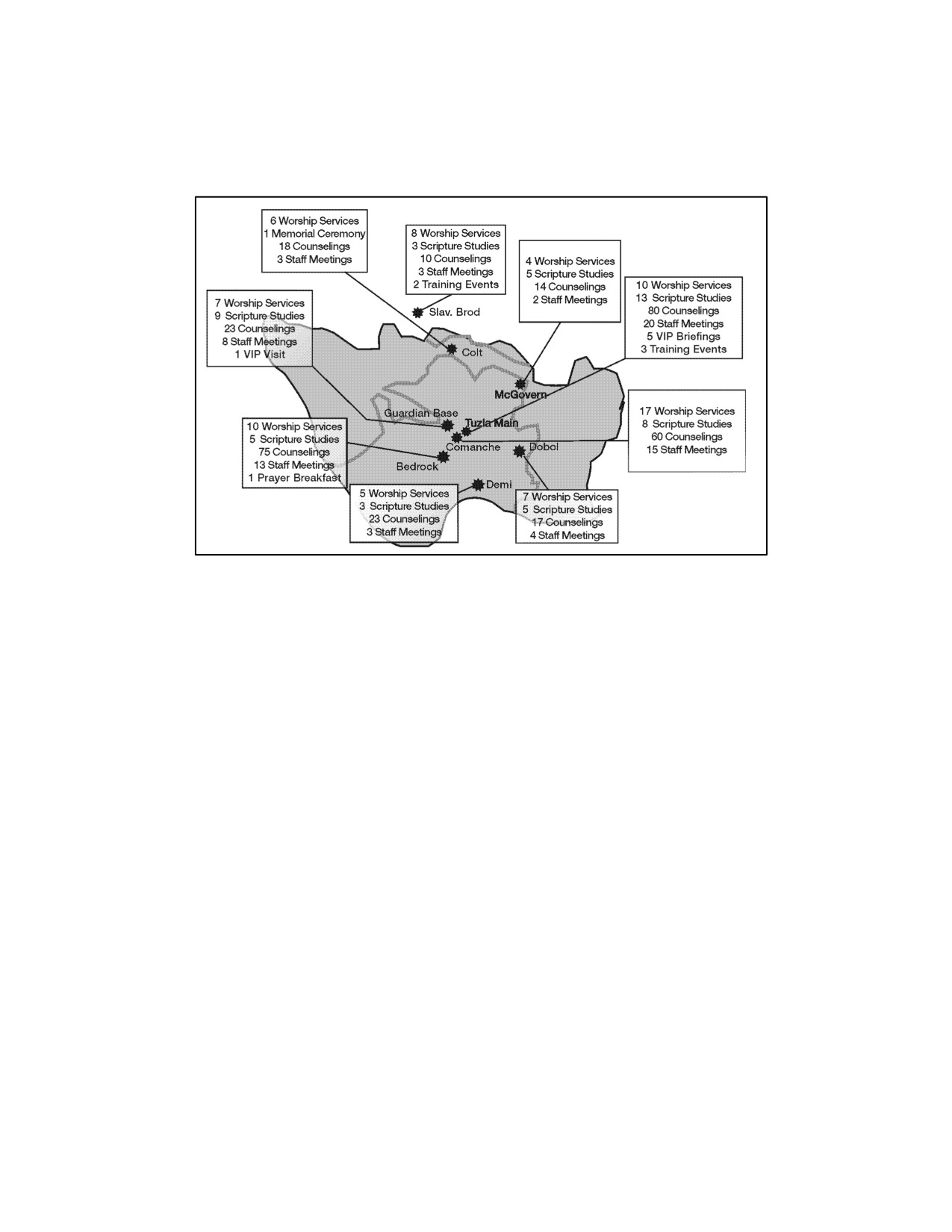
(See Figure 5-1.)
Figure 5-1. Week of Religious Support in Task Force Eagle
5-27. Critical capabilities requirements. The ability to provide religious sup-
port in the 21st century battlespace will depend upon five critical capabilities
requirements: information access, situational awareness, communication
connectivity, mobility, and force structure. A deficit in any of these five re-
quirements will radically impair the ability to provide timely religious sup-
port.
5-28. Division UMTs must have real time operational awareness. They must
be able to determine an appropriate response and expeditiously communi-
cate that information to religious support personnel who will respond di-
rectly to the situation. To enable religious support throughout the bat-
tlespace, UMTs must be able to move and communicate seamlessly through-
out the AO.
5-29. Battle tracking operations require sufficient personnel and the re-
quired technical training to conduct 24-hour operations.
Offense
5-30. The Division Chaplain coordinates and supervises religious support for
the comprehensive support of all soldiers and units in the division. Based on
the religious support estimate, the division chaplain determines area support
requirements and where to position the division UMT to best accomplish its
mission.
5-31. Normally, the Division Chaplain monitors the tactical situation, plans
religious support, and provides care for soldiers from the main Command
Post (CP). Prior to an operation, the Division Chaplain moves forward and
provides pastoral care to brigade UMTs. Division UMT personnel, under the
5-7
FM 1-05__________________________________________________________________________________
Deputy Division Chaplain, provide religious support to soldiers in the rear
CP; monitor the volume of casualties, replacements, logistics; and coordinate
religious support in the division rear area. These are norms, but in the final
analysis, the Division Chaplain must organize and locate his ministry team
in a manner that best accomplishes the religious support mission.
5-32. The Deputy Division Chaplain normally coordinates with the DISCOM
UMT for religious support in the division support area (DSA); with maneu-
ver units in reserve, division combat support and combat service support
units not located in the DSA; and with the Corps Support Group (CSG) UMT
that directly supports the division.
5-33. Elements of the supporting CSG may be located in the division AO. Its
UMTs may provide additional support to the division and to other corps ele-
ments operating in the division area. Other corps units may include the Ar-
mored Cavalry Regiment (ACR), artillery, signal, military intelligence, medi-
cal, air defense artillery, aviation, and engineers. Some elements of these
corps units may be forward in brigade support areas.
5-34. The Division UMT coordinates with the CSG UMT for area and faith
group support. The division RSA includes coordinating instructions author-
izing brigade UMTs to coordinate with UMTs from corps units located in
their AOs.
5-35. The Division UMT coordinates with the Corps UMT concerning area
support of corps units in the division AO. The tactical situation may prevent
corps UMTs from moving forward to their subordinate units. The teams may
be separated from their forward elements by as much as 150 kilometers.
5-36. Area support is limited in light infantry divisions because of restricted
transportation assets. Non-divisional UMTs with greater mobility may be
tasked to provide more area support to a light division than they would to a
heavy division.
Defense
5-37. Division religious support during the defense is similar to religious
support during the offense. Access to subordinate UMTs is easier, but enemy
reconnaissance and preparatory fires may complicate travel. As in the of-
fense, the division UMT coordinates with the CSG UMT for mutual support.
5-38. The DISCOM UMT coordinates area support in the DSA.
Stability
5-39. Conducting religious support during stability operations remains fun-
damentally the same as in the offense and defense. The management of the
religious support plan is challenged by the increased information manage-
ment tasks required to properly respond to religious support issues. In sta-
bility operations, as in war, the division conducts simultaneous operations.
For example, the division could conduct peacekeeping operations at the same
time it is deploying additional forces and securing facilities. Stability opera-
tions are usually complex. Rarely will UMTs be given a single task to accom-
plish. Their capability to handle multiple tasks across a wide range will
challenge them. When the division headquarters is deployed for stability op-
erations, it is often assigned as the ARFOR and works for a joint task force
commander.
5-8
_________________________________________
DIVISION UNIT MINISTRY TEAM RELIGIOUS SUPPORT
5-40. Although often only part of the division deploys, as a controlling head-
quarters, it may receive attached or operational control (OPCON) units from
many external sources. These sources include Army organizations, other
U.S. military services, and multinational forces. Within these units are other
UMTs that the division UMT must integrate into their religious support
plan. Planning considerations for the division UMT—
· ROE understanding and religious support application.
· Command understanding of the religious culture and traditions.
· Media and Public Affairs Office/Officer (PAO) guidance.
· Religious support integration during Base Camp planning.
· Command and staff expansion for operations.
· Information management.
· Personnel issues for UMTs
· Increased liaison tasks with faith-based NGOs and IOs, and host nation
religious leaders.
Support
5-41. Support operations consist of relief operations, support to WMD inci-
dents, support to civil law enforcement, and community support. All are
challenging for religious support planning and execution. Support opera-
tions can also be conducted simultaneously with offense, defense, and stabil-
ity operations. Posse Comitatus (the legal guidelines defining the relation-
ship between federal armed forces and the civilian populace) plays a critical
part for planning. (See Annex K for more information.)
5-42. Religious support planning may include—
· Limits on deployed religious support personnel due to statutory agree-
ments and other restrictions.
· Availability and type of transportation assets.
· Force protection requirements.
· Training requirements.
· SOF participation.
· Use of reserve component forces.
· Other U.S. government agencies' roles.
· Lodgment sites and responsibilities.
· Host nation requirements and expectations (OCONUS).
· Political and social implications of the division's actions.
· Funding and special equipment and supplies requirements.
· Impact of mass casualty upon the units.
Reconstitution, Redeployment, and Demobilization
5-43. Reconstitution is an extraordinary action that commanders plan and
implement to restore units to a desired level of combat readiness. It tran-
scends normal daily force sustainment actions. No resources exist solely to
perform reconstitution; rather existing systems and units do it.
5-44. Reconstitution decisions belong to commanders. They control assets
and decide whether to reorganize or regenerate a unit. Normally, the deci-
sion to reconstitute is made two echelons above the unit that must be rebuilt.
The commander two echelons above, with his staff’s assistance, are in the
5-9
FM 1-05__________________________________________________________________________________
best position to assess a subordinate unit's effectiveness. The division UMT
provides unit ministry support, particularly for cases of combat and opera-
tional stress, spiritual renewal, critical event debriefings, and worship op-
portunities. The chaplain coordinates worship and memorial services, sac-
ramental acts, and pastoral counseling. Chaplains play a key role in assess-
ing the spiritual morale and moral/ethical needs of the unit.
5-45. The OPLAN includes enough details to enable staffs and supporting
units to prepare for rapid restoration of units within command priorities.
The division UMT inputs the religious support plan in support of reconstitu-
tion operations after utilizing the estimation and analysis process. While the
religious support plan cannot meet all the contingencies of Army operations,
it must be one that the command and UMT can adapt to the situation. In
addition to addressing reconstitution for a specific mission, the staff may
have to write a separate OPLAN for reconstitution operations. The UMT is
fully integrated within this process. The more fully developed a UMT’s re-
constitution SOP, the easier for it to develop a reconstitution plan.
5-46. Redeployment is the repositioning of forces after mission accomplish-
ment or transfer of mission and authority to another unit. This may mean
redeployment to another AO for subsequent missions, or return to home sta-
tion. In either case, the division UMT should prepare subordinate UMTs to
assist commanders, soldiers, and family members, in preparing emotionally
and spiritually for the changes that come with redeployment and reunion.
5-47. Demobilization is the return of forces to a peacetime posture. Planning
for demobilization is critical. The division UMT cannot wait for the operation
to end to begin planning for demobilization. It must begin early in the proc-
ess. The division UMT’s role in demobilization may be much greater than in
mobilization. It begins in the division's AO with reconstitution of attached
Reserve Component forces and preparation for redeployment to CONUS or
OCONUS demobilization stations. Demobilization planning begins concur-
rently with mobilization. Demobilization planning may impact on division
UMTs in theater as reserve component units begin the tasks of reconstitu-
tion and demobilization, while under division or corps control. Religious
support plans must address many issues including—
· UMT spiritual reconstitution.
· Decorations and awards.
· Evaluation reports.
· Memorial Services and Ceremonies.
· Critical event debriefings.
· Reunion briefings for command and staff, soldiers, and family members.
· The division UMT may also coordinate with the corps and installation
chaplain at both the division's home station installation and the RC
unit's demobilization station.
Garrison Operations
5-48. During garrison/installation operations, the division UMT plans and
implements the CMRP in coordination with the unit training schedule to
support the religious needs of the division’s soldiers and their families. The
division UMT manages and supervises the subordinate UMTs assigned to
the division for the commander and coordinates ministry as applicable with
5-10

_________________________________________
DIVISION UNIT MINISTRY TEAM RELIGIOUS SUPPORT
the garrison/installation UMT. The UMT participates in all installation
chaplains’ training programs and other programs that enhance the religious
quality of life of the installation. They also fully participate in the unit’s
training program. The division UMT will support the unit’s training pro-
gram by being available to conduct training for the command and staff, and
subordinate UMTs. The division UMT is the mentor for the battal-
ion/squadron UMTs of the division and will execute a mentorship program.
Also, the senior division UMT supervises the personnel assigned or attached
to the division chaplain’s office.
ROLE OF THE DIVISION UNIT MINISTRY TEAM
5-49. The role of the division UMT is critical to the professional and tactical
proficiency of the subordinate UMTs. Their leadership responsibilities shape
and guide brigade, battalion, and squadron UMTs role in religious support
execution process. They are the command and staff advisors for the officers
and NCO chain of command.
PRINCIPLES
Table 5-1. Division/Task Force Tactical UMT
CHAPLAIN
(O-5)
CHAPLAIN ASSISTANT
(E-8)
CHAPLAIN
(O-4)
CHAPLAIN ASSISTANT
(E-5)
CHAPLAIN ASSISTANT (E-3)
Role
Role
Commissioned Officer/Staff
Noncommissioned Officer
Religious Professional
Specialized Assistant
Title 10 Protected
Religious Support Specialist
Team Security
Mission
Mission
Advises commander on religious support and
Advises Chaplain and NCO Chain.
quality of life issues to support the unit’s
Provides specialized assistance in areas of
mission.
religious support to support the chaplain.
Performs/provides/coordinates the religious
Perform Battle Staff functions.
support mission for the division.
Team NCOIC.
Division Team Leader for Religious Support.
Parallel Tasks
Parallel Tasks
1. Assess subordinate UMTs readiness.
1. Assess subordinate UMTs readiness.
2. Conducts staff assistance visits.
2. Conducts staff assistance visits.
3. Determines Training Objectives.
3. Conducts UMT religious support training.
4. Mentors subordinate UMTs.
4. Mentors subordinate UMTs.
5. Recommend personnel assignments.
5. Recommends Chaplain Assistant
assignments.
5-50. The Division Chaplain is a personal staff officer, religious leader, and
team leader. The Division Chaplain Assistant NCOIC must be a NCO leader
and advisor, mentor, information manager for the team. They both must
have a keen awareness of the world situation as it bears on potential mili-
5-11
FM 1-05__________________________________________________________________________________
tary operations, know the role of military religious leader’s and have a broad
understanding of the impact of indigenous religions on military operations.
5-51. Unit Ministry Teams must use technology to enhance the personal de-
livery of religious support. They must be trained in joint and multi-national
operations and skilled in synchronizing all aspects of religious support dur-
ing military operations. They will operate in an environment of increasing
volatility, complexity and ambiguity. The division UMT must be innovative
and disciplined.
5-52. This means that the Division Chaplain section NCOIC will need to be a
graduate of the Battle Staff NCO Course (with the 2S identifier). This will
enable the UMT NCOIC to take part in the MDMP in the absence of the
chaplain, track the battle analytically and better utilize the digital enablers
that the division will share with other staff sections.
5-53. Division UMTs require the same level of technology as the command of
the supported force. UMT automation, communication and transportation
requirements must keep pace with the command’s requirements in order to
effectively coordinate religious support, communicate critical information,
and remain physically flexible to meet requirements across the division
battlespace. They are an integral part of the division.
RESPONSIBILITY AND ACCOUNTABILITY
Staff Responsibilities
5-54. The Division UMT works directly for the commander representing the
religious support dimension of caring for soldiers and family members. The
UMT executes the commander’s plan for religious support initiatives and
programs. Staff responsibilities include—
· Synchronizing religious support programs across the division AO.
· Coordinating denominational coverage.
· Performing UMT personnel tasks.
· Advising the Division Commander on matters of religion, ethics, morals,
and morale as affected by religion, the impact of indigenous religions on
military operations, and installation and community religious support is-
sues.
· Preparing the staff religious support estimate and appendix for the divi-
sion OPORDs.
Relationship to the Corps Unit Ministry Team
5-55. The Division UMT supports all of the Corps UMT programs including
training, family support, and professional development. They work closely
together implementing UMT personnel issues for the command. During
combat operations, the division UMT utilizes the Corps UMT’s religious sup-
port appendix to the corps OPORD for religious support planning. The Divi-
sion UMT works closely with the corps to ensure the success of the religious
support mission.
SUPERVISORY RESPONSIBILITIES
5-56. The Division UMT provides technical and professional supervision to
subordinate UMTs in the division. As the senior UMT, the Division UMT
provides leadership for UMTs in professional development, implementation
5-12
_________________________________________
DIVISION UNIT MINISTRY TEAM RELIGIOUS SUPPORT
of the CMRP, personnel issues, and other issues as directed by the com-
mander. The Division UMT works closely with subordinate UMTs to mentor
and provide direction.
TRAINING
5-57. The Division UMT assesses its current training strategies as well as
the underlying assumptions regarding pre-training knowledge and skills in
light of the Division Commander’s training and mission requirements. The
Division UMT will provide training in planning, preparation and execution
of the 11 Religious Support Activities in accordance with the CMRP. Infor-
mation literacy requirements for all UMTs are imperative in training.
5-58. Training will be profoundly affected since non-linear operations compli-
cate the organization of the battlespace into close, deep and rear operations.
SUMMARY
5-59. Recent significant changes in international politics have created an
ambiguous security environment in which threats to world stability and U.S.
national interests are more regionally focused. Many crisis situations in
which the United States exercises its power span the spectrum of operations
from operations other than war to actual combat. Force Projection has be-
come our chief strategy for supporting the power-projection element of U.S.
national security. Army corps and divisions must be prepared for force pro-
jection operations, as part of a joint or multinational effort and in war as
well as other than war environments.
5-60. The mission of the Division UMT is to coordinate religious support to
soldiers, families, and as the force structure evolves, to forward-deployed
DOD authorized civilians. Division Chaplains also serve as critical advisors
to commanders at all levels of the division providing essential information on
troop and unit morale, quality of life matters, and the impact of indigenous
religion on military operations.
5-61. The Division UMT is expected to operate with a great deal of freedom
and responsibility. From information available, it must discern what is es-
sential for the commander's decision making. It must coordinate the entire
division religious support effort to support the commander's intent and con-
cept of operation. The UMT develops plans and conducts necessary coordina-
tion between subordinate and higher UMTs to execute the commander's in-
tent.
5-62. Combat power in the 21st century will rely heavily upon technology.
The cumulative affect of the numerous factors will increase the spiritual,
psychological and interpersonal demands placed upon soldiers of the 21st
century. Technology will provide additional means to plan, coordinate, and
execute religious support to address these demands but the personal delivery
of religious support by the UMT will always be imperative.
RESOURCES
5-63. The following is a list of main resources utilized for writing and up-
dating this doctrine.
· JP 1-05.
5-13
FM 1-05__________________________________________________________________________________
· JP 5-00.2.
· JP 3-05.
· FM 16-1.
· FM 100-5.
· FM 3-0 (100-5).
· FM 25-100.
· FM 25-101.
· FM 71-100.
· Lessons Learned from past and current operation
· Lessons Learned from the training centers
5-14
Chapter 6
CORPS/ECHELONS ABOVE CORPS
RELIGIOUS SUPPORT OPERATIONS
The corps is the Army's largest tactical organization. The corps organiza-
tion is tailored for the assigned theater of operations and the assigned
mission. Corps may be assigned divisions of any type required by the
theater and the mission. They have a support command and will receive
additional Combat Service (CS) and
CONTENTS
Combat Service Support (CSS) or-
Operational Echelon Description
6-1
ganizations based on the assigned
Fundamentals of Religious Support
mission.
Operations
6-5
Religious Support in Rear Areas
6-9
Echelons above corps (EAC) consist of
Special Religious Support
the Army at theater level and above.
Requirements in Rear Areas
6-13
These units will be under the
Reconstitution and Redeployment
6-14
command of a regional combatant com-
Theater Religious Support
6-14
mander (unified command). This level
Additional Corps/Echelons above
is in the strategic context.
Corps Religious Plan
Requirements
6-16
OPERATIONAL ECHELON
Role of the Corps/Echelon above
DESCRIPTION
Corps Unit Ministry Teams
6-20
Garrison Operations
6-20
6-1. Corps conducts
Summary
6-20
operations with joint,
Resources
6-20
interagency, or multinational
forces, facilitated by information superiority across the full range of military
operations, in a Major Theater War or small-scale contingency, against any
threat, in any assigned AO. Corps operations may include a mixture of of-
fense, defense, stability, and support operations executed sequentially or si-
multaneously.
6-2. Corps is usually the link between the operational and tactical levels of
war. Corps may link the operational level of war to the strategic level of war.
Corps plan and conduct major operations and battles. The corps headquar-
ters synchronizes tactical operations including maneuver; fires, joint, deep,
close, and Suppression of Enemy Air Defenses (SEAD); CS; and CSS. The
corps is not a fixed standing organization, but a formation whose core char-
acteristic is the ability to form task forces focused on mission requirements.
It employs tailored forces that are optimized for specific functions or tasks.
The corps employs divisions and applies force allocation rules of support to
divisions based on mission. The corps normally has a wide range of Army
capabilities to support and sustain any effort. The two critical requirements
6-1
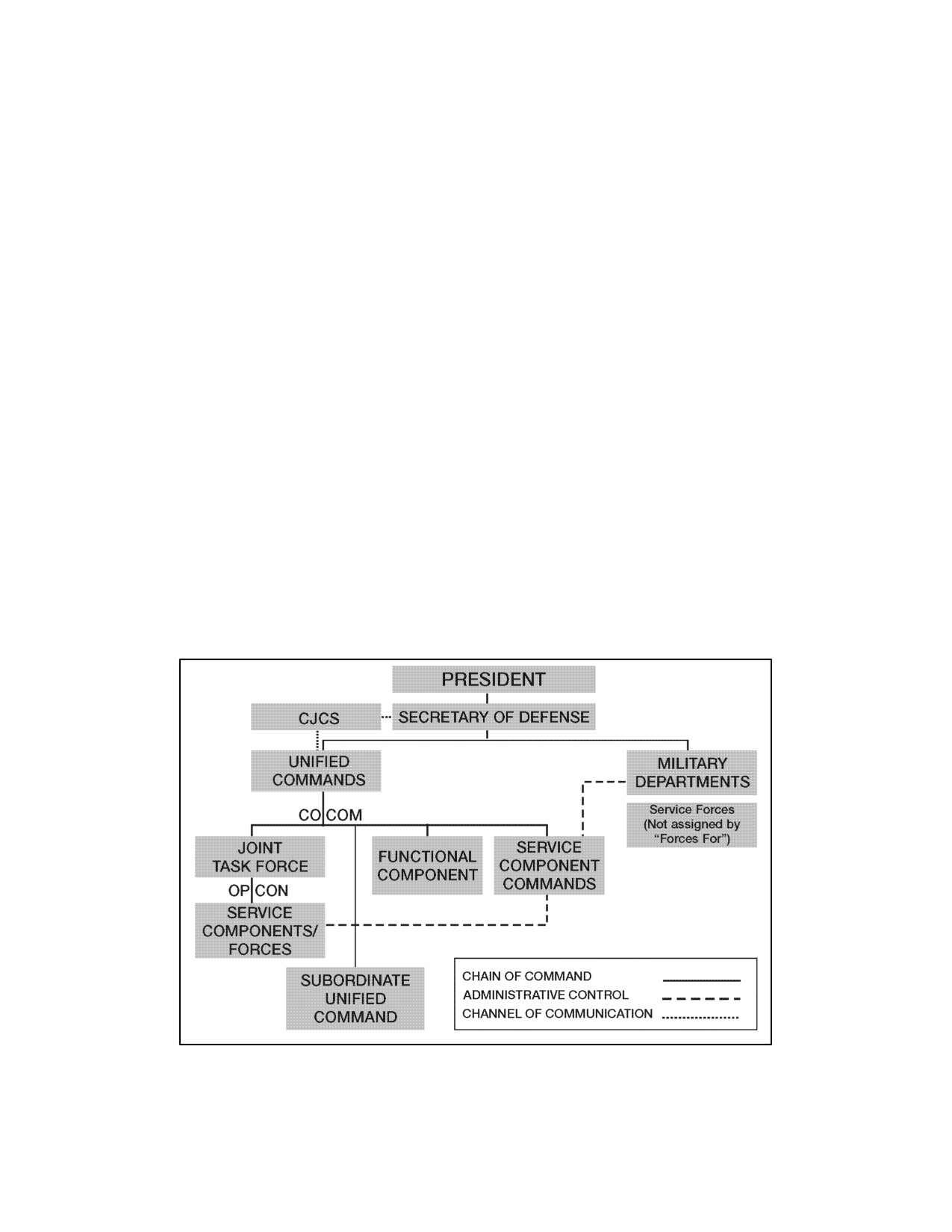
FM 1-05__________________________________________________________________________________
of corps operations are a robust C4 intelligence, surveillance and reconnais-
sance (C4ISR) and logistics support to plan, prepare, execute, and assess the
full range of operations. Corps traditionally can employ multinational forces
and operate with governmental and non-governmental agencies and capa-
bilities. Corps operations are nested in political military dimensions of the
combatant commander’s theater effort, but are optimized for conducting
military operations.
6-3. The corps is a much diversified organization that fulfills the synchroni-
zation of many functions that achieve tactical and operational advantage.
The corps conducts planning together with joint forces to achieve campaign
objectives and conducts simultaneous operations in depth across the corps
battlespace. The corps integrates all joint combat, CS, and CSS efforts.
6-4. The corps plans and conducts campaigns and major operations. Corps
campaign plans set broad long-term goals, such as control of a geographical
area, defeat of an enemy in theater, or the reestablishment of international
boundaries. The corps also plans and executes tactical-level battles that sup-
port the corps operational objectives, simultaneously conducting close, deep,
and rear operations, as well as planning future operations.
6-5. Current U.S. collective security arrangements make it imperative that
corps are ready to deploy in response to worldwide situations. In the event of
a crisis situation, a corps headquarters considers the employment of light
forces, armored maneuver forces, and special operations forces. (See Figure
6-1.)
Figure 6-1. Chain of Command and Control
6-2
_________________________
CORPS/ECHELONS ABOVE CORPS RELIGIOUS SUPPORT OPERATIONS
JOINT TASK FORCE CONFIGURATIONS
6-6. A corps headquarters may function as the Army component headquar-
ters of a joint force, the Joint Forces Land Component Command (JFLCC)
headquarters of a JTF or as the JTF headquarters itself. The corps' primary
responsibility in the joint environment is to participate in the development of
supporting joint campaign plans. Current U.S. collective security commit-
ments and the very nature of the international political environment ensure
that U.S. corps’ will also operate as part of multinational coalition forces.
6-7. Corps with missions to respond to worldwide situations will frequently
fight as the largest ground formation in the theater. Often this situation re-
sults in the corps commander filling the position of the commander JTF
(CJTF). In such cases, the corps headquarters accepts the responsibility to
plan operational and tactical level missions as well as oversee the tactical
execution of campaigns or other extended operations.
6-8. As the CJTF, the corps commander will exercise OPCON or tactical
control (TACON) of assigned forces. The CJTF must form a joint staff and
establish the necessary joint boards and centers, as the mission requires.
Joint service representation on the staff should be in relative proportion to
the service composition of the JTF. It is imperative that all of the staff sec-
tions and agencies have joint service representation in the formation and
execution of the joint campaign plan. The corps staff must transition to a
joint staff structure to ensure unity of effort within the task force.
6-9. The JTF establishing authority is responsible for providing personnel
and resources for the corps when the corps is designated the JTF headquar-
ters. However, the corps commander, as the CJTF, must determine what
augmentation requirements he needs for the task at hand and coordinate
support through the establishing authority. This augmentation is essential
in the transition of the corps to a JTF structure.
6-10. Augmentation must be tailored for the specific situation and will be dif-
ferent for every mission. The following areas usually require augmentation:
· Joint, special staff, and personal sections.
· Specific functional area augmentation, such as CA, movement control,
and PSYOP.
· Headquarters life support functions.
· Communications support.
· Security support for the JTF headquarters
6-11. The combatant commanders usually organize augmentation for the
joint staff into packages based on the nature and tempo of developments and
the existing capabilities of the headquarters designated as the JTF. These
packages fall into three broad categories:
· Quick response cells to rapidly augment the JTF headquarters with joint
and operational area expertise during the early stages of a crisis action
situation.
· Functional area augmentation to provide the JTF with expertise not or-
ganic to its staff or to enhance specific capabilities based on mission re-
quirements
6-3
FM 1-05__________________________________________________________________________________
· Joint staff augmentation to provide the coordinating personal and special
staff sections expertise in joint procedures and service-unique capabili-
ties.
JOINT TASK FORCE STAFF AUGMENTATION
6-12. Augmentation facilitates coordination between the JTF staff and the
combatant command joint staff, especially with regard to accessing informa-
tion and capabilities available at the combatant command level.
6-13. Although the corps/ JTF commander applies the military element of
power, he also considers those interagency, political, economic, and other re-
sources that may be available and appropriate for the task at hand. The
CJTF must understand the strategic and regional environment to include
U.S. policy, treaty commitments, the status of forces agreements (SOFA);
host nation concerns, religious and cultural considerations, and coalition
members' interests. These influences will affect campaign and operational
planning, and the establishment of ROE for the joint force. The CJTF must
keep in mind the strategic end state through out the planning and execution
of the operation.
THE CORPS AS AN ARMY FORCES/JOINT FORCE LAND COMPONENT
COMMANDER HEADQUARTERS
6-14. A JTF-level service component command consists generally of forces
from only one service of the JTF. The CJTF may designate the corps head-
quarters as the ARFOR headquarters giving it Title 10 responsibilities and,
in most cases, OPCON of a number of assigned or attached forces.
6-15. The designation of Commander, ARFOR carries additional responsibili-
ties for the Corps Commander. The corps as ARFOR must accomplish the
same coordination as covered above. Corps headquarters are uniquely
suited to be the ARFOR or Joint Force Land Component Commander
(JFLCC) headquarters in a JTF. Joint Pub 1-02 defines the Joint Force
Land Component Commander as "the commander within a unified com-
mand, subordinate unified command, or a JTF responsible to the establish-
ing commander for making recommendations on the proper employment of
land forces, planning and coordinating land operations, or accomplishing
such operational missions as may be assigned. The joint force land compo-
nent commander is given the authority necessary to accomplish missions
and tasks assigned by the establishing commander. The joint force land
component commander will normally be the commander with the preponder-
ance of land forces and the requisite C2 capabilities." The primary purpose
of a JFLCC is to provide unity of command for employing land power for the
benefit of the joint force as a whole and to give the Joint Force Commander
(JFC) a workable span of control.
6-16. The JFLCC must shape the battlespace for subordinate units by focus-
ing on deep operations in space and time (more than 96 hours out).
6-17. Subordinate units are organized for executing the battle command
functions required from the higher headquarters of ground maneuver forces.
Corps headquarters can coordinate the sustainment activities for significant
numbers of assigned or attached forces. Corps also has the staffing to do
joint and multinational force coordination and liaison. In most cases the
6-4
_________________________
CORPS/ECHELONS ABOVE CORPS RELIGIOUS SUPPORT OPERATIONS
corps headquarters is capable of being the ARFOR or JFLCC headquarters
in a JTF without significant personnel augmentation.
THE CORPS AS A FORCE PROVIDER
6-18. In day-to-day operations the corps is required to provide resources to
support operations in which the corps headquarters is not otherwise in-
volved. (As an example, each U.S. corps today has soldiers deployed around
the globe.) As a force-provider, corps has considerable assets, which they
may commit to other commands to support major and lesser regional contin-
gencies around the world. Although these deployed organizations may be
under the OPCON or TACON of another headquarters, the corps retains
significant responsibilities as the parent organization.
6-19. Operations in stability and support environments are good examples in
which corps’ function as force providers. Stability operations and support
operations often come with vague or ad hoc chains of command, requiring
specific support. These missions are different. They require a variety of
corps combat, CS, and CSS units to operate in concert with U.S. and foreign
civil agencies of government, international, and private organizations.
ECHELONS ABOVE CORPS
6-20. EAC echelons include the theater command. Within this command are
various commands that support theater operations. The Army Service Com-
ponent Command (ASCC) is an Army component in a unified and subordi-
nate unified command. Army forces, through the ASCCs, provide defenses
to all joint force components. The ASCC establishes the link between
ARFOR and the joint command. It also plans and executes operations in
support of the joint campaign, plans and executes support operations to sus-
tain subordinate ARFOR, and provides support to other services in accor-
dance with executive agent responsibilities. The Theater Support Command
(TSC) is an EAC-level support organization that is key to operations for CS
and CSS execution. The TSC is structured and organized to deploy tailored
functional modules. The ARFOR commander is provided key functional ex-
pertise and C2 to support joint forces.
FUNDAMENTALS OF RELIGIOUS SUPPORT OPERATIONS
6-21. The corps can rapidly tailor force packages formed from the full range
of Army capabilities, both active and reserve. The corps C2 has the organic
capabilities for split-based operations required for simultaneous functions of
deploying and employing Army forces. The religious support planning and
management mission considers force-tailoring UMTs to perform and provide
religious support for all types and sizes of forces in all contingencies. Relig-
ious support delivery, coordination, synchronization, and synergy are de-
pendent upon the communication capacity in both digital and analog envi-
ronments to support decisive operations and to improve the synergy of joint
and multinational operations. Superior situational understanding is avail-
able through information systems that facilitate the execution of decisive,
shaping, and sustainment operations across all dimensions of the corps AO.
6-5
FM 1-05__________________________________________________________________________________
CORPS RELIGIOUS SUPPORT
6-22. The Corps Chaplain supports the Corps Commander's operational-level
responsibilities and roles by engaging in three operational areas:
· Given guidance by the Corps Commander in coordination with G-5, PAO,
CA, the Corps Chaplain establishes links with representatives of joint,
multinational, interagency, faith-based NGOs and IOs, and religious
leaders of the host nation.
· Plans and executes religious support for corps operations. Monitors re-
ligious support in major subordinate commands.
· Executes support operations to sustain subordinate Army forces. (See
FM 100-7.)
6-23. From the main CP, the Corps UMT plans and synchronizes religious
support in the corps area. The Corps Chaplain monitors the tactical situation
and moves as far forward as possible to provide staff supervision. The Corps
UMT at the rear CP recommends chaplain and chaplain assistant assign-
ments. It coordinates religious support for displaced persons and also plans
religious support for reconstitution. It provides an on-call UMT for the Corps
Reconstitution Task Force (RTF).
6-24. The Corps UMT normally passes responsibility for religious support in
the corps support areas (CSA) to the COSCOM UMT. The Corps UMT must
be capable of simultaneous employment and deployment. Its flexible METT-
TC planning speeds the process of force tailoring, while its capabilities allow
it to provide religious support to the reception, staging, onward movement,
and integration (RSOI) at the lodgment base or in an intermediate staging
base (ISB) within a JOA. The Corps Chaplain’s section will have secure, ro-
bust, and survivable communications networks for transmissions of voice,
data, and video.
6-25. The senior echelons above division (EAD) Chaplain will tailor the
staffing of religious support personnel to match force packages engaged in
operations. Religious support relies upon the availability of sufficient relig-
ious support assets and the flexibility to reallocate those assets.
6-26. Flexibility must include provisions to transition between combat and
other military operations. Planning considerations include—
· Provide interface/liaison between corps and local religious leaders and
faith-based NGO/IOs.
· Support the resettlement of refugees and displaced civilians.
· Reconstitute and regenerate combat ineffective units.
· Manage religious support personnel assignments.
· Contractor religious support planning for subordinate UMTs.
· In coordination with the ASCC chaplain, establishes liaison with senior
UMTs of other services for religious support to Army authorized person-
nel, as well as, religious support to service members of other services.
· Conduct specialized religious support assessment of the AO for the com-
mander and staff.
· Coordinate all chaplains' fund activities within the corps and all budget
and funding requirements for the corps UMTs.
· Provide spiritual care to subordinate UMTs.
6-6

_________________________
CORPS/ECHELONS ABOVE CORPS RELIGIOUS SUPPORT OPERATIONS
· Coordinate with the ASCC chaplain for Chaplain Detachments (CD) and
Special Medical Augmentation Response Team-Pastoral Care (SMART-
PC) usage.
· Provide a UMT training program.
· Plan RS 96 hours to 5 days from execution for the corps fight.
· Utilization of “requests for information” (RFI) to respond to FRAGOs and
mission RS implied tasks.
6-27. The Corps Chaplain’s staff will be resourced to conduct continuous op-
erations. The Corps Chaplains staff will consist of at least four (4) chaplains
and five (5) chaplain assistants and will be augmented by the Chaplain De-
tachment - Corps. Further augmentation may be necessary if serving as the
JTF or JFLCC UMT. The Corps UMT will execute sleep plans to minimize
the degrading effects of sleep loss. The Chaplain’s section must be equipped
to minimize the stress imposed by extreme environmental conditions. The
Corps UMT will have the capability to exercise religious support manage-
ment for the commander from any point within the corps extended area of
operations.
THE CORPS/EAC TACTICAL/OPERATIONAL/STRATEGIC UMT
CHAPLAIN
(O-6)
CHAPLAIN ASSISTANT (E-7/8/9)
Role
Role
Commissioned Officer / Staff member
Noncommissioned Officer
Religious Professional
Specialized Assistant
Title 10 Protected
Religious Support Specialist
Team Security
Mission
Mission
Advises commander on religious support and
Advises Chaplain and NCO Chain.
quality of life issues to support the unit’s
Provides specialized assistance in areas of
mission.
religious support to support the chaplain.
Performs/provides/coordinates the religious
Perform Battle Staff functions.
support mission for the command.
Senior Team NCOIC
Senior Team Leader
Parallel Tasks
Parallel Tasks
1. Conducts staff assistance visits.
1. Conducts staff assistance visits.
2. Determines Training Objectives.
2. Conducts religious support training.
3. Mentors subordinate UMTs.
3. Mentors subordinate UMTs.
4. Recommends personnel assignments.
4. Recommends Chaplain Assistant
assignments.
6-7
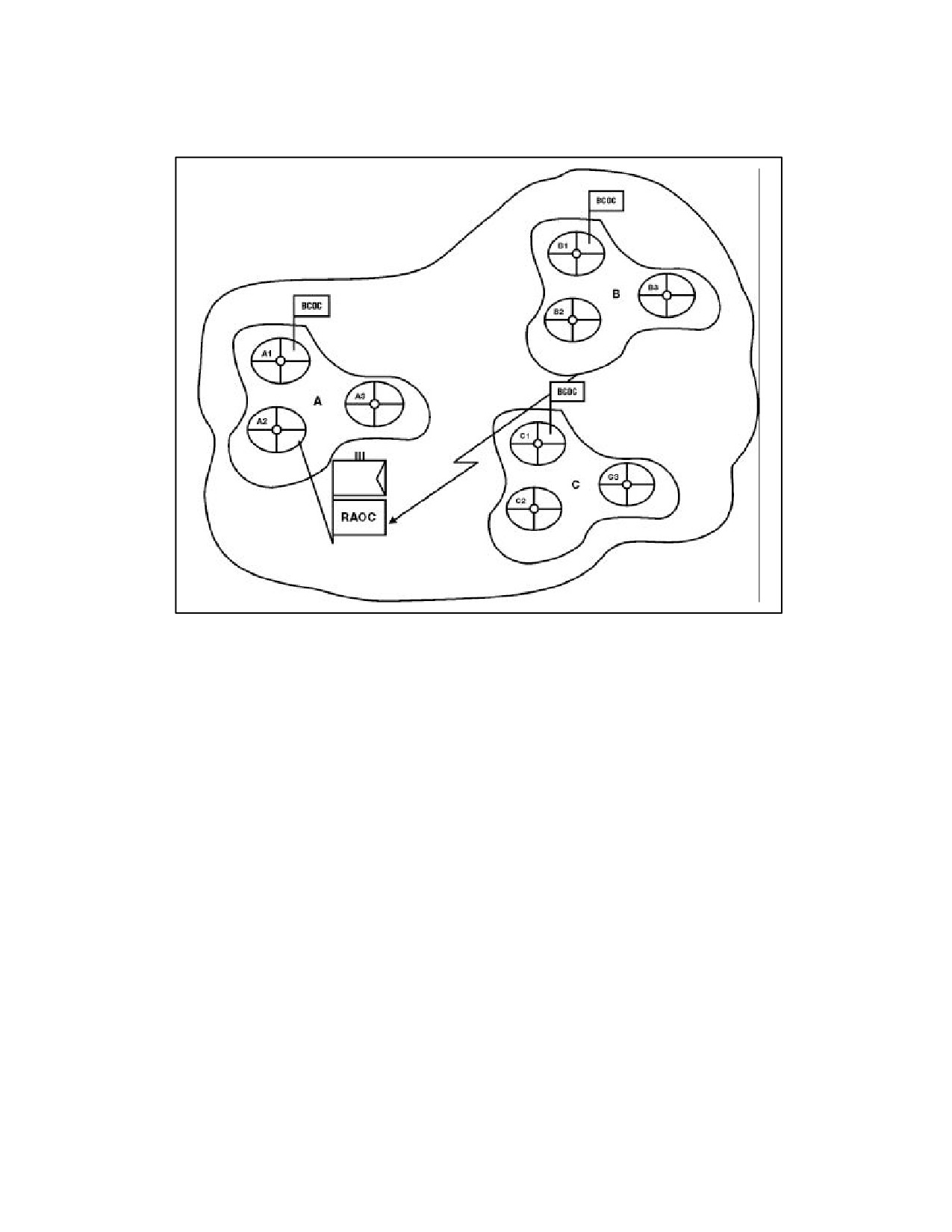
FM 1-05__________________________________________________________________________________
Figure 6-3. Religious Support Coordination in a Corps Support Area
CORPS SUPPORT COMMAND
6-28. The Corps Support Command (COSCOM) UMT coordinates religious
support in the corps support area (CSA) for the Corps chaplain. The CSA
constitutes the Corps Rear Area. The potential expansion of the CSA, the
dispersion of units in bases and base clusters, and the movement of small
units make the coordination of religious support difficult. The COSCOM
UMT will manage and coordinate area religious support for the Base Cluster
Commander to ensure synchronized RS to all units in the base footprint. As
a measure of the magnitude of possible expansion, during Operation
DESERT SHIELD/DESERT STORM, one COSCOM grew to over 60 UMTs.
The area that the COSCOM may cover encompasses the entire battlespace,
making authorized and assigned transportation and communication assets
for all COSCOM UMTs essential.
6-29. The COSCOM UMT works closely with the Rear Tactical Operation
Center (RTOC) and Rear Area Operation Center (RAOC) to track the loca-
tions and faith groups of the chaplains in the CSA.
6-30. The COSCOM UMT monitors the flow of religious support supplies
with the Corps Material Management Center. The COSCOM UMT locates
where communication, battle tracking, and religious support management
are best executed. Twenty-four-hour operations are critical to ensure com-
6-8
_________________________
CORPS/ECHELONS ABOVE CORPS RELIGIOUS SUPPORT OPERATIONS
prehensive religious support and personal staff support to the commander.
Split operations at two locations may be considered.
CORPS SUPPORT GROUP
6-31. The COSCOM supports the corps with two or more Corps Support
Groups (CSGs): forward and rear. CSGs are composed of multi-functional
battalions that provide supply, services, and maintenance to supported
units. Forward CSGs support the divisions and other corps units in their
AOs. The Rear CSG supports the corps rear area, units in reserve, separate
brigades, and units with special missions. The task organization of a CSG
can change daily.
6-32. The Forward CSG UMTs monitor the rapidly changing situation
through their assigned RAOCs. The tactical communication system found in
the RAOC is the primary means of communication for the CSG UMTs. These
teams are responsible for coordinating religious support throughout their
AOs. They maintain a database with the locations of all UMTs by unit and
faith group to process requests for area and faith group religious support.
6-33. The Rear CSG UMT provides religious support to the largest unit in
the corps support area that includes the corps and COSCOM headquarters.
6-34. The Rear CSG UMT is often given the reconstitution mission.
RELIGIOUS SUPPORT IN REAR AREAS
6-35. The dispersion of units in rear areas presents a significant religious
support challenge. Unit ministry teams have elements of units deployed far
forward and out of reach. At the same time, they have elements of other
units located in their areas. Of necessity, area support in the rear consumes
a greater portion of a UMT's time and energy than does unit support. The
Corps Support Chaplain has the responsibility for the rear. Timely religious
support coordination is crucial and requires a clear understanding of rear
operations.
REAR OPERATIONS
6-36. Rear operations support tactical forces in contact, guaranteeing free-
dom of maneuver, continuity of support, and uninterrupted C2. In the linear
battlespace these actions occur behind forces engaged in active combat. In
the non-linear battlespace they occur in the support base areas. Rear opera-
tions are characterized by a wide dispersion of multi-functional units con-
ducting a variety of missions around-the-clock.
6-37. Rear areas may be small in a sparse theater, as in small-scale contin-
gencies (SSC), or large in a mature theater, as during general war. In SSC,
with tactical operations arrayed through 360 degrees, the "rear area" refers
to the area designated as the support base.
6-38. The synchronization of rear operations is the responsibility of a Rear
Tactical Operations Center (RTOC), a Rear Area Operations Centers
(RAOC), or a Rear Command Post (RCP).
6-39. The Rear Tactical Operations Center (RTOC) is the primary staff ele-
ment for planning and coordinating rear area security operations.
6-9
FM 1-05__________________________________________________________________________________
6-40. The Rear Area Operations Center (RAOC) is a subordinate command
post in or near the rear tactical command post concerned with terrain man-
agement and security operations.
6-41. The RAOC maintains critical information for the UMT to accomplish
its mission: a current situation map; continuous communications with the
RCP, other RAOCs, and subordinate base clusters; the threat condition; and
Base Defense Status Reports.
The RAOC maintains critical information for the UMT.
6-42. The most important RAOC function for religious support coordination
is terrain management. The RAOC manages the use of terrain by assigning
units to bases and base clusters.
Bases
6-43. Units are positioned in bases to share security responsibilities and capi-
talize on mutual strengths. Bases have clearly defined, defensible perimeters
and established access controls.
6-44. Normally, the senior commander is the Base Commander. All forces as-
signed to the base are under his operational control for defense purposes.
The commander forms a Base Defense Operations Center (BDOC) to assist
in planning, coordinating, integrating, and controlling base defense efforts.
6-45. The base commander's UMT obtains information about the units (in-
cluding those in transition) occupying the base from the BDOC. The UMT
uses the BDOC's secure communication equipment to coordinate with higher
echelons and to coordinate area religious support requirements. (See Figure
6-4.)
6-10
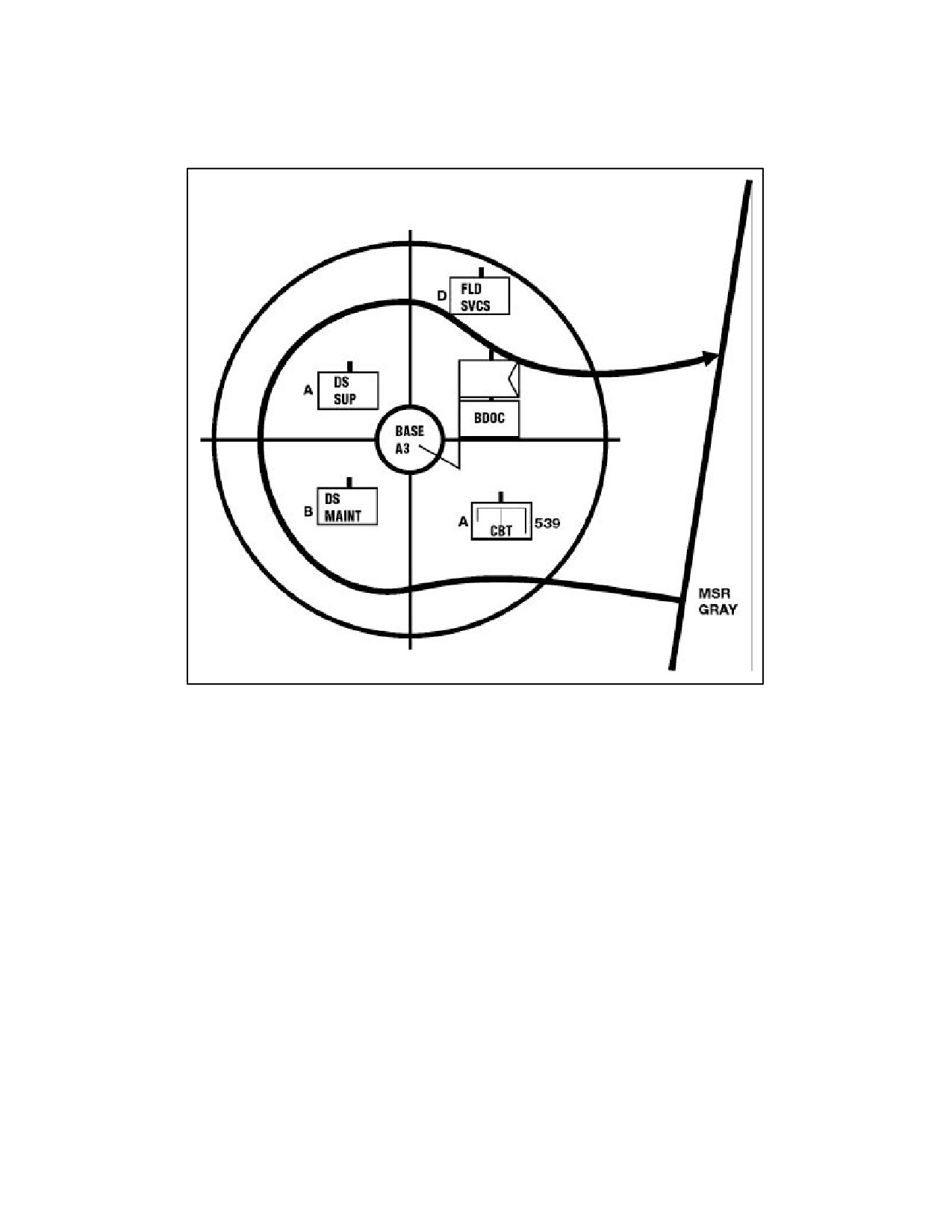
_________________________
CORPS/ECHELONS ABOVE CORPS RELIGIOUS SUPPORT OPERATIONS
Figure 6-4. Religious Support Coordination in a Base
Base Clusters
6-46. A base cluster is a grouping of bases that are mutually supporting for
defense purposes. The commander forms a Base Cluster Operations Center
(BCOC) from his own staff and available base assets.
6-47. As in the base, the base cluster commander's UMT uses the BCOC as
its source of information for coordinating area religious support in the base
cluster and for communicating with higher and lower echelons. (See Figure
6-5.)
6-11
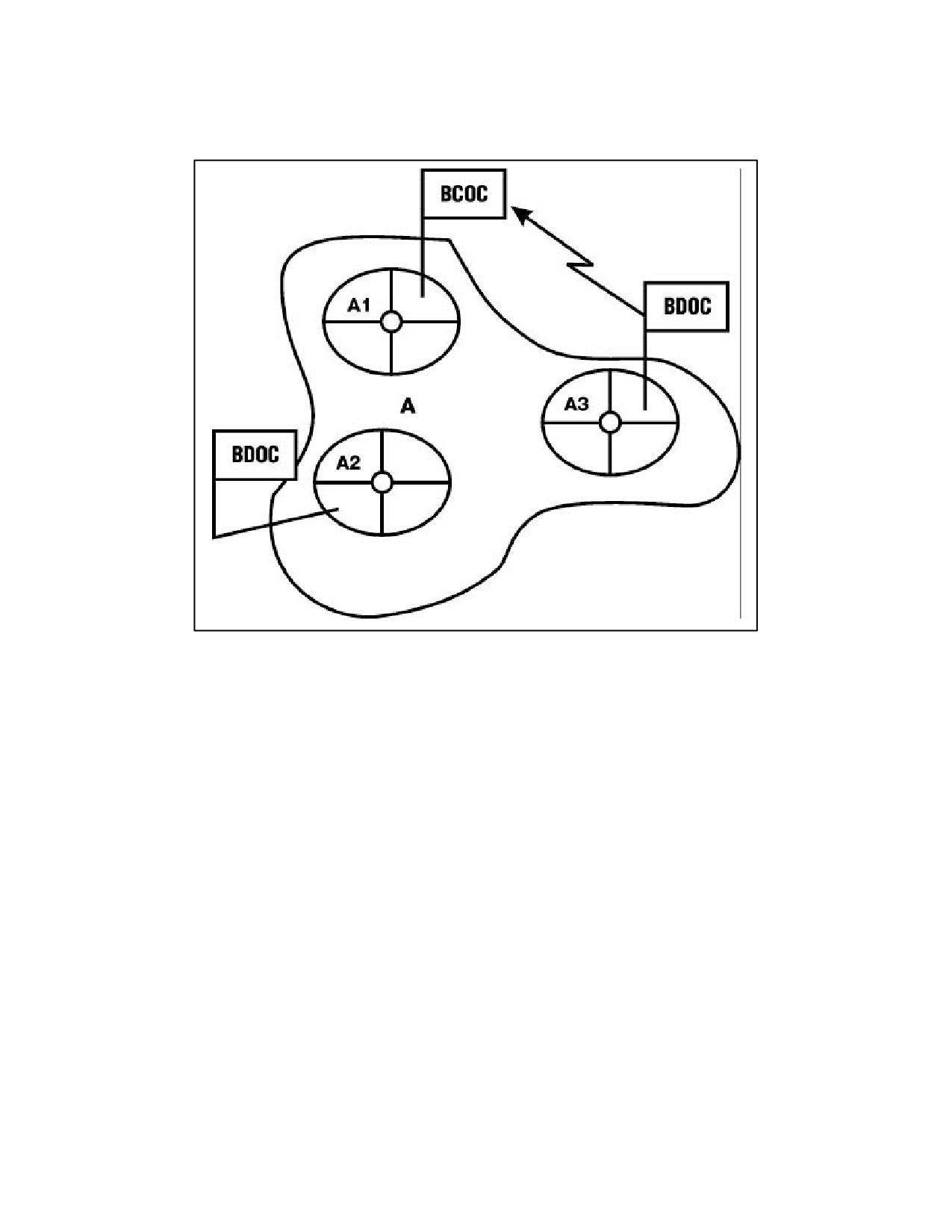
FM 1-05__________________________________________________________________________________
Figure 6-5. Religious Support Coordination in a Base Cluster
Religious Support Coordination In Rear Areas
6-48. The base or base cluster commander's unit ministry team (Base or Base
Cluster UMT), regardless of the chaplain's rank, is responsible for area sup-
port planning and coordination. Tenant and transient units coordinate with
the Base UMT. Base and Base Cluster UMTs coordinate scarce resources for
optimum religious support.
6-49. Base and Base Cluster UMTs monitor unit movements, particularly
company-size and smaller. They maintain a database of chaplains, their
units, faith groups, locations, and means of communication.
6-50. When the commander does not have an assigned UMT, the senior
chaplain in the base or base cluster coordinates area support. If there is no
religious support available in the base or base cluster, the next higher eche-
lon takes responsibility for area coordination. These relationships are speci-
fied in the Religious Support Appendix of the next higher headquarters.
Base Religious Support
6-51. Tenant units coordinate with the Base UMT for additional religious
support. The Base UMT conducts a daily meeting to coordinate religious
support for the soldiers in the base. Units without organic religious support
contact the Base UMT through the BDOC for religious support.
6-12
_________________________
CORPS/ECHELONS ABOVE CORPS RELIGIOUS SUPPORT OPERATIONS
6-52. The Base UMT reports tenant and transient chaplains by faith group to
the Base Cluster UMT. This information is used to coordinate faith group
support in the base cluster. Unit ministry teams provide area support as
needed on a temporary basis until their unit's mission requires their move-
ment from the base.
6-53. If there is no chaplain available in the base to meet a unique faith
group requirement, the Base UMT requests support through the BDOC to
the BCOC. For instance, if there is no Roman Catholic chaplain available,
the Base UMT may request Catholic support using this procedure.
Base Cluster Support
6-54. The base cluster religious support is coordinated in the same way as in
the base. The Base Cluster UMT monitors the movement of units into and
out of the bases. As bases submit requests for additional faith group support,
the Base Cluster UMT meets those requests with available UMTs. If the re-
quest cannot be met, it is forwarded to the next higher echelon. The Base
Cluster UMT reports chaplains by faith group through the BCOC to the
RAOC of the next higher echelon.
Higher Echelon Support
6-55. The procedure for coordination of faith group support described above
is repeated up the chain of command. At higher echelons, as the area and
the number of units increase, the maintenance of the chaplain database be-
comes more sophisticated. At these levels, a computerized database, using
standard data base software, is required.
SPECIAL RELIGIOUS SUPPORT REQUIREMENTS IN REAR AREAS
RECEPTION, STATIONING, ONWARD MOVEMENT, AND INTEGRATION
OPERATIONS
6-56. RSOI operations include the initial reception of units and individuals,
the preparation of these units and individuals for combat, and their move-
ment forward into the combat zone. Reception operations begin before hos-
tilities start and continue after hostilities cease. RSOI may be conducted ei-
ther forward in the theater of operation, in the rear of the area of operation
at an Intermediate Staging Base (ISB), or at home station and/or en route to
the AO. In the case of RSOI being conducted in the theater, the theater
chaplain is responsible for coordinating religious support in the reception
area. In the case of a RSOI being conducted closer to the AO, the COSCOM
chaplain may be designated to provide area religious support.
MORTUARY AFFAIRS
6-57. The recovery, preparation, and transportation of the dead are one of
the most difficult missions in the battlespace. Religious support is provided
to soldiers in Mortuary Affairs units and to those detailed to perform this
mission. The care for the dead requires sensitive religious support.
6-58. Planning Considerations:
· Religious support in sites where those killed in action are prepared for
return to CONUS.
6-13