FM 1-05 RELIGIOUS SUPPORT (APRIL 2003) - page 1
*FM 1-05 (FM 16-1)
Field Manual
Headquarters
Department of the Army
No. 1-05
Washington, DC, 18 April 2003
Religious Support
Contents
Page
Chapter 1
RELIGIOUS SUPPORT FUNDAMENTALS
Historical Foundations
1-3
The Chaplain’s Authority for Ministry
1-3
Religious Support Mission
1-4
Religious Support Functions
1-5
Religious Support Activities
1-5
Roles and Responsibilities
1-6
Organization
1-9
Providing Unit Religious Support
1-9
Summary
1-10
Resources
1-10
Chapter 2
RELIGIOUS SUPPORT ENVIRONMENT
Religious Support and the Threat Environment
2-1
Force Projection
2-2
Levels of Military Actions
2-3
Decisive Full Spectrum Operations
2-5
Summary
2-10
Resources
2-11
Chapter 3
UNIT MINISTRY TEAM OPERATIONS
General Religious Support Planning, Preparation, Coordination and Execution
Overview
3-1
Religious Support Planning for Force Projection
3-12
Battlefield Transition Planning and Execution
3-18
Installation Religious Support
3-22
Summary
3-26
Resources
3-26
Chapter 4
BATTALION, SQUADRON, BRIGADE, REGIMENT AND GROUP RELIGIOUS
SUPPORT OPERATIONS
Tactical Echelon Description
4-1
Fundamentals of Religious Support Operations
4-3
Role of the Battalion/Squadron Unit Ministry Team and Section
4-3
Role of the Brigade Unit Ministry Team
4-6
Operations Planning and Preparation for Unit Ministry Teams
4-13
Developing Priorities for the Task Force Unit Ministry Team
4-15
Writing Religious Support Appendix
4-16
Brigade
4-16
Situational Awareness
4-22
Offense
4-25
Religious Support of Defensive Operations
4-30
Other Brigade and Below Units and Special Religious Support Considerations
4-38
Summary
4-41
Resources
4-41
Distribution Restriction. Approved for public release; distribution is unlimited.
*This publication supersedes FM 16-1, 26 May 1995.
i
__________________________________________________________________________________
FM 1-05
Chapter 5
DIVISION UNIT MINISTRY TEAM RELIGIOUS SUPPORT
Tactical Echelon Description
5-1
As Part of a Corps
5-1
As Part of a Joint Task Force
5-2
Fundamentals of Religious Support Operations
5-3
Role of the Division Unit Ministry Team
5-11
Summary
5-13
Resources
5-13
Chapter 6
CORPS/ECHELONS ABOVE CORPS RELIGIOUS SUPPORT OPERATIONS
Operational Echelon Description
6-1
Fundamentals of Religious Support Operations
6-5
Religious Support in Rear Areas
6-9
Special Religious Support Requirements in Rear Areas
6-13
Reconstitution and Redeployment
6-14
Theater Religious Support
6-14
Additional Corps/Echelons above Corps Religious Plan Requirements
6-16
Role of the Corps/Echelon above Corps Unit Ministry Teams
6-20
Garrison Operations
6-20
Summary
6-20
Resources
6-20
Chapter 7
INSTALLATION UNIT MINISTRY TEAM RELIGIOUS SUPPORT OPERATIONS
Installation Description
7-2
Fundamentals of Installation Religious Support Operations
7-3
Mobilization Phases
7-6
Domestic Support
7-10
Role of the Installation Unit Ministry Team
7-10
Specialized Religious Support
7-12
Summary
7-15
Resources
7-15
Appendix A
RELIGIOUS SUPPORT IN CIVIL MILITARY OPERATIONS
A-1
Appendix B
COMBAT AND OPERATIONAL STRESS CONTROL AND RELIGIOUS
SUPPORT
B-1
Appendix C
CRISIS INTERVENTION MANAGEMENT AND CRITICAL EVENT
DEBRIEFINGS
C-1
Appendix D
INSTRUCTIONS FOR USING THE MODEL RELIGIOUS SUPPORT
MATRIX
D-1
Appendix E
UNITED STATES CODES RELEVANT TO RELIGIOUS SUPPORT
OPERATIONS
E-1
Appendix F
GUIDE FOR RELIGIOUS AREA / IMPACT ASSESSMENT
F-1
Appendix G
CHAPLAIN DETACHMENTS
G-1
Glossary
.............................................................................................................. Glossary-1
Bibliography
........................................................................................................Bibliography-1
ii
Preface
The Chaplain Corps is the Army’s primary agency for practically ensuring the free exercise of
religion for America’s soldiers. This responsibility also applies to the Chaplain Corps’ religious
support to Army family members, Department of Army (DA) civilians, and other authorized
personnel. The Chaplain Corps ensures free exercise of religion by executing the command re-
ligious programs of Army commanders.
PURPOSE
FM 1-05 establishes the Army’s definitive doctrine for the execution of comprehensive religious
support across the full spectrum of operations. It is founded upon the Army’s operational doc-
trine articulated in FM 3-0 and FM 101-5 and other supporting documents. FM 1-05 is
compatible with the joint religious support doctrine contained in JP 1-05. This doctrine pro-
nounces that the personal delivery of religious support is the primary focus of the Chaplain
Corps and places greater emphasis on the chaplain’s role as an advisor to the commander. It
takes into account emerging technology, possesses a broader focus on religious support at eche-
lons above brigade, and speaks clearly to the interface between religious support operations and
civil military operations. It is the authoritative, but not prescriptive, guide to the missions,
roles, responsibilities, and duties the Chaplain Corps must execute to deliver comprehensive
religious support.
APPLICABILITY
FM 1-05 provides guidance to commanders at all echelons responsible for providing command
religious support programs to their units and organizations, as well as, to Chaplains, Chaplain
Assistants and other personnel responsible to plan, prepare, and provide religious support to
The Army. This guidance is the principle tool for professional education in the art of religious
support operations. Trainers at all echelons should employ it as the authoritative guide for the
planning and execution of religious support training. For overseas theaters, this doctrine ap-
plies to U.S. unilateral operations only, subject to applicable host nation laws and agreements.
USER INFORMATION
The proponent for this publication is the U.S. Army Training and Doctrine Command
(TRADOC). Send comments and recommendations on DA Form 2028 (Recommended Change
to Publications and Blank Forms) to Commandant, U.S. Army Chaplain Center and School,
ATTN: ATSC-DCD, Fort Jackson, SC 29207.
Unless this publication states otherwise, masculine nouns and pronouns do not refer exclusively
to men.
iii
Chapter 1
RELIGIOUS SUPPORT
FUNDAMENTALS
The First Amendment of the United
States Constitution reinforced by Title
CONTENTS
10 U.S. Code (USC) and Army
Historical Foundations
1-3
Regulation (AR) 165-1, guarantees
The Chaplain’s Authority for Ministry
1-3
every American the right to the free
Religious Support Mission
1-4
exercise of religion. Commanders are
Religious Support Functions
1-4
responsible for those religious freedoms
Religious Support Activities
1-5
within their command. On behalf of
Roles and Responsibilities
1-6
the commander, Chaplains provide and
Organization
1-8
perform Religious Support (RS) in the
Providing Unit Religious Support
1-9
Army to ensure the free exercise of
Summary
1-9
religion. Chaplains are obligated to
Resources
1-10
provide for those religious services or practices that they cannot person-
ally perform. Chaplains perform religious support when their actions are
in accordance with the tenets or beliefs of their faith group. Chaplain as-
sistants assist the chaplain in providing or performing this religious sup-
port. Religious support includes—
· Religious services.
· Rites.
· Sacraments.
· Ordinances.
· Pastoral care.
· Religious education.
· Family life ministry.
· Institutional ministry.
· Professional support to the command and staff.
· Management and administration.
· Religious/humanitarian support.
· Religious support planning/operations and religious support
training.
1-1. The Chaplain’s statutory (10 USC) and regulatory (AR 165-1) under-
standing of religious support includes—
· Provide and/or perform worship services, rites, sacraments, ordinances,
pastoral and spiritual care and religious education to nurture the living,
care for the dying, and honor the dead.
1-1
FM 1-05__________________________________________________________________________________
· Advice to the commander on morals and morale as affected by religion,
the impact of local religions on the military mission, and the ethical im-
pact of command decisions.
1-2. Examples of religious support include—
· Worship, in accordance with one’s faith, mindful of Army regulations
and mission.
· Religious guidance, care, and counsel.
· Observation of Holy days and observances.
· Participation in rites, sacraments, and/or ordinances of one’s faith.
· Practice of dietary laws.
· Medical treatment according to one’s religious belief.
· Resolution of medical treatment challenges, religious apparel issues and
dietary restrictions arising from one’s religious belief. (See AR 600-20 for
further guidance on religious accommodation.)
1-3. The Unit Ministry Team (UMT) is a task-organized, mission-based
team designed to support the religious, spiritual, and ethical needs of sol-
diers and their families, members of other services, and authorized civilians.
1-4. The UMT consists of at least one chaplain and one chaplain assistant.
UMTs are identified according to either a Modified Table of Organization
and Equipment (MTOE) or a Table of Distribution and Allowances (TDA).
Certain roles, functions and expectations of these UMTs depend on whether
they are authorized by the MTOE or by the TDA. Continued mission and
task analysis determines the distribution and size of UMT assets. The UMT
is embedded into the Army Force Structure as organic and central to the or-
ganization.
1-5. Religious Support in the Army has no civilian equivalent. Chaplains
execute their distinct religious support mission for soldiers, members of
other military services, family members and/or authorized civilians in a va-
riety of geographical locations, operational situations, and circumstances.
1-6. The religious support model in Figure 1-1 depicts supporting functions
and tasks the UMT performs or provides for the free exercise of religion, as
stated in 10 USC.
1-2

_____________________________________________________
RELIGIOUS SUPPORT FUNDAMENTALS
Free
Exercise
Nurture
Care for
Honor
Living
the Dying
Dead
Pastoral
Spiritual
Worship
Memorials
Care
Fitness
RS estimate, RS Plan, Critical Event Debriefing, Staff Activities,
Ethical Decision Making, Security, Navigation, Communica-
tion/Digital Competency.
Figure 1-1. Religious Support Model
Religious Support in the Army has no civilian equivalent.
HISTORICAL FOUNDATIONS
1-7. Chaplains have served in the U.S. Army since the Revolutionary War.
The Continental Congress enacted regulations and salaries governing chap-
lains. George Washington, as Commander-in-chief, was resolute in his view
that chaplains were necessary for the good ordering of the military and
steadfast in his conviction that only well-qualified men should be chosen to
serve as chaplains. To Colonel George Taylor he wrote that chaplains should
be men of “Character and good conversation…who will influence the man-
ners of the Corps both by precept and example.” On 29 July 1775, the Con-
tinental Congress provided for the appointment of chaplains for the armed
forces. That date is the recognized “birthday” of the Chaplain Corps, making
it the second oldest branch in the Army, preceded only by the Infantry. 10
USC , Sections 3073, 3547, and 3581 codify the position of Chaplain in the
Army. The 10 USC and AR 165-1 prescribe the duties of chaplains and re-
quire commanders to provide for the religious needs of soldiers. Religious
support to families and authorized civilians is a derived task of this duty.
1-8. The War Department established the position of chaplain assistant by
General Order Number 253, on 28 December 1909. The commanding officer
detailed one enlisted soldier to special duty to any organization in which a
chaplain was assigned. This detailed soldier assisted the chaplain in the per-
formance of his official duties. The Army established the military occupa-
tional specialty (MOS) chaplain assistant as an official MOS in 1968.
1-3
FM 1-05__________________________________________________________________________________
THE CHAPLAIN’S AUTHORITY FOR MINISTRY
1-9. The government recognizes that the primary role of religious support
belongs to the religious community. The federal government also recognizes
the special religious support needs of armed forces personnel and the diffi-
culty of providing organized, effective religious support. The isolation,
unique environment, and training for combat zones throughout the world
generate special requirements for religious support. The federal government
provides the chaplaincy to meet these needs. Chaplains serve in the Army
as clergy representing the respective faiths or denominations that endorse
them. A chaplain’s call, ministry, message, ecclesiastical authority, and re-
sponsibility come from the religious organization that the chaplain repre-
sents. Chaplains preach, teach, and conduct religious services, in accordance
with the tenets and rules of their tradition, the principles of their faith, and
the dictates of conscience. They also perform ecclesiastical rites and ceremo-
nies and administer the sacraments and ordinances of their faith commu-
nity. When a conflict arises between the standards of a chaplain's faith tradi-
tion and the requirements of a religious support mission, chaplains are re-
quired to provide for the religious needs of the soldier by obtaining other
chaplains or qualified people to perform the needed religious support.
1-10. Chaplains, ordained and endorsed by distinctive faith groups, must be
people of integrity who consistently live according to the highest principles of
the Army and the distinctive faith groups they represent. Chaplain
assistants are also expected to be people of integrity whose lives reflect high
moral standards and the values of the Army. The UMT must mirror the
Army’s values - Loyalty, Duty, Respect, Selfless Service, Honor, Integrity,
and Personal Courage.
1-11. As religious leaders, chaplains continue to meet the vision of General
George Washington by setting the standard for moral and ethical behavior
by upholding the Army Chaplaincy Values: Spirituality, Accountability,
Compassion, Religious Leadership, Excellence, and Diversity (SACRED).
Army Chaplaincy Values
Spirituality
The bedrock of all faiths, providing meaning and direction in life.
Accountability
The means to measure how we practice what we preach.
Compassion
The love that sees beyond the surface and discerns our common
humanity.
Religious leadership
Interprets the role of leadership prophetically.
Excellence
The standard for staff work and religious responsibilities.
Diversity
Being respectful of different views and ideas that are not like our own.
1-4
_____________________________________________________
RELIGIOUS SUPPORT FUNDAMENTALS
RELIGIOUS SUPPORT MISSION
1-12. The mission of the UMT is to provide and perform religious support to
soldiers, families, and authorized civilians as directed by the commander.
Chaplains serve as personal staff officers to commanders at all levels of the
command providing essential information on troop and unit morale, quality
of life matters, free exercise of religion issues, ethical decision-making, and
the impact of religion on the operation.
RELIGIOUS SUPPORT FUNCTIONS
1-13. Comprehensive religious support includes the following three major
functions:
· Nurture the Living. In preparation for missions that span the full
spectrum of operations UMTs develop and provide religious support ac-
tivities to strengthen and sustain the spiritual resilience of soldiers and
family members. During the battle, UMTs bring hope and strength to
those who have been wounded and traumatized in body, mind, and
spirit, assisting the healing process.
· Care for the Dying. UMTs provide religious support, spiritual care,
comfort, and hope to the dying. This focus of religious support affirms
the sanctity of life, which is at the heart of the chaplaincy. Through
prayer and presence, the UMT provides the soldier with courage and
comfort in the face of death.
· Honor the Dead. Our Nation reveres those who have died in military
service. Religious support honors the dead. Funerals, memorial services,
and ceremonies, reflect the emphasis the American people place on the
worth and value of the individual. Chaplains conduct these services and
ceremonies, fulfilling a vital role in rendering tribute to America’s sons
and daughters who paid the ultimate price serving the Nation in the de-
fense of freedom.
RELIGIOUS SUPPORT ACTIVITIES
1-14. Commanders provide opportunities for the free exercise of religion.
UMTs provide and/or perform the following major religious activities, within
the unique military context, in support of the command religious plan:
· Religious Services: Worship; Funerals; Memorial Services and Cere-
monies; Prayer Breakfasts.
· Rites, Sacraments, Ordinances: Marriages; Burials; Baptisms; Con-
firmations; Blessings; Daily Prayers; other ministrations and religious
requirements.
· Pastoral Care/Counseling: Taking part in command activities; visit-
ing soldiers; calling on families; activities and unit “ministry of pres-
ence”; individual and group pastoral counseling; and similar pastoral ac-
tivities. This may also include elements of the spiritual fitness training
program. .
· Religious Education: Study of religious teachings including activities
of faith sustainment (enrichment, formation, study or instruction), mar-
riage enrichment, problem solving, communication skills, parenting
skills, youth programs, religious literature.
1-5
FM 1-05__________________________________________________________________________________
·
Family Life Ministry: Training UMTs, directing the Chaplain Family
Life Center (CFLC). Family Life Ministry is implemented through the
CFLC programs and formal training.
·
Institutional Ministry: Preserving soldiers’ fighting strength by main-
taining their health and supporting family members receiving medical
services. Institutional ministry occurs in hospitals and confinement or
correction facilities.
·
Professional Support to the Commander and Staff: Support to the
commander on matters of religion, morals, and morale, as affected by re-
ligion and the impact of indigenous religions on the military mission.
Assesses the unit climate by visiting soldiers and providing advice on the
religious needs of soldiers and families.
·
Management and Administration: Beyond the normal administration
requirements and actions required by the Command Religious Plan, the
UMT manages funds, facilities, manpower, supplies, and equipment.
·
Religious/Humanitarian Support: Support programs to Joint Mili-
tary Operations. Such support includes humanitarian support programs
on issues of religion, morale, morals, and ethics.
·
Religious Support Planning/Operations: Providing commanders
with Religious Support plans and programs for all mobilization require-
ments spanning the full spectrum of military operations, as well as,
planned ministries for families of deployed soldiers.
·
Religious Support Training: Training that includes spiritual fitness
(Spiritual fitness training is the training and development of personal
qualities needed to sustain a soldier in times of danger, hardship, and
tragedy. These qualities are based in religious, philosophical and human
values and they form the basis of character, decision-making and integ-
rity.), moral leadership (see AR 165-1, Chapter 11), soldier and family
member suicide prevention, violence in the work place, professional
leadership, and training required by UMTs, commanders, staff, soldiers
and family members.
ROLES AND RESPONSIBILITIES
1-15. Commanders, chaplains, and chaplain assistants have distinct roles
and responsibilities in providing and performing religious support to sol-
diers, their family members and authorized civilians.
COMMANDER
1-16. The commander provides for the free exercise of religion of soldiers and
families thereby enhancing the spiritual health of the command. To assure
readiness across the full spectrum of operations, commanders provide for a
wide range of religious support activities. Commanders use the Command-
ers’ Religious Program (CRP) to resource the religious support plan.
1-17. The commander accommodates religious practices, in accordance with
Army regulations (See AR 600-20). The Army policy is to accommodate re-
ligious practices when those accommodations will not have an adverse im-
pact on military readiness, unit cohesion, standards, health, safety or disci-
pline, or otherwise interfere with the performance of the soldier’s military
1-6
_____________________________________________________
RELIGIOUS SUPPORT FUNDAMENTALS
duties. Accommodation of a soldier’s religious practices must be weighed
against military necessity and cannot be guaranteed at all times.
CHAPLAIN
1-18. Chaplains personally deliver religious support. They have two roles:
religious leader and staff officer.
· The chaplain as a religious leader executes the religious support mission,
which ensures the free exercise of religion for soldiers and authorized
personnel.
· The chaplain is a non-combatant and will not bear arms (AR 165-1).
The Chaplain is a non-combatant and will not bear arms in accordance with AR
165-1.
1-19. The chaplain is a personal staff officer responsible for coordinating the
religious assets and operations within the command. The chaplain is a confi-
dential advisor to the commander for religious matters. A chaplain is located
at every echelon of command above battalion. Besides his common staff re-
sponsibilities, the chaplain’s specific responsibilities include —
·
Advise the commander on issues of religion, ethics, and morale (as af-
fected by religion), including the religious needs of all personnel for
whom the commander is responsible.
·
Provide commanders with pastoral care, personal counseling, advice,
confidentiality, and sacred confidence.
·
Develop and implement the commander’s religious support program.
·
Exercise staff supervision and technical control over religious support
throughout the command.
·
Provide moral and spiritual leadership to the command and community.
·
Coordinate religious support with unit ministry teams of higher and ad-
jacent headquarters, other services, and multinational forces or coalition
partners.
·
Translate operational plans into battlespace ministry priorities for relig-
ious support.
·
Help the commander ensure that all soldiers have the opportunity to ex-
ercise their religion.
·
Advise the commander and staff, with the G5 (S5), on the impact of the
faith and practices of indigenous religious groups in an area of operation.
·
Perform or provide religious rites, sacraments, ordinances, services, and
pastoral care and counseling to nurture the living, care for the dying and
honor the dead.
·
Provide religious support to the command and community to include con-
fined or hospitalized personnel, enemy prisoners of war (EPWs), civilian
detainees, and refugees.
·
Support the commander in the execution of Civil Military Operations
(See appendix A).
1-20. The Chaplain trains, equips and supports the subordinate chaplain and
chaplain assistant (FM 101-5).
1-7
FM 1-05__________________________________________________________________________________
1-21. As a minimum, the chaplain requires a SECRET clearance. This will
allow the chaplain to have access to the command post and enable him/her to
be part of the planning process.
1-22. Although chaplains do not have command or Uniform Code of Military
Justice (UCMJ) authority, they do exercise staff supervision and functional
direction of religious support personnel and activities.
1-23. The proper title for a chaplain is “chaplain” regardless of military rank
and professional title.
CHAPLAIN ASSISTANT
1-24. The chaplain assistant (CA) is a combatant, trained in religious support
and staff skills; who possesses a SECRET clearance; manages force protec-
tion, provides security for the UMT on the battlefield, and accompanies the
chaplain in the area of operation. The CA is a soldier trained to assist the
chaplain in providing religious support. Under the direction of the chaplain,
the CA coordinates and synchronizes religious support operations. In the
absence of the chaplain, the CA continues the religious support mission for
the commander as a staff representative, but does not assume the religious
leadership role of the Chaplain.
1-25. Unit Ministry Team Chaplain Assistant. Under the supervision of the
chaplain, the CA—
· Assists in religious support planning and operations.
· Coordinates the UMT movement plan, monitors the tactical situation,
and attends briefings.
· Coordinates and prepares for religious activities.
· Coordinates for and conducts equipment maintenance.
· Assesses soldier morale and provides this information to the chaplain.
· Conducts pre-counseling interviews.
· Assists with combat operations stress response (COSR), identification,
intervention, and care.
· Performs tactical, logistical, and administrative support for the UMT.
· Requires access to classified messages, systems, and secure areas to ac-
complish the religious support mission.
· When an NCO, the CA serves as a liaison for the chaplain to the non-
commissioned officers (NCOs) of the command.
Chaplain Assistants require a SECRET clearance to accomplish the religious sup-
port mission.
1-26. The Chaplain Assistant NCO supervises, mentors, and trains chaplain
assistants and serves as the religious support section noncommissioned offi-
cer in charge (NCOIC) according to the echelon assigned. In addition to exe-
cuting the roles and functions of a CA of lesser rank, the NCOIC performs
many of the following staff functions:
· Participates in battle staff planning, tracking, and execution.
· Procures contracts for goods and services, and coordinates and monitors
the CRP.
1-8
_____________________________________________________
RELIGIOUS SUPPORT FUNDAMENTALS
· Provides training in suicide prevention awareness, intervention for
COSR, and performance counseling.
· Plans, briefs, and performs operational training with other staff NCOs.
· Coordinates taskings.
· Serves as advisor to the unit CSM and other key NCO leaders.
· Coordinates religious support during joint, multinational, and inter-
agency operations.
ORGANIZATION
UNIT MINISTRY TEAM AND MODIFIED TABLE OF ORGANIZATION AND
EQUIPMENT (MTOE) UNITS
1-27. UMTs authorized by the Modified Table of Organization and Equip-
ment (MTOE) are assigned to units whose primary mission is warfighting.
The UMT deploys with its unit and provides religious support for all units in
the commander’s area of responsibility during each stage of force projection.
1-28. At echelons above brigade, the senior chaplain is at times listed in the
command section of the MTOE. Additional chaplains, chaplain assistants,
and UMT equipment are listed in a separate section of the MTOE.
1-29. Comprehensive religious support requires the assignment and deploy-
ment of UMTs in maneuver, maneuver support, and maneuver sustainment
units at all echelons, beginning at the battalion. UMTs move forward to pro-
vide religious support to all elements of the squadron/battalion: companies,
troops, batteries, platoons, squads, and teams.
1-30. In operations where lethality and intensity are high, religious support
becomes increasingly important to soldiers. UMTs provide hope, faith, en-
couragement, and compassion to soldiers experiencing shock, fatigue, isola-
tion, fear, and death. In the chaos and uncertainty of military operations,
the UMT is a reminder of the presence of God.
UNIT MINISTRY TEAMS AND TABLE OF DISTRIBUTION AND ALLOWANCES (TDA)
UNITS
1-31. UMTs authorized by a TDA are assigned to units whose primary mis-
sions vary widely. The missions and responsibilities associated with TDA or-
ganizations depend upon the type of organization served. TDA organizations
include installations, schools, hospitals, disciplinary barracks, some Major
Army Commands (MACOMs), and Headquarters, Department of the Army
(HQDA). The Installation UMT provides the training base for all MTOE and
TDA UMTs. In addition to providing religious support directly to the units,
the TDA UMTs manage, supervise, and support the religious support mis-
sion of their organization.
PROVIDING UNIT RELIGIOUS SUPPORT
1-32. Unit religious support is provided in the following three ways:
· Unit support: support provided to the unit to which the UMT is as-
signed or attached. The team normally gives first priority to this mis-
sion.
1-9
FM 1-05__________________________________________________________________________________
· Area support: support provided to soldiers, members of other services,
and authorized civilians who are not a part of the team's unit, but oper-
ate within the supporting unit’s area of operations (AO).
· Denominational support: support given to soldiers and other author-
ized persons of the chaplain’s denomination or distinctive faith group.
Limited assets affect the availability of denominational support.
1-33. The UMT extends opportunities for soldiers to serve as volunteers in
worship, religious education, and service to the unit. The sponsoring UMT
is responsible for recruiting, training, and supervising volunteers. Under
the supervision of the unit chaplain, soldiers may serve as members of their
own faith groups as Distinctive Faith Group Leaders (DFGL). Denomina-
tional certification, the approval of the commander, and the final approval of
the MACOM/State Area Command (STARC)/United States Army Reserve
Command (USARC) or Major Subordinate Command (MSC) chaplain are re-
quired before a soldier may serve as a DFGL. (See AR 165-1)
SUMMARY
1-34. The Chaplain Corps and Regiment remains committed to providing for
the fundamental freedom of the free exercise of religion as guaranteed by the
Constitution. This is accomplished by—
· Performing religious activities according to the chaplain’s faith tradition.
· Providing professional and effective advice to the commander, in coordi-
nation with commander’s staff, regarding the needs of soldiers not of the
chaplain’s faith tradition.
· Developing effective teamwork within the UMT.
· Through cooperation with other chaplains without compromising the
tenets of one’s own faith.
1-35. Through it all, the soldier’s spiritual health and welfare, as well as the
soldier’s spiritual freedoms, remain the focal point. Thus the Chaplain
Corps’ unofficial motto: “Bringing God to Soldiers, and Soldiers to God.”
RESOURCES
1-36. The following resources were used for writing and updating this doc-
trine.
· AR 165-1.
· AR 600-20.
· JP 1-05.
· JP 5-00.2.
· JP 3-0.
· FM 1 (100-1).
· FM 3-0 (100-5).
· FM 16-1.
· FM 22-100.
· DA Pam 165-3.
· Military Rules of Evidence 503 UCMJ.
· U.S. Army Chaplaincy Strategic Plan FY 2000-FY 2005.
· Chaplain Support Force XXI White Paper.
· Chaplain Assistant Concept Paper, 2000.
1-10
Chapter 2
RELIGIOUS SUPPORT ENVIRONMENT
“We have to remember something simple but important: Making history is messy. Study-
ing Normandy today looks like arrows and unit symbols. Normandy on 6 June 1944
looked like Saving Private Ryan - dangerous and chaotic.”
MG James Dubik
The mission and operational environment determine the shape of relig-
ious support. The team conducts religious support effectively with a clear
understanding of the context and complexities of military operations in
which religious support is provided
and performed.
CONTENTS
Religious Support and the Threat
RELIGIOUS SUPPORT AND THE
Environment
2-1
THREAT ENVIRONMENT
Force Projection
2-2
Levels of Military Actions
2-3
2-1. With the collapse of the
Decisive Full Spectrum Operations
2-5
Soviet Union, the bilateral
Summary
2-10
world of the post WWII era,
Resources
2-11
pitting the political ideologies
of communism and capitalism against one another, came to an end. As a
consequence, the operational climate and the organizational structure of the
U.S. Army began to change. The Army moved away from the concept of a
forward deployed Army based overseas to the concept of a force projection
Army based in the United States. “Because the Army is a power projection
force, its units deploy from and return to home stations.” (FM 3-0, pg. 4-9)
The changes in operational climate, organization, and deployment posture
require adaptations in the methods of providing religious support.
THE THREAT
“The enemies we are likely to face through the rest of the decade and beyond will not be
‘soldiers,’ with the disciplined modernity the term conveys, but ‘warriors’ - erratic primi-
tives of shifting allegiance, habituated to violence, with no stake in civil order.”
LTC Ralph Peters, Fighting for the Future
2-2. Potential threats to U.S. forces are many and varied. They range from
a local populace with small arms to a conventional force possessing weapons
of mass destruction (WMD). Global, regional, and local challenges confront
the U.S. Army with adversaries who, as a result of their religious beliefs,
2-1
FM 1-05__________________________________________________________________________________
may interpret such fundamental ideas as right and wrong, the value of hu-
man life, or even the concept of victory and defeat very differently.
2-3. Failing states and the associated fragmentation due to religious or eth-
nic strife will continue to promote regional instability and produce security
concerns for the United States and our allies. The security environment is
further complicated by challenges that transcend state borders, such as eth-
nic disputes and religious rivalries.
2-4. Threats can be of short duration or protracted over a long period of
time. They can be waged over competing ideology, ethnic identity, economic
policies, national aspirations, religious conflict or any number of social and
political issues. Struggles can be waged by a variety of means: diplomatic,
informational, military, or economic.
2-5. Asymmetric threats (unconventional or inexpensive approaches) to the
United States (such as terrorism—both domestic and international, guerilla
warfare, and WMD including attacks on domestic targets) are issues of spe-
cial concern and create challenges to religious support planning. Particu-
larly problematic is the growing threat to our increasing information infra-
structure through acts of cyber-terrorism.
2-6. Unlike the Cold War era, when threats were measurable and predict-
able, Army forces today are likely to encounter conditions of greater ambi-
guity and uncertainty. The U.S. Army must be prepared to respond to
worldwide strategic, operational and tactical challenges either alone, or as
part of a joint or multinational team. The U.S. Army’s UMTs must also be
prepared to provide religious support in every contingency or circumstance.
2-7. Mission, enemy, terrain and weather, troops and support available,
time available, civilian considerations (METT-TC) includes “civilians” as an
operational planning consideration. The UMT requires skills to deal with the
religious support requirements of DA civilians, contractors in the area of
operations, and indigenous and host nation civilians. With the expected
increased urban terrain missions, the UMT will have more opportunity and
responsibility to interface with the local people and religious leaders as it
supports the command mission.
FORCE PROJECTION
2-8. The Army performs its
Force Projection Process
mission within the context of
Mobilization
Sustainment
national security and military
Deployment
Redeployment
strategies. Power projection is
Employment
Demobilization
the application of the elements
of national power—diplomatic, economic, information, and military—any-
where in the world.
2-9. The military aspect of power projection is force projection. Force pro-
jection is the deployment of forces to perform missions spanning the whole
range of military operations anywhere in the world. Force projection applies
to the entire Army, Active and Reserve Components.
2-10. Force projection encompasses a process in which forces are managed,
trained, and projected to the theater of operations for any contingency. The
2-2
_______________________________________________________
RELIGIOUS SUPPORT ENVIRONMENT
force projection process is organized in phases: Mobilization, Deployment,
Employment, Sustainment, Redeployment, and Demobilization.
2-11. Credible force projection depends on the capability of the United States
to deploy forces rapidly and to perform missions spanning the whole range of
military operations. A unit may deploy with short notice, causing tremen-
dous stress on soldiers and systems.
2-12. When the United States decides to employ its military resources, the
nation continues to meet the soldier’s rights to free exercise of religion by
deploying UMTs with the soldiers. During force projection operations, the
religious support mission is to provide religious support to the soldiers,
authorized civilians, and families of the deployed unit. The environment and
type of operation may change, but the religious support mission remains
constant throughout the spectrum of operations. The successful provision of
religious support to meet requirements of force projection rests upon four
pillars (table 2-1).
Table 2-1. Four Pillars of Religious Support
Religious support
Coordinated with all echelons of command and included
plan (RSP) {to
in the operation plan/order.
include the CMRP}
UMTs must be able to interact with their commands and
Communication
RS providers at higher, subordinate and adjacent units.
architecture
(Plan redundancy when possible).
Split-based
Concurrent RS provided from projection platform to
operations
theater of operations.
UMTs assigned to operational units and Task Forces to
meet unique religious support requirements, liaison with
Force tailoring
faith-based Non-Governmental Organizations (NGOs)
and International Organizations (IOs), and governmental
agencies.
LEVELS OF MILITARY ACTIONS
2-13. Levels of military actions include strategic, operational, tactical, and
military operations other than war (MOOTW). Military operations in the
21st century will span all levels of military actions, often simultaneously or
in rapid sequence. For example, forces on the ground may be engaged in
high-intensity conflict one moment, then with changes in the strategic dip-
lomatic or political circumstances, be leading a MOOTW operation the next
moment, or vice versa. The Army Chaplaincy of the 21st Century will be or-
ganized and equipped to meet the challenges at all levels of actions at any
time.
STRATEGIC ENVIRONMENT
“Although U.S. military forces enjoy superiority in many dimensions of armed conflict,
the United States is likely to be challenged by adversaries who possess a wide range of
capabilities, including asymmetric approaches to warfare, particularly weapons of mass
2-3
FM 1-05__________________________________________________________________________________
destruction. The United States cannot predict with a high degree of confidence the iden-
tity of the countries and actors that may threaten its interests and security.”
--Quadrennial Defense Review Report, 2001
Strategic Religious Support Mission Essential Task List
2-14. The Army’s strategy is to achieve and maintain a capabilities-based,
threats-adaptive Army that is postured to support our nation’s strategy to
respond to the full spectrum of crises. To support the Army’s strategy, the
Chaplaincy must anticipate changes in the strategic environment, techno-
logical advances, and evolving Joint war-fighting concepts. The Army’s stra-
tegic mission essential task list (METL) describes what “well-trained, su-
perbly led, and well-equipped soldiers do for the nation (FM 3-0).” Likewise,
the Army Chaplaincy in support provides strategic METL tasks that shape
and sustain the spiritual freedoms of the soldier.
Army and Chaplain Corps Mission Essential Task Lists
Army—
· Shape the security environment.
· Respond promptly to crisis.
· Mobilize the Army.
· Conduct forcible entry operations.
· Dominate land operations.
· Provide support to civil authorities.
Chaplain Corps—
· Provide and perform personal delivery of religious support throughout
full spectrum of operations.
· Train and equip the Chaplain Corps.
· Advise the commander on matters pertaining to the religious, moral,
ethical, and morale climate of the command.
· Advise the commander on matters pertaining to indigenous religions and
their impact on military operations.
· Manage mobilization of the Chaplain Corps throughout all Army compo-
nents.
· Plan and coordinate for religious support with other services, interna-
tional chaplaincies, and governmental agencies.
· Provide UMTs to implement Combatant Commanders’ religious support
requirements. (Combatant Commanders are the commanders of the nine
unified commands in DOD i.e. USEUCOM, USPACOM, USCENTCOM,
USSOUTHCOM, USSOCOM, USTRANSCOM, USJFCOM,
USNORTHCOM, USSTRATCOM)
· Provide and perform religious support during military support to civilian
authorities (MSCA).
OPERATIONAL ENVIRONMENT
2-15. The operational level of war links the tactical employment of forces to
strategic objectives. The focus at this level is on operational art—the use of
military forces to achieve strategic goals. Emerging doctrine from all
2-4
_______________________________________________________
RELIGIOUS SUPPORT ENVIRONMENT
branches is shaping the religious support environment by making increasing
requirements for support in this much wider spectrum of operations.
2-16. On the nonlinear, asymmetrical battlefield, with operations character-
ized by multiple and simultaneous operational missions, religious support
tasks become much more challenging. A sound operational religious support
plan, executed skillfully, increases the chances of tactical success. It does
this by decreasing the tactical UMTs risks and supports the UMT’s time
management requirements. Operational religious support planning inte-
grates conditions, sequences of support actions, and wise management of re-
sources throughout the theater, to optimize the delivery of religious support.
TACTICAL ENVIRONMENT
2-17. Tactics is the art and science of employing all available means to win
battles and engagements. Tactical operations are rapid and dynamic in na-
ture. Specifically, the subject of tactics comprises the actions taken by a
commander to arrange units and activities in relation to each other and the
enemy. At this level, UMTs are fully engaged with their units maneuvering
to the area of operations delivering religious support.
MILITARY OPERATIONS OTHER THAN WAR ENVIRONMENT
2-18. Military Operations Other Than War (MOOTW) includes a wide range
of contingencies. It may involve offensive or defensive operations, but most
often the primary focus is on stability operations and support operations.
During MOOTW, UMTs focus their religious support planning and execution
on spiritual care of the soldier over long durations of deployment and serve,
when directed, as the commander’s liaison with local religious leaders, and
faith-based NGOs and IOs.
DECISIVE FULL SPECTRUM OPERATIONS
2-19. Within the operational and tactical levels of military actions, com-
manders plan and execute military operations. There are four types of opera-
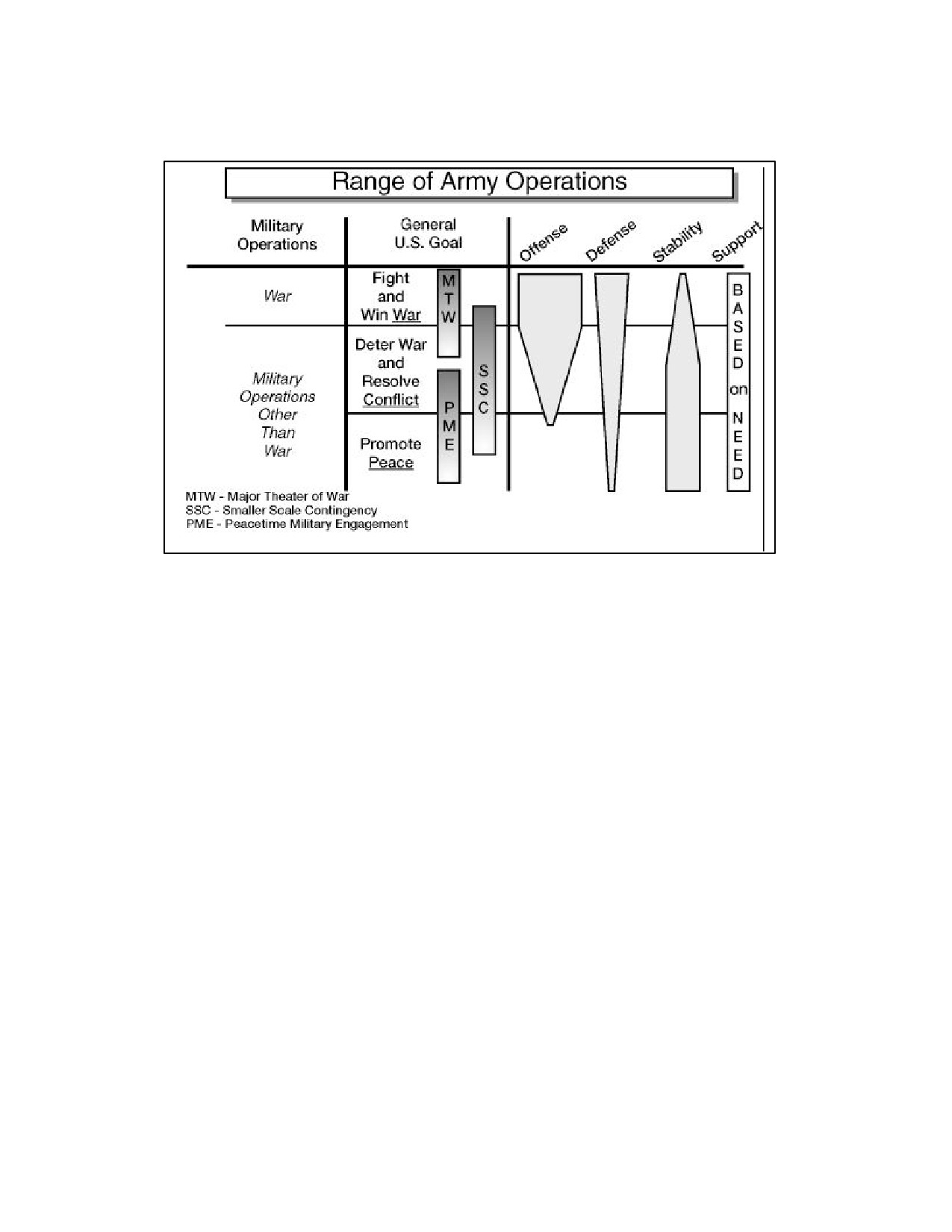
tions: Offense, Defensive, Stability and Support. The Army’s role differs with
each operation (Figure 2-1).
2-5
FM 1-05__________________________________________________________________________________
Figure 2-1. Range of Army Operations
OFFENSE
2-20. This is the decisive form of war. Offense is essential to success in all
operations—defensive, stability, and support as well as offensive.
DEFENSIVE
2-21. These operations are directed by command to defeat enemy attacks,
buy time, economize forces, or develop conditions favorable for the offense.
STABILITY
2-22. Stability operations include a range of actions that Army forces conduct
outside the United States and its territories. The main goal is to promote
and sustain regional and global stability. Characteristics of stability opera-
tions include a diverse and complex environment. These operations are
highly demanding on small units and leaders, require intense mental and
physical agility, and are often long-term. There are ten types of stability op-
erations:
· Peace operations.
· Foreign Internal Defense.
· Security assistance.
· Humanitarian and civic assistance.
· Support to insurgencies.
· Support to counter drug operations.
· Combating terrorism.
2-6
_______________________________________________________
RELIGIOUS SUPPORT ENVIRONMENT
· Noncombatant evacuation operations.
· Arms control.
· Show of force.
SUPPORT
2-23. Support operations are conducted to relieve suffering and help civil
authorities prepare for, or respond to, crises. They are divided into two
categories: Domestic support operations (DSO) conducted within the United
States and its territories, and foreign humanitarian assistance (FHA)
conducted outside the United States and its territories. Support Operations
usually are conducted to relieve or reduce the results of natural or manmade
disasters. They are also conducted to relieve conditions (such as pain, dis-
ease, hunger, or privation) that present a serious threat to life or loss of
property. There are several forms of support operations.
· Relief operations. Humanitarian relief focuses on the well being of
supported populations. Disaster relief focuses on recovery of critical in-
frastructure after a natural or manmade disaster.
· Support to incidents involving weapons of mass destruction
(WMD). Assistance is given to civil authorities protecting U.S. territory,
population, and infrastructure before an attack by supporting domestic
preparedness and protection of critical assets.
· Support to Civil Law Enforcement. This involves activities related to
counter terrorism, counter drug operations, military assistance to civil
disturbances, and general support.
· Community assistance. Provision is given to community assistance for
projecting a positive military image, training opportunities, and public
relationships.
Religious Support in Peace Operations
2-24. The range of religious support is tailored to support the objectives out-
lined in the operation plan or order. Unit Ministry Teams must understand
each of the four types of military operations in order to plan for, and execute,
religious support.
2-25. The Army performs peace operations that range from explicitly peace-
ful missions to those that have significant applications of combat power.
Peace operations are classified as peace making, peace building, and preven-
tative diplomacy. These operations are conducted outside U.S. territories
(FM 100-23).
Religious Support in Joint, Combined, and Interagency Operations
2-26. Army units deploy with other military services and agencies of the U.S.
government. Increasingly, the U.S. Army operates with other countries as
well. Army forces will normally deploy as part of a joint, multinational, and
interagency operation. These operations are collectively called unified
actions. This is true not only when the military effort is the prime strategic
option, but also when other strategic options are preferred.
2-27. Joint operations are operations in which two or more American mili-
tary departments are employed in the same operation. Joint doctrine is
published under the authority of the Chairman of the Joint Chiefs of Staff.
2-7
FM 1-05__________________________________________________________________________________
JP 1-05 provides doctrinal guidance for religious support in joint operations.
It is important to recognize that Joint publications take precedence over doc-
trine of the participating service branches.
2-28. Combined operations are operations in which American forces are em-
ployed along with forces from other nations. Operational procedures are de-
termined through agreement and coordination by higher headquarters.
Provisions for religious support should be included in the operational proce-
dures or policies agreed upon by the participating nations and coalitions; for
example, American, British, Canadian, and Australian/New Zealander
(ABCA) or the North Atlantic Treaty Organization (NATO).
2-29. Interagency operations are operations in which the military works in
tandem with another government agency. The lead agency and organiza-
tional relationship are specified in the mission directive. The provision of
religious support must be specified for each operation.
2-30. Standardized methods of operating may not be present in many Joint,
Combined, or Interagency Operations. Circumstances will occur that cannot
be anticipated. UMTs must be flexible and creative in planning religious
support for these operations. In each type of operation, the key elements to
consider for religious support mission accomplishment are understanding,
cooperation, and coordination. These will take place between U.S. chaplains,
multinational chaplains, and interagency representatives. This is essential
to achieve unity of effort in providing total and comprehensive theater of op-
eration religious support.
Religious Support in Special Operations
2-31. Special Operations Forces (SOF), which consist of specialized Army, Air
Force, and Navy units, give the President and the Secretary of Defense addi-
tional military options across the full spectrum of operations. These options
provide a strategic response capability to prevent future, or stabilize current,
international situations with minimum risk to U.S. interests. The theater
SOF commander executes special operations (SO) as part of the theater
commander's joint special operations effort. Religious support is woven into
this specialized Army and joint environment. The religious support plan-
ning encompasses all contingencies, whether direct or indirect military ac-
tions in support of a Joint Force Command.
2-32. U.S. Army Special Operations Command (USASOC) commands all
CONUS-based active and reserve Army Special Operations Forces (ARSOF)
units. This command is comprised of five types of units: Special Forces (SF),
Rangers, Army Special Operations Aviation (ARSOA), Psychological Opera-
tions (PSYOP), and Civil Affairs (CA).
2-33. The command is responsible for readiness and training oversight for all
Army Reserve SOF and all outside the continental United States (OCONUS)
forward based (deployed) active Army SOF. When directed, USASOC pro-
vides mission-ready ARSOF assets, through United States Special Opera-
tions Command (USSOCOM), to the regional combatant commanders for
employment under their command authority. (See Chapter 5 for religious
support tasks.)
2-8
_______________________________________________________
RELIGIOUS SUPPORT ENVIRONMENT
Religious Support and Military Support to Civilian Authorities
2-34. Another military environment in which religious support is provided is
Military Support to Civilian Authorities (also known as MSCA). These do-
mestic support operations involve the Army in assisting civilian authorities
by providing general military assistance. General assistance for domestic
support operations includes disaster assistance, environmental assistance,
and law enforcement support and community assistance. These operations
are conducted within U.S. territories (FM 100-19).
2-35. Religious support in both peace operations and MSCA, as well as Mili-
tary Assistance to Civil Disturbances (MACDIS), require intentional coordi-
nation and cooperation within the Chaplaincy among Army components (ac-
tive duty, Reserve, and National Guard (NG)), as well as with civil and NGO
leaders.
2-36. Civil Support will involve extensive coordination and liaison among in-
teragency, joint, multi-jurisdictional (state and local), and active and Reserve
Component (AC/RC) chaplaincies. When state authorities request Federal
help, the Federal Emergency Management Agency (FEMA) most often is the
lead agency, with DOD supporting. The Secretary of the Army is the execu-
tive agent. The Army Chaplaincy works directly for the military command
providing RS to soldiers and authorized civilians.
2-37. Reserve Component UMTs provide a unique capability for the Chap-
laincy. They have a long-term relationship with state and local religious
leaders, institutions, officials, and businesses. They also have special capa-
bilities and are geographically dispersed to conduct religious support opera-
tions. UMTs provide and perform the following religious support before,
during, and after crises:
· Planning. Army National Guard (ARNG) and Reserve component (RC)
UMTs are ideally suited to support any locality because of their disper-
sion throughout the Nation and long-term relationships with local
clergy, civil agencies, and institutions. Planning must consist of infor-
mation management, synchronization with all military and civil assets,
equipping and training for all contingency missions, close support of
Civil Military Operations tasks, shaping the force religious support
structure to meet operational needs and staff integration.
· Preparing. Doctrine, organization, training, material, leader develop-
ment, personnel and facilities (DOTMLPF) issues need to be continu-
ously reviewed by chaplain leadership in all Army components to re-
spond effectively within Civil Support operations. All written guidance
and plans need to be continuously updated to meet METT-TC needs and
directives. Standard operating procedures (SOPs), UMT battle-books,
and other publications need to address all areas to which all UMTs will
be directed to respond. Training incorporates many of the collective
skills that UMTs already possess and continually update.
· Responding and executing. When a crisis occurs, UMTs of selected
units, in support of the lead agency, will provide and perform direct re-
ligious support to military units, will perform liaison responsibilities
with State and Federal agencies pertaining to religious issues, will con-
duct religious risk assessment for the command, and will liaison with ci-
vilian religious leaders.
2-9
FM 1-05__________________________________________________________________________________
· Follow-up. In the days following a crisis, UMTs provide and perform re-
ligious support directly to military forces as they are employed after a
hostile event, to include the following tasks: mass casualty religious
support, critical event debriefings, liaison with local religious leaders,
etc.
2-38. The Medical Command (MEDCOM) plays a key role in response efforts.
Existing MEDCOM units may be tailored to meet the METT-TC require-
ments. MEDCOM UMTs will bring specific skills in mass casualty, trauma,
crisis intervention, and critical event debriefing ministry to these events. RS
planning must be well integrated within this health care response. Army
AC/RC deployable hospitals may move forward to the area of operations.
Military medical facilities may be used as a trauma center when that capa-
bility does not exist locally, or when called for under National Disaster Medi-
cal System (NDMS). Large numbers of casualties resulting from WMD will
challenge the UMT and other caregivers, resulting in increased need for
critical event debriefing and other types of intervention ministries. Special
Medical Augmentation Response Teams-Pastoral Care (SMART-PC) play a
unique religious support role in response ministry. SMART-PCs, as well as
the chaplain’s role in support of Special Medical Augmentation Response
Teams-Stress Management (SMART-SM), are discussed in depth in chapter
6 of this FM.
SUMMARY
2-39. Religious support provided during a military operation can occur under
widely differing circumstances. The UMT’s basic mission to provide relig-
ious support to the soldier, however, remains constant. What differs is the
operational environment in which the religious support is provided. The dif-
fering types of military operations determine the specific nature of religious
support.
2-40. The U.S. Army’s UMTs must be prepared to provide religious support
in every contingency or circumstance. With the expected increase in urban
terrain missions, the UMT will have more opportunity and responsibility to
interact with the local people and religious leaders in supporting the com-
mand mission. Additionally, METT-TC includes “civilians”, which include
both authorized DA Civilians, civilian contractors on the battlefield, as well
as indigenous and host nation civilians. These civilians are included as an
operational planning consideration for the UMTs to determine who, what,
when, and where to provide and perform religious support.
2-41. In all types of operations across the full spectrum, key elements to con-
sider for the religious support mission accomplishment are: understanding,
cooperation, and coordination between U.S. chaplains, multinational chap-
lains, and interagency representatives. This is essential to achieve unity of
effort in providing total and comprehensive theater of operation religious
support.
2-42. There are no boundaries between strategic, operational, tactical, and
MOOTW environment. Over time in the battlespace of a theater, opera-
tional activities link the tactical employment of forces to strategic objectives.
The Army strategic METL describes what “well -trained, superbly led, and
well-equipped soldiers do for the nation (FM 3-0).” Likewise, the Army
2-10
_______________________________________________________
RELIGIOUS SUPPORT ENVIRONMENT
Chaplain Corps, in support, provides a strategic METL that helps shape and
sustain the spiritual center of the soldier.
2-43. Civil Support will involve extensive coordination and liaison among in-
teragency, joint, multi-jurisdictional (state and local), and active and reserve
component (AC/RC) Chaplaincies. The RC UMT provides a unique capabil-
ity to the Chaplaincy. They have long-term relationships with state and lo-
cal religious leaders, institutions, officials, and businesses. Also, RC UMTs
have special capabilities and geographic dispersion to conduct religious sup-
port operations. Religious Support tasks will be in concert with the Army’s
role in Civil Support which follow in these categories: force protection, sup-
port to crisis management, support to consequence management, protection
of critical assets, support to counter-terrorism, deterrence/defense against
strategic attack, and MSCA missions.
RESOURCES
2-44. The following is a list of main resources utilized for writing and up-
dating this doctrine.
· AR 165-1.
· JP 1-05.
· JP 5-00.2.
· JP 3-0.
· JP 3-05.
· FM 3-0 (100-5).
· FM 16-1.
· FM 22-100.
· FM 1 (100-1).
· FM 100-19.
· National Military Strategy
· Joint Vision 2010
· Army Vision 2010
· A National Security Strategy For a New Century, May 1997
· U.S. Army Chaplaincy Strategic Plan FY 2000-FY 2005
· Chief of Chaplains MSCA Concept Paper, September 2000
· Chaplain Support Force XXI White Paper
· Quadrennial Defense Review Report, September 2001.
2-11
Chapter 3
UNIT MINISTRY TEAM OPERATIONS
"I was determined that whatever else might happen next time [post-W.W.I], at least I
myself would be prepared, and trained, and ready when the time came. I had at times a
kind of inward feeling that the call would come, to me personally, and in my prayers
morning and evening I used to ask that I might be given help and strength so that I
might not fail when put to the test."
--Field Marshall Montgomery, The Path of Leadership
"Everything is simple in war, but the simplest thing is difficult."
--Carl Von Clausewitz, On War
This chapter establishes the essential
elements of Religious Support (RS)
CONTENTS
planning, coordination, and execution
General Religious Support Planning,
efforts in all phases of operations. It ex-
Preparation, Coordination and
amines the following key points:
Execution Overview
3-1
· General Religious Support planning,
Religious Support Planning for
preparation, coordination and execu-
Force Projection
3-12
tion overview.
Battlefield Transition Planning and
Execution
3-18
· Religious Support Planning for Force
Installation Religious Support
3-22
Projection.
Summary
3-26
· General Responsibilities of the UMT
Resources
3-26
During Religious Support Operations.
GENERAL RELIGIOUS SUPPORT PLANNING, PREPARATION,
COORDINATION AND EXECUTION OVERVIEW
3-1. To meet the religious needs of soldiers and other authorized personnel
in all operations, the Unit Ministry Team (UMT) prepares a comprehensive
religious support plan that is staffed and integrated into every operational
phase. The UMT advises the commander on the plan for accomplishing the
religious support mission. The plan encompasses RS required from training
and mobilization, to redeployment and demobilization.
3-2. The commander is responsible for the execution of the Religious Sup-
port Plan (RSP). The Chaplain, as a member of the commander’s personal
staff, is responsible to the commander to plan and implement the following:
3-1
FM 1-05__________________________________________________________________________________
· Developing the RSP.
· Executing the approved RSP.
· Use of available religious support resources.
· Allocation of assets.
· Location of UMTs.
· Coordination with indigenous religious leaders.
· Coordination with religious NGOs and IOs in coordination with Civil
Military Operations leaders.
· Religious support for all authorized civilians in the AO.
PLANNING
3-3. The UMT participates in the collaborative planning process with the
other staff sections known as the Military Decision-Making Process
(MDMP). Religious support planning is
continuous, detailed, and systematic. It
KEY PLANNING
examines all factors relating to the re-
CONSIDERATIONS:
ligious support of an operation. The
· Commander’s Intent
planning process builds on the religious
· Concept of Operations
support section of the unit's tactical
· Concept of Logistics
standard operating procedures (TSOP).
· Concept of Medical Support
It becomes specific to an operation
· ROE
through the preparation of a religious
· METT-TC of the battlespace/theater
support estimate (RSE). The product of
of operations
this planning process is a religious
support plan (RSP). The RSP is in-
cluded in the operations plan or operations order (OPLAN/OPORD). Inclu-
sion may be in the plan/order as an appendix, annex or TAB. The specific
placement of the RSP is dependent upon the particular unit’s protocol for
constructing operation plans and orders. The RSP informs the command
and staff of the concept of religious support, and guides the work of the
UMT. When appropriate, the RSP can be contained in a matrix format. A
model for such a RSP matrix is contained in Appendix D of this manual. The
use of a RSP matrix is appropriate when UMTs are assigned or attached to
units that publish their OPLANS/OPORDS in a matrix format. The RSP
matrix model is a self-explanatory form that clearly and concisely articulates
how the UMT will provide religious support during the operation. The use
of a RSP matrix is highly recommended when time constraints impact the
planning process and the UMT needs a ready tool to direct and encapsulate
its religious support planning.
Religious Support Estimate
3-4. The estimate process is a problem solving procedure to assist the com-
mander in determining the best course of action (COA) to accomplish a mis-
sion or task. Staff estimates are designed to supplement the commander’s
estimate within the respective areas of expertise. A staff estimate consists of
significant facts, events, conclusions and recommendations on how best to
use available resources to accomplish the mission. Upon receipt of the com-
mander’s guidance, each staff section develops its own staff estimate relating
how its area of interest will affect the mission.
3-2
_________________________________________________________
UNIT MINISTRY TEAM OPERATIONS
3-5. The chaplain develops the
BASIC PRINCIPLES OF RS
Religious Support Estimate (RSE) that
PLANNING AND
becomes the basis for the Religious
COORDINATION
Support Plan (RSP). Development of
· Plan early and continuously.
the RSE ensures the careful and
· Use guidance from higher HQ.
intentional planning of religious
· Exploit all available RS assets.
support. In the development of the
· Use the lowest echelon capable of
RSE, the chaplain considers the —
furnishing effective RS.
· Location and movement of the
· Use the most effective RS means.
UMT during all phases of the
· Furnish the type of RS requested.
operation.
· Avoid unnecessary duplication.
· Logistical and communication
· Coordinate RS along command
support required for specific
and technical channels.
missions.
· Provide adequate support.
· Replacement and/or augmentation
· Provide rapid coordination.
of UMT members in the event
· Provide safeguards and surviv-
UMT members become casualties
ability.
or are unable to meet all RS needs
· Establish RS coordination meas-
during especially intense fighting.
ures.
· Religious, moral, and morale
· Establish communications support.
issues that affect the soldiers and
the unit.
· Impact of indigenous religions on the military operation.
3-6. The preparation of the estimate follows a logical, continuous, and me-
thodical process to provide the appropriate religious support for the com-
mander's selected COA. In conjunction with the other staff sections, the
UMT prepares the RSE using the following steps:
1. Gather facts and assumptions.
2. Analyze the mission.
3. Develop courses of action.
4. Analyze and compare courses of action.
5. Make a recommendation.
Step 1: Gather Facts and Assumptions
3-7. The staff gathers information concerning the assigned mission and di-
vides the information into two categories: facts and assumptions. Facts are
statements of known data concerning the situation, and include the follow-
ing:
· Enemy and friendly dispositions.
· Available troops.
· Unit strengths.
· Materiel readiness.
· Mission and the commander's intent.
3-8. Special religious needs of soldiers in the unit are key facts for the RSE.
The team develops a Religious Preference Profile (RPP) using data from a
Standard Installation/Division Personnel System (SIDPERS) ad hoc query.
(See AR 680-29 for religious preference codes.) The report is a statistical
analysis of the unit’s religious demographics and provides the stated relig-
ious preference of soldiers assigned to that unit.
3-3
FM 1-05__________________________________________________________________________________
3-9. When facts essential to planning for RS are not available, the UMT
must make assumptions. An assumption is a supposition about the current
or future situation, assumed to be true, though without positive proof. In
the absence of facts, assumptions are used to fill gaps. Assumptions are nec-
essary only when they bear directly upon the planning or the execution of
the plan. As new information becomes available, some assumptions become
facts and some are modified or discarded.
3-10. Mission, Enemy, Terrain and Weather, Troops and support available,
Time available, and Civil Considerations, or METT-TC, is a useful outline by
which to consider and formulate facts and assumptions essential for devel-
oping an RSE.
Mission, Enemy, Terrain and Weather, Troops and support available, Time available, and
Civil Considerations (METT-TC)
Mission: The UMT identifies specified or implied religious support tasks from the higher
headquarters’ OPLAN or OPORD. For example, a requirement to provide area religious support
may be implied but not specified by a higher headquarters’ task organization. Other considerations
may include protection of religious shrines, artifacts or sacred places in the AO.
Enemy: In this part of mission analysis, the team identifies how the enemy may threaten the
religious support mission. For example, enemy activity in rear areas may restrict team travel and
necessitate additional area support requirements. The team may also consider how religion plays
a part in the enemy’s capacity or inclination to fight.
Terrain and Weather: The UMT assesses the terrain and weather in the AO. Traffic-ability,
weather extremes, and the amount of daylight are factors that will affect the religious support
mission. (Consider observation and fields of fire, cover and concealment, obstacles, key terrain,
and avenues of approach (OCOKA).
Troops: Religious support is focused upon soldiers. What soldiers are doing often determines
their availability for religious support. The UMT adjusts its plan to match the soldiers' schedules to
meet their needs. The UMT must also assess the level of anxiety and fatigue among the troops to
shape its ministry to the soldiers more effectively. The UMT will also advise the commander on the
morale, moral, and spiritual health and welfare of soldiers.
Time Available: The UMT assesses the time required for planning and the time available for
executing the religious support mission. The amount of planning time determines the detail of the
plan. The team also considers the travel time to each unit, preparation time, and available light.
Civil Considerations: The UMT researches and advises the command on the religious
attitudes and activities of the civilian population, religious and cultural dynamics, religious
organizations, and religious leaders within the battlespace. Coordination with CMO personnel is
essential. The chaplain advises the commander regarding civil concerns and their impact on the
mission:
· Understanding the operational religious environment.
· Recognize religious implications for courses of action during planning.
· Anticipate and control negative impacts on the local religious climate.
· Consider long-term effects of operations on the indigenous religious climate.
· Ensure legitimacy and credibility of friendly forces.
· Balance operational priorities with concern for religious freedom.
· Minimize negative effects of operation on unit soldiers belonging to the same faith group as
the local population.
3-4
_________________________________________________________
UNIT MINISTRY TEAM OPERATIONS
Step 2: Analyze the Mission
3-11. Mission analysis begins with a review of the intent of commanders one
and two levels higher. From this review, the commander and staff derive
the specified tasks that the unit must perform to accomplish the mission.
The unit must also identify implied tasks and determine which tasks are es-
sential. A tentative list of essential tasks is presented to the commander for
approval. Based upon the approved list, the staff presents the commander
with a restated mission for approval. Commanders disseminate the restated
mission as a warning order.
3-12. The UMT participates with the rest of the staff in mission analysis by
identifying specified and implied religious support tasks. The UMT also con-
siders any religious factors that may directly affect the mission. (FM 101-5,
Appendix J)
3-13. During mission analysis, in addition to the RSE, the UMT brings ex-
pertise to the staff team in studying the following areas:
· Unit Morale. The UMT should have a sense of the morale of the unit.
Factors such as whether the troops are fatigued, are excited or dreading
the mission, and the spiritual health and welfare of the unit all impact
on unit morale.
· Ethical and moral implications. The chaplain can assist the staff in
considering the ethical and moral implications of a particular plan as it
impacts on the lives of leaders, soldiers, and the local civilian population.
For example, this may include compassionate treatment of EPWs, de-
tainees, and displaced persons.
· Impact of local religion on the mission. The chaplain can assist in
the religious assessment of an AO. The UMT should familiarize them-
selves with the local religions and their significance within the area of
operations. What and where are the places that are considered sacred?
What are the significant religious holidays and how are they celebrated?
How could this impact the operation or the timing of the operation? (See
Appendix F).
Step 3: Develop Courses of Action
3-14. Course of action (COA) development is based on mission analysis and
on the facts and assumptions developed earlier. After receiving the com-
mander's guidance, the Chief of Staff (CofS) or the executive officer (XO)
leads the staff in developing COAs for accomplishing the mission. As the
staff begins to develop COAs, the chaplain considers the religious and
moral/ethical implications of each proposed COA and how to provide relig-
ious support. While the operations officer formulates the tactical possibili-
ties, the chaplain and other staff officers consider how to integrate their
functional areas into each COA. In the midst of COA development, the use
of Chaplain Detachments (CD) by those units to which they have a doctrinal
association must be considered and implemented into the COAs and the
eventual RSP. Likewise, units with a doctrinal association with CDs must
proactively request CDs through appropriate staff actions to ensure their op-
erational employment.
3-5
FM 1-05__________________________________________________________________________________
Step 4: Analyze and Compare Courses of Action
3-15. After the staff develops several COAs, it analyzes each one. COA
analysis consists of two parts: war-gaming and COA comparison. Through
this process, the staff identifies the best COA to recommend to the com-
mander.
3-16. Note that the chaplain may have a different kind of input depending on
the kind of mission that is being planned. For units preparing for offensive
or defensive actions, often the chaplain’s role is more involved with inte-
grating with the staff and being a team player while developing the RS as-
pect of the plan. In a stability and support operation, a chaplain may have
more to contribute in the plan development process. In both cases, the
chaplain will want to anticipate the COA toward which the commander may
be leaning.
3-17. Additionally, the chaplain will want to pay particular attention to the
casualty flow estimates and concepts of support. During the war gaming
phase of the MDMP, chaplains must pay particular attention to where the
casualties are expected, remembering that this critical ministry is one of the
three major functions of comprehensive religious support. If the chaplain
participates in the war gaming phase of the analysis, the chaplain will have
a much clearer understanding of the scope of the mission when the COA is
finally decided upon and then rehearsed.
Step 5: Make a Recommendation
3-18. After choosing the best COA, the staff briefs the commander. The
commander may agree with the staff's recommendation, modify it, or select
another. Once the commander decides on a COA, the UMT uses the con-
cepts of support developed during the RSE process to prepare the Religious
Support Plan (RSP).
3-19. The commander and staff begin preparations for the mission rehears-
als. The chaplain needs to participate in the rehearsals in order to test the
effectiveness of the RSP. Afterwards an assessment is made as to whether
the plan actually meets the needs of the troops according to the commander’s
guidance.
Note: The adjutant (S1), supply officer (S4), and the chaplain are often not
included in the accelerated MDMP process. However, this does not preclude
the UMT from preparing RSEs and RSPs. Staff coordination and proper
analysis is always necessary.
Religious Support Plan
3-20. Based on the selected COA, the UMT completes the details of its plan
for inclusion in the OPLAN/OPORD. The religious support plan (RSP) as-
signs religious support responsibilities, defines area support requirements,
and authorizes coordination between subordinate units.
3-21. Additional information found in the RSP may include the following:
· Concept of support for special faith groups and special holy days.
· Concepts of support for joint and multinational religious services sup-
port.
3-6
_________________________________________________________
UNIT MINISTRY TEAM OPERATIONS
· Religious support requirements of all authorized civilians.
· Religious support for EPWs and Detainees in accordance with the Ge-
neva Convention.
· Command guidance regarding liaison responsibilities with faith-based
NGO/IOs and liaison support, in coordination with CMO personnel, to
religious leaders in the AO.
3-22. Priority of religious support is—
· Unit military personnel.
· Other military personnel in AO.
· Authorized civilians such as DOD employees and contractors.
· EPWs and Detainees.
Planning Religious Support in Joint Operations
3-23. Just as in the Army planning process, the UMT is included in the sys-
tem of joint planning. The Religious Ministry Support Team (RMST) (chap-
lain and chaplain assistants as designated under JP 1-05, which the Army
designates as UMT) at each echelon is intricately involved with the orders
process. Planning religious support operations must encompass and con-
sider—
· Denominational assets.
· Command relationships.
· Location of RMSTs.
· Logistical requirements.
(See JP 1-05 for more detail.)
Planning Religious Support in Multinational Operations
3-24. Religious support planning with multinational forces in an operation
must include the differences in religious support doctrine (or military custom
of providing religious support), capabilities, force structure, logistics, and
culture (denominational representation, language, supervision, etc). Com-
munication, cooperation, and coordination are essential in planning multina-
tional religious support operations. Senior force RMSTs need to understand
the capabilities and limitations of religious support with each country repre-
sented within the coalition. Planning must remain flexible due to these dif-
ferences while emphasizing the similarities that may include, language
common between countries, denominational backgrounds of chaplains, and
locations for area support. Senior U.S. RMSTs must be highly sensitive to
allocating religious support assets of another country and should only do so
with prior consultation and coordination. Planning considerations include—
· Communication requirements and limitations.
· Denominational representation.
· Language difficulties.
· Limitations in formal chaplain structures.
Rules of Engagement
3-25. Rules of engagement (ROE) specify the circumstances and limitations
in which forces may engage the “enemy”. Many factors influence ROE, in-
cluding national command policy, mission, operational environment, com-
3-7
FM 1-05__________________________________________________________________________________
mander’s intent and the law of land warfare. Properly written ROE are
clear and tailored to the situation.
3-26. Chaplains at all echelons help commanders apply the ROE by advising
on the moral/ethical implications of proposed COAs. Senior-level chaplains
consider the restrictions and constraints of the ROE when recommending
religious support policy to the commander.
PREPARATION
3-27. Preparation is the link between planning and execution. While the
commander and staff are planning, the unit prepares for the operation based
on a warning order issued earlier by the commander. Once the plan is com-
plete, preparations unique to the mission may begin. Upon completion of the
individual and team preparations, the UMT provides religious support to
soldiers while they complete their preparation for the operation.
Rehearsals
3-28. Units conduct rehearsals during preparation for combat. In addition to
maneuver rehearsals, units conduct combat service support (CSS) and casu-
alty evacuation rehearsals. Rehearsals provide an opportunity to refine the
RSP. The UMT must be present at the rehearsal, and integrate the RSP
into it, to fully understand the scheme of maneuver, support, and other criti-
cal pieces of information shared. If time permits, UMTs may conduct their
own RS rehearsals following those of the unit. Such RS rehearsals offer
UMTs an opportunity to resolve communication issues, as well as, build a
comprehensive understanding of each UMT’s religious support mission.
Individual and Team Preparation
3-29. The chaplain and chaplain assistant prepare themselves for combat
like other soldiers of the unit. This preparation must be physical, mental
and spiritual. The chaplain and chaplain assistant must also insure that
their families are ready for coping with the challenges of deployment.
3-30. Team preparation includes load plans, pre-combat checks, updating in-
formation, map reconnaissance, travel planning, rehearsals, and mission co-
ordination. Other preparations include securing equipment for the opera-
tion such as worship aids, devotional literature, music, and liturgical items.
Pre-Combat Inspections and Preparation
3-31. The UMT conducts a pre-combat inspection according to the unit
TSOP. This inspection ensures the UMT possesses sufficient supplies and
equipment to successfully execute the operation. On every mission, the team
must carry food, water, and other survival equipment. The chaplain assis-
tant prepares and updates the team’s load plan and inventories and ar-
ranges the necessary supplies and equipment for movement.
Information Update
3-32. The UMT updates mission information regularly— especially before
departing from its operational base. The tactical situation can change rap-
idly on the battlefield. The team checks the situation map, situation reports
(SITREPS), logistics reports, and the latest fragmentary orders (FRAGOs) or
warning orders. If there are significant changes in the situation, the team
modifies its plan accordingly.
3-8
_________________________________________________________
UNIT MINISTRY TEAM OPERATIONS
Training
“The key to winning on the battlefield is the understanding of “how we fight” and the
demonstrated confidence, competence, and initiative of our soldiers and leaders. Train-
ing is the means to achieve the tactical and technical proficiency that soldiers, leaders,
and units must have to enable them to accomplish their missions.”
FM 7-0, TRAINING THE FORCE
3-33. Training is the cornerstone of preparation for military operations. The
Army's primary activity during peacetime is realistic, battle-focused training
oriented on the unit’s mission essential task list (METL). Installation chap-
lains, through their training managers, and in coordination with subordi-
nate UMTs and unit operations/training officers (S3/G3), ensure that UMTs
have adequate technical and tactical training for deployment and combat.
The training objective is operational readiness—units and soldiers that are
tactically and technically proficient.
3-34. Tactical proficiency is a demonstrated understanding of the Army's war
fighting doctrine and tactics. To provide effective religious support in com-
bat, the UMT must know its unit's standard operational procedures, tactics,
and techniques. The UMT must also maintain the requisite skills of field
craft essential for survival on the battlefield. Tactical training is primarily
the responsibility of the unit to which the UMT is assigned or attached.
3-35. Technical proficiency is the demonstrated ability to perform all tasks
related to one’s functional area. Technical proficiency is required for both
garrison and field missions. Technical proficiency is acquired from schools,
self-study and training with other UMTs in performing the unit’s and in-
stallation’s religious support mission. Training and continuing education
conferences, functional courses offered by the U.S. Army Chaplain Center
and School (USACHCS), and courses offered through the Officer and NCO
Education System (OES and NCOES) supplement the installation religious
support-training program.
"To understand firepower and its application you have to use it, actually practice with it
and see it work. This means maneuvers in the field, maneuvers that reproduce as realis-
tically as possible, within the bounds of prudence, the actual conditions a soldier will
encounter on the battlefield. Only so can you condition, not only the human body, but
also the human spirit, to face and survive the stresses and strains the soldier will en-
counter in battle. And in future battle, if it comes, these stresses and strains will be im-
measurably greater."
General Matthew Ridgeway
3-36. The UMT must plan for and participate in religious support training
for both combat and garrison environments. Furthermore, the UMT must
participate fully in both the unit tactical and religious support training to
assure their tactical and technical proficiency.
Assessment of Unit Ministry Team Readiness
3-37. As the commander's personal staff officer for religious support, chap-
lains at brigade and higher levels are responsible for assessing the tactical
3-9
FM 1-05__________________________________________________________________________________
and technical proficiency of UMTs in subordinate units. They conduct as-
sessments of the UMT during field training exercises (FTXs), external Army
Training and Evaluation Program (ARTEP) events, unit training and Com-
mand Inspections. Observer controllers provide additional assessment assis-
tance when the UMT is involved in Battle Command Training Program
(BCTP) events or Combat Training Center (CTC) rotations. These CTC as-
sessments for UMTs are important for readiness analysis and training.
3-38. Chaplains and chaplain assistants participate in the installation’s
Command Master Religious Plan (CMRP) to help soldiers develop the per-
sonal spiritual readiness needed to sustain them during combat. Spiritual
readiness is also essential to sustain soldier families while the unit is de-
ployed. As part of the installation’s CMRP, the UMTs conduct worship
services, offer religious education, and provide spiritual fitness training and
other activities in installation chapels and facilities, and in the theater of op-
erations. Spiritual readiness applies to all levels of the command. Planning
for spiritual readiness programs must be part of the preparation for combat
for each soldier and authorized personnel.
Religious Support Preparation in Joint Operations
3-39. Coordination between all RMSTs is critical for full implementation of
the RSP. Total synchronization between all religious support elements is
key to a comprehensive plan. The joint task force (JTF) RMST considers the
following additional tasks for operational preparation:
· Identifying RMST logistical requirements.
· Personnel staffing and augmentation requirements.
· RSP integration within the operational plan.
· RSP rehearsals.
· Spiritual Nurture programs for the command and staff.
· Loading of equipment and material.
3-40. The Command JTF RMST works closely with the Joint staff for RMST
closure within the Joint Operational Area (JOA), ensuring communication
and synchronization of the RSP.
Religious Support Preparation in Multinational Operations
3-41. Each nation brings different capabilities and limitations to the Com-
bined-Joint Task Force (CJTF). Task organizing along functional lines vice
national lines can help fill capability gaps, and designs each nation’s role so
they are full participants. Comprehensive religious support information dis-
seminated to all participating nations describing religious support opera-
tional expectations will prepare all combined participants for spiritual and
religious coverage. UMTs must logistically prepare themselves to meet the
many diverse and varied religious and cultural differences. Communication
limitations and differences must be prepared for such as language, terminol-
ogy, systems, and distance. Liaison and training can offset some of the
challenges.
3-10
_________________________________________________________
UNIT MINISTRY TEAM OPERATIONS
“A chaplain visits our company. In a tired voice, he prays for the strength of our arms
and for the souls of the men who are to die. We do not consider his denomination. Hel-
mets come off. Catholics, Jews, and Protestants bow their heads and finger their weap-
ons. It is front-line religion: God and the Garand.”
Audie Murphy, To Hell and Back
COORDINATION
3-42. Coordination consists of three categories: mission, internal, and exter-
nal.
Mission Coordination
3-43. The size of the AO and unit dispersion challenge the UMT’s ability to
coordinate for religious support. Communications equipment is critical for
timely and effective coordination. Also, key communications systems allow
the UMT to be available for emergency tasks. Early planning and coordina-
tion will help to eliminate potential problems. Coordination is both internal
to the participating units and UMTs, and with external units, agencies, and
UMTs.
Internal Coordination
3-44. As a personal staff officer, the chaplain works for the commander, ad-
vises the commander, and executes the commander’s religious support pro-
gram on his behalf. The UMT coordinates the execution of the commander’s
religious support program with the Chief of Staff or XO. The team plans co-
operatively with all staff sections for the exchange of information.
External Coordination
3-45. Because of the rapidly changing dynamics, conditions, and circum-
stances on the modern battlefield, coordination for area support is difficult.
Although religious support execution is decentralized, UMTs must synchro-
nize religious support within their subordinate units. Establishing synchro-
nization procedures with subordinate commands before deployment reduces
the communication and coordination challenge for the UMT.
3-46. Military communication channels streamline information distribution
on the battlefield. The team uses command, staff, and technical channels for
communication, guidance, and coordination.
· Command: The command channel is the official communication line be-
tween headquarters for passing orders, instructions, and tasks to subor-
dinate units. Command channels link commander to commander.
Within the authority granted them, staff officers use command channels
when acting for the commander. It is seldom if ever used by the UMT.
· Staff: The staff channel is the staff-to-staff link between headquarters.
It is the primary channel the UMT uses for planning and coordinating
religious support. Through this channel, the team transmits and coordi-
nates planning information and provides staff supervision of religious
support in subordinate units.
· Technical: The technical channel is the link between members of the
same branch or discipline to convey technical instructions and guidance.
Chaplains use the technical channel to communicate with UMTs of other
3-11
FM 1-05__________________________________________________________________________________
units about the technical aspects and details of religious support. It is
not used to send official reports, to request religious support, or to send
routine information between teams. This information is communicated
through command or staff channels.
EXECUTION
3-47. The execution of the religious support mission on the battlefield is de-
centralized and performed by UMTs in accordance with the RSP. Adjust-
ments to the plan are coordinated between affected units.
RELIGIOUS SUPPORT PLANNING FOR FORCE PROJECTION
MOBILIZATION
3-48. United States military strategy rests upon the ability to rapidly re-
spond to crises. Responding to crises requires the Army to deploy its forces
and may require mobilization of Reserve Component (RC) resources. De-
ployment comprises those activities required to prepare and move the force
and its sustainment equipment and supplies to the AO.
Religious Support during Mobilization
3-49. Mobilization is the activation of the U.S. Army Reserve (USAR) and
federalization of the Army National Guard. Mobilization provides com-
manders with RC forces, manpower, facilities, and logistics. FM 100-17-3,
Reception, Staging, Onward Movement, and Integration (RSOI), provides
additional information on RSOI procedures. It expands the Army's capabil-
ity to respond to crises. Mobilization is conducted in five phases:
· Phase I. Planning.
· Phase II. Alert.
· Phase III. Home Station.
· Phase IV. Mobilization Station.
· Phase V. Port of Embarkation.
Mobilization Phase I: Planning
3-50. Planning begins long before a unit is mobilized. During peacetime, Ac-
tive component (AC) and Reserve component (RC) UMTs coordinate with
AC units for their mobilization planning. This planning takes into account
operational and training requirements, equipment status, and readiness. It
also includes the impact of mobilization on soldiers, families, and communi-
ties.
3-51. The primary planning tool for mobilization is the Unit Ministry Team
Mobilization Systems Planbook (MOB Planbook). The MOB Planbook inte-
grates all phases and levels of mobilization, and it provides a detailed guide
for integrating mobilization planning.
3-52. Installation, Continental United States Army (CONUSA), STARC, and
USARC chaplains are key to Reserve Component UMT mobilization. Each
maintains a copy of the UMT MOB Planbook. Organizational MOB Plan-
books contain the same basic information, but each is tailored for the par-
ticular headquarters. The MOB Planbook specifies what must be accom-
plished during each phase of mobilization. While many of the tasks in the
3-12
_________________________________________________________
UNIT MINISTRY TEAM OPERATIONS
MOB Planbooks are unique, they are designed to integrate the mobilization
process.
3-53. A unit's success is directly related to the quality of its preparation be-
fore it conducts operations. A representative listing of the mobilization
planning responsibilities for installation, CONUSA, STARC, and USARC
chaplains is detailed in Chapter 7. Planning considerations—
· Does the home station require special planning or preparation?
· Where is the home station in relation to support resources?
· How does the UMT provide family support briefings?
· How will the UMT provide required religious support if some parts of the
unit remain at home station for an extended period of time, while others
elements are sent forward to the mobilization station (MS)?
· Does the UMT go forward with the advance party or with the main body
of the unit?
· How do durations in personnel holding areas, movement, or separation
influence soldier morale?
· What religious support activities would address morale problems in the
unit?
· What actions are required to close out civilian responsibilities?
· What coordination is required with faith groups for religious coverage
during mobilization?
· What supplies are required for religious support?
· What religious support is required as the unit transitions to war?
· What training is required to bring the UMT to validated status for de-
ployment?
3-54. Thorough planning and realistic training before a mobilization reduces
confusion between all key UMT participants. Mobilization training gives
both AC and RC UMTs an opportunity to practice their mobilization relig-
ious support missions, and an opportunity to assess the adequacy of mobili-
zation plans. Installations assist with the following RC UMT training
events:
· Annual training (AT).
· Individual Mobilization Augmentee (IMA) training.
· Individual training events, Individual Ready Reserve (IRR), and Chap-
lain Candidate training.
· AC/RC Sustainment Training.
· Training for UMTs in Garrison Support Units (GSUs).
· AC / RC Annual Chaplaincy Regional Sustainment Training (CREST) as
mandated by the Chief of Chaplains.
3-13
FM 1-05__________________________________________________________________________________
Planning Considerations:
· Does the home station require special planning or preparation?
· Where is the home station in relation to support resources?
· How does the UMT provide family support briefings?
· How will the UMT provide required religious support if some parts of the unit
remain at home station for an extended period of time, while others elements
are sent forward to the mobilization station (MS)?
· Does the UMT go forward with the advance party or with the main body of the
unit?
· How do durations in personnel holding areas, movement, or separation influence
soldier morale?
· What religious support activities would address morale problems in the unit?
· What actions are required to close out civilian responsibilities?
· What coordination is required with faith groups for religious coverage during
mobilization?
· What supplies are required for religious support?
· What religious support is required as the unit transitions to war?
· What training is required to bring the UMT to validated status for deployment?
Mobilization Phase II: Alert
3-55. The Alert Phase begins when the unit receives the alert order of a
pending mobilization order. The UMT reports immediately to its home sta-
tion and the unit conducts the final screening of soldiers and cross leveling of
personnel and equipment. The Alert Phase ends on the effective date of the
unit’s entry on active duty.
Note: RC chaplains cannot be mobilized (i.e. cannot be brought onto Active
Duty) until they have completed all phases of the Chaplain Officer Basic
Course (CHOBC). AC chaplains are non-deployable until the sustainment
phase of CHOBC is completed. (See AR 165-1)
Mobilization Phase III: Home Station
3-56. Phase III begins on the effective date of the unit's mobilization. The ef-
fective date of mobilization is when RC chaplains and chaplain assistants
come on Active Duty. During this phase the unit begins its transition to ac-
tive duty. At home station the unit inventories property, dispatches an ad-
vance party, and moves to the mobilization station (MS). This phase ends
when the unit arrives at the MS.
3-57. UMTs must balance the time spent in their own deployment prepara-
tion with providing religious support to soldiers and families.
Mobilization Phase IV: Mobilization Station (MS)
3-58. Phase IV begins when the unit arrives at the mobilization station. Ac-
tivities at the MS include processing personnel and equipment, accessioning
the unit into the active structure, cross-leveling, and soldier readiness proc-
essing. The UMT, along with the unit, engages in individual and collective
training and validation exercises for survival on the battlefield. The goal of
the unit during this phase is to achieve mission capability in the shortest
3-14
_________________________________________________________
UNIT MINISTRY TEAM OPERATIONS
possible time. The MS phase ends when the unit arrives at the port of
embarkation (POE).
Note: The unit's line of authority shifts during this phase from the CONUSA
to the MS commander.
Mobilization Phase V: Port of Embarkation (POE)
3-59. This phase begins with the arrival of the unit at its POE. Actions at
the POE include preparing and loading equipment and manifesting and
loading personnel. The POE phase ends with departure of personnel and
equipment from the POE.
UNIT RELIGIOUS SUPPORT DURING DEPLOYMENT
3-60. Deployment is the planning, preparation and movement of forces and
support base from any location to an area of operations in response to mili-
tary need or crisis. Deployment may take the form of a forcible or permis-
sive entry. Deployments are conducted in five phases:
· Phase I. Pre-deployment Activities.
· Phase II. Movement to Ports of Embarkation.
· Phase III. Strategic Lift.
· Phase IV. Theater Base Reception.
· Phase V. Theater Onward Movement.
Deployment Phase I: Pre-deployment Activities
3-61. Pre-deployment activities begin when a unit receives a deployment no-
tification. These activities include mission briefings and planning, family
pre-deployment briefings, equipment loading, chapel closeout, and the trans-
fer of property accountability.
Mission Planning
3-62. As discussed above, the commander and staff begin the MDMP after
they receive the deployment notification and they review contingency plans
for completeness and accuracy. The UMT, along with the rest of the staff,
begins to prepare an estimate of the situation. The team balances planning
and preparation with providing religious support.
3-63. Religious support planners at higher echelons integrate the broader
scheme of the operation into the planning process. They assess lines of
authority, task organization, and faith group needs to determine the re-
quired number and mix of UMTs. Senior planners monitor the tailoring of
the deploying force. When a JTF or Army Forces (ARFOR) commander
forms an ad hoc headquarters, senior chaplains must monitor its composition
to ensure the inclusion of a senior chaplain on the staff.
3-64. If the theater chaplain is not scheduled to deploy immediately, he des-
ignates a senior chaplain to be responsible for coordinating religious support
in theater during each stage of the deployment preceding his arrival.
Chapel Transitions
3-65. The installation chaplain is responsible for all religious support facili-
ties on the installation. Deploying UMTs coordinate chapel transition with
3-15
///////////////////////////////////////