FM 3-22.34 TOW WEAPON SYSTEM (November 2003) - page 4
FM 3-22.34
environments. The TFTT trains gunners to adopt a correct firing position, assess target
engageability, and to engage and track the target. Missile launch, flight and impact effects
are realistically simulated by the TFTT.
F-6. COMPONENTS AND FEATURES
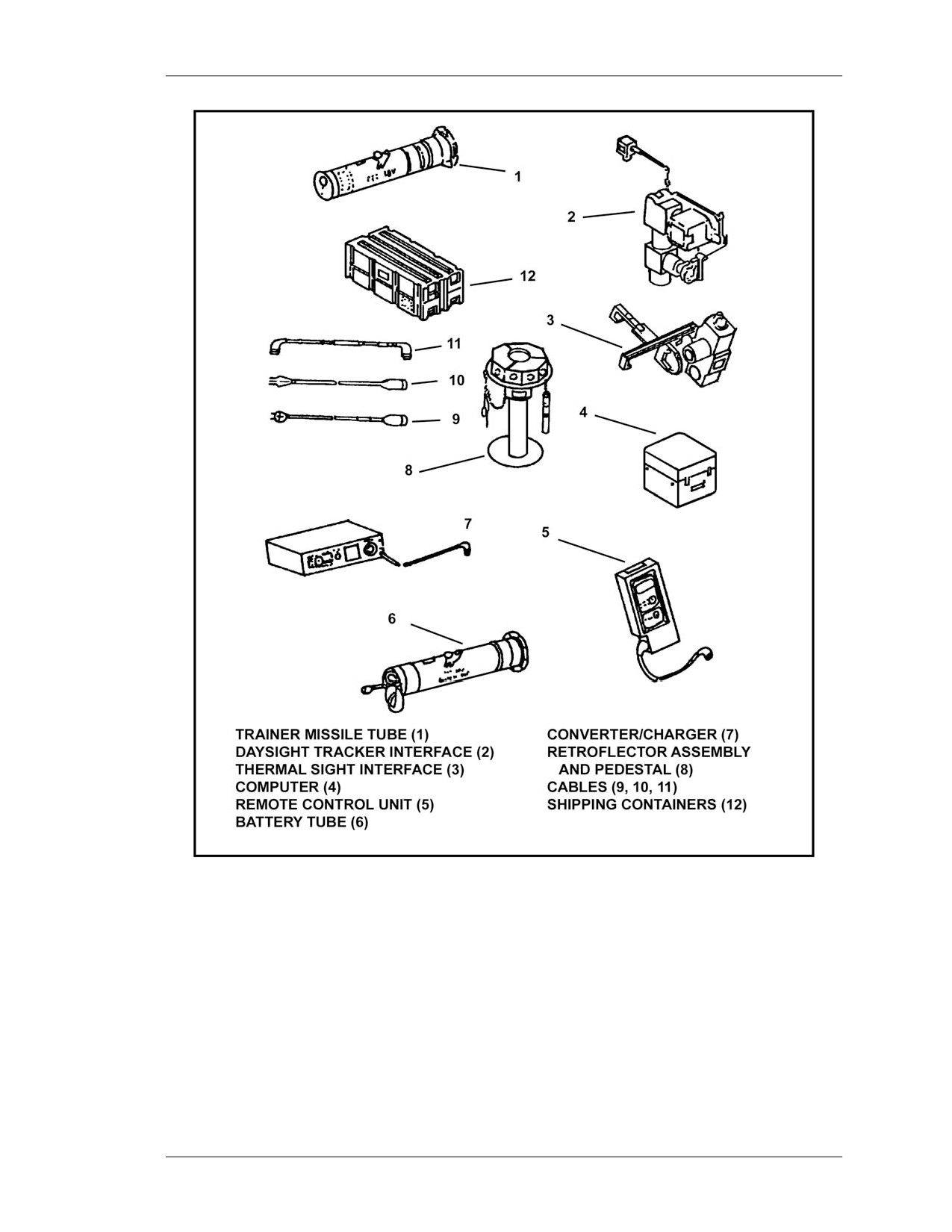
The TFTT consists of TFTT-unique components and a TOW 2 weapon system. The
TFTT attaches to the TOW 2 and replaces some of its components. The TFTT can be
either tripod mounted or HMMWV mounted and can be configured for the M966
(Figure F-4).
a. The TFTT uses the TOW 2 weapon system equipment to enhance training
realism. In addition, most of the TFTT components are designed to resemble actual
weapon system equipment. The TFTT uses a retroreflector to designate its target. The
retroreflector returns a portion of the laser beam generated by the gunner. The laser beam
enables precise measurement of target range and location relative to the gunner. The
retroreflector can be mounted on a variety of target vehicles, which can be maneuvered as
required during a training mission. Targets equipped with MILES sensors can also be
engaged by the TFTT.
b. The TFTT operator loads the M80 blast simulator, sets the duration of the
obscuration that simulates the smoke produced at missile launch, and selects the relative
size of the target. Following missile launch, the operator monitors gunner performance
during missile flight. At the end of each mission, the operator is provided with a readout
of mission results.
F-7. ASSEMBLY AND OPERATION
The following manuals are used for proper assembly and operation of the TFTT.
a. TM 9-6920-453-10
(M966), Chapter
2, Section
1, discusses procedures for
unpacking, assembly, disassembly, and repacking of the TFTT.
b. TM 9-6920-453-10 (M966), Chapter 2, Section
2, discusses procedures for
preliminary inspection, power-up, and operational checkout of the TFTT.
c. TM
9-6920-453-10
(M966), Chapter
2, Section
3, discuss procedures for
operating the TFTT.
F-6
FM 3-22.34
Figure F-4. TOW field tactical trainer components (M966).
F-8. SAFETY PRECAUTIONS
The laser light emitted by the TFTT is considered eye safe, but suitable precautions must
be taken to avoid possible eye damage from overexposure to this radiated energy. See the
preface to TM 9-6920-453-10 and the laser range safety procedures in DA Pam 385-63
and TB MED-279 for these precautions. To avoid personnel injury and equipment
damage, four people are required to lift and carry each shipping container.
F-7
FM 3-22.34
DANGER
THIS EQUIPMENT USES HIGH VOLTAGE TO
OPERATE. DEATH ON CONTACT MAY RESULT IF
PERSONNEL FAIL TO OBSERVE SAFETY
PRECAUTIONS LISTED IN TMs
9-6920-453-10
(M966).
DANGER
THE M80 BLAST SIMULATOR USED WITH THE
TFTT CAN CAUSE DEATH OR INJURY. OBSERVE
THE PRECAUTIONS LISTED IN THE PREFACE OF
TM 9-6920-453-10.
F-8
FM 3-22.34(FM 23-34)
APPENDIX G
COMBAT VEHICLE IDENTIFICATION
Skill Level 1 11B soldiers must be able to identify combat vehicles
according to the conditions and standards listed in this appendix.
CONDITIONS: Given a classroom with a 35-mm slide projector, screen, slide tray with
40 combat vehicle slides, stopwatch, chair, desk or clipboard, and pencil. (See the local
Training Support Center for the combat vehicle slides.)
STANDARDS: Given a 12-second exposure time for each slide, the soldier will identify
36 of 40 vehicles by nomenclature.
EVALUATION PROCEDURES: This task requires the crewman to identify combat
vehicles from the front, side, oblique, or rear using day and thermal sights. Views of these
combat vehicles should replicate ranges between 800 and 1,200 meters.
a. Administrative Process. At the station, the evaluator logs the soldier’s
information on a roster. The evaluator provides the soldier with all materials and
equipment and displays them in a manner outlined in this guide. The evaluator must use
the criterion performance checklist for this task. The evaluator informs the soldier of his
performance on this task and directs him to the next station or to further training. The
number of soldiers to be tested at one time depends on the classroom seating without
compromising test procedures.
b. Administrative Procedures for Personnel Receiving a NO-GO. If the soldier
does not achieve the standard indicated on the checklist, he receives a NO-GO. When a
soldier receives a NO-GO, he must be critiqued, to include an explanation of vehicles that
were incorrectly identified. The soldier will be retested with a second set of slides
showing the same vehicles in a different view or a different order.
PERSONNEL, EQUIPMENT, AND MATERIAL REQUIRED:
• Qualified 11B sergeant or above.
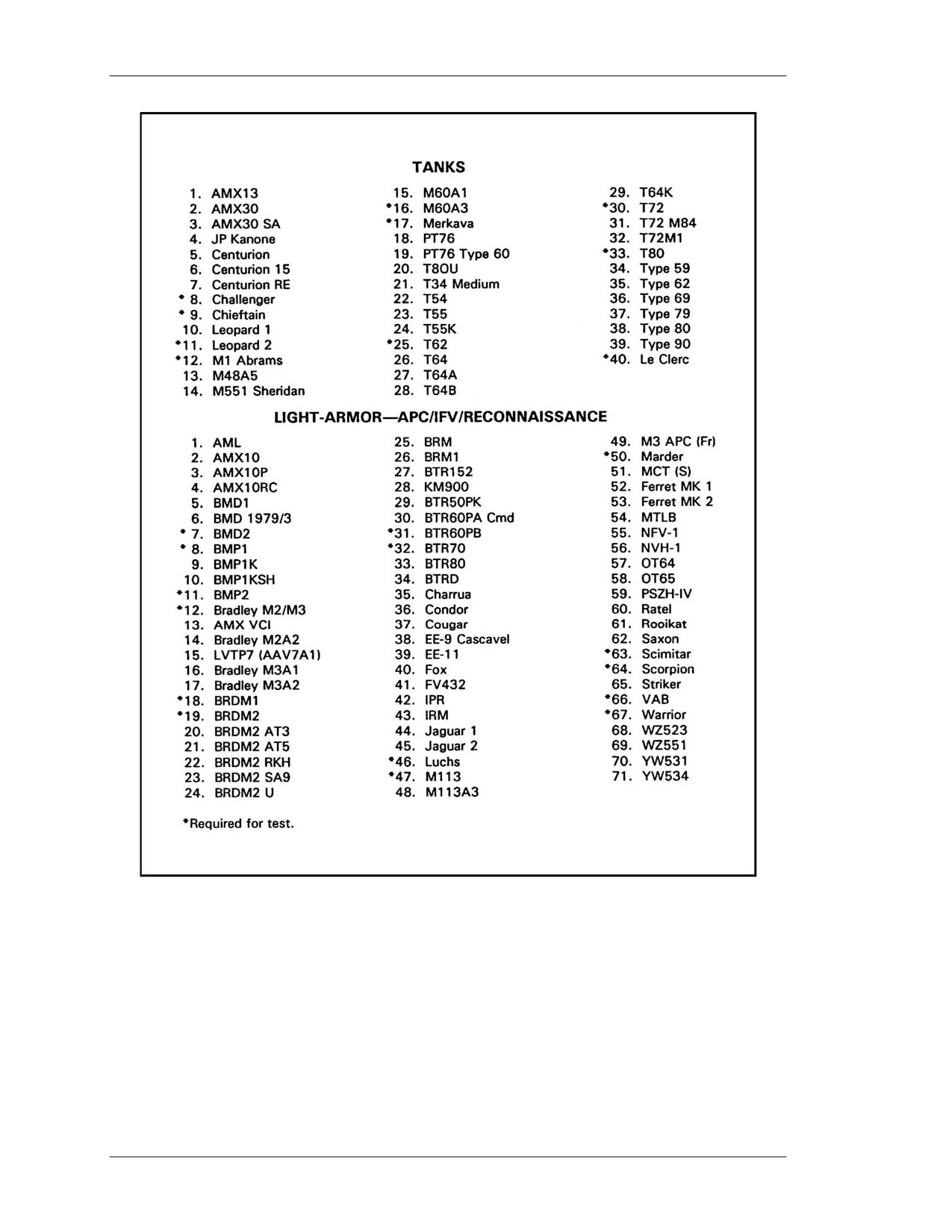
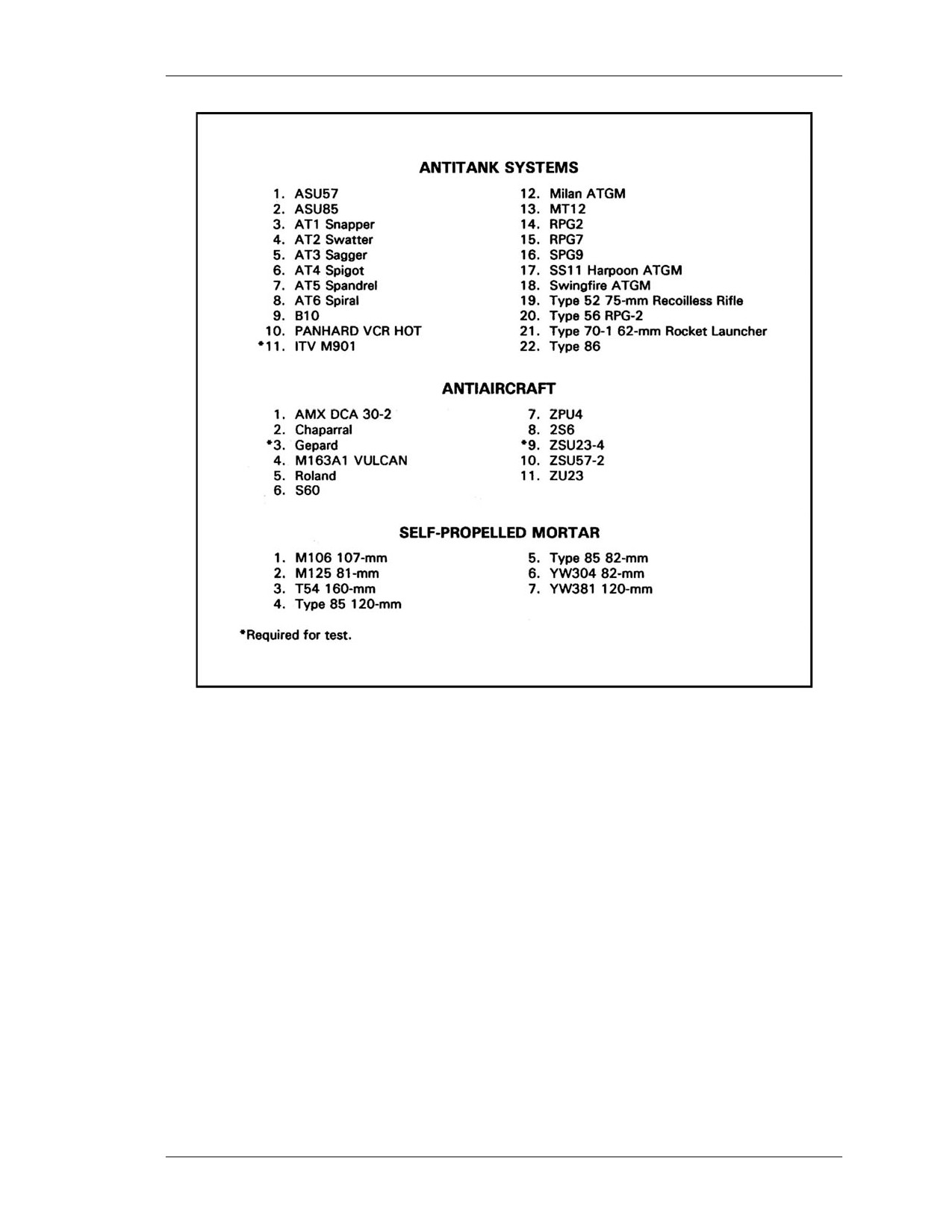
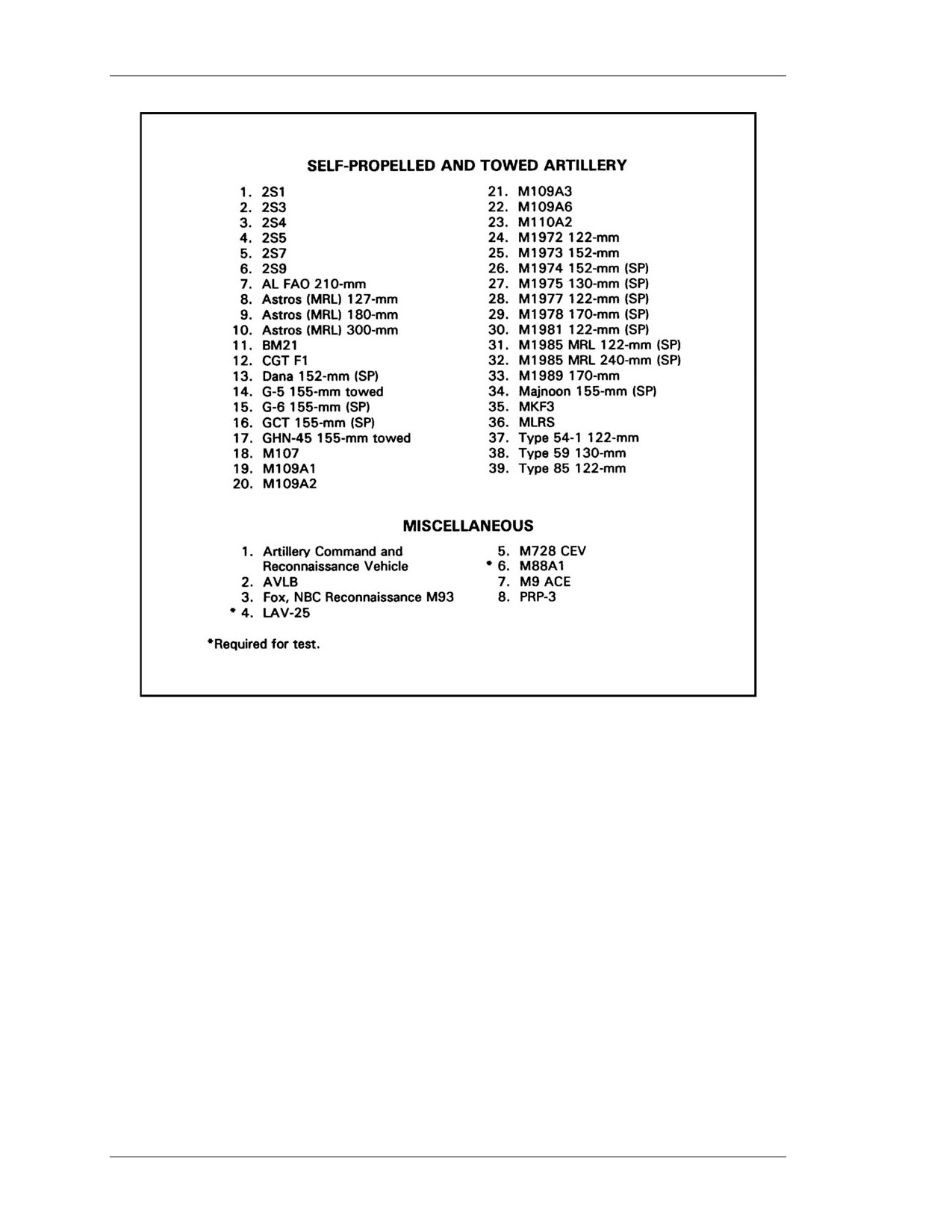
• Forty 35-mm slides of combat vehicles. The 30 required vehicles for this test
are included in the list in Figure H-1 and are indicated by an asterisk. The
balance will be taken from the other vehicles listed in Figure G-1 (page G-4).
(Recognition of Combat Vehicles [ROC-V] compact discs may also be used.)
(For more information, see GTA 17-02-013.)
• Classroom.
• Slide projector with screen.
• Stopwatch.
• Performance checklist (one per soldier).
• Chair, desk or clipboard (one per soldier).
• Pencil (one per soldier).
PRETEST PREPARATION: Thirty vehicles will be taken from the prescribed list and
ten will be selected by the commander based on the unit’s contingency area. The station
evaluator must ensure the slide projector is operational and the slides can be recognized
G-1
FM 3-22.34
from all locations in the classroom. Some projectors have an automatic setting for
exposure of each slide; if used, this feature must be checked for accuracy.
a. Select 30 required vehicle slides to be used along with 10 slides selected by the
commander.
b. Ensure the slide projector is operational.
c. Ensure the slides can be recognized from all locations in the classroom.
PRETEST CONDITIONS FOR EACH EXAMINEE: The slide projector will be on,
but slides will not be exposed.
TEST PLANNING TIME:
Administrative: 5 minutes
Test:
15 minutes
Total:
20 minutes
INSTRUCTIONS TO EXAMINEES:
“LET ME HAVE YOUR ATTENTION. AT THIS STATION, YOU WILL
BE TESTED ON YOUR ABILITY TO IDENTIFY COMBAT
VEHICLES. YOU MUST CORRECTLY IDENTIFY THIRTY-SIX OF
FORTY VEHICLES BY NOMENCLATURE. YOU WILL HAVE
TWELVE SECONDS TO VIEW EACH SLIDE AND TEN SECONDS
BETWEEN EACH SLIDE TO WRITE YOUR ANSWER ON THE
PERFORMANCE CHECKLIST PROVIDED. BE SURE YOU DO
NOT GET OUT OF SEQUENCE OR YOUR ANSWERS WILL BE
INCORRECT. DO YOU UNDERSTAND THESE INSTRUCTIONS?”
Pause 5 seconds, then say, “YOU WILL HAVE TWENTY-TWO
SECONDS TO COMPLETE EACH TASK.” Pause, then say,
“BEGIN.”
Begin timing when the command “BEGIN” is given. If the examinee has not completed
each task after the appropriate time, announce loud enough for the examinee to hear,
“STOP.”
PERFORMANCE CHECKLIST
TASK: Identify combat vehicles by nomenclature.
PERFORMANCE MEASURES:
1.
Identified vehicle slide No. 1.
2.
Identified vehicle slide No. 2.
3.
Identified vehicle slide No. 3.
4.
Identified vehicle slide No. 4.
5.
Identified vehicle slide No. 5.
6.
Identified vehicle slide No. 6.
7.
Identified vehicle slide No. 7.
G-2
FM 3-22.34
8.
Identified vehicle slide No.
8.
9.
Identified vehicle slide No.
9.
10.
Identified vehicle slide No.
10.
11.
Identified vehicle slide No.
11.
12.
Identified vehicle slide No.
12.
13.
Identified vehicle slide No.
13.
14.
Identified vehicle slide No.
14.
15.
Identified vehicle slide No.
15.
16.
Identified vehicle slide No.
16.
17.
Identified vehicle slide No.
17.
18.
Identified vehicle slide No.
18.
19.
Identified vehicle slide No.
19.
20.
Identified vehicle slide No.
20.
21.
Identified vehicle slide No.
21.
22.
Identified vehicle slide No.
22.
23.
Identified vehicle slide No.
23.
24.
Identified vehicle slide No.
24.
25.
Identified vehicle slide No.
25.
26.
Identified vehicle slide No.
26.
27.
Identified vehicle slide No.
27.
28.
Identified vehicle slide No.
28.
29.
Identified vehicle slide No.
29.
30.
Identified vehicle slide No.
30.
31.
Identified vehicle slide No.
31.
32.
Identified vehicle slide No.
32.
33.
Identified vehicle slide No.
33.
34.
Identified vehicle slide No.
34.
35.
Identified vehicle slide No.
35.
36.
Identified vehicle slide No.
36.
37.
Identified vehicle slide No.
37.
38.
Identified vehicle slide No.
38.
39.
Identified vehicle slide No.
39.
40.
Identified vehicle slide No.
40.
G-3
FM 3-22.34
Figure G-1. Combat vehicle slide list.
G-4
FM 3-22.34
Figure G-1. Combat vehicle slide list (continued).
G-5
FM 3-22.34
Figure G-1. Combat vehicle slide list (continued).
G-6
FM 3-22.34(FM 23-34)
APPENDIX H
OPFOR/THREAT COUNTERPART SYSTEMS
Recent years have seen rapid and revolutionary changes in the field of
armor and antiarmor warfare. The most radical changes have been in the
design of armor itself, the fire control systems
(especially in thermal
sights), the warheads and kill mechanisms of the missiles, and the various
countermeasures that have been developed. The rate of change is
increasing, and antiarmor crewmen and trainers must make a continual
effort to keep abreast of recent developments. What was true two years
ago, or even one year ago, is not necessarily true today. Leaders who take
their men into battle and make decisions based on outmoded information
and assumptions are dooming those men to failure and death.
H-1. OPFOR/THREAT ARMORED VEHICLES
Armored vehicle identification in the past was a simple matter of distinguishing between
vehicles manufactured by Eastern Bloc and Rest of the World (ROW) nations and those
manufactured by NATO nations. Even then, many soldiers had difficulty distinguishing
between vehicles on a simple “friend or foe” basis. Changes in international relations
have made it less likely that we will meet nations of the former Soviet Union in battle,
but more likely that we will fight the military of a third world nation equipped with a
wide variety of equipment. From the standpoint of vehicle identification, this greatly
complicates the problem. Most third world nations do not manufacture their own
vehicles, but buy them from other countries. As a result, many of them have vehicles
from nearly every manufacturing nation in the world in their inventories. Twenty nations
in the world today have more than 500 main battle tanks each. Two possible examples of
many illustrate this point (Table H-1).
COUNTRY
TYPE
ORIGIN
Iran
Type 59
China
Type 69
China
Chieftain
United Kingdom
M48A5
USA
M60A1
USA
T62
Russia
T72
Russia
EE-9 Cascavel
Brazil
M113
USA
Iraq
Type 59
China
AMX-30
France
Chieftain
United Kingdom
T62
Russia
T72
Russia
EE-11 Urutu
Brazil
Walid
Egypt
MOWAG Roland
Switzerland
M113A1
USA
Table H-1. Select armored vehicle types and countries of origin.
H-1
FM 3-22.34
a. The task of armored vehicle identification has become much more complex. The
antiarmor crewman must now become familiar with a much wider variety of vehicles
than before. He must also be well informed about what vehicles a potential enemy
possesses. In the future, the antiarmor crewman will probably face armored vehicles
produced in the U.S. as well as in other friendly nations. The trend of the U.S. to fight
with a coalition means that, on future battlefields, both friendly and enemy forces may
have identical equipment.
b. This manual is not a complete FM on vehicle identification. However, the
antiarmor crewman should be readily familiar with a few of the most recently fielded
vehicles and the particular problems and capabilities they present.
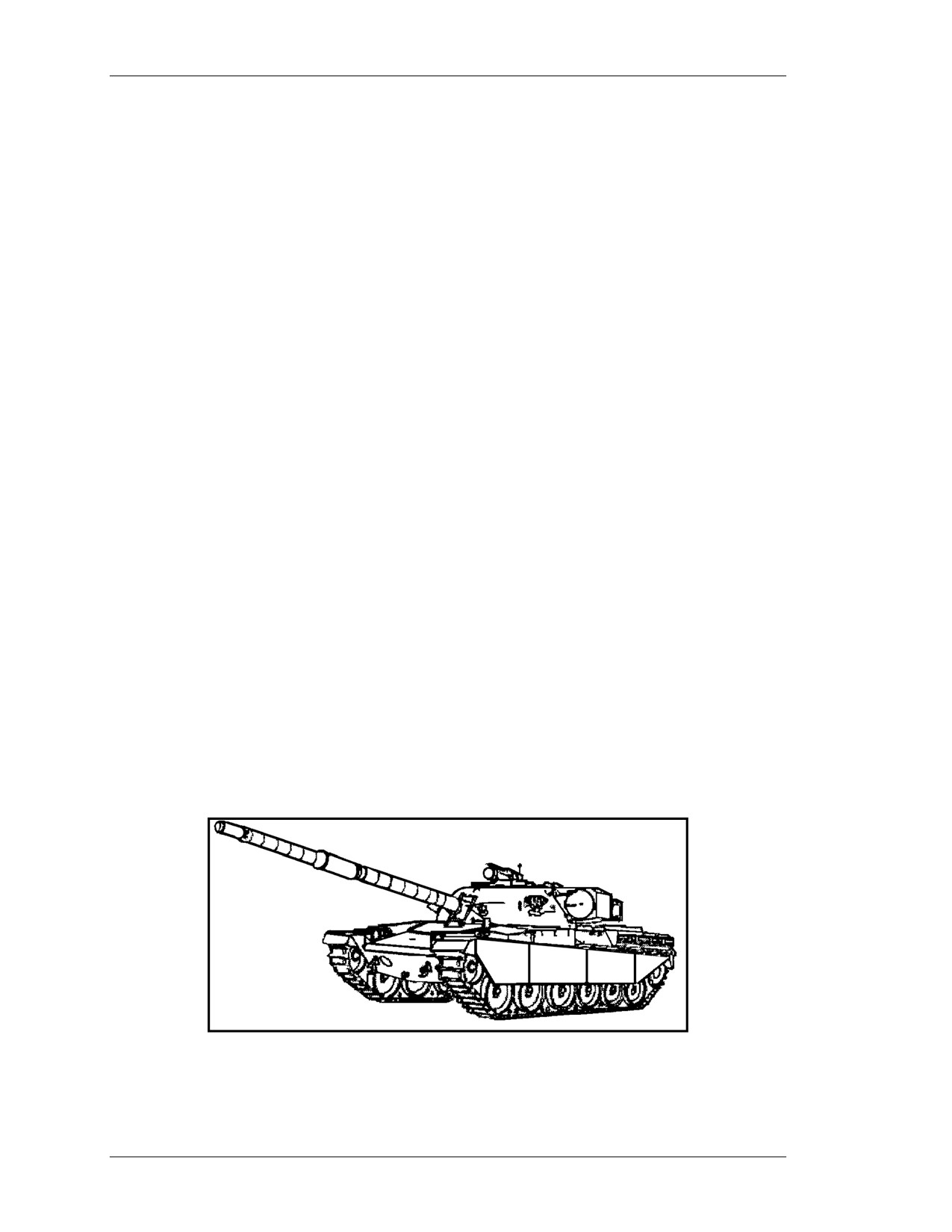
(1) British Main Battle Tank, Chieftain Mk 5 (Figure H-1).
• Date of introduction: 1967 original Chieftain
• Proliferation: At least six countries
• Automotive performance:
Engine type: 750-hp diesel
Cruising range: 400 to 500 km
• Speed:
Max road: 48 km/h
Max off-road: INA
Average cross country: 30 km/h
Max swim: INA
• Fording depths: 1.1 meters unprepared
• Main armament ammunition:
Caliber type name: 120-mm high L11A5
Rate of fire: 8 to 10 rounds per minute first minute; 6 sustained
Maximum aimed range: 5,000 meters
Maximum effective range:
Day: 3,000 meters
Night: INA
Armor penetration: INA
Figure H-1. British main battle tank, Chieftain Mk 5.
H-2
FM 3-22.34
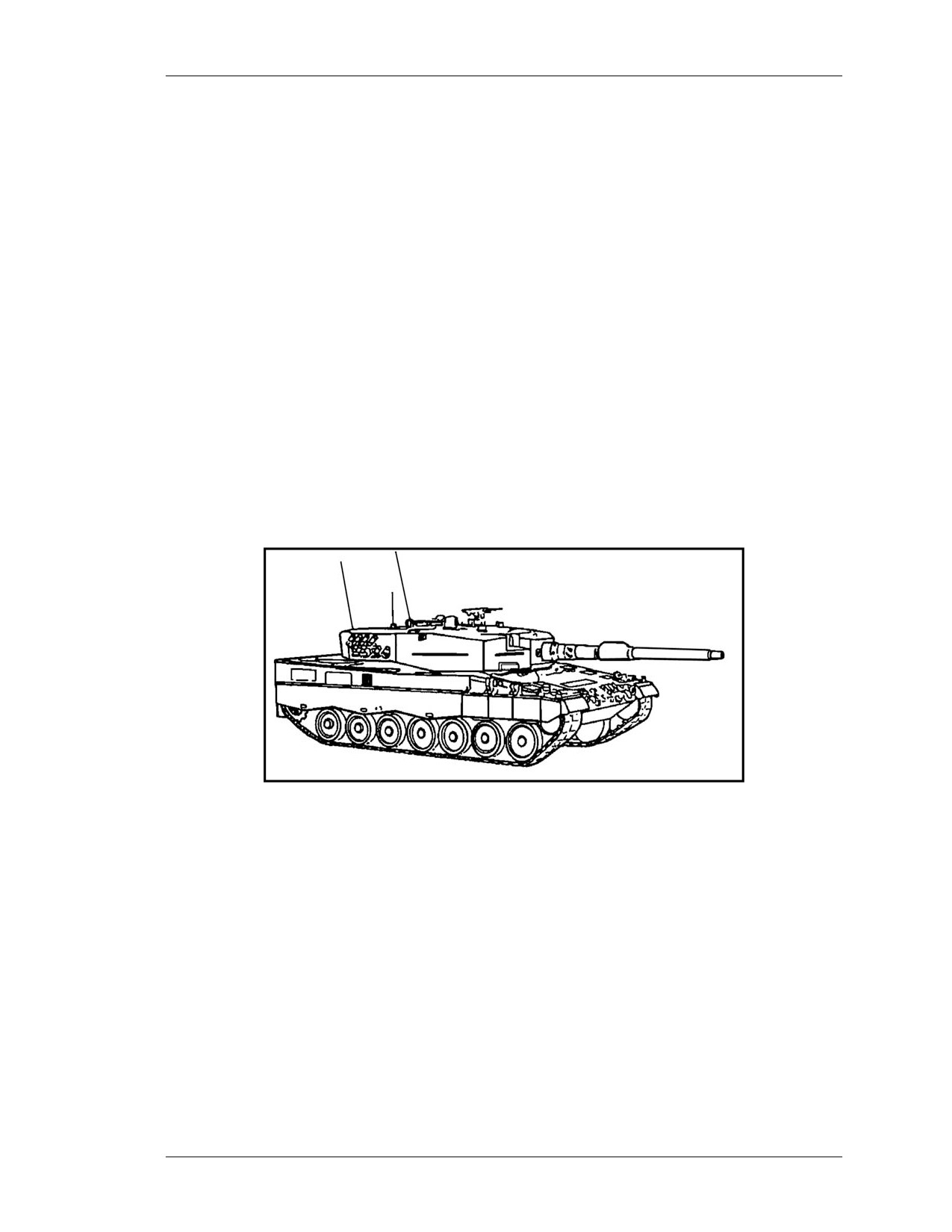
(2) German Main Battle Tank, Leopard 2 (Figure H-2).
• Date of introduction: 1979
• Proliferation: At least seven countries
• Automotive performance:
Engine type: 750-hp diesel
Cruising range: 400 to 500 km
• Speed:
Max road: 48 km/h
Max off-road: INA
Average cross country: 30 km/h
Max swim: INA
• Fording depths: 1.1 meters unprepared
• Main armaments ammunition:
Caliber type, name: 120-mm APFSDS-T, DM43
Rate of fire: INA
Maximum aimed range: 3,500 meters
Day: INA
Night: INA
Armor penetration: 450 to 2,000 mm
Figure H-2. German main battle tank, Leopard 2.
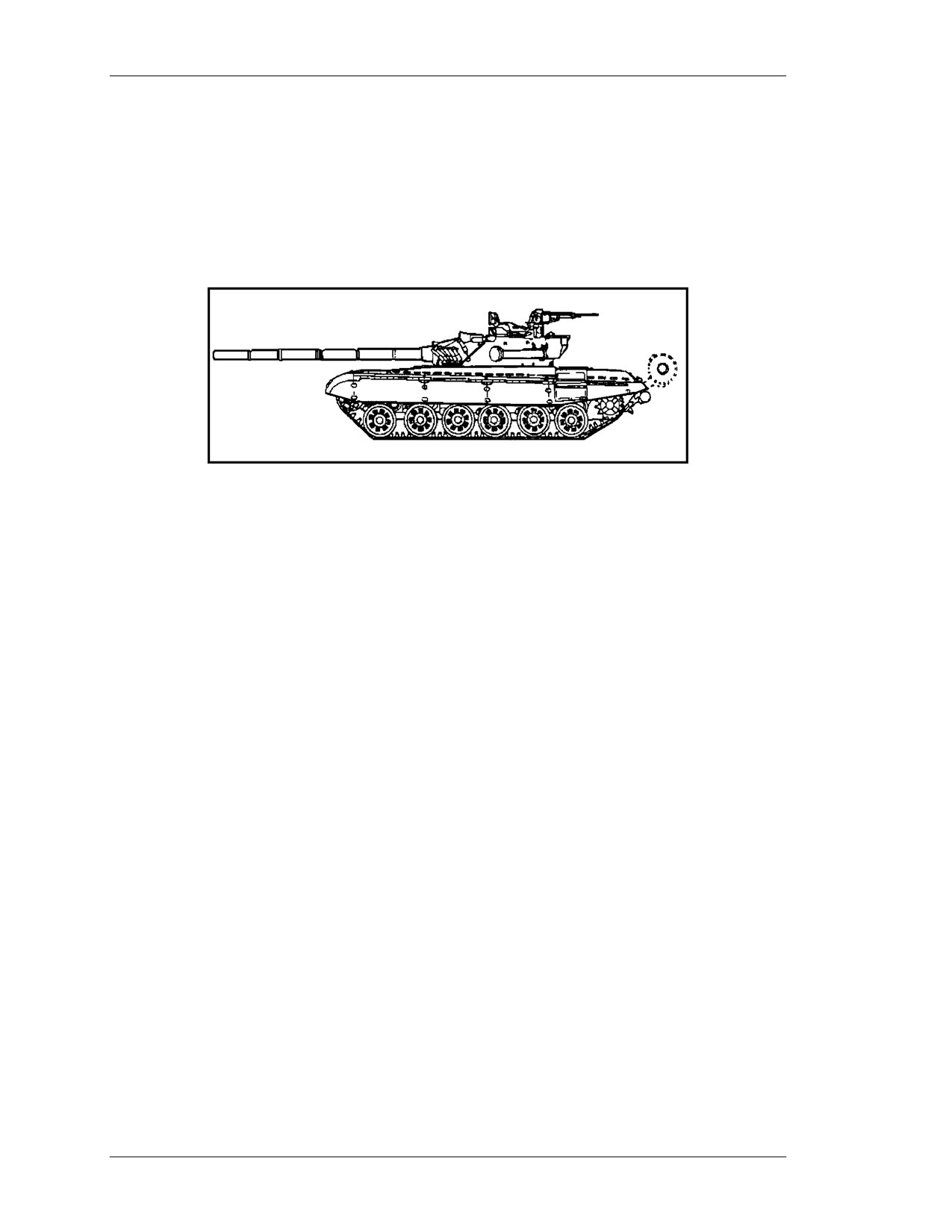
(3) Polish/Czechoslovakian Main Battle Tank, T-72M1 (Figure H-3, page H-4).
• Date of introduction: 1975
• Proliferation: At least seven countries
• Automotive performance:
Engine type: 780-hp diesel
Cruising range: 460 to 700 km with extra tanks
• Speed:
Max road: 60 km/h
Max off-road: 45 km/h
Average cross country: 35 km/h
Max swim: INA
• Fording depths: 1.2 meters unprepared; 5 meters with snorkel
H-3
FM 3-22.34
• Main armaments ammunition:
Caliber type, name: 125-mm APFSDS-T, BM-42M
Rate of fire: INA
Maximum aimed range: 2,000 to 3,000 meters
Day: 2,000 to 3,000 meters
Night: 850 to 1,300 meters
Armor penetration: 590 to 630 rounds per min at 2,000 meters
Figure H-3. Polish/Czechoslovakian main battle tank, T-72M1.
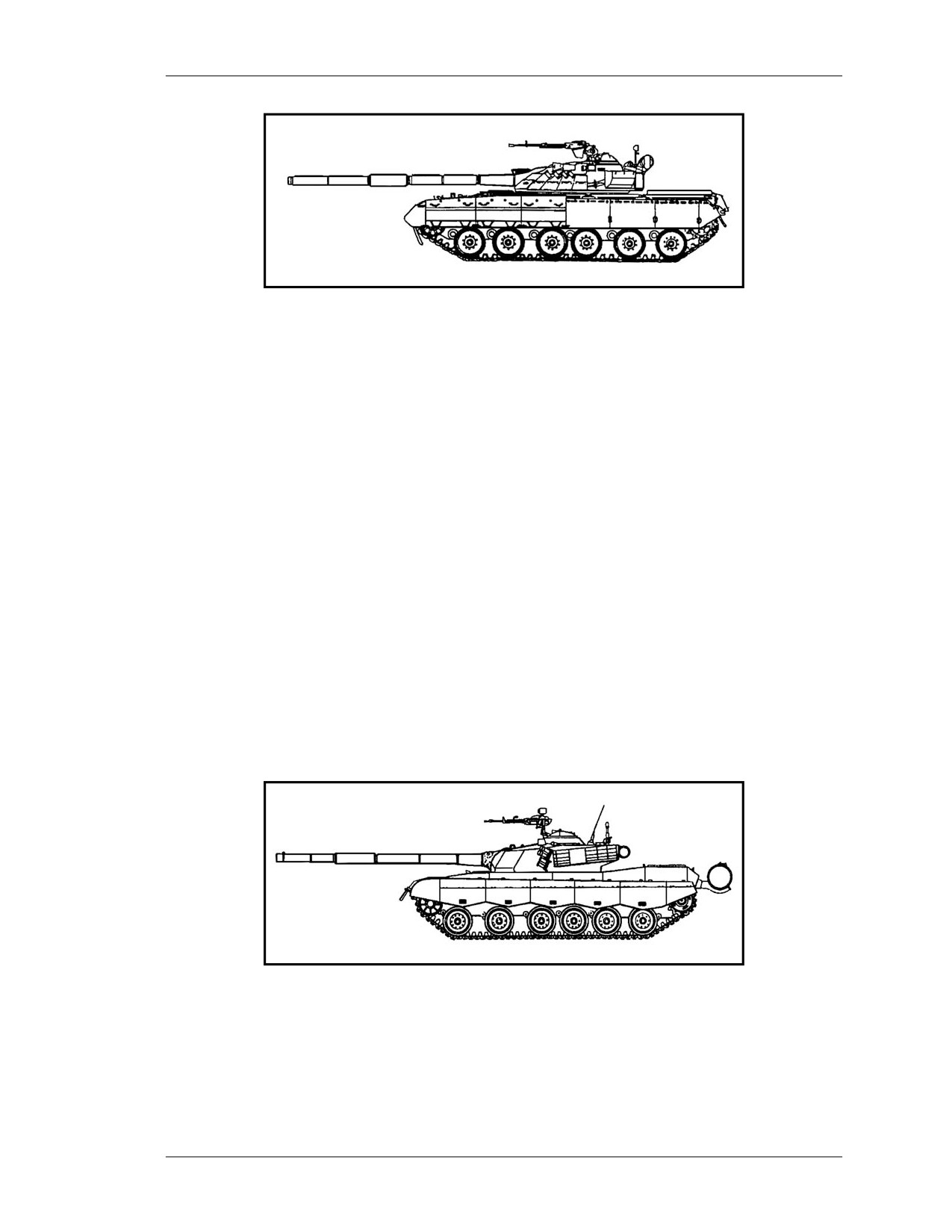
(4) Russian Main Battle Tank, T-80U (Figure H-4).
• Date of introduction: 1987
• Proliferation: At least three countries
• Automotive performance:
Engine type: 1250-hp gas turbine (multi-fuel); diesel on T-80UD
Cruising range: 335 km; 600 km with extra tanks
• Speed:
Max road: 70 km/h
Max off-road: 48 km/h
Average cross country: 40 km/h
Max swim: INA
• Fording depths: 1.8 meters unprepared; 5 meters with snorkel; 12 meters with
BROD-M system
• Main armaments ammunition:
Caliber type, name: 125-mm APFSDS-T, BM-42M
Rate of fire: INA
Maximum aimed range: 2,000 to 3,000 meters
Day: 2,000 to 3,000 meters
Night: 800 to 1,300 meters
Armor penetration: 560 to 630 mm at 2,000 meters
H-4
FM 3-22.34
Figure H-4. Russian main battle tank, T-80U.
(5) Chinese Main Battle Tank, Type 85-IIM (Figure H-5).
• Date of introduction: 1991
• Proliferation: At least two countries
• Automotive performance:
Engine type: 750-hp diesel
Cruising range: 700 km; 900 km with external tanks
• Speed:
Max road: 57 km/h
Max off-road: 45 km/h
Average cross country: 35 km/h
Max swim: INA
• Fording depths: 1.4 meters unprepared; 2.4 meters with snorkel
• Main armaments ammunition:
Caliber type, name: 125-mm HEAT-MP, BK-29M
Rate of fire: INA
Maximum aimed range: 3,000 meters
Day: INA
Night: 850 to 1,300 meters
Armor penetration: 560 to 750 mm
Figure H-5. Chinese main battle tank, Type 85-IIM.
H-5
FM 3-22.34
H-2. THREAT RIFLE-PROPELLED GRENADES
The most prolific threat now is the hand-held RPG. The following are some of the RPGs
that U.S. forces will encounter.
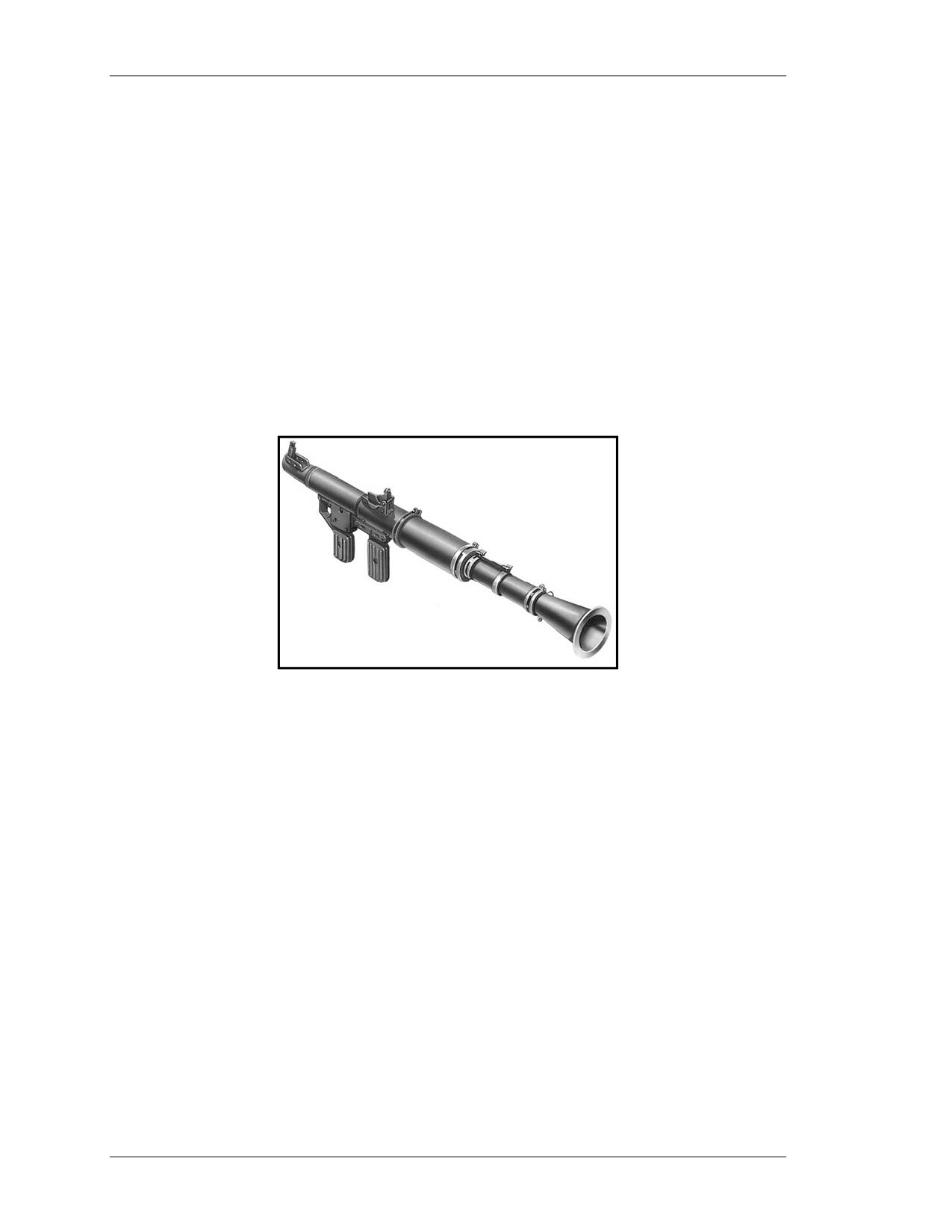
a. Russian 40-mm Antitank Grenade Launcher, RPG-7V (Figure H-6).
• Date of introduction: 1962
• Proliferation: At least 40 countries
• Ammunition: PG-7V
Caliber: 85 mm
Type: Heat
Range:
Effective: 500 meters
Minimum: N/A
Moving: 300 meters
Armor penetration: 330 mm
Figure H-6. Russian 40-mm antitank grenade launcher, RPG-7V.
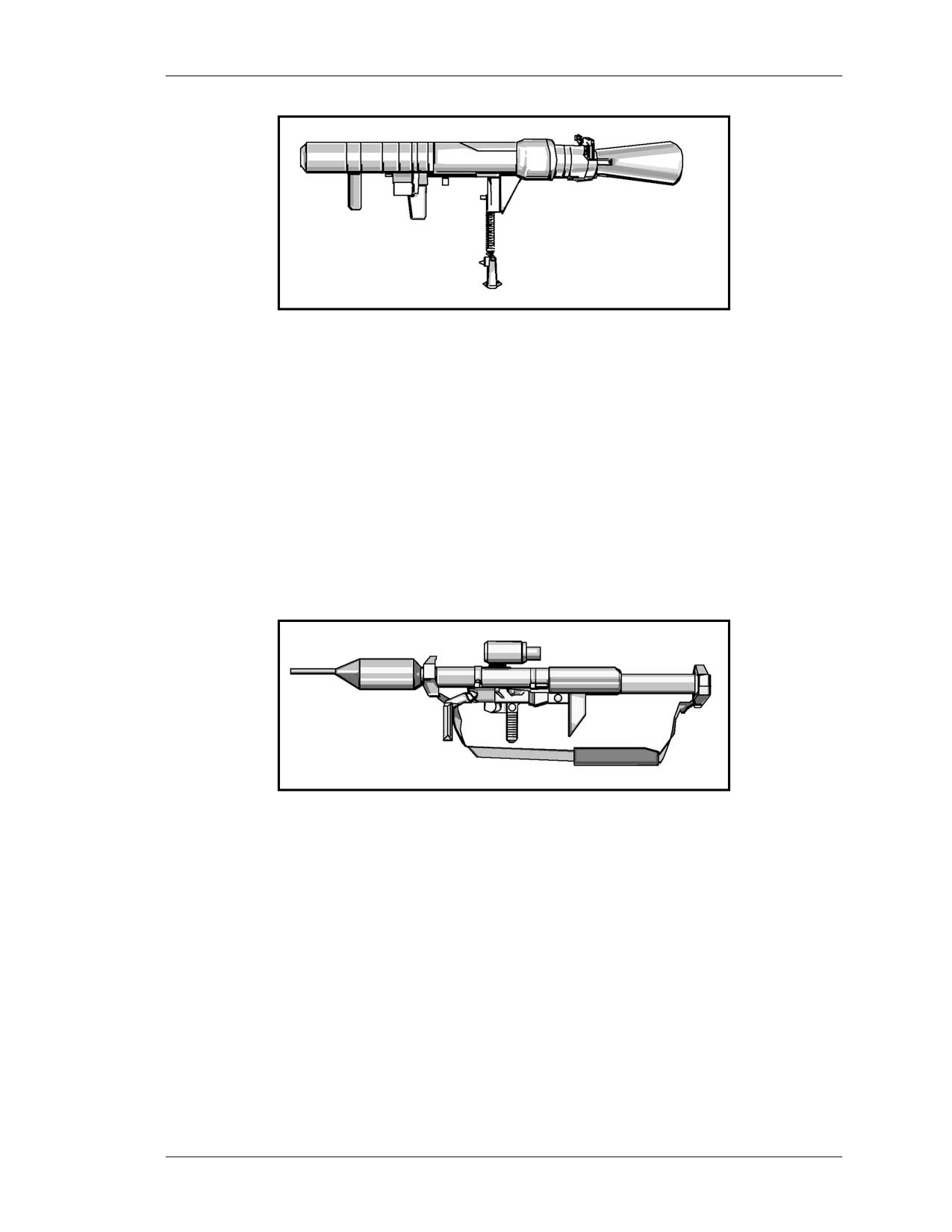
b. Swedish 84-mm Recoilless Rifle, Carl Gustav M2 (Figure H-7).
• Date of introduction: INA
• Proliferation: At least 20 countries
• Ammunition: FFV 751
Type: Heat (tandem)
Range:
Effective: 500 meters
Minimum: N/A
Armor penetration: +500 mm
H-6
FM 3-22.34
Figure H-7. Swedish 84-mm recoilless rifle, Carl Gustav M2.
c. German 60-mm Antitank Grenade Launcher, Panzerfaust-3 (Figure H-8).
• Date of introduction: 1990
• Proliferation: At least eight countries
• Ammunition: INA
Caliber: 110 mm
Type: Heat
Range:
Effective (moving): 300 meters
Effective (stationary): 500 meters
Armor penetration: 500 mm
Figure H-8. German 60-mm antitank grenade launcher, Panzerfaust-3.
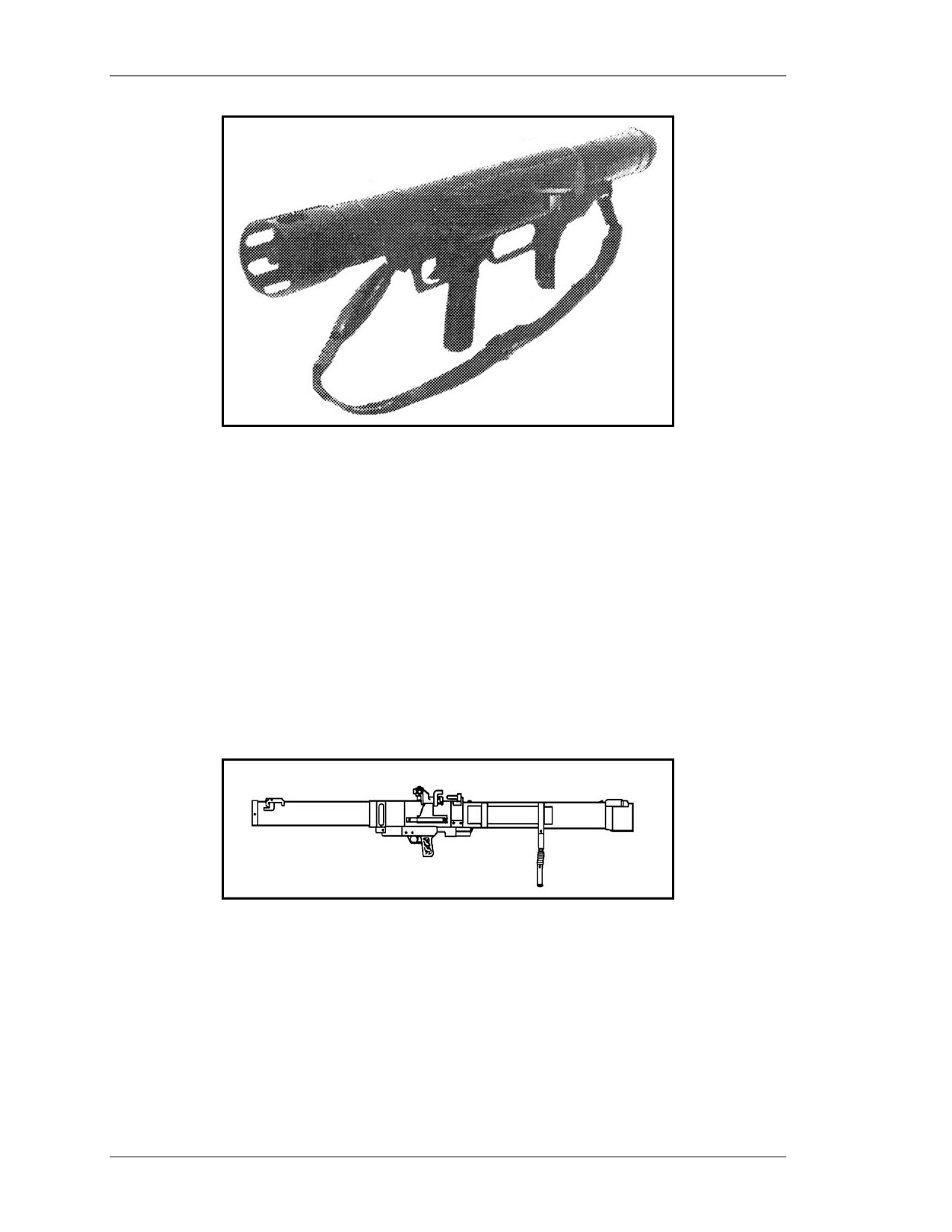
d. German
67-mm Disposable Antitank Grenade Launcher, Armbrust
(Figure H-9, page H-8).
• Date of introduction: INA
• Proliferation: At least seven countries
• Ammunition: INA
Type: Heat
Range:
Maximum: 1500 meters
Effective AT: 300 meters
H-7
FM 3-22.34
Figure H-9. German 67-mm disposable antitank grenade launcher,
Armbrust.
e. Russian 105-mm Antitank Grenade Launcher, RPG-29 (Figure H-10).
• Date of introduction: Late 1980s
• Proliferation: Former Soviet Union
• Ammunition: PG-29V
Caliber (warhead): 105 mm
Type: Heat (tandem)
Range:
Effective: 500 meters
Minimum: N/A
Armor penetration: +750 mm
Figure H-10. Russian 105-mm antitank grenade launcher, RPG-29.
H-3. ANTITANK GUIDED MISSILE LAUNCHER VEHICLES
Although there are unique ATGM launcher vehicles with unique ATGMs, most launcher
vehicles are military and commercial vehicles adapted with pintel mounts for portable
ground launchers, with ATGMs manually loaded and launched. The systems described in
this paragraph are the more common threat systems or represent the spectrum of antitank
systems that can threaten U.S, Army forces in the world today.
H-8
FM 3-22.34
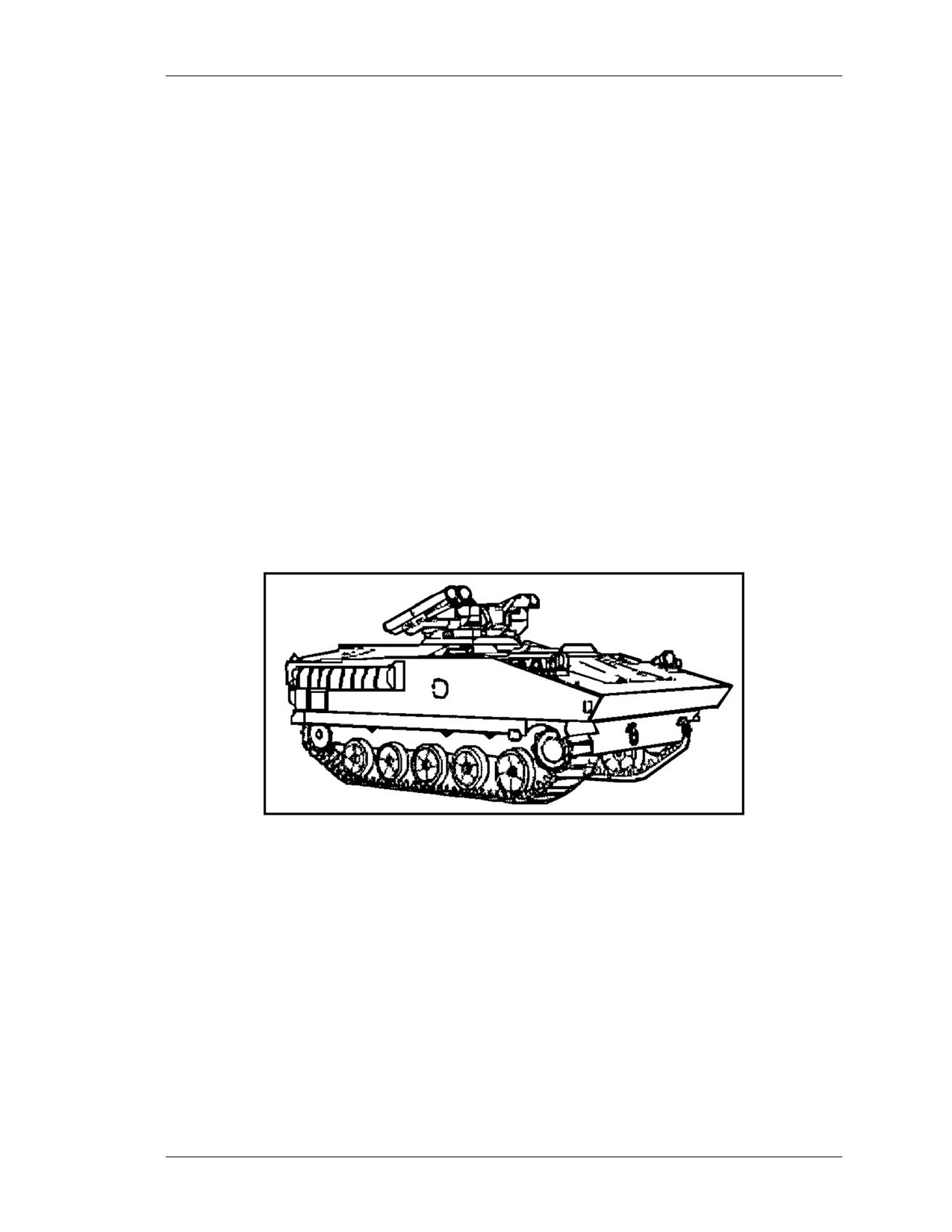
a. French ATGM Launcher Vehicle, AMX-10 HOT (Figure H-11).
• Date of introduction: INA
• Proliferation: At least one country
• Guidance system: SALCOS
• Command link: Wire
• Ammunition: ATGM
Name: HOT
Warhead type: shaped charge (HEAT)
Armor penetration: 800 mm
Minimum/maximum range: 75 to 4,000 meters
Name: HOT 2
Warhead type: tandem shaped charged (HEAT)
Armor penetration: 900 mm
Minimum/maximum range: 75 to 4,000 meters
Name HOT 2
Warhead type: tandem shaped charged (HEAT)
Armor penetration: 1,250 mm
Minimum/maximum range: 75 to 4,000 meters
• Probability of hit: INA
• Time of flight to max range: 17.3 seconds
Figure H-11. French ATGM launcher vehicle, AMX-10 HOT.
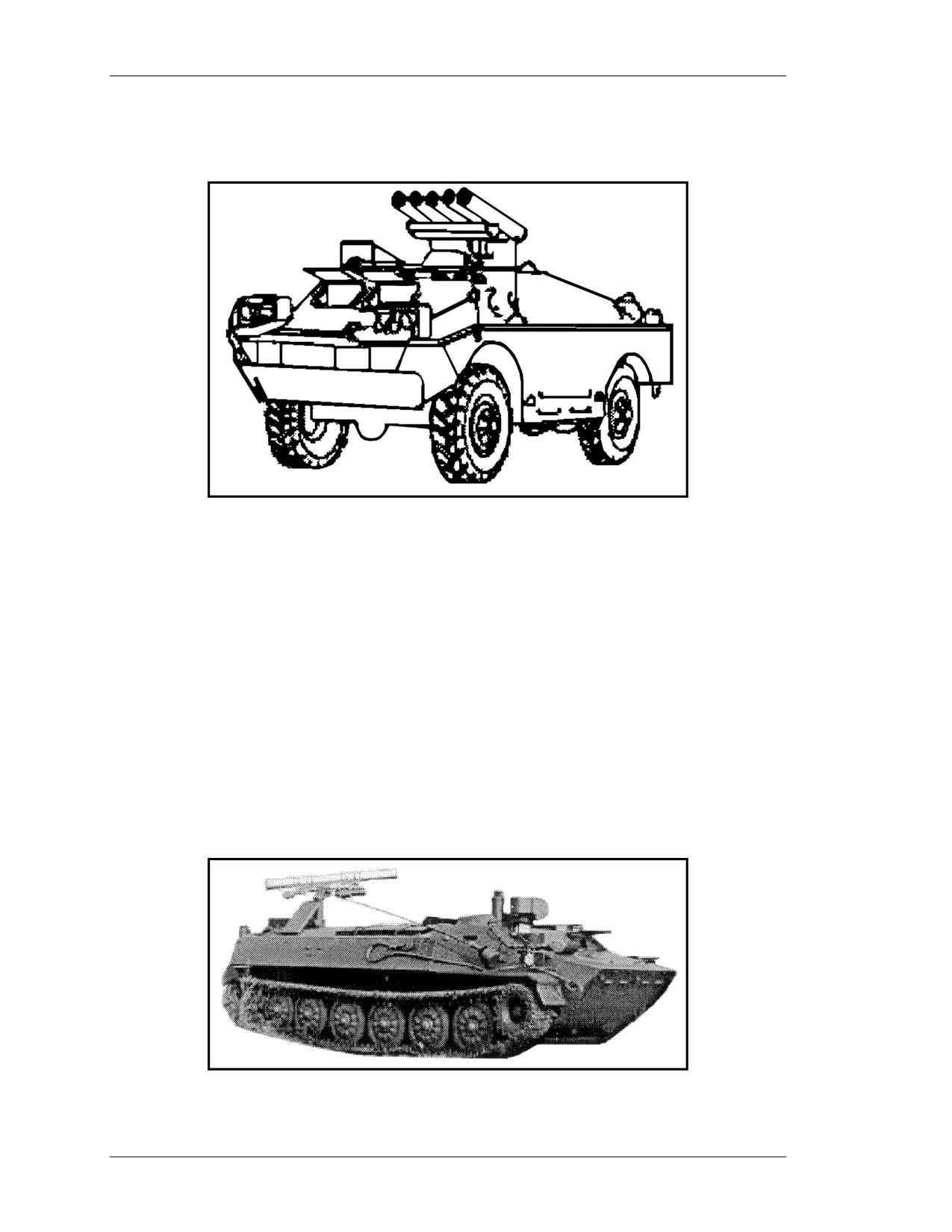
b. Russian ATGM Launcher Vehicle, 9P148 (Figure H-12, page H-10).
• Date of introduction: 1977
• Proliferation: At least six countries
• Guidance system: SALCOS
• Command link: Wire
• Ammunition
• ATGM:
Name: AT-5/SPANDREL
Warhead type: shaped charge (HEAT)
Armor penetration: 650 mm
Minimum/maximum range: 75 to 4,000 meters
H-9
FM 3-22.34
• Probability of hit: 90 percent
• Time of flight to max range: 20 seconds
Figure H-12. Russian ATGM launcher vehicle, 9P148.
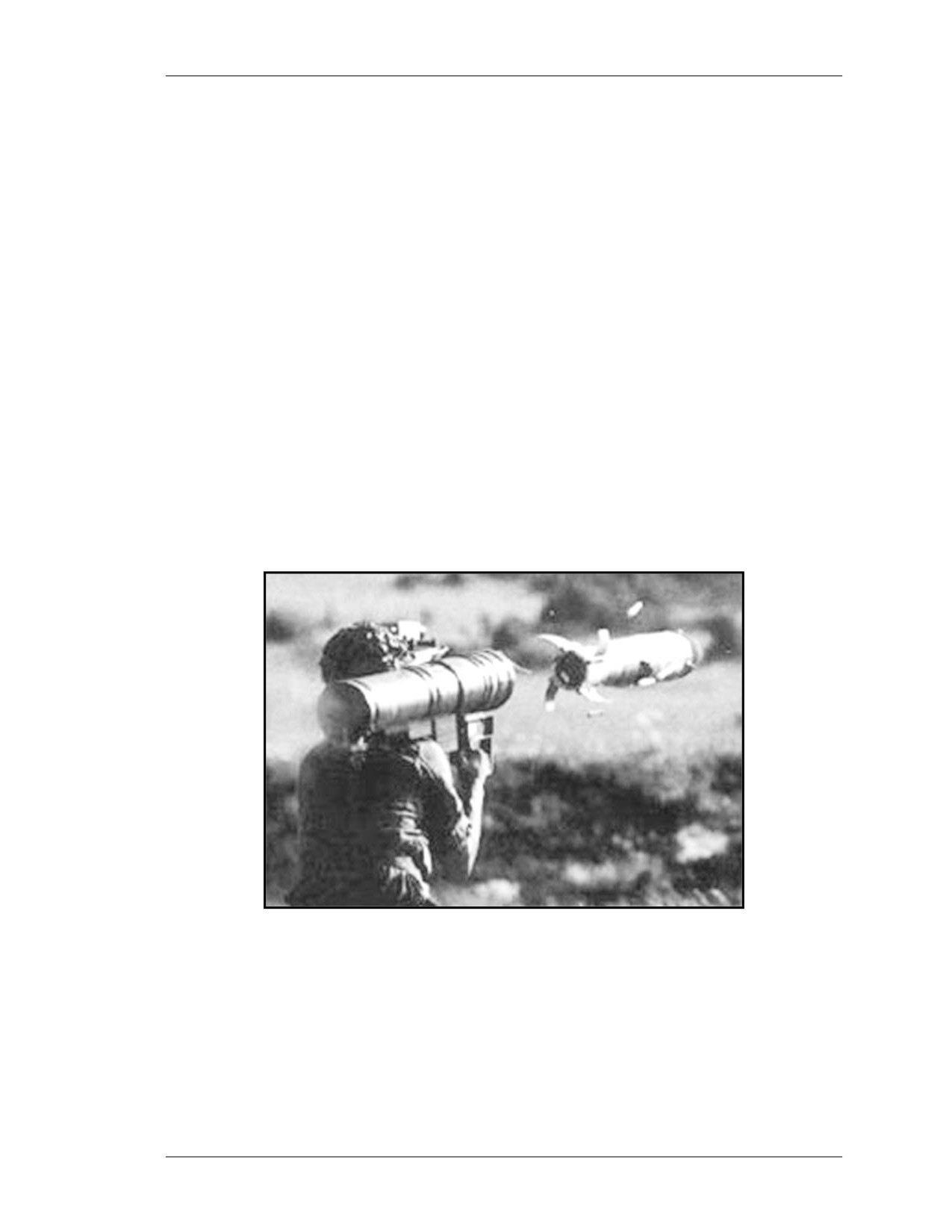
c. Russian ATGM Launcher Vehicle, 9P149 (Figure H-13).
• Date of introduction: 1990
• Proliferation: At least nine countries
• Guidance system: SALCOS
• Command link: radio frequency
• Ammunition: ATGM
Name: AT-56a/SPIRAL
Warhead type: shaped charge (HEAT)
Armor penetration: 750 mm
Minimum/maximum range: 400 to 5,000 meters
• Probability of hit: 90 percent
• Time of flight to max range: 14.5 seconds
Figure H-13. Russian ATGM launcher vehicle, 9P149.
H-10
FM 3-22.34
H-4. ANTITANK GUIDED MISSILE LAUNCHER
As the levels of armor protection and the lethality of antitank weapons continue to rise,
armor protection for many modern tanks has outpaced most AT weapons. However,
ATGMs have been able to increase their range and warhead configurations to threaten
even the heaviest tanks. Among notable trends in ATGMs is the worldwide proliferation
and variety of man-portable and portable antitank ballistic missiles (ATBMs).
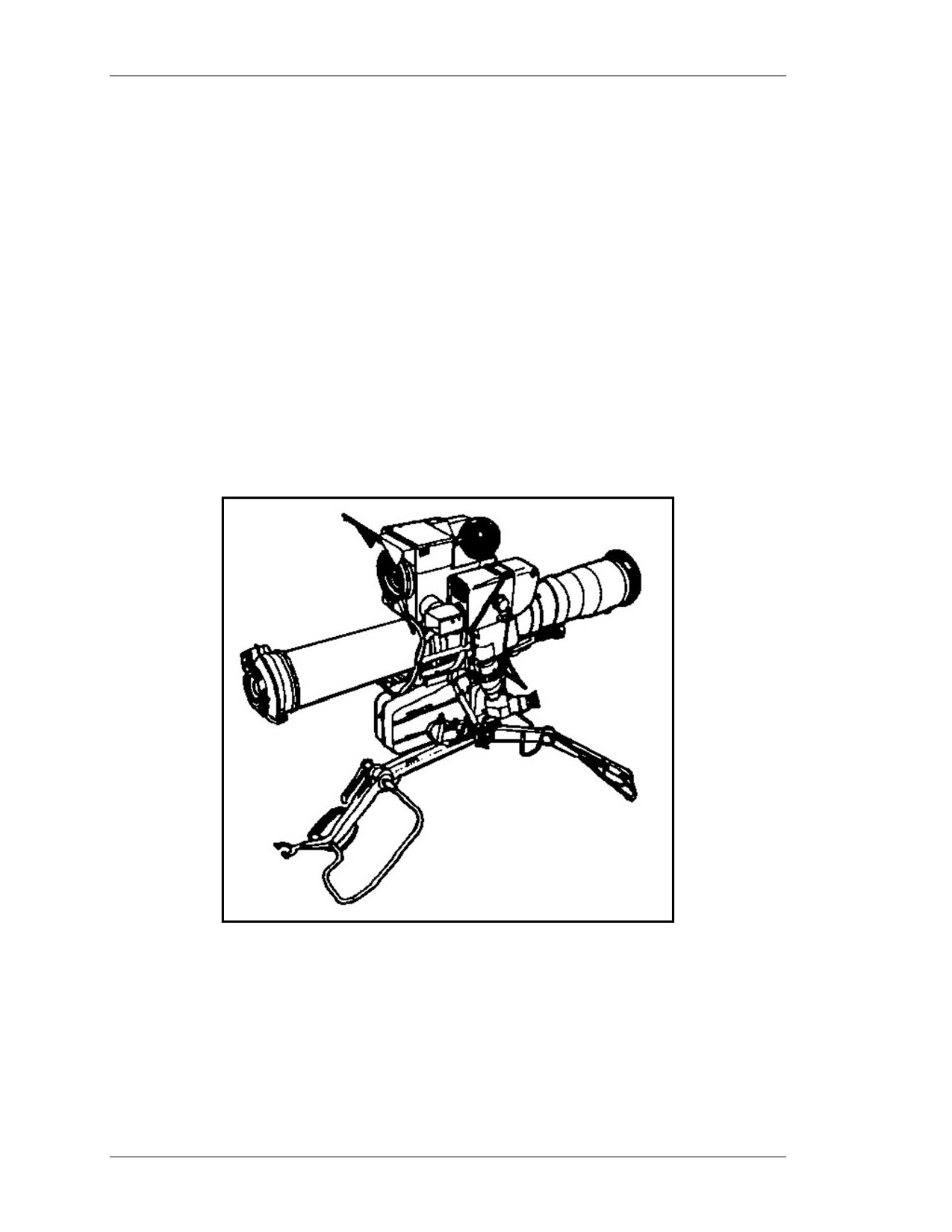
a. French ATGM Launcher, Eryx (Figure H-14).
• Date of introduction: 1991
• Proliferation: At least five countries
• Guidance: SACLOS
• Command link: Wire
• Beacon type: infrared laser diode
• Ammunition:
Name: Eryx
Warhead type: tandem shaped charge (HEAT)
Armor penetration: 900 mm
Minimum/maximum range: 50 to 600 meters
• Probability of hit: 90 percent
• Time of flight to max range: 3.7 seconds
Figure H-14. French ATGM launcher, Eryx.
b. Russian ATGM Launcher, AT-4/AT-5 (Figure H-15, page H-12).
• Date of introduction: 1973
• Proliferation: At least 25 countries
• Guidance: SACLOS
• Command link: Wire
• Beacon type: Incandescent infrared bulb
• Ammunition:
H-11
FM 3-22.34
Name: AT-5B/SPANDREL-B
Warhead type: tandem shaped charge (HEAT)
Armor penetration: 925 mm
Minimum/maximum range: 75 to 4,000 meters
Probability of hit: 90 percent
Time of flight to max range: 10 seconds
Name: AT-5B/SPANDREL
Warhead type: shaped charge (HEAT)
Armor penetration: 650 mm
Minimum/maximum range: 75 to 4,000 meters
Probability of hit: 90 percent
Time of flight to max range: 20 seconds
Name: AT-4/SPIGOT
Warhead type: shaped charge (HEAT)
Armor penetration: 480 mm
Minimum/maximum range: 70 to 4,200 meters
Time of flight to max range: 11 seconds
Figure H-15. Russian ATGM launcher, AT-4/AT-5.
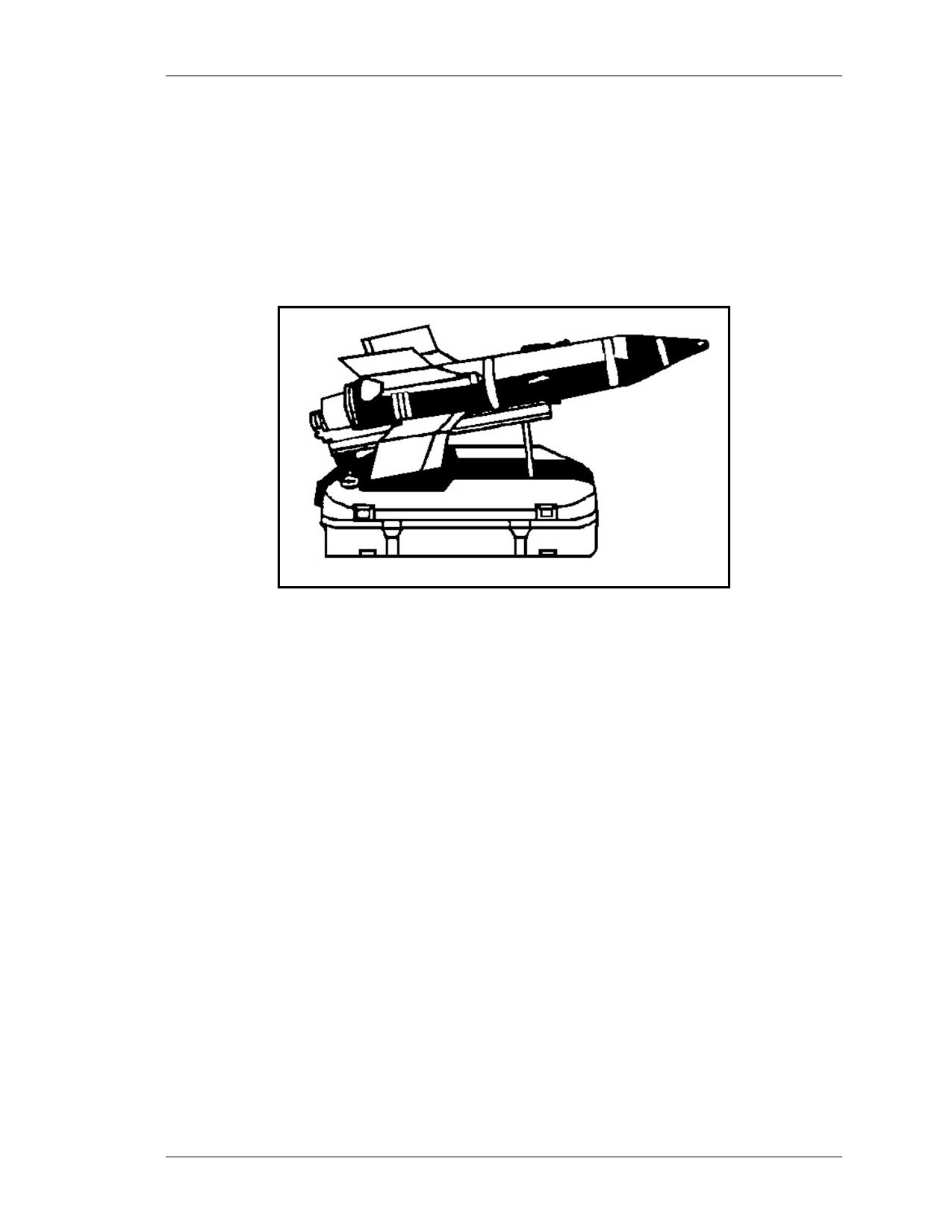
c. Russian ATGM Launcher, AT-3 (Figure H-16).
• Date of introduction: 1963
• Proliferation: At least 45 countries
• Guidance: MCLOS
• Command link: Wire
H-12
FM 3-22.34
• Beacon type: Incandescent infrared bulb (SACLOS)
• Ammunition:
Name: AT-3, 3a, 3b/SAGGER
Warhead type: tandem shaped charge (HEAT)
Armor penetration: 400 mm
Minimum/maximum range: 500 to 3,000 meters
Probability of hit: 70 percent
Time of flight to max range: 26 seconds
Figure H-16. Russian ATGM launcher, AT-3.
H-5. THREAT INFANTRY ARMOR COUNTERMEASURES
Historically, the deployment of thick belts of ATGMs has been the foundation of U.S.
antiarmor defense planning. Potential enemies have developed countermeasures to these
antiarmor measures, which any enemy we may face may employ.
a. Reconnaissance. A high priority for enemy reconnaissance elements is to locate
our ATGM sites before their main body enters our engagement areas. Methods of
reconnaissance can include aircraft, drones, signals intelligence, and conventional ground
reconnaissance elements. Leaders must learn to emphasize careful camouflage and
concealment and to conduct effective counterreconnaissance operations. Lessons learned
at NTC show that the commander who loses the counterreconnaissance phase of the
battle loses the battle. For enemy reconnaissance to be effective, their reconnaissance
elements must spot our weapon systems and survive to report their location.
b. Artillery. Once enemy reconnaissance elements have spotted our ATGM
positions, the weapon of choice to destroy them is artillery. Since ATGMs are a
high-priority target for artillery, these positions will be subjected to intense indirect fire.
The TOW is not designed to withstand such barrages. The best way to survive is to
remain undetected and to avoid terrain that is likely to attract heavy artillery fire.
Positions should be as well protected against artillery as possible. Move, if possible,
when positions come under artillery fire.
c. Helicopters. Attack helicopters routinely follow artillery preparation. Again,
ATGMs are high-priority targets.
H-13
FM 3-22.34
d. Direct Fire. Enemy forces will attempt to suppress or destroy friendly ATGM
systems with direct fire.
e. Grenade Launcher. This weapon is very effective against a tripod- or
HMMWV-mounted TOW, and is somewhat effective against lightly armored vehicles
such as the Bradley.
f. Lasers. Most armies use laser range finders and target designators. Many of these
are quite powerful and can cause temporary or permanent damage to a gunner’s eyes
when he is using direct-view magnifying optics. Some of these devices can even damage
the sights themselves. Thermal sights are less vulnerable to lasers. Laser weapons, such
as the PRC-produced ZM-87, or even frequency agile laser weapons may be encountered
on the future battlefield. Many countries, such as China, Russia, and France, have
extensive laser development and procurement programs.
g. Battlefield Obscurants. The AN/TAS-4 series of thermal sights is able to
penetrate many kinds of battlefield obscurants, but not all. Bispectral smoke and
battlefield dust, among others, are largely opaque to thermal sights if they are thick
enough. In addition, when using a basic or ITOW, the target may be seen, but the system
is unable to guide the missile through the obscurants.
h. Combined Arms. Enemy doctrine prefers to fight mounted, but if they run into
strong ATGM defenses, they will dismount their infantry and advance at foot pace, with
the infantry engaging personnel and ATGMs. The tanks will advance first, at about 6
kilometers per hour, and the infantry will closely follow the tanks. The fighting vehicles
will follow the infantry and provide supporting fire.
H-6. INFANTRY ANTITARMOR COUNTER-COUNTERMEASURES
United States forces must have counter-countermeasures against reconnaissance, artillery,
helicopters, direct fire, grenade launchers, lasers, obscurants, and combined arms.
a. Reconnaissance. The best counter to reconnaissance elements is effective
counterreconnaissance operations by defending forces. Equally important is effective and
rigidly enforced camouflage and concealment.
b. Artillery. The best defense against artillery is not to be discovered by the
enemy’s reconnaissance elements. This may not be possible, so positions must be as well
prepared against heavy artillery fire as time permits. When all else fails, it may be
necessary to move positions. Secondary and alternate positions should be preselected for
this eventuality.
c. Helicopters. The best defense against helicopters is not to be spotted in the first
place. TOW positions should only engage helicopters in self-defense when they are
already spotted and under attack. Helicopters not engaging TOW positions should be left
to regular ADA assets. (See Chapter 5 for more detailed information.)
d. Direct Fire. TOW squads must maximize their chances of winning engagements
with tanks and fighting vehicles by choosing positions with good cover and concealment,
striving for flank shots, striving for surprise, exercising good fire control, and carefully
prioritizing their targets, to ensure that targets posing the most immediate threat are
engaged first. This is, in fact, precisely the type of combat the TOW was intended to
engage in.
e. Grenade Launcher. TOW squads must try to choose positions where it is
difficult for enemy grenade launcher teams to get in range without being detected and
H-14
FM 3-22.34
engaged. Where the terrain is too close to permit this, TOW squads must emplace behind
friendly infantry, and let the infantry engage the grenade launcher team.
f. Lasers. Protective lenses should be installed on optical devices. The protective
covers or doors on these devices should be closed when protective lenses are not
available. Soldiers should wear laser-proof goggles at all times. (Soldiers are vulnerable
to eye damage even when not looking through sighting devices.)
g. Battlefield Obscurants. TOW crews should train under realistic battlefield
obscurant conditions whenever possible, so that they better understand the limitations of
their thermal sights. Alternate positions that view the battlefield from a different angle
and that may afford a better view should be identified and prepared. The battlefield
should be carefully examined and marked to give gunners a better perspective of where
things are when the field becomes partially or largely obscured. Enemy smokescreens
normally end about 1,000 meters from our positions, so gunners should be prepared to
engage targets immediately when they emerge from the smokescreen.
h. Combined Arms. TOW positions are ill-equipped to defend themselves against
dismounted infantry. To survive a properly executed combined arms attack, TOW squads
should be integrated into a combined arms defense that includes overwatching dug-in
infantry, fighting vehicles, and tanks. The TOW was never intended as a stand-alone
weapon system, and leaders who attempt to employ it as such guarantee their destruction.
H-7. DIRECTED-ENERGY WEAPONS
Directed-energy weapons include lasers, microwave radiation emitters, and particle beam
generators. By far the most likely type that ground troops will see in combat is the laser.
This can take the form of a powerful laser range finder used as a weapon or as a specially
designed laser weapon. The common perception of the laser is as a science fiction
weapon that can vaporize a tank with a single blast. This is far from the truth. In fact, the
laser beam will normally be invisible and is generally able only to temporarily blind a
soldier who is hit in the eyes with it. If the soldier is using an optical sight of some kind,
the effect is magnified. More powerful lasers may cause permanent blindness, but these
are rare. Some lasers are also powerful enough to damage the lenses of optical sights or
the electronics of electrooptical devices (generally thermal sights and image intensifiers).
(For means of defense, see paragraph H-4 of this appendix. See FM 7-91, Appendix F for
a more detailed discussion.)
H-8. IMPROVED ARMOR TECHNOLOGY
In the past decade, there has been a revolution in armor technology. Research and new
developments have come from Europe, the United States, and Israel. These
improvements are continuing worldwide, and the antiarmor crewman must keep up with
them. These improvements are also becoming much more common in third world armies,
so the antiarmor crewman must expect to meet them wherever he goes. In addition, many
older tanks and other AFVs are being retrofitted with improved armor protection, so it is
not just the newer vehicles we need be concerned with. These advanced armor
configurations improve the vehicles’ survivability against all weapons, but for the most
part they are specifically designed to protect against HEAT warheads. This is a complex
technical subject, and growing more so every year, but essentially these improved types
of armor fall into four categories.
H-15
FM 3-22.34
a. Reactive Armor. Originally fielded by the Israeli Army, reactive armor appeared
shortly after on enemy tanks. Reactive armor comes in several varieties, but the principle
is essentially the same on all. The armor consists of blocks of explosives sandwiched
between two metal plates and bolted on the outside of the vehicle. Small-arms and
artillery shrapnel will not set off the blocks. However, when a HEAT round strikes the
block, the explosive ignites and blows outwards. The blast and the moving steel plates
disperse and deflect the jet of the HEAT warhead, dramatically reducing its ability to
penetrate armor. Many countries are now fielding different versions of reactive armor.
One of its advantages is that it can easily be retrofitted onto older vehicles.
b. Laminated Armor. Laminated armor was developed in the West, most
specifically by England, the United States, and West Germany. It consists of flat layers of
steel armor plate with layers of ceramics, fiberglass, or other nonmetallic materials in
between. This armor is highly effective against all types of weapons, but is difficult and
expensive to manufacture. Vehicles with laminated armor are characterized by flat, slab
sides, such as on the M1 and Leopard II.
c. Composite Armor. Composite armor consists of a nonmetallic core (usually
some kind of ceramic) around which the rest of the steel of the hull or, more commonly,
the turret, is molded. This is much more effective than conventional steel armor against
all types of weapons, but less so than laminated armor. However, it is less difficult and
expensive to manufacture. Hulls made of composite armor do not have to be slab sided,
like those made of laminated armor.
d. Applique Armor. Applique armor is essentially extra plates mounted or welded
on top of the hull or turret of a vehicle. They can be made of any material, but are
frequently made of ceramic or laminated materials. Like reactive armor, applique armor
is an easy and cost-effective way of improving the protection of older vehicles.
H-9. COUNTERMEASURES TO IMPROVED ARMOR TECHNOLOGY
The long-term answer to improved armor technology is primarily a technical issue:
improving the kill mechanisms of our missiles to defeat the improved armor.
a. Two responses to improved armor have already been fielded: the TOW 2A and
the TOW 2B. Other improved kill mechanisms will be fielded as time passes.
(1) The TOW 2A has an explosive charge in the tip of the extensible probe to
prematurely detonate reactive armor and minimize its effect on the penetration abilities of
the missile.
(2) The TOW 2B employs a new kill mechanism. It flies about 6 or 7 feet above the
line of sight and detonates above the hull or turret of the tank. When it detonates, it
creates two explosively formed penetrators (EFPs), which are metallic slugs travelling at
very high speeds. These EFPs strike the top of the vehicle where the armor is thinnest and
there are fewer reactive armor plates.
b. TOW crews can expect to be issued a mix of TOW missile types on the
battlefield, with widely varying capabilities. Gunners and leaders must be familiar with
the different missile types and their respective capabilities. The proper type of missile
must be chosen for each type of target (Table H-2).
c. TOW crews must strive harder than ever to find positions where they can engage
enemy vehicles from the flank. Modern tanks with reactive armor have become
increasingly difficult to kill from the front.
H-16

FM 3-22.34
THREAT VEHICLE
SELECTION PRIORITY
TYPE TARGETS
FIRST
SECOND
THIRD
FOURTH
Tanks with applique armor.
TOW 2B
TOW 2A
TOW 2
ITOW
Tanks with explosive
TOW 2B
TOW 2A
TOW 2
ITOW
reactive armor.
Tanks without applique/
TOW 2B
TOW 2A
TOW 2
ITOW
reactive armor.
Light armored personnel
TOW 2
TOW 2A
TOW 2B
ITOW
carriers.
Light armored wheeled
TOW 2
TOW 2A
TOW 2B
ITOW
vehicles.
Antiaircraft vehicles.
TOW 2
TOW 2A
TOW 2B
ITOW
Armored vehicles in hull
TOW 2B
TOW 2A
TOW 2
ITOW
defilade positions.
Bunkers/fortifications.
TOW 2
TOW 2A
ITOW
TOW 2B
Table H-2. Missile selection priority chart.
H-17
FM 3-22.34(FM 23-34)
GLOSSARY
ACCP
Army Correspondence Course Program
ADA
air defense artillery
AFV
armored fighting vehicle
ANCOC
Advanced noncommissioned officer course
APC
armored personnel carrier
AR
Army regulation
ARTEP
Army training and evaluation program
ATEA
anticipated target engagement area
ATGM
antitank guided missile
ATTN
attention
ATWESS
antitank weapon effect signature simulator
AZ
azimuth
BFV
Bradley fighting vehicle
BNCOC
Basic noncommissioned officer course
BPC
battery power condition
CO
company
cm
centimeter
CVC
combat vehicle crewman (helmet)
CVKI
combat vehicle kill indicator
DA
Department of the Army
DS
direct support
EFP
explosively formed projectiles
ELEV
elevation
EMER PWR
emergency power
EOD
explosive ordnance disposal
FIST
fire support team
FM
field manual
FO
forward observer
FSO
fire support officer
FTX
field training exercise
Glossary-1
FM 3-22.34
GCP
gunner’s control panel
GHC
gunner’s hand control
GST
Gunner’s Skill Test
HMMWV
high-mobility, multipurpose wheeled vehicle
IAW
in accordance with
IFV
infantry fighting vehicle
IMT
infantry moving target
IR
infrared
ITA
image transfer assembly
ITOW
improved TOW
IVD
interactive video disk
km
kilometers
km/h
kilometers per hour
LOS
line of sight
LTD
laser target detector
LTID
laser target interface device
MCLOS
manual command to line-of-sight guidance
METL
mission-essential task list
METT-T
mission, enemy, terrain, troops, and time available
MGS
missile guidance set
MILES
Multiple Integrated Laser Engagement System
MOPP
mission-oriented protective posture
MOS
military occupation specialty
MPRC
multipurpose range complex
MSR
missile simulation round
MV
moving
MWLD
man-worn laser detectors
MWO
modified work order
NATO
North Atlantic Treaty Organization
NBC
nuclear, biological, and chemical
NCO
noncommissioned officer
NTC
National Training Center
Glossary-2
FM 3-22.34
OCL
operator’s checklist
OPFOR
opposing force
OSUT
one station unit training
PGTS
Precision Gunnery Training System
PLT
platoon
PMCS
preventive maintenance checks and services
psi
pounds per square inch
ROW
rest of the world
rpm
revolutions per minute
SACLOS
semiautomatic command-to-line-of-sight guidance
SDZ
surface danger zone
SFC
sergeant first class
SGT(P)
sergeant (promotable)
SL
skill level; squad leader (figures only)
SLP
squad leader’s periscope
SM
soldier’s manual
SOP
standing operating procedure
SQD
squad
ST
stationary
STBY
standby
STRAC
Standards in Training Commission
STP
soldier training publication
STX
situational training exercise
TFTT
TOW Field Tactical Trainer
TG
trainer’s guide
TGT
TOW Gunnery Trainer
TOW
tube-launched, optically tracked, wire-guided
TM
technical manual (training manual)
TRP
target reference point
TVPC
TOW vehicle power conditioner
US
United States
VDC
volts direct current
VPC
vehicle power conditioner
Glossary-3
FM 3-22.34(FM 23-34)
REFERENCES
DOCUMENTS NEEDED
These documents must be available to the intended users of this publication.
AR 75-1
Malfunctions Involving Ammunition and Explosives.
23 April 2001.
ARTEP 7-91-Drill
Drills for the Antiarmor (TOW) Platoon, Section, and
Squad. 26 July 2002.
ARTEP 7-91-MTP
Mission Training Plan for Antiarmor
Company/Platoon/Section. 12 October 1989.
DA Form 7331-R
Scorecard for Gunner’s Skill Test-Part 1. August 2003.
DA Form 7332-R
Scorecard for Gunner’s Skill Test-Part 2-Carrier-Specific
Tasks. August 2003.
DA Form 7333-R
TOW Gunnery Tables 1 and 2: Individual Gunnery Practice
and Qualification Scorecard. August 2003.
DA Form 7334-R
TOW Gunnery Tables 3 and 4: Advanced Gunnery Practice
and Qualification Scorecard. August 2003.
DA Form 7335-R
TOW Gunnery Tables 5 and 6: Baseline TFTT Gunnery
Practice and Qualification Scorecard. August 2003.
DA Form 7336-R
TOW Gunnery Table 7: Squad Gunnery Practice
Scoresheet. August 2003.
DA Form 7337-R
TOW Gunnery Table 8: Squad Gunnery Qualification
Scoresheet. August 2003.
DA Form 7338-R
TOW Gunnery Table 9: Section Gunnery Practice
Scoresheet. August 2003.
DA Form 7339-R
Tow Gunnery Table 10: Section Gunnery Qualification
Scoresheet. August 2003.
References-1
FM 3-22.34
DA Form 7340-R
TOW Gunnery Table 11: Platoon Gunnery Practice
Scoresheet. August 2003.
DA Form 7341-R
TOW Gunnery Table 12: Platoon Gunnery Qualification
Scoresheet. August 2003.
DA Pam 350-38
Standards in Weapons Training. 01 October 2002.
DA Pam 385-63
Range Safety. 10 April 2003.
DA Pam 611-21
Military Occupational Classification and Structure.
31 March 1999.
FM 3-21.91(FM 7-91)
Tactical Employment of Antiarmor Platoons, Companies,
and Battalions. 26 November 2002.
FM 3-37.3(FM 3-5)/
NBC Decontamination. 28 July 2000.
with change
FM 5-250
Explosives and Demolitions. 30 July 1998.
FM 10-500-29
Airdrop of Supplies and Equipment: Rigging Heavy
Antitank Assault Weapon System (TOW). 14 April 2000.
FM 25-101
Battle Focused Training. 30 September 1990.
GTA 17-02-011
Combat Vehicle Identification (CVI) Training Cards. 1984.
GTA 17-02-013
Armored Vehicle Recognition. 01 January 1997.
STP 7-11BCHM24-SM-TG
Soldier’s Manual and Trainer’s Guide for MOS 11B, 11C,
11H, and 11M Infantry Skill Levels 2/3/4. 19 June 2000.
TB MED 524
Occupational and Environmental Health: Control of
Hazards to Health From Laser Radiation. 20 June 1985.
TC 25-8/with change
Training Ranges. 25 February 1992.
References-2
FM 3-22.34
TM 9-1265-368-10-2
Operator’s Manual for Multiple Integrated Laser
Engagement System (MILES), Simulator System, Firing
Laser: M64 (NSN 1265-01-077-6083) for TOW Standard,
TOW Long Range, TOW II, TOW II Extended Weapon
System. 15 July 1988.
TM 9-1410-470-34
Direct Support and General Support Maintenance Manual
for Surveillance of Guided Missile Surface Attack, BGM-
71A, BGM-71A-1, BGM-71A-2, BGM-71A-2A,
BGM-71A-3, BGM-71A-3A, BGM-71C, BGM-71C-1,
BGM-71C-1A, BGM-71D, or BGM-71E and Guided
Missile Practice BTM-71A, BTM-71A-1, BTM-71A-2,
BTM-71A-2A, BTM-71A-3, or BTM-71A-3A (TOW
Heavy Antitank/Assault Weapon System). 01 March 1988.
TM 9-1425-450-12
Operator and Organizational Maintenance Manual for
TOW 2 Weapon System, Guided Missile System M220A2
(NSN 1440-014-9034) (TOW 2 Heavy Antitank/Assault
Weapon System). 25 May 1983.
TM 9-2320-280-10
Operator’s Manual for Truck, Utility: TOW Carrier,
Armored, 1-1/4 Ton, 4X4, M966. 31 January 1996.
TM 9-6920-452-10
Trainer, Gunnery, Antitank: AN/TWQ-T1 (TOW Gunnery
Trainer). 01 August 1991.
TM 9-6920-453-10
Trainer, Guided Missile: AN/TWQ-T3 (TOW Field
Tactical Trainer). 20 March 1991.
TM 750-244-6
Procedures for Destruction of Tank-Automotive Equipment
to Prevent Enemy Use (US Army Tank-Automotive
Command). 03 October 1972.
INTERNET WEB SITES
Army Publishing Directorate
Reimer Digital Library
References-3