FM 3-22.34 TOW WEAPON SYSTEM (November 2003) - page 3
FM 3-22.34
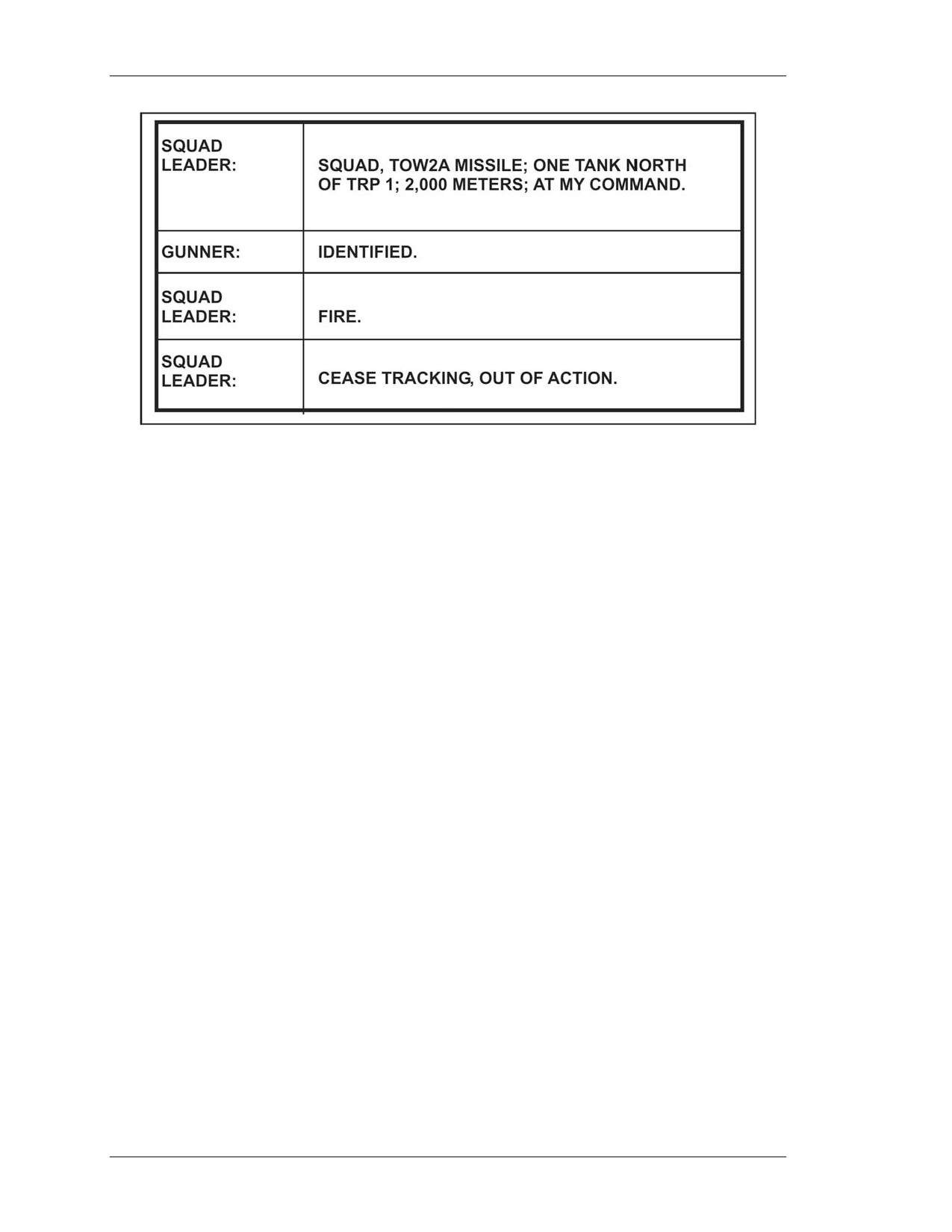
Figure 5-9. Example of a squad fire command.
a. Alert. The first element of the fire command alerts the crew for an immediate
engagement. The squad leader commands, “Squad,” and the gunner begins observing the
target area.
b. Type of Missile. Because a variety of TOW missiles are used and their
capabilities vary, a particular type of missile must be specified. A TOW crew in battle
will probably have a mix of different missiles and a wide variety of target arrays to
engage (see Chapter 1, TOW missile types and configurations). For example, if the target
is a BTR-60 or BMP-1, the squad leader may command, TOW 2; if the target is a T-80
with reactive armor, he may command, TOW 2B.
c. Target Description. The second element identifies the target for the gunner. If
several similar targets are present, this element tells the gunner which target to engage
first. Most targets can be described by using the terms listed in Table 5-1. Targets that are
combinations of the ones listed in Table 5-1, such as a truck mounting a missile system,
are identified by combining terms—for example, TRUCK MOUNTING ANTITANK.
When the gunner sees the target, he announces, “Identified.” If multiple targets appear,
the commander may specify which target will be engaged by the gunner--for example,
FIRST TANK or RIGHT TRACK. (See Appendix H for information on OPFOR/Threat
counterpart systems.)
5-6

FM 3-22.34
TARGET
ANNOUNCED AS
Any tank or tank-like vehicle
TANK
Several tanks
TANK FORMATION
Any unarmored vehicle
TRUCK
Any halftrack or armored
TRACK
personnel carrier
Helicopters
CHOPPER
All fixed-wing aircraft
PLANE
Personnel
TROOPS
Any machine gun
MACHINE GUN
Any antitank gun or towed
ANTITANK
artillery piece
A short word or
Any other target
phrase that clearly
describes the target.
Table 5-1. Terms used to describe targets.
d. Target Direction. If the target is moving, the direction of movement is given
after the description to aid the gunner in locating the target. After the gunner is given the
location of a target, he can search for the target in the direction of movement. The
following methods are also used to help the gunner locate the target.
(1) Target Reference Point. A TRP is an easily recognizable feature or point on the
ground (either natural or man-made) used for identifying targets and controlling fires.
They can be used to designate targets for companies, platoons, sections, and individual
weapons. They can also be used to designate the center of an area where the commander
plans to distribute or converge the fires of all his weapons. TRPs are usually designated
by the company commander or platoon leaders.
(a) Weapons will engage targets from different directions, so compass points (for
example, north, east), rather than “right” or “left,” are used when giving directions
centered on a TRP.
(b) Deflection from the TRP can be estimated, or it can be measured using the
binocular mil scale or the circular reticle on the wide field of view−for example, 5.5
degrees at 1,000 meters is about 100 meters, or 200 meters at 2,000 meters.
(2) Prominent Features. The commander may give the distance and direction from a
prominent feature−for example, FROM HILL SEVEN SIX TWO, LEFT TWO
HUNDRED, or FROM BRIDGE, RIGHT FOUR HUNDRED.
e. Range. The range is given to help the gunner identify his target and to determine
its engageability. The squad or section leader can determine the range to the target using
the naked eye, binoculars (mil-relation formula), or reference materials (maps, range
cards).
(1) Naked Eye. One method for using the naked eye to determine range is the football
field method. The squad or section leader counts in 100-meter increments, estimating the
number of football fields that could fit between the firing position and the target.
5-7
FM 3-22.34
(2) Binoculars. Binoculars and the mil-relation formula can be used to determine
range. To use this method, the squad or section leader must know the width, height, or
length of the target. He determines the width, height, or length with the mil scale on the
binoculars; substitutes the mil-relation; and computes the range.
(3) Reference Materials. Maps can be used to determine range by counting the grid
lines between the firing position and the target or by adjusting from a known point.
Range cards can also be used to determine the range to the target.
f. Execution. Two commands are necessary for execution: a preparatory command
and a command of execution.
(1) AT MY COMMAND is a preparatory command that warns the gunner not to fire
until given the command of execution.
(2) FIRE is the only command of execution used to fire a missile.
g. Additional Commands. In addition to the six elements of the fire command,
some other commands are needed.
(1) The command CEASE TRACKING or CEASE TRACKING, OUT OF ACTION
is issued after seeing the round detonate or when the squad or section leader wants to halt
firing.
(a) CEASE TRACKING tells the crew the squad or section leader intends to stay in
position and engage another target immediately or when one appears.
(b) CEASE TRACKING, OUT OF ACTION tells the crew the squad or section
leader intends to move to another position.
(2) To determine the method of engagement, the section leader (or above) selects a
fire pattern depending on the opposing force’s formation. The section leader directs,
FRONTAL, DEPTH, or CROSSFIRE, when the gunner is faced with multiple targets.
(3) When the target is identified, the gunner announces, “Identified.”
(4) If the gunner cannot see the target, he announces, “Lost.”
(5) If the gunner cannot identify the target, he announces, “Cannot identify.”
(6) The loader announces, “Backblast clear,” before the command of execution is
given.
h. Repeating Commands. When a crew member fails to hear or understand any
element of a fire command, he announces the element in question. For example, if the
gunner asks, “Location?” the squad leader repeats the location element such as, “From
hill seven six two, west two hundred.”
i.
Correcting Errors. To correct an error in a fire command, the squad leader
announces, “Correction,” and corrects only the element in error. He completes the
command by announcing all elements after the corrected element. He does not try to
correct an element that has been needlessly included, such as the direction element. He
corrects the omission of an element by announcing “Correction” and then the omitted
element. After announcing the omitted element, he completes the command.
j.
Commands for the Driver. Although directions to the driver are not part of the
fire command, they are given by the squad leader or gunner in short terms.
5-3.
TARGET TRACKING
To track a target, the gunner visually acquires the target through the daysight tracker
system of the TOW. He can track the target by either optical or electrooptical means,
depending on the system configuration being used and on the visibility conditions.
5-8
FM 3-22.34
a. To track the target, the gunner operates the hand controls on the traversing unit to
keep the reticles in the launcher sight aligned with the target. The daysight tracker system
is attached to and aligned with the launch tube. The launch tube stabilizes the exit of the
missile from the launcher for initial alignment during missile flight. On achieving target
alignment, the gunner fires the missile by manually depressing the trigger switch.
Thereafter, all operations are automatic and the gunner’s only task is to maintain
alignment of the sight reticle on the target until missile impact.
b. Deviations of the missile from the line-of-sight trajectory are sensed in the
launcher sight by infrared means that receive information from infrared radiators attached
to the missile. This information is processed in the form of electrical signals to produce
error signals proportional to the azimuth and elevation displacements of the missile from
the intended trajectory. Correction commands are derived from these error signals and are
sent to the missile over the command-link wires, which are dispensed from the missile.
The missile performs corrective maneuvers using aerodynamic control surfaces that
deflect in response to the command signals from the launcher. On target impact, a
high-explosive, shaped-charge warhead is detonated.
5-4.
TARGET ENGAGEMENT WITH THE M220A1 (BASIC TOW)
Specific procedures are followed to engage a target with the M220A1.
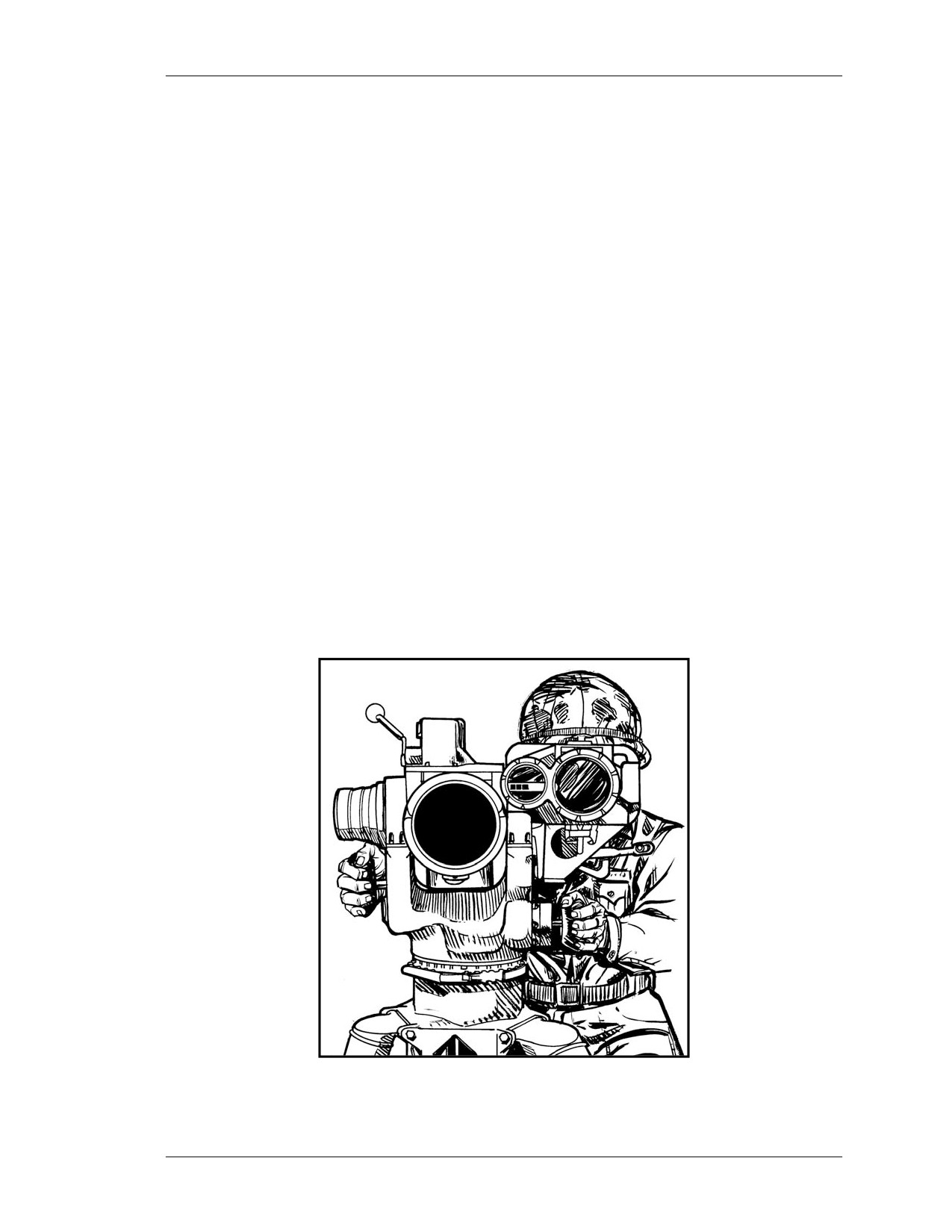
a. Position the eye well into the rubber eyepiece and place both hands firmly on the
control knobs (Figure 5-10). Place the body so there is no contact between the shoulder
and the encased missile. The only contact with the launcher is with the hands and eye.
Assume a firing position that is comfortable. An uncomfortable position causes muscle
tension, which affects the ability to track smoothly.
Figure 5-10. Control knobs.
5-9
FM 3-22.34
NOTE: When firing from the tripod, kneel on one or both knees.
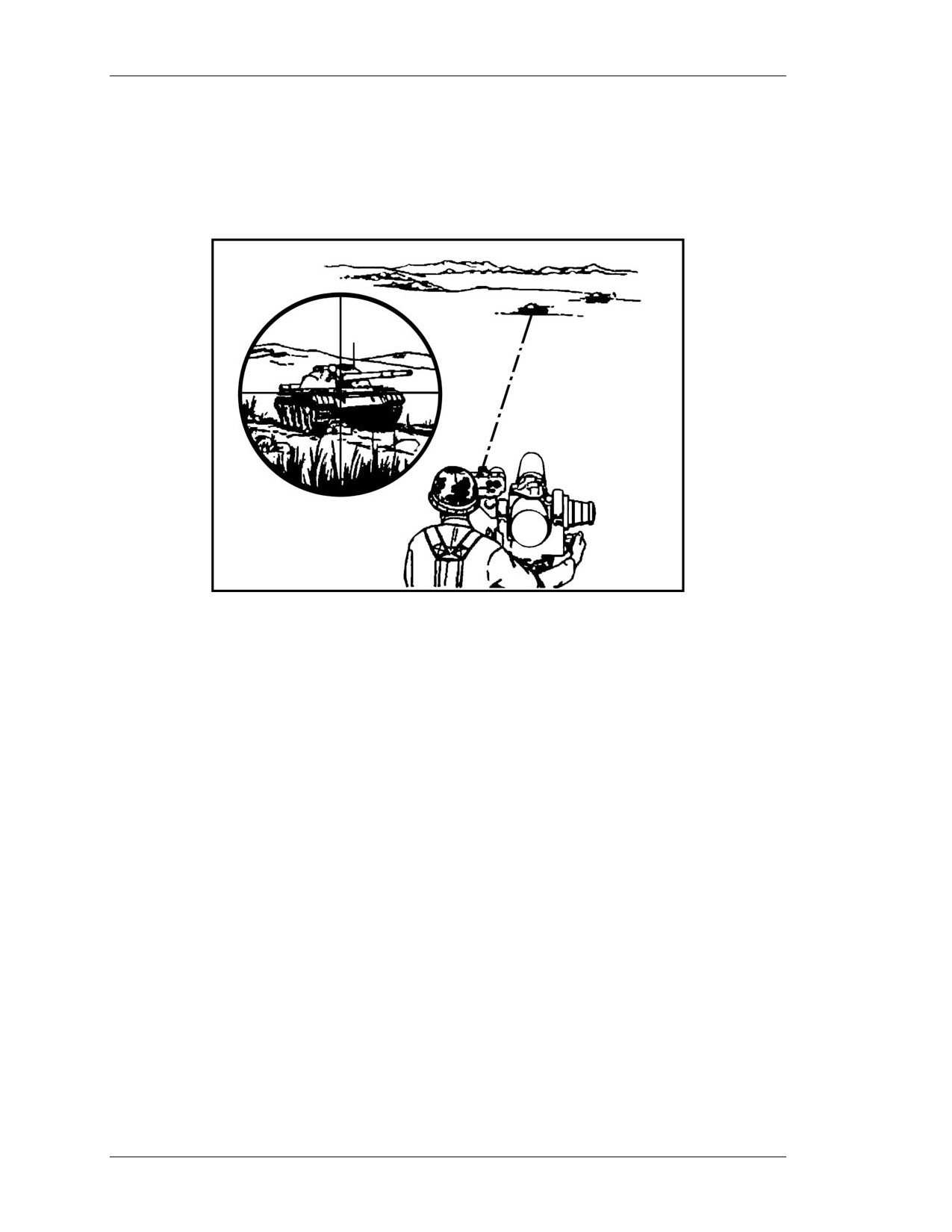
b. Raise the trigger protective cover and establish a smooth tracking rate while
keeping the crosshairs on the center of visible mass of the target (Figure 5-11).
Figure 5-11. Crosshairs on the center of visible mass of the target.
c. Move the launch tube left or right by applying a smooth, steady force to both
control knobs (pushing one and pulling on the other) and rotating the body from the waist
up as the launcher moves. Elevate or depress the launch tube by applying a smooth,
steady turning force to both control knobs. Applying pressure to only one control knob,
or applying uneven pressure, makes it more difficult to track smoothly. Maintain the
same arm, shoulder, and head position throughout an engagement. Any change in body
position other than leaning with the controls will cause a jerking motion that could result
in grounding of the missile.
d. Proper breath control is especially important during the first and last 400 meters
of missile flight. Improper breathing will cause poor tracking. Take a deep breath and let
part of it out; then, press the trigger. After a 1.5-second delay, the missile will launch.
The delayed firing of the launch motor may cause you to flinch or jerk the control knobs
if you are not prepared for it. Be prepared for two noises after the trigger is pressed. The
first noise is the gyro being activated. While it is not loud, it may cause you to think a
misfire has occurred, and you may not be prepared for the next noise. The second noise is
the launch motor firing and it is loud. The dust, smoke, heat, and debris from the
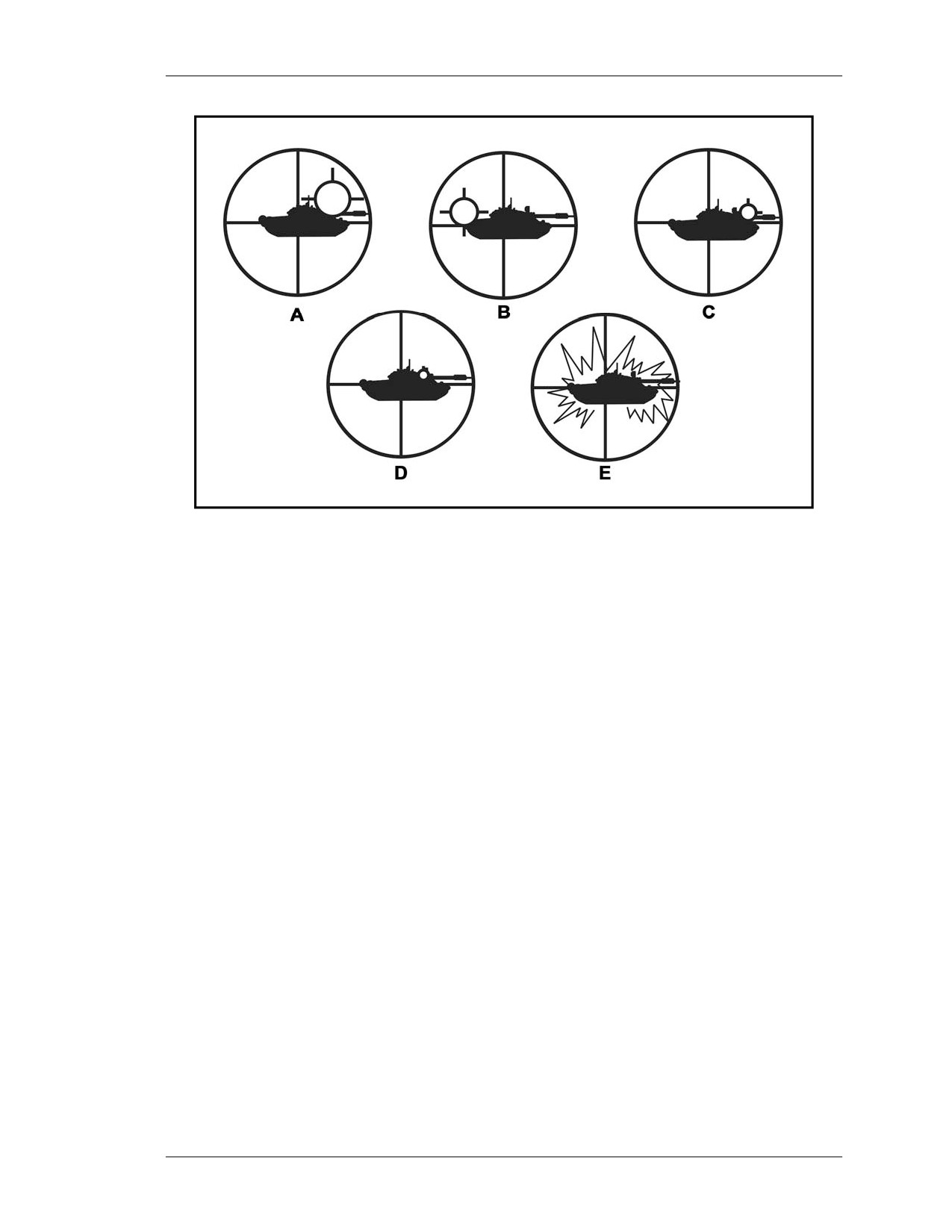
backblast may cause flinching. When the missile appears in the sight picture, ignore it.
Never try to guide the missile. If distracted, tracking becomes poor and chances of hitting
the target are reduced. Continue to track the target at a smooth tracking rate, keeping the
crosshairs on the center of visible mass until missile impact (Figure 5-12).
5-10
FM 3-22.34
Figure 5-12. Keep crosshairs on the center of visible mass.
5-5.
TARGET ENGAGEMENT WITH THE M220A2 (TOW 2)
Specific procedures are followed to engage a target using the M220A2.
a. Looking through the daysight tracker, adjust the focus control until the crosshairs
are in focus. (To see the crosshairs clearly, set RETICLE LIGHT switch to ON.) Position
the crosshairs on the target, and remove the front lens cover from the nightsight by
releasing two latches. Set the ON-OFF-STBY switch to ON. Look through the eyepiece
and adjust the diopter adjustment ring to focus the reticle. Ensure the battery monitor
light is off. Set the field of view selector to wide field of view, locate the target, and
adjust the range focus, contrast, and brightness controls to obtain the best possible sight
picture. Set the field of view selector to narrow field of view and adjust the range focus,
contrast, and brightness knobs.
(1) Because handoff may occur when limited visibility conditions exist, locate the
target with the daysight tracker and fire using the nightsight. During daylight, the
battlefield can be obscured by smoke, dust, and so forth. If limited visibility conditions
exist, the MGS automatically transfers control of the missile from the daysight tracker to
the nightsight. The nightsight allows continuous observation of the target regardless of
battlefield visibility conditions.
(2) To view the battlefield, ensure the TOW 2 nightsight ON-OFF-STBY switch is in
the ON position. Battlefield conditions requiring the nightsight to be in operation are area
target monitoring and target engagement. The ON-OFF-STBY switch on the TOW 2
nightsight allows greater battery life from the BPC when placed in the STBY position.
After the TOW 2 nightsight has been turned on and allowed to cool down (about three
minutes), place the ON-OFF-STBY switch in the STBY position. The STBY position
causes the closed-cycle cooler to cycle OFF for 100 seconds and ON for 20 seconds.
Cool down is not required if the nightsight has been operating in the STBY position.
5-11
FM 3-22.34
(3) When firing the TOW 2 system, ensure the nightsight is turned ON. Always allow
three to five minutes cool down time before operation regardless of which sight is used.
This ensures that the enhanced capabilities of TOW 2 are used during firing, flight, and
impact. Certain conditions may permit degraded firing. During the system check-out
procedure, if the display indicates a nightsight (postamplifier) failure, the TOW 2 can be
fired using the daysight tracker only. If limited visibility causes handoff during flight,
control of the missile may be lost.
b. To complete the firing sequence, follow the procedures for the basic TOW
launcher (paragraph 5-4, page 5-9).
Section ll. HELICOPTER ENGAGEMENT
Enemy armor is the primary threat to friendly ground forces employed in forward areas.
The primary mission of the TOW is the destruction of these tanks at the greatest possible
range. However, TOW gunners can also successfully engage attacking enemy
helicopters, which are a significant threat to ground forces.
5-6.
OPERATIONAL CONCEPT
Engaging helicopters with the TOW should be considered primarily as a means of
self-defense. TOW crews should not consider helicopters as a routine target of
opportunity, but they should leave them to conventional ADA assets when possible.
a. TOW positions are selected to cover armor avenues of approach, but these
long-range fields of fire also facilitate the engagement of aircraft. The section leader’s,
squad leader’s, and crew’s observation from these positions can provide the early
warning required to successfully engage aircraft.
b. The engagement of attacking helicopters should be done by TOW sections, not
individual weapon systems. TOW sections should automatically engage helicopters that
are attacking their positions. If one squad in a section is being attacked by a helicopter,
the other squad should engage the helicopter while the first squad seeks cover. TOW
crews and sections should be trained to automatically respond to helicopter attacks in this
manner.
5-7.
GUNNERY TRAINING
Specific gunnery training is required to track a helicopter with a TOW. Crews should
perform the training according to the following conditions and standards. In addition to
these outdoor training exercises, a number of scenarios for the TGT include helicopters as
targets.
a. Conditions. Training takes place during daylight on a range. The TOW crew is
given either a ground- or vehicle-mounted TOW with a TFTT and a helicopter mounted
with TFTT reflectors. The helicopter moves toward the TOW gunner at speeds between
40 and 80 knots and at ranges between 1,000 and 3,500 meters. Three target angles are
used for tracking: head-on; approaching at 30 degrees; and an evasive track with a
90-degree turn.
b. Standards. Within 5 seconds the gunner must acquire and begin tracking the
target. He must get a hit 6 out of 10 times with the TFTT.
5-12
FM 3-22.34
Section III. NBC AND LIMITED VISIBILITY CONDITIONS
Specific procedures are followed to operate the TOW during NBC and limited visibility
conditions.
5-8.
DECONTAMINATION
TOW crewmen must know decontamination procedures and materials. They must know
which decontamination materials to use on each type of surface on the weapon system.
Using the wrong material can cause damage to the system (for example, using DS2 on
rubber surfaces). Decontamination materials and methods are periodically revised. (Refer
to Appendix C of FM 3-5 for the most up-to-date information.)
5-9.
THERMAL TARGET RECOGNITION, IDENTIFICATION, AND
ENGAGEMENT
The nightsight allows the TOW gunner to view targets during limited visibility conditions
such as darkness, smoke, fog, rain, and snow. It produces images called thermal target
signatures or infrared target signatures, which are different from the images seen in the
daysight tracker. Targets stand out in these infrared images and can be recognized at long
ranges on a clear night and at reduced ranges during poor visibility. Recognizing these
targets requires trained and experienced gunners.
a. Temperature and Thermal Images. Most objects have a radiated temperature
either higher or lower than their background. Even if the radiated temperature differences
are less than a degree, they appear on the nightsight display. If there is no difference
between the temperature of an object and its background, the object will not be seen in
the display.
(1) If an object has a high temperature, it will appear bright red in the nightsight. If
the object has a low temperature, it will appear black. Usually, targets are easier to
identify at night, because their radiated temperature is hotter than their background.
(2) Some targets, such as tanks and APCs, have internal temperature variations that
form visible patterns. These patterns are the basis of target signature cues. In a nightsight,
the shapes of the hottest vehicle parts, such as engines and exhausts, appear bright red.
Objects with a medium temperature, such as the warm tracks, appear a dim red. Objects
with a cool temperature, such as the cool hull and other cool parts, appear black.
b. Sources of Infrared Energy. Infrared energy comes from different sources such
as solar heat, fuel combustion heat, frictional heat, and reflected radiance.
(1) Solar Heat. Solar heat comes from the sun and affects the exterior surface of
objects. This heating highlights the outline of the object, which provides recognition cues
to the gunner. These cues are usually similar to the overall appearance of the target. (For
example, a solar-heated M113 appears box-like with a sloping front; a solar-heated M60
tank appears as a small oval atop a larger oval.) These shape cues are recognizable out to
medium (1,000 to 2,500 meters) and long (beyond 2,500 meters) ranges. Since the sides
have more defined contours, the side view shapes are usually easier to recognize than the
front view. In addition to atmospheric variables and surface reflections, the solar heating
rate is also affected by the object’s ability to absorb sunlight. Generally, dark-colored
objects are better absorbers of sunlight than light-colored objects.
5-13
FM 3-22.34
(2) Fuel Combustion Heat. Fuel combustion heat comes from operating engines. The
heat from operating engines is conducted to the surfaces of the surrounding engine
compartment.
(a) Because engine compartment temperatures reach up to 200°F, the surfaces of
these compartments radiate features that can be easily detected on the nightsight at long
ranges. Heated personnel space is also visible.
(b) Engine muffler and exhaust pipe temperatures are high, providing the gunner with
good cues.
(c) Although the engine, heated compartments, and exhaust features themselves do
not appear in the nightsight, their cue value is not any less. A trained and experienced
gunner can determine much about the vehicle from these cues.
(3) Frictional Heat. Frictional heat is produced by the moving parts of vehicles.
However, these features usually appear a dim red. This heat is less intense than the high
temperatures from the engine combustion. Frictional heat is generated only when the
vehicle is in motion.
(a) Frictional heat provides long-range cues to classify the vehicle as wheeled or
tracked. At medium-range to short-range, these cues can be used to identify the vehicle.
(b) The vehicle’s transport systems are the source of most frictional heat cues.
Tracked vehicles have frictional heat in the tracks, road wheels, drive sprockets, support
rollers, and shock absorbers. The smallest of these features can be identified at longer
ranges when they are hot. Wheeled vehicles have frictional heat in the tires, shock
absorbers, drive shafts, transmissions, axles, and differentials. The tires, shock absorbers,
and differentials can be detected at medium-range to long-range.
(4) Reflected Radiance. Certain smooth, glossy surfaces, such as windshields and
glossy painted fenders, reflect radiation images from other sources. These reflections can
produce odd images. For example, the fenders of a T-62 appear black because of thermal
reflection. An overcast sky can cause warmer thermal reflections. Generally, surface
reflections are diffuse in nature and do not usually cause problems.
5-10. EFFECTS OF WEATHER AND OBSCURANTS
Variations in solar heat, fuel combustion heat, frictional heat, and thermal reflection
affect infrared signatures and infrared target recognition cues. In addition, some
atmospheric conditions degrade the nightsight, while others can enhance it. Some of these
factors are discussed below.
a. Falling Precipitation. Infrared energy does not transmit well through falling
precipitation (rain, snow, and fog). The temperature of targets and background objects are
decreased. The basic signature cues themselves do not change because of atmospheric
transmission losses. Falling precipitation restricts nightsight visibility more than
precipitation that has fallen.
(1) During rain or snow, background objects and frictionally heated and solar-heated
target features lose heat. Frictional heat loss is caused by water and mud accumulating on
the tracks, wheels, and other transport system parts. Engine compartment and exhaust
temperatures remain high. Landmarks, such as tree lines, trails, and contour features, are
often lost. The loss of heat in background objects reduces scene clutter, such as trees and
rocks, and can increase target detection. Target recognition cues are usually reduced
because of the loss of heat in certain target features.
5-14
FM 3-22.34
(2) Because rain and snow have a cooling effect on the target’s contrast, the
nightsight contrast controls must be increased to compensate for the condition. However,
a higher contrast setting produces a “snowy” image.
b. Fallen Snow. Fallen snow tends to make all ground temperatures the same. Depth
perception by size comparison becomes difficult because of lack of terrain features with
which to reference size.
c. Dust, Diesel Fog, and Oil Smoke. Dust particles from artillery impact greatly
reduce nightsight visibility. Only the hotter objects and target features show through the
obscurants.
5-11. COMPENSATION FOR TARGET APPEARANCE VARIABLES
Although vehicles have distinguishing characteristics or cues by which they can be
classified and identified, vehicle appearance can be altered by changes in atmospheric
and ground conditions. Therefore, the gunner must know to use the control settings of the
nightsight to help compensate for these variables.
a. Contrast and Brightness Control. The contrast and brightness controls can be
set for maximum internal detail of the target. The controls are balanced to give the
clearest image of these target recognition cues. The following is general guidance for
setting the image brightness and contrast controls. Gunners should be encouraged to
experiment with the controls to understand the effects of the image controls on the
thermal image and thermal signatures.
(1) Brightness, Low; Contrast, Medium to High. These settings are for scanning an
area in search of targets. Background clutter is suppressed. Cool objects are not visible.
Only the hot objects in the field of view are seen. When a possible target has been found,
brightness can be increased and contrast can be lowered gradually to reveal more thermal
detail in the suspected target. Low brightness and medium-to-high contrast settings are
also for nightsight use in light fog, rain, or dust conditions.
(2) Brightness, Low to Medium; Contrast, Medium. This is the best overall setting
for target detail. With medium contrast, brightness can be varied up and down to bring
out features and determine the hottest vehicle parts. When brightness is lowered, the
cooler parts, such as tracks, darken before hotter parts. Often, small changes in brightness
can reveal much about the vehicle. For example, road wheels can sometimes be seen at
long range if this technique is used. Experimentation is helpful in learning this target
feature extraction technique.
(3) Brightness, Medium; Contrast, Medium to High. These settings work well in
heavy fog or heavy dust when little can be seen with the TOW. The settings increase the
snowy effect in the image, but they also increase the apparent sensitivity of the sight. The
image appears distorted and is difficult to interpret. These settings are also good for
searching a tree line in wet conditions. They are sometimes useful with long-range
targets. Beyond 2,500 meters, small target images, such as the front view of a BRDM-2,
will have a few recognizable features. At long ranges, the higher contrast setting
highlights the vehicle’s hull and overall silhouette. This will not provide internal detail,
but it will help the target stand out from the background and will aid in target detection.
b. Focus Controls. Most nightsight focus controls are sensitive; that is, a small
movement of the control knob results in a large change in focal point. If a gunner has
difficulty in focusing, he should check the adjustment of the image controls.
5-15
FM 3-22.34
(1) The eyepiece focus should be adjusted first. The eyepiece focus is called the
diopter adjustment. Once a gunner knows his diopter correction number, he can dial it in
on any nightsight diopter ring. Correct diopter adjustment can usually be obtained by
focusing the eyepiece so that the reticle is focused.
(2) The second focus adjustment is the objective range focus. The image controls
should be adjusted at the low-to-medium level before focusing the objective lens.
Focusing the objective lens is learned through trial and error. It is made difficult by the
fact that infrared heat diffuses on objects and does not usually give clear-cut, straight
lines on which to focus. Thus, the gunner must learn to focus by adjusting the control
back and forth to get the best image. This is easier to do when the nightsight is aimed at a
prominent object. Once the best image is determined, the gunner can experiment by
focusing on different objects at different ranges.
5-12. BATTLEFIELD IDENTIFICATION
Battlefield identification using a nightsight is difficult. Although the identification
problem is being studied, little is known about the ranges at which high-confidence
identification can be expected. In a target-rich environment on a dry, clear night,
high-confidence identification requires a thermal image of such features as road wheels,
turret shapes, gun tube, and exhaust location. Limited experience with tanks produced in
the U.S. and other nations indicates that thermal identification can be made between
1,000 to 2,000 meters in clear weather. When identifying targets, a gunner should ask
himself these questions:
• Is the target moving?
• What direction is it moving?
• Where is the engine?
• Where is the exhaust?
• Is the target in the unit’s sector?
• Should it be there?
• Is it in a formation?
• Is it firing at the unit?
NOTE: Refer to FM 100-65 for primary recognition cues.
Section lV. ELECTROOPTICAL COUNTERMEASURES
TOW crews may encounter electrooptical countermeasures on the battlefield. Therefore,
the following procedures should be used as engagement criteria and not as maintenance
checks.
5-13. TOW LAUNCHER
TOW gunners should complete boresight procedures at least as often as prescribed in the
operator’s manual to ensure the system remains boresighted. When properly boresighted,
the boresight meter needles are centered. The sight sensor must point at the ground or
away from the sun or any other possible source of IR energy when the boresight
procedure is being completed.
5-16
FM 3-22.34
a. Once the boresight procedure is completed, the TOW crew leaves the self-test
selector switch in position 7 and engages the test/operate switch (move to test position
and hold) as the gunner acquires the target. The missile arming lever should not be raised
at this time. If the self-test meter needles peg to one side, or become erratic, or both as the
gunner aims at the target, electro-optical countermeasures are present and a shot against
that target should not be attempted. The gunner waits for a flank shot or shifts targets.
b. The loader releases the test/operate switch as the gunner shifts targets. The loader
reengages the test/operate switch (returns it to test position) when the gunner is ready to
acquire a second target. Releasing the switch saves wear and tear on the daysight tracker
sensor and conserves battery power, if batteries are being used.
c. If the meter needles return to center after the gunner places his crosshairs on a
second target, he engages the target. The loader releases the test/operate switch and raises
the arming lever, and the gunner fires the missile.
d. If the meter’s needles are erratic after the gunner lays on the second target, he
does not fire. He selects another target or waits for an oblique or flank shot ensuring the
meter needles are centered before firing.
5-14. TOW 2 LAUNCHER
TOW 2 launchers firing TOW 2-series missiles are not vulnerable to electrooptical
countermeasures. However, TOW 2 launchers firing non-TOW 2 missiles are vulnerable,
and gunners should use the boresight indicators to determine whether a target should be
engaged.
a. The loader completes the MGS self-test procedure as target engagement becomes
imminent. The loader holds the self-test toggle switch in the test position before the
missile is armed, as the gunner places his crosshairs on the target. If the green light stays
on indicating electro-optical countermeasures are not present, the loader releases the
toggle switch and raises the arming lever, and the gunner engages the target.
b. If the green boresight center light goes off and the red lights begin to flicker on
and off indicating electro-optical countermeasures are present, the gunner does not
engage the target. The loader holds the self-test toggle switch in the test position as the
gunner acquires an alternate target. If the red lights go off and the green light comes on as
the gunner lays his crosshairs on a second target, the loader releases the self-test toggle
switch and arms the missile, and the gunner engages the target.
c. Because the TOW 2 self-test switch is reactivated each time the toggle switch is
placed in the test position and the self-test cycle takes 15 to 20 seconds, the loader does
not release the test switch while the gunner is acquiring alternate targets. The leader
releases the switch only after the green boresight light appears, signifying that it is safe to
engage that target.
5-17
FM 3-22.34(FM 23-34)
APPENDIX A
TOW TRAINING TIPS
Experiences at the National Training Center have produced many
useful tips for training and employing TOWs. Following these tips will
greatly enhance the performance of TOW units in the field.
1. To reduce the effects of heat scintillation, fire from a higher to a lower elevation
whenever possible.
2. Train crewmen to remove the protective covers from the electrical connectors of
missiles before loading. This is the most common cause of misfires during live fire.
3. Emphasize the obstacle effects of TOW guidance wires. Wire will impede or stop
vehicular and dismounted movement. Plan for their recovery and or destruction. Wire
cutters are not fine enough to cut TOW wire. The wire must be cut with low-intensity
flame when possible.
4. Perform a system self-test and collimate the nightsight to the daysight tracker every 4
hours, after every 10-degree change in temperature; and after moving cross country.
5. Select flat, level firing positions to improve hit probability.
6. Practice fire control and fire patterns at every opportunity.
7. Identify maximum engagement lines and TRPs as accurately as possible. Use
adjacent tanks or FO/FIST laser range finders when available.
8. Perform the 180-day verification checks as often as possible (every 30 days is not too
often). Verify in the assembly area immediately before combat or live-fire operations.
Allow time to fix deficiencies.
9. Increase the amount of time spent tracking in MOPP4. Tracking in MOPP4 improves
tracking skills even under MOPP1 conditions.
10. Ensure TOW live fire is conducted from the narrow field of view only.
11. Ensure M966s and BFVs with TOW 2 weapon systems receive priority issue of
TOW 2 missiles.
12. Collimate nightsight to daysight each time the system is boresighted.
13. Know the diopter setting. This information should be posted on the system for ready
reference.
A-1
FM 3-22.34
14. M966 TOW HMMWV:
a. Shield the nightsight and daysight from direct sunlight. Cool the nightsight as
much as possible to reduce system cool-down time.
b. Familiarize gunners with launch obscuration effects:
(1) White out⎯1.5 seconds after trigger pull, block daysight for 2 to 5 seconds.
(2) Red out⎯1.5 seconds after trigger pull, pass a lit cigarette lighter or other IR heat
source 6 inches in front of the AN/TAS-4.
c. Remove AN/TAS-4 eyepiece when tracking in a protective mask. Replace with a
doughnut-shaped foam cushion made from a sleeping mat or from ammunition packing
and taped to AN/TAS-4.
d. Reinforce counter-rotation launch technique to reduce launch tube climb during
live fire.
e. Train gunners to bring crosshairs back on target slowly, avoiding jerky
movements.
f. Minimize movement of crew members on vehicle when missile is in flight.
g. Minimize blowing of sand and dust from missile launch, by placing a tarp on the
ground in front of the launch tube or by wetting the ground down. Blowing dust and sand
can cause the weapon system to lose the IR beacon on the missile.
15. Fire Commands/Missile Selection. With the increase in the number of different types
of missiles in the TOW inventory, it will sometimes be necessary to tell the gunner what
type of missile to engage the target with (see Appendix H, Table H-2). If a missile is not
loaded in the weapon system, the squad leader can include the missile type in the target
description portion of the fire command (SQUAD, T-80, TOW 2B). If a missile is loaded
in the weapon system, the squad leader will have to make the decision whether time and
the tactical situation make it desirable to unload and then reload the system. If a missile
has just been fired, the missile reload type can be designated as part of the cease tracking
command (CEASE TRACKING, TARGET DESTROYED, RELOAD WITH TOW 2A).
16. TOW MILES Gunnery. Because TOW MILES is an engagement simulator adapted
as an interim gunnery trainer, it is important to return gunners to a precision tracking
system before live-fire or combat operations. Because the tracking simulation of TOW
MILES is less realistic and more forgiving of errors, hit success with the MILES
simulator comes more easily than hit success with the actual TOW missile. This is
especially true with panel targets equipped with the LTID. Exclusive training on TOW
MILES sometimes lulls gunners into a false sense of tracking proficiency. As an
engagement simulator in the role of tactical trainer, TOW MILES offers adequate tactical
realism. Good TOW gunners are usually good MILES gunners. The reverse is not
necessarily true.
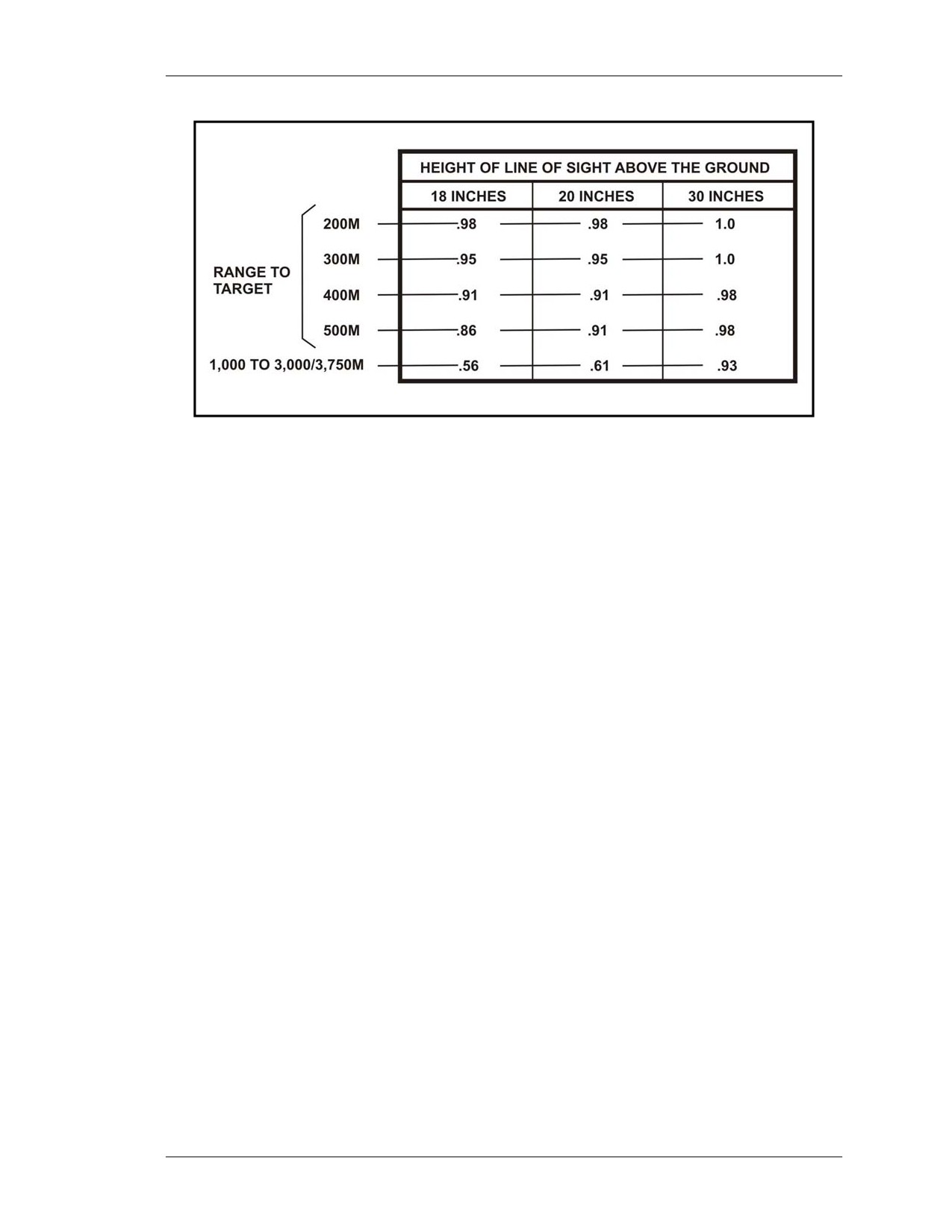
17. TOW Missile Clearance Requirements. If line-of-sight clearance is less than 30
inches, the probability of the missile hitting the ground or an obstruction is increased.
Figure A-1 shows the probability of survival for the TOW. The reason for the deviation is
that the missile does not precisely follow a gunner’s line of sight.
A-2
FM 3-22.34
Figure A-1. Probability of survival for the TOW (meters).
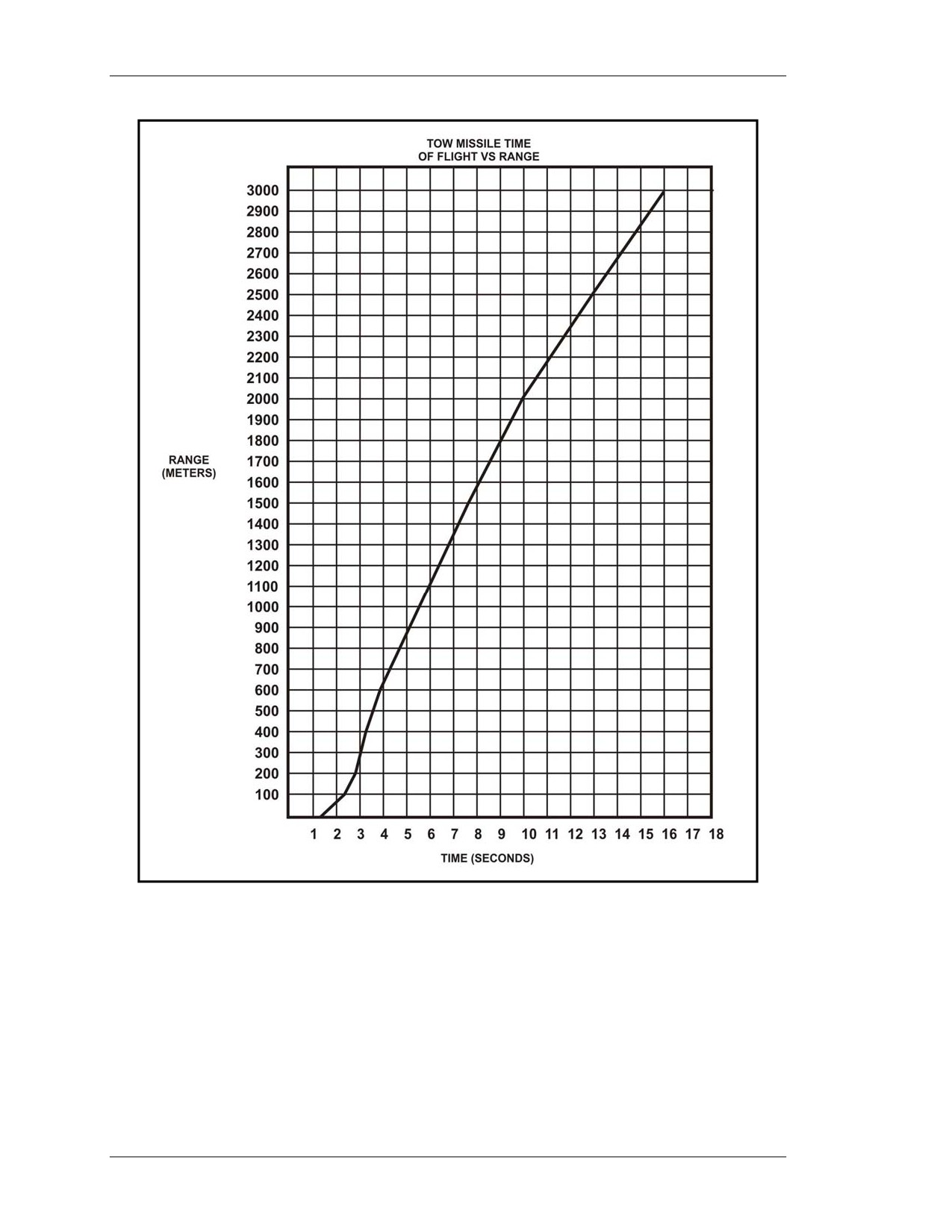
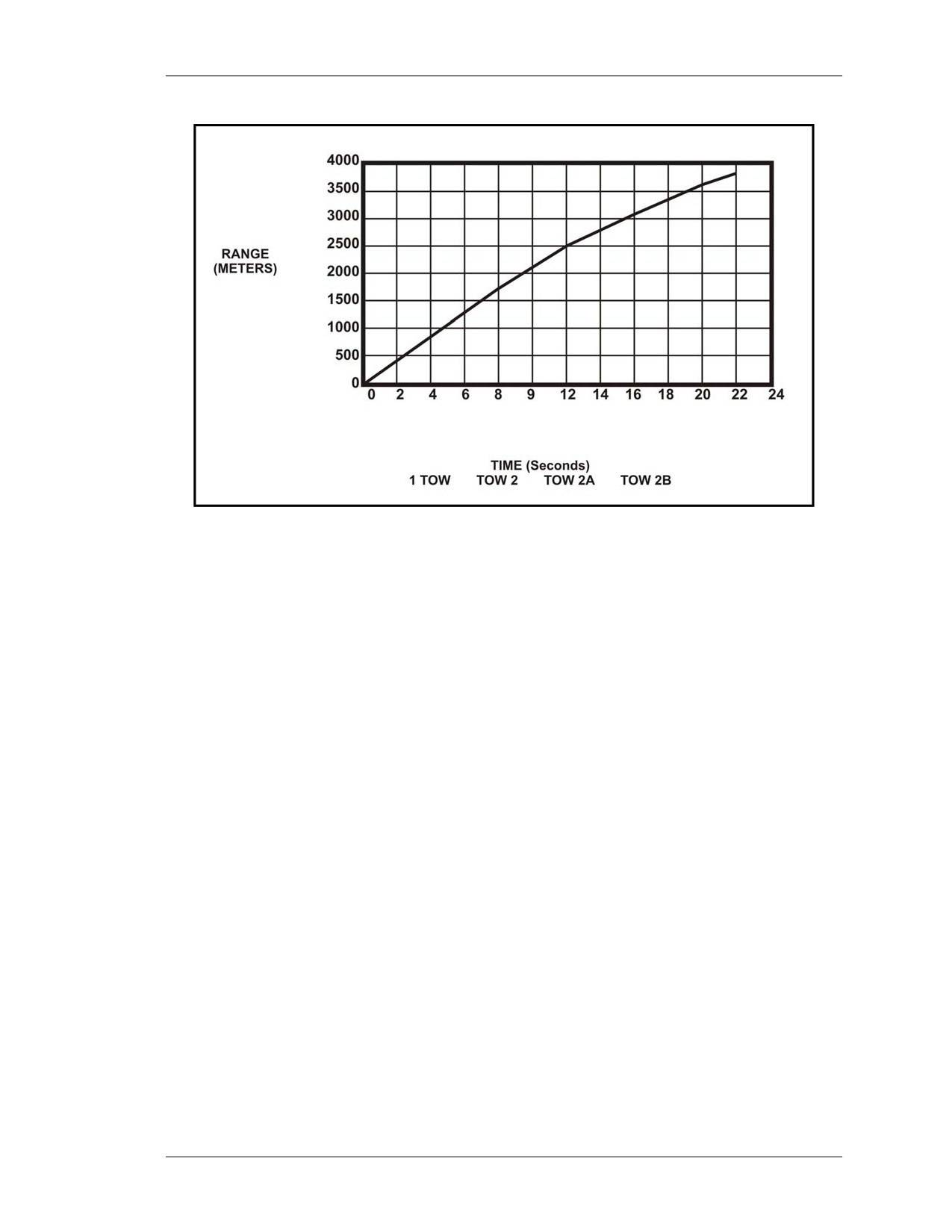
18. TOW Missile Time-Of-Flight Versus Range. Figure A-2 (page A-4) and Figure A-3
(page A-5) show the time of flight of the TOW missile to various ranges. Using these
figures allows the squad leader to accurately calculate the time it takes for the missile to
reach its target.
A-3
FM 3-22.34
Figure A-2. TOW missile time-of-flight versus range.
A-4
FM 3-22.34
Figure A-3. TOW missile time-of-flight versus range (kilometers).
A-5
FM 3-22.34(FM 23-34)
APPENDIX B
TRAIN-THE-TRAINER PROGRAM
The success of the TOW training program depends on trainers who
are competent and well prepared. This appendix provides information to
assist the TOW unit’s chain of command in preparing and implementing
an effective train-the-trainer program.
B-1. OBJECTIVES
The train-the-trainer program has specific objectives. Its purpose is to develop in every
TOW trainer the skills, confidence, and willingness to train 11B soldiers to be proficient
with their weapon system and effective in combat. An effective trainer must be able to―
• Set up and operate training equipment.
• Perform all individual and collective tasks.
• Effectively coach a gunner during tracking training.
• Accurately assess the training strengths and weaknesses of individuals and
crews.
• Plan and conduct training that will correct training weaknesses.
• Instill confidence in the individuals and crews he trains.
B-2. MISSION-ESSENTIAL TASK LIST
Each commander of a TOW unit should carefully examine his unit’s wartime mission and
develop a METL. He then organizes a unit sustainment training program that supports
that METL. The TOW Training Program consists of quarterly and semiannual mandatory
training events. That does not mean that no TOW training should be done in the interval
between these events. The commander is responsible for assessing his wartime mission
and his unit’s current training status and then devising a unit sustainment training
program. That program should both support his METL and prepare his unit for the next
round of TOW gunnery tables.
B-3. TRAINER ASSESSMENT
Trainers in a TOW unit are normally the squad and section leaders and the platoon
sergeants. The trainers are not chosen by their proficiency but by their duty position.
Therefore, assessing the abilities of all element leaders is critical. Any shortcomings must
be corrected. This assessment is primarily the responsibility of the commander and the
platoon leaders and sergeants. This can be accomplished in several ways.
• Conduct periodic leader’s tests, both written and hands on.
• Have all leaders perform all the tasks that their subordinates are required to
take in the quarterly and semiannual mandatory training events (Gunner’s
Skill Test and TOW Gunnery Tables).
• Hold a competitive skill test each month with the winner being named trainer
of the month.
Any of these methods, or any other the commander deems appropriate, are acceptable as
long as they provide an accurate assessment. Trainers should be thoroughly refreshed in
the skills they are deficient in before they are allowed to train and test subordinates. A
B-1
FM 3-22.34
soldier must know his superiors are more skilled than he is in order to have confidence in
those superiors.
B-4. COMMAND BENEFITS
If a train-the-trainer program is conducted aggressively and regularly, the benefits to the
unit are considerable.
a. The base of trainer expertise will remain solid and gradually spread through the
unit.
b. Maintaining this base is easier than periodically recreating it.
c. Overall unit proficiency and esprit de corps will steadily rise.
d. A well-trained and proficient unit requires less time for sustainment training and
leaves more time for other unit missions.
B-5. TRAINING TASKS
To be successful, the trainer must be thoroughly familiar with the operation of his
training devices. All trainers must be able to correctly perform the following tasks:
a. TOW Gunnery Trainer.
TASK: Assemble the TGT.
CONDITIONS: Indoors, given a TOW tripod, traversing unit, and launch tube
and all components of the TGT.
STANDARDS: Correctly assemble all components of the TGT IAW TM 9-6920-
452-10.
TASK: Prepare the TGT for operation.
CONDITIONS: Indoors, given a fully assembled and operational TGT.
STANDARDS: Correctly power on and warm up the TGT, and perform the
operational checkout of the TGT IAW TM 9-6920-452-10.
TASK: Conduct pre-operational procedures for the TGT.
CONDITIONS: Indoors, given an operational and fully assembled TGT.
STANDARDS: Correctly load the videodisc, program disk, and the data disk
IAW TM 9-6920-452-10.
TASK: Edit a planned group.
CONDITIONS: Indoors, given a fully assembled, operational TGT and matching
data and videodiscs.
STANDARDS: Correctly edit a planned group to match the desired conditions in
the mission IAW TM 9-6920-452-10.
B-2
FM 3-22.34
TASK: Perform operational procedures for the TGT.
CONDITIONS: Indoors, given an assembled, fully operational TGT with
matching video and data disks and an edited planned group.
STANDARDS: Correctly brief the student and conduct a mission from the
planned group IAW TM 9-6920-452-10.
b. MILES.
TASK: Install MILES on the TOW weapon system.
CONDITIONS: Outdoors, given a TOW traversing unit, tripod, nightsight, and
launch tube and a TOW MILES tracker head, ATWESS tube, and MGS
simulator.
STANDARDS: Correctly assemble, install, and test the TOW weapon system
with TOW MILES IAW TM 9-1265-368-10-2 (tasks 9 through 12).
TASK: Test the assembled TOW MILES.
CONDITIONS: Outdoors, given an assembled TOW weapon system with TOW
MILES installed.
STANDARDS: Correctly test the TOW MILES IAW TM 9-1265-368-10-2
(task 13).
TASK: Fire TOW and ATWESS.
CONDITIONS: Outdoors, given an assembled, tested, and operational TOW
MILES system.
STANDARDS: Correctly and safely fire TOW MILES with ATWESS IAW TM
9-1265-368-10-2 (task 15).
TASK: Reset MWLD and TOW MILES.
CONDITIONS: Outdoors, given an MWLD, an assembled, tested, and
operational TOW MILES system, and a controller key.
STANDARDS: Correctly reset the MWLD and TOW MILES after they have
been “killed” IAW TM 9-1265-368-10-2 17).
c. TOW Field Tactical Trainer.
TASK: Assemble the TFTT and install the retroreflector.
CONDITIONS: Outdoors, given a complete TOW system and a complete TFTT
with retroreflector.
STANDARDS: Correctly install the TFTT and retroreflector IAW TM 9-6920-
453-10 (M966).
B-3
FM 3-22.34
TASK: Power up the TFTT and align the laser to the retroreflector.
CONDITIONS: Outdoors, given an assembled TFTT and an installed
retroreflector.
STANDARDS: Correctly power up the TFTT and align the laser to the
retroreflector IAW TM 9-6920-453-10 (M966).
TASK: Conduct operational procedures for the TFTT.
CONDITIONS: Outdoors, given an assembled, operational, aligned TFTT, and an
installed retroreflector.
STANDARDS: Correctly conduct operational procedures for the TFTT to
included setting target size and obscuration time, loading the M80 blast simulator,
and preparing the TFTT for firing IAW TM 9-6920-453-10 (M966).
TASK: Conduct system checks and test procedures for the TFTT.
CONDITIONS: Outdoors, given an assembled, operational, and aligned TFTT.
STANDARDS: Correctly perform all system checks and test procedures for the
TFTT to include visual checks, cable checks, power checks, computer checks,
alignment checks, and system and operational checks IAW TM 9-6920-453-10
(M966).
B-6. TRAINER CERTIFICATION PROGRAM
The commander may choose whatever method he thinks best to assess trainers, but he
must include the following elements in a trainer certification program:
a. Program Orientation. When a new trainer first enters the unit, he must be
briefed on the unit’s instructor certification program so that he understands what is
expected of him.
b. Testing of 11B Individual Soldier Tasks. Each trainer must be tested on each
individual task at least annually. Testing every trainer on every task more frequently is
impractical. A more workable method is to conduct monthly or quarterly testing events
where some portion of these tasks are tested, and over the course of a year all tasks are
included.
c. Testing of Collective Tasks. Trainers should be tested in all collective tasks
annually. Testing events should be spread out in partial monthly or quarterly events.
d. Testing of Training Equipment Tasks. This should be conducted in the same
manner as the individual and collective tasks. The testable training equipment tasks are
listed in paragraph B-5. These tasks are not found in the soldier’s manual. The
appropriate TMs must be referenced for the performance measures.
e. Formal Records Keeping. Formal records should be carefully maintained. If a
trainer fails a particular task, he should be retrained and retested until he receives a go on
it and all other tested tasks. No one should be allowed to train troops who has not
received a go on all tasks tested to date. The soldiers’ full confidence in the abilities of
their trainers and leaders is critical to morale.
B-4
FM 3-22.34(FM 23-34)
APPENDIX C
FIGHTING POSITIONS
TOW fighting positions may be mounted or dismounted, depending on
the situation. A camouflage net can be used with either configuration.
C-1. DISMOUNTED TOW FIGHTING POSITION
A tripod-mounted TOW fighting position must meet the following specifications:
• Allows the squad to engage the enemy in its assigned sector of fire.
• Provides protection for both the weapon and its crew.
• Blends with its surroundings so that it cannot easily be detected 35 meters to
the front and cannot be seen from the air.
a. The steps in constructing the position should be conducted in the following
sequence:
(1) Assemble the launcher.
(2) Clear the fields of fire while ensuring the sector is under observation.
(3) Dig the weapon position first, then add overhead protection for the crew.
(4) Build a parapet to the front and flanks of the position.
(5) Disconnect the MGS and place it in the position made for it. Place the launcher
into the position. Reconnect the MGS and check the boresight.
(6) Improve the position by adding overhead cover for the crew and system.
(7) Camouflage the position.
(8) Inspect the position and its camouflage. If possible, move at least 35 meters to the
front of the position and study it.
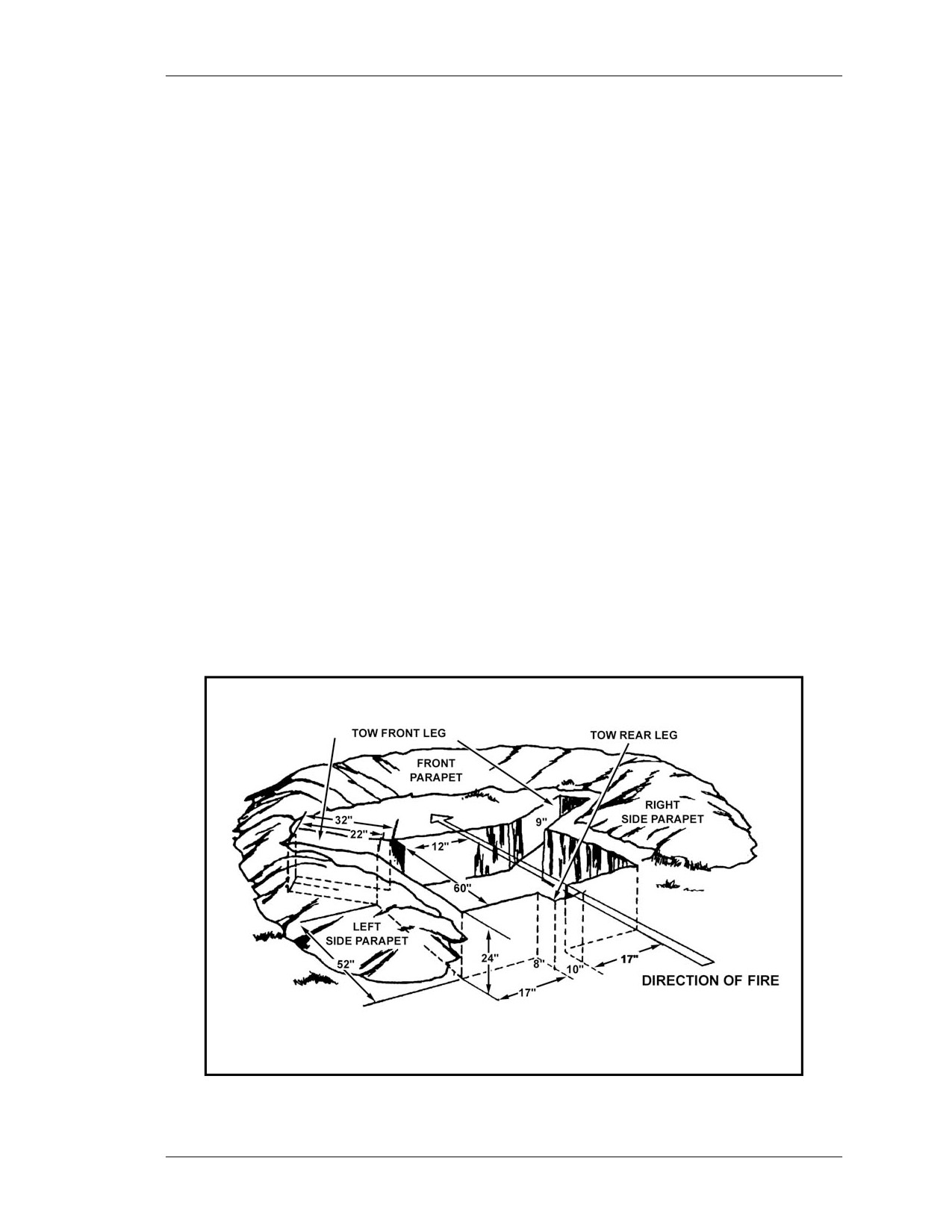
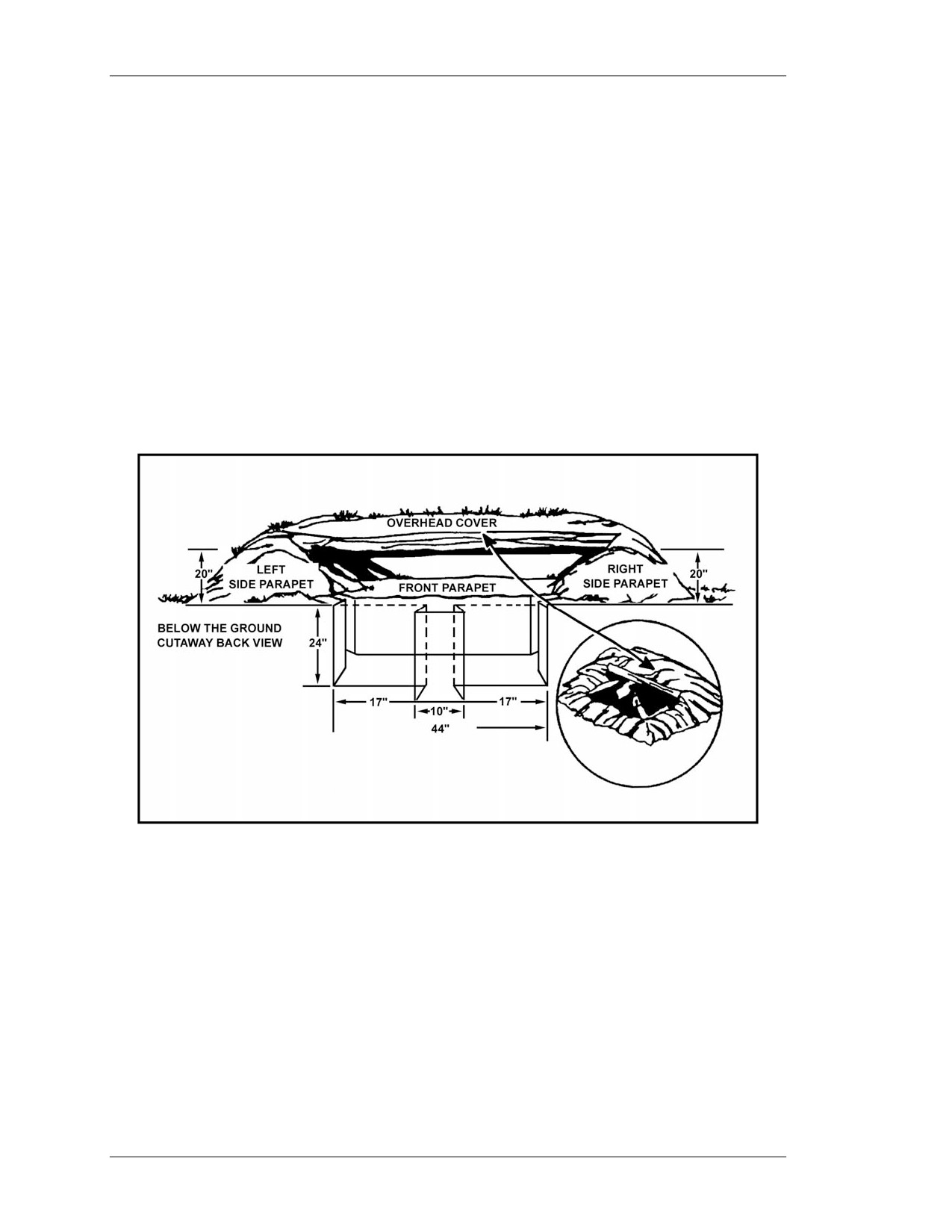
b. The initial position should look like Figure C-1.
Figure C-1. Tripod-mounted TOW fighting position.
C-1
FM 3-22.34
(1) Make the position 24 inches deep.
(2) Make the parapet at least 18 inches thick to keep out small-arms fire and artillery
fragments. It should provide 9 inches of muzzle clearance under the launch tube.
(3) Do not place dirt or equipment in the backblast area.
(4) Scoop out a place for the MGS either under or to the front of the tripod.
(5) Dig a storage/protective area for the crew and missiles to one flank at a 90-degree
angle to the primary direction of fire. Use the strongest material available for the roof.
Put canvas or plastic down before throwing dirt on the roof to keep the ceiling from
leaking. Place at least 20 inches of dirt on top of the storage/protective area (Figure C-2).
(6) Ensure the ground behind the TOW is free of leaves and dirt out to 25 meters so
the backblast does not leave a signature.
(7) Ensure all the standard principles of camouflage are followed. (For example,
cover all fresh dirt with leaves and brush, replace withered foliage, always approach
position from rear, and so forth.)
Figure C-2. Storage/protective area.
C-2. MOUNTED TOW FIGHTING POSITION
A mounted TOW fighting position must meet the following specifications:
• Does not restrict the TOW's target engagement.
• Provides concealment from ground and air observation for the crew and
vehicle.
• Backblast area is as clear as possible of debris that would increase launch
signature.
a. Camouflage and conceal the firing position.
(1) All vehicles travel to a position over the same route to prevent the enemy from
detecting the number of vehicles present.
C-2
FM 3-22.34
(2) The route taken should follow existing paths, roads, fences, or natural lines in
terrain.
(3) Exposed routes should not end at a position.
(4) If only a short portion of the route into a position is exposed, sweep out the tracks
with tree branches.
(5) Traffic in and out of a position should be held to essential movements only.
(6) Upon moving into a position, be sure to erase the trail leading into the position.
(7) Ensure all standard principles of camouflage are adhered to (same as for tripod-
mounted position).
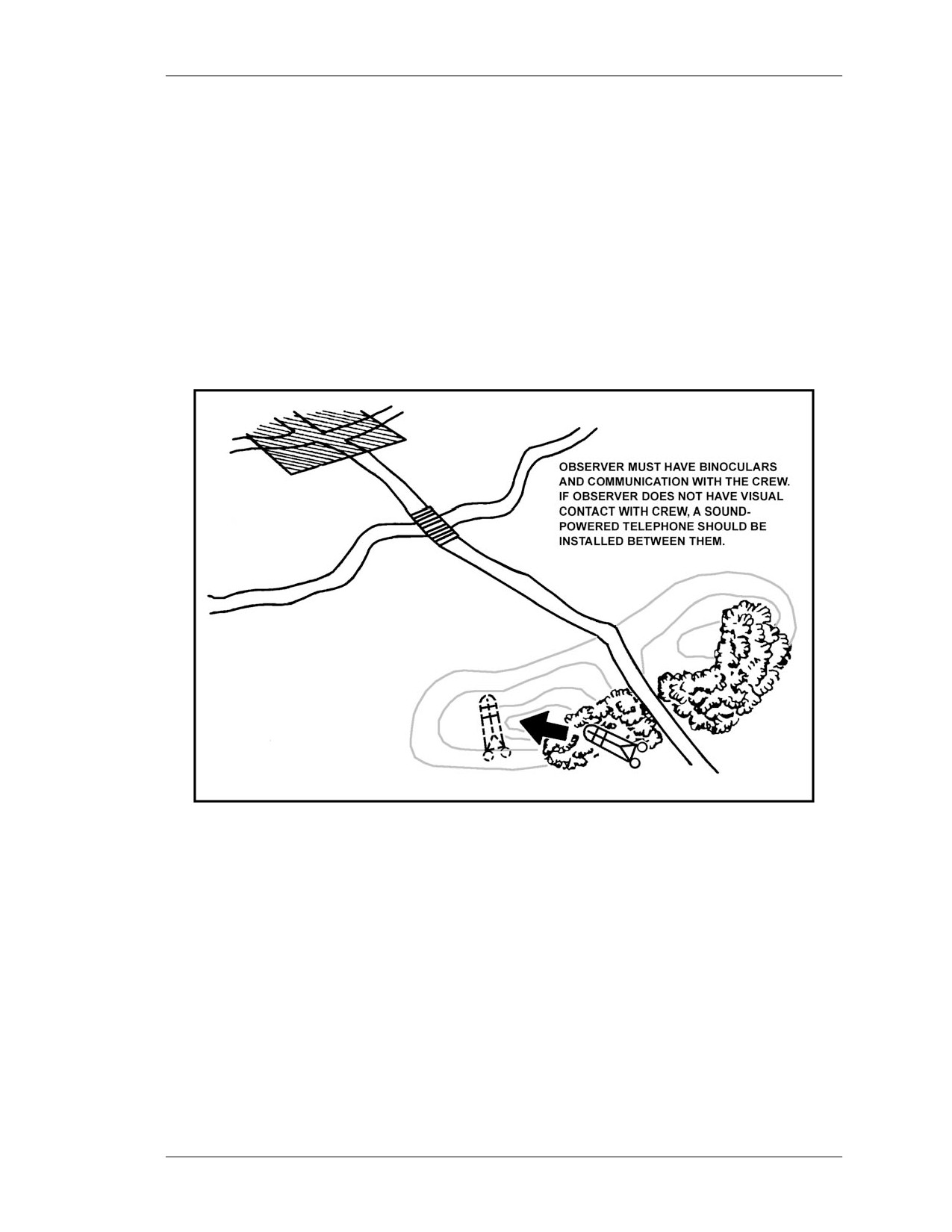
b. If a hull-down position is not available, use a hide position (Figure C-3).
c. If possible, move at least 35 meters in front of the position to ensure that it looks
natural and blends with its surroundings.
Figure C-3. TOW hide position.
C-3. CAMOUFLAGE NETS
When camouflaging any TOW fighting position, whether mounted or dismounted, the net
must be positioned so it does not hang in the backblast area. If any portion of the net is in
the backblast area, the net will be damaged and could collapse on top of the launcher
when a missile is launched. Also, the net must not interfere with the field of fire.
C-3
FM 3-22.34(FM 23-34)
APPENDIX D
STANDARD RANGE CARD
This appendix describes the various parts of a standard range card. It
also provides a detailed discussion of how to complete a range card.
D-1. DESCRIPTION
A range card is a sketch of the terrain a weapon system has been assigned to cover by
fire. It contains information that assists in the planning and controlling of fires, the rapid
detection and engagement of targets, and the orientation of replacement personnel or
units. By using a range card, a gunner can quickly and accurately determine the
information he needs to engage targets.
a. A sector of fire is a part of the battlefield within which a gunner is responsible for
engaging targets. Sectors of fire are assigned to ensure weapon systems will cover target
approaches. Leaders should strive to overlap sectors to cover areas that cannot be
engaged by one system. The leader gives a gunner boundaries running between
prominent terrain features, or by left and right limits indicated by terrain features or
azimuths. If necessary, the leader also assigns a gunner more than one sector of fire,
designating one sector as primary and others as secondary.
b. The section or squad leader may also designate anticipated target engagement
locations within the sector of fire. Those are recognizable terrain features on or near
likely enemy avenues of approach. This information is placed on the range card.
c. Leaders may pick out natural or man-made terrain features that can be used as
reference points for locating targets and adjusting direct and or indirect fires. Those
features are called target reference points (TRPs). TRPs are requested through the mortar
or artillery fire support team (FIST) or fire support officer (FSO). If TRPs are in or near
the sector of fire, the leader should point them out and tell the gunner their numbers. If he
does, the gunner depicts the TRPs on his range card. Normally, a gunner has at least one
TRP, but not more than three, in his sector of fire.
d. Natural or man-made terrain features, such as hills, draws, or buildings, may be
within the sector(s) of fire that prevent the gunner from firing in that area. The area
blocked by these features is called dead space. All dead space in the sector(s) of fire must
be determined so leaders can plan other weapon systems or other types of fire to cover
the area (for example, mortars, artillery, or mines). Dead space is indicated on the range
card.
e. The length of the sector of fire is normally limited by the maximum engagement
range of the antiarmor weapon, but it can be less if any natural or man-made terrain
features (trees, fences) prevent the gunner from engaging targets at maximum range.
Regardless of what affects it, the maximum engagement range is shown on the card as a
maximum engagement line. The squad leader uses a map to determine the distance to the
maximum engagement line.
f. All TRPs, anticipated target engagement areas, azimuth and distance to a known
point, and left and right limits are numbered on the sector sketch and in the data section
with corresponding numbers for quick response.
D-1

FM 3-22.34
D-2. PREPARATION PROCEDURES
The section/squad leader’s briefing provides the necessary information for the gunner to
begin preparing DA Form 5517-R (Standard Range Card). If he is assigned alternate and
supplementary firing positions, he prepares a range card for them also. The gunner
prepares the range card by performing the following steps.
EXAMPLE OF SECTION OR SQUAD LEADER’S BRIEFING:
“Our mission is to cover a sector of fire that begins at our present
position and goes in the direction of the windmill to the maximum
engagement range of 3,750 meters; it extends to the right across
the high ground behind the houses, and hill, to the right edge of the
orchard and returns here. The enemy should approach from the
north and will probably use both Marshall Road and Lewis Road to
enter our sector. We must plan on engaging the enemy in this area
as soon as he is within range. There are two target reference points
within your sector; the road intersection of Marshall Road and
Duffell Road is TRP-Charlie One and the road junction of Lewis
Road and Duffell Road is TRP-Charlie Two. Use the road junction
of Campbell Road and Lewis Road to your left as a reference point
to locate your position. The distance from the road junction is 633
meters on an azimuth of 85 degrees.” (See Figure D-1.)
Figure D-1. Section or squad leader’s briefing.
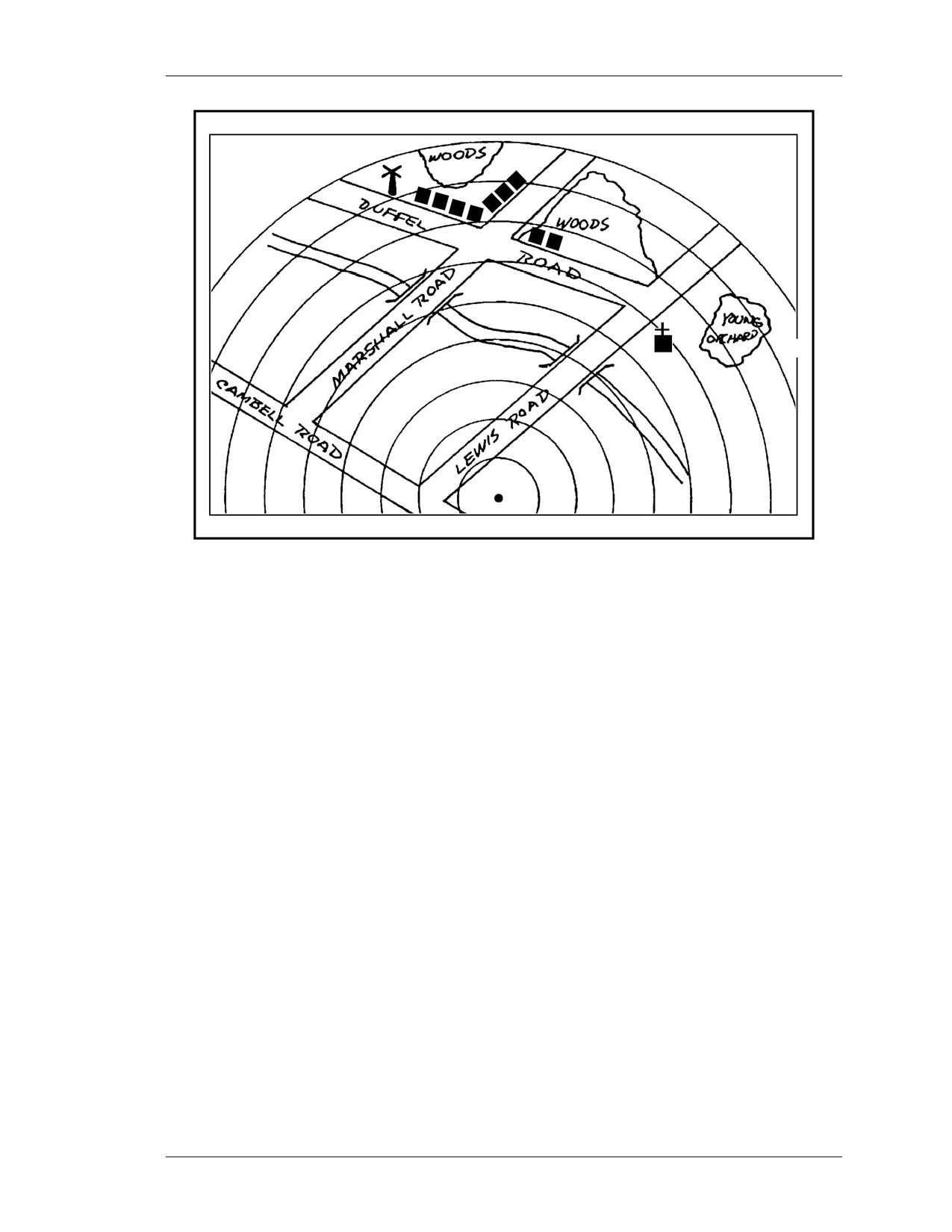
a. Draw a sector sketch of the entire sector. Make the sketch as large as possible, not
to exceed the largest circle. For a large area covered by trees or woods, draw only the
outline and label the area; for example, “woods” or “orchard” (Figure D-2).
D-2
FM 3-22.34
Figure D-2. Sketch of area on range card.
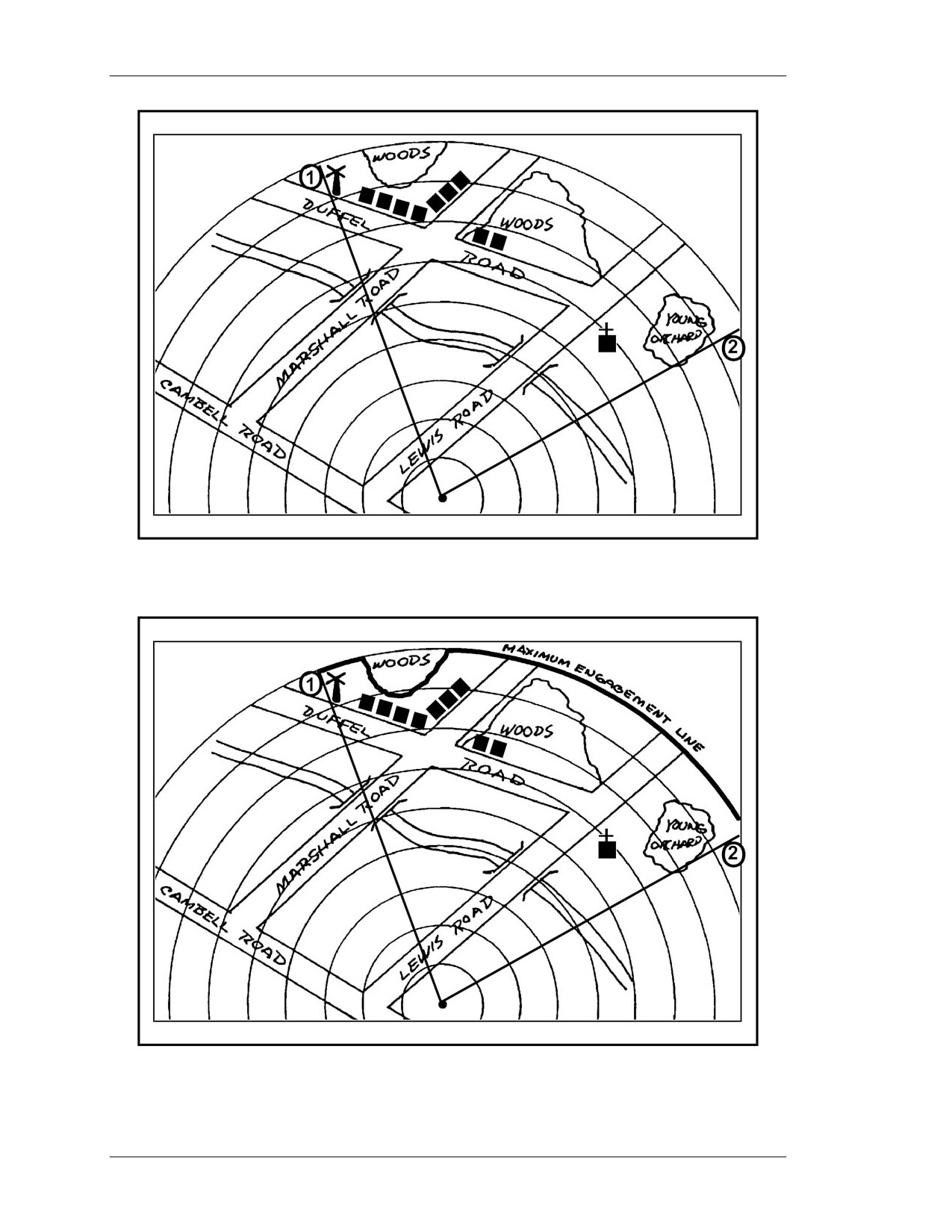
b. Draw lines from the weapon position (indicated by the black dot at lower center
of range card) to show the right and left limits. Place a number 1 at the end of the left
limit line and draw a circle around the number. Place a number 2 at the end of the right
limit line and draw a circle around the number (Figure D-3, page D-4).
NOTE: After drawing left and right limit lines, the weapon symbol can be drawn over
the black dot.
c. If there are no limitations, the maximum engagement line is curved and joins the
left and right sector of fire boundaries at the maximum engagement range (Figure D-4,
page D-4). If there are limitations, the maximum engagement line is drawn in front of the
limiting terrain feature.
D-3
FM 3-22.34
Figure D-3. Labeling sector of fire.
Figure D-4. Placement of maximum engagement line.
D-4
FM 3-22.34
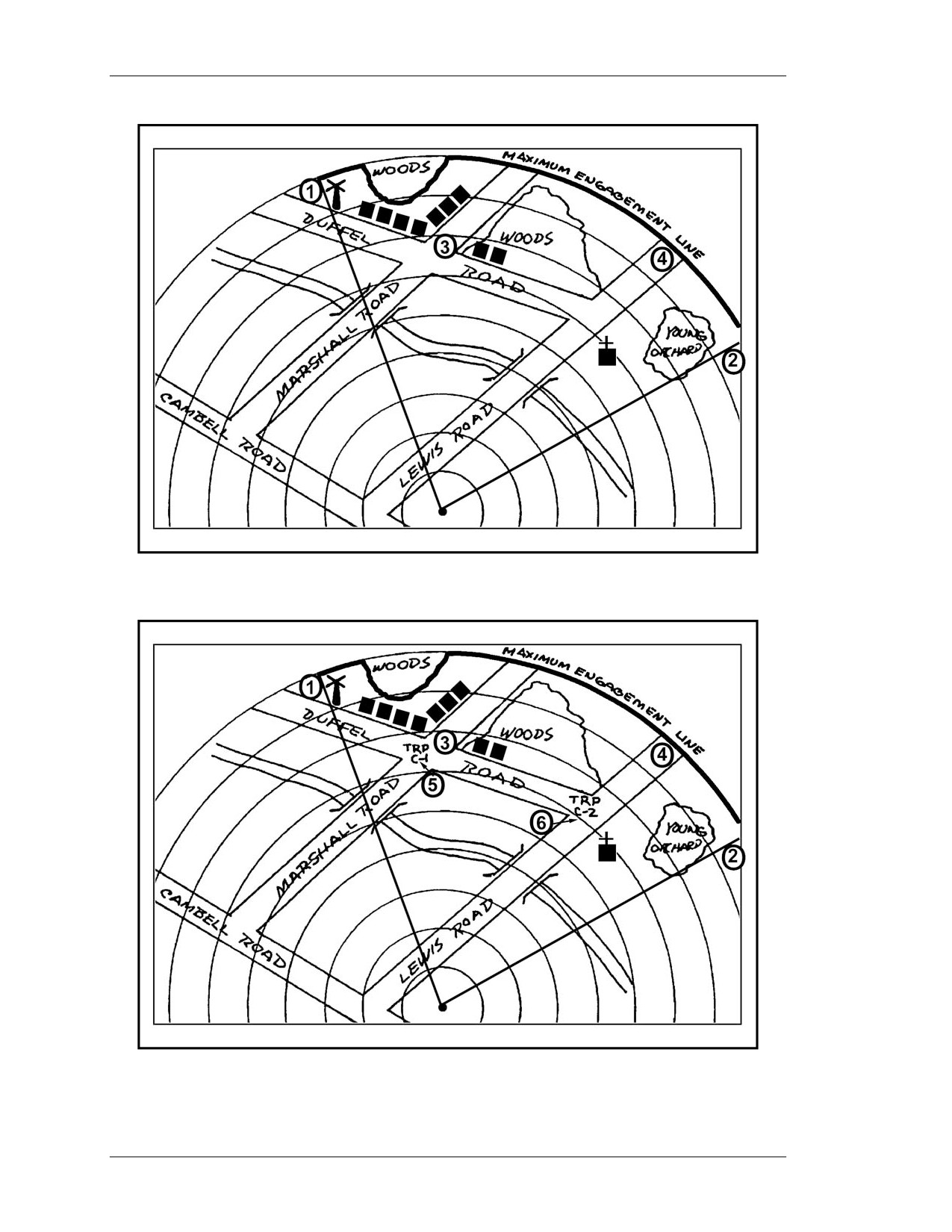
d. Number the anticipated target engagement areas (ATEAs) from left to right,
starting with number 3. Place a number at the maximum engagement range of the target
on the range card and circle the number (Figure D-5, page D-6).
e. Number the TRPs from left to right. Place the number below or next to the TRP
on the range card and circle the number (Figure D-6, page D-6).
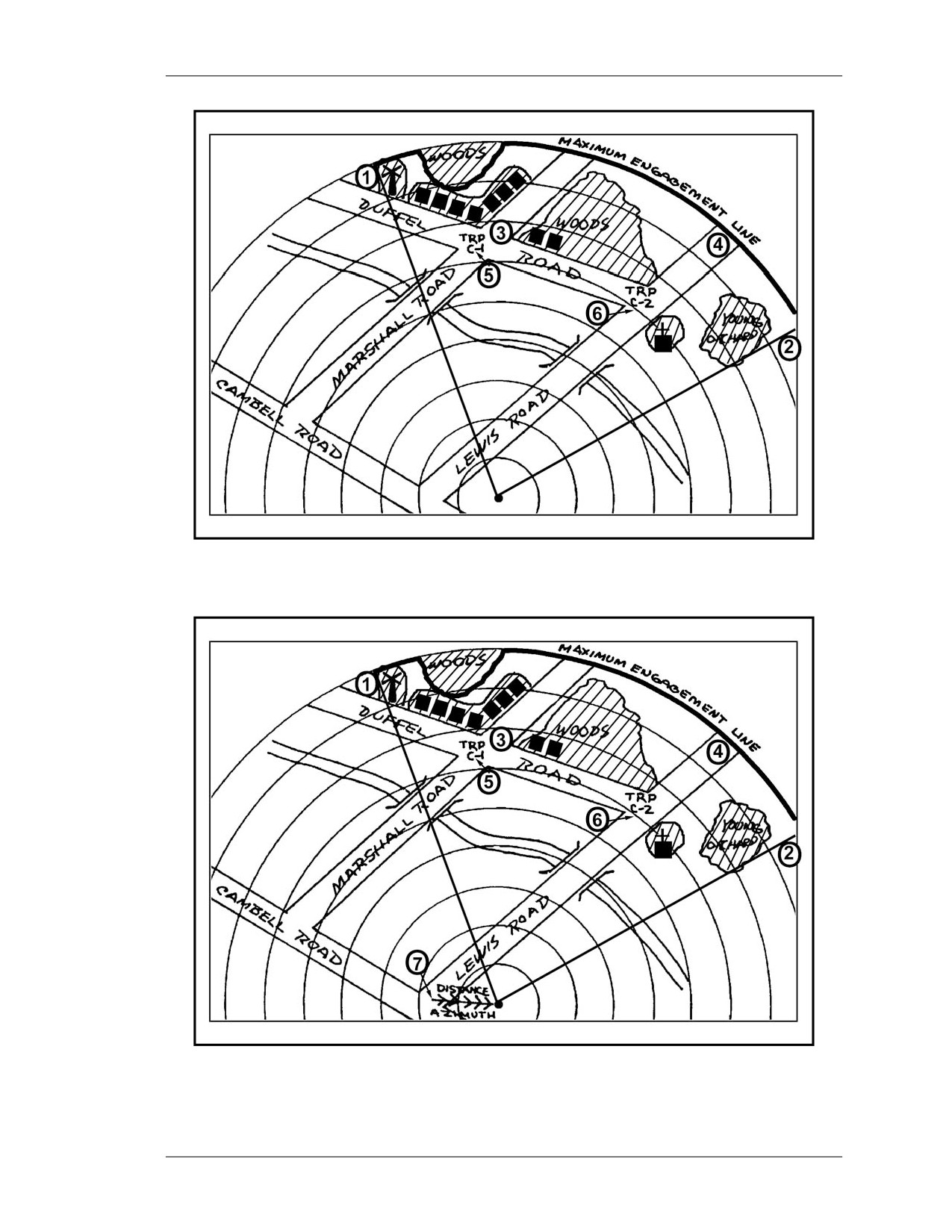
f. Place diagonal lines, or the words
“dead space,” where dead space occurs
(Figure D-7, page D-7).
g. Use a compass to determine the azimuth from the firing position to the known
point. Convert the direction to a back azimuth. Draw a line with multiple arrows from the
known point to the firing position. Place a number at the known point and circle the
number (Figure D-8, page D-7).
h. Fill in the marginal information at the top of the card.
(1) Unit Description−SQD, PLT, CO. Never indicate a unit higher than company
level.
(2) Magnetic North. Orient the range card with the terrain. Place the compass on the
range card. Determine the direction of magnetic north arrow and mark it on the card.
i.
Fill in the data section at the bottom of the card.
(1) Position Identification. List either primary, alternate, or supplementary.
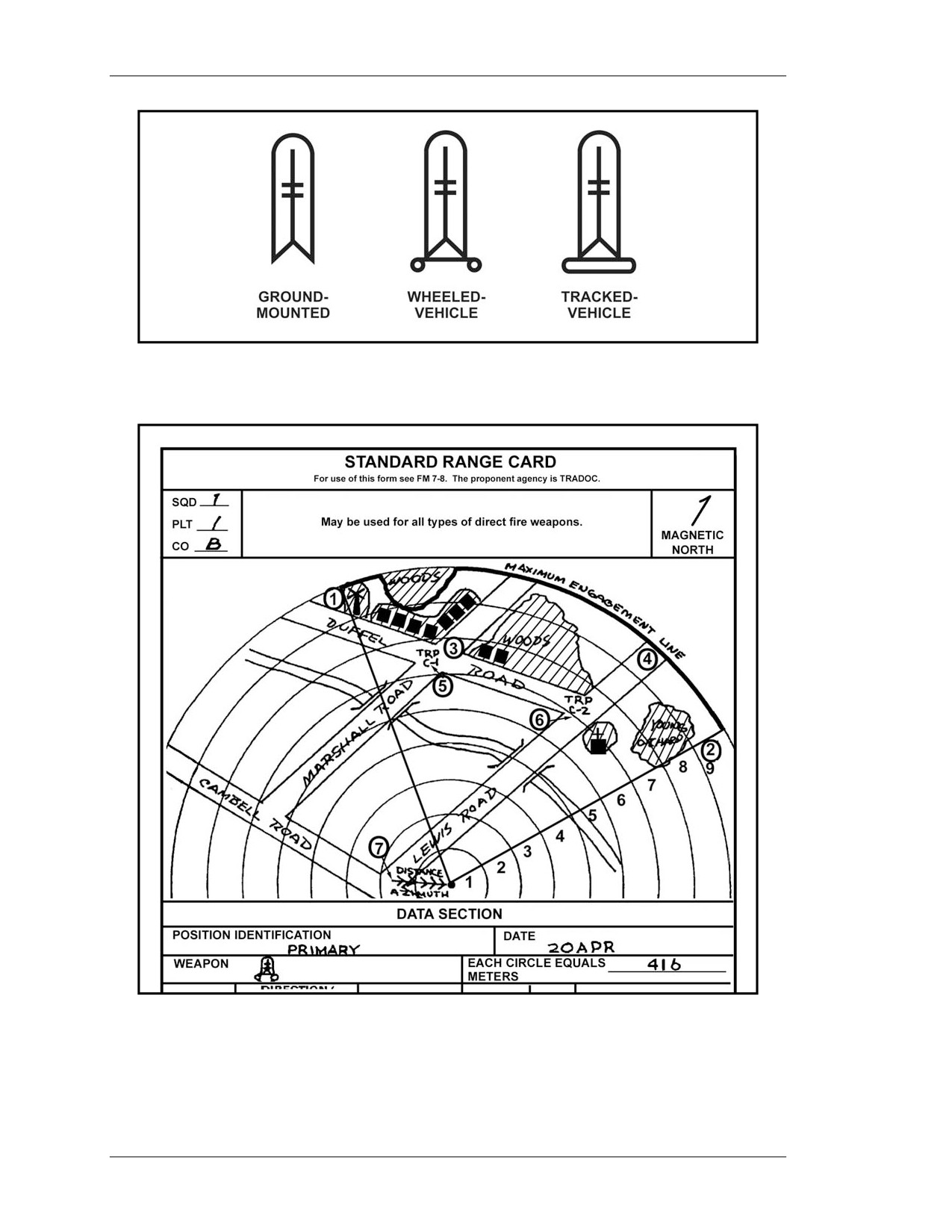
(2) Weapon. See Figure D-9 (page D-8) for weapon symbols.
(3) Date. List the day and month.
(4) Each circle equals ______ meters. Write the distance between the circles in
meters. To determine the distance, count the intervals from the weapon to the maximum
engagement line (as determined by the squad leader). Divide the amount of intervals into
the range of the maximum engagement line. This will give the distance between circles
(Figure D-10, page D-8).
Example: 9 intervals into 3,750 meters = 416 meters between circles.
(5) No. (Number). Starting with number 1, list the left limit, the right limit, and
locations of ATEAs and TRPs shown on the sector.
(6) Direction/Deflection. Only degrees or the azimuth from the azimuth bevel ring
(improved TOW vehicle) is listed. Line through the word that does not describe the
information listed.
(7) Elevation. This is only used with a ground-mounted machine gun using the
traverse and elevation mechanism.
(8) Range. Distance in meters from the weapon to the TRP or target engagement
area.
(9) Ammunition. List the type of ammunition used, if applicable.
(10) Description. List the name of the object; for example, road, windmill, church. If
the item is a TRP, also list the TRP number.
(11) Remarks. Enter the weapon’s reference point and any additional information not
listed in the range card section. If more space in the data section is needed, use the
reverse side of the range card.
D-5
FM 3-22.34
Figure D-5. Numbered target engagement locations.
Figure D-6. Target reference points and numbers.
D-6
FM 3-22.34
Figure D-7. Dead space indicated.
Figure D-8. Placement of distance and azimuth from a known point.
D-7
FM 3-22.34
Figure D-9. Weapon symbols.
Figure D-10. Determining range interval on range card.
D-8
FM 3-22.34
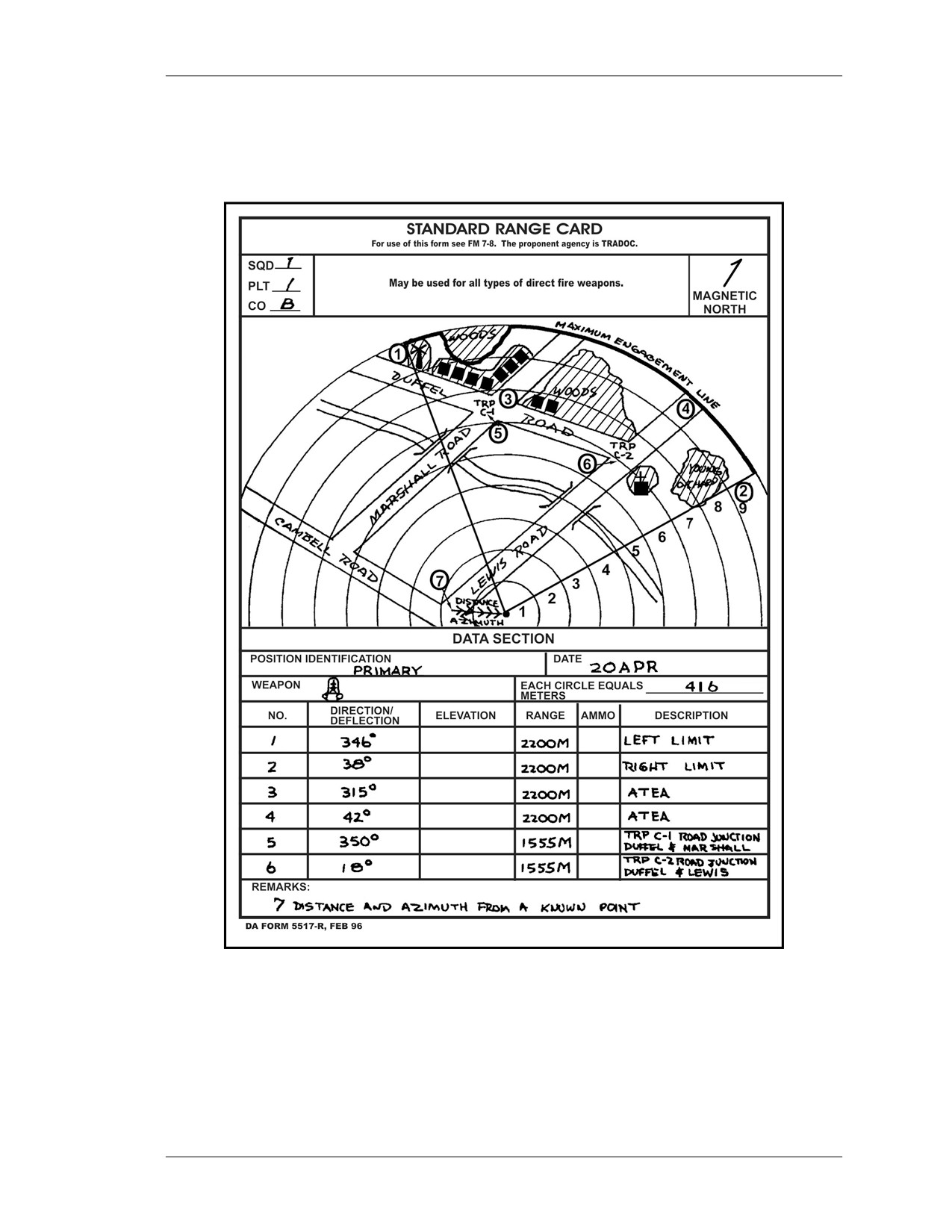
j.
Make two range cards. Keep one at the firing position and give one to the squad
or section leader for preparation of fire plans and final coordination of fires. (See Figure
D-11 for a completed TOW range card.)
Figure D-11. Example of a completed DA Form 5517-R, Standard Range
Card for TOW.
D-3. EXPEDIENT RANGE CARD
In combat, a DA Form 5517-R may not be available. The gunner must then draw a range
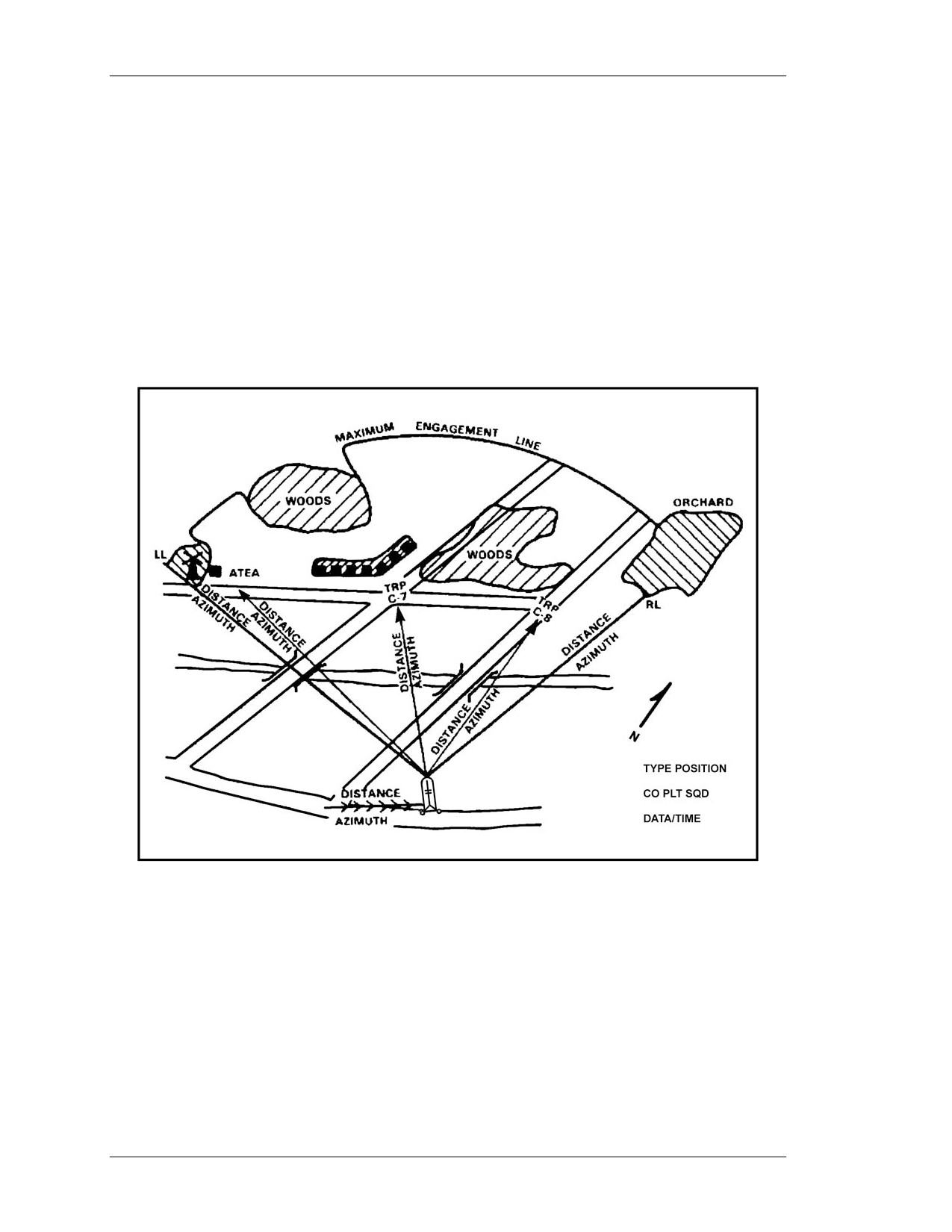
card on anything available (Figure D-12, page D-10). Preparation of the expedient range
D-9
FM 3-22.34
card follows the same procedures provided for the standard range card, but the weapon
symbol must be used to indicate the location of the weapon position. The range card must
include the following eight items:
• Weapon symbol.
• Sector of fire.
• Maximum engagement line.
• Range and azimuth to TRP/ATEA.
• Dead space.
• Distance and azimuth from a known point.
• Magnetic north arrow.
• Data section.
Figure D-12. Expedient range card.
D-10
FM 3-22.34(FM 23-34)
APPENDIX E
SAFETY
Units should develop local directives and SOPs that include individual
responsibilities, safety requirements, proximity limits for personnel and
explosives, location and sequence of operations, equipment required for
handling munitions, and protection for troops. Individual responsibility
for operations involving explosives must be designated. Troops must not
tamper with the encased missiles other than to remove the forward
handling ring and dust cover.
Because of the danger to troops from the backblast, extreme care must
be used in all phases of training. Emphasize this danger from the first
stage of training. Conduct all crew tasks, position and tracking exercises,
and firings with the simulation round as though missiles were being fired.
E-1. SAFETY PRECAUTIONS
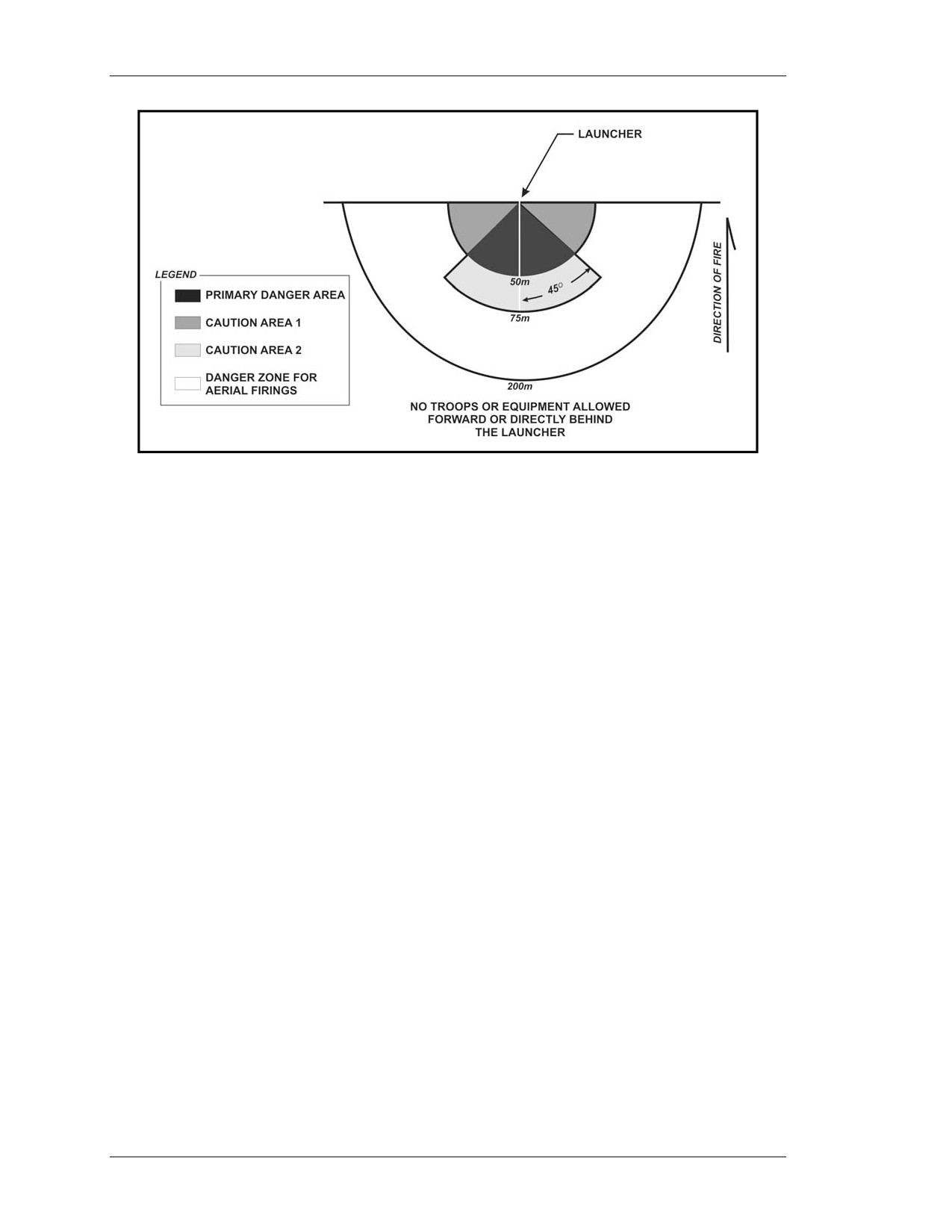
The surface danger zone for any firing range consists of a firing area, a target area,
impact area, and danger areas surrounding these locations (Figure E-1). An additional
area for occupation by personnel during firings may also be required. The shape and size
of the surface danger zone varies with the type of missile or rocket being fired. (Refer to
DA Pam 385-63 for dimensions.)
a. The primary danger area is a 90-degree cone with a 50-meter radius. The apex of
the cone is centered at the rear of the missile launcher. Serious casualties or fatalities are
likely to occur to anyone in the area during firing. Hazards include launch motor blast,
high noise levels, overpressure, and debris.
b. Caution area 1 extends radially from each side of the primary danger area to the
firing line with a radius of
50 meters. Permanent hearing damage could occur to
personnel without adequate hearing protection in this area during firing. The hazards are
high noise levels and overpressure.
c. Caution area
2 is an extension of the primary danger area with the same
associated hazards and personnel protection required. The radius of this area is 75 meters.
d. The 200-meter zone is the danger area for aerial firings 15.25 meters or more
above ground level.
e. TOWs will not be fired from buildings or bunkers, or within 100 meters of a
vertical or nearly vertical backstop (IAW DA Pam 385-63).
WARNING
All crew members must wear V-51R
(or
equivalent) earplugs that have been fitted by
qualified medical personnel. Failure to use the
proper earplugs during missile firing could cause
serious injury.
E-1
FM 3-22.34
Figure E-1. Surface danger zone for firing basic TOW, TOW 2A, and TOW
2B missiles.
E-2. MISSILE HANDLING PRECAUTIONS
Improper handling of the encased missile may damage the components and cause
malfunctions when the missile is launched. If the encased missile is dropped, the end
handling rings and the launch container may be damaged. If the missile has been
damaged or there is damage to the launch container (other than minor deformation of
handling rings), the encased missile should be returned to the ammunition unit for
inspection and disposition.
E-3. SIGHTING AND AIMING PRECAUTIONS
Gunners must not look at the sun or bright lights while sighting through the daysight
tracker; serious eye burn could result. They must not look through the daysight tracker at
an air field test set on the control tower unless the distance between the daysight tracker
and the test set is more than 300 feet.
E-4. FIRING ANGLE LIMITATIONS
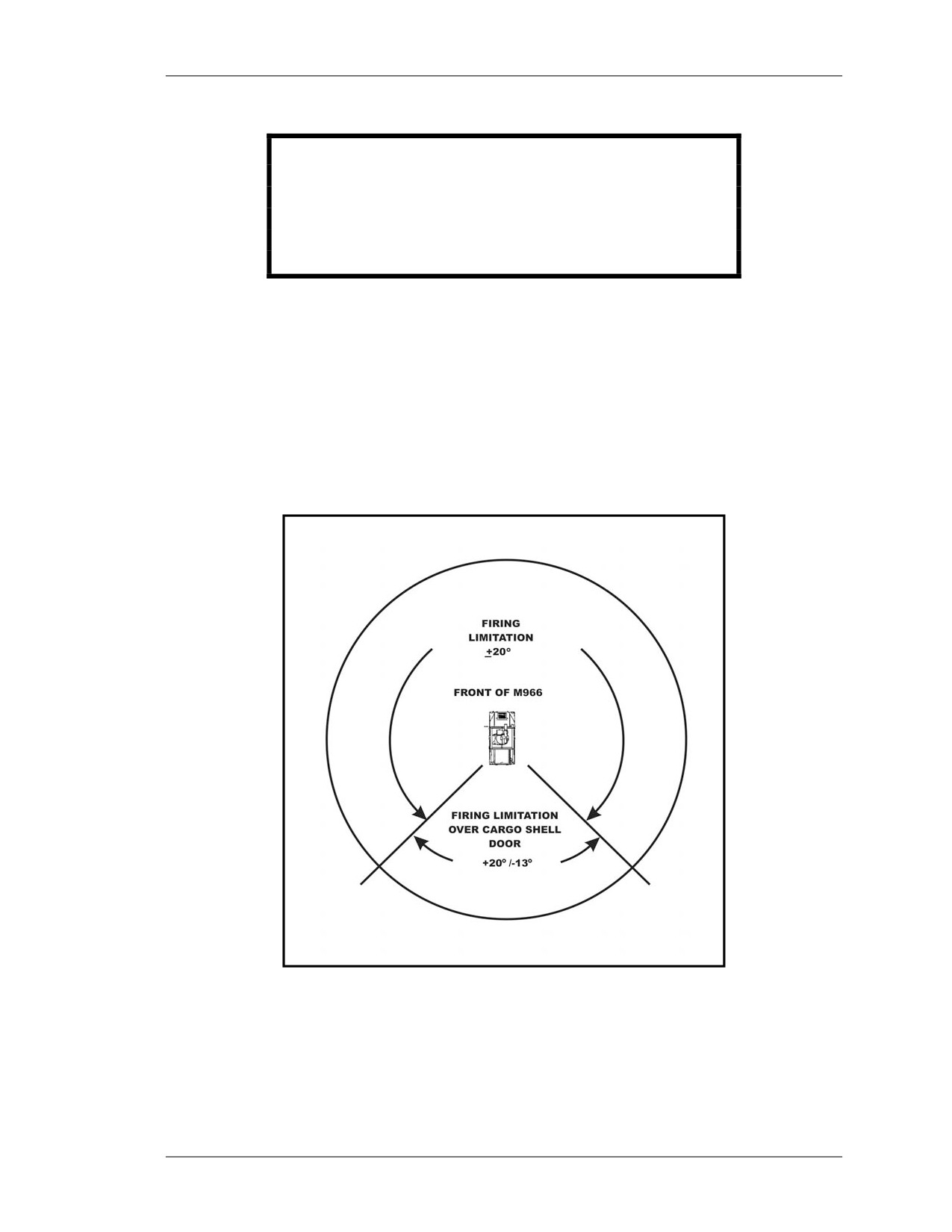
Azimuth and elevation firing angles are limited by the traversing unit, the vehicle, and
other external restrictions. All elevation angles are referenced to the horizontal plane of
the traversing unit. All azimuth angles are referenced to the long axis of the vehicle and
depend on whether the launch tube points over the front or rear of the vehicle. The other
reference line is the line-of-sight from the TOW to the target.
E-2
FM 3-22.34
WARNING
At angles greater than 20 degrees above ground
level, hazards to the gunner may exist in the
overpressure waves and debris caused by the
backblast during training. Do not use angles
greater than 20 degrees.
a. When the TOW is tripod-mounted, a 360-degree lateral track is possible, because
the traversing unit is not restricted in azimuth. Mechanical stops limit the elevation angle
coverage to 20 degrees below and 30 degrees above the horizontal plane. Before the
missile is fired, the line-of-sight angle should be estimated at the expected time of launch
and throughout the expected missile flight time. The firing position should be changed or
a different target selected if an expected line-of-sight angle exceeds the firing limitation
angle.
b. The firing angle limitations of the TOW carriers are as shown in Figure E-2.
Figure E-2. M966-mounted TOW firing angle limitations.
E-3
FM 3-22.34
E-5. SAFETY PRECAUTIONS FOR MILES
The gunner must follow these safety precautions:
a. Do not load an ATWESS cartridge until ready to fire. If the target is lost, remove
the ATWESS cartridge from the firing chamber before moving.
(Gloves are
recommended when loading or unloading the ATWESS cartridge.)
b. Before pulling the PULL-TO-ARM switch, always check to ensure no personnel
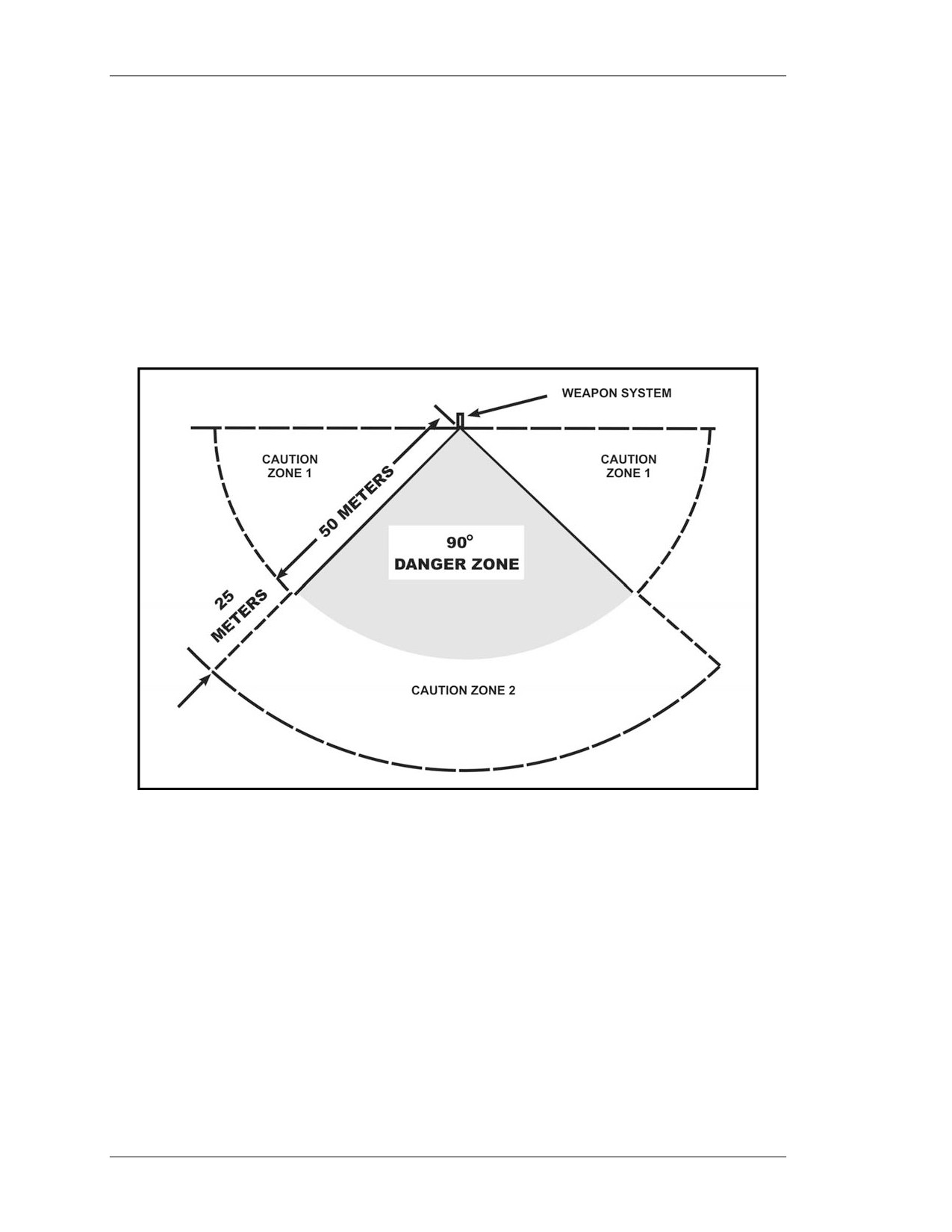
or equipment (antennas) are in the ATWESS danger zone. This zone extends for 75
meters behind the ATWESS firing chamber and covers an arc
90 degrees wide
(Figure E-3).
c. Never view the laser being fired through stabilized optics, such as binoculars or
telescopic weapon sights, when within 75 meters of the transmitter.
Figure E-3. ATWESS danger zone.
E-4
FM 3-22.34
E-6. SAFETY PRECAUTIONS FOR THE TOW GUNNERY TRAINER
The following safety precautions must be observed when using the TGT.
DANGER
THIS EQUIPMENT USES HIGH VOLTAGE TO
OPERATE. NEVER USE UNGROUNDED
EXTENSION CORDS, UNGROUNDED ADAPTERS,
OR ANY UNGROUNDED OUTLET TO CONNECT
THE TGT. DEATH ON CONTACT MAY RESULT IF
PERSONNEL FAIL TO OBSERVE SAFETY
PRECAUTIONS.
a. Use two people to lift the instructor console. The console is heavy and lifting with
only one man could result in serious injury.
b. Do not attempt to open shipping cases before pressing air pressure release valves
on side of cases. Serious injury to personnel could result from opening cases with high
pressure inside.
c. Turn off the power to the TGT trainer and disconnect the wall outlet plug before
beginning cleaning procedures.
E-7. SAFETY PRECAUTIONS FOR THE TOW FIELD TACTICAL TRAINER
The following safety precautions must be observed when using the TFTT.
a. The laser light emitted by the TFTT is considered eye safe, but suitable
precautions must be taken to avoid possible eye damage from overexposure to this
radiated energy. The preface to TM 9-6920-453-10 and the laser range safety procedures
in DA Pam 385-63 and TB MED-279 discuss these precautions.
b. The M80 blast simulator used with the TFTT can cause death or injury. Observe
the precautions listed in the preface of TM 9-6920-453-10.
c. To avoid personnel injury and equipment damage, four people are needed to lift
and carry each shipping container.
DANGER
THIS EQUIPMENT USES HIGH VOLTAGE TO
OPERATE. DEATH ON CONTACT MAY RESULT IF
PERSONNEL FAIL TO OBSERVE THE SAFETY
PRECAUTIONS LISTED IN TM 9-6920-453-10.
E-5
FM 3-22.34(FM 23-34)
APPENDIX F
TOW TRAINING DEVICES
For many years TOW training devices consisted of the M70-series
training sets and MILES TOW equipment. Recently, the Precision
Gunnery Training System (PGTS) was fielded. PGTS consists of two
systems: an indoor trainer and an outdoor trainer. The TOW Gunner
Trainer (TGT) is the indoor system and the TOW Field Tactical Trainer
(TFTT) is the outdoor system. The TGT will be used in place of the M70 to
qualify individual gunners and for additional sustainment training as
needed. The TFTT will be used in place of the M70 for outdoor tracking
sustainment and in place of MILES when conducting Tables 5 through 12
of the TOW Training Tables.
MILES TOW equipment is the most realistic device available for
simulating tactical engagements. It is valuable in maneuver training
exercises and Army training and evaluation programs. However, MILES
TOW is not a precision gunnery trainer and should not be used to train
gunner tracking skills.
Section I. MULTIPLE-INTEGRATED LASER ENGAGEMENT SYSTEM
MILES is a training system used in force-on-force training and in FTXs. Commanders
should use an MPRC to verify MILES equipment before the unit’s rotation to the NTC.
(See gunnery Tables 7 through 12 in Chapter 4 for target arrays.)
F-1. COMPONENTS AND FEATURES
This paragraph discusses the different components, features, and capabilities of MILES.
a. Components.
(1) The following are the nine components in the MILES TOW transit case:
• Operator’s manual.
• Two man-worn laser detector sets (halo and harness).
• Two yellow keys.
• TOW laser transmitter/tracker head simulator.
• Missile guidance set adapter.
• Miscellaneous hardware.
• Hook-pile tape pads.
• Control console mounting bracket.
• Collimator adapter bracket.
(2) The following are the ten MILES APC system components packed in the APC
transit case.
• Operator’s manual.
• Control console.
• Laser transmitter for M2.
• Battery box.
• Hardware.
F-1
FM 3-22.34
• Combat vehicle kill indicators.
• Weapon’s keys.
• Cable assembly.
• Combat vehicle laser detector belt segments.
• Man-worn laser detectors.
b. Features.
Range: 3,750 meters; M60, 1,100 meters.
Tracking time: 10 seconds.
Kill codes:
Visual
Audio
Near miss
2 CVKI flashes
2 tones
Hit
4 to 6 CVKI
4 to 6
flashes
tones
Kill
Continuous
Continuous
flash
tone
Basic load: IAW unit SOP, ATTWESS comes packed 12 to a box.
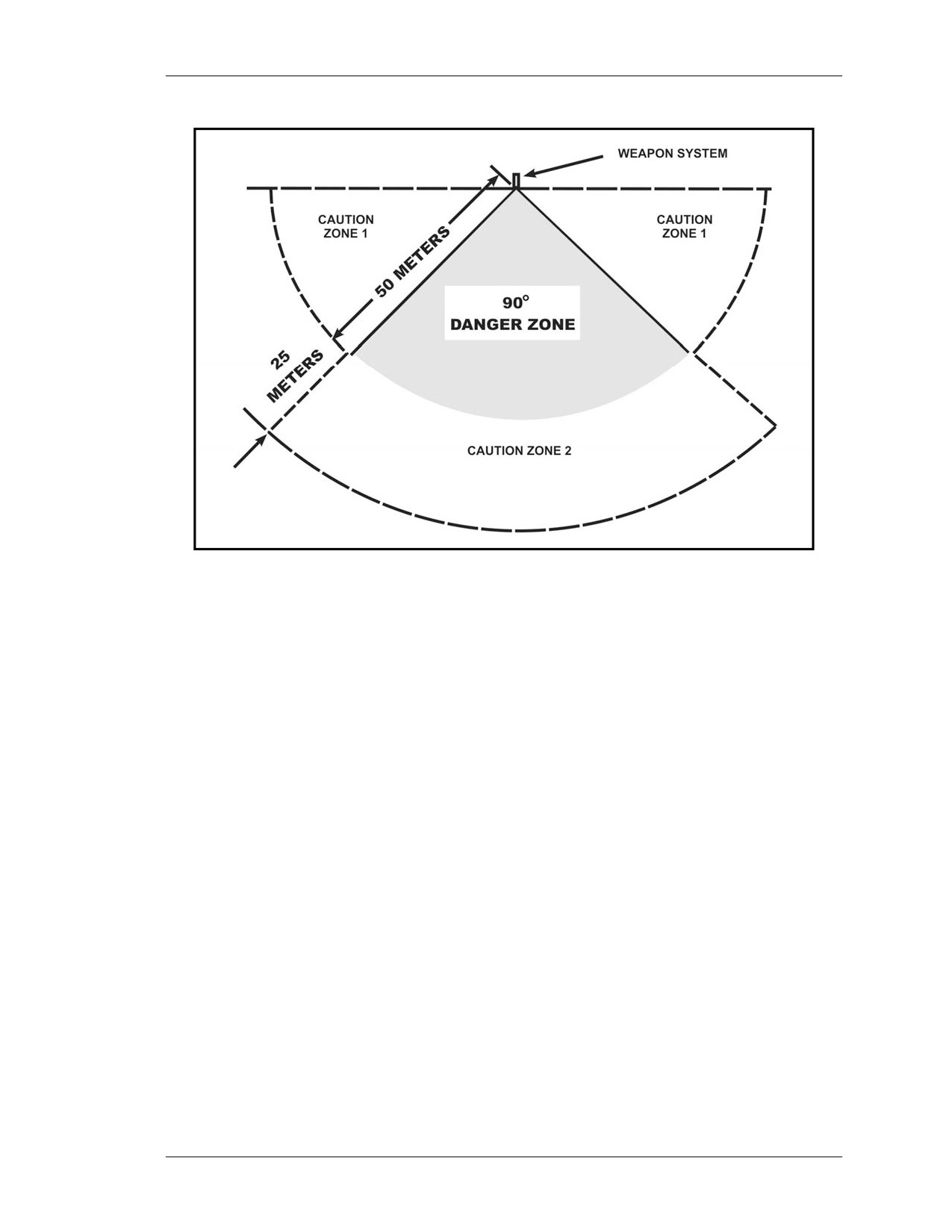
Backblast area: 75 meters at 90 degrees.
TOW laser tracking: head assembly optics 10 power.
Refire ability: every 10 seconds.
c. Capabilities. MILES-equipped weapons have the same range and operational
capabilities as the normal weapons. The effective range of the transmitter may be reduced
by a dirty transmitter lens and or weak batteries. The M60 machine gun is effective
against lightly armored MILES-equipped vehicles and personnel. The TOW 2 is effective
against armored MILES-equipped vehicles.
NOTE: Training soldiers to assemble, utilize, and maintain the MILES will greatly
decrease down time due to MILES malfunctions.
F-2. SAFETY PRECAUTIONS
The following safety precautions should be observed when using MILES.
a. Do not load an ATWESS cartridge until ready to fire. If the target is lost, remove
the ATWESS cartridge from the firing chamber before moving.
(Gloves are
recommended when loading or unloading the ATWESS.)
b. Before pulling the PULL-TO-ARM switch, always check to ensure no personnel
or equipment (antennas) are in the ATWESS danger zone. This zone extends for 75
meters behind the ATWESS firing chamber and covers an arc 90 degrees wide (Figure F-
1).
c. Never view the laser being fired through stabilized optics, such as binoculars or
telescopic weapon sights, when within 75 meters of the transmitter.
F-2
FM 3-22.34
Figure F-1. MILES TOW backblast area.
Section II. TOW GUNNERY TRAINER
The TGT is a new trainer used indoors for individual advanced gunnery tables. It
provides realistic gunnery training, not crew drills.
F-3. COMPONENTS AND FEATURES
The TGT consists of TGT-unique components and TOW 2 components. The major
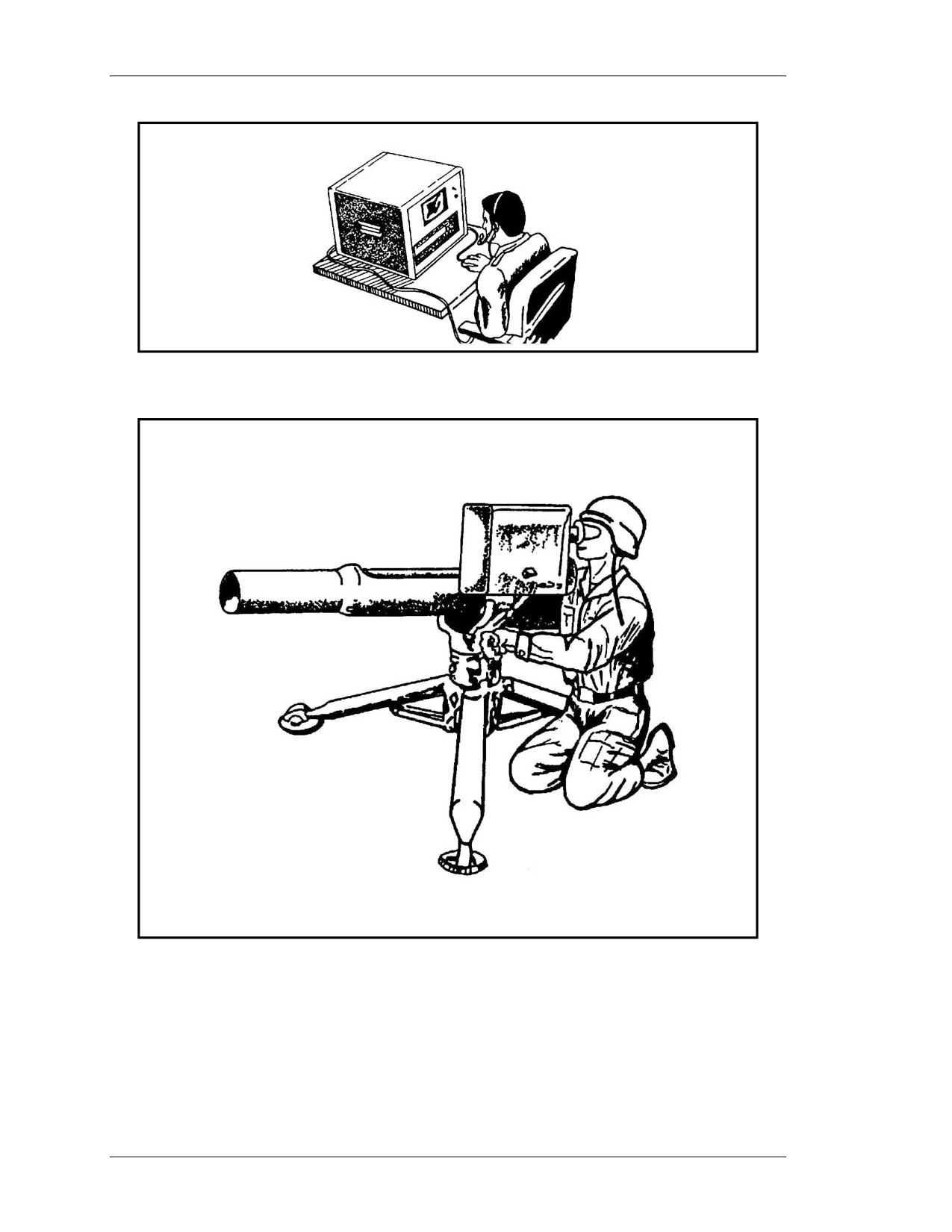
TGT-unique components are the instructor station (Figure F-2, page F-4) and the student
station (Figure F-3, page F-4). The TOW 2 components are the traversing unit, tripod,
and the launch tube.
F-3
FM 3-22.34
Figure F-2. Instructor station.
Figure F-3. Student station.
a. The TGT simulates the sight(s), controls, switches and indicators of the M220E4
TOW 2 weapon system. Through the gunner’s sight(s) you see battlefield scenes that
include both enemy and friendly vehicles. Using the controls and switches, the gunner
selects a target, fires, and tracks it. The headsets simulate the blast of the TOW and the
singing of the wire. The gunner sees and hears hit-and-miss explosions and hears
F-4
FM 3-22.34
commands from the instructor and battlefield sounds of small arms and guns. The score is
displayed at the end of each mission.
b. TGT trains novice gunnery skill training, gunnery skill progression, and
sustainment training. It is used to train the following skills:
• Correct firing position.
• Target identification.
• Target engageability determination.
• Target engagement, including tracking and firing.
• Fire commands.
F-4. ASSEMBLY AND OPERATION
The following manuals are used for proper assembly and operation of the TGT.
a. TM 9-6920-452-10, Chapter 2, Section 1, discusses procedures for unpacking,
assembly, disassembly, and repacking for storage and or shipment.
b. TM 9-6920-452-10, Chapter 2, Section 2, discusses preparation for operation,
preliminary inspections, warm-up, and operational checkout procedures.
c. TM
9-6920-452-10, Chapter
2, Section
3, discusses operating procedures
performed by the instructor in order to conduct training.
F-5. SAFETY PRECAUTIONS
The following safety precautions should be observed when using the TGT.
DANGER
THIS EQUIPMENT USES HIGH VOLTAGE TO
OPERATE. NEVER USE UNGROUNDED
EXTENSION CORDS, UNGROUNDED ADAPTERS,
OR ANY UNGROUNDED OUTLET TO CONNECT
THE TGT. DEATH ON CONTACT MAY RESULT IF
PERSONNEL FAIL TO OBSERVE SAFETY
PRECAUTIONS.
a. Use two people to lift the instructor console. The console is heavy and lifting with
only one man could result in serious injury.
b. Do not attempt to open shipping cases before pressing air pressure relief valves on
side of cases. Serious injury to personnel could result from opening cases with high
pressure inside.
c. Turn off the power to the TGT trainer and disconnect the wall outlet plug before
beginning cleaning procedures.
Section III. TOW FIELD TACTICAL TRAINER
The TFTT is used to teach precision gunnery skills to TOW gunners in the field. This
training can occur on designated ranges, general outdoor areas, or representative tactical
F-5