FM 3-22.34 TOW WEAPON SYSTEM (November 2003) - page 2
FM 3-22.34
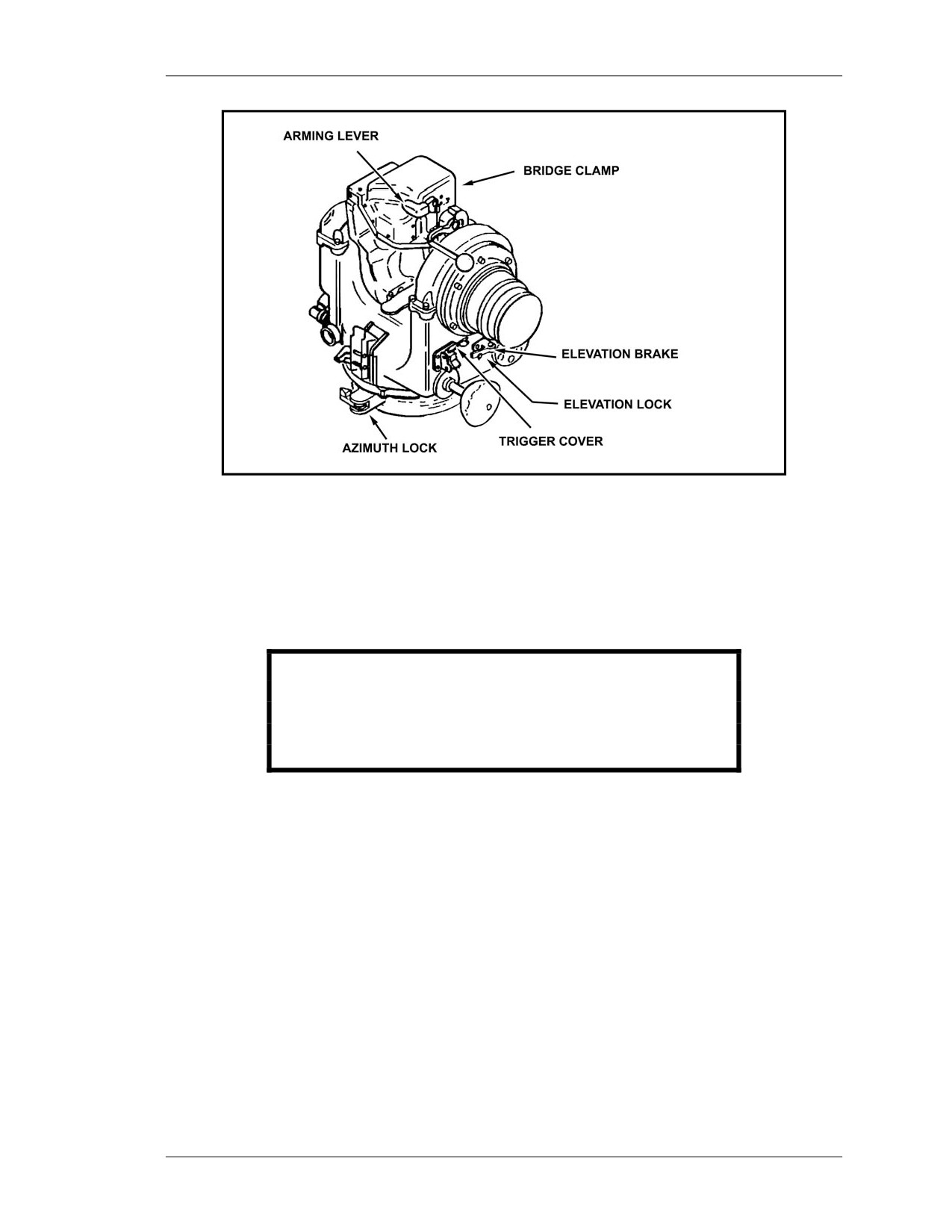
Figure 3-14. Trigger cover, arming lever, elevation lock, and azimuth lock.
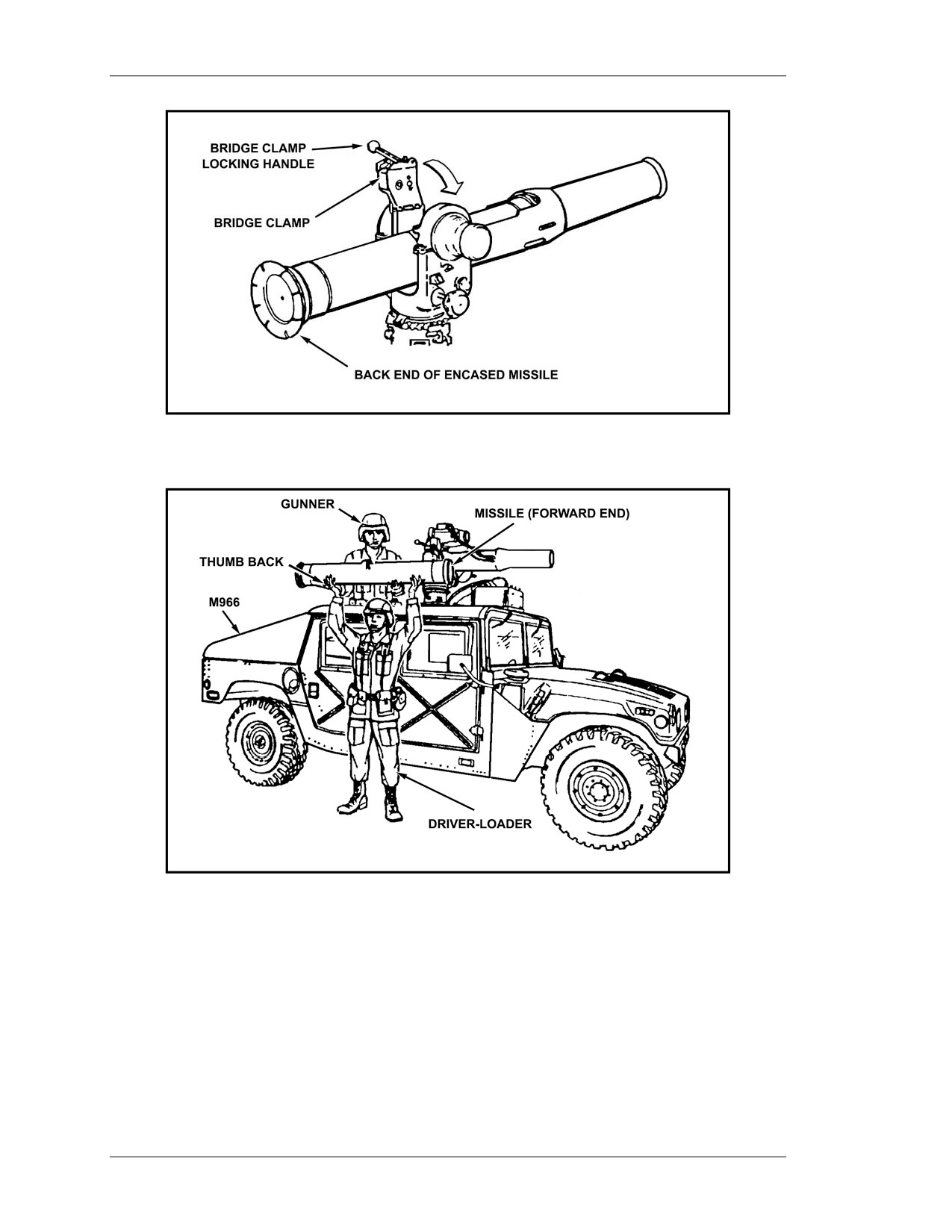
(2) He opens the bridge clamp (Figure 3-15, page 3-18), removes the missile from the
launch tube (keeping the missile pointed downrange at all times), and hands the missile
over either side of the vehicle to the driver-loader (Figure 3-16, page 3-18).
WARNING
Do not hand off a malfunctioned missile to the
front or rear of the vehicle. A malfunctioned
missile must be handed off from the vehicle to
either the left or right side.
(3) The driver-loader, keeping the missile pointed downrange, places the missile on
the ground a safe distance from the vehicle. (In training, he places the missile on the
ground at least 200 meters from the vehicle and marks the location.)
b. For a misfire, the gunner continues to track the target for one minute and presses
the trigger again. He alerts the crew by announcing, “Misfire” and continues to track the
target.
(1) If the missile still fails to launch, he disarms the missile by closing the trigger
cover, lowers the arming lever, and locks the azimuth and elevation locks ensuring that
the launch tube is locked in the 8-degree down position.
3-17
FM 3-22.34
Figure 3-15. Bridge clamp, missile, and launch tube.
Figure 3-16. Driver-loader’s position for receiving
the missile from the gunner.
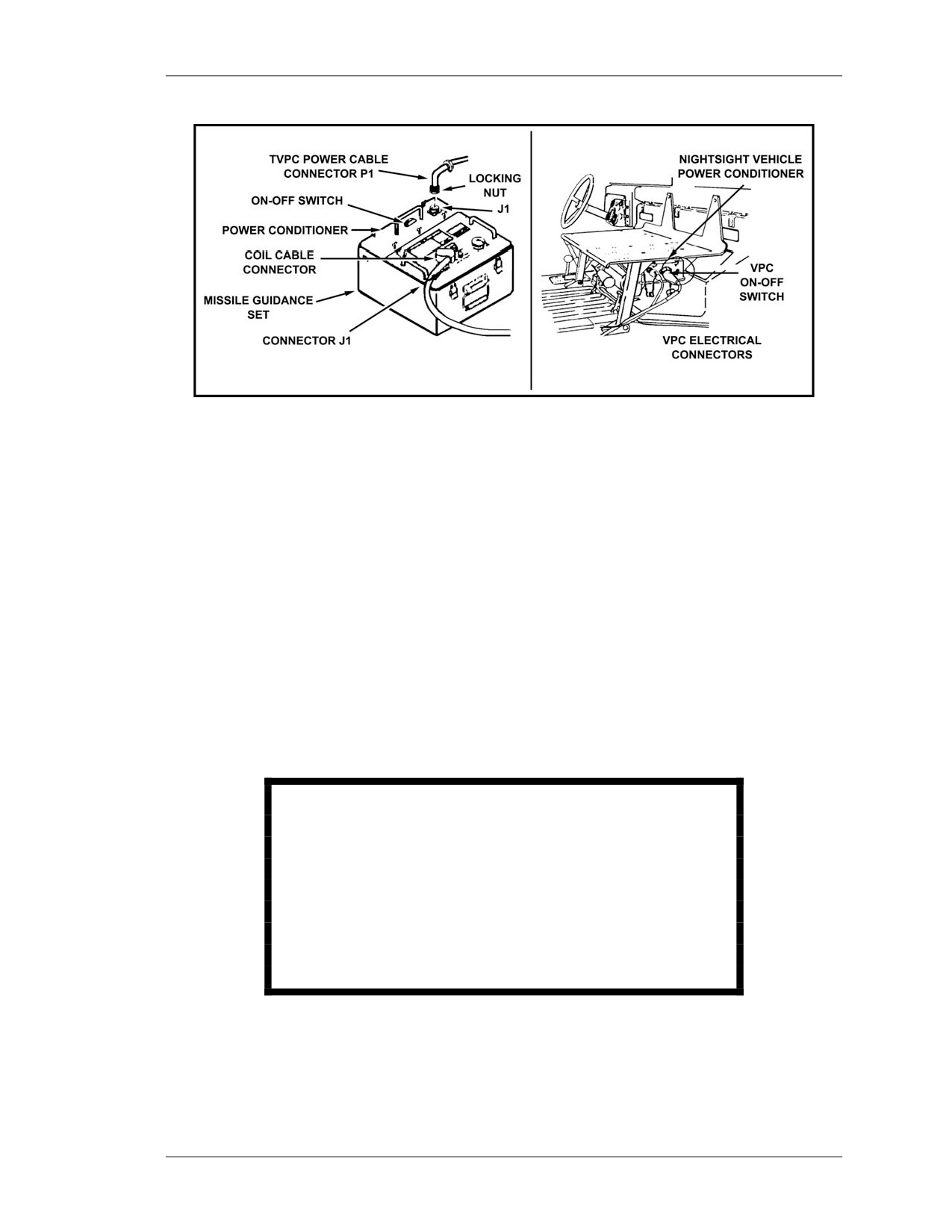
(a) The gunner presses the TEST-OPERATE switch to check the battery power. If he
receives an OUT-OF-BAND/BATTERY FAIL, he checks to ensure that the TVPC
switch is in the ON position and that the P1 cable is securely mated to the container. If all
cables are connected securely, he replaces the power conditioner with a battery and
checks the battery (Figure 3-17).
3-18
FM 3-22.34
Figure 3-17. MGS, TVPC cable connector P1, power conditioner.
(b) He checks the coil cable connection to J1 connector. If it is not connected
properly, he corrects it.
(c) He ensures the bridge clamp locking handle is properly seated, unlocks the
azimuth and elevation locks, and raises the arming lever.
(d) He ensures the electrical connector is properly mated, raises the trigger cover, and
presses the trigger.
(2) If the missile still fails to launch, the gunner may continue tracking the target for
one minute (at the gunner’s discretion in combat).
(a) He closes the trigger cover, lowers the arming lever, and locks the azimuth and
elevation locks, ensuring the launch tube is locked in the 8-degree down position.
NOTE: In a training situation, the crew dismounts the vehicle, closes the doors, calls
EOD, and waits 30 minutes. The gunner may then remount the vehicle.
DANGER
IF THE VEHICLE IS NOT POSITIONED WITH ITS
FRONT OR REAR IN LINE WITH THE TARGET,
REPOSITION IT SO THAT EITHER THE FRONT OR
REAR OF THE VEHICLE IS IN LINE WITH THE
TARGET. ROTATE THE WEAPONS STATION
DURING VEHICLE REPOSITIONING SO THE
FORWARD END OF THE MISSILE IS POINTING
TOWARD THE TARGET AT ALL TIMES.
(b) The gunner opens the bridge clamp, removes the missile from the launch tube
(keeping the missile pointed downrange at all times), and hands the missile over either
side of the vehicle to the driver-loader.
3-19
FM 3-22.34
WARNING
Do not hand off malfunctioned missile to the front
or rear of the vehicle. A malfunctioned missile
must be handed off from the vehicle to either the
left or right side.
(3) The driver-loader, keeping the missile pointed downrange, places the missile on
the ground a safe distance from launcher. (In training, he places the missile on the ground
at least 200 meters from the launcher and marks the missile location.)
3-10. M220A1 DISMOUNT
Specific actions must be followed when dismounting the M220A1 and moving it to the
firing site. All actions happen simultaneously.
a. Dismount Actions. Each crew member begins executing his assigned
responsibilities as soon as the squad leader commands, DISMOUNT THE TOW.
(1) Squad Leader’s Actions. The squad leader⎯
(a) Turns the VPC to the OFF position, places the MGS cover on the driver-loader’s
seat, and places the coil cable in its retaining cup on the traversing unit.
(b) Dismounts and goes to the rear of the vehicle; opens the cargo shell door using
the rear latch; lowers the tailgate; removes the tripod, battery case, and coolant cartridge
case and places them on the ground beside the launch tube (on left front side of vehicle in
front of the MGS and the daysight tracker); closes the tailgate and cargo shell door.
(c) Enters the right rear passenger door, gets the collimator case and the nightsight
case, dismounts the vehicle, and places the collimator case and the nightsight case on the
ground beside the vehicle.
(d) Carries the tripod, the coolant cartridge case, the battery case, and the launch tube
to the firing site.
(2) Gunner’s Actions (assisted by driver-loader when needed). The gunner⎯
(a) Disconnects the coil cable from the MGS; disconnects the VPC and TVPC cables.
(b) Removes the nightsight and hands it to the driver-loader who places it on the
ground. Removes the daysight tracker and hands it to the driver-loader who places it on
the ground in front of the left side of the vehicle. (The nightsight should be put into its
case and placed behind daysight tracker.)
(c) Removes the launch tube and hands it to the driver-loader who places it on the
ground in front of the daysight tracker.
(d) Unlocks the top coupling clamp on the traversing unit adapter; removes the
traversing unit (minus adapter); hands the traversing unit to the driver who places it on
the ground behind the daysight tracker.
(e) Removes the TVPC from the MGS and places it to his rear on top of the vehicle
within reach of the cargo hatch (see next step); unstraps the MGS and hands it to the
driver-loader who places it on the ground beside the daysight tracker.
3-20
FM 3-22.34
(f) Opens the cargo shell door by using the forward latch; switches the TVPC for the
TOW battery assembly, and hands the battery assembly to the driver-loader to install in
the MGS.
(g) Unstraps a missile and hands it to the driver-loader who places the missile on the
ground behind the traversing unit. The gunner then closes the cargo shell door and
dismounts the vehicle.
(h) Carries the daysight tracker and the MGS to the firing site.
(3) Driver-Loader’s Actions. The driver-loader⎯
(a) Dismounts the vehicle and waits to receive equipment from the gunner.
(b) Aligns equipment as described in paragraphs 2a through 2g; installs the battery
assembly in the MGS and then replaces the MGS cover on the MGS.
(c) Carries the traversing unit on the first trip, the missile on the second trip, and the
nightsight and boresight collimator on the third trip to the firing site.
b. Firing Position Actions. Upon reaching the firing position, the crew proceeds
with the following actions.
(1) Squad Leader’s Actions. The squad leader⎯
(a) Places the coolant cartridge case, battery case, and launch tube on the ground.
Sets up the tripod with the coupling clamp handle facing the direction of fire and
unlocked.
(b) Pulls the coil cable out of the traversing unit retaining cup, installs the launch
tube, and observes downrange for enemy targets.
(c) Issues fire commands.
(2) Gunner’s Actions. The gunner⎯
(a) Places the MGS on the ground next to the tripod and installs the daysight tracker
on the traversing unit.
(b) Removes the MGS cover and connects the coil cable to the MGS.
(c) Installs the nightsight and turns the actuator switch to the ON position.
(d) Conducts the system self-test, boresight, and collimation.
(e) Engages the target upon receipt of the fire command.
(3) Driver-Loader’s Actions. The driver-loader⎯
(a) Installs the traversing unit on the tripod.
(b) Returns to the vehicle for the missile; places the missile on the ground at the
firing position to the right side of the weapon system.
(c) Returns to the vehicle to get the nightsight case and the boresight collimator case;
returns to the firing position and hands the nightsight to the gunner.
(d) Places the collimator on the ground, removes it from its case, and installs it on the
nightsight. Attaches the battery to the collimator.
(e) Removes the collimator from the nightsight; removes the battery from the
collimator; places both the collimator and the battery back in their cases (if time permits).
(f) Loads the missile and arms it if commanded.
3-11. M220A1 REMOUNT
The following actions occur at the same time, when the squad leader commands, CEASE
TRACKING, OUT OF ACTION.
a. Firing Position Actions. The following actions take place at the firing position
before returning to the vehicle.
3-21
FM 3-22.34
(1) Squad Leader’s Actions. The squad leader⎯
(a) Removes the launch tube and places it on the ground.
(b) Folds the tripod legs and commands MOVE OUT. (The squad leader remains at
the firing position until the driver-loader returns and all equipment is en route to the
vehicle.)
(c) Carries the coolant cartridge case, tripod, battery case, and launch tube back to the
vehicle. Places the launch tube on the ground on the driver’s side of the vehicle and the
rest of the equipment on the ground behind the vehicle.
(2) Gunner’s Actions. The gunner⎯
(a) Disconnects the coil cable.
(b) Replaces the nightsight lens cover, removes the nightsight, and places it on the
ground near the driver-loader.
(c) Removes the daysight tracker and picks up the MGS; carries them to the vehicle.
(d) Places the daysight tracker and the MGS on top of the vehicle and enters the
gunner’s station.
(3) Driver-Loader’s Actions. The driver-loader⎯
(a) Removes the encased missile (or empty launch container if the missile was fired).
(b) Removes the traversing unit from the tripod, carries it to the vehicle, and hands it
to the gunner when the gunner reenters the gunner’s station.
(c) Returns to the firing position to get the nightsight and collimator; returns to the
vehicle and hands the nightsight to the gunner; sets the collimator and the nightsight case
on the ground near the rear of the vehicle.
(d) Returns to the firing position to get the encased missile (if a missile was not fired)
and carries it to the vehicle. Hands the missile to the gunner.
b. Remount Actions. The following actions are performed to remount the vehicle.
(1) Squad Leader’s Actions. The squad leader⎯
(a) Stows the coolant cartridge, battery case, tripod, nightsight case, and collimator
on the vehicle.
(b) Hands the TVPC and VPC cables to the gunner. Enters the squad leader’s seat in
the vehicle and turns the VPC to the ON position.
(c) Places the MGS cover on the floorboard.
(d) Assists other crew members as needed.
(2) Gunner’s Actions. The gunner⎯
(a) Receives the traversing unit from the driver-loader, installs it on the traversing
unit adapter, and secures it with the top coupling clamp.
(b) Installs the MGS in the MGS tray and secures it with the straps; hands the MGS
cover to the squad leader; connects the coil cable.
(c) Installs the daysight tracker and nightsight, and connects the VPC.
(d) Moves into the cargo area and places the unfired missile in the missile rack (if
necessary).
(e) If time permits, conducts the system self-test, boresight, and collimation;
exchanges the battery assembly for the TVPC; connects the TVPC cable.
(3) Driver-Loader’s Actions. The driver-loader assists the squad leader and gunner as
needed. He closes the tailgate and cargo shell door at the end of the drill.
NOTE: If a missile was fired, the empty launch container is destroyed.
3-22
FM 3-22.34
3-12. M220A2 DISMOUNT (READY-TO-FIRE CONFIGURATION)
Specific actions must be followed when dismounting the M220A2 and moving it to the
firing site. All actions happen simultaneously.
NOTE: Infantry units using the M966 conduct many types of missions. Therefore,
during dismount operations, all equipment must be properly stored before
leaving the vehicle.
a. Dismount Actions. The following actions occur at the same time when the squad
leader commands, DISMOUNT THE TOW.
(1) Squad Leader’s Actions. The squad leader⎯
(a) Turns the VPC to the OFF position, places the MGS cover on the driver-loader’s
seat, and places the coil cable in its retaining cup on the traversing unit.
(b) Dismounts and goes to the rear of the vehicle; opens the cargo shell door using
the rear latch; lowers the tailgate; removes the tripod and the BPC and places them on the
ground beside the launch tube (on the left front side of the vehicle in front of the MGS
and the daysight tracker); closes the tailgate and cargo shell door.
(c) Enters the right rear passenger door, gets the collimator case and the nightsight
case, dismounts the vehicle, and places the collimator case and the nightsight case on the
ground beside the vehicle.
(d) Carries the tripod, BPC, and launch tube to the firing site.
(2) Gunner’s Actions (assisted by driver-loader when needed). The gunner⎯
(a) Disconnects the coil cable from the MGS and disconnects the VPC and TVPC
cables.
(b) Removes the nightsight and hands it to the driver-loader who places it on the
ground. Removes the daysight tracker and hands it to driver-loader who places it on the
ground in front of the left side of the vehicle. (The nightsight should be put into its case
and placed behind the daysight tracker.)
(c) Removes the launch tube and hands it to driver-loader who places it on the ground
in front of the daysight tracker.
(d) Unlocks the top coupling clamp on the traversing unit adapter, removes the
traversing unit (minus adapter), and hands it to the driver-loader who places it on the
ground behind the daysight tracker.
(e) Removes the TVPC from the MGS and places it to his rear on top of the vehicle
within reach of the cargo hatch (see next step); unstraps the MGS and hands it to the
driver-loader who places it on the ground beside the daysight tracker.
(f) Opens the cargo shell door by using the forward latch; exchanges the TVPC for
the TOW battery assembly; hands the battery assembly to the driver-loader to install in
the MGS.
(g) Unstraps a missile and hands it to the driver-loader who then places the missile on
the ground behind the traversing unit. The gunner then closes the cargo shell door and
dismounts the vehicle.
(h) Carries the daysight tracker and the MGS to the firing site.
(3) Driver-Loader’s Actions. The driver-loader⎯
(a) Dismounts the vehicle and waits to receive equipment from the gunner.
3-23
FM 3-22.34
(b) Aligns equipment as described in paragraphs 2a through 2g; installs the battery
assembly in the MGS and then installs the MGS cover on the MGS.
(c) Carries the traversing unit on the first trip, the missile on the second trip, and the
nightsight and boresight collimator on the third trip to the firing site.
b. Firing Position Actions. Upon reaching the firing position, the crew proceeds
with the following actions:
(1) Squad Leader’s Actions. The squad leader⎯
(a) Places the BPC and launch tube on the ground; sets up the tripod with the
coupling clamp handle facing the direction of fire and unlocked; connects the BPC cable
and turns the BPC to the ON position; places the BPC cable within reach of the gunner.
(b) Pulls the coil cable out of the traversing unit retaining cup; installs the launch
tube; observes downrange for enemy targets.
(c) Issues fire commands.
(2) Gunner’s Actions. The gunner⎯
(a) Places the MGS on the ground next to the tripod and installs the daysight tracker
on the traversing unit.
(b) Removes the MGS cover and connects the coil cable to the MGS.
(c) Installs the nightsight and turns the actuator switch to the ON position.
(d) Conducts the system checkout, boresight, and collimation.
(e) Engages the target upon receipt of the fire command.
(3) Driver-Loader’s Actions. The driver-loader⎯
(a) Installs the traversing unit on the tripod.
(b) Returns to the vehicle for the missile; places it on the ground at the firing position
to the right side of the weapon system.
(c) Returns to the vehicle and gets the nightsight case and collimator case; returns to
the firing position, takes the nightsight out of the case, and hands it to the gunner.
(d) Places the collimator case on the ground; removes the collimator from its case and
installs it on the nightsight. Attaches the boresight cable to the collimator.
(e) Disconnects the boresight cable and removes the collimator from the nightsight;
places the collimator in its case (time permitting).
(f) Loads the missile and arms it upon receipt of the fire command.
3-13. M220A2 REMOUNT (READY-TO-FIRE CONFIGURATION)
The following actions occur at the same time, when the squad leader commands, CEASE
TRACKING, OUT OF ACTION.
a. Firing Position Actions. The following actions are performed at the firing
position.
(1) Squad Leader’s Actions. The squad leader⎯
(a) Removes the launch tube and places it on the ground.
(b) Places the coil cable in the retaining cup in the bottom of the traversing unit.
(c) Folds the tripod legs and commands MOVE OUT. (The squad leader remains at
the firing position until the driver-loader returns and all equipment is enroute to the
vehicle.
(d) Carries the BPC, tripod, and launch tube back to the vehicle. Places the launch
tube on the ground on the driver’s side of the vehicle and the rest of the equipment on the
ground behind the vehicle.
3-24
FM 3-22.34
(2) Gunner’s Actions. The gunner⎯
(a) Disconnects the coil cable.
(b) Replaces the nightsight lens cover; removes the nightsight and sets it on the
ground near the driver-loader.
(c) Removes the daysight tracker, picks up the MGS, and carries them to the vehicle.
(d) Places the daysight tracker and MGS on top of the vehicle and enters the gunner’s
station.
(3) Driver-Loader’s Actions. The driver-loader⎯
(a) Removes the encased missile (or empty launch container if the missile was fired).
(b) Removes the traversing unit from the tripod, carries it to the vehicle, and hands it
to the gunner when the gunner reenters the gunner’s station.
(c) Returns to the firing position to get the nightsight and collimator; returns to the
vehicle and hands the nightsight to the gunner; sets the collimator and the nightsight case
on the ground near the rear of the vehicle.
(d) Returns to the firing position, gets the encased missile (if the missile was not
fired), and carries it to the vehicle. Hands the missile to the gunner.
b. Remount Actions. The following actions are performed to remount the vehicle.
(1) Squad Leader’s Actions. The squad leader⎯
(a) Stows the BPC, tripod, collimator, and nightsight case on the vehicle.
(b) Hands the TVPC and VPC cables to the gunner. Enters the squad leader’s seat in
the vehicle and turns the VPC to the ON position.
(c) Places the MGS cover on the floorboard.
(d) Assists the other crew members as needed.
(2) Gunner’s Actions. The gunner⎯
(a) Receives the traversing unit from the driver-loader, installs it on the traversing
unit adapter, and secures it with the top coupling clamp.
(b) Installs the MGS in the MGS tray and secures it with the straps; hands the MGS
cover to the squad leader; connects the coil cable.
(c) Installs the daysight tracker and the nightsight, and connects the VPC.
(d) Moves into the cargo area and places the unfired missile in the missile rack (if
necessary).
(e) Conducts the system checkout, boresight, and collimation
(if time permits);
exchanges the battery assembly for the TVPC and connects the TVPC cable.
(3) Driver-Loader’s Actions. The driver-loader assists the squad leader and gunner as
needed.
NOTE: If a missile was fired, the empty launch container is destroyed.
3-14. FIRING LIMITATIONS
Firing limitations for the M966-mounted TOW/TOW
2 are the same as for the
tripod-mounted TOW/TOW 2 with an additional limitation: Restricted firing angles are
those greater than +20 degrees or less than -20 for all firing positions except firing over
the cargo shell door. The firing angle over the cargo shell door should not exceed +20
degrees or -13 degrees.
3-25
FM 3-22.34(FM 23-34)
CHAPTER 4
TOW TRAINING PROGRAM
The TOW Training Program is a comprehensive program of required
training and testing that begins with individual Skill Level 1 tasks and
progresses through individual gunner qualification to squad-, section-,
and platoon-level testing and verification. This process has been
condensed and unified into a program that consists of 12 TOW gunnery
tables plus a quarterly Gunner’s Skill Test. All mandatory TOW training
and testing are included in this program. Additional types of TOW
training, such as STXs and CO EXEVALs, will be performed with the
frequency prescribed in STRAC and in the manner described in ARTEP
7-91. The unit commander must assess the training status of the individual
unit to determine what additional TOW training is necessary to support
the 12 mandatory training tables and must prepare his crews to pass their
required testing.
Section l. TRAINING ASSESSMENT AND PLANNING
Differences between resources required and resources available will affect both the time
required to conduct and sustain training and the unit’s ability to meet the required
standards. Required resources and maintenance assistance should be planned for and
requested well in advance. Nothing should be left to chance, because resources will be
wasted and training opportunities lost. A good program must have provisions for routine
inspection of the TOW weapon systems by direct support units. Leaders must adjust the
training program to meet the changing needs of the unit. (See Table 4-1, page 4-2, for
ammunition requirements according to DA Pam 350-38).
4-1.
COMMANDER’S RESPONSIBILITY
All mandatory TOW gunnery training and testing are included in the 12 TOW Gunnery
Tables plus the quarterly Gunner’s Skill Test. However, the commander must still conduct
an accurate assessment of the state of TOW training in his unit to determine what
additional training is necessary to prepare his unit for the quarterly and semiannual tables.
He must remember that his units must meet the standards outlined in DA PAM 350-38 to
be certified in the training status C1, fully trained. A good assessment of training
requirements and thorough planning produce an effective unit training program. To
accomplish this, the commander should start early, be thorough, and be flexible and
creative. All aspects of the training program should be coordinated to produce the desired
results.
a. The commander should refer to FM 25-101 when developing his unit training
program. This FM applies the doctrine established in FM 25-100 and assists leaders in
the development and execution of training programs.
b. The heart of an effective training program is the development of a METL and the
soldier tasks, leader tasks, and collective tasks that support the METL. Battle focus drives
the METL development process; the METL is based on the wartime mission, and the unit
4-1
FM 3-22.34
must train as it plans to fight. Chapter 2 of FM 25-101 illustrates this process in clear and
practical terms.
TRC A*
TRC B
TRC C
TRC D
EVENT/TABLE
(M80 TOW blast
(M80 TOW blast
(M80 TOW blast
(M80 TOW blast
simulator)
simulator))
simulator)
simulator)
GST
0
0
0
TABLES 1 & 2
0
0
0
TABLES 3 & 4
0
0
0
TABLES 5 & 6
240
60
0
TABLES 7 & 8
40
20
0
TABLES 9 & 10
48
24
0
TABLES 11 & 12
48
24
0
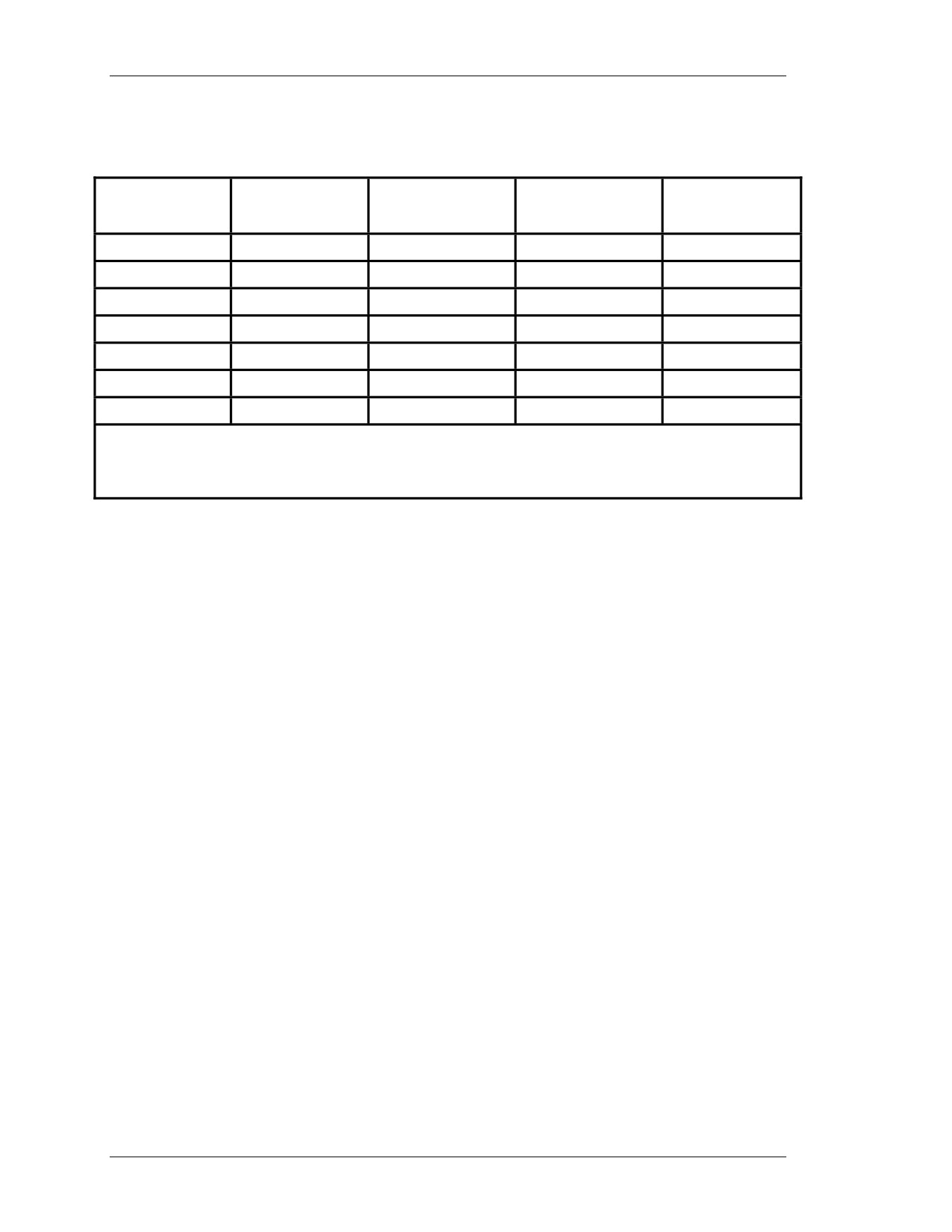
*The STRAC determines a unit’s ammunition requirements based on its training readiness
condition (TRC). The four major categories are: TRC A, active Army; TRC B, National Guard
enhanced brigades; TRC C, USAR and other National Guard units; and TRC D, Reserve
training divisions.
Table 4-1. Required TOW gunnery tables and ammunition needed per
system per year (IAW DA Pam 350-38 STRAC).
4-2.
SUSTAINMENT TRAINING AND EVALUATION
As individual TOW crewmen, squads, sections and platoons become qualified, the
commander should maintain that status by sustainment training and evaluation, and by
crew stabilization. Personnel changes are inevitable in units. Before TOW squads lose
their crew integrity and combat readiness, personnel changes should be examined in
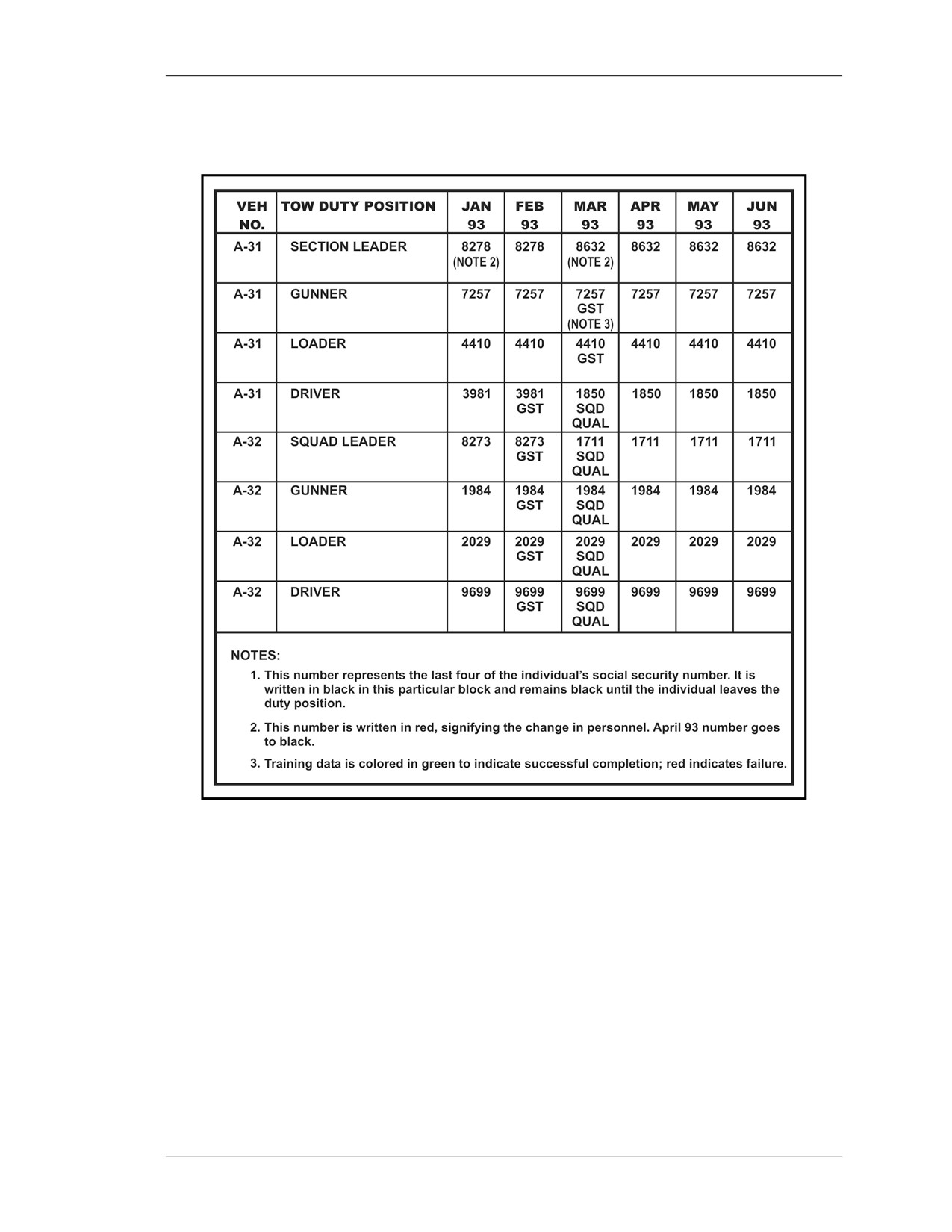
detail and alternative solutions sought where possible. Figure 4-1 is an example of a crew
stability management chart used to record training milestones and qualifications.
4-3.
TOW TRAINING GUIDELINES
A soldier must track all targets and perform all individual and collective tasks and battle
drills discussed in this manual to become a fully trained heavy antiarmor weapon system
crewman. Soldier training publications and ARTEP battle drills for TOW provide tasks,
conditions, and standards for combat-critical skills.
a. When a crew member becomes skilled in his job, he should be trained to do
another crew member’s job (cross-trained). Therefore, the loss of one crew member will
not make the squad combat-ineffective.
b. Training should be conducted under realistic conditions. To properly develop
combat skills, training must be conducted in a tactical environment with emphasis on the
type of threat the crew can expect to face in combat.
c. Multiechelon training should be conducted to save time and resources. For
example, while squads are training in crew tasks, leaders can train to execute their tactical
command and control responsibilities.
d. Training should be conducted with supported units. When possible, tactical
training should be conducted with the type of units to be supported in combat—infantry,
4-2
FM 3-22.34
mechanized infantry, and armor. TOW units must be able to interface with the units they
support.
Figure 4-1. Example of a crew stability management chart.
e. Training should be concentrated in areas where it is most needed. Time should not
be wasted by training skills the unit and soldiers have already mastered. The trainer must
know where the weak spots are and train to correct them.
f. Sections and squads will not always be at full strength. The mission in combat
and in training can still be accomplished if under-strength units are organized with the
following rules in mind:
(1) Key leadership positions should always be filled. For example, the gunner may
have to fill the position of the squad leader.
(2) The primary weapon system should always be manned. If the loader becomes a
casualty, the squad leader may have to load the TOW and control the squad at the same
time. If the gunner becomes a casualty, the squad leader must operate and fire the TOW.
4-3

FM 3-22.34
4-4.
TOW GUNNERY TABLES
The TOW Training Program consists of 12 gunnery tables plus the Gunner’s Skill Test.
The STRAC establishes the frequency of a unit’s training requirements based on its TRC.
A TRC A (active Army) unit, for example, is required to conduct Tables 1 through 6 and
the Gunner’s Skill Test and Tables 7 through 12 semiannually. (See Table 4-2 for
frequency of events as required by DA Pam 350-38 STRAC.)
NOTE: The second quarterly GST should be conducted within seven days before
conducting Tables 7 through 12.
EVENT/TABLE
TRC A*
TRC B
TRC C
TRC D
4
Weapons Training
12
1
1
Gunner’s Sustainment
12
4
1
1
GST
4
1
1
1
TABLES 1 & 2*
4
2
1
1
TABLES 3 & 4
4
2
1
1
TABLE 5
4
1
1
1
1
TABLE 6
4
1
0
TABLES 7 & 8
2
1
0
0
TABLES 9 & 10
2
1
0
0
TABLES 11 & 12
2
1
0
0
*See STRAC Table 5-11 for details on personnel required to conduct
training and any training devices used.
Table 4-2. Frequency of required TOW gunnery events.
Tables 1 and 2 will be performed by all of the crew with the TOW Gunnery Trainer
(TGT). Only gunners will perform tables 3 and 4. Tables 5 through 12 will be performed
with the TOW Field Tactical Trainer
(TFTT). The TFTT replicates the flight and
performance characteristics of the TOW. (See Appendix F for more information on TOW
training devices.)
4-5.
CONDUCT OF UNIT TOW TRAINING
TOW training involves individual and collective training divided into four phases. Each
unit must complete these phases as required.
a. Phase I—Individual Training.
• Conduct refresher training on STP tasks as deemed necessary to prepare for
the Gunner’s Skill Test.
• Conduct sustainment training with the TGT as deemed necessary to prepare
for TOW Gunnery Tables 1 through 4.
• Conduct Gunner’s Skill Test.
• Conduct TOW Gunnery Table 1, Individual Gunnery Practice.
4-4
FM 3-22.34
• Conduct TOW Gunnery Table 2, Individual Gunnery Qualification.
• Conduct TOW Gunnery Table 3, Advanced Gunnery Practice.
• Conduct TOW Gunnery Table 4, Advanced Gunnery Qualification.
b.
Phase II—Squad Training.
• Conduct refresher training on the installation and operation of TFTT or
MILES equipment as deemed necessary in preparation for TOW Gunnery
Tables 5 and 6.
• Conduct TOW Gunnery Table 5, Baseline Gunnery Practice.
• Conduct TOW Gunnery Table 6, Baseline Gunnery Qualification.
• Conduct squad-level sustainment training as deemed necessary to prepare for
TOW Gunnery Tables 7 and 8.
• Conduct TOW Gunnery Table 7, Squad Gunnery Practice, in preparation for
Table 8.
• Conduct TOW Gunnery Table 8, Squad Gunnery Qualification.
c.
Phase III—Section Training.
• Conduct section-level sustainment training as deemed necessary to prepare for
TOW Gunnery Tables 9 and 10.
• Conduct TOW Gunnery Table 9, Section Gunnery Practice, in preparation for
Table 10.
• Conduct TOW Gunnery Table 10, Section Gunnery Qualification.
d.
Phase IV—Platoon Training.
• Conduct platoon-level sustainment training as deemed necessary to prepare
for TOW Gunnery Tables 11 and 12.
• Conduct TOW Gunnery Table 11, Platoon Gunnery Practice, in preparation
for Table 12.
• Conduct TOW Gunnery Table 12, Platoon Gunnery Qualification.
4-6.
COLLECTIVE TRAINING
Collective training is the coordinated performance of individual skills and tasks as a
team. Collective tasks are normally performed by more than one soldier.
a. Common crew task training is the first level of collective training. Common crew
tasks provide the basic technical collective tasks performed by the crew to accomplish the
wartime mission. These tasks tell “how to” and allow each soldier in the crew to perform
his tasks. As a result, the squad leader, gunner, driver, and loader combine their learned
individual technical skills to perform as one crew on their assigned vehicle.
b. The critical squad and platoon collective tasks are called battle drills. Battle drills
are mostly independent of METT-TC and require minimal leader actions to execute. They
are standardized throughout the U.S. Army. Battle drills are in the applicable drill book
for each echelon and equipment-type unit. The battle drills for antiarmor platoons are in
ARTEP 7-91-Drill.
c. Common crew tasks are tasks performed by a TOW crew that are not battle drills
but are performed in the same manner. An example of a common crew task is
Dismount/Remount the TOW. Crew tasks are crucial to applying tactics to enhance
survival and to accomplish the TOW crew’s mission of providing antiarmor direct fire
support to destroy the enemy.
4-5
FM 3-22.34
d. ARTEP training exercises are used to practice, evaluate, and sustain collective
tasks and mission proficiency. They have specific goals and are modified based on
METT-T factors. Exercises are structured to the availability of resources, time, and
training areas. (See appropriate ARTEP for details on conducting ARTEP exercises.)
SECTION ll. TOW TRAINING PHASES
The TOW training program is divided into four phases: individual training, squad
training, section training, and platoon training. Phase I (individual training) consists of
the Gunner’s Skill Test and TOW Gunnery Tables 1 through 4. Phase II (squad training)
consists of TOW Gunnery Tables 5 through 8. Phase III (section training) consists of
TOW Gunnery Tables 9 and 10. Phase IV (platoon training) consists of TOW Gunnery
Tables 11 and 12. (All scoring forms are located in the back of this manual for local
reproduction.)
4-7.
PHASE I: INDIVIDUAL TRAINING
Individual training covers all tasks that are performed by a single TOW crewman. These
tasks include Skill Level 1 11B soldier’s manual tasks and individual gunnery. They are
the building blocks that form the foundation of TOW training.
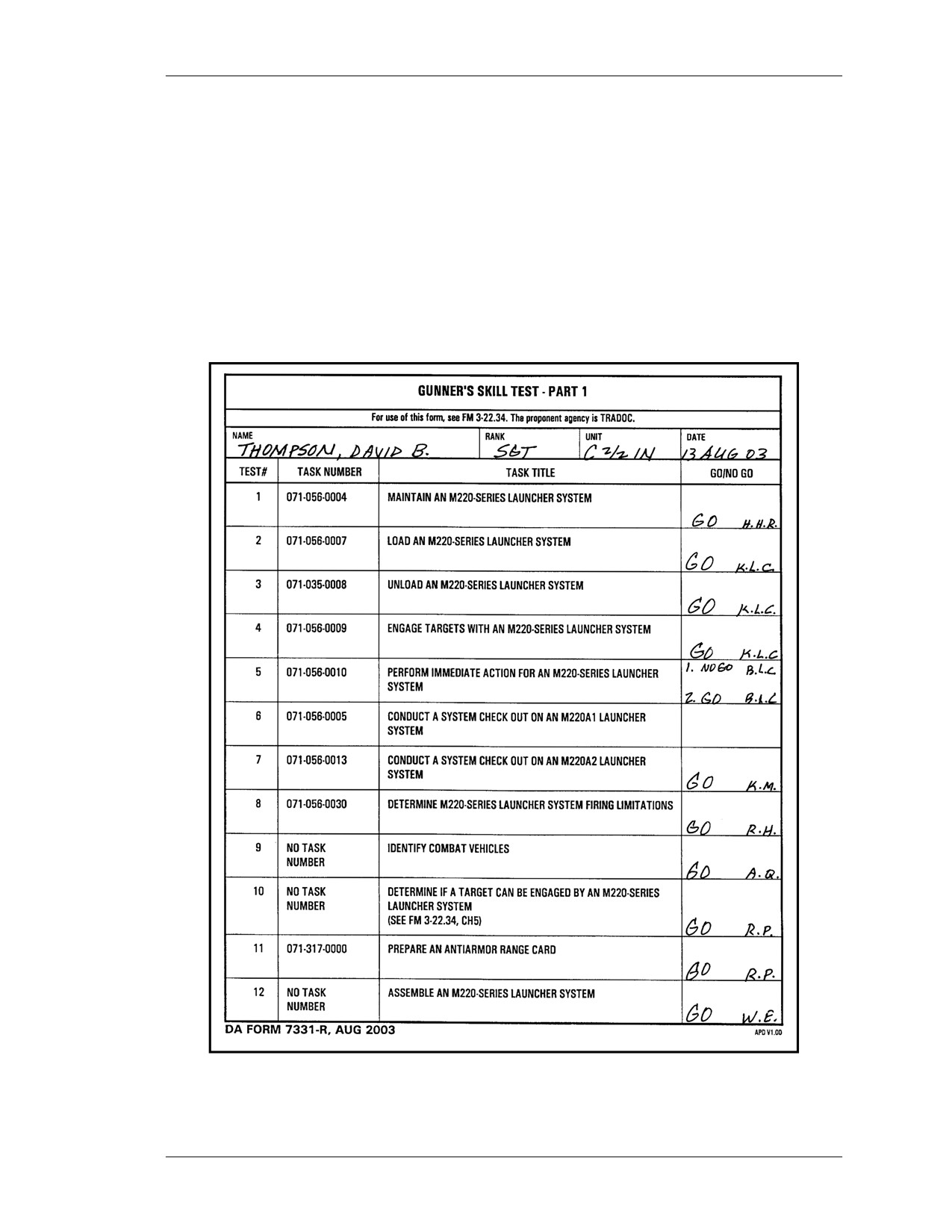
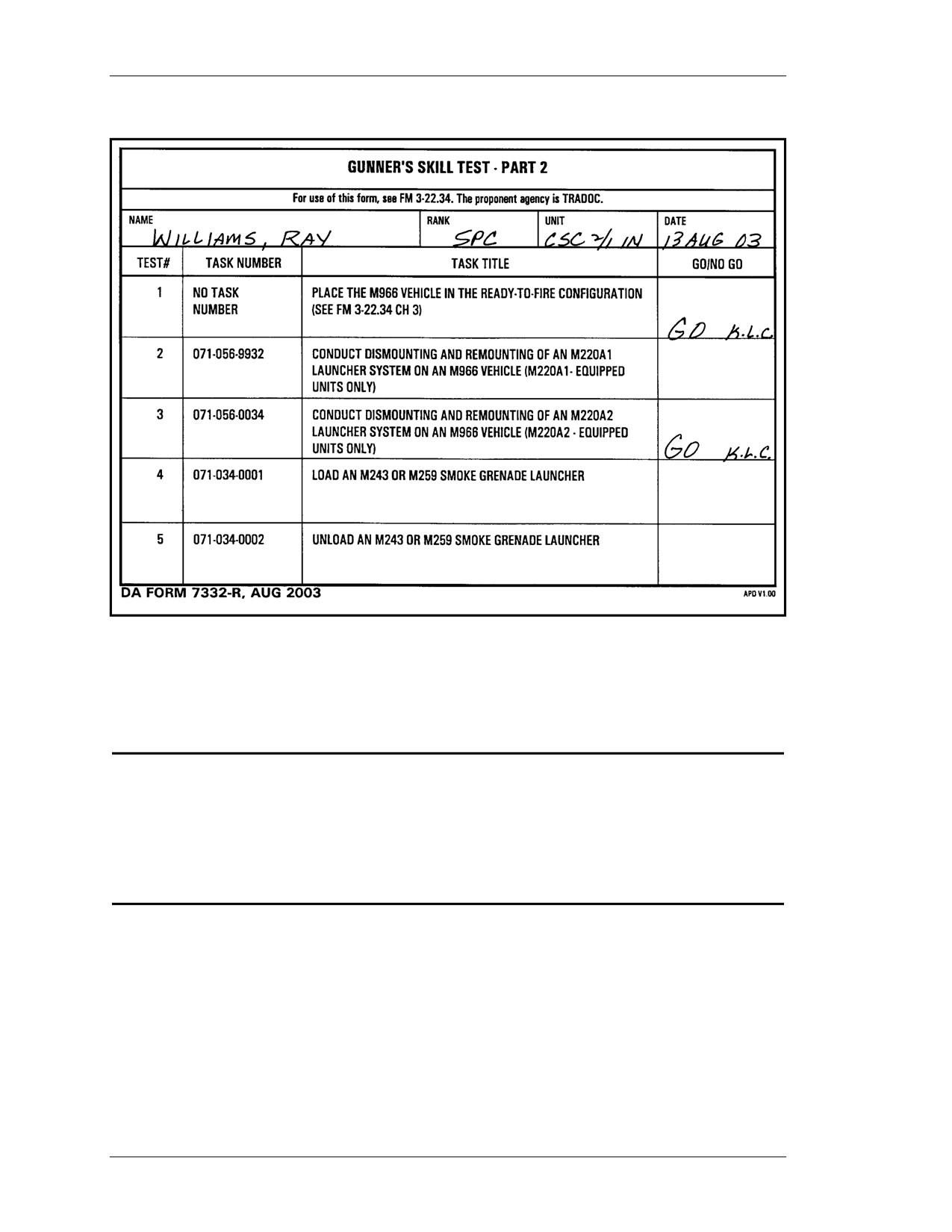
a. Gunner’s Skill Test. The Gunner’s Skill Test comprises the Skill Level 1 tasks
for the TOW weapon system listed in STP 7-11B1-SM-TG plus some additional tasks
(Figure 4-2, page 4-7 and Figure 4-3, page 4-8). All soldiers assigned to TOW-equipped
units must take this portion of the test and receive a GO on at least 70 percent of the
tasks. Soldiers must be tested on the group of tasks that applies to the vehicle his unit is
equipped with and receive a GO on at least 70 percent of those tasks. Some of the tasks
are combined individual/crew tasks. Since every member of the crew must be cross
trained, the combined individual/crew tasks will be performed in rotation and every
member of the crew will be tested on each part.
TASK: Perform the TOW gunner’s tasks listed in (1) below.
CONDITIONS: Testing will be hands on, with the appropriate equipment. Specific
conditions will be found in the reference cited for each task.
STANDARDS: Specific standards for each task listed will be found in the appropriate
reference. The overall minimum standard to receive a GO on the Gunners’ Skill Test is
for each individual to receive a GO on at least 70 percent of the tasks he is required to
test on.
(1) The GST consists of the following tasks.
(a) 071-056-0004 Maintain an M220-series launcher system.
(b) 071-056-0007 Load an M220-series launcher system.
(c) 071-056-0008 Unload an M220-series launcher system.
(d) 071-056-0009 Engage targets with an M220-series launcher system.
(e) 071-056-0010 Perform immediate action for an M220-series launcher system
malfunction.
4-6
FM 3-22.34
(f)
071-056-0005 Conduct a system check-out on an M220A1 launcher system.
(Tested only if unit is equipped with M220A1 systems.)
(g) 071-056-0013 Conduct a system check-out on an M220A2 launcher system.
(Tested only if unit is equipped with M220A2 systems.)
(h) 071-056-0030 Determine TOW-series launcher system firing limitations.
(i) No Task Number Identify combat vehicles. (See Appendix G.)
(j) No Task Number Determine if a target can be engaged by an M220-series
launcher system. (See Chapter 5.)
(k) 071-317-0000 Prepare an antiarmor range card.
(l) No Task Number Assemble an M220-series launcher system. (See TM 9-1425-
472-12 [M220A1] or TM 9-1425-450-12 [M220A2].)
Figure 4-2. Example of completed DA Form 7331-R,
Gunner’s Skill Test—Part 1.
4-7
FM 3-22.34
Figure 4-3. Example of completed DA Form 7332-R,
for Gunner’s Skill Test—Part 2.
(4) The following are the tasks, conditions, and standards for the unnumbered tasks in
the Gunner’s Skill Test.
TASK: Identify combat vehicles.
CONDITIONS: Given a classroom with appropriate audiovisual equipment and assorted
vehicle GTAs. (See the local Training Support Center for the combat vehicle slides.)
STANDARDS: Given a 12-second exposure time for each slide, the soldier must
correctly identify 36 out of 40 vehicles by nomenclature as described in Appendix G.
TASK: Determine if a target can be engaged by an M220-series TOW launcher system.
CONDITIONS: In the field, given an operational, assembled M220-series TOW launcher
system and tactical vehicles placed in realistic situations; or indoors, given a series of
graphic presentations of target engageability situations or using the TGT.
STANDARDS: Correctly determine target engageability for the M220-series TOW
launcher system in terms of range and obstructions using both the daysight tracker and
nightsight as described in Chapter 5, paragraph 5-1.
4-8

FM 3-22.34
TASK: Assemble an M220-series launcher system.
CONDITIONS: Given a complete but unassembled M220-series launcher.
STANDARDS: Correctly assemble an M220-series launcher system as described in TM
9-1425-472-12 (M220A1) or TM 9-1425-450-12 (M220A2) within 3 minutes.
TASK: Place the M966 HMMWV in the ready-to-fire configuration.
CONDITIONS: Given an M966 HMMWV, an M220-series TOW launcher complete, and
an MSR.
STANDARDS: Correctly place the M966 in the ready-to-fire configuration as described
in TM 9-1425-475-12 (M220A1) or TM 9-1425-450-12 (M220A2) within 5 minutes.
b. TOW Gunnery Table 1, Individual Gunnery Practice. TOW Gunnery Table 1
consists of firing a minimum of two practice events (instructional firing) in preparation
for actual gunner qualification on TOW Gunnery Table 2. Units will use the TGT to
conduct this table.
TASK: Verify on TOW Gunnery Table 1, Individual Gunnery Practice using the TGT.
CONDITIONS: Indoors, using the TGT. The gunner will fire a minimum of two 10-shot
events using the TGT. They will be selected from the events listed in Table 4-3 (page
4-10).
STANDARDS: To verify on TOW Gunnery Table 1 and progress to TOW Gunnery Table
2, the gunner must fire at least one 10-shot event with a cumulative score of at least 625
points and at least 6 hits.
(1) Preparation of the TGT for Gunner Practice. The TGT is not designed for use as
an outdoor trainer. Therefore, it should always be set up and used indoors. It may be used
in tents or under shelter as long as it is not exposed to the elements, particularly dust or
blowing sand. It may be used in either the tripod-mounted mode or in the
HMMWV-mounted mode. The TGT should never be mounted on a moving HMMWV. It
should be assembled and operated according to the instructions in TM 9-6920-452-10.
(2) Personnel Duties. Normally, only two people at a time, the gunner and the trainer,
will be involved in training with the TGT. The trainer will usually be either the squad or
section leader. Other members of the squad should be occupied with concurrent training.
Other gunners should not be allowed to watch during conduct of the event. Once the TGT
has been assembled and warmed up, the trainer must assemble a plan group that
conforms to one of the 10-shot events listed in Table 4-3 (page 4-15). The trainer should
have the TGT inspected and warmed up, and the plan group constructed before the
gunner is brought in to begin engaging targets. When constructing the plan group, the
trainer ensures battle sounds are ON, target size is set at 100 percent, and obscuration is
set to last for
1.5 seconds for the thermal sight and for the daysight tracker. When
everything is ready, the trainer should bring the gunner in and brief him before beginning
the event. The briefing should include the following:
4-9

FM 3-22.34
• Safety considerations.
• Breath control—remind the student of proper procedures.
• Obscuration—tell the student the obscuration setting used.
• Sight—tell the student which sight he will use.
• Special conditions—tell the student any special conditions (multiple targets
and so forth) that apply.
(3) Conduct of Training. When the TGT is ready for operation, the plan group has
been constructed, and the gunner has been briefed and is in place, the trainer begins
conducting the table. Before the trainer starts each mission, he gives the gunner a fire
command and tells him to fire when ready. During the mission, the trainer does not coach
the gunner in any way. The gunner must determine when to fire and at which target. After
each mission, the trainer gives the gunner the results and then proceeds to the next
mission.
NOTE: The trainer has the option of thoroughly debriefing the gunner on his
performance at the end of each mission or of saving all 10 missions and
reviewing them after the table is complete. The trainer must remember that the
TGT will only save a maximum of 20 missions at one time.
TABLE NO.
1
2
3
DISK NO.
DFT 10
DFT 11
DFT 12
MISSION NO.
2
1
22
3
2
24
6
4
26
8
3
28
9
18
29
18
26
2
(THERMAL)
(THERMAL)
(THERMAL)
14
27
3
(THERMAL)
(THERMAL)
(THERMAL)
12
28
4
(THERMAL)
(THERMAL)
(THERMAL)
15
29
9
(THERMAL)
(THERMAL)
(THERMAL)
22
30
10
(THERMAL)
(THERMAL)
(THERMAL)
Table 4-3. 10-shot events for the TGT.
(4) Scoring. The two scoring criteria for TOW Gunnery Table 1 are total point score
and number of hits. The point score for the table consists of the cumulative point score
for all 10 missions. The minimum number of hits is 6 out of 10. The trainer should use
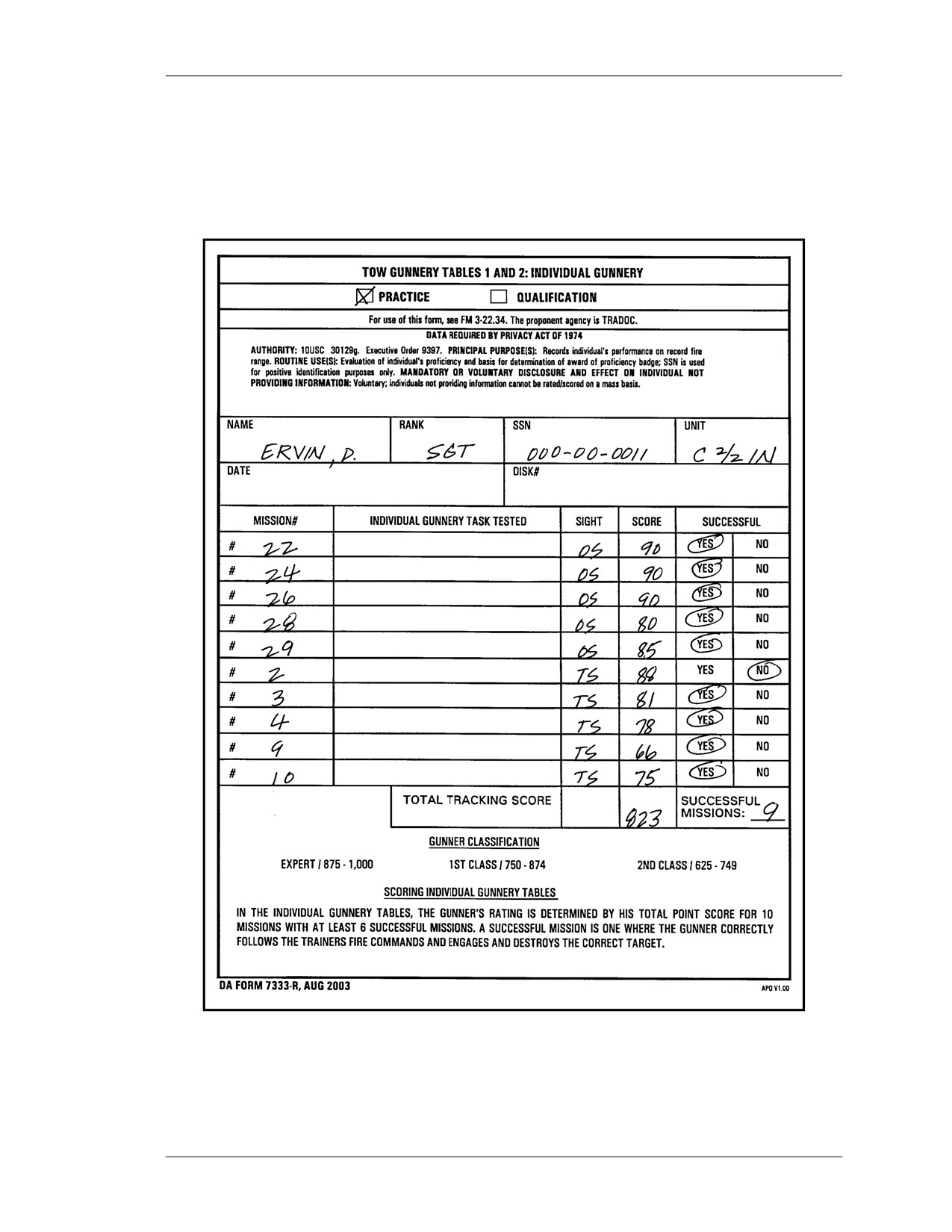
DA Form 7333-R to record results (Figure 4-4).
4-10
FM 3-22.34
(5) Sustainment Training. Units are required to conduct monthly sustainment
training. This training should not be confused with the quarterly tables. Missions for
monthly sustainment training may be taken from any of the videodiscs and are chosen at
the trainer’s discretion. The missions in Table 4-3 should not be used for sustainment
training, if possible.
Figure 4-4. Example of completed DA Form 7333-R,
TOW Gunnery Tables 1 and 2: Individual Gunnery Practice
and Qualification.
4-11
FM 3-22.34
c. TOW Gunnery Table 2, Individual Gunnery Qualification. TOW Gunnery
Table 2 will be set up and run the same as TOW Gunnery Table 1. It will be performed
with the TGT.
TASK: Qualify on TOW Gunnery Table 2, Individual Gunnery Qualification using the
TGT.
CONDITIONS: Indoors using the TGT. The gunner will fire a 10-shot event selected
from Table 4-3.
STANDARDS: To qualify on TOW Gunnery Table 2 and progress to TOW Gunnery
Table 3, the gunner must fire one 10-shot event with a cumulative score of at least 625
points and at least 6 hits. The gunner’s classification (expert, first class, second class) will
be determined by the cumulative point score using the point scale as shown in Figure 4-4.
NOTE: Preparation of the TGT, personnel duties, and conduct of training are the same
as for TOW Gunnery Table 1.
d. TOW Gunnery Table 3, Advanced Gunnery Practice. TOW Gunnery Table 3
(Figure 4-5, page 4-14) consists of a series of missions performed with the TGT that train
and test advanced gunnery skills. These skills include determining a target’s
engageability, identifying targets (to include friend or foe), prioritizing targets, deciding
which fire control methods to use, and engaging evasive targets that are hard to track
such as helicopters, obscured targets, or extreme-range targets. Only the assigned gunners
in each squad are required to verify on TOW Gunnery Table 3. (Other members of the
squad may perform the table if time permits and the trainer thinks it useful.) TOW
Gunnery Table 3 can only be performed with the TGT. Gunners must verify on TOW
Gunnery Table 3 to progress to TOW Gunnery Table 4, Advanced Gunnery Qualification.
(1) Gunner Verification on TOW Gunnery Table 3, Advanced Gunnery Practice.
TASK: Verify on Table 3, Advanced Gunnery Practice.
CONDITIONS: Indoors, using the TGT. The gunner will fire a minimum of two 10-shot
events using the TGT. The 10-shot events will be selected from Table 4-4 (page 4-15).
STANDARDS: To verify on TOW Gunnery Table 3 and progress to TOW Gunnery Table
4, the gunner must score at least 625 points. The gunner must also receive a GO on at
least 6 out of 10 missions.
(2) Personnel Duties. The trainer (usually the squad or section leader) sets up the
TGT IAW TM 9-6920-452-10, creates the planning group for each 10-shot event, briefs
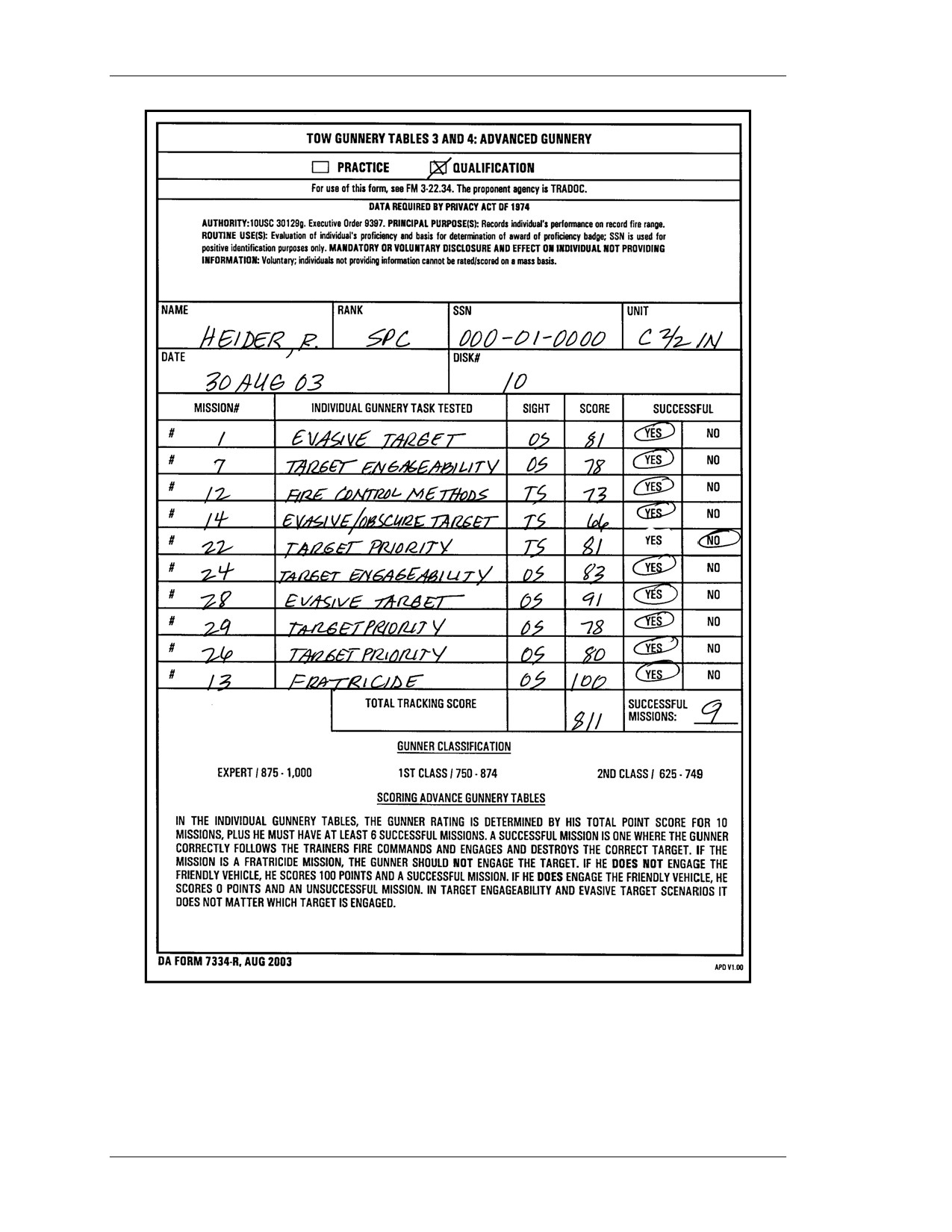
the gunner, gives the fire commands for each mission, and completes DA Form 7334-R
(TOW Gunnery Tables 3 and 4, Advanced Gunnery Practice and Qualification Scorecard,
Figure 4-5, page 4-14). He also debriefs and critiques the gunner at the end of each
10-shot event.
4-12
FM 3-22.34
(3) Conduct of Training. Conduct of advanced gunnery training with the TGT is
more complex than individual gunnery. The trainer must not only observe and record the
gunner’s tracking performance but also brief, observe, and score the particular advanced
gunnery task that is presented in each separate mission. The trainer selects the 10-shot
event from Table 4-4 (page 4-15). The sequence of missions in each 10-shot event should
be changed continuously to prevent the gunner from becoming familiar with them.
(a) Before each mission, the trainer must present a fire command to the gunner that
clearly states what the gunner must do. For example, if a particular mission involves
prioritizing targets (such as tanks are higher priority targets than APCs), the trainer gives
the command “GUNNER! TARGETS TO YOUR FRONT! ENGAGE TANKS FIRST!
FIRE WHEN READY!”
(b) In some missions, the task involved may not require specific fire commands.
These tasks include determining a target’s engageability, engaging evasive/obscured
targets, and identifying targets (to include friend or foe). When giving fire commands for
these missions, the trainer need only give general instructions, such as “GUNNER!
TARGETS TO YOUR FRONT! FIRE WHEN READY!”
(4) Scoring. The trainer has two criteria for scoring each of these missions: tracking
and success of the mission. The trainer will record the gunner’s performance on the DA
Form 7334-R (Figure 4-5, page 4-14).
(a) Tracking Score. TOW Gunnery Table 3 is scored in the same manner as TOW
Gunnery Table 1 except for target identification (to include friend or foe) missions. In
these missions, if the gunner correctly identifies a target as friendly and does not fire on
it, he receives 100 points. If he fires on a friendly target, he receives 0 points whether he
hits it or not. The total tracking score from the 10 missions (Table 4-4, page 4-15)
determines the gunner’s ranking.
(b) Successful Mission Score. The gunner must achieve a GO on at least 6 out of 10
missions. The requirements for a mission to be successful vary according to the advanced
gunnery task that is presented in each mission. A successful mission is defined as follows:
• The gunner successfully engages (destroys) the correct target as determined
by the trainer’s instructions for that particular mission. In a mission to
determine a target’s engageability, a hit on any target presented is scored as a
success. In scenarios to prioritize targets or determine the method of fire
control, the gunner must engage the correct target according to the instructions
given to him in the fire command.
• In a scenario to identify targets (including friend or foe), the gunner must not
fire on friendly targets.
• Engaging evasive and or obscured targets does not require special skills or
actions from the gunner. These targets are simply hard to hit. A hit on any
target is scored as a successful mission.
4-13
FM 3-22.34
Figure 4-5. Example of completed DA Form 7334-R,
TOW Gunnery Tables 3 and 4: Advanced Gunnery Practice
and Qualification.
4-14
FM 3-22.34
DISK NO.
MISSION NO.
DFT 10
1
Evasive Target/Optical Sight
7
Target Engageability/Optical Sight
12
Fire Control Methods/Thermal Sight
14
Evasive/Obscure Target/Thermal Sight
22
Target Priority/Thermal Sight
24
Target Engageability/Optical
28
Evasive Target/Optical
29
Target Priority/Optical
26
Target Priority/Optical
13
Fratricide/Optical
DFT 12
7
Fratricide/Thermal
9
Fratricide/Thermal
22
Target Priority/Optical
23
Target Priority/Thermal
5
Target Priority/Thermal
6
Target Priority/Thermal
10
Target Priority/Thermal
12
Target Priority/Thermal
15
Evasive Target/Thermal
11
Evasive Target/Thermal
DFT 13
30
Target Engageability/Daysight Tracker
7
Target Priority/Daysight Tracker
26
Target Engageability/Daysight Tracker
21
Fratricide/Daysight Tracker
6
Target Priority/Thermal
10
Target Priority/Thermal
8
Target Priority/Thermal
15
Target Priority/Thermal
12
Target Priority/Thermal
DFT 15
2
Target Engageability/Dual
5
Target Priority/Dual
6
Target Priority/Dual
7
Target Priority/Dual
9
Target Priority/Dual
11
Target Engageability/Dual
12
Evasive Target/Dual
8
15 Target Engageability/Dual
3
15 Target Engageability/Dual
15
Target Engageability/Dual
Note: As reviewer discs become available and are verified, they will be
added to the manual as a change.
Table 4-4. 10-shot events for advanced gunnery tables.
4-15
FM 3-22.34
NOTES:
1. In the mission descriptions in Table 4-4, the term “evasive target” refers to
evasive, obscured, or difficult targets and helicopters.
2. The term “target priority” refers to missions in which different types of
targets are presented (such as tanks and APCs) or in which some are
moving and some are stationary. (Using these differences as criteria, the
trainer chooses the high priority target for the gunner.)
3. In the missions where the type of sight is listed as dual, both sights are
active and the gunner may choose whichever sight he prefers for the
engagement or may change sights during the engagement.
4. In the fire control missions, the trainer gives the gunner a choice of fire
control methods (frontal, depth, or crossfire), and the gunner must engage
the appropriate target out of the group presented.
(5) Sustainment Training. Each month every soldier assigned to a TOW-equipped
unit is required to perform sustainment training on the TGT. The trainer may choose from
all missions available for this training. He must remember that he is preparing his soldiers
for the quarterly gunnery tables and should choose scenarios that train his soldiers in the
skills and engagements in which they are weakest. Since only assigned gunners are
required to perform and pass TOW Gunnery Tables 3 and 4, the trainer must be sure they
are trained on the difficult advanced scenarios. Other members of his TOW crews should
be trained as thoroughly as time permits and their training weaknesses require.
e. TOW Gunnery Table 4, Advanced Gunnery Qualification. TOW Gunnery
Table 4 is similar to TOW Gunnery Table 3. It consists of a series of missions performed
with the TGT that train and test advanced gunnery skills. Gunners will be evaluated on
their ability to track and hit targets, and on their ability to perform advanced gunnery
skills. These skills include determining a target’s engageability, identifying targets (to
include friend or foe), prioritizing target’s, choosing a method of fire control, and
engaging targets that are difficult to track, such as helicopters, obscured targets, and
extreme-range targets. Only assigned gunners in each squad are required to qualify on
TOW Gunnery Table 4. (Other members of the squad may perform the table if time
permits and the trainer thinks it useful.) TOW Gunnery Table 4 can only be performed
with the TGT. Therefore, units that do not have access to the TGT are not required to
perform this table. Gunners must qualify on TOW Gunnery Table 4 to progress to TOW
Gunnery Table 5, Baseline TFTT Gunnery Practice.
(1) Gunners’ Qualification on TOW Gunnery Table
4, Advanced Gunnery
Qualification.
TASK: Qualify on TOW Gunnery Table 4, Advanced Gunnery Qualification.
CONDITIONS: Indoors, using the TGT. The gunner will fire one 10-shot event using the
TGT. The 10-shot event will be selected from Table 4-4.
STANDARDS: To qualify on TOW Gunnery Table 4 and progress to TOW Gunnery
Table 5, the gunner must score a total of at least 625 points. The precise ranking of the
gunner (Expert, 1st class, or 2d class) is determined according to the scale shown on the
scorecard. In addition, the gunner must receive a GO on at least 6 out of 10 missions.
4-16
FM 3-22.34
(2) Personnel Duties. Personnel duties, conduct of training, and sustainment training
are the same as for TOW Gunnery Table 3.
(3) Scoring. TOW Gunnery Table 4 is scored the same as TOW Gunnery Table 3. The
form shown in Figure 4-5, TOW Gunnery Tables 3 and 4, Advanced Gunnery Practice
and Qualification Scorecard, is used to score the table.
4-8.
PHASE II: SQUAD TRAINING
Phase II begins squad-level TOW training. TOW Gunnery Tables 5 and 6 are static
gunnery exercises from a baseline. TOW Gunnery Tables 7 and 8 are moving gunnery
exercises where the vehicle moves from point to point on a course and engages a series of
targets. These gunnery exercises are used to train and evaluate the TOW unit’s combat
capability. Each element has two tables: a practice table to train and a qualification table
for evaluation. Each table is performed once during the day and once during the night
under realistic (simulated) battlefield conditions. Point scores for target engagements are
based on a combat model that predicts success based on the time from target detection to
target engagement, type of target, and range to target. These scores are taken from the
live-fire point calculation sheet (Figure 4-16, 4-35). Point scores are also affected by crew
cuts (crew cuts are crew errors, either major or minor, that reduce the point score for a
target engagement). The actual rating is calculated by adding the scores for the day and
night phases and dividing them by two to get an average score. During move-out
scenarios, the senior trainer is normally to the rear of the leader’s vehicle (75 meters by
90 degrees) for evaluation and training purposes. An assistant evaluator of the appropriate
rank and experience is normally assigned to each additional vehicle that is evaluated as
part of the same exercise. Evaluators must monitor crew conversations and fire
commands.
a. TOW Gunnery Table 5, Baseline TFTT Gunnery. TOW Gunnery Table 5
reacquaints crews with TFTT and allows them to troubleshoot the equipment. It refreshes
crews on TFTT gunnery and target engagement techniques to prepare the crews for the
practice and qualification tables that follow.
TASK: Conduct baseline TFTT gunnery practice (day and night).
CONDITIONS: On an MPRC or in the field, given a TOW weapon system, its organic
carrier, TFTT system, M80 blast simulators, and either pop-up moving targetry or tactical
vehicles equipped with TFTT retroreflector assembly, as appropriate. (Use of MILES
harness and LTIDs is optional.) The table will be conducted once during daylight and
once at night.
STANDARDS: To complete TOW Gunnery Table 5 and progress to TOW Gunnery Table
6, the crew must successfully install, troubleshoot, and operate the TFTT system once
during daylight and again at night IAW the appropriate TM. The crew must also
successfully acquire, engage, and destroy 6 out of 10 targets presented in Table 5 (once
during daylight and once at night).
4-17
FM 3-22.34
(1) Conduct. In TOW Gunnery Table 5, the system and or carriers are set up in static
positions on a baseline. A range with pop-up or moving targets equipped with TFTT
retroreflectors should be used if available. (Use of MILES harness or LTIDs is optional.)
If such a range is not available, tactical vehicles equipped with TFTT retroreflectors may
be used. (Use of tactical vehicles equipped with MILES harness or LTIDs is optional.)
The TOW systems will not move but will engage a series of moving and or pop-up
targets from the baseline. TOW Gunnery Table 5 will be fired twice; once during daylight
and once at night. Some of the engagements will be designated as NBC engagements and
will be performed with the crew in MOPP 4.
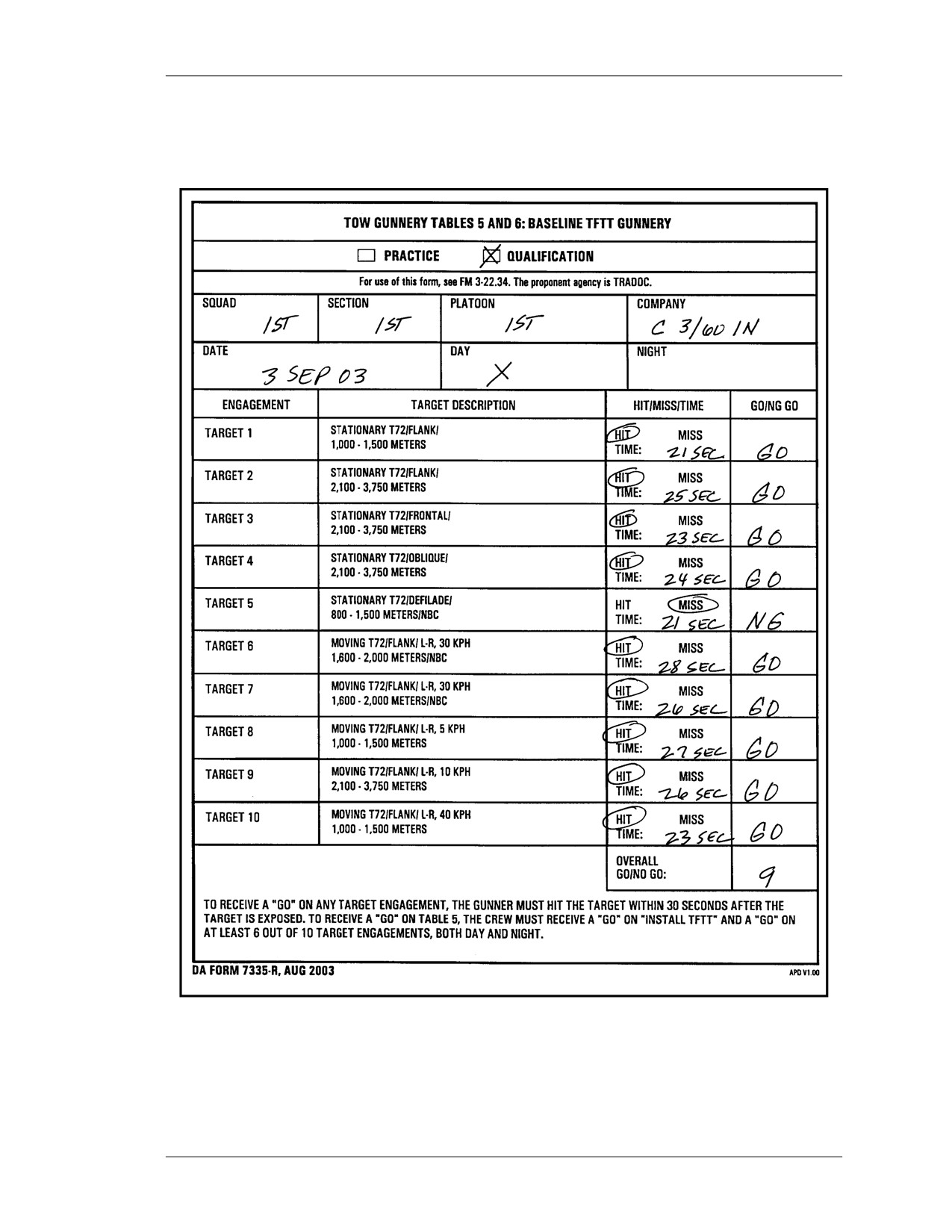
(2) Scoring. To count as a successful engagement, the target must be killed within 30
seconds or less after exposure. Use DA Form 7335-R (TOW Gunnery Tables 5 and 6,
Baseline TFTT Gunnery Practice and Qualification Scorecard, Figure 4-6) to record the
crew’s score (day or night).
(3) Suggested Support Requirements. The following support requirements are
recommended when conducting TOW Gunnery Tables 5 through 8.
•
Minimum evaluators (evaluators will not assist the gunner in finding or
identifying targets):
⎯ One evaluator per squad.
⎯ One evaluator in the range tower to record scores on engagements.
•
Opposing forces: None.
•
Support troops: None.
•
Vehicles/communications:
⎯ One AN/PRC-119 radio per squad evaluator.
⎯ Two AN/PRC-119 radios for the tower evaluator (one primary, one spare).
⎯ Two frequencies (one for the tower and squad evaluator and one for the
antiarmor squad).
•
Maneuver area:
⎯ Multipurpose range complex.
⎯ A route for the element to move from the assembly area to the first firing
point without damaging the underground wiring.
•
Firing area:
⎯ The TOW backblast area (75 meters by 90 degrees) will be clear.
⎯ Smoke may be used.
•
Training aids, devices, and special equipment:
⎯ TFTT system.
⎯ Sufficient TFTT retroreflectors to cover targets. (Use of MILES harness
and LTIDs is optional.)
•
Ammunition: Ten M80 blast simulators per TOW, per iteration.
•
Key references: FM 3-21.91(FM 7-91), FM 3-22.34(FM 23-34), and live-fire
point calculation sheet.
(4) Trainer/Evaluator Guidelines. Because this table is conducted on an MPRC,
marking the firing positions may be necessary. At night, the roads must be marked with
luminous tape.
b. TOW Gunnery Table
6, Baseline TFTT Gunnery Qualification. TOW
Gunnery Table 6 is conducted according to the same conditions and standards as TOW
4-18
FM 3-22.34
Gunnery Table 5. DA Form 7335-R (TOW Gunnery Tables 5 and 6, Baseline TFTT
Gunnery Practice and Qualification Scorecard, Figure 4-6) is used to score the table.
Figure 4-6. Example of completed DA Form 7335-R,
TOW Gunnery Tables 5 and 6: Baseline TFTT Gunnery Practice
and Qualification.
4-19
FM 3-22.34
c. TOW Gunnery Table 7, Squad Gunnery Practice. This table trains the TOW
squad to engage stationary and moving targets in a simulated battlefield scenario
(Figure 4-7, page 4-22). It prepares the TOW squad for TOW Gunnery Table 8, Squad
Gunnery Qualification, by presenting engagement scenarios and task requirements
similar to those for evaluation. TOW Gunnery Table 7 may be conducted by a TOW
HMMWV on an MPRC light.
(1) Conduct. All firings will be from the hull down position. Reload procedures will
be executed from a defilade position. All stationary targets should be mounted on pop-up
mechanisms to facilitate target acquisition and scoring. If pop-up mechanisms are not
available, exposed stationary targets will be placed in an appropriate array. If exposed
targets must be used, the exercise should be designed so that targets are presented only to
the position from which they should be engaged. Moving targets should be presented at
speeds from 5 to 40 kilometers per hour.
(2) Scoring. The squad is rated based on the total point score. For scoring gunnery,
time will start for the first target when the target is raised and will stop when the target is
hit. All reloads will be made from a hull defilade position. Time for the second target
begins when the vehicle reoccupies the firing position and ends when the target is hit. DA
Form 7336-R (TOW Gunnery Table 7, Squad Gunnery Practice Scoresheet, Figure 4-8,
page 4-23) will be used to record scores.
(a) The table consists of five tasks. Each task consists of one or more target
engagements from one firing position. Each target engagement is worth a maximum of
100 points. The point score is determined by the time taken to kill the target using the
live-fire point calculation sheet (Figure 4-16, page 4-35). Any crew or leader cuts are
deducted from this score (Table 4-5, page 4-21 and Table 4-6, page 4-26).
(b) Each task is also worth a maximum of
100 possible points. This score is
calculated by adding the scores for all engagements made during the task and dividing by
the number of targets engaged. For example, three targets were engaged and the scores
were 75, 82, and 93 for a total of 250 points divided by 3 (the number of targets
presented) for a task score of 81 points.
(c) Each table is performed once during the day and once at night. Scoring for day
engagements will be made by the evaluator in the range tower. Scoring for night
engagements will be made by both evaluators. The scores of the two events are added
together for a maximum possible score of 1,000 points. This is the final score for the
gunnery table.
NOTE: This scoring process is the same for Tables 7 through 12.
4-20
FM 3-22.34
CREW CUTS
MINOR
MAJOR
(Deduct 5 points)
(Deduct 30 points)
Improper fire commands.
Failure to conduct system self-
test/boresight before engaging
first target.
Firing before receiving
command to fire.
Failure to collimate day sight
and or nightsight before
Incorrect engagement
engaging first target.
techniques (such as engaging
the least dangerous target
before the most dangerous
Failure to be in MOPP4 and
target).
close all hatches during NBC
engagement.
Engagement of friendly targets
(if friendly targets are
presented).
Table 4-5. Crew cuts.
d. TOW Gunnery Table 8, Squad Gunnery Qualification. TOW Gunnery Table 8
evaluates the TOW squad on its ability to engage stationary and moving targets in a
simulated battlefield scenario (Figure 4-7, page 4-22). The conduct, scoring, suggested
support requirements, and trainer/evaluator guidelines are the same as for TOW Gunnery
Table 7. The squad’s scores will be recorded on DA Form 7337-R, (TOW Gunnery Table
8, Squad Qualification Scoresheet, Figure 4-9, page 4-24).
4-21
FM 3-22.34
4-9.
PHASE III: SECTION TRAINING
Phase III begins section-level TOW training. TOW Gunnery Tables 9 and 10 are moving
gunnery exercises where the vehicle moves from point to point on a course and engages a
series of targets. These gunnery exercises are used to train and evaluate the TOW unit’s
combat capability. Each element has two tables: a practice table to train and a
qualification table for evaluation. Each table is performed once during the day and once
during the night under realistic (simulated) battlefield conditions. Point scores for target
engagements are based on a combat model that predicts success based on the time from
target detection to target engagement, type of target, and range to target. These scores are
taken from the live-fire point calculation sheet (Figure 4-16, page 4-35). Point scores are
also affected by crew cuts (crew cuts are crew errors, either major or minor, that reduce
the point score for a target engagement). The actual rating is calculated by adding the
scores for the day and night phases and dividing them by two to get an average score.
During move-out scenarios, the senior trainer is normally to the rear of the leader’s
vehicle for evaluation and training purposes. An assistant evaluator of the appropriate
rank and experience is normally assigned to each additional vehicle that is evaluated as
part of the same exercise. Evaluators must monitor crew conversations and fire
commands.
a. TOW Gunnery Table 9, Section Gunnery Practice. This table trains the TOW
section to control fire and distribution. It contains offensive and defensive engagements
in a simulated battlefield scenario (Figure 4-10, page 4-27). TOW Gunnery Table 9
prepares the TOW section for the qualification table by presenting engagement scenarios
and task requirements similar to those for evaluation. It may be conducted by a TOW
HMMWV on an MPRC light.
(1) Conduct. All firings will be from the hull down position. Reload procedures will
be executed from a defilade position. All stationary targets should be mounted on pop-up
mechanisms to facilitate target acquisition and scoring. If pop-up mechanisms are not
available, exposed stationary targets will be placed in an appropriate array. If exposed
targets must be used, the exercise should be designed so that targets are presented only to
the position from which they should be engaged. Moving targets should be presented at
speeds from 5 to 40 kilometers per hour.
(2) Scoring. The section is rated based on the total point score accumulated. For
scoring gunnery, times for engagements will be scored separately for each vehicle. Start
time for the section leader’s vehicle will be the same as in TOW Gunnery Table 7. Start
time for the squad leader’s vehicle will be upon completion of the fire directive by the
section leader, which will include the method of engagement. Stop time will be when the
target is hit. Points will be awarded IAW the live-fire point calculation sheet (Figure 4-16,
page 4-35). Deductions will be made from this point score when a major or minor crew
cut error (Table 4-5, page 4-21) or a section leader cut error (Table 4-6, page 4-26) is
made. The evaluator in the range tower will score day engagements. Both evaluators will
score night engagements. DA Form 7338-R (TOW Gunnery Table 9, Section Gunnery
Practice Scoresheet, Figure 4-11, page 4-28) will be used to record the scores.
4-25
FM 3-22.34
LEADER CUTS
MINOR
MAJOR
(Deduct 10 points)
(Deduct 30 points)
Give incorrect fire commands.
⎯ Fail to properly distribute
and control section fires.
Fail to give SITREP to tower.
Table 4-6. Section leader cuts.
(3) Suggested support requirements. The following support requirements are
recommended when conducting TOW Gunnery Tables 9 and 10.
•
Minimum evaluators (evaluators will not assist the gunner in finding or
identifying targets):
⎯ One evaluator per section and squad.
⎯ Two evaluators in the range tower to record scores on engagements.
•
Opposing forces: None.
•
Support troops: None.
•
Vehicles/communications:
⎯ One AN/PRC-119 radio per section and squad evaluator.
⎯ Two AN/PRC-119 radios for the tower evaluator (one primary, one spare).
⎯ Two frequencies (one for the tower and section evaluator and one for the
antiarmor squad).
•
Maneuver area:
⎯ Multipurpose range complex.
⎯ A route for the element to move from the assembly area to the first firing
point without damaging the underground wiring.
•
Firing area:
⎯ The TOW backblast area (75 meters by 90 degrees) will be clear.
⎯ Smoke may be used.
•
Training aids, devices, and special equipment:
⎯ TFTT system.
⎯ Sufficient TFTT retroreflectors to cover the targets.
(Use of MILES
harness and LTIDs is optional.)
•
Ammunition: Six M80 blast simulators per TOW, per iteration.
•
Key references: FM 3-21.91(FM 7-91), FM 3-22.34(FM 23-34), and live-fire
point calculation sheet.
(4) Trainer/Evaluator Guidelines. Because this table is conducted on an MPRC,
marking the firing positions may be necessary. At night, the roads must be marked with
luminous tape.
b. TOW Gunnery Table 10, Section Gunnery Qualification. TOW Gunnery Table
10 evaluates the TOW section on controlling fire and distribution. It contains offensive
and defensive engagements in a simulated battlefield scenario (Figure 4-10, page 4-27).
The conduct, scoring, suggested support requirements, and trainer/evaluator guidelines
are the same as for TOW Gunnery Table 9. The section’s scores will be recorded on
4-26
FM 3-22.34
DA Form 7339-R (TOW Gunnery Table 10, Section Gunnery Qualification Scoresheet,
Figure 4-12, page 4-29).
Figure 4-10. Example section gunnery practice and qualification scenario.
4-27
FM 3-22.34
4-10. PHASE IV: PLATOON TRAINING
Phase IV begins platoon-level TOW training. TOW Gunnery Tables 11 and 12 are
moving gunnery exercises where the vehicle moves from point to point on a course and
engages a series of targets. These gunnery exercises are used to train and evaluate the
TOW unit’s combat capability. Each element has two tables: a practice table to train and a
qualification table for evaluation. Each table is performed once during the day and once
during the night under realistic (simulated) battlefield conditions. Point scores for target
engagements are based on a combat model that predicts success based on the time from
target detection to target engagement, type of target, and range to target. These scores are
taken from the live-fire point calculation sheet (Figure 4-16, page 4-35). Point scores are
also affected by crew cuts (crew cuts are crew errors, either major or minor, that reduce
the point score for a target engagement). The actual rating is calculated by adding the
scores for the day and night phases and dividing them by two to get an average score.
During move-out scenarios, the senior trainer is normally to the rear of the leader’s
vehicle for evaluation and training purposes. An assistant evaluator of the appropriate
rank and experience is normally assigned to each additional vehicle that is evaluated as
part of the same exercise. Evaluators must monitor crew conversations and fire
commands.
a. TOW Gunnery Table 11, Platoon Gunnery Practice. This table trains the TOW
platoon to control fire and distribution. It contains offensive and defensive engagements
in a simulated battlefield scenario (Figure 4-13, page 4-32). TOW Gunnery Table 11
prepares the TOW platoon for the qualification table by presenting engagement scenarios
and task requirements similar to those for evaluation. It may be conducted by a TOW
HMMWV on an MPRC light.
(1) Conduct. All firings will be from the hull down position. Reload procedures will
be executed from a defilade position. All stationary targets should be mounted on pop-up
mechanisms to facilitate target acquisition and scoring. If pop-up mechanisms are not
available, exposed stationary targets will be placed in an appropriate array. If exposed
targets must be used, the exercise should be designed so that targets are presented only to
the position from which they should be engaged. Moving targets should be presented at
speeds from 5 to 40 kilometers per hour.
(2) Scoring. The platoon is rated based on the total point score accumulated. For
scoring gunnery, times for engagements will be scored separately for each vehicle. Start
time will begin upon completion of the directive given to the vehicle commander. Stop
time will be when the target is hit. Points will be awarded IAW the live-fire point
calculation sheet (Figure 4-16, page 4-35). Deductions will be made from this point score
when a major or minor crew cut error (Table 4-5, page 4-21) or a platoon leader cut error
(Table 4-7) is made. The evaluator in the range tower will score day engagements. Both
evaluators will score night engagements. DA Form 7340R (TOW Gunnery Table 11,
Platoon Gunnery Practice Scoresheet, Figure 4-14, page 4-33) will be used to record the
scores.
4-30
FM 3-22.34
PLATOON LEADER CUTS
MINOR
MAJOR
(Deduct 10 points)
(Deduct 30 points)
Give incorrect fire commands.
Fail to properly distribute and
control section fires.
Fail to give SITREP to tower.
Table 4-7. Platoon leader cuts.
(3) Suggested Support Requirements. The following support requirements are
recommended when conducting TOW Gunnery Tables 11 and 12.
•
Minimum evaluators (evaluators will not assist the gunner in finding or
identifying targets):
⎯ One evaluator per platoon, section, and squad.
⎯ Two evaluators in the range tower to record scores on engagements.
•
Opposing forces: None.
•
Support troops: None.
•
Vehicles/communications:
⎯ One AN/PRC-119 radio per platoon, section, and squad evaluator.
⎯ Two AN/PRC-119 radios for the tower evaluator (one primary, one spare).
⎯ Two frequencies (one for the tower and platoon evaluator and one for the
antiarmor platoon).
•
Maneuver area:
⎯ Multipurpose range complex.
⎯ A route for the element to move from the assembly area to the first firing
point without damaging the underground wiring.
•
Firing area:
⎯ The TOW backblast area (75 meters by 90 degrees) will be clear.
⎯ Smoke may be used.
•
Training aids, devices, and special equipment:
⎯ TFTT system.
⎯ Sufficient TFTT retroreflectors to cover the targets.
(Use of MILES
harness and LTIDs is optional.)
•
Ammunition: Six M80 blast simulators per TOW, per iteration.
•
Key references: FM 3-21.91(FM 7-91), FM 3-22.34(FM 23-34), and live-fire
point calculation sheet.
(4) Trainer/Evaluator Guidelines. Because this table is conducted on an MPRC,
marking the firing positions may be necessary. At night, the roads must be marked with
luminous tape.
b. TOW Gunnery Table 12, Platoon Gunnery Qualification. TOW Gunnery Table
12 evaluates the TOW platoon on controlling fire and distribution. It contains offensive
and defensive engagements in a simulated battlefield scenario (Figure 4-13, page 4-32).
The conduct, scoring, suggested support requirements, and trainer/evaluator guidelines
are the same as for TOW Gunnery Table 11. The platoon’s scores will be recorded on DA
4-31
FM 3-22.34
Form 7341-R (TOW Gunnery Table 12, Platoon Gunnery Qualification Scoresheet,
Figure 4-15, page 4-34).
Figure 4-13. Example platoon gunnery practice
and qualification scenario.
4-32
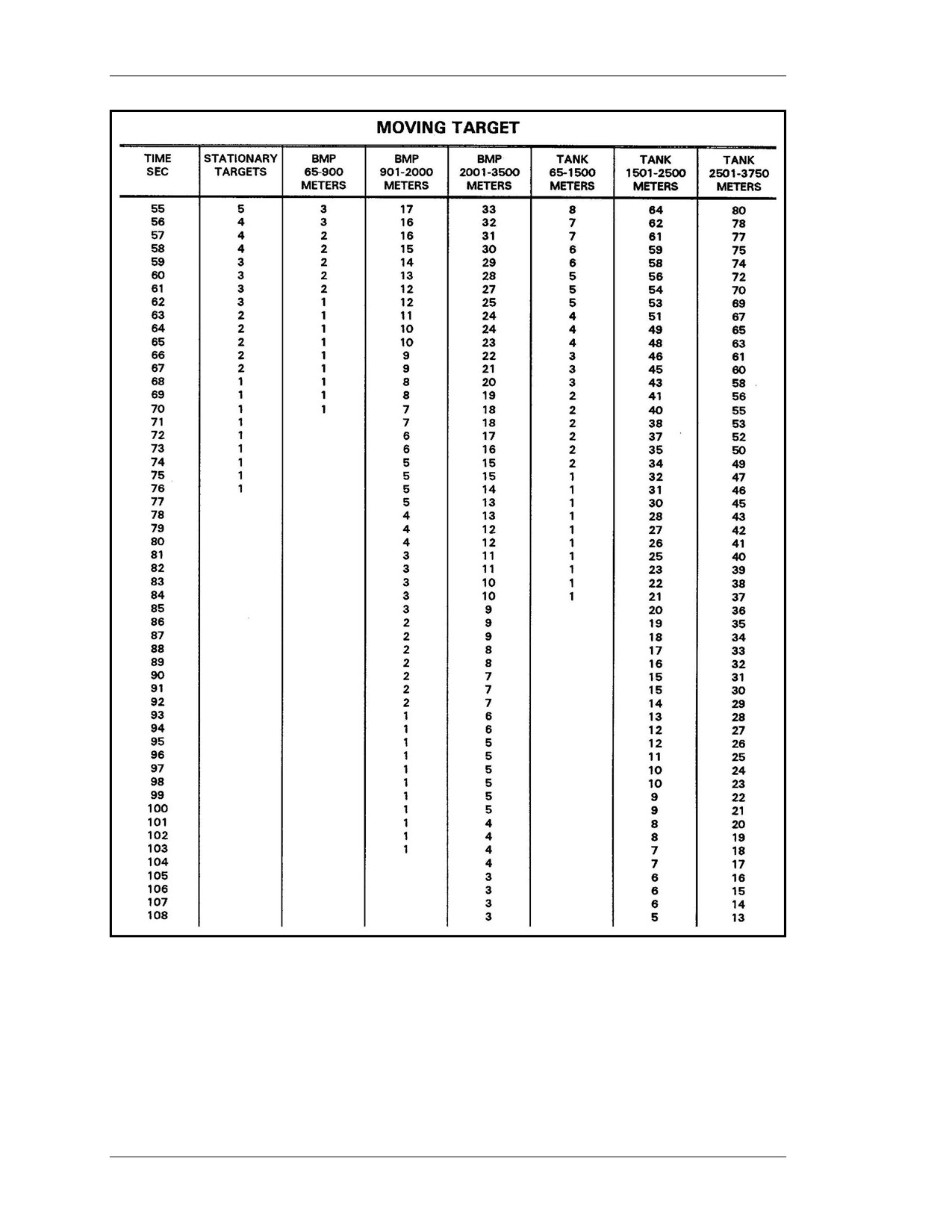
FM 3-22.34
Figure 4-16. Example of TOW live-fire point calculation sheet (continued).
4-11. FIELD TRACKING
Field tracking (or tracking in a field environment) provides practice and experience in
tracking uncooperative targets and should be performed in conjunction with FTXs. It is
not an element in the 12 required TOW gunnery tables, but it is useful in preparing for
4-36
FM 3-22.34
them, especially Tables 7 through 12. Other tactical employment tasks, such as occupying
a firing position or completing a range card, should be performed at the same time.
Careful planning by unit commanders will result in effective training that makes the best
use of time, equipment, and personnel.
a. The tracking range should include an area more than 3,000 meters deep and at
least 500 meters wide with hills and valleys, dead space, and covered terrain. Battlefield
target conditions should be simulated as follows:
(1) Targets should be a variety of tanks, APCs, and other tactical vehicles. Many
training installations now have various types of actual threat vehicles. These vehicles
should be used when possible.
(2) Target vehicles should behave as much like real enemy vehicles on the battlefield
as possible. They should change directions constantly and quickly (to include backing up
for short distances) and should vary their speed. They should move within the gunner’s
sight picture from left to right, top to bottom, and bottom to top. The vehicles should
move at angles to and from the weapon position as well as directly toward and away from
the weapon.
(3) Gunners should see tanks and APCs in full and partial frontal, flank, and rear
exposures.
(4) Gunners must engage the targets at all ranges with both the daysight tracker and
the nightsight. To do so, they must be able to determine if a target is in range. Targets
should move in and out of range so gunners can gain experience in target range
determination.
(5) Armored vehicles should limit their exposure by moving quickly from one
covered area to another to escape ATGM fires. The squad leader must have the gunner
acquire and fire at the target while it is exposed. During field tracking, target vehicle
exposure time is reduced to a minimum by having targets use covered areas during halts.
This gives the gunner experience in tracking targets that disappear and reappear.
b. Field tracking should be performed under conditions that normally occur on the
battlefield. These conditions include limited visibility caused by darkness, smoke, or fog;
the discomfort of MOPP gear; and the noise and distraction caused by indirect and
small-arms fire around the firing positions. Battlefield tracking conditions should be
simulated as follows:
(1) The TOW crew members should train to engage targets during reduced visibility
conditions using both the daysight tracker and the nightsight. Training should be
conducted during daylight using the AN/TAS-4A. The AN/TAS-4A is a thermal sight, not
just a nightsight. It offers many advantages in searching for and tracking targets in all
kinds of weather and at any time of day. The AN/TAS-4A should be used extensively in
conjunction with the daysight to maximize the abilities of the system.
(2) Enemy capabilities include the use of nuclear, biological, and chemical munitions.
These munitions may not affect the weapon, but a gunner’s ability to track will be
degraded if he has never tracked while wearing a protective mask and protective clothing.
Training is more realistic when the entire crew wears protective masks and clothing
during part of the field tracking exercises.
(3) The enemy will try to suppress TOW fires with artillery and mortar fires. A
gunner’s ability to keep the sight crosshairs on a target may be affected under these
conditions, especially if he has not been properly trained. Distractors should be used in
4-37
FM 3-22.34
training to accustom gunners to such conditions and to minimize flinching. Grenade and
artillery simulators are effective distractors. Small-arms fire can also be expected, but
gunners should not be seriously distracted by its noise. Therefore, the simulation of
small-arms fire is not required.
c. If facilities and equipment are not available to conduct a field tracking exercise,
gunners should be allowed to track any uncooperative targets such as military or civilian
vehicles traveling on a nearby highway. Any means available should be used to allow
gunners to practice tracking targets that vary target speeds and directions of movement.
This should be done often and can be accomplished in any location that has vehicle
traffic.
d. TOW crews must be proficient in combat vehicle identification to gain the most
benefit from field tracking. Combat vehicle identification skills have been standardized
by GTA 17-02-011. This GTA includes six modules of 35-mm slides and instructor
guides. Each module highlights five different NATO or Threat combat vehicles from five
different views: frontal, right side, left side, right oblique, and left oblique.
4-38
FM 3-22.34(FM 23-34)
CHAPTER 5
COMBAT TECHNIQUES OF FIRE
This chapter discusses the techniques and procedures of fire control,
helicopter engagement, and firing the TOW under NBC and limited
visibility conditions in a combat situation. These techniques and
procedures greatly enhance the performance of the TOW weapon system
in combat and increase its chances of survival.
Section l. FIRE CONTROL MEASURES
This section discusses fire control measures in combat to include target engagement
determination procedures, the elements of fire commands, target tracking procedures, and
target engagement procedures with the M220A1 and M220A2 TOW launchers.
5-1.
TARGET ENGAGEMENT DETERMINATION
Mechanized units are trained to use terrain driving techniques to conceal movement, and
drivers are taught to move vehicles quickly from one concealed position to another. TOW
gunners and squad leaders must determine the range to a target and determine if the
exposure time―the time a vehicle is in an opening between positions―is long enough to
allow a missile to reach its target.
a. Determine if a Target is Within Range. The TOW gunner or squad leader can
use the nightsight method or the binocular method to determine if a target is within range.
(1) Nightsight Method. The reticle within the nightsight is marked with stadia lines
on each side of the vertical crossline and just above the intersection of the vertical and
horizontal crosslines (Figure 5-1, page 5-2). Use these stadia lines to determine if a target
is within range.
(a) Check to ensure the nightsight is in the narrow field of view.
(b) Look at the flank (broadside) of a target. If the ends of the target touch or extend
beyond the stadia lines, the target is within range (Figure 5-2, page 5-2).
(c) If the target is moving straight or at an angle toward the position, use one-half of
the stadia lines. If one side of the vehicle touches one of the stadia lines and the other side
of the vehicle touches or extends beyond the vertical line of the crossline, the target is
within range (Figure 5-3, page 5-2).
5-1
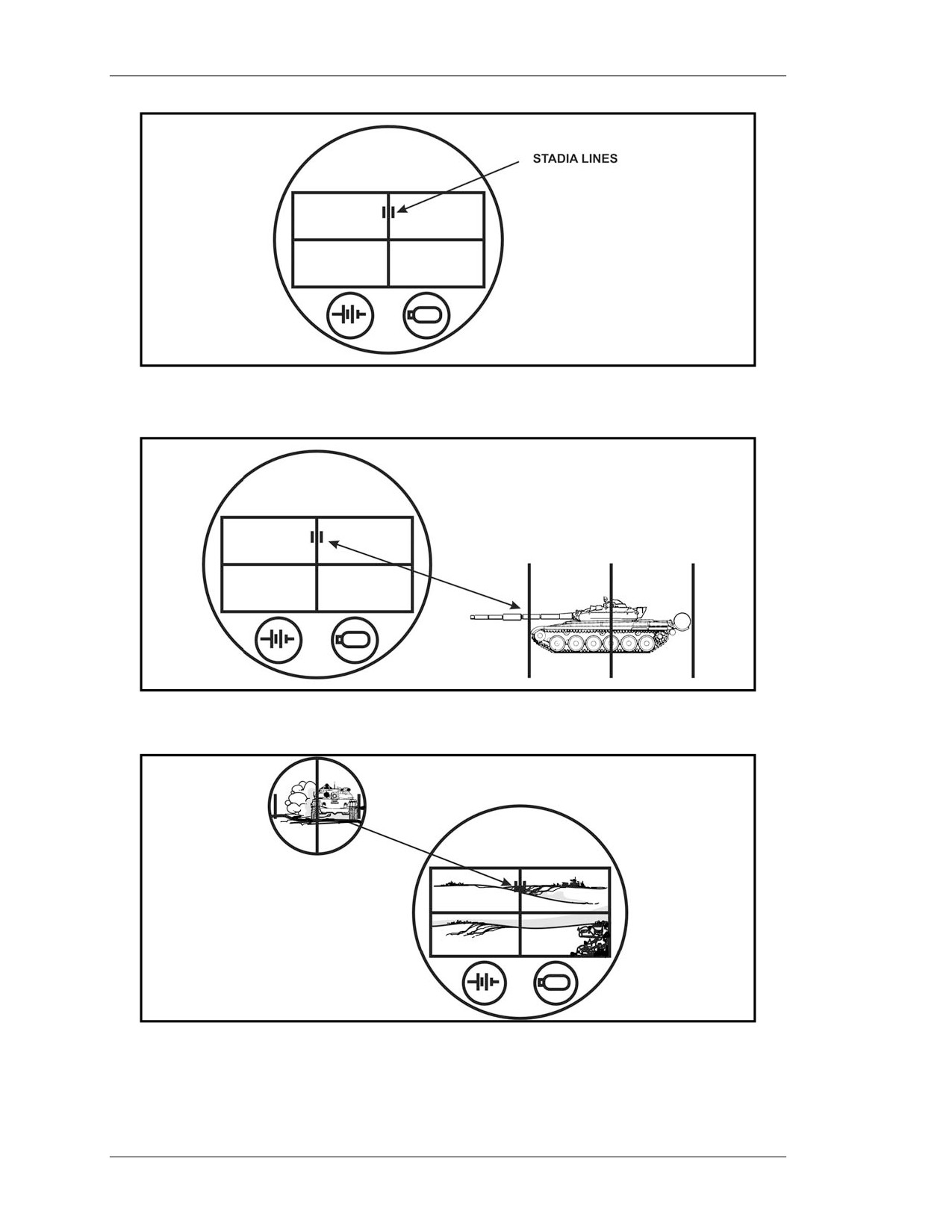
FM 3-22.34
Figure 5-1. Stadia lines.
Figure 5-2. Target within range.
Figure 5-3. Target moving straight toward or away from position within
range.
5-2
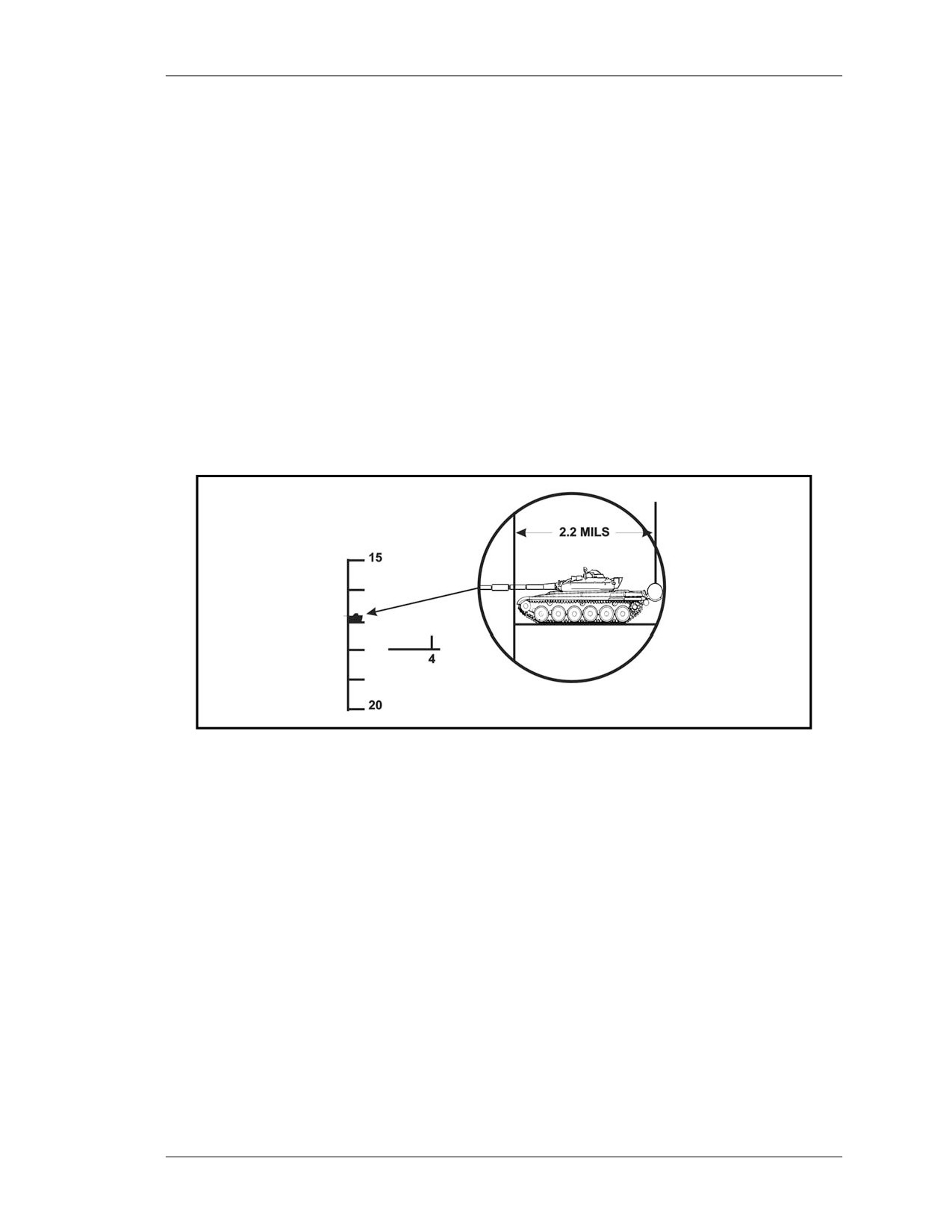
FM 3-22.34
NOTE: When using the stadia lines to determine if a target is within range, keep two
things in mind. First, the range is a rough estimate, based on the size of the
target. A large vehicle may be out of range when the stadia lines show it to be
in range. Second, the stadia lines are designed for a maximum engagement
range of 3,000 meters.
(2) Binocular Method. Use the reticle in binoculars to determine if a target is within
range by looking at the length, width, or height of the vehicle. Follow the same
procedures when using the M17 and M19 binoculars, even though the reticles differ
slightly. The M17 tick marks are only 1.7 mils long while the tick marks on the M19
reticle are 5 mils long (2.5 mils on each side of the horizontal and vertical scales).
(a) To determine if a target is within range at 3,000 meters based on the length of the
target, place the length of the target on the vertical scale. If one-third or more of the
vehicle extends beyond the tick mark, the vehicle is in range (Figure 5-4). A vehicle 6.5
meters long will measure about 2.2 mils at 3,000 meters and about 1.7 mils at 3,750
meters.
Figure 5-4. Target within range (flank or oblique) using M17 binoculars.
(b) To determine if a target is within range at 3,000 meters based on the width of the
target, place the target on the small tick mark on the vertical scale. If the target covers
two-thirds or more of the tick mark, the vehicle is within range (Figure 5-5, page 5-4). A
vehicle 3.4 meters wide will measure 1.1 mils at 3,000 meters and .85 mils at 3,750
meters. (Most Warsaw Pact APCs are less than 3.4 meters wide and can be engaged at
smaller mil values.)
(c) To determine if a target is within range at 3,000 meters based on the height of the
target, place the target on one of the tick marks on the horizontal scale. If the height of
the vehicle is one-half or more of the height of one of the tick marks, the vehicle is within
range. A vehicle 2.4 meters high (the size of most Warsaw Pact vehicles), will measure
.8 mils at 3,000 meters and .6 mils at 3,750 meters (Figure 5-6, page 5-4).
5-3
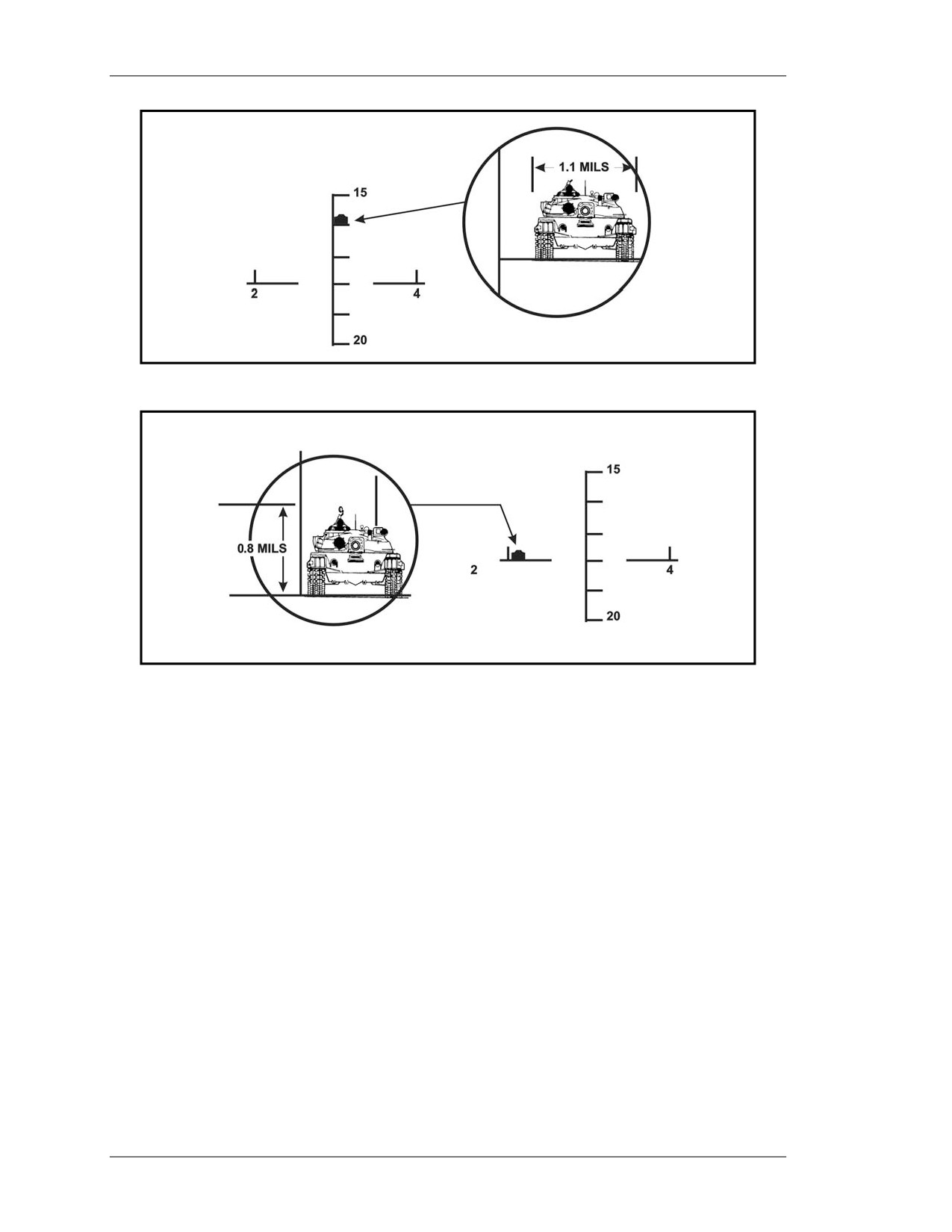
FM 3-22.34
Figure 5-5. Target within range (frontal or rear) using M17 binoculars.
Figure 5-6. Target within range based on height.
NOTE: This method cannot be used if the weapon system is in an elevated firing
position or if the lower portion of the target vehicle is hidden by foliage or
terrain.
b. Determine Exposure Time. The half-sight method of determining exposure time
is based on a vehicle speed of 35 kilometers per hour (the expected top vehicle speed of
armored vehicles on level or gently sloping dry terrain).
(1) Daysight Tracker Method. Use the crosslines on the daysight tracker to determine
the exposure time of a target.
(a) Place the crosslines of the daysight tracker on the center of the visible mass of the
vehicle.
(b) If the area between the vertical crossline and the edge of the field of view in the
direction of travel is clear of obstruction, the target is engageable (Figure 5-7).
(c) If obstructions appear between the vertical crossline and the edge of the field of
view, the time of exposure would not be long enough for the missile flight before the
target moved out of sight (Figure 5-7).
5-4
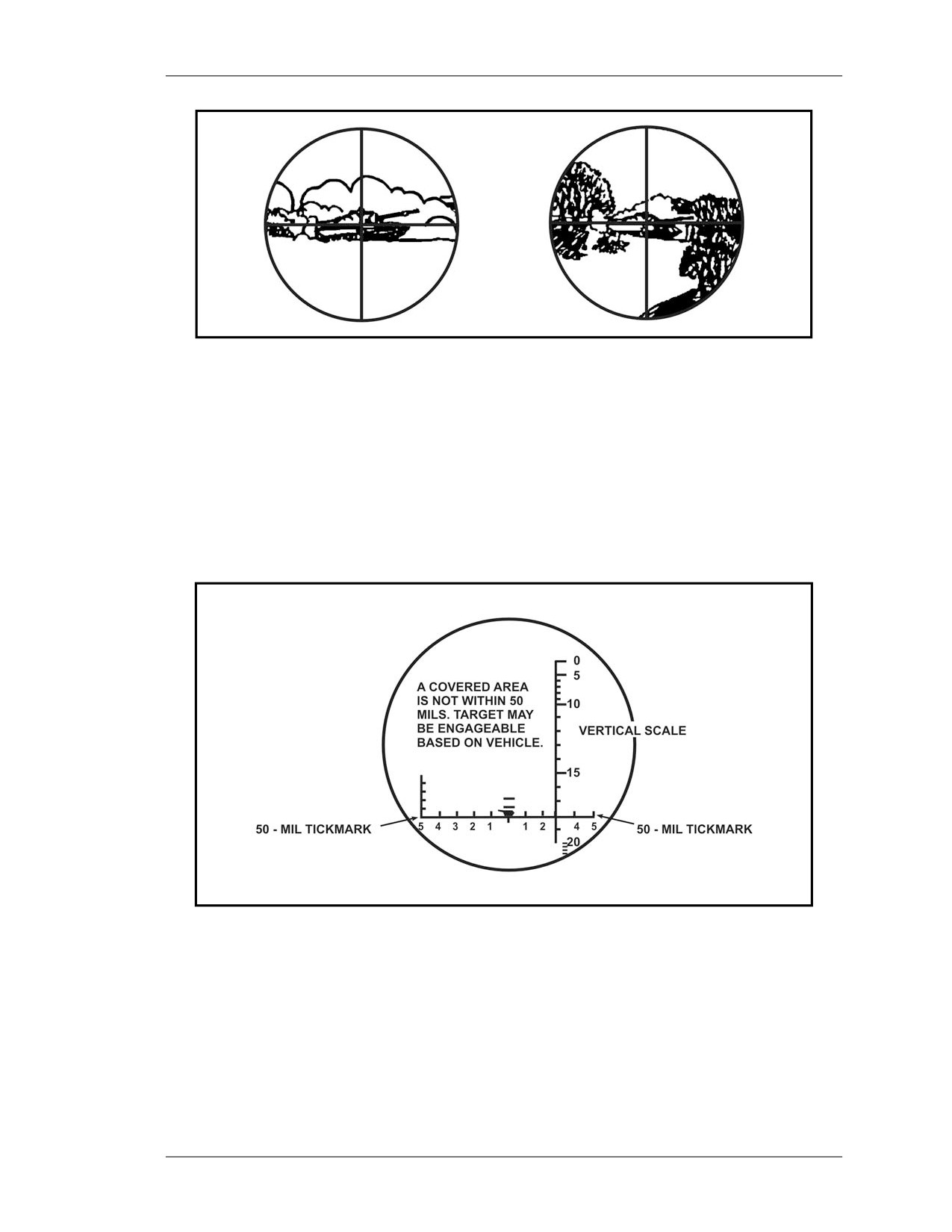
FM 3-22.34
Figure 5-7. Obstruction.
(2) Nightsight Method. The procedure to determine exposure time is the same for the
nightsight as for the daysight tracker, except the nightsight must be set on narrow field of
view.
(3) Binocular Reticle Method. Use the reticle in the binoculars to determine the
exposure time of a target.
(a) Place the zero tick mark of the horizontal scale at the center of the vehicle.
(b) If the area between the vehicle and the 50-mil tick mark is clear of obstructions in
the direction of travel, the target is engageable (Figure 5-8).
Figure 5-8. Binocular reticle method.
5-2.
FIRE COMMANDS
The six elements of a fire command are alert, type of missile, target description, target
direction, range, execution, and closing. Whether mounted or dismounted, the elements
of the fire command are the same. (Figure 5-9, page 5-6, shows an example of a squad
fire command.)
5-5