FM 42-414 TACTICS, TECHNIQUES, AND PROCEDURES FOR QUARTERMASTER FIELD SERVICE COMPANY, DIRECT SUPPORT (July 1998) - page 3
FM 42-414
dismantle the delousing equipment. Supported unit personnel will operate the delousing guns and refill
delousing canisters. Delousing support operations take on the following execution requirement:
Identifying Delousing Need. Soiled clothing and dirty skin are good breeding grounds for lice. Lice
often attach themselves and their eggs to body hair and clothing seams. They spread diseases by feeding on
the blood of their victims. Since these diseases may be fatal, the victims must be protected from lice. Use
the disinfectant agent recommended by the medical authorities.
Using the Delousing Outfit. When large numbers of personnel must be deloused, the delousing
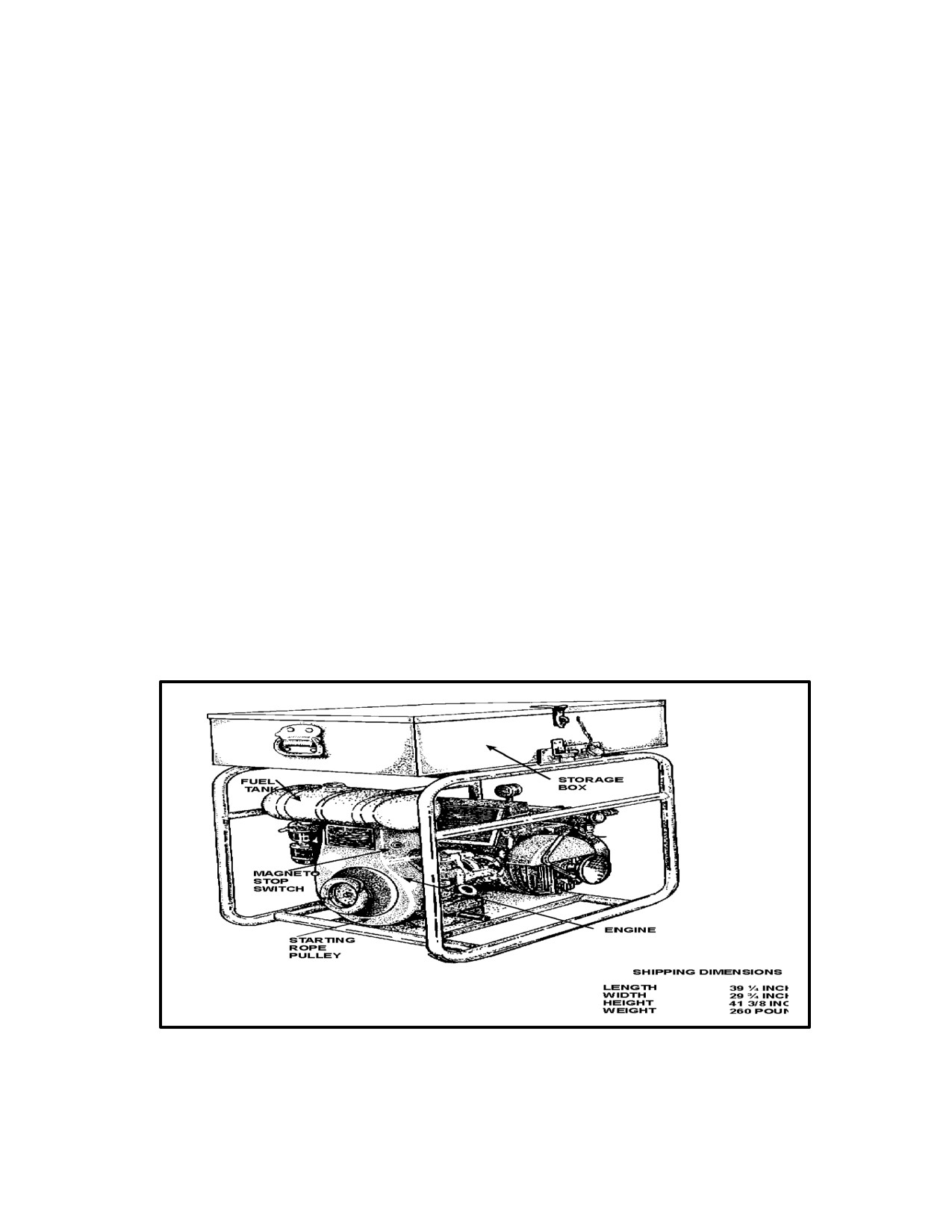
outfit is used. This outfit is shown in Figures 3-10, below, and 3-11 (page 3-37). It makes it possible to
disinfect quickly both personnel and the clothing they are wearing. The portable delousing unit is mounted
on a tubular skid frame. The accessory or storage box is mounted on top of the frame. The chief parts of
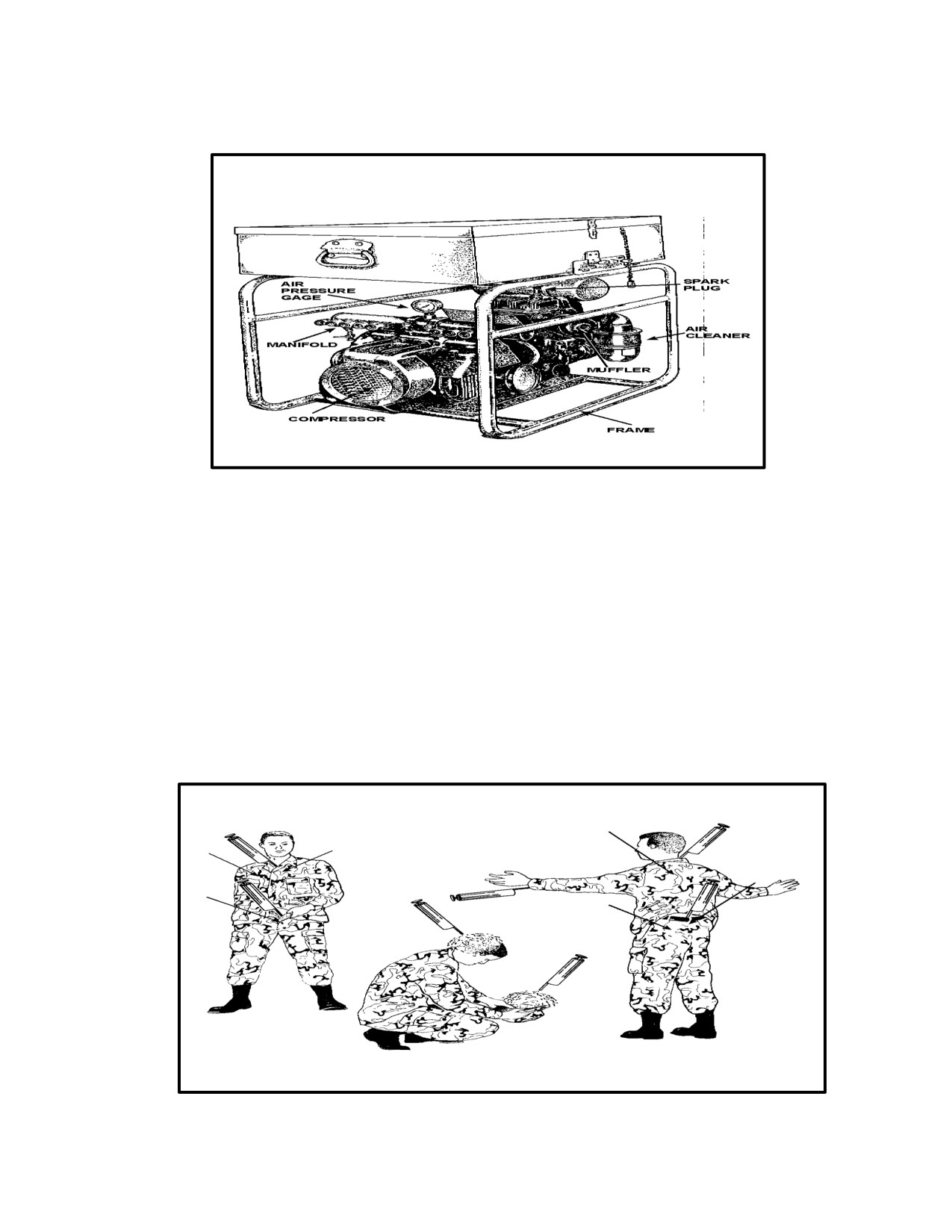
the unit are the engine and the compressor. Function of each part is --
· Engine. The one-cylinder, gasoline-driven engine provides power to run the unit. The crankcase holds
2 pints of oil. The fuel tank holds 1 gallon of gasoline.
· Compressor. The compressor is powered by the engine. It provides a filtered flow of air to the
manifold. The 10 hoses and delousing guns are attached to the manifold openings. The compressed air goes
through the delousing guns at 25 PSI.
· Accessory or storage box. The accessory or storage box is held to the frame with locking clamps. The
box contains the 10 hoses, 20 canisters, and 10 air guns that are used for disinfecting. Eleven operator face
masks, the starting rope, and a dry chemical fire extinguisher are also stored in the box.
NOTE: A fire extinguisher is always available during operation of the delousing outfit.
Figure 3-10. Delousing outfit (left front view)
3-36
FM 42-414
Figure 3-11. Delousing outfit (right rear, three-quarter view)
Delousing Procedures. Operators position the delousing outfit so that the exhaust is outside if a
tent is used. They allow space for ventilation around the delousing unit, because of the heat it generates. It
takes 11 men to operate the outfit; 10 operate the dusting guns, and 1 person refills the canisters. Members
of the unit that are receiving the service man the guns and refill the canisters. Delousing actions may
consist of --
Power Fumigating. Delousing guns will provide about a 2-gram dose of disinfectant with
each pull of the trigger. It takes only a moment of pressure on the trigger when the power fumigator is
being used. When power fumigating soldiers, operators will perform the following steps.
· Tell a soldier to loosen collar and belt and to stand holding hat or helmet in hand as shown below in
Figure 3-12. The figure shows only places where the soldier would be power fumigated.
3-37
FM 42-414
Figure 3-12. Areas for delousing personnel
· Fumigate the head first. One pull of the trigger is enough. The soldier should then massage his head so
that the disinfectant is evenly distributed throughout his hair.
· Dust inside of the hat and/or helmet.
· Insert the gun into the right sleeve next to the skin with the arm held out to the side at shoulder height
and direct one pull of the trigger toward the armpit. The soldier being disinfected should cover his face and
turn their head away from the gun.
· Insert the nozzle in the front of the shirt at the collar and direct one pull of the trigger to the right
armpit, one to the stomach, and one to the left armpit. The operator stands in front, and the soldier leans
forward with his head tipped back.
· Insert the nozzle in the front of the trousers next to the skin and direct one pull of the trigger toward the
right leg, one between the legs, and one toward the left leg.
· Insert the nozzle at the collar in the back of the shirt. Direct one pull of the trigger toward the right
shoulder, one to the small of the back, and one toward the left shoulder. The operator should stand in front
of the soldier. The head of the soldier should be bent on his chest. The operator must ensure the collar itself
is fumigated, because lice are often found there.
· Insert the nozzle in the back of the trouser next to the skin and direct one pull of the trigger towards the
right leg, one to the center, and one to the left leg.
Hand Fumigating. When personnel use the hand fumigator (duster), only two full strokes
on the fumigator are needed. Operators learn the exact timing through experience.
Delousing Outfit Operational Setup Instructions. Before operators start the delousing outfit, they
make sure it is leveled. They use wooden blocks if leveling is needed. When they fill the fuel tank, they
provide a metal-to-metal contact between the container and the fuel tank to keep sparks from forming when
the gasoline flows over the metal surface. Operators must also take the following actions:
· Remove the hoses, fumigating guns, canisters, and face masks from the accessory or storage box.
· Connect the 10-hose assemblies to the 10 connectors on the air manifold.
· Fill the fumigating guns three-fourths full, or to the line inside the canister, with the disinfectant agent.
Connect the guns to the hoses and listen to the clicking sound to show that the connection has been made.
· Attach the canisters to the guns.
· After these preliminary steps are completed, operators follow the starting instructions IAW TM 10-
4230-203-14. Delousing operations begin when the air pressure gage reads 25 PSI.
3-38
FM 42-414
3-11. NBC DECONTAMINATION
As previously stated in Chapter 1, Section I, the FSC will not provide laundry decontamination
support and showers are not required for troop decontamination of chemical and biological agents.
However, for radiation decontamination, a shower may or may not be needed. If MOPP gear is used
against NBC fallout, no showers will be needed. However, if MOPP is not used and personnel are
contaminated in the hair and on the skin, showering will be needed to remove this contamination fallout.
When the FSC or its SLCR section/team is to provide required decontamination support, then, this
application imposes the following mission objectives.
Set Up NBC Shower Operations. Setup of a shower area for contaminated personnel effected by
radiation fallout will be located in an area outside the normal SLCR section’s/team’s operational area. The
FSC or shower element of the SLCR section/team will coordinate through or be directed by S3 operations
office for a shower decontamination location. At the same time, the S3 will coordinate for medical
personnel assistance and with the nearest chemical support element. Chemical personnel, using
radiacmeter(s), will monitor radiation level at the shower decontamination site and advise on disposal of
contaminated clothing, equipment, and textiles. Medical personnel will carry out required and necessary
radiation treatment care. Prior planning for such an occurrence as this should be set up in the FSC’s and
SLCR sections’/teams’ SOP/TSOP. It includes the appropriate chain-of-command channels and EPA
guidelines to implement decontamination fallout operation, whether it be a special mission tasker or a self-
imposed unit responsibility. The following decontamination procedures and actions should be started by
shower team personnel.
· Shower personnel wear appropriate MOPP gear in handling personnel needing shower decontamination;
this information should be identified in the FSC's and SLCR sections’/teams’ TSOP.
· DA Form 4766-R (Figure 3-9) is used to identify supported units and record the number of personnel
processed through the shower decontamination site.
· Shower personnel will destroy washing soap and towels used in shower operations. Additional
measures to be taken encompass the following:
·· The most common ways to dispose of heavily contaminated items are by burning or
burial.
·· Coordination by the shower personnel through FSC headquarters element in
this operation must get permission from the S3 office before burning any contaminated
articles.
·· Since a decontamination element will be in the area assisting in monitoring
radiation level, they may be tasked to help in the disposal operation. FSC and SLCR
section/team should develop this action into its TSOP. More information on NBC
avoidance, protection, and decontamination procedures can be found in FMs 3-3, 3-4,
and 3-5.
3-39
FM 42-414
Disposal of Contaminated Shower Water. Water used for shower decontamination contains
contaminated matter. This water must not be allowed to drain into the clean water supply reservoir. To
dispose of this contaminated wastewater, a drainage pit or interlocking drainage pits should be constructed
by using engineer support personnel to prepare disposal area(s). Shower personnel are not able to do this
construction because they do not have the equipment for this job. The following wastewater measures to be
taken are --
· Coordinate with higher headquaters for disposal. Location of the wastewater must be reported to higher
headquarters, and EPA regulations and local policy guidelines must be followed. EPA guidelines and
restrictions should be set up in the FSC’s and SLCR sections’/teams’ TSOP.
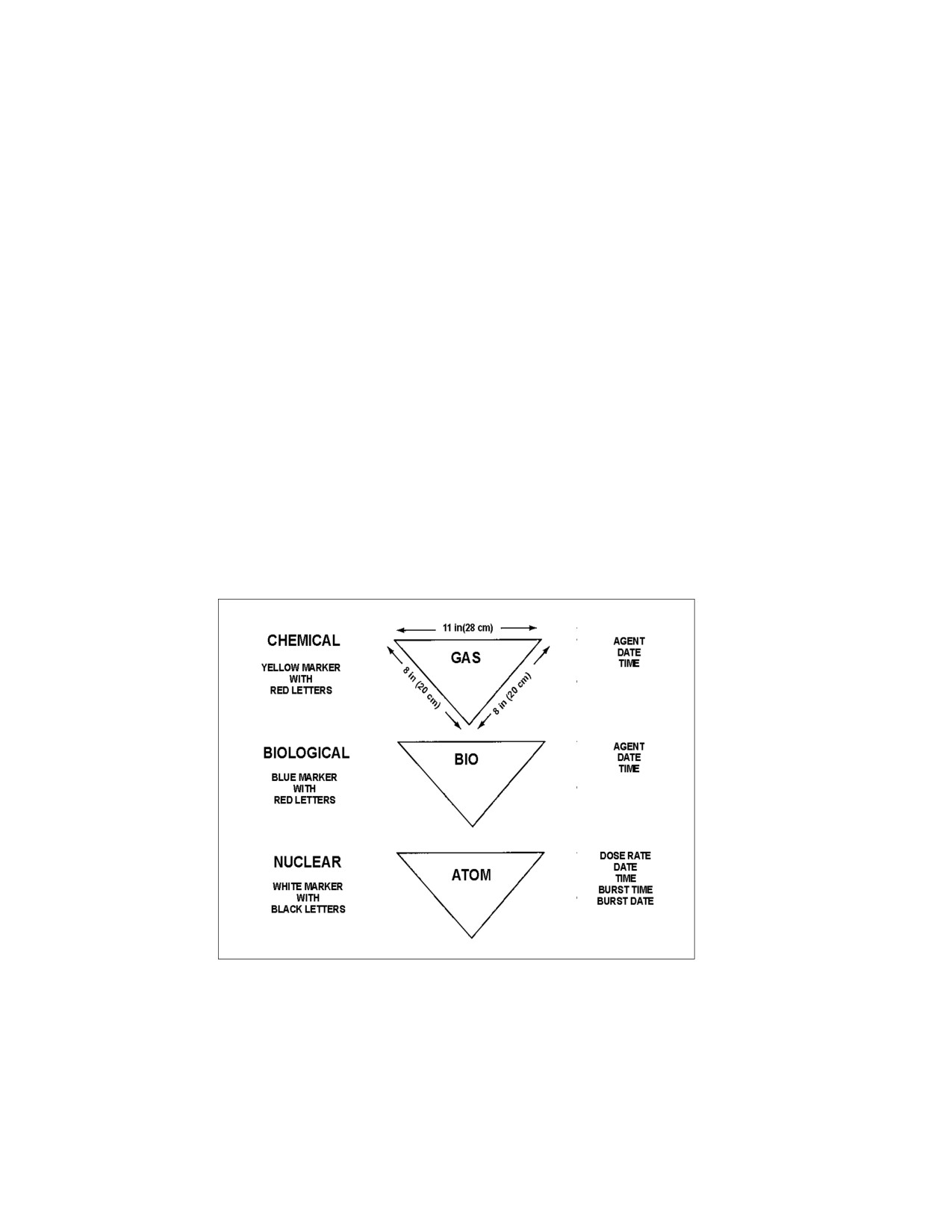
· Identify wastewater site. The location of the wastewater site must be marked with the appropriate NBC
markers shown below in Figure 3-13.
· Implement wastewater disposal application. Also, contaminated wastewater (in conjunction with the
field service shower equipment) may dispose of wastewater into a collapsible water tank(s) or pumped into
tanker truck(s). Responsibility for the arrangement for tanker truck(s) for wastewater disposal will be with
the headquarters, FSC.
NOTE: Decontamination of shower equipment will be processed by the decontamination element advising
and assisting the shower element, as authorized through the chain of command.
Figure 3-13. Markers for contaminated land areas
3-40
FM 42-414
Section III
LAUNDRY SECTION
3-12. ORGANIZATION FOR OPERATIONS
In the SLCR section/team, laundry personnel will consist of an appropriate number of personnel to
provide support to a brigade or division/non-division units, using the various M-85 series mobile laundry
units. S/L elements of the SLCR section/team may also be tasked organized to accommodate a particular
strength support requirement.
Composition of Laundry Element. Laundry service allows soldiers to meet The Surgeon
General’s standard of changing clothes at least every seven days and permitting the soldier to turn in up to
15 pounds of dirty laundry per week. This increased capability can be handled with the fielding of the
LADS with its innovated reduced water usage technology. One LADS will replace every two mobile
laundry units; for example, two LADS (machines) mounted on a flatbed trailer will replace four M-85
series laundry units.
Performance of Laundry Element. The laundry element will --
· Process and deliver clean laundry to the supported unit within 24 hours, or at a mutually acceptable
time and location set by the laundry personnel and supported unit.
· Develop contingency plans in the event supported units relocate or METT-TC conditions change
mission operations. Contingency plans may have the supported unit’s supply NCO (or other designated
person) deliver soil laundry, pick up clean laundry, and issue clean laundry to the soldier when
METT-
TC conditions are favorable (or allowable).
· Coordinate closely with supported unit(s) to set up detailed instructions to supported soldiers on
laundry service procedures.
· Provide limited laundry support for selected seasonal, special purpose, and OCIE. This is in the event
of a light work load in laundry requirements for personal clothing. Items in these categories, however, will
be turned in through normal supply channels to the organization in the rear area designated responsible for
contracting or arranging HNS for laundry support.
LAUNDRY SERVICES
As soldiers turn in their soiled clothing, they must identify clothing needing repair. All soiled
clothing is cleaned. Items needing repair are sent to the fabric repair area. Clean clothing and repair items
are turned in to the shipping area. In this area, repaired items are matched up with the individual’s (or
unit’s) cleaned laundry and returned to the individual soldier for pickup or unit pickup. This depends on
arrangements worked out with the supported unit(s) or METT-TC conditions. Information on clothing
3-41
FM 42-414
repair service will be explained in Section IV of this chapter. The following data described next supports
laundry services for personal laundry, the individual “wash and return” policy and the requirement, if
tasked, to support bulk laundry or organizational items. All emphasis by the FSC is, however, to provide
individual laundry service support by its SLCR sections/teams.
Types of Laundry. The three types of laundry are bulk, organizational, and individual. The method
of processing laundry depends upon the type. See Table 3-3 (page 3-43) for a description of typical items
sent to mobile field laundry for cleaning. The following is a description of each laundry type.
Bulk Laundry. Bulk laundry consists of clothing and textile items that are washed for
return to stock or repair. If tasked, the mobile field laundry element sorts bulk laundry by color and type of
fabric before washing it. If needed, it separates the laundry by size after washing. These items will be
washed and returned to its organization.
Organizational Laundry. When a unit or organization sends all of its laundry to the mobile
field laundry element in bulk form, the laundry is called organizational laundry. This kind of laundry is
handled differently than bulk laundry. It is washed separately so that the same items are returned to the unit
that sent them to the mobile field laundry. Organizational laundry differs from individual laundry in that the
mobile field laundry element is not responsible for keeping each soldier’s clothing separate when it is sent
as part of an organizational work load.
NOTE: Bulk and organizational laundry support is a mission of the laundry and renovation company.
However, since this company is unresourced, this mission may be assumed by the FSC as METT-TC
conditions dictate and/or receipt of directions from higher headquarters. A likely “scenario” will have bulk
and organizational laundry being done through HNS or by contracting elements. Again, METT-TC
circumstances and directions from higher headquarters will set up the requirements for this mission.
Individual Laundry. Individual laundry service is like commercial service. The mobile field
laundry element returns each soldier’s clothing to him after it is washed and dried (and repaired). It also
uses self-stamped numbered mesh bags and/or Army or Air Force pin system to identify each soldier’s
laundry and to ensure that the soldier’s clothing is returned to him.
Planning Laundry Work Flow. The laundry NCO plans the work flow based mainly on individual
bundles (or bulk or organizational laundry support, if FSC is tasked with this mission). His work plans are
based on these actions being --
· Supported personnel or unit delivers soiled laundry to the receiving area.
· Laundry personnel with required help from supported unit at the receiving area will place the
individual’s soiled laundry into identified mesh bags. One bag is used for socks, T-shirts, and underwear,
and the other for his BDUs and laundry bag.
NOTE: In bulk operations, the laundry is classified by color and type of fabric, and identified IAW
DA Form 1974. See Figure 3-14 (page 3-44). Bulk laundry will not be placed into mesh bags for washing
or drying. Bulk laundry will be kept together throughout the laundry process from the receiving area
through the shipping area.
3-42
FM 42-414
Table 3-3. Typical items of individual or bulk laundry sent to mobile field laundry
Type of Facility
Items Laundered
Hospital
· Bed linens (sheets, pillow cases,
mattress covers, and blankets)
· Towels
· Operating gowns
· Pajamas
· Robes
· Shower shoes
Individual/bulk laundry
· Socks
facility
· Underwear
· Field uniforms
· Towels
Clothing and textile
· Clothing
renovation facility
· Blankets
· Mattress covers
· Belts
· Canteen covers
· Shelter halves
· Combat packs
3-43
FM 42-414
Figure 3-14. Sample of DA Form 1974 (Laundry List (Medical Treatment Facility and Organization))
· Laundry personnel put the mesh bags in canvas laundry baskets to take to the washing machines. Each
basket holds about one 60-pound washer load. Laundry personnel place the laundry mesh bags in the
washing machine for cleaning; then, the extractor to remove most of the moisture.
NOTE: A daily, weekly, or monthly laundry production report will be sent to the battalion S4 office
through appropriate chain-of-command channels. Remember, retain all necessary reports, for
administrative accountability.
· Laundry personnel place the laundry in the dryer-tumbler. Drying time and temperature depend on the
fabric type.
· Laundry personnel place the dry laundry mesh bags into the canvas baskets to take to the shipping
(pickup) area.
3-44
FM 42-414
· Laundry personnel sort or separate the laundry from mesh bags at the shipping area and pack it back
into the individual’s laundry bag(s) for individual (or unit) pickup. Items needing repair before being
returned to individual’s laundry bag(s) are processed by fabric repair specialists.
LAUNDRY PROCESSING PROCEDURES
To implement the individual laundry “wash and return” policy (or supporting a bulk or
organizational laundering tasked mission), necessary procedures must be taken. To do this, take these
steps --
Set Up Laundry Turn-In Schedules. Before setting up any new laundry turn-in schedules,
personnel should review historical records, such as checking previously completed DA Forms 4765-R.
See Figure 3-15 (page 3-46). These records will provide the following information:
· Number of operating personnel (by job title) processing laundry during each shift.
· Number of hours the shift operated.
· Amount of laundry processed under the previous records. This includes bundles from individuals and
pieces from organizational, salvage, and hospital units.
· Types and amounts of supplies used.
Use DA Form 2886. This form is used for processing individual laundry. See Figure 3-8. The form
is made up of three copies separated by carbon paper. The disposition of each copy is as follows:
· The first copy is the bundle copy. The soldier, submitting his laundry, fills in this copy, completing the
heading, lists the quantities of each item he wants laundered, and puts the copy with his laundry bag. Any
item needing repair (sewing) will be identified as a NOTE at the end of the item description area. The note
should state what needs repairing and how many.
· The second copy, the hanger copy, is used only when outer garments, such as field jackets, will be put
on hangers at the laundry. If the soldier is not going to use this copy, he removes it.
NOTE: This “second” copy is usually not used in a field environment.
· The third copy, the patron’s copy, is kept by the soldier who sends the laundry items.
3-45
FM 42-414
Figure 3-15. Sample of DA Form 4765-R (Laundry Activity Record)
Check and Mark Individual Bundles. When individual bundles of laundry are received, personnel
must check and mark each item. This process depicts the following performances:
Checking. When individual laundry comes into the receiving area, a checker empties one
laundry bag at a time on a table. He removes the DA Form 2886 and checks each item to be sure the listing
is correct. If he finds an incorrect listing, he circles the quantity on the list and writes the correct quantity
beside it in red pencil. He puts a check mark in red in the IN column beside each correct entry. He writes
his initials in the CHECKER block at the bottom of the form.
NOTE: In the QUANTITY and IN blocks, all corrections, check marks, and initials should be in red. The
soldier initiating the change places his initial in red in the MARKER block.
Marking. Identified individual laundry items will be placed into self-stamped mesh bags.
Laundry going into mesh bags with a drawstring will be pinned, using the standard Army block
letter/number pin set to the outside of the bag. Laundry going into mesh bags without a draw-string will be
pinned using the US Air Force 5-inch pin system. See TO 50D1-3-1 for US Air Force laundry system
operations. In the BUNDLE NUMBER block of DA Form 2886, the laundry personnel write in red the
identifying mesh bag number or the block letter/number pin from the pin tray, if this is being used. The
mesh bag number or block letter/number pins used are identified in DA Form 2886 statement block (THE
3-46
FM 42-414
STATEMENT BELOW MUST BE READ AND SIGNED BY PATRON). As a protective measure, each
soldier should mark all their clothing items on the collar and waistband with their SSN.
NOTE: Organizational laundry will use the standard US Army block letter/number pin system. Laundry
personnel pin each item of clothing as noted in Table 3-4.
Table 3-4. Proper locations for marking pins on organizational laundry
Item
Place Pinned
Caps
· In sweatband
Fatigue and field
· In front near bottom of button side
jackets; shirts
Handkerchiefs;
· Together as close to a corner as possible
towels, washcloths
Socks
· Together at top
Trousers and drawers
· In fly on button side
Undershirts
· At bottom in back
Classifying Items of Individual Laundry. As stated before, the soldier’s soiled clothing will
be classified according to color and materials, and placed into two mesh bags. Mesh bags will be placed
into separate canvas baskets and taken to the laundry trailer unit. A full basket holds about one washer
load. The soldier’s soiled laundry will be separated into the two mesh bags as follows:
· White cotton items and colored cotton items (for example, towels, washcloths, and underwear) are
placed in one mesh bag.
· Wool items and durable-press items (for example, socks and BDUs) are placed in the second mesh bag.
Process Organizational and Bulk Laundry. As discussed in Chapter 1, Section II, the laundry and
renovation company, GS, is to receive, classify, laundry, renovate, and temporarily store clothing and
lightweight laundered textiles. This company, then, will process organizational and bulk laundry items. (As
stated earlier, because this unit is presently not resourced, the FSC may be tasked with this mission, or it
may become a HNS or contractor mission.) Each process is described next.
Organizational Laundry Processing. Organizational laundry brought in by a unit has
usually been separated into bundles of like items. For example, all the field jackets may be in one bundle
and all trousers in another. A checker verifies the DA Form 1974. See Figure 3-14. He makes sure all of
3-47
FM 42-414
the items have been received. When like items from different units are laundered, the section chief makes
sure that each unit’s items are processed separately. He does this to be sure that each unit gets its own
clothing back.
Bulk Laundry Processing. Bulk laundry items that are to be returned to stock in a hospital
or a renovation and textile facility are not marked. Laundry personnel sort bulk laundry items into wool and
cotton loads. Then they separate each of these classes into white and colored items.
Wash the Load. Washing removes soil and dirt from clothing and textiles. The washing process
consists of sudsing, rinsing, and souring. See Appendixes E and F, respectively, for washing formulas and
dry weights of standard clothing items. Washing terms are explained in the Glossary for clarification.
Use Washing Formulas. Washing formulas are listed in Appendix E. These formulas give the
following data for --
· Number of sudsing operations; the amount of water, detergent, and other additives needed; the time
required; and the water temperatures for each operation.
· Number of rinsing operations, the time required, the amount of water, and the water temperature.
· Amount of sour to be added, if needed.
· Methods to be used for restoring water-repellency; mothproofing woolen items; and, laundering durable
press garments, white cotton polyester uniforms, and white arctic snow camouflage uniforms.
Extract the Load. Extracting is the process of removing water from clothing and textiles. See TMs
10-3510-209-24, 10-3510-220-10, and 10-3510-222-10 for extracting operations; this processing
procedure depends on with what (TOE) M85-series mobile laundry unit you are operating.
NOTE: Laundry wastewater is disposed of by emptying downstream away from intake operations with
coordination approval from local EPA. If wastewater cannot be emptied into a stream, it can be drained
into a sump pit or pumped into a 3,000-gallon collapsible fabric tank to be hauled away for disposal.
Disposal coordination should be set up during laundry set-up operations through the S-3 office. Laundry
equipment maintenance is done between shift operations. See TMs 10-3510-209-10, 10-3510-220-10, and
10-3510-222-10 for these required procedures.
Process Finished Laundry. After the laundry has been washed and dried, it is taken to the shipping
area to be processed for pickup by the individual supported soldier (or delivered to the unit, as dictated by
METT-TC conditions). Processing actions for individual, organizational, and bulk laundry are as follows:
Processing Finished Individual Laundry: A checker takes the DA Form 2886 out of the file
and uses chalk to write the mesh bag number or the pin tray numbers from the forms on the sorting table.
He sorts the clean laundry and places all garments and laundry with the same mesh bag number or letter
and pin tray number beside the corresponding letter and number on the sorting table. He counts the number
of each type of garment and checks the count against that shown on the form. If everything checks out, he
(removes the pin from mesh bag, if used,) puts the laundry in the laundry bag. He puts his initials in blue in
the BUNDLER block, located at the bottom of DA Form 2886 if the bundle is complete. He ties the form
to the top of the laundry bag with the drawstrings.
3-48
FM 42-414
Processing Finished Organizational Laundry. When a laundry section/team handles laundry
for only one unit, its personnel are not required to sort the finished laundry. They check the laundry for
quantity and place it in containers marked with the unit name. If unit "lots" of less than a washer load are
washed together, the checker must sort the items carefully so that each unit receives the same items it
turned in initially.
Processing Finished Bulk Laundry. Resizing is the only processing needed for finished bulk
laundry. Methods for resizing clothing are given in Appendix G. Resizing is needed only when a laundry
section/team is supporting a clothing and textile maintenance or hospital facility.
OPERATING SUPPLIES AND SPECIAL SUPPLIES
Appendix E describes supplies kept on hand at the SLCR section/team site, especially the laundry
element, and special supplies needed to decontaminate radioactive clothing, treat clothing for water, or
mothproof woolens. Requirements for operating supplies is based on --
NOTE: Mesh bags have been added to CTA 50-970 and can be procured for laundry use. The purpose of
the mesh bag system is to allow a more sanitary means for handling soiled laundering and to reduce the loss
of individual laundry.
Determination of Supplies Needed. The quantity of supplies needed for the mobile field laundry
services is based on the quantities used in past operations or missions. These vary according to the local
conditions. If there are no production records for laundry personnel to use, then they use the number of
persons or units that the laundry is to support with laundry service to estimate the supplies they need. A
mobile laundry element that handles four washer loads an hour uses 11 ounces of detergent and 2 ounces of
sour per washer load. If the SLCR section/team operates in two 10-hour shifts each day, it will require the
following supplies for 15 days of operation:
· Detergent, laundry powder -- 825 pounds.
· Sour, laundry -- 150 pounds.
Establish Laundry Records and Reports. A mobile field laundry element in a combat zone must
send information to its higher headquarters on its operations. Use the following forms to report this
information.
· DA Form 2886, Figure 3-8, is used for laundry done on an individual basis.
· DA Form 1974, Figure 3-14, is for organizational or bulk laundry service.
· DA Form 4765-R, Figure 3-15, is used to show the daily, weekly, or monthly activities of a mobile
field laundry section or team. The report gives the following information on laundry operations:
·· Total man-hours worked.
·· Operation data on each shift and total production of the SLCR section/team.
·· Data to provide supply personnel with information they need to keep enough repair
parts and operating supplies on hand to ensure efficient laundry operations.
3-49
FM 42-414
·· Data to help the commander when he prepares his monthly command reports.
Section IV
CLOTHING REPAIR AND LIMITED,
LIGHTWEIGHT TEXTILE REPAIR SECTION
ORGANIZATION FOR OPERATIONS
Clothing and limited, lightweight textile repairs are performed by the SLCR section/team in
support of S/L operations. This CR element will need at least four to five fabric repair specialists, one or
two inspector/classifier of clothing and textiles, and a section NCO. The CR element will be further
subdivided into two 10-hour shifts or longer to support S/L services. Repairs are limited to individual
clothing and limited, unit lightweight textile repairs. These operations will be collocated with the laundry
shipping area. See TM 10-3530-207-14 on setting up, operating, and dismantling procedures; equipment
usage; and, maintenance applications and supplies used for the trailer-mounted, clothing repair shop.
CLOTHING REPAIR AND LIMITED, LIGHTWEIGHT TEXTILE REPAIR SERVICES
Fabric repair specialists are assigned to the FSC to repair clothing and limited, lightweight textile
items. These specialists are also authorized (in selected maintenance TOEs) to repair medium-weight and
heavyweight textiles. They repair canvas and fabrics used on vehicles and items such as seat covers,
tarpaulins, cargo covers, and swim barriers. The FSC fabric repair specialists are authorized clothing
repair clothing shops (trailer-mounted) and the canvas worker’s tool kit. The fabric repair specialists in
maintenance companies are authorized the canvas and glass shop (shelter-mounted) and the canvas
worker’s tool kit. It is important to note that the fabric repair specialists assigned to an FSC do not have the
equipment to repair mediumweight and heavyweight fabrics like tents and tarpaulins.
CLOTHING REPAIR AND LIMITED, LIGHTWEIGHT TEXTILE REPAIR OPERATIONS
CR with limited, lightweight textile repair functions will be closely associated with S/L operations.
Repairs will be limited by time requirements as explained next. As stated earlier, grossly damaged clothing,
determined by CR personnel as being too unserviceable and unrepairable, will be turned in by the soldier
through his supply element for one-on-one replacement. CR operations will consist of the following
processing actions:
Repair Turn-In Procedures. At the laundry point, laundry personnel will have identified the
soldier’s mesh bag with a color-code tag to show his laundry needs repair services, based on turn in DA
Form 2886 data. (This color-code tag also applies to servicing organization or bulk laundry needing
repairs, if FSC is tasked or assigned this support mission.) Laundry personnel will send items needing
repair to the CR element through the receiving point in their identified, tagged mesh bag with attached DA
Form 2886. Clothing items not needing repair after laundering are turned in by the laundry personnel to the
shipping point in their mesh bags, identified by the soldier’s DA Form 2886. At the receiving and shipping
point and repair area, CR actions implement the following --
Receiving and Shipping Point Measures. Field service receiving point personnel verify
laundered clothing from the mesh bags with its attached DA Form 2886. After verification, items are
placed in the soldier’s respective laundry bag. Items needing repair are laid on top of the other laundered
items in the soldier’s laundry bag with attached DA Form 2886 and are turned over to the CR section for
3-50
FM 42-414
servicing. Laundry bag items not needing repairs are kept in the shipping point for pickup or delivery. After
repairs, CR personnel assemble repaired items back into the soldier’s respective laundry bag, and return it
to the shipping point for pickup or delivery.
Repair Measures. Repairs will be done within the set 24-hour objective for laundry
turnaround. Repairs will be done by these standards:
· No single repair shall exceed five minutes in duration and no item of clothing will be repaired if total
repairs exceed 15 minutes.
NOTE: See TM 10-3530-207-14 for operator and maintenance instructions on the trailer-mounted,
clothing repair shop. See FM 10-16, TMs 10-8400-252-23 and 10-8400-201-23, and SB 10-523 to repair
clothing and limited, lightweight textiles.
· Any items exceeding the time limitations will be returned to the soldier for replacement through normal
supply channels. Table 3-5 (page 3-52) shows a list of the repairs that can be made by the SLCR sections
and the approximate time for each repair.
· Items determined unserviceable and unrepairable will be returned to the soldier for his disposal. The
soldier should take the appropriate supply action through his unit supply sergeant to immediately replace
the item.
Pickup and Delivery Procedures. Pickup of the laundered and repaired items is done by having the
individual soldier return for his personal laundry bag at the shipping point according to the SLCR
section’s/team’s services time schedule; or, the SLCR section/team will deliver laundered and repaired
items to the supported unit. However, as directed by higher headquarters and/or on METT-TC conditions,
and prior (direct) coordination action with the FSC or SLCR section/team, the supported unit’s supply
sergeant or his authorized representative will return for pickup of laundered and repaired items.
NOTE: Pickup or delivery of organizational or bulk laundry and repaired items by FSC (SLCR
sections/teams), if tasked or assigned this mission, is given to the supported unit’s authorized supply
representative(s).
Table 3-5. Types of clothing repairs and repair times by fabric repair specialists in
SLCR section/team
Approximate Time
3-51
FM 42-414
Repair
(Minutes)
Sew name tag
4
Sew US Army tag
4
Sew unit insignia
3
Replace button
1
Darn small holes, rips, and tears
5
Iron on patch
5
Restitch seams
5
3-52
FM 42-414
CHAPTER 4
EMERGING CONCEPT AND SYSTEMS
This chapter is for all company personnel.
Section I
EMERGING CONCEPT
CONCEPT PREVIEW
An emerging concept and several new systems will impact on S/L and CR operations. This emerging
concept formalizes a team organization where these services will be collocated. This concept (i.e. SLCR
section/team) is presented in chapters 1, 2, and 3. Force XXI concept will impact the doctrine and structure
of the Army’s ability to conduct, sustain, and win wars in the 21st century.
QM FIELD SERVICE COMPANY, MODULAR
As discussed previously, the QM FSC, M (TOE 10414L00) is designed as the phase-in replacement
for the QM FSC, DS. See Figure 1-1. Its field service, application functions, basically, mirror the QM
FSC, DS. Difference between the two companies is the assigned company, personnel strength number and
the use of LADS as a replacement for the M85-series mobile, laundry trailer unit. Until LADS is fielded,
QM FSC, M will use the M85s authorized under its base TOE data. Also, note the different support
capabilities of each company as described in chapter 3. QM FSC, M will display the following mission
support attributes:
· Support concept. With implementation of the TOE for the QM FSC, M, areas of EAC will be
supported by HNS, contractors, or through self-help service methods.
· AO employment. The FSC, M will employ in the corps forward or division rear area with its SLCR
sections’/teams’ AO as far forward as the maneuver battalion, dependent on METT-TC.
· Capabilities. The functional operations of company personnel and unit elements are the same as the
QM FSC, DS. See specifics as described in chapters 2 and 3.
SOLDIER SUPPORT
In a fluid and fast moving tactical environment envisioned in future armed conflicts, the Army will
require a greater capability for S/L support to the maneuver soldier. Major initiatives in S/L support are
being studied and formalized for development and fielding to FSCs. These new systems are identified and
discussed next. Expected fielding of some of these systems will occur in the near future.
4-1
FM 42-414
Section II
NEW SYSTEMS AND MATERIALS
SHOWER INITIATIVES
Containerized showers are being developed which will allow for faster setup and dismantling, better
control of wastewater, and increased mobility. The following shower systems are being considered --
IUSHOW. This system is lightweight and rugged. It sets up and dismantles rapidly. The IUSHOW is
mobile, and can provide showers to two to four soldiers at one time (or more than one shower per week).
This system will provide small detached units a shower capability when they cannot be supported by an
organized QM shower unit. This system will be a CTA item available to most units.
SUS. The SUS is a mobile, lightweight shower unit intended for use by forward deployed forces. It can
be erected within 15 minutes and operated by the using unit. The SUS provides a hot shower capability. It
will not replace the shower elements from the FSC. The components of the SUS include a water heater, a
shower module, and a shelter. Each component will weigh no more than 75 pounds. The SUS can provide
showers for at least 16 soldiers within a 50 minute period. As a supplement to the SLCR section/team
capability, the SUS will help reduce disease and nonbattle injuries as well as improve morale.
LAUNDRY INITIATIVES
The major initiative in the laundry arena is the development and fielding of a dry-cleaning system.
Another initiative is the containerized self-service laundry/mobile laundry-mat. These systems are given
below.
LADS. Presently, LADS is a recyclable, water-based system. This system will use about 240 gallons
of water per 20 hours of operation. It will produce about 400 pounds of clean laundry per hour.
Consequently, the system will reduce the number of operators required by 75 percent. In the far future,
however, it is hoped that this system, using an environmentally safe solvent, will end the requirement for
water in laundry operations. The closed-loop system will regenerate the solvent for unlimited use.
Replacement solvent would be required for what is lost through maintenance, evaporation, or improper
operation. LADS will be containerized to make setting up and dismantling faster.
CSSL/Mobile Laundry-Mat. CSSL/Mobile laundry Mat will be used in the rear areas to supplement or
take the place of contract or HNS provided services. It will be operated by user unit personnel. The system
would provide laundry support (15 pounds per soldier) for up to 150 soldiers per day. Use of this system in
rear areas will help to free up FSC assets to provide greater support to forward deployed troops.
CURRENT S/L SUPPORT ALTERNATIVES
Pending the development and fielding of the new field services equipment with greater output, there are
several alternative capabilities for augmenting present S/L support with equipment available in the current
Army inventory or which can be procured commercially. The alternatives provide soldiers increased
hygiene capability over and above that required solely for health reasons. These alternatives include
4-2
FM 42-414
equipment suitable for S/L support provided by the unit, as well as self-help cleansing and laundry by the
individual soldier. These S/L support alternatives are --
Self Help Projects. For maneuver units and some CS units deployed in a tactical environment, support
through unit self-help efforts may be limited. Logically, CSS units are generally better able to use unit self-
help procedures as well as HNS and contract support based on their mission and location on the battlefield.
This frees the FSC to provide maximum support to soldiers in the forward area.
S/L Supplements. Appendix H in this manual provides a listing of both Army standard and commercial
items available to commanders and soldiers. It may be used to supplement the support service provided by
the FSC. Use of this or similar equipment is essential to maintain a level of personal hygiene over and
above that which is required purely for health reasons. Commanders must capitalize on field expedient
capabilities available to the unit and soldier to assist in achieving and sustaining the highest, practical
quality of life for the soldier.
IMPLEMENTATION OF FORCE XXI
Reductions in U.S. military structure and resources has resulted by the end of the Cold War.
Information Age Technology advances are creating a revolution in military affairs. It demands a
reevaluation of the roles, structure, doctrine, and business practices of the U.S. Army, ensuring that it can
continue to fight and win the Nation’s wars in the 21st century. Force XXI, therefore, is the U.S. Army’s
approach in planning to reengineer and redesign America’s Army for the 21st century.
Power Projection Logistics. The Army’s power projection logistics strategy focuses on enhancing the
Army’s ability to project power (employment) as a strategic force from the CONUS, including forces
stationed in peacetime locations outside CONUS. This tenet of “power projection logistics” focuses on the
strategic capabilities of U.S. forces to mobilize, distribute, and sustain itself and allies in the 21st century.
This power projection, logistics concept centers on the principals of power support logistics initiatives
listed in Table 4-1 (page 4-4).
Battlespace Logistics. Battlespace logistics perception is derived from the basic doctrine, terminology,
and operational concepts for Force XXI as given in TRADOC Pamphlet 525-5. Battlespace logistics
consorts to a logistics continuum consisting of soldiers, civilians (DOD and contractors), organizations,
modular support forces, and an integrated, intelligent, and networked information system.
FORCE XXI SERVICE SUPPORT FOR BATTLESPACE LOGISTICS
Force XXI field service operational support will achieve battlespace logistics. It will cause to effect a
strategic mobility implementation as a joint or combined modular element (and employ a fully
synchronized and compatible Active and Reserve CA, CS and CSS organizations). It will operate under a
concept of assured support. It will have a predictive push and responsive pull type interface between
provider and customer with the assurance of required support on time, where required, with required
quantities or services. Support efforts will be coordinated by employing an intelligent, valued-added,
networked system electronically linked with compatible, assured communications, operating in real time.
Communications and real-time situation awareness will use a digitized, space-based, simultaneous, and
anticipatory automation (computer) system. It will use knowledge-based versus echelon sequential
processing. Too, it will use a cost effective and transparent communication flow, showing visibility of
assets throughout the system.
4-3
FM 42-414
Table 4-1. Principles of power support logistics
· Total asset visibility
· Integrated sustainment maintenance
· Army strategic mobility program
· Total distribution program
· Improved communication capability
· Split-based operations
· Modularity configuration of forces
· Improved digitization assets
· Joint logistics doctrine
· Central asset management
4-4
FM 42-414
APPENDIX A
SUGGESTED SOP FORMAT
A-1. HEADING
The heading should contain--
(10) Fighting positions.
a. Designation.
(11) Patrols.
b. Location or mailing address.
c. Date of issue.
d. Movements.
d. Number.
(1) Order of march.
e. Title (Standing Operating Procedure).
(2) Distances between vehicles.
(3) Maximum speeds:
day/night.
(4) Reconnaissance.
A-2. BODY
(5) Feeding.
(6) Refueling.
The body should contain brief but compre-
(7) Halts.
hensive instructions relating to each of the
(8) Air and ground protection.
following, when applicable:
(9) NBC protection.
a.
General.
(10) Limited visibility and smoke
(1) Subject.
operations.
(2) References.
(11) Night movement.
(3) Purpose and scope.
(12) Guides.
(4) Definitions, when necessary.
(13) Vehicle information.
(5) Mission.
(14) Control Officer.
(6) Assignment.
(15) Trail officer.
(7) Capabilities.
(16) Loading.
(8) Organizations.
(17) Communications during
(9) Host Nation Support.
march.
b.
Command.
e. Personnel.
(1) Command post.
(1) Military justice.
(2) Liaison officers.
(2) Strength reports.
(3) Procedure guides.
(3) Decorations and citations.
(4) Orders.
(4) Prisoners of war.
(5) Intelligence.
(5) Casualties.
(6) Communications.
(6) Refugees.
c.
Security and Defense.
f. Administration.
(1) Plan.
(1) Office management.
(2) Conduct.
(2) Field kitchen.
(3) Responsibilities.
(3) Unit supply.
(4) Measures.
(4) Unit maintenance.
(5) Weapons.
(5) Section/team (prerequisite).
(6) Mines and booby traps.
(6) Safety and EPA requirements.
(7) Air and ground attack.
(8) Rear operations.
(9) Reconnaissance.
A-1
FM 42-414
g. Training.
(1) General.
(2) Responsibilities.
(3) Objectives.
(4) Directives.
(5) Phases.
(6) Equipment.
(7) Schools.
(8) CTTs, STXs, ARTEPs.
(9) Records and reports.
A-3. ENDING
The ending of a typical SOP
should contain--
a. Unit commander’s
signature.
b. List of enclosures/annexes.
c. Distribution.
d. Authentication, if applicable.
A-2
FM 42-414
APPENDIX B
FRATRICIDE PREVENTION
Introduction
The problem of fratricide is as old as warfare itself. It is a complex problem which defies simple
solutions. Fratricide is defined as "the employment of friendly weapons, with the intent to kill the enemy or
destroy his equipment and facilities, which results in unforeseen and unintentional death, injury, or damage
to friendly, neutral, or noncombatant personnel." This is obviously a broad definition. This appendix
focuses on actions leaders take with current resources to reduce the risk of fratricide. Second, it identifies
actions that leaders and crews take to stop friendly fire incidents when they occur.
Magnitude of the Problem
The modern battlefield is more lethal than any in history. The pace of operations is rapid. The
battlefield's nonlinear nature creates command and control challenges for all unit leaders.
Our ability to acquire targets using thermal imagery exceeds our ability to identify targets as friend or
foe. The accuracy and lethality of modern weapons makes it possible to engage and destroy targets at these
extended acquisition ranges.
Add to this the problem of battlefield obscuration. Rain, dust, fog, smoke, and snow degrade the ability
to identify targets by reducing the intensity and clarity of thermal images. The effects of battlefield
obscuration must be considered when relying on thermal identification.
On the battlefield, positive visual identification cannot be the sole engagement criterion at ranges
beyond 1,000 meters. Situational awareness is key and must be maintained throughout an operation.
Following are recommended actions to take at crew and leader level, if a friendly fire incident occurs.
Crew actions when victims of friendly fires. The crew should--
* React to contact until you can recognize friendly fire.
* Report the following on the next higher unit net:
o Receipt of friendly fire.
o Location, direction, and firing vehicle.
o Visual recognition signal to cease fire.
* Request for medical help as needed.
* Not to return fire when you positively identify the firing element as friendly.
Crew actions when engaging friendly fires. The crew should--
Cease fire.
Report the following on the next higher net:
o The engaged friendly force (if unknown, report number and type of vehicles).
o Location.
o Direction of friendly force and distance to victim.
o Type of fire.
o Target effects.
B-1
FM 42-414
Crew actions when observing a friendly fire incident. The crew should--
* Seek cover and protect self.
* Report the following on the next higher net:
o Engage friendly force.
o Location.
o Direction of friendly force and distance to victim or firer.
o Type of fire.
o Target effects.
*Provide a visual friendly recognition signal.
*Provide assistance as needed when safe.
Leader actions. Leader actions focus on identifying and stopping the friendly fire incident and
establishing controls to prevent its recurrence. Leaders should--
* Find or stop firing.
* Conduct in-stride risk assessment.
* Identify or implement controls to prevent recurrence.
Preventative Measures
Reduction of fratricide risk begins with the planning phase of an operation. It continues through the
execution of the operation.
The following are considerations for identifying fratricide risks in the planning, preparation, and
execution phases of a given operation.
Planning phase. A good plan which is well understood helps to reduce fratricide risk. The
following considerations help indicate the potential for fratricide in a given operation:
* The clarity of the enemy situation.
* The clarity of the friendly situation.
* The clarity of the commander's intent.
* The complexity of the operation.
* The planning time available to all levels.
Preparation phase. Additional fratricide risks may become clear during rehearsals. Consider--
* Number and type of rehearsals.
* Training and skill levels of unit and individuals.
* The habitual relationships between units.
* The endurance of the soldiers conducting the operation.
Execution phase. During execution, instride risk assessment and reaction are necessary to
overcome unforeseen fratricide risk situations. Consider--
* Intervisibility between adjacent units.
* Amount of battlefield obscuration.
* Ability or inability to positively identify targets.
* Equipment similarities or dissimilarities between enemy and friendly vehicles.
* Vehicle density on the battlefield.
* The tempo of the battle.
Risk assessment must be conducted at all levels during the planning, preparation, and execution phases
of all operations. Identification of fratricide risk factors is conducted at every level and the results clearly
communicated up and down the chain of command. Table B-1 (page B-3) provides a format for considering
fratricide risk in the context of mission requirements. It also suggests fratricide reduction measures and has
a quick-reference risk assessment chart.
B-2
FM 42-414
Table B-1. Fratricide risk assessment chart
LOW
MEDIUM
HIGH
FACTORS
(1)
(2)
(3)
1. Understand Plan:
*Cdr's Intent
Clear
Foggy
*Complexity
Simple
Complex
*Enemy Situation
Known
Unknown
*Friendly Situation
Clear
Unclear
*ROE
Clear
Unclear
2. Environment:
*Intervisibility
Favorable
Unfavorable
*Obscuration
Clear
Obscured
*Battle Tempo
Slow
Fast
*Positive Target ID
100%
0%
3.
Control Measures:
*Commo
Relationships
Organic
Joint/Combined
*Audio
Loud/Clear
Jammed
*Visual
Well Seen
Obscured
*Graphic
Standard
Not Understood
*SOPs
Standard
Not Used
*LNOs
Proficient
Unsure
*Location
Or Navigation
Sure
Unsure
4.
Equipment:
(Compared To Us):
*Friendly
Similar
Different
*Enemy
Different
Similar
5.
Training:
*Indiv Proficiency
MOS Qual
Untrained
*Unit Proficiency
Trained
Untrained
*Rehearsal
Multiple
None
*Habitual
Relationship
Yes
No
*Endurance
Alert
Fatigued
6.
Planning Time
(1/3 To 2/3 Rule):
*Higher HQ
Adequate
Inadequate
*Own HQ
Adequate
Inadequate
*Lower HQ
Adequate
Inadequate
Overall Fratricide
Low
Medium
High
Assessment
26-46*
42-62*
58-78*
*Commander may use numbers as the situation dictates. Numbers alone may not give
accurate fratricide risk assessment status.
B-3
FM 42-414
Fratricide Reduction Measures
These fratricide reduction measures are provided as reminders for prudent or appropriate actions to
reduce fratricide risk. They are not directive in nature, nor intended to restrict initiative. Apply these to
METT-T situations as appropriate:
* Maintain SITUATIONAL AWARENESS--current intelligence, unit locations or dispositions,
denial areas (minefield or FASCAM), contaminated areas (ICM or NBC), SITREPS, and METT-T.
* Ensure POSITIVE TARGET IDENTIFICATION. Review vehicle and weapon ID cards; know at
what ranges and under what conditions positive ID of friendly vehicles and weapons is possible.
* Establish COMMAND CLIMATE that stresses FRATRICIDE PREVENTION. Enforce fratricide
prevention measures and constant supervision of execution of orders and performance to standard through
use of doctrinally sound tactics, techniques, and procedures.
* Recognize the signs of BATTLEFIELD STRESS. Take quick effective action to deal with it and
maintain unit cohesion.
* Conduct individual and collective
(unit) FRATRICIDE AWARENESS TRAINING, target
identification or recognition, fire discipline, and leader training.
* Develop a SIMPLE, DECISIVE PLAN.
* Give COMPLETE and CONCISE MISSION ORDERS.
* Use SOPs that are consistent with doctrine to simplify mission orders. Periodically review and
change as needed.
* Strive for MAXIMUM PLANNING TIME for you and your subordinates.
* Use COMMON LANGUAGE or vocabulary and doctrinally correct STANDARD
TERMINOLOGY AND CONTROL MEASURES (for examples, fire support coordination line, zone of
engagement, restrictive fire line).
* Ensure thorough COORDINATION is done.
* Plan for and set up good COMMUNICATIONS.
* Plan for COLLOCATED CPs, as appropriate to the mission (for example, passage of lines).
* Establish or designate LIAISON OFFICERS as appropriate.
* Make sure RULES OF ENGAGEMENT are clear.
* Consider the effects of KEY ELEMENTS OF TERRAIN analysis on fratricide (observation and
fields of fires, cover and concealment, obstacles and movement, key terrain, and avenues of approach).
* Conduct REHEARSALS whenever situation allows time to do so.
* Be in the right place at the right time. Position location or navigation equipment. Know YOUR
LOCATION and LOCATIONS OF ADJACENT UNITS (left, right, leading, and following on). Synchronize
tactical movement.
* Include FRATRICIDE INCIDENTS in after-action reviews.
Maintaining situational awareness at all levels is key to fratricide reduction. Units must develop
techniques, similar to those listed, to gain and maintain situational awareness in SOPs:
* Eavesdropping on next higher net.
* Cross talk on radio between units.
* Accurate position reporting and navigation.
* Training and use or exchange of LNOs.
Rehearsals are a primary tool in identifying and reducing fratricide risk. Consider the following
when conducting rehearsals:
* Brief-backs ensure subordinates understand the commander's intent. They often highlight areas
of confusion, complexity, or planning errors.
* The type of rehearsal conducted impacts on the risks identified.
* Rehearsals should extend to all levels of command and involve all key players.
* Ensure subordinates know where fratricide risks exist and what to do to reduce the risk.
B-4
FM 42-414
Graphics are a basic tool that commanders at all levels use to clarify their intent. Graphics add
precision to their concept and communicate their plan to subordinates. As such, graphics are very useful in
reducing the risk of fratricide. Commanders at all levels must have absolute understanding of the definitions
and purpose of operational graphics and techniques of their employment. See FM 101-5-1 for the
definitions of each type of graphic control measures.
Fratricide Risk Considerations
The format in Table B-2
(pages B-6 and B-7) parallels the five-paragraph OPORD. The
considerations or factors listed key on fratricide reduction and are structured where they would likely
appear in the OPORD. This is not a change to the OPORD format nor an addition.
B-5
FM 42-414
Table B-2. Format for fratricide reduction
PARAGRAPH 1: SITUATION
a.
Enemy Forces:
o Equipment and uniform similarities.
o Language.
o Deception capabilities and past use.
o Similarities which could lead to fratricide.
o Location.
b.
Friendly Forces:
o Similarities or differences in allied forces' language, uniform, and equipment (combined
operations).
o Differences in US services equipment and uniform (joint operations).
o Similarities which could lead to fratricide.
o Differences which could prevent fratricide.
o Deception plan.
o Location of your unit and adjacent units (left, right, leading, or follow-on).
o Location of neutrals and noncombatants.
c.
Attachments and Detachments:
o Do attached elements know the previous information?
o Are detached elements supplied the previous information by gaining units?
d.
Own Forces:
o Status of training (individual, crew, or unit) skill.
o Fatigue (at the time of the operation or sleep plan).
o Acclimatization to area of operations.
o Equipment (new, old, and mix; status of NET).
o MOPP requirements.
o Weather:
oo Visibility (light data and precipitation).
oo Hot or cold (effect of weapons, equipment, and soldiers).
e.
Terrain:
o Topography and vegetation (urban, mountain, hilly, rolling, flat, desert, swamp
or marsh, prairie or steppe, jungle, dense forest, or open woods).
o OCOKA.
PARAGRAPH 2: MISSION
Is the mission, with associated tasks and purposes, clearly understood?
PARAGRAPH 3: EXECUTION
a. Task Organization:
o Has unit worked under this organization before (familiarity)?
o Are SOPs compatible with the task organization (especially with attached units)?
Uniform and equipment: Are special markings or signals needed for positive
identification (cat's eyes, chemical lights, or panels)?
o What special weapons or equipment are to be used? Do they look or sound like
enemy weapons or equipment?
B-6
FM 42-414
Table B-2. Format for fratricide reduction (continued)
b.
Concept of the Operation:
o Maneuver. Are main and supporting efforts identified to ensure awareness of greatest
fratricide danger?
o F ires (direct and indirect).
oo Priorities of fires identified.
oo Target list(s).
oo Fire execution matrix and overlay.
oo Location of denial areas (minefields or FASCAM) and contaminated areas (ICM or
NBC).
oo Location of all supporting fire targets identified in OPORD or OPLAN (overlays).
oo Aviation and CAS targets clearly identified.
oo Direct fire plan.
oo FPF.
oo Sector limits (check and verify).
o Engineer.
oo Barrier breaching -- Are friendly minefields, including FASCAM and ICM dud
contaminated areas, known?
oo Are obstacles identified, along with approximate time for reduction/breaching? Task to
each subordinate unit. Are friendly forces identified, as appropriate, for each
subordinate maneuver element?
o Tasks to CS and CSS units. Are friendly forces identified to CS and CSS units?
o Coordinating instructions.
oo Rehearsal -- Will one be conducted? Is it necessary? Direct and indirect fires included?
oo Brief-back necessary?
oo Constraints and limitations. Are appropriate control measures clear and in OPORD
or overlay? Are they known by everyone who has a need to know (assembly area, attack
position, line of departure,
axis of advance or avenue of approach or direction of
attack, phase lines, objective(s), movement times, restrictive fire lines, fire support
coordination line, zone of engagement, limits of advance, main supply route,
coordination points, LP or OP, challenge, and password)? What is the plan for using
these control measures to synchronize the battle and prevent fratricide?
oo Target or vehicle identification drills.
oo What is the immediate action drill or signal for "Cease fire" or "I'm friendly" if element
comes under unknown or friendly fire? Is there a backup action?
oo Include guidance in handling dud munitions (ICM and CBUS).
PARAGRAPH 4: SERVICE SUPPORT
o Ensure train's location and identification marking are known by everyone.
o Ensure medical and maintenance personnel know routes between train and units.
PARAGRAPH 5: COMMAND AND SIGNAL
a. Command:
o Where is the location of the commander and key staff?
o What is the succession of the command?
b. Signal:
o Do instructions include signals for special and emergency events? Do instructions include how
we identify ourselves to aircraft?
o Do instructions include backup for code words and visual signals for all special and emergency
events?
o Are signal operating instructions distributed to all units with a need-to-know (higher, lower,
left, right, leading, or following)?
B-7
FM 42-414
APPENDIX C
MISSION-KILL OPERATIONAL DATA
MISSION-KILL CONCEPT
Historically, mission-kill operations have been employed throughout man's war-fighting history.
Contaminated or poisoned projectiles to induce angry wounds and the creation of paralyzing fear to reduce
or eliminate the will to fight have been used by warring forces.
Examples of mission-kill weapons used to weaken materiel include setting of fires against stone
fortress walls. The fires caused the walls to crumble and allowed heavily armored knights on horseback to
attack armored knights on foot. In WWII, examples of mission-kill weapons involve Soviet use of air
defense searchlights to blind German tank crews at night and the scattering of tetrapods by Allied partisans
and commandos to attack German truck tires; and, during Vietnam conflict, the use of punjstake booby
traps by the Vietcong.
Although mission kill has long been an integral part of military force, its military utility is
sometimes not recognized. Many prefer to think primarily in terms of "hard-kill" weapons. So, the
development and use of some mission-kill weapons is often passed over in favor of the hard kill. The
arguments for this center on the idea that hard-kill weapons are intended to destroy the target and lead to
faster, more reliable defeat of opposing hostile forces. Certainly, this is true for many types of targets, but
not for all. What is often overlooked is that mission-kill capabilities offer unique effects or may be more
cost effective in some cases. Increasing complexities of modern battlefield and potential to develop mission-
kill capabilities are getting increased attention as more and more people recognize both their historic
military applications and their applications in modern combat. Perceptions are given way to the reality that
mission-kill weapons can increasingly contribute to the defeat of the hostile force and can do so with speed,
economy, and reliability.
MISSION-KILL EFFECTS
A wide variety of mission-kill weapon effects have conceptual potential for the successful mission
kill of military targets. Examples of some of these are described in the following paragraphs. The listing
here does not imply that the concept has or does not have military utility. These effects are listed for
illustrative purposes only.
Blast
Blast mission-kill is the use of rapidly increasing air pressure to cause mechanical or structural
damage to materiel or to wound personnel.
Antimateriel effects. Mission-kill blast effects to materiel include but are not limited to: crushing roofs of
vehicles or structures; overturning vans and light vehicles; deforming skins of missiles, aircraft, or light
vehicles; deforming antennae; blowing open combat vehicle hatches; and damaging optics. The following
blast effects are not considered to be mission kill: blowing down trees or rubble, sympathetic detonation of
explosives, flattening tents or temporary structures, initiation of flying projectiles, or debris such as broken
glass.
Antipersonnel effects. Mission-kill blast effects to personnel include damage to the lungs, eyes, and ears.
Sources of blast effects. Blast effects may occur in training or combat and may result from proximity to
weapons fire, aircraft overflight, or proximity to detonating explosives. Blast effects to personnel and
materiel in combat may come from a wider range of sources including nuclear weapons; aircraft overflight;
C-1
FM 42-414
weapons firing (especially high-velocity weapons); detonations of conventional mines and explosives;
detonation of enhanced explosives or fuel-air explosives; concussion grenades; or aerial bombs, missiles,
and rockets.
Biological
Biological mission kill includes the use of bacteria, viruses, or toxins to disable enemy soldiers by
rapid onset of disease or debilitation of functions. It does not include killing enemy soldiers and does not
include any effects to domestic or military animals or to vegetation.
Legality. The deliberate use of biological agents is prohibited by the United States and international laws.
Discussion is included here because of the real possibility of potential opponents to disregard international
law and because of the potential for unintentional use or spread of biological agents.
Antimateriel effects. There are currently no practicable antimateriel mission-kill effects from biological
agents. Future effects may include damage and loss of equipment materials including canvas, seals,
gaskets, and lubricants.
Antipersonnel effects. Antipersonnel mission-kill biological effects include a wide range of incapacitation of
body functions, rendering soldiers unable or unwilling to perform their intended military function or
mission.
Sources of biological effects. Biological mission-kill effects such as disease may occur from accidental
exposure to appropriate bacteria, virus, or toxins primarily as a result of hygienic practices. Biological
mission-kill effects may also result from the deliberate introduction of bacteria, viruses, or toxins to the
battle area through the use of sprays, conventional munitions, special operations forces, or other
techniques.
Directed Energy
Directed energy mission-kill is the use of electromagnetic energy, such as visible light, infrared,
millimeter waves, microwaves, or x-rays, to disable susceptible military targets by damaging or destroying
a critical component of the military target.
Antimateriel effects. Mission-kill effects to materiel include inducement of mechanical damage, overheating
of components, inducement of electrical currents, or inducement of other effects to cause a variety of types
of damage or system malfunction.
Antipersonnel effects. Directed energy mission-kill antipersonnel effects cover a very wide range.
Sources of directed energy mission-kill effects. Directed energy mission-kill effects can occur in training or
combat. Effects in training or combat can occur when susceptible personnel or equipment are accidentally
exposed by getting too close to nonweapons-directed energy sources such as radio transmitters, radars,
electronic warfare jamming devices, television transmitters, television or communications microwave
relays, laser range finders, laser designators, laser jammers, and similar devices. Some of these mission-kill
effects are also sometimes technically categorized as electromagnetic interference or electromagnetic
effects. Directed energy warfare is the use of and defense against directed energy weapons and devices in
combat. Mission kill is one of a very large continuum of DEW effects on targets. The large variety of
DEW target effects are used to provide a very wide range of combat functions including the following:
detection of targets, illumination of targets to supplement night-viewing systems, identification and
classification of targets, disruption of target function or mission, damage of targets, and destruction of
targets. Examples of directed energy mission-kill devices include hand-held, crew-served, or vehicular-
mounted laser devices and vehicular-mounted or artillery-delivered radio frequency devices.
C-2
FM 42-414
Chemical
Chemical mission kill is one component of chemical warfare in which personnel or materiel targets
are attacked with asphyxiating, poisonous, corrosive, or debilitating gases, flames, or other media or
methods. Chemical warfare effects may vary in intensity in a continuum from irritating or disrupting effects
to mission kill to hard kill.
Antimateriel effects. Chemical mission-kill effects to materiel cover a very wide range. Theoretically, or in
the laboratory, or on a small scale, the effects can be used to produce mission kill by any of the following
applications: fuel defeat; combat vehicle, aircraft or weapon system rubber, sealants, or seals defeat;
combat vehicle or aircraft engine air intake defeat or engine oxygen starvation; metal fatigue;
communication, radar, or weapon electronic short circuit; surveillance, target acquisition, or fire control
optics and electro-optics and canopies defeat.
Antipersonnel effects. Chemical mission-kill effects to personnel vary widely but generally cause damage or
impairment of body organs.
Chemical mission-kill sources. Chemical mission kill can occur accidentally or deliberately. It may occur
accidentally through such means as engine exhaust fume asphyxiation of personnel; skin burns from engine
exhaust, pyrotechnics, fires, flame weapons, or other heat sources; or exposure to tear gas or other crowd
control agents. Chemical mission-kill sources vary widely. The most widely known include debilitating
gases, including riot control agents. While international law and other factors may limit use, debilitating
chemical agents are available internationally and should be anticipated in any future conflict.
Ballistic
For the purpose of this concept, ballistic mission kill includes the use of any bullet, projectile,
pellet, or shrapnel which imparts physical damage, rather than destruction, to personnel or materiel.
Antimateriel effects. Ballistic mission-kill effects to materiel may occur accidentally as a by-product of
attack by hard-kill weapons or through the use of ballistic mission-kill weapons. Such effects are generally
referred to as damage that renders the materiel item unusable for its intended purpose. Mission-kill damage
may lead to self-destruction of the damaged materiel. Examples of accidental mission kill include artillery
shrapnel damage to tank gun fire control optics and bullet damage to a helicopter which causes the engine
to fail in flight. An example of deliberate ballistic mission kill is the use of a mine to blow the tread off a
tank.
Antipersonnel effects. Ballistic mission-kill effects to personnel (wounding) are well known and can occur
accidentally as a secondary effect of hard-kill weapons. Some ballistic weapons such as certain types of
antipersonnel mines, or booby traps, may be employed deliberately to debilitate personnel.
Sonic
Sonic mission-kill weapons use audible or inaudible sound waves to induce debilitating effects in
personnel targets. Sound waves may be used to debilitate personnel by interfering with hearing, balance, or
other organ functions. Such debilitation may occur accidentally or deliberately in combat through personnel
proximity to aircraft overflight noise, weapons firing, munitions explosions, or similar sources. Sonic
mission kill may be deliberately induced through the use of special sonic weapons.
C-3
FM 42-414
Psychological
Psychological mission kill includes a variety of techniques which may induce debilitating fear in
personnel, thereby, rendering them incapable or unwilling to perform the intended military action. Mission-
kill effects may occur accidentally or deliberately. One of the principal psychological effects is the surprise
effect of mission kill itself. Mission-kill effects, whether accidental or deliberate, can be expected to
surprise opponents who are not trained to expect and react to these effects. Surprise may cause soldiers or
units to hesitate, to abort or alter missions, to change plans, to reallocate resources, or to take or not take
other military actions. Such effects or surprise must be taken into account in both offensive and defensive
mission-kill operations.
Nuclear
Nuclear weapons produce a wide variety of mission-kill effects including thermal, blast, and
electromagnetic. These effects have been discussed previously, or are well known, and are listed here only
for completeness.
Other
Other mission-kill weapons may exist which do not fall conveniently into the above categories. One
such example is the electric stun gun which is used to incapacitate persons at close range. Another example
is the flame weapon.
Excluded Effects
The line between temporary debilitating effects and mission kill is a thin one, and the result in
combat may often be the same. For the purposes of this concept, however, the following temporary effects
on electronic, optical, or electrooptical equipment are excluded:
· Accidental electromagnetic interference.
· Deliberate electronic jamming.
· Accidental or deliberate flash binding.
· Deliberate electronic or optical deception.
JOINT MISSION-KILL DOCTRINE
There is no standard definition for mission kill between the services. There is no US Air Force
definition. The US Navy uses soft kill as a component of antiair warfare and means systems which provide
defense by attempting to disrupt enemy conduct of warfare by use of decays, chaff, and electronic
countermeasures and by exploiting enemy radiations such as electronic support measures. This definition
includes jamming, flash blinding, and deception.
OPERATIONAL CONCEPT
Mission-kill requirements must be highly planned and executed. Subordinate units and personnel
are briefed on all operational measures to be taken to eliminate any possible risks and confusion of intent.
C-4
FM 42-414
Uses of Mission-Kill Weapons
Mission-kill weapons and protection measures are used to protect friendly forces from attack
during offensive and defensive operations. Mission-kill weapons disrupt hostile combat operations
throughout the depth of the battlefield in any intensity of conflict. This requirement is translated into the
following missions:
· Degrade the enemy's ability to see.
· Degrade the enemy's ability to communicate.
· Degrade the enemy's mobility.
· Degrade the enemy soldier's ability to fight.
· Degrade the enemy weapons systems.
· Enhance friendly weapons system effectiveness.
· Deceive the enemy force.
Planning
Mission-kill weapons planning is part of the overall tactical plan. Consider the following when
developing your tactical plan:
· Mission kill of specific hostile targets may or may not be the ultimate objective of the military
operation, depending on military, political, and other operant factors. Normally mission kill will be
used to enhance hard kill by employing these capabilities in supporting roles.
· Mission-kill weapons require coordinated use.
· Protection measures against hostile mission-kill capabilities normally impose operational penalties.
· Mission-kill weapons may have a large footprint.
· Use or protection of mission-kill systems may allow economy of force.
· Time intervals required to get or protect from effects may constrain courses of action.
· Mission kill is often a natural consequence of hard kill or other military action.
· Mission-kill capabilities may affect large numbers of targets, including those outside the immediate
battle area.
· Energy required and complexity may exceed military value.
· Target characteristics vary widely according to a number of parameters including vulnerability,
function, and frequency of encounter.
· The mission-kill capability of an item of equipment, friendly or threat, may or may not be covert and
may or may not be commonly known. For example, a laser range finder may be deliberately designed
with extra power to enable its use as a blinding weapon while still calling it a “range finder.”
Training
Training the conditions upon friendly forces to use and defend against the use of mission-kill
weapons in combat must meet the principal, training tenets are as follows:
· The soldier must be well informed about the use of and defense against mission-kill capabilities.
· The soldier must be provided with protection materiel designed to be soldier-selectable (usable when
needed; not used when not needed) and must not be "transparent" to user (hidden within the equipment
design and not controllable by the user).
· Training tactics, techniques, and procedures must be integrated at all levels, in all training media, and
in all training exercises and tests.
C-5
FM 42-414
Execution
The potential impact of some mission-kill weapons on tactical operations means units must fully
plan, coordinate, and rehearse for possible contingencies.
Control
Several special factors require that mission-kill weapons be employed under positive control. These
factors include:
· Mission-kill weapons may interfere with or be otherwise incompatible with personnel and equipment.
· Some mission-kill capabilities have very long ranges and can be used in very short periods of time.
· Some mission-kill effects may persist for very short periods of time.
Mission-Kill Weapons at the Operational Level of War
Operational objectives within a theater of war include the marshalling and sustainment of forces
and materiel to conduct successful campaigns. Mission-kill operations at this level will be conducted
primarily to--
· Deceive the enemy as to friendly force location, status, movement, intent, mission, or other factor.
· Degrade enemy air reconnaissance systems.
· Reduce the effectiveness of enemy air weapons systems.
· Degrade enemy ground forces surveillance, reconnaissance, target acquisition, and fire-control systems.
· Degrade enemy communications equipment.
· Degrade enemy electronic warfare equipment.
· Degrade or defeat mines and dud ordnance.
· Degrade rear area facilities and equipment.
· Degrade use of combat vehicles and aircraft.
· Degrade willingness or ability of soldiers to perform their missions.
Operational Advantages of Mission Kill
Mission-kill capabilities offer a number of operational advantages including, but not limited to, the
following:
· Can create military surprise.
· Can create feelings of uncertainty in opponent.
· Can create feelings of lack of confidence in opponent.
· Can be covert.
· Can be used in day and night operations.
· Forces penalties on opponent.
· May defeat targets beyond the ranges of conventional weapons.
C-6
FM 42-414
Operational Disadvantages of Mission Kill
Operational disadvantages of mission kill include, but are not limited to, the following:
· May require stringent command and control.
· May require unique self-protection measures.
· May create unique equipment or force signatures.
· May interfere with some conventional systems.
· Will require increased training and doctrine.
· May not be useful in all weather.
MISSION-KILL SPECIAL CONSIDERATIONS
Mission-kill usage or operations must be sensitive to its intent. These performances depend on
purpose, practice, or procedure. Mission-kill applications should be taken under advisement of the
following concerns:
·
Mission kill is not a panacea, and reliability will vary with the varying conditions of combat.
·
Some proposed mission-kill weapons may be scientifically interesting or possible without having any
military utility.
·
Some operationally conceived mission-kill applications may not be scientifically possible, practicable,
or militarily useful.
·
Some mission-kill weapons may be effective against specific targets within a class of targets; others
may be effective against a whole class of targets; and, few, if any, will be effective against all classes
of targets.
·
Survivability of the mission-kill weapon or the weapon effect is a major consideration.
·
Some mission-kill effects may be most synergistic when used with conventional weapons, tactics,
techniques, or procedures.
·
Some mission-kill weapons and effects will be incompatible with or interfere with surrounding
weapons, equipment, or personnel.
·
Some mission-kill weapons and effects will pose an adverse impact on the environment.
·
Some mission-kill weapons and effects may pose unacceptable safety hazards to civilians and/or
troops.
·
Some mission-kill weapons effects, training, or doctrine may have been studied or may be under
development by other US Army agencies, other services, other government organizations, industry, or
allies.
·
Some mission-kill weapons or protection measures may be feasible, or militarily useful, but may not be
cost effective.
·
Legal or treaty considerations or restrictions may impact the development or use of some mission-kill
systems.
·
Mission-kill weapons depend on means of delivery to the target and on appropriate response times.
C-7
FM 42-414
APPENDIX D
UNIT PUBLIC AFFAIRS
RESPONSIBILITIES
Every commander, regardless of the size or type of his unit, has public affairs
responsibilities. He must ensure that he meets the information needs of his soldiers, their families,
and other critical home station audiences and that his unit is prepared to support the media
representatives who will be gathering and reporting information to the world. To operate
successfully in the environment described in FM 100-5, every commander needs to understand
some basic public affairs principles. These are discussed below.
Identifying, understanding, and fulfilling information needs is critical to success. Meeting
the information needs of internal audiences enhances morale, confidence, unit discipline, and
effectiveness. It builds team cohesion and unit esprit, eases concems and distractions so that
soldiers can concentrate on performing their mission, and reduces the boredom, fear, isolation,
uncertainty, rumor, and misinformation which cause soldiers stress and misconduct. Facilitating
the efforts of media representatives fosters the support of American and allied publics and deters
enemies and potential adversaries by communicating capability, readiness, and resolve.
Every soldier is a spokesperson. The commander is the unit's official spokesperson. Junior
soldiers, however, are often perceived as more honest, accurate, forthright, insightful, and
believable. Media representatives, therefore, will want to be "with the troops" to interview them
and get their thoughts about issues, events, or situations. Good commanders recognize the benefits
of soldier-media interaction and find opportunities to "make it happen."
News media representatives are not the enemy. They are an important information channel
to the American public; most media representatives strive to publish accurate, truthful, and
balanced stories. Commanders need to understand that the media's goal is not to undermine,
interfere, or misrepresent, although some stories will be negative and misunderstanding, errors, and
criticism will occur. By proactively assisting news media representatives in obtaining information
and access to soldiers, units, and operations, commanders help them to understand the Army and
produce stories which educate the public and foster support for our soldiers, our organization, and
our contribution to the nation. Regarding the news media as a hostile force and being close-
mouthed or uncooperative leads to antagonistic, counterproductive practices and results in
incomplete, inaccurate, and imbalanced stories.
Foster maximum disclosure with minimum delay. Because the Army is an agency of the
US government, the public has a right to know about its operations; but, more importantly, the
Army has an obligation to keep the public informed. Therefore, information will be made readily
available, within the bounds of OPSEC. Open and independent reporting will be the norm, and
journalists should be granted access to all units. Information should not be withheld solely to
protect the Army from criticism or embarrassment. When speaking with a media representative, be
honest, accurate, and candid.
MEDIA GUIDELINES FOR LEADERS AND SOLDIERS
As a leader or soldier, you have responsibilities when dealing with the media. The
following paragraphs give some pointers in this area.
Know to whom you are talking. When a reporter comes to your unit, verify that he has
been accredited by public affairs personnel. If the media representative is properly accredited,
D-1
FM 42-414
assist him in gathering information for his story. If the media representative is not accredited,
inform him that he must be accredited through military channels and assist him in getting
accredited. If he is uncooperative, do not detain him, threaten him, try to apprehend him, or harm
him. Report him and the incident through your chain of command.
Know your rights. It is your choice whether or not to speak to reporters. If you decide to
speak with a media representative, you may talk without fear of repercussion or punishment. Keep
your answers brief, simple, and to the point. Avoid rambling explanations full of acronyms and
jargon. Always be professional and courteous. If necessary, ask the reporter to repeat, clarify, or
rephrase his questions. Remember that you may refuse to answer any question you feel is
inappropriate, and you can end the interview or conversation any time you desire.
Know your limits. Stick to subjects within your own area of responsibility and personal
knowledge. If you do not know something, say so. Do not speculate! Do not repeat rumors! Be
OPSEC aware. Be honest, accurate, and candid.
View media visits as opportunities. Provide escorts and support to accredited media
representatives whenever possible. Emphasize the positive aspects of your unit and mission.
Introduce the reporters to your soldiers. Show them your equipment and training. Let them
understand your motivation, pride, and morale. Their inside look at your unit can result in
favorable coverage for your people, their accomplishments, the operation, and the Army.
Do not violate OPSEC or aid adversaries. Actual and potential adversaries have access to
the information published by news media representatives. The most effective way to protect
classified or sensitive information which might jeopardize your soldiers, unit, or mission or be used
as propaganda against our nation and forces is to practice security at the source. If information is
inadvertently provided, remain professional, seek the news media representative's assistance and
cooperation, or obtain assistance through the chain of command. Do not attempt to forcefully
confiscate the reporter's film, notes, or equipment, or detain, threaten, or apprehend the reporter.
Do not lose your professionalism or composure. When interacting with media
representatives, you must always maintain a professional attitude. Never lose your composure or
temper or give sarcastic responses to questions you feel are inappropriate. Never try to mislead,
equivocate, or rationalize. Never threaten or attempt to physically interfere with, detain, or
apprehend a reporter. Never try to confiscate a reporter's equipment.
Do not try to answer questions above your level or out of your area of expertise. Do not
speculate, repeat rumors, respond to hypothetical questions, comment on remarks or statements
you have not seen or heard, or discuss situations, issues, or subject matter which are outside the
expertise of your command. If you cannot or do not want to answer a question, explain why.
Do not stage events or activities for the media. The media should be passive onlookers to
normal activities. The presence of media representatives should not result in "dog and pony shows"
or special events designed solely to gain favorable coverage or cover up an unfavorable situation.
Before meeting with media representatives, soldiers should be given public affairs guidance,
informed of Army themes and messages, and briefed to ensure their information is accurate and up
to date. They should not be told what they can and cannot say.
D-2
FM 42-414
APPENDIX E
LAUNDRY WASHING FORMULAS
All formulas listed in this appendix are based on a 60-pound clothing load for the M85-series mobile
laundry units. To conserve time, manpower, and energy, all machines should be fully loaded when
processing laundry, unless otherwise stated. Water level, length of time, and temperature for each operation
are shown with each formula. Following laundry (washing) actions are implemented.
· Items of similar fabric construction and types should be laundered together. However, take care when
laundering items containing blended materials such as cotton and wool and polyester and wool blends.
Blended materials should be laundered according to laundering procedures for wool items.
Antiredisposition agents may be added when laundering natural and synthetic blended materials. To better
clean heavily soiled items, a prespotting agent may be used.
· The detergent types listed can be used with good results in both soft and hard water. When the supply
of fresh water is low, seawater can be used if type II detergent is used in twice the amount shown for each
suds operation. Fresh water should be used for the last two rinses.
· Some detergents listed in formulations contain phosphates and should be used only in those areas
where allowed by law. The laundry manager should consult with the higher headquarters and local (i.e.
state) EPA agency for guidance in this area. Alternate, nonphosphate-containing detergents are listed in the
back of this appendix along with a complete list of laundry items.
NOTE: Laundry decontamination is not a mission performed by the QM FSC. However, due to METT-
TC and directions from higher headquarters, the QM FSC, DS (or Modular) may assume the requirement
to provide this support as needed.
Formula I. In Table E-1 formula I is used to decontaminate cotton, synthetic, and cotton and
synthetic blends that are radioactively contaminated below the maximum tolerance level. A bleaching agent
should be used white clothing is being laundered. About 3 ounces of bleach (80 to 100 PPM) is placed in
the third sudsing operation. When bleach is used, 1.5 ounces of anti-chlor sodium thiosulfate is added in the
second rinse operation. Extract for two minutes. Tumble dry at 150oF.
Table E-1. Formula I
Water
Time
Temperature
Operation
Level
(min)
oF/oC
Supplies
Suds
Low
5
Lukewarm (100/38)
Detergent, type I, 6 oz
Suds
Low
5
Hot (130/55)
Detergent, type I, 4 oz
Suds
Low
5
Hot (140/60)
Detergent, type I, 2 oz
Rinse
High
2
Hot (140/60)
---------------------------
Rinse
High
2
Warm (120/49)
---------------------------
Rinse
High
2
Lukewarm (100/38)
Sour, 2 oz
E-1
FM 42-414
Formula II. In Table E-2 formula II is used to launder sleeping bags (turn bag inside out, close
zipper, and tie neck opening), polypropylene underwear for the ECWCS, and woolen items such as
blankets, winter underwear, and socks. Three ounces of commercially available quarternary ammonium
softener and bacteriostat is added in the second rinse (low water level) for underwear items. To reduce
shrinkage and strain on the items, the washer should be fully loaded and stopped during filling and
draining. Allow the extractor to reach top speed, and then shut it off. Be sure the tumbler is fully loaded.
Dry sleeping bags are placed in tumbler at a temperature not exceeding 130oF. Dry polypropylene
underwear at a temperature not exceeding 110oF. Dry woolen items at a temperature not exceeding 120oF.
Table E-2. Formula II
Water
Time
Temperature
Operation
Level
(min)
oF/oC
Supplies
Suds
High
5
Lukewarm (90/32)
Detergent, type II, 6 oz
Suds
High
5
Lukewarm (90/32)
Detergent, type II, 4 oz
Rinse
High
2
Lukewarm (90/32)
----------------------------
Rinse
High
2
Lukewarm (90/32)
----------------------------
Rinse
High
2
Lukewarm (90/32)
Sour, 2 oz
Formula III. In Table E-3 formula III is used to launder hospital garments and linen items. A
bleaching agent and sodium thiosulfate are used for white items only. Extract for two minutes and dry at
150o to 160oF. See Formula IX for laundering white cotton polyester nursing uniforms.
Table E-3. Formula III
Water
Time
Temperature
Operation
Level
(min)
oF/oC
Supplies
Flush
High
2
Warm (110/43)
-----------------------
Suds
Low
8
Warm (110/43)
Detergent, laundry,
liquid-cold, 9 oz
Suds
Low
8
Warm (110/43)
Detergent, laundry,
liquid-cold, 4 oz
Flush
High
2
Warm (110/43)
-----------------------
Bleach (whites)
Low
9
Warm (110/43)
Bleach, sodium
hypochloride, 4 oz
(100-150 PPM)
Rinse
High
2
Cold (80/27)
----------------------
Antichlor
High
2
Cold (80/27)
Sodium thiosulfate, 1.5 oz
Rinse
High
2
Cold (80/27)
----------------------
Sour/softener
Low
5
Cold (80/27)
Sour, laundry, 3 oz
Bacteriostat
Softener, 3 oz (pH 6.5-7.0)
Antistat*
Low
5
Cold (80/27)
24 oz by volume
*Note: If antistat is required, dilute antistatic agent with equal amounts of water before adding it
to the load.
E-2
FM 42-414
Formula IV. In Table E-4 formula IV is used to make outer clothing, such as field wear and
raincoats, water-repellent. Soiled garments sometimes lose repellency. If the garments show poor water-
repellency after they are laundered and dried, they should be treated again. Treated garments are never
starched. Be sure that the final rinse operation contains no residual suds. Sudsing interferes with the water
repellency of the clothing items. More rising may be needed. Dry according to the care label instructions on
the garment.
Table E-4. Formula IV*
Water Time
Temperature
Operation
Level
(min)
oF/oC
Supplies
Suds
Low
5
Lukewarm (100/38)
Detergent, liquid-cold, 5 oz
Suds
Low
5
Lukewarm (100/38)
Detergent, liquid-cold, 3 oz
Rinse
High
2
Lukewarm (90/32)
---------------------------------
Rinse
High
2
Lukewarm (90/32)
---------------------------------
Rinse
High
2
Lukewarm (90/32)
---------------------------------
Rinse
High
2
Lukewarm (90/32)
---------------------------------
Water-repellent
High
10
Lukewarm (90/32)
Compound, water-repellant,
treatment
textile-finish, type I,
aqueous, 3 pints
*Note: Not for Quarpel-treated items.
Formula V. In Table E-5 formula V is used for mothproofing woolen items before they are stored
for the summer or returned to stock. After washing the clothing, place items in extractor for two minutes.
Dry the clothing at a temperature not exceeding 130oF/55oC. In a separate container, add 1 ounce
Permanonce 40 EC to 1 quart of water (100oF). Add 5 ounces of commercial liquid fabric softener to
Permanone and water solution. Stir well and add to final rinse water.
Table E-5. Formula V
Water
Time
Temperature
Operation
Level
(min)
oF/oC
Supplies
Suds
High
5
Lukewarm (100/38)
Detergent, type II, 6 oz
Suds
High
5
Lukewarm (100/38)
Detergent, type II, 3 oz
Rinse
High
3
Cold (80/27)
----------------------------
Rinse
High
3
Cold (80/27)
----------------------------
Rinse
High
3
Cold (80/27)
----------------------------
Formula VI. In Table E-6 (page E-4) formula VI is used to decontaminate clothing that is
radioactively contaminated above the maximum tolerance level. For woolen clothing, change the formula to
use type II powder detergent with water temperature of not more than 100oF/38oC. Also, the wash-
extractor cylinder must be fully loaded and stopped during filling and draining. For white clothing or
bedding, a bleaching agent should be used. An organic chelating agent, tetrasodium salt of ethylene
diaminetetraacetic acid, is available commercially as Versene, Nullapon, or Sesquestrene. When hard water
is used, the amount of chelate should be increased at the rate of 1 ounce chelate per 83 grains of water
hardness. An equal weight of sodium hexametaphosphate or sodium tetraphosphate may be substituted for
E-3
FM 42-414
the organic chelating agents. Dry cotton and synthetic items at 150oF and woolen items at a temperature not
exceeding 120oF.
Table E-6. Formula VI
Water
Time
Temperature
Operation
Level
(min)
oF/oC
Supplies
Suds
Low
5
Lukewarm (90/32)
Detergent, type I, 6 oz
Acid
High
5
Hot (140/60)
Citric acid crystals, 4 lb
Acid
High
5
Hot (140/60)
Citric acid crystals, 2 lb
Chelate
High
5
Hot (140/60)
Chelating agent, 1 lb dry weight
Rinse
High
3
Hot (140/60)
---------------------------------------
Rinse
High
3
Warm (120/49)
---------------------------------------
Sour
High
5
Tap water
Laundry sour, 1 1/2 oz (use
equal parts of sodium
silicofluoride and sodium
acid fluoride)
Formula VII. In Table E-7 formula VII is used to launder and decontaminate chemically or
biologically contaminated unimpregnated cotton, synthetic, and woolen items. Detergent and super tropical
bleach (NSN 6850-00-264-8942) must be mixed together in water before they are put in the washer.
Cotton and woolen items must not be put in the same wash load. When items such as belts, webbing,
canteen covers, and pack carriers are washed, the time of the first suds should be increased to 15 minutes.
Extract for two minutes and tumble dry cotton and synthetics at 150oF. Tumble dry wool at a temperature
not exceeding 120oF.
Table E-7. Formula VII
Water
Time
Temperature
Operation
Level
(min)
oF/oC
Supplies
Suds
High
5
Lukewarm(90/32)
Detergent, type II, 6 oz;
decontaminating agent; super
tropical bleach (STB), 2.5 lb
Suds
High
5
Lukewarm(90/32)
Detergent, type II, 4 oz
Rinse
High
2
Lukewarm(90/32)
-----------------------------------
Rinse
High
2
Lukewarm(90/32)
-----------------------------------
Rinse
High
2
Lukewarm(90/32)
Sour, 2 oz
Formula VIII. In Table E-8 (page E-5) formula VIII is used to launder durable press garments
and BDUs. Load the washer with 60 pounds of laundry. Load the extractor with 30 pounds from the full 60
pounds wash load. Type II detergent is used when laundering BDU items. To prevent the setting of creases,
allow the extractor to reach top speed and shut it off immediately. Do not wring or twist garments. DO
NOT STARCH, BLEACH, OR PRESS BDU ITEMS; however, this recommendation is left up to the post
commander to do otherwise. (See Table E-12, page E-8, for a new wash formula for ECWCS PTFE parka
and trousers.)
E-4
FM 42-414
Table E-8. Formula VIII
Water
Time
Temperature
Operation
Level
(min)
oF/oC
Supplies
Suds
High
8
Warm (110/43)
Detergent, laundry,
liquid-cold, 4 oz
Suds
High
6
Warm (110/43)
Carry-over
Rinse
High
3
Lukewarm (90/32)
-----------------------
Rinse
High
3
Lukewarm (90/32)
-----------------------
Sour
Low
3
Lukewarm (90/32)
Sour, laundry, 3 oz
Formula IX. In Table E-9 formula IX is used to launder white cotton-polyester nursing uniforms.
Loads in washer and dryer must not exceed two-thirds of their capacity. The washer should be stopped
during filling and emptying. Before placing the uniforms in the washer, close the zipper and snap fasteners.
Extract for two minutes, and tumble dry at 150oF.
Table E-9. Formula IX
Water
Time
Temperature
Operation
Level
(min)
oF/oC
Supplies
Suds
High
12
Warm (110/43)
Detergent, low temp, 6 oz
Suds1
High
10
Warm (110/43)
Detergent, low temp, 6 oz
Rinse
High
2
Cold (80/27)
-------------------------------
Rinse2
High
2
Cold (80/27)
-------------------------------
Sour
High
4
Cold (80/27)
-------------------------------
Rinse
High
8
Cold (80/27)
Sour/softener
Antistat3
Low
5
Cold (80/27)
24 oz by volume
1If bleach is required, use at the rate of 2 quarts of 1-percent bleach or 2 ounces of dry bleach (15
to 16 percent available chlorine) per 100 pounds of garments. Dilute with water before adding.
2If bleach is used, add anti-chlor sodium thiosulfate at the rate of 1 ounce per 100 pounds of
clothes.
3Dilute antistatic agent with equal amounts of water before adding.
E-5