FM 42-414 TACTICS, TECHNIQUES, AND PROCEDURES FOR QUARTERMASTER FIELD SERVICE COMPANY, DIRECT SUPPORT (July 1998) - page 1
FM 42-414
HEADQUARTERS
Field Manual
DEPARTMENT OF THE ARMY
No. 42-414
Washington, DC, 3 July 1998
TACTICS, TECHNIQUES, AND PROCEDURES
FOR QUARTERMASTER FIELD SERVICE COMPANY,
DIRECT SUPPORT
Table of Contents
Page
PREFACE
………………………………………………………………………………..iv
CHAPTER 1 ALIGNMENT OF QUARTERMASTER FIELD SERVICE SUPPORT
Section I FIELD SERVICES
…1-1
Introduction
……..1-1
FS Support to Corps and Theater Army
…….. 1-1
Organization for Support
……..1-2
Support Services
……..1-3
Section II CAPABILITIES AND OPERATIONAL CONCEPT OF
FIELD SERVICE UNITS
…...1-7
Responsibilities
……...1-7
Quartermaster Force Provider Company
……
1-8
Stability and Support Operations…
…….. 1-11
Section III COMMUNICATIONS… … … ..… … … … … … … … … … … … …… . 1-12
Communication Services… … … ..… … … … … … … … … … … … …. … 1-12
Methods of Communication… … … … … … … … … … … … … … … …... 1-13
Communications Security… .… … .… … … … … … … … … … … …... … . 1-14
Communication Environments… … … … … … … … … … … … … … …… 1-15
Electronic Attacks… … … … … … … … … … … … … … … … … … ..… 1-16
Section IV PLANNING CONSIDERATIONS… …. … … … … … … … … … … ...… 1-17
Site Selection… … … … … … … … … … … … … … … … … … … …
1-17
Threat Action… ..… … … … … … … … … … … … … … … … … … … .. 1-17
Defensive and Offensive Measures… … … .… … … … … … … … …… … . 1-18
DISTRIBUTION RESTRICTION: Approved for public release; distribution is unlimited.
*This publication supersedes FM 10-280, 22 October 1986.
FM 42-414
Page
Section V ENVIRONMENTAL AWARENESS
1-27
Environmental Management
……
1-27
Safety Issues
……
1-32
Area Damage Control
………
1-32
CHAPTER 2 QUARTERMASTER FIELD SERVICE COMPANY, DIRECT SUPPORT:
HEADQUARTERS
Section I MISSION… …
………
2-1
Company Headquarters
…………
2-1
Organization for Operations
…………
2-2
Communications
……………...2-4
Section II OPERATIONAL CONCEPT
………...2-5
Administrative Section Operations
……………... 2-5
Maintenance Section Operations
……………
2-6
Field Kitchen Section Operations
……………
2-11
CHAPTER 3 QUARTERMASTER FIELD SERVICE COMPANY, MODULAR:
SHOWER, LAUNDRY, AND CLOTHING REPAIR (SLCR) PLATOONS
Section I MISSION… … …
…
3-1
Purpose of SLCR Operations… …
……..…….3-1
Operational Command Structure… …
……
3-1
SLCR Platoon Headquarters Function
………..… 3-19
Communications
………... 3-22
Section II SHOWER SECTION
…. 3-22
Organization for Operations
………
3-22
Shower Equipment Setup
…
……
3-23
Shower Equipment Maintenance
…
……
3-28
Shower Services
………
3-32
Records and Reports
………
3-35
Delousing Support Operations
……
…
3-35
NBC Decontamination
………
3-39
Section III LAUNDRY SECTION
………
3-41
Organization for Operations
………
3-41
Laundry Services
………
3-41
Laundry Processing Procedures
………
3-45
Operating Supplies and Special Supplies
………
3-49
Page
Section IV CLOTHING REPAIR AND LIMITED, LIGHTWEIGHT TEXTILE
REPAIR SECTION
…
3-50
Organization for Operations
……
3-50
Clothing Repair and Limited, Lightweight Textile Repair Services
……
3-50
Clothing Repair and Limited, Lightweight Textile Repair Operations
…
3-50
CHAPTER 4 EMERGING CONCEPT AND SYSTEMS
Section I EMERGING CONCEPT
…………
4-1
Concept Preview… … …
………
4-1
QM Field Service Company, Modular… … … … … … … … … … … … … … 4-1
Soldier Support…… … … … … … … … … … … … … … … … … … … … . 4-1
Section II NEW SYSTEMS AND MATERIALS
…
4-2
Shower Initiatives
………
4-2
Laundry Initiatives… … … … … … … … … … … … … … … … … … … …. 4-2
Current S/L Support Alternatives… … … … … … ...… … … … … … … … … 4-2
Implementation of Force XXI
…………
4-3
Force XXI Service Support for Battlespace Logistics
………
4-3
APPENDIX A SUGGESTED SOP FORMAT
………
A-1
APPENDIX B FRATRICIDE PREVENTION
…
B-1
APPENDIX C MISSION KILL OPERATIONAL DATA
…
C-1
APPENDIX D UNIT PUBLIC AFFAIRS
…...D-1
APPENDIX E WASHING FORMULAS
……
E-1
APPENDIX F DRY WEIGHTS OF STANDARD CLOTHING ITEMS
……
F-1
APPENDIX G CLOTHING RESIZING
……
G-1
APPENDIX H S/L SUPPLEMENTS
……
H-1
GLOSSARY………………………………………………………….………………….Glossary-1
REF……………………………………………………………………………………References-1
INDEX
…………………………………………………..…………………………..Index-1
FM 42-414
PREFACE
SCOPE
This manual covers the TTP of the QM FSC, DS (TOE 42414L0) and QM FSC, M (TOE 10414L0).
It describes the mission, organization, and operations of both companies in terms of performing SLCRs as
a section/team concept under the SLCR platoons for the QM FSC, M. New doctrinal concepts supporting
this structural idea for the QM FSCs are included in this manual and, at the same time, providing field
service applications in today’s setup. However, this manual implements a new way of performing the
mission by the QM FSC, DS as it materializes into the new QM FSC, M in supporting the U.S. Army into
the twenty-first century. This manual is for all QM FSC personnel. All soldiers should use this manual
along with FMs 10-1, 10-27-2, and 63 series. This manual is based on doctrine in FMs 100-5, 100-10,
100-15, and 29-15. FM 100-5 is the Army’s keystone doctrinal manual. It outlines how the Army will
fight. FM 100-10 is the Army’s keystone CSS doctrinal manual. It provides an overview of the CSS
systems for supporting the Army in the field. FM 100-15 is the Army’s keystone manual for corps
operations. FM 29-15 is the Army’s guidebook for division supply and FS operations. FM 42-414 is meant
to be a doctrinal guide, not a precision directive. Refer to the publications identified in the References at the
end of this manual for more tactical and technical “how-to” procedures for CSS.
Planning. Supervisors must ensure the unit’s mission is carried out with the available equipment,
personnel, and METT-TC conditions. They must be aware of the problems they will face in wartime versus
peacetime (or stability and support operations). This manual will help them determine their unit's
capabilities. It will also help them organize their resources to do their mission.
Operations. This manual explains doctrine and describes current and pertinent polices and standards.
It relates accepted and new TTPs and policies that apply to the QM FSC, DS and formation of the QM
FSC, M. This manual allows the command to make decisions to do their mission, based on chain-of-
command guidance and the immediate and future prediction of METT-TC status and stability and support
operational setting. This manual is for the use by Active Army, National Guard, and U.S. Army Reserve
organized as QM FSC, DS under TOE 42414L and QM FSC, M under TOE 10414L0.
Training. Supervisors are responsible for training their soldiers to meet the standards set in the unit
ARTEP/MTP and STP manuals. Training must be geared to meet both wartime and peacetime operations.
See FMs 25-100 and 25-101 for details on training.
ORGANIZATION AND COVERAGE
There are four chapters in this manual. Chapter 1 covers the overall alignment and mission of FS
support units and the organizational structure and services of the QM FSC, DS and QM FSC, M. Chapter
2 identifies both the QM FSC, DS and QM FSC, M headquarters' mission and responsibilities. Chapter 3
explains operational mission services of the SLCR platoons and their sections/teams that make up the QM
FSC, M while depicting the QM FSC, DS present operational functions. Chapter 4 cites the new emerging
systems, effecting the QM FSCs.
vi
FM 42-414
USER INFORMATION
The proponent of this publication is HQ, TRADOC. Send your comments and recommendations on
DA Form 2028 (Recommended Changes to Publications and Blank Forms) directly to:
TRAINING DIRECTORATE
ATTN ATCL AQ
801 LEE AVENUE
FORT LEE, VIRGINIA 23801-1713
Unless this publication states otherwise, masculine nouns and pronouns do not refer exclusively to men.
vii
FM 42-414
CHAPTER 1
ALIGNMENT OF QUARTERMASTER FIELD SERVICE SUPPORT
This chapter is for all unit leaders and supervisors.
Section I
FIELD SERVICES
INTRODUCTION
FS functions include airdrop, mortuary affairs, field feeding, laundry and shower, clothing repairs and
light-textile repairs, and water purification. These help keep the soldiers’ morale high. They also enhance
unit effectiveness and mission success. FS covers many and varied services or functions. Quartermaster
personnel primarily provide these services in many units at the tactical and operational levels of logistics.
See FM 10-1 for QM fundamental principles on field service operations.
Wartime Tactical Support. Laundry and shower DS at the tactical level will be provided by a FSC that
can send small teams as far forward as desired by the supported commander. At the operational level, this
GS will be provided by a combination of FSCs, HNS, and contractors. A GS laundry capability will be
provided by a laundry and renovation company assigned to the TAACOM. The FSC can make limited,
minor clothing repairs. A larger capability exists in the laundry and renovation company. In addition,
Quartermaster fabric repair specialists are organic to selected maintenance units to repair a variety of
canvas and fabrics used on tactical vehicles.
Peacetime Support. In support of peacetime training, contingencies, or support and stability operations,
FS may be provided by Active, Reserve, and National Guard components, contract, or HNS. ARs, SOPs,
and HNS agreements will govern policies and procedures for procuring and using contracted services.
Appendix A gives a suggested SOP format.
Augmentation Support. The Army continually seeks to increase its combat potential within peacetime
resources allocations. This requires augmentation support (contracting) from external resources. US
Armed Forces use of contractors to provide supplies and services during both peacetime and contingencies
dates back to the Revolutionary War. Thus, to achieve the maximum augmentation potential, support from
as many sources as possible is necessary. HNS, as mentioned above, is one method of support obtained
through Government-to-Government negotiations. Today, a program exists to preplan for the effective use
of civilian contractors in wartime and other contingencies to augment US forces and support DOD
missions. The program is known as LOGCAP. AR 700-137 gives the program for the Army. In short,
LOGCAP is a DA capstone program. It includes all preplanned logistics, engineering, and construction-
oriented contingency contracts, actually awarded. This includes peacetime contracts, having contingency
clauses. LOGCAP, thus, is a tool that provides field commanders an alternative augmentation source for
filling CS/CSS shortfalls by using contractor/commercial vendor expertise and resources when other
sources are unavailable.
FS SUPPORT TO CORPS AND THEATER ARMY
Logically, units in the rear areas will enjoy greater opportunities for improved quality of life support
than maneuver units deployed on or near the FLOT. Rear area units have unit self-help support, individual
1-1
FM 42-414
self-help support, plus HNS and contract support. HNS and contract support may not be available under
all conditions and in all locations. However, where available, non-US military support must be used to help
balance the quality of support between maneuver units and rear area units. FSC support assets will be
based on the capability of the unit, the desires of the commander, and METT-TC. Focus of the FSC is on
support to combat, combat support, and CSS units within a division and non-divisional level.
The FSC protects the force by improving soldier sanitation, reducing disease, and keeping soldiers’
readiness and morale high. These conditions improve the soldiers’ physical and mental status and give the
soldiers’ unit, itself, the temper to affect mission success. To support battlefield operations, the FSC,
applies the Army operations’ tenets of initiative, agility, depth, synchronization, and versatility to be
flexibly committed and responsive to the combat commander’s forces. The FSC carries out its support
mission by applying FM
100-5 logistics characteristics of anticipation, integration, continuity,
responsiveness, and improvisation. Using these characteristics, the company can change with the tactical
situations of war and help with the needs of stability and support operations, especially, for peacetime
callings.
ORGANIZATION FOR SUPPORT
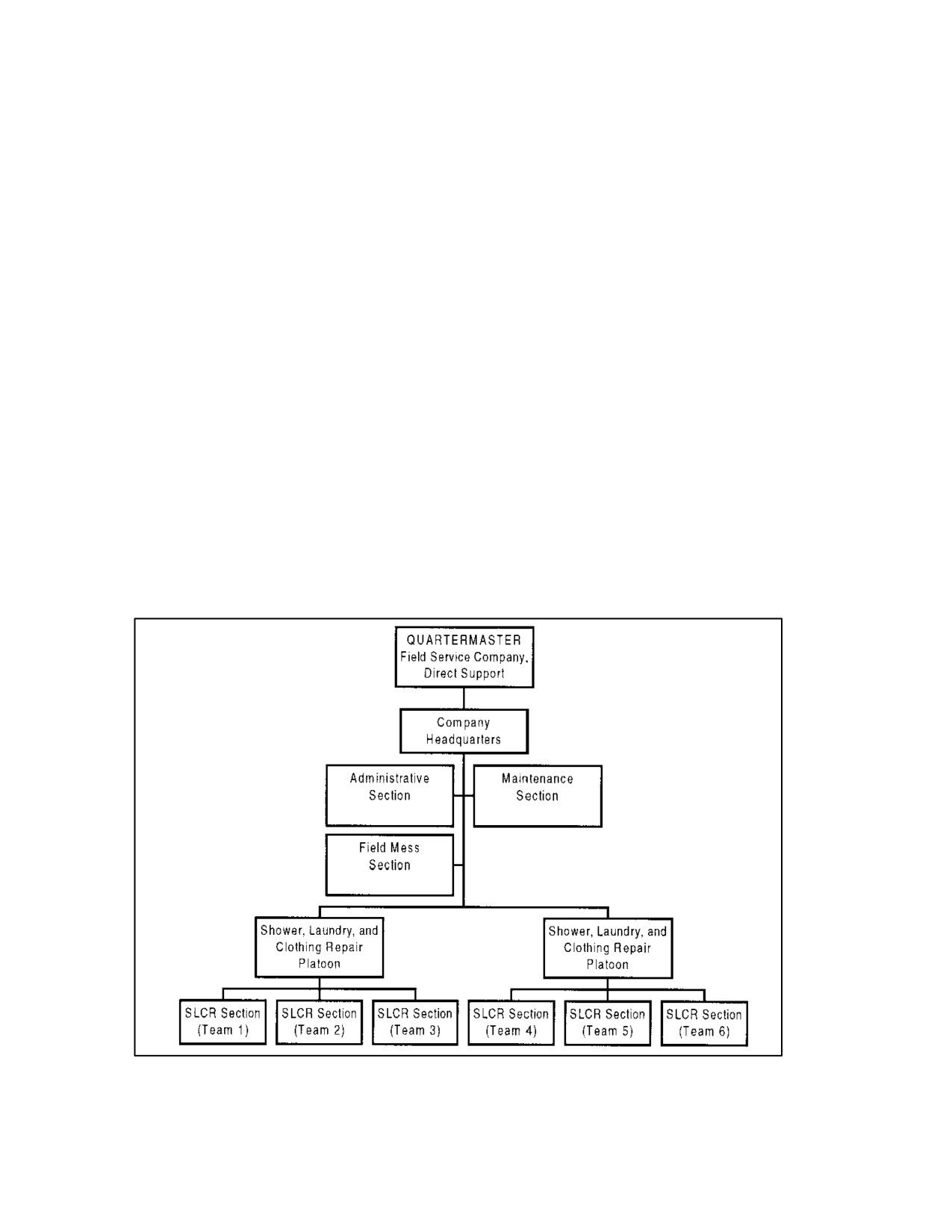
The FS functions of SLCR will be provided by a QM FSC, M (TOE 10414L0). QM FSC, M can
support 21,000 soldiers. It is normally assigned to a HHD, QM S&S Battalion (TOE 42446L000); HHC
Support Group (Corps) (TOE 63422L000); or HHC, Area Support Group (TOE 63622L000). The QM
FSC, DS is assigned to the TAACOM or COSCOM and normally attached to HHC, QM S&S Battalion
(TOE 42446L000). See Section II in this chapter for more information on company responsibilities. Figure
1-1 depicts FSC, DS becoming the FSC, M organization.
Figure 1-1. QM field service company, modular (TOE 10414L0)
1-2
FM 42-414
The QM FSC, M Organization (TOE 10414L0). It will be organized with a company headquarters and
two SLCR platoons. The company headquarters will provide routine administrative, supply, maintenance,
and food service support to the company. When deployed, SLCR platoons and its sections (or teams) may
require feeding support from supported unit.
SLCR Platoon Organization. Each platoon consists of a platoon headquarters and three SLCR sections
(or teams). The SLCR platoon headquarters coordinates mission operations with supported units for
services. The SLCR platoon sets up and operates the three SLCR sections or teams simultaneously.
The QM FSC, DS Organization (TOE 42414L0). It is organized with a company headquarters
(i.e. administration, supply, and food service elements); a laundry and renovation platoon, consisting of a
platoon headquarters, a renovation section, and a laundry section; and, a shower platoon, consisting of a
platoon headquarters and a shower section.
NOTE: CES operations will cease in the FSC.
Capability. Mission equipment of the FSC is highly mobile and can provide support as far forward as
the METT-TC allows. In the QM FSC, M, each SLCR section/team has 100 percent mobility with enough
vehicles to provide services forward. It can deliver clean laundry to its supported units as METT-TC
conditions permit. Each SLCR section/team maintains its own equipment. Each SLCR section/team may
need to move every 24 hours in the brigade area. In the division rear, it may need to move up to three times
within a seven-day period. (Total unit production capability will be degraded in cases of more frequent
moves.) The SLCR platoons and their respective sections/teams coordinate with the company commander
and the FSB SPO in planning their reposition or AO assignment. The QM FSC, DS is capable of moving
75 percent of its TOE equipment and supplies in one single lift, using its own unit vehicles. Deployment
and coordination requirements are the same as above. Additional company capabilities and support needs
for each FSC are identified in Chapter 2.
SUPPORT SERVICES
The FSC must adapt its field support capabilities in a sufficient and flexible manner to meet the
changing warfighting doctrine. To meet the necessary battlefield METT-TC conditions, the FSC provides
the following operating services:
NOTE: Clothing Exchange Services. CES allowed soldiers to exchange their dirty serviceable clothing for
clean clothing in conjunction with a field shower. FSC will not perform clothing replacement. CES is a
supply action to replace unserviceable clothing. The FSC will provide a “wash and return” policy for all
soldiers. They will wash and return to soldiers their own clothing with name tags, organizational patches,
and skill badges.
Laundry Support Services. In keeping with the Surgeon General standards, the FSC will provide a
minimum of one shower per week to the soldier in conjunction with laundry support. This is to maintain his
minimum level of personal hygiene required to minimize force degradation from infectious diseases.
Laundry support services entails the following --
Implement Laundry Planning Factors. In the QM FSC, M (TOE 10414L0), soldiers should
consider that 15 pounds of laundry equals three BDUs minus a field jacket, three sets of underwear, socks,
and two towels. In this process, soldiers will receive their clothing back in a 24-hour period, or at a time
1-3
FM 42-414
and location mutually acceptable to the laundry section and the supported unit. The QM FSC, DS (TOE
42414L0), will service at the rate of 7.9 pounds of laundry per soldier per week.
Provide Laundry Delivery Service. Delivery service must be closely coordinated. Contingency plans
must be set up in case the supported units relocate prior to delivery. Contingency plans may include having
the supported unit’s supply NCO or other designated representative to pick up clean laundry and issue to
the soldier when METT-TC allows.
Establish Communications Services. The FSC and its elements or sections/teams will be able to
communicate with supported units to facilitate field service operations, especially the delivery of clean
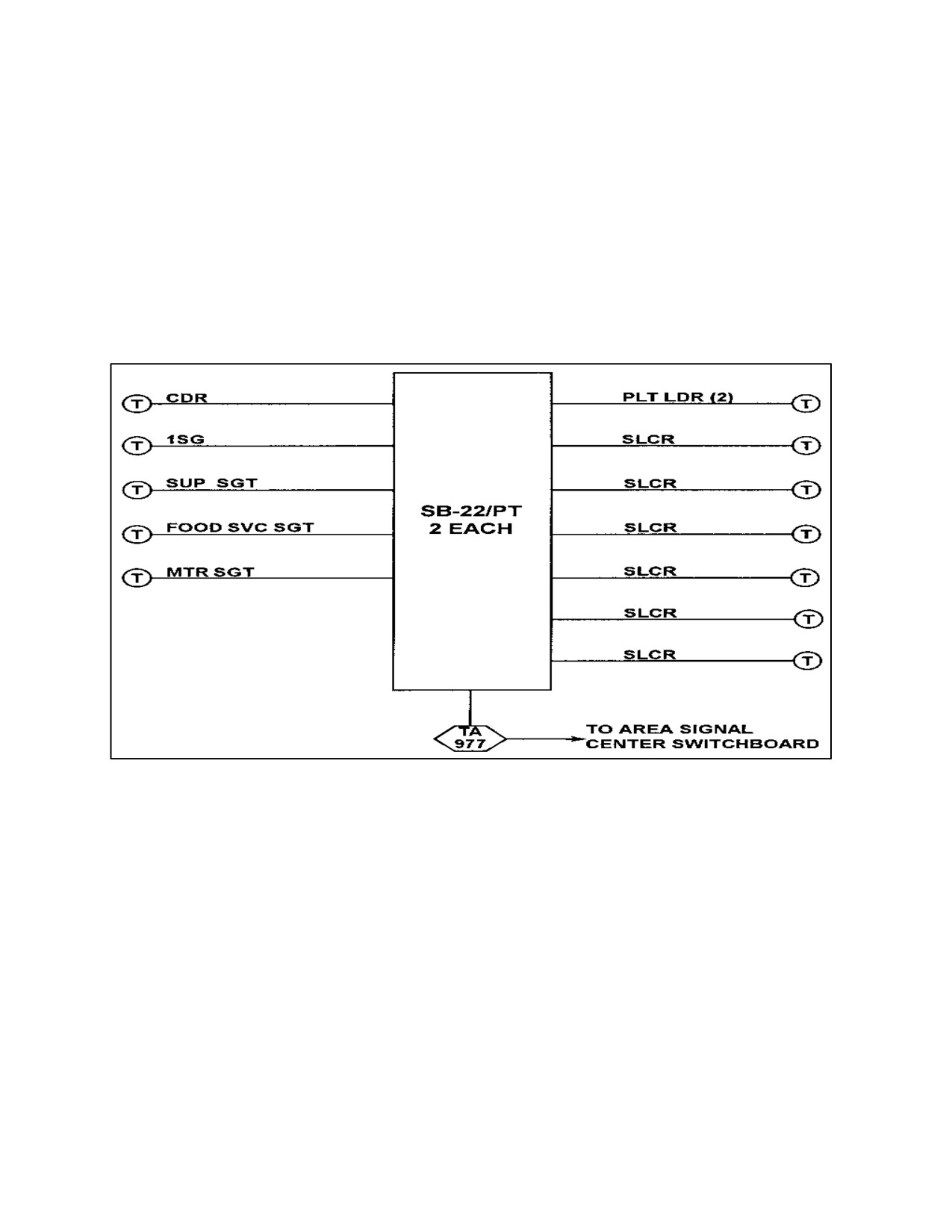
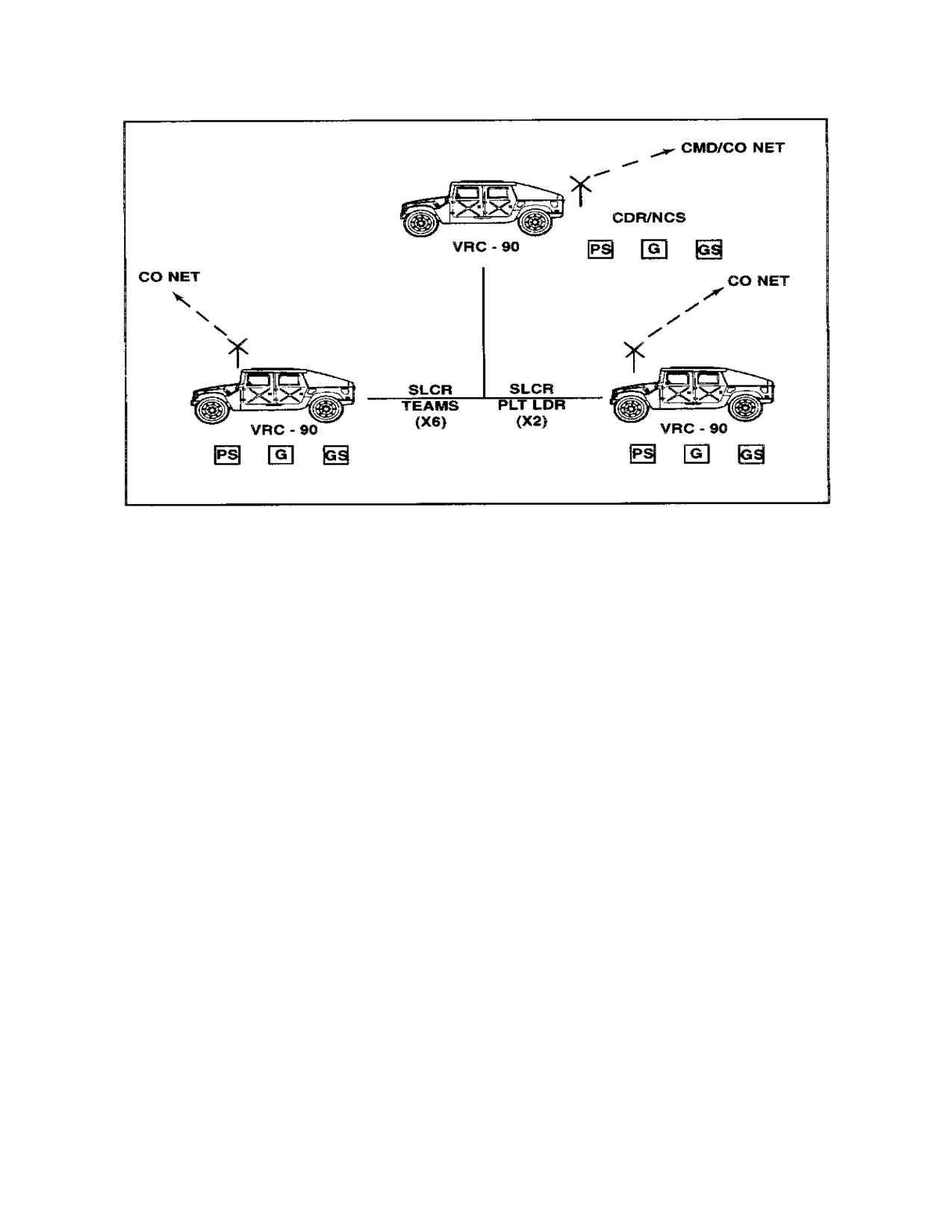
clothing. See Figures 1-2 and 1-3 (pages 1-5 and 1-6) for the company’s communication system.
NOTE: The FSC, M will increase its capability of laundry service through the fielding of the LADS with
its innovative reduced water usage technology. Using about 240 gallons of water per 20 hours of operation,
the LADS produces about 400 pounds of clean laundry per hour and reduces the number of operators
required by 75 percent. Laundry equipment capability is measured in terms of “pounds per hour,” which
makes it essential that soldiers’ allocation for laundry be measured in terms of weight rather than pieces.
Shower Support Services. The FSC, M, shower and laundry entity
(sub-element of the SLCR
section/team) can support 3,500 soldiers per week. They will be deployed in support of a brigade-size
element. They will provide showers, clean laundry, clothing repair and limited, lightweight textile repair.
The S/L element(s) of the SLCR section(s)/team(s) may be organized (required) by tasks to accommodate a
particular strength requirement. The FSC, DS will support 18,500 soldiers per week, providing required
services stated above. Shower support services entail --
Establish Shower Operations. Shower operations must take care of both male and female soldiers.
This can be done by either providing separate shower facilities or by separate scheduling, whichever is
most practical at the time. Supply personnel from the supported units are responsible for providing HCP
1 and 2 to their own soldiers.
Establish Shower Procedures. After showering, soldiers will put on clean clothing. They will be told
to go to the laundry point to turn in dirty laundry. Details on showering procedures will be explained in
Chapter 3.
NOTE: Commanders should make every effort for soldiers to have clean clothing after they have
showered. This may require unusual and extraordinary efforts by the command. The command must ensure
soldiers follow the unit’s SOP, requiring them to carry clean clothing in their rucksack.
Decontamination Support Services. The FSC will NOT provide laundry decontamination support;
showers will not be used for troop decontamination of chemical and biological agents. However, a shower
may be used for radiation decontamination. If MOPP gear is used as protection from fallout, no showers
will be needed. If MOPP was not used, then, contamination may be lodged in the hair and on the skin and
can only be removed by showering. Run-off water from these showers is contaminated. It must be
controlled IAW applicable procedures and EPA requirements.
NOTE: Current chemical protection over-garments cannot be washed or decontaminated by field laundries
and retain their protective qualities. Once these garments are exposed to contamination, they must be
disposed of IAW higher headquarters directives and applicable procedures. The next generation of chemical
1-4
FM 42-414
protection for over and undergarments will allow at least four washings, before being exposed to any
contaminations, and still provide protection from chemical agents.
EPA implementation is initiated by following --
EPA Regulations In The United States. Rules and regulations for wastewater discharges are set by
the EPA or a state with an EPA-approved program under the NPDES, established under the CWA. The
NPDES sets minimum treatment standards for surface waters discharges. It also sets up the framework for
setting more discharge standards. For disposal of discharges, apply for and obtain an NPDES permit (or
state equivalent), which contains discharge standards and restrictions that apply to the given discharge.
Before operating any S/L elements in the United States, check with the state and local EPA for permit(s)
requirements.
*Figure 1-2. Proposed wire net for QM field service company ( modular)
*(NOTE: QM FSC, DS and QM FSC, M are authorized TA-312/PT telephone sets.)
1-5
FM 42-414
*Figure 1-3. Proposed radio net, QM field service company (modular)
*(NOTE: Command elements of QM FSC, DS authorized VRC-90 radios.)
EPA Discharge Permits. Many military installations may have current discharge permits for water
sources located on the installation, which are used by S/L elements. Check with the Installation
Environmental Office for guidance. Always consider the potential environmental impact of chemical or
waste discharges on a water source.
EPA Regulations in Other Countries. It is always necessary to check with local authorities for
regulatory requirements. Each country in which water purification, storage, and distribution operations
may be used will have their own guidance on disposal of chemical and waste discharges in a training
exercise, as well as ambient water quality criteria. Units must comply with environmental standards
applicable in the host country.
Laundry Support Services For OCIE. The first priority of the FSC is the soldier’s personal clothing.
However, laundry support for OCIE and seasonal and special-purpose clothing is needed. Requirements to
meet laundry services for OCIE is initiated through the following directed measures.
OCIE Service. OCIE and seasonal and special-purpose clothing will be turned in through normal
supply channels to the organization in the rear area that is responsible for contracting or arranging HNS for
laundry support.
OCIE Support. If there is a light work load for personal clothing, the FSC laundry elements may
provide limited support for selected OCIE and seasonal and special-purpose clothing as directed by higher
headquarters.
Clothing Repair Support Services. Soldiers may need their clothing to be repaired on the battlefield.
This support may be provided by three methods, depending on the extent of the requirement: self-help,
1-6
FM 42-414
direct support through the FSC clothing repair element, and support through HNS and/or (hired) contract
service. CR support service is gauged upon the following measures --
CR Operating Standards. The individual soldier can make minor and emergency clothing repairs
using repair kits available through the supply system. If he cannot make the repair, he should identify the
clothing needing repair at laundry turn-in. After the clothing is cleaned, the fabric repair specialists will
inspect and determine serviceability. They will do limited clothing repair based on standards set in FM 10-
16; TMs 10-8400-252-23 and 10-8400-201-23; and SB 10-523.
CR Time Standards. Repairs will be made within the 24-hour laundry turn-around time.
NOTE: Soldiers should be careful when turning in grossly damaged clothing for laundry. If the item is
determined to be unserviceable and unrepairable, it is returned to the user. The user, then, disposes of the
item(s) by initiating a supply action to immediately replace the item(s). Under combat conditions, units can
immediately requisition replacements through the supply system for those items not repairable. The FSC,
(direct support or modular) has no capability to issue replacement items.
Section II
CAPABILITIES AND OPERATIONAL CONCEPT OF FS UNITS
RESPONSIBILITIES
To maintain good morale and hygiene comfort to troops in the field, showering and clean laundry and
serviceable clothing support is recognized as an essential necessity for personal sustainment needs. Units
providing this support are --
Quartermaster FSC (DS or M). This company is the primary provider of tactical field services to
divisional and non-divisional personnel from corps forward area to FLOT. Services include shower,
laundry, limited clothing and lightweight textile repairs (described as “renovation” in FSC, DS), and
delousing support. Refer to section I in this chapter for organizational structure and unit attachment.
Quartermaster Laundry and Renovation Company, GS. The mission of this company is to receive,
classify, launder, renovate, and temporarily store clothing and lightweight laundered textiles. The company
also processes and stores seasonal clothing and equipment. It is assigned to a TAACOM and attached to an
S&S Battalion in an area support group. The following describes its composition and capability.
Organizational Structure. The company is organized with a headquarters section, operations
section, classification and storage platoon, and a laundry and renovation platoon. It operates on two shifts.
· The classification and storage platoon consist of a platoon headquarters, a classification section, and
a storage section.
· The laundry and renovation platoon consists of the platoon headquarters, renovation section, and a
laundry section.
1-7
FM 42-414
Capability. On a weekly basis, the company can receive, classify, and temporarily store about
22 tons of clothing and lightweight textiles; renovate about 35,000 items; and launder 44,000 pounds of
clothing.
Quartermaster Laundry Team. This team is normally attached to a TAACOM hospital unit, base
(field); or a TAACOM hospital unit, base (general). The team provides weekly laundry service for
500 hospital patients, based on 77 pounds for each patient a week.
Combat Support Hospital. This hospital has unit equipment to support its patient load. Its personnel are
supported by the FMC in their AO. The hospital must request and coordinate staff services through its
support channels.
NOTE: Although CSS requirements for the QM laundry and renovation company and the QM laundry
service teams have been identified by FORSCOM, these elements are not currently resourced.
QUARTERMASTER FORCE PROVIDER COMPANY
The Army requires a capability to provide front-line soldiers a brief respite from the rigors of duty in a
front-line area. The following paragraphs discuss the history and concept of this unique company and its
special services support to the soldier in the field.
History of Force Provider. Operation Desert Storm ushered in a new area for the Army. For the first
time, the difference between a U.S. Army soldier’s and a U.S. Air Force airman’s quality of life in the field
was broadcasted to the world, as they waited for a war to begin. World news televised Army soldiers
sleeping in tents that were designed in the 1940s and 1950s and using makeshift latrines and showers, while
Air Force airmen lived in modern field facilities. Recalling their days in the field, the Army’s senior
leadership saw that little had improved over the years. They demanded an immediate change to this
inequality. One of the results was the QM FPC.
Concept of Force Provider. To support the soldier in the field, the Force Provider concept was set up to
identify with the Army’s myriad of mission profiles. These being soldier rest and refit services, convoy
support actions, theater reception operations, and immediate staging base operations. Force Provider would
also be used to provide support to humanitarian aid, disaster relief missions, and peacekeeping missions--
stability and support operations. The requirements for organizations and equipment that would enable
Force Provider to support these diverse missions were instrumented by TRADOC. Force Provider would be
containerized for easy air, land, or sea transport. It would be modular for operating in a variety of tactical
environments and movable to follow troop movements. It would offer a variety of services to improve
soldier quality of life in all field environments anywhere in the world.
Force Provider Support Service Capabilities. Force Provider is air, land, and sea transportable. It is
also a collective support system that provides comforts rarely enjoyed by Army combat soldiers. These
Force Provider modules will support up to 550 soldiers and may be combined to support brigade-size
forces of up to 3,300 soldiers. The following describes its uniqueness.
QM FPC Set Up. It will be a self-contained unit. It will have its own capabilities. These being a unit
power generation system, water and wastewater distribution systems, and fuel storage areas. However,
external transportation, water, and engineer support will be needed to set up and operate Force Provider.
1-8
FM 42-414
QM FPC Services. Troop units will rotate into the QM FPC for rest and refit services. These
services will consist of the following: hot meals and showers, laundry service, and a variety of MWR
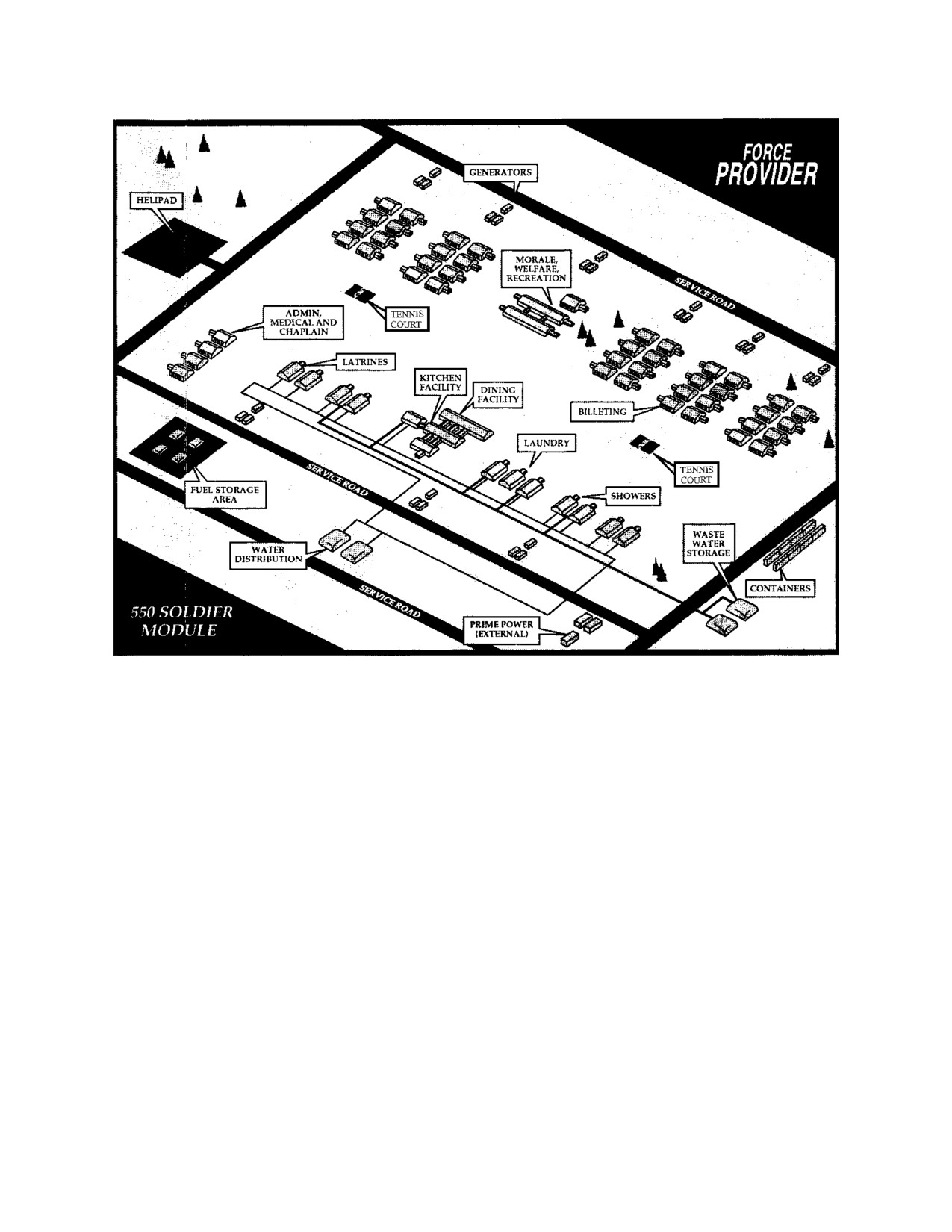
activities. Also, supported units will be living in environmentally controlled tents. See Figure 1-4
(page
1-10) for the set up of the QM FPC.
QM FPC Equipment. It will use the best CSS equipment available within the DOD. Force Provider
will use the modern air-conditioned Army TEMPER tent as its basic “building block.” These TEMPER
tents will house Air Force showers and latrines. They will serve as quality billets, kitchen and dining
facilities, and MWR centers. Power to these facilities is provided by either the Army’s 60-kilowatt tactical,
quiet generators or by the 750-kilowatt generators from the “Prime Power Battalion.” Fuel (area) storage
facilities, wastewater storage areas, and a pressurized fresh water system will round out the utilities serving
Force Provider.
Force Provider Future Enhancements. Improvements will continue as state-of-the-art containerized
kitchens, latrines, and laundries. A winterization kit will enable worldwide deployment. A high-tech
wastewater treatment system will recycle laundry and shower water and reduce nonrecyclable liquid waste
products to an environmentally disposal state.
QM FPC Assignment Area. Force Provider is to be assigned to a TAACOM or a COSCOM with
attachment to a HHD, S&S Battalion (TOE 42446L) or a HHC, Support Group (Corps) (TOE 63422L).
The QM FPC may be detached to operate separately in an austere environment.
QM FPC Organizational Structure And Operational Functions. The company consists of nine major
elements. It has a company HQ, a support operations section, a maintenance section, six provider platoon
HQs, six food service sections, six S/L sections, six water distribution sections, six facilities support
sections, and six petroleum distribution sections. Documented as a complete TOE showing strength levels
1, 2, and 3, this unit is planned to be organized only as a Type B structure. See AR 220-1 for more
information on TOE strength levels. As such, 44 personnel will serve as the nucleus for unit operational
planning and deployment. Based on plan execution, these personnel will fall in on Force Provider
equipment modules already in place or in contingency storage areas. Full unit functioning will be handled
by filling the unit with DA civilians, contractors, local nationals, or third country nationals. Significant
dependence will be placed on other TOE organizations for help in setting up the site and operating support.
The nine QM FPC elements and their functions are --
1-9
FM 42-414
Figure 1-4. Set up of the QM FPC
· Company HQ. The company HQ provides C2, training, administration, and logistical support needed to
do unit operations. The company commander is assisted by the first sergeant, who supervises and
coordinates the functions of the company.
· Support operations section. This section supervises the supply, maintenance, and field service support
operations and advises the company commander in these functional areas. It also serves as the focal point
for all contracting and engineer support.
· Unit maintenance section. This section provides unit maintenance on all unit equipment except
COMSEC and communications-electronics equipment.
· Six provider platoon HQs. The HQ supervises those activities such as billeting, supply functions,
climate control, and facility spacing needs for basic MWR services.
· Six food service sections. The sections prepare and serve three cooked meals daily. This includes
preparing meals for a maximum module of 550 supported personnel and up to 3,300 personnel when Force
Provider is fully deployed.
1-10
FM 42-414
NOTE: The kitchen and dining facility setup must be at least 100 feet from the latrines.
· Six S/L sections. The S/L sections plan and coordinate internal logistics requirements in providing
shower support and performing company security operations. The laundry system can wash each soldier’s
turn-in of 15 pounds of laundry within a minimum of three days.
· Six water distribution sections. The sections provide approximately 80,000 gallons of treated water for
a maximum of three days. They can store, distribute, and dispose of water for units assigned to QMFPC.
· Six facilities support sections . The sections supervise and coordinate all lighting, climate control,
power generation and distribution services, and all facilities support requirements.
· Six petroleum distribution sections. These sections provide QM FPC the necessary Class III supply
support. They can receive, store, and issue Class III supplies as needed.
Force Provider Support Request Channels. Divisional elements desiring Force Provider support will
send requests through their command channels to the DISCOM Support Operation Branch, which will be
responsible for work-loading the QM FPC. Priority of use within the division will be set by the ACofS, G1.
Non-divisional elements, wishing to use the QM FPC, will submit requests through their command
channels to the DISCOM Support Operations Branch, who will determine in consultation with the ACofS,
G3 whether or not support can be provided. The following depicts its support role.
Force Provider Support. If Force Provider is in DS of one or more divisions, while remaining under
the C2 of the COSCOM or TAACOM, priority of support will be given to the supported divisions. Non-
divisional elements will be supported on a space available area support basis. All requests for support will
be sent through appropriate command channels to the COSCOM ACofS, Support Operations, or the
TAACOM ACofS, Services. Priority of support will be set by the Corps ACofS, G3.
Force Provider Stability and Support Operations. Force Provider support to civil authorities in
SASO (for example, disaster relief or humanitarian assistance) will be done IAW procedures given in FM
100-19.
Force Provider Equipment Support Contingency. Conceptually, two Force Provider equipment sets
will be placed on pre-positioned ships and four in operational projects in CONUS Army depots. Those
placed on ships will be responsive to missions involving OCONUS contingencies; reception and staging
operations, or convoy movements. They will have a positive effect on early TPFDL flow. Those maintained
in the Army depots will be used for training and testing and will be respond to other military missions, as
well as supporting U.S. civil authorities’ emergencies and disaster request needs.
STABILITY AND SUPPORT OPERATIONS
According to FM 100-5, the U.S. Army will evolve itself with conducting “military activities during
peacetime and conflict that do not necessarily involve armed clashes between two organized forces.” The
Army’s prime mission focus is on fighting war; however, its role in SASO is critical. During peacetime and
war, the FSC personnel may be participating in disaster relief and nation assistance missions. This was true
for the Quartermaster 16th FSC (DS) at Fort Lee, VA. This organization assisted the civilian community
and U.S. Air Force personnel in operation Hurricane Andrew Relief at Homestead U.S. Air Force Base, FL
in the summer of 1992. In August 1993, the 16th FSC, DS was tasked in Provide Disaster Relief to its
close community neighbors of Petersburg and Colonial Heights, VA. A tornado hit these areas causing
1-11
FM 42-414
severe damage to homes and businesses. Homeowners and business personnel received varied field service
assistance. Humanitarian aid and disaster relief was again supported by Army field service units called to
duty in the Mississippi Flood Relief of 1993.] SASO is further defined below.
SASO Principals. Army forces as FM 100-5 states, “...must be full dimensional operations. This
means employing all means available to accomplish any given mission--decisively and at least cost--across
the full range of possible operations in war and in operations other than war.” More information on these
principles can be found in “Operations Other Than War: Peacekeeping and Peace Enforcement,” Center
for Army Lessons Learned Newsletter.
SASO Support Enhancements. Using force projection and conducting split-based (logistics) operations
for SASO, conflict, or war missions, FS support operations will continue to enhance joint and combined
field service capabilities. FSC (i.e. elements, sections/teams) as part of modular units and civilian support
components, as needed, will make up the proper balance of forces to support and sustain a total force
concept. They will be a part of a joint, combined, United Nations, or contingency organization.
Section III
COMMUNICATIONS
COMMUNICATION SERVICES
A good working communications system is needed to set up effective unit CSSCS measures. FSC staff
must be able to communicate with its higher headquarters, adjacent units, supported units, and its own
internal sections. Communication resources and details for setting up telecommunications should be
explained clearly in the company’s TSOP. This information identifies the requirements of setting up and
operating services. It denotes all automated and satellite or electromagnetic communication systems, and
telephone system services. It also includes priorities for laying wire and responsibilities for setting up the
system. See Appendix A for format and informational data for setting up an SOP/TSOP. Your
communication system invokes the following aspects --
Communication Support. The FSC will get its communication support from the S&S Battalion with
additional support from the area’s assigned signal team. Refer back to Figures 1-2 and 1-3 on proposed
wire and radio nets. Make sure the allocation of radio equipment is documented in the company’s TSOP.
(When the company uses the SINCGARS communication assets, ensure all company personnel know how
to operate this satellite communication system.) After setting up the company’s operating site(s), your
communication personnel should enter the net within a reasonable time, OPORD or as prescribed by higher
headquarters IAW CEOI in company's TSOP. Use FMs 24-1, 24-19, and 24-22 for additional guidance.
Communication Means. Your company’s means of communication depends on equipment on hand,
internet capability with other units, and METT-TC. FM 24-1 describes the main features and weak points
for each of the following systems.
· Area common user system.
1-12
FM 42-414
· Tactical satellite communications.
· Net radio interface.
· Audiovisual, facsimile, data, and tactical automated systems.
NOTE: Your public affairs responsibilities, concerning soldier-media interaction, are addressed in
Appendix B of this manual.
METHODS OF COMMUNICATION
There are many methods of communication. Use the methods that offer maximum continuity, security,
versatility, and simplicity. Do not depend on only one method. Use them to complement each other. Signal
equipment, particularly when connected to cables and antennas, can be damaged by electromagnetic pulses.
Therefore, alternative means of communication should always be available in case of nuclear warfare,
directed energy attack, lighting strike, or equipment failure. FM 24-1 has more details on the various
methods of communication. Basic communications aspects are discussed next. However, every
consideration to acquire and use advanced electronic and satellite communications should be employed by
the unit.
Wire. Wire system uses field wire and cable, telephones, and a switchboard to provide person-to-
person conversations. Wire is more secure than radio. If you use links in your system, the enemy can
intercept your conversations. Make sure your soldiers know this and practice COMSEC. See TC 24-20 for
information on field wire activities and the general characteristics of equipment used with field wire
systems.
Radio. Radio will be your main method of communications with your sections that are mobile or do
not have access to the telephone system. However, radio is the least secure communications method. Radios
can be severely damaged by the electromagnetic pulse resulting from a nuclear detonation. If your company
is in or expects to be in a nuclear environment, protect your radios. Put both security and protective
measures in your TSOP. When setting up operating sites, your soldiers should enter the net using
procedures in FM 24-18. See FM 24-19 for daily operational procedures.
Messenger. Use your soldiers for messengers as much as possible. They provide the most secure
method of communications.
Visual and Sound Signals. You can use visual and sound signals to send messages over short distances.
These signals are especially useful as alarms or warnings, especially of enemy attack, or as a means of
sending prearranged messages. Messages transmitted by visual or sound signal are easily misunderstood.
Take care when selecting the method and the message to be conveyed. For publications on visual and sound
signals, see Table 1-1 (page 1-14).
Table 1-1. Visual and sound signal publications
Publication
Coverage
1-13
FM 42-414
FM 3-4
Sound alarms
FM 5-36
Road signs
FM 21-60
Flags, lights, panels, arm and hand signals
FM 21-305
Traffic control signals
FM 23-30
Pyrotechnics
FM 55-312
Convoy warning devices, flags, and hand signals
COMMUNICATIONS SECURITY
COMSEC consists of measures taken to keep unauthorized persons from getting information from the
communications system. As outlined in FM 24-1, your soldiers should practice the following security
measures in these areas: physical, transmission, cryto, and emission. Transmission and physical security
measures are discussed for further clarification.
Transmission Security. The SOI governs all transmissions. The SOI is a type of classified combat
order issued by higher headquarters for technical control and coordination of communications. See
FM 25-35 for more information on the SOI. As a rule, you receive only an extract of the SOI, the part you
need to manage your nets. Also, the SOI may give you a list of essential elements of friendly information
which must not be transmitted. Your operators should have a copy of this list. They should monitor
transmissions to see if information on the list is being passed. They should report any violations to their
supervisor. Other ways you can make transmissions more secure include --
· Choose the most secure means of communication according to the urgency of the situation.
· Transmit only when necessary.
· Use low transmitting power when possible.
· Be wary if a radio station’s signal strength suddenly changes.
· Use directional antennas and terrain masking when possible.
· Plan your message. Keep the message short as possible.
· Maintain total radio silence when directed.
· Use only authorized codes and ciphers.
· Avoid identifying yourself or others.
1-14
FM 42-414
· Demand authentication. Do not talk to anyone who will not authenticate.
Physical Security. Impress your operators with the need to protect communications equipment from
abuse, damage, or capture. Make sure they guard against disclosing the locations of equipment. Make sure
phone wires are inside the defense perimeter and along frequently traveled routes. Bury wire and cables
when possible. This protects against magnetic pulses during nuclear attacks. Site radios in well-defended
locations. Instruct your operators to move transmitters frequently. Be sure to rotate your operators so that
an enemy will not associate an operator with a specific unit or operation.
COMMUNICATION ENVIRONMENTS
The environment can have a significant impact on communications. Your soldiers must know how to
install, operate, and maintain communications equipment in all environments. Cold weather, desert, jungle,
mountain, and NBC environments create special problems. These areas are discussed next.
Cold Weather. For operations in severe cold weather, special arctic training is needed. See
FMs
9-207, 24-1, 31-70, and 31-71 for details on operations in cold weather.
Desert. Dust and extreme heat are two major problems in desert operations. FM 24-1 lists their effects
on communications. See FM 90-3 for details on desert operations.
Jungle. Humidity and heat create the biggest problems for combat communicators in the jungle. Good
operator maintenance is the key to keeping equipment in working condition. FMs 24-1 and 90-5 have
details on a jungle environment.
Mountain. In mountain areas, you may find it difficult to move, to find a communication site, and to
ground equipment in rocky soil. You may also have problems with operating generators and carburetors at
high altitudes. See FMs 24-1 and 90-6 for more details on mountain operations.
Biological and Chemical. Combat communicators will find it difficult to retain continuity of
communications in a biological or chemical environment. Manual dexterity is degraded when they wear
MOPP gear. Voice distortion from the protective mask will make radio and telephone conversations
difficult. Personnel decontamination is time-consuming and will take CE operators away from their duty
positions. To overcome these problems, train your soldiers in full MOPP gear in a simulated biological or
chemical environment. See FMs 3-3, 3-4, 3-100, and 24-1 for more details on operations in a biological or
chemical environment.
Nuclear. Nuclear detonations from great distances degrade signals as a result of changes in the
medium characteristics (a transient effect of electromagnetic pulse). They damage systems by radiation or
intense fields generated by gamma pulse.
ELECTRONIC ATTACKS
1-15
FM 42-414
EA may hinder, confuse, or prevent radio reception. Your soldiers should report all EA according to
SOI supplemental instructions. Before reporting EA, the operator should disconnect the receiving antenna
to determine whether or not the signal is from an outside source. The operator should follow the procedures
in FM 24-33 to determine the nature of the EA and monitoring/countermeasures used against them. These
include --
Interference. Electromagnetic signals caused by sources other than the enemy may interfere with your
radio reception. These sources include friendly radio signals, faulty electrical components, weather
conditions, and nearby generators.
Intrusion. The insertion of electromagnetic energy into friendly signal paths so that operators are
deceived or confused by it is called intrusion. The enemy may try to enter the communications system by
imitating a friendly unit or station. Train your operators to counter intrusion by using correct operation
codes, brevity lists, and operating signals. Make certain your operators require authentication and that they
observe transmission security.
Jamming. The deliberate effort to prevent the passage of or to degrade the reception of information is
jamming. It can disrupt a single frequency or an entire frequency spectrum. All radio frequencies can be
jammed. An operator hearing unusual noise on the radio must try to determine its source. If he cannot trace
the noise to friendly source, the radio is probably being jammed. The operator should try to identify the
kind of noise and report it. Do not let the enemy know that his jamming efforts are successful.
Reports. An operator suspecting EA should report it at once. Reports are made according to the SOI
supplemental instructions, using the format shown in FM 24-1, Appendix H. The operator should make the
report whether or not he is successful in working through the EA. Upon receipt, the report is sent forward
to higher headquarters as required by the SOI.
Training. Operators must be trained in the correct procedures to follow to restore communications or
set priorities for transmissions. Train soldiers equally in all communications methods. This enables the
company to continue operations during periods when one or more methods are knocked out of commission.
Ensure that all users, not just prime operators, are trained. These include officers, NCOs, and other
soldiers. Train them to operate communications equipment correctly and to maintain COMSEC. Train
backup operators to take over when prime operators are absent. Review FM 24-1 for additional tactical
and operational level signal support, regarding IMA disciplines of communications, automation, visual
information, records management, and printing/publications.
Directed Energy Weapons. Weapons using directed microwave radio energy and lasers safe to the
human eye may be fielded in the near future. At low power, these weapons can jam CE equipment. At
higher power, they can induce excess electric currents into sensitive components to cause damage, burnout,
or destruction.
Instructions. The TSOP should have the methods of installation and operation of CE equipment that
best protect soldiers and equipment. CE equipment in company inventory generally will not be designed to
withstand the effects of EMP. Plan to give communications priority to harden systems in an EMP
environment. In training situations, emphasize compliance with EMP-related directives. Use smoke
generators, pots, or grenades to absorb and reflect the directed energy of most directed energy weapons.
Section IV
1-16
FM 42-414
PLANNING CONSIDERATIONS
SITE SELECTION
The main concern when selecting a site for operations is based on the mission and assigned area given
to the company by higher headquarters and conditions of METT-TC. The site is set up with these concerns
according to --
Location Support. The site should be set up as close as possible to the unit or command being
supported.
Operational Support Requirements. The site operational area should support the number of personnel
receiving services to include area capacity and restrictions; time constraints; METT-TC conditions; good
roads network system; and, if available, natural cover and concealment.
Water Support. The site should have plenty of clean water or potable water in an arid environment.
The area terrain should be gently sloping to provide proper drainage capability. (The drainage system or a
ditch should be available to carry off wastewater. Before constructing such a system, the unit should check
with the environmental engineer for any EPA restrictions prior to discharging any water.) Chapter 3,
Section I provides detailed requirements for FSC site operations to include water and fuel needs.
THREAT ACTION
Since the FSC provides support in the division rear area and close to the FLOT in the brigade support
area, they are susceptible to many threat tactics. This premise is based on modern threat capabilities and
doctrine. The FSC and its elements or sections/teams will use normal defensive procedures before a threat
attack and provide protection for its equipment. Some effective passive measures for equipment protection
include decentralization of storage locations, the use of indoor storage facilities, and the use of protective
cover for supplies stored in the open. Decentralized storage locations are especially effective against direct
and indirect fire weapons. All FSC operations will cease during or upon alert of an impending NBC
warning or attack. All personnel will don appropriate MOPP level gear until threat is abated. The following
information covers recent changes to the threat environment and threat counter tactics, to include friendly
countermeasures to be taken.
Threat Environment. The collapse of the Soviet Union and the end of the cold war has changed the
threat environment. Regional conflicts are now emerging from the former Soviet Union spheres of control.
Other conflict areas which now threaten U.S. and allied interests could come from such countries and
regions as Kurdistan, the Balkans, the Andean Ridge, Korea, Persian Gulf, and Palestine. These conflicts
could range from nuclear war to major regional conflicts to insurgencies and terrorism. Because of this new
threat environment, the impact of global news networks in providing near-real-time enhances the ability of
threat governments or organizations to use the media as a tool of warfare. See Appendix B for more
information on what public affair procedures to take when dealing with the news media.
Threat Counter Tactics. With advance technology and the weaponry sales to third world nations and
extremist organizations who can afford them, the enemy or potential enemies of U.S. forces and its allies
1-17
FM 42-414
can employ very stiff resistance to our deployment and buildup of friendly forces' capabilities. As given in
FM 10-1, tactics that the enemy will likely use to counter U.S. and allied forces include --
· Prevent buildup of friendly forces. Prevent the buildup of U.S. and allied forces by deploying their
attack forces into a theater to block our heavy forces and by attacking our rear echelon infrastructure.
· Control operational tempo. Slow operational tempo of U.S. and allied forces as an example by
improving their armor and anti-armor capabilities, degrading U.S. and allied forces' battlefield
identification capabilities, and maximizing use of sea and/or land mines.
· Degrade command elements. Degrade the relative advantage of our C3I capabilities by using electronic
countermeasures and stealth or low-observation materials and technologies.
· Employ guerrilla or terrorist and/or biological and chemical attacks . Maximize U.S. and allied
casualties through use of guerrilla or terrorist attacks and biological and chemical agents, especially in rear
area support areas.
Friendly Forces Counter Support Measures. In support of the "next" battle, units and their personnel
must apply their mission operations at the right location and on time. This gives the maneuver commander
the opportunity to maximize his success on the battlefield. This requires units and its soldiers to train in a
variety of situations and environments. Also, it requires organizational planning to meet METT-TC
conditions; anticipation of support needs including timing and location setup operations; and, a thorough
understanding in assisting and following through on the maneuver commander’s objectives and tactics. As
the threat situation dictates, your unit may become part of the maneuver commander’s offensive “shooting”
force or reserve “shooting” force or defensive counter-attack force as an extreme measure to the tactical
threat situation. Friendly forces must stay current on threat doctrine, including terrorism actions, and its
technological capabilities in meeting the challenge and opportune time to defeat the threat.
DEFENSIVE AND OFFENSIVE MEASURES
Because of the FSC location on the battlefield, its fighting capability will probably be a defensive
measure, unless ordered by higher command to take part in an offensive (or counter attack) strike. Unlike
combat support units designed and equipped to fight the enemy, the FSC is not organized or equipped to do
so. However, the company or its elements or teams may have to fight an enemy force until reaction forces
(such as MP or combat forces) can help. Company personnel (i.e. SLCR section(s)/team(s), S/L and CR
element(s)) must be able to defend themselves and, if required, to take part in offensive tactics. Therefore,
the company commander is responsible for the security and safety of the company. The company
commander must train his personnel in unit collective and individual tasks. This is necessary to protect
against both level I threat (attacks by agents, saboteurs, and terrorists) and level II threat (attacks by
irregular or tactical units less than battalion size) activities. Training on offensive tactics will need to be
employed in anticipation or preparation for offensive actions. These measures entail the following guidance
--
Understanding Defensive And Offensive Principles. The principles of defense for this company are the
same as those for combat units. You must adapt them because of the lack of personal, equipment, or
weapons to furnish a full defense and to avail in performing your mission. If ordered to take part in an
offensive mission, apply the principles stated in FM 100-5 and train to standards according to HTF
manuals. Keep informed of the latest preparation measures against ground, air, and NBC attacks. See
1-18
FM 42-414
Appendixes C and D on mission-kill operational data and fratricide prevention measures to survive on
today’s and tomorrow’s battlefield.
Prepare Defensive Plan or Offensive Measures. Using all available means, survey your operations and
make defensive plans or offensive measures to lessen the possibility and effects of an enemy attack. Plan
the action your company will take during and after an attack so the company can perform its mission. Base
your plan on guidance and instructions from higher headquarters on your specific mission, situation, and
location. The FSC should follow these preliminary offensive support measures:
· Plan unit move.
· Perform pre-combat checks.
· Prepare unit to move.
· Prepare unit equipment and vehicles for deployment.
· Conduct tactical road march.
· Cross chemically and/or radiological contaminated area.
· Take active air defense procedures against hostile aircraft, which includes small arms fire. See
FM 44-8 for small unit arms air defense measures.
Conduct C3 I. Initiate C3I procedures against the threat as identified in company’s or team’s/section’s
TSOP and guidance received from higher headquarters. Apply the following planning and execution
operations.
Review Intelligence. Request all available intelligence about the enemy from higher headquarters
on identity of probable threats. This information will likely include what enemy forces to expect and when,
such as--
· Hit-and-run night or daylight missions by saboteurs.
· Small guerrilla bands or terrorist groups.
· On-target air attacks resulting from air reconnaissance.
Revise the Defense/Offense Measures. Include this data in appropriate annex(s) to the unit TSOP.
Adapt the TSOP in keeping with the intelligence about the situation and the type of enemy attack or
offensive strike tasking you may be expected to receive. Decide and detail counteractions as updated data to
the TSOP for each type of threat to be encountered in a defensive or offensive mission. Identify, in detail,
any open or restricted fire zones. Update data, as necessary, on the composition of any reaction forces. See
Table 1-2 (page 1-20) for a listing of subject areas and publications with which to be familiar. Execute
these actions to prepare the defense or offensive measures of the TSOP.
Perform Reconnaissance. In reconnaissance of the area, direct reconnaissance personnel to report
on --
1-19
FM 42-414
· Unusual terrain conditions.
· The condition of roads.
· Any errors in the maps being used or provided by higher headquarters.
· Any presence of threat forces including equipment and weapons.
Conduct Brief-Back. Set up a briefing so that reconnaissance personnel may brief all key personnel
on their findings, including terrain and natural obstacles encountered and those that can be used for cover
or camouflage. Discuss objective routes for offensive actions or likely avenues of approach by enemy
attack. For defensive precautions, determine placement of OPs, automatic chemical agent alarms, and
crew-served weapons for interlocking fire zones.
Table 1-2. Defense publications
For Information About:
Use:
Camouflage
FM 20-3
Survivability
FM 5-103
Fighting Positions
FM 7-7
Mines
FMs 20-32 and 23-23
Unit Weapons
FMs 23-14, 23-31, and 23-67
Air Attack
FM 44-80
Combat Training
FMs 7-10 and 21-75
Grenades and Pyrotechnic Signals
FM 23-30
Built-Up Areas
FM 90-10
Draw Up Defense Layout Plan. Show the placement of OPs, LPs, machine guns, mines, automatic
chemical agent alarms, and all barriers on map overlays. Give a copy of the layout plan to higher
headquarters and to the quartering party personnel. Define sectors of defense, and assign responsibilities
for each sector. Estimate time, labor, and equipment required to construct camouflage and barriers.
1-20
FM 42-414
Request camouflage, barrier materials, and ammunition supplies through channels. Set priorities for
constructing obstacles, and assign responsibility for each barrier.
Coordinate With Adjacent Units. Higher headquarters keeps the company informed of the tactical
situation, enemy capabilities, and OPORD, directing the degree of dispersion to be made for the company
areas of operation. Using this information, the company coordinates its defense plan with the plans of all
nearby units to form a mutual defense plan of operations. If the company is attacked, immediately inform
higher headquarters and adjacent units. This report should include the time and strength of the attack so
help can be provided if needed. See FM 90-14 for fire support plan and rear battle actions to be taken. See
Appendix D for more information on fratricide prevention measures; it identifies actions to be taken when
friendly fire incidents occur. To stay abreast with your higher headquarters and adjacent units, these
communication steps must be followed.
Establish Communications. Tie into the area communications net. Ensure that a primary and
alternate means of communication exists between operating sections, between operating teams and their
platoon headquarters and company headquarters, and between company headquarters and higher
headquarters. Use your communications net to coordinate with adjacent units to ensure that common
boundaries are covered by interlocking fire.
Effect Communications Security. Implement COMSEC measures to keep unauthorized persons
from getting information from the communication system. Effective use of these measures denies the enemy
information on company’s operations. COMSEC is everybody’s responsibility. Make sure all company
personnel understand and observe the security measures described in FM 19-30. Two types of COMSEC
operations that they should know about are physical security and transmission security. Each is described
next.
· Maintain physical security . Physical security includes measures to protect classified material from
unauthorized persons. An important element of physical security is guarding communication equipment
from abuse and damage. Table 1-3 suggests ways to physically secure communication assets.
Table 1-3. Physical security measures
· Guard against disclosures of the location of your equipment and against its damage or
capture.
· Put phone wires inside your defense perimeter and along frequently traveled routes.
· Make sure your radio position can be defended.
· When moving to another site, inspect the old site before leaving. Destroy copies of
messages, carbons, maps, or other documents that could aid the enemy.
· Move transmitters frequently. Rotate your operators. They have distinct voices and
techniques, which the enemy can quickly connect a frequent operator with an
operation.
1-21
FM 42-414
· Maintain transmission security .
Transmission security includes measures taken to protect
transmission interception. Make sure company personnel understand and follow these measures. A list of
transmission security measures to follow is given in Table 1-4.
Train Your Personnel. Make sure that company personnel know about the defense plan. Assign
specific duties to them as part of the plan. Make sure all personnel know their duties. Train them so they
know how to do their duties. Ensure all know the proper procedures for dispersion, concealment, and
camouflage. Make sure personnel are prepared to defend themselves against air, ground, and NBC attack.
Make sure personnel know how to perform offensive support measures, if ordered by higher headquarters.
Table 1-5 lists suggested defensive training activities; some are applicable to offensive measures. Refer to
FM 100-5 and HTF manuals for offensive activities.
Table 1-4. Transmission security measures
· Use the most secure measures.
· Avoid identifying yourself or others.
· Use low transmitting power when possible.
· Transmit only when necessary and keep messages short.
· Use signals and codes
· Plan your messages; write it out, cross out unneeded words, and then transmit it.
· Cut out unnecessary chatter. Maintain radio silence as much as possible.
· Demand authentication. Do not talk to anyone who does not authenticate.
· Be wary if a station’s signal strength suddenly changes.
Table 1-5. Defense training activities
· Rehearse security and define plans; practice observation and listening post operations.
Use ARs 380-40 and 105-3 and FM 21-75.
· Cross-train all personnel to operate and maintain crew-served weapons and
communication equipment.
· Design field exercises requiring troops to use terrain and camouflage nets to conceal
equipment and constructing barriers.
· Practice patrolling procedures; use FM 21-75. Practice working quietly: enforce noise
discipline, practice using visual signals, practice working with little or no light, enforce
light discipline, and practice using flashlights equipped with appropriately colored
shields.
1-22
FM 42-414
Camouflage Area And Personnel. Your soldiers are responsible for their camouflage. As they set up
operations, direct them to camouflage the areas and equipment. Ensure your soldiers take full advantage of
natural terrain to conceal operations. Make sure they realize that the survival of the company is in danger if
any soldier can be seen by the enemy because of improper camouflage. Besides using camouflage,
personnel can conceal operations by hiding or disguising them. To hide operations, set up in buildings or
large warehouses, if available, and conduct night operations under blackout conditions. To disguise
operations, use decoy operational areas and equipment. Ensure phone wire is laid along the side of
roadways or paths and not stretched across the country. FM 20-3 gives information on camouflage, cover,
and concealment.
Take Defensive NBC Measures. If an NBC attack occurs, your soldiers may have to operate in a
contaminated environment until decontaminated or ordered or evacuated out of the area. To reduce hazards,
make sure soldiers know what to do before, during, and after an NBC attack. Review to FM 3-3 for
information on NBC warning and reporting system and FM 3-4 for guidance on protecting soldiers and unit
from the effects of an NBC attack. NBC concerns and actions to be taken are --
· MOPP concerns. NBC environment will greatly affect the company’s support mission. Wearing of
MOPP 3 or 4 gear stops all field service support operations. Performing any taskings in one’s MOPP suit
leads to concern. The buildup of temperature generated inside the protective clothing can cause harm to the
soldier. A stop work/rest cycle(s) is implemented to prevent personnel from overheating in their MOPP
suits. See FM 3-7 for tables for determining work/rest rates.
· Contamination precautions. Effects of various chemical agents and decontamination chemicals on your
company’s equipment and components need to be determined whether the company can meet its mission
support. Take every precaution to protect company equipment and components from exposure. Personnel
must take appropriate NBC actions to counter exposure effects and handling of contaminated materials.
Refer to FMs 21-11 and 8-285 for first aid measures for NBC injuries.
Enforce Rear Area Protection and Operations. RAP makes best use of defensive strength of the unit. It
helps to prevent interruptions of the unit mission. The three defense principles of RAO are -
· Unity of effort and economy of forces.
· Responsiveness.
Unit of effort ensures that RAO are part of the total battle plan. Economy of forces involves CS and
CSS units defending themselves until support forces can arrive. Responsiveness means quick action to
destroy the enemy and reduce damage. Consequently, RAO include activities that allow freedom of
maneuver, continuity of support, and uninterrupted C2 . These similar actions could be required in SASO
for disaster relief and nation assistance missions. Joint Publications 3-10 and 3-10.1 and FMs 90-12 and
90-23 provide additional coverage of rear operations. Whether part of the COMMZ/JRA or CZ, RAO has
four main functions--sustainment, movement, terrain management, and security. Special actions for RAO
include --
Special Taskings. Within the company, designate some of your soldiers to be or serve as part of a
reaction force. Also, appoint personnel on a rotating basis to serve on a reconnaissance or security patrol as
needed. Ensure your personnel who serve on these missions are well informed on their duties, actions to
take, and their area of operational responsibility. Specify in the TSOP how to carry out these mission
1-23
FM 42-414
assignments, to include chain-of-command list, training requirements, organizational makeup, and
implementation instructions or contingency plans.
RAO Security. Appropriate defensive security measures the company is to conduct against enemy
ground attack are listed in Table 1-6 (pages 1-25 and 1-26). Security for RAO includes steps taken to
reduce the effects of an infiltrating guerrilla action, sabotage action, or enemy attack. These steps may be
taken before, during, or after enemy action. More information on RAS can be found in FM 10-27-3. FM
90-14 gives the overall rear battle doctrine. Company elements or sections/teams should respond to an air
attack by making maximum use of camouflage and cover, since no special weapons to defend against air
attack are authorized to the company. Small arms can be an effective measure against aircraft, if fired in
volume. State in TSOP whether company personnel can use small arms fire at aircraft. Refer to the higher
headquarters TSOP for policy directives. If this is allowed, make sure troops are trained in recognizing
aircraft by using FM 44-80. Make sure your soldiers do not fire on enemy aircraft unless the aircraft is
attacking the company. Even then, they may not fire on them if it will endanger friendly troops or aircraft.
Implement Risk Assessment. A risk management program must be made into your planning cycle. This
ensures overall operation and mission success, including force protection security measures as combating
terrorism (counter-terrorism and antiterrorism), physical security, law enforcement, personal security, and
OPSEC to include C2P. Risk assessments identify hazards and examine the resulting risks associated with
the mission and/or task/objective. Risk assessment is dynamic as circumstances change and as you gain
added (tactical) experience. Risk assessments confirm and reconfirm critical information that effects
decisions. Consider these topics when setting up a risk management program to conduct smooth and safe
mission (and training) operations. Make note of the following --
Risk and Accidents. Risk is defined as an expected and/or estimated loss, danger or peril, due to or
resulting from hazard. Risk is expected in terms of hazard severity and probability; the consequences (loss
or injury) of an accident. In general and historically, accidents have taken a heavy toll of US Army
resources. In future operations, the impact of equipment and personnel losses and accident costs will be
much greater. These losses are a measurement or loss of combat effectiveness and fighting potential of a
force. Human error causes 80 percent of all Army accidents (ground and air in military and civilian
operations). Other accidents are caused by material/system failure or inadequate precautions for
environmental factors.
Risk Management. Risk management approach reduces losses in both combat and training
consistent with objectives of mission, operation, training, collective/individual tasks employed, and
system(s) used by building safety into these activities. Consequently, risk management is defined as the
process of making “high” risk operations safer by eliminating or reducing risks while retaining overall
mission benefit. Formal risk management process encompasses --
· Identifying the risks in unit mission, collective and individual tasks, and routine unit activities that
point to accidental potential.
· Assessing the risk associated with each hazard. Develop, review, and assess techniques, practices,
procedures, or plans that reduce accidents but still allow the mission to be done.
Table 1-6. Ground attack defense measures
1-24
FM 42-414
To defend against:
Use these defense measures:
Hit and run attacks
· Continually review intelligence; brief staff and supervisory
personnel on possible attacks. Go over defense plans.
· Plan illumination of the area to eliminate the element of surprise.
Refer to FM 21-60 for details on using illuminating grenades, flares,
and expedients.
· Detail night relief procedures; vary passwords.
· Set up night patrols. Vary schedules and patrol routes.
· Set up roving guards, particularly in the maintenance areas and
around the supply tent where weapons and ammunition are stored.
· Set up checkpoints.
· Vary locations of OPs, LPs, and weapons.
· Stress light and noise discipline.
· Stress the importance of reporting possible intelligence
information and reporting it accurately. Detail reporting procedures
in TSOP.
Ambushes of patrols
· Prior to the move, brief personnel on the tactical situation.
and the unit during
moves to new sites
· Review defense tactics and signals with troops
· Require all personnel to be armed and able to return maximum
volume of fire from positions in vehicles.
· Strengthen vehicles with sandbags.
· Have vehicles in the kill zone attempt to drive through the area
while passengers return fire.
· After moving to a point that can be defended, personnel should
set up a perimeter defense.
· Depending on the situation and terrain, have vehicles that have
not entered the kill zone to disperse in staggered form
(odd-
numbered vehicles to the left, even-numbered vehicles to
the right) and seek
cover. Personnel should then dismount and
take up firing positions.
Table 1-6. Ground attack defense measures (continued)
1-25
FM 42-414
To defend against:
Use these defense measures:
*Attacks by guerrilla
· Have personnel check status of LPs and OPs.
bands
· Evacuate wounded and dead as soon as possible.
· Relay cut wire.
· Reposition weapons, LPs, OPs, and fighting positions that have
been discovered.
· Rearrange camouflage.
· Change the meaning of fire signals and make sure all soldiers are
aware of these changes.
*Ambushes
· Warn others of the ambush by releasing a smoke grenade or by
sounding a designated warning signal.
· Immediately inform higher headquarters of the situation by radio.
· Inform supporting or surrounding units on your situation.
*When ambushed or attacked by guerrilla bands, unit elements should vigorously return direct fire,
and execute fire and maneuver battle drill against the enemy to prevent large number of friendly
force casualties. FM 7-7J lists the battle drills that work well against these types of enemy's
scenario attacks.
· Making decisions and developing control measures by selecting and implementing the techniques,
procedures, or plan most likely to eliminate unnecessary accident risks while completing the unit mission,
collective and individual tasks, or operation in question.
· Making safety and the use of risk control procedures standard practice by following these guidelines:
·· Stress the ties between leadership responsibilities/awareness and safety. Each member of the
chain of command must keep in mind the overall purpose of unit safety is to keep soldiers free from injury.
·· Embed risk control measures in unit SOP/TSOP, training, and job aids.
·· Conduct all training to standard. Safe performance is a result of training to standard. Failure
to train to the standard or to enforce standards is the cause of many human-error-related accidents.
1-26
FM 42-414
·· Supervise your subordinates. All leaders and individual soldiers must advise on safety matters
which may affect soldiers and equipment in completing the task/objective or mission. Use the “tough
caring” approach to safety enforcement. Do this by including safety and risk control techniques into AARs.
Then implement any safety lessons learned into SOP/TSOP, training, and future operations.
Conduct Force Protection Measures. As commander, you must oversee the safeguards of your unit by
taking the necessary precautions to reduce the effects of enemy operational-level actions (movement, radio
security, electronic combat). You must ensure that your operational areas are well fortified and removed
from significant operational hazards and protected from the use of electromagnetic spectrum. The following
actions are required to safeguard and protect your unit from the threat.
Employ Force Operational Activities. You must try to hide your unit’s operational activities by
employing SIGSEC and concealment techniques and avoid operational patterns. Also, you must have your
troops take appropriate actions to protect emitters and information transmitted through friendly C2
communications-electronic systems from enemy exploitation. This also includes hiding your unit’s
operational activities and facilities from enemy observation and surveillance sensors. Again, ensure your
unit varies its activities and ways of conducting operations to avoid predictable patterns that are vulnerable
to enemy interception.
Provide Security of Force. Your unit can perform its mission activities if you can identify and
reduce your unit’s vulnerability to hostile acts, influence, or surprise. These measures protect your unit
from surprise, observation, detection, interference, espionage, and sabotage (terrorism). It also involves
protecting and securing your flanks of operating unit elements, setting up critical C2 installation, setting up
and securing unit facilities, and using/maintaining and securing equipment systems. For more information
on force protection doctrine, see FMs 100-6 and 100-7.
Section V
ENVIRONMENTAL AWARENESS
ENVIRONMENTAL MANAGEMENT
You, the commander, your unit leaders, and soldiers are expected to be the Army’s basic environmental
managers. The Army’s environmental vision is to be a national leader in environmental management
endeavors and natural resource stewardship. The Army is has the huge task of reducing the environmental
impact on its installations and units throughout the United States and the world.
The Army is renewing its emphasis on taking care of the environment. It is critical for leaders and
soldiers to follow safe, legal environmental practices. By doing so, they protect their health and the health
of those around them. Their actions can prevent long term environmental damage that can lead to fines and
other legal damage. This mission requirement has the following aspects:
Environmental Perception. The environment issue and its concerns will be an integral part of all Army
missions. This endeavor is to key on preserving, saving, and caring for man’s natural and cultural assets.
1-27
FM 42-414
Implementation of environmental stewardship goals and instilling the Army’s leadership in environmental
stewardship perpetuates the Army’s endeavor to be a leader in environmental and natural resource
protection.
Environmental Stewardship Goals. The Army no longer just complies with EPA laws. They want to
be a leader in environmental protection. To do this, the Army has set goals for its leaders. These goals
include --
· Making sure operations comply with standards . Do not receive a notice of violation or a fine for not
following local, state, and federal environmental regulations.
· Cleaning up installations. Begin restoring all contaminated sites by year 2000.
· Preventing future pollution. Reduce all hazardous waste and toxic releases.
· Integrating NEPA procedures into all operations.
· Protecting natural and cultural resources.
Role of Environmental Stewardship in Leadership. A leader who cares for the environment also
cares for his troops. He does this by reducing or eliminating undue health risks. He saves resources
(soldiers or money) vital to his mission. He keeps training areas in excellent conditions for training far into
the future. He preserves cultural artifacts for study by future generations. He also teaches the basic moral
duty of soldiers to protect and preserve the United States of America and its allies.
Environmental Planning. Unit leaders must make adjustments to planned actions and reduce adverse
effects on the environment without impairing the Army’s mission. Unit leaders should assess and manage
identified, planned activities for potential environmental risks and hazards. They should follow these
guidelines for environmental risk management and stewardship endeavors:
· Identify the hazards to the environment during mission analysis . Point out those conditions that have
the potential of polluting the air, soil, water, and/or degrading natural or cultural resources.
· Evaluate the probability of environmental damage or violations. Work with an environmental risk-
assessment or management plan.
· Make decisions on an environmental suitability study . Develop measures or procedures to reduce high
risk concerns.
· Conduct environmental briefing. Brief through the chain of command and appropriate decision maker
on proposed plans, implementations, and side risks.
· Implement environmental measures. Integrating them into plans, orders, SOP/TSOP, training
performance standards, and rehearsals. Train to the standard.
· Supervise and enforce environmental standards. Implement controls to ensure environmental damage
is reduced.
1-28
FM 42-414
· Repair environmental damage. Fix, overhaul, or rebuild the environmental landscape to the greatest
extent possible, once operations are completed.
Environmental Responsibilities of Personnel. Soldiers, NCOs, officers, and commanders at all levels
must protect the environment. Outlined below are each respective duties concerning responsibility to the
environment.
Soldiers. Their duties include --
·
Follow installations environmental policies, unit SOP, ARs, and environmental laws and regulations.
·
Make sound decisions in everyday activities.
·
Advise the chain of command on techniques to ensure
·
Identify the environmental risks in individual and team tasks.
·
Support the Army recycling program.
·
Report HM and HW spills immediately.
NCOs. Their duties include --
·
Always consider the environment in day-to-day decisions.
·
Make sure soldiers know the Army’s environmental ethic.
·
Train soldiers to be good environmental stewards.
·
Be committed to environmental protection.
·
Identify environmental risk associated with tasks.
·
Plan and conduct environmental sustainable actions and training.
·
Protect the environment during training and other activities.
·
Analyze the influence of the environment on your mission.
·
Integrate environmental considerations into unit activities.
·
Train peers and soldiers to identify the environmental effects of plans, actions, and missions.
·
Counsel soldiers on the results of not complying with environmental laws.
·
Incorporate environmental considerations in AARs.
·
Support the Army recycling program.
·
Report HM and HW spills immediately.
1-29
FM 42-414
Officers. Their duties include --
· Build an environmental ethic in soldiers.
· Train and counsel subordinate leaders on stewardship.
· Lead by example.
· Enforce compliance with laws and regulations.
· Always consider the environment in making day-to-day decisions.
· Make sure subordinates know the Army's environmental ethic.
· Train subordinates to be good environmental stewards.
· Commit subordinate leaders to protect the environment.
· Analyze the influence of the environment on the mission.
· Integrate environmental considerations into unit activities, to include identifying the environmental risks
associated with unit tasks.
Commander. An environmental ethic should be instilled by the commander to his soldiers. The
spirit of environmental compliance is set by the commander. He is totally responsible for complying with
all applicable environmental laws in the unit. The commander trains his unit subordinates on stewardship
and counsels them on doing what is right. The commander must lead by example and enforce compliance
with laws. Commanders should --
· Consider the environment in making daily decisions; know about NEPA, HM, HW, HAZCOM efforts,
and spill contingencies.
· Commit subordinates to environmental protection.
· Make sure officers and NCOs know the environmental ethic and train them to be good environmental
stewards.
· Counsel officers and NCOs on the importance of protecting the environment and the results of violating
laws.
· Have officers and NCOs comply with requirements when reporting hazardous substance spills.
· Incorporate environmental concerns throughout training.
· Identify and assess the environmental consequences of proposed programs and activities.
1-30
FM 42-414
· Plan and conduct training that complies with environmental laws, including marking areas as
“off-limits” during training exercises.
· Discuss environmental concerns during briefings, meetings, and AARs.
· Establish and sustain unit environmental awareness training.
· Appoint an environmental compliance officer and a HW coordinator (the same person can serve both
positions). These appointments ensure environmental compliance occurs at the unit level.
· Have the unit SOP to cover environmental considerations, conservation, natural resources, and spill
procedures.
· Support the Army pollution prevention/recycling program.
· Report HM waste spills immediately.
· Conduct environmental self-assessment or internal environmental compliance assessments.
· Meet with key installation environmental POCs.
Appointed Personnel. These personnel are appointed by the commander and should receive formal
training. Their responsibilities include --
· Serve as an advisor on environmental regulatory compliance during training, operations, and logistics
functions.
· Serve as the commander’s eyes and ears for environmental matters.
· Be the liaison between the unit and higher headquarters who are responsible for managing the
environmental compliance programs and who can provide information on training requirements'
certifications that unit personnel need.
The Unit-Level Environmental Training Program. An effective training program allows personnel to
carry out their responsibilities. The commander ensures all personnel are trained on environmental issues.
He appoints an environmental compliance officer/HW coordinator. This person works with other
environmental personnel. He ensures environmental laws are followed. The commander meets with the
battalion S3 and S4 officers and other environmental personnel. He finds what their requirements
concerning environmental training and qualifications of unit personnel, ECAS inspections that may affect
the unit and common environmental problem areas and how to avoid them. The commander also makes
sure the unit SOP details environmental issues and procedures to be followed. The training program should
cover --
· HM management.
· HW management.
1-31
FM 42-414
· HAZCOM.
· Pollution prevention and HAZMIN.
· Recycling program.
· Spill prevention/response plan.
SAFETY ISSUES
Safety and environmental issues are always prime concerns when new equipment and systems are being
developed. Some of these concerns that apply to FSC operations are discussed next.
Equipment and Personnel Safety. S/L equipment in the field is constantly being checked for safety and
health hazards. Some concerns are their liquid fuels, hot surface temperatures, hot water, carbon monoxide
from hot exhaust air, and electrical shock potential. An added health concern is laundry personnel handling
soiled clothing and hospital items. It is possible that such items could have been used by personnel with
contagious or infectious diseases, lice, or other health hazards. As a protective measure, laundry personnel
should wear protective latex or rubber gloves, surgical mask, and possibly rubber waterproof aprons. CR
operations must be concerned with their equipment PMCS.
Environment Safety. The main environmental concern with S/L operations is disposing of wastewater.
In many areas, the practice of draining wastewater downstream in a river or into a sump is being stopped.
Certain areas may require that wastewater be stored or hauled to an approved dump site or disposed of
through the use of an approved sewage system, which is now mandatory on some Army posts. Before
discharging any water on the ground, commanders must check with the local environmental engineers IAW
AR 700-135. S/L personnel must be sure that drainage ditches are dug around equipment to control water
discharge. The proper use of detergents, bleaches, and other chemical supplies is needed to control
environmental impact. See Appendix E for appropriate laundry washing formulas. Fuel is supplied in 55-
gallon drums or 20-liter fuel cans and connected to the equipment components by fuel lines (dryer and
water heaters) or poured directly into fuel tanks on the other components (generators). Extreme caution
must be exercised to prevent fuel spills.
AREA DAMAGE CONTROL
Together with environmental and safety concerns is the use of all available assets to conduct necessary
ADC tasks to restore operations and provide continuous support. When ADC assets are available, the
support battalion/brigade rear CP provides each base cluster with external support needed to overcome an
attack and return to its primary mission. These support assets include medical evacuation and treatment
elements; equipment recovery/evacuation and repair capabilities; critical supply contingencies; and EOD
resources. The following ADC taskings and precautions are discussed next.
NOTE: BSA base commanders and the support battalion commander identify critical support points. They
include points that are the sole local sources of supplies. They examine innovative ideas and initiatives to
reduce damage. They coordinate with the host-nation assets, MPs, and engineer units through the brigade
1-32
FM 42-414
rear CP. The commanders include ADC plans in the BDOC and BCOC defense plans. The support
battalion S2/S3 helps the brigade rear CP identify requirements for emergency food; clothing, water, and
fuel sources; and, available distribution assets.
Preincident ADC Taskings. IAW ADC guidelines, units in the base cluster defense complete the
following tasks before any occurrences take place:
· Identify ADC personnel. Select specific individuals and unit elements to perform ADC operations.
· Prepare equipment and facilities for minimal damage. Attempt to disperse and harden unit equipment,
components, and facilities to reduce damage; when practicable, use existing structures.
· Set ADC priorities within the AO. Point out those critical facilities needing protection and logically
prioritize the responsibilities based on headquarters directives. Immediately report critical facilities not
provided necessary ADC.
· Establish ADC plans. Prepare, coordinate, and rehearse ADC plans and SOPs.
· Train for ADC operations. Organize, equip, and train personnel and unit elements for ADC
operations.
· Select alternate operational sites or alert areas. Name facilities or supply points as sole source
facility.
Incident ADC Taskings. Units in the base cluster defense complete the following tasks during and after
an occurrence.
· Conduct ADC assessment. Perform an immediate assessment of the damage and report to the BCOC.
At the same time, take actions to isolate the danger areas and to prevent extension or continuation of the
damage. (Fighting fires, stopping gas leaks, and reducing flooding are examples.)
· Implement fire prevention measures. Where possible, prevent fires by bunkering and isolating
flammables and explosives. Fight existing fires with stored water or identify water sources. Extensive fire
fighting is mainly a unit responsibility with support from engineer fire-fighter teams where available.
However, due to the extended distances involved and the current technology that produces widespread
devastation, alternative means may have to be used. Local fire-fighting capabilities such as HNS or the
acquisition of commercial material to support ad hoc fire-fighting teams may be necessary.
· Conduct casualty assistance measures. Perform first aid (self-aid, buddy aid, and combat life saver
procedures) and carry casualties to the nearest appointed medical facility. When possible, medical
personnel and vehicles should evacuate patients. Timely transportation of casualties is important and may
require the use of non-medical vehicles for mass casualties. Medical personnel, if possible, go with those
patients being carried in non-medical vehicles to provide enroute patient care.
· Coordinate with MPs to provide traffic control . This ensures fire-fighting equipment gains access to
the area and ambulances and evacuation vehicles clear the area.
(MPs notify the brigade CP of blocked
routes and divert traffic as needed.) MPs provide support that includes but is not limited to circulation
1-33
FM 42-414
control, refugee control, straggler control; NBC detecting and reporting; and, some local security when
required.
· Coordinate with engineers to support critical facilities. Engineers construct fortifications and barriers
and clear debris and rubble in support of the base ADC mission.
· Coordinate EOD support to area damage control operations with EODCT. One EODCG with four
subordinate EOD detachments is allocated to each separately deployed brigade.
· Coordinate for decontamination support. If contaminated, evacuate along specific routes (not MSR)
assigned by the MCO to the appointed decontamination sites. The MPs provide route control.
1-34
FM 42-414
CHAPTER 2
QUARTERMASTER FIELD SERVICE COMPANY, DIRECT SUPPORT:
HEADQUARTERS
This chapter is for the company commander and headquarters personnel.
(NOTE: Under TOE 42414L0, FSC, DS, operational measures for S/L and CR will mirror TOE 10414L0 of
the SLCR platoons for the FSC, M, described in this chapter with the exception to the number of soldiers
each respectively supports. This data is also portrayed in chapter 3.)
Section I
MISSION
COMPANY HEADQUARTERS
Company HQ soldiers and you, the commander, support your unit elements. The mission of the
company HQ section entails a variety of functions: planning, directing, training, and supervising the
operations and employment of the company, and coordinating logistical support required to conduct the
entire company operations.
Effective operation of the headquarters requires identifying key personnel and understanding their
primary duties and responsibilities. Key personnel are the commander, his staff, and soldiers who assist
him and his staff. The following company HQ positions and job duties are --
Commander and Duties. As the leader of the company, you command the company so that its
mission is carried out as required. You are responsible for unit readiness, site establishments,
communications, defense, unit administration, supply, maintenance, and overall training of the company.
You are also responsible for food service support to your troops. The commander will dictate the
responsibilities of the XO.
Executive Officer and Duties. The XO is second in command. His primary role is to help the
commander in managing the company’s mission. He ensures reports from company elements are forwarded
to higher headquarters' (tactical) operation center. (The XO may locate where he can maintain
communications with the company commander and higher headquarters operation center.) The XO assumes
command of company when the commander is elsewhere (or as directed by the commander). The following
duties may also be administered by the XO.
· Plans and coordinates mission requirements. The XO plans and coordinates logistical and
maintenance support with agencies outside the company, while the 1SG does the same internally. He
prepares or assists in the preparation of paragraph 4 of the OPORD; and, he may also assist the
commander in planning the mission.
· Coordinates C3I and acts as liaison officer. The XO coordinates with higher, adjacent, and supporting
units. By discretion of the company commander, he serves as company’s liaison or special representative to
special events or as an assignment (additional) duty. He may aid in the assumption of control of a platoon
or section/team for movement and operations.
2-1
FM-42-414
· Lead special assignments. The XO may be assigned special missions to accomplish. Such task-
works are --
·· Landing zone/pickup control officer. These duties may include re-supply operations, casualty
evacuations, as well as air/ground liaison officer.
·· Quartering party/team OIC. He may be the OIC of various company elements in which they
precede the main company elements or team(s) in reconnoitering, securing, and marking assembly area(s)
or AO. The XO may remain behind the company with various or special/select company elements. His
purpose is to direct the move and secure the remaining company equipment while the main force of the
company moves or relocates to new locations/sites.
·· Special mission OIC. The XO may be assigned a task-organized element to do the company’s
objective/mission or be responsible for controlling attachments to the company. He may be in charge of the
company’s defense. For more information on XO duties and responsibilities, see FM 7-10.
First Sergeant and Duties. The 1SG is the commander’s principal assistant. He calls formations,
manages the company headquarters, and represents the enlisted soldiers of the company. He is also
responsible for food service support to your troops.
Other Personnel and Duties. Other HQ personnel and their duties are --
· Food service sergeant. Manages food service operations with assistance from unit cooks.
· Supply sergeant. Requests, receives, stores, safeguards, and issues supplies and equipment. His
assistant is the armorer who controls and maintains all weapons.
· NBC NCO and his assistant, the chemical equipment repair specialist. Advise the company on NBC
defense measures. These measures include NBC warning and reporting, NBC protection (MOPP levels),
and decontamination. Assess NBC readiness and advises you, the commander, on NBC training strategies
to be taken.
· Motor sergeant. Sets up and directs the company’s maintenance facility. Under his supervision, the
light-wheeled vehicle mechanics maintain and service the company’s and teams’ (or section elements’)
wheeled vehicles and trailers.
· Equipment receipt and parts specialist. Maintains the company’s PLL and TAMMS data and may
serve as the company’s accountant for Class I and Class III products.
· Quartermaster and chemical equipment repair specialists. Maintain company’s chemical equipment
and all field service equipment (i.e. sewing machines, darning and button machines, and laundry
apparatus).
· Power-generator equipment repair specialists. Maintain the company’s power generator sets.
ORGANIZATION FOR OPERATIONS
2-2
FM 42-414
The company headquarters of FSC is divided into three sections: administration, maintenance, and
field mess. Duty areas of HQ personnel listed in above paragraph correspond to these three elements. Refer
to Figure 1-1 for this organization. The organization of HQ elements is designed to function smoothly and
effectively. It’s structured to ensure that company and section/team personnel and equipment are used in an
efficient and mission supportive manner.
Unit Capabilities. Under the direction of the FSC headquarters command element, the company’s
S/L and CR elements (TOE 42414L0) or SLCR sections/teams (TOE 10414L0) provide the following
services:
· Laundry element. QM FSC, DS (TOE 42414L0) provides service of 7.9 pounds of laundry per person
in support of approximately 18,500 troops per week. The QM FSC, M (TOE 10414L0) provides services
at the rate of 15 pounds of laundry per person in support of approximately 21,000 troops per week.
· Shower element. QM FSC, DS, per TOE mission statement, provides service for approximately 18,500
troops per week (approximately 443 troops per day) at one shower per person per week. According to TOE
mission statement for QM FSC, M, it provides service for 21,000 troops per week at one shower per
person per week. Each SLCR section/team supports 500 troops per day or 3,500 troops per week.
· Clothing repair element. Repair service on clothing and limited, lightweight textiles correlates to
numbers for shower support as stated above.
Additional Capabilities. Additional company capabilities and support needs to be considered by
company command element include --
· Unit defense. Company personnel can assist in the coordinated defense of the unit’s area or installation
location. Additional defense forces will be needed for its protection. This requirement should be coordinated
with your battalion HQ S3 officer.
· Unit maintenance. Company personnel can perform unit maintenance on organization equipment,
excluding construction and communication/electronic equipment. Outside help for communications
assistance will be provided through your battalion HQ S3 officer; support may also be provided by the
designated communications team in your AO. (The QM FSC, DS performs unit equipment maintenance,
except construction equipment and COMSEC equipment. The QM FSC, M performs unit maintenance on
all unit equipment except communications equipment and COMSEC equipment.)
· Unit required support. QM FSC, DS depends on appropriate elements of corps or theater Army for
health, religious, financial, personnel/administrative services, and supplemental transportation support.
Requirements for these services may also depend on HNS. The light equipment, maintenance company
(TOE 43209L000) will support the company for construction equipment and maintenance. Because the
company provides its own food service support, no additional support is required. The QM FSC, M is
dependent on appropriate elements of corps or theater Army for combat health support, religious,
financial, personnel/administrative services, and supplemental transportation support. It is dependent on the
QM supply company, direct support (TOE 42447L000), for water support; and, supported unit for
supplemental supply, communications, maintenance support, and security support when SLCR
sections/teams are deployed independently (of parent unit). Also, it’s dependent to the unit that it’s attached
for communications equipment maintenance.
2-3
FM-42-414
· Unit mobility. QM FSC, DS is required to transport 75 percent of its TOE equipment and supplies in a
single lift using its own authorized vehicles. It can transport 125,500 pounds (9,321.0 cubic feet) of TOE
equipment with its own vehicles, but requires more transportation support to move the remaining 46,317
pounds (3,719.8 cubic feet) of TOE equipment. QM FSC, M operational elements (SLCR section/team)
are 100 percent mobile.
Unit Designation Code. The FSC capabilities are determined by the personnel strength levels
authorized in its TOE. The QM FSC, DS is coded as a type B organization (a category II unit), or as being
a TOE strength level 1 organization. At TOE strength level 1, the company is operating at 100 percent full
strength. At TOE strength level 2, the company operates at 90 percent capacity. At TOE strength level 3,
the company operates at 80 percent capacity. The QM FSC, M, however, is not adaptable to a type B
organization. For more on strength levels, status reporting, and unit categories, see ARs 71-13, 220-1, and
310-25. Any additional company equipment needs are acquired through specific authorization and
supportive documents. These are --
· Unit equipment authorizations. The equipment your personnel need is identified by several types of
documents. These include your TOE and CTAs. Refer to AR 310-49 for directions on how to request
additional equipment that your unit requires, but is not prescribed by your TOE.
· Other unit equipment authorizations. The TOE provides only certain types of items; it does not
prescribe low-cost or expendable items. Some items of equipment needed to do your mission fall into these
categories. Without these items, your personnel cannot perform their duties. Items of clothing and
equipment, components of sets and kits, repair parts, tools, and expendable items are authorized by specific
TMs, SBs, and related authorization documents.
COMMUNICATIONS
Communications services will differ depending on whether the company is deployed in the
COMMZ or in the corps area. TAACOM units install, operate, and maintain a network of area signal
centers in the COMMZ. The corps communications system operates in the combat zone and provides
communications for corps units. Therefore, you need a good working communications system for unit C2.
Communications set up necessitates certain command measures to be taken: establish and provide
communication C2 and guidance in the form of individual and unit responsibilities.
Establish Communication C2. Your company must communicate with the HHC of the QM S&S
battalion or other assigned HQ elements, the COSCOM or TAACOM MMC, supported units, and internal
elements. Refer to Figures 1-3 and 1-4 on the company’s communication system setup. Since the (shower
element or SLCR) sections/teams are not collocated with the company headquarters, communications
assets for each need to be working properly for the whole company to do its mission.
Provide Communications Guidance. Ensure the allocation of radio or other telecommunication
equipment is documented in the company’s TSOP. In the TSOP, include details of the telephone system,
priorities for laying wire or assisting the signal team in this matter, and any responsibilities for assisting
with the system setup. The TSOP should set up the identification of primary and alternate personnel
operating the system and designate a time or schedule for operating shifts. Upon setting up operating sites,
company designated personnel and unit elements should enter the net within a reasonable time or within the
time schedule set by higher headquarters using procedures in FM 24-19.
2-4
///////////////////////////////////////