FM 42-414 TACTICS, TECHNIQUES, AND PROCEDURES FOR QUARTERMASTER FIELD SERVICE COMPANY, DIRECT SUPPORT (July 1998) - page 2
FM 42-414
NOTE: See FM 63-1 for more information on the principles and developments in communications systems
because communications equipment and systems in the corps are changing. The MSE system is replacing
the old area communications system. SINGARS and IHFR are replacing the current FM-VHF (AN/VRC-
12) and AM-SSB (AN/GRC-106) series radios.
Section II
OPERATIONAL CONCEPT
This section is for company headquarters personnel.
ADMINISTRATIVE SECTION OPERATIONS
The mission of the administrative section is to support the company elements. It is responsible for
the effectiveness of company operations.
Capability. Administrative section provides C3I supervision and direction to include tactical
direction to the company elements. Within this section is the supply element that supports the company
with supplies and TOE equipment. The FSC will rely upon higher headquarters for added administrative
and logistical support. These actions interdict with the respective higher headquarters elements.
· Battalion S1 and PAC support. Provide personnel service to your company. The company’s personnel
administrative sergeant will assist the battalion PAC section as needed. Ensure their capabilities and the
means to secure your support are in the battalion administrative SOP, letters of instruction, or as a
supplement directive for your unit administrative SOP/TSOP. Doctrine for personnel service support is in
FM 12-6 and TCs 12-16 and 12-17. The company only needs a limited number of administrative
regulations, pamphlets, and FMs on hand to conduct its business.
· Battalion S4 support. Headquarters support through the S4 office will be available for FSC as needed.
Supply operations basically consist of requesting, receiving, storing, protecting, issuing, and turning in of
supplies. The S4 section plans, coordinates, and supervises organizational supply support, maintenance,
and food service activities of assigned or attached units.
(This planning process covers the arming, fueling,
and maintenance support of the units.) This includes pertinent portions of the unit environmental
stewardship program. Particular materials and wastes in maintenance, food service and supply room
operations, environmentally safe maintenance operations, and the unit recycling program. Also, the S4 is
responsible for the execution of the COB. For more information on administrative personnel service and
supply support activities, see FMs 10-27-3, Chapters 2 and 3, and 100-5.
NOTE: As mentioned previously, all NBC operations and training procedures for all company elements
will be directed and monitored within the company HQ by the designated NBC NCO. The NBC NCO
ensures that all company personnel comply to the principles of NBC defense actions, according to
procedures found in FMs 3-3, 3-4, 3-5, and 3-100.
Additional Requirements. The company’s primary battlefield responsibilities are given below. HQ
FSC, DS personnel will be supported by the battalion PAC and other battalion support personnel/ elements
to conduct these actions:
· Maintain personnel accountability.
2-5
FM-42-414
· Report casualties.
· Receive and process replacements.
· Initiate request for personnel actions: awards, decorations, promotions and reductions, transfers and
discharges, classification, evaluations, emergency leaves, and UCMJ actions.
· Coordinate and provide mail and MWR support.
· Coordinate team for religious support.
· Provide for physical conditioning and relief from battlefield stress.
· Initiate requests for financial actions.
MAINTENANCE SECTION OPERATIONS
The maintenance section, supervised by the motor maintenance sergeant, is the company’s motor
pool element. The mission of this section is to perform unit maintenance on the company’s wheeled
vehicles, MHE, power-generated equipment, and CTA items.
Capability. The maintenance capability of this section consist of inspecting, servicing, lubricating,
adjusting, and replacing parts, minor assemblies, and subassemblies. Unit maintenance, therefore, is largely
preventive maintenance. See DA Pamphlet 750-1 for more information on unit PMCS. Listed below are the
personnel and their responsibilities supporting maintenance operations.
· Light-wheeled vehicle mechanics. Perform unit maintenance on all vehicles assigned to the company.
To maintain effective maintenance management and operational tasks, these vehicle mechanics must ensure
responsibility for equipment and efficient maintenance procedures to include safety and training. Safety
precautions listed below in Tables 2-1 and 2-2 (pages 2-7 and 2-8) should be observed. Maintenance
capabilities depend on time available, tool authorization, and availability of repair parts. Maintenance that
cannot be performed within this section is sent to a support activity directed by higher headquarters.
· Equipment receipt and parts specialist. Supports the daily maintenance operations IAW the
company’s PLL, using either the automated (ULLS-G) or non-automated request procedures.
· Quartermaster and chemical equipment repair specialist. Supports daily maintenance operations on
chemical equipment and all field service equipment, including shower apparatus.
· Power-generator equipment repair specialist. Services and maintains the company’s generator sets.
· Motor maintenance sergeant. As stated earlier, supervises the unit’s maintenance requirements. He
ensures maintenance efficiency. Also, he ensures personnel do not perform maintenance operations beyond
2-6
FM 42-414
their capability. His duties require preventing maintenance backlogs, preparing work assignment sheet(s),
monitoring work procedures, and analyzing maintenance man-hours.
Table 2-1. Safety precautions for maintenance areas
Hazard
Preventive Measures
Vehicle
· Use ground guides to move vehicles in the area. Use two guides
to help drivers back up vehicles.
· Place chock blocks against each vehicle.
· Do not refuel vehicles in maintenance tent.
· While refueling:
·· Turn off engine.
·· Connect ground wire to vehicle.
·· Have a fire extinguisher handy.
· Disconnect the ground cables of the battery whenever working
around a vehicle. This may prevent someone from starting the
vehicle when other personnel are still working on it.
Personal
· Remove rings and/or watches before performing maintenance
tasks to avoid electrical shocks.
· Pocket identification tags so that they will not get caught in
operating equipment during maintenance.
· Wear protective clothing/goggles while welding.
· Wear MOPP gear, as required, when working in contaminated
areas. Wear additional protection (wet weather suit or the
mechanic’s overalls) over MOPP gear to avoid degradation of
such gear by petroleum products.
Work Area
· Clean up spilled liquids at once.
· Wrap stored chisels and other sharp tools to prevent injury.
2-7
FM-42-414
Table 2-2. Night operations maintenance procedures
· Perform only emergency repairs (those repairs necessary to return equipment to a
serviceable condition).
· Obtain and position repair parts to support night operations.
· Mark tools and equipment with fluorescent tape or paint.
· Modify light sets to provide subdued lighting (only minimum light required).
·
*Train personnel to use night vision aids and GPS.
*NOTE: All company personnel should be trained in night vision aids and GPS.
The Army Maintenance Management System. TAMMS is the key to good maintenance
management. TAMMS records give the command element the data needed to manage equipment resources.
These records enable the commander and his staff to assess modification work orders and repair parts
requirements to include evaluating equipment operation/availability, deficiencies, and failure frequency. DA
Pamphlet 738-750 contains specific instructions on the preparation and use of maintenance system forms.
See Table 2-3 (pages 2-9 and 2-10) for key TAMMS records to be used. TAMMS records are categorized
into three types: operational, maintenance, and historical.
· Operational records. Used for planning maintenance operations, identifying the best use of equipment,
controlling equipment usage, and managing operators.
· Maintenance records. Used for deterring equipment readiness and reliability and for usage/support in
logistics requirements. They are used for managing maintenance scheduling, inspection procedures, and
repair work loads.
· Historical records. Document the permanentness of the receipt, operation, maintenance, and disposal
of equipment.
Maintenance SOP. A company maintenance SOP should be developed. It will ensure that all
personnel know what is expected of them. It may be a separate SOP (motor pool) or part of the company
TSOP. The SOP should include the following information:
· Responsibilities of company personnel.
· Unit maintenance measures (including preventive and operator maintenance).
· Motor stable procedures.
2-8
FM 42-414
· Procedures for completing forms and records.
· Maintenance element layout plans.
Table 2-3. Key TAMMS records
Type
Record
Form
Purpose
Operational
DA Form 2401
Used to consolidate listing of all
(Organization Control
equipment dispatched. Provides ready
Record for Equipment)
identification of user and location of
equipment while in use.
DD Form 1970
Used to control equipment use.
(Motor Equipment
Sometimes referred to as trip ticket.
Utilization Record)
Filled out for each vehicle dispatched.
Records miles or hours and fuel and oil
consumption.
Maintenance
DA Form 2404
Used to record equipment faults found
(Equipment Inspection
during operator’s daily inspection,
and Maintenance
periodic services, and inspections by
Worksheet)
maintenance activities. Parts
requirements go to Automated Logistics
Specialist (PLL clerk).
DA Form 2405
Used to consolidate record of job orders
(Maintenance Request
(DA Form 2407) initiated, received, and
Register)
processed by maintenance activities.
Used at unit level to record number of
maintenance requests submitted to
supporting maintenance units.
DA Form 2406
Used to report condition of equipment so
(Material Condition
that defects can be corrected.
Status Report)
DA Form 2407
Used to request maintenance from a
(Maintenance Request)
supporting unit and record details of
maintenance performed.
DA Form 2408-14
Used to record equipment faults that
(Uncorrected Fault Record)
have not been corrected by maintenance.
DD Form 314
Used as record of scheduled and
2-9
FM-42-414
(Preventive Maintenance
performance maintenance services.
Schedule and Record)
Maintained for each item requiring
periodic services by unit maintenance
personnel.
Table 2-3. Key TAMMS records (continued)
Type
Record
Form
Purpose
Historical
DA Form 2408-9
Used to obtain initial basic equipment
(Equipment Control Record)
acceptance and identification information.
Also used to update information on
ownership, location, usage, transfer,
gain, loss, overhaul, and disposition.
DA Form 2409
Used to record complete maintenance
(Equipment Maintenance
history of equipment item.
Log [Consolidated])
· Procedures for storing and safeguarding equipment, repair parts, tools, and supplies.
· Safety precautions. See Table 2-1 for safety precautions.
· Procedures for night operations. See Table 2-2 for these procedures.
· Recovery and evacuation procedures (including recovery and evacuation of contaminated items).
· Procedures for maintaining PLLs.
· Inventory procedures.
· Publications procedures.
· Training procedures.
· Tables of measurement equivalents. See FM 10-13, Appendix B for these equivalents.
NOTE: Helpful maintenance publications include AR 735-5; DA Pamphlets 750-1 and 710-2-1;
FMs
43-5 and 43-12; and, the latest copies of The Maintenance Update and Unit Supply Update.
See FM
10-27-3, Chapter 5, and FM 10-27-1, Chapter 1, for more information on maintenance operational
procedures and job responsibilities according to MOS.
2-10
FM 42-414
FIELD KITCHEN SECTION OPERATIONS
The mission of the field kitchen is to provide the best possible food service support to soldiers on
the battlefield by receiving rations, storing and protecting rations, preparing and serving meals, and keeping
required records.
Capability. The FSC operates a tactical field kitchen site to feed its soldiers. The field kitchen is
the mobile kitchen trailer type. This trailer-mounted field kitchen (MKT-75, MKT-75A, or MKT-82) is a
collection of food preparation and serving equipment mounted on a trailer chassis, moved either by a 2 1/2-
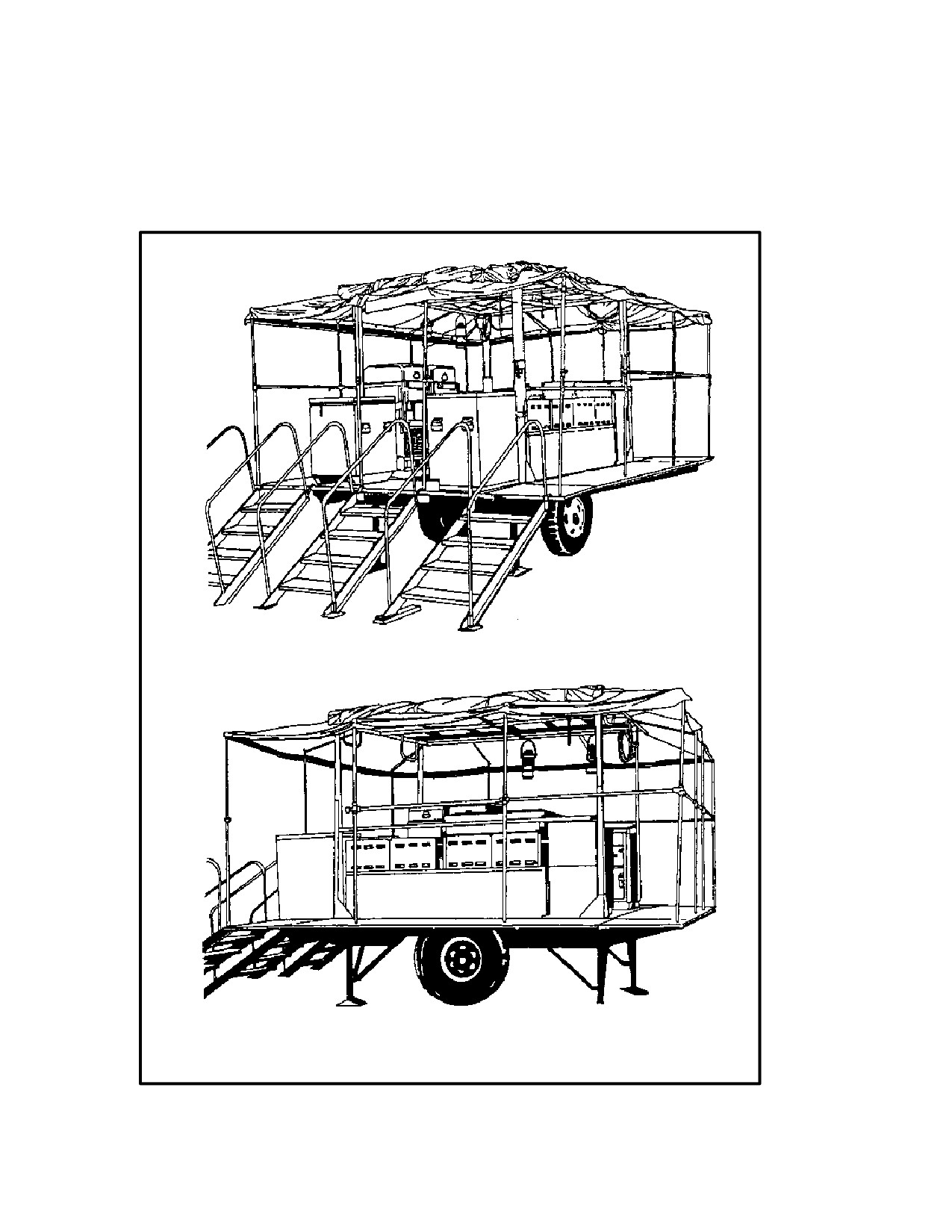
ton or 5-ton medium cargo truck. Figure 2-1 (page 2-12) shows a MKT. Use FM 10-23 for information on
cooking and serving meals on the kitchen trailer. The field kitchen enacts the following characteristics --
· Company food service personnel and the MKT. Remain with the company headquarters unless you,
the commander, need to dispatch your cook(s) to help feed your company element(s) or section(s)/ team(s).
· FSC element(s) or section(s)/team(s). Will normally be fed by the unit it is supporting.
The Army Field Feeding System. AFFS provides three quality meals a day to the soldier. These
meals consist of individual MRE, and group meals (T-, B-, and A-rations), or a combination of these
meals, including enhancements and supplements, or UGR B-rations and UGR A-rations along with
enhancements (for example, fresh fruits, vegetables, eggs, and bread). The T-ration is packaged in modules
with 18 or 36 meals to a module and 24 modules to a pallet. Each module contains all the components of a
meal, including condiments and disposal eating ware. UGRs will be used when the tactical situation permits
and refrigeration is available. Disposition of the field kitchen feature these aspects --
· Field kitchen supervisor. The food operations sergeant runs the field kitchen. He directs the company
cooks (food service personnel) on the daily field kitchen operations.
· Field kitchen operations. It will be performed IAW FM 10-23 and be developed into a kitchen SOP
(as part of the company’s TSOP) for food service mission operation. A daily meal production schedule
with written instructions is developed to supplement the field kitchen SOP. These instructions detail the
day-to-day and meal-by-meal basis of individual responsibilities, work procedures and standards. They
also give the acceptable kitchen methods to be used.
· Field kitchen meal cycle. It is urgent that the commander set up the meal cycle for the unit. This will
be determined by instructions from higher headquarters (S-4), supply availability, OPTEMPO, and most
importantly the unit’s METT-TC situation. The food operations sergeant must be given the appropriate
guidance in time to request rations for the unit. This will vary between 2 to 5 days in actual operation (and
to 60 days in a programmed training environment).
2-11
FM-42-414
Figure 2-1. Trailer-mounted field kitchen: front and side views
2-12
FM 42-414
Additional Field Feeding Requirements. Food service operations also require that provisions be
made for water, ice, refrigeration, and trash removal. These are explained next.
· Water. Water used in field feeding operations must be potable, unlike that which is used in the SLCR
teams. Water is picked up at an approved source and maintained in the field kitchen area in 400-gallon
water trailer(s) or 5-gallon cans. Water is inspected by a field sanitation team or supporting medical
elements. A good planning factor for water need in preparing food is to plan a requirement of 64 to 86 (an
average of 75) gallons per 100 soldiers per day. This includes water for beverages on the menu, but not for
refilling canteens or for personal sanitation. Refer to FM 10-23 for more information on food preparation
requirements. FM 10-52 gives information on individual water requirements.
· Ice. Ice is obtained through the ration break point; or, it may be obtained through HNS, or a
commercial source. All ice must be inspected for consumption or use; if trained veterinary personnel are
not available to inspect the ice, preventative medicine personnel may be required to do this. Ensure
inspections are done before accepting receipt of the shipment. Receipt of ice from a field ration break point
is inspected by the Class I officer; and, a final inspection on all received ice is done by the food operations
sergeant.
· Refrigeration. One of the determinations for how many and how often the A-ration is used is the
capability for refrigeration. The MKT does not have organic refrigeration capability, but does come with
an ice chest able to hold certain perishable items for up to 24 hours. A-ration meals will be determined by
available refrigeration. Therefore, in certain field operations, refrigeration may depend on host-nation
support.)
· Trash removal. FM 21-10 gives procedures for waste disposal. While the food service is a large
contributor to the problem, there are other parts of the unit that will generate trash. The commander needs
to determine actions to be taken to ensure federal, state, local, or host nation laws are abided regarding
trash disposal. These procedures should be put into the unit’s SOP/TSOP. It is very important to dispose of
all garbage properly to avoid leaving signature trails. If possible, make arrangements to back haul garbage.
UGRs come with plastic bags for waste disposal. Since garbage takes last priority on any vehicle, make the
bundles as small as possible by nesting items (for example: plates, cups, and empty tray packs) to take
minimal space.
2-13
FM 42-414
CHAPTER 3
*QUARTERMASTER FIELD SERVICE COMPANY, MODULAR:
SHOWER, LAUNDRY, AND CLOTHING REPAIR (SLCR) PLATOONS
This chapter is for the all company personnel.
(*NOTE: The functional performance measures of the FSC, designed in accordance to either
TOE 42414LO (FSC, DS) or TOE 10414L0 (FSC, M), is to provide required hygienic service support to
troops in the field. Unit entities of the FSC such as S/L, CR, and SLCR perform the same, basic field service
support operations (i.e. showers, laundry, and limited-clothing and textile repairs). The organizational
structure for these entities, though, may be fashioned differently as identified in Chapters 1 and 2. This
chapter will concentrate on operations performed by the SLCR platoons of the FSC, M. Mission actions of
the entities that make up the FSC, DS (i.e. S/L and CR sections) will mirror the SLCR sections/teams field
service applications. The FSC, DS will function in its present day TOE/MTOE organizational structure until
redesigned as the FSC, M.)
Section I
MISSION
PURPOSE OF SLCR OPERATIONS
The SLCR platoons provide command and control of personnel and equipment support in giving
warm showers, laundered clothing, and clothing repair service to soldiers in the field. These soldiers will be
provided at least one shower per week. Laundered clothing will consist of washing and returning to the
soldiers their own clothing with name tags, organizational patches, and skill badges. The concept of
individual “wash and return” laundry support allows each soldier to turn in 12 to 15 pounds of personal
laundry per week. Clothing and limited, lightweight textile repairs performed by the CR element are limited
to individual clothing of units being supported with shower and laundry services. Laundered clothing
includes necessary repairs that are returned to the supported personnel within 24 hours.
OPERATIONAL COMMAND STRUCTURE
The two SLCR platoons consist of a platoon headquarters and three SLCR sections or teams. See
Figure 1-1. SLCR sections/teams may be separately dispersed across the battlefield. They allow each team
to operate independently in support of approximately 500 troops per day or 3,500 troops per week or
collectively based on personnel strength or organizational elements to be supported. Each SLCR
section/team may be tasked organized to support a designated area or assigned unit(s). The supported unit
receiving SLCR services may be tasked by higher headquarters to provide meal support to SLCR
personnel.
Operational Command Structure. Command element personnel have certain responsibilities with
regard to field, mobile SLCR operations. These operations are a theater army or corps asset that is
assigned to the TAACOM or the COSCOM. Field services require close coordination between those who
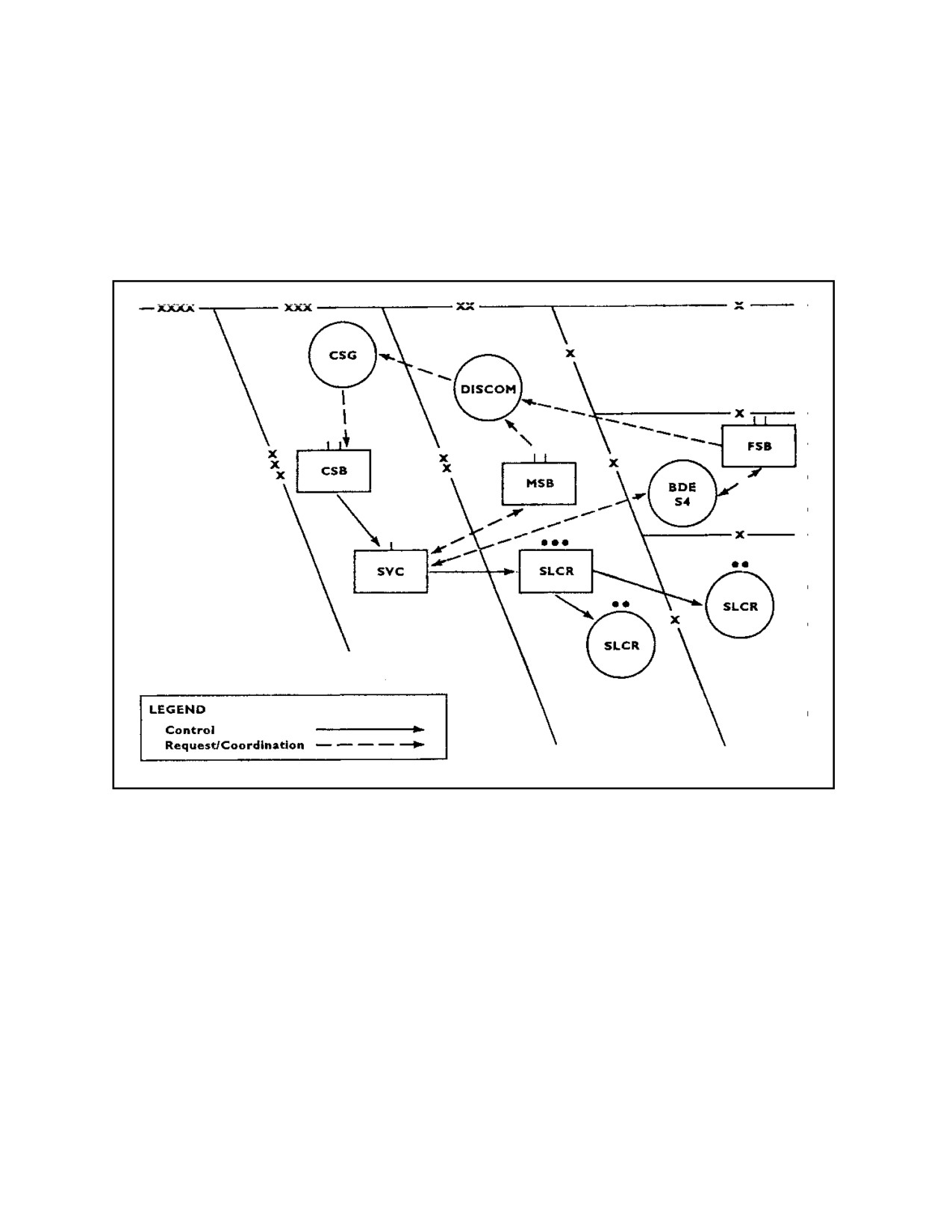
provide the support and those who receive it. See Figure 3-1 (page 3-2) for command and support channels
for SLCR sections/teams. These command elements’ responsibilities are --
3-1
FM 42-414
Theater Army. The TA provides overall command and control. It sets up priorities, assigns
missions, and allocates resources according to the TA commanders’ concept of operations.
Theater Army Area Commander. As set up by the TA, the TAACOM commander provides
service support to the units in its area of operations. The TAACOM ACofS, Services develops policies and
plans for the provision and the location of field services assets; and, to their divisional and non-divisional
units is one of service, cooperation, and assistance. The supported units coordinate their requirements
through logistical channels.
Figure 3-1. Command and support channels for SLCR sections/teams
Corps Support Commander. The COSCOM commander commands and controls assigned
and attached units. The COSCOM ACofS, Services, develops and plans for the provision and the location
of field service assets and their frequency of use. The COSCOM relationship with divisional and non-
divisional units is one of service, cooperation, and assistance. The supported units coordinate the
requirements through logistical channels. Detailed operational information is provided to these units in an
administrative logistics order.
Division Support Command Commander. The DISCOM commander commands and
controls organic and attached units of the DISCOM. The DISCOM SPO is the principal staff advisor to
the DISCOM commander in the field services area. The DISCOM commander advises division
commanders and staff about CSS operations throughout the division. The DISCOM support operations
section and MMC provide planning and coordination to ensure sustainment support for all division and
3-2
FM 42-414
attached units. The supported units coordinate their requirements through logistical channels. The following
personnel coordinate closely to provide SLCR operations:
· Supported unit logistics officer.
· COSCOM ACofS, Services.
· DISCOM SPO Officer.
· Supply officer of the MSB.
·
NOTE: Detailed SLCR operational information is provided to the supported unit in the administrative-
logistics order.
Battalion Operations Officer. The responsibility for SLCR services begins at the battalion
level where operations are planned, organized, controlled, and directed. The battalion operations officer
directs the following actions:
· Determines the general area for the site selection.
· Arranges with preventive medicine or water treatment specialists to test the water.
· Arranges for the distribution of water to operational sites if adequate fresh water is not available.
· Arranges for additional help as required for the setup of the site.
· Arranges for site personnel to have their meals with supported units, if required.
· Publishes the source of supplies to support operational requirements.
· Sets up SOP/TSOP that provide for reports and records.
· Sets up a battalion loading plan which incorporates the FSC’s transportation requirements.
· Coordinates with area units for environmental considerations.
· Coordinates with supported units to move and defend the operating sites.
· Coordinates release times, communications, and possible succeeding missions for the unit.
Company Commander and XO. The company commander delegates authority for mission
operations to the his XO, platoon leaders, and section/team leaders. If the company is operating as a
separate unit and not as an element of a battalion, then, the company commander may also have to perform
the duties of the battalion operations officer. The XO will help the CO in running the company’s
administrative areas. See Chapter 2, Section I for the duties of company headquarters elements. The CO
and/or XO direct the following actions:
· Gives orders and information on scheduling changes to platoon or section leader.
· Verifies that preventive medicine personnel or water treatment specialist personnel have checked the
water supply.
3-3
FM 42-414
· Coordinates with supported unit(s) for personnel to provide help with S/L operations.
· Ensures the coordination of meals and billeting for his troops with the supported unit.
· Inspects field operations periodically.
· Ensures requests for supplies are forwarded to the source of supply.
· Participates in battalion staff meetings and conferences.
Platoon Leader. The platoon leader coordinates platoon functions with other units. Based
on the platoon sergeant’s recommendations, he approves or disapproves selected sites. If there is doubt
about the water supply, then, he coordinates through the company to the battalion operations to get
preventive medicine personnel to test the water. He also plans for site security and coordinates this effort
through battalion operations. He prepares and maintains SLCR platoon’s status report and briefs CO/XO
on SLCR operations as required.
Platoon Sergeant. The platoon sergeant supervises and monitors SLCR platoon
operations; and, advises the chain of command (CO, XO, and platoon leader) on SLCR operations. The
platoon sergeant --
· Selects field sites for platoon headquarters.
· Supervises site selection for platoon operations.
· Prepares SOP/TSOP for platoon operations.
· Sets up training schedules for SLCR platoon training and monitors the training.
· Assists in preparing the SLCR platoon status report.
· Coordinates scheduling needs with supported units for the platoon sections/teams on SLCR activities.
· Inspects SLCR field sites.
· Consolidates SLCR administrative records/reports and supply requirements and forwards them through
chain-of-command channels.
· Makes sure that personnel receive meals, billets, and perform in area security.
· Assumes the platoon leader's duties in the absence of the platoon leader.
· Directs PMCS of platoon equipment.
SLCR Section/Team Chief. The section/team chief works under the supervision of the
SLCR platoon sergeant. The SLCR section/team chief --
· Provides input for the SOP/TSOP for SLCR operations.
3-4
FM 42-414
· Selects operating sites for SLCR section/team.
· Supervises the layout and setup of the site, which includes advising on and conducting operational
inspections; and, ensures the SLCR section/team is complying with environmental standards IAW
SOP/TSOP and guidelines/directives from higher headquarters.
· Reports to SLCR platoon sergeant/platoon leader on status of SLCR section’s/team’s operations, which
includes preparing (consolidating) and maintaining administrative records/reports.
Shower NCO. The shower NCO is supervised by the SLCR section/team chief. The
shower NCO supervises the day-to-day shower activities to include issuing daily shower work orders. He --
· Provides input for the SOP/TSOP for showering and delousing support operations.
· Assists on selecting operating site(s).
· Supervises the layout and setup of the site(s).
· Sets up shower and delousing equipment load plans.
· Enforces operational safety rules and precautionary measures to include executing environmental
standards.
· Develops and distributes the work schedules.
· Ensures that a separate shower schedule is set up for males and females.
· Notifies the SLCR section/team chief on any problem(s) regarding site operations.
· Prepares, maintains, and submits required records/reports to SLCR section/team chief.
· Determines shower supply requirements and forwards request(s) through supply support channels.
·· Obtains flooring materials for the building of duckboards or pallets for walkways and
shower tents. He supervises the construction.
·· Obtains materials for building storage bins and shelves as needed to expedite shower
operations. He supervises the construction.
· Coordinates with supported unit(s) personnel on delousing requirements.
· Coordinates with preventive medicine personnel to test water, if required.
· Inspects section’s/team’s equipment and supervises PMCS activities as needed.
· Ensures shower operations are being performed to standards.
· Conducts unit and individual training as required.
3-5
FM 42-414
Laundry NCO. The laundry NCO is supervised by the SLCR section/team chief. The
laundry NCO supervises the day-to-day laundry activities to include issuing daily laundry work orders.
He --
· Provides input to the SOP/TSOP for laundry operations.
· Assists on selecting operating site(s).
· Supervises the layout and setup of the site(s).
· Sets up laundry equipment load plans.
· Enforces operational safety rules and precautionary measures to include executing environmental
standards.
· Develops and distributes work schedules.
· Notifies the SLCR section/team chief on any problem(s) regarding site operations.
· Determines laundry supply requirements and forwards request(s) through supply support channels.
· Prepares, maintains, and submits required records/reports to SLCR section/team chief.
· Inspects section’s/team’s equipment and supervises PMCS activities as needed.
· Ensures laundered items are returned to appropriate personnel and/or organization(s) within 24 hours.
· Conducts unit/individual training as required.
Shower and Laundry Specialists. S/L specialists perform the day-to-day activity taskings
for S/L operations. They--
· Operate section equipment and perform PMCS.
· Perform shower and laundry operations.
NOTE: Under the supervision of shower personnel, the supported unit’s personnel may assist in the
following actions: set up and dismantle of shower point(s)/operations and delousing equipment; and,
conduct delousing operations. Supported unit’s personnel will be responsible for securing their unit’s
valuables during showering and delousing operations. Supported unit will coordinate for medical support
personnel in delousing operations.
· Perform required S/L reports, records, and inventory data.
Fabric Repair NCO. The fabric repair NCO works under the direct supervision of the
SLCR section/team chief. The fabric repair NCO supervises the day-to-day fabric repair activities and
issues daily (clothing and limited, light textiles) repair work orders. He--
3-6
FM 42-414
· Provides input for the SOP/TSOP for repair operations on clothing and limited, lightweight textiles.
· Assists on selecting operating site(s).
· Supervises the layout and the setup of the site(s).
· Sets up fabric repair, equipment load plans.
· Enforces operational safety rules and precautionary measures to include executing environmental
standards.
· Develops and distributes work schedules.
· Notifies the SLCR section/team chief on any problem(s) regarding site operations.
· Prepares, maintains, and submits required records/reports to SLCR section/team chief.
· Inspects section’s/team’s equipment and supervises PMCS activities as needed.
· Determines fabric repair supply requirements and forwards request(s) through supply support channels.
· Ensures repairs are performed to standards.
· Supervises pickup and receipt of repaired laundry and limited, lightweight textiles.
· Conducts unit/individual training as required.
Fabric Repair Specialists. Fabric repair specialists perform the day-to-day activity taskings
for repairing clothing and limited, lightweight textiles. They--
· Operate section equipment and perform PMCS.
· Make necessary repairs on clothing and (limited) lightweight textiles IAW TMs 10-8400-252-23 and
10-8400-203-23, FM 10-16, and SB 10-523.
· Perform required shop records, reports, and inventory data.
Site Selection Requirements. The mission assigned to the FSC by higher headquarters is the chief
consideration used in selecting a SLCR site for operations. (In most instances, the units that the laundry
site supports deliver and pick up their laundry and repair articles at the designated site. The units that the
shower site supports provide the trucks that are used to deliver the soldiers for shower operations.) The
SLCR site selection depends upon the mission. When possible, the SLCR site is located near the units or
the commands that are supported. The location should have plenty of clean water, proper drainage (gentle
sloping terrain), good roads, and natural cover and concealment.
Water Requirements. The S/L elements of the SLCR section/team must have an ample supply of
clean water, which can be non-potable. Each mobile laundry unit uses about 350 gallons of water per hour.
Each nine-head shower uses over 1,200 plus gallons of water per hour; the twelve-head shower uses over
3-7
FM 42-414
1,200 plus gallons of water per hour. LADS uses 240 gallons of water per 20-hour period. This water must
be as free from impurities as possible. Considerations for water include --
NOTE: The SLCR section/team chief must ensure that the wastewater does not pollute the water that is
used for drinking, cooking, and bathing.
· Water allotment. IAW AR 700-135, the office of the surgeon general requires that each soldier take a
shower and change clothes at least every seven days for health reasons, regardless of climatic conditions.
Laundry and shower requirements are based on this weekly cycle. The recommended water consumption
factor for hot, cold, or temperate climates is 6.5 gallons per soldier per day for laundering of clothing and 3
gallons per soldier per day for showers. As a rule, it takes 3 gallons of water for every pound of clothing
processed and a flow rate per shower head of 2.5 gallons per minute. Table 3-1 (pages 3-9 and 3-10)
shows the water planning data used for laundry and shower operations.
NOTE: Remember, S/L operations do not need potable water for normal operations in most climatic areas,
but the water must be disinfected. The water may require some treatment to remove foreign mater and
microorganisms. When non-potable water is used for showers, signs are posted warning soldiers not to
drink it. The Army water doctrine requires that potable water be used in an arid environment.
· Water acquisition. Currently, there is no standard form to request water for field laundries or showers.
Normally, the platoon sergeant or the section sergeant/team leader selects a site that has an abundant water
supply. In arid environments or where potable water must be supplied, the SLCR sections/teams coordinate
their potable water requirements with the FSC HQ, which coordinates through the battalion to the MMC.
Two water sites are always selected: one for immediate operations, the other for site relocation or
movement when required. Preventive medicine personnel must test water for purity. If the water is not clean
enough to drink, SLCR personnel must post signs telling troops not to drink it. Potable and disinfected non-
potable water will be used through the shower units at different times. Non-potable fresh water can be used
to operate the laundry unit. The degree of treatment of this raw water depends on its condition. The Army
water purification units use four water treatment processes to treat raw water: coagulation and flocculation,
filtration, reverse osmosis, and disinfection. See TB MED 577 and FM 10-52-1 for water treatment
measures.
3-8

FM 42-414
Table 3-1. Laundry and shower planning data
LAUNDRY WATER PLANNING DATA
A
B
C
D
E
F
Gallons
Pounds
Gallons
Pounds
Pounds
Gallons
Per
Per
Per
Per
Per
Per
Load
Load
Pound
Soldier/Week
Soldier/Day
Soldier/Day
(A/B)
(D/7)
(C x E)
180
60
3
15
2.14
6.42
NINE-HEAD SHOWER WATER PLANNING DATA
A
B
C
D
E
F
Minutes
Cycles
Soldiers
Soldiers
Usage**
Showers
Per
Per
Per
Per
Factor
Per
Shower
Hour
Cycle
Hour
Hour
(60/7)
(B x C)
(D x E)
7
8.6
9
77.4*
.70 Division
54
.85 Corps
66
.90 COMMZ
70
G
H
I
Gallons
Gallons
Gallons
Per
Per
Per
Hour
Soldier/Week
Soldier/Day
(Equipment)
(G/F)
(H/7)
1,200
22.20 Division
3.20 Division
18.20 Corps
2.60 Corps
17.10 COMMZ
2.50 COMMZ
*The
77.4 showers per hour assumes a constant flow of traffic where nine persons would
instantaneously replace the persons using the showers without any break in the sequence.
3-9

FM 42-414
**The usage factor is based on unscheduled maintenance, late troop arrival, and working requirements
of the supported unit.
Table 3-1. Laundry and shower planning data (continued)
TWELVE-HEAD SHOWER WATER PLANNING DATA
A
B
C
D
E
F
Minutes
Cycles
Soldiers
Soldiers
Usage**
Showers
Per
Per
Per
Per
Factor
Per
Shower
Hour
Cycle
Hour
Hour
(60/7)
(B x C)
(D x E)
7
8.6
12
103.2*
.70 Division
72
.85 Corps
88
.90 COMMZ
93
G
H
I
Gallons
Gallons
Gallons
Per
Per
Per
Hour
Soldier/Week
Soldier/Day
(Equipment)
(G/F)
(H/7)
1,200
16.70 Division
2.30 Division
13.60 Corps
1.90 Corps
12.90 COMMZ
1.80 COMMZ
*The 103.2 showers per hour assumes a constant flow of traffic where twelve persons would
instantaneously replace the persons using the showers without any break in the sequence.
**The usage factor is based on unscheduled maintenance, late troop arrival, and working requirements
of the supported unit.
· Water areas. The following measures are taken for water use and acquisition.
·· Areas in towns and cities. Towns and cities usually have a water system which can support
operations. SLCR sections/teams use this system when it is available.
·· Areas without fresh water. When SLCR sections/teams operate in an area without a supply
of fresh water, the 3,000-gallon collapsible water tank can be used. Delivery of water must be coordinated
through supporting water transportation teams or the supported unit.
3-10
FM 42-414
·· Areas with hard water. When the field laundry is in a hard water area, it is important to use
the proper type and amount of detergent.
Fuel Supply. Proper planning and coordination of fuel support through supply channels are
required if operations are to start up immediately on arrival at a site. Table 3-2 gives the hourly planning
requirements for each piece of SLCR equipment.
Table 3-2. SLCR fuel planning data
Gallons Per
Type Of
Component
Hour
Fuel
10-KW Generator
1.09
Diesel
M85 Water Heater
2.50
Diesel
Dryer
2.10
Diesel
3-KW Generator
0.84
MOGAS
5-KW Generator
0.57
Diesel
M80 Water Heater
2.50
Diesel
Delouser
0.35
MOGAS
Terrain. The SLCR section/team chief must choose a firm, sloping, and well-drained area that will
support the SLCR equipment and the vehicles in any weather. He must allow enough space for tents,
vehicle parking, and vehicle turn-around area.
Roads. The SLCR section/team chief selects a site that is near a traveled road or road network so
that SLCR services are available to supported units. Inside the operating site, there must be enough space
for parking vehicles, room for the vehicles to turn around, and room for handling the numbers of soldiers at
the site at any one time. The SLCR section/team chief plans the layout for roads in the area so that vehicles
can get to the required place and out again. A one-way traffic flow is usually the best, especially, when
there are blackout or restricted light conditions.
Cover And Concealment. A site is selected which provides natural protection from air or ground
attack. Camouflage screens and nets are used to conceal the operational site. If camouflage screens and
nets are not available, natural camouflage is used, such as tree limbs or shrubbery. A protected slope or
grove of trees makes for a good windbreak. The SLCR section/team chief should also think about using
available buildings for operations, taking advantage of road systems, and blending into built-up areas. The
SLCR section/team chief pays particular attention as to where wash water drains, as this could draw
attention to the operational areas.
NOTE: Seasonal (environmental) and artificial camouflage will best protect the SCLR operational area(s)
against attack. These types of camouflage are checked periodically for wear and tear, decay (especially for
natural camouflage materials), and replaced often or as needed.
3-11
FM 42-414
Layout and Setup of SLCR Section/Team Elements. After a site is selected, you must lay out and
set up your equipment. Think about layout planning, workflow planning, and equipment setup for --
Laundry Element. The work area and the bivouac area should take advantage of all natural
and artificial concealment elements. Take these measures:
· Layout planning. It is sometimes necessary to have two or more SLCR sections/teams in the same
place to provide the required support for a command or organization. Suggested layouts for a single
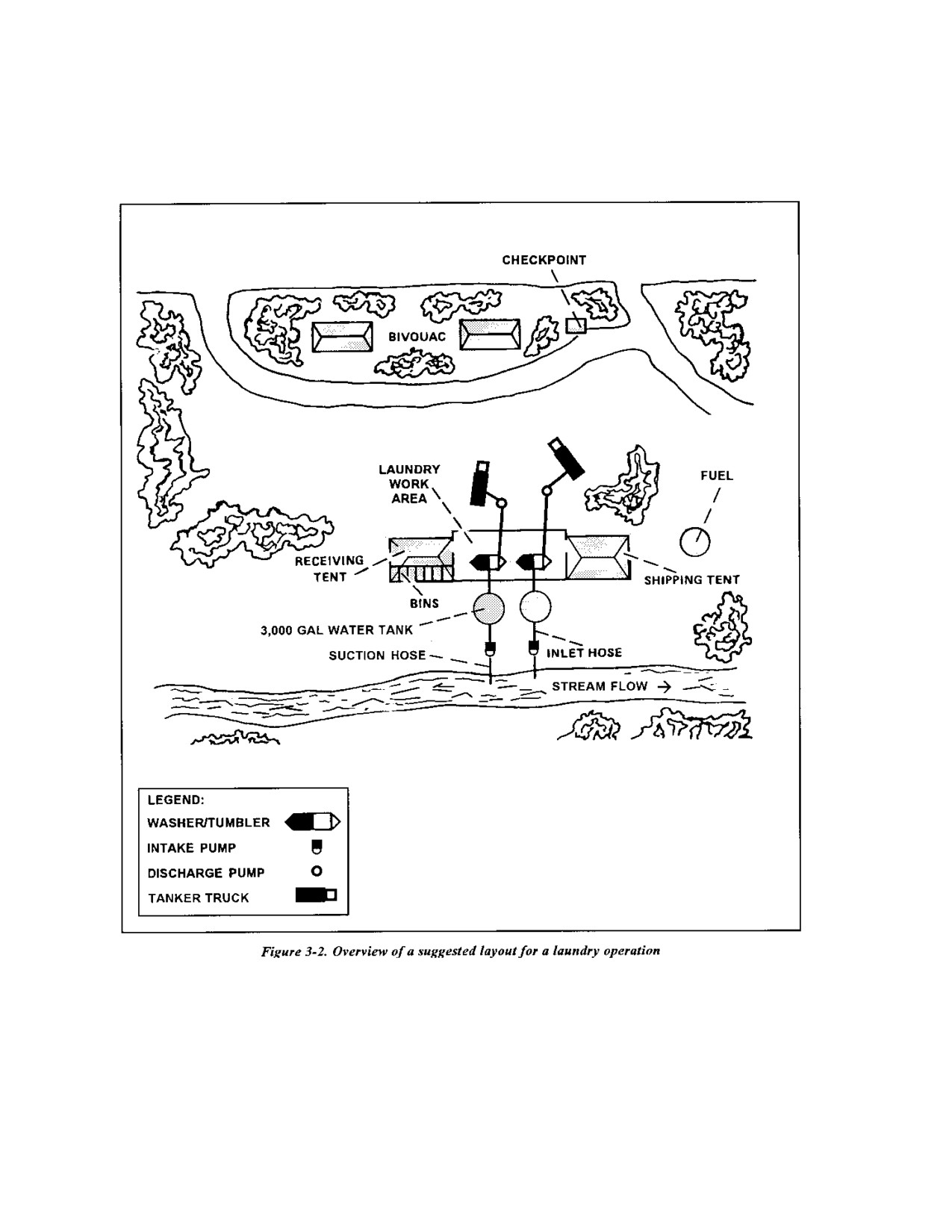
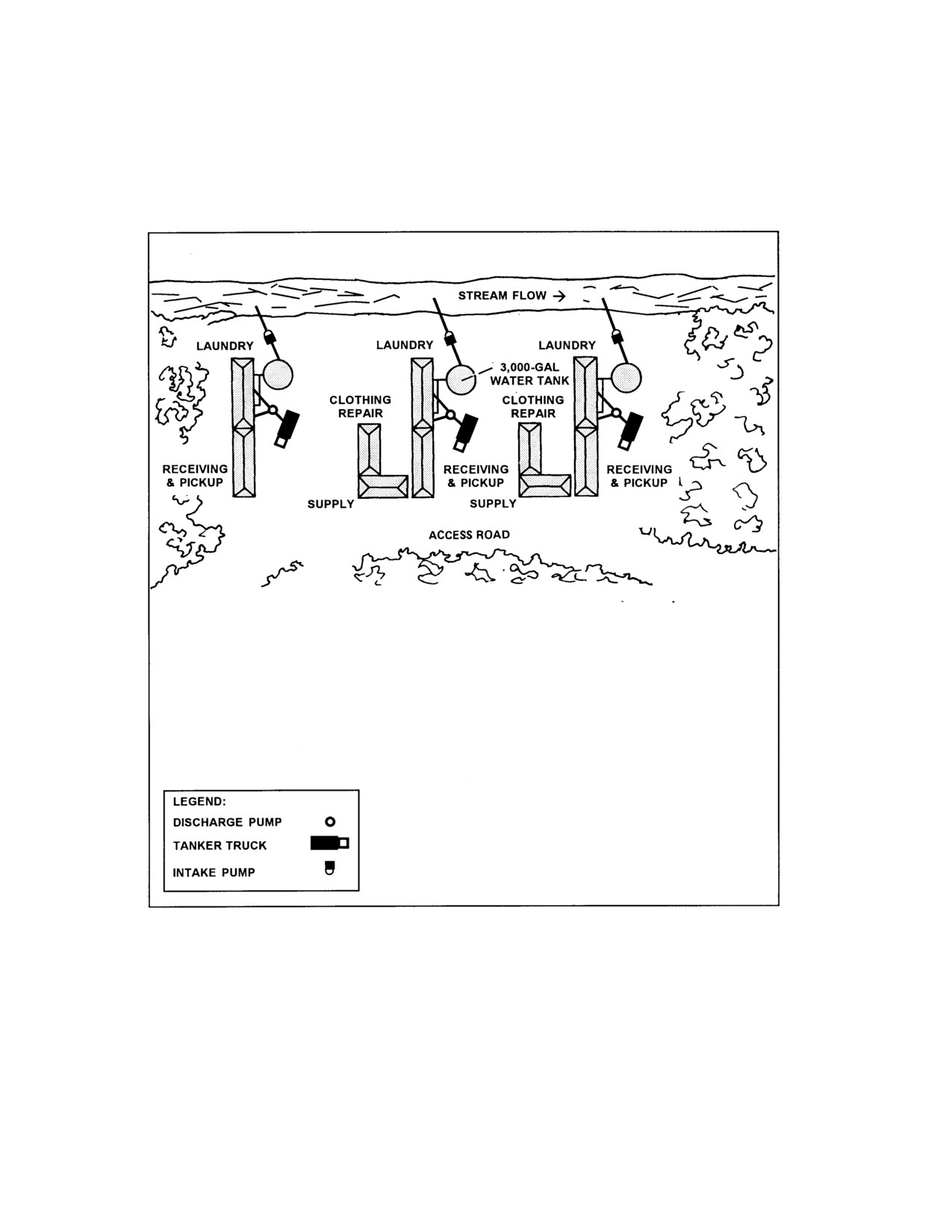
laundry element and for two or more laundry elements, including operational equipment and set up, are
shown in Figures 3-2, 3-3, 3-4, and 3-5 (pages 3-12 through 3-15). Depending upon METTC-TC and
higher headquarters guidance, the shower and/or laundry elements for either TOE 42414L0 or 10414L0
may be utilized separate from each other. (The requirement ,though, is to have the SLCR section/team to
perform as a whole unit entity.) Note these planing consideration areas:
·· Receiving and shipping area. Set up separate tents for receiving and shipping
operations, when possible. Separating the two operations prevents crowding and confusion. Place tents so
that they can be reached easily for delivering or picking up laundry. Ensure that the traffic flow pattern
allows this. However, one GP large tent or a 48- by 20-foot TEMPER may be used to combine these two
operations together into a single operating site.
·· Laundry work area. The laundry work area should be set up next to the shipping and
receiving tent. For the M-85 series equipped unit, a GP large tent is ideal for the work area since it can
accommodate two laundry trailers. If the TEMPER is being used, add on to its structure.
NOTE: LADS will not fit within a GP large tent. LADS is being constructed to withstand the effects of
exposure, and options are being considered for the use of a shelter system with LADS.
·· Bivouac area. Normally, a GP medium tent or compatible TEMPER is used to billet
laundry personnel.
· Work flow planning. The laundry NCO plans the work flow. He plans for bulk and/or individual
laundry. He bases his plans on the following considerations.
·· Receiving area. The receiving area is where soiled laundry is delivered. The soiled
laundry is processed and sent to the wash and dry area.
·· Laundry work area. The laundry is washed, extracted, and dried in this area. Upon
completion, it is sent to the shipping (pickup) area.
·· Shipping area. The laundry is processed for delivery to the supported unit; or,
because of METT-TC conditions, the supported unit will come back for its pickup.
· Setup of equipment. Mobile laundry units must be placed in position before the GP large tent or
TEMPER that is used for the laundry work area is set up. Some components are stored or mounted on the
mobile laundry unit for shipment and storage. During use, remove stored components from the mobile
3-12
FM 42-414
laundry unit. Ensure that water supply, water drainage, and electrical connections are considered when the
mobile laundry units are positioned. For all setup, operational, and maintenance procedures for your
specific mobile laundry unit, use the FMs 10-3510-209-10, 10-3510-220-10, or 10-3510-222-10.
(NOTE: Figure 3-2 depicts laundry operations under TOE 42414L0.)
3-13
FM 42-414
Figure 3-3. Overview of a suggested layout for two or more laundry operations
(NOTE: Figure 3-3 depicts laundry operations under TOE 42414L0.)
3-14
FM 42-414
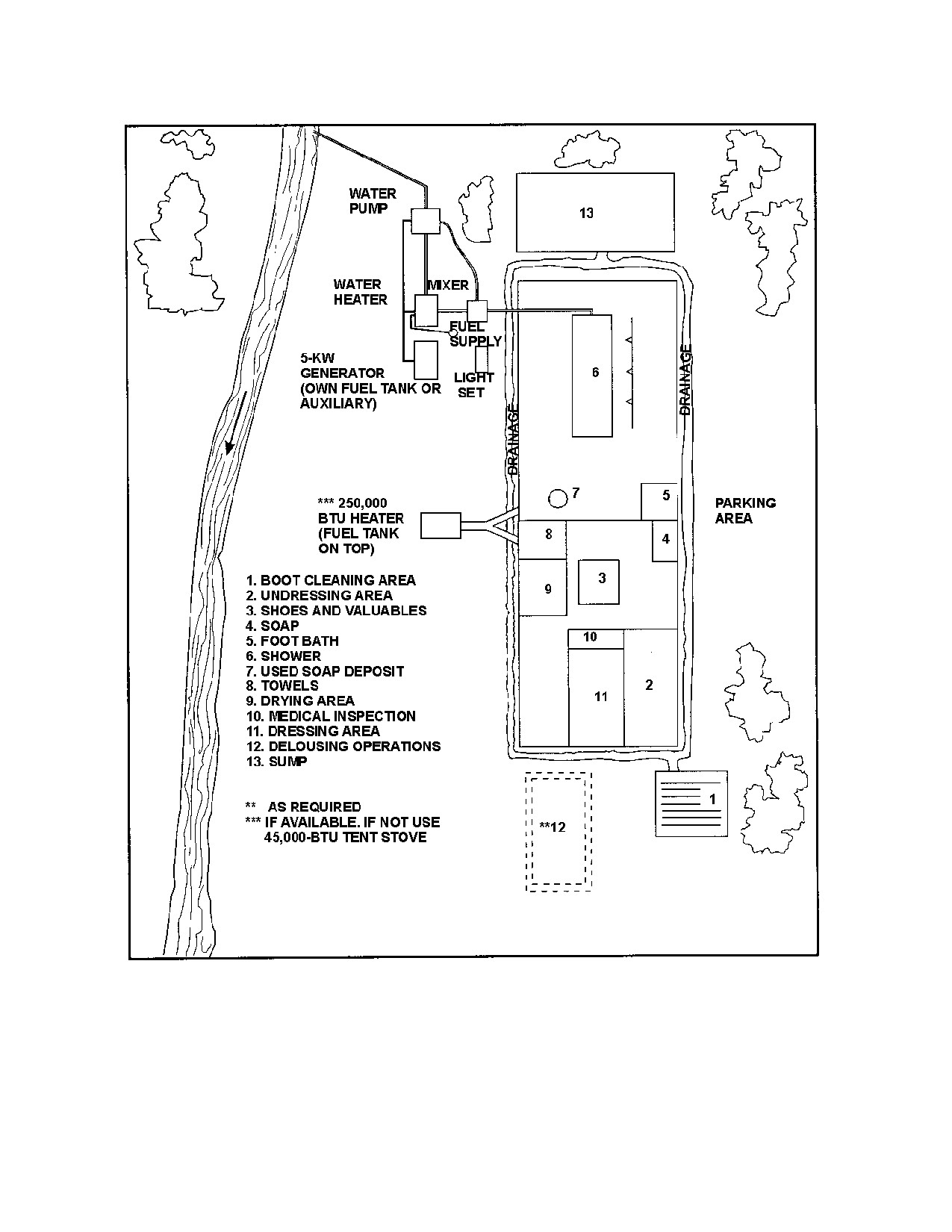
Figure 3-4. Suggested shower layout
(NOTE: Placement description #4 is a soap dispensing/disposal or storage area. A required soap area is
needed for those personnel who did not bring their required washing soap to shower tent or for those
disposing their used soap.)
3-15
FM 42-414
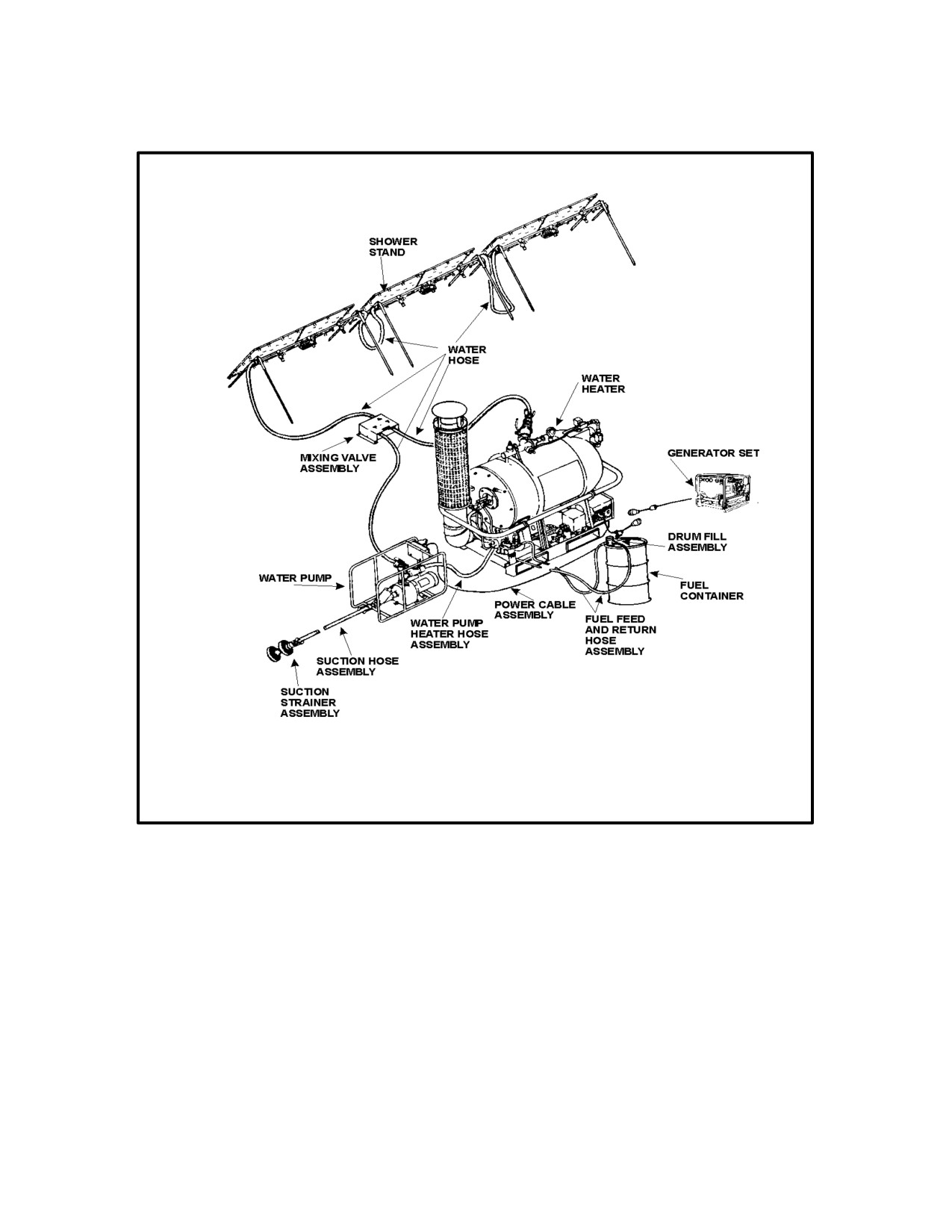
Figure 3-5. Shower equipment setup - nine-head shower unit
3-16
FM 42-414
Clothing and Limited, Lightweight Textile Repair Element. The work and bivouac areas of
the CR element should take advantage of all natural and artificial cover and concealment factors. The
following measures are taken:
· Layout planning. Collocate the fabric repair element with the laundry element. Most items for fabric
repairs have to be laundered before being repaired.
·· Shop operations area. Set up of the clothing and repair operations is co-located in the
receiving and shipping tent(s).
·· Bivouac area. Normally, use a GP medium tent or compatible TEMPER tent to billet
fabric repair personnel.
· Work flow planning. Normally, one end of the fabric repair tent is selected as the receiving area. This
is where the customer delivers items for repair. The middle portion of the tent is selected as the repair work
area. This is where the sewing machines are set up. The other end of the tent is selected as the shipping
(pickup) area. This is where the finished items are inspected and processed for return to the customer.
· Set up of equipment. Ensure that laundry carts can maneuver between the sewing machines and in the
center aisle. Consider the electrical connections when the sewing machines are being positioned.
S/L Elements. The work areas (applicable to SLCR activities, too) and the bivouac areas
should take advantage of all natural and artificial camouflage elements. Take these collocated, AO
measures:
· Layout planning. Sometimes, it is necessary to set up two or more S/L “subsections/teams” in the
same place to provide the required support for a command or organization. These elements can operate as a
separate “entity” section or as a combined S/L “entity” section (under TOE 42414L0). Suggested layouts
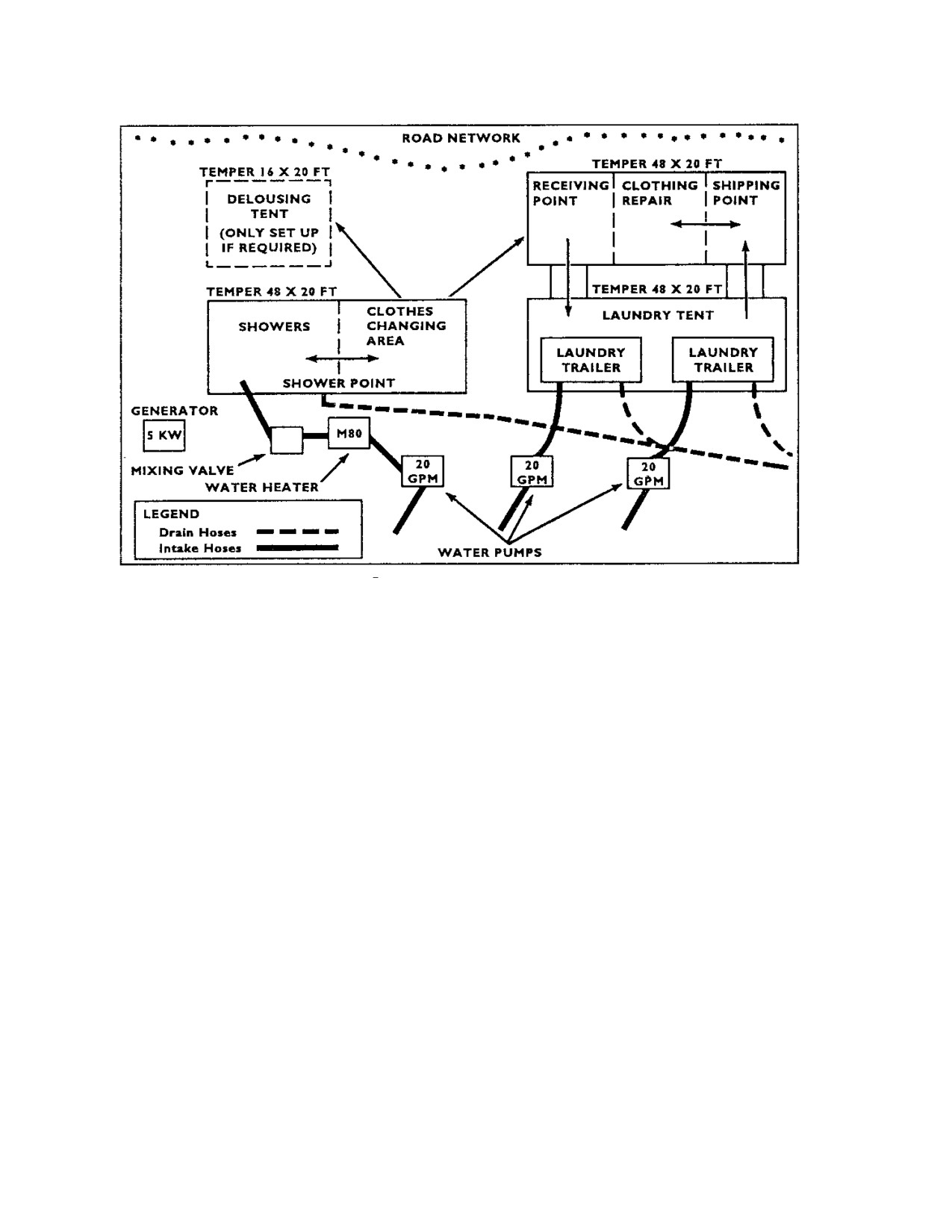
for a single S/L section and for two or more S/L sections are shown in Figures 3-6 and 3-7 (pages 3-18 and
3-19). This requirement may be required for the S/L element of the SLCR section/team, depending on
higher headquarters directive and influence of METT-TC.
· Work flow planning. The shower NCO and laundry NCO will coordinate their plans for proper work
flow processing. They base their plans on mission requirements. The mission may call for a shower only
operation or for a S/L operation. Delousing support operations must be planned, if needed. If delousing is
required, then, a separate tent must be used for the delousing mission.
·· Shower layout. Each shower setup requires two GP medium tents or one 48- by 20-
foot TEMPER tent. An additional GP medium tent or one 16- by 20-foot TEMPER is required to support
the delousing operation.
·· S/L collocation layout. Each S/L setup requires GP medium tents or necessary
TEMPER or modular tents. These GP tents or TEMPER/modular tents are joined together. Two GP
medium tents or one 48- by 20-foot TEMPER will support showering and clothes changing needs. Laundry
operations will be set up in either one GP large tent or one 48- by 20-foot TEMPER. Refer to Figure 3-7
(page 3-19) for layout scheme.
3-17
FM 42-414
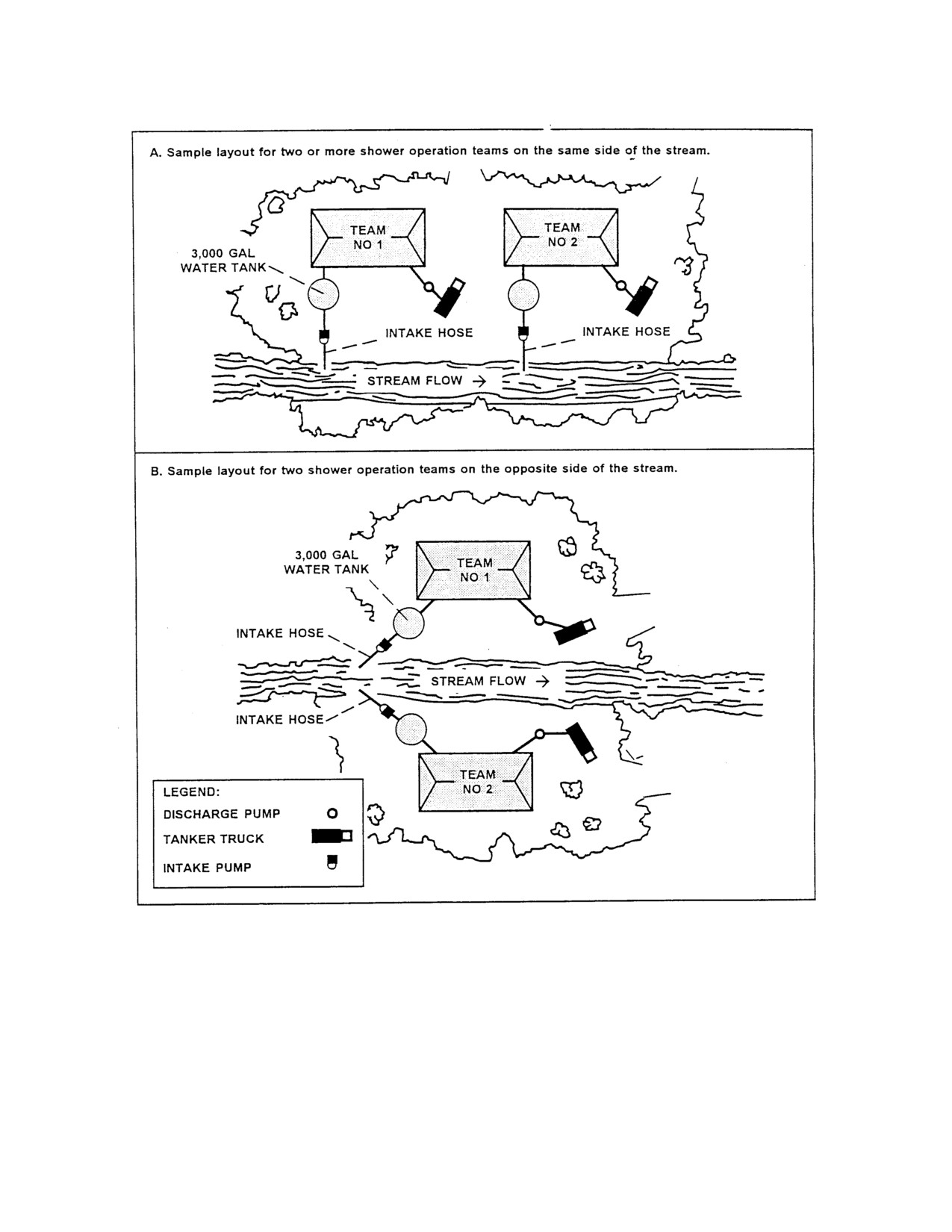
Figure 3-6. Shower layouts
(NOTE: Figure 3-6 depicts shower operations under TOE 42414L0.)
3-18
FM 42-414
Figure 3-7. Suggested composite site layout for one SLCR section/team operations under TOE 10414L0
· Setup of equipment. Locate the water pump no more than 10 meters from the water source. Locate all
equipment to support the shower operations outside the tent on the same side. This eases operation, PMCS,
and the monitoring of equipment during operations.
· Drainage system. Dig a ditch to carry wastewater to a point that is downstream from the intake hose.
Ensure that the drainage ditch runs completely around the shower area. If rules for protecting the
environment do not allow used water to go into the stream or into the ground, then, the commander,
according to AR 700-135, must check with the local environmental agency that has jurisdiction over the
area of operations. The environmental agency will give instructions concerning the proper disposition of the
water.
SLCR PLATOON HEADQUARTERS FUNCTION
Platoon headquarters serves as the command and control element of the SLCR sections/teams. Its
functions consist of supervising, directing, and coordinating showers, laundry, and clothing limited,
lightweight textiles repair operations for supporting elements and the FSC itself. The platoon sergeant's
duties, as supervisor of platoon SLCR operations, are to--
· Determine mission requirements.
· Prepare OPLANS.
· Set up and monitor platoon and SLCR sections’/teams’ training and preventative maintenance
procedures.
3-19
FM 42-414
· Consolidate SLCR sections’/teams’ production reports and schedules.
The platoon headquarters functional requirements consider --
POL Requirements. Planning guides and factors are available that give fuel consumption rates for
estimating petroleum requirements for generators, heating equipment, pumping equipment, and wheeled
vehicles. This information is provided in an automated POL software package. The OPLOGPLN is
obtainable from Commander, US ARMY CASCOM, Directorate of Combat Developments for Combat
Service Support, ATTN: Planning Factors Branch (ATCL-CFP), 3901 A Avenue, Suite 220, Fort lee, VA
23801-1809. You may E-mail for them at OPLOGPLN@LEE-DSN1.ARMY.MIL. Ensure you include
your return address on all correspondence methods used. Planning factors may also be obtained in FMs 10-
13 and 101-10-1.
Personnel Requirements. The achievement of the SLCR platoon’s mission is of the utmost
importance to the overall company mission. However, if the SLCR platoon personnel are not provided with
their basic needs, the mission cannot be met. The platoon leader ensures that his soldiers are being fed and
that they are being provided with suitable living quarters. He ensures that enough personnel are available to
secure the defense of the platoon area. Note the following measures:
· Billeting. The TOE shows the number of personnel authorized for setting up the SLCR platoon. Using
this number of personnel, the platoon sergeant and/or SLCR team/section chief calculates the tentage
requirements by referring to TM 10-8340-211-13. This TM gives the square footage for tents so that the
number of soldiers per tent can be computed. Use TM 10-8340-224-23P for modular, extendable tent or
TM 10-5410-229-14 for the TEMPER tent requirements. The allotted foot space per soldier for fixed
military billeting facilities/barracks is in AR 210-50.
· Meals. The platoon sergeant and/or SLCR section/team chief informs higher headquarters of the names
of soldiers to be fed (for accountability) and meal requirements. He tells the soldiers of the mealtimes and
locations. The platoon sergeant and/or SLCR section/team chief computes meal requirements as follows:
NUMBER OF SOLDIERS x 3 MEALS PER DAY x
NUMBER OF DAYS OPERATING = MEAL REQUIREMENTS
· Security. The platoon sergeant and/or SLCR section/team chief determines the number of soldiers
needed to secure the platoon/section/team area(s) as directed by higher headquarters. Either is responsible
for selecting soldiers for guard duty and for briefing them on their responsibilities and duties. Occasionally,
the supporting unit provides the security guards.
· OPLANS. The purpose, content, and format of OPLANS are given in FM 101-5. OPLANS contain the
following information:
·· Situation.
·· Mission.
·· Assignment of tasks.
3-20
FM 42-414
·· Support and assistance to be provided. Additional requirement considerations
include --
··· Site selection and supply requirements must be determined before the
OPLANS are prepared.
··· The size of the platoon or section/team and the amount of assigned
equipment determine the number of soldiers required to set up a SLCR site. See
TMs 10-8340-211-13, 10-5410-229-14, or 10-8340-224-23P for the number of
soldiers required to pitch your specific tents.
Platoon Training. The SLCR platoon sergeant and section/team NCOs set up a training schedule
for equipment training, ARTEPs/MTPs, and common task training. The platoon sergeant conducts periodic
checks on the training to ensure that it is based on current doctrine. He also is the master trainer of junior
sergeants of the platoon. He is directly responsible for all they do or fail to do. The platoon sergeant
personally trains and checks them to see that they are fully trained in their duties. Section/team NCOs train
their subordinates to perform collective/individual tasks to prescribed standards.
Preventive Maintenance Programs. The platoon sergeant prepares a schedule for SLCR preventive
maintenance activities. The schedule is monitored to ensure that the preventive maintenance is performed
according to the appropriate TMs. DA Form 2404 is checked for completeness and correctness and for the
reporting of non-repairable deficiencies to organizational maintenance. The platoon sergeant periodically
checks the platoon equipment to ensure that all deficiencies not corrected by the operator have been
recorded. DD Form 1970 is periodically checked for completeness and correctness. The platoon sergeant
checks the REMARKS column of DD Form 1970 to ensure that fuel and oil were added to the equipment
at appropriate maintenance intervals. Detailed instructions for filling out DA Form 2404 and DD Form
1970 are in DA Pamphlet 738-750. The platoon sergeant reviews the following forms to ensure that
equipment is scheduled for services: DD Form 314, DA Form 2405, DA Form 2406, and DA Form 2407.
More information on these forms is in DA Pamphlet 738-750. Use unit maintenance procedures on the
M85-series laundry unit as prescribed in TMs 10-3510-209-24, 10-3510-220-10, and 10-3520-222-10; for
showers use TM 10-4510-206-14 (nine-head) and
TO 50D1-3-1 (twelve-head); and, use TM 10-
3530-207-14 for the trailer mounted, clothing repair shop.
Production Reports. Each SLCR element prepares daily production reports. The SLCR platoon
sergeant consolidates these reports upon receipt from the SLCR section/team chiefs. He then submits them
to higher headquarters. The SLCR platoon sergeant receives information from the supporting unit on the
number of male and female soldiers scheduled for SLCR activities so that a time schedule can be prepared.
He informs higher headquarters and supporting units of the SLCR hours of operation and location. The
following report forms are used.
· DA Form 4765-R. The front of this form is used to record operating personnel and hours of operations.
The reverse is used to record the amount of laundry processed and the types of supplies used.
· DA Form 4766-R. Pending a revision and name change to this form, the front of this form will only be
used to record units served, number of personnel processed, processing times, and types of supplies used.
The backside to this form will not be used, since clothing exchange operations are no longer applicable.
Refer to Table 2-3 for other forms that can be used.
3-21
FM 42-414
COMMUNICATIONS
Refer to Chapter 1, Figures 1-2 and 1-3 for proposed wire net and radio system for FSC and its
SLCR platoons and section/team elements. Use the same C2 procedures to set up your communications net
as identified in the TSOP and directions or orders received from higher headquarters. Also, see
FM
100-6 on information operations. Use FMs 24-1, 24-19, and 24-35 for conducting information
communication capabilities and procedures.
Section II
SHOWER SECTION
ORGANIZATION FOR OPERATIONS
Shower personnel will meet the needs of supported units by providing warm showers. This service
helps to provide a hygienic need and a moral uplift to the soldier in the field. Shower capabilities and
operations are explained next.
Capabilities. The shower operational element has the following attributes:
· Under TOE 10414L0, shower element consists of ten shower specialists. This section works 10 hours a
day. If the 9-head shower system is used, it provides shower service for 500 soldiers a day. If the 12-head
shower system is used, it services 750 soldiers a day. The shower element in the SLCR section/team
configuration may be set up at a fixed site, based on required support needed. Under TOE 42414L0,
shower element consists of three shower specialist. Each shower section works 10 hours a day, providing
shower service for approximately 18, 500 per week at the rate of one shower per man per week. The
shower element may be setup at a fixed site or moves from time to time to provide services to troops in
forward areas.
· Prior coordination through support channels and conditions of METT-TC determine the next location
for both FSC, M and FSC, DS. Shower elements under TOE 42414L0 serving non-divisional elements
usually set up and operate at a site in a corps or theater army area.
· Shower elements may be attached to a division or a corps and may furnish services to units of less than
company size. They may also be used to increase the capabilities of fixed-strength shower and laundry
elements.
Shower and Laundry Operational Concept. S/L operational concept consist of the following
actions:
· Supported personnel will arrive at the shower point with their dirty laundry and a change of clothing to
wear after they shower. After showering, they will go to the laundry point and turn in up to 15 pounds of
dirty clothing (TOE 10414L0). (Under TOE 42414L0, the requirement exists for turning in only 7.9
pounds of dirty clothing.) The soldiers place their dirty clothing in mesh bags: one mesh bag for the
soldier’s BDUs and laundry bag, and one for his socks, T-shirts, and underwear. Under TOE 10414L0,
3-22
FM 42-414
mesh bags will only be used in containing the dirty laundry. Mesh bags will be identified and secured by
one or more of the following methods:
·· Mesh bags will be identified by pre-stamped number(s) on the outside of the bag.
or
·· If the mesh bag has a draw string, the current Army numbered laundry pin set will
be used. Mesh bags will be identified and secured with two numbered laundry pins.
·· Mesh bags without a draw string will be secured using the US Air Force pin system.
This system uses a very large pin to secure the mesh bag so contents do not spill out.
Check CTA 50-970 for ordering required pins.
NOTE: Under TOE 42414L0 (QM FSC, DS), the “mesh bag system” is not used. The standard US Army
“pin numbering system” is still to be used. Under TOE 10414L0, QM FSC, M will make use of the “mesh
bag system.” Under each TOE (10414L0 and 42414L0), required administrative records and reports
keeping is prepared and maintained as needed.
· Clothing needing repair will be identified when turned in for cleaning.
· The dirty clothing is laundered, repaired (if needed), and returned to the supported unit or soldier within
24 hours. If supported unit or soldiers are moved out of the SLCR area before the 24-hour turnaround time,
coordination may be made with the supported unit for pickup. Or, the SLCR section/team uses its unit
vehicles to deliver clean and repaired individual laundry to the supported unit or battalion S4 area as it
depends on METT-TC.
· When medical personnel determine that mass delousing is required, a delousing station is set up. It's
manned by supported unit personnel, under the supervision of shower point personnel. Shower personnel
will train the supported unit's personnel how to set up, operate, and dismantle the delousing equipment. A
medical representative must be present during mass delousing operations. The supported unit coordinates
the presence of medical personnel with their supporting medical facility. More details on delousing
operations will be explained later in this chapter.
NOTE: Delousing operation, when required, is performed with shower operation.
SHOWER EQUIPMENT SETUP
Depending on METT-TC and/or higher headquarters directives, two or more SLCR sections/teams
(or S/L elements under TOE 42414L0) may be located together to provide the needed services. When fresh
or potable water must be brought in by water tank trucks or by POL tanks that have been flushed out for
water use, the water is stored in 3,000-gallon fabric collapsible tanks. The section/team NCO changes his
layout plan to allow plenty of room for the 3,000-gallon tank or tanks. The pump works the same way with
water from a tank as it does with water from a stream. The shower element, usually collocated near the
laundry element, establishes its set up based on these features:
S/L Points. When two or more S/L points operate in the same area, the section/team chief or the
section/team NCO(s) must be sure the intake hoses are located at about the same point. See Figure 3-6 for
shower layout diagrams. If the two “teams” are on opposite sides of the same stream, the intake hoses and
3-23
FM 42-414
drainage ditches are located at about the same points. (Under TOE 42414L0, laundry platoons stay in the
company area, and the shower “teams” deploy forward.)
NOTE: In conjunction with showering when delousing operations need to be done, requiring power
equipment, a GP medium tent or a 16- by 20-foot TEMPER tent can be requested. Delousing should not
take place in the tents where soldiers are undressing, showering, or dressing. Soldiers should be fumigated
outside in good weather when there is no wind. However, if there is bad weather, fumigating should take
place in a separate tent.
Shower Element. When the shower element arrives at the operating site, the driver backs the 2 1/2-
ton truck as close as possible to where the equipment will be placed. The tents are unloaded first and set
up. Then, the duck-boards are placed in the tents for flooring. Use Figure 3-5 as a guide for positioning
shower equipment. The water pump, water heater, and generator must be placed on level ground.
NOTE: A plate mounted on the water heater gives pre-operation, during-operation, and post-operation
instructions. TM 10-4510-206-14 for your shower unit is kept in a canvas pocket attached to the generator.
See this TM for set up and operational data on the shower equipment. Equipment setup envolves --
· Water pump setup. To set up the water pump, shower personnel follow these steps:
·· Connect the suction hose strainer to the male end of the 25-foot, 1-inch water hose.
Secure the coupling locking levers.
CAUTION
To prevent equipment damage, ensure that hose couplings are free of dirt or
foreign matter and that coupling gaskets are in place before coupling hoses.
·· Connect female end of water hose to water pump suction port.
·· Place water pump on level surface about 20 feet from water source> Ensure suction
lift does not exceed 15 feet.
·· Place suction hose assembly and strainer into water source using one of two methods:
··· Place strainer on mound of stones or gravel and make large piles of stones
upstream from strainer to divert debris from strainer.
··· Build a tripod made of tree branches, saplings, timber, or some type of
construction material and suspend strainer from tripod. Build a barrier using tree
branches or some type of construction material upstream from strainer to prevent
leaves, weeds, or other debris from entering the strainer.
NOTE: Since the “new” strainer has a disk-like format, there may not be a need to construct piles of
stones or gravel or tripod. See TM 10-4510-206-14 as needed.
3-24
FM 42-414
· Shower stand setup. To set up the shower stand, shower personnel take the following steps:
·· Personnel assemble each shower stand by inserting the four legs into the sleeves of
each riser. Erected shower stand is about 20 feet from the mixing valve. Connected
sections of shower stand are done by using the 7 1/2-foot, 1-inch water hose.
·· A cap is placed on the shower stand end connector. See TM 10-4510-206-14 for
more details on setting up the shower unit. See Figure 3-5 for diagram on shower
equipment setup.
·· Before operations start, signs are posted to alert soldiers not to brush their teeth or
rinse their mouths in the shower.
· Water heater setup. To set up the water heater, shower personnel take the following steps:
·· Place the water heater on level ground about 5 feet from the water pump. Construct,
if possible, a suitable shelter or windbreak for the water heater to conserve fuel.
·· Connect the male coupling of the 1 1/2-inch water hose to the water pump. Connect
the female end of the hose to the water heater intake.
·· Connect the female end of the 7 1/2-foot, 1-inch water hose to the water heater and
the male end of the hose to the HOT fitting on the mixing valve.
·· Connect the male end of the 7 1/2-foot, 1-inch hose to the water pump outlet and the
female end of the hose to the COLD fitting on the mixing valve.
·· Install the elbow on the water heater with a slight turn to the right to seat the pin in
the slot.
·· Insert the smokestack and guard assembly through the bracket onto the elbow.
·· Tighten the screw on the bracket to secure the smokestack and guard assembly.
3-25
FM 42-414
CAUTION
The exhaust duct becomes very hot when the shower unit is operating. To
prevent severe burns, soldiers must not touch the duct while the equipment is
in use.
· Fuel connection setup. To connect the fuel set up, shower personnel perform the following steps:
·· Place the fuel container about 5 feet from the water heater.
WARNING
Fuel used with the shower unit is highly flammable and may be dangerous
to human life if handled improperly. All fuel fittings must be tightened
firmly with a wrench to prevent leaks. Recheck all fittings when the water
heater is operating to ensure no fuel leaks with the system under pressure.
·· Screw the drum fill adapter into the fuel container.
·· Connect the fuel line from the pump filter to the suction fitting on the drum fill
adapter assembly.
·· Connect the fuel line from the pump to the return fitting.
·· Connect the cable assembly to the water heater, water pump, and power source.
WARNING
Use only specified fuel. Failure to do so may result in injury to personnel
or equipment.
CAUTION
Lack of lubrication may cause pump damage when straight gasoline is used as
fuel. To avoid failure, 1 quart of oil must be mixed with each 5 gallons of
gasoline used.
3-26
FM 42-414
· Generator setup. Moving the 5-kilowatt generator for the twelve-head shower unit (or the 3-kilowatt
generator for the nine-head shower unit) requires extra help. The generator set is placed 15 to 20 feet from
the water heater and the same distance from the water pump so that the three pieces of equipment are in a
straight line. Since the 5-kilowatt generator weighs 960 pounds, it needs to be mounted in a trailer or
positioned for operation by a forklift. See TM 5-6115-584-12 for more information on the
5-kilowatt
generator and TM 5-6115-271-14 for the 3-kilowatt generator.
·· The generator must not tilt more than 15 degrees. If the generator is not already
mounted on a skid-board, the section/team members use planks, pallets, or ammunition
boxes to level it.
·· Section/team members check the switch operating the blower and fuel pump of the
water heater to ensure it has been turned off. They also make certain that the water pump
motor switch is turned off. The members of the shower team connect the two power cord
cables to the generator receptacle box connections. One cable goes to the water pump
receptacle connector and the other cable to the water heater receptacle connector.
·· Shower operators ground the generator to an underground metallic water system, a
metal rod, or a buried metal plate. The ground lead must be as strong as a number 6
copper wire. The ground must be a 5/8-inch solid rod or a 3/4-inch pipe. Soldiers drive
in one 3-foot section, then screw in the next section. They continue this until they reach a
depth of at least 8 feet so that they reach groundwater. When they remove the
rod, they tap it to loosen the ground around it. Then they remove one section at a time.
When the ground is too hard to drive in the ground rod, shower personnel use a metal
plate of at least 9 square inches. They get this made at a maintenance activity and have
one section of the ground rod welded to the plate. They bury the plate to a depth of about
4 feet and keep the soil damp at all times.
· Fire extinguisher. Personnel place a CO2 or dry chemical fire extinguisher beside the shower
equipment. They must use the extinguisher for all electrical and petroleum fires. Dirt or sand may be used
on these fires, but NEVER use water to put out an electrical or petroleum fire.
· Drainage system. As previously stated in this text, a ditch should be dug to carry wastewater to a point
downstream from the intake hose. The drainage ditch should run completely around the shower area. If
rules for protecting the environment will not allow the used water to go into the stream or the river,
battalion operations personnel will decide where drainage ditches must be dug.
·· As much as 1,200 gallons of water an hour for the 12-head shower may be
generated from each shower system. The ditch, therefore, must be wide and deep enough
to take care of this water. The depth of the drainage ditch will depend on the type of soil
and the slope of the area. A ditch of 1 foot wide and 3 feet deep will usually be
satisfactory. Ditches should be located away from the parking lot so that the area will not
get muddy. Discuss the drainage ditch construction with environmental engineer support
element for EPA restrictions.
·· Where wastewater cannot be emptied into a stream, a drainage soakage pit should
be built about 100 feet from the shower area. It should be large enough to take care of
3-27
FM 42-414
peak lows. If water has to be hauled away for disposal, it may be pumped into a
3,000-gallon collapsible, fabric water tank for temporary storage.
· Portable duct-type heater and space heater. When the shower element is operating in a cold climate
requiring heat in the tents, personnel set up a 250,000-BTU heater or a 45,000-BTU space heater.
·· When the 250,000-BTU heater is used, shower operators must be sure that the
heater is level so that the fuel will flow evenly. They attach the asbestos-lined ends of
the ducts to the heater and, then, attach the canvas ducts. When longer ducts are needed
to heat the shower tent, the section chief prepares a request for extension ducts for the
heater. Personnel run one duct to the shower tent. The duct, with the steam from the
showers, will be enough to warm the tent. The heater is placed outside the tent.
CAUTION
This heater is dangerous because the fuel tank is on the heating element. It
may explode if soldiers are not very careful. For this reason, sandbags should
be placed around the heater. The bags should be stacked at least as high as
the top of the fuel tank. DO NOT LIGHT THIS HEATER WHEN IT IS
WARM.
·· In some cases, a stove or space heater is used to warm a tent. Personnel position the
stovepipe so that it goes through the hole in the tent top and extends higher than the tent.
As a safety precaution, they install draft diverters and shields around the stovepipe
opening. Also, all personnel should be trained in building and maintaining stove fires.
They should practice and understand all fire precautions. See TMs 10-8340-211-13, 10-
8340-224-23P, and 10-5410-229-14 on tents; and TMs 10-4500-200-13 and
5-4500-201-12 on space heaters.
SHOWER EQUIPMENT MAINTENANCE
Shower personnel must perform daily operator, PMCS on shower equipment. TM 10-4510-206-14
gives detailed equipment maintenance information. When shower equipment operators find faults they
cannot correct, they list them on DA Form 2404 and send the form to unit maintenance. They must inspect
the equipment regularly, so that they can find defects and correct them before serious damage or equipment
failure results. The shower equipment maintenance checks and services are given below.
Water Pump Maintenance. Shower personnel perform the following maintenance checks and
services:
· Before operations --
·· Check the pump for possible damage.
·· See that the drain port is closed.
·· Inspect the strainer to be sure it is clean, has no leaks, and is properly positioned.
3-28
FM 42-414
·· Check power cord to see that it is properly connected and has not cracked.
·· Check the hoses for twists or kinks in connections.
·· See that the suction lift is not more than 15 feet.
· During operations --
·· Inspect the hoses for leaks and kinks in connections.
·· See that the strainer is still properly positioned.
·· Recheck the 15-foot distance of suction lift.
· After operations --
·· Inspect the water line strainer for dirt, breakage, and leaks.
·· Inspect the suction strainer to see that it is not dirty or clogged.
Five-Kilowatt or Three Kilowatt Generator Set Maintenance. Shower personnel must perform the
following maintenance checks and services:
· Before operations --
·· Check the fuel tank to see that it is full and does not leak.
·· Check the oil level and add oil if the level is low.
·· Check the air cleaner for dirt.
·· Inspect the fuel filter for water, dirt, and cracks.
·· Check the power cord cables for loose or broken connections and for cracked
insulation.
·· Inspect all meters for broken glass or loose mountings.
·· Check the starter rope and replace if worn or frayed.
·· Check the fuel line for loose connections.
· During operations --
·· Check the meters for cracked glass, loose mountings, and faulty operation.
·· Check for overheating or excessive vibration.
3-29
FM 42-414
·· Check for fuel leaks.
· After operations --
·· Inspect fuel lines, connections, fuel tank, and filter.
·· Check instruments for broken lenses and loose connections.
·· Inspect wiring to see if insulation is cracked or worn and if connections are loose.
CAUTION
Before servicing any part of the generator set, personnel must make sure the
engine has been turned off.
Water Heater Maintenance. The shower equipment operators must perform the following
maintenance checks and services:
· Before operations --
·· Check the nozzle and electrode holder on the burner for secure mounting. Ensure
that connections on the lead assemblies are secure.
·· Ensure that the blower shutter operates freely and check the blower mounting.
·· Check the line connections on the fuel pump. Prime the pump and check it for leaks.
·· Be sure their are no broken lenses on any instruments and that connections are
secure.
·· Check motor rotation of pump and burner. If the motor rotation is incorrect, change
or reverse the motor’s two power leads.
·· Check the operation of all valves and controls.
·· Be sure the exhaust duct is properly connected and without any breaks or leaks.
· During operations --
·· Check sight glass for steady flame.
·· Check hoses for water leaks and to see that they are not twisted.
3-30
FM 42-414
·· Watch the exhaust duct to see that the exhaust is a light haze. If the exhaust is black,
adjust the shutter to get proper intake of air.
·· Be sure that valves and controls are operating properly.
·· Check the fuel lines to see that they are not leaking.
· After operations --
·· Inspect the exhaust duct for damage.
·· Check the water hoses for obstructions.
·· Check the glass on the instruments for breakage or loose connections.
·· Make certain the blower and motor are mounted properly and that the shutter
operates freely.
·· Check the lead assemblies for source connections.
·· Check the nozzle and electrode holder for secure mounting.
·· Drain all water from the system to prevent freezing.
Fuel Drum Maintenance. Shower unit operators must perform the following maintenance checks
and services:
· Check fuel drum for --
·· Fuel level in drum.
·· Fuel leaks.
· Inspect the fuel lines for --
·· Proper connections.
·· Any leaks.
Shower Stand Maintenance. The shower unit operators must perform the following maintenance
checks and services:
· Before operations --
·· Ensure shower heads are not dirty or clogged. If so, they are cleaned.
·· Check the connections of the supply hoses to ensure they are secure and hoses are
not twisted or knotted.
3-31
FM 42-414
· During operations --
·· Check the flow of water to see that there is a steady, even stream.
·· See that the water drains downstream from the suction (intake) hose.
· After operations --
·· Check shower heads to see if they need cleaning.
·· Check hoses for leaks.
Fire Extinguisher. The shower unit operator checks the fire extinguisher to be sure the seal is not
broken and the gage has the proper charge. Personnel check the tag on the extinguisher every 30 days to be
sure the inspection is up-to-date.
SHOWER SERVICES
The shower point is staffed with at least three shower personnel. Supported units must provide
their own guards to protect their personnels’ valuables and weapons. The following shower implementation
measures are taken.
Unit Schedules. Each supported unit receives a scheduled time for SLCR operations to ensure that
services are provided in an orderly manner, meets METT-TC conditions, and coincides with supported
units’ availability. Female soldiers are scheduled separately from male soldiers. After their showers, the
supported soldiers must take their clothing to the laundry turn-in point.
Shower Traffic Flow. Soldiers who are to receive showers follow these steps:
· Each soldier brings their soiled laundry in their laundry bag with a filled-in DA Form 2886
(Figure
3-8, page 3-33), plus a set of clean clothing to be changed into after showering. (NOTE: On DA Form
2886, the soldier will make a note to identify what items, how many, and required repair to be taken.)
When METT-TC does not allow this, commanders may arrange for its unit supply representative to take
the soldiers’ soiled clothing to the laundry point. With the help from supported unit personnel, the soldier
turns over their laundry bag of soiled clothing and set of clean clothing. Their laundry bag and clean
clothing are left in the undressing/dressing tent in a reserved area. Each soldier gets a receipt or a claim
check for their laundry bag and set of clean clothing so that each soldier can get back their own clothing
after showering. Supported unit personnel will provide guards to protect individuals’ valuables, dirty
laundry, and clean clothing while soldiers are showering.
· Prior to turning in one’s laundry bag and set of clean clothing, the soldier will start at the boot cleaning
area to scrape any mud and dirt from his boots. See Figure 3-4 for the shower processing area setup.
· The soldier leaves his helmet, valuables, and boots in the undressing/dressing reserved area. (It’s
advised to give each soldier a numbered tag to be used for a receipt or claim check. This “claim check” is
the same for one’s “receipt” (return) of their laundry bag and set of clean clothing. Supported unit must
provide the necessary “claim checks.” Supported unit will also have their own personnel to process this
action, if needed.)
3-32
FM 42-414
Figure 3-8. Annotated copy of DA Form 2886 (Laundry List for Military Personnel)
NOTE: The unit being serviced provides a person(s) to issue and collect the receipts/claim checks.
3-33
FM 42-414
· Each soldier brings a 2-ounce cake of soap for washing. Soap is the responsibility of the individual
soldier.
· The soldier then enters the shower area. He may remain under the shower for as long as seven minutes.
He may leave his used soap in the available disposal can or other designated container. Shower personnel
will keep a special logbook to account for the number of soldiers allowed to enter the shower area at a
given time. This cumulative data is transferred to DA Form 4766-R. See Figure 3-9 below.
Figure 3-9. Sample of DA Form 4766-R (Bath and Clothing Exchange Activity Record), front side
3-34
FM 42-414
· After showering and disposing of one’s soap, the soldier returns to the dressing area to dry off.
NOTE: Soldiers are asked to furnish their own towels; this arrangement should be coordinated with the
supported unit before it arrives.
· Before dressing, the soldier receives a hygiene inspection by medical personnel, especially looking for
body lice. After this inspection, the soldier puts on his clean clothing and picks up his valuables, boots,
helmet, and weapon(s), using his “claim” check, if used.
NOTE: If 5 percent or more of the unit members are infected with body lice, the entire unit goes to the
delousing area to be deloused. If fewer than 5 percent are infected, personnel are issued appropriate
medical disinfectant and are told to disinfect themselves as needed. They may also be told not to take
showers for at least 24 hours.
RECORDS AND REPORTS
Higher headquarters usually requires each shower element to keep records on all activities and to
submit reports either daily, weekly, or monthly. This need requirement is based on the following action and
is recorded and reported on required documents stated below:
Reporting Requirement. The reporting cycle depends on the schedule set by the battalion.
Shower Activity Records. The section chief is responsible for obtaining activity records from each
shower element, combining the figures, and submitting a consolidated report to higher headquarters. Copies
of these records are kept with SLCR platoon headquarters and FSC headquarters. Shower data are reported
on --
· DA Form 4766-R. This form (Figure 3-9) is used to report the activities of a shower point. See
STP
10-57E14-SM-TG for the individual task on how to prepare this form.
· Section records. A shower element gives showers in 10-hour shifts. Schedules for the work must be
prepared and posted. During the first hour of a shift, the shower element performs before-operation PMCS.
After eight hours of providing shower service, shower personnel perform after-operation PMCS, refuel
equipment, and complete its activity report.
DELOUSING SUPPORT OPERATIONS
Due to improved personnel hygiene training and practice over the years, and the absence of
prolonged combat operations from static field positions (trenches, bunkers), there has been no documented
requirement for mass delousing of US Army soldiers in recent history. Adherence to DA-established
hygiene standards by soldiers, as outlined in FM 21-10, will render lice infestation a thing of the past. The
risk of a mass delousing requirement for US Army soldiers is very small. Delousing of EPWs or civilian
detainees may be handled as an ad hoc requirement directed by the corps or theater commander. If needed,
it will be supervised by medical personnel and assisted by other CS and CSS personnel as appropriate.
Delousing equipment will be maintained by the FSC. As the maintainer of the delousing equipment, the
laundry and shower specialist of the FSC will train supported personnel how to set up, operate, and
3-35