FM 5-0, C1 The Operations Process (March 2011) - page 4
Appendix B
enemy counteractions or unexpected civilian reactions. Lastly, the staff lists assets used in the appropriate
columns of the work sheet and lists the totals in the assets column (not considering any assets lower than
two command levels down).
B-159. The commander and staff examine many areas during the war game. These include—
z
All friendly capabilities.
z
All enemy capabilities.
z
Civilian reactions to all friendly actions.
z
Global media responses to proposed actions.
z
Movement considerations.
z
Closure rates.
z
Lengths of columns.
z
Formation depths.
z
Ranges and capabilities of weapon systems.
z
Desired effects of fires.
B-160. The commander and staff consider how to create conditions for success, protect the force, and
shape the operational environment. Experience, historical data, SOPs, and doctrinal literature provide much
of the necessary information. During the war game, staff officers perform a risk assessment for their
functional area for each COA. They then propose appropriate controls. They must continually assess the
risk of adverse population and media reactions that result from actions taken by all sides in the operation.
Staff officers develop ways to mitigate those risks.
B-161. The staff continually assesses the risk to friendly forces from catastrophic threats, seeking a
balance between mass and dispersion. When assessing the risk of weapons of mass destruction to friendly
forces, planners view the target that the force presents through the eyes of an enemy target analyst. They
consider ways to reduce vulnerability and determine the appropriate level of mission-oriented protective
posture consistent with mission accomplishment.
B-162. The staff identifies the required assets of the warfighting functions to support the concept of
operations, including those needed to synchronize sustaining operations. If requirements exceed available
assets, the staff recommends priorities based on the situation, commander’s intent, and planning guidance.
To maintain flexibility, the commander may decide to create a reserve to account for assets for unforeseen
tasks or opportunities.
B-163. The commander can modify any COA based on how things develop during the war game. When
doing this, the commander validates the composition and location of the decisive operation, shaping
operations, and reserve forces. Control measures are adjusted as necessary. The commander may also
identify situations, opportunities, or additional critical events that require more analysis. The staff performs
this analysis quickly and incorporates the results into the war-gaming record.
B-164. An effective war game results in the commander and staff refining, identifying, analyzing,
developing, and determining several effects.
B-165. An effective war game results in the commander and staff refining—
z
Or modifying each COA, including identifying branches and sequels that become on-order or
be-prepared missions.
z
The locations and times of decisive points.
z
The enemy event template and matrix.
z
The task organization, including forces retained in general support.
z
Control requirements, including control measures and updated operational graphics.
z
CCIRs and IRs—including the last time information of value—and incorporating them into the
ISR plan and information management plans.
B-166. An effective war game results in the commander and staff identifying—
z
Key or decisive terrain and determining how to use it.
z
Tasks the unit retains and tasks assigned to subordinates.
B-32
FM 5-0, C1
18 March 2011
The Military Decisionmaking Process
z
Likely times and areas for enemy use of weapons of mass destruction and friendly chemical,
biological, radiological, and nuclear defense requirements.
z
Potential times or locations for committing the reserve.
z
The most dangerous enemy COA.
z
The most dangerous civilian reaction.
z
Locations for the commander, command posts, and INFOSYS nodes.
z
Critical events.
z
Requirements for support of each warfighting function.
z
Effects of friendly and enemy actions on civilians and infrastructure, and how these will affect
military operations.
z
Or confirming the locations of named areas of interest, target areas of interest, decision points,
and IRs needed to support them.
z
Analyzing, and evaluating strengths and weaknesses of each COA.
z
Hazards, assessing their risk, developing controls for them, and determining residual risk.
z
The coordination required for integrating and synchronizing interagency, host-nation,
and
nongovernmental organization involvement.
B-167. An effective war game results in the commander and staff analyzing—
z
Potential civilian reactions to operations.
z
Potential media reaction to operations.
z
Potential impacts on civil security, civil control, and essential services in the AO.
B-168. An effective war game results in the commander and staff developing—
z
Decision points.
z
A synchronization matrix.
z
A decision support template and matrix.
z
Solutions to achieving minimum essential stability tasks in the AO.
z
The ISR plan and graphics.
z
Initial information themes and messages.
z
Fires, protection, and sustainment plans and graphic control measures.
B-169. Lastly, an effective war game results in the commander and staff—
z
Determining requirements for military deception and surprise.
z
Determining the timing for concentrating forces and starting the attack or counterattack.
z
Determining movement times and tables for critical assets, including INFOSYS nodes.
z
Estimating the duration of the entire operation and each critical event.
z
Projecting the percentage of enemy forces defeated in each critical event and overall.
z
Projecting the percentage of minimum essential tasks that the unit can or must accomplish.
z
Anticipating media coverage and impact on key audiences.
z
Integrating targeting into the operation, to include identifying or confirming high-payoff targets
and establishing attack guidance.
z
Allocating assets to subordinate commanders to accomplish their missions.
Conduct a War-Game Briefing (Optional)
B-170. Time permitting, the staff delivers a briefing to all affected elements to ensure everyone
understands the results of the war game. The staff uses the briefing for review and ensures that all relevant
points of the war game are captured for presentation to the commander, COS (XO), or deputy or assistant
commander in the COA decision briefing. In a collaborative environment, the briefing may include selected
subordinate staffs. A war-game briefing format includes the following:
z
Higher headquarters’ mission, commander’s intent, and military deception plan.
z
Updated IPB.
18 March 2011
FM 5-0, C1
B-33
Appendix B
z
Friendly and enemy COAs that were war-gamed, including—
Critical events.
Possible enemy actions and reactions.
Possible impact on civilians.
Possible media impacts.
Modifications to the COAs.
Strengths and weaknesses.
Results of the war game.
z
Assumptions.
z
War-gaming technique used.
COURSE OF ACTION COMPARISON
B-171. COA comparison is an objective process to evaluate COAs independently of each other and
against set evaluation criteria approved by the commander and staff. The goal to identify the strengths and
weaknesses of COAs enable selecting a COA with the highest probability of success and further developing
it in an OPLAN or OPORD. The commander and staff perform certain actions and processes that lead to
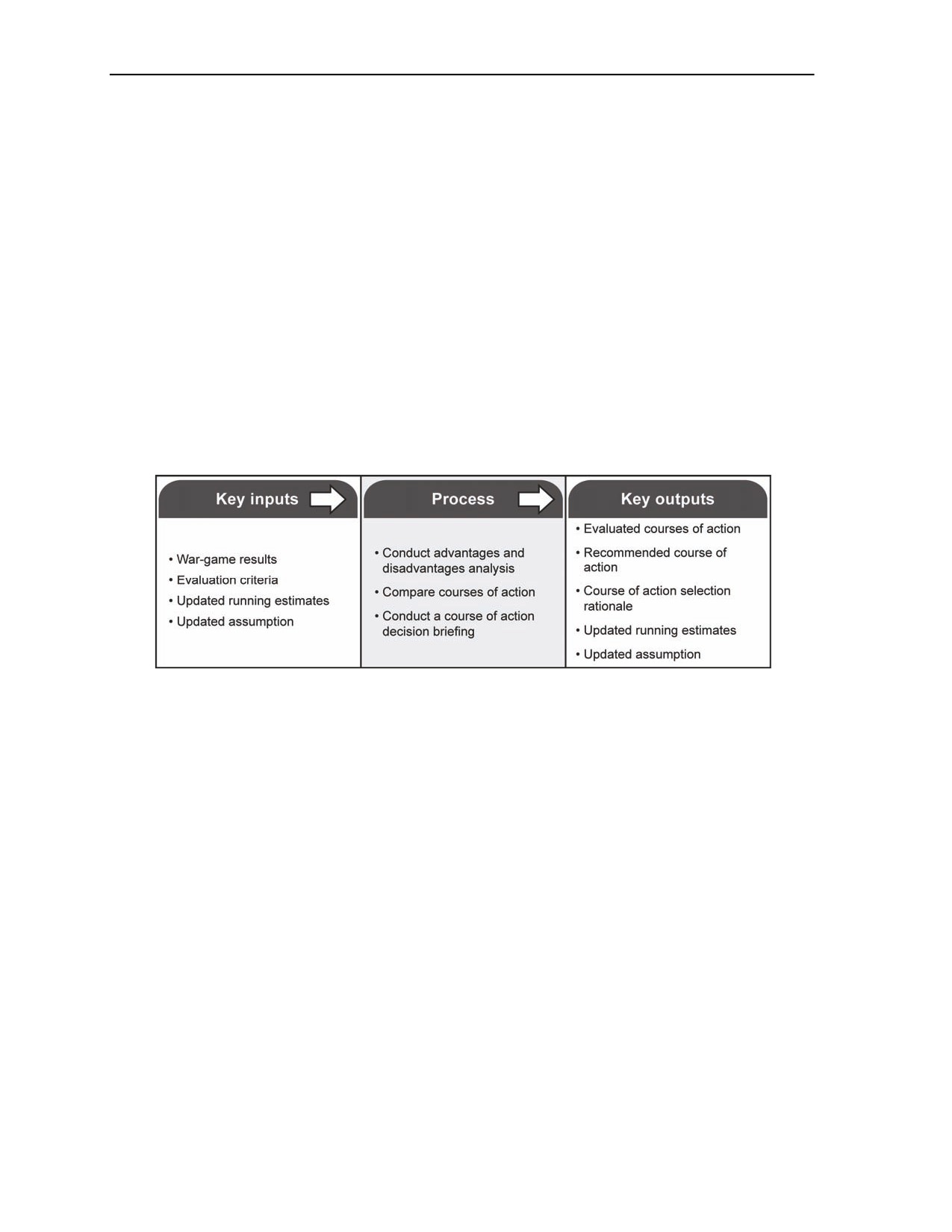
the key outputs in figure B-14.
Figure B-14. COA comparison
Conduct Advantages and Disadvantages Analysis
B-172. The COA comparison starts with all staff members analyzing and evaluating the advantages and
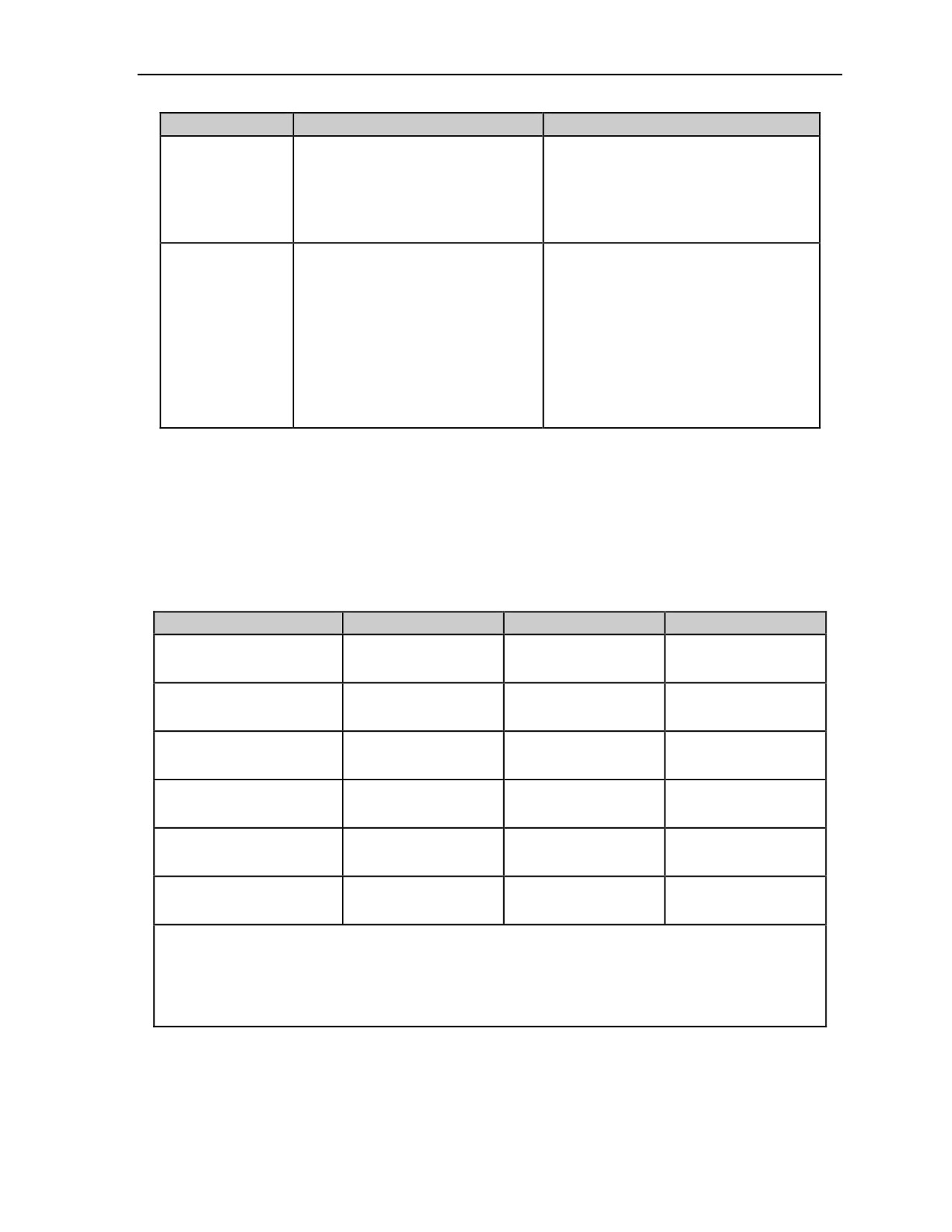
disadvantages of each COA from their perspectives. (See figure B-15.) Staff members each present their
findings for the others’ consideration. Using the evaluation criteria developed before the war game, the
staff outlines each COA, highlighting its advantages and disadvantages. Comparing the strengths and
weaknesses of the COAs identifies their advantages and disadvantages with respect to each other.
B-34
FM 5-0, C1
18 March 2011
The Military Decisionmaking Process
Course of Action
Advantages
Disadvantages
Decisive operation avoids major
Units conducting the decisive operation
terrain obstacles. Adequate
face stronger resistance at the start
COA 1
maneuver space available for units
of the operation.
conducting the decisive operation
Limited resources available to
and the reserve.
establishing civil control to Town X.
Shaping operations provide
Operation may require the early
excellent flank protection of the
employment of the division’s reserve.
decisive operations.
Upon completion of decisive
COA 2
operations, units conducting
shaping operations can quickly
transition to establish civil control
and provide civil security to the
population in Town X.
Figure B-15. Sample advantages and disadvantages
Compare Courses of Action
B-173. Comparison of COAs is critical. The staff may use any technique that facilitates developing those
key outputs and recommendations and helping the commander making the best decision. A common
technique is the decision matrix. This matrix uses evaluation criteria developed during mission analysis and
refined during COA development to help assess the effectiveness and efficiency of each COA. (See
figure B-16.)
Criteria1
Weight2
COA 13
COA 23
1
2
1
Simplicity
(2)
(1)
2
2
1
Maneuver
(4)
(2)
1
2
1
Fires
(2)
(1)
1
1
2
Civil control
(1)
(2)
2
1
2
Support mission narrative
(2)
(4)
Total (Min=Max)
8
7
Weighted TOTAL
(11)
(10)
Notes:
1 Criteria are those assigned in step 5 of COA analysis.
2 The COS (XO) may emphasize one or more criteria by assigning weights to them based on a determination of their
relative importance.
3 COAs are those selected for war-gaming with values assigned to them based on comparison between them with
regard to relative advantages and disadvantages of each, such as when compared for relative simplicity COA 2 is by
comparison to COA 1 simpler and therefore is rated as 1 with COA 1 rated as 2.
Figure B-16. Sample decision matrix
B-174. The decision matrix is a tool to compare and evaluate COAs in a thorough and logical manner.
However, the process is based on highly subjective judgments that may change dramatically during the
course of evaluation as it draws out and shapes critical thought from the commander and staff. In the
18 March 2011
FM 5-0, C1
B-35
Appendix B
example above, values reflect the relative advantages or disadvantages of each criterion for each COA as
initially estimated by a COS (XO) during mission analysis. At the same time, the COS (XO) determines
weights for each criterion based on a subjective determination of their relative value. The lower values
signify a more favorable advantage, such as the lower the number, the more favorable the score. After
comparing COAs and assigning values, the unweighted assigned scores in each column are added vertically
under each COA and a total for each COA is noted. The same values are then multiplied by the weighted
score associated with each criterion, and the product is noted in parenthesis in each appropriate box. These
weighted products are then added vertically and noted in parenthesis in the space for “Weighted TOTAL”
below each COA column. The totals are then compared to determine the “best” (lowest number) COA
based on both criteria alone and then on weighted scores. Upon review and consideration, the
commander—based on personal judgment—may elect to change either the value for the basic criterion or
the weighted value. Although the lowest value denotes a “best” solution, the process for estimating relative
values assigned to criterion and weighting is highly subjective. One result may be that the “best” COA may
not be supportable without additional resources. This would enable the decisionmaker to decide whether to
pursue additional support, alter the COA in some way, or determine that it is not feasible.
B-175. The decision matrix is one highly structured and effective method used to compare COAs against
criteria that, when met, suggest a great likelihood of producing success. Specific broad categories of COA
characteristics are given a basic numerical value based on evaluation criteria. Weights are assigned based
on subjective judgment regarding their relative importance to existing circumstances. Basic values are then
multiplied by the weight to yield a given criterion’s final score. The staff member then totals all scores so
to compare COAs.
B-176. However, the results of such a decision matrix alone do not provide a total basis for decision
solutions. During the decision matrix process, planners use special care to avoid reaching conclusions from
mainly subjective judgments as the result of purely quantifiable analysis. Comparing and evaluating COAs
by category of criterion is probably more useful than merely comparing total scores. Often judgments
change with regard to relative weighting of criterion of importance during close analysis of COAs, which
would change matrix scoring.
B-177. The staff compares feasible COAs to identify the one with the highest probability of success
against the most likely enemy COA, the most dangerous enemy COA, the most important stability task, or
the most damaging environmental impact. The selected COA should also—
z
Pose the minimum risk to the force and mission accomplishment.
z
Place the force in the best posture for future operations.
z
Provide maximum latitude for initiative by subordinates.
z
Provide the most flexibility to meet unexpected threats and opportunities.
z
Provide the most secure and stable environment for civilians in the AO.
z
Best facilitate initial information themes and messages.
B-178. Staff officers may each use their own matrix to compare COAs with respect to their functional
areas. Matrixes use the evaluation criteria developed before the war game. Decision matrixes alone cannot
provide decision solutions. Their greatest value is providing a method to compare COAs against criteria
that, when met, produce operational success. Staff officers use these analytical tools to prepare
recommendations. Commanders provide the solution by applying their judgment to staff recommendations
and making a decision.
Conduct a Course of Action Decision Briefing
B-179. After completing its analysis and comparison, the staff identifies its preferred COA and makes a
recommendation. If the staff cannot reach a decision, the COS (XO) decides which COA to recommend.
The staff then delivers a decision briefing to the commander. The COS (XO) highlights any changes to
each COA resulting from the war game. The decision briefing includes—
z
The commander’s intent of the higher and next higher commanders.
z
The status of the force and its components.
B-36
FM 5-0, C1
18 March 2011
The Military Decisionmaking Process
z
The current IPB.
z
The COAs considered, including—
Assumptions used.
Results of running estimates.
A summary of the war game for each COA, including critical events, modifications to any
COA, and war-game results.
Advantages and disadvantages (including risk) of each COA.
The recommended COA. If a significant disagreement exists, then the staff should inform
the commander and, if necessary, discuss the disagreement.
COURSE OF ACTION APPROVAL
B-180. After the decision briefing, the commander selects the COA to best accomplish the mission. If the
commander rejects all COAs, the staff starts COA development again. If the commander modifies a
proposed COA or gives the staff an entirely different one, the staff war-games the new COA and presents
the results to the commander with a recommendation.
B-181. After selecting a COA, the commander issues the final planning guidance. The final planning
guidance includes a refined commander’s intent (if necessary) and new CCIRs to support execution. It also
includes any additional guidance on priorities for the warfighting functions, orders preparation, rehearsal,
and preparation. This guidance includes priorities for resources needed to preserve freedom of action and
ensure continuous sustainment.
B-182. Commanders include risk they are willing to accept in the final planning guidance. If there is time,
commanders use a video-teleconference (VTC) to discuss acceptable risk with adjacent, subordinate, and
senior commanders. However, a commander must obtain the higher commander’s approval to accept any
risk that might imperil accomplishing the higher commander’s mission.
B-183. Based on the commander’s decision and final planning guidance, the staff issues a WARNO to
subordinate headquarters. This WARNO contains the information subordinate units need to refine their
plans. It confirms guidance issued in person or by VTC and expands on details not covered by the
commander personally. The WARNO issued after COA approval normally contains—
z
Mission.
z
Commander’s intent.
z
Updated CCIRs and EEFIs.
z
Concept of operations.
z
The AO.
z
Principal tasks assigned to subordinate units.
z
Preparation and rehearsal instructions not included in the SOPs.
z
A final timeline for the operations.
ORDERS PRODUCTION
B-184. The staff prepares the order or plan by turning the selected COA into a clear, concise concept of
operations and required supporting information. The COA statement becomes the concept of operations for
the plan. The COA sketch becomes the basis for the operation overlay. If time permits, the staff may
conduct a more detailed war game of the selected COA to more fully synchronize the operation and
complete the plan. The staff writes the OPLAN and OPORD using the Army’s operation order format. See
Annex E, (Protection).
B-185. Commanders review and approve orders before the staff reproduces and disseminates them unless
they have delegated that authority. Subordinates immediately acknowledge receipt of the higher order. If
possible, the order is briefed to subordinate commanders face-to-face by the higher commander and staff.
The commander and staff conduct confirmation briefings with subordinates immediately afterwards.
Confirmation briefings can be done collaboratively with several commanders at the same time or with
18 March 2011
FM 5-0, C1
B-37
Appendix B
single commanders. These briefings may be performed face-to-face or by VTC. (See appendix E for
formats for plans and orders.)
PLANNING IN A TIME-CONSTRAINED ENVIRONMENT
B-186. The focus of any planning processes should aim to quickly develop a flexible, sound, and fully
integrated and synchronized plan. However, any operation may “outrun” the initial plan. The most detailed
estimates cannot anticipate every possible branch or sequel, enemy action, unexpected opportunity, or
change in mission directed from higher headquarters. Fleeting opportunities or unexpected enemy action
may require a quick decision to implement a new or modified plan. When this occurs, units often find
themselves pressed for time in developing a new plan.
B-187. While the MDMP seeks the optimal solution, the rapid decisionmaking and synchronization
process (RDSP) seeks a timely and effective solution within the commander’s intent, mission, and concept
of operations. Using the RDSP lets leaders avoid the time-consuming requirements of developing decision
criteria and comparing COAs. (See chapter 5 for more information on RDSP.)
B-188. Before a unit can effectively conduct planning in a time-constrained environment, it must master
the steps in the full MDMP. A unit can only shorten the process if it fully understands the role of each and
every step of the process and the requirements to produce the necessary products. Training on these steps
must be thorough and result in a series of staff battle drills that can be tailored to the time available.
B-189. Staffs must be able to produce simple, flexible, and tactically sound plans in a time-constrained
environment. Any METT-TC factor, but especially limited time, may make it difficult to complete every
step of the MDMP in detail. Applying an inflexible process to all situations will not work. Anticipation,
organization, and prior preparation are the keys to successful planning under time-constrained conditions.
B-190. The time saved on any step of the MDMP can be used to—
z
Refine the plan more thoroughly.
z
Conduct a more deliberate and detailed war game.
z
Consider potential branches and sequels in detail.
z
Focus more on rehearsing and preparing the plan.
z
Allow subordinate units more planning and preparation time.
THE COMMANDER’S ROLE
B-191. The commander decides how to adjust the MDMP, giving specific guidance to the staff to focus on
the process and save time. Commanders (who have access to only a small portion of the staff or none at all)
rely even more than normal on their own expertise, intuition, and creativity as well as on their
understanding of the environment and of the art and science of warfare. They may have to select a COA,
mentally war-game it, and confirm their decision to the staff in a relatively short time. If so, the decision is
based more on experience than on a formal, integrated staff process.
B-192. Commanders should avoid changing their guidance unless a significantly changed situation
requires major revisions. Frequent minor changes to the guidance can easily result in lost time as the staff
constantly adjusts the plan with an adverse ripple effect throughout overall planning.
B-193. Commanders consult with subordinate commanders before making a decision, if possible.
Subordinate commanders are closer to the operation and can more accurately describe the enemy, friendly,
and civilian situations. Additionally, consulting with subordinates gives commanders insight into the
upcoming operation and allows parallel planning. White boards and collaborative digital means of
communicating greatly enhance parallel planning.
B-194. In situations where commanders must decide quickly, they advise their higher headquarters of the
selected COA, if time is available. However, commanders do not let an opportunity pass just because they
cannot report their actions.
B-38
FM 5-0, C1
18 March 2011
The Military Decisionmaking Process
THE STAFF’S ROLE
B-195. Staff members keep their running estimates current. When planning time is limited, they can
provide accurate, up-to-date assessments quickly and move directly into COA development. Under time-
constrained conditions, commanders and staffs use as much of the previously analyzed information and
products as possible. The importance of running estimates increases as time decreases. Decisionmaking in a
time-constrained environment almost always occurs after a unit has entered the AO and begun operations.
This means that the IPB, an updated common operational picture, and some portion of running estimates
should already exist. Civilian and military joint and multinational organizations operating in the AO should
have well-developed plans and information to add insights to the operational environment. Detailed
planning provides the basis for information that the commander and staff need to make decisions during
execution.
B-196. Commanders shorten the MDMP when they lack time to perform each step in detail. The most
significant factor to consider is time. It is the only nonrenewable, and often the most critical, resource.
TIME-SAVING TECHNIQUES
B-197. Several time-saving techniques can speed up the planning process. These techniques include the
following:
z
Increase commander’s involvement.
z
Limit the number of COAs to develop.
z
Maximize parallel planning.
z
Increase collaborative planning.
z
Use liaison officers.
Increase Commander’s Involvement
B-198. While commanders cannot spend all their time with the planning staff, the greater the
commander’s involvement in planning, the faster the staff can plan. In time-constrained conditions,
commanders who participate in the planning process can make decisions (such as COA selection) without
waiting for a detailed briefing from the staff. The first time-saving technique is to increase the
commander’s involvement. This technique allows commanders to make decisions during the MDMP
without waiting for detailed briefings after each step.
Limit the Number of Courses of Action to Develop
B-199. Limiting the number of COAs developed and war-gamed can save planning time. If time is
extremely short, the commander can direct development of only one COA. In this case, the goal is an
acceptable COA that meets mission requirements in the time available. This technique saves the most time.
The fastest way to develop a plan is for the commander to direct development of one COA with branches
against the most likely enemy COA or most damaging civil situation or condition. However, this technique
should be used only when time is severely limited. In such cases, this choice of COA is often intuitive,
relying on the commander’s experience and judgment. The commander determines which staff officers are
essential to assist in COA development depending on the type of operation being planned. The minimum is
normally the intelligence officer, operations officer, plans officer, chief of fires (fire support officer),
engineer coordinator, civil affairs operations officer, inform and influence officer, and COS (XO). The
commander may also include subordinate commanders, if available, either in person or by VTC. This team
quickly develops a flexible COA that it feels will accomplish the mission. The commander mentally war-
games this COA and gives it to the staff to refine.
Maximize Parallel Planning
B-200. Although parallel planning is the norm, maximizing its use in time-constrained environments is
critical. In a time-constrained environment, the importance of WARNOs increases as available time
decreases. A verbal WARNO now followed by a written order later saves more time than a written order
one hour from now. The same WARNOs used in the full MDMP should be issued when abbreviating the
18 March 2011
FM 5-0, C1
B-39
Appendix B
process. In addition to WARNOs, units must share all available information with subordinates, especially
IPB products, as early as possible. The staff uses every opportunity to perform parallel planning with the
higher headquarters and to share information with subordinates.
Increase Collaborative Planning
B-201. Planning in real time with higher headquarters and subordinates improves the overall planning
effort of the organization. Modern INFOSYS and a common operational picture shared electronically allow
collaboration with subordinates from distant locations, can increase information sharing, and can improve
the commander’s visualization. Additionally, taking advantage of subordinate input and knowledge of the
situation in their AOs often results in developing better COAs faster.
Use Liaison Officers
B-202. Liaison officers posted to higher headquarters allow the commander to have representation in their
higher headquarters’ planning session. These officers assist in passing timely information to their parent
headquarters and can speed up the planning effort by transmitting timely information directly to the
commander. Effective liaison officers have the commander’s full confidence and the necessary rank and
experience for the mission. Commanders may elect to use a single individual or a liaison team. Since
liaison officers represent the commander, they must—
z
Understand how their commander thinks and be able to interpret the commander’s verbal and
written guidance.
z
Convey their commander’s intent, planning guidance, mission, and concept of operations.
z
Represent their commander’s position.
z
Know the unit’s mission; tactics, techniques, and procedures; organization; capabilities; and
communications equipment.
z
Observe the established channels of command and staff functions.
z
Be trained in their functional responsibilities.
z
Be tactful.
z
Possess the necessary language expertise.
B-40
FM 5-0, C1
18 March 2011
Troop Leading Procedures
strengths and weaknesses of subordinate leaders. They realistically determine all available resources. This
includes troops attached to, or in direct support of, the unit. The assessment includes knowing the strength
and status of their equipment. It also includes understanding the full array of assets in support of the unit.
Leaders know, for example, how much indirect fire will become available, and when it is available, they
will know the type. They consider any new limitations based on the level of training or recent fighting.
Time Available
C-37. Leaders not only appreciate how much time is available, they understand the time-space aspects of
preparing, moving, fighting, and sustaining. They view their own tasks and enemy actions in relation to
time. They know how long it takes under such conditions to prepare for certain tasks (such as orders
production, rehearsals, and subordinate element preparations). Most important, leaders monitor the time
available. As events occur, they assess their impact on the unit timeline and update previous timelines for
their subordinates. Timelines list all events that affect the unit and its subordinate elements.
Civil Considerations
C-38. Civil considerations are the influence of manmade infrastructure, civilian institutions, and attitudes
and activities of the civilian leaders, populations, and organizations within an AO on the conduct of
military operations (FM 6-0). Rarely are military operations conducted in uninhabited areas. Most of the
time, units are surrounded by noncombatants. These noncombatants include residents of the AO, local
officials, and governmental and nongovernmental organizations. Based on information from higher
headquarters and their own knowledge and judgment, leaders identify civil considerations that affect their
mission. (See FM 6-0 and FM 3-05.401.) Civil considerations are analyzed in terms of six factors known
by the memory aid ASCOPE:
z
Areas.
z
Structures.
z
Capabilities.
z
Organizations.
z
People.
z
Events.
Course of Action Development
C-39. Mission analysis provides information needed to develop COAs. The purpose of COA development
is simple: to determine one or more ways to accomplish the mission. At lower echelons, the mission may
be a single task. Most missions and tasks can be accomplished in more than one way. However, in a time-
constrained environment, leaders may develop only one COA. Normally, they develop two or more.
Leaders do not wait for a complete order before beginning COA development. They develop COAs as soon
as they have enough information to do so. Usable COAs are suitable, feasible, acceptable, distinguishable,
and complete. (See appendix B.) To develop them, leaders focus on the actions the unit takes at the
objective and conduct a reverse plan to the starting point.
±Analyze Relative Combat Power
C-40. During COA development, leaders determine whether the unit has enough combat power to defeat
the force (or accomplish a task in stability or civil support operations) against which it is arrayed by
comparing the combat power of friendly and enemy forces. Leaders seek to determine where, when, and
how friendly combat power (the elements of intelligence, movement and maneuver, fires, sustainment,
protection, and mission command) can overwhelm the enemy. It is a particularly difficult process if the unit
is fighting a dissimilar unit (for example, if the unit is attacking or defending against an enemy mechanized
force as opposed to a similarly equipped light infantry force). Below battalion level, relative combat power
comparisons are rough and generally rely on professional judgment instead of numerical analysis. When an
enemy is not the object of a particular mission or tasks, leaders conduct a troop-to-task analysis to
determine if they have enough combat power to accomplish the tasks. For example, a company commander
assigned the task “establish civil control in town X” would need to determine if they had enough Soldiers
18 March 2011
FM 5-0, C1
C-7
Appendix C
and equipment (to include vehicles and barrier materials) to establish the necessary check points and
security stations within the town to control the population in town X.
Generate Options
C-41. During this step, leaders brainstorm different ways to accomplish the mission. They determine the
doctrinal requirements for the operation, including the tactical tasks normally assigned to subordinates.
Doctrinal requirements give leaders a framework from which to develop COAs.
C-42. Next, leaders identify where and when the unit can mass overwhelming combat power to achieve
specific results (with respect to enemy, terrain, time, or civil considerations) that accomplish the mission.
Offensive and defensive operations focus on the destructive effects of combat power. Stability operations,
on the other hand, emphasize constructive effects. Leaders identify the decisive point or points. Leaders
determine what result they must achieve at the decisive points to accomplish the mission. This helps leaders
determine the amount of combat power to apply at the decisive point and the required tasks.
C-43. After identifying the tasks, leaders next determine the purpose for each task. There is normally one
primary task for each mission. The unit assigned this task is the main effort. The purpose of the other tasks
should support the accomplishment of the primary task.
Develop a Concept of Operations
C-44. The concept of operations describes how the leader envisions the operation unfolding from its start to
its conclusion or end state. It determines how accomplishing each task leads to executing the next. It
identifies the best ways to use available terrain and to employ unit strengths against enemy weaknesses.
Fire support considerations make up an important part of the concept of operations. Essential stability tasks
are also identified. Leaders develop the graphic control measures necessary to convey and enhance the
understanding of the concept of operations, prevent fratricide, and clarify the task and purpose of the main
effort.
Assign Responsibilities
C-45. Leaders assign responsibility for each task to a subordinate. Whenever possible, they depend on the
existing chain of command. They avoid fracturing unit integrity unless the number of simultaneous tasks
exceeds the number of available elements. Different command and support arrangements may be the
distinguishing feature among COAs.
Prepare a Course of Action Statement and Sketch
C-46. Leaders base the COA statement on the concept of operations for that COA. The COA statement
focuses on all significant actions, from the start of the COA to its finish. Whenever possible, leaders
prepare a sketch showing each COA. Another useful technique is to show the time it takes to achieve each
movement and task in the COA sketch. Doing this helps subordinate leaders gain an appreciation for how
much time will pass as each task of the COA is executed. The COA contains the following information:
z
Form of movement or defense to be used.
z
Designation of the main effort.
z
Tasks and purposes of subordinate units.
z
Necessary sustaining operations.
z
Desired end state.
C-47. Figure C-4 provides a sample mission statement and course of action statement for an infantry
company in the defense.
C-8
FM 5-0, C1
18 March 2011
The Military Decisionmaking Process
C Co/2-67 IN (L) defends NLT 281700(Z) AUG 2005 to destroy enemy forces
Mission
from GL 375652 to GL 389650 to GL 394660 to GL 373665 to prevent the
Statement:
envelopment of A Co, the battalion main effort.
The company defends with two platoons (PLTs) forward and one PLT in depth from
PLT battle positions. The northern PLT (2 squads) destroys enemy forces to
prevent enemy bypass of the main effort PLT on Hill 657. The southern PLT (3
squads, 2 Javelins) destroys enemy forces to prevent an organized company attack
against the Co main effort on Hill 657. The main effort PLT (3 squads, 2 TOWS)
retains Hill 657 (vic GL378659) to prevent the envelopment of Co A (BN main
COA Statement:
effort) from the south. The anti-armor section (1 squad, 4 Javelins) establishes
ambush positions at the road junction (vic GL 377653) to destroy enemy recon to
deny observation of friendly defensive position and to prevent a concentration of
combat power against the main effort PLT. The company mortars establish a
mortar firing point vic GL 377664 to suppress enemy forces to protect the main
effort platoon.
Figure C-4. Sample mission and COA statements
Analyze Courses of Action (War Game)
C-48. For each COA, leaders think through the operation from start to finish. They compare each COA
with the enemy’s most probable COA. At the small-unit level, the enemy’s most probable COA is what the
enemy is most likely to do given what friendly forces are doing at that instant. The leader visualizes a set of
actions and reactions. The object is to determine what can go wrong and what decision the leader will likely
have to make as a result.
Course of Action Comparison and Selection
C-49. Leaders compare COAs by weighing the advantages, disadvantages, strengths, and weaknesses of
each, as noted during the war game. They decide which COA to execute based on this comparison and on
their professional judgment. They take into account—
z
Mission accomplishment.
z
Time available to execute the operation.
z
Risks.
z
Results from unit reconnaissance.
z
Subordinate unit tasks and purposes.
z
Casualties incurred.
z
Posturing of the force for future operations.
INITIATE MOVEMENT
C-50. Leaders conduct any movement directed by higher headquarters or deemed necessary to continue
mission preparation or position the unit for execution. They do this as soon as they have enough
information to do so or the unit is required to move to position itself for a task. This is also essential when
time is short. Movements may be to an assembly area, a battle position, a new AO, or an attack position.
They may include movement of reconnaissance elements, guides, or quartering parties.
CONDUCT RECONNAISSANCE
C-51. Whenever time and circumstances allow, or as directed by higher headquarters, leaders personally
observe the AO for the mission prior to execution. No amount of intelligence preparation of the battlefield
can substitute for firsthand assessment of METT-TC from within the AO. Unfortunately, many factors can
18 March 2011
FM 5-0, C1
C-9
Appendix C
keep leaders from performing a personal reconnaissance. The minimum action necessary is a thorough map
reconnaissance supplemented by imagery and intelligence products. As directed, subordinates or other
elements (such as scouts) may perform the reconnaissance for the leader while the leader completes other
TLP steps.
C-52. ±Leaders use results of the war game to identify information requirements. Reconnaissance
operations seek to confirm or deny information that supports the tentative plan. They focus first on
information gaps identified during mission analysis. Leaders ensure their leader’s reconnaissance
complements the higher headquarters’ ISR plan. The unit may conduct additional reconnaissance
operations as the situation allows. This step may also precede making a tentative plan if commanders lack
enough information to begin planning. Reconnaissance may be the only way to develop the information
required for planning.
±COMPLETE THE PLAN
C-53. During this step, leaders incorporate the results of reconnaissance into their selected COA to
complete the plan or order. This includes preparing overlays, refining the indirect fire target list,
coordinating sustainment with signal requirements, and updating the tentative plan because of the
reconnaissance. At lower levels, this step may entail only confirming or updating information contained in
the tentative plan. If time allows, leaders make final coordination with adjacent units and higher
headquarters before issuing the order.
ISSUE THE ORDER
C-54. Small-unit orders are normally issued verbally and supplemented by graphics and other control
measures. The order follows the standard five-paragraph OPORD format. (See appendix E.) Typically,
leaders below company level do not issue a commander’s intent. They reiterate the intent of their higher
and next higher commanders.
C-55. The ideal location for issuing the order is a point in the AO with a view of the objective and other
aspects of the terrain. The leader may perform a leader’s reconnaissance, complete the order, and then
summon subordinates to a specified location to receive it. Sometimes security or other constraints make it
infeasible to issue the order on the terrain. Then leaders use a sand table, detailed sketch, maps, and other
products to depict the AO and situation.
SUPERVISE AND REFINE
C-56. Throughout TLP, leaders monitor mission preparations, refine the plan, coordinate with adjacent
units, and supervise and assess preparations. Normally, unit SOPs state individual responsibilities and the
sequence of preparation activities. To ensure the unit is ready for the mission, leaders supervise
subordinates and inspect their personnel and equipment.
C-57. A crucial component of preparation is the rehearsal. Rehearsals allow leaders to assess their
subordinates’ preparations. They may identify areas that require more supervision. Leaders conduct
rehearsals to—
z
Practice essential tasks.
z
Identify weaknesses or problems in the plan.
z
Coordinate subordinate element actions.
z
Improve Soldier understanding of the concept of operations.
z
Foster confidence among Soldiers.
C-58. Company and smaller sized units use four types of rehearsals discussed in appendix I:
z
Backbrief.
z
Combined arms rehearsal.
z
Support rehearsal.
z
Battle drill or SOP rehearsal.
C-10
FM 5-0, C1
18 March 2011
Appendix D
Guidelines for Commander’s Planning Guidance
This appendix provides guidelines to assist commanders in developing planning
guidance within the military decisionmaking process (MDMP). (Appendix B defines
and describes the MDMP.) The content of the planning guidance varies depending on
the situation and the echelon. This appendix does not account for all possible
situations. It is a generic list of information commanders consider as they develop
planning guidance.
PLANNING GUIDANCE WITHIN THE MILITARY
DECISIONMAKING PROCESS
D-1. Commanders develop planning guidance based on their understanding and visualization of the
operation. Planning guidance may be broad or detailed, as circumstances require. Combined with the
restated mission and commander’s intent, planning guidance conveys the essence of the commander’s
visualization. Commanders use their experience and judgment to add depth and clarity to their planning
guidance. Effective planning guidance gives the staff a broad outline of the commander’s visualization
while still allowing them latitude to explore different options.
D-2. Commanders issue planning guidance when conducting design (see chapter 3) and at specific points
during the MDMP:
z
Upon receipt of or anticipation of a mission (initial planning guidance).
z
Following mission analysis (planning guidance for course of action [COA] development).
z
Following COA development (revised planning guidance for COA improvements).
z
COA approval (revised planning guidance to complete the plan).
D-3.
±Commanders use elements of operational art appropriate to their situation and echelon to help them
formulate their guidance. See FM 3-0 for a full discussion on each element of operational art. The elements
of operational art are—
z
End state and conditions.
z
Centers of gravity.
z
Direct or indirect approach.
z
Decisive points.
z
Lines of operations and lines of effort.
z
Operational reach.
z
Tempo.
z
Simultaneity and depth.
z
Phasing and transitions.
z
Culmination.
z
Risk.
D-4. The level of detail in the planning guidance depends on situational understanding, time available,
staff proficiency, and the latitude the next higher commander allows. Broad and general guidance allows a
proficient staff to develop flexible and effective options. Time-constrained conditions require more specific
guidance. The more detailed the planning guidance, the more quickly the staff can complete the plan.
However, detailed guidance incurs the risk of overlooking or insufficiently examining things that might
affect mission execution.
18 March 2011
FM 5-0, C1
D-1
Appendix D
PLANNING GUIDANCE BY WARFIGHTING FUNCTIONS
D-5. The lists in paragraphs D-7 through D-12 are not intended to meet the needs of all situations.
Commanders are neither required nor desired to address every item. Planning guidance is tailored to meet
specific needs based on the situation. Commanders issue guidance on only those items appropriate to a
particular mission.
D-6. As commanders formulate their planning guidance, they may want to address assumptions,
specifically, those that their staff prepares and those that higher headquarters provides. Considerable effort
should be made to validate those assumptions. Commanders should also be thinking through transitions—
those that their formations will create and those that will be imposed by others outside the command.
Finally, commanders may wish to give guidance regarding their unit’s role in enabling other organizations
and activities (joint, interagency, intergovernmental, and multinational) as appropriate.
INTELLIGENCE
D-7. For the intelligence warfighting function, planning guidance may include—
z
Guidance on intelligence, surveillance, and reconnaissance.
z
Gaps in knowledge required to understand the situation.
z
Enemy COAs to consider during COA development and COA analysis. At a minimum, these
may be the enemy’s most probable COA, most dangerous COA, or a combination of the two.
These COAs may include the—
Enemy commander’s mission.
Enemy commander’s concept of operations.
Enemy’s critical decision points and vulnerabilities.
z
Priority intelligence requirements.
z
High-value targets.
z
Desired enemy perception of friendly forces.
z
Intelligence focus for each phase of the operation.
z
Specific terrain (including identification of key terrain) and weather factors.
z
Identification of key aspects of the environment, including civil considerations.
z
Guidance on counterintelligence.
z
Request for intelligence support from nonorganic resources and special collection requests.
MOVEMENT AND MANEUVER
D-8. For movement and maneuver, planning guidance may include—
z
Initial commander’s intent.
z
COA development guidance consisting of—
Number of friendly COAs to consider.
COAs to consider or not to consider.
Critical events.
Elements of operational art.
Decisive, shaping, and sustaining operations.
Task organization.
Task and purpose of subordinate units.
Forms of maneuver.
Reserve guidance (composition, mission, priorities, and control measures).
Security and counterreconnaissance guidance.
Friendly decision points.
Possible branches and sequels.
D-2
FM 5-0, C1
18 March 2011
Guidelines for Commander’s Planning Guidance
Intelligence, surveillance, and reconnaissance integration and priorities.
Military deception.
z
Risk—
To friendly forces.
Of collateral damage or civilian casualties.
Of any condition affecting mission accomplishment or achievement of desired end state.
FIRES
D-9.
For fires, planning guidance may include—
z
Synchronization and focus of fires with maneuver.
z
Priority of fires.
z
High-payoff targets to include—
Methods of engagement.
Desired effects.
z
An observer plan.
z
Requirements, restrictions, and priorities for special munitions.
z
Task and purpose of fires.
z
Counterfire.
z
Target acquisition radar zones consisting of—
Critical friendly zones.
Call for fire zones.
Artillery target intelligence zones.
Sensor zones.
z
Suppression of enemy air defenses.
z
Fire support coordination measures.
z
Attack guidance.
z
A no-strike list, including cultural, religious, historical, and high-density civilian areas.
z
Restricted target list.
PROTECTION
D-10. For protection, planning guidance may include—
z
Protection priorities.
z
Work priorities for survivability assets.
z
Guidance on air and missile defense positioning.
z
Specific terrain and weather factors.
z
Intelligence focus and limitations for security efforts.
z
Areas or events where risk is acceptable.
z
Protected targets and areas.
z
Vehicle and equipment safety or security constraints.
z
Guidance on environmental considerations.
z
Guidance on unexploded explosive ordnance.
z
Operational security risk tolerance.
z
Rules of engagement, standing rules for the use of force, and rules of interaction.
z
Guidance on escalation of force and nonlethal weapons.
18 March 2011
FM 5-0, C1
D-3
Appendix D
SUSTAINMENT
D-11. For sustainment, planning guidance may include—
z
Priorities in terms of tactical sustainment functions
(manning, fueling, fixing, arming, and
moving the force, and sustaining Soldiers and their systems).
z
Army health system support.
z
Anticipated requirements and prestockage of class III, IV, and V supplies.
z
Controlled supply rates.
z
Guidance on construction and provision of facilities and installations.
z
Guidance on the movement of detainees and the sustainment of internment and resettlement
activities.
±MISSION COMMAND
D-12. For mission command, planning guidance may include—
z
Friendly forces information requirements.
z
Rules of engagement.
z
Position of the command post.
z
Position of the commander.
z
Liaison officer guidance.
z
Timeline guidance, including timeline for planning and the operational timeline.
z
Type of order and rehearsal.
z
Specific communications guidance.
z
Succession of command.
z
Initial themes and messages.
z
Civil affairs operations that consist of—
Establishing a civil-military operations center.
Establishing liaison with host-nation, interagency, and governmental and nongovernmental
organizations.
Providing resources for humanitarian assistance.
Prioritizing allocated funds dedicated to civil affairs operations.
Building a relationship between the command and civilian population.
D-4
FM 5-0, C1
18 March 2011
Appendix E
Army Operation Plan and Order Format
This appendix provides instructions for preparing plans and orders for Army units.
For guidance on preparing joint operation plans and orders, refer to JP 5-0.
±CHARACTERISTICS
E-1. Commanders direct operations and communicate their visualization, commander’s intent, and
decisions through plans and orders. Effective plans synchronize subordinate activities in time, space, and
purpose to achieve objectives and accomplish missions. Plans and orders not only direct subordinate units
but provide information to facilitate coordination among organizations outside the command. Effective
plans and orders account for those military and civilian organizations involved in the operation.
E-2. The amount of detail provided in a plan or order depends on several factors, including the cohesion
and experience of subordinate units and complexity of the operation. Effective plans and orders encourage
subordinate’s initiative by providing the what and why of tasks to subordinate units, and leave the how to
perform the tasks to subordinates. (Paragraphs Error! Reference source not found. through Error!
Reference source not found. discuss mission orders in detail.) To maintain clarity and simplicity, the base
plan or order is kept as short and concise as possible. Detailed information and instructions are addressed in
attachments as required.
E-3. Good operation plans (OPLANs) and operation orders (OPORDs)—
z
Possess simplicity.
z
Possess authoritative expression.
z
Possess positive expression.
z
Avoid qualified directives.
z
Possess brevity.
z
Possess clarity.
z
Contain assumptions.
z
Incorporate flexibility.
z
Exercise timeliness.
E-4. Plans and orders are simple and direct to reduce misunderstanding and confusion. Simple plans
executed on time are better than detailed plans executed late. Commanders at all echelons weigh potential
benefits of a complex concept of operations against the risk that subordinates will fail to understand it.
Multinational operations mandate simplicity due to the differences in language, doctrine, and culture.
E-5. Authoritative expression through the commander’s intent is reflected in plans and orders. As such,
their language is direct. Effective plans and orders unmistakably state what the commander wants the unit
and its subordinate units to do and why.
E-6. Instructions in plans and orders are stated in the affirmative. For example, “Combat trains will
remain in the assembly area” instead of “The combat trains will not accompany the unit.”
E-7. Plans and orders avoid meaningless expressions, such as “as soon as possible (ASAP).” Indecisive,
vague, and ambiguous language leads to uncertainty and lack of confidence.
E-8. Effective plans and orders are brief, clear, and concise. They use short words, sentences, and
paragraphs. Use acronyms unless clarity is hindered. Do not include material covered in standard operating
procedures (SOPs). Refer to those SOPs instead.
E-9. Plans and orders possess clarity. They use doctrinally correct terms and symbols, avoid jargon, and
eliminate every opportunity for misunderstanding the commander’s exact, intended meaning.
18 March 2011
FM 5-0, C1
E-1
Appendix E
E-10. Effective plans and orders contain assumptions. This helps subordinates and others to better
understand the logic behind a plan or order and facilitates the preparation of branches and sequels.
E-11. Plans and orders incorporate flexibility. They leave room to adapt and make adjustments to counter
unexpected challenges and seize opportunities. Effective plans and orders identify decision points and
proposed options at those decision points to build flexibility.
E-12. Plans and orders exercise timeliness. Plans and orders sent to subordinates in time allow subordinates
to collaborate, plan, and prepare their own actions.
TYPES OF PLANS
E-13. ±A plan is a design for a future or anticipated operation. Plans come in many forms and vary in
scope, complexity, and length of planning horizons. There are several types of plans:
z
Campaign plan.
z
Operation plan.
z
Supporting plan.
z
Concept plan.
z
Branch.
z
Sequel.
E-14. A campaign plan is a joint operation plan aimed at achieving strategic or operational objectives
within a given time and space. Developing and issuing a campaign plan is appropriate when the
contemplated simultaneous or sequential military operations exceed the scope of single major operation.
Only joint force commanders develop campaign plans.
E-15. An operation plan is any plan for the conduct of military operations prepared in response to actual
and potential contingencies (JP 5-0). An OPLAN may address an extended period connecting a series of
objectives and operations, or it may be developed for a single part or phase of a long-term operation. An
OPLAN becomes an OPORD when the commander sets an execution time or designates an event that
triggers the operation.
E-16. A supporting plan is an operation plan prepared by a supporting commander, a subordinate
commander, or an agency to satisfy the requests or requirements of the supported commander’s plan
(JP 5-0). For example, the ARFOR commander develops a supporting plan as to how Army forces will
support the joint force commander’s campaign plan or OPLAN.
E-17. A concept plan is an OPLAN in an abbreviated format that requires considerable expansion or
alteration to convert it into a complete operation plan or operation order. Often branches and sequels are
written in the form of concept plans. (See chapter 2 for a discussion on branches and sequels.) As time and
the potential allow for executing a particular branch or sequel, these concept plans are developed in detail
into OPLANs.
TYPES OF ORDERS
E-18. An order is a communication, written, oral, or by signal, which conveys instructions from a superior
to a subordinate (JP 1-02). (See figures E-2 through E-5 for OPORD formats.) There are three types of
orders:
z
Operation order.
z
Fragmentary order (FRAGO).
z
Warning order (WARNO).
E-19. An operation order is a directive issued by a commander to subordinate commanders for the purpose
of effecting the coordinated execution of an operation (JP 5-0). Commanders issue OPORDs to direct the
execution of long-term operations as well as the execution of discrete short-term operations within the
framework of a long-range OPORD.
E-20. A fragmentary order is an abbreviated form of an operation order issued as needed after an operation
order to change or modify that order or to execute a branch or sequel to that order (JP 5-0). FRAGOs
E-2
FM 5-0, C1
18 March 2011
Army Operation Plan and Order Format
include all five OPORD paragraph headings and differ from OPORDs only in the degree of detail provided.
After each paragraph heading, it provides either new information or states “no change.” This ensures that
recipients know they have received the entire FRAGO. FRAGOs provide brief and specific instructions.
They address only those parts of the original OPORD that have changed. The higher headquarters issues a new
OPORD when the situation changes completely or when many changes make the current order ineffective.
E-21. FRAGOs may be issued as overlay orders. An overlay order is a technique used to issue an order that
has abbreviated instructions written on an overlay. Commanders may issue an overlay order when planning
and preparation time is severely constrained and they must get the order to subordinate commanders as
soon as possible. Commanders verbally issue the order using the standard five-paragraph outline. When
giving a verbal briefing, the briefer discusses only the items in the order that have changed from an original
order and focuses attention to key events and tasks, the main effort, priority of support, and control
measures and graphics. The overlay order accompanies this verbal briefing and may be presented by any
suitable graphic presentation. (See figure E-6 on page E-23 for a sample overlay order.)
E-22. A warning order is a preliminary notice of an order or action that is to follow (JP 3-33). WARNOs
help subordinate units and staffs prepare for new missions by describing the situation, providing initial
planning guidance, and directing preparation activities. WARNOs increase subordinates’ planning time,
provide details of the impending operation, and list events that accompany preparation and execution. The
amount of detail a WARNO includes depends on the information and time available when it is issued and
the information subordinate commanders need for planning and preparation. Unless specifically stated, a
WARNO does not authorize execution other than planning and the words warning order precede the
message text. (See figure E-4 on page E-20 for a WARNO formats.)
E-23. Commanders issue orders verbally or in writing. The five-paragraph format (situation, mission,
execution, sustainment, and command and signal) remains the standard for issuing orders. The technique
used to issue orders is at the discretion of the commander; each method is time and situation dependent.
VERBAL ORDERS
E-24. Commanders use verbal orders when operating in an extremely time-constrained environment. These
orders offer the advantage of being passed quickly but risk important information being overlooked or
misunderstood. Verbal orders are usually followed by written FRAGOs.
WRITTEN ORDERS
E-25. Commanders issue written plans and orders that contain both text and graphics. Graphics convey
information and instructions through military symbols. (See FM 1-02.) They complement the written
portion of a plan or an order and promote clarity, accuracy, and brevity. Written orders are often generated
and disseminated by electronic means to shorten the time needed to gather and brief the orders group.
Orders are easily edited and modified when electronically produced. The same order can be sent to multiple
recipients simultaneously. Using computer programs to develop and disseminate precise corresponding
graphics adds to the efficiency and clarity of the orders process.
E-26. Electronic editing makes importing text and graphics into orders very easy. Unfortunately, such ease
can result in orders becoming unnecessarily large without added operational value. Commanders need to
ensure that orders contain only that information needed to facilitate effective execution. Orders should not
be a regurgitation of unit SOPs. They should be clear, concise, and relevant to the mission.
ADMINISTRATIVE INSTRUCTIONS
E-27. The following information pertains to administrative instructions for preparing all plans and orders.
Unless otherwise stated, the term order refers to both plans and orders. The term base order refers to the
main body of a plan or order without annexes.
E-28. Regardless of echelon, all orders adhere to the same guidance. Show all paragraph headings on
written orders. A paragraph heading with no text will state “None” or “See [attachment type] [attachment
letter or number].” In this context, attachment is a collective term for annex, appendix, tab, and exhibit.
18 March 2011
FM 5-0, C1
E-3
Appendix E
E-29. The base order and all attachments follow a specific template for the paragraph layout. Every order
follows the five-paragraph format. Title case, underline, and bold the titles of these five paragraphs—
Situation, Mission, Execution, Sustainment, and Command and Signal. The paragraph title begins with a
capital letter and is bold and underlined. For example, “situation” is Situation. All subparagraphs and
subtitles begin with capital letters and are underlined. For example, “concept of operations” is Concept of
Operations.
E-30. When a paragraph is subdivided, it must have at least two subdivisions. The tabs are 0.25 inches and
the space is double between paragraphs. Subsequent lines of text for each paragraph may be flush left or
equally indented at the option of the chief of staff or executive officer, as long as consistency is maintained
throughout the order. (See figure E-1.)
1. Title. Text.
a. Title. Text.
(1) Title. Text.
(a) Title. Text.
1. Title. Text.
Figure E-1. Paragraph layout for plans and orders
ACRONYMS AND ABBREVIATIONS
E-31. Use acronyms and abbreviations to save time and space if they do not cause confusion. Do not
sacrifice clarity for brevity. Keep acronyms and abbreviations consistent throughout the order and its
attachments. Do not use acronyms and abbreviations not found in FM 1-02 or JP 1-02. Spell out the entire
acronym or abbreviation and place the acronym or abbreviation between parentheses at first use in the
document. After this first use, use the acronym or abbreviation throughout the document.
PLACE AND DIRECTION DESIGNATIONS
E-32. Describe locations or points on the ground by—
z
Providing the map datum used throughout the order.
z
Referring to military grid reference system (MGRS) coordinates.
z
Referring to longitude and latitude if available maps do not have the MGRS.
E-33. ±Designate directions in one of two ways:
z
By using two locations or places. For example, direction ECKENTAL 18PV6690-PEGNITZ
18PV6851.
z
As a magnetic, grid, or true bearing, stating the unit of measure. For example, 85 degrees
(magnetic).
E-34. When first mentioning a place or feature on a map, print the name in capital letters exactly as spelled
on the map and show its complete grid coordinates (grid zone designator, 100-kilometer grid square, and
four-, six-, eight-, or ten-digit grid coordinates) in parentheses after it. When first using a control measure
(such as a contact point), print the name or designation of the point followed by its complete grid
coordinates in parentheses. Thereafter, repeat the coordinates only for clarity; use names, planning names,
or codes.
E-35. Describe areas by naming the northernmost (12 o’clock) point first and the remaining points in
clockwise order. Describe positions from left to right and from front to rear, facing the enemy. To avoid
confusion, identify flanks by compass points, rather than right or left of the friendly force.
E-4
FM 5-0, C1
18 March 2011
Army Operation Plan and Order Format
E-36. If the possibility of confusion exists when describing a route, add compass points for clarity. For
example, “The route is northwest along the road LAPRAIRIE-DELSON.” If a particular route already has
a planning name, such as main supply route SPARTAN, refer to the route using only that designator.
E-37. Designate trails, roads, and railroads by the names of places along them or with grid coordinates.
Precede place names with trail, road, or railroad. For example, “road GRANT-CODY.” Designate the route
for a movement by listing a sequence of grids from the start point to the release point. Otherwise, list the
sequence of points from left to right or front to rear, facing the enemy.
E-38. Identify riverbanks as north, south, east, or west. In gap-crossing operations, identify riverbanks as
either near or far.
E-39. Describe boundaries and phase lines by terrain features easily distinguishable from the ground or air
or on a map. When designating boundaries between units, state which unit has responsibility and authority
for the place, feature, or location to which the description refers. State each location along a boundary as
either inclusive or exclusive to a unit. For example, “1st Brigade, exclusive crossroad 18PV621352.” List
boundaries and phase lines from left to right or front to rear, facing the enemy.
NAMING CONVENTIONS
E-40. Unit SOPs normally designate naming conventions for graphics. Otherwise, planners select them.
For clarity, avoid multiword names, such as “Junction City.” Simple names are better than complex ones.
To ensure operations security, avoid assigning names that could reveal unit identities, such as the
commander’s name or the unit’s home station. Do not name sequential phase lines and objectives in
alphabetical order. For memory aids, use sets of names designated by the type of control measure or
subordinate unit. For example, the division might use colors for objective names and minerals for phase
line names.
±CLASSIFICATION MARKINGS
E-41. AR
380-5 contains a detailed description of marking, transmitting procedures, and other
classification instructions. Each page and portions of the text on that page will be marked with the
appropriate abbreviation (“TS” for TOP SECRET, “S” for SECRET, “C” for CONFIDENTIAL or “U for
UNCLASSIFIED). Place classification markings at the top and bottom of each page. All paragraphs must
have the appropriate classification marking immediately following the alphanumeric designation of the
paragraph (preceding the first word if the paragraph is not numbered). The abbreviation “FOUO” will be
used in place of “U” when a portion is UNCLASSIFIED but contains “For Official Use Only” information.
AR 25-55 contains the definition and policy application of FOUO markings.
EXPRESSING UNNAMED DATES AND HOURS
E-42. Use specific letters to designate unnamed dates and times in plans and orders. (These definitions
come from JP 1-02 unless noted otherwise.) See table E-1 on page E-4.
E-43. C-, D-, and M-days end at 2400 hours, Universal Time (ZULU time). They are assumed to be
24-hours long for planning. Plans and orders state the letters used and their meanings. If a plan mentions
more than one event, refer to the secondary event in terms of the time of the primary event. Refer to days
preceding or following C-, D-, or M-day by using a plus or minus sign and an Arabic number after the
letter. For example, D - 3 is three days before D-day; D + 7 is seven days after D-day. When using a time
element other than days, spell it out. For example, D + 3 months.
E-44. Refer to hours preceding or following (H- or L-hour) by a plus or minus sign and an Arabic number
after the letter. For example, H - 3 is three hours before H-hour; H + 7 is seven hours after H-hour. When
using a time element other than hours, spell it out. For example, H + 30 minutes.
E-45. Where it is necessary to identify a particular operation or exercise, place a nickname or code words
before the letter, such as BALD EAGLE (D-day) or ANVIL EXPRESS (M-day).
18 March 2011
FM 5-0, C1
E-5

Appendix E
±Table E-1. Designated letters for dates and times
Term
Definition
The unnamed day on which a deployment operation commences or is to commence. The
deployment may be movement of troops, cargo, weapon systems, or a combination of these
elements using any or all types of transport. The letter “C” will be the only one used to
denote the above. The highest command or headquarters responsible for coordinating the
C-day
planning will specify the exact meaning of C-day within the aforementioned definition. The
command or headquarters directly responsible for the execution of the operation, if other
than the one coordinating the planning, will do so in light of the meaning specified by the
highest command or headquarters coordinating the planning.
D-day
The unnamed day on which a particular operation commences or is to commence. (JP 3-02)
The effective time of announcement by the Secretary of Defense to the Military Departments
F-hour
of a decision to mobilize Reserve units.
H-hour
The specific hour on D-day at which a particular operation commences.
H-hour
For amphibious operations, the time the first assault elements are scheduled to touch down
(amphibious
on the beach, or a landing zone, and in some cases the commencement of countermine
operations)
breaching operations. (JP 3-02)
The specific hour on C-day at which a deployment operation commences or is to
L-hour
commence.
L-hour
In amphibious operations, the time at which the first helicopter of the helicopter-borne
(amphibious
assault wave touches down in the landing zone. (JP 3-02)
operations)
The term used to designate the unnamed day on which full mobilization commences or is
M-day
due to commence.
N-day
The unnamed day an active duty unit is notified for deployment or redeployment.
P-hour
In airborne operations, the specific hour on D-day at which a parachute assault commences
(airborne
with the exit of the first Soldier from an aircraft over a designated drop zone. (FM 5-0)
operations)
Redeployment day. The day on which redeployment of major combat, combat support, and
R-day
combat service support forces begins in an operation.
S-day
The day the President authorizes Selective Reserve callup (not more than 200,000).
The effective day coincident with Presidential declaration of national emergency and
T-day
authorization of partial mobilization (not more than 1,000,000 personnel exclusive of the
200,000 callup).
Declared by the President, W-day is associated with an adversary decision to prepare for
W-day
war (unambiguous strategic warning). (JP 3-02.1)
EXPRESSING TIME
E-46. The effective time for implementing the plan or order is the same as the date-time group of the order.
Express the date and time as a six-digit date-time group. The first two digits indicate the day of the month;
the last four digits indicate the time. The letter at the end of the time indicates the time zone. Add the month
or the month and year to the date-time group when necessary to avoid confusion. For example, a complete
date-time group appears as 060140Z August 20XX.
E-6
FM 5-0, C1
18 March 2011
Army Operation Plan and Order Format
[CLASSIFICATION]
OPLAN/OPORD [number] [(code name)]—[issuing headquarters] [(classification of title)]
a.
(U) Commander’s Intent. Commanders develop their intent statement personally. The
commander’s intent is a clear, concise statement of what the force must do and the conditions the force
must establish with respect to the enemy, terrain, and civil considerations that represent the desired end
state. It succinctly describes what constitutes the success of an operation and provides the purpose and
conditions that define that desired end state. The commander’s intent must be easy to remember and
clearly understood two echelons down.
b. (U) Concept of Operations. The concept of operations is a statement that directs the manner in
which subordinate units cooperate to accomplish the mission and establishes the sequence of actions
the force will use to achieve the end state. It is normally expressed in terms of decisive, shaping, and
sustaining operations. It states the principal tasks required, the responsible subordinate units, and how
the principal tasks complement one another. Normally, the concept of operations projects the status of
the force at the end of the operation. If the mission dictates a significant change in tasks during the
operation, the commander may phase the operation. The concept of operations may be a single
paragraph, divided into two or more subparagraphs, or if unusually lengthy, summarized here with
details located in Annex C (Operations). If the concept of operations is phased, describe each phase in
a subparagraph. Label these subparagraphs as “Phase” followed by the appropriate Roman numeral,
for example, “Phase I.” If the operation is phased, all paragraphs and subparagraphs of the base order
and all annexes must mirror the phasing established in the concept of operations. The operation
overlay and graphic depictions of lines of effort help portray the concept of operations and are located
in Annex C (Operations).
c.
(U) Scheme of Movement and Maneuver. Describe the employment of maneuver units in
accordance with the concept of operations. Provide the primary tasks of maneuver units conducting the
decisive operation and the purpose of each. Next, state the primary tasks of maneuver units conducting
shaping operations, including security operations, and the purpose of each. For offensive operations,
identify the form of maneuver. For defensive operations, identify the type of defense. For stability
operations, describe the role of maneuver units by primary stability tasks. If the operation is phased,
identify the main effort by phase. Identify and include priorities for the reserve. Refer to Annex C
(Operations) as required.
(1) (U) Scheme of Mobility/Countermobility. State the scheme of mobility/countermobility
including priorities by unit or area. Refer to Annex G (Engineer) as required.
(2)
(U) Scheme of Battlefield Obscuration. State the scheme of battlefield obscuration,
including priorities by unit or area. Refer to Appendix
9 (Battlefield Obscuration) to Annex C
(Operations) as required.
(3)
(U) Scheme of Intelligence, Surveillance, and Reconnaissance. Describe how the
commander intends to use intelligence, surveillance, and reconnaissance (ISR) to support the concept
of operations. Include the primary reconnaissance objectives. Refer to Annex L
(Intelligence,
Surveillance, and Reconnaissance) as required.
(Note: Army forces do not conduct ISR within the United States and its territories. For domestic
operations, this paragraph is titled “Information Awareness and Assessment” and the contents of this
paragraph comply with Executive Order 12333.)
[page number]
[CLASSIFICATION]
Figure E-2. Annotated Army OPLAN/OPORD format (continued)
18 March 2011
FM 5-0, C1
E-11
Appendix E
[CLASSIFICATION]
OPLAN/OPORD [number] [(code name)]—[issuing headquarters] [(classification of title)]
d. (U) Scheme of Intelligence. Describe how the commander envisions intelligence supporting the
concept of operations. Include the priority of effort to situation development, targeting, and assessment.
State the priority of intelligence support to units and areas. Refer to Annex B (Intelligence) as required.
e. (U) Scheme of Fires. Describe how the commander intends to use fires to support the concept of
operations with emphasis on the scheme of maneuver. State the fire support tasks and the purpose of
each task. State the priorities for, allocation of, and restrictions on fires. Refer to Annex D (Fires) as
required. If Annex D is not used, use subparagraphs for fires categories (for example, field artillery or
cyber/electromagnetic activities) based on the situation.
f.
(U) Scheme of Protection. Describe how the commander envisions protection supporting the
concept of operations. Include the priorities of protection by unit and area. Include survivability.
Address the scheme of operational area security, including security for routes, bases, and critical
infrastructure. Identify tactical combat forces and other reaction forces. Use subparagraphs for
protection categories (for example, air and missile defense and explosive ordnance disposal) based on
the situation. Refer to Annex E (Protection) as required.
g.
(U) Stability Operations. Describe how the commander envisions the conduct of stability
operations in coordination with other organizations through the primary stability tasks. (See FM 3-07.)
If other organizations or the host nation are unable to provide for civil security, restoration of essential
services, and civil control, then commanders with an assigned AO must do so with available resources,
request additional resources, or request relief from these requirements from higher headquarters.
Commanders assign specific responsibilities for stability tasks to subordinate units in paragraph 3.i
(Tasks to Subordinate Units) and paragraph
3.j
(Coordinating Instructions). Refer to Annex C
(Operations) and Annex K (Civil Affairs Operations) as required.
h. (U) Assessment. Describe the priorities for assessment and identify the measures of effectiveness
used to assess end state conditions and objectives. Refer to Annex M (Assessment) as required.
i. (U) Tasks to Subordinate Units. State the task assigned to each unit that reports directly to the
headquarters issuing the order. Each task must include who (the subordinate unit assigned the task),
what (the task itself), when, where, and why (purpose). Use a separate subparagraph for each unit. List
units in task organization sequence. Place tasks that affect two or more units in paragraph
3.j
(Coordinating Instructions).
j.
(U) Coordinating Instructions. List only instructions and tasks applicable to two or more units
not covered in unit SOPs.
(1) (U) Timing. State the time or condition when the OPORD becomes effective and list the
operational timeline.
(2)
(U) Commander’s Critical Information Requirements. List commander’s critical
information requirements (CCIRs) here.
(3)
(U) Essential Elements of Friendly Information. List essential elements of friendly
information (EEFIs) here.
(4) (U) Fire Support Coordination Measures. List critical fire support coordination or control
measures.
[page number]
[CLASSIFICATION]
±Figure E-2. Annotated Army OPLAN/OPORD format (continued)
E-12
FM 5-0, C1
18 March 2011
Army Operation Plan and Order Format
[CLASSIFICATION]
OPLAN/OPORD [number] [(code name)]—[issuing headquarters] [(classification of title)]
(5)
(U) Airspace Coordinating Measures. List critical airspace coordinating or control
measures.
(6) (U) Rules of Engagement. List rules of engagement here. Refer to Appendix 12 (Rules of
Engagement) to Annex C (Operations) as required.
(Note: For operations within the United States and its territories, title this paragraph “Rules for the
Use of Force”).
(7)
(U) Risk Reduction Control Measures. State measures specific to this operation not
included in unit SOPs. They may include mission-oriented protective posture, operational exposure
guidance, troop-safety criteria, and fratricide prevention measures. Refer to Annex E (Protection) as
required.
(8) (U) Personnel Recovery Coordination Measures. Refer to Appendix 2 (Personnel Recovery)
to Annex E (Protection) as required.
(9) (U) Environmental Considerations. Refer to Appendix 6 (Environmental Considerations) to
Annex G (Engineer) as required.
(10) (U) Themes and Messages. List themes and messages.
(11) (U) Other Coordinating Instructions. List additional coordinating instructions and tasks
that apply to two or more units as subparagraphs at this level as required.
4. (U) Sustainment. Describe the concept of sustainment, including priorities of sustainment by unit or
area. Include instructions for administrative movements, deployments, and transportation—or
references to applicable appendixes—if appropriate. Use the following subparagraphs to provide the
broad concept of support for logistics, personnel, and Army health system support. Provide detailed
instructions for each sustainment subfunction in the appendixes to Annex F (Sustainment) listed in table
E-2.
a. (U) Logistics. Refer to Appendix 1 (Logistics) to Annex F (Sustainment) as required.
b. (U) Personnel. Refer to Appendix 2 (Personnel Services Support) to Annex F (Sustainment) as
required.
c. (U) Health System Support. Refer to Appendix 3 (Army Health System Support) to Annex F
(Sustainment) as required.
5. (U) Command and Signal.
a. (U) Command.
(1)
(U) Location of Commander. State where the commander intends to be during the
operation, by phase if the operation is phased.
(2) (U) Succession of Command. State the succession of command if not covered in the unit’s
SOPs.
(3) (U) Liaison Requirements. State liaison requirements not covered in the unit’s SOPs.
[page number]
[CLASSIFICATION]
±Figure E-2. Annotated Army OPLAN/OPORD format (continued)
18 March 2011
FM 5-0, C1
E-13
Appendix E
[CLASSIFICATION]
OPLAN/OPORD [number] [(code name)]—[issuing headquarters] [(classification of title)]
b. (U) Control.
(1) (U) Command Posts. Describe the employment of command posts (CPs), including the
location of each CP and its time of opening and closing, as appropriate. State the primary controlling
CP for specific tasks or phases of the operation (for example, “Division tactical command post will
control the air assault”).
(2) (U) Reports. List reports not covered in SOPs. Refer to Annex R (Reports) as required.
c. (U) Signal. Describe the concept of signal support, including location and movement of key
signal nodes and critical electromagnetic spectrum considerations throughout the operation. Refer to
Annex H (Signal) as required.
ACKNOWLEDGE: Include instructions for the acknowledgement of the OPLAN/OPORD by
addressees. The word “acknowledge” may suffice. Refer to the message reference number if necessary.
Acknowledgement of a plan or order means that it has been received and understood.
[Commander’s last name]
[Commander’s rank]
The commander or authorized representative signs the original copy. If the representative signs the
original, add the phrase “For the Commander.” The signed copy is the historical copy and remains in
the headquarters’ files.
OFFICIAL:
[Authenticator’s name]
[Authenticator’s position]
Use only if the commander does not sign the original order. If the commander signs the original, no
further authentication is required. If the commander does not sign, the signature of the preparing staff
officer requires authentication and only the last name and rank of the commander appear in the
signature block.
ANNEXES: List annexes by letter and title. If a particular annex is not used, place “not used” beside
that annex letter.
A - Task Organization
B - Intelligence
C - Operations
D - Fires
E - Protection
F - Sustainment
G - Engineer
H - Signal
I
- not used
J
- Inform and Influence Activities
K - Civil Affairs Operations
L - Intelligence, Surveillance, and Reconnaissance
[page number]
[CLASSIFICATION]
Figure E-2. Annotated Army OPLAN/OPORD Format (continued)
E-14
FM 5-0, C1
18 March 2011
Army Operation Plan and Order Format
[CLASSIFICATION]
OPLAN/OPORD [number] [(code name)]—[issuing headquarters] [(classification of title)]
M - Assessment
N - Space Operations
O - not used
P - Host-Nation Support
Q - spare
R - Reports
S - Special Technical Operations
T - spared
U - Inspector General
V - Interagency Coordination
W - spare
X - spare
Y - spare
Z - Distribution
DISTRIBUTION: Furnish distribution copies either for action or for information. List in detail those
who are to receive the plan or order. Refer to Annex Z (Distribution) if lengthy.
[page number]
[CLASSIFICATION]
Figure E-2. Annotated Army OPLAN/OPORD format (continued)
E-60. Table E-2 lists the annexes and their associated appendices as well as the staff officers responsible
for developing each attachment.
18 March 2011
FM 5-0, C1
E-15

Appendix E
±Table E-2. List of attachments and responsible staff officers
ANNEX A - TASK ORGANIZATION (G-5 or G-3 [S-3])
ANNEX B - INTELLIGENCE (G-2 [S-2])
Appendix
1 - Intelligence Estimate
Appendix
2 - Intelligence, Surveillance, and Reconnaissance Synchronization Matrix
Appendix
3 - Counterintelligence
Appendix
4 - Signals Intelligence
Appendix
5- Human Intelligence
Appendix
6 - Geospatial Intelligence
Appendix
7 - Measurement and Signature Intelligence
Appendix 8 - Open Source Intelligence
ANNEX C - OPERATIONS (G-5 or G-3 [S-3])
Appendix 1 - Design Concept
Appendix 2 - Operation Overlay
Appendix 3 - Decision Support Products
Appendix 4 - Gap Crossing Operations
Appendix 5 - Air Assault Operations
Appendix 6 - Airborne Operations
Appendix 7 - Amphibious Operations
Appendix 8 - Special Operations (G-3 [S-3])
Appendix 9 - Battlefield Obscuration (CBRN Officer)
Appendix
10 - Airspace Command and Control (G-3 [S-3] or Airspace Command and Control Officer)
Appendix 11 - Rules of Engagement (Staff Judge Advocate)
Appendix 12 - Law and Order Operations (Provost Marshal)
Appendix 13 - Internment and Resettlement Operations (Provost Marshal)
ANNEX D - FIRES (Chief of Fires/Fire Support Officer)
Appendix 1 - Fire Support Overlay
Appendix 2 - Fire Support Execution Matrix
Appendix 3 - Targeting
Appendix 4 - Field Artillery Support
Appendix 5 - Air Support
Appendix 6 - Naval Fire Support
Appendix 7 - Cyber/Electromagnetic Activities (Electronic Warfare Officer)
ANNEX E - PROTECTION (Chief of Protection/Protection Coordinator as designated by the
commander)
Appendix 1 - Air and Missile Defense (Air and Missile Defense Coordinator)
Appendix 2 - Personnel Recovery (Personnel Recovery Coordinator)
Appendix 3 - Fratricide Prevention
Appendix 4 - Operational Area Security (Provost Marshal)
Appendix 5 - Antiterrorism (Antiterrorism Officer)
Appendix 6 - Chemical, Biological, Radiological, and Nuclear Defense (CBRN Officer)
Appendix 7 - Safety (Safety Officer)
Appendix 8 - Operations Security (Operations Security Officer)
Appendix 9 - Explosive Ordnance Disposal (Explosive Ordnance Disposal Officer)
Appendix 10 - Force Health Protection (Surgeon)
E-16
FM 5-0, C1
18 March 2011
Army Operation Plan and Order Format
Table E-2. List of attachments and responsible staff officers (continued)
ANNEX F - SUSTAINMENT (Chief of Sustainment [S-4])
Appendix 1 - Logistics (G-4 [S-4])
Appendix 2 - Personnel Services Support
Appendix 3 - Army Heath System Support (Surgeon)
ANNEX G - Engineer
Appendix 1 - Mobility/Countermobility
Appendix 2 - Survivability (Engineer Officer)
Appendix 3 - General Engineering
Appendix 4 - Geospatial Engineering
Appendix 5 - Engineer Task Organization and Execution Matrix
Appendix 6 - Environmental Considerations
ANNEX H - SIGNAL (G-6 [S-6])
Appendix 1 - Information Assurance
Appendix 2 - Voice and Data Network Diagrams
Appendix 3 - Satellite Communications
Appendix 4 - Foreign Data Exchanges
Appendix 5 - Electromagnetic Spectrum Operations
ANNEX I
- Not Used
ANNEX J - INFORM AND INFLUENCE ACTIVITIES (G-7 [S-7])
Appendix 1 - Public Affairs
Appendix 2 - Military Deception
Appendix 3 - Military Information Support Operations
Appendix 4 - Soldier and Leader Engagement
ANNEX K - CIVIL AFFAIRS OPERATIONS (G-9 [S-9])
ANNEX L - INTELLIGENCE, SURVEILLANCE, AND RECONNAISSANCE (G-3 [S-3])
Appendix 1 - Intelligence, Surveillance, and Reconnaissance Overlay
Appendix 2 - Intelligence, Surveillance, and Reconnaissance Tasking Matrix
ANNEX M - ASSESSMENT (G-5 [S-5] or G-3 [S-3])
ANNEX N - SPACE OPERATIONS (Space Operations Officer)
ANNEX O - Not Used
ANNEX P - HOST-NATION SUPPORT (G-4 [S-4])
ANNEX Q - Spare
ANNEX R - REPORTS (G-3 [S-3])
ANNEX S - SPECIAL TECHNICAL OPERATIONS
ANNEX T - Spare
ANNEX U - INSPECTOR GENERAL
ANNEX V - INTERAGENCY COORDINATION (G-3 [S-3])
ANNEX W - Spare
ANNEX X - Spare
ANNEX Y - Spare
ANNEX Z - DISTRIBUTION (G-3 [S-3])
18 March 2011
FM 5-0, C1
E-17
Appendix E
E-61. Figure E-3 is an example of an annotated attachment format. Figure E-4, page E-20, illustrates a
sample WARNO. Figure E-5, page E-22, illustrates a sample FRAGO.
[CLASSIFICATION]
(Change from verbal orders, if any)
Copy ## of ## copies
Issuing headquarters
Place of issue
Date-time group of signature
Message reference number
Include heading if attachment is distributed separately from the base order or higher-level attachment.
[Attachment type and number/letter] [(attachment title)] TO [higher-level attachment type and
number/letter, if applicable] [(higher-level attachment title, if applicable)] TO OPERATION
PLAN/ORDER [number] [(code name)] [(classification of title)]
References:
Time Zone Used Throughout the Order:
1.
(U) Situation. Include information affecting the functional area that paragraph
1 of the
OPLAN/OPORD does not cover or that needs to be expanded.
a. (U) Area of Interest. Refer to Annex B (Intelligence) as required.
b. (U) Area of Operations. Refer to Appendix 2 (Operation Overlay) to Annex C (Operations).
(1) (U) Terrain. List all critical terrain aspects that impact functional area operations. Refer to
Tab A (Terrain) to Appendix 1 (Intelligence Estimate) to Annex B (Intelligence) as required.
(2) (U) Weather. List all critical weather aspects that impact functional area operations. Refer
to Tab B (Weather) to Appendix 1 (Intelligence Estimate) to Annex B (Intelligence) as required.
c. (U) Enemy Forces. List known and templated locations and activities of enemy functional area
units for one echelon up and two echelons down. List enemy maneuver and other area capabilities that
will impact friendly operations. State expected enemy courses of action and employment of enemy
functional area assets. Refer to Annex B (Intelligence) as required.
d. (U) Friendly Forces. Outline the higher headquarters’ plan as it pertains to the functional area.
List designation, location, and outline of plan of higher, adjacent, and other functional area assets that
support or impact the issuing headquarters or require coordination and additional support.
e. (U) Interagency, Intergovernmental, and Nongovernmental Organizations. Identify and describe
other organizations in the area of operations that may impact the conduct of functional area operations
or implementation of functional area-specific equipment and tactics.
f. (U) Civil Considerations. Refer to Annex K (Civil Affairs Operations) as required.
g. (U) Attachments and Detachments. List units attached or detached only as necessary to clarify
task organization.
h.
(U) Assumptions. List any functional area-specific assumptions that support the annex
development.
[page number]
[CLASSIFICATION]
±Figure E-3. Annotated attachment format (general)
E-18
FM 5-0, C1
18 March 2011
Army Operation Plan and Order Format
[CLASSIFICATION]
[Attachment type and number/letter] [(attachment title)] TO [higher-level attachment type and
number/letter, if applicable] [(higher-level attachment title, if applicable)] TO OPERATION
PLAN/ORDER [number] [(code name)]—[issuing headquarters] [(classification of title)]
2. (U) Mission. State the mission of the functional area in support of the base plan or order.
3. (U) Execution.
a. (U) Scheme of Support. Describe how the functional area supports the commander’s intent and
concept of operations. Establish the priorities of support to units for each phase of the operation. Refer
to Annex C (Operations) as required.
b. (U) Tasks to Subordinate Units. List functional area tasks assigned to specific subordinate units
not contained in the base order.
c. (U) Coordinating Instructions. List only instructions applicable to two or more subordinate units
not covered in the base order.
4.
(U) Sustainment. Identify priorities of sustainment for functional area key tasks and specify
additional instructions as required. Refer to Annex F (Sustainment) as required.
5. (U) Command and Signal.
a. (U) Command. State the location of key functional area leaders.
b. (U) Control. State the functional area liaison requirements not covered in the base order.
c. (U) Signal. Address any functional area-specific communications requirements or reports. Refer
to Annex H (Signal) as required.
ACKNOWLEDGE: Include only if attachment is distributed separately from the base order.
OFFICIAL:
[Authenticator’s name]
[Authenticator’s position]
Either the commander or coordinating staff officer responsible for the functional area may sign
attachments.
ATTACHMENT: List lower level attachments.
DISTRIBUTION: Show only if distributed separately from the base order or higher-level attachments.
[page number]
[CLASSIFICATION]
Figure E-3. Annotated attachment format (general) (continued)
18 March 2011
FM 5-0, C1
E-19
Appendix E
[CLASSIFICATION]
(Change from verbal orders, if any) (Optional)
[Heading data is the same as for OPLAN/OPORD]
WARNING ORDER [number]
(U) References: Refer to higher headquarters’ OPLAN/OPORD and identify map sheets for operation
(Optional).
(U) Time Zone Used Throughout the OPLAN/OPORD: (Optional).
(U) Task Organization: (Optional).
1.
(U) Situation. The situation paragraph describes the conditions and circumstances
of
the
operational environment that impact operations in the following subparagraphs:
a. (U) Area of Interest.
b. (U) Area of Operations.
c. (U) Enemy Forces.
d. (U) Friendly Forces.
e. (U) Interagency, Intergovernmental, and Nongovernmental Organizations.
f. (U) Civil Considerations.
g. (U) Attachments and Detachments. Provide initial task organization.
h. (U) Assumptions. List any significant assumptions for order development.
2. (U) Mission. State the issuing headquarters’ mission.
3. (U) Execution.
a. (U) Initial Commander’s Intent. Provide brief commander’s intent statement.
b. (U) Concept of Operations. This may be “to be determined” for an initial WARNO.
c. (U) Tasks to Subordinate Units. Include any known tasks at time of issuance of WARNO.
d. (U) Coordinating Instructions.
4. (U) Sustainment. Include any known logistics, personnel, or Army health system preparation tasks.
5. (U) Command and Signal. Include any changes to the existing order or state “no change.”
[page number]
[CLASSIFICATION]
±Figure E-4. Annotated WARNO format
E-20
FM 5-0, C1
18 March 2011
Army Operation Plan and Order Format
[CLASSIFICATION]
(Change from verbal orders, if any) (Optional)
[Heading data is the same as for OPLAN/OPORD]
WARNING ORDER [number]
ACKNOWLEDGE:
[Commander’s last name]
[Commander’s rank]
OFFICIAL:
[Authenticator’s name]
[Authenticator’s position]
ANNEXES:
DISTRIBUTION:
[page number]
[CLASSIFICATION]
Figure E-4. Annotated WARNO format (continued)
18 March 2011
FM 5-0, C1
E-21
Appendix E
[CLASSIFICATION]
(Change from verbal orders, if any) (Optional)
Copy ## of ## copies
Issuing headquarters
Place of issue
Date-time group of signature
Message reference number
FRAGMENTARY ORDER [number]
(U) References: Refer to higher the order being modified.
(U) Time Zone Used Throughout the OPLAN/OPORD:
(U) Task Organization: List changes to the task organization.
1. (U) Situation. Include any changes to the existing order or state “No change.” For example, “No
change to OPORD 03-XX.”
2. (U) Mission. State “No change.”
3. (U) Execution. Include any changes or state “No change.”
a. (U) Commander’s Intent. Include any changes or state “No change.”
b. (U) Concept of Operations. Include any changes or state “No change.”
c. (U) Scheme Movement and Maneuver. Include any changes or state “No change.”
d. (U) Scheme of Intelligence. Include any changes or state “No change.”
e. (U) Scheme of Fires. Include any changes or state “No change.”
f. (U) Scheme of Protection. Include any changes or state “No change.”
g. (U) Stability Operations. Include any changes or state “No change.”
h. (U) Assessment. Include any changes or state “No change.”
i. (U) Tasks to Subordinate Units. Include any changes or state “No change.”
j. (U) Coordinating Instructions. Include any changes or state “No Change.”
4. (U) Sustainment. Include any changes or state “No change.”
5. (U) Command and Signal. Include any changes or state “No change.”
ACKNOWLEDGE:
[Commander’s last name]
[Commander’s rank]
OFFICIAL:
[Authenticator’s name]
[Authenticator’s position]
ANNEXES:
DISTRIBUTION:
[page number]
[CLASSIFICATION]
±Figure E-5. Annotated sample FRAGO
E-22
FM 5-0, C1
18 March 2011