FM 5-0, C1 The Operations Process (March 2011) - page 5
Army Operation Plan and Order Format
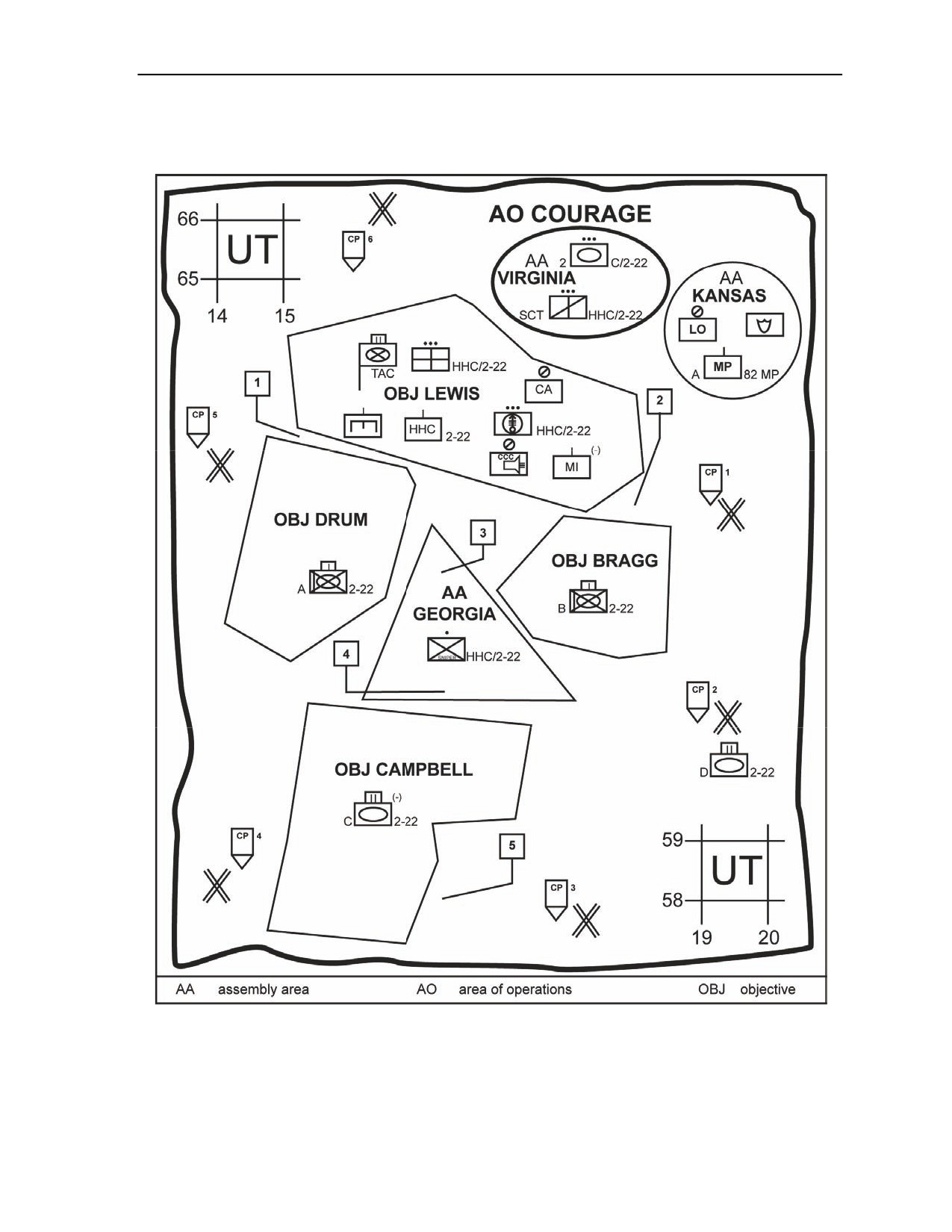
E-62. ±Figure E-6 is a sample overlay order graphic with text.
±Figure E-6. Example of overlay order graphic
18 March 2011
FM 5-0, C1
E-23
Appendix E
TASK ORGANIZATION
TF Control
A/2-22 IN
B/2-22 IN
C/2-22 AR
D/2-22 AR
Sniper Sqd/HHC/2-22
1/A/2-22 IN
1/B/2-22 IN
1/C/2-22 AR
1/D/2-22 AR
2/A/2-22 IN
2/B/2-22 IN
2/C/2-22 AR
2/D/2-22 AR
3/C/2-22 AR
3/D/2-22 AR
3/A/2-22 IN
3/B/2-22 IN
HHC
HN Civil Authorities (DIRLAUTH)
Scout PLT/2-22 IN
None
Mortars/HHC/2-22
Medical/HHC/2-22
MISSION:
TF 2-22 conducts a cordon and search in AO COURAGE NLT 120900ZJAN07 to capture anti-coalition forces (ACF) and seize
weapons caches in order to limit the attacks on coalition forces.
COMMANDER’S INTENT:
Simultaneous occupation of outer cordon checkpoints (CKPs) to isolate search objectives and prevent ACF exfiltration or
infiltration. Lead with information dissemination of information themes and messages. Exercise patience, discipline, and respect
for host-nation population and property while conducting thorough searches. Immediate evacuation of ACF personnel to BCT
Detainee Collection Point for processing and evacuation. End state is OBJ’s LEWIS, DRUM, BRAGG and CAMPBELL free of ACF
and companies postured for future operations.
EXECUTION - TASKS TO SUBORDINATE UNITS:
TF Decisive Operation: Secure OBJ DRUM (inner cordon) and conduct search to capture ACF
A/2-22 IN
and seize weapons caches in order to limit the attacks on coalition forces.
Secure OBJ BRAGG (inner cordon) and conduct search to capture ACF and seize weapons caches
B/2-22 IN
in order to limit the attacks on coalition forces.
1. Secure OBJ CAMPBELL (inner cordon) and conduct search to capture ACF and seize weapons
C/2-22 AR
caches in order to limit the attacks on coalition forces.
1. Secure the outer cordon at CKPs 1-6.
D/2-22 AR
2. Secure AA KANSAS, for HNCA occupation.
HHC (-)/2-22
1. Secure TF tactical command post and TF Forward Aid Station in OBJ LEWIS.
1. Occupy AA GEORGIA and provide observation and surveillance of OBJs DRUM, BRAGG, and
Sniper/HHC/2-22
CAMPBELL.
2. O/O deliver precision fires to destroy ACF.
Acknowledge: A/2-22 IN, B/2-22 IN, C/2-22 AR, D/2-22 AR, HHC/2-22, Sniper/2-22 IN
±Figure E-6. Example of overlay order graphic (continued)
E-24
FM 5-0, C1
18 March 2011
Appendix F
Task Organization
This appendix discusses the fundamentals of task organization, including command
and support relationships. It provides instructions, formats and examples for listing
task organization, and unit listing sequence. See JP 1 for doctrine on joint command
and control relationships.
FUNDAMENTAL CONSIDERATIONS
F-1. A task organization is a temporary grouping of forces designed to accomplish a particular mission
(FM 3-0). Task-organizing is the act of designing an operating force, support staff, or logistic package of
specific size and composition to meet a unique task or mission. Characteristics to examine when task-
organizing the force include, but are not limited to: training, experience, equipage, sustainability, operating
environment, enemy threat, and mobility. For Army forces, it includes allocating available assets to
subordinate commanders and establishing their command and support relationships (FM 3-0). Command
and support relationships provide the basis for unity of command in operations.
Note: Army command relationships are similar but not identical to joint command authorities
and relationships. (See FM 3-0.) Differences stem from the way Army forces task-organize
internally and the need for a system of support relationships between Army forces. Another
important difference is the requirement for Army commanders to handle the administrative
control requirements.
F-2.
±Military units consist of organic components. Organic parts of a unit are those forming an essential
part of the unit and are listed in its table of organization and equipment. Commanders can alter
organizations’ organic unit relationships to better allocate assets to subordinate commanders. They also can
establish temporary command and support relationships to facilitate exercising mission command.
F-3. Establishing clear command and support relationships is fundamental to organizing for any
operation. These relationships establish clear responsibilities and authorities between subordinate and
supporting units. Some command and support relationships (for example, tactical control) limit the
commander’s authority to prescribe additional relationships. Knowing the inherent responsibilities of each
command and support relationship allows commanders to effectively organize their forces and helps
supporting commanders to understand their unit’s role in the organizational structure.
F-4. Commanders designate command and support relationships to weight the decisive operation and
support the concept of operations. Task organization also helps subordinate and supporting commanders
support the commander’s intent. These relationships carry with them varying responsibilities to the
subordinate unit by the parent and gaining units as listed in table F-1 and table F-2, pages F-3 and F-4
respectively. Commanders consider two organizational principles when task-organizing forces:
z
Maintain cohesive mission teams.
z
Do not exceed subordinates’ span of control capabilities.
F-5. When possible, commanders maintain cohesive mission teams. They organize forces based on
standing headquarters, their assigned forces, and habitual associations when possible. When not feasible
and ad hoc organizations are created, commanders arrange time for training and establishing functional
working relationships and procedures. Once commanders have organized and committed a force, they keep
its task organization unless the benefits of a change clearly outweigh the disadvantages. Reorganizations
may result in a loss of time, effort, and tempo. Sustainment considerations may also preclude quick
reorganization.
18 March 2011
FM 5-0, C1
F-1
Appendix F
F-6.
±Commanders carefully avoid exceeding the span of control capabilities of subordinates. Span of
control refers to the number of subordinate units under a single commander. This number is situation
dependent and may vary. As a rule, commanders can effectively command two to six subordinate units.
Allocating subordinate commanders more units gives them greater flexibility and increases options and
combinations. However, increasing the number of subordinate units increases the number of decisions to be
made in a timely fashion.
F-7. Running estimates and course of action (COA) analysis of the military decisionmaking process
provide information that help commanders determine the best task organization. An effective task
organization—
z
Facilitates the commander’s intent and concept of operations.
z
Retains flexibility within the concept of operations.
z
Adapts to conditions imposed by mission variables.
z
Accounts for the requirements to conduct essential stability tasks for populations within an area
of operation.
z
Creates effective combined arms teams.
z
Provides mutual support among units.
z
Ensures flexibility to meet unforeseen events and support future operations.
z
Allocates resources with minimum restrictions on their employment.
z
Promotes unity of command.
z
Offsets limitations and maximizes the potential of all forces available.
z
Exploits enemy vulnerabilities.
F-8. Creating an appropriate task organization requires understanding—
z
The mission, including the higher commander’s intent and concept of operations.
z
The fundamentals of full spectrum operations
(see FM 3-0), basic tactical concepts
(see
FM 3-90), and the fundamentals of stability (see FM 3-07).
z
The roles and relationships among the warfighting functions.
z
The status of available forces, including morale, training, and equipment capabilities.
z
Specific unit capabilities, limitations, strengths, and weaknesses.
z
The risks inherent in the plan.
F-9. During COA analysis, commanders identify what resources they need, and where, when, and how
frequently they will need them. Formal task organization and the change from generic to specific units
begin after COA analysis when commanders assign tasks to subordinate commanders. Staffs assign tasks to
subordinate headquarters and determine if subordinate headquarters have enough combat power,
reallocating combat power as necessary. They then refine command and support relationships for
subordinate units and decide the priorities of support. Commanders approve or modify the staff’s
recommended task organization based on their evaluation of the factors (listed in paragraphs F-7 and F-8)
and information from running estimates and COA analysis. (Appendix B defines and describes the military
decisionmaking process.)
F-10. In allocating assets, the commander and staff consider the—
z
Task organization for the ongoing operation.
z
Potential adverse effects of breaking up cohesive teams by changing the task organization.
z
Time necessary to realign the organization after receipt of the task organization.
z
Limits on control over supporting units provided by higher headquarters.
ARMY COMMAND AND SUPPORT RELATIONSHIPS
F-11. Army commanders build combined arms organizations using command and support relationships.
Command relationships define command responsibility and authority. Support relationships define the
purpose, scope, and effect desired when one capability supports another.
F-2
FM 5-0, C1
18 March 2011
Task Organization
2/52 HBCT
116 HBCT (+)
52 CAB AASLT
1-77 IN (-)
3-116 AR
HHC/52 CAB
1-30 AR (-)
1-163 IN
1/B/1-77 IN (DIV QRF)
(OPCON)
1-20 CAV
2-116 AR
A/4-52 CAV (ARS) (DS)
1-148 FA
1-52 AV (ARB) (-)
2-606 FA (2x8)
145 BSB
4-52 CAV (ARS) (-)
TACP/52 ASOS (USAF)
4/B/2-52 AV (GSAB) (TACON)
3-52 AV (ASLT) (-)
521 BSB
4/2/311 QM CO (MA)
2-52 AV (GSAB)
2/2/311 QM CO (MA)
4/577 MED CO (GRD AMB)
1 (TUAS)/B/52 BSTB (-) (GS)
1/B/2-52 AV (GSAB) (TACON)
844 FST
2/694 EN CO (HORIZ) (DS)
2/577 MED CO (GRD AMB)
116 BSTB
(attached)
366 EN CO (SAPPER) (DS)
52 FIRES BDE
842 FST
HHB
1/401 EN CO (ESC) (DS)
2 BSTB
2/244 EN CO (RTE CL) (DS)
TAB (-)
31 EN CO (MRBC) (DS)
52 EOD
1-52 FA (MLRS)
63 EOD
1/301 MP CO
3-52 FA (-) (M109A6)
2/244 EN CO (RTE CL) (DS)
1/3/1/55 SIG CO (COMCAM)
1/694 EN CO (HORIZ) (DS)
1/2/1/55 SIG CO (COMCAM)
1/467 CM CO (MX) (S)
2D MP PLT
C/388 CA BN
17 MEB 52 ID
RTS TM 1/A/52 BSTB
116 MP PLT
25 CM BN (-)
RTS TM 2/A/52 BSTB
700 MP BN
RTS TM 3/A/52 BSTB
87 IBCT
7 EN BN
RTS TM 4/A/52 BSTB
1-80 IN
2/2/1/55 SIG CO (COMCAM)
2-80 IN
11 ASOS (USAF)
2/54 HBCT
3-13 CAV
4-77 IN
52 SUST BDE
A/3-52 AV (ASLT) (DS)
2-30 AR
B/1-52 AV (ARB) (DS)
52 BTB
3-20 CAV
C/4-52 CAV (ARS) (-) (DS)
520 CSSB
2/C/4-52 CAV (ARS) (DS)
2-636 FA
521 CSSB
2-607 FA
A/3-52 FA (+)
10 CSH
TACP/52 ASOS (USAF)
TACP/52 ASOS (USAF)
168 MMB
105 BSB
Q37 52 FA BDE (GS)
3/2/311 QM CO (MA)
99 BSB
52 HHB
2/B/2-52 AV (GSAB) (TACON)
845 FST
A/1-30 AR (DIV RES)
843 FST
1/577 MED CO (GRD AMB)
35 SIG CO (-) (DS)
3/577 MED CO (GRD AMB)
3/B/2-52 AV (GSAB) (TACON)
154 LTF
3 BSTB
1/2/311 QM CO (MA)
2/1/55 SIG CO (-)
A 388 CA BN
87 BSTB
14 PAD
1/244 EN CO (RTE CL) (DS)
388 CA BN (-) (DS)
53 EOD
763 EOD
3/2/1/55 SIG CO (COMCAM)
2/2/1/55 SIG CO (COMCAM)
B/420 CA BN
3D MP PLT
2 HCT/3/B/52 BSTB
745 EN CO (MAC) (DS)
1/1/52 CM CO (R/D) (R)
2/467 CM CO (MX) (S)
1/1102 MP CO (CS) (DS)
±Figure F-1. Sample outline format for a task organization (52d Infantry Division)
18 March 2011
FM 5-0, C1
F-5
Appendix F
AASLT air assault
EOD explosive ordnance disposal
MLRS multiple launch rocket
AR
armor
ESC
expeditionary sustainment
system
ARB
attack reconnaissance
command
MMB multifunctional medical
battalion
FA
field artillery
battalion
ARS
attack reconnaissance
FST
forward surgical team
MP
military police
squadron
GRD AMB ground ambulance
MRBC
multi-role bridge company
ASLT assault
GS
general support
MX
mechanized
ASOS air support operations
GSAB
general support aviation
OPCON operational control
squadron
battalion
PAD
public affairs detachment
AV
aviation
HBCT heavy brigade combat team
PLT
platoon
BDE
brigade
HCT
human intelligence
QM
quartermaster
BN
battalion
collection team
QRF
quick reaction force
BSB
brigade support battalion
HHB headquarters and
R
reinforcing
BSTB
brigade special troops
headquarters battalion
R/D
reconnaissance/
battalion
HHC headquarters and
decontamination
BTB
brigade troop battalion
headquarters company
RES
reserve
CA
civil affairs
HORIZ horizontal
RTE CL
route clearance
CAB
combat aviation brigade
IBCT
infantry brigade combat
RTS
retransmission
CAV
cavalry
team
S
smoke
CM
chemical
ID
infantry division
SIG
signal
CO
company
IN
infantry
SUST
sustainment
COMCAM combat camera
LTF
logistics task force
TAB
target acquisition battery
CS
combat support
MA
mortuary affairs
TACON
tactical control
CSH
combat support hospital
MAC
mobility augmentation
TACP
tactical air control party
CSSB
combat sustainment support
company
TM
team
battalion
MEB maneuver enhancement
TUAS
tactical unmanned aircraft
DIV
division
brigade
system
DS
direct support
MED medical
USAF United States Air Force
EN
engineer
Figure F-1. Sample outline format for a task organization (52d Infantry Division) (continued)
F-16. ±List subordinate units under the headquarters to which they are assigned, attached, or in support.
Place direct support (DS) units below the units they support. Indent subordinate and supporting units two
spaces. Identify relationships other than attached with parenthetical terms—for example, general support
(GS) or (DS).
±UNIT LISTING SEQUENCE
F-17. List major subordinate control headquarters in the sequence shown in table F-3. If applicable, list
task organizations according to the phases of the operation during which it applies.
F-18. Group units by controlling headquarters. List major subordinate maneuver units first (for example,
2d HBCT; 1-77th IN; A/4-52d CAV). Place them in alphabetical or numerical order. List brigade combat
teams ahead of brigades, combined arms battalions before battalions, and company teams before
companies. Follow maneuver headquarters with the field artillery
(for example, fires brigade after
maneuver brigades), intelligence units, maneuver enhancement units, and the sustainment units. The last
listing should be any special troops units under the control of the force headquarters.
F-19. Use a plus
(+) symbol when attaching one or more subelements of a similar function to a
headquarters. Use a minus symbol (-) when deleting one or more subelements of a similar function to a
headquarters. Always show the symbols in parenthesis. Do not use a plus symbol when the receiving
headquarters is a combined arms task force or company team. Do not use plus and minus symbols together
(as when a headquarters detaches one element and receives attachment of another); use the symbol that
portrays the element’s combat power with respect to other similar elements. Do not use either symbol when
two units swap subelements and their combat power is unchanged. Here are some examples:
z
C Company loses one platoon to A Company; the battalion task organization will show A Co.
(+) and C Co. (-).
z
4-77th Infantry receives a tank company from 1-30 Armor; the brigade task organization will
show TF 4-77 IN (+) and 1-30 AR (-).
F-6
FM 5-0, C1
18 March 2011

Task Organization
±Table F-3. Order for listing units in a task organization
Corps
Division
Brigade
Battalion
Company
Movement and
Divisions
Brigade-size
Battalion TFs
Company
Organic
Maneuver
Separate
ground units
Battalions
teams
platoons
maneuver
Infantry
Combined arms
Named
Attached
brigades or
teams in
platoons
Heavy
Infantry
battalions
order
Stryker
Reconnaissance
Combat
Letter
Brigades in
Company teams
aviation
designated
numerical
brigades or
Companies
teams in
order
battalions
Air cavalry
alphabetical
Battalion TF
order
Special
squadron
Named TFs in
operations
Companies
alphabetical
forces
Rifle
order
Ranger
Mechanized
Numbered TFs
Special forces
infantry
in numerical
order
Armor
Combat aviation
brigade
Fires
Fires brigade
Fires brigade
Fires battalion
Mortar platoon
Intelligence
Battlefield
Battlefield
RSTA squadron
Scout platoon
surveillance
surveillance
brigade
brigade
Protection
MEB
MEB
Air defense
Air defense
Air defense
Air defense
CBRN
CBRN
CBRN
CBRN
Engineer
Engineer
Engineer
Engineer
Military police
Military police
Military police
EOD
EOD
Sustainment
Sustainment
Sustainment
BSB
FSC
brigade
brigade
Medical brigade
Medical brigade
Mission
Signal
Signal
Signal
Command
Public affairs
Public affairs
Public affairs
Civil affairs
Civil affairs
Civil affairs
MISO
MISO
MISO
Space
Space
BSB
brigade support battalion
MISO military information support operations
CBRN
chemical, biological, radiological, and nuclear
RSTA reconnaissance, surveillance, and target
EOD
explosive ordnance disposal
acquisition
FSC
forward support company
TF
task force
MEB
maneuver enhancement brigade
F-20. When the effective attachment time of a nonorganic unit to another unit differs from the effective
time of the plan or order, add the effective attachment time in parentheses after the attached unit—for
example, 1-80 IN (OPCON 2 HBCT Ph II). List this information either in the task organization in the base
order or in Annex A (Task Organization). For clarity, list subsequent command or support relationships
under the task organization in parentheses following the affected unit—for example, “..on order, OPCON
to 2 HBCT” is written (O/O OPCON 2 HBCT).
F-21. During multinational operations, insert the country code between the numeric designation and the
unit name—for example, show 3rd Panzer Division as 3d (GE) Panzer Division. (FM 1-02 contains
authorized country codes.)
F-22. Use abbreviated designations for organic units. Use the full designation for nonorganic units—for
example, 1-52 FA (MLRS) (GS) rather than 1-52 FA. Specify a unit’s command or support relationship
only if it differs from that of its higher headquarters.
18 March 2011
FM 5-0, C1
F-7
Appendix F
F-23. Designate task forces with the last name of the task force commander
(for example, TF
WILLIAMS), a code name (for example, TF WARRIOR), or a number (for example, TF 47 or
TF 1-77 IN).
F-24. For unit designation at theater army level, list major subordinate maneuver units first, placing them
in alphabetical or numerical order, followed by fires, intelligence, maneuver enhancement, sustainment,
and any units under the control of the force headquarters. For each function following maneuver, list
headquarters in the order of commands, groups, brigades, squadrons, and detachments.
F-8
FM 5-0, C1
18 March 2011
Appendix G
Running Estimates
This appendix defines the running estimate and describes how the commander and
members of the staff build and maintain their running estimates throughout the
operations process. This appendix provides a generic running estimate format
modified by the commander and each staff section to fit their functional area. See
JP 5-0 for information on joint estimates.
TYPES OF RUNNING ESTIMATES
G-1. A running estimate is the continuous assessment of the current situation used to determine if
the current operation is proceeding according to the commander’s intent and if planned future
operations are supportable. The commander and each staff section maintain a running estimate. In their
running estimates, the commander and each staff section continuously consider the effects of new
information and update the following:
z
Facts.
z
Assumptions.
z
Friendly force status.
z
Enemy activities and capabilities.
z
Civil considerations.
z
Conclusions and recommendations.
G-2. Commanders maintain their running estimates to consolidate their understanding and visualization of
an operation. The commander’s running estimate includes a summary of the problem and integrates
information and knowledge of the staff’s and subordinate commanders’ running estimates.
G-3.
±Building and maintaining running estimates is a primary task of each staff section. The running
estimate helps the staff to track and record pertinent information as well as to provide recommendations to
commanders. Running estimates represent the analysis and expert opinion of each staff section by
functional area. Running estimates are maintained throughout the operations process to assist commanders
and staffs in the exercise of mission command.
G-4. Each staff section and command post functional cell maintains a running estimate focused on how
their specific areas of expertise are postured to support future operations. Because an estimate may be
needed at any time, running estimates must be developed, revised, updated, and maintained continuously
while in garrison and during operations. While in garrison, staffs must maintain a running estimate on
friendly capabilities.
ESSENTIAL QUALITIES OF RUNNING ESTIMATES
G-5. A comprehensive running estimate addresses all aspects of operations and contains both facts and
assumptions based on the staff’s experience within a specific area of expertise. Figure G-1 on page G-2
provides the base format for a running estimate that parallels the planning process. Each staff section
modifies it to account for their specific functional areas. All running estimates cover essential facts and
assumptions including a summary of the current situation by the mission variables, conclusions, and
recommendations. Once they complete the plan, commanders and staff sections continuously update their
estimates.
18 March 2011
FM 5-0, C1
G-1
Appendix G
1.
SITUATION AND CONSIDERATIONS.
a.
Area of Interest. Identify and describe those factors of the area of interest that affect
functional area considerations.
b.
Characteristics of the Area of Operations.
(1) Terrain. State how terrain affects staff functional area’s capabilities.
(2) Weather. State how weather affects staff functional area’s capabilities.
(3) Enemy Forces. Describe enemy disposition, composition, strength, and systems within a
functional area as well as enemy capabilities and possible courses of action (COAs) with
respect to their effects on a functional area.
(4) Friendly Forces. List current functional area resources in terms of equipment, personnel,
and systems. Identify additional resources available for the functional area located at higher,
adjacent, or other units. List those capabilities from other military and civilian partners that may
be available to provide support within the functional area. Compare requirements to current
capabilities and suggest solutions for satisfying discrepancies.
(5) Civilian Considerations. Describe civil considerations that may affect the functional area
to include possible support needed by civil authorities from the functional area as well as
possible interference from civil aspects.
c. Assumptions. List all assumptions that affect the functional area.
2.
MISSION. Show the restated mission resulting from mission analysis.
3.
COURSES OF ACTION.
a. List friendly COAs that were war-gamed.
b. List enemy actions or COAs that were templated that impact the functional area.
c. List the evaluation criteria identified during COA analysis. All staff use the same criteria.
4.
ANALYSIS. Analyze each COA using the evaluation criteria from COA analysis. Review enemy
actions that impact the functional area as they relate to COAs. Identify issues, risks, and
deficiencies these enemy actions may create with respect to the functional area.
5.
COMPARISON. Compare COAs. Rank order COAs for each key consideration. Use a decision
matrix to aid the comparison process.
6.
RECOMMENDATIONS AND CONCLUSIONS.
a. Recommend the most supportable COAs from the perspective of the functional area.
b. Prioritize and list issues, deficiencies, and risks and make recommendations on how to mitigate
them.
Figure G-1. Generic base running estimate format
G-6.
The base running estimate addresses information unique to each functional area. It serves as the staff
section’s initial assessment of the current readiness of equipment and personnel and of how the factors
considered in the running estimate affect the staff’s ability to accomplish the mission. Each staff section
identifies functional area friendly and enemy strengths, systems, training, morale, leadership, and weather
and terrain effects, and how all these factors impact both the operational environment and area of
operations. Because the running estimate is a picture relative to time, facts, and assumptions, each staff
section constantly updates the estimate as new information arises, as assumptions become facts or are
invalidated, when the mission changes, or when the commander requires additional input. Running
estimates can be presented verbally or in writing.
RUNNING ESTIMATES IN THE OPERATIONS PROCESS
G-7. Commanders and staff sections immediately begin updating their running estimates upon receipt of
mission. They continue to build and maintain their running estimates throughout out the operations process
in planning, preparation, execution, and assessment as discussed in paragraphs G-8 through Error!
Reference source not found..
RUNNING ESTIMATES IN PLANNING
G-8. During planning, running estimates are key sources of information during mission analysis.
Following mission analysis, commanders and staff sections update their running estimates throughout the
rest of the military decisionmaking process. Based on the mission and the initial commander’s intent, the
staff develops one or more proposed courses of action (COAs) and continually refines its running estimates
G-2
FM 5-0, C1
18 March 2011
Glossary
The glossary lists acronyms and terms with Army or joint definitions, and other
selected terms. Where Army and joint definitions are different, (Army) follows the
term. Terms for which FM 5-0 is the proponent manual (the authority) are marked
with an asterisk (*). The proponent manual for other terms is listed in parentheses
after the definition.
SECTION I - ACRONYMS
AAR
after action review
ACOS
assistant chief of staff
AO
area of operations
ARFOR
See ARFOR under terms.
CCIR
commander’s critical information requirement
COA
course of action
COS
chief of staff
CP
command post
CRM
composite risk management
DA
Department of the Army
DS
direct support
EEFI
essential element of friendly information
FM
field manual
FMI
field manual-interim
FRAGO
fragmentary order
G-1
assistant chief of staff, personnel
G-2
assistant chief of staff, intelligence
G-3
assistant chief of staff, operations
G-4
assistant chief of staff, logistics
G-5
assistant chief of staff, plans
G-6
assistant chief of staff, signal
±G-7
assistant chief of staff, inform and influence activities
G-8
assistant chief of staff, financial management
G-9
assistant chief of staff, civil affairs operations
GS
general support
INFOSYS
information systems
IPB
intelligence preparation of the battlefield
IR
information requirement
ISR
intelligence, surveillance, and reconnaissance
MCWP
Marine Corps warfighting publication
18 March 2011
FM 5-0, C1
Glossary-1
Glossary
MDMP
military decisionmaking process
METT-TC
See METT-TC under terms.
MFR
memorandum for record
MGRS
military grid reference system
MOE
measure of effectiveness
MOP
measure of performance
OPLAN
operation plan
OPORD
operation order
ORSA
operations research/systems analysis
PIR
priority information requirements
RDSP
rapid decisionmaking and synchronization process
RFI
request for information
S-1
personnel staff officer
S-2
intelligence staff officer
S-3
operations staff officer
S-4
logistics staff officer
S-5
plans staff officer
S-6
signal staff officer
±S-7
inform and influence activities staff officer
S-9
civil affairs operations staff officer
SOP
standard operating procedure
TLP
troop leading procedures
U.S.
United States
VTC
video-teleconference
WARNO
warning order
XO
executive officer
SECTION II - TERMS
ARFOR
The Army Service component headquarters for a joint task force or a joint and multinational force.
assessment
(Army) The continuous monitoring and evaluation of the current situation, particularly the enemy, and
progress of an operation. (FM 3-0)
assumption
(joint) A supposition on the current situation or a presupposition on the future course of events, either
or both assumed to be true in the absence of positive proof, necessary to enable the commander in the
process of planning to complete an estimate of the situation and make a decision on the course of
action. (JP 1-02)
avenue of approach
(joint) An air or ground route of an attacking force of a given size leading to its objective or to key
terrain in its path. (JP 2-01.3)
Glossary-2
FM 5-0, C1
18 March 2011
Glossary
*backbrief
A briefing by subordinates to the commander to review how subordinates intend to accomplish their
mission.
battle rhythm
(joint) A deliberate daily cycle of command, staff, and unit activities intended to synchronize current
and future operations. (JP 3-33)
±*be-prepared mission
A mission assigned to a unit that might be executed.
*board
(Army) A grouping of predetermined staff representatives with delegated decision authority for a
particular purpose or function.
branch
(joint) The contingency options built into the base plan. A branch is used for changing the mission,
orientation, or direction of movement of a force to aid success of the operation based on anticipated
events, opportunities, or disruptions caused by enemy actions and reactions. (JP 5-0)
campaign plan
(joint) A joint operation plan for a series of related major operations aimed at achieving strategic or
operational objectives within a given time and space. (JP 5-0)
civil considerations
The influence of manmade infrastructure, civilian institutions, and attitudes and activities of the
civilian leaders, populations, and organizations within an AO on the conduct of military operations.
(FM 6-0)
*collaborative planning
Commanders, subordinate commanders, staffs, and other partners sharing information, knowledge,
perceptions, ideas, and concepts regardless of physical location throughout the planning process.
combat power
(Army) The total means of destructive, constructive, and information capabilities that a military
unit/formation can apply at a given time. Army forces generate combat power by converting potential
into effective action. (FM 3-0)
±*command group
The commander and selected staff members who assist the commander in controlling operations away
from a command post.
*command post
(Army) A unit headquarters where the commander and staff perform their activities.
*command post cell
A grouping of personnel and equipment organized by warfighting function or by planning horizon to
facilitate the exercise of mission command.
commander’s intent
(Army) A clear, concise statement of what the force must do and the conditions the force must
establish with respect to the enemy, terrain, and civil considerations that represent the desired end
state. (FM 3-0)
commander’s visualization
The mental process of developing situational understanding, determining a desired end state, and
envisioning the broad sequence of events by which the force will achieve that end state. (FM 3-0)
concealment
(joint) Protection from observation and surveillance. (JP 1-02)
18 March 2011
FM 5-0, C1
Glossary-3
Glossary
concept of operations
(Army) A statement that directs the manner in which subordinate units cooperate to accomplish the
mission and establishes the sequence of actions the force will use to achieve the end state. It is
normally expressed in terms of decisive, shaping, and sustaining operations. (FM 3-0)
*constraint
(Army) A restriction placed on the command by a higher command. A constraint dictates an action or
inaction, thus restricting the freedom of action of a subordinate commander. (joint) A requirement
placed on the command by a higher command that dictates an action, thus restricting freedom of
action. (JP 5-0)
control measure
A means of regulating forces or warfighting functions. (FM 3-0)
cover
(Army) Protection from the effects of fires. (FM 6-0)
decision point
(joint) A point in space and time when the commander or staff anticipates making a key decision
concerning a specific course of action. (JP 5-0)
*decision support matrix
A written record of a war-gamed course of action that describes decision points and associated actions
at those decision points.
decision support template
(joint) A combined intelligence and operations graphic based on the results of wargaming. The
decision support template depicts decision points, timelines associated with movement of forces and
the flow of the operation, and other key items of information required to execute a specific friendly
course of action. (JP 2-01.3)
decisive point
(joint) A geographic place, specific key event, critical factor, or function that, when acted upon, allows
commanders to gain a marked advantage over an adversary or contribute materially to achieving
success. (JP 3-0)
*design
A methodology for applying critical and creative thinking to understand, visualize, and describe
complex, ill-structured problems and develop approaches to solve them.
±*early-entry command post
A lead element of a headquarters designed to control operations until the remaining portions of the
headquarters are deployed and operational.
*essential task
(Army) A specified or implied task that must be executed to accomplish the mission.
*evaluating
Using criteria to judge progress toward desired conditions and determining why the current degree of
progress exists.
exceptional information
Information that would have answered one of the commander’s critical information requirements if the
requirement for it had been foreseen and stated as one of the commander’s critical information
requirements. (FM 6-0)
execution
Putting a plan into action by applying combat power to accomplish the mission and using situational
understanding to assess progress and make execution and adjustment decisions. (FM 3-0)
*execution matrix
A visual and sequential representation of the critical tasks and responsible organizations by time.
Glossary-4
FM 5-0, C1
18 March 2011
Glossary
field of fire
The area which a weapon or a group of weapons may cover effectively with fire from a given position.
(JP 1-02)
fragmentary order
(joint) An abbreviated form of an operation order issued as needed after an operation order to change
or modify that order or to execute a branch or sequel to that order. (JP 5-0)
full spectrum operations
Army forces combine offensive, defensive, and stability or civil support operations simultaneously as
part of an interdependent joint force to seize, retain, and exploit the initiative, accepting prudent risk to
create opportunities to achieve decisive results. They employ synchronized action—lethal and
nonlethal—proportional to the mission and informed by a thorough understanding of all variables of
the operational environment. Mission command that conveys intent and an appreciation of all aspects
of the situation guides the adaptive use of Army forces. (FM 3-0)
*implied task
(Army) A task that must be performed to accomplish a specified task or mission but is not stated in the
higher headquarters’ order.
*indicator
(Army) In the context of assessment, an item of information that provides insight into a measure of
effectiveness or measure of performance.
information requirements
(Army) All information elements the commander and staff require to successfully conduct operations;
that is, all elements necessary to address the factors of METT-TC. (FM 6-0)
key terrain
(joint) Any locality, or area, the seizure or retention of which affords a marked advantage to either
combatant. (JP 2-01.3)
leadership
The process of influencing people by providing purpose, direction, and motivation, while operating to
accomplish the mission and improving the organization. (FM 6-22)
±*main command post
A facility containing the majority of the staff designed to control current operations, conduct detailed
analysis, and plan future operations.
main effort
The designated subordinate unit whose mission at a given point in time is most critical to overall
mission success. It is usually weighted with the preponderance of combat power. (FM 3-0)
measure of effectiveness
(joint) A criterion used to assess changes in system behavior, capability, or operational environment
that is tied to measuring the attainment of an end state, achievement of an objective, or creation of an
effect. (JP 3-0)
measure of performance
(joint) A criterion used to assess friendly actions that is tied to measuring task accomplishment.
(JP 3-0)
METT-TC
A memory aid used in two contexts: 1. In the context of information management, the major subject
categories into which relevant information is grouped for military operations: mission, enemy, terrain
and weather, troops and support available, time available, civil considerations. (FM 6-0) 2. In the con-
text of tactics, major variables considered during mission analysis (mission variables). (FM 3-90)
18 March 2011
FM 5-0, C1
Glossary-5
Glossary
*military decisionmaking process
An iterative planning methodology that integrates the activities of the commander, staff, subordinate
headquarters, and other partners to understand the situation and mission; develop and compare courses
of action; decide on a course of action that best accomplishes the mission; and produce an operation
plan or order for execution.
mission
(joint) The task, together with the purpose, that clearly indicates the action to be taken and the reason
therefore. (JP 1-02)
±mission command
The exercise of authority and direction by the commander using mission orders to enable disciplined
initiative within the commander’s intent to empower agile and adaptive leaders in the conduct of full
spectrum operations. It is commander-led and blends the art of command and the science of control to
integrate the warfighting functions to accomplish the mission. (FM 3-0)
±mission command networks and systems
The coordinated application of personnel, networks, procedures, equipment and facilities, knowledge
management, and information management systems essential for the commander to conduct
operations. (FM 3-0)
*mission narrative
The expression of the operational approach for a specified mission.
mission orders
A technique for developing orders that emphasizes to subordinates the results to be attained, not how
they are to achieve them. It provides maximum freedom of action in determining how to best
accomplish assigned missions. (FM 3-0)
mission statement
(joint) A short sentence or paragraph that describes the organization’s essential task (or tasks) and
purpose—a clear statement of the action to be taken and the reason for doing so. The mission statement
contains the elements of who, what, when, where, and why, but seldom specifies how. (JP 5-0)
*monitoring
(Army) Continuous observation of those conditions relevant to the current operation.
*nested concepts
A planning technique to achieve unity of purpose whereby each succeeding echelon’s concept of
operations is aligned by purpose with the higher echelons’ concept of operations.
objective
(Army) A location on the ground used to orient operations, phase operations, facilitate changes of
direction, and provide for unity of effort. (FM 3-90)
observation
The condition of weather and terrain that permits a force to see the friendly, enemy, and neutral
personnel and systems, and key aspects of the environment. (FM 6-0)
obstacle
Any obstruction designed or employed to disrupt, fix, turn, or block the movement of an opposing
force, and to impose additional losses in personnel, time, and equipment on the opposing force.
Obstacles can exist naturally or can be man-made, or can be a combination of both. (JP 3-15)
±*on-order mission
A mission to be executed at an unspecified time.
operation order
(joint) A directive issued by a commander to subordinate commanders for the purpose of effecting the
coordinated execution of an operation. (JP 5-0)
Glossary-6
FM 5-0, C1
18 March 2011
Glossary
operation plan
(joint) Any plan for the conduct of military operations prepared in response to actual and potential
contingencies. (JP 5-0)
operational approach
A broad conceptualization of the general actions that will produce the conditions that define the
desired end state.
operational art
(joint) The application of creative imagination by commanders and staffs—supported by their skill,
knowledge, and experience—to design strategies, campaigns, and major operations and organize and
employ military forces. Operational art integrates ends, ways, and means across the levels of war.
(JP 3-0)
operational environment
(joint) A composite of the conditions, circumstances, and influences that affect the employment of
capabilities and bear on the decisions of the commander. (JP 3-0)
operational initiative
The setting or dictating the terms of action throughout an operation. (FM 3-0)
operational limitation
(joint) An action required or prohibited by higher authority, such as a constraint or a restraint, and
other restrictions that limit the commander’s freedom of action, such as diplomatic agreements, rules
of engagement, political and economic conditions in affected countries, and host nation issues. (JP 5-0)
operations process
The major mission command activities performed during operations: planning, preparing, executing,
and continuously assessing the operation. The commander drives the operations process through
leadership. (FM 3-0)
order
(joint) A communication, written, oral, or by signal, which conveys instructions from a superior to a
subordinate. (JP 1-02)
*parallel planning
Two or more echelons planning for the same operation nearly simultaneously.
±persistent conflict
The protracted confrontation among state, nonstate, and individual actors that are increasingly willing
to use violence to achieve their political and ideological ends. (FM 3-0)
phase
(Army) A planning and execution tool used to divide an operation in duration or activity. A change in
phase usually involves a change of mission, task organization, or rules of engagement. Phasing helps in
planning and controlling and may be indicated by time, distance, terrain, or an event. (FM 3-0)
±*P-hour (airborne operations)
In airborne operations, the specific hour on D-day at which a parachute assault commences with the
exit of the first Soldier from an aircraft over a designated drop zone.
planning
The process by which commanders (and the staff, if available) translate the commander’s visualization
into a specific course of action for preparation and execution, focusing on the expected results.
(FM 3-0)
*planning horizon
A point in time commanders use to focus the organization’s planning efforts to shape future events.
18 March 2011
FM 5-0, C1
Glossary-7
Glossary
preparation
Activities performed by units to improve their ability to execute an operation. Preparation includes, but
is not limited to, plan refinement; rehearsals; intelligence, surveillance, and reconnaissance;
coordination; inspections; and movement. (FM 3-0)
*priority of support
A priority set by the commander to ensure a subordinate unit has support in accordance with its
relative importance to accomplish the mission.
*rehearsal
A session in which a staff or unit practices expected actions to improve performance during execution.
restraint
(joint) Requirement placed on the command by a higher command that prohibits an action, thus
restricting freedom of action. (JP 5-0)
*running estimate
The continuous assessment of the current situation used to determine if the current operation is
proceeding according to the commander’s intent and if planned future operations are supportable.
sequel
(joint) A major operation that follows the current major operation. In a single major operation, a sequel
is the next phase. Plans for a sequel are based on the possible outcomes (success, stalemate, or defeat)
associated with the current operation. (JP 5-0)
situational understanding
The product of applying analysis and judgment to relevant information to determine the relationships
among the mission variables to facilitate decisionmaking. (FM 3-0)
*specified task
(Army) A task specifically assigned to a unit by its higher headquarters.
*staff section
A grouping of staff members by area of expertise under a coordinating, special, or personal staff
officer.
supporting plan
(joint) An operation plan prepared by a supporting commander, a subordinate commander, or an
agency to satisfy the requests or requirements of the supported commander’s plan. (JP 5-0)
*synchronization matrix
A tool the staff uses to record the results of war-gaming and helps them synchronize a course of action
across time, space, and purpose in relationship to potential enemy and civil actions.
±*tactical command post
A facility containing a tailored portion of a unit headquarters designed to control portions of an
operation for a limited time.
task
A clearly defined and measurable activity accomplished by individuals and organizations. (FM 7-0)
task organization
(Army) A temporary grouping of forces designed to accomplish a particular mission. (FM 3-0)
task-organizing
(Army) The act of designing an operating force, support staff, or logistic package of specific size and
composition to meet a unique task or mission. Characteristics to examine when task-organizing the
force include, but are not limited to: training, experience, equipage, sustainability, operating
environment, enemy threat, and mobility. For Army forces, it includes allocating available assets to
subordinate commanders and establishing their command and support relationships. (FM 3-0)
Glossary-8
FM 5-0, C1
18 March 2011
Glossary
*terrain management
The process of allocating terrain by establishing areas of operation, designating assembly areas, and
specifying locations for units and activities to deconflict activities that might interfere with each other.
*troop leading procedures
A dynamic process used by small-unit leaders to analyze a mission, develop a plan, and prepare for an
operation.
troop movement
The movement of troops from one place to another by any available means. (FM 3-90)
understanding
Knowledge that has been synthesized and had judgment applied to it in a specific situation to
comprehend the situation’s inner relationships. (FM 6-0)
unity of effort
(joint) Coordination and cooperation toward common objectives, even if the participants are not
necessarily part of the same command or organization—the product of successful unified action. (JP 1)
variance
A difference between the actual situation during an operation and what the plan forecasted the situation
would be at that time or event. (FM 6-0)
warning order
(joint) A preliminary notice of an order or action that is to follow. (JP 3-33)
*working group
(Army) A grouping of predetermined staff representatives who meet to provide analysis, coordinate,
and provide recommendations for a particular purpose or function.
18 March 2011
FM 5-0, C1
Glossary-9
References
Field manuals and selected joint publications are listed by new number followed by
old number.
REQUIRED PUBLICATIONS
These documents must be available to intended users of this publication.
FM 1-02 (101-5-1). Operational Terms and Graphics. 21 September 2004.
JP 1-02. Department of Defense Dictionary of Military and Associated Terms. 12 April 2001.
RELATED PUBLICATIONS
These documents contain relevant supplemental information.
JOINT AND DEPARTMENT OF DEFENSE PUBLICATIONS
Most joint publications are available online: <http://www.dtic.mil/doctrine/new_pubs/jointpub.htm.>
JP 1. Doctrine for the Armed Forces of the United States. 02 May 2007.
JP 2-01.3. Joint Intelligence Preparation of the Operational Environment. 16 June 2009.
JP 3-0. Joint Operations. 17 September 2006.
JP 3-02. Amphibious Operations. 10 August 2009.
JP 3-08. Interagency, Intergovernmental Organization, and Nongovernmental Organization
Coordination During Joint Operations. 17 March 2006.
JP 3-15. Barriers, Obstacles, and Mine Warfare for Joint Operations. 26 April 2007.
JP 3-28. Civil Support. 14 September 2007.
JP 3-31. Command and Control for Joint Land Operations. 23 March 2004.
JP 3-33. Joint Task Force Headquarters. 16 February 2007.
JP 5-0. Joint Operation Planning. 26 December 2006.
ARMY PUBLICATIONS
Most Army doctrinal publications are available online:
±AR 25-55. The Department of the Army Freedom of Information Act Program. 1 November 1997.
AR 380-5. Department of the Army Information Security Program. 31 October 2000.
AR 380-10. Foreign Disclosure and Contacts with Foreign Representatives. 22 July 2005.
FM 2-0. Intelligence. 17 May 2004.
FM 2-01.3. Intelligence Preparation of the Battlefield/Battlespace. 15 October 2009.
±FM 3-0. Operations. 27 February 2008 (including Change 1).
FM 3-05.401. Civil Affairs Tactics, Techniques, and Procedures. 5 July 2007.
FM 3-07. Stability Operations. 6 October 2008.
FM 3-24. Counterinsurgency. 15 December 2006.
FM 3-37. Protection. 30 September 2009.
FM 3-52 (FM 100-103). Army Airspace Command and Control in a Combat Zone. 1 August 2002.
FM 3-60 (FM 6-20-10). The Targeting Process. 26 November 2010.
18 March 2011
FM 5-0, C1
References-1
References
FM 3-90. Tactics. 4 July 2001.
FM 5-19. Composite Risk Management. 21 August 2006.
FM 6-0. Mission Command: Command and Control of Army Forces. 11 August 2003.
FM 6-01.1. Knowledge Management Section. 29 August 2008.
FM 6-22 (FM 22-100). Army Leadership. 12 October 2006.
FM 7-0. Training for Full Spectrum Operations. 12 December 2008.
FM 7-15. The Army Universal Task List. 27 February 2009.
±TC 2-01 (FMI 2-01). Intelligence, Surveillance, and Reconnaissance Synchronization.
22 September 2010.
OTHER PUBLICATIONS
MCWP 5-1. Marine Corps Planning Process. 5 January 2000.
RECOMMENDED PUBLICATIONS
This bibliography is a tool for Army leaders to help them increase their knowledge of the exercise of
mission command. Reading what others have written provides a foundation that leaders can use to
assess situations and make appropriate decisions. The books and articles that follow are not the only
good ones on these subjects. The field is vast and rich. They are, however, some of the more useful
readings for Soldiers.
WAR AND THE NATURE OF OPERATIONS
Ames, Roger T., trans. Sun-tzu: The Art of Warfare. New York: Ballantine Books, a division of
Random House, Inc., 1993.
Arreguín-Toft, Ivan. How the Weak Win Wars: A Theory of Asymmetric Conflict. Cambridge:
Cambridge University Press, 2005.
Biddle, Stephen. Military Power: Explaining Victory and Defeat in Modern Battle. Princeton:
Princeton University Press, 2004.
Corbett, Julian. Some Principles of Maritime Strategy. Annapolis, MD: Naval Institute Press, 1988.
Joint Doctrine Note 1/09. The Significance of Culture to the Military. Shrivenham, England: The
Development, Concepts and Doctrine Centre, 2009.
Kalyvas, Stathis N. The Logic of Violence in Civil War. Cambridge, MA: Cambridge University Press,
2006.
Kilcullen, David. The Accidental Guerrilla: Fighting Small Wars in the Midst of a Big One. Oxford:
Oxford University Press, 2009.
Lawrence, T. E. Seven Pillars of Wisdom: a Triumph. London: Penguin Books, 1983.
Liddell Hart, Sir Basil. Thoughts on War. London: Faber & Faber, 1944.
Mao, Tse-tung. Selected Military Writings of Mao Tse-tung. Beijing: Foreign Language Press, 1967.
McFeely, Mary Drake, William S. McFeely, and Richard B. Russell, eds. Ulysses S. Grant: Memoirs
and Selected Letters: Personal Memoirs of U.S. Grant/Selected Letters 1839-1865. New
York: Library of America, 1990.
Naveh, Shimon. In Pursuit of Military Excellence: The Evolution of Operational Theory. London:
Routledge, 1997.
Slim, Field Marshal Viscount. Defeat into Victory: Battling Japan in Burma and India, 1942-1945.
London: Macmillan-PaperMac, 1986.
Spiller, Roger J. Sharp Corners: Urban Operations at Century’s End. Fort Leavenworth, KS: U.S.
Army Command and General Staff College Press, 2000.
von Clausewitz, Carl. On War. Michael Howard and Peter Paret, eds. and trans. New York: Alfred A.
Knopf, 1993.
References-2
FM 5-0, C1
18 March 2011
References
COMMAND
Allard, Kenneth. Command, Control, and the Common Defense, rev. ed. Washington, DC: National
Defense University Press, 1996.
Coakley, Thomas. Command and Control for War and Peace. Washington, DC: National Defense
University Press, 1992.
Cohen, Eliot A. and John Gooch. Military Misfortunes: The Anatomy of Failure in War. New York:
Anchor, 1991.
Fuller, J. F. C. Generalship: Its Diseases and Their Cure. Harrisburg, PA: Military Service Publishing
Co., 1936.
Heifetz, Ronald A. Leadership Without Easy Answers. Cambridge, MA: Harvard University Press,
1994.
McCann, Carol and Ross Pigeau, eds. The Human in Command: Exploring the Modern Military
Experience. New York: Kluwer Academic Press, 2000.
Snyder, Frank M. Command and Control: The Literature and Commentaries. Washington, DC:
National Defense University Press, 1993.
van Creveld, Martin. Command in War. Cambridge, MA: Harvard University Press, 1987.
DECISIONMAKING
Gilovich, Thomas, Dale Griffin and Daniel Kahneman, eds. Heuristics and Biases: The Psychology of
Intuitive Judgment. New York: Cambridge University Press, 2002.
Greenfield, Kent Roberts, ed. Command Decisions. Washington, DC: Center of Military History, 2000.
Hart, Paul ‘t, Eric K. Stern, and Bengt Sundelius, eds. Beyond Groupthink: Political Group Dynamics
and Foreign Policy-making. Ann Arbor, MI: University of Michigan, 1997.
Janis, Irving L. and Leon Mann. Decision Making: A Psychological Analysis of Conflict, Choice, and
Commitment. New York: The Free Press, a division of Macmillan Publishing Company, 1977.
Kahneman, Daniel and Amos Tversky. “Part I: Introduction-Judgment Under Uncertainty: Heuristics
and Biases.” In Judgment Under Uncertainty: Heuristics and Biases, edited by Daniel
Kahneman, Paul Slovic, and Amos Tversky. New York: Cambridge University Press, 1982.
Klein, Gary. Sources of Power: How People Make Decisions. Cambridge, MA: The MIT Press, 1998.
Leedom, Dr. Dennis K., James Murphy, Bill Killam, and Dr. Leonard Adelman. Final Report:
Cognitive Engineering of the Human-Computer Interface for ABCS. Andover, MA: Dynamics
Research Corporation, 1998.
Neustadt, Richard E. and Ernest R. May. Thinking in Time: The Uses of History for Decision Makers.
New York: Free Press, 1986.
Simon, Herbert A. Administrative Behavior: A Study of Decision-Making Processes in Administrative
Organization. New York: Free Press, 1997.
__________. The Sciences of the Artificial, 3d ed. Cambridge, MA: The MIT Press, 1996.
Turner, Marlene E. and Anthony R. Pratkanis. “Twenty-Five Years of Groupthink Theory and
Research: Lessons from the Evaluation of a Theory.” Organizational Behavior and Human
Decision Processes 73 (February-March 1998): 105-115.
PLANNING AND PROBLEM SOLVING
Dörner, Dietrich. The Logic of Failure: Why Things Go Wrong and What We Can Do to Make Them
Right. New York: Metropolitan Books, 1996.
Gole, Henry G. The Road to Rainbow: Army Planning for Global War, 1934-1940. Annapolis, MD:
Naval Institute Press, 2003.
Kirkpatrick, Charles E. An Unknown Future and a Doubtful Present: Writing the Victory Plan of 1941.
Washington, DC: Center of Military History, 1990.
18 March 2011
FM 5-0, C1
References-3
References
Mintzberg, Henry. The Rise and Fall of Strategic Planning: Reconceiving Roles for Planning, Plans,
Planners. New York: Free Press, 1994.
Rein, Martin and Donald A. Schön. “Frame-Reflective Policy Discourse.” In Social Sciences and
Modern States: National Experiences and Theoretical Crossroads, edited by Peter Wagner,
Carol H. Weiss, Björn Wittrock, and Hellmut Wollmans. New York: Cambridge University
Press, 1991.
Rittel, Horst W. J. “On the Planning Crisis: Systems Analysis of the ‘First and Second Generations’.”
Bedriftsøkonomen 8 (1972): 390-396.
Rittel, Horst W. J. and Melvin M. Weber. “Dilemmas in a General Theory of Planning.” Policy
Sciences 4 (1973): 155-169.
DESIGN
Banach, Stefan J. “Educating by Design: Preparing Leaders for a Complex World.” Military Review
(March-April 2009): 96-104.
Banach, Stefan J. and Alex Ryan. “The Art of Design: A Design Methodology.” Military Review
(March-April 2009): 105-115.
Berger, Warren. Glimmer: How Design Can Transform Your Life, and Maybe Even the World. New
York: Penguin Press, 2009.
Brown, Tim. Change by Design: How Design Thinking Transforms Organizations and Inspires
Innovation. New York: Harper Business, 2009.
Checkland, Peter and John Poulter. Learning for Action: A Short Definitive Account of Soft Systems
Methodology and Its Use for Practitioner, Teachers and Students. Hoboken, NJ: Wiley, 2006.
Cross, Nigel. “Forty Years of Design Research.” Design Research Quarterly (January 2007): 3-5.
Denning, Stephen. The Leader’s Guide to Storytelling: Mastering the Art and Discipline of Business
Narrative. San Francisco: Jossey-Bass, a Wiley imprint, 2005.
Dodge, Jennifer, Sonia M. Ospina, and Erica Gabrielle Foldy. “Integrating Rigor and Relevance in
Public Administration Scholarship: The Contribution of Narrative Inquiry.” Public
Administration Review (May/June 2005): 286-300.
Jones, J. Christopher. Design Methods: Seeds of Human Futures. New York: Wiley-Interscience, 1970.
Kem, Jack D. Design: Tools of the Trade. Fort Leavenworth, KS: U.S. Army Command and General
Staff College, U.S. Army Combined Arms Center, 2009.
Lawson, Bryan. How Designers Think: The Design Process Demystified. Boston: Architectural Press,
1997.
Ospina, Sonia M. and Jennifer Dodge. “It’s About Time: Catching Method Up to Meaning—The
Usefulness of Narrative Inquiry in Public Administration Research.” Public Administration
Review (March 2005): 143-157.
Schön, Donald A. The Reflective Practitioner: How Professionals Think in Action. New York: Basic
Books, 1983.
Schwarz, Roger, Anne Davidson, Peg Carlson, and Sue McKinney. The Skilled Facilitator Fieldbook:
Tips, Tools, and Tested Methods for Consultants, Facilitators, Managers, Trainers, and
Coaches. San Francisco: Jossey-Bass, 2005.
CRITICAL THINKING
Archer, Margaret, Roy Bhaskar, Andrew Collier, Tony Lawson, and Alan Norrie, eds. Critical
Realism: Essential Readings. New York: Routledge, 1998.
Checkland, Peter. Systems Thinking, Systems Practice. New York: J. Wiley, 1981.
Gharajedaghi, Jamshid. Systems Thinking: Managing Chaos and Complexity: A Platform for
Designing Business Architecture. Boston: Butterworth-Heinemann, 1999.
Paul, Richard and Linda Elder. Critical Thinking: Tools for Taking Charge of Your Learning and Your
Life. Upper Saddle River, NJ: Prentice Hall, 2001.
References-4
FM 5-0, C1
18 March 2011