FM 5-0, C1 The Operations Process (March 2011) - page 2
Design
Identifying the Problem
3-56. A concise problem statement clearly defines the problem or problem set to solve. It considers how
tension and competition affect the operational environment by identifying how to transform the current
conditions to the desired end state—before adversaries begin to transform current conditions to their
desired end state. The statement broadly describes the requirements for transformation, anticipating
changes in the operational environment while identifying critical transitions. The problem statement
accounts for the time and space relationships inherent in the problem frame.
CONSIDERING OPERATIONAL APPROACHES
3-57. Considering operational approaches to the problem provides focus and sets boundaries for the
selection of possible actions that together lead to achieving the desired end state. The staff synthesizes and
reduces much of the information and products created during the design to create the design concept and a
shared understanding of a rationale behind it. The staff converges on the types and patterns of actions
determining how they will achieve the desired conditions by creating a conceptual framework linking
desired conditions to potential actions. The entire staff considers how to orchestrate actions to solve the
problem in accordance with an operational approach.
The Operational Approach
3-58. The operational approach is a broad conceptualization of the general actions that will produce
the conditions that define the desired end state. In developing the operational approach, commanders
consider the direct or indirect nature of interaction with relevant actors and operational variables in the
operational environment. As commanders consider various approaches, they evaluate the types of defeat or
stability mechanisms that may lead to conditions that define the desired end state. Thus, the operational
approach enables commanders to begin visualizing and describing possible combinations of actions to
reach the desired end state given the tensions identified in the environmental and problem frames. As
courses of action are developed during detailed planning, the operational approach provides the logic that
underpins the unique combinations of tasks required to achieve the desired end state.
3-59. One method to depict the operational approach is by using lines of effort that provide a graphic to
articulate the link among tasks, objectives, conditions, and the desired end state. (See appendix B for more
detailed guidance on developing lines of effort.) Design offers the latitude to portray the operational
approach in a manner that best communicates its vision and structure. Ultimately, the commander
determines the optimal method to articulate the operational approach. However, it is important that
narratives accompany lines of effort to ensure Soldiers understand the operational approach.
Operational Initiative
3-60. In developing an operational approach, the commander and staff consider how potential actions will
enable the force to maintain the operational initiative. The operational initiative is the setting or dictating
the terms of action throughout an operation (FM 3-0). The staff evaluates what combination of actions
might derail opposing actors from achieving their goals while reinforcing their own desired end state. This
entails evaluating an action’s potential risks and the relevant actors’ freedom of action. By identifying the
possible emergence of unintended consequences or threats, commanders consider exploitable opportunities
to create effects that reinforce the desired end state. The staff explores the risks and opportunities of action
by considering exploitable tensions. This includes identifying capabilities and vulnerabilities of the actors
who oppose the desired end state. The commander and staff can then formulate methods to neutralize those
capabilities and exploit such vulnerabilities.
Resources and Risks
3-61. When creating the broad recommendations for action, the commander and staff consider resources
and risks. The staff provides an initial estimate of the resources required for each recommended action in
the design concept. Rarely does one organization directly control all the necessary resources. However, to
create lasting changes in conditions, the effort may require substantial resources. Creative and efficient
18 March 2011
FM 5-0, C1
3-11
Chapter 3
approaches can greatly amplify the limited resources directly controlled by the commander. Detailed
planning determines the exact resources required.
3-62. The initial planning guidance addresses risk. It explains the acceptable level of risk to seize, retain, or
exploit the initiative and broadly outlines risk mitigation measures. Planners identify and consider risks
throughout the iterative application of design. Collaboration, coordination, and cooperation among
multinational military and civilian partners are essential to mitigating risk, conserving resources, and
achieving unity of effort. These are easier to achieve if military and civilian partners participate in design
from the outset to build trust and confidence in the effort and one another.
FORGING THE DESIGN CONCEPT
3-63. The design concept is the link between design and detailed planning. It reflects understanding of the
operational environment and the problem while describing the commander’s visualization of a broad
approach for achieving the desired end state. The design concept is the proper output of design, conveyed
in text and graphics, which informs detailed planning. It is articulated to the planning staff through the—
z
Problem statement.
z
Initial commander’s intent.
z
Commander’s initial planning guidance.
z
Mission narrative.
z
Other products created during design.
3-64. Products created during design include the text and graphics of the operational environment and
problem. Diagrams representing relationships between relevant actors convey understanding to the
planning staff. The problem statement generated during problem framing communicates the commander’s
understanding of the problem or problem set upon which the organization will act.
3-65. The initial commander’s intent and planning guidance visualize and describe the desired end state
along with implications for further planning. The design concept organizes desired conditions and the
combinations of potential actions in time, space, and purpose that link the desired end state to the conduct
of full spectrum operations. The planning guidance orients the focus of operations, linking desired
conditions to potential combinations of actions the force may employ to achieve them. Other information
provided in the initial planning guidance includes—
z
Information integration.
z
Resources.
z
Risk.
3-66. The mission narrative is the expression of the operational approach for a specified mission. It
describes the intended effects for the mission, including the conditions that define the desired end state. The
mission narrative represents the articulation, or description, of the commander’s visualization for a
specified mission and forms the basis for the concept of operations developed during detailed planning. An
explicit reflection of the commander’s logic, it is used to inform and educate the various relevant partners
whose perceptions, attitudes, beliefs, and behaviors are pertinent to the operation. It also informs
development of supporting information themes and messages for the mission and serves as a vital tool for
integrating information engagement tasks with other activities during execution.
3-67. In applying design, the commander and staff may draw on the elements of operational design
relevant to the situation. (See FM 3-0.) The design concept promotes mutual understanding and unity of
effort throughout the echelons and partner organizations. Thus, the design concept is the rationale linking
design to detailed planning. From the design concept, planners determine how to apply forces and
capabilities to achieve the desired end state.
REFRAMING
3-68. ±Reframing is a shift in understanding that leads to a new perspective on the problems or their
resolution. Reframing involves significantly refining or discarding the hypotheses or models that form the
basis of the design concept. At any time during the operations process, the decision to reframe can stem
3-12
FM 5-0, C1
18 March 2011
Design
from significant changes to understanding, the conditions of the operational environment, or the end state.
Reframing allows the commander and staff to make adjustments throughout the operations process,
ensuring that tactical actions remain fundamentally linked to achieving the desired conditions.
3-69. Because the current operational environment is always changing and evolving, the problem frame
must also evolve. Recognizing when an operation—or planning—is not progressing as envisioned or must
be reconsidered provides the impetus for reframing in design. Reframing criteria should support the
commander’s ability to understand, learn, and adapt—and cue commanders to rethink their understanding
of the operational environment, and hence rethink how to solve the problem. Generally, reframing is
triggered in three ways: a major event causes a “catastrophic change” in the operational environment, a
scheduled periodic review shows a problem, or an assessment and reflection challenges understanding of
the existing problem and the relevance of the operational approach.
3-70. During operations, commanders decide to reframe after realizing the desired conditions have
changed, are not achievable, or cannot be attained through the current operational approach. Reframing
provides the freedom to operate beyond the limits of any single perspective. Conditions will change during
execution, and such change is expected because forces interact within the operational environment.
Recognizing and anticipating these changes is fundamental to design and essential to an organization’s
ability to learn.
3-71. Reframing is equally important in the wake of success. By its very nature, success transforms the
operational environment, creating unforeseen opportunities to exploit the initiative. Organizations are
strongly motivated to reflect and reframe following failure, but they tend to neglect reflection and
reframing following successful actions.
18 March 2011
FM 5-0, C1
3-13
Chapter 4
Preparation
This chapter defines preparation and lists its functions. Next, it describes the
relationship of preparation to the other operations process activities. The chapter
concludes by listing the preparation activities commonly performed within the
headquarters and across the force to improve the unit’s ability to execute operations.
PREPARATION FUNCTIONS
4-1. Preparation consists of activities performed by units to improve their ability to execute an operation.
Preparation includes, but is not limited to, plan refinement; rehearsals; intelligence, surveillance, and
reconnaissance; coordination; inspections; and movement (FM 3-0). Preparation creates conditions that
improve friendly forces’ opportunities for success. It requires commander, staff, unit, and Soldier actions to
ensure the force is ready to execute operations.
4-2. Preparation helps the force transition from planning to execution. Preparation normally begins during
planning and continues into execution by uncommitted units. Preparation activities help commanders,
staffs, and Soldiers to understand the situation and their roles in the upcoming operations. The primary
functions of preparation include—
z
Improving situational understanding.
z
Developing a common understanding of the plan.
z
Practicing and becoming proficient on critical tasks.
z
Integrating, organizing, and configuring the force.
z
Ensuring forces and resources are ready and positioned.
IMPROVING SITUATIONAL UNDERSTANDING
4-3. Developing and maintaining situational understanding requires continuous effort throughout the
operations process. (See chapter 1.) Commanders realize that their initial understanding developed during
planning may be neither complete nor accurate. During preparation, commanders strive to improve their
situational understanding. Leader reconnaissance and intelligence, surveillance, and reconnaissance (ISR)
operations help improve understanding the enemy, terrain, and civil considerations. Inspections, rehearsals,
liaison, and coordination help leaders improve their understanding of the friendly force. Based on their
improved situational understanding, commanders refine the plan as required, prior to execution.
DEVELOPING A COMMON UNDERSTANDING OF THE PLAN
4-4. A successful transition from planning to execution requires those charged with executing the order to
understand the plan fully. The transition between planning and execution takes place both internally in the
headquarters (among the plans cell, future operations cell, and current operations integration cell) and
externally (between the commander and subordinate commanders). Several preparation activities assist the
commander, staff, and subordinates in fully understanding the plan. A confirmation briefing, rehearsals,
and the plans-to-operations transition briefing help them all develop a common understanding of the plan.
Additionally, when possible, commanders personally brief plans to subordinates to ensure understanding.
PRACTICING AND BECOMING PROFICIENT ON CRITICAL TASKS
4-5. During preparation, units and Soldiers practice to become proficient in those tasks critical to the
success of a specific operation. Commanders issue guidance on which tasks to rehearse and train. They
base their guidance on time available and unit readiness. Commanders also allocate time during preparation
18 March 2011
FM 5-0, C1
4-1
Chapter 4
for units and Soldiers to train on unfamiliar tasks prior to execution. For example, a unit unfamiliar with
small boat operations requires significant training and familiarization prior to crossing a river by small
boat. Units may need to practice crowd control techniques in support of a local election. Leaders also
allocate time for maintaining proficiency on individual Soldier skills (such as zeroing individual weapons,
combat lifesaving tasks, language familiarization, and cultural awareness) during preparation.
INTEGRATING, ORGANIZING, AND CONFIGURING THE FORCE
4-6. Task-organizing the force is an important part of planning. During preparation, commanders allocate
time to put the new task organization into effect. This includes detaching units, moving forces, and
receiving and integrating new units and Soldiers into the force. When units change task organization, they
need preparation time to learn the gaining unit’s standard operating procedures (SOPs) and the plan the
gaining unit will execute. The gaining unit needs preparation time to assess the new unit’s capabilities and
limitations and to integrate new capabilities. See appendix F for a detailed discussion on task organization.
ENSURING FORCES AND RESOURCES ARE READY AND POSITIONED
4-7.
±Effective preparation ensures the right forces are in the right place, at the right time, with the right
equipment and other resources ready to execute the operation. Concurrent with task organization,
commanders use troop movement to position or reposition forces to the correct location prior to execution.
This includes positioning sustainment units and supplies. Preoperations checks confirm that the force has
the proper equipment and the equipment is functional prior to execution.
PREPARATION AND THE OPERATIONS PROCESS
4-8.
±Preparation often begins during planning and continues into execution. During planning, the higher
headquarters issues a series of warning orders to subordinates alerting them of an upcoming mission and
directing preparation activities such as reconnaissance and troop movements. During execution,
uncommitted units continue to prepare. Assessment during preparation focuses on identifying changes in
the situation that may require plan refinement and determining the readiness of the force to execute
operations.
±THE COMMANDER’S ROLE
4-9. During preparation, commanders continue to understand, visualize, describe, direct, lead, and assess.
They gather additional information to improve their situational understanding, revise the plan, coordinate
with other units and partners, and supervise preparation activities to ensure their forces are ready to execute
missions.
4-10. During preparation, commanders update and improve their commander’s visualization as they
receive relevant information that helps satisfy their commander’s critical information requirements (CCIRs)
and verify assumptions made during planning. Preparation activities—particularly subordinate
confirmation briefs and rehearsals—help commanders visualize the situation from their subordinates’
perspectives. Additionally, information from ISR and liaisons improves the commander’s situational
understanding. Commanders describe any changes in their visualization to their subordinates resulting in
additional planning guidance and fragmentary orders prior to execution.
4-11. During preparation, commanders circulate among subordinate units and with the population in areas
under friendly control. This allows commanders to assess subordinates’ preparation, get to know new units
in the task organization, and personally motivate Soldiers. By personally briefing subordinates,
commanders gain firsthand appreciation for the situation as well as ensure Soldiers understand the
commander’s intent. Commanders also visit with civilian organizations
(other government agencies,
intergovernmental organizations, nongovernmental organizations, and elements of the private sector) in the
operational area to build personal relationships with civilian partners. Knowledge gained during these visits
allows the commander to maintain situational understanding and continuously update their commander’s
visualization prior to execution.
4-2
FM 5-0, C1
18 March 2011
Preparation
PREPARATION DURING PLANNING
4-12. Planning and preparation often overlap. In operations, subordinate forces begin preparation before
the operation order is published. Subordinate headquarters can begin planning prior to or in parallel with
their higher headquarters; they begin preparation as information about the upcoming operation becomes
available and as preliminary decisions are made, particularly concerning information gaps. Using warning
orders or collaborative planning to disseminate new information increases subordinate units’ preparation
time. Several preparation activities begin during planning. Commanders often direct troop movements,
task-organizing, and sustainment preparation in warning orders before they issue the operation order.
4-13. While waiting on the details of an upcoming operation, units train on basic skills, maintain weapons
and equipment, and work on tasks identified as needing improvement during recent operations. Sometimes,
preparation during lulls may mean giving Soldiers a chance to rest and restore themselves.
PREPARATION DURING EXECUTION
4-14. During execution, some of the force may be still preparing. Uncommitted forces continue preparation
for the operation’s next phase or branch. Committed forces revert to preparation when they reach their
objectives, occupy defensive positions, or pass into reserve. Units in reserve conduct route reconnaissance
for counterattacks and rehearse those actions deemed most likely for their commitment.
ASSESSMENT DURING PREPARATION
4-15. Assessment during preparation focuses on determining the force’s readiness to execute the mission
and identifying any significant changes in the situation requiring a change to the plan. During preparation,
staffs continue to build and maintain their running estimates, providing commanders results of their
analysis, conclusions, and recommendations. Commanders continue to modify their understanding and
visualization based on new information concerning the friendly force and other aspects of the operational
environment. This assessment helps the commander and staffs verify assumptions and refine plans as
required. Assessment results during preparation may reveal significant changes in the situation requiring
commanders to reframe and develop a new plan.
PREPARATION ACTIVITIES
4-16. Mission success depends as much on preparation as on planning. Higher headquarters may develop
the best of plans; however, plans serve little purpose if subordinates do not receive them in time.
Subordinates need enough time to understand plans well enough to execute them. Subordinates develop
their own plans and prepare for the operation. After they fully comprehend the plan, subordinate leaders
rehearse key portions of it and ensure Soldiers and equipment are positioned and ready to execute the
operation. To help ensure the force is protected and prepared for execution, commanders, units, and
Soldiers conduct the following activities:
z
Conduct ISR.
z
Conduct security operations.
z
Conduct protection.
z
Manage terrain.
z
Coordinate and conduct liaison.
z
Continue to build partnerships and teams.
z
Conduct confirmation briefs.
z
Conduct rehearsals.
z
Conduct plans-to-operations transitions.
z
Revise and refine the plan.
z
Complete task organization.
z
Integrate new Soldiers and units.
z
Train.
z
Initiate troop movements.
18 March 2011
FM 5-0, C1
4-3
Chapter 4
z
Prepare terrain.
z
Conduct sustainment preparation.
z
Initiate deception operations.
z
Conduct preoperations checks and inspections.
±CONDUCT INTELLIGENCE, SURVEILLANCE, AND RECONNAISSANCE
4-17. During preparation, commanders take every opportunity to improve their situational understanding
prior to execution. This requires aggressive and continuous surveillance and reconnaissance during
preparation. Commanders often direct ISR operations early in the planning process that continue in
preparation and execution. Through ISR, commanders and staffs continuously plan, task, and employ
collection assets and forces. These assets and forces collect, process, and disseminate timely and accurate
information, combat information, and intelligence to satisfy CCIRs and other information requirements.
4-18. Commanders consider requesting assistance from sources beyond their control, including long-range
surveillance teams and joint assets, through ISR synchronization. They synchronize reconnaissance
operations with their own organic assets as well as the intelligence collection and analysis effort to
continuously update and improve their situational understanding.
4-19. Commanders give the same care to reconnaissance missions as to any other combined arms
operation. They ensure all warfighting functions are synchronized to support forces conducting
reconnaissance. This includes, but is not limited to, fires, sustainment, and mission command. Relevant
information from surveillance and reconnaissance helps commanders fill in information gaps, validate
assumptions, and finalize the plan prior to execution.
±CONDUCT SECURITY OPERATIONS
4-20. The force as a whole is often most vulnerable to surprise and enemy attack during preparation.
Forces are often concentrated in assembly areas. Leaders are away from their units and concentrated
together during rehearsals. Parts of the force could be moving to task-organize. Required supplies may be
unavailable or being repositioned. Security operations—screen, guard, cover, area security, and local
security—are essential during preparation. (See FM 3-90.) Units assigned security missions execute these
missions while the rest of the force prepares for the overall operation.
±CONDUCT PROTECTION
4-21. Protection is both a warfighting function and a continuing activity. The protection warfighting
functions consist of twelve tasks (see FM 3-0) for which commanders and staffs continuously plan and
execute to preserve the force. Preserving the force includes protecting personnel
(combatants and
noncombatants), physical assets, and information of the United States and multinational military and
civilian partners. (See FM 3-37 for doctrine on protection.)
4-22. Because the force is often most vulnerable to attack and surprise while preparing, emphasis on
protection increases during preparation and continues throughout execution. While all protection tasks are
important, commanders particularly emphasize the protection tasks of operations security, survivability,
and operational area security during preparation.
4-23. Operations security identifies and implements measures to protect essential elements of friendly
information. During preparation, forces implement measures that eliminate or reduce the vulnerability of
friendly forces to exploitation. These measures include concealing rehearsals, troop movements,
positioning of forces, and other indicators of unit intentions that enemy intelligence may exploit.
4-24. Survivability includes protecting the force while deceiving the enemy. It includes developing and
constructing protective positions to reduce the effectiveness of enemy weapon systems. Protective positions
can include earth berms, dug-in positions, overhead protection, and counter-surveillance. Survivability
tactics range from employing camouflage, concealment, and deception to the hardening of facilities, signal
nodes, and critical infrastructure.
4-4
FM 5-0, C1
18 March 2011
Preparation
4-25. Operational area security focuses on protecting areas, routes, or installations. During preparation,
operational area security focuses on protecting assembly areas and securing routes required for task
organization, sustainment, or positioning units for upcoming operations.
MANAGE TERRAIN
4-26. Terrain management is the process of allocating terrain by establishing areas of operation,
designating assembly areas, and specifying locations for units and activities to deconflict activities
that might interfere with each other. Terrain management is an important activity during preparation as
units reposition and stage prior to execution. Commanders assigned an area of operations manage terrain
within their boundaries. Through terrain management, commanders identify and locate units in the area.
Staffs can then deconflict operations, control movements, and deter fratricide as units get in position to
execute planned missions. Commanders also consider the civilians and civilian organizations located in
their area of operations.
COORDINATE AND CONDUCT LIAISON
4-27. Coordinating and conducting liaison helps ensure that military leaders internal and external to the
headquarters understand their unit’s role in the upcoming operation and are prepared to execute it. In
addition to military forces, many civilian organizations may operate in the operational area. Their presence
can affect and are affected by the commander’s operations. Continuous coordination and liaison between
the command and civilian organization helps to build unity of effort—coordination and cooperation toward
common objectives, even if the participants are not necessarily part of the same command or
organization—the product of successful unified action (JP 1). (See FM 3-07 and JP 3-08 for detailed
discussions on interagency, intergovernmental organization, and nongovernmental organization
coordination.)
4-28. During preparation, commanders coordinate with higher, lower, adjacent, supporting, and supported
units and civilian organizations. Coordination includes the following:
z
Sending and receiving liaison teams.
z
Establishing communication links that ensure continuous contact during execution.
z
Exchanging SOPs.
z
Synchronizing security operations with ISR plans to prevent breaks in coverage.
z
Facilitating civil-military coordination among those involved.
4-29. Establishing and maintaining liaison is vital to external coordination. Liaison provides a means of
direct communications between the sending and receiving headquarters. It may begin with planning and
continue through preparing and executing, or it may start as late as execution. Available resources and the
need for direct contact between sending and receiving headquarters determine when to establish liaison.
Establishing liaisons with civilian organizations is especially important in stability operations because of
the variety of external organizations and the inherent coordination challenges. (See FM 6-0 for doctrine on
liaison.)
±CONTINUE TO BUILD PARTNERSHIPS AND TEAMS
4-30. Developing teams among modular formations and joint, interagency, intergovernmental, and
multinational partners is a key mission command task that begins early in the operations process. While the
Army’s modular brigade-based force allows for greater flexibility, the modular construct creates challenges
in building cohesive teams. Often, modular units are task-organized to meet specific mission requirements.
In addition, they may not have trained with the higher headquarters that employs them.
4-31. To help build teams among modular formations, commanders encourage active collaboration and
dialog with subordinates (see chapter 1). Through collaboration and dialog, commanders gain insight into
Soldiers’ needs while providing their own vision and expectations. Commanders circulate among
subordinate units as much as possible to help establish personal relationships and build the team. By
circulating, commanders assess subordinates’ preparation and execution, get to know new units in the task
organization, and personally motivate Soldiers. Commanders appreciate the situation firsthand and ensure
18 March 2011
FM 5-0, C1
4-5
Chapter 4
subordinates understand their commander’s intent. Commanders lead, coach, and mentor subordinate
leaders, establishing close relationships that foster trust and confidence.
4-32. Conducting full spectrum operations requires commanders to shape civil conditions in concert with
other military and civilian organizations within an operational area. In some circumstances, commanders
have an established command or support relationship with these organizations. In other instances, they will
not. In those instances where commanders lack a formal command or support relationship with an
organization, they seek unity of effort. (See paragraph 4-48.) They try to build partnerships and teams with
these organizations to develop common goals, including local political leaders, host-nation police and
security forces, and nongovernmental organizations. Capable and cooperative civilian organizations
substantially enhance military operations by performing complementary civil functions that inform and
assist the population and add legitimacy to the mission.
4-33. Building partnerships and teams with organizations begins early in planning, is a key activity of
preparation, and continues throughout execution. Civilian organizations, including those of the host nation,
are frequently present before forces arrive and remain after forces depart. As part of mission analysis,
commanders identify civilian organizations in the operational area and develop plans to build relationships
with them. During preparation, commanders, staffs, and subordinate commanders identify and make
contact with those various organizations. A challenge in building partnerships among civilian and military
efforts is the differing capabilities and cultures in the civilian and host-nation organizations compared to
those of the headquarters. To help build partnerships, commanders strive to have participants—
z
Represented, integrated, and actively involved in planning and coordinating activities.
z
Share an understanding of the situation and problems to solve.
z
Strive for unity of effort toward achieving a common goal.
z
Integrate and synchronize capabilities and activities wherever possible.
z
Collectively determine the resources, capabilities, and activities necessary to achieve their goal.
Note: Commanders avoid creating a false impression of the headquarters’ readiness to make
available classified military materiel, technology, or information when coordinating with foreign
governments and international originations. See AR 380-10 for guidance on foreign disclosure
and contacts with foreign representatives.
4-34. Developing partnerships with civilian organizations requires considerable effort by the commander,
staff, and subordinate commanders. Some organizations willingly cooperate with the command. Other
organizations may avoid a close affiliation. Sometimes they fear compromising their impartiality with the
local populace or have suspicions that the force may intend to take control of, influence, or even prevent
operations. Despite different goals among military and civilian agencies and organizations, discovering
common ground is essential to unity of effort.
CONDUCT CONFIRMATION BRIEFS
4-35. The confirmation brief is a key part of preparation. Subordinate leaders give a confirmation brief to
the commander immediately after receiving the operation order. A confirmation brief ensures the
commander that subordinate leaders understand—
z
The commander’s intent, mission, and concept of operations.
z
Their unit’s tasks and associated purposes.
z
The relationship between their unit’s mission and those of other units in the operation.
Ideally, leaders conduct the confirmation brief in person with selected staff members of the higher
headquarters present.
CONDUCT REHEARSALS
4-36. A rehearsal is a session in which a staff or unit practices expected actions to improve
performance during execution. Commanders use this tool to ensure staffs and subordinates understand
the concept of operations and commander’s intent. Rehearsals also allow leaders to practice synchronizing
4-6
FM 5-0, C1
18 March 2011
Preparation
operations at times and places critical to mission accomplishment. Effective rehearsals imprint a mental
picture of the sequence of the operation’s key actions and improve mutual understanding and coordination
of subordinate and supporting leaders and units. The extent of rehearsals depends on available time. In
cases of short-notice requirements, rehearsals may not be possible.
4-37. Rehearsals contribute to external and internal coordination. Even if staff members do not attend a
rehearsal, they may receive a tasking for internal coordination. Properly executed, they—
z
Help commanders visualize conditions associated with decisionmaking before, during, and after
the operation.
z
Help prepare commanders and staffs to synchronize the operation at key points. Rehearsals do
this by identifying actions, times, and locations that require coordination.
z
Reveal unidentified external coordination requirements.
z
Support internal coordination by identifying tasks needed to accomplish external coordination.
z
Help staff sections update internal coordination tools, such as the synchronization matrix and
decision support template.
4-38. Uncommitted units rehearse during execution of the overall operation if time allows. These
rehearsals help Soldiers prepare for their part of the operation. For example, the reserve might practice their
movements to attack or defend positions. Units defending in depth can rehearse their movements and
engagements. (See appendix I for more information on rehearsals.)
±CONDUCT PLANS-TO-OPERATIONS TRANSITION
4-39. The plans-to-operations transition is a preparation activity that occurs within the headquarters to
ensure that members of the current operations integration cell fully understand the plan before execution.
During preparation, the responsibility for developing and maintaining the plan shifts from the plans (or
future operations) cell to the current operations integration cell. This transition is the point at which the
current operations integration cell becomes responsible for controlling execution of the operation order.
This responsibility includes answering requests for information concerning the order and maintaining the
order through fragmentary orders. This transition enables the plans cell to focus its planning efforts on
sequels, branches, and other planning requirements directed by the commander.
4-40. The timing of the plans-to-operations transition requires careful consideration. It must allow enough
time for members of the current operations integration cell to understand the plan well enough to
coordinate and synchronize its execution. Ideally, the plans cell briefs the members of the current
operations cell on the plans-to-operations transition before the combined arms rehearsal. This briefing
enables members of the current operations integration cell to understand the upcoming operation as well as
identify friction points and issues to solve prior to execution. The transition briefing is a mission briefing
that generally follows the five-paragraph operation order format. Areas addressed include—
z
Task organization.
z
Situation.
z
Higher headquarters’ mission (one and two echelons up).
z
Mission.
z
Commander’s intent (one and two echelons up).
z
Concept of operations.
z
Commander’s critical information requirements.
z
Decision support template and matrix.
z
Branches and sequels.
z
Sustainment.
z
Command and signal.
z
Outstanding requests for information and outstanding issues.
4-41. Following the combined arms rehearsal, planners and members of the current operations integration
cell review additional planning guidance issued by the commander and modify the plan as necessary.
18 March 2011
FM 5-0, C1
4-7
Chapter 4
Significant changes may require assistance from the plans cell to include moving a lead planner to the
current operations integration cell. The plans cell continues planning for branches and sequels.
±REVISE AND REFINE THE PLAN
4-42. Revising and refining the plan is a key activity of preparation. The commander’s situational
understanding may change over the course of operations, enemy actions may require revision of the plan,
or unforeseen opportunities may arise. During preparation, assumptions made during planning may be
proven true or false. Intelligence analysis may confirm or deny enemy actions or show changed conditions
in the area of operations because of shaping operations. The status of friendly forces may change as the
situation changes. In any of these cases, commanders identify the changed conditions and assess how the
changes might affect the upcoming operation. Significant new information requires commanders to make
one of three assessments regarding the plan:
z
The new information validates the plan with no further changes.
z
The new information requires adjustments to the plan.
z
The new information invalidates the plan requiring the commander to reframe and develop a
new plan.
The earlier the commander identifies the need for adjustments, the more easily the staff can incorporate the
changes to the plan and modify preparation activities.
4-43. Plans are not static. They should be made as flexible as possible by including on-order adjustments
or variations that can be implemented by fragmentary orders. Commanders adjust the plan based on new
information and changing circumstances. These new developments may correct or invalidate assumptions
made during planning. With such changes, commanders determine whether the new information requires
adjustment to the plan or whether to begin a reframing effort (see chapter 3) and develop a completely new
plan. Commanders decide by balancing the loss of synchronization caused by the change against the
problems created by executing a plan that no longer fits reality. Any adjustments to the plan must fit within
the higher commander’s intent. Commanders identify adjustments that create a major change in preparation
activities early enough to allow the force to react.
±COMPLETE TASK ORGANIZATION
4-44. During preparation, commanders complete task-organizing their organizations to obtain the right mix
of forces, capabilities, and expertise to accomplish a specific mission. The receiving commander integrates
units that are attached, placed under operational control, or placed in direct support. The commander
directing the task organization also makes provisions for sustainment. The commander may direct task
organization to occur immediately before the operation order is issued. This task-organizing is done with a
warning order. Doing this gives units more time to execute the tasks needed to affect the new task
organization. Task-organizing early allows affected units to become better integrated and more familiar
with all elements involved.
±INTEGRATE NEW SOLDIERS AND UNITS
4-45. Commanders, command sergeants major, and staffs help new Soldiers assimilate into their units and
new units into the force. They also prepare new units and Soldiers to perform their duties in the upcoming
operation with smooth integration.
4-46. For new Soldiers, integration includes—
z
Training new Soldiers on the unit SOPs and mission-essential tasks for the operation.
z
Orienting new Soldiers on their places and roles in the force and operation.
z
Confirming that all personal information is present and correct.
4-47. This integration for units includes—
z
Receiving and introducing new units to the force and the area of operations.
z
Exchanging SOPs.
z
Conducting briefings and rehearsals.
4-8
FM 5-0, C1
18 March 2011
Preparation
z
Establishing communications links.
z
Exchanging liaison teams (if required).
±TRAIN
4-48. Training prepares forces and Soldiers to conduct operations according to doctrine, SOPs, and the
unit’s mission. Training develops the teamwork, trust, and mutual understanding that commanders need to
exercise mission command and that forces need to achieve unity of effort. Training does not stop when a
unit deploys. If the unit is not conducting operations or recovering from operations, it is training. Training
while deployed focuses on fundamental skills, current SOPs, and skills for a specific mission. (See FM 7-0
for details on training the force.)
±INITIATE TROOP MOVEMENTS
4-49. The repositioning of forces prior to execution is a significant activity of preparation. Troop
movement is the movement of troops from one place to another by any available means (FM 3-90). Troop
movement is used to position or reposition units to ensure they are in the right starting places before
execution. Commanders integrate operations security measures with troop movements to ensure the
movements do not reveal any intentions to the enemy. (See FM 3-37.) Troop movements include assembly
area reconnaissance by advance parties and route reconnaissance. They also include movements required
by changes to the task organization. Commanders can use a warning order to direct troop movements
before issuing the operation order.
±PREPARE TERRAIN
4-50. Terrain preparation starts with the situational understanding of terrain through proper terrain
analysis. It involves shaping the terrain to gain an advantage, to include improving cover, concealment and
observation, fields of fire, new obstacle effects through reinforcing obstacles, or mobility operations for
initial positioning of forces. It can make the difference between the operation’s success and failure.
Commanders must understand the terrain and the infrastructure of their area of operations as early as
possible to identify potential for improvement, establish priorities of work, and begin preparing the area as
rapidly as possible.
±CONDUCT SUSTAINMENT PREPARATION
4-51. Resupplying, maintaining, and issuing supplies or equipment occurs during preparation. Any
repositioning of sustainment assets can also occur. In addition, sustainment elements need to accomplish
many other activities.
4-52. During preparation, sustainment planners at all levels take action to optimize means (force structure
and resources) for supporting the commander’s plan. These actions include but are not limited to
identifying and preparing bases, host-nation infrastructure and capabilities, contract support requirements,
lines of communications, and endemic health and environmental factors as well as forecasting and building
operational stocks.
4-53. Planners focus on identifying the resources currently available in the theater of operations and
ensuring access to them. During preparation, sustainment planning continues to support operational
planning (branch and sequel development) and the targeting process.
±INITIATE DECEPTION OPERATIONS
4-54. Deception operations commonly begin during preparation. Commanders use some troop positioning
and movement to deceive the enemy. Deceptive electronic activities, camouflage and decoys, and
circulation of false information also accompany preparation. These operations impose some burdens on a
force but may improve the effectiveness of execution. Preparation of the force cannot compromise the
commander’s deception plan.
18 March 2011
FM 5-0, C1
4-9
Chapter 4
±CONDUCT PREOPERATIONS CHECKS AND INSPECTIONS
4-55. Unit preparation includes completing preoperations checks and inspections. These checks ensure
units, Soldiers, and systems are as fully capable and ready to execute as time and resources permit. The
inspections ensure the force has resources necessary to accomplish the mission. Also during preoperations
checks and inspections, leaders check Soldiers’ ability to perform crew drills that may not be directly
related to the mission. Examples of these drills include those that respond to a vehicle rollover or an
onboard fire.
4-10
FM 5-0, C1
18 March 2011
Chapter 5
Execution
This chapter provides doctrine for exercising mission command during execution. It
provides fundamentals to guide execution and describes the roles of the commander
and staff when directing and synchronizing the current operation. Next, this chapter
describes assessment and decisionmaking in execution. The chapter concludes with a
discussion of the rapid decisionmaking and synchronization process (RDSP).
FUNDAMENTALS OF EXECUTION
5-1. Planning and preparation accomplish nothing if the command does not execute effectively. Execution
is putting a plan into action by applying combat power to accomplish the mission and using situational
understanding to assess progress and make execution and adjustment decisions (FM 3-0). In execution,
commanders focus their efforts on translating decisions into actions to accomplish their missions.
5-2. In any operation, the situation may change rapidly. Operations the commander envisioned in the plan
may bear little resemblance to actual events in execution. Subordinate commanders need maximum latitude
to take advantage of situations and meet the higher commander’s intent when the original order no longer
applies. Effective execution requires leaders trained in independent decisionmaking, aggressiveness, and
risk taking in an environment of mission command. (See FM 6-0.) During execution, leaders must be able
and willing to solve problems within the commander’s intent without constantly referring to higher
headquarters. Subordinates need not wait for top-down synchronization to act.
5-3. Throughout execution, commanders (assisted by their staff) use forces and other resources for both
constructive and destructive purposes to mass effects at decisive points and times. To successfully execute
operations, commander’s consider the following execution fundamentals:
z
Seize and retain the initiative.
z
Build and maintain momentum.
z
Exploit success.
SEIZE AND RETAIN THE INITIATIVE
5-4. Initiative gives all operations the spirit, if not the form, of the offense. Operationally, seizing the
initiative requires leaders to anticipate events so their forces can see and exploit opportunities faster than
the enemy can or a situation deteriorates. Once they seize the initiative, Army forces exploit created
opportunities. Initiative requires constant effort to force an enemy to conform to friendly purposes and
tempo while retaining friendly freedom of action. Subordinates make reasoned decisions within the
commander’s intent. Their decisions and the commander’s intent create conditions for exercising
disciplined initiative.
Take Action
5-5. Commanders create conditions for seizing the initiative by acting. Without action, seizing the
initiative is impossible. Faced with an uncertain situation, there is a natural tendency to hesitate and gather
more information to reduce the uncertainty. However, waiting and gathering information might reduce
uncertainty but will not eliminate it. Waiting may even increase uncertainty by providing the enemy with
time to seize the initiative. It is far better to manage uncertainty by acting and developing the situation.
5-6. In stability operations, commanders act quickly to improve the civil situation while preventing
conditions from deteriorating further. Immediate action to stabilize the situation and provide for the
immediate humanitarian needs of the people begins the process toward stability. Friendly forces dictate the
18 March 2011
FM 5-0, C1
5-1
Chapter 5
terms of action and drive positive change to stabilize the situation rapidly. In turn, this improves the
security environment, creating earlier opportunities for civilian agencies and organizations to contribute.
By acting proactively to influence events, Army forces exploit the initiative to ensure steady progress
toward conditions that support stability. Failing to act quickly may create a breeding ground for dissent and
possible recruiting opportunities for enemies or adversaries.
5-7.
±During execution, action must be synchronized with themes and messages. Commanders use inform
and influence activities in their area of operations to communicate, build trust and confidence, and
influence perceptions and behavior. Failure to synchronize words and actions may result in adverse
behavior by groups whose behavior is key to mission accomplishment.
Create and Exploit Opportunities
5-8. Events that offer better ways to success are opportunities. Commanders recognize opportunities by
continuously monitoring and evaluating the situation. Failure to understand the opportunities inherent in an
enemy’s action surrenders the initiative. Commander’s critical information requirements (CCIRs) must
include elements that support exploiting opportunities. Commanders encourage subordinates to act within
the commander’s intent as opportunities occur. Vision, clear communication of commander’s intent, and
mission command create an atmosphere conducive to subordinates exercising initiative.
Assess and Take Risk
5-9. Uncertainty and risk are inherent in all military operations. Recognizing and acting on opportunity
means taking risks. Reasonably estimating and intentionally accepting risk is not gambling. Carefully
determining the risks, analyzing and minimizing as many hazards as possible, and executing a supervised
plan that accounts for those hazards contributes to successfully applying military force. Gambling, in
contrast, is imprudently staking the success of an entire action on a single, improbable event. Commanders
assess risk in ascending orders of magnitude by answering four questions:
z
Am I minimizing the risk of civilian casualties and collateral damage?
z
Am I minimizing the risk of friendly losses?
z
Am I risking the success of the operation?
z
Am I risking the destruction of the force itself?
5-10. When commanders embrace opportunity, they accept risk. It is counterproductive to wait for perfect
preparation and synchronization. The time taken to fully synchronize forces and warfighting functions in a
detailed order could mean a lost opportunity. It is far better to quickly summarize the essentials, get things
moving, and send the details later. Leaders optimize the use of time with warning orders, fragmentary
orders, and verbal updates.
BUILD AND MAINTAIN MOMENTUM
5-11. Momentum comes from seizing the initiative and executing decisive, shaping, and sustaining
operations at a rapid and sustainable tempo. Momentum allows commanders to create opportunities to
engage the enemy from unexpected directions with unanticipated capabilities. Having seized the initiative,
commanders continue to control the relative momentum by maintaining focus and pressure and controlling
the tempo. They ensure that they maintain momentum by anticipating transitions and moving rapidly
between types of operations.
5-12. Speed promotes surprise and can compensate for lack of forces. It magnifies the impact of success in
seizing the initiative. By executing at a rapid tempo, Army forces present the enemy with new problems
before it can solve current ones. Rapid tempo should not degenerate into haste. Ill-informed and hasty
action usually precludes effective combinations of combat power; it may lead to unnecessary casualties.
The condition of the enemy force dictates the degree of synchronization necessary. When confronted by a
coherent and disciplined enemy, commanders may slow the tempo to deliver synchronized blows. As the
enemy force loses cohesion, commanders increase the tempo, seeking to accelerate the enemy’s morale and
physical collapse.
5-2
FM 5-0, C1
18 March 2011
Execution
EXPLOIT SUCCESS
5-13. Ultimately, only successes that achieve the end state count. To determine how to exploit tactical and
operational successes, commanders assess them in terms of the higher commander’s intent. However,
success will likely occur in ways unanticipated in the plan. Commanders may gain an objective in an
unexpected way. Success signals a rapid assessment to answer these questions:
z
Does the success generate opportunities that more easily accomplish the objectives?
z
Does it suggest other lines of operations or lines of effort?
z
Does it cause commanders to change their overall intent?
z
Should the force transition to a sequel?
z
Should the force accelerate the phasing of the operation?
5-14. Exploitation demands assessment and understanding of the impact on sustainment operations.
Sustainment provides the means to exploit success and convert it into decisive results. Sustainment
preserves the freedom of action necessary to take advantage of opportunity. Commanders remain fully
aware of the status of units and anticipate sustainment requirements, recognizing that sustainment often
determines the depth to which Army forces exploit success.
RESPONSIBILITIES DURING EXECUTION
5-15. ±During execution, commanders focus their activities on directing, assessing and leading while
improving their understanding and modifying their visualization. Initially, commanders direct the transition
from planning to execution as the order is issued and the responsibility for integration passes from the plans
cell to the current operations integration cell. During execution, the staff directs, within delegated authority,
to keep the operation progressing successfully. Assessing allows the commander and staff to determine the
existence and significance of variances from the operations as envisioned in the initial plan. The staff
makes recommendations to the commander about what action to take concerning variances they identified.
During execution, leading is as important as decisionmaking as commanders influence subordinates by
providing purpose, direction, and motivation.
COMMANDERS, DEPUTIES, CHIEFS OF STAFF, AND COMMAND SERGEANTS MAJOR
5-16. During execution, commanders at all levels locate where they can exercise command and sense the
operation. Sometimes this is at the command post. Other times, commanders may use a command group or
mobile command post to command from a forward location. Commanders must balance the need to make
personal observations, provide command presence, and sense the mood of subordinates from a forward
location with the ability to maintain continuity with the entire force. No matter where they are located,
commanders are always looking beyond the current operation to anticipate what’s next. They must
periodically step back and look at how the force is positioning itself for future operations.
5-17. Deputy commanders provide a command resource during execution. First, they can serve as a senior
advisor to the commander. Second, deputy commanders may directly supervise a specific warfighting
function (for example, sustainment). Finally, deputy commanders can provide command of a specific
operation (such as a gap crossing), area, or part of the unit (such as the covering force) for the commander.
5-18. The chief of staff (COS) or executive officer (XO) integrates the efforts of the whole staff during
execution. These efforts include the assignment of responsibilities among staff sections and command post
cells for conducting analysis and decisionmaking. While the unit standard operating procedures might
specify a division of responsibilities among integrating cells for these matters, often the COS (XO) makes
specific decisions allocating responsibilities among cells. The COS (XO) considers the situation, expertise,
and capabilities of individual cells as requirements arise or are forecast.
5-19. The command sergeant major provides another set of senior eyes to assist the commander. The
command sergeant major assists the commander with assessing operations as well as assessing the
condition and moral of forces. In addition, the command sergeant major provides leadership and expertise
to units and Soldiers.
18 March 2011
FM 5-0, C1
5-3
Chapter 5
STAFF
5-20. In execution, the staff—primarily through the current operations integration cell—integrates forces
and warfighting functions to accomplish the mission. The staff assesses short-term actions and activities as
part of this integration. While the COS (XO) integrates staff activities among all functional and integrating
cells and separate sections, the operations officer integrates the operation through the current operations
integration cell. Other staff principals integrate within their areas of expertise.
5-21. Formal and informal integration of the warfighting functions by functional and integrating cells is
continuous. The integration occurs both within and among command post cells and staff sections and
between headquarters. When staffs need a more structured integration, they establish meetings (to include
working groups and boards) to share information, coordinate actions, and solve problems. (See command
post operations in appendix A.) The COS (XO) also identifies staff members to participate in the higher
commander’s working groups and boards.
CURRENT OPERATIONS INTEGRATION CELL
5-22. The current operations integration cell is the integrating cell in the command post with primary
responsibility for execution. Staff members in the current operations integration cell actively assist the
commander and subordinate units in controlling the current operation. They provide information,
synchronize staff and subordinate unit or echelon activities, and coordinate subordinate support requests.
The current operations integration cell solves problems and acts within the authority delegated by the
commander. It also performs some short-range planning using the RDSP. (See paragraphs Error!
Reference source not found. through 5-49.)
5-23. The current operations integration cell is staffed and equipped to—
z
Monitor and assess execution of the operation, to include tracking tasks assigned to subordinate
forces.
z
Maintain the location and status of friendly forces (higher, lower, and adjacent) and their
resources.
z
Maintain the location and status of threat forces.
z
Maintain the location and status of significant civilian agencies.
z
Track CCIRs and decision points.
z
Adjust the current order within its authority or recommend adjustments to the commander.
z
Conduct short-range planning to take advantage of opportunities or to counter threats. (The
future operations cell or plans cell solves complex planning problems and planning beyond the
short-range planning horizon.)
z
Conduct knowledge management and information management activities, to include—
Managing requests for information.
Maintaining displays, such as CCIRs, execution matrixes, and significant events.
Maintaining the common operational picture.
Receiving and sending reports, including operational and commander summaries.
Helping to prepare, authenticate, and distribute operation plans and orders, messages, and
other directives.
Conducting rehearsals.
Collecting, processing, storing, displaying, and disseminating relevant information.
5-24. Several decision support tools assist the commander and staff during execution. Among the most
important are the decision support template, decision support matrix, and execution matrix. The current
operations integration cell uses these tools among others to help control operations and to determine when
anticipated decisions are coming up for execution.
5-25. A decision support template is a combined intelligence and operations graphic based on the results of
wargaming. The decision support template depicts decision points, timelines associated with movement of
forces and the flow of the operation, and other key items of information required to execute a specific
friendly course of action (JP 2-01.3). Part of the decision support template is the decision support matrix.
5-4
FM 5-0, C1
18 March 2011
Execution
COMPARE THE CURRENT SITUATION TO THE ORDER
5-46. Commanders identify likely variances during planning and identify options that will be present and
actions that will be available when each variance occurs. During execution, commanders and staffs
monitor the situation to identify changes in conditions. Then they ask if these changes affect the overall
conduct of operations or their part of it and if the changes are significant. Finally, they identify if the
changed conditions represent variances from the order—especially opportunities and risks. Staff members
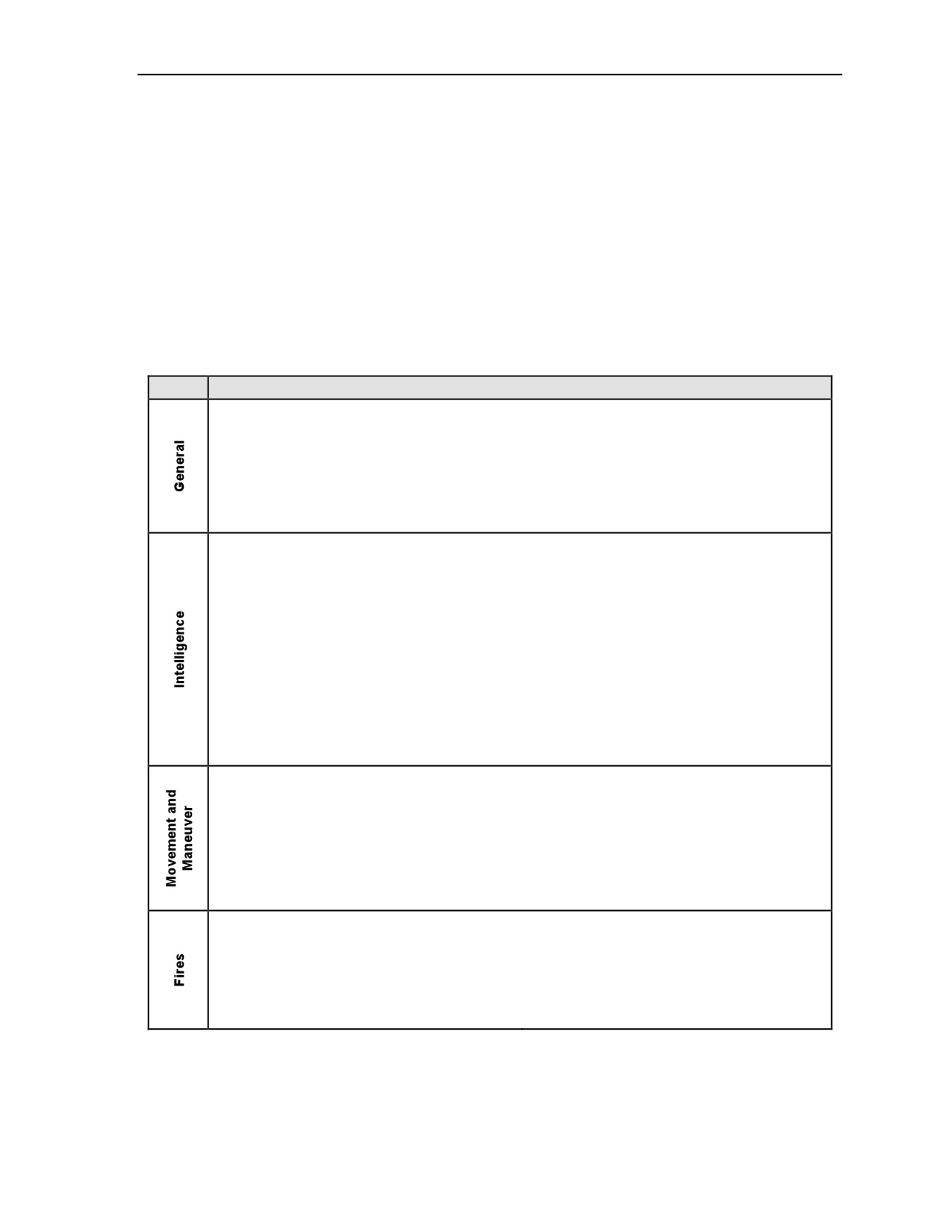
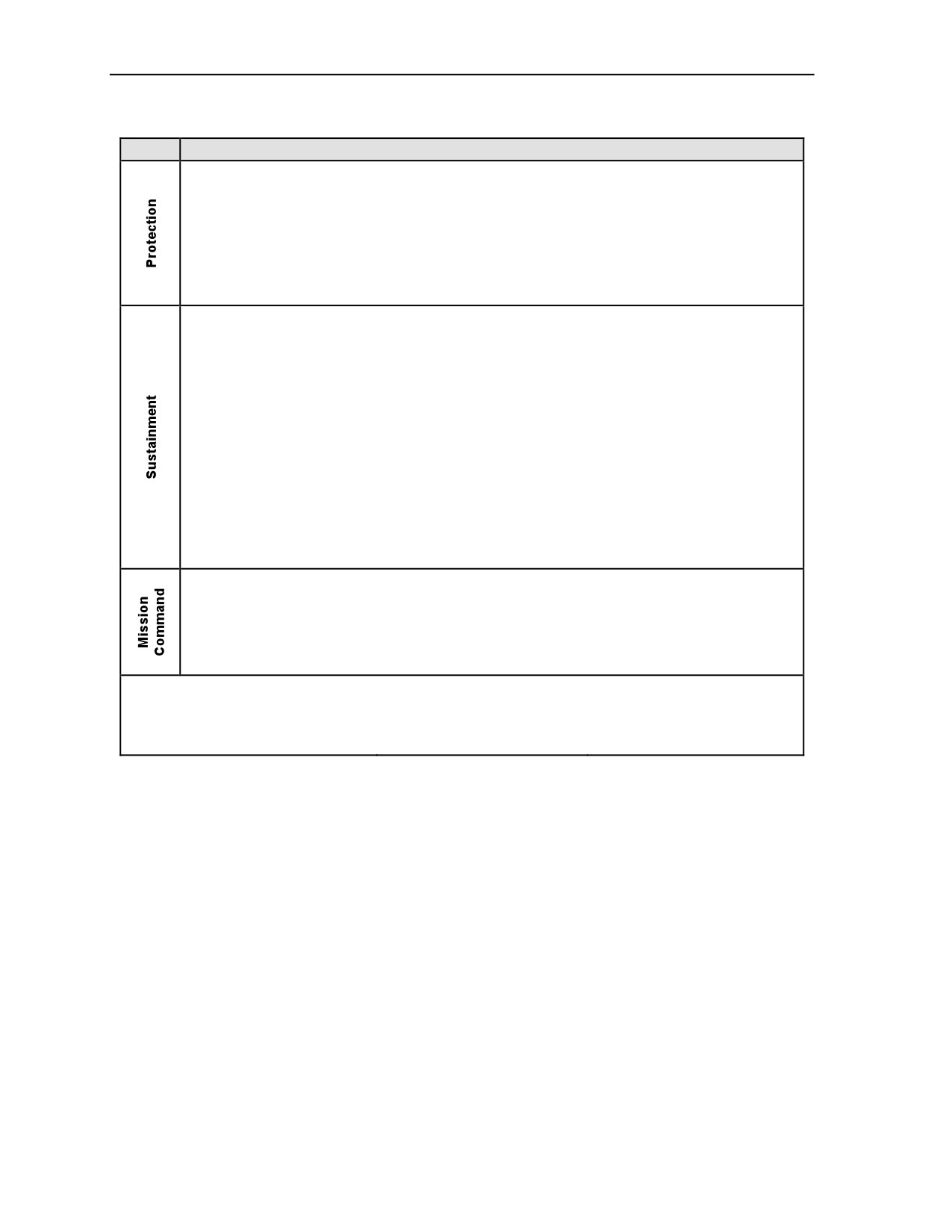
use running estimates to look for indicators of variances that affect their areas of expertise. (See table 5-2
for examples of indicators.) The commander, COS, and command post cell chiefs look for indicators of
variances that affect the overall operation. While these indicators may come from any source, often they
come from intelligence, surveillance, and reconnaissance (ISR) efforts or reports from units executing the
operation.
±Table 5-2. Examples of change indicators
Types
Indicators
•
Answer to a CCIR.
•
Change in capabilities of subordinate unit.
•
Identification of an IR.
•
Change in role of host-nation military force.
•
Change in mission.
•
Climate changes or natural disasters
impacting on the population, agriculture,
•
Change in organization of unit.
industry.
•
Change in leadership of unit.
•
Upcoming local election.
•
Signing or implementation of peace treaty or
other key political arrangement.
•
Changes in key civilian leadership.
•
Identification of enemy main effort.
•
Enemy electronic attack use.
•
Identification of enemy reserves or
•
Indicators of illicit economic activity.
counterattack.
•
Identification of threats from within the
•
Indications of unexpected enemy action or
population.
preparation.
•
Increased unemployment within the
•
Increase in enemy solicitation of civilians for
population.
intelligence operations.
•
Interference with freedom of religious
•
Identification of an IR.
worship.
•
Insertion of manned surveillance teams.
•
Identification of HPT or HVT.
•
Disruption of primary and secondary
•
UAS launch.
education system.
•
Answer to a PIR.
•
Unexplained disappearance of key members
•
Enemy rotary-wing or UAS use.
of intelligence community.
•
Success or failure in breaching or gap
•
Success or failure of a subordinate unit task.
crossing operations.
•
Modification of an airspace control measure.
•
Capture of significant numbers of EPWs,
•
Numbers of dislocated civilians sufficient to
enemy CPs, supply points, or artillery units.
affect friendly operations.
•
Establishment of road blocks along major
•
Damages to civilian infrastructure affecting
traffic routes.
friendly mobility.
•
Unexplained displacement of neighborhoods
•
Loss of one or more critical transportation
within a given sector.
systems.
•
Receipt of an air tasking order.
•
Execution of planned fires.
•
Battle damage assessment results.
•
Modification of a FSCM.
•
Unplanned repositioning of firing units.
•
Effective enemy counterfire.
•
Success or lack thereof in electronic attack.
•
Negative effects of fires on civilians.
•
Identification of HPT or HVT.
•
Destruction of any place of worship by
•
Identification of an IR.
friendly fire.
18 March 2011
FM 5-0, C1
5-9
Chapter 5
±Table 5-2. Examples of change indicators (continued)
Types
Indicators
•
NBC 1 report or other indicators of enemy
•
Identification of threats to communications
CBRN use.
or computer systems.
•
Report or other indicators of enemy
•
Reports of enemy targeting critical host-
improvised explosive device use.
nation infrastructure.
•
Indicators of coordinated enemy actions
•
Identification of threat to base or
against civilians or friendly forces.
sustainment facilities.
•
Increased criminal activity in a given sector.
•
Escalation of force incidents.
•
Increase in organized protests or riots.
•
Loss of border security.
•
Significant loss of capability in any class of
•
Degradations to essential civilian
supply.
infrastructure by threat actions.
•
Opening or closing of civilian businesses
•
Civilian mass casualty event beyond
within a given area.
capability of host-nation resources.
•
Identification of significant incidences of
•
Identification of significant shortage in any
disease and nonbattle injury casualties.
class of supply.
•
Closing of major financial institutions.
•
Outbreak of epidemic or famine within the
•
Mass casualties.
civilian population.
•
Medical evacuation launch.
•
Receipt of significant resupply.
•
Disruption of one or more essential civil
•
Dislocated civilian event beyond capability
of host-nation resources.
services (such as water or electricity).
•
Contact on a supply route.
•
Disruption of key logistics lines of
communication.
•
Answer to an FFIR.
•
Changes in availability of host-nation
•
Mass detainees.
support.
•
Impending changes in key military
•
Effective adversary information efforts on
leadership.
civilians.
•
Interference with freedom of the press or
•
Loss of civilian communications nodes.
news media.
•
Loss of contact with a CP or commander.
•
Receipt of a fragmentary order or warning
•
Jamming or interference.
order from higher headquarters.
CBRN
chemical, biological, radiological, and
FFIR friendly force information
IR
information requirement
nuclear
requirement
NBC
nuclear, biological, and
CCIR
commander’s critical information
FSCM fire support coordination
chemical
requirement
measure
PIR
priority intelligence requirement
CP
command post
HPT high-priority target
UAS
unmanned aircraft system
EPW
enemy prisoner of war
HVT high-value target
5-47. Staff members are particularly alert for answers to CCIRs that support anticipated decisions. They
also watch for exceptional information. Exceptional information is information that would have answered
one of the commander’s critical information requirements if the requirement for it had been foreseen and
stated as one of the commander’s critical information requirements (FM 6-0). Exceptional information
usually reveals a need for an adjustment decision. (See FM 6-0.)
5-48. When performing the RDSP, the current operations integration cell first compares the current
situation to the one envisioned in the order. (See chapter 2.) It may obtain assistance from the assessment
section or the red team section in this analysis. If the situation requires greater analysis, the COS (XO)
may task the future operations cell (where authorized) or the plans cell to perform this analysis. At
echelons with no future operations cell, the plans cell or the current operations integration cell performs
this function.
DETERMINE THE TYPE OF DECISION REQUIRED
5-49. When a variance is identified, the commander directs action while the chief of operations leads
chiefs of the current operations integration cell and selected functional cell in quickly comparing the
current situation to the expected situation. This assessment accomplishes the following:
5-10
FM 5-0, C1
18 March 2011
Execution
z
Describes the variance.
z
Determines if the variance provides a significant opportunity or threat and examines the
potential of either.
z
Determines if a decision is needed by identifying if the variance—
Indicates an opportunity that can be exploited to accomplish the mission faster or with fewer
resources.
Directly threatens the decisive operation’s success.
Threatens a shaping operation such that it may threaten the decisive operation directly or in
the near future.
Can be addressed within the commander’s intent and concept of operations.
(If so,
determine what execution decision is needed.)
Requires changing the concept of operations substantially. (If so, determine what adjustment
decision or new approach will best suit the circumstances.)
5-50. For minor variances, the chief of operations works with other cell chiefs to determine whether
changes to control measures are needed. If so, they determine how those changes affect other warfighting
functions. They direct changes within their authority (execution decisions) and notify the COS (XO) and
the affected command post cells and staff elements.
5-51. Commanders intervene directly in cases that affect the overall direction of the unit. They describe
the situation, direct their subordinates to provide any additional information they need, and order either
implementation of planned responses or development of an order to redirect the force.
5-52. Staff members constantly compare the current situation to their expectations to identify variances.
Likewise, as the time for an anticipated execution decision approaches, staff members assess the situation
in their area of expertise. Doing this allows them to confirm that the decision will produce the planned
effects. It initiates the RSDP, essentially bypassing recognition and allowing the staff to discover small
changes in conditions that might otherwise go unnoticed.
DEVELOP A COURSE OF ACTION
5-53. If the variance requires an adjustment decision, the designated integrating cell and affected
command post cell chiefs recommend implementation of a COA or obtain the commander’s guidance for
developing one. They use the following conditions to screen possible COAs:
z
Mission.
z
Commander’s intent.
z
Current dispositions and freedom of action.
z
CCIRs.
z
Limiting factors, such as supply constraints, boundaries, and combat strength.
5-54. The new options must conform to the commander’s intent. Possible COAs may alter the concept of
operations and CCIRs if they remain within the commander’s intent. However, the commander approves
changes to the CCIRs. Functional cell chiefs and other staff section leaders identify areas that may be
affected within their areas of expertise by proposed changes to the order or mission. Considerations
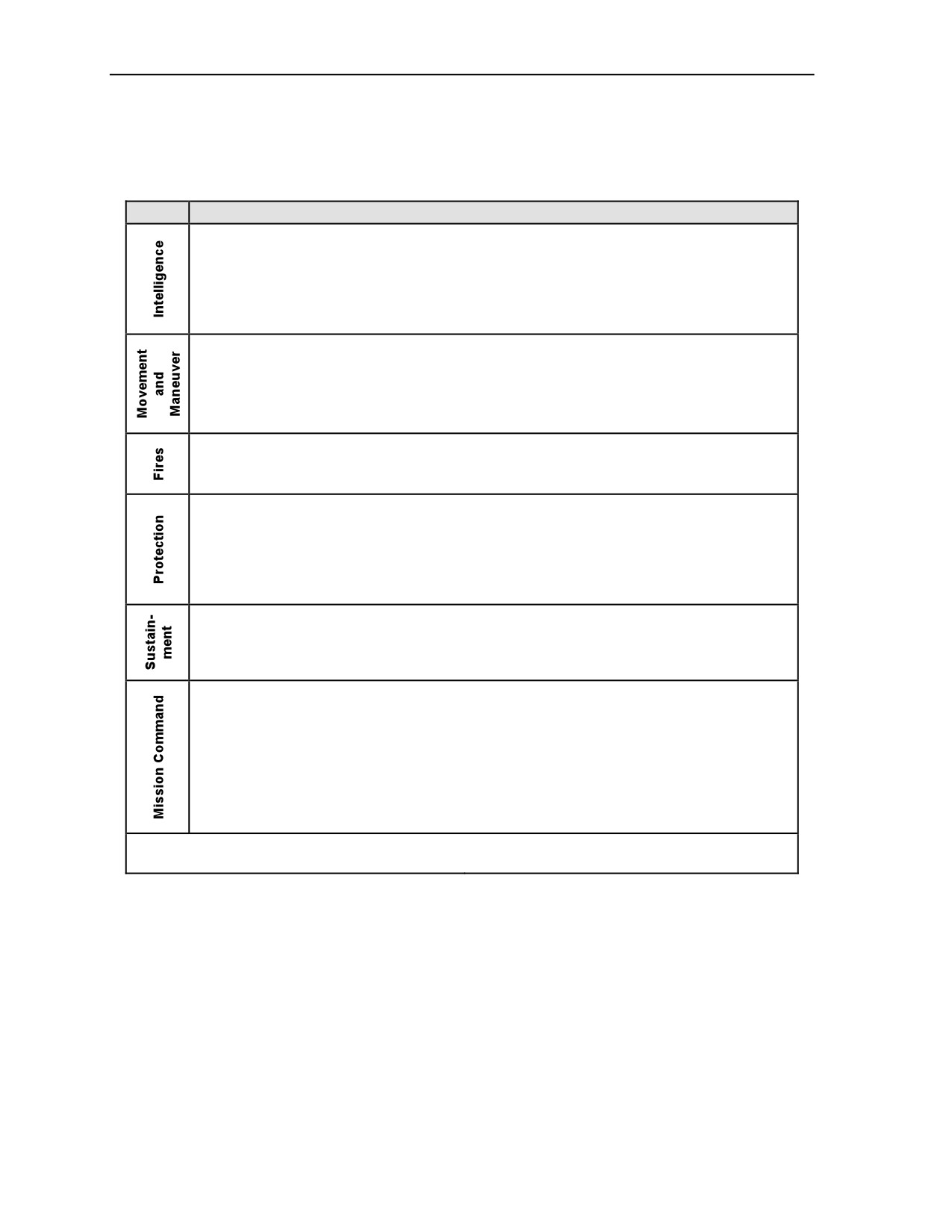
include but are not limited to those shown in table 5-3 on page 5-12. The commander is as likely as
anyone else to detect the need for change and to sketch out the options. Whether the commander, COS,
XO, or chief of operations does this, the future operations cell is often directed to flesh out the concept and
draft the order. The chief of operations and the current operations integration cell normally lead this effort,
especially if the response is needed promptly or the situation is not complex. The commander, COS, or
XO is usually the decisionmaking authority, depending on the commander’s delegation of authority.
5-55. Commanders may delegate authority for execution decisions to their deputies, COSs (XOs), or their
operations officers. They retain personal responsibility for all decisions and normally retain the authority
for approving adjustment decisions.
18 March 2011
FM 5-0, C1
5-11
Chapter 5
5-56. When reallocating resources or priorities, commanders assign only minimum essential assets to
shaping operations. They use all other assets to weight the decisive operation. This applies when
allocating resources for the overall operation or within a warfighting function.
±Table 5-3. Considerations for synchronization and decision implementation actions
Types
Actions
•
Modifying priority intelligence
•
Updating the enemy SITEMP and enemy
requirements and other intelligence
COA statements.
requirements.
•
Modifying the ISR synchronization plan.
•
Updating named areas of interest and
•
Confirming or denying threat COAs.
target areas of interest.
•
Updating the ISR synchronization matrix and
•
Updating the intelligence estimate.
tools.
•
Assigning new objectives.
•
Modifying airspace control measures.
•
Revising or refining the ISR plan.
•
Making unit boundary changes.
•
Assigning new tasks to subordinate units.
•
Emplacing obstacles.
•
Adjusting terrain management.
•
Clearing obstacles.
•
Employing smoke.
•
Establishing and enforcing movement priority.
•
Delivering fires against targets or target sets.
•
Modifying radar zones.
•
Modifying the high-payoff target list and
•
Modifying the priority of fires.
the attack guidance matrix.
•
Modifying fire support coordination measures.
•
Moving air defense weapons systems.
•
Changing air defense weapons control status.
•
Establishing decontamination sites.
•
Enhancing survivability through engineer
support.
•
Conducting chemical, biological,
radiological, and nuclear reconnaissance.
•
Revising and updating personnel recovery
coordination.
•
Establish movement corridors on critical
lines of communications.
•
Reassigning or repositioning response forces.
•
Prioritizing medical evacuation assets.
•
Repositioning and prioritizing general
•
Repositioning logistics assets.
engineering assets.
•
Modifying priorities.
•
Positioning and prioritizing internment and
resettlement assets.
•
Modifying distribution.
•
Moving communications nodes.
•
Moving command posts.
•
Modifying information priorities for employing information as combat power.
•
Synchronizing and adjusting information themes and messages to support the new decision.
•
Adjusting measures for minimizing civilian interference with operations.
•
Revising recommended protected targets to the fires cell.
•
Recommending modifications of stability operations, including employment of civil affairs
operations and other units, to perform civil affairs operations tasks.
COA
course of action
SITEMP situation template
ISR
intelligence, surveillance, and reconnaissance
5-57.
Commanders normally direct the future operations cell to prepare a fragmentary order or the current
operations integration cell to issue a fragmentary order setting conditions for executing a new COA. When
lacking time to perform the MDMP or quickness of action is desirable, commanders make an immediate
adjustment decision—using intuitive decisionmaking—in the form of a focused COA. Developing the
focused COA often follows the mental war-gaming by commanders until they reach an acceptable COA.
If time is available, commanders may direct the plans cell to develop a new COA using the MDMP, and
the considerations for planning become operative.
REFINE AND VALIDATE THE COURSE OF ACTION
5-58. Once commanders describe the new COA, the current operations integration cell conducts an
analysis to validate its feasibility, suitability, and acceptability. If acceptable, the COA is refined to
resynchronize the warfighting functions enough to generate and apply the needed combat power. Staffs
5-12
FM 5-0, C1
18 March 2011
Execution
with a future operations cell may assign that cell responsibility for developing the details of the new COA
and drafting a fragmentary order to implement it. The commander or COS may direct an “on-call”
operations synchronization meeting to perform this task and ensure rapid resynchronization.
5-59. Validation and refinement is done very quickly. Normally, the commander and staff officers
conduct a mental war game of the new COA. They consider potential enemy reactions, the unit’s
counteractions, and secondary effects that might affect the force’s synchronization. When time allows, the
XO or chief of operations assembles command post cell chiefs and refines and validates the COA in an
open forum. Each staff member considers the following:
z
Is the new COA feasible in terms of my area of expertise?
z
How will this action affect my area of expertise?
z
Does it require changing my information requirements?
Should any of the information requirements be nominated as a CCIR?
What actions within my area of expertise does this change require?
Will it require changing objectives or targets nominated by the staff section?
z
What other command post cells and elements does this action affect?
z
What are potential enemy reactions?
z
What are the possible friendly counteractions?
Does this counteraction affect my area of expertise?
Will it require changing my information requirements?
Are any of my information requirements potential CCIRs?
What actions within my area of expertise does this counteraction require?
Will it require changing objectives or targets nominated by the staff section?
What other command post cells and elements does this counteraction affect?
5-60. The validation and refinement show if the COA will acceptably solve the problem. If it does not,
the XO or chief of operations modifies it through additional analysis or develops a new COA. The XO
informs the commander of any changes made.
IMPLEMENT
5-61.
±When the COA is acceptable, the XO recommends implementation to the commander or
implements it directly if the commander has delegated that authority. Implementation normally requires a
fragmentary order; in exceptional circumstances, it may require a new operation order. That order changes
the concept of operations
(in adjustment decisions), resynchronizes the warfighting functions, and
disseminates changes to control measures. The staff uses warning orders to alert the unit to a pending
change. The staff also establishes sufficient time for the unit to implement the change without losing
integration or being exposed to unnecessary tactical risk. Stability operations demand special attention to
execution of inform and influence activities. Part of implementing in stability operations includes
informing the population of the purpose of an operation and amending the inform and influence plan to
account for changes that occur as the operation proceeds.
5-62. Commanders often issue orders to subordinates verbally in situations requiring a quick reaction. At
battalion and higher levels, written fragmentary orders confirm verbal orders to ensure synchronization,
integration, and notification of all parts of the force. Common revisions to products needed to affect
adjustments include the following:
z
Updated enemy situation, including the situation template.
z
Revised CCIRs.
z
Updated ISR plan.
z
Updated scheme of maneuver and tasks to maneuver units, including an execution matrix and
decision support matrix or template.
z
Updated scheme of fires, including the fire support execution matrix, high-payoff target list, and
attack guidance matrix.
z
Updated information tasks.
18 March 2011
FM 5-0, C1
5-13
Chapter 5
5-63. If time permits, leaders verify that subordinates understand critical tasks. Methods for doing this
include the confirmation brief and backbrief. These are done both between commanders and within staff
elements to ensure mutual understanding.
5-64. After the analysis is complete, the current operations integration cell and command post cell chiefs
update decision support templates and synchronization matrixes. When time is available, the operations
officer or chief of operations continues this analysis to the operation’s end to complete combat power
integration. Staff members begin the synchronization needed to implement the decision. This
synchronization involves collaboration with other command post cells and subordinate staffs. Staff
members determine how actions in their areas of expertise affect others. They coordinate those actions to
eliminate undesired effects that might cause friction. The cells provide results of this synchronization to
the current operations integration cell and the common operational picture.
5-65. During implementation of the RDSP, the current operations integration cell keeps the warfighting
functions synchronized as the situation changes. It considers the following outcomes when making
synchronization decisions or allowing others’ synchronization in collaboration to proceed:
z
Combined arms integration.
z
Responsiveness—both anticipatory and reactive.
z
Timeliness.
Anticipating certain outcomes lets commanders mass the effects of combat power at decisive times and
places.
5-66. Commanders also synchronize collaboratively. Coordination among higher, adjacent, supporting,
and subordinate commanders facilitates effective execution by improving interaction between their units
as they anticipate and solve problems. Cross talk among subordinate commanders can provide
synchronization as well as lead to decisionmaking. Such synchronization occurs without the higher
commander becoming involved, except to affirm, either positively or through silence, the decisions or
agreements of subordinates.
CAUTIONS
5-67. Validating and refining action is a rapid and largely intuitive activity. It should be done quickly and
not be drawn out. Commanders focus on maintaining the tempo and minimizing necessary
synchronization. The RDSP is not designed to mass maximum combat power but to make the minimum
coordination needed to generate enough combat power to prevail.
5-68. Most decisions during execution are made at a relatively low level by command post cell chiefs.
They refine execution of the order without changing it significantly. However, even small changes can
affect other staff sections. All changes that affect operations should be coordinated between cells and
reported to the staff as a whole. When time does not allow this, the staff element making the change
immediately advises all affected elements.
5-69. To work, the RDSP must be done continuously, not tied to the battle rhythm. Commanders can use
cyclical events (such as targeting working groups) to review an entire process or evaluate the entire ISR or
targeting plan. The key is to be able to act and react in real time as events occur, not at predetermined
points. Only in this way can Army forces operate within the enemy’s decision cycles at a tempo the enemy
cannot match.
5-14
FM 5-0, C1
18 March 2011
Chapter 6
Assessment
This chapter provides the fundamentals of assessment, including its definition,
purpose, and process. It discusses how assessment works with the levels of war and
offers considerations for effective assessment. This chapter also covers assessment
working groups and assessment support with operations research/systems analysis.
Guidelines for developing assessment plans are discussed in detail in appendix H.
ASSESSMENT FUNDAMENTALS
6-1. Assessment is the continuous monitoring and evaluation of the current situation, particularly the
enemy, and progress of an operation (FM 3-0). Commanders, assisted by their staffs and subordinate
commanders, continuously assess the operational environment and the progress of the operation. Based on
their assessment, commanders direct adjustments thus ensuring the operation remains focused on
accomplishing the mission.
6-2. Assessment involves deliberately comparing forecasted outcomes with actual events to determine the
overall effectiveness of force employment. More specifically, assessment helps the commander determine
progress toward attaining the desired end state, achieving objectives, and performing tasks. It also involves
continuously monitoring and evaluating the operational environment to determine what changes might
affect the conduct of operations. Assessment helps commanders determine if they need to reframe the
problem and develop an entirely new plan. (Chapter 3 addresses reframing.)
6-3. Throughout the operations process, commanders integrate their own assessments with those of the
staff, subordinate commanders, and other partners in the area of operations. Primary tools for assessing
progress of the operation include the operation order, the common operational picture, personal
observations, running estimates, and the assessment plan. The latter includes measures of effectiveness,
measures of performance, and reframing criteria. The commander’s visualization forms the basis for the
commander’s personal assessment of progress. Running estimates provide information, conclusions, and
recommendations from the perspective of each staff section. They help to refine the common operational
picture and supplement it with information not readily displayed.
6-4. Commanders avoid excessive analyses when assessing operations. Committing valuable time and
energy to developing excessive and time-consuming assessment schemes squander resources better devoted
to other operations process activities. Commanders reject the tendency to measure something just because it
is measurable. Effective commanders avoid burdening subordinates and staffs with overly detailed
assessment and collection tasks. Generally, the echelon at which a specific operation, task, or action is
conducted should be the echelon at which it is assessed. This provides a focus for assessment at each
echelon. It enhances the efficiency of the overall operations process.
ASSESSMENT PROCESS
6-5. Assessment is continuous; it precedes and guides every operations process activity and concludes
each operation or phase of an operation. Broadly, assessment consists of the following activities:
z
Monitoring the current situation to collect relevant information.
z
Evaluating progress toward attaining end state conditions, achieving objectives, and performing
tasks.
z
Recommending or directing action for improvement.
18 March 2011
FM 5-0, C1
6-1
Chapter 6
6-6. The three activities that make up the assessment process are also continuous; they are logically
sequential while constantly executed throughout the operations process. This process applies to assessments
of every type and at every echelon.
MONITORING
6-7. Monitoring is continuous observation of those conditions relevant to the current operation.
Monitoring within the assessment process allows staffs to collect relevant information, specifically that
information about the current situation that can be compared to the forecasted situation described in the
commander’s intent and concept of operations. Progress cannot be judged, nor effective decisions made,
without an accurate understanding of the current situation.
6-8. During planning, commanders monitor the situation to develop facts and assumptions that underlie
the plan. During preparation and execution, commanders and staffs monitor the situation to determine if the
facts are still relevant, if their assumptions remain valid, and if new conditions emerged that affect the operations.
6-9. Commander’s critical information requirements and decision points focus the staff’s monitoring
activities and prioritize the unit’s collection efforts. Information requirements concerning the enemy,
terrain and weather, and civil considerations are identified and assigned priorities through intelligence,
surveillance, and reconnaissance
(ISR) synchronization. Operations officers use friendly reports to
coordinate other assessment-related information requirements. To prevent duplicated collection efforts,
information requirements associated with assessing the operation are integrated into both the ISR plan and
friendly force information requirements. (See appendix H for more detail in building an assessment plan.)
6-10. Staffs monitor and collect information from the common operational picture and friendly reports.
This information includes operational and intelligence summaries from subordinate, higher, and adjacent
headquarters and communications and reports from liaison teams. The staff also identifies information
sources outside military channels and monitors their reports. These other channels might include products
from civilian, host-nation, and other government agencies. Staffs apply information management and
knowledge management principles to facilitate getting this information to the right people at the right time.
(See FM 6-0 and FM 6-01.1.)
6-11. Staff sections record relevant information in running estimates. Each staff section maintains a
continuous assessment of current operations as a basis to determine if they are proceeding according to the
commander’s intent, mission, and concept of operations. In their running estimates, staff sections use this
new information, updated facts, and assumptions as the basis for evaluation.
EVALUATING
6-12. The staff analyzes relevant information collected through monitoring to evaluate the operation’s
progress. Evaluating is using criteria to judge progress toward desired conditions and determining
why the current degree of progress exists. Evaluation is the heart of the assessment process where most
of the analysis occurs. Evaluation helps commanders determine what is working, determine what is not
working, and gain insights into how to better accomplish the mission.
6-13. Criteria in the forms of measures of effectiveness (MOEs) and measures of performance (MOPs) aid
in determining progress toward attaining end state conditions, achieving objectives, and performing tasks.
MOEs help determine if a task is achieving its intended results. MOPs help determine if a task is completed
properly. MOEs and MOPs are simply criteria—they do not represent the assessment itself. MOEs and
MOPs require relevant information in the form of indicators for evaluation.
6-14. A measure of effectiveness is a criterion used to assess changes in system behavior, capability, or
operational environment that is tied to measuring the attainment of an end state, achievement of an
objective, or creation of an effect (JP 3-0). MOEs help measure changes in conditions, both positive and
negative. MOEs help to answer the question “Are we doing the right things?” MOEs are commonly found
and tracked in formal assessment plans. Examples of MOEs for the objective to “Provide a safe and secure
environment” may include—
z
Decrease in insurgent activity.
z
Increase in population trust of host-nation security forces.
6-2
FM 5-0, C1
18 March 2011
Assessment
6-27. Often, time available for detailed analysis and assessment is shorter at the tactical level. Additionally,
tactical staffs are progressively smaller and have less analytic capability at each lower echelon. As such,
assessment at the tactical level focuses on the near term and relies more on direct observation and
judgments than on detailed assessment methods. This is not to say that tactical units cannot use detailed
assessment methods.
6-28. For small units (those without a staff), assessment is mostly informal. Small-unit leaders focus on
assessing their unit readiness—personnel, equipment, supplies, and morale—and their unit’s ability to
perform assigned tasks. Leaders also determine whether the unit has completed assigned tasks. If those
tasks have not produced the desired results, leaders explore why they have not and consider what smart
improvements could be made for unit operations. As they assess and learn, small units change their tactics,
techniques, and procedures based on their experiences.
CONSIDERATIONS FOR EFFECTIVE ASSESSMENT
6-29. The following considerations help commanders and staffs develop assessment plans and conduct
effective assessments:
z
Assessment is continuous.
z
Commanders drive assessment through prioritization.
z
Assessment incorporates the logic behind the plan.
z
Assessment facilitates learning and adapting.
z
Commanders and staffs use caution when establishing cause and effect.
z
Commanders and staffs combine quantitative and qualitative indicators.
z
Assessment incorporates formal and informal methods.
ASSESSMENT IS CONTINUOUS
6-30. Assessment is a continuous activity of the operations process. The focus of assessment, however,
changes for each operations process activity. During planning, assessment focuses on understanding current
conditions of the operational environment and developing an assessment plan, including what and how to
assess progress. Understanding the commander’s intent and desired future conditions is key when building
the assessment plan. During preparation, assessment focuses on determining the friendly force’s readiness
to execute the operation and on verifying the assumptions on which the plan is based. During execution,
assessment focuses on evaluating progress of the operation. Based on their assessment, commanders direct
adjustments to the order, ensuring the operation stays focused on accomplishing the mission. They adjust
their assessment plan as required.
6-31. Assessment is continuous, even when the unit is not actively engaged in operations. At a minimum,
staffs maintain running estimates of friendly force capabilities and readiness within their areas of expertise.
Some running estimates, such as the intelligence estimate, also assess operational environments to which
the unit is likely to deploy.
COMMANDERS DRIVE ASSESSMENT THROUGH PRIORITIZATION
6-32. The commander’s role is central to the assessment process. Commanders establish priorities for
assessment and discipline the staff to meet the requirements of time, simplicity, and level of detail based on
the situation. While the staff does the detailed work, to include collecting and analyzing information,
commanders ultimately assess the operation. Commanders are also responsible for decisions made based on
their assessments.
6-33. ±In assessing operations, commanders consider information and recommendations by the staff,
subordinate commanders, and other partners within and outside of their area of operations. Commanders
then apply their judgment to assess progress. As commanders monitor the situation, they compare the
current situation to their initial commander’s visualization and commander’s intent. Based on their
assessment of progress, commanders direct adjustments to the order—ensuring the operation stays focused
on the operation’s end state—or reframe the problem and develop an entirely new plan.
18 March 2011
FM 5-0, C1
6-5
Chapter 6
6-34. To assist commanders learning throughout the conduct of operations, they establish their
commander’s critical information requirements, set priorities for assessment in the form of MOEs and
reframing criteria, and explicitly state assumptions. When results fail to meet expectations, commanders
decide whether this is due to a failure in implementing the plan (execution) or if the plan and its underlying
logic are flawed.
ASSESSMENT INCORPORATES THE LOGIC BEHIND THE PLAN
6-35. Effective assessment relies on an accurate understanding of the logic used to build the plan. Each
plan is built on assumptions and an operational approach—a broad conceptualization of the general actions
that will produce the conditions that define the desire end state. The reasons or logic as to why the
commander believes the plan will produce the desired results are important considerations when
determining how to assess the operations. Recording and understanding this logic helps the staffs
recommend the appropriate MOPs, MOEs and indicators for assessing the operation. It also helps the
commander and staff determine if they need to reframe the problem if assumptions prove false or the logic
behind the plan appears flawed as operations progress. (See chapter 3 for a discussion of framing and
reframing the problem and developing a design concept.)
6-36. When conducting design, the logic used to drive more detailed planning is captured in the design
concept that includes the mission narrative and problem statement. As planning continues, staff sections
identify and record the logic behind the plan relating to their area of expertise in their running estimates.
They also record assumptions and include key assumptions as part of the operation plan or order. An
explicit record of this logic used in building the plan proves valuable to the commander and staff as well as
to follow-on units and other civilian and military organizations in understanding the plan and assessing the
progress of operations.
ASSESSMENT FACILITATES LEARNING AND ADAPTING
6-37. One of the most important questions when assessing the operation is whether the plan is still
relevant. Assessment entails measuring progress according to the plan. It also includes periodically
reexamining the logic and assumptions of the original plan to determine if the plan is still relevant.
Throughout an operation, higher operational objectives may change and conditions may develop that did
not exist during planning. These conditions may create a somewhat different situation from the one the
commander originally visualized. When this occurs, modifications to the plan may be in order, or it may be
necessary to reframe the problem.
6-38. The assessment process prompts the decision to reframe in several ways. Commanders and staffs
continuously challenge the key assumptions in the plan. When an assumption is invalidated, reframing may
be in order. Another sign of a requirement to reframe is when task completion measured by MOPs is high
but purpose accomplishment measured by MOEs is low. That suggests that the wrong tasks have been
assigned and reframing is needed.
6-39. As commanders assess and learn throughout the operation, they determine if achieving their original
objectives leads to the desired end state. Collaboration and dialog with higher, lower, and adjacent
commanders and staffs, backed up by quantitative and qualitative assessments, contribute to this learning.
Assessing helps commanders to update their commander’s visualization (which may include a revised end
state), direct changes to the order, and adapt the force to better accomplish the mission.
COMMANDERS AND STAFFS USE CAUTION WHEN ESTABLISHING CAUSE AND EFFECT
6-40. Establishing cause and effect is sometimes difficult, but it is crucial to effective assessment.
Sometimes, establishing causality between actions and their effects can be relatively straightforward, such
as in observing a bomb destroy a bridge. In other instances, especially regarding changes in human
behavior, attitudes, and perception, establishing links between cause and effect proves difficult.
Commanders and staffs must guard against drawing erroneous conclusions in these instances.
6-41. Understanding how cause and effect works requires careful consideration and shrewd judgment.
Even when two variables seem to be correlated, commanders must still make assumptions to establish
6-6
FM 5-0, C1
18 March 2011
Assessment
which one is cause and which one is effect. In fact, both may be caused by a third unnoticed variable.
Commanders clearly acknowledge all assumptions made in establishing causes and effects. The payoff for
correctly identifying the links between causes and effects is effective and smart recommendations.
Commanders and staffs are well-advised to devote the time, effort, and energy needed to properly uncover
connections between causes and effects. Assumptions made in establishing cause and effect must be
recorded explicitly and challenged periodically to ensure they are still valid.
6-42. ±In its simplest form, an effect is a result, outcome, or consequence of an action. Direct effects are
the immediate, first-order consequences of a military action unaltered by intervening events. They are
usually immediate and easily recognizable. Examples are an enemy command post destroyed by friendly
artillery or a terrorist network courier captured by a direct-action mission. Establishing the link between
cause and effect in the physical domains is usually straightforward, as is assessing progress.
6-43. ±It is often difficult to establish a link or correlation that clearly identifies actions that produce
effects beyond the physical domains. The relationship between action taken (cause) and nonphysical effects
may be coincidental. Then the occurrence of an effect is either purely accidental or perhaps caused by the
correlation of two or more actions executed to achieve the effect. For example, friendly forces can
successfully engage enemy formations with fire and maneuver at the same time as military information
support operations. Military information support operations might urge enemy soldiers to surrender. If both
these events occur at the same time, then correlating an increase in surrendering soldiers to military
information support operations will be difficult. As another example, friendly forces may attempt to
decrease population support for an insurgency in a particular city. To accomplish this task, the unit
facilitates the reconstruction of the city’s power grid, assists the local authorities in establishing a terrorist
tips hotline, establishes a civil-military operations center, and conducts lethal operations against high-
payoff targets within the insurgency. Identifying the relative impact of each of these activities is extremely
challenging but is critical for allocating resources smartly to accomplish the mission. Unrecognized
influences completely invisible to assessors can also cause changes unforeseen or attributed inaccurately to
actions of the force.
6-44. Furthermore, because commanders synchronize actions across the warfighting functions to achieve
an objective or obtain an end state condition, the cumulative effect of these actions may make the impact of
any individual task indistinguishable. Careful consideration and judgment are required, particularly when
asserting cause-and-effect relationships in stability operations.
COMMANDERS AND STAFFS COMBINE QUANTITATIVE AND QUALITATIVE INDICATORS
6-45. Effective assessment incorporates both quantitative (observation based) and qualitative (opinion
based) indicators. Human judgment is integral to assessment. A key aspect of any assessment is the degree
to which it relies upon human judgment and the degree to which it relies upon direct observation and
mathematical rigor. Rigor offsets the inevitable bias, while human judgment focuses rigor and processes on
intangibles that are often key to success. The appropriate balance depends on the situation—particularly the
nature of the operation and available resources for assessment—but rarely lies at the ends of the scale.
6-46. A balanced judgment for any assessment identifies the information on which to concentrate.
Amassing statistics is easy. Determining which actions imply success proves far more difficult due to
dynamic interactions among friendly forces, adaptable enemies, populations, and other aspects of the
operational environment such as economics and culture. This is especially true of operations that require
assessing the actions intended to change human behavior, such as deception or stability operations. Using
quantitative and qualitative indicators reduces the likelihood and impact of the skewed perspective that
results from an overreliance on either expert opinion or direct observation.
Quantitative
6-47. In the context of assessment, a quantitative indicator is an observation-based (objective) item of
information that provides insight into a MOE or MOP. Little human judgment is involved in collecting a
quantitative indicator. Someone observes an event and counts it. For example, the individual tallies the
monthly gallons of diesel provided to host-nation security forces by a unit or the monthly number of tips
provided to a tips hotline. Then the commander or staff collects that number.
18 March 2011
FM 5-0, C1
6-7
Chapter 6
6-48. Some human judgment is inevitably a factor even when dealing with quantitative indicators.
Choosing which quantitative indicators to collect requires significant human judgment prior to collection.
During collection the choice of sources, methods, and standards for observing and reporting the events
require judgment. After collection, the commander or staff decides whether to use the number as an
indicator in a formal assessment plan and for which MOEs or MOPs.
6-49. Quantitative indicators prove less biased than qualitative indicators. In general, numbers based on
observations are impartial (assuming that the events in question were observed and reported accurately).
Often, however, these indicators are less readily available than qualitative indicators and more difficult to
select correctly. This is because the judgment aspect of which indicators validly inform the MOE is already
factored into qualitative indicators to a degree. Experts factor in all considerations they believe are relevant
to answering questions. However, this does not occur inherently with quantitative indicators. The
information in quantitative indicators is less refined and requires greater judgment to handle appropriately
than information in qualitative indicators.
6-50. Public opinion polling can be easily miscategorized. It often provides an important source of
information in prolonged stability operations. Results of a rigorously collected and statistically valid public
opinion poll are quantitative, not qualitative. Polls take a mathematically rigorous approach to answering
the question of what people really think; they do not offer opinions on whether the people are correct.
6-51. While the results of scientifically conducted polls are quantitative, human judgment is involved in
designing a poll. Decisions must be made on what questions to ask, how to word the questions, how to
translate the questions, how to select the sample, how to choose interviewers, what training to give
interviewers, and what mathematical techniques to use for getting a sample of the population.
Qualitative
6-52. In the context of assessment, a qualitative indicator is an opinion-based
(subjective) item of
information that provides insight into a MOE or MOP. A high degree of human judgment is involved when
collecting qualitative indicators. Qualitative indicators are themselves opinions, not just observed opinions
of others such as polls. For example, the division commander estimates the effectiveness of the host-nation
forces on a scale of 1 to 5. Sources of qualitative indicators include subject matter experts’ opinions and
judgments as well as subordinate commanders’ summaries of the situation.
6-53. Qualitative indicators can account for real-world complexities that cannot be feasibly measured using
quantitative indicators. Qualitative indicators are also more readily available; commanders often have
access to staff principals and other subject matter experts from whom to garner opinions. In some cases, the
only available indicator for a particular MOE or MOP is an expert opinion. For example, determining
changes in the size and number of enemy sanctuaries may prove impossible without asking local
commanders. Without large amounts of objective data, subjective indicators can be used to give a relatively
informed picture. However, subjective measures have a higher risk of bias. Human opinion is capable of
spectacular insight but also vulnerable to hidden assumptions that may prove false.
6-54. Differentiating between quantitative and qualitative indicators is useful but signifies a major
tendency rather than a sharp distinction in practice. Quantitative indicators often require a degree of
judgment in their collection. For example, determining the number of mortar attacks in a given area over a
given period requires judgment in categorizing attacks as mortar attacks. A different delivery system could
have been used, or an improvised explosive device could have been mistaken for a mortar attack. The
attack could also have landed on a boundary, requiring a decision on whether to count it. Similarly,
qualitative indicators always have some basis in observed and counted events. The same indicator may be
quantitative or qualitative depending on the collection mechanism. For example, the indicator may measure
a change in market activity for village X. If a Soldier observes and tracks the number of exchanges, then
the indicator is quantitative. If the battalion commander answers that question in a mandated monthly
report based on a gut feel, then the indicator is qualitative.
ASSESSMENT INCORPORATES FORMAL AND INFORMAL METHODS
6-55. Assessment may be formal or informal; the appropriate level of formality depends entirely on the
situation. As part of their planning guidance, commanders address the level of detail they desire for
6-8
FM 5-0, C1
18 March 2011
Appendix A
Command Post Organization and Operations
This appendix describes how commanders organize their headquarters into command
posts (CPs) during the conduct of operations. It describes how commanders further
cross-functionally organize the staff within CPs into functional and integrating cells.
Next, this chapter provides guidelines for CP operations to include the importance of
establishing standard operating procedures and an effective battle rhythm for the
headquarters. For specific guidance on CP organization by echelon or type of unit,
see the corresponding field manual. For headquarters serving as a joint task force
headquarters, see JP 3-33.
±COMMAND POST ORGANIZATION
A-1. Staffs at every echelon are structured differently; however, all staffs are similar. A commander’s staff
includes a chief of staff (COS) or executive officer (XO) and various staff sections. A staff section is a
grouping of staff members by area of expertise under a coordinating, special, or personal staff
officer. The number of coordinating, special, and personal principal staff officers and their corresponding
staff sections varies by type of unit and echelon. FM 6-0 details the duties and responsibilities of the
coordinating, special, and personal staff.
A-2. In operations, effective mission command requires continuous, and often immediate, close
coordination, synchronization, and information sharing across staff sections. To promote this, commanders
cross-functionally organize elements of staff sections within CP cells (see A-15 to A-33). Additional staff
integration occurs in meetings to include working groups and boards.
COMMAND POSTS
A-3.
±A command post is a unit headquarters where the commander and staff perform their
activities. The headquarters’ design of the modular force, combined with robust communications, gives
commanders a flexible mission command structure consisting of a main CP, a tactical CP, and a command
group for brigades, divisions, and corps. Combined arms battalions are also resourced with a combat trains
CP and a field trains CP. Theater army headquarters are resourced with a main CP and a contingency CP.
See appropriate echelon manuals for doctrine on specific CP and headquarters’ organization.
A-4. Each CP performs specific functions by design as well as tasks the commander assigns. Activities
common in all CPs include—
z
Maintaining running estimates and the common operational picture.
z
Controlling operations.
z
Assessing operations.
z
Developing and disseminating orders.
z
Coordinating with higher, lower, and adjacent units.
z
Conducting knowledge management and information management. (See FM 6-01.1.)
z
Performing CP administration.
Main Command Post
A-5.
±The main command post is a facility containing the majority of the staff designed to control
current operations, conduct detailed analysis, and plan future operations. The main CP is the unit’s
principal CP. It includes representatives of all staff sections and a full suite of information systems to plan,
18 March 2011
FM 5-0, C1
A-1
Appendix A
prepare, execute, and assess operations. It is larger in size and staffing and less mobile than the tactical CP.
The COS (XO) leads and provides staff supervision of the main CP. Functions of the main CP include—
z
Controlling and synchronizing current operations.
z
Monitoring and assessing current operations (including higher and adjacent units) for their
impact on future operations.
z
Planning operations, including branches and sequels.
z
Assessing the overall progress of operations.
z
Preparing reports required by higher headquarters and receiving reports for subordinate units.
z
Providing a facility for the commander to control operations, issue orders, and conduct
rehearsals.
Tactical Command Post
A-6.
±The tactical command post is a facility containing a tailored portion of a unit headquarters
designed to control portions of an operation for a limited time. Commanders employ the tactical CP as
an extension of the main CP to help control the execution of an operation or a specific task, such as a gap
crossing, a passage of lines, or an air assault operation. Commanders may employ the tactical CP to direct
the operations of units close to each other. This can occur for a relief in place. The tactical CP may also
control a special task force or a complex task, such as reception, staging, onward movement, and
integration.
A-7. The tactical CP is fully mobile. As a rule, it includes only the Soldiers and equipment essential to the
tasks assigned. The tactical CP relies on the main CP for planning, detailed analysis, and coordination. A
deputy commander or the operations officer leads the tactical CP.
A-8. When employed, tactical CP functions include the following:
z
Monitor and control current operations.
z
Provide information to the common operational picture.
z
Assess the progress of operations.
z
Monitor and assess the progress of higher and adjacent units.
z
Perform short-range planning.
z
Provide input to targeting and future operations planning.
z
Provide a facility for the commander to control operations, issue orders, and conduct rehearsals.
A-9. When the commander does not employ the tactical CP, the staff assigned to it reinforces the main
CP. Unit standard operating procedures (SOPs) should address the specifics for this, including procedures
to quickly detach the tactical CP from the main CP.
±Command Group
A-10. A command group consists of the commander and selected staff members who assist the
commander in controlling operations away from a command post. The command group is organized
and equipped to suit the commander’s decisionmaking and leadership requirements. It does this while
enabling the commander to accomplish critical mission command tasks when the commander is away from
a command post. The command group consists of critical staff officers necessary to assist the commander
in directly influencing the ongoing operation.
A-11. Command group personnel includes staff representation that can immediately affect current
operations, such as maneuver, fires (including the air liaison officer), and intelligence. The mission and
available staff, however, dictate the command group’s makeup. For example, during a deliberate breach,
the command group may include an engineer and an air defense officer. When visiting a dislocated
civilians’ collection point, the commander may take a translator, civil affairs operations officer, a medical
officer, and a chaplain.
A-12. Division and corps headquarters are equipped with a mobile command groups. The mobile command
group serves as the commander’s mobile CP. It consists of ground and air components equipped with
information systems. The mobile command group’s mobility allows commanders to move to critical
A-2
FM 5-0, C1
18 March 2011
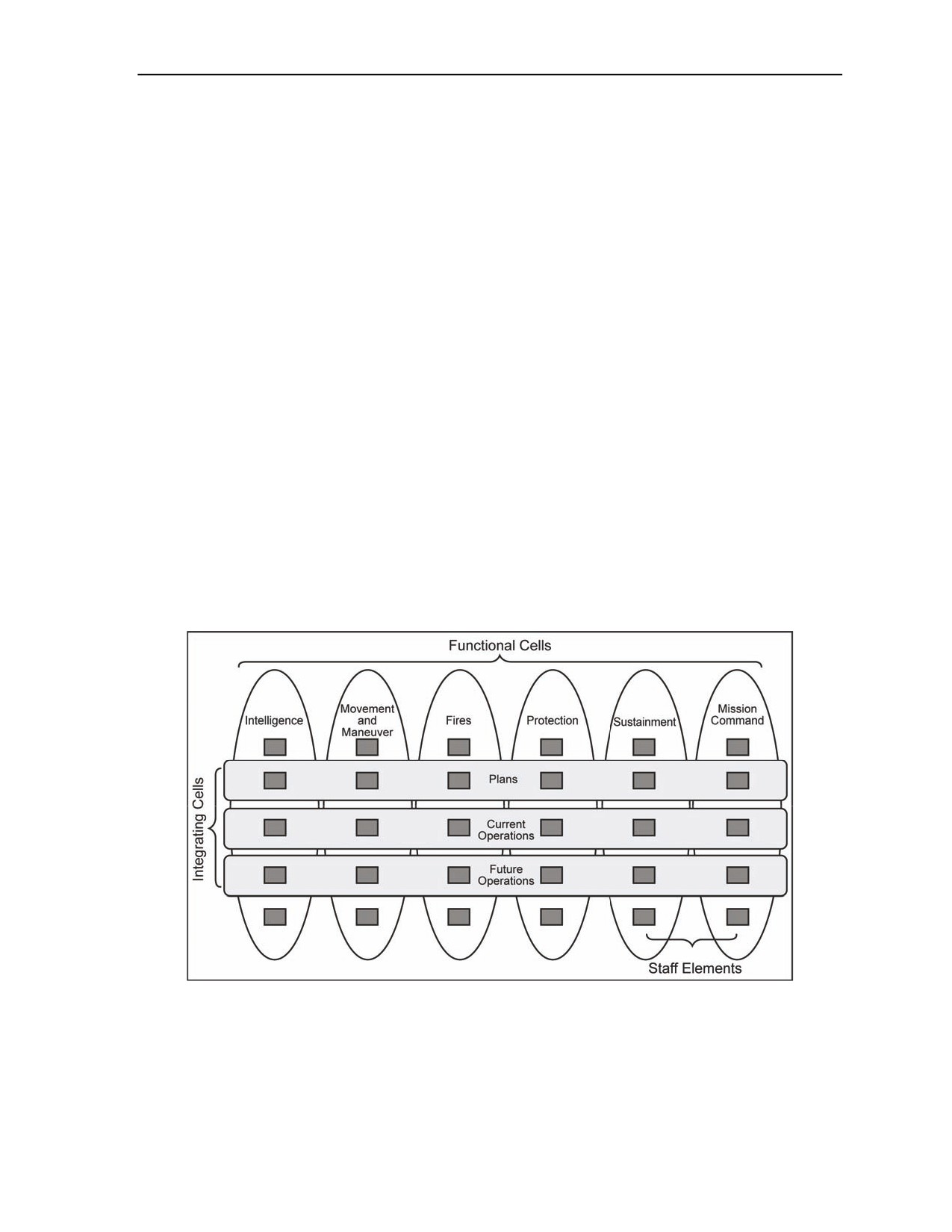
Command Post Organization and Operations
locations to personally assess a situation, make decisions, and influence operations. The mobile command
group’s information systems and small staff allow commanders to do this while retaining communication
with the entire force.
Early-Entry Command Post
A-13. ±While not part of the unit’s table of organization and equipment, commanders can establish an
early-entry command post to assist them in controlling operations during the deployment phase of an
operation. An early-entry command post is a lead element of a headquarters designed to control
operations until the remaining portions of the headquarters are deployed and operational. The early-
entry command post normally consists of personnel and equipment from the tactical CP with additional
intelligence analysis, planners, and other staff officers from the main CP based on the situation.
A-14. The early-entry command post performs the functions of the main and tactical CPs until those CPs
are deployed and fully operational. A deputy commander, COS (XO), or operations officer normally leads
the early-entry command post.
COMMAND POST CELLS AND STAFF SECTIONS
A-15. ±Within the CP, commanders organize elements of staff sections into CP cells. A command post cell
is a grouping of personnel and equipment organized by warfighting function or by planning horizon
to facilitate the exercise of mission command. CP cells are formed from staff elements—personnel and
equipment from staff sections. For example, the current operations integration cell contains elements from
nearly all staff sections of a headquarters.
A-16. ±While each echelon and type of unit organizes CPs differently, two types of CP cells exist:
functional and integrating.
(See figure A-1.) Functional cells group personnel and equipment by
warfighting function. Integrating cells group personnel and equipment to integrate the warfighting
functions by planning horizon.
±Figure A-1. Functional and integrating cells
Functional Cells
A-17. ±Functional cells coordinate and synchronize forces and activities by warfighting function. The
functional cells within a CP are intelligence, movement and maneuver, fires, protection, sustainment, and
mission command. Echelons above brigade are resourced to establish all six functional cells described in
18 March 2011
FM 5-0, C1
A-3
Appendix A
paragraphs A-18 through A-23. See appropriate brigade and battalion manuals for specifics on the
functional cells at those levels.
Intelligence Cell
A-18. The intelligence cell coordinates activities and systems that help commanders understand the enemy,
terrain and weather, and civil considerations. The intelligence cell requests, receives, and analyzes
information from all sources to produce and distribute intelligence products. This includes tasks associated
with intelligence preparation of the battlefield and intelligence, surveillance, and reconnaissance. Most of
the intelligence staff section resides in this cell. The unit’s intelligence officer leads this cell.
Movement and Maneuver Cell
A-19. The movement and maneuver cell coordinates activities and systems that move forces to achieve a
position of advantage in relation to the enemy. This includes tasks associated with combining forces with
direct fire or fire potential (maneuver) and force projection (movement) related to gaining a positional
advantage over an enemy. Elements of the operations, airspace command and control, aviation, engineer,
geospatial information and service, and space staff sections form this cell. The unit’s operations officer
leads this cell. Staff elements in the movement and maneuver cell also form the core of the current
operations integration cell. (See paragraphs A-30 through A-32.)
±Fires Cell
A-20. The fires cell coordinates activities and systems that provide collective and coordinated use of Army
indirect fires, joint fires, and cyber/electromagnetic activities through the targeting process. The fires cell
consists of elements of fire support, Air Force (or air component), and electronic warfare staff section. The
unit’s chief of fires (or fire support officer brigade and below) leads this cell.
±Protection Cell
A-21. The protection cell coordinates the activities and systems that preserve the force through composite
risk management. This includes tasks associated with protecting personnel, physical assets, and
information. Elements of the following staff sections form this cell: air and missile defense; chemical,
biological, radiological, nuclear, and high-yield explosives; engineer; operations security; personnel
recovery; force health protection; and provost marshal. Additionally, a safety officer is assigned at theater
army and is often augmented as required down to the brigade level. The protection cell coordinates with the
signal staff section in the mission command cell to further facilitate the information protection task. The
chief of protection leads this cell.
Sustainment Cell
A-22. The sustainment cell coordinates activities and systems that provide support and services to ensure
freedom of action, extend operational reach, and prolong endurance. It includes those tasks associated with
logistics, personnel services, and Army health system support. The following staff sections form this cell:
personnel, logistics, financial management, engineer, and surgeon. The chief of sustainment (or logistics
officer brigade and below) leads this cell.
±Mission Command Cell
A-23. The mission command cell is made up of the G-6 (S-6) signal, G-7 (S-7) inform and influence
activities, and civil affairs operations staff sections. The mission command cell is unique among the other
functional cells in two ways. First, the mission command cell is not responsible for coordinating all the
tasks associated with its title. The mission command cell has a narrower focus. Second, the staff sections
that reside in the mission command cell report directly to the COS and not through a cell chief.
Integrating Cells
A-24. Whereas functional cells are organized by warfighting functions, integrating cells coordinate and
synchronize forces and warfighting functions within a specified planning horizon and include the plans,
A-4
FM 5-0, C1
18 March 2011
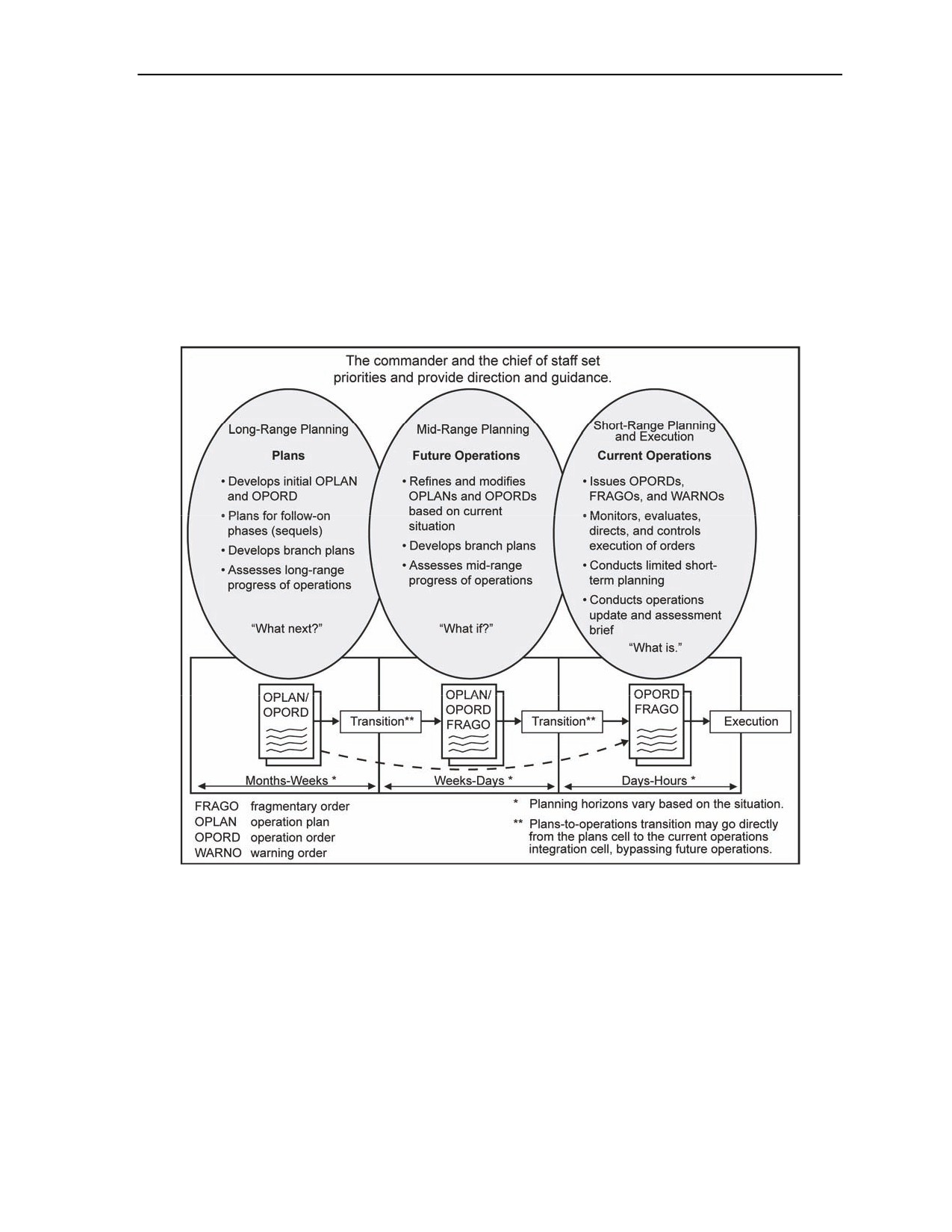
Command Post Organization and Operations
future operations, and current operations integration cells. A planning horizon is a point in time
commanders use to focus the organization’s planning efforts to shape future events. The three
planning horizons are long, mid, and short. Generally, they are associated with the plans cell, future
operations cell, and current operations integration cell respectively. Planning horizons are situation-
dependent; they can range from hours and days to weeks and months. As a rule, the higher the echelon, the
more distant the planning horizon with which it is concerned. (See chapter 2 for a discussion of planning in
time.)
A-25. Not all echelons and types of units are resourced for all three integrating cells. Battalions, for
example, combine their planning and operations responsibilities in one integrating cell. The brigade combat
team has a small, dedicated plans cell but is not resourced for a future operations cell. Divisions and above
are resourced for all three integrating cells as shown in figure A-2.
Figure A-2. Integration of plans, future operations, and current operations
Plans Cell
A-26. The plans cell is responsible for planning operations for the long-range planning horizons. It prepares
for operations beyond the scope of the current order by developing plans and orders, including branch plans
and sequels. The plans cell also oversees military deception planning.
A-27. The plans cell consists of a core group of planners and analysts led by the plans officer (or the
operations officer at battalion level). All staff sections assist as required. Whereas a brigade has a small,
dedicated plans cell, the majority of its staff sections balance their efforts between the current operations
integration and plans cells. Battalions are not resourced for a plans cell. Planning in combined arms
battalions occurs in the current operations integration cell.
18 March 2011
FM 5-0, C1
A-5
Appendix A
Future Operations Cell
A-28. The future operations cell is responsible for planning operations in the mid-range planning horizon. It
focuses on adjustments to the current operation—including the positioning or maneuvering of forces in
depth—that facilitates continuation of the current operation. The cell consists of a core group of planners
led by an assistant operations officer (the chief of future operations). All staff sections assist as required.
Divisions and above headquarters have a future operations cell. Battalion and brigade headquarters do not.
A-29. In many respects, the future operations cell serves as a fusion cell between the plans and current
operations integration cells. The future operations cell monitors current operations and determines
implications for operations within the mid-range planning horizon. In coordination with the current
operations integration cell, the future operations cell assesses whether the ongoing operation must be
modified to achieve the current phase’s objectives. Normally, the commander directs adjustments to the
operation, but the cell may also recommend options to the commander. Once the commander decides to
adjust the operation, the cell develops the fragmentary order necessary to implement the change. The future
operations cell also participates in the targeting working group since the same planning horizons normally
concern them both. The future operations cell updates and adds details to the branch plans foreseen in the
current operation and prepares any orders necessary to implement a sequel to the operation.
Current Operations Integration Cell
A-30. The current operations integration cell is the focal point for the execution of the operations. This
involves assessing the current situation while regulating forces and warfighting functions in accordance
with the mission, commander’s intent, and concept of operations.
A-31. The current operations integration cell displays the common operational picture and conducts shift
changes, assessments, and other briefings as required. It provides information on the status of operations to
all staff members and to higher, subordinate, and adjacent units. The operations synchronization meeting is
the most important event in the battle rhythm in support of the current operation.
A-32. The operations officer leads the current operations integration cell and is aided by an assistant
operations officer (the chief of operations). The movement and maneuver cell forms the core of the current
operations integration cell. Elements or watch officers from each staff section and liaison officers from
subordinate and adjacent units form the remainder of the cell. All staff sections are represented in the
current operations integration cell, either permanently or on call. (Chapter 5 discusses execution with a
focus on the current operations integration cell.)
Staff Sections
A-33. Not all staff sections reside in one of the functional or integrating cells. Personal staff officers and
their associated staff sections, such as the inspector general and public affairs staff sections, are examples.
Special staff sections such as the operations research/systems analysis, red team, and knowledge
management are other examples. These staff sections maintain their distinct organizations. They operate in
different CP cells as required and coordinate their activities in the various meetings established in the unit’s
battle rhythm.
COMMAND POST OPERATIONS
A-34. ±Units must man, equip, and organize command posts to control operations for extended periods.
Command post personnel, information systems, and equipment must be able to support 24-hour operations
while in continuous communication with all subordinate units and higher and adjacent units. Commanders
arrange CP personnel and equipment to facilitate internal coordination, information sharing, and rapid
decisionmaking. They also ensure they have procedures to execute the operations process within the
headquarters to enhance how they exercise mission command. Commanders use the following to assist
them with effective CP operations:
z
SOPs.
z
Battle rhythm.
z
Meetings.
A-6
FM 5-0, C1
18 March 2011