FM 5-499 Hydraulics (August 1997) - page 5
FM 5-499
CHAPTER 7
Electrical Devices:
Troubleshooting and Safety
This chapter describes the process of locating the cause of malfunctions in electrical cir-
cuits associated with hydraulic-control systems. The information includes testing devices
and types of grounding points. Also addressed in this chapter are the safety measures person-
nel should take when working on or around electrical circuits.
7-1. Hydraulics and Electricity. Hydraulics and electricity are often compared because
the systems have similarities. A hydraulic circuit requires a power source (usually a pump),
a load device (actuator), and conductors. The circuits differ mainly in the—
• Types of devices used to control, direct, and regulate the hydraulic fluid flow.
• Type and capacity of the actuators used to accomplish the work, which varies,
depending on the application.
An electrical circuit also requires a power source (battery, generator), a load device
(light, bell, motor), and proper connections. An assortment of devices also controls, directs,
and regulates the flow of electrical current.
Hydraulic and electrical components are usually represented on diagrams by their own
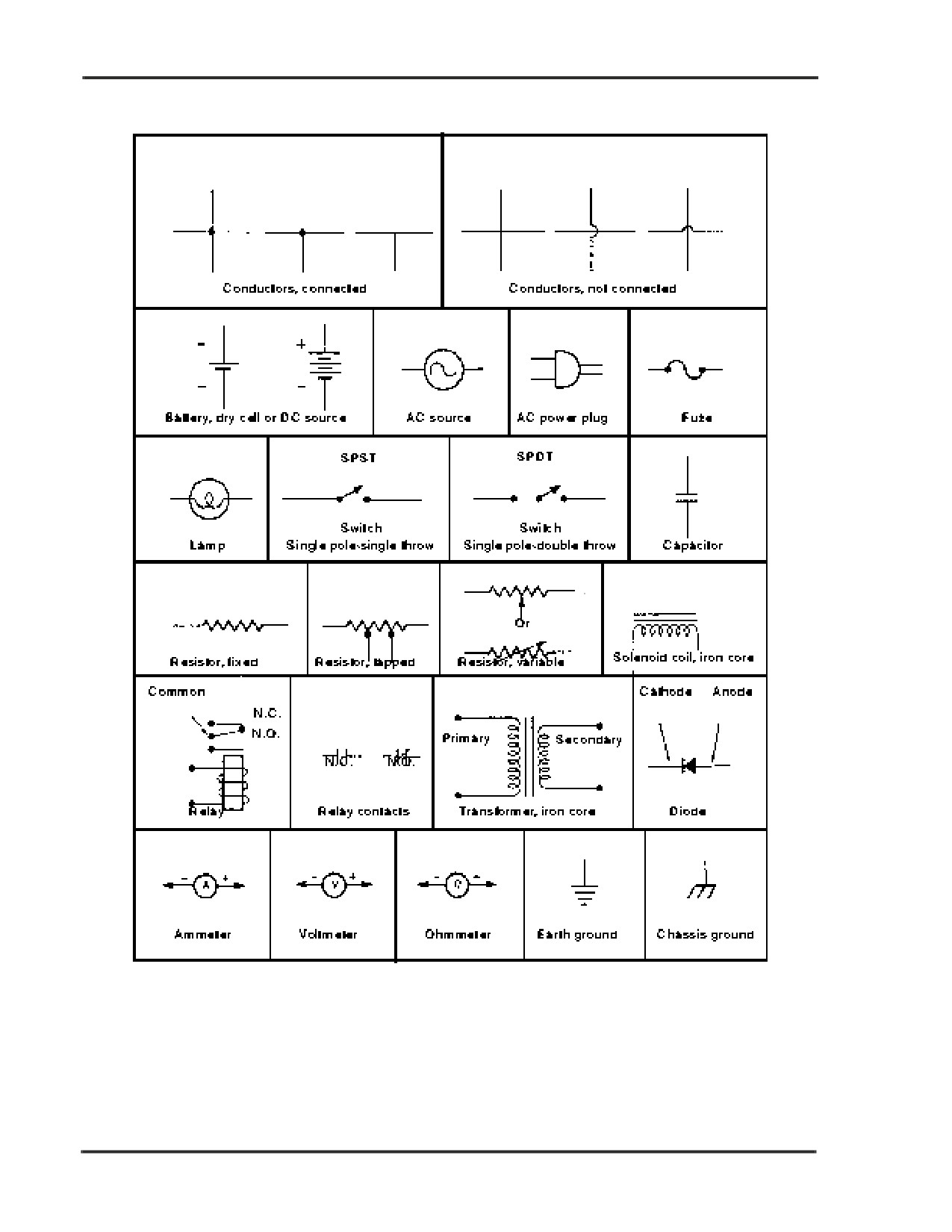
set of standardized symbols. Electrical diagrams are often called schematics. Figure 7-1,
page 7-2, shows some of the more common symbols. Hydraulic and electrical systems and
circuits have many differences. For example, electrical current is invisible, hydraulic fluid is
not; electrical current flows through solid wires, hydraulic fluid flows through hollow lines.
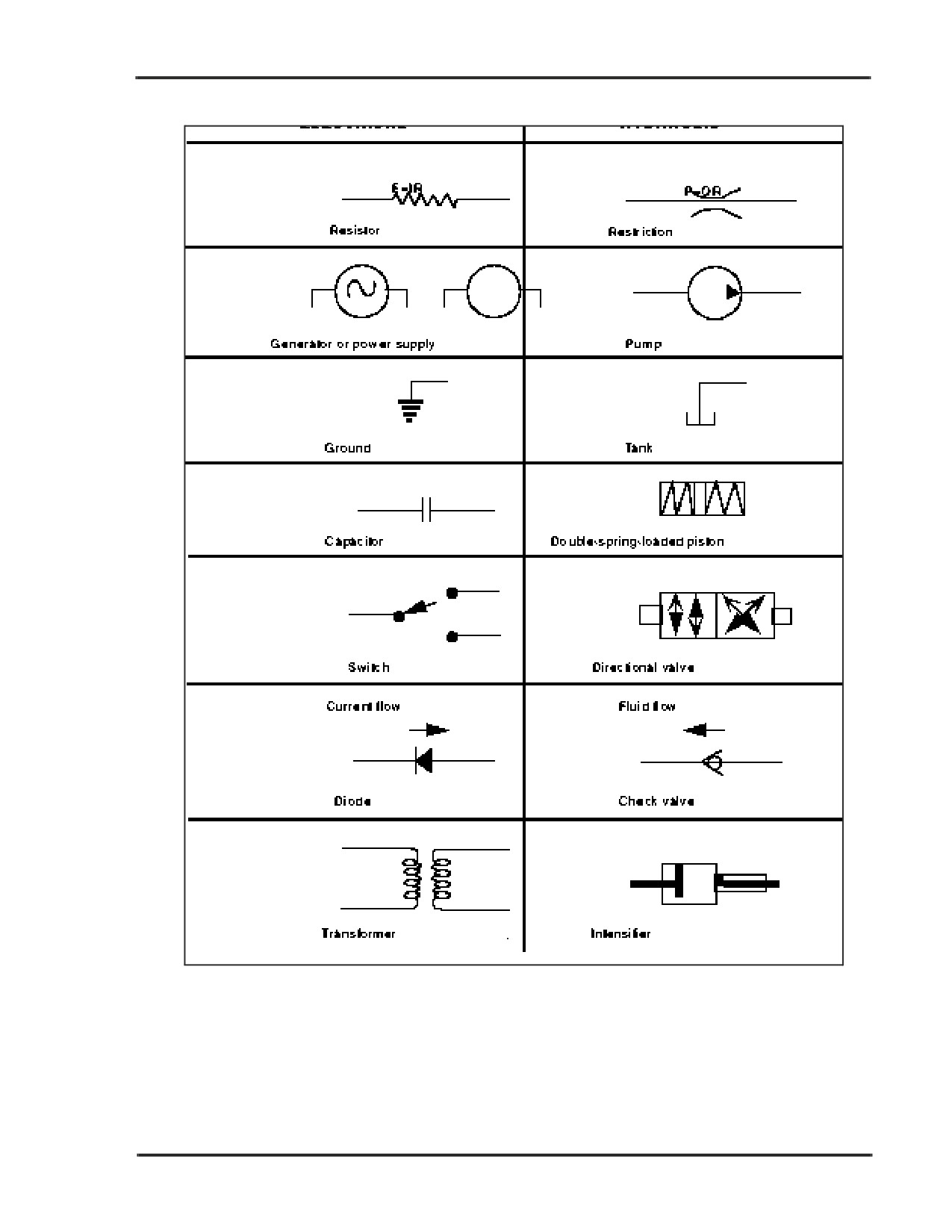
Figure 7-2, page 7-3, shows symbols for electrical and hydraulic components. Figure 7-3,
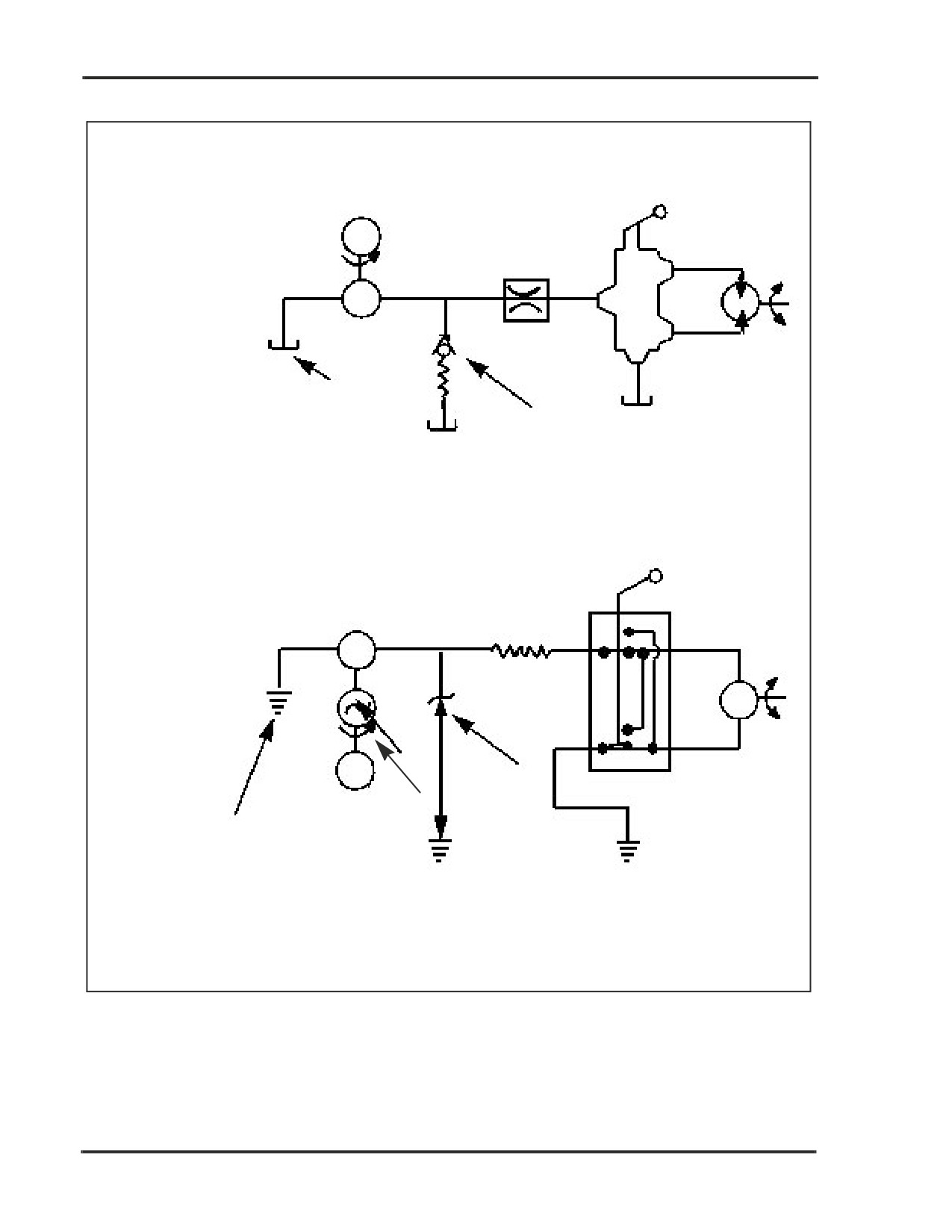
page 7-4, compares a hydraulic circuit and an electrical circuit.
7-2. Troubleshooting Electrical Devices. Electrical troubleshooting is the process of
locating the cause of malfunctions in electrical circuits. The following paragraphs contain
some general troubleshooting information as well as specific tests for determining the status
of some electrical devices. Skill in troubleshooting electrical equipment and circuits
requires—
• Knowledge of electrical principles to understand how a circuit or device should func-
tion.
• Skill in reading and interpreting electrical schematics, diagrams, product data, and
so forth.
• Skill in operating test equipment and interpreting test measurements.
• Ability to analyze problems in a logical manner.
Following systematic steps that narrow down the problem to a smaller area of the
equipment is much more efficient than trial-and-error methods. The troubleshooting
Electrical Devices: Troubleshooting and Safety
7-1
FM 5-499
Figure 7-1. Common electrical schematic symbols
7-2
Electrical Devices: Troubleshooting and Safety
FM 5-499
Figure 7-2. Comparison of electrical and hydraulic components
Electrical Devices: Troubleshooting and Safety
7-3
FM 5-499
Directional valve
Power source
M
Motor
Load
(motor)
Pressure drop
Pump
(Restriction
orifice)
Pressure reference
(tank)
Regulation
(relief valve)
HYDRAULIC CIRCUIT
Directional switch
Power source
Power supply
Voltage drop
(Resistor)
Generator
Load
(motor)
Motor M
Regulation
(zener diode)
Voltage reference
(ground)
ELECTRICAL CIRCUIT
Figure 7-3. Comparison of electrical and hydraulic circuits
7-4
Electrical Devices: Troubleshooting and Safety
FM 5-499
procedure detailed below can be very useful in organizing the problem-solving effort and
reducing equipment downtime:
a. Procedure. The following troubleshooting procedure consists of five steps that you
should perform in order. These steps represent the most reliable method of learning and
applying a logical approach to problem solving and can be applied to any equipment, regard-
less of size.
(1) Step One: Identify the Symptom. A symptom is an external indication that a cir-
cuit or device is not functioning correctly. You can identify a symptom by investigating the
problem by sight, sound, smell, and touch. For example, visually inspecting the equipment
may reveal that a circuit component has overheated and changed color or that an indictor
lamp which should be on is not. A peculiar odor may lead you to discover melted insulation,
or a chattering noise could indicate that a solenoid is about to fail. Moving controls or
adjusting knobs may change the problem or have no effect at all. The fact that the equip-
ment is not operating is a symptom.
If someone else was operating the equipment when it failed, ask the person if he
noticed anything unusual before it failed. Funny noises, things that do not look quite right,
and improper operating sequences are symptoms that could lead to the cause of the problem.
If you cannot find any immediately identifiable symptoms, try operating the equipment once
you determine that it is safe to do so. Watch what works and what does not work. Note any-
thing that does not seem right, no matter how small. Take the time to conduct a thorough
investigation.
(2) Step Two: Analyze the Symptom. In this step, you identify the functions where
symptoms indicate a malfunction. Use the information you obtained during your identifica-
tion, along with the schematic and functional block diagrams and knowledge of how the
equipment is supposed to operate, to make logical technical deductions. For example, after
careful examination, you find that a clamp in a plastic-injection molding machine will not
pressurize. Further analysis, without using test equipment, narrows the problem to a clamp
that is closed, clamp pressurization, or prefill shift, any of which might contain the faulty
circuit.
(3) Step Three: Isolate the Single Faulty Function. In this step, you use test equip-
ment to decide which faulty function is actually causing the malfunction. When making
these tests, use the following guidelines:
• Make only those tests that are safe to make.
• Make the least difficult tests first.
• Test those functions first that will eliminate one or more of the other possible
faulty functions.
For example, if taking an ohmmeter reading can determine the fault, do not take a
voltmeter reading as that requires power on the equipment. If you must disassemble half of
the machine to reach a test point, perform a simpler test first. Test at a midway point in the
circuitry, if possible. A good reading at the midway point eliminates the preceding functions
and indicates that the problem is in the remaining circuits. A faulty signal at the midway
point means that the problem is in the functions that process the signal before the midway
point.
Electrical Devices: Troubleshooting and Safety
7-5
FM 5-499
In the injection molding example, test the clamp's pressurization circuits where the
clamp's fully closed signal input either eliminates that function or confirms that the cause of
the problem is a clamp that is not fully closed and, therefore, cannot be pressurized. Con-
tinue testing inputs and outputs of the suspect functions until you identify and confirm the
single faulty function.
(4) Step Four: Isolate the Faulty Circuit. In this step, you locate the single malfunc-
tioning circuit within a functional group of circuits. Use the accumulated symptom and test
data to close in on the single faulty circuit. Follow the guidelines from step three, but apply
them to the circuits related to the faulty function. Use schematic and block diagrams to
locate test points.
In the injection-molding-machine example, assume that the clamp's fully closed signal
is not present at the input to the clamp's pressurization circuits. Test within the clamp’s
closed circuits until you identify a single faulty circuit. The first test may reveal that the
output of the clamp's fully closed circuit is bad. A check of the inputs to this circuit may indi-
cate that the input from a clamp's closed-limit switch is bad but that all others are good.
You can now identify the problem as being associated with one of the relatively few parts
contained in a single circuit.
(5) Step Five: Locate/Verify the Cause of the Malfunction. The tests you make in this
step identify the failing part within the faulty circuit. Test the circuit until you find the
cause of the malfunction. Examine and test the faulty part to verify that it has caused the
problem and produced the observed symptoms.
In checking out the clamp's fully closed circuit, for example, remove the suspected limit
switch from the circuit and test it with an ohmmeter to determine if the switch's contacts are
closing correctly to complete the circuit. Connect the ohmmeter across the contacts of the
switch and actuate the switch's arm several times while checking the meter reading. If the
contacts close properly, the meter should read zero ohms when the arm is in one position and
infinity when the arm is in the other position.
If the meter pointer does not move when the switch arm is actuated, disassemble and
examine the switch. If this last examination reveals that the mechanical linkage connecting
the switch's arm to the contacts is broken, then you have found the cause of the malfunction.
A final analysis should show that this cause explains the observed symptoms. However, the
procedure is not complete until you verify the findings. In this example, you would install a
new limit switch in the circuit and operate the equipment to confirm that you have fixed the
problem.
b. Testing Devices. The following paragraphs outline some basic electrical tests that
you can conduct on specific pieces of equipment that were discussed earlier. As part of a
troubleshooting test, you should mechanically inspect these devices. Also, if spare parts are
available, substitute a good part for a suspect part as a quick method of returning the equip-
ment to operation. Test the suspect part and either repair it or discard it.
(1) Potentiometer. Since a potentiometer is a variable-resistance device, it should be
disconnected from its circuit and tested with an ohmmeter, if it is suspect. Only two of the
three leads need to be disconnected for this test. Be very careful when adjusting small
potentiometers on printed circuit boards. They are quite fragile and can easily be broken if
rotated beyond the end stops. Test a potentiometer as follows:
7-6
Electrical Devices: Troubleshooting and Safety
FM 5-499
• Determine the expected resistance value from a schematic diagram for the circuit.
The value may also be printed on the case of the device.
• Connect the ohmmeter across the ends of the potentiometer and confirm that the
reading matches the expected value.
• Remove a test lead from one end and move it to the middle terminal.
• Rotate the shaft or turn the screw that varies the resistance of the device. The
ohmmeter reading should indicate zero ohms at one end of the shaft rotation and
the full expected resistance value of the potentiometer at the other end. It should
also show a smooth change in resistance as the shaft is turned.
• Move the lead that is still connected to an end terminal over to the other end.
• Rotate the shaft again while looking for the same smooth transition from zero to
maximum resistance.
(2) Solenoid Coil. If a solenoid is thought to be faulty, do the following:
• Remove it from the machine (plug the opened ports on the valves if necessary).
• Disassemble and examine the solenoid for signs of overheating or mechanical
problems.
• Test the solenoid coil by attaching an ohmmeter (set to a low resistance range)
across the coil terminals. If the coil is good, the meter will show a relatively low
reading (a few thousand ohms or less). A zero reading would indicate that the coil
windings are shorted to each other, probably as a result of melted insulation. An
infinity reading on the ohmmeter means that the coil has opened up and is defec-
tive.
(3) Relay. Test a suspect relay as follows:
• Actuate the relay armature, manually.
• Remove the relay from the equipment.
• Examine the relay carefully for signs of mechanical problems.
• Check the relay coil in the same way as a solenoid coil, if you do not find any
mechanical problems. Test the electrical contacts with an ohmmeter as you do
the switch contacts. The meter should read zero when the contacts are closed and
infinity when they are open.
• Test the normally open and the normally closed circuits.
(4) Transformer. When you determine, by voltage readings or symptom information,
that a transformer may be the cause of a malfunction, check the primary and the secondary
coil resistance with an ohmmeter. Disconnect one end of the primary winding and one end of
the secondary winding from the rest of the circuit before testing. If the failure is the result of
an open winding, the ohmmeter will read infinity when connected across the defective wind-
ing. If the failure is caused by shorted turns within a winding, the problem is more difficult
to diagnose because the ohmmeter will indicate a very low resistance. Since a winding con-
sists of a length of conductor wound into a coil, the resistance readings are normally quite
low anyway. If you suspect shorted turns—
• Use the expected primary and secondary operating voltages to determine the
approximate turns ratio. Divide the secondary voltage into the primary voltage to
get the ratio. For example, 120 volts divided by 24 volts equals a ratio of 5:1.
Electrical Devices: Troubleshooting and Safety
7-7
FM 5-499
• Use this ratio to compare the measured primary resistance to the measured sec-
ondary resistance. In the example, if the primary resistance is 20 ohms, then the
secondary resistance should be about 4 ohms (20/5).
Be sure to adjust the zero-ohms control before making the measurement; hold the test
probes by the insulated portion only. You may have difficulty determining if the reading is
accurate since the measurement is so close to the low end of the ohms scale. Compare the
readings to a replacement transformer’s, if one is available. To positively verify that the
transformer is faulty, you may have to substitute a good transformer for the suspect one.
(5) Diode. You can use a simple resistance check with an ohmmeter to test a diode's
ability to pass current in one direction only. To test a suspect diode—
• Remove one end of the diode from the circuit.
• Connect the positive ohmmeter lead to the anode and the negative lead to the
cathode. When the ohmmeter is connected this way, the diode is forward biased,
and the measured reading should be very low. Set the ohmmeter for the appropri-
ate diode test range.
• Reverse the ohmmeter connections. When the negative ohmmeter lead is
attached to the anode and the positive lead is attached to the cathode, the diode is
reverse biased, and the meter should read a high resistance.
A good diode should have real low resistance when forward biased and high resistance
when reverse biased. If the diode reads a high resistance in both directions, it is probably
open. If the readings are low in both directions, the diode is shorted. A defective diode could
show a difference in forward and backward resistance. In this case, the ratio of forward to
backward resistance is the important factor. The actual ratio depends on the type of diode.
As a rule of thumb, a small signal diode should have a ratio of several hundred to one. A
power rectifier can operate with a ratio as low as ten to one.
7-3. Ground. Every electrical circuit has a point of reference to which all circuit voltages
are compared. This reference point is called ground, and circuit voltages are either positive
or negative with respect to ground. Connections to ground that are made for safety reasons
refer to earth ground. When voltage measurements are taken, the difference of potential
between a point in the circuit and a ground point is measured by the voltmeter. This type of
ground is referred to as chassis or common ground.
a. Earth Ground. Initially, ground referred to the earth itself and since has represented
a point of zero potential or zero volts. A short circuit within a device that connects live volt-
age to the frame could cause a serious shock to anyone touching it. However, if the frame is
connected to earth ground, it is held at the safe potential of zero volts, as the earth itself
absorbs the voltage.
Today, a third prong on grounded power plugs connects most stationary equipment to
earth ground through the electrical wiring system. Some equipment is connected to earth
ground by a conductor that goes from the metal frame of the equipment to a long copper rod
that is driven into the earth. Some appliances are often grounded by connecting the conduc-
tor to a water pipe running into the ground. In any case, the frames of all equipment con-
nected to the earth are at the same zero volt potential. This prevents shocks that might
occur should a person touch two pieces of ungrounded equipment at the same time.
7-8
Electrical Devices: Troubleshooting and Safety
FM 5-499
b. Chassis or Common Ground. In some cases, electrical circuits used today are not con-
nected directly to earth ground; however, they still require a point of reference or a common
point to which elements of each circuit are connected. For example, a portable battery-oper-
ated transistor radio does not have a ground conductor connecting it with the earth. A strip
of conducting foil on the internal circuit board is used as the common point. In an automo-
bile battery, the negative terminal is generally connected to the engine block or chassis
frame by a heavy cable. The connecting point, as well as every other point on the metal
frame, is considered to be a ground for the electrical circuits of the vehicle. The rubber tires
insulate the vehicle from the earth ground. In these examples, ground is simply a zero refer-
ence point in an electrical circuit and is referred to as chassis ground. All voltages in the cir-
cuit are measured with respect to this common point.
c. Zero Reference Point. Without a zero reference point, voltage could not be expressed
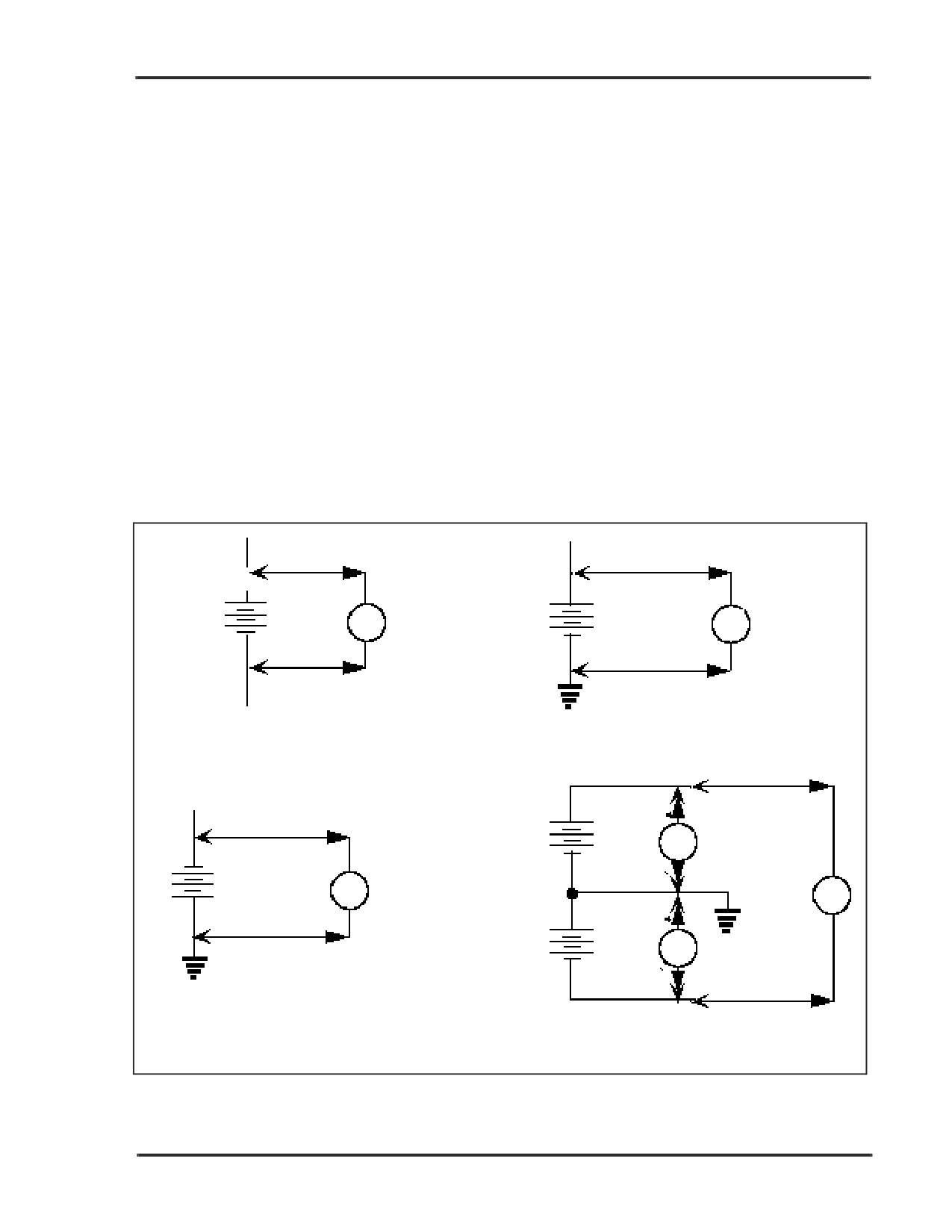
as a positive or negative value. The schematic diagrams in Figure 7-4 illustrate this point:
• Diagram A shows a voltmeter connected to the two terminals of a 6-volt, dry-cell
battery. Without a ground in the circuit, the measured voltage is 6 volts between
the two terminals. It is neither positive nor negative.
• Diagram B shows that the negative battery terminal is connected to ground. The
voltmeter measures the difference of potential between the positive terminal and
+
Voltmeter
+
+
+
indicates 6 V.
6 V
It is neither +
Voltmeter
V
V
battery
nor -.
indicates +6 V.
-
-
-
-
A. VOLTAGE READING
B. NEGATIVE TERMINAL
WITHOUT GROUND
GROUNDED
A
+
+
+6 V
-
+
+
-
-
Voltmeter
V
B
indicates -6 V.
12 V
+
-
+
+
-
-6 V
-
-
C
C. POSITIVE TERMINAL
D. PLACEMENT OF GROUND PROVIDES
GROUNDED
BOTH POSITIVE AND NEGATIVE VOLTAGE
Figure 7-4. Schematic diagrams illustrating zero reference point
Electrical Devices: Troubleshooting and Safety
7-9
FM 5-499
the ground point. The measured voltage is +6 volts because the ungrounded ter-
minal is 6 volts more positive than the ground or zero reference point.
• Diagram C shows that the voltmeter measure -6 volts when the positive terminal
of the battery is connected to the zero reference point. The ungrounded battery
terminal is now 6 volts more negative than the reference point.
• Diagram D shows two 6-volt batteries that are connected in series. The voltage
between points A and C is 12 volts. When a ground is placed at point B, which is
between the two batteries, + 6 volts are available between points A and B, and -6
volts are available between points C and B. (Many modern electronic circuits
require both positive and negative voltage for proper operation. This would be
impossible without a zero reference point in the circuit.)
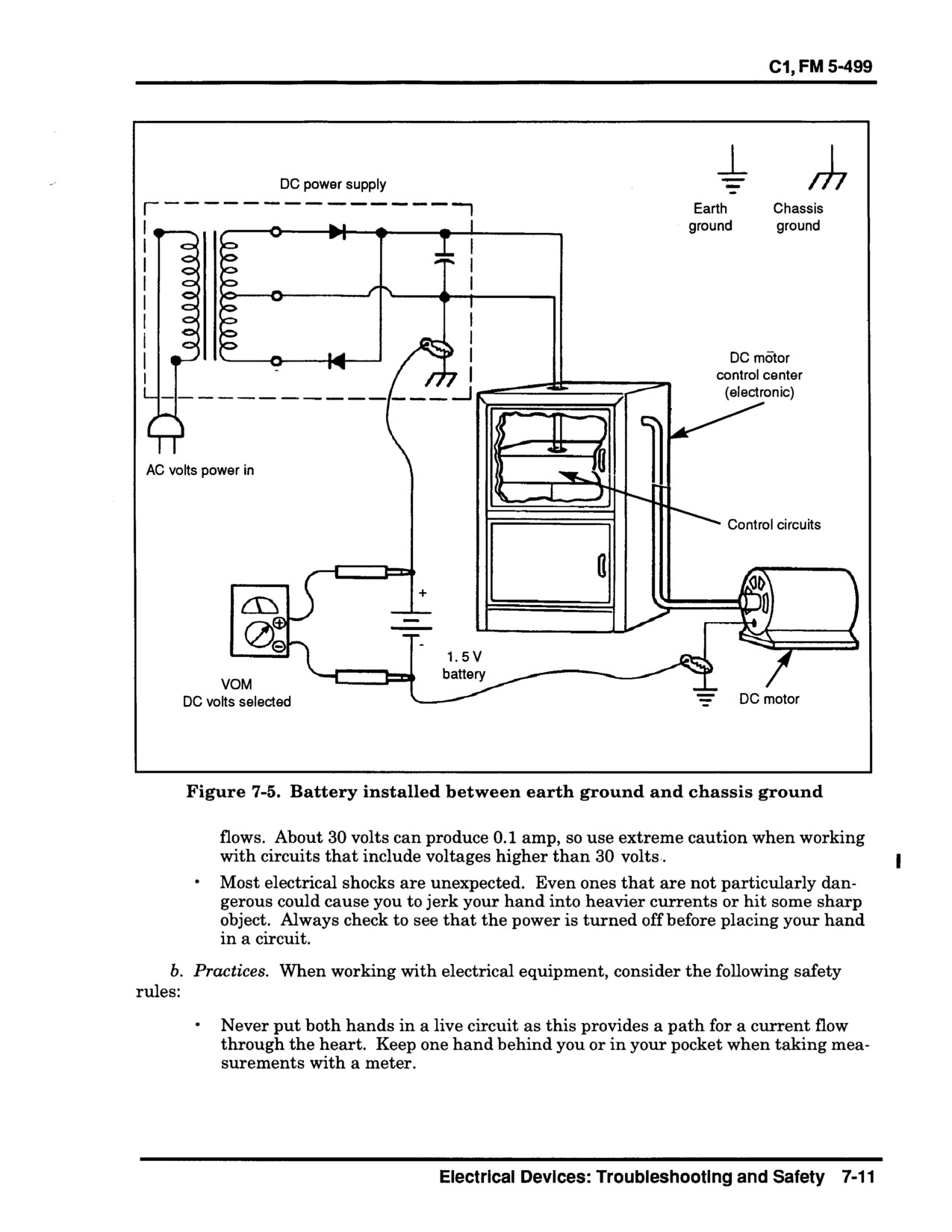
d. Isolation Between Earth and Chassis Ground. Industrial equipment often requires
an earth and a separate chassis ground for proper operation. The earth ground represents
an actual potential of zero volts, while the chassis ground is used only as a reference point
and may be at some potential above or below the earth ground. In these cases, the earth
ground and the chassis ground are not connected together at any point in the equipment.
However, during installation or repairs, the chassis ground may be inadvertently connected
to the earth ground. To check for this condition, use a 1.5-volt, D-cell battery and holder,
connecting wires, and a voltmeter. Make sure that the equipment is OFF before making the
test.
In Figure 7-5, the battery is installed between the chassis ground and the earth ground.
The voltmeter, set to measure 1.5 volts direct current (DC), is connected across the battery.
If a connection exists between the chassis and the earth ground, it will place a short circuit
across the battery, and the voltmeter will indicate zero volts. If this is the case, temporarily
disconnect one end of the battery to keep it from discharging while looking for the improper
connection between the grounds. When you find the connection, remove it and reconnect the
battery and the meter. The voltmeter should read the battery potential of 1.5 volts. If the
voltmeter reading is still zero volts, an improper connection still exists in the equipment.
Repeat the test until the voltmeter reads the battery voltage. Remember to disconnect the
battery after completing the test.
7-4. Safety. Effective safety measures are a blend of common sense and the knowledge of
basic electrical and hydraulic principles and of how a system or circuit operates, including
any dangers associated with that operation. General safety information and safety practices
are listed below. The list is not all inclusive, is not intended to alter or replace currently
established safety practices, and does not include safety practices for hydraulic equipment.
a. Information. When working with electrical equipment, consider the following infor-
mation regarding safety:
• Injuries associated with electrical work may include electrical shocks; burns; and
puncture, laceration, or abrasion wounds.
• Current flowing through the body can be fatal. As little as 0.01 amp produces
muscle paralysis and extreme breathing difficulty in the average person; perma-
nent physical damage and death can result from 0.1 amp flowing through the
heart.
• The amount of current received from an electrical shock depends on the voltage
applied and the resistance of that part of the body through which the current
7-10
Electrical Devices: Troubleshooting and Safety
FM 5-499
• Never work on live circuits when wet, as this lowers the body’s resistance and
increases the chance for a fatal shock.
• Never work alone on electrical equipment. Shocks above 0.01 amp can paralyze
your muscles and leave you unable to remove yourself from the source of the cur-
rent flow. Always be sure someone else is around to help in an emergency.
• Use the proper equipment for circuit testing. Check for correct junction settings,
range switches, proper insulation on test probes, and so forth.
• Remove all watches, rings, chains, and any other metal jewelry that may come in
contact with an electrical potential or get caught in moving mechanical parts. Do
this before you work on any electrical equipment, circuit, or battery.
• Have a good understanding about the circuit you are working on. Think about
what you need to do before working on the circuit. Ask for help if you do not know
enough about the task you are to perform.
7-12
Electrical Devices: Troubleshooting and Safety

FM 5-499
Appendix A
Metric Conversion Chart
A-1. Purpose. This chart complies with current Army directives which state that the Metric
System will be incorporated into all new publications. This Appendix will provide a chart to
convert the English measurements to Metric.
Table A-1. Metric conversion chart
To Convert
Into
Multiply By
Cubic Centimeters
28,320.0 x 104
Cubic feet
Cubic Meters
0.02832
Liters
28.32
Cubic Centimeters
28,320.0
Cubic inches
Cubic Meters
1.639 x 10⁻⁵
Liters
0.01639
Centimeters
6.0
Kilometers
3.048 x 10⁴
Feet
Meters
0.3048
Millimeters
304.8
BTU
1.286 x 10⁻³
Foot pound
Kilowatt-hours
3.766 x 10⁻⁷
Cubic Centimeters
3,785.0
Cubic Feet
0.1337
Gallons
Cubic Inches
231.0
Cubic Meters
3.785 x 10⁻³
Liters
3.785
BTU per min
42.44
horsepower
hp (metric)
1.014
Appendix-225

FM 5-499
Table A-1. Metric conversion chart
To Convert
Into
Multiply By
Centimeters
2.540
Inches
Meters
2.540 x 10⁻²
Millimeters
25.40
Centimeters
1.6093 x 10⁵
Miles (statute)
Meters
1,609.3
Kilometers
1.609.3
cms/sec
44.70
Miles/hr
kms/hr
1.609
kms/min
0.02682
Pounds
Kilograms
0.4536
Pounds/sq in (psi)
kgs/sq meter
703.1
Square Inches
sq centimeters
6.452
sq cms
929.0
Square feet
sq meters
0.09290
sq millimeters
9.290 x 10⁴
sq kms
2.590
Square miles
sq meters
2.590 x 10⁶
Kilograms
907.1848
Tons
Tons (metric)
.9078
Centimeters
91.44
Kilometers
9.144 x 10⁻⁴
Yards
Meters
0.9144
Millimeters
914.4
Temperature Conversion Chart: Celsius = 5/9 (°F - 32)
Fahrenheit = 9/5 (°C + 32)
Appendix-226
FM 5-499
Glossary
°F
degree Fahrehheit
AC
alternating current
ASA
American Standards Association
ATTN
attention
axial piston pump
A pump in which the pistons stroke in the same direc-
tion on the cylinder block's centerline; these pumps
are either an in-line or angle design.
Bernoulli's Principle
Law which states that the static pressure of a moving
liquid varies inversely with its velocity; that is, as ve-
locity increases, static pressure decreases.
BTU
British thermal unit
capacity
Same as volumetric output.
cavitation
A condition that occurs in pumping when available
fluid does not fill the existing space; cavitation causes
erosion of the metal in the inlet and speeds deteriora-
tion of the hydraulic oil.
centrifugal pump
A nonpositive-displacement pump that is used in a
hydraulic system where a large volume of flow is re-
quired at relatively low pressures; a centrifugal pump
is either a volute or diffuser type.
cfs
cubic foot (feet) per second
chassis ground
The difference of potential between a point in the cir-
cuit and a ground point that is measured by the volt-
meter. Also called common ground. See also earth
ground; ground; zero reference point.
Glossary-227
FM 5-499
closed-center system
A pump system where the pump continues to operate
against a load in the neutral condition.
common ground
Same as chassis ground.
cyl
cylinder
cylinder
A hydraulic actuator that is constructed of a piston or
plunger which operates in a cylindrical housing by the
action of liquid under pressure; a cylinder can be one
of several types: single acting, double acting, differen-
tial, nondifferential, ram type, piston type, cushioned,
or lockout.
DA
Department of the Army
DC
direct current
delivery rate
Same as volumetric output.
directional-control valves
Valves that control the flow direction; they can be a
poppet, a sliding-spool, a check, a two-way, or a four-
way valve. See also flow-control valves, pressure-
control valves; valves.
displacement
The amount of liquid that is transferred from the
pump's inlet to its outlet in one revolution or cycle;
displacement is either fixed or variable. See also
fixed-displacement pump; variable-displacement
pump.
displacement principle
Principle which explains how fluid is taken in at one
point and is displaced to another point; displacement
is either nonpositive or positive. See also nonpositive-
displacement pump; positive-displacement pump.
earth ground
Connections to ground that are made for safety rea-
sons. See also chassis ground; ground; zero refer-
ence point.
energy
The ability to do work, expressed in ft lb. See also
friction; heat energy; kinetic energy; potential
energy.
fixed-displacement pump
A pump in which the GPM output can be changed only
by varying the drive speed. See also displacement;
variable-displacement pump.
flow
The movement of the hydraulic fluid caused by a dif-
ference in the pressure at two points; velocity and
flow rate are the two ways to measure flow. See also
Glossary-228
FM 5-499
flow rate; velocity.
flow rate
The measure of how much volume of a liquid passes a
gpoint in a given time, measure in GPM. See also
flow; velocity.
flow-control valves
Valves that are used to control the actuator speed by
metering the flow; they can be a gate, a globe, a nee-
dle, a restrictor, an orifice-check, or a flow-equlizer
valve. See also directional-control valves;
pressure-control valves; valves.
FM
field manual
force
Anything that tends to produce or modify motion, ex-
pressed in pounds.
fps
foot (feet) per second
FPT
flow, pressure, and temperature
friction
The resistance to relative motion between two bodies.
See also energy; heat energy; kinetic energy; po-
tential energy.
ft
foot (feet)
ft lb
foot-pound
GPM
gallon(s) per minute
ground
A point of reference in an electrical circuit to which all
circuit voltages are compared; circuit voltages are ei-
ther positive or negative with respect to ground. See
also chassis ground; earth ground; zero refer-
ence point.
head
The vertical distance between two levels in a fluid.
heat energy
The energy a body possesses because of its heat; con-
sidered a dynamic factor. See also energy; friction
kinetic energy; potential energy.
hp
horsepower; standard unit of power; one HP is equal
to 550 ft lb of work every second.
HP
hydraulic hp
HQ
headquarters
hydraulic actuator
A piece of equipment that receives pressure energy
Glossary-229
FM 5-499
and converts it to mechnical force and motion.
hydraulic motors
A piece of equipment that converts hydraulic energy
into mechanical energy; hydraulic motors can be gear,
vane, or piston types.
hydraulic testers
lightweight units used to check or troubleshoot a hy-
draulic-powered system.
hydraulics
The science of transmitting force and/or motion
through the medium of a confined liquid.
ID
inside diameter
JIC
Joint Industry Conference
kinetic energy
The energy a body possesses because of its motion; the
amount of kinetic energy in a moving liquid is directly
proportional to the square of its velocity; considered a
dynamic factor. See also friction; heat energy; po-
tential energy; velocity pressure.
laminar flow
Flow that occurs when particles of a liquid move in
straight lines parallel to the flow direction. See also
turbulent flow.
lb
pound
MO
Missouri
N C
normally closed
N O
normally open
nonpositive-displacement pump
This type of pump discharges liquid in a continuous
flow. See also displacement principle; positive-
displacement pump.
OD
outside diameter
open-center system
A pump system where the pump's output has a free
flow path back to the reservoir in the circuit's neutral
condition.
Pascal's Law
Basic law of hydraulics that Blaise Pascal formulated
in the 17th century; Pascal states that pressure in a
Glossary-230
FM 5-499
confined fluid is transmitted undiminished in every
direction and acts with equal force on equal area and
at right angles to the container's walls.
positive-displacement pump
This type of pump discharges volumes of liquid that
are separated by periods of no discharge. See also dis-
placement principle; nonpositive-displacement
pump.
potential energy
Energy due to position; in hydraulics, potential ener-
gy is a static factor. See also energy; friction; heat
energy; kinetic energy.
pressure
The force exerted against a specific area, expressed in
psi.
pressure-control valves
Valves that may limit or regulate pressure, create a
particular pressure condition required for control, or
cause actuators to operate in a specific order. Pres-
sure-control valves can be a relief, a pressure-reduc-
ing, a sequence, or a counterbalance valve. See also
directional-control valves; flow-control valves;
valves.
psi
pound(s) per square inch
radial piston pump
A pump in which the pistons are arranged like wheel
spokes in a short cylindrical block.
reciprocating pump
A type of pump that depends on a reciprocating mo-
tion to transmit liquid from its inlet side to its outlet
side.
resistance
A condition in a hydraulic system that is usually
caused by a restriction or obstruction in the path or
flow.
rotary pump
A positive-displacement pump in which rotary motion
carries the liquid from the pump's inlet to its oulet.
rpm
revolution(s) per minute
slippage
The measure of a pump's efficiency expressed in per-
cent; oil leaks from the pressure outlet to a low-pres-
sure area or back to the inlet; some slippage is
designed into pump systems for lubrication purposes.
SPDT
single pole-double throw switch
SPST
single pole-single throw switch
sq in
square inches
Glossary-231
FM 5-499
STOP system
Troubleshooting system in hydraulics in which a per-
son should Study the cirucit diagrams, Test by using
a reliable tester, Organize the knowledge gained from
the circuit-test results, and Perform repairs, taking
time to do the job well.
torque
Circular force on an object.
turbulent flow
Flow that develops when flow speed increases beyond
a given point. See also laminar flow.
two-stage pump
A pump that consists of two separate pump assem-
blies that are contained in one housing.
typical mobile circuits
Hydraulic-lift, power-steering, and road-patrol-truck
circuits.
USAES
United States Army Engineer School
USASI
United States of American Standards Institute
valves
Objects in a hydraulic system that control the opera-
tion of the actuators; valves regulate pressure by cre-
ating special pressure conditions and by controlling
how much oil will flow in portions of the circuit and
where it will go. See also directional-control
valves; flow-control valves; pressure-control
valves.
vane-type pump
A pump in which a slotted rotor splined to a drive
shaft rotates between closely fitted side plates that
are inside of an elliptical- or circular-shaped ring;
vane pumps can be couble, unbalanced, or balanced.
variable-displacement pump
A pump in which the pumping-chamber sizes can be
changed; the GPM delivery can be changed by moving
the displacement control, changing the drive speed, or
doing both. See also displacement; fixed-
displacement pump.
velocity
The average speed of a fluid's particles past a given
point, measured in fps. See also flow; flow rate.
velocity pressure
Pressure caused by kinetic energy. See also kinetic
energy.
volumetric output
The amount of liquid a pump can deliver at its outlet
port per unit of time at a given drive speed, usually
expressed in GPM or cubic inches per minute. Also
called delivery rate or capacity.
Glossary-232
FM 5-499
V
volt
VOM
volt-ohm-millammeter
work
The measure of force multiplied by distance.
zero reference point
voltage point in an electrical circuit that is neither
negative or positive. See also chassis ground, earth
ground; ground.
Glossary-233
FM 5-499
References
SOURCES USED
These are the sources quoted or paraphrased in this publication.
Nonmilitary Publications
Hydraulics. Deere and Company Service Publications, Moline, Illinois. 1997.
Industrial Hyydraulics Manual. Vickers Training Center, Rochester Hills, Michigan. 1993.
DOCUMENTS NEEDED
These documents must be available to the users of this publication;
Department of the Army Forms
DA Form 2028. Recommended Changes to Publications and Blank Forms. February 1974.
References-1