FM 3-0, C1 Operations (February 2011) - page 4
Chapter 6
maneuver units to where they can best mass the effects of combat power. Commanders also consider how
much time they can give subordinates to plan and prepare their own operations. Parallel and collaborative
planning helps optimize available time. (FM 5-0 discusses parallel and collaborative planning.)
6-62. Commanders relate time to the enemy and conditions. As part of this analysis, commanders consider
time in two contexts: First, they estimate how much time friendly forces have to accomplish the mission
relative to enemy efforts to defeat them. Second, they consider the time needed to accomplish their
objectives or to change current conditions into those of the desired end state. Analyzing the time available
helps commanders determine how quickly and how far in advance to plan operations. The more time the
commander and staff take, the more time the enemy has. The time spent perfecting a plan may work to the
enemy’s advantage; the additional time provided to enemy forces often offsets the minor gains a slightly
improved plan gives friendly forces.
6-63. Commanders consider the time available relative to the situation. Success depends on preventing the
situation from deteriorating further. Ultimately, good plans executed sooner produce better results than
perfect plans executed later.
6-64. Finally, understanding the operational environment requires understanding civil considerations. Civil
considerations reflect the influence of manmade infrastructure, civilian institutions, and attitudes and
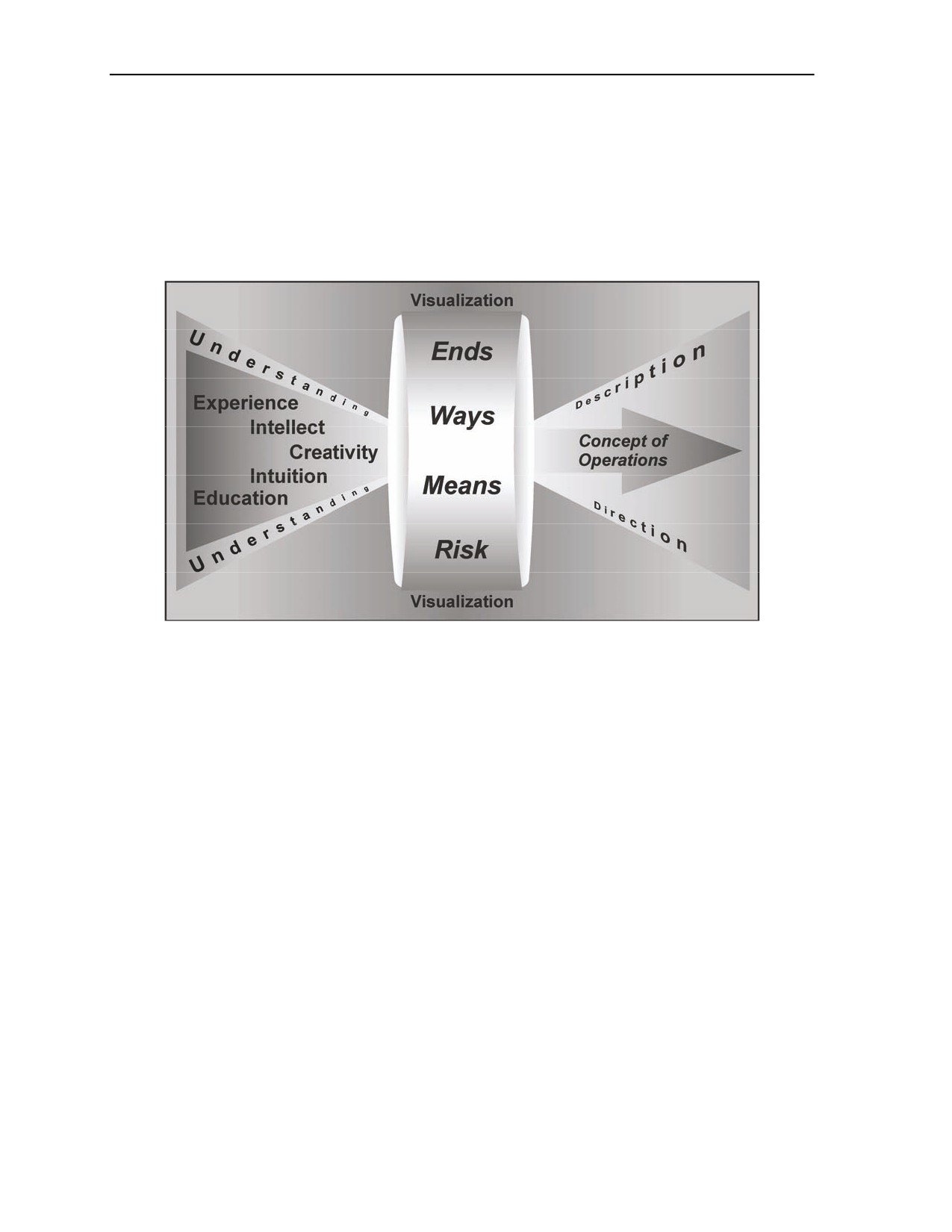
activities of the civilian leaders, populations, and organizations within an area of operations on the conduct
of military operations (FM 6-0). Commanders and staffs analyze civil considerations in terms of the
categories expressed in the memory aid ASCOPE: Areas, Structures, Capabilities, Organizations, People,
and Events.
6-65. Civil considerations help commanders understand the social, political, and cultural variables within
the area of operations and their affect on the mission. Understanding the relationship between military
operations and civilians, culture, and society is critical to conducting full spectrum operations. (FM 3-05.40
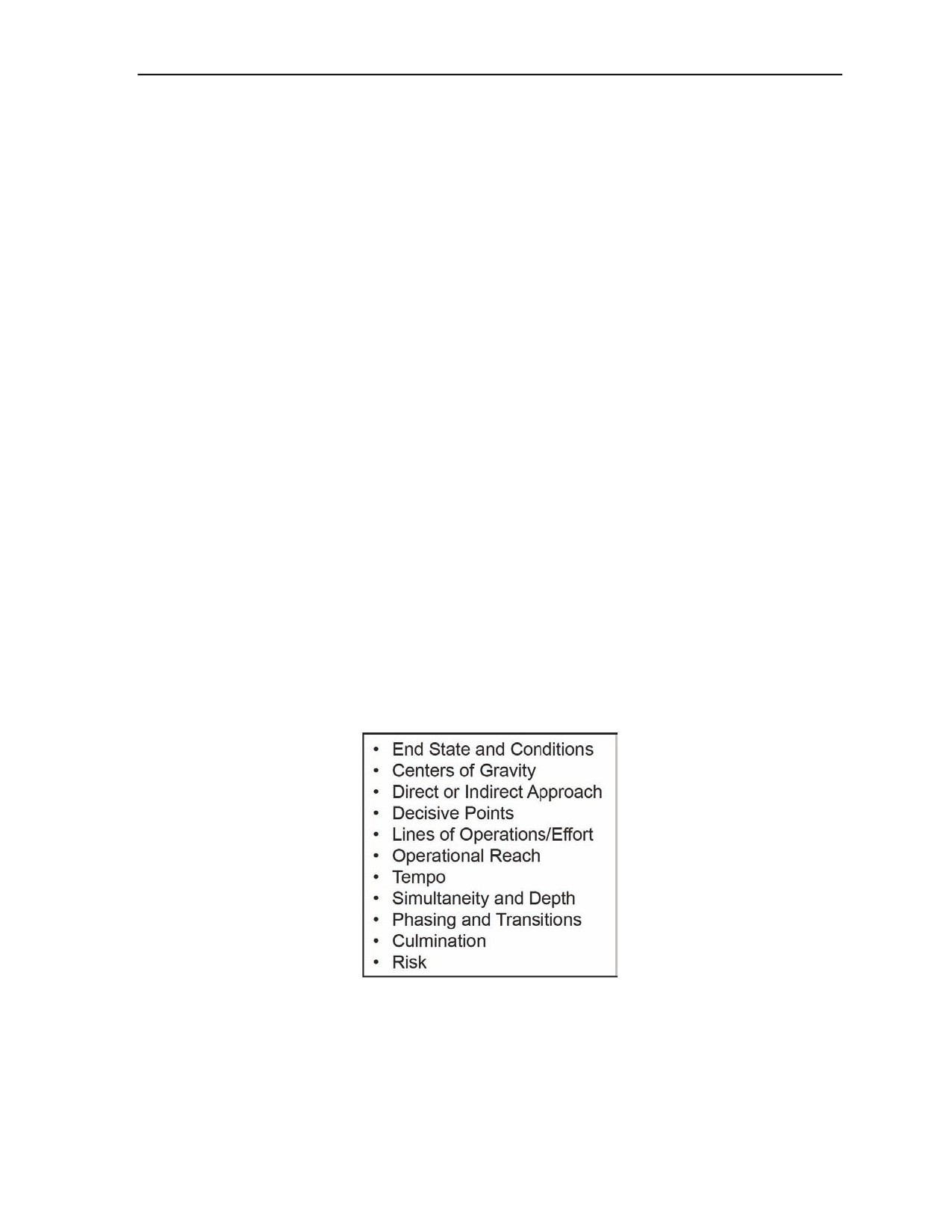
contains additional information on civil considerations.) These considerations relate directly to the effects
of the other instruments of national power. They provide a vital link between actions of forces interacting
with the local populace and the desired end state.
6-66. Civil considerations are essential to developing effective plans for all operations—not just those
dominated by stability or civil support. Full spectrum operations often involve stabilizing the situation,
securing the peace, building host-nation capacity, and transitioning authority to civilian control. Combat
operations directly affect the populace, infrastructure, and the force’s ability to transition to host-nation
authority. The degree to which the populace is expected to support or resist Army forces also affects the
design of offensive and defensive operations.
6-67. Commanders and staffs use personal knowledge, area studies, and the intelligence and civil affairs
running estimates to assess social, economic, and political factors. Commanders consider how these factors
may relate to potential lawlessness, subversion, or insurgency. Their goal is to develop their understanding
to the level of cultural awareness. At this level, they can estimate the effects of friendly actions and direct
their subordinates with confidence. Cultural awareness improves how Soldiers interact with the populace
and deters their false or unrealistic expectations. They have more knowledge of the society’s common
practices, perceptions, assumptions, customs, and values, giving better insight into the intent of individuals
and groups.
AREA OF OPERATIONS
6-68. One of the most important control measures is the area of operations. The Army or land force
commander is the supported commander within an area of operations designated by the joint force
commander for land operations. Within their areas of operations, commanders integrate and synchronize
maneuver, fires, and interdiction. To facilitate this integration and synchronization, commanders have the
authority to designate targeting priorities and timing of fires.
6-69. Commanders consider a unit’s area of influence when assigning it an area of operations. An area of
influence is a geographical area wherein a commander is directly capable of influencing operations by
maneuver or fire support systems normally under the commander’s command or control (JP 3-16). The area
of influence normally surrounds and includes the area of operations. Understanding the area of influence
6-10
FM 3-0, C1
22 February 2011
The Science of Control
helps the commander and staff plan branches to the current operation in which the force uses capabilities
outside the area of operations. An area of operations should not be substantially larger than the unit’s area
of influence.
6-70. Ideally, the entire area of influence encompasses the area of operations. An area of operations that is
too large for a unit to control can allow sanctuaries for enemy forces and may limit joint flexibility.
Assigning areas of operations to subordinate commanders maximizes decentralized execution by
empowering those commanders to exercise initiative. Mission command authorizes commanders to create
any effects necessary to accomplish the mission (consistent with the rules of engagement) within their areas
of operations. However, commanders cannot create effects outside their areas of operations without
permission from the commander assigned the area of operations in which those effects will occur. Further,
commanders must control all parts of their area of operations not assigned to subordinates. Assignment of
an area of operations includes authority to perform the following:
z
Terrain management.
z
Intelligence collection.
z
Civil affairs activities.
z
Air and ground movement control.
z
Clearance of fires.
z
Security.
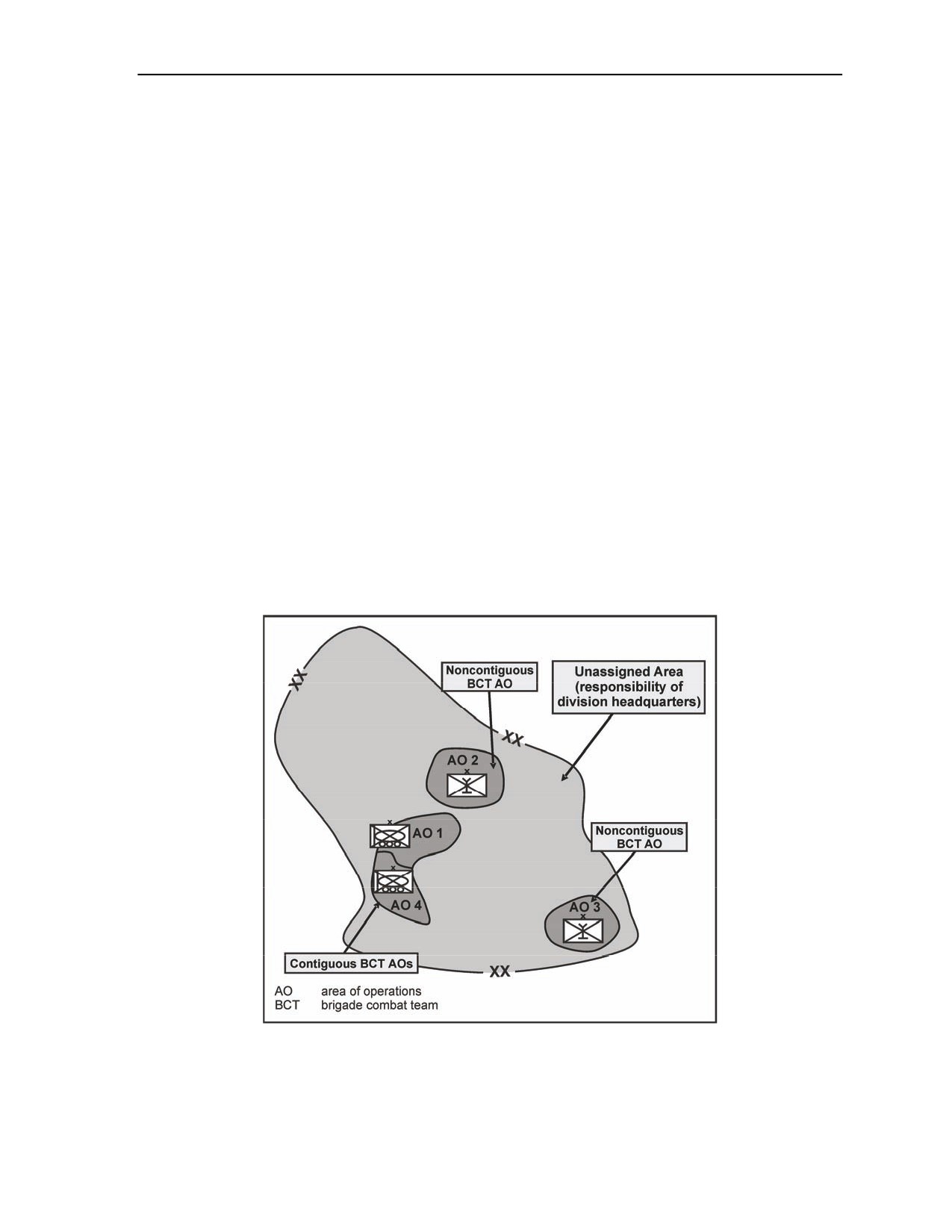
6-71. Subordinate unit areas of operations may be contiguous or noncontiguous. (See figure 6-2.) A
common boundary separates contiguous areas of operations. Noncontiguous areas of operations do not
share a common boundary; the concept of operations provides procedural control of elements of the force.
An unassigned area is the area between noncontiguous areas of operations or beyond contiguous
areas of operations. The higher headquarters is responsible for controlling unassigned areas within
its area of operations. Designating an unassigned area only indicates that the area is not assigned to a
subordinate. Unassigned areas remain the responsibility of the controlling headquarters.
Figure 6-2. Contiguous, noncontiguous, and unassigned areas
22 February 2011
FM 3-0, C1
6-11
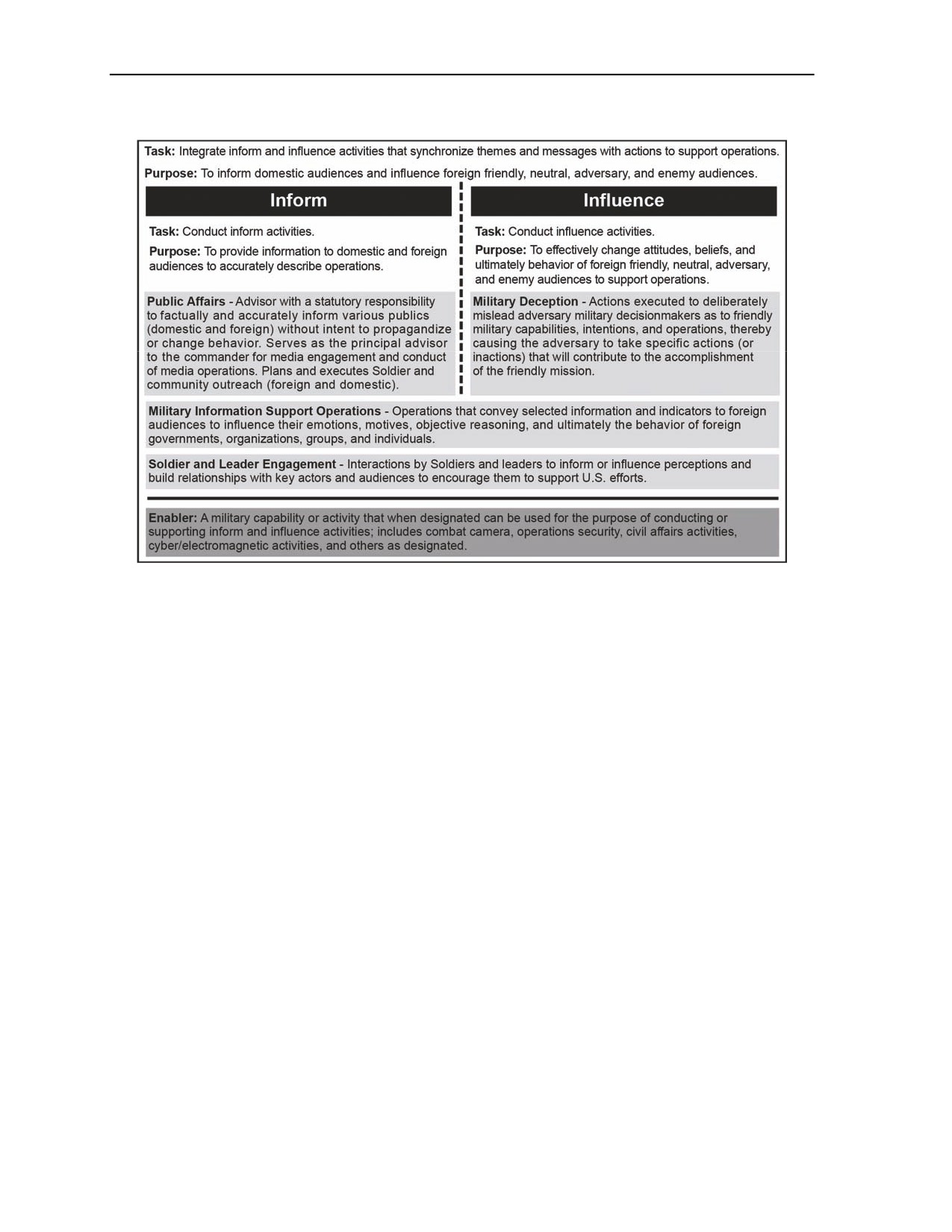
Chapter 6
COMMON OPERATIONAL PICTURE
6-72. The common operational picture is a single display of relevant information within a
commander’s area of interest tailored to the user’s requirements and based on common data and
information shared by more than one command. An area of interest is area of concern to the
commander, including the area of influence, areas adjacent thereto, and extending into enemy territory to
the objectives of current or planned operations. This area also includes areas occupied by enemy forces
who could jeopardize the accomplishment of the mission (JP 2-03). The area of interest for stability or civil
support operations may be much larger than that associated with offensive and defensive operations.
6-73. The availability of a common operational picture facilitates mission command. The common
operational picture lets subordinates see the overall operation and their contributions to it as the operation
progresses. This knowledge reduces the level of control higher commanders need to exercise over
subordinates. The common operational picture features a scale and level of detail that meets the
information needs of that commander and staff. It varies among staff sections and echelons. Separate
echelons create a common operational picture by collaborating, sharing, and refining relevant information.
To the extent permitted by technology, the common operational picture incorporates as much information
from running estimates as possible.
*CONDUCT KNOWLEDGE MANAGEMENT AND INFORMATION
MANAGEMENT
6-74. Staffs apply the science of control to support the commander’s tasks by conducting knowledge
management and information management.
*KNOWLEDGE MANAGEMENT
6-75. Knowledge management is the art of creating, organizing, applying, and transferring knowledge
to facilitate situational understanding and decisionmaking. Knowledge management supports
improving organizational learning, innovation, and performance. Its processes ensure that knowledge
products and services are relevant, accurate, timely, and useable to commanders and decisionmakers.
Knowledge management has three major components:
z
People—those inside and outside the organization who create, organize, share, and use
knowledge, and the leaders who foster an adaptive, learning environment.
z
Processes—the methods to create, capture, organize, and apply knowledge.
z
Technology—information systems that help collect, process, store, and display knowledge.
Technology helps put knowledge products and services into organized frameworks.
6-76. Knowledge management enables commanders make informed, timely decisions despite the
uncertainty of operations. It enables effective collaboration by linking organizations with Soldiers requiring
knowledge. Knowledge management enhances rapid adaptation in dynamic operations. Analyzing and
evaluating information creates knowledge. Since a wide range of knowledge might affect operations, the
commander’s information requirements may extend beyond military matters. Defining these requirements
is an important aspect of knowledge management. Commanders define their information requirements with
their CCIRs. The CCIRs focus development of knowledge products. (See FM 6-01.1 for a discussion on
knowledge management.)
6-77. Commanders and staffs assess knowledge management effectiveness by considering whether it
lessens the fog of war. Knowledge management narrows the gap between relevant information
commanders require and that which they have. Developing a knowledge management plan enables leaders
to—
z
Address knowledge and information flow.
z
Develop criteria for displaying the common operational picture.
z
Access and filter information from sources normally found outside the military or the
organization.
z
Support developing situational awareness and situational understanding.
6-12
FM 3-0, C1
22 February 2011
The Science of Control
z
Enable rapid, accurate retrieval of previously developed knowledge to satisfy new requirements.
z
Route products to the right individuals in a readily understood format.
z
Keep information from overwhelming commanders and staffs.
6-78. Staff responsibility for knowledge management begins with the chief of staff. Depending on the
complexity of the situation, it may require dedicated personnel.
*SITUATIONAL AWARENESS
6-79. Commanders begin their visualization with situational awareness. Situational awareness means
immediate knowledge of the conditions of the operation, constrained geographically and in time.
More simply, it is Soldiers knowing what is currently happening around them. Situational awareness occurs
in Soldiers’ minds. It is not a display or the common operational picture; it is the interpretation of displays
or the actual observation of a situation. On receipt of mission, commanders develop their situational
awareness. They base it on information and knowledge products, such as the common operational picture
and running estimates.
*SITUATIONAL UNDERSTANDING
6-80. During mission analysis, commanders apply judgment to their situational awareness to arrive at
situational understanding. Situational understanding is the product of applying analysis and judgment
to relevant information to determine the relationships among the mission variables to facilitate
decisionmaking. It enables commanders to determine the implications of what is happening and forecast
what may happen. Situational understanding enhances decisionmaking by identifying opportunities, threats
to the force or mission accomplishment, and information gaps. It helps commanders identify enemy options
and likely future actions, the probable consequences of proposed friendly actions, and the effect of the
operational environment on both. Situational understanding based on a continuously updated common
operational picture fosters individual initiative by reducing, although not eliminating, uncertainty.
*INFORMATION MANAGEMENT
6-81. Information management is the science of using procedures and information systems to collect,
process, store, display, disseminate, and protect knowledge products, data, and information.
Information management disseminates timely and protected relevant information to commanders and staffs.
Information management helps commanders develop situational understanding. It also helps them make
and disseminate effective decisions faster than the enemy can. Among other aspects, information
management includes lower-level mechanical methods, such as organizing, collating, plotting, and
arranging. However, information management goes beyond technical control of data flowing across
networks. It employs both staff management and automatic processes to provide relevant information to the
right person at the right time. Information management centers on commanders and the information they
need to exercise mission command. It has two components: information systems and relevant information.
*INFORMATION SYSTEMS
6-82. An information system consists of equipment and facilities that collect, process, store, display, and
disseminate information. This includes computers—hardware and software—and communications, as well
as policies and procedures for their use. Information systems are the physical dimension of information
management. They automatically sort, filter, store, and disseminate information according to the
commander’s priorities. These capabilities relieve the staff of handling routine data. Information systems—
especially when merged into a single, integrated network—enable extensive information sharing.
Commanders best use information systems when they determine their information requirements and focus
their staffs and organizations on meeting them.
6-83. LandWarNet is the Army’s portion of the Global Information Grid. LandWarNet encompasses all
Army information management systems and information systems that collect, process, store, display,
disseminate, and protect information worldwide. It enables execution of Army command and control
processes and supports operations by widely disseminating relevant information. LandWarNet facilitates
22 February 2011
FM 3-0, C1
6-13
Chapter 6
rapidly converting relevant information into decisions and actions. It allows commanders to exercise
mission command from anywhere in their area of operations. (JP 6-0 describes the Global Information
Grid.)
*RELEVANT INFORMATION
6-84. Relevant information is all information of importance to commanders and staffs in the exercise
of mission command. To be relevant, information must be accurate, timely, usable, complete, precise,
reliable, and secure. Relevant information provides answers commanders and staffs need to conduct
operations successfully. The mission variables are the categories of relevant information. (FM 6-0 contains
doctrine on relevant information and the cognitive hierarchy. The cognitive hierarchy describes how data
become information, knowledge, and understanding.)
6-85. Effective information management identifies relevant information and processes data into
information for development into and use as knowledge. Information management then quickly routes
information and knowledge products to those who need them. All information given to commanders should
be relevant information. That is, commanders should only receive information or knowledge products that
they need for exercising mission command. The information commanders receive drives how they visualize
the operation. How relevant information fits into the commander’s visualization determines its value. In
turn, their visualization guides what information commanders seek. Commanders emphasize the most
important relevant information they need by establishing CCIRs. Providing the information commanders
need to make decisions and maintain an accurate situational understanding requires staffs who understand
the commander’s intent and know the CCIRs.
INFORMATION CATEGORIES
6-86. Information management places information into one of four categories: specified requirements,
implied requirements, gaps, and distractions. Specified requirements are requirements commanders
specifically identify. CCIRs, priority intelligence requirements, and friendly force information requirements
are categories of specified requirements. Implied requirements are important pieces of information that
commanders need but have not requested. Effective staffs develop implied requirements and recommend
them for specified requirements. These often become priority intelligence requirements or friendly force
information requirements. Gaps are elements of information commanders need to achieve situational
understanding but do not have. Ideally, analysis identifies gaps and translates them into specified
requirements. Intelligence, surveillance, and reconnaissance (ISR) synchronization and integration focus on
collecting information to fill gaps. Until a gap is filled, commanders and staffs make assumptions, clearly
identifying them as such. This practice is most common during planning. Staffs continually review
assumptions and replace them with facts as information becomes available. Distractions include
information commanders do not need to know but continue to receive. Distractions contribute to
information overload.
6-87. Effective information management keeps commanders and staffs aware of the quality of their
information as they use it to build situational understanding. Soldiers processing information use these
criteria to evaluate the quality of an element of information:
z
Relevance—applies to the current mission, situation, or task.
z
Accuracy—conveys the true situation.
z
Timeliness—is available in time to make decisions.
z
Usability—is portrayed in common, easily understood formats and displays.
z
Completeness—provides all necessary data.
z
Precision—has the required level of detail.
z
Security—affords required protection.
6-14
FM 3-0, C1
22 February 2011
The Science of Control
*CONDUCT INFORM AND INFLUENCE AND
CYBER/ELECTROMAGNETIC ACTIVITIES
6-88. Under mission command, staffs apply the science of control to support the commander’s tasks by
conducting inform and influence and cyber/electromagnetic activities. This information task supports and
enhances current joint information operations doctrine. It not only focuses on the adversary, but it expands
to focus on all audiences within the information environment—friendly, neutral, adversary, and enemy.
Information systems are everywhere with pervasive news and opinion media. Such systems expose
individual actions that can have immediate strategic implications. Staffs integrate the task—conduct inform
and influence and cyber/electromagnetic activities—into the staff process.
6-89. Commanders and staff fully integrate the task into all operations. Commanders, with advice from the
staff, guide the integration of the information task with other actions in their concept of operations. Staffs
include the information task in the operations process from inception. Mismanagement of the information
task increases likelihood chance of information fratricide, where friendly force use of information
adversely affects friendly forces.
6-90. Cyber/electromagnetic activities seek to seize, retain, and exploit advantages in and through
cyberspace and the electromagnetic spectrum. These activities deny and degrade adversary and enemy use
of cyberspace and the electromagnetic spectrum. Cyber/electromagnetic activities protect friendly mission
command networks and systems. Cyberspace is a global domain within the information environment
consisting of the interdependent network of information technology infrastructures, including the Internet,
telecommunications networks, computer systems, and embedded processors and controllers (JP 1-02).
Cyberspace is essential for mission command of Army forces and for effective inform and influence
activities. It is also a venue to attack enemy networks and systems. The electromagnetic spectrum is
defined as the range of frequencies of electromagnetic radiation from zero to infinity. It is divided into 26
alphabetically designated bands (JP 3-13.1). Modern wireless communications and networks, and hence
mission command, depend on the electromagnetic spectrum. The spectrum is also necessary for sensors,
self-protection, and precision weapons. Commanders use the electromagnetic spectrum to attack enemy
networks and systems.
*INFORM AND INFLUENCE ACTIVITIES
6-91. Inform and influence activities is defined as the integrating activities within the mission
command warfighting function which ensures themes and messages designed to inform domestic
audiences and influence foreign friendly, neutral, adversary, and enemy populations are
synchronized with actions to support full spectrum operations. Inform and influence activities
incorporate components and enablers expanding the commander’s ability to use other resources to
inform and influence. When conducting inform and influence activities, commanders determine how these
activities affect the populace and their perceptions.
(See figure
6-3, page 6-16.) Often commanders
influence disparate people to resolve differences peacefully. To do so, commanders understand human
behavior and other cultures. Inform and influence activities may involve attacking an enemy’s will to fight
through defeat mechanisms or to gain support from various partners for friendly actions.
22 February 2011
FM 3-0, C1
6-15
Chapter 6
*Figure 6-3. Two lines of effort for inform and influence activities
6-92. Inform and influence activities have into two lines of effort: the inform line of effort and the
influence line of effort. These two lines of effort help the commander to accomplish objectives and meet
statutory requirements. Each line of effort has a different task, purpose, and effect. These lines of effort
may rely on the same capabilities and enablers to accomplish these effects. The dashed line in figure 6-3
indicates that while both lines of effort have different tasks and purposes, they are closely integrated and
synchronized for maximum effect. The staff officer for inform and influence activities synchronizes and
integrates these lines of effort to ensure unity of effort in words, images, and actions. The element for
inform and influence activities, led by the G-7 or S-7, resides in the mission command warfighting
function. This element is responsible for integrating the two lines of effort.
6-93. The commander and staff officer for inform and influence activities ensure transparency in themes
and messages to the American people. Commanders communicate openly to maintain the Army’s trust
relationship with the American people. They align themes and messages to inform domestic audiences and
influence foreign friendly, neutral, adversary, and enemy populations. Integrating inform and influence
activities synchronizes the activities with Army actions to support operations. This integration shapes the
operational environment by synchronizing inform and influence activities of higher, adjacent, and lower
units as well as of partners. Integrated activities avoid contradictory themes and messages. Contradicting
themes and messages may lead to information fratricide and undermine the force’s efforts. Poorly defined
or ill-timed actions may negatively affect other actions. Thus, commanders aim not to constrain or dictate
actions to each line of effort but rather to ensure they synchronize and integrate their efforts with the
overall operation.
*Inform Line of Effort
6-94. The inform line of effort provides information to domestic and foreign audiences with accurately
described operations. This ensures a thorough understanding of Army, joint, and partner intentions and
operations so all participants can make informed judgments about them. Informing does not force or make
a decision for the actors but provides them with facts. Providing factual and accurate information counters
false information (misinformation or disinformation) disseminated by others. Maintaining transparency and
6-16
FM 3-0, C1
22 February 2011
The Science of Control
credibility is critical within the inform line of effort. The inform line of effort includes public affairs (at
home and abroad), military information support operations (abroad), and Soldier and leader engagements.
The inform line of effort enables partners to make their own informed decisions.
*Influence Line of Effort
6-95. The influence line of effort effectively changes attitudes, beliefs, and ultimately behavior of foreign
friendly, neutral, adversary, and enemy populations to support operations. Influence guides actors to make
decisions that support the commander’s objectives. This guidance includes misleading enemy
decisionmakers or convincing enemy forces to surrender or cease their efforts. It also includes those actions
designed to extend influence to foreign partners and the local populace in an area where Army forces may
or may not have a physical presence. Such influence creates and strengthens relationships when Army
forces do not have command over partner forces. Successful commanders build relationships on trust and
mutual confidence demonstrating how the Army adds value to host-nation objectives. The influence line of
effort includes military deception, military information support operations, and Soldier and leader
engagement.
*COMPONENTS OF INFORM AND INFLUENCE ACTIVITIES
6-96. A component of inform and influence activities is a military capability or activity specifically
designed to influence, inform, or inform and influence select leaders, decisionmakers, and audiences whose
behaviors and perceptions are deemed integral to mission success. Commanders are not restricted to just
these components when conducting inform and influence activities and may add or subtract enablers as the
situation dictates. Enablers that can support inform and influence activities include combat camera, civil
affairs activities, cyber/electromagnetic activities, operations security, and other military actions as
designated by the commander.
*Public Affairs
6-97. The public affairs officer factually and accurately informs various populations (foreign and domestic)
without intent to misinform or change behaviors. As the principal advisor to the commander for media
engagement, the public affairs officer conducts media operations and Soldier and community outreach
(foreign and domestic). This officer also plans and executes support to public diplomacy by developing
information strategies and media facilitation.
6-98. The public affairs officer enables the commander to inform Americans, U.S. Government
decisionmakers, and foreign partners. Effective information exchange protects the credibility of the
commanders and the Army. This requires care and consideration when synchronizing public affairs with
other inform and influence activities. The public affairs officer synchronizes components of public affairs
with other inform and influence activities to ensure consistency, command credibility, and operations
security.
6-99. The public affairs staff prepare for the following:
z
Advising and counseling the commander concerning public affairs.
z
Public affairs planning.
z
Media engagement.
z
Media facilitation.
z
Public affairs training.
z
Community outreach.
z
Communication strategies.
(FM 46-1 and FM 3-61.1 discuss public affairs.)
*Military Information Support Operations
6-100. Military information support operations are planned operations to convey selected information and
indicators to foreign audiences. These operations intend to inform, direct, and influence the emotions,
22 February 2011
FM 3-0, C1
6-17
Chapter 6
motives, objective reasoning, and ultimately the behavior of foreign governments, organizations, groups,
and individuals. Commanders focus efforts of military information support operations toward foreign
friendly, neutral, adversary, and enemy audiences. Ultimately, commanders want to change each audience’s
behavior to support friendly operations. Forces for military information support operations are modular and
attached to maneuver forces based on mission requirements. Commanders use military information support
operations with other inform and influence activities, such as public affairs and military deception.
6-101. Commanders use forces for military information support operations for face-to-face
communications or communications in denied areas with the local populace. These forces help
commanders solve problems of armed resistance and local interference to military operations while
encouraging dialog and cooperation with noncombatants. Effective commanders understand the
psychological effects and potential implications of military actions and operations on populations. Knowing
the potential impact of military operations facilitates the commander’s decisionmaking process.
Commanders also use forces for military information support operations to give advice on targeting to
maximize effects and minimize adverse impacts and unintended consequences.
6-102. Commanders employ military information support operations even when not in direct contact with
specific audiences. They use forces for military information support operations—
z
To support combat operations.
z
To support special operations.
z
For military information support to Department of Defense and other government agencies
during peacetime.
z
For civil authority information support to lead Federal agencies during domestic disaster relief
operations.
6-103. Forces for military information support operations disseminate messages via their resources. These
resources consist of other government agencies, contracted media sources, multinational partners, and
airborne and seaborne platforms supporting military information support operations. These forces attempt
to use as many different dissemination assets as possible to ensure access to the desired and relevant
audiences. (See FM 3-05.30.)
*Soldier and Leader Engagement
6-104. Soldier and leader engagement broadly describes interactions that take place among Soldiers,
leaders, and audiences in the area of operations. Soldier and leader engagements can occur as impromptu
face-to-face encounters on the street or as deliberate as a scheduled meeting. Such engagements can
employ other means, such as phone calls or a video-teleconference. These engagements build relationships,
inform an audience by providing relevant information, or influence an audience to support objectives.
These interactions should be as deliberate as possible; however, not all engagements are planned. Soldiers
and leaders cannot account for every situation encountered and should remain flexible and communicate
within the bounds of the commander’s themes and messages.
6-105. Face-to-face interaction by Soldiers and leaders strongly influences the perceptions of the local
populace. Carried out with discipline, professionalism, and cultural sensitivity, day-to-day interactions of
Soldiers with the local populace has positive effects. Such interaction amplifies positive actions, counters
adversary information, and increases goodwill and support for the friendly mission. Actions in keeping
with the commander’s themes and messages also reinforce the trust in commander’s messages, creating
consistency between actions and words.
6-106. Likewise, meetings and other engagements conducted by leaders can be critical to mission success.
These leaders work with key communicators, civilian leaders, or others whose perceptions, decisions, and
actions affect mission accomplishment. Planned engagements provide the best venue for conveying
positive information, assuaging fears, and refuting rumors, lies, and misinformation. Conducted with
detailed preparation and planning, meetings and other engagements garner local support for Army
operations, providing an opportunity for persuasion, and reducing friction and mistrust.
6-18
FM 3-0, C1
22 February 2011
The Science of Control
6-107. Commanders who gain influence with host-nation forces build partner capacity and competence in
security force assistance. Gaining influence, even when no command authority exists, depends on
collaboration, a mutual understanding of the environment, and a common commitment to solving problems.
By developing host-nation relationships, Army forces can widely influence even while creating a small
footprint in the area of operations.
*Military Deception
6-108. Military deception is those actions executed to deliberately mislead adversary decisionmakers as to
friendly military capabilities, intentions, and operations, thereby causing the adversary to take specific
actions (or inactions) that will contribute to the accomplishment of the friendly mission (JP 3-13.4).
Military deception influences desired behaviors intending to cause adversary decisionmakers to form
inaccurate impressions about strength, readiness, locations, and intended missions of friendly forces.
Military deception planners target adversary information systems, sensors, and decisionmaking processes
so to affect information that reaches the adversary decisionmaker.
6-109. At its most successful, military deception provokes an enemy commander to commit a serious
mistake that friendly forces can exploit. However, effective military deception also introduces uncertainty
into the enemy’s estimate of the situation, and that doubt can lead to hesitation. Military deception is a
good means to dislocate an enemy force in time and space.
6-110. Military deception can contribute significantly to the influence line of effort; however, it requires
integration into the overall operation beginning with receipt of mission. To achieve maximum effects,
military deception requires good operations security, significant preparation, and resources. If added as an
afterthought, military deception often proves ineffective. Successful military deception requires a
reasonably accurate assessment of the enemy’s expectations. While retained as a component of inform and
influence activities in this version of FM 3-0, military deception will migrate to another functional area in
future editions of FM 3-0. (JP 3-13.4 discusses military deception.)
*ENABLERS OF INFORM AND INFLUENCE ACTIVITIES
6-111. An enabler of inform and influence activities refers to a military capability or activity whose
primary purpose, if other than inform and influence activities, can be used for conducting or supporting
inform and influence activities. Common enablers include operations security, civil affairs activities,
combat camera, and cyber/electromagnetic activities. When properly integrated, enablers enhance inform
and influence activities. Commanders consider other activities in addition to this list based on the mission
and operational environment.
6-112. Operations security enables commanders to deny adversaries and enemies information that in turn
influences their decisionmaking process. Civil affairs activities enhance the relationship between military
forces and civil authorities in areas with military forces. Cyber/electromagnetic activities enable and
facilitate Army operations by undertaking deliberate actions designed to gain and maintain informational
advantages in the information environment. Typically, but not solely, these actions occur through
cyberspace operations and electronic warfare. (Paragraphs 6-115 through 6-128 discuss cyber/electro-
magnetic activities.)
6-113. Combat camera is the acquisition and utilization of still and motion imagery in support of
operational and planning requirements across the range of military operations and during joint exercises
(JP 3-61). Combat camera generates imagery to support full spectrum operations. Combat camera units
provide powerful documentary tools that support public affairs, military information support operations,
and Soldier and leader engagement. For example, combat camera units prepare products documenting
Army tactical successes that counter enemy propaganda claiming the opposite. (FM 6-02.40 discusses
combat camera.)
6-114. The operations process aids the commander and staff in determining if other enablers, not specified
above, can support inform and influence activities. For example, commanders can use the positioning of
maneuver forces to influence or reinforce a message. Such synchronized military action integrated with
associated themes and messages can have a powerful effect. Commanders can destroy certain key targets
22 February 2011
FM 3-0, C1
6-19
Chapter 6
via fires and maneuver. They also consider constructive means to inform or influence. These could include
medical assistance or the use of engineers to restore key civilian infrastructure.
*CYBER/ELECTROMAGNETIC ACTIVITIES
6-115. The impact of modern electronic and information technologies on human society and military
operations increases daily. The electromagnetic spectrum is essential for communication, lethality, sensors,
and self-protection. Army forces increasingly depend on cyberspace. Within cyberspace, units use
electronics and the electromagnetic spectrum to store, modify, and exchange data via networked systems.
Given the Army’s dependence on cyberspace as well as the electromagnetic spectrum, commanders fully
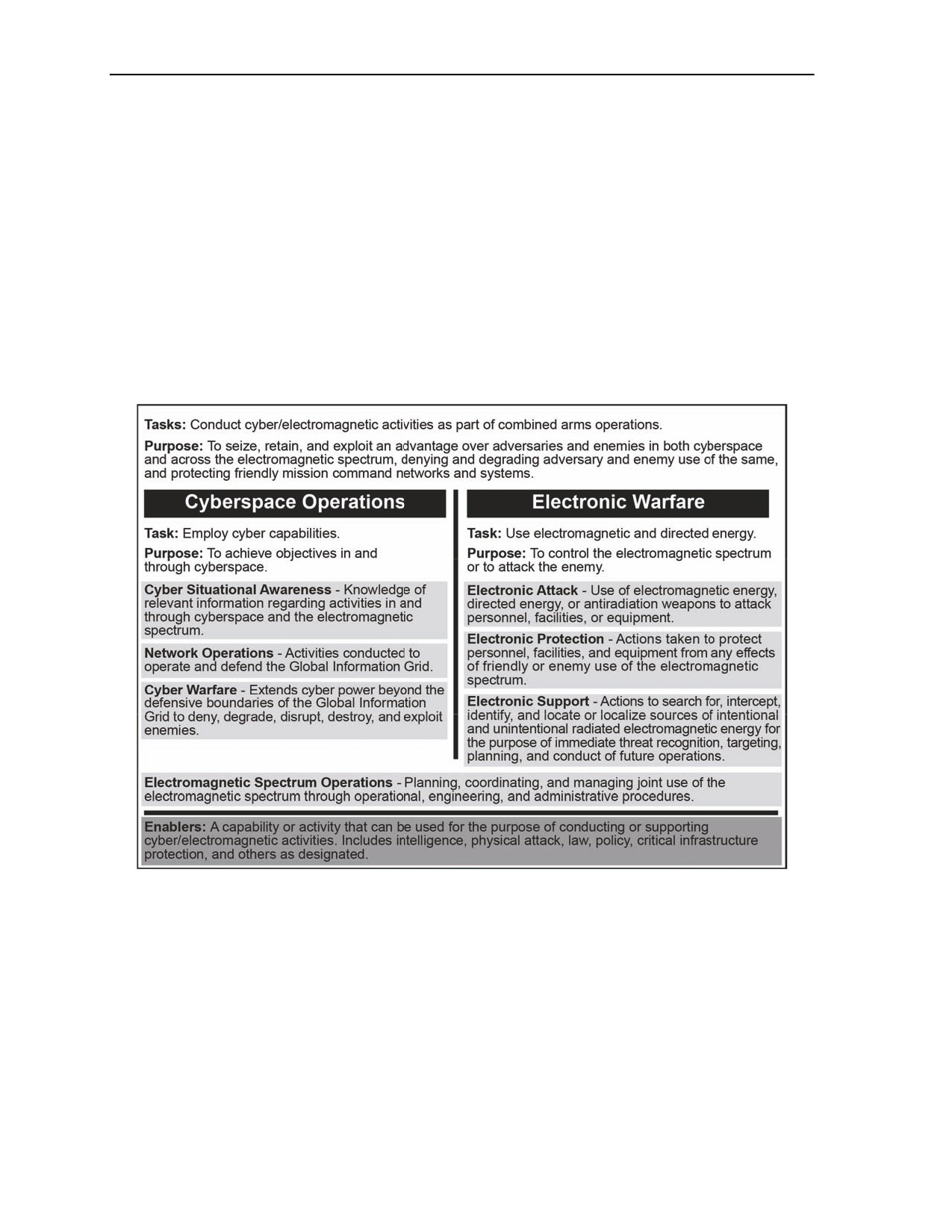
integrate cyber/electromagnetic activities within the overall operation (see figure 6-4). These activities
employ a combined arms approach to operations in a contested cyberspace domain and a congested
electromagnetic spectrum. Cyber/electromagnetic activities seize, retain, and exploit advantages in
cyberspace and the electromagnetic spectrum. The result enables Army forces to retain freedom of action
while denying freedom of action to enemies and adversaries, thereby enabling the overall operation.
*Figure 6-4. Two lines of effort for cyber/electromagnetic activities
6-116. Cyber/electromagnetic activities are divided into two lines of effort: the cyberspace operations line
of effort and the electronic warfare line of effort. These lines of effort may rely on the same capabilities and
enablers to accomplish these effects and must be synchronized and integrated closely to ensure unity of
effort in words, images, and actions. The components of the cyberspace operations line of effort integrate
with the components of the electronic warfare line of effort and electromagnetic spectrum operations.
*Cyberspace Operations
6-117. The cyberspace operations line of effort aims to accomplish objectives in and through cyberspace.
The components of the cyberspace line of effort include cyber situational awareness, network operations,
cyber warfare, and cyber support.
6-20
FM 3-0, C1
22 February 2011
The Science of Control
*Electronic Warfare
6-118. Electronic warfare is any military action involving the use of electromagnetic and directed energy
to control the electromagnetic spectrum or to attack the enemy. Electronic warfare consists of three
divisions: electronic attack, electronic protection, and electronic warfare support (JP 3-13.1). The electronic
warfare line of effort aims to control the electromagnetic spectrum or to attack the enemy. The components
of the electronic warfare line of effort consist of electronic attack, electronic protection, and electronic
support.
*COMPONENTS OF CYBER/ELECTROMAGNETIC ACTIVITIES
6-119. Cyber/electromagnetic activities consist of seven components: cyber situational awareness,
networks operations, cyber warfare, electronic attack, electronic protection, electronic support, and
electromagnetic spectrum operations.
*Cyber Situational Awareness
6-120. Cyber situational awareness is the knowledge of friendly, neutral, adversary, and enemy relevant
information regarding activities in and through cyberspace and the electromagnetic spectrum. Soldiers gain
this awareness by combining intelligence and operational activity in cyberspace, the electromagnetic
spectrum, and the other domains, both unilaterally and through collaboration with our joint, interagency,
intergovernmental, multinational, and nongovernmental organizational partners. Cyber situational
awareness enables the commander to collect, process, store, display, and disseminates an appropriate level
view of networks and systems. This enables an assessment of any changes to the network risk mitigation
steps needed due to network degradation. Commanders use cyber situational awareness to—
z
Assess enemy and adversary cyber capabilities and intentions.
z
Assess friendly, enemy, and adversary cyber vulnerabilities.
z
Monitor, protect, and prioritize their networks.
z
Assess the operational impact of network disruptions.
z
Respond to network outages or attacks.
z
Dynamically reallocate network traffic.
*Network Operations
6-121. Network operations install, operate, maintain, and protect LandWarNet, critical infrastructure, key
resources, and other specified cyberspace. Units need network operations to ensure operation of mission
command networks and systems. (See FM 6-02.71 for details on network operations.)
*Cyber Warfare
6-122. Cyber warfare extends combat power beyond the defensive boundaries of the Global Information
Grid to detect, deny, degrade, disrupt, destroy, and exploit enemies. Cyber warfare capabilities target
computer networks, telecommunication networks, and embedded processors and controllers in equipment,
systems, and infrastructure. Cyber warfare uses cyber exploitation, cyber attack, and cyber defense in a
mutually supporting and supported relationship with network operations and cyber support. Cyber warfare
accomplishes the following tasks:
z
Studies and characterizes the cyber threat.
z
Identifies, characterizes, and exploits enemies.
z
Contributes to cyber situational awareness.
z
Conducts cyber exploitation, attack, and defense.
z
Assists attack investigations to determine attribution.
*Electronic Attack
6-123. Electronic attack is a division of electronic warfare involving the use of electromagnetic energy,
directed energy, or antiradiation weapons to attack personnel, facilities, or equipment with the intent of
22 February 2011
FM 3-0, C1
6-21
Chapter 6
degrading, neutralizing, or destroying enemy combat capability and is considered a form of fires
(JP 3-13.1). Electronic attack has both defensive and offensive capabilities. For example, defensive
electronic attack includes efforts to defeat radio-controlled improvised explosive devices. Offensive
electronic attack includes—
z
Actions taken to prevent or reduce an enemy’s effective use of the electromagnetic spectrum,
such as jamming and electromagnetic deception.
z
Employment of weapons that use either electromagnetic or directed energy as their primary
destructive mechanism (lasers, radio frequency weapons, particle beams).
z
Offensive and defensive activities, including countermeasures.
*Electronic Protection
6-124. Electronic protection is a division of electronic warfare involving actions taken to protect
personnel, facilities, and equipment from any effects of friendly or enemy use of the electromagnetic
spectrum that degrade, neutralize, or destroy friendly combat capability (JP 3-13.1). Electronic protection
includes actions, such as frequency agility in a radio or variable pulse repetition frequency in radar.
Electronic protection should not be confused with self-protection. Both defensive electronic attack and
electronic protection protect personnel, facilities, capabilities, and equipment. However, electronic
protection protects forces from the effects of electronic attack (friendly and enemy). Defensive electronic
attack primarily protects forces against lethal attacks by denying enemy use of the electromagnetic
spectrum to guide or trigger weapons. To protect friendly capabilities, units—
z
Regularly brief force personnel on the electronic warfare threat.
z
Ensure that electronic system capabilities are safeguarded during exercises and training.
z
Coordinate and deconflict electromagnetic spectrum usage.
z
Train on electronic protection active and passive measures.
z
Minimize the vulnerability of friendly receivers to enemy jamming (such as reduced power,
brevity of transmissions, and directional antennas).
*Electronic Support
6-125. Electronic support is a division of electronic warfare involving actions tasked by, or under the
direct control of, an operational commander to search for, intercept, identify, and locate or localize sources
of intentional and unintentional radiated electromagnetic energy for the purpose of immediate threat
recognition, targeting, planning, and conduct of future operations. Electronic support systems supply
information regarding electronic attack, electronic protection, avoidance, targeting, and other tactical
employments of forces. Commanders make immediate decisions involving this information. Electronic
support systems collect data and produce information or intelligence to—
z
Corroborate other sources of information or intelligence.
z
Conduct or direct electronic attack operations.
z
Initiate self-protection measures.
z
Task weapon systems.
z
Support electronic protection efforts.
z
Create or update electronic warfare databases.
z
Support information activities.
FM 3-36 provides Army doctrine for electronic warfare.
*Electromagnetic Spectrum Operations
6-126. Electromagnetic spectrum operations are the conduct of spectrum management, frequency
assignments, policy implementation, and host-nation coordination that enables the commander’s effective
use of the electromagnetic spectrum.
(See FM 6-02.70 for detailed information on electromagnetic
spectrum operations.)
6-22
FM 3-0, C1
22 February 2011
The Science of Control
*ENABLERS OF CYBER/ELECTROMAGNETIC ACTIVITIES
6-127. An enabler of cyber/electromagnetic activities is called cyber support. Cyber support is supporting
activities to enable both network operations and cyber warfare. Cyber support differs from cyber warfare
and network operations. Those activities are carried out by multiple organizations and do not require a
separate cyber support proponent or lead. Cyber support entails varying intents, conditions, authorities, and
levels of effort. Cyber support conducts the following tasks:
z
Conduct vulnerability assessment.
z
Conduct threat-based security assessment.
z
Conduct vulnerability and security remediation.
z
Reverse engineering malware.
z
Explore cyber aspects of site exploitation.
z
Counter intelligence.
z
Conduct cyber forensics.
z
Coordinate with law enforcement.
z
Conduct cyber research, development, test, and evaluation.
z
Develop and acquire cyber combat.
*INTEGRATION AND SYNCHRONIZATION OF CYBER/ELECTROMAGNETIC ACTIVITIES
6-128. Responsibility for integration and synchronization of cyber/electromagnetic activities resides in the
electronic warfare element of the fires warfighting function. Unlike the inform and influence activities,
cyber/electromagnetic activities do not exist within a distinct staff element. Rather, the cyber/electro-
magnetic components operate within an existing electronic warfare workgroup.
SECTION III - SUMMARY
6-129. Commanders and staffs apply the science of control to accomplish the staff tasks and integrate the
warfighting functions. Control permits commanders to counter negative effects during operations. Design
pervades all systems and procedures. Commanders, assisted by their staffs, exercise control through the
operations process and mission command networks and systems. Commanders turn decisions into effective
actions through Army procedural and positive control. Knowledge management and information
management support control by transforming information into knowledge to support situational
understanding and decisionmaking. Commanders and staffs conduct inform and influence and
cyber/electromagnetic activities.
22 February 2011
FM 3-0, C1
6-23
This page intentionally left blank.
Chapter 7
Operational Art
This chapter discusses operational art, the levels of war, and how commanders and
staffs apply operational art to understand, visualize, and describe how to establish
conditions to achieve a desired end state. Operational art represents a creative
approach to dealing with the direction of military forces. It expresses informed vision
across the levels of war.
*UNDERSTANDING OPERATIONAL ART
7-1. Operational art is the application of creative imagination by commanders and staffs—supported by
their skill, knowledge, and experience—to design strategies, campaigns, and major operations and organize
and employ military forces. Operational art integrates ends, ways, and means across the levels of war
(JP 3-0).
7-2. Operational art reflects a holistic understanding of the operational environment and the problem. This
understanding enables commanders to develop end state conditions and an operational approach to guide
the force in establishing those conditions for lasting success. The operational approach is a broad
conceptualization of the general actions that will produce the conditions that define the desired end state
(FM 5-0). Design
(see chapter
5) assists commanders in developing their operational approach.
Commanders use a common language to visualize and describe their operational approach.
7-3. In visualizing an operation, commanders determine which conditions satisfy policy, orders, guidance,
and directives. Taken together, these conditions become the end state. Commanders devise and execute
plans that complement the actions of the other instruments of national power in a focused, unified effort. To
this end, commanders draw on experience, knowledge, education, intellect, intuition, and creativity.
7-4. Mission command focuses on empowering subordinate leaders and sharing information to facilitate
decentralized execution. Effective mission command requires Army leaders at lower levels of command to
assume greater responsibility for accomplishing higher headquarters’ objectives during operations. (See
Chapter 5 for more discussion on mission command.) The ability to exercise operational art provides
Soldiers with freedom of action to ensure their efforts contribute to accomplishing those objectives. This
ability also allows Army forces to develop the situation as well as adapt and act decisively in dynamic
conditions.
THE LEVELS OF WAR
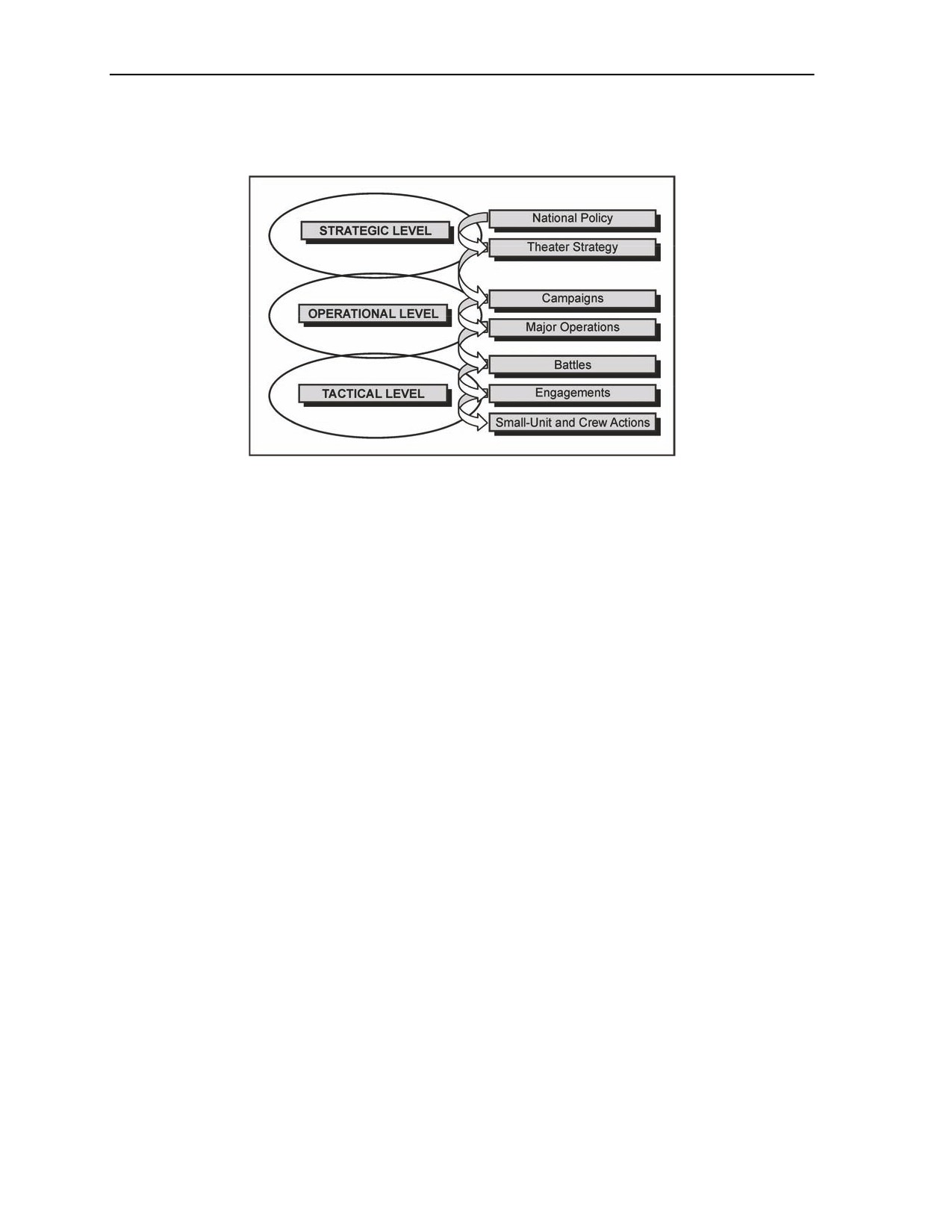
7-5. The levels of war define and clarify the relationship between strategy and tactical actions. (See
figure 7-1, page 7-2.) The levels have no finite limits or boundaries. They correlate to specific levels of
responsibility and planning. They help organize thought and approaches to a problem. The levels
distinguish between headquarters and the specific responsibilities and actions performed at each echelon.
Despite advances in technology, digital information sharing, and the increased visibility of tactical actions,
the levels of war remain useful. Decisions at one level always affect other levels.
7-6. A natural tension exists between the levels of war and echelons of command. This tension stems
from different perspectives, requirements, and constraints associated with command at each level of war.
Between the levels of war, the horizons for planning, preparation, and execution differ greatly.
Operational-level commanders typically synchronize the activities of military and civilian organizations
and agencies across large areas. Tactical commanders focus primarily on employing combined arms within
an area of operations. They sometimes work with civilian agencies on political, informational, and
22 February 2011
FM 3-0, C1
7-1
Chapter 7
economic issues. Often, tactical commanders receive missions that divert combat power from tasks that
seem more urgent at lower levels. It is a commander’s responsibility to recognize and resolve this tension.
Figure 7-1. Levels of war
7-7. A string of tactical victories does not guarantee success at the operational and strategic levels.
Tactical success, while required to set operational conditions, must be tied to achieving the strategic end
state. Wars are won at the operational and strategic levels; yet without tactical success, a major operation
cannot achieve the desired end state. Commanders overcome this tension through open and continuous
dialog, a thorough understanding of the situation across the levels of war, and a shared vision that integrates
and synchronizes actions among the echelons.
7-8. Small units, crews, and individuals act at the tactical level. At times, their actions may produce
strategic or operational effects. However, this does not mean these elements act at the strategic or
operational level. Actions are not strategic unless they contribute directly to achieving the strategic end
state. Similarly, actions are considered operational only if directly related to operational movement or the
sequencing of battles and engagements. The level at which an action occurs is determined by the
perspective of the echelon in terms of planning, preparation, and execution.
STRATEGIC
7-9. The strategic level of war is the level of war at which a nation, often as a member of a group of
nations, determines national or multinational
(alliance or coalition) strategic security objectives and
guidance, and develops and uses national resources to achieve these objectives. Activities at this level
establish national and multinational military objectives; sequence initiatives; define limits and assess risks
for the use of military and other instruments of national power; develop global plans or theater war plans to
achieve those objectives; and provide military forces and other capabilities in accordance with strategic
plans (JP 3-0).
7-10. Strategy is a prudent idea or set of ideas for employing the instruments of national power in a
synchronized and integrated fashion to achieve theater, national, and/or multinational objectives (JP 3-0).
The President translates national interests and policy into a national strategic end state. Combatant
commanders base their theater strategic planning on this end state. To ensure their military strategy aligns
with national interests and policy, combatant commanders participate in strategic discourse with the
President, Secretary of Defense (through the Chairman of the Joint Chiefs of Staff), and multinational
partners. Peacetime military engagement is vital to U.S. strategy and integral to theater security cooperation
plans. Strategy involves more than campaigns and major operations. When successful, these plans promote
national or multinational goals through peaceful processes. Peacetime military engagement contributes to
the ability of multinational forces to operate together.
7-2
FM 3-0, C1
22 February 2011
Operational Art
7-11. National interests and policy define and inform military strategy with a broad framework for
conducting operations. A combatant commander’s military strategy is thus an instrument that implements
national policy and strategy. Successful commanders understand the relationship and links between policy
and strategy. They also appreciate the distinctions and interrelationships among the levels of war. This
appreciation is fundamental to an informed understanding of the decisions and actions at each level.
Without it, commanders cannot sequence and synchronize military and nonmilitary actions toward an end
state consistent with national strategy and policy.
OPERATIONAL
7-12. The operational level links employing tactical forces to achieving the strategic end state. At the
operational level, commanders conduct campaigns and major operations to establish conditions that define
that end state. A campaign is a series of related major operations aimed at achieving strategic and
operational objectives within a given time and space (JP 5-0). A major operation is a series of tactical
actions
(battles, engagements, strikes) conducted by combat forces of a single or several Services,
coordinated in time and place, to achieve strategic or operational objectives in an operational area. These
actions are conducted simultaneously or sequentially in accordance with a common plan and are controlled
by a single commander. For noncombat operations, a reference to the relative size and scope of a military
operation (JP 3-0). Major operations are not solely the purview of combat forces. They are typically
conducted with the other instruments of national power. Major operations often bring together the
capabilities of other agencies, nations, and organizations.
7-13. Operational art determines when, where, and for what purpose commanders employ major forces.
Operational commanders position and maneuver forces to shape conditions in their area of operations for
their decisive operation. Commanders exploit tactical victories to gain strategic advantage or reverse the
strategic effects of tactical losses.
7-14. Actions at the operational level usually involve broader dimensions of time and space than tactical
actions do. Operational commanders need to understand the complexities of the operational environment,
look beyond the immediate situation, and consider the consequences of their approach and subordinates’
actions. Operational commanders seek to establish the most favorable conditions possible for subordinate
commanders by shaping future events.
7-15. Experienced operational commanders understand tactical realities and can establish conditions that
favor tactical success. Likewise, good tactical commanders understand the operational and strategic context
within which they execute their assigned tasks. This understanding helps them seize opportunities (both
foreseen and unforeseen) that contribute to achieving the end state or defeating enemy initiatives that
threaten its achievement. Operational commanders require experience at both the operational and tactical
levels. This experience gives them the knowledge and intuition needed to understand how tactical and
operational possibilities interrelate.
TACTICAL
7-16. Tactics uses and orders the arrangement of forces in relation to each other. Through tactics,
commanders use combat power to accomplish missions. The tactical-level commander uses combat power
in battles, engagements, and small-unit and crew actions. A battle consists of a set of related engagements
that lasts longer and involves larger forces than an engagement. Battles can affect the course of a
campaign or major operation. An engagement is a tactical conflict, usually between opposing lower
echelons maneuver forces (JP 1-02). Engagements are typically conducted at brigade level and below. They
are usually short, executed in terms of minutes, hours, or days.
7-17. Operational-level headquarters determine objectives and provide resources for tactical operations.
For any tactical-level operation, the surest measure of success is its contribution to achieving end state
conditions. Commanders avoid battles and engagements that do not contribute to achieving the operational
end state conditions.
22 February 2011
FM 3-0, C1
7-3
Chapter 7
APPLYING OPERATIONAL ART
7-18. Commanders use operational art to envision how to establish conditions that define the desired end
state. Actions and interactions across the levels of war influence these conditions. These conditions are
fundamentally dynamic and linked together by the human dimension, the most unpredictable and uncertain
element of conflict. The operational environment is complex, adaptive, and interactive. Through
operational art, commanders apply a comprehensive understanding of it to determine the most effective and
efficient methods to influence conditions in various locations across multiple echelons. (See figure 7-2.)
Figure 7-2. Operational art
7-19. Operational art spans a continuum—from comprehensive strategic direction to concrete tactical
actions. Bridging this continuum requires creative vision coupled with broad experience and knowledge.
Operational art provides a means for commanders to derive the essence of an operation. Without it, tactical
actions devolve into a series of disconnected engagements, with relative attrition the only measure of
success. Through operational art, commanders translate their concept of operations into an operational
design and ultimately into tactical tasks. They do this by integrating ends, ways, and means and by
envisioning dynamic combinations of the elements of full spectrum operations across the levels of war.
They then apply operational art to array forces and maneuver them to achieve the desired end state.
7-20. Every operation begins with a commander’s intent that guides its conduct. In almost all cases, a
commander’s intent and concept of operations envision all the instruments of national power working
toward a common end state. Using operational art, commanders frame their concept by answering several
fundamental questions:
z
What is the force trying to accomplish (ends)?
z
What conditions, when established, constitute the desired end state (ends)?
z
How will the force achieve the end state (ways)?
z
What sequence of actions is most likely to attain these conditions (ways)?
z
What resources are required, and how can they be applied to accomplish that sequence of actions
(means)?
z
What risks are associated with that sequence of actions, and how can they be mitigated (risk)?
7-21. Commanders understand, visualize, describe, direct, lead, and assess all aspects of operations. Based
on a comprehensive analysis of the operational environment, commanders determine the centers of gravity
around which to frame the plan.
7-4
FM 3-0, C1
22 February 2011
Operational Art
7-22. When applying operational art, collaboration informs situational understanding. This collaboration
involves an open, continuous dialog between commanders that spans the levels of war and echelons of
command. This dialog is vital in establishing a common perspective on the problem and a shared
understanding of the operational environment’s conditions. Effective collaboration enables assessment,
fosters critical analysis, and anticipates opportunities and risk. Collaboration allows commanders to
recognize and react to changes in the situation.
7-23. Practicing operational art requires a broad understanding of the operational environment at all levels.
It also requires practical creativity and the ability to visualize changes in the operational environment.
Commanders project their visualization beyond the realm of physical combat. They anticipate the
operational environment’s evolving military and nonmilitary conditions. Operational art encompasses
visualizing the synchronized arrangement and employment of military forces and capabilities to achieve the
desired end state. This creative process requires the ability to discern the conditions required for victory
before committing forces to action.
7-24. Conflict is fundamentally a human endeavor characterized by violence, uncertainty, chance, and
friction. Land operations are inherently tied to the human dimension; they cannot be reduced to a simple
formula or checklist. Operational art helps commanders integrate functions and capabilities. It also helps
synchronize military actions with actions of other government and civilian organizations. Operational art
supports design by providing a conceptual framework for ordering thought when planning operations.
Operational art supports the commanders’ ability to seize, retain, and exploit initiative and achieve decisive
results.
*THE ELEMENTS OF OPERATIONAL ART
7-25. Through operational art supported by design, commanders and staffs develop a broad operational
approach and translate it into a coherent, feasible plan for employing forces. This operational approach
provides a framework that relates tactical tasks to the desired end state. It provides a unifying purpose and
focus to all operations. In applying operational art, commanders and their staffs use a set of intellectual
tools to help them think through understanding the operational environment as well as visualizing and
describing the operational approach (see figure 7-3). Collectively, this set of tools is known as the elements
of operational art. These tools help commanders understand, visualize, and describe complex combinations
of combat power and help them formulate their intent and guidance. Commanders selectively use these
tools in any operation. However, their application is broadest in the context of long-term operations.
Figure 7-3. Elements of operational art
7-26. The elements of operational art support the commander in identifying tasks and objectives that link
tactical mission to the desired end state. They help refine and focus the operational approach that forms the
basis for developing a detailed plan or order. During execution, commanders and staffs consider the
elements of operational art as they assess the situation. They adjust current and future operations and plans
as the operation unfolds.
22 February 2011
FM 3-0, C1
7-5
Chapter 7
END STATE AND CONDITIONS
7-27. The end state is a desired future condition represented by the expressed conditions that the
commander wants to exist when an operation ends. Clearly describing the end state requires understanding
the operational environment and assessing the friendly, enemy, adversary, and neutral populations.
Commanders include end state in their planning guidance and commander’s intent. A clearly defined end
state promotes unity of effort, facilitates integration and synchronization, and helps mitigate risk.
7-28. Army operations typically focus on achieving the military end state. However, Army operations also
contribute to establishing nonmilitary conditions. Sometimes that is their focus. Commanders explicitly
describe the end state and its defining conditions for every operation. Otherwise, missions become vague
and operations lose focus. Commanders should direct every operation toward a clearly defined, decisive,
and attainable end state.
7-29. The end state may evolve as an operation progresses. Commanders may refine guidance, the
operational environment’s conditions might change, and situational understanding may increase. Therefore,
all commanders continuously monitor operations and evaluate their progress. Commanders use formal and
informal assessment methods to assess progress in achieving the desired end state and determine whether
reframing is required.
CENTERS OF GRAVITY
7-30. A center of gravity is the source of power that provides moral or physical strength, freedom of
action, or will to act (JP 3-0). This definition states in modern terms the classic description offered by
Clausewitz: “the hub of all power and movement, on which everything depends.”3 The loss of a center of
gravity ultimately results in defeat. The center of gravity is a vital analytical tool for planning operations. It
provides a focal point, identifying sources of strength and weakness.
7-31. Understanding the center of gravity has evolved beyond the term’s preindustrial definition. Centers
of gravity are now part of a more complex perspective of the operational environment. Today they are not
limited to military forces and can be either physical or moral. Physical centers of gravity, such as a capital
city or military force, are typically easier to identify, assess, and target. They can often be influenced solely
by military means. In contrast, moral centers of gravity are intangible and complex. Dynamic and related to
human factors, they can include a charismatic leader, powerful ruling elite, religious tradition, tribal
influence, or strong-willed populace. Military means alone usually prove ineffective when targeting moral
centers of gravity. Eliminating them requires the collective, integrated efforts of all instruments of national
power.
7-32. Center of gravity analysis is thorough and detailed. Faulty conclusions drawn from hasty or
abbreviated analyses can adversely affect operations, waste critical resources, and incur undue risk.
Thoroughly understanding the operational environment helps commanders identify and target enemy
centers of gravity. This understanding encompasses how enemies organize, fight, and make decisions. It
also includes their physical and moral strengths and weaknesses. In addition, commanders should
understand how military forces interact with other government and civilian agencies. This understanding
helps planners identify centers of gravity, their associated decisive points, and the best approach for
achieving the desired end state.
DIRECT OR INDIRECT APPROACH
7-33. The approach is the manner in which a commander contends with a center of gravity. The
direct approach is the manner in which a commander attacks the enemy’s center of gravity or
principal strength by applying combat power directly against it. However, centers of gravity are
generally well protected and not vulnerable to a direct approach. Thus, commanders usually choose an
indirect approach. The indirect approach is the manner in which a commander attacks the enemy’s
center of gravity by applying combat power against a series of decisive points while avoiding enemy
3 © 1984. Reproduced with permission of Princeton University Press.
7-6
FM 3-0, C1
22 February 2011
Operational Art
strength. Both approaches use specific combinations of defeat or stability mechanisms depending on the
mission. Whether direct or indirect, an effective operational approach achieves decisive results through
combinations of defeat and stability mechanisms. As commanders and staffs frame the problem, they
determine the appropriate combination of defeat or stability mechanisms to solve it. This begins the process
that ends with the plan for an operation that achieves the desired end state.
Defeat Mechanisms
7-34. A defeat mechanism is the method through which friendly forces accomplish their mission
against enemy opposition. A defeat mechanism is described in terms of the physical or psychological
effects it produces. Defeat mechanisms are not tactical missions; rather, they describe broad operational
and tactical effects. Commanders translate these effects into tactical tasks. Operational art formulates the
most effective, efficient way to defeat enemy aims. Physical defeat deprives enemy forces of the ability to
achieve those aims; psychological defeat deprives them of the will to do so. Army forces have the most
success when applying focused combinations of defeat mechanisms. This produces complementary and
reinforcing effects not attainable with a single mechanism. Used individually, a defeat mechanism achieves
results proportional to the effort expended. Used in combination, the effects are likely to be both synergistic
and lasting. Army forces at all echelons use combinations of four defeat mechanisms:
z
Destroy.
z
Dislocate.
z
Disintegrate.
z
Isolate.
7-35. In the context of defeat mechanisms, destroy means to apply lethal combat power on an enemy
capability so that it can no longer perform any function and cannot be restored to a usable condition
without being entirely rebuilt. To most effectively destroy enemy capabilities, units use a single, decisive
attack. When units cannot mass the necessary combat power simultaneously, commanders apply it
sequentially. This approach is called attrition. It defeats the enemy by maintaining the highest possible rate
of destruction over time.
7-36. Destruction may not force the enemy to surrender; well-disciplined forces and those able to
reconstitute can often endure heavy losses without giving up. Defeat cannot be accurately measured solely
in terms of destruction, particularly when criteria focus on narrow metrics, such as casualties, equipment
destroyed, or perceived enemy strength. Destruction is especially difficult to assess if friendly forces apply
force indiscriminately. The effects of destruction often fade unless combined with isolation and dislocation.
7-37. Dislocate means to employ forces to obtain significant positional advantage, rendering the
enemy’s dispositions less valuable, perhaps even irrelevant. It aims to make the enemy expose forces by
reacting to the dislocating action. Dislocation requires enemy commanders to make a choice: accept
neutralization of part of their force or risk its destruction while repositioning. Turning movements and
envelopments produce dislocation. When combined with destruction, dislocation can contribute to rapid
success.
7-38. Disintegrate means to disrupt the enemy’s command and control system, degrading the ability
to conduct operations while leading to a rapid collapse of the enemy’s capabilities or will to fight. It
exploits the effects of dislocation and destruction to shatter the enemy’s coherence. Typically,
disintegration—coupled with destruction and dislocation—follows the loss of capabilities that enemy
commanders use to develop and maintain situational understanding. Simultaneous operations produce the
strongest disintegrative effects. Disintegration is difficult to achieve; however, prolonged isolation,
destruction, and dislocation can produce it.
7-39. In the context of defeat mechanisms, isolate means to deny an enemy or adversary access to
capabilities that enable the exercise of coercion, influence, potential advantage, and freedom of
action. Isolation limits the enemy’s ability to conduct operations effectively by marginalizing one or more
of these capabilities. It exposes the enemy to continued degradation through the massed effects of the other
defeat mechanisms. There are two types of isolation:
22 February 2011
FM 3-0, C1
7-7
Chapter 7
z
Physical isolation, which is difficult to achieve, but easier to assess. An isolated enemy loses
freedom of movement and access to support.
z
Psychological isolation, which, while difficult to assess, is a vital enabler of disintegration. The
most important indicators include the breakdown of enemy morale and the alienation of a
population from the enemy.
7-40. Isolation alone rarely defeats an enemy. However, it complements and reinforces other defeat
mechanisms’ effects. Offensive operations often focus on destroying personnel and equipment. They may
use maneuver to dislocate forces. However, these effects multiply when combined with isolating the enemy
from sources of physical and moral support.
Stability Mechanisms
7-41. Commanders use stability mechanisms to visualize how to employ the stability element of full
spectrum operations. A stability mechanism is the primary method through which friendly forces affect
civilians in order to attain conditions that support establishing a lasting, stable peace. As with defeat
mechanisms, combinations of stability mechanisms produce complementary and reinforcing effects that
accomplish the mission more effectively and efficiently than single mechanisms do alone. The four stability
mechanisms are—
z
Compel.
z
Control.
z
Influence.
z
Support.
7-42. Compel means to use, or threaten to use, lethal force to establish control and dominance, effect
behavioral change, or enforce compliance with mandates, agreements, or civil authority. The
appropriate and discriminate use of lethal force reinforces efforts to stabilize a situation, gain consent, or
ensure compliance. Conversely, misusing force can adversely affect an operation’s legitimacy. Legitimacy
is essential to producing effective compliance. Compliance depends on how the local populace and others
perceive the force’s ability to exercise lethal force to accomplish the mission.
7-43. In the context of stability mechanisms, control means to impose civil order. It includes securing
borders, routes, sensitive sites, population centers, and individuals. It also involves physically occupying
key terrain and facilities. Control includes activities related to disarmament, demobilization, and
reintegration, as well as security sector reform. (Chapter 3 discusses the security sector.)
7-44. *In the context of stability mechanisms, influence means to alter the opinions and attitudes of a
civilian population through inform and influence activities, presence, and conduct. It aims to change
behaviors through nonlethal means. Influence is as much a product of public perception as a measure of
success. It reflects the ability of friendly forces to operate within the cultural and societal norms of the local
populace while accomplishing the mission. Influence requires legitimacy. Developing legitimacy requires
time, patience, and coordinated, cooperative efforts across the operational area.
7-45. In the context of stability mechanisms, support means to establish, reinforce, or set the
conditions necessary for the other instruments of national power to function effectively. It requires
coordination and cooperation with civilian agencies as they assess the immediate needs of failed or failing
states and plan for, prepare for, or execute responses to them. In extreme circumstances, support may
require committing considerable resources for a protracted period. This commitment may involve
establishing or reestablishing the institutions required for normal life. These typically include a legitimate
civil authority, market economy, and criminal justice system supported by government institutions for
health, education, and civil service.
Using Defeat and Stability Mechanisms
7-46. Defeat and stability mechanisms complement center of gravity analysis. This analysis reveals the
intrinsic vulnerabilities of a given center of gravity. Defeat mechanisms describe ways to isolate or destroy
it. For example, a decisive point may be temporarily neutralized by dislocating it. The enemy may commit
significant combat power to regain that capability, presenting an opportunity to destroy committed enemy
7-8
FM 3-0, C1
22 February 2011
Operational Art
forces. By combining dislocation and destruction, the commander can effectively eliminate the capability.
Thus, the effect on the center of gravity is permanent, and friendly forces retain freedom of action and
initiative.
7-47. The approach reflects the commander’s visualization for applying combinations of defeat and
stability mechanisms. An effective approach, direct or indirect, focuses operations toward achieving the
end state.
DECISIVE POINTS
7-48. A decisive point is a geographic place, specific key event, critical factor, or function that, when acted
upon, allows commanders to gain a marked advantage over an adversary or contribute materially to
achieving success (JP 3-0). Decisive points are not centers of gravity; they are keys to attacking or
protecting them. Decisive points apply at both the operational and tactical levels. At the operational level,
they typically provide direct use against a center of gravity. At the tactical level, they tie directly to mission
accomplishment.
7-49. Some decisive points are geographic. Examples include port facilities, distribution networks and
nodes, and bases of operations. Specific events and elements of an enemy force may also be decisive
points. Examples of such events include commitment of the enemy operational reserve and reopening a
major oil refinery. A common characteristic of decisive points is their major importance to a center of
gravity. A decisive point’s importance requires the enemy to commit significant resources to defend it. The
loss of a decisive point weakens a center of gravity and may expose more decisive points.
7-50. Decisive points have a different character during operations dominated by stability or civil support.
These decisive points may be less tangible and more closely associated with important events and
conditions. For example, during operations after Hurricane Andrew in 1992, reopening schools was a
decisive point. Other examples include—
z
Repairing a vital water treatment facility.
z
Establishing a training academy for national security forces.
z
Securing an election.
z
Quantifiably reducing crime.
None of these examples is purely physical. Nonetheless, any may be vital to establishing conditions for
transitioning to civil authority. In an operation dominated by stability or civil support, this transition is
typically an end state condition.
7-51. Commanders identify the decisive points that offer the greatest advantage against centers of gravity.
Decisive points that enable commanders to seize, retain, or exploit the initiative are crucial. Controlling
them is essential to mission accomplishment. Enemy control of a decisive point may exhaust friendly
momentum, force early culmination, or allow an enemy counterattack. Decisive points shape the design of
operations. They help commanders select clearly decisive, attainable objectives that directly contribute to
achieving the end state.
LINES OF OPERATIONS AND LINES OF EFFORT
7-52. Lines of operations and lines of effort bridge the broad concept of operations across to discreet
tactical tasks. They link objectives to the end state. Continuous assessment gives commanders the
information required to revise and adjust lines of operations and effort. Subordinate commanders reallocate
resources accordingly.
7-53. Commanders may describe an operation along lines of operations, lines of effort, or a combination of
both. Irregular warfare, for example, typically requires a deliberate approach using lines of operations
complemented with lines of effort; the combination of them may change based on the conditions within the
operational area. An operational approach using both lines of operations and lines of effort reflects the
characteristics and advantages of each. With this approach, commanders synchronize and sequence actions,
deliberately creating complementary and reinforcing effects. The lines then converge on the well-defined,
commonly understood end state outlined in the commander’s intent.
22 February 2011
FM 3-0, C1
7-9
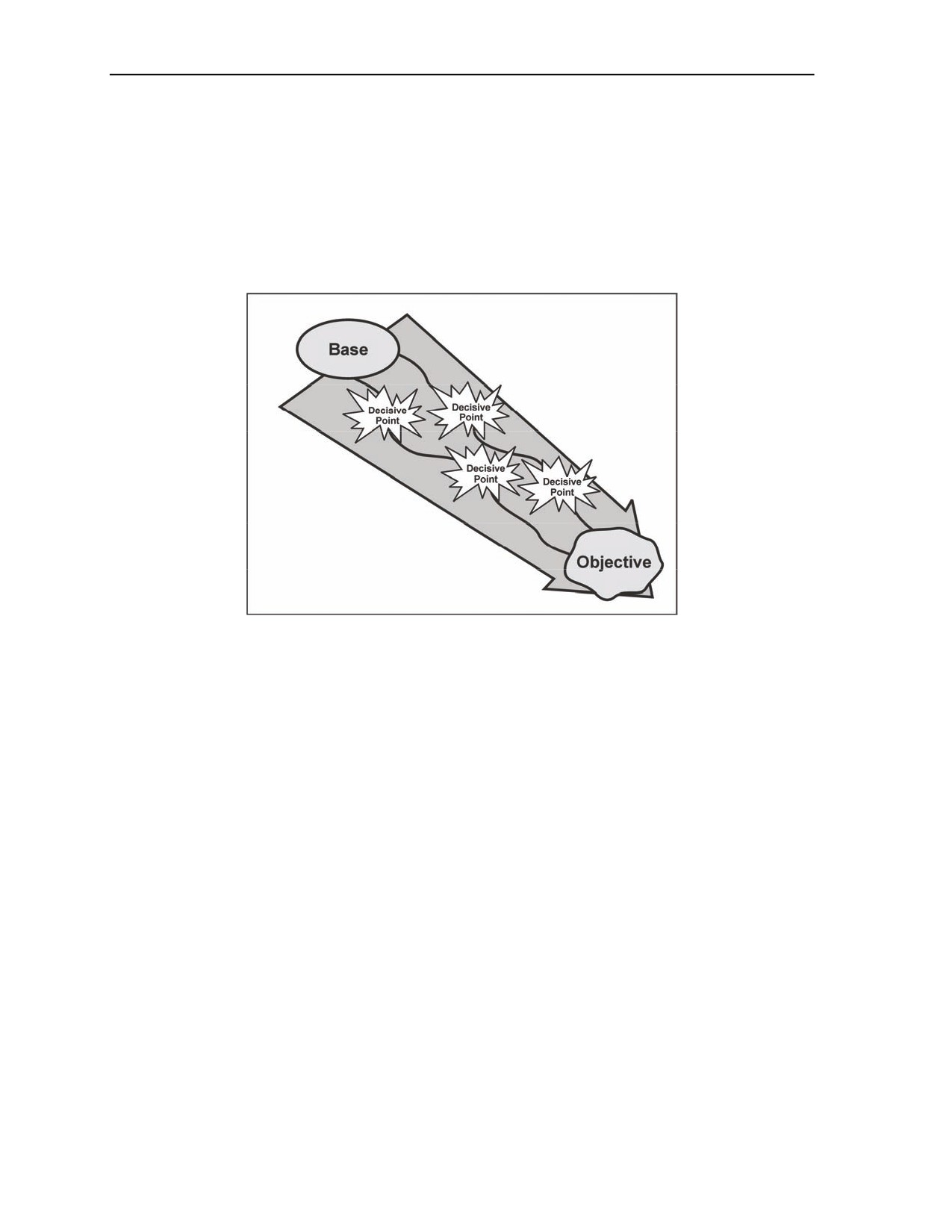
Chapter 7
Lines of Operations
7-54. A line of operations is a line that defines the directional orientation of a force in time and space
in relation to the enemy and links the force with its base of operations and objectives. (See figure 7-4.)
Lines of operations connect a series of decisive points that lead to control of a geographic or force-oriented
objective. Operations designed using lines of operations generally consist of a series of actions executed
according to a well-defined sequence. Major combat operations are typically designed using lines of
operations. These lines tie offensive and defensive tasks to the geographic and positional references in the
operational area. Commanders synchronize activities along complementary lines of operations to achieve
the end state. Lines of operations may be either interior or exterior.
Figure 7-4. Example of a line of operations
7-55. A force operates on interior lines when its operations diverge from a central point. Interior lines
usually represent a central position, where a friendly force can reinforce or concentrate its elements faster
than the enemy force can reposition. With interior lines, friendly forces are closer to separate enemy forces
than the enemy forces are to one another. Interior lines allow an isolated force to mass combat power
against a specific portion of an enemy force by shifting capabilities more rapidly than the enemy can react.
7-56. A force operates on exterior lines when its operations converge on the enemy. Operations on
exterior lines offer opportunities to encircle and annihilate an enemy force. However, these operations
typically require a force stronger or more mobile than the enemy.
7-57. The relevance of interior and exterior lines depends on the time and space relationship between the
opposing forces. Although an enemy force may have interior lines with respect to the friendly force, this
advantage disappears if the friendly force is more agile and operates at a higher tempo. (Paragraph 7-71
defines tempo.) Conversely, if a smaller friendly force maneuvers to a position between larger but less agile
enemy forces, the friendly force can better defeat them in detail before they can react effectively.
Lines of Effort
7-58. A line of effort is a line that links multiple tasks and missions using the logic of purpose—cause
and effect—to focus efforts toward establishing operational and strategic conditions. Lines of effort
are essential to long-term planning when positional references to an enemy or adversary have little
relevance. In operations involving many nonmilitary factors, lines of effort may form the only way to link
tasks, effects, conditions, and the desired end state. Lines of effort help commanders visualize how military
capabilities can support the other instruments of national power. They prove particularly invaluable when
used to achieve unity of effort in operations involving multinational forces and civilian organizations,
where unity of command is elusive, if not impractical.
7-10
FM 3-0, C1
22 February 2011
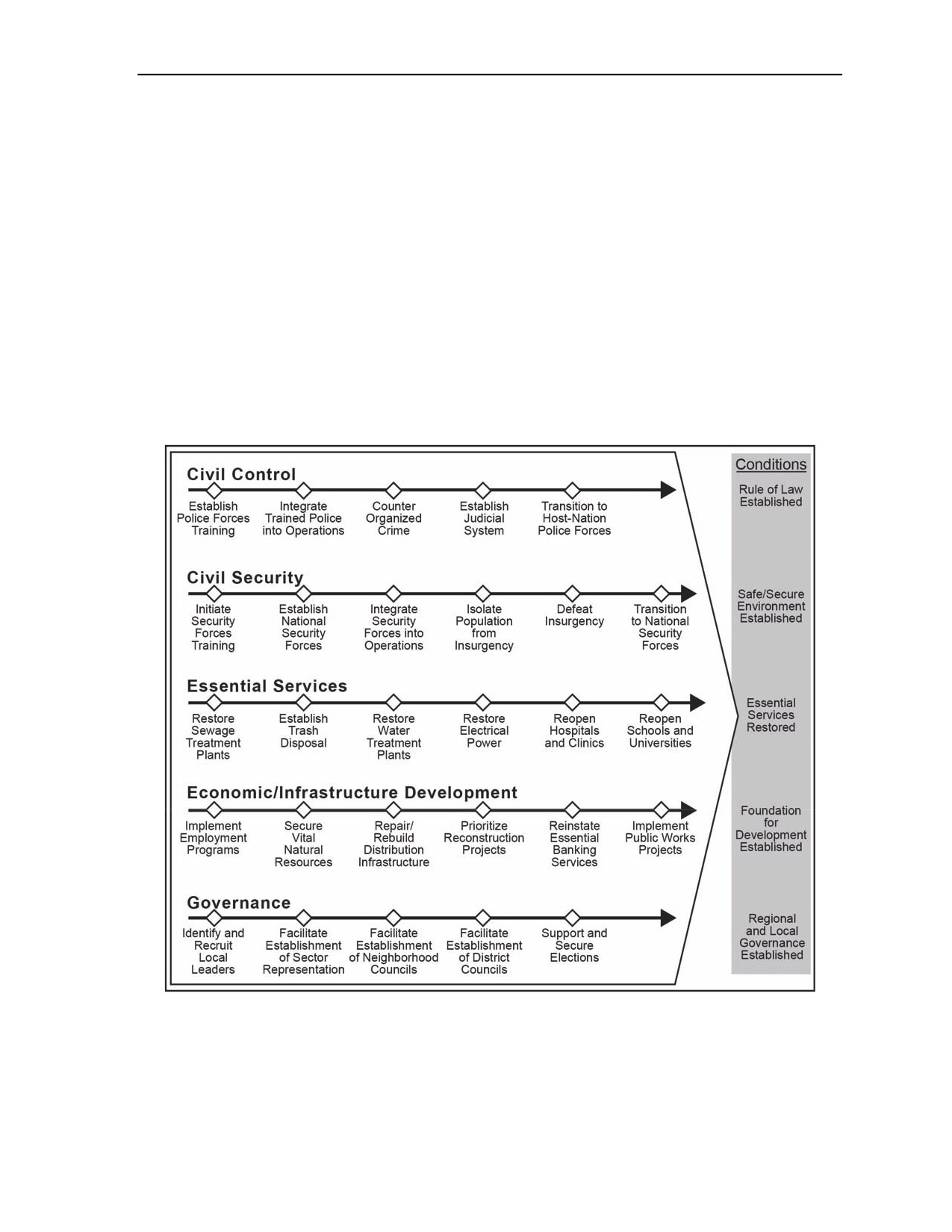
Operational Art
7-59. Commanders use lines of effort to describe how they envision their operations establishing the more
intangible end state conditions. These lines of effort show how individual actions relate to each other and to
achieving the end state. Ideally, lines of effort combine the complementary, long-term effects of stability or
civil support tasks with the cyclic, short-term events typical of offensive or defensive tasks.
7-60. Commanders at all levels may use lines of effort to develop missions and tasks and to allocate
resources. Commanders may designate one line of effort as the decisive operation and others as shaping
operations. Commanders synchronize and sequence related actions along multiple lines of effort. Seeing
these relationships helps commanders assess progress toward achieving the end state as forces perform
tasks and accomplish missions.
7-61. Commanders typically visualize stability and civil support operations along lines of effort. For
stability operations, commanders may consider linking primary stability tasks to their corresponding
Department of State post-conflict technical sectors. (See Chapter 3 for a discussion on stability tasks.)
These stability tasks link military actions with the broader interagency effort across the levels of war.
Figure 7-5 provides an example. A full array of lines of effort might include offensive and defensive lines,
as well as a line for inform and influence activities. Inform and influence activities typically produce effects
across multiple lines of effort.
Figure 7-5. Example of lines of effort (stability)
7-62. The five post-conflict technical sectors described in chapter 3 may become lines of effort, as
illustrated in figure
7-5. They provide a framework for analyzing an operational environment where
stability operations are the major focus. They identify the breadth and depth of relevant civilian agency
tasks and emphasize the relationships among them. Using them as lines of effort can help as Army forces in
collaborative interagency planning and dialog. Planning and dialog leads to developing lines of effort that
22 February 2011
FM 3-0, C1
7-11
Chapter 7
synchronize the effects of the instruments of national power. However, the sectors are not themselves lines
of effort and are not the default solution for every operation. During a civil support mission, lines of effort
normally portray support in response to a disaster or terrorist attack, support to law enforcement, and other
support as required.
7-63. As operations progress, commanders may modify the lines of effort after assessing conditions and
collaborating with multinational military and civilian partners. Lines of effort typically focus on integrating
the effects of military operations with those of other instruments of national power to support the broader
effort. Each operation, however, differs. Commanders develop and modify lines of effort to keep operations
focused on achieving the end state, even as the situation changes.
Combining Lines of Operations and Lines of Effort
7-64. Commanders use both lines of operations and lines of effort to connect objectives to a central,
unifying purpose. Lines of operations portray the more traditional links between objectives, decisive points,
and centers of gravity. However, lines of operations do not project the long-term plan beyond defeating
enemy forces and seizing terrain. Combining lines of operations and lines of effort allows commanders to
include nonmilitary activities in their long-term plan. This combination helps commanders incorporate
stability tasks that establish the end state conditions into the operation. It allows commanders to consider
the less tangible aspects of the operational environment where the other instruments of national power
dominate. Commanders can then visualize concurrent and post-conflict stability activities. Making these
connections relates the tasks and purposes of the elements of full spectrum operations with joint effects
identified in the long-term plan.
OPERATIONAL REACH
7-65. Operational reach is the distance and duration across which a unit can successfully employ military
capabilities
(JP
3-0). It reflects the ability to achieve success through a well-conceived operational
approach. Operational reach is a tether; it is a function of protection, sustainment, endurance, and relative
combat power. The limit of a unit’s operational reach is its culminating point. (See paragraph 7-85.) It
balances the natural tension between endurance, momentum, and protection. The following actions can
extend operational reach:
z
Forward positioning of forces, reserves, bases, and support capabilities along lines of operations.
z
Employing weapons systems with extended ranges, such as missiles.
z
Phasing an operation to focus limited resources.
z
Leveraging supply discipline, contracting, and host-nation support. Maximizing distribution
network efficiency.
z
Leveraging joint capabilities.
7-66. Endurance refers to the ability to employ combat power anywhere for protracted periods. It stems
from the ability to create, protect, and sustain a force, regardless of the distance from its base and the
austerity of the environment. Endurance involves anticipating requirements and making the most effective,
efficient use of available resources. Their endurance gives Army forces their campaign capability. It makes
permanent the changing effects of other capabilities.
7-67. Momentum comes from seizing the initiative and executing high-tempo operations that overwhelm
enemy resistance. Commanders control momentum by maintaining focus and pressure. They set a tempo
that prevents exhaustion and maintains sustainment. A sustainable tempo extends operational reach.
Commanders maintain momentum by anticipating and transitioning rapidly between primary tasks or—
when necessary—the elements of full spectrum operations. Sometimes commanders push the force to its
culminating point to take maximum advantage of an opportunity. For example, exploitations and pursuits
often involve pushing all available forces to the limit of their endurance to capitalize on momentum and
retain the initiative.
7-68. Protection is an important contributor to operational reach. Commanders anticipate how enemy
actions might disrupt operations and then determine the protection capabilities required to maintain
sufficient reach. Protection closely relates to endurance and momentum. It also contributes to the
7-12
FM 3-0, C1
22 February 2011
Operational Art
commander’s ability to extend operations in time and space. The protection warfighting function helps
commanders maintain the deploying force’s integrity and combat power.
7-69. An operational pause is a deliberate halt taken to extend operational reach or prevent
culmination. Commanders may execute an operational pause for several reasons. These may include the
force being close to culmination, the decisive operation failing, or the end state changing. In planning an
operation, commanders carefully balance initiative, momentum, reach, and culmination to avoid
unnecessary operational pauses. In protracted operations, however, they may have to execute operational
pauses to extend operational reach. Commanders carefully plan, prepare for, and execute these pauses to
prevent losing the initiative. During an operational pause, commanders retain the initiative by using
shaping operations to keep pressure on enemy forces. These shaping operations confuse the enemy while
friendly forces generate combat power for the decisive operation.
7-70. Commanders and staffs balance operational reach, direct and indirect approaches, and operational
pauses to ensure Army forces accomplish their missions before culminating. Commanders continually
strive to extend operational reach. They assess friendly and enemy force status, anticipate culmination, and
plan operational pauses if necessary. Commanders have studied and reflected on the challenge of
conducting and sustaining operations over long distances and times. History contains many examples of
operations hampered by inadequate operational reach. Achieving the desired end state requires forces with
the operational reach to establish and maintain the end state conditions.
TEMPO
7-71. Tempo is the relative speed and rhythm of military operations over time with respect to the
enemy. It reflects the rate of military action. Controlling tempo helps commanders keep the initiative
during combat operations or rapidly establish a sense of normalcy during humanitarian crises. During
operations dominated by the offense and defense, commanders normally seek to maintain a higher tempo
than the enemy; rapid tempo can overwhelm an enemy’s ability to counter friendly actions. During
operations dominated by stability and civil support, commanders act quickly to control events. By acting
faster than the situation deteriorates, commanders can change the dynamics of a crisis and restore stability.
The capability to act quickly enhances flexibility and operational adaptability across the spectrum of
conflict.
7-72. Commanders control tempo throughout the conduct of operations. First, they formulate operations
that stress the complementary and reinforcing effects of simultaneous and sequential operations. They
synchronize those operations in time and space to degrade enemy capabilities throughout the operational
area. Second, commanders avoid unnecessary engagements. This practice includes bypassing resistance
that appears at times and places commanders do not consider decisive. Third, through mission command
they enable subordinates to exercise initiative and act independently. Controlling tempo requires both
audacity and patience: audacity initiates the actions needed to develop a situation; patience allows a
situation to develop until the force can strike at the decisive time and place. Ultimately, the goal is
maintaining a tempo appropriate to retaining the initiative and achieving the end state.
7-73. Army forces expend more energy and resources when operating at a high tempo. Commanders assess
the force’s capacity to operate at a high tempo based on its performance and available resources. An
effective operational design varies tempo throughout an operation to increase endurance while maintaining
appropriate speed and momentum. There is more to tempo than speed. While speed can be important,
commanders balance speed with endurance.
SIMULTANEITY AND DEPTH
7-74. Simultaneity and depth extend operations in time and space. Simultaneity has two components. Both
depend on depth to attain lasting effects and maximum synergy. Simultaneous combinations of offensive,
defensive, and stability tasks overwhelm enemy forces and their will to resist while setting the conditions
for a lasting, stable peace. Simultaneous actions across the depth of the operational area place more
demands on enemy forces than enemy forces can effectively respond to them. Operations combining depth
and simultaneity achieve a synergy that paralyzes enemy forces. This prevents them from reacting
appropriately, inducing their early culmination. Similarly, stability or civil support tasks—executed in
22 February 2011
FM 3-0, C1
7-13
Chapter 7
depth with simultaneous defensive and offensive tasks when necessary—establish control of the situation
throughout the operational area.
7-75. Simultaneity also refers to the concurrent effects operations produce at the tactical, operational, and
strategic levels. Tactical commanders fight the battles and engagements that accomplish objectives in
accordance with the operational commander’s intent. Operational commanders set the conditions for
tactical success in battles within a campaign or major operation. These victories, in turn, create the
conditions that define the end state. Because of the complex interaction among the levels of war,
commanders cannot be concerned only with events at their respective echelon. Success requires them to
understand how their actions affect the operations of commanders at all other echelons.
7-76. Depth is the extension of operations in time, space, and resources. Operations in depth can disrupt
the enemy’s decision cycle. These operations contribute to protecting the force by destroying enemy
capabilities before the enemy can use them. Commanders balance their forces’ tempo to produce
simultaneous results throughout their operational area. To achieve simultaneity, commanders establish a
higher tempo to target enemy capabilities located at the limit of a force’s operational reach.
7-77. Simultaneity and depth are inherent in full spectrum operations. Army forces execute simultaneous
operations across vast areas. They force the enemy to react to numerous friendly actions—potential and
actual—throughout the operational area. Army forces use combined arms, advanced information systems,
and joint capabilities to increase the depth of their operations. The complementary effects produced by
executing simultaneous operations in depth overwhelm enemy forces, forcing them to respond piecemeal or
not at all.
7-78. Commanders extend the depth of operations through joint integration. When determining an
operation’s depth, commanders consider their own capabilities, as well as joint capabilities and limitations.
They use these capabilities to ensure actions executed at operational depth receive robust and uninterrupted
support. Commanders sequence and synchronize operations in time and space to achieve simultaneous
effects throughout the operational area.
PHASING AND TRANSITIONS
7-79. A phase is a planning and execution tool used to divide an operation in duration or activity. A
change in phase usually involves a change of mission, task organization, or rules of engagement.
Phasing helps in planning and controlling and may be indicated by time, distance, terrain, or an
event. The ability of Army forces to extend operations in time and space, coupled with a desire to dictate
tempo, often presents commanders with more objectives and decisive points than the force can engage
simultaneously. At both the operational and tactical levels, this situation may require commanders and
staffs to consider sequencing operations. Sequencing involves integrating capabilities and synchronizing
actions. This is accomplished through phasing.
7-80. Phasing is key to arranging complex operations. It describes how the commander envisions the
overall operation unfolding. It is the logical expression of the commander’s visualization in time. Within a
phase, a large portion of the force executes similar or mutually supporting activities. Achieving a specified
condition or set of conditions typically marks the end of a phase.
7-81. Simultaneity, depth, and tempo are vital to full spectrum operations. However, they cannot always be
attained to the degree desired. In such cases, commanders limit the number of objectives and decisive
points engaged simultaneously. They deliberately sequence certain actions to maintain tempo while
focusing combat power at the decisive point in time and space. Commanders combine simultaneous and
sequential operations to establish the end state conditions.
7-82. Phasing can extend operational reach. Only when the force lacks the capability to accomplish the
mission in a single action do commanders phase the operation. Each phase should strive to—
z
Focus effort.
z
Concentrate combat power in time and space at a decisive point.
z
Deliberately and logically accomplish its objectives.
7-14
FM 3-0, C1
22 February 2011
Operational Art
7-83. Transitions mark a change of focus between phases or between the ongoing operation and execution
of a branch or sequel. Shifting priorities between the elements of full spectrum operations—such as from
offense to stability—also involves a transition. Transitions require planning and preparation well before
their execution to maintain the momentum and tempo of operations. The force is vulnerable during
transitions, and commanders establish clear conditions for their execution. Transitions may create
unexpected opportunities; they may also make forces vulnerable to enemy threats.
7-84. An unexpected change in conditions may require commanders to direct an abrupt transition between
phases. In such cases, the overall composition of the force remains unchanged despite sudden changes in
mission, task organization, and rules of engagement. Typically, task organization evolves to meet changing
conditions; however, transition planning must also account for changes in mission. Commanders attuned to
sudden changes can better adapt their forces to dynamic conditions. They continuously assess the situation
and task-organize and cycle their forces to retain the initiative. They strive to achieve changes in emphasis
without incurring an operational pause.
CULMINATION
7-85. The culminating point is that point in time and space at which a force no longer possesses the
capability to continue its current form of operations. Culmination represents a decisive shift in relative
combat power. It is relevant to both attackers and defenders at each level of war. In the offense, the
culminating point occurs when the force cannot continue the attack and must assume a defensive posture or
execute an operational pause. In the defense, it occurs when the force can no longer defend itself and must
withdraw or risk destruction.
7-86. With stability, the culminating point is more difficult to identify. Three conditions can result in
culmination:
z
Being too dispersed to adequately control the situation.
z
Being unable to provide the necessary security.
z
Lacking required resources.
7-87. During civil support, culmination is unlikely. However, culmination may occur if forces must
respond to more catastrophic events than they can manage simultaneously. That situation results in
culmination due to exhaustion.
7-88. Culmination may be a planned event. In such cases, the concept of operations predicts which part of
the force will culminate, and the task organization includes additional forces to assume the mission.
Culmination is expected and measures are in place to mitigate it. Culmination is typically caused by direct
combat actions or higher echelon resourcing decisions. It relates to the force’s ability to generate and apply
combat power and is not a lasting condition. Tactical units may be reinforced or reconstituted to continue
operations.
RISK
7-89. Risk, uncertainty, and chance are inherent in all military operations. When commanders accept risk,
they create opportunities to seize, retain, and exploit the initiative and achieve decisive results. Risk is a
potent catalyst that fuels opportunity. The willingness to incur risk is often the key to exposing enemy
weaknesses that the enemy considers beyond friendly reach. Understanding risk requires calculated
assessments coupled with boldness and imagination. Successful commanders assess and mitigate risk
continuously throughout the operations process.
7-90. Inadequate planning and preparation recklessly risks forces. It is equally rash to delay action while
waiting for perfect intelligence and synchronization. Reasonably estimating and intentionally accepting risk
is fundamental to conducting operations and essential to mission command. Successfully applying military
force requires commanders who assess the risks, analyze and minimize the hazards, and execute a plan that
accounts for those hazards. Experienced commanders balance audacity and imagination with risk and
uncertainty to strike at a time and place and in a manner wholly unexpected by enemy forces. This is the
essence of surprise. It results from carefully considering and accepting risk. (FMs 3-90 and 6-0 discuss
tactical risk.)
22 February 2011
FM 3-0, C1
7-15
Chapter 7
7-91. Operational art balances risk and opportunity to create and maintain the conditions necessary to
seize, retain, and exploit the initiative and achieve decisive results. During execution, opportunity is
fleeting. The surest means to create opportunity is to accept risk while minimizing hazards to friendly
forces. A good operational approach considers risk and uncertainty equally with friction and chance. The
final plans and orders then provide the flexibility commanders need to take advantage of opportunity in
complex, dynamic environments.
SUMMARY
7-92. Operational art is a cognitive aspect of operations supported by design. While the character of
conflict changes with time, the violent and chaotic nature of warfare does not. The essence of military art
remains timeless. Operational art—the creative expression of informed vision to integrate ends, ways, and
means across the levels of war—is fundamental to the Army’s ability to seize, retain, and exploit the
initiative.
7-16
FM 3-0, C1
22 February 2011
Strategic and Operational Reach
be expanded and improved to establish a more permanent presence. The scale and complexity of the base,
however, directly relates to the size of the force required to maintain it. A large base with extensive
facilities requires a much larger security force than a smaller, austere base. Commanders weigh whether to
expand and improve a forward operating base against the type and number of forces available to secure it,
the expected length of the forward deployment, and the force’s sustainment requirements.
8-37. Forward operating bases extend and maintain the operational reach of Army forces, providing secure
locations from which to conduct and sustain operations. They not only enable extending operations in time
and space; they also contribute to the overall endurance of the force, an essential element of the Army’s
campaign capability. Forward operating bases allow forward-deployed forces to reduce operational risk,
maintain momentum, and avoid culmination.
8-38. Typically, forward operating bases are established adjacent to a regional distribution hub, such as a
large airfield (civilian or military), rail terminal, or major highway junction. This facilitates movement into
and out of the operational area while providing a secure location through which to distribute personnel,
equipment, and supplies. However, forward operating bases may be located in austere locations with
limited access to transportation infrastructure. In such cases, units will not likely maintain the base for
extended periods.
*SUPPORT AREAS
8-39. When lodgment or a forward operating base expands to include clusters of sustainment,
headquarters, and other supporting units, commanders may designate a support area. A support area is a
specific surface area designated by the echelon commander to facilitate the positioning, employment,
and protection of resources required to sustain, enable, and control tactical operations. Within a
support area, a designated unit such as a brigade combat team or maneuver enhancement brigade provides
area security, terrain management, movement control, mobility support, clearance of fires, and required
tactical combat forces. This allows sustainment units to focus on their primary function.
SUMMARY
8-40. The Nation requires joint forces with strategic and operational reach. Given the enormous distances
that separate the United States from regions in conflict, this imposes serious challenges for the Army. Even
within the United States, the distances between Army installations and major cities often span a significant
expanse. Above all, the Army must remain versatile, adapting not only to the particular requirements of
different areas of responsibility, but also to limitations in strategic and intratheater lift. Available lift will
never equal an ideal land force’s requirements. Joint force commanders need some landpower deployed
very rapidly and capable of seizing a lodgment. They also need follow-on land forces able to persevere for
months and years as the campaign progresses. Once deployed, Army commanders develop and protect
bases and lines of communications in austere areas. These house not only Soldiers but also joint and
multinational forces. With each base, Army forces extend their operational reach throughout the operational
area, using landpower to multiply the effectiveness of American military power.
22 February 2011
FM 3-0, C1
8-7
This page intentionally left blank.
The Role of Doctrine and Summary of Changes
ADDENDUM TO THE ROLE OF DOCTRINE AND SUMMARY OF
CHANGES
SUMMARY OF MAJOR CHANGES
D-27. The following paragraphs summarize the major doctrinal changes made by this field manual from the
2008 version.
Chapter 1 - The Operational Environment
D-28. Chapter 1 adds a discussion of hybrid threats.
Chapter 2 - The Continuum of Operations
D-29. Chapter 2 makes the following changes:
z
Eliminates graphics to illustrate the continuum of operations.
z
Expands and clarifies the discussion of major combat operations.
Chapter 3 - Full Spectrum Operations
D-30. Chapter 3 makes the following changes:
z
Moves the discussion of mission command from the section within the operational concept to
chapters 4, 5, and 6 to consolidate and emphasize mission command.
z
Adds the discussion of stability operations now includes security force assistance.
z
Modifies the discussion of civil support tasks from three tasks to four.
Chapter 4 - Combat Power
D-31. Chapter 4 makes the following changes:
z
Replaces the command and control warfighting function with mission command warfighting
function.
z
Introduces the four commander’s tasks of mission command: drive the operations process;
understand, visualize, describe, direct, lead, and assess operations; develop teams among
modular formations and joint, interagency, intergovernmental, and multinational partners; and
lead inform and influence activities.
z
Introduces the three staff tasks of mission command: conduct the operations process, conduct
knowledge management and information management, and conduct inform and influence and
cyber/electromagnetic activities.
z
Adds integrate and synchronize cyber/electromagnetic activities as a fires warfighting task.
z
Modifies the discussion of health service support under the sustainment warfighting function.
z
Adds health risk communication as a measure under force health protection in the protection
warfighting function.
Chapter 5 - The Commander and Mission Command
D-32. Chapter 5 makes the following changes:
z
Changes the title of the chapter to The Commander and Mission Command.
z
Moves the discussions of control and the operations process to chapter 6.
z
Describes how design assists the commander in better understanding the operational
environment.
z
Prescribes a new definition for mission command.
z
Discusses the four commander’s tasks of mission command.
22 February 2011
FM 3-0, C1
D-7
Appendix D
z
Describes how building teams enables commanders to shape operations before, during, and after
operations.
z
Rescinds the term battle command.
z
Rescinds the term command and control warfare and the discussion of command and control
warfare.
z
Describes how the commander uses assessment in operations.
Chapter 6 - The Science of Control
D-33. Chapter 6 is a new chapter. It makes the following changes:
z
Changes the title of the chapter to The Science of Control.
z
Describes the three staff tasks of mission command.
z
Eliminates the five information tasks and replaces them with the task of inform and influence
and cyber/electromagnetic activities. The joint construct of information operations focuses on
adversaries and is based on capabilities. The previous version of FM 3-0, Operations, and the
2003 FM 3-13, Information Operations, used a similar definition and construct. In 2008, FM 3-0
revised how the Army viewed information operations using five information tasks located in
separate warfighting functions. This change accounts for the difference between land operations
and those conducted in the other domains. For example, the joint construct of information
operations had nothing that focused the efforts of multiple contributors on getting out effective
messages to friendly or neutral audiences, which are now accounted in the task of inform and
influence activities. The new construct also recognizes the growing importance of a new
function that addresses the cyber/electromagnetic arena. As an interim measure, responsibility
for integration and synchronization of cyber/electromagnetic activities resides in the electronic
warfare element of the fires warfighting function. The concepts and functions of cyber/
electromagnetic activities will mature and be refined.
z
Rescinds the term psychological operations and replaces the term with military information
support operations.
Chapter 7 - Information Superiority (Deleted)
D-34. Chapter 7, Information Superiority, is deleted. Discussion of inform and influence and cyber/
electromagnetic activities is moved to chapter 6.
Chapter 7 - Operational Art
D-35. Chapter 7 (previously chapter 6) makes the following changes:
z
Introduces design as a methodology that supports the application of operational art.
z
Modifies the definition of operational approach to align with FM 5-0.
z
Replaces elements of operational design with elements of operational art.
Chapter 8 - Strategic and Operational Reach
D-36. Chapter 8 adds a discussion of and defines support area.
Appendix A - Principles of War and Operations
Appendix B - Command and Support Relationships
Appendix C - The Army Modular Force
D-8
FM 3-0, C1
22 February 2011