FM 3-22.40 NLW TACTICAL EMPLOYMENT OF NONLETHAL WEAPONS (JANUARY 2003) - page 3
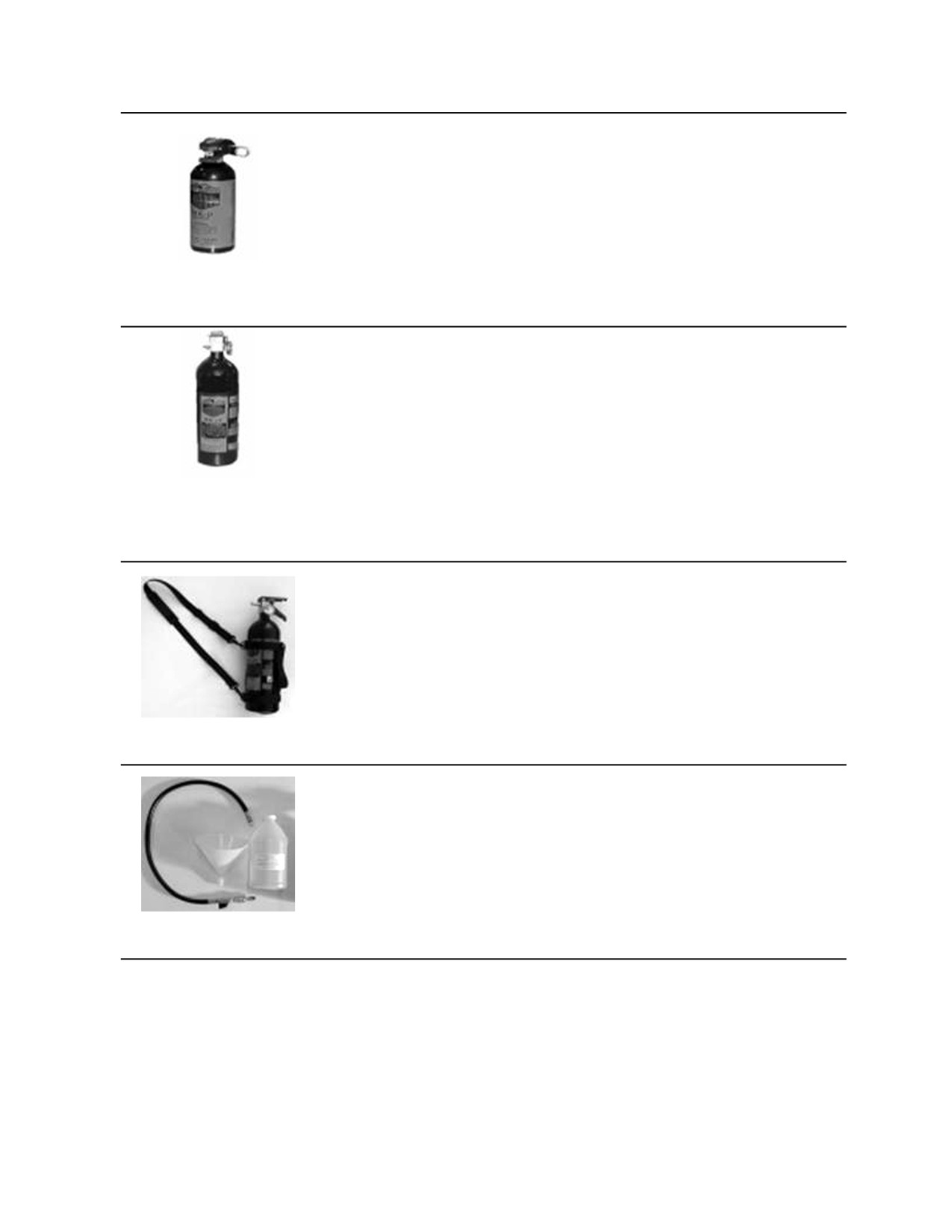
19. MK-9 Squad Live OC Pepper Spray: The MK-9 squad pepper spray
has a range of up to 15 feet in a target-specific fog. It contains 8 to10 half-
second high volume bursts. (Figure A-11)
Figure A-11. MK-9
Squad Live OC Pepper
Spray
20. MK-46 Platoon Live (Horizontal) OC Pepper Spray: The MK-46
platoon pepper spray has a range of up to 25 to 30 feet in a target-specific
dispersed spray pattern. It contains up to 12 one-second high volume
bursts.
(Figure A-12)
Figure A-12. MK-46
Platoon Live
(Horizontal) OC Pepper
Spray
21. MK-46 Sling: The MK-46 sling gives a service member the ability to
sling the MK-46 canister on the shoulder. (Figure A-13)
Figure A-13. MK-46
Sling
22. MK-46 Hardware Kit: The MK-46 hardware kit consists of a transfer
tube, funnel, and transfer bottle. A compressed nitrogen source is also
required to utilize the kit.
(Figure A-14)
Figure A-14. MK-46
Hardware Kit
A-4
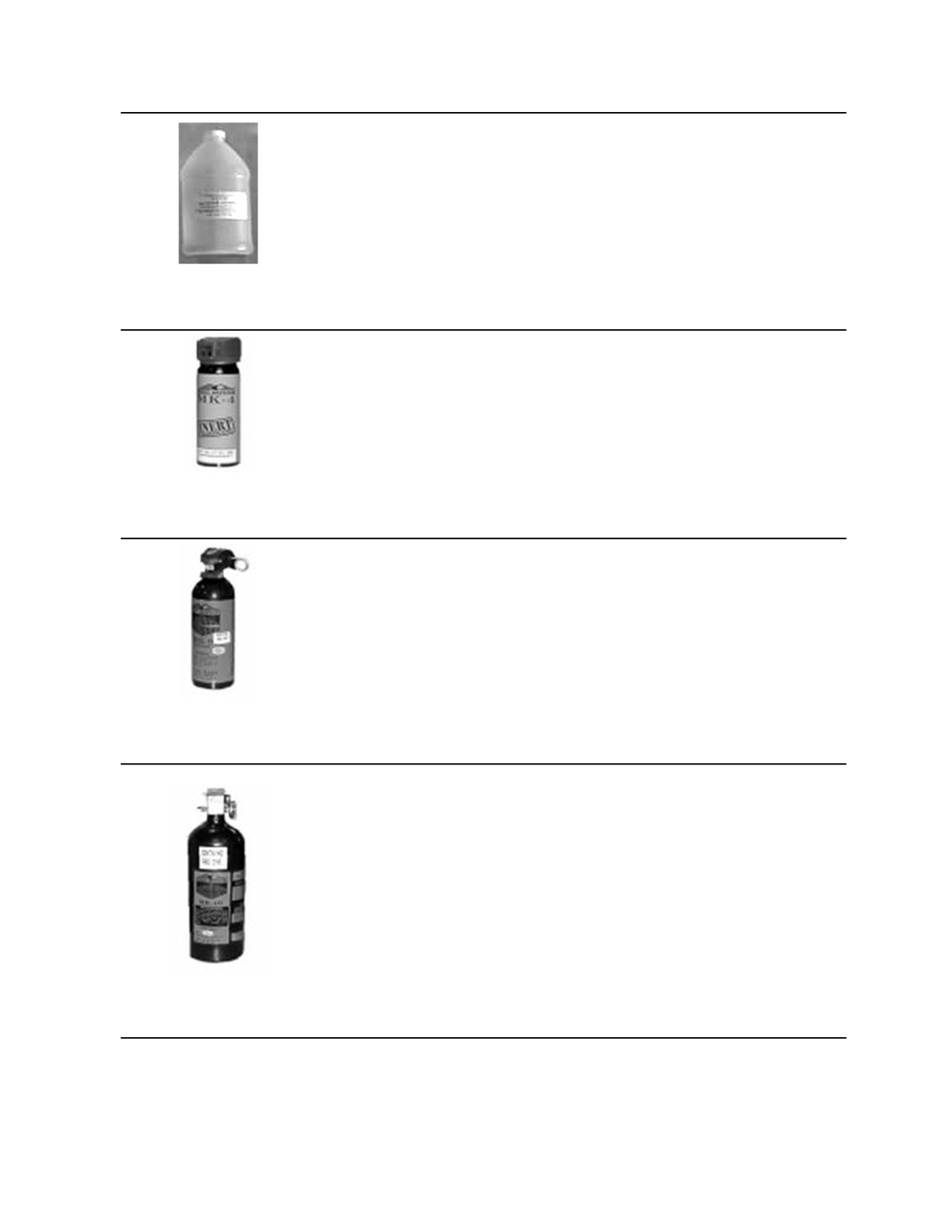
23. MK-46 Refill Live OC Pepper Spray: The MK-46 refill solution comes in
a one-gallon container. (Figure A-15)
Figure A-15. MK-46
Refill Live OC Pepper
Spray
24. MK-4 Individual Inert OC Pepper Spray: The MK-4 inert individual
pepper spray has a range of up to 12 feet in a target-specific stream. It
contains 30 to 35 half-second bursts. It provides the service member with
an inert canister for familiarization and training purposes. The inert device
is loaded with a non-irritant, non-toxic formulation payload. The device
may also contain a non-toxic, water-soluble marker to allow immediate
feedback on content delivery to target. The MK-4 device is marked “Inert.”
Figure A-16. MK-4
(Figure A-16)
Individual Inert OC
Pepper Spray
25. MK-9 Squad Inert OC Pepper Spray: The MK-9 squad inert pepper
spray has a range of up to 15 feet in a target-specific fog. It contains 8 to
10 half-second high volume bursts. It provides the service member with
an inert canister for familiarization and training purposes. The inert device
is loaded with a non-irritant, non-toxic formulation payload. The device
may also contain a non-toxic, water-soluble marker to allow immediate
feedback on content delivery to target. The inert MK-9 device is
Figure A-17. MK-9
prominently marked “Inert” with a yellow sticker attached. (Figure A-17)
Squad Inert OC Pepper
Spray
26. MK-46 Platoon Inert OC Pepper Spray: The MK-46 platoon inert
pepper spray has a range of up to 25 to 30 feet in a target-specific
dispersed spray pattern. It contains up to 12 one-second high volume
bursts. It provides the service member with an inert canister for
familiarization and training purposes. The inert device is loaded win a
non-irritant, non-toxic formulation payload. The device may also contain a
non-toxic, water-soluble marker to allow immediate feedback on content
delivery to target. The inert MK-46 device is prominently marked “Inert”
with a yellow sticker attached. (Figure A-18)
Figure A-18. MK-46
Platoon Inert OC
Pepper Spray
A-5
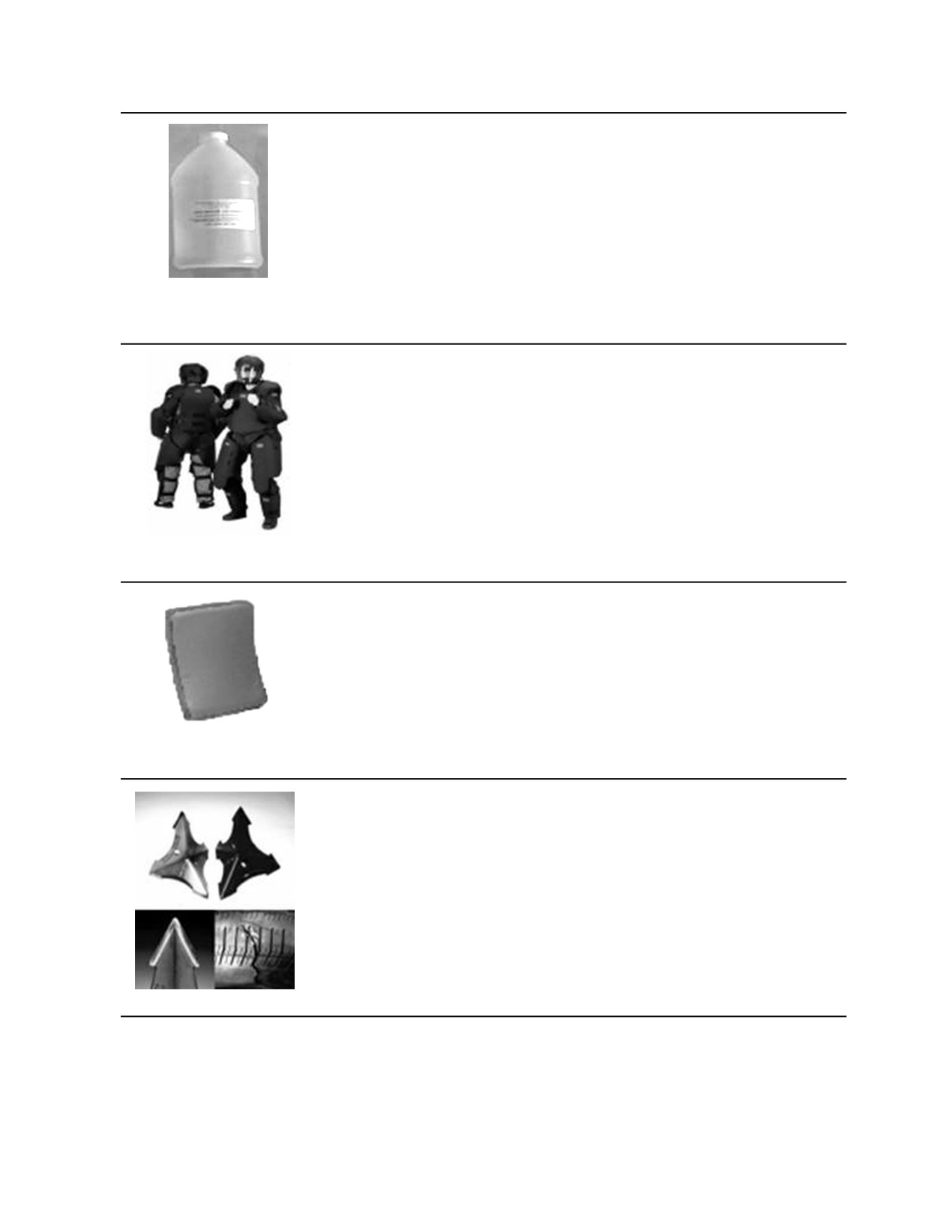
27. MK-46 Refill Inert OC Pepper Spray: The MK-46 refill solution comes
in a one-gallon container. (Figure A-19)
Figure A-19. MK-46
Refill Inert OC Pepper
Spray
28. FIST Training Suit: The FIST training suit is made of closed-cell
shock-absorbent foam that allows service members to hone their riot baton
skills through realistic hand-to-hand engagement training. The FIST suit
can absorb blows inflicted by the current expandable and wood riot baton.
It provides protection for the head, face, hands, and legs, without
significant degradation of the wearer’s mobility. The FIST suit consists of
a helmet, chest and back protector, bicep and forearm protectors, groin
and buttock protectors, thigh and shin protectors, gloves, and carry bag.
(Figure A-20)
NOTE: FIST is the current manufacturer of this training suit).
Figure A-20. FIST
Training Suit
29. Riot Training Strike Bag: The riot training strike bag gives the service
member a strike bag for training and proficiency in open-hand control
techniques. (Figure A-21)
Figure A-21. Riot
Training Strike Bag
30. Caltrop: The caltrop is a field expedient area denial system. Securing
approximately 50 caltrops to 550 military cord best employs it. This allows
a service member to quickly toss/recover the system, using the caltrops to
deny vehicle/pedestrian movement in a designated area. The four prongs
are approximately two inches tall and will puncture tires or boots. (Figure
A-22)
Figure A-22. Caltrop
A-6
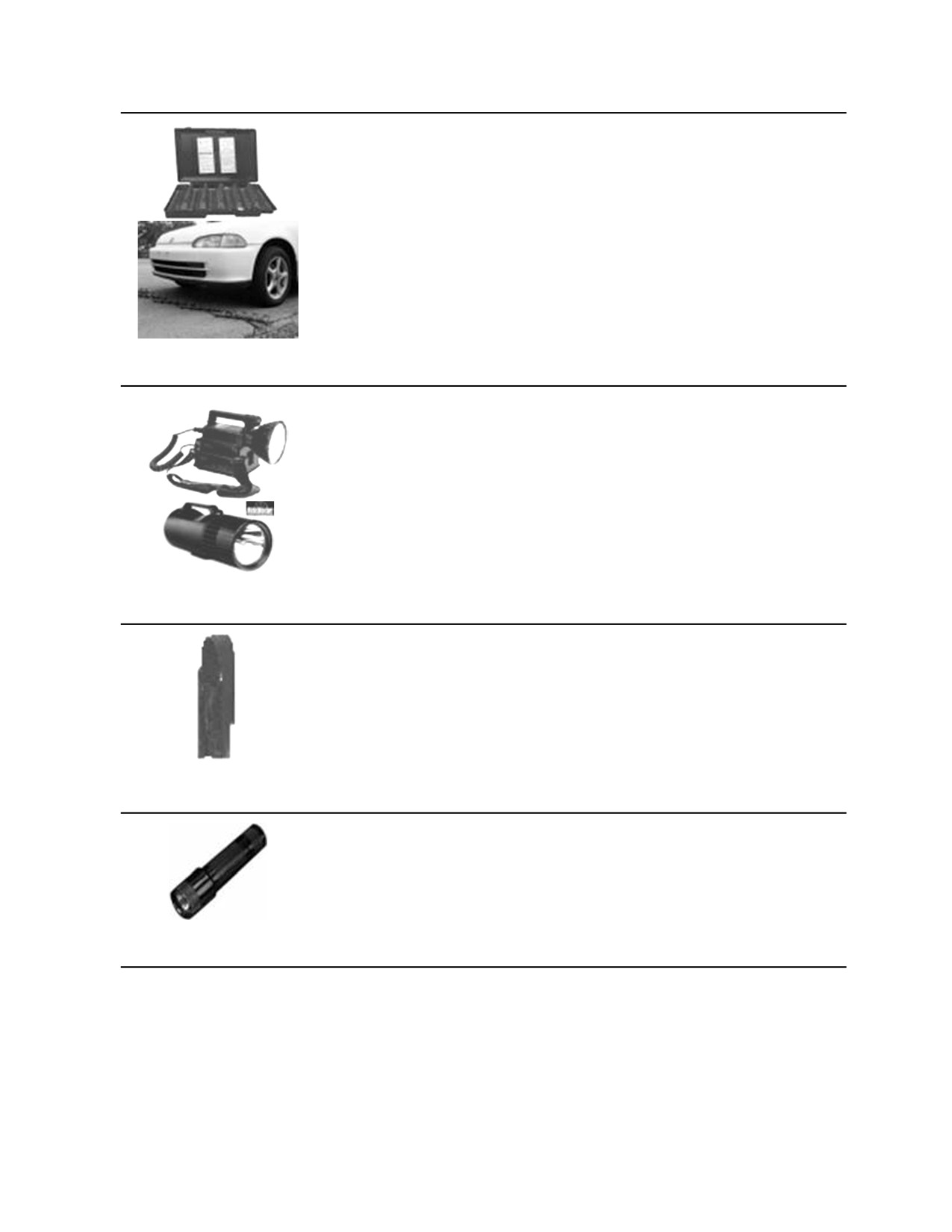
31. Road Side Spike Strip: The spike strip is designed to puncture a
pneumatic tire as the vehicle makes contact with the spike strip. The
spikes pivot into the tire and the tip-guards are pushed down. The spikes
are imbedded deeply into the tire. The spikes are pulled out of the unit
and remain in the tire. On the second revolution they will be pushed
directly into the tire, allowing air to escape slowly without causing a
blowout or sudden loss of control. The average tire will pick up 4 to 6
spikes with the deflation time of about 12 to 20 seconds. It allows a
service member to quickly toss/recover the system, impeding vehicle
movement in a designated area. It allows a force to provide additional
physical security in areas where the caltrop cannot be tactically employed.
(Figure A-23)
Figure A-23. Road Side
Spike Strip
32. The high-intensity searchlight is a rugged, lightweight, hand-held, high-
intensity spotlight for use during low-light conditions. Two different high-
intensity lights were fielded. The Maxabeam light (shown on top) was
fielded in 1997. It was replaced by the Nighthunter light (shown
underneath) in 2000. (Figure A-24)
Figure A-24. High-
Intensity Search Light
33. Individual Light Holster (6P): The 6P individual light holster is
designed to hold the 6P individual light. (Figure A-25)
Figure A-25. Individual
Light Holster (6P)
34. 6P Individual Light: The 6P individual light is issued to service
members within the platoon. (Figure A-26)
Figure A-26. 6P
Individual Light
A-7
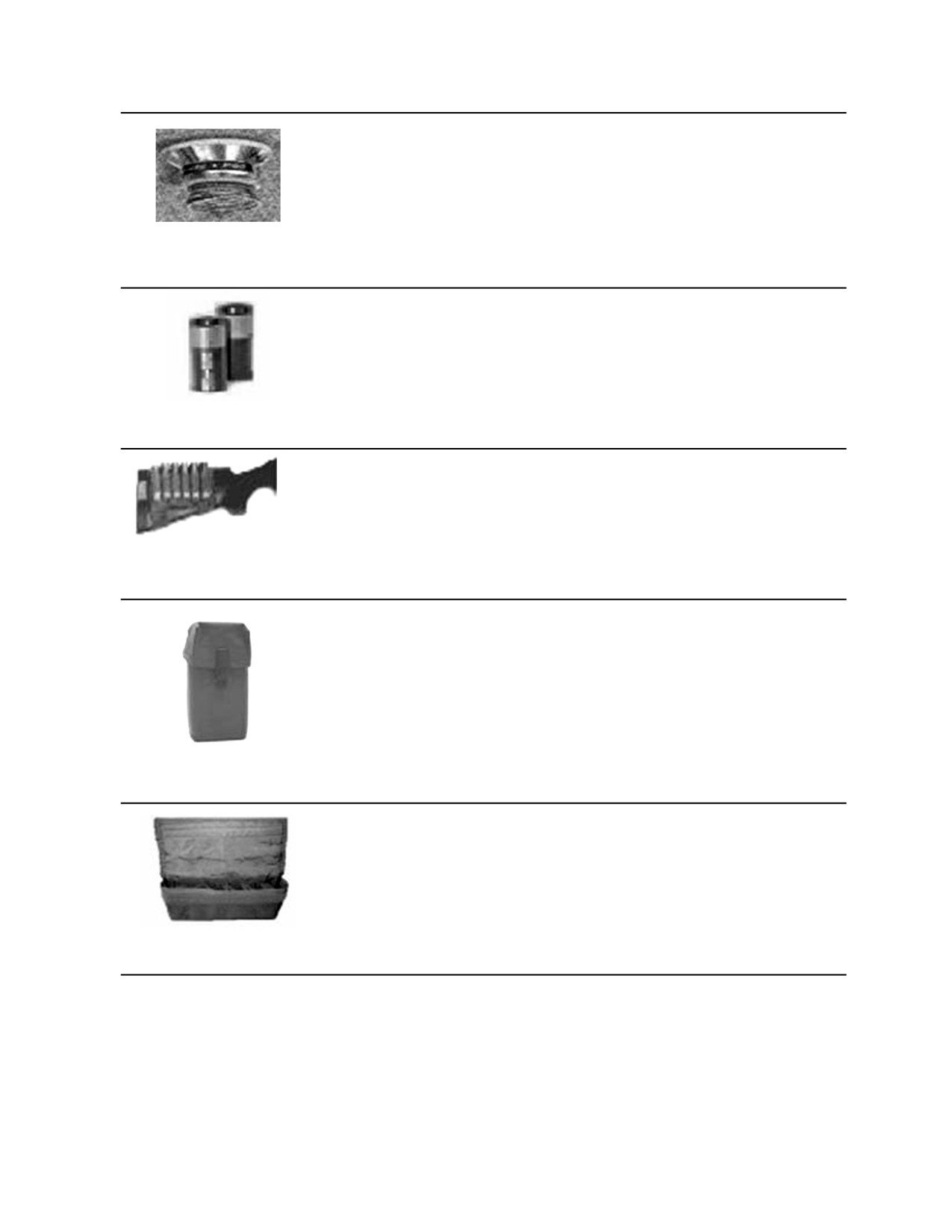
35. 6P Individual Light Accessory Kit: The 6P individual light accessory kit
includes a spare light bulb installation kit.
(Figure A-27)
Figure A-27. 6P
Individual Light
Accessory Kit
36. 3V Lithium Batteries: Two 3V Lithium Batteries are required to operate
the 6P individual light.
(Figure A-28)
Figure A-28. 3V
Lithium Batteries
37. 12-Gauge Buttstock Cuff: The buttstock cuff is designed to fasten to
the buttstock of most shotguns to hold seven 12-gauge cartridges for quick
loading of the shotgun. (Figure A-29)
Figure A-29. 12-Gauge
Buttstock Cuff
38. 12-Gauge Utility Pouch: The 12-gauge utility pouch is designed to
hold twenty-five 12-gauge munitions and attaches to the service member’s
combat gear. (Figure A-30)
Figure A-30. 12-Gauge
Utility Pouch
39. 40-mm Carrying Pouch: The 40-mm carrying pouch is partitioned in a
manner to provide the service member with a means of carrying not less
than six 40-mm nonlethal rounds in separate compartments. It attaches to
the service member’s combat gear. (Figure A-31)
Figure A-31. 40-mm
Carrying Pouch
A-8
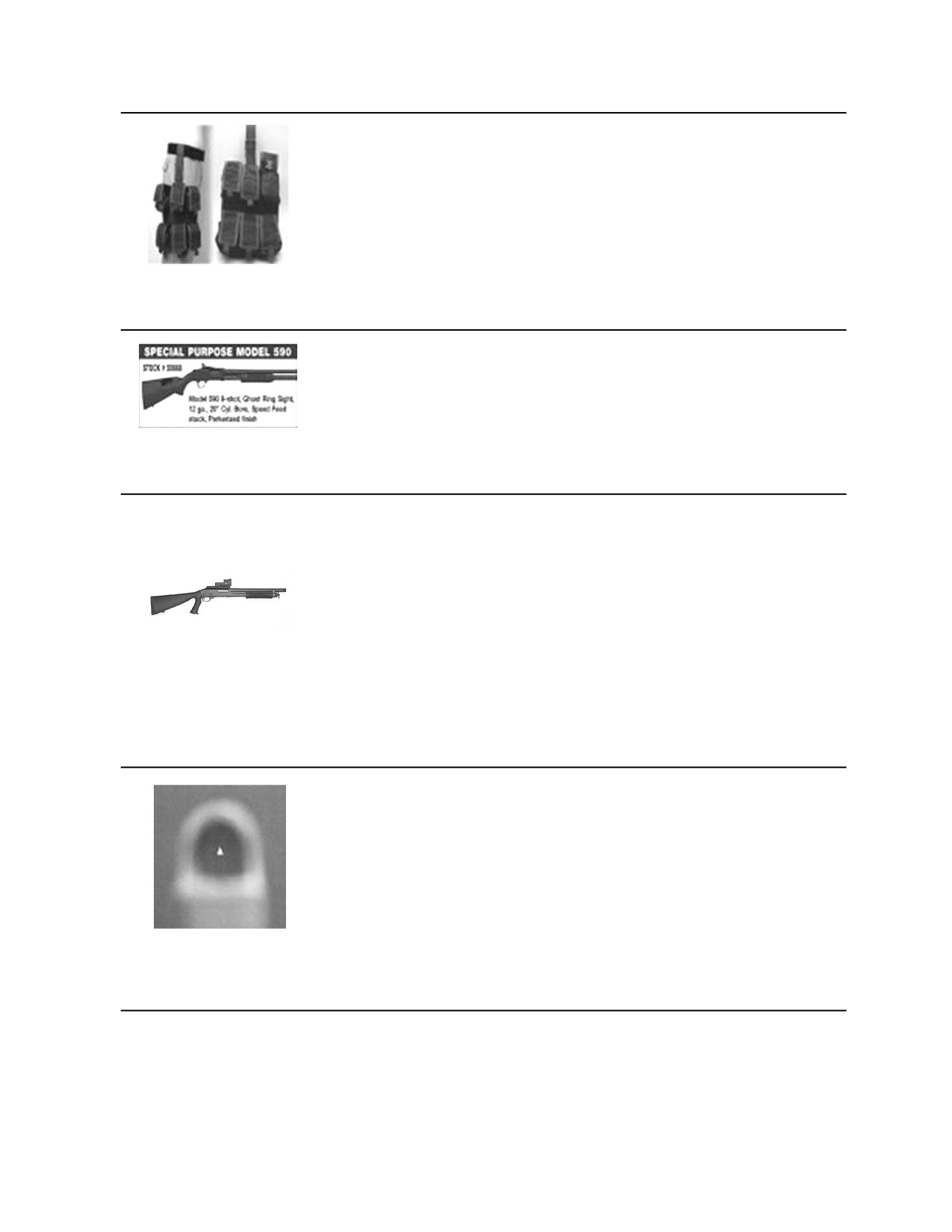
40. Diversionary/Rubber Ball Grenade Pouch: The diversionary/rubber
ball grenade pouch is an ammunition carrying pouch partitioned in a
manner to provide the service member with a means of holding up to six
rubber ball grenades or six flash bang grenades in separate
compartments. (Figure A-32)
Figure A-32.
Diversionary/Rubber
Ball Grenade Pouch
41. 12-Gauge Mossberg 500A2/590 Shotgun: The 12-gauge Mossberg
500A2 or 590 shotgun are the only 12-gauge shotguns currently
authorized for firing 12-gauge nonlethal projectile munitions. The
launching cup for the rubber ball grenade will attach to the Mossberg
500A2 Shotgun. The launch cup will not attach to the Mossberg 590
shotgun. Until the Joint Service Combat shotgun can effectively fire
Figure A-33. 12-Gauge
nonlethal 12-gauge rounds, the 12-gauge Mossberg 500A2 or 590
Mossberg 500A2/590
shotgun configuration meets the requirement of the NLW force. (Figure A-
Shotgun
33)
42. 12-Gauge M870 (modified) Version 2 (USCG): The modified
Remington 870 shotgun has a fixed synthetic stock and pistol grip. The
pistol grip gives the shooter more control of the weapon and helps
dissipate recoil from the shoulder. The synthetic materials used are more
durable and lighter weight than the wood stocks used on the Standard
M870. The barrel is fitted with a rifled choke tube for firing slugs (solid
projectiles) to increase accuracy. It is also equipped with an Advanced
Combat Optical Gunsight that was developed for use in “both-eyes-open”
Figure A-34. 12-Gauge
close quarters battle. The advantage is rapid target acquisition without the
M870 (modified)
need to align front and rear sights. Batteries do not power the illumination
Version 2 (USCG)
sight; it contains tritium gas.
In the Coast Guard, a yellow “stock sock” will be used whenever the
shotgun is loaded with nonlethal munitions. This removable nylon sleeve
is used to identify the weapon as a nonlethal delivery system. (Figure
A-34)
43. Advanced Combat Optical Gunsight (ACOG) Reflex Sight (USCG):
Modified shotguns are equipped with this site. (Figure A-34)
Figure A-35. Advanced
Combat Optical
Gunsight (ACOG)
Reflex Sight (USCG)
A-9
44. ACOG Reflex Sight (USCG): The dual-illuminated, Trijicon® Reflex
sight was developed for the military for use in both-eyes-open close
quarters battle (CQB). The advantage is quick target acquisition thus
eliminating the need to align front and rear sights. Batteries do not power
the illumination sight; it contains tritium gas.
(Figure A-35)
Figure A-36. ACOG
Reflex Sight (USCG)
Equipment Currently Being Fielded
1.
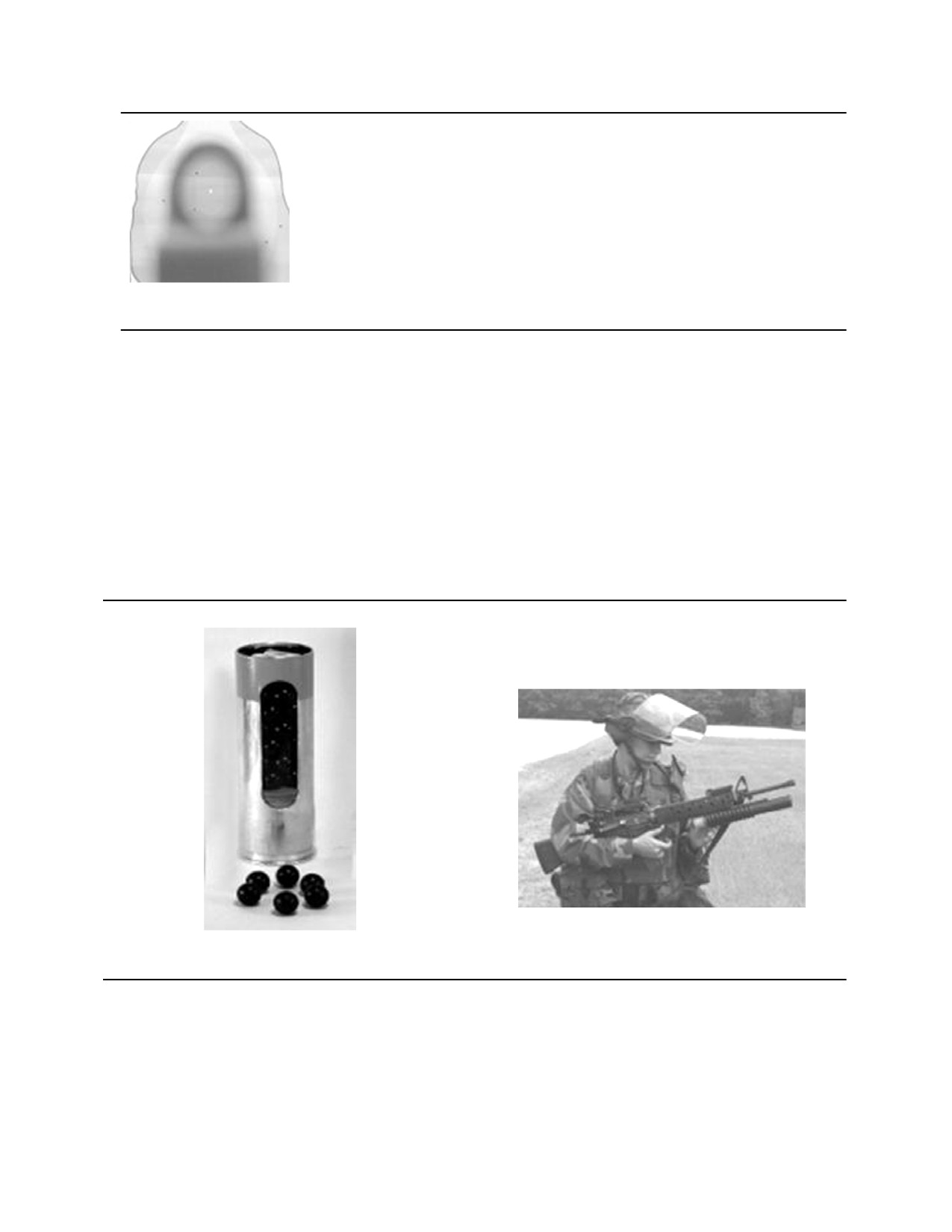
40-mm Crowd Dispersal Cartridge (CDC):
This direct fire, low-hazard, non-shrapnel-producing, multiple ball projectile provides
friendly forces the capability to conduct crowd control. The CDC uses nonlethal, blunt
trauma to stop, confuse, disorient, and/or temporarily incapacitate personnel and increase
standoff distance between friendly forces and the hostile crowd. Primarily designed as an
area effect munition, the CDC can be used on individuals. The M203 40-mm grenade
launcher fires the CDC and contains 48, .48 caliber rubber balls. Effective range is 10 to
30 meters. (Figures A-37 and A-38)
Figure A-38. Soldier Employing CDC
Figure A-37. Crowd Dispersal Cartridge
with M203
A-10
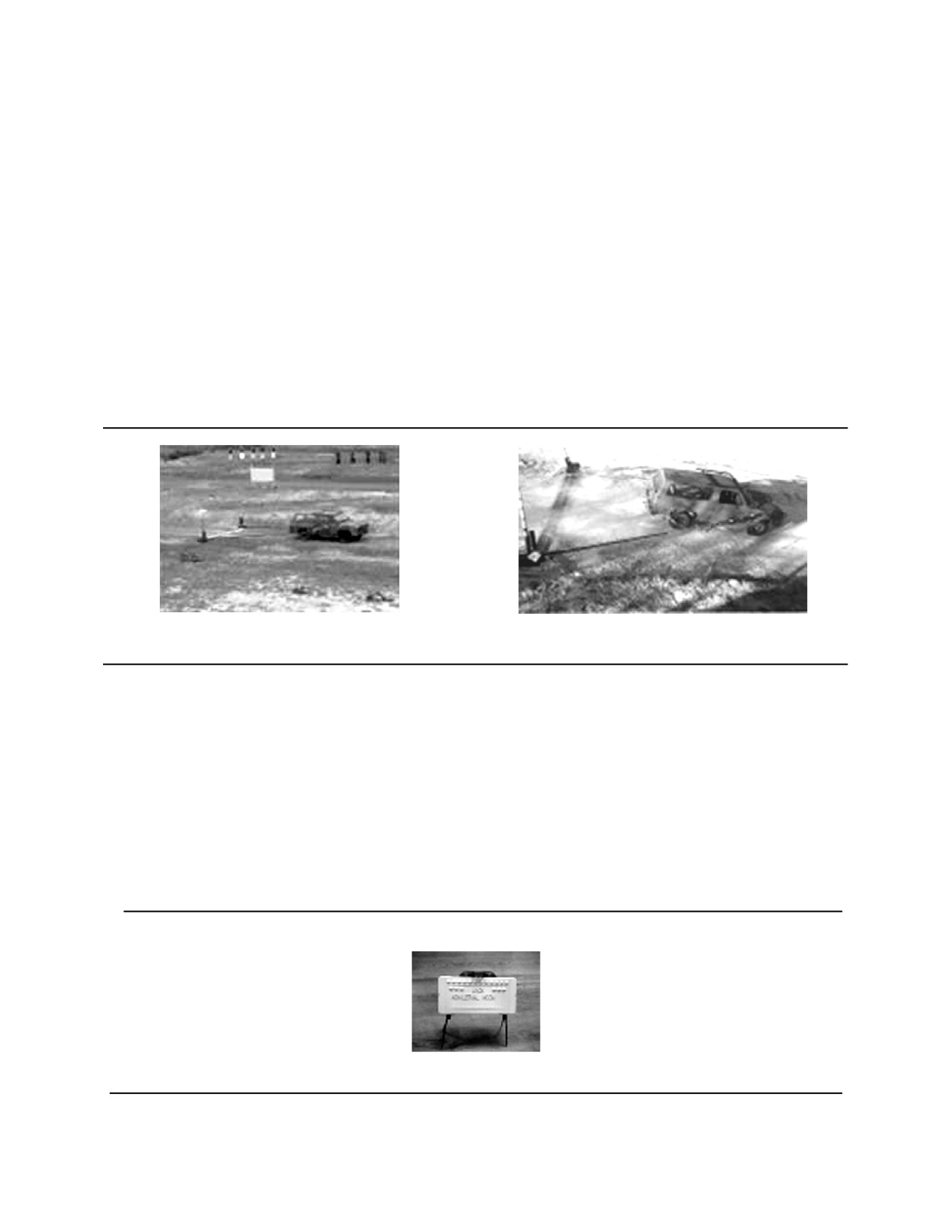
2. Portable Vehicle Arresting Barrier (PVAB):
PVAB is a lightweight, portable, manually emplaced and recoverable barrier entrap-
ment device to create, on command, a barrier that stops vehicles driven by known or sus-
pected hostile forces with minimal damage to the vehicle or its occupants. It is used at
dismount points, checkpoints, and roadblocks to prevent unauthorized access by wheeled
vehicles into or out of areas (e.g. airfields, ports, command posts [CP]). Two individuals can
easily emplace it, in approximately four hours. In stand-by mode, PVAB folds down into
something similar to a speed bump (vehicles pass freely). In capture mode, the net springs
up on two hydraulic pistons, to maximum height in less than a second. PVAB can be set up
to span 12 to 24 feet and can stop a light truck (up to 7,500 pounds) at speeds up to 45 miles
per hour, with a stopping distance of less than 200 feet PVAB can be containerized: 53.75
cubic feet (7 boxes, 4 large-3 small)—1,044 pounds on approximately one pallet. (Figures A-
39 and A-40)
Figure A-39. PVAB in Action (Far View)
Figure A-40. PVAB in Action Near View
3. Modified Crowd Control Munition—Ground Emplaced (MCCM-GE):
The MCCM-GE (Figure A-41) is a nonlethal munition, housed in a casing similar to the
current claymore mine, which will stop, confuse, disorient and/or temporarily incapacitate
area targets/personnel at close range. The force can use it to provide crowd control by dis-
persing hostile crowds and force protection by integrating it into a layered perimeter de-
fense. It delivers 600, .32 caliber rubber balls as well as a flash bang effect. The MCCM-
GE gives the commander or small unit leader greater flexibility to apply nonlethal force as
a first line of defense against hostile noncombatants. Effective range is 5 to 15 meters.
(Figure A-42)
Figure A-41. Modified Crowd Control Munition-Ground Emplaced (MCCM-GE)
A-11
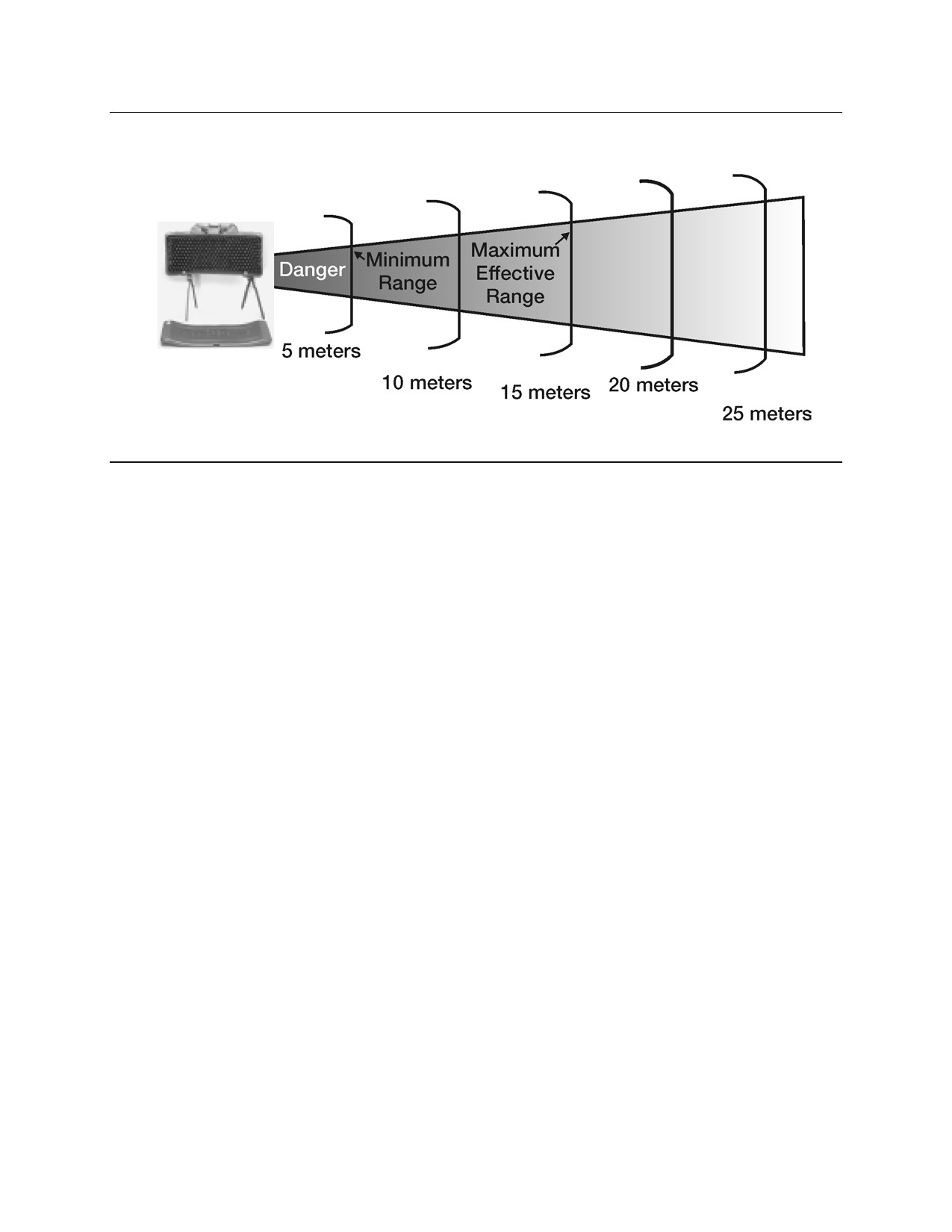
Figure A-42. MCCM-GE Range Chart
4.
66-mm Vehicle Mounted Nonlethal Grenade Launcher (VMNLGL):
The VMNLGL is a nonlethal grenade-launching device mounted on high mobility multi-
purpose wheeled vehicle (HMMWV). It is an indirect fire-support system that can deliver a
66-mm distraction device (flash-bang), CS, or blunt trauma (sting ball) payload. The dis-
traction grenade uses a pyrotechnic charge for crowd control through audio and visual
stimuli. The blunt trauma grenade uses a pyrotechnic charge to discharge 140, .32 caliber
(cal.), rubber balls to achieve crowd control through audio, visual, and physical stimuli.
The force uses VMNLGL to enhance the ability of friendly forces to conduct force protection
without direct contact with hostile or threatening crowds. It enforces standoff distances
and deters potential threats. It can disperse or subdue crowds, keep personnel from sur-
rounding or climbing on patrol vehicles, slow or stop threatening personnel or vehicles by
confusing, disorienting, and/or temporarily incapacitating individuals for capture. The gre-
nade is fired from the grenade launchers traditionally found on tracked vehicles. Vehicle-
launched grenades have three submunitions designed to ground burst. Effective range is
50 to 100 meters. An adjustable bracket allows engagement at ranges of 50 meters, 75
meters, and 100 meters. (Figure A-44)
A-12
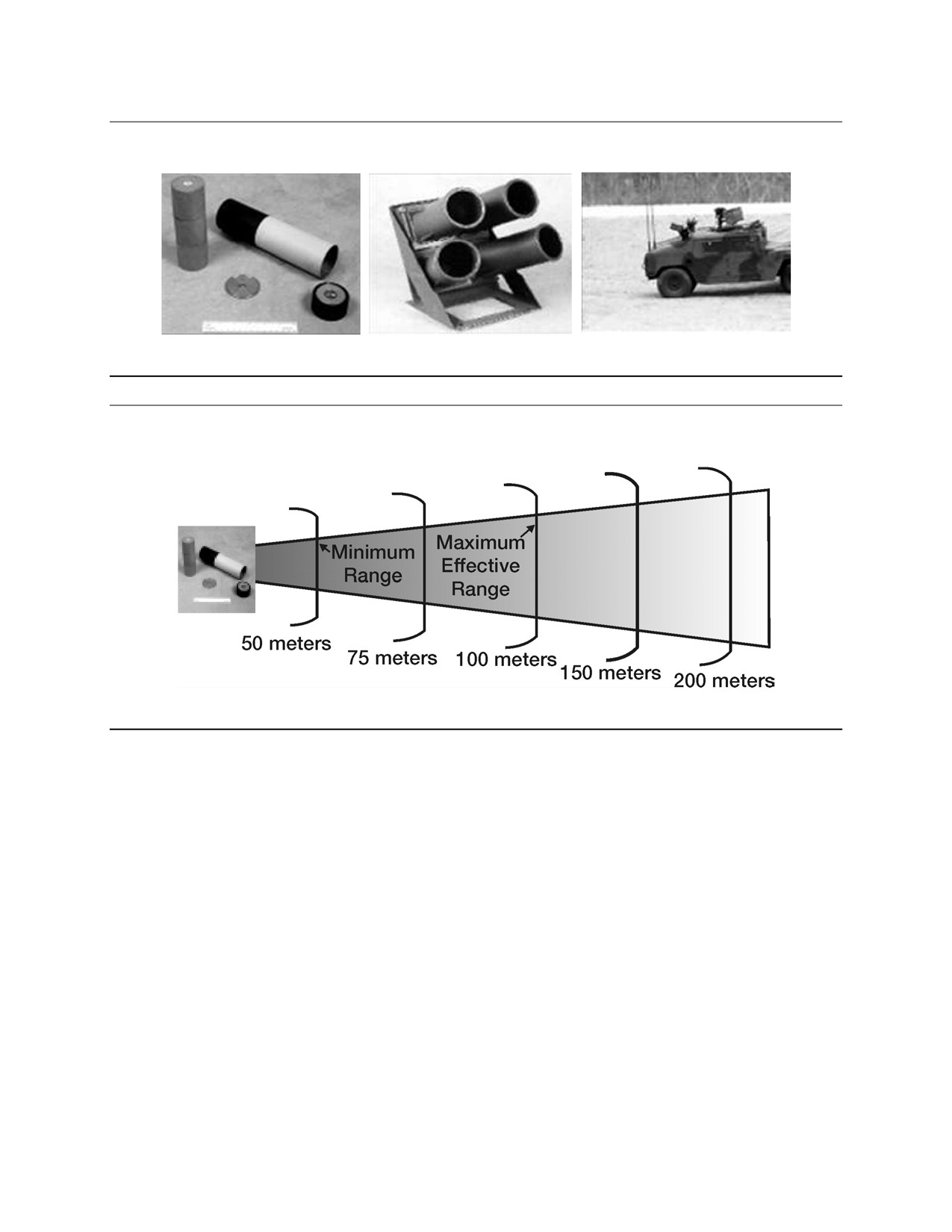
Figure A-43. 66-mm Vehicle Mounted Nonlethal Grenade Launcher (VMNLGL)
Figure A-44. VMNLGL Range Chart
5. Running Gear Entanglement System (RGES)
The Running Gear Entanglement System (RGES) is series of short, separate, looped
polyethylene lines that are attached to a single, long polyethylene base line. This entan-
glement net fouls the propellers of planing hull small boats. The capability to manually de-
ploy the net from a soft-sided bag has been fielded for USCG use in limited numbers. The
USCG is in the process of incorporating three other variants of RGES into its inventory of
nonlethal capabilities. These include aerial-delivered RGES, surface launched RGES to de-
ploy from vessels, and static barrier RGES. The static barrier RGES has broad application
into support homeland security, physical security and force protection missions. The sur-
face launched RGES has direct application in the USCG’s law enforcement mission wher-
ever the requirement exists to stop a non-compliant vessel. Both of these systems are ex-
pected to be fielded in the fall/winter of CY02. The air launched version is currently still in
the concept development phase and is not yet fully developed. (Figure A-45)
A-13
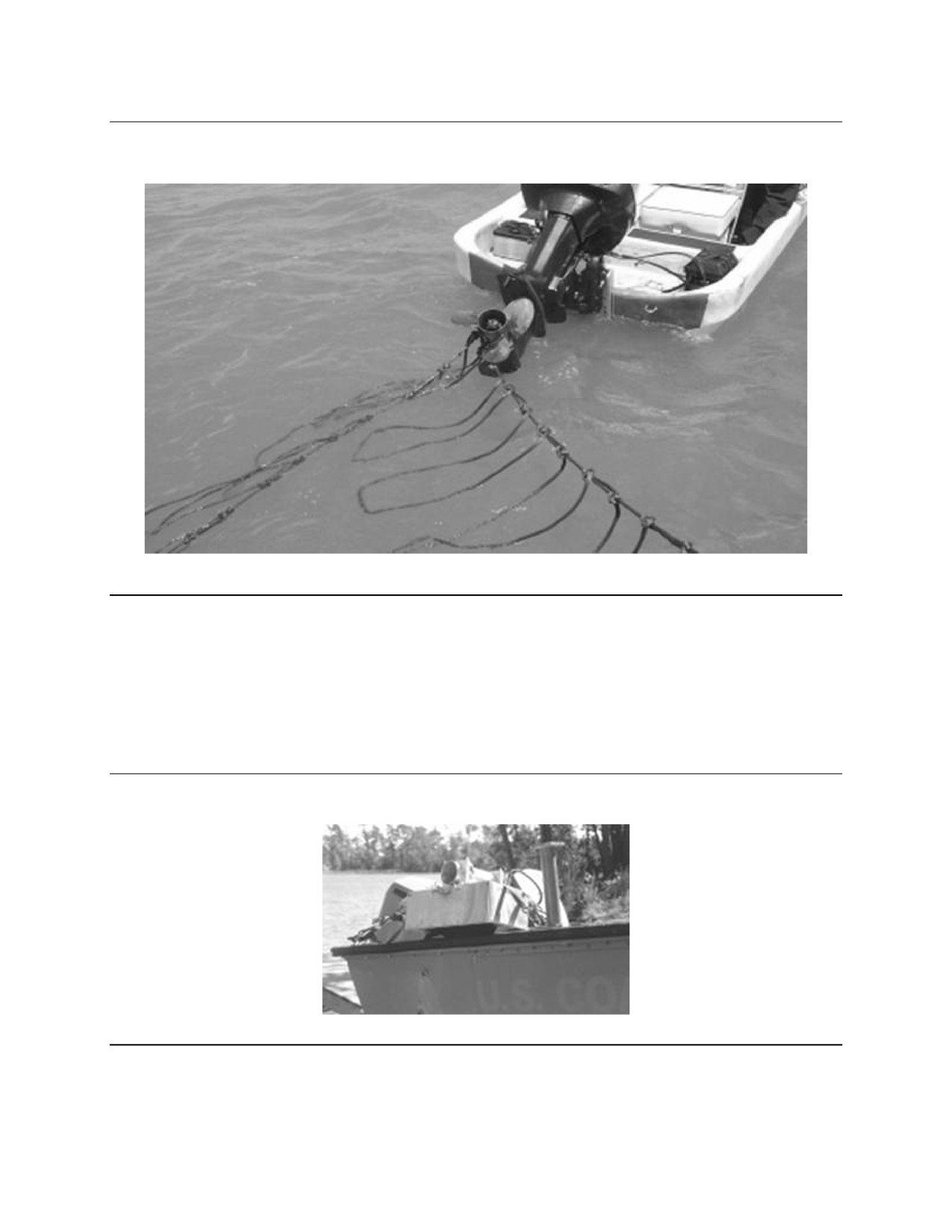
Figure A-45. Running Gear Entanglement System (RGES)
a. RGES Surface Delivery System: The USCG can use stern-mounted, manually
deployed RGES from a cutter’s small boat to stop slow-moving migrant-type craft. (Figure
A-46)
(1) Uses COTS compressed air cylinder launcher.
(2) Removable, fix-mounted launcher on side of craft.
(3) Launch projects device ahead of target.
Figure A-46. RGES Surface Delivery System
b. RGES Barrier
(1) Provides static barrier around ship or other waterside asset.
A-14
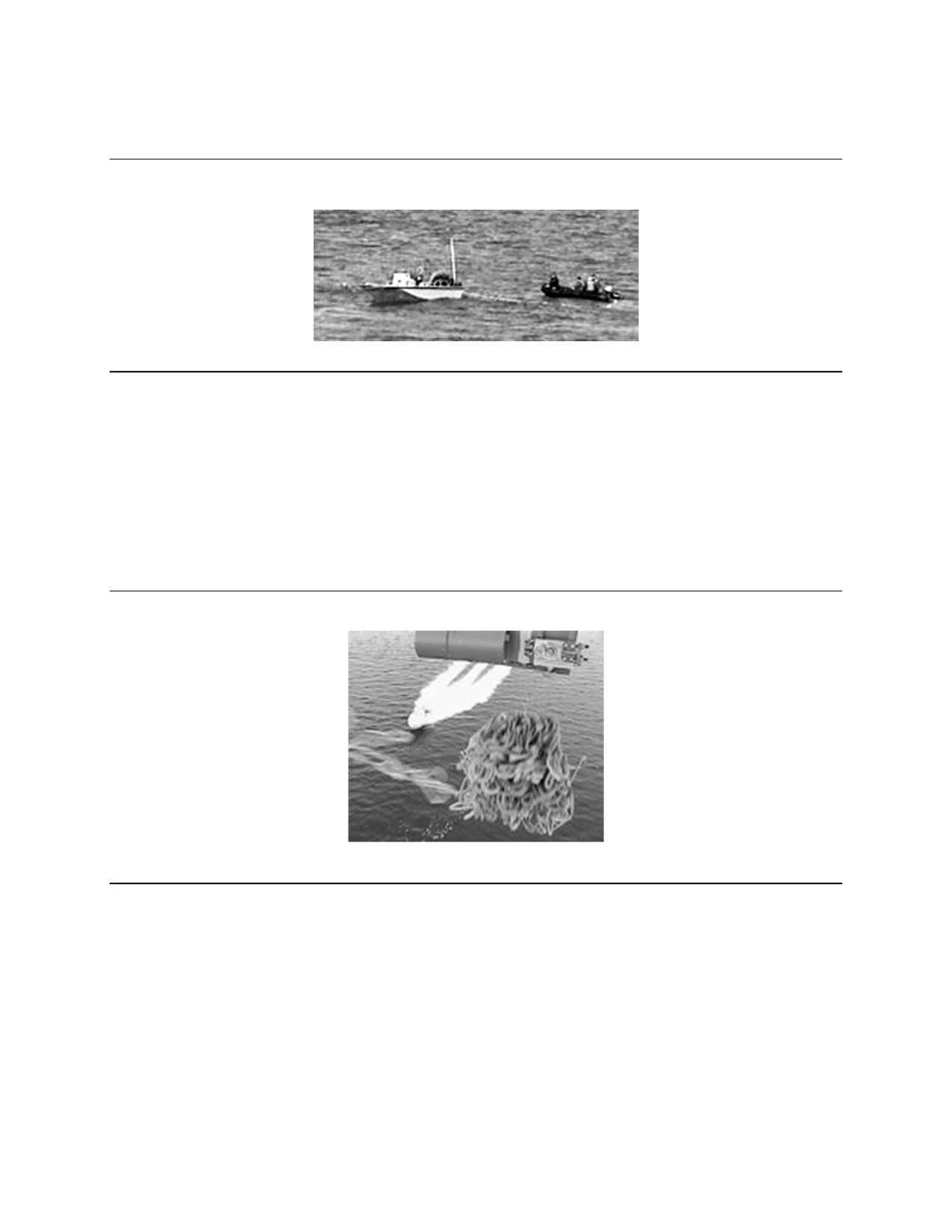
(2) Provides a visible demarcation line, establishes zones, deters intrusions. (Figure
A-47)
Figure A-47. RGES Barrier Employment
c. RGES Aerial Delivery System (ADS): RGES is aerial deployed from the ADS ahead
of target aboard a H60 helicopter (Figure A-48). Device should float in the water ahead of
target ensuring target runs over device. Device fouls propeller or rudder until target stops
and awaits boarding.
(1) Uses COTS compressed air cylinder launcher
(2) Removable, fix-mounted launcher on helicopter
(3) Launch projects device ahead of target. (Figures A-49)
Figure A-48. RGES Aerial Delivery System (ADS)
A-15
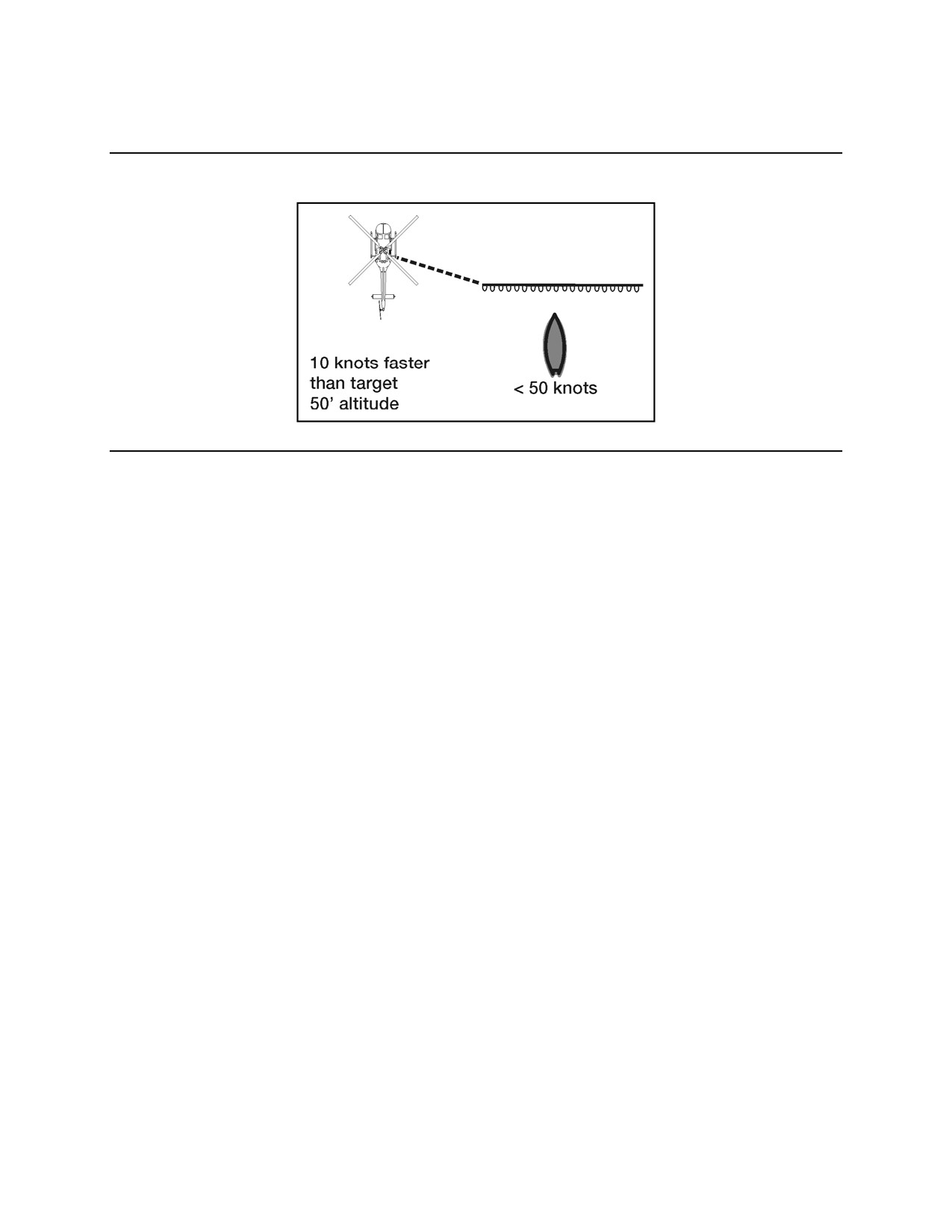
Figure A-49. RGES Aerial Delivery System (ADS)
6. Warp Cutter
a. Warp cutting is a nonlethal use of force, which has been safely and effectively
employed by several countries to enforce fisheries laws in their respective exclusive
economic zones (EEZ). The warp cutter is a device that closely resembles a grappling hook
or small anchor. It has hardened steel blades attached to the crux of the grapnels. It is
towed behind an enforcement vessel and across the warps of a non-compliant fishing vessel.
As the cutting device engages the warps, it slices through them, separating the net from the
fishing vessel.
b. The USCG uses the warp cutter to compel foreign vessels suspected of illegally
fishing in the U.S. EEZ to comply with lawful orders to stop and be boarded. The USCG
may cut the trawl warps of non-compliant vessels as a means of compelling them to stop for
a boarding.
A-16
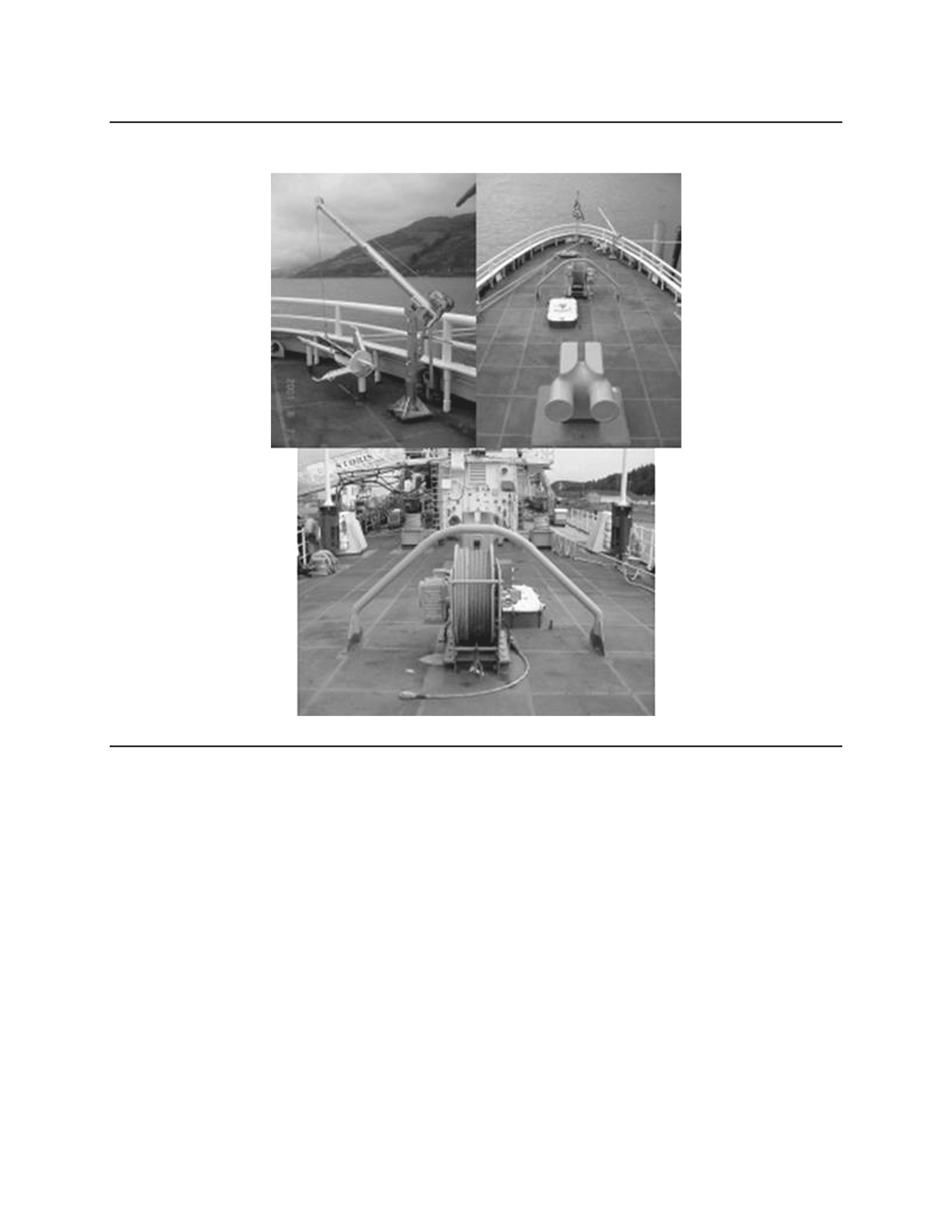
Figure A-50. Warp Cutter
A-17
Appendix B
Summary: Specialty Impact Munitions
12-Gauge Launch Cartridge
Using Services: USN, USMC
Status: Fielded 1998
DODIC: AA30
NSN: 1305-01-464-8389
Acquisition Activity: MARCORSYCOM—NSWC Crane, IN
Further Information:
Commercial: MARCORSYSCOM (703) 784-9395
NSWC Crane (812) 854-5801
Color
Clear case
Diameter
12-gauge
Projectile
N/A
Length
2.00 inches (51 mm)
Total Weight
13.6 grams
Propellant Weight
46.3 grains (black powder)
Muzzle Velocity
100 feet/second (30.5 m/sec)—rubber ball grenade
Acceptance Accuracy
200 feet (61 m) + 25 feet (7.6 m) at 30-degree launch angle using
rubber ball grenade and 12-gauge launch cup
Projectile Specification: N/A
• Use 12-gauge launch round in combination with rubber ball grenade and 12-gauge
launch cup to hurl a grenade a distance of 200 feet (61 m) + 25 feet (7.6 m) when
launch angle is approximately 30 degrees.
• Chamber launch cartridge only after installing grenade in launch cup and pulling
safety pin from grenade.
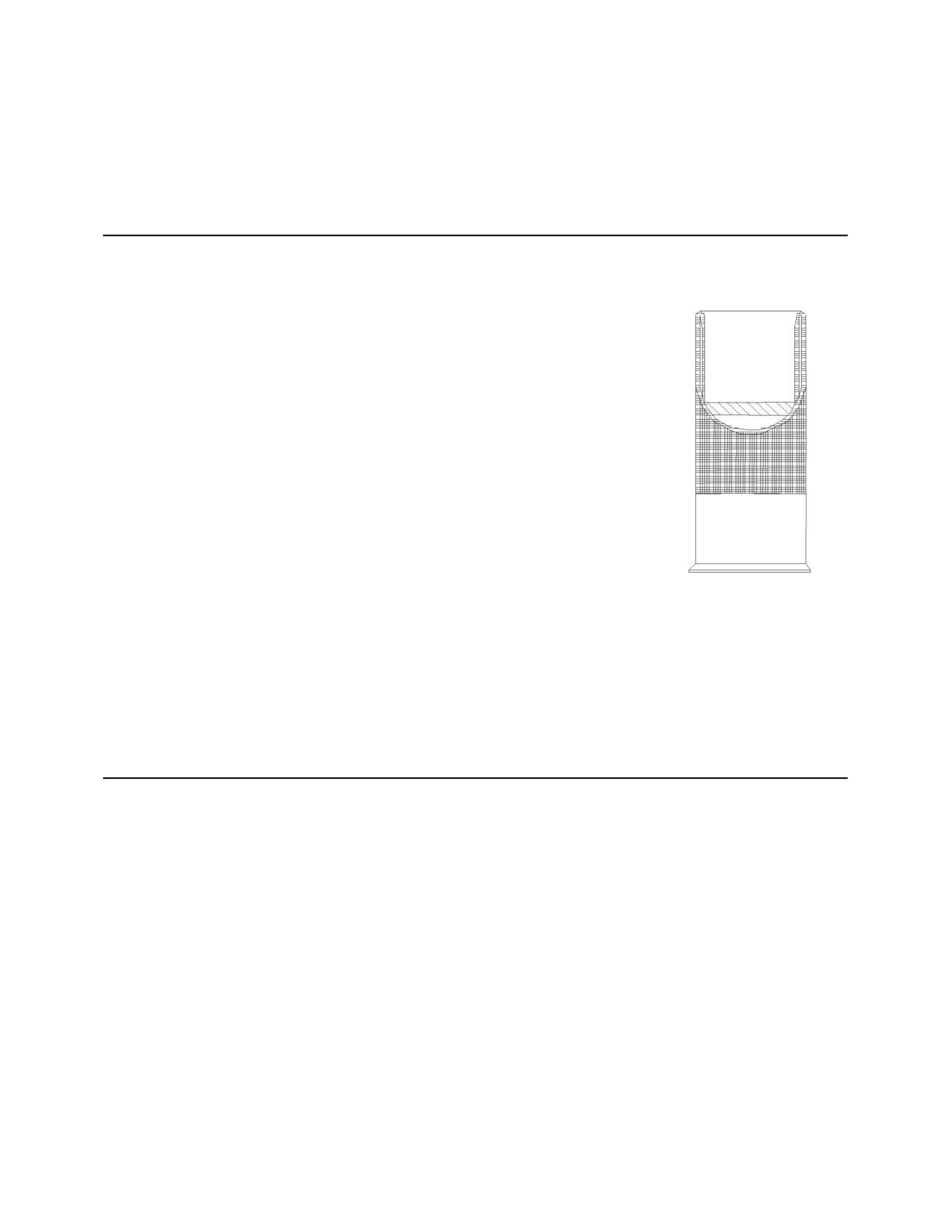
Figure B-1. 12-Gauge Launch Cartridge
B-1
12-Gauge Bean Bag Cartridge
Using Services: USN, USMC
DODIC: AA29
NSN: 1305-01-454-0191
Status: Fielded 1998
Acquisition Activity: MARCORSYCOM—NSWC
Crane, IN
Further Information:
Commercial: MARCORSYSCOM (703) 784-9395
NSWC Crane (812) 854-5801
Color
Clear or red case
Diameter
12 gauge
Projectile
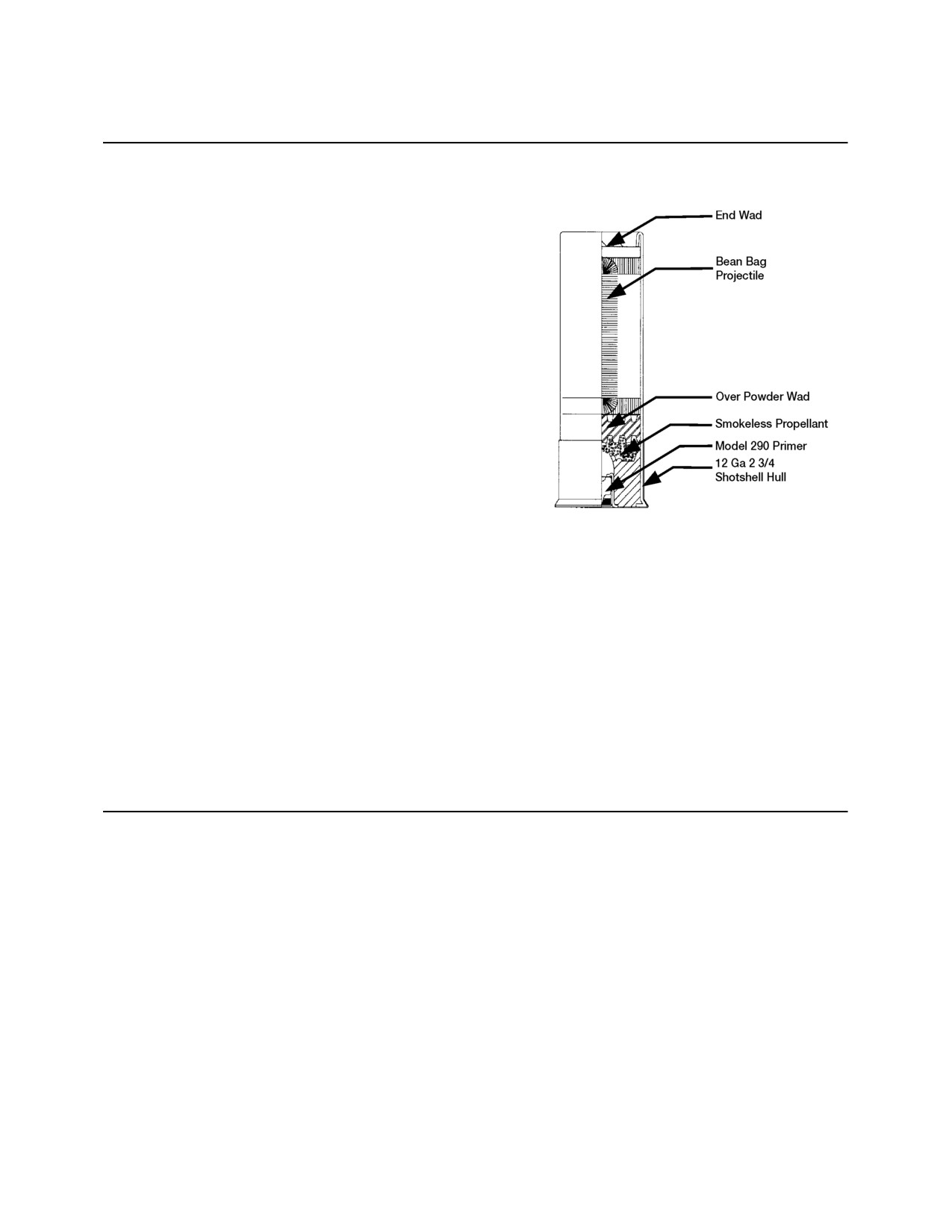
1 bean bag
Length
2.45 inches (62 mm)
Total Weight
49.9 grams
Propellant Weight
3.4 grains
Muzzle Velocity
300 + 25 feet/second (91.4 + 7.62 m/sec)
Acceptance Accuracy
2 feet (.6 m) X 6 feet (1.8 m) at 100 feet (30.3 m) with Mossberg
500A2
Shotgun Projectile Specification:
Shape
Square bag or tube sock
Material
Nylon or cotton-polyester
Filler
#9 lead shot
Filler weight
44.4 grams (maximum)
• Fatal injuries are possible at employment distances of less than 20 feet (6 m)
• At distances of 20 feet (6 m) to 40 feet (12 m), target area should be center mass
• Training needs to reinforce that head shots are NOT ACCEPTABLE
• Do not skip fire this round! Round becomes unpredictable upon striking the ground
• Round is most effective against individually selected targets (point round)
• End wad has low light marker
Figure B-2. 12-Gauge Bean Bag Cartridge
B-2
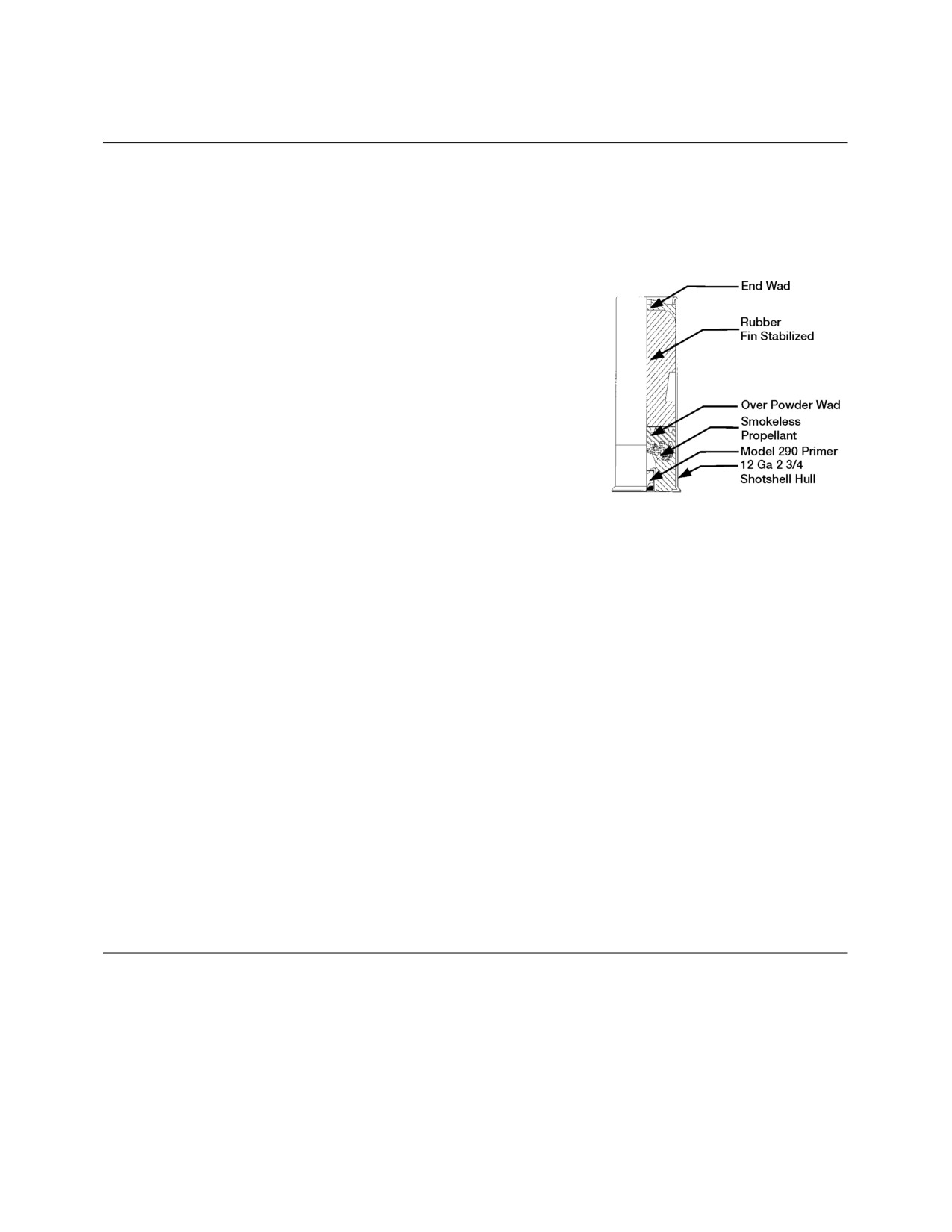
12-Gauge Rubber Fin Stabilized Cartridge
Using Services: USN, USMC, USCG
Status: Fielded 1998
DODIC: AA31
NSN: 1305-01-454-0189
Acquisition Activity: MARCORSYCOM—NSWC Crane, IN
Further Information:
Commercial: MARCORSYSCOM (703) 784-9395
NSWC Crane (812) 854-5801
Color
Clear or red case
Diameter
12 gauge
Projectile
1 rubber projectile
Length
2.45 inches (62 mm)
Total Weigh
9.1 grams
Propellant Weight
4.8 grains
Muzzle Velocity
530 + 65 feet/second
(161.5 + 19.8 m/sec)
Acceptance Accuracy
2 feet (.6 m) X 6 feet (1.8 m) at 100 feet (30.3 m) with Mossberg 500
A2 shotgun
Projectile Specification:
Caliber 12 gauge
Material
Rubber
Hardness
Durometer 70-80 Shore “A” scale
Weight
7.8 grams
Temperature Limits (demonstrated):
Upper limit…125º F
Lower limit…0º F
Shipping Data: Hazard classification/division and storage compatibility group…1.4S
DOT Class
ORM-D
DOT Markings Cartridge
Small Arms
UNO serial number
0012
• Fatal injuries are possible at employment distances of less than 20 feet (6 m);
USCG: 15 yards
• At distances of 20 feet (6 m) to 40 feet (12 m), target area should be center mass;
USCG: 15 to 30 yards
• Training needs to reinforce that head shots are NOT ACCEPTABLE
• Do not skip fire this round! Round becomes unpredictable upon striking the ground
• Round is most effective against individually selected targets (point round)
• End wad has low light marking
Figure B-3. 12-Gauge Rubber Fin Stabilized Cartridge
B-3
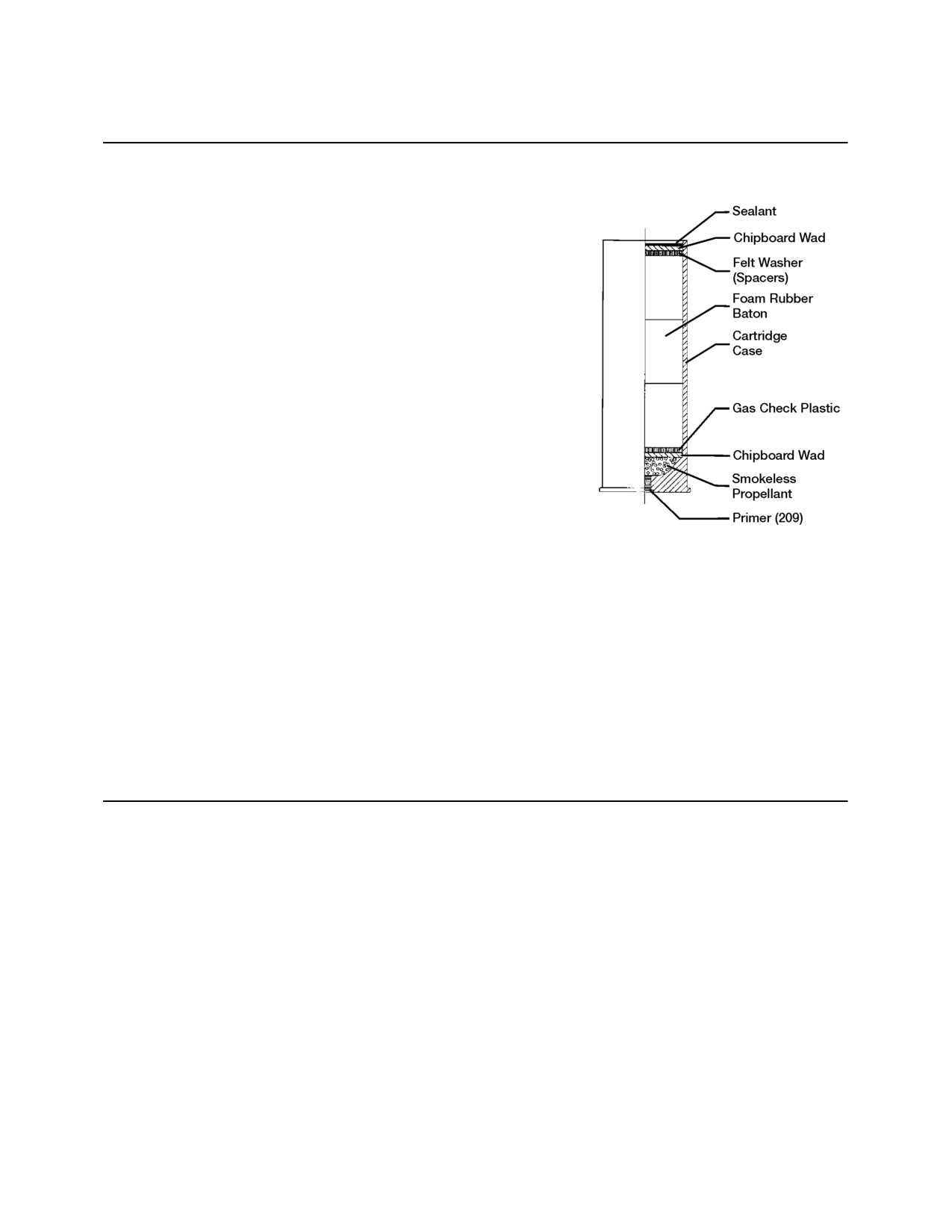
40-mm Foam Rubber Baton Cartridge
Using Services: USN, USMC
Status: Fielded 1998
DODIC: BA07
NSN: 1310-01-453-9168
Acquisition Activity: MARCORSYSCOM—NSWC
Crane, IN
Further Information:
Commercial: MARCORSYSCOM (703) 784-9395
NSWC Crane (812) 854-5801
Color
Aluminum (case)
Diameter
40 millimeter
Projectile
3 foam batons
Length
4.78 inches (121.4 mm)
Total Weight
201 grams
Propellant Weight
13.0 grains
Muzzle Velocity
325 + 35 feet/second
(99 + 10.6 m/sec)
Acceptance Accuracy
6 feet (1.8 m) X 3 feet (.9 m) at 50
feet (15.2 m) with M203
Projectile Specifications:
Number
3
Material
Foam rubber
Hardness
Durometer 25 + 10 on Shore “A” scale
Weight
250 to 280 grains
• Fatal injuries are possible at employment distances of less than 20 feet (6 m)
• At distances of 20 feet (6 m) to 40 feet (12 m), target area should be center mass
• Training needs to reinforce that head shots are NOT ACCEPTABLE
• Round is most effective against point targets (individual personnel)
• End wad has low light marker
Figure B-4. 40-mm Foam Rubber Baton Cartridge
B-4
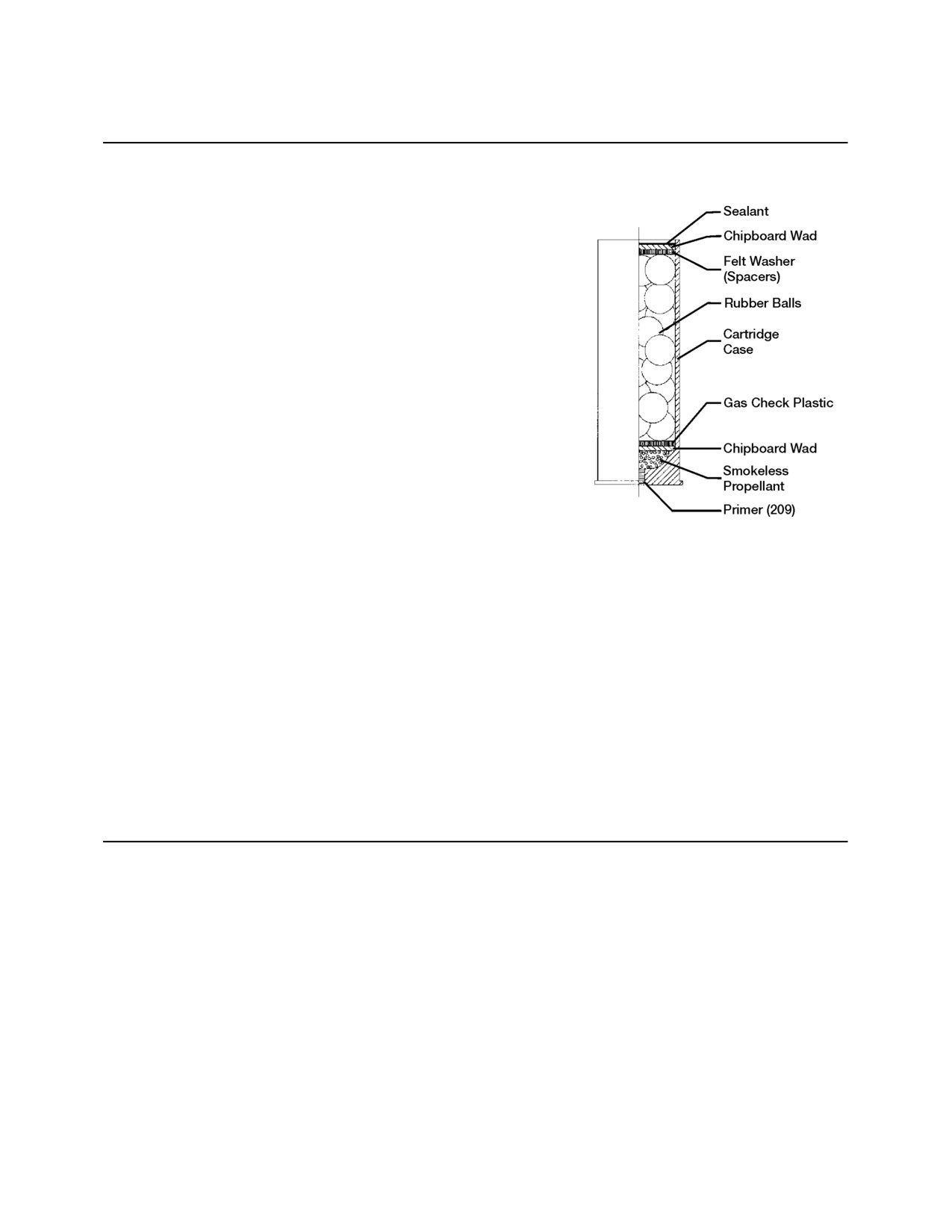
40-mm Rubber Ball Cartridge
Using Services: USN, USMC
Status: Fielded 1998
DODIC: BA08
NSN: 1310-01-453-9154
Acquisition Activity: MARCORSYSCOM—NSWC
Crane, IN
Further Information:
Commercial: MARCORSYSCOM (703) 784-9395
Color
Aluminum (case)
Diameter
40 millimeter
Projectile
24 rubber balls
Length
4.78 inches (121.4 mm)
Total Weight
201 grams
Propellant Weight
7.3 grains
Muzzle Velocity
325 + 35 feet/second
(99 + 10.6 m/sec)
Acceptance Accuracy
6 feet (1.8 m) x 9 feet (2.7 m) at
50 feet (15.2 m) with
M203NSWC Crane
(812) 854-5801
Projectile Specifications:
Caliber
60
Number
22 (minimum)
Material
Rubber
Hardness
Durometer 60 + 10 on Shore “A” scale
Weight
2.2 grams each
• Fatal injuries are possible at employment distances of less than 20 feet (6 m)
• At distances of 20 feet (6 m) to 40 feet (12 m), target area should be center mass
• Training needs to reinforce that head shots are NOT ACCEPTABLE
• Round is most effective against area targets (multiple personnel)
• End wad has low light marker
Figure B-5. 40-mm Rubber Ball Cartridge
B-5
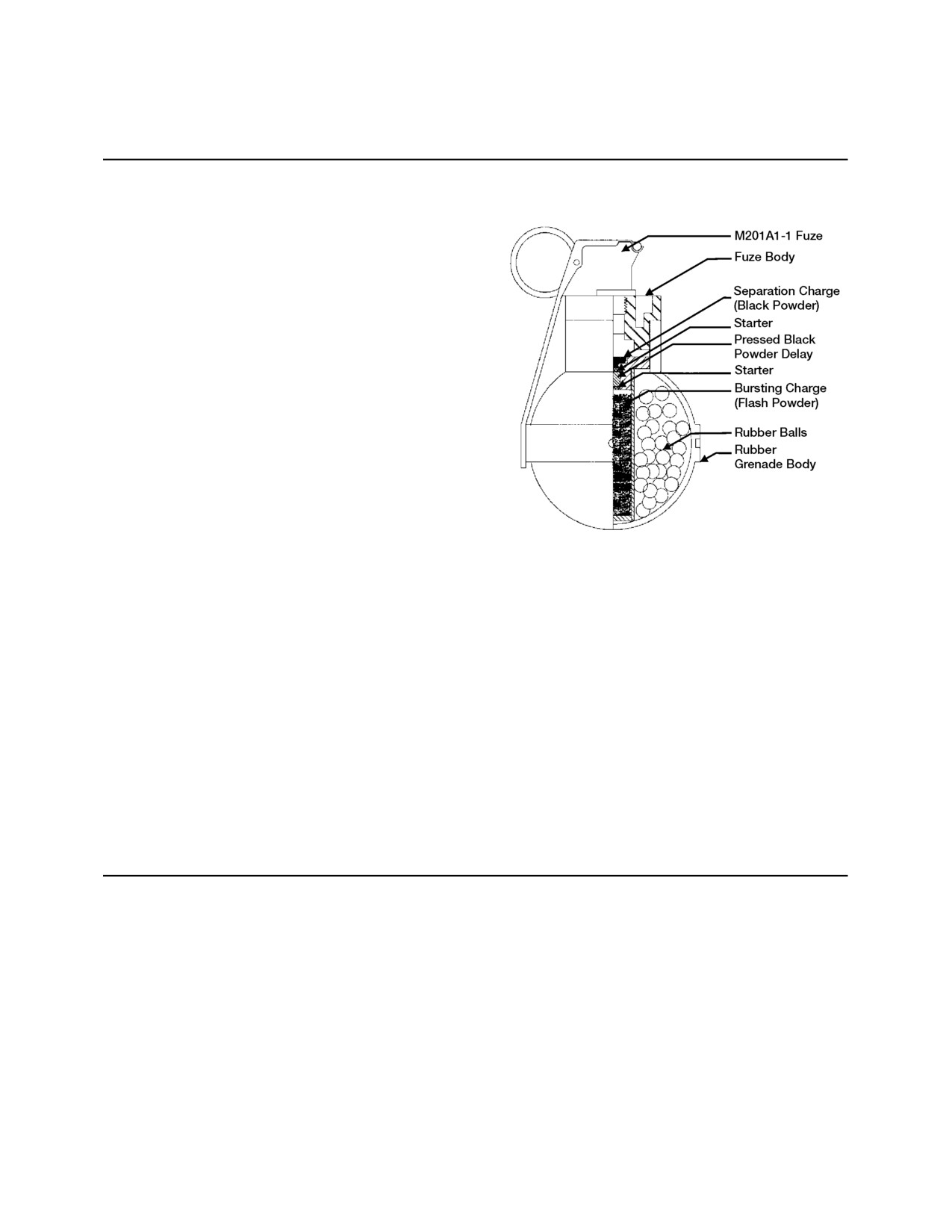
Rubber Ball Grenade
Using Services: USN, USMC
Status: Fielded 1998
DODIC: GG04
NSN: 1310-01-454-0132
Acquisition Activity: MARCORSYSCOM—NSWC
Crane, IN
Further Information:
Commercial: MARCORSYSCOM (703) 784-9395
NSWC Crane (812) 854-5801
Color
Black with white
lettering
Diameter
3.12 inches (79 mm)
Projectiles
100 rubber balls
(minimum)
Height
5.25 inches
(133.4 mm)
Total Weight
290 grams
Explosive Weight
59 grams
Total Time Delay
3.0 + 0.5 seconds
Employment Distance:
Hand Thrown
50 feet (15.2 m)
Shotgun Launched
200 feet (61 m)
Projectile Specifications:
Number
100 (minimum)
Material
Rubber
Hardness
Durometer 70 to 80 on Shore “A” scale
Diameter
0.25 inches (6.4 mm) (minimum)
• Fuze separates from the body 1.3 to 1.7 seconds after primer ignition.
• Second delay causes burster charge detonation 3.0 + 0.5 seconds average after primer
ignition. Rubber balls are then dispersed in a 50-feet (15-m) circular pattern.
•
12-gauge shotgun with launch cup and launch cartridge can launch grenade 200 feet
(61 m) + 25 feet (7.6 m)
Figure B-6. Rubber Ball Grenade
B-6
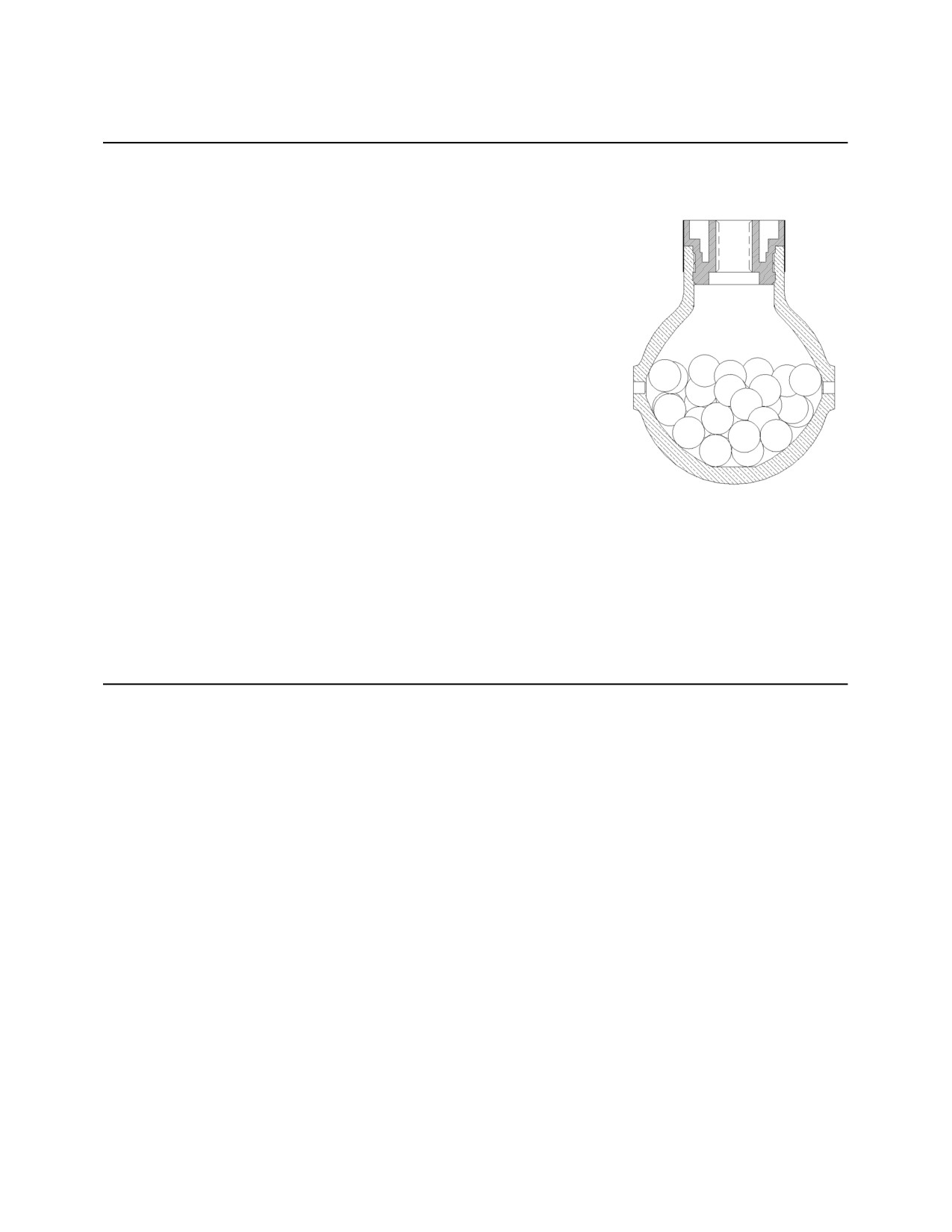
Practice Grenade Body
Using Services: USMC
Status: Fielded 2002
DODIC: GG05
NSN: Pending
Acquisition Activity: MARCORSYSCOM - NSWC Crane, IN
Further Information:
Commercial: MARCORSYSCOM (703) 784-9395
NSWC Crane (812) 854-5801
Diameter
3.12 inches (79 mm)
Projectiles
N/A
Height
4.2 inches (106 mm)
Total Weight
208 grams
Explosive Weight
N/A (inert)
Total Time Delay
3.0 + 0.5 seconds when used with
practice grenade fuze
Employment Distance:
Hand Thrown
50 feet (15.2 m)
Shotgun Launched
200 feet (61 m) using Mossberg launch cup and 12-gauge launch
cartridge (AA30).
• Practice grenade body is reusable up to 25 times and is a component of a practice
grenade assembly, consisting of the body and a practice grenade fuze.
• Practice grenade assembly accurately replicates the GG04 rubber ball grenade and is
used for training purposes.
Figure B-7. Practice Grenade Body
B-7
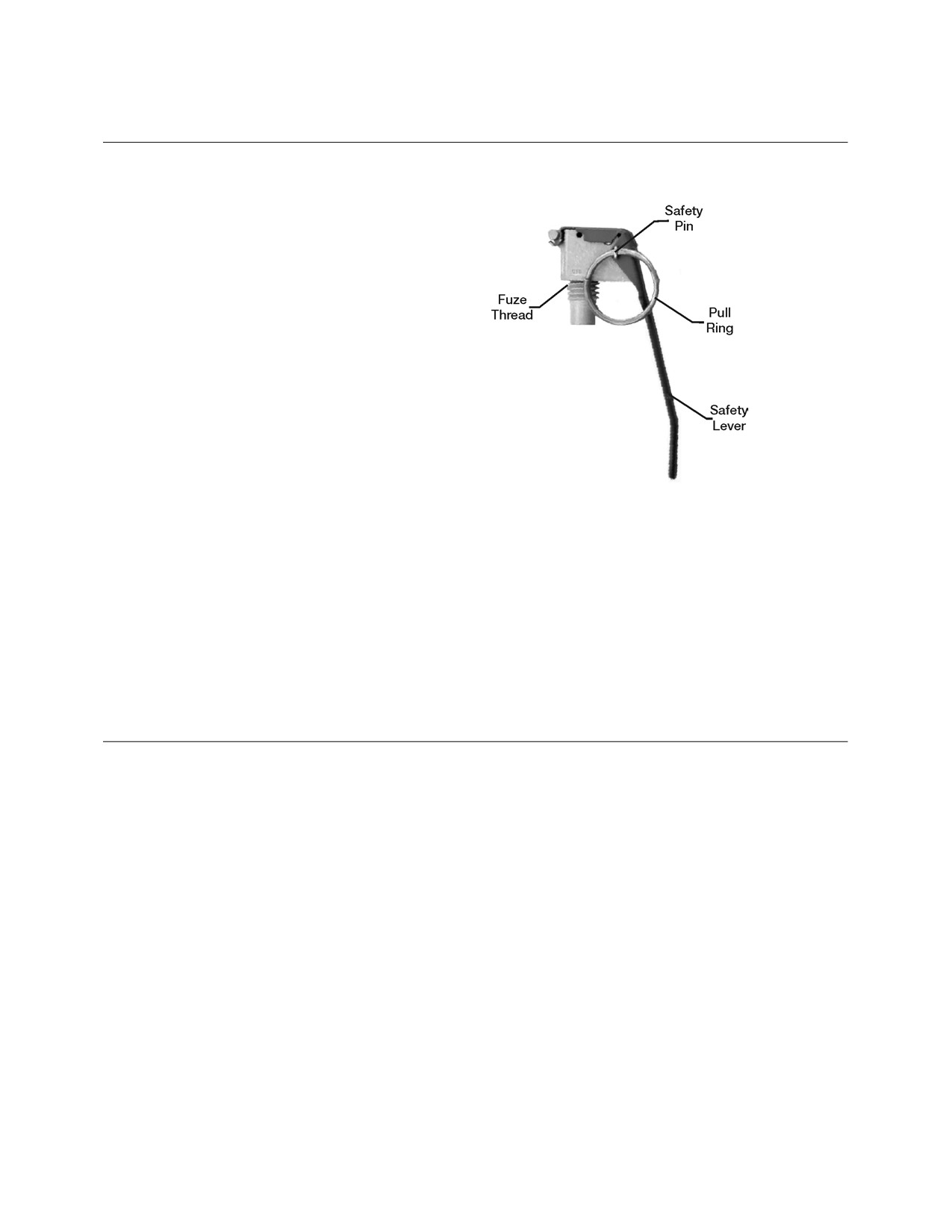
Practice Grenade Fuze
Using Services: USMC
Status: Fielded 2002
DODIC: Pending
NSN: Pending
Acquisition Activity: MARCORSYSCOM—NSWC
Crane, IN
Further Information:
Commercial: MARCORSYSCOM
(703) 784-9395
NSWC Crane (812) 854-5801
Color
Blue safety lever
with brown stripe
Projectiles
N/A
Height
4.25 inches
(107 mm)
Total Weight
82 grams
Explosive Weight
Not available
Total Time Delay
3.0 + 0.5 seconds
Employment Distance when used with GG05 Practice Grenade Body:
Hand Thrown
50 feet (15.2 m)
Shotgun Launched
200 feet (61 m)—using Mossberg launch cup and 12-gauge launch
cartridge (AA30).
• Employ practice grenade fuze with the practice grenade body to create a practice
grenade assembly consisting of the body and a practice grenade fuze.
• Practice grenade assembly accurately replicates the GG04 rubber ball grenade and is
used for training purposes.
Figure B-8. Practice Grenade Fuze
B-8
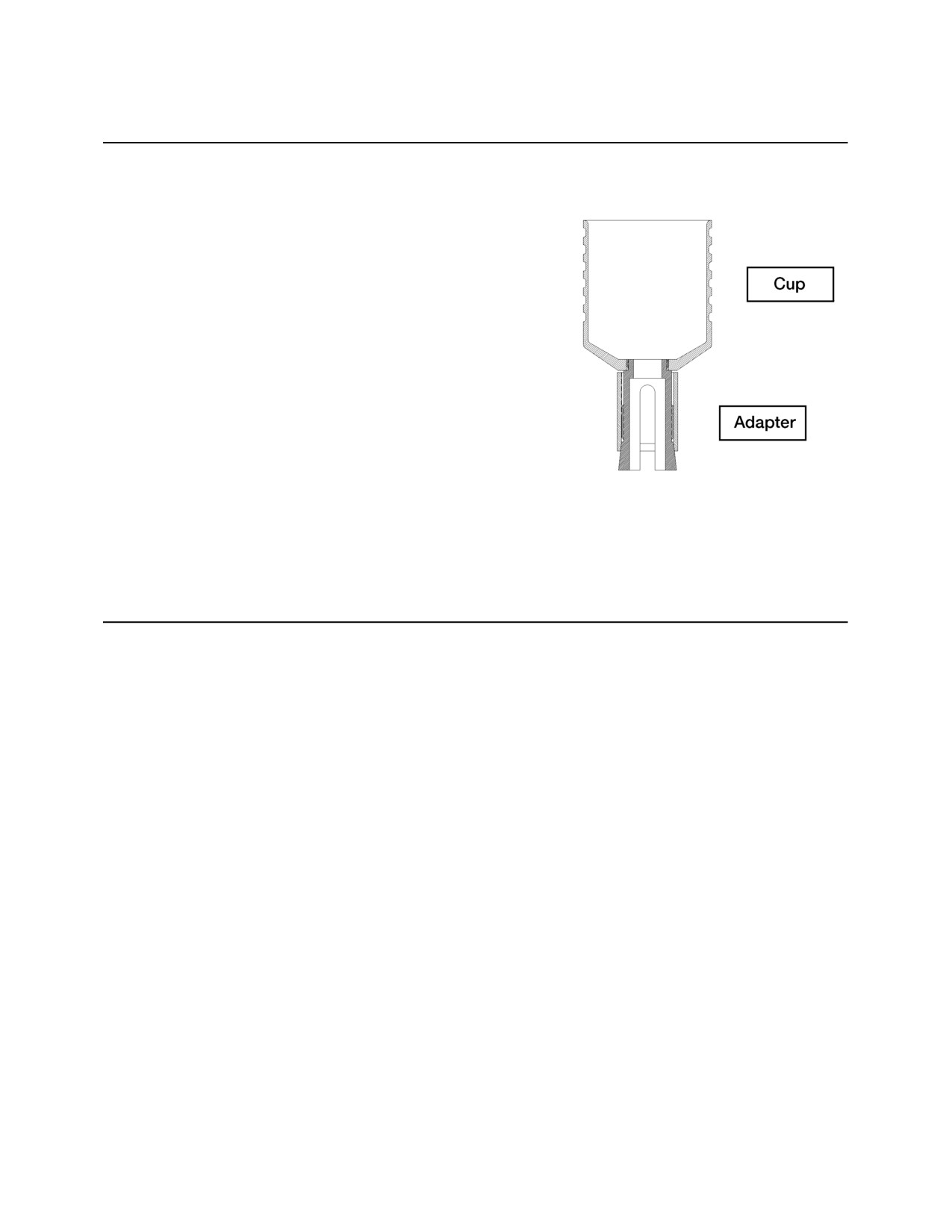
Nonlethal Grenade Launch Cup
Using Service: USMC
Status: Fielded 2002
DODIC: N/A
NSN: Pending
Acquisition Activity: MARCORSYSCOM—NSWC Crane, IN
Further Information: Commercial: MARCORSYSCOM
(703) 784-2006 Ext. 2733
NSWC Crane (812) 854-5801
NOTE: Cup body shown is representative of cup bodies
used on all shotguns. Adapter shown is subject to
change depending on the shotgun used and design
improvements.
Color
Black
Diameter (internal)
3.12 inches (79 mm)
Length (without adapter)
4 inches (102 mm)
Weight
397 grams (maximum)
Cross Section View
• Use launch cup in concert with AA30 launch cartridge and either the GG04 rubber ball
grenade or GG05 practice grenade assembly
• Attach launch cup and remove from the shotgun without using tools
• Launch cup can withstand accidental detonation of rubber ball grenade without
fragmenting
Figure B-9. Nonlethal Grenade Launch Cup
B-9
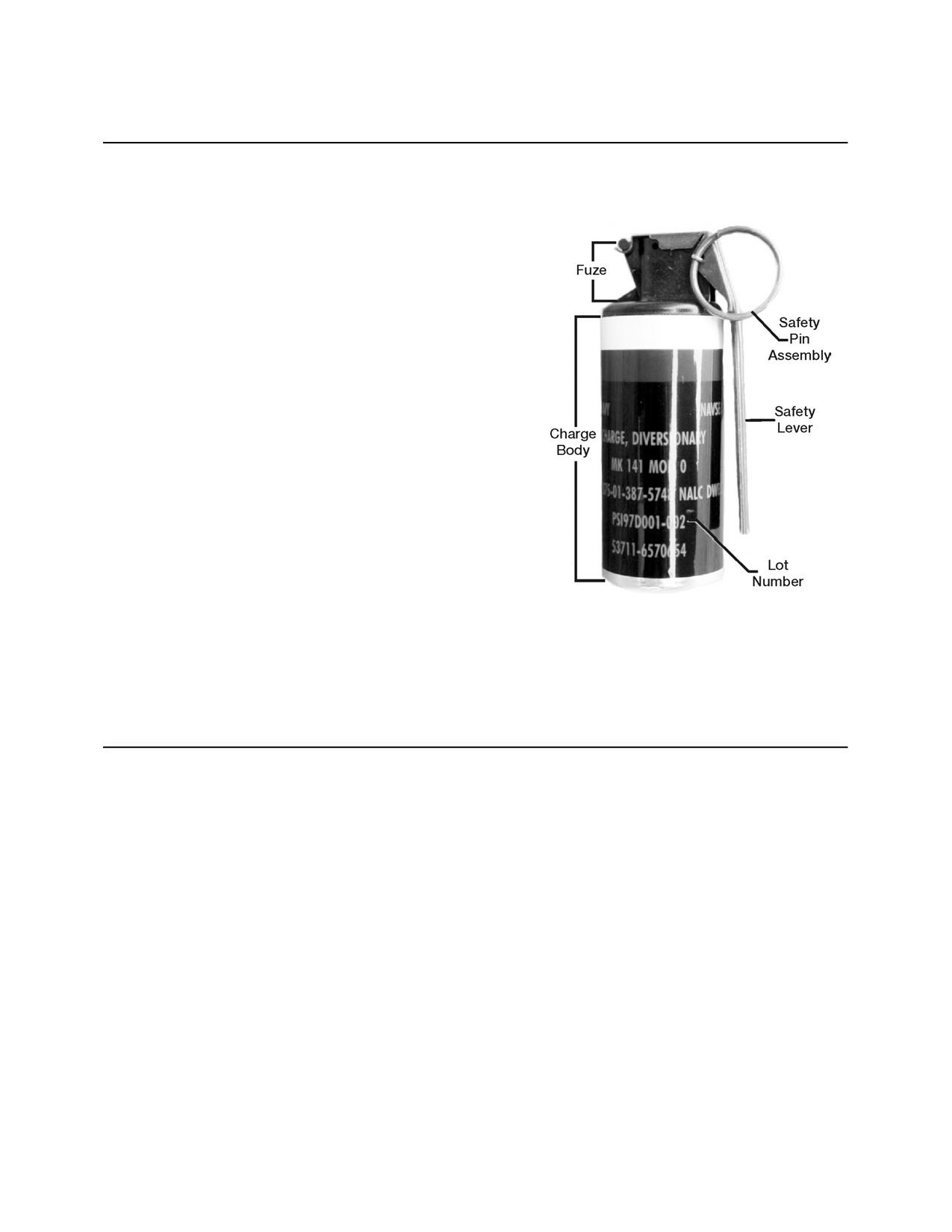
Diversionary Charge, MK 141, MOD 0
Using Services: USN, USMC
Status: Fielded 1997
DODIC: DWBS
NSN: 1375-01-387-5748
Acquisition Activity: MARCORSYSCOM—NSWC
Crane, IN
Further Information:
Commercial: MARCORSYSCOM (703) 784-9395
NSWC Crane (812) 854-3934
Color
Brown with white stripe
Diameter
1.77 inches (45 mm)
Projectile
N/A
Length
5.214 inches (132.4 mm)
Total Weight
99.8 grams
Net Explosive Weight
17.8 grains
Light Output
2 million candlepower for
4 milliseconds
Noise Output
176 to 185 decibels
Material
Molded and machined
polyurethane
Time Delay:
Initial
1.26 seconds (minimum)
Total
1.34 to 1.84 seconds
• Diversionary charge can cause serious injury if held at time of detonation
• Light and noise most effective in confined space to stun individuals
• Most often employed for hostage rescue
Figure B-10. Diversionary Charge, MK 141, MOD 0
B-10
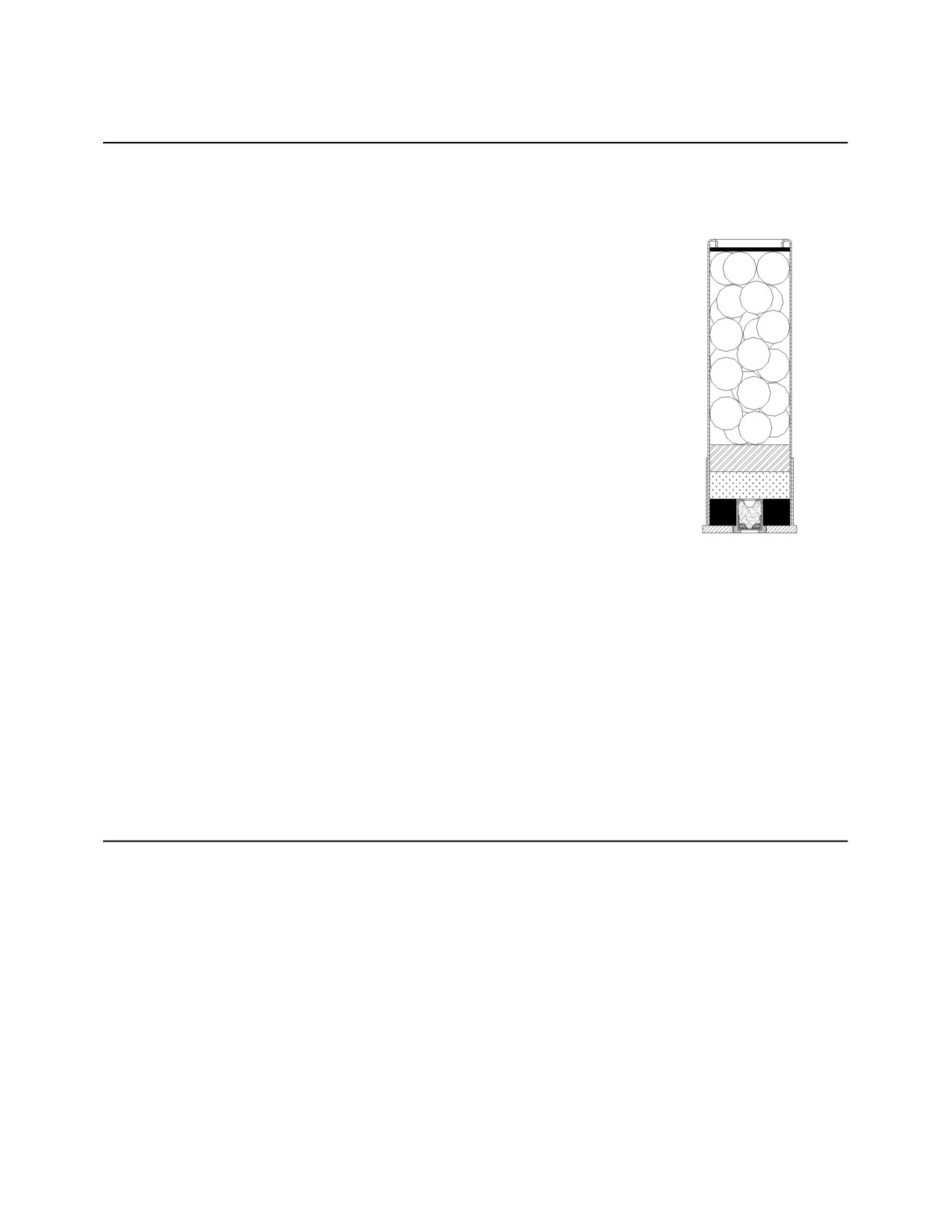
Cartridge, 12-Gauge Rubber Sting Ball™
Using Services: USCG
Status: Fielded
DODIC: N/A Model No. 2552
NSN: Commercial Procurement
Acquisitions Activity: Commandant (G-OCU)
Further Information: Commandant (G-OCU) (202) 267-1522
Model Number
31-caliber sting-ball
Type
Multiple projectile rubber pellets
Range
10 yards (9 m)
Projectiles
18 (average)
Cartridge Material
Plastic
Projectile Weight
35 grams each
Projectile Material
31-caliber rubber pellets
Overall Height
2.75 inches (70 mm)
Overall Weight
18 grams
Compatibility
12-gauge shotguns
Velocity
400 feet/second
USCG
• Fatal injuries are possible at employment distances of less than 5 yards.
• At distances of 20 feet (6 m) to 40 feet (12 m), target area should be center mass
• This round is most effective against area targets with a maximum effective range of 15
yards
• Training needs to reinforce that head shots are NOT ACCEPTABLE
• Round is most effective against area targets (multiple personnel)
• Stock Sock: a yellow “stock sock” will be used whenever the modified 12-gauge
Remington 870 shotgun is loaded with nonlethal munitions. This removable nylon
sleeve is used to identify the weapon as a nonlethal delivery system.
• All specifications are average and are subject to change without notice
•
2552SPEC
Figure B-11. Cartridge, 12-Gauge Rubber Sting Ball™
B-11
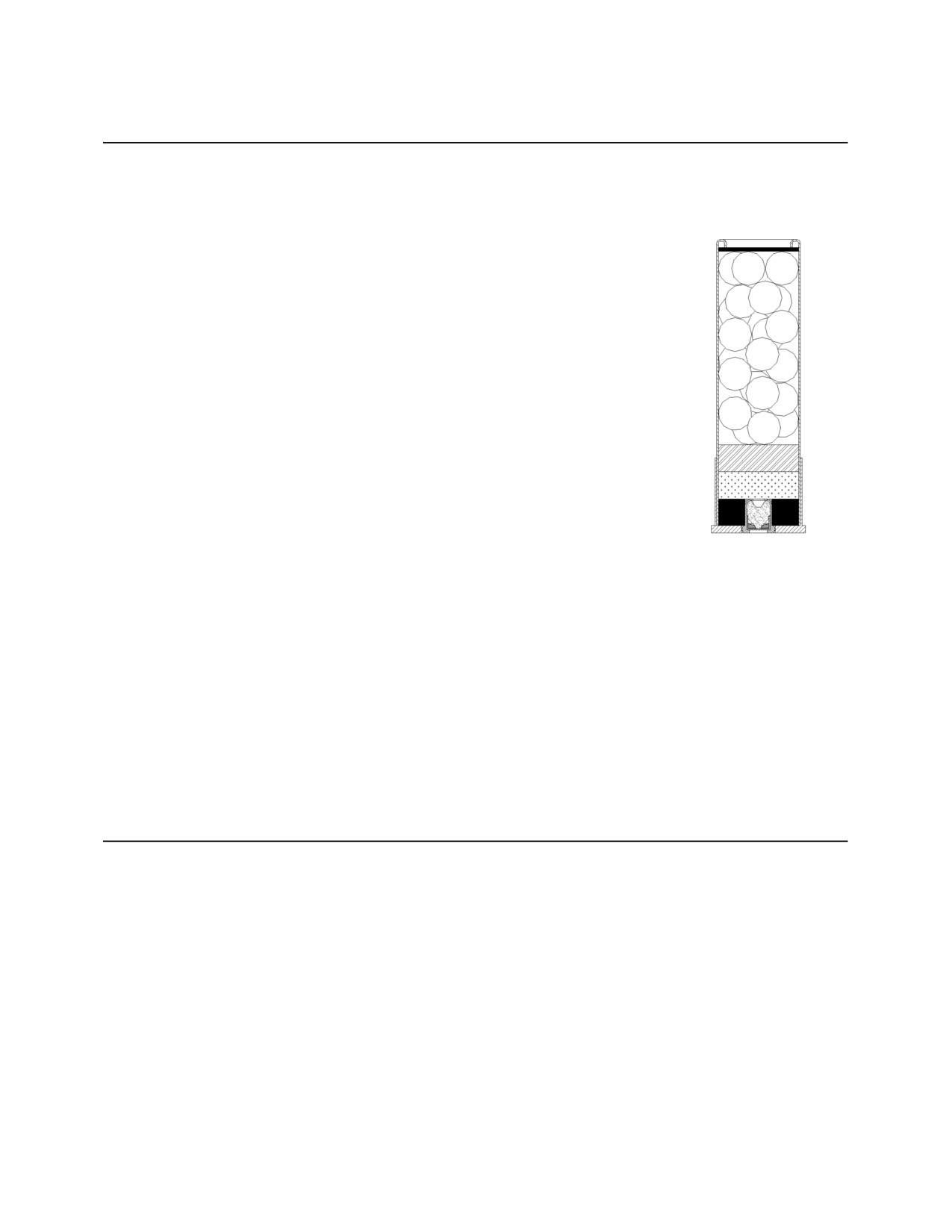
Cartridge, 12-Gauge Sting Ball™ High Velocity
Using Services: USCG
Status: Fielded
DODIC: N/A Model No. 2553
NSN: Commercial Procurement
Acquisitions Activity: Commandant (G-OCU)
Further Information: Commandant (G-OCU) (202) 267-1522
Model Number
31-caliber sting-ball
Type
Multiple projectile rubber pellets
Range
10 yards (9 m)
Projectiles
18 (average)
Cartridge Material
Plastic
Projectile Weight
35 grams each
Projectile Material
31-caliber rubber pellets
Overall Height
2.4 to 2.5 inches (61 - 63 mm)
Overall Weight
18 grams
Compatibility
12-gauge shotguns
Velocity
900 feet/second
USCG
• Fatal injuries are possible at employment distances of less than 5 yards.
• At distances of 20 feet (6 m) to 40 feet (12 m), target area should be center mass
• Maximum effective range is 15 yards
• Training needs to reinforce that head shots are NOT ACCEPTABLE
• Round is most effective against area targets (multiple personnel)
• Stock Sock: a yellow “stock sock” will be used whenever the modified 12-gauge
Remington 870 shotgun is loaded with nonlethal munitions. This removable nylon
sleeve is used to identify the weapon as a nonlethal delivery system.
• All specifications are average and are subject to change without notice.
•
2553SPEC
Figure B-12. Cartridge, 12-Gauge Sting Ball™ High Velocity
B-12
M1006, 40-mm Nonlethal Cartridge (Sponge Grenade)
Using Services: U.S. Army
Status: Materiel Released April 2000
DODIC: BA06
NSN: 1310-01-452-1190
Acquisition Activity: Acquisition Center, Picatinny Arsenal, NJ
Further Information:
Commercial: Picatinny Arsenal NL Systems Integrator: (973) 724-6948
Product Director: (973) 724-6283
Color:
Projectile
Black, olive green (foam rubber)
Cartridge Case
Opaque
Diameter
40 millimeter
Length
5.272 inches (13.4 cm) (maximum)
Total Weight
68 grams (0.15 lbs)
Propellant Weight
2 grains
Muzzle Velocity
265 + 20 feet/second (81 + 6 m/sec)
Acceptance Accuracy
>85 % accuracy at 30 meters (E-silhouette) and >60 % accuracy at
50 meters (E-silhouette) when fired from an M16A2/M203 or a
M4/M203
Engagement Range
10 meters to 50 meters
Projectile Specification:
Shape
40-mm bullet shaped foam rubber
Material
Foam rubber
Weight
28.5 grams (.06 lbs)
• Fatal injuries are possible at employment distances of less than 32.8 feet (10 m)
• At distances of 10 meters to 50 meters, target area should be center mass
• Training needs to reinforce that head shots are NOT ACCEPTABLE
• Do not skip fire this round! Round becomes unpredictable upon striking the ground
• Round is most effective against individually selected targets (point round)
Figure B-13. M1006, 40-mm Nonlethal Cartridge (Sponge Grenade)
B-13
M1012, 12-Gauge Shotgun: Nonlethal, Point Control Cartridge
Using Services: U.S. Army
Status: Type Classified, June 2000
DODAC: AA51
NSN: 1305-01-470-2405
Acquisition Activity: Acquisition Center, Picatinny Arsenal, NJ
Further Information:
Commercial: Picatinny Arsenal NL Systems Integrator: (973) 724-6948
Product Director: (973) 724-6086
Color:
Cartridge Case:
Clear
Diameter
12 gauge
Length
2.45 inches (62.2 mm)
Total Weight
500 grains
Propellant Weight
6.6 grains smokeless (Red Dot)
Muzzle Velocity
500 feet/second (152.4 m/sec)
Acceptance Accuracy
80 % accuracy at 10 and 20 meters (E-silhouette) fired out of
Mossberg 500, Mossberg 590, and Winchester 1200
Engagement range
10 to 20 meters
Projectile Specification:
Shape
Fin stabilized ‘bomblet’ shape
Material
Rubber
Weight
0.2 ounces ( 5.8 gm)
Hardness
75 Durometer “A” Scale
• Fatal injuries are possible at employment distances of less than 33 feet (10 m)
• At distances of 10 to 20 meters, target area should be center mass
• Training needs to reinforce that head shots are NOT ACCEPTABLE
• Round is most effective against individually selected targets (point round)
Figure B-14. M1012, 12-Gauge Shotgun: Nonlethal, Point Control Cartridge
B-14
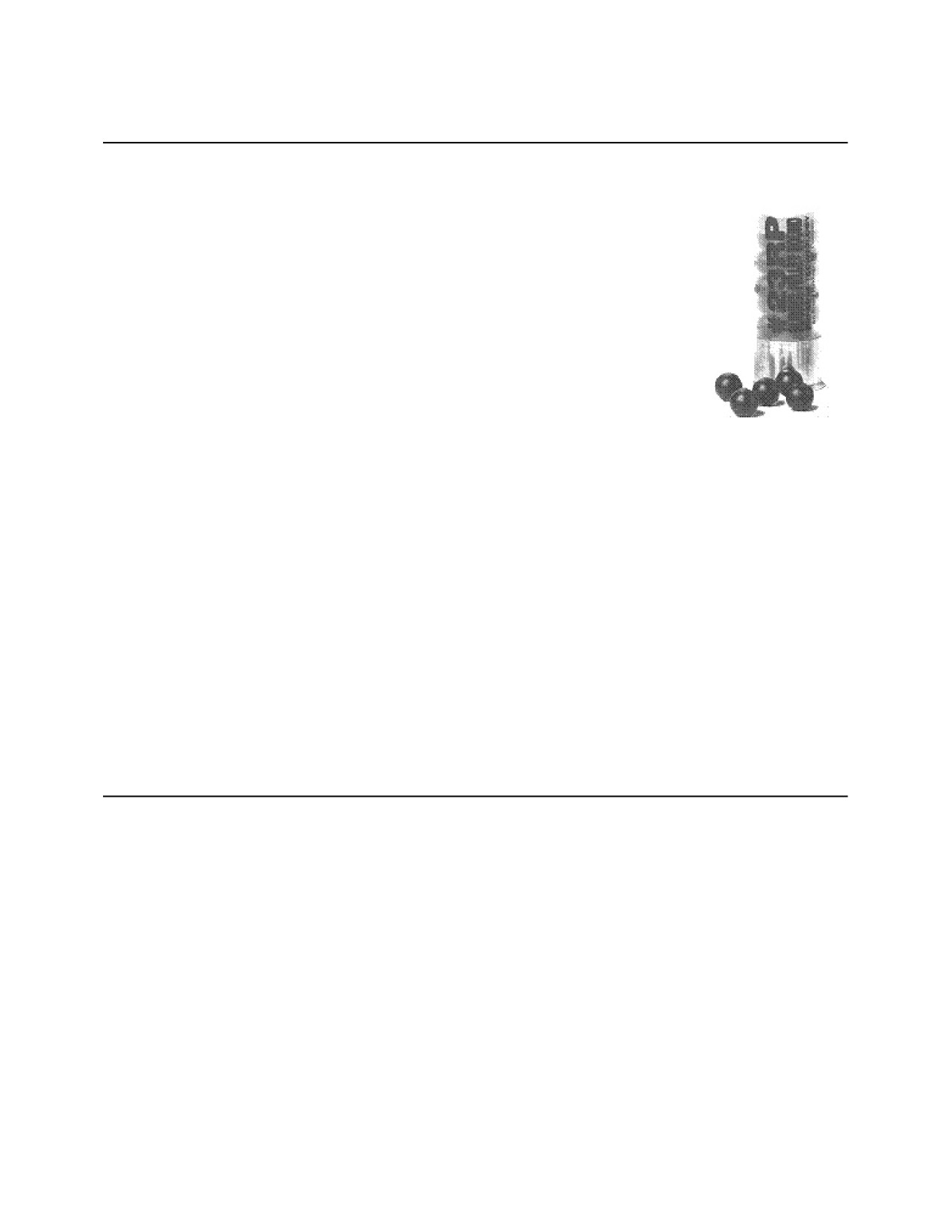
M1013, 12-Gauge Shotgun: Nonlethal, Crowd Dispersal Cartridge
Using Services: U.S. Army
Status: Type Classified June 2000
DODAC: AA52
NSN: 1305-01-470-2139
Acquisition Activity: Acquisition Center, Picatinny Arsenal, NJ
Further Information:
Commercial: Picatinny Arsenal NL Systems Integrator: (973) 724-6948
Product Director :(973) 724-6086
Color:
Projectile
Black rubber
Cartridge Case
Clear
Diameter
12 gauge
Projectile
18 rubber balls
Length
2.37 inches (60.2 mm)
Total Weight
500 grains (32.4 gm)
Propellant Weight
14 grains smokeless (Red Dot)
Muzzle Velocity
900 feet/second (274 m/sec)
Acceptance Accuracy
80 % accuracy for a 2-by-3-meter target at 10 and 20 meters fired
out of Mossberg 500, Mossberg 590, and Winchester 1200
Engagement range
10 to 20 meters
Projectile Specification:
Shape
32-gauge (0.32 in) ball
Material
PVC rubber compound
Weight
0.01 ounces (0.25 gm)
Hardness
75 Durometer “A” Scale
• Fatal injuries are possible at employment distances of less than 32.8 feet (10 m)
• At distances of 10 to 20 meters, target area should be center mass
• Training needs to reinforce that head shots are NOT ACCEPTABLE
Figure B-15. M1013, 12-Gauge Shotgun: Nonlethal, Crowd Dispersal Cartridge
B-15
M1029, 40-mm Nonlethal Crowd Dispersal Grenade
Using Services: U.S. Army
Status: Type Classified May 2001
DODIC: BA13
NSN: 1310-01-475-0628
Acquisition Activity: Acquisition Center, Picatinny Arsenal, NJ
Further Information:
Commercial: Picatinny Arsenal NL Systems Integrator: (973) 724-6948
Product Director: (973) 724-6283
Color:
Projectile
Black rubber
Cartridge Case
Aluminum
Diameter
40 millimeter
Projectile
48 rubber balls
Length
4.8 inches (12.2 cm)
Total Weight
202.22 grams (7.0 oz)
Propellant Weight
8.5 grains smokeless
Muzzle Velocity
450 feet/second
Acceptance Accuracy
> 90 % hit accuracy 4 out of 5 (shoulder to shoulder) E-silhouettes
target at 30 meters and when fired from an M16A2/M203 or a
M4/M203
Projectile Specification:
Shape
48-gauge ball (.48 in diameter)
Material
Rubber
Weight
1.3 grams (.046 oz)
Hardness
Durometer 60, scale “A”
• Fatal injuries are possible at employment distances of less than 32.8 feet (10 m)
• At distances of 10 to 30 meters, target area should be center mass of group of
individuals
• Round is most effective when used to disperse groups of individuals
Figure B-16. M1029, 40-mm Nonlethal Crowd Dispersal Grenade
B-16
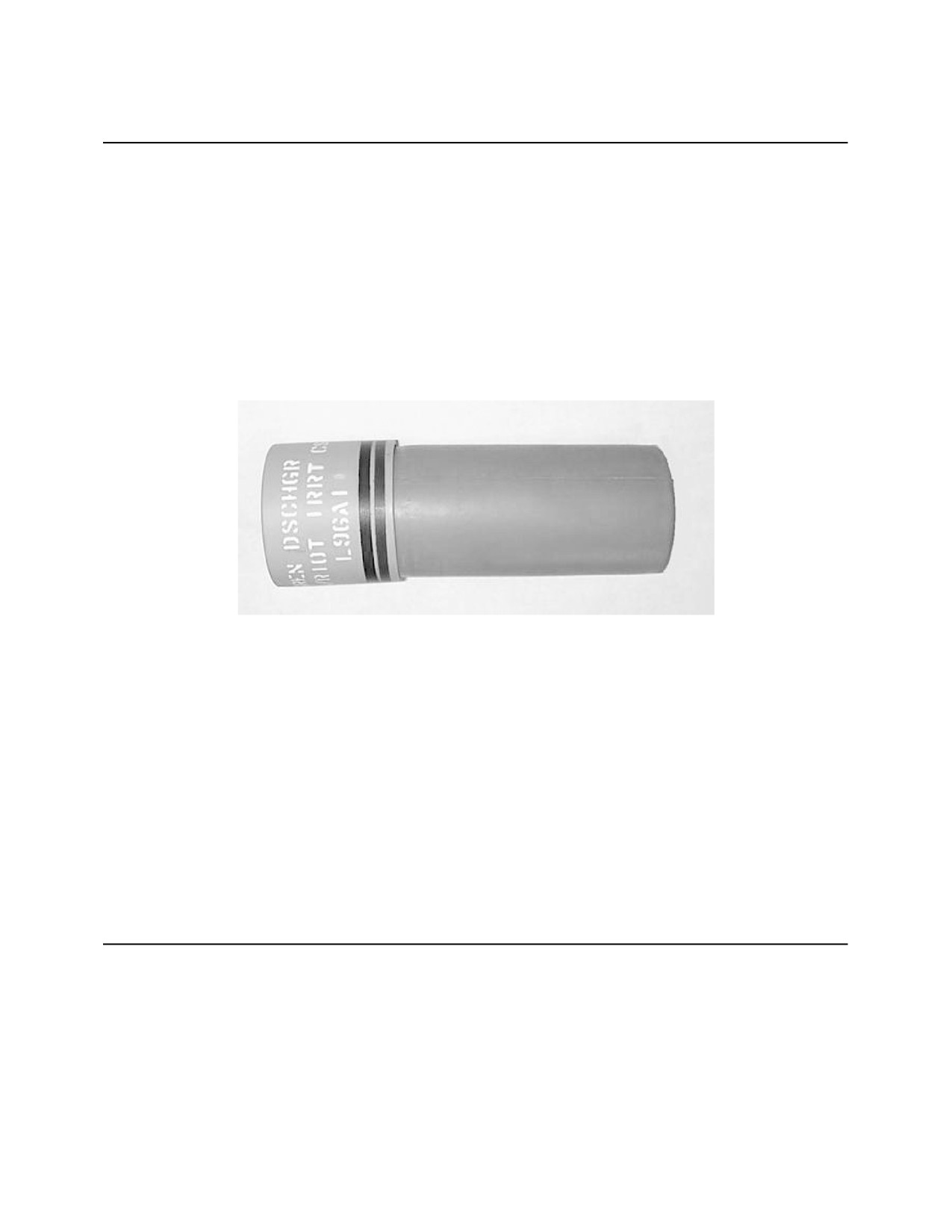
L96A1*, Grenade, Discharger: Antiriot, Irritant, CS
Using Services: U.S. Army, USMC
Status: Materiel Release, 4 January 2002
DODIC: FZ14
NSN: 1330-01-459-4018
Acquisition Activity: Acquisition Center, Picatinny Arsenal, NJ
Further Information:
Commercial: Picatinny Arsenal NL Systems Integrator: (973) 724-6948
Project Officer: (410) 436-2139
Color
Light gray with red and brown bands
Diameter
66 millimeters
Projectile
23 canisters filled with CS compound
Length
185 millimeters (7.28 in)
Total Weight
568 grams (1.25 lbs)
Propellant Weight
3.8 grams (.008 lbs)
Muzzle Velocity
35.8 meters/second (117.5 ft/s)
Acceptance Accuracy
65 to 95 meters
Deployment Range
65 to 95 meters
Projectile Specification:
NOTE: It is not accurate to refer to the submunitions of the L96A1 grenade as projectiles. The
antiriot material (CS) is released from the submunitions as they burn on the ground.
Shape
Cylindrical
Material
Aluminum
Weight
11.3 grams (.025 lbs)
* The L97A1 Grenade is the training grenade for the L96A1 Grenade.
Figure B-17. L96A1, Grenade, Discharger: Antiriot, Irritant, CS
B-17
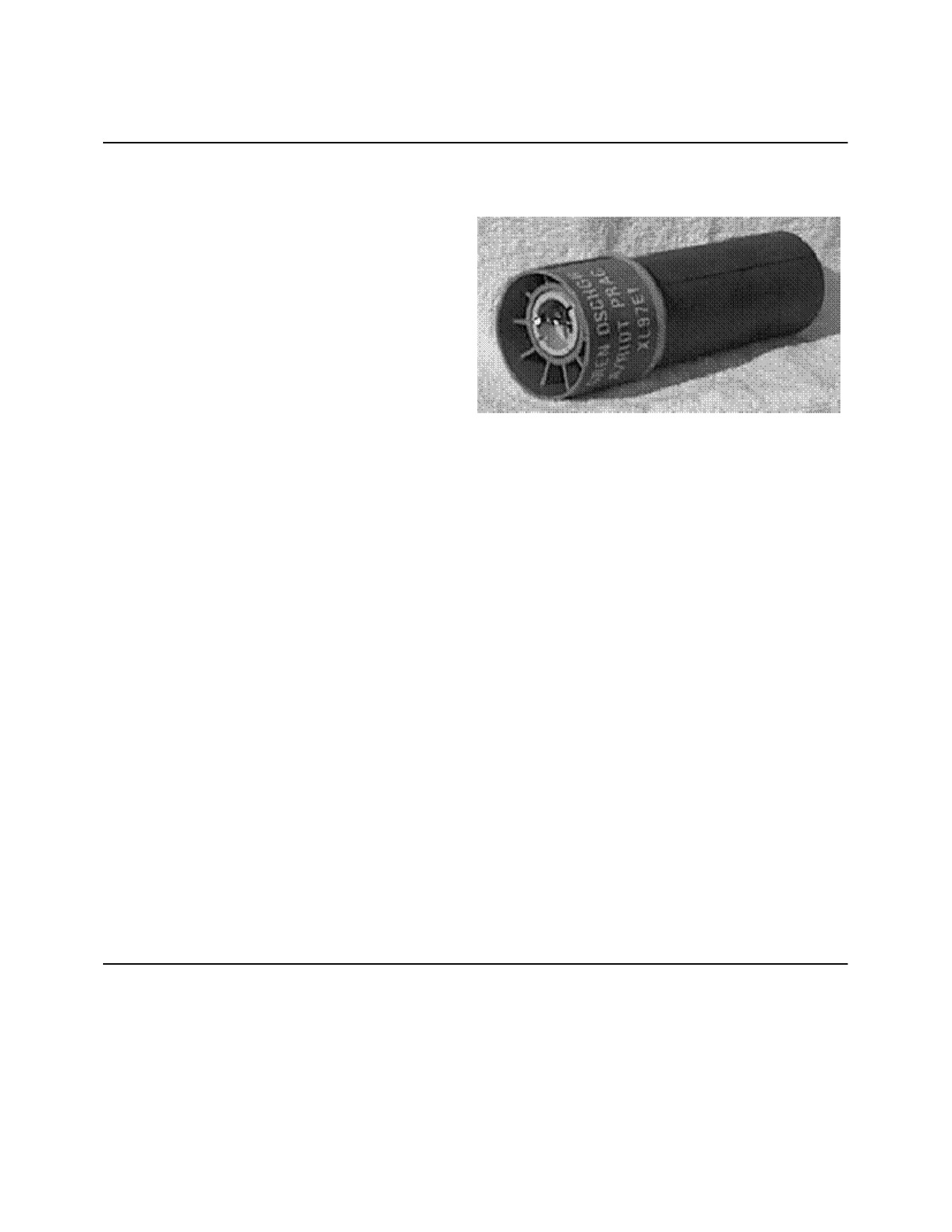
L97A1, Grenade, Discharger: Antiriot, Practice
Using Services: U.S. Army, USMC
Status: Material Released, 4 January 02
DODIC: FZ15
NSN: 1330-01-459-4032
Acquisition Activity: Acquisition Center,
Picatinny Arsenal, NJ
Further Information:
Commercial: Picatinny Arsenal NL Systems
Integrator: (973) 724-6948
Project Officer:
(410) 436-2139)
Color
Blue with brown and green bands
Diameter
66 millimeters
Projectile
23 canisters filled with Cinnamic Acid (CA)
Length
185 millimeters (7.28 in)
Total Weight
568 grams (1.25 lbs)
Propellant Weight
3.8 grams (.008 lbs)
Muzzle Velocity
35.8 meters/second (117.5 ft/s)
Acceptance Accuracy
65 to 95 meters
Deployment Range
65 to 95 meters
Projectile Specification:
NOTE: It is not accurate to refer to the submunitions of the L97A1 grenade as projectiles. The
antiriot, practice material (CA) is released from the submunitions as they burn on the ground.
Shape
Cylindrical
Material
Aluminum
Weight
11.3 gram (.025 lbs)
• CA smoke can cause irritation to the eyes, mucous membranes, and skin. Personnel
entering a CA cloud must wear appropriate face protection such as an M17- or M40-
series protective mask.
• The burning grenade canisters could start a fire in dry grasses. Keep fire extinguisher
available.
• During firing training, personnel within 16 meters must wear single hearing protection.
This includes personnel within vehicle.
• Do not fire grenades when personnel or equipment are within 150 meters covering a
90-degree arc around a firing discharger.
• Do not fire grenades at the 50- or 75-meter position on the M315 adjustable aiming
bracket. Fire only at the 100-meter setting.
Figure B-18. L97A1, Grenade, Discharger: Antiriot, Practice
B-18
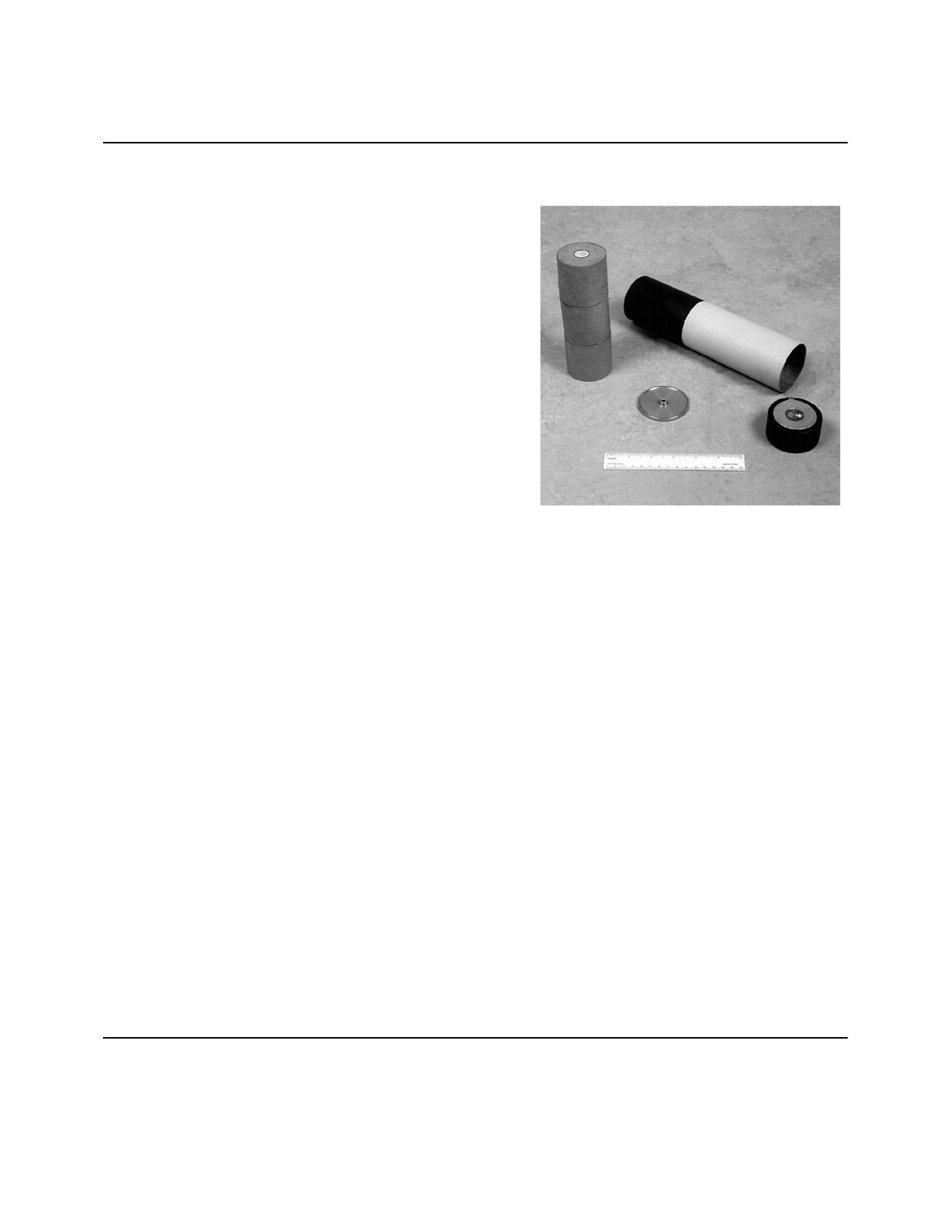
Grenade, Launcher: Nonlethal, Distraction, M98
Using Services: U.S. Army, USMC
Status: Type Classified, 17 October 2001
DODIC: FZ16
NSN: 1330-01-484-7773
Acquisition Activity: Acquisition Center, Picatinny
Arsenal, NJ
Further Information: Commercial: Picatinny Arsenal
NL Systems Integrator:
(973) 724-6948
Project Officer: (410) 436-2139
Color
Green and black with brown band
Diameter
66 millimeters
Projectile
3 bursting submunitions, with pyrotechnic charges for audio and
visual stimuli
Length
25.25 centimeters (9.94 in)
Total Weight
725.7 grams (1.6 lbs)
Propellant Weight
5.0 grams (.011 lbs)
Muzzle Velocity
48.9 meters/seconds (160.4 ft/s)
Acceptance Accuracy
100 to 120 meters
Deployment Radius
10 to 15 meters
Projectile Specification:
NOTE: It is not accurate to refer to the submunitons of the M98 grenade as projectiles. These
submunitions are ground bursting and the payload of inert ballast is just for flight stabilization
and to deliver the audio/visual stimuli to the required range.
Filler
Inert Ballast
• There is a remote chance of starting a fire. Keep fire extinguisher available.
• Personnel within 17 meters of a firing discharger must wear single hearing protection.
This includes personnel within vehicle.
• Avoid looking directly at a bursting grenade; it could result in temporary loss of vision,
lasting 2 to 5 minutes.
• Personnel within 35 meters of an operating launcher or 0.5 meters of a bursting
canister should wear safety or ballistic-type eye protection, military clothing with long
sleeves and elevated shirt collar, and helmet headgear.
• Do not handle or load M98s within 50 meters of a frequency transmitter emitting at
175 MHz, 448 MHz, 503 MHz and 1430 MHz.
• Do Not fire grenades when personnel or equipment are within 160 meters covering a
90-degree arc around a firing discharger.
Figure B-19. Grenade, Launcher: Nonlethal, Distraction, M98
B-19
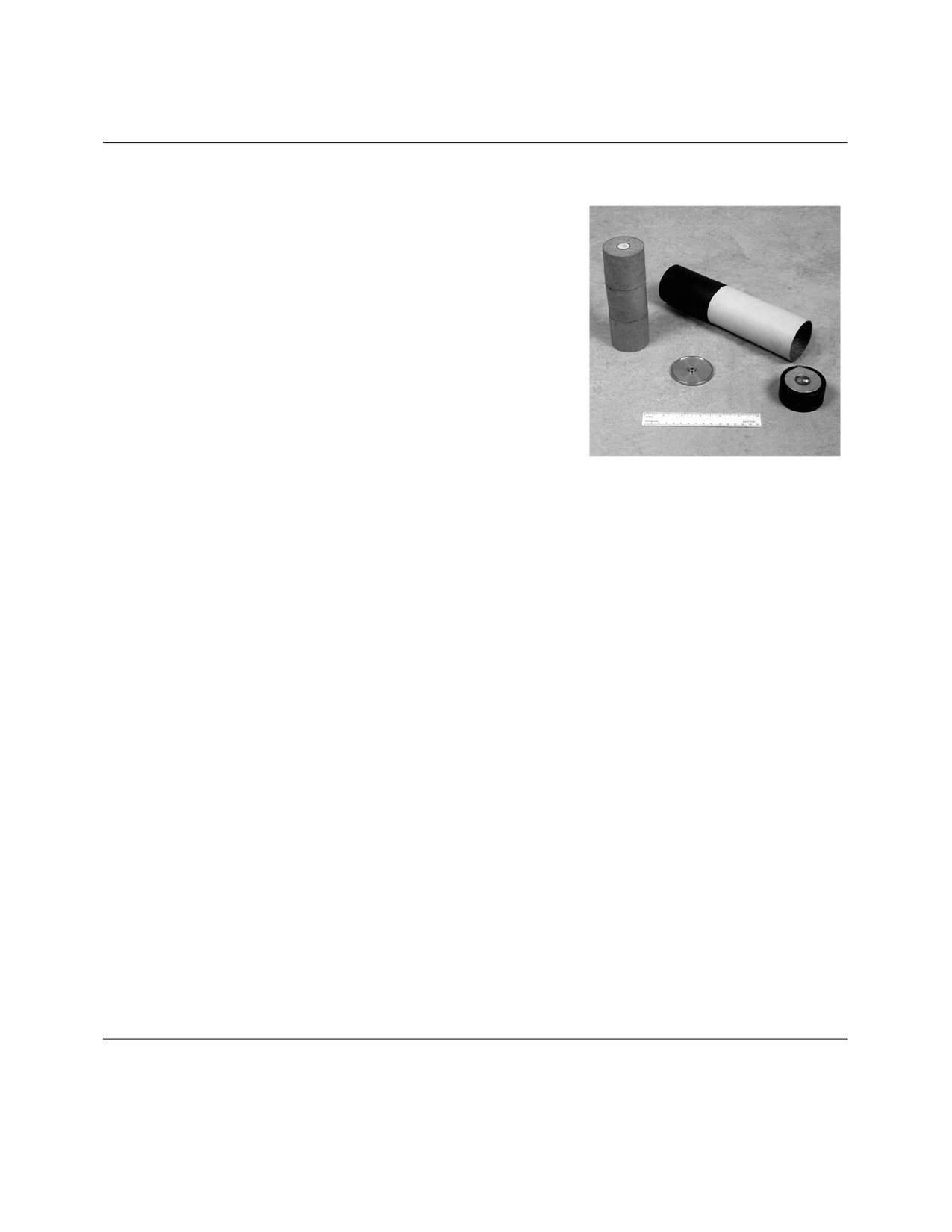
M99, Grenade, Launcher: Nonlethal, Blunt Trauma
Using Services: U.S. Army, USMC
Status: Type Classified—17 October 2001
DODIC: FZ17
NSN: 1330-01-484-7775
Acquisition Activity: Acquisition Center, Picatinny Arsenal,
NJ
Further Information:
Commercial: Picatinny Arsenal NL Systems Integrator:
(973) 724-6948
Project Officer: (410-436-2139)
Color
Green and black with brown band
Diameter
66 millimeters
Projectile
3 bursting submunitions, each with 140 balls
Length
25.25 centimeters (9.94 in)
Total Weight
725.7 grams (1.6 lbs)
Propellant Weight
5.0 grams (.011 lbs)
Muzzle Velocity
48.9 meters/second (160.4 ft/s)
Acceptance Accuracy
100 to 120 meters
Deployment Radius
5 to 10 meters
Projectile Specification:
NOTE: It is not accurate to refer to the submunitions of the M99 grenade as projectiles. These
submunitions are ground bursting and the payload of inert ballast is just for flight stabilization
and to deliver the audio/visual stimuli to the required range.
Shape
32-caliber (5/16 in) ball
Material
PVC
Weight
0.40 grams (.014 oz)
Hardness
90 Durometer
• There is a remote chance of starting a fire. Keep fire extinguisher available.
• Personnel within 17 meters of a firing discharger must wear single hearing protection.
This includes personnel within vehicle.
• Avoid looking directly at a bursting grenade; it could result in temporary loss of vision,
lasting 2 to 5 minutes
• Personnel within 35 meters of an operating launcher or 0.5 meters of a bursting
canister should wear safety or ballistic-type eye protection, military clothing with long
sleeves and elevated shirt collar, and helmet headgear.
• Do not handle or load M98s within 50 meters of a frequency transmitter emitting at 175
MHz, 448 MHz, 503 MHz and 1430 MHz.
• DO NOT fire grenades when personnel or equipment are within 160 meters covering a
90-degree arc around a firing discharger.
• To minimize risk of eye injury, use the M99 primarily against crowds of adults.
Figure B-20. M99, Grenade, Launcher: Nonlethal, Blunt Trauma
B-20