FM 3-22.40 NLW TACTICAL EMPLOYMENT OF NONLETHAL WEAPONS (JANUARY 2003) - page 2

Table V-6. Seize Personnel
NLW
Task
Planning Factors
Equipment
Employment
Notes
Seize
Civil Affairs
personnel
• Collect civilian
intelligence
• Care for injured
personnel
• Detain civilian
personnel
Seize
Medical
personnel
• Medical
evacuation
(MEDEVAC)
planning
Table V-7. Clear Facilities of Personnel
NLW
Employment
Tasks
Planning Factors
Equipment
Considerations
Notes
Clear
Administration/
Support Equipment
• Distribute to
• Surprise is a
facilities of
Personnel
• Riot face shield
troops in advance
critical element for
personnel
• SJA/claims
mission
• Full-length riot
• Do not employ riot
planning
accomplishment
shield
baton to the head
• Chaplain affairs
• Commander must
• Expandable riot
• Employ optic with
• Casualty
baton
DM to ID occupant
strictly define ROE
notification
• Optics
leaders and
• Due to close
provide lethal
quarter tactics, the
• PAO media plan
• Portable bullhorn
cover fire
force must be
• Use bullhorn used
instantly ready to
for communicating
utilize deadly force
with occupants
if required
V-13

Table V-7. Clear Facilities of Personnel
NLW
Employment
Tasks
Planning Factors
Equipment
Considerations
Notes
Clear
Intelligence
Kinetic Rounds
•
Do not employ
•
Using RCA greatly
facilities of
•
IPB
•
12-gauge bean
kinetic rounds at
reduces visibility
personnel
•
Background on
bag round
less than 15 feet
•
Use of RCA is
facility, access,
•
12-gauge rubber
due to possible
restricted to
power plant
bullet
fatal outcome
certain
•
Targeted
circumstances;
•
Route/map recon
•
12-gauge
personnel at 15 to
verify that proper
•
Background info
launching
40 feet should be
authority has been
on building
cartridge
center mass
given before use
occupants
•
40-mm rubber
baton
•
Head shots are
•
Determine any
not acceptable
outside support for
•
40-mm wooden
•
Kinetic rounds will
building occupants
baton
not be skip fired
NOTE: USMC no
longer uses wooden
•
Kinetic rounds
baton.
effective against
selected targets
•
40-mm stinger
and to disperse
Stun grenade
individuals
• Flash bang
•
Stun grenade
effects can be
amplified in
buildings
•
Visibility will be
reduced once
kinetic rounds are
employed
•
M203 and
shotguns are
nonlethal
complementary.
M203 has a low
rate of fire, area
target. Shotgun
has a high rate of
fire, point target
V-14

Table V-7. Clear Facilities of Personnel
NLW
Employment
Tasks
Planning Factors
Equipment
Considerations
Notes
Clear
Operations
RCA
•
Disrupt/disperse
•
Isolate area to
facilities of
• Tactically integrate
• OC dispenser
crowds
prevent
personnel
NLW and lethal
• Team OC
•
Apply RCA to face
reinforcements
fires
dispenser
and eyes for full
•
Prepare
• FSE plans to
effect
disposition plan for
• High-volume
include RCA
cleared personnel
dispenser
• Allocate NLW
•
Consider use of
munitions
facility
• Integrate NLW
•
Prepare security
fires and
plan for cleared
maneuver
facility
• Determine assault
and breaching
plan
• Plan for isolation
of facility
Clear
Logistics
Riot Control
•
Searchlights
facilities of
• Distribute NLW
•
Xenon searchlight
dazzle/disorient
personnel
supplies
individuals
•
Flex cuffs
• Resupply NLW
•
RCA markers
•
Use flex cuffs for
munitions
agitators
•
Flash bangs
• Plan for
•
Use RCA markers
transportation of
to mark agitators
displaced civilians
for future ID
• Plan facility
•
Flash bangs to
maintenance or
dazzle/disorient
repair
individuals
Clear
Civil Affairs
facilities of
• Collect civilian
personnel
intelligence
• Care for injured
civilians
• Coordinate plans
for controlling
civilians
Clear
Medical
facilities of
• Hospital planning
personnel
• Medic planning for
tactical units
• Procurement of
medical supplies
V-15
4. Staff Planning/Responsibilities
a. Administration. A staff composed of the G-1/S-1, PAO, SJA, and others as needed, is
responsible for advising the commander on NLW employment and ROE. Additionally,
administrative personnel are responsible for processing all civilian detainees and claims
that arise from NLW employment. As a minimum, the staff must consider the following:
(1) SJA/claims planning.
(2) Chaplain.
(3) Casualty notification.
(4) Detainee disposition plan.
(5) PAO/media planning.
(6) Information dissemination.
b. Intelligence. The G-2/S-2 office is responsible for conducting the IPB process and
providing information on the adversary’s culture, political stability, and level of dedication
to the cause, motivation, leadership, capabilities, equipment, and tactics. The G-2/S-2
should locate native language speakers to assist the interrogator-translator team.
(1) Background on country and culture.
(2) Route/map reconnaissance.
(3) Place sensors for advance notification.
(4) Information on leaders.
(5) LP/OP.
(6) Determine reason for the crowd.
(7) Identify threat.
(8) Analyze traffic.
c. Operations. The G-3/S-3 office is responsible for unit training, nonlethal
certification of units, mission analysis, maneuver plans, and CA planning when required.
(1) Tactically integrate NLW and lethal fires.
(2) Fire support plans to include using RCA.
(3) Allocate NLW munitions.
(4) Plan engineer barrier.
d. Logistics. The G-4/S-4 office is responsible for logistics considerations, ship-to-shore
movement of weapons and ammunition, storage and maintenance of equipment, resupply,
transportation ashore, and other support requirements inherent in using NLW.
(1) Distribute NLW supplies.
(2) Security of rear area facilities.
(3) Resupply NLW munitions.
(4) Special maintenance requirements for NLW equipment and munitions.
e. Communications Officer. The G-6/S-6 staff is responsible for installing, operating,
and maintaining communications from units confronting belligerents to the tactical
operation center (TOC) or combat operations center (COC). The staff must plan for the
effects NLW will have on communications to include proper frequencies.
V-16
f. PAO. The PAO provides liaison with outside media and participates in the staff
planning process. PAO is also responsible for ensuring the NLW media plan and news
releases consider the perceptions of the native media and belligerents or adversaries. PA
personnel must receive training on NLW technologies, employment and capabilities, acute
and long-term effects, impact on the environment, and legal approval procedures (at a
minimum) so they can respond to media and public inquiries.
g. Medical. Medical personnel must be aware of the effects of NLW. Medical personnel
should also be familiar with and able to provide decontamination of RCA as well as
administer antidotes in cases of adverse reactions to riot control and other agents.
(1) MEDEVAC planning.
(2) Procuring medical supplies.
(3) Hospital planning.
(4) Medical planning for tactical units.
h. Chaplain. The commander should consider chaplain support for counseling and/or
religious services for military and civilian personnel. Additionally, chaplains should
provide information regarding the religious and cultural background of the local populace.
i.
CA. The CA office is responsible for planning and coordinating all aspects of CA
activities and providing assistance in gathering intelligence from civilian sources.
(1) Handle displaced civilian personnel.
(2) Coordinate plans for control of civilians.
j.
PSYOP. Tactical PSYOP forces serve as an ideal tool for the commander to resolve
issues of armed resistance and local interference with military operations while
encouraging dialogue and cooperation with noncombatants. This force provides
dissemination of PSYOP products (loudspeaker messages, leaflets, posters, etc.) and
conducts face-to-face communications with target audience. PSYOP forces provide the
supported commanders with nonlethal leverage by influencing foreign populations and
expressing information subjectively to influence attitudes and behavior, thereby obtaining
compliance or noninterference. They provide public information to foreign populations to
support humanitarian activities, ease suffering, and restore or maintain civil order. They
serve as the supported commander’s voice to foreign populations to convey intent,
countering enemy propaganda, misinformation, and opposing information to correctly
portray friendly intent and actions. Finally, PSYOP forces deny others the ability to
polarize public opinion and political will against the United States and its allies within an
AO.
5. Tactics
The commander should include the following considerations in preparing for unit tacti-
cal operations involving NLW:
a. Avoid reconfiguring small-unit organization, except for special configurations such
as—
(1) Special teams.
(2) Attachments.
(3) Crowd control formations.
(4) Security organizations.
V-17
b. Standardize postures in unit tactical SOP. Take the following steps to add a higher
volume of specialty impact munitions and equipment within squads, platoons, or units:
(1) Avoid arming troops involved in apprehending designated personnel with long
weapons (i.e., shotguns, rifles) because they can be easily grabbed/pulled away by
individuals.
(2) Add weapons systems (shotguns) that provide a greater nonlethal capability.
When loaded with nonlethal munitions, the longer reloading time of the M203 grenade
launcher is protected by coverage from the high rate of fire from shotgun.
(3) Add nonlethal munitions to existing organic weapons systems (M203 grenade
launcher).
(4) Avoid arming troops in the front lines of crowd control formations with long
weapons.
(5) Focus riot-control capabilities in specialized reaction forces.
(6) Establish base line NLW postures.
(7) Establish command relations for special units.
(8) Maximize distance and barriers.
(9) Create NLW range cards for static positions.
(10) Provide the force with available OC/RCA consistent with ROE.
(11) Always mutually support forces utilizing NLW with lethal means.
(12) Consider environmental conditions (heat/cold/wind) and their effect on the
performance of nonlethal munitions. Proper storage, periodic inspections, and rotation of
NLW ammunition are critical to maintaining the effectiveness and viability of nonlethal
munitions.
c. Unit Weapons, Unit Configurations, and Ammunition Considerations.
(1) Individual. Designate individuals as nonlethal shooters. Nonlethal shooters
should also carry lethal munitions for use as required. Lethal rounds must be marked and
carried in a manner to prevent confusing nonlethal rounds with lethal rounds.
(2) Squad. Squad leaders should dictate who carries nonlethal grenades and
maintain their weapons loaded with lethal ammunition. Ideally, the squad should not
change its task organization to accommodate nonlethal equipment, but should designate
nonlethal shooters.
(3) Patrols. Commanders should not plan a nonlethal patrol, but should plan a
combat/security patrol with a nonlethal capability when mission dictates.
(4) Static Positions. Individuals in static positions should have their weapons
loaded with lethal munitions (mission, enemy, terrain and weather, troops and support
available-time available and civil considerations dependent) (METT-T/METT-TC).
Additionally, they should carry nonlethal munitions. Both shotgun and M203 work well
from static positions and should complement each other in a nonlethal mode.
(5) Recovery Teams. Recovery teams have the primary responsibility of retrieving
and controlling designated personnel from the crowd; the commander should establish a
recovery team before deploying. The force should train team members in unarmed self-
defense, open-hand control, and hand cuffing/flex cuffing. It should equip recovery teams
with personal protection gear, 9-mm weapon, and flex cuffs. Due to the physical nature of
recovery teams, it is important not to arm team members with long rifles. If security for
the recovery team is an issue, the commander should attach a security element.
V-18
(6) Crowd Control Formations. The unit should establish crowd control
formations within a minimum response time. Because of the physical nature of crowd
control, individuals in these formations, if possible, should not carry long rifles. These
formations should have inherent nonlethal capability. The unit must provide lethal
coverage for the entire formation.
d. Individual Elements of a Formation. These elements are: base element, support
element, and command element. The formation needs to provide versatility. Restrictions
must never be set on numbers, equipment, or changes to the standard formations.
(1) Base Element. Role of the base element (front line):
(a) Base element serves as the front line or the base/foundation of the
formation (can be divided into two or three sections or ranks).
(b) Front line consists of the shield holders.
(c) Angle the bottom of the shield to channel flammable liquids away from the
body.
(d) Distance or interval between the shields differs based upon the range to the
crowd. The closer the crowd, the tighter the interval between the shields.
(e) Provide frontal security.
(f) Hold a solid line.
(g) Provide intimidation factor.
(h) Fire team leaders are in the line holding shields.
(i) Secondary (tertiary) line(s) can consist of the baton holders and/or nonlethal
gunners.
(j) Baton holders will—
• Strike with batons.
• Spray OC or disperse smoke.
• Serve as spotters for the NLW gunners.
• Control and detain subjects pulled from the crowd.
(k) Nonlethal gunners will—
• Consist of team leader with M203/M16 (provides nonlethal cover with
M203 40-mm munitions and lethal cover with M16).
• Position themselves between shields working with baton holders.
• Serve as immediate control for the team.
• Maintain continuous muzzle awareness of the weapon.
• Provide immediate support to the shields.
(2) Support Element. Role and employment of the support element:
(a) Provide the means to employ lethal and nonlethal capabilities.
(b) Can consist of two ranks: M16/M203 (2nd rank) Mossberg 12-gauge
shotguns (3rd rank).
(c) Provide security for search and recovery team.
V-19
(d) Consists of munitions teams and/or recovery teams.
(e) Munitions teams provide the means to employ lethal and nonlethal
capabilities consisting of M16/M203 and Mossberg 12-gauge shotguns.
(f) Recovery teams provide ability to detain and search rioters downed by
nonlethal munitions. Recovery teams will—
• Extract vehicles or personnel from the crowd who are in immediate
danger.
• Detain and escort downed rioters to rear of the formation.
• Restrain and search detained individuals.
• Communicate with the base element.
• Spray or employ RCA as needed.
• Fill in the gaps in the front line as needed.
• Insert into a confined or congested area too large for the formation.
• Use a soft base line that capitalizes on the munitions fired to deploy
forward of the shields in order to drive the crowd back, retrieve personnel/gear, and appre-
hend key riot personnel. Employed in pairs (1 x shield man/1 x shotgun).
NOTE: Refer to Marine Corps Security Force (MCSF) formation examples.
(3) Command Element. Role of the command element is to provide command and
signal to the formation and consists of the platoon leader/flight commander/ platoon
sergeant/flight sergeant, and squad leaders.
(a) Platoon Leader/Flight Commander, Platoon Sergeant/Flight Sergeant—
• Pass verbal commands.
• Maintain order within formations.
• Gauge and evaluate use of munitions and resupply considerations.
(b) Squad Leaders—
• Effectively control the squad.
• Pass information up the chain.
• Employ OC as directed.
(c) Designated Marksman (DM). During a nonlethal engagement, using
DM provides confidence and safety to those facing a riot. The DM in an overwatch position
scans the crowd, identifies threats and designated personnel for recovery, and fires lethal
rounds if a lethal threat is presented. Additionally, DM are ideally suited for flank security
and counter sniper operations.
6. Employment Objectives
a. Innovative employment methods of NLW and ingenuity take on critical significance.
NLW are employed in concert with other nonlethal and lethal systems to create a
synergistic effect.
V-20
b. The measures for countering many nonlethal options are usually apparent, quickly
learned, and readily available. Because they are not intended to kill, nonlethal options
“teach” an adversary what to avoid in the future. Small unit commanders must prepare to
keep one step ahead of motivated belligerents.
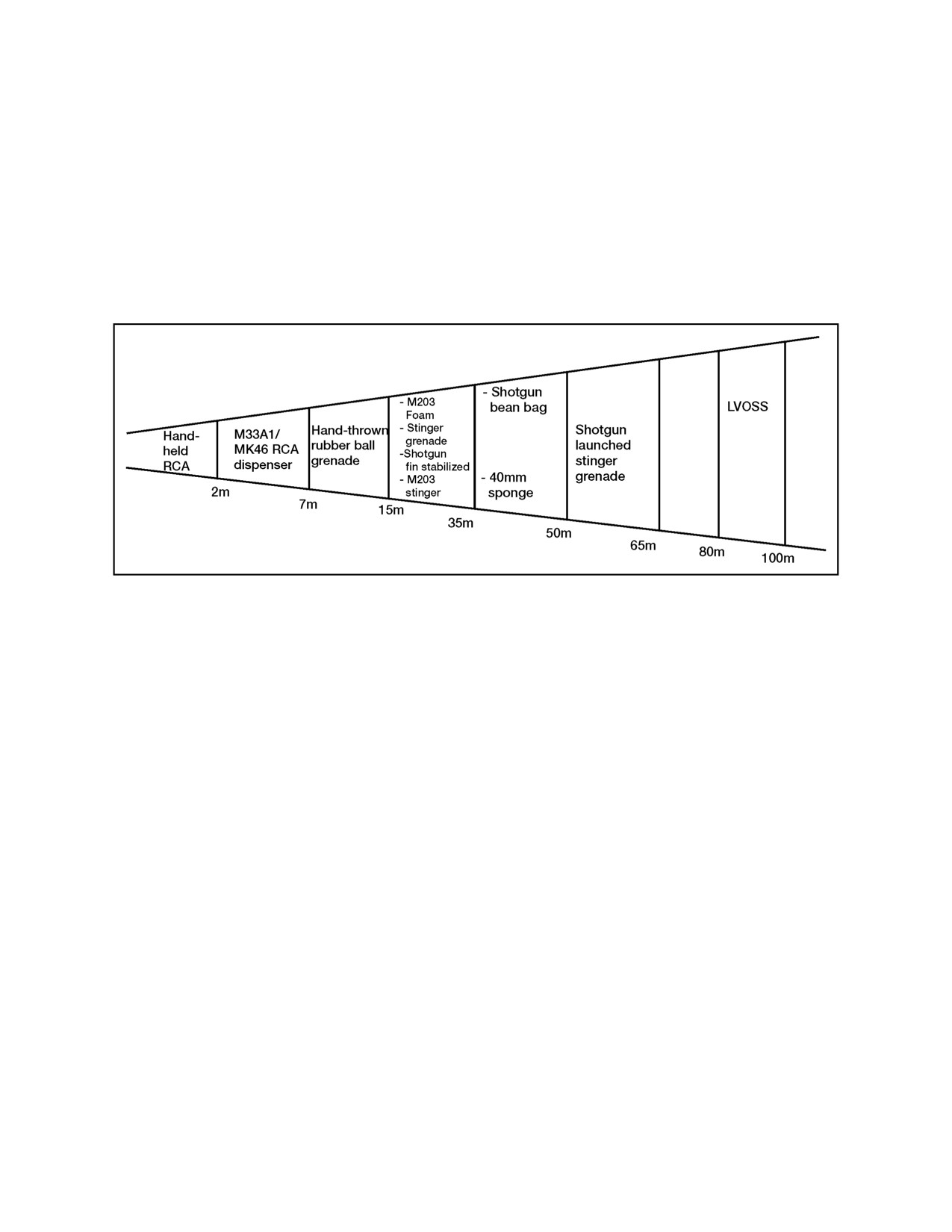
c. Many nonlethal munitions have both maximum effective and minimum safe ranges.
Individuals short of the minimum safe range may suffer severe injuries or death while the
effects of most nonlethal munitions are greatly decreased at longer ranges. To be effective,
an adversary must be engaged within the optimum range of the munition. Figure V-1
illustrates the ranges for a variety of nonlethal munitions and systems.
Figure V-1. Nonlethal Weapons Ranges
7. Rules of Engagement
a. U.S. forces follow directives issued by competent military authority that delineate
the circumstances and limitations under which deadly force will be initiated against other
forces. Intrinsic to the effective use of nonlethal options is the authorization to employ
them. ROE are the primary means by which the chain of command can provide guidance to
deployed forces in peacetime for handling crises and, in wartime, to help control the level of
hostilities.
b. The commander should distinguish ROE from tactical control measures, threat
conditions, and arming orders/weapons conditions. Although arming orders are sometimes
listed on the same quick reference card as ROE for easy reference, the commander should
distinguish ROE from other policies and directives developed, such as weapons confiscation
rules.
c. The commander should delegate the decision to use NLW against an adversary to
the lowest possible level, preferably to the platoon, flight, or squad level. However, this
requires that all personnel, not just leaders, have a clear understanding of ROE and his
intent.
d. Using lethal force, employed under the standing ROE, will never be denied. At no
time will forces be deployed without the ability to defend themselves against a lethal threat
nor will they forego normal training, arming, and equipping for combat. Nonlethal options
are a complement to, not a replacement for, lethal force and seek to expand a proactive
response across the range of military operations.
e. The following figures are examples of service-specific formations. These examples
are not all-inclusive, and the tactical situation will always dictate actual unit employment.
V-21
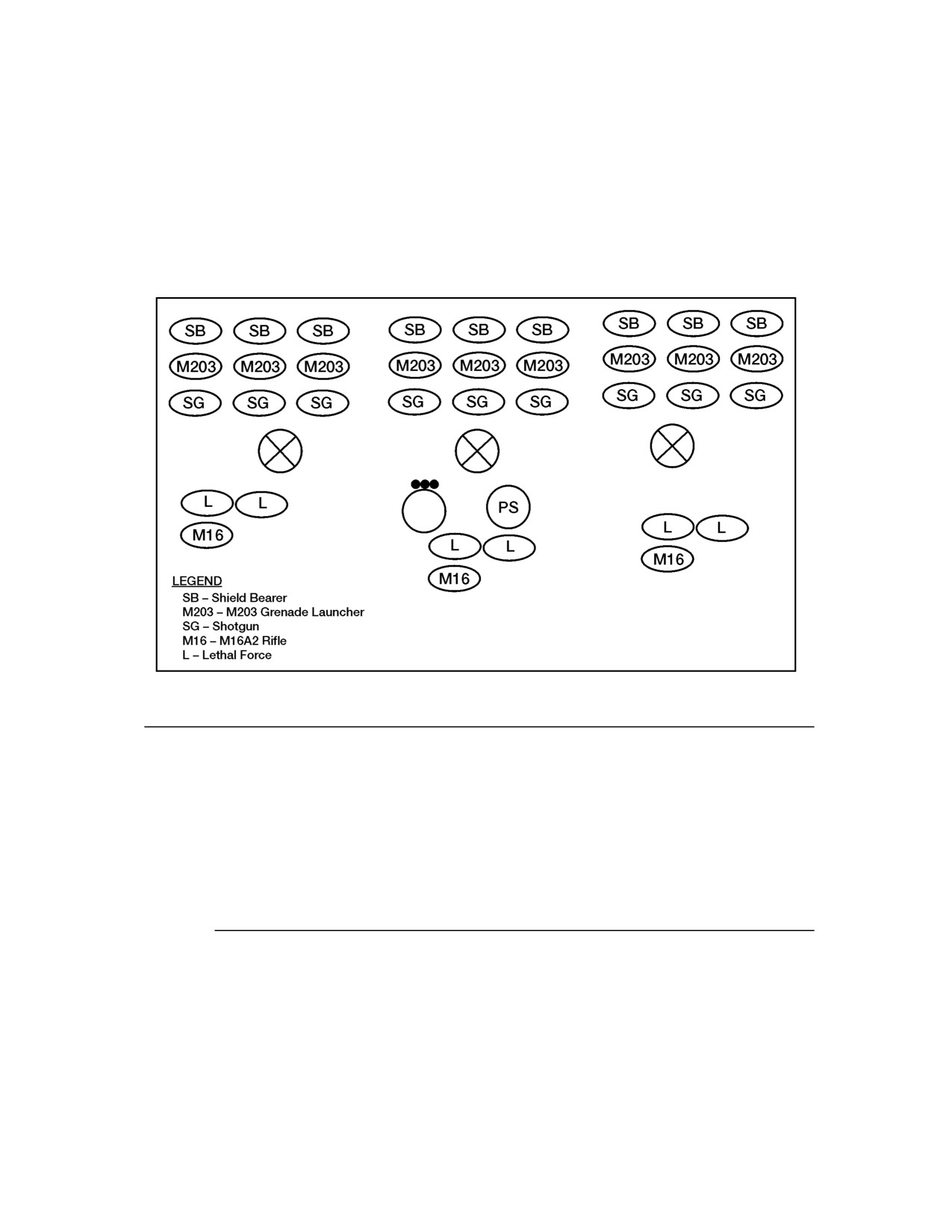
FM 19-15, Civil Disturbance; MCWP 3-11.1, Rifle Company; and MCWP 3-11.2, Marine
Rifle Squad provide extensive detail about small-unit formations, their use, and other
considerations. Figures V-2 to V-7 are from I and II Marine Expeditionary Force (MEF)
Special Operations Training Groups (SOTG) and represent a notional infantry platoon.
Figures V-8 to V-13 represent a notional U.S. Army infantry platoon. Figures V-14 to V-21
are additional platoon formations submitted by Marine Corps Security Force Training
Company.
Figure V-2. Platoon in Depth
NOTE: The platoon is the smallest unit capable of independent maneuver. The
platoon in depth formation shown above provides the following benefits:
• In-depth support with three ranks.
• Complementary support with the shotguns covering the slower reload
time for the M203.
• Additional personnel from each squad to form the recovery teams.
• Each squad is capable of moving as an independent formation forward
of the platoon line, if situation dictates.
• Other tactical formations are applicable—echelon, wedge, column.
V-22
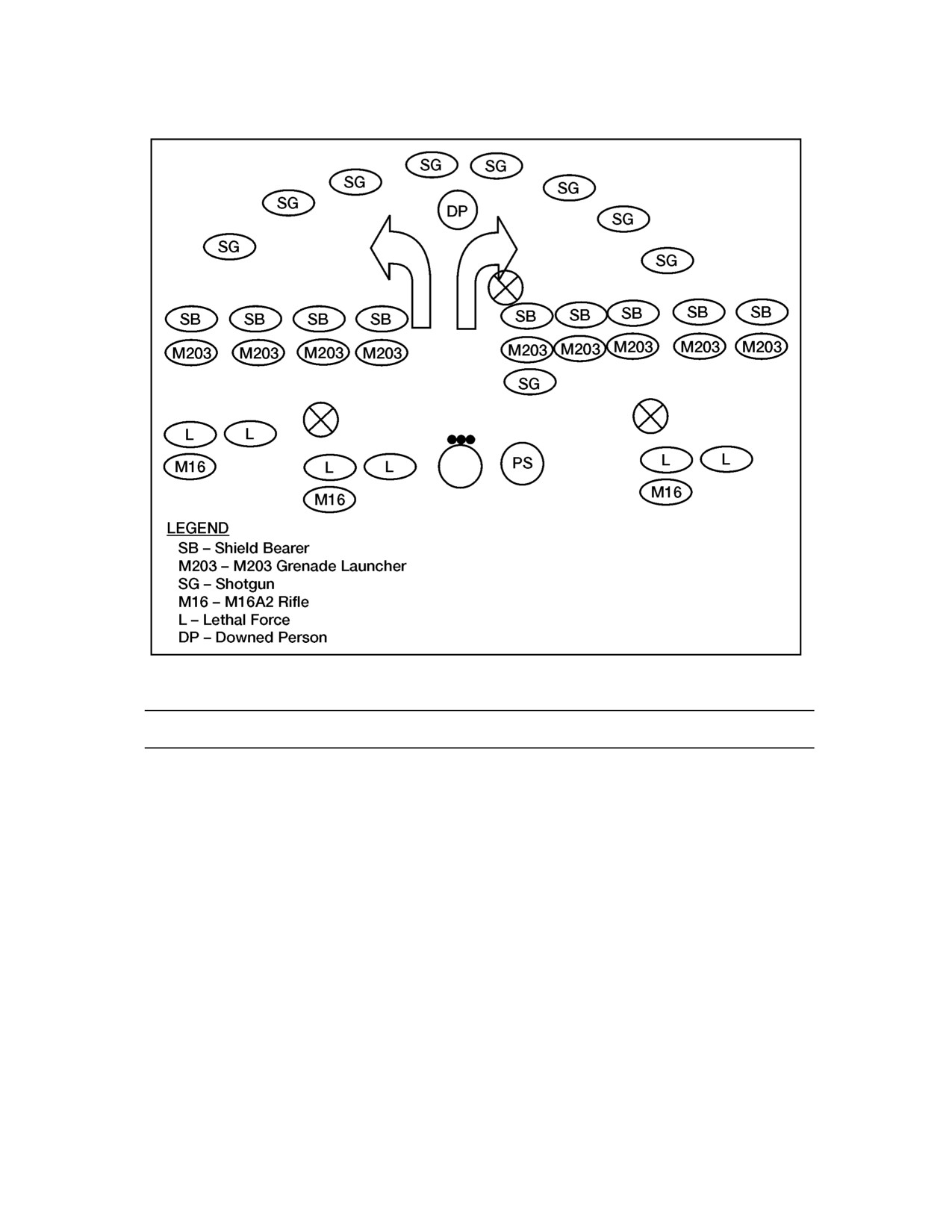
Figure V-3. Platoon Recovery Team Deployment—Security Element
NOTE: Security element deploys around downed person.
V-23
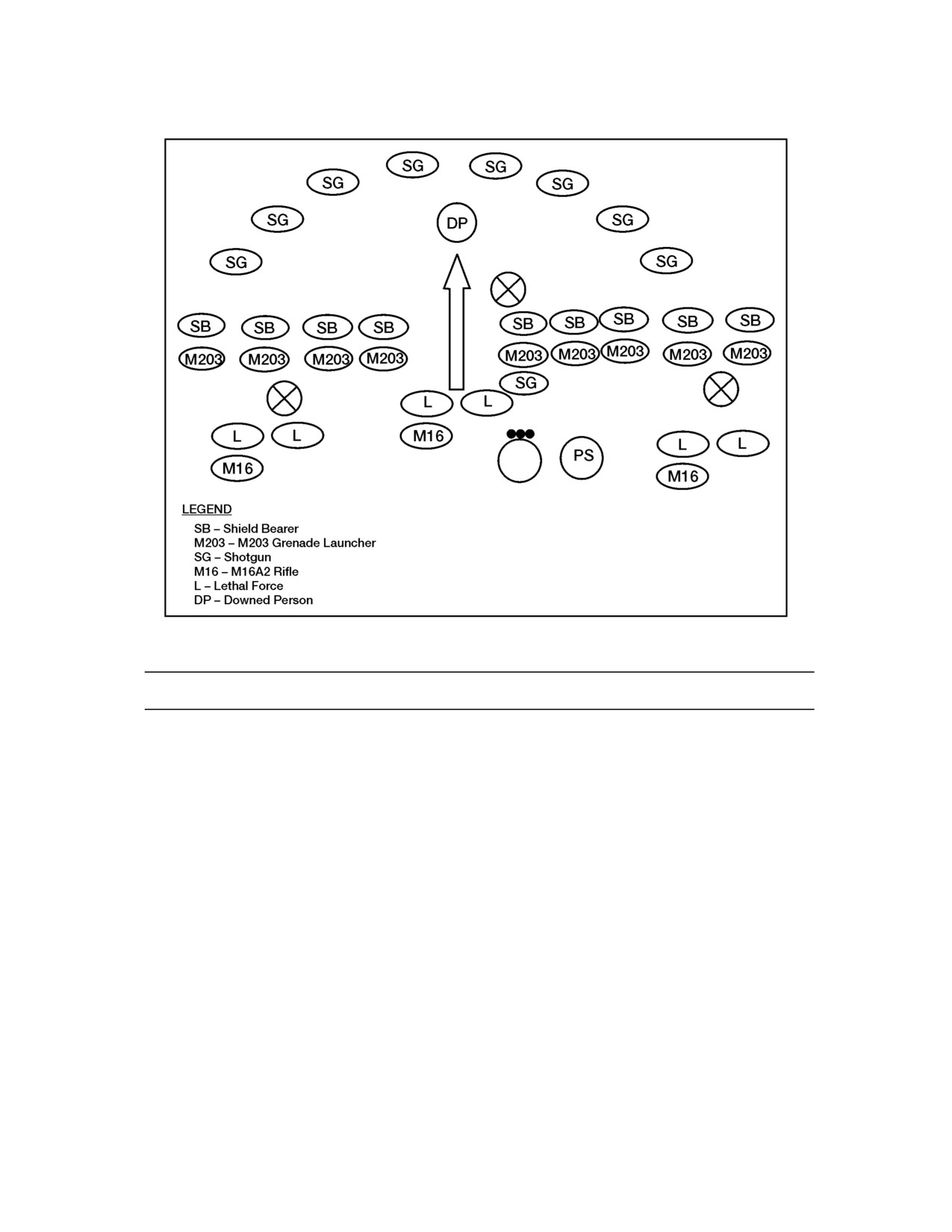
Figure V-4. Platoon Recovery Team Deployment—Recovery Team
NOTE: Recovery team deploys to detain, search, and recover downed person.
V-24
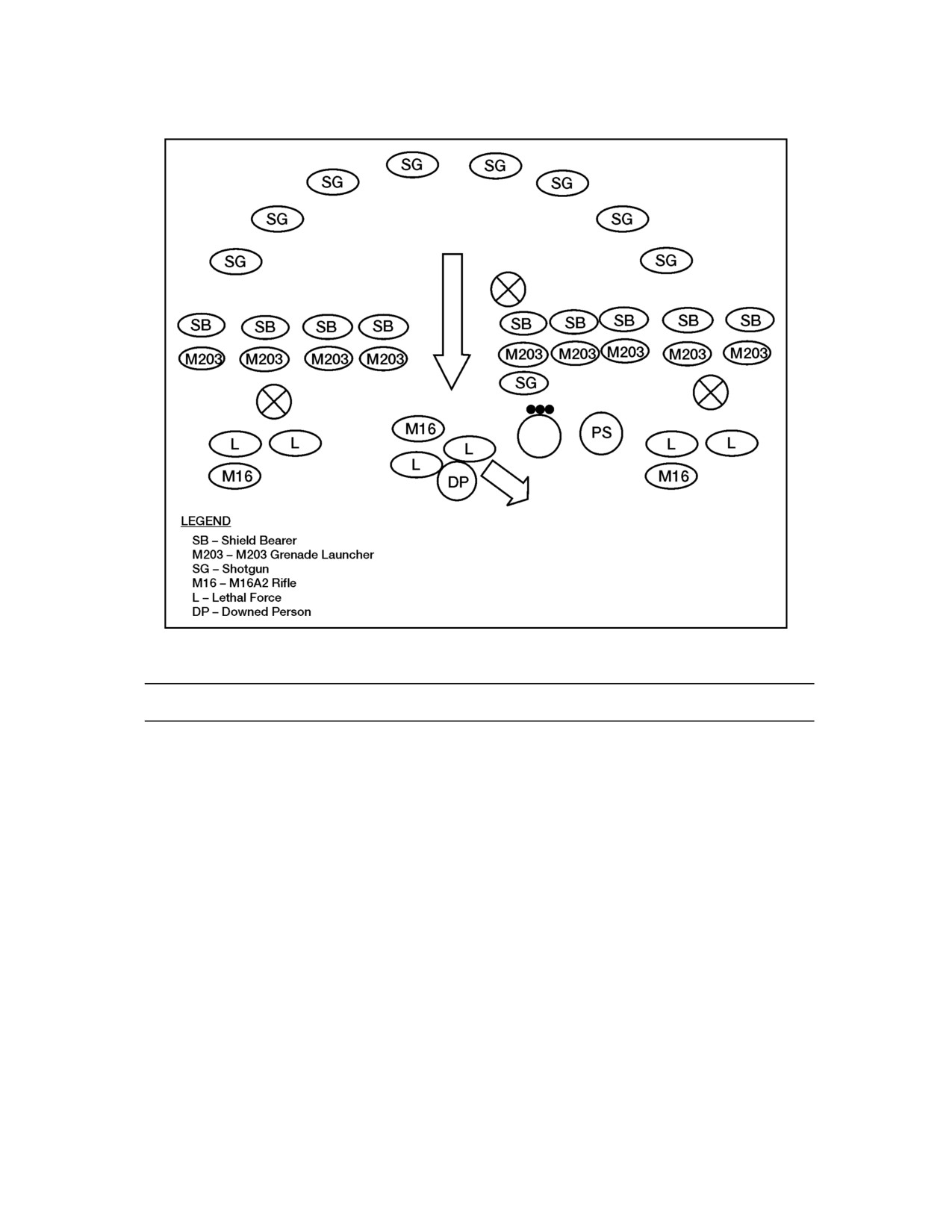
Figure V-5. Platoon Recovery Team Deployment—Recovery Team Redeploy
NOTE: Recovery team redeploys with detained person.
V-25
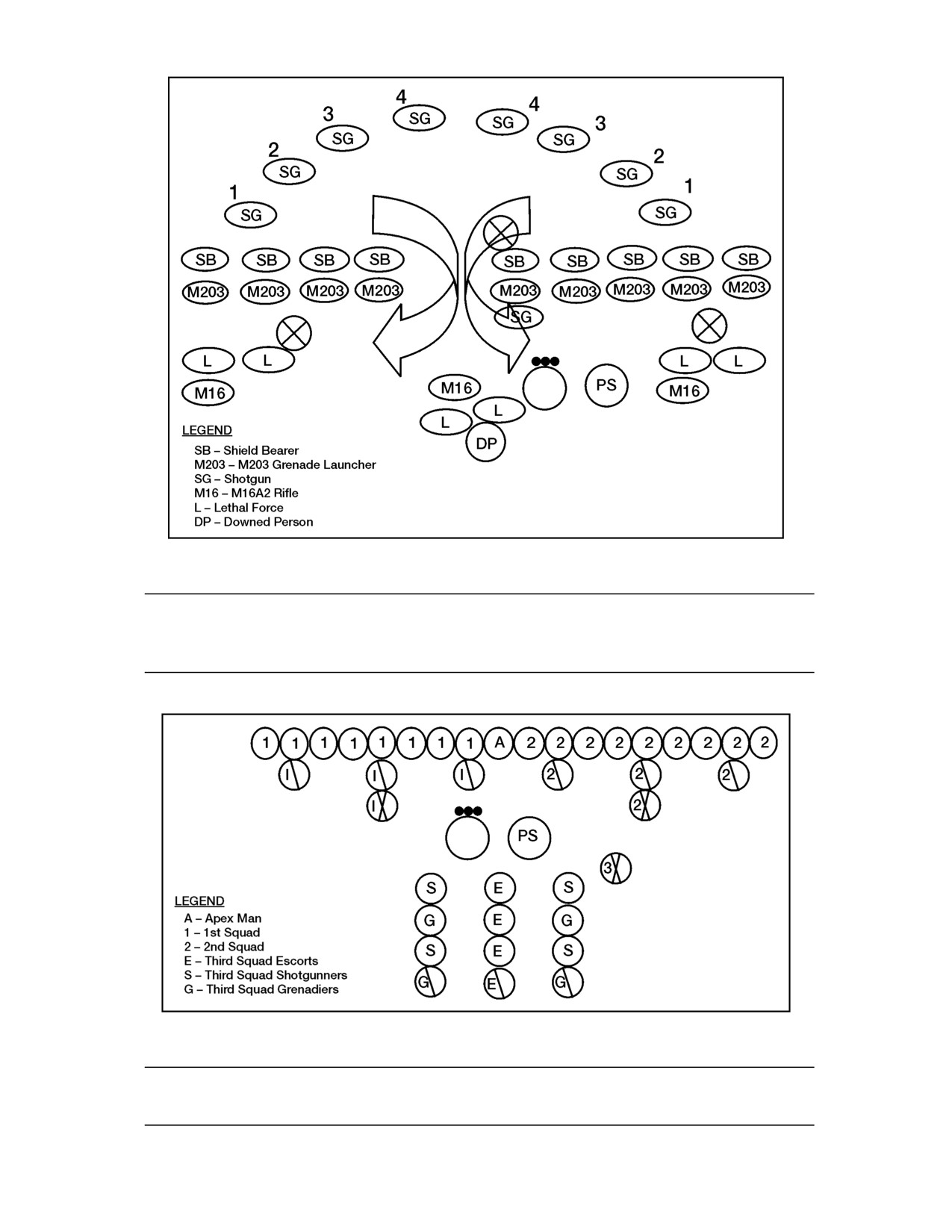
Figure V-6. Platoon Recovery Team Deployment—Security Element Redeploy
NOTE: Security element redeploys back to 3rd rank “by the numbers.” Team
leader calls “4s in,” then “3s in,” etc. The last person in calls “last man in”
and formation closes the gap.
Figure V-7. Platoon On Line—Munitions Squad in Close Support to Cover Flanks
NOTE: Platoon in close support. NLW and lethal weapons are sited to cover the
flanks of the formation, as well as support the front line.
V-26
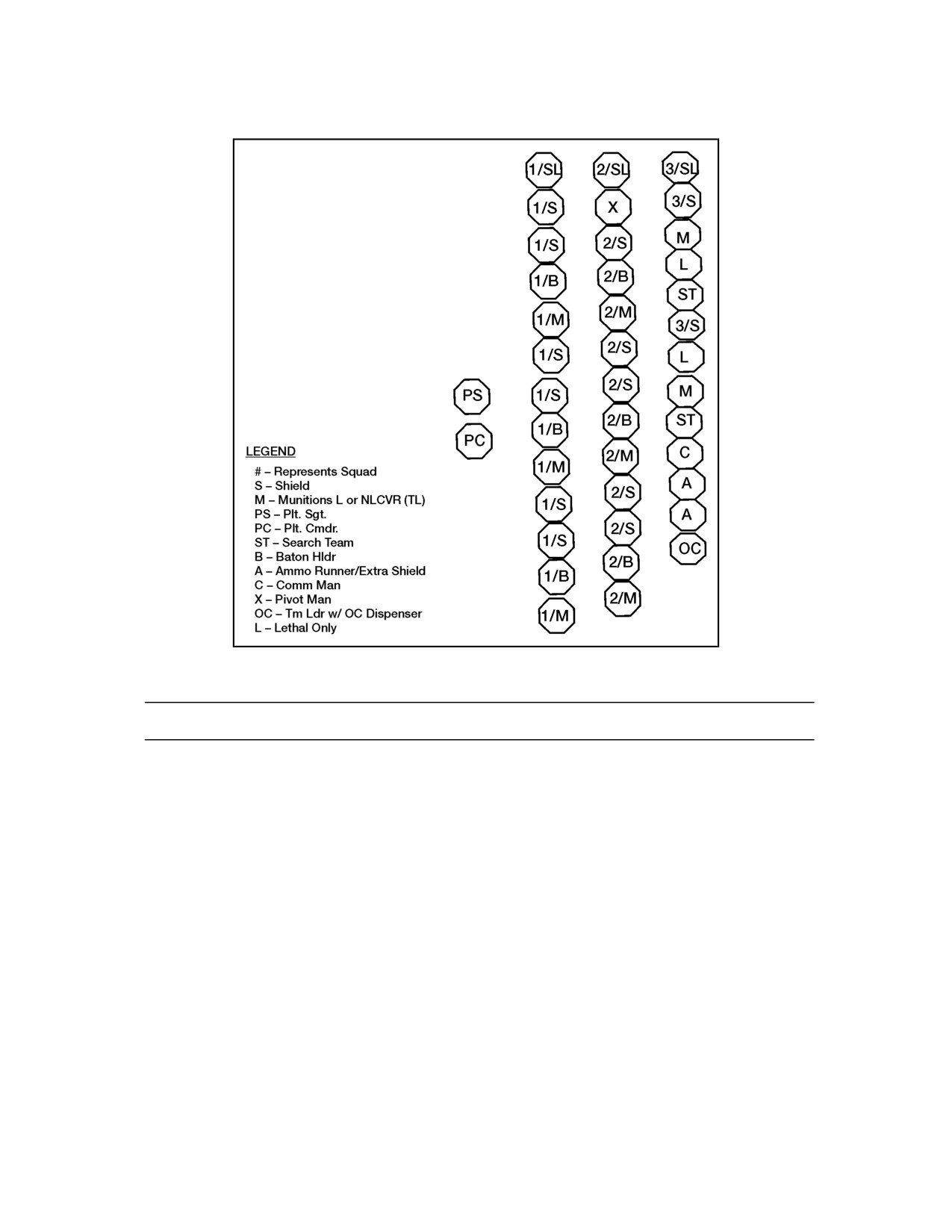
Figure V-8. Platoon Column
NOTE: Platoon in column formation. For administrative movement only.
V-27
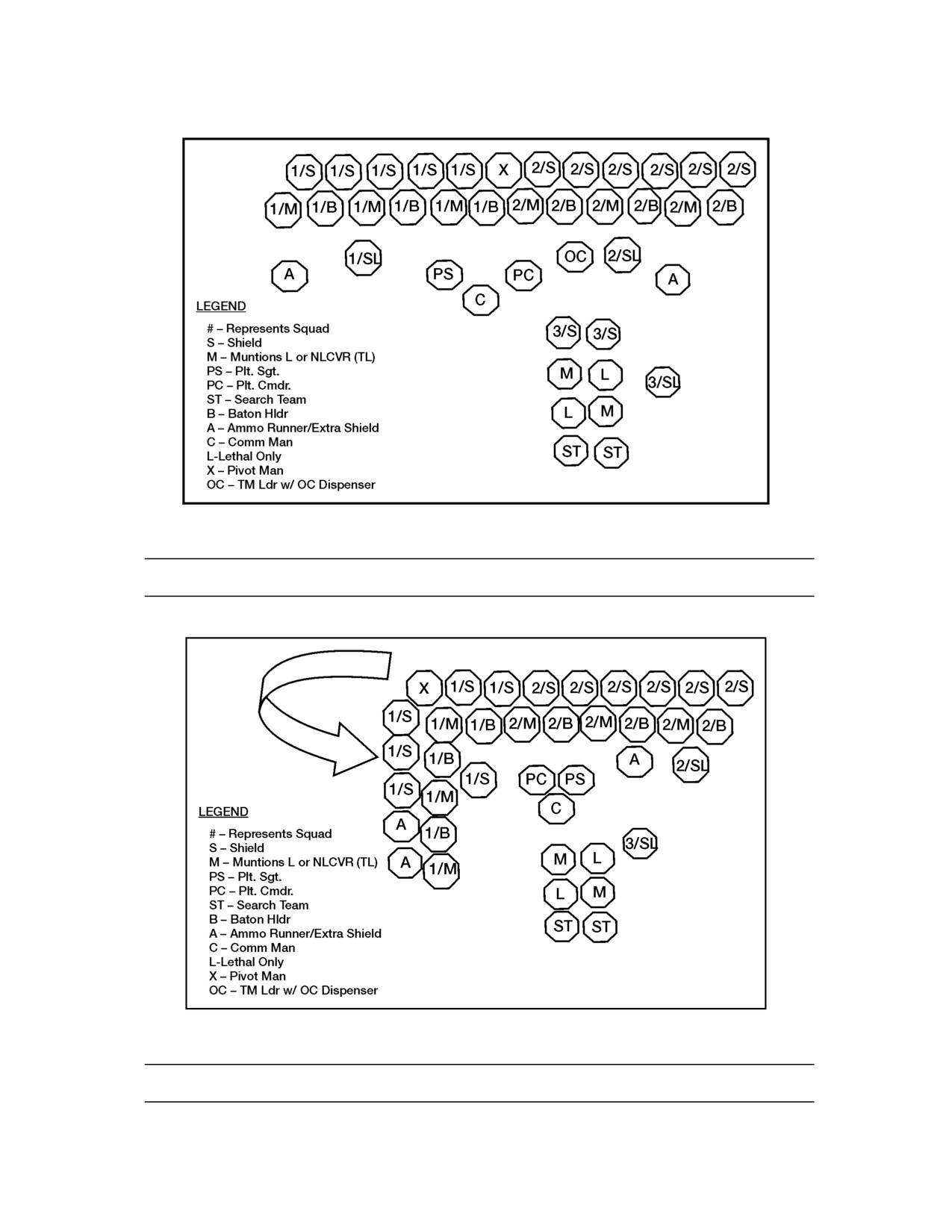
Figure V-9. Platoon On Line
NOTE: Platoon on line—basic formation for the employment of NLW.
Figure V-10. Platoon Lateral Support, Left (Right)
NOTE: Platoon in lateral support to protect flanks.
V-28
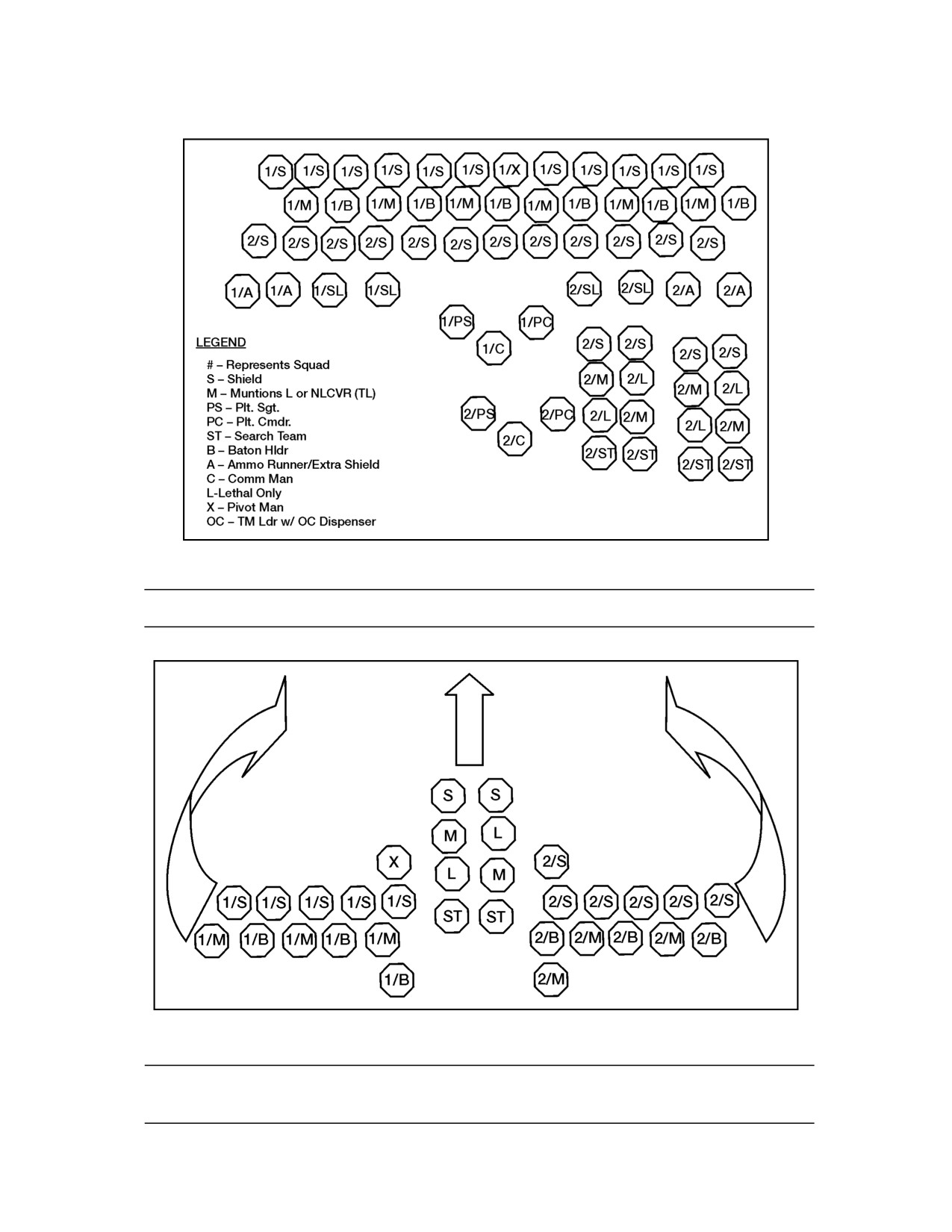
Figure V-11. Two Platoons in Close Support
NOTE: Two platoons in close support—tied in for mutual advantage.
Figure V-12. Recovery Team Deployment
NOTE: Recovery team deploys from formation—remainder of platoon can deploy
around the recovery team from either flank.
V-29
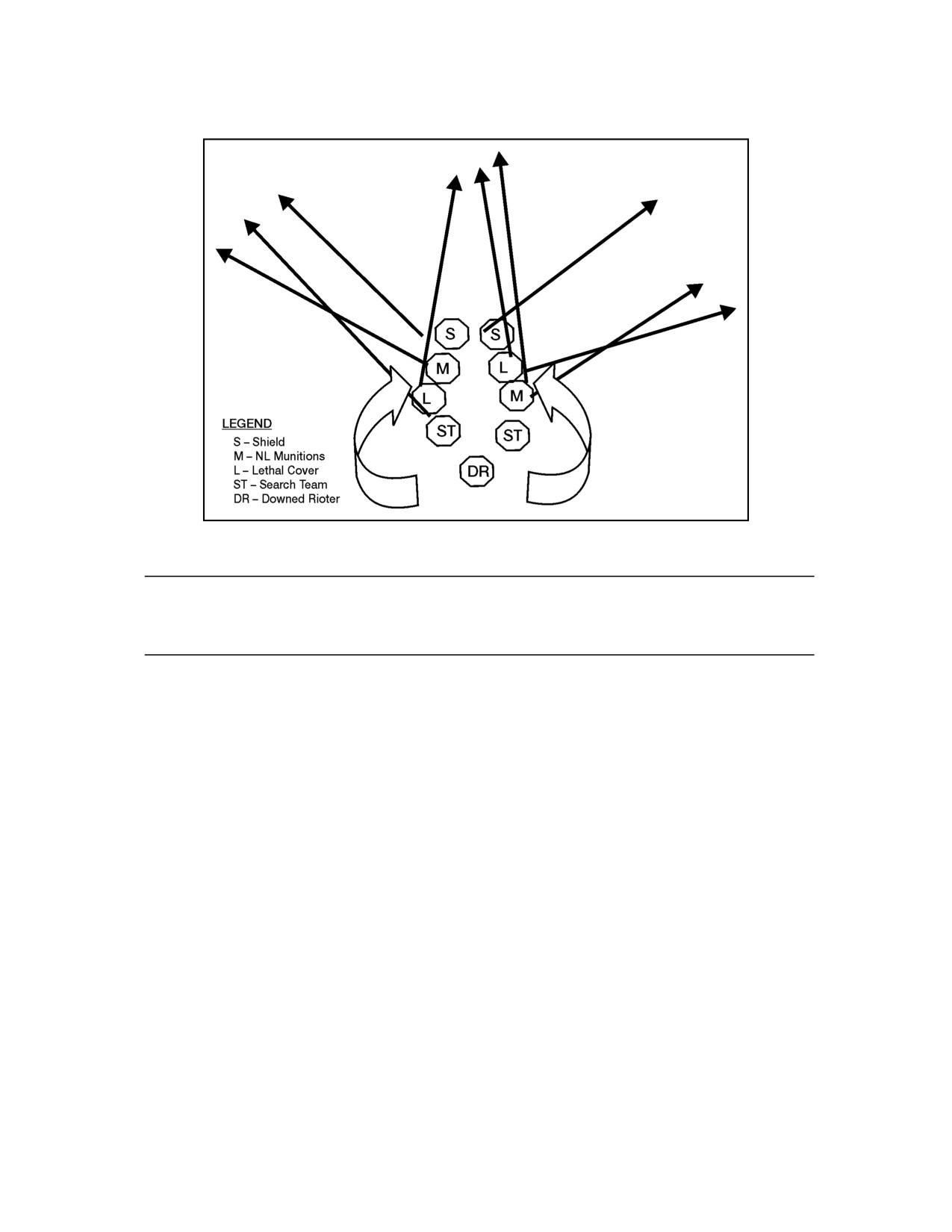
Figure V-13. Recovery Team Actions and Security Posture
NOTE: Recovery team forms security perimeter around downed rioter, conducts
search and detain actions. Once actions are complete, recovery team rede-
ploys.
V-30
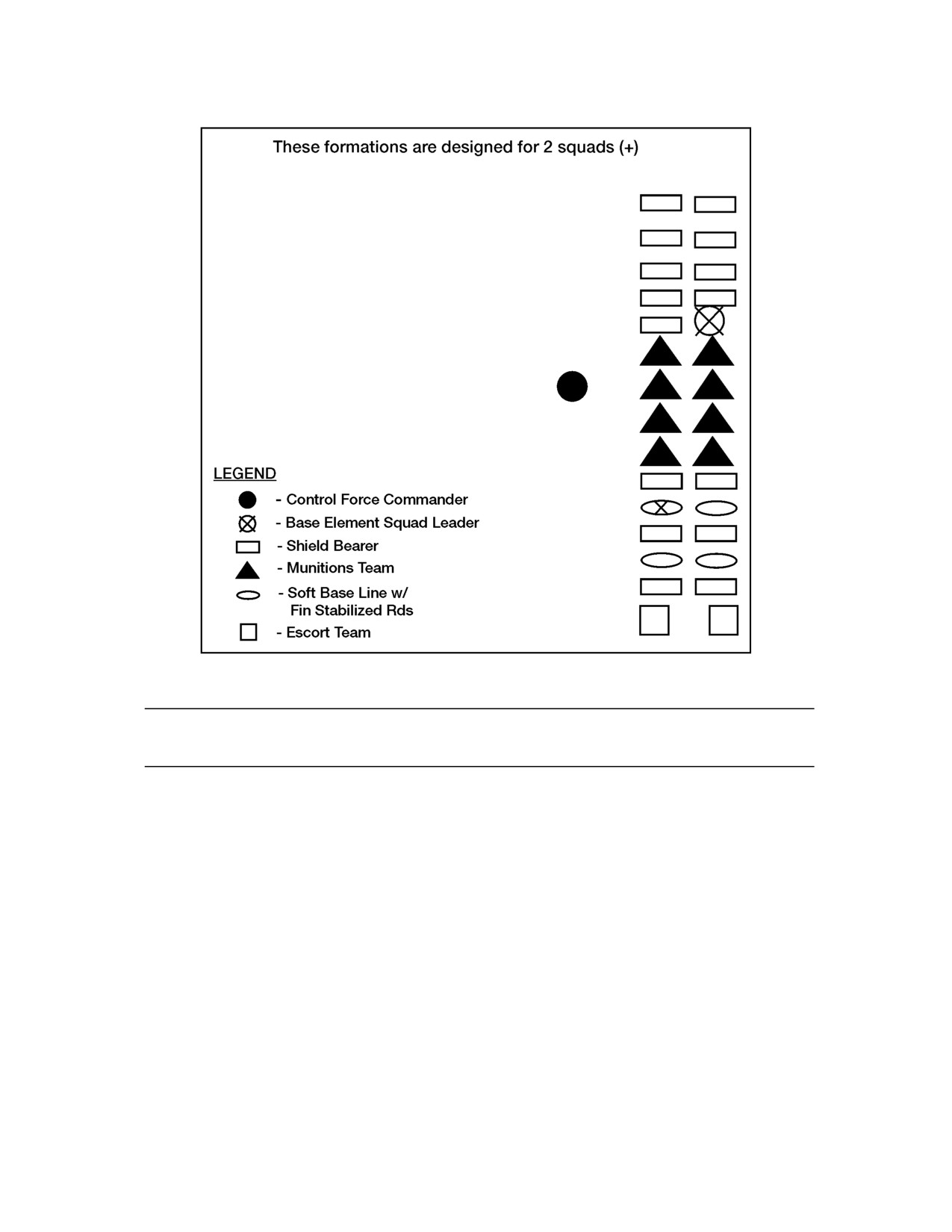
Figure V-14. Platoon in Column (USMC)
NOTE: These formations are designed for 2 squads (+). This allows the platoon to
move rapidly when there is no chance of being engaged with the crowd.
V-31
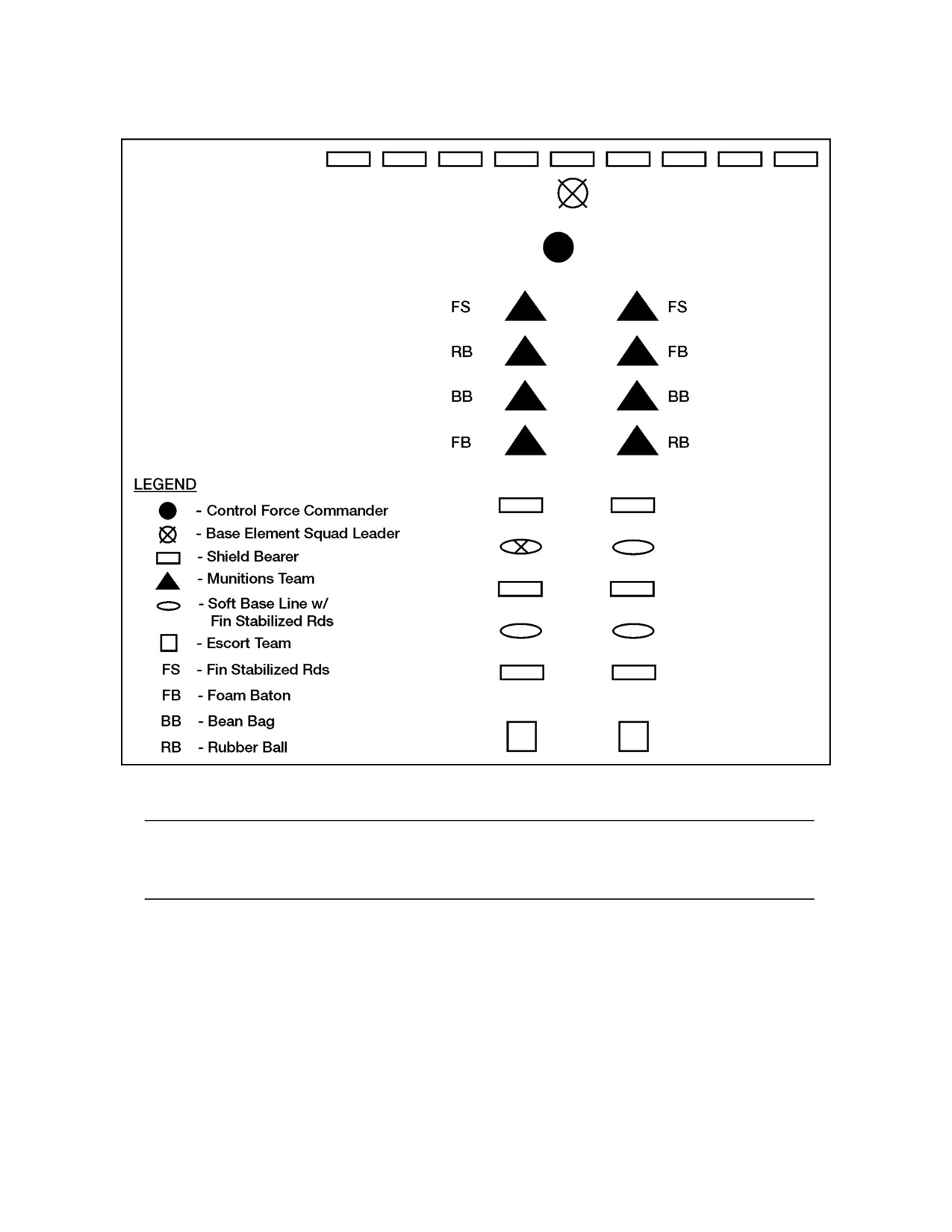
Figure V-15. Platoon in General Support (USMC)
NOTE: The control force commander moves into this formation approximately 60
to 70 meters from the crowd, as the crowd could start to engage the control
force with thrown objects.
V-32
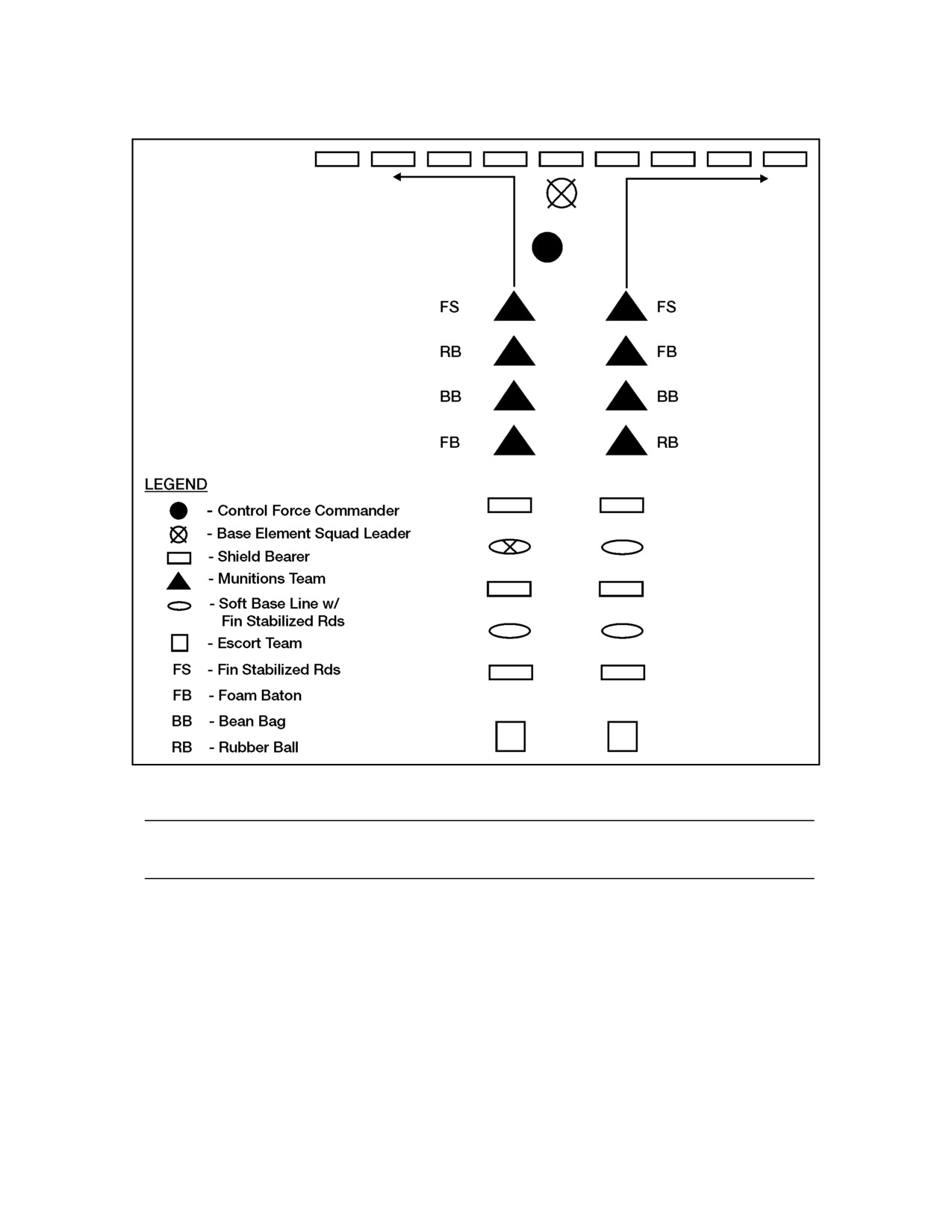
Figure V-16. Platoon in Close Support (Start) (USMC)
NOTE: The control force commander moves into this formation when he feels
ready to engage the crowd with nonlethal munitions.
V-33
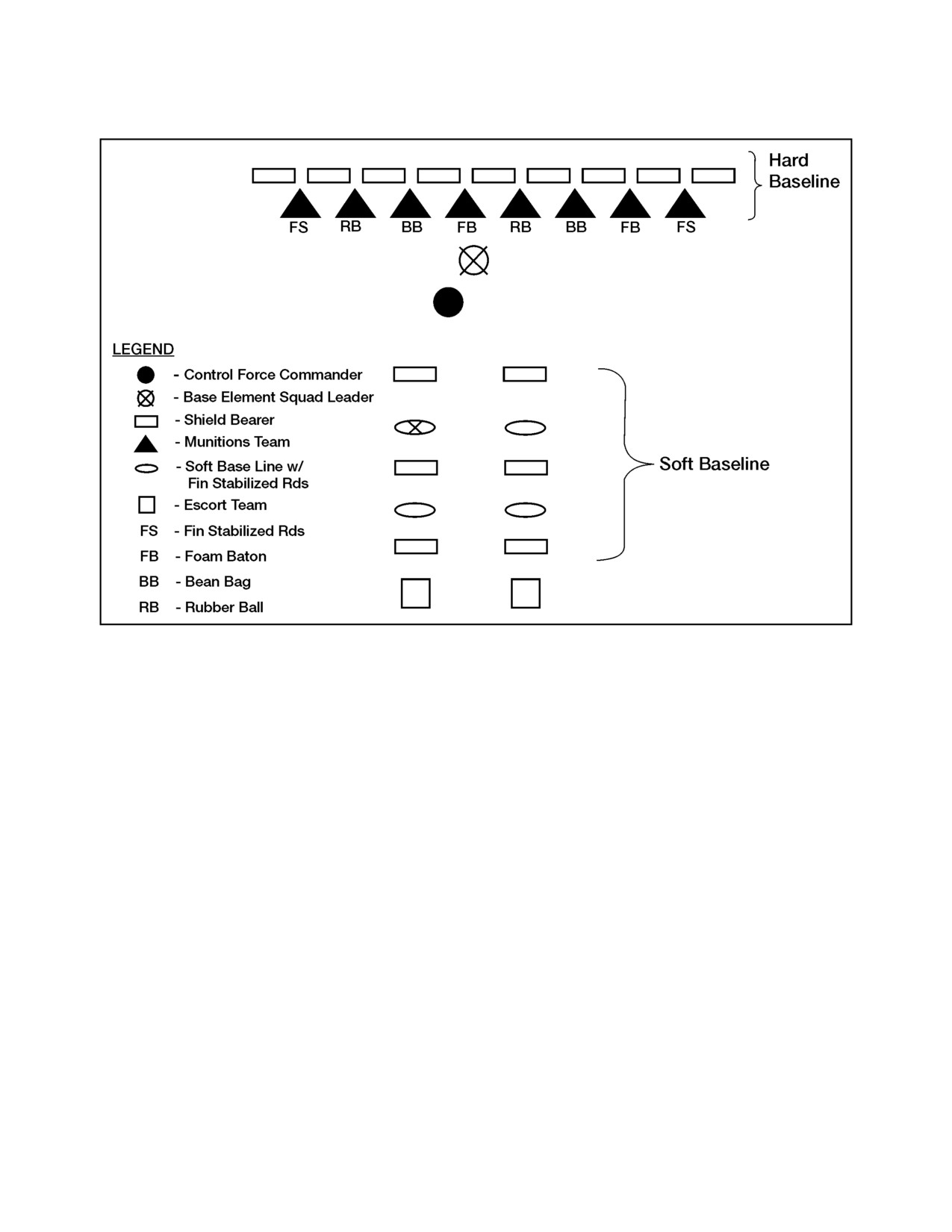
Figure V-17. Platoon in Close Support (Finish)
V-34
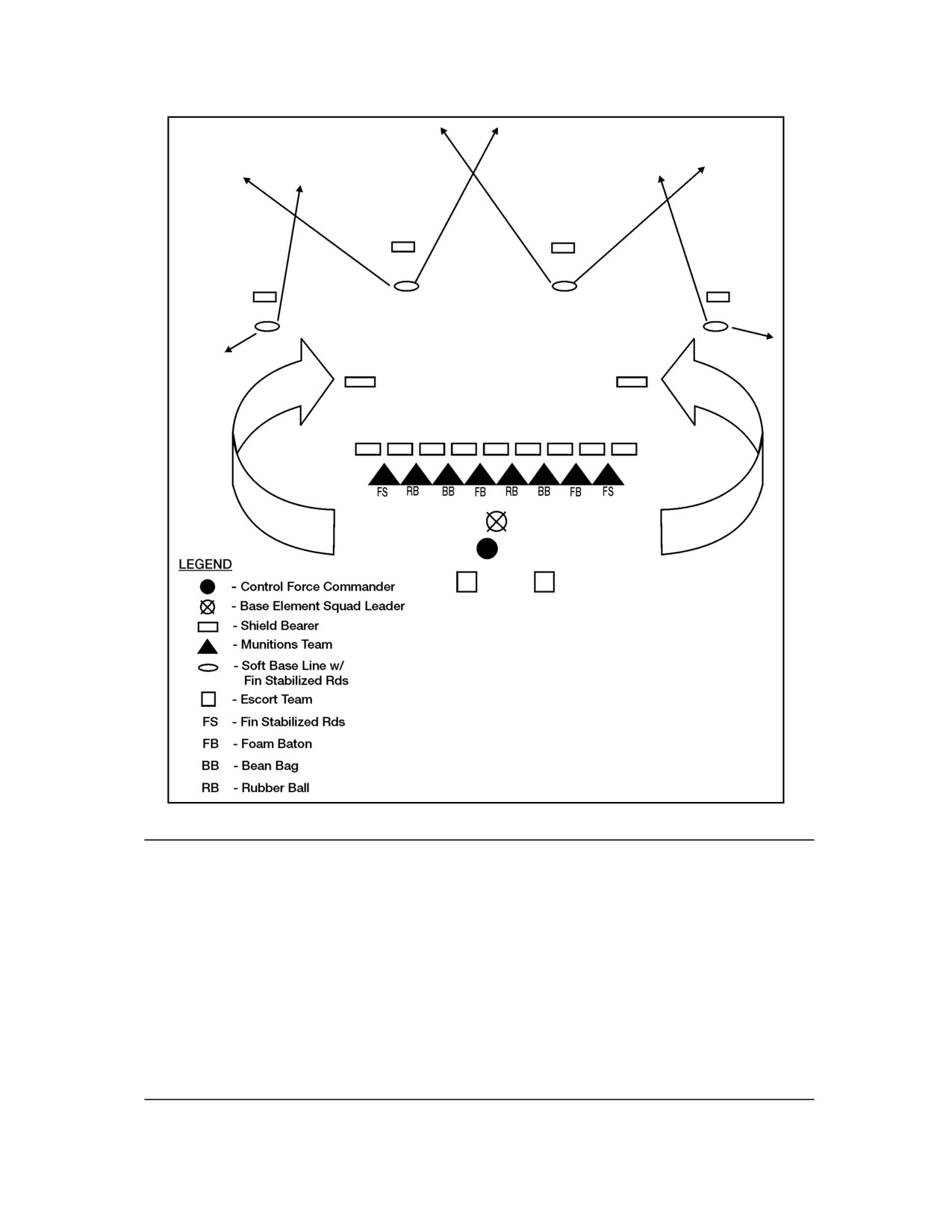
Figure V-18. Deploying Soft Baseline
NOTE: The soft baseline affords the control force commander much flexibility. The
primary mission of this formation is to disperse the crowd back using speed
and extreme violence of action. By deploying the soft baseline, the com-
mander is able to maneuver the hard baseline where needed (around the
barrier plan or obstacles.) The soft baseline is deployed by a predetermined
signal (bullhorn siren, whistle blasts, vehicle horn) and will be retrieved us-
ing the same signal. This signal conditions the crowd to expect violence of
action and causes them to disperse. The soft baseline should never be de-
ployed into a fresh crowd; the crowd needs to be distracted by nonlethal mu-
nitions. The formula found to work is distract with stingball grenades, fol-
lowed by a volley of shotguns and M203 munitions, then send the soft base-
line out to disperse or move the crowd back. (Sting them, shoot them, soften
them up.)
V-35
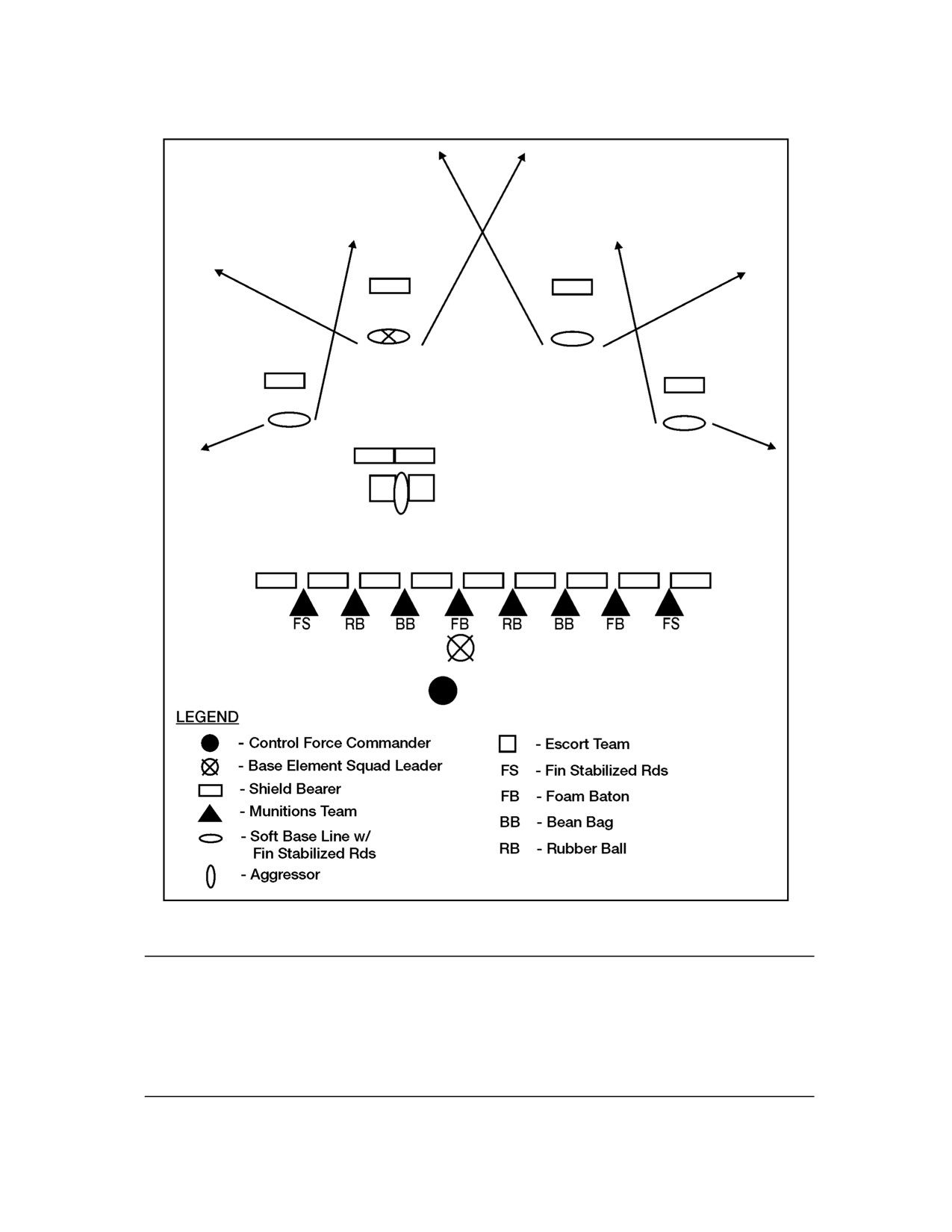
Figure V-19. Deploying Escort Team (Start)
NOTE: When the control force commander identifies the aggressor to retrieve, the
command is, “Escort team left/right,” then the signal. The signal is the
same to deploy the soft baseline. As the soft baseline deploys, the two
shields without gunners provide protection for the escort team. The
shields remain with the escort team until the soft baseline is called back
in, at which time the shields go back to the soft baseline.
V-36
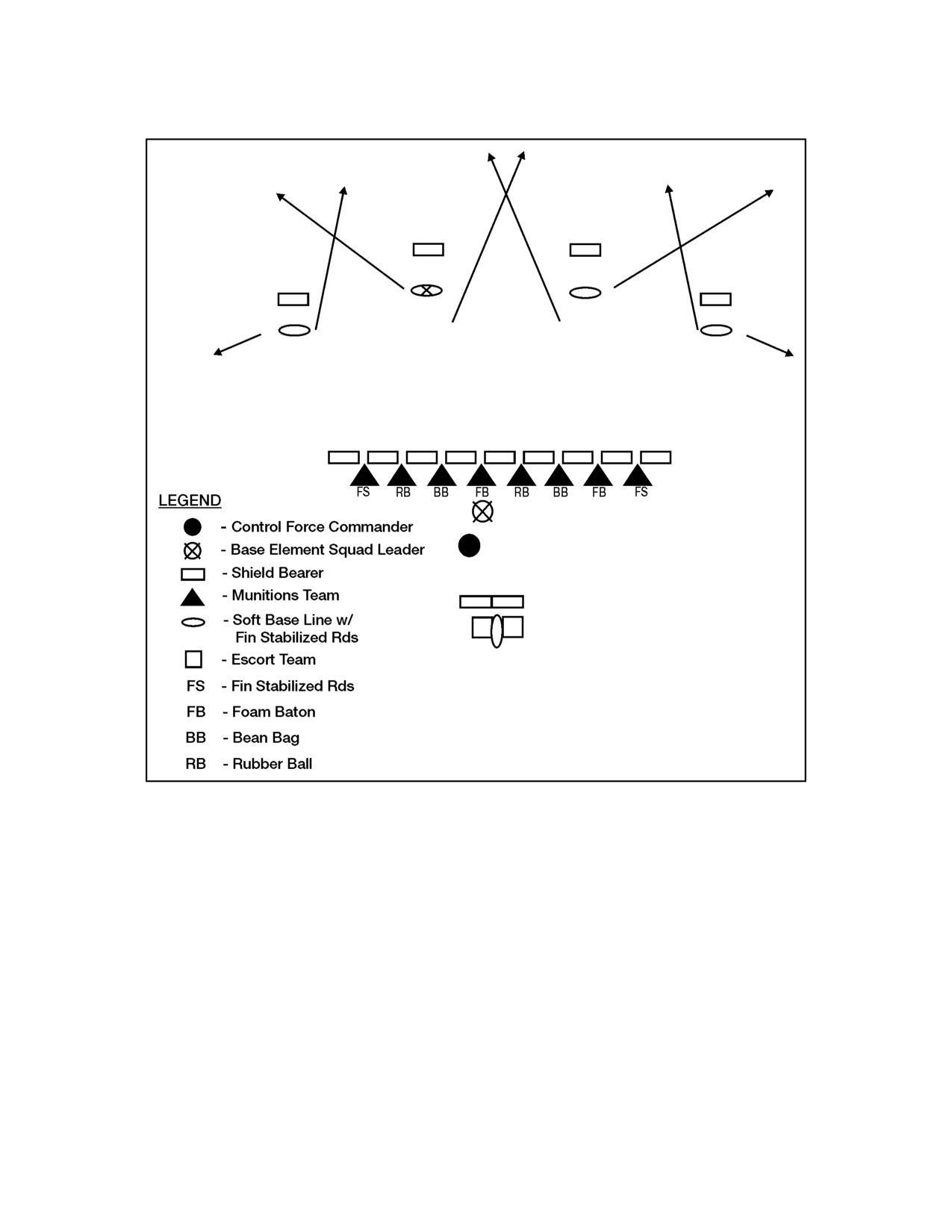
Figure V-20. Deploying Escort Team (Finish)
V-37
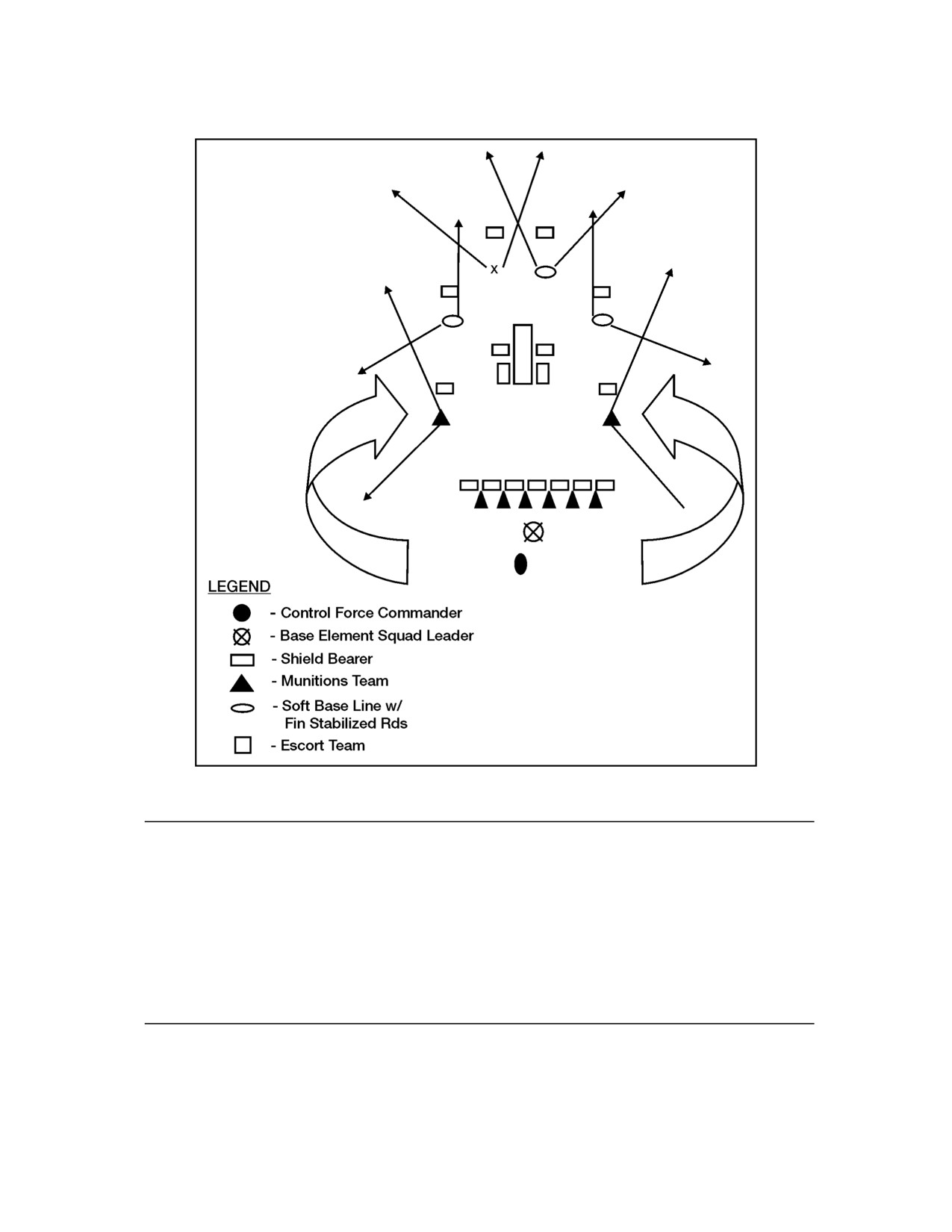
Figure V-21. Recovery of Downed Personnel or Stranded Vehicle (Big Johnson)
NOTE: In the event the crowd attacks personnel or a vehicle, the control force
commander can call for a “Big Johnson.” In a Big Johnson, the soft base-
line deploys as usual except now the shield and shotgunners on the flank
of the hard baseline also deploy creating a 190-degree perimeter around
the personnel or vehicle. This maneuver must be executed quickly and
with extreme violence of action because the crowd already has its hands on
individuals in the force. The escort team deploys with the Big Johnson in
order to escort or carry injured individuals. The shields without gunners
provide protection for the escort team.
V-38
Chapter VI
LESSONS LEARNED
1. Background
Although lessons learned from employing NLW are still being studied and impacts ana-
lyzed, it is beneficial to look at the preliminary lessons gained from the NLW experience.
These lessons are far from conclusive, because U.S. forces have yet to see the first large-
scale employment of NLW. However, U.S. forces can gain tremendous insight from the ex-
perience of others and use what has been learned to guide future NLW employment.
2. Lessons Learned
a. Force Continuum. Using nonlethal options needs to be based on the principle of a
graduated and proportional response, using the decisive force necessary to respond to the
threat.
b. Attempts to legislate and regulate every aspect of NLW employment can prove
disadvantageous to the on-scene commander. During the evacuation of U.N. forces in
Somalia (OPERATION UNITED SHIELD, 1995), the ROE made an arbitrary and
unnecessary distinction between situations justifying deadly force and those that justified
only lesser means. Crowd control items were restricted to situations requiring deadly force.
Many soldiers, airmen, and Marines asked, “why resort to nonlethal means at all if I have
to wait until deadly force is authorized before I can shoot them with a beanbag?”
Additionally, the use of sticky foam was limited to deadly force situations because of the
perception that adversaries might suffocate from its application. This stipulation
effectively eliminated sticky foam as a nonlethal option to the forces in Somalia.
c. With ROE that take into account the force continuum and encourage graduated
response to nonlethal threats, the commander can employ NLW to enhance his flexibility,
deterrence ability, and reaction to uncertain situations. To accomplish the mission with
minimum loss of life and property, commanders need to have ROE that do not restrict them
from properly employing NLW.
VI-1
Lessons Learned from OPERATION JOINT GUARDIAN 1999 (Battalion Landing Team (BLT)
3/8 26 Marine Expeditionary Unit (MEU) Peace Operations in Kosovo:
ROE significantly impaired the employment of NLW. For example, OC was not authorized be-
cause it was considered a chemical agent. Nonlethal direct fire munitions were not authorized
during the initial occupation of the province. This significantly hampered the individual Marine’s
ability to neutralize a threat where deadly force would not have been justified but action was re-
quired. Overly restrictive ROE thus negated the flexibility of response that NLW are supposed to
provide. The intent of deploying NLW is to provide the operator the capability and flexibility to
neutralize a threat without having to apply deadly force. Thus, the ROE for NLW should ideally
be less restrictive, not the same or more restrictive, than those for lethal force.
It is often enticing for authors of ROE involving the use of NLW to base those ROE on the princi-
ple of minimum force necessary. This may be appropriate for base and station or homeland se-
curity ROE; however, for expeditionary operations the decision to mandate minimum force de-
serves critical consideration. Commanders in military operations have traditionally gained advan-
tage over their enemy not only by the actual combat power that they bring to the fight, but also
from that enemy’s perceptions and beliefs about the intensity and resolve with which that combat
power will be applied. When ROE are written stating that the confrontations will be addressed us-
ing the minimum force necessary, this advantage is lost. ROE developed for expeditionary
nonlethal operations should be based on the concept of decisive and compelling force, rather
than the minimum force. This will maintain an adversary’s hesitancy to harass and endanger
U.S. forces even after that adversary has tested or probed the response of those U.S. forces.
Further, this will allow synergy to be gained through the complimentary employment of lethal and
NLW by providing more response options to the small unit leader.
3.
Employment
a. Through the use of modeling, simulation, and field exercises, new concepts for
employing NLW are continually being developed. The force should train with NLW to the
same degree as for lethal weapons. In this way, units become confident when using
nonlethal options in chaotic and uncertain situations. The commander should push the
decision to employ NLW to the lowest possible tactical level. Commanders who intend to
use NLW in achieving military objectives must recognize the fluidity of the situations in
which they are likely to be employed. The decisionmaking cycle is short, stressful, and the
level of violence can move in both directions along the force continuum. In quick
succession, a small unit leader might employ nonlethal munitions, decide to employ deadly
force to an immediate specific threat that arises, then return to using nonlethal means in
response to unarmed hostile elements.
b. A mixture of nonlethal “tools” has been determined to be advantageous in an
operational scenario. As the situation develops, commanders can apply different nonlethal
responses with respect to range/distance capability and severity of effect. For example, to
disperse a crowd, area fire weapons would precede use of close-in point target nonlethal
munitions.
c. An important point to remember is that NLW are just one element of a graduated
response available to the force commander. Other factors make up a large contribution to
the success of U.S. forces, including barrier plans and PSYOP. An example of this
operation would be using barriers such as roadblocks or concertina wire, warning
commands to inform a mob of potential responses based on their actions, and only then
taking actions through escalated employment of NLW. These continued responses would
involve smoke, RCA, and blunt munitions. A specific verbal warning should precede every
escalation of nonlethal means.
VI-2
d. Whenever NLW are employed, a separate lethal capability must always be in place.
Troops must always be prepared to protect themselves as required by lethal means, because
it is impossible to accurately predict the response of an individual or mob to NLW
employment.
Lessons Learned from OPERATION ESSENTIAL HARVEST 2001 (U.S. Embassy Rein-
forcement operations conducted at the U.S. Embassy Skopje Macedonia by 5th Platoon, 2nd
Fleet Antiterrorism Security Team [FAST] USMC):
The anticipated threats were violent demonstrations directed against U.S. facilities in the AO. In
this case, USMC forces tasked to reinforce the embassy were equipped with a compliment of
NLW. ROE took into account the capabilities and limitations of the NLW. The ROE and the NLW
systems on the ground were coordinated and thus compatible. In addition, it was found that inte-
grated employment of different nonlethal munitions greatly enhanced that force’s ability to sup-
press the threats encountered (large rioting mobs). Random security patrols reinforced with mili-
tary working dogs proved very effective. Reinforcement with multiple M203s provided USMC
units with both a lethal and nonlethal capability in the same weapons system. The M203 was
particularly useful as it gave the individual Marine the means to quickly transition between a lethal
(5.56-mm) and nonlethal (40-mm nonlethal) capability. A basic understanding of the capabilities
and limitations of nonlethal munitions enabled a relatively small force (40-50 Marines) to counter
a sizable threat many times its size (500-1000 rioters). Although NLW were not used, the
capability and preparation of the units provided the adequate deterrence that prevented the
situation form escalating.
4. Publicity and Media
a. The commander can use the media to his advantage, as they will inform the local
population of the military’s capabilities and responses available. During OPERATION
UNITED SHIELD in Somalia, the local media was informed of the Marines’ nonlethal
options and “new technologies” in order to discourage hostile actions. The media was
encouraged to report this to the population. Intelligence had indicated the Somalis were
planning to mix civilians with armed clansmen, creating hostile mobs. In fact, feuding
warlords had previously successfully demonstrated this strategy on several occasions. Lack
of deadly mob incidents implies Somalis were not anxious to test this new technology.
Evidently, publicity had directly contributed to mission accomplishment.
b. The public dissemination of the presence of NLW capabilities must strike a balance
between information sufficient to discourage hostile actions and information that enables
the local population to learn too much of the capabilities of NLW. Too much information
allows adversaries to develop countermeasures or avoid the NLW effects. Commanders
who employ NLW systems must involve the PAO from the beginning of planning. The PAO
must be familiar with the objectives of the mission, commander’s intent, ROE, NLW and
lethal weapons employed, and be prepared to advise the commander on the best methods of
dealing with outside media. The commander should fully integrate the PA plan with
PSYOP objectives and the concept of operations. Additionally, he must work the media to
ensure the “sensationalism” of such a new technology does not create unrealistic
expectations where he can be unfairly judged or constrained.
5. Capabilities and Impact on Mission Accomplishment
a. The commander should understand the unique capabilities of NLW and use them to
accomplish the mission. He should use NLW in conjunction with the planned employment
of the force and within established ROE to minimize loss of life and property while
accomplishing the mission. The force requires early hands-on training to recognize the
VI-3
capabilities and limitations of NLW. Appendix D has sample training plans developed to
meet these objectives.
b. The force commander must fully integrate planning for using nonlethal capabilities
as quickly as possible in the staff planning cycle. In order to have a full range of
alternatives for use against unarmed but hostile elements, the force needs to deliver
nonlethal systems, complete necessary ROE and legal review, and make sufficient
quantities of each NLW readily accessible to the force. The choice of nonlethal capabilities
should be based on several factors and the choice can be made after addressing these
questions:
(1) First, are the NLW systems available and can they be delivered on time?
(2) Second, are they compatible with, and do they complement existing weapons
and training?
(3) Third, are there clear and unambiguous guidelines and ROE for employment?
(4) Finally, can the NLW be effectively employed to save lives and contribute to
mission accomplishment?
c. Leaders need to anticipate local civilians developing effective countermeasures to
their NLW and tactics. Therefore, prior to beginning their mission, leaders must determine
and rehearse actions to take when nonlethal munitions are effectively countered.
d. Using nonlethal and lethal force are not mutually exclusive. In many instances, the
commander can gain synergistic effects by using a combination of both. The following are
some examples of this:
(1) Utilizing NLW to separate agitators from noncombatants with simultaneous
employment of lethal force against hostiles or combatants where deadly force is justified.
(2) Utilizing NLW when making entry into structures or rooms to gain time in
order to discern temper and intent of occupants prior to applying deadly force.
6. Knowing Your Adversary
a. Although commanders desire thorough intelligence of any potential adversary, such
a goal may be difficult to reach in a NLW employment environment. During OPERATION
UNITED SHIELD in Somalia and OPERATION UPHOLD DEMOCRACY (1995) in Haiti, a
study of the local population’s culture, history, and customs enabled commanders to
anticipate and control many situations before they got out of hand. On the other hand,
during OPERATION UPHOLD DEMOCRACY, poor intelligence and a lack of
understanding between the two cultures led to the Haitians and Cubans being lodged
together in Guantanamo Bay. This situation led to riots between factions who had a deep
dislike for each other. By understanding a particular crowd’s motivation, friendly forces
may be better able to take necessary steps to prevent escalation resulting in the use of
deadly force. Early training in crowd dynamics and riot control will enhance the effective
use of NLW.
VI-4
Lessons Learned from U.S. Peace Operations, 739th MP Battalion (Bn), January 2001
An Army MP platoon received a mission to clear a rioting crowd of 300 civilian locals from a main
supply route. The platoon placed vehicle-mounted machine guns in overwatch positions to allow
quick transition from NLW to conventional rounds. 12-gauge shotgun teams armed with fin stabi-
lized rounds carried M9 pistols for lethal backup. Two volleys of shotgun and M203 nonlethal
rounds successfully dispersed the crowd. The platoon had utilized INIWIC graduates to conduct
preparatory training on using NLW. The NLW were extremely effective in pushing back the crowd
and causing it to disperse. The 40-mm rubber ball round was moderately effective at close
range, but very inaccurate at longer ranges. Shotguns were more effective than the M203 due to
their high rate of fire and quick-loading capabilities.
b. Specific lessons learned during this operation are as follows:
(1) Placing interpreters is critical. The solution in this incident was to place
interpreters approximately 25 meters behind formation so they could deploy forward as
needed. Interpreters were often needed to communicate with crowds and with adjacent
forces and coalition units that were organic to Kosovo forces (KFOR) that also responded to
the incident.
(2) Leaders as well as soldiers should prepare to speak to the media. The
command should have a PAO representative on hand to deal with the media.
(3) The commander should thoroughly brief the transition to lethal force from
NLW.
(4) U.S. commanders in Kosovo engaged in the decisionmaking process had
disparate levels of knowledge of nonlethal capabilities, constraints, and operational
considerations. Therefore, leader training and orientation requires more emphasis.
(5) ROE were vague regarding the use of NLW. In many operations, NLW use is
delegated to the on-site commander. Delegating to the lowest possible level is the preferred
method.
(6) A unit needs a mixture of nonlethal rounds based on the size of crowd,
composition of the crowd, available weapons systems, and synergistic effect of selected
nonlethal combinations.
(7) When a RRF/QRF arrives on station with NLW to support a force equipped
only with lethal means, the commander should address the following command and control
concerns:
(a) Who makes the decision to employ NLW?
(b) Is the reinforced commander familiar with NLW?
(c) Who controls the reinforced unit?
(d) How does this relationship change as the situation develops?
7. Summary
a. The wide range of military operations in which U.S. forces are involved has
demanded the introduction of NLW into the arsenal of weaponry available to commanders.
NLW provide a graduated and proportional response to threats posed by a variety of
adversaries. The ROE must be consistent with the rapidly changing situation of today’s
chaotic and uncertain military operations. This reality demands a high level of training in
properly employing NLW.
VI-5
b. Effective use of NLW involves a synergy between PSYOP activities, intelligence
gathering, and professional media/PA plan. NLW effectiveness is enhanced through
integration of these activities to reduce the chance adversaries will be able to develop
effective countermeasures. NLW, when combined with lethal weapons, provide the
commander with a force response across a wide range of military operations.
VI-6
Appendix A
DOD Nonlethal Weapons and Equipment Item Description
The following is a cumulative list of NLW and equipment currently fielded within the
DOD. Each service has various components of the following list in its inventory. A list of
the service’s items is located in Appendix E.
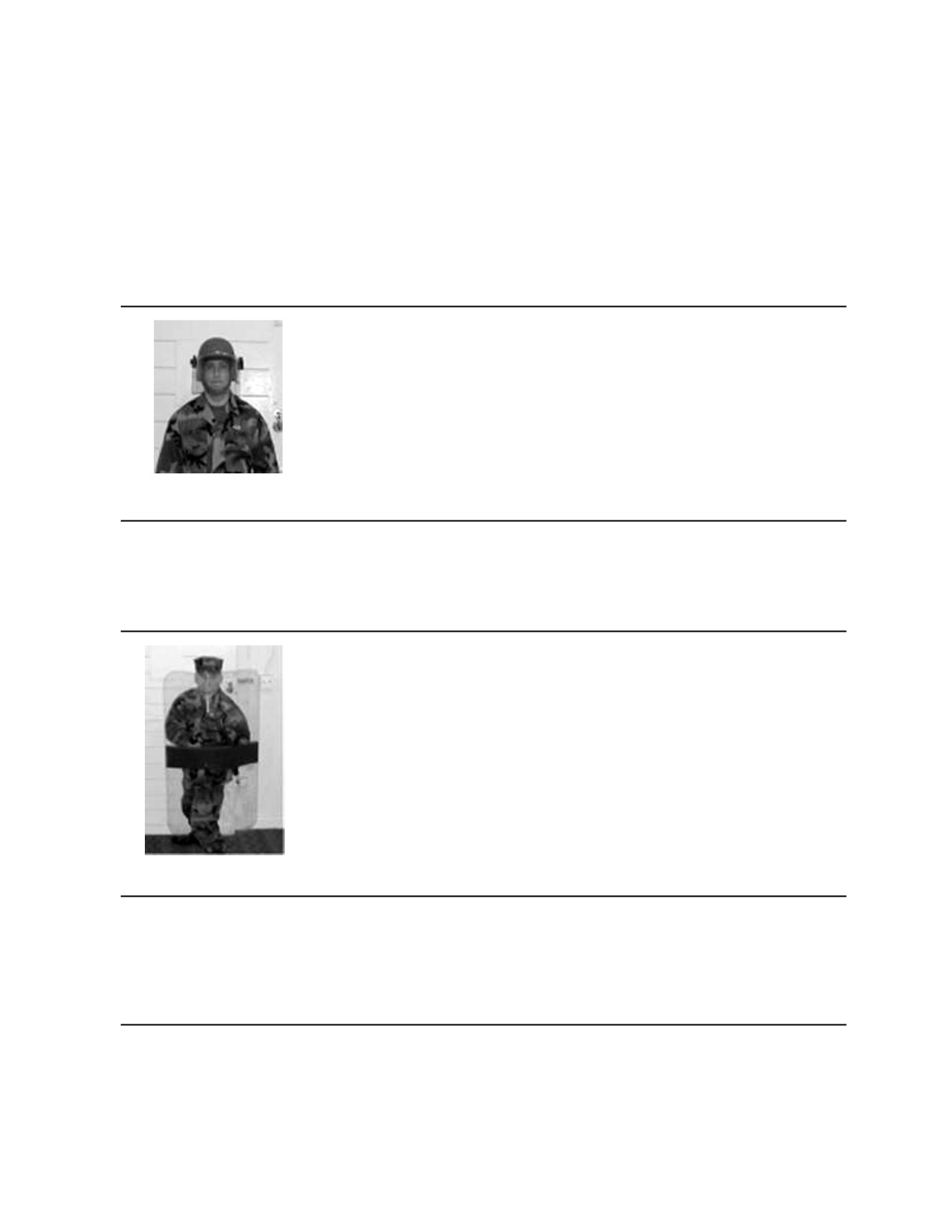
1. Riot Face Shield: The riot face shield is a non-ballistic face shield
designed to protect the service member’s face from objects thrown or
attacks from non-ballistic weapons. (Figure A-1)
Figure A-1. Riot Face
Shield
2. Ballistic Face Shield: The ballistic face shield provides the service
member with face protection from a wide range of threats (i.e. debris,
liquids, handthrown objects). The shield is manufactured from acrylic and
No picture available.
bullet resistant materials to provide Level IIIA protection (9-mm and .44
magnum pistol rounds), weighs 3.4 pounds and is compatible with the
PASGT helmet and M-17/M-40 protective masks.
3. Riot Body Shield: The riot body shield is a non-ballistic body shield
designed to protect the service member’s body from objects thrown or
attacks from non-ballistic weapons. (Figure A-2)
Figure A-2. Riot Body
Shield
4. Ballistic Body Shield with Light Kit: The ballistic shield provides the
service member with torso protection from a wide range of threats (i.e.
debris, liquids, hand thrown objects). The shield is manufactured from
No picture available.
Spectra Shield resistant material painted anti-reflective flat black, and is
capable of providing Level IIIA protection (9-mm and .44 magnum pistol
rounds). The shield weighs 18 pounds and is 20 x 36 inches in size with a
view port of 4 x 16 inches.
A-1
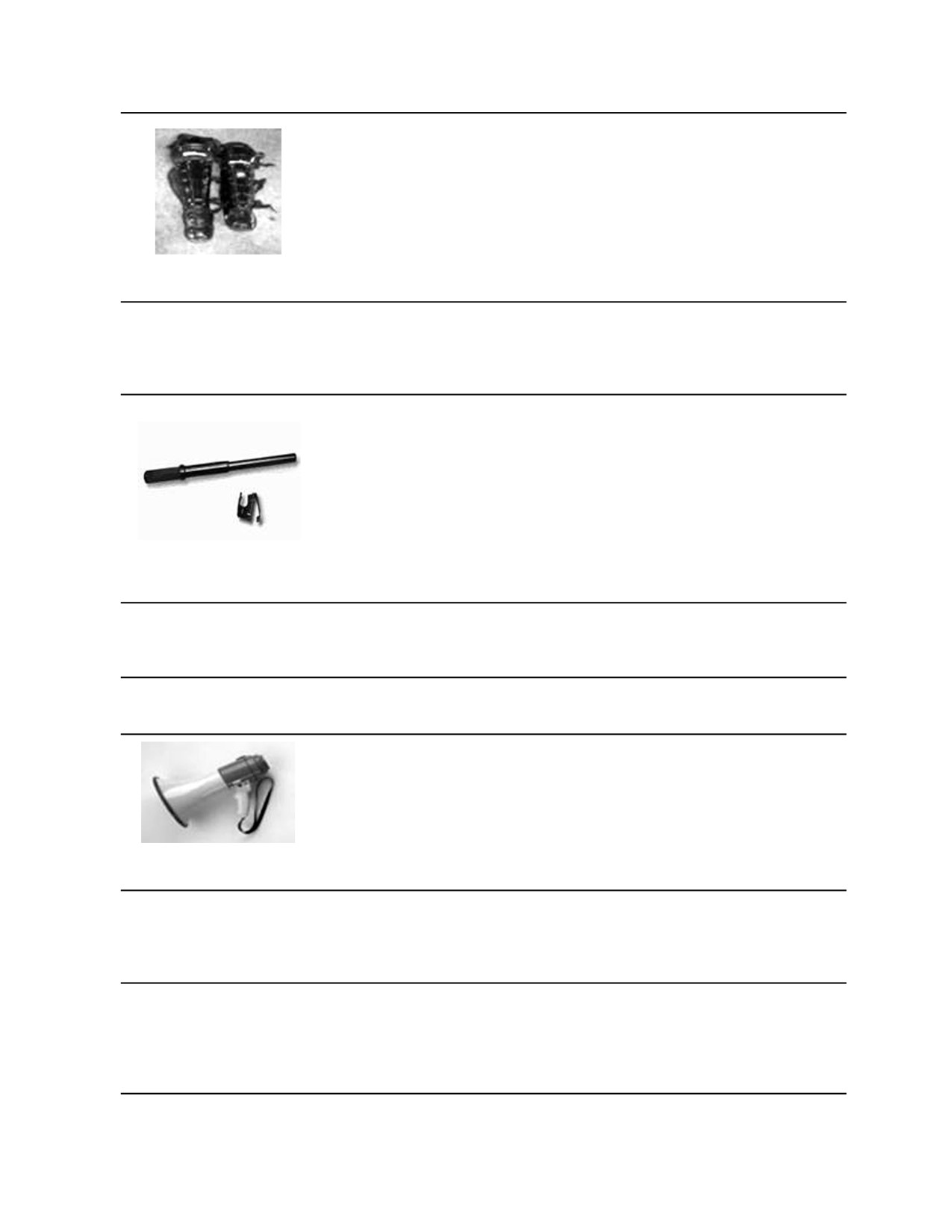
5. Riot Shin Guard: The riot shin guard is a non-ballistic shin guard
designed to protect the service member’s shins from objects thrown or
attacks from non-ballistic weapons. (Figure A-3)
Figure A-3. Riot Shin
Guard
6. Ballistic Shin Guards: Ballistic shin guards provide the service member
with leg protection from a wide range of threats (i.e. debris, liquids, hand
No picture available.
thrown objects). The guards are manufactured from Kevlar KM2 and
provide Level IIIA protection (9-mm and .44 magnum pistol rounds). They
are available in three sizes and weigh between 7 to 10 pounds.
7. Expandable Riot Baton (with holster): The expandable riot baton
provides the service member a nonlethal means of crowd control and self-
defense. The baton comes with a mounting device that attaches the baton
to a belt. The baton is 24 to 36 inches in length. (Figure A-4)
Figure A-4. Expandable
Riot Baton (with
holster)
8. Wooden Baton: The wooden baton provides self-defense for the
service member and the option between physical force and lethal force.
No picture available.
The baton comes with a mounting device that attaches the baton to a belt.
The baton is 36 inches in length.
9. Practice Riot Batons: The practice riot batons provide the service
No picture available.
member with a safe dynamic training environment for properly using a riot
baton. The batons are available in a variety of lengths.
10. Portable Bullhorn: The portable bullhorn provides the service member
the capability to control his forces by projecting his voice above the noise
and commotion created by crowds and mobs. (Figure A-5)
Figure A-5. Portable
Bullhorn
11. Ground-Mounted Public Address System: The ground-mounted public
address system is a communication enhancement device for conducting
No picture available
crowd control tactics. The system facilitates communication with the
crowd in the absence of PSYOP support and assists with communication
of commands to troops engaged in crowd-over-crowd noise.
12. M7 Individual Voice Amplification System: The M7 individual voice
amplification system is a communication enhancement device for
conducting crowd control tactics while wearing the M40 protective mask
No picture available.
and using riot control agents. The M7 is fitted to the M40 protective mask
to facilitate oral communication and increase the user’s ability to
communicate using radios and other devices.
A-2
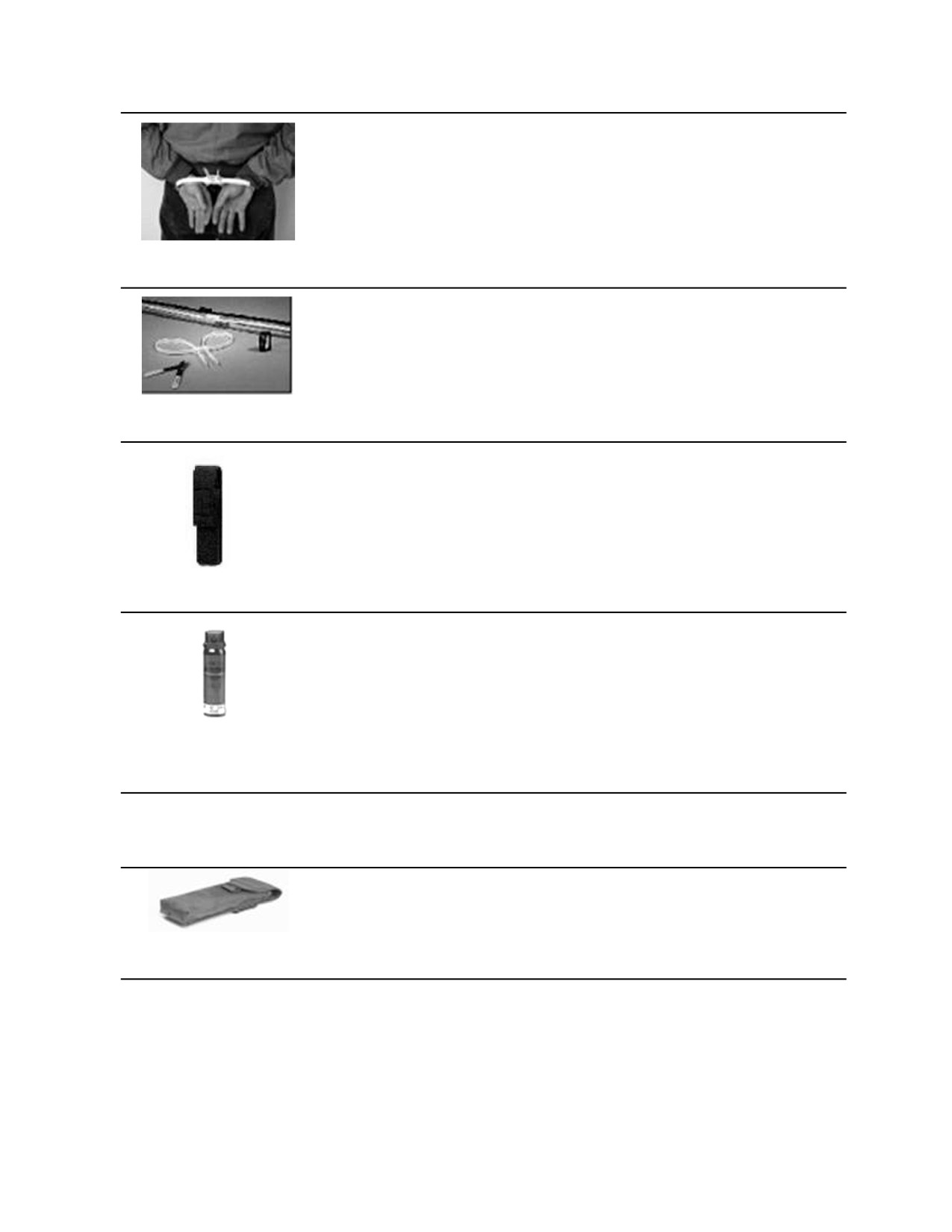
13. Disposable Handcuff: The disposable handcuff provides service
members with a means of restraining and controlling suspects, prisoners,
and other individuals encountered during crowd control. The disposable
handcuff is designed for one-time use. (Figure A-6)
Figure A-6. Disposable
Handcuff
14. Training Disposable Handcuff: The training disposable handcuff
provides service members with a means for training in handcuffing
procedures prior to actual use. The training disposable handcuff is red
and reusable. (Figure A-7)
Figure A-7. Training
Disposable Handcuff
15. MK-4 Pepper Spray Pouch: The MK-4 pepper spray pouch is
designed to carry the MK-4 pepper spray canister. (Figure A-8)
Figure A-8. MK-4
Pepper Spray Pouch
16. MK-4 Individual Live OC Pepper Spray: The MK-4 individual pepper
spray has a range of up to 12 feet in a target-specific stream. It contains
30 to 35 half-second bursts. (Figure A-9)
Figure A-9. MK-4
Individual Live OC
Pepper Spray
17. M-36 Individual Riot Control Disperser: M-36 Individual Riot Control
Disperser has a range of up to 12 feet in a target-specific stream. It
No picture available.
contains 30 to 35 half-second bursts. It is loaded with either CN or CS
agent.
18. MK-9 Pepper Spray Pouch: The MK-9 pepper spray pouch is
designed to carry the MK-9 pepper spray canister. (Figure A-10)
Figure A-10. MK-9
Pepper Spray Pouch
A-3