FM 3-16 THE ARMY IN MULTINATIONAL OPERATIONS (APRIL 2014) - page 3
Chapter 6
Sustainment Challenges in Multinational Operations
This chapter begins by giving an overview of multinational logistics and discusses
the importance of unity of effort between nations and agencies. It then discusses
responsibility for logistics, planning for logistics, and host nation support. Lastly, this
chapter discusses operational contract support, waste and disposal plans, and gives an
overview of the United Nations system and movement in multinational force
operations. A checklist is available for commanders and staffs at the end of the
chapter.
MULTINATIONAL LOGISTICS OVERVIEW
6-1. A coordinated logistic effort within a multinational force is needed to accomplish its mission. The
multinational commander considers how to coordinate the logistic effort. If nations compete for host nation
resources to provide logistical support to troop-contributing units, it hampers the multinational force’s
efforts to accomplish its mission, and causes harmful inflation in the host nation economy. The
multinational commander strives to achieve unity of effort in the logistic effort.
UNITY OF EFFORT BETWEEN NATIONS AND AGENCIES
6-2. Unity of effort is essential to multinational logistic operations. Unity of effort requires contributing
nations and civilian agencies in the area of operations (AO) to coordinate. The multinational force is
responsible to execute multinational logistics. When possible, the assistant chief of staff, logistics/battalion
or brigade logstics staff officer
(G-4/S-4) develops mutual logistic support for economy of effort.
Multinational logistics are flexible, responsive, and predictive and provide timely sustainment throughout
the entire multinational force. The multinational logistic plan incorporates the logistic requirements of all
contributing forces to execute the plan.
6-3. Consensus on multinational logistic issues and requirements are formed early. Commanders
comprehend multinational forces’ doctrine and have good relations with subordinate commanders and
civilian leaders. All elements providing logistics support and operational elements cooperate and
coordinate. This begins during the initial planning phase and continues through the operation’s termination
and redeployment of forces back to their countries of origin.
6-4. Commanders handle logistics on a multinational basis. They control logistics as interoperability
permits. Under certain conditions, creating a single multinational logistics command provides economy of
assets and system efficiency. Even if multinational participants (for national command reasons) maintain a
national logistics structure, assigning a lead for logistics responsibility precludes duplication of effort. The
G-4/S-4 establishes a planning group with members from all participating nations to define the extent of
interoperability that exists between multinational forces. Commanders identify the funding authority early
to support multinational forces and develop procedures to prevent an adverse impact on operations.
6-5. Multinational operations complicate logistic support and reduce the degree of flexibility inherent in a
national logistic system. Although responsible for logistic support of its national forces, not all nations have
deployable logistic capabilities. Such nations depend on other nations for all or part of their support. In
these cases, the multinational force provides deployment and sustainment to military and civilian
organizations. For deployment, close liaison with theater airlift command and control helps coordinate
approval and facilitate airlift once approved. When support is required, close liaison ensures clear funding
lines.
8 April 2014
FM 3-16
6-1
Chapter 6
RESPONSIBILITY FOR LOGISTICS
6-6. Logistics is a national responsibility in multinational operations. Some nations do not want to
relinquish authority over logistics assets. However, relations between NATO and the U.S. have evolved
enough that logistics is a collective responsibility with North Atlantic Treaty Organization (NATO) support
agency oversight. The multinational commander needs the authority and control mechanisms for logistics
to achieve the mission. Each nation performing logistic functions separately would be inefficient and
expensive. The multinational logistics staff handles mutual logistic support among multinational partners.
The planning staff designs the plans to complement partner nations’ capabilities and minimize weaknesses.
The multinational force staff evaluates the degree of interoperability among the participating nations. After
which, the participating nations discuss which nations provide support functions for the multinational force
and the procedures and methods of how those nations provide that support. For additional information on
multinational logistics, see JP 4-08, AJP-4, ADRP 4-0, and applicable NATO Standardization Agreements.
6-7. The multinational force exercises control over the national logistic units or acts as the coordinating
authority. The degree of authority depends on existing agreements and arrangements negotiated with
contributing nations. The multinational force commander delegates the level of authority granted by the
individual nations to subordinate commanders. The multinational force commander establishes logistics
coordination or the control center headed by a senior logistic coordinator or commander to coordinate
common logistic support in the AO.
6-8. The G-4 coordinates with the multinational force J-4 to determine what logistic authority for a
common support capability the national authorities have delegated to the multinational force. The G-4/S-4
also determines whether that authority meets multinational requirements. The multinational force’s
delegated or directed authority does not negate national responsibilities for logistic support or discourage
coordination. Also, it is not meant to disrupt effective procedures and the efficient use of facilities or
organizations.
6-9. Three methods of executing cooperative logistics exist in a multinational force. Each method is used
by itself or combined with the other methods. Regardless of the method used, national decisions and
commitments lead or participate in these arrangements early during the planning cycle. The three methods
are:
z
The lead nation concept. For this method, one nation provides the framework for one or more
logistics functions to support the multinational force.
z
A role-specialization agreement. Under this method, one nation provides a particular class of
supply or service for all or most of the multinational force.
z
Pooled assets and resources. For this method, two or more nations form an integrated logistic
support structure to provide supply or support functions to the multinational force.
PLANNING FOR LOGISTICS
6-10. It is critical that the logistics staff plans concurrent logistics and operations early. This ensures that
sustainment requirements balance with capabilities. The staff identifies personnel and provides their
availability early to facilitate planning. Staffs develop plans with all participating nations to achieve logistic
efficiencies. The multinational headquarters determines the logistic support needed to uphold the
commander’s plan and provide estimates of these requirements to national units. Planners share partial
planning data with prospective partner nations to facilitate parallel planning. Staffs—
z
Evaluate the level of standardization and interoperability among participating nations.
z
Determine differences in logistics doctrine, capabilities, methods for computing requirements,
stockage levels, organizations, and communications and information systems.
z
Account for these differences in the plan.
z
Account for differences in language, values, religious and moral beliefs, economic
infrastructure, nutritional standards, and social outlooks that impacts logistic support to
multinational forces.
z
Determine protection of civilians.
z
Determine what level of civilian casualties constitutes mass atrocity. Determine the response.
6-2
FM 3-16
8 April 2014
Sustainment Challenges in Multinational Operations
6-11. The logistics planners assign responsibilities and procedures to provide logistic support in the
multinational force and the task organization of multinational logistics units. Nongovernmental
organizations support the local population. However, in some circumstances when military support is
required, the logistics planners address the requirements of the local population as a part of the logistics
plan of the operations order.
6-12. Logistics personnel prepare logistics of the theater of operations for a flexible operational support
plan. Logistics personnel perform actions at all echelons to optimize the means
(force structure,
multinational and host nation resources, and strategic lift) to support the multinational force commander’s
plan. Personnel identify resources available in the theater of operations for use by multinational forces and
ensure access to those resources. (See ADRP 4-0 for more information on logistic preparation of the theater
of operations.) These actions include—
z
Identifying and preparing intermediate staging base and forward logistics bases/forward logistics
elements.
z
Selecting and improving lines of communication.
z
Projecting and preparing forward logistics bases.
z
Coordinating multinational logistic support.
z
Forecasting and building operational stock assets forward and afloat.
6-13. The plan ensures all appropriate environmental reviews meet environmental laws, policies, and
regulations. The plan must be in accordance with national, international, and host nation agreements. The
G-4/S-4 coordinates with legal and other appropriate staff officers to ensure that current environmental
conditions—such as water and soil contamination—epidemiological surveys, and disease risk assessments
comply with legal requirements. The G-4/S-4 also records data for future remediation.
6-14. When planning to acquire real property and lease facilities, planners determine what facilities and
land they need and whether those exist in the AO. Planners establish priorities for property acquisition and
consider the property they need.
6-15. Logistics planners determine the multinational force resupply requirements and recommend the best
method and type of servicing to the commander. Also, advance coordination must be made with Army
Material Command and the Theater Sustainment Command so material and support requirements are
known and resourcing can begin.
HOST NATION SUPPORT
6-16. The command analyzes the physical infrastructure in the host nation to determine what facilities and
services are available to support the command and how the command minimizes the logistic footprint. The
command understands the culture, business practices and laws, religious implications, and political and
social structure of the host nation. Evaluation includes location and what the command uses. AOs without a
functioning government provide limited support. Commanders integrate host nation support into the
logistic structure of the command to ensure effective use. The command allocates this support based on
command priorities. Nations agree on whether a multinational force has the authority to conclude host
nation support arrangements on behalf of participating nations or whether prior national approval is
required.
6-17. Host nation support expertise (legal, financial, acquisition, medical, and administrative) is centralized
within the logistic staff to identify and procure host nation support. This ensures the command’s
requirements and prevents competition between partners.
6-18. While local procurement efforts are beneficial to the host nation, these efforts sometimes undermine
important command goals. Local suppliers have important political connections. An otherwise innocent
procurement decision has significant political meaning in the host nation. Procurement actions inflate local
prices with negative impacts on local groups or civilian agencies. These effects influence the attainment of
the end state and the timing of withdrawal. Stability tasks and civil affairs personnel identify and coordinate
host nation support and provide valuable assistance to the logistics staff in this area.
8 April 2014
FM 3-16
6-3

Chapter 6
6-19. The command obtains authorization from national authorities to negotiate for host nation support.
Agreements with the host nation include the authority for the command to deal directly with the host nation
for support. The command develops a list of current host nation agreements. The command legal advisor
and Department of State or Ministry of Foreign Affairs political advisor negotiates host nation support
agreements. Agreements are negotiated for local contracting, currency exchange rates, local hire wage
scales, and customs regulations.
6-20. The logistics staff evaluates the effectiveness of current host nation contracts between the host nation
and civilian agencies in the AO. Then, the staff determines the best lead agency (military or civilian) to
negotiate and contract for host nation support. Table 6-1 provides host nation considerations for support.
6-21. Multinational forces perform background checks on host nation support personnel and contractors
and periodically check host nation support personnel and contractors against intelligence databases. Based
on experiences from Operation Enduring Freedom, Operation Iraqi Freedom, and Operation New Dawn,
host nation support personnel and contractors often have family, social, organizational, or financial ties or
routine contact with insurgents.
Table 6-1. Host nation considerations
Items and Considerations
Accommodations
Communication
Billeting
Local
Offices
International
Stores and warehouses
Security
Workshops, vehicle parks, gun parks
Finance
Medical
Payment for—
Hardstands
Accommodations, supplies, communications, equipment,
Fuel
local labor maintenance, medical, and movement facilities
Weapons and ammunition storage
Emergency facilities
Transportation, including aircraft
Personal facilities
Firing ranges
Fuel
Training areas and facilities
Aircraft
Recreation areas and facilities
Vehicles
Laundry and dry cleaning facilities
Ships
Postal facility
Method of Delivery
Weapons and Ammunition
Storage
Security
Interoperability of refueling equipment
Storage
Common use of refueling installations
Collection or delivery
Local Labor
Rations
Method of hiring
Fresh
Method of payment
Pack
Administration
Potable water
Medical
Translation
Normal facilities
Interpreters/language specialists
Emergency facilities
Translation of documents
Reciprocal national health agreements
Supplies and Equipment (other than ammunition, fuel,
Evacuation of causalities
or rations)
Medical and blood supply system
Common use items
6-4
FM 3-16
8 April 2014

Sustainment Challenges in Multinational Operations
Table 6-1. Host nation considerations (continued)
Items and Considerations
Maintenance
Water
Accommodations
Production/purification capability
Vehicles
Municipal
Ships
Other water treatment systems
Equipment
Distribution capability
Roads (including snow clearance)
Trucks
Fixed- and rotary-wing aircraft
Pipeline
Provision of assembly areas
Hoseline
Damage control
Storage capability
Emergency facilities for visitors’ vehicles and
Receipt and issue capability
equipment
Available water sources
Recovery and transportation of disabled vehicles
Wells
and equipment
Surface
Waste and disposal
Subsurface
Host nation water quality standards
Movement
Transportation Equipment
Airheads
Host nation military vehicles, equipment, ships, aircraft
Alternates
Locally hired vehicles and equipment, ships, aircraft
Facilities
Policy on drivers and handlers for above
Ships
Other services
Equipment
Electricity: locally procured or generator
Refueling
Trash pick-up
Ports
Alternates
Draft
Bunkering/fueling
Repair
Road and rail movement
Personnel
Equipment
Security
Traffic control
Pipeline movement
6-22. The national government handles agreements for transferring defense goods and services between
nations. This is cumbersome and time consuming. Support provided and received in multinational
operations comply with existing legal authorities. Under an acquisition and cross-servicing agreement,
national authorities enter into agreements for acquiring or cross-servicing logistic support, supplies, and
services on a reimbursable, replacement-in-kind, or exchange for equal value basis. The acquisition and
cross-servicing agreement is a broad overall agreement, generally supplemented by an implementing
arrangement. The J-4 and the Department of State with the country involved performs the agreement in the
acquisition and cross-servicing agreement. The Department of Defense (DOD) and the country involved
provides the approval and signs the agreement. Major commands in country negotiate the details with their
counterparts and document the services (whether used or not) on a statement of requirements for exchange
of support and services. The implementing arrangement contains details on orders for logistic support. G-
4/S-4 documents receipt of agreed upon services to prevent fraudulent payment for services not provided.
The acquisition and cross-servicing agreement includes—
z
Food.
z
Billeting.
z
Transportation.
8 April 2014
FM 3-16
6-5
Chapter 6
z
Petroleum, oils, and lubricants.
z
Clothing.
z
Communications.
z
Army health system (AHS) support.
z
Ammunition.
z
Base operations support including construction.
z
Storage.
z
Use of facilities.
z
Training.
z
Spare parts.
z
Repair and maintenance.
z
Calibration.
z
Port services.
z
Generators.
z
HAZMAT response and disposal.
z
Medical waste disposal.
z
Heating oil/gas.
z
Local electricity consumption.
z
Trash removal.
z
Satellite service.
z
Road clearance and snow removal.
z
Railhead operations.
z
Cranes and forklifts.
6-23. Items not included are—
z
Weapons systems.
z
Major end items.
z
Guided missiles.
z
Nuclear and chemical munitions other than riot control agents.
z
Cartridge and aircrew escape propulsion system components.
z
Chaff and chaff dispensers.
z
Guidance kits for bombs and other ammunition.
OPERATIONAL CONTRACT SUPPORT
6-24. Multinational militaries, including the U.S. military, rely on contracted
support
to
perform
a
multitude of support functions and tasks. Factors that have led to this increased reliance include—
z
Reductions in the size of military forces (especially in the combat support and sustainment
areas).
z
Increases in tempo and missions undertaken by the military.
z
Increased complexity and sophistication of weapon systems.
z
A continued push to gain efficiencies and reduce costs through outsourcing or privatizing
commercially adaptable functions.
6-25. The logistic directorate of a multinational staff oversees operational contract support and contractor
personnel providing support to the multinational force in a designated operational area.
6-26. Centralized coordination of contracting efforts is essential to provide the necessary management of
limited resources. This ensures the multinational force contracts operational priorities and supports each
one. Through centralized coordination of contracting efforts, maximum benefits are derived from volume
procurements, competition is optimized, price escalation is avoided, and the opportunities for local black
market operations are minimized.
6-6
FM 3-16
8 April 2014
Sustainment Challenges in Multinational Operations
6-27. Early planning is critical for effective and efficient operational contract support in multinational
operations. From an operational planning point of view, there are a number of considerations influencing
when to use contractor support in multinational operations. Common contract support considerations
include—
z
Type of operation. Operations with higher risk of combat, such as initial entry operations, are
less suitable for outsourcing than lower risk operations such as peacekeeping and stabilization
operations.
z
Phase of the operation. In the early stages of an operation, military units support military
functions because of high risk, efficiency, operational effectiveness, and security. As the
environment stabilizes and risk reduces, selected support functions transfer to lead nation or role
specialist nations provided there is contract support.
z
Protection of contractor personnel. Although contractors are mostly self-sufficient, they are not
combatants and the force is generally responsible for the security of contractor employees
accompanying for force.
z
Protection from contractor personnel. Using contracted support instead of military support
entails additional risks to the force. This risk is heighted when using third country national and
especially local national contractor employees.
6-28. Multinational partners have a collective responsibility for planning and implementing contracted
support. This responsibility encourages partner nations to identify support requirements that could be met
by contracted services and supplies and create contractual arrangements. These nations share the provision
and use of contractor capabilities and resources through prior arrangements to support the force.
6-29. Planning and preparation for providing contracted support in multinational operations begins with
support planning. Multinational partners use existing common user logistics role specialists and lead nation
agreements and other available Service, joint, and/or allied contracting support agencies that provide
contracting services on a reimbursable basis. Properly prepared and funded, contracted support enhances
support to operations, releases military resources for higher priority tasks elsewhere, overcomes identified
sustainment shortfalls, and provides endurance where needed with less impact on military assets than
would be the case without it. Contract support applies to a wide range of logistics and other support
functions including—
z
Base camp services (billeting, food, and local labor).
z
Firefighting.
z
Linguists.
z
Interpreters.
z
Trucking services.
z
Base camp construction and maintenance.
z
Strategic transport.
z
Fuel storage and distribution.
z
Strategic aeromedical evacuation.
z
Elements of deployed healthcare.
z
Food and water.
z
Bulk petroleum.
z
Port clearance.
z
Signal communications.
6-30. As a matter of policy, U.S. contract support to multinational partners is limited to supplies and
services planned and procured for support of the U.S. force. Additionally, standards of support for
contracted services are the same standard established by the national support element providing the support.
Finally, proper funding approval must be in accordance with national laws and policies of all parties prior
before receiving or providing contract support. More specifically, U.S. policy and law requires an approved
acquisition and cross-servicing agreement, and when appropriate, an implementation agreement before the
U.S. force provides contracted supplies and services to any multinational partner.
8 April 2014
FM 3-16
6-7

Chapter 6
6-31. Determining the appropriate contract support arrangements is a critical step in multinational contract
support planning. Based on recent insights from multinational operations and approved NATO doctrine,
there are three generally acceptable contract support sharing arrangements:
z
Lead nation. This is the most common form of multinational contract support arrangement where
one nation is designated the lead common contract support provider.
z
Role specialist nation. Similar to lead nation arrangement, but where one or several nations
arrange for contracted support for a single service such as fuel, medical evacuation, security,
force protection, food, and maintenance.
z
Multinational support capability. Normally only executed for large scale and long term
operations and based on a formal alliance capability such as the NATO real life support
agreement in Afghanistan. This type of direct contract support arrangement is very complex and
takes significant time to put in place. It is referred to as the Theater Allied Contracting Office per
NATO doctrine. (See NATO documents: STANAG 6025 Ed. 2 and AJP-4.5.)
6-32. In the lead and role specialist nation support arrangements, the operational command logistic staff
and national support element planners determine common support arrangements to include contracting
processes and procedures.
6-33. For the Army, contracting support provided to designated multinational partners is executed via the
supporting contracting support brigade contracts or a logistics civil augmentation program task order. In
this process, the supported multinational units process their support request directly with the designated
providing unit, not the supporting contracting support brigade or logistics civil augmentation program-
forward office. Accordingly, each designated providing unit incorporates the multinational support
requirements into their contract support requirements development. The providing unit identifies changes to
requirements and provides receiving and quality assurance reports to the supporting contracting office as
required by national law and policy.
6-34. The supporting contracting office, with support for the providing unit, negotiates changes to the
contract, evaluates the performance of the contractor, assesses penalties for non-performance, and certifies
payment for delivery of services. The contracting officer administers contractual instruments to ensure the
contractual obligations of the contractor and partner forces are correctly and promptly fulfilled. It is
important to note U.S. Federal Acquisition Regulation requires a DOD civilian or uniformed U.S. military
member sign receiving reports (for supply request) and to serve as contracting officer representatives (for
service contracts). Again, the designated Army providing unit must arrange receiving official and
contracting officer representative’s support for their supported multinational units.
6-35. In NATO operations, it is possible to stand up a theater allied contracting office to contract for
selected goods and services in limited supply in the operational area or are commonly needed by the entire
force. To coordinate theater allied contracting office activities, the multinational force contracts may
publish a restricted items list that identifies critical, limited supplies and services in the operational area.
This procurement is coordinated with the contracting coordination center. The theater allied contracting
office negotiates base ordering agreements for use by all participating nations. These base ordering
agreements would normally include information identified in table 6-2.
Table 6-2. Standard base ordering agreement information
Agreement title/number
Unit of issue/quantity (for a supply item)
Implementing arrangement title/number (if applicable)
Unit price (for supply item)
Date of request
Overall price
Providing unit/nationality
Delivery location (for a supply)
Receiving unit/nationality
Location of performance (for a contracted service)
Fund citation
Description of service (for contracted service)
Method of payment
Period of performance (for contracted service)
Requesting unit signature block
Implementing agreement officer signature block
Receiving unit signature block
Providing unit signature block
6-8
FM 3-16
8 April 2014
Sustainment Challenges in Multinational Operations
6-36. Contractor personnel management integrates, manages, and within limits, controls contractors
supporting the multinational force in the designated operational area. The multinational force contract’s
authority over contractors is limited. Accordingly, the multinational force contract coordinates contractor
management policy and procedures between the major multinational partners including movement control,
minimum government furnished support arrangements, legal jurisdiction, and VISA requirements. (See JP
4-08 for more information on logistic support of multinational operations.) The multinational logistic
procurement support board helps with the multinational force contracts to ensure these policies and
procedures are incorporated into contributing nation’s contracts and included in their national contract
oversight. For further guidance on operational contract support in multinational operations, see JP 4-10,
ATTP 4-10, and the NATO Logistics Handbook.
6-37. Commanders integrate the strategic and theater of operations movement requirements to prevent
congestion at seaports and airports. Establishing intratheater hubs maximizes cargo throughput and
improves theater distribution. Nations provide movement data to the multinational force theater movement
control system. This data provides information for the direct delivery or transloading of passengers and
cargo. It deconflicts strategic movements with other theater of operations movements.
6-38. Civilian agencies, in an effort to help by shipping relief supplies, will likely cause transportation
“choke points” en route to and in the theater of operations. A G-4/S-4 link with the civil-military operations
center provides a solution to this type of circumstance.
6-39. The multinational force designates a director of mobility forces. The director is normally a senior
officer familiar with the AO with an extensive background in airlift operations. The director is the
designated agent for all airlift issues in the AO and for other duties as directed.
WASTE AND DISPOSAL PLANS
6-40. Inadequate waste disposal plans cause conflicts with public and international law and increases costs.
Waste and disposal are in the operation plan or operation order from initial planning to redeployment.
When cost becomes paramount during redeployment, waste and disposal are important. These commodities
require disposal:
z
Usable property and scrap.
z
Munitions list and strategic list items.
z
Captured and confiscated weapons.
z
Hazardous materiel and hazardous waste.
z
Rations and food.
z
Ammunition, explosives, and dangerous articles.
z
Radioactive materiel.
z
Medical waste.
z
Classified items.
z
Drugs, biological substances, and controlled substances.
UNITED NATIONS SYSTEM
6-41. The United Nations (UN) logistic system requires member states to be self-sufficient at the unit level
for 60 to 120 days. This allows the UN to organize a logistic structure, acquire real estate and facilities, and
establish contracts and local memorandums of understanding and letters of assist to provide support for the
multinational force. Once established, the UN logistic structure provides continuing support through a
system of lead nations, civilian contracts, a UN force logistic support group, or a combination of the three.
6-42. A UN survey and assessment team evaluates operational requirements and develops planning data
for sustainment. When participating in UN missions, the command sends a logistics representative with the
UN survey team if possible. The multinational force coordinates with UN forces to improve the unity of
effort and reduce potential conflicts.
8 April 2014
FM 3-16
6-9
Chapter 6
LEAD NATION CONCEPT
6-43. A lead nation is a nation with the will, capability, competence, and influence to provide the essential
elements of political consultation and military leadership to coordinate the planning, mounting, and
execution of a multinational operation (JP 3-16). Supported nations then rely on the lead nation for the
agreed level of support. National contingents have representatives in the lead nation’s logistic organization.
See JP 4-0 for additional information.
FORCE LOGISTIC SUPPORT CENTER
6-44. In most cases, the UN will ask a member state, or states, to form a force logistic support group. The
group incorporates logistic units from participating nations. A state accepting the group role and the chief
logistic officer at the force headquarters establish local contracts to support the force. Even with a force
logistic support group, member states are responsible for specific national elements of resupply—such as
repair parts, clothing, food, and major end item replacements—unless nations establish an agreement to
provide this support. This would be on a reimbursable basis under either a wet or dry lease arrangement
that the UN and contributing nation’s government agree to before deployment.
CIVILIAN CONTRACTOR CONCEPT
6-45. The UN economizes logistic support by using civilian contractors. The goal is to achieve the most
economical logistic organization that meets the demands of the force and releases military manpower for
redeployment. Force headquarters coordinate the process. UN contracting does not fall under the logistic
division. It falls under the purchasing and transport services division. UN procurement is bureaucratic and
slow. It is decentralized and each agency uses its own procedures. The interagency procurement services
office of the UN development program creates a standard procurement system.
6-46. The UN chief administrative officer does not work for the force commander, but reports to the
special representative of the secretary general. The civilian logistic infrastructure, including the budget
officer, reports to the chief administrative officer. Logistics problems will not be resolved unless the chief
administrative officer is involved. Maximum liaison between military and civilian counterparts is required
to allow synchronization of effort.
6-47. The UN normally coordinates logistic areas such as bulk supplies and services. National standards
such as consumption rates, space requirements, and safety levels exceed UN standards. Sophisticated
multinational military equipment requires different standards of support than what the UN has agreed to
provide or fund. The G-4/S-4 understands UN standards concerning level and quality of support provided
and funded. Logistic support that extends beyond what is outlined in the UN agreement is not reimbursable.
The multinational force must be prepared to bring its own support in the areas where the UN-provided
support is deficient.
MOVEMENT IN MULTINATIONAL FORCE OPERATIONS
6-48. Movement is critical to multinational force operations. A multinational force headquarters, or its
supporting combatant command, plans and executes all intertheater movement. However, it remains a
national responsibility to move forces into the operating area. The multinational force headquarters
coordinates these deployments to support the commander’s plan and plans and controls intratheater
movement through reception, staging, onward movement, and integration.
INTERMEDIATE STAGING BASE
6-49. Nations participating in the multinational operation consult with the multinational force commander
to determine if the force needs an intermediate staging base. If established, the intermediate staging base
will be outside the operating area. The commander balances numerous requirements, including greater lift
requirements against better efficiency. Multinational forces assemble and stage in an intermediate staging
base, especially if combat is imminent. The intermediate staging base provides a secure area to assemble,
train, equip, and bond the multinational force into a cohesive one. It is better to solve problems and correct
deficiencies in a non-hostile environment. The multinational force headquarters staff assembles first and
6-10
FM 3-16
8 April 2014
Sustainment Challenges in Multinational Operations
works together, followed by the rest of the multinational force. The international staging base has sufficient
billeting and training capacity to support the entire multinational force at once. Access to airports and
seaports for smooth reception of the force and its subsequent deployment is critical. If the multinational
operation is a lesser regional contingency or a second major regional contingency, an intermediate staging
base is not possible.
6-50. Planners anticipate disruptions from many factors, ranging from weather to political decisions. This
alters the planned flow of personnel, units, and equipment. The Army Service component commander, or a
supporting combatant command, operates the intermediate staging base and deploys fully ready forces into
the operating area. When the lodgment is well established, the intermediate staging base shifts into the
operating area if it will not drain additional resources. Larger areas, such as Europe or Korea, allow for a
reception center or intermediate staging base in the theater of operations from the beginning. In the Korean
War, UN forces operated the UN reception center where incoming contingents were equipped, trained, and
linked up with U.S. liaison elements.
THEATER OF OPERATIONS RECEPTION
6-51. At ports of debarkation, units work with host nation, contracted host nation support, and multiservice
personnel to secure the port, discharge equipment, process equipment and personnel and move units to
marshaling areas. Host nation forces perform and help with many of these functions. The multinational
force headquarters assigns a troop-contributing nation to oversee and help the host nation perform these
functions. If host nation support forces are not available, national units perform those functions. The
multinational task force commander plans for all units in the strategic flow. Some national forces have
limited capability so the commander, based on planning staff recommendations, specifies functions for
these units.
THEATER OF OPERATIONS STAGING
6-52. Staging is that part of the reception, staging, onward movement, and integration operation where
several key activities occur in controlled areas of combat power. During this phase, the following occurs:
z
Units are reassembled and united with their equipment and scheduled for movement toward the
tactical assembly area.
z
Materiel is segregated, prioritized, and prepared for transport.
z
Class V supplies are uploaded.
z
Life support is provided to personnel.
THEATER OF OPERATIONS ONWARD MOVEMENT
6-53. This phase begins when units move to their final destination. Such movement is accomplished
through a carefully devised movement program that employs convoy, rail, and host nation contract assets
(such as heavy equipment transporters and other trucks) to ensure the forward and concurrent movement of
troops and supplies. Centralized control of transportation assets is required. Real estate management is a
problem unless a multinational counterpart to the U.S. joint force utilization board (usually controlled by
engineers) has authority to allocate terrain to all forces and agencies.
6-54. Movement planning accounts for differences in how nations perform road marches or similar
administrative movements. These differences lead to confusion and disorganization. For example, one
multinational force contingent considers any movement made by a tactical unit to be a tactical movement.
Terminology must be coordinated through the movement control center to avoid confusion.
6-55. When planning the movement of a multinational force, planners know the details of the organization,
equipment, capabilities, and limitations of the forces. Planners know how to request intratheater movement
of multinational operational forces consistent with the operational commander’s operation plan. The
movement should complement sequencing of operations and time-phased force deployment. Movement
planners should consider all assets (joint, multinational, nongovernmental, governmental, host nation, and
third country) and modes (air, land, or sea) of transport. During execution of these movements, movement
control personnel locate where they validate actual movements.
8 April 2014
FM 3-16
6-11
Chapter 6
THEATER OF OPERATIONS INTEGRATION
6-56. This phase covers both the effective management of reception, staging, onward movement, and
integration movement of units and the table of allowance of units to the tactical commander.
CHECKLIST
6-57. Commanders and staffs participating in multinational operations should be able to answer the
following questions with respect to the logistic portion of the operation.
SUPPORT AND CAPABILITIES
z
What areas come under multinational control? What areas remain national issues?
z
What logistic service and support is available?
z
Does the unit have sufficient assets (such as maintenance, communications, transportation) to
perform its movement and/or mission? Will it require support?
z
What are the specific logistic capabilities of each nation of the multinational force?
Understanding these capabilities is essential to effective and efficient logistic planning and
support.
z
What mortuary affairs capabilities does the command have?
z
What legal restrictions do national laws impose on logistic support?
z
Do national legal authorities permit the provision of logistic support among multinational
nations?
z
Are mutual logistic support agreements in accordance with existing legal authorities?
z
What is the system for property accountability?
z
What are the special clothing and equipment requirements that have a long lead-time to obtain?
(For example, nonmilitary supplies or riot control gear.)
z
What are the procedures to provide support such as transportation, housing, and meals to
diplomats and distinguished visitors? What coordination is there with the joint visitor’s bureau
on this?
z
What is the system for preventing fraud, waste, and abuse?
z
How does the command assess logistic requests, requirements, and actions to ensure that they
are valid with respect to the operation and authority given to the command?
z
How does the command adequately secure logistic assets?
z
Will the command establish a common retail store at some point during operations? A well-
stocked retail store provides personnel support items and serves as a morale booster.
z
How will the intelligence staff gather information from logistic sources such as truck drivers and
engineers?
z
What are the acquisition and cross-servicing agreement procedures to account for and reimburse
nations for services and supplies exchanged between nations?
z
What are the common supplies and services that one nation or a multinational organization
might provide?
z
Is there an agreement that authorizes forces to exchange mutual logistic support of goods and
services and that accounts for the amounts received?
z
Will there be, and if so when and how, a transfer of authority of national logistic assets to the
multinational force?
z
What is the multinational force’s authority to redistribute or cross-level logistic assets and
services under routine and emergency conditions?
z
How will the command maintain national asset accountability from the national sustaining base
to the front-line units?
z
How will the command ensure compatibility and interoperability of communications and
information systems, including automated data processing interfaces between the multinational
and national support systems?
6-12
FM 3-16
8 April 2014
Sustainment Challenges in Multinational Operations
z
How will the command prioritize, allocate, and use common infrastructure capabilities (ports,
airfields, roads) to support military and civil operations?
z
What are the existing standardization agreements that facilitate multinational logistic support?
z
What is the logistic support structure? How will it identify capabilities and responsibilities of
contributing nations?
z
Does the multinational force have an acquisition and cross-servicing agreement among
multinational nations?
z
Does the logistic structure have one officer in charge or a main point of contact for command
and control of contract personnel?
z
Have contractor procedures been established to allow total multinational participation in
contracts led by national personnel and used by multinational personnel?
z
Is there a need to establish a multinational logistic command or element? If so, has its staffing
been determined?
z
Has the relationship between the multinational and national logistic elements been clearly
defined?
z
Have lead nations been designated where appropriate?
z
Have logistic reporting procedures been established throughout the force?
z
Do all forces know and comply with the infrastructure repair plan?
z
Is there duplication of effort in the support plan for the operation?
z
If there is a need, what is the composition of the multinational logistics command or element?
Have coordinating centers been established for movements, medical support, contracting,
infrastructure engineering, and logistics operations?
z
What is the transitional plan for operational assumption of in-place contracts, equipment,
facilities, and personnel belonging to another agency or alliance?
z
Are multinational legal representatives available to provide council on international law and
legal agreements?
z
Have customs clearance procedures been established at ports of embarkation?
z
Has certification been established?
z
Have standards been identified for logistic support? Is there a plan to perform, inspect, and
ascertain compliance with these standards before deployment?
z
What is the division of responsibilities between multinational, national, and host nation logistic
support?
z
How will each class of supply be handled?
z
What are the multinational force’s capabilities to receive, store, and issue dry cargo, fuel, and
water including water production and purification capability?
z
Does the multinational force have the means to communicate requirements to the multinational
logistics management center?
z
What materiel handling equipment is available in the multinational force and host nation?
z
Does the multinational force have a load of ammunition? What are the ammunition procedures?
z
What are the multinational force’s special requirements including tents, cots, reverse osmosis
water purification units, laundry, latrines, and batteries?
z
What are the military assistance program requirements for multinational forces?
z
What is the best method for providing potable water? Have the engineers, medical personnel,
and other staff officers been consulted about this issue? Using bottled water has an added
advantage of enhancing troop morale.
z
What is available in lessons learned databases for specific requirements, planning factors, and
potential problem areas?
z
Has liaison been established with other multinational nations and civilian agencies to obtain the
most up-to-date logistic information on the AO?
z
What are the personnel augmentation requirements and equipment needed for mission support?
z
Have basing rights and diplomatic clearances critical to mobility been secured?
8 April 2014
FM 3-16
6-13
Chapter 6
z
What are intratheater capabilities and resources of civilian agencies in the AO?
z
What current agreements exist with other participating nations that provide for logistic support?
Does this include agreements governing logistic support with representatives of other nations?
z
What quality controls have been established for all services and supplies such as petroleum, oils,
and lubricants, water, and food? How will those controls be monitored?
z
What are the procedures to ensure in-transit visibility at all transportation nodes? Lack of in-
transit visibility causes loss of confidence in the supply system and leads to unnecessary
reordering, further clogging the supply lines.
z
For UN operations, what standards are followed concerning support?
z
What is the support plan for redeployment of forces, materiel, and equipment?
z
What logistics infrastructure, materiel, capabilities, and equipment remain in-country for use by
subsequent forces or organizations?
FUNDING
z
Has it been determined if, or to what extent, operational-related expenses are reimbursed from
common funding or sources external to national funding by the participating nations?
z
Has funding been identified to defense support of civil authorities or reimbursement
expenditures? What are the limits on funding authority?
z
What is the availability of common funding for contracting, multinational headquarters
establishment, and general or common support? What are the procedures for common funding
for contracting, multinational headquarters establishment, and general or common support?
z
What are the accounting and reimbursement procedures for services and supplies exchanged
between nations? Are replacement-in-kind procedures included?
z
Has the probable cost of the multinational operations been determined? Is the probable cost
acceptable?
z
What are the funding requirements for renting facilities to defense support of civil authorities?
z
Does the command have funding codes from all multinational nations? What methods and
documentation are required to record all expenditures?
z
How will the command capture costs associated with supporting the multinational forces?
HOST NATION SUPPORT
z
Has host nation support been evaluated to determine the logistic support available? Are law
enforcement, sanitation, medical services, facilities, storage, and materiel included?
z
What are the capabilities of existing infrastructure? Do they include water treatment plants,
power stations, reservoirs, and bulk and retail fuel storage? Engineers or facility managers
provide critical information on the availability of existing facilities.
z
Have negotiations to secure support either been established or completed?
z
What is the impact of obtaining host nation support on the host nation’s economy?
z
What are the possible environmental impacts on the host nation providing this support?
z
What technical agreements—such as environmental clean-up; customs duties and taxes; and
hazardous material and waste storage, transit, and disposal—must be developed to augment host
nation support agreements?
MAINTENANCE
z
Do the multinational forces have maintenance support?
z
Do the multinational forces have the means to order and receive repair parts?
z
Do the multinational forces have wreckers, stake and platform trailers, or heavy equipment
transporters?
z
Do the multinational forces have communications repair facilities?
6-14
FM 3-16
8 April 2014
Sustainment Challenges in Multinational Operations
CHEMICAL, BIOLOGICAL, RADIOLOGICAL, AND NUCLEAR DEFENSE
z
What infrastructure exists for assisting multinational forces to counter low-level radiation or
toxic industrial chemical hazards such as medical treatment facilities or detection equipment
supply houses? (Are U.S. policy and guidelines acceptable to other nations if none exist?)
z
Is the necessary CBRNE protection, detection, and reconnaissance equipment available to troops
to counter the threat?
z
Are adequate theater stocks of chemical overgarments available?
z
What plans exist to protect and train locally hired civilians against weapons of mass destruction
threats?
TRANSPORTATION
z
What is the multinational transportation command structure?
z
What are the available multinational air and sea lines of communication?
z
What are assigned airlift and sealift capabilities and allocations? Are the requirements to support
both military and civilian agencies included?
z
What are the requirements for and capabilities, limitations, and availability of airfields, seaports,
and inland transportation systems in the departure, intermediate staging, and objective areas?
What resources are required for new construction or necessary improvements to existing
facilities?
z
What is the multinational reception, staging, onward movement, and integration process?
z
What is the ability of the host nation to receive personnel and equipment at ports and airfields?
z
What are the access rights in the AO? The command must coordinate diplomatic efforts to
arrange for—
Support, country, and diplomatic clearances.
Over-flight rights.
Basing for forces in transit from one locality to another.
z
What is the capability of transportation systems to move forces once they arrive in the theater of
operations?
z
Do multinational forces have tactical rotary- and fixed-wing assets for intratheater supply?
z
Who supplies transportation supply throughput from the multinational logistics center for
multinational forces?
z
Do multinational forces have transportation assets for moving troops?
z
How will the command control movement into and out of airfields and seaports?
z
How will transportation facilities be shared with civilian agencies and contractors?
z
Is rail a feasible transportation method? If so, can rail cars transport tactical equipment (tanks)?
z
Are the railhead facilities usable?
z
Are there sufficient on/off load capabilities?
z
What are the security requirements for rail transport by the multinational force or host nation?
z
Will non-tactical vehicles be needed for the operations? If so, how many and what types (SUVs,
vans, sedans, buses)?
z
Will non-tactical vehicles be contracted or provided by the host nation or other multinational
force?
z
Will there be other transportation requirements based on mission location, weather, or lack of
transportation infrastructure?
MANNING AND EQUIPPING
z
Have deploying units provided planning numbers of deploying forces?
z
Have deploying units provided planning numbers of deploying equipment, types of containers,
and number of containers?
8 April 2014
FM 3-16
6-15
Chapter 7
Inform and Influence Challenges in Multinational
Operations
This chapter discusses the information environment in multinational operations. A
checklist is available for commanders and staffs at the end of the chapter.
INFORMATION ENVIRONMENT IN MULTINATIONAL
OPERATIONS
7-1. The information environment consists of three interrelated dimensions, which interact with
individuals, organizations, and systems. These dimensions are physical, informational, and cognitive. The
physical dimension includes command and control systems, key decisionmakers, and supporting
infrastructure that enable individuals and organizations to create effects. The informational dimension
specifies where and how information is collected, processed, stored, disseminated, and protected. The
cognitive dimension encompasses the minds of those who transmit, receive, and respond to or act on
information. (See JP 3-13 for more information.)
7-2. In multinational operations, the information environment is the aggregate of individuals,
organizations, and systems that collect, process, disseminate, or act on information
(JP
3-13). The
information environment evolves with the information and revolution that includes the Internet and mobile
telephone and has ushered in the age of computer-based decisionmaking. The evolving information
revolution includes information, actors, and systems that enable using information. The actors include
leaders, decisionmakers, individuals, and organizations. Information systems include the materials and
systems employed to collect, apply, or disseminate information. Information operations is the integrated
employment, during military operations, of information-related capabilities in concert with other lines of
operation to influence, disrupt, corrupt, or usurp the decision-making of adversaries and potential
adversaries while protecting our own (JP 3-13). North Atlantic Treaty Organization (NATO) defines
information operations as a military function to provide advice and coordinate military information
activities to create desired effects on the will, understanding and capability of adversaries, potential
adversaries and other North Atlantic Council approved parties to support alliance mission objectives. The
joint and multinational communities continue to use the term information operations.
7-3. The joint construct for conducting information operations is the information-influence relational
framework. The framework describes the application, integration, and synchronization of information-
related capabilities to influence, disrupt, corrupt, or usurp the decisionmaking of target audiences to create
a desired effect to support achievement of an objective. An information-related capability is a tool,
technique, or activity employed within a dimension of the information environment that can be used to
create effects and operationally desirable conditions (JP 3-13). These tools are applied through three inter-
related activity areas. These activity areas are—
z
Information activities that focus on changing, influencing, or reinforcing perceptions and
attitudes of adversaries and other North Atlantic Council approved parties.
z
Information activities that focus on preserving and protecting alliance freedom of maneuver in
the information environment by defending the data and information that supports alliance
decisionmakers and decisionmaking.
z
Information activities that focus on countering command functions and capabilities by affecting
the data and information that support adversaries and other North Atlantic Council approved
parties and are used in command and control, intelligence, surveillance and target acquisition
and weapons systems.
8 April 2014
FM 3-16
7-1
Chapter 7
7-4. Information-related capabilities (as described in JP 3-13 and FM 3-13) are similar to the capabilities,
tools, and techniques in allied joint doctrine:
z
Psychological operations.
z
Presence, posture, and profile.
z
Operations security.
z
Information security.
z
Deception.
z
Electronic warfare.
z
Physical destruction.
z
Key leader engagement.
z
Computer network operations (computer network attack, a computer network exploitation, or
computer network defense).
CIVIL MILITARY COOPERATION
7-5. Multinational force commanders know that each member state has diverse concepts, doctrine,
procedures, and capabilities on information operations. The multinational force commander resolves
potential conflicts and integrates an achievable information operations strategy. (See JP 3-13 for more
information.) Multinational partners augment the joint force staff with information operations planners and
information-related capabilities subject matter experts to accommodate their information operations
requirements.
INFORMATION COORDINATION PROCESS
7-6. The Joint staff coordinates U.S. positions on information operations matters delegated to them as a
matter of law or policy and discusses them bilaterally, or in multinational organizations, to achieve
interoperability and compatibility in fulfilling common requirements. Direct discussions regarding
multinational information operations planning in specific theaters are the responsibility of the geographic
combatant commander. (See JP 3-13 for more information.)
7-7. To achieve success and meet the commanders’ objectives, information operations must be fully
integrated and coordinated with all other joint force actions. To create the desired effects, a coherent and
synchronized approach among headquarters, adjacent and subordinate commands, and the strategic-
political level must be achieved. One of the keys to success is through coordination of information
objectives and related military actions from the strategic to the tactical level. Commanders ensure that any
information activities likely to affect their areas is implemented with prior coordination and notification.
(See AJP 3-10 for more information.) Information operations is effective through the headquarters
coordination processes using an information operations coordination board. (See AJP 3-10 for more
information on the information coordination board.)
7-8. When the staff prepares the plans, it includes Army information tasks. The staff plans consider the
impact public opinion has on policymakers. Public affairs is considered a function that promotes military
aims and objectives to audiences that enhance awareness and understanding of military aspects of the
alliance. The public affairs and information operations staff work closely together to deliver a coordinated
message to the intended audiences. (See AJP 3-10 for more information.) Public affairs is considered a
related function of information operations.
CHECKLIST
7-9. Commanders and staffs participating in multinational operations should be able to answer the
following questions with respect to Army information tasks.
INFORMATION OPERATIONS
z
How is information released among the multinational partners?
z
How does each multinational nation view population, neutrals, adversaries, and civilians?
7-2
FM 3-16
8 April 2014
Inform and Influence Challenges in Multinational Operations
z
What is the multinational members’ understanding of information in the global security
environment?
z
What is the multinational members’ understanding of the national information environment? Is it
accessible to the other multinational members?
z
What do multinational members understand about the information environment?
z
What is the multinational member’s definition of information operations?
z
How does each of the multinational members manage information? Is the process open to other
multinational members?
z
What threats to information operations are common to all the multinational members? What
threats to information operations are specific to any one army?
z
What common solutions are applied across armies to negate the threats to information
operations?
z
What mission essential task lists must be modified to accommodate multinational Army
information operations?
z
What is the guidance (for example, types of information, level of detail, and approved audience)
on releasing information to multinational partners?
z
What is the process for obtaining authorization to release information to multinational partners?
COMMANDER
z
How do commanders examine the vulnerability of their Soldiers and systems to an exploitation
or attack by an adversary capable of employing electronic warfare, physical destruction, military
deception, and propaganda?
z
Does the commander’s intent and concept of the operations provide sufficient guidance for
information operations planning?
z
Are assessments continuously monitoring and evaluating current situations towards the desired
end state?
STAFF ORGANIZATION
z
Does the information operations cell or some other staff element contribute to planning,
preparing, and executing the inform and influence activities portion of the plan?
z
How does the commander provide guidance concerning information operations during planning?
z
Are the elements of information operations deconflicted?
z
Are inform and influence activities annexes reviewed for compliance with rules of engagement
(ROE) and other legal restrictions?
z
How are the commander’s critical information requirements integrated into the collection plan?
z
What are the roles and responsibilities of the information operations element staff members in
planning and conducting information operations?
z
Do information operations cell personnel understand planning? Do they employ effective and
efficient models and tools?
z
Do multinational members use an information operations coordinator?
z
Does the table of organization and equipment of multinational members require augmentation to
perform its information operations mission?
z
Does the G-7 inform and influence cell accomplish the following tasks?
Focus the commander’s intent to inform and influence.
Establish information operations priorities to accomplish planned objectives.
Determine the availability of information operation resources to carry out information
operation actions.
Synchronize, coordinate, and deconflict information operations.
Integrate information operations into the operation plan.
Recommend tasking to the G-3 for the assets needed to execute information operations.
8 April 2014
FM 3-16
7-3
Chapter 7
Nominate targets (lethal/non-lethal) for physical destruction to the targeting meeting.
Publish the inform and influence appendix to an operation plan or operation order.
Coordinate information operations input into an operation plan or operation order.
Coordinate intelligence support from the all source intelligence cell.
Ensure that a solution is provided to the command to reverse information operation
vulnerabilities.
7-4
FM 3-16
8 April 2014
Chapter 8
Protection in a Multinational Environment
This chapter begins by providing a multinational force protection overview and
discussing asymmetric threats and the potential for fratricide. It then discusses the
protection principles for commanders, concept for protection, and constituents of
protection. Lastly, the chapter discusses protection and mission command and
provides a checklist for commanders and staffs.
MULTINATIONAL FORCE PROTECTION OVERVIEW
8-1. In a multinational environment, philosophies of protection vary and national policies dictate the
degree of risk that a contingent assumes. The nations coordinate at the earliest opportunity to ensure
cohesion. The multinational commander develops and coordinates protection guidelines for the force as a
whole. Effective protection makes the command more credible as a multinational force. Within each
national unit, national commanders conduct protection for some nations according to their own national
concepts and multinational guidelines.
ASYMMETRIC THREATS
8-2. Protection minimizes, as far as is practical, the threat from information operations components
overhead attack systems, weapons of mass destruction, and environmental hazards to sustaining operations.
In addition to attacks by conventional forces, irregular forces frequently threaten to attack. This is
indigenous or from a third party. It could manifest itself in a number of ways—from guerrilla and terrorist
action to civil disturbance. Such activity is the main threat in stability tasks. Protection keeps the force from
these attacks. Protection also reduces the civil population’s interference with operations. This minimizes
casualties and reduces the loss of materiel. It also allows the commander to concentrate on the mission.
Using information tasks provides valuable security and aids protection activities.
POTENTIAL FOR FRATRICIDE
8-3. A significant problem facing multinational force commanders is the potential for fratricide. Different
operational procedures and languages compound this risk. Commanders make every effort to reduce
fratricide. They know what situations increase the risk of fratricide and work with other multinational
forces to institute appropriate preventative measures. The measures include—
z
Command emphasis.
z
Awareness.
z
Target identification.
z
Disciplined operations.
z
Close coordination with multinational operational staff.
z
Rehearsals.
z
Enhanced situational understanding.
z
Liaison officers to assess the fratricide risk and recommend potential solutions.
8-4. Antifratricide measures are included in the command’s standard operating procedures and other
directives. The command coordinates these measures with other multinational forces to ensure that all
forces understand and follow these measures.
8 April 2014
FM 3-16
8-1
Chapter 8
PROTECTION PRINCIPLES FOR COMMANDERS
8-5. Five protection principles are common for national, multinational, and subordinate commanders:
z
Threat assessment.
z
Risk management.
z
Joint and multinational focus.
z
Prioritization.
z
Flexibility.
THREAT ASSESSMENT
8-6. A threat assessment, in antiterrorism, is examining the capabilities, intentions, and activities, past
and present, of terrorist organizations as well as the security environment within which friendly forces
operate to determine the level of threat (JP 3-07.2). A threat assessment based on accurate and timely all-
source intelligence must be conducted as the basis for selecting protection measures.
RISK MANAGEMENT
8-7. Risk management is important to mission command. It provides leaders at all levels the freedom of
action to seize the initiative and operate in a well-defined parameter consistent with commander’s intent.
As the central figure in mission command, the commander uses risk management to identify threats,
hazards and risk levels. This allows commanders to make informed decisions on risk acceptance and
mitigation, and the level of risk they can allow subordinate leaders to accept. Risk management allows
leaders to react to situational changes while managing chaos and uncertainty. Ultimately, the authority to
accept risk lies with the commander. Risk management is a compatible decisionmaking process. Risk
management provides the standardized means to identify, assess, and control hazards and their potential
impact on operations. Risk management further provides a standard to define and communicate the
potential impact of hazards in terms of potential loss compared to potential gain. (See FM 5-19 for
additional information.) The multinational commander ensures all nations are involved.
JOINT AND MULTINATIONAL FOCUS
8-8. Protection embraces all force components, joint and multinational, in the area of operations (AO). It
addresses all aspects of the threat.
PRIORITIZATION
8-9. Although protection embraces the whole force, protecting all elements to the same degree probably
will not exist. Priority is given to centers of gravity. These centers of gravity are tangible and include
intelligence, surveillance, target acquisition, and reconnaissance assets or sustainment. Multinational
cohesion or political will as influenced by public opinion is intangible.
FLEXIBILITY
8-10. The protection policy and measures must be flexible and capable of responding to a rapidly changing
threat.
CONCEPT OF PROTECTION
8-11. Protection is not an issue addressed separately or in isolation. It is important to operations and
incorporated into the multinational force commander’s plan from the beginning. Commanders stress the
importance of protection in their estimate and directive to subordinates. The lead nation headquarters
negotiates with national command elements to arrive at protection measures that satisfy national political
imperatives, the multinational commander’s intent, and the ability of the force to act cohesively. Mission
analysis by subordinates includes protection and incorporates the guidance given in the multinational force
commander’s directive.
8-2
FM 3-16
8 April 2014
Protection in a Multinational Environment
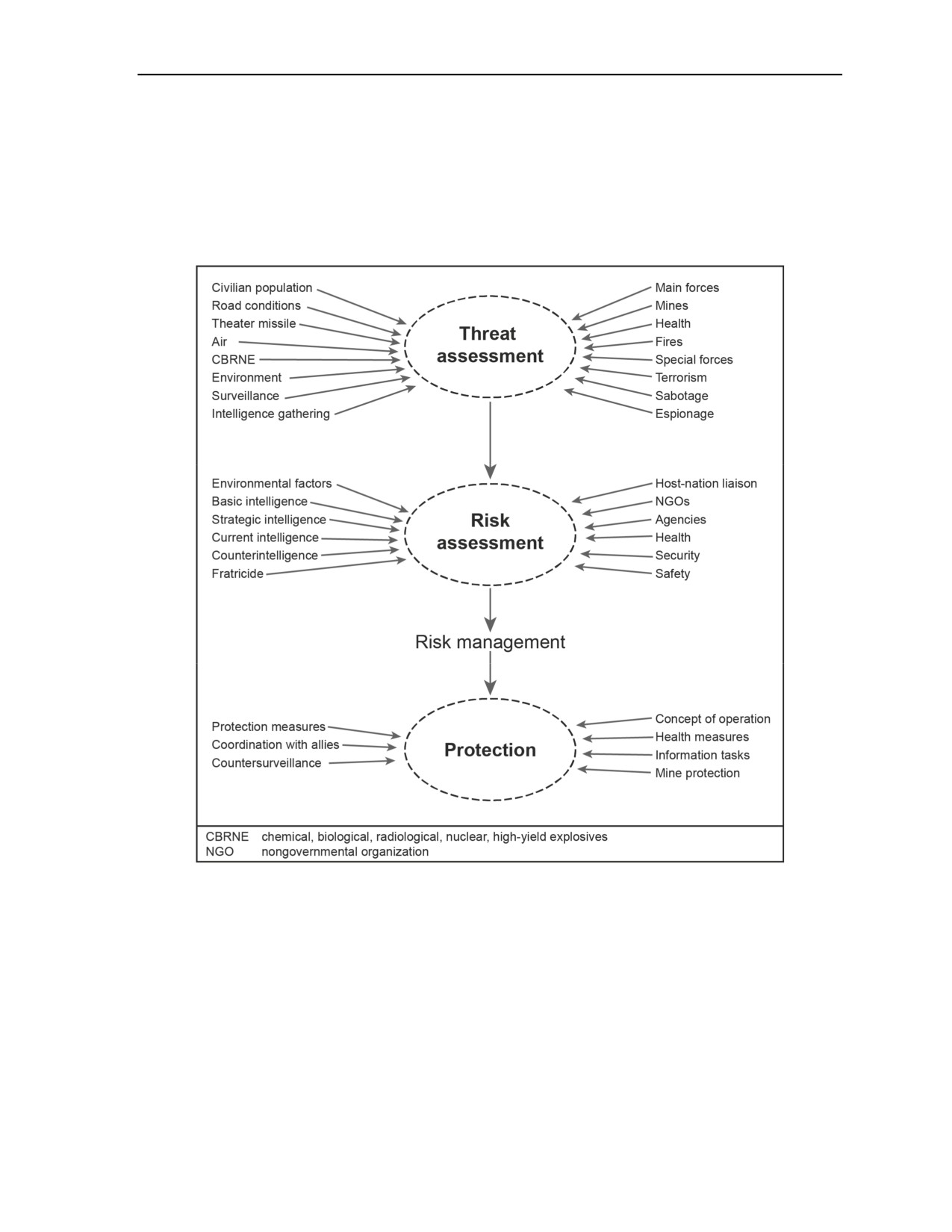
8-12. Protection is a risk management process as shown in figure 8-1. By producing an accurate and
comprehensive threat assessment and covering all the principles covered in the principles for commanders,
the staff produces an initial set of measures that address the actual threat. Protection measures are offensive
or defensive. The proposed measures balance against the commander’s mission and operational
requirements. The measures are tempered in application by risk management. For example, measures that
perceived as aggressive, such as patrolling in armored vehicles or hard targeting, impairs a force’s mission
in many peace operations environments.
Figure 8-1. Protection process diagram
8-13. The lead nation headquarters distributes the final selection of protection measures in an annex to the
operation order. Implementing some measures are not force wide. The threat, particularly in stability tasks,
is not uniform and is subject to frequent review and change. Subordinate commanders, in consultation with
the multinational force commander, implements additional local measures.
8-14. The threat assessment is continual. As the situation changes or new intelligence is received, the staff
reviews protection measures and adapts them to the new situation. As part of mission command,
subordinate commanders perform local reviews. The lead nation headquarters continue to coordinate
protection.
8 April 2014
FM 3-16
8-3
Chapter 8
NONMILITARY AGENCIES AND REQUEST FOR PROTECTION
8-15. Nonmilitary agencies request some form of protection from the military, contractors, or host nations.
Threats are not always transparent, so these agencies help identify them. The protection afforded to these
agencies enhances military credibility and provides the multinational force with an opportunity to advance
a cooperative environment. However, the protection provided must be in proportion to mission
requirements.
CONSTITUENTS OF PROTECTION
8-16. There are two constituents of protection—balanced threat assessment and derived protection
measures. Together these two constituents provide collective security of the multinational force.
BALANCED THREAT ASSESSMENT
8-17. Protection is based on the threat assessment. The results of the assessment determine the measures
that address collective protection, security, and health and safety. Overprotection, to counter an improbable
threat, diverts scarce resources from accomplishing the mission. As part of planning, the national
authorities perform a threat assessment. The national authorities provide political guidance on the priority
that avoids casualties. Varying intents, threats, and capabilities are in the threat assessment where multiple
adversaries exist. An overall assessment of protection requirements based on this threat assessment is
incorporated into the national military directive. The checklist in chapter 2 gives examples of the content
for a threat assessment. It includes the following:
z
The lead nation’s national assessment. This provides the basis for the multinational force
commander’s visualization and directive. It also provides a start point for negotiations with the
other troop-contributing nations.
z
National or local assessments. These reveal a threat to the civilian population of troop-
contributing nations or their forces in other theaters of operation. These assessments include
nonviolent activities such as military information support operations
(MISO) and other
associated tactics aimed at influencing international perceptions. Countering such threats is a
national responsibility.
DERIVED PROTECTION MEASURES
8-18. Following the threat assessment, commanders decide on appropriate protective measures. The threat
assessment also informs targeting. Attack is the only form of defense against certain threats. Protection
includes those elements, normally the responsibility of the lead nation headquarters, which protect the
whole force. Responsibility for this is delegated to subordinate commanders. Protection measures fall under
several broad categories:
z
Theater of operations missile defense.
z
Chemical, biological, radiological, nuclear, and high-yield explosives (CBRNE) defense.
z
Explosive ordnance disposal (EOD).
z
Air defense.
z
Information operations.
z
Countersurveillance.
z
Sustainment protection.
z
Physical protection (equipment and standards).
z
Traffic regulation.
z
Counterfratricide.
z
Security.
z
Space control.
8-4
FM 3-16
8 April 2014
Protection in a Multinational Environment
8-19. Within an American-led multinational force, the U.S. provides theater of operations missile defense.
Multinationals without U.S. coverage rely on destroying surface-to-surface missiles and ground launchers
and prevent the enemy from neutralizing or destroying their associated command and control structures.
8-20. The threat assessment determines the need to deploy specialist CBRNE assets and additional medical
resources.
8-21. The multinational force air component commander, who also serves as the area air defense command
and airspace control authority, coordinates air defense including offensive and defensive operations for the
multinational force. The functions and responsibilities of this commander, the airspace control authority,
and the area air defense commander must be integrated to unite joint air operations, airspace control,
missile detection and warning, and air defense operations to support the multinational plan.
8-22. Information operations must be related to protecting the integrity and capability of the force. These
operations must also physically protect the headquarters and communications assets, particularly isolated
communications outstations. There are measures in the nation or the multinational force. These measures
include—
z
Physical destruction.
z
Electronic warfare.
z
MISO, operations security, and deception that falls in an information operations or mission
command warfare plan.
z
Computer network operations.
8-23. Effective countersurveillance protects all force elements by making it harder to target the location
and friendly forces. Countersurveillance measures are part of each formation’s standard operating
procedures, but direction comes from the lead nation headquarters via the subordinate commanders. All
direction is based on the adversary’s intelligence, surveillance, target acquisition, and reconnaissance
capability from the threat assessment.
8-24. Sustainment units require protection in warfighting. Units lack a self-defense capability against
anything other than small-scale infantry attacks. The threat assessment determines the likely level, scale,
and warning time for attacks on sustainment units. This determines allocation of additional forces to the
sustainment area commander, multinational force logistics commander, or both. Sustainment units have to
decrement mission assets (such as converting cargo-carrying trucks to gun trucks) to augment protection
forces.
8-25. The physical protection of the force has three aspects—structures, vehicles, and individuals.
Engineers are responsible for field defenses. National authorities make decisions on additional armor
protection and other vehicle modifications. The commander’s decisions are implemented before
deployment or arrival in the theater of operations. The subordinate commanders control some personal
equipment, such as general-purpose laser goggles and fragmentation vests, in lead nation headquarters
guidelines. The commander delegates decisions on protective dress policy to subordinate commanders.
8-26. Military police provide a wide array of functions and capabilities during multinational operations.
Military police are specifically trained to—
z
Interact with local police authorities where appropriate.
z
Advise on, implement, and enforce main supply route regulations.
z
Provide a visible protection presence in built-up areas.
z
Provide vital information on criminal and threat forces.
z
Conduct dislocated civilian and refugee operations with assistance from civil affairs and MISO
units.
8-27. A counterfratricide policy covers operational awareness at all levels, weapons-tight zones, use of
liaison, coordination between adjacent units, and combat identification. The lead nation headquarters
formulates and coordinates this policy.
8-28. Security covers the physical and procedural measures, directed at lead nation headquarters level and
integrated into the overall plan, but mainly applied at the local level. Security minimizes direct and indirect
attacks on personnel, equipment, installations, and line of communication by other than the adversary’s
8 April 2014
FM 3-16
8-5
Chapter 8
main forces. In stability tasks, North Atlantic Treaty Organization (NATO) Article 5 Collective Defense,
and peace operations, where the adversary does not possess an air, surface-to-surface missile, and CBRNE
capability, security is the main constituent of protection. Some security measures affect the civilian
population. Such measures are subject to appropriate legal advice that incorporates the requirements of
international law, host nation law, and any extant status of force agreements or memorandums of
understanding. Security incorporates the following:
z
Personnel security—to include standing physical and procedural measures to protect personnel.
z
Positional or installation security—including physical and procedural measures to protect
positions or installations from attack, sabotage, and theft.
z
Line of communication defense—including patrols, mine clearance, overwatch, and bridge
guards that ensure safe and secure lines of communication.
z
Security of information—including physical and procedural barriers to protect friendly
information.
z
Liaison with host nation security forces. The host nation security forces retain some operational
capability and liaison is vital to coordinate actions. In some cases, host nation security forces
have primacy. In nearly all cases, they provide intelligence and other related information about
conditions in the theater of operations.
z
Individual national EOD protection support provides different capabilities; therefore, a single
combined joint EOD cell must be established in the top level headquarters of combined joint
task force headquarters. The combined joint EOD cell is the focal point for the combined joint
task force headquarters for all EOD matters. While the combined joint EOD cell does not have a
tasking function for EOD tasks, it is responsible for coordinating EOD matters with troop-
contributing nations and other organizations. An example is the United Nations (UN). The broad
roles of the combined joint EOD cell are to—
Develop, implement, and maintain the policies that define EOD operations.
Coordinate the passage of all forms of relevant EOD intelligence and information.
Coordinate EOD effort in the AO.
Write and continually revise and publish theater specific operating standards and
procedures.
z
Population controls—including curfews, movement restrictions, travel permits, registration
cards, and resettlement of villagers.
z
Prisoners of war and detainees—to include providing secure accommodations and guard forces
to contain prisoners of war and detainees.
z
Health defense that aims to minimize casualties from disease and environmental hazards. Some
examples are pollution, poor sanitation, and climatic extremes. The health defense incorporates
the following:
Proactive measures—including vaccination against endemic and biological warfare
pathogens, acclimatization, medical surveillance, and clinical presentations.
Health education—to include advising personnel on prevalence of, and measures to prevent,
endemic and sexually transmitted diseases; measures to prevent casualties from climatic
extremes; and measures to prevent transmission of biological warfare agents and persistent or
residual chemical and radioactive agents.
Local environment advice—including dangerous wildlife, hazardous terrain, and industrial
and other pollution hazards.
z
Mine defense—including mine, unexploded explosive ordnance, improvised explosive device,
and booby traps marking; clearing and awareness; and out of bounds areas. This requires the
establishment of a mine and unexploded explosive ordnance action center. These centers track
mine, unexploded explosive ordnance, and booby trap hazards resulting from previous combat.
PROTECTION AND MISSION COMMAND
8-29. Protection is cyclical. It assesses the threat and prescribes appropriate measures to reduce the
vulnerabilities at risk from elements of that threat. It is not a separate staff function, but an implicit part of
8-6
FM 3-16
8 April 2014
Protection in a Multinational Environment
the operation plan. Multinational force construction addresses the required elements or components of
protection and their mission command functions to implement the plan. All these elements are brought
together for single coordination at senior J-3 staff level with joint coherence. As with all other aspects of
military operations, responsibility for protection rests with the multinational force commander.
Nevertheless, the chief of staff coordinates with the J-3 to exercise day-to-day responsibility for protection.
The multinational commander establishes a multinational operational protection coordination center under
the staff supervision of chief of staff to coordinate protection issues for the multinational force and with the
host government.
8-30. If the threat to sustaining operations is anything other than low, and particularly if adversary main
forces threaten sustaining operations, then the multinational force commander appoints a sustaining
operations coordinator separate from the force logistics headquarters.
CHECKLIST
8-31. Commanders and staffs participating in multinational operations should be able to answer the
following question with respect to the protection portion of the operation.
THREAT ASSESSMENT
z
Has a threat assessment been carried out?
z
Has the lead nation headquarters coordinated protection measures for the multinational force?
z
Has the mission, including the commander’s intent, been disseminated? Do elements two
echelons down understand it?
z
Who is the designated staff officer for protection at the lead nation headquarters and subordinate
headquarters?
z
What does protection mean to each nation in the multinational operations?
z
Do the rules of engagement (ROE) support protection?
z
What are the force’s antifratricide measures?
z
Do commanders at all levels understand how to apply risk management?
z
Will any formation be needed to carry out a local threat assessment?
z
Are countersurveillance measures included in formation standard operating procedures?
z
What nonlethal technology is available? How is the force trained to use it? Do the ROE
authorize its employment?
z
What controls exist on using personal equipment?
z
What units are available to the command and when are they available?
z
What are the multinational airspace control measures?
z
What training is required once deployed?
z
Has a MISO program been developed to support the operation?
z
Have MISO assets been requested?
z
What multinational space control assets are available?
z
Has a computer network operations plan been developed to support the operation?
z
Have computer network operations assets been requested?
z
Has a vulnerability assessment been made of friendly high value facilities?
z
Has a multinational operation protection coordination center been established?
z
Are there sufficient military police or similar forces available for area and route security in the
AO?
GROUND-BASED AIR DEFENSE FORCE PLANNING
8-32. The Army air defense artillery protects the force from enemy interference from the air. This checklist
assumes that the multinational air force has not neutralized a credible air threat.
8 April 2014
FM 3-16
8-7
Chapter 8
z
Stability tasks and peace operations may not have a credible air threat. If that is the case, is there
a real need for ground-based air defense?
z
Which ground-based air defense package does the war fighting, low to high intensity conflict,
require?
z
What is the multinational force structure?
z
What maritime and air assets will support the multinational force?
z
What is the desired ground-based air defense coverage for early entry forces?
z
What is the desired order of arrival of ground-based air defense assets?
z
What is the commander’s intent?
z
What is the multinational command structure for ground-based air defense?
z
What airspace control procedures will be used to deconflict air, aviation, indirect fire, and UAS
use?
z
Is there a requirement for a multinational airspace management cell at division or force level?
z
What will be the command relationships for ground-based air defense assets in operational
control versus tactical control situations?
z
What national sensitivities exist concerning the use of national ground-based air defense assets?
z
What international procedures will apply during the operations—for example, NATO or
American, British, Canadian, Australian, and New Zealand (ABCA) Armies’ Program?
z
What national ground-based air defense command arrangements are required to support the
multinational command structure?
z
What are the national requirements for liaison officers?
z
Will there be a multinational ground-based air defense command and control information
system? If not, how will national systems such as forward area air defense; command, control,
communications, and intelligence; and air defense communication and information systems be
integrated?
z
What multinational bearer communications system will be used? (Examples include mobile
subscriber equipment.)
z
Will the low-level air picture interface be used?
z
What are the multinational real estate procedures for ground-based air defense assets?
z
What battlefield coordination detachment requirements are available to coordinate land
component commander requirements in the air operations center?
Intelligence
z
Has a multinational intelligence preparation of the operational environment, including air
intelligence preparation of the operational environment, and estimate process been performed?
What factors were deduced by the multinational force headquarters?
z
Is there a multinational geospatial database to help define likely air avenues of approach and,
consequently, the ground-based air defense deployment plan?
z
What multinational force assets will need protection—seaport of disembarkation, aerial port of
disembarkation, lines of communication, force logistic areas, force concentration area, forward
operations area, or a combination of these?
AIRSPACE CONTROL SYSTEM
z
Will the joint force air component commander concept be employed by the multinational force?
If so, who is the multinational air component commander and where is this individual located?
z
Will the multinational air component commander produce the airspace control plan, the airspace
coordination order, and the air tasking order and act as the airspace control authority for the
operation? If not, who will?
z
What interface will there be with the host nation civil aviation authority before the
commencement of hostilities?
z
Where will the combined air operations center for the force be located?
8-8
FM 3-16
8 April 2014
Protection in a Multinational Environment
z
Will the airspace control system aim for positive control or will national ground-based air
defense mission command limitations force it back to procedural control?
SITUATIONAL UNDERSTANDING
z
What type of recognized air picture and local air picture system is available?
z
Will there be a recognized air picture?
z
How will maritime, land, air, and space units contribute to it?
z
What tactical data link system will be used?
z
Who will be the identification authority for the recognized air picture
(multinational air
operations center or sector operations center)?
z
Who will be the identification authority for situational understanding?
RULES OF ENGAGEMENT
z
What will be the multinational ROE before hostilities and after committing the first hostile act?
z
Will the policy on preemptive air strikes be contained in the multinational ROE?
z
Who will define weapon control statuses such as weapons free, weapons tight, and weapons
hold?
z
What mechanism will exist to update ROE during the operation?
IDENTIFICATION, FRIEND OR FOE
z
What identification, friend or foe systems will be used?
z
What identification, friend or foe types are fitted to ground-based air defense systems?
ELECTRONIC COUNTERMEASURES
z
What electronic countermeasure policy will be put in place by the force J6?
z
Does the electronic countermeasure policy minimize potential suppression of enemy air defenses
against the force ground-based air defense assets?
LOGISTICS
z
What major equipment will multinational partners bring to the theater of operations?
z
What is the logistic structure?
z
What arrangements will be in place for multinational resupply of common ammunition?
z
What is the multinational policy on the scale of war reserve ground-based air defense systems by
equipment type?
z
What is the intratheater repair policy? What mutual support is planned for common equipment?
TRAINING
z
Where will training occur—at home, en route to operation, or in concentration area? When will
training occur?
z
Will intratheater ranges be available?
z
What will be the policy on test firing weapon systems intratheater?
z
What part will simulators play in the transition to war training strategy?
z
What collective training will occur?
EXPLOSIVE HAZARDS
z
What types of explosive hazards have been used in the AO?
z
Are there existing mine field maps and/or assessments of the types of mines and patterns used?
z
What types of cluster munitions were used and what are their locations?
8 April 2014
FM 3-16
8-9
Chapter 8
z
What types of booby traps and improvised explosive devices have been or are anticipated to be
used in the AO?
z
Is there an ongoing humanitarian demining program in the AO?
z
What EOD assets are available in the AO to respond to these threats?
z
What engineer area clearance assets are available in the AO?
8-10
FM 3-16
8 April 2014
Chapter 9
Civil Affairs Operations
This chapter begins by discussing civil-military cooperation and the purpose of civil
affairs operations; the cooperation, functions, and guidelines of civil affairs
operations; and principles in civil affairs operations. It also discusses civil affairs
operations’ legal parameters and key factors. The chapter then discusses key civil
affairs operations and principles of humanitarian action; civil organizations,
government, and military relationships; and organizational structure. Lastly, it
discusses the military support to the civilian community and military planning in civil
affairs operations. This chapter also provides a checklist for commanders and staffs.
CIVIL-MILITARY COOPERATION
9-1. As with many areas discussed in this manual, civil affairs operations, stability tasks, or civil-military
cooperation does not have a single doctrinal focus that all the nations share. (Civil-military cooperation is
the more commonly used term in the multinational community.) For example, some nations see civil affairs
operations as supporting the commander’s mission. Others believe that civil military cooperation has a
wider scope because it supports the commander’s mission as it helps the military troops play their part in a
wider response to a crisis. For those latter nations, civil affairs operations funding comes from other
government departments rather than from their defense establishment. Therefore, civil affairs operations for
those nations does not support the military mission alone.
9-2. Civil affairs operations allow the commander to interface effectively with all parts of the civilian
environment in the joint operations area. Civil affairs operations include performance by military forces of
activities and functions that are the responsibility of the local, regional, or national government. These
activities and functions also occur, if directed, in the absence of other military operations.
9-3. Civil affairs operations is a function of operations performed by staffs fully integrated into
headquarters at every level. Civil military cooperation activity begins at the highest political levels,
becomes integrated into the campaign plan, and remains coherent at all operational levels. Civil military
cooperation contributes to achieving the overall political mission and the commander’s mission.
9-4. The campaign plan, as agreed by all multinational partners, will—
z
Direct the commander on the legal obligations to the civilian sector.
z
Prioritize the major tasks.
z
Provide the necessary funding.
z
Ensure consistency across zones of national responsibility in the joint operations area.
z
Outline the relationships with the strategic decisionmakers.
9-5. Commanders consider the civil affairs operations dimension of the operation early in planning.
PURPOSE OF CIVIL AFFAIRS OPERATIONS
9-6. The purpose of civil affairs operations is to—
z
Minimize civilian interference with military operations.
z
Maximize support for operations.
z
Meet the commander’s legal responsibilities and moral obligations to civilian populations in the
commander’s area of control.
8 April 2014
FM 3-16
9-1
Chapter 9
9-7. When possible, a second purpose is to reduce military interference with the civilian populace. This
helps create civil-military conditions that maximize advantages for commanders to accomplish their
missions. The long-term purpose of civil affairs operations is to accomplish the mission and create and
sustain the conditions to support a lasting solution to a crisis. Civil affairs operations is the interface
between military and civil authorities, agencies, and populations. It is integral to any military operation.
DEFINITIONS AND TERMINOLOGY OF CIVIL AFFAIRS
OPERATIONS
9-8. Many multinational armies adopted different terminology as this area has developed. The Army uses
civil affairs operations while NATO and American, British, Canadian, and Australian and New Zealand
Armies Program use civil-military cooperation. The following explains the relationship between U.S. and
NATO terminology:
z
The U.S. term civil affairs is most closely related to the NATO term civil-military cooperation
groups.
z
The U.S. term civil affairs operations refers to the actions of civil affairs personnel. It is related
to the NATO term civil-military cooperation.
z
The U.S. term civil-military operations center is related to the NATO term civil-military
cooperation center.
COOPERATION OF CIVIL AFFAIRS OPERATIONS
9-9. Establishing and maintaining working relationships with organizations operating in the civil sector is
fundamental to successful multinational civil affairs operations. These relationships range from high-level
interorganizational to less formal relations that stem from ongoing working interactions. These
relationships form effective cooperation with interorganization.
9-10. It is not practicable or necessary for all civil agencies to have the same degree of cooperation. Many
mechanisms and activities support this process. These include general liaison, regular meetings, and
standing for an agency collaboratively staffed by both civil and military representatives. These mechanisms
and activities facilitate various levels of cooperation ranging from information sharing to integrated
planning.
FUNCTIONS OF CIVIL AFFAIRS OPERATIONS
9-11. The headquarters of civil affairs operations staff carry out the following core functions:
z
Civil-military liaison.
z
Support to the civil environment.
z
Support to the force.
CIVIL-MILITARY LIAISON
9-12. This liaison facilitates and supports the planning and conduct of operations. Such liaison early in
planning and immediately following the deployment of forces provides the basis for the other two core civil
affairs operations functions.
SUPPORT TO CIVIL ENVIRONMENT
9-13. Support to the civil environment involves a wide range of military resources: information, personnel,
materiel, equipment, communication facilities, specialist expertise, or training. Staff at the highest level
make decisions on depth, duration, and extent of this support. Decisions include political, military, and civil
factors. Nations have different national agendas as to their extent, type, and purpose of support to the civil
environment. The multinational commander understands these positions.
9-2
FM 3-16
8 April 2014
Civil Affairs Operations
SUPPORT TO THE FORCE
9-14. Commanders, depending on the circumstances at the time, require significant civilian support in the
joint operations area. They also require coordination of efforts to minimize disruption to military operations
such as population and resources control operations. The force is partially dependent on civilian resources
and information from civilian sources. Commanders seek tacit civilian support for operations.
GUIDELINES OF CIVIL AFFAIRS OPERATIONS
9-15. Civil affairs operations implies neither military control of civilian organizations or agencies. It
recognizes that—
z
The military is only responsible for security related tasks and limited logistics, communication,
or other support. It is possible to support the appropriate civil authority for implementing civil
tasks. However, this is possible only if the mandated civil authorities, if applicable, and the
appropriate military commander agrees according to the campaign plan.
z
In exceptional circumstances subject to political sanction by the governments of troop-
contributing nations, the force takes on tasks normally the responsibility of a mandated civil
authority. This involves civil administration operations.
z
These tasks are only accepted where the appropriate civil body is not present or is unable to
carry out its mandate.
z
The military undertakes tasks necessary to maintain momentum towards a lasting solution to a
crisis until the mandated civil authority or agency is prepared and able to assume them.
z
Responsibility for civil related tasks are handed over to the appropriate civil authority,
organization, or agency as soon as is practical. Responsibility is handed over as smooth as
possible.
PRINCIPLES IN CIVIL AFFAIRS OPERATIONS
9-16. The following principles help multinational forces in conducting civil affairs operations:
z
Coordination.
z
Unity of effort.
z
Impact minimizing.
z
Impartiality.
z
Transparency.
z
Common goals identification.
z
Primacy of the military mission.
z
Economy of effort.
z
Relationships.
COORDINATION
9-17. Civil affairs operations is a key strand of the overall operational plan and not an activity apart. It
requires close coordination with other military capabilities and actions. It creates interfaces with the civil
environment necessary for the performance of other functions such as host nation support or engineering
activities.
UNITY OF EFFORT
9-18. Unity of effort is essential to achieve effective civil affairs operations. Activities in the theater of
operations have central direction, are closely coordinated, and are deconflicted without prejudicing the
needs of lower levels of command where necessary. Commanders establish explicit policies and procedures
to specify what subordinate commanders can do and what must first be coordinated with higher
headquarters.
8 April 2014
FM 3-16
9-3
Chapter 9
IMPACT MINIMIZING
9-19. Commanders minimize the military impact on the civil environment and minimize the civil
environment impact on military operations. The military requires access to local civilian resources. In such
circumstances, commanders avoid adversely impacting local populations, economies, or infrastructure.
9-20. The military takes on civil tasks only—
z
Where no other practical solution exists.
z
Where an otherwise unacceptable vacuum would arise.
z
Where it has the available resources.
9-21. Creating a “dependency culture” is likely to prejudice the successful achievement of the overall
mission. Responsibility for civil related tasks goes to the civil sector as quickly as possible. Likewise, every
effort is made to reduce the civil environment impact on military operations. An example of this includes
how dislocated civilians impact the main routes to provide supply and relief aid. This requires careful
planning.
IMPARTIALITY
9-22. Neutrality is a principle for nongovernmental organizations, not military forces seeking a specific
outcome. Supportive or compliant populations are favored and non-compliant populations are not
rewarded. Every practical effort is made to avoid compromising the neutrality of civil humanitarian
agencies. This is often difficult, but commanders and staffs are sensitive to the issue and exercise their
professional judgment. The ethical behavior and the appearance of ethical decisions by U.S. forces
demonstrate impartiality.
TRANSPERENCY
9-23. Transparency in all civil affairs operations activities is the best way to minimize potential tension.
Tension in a civil military relationship is detrimental to the overall goal.
COMMON GOALS IDENTIFICATION
9-24. Military and civilian organizations identify and share common goals to maximize the effectiveness of
civil affairs operations. Organizations establish these goals early in planning and incorporate political
guidance.
PRIMACY OF THE MILITARY MISSION
9-25. Ideally, no conflict exists between military objectives and those of most of the civilian organizations
working in the joint operations area. Only the commander decides how much to commit military resources
to civil affairs operations tasks. Additional tasks are not assumed without assessing the resources in
coordination with civilian agencies and prioritizing military tasks.
ECONOMY OF EFFORT
9-26. Commanders minimize the use of military assets in civil tasks and encourage maximum use of civil
resources. Equally, commanders do not create long-term civilian dependence on military resources by the
local population, government, intergovernmental organizations, or nongovernmental organizations. Once
provided, withdrawing or reducing resources strains civil relations or slows the growth of civil-military
relations. Also, withdrawing or reducing resources causes lasting damage to public confidence in the
military force.
RELATIONSHIPS
9-27. Commanders establish close working relationships between the key military and civilian
decisionmakers. These relationships help decisionmakers develop mutual respect and understanding. As the
operation matures, commanders recognize the impact made with the turnover of civilian and military staff.
9-4
FM 3-16
8 April 2014
Civil Affairs Operations
LEGAL PARAMETERS OF CIVIL AFFAIRS OPERATIONS
9-28. One of the key aspects of civil affairs operations is the role it plays to win the battle for moral
authority and legitimacy. In this respect, military elements use legal parameters and frameworks that form
the basis for civil affairs operations elements of the overall plan to win the operations for moral authority.
In addition, there are significant legal issues that affect various planning factors, particularly logistics. In
civil affairs operations, operations are integral to meeting the obligations that arise from the legal principle
of command responsibility.
9-29. Legal parameters vary according to the type of operation and its position in unified land operations.
The domestic legal restrictions that apply to coalition partners vary in the extent and nature of their
involvement in civil affairs operations. Multinational partners interpret international laws applicable to all
the partners differently. It is critical to continue discussions to find these differences and resolve or provide
for them in operational planning where possible. Legal staffs of coalition partners develop civil affairs
operations plans at the earliest opportunity.
KEY FACTORS IN CIVIL AFFAIRS OPERATIONS
9-30. If an operation takes place under a United Nations (UN) Security Council resolution, then the terms
of the resolution bind all UN members. Where the terms of the resolution authorize civil affairs operations
activity or initiatives, the resolution takes precedence over impediments that existed arising from the law of
the affected nation where operations occur. This occurs in Chapter VII (of the UN charter) operations
where “all necessary means” are authorized to achieve such tasks as securing humanitarian relief activities
or restoring peace and order.
9-31. Host nation laws, such as those related to customs and contracting, affect an operation to varying
degrees. G-2/S-2 identifies these issues in the intelligence preparation of the operational environment when
developing the civil affairs operations plan. As part of dealing with the host nation or with states hosting
forward operating bases, status-of-forces agreement (SOFA) clarify issues relating to logistic activity and
jurisdiction. Civil affairs operations planners know the terms of the SOFA significantly impact stability
tasks center planning.
9-32. Acquisition and cross-servicing agreements among multinational partners affect logistics of civil
affairs operations. These agreements materially facilitate procurement and supply standardization and
streamlining. Chapter 6 discusses sustainment in detail.
9-33. Domestic law considerations for multinational partners greatly affect the activities that a particular
contingent or national personnel undertakes. For example, the National Foreign Assistance Act contains
certain provisions that govern national involvement in issues such as raising and training foreign police
forces. These provisions affect activities that coalition partners undertake. Civil affairs planners and
subordinate commanders understand these provisions before beginning an operation.
9-34. The most significant legal factor to consider in civil affairs operations is the possible application of
international humanitarian law.
ADMINISTRATION IN HOSTILE OR OCCUPIED TERRITORY
9-35. Multinational, alliances, coalition forces, or nations perform civil administration activities across the
range of military operations but particularly in the collapsed state context. They act on the authority of a
nation, alliance, coalition of nations, or the UN. The military controls the territory under administration. In
this situation, the civil affairs personnel along with the Department of State personnel, executes the
functions of military or occupational government until transitioning to a viable civilian government. The
occupying force has rights and obligations under international humanitarian law to ensure public order and
safety and the just and effective administration of and support to a hostile or occupied territory.
9-36. The occupying force maintains an orderly administration and hands over an effective civilian
administration or government as soon as possible. This occurs within its capabilities and is subject to the
principle of military necessity arising from any ongoing combat or security operations. The multinational
force commander analyzes military activities likely to increase tensions and those likely to facilitate and
8 April 2014
FM 3-16
9-5
Chapter 9
accelerate a return to civil administration or government subject to the requirements of the military
situation. The commander’s analysis is important in multiethnic or multicultural environments where one
or more of the parties to a conflict view the course of action as partisan.
9-37. Multinational partners have different opinions about when international humanitarian law applies.
The multinational force commander centrally coordinates and monitors policy applying to civil affairs
operations action under an international humanitarian law regime. Action should be taken at the outset of
the operation environment to find common ground on such issues.
KEY CIVIL AFFAIRS OPERATIONS ORGANIZATIONS
9-38. Civilian organizations perform a wide range of activities encompassing humanitarian aid to
include—
z
Human rights.
z
Protection of minorities, refugees, and displaced persons.
z
Legal assistance.
z
Medical care.
z
Reconstruction.
z
Agriculture.
z
Education, arts, and sciences.
z
General project funding.
9-39. Civil affairs operations staff and personnel understand the mandate, role, structure, methods, and
principles of civilian organizations. Collectively, with local populations and their representatives, these
staff and personnel represent the other half of the civil affairs operations equation. It is impossible to
establish an effective relationship with them without this understanding.
PRINCIPLES OF HUMANITARIAN ACTION
9-40. Commanders understand the four humanitarian principles to understand the civil-military
relationship. This is separate from the commanders’ requirement to understand the different roles and
mandates of the various civilian organizations. The international community adopted these four principles.
Most civil aid organizations base operation and humanitarian action on these principles, which include—
z
Humanity. Human suffering must be relieved and the dignity and other human rights of
individuals and groups must be respected.
z
Impartiality. Humanitarian assistance must be provided without discrimination. Relief is given
without regard to nationality, political or ideological beliefs, race, religion, sex, or ethnicity, but
only if needs are urgent.
z
Neutrality. Humanitarian participants do not take sides in hostilities or engage in controversies
of a political, racial, religious, cultural, or ideological nature at any time.
z
Independence. Humanitarian participants maintain the right to independence of their own actions
and resist any attempts to place conditions on their actions or movements in return for
cooperation with military authorities.
LEAD AGENCIES
9-41. A lead agency is the U.S. Government agency designed to coordinate the interagency oversight of
the day-to-day conduct of an ongoing operation (JP 3-08).The international community mandates a lead
agency to coordinate civilian organization activities. These civilian organizations volunteer for an
operation. It is normally a major UN agency such as UN High Commissioner for Refugees, UN Children’s
Fund, or the UN Office for the Coordination of Humanitarian Affairs, which is part of the UN secretariat.
Specific responsibilities of a lead agency include—
z
Acting as a point of contact for other agencies, particularly in the areas of planning and
information sharing.
z
Coordinating field activities to avoid duplicating effort and wasting resources.
9-6
FM 3-16
8 April 2014