FM 3-16 THE ARMY IN MULTINATIONAL OPERATIONS (APRIL 2014) - page 1
*FM 3-16
Field Manual
Headquarters
Department of the Army
No. 3-16
Washington, DC, 8 April 2014
The Army in Multinational Operations
Contents
Page
PREFACE
v
INTRODUCTION
vi
Chapter 1
FUNDAMENTALS OF MULTINATIONAL OPERATIONS
1-1
Fundamentals
1-1
The Structure of Multinational Forces
1-1
The Nature of Multinational Operations
1-2
The Importance of Mutual Confidence
1-2
Chapter 2
COMMAND AND CONTROL IN MULTINATIONAL OPERATIONS
2-1
Multinational Operations Purpose
2-1
Mission Command Purpose
2-1
Command Structure
2-2
Command Jurisdiction
2-4
Unity of Effort
2-4
National Interests
2-5
Command Authority
2-5
NATO Operations
2-6
CFC, Korea and U.S. Force, Korea Operations
2-6
Allied Operations
2-7
United Nations Operations
2-7
Multinational Forces Control
2-7
Command and Control Interoperability
2-9
Agency Cooperation and Coordination
2-10
Multinational Force Staffing
2-10
Communication Establishment
2-17
National Capabilities
2-17
Checklist
2-20
Chapter 3
HUMAN RESOURCE CHALLENGES OF MULTINATIONAL OPERATIONS . 3-1
Human ResourceS Support
3-1
Legal Considerations for Commanders
3-3
Distribution Restriction: Approved for public release; distribution is unlimited.
*This publication supersedes FM 3-16 dated 20 May 2010.
i
Contents
Environmental Considerations
3-7
Checklist
3-7
Chapter 4
INTELLIGENCE CONCERNS FOR MULTINATIONAL OPERATIONS
4-1
Multinational Intelligence
4-1
Multinational Information Sharing
4-1
Multinational Forces Operations Planning
4-2
Multinational Forces Communications and Processing
4-2
Effective Coordination for Multinational Operations
4-2
Stability Operations Support
4-3
Information Gathering Importance
4-3
Information Versus Intelligence
4-5
Checklist
4-5
Chapter 5
PLANNING CHALLENGES FOR MULTINATIONAL OPERATIONS
5-1
Multinational Operations Overview
5-1
Early Planning
5-1
Campaign Preparation
5-2
Force Projection for Multinational Forces
5-2
Mission Focus for the Commander
5-2
Commander’s Intent
5-3
Transfer of Authority
5-3
Planning Groups for Multinational Forces
5-3
Transition Planning
5-4
Unmanned Aircraft Systems in Planning
5-7
Training Multinational Forces
5-7
Checklist
5-9
Chapter 6
SUSTAINMENT CHALLENGES IN MULTINATIONAL OPERATIONS
6-1
Multinational Logistics Overview
6-1
Unity of Effort Between Nations and Agencies
6-1
Responsibility for Logistics
6-2
Planning for Logistics
6-2
Host Nation Support
6-3
OperatIonal Contract Support
6-6
Waste and Disposal Plans
6-9
United Nations System
6-9
Movement In Multinational Force Operations
6-10
Checklist
6-12
Chapter 7
INFORM AND INFLUENCE CHALLENGES IN MULTINATIONAL OPERATIONS
............................................................................................................................7-1
Information Environment In Multinational Operations
7-1
Checklist
7-2
Chapter 8
PROTECTION IN A MULTINATIONAL ENVIRONMENT
8-1
Multinational Force Protection Overview
8-1
Asymmetric Threats
8-1
Potential for Fratricide
8-1
Protection Principles for Commanders
8-2
Concept of Protection
8-2
ii
FM 3-16
8 April 2014
Contents
Nonmilitary Agencies And Request for Protection
8-4
Constituents of Protection
8-4
Protection And Mission Command
8-6
Checklist
8-7
Chapter 9
CIVIL AFFAIRS OPERATIONS
9-1
Civil-Military Cooperation
9-1
Purpose of Civil Affairs Operations
9-1
Definitions and Terminology of Civil Affairs Operations
9-2
Cooperation of Civil Affairs Operations
9-2
Functions of Civil Affairs Operations
9-2
Guidelines of Civil Affairs Operations
9-3
Principles in Civil Affairs Operations
9-3
Legal Parameters of Civil Affairs Operations
9-5
Key Factors in Civil Affairs Operations
9-5
Administration in Hostile or Occupied Territory
9-5
Key Civil Affairs Operations Organizations
9-6
Principles of Humanitarian Action
9-6
Relationships Between Civil Organizations, Governments, and the Military
9-9
Organizational Structure
9-10
Military Support to the Civilian Community
9-12
Military Planning in Civil Affairs Operations
9-13
Checklist
9-15
Chapter 10
RESOURCE MANAGEMENT CHALLENGES IN MULTINATIONAL OPERATIONS
.......................................................................................................................... 10-1
Multinational Resource Management
10-1
Multinational Resource Manager
10-1
Interorganizational Resource Guidance
10-2
Interagency (Funding and Control) Processes
10-3
Reimbursement Procedures
10-4
Checklist
10-4
Chapter 11
MEDICAL SUPPORT IN MULTINATIONAL OPERATIONS
11-1
Army Health System Role
11-1
Army Health System Principles
11-1
Medical Staff
11-1
Command Surgeon Responsibilities
11-2
Command Relationships in Medical Support
11-3
Medical Planning
11-3
Health Threat Assessment
11-4
Medical Support Policies and Issues
11-4
Countermeasures
11-5
Standards of Care
11-5
Health Service Support Functional Areas
11-6
Checklist
11-6
Chapter 12
OPERATIONAL CONSIDERATIONS FOR MULTINATIONAL FORCES
12-1
Military Capabilities
12-1
Critical Opponents at the Operational Level
12-1
8 April 2014
FM 3-16
iii
Contents
Fire Support
12-1
Engineer Tasks and Responsibilities
12-2
Engineer Support
12-4
Interoperability and Standardization in Multinational Forces
12-6
Checklist
12-8
Chapter 13
MARITIME OPERATIONS IN MULTINATIONAL OPERATIONS
13-1
Characteristics of Maritime Forces
13-1
Employment of Maritime Forces
13-2
Maritime Constabulary Functions
13-3
Operations in Wartime
13-4
Checklist
13-4
Chapter 14
AIR OPERATIONS IN MULTINATIONAL OPERATIONS
14-1
Multinational Air Operations Principles
14-1
Air Defense
14-2
Army Air and Command Missile Defense Command
14-3
Airfield Operations
14-3
Unmanned Aircraft Systems
14-3
Checklist
14-4
GLOSSARY
Glossary-1
REFERENCES
References-1
INDEX
Index-1
Figures
Figure 2-1. Integrated command structure
2-4
Figure 2-2. Comparison of command authorities
2-6
Figure 8-1. Protection process diagram
8-3
Tables
Table 6-1. Host nation considerations
6-4
Table 6-2. Standard base ordering agreement information
6-8
iv
FM 3-16
8 April 2014
Preface
FM 3-16 blends key points of Joint Publication (JP) 3-16 into its approach to ensure consideration by Army
elements of a joint force and addresses the Army's roles and functions in a multinational operation. While North
Atlantic Treaty Organization (NATO) and the American, British, Canadian, Australian, and New Zealand
(ABCA) Armies’ Program have achieved some levels of standardization in certain areas, no comprehensive
common doctrine exists between the armies. This manual does not fill this gap. It will help the multinational
commander understand and develop solutions to create an effective fighting force.
The principal audience for FM 3-16 is all members of the profession of arms. Commanders and staffs of Army
headquarters serving as joint task force or multinational headquarters should also refer to applicable joint or
multinational doctrine concerning the range of military operations and joint or multinational forces. Trainers
and educators throughout the Army will also use this manual.
Commanders, staffs, and subordinates ensure their decisions and actions comply with applicable U.S.,
international, and in some cases, host-nation laws and regulations. Commanders at all levels ensure their
Soldiers operate according to the law of warfare and the rules of engagement (ROE). (See FM 27-10).
FM 3-16 implements standardization agreement STANAG 6025, Ed. 2.
FM 3-16 uses joint terms where applicable. Selected joint and Army terms and definitions appear in both the
glossary and the text. Terms for which FM 3-16 is the proponent publication (the authority) are marked with an
asterisk (*) in the glossary. Definitions for which FM 3-16 is the proponent publication are boldfaced in the
text. For other definitions shown in the text, the term is italicized and the number of the proponent publication
follows the definition.
FM 3-16 applies to the Active Army, Army National Guard/Army National Guard of the United States, and
United States Army Reserve unless otherwise stated.
The proponent of FM 3-16 is the United States Army Combined Arms Center. The preparing agency is the
Combined Arms Doctrine Directorate, U.S. Army Combined Arms Center. Send comments and
recommendations on a Department of the Army (DA) Form 2028 (Recommended Changes to Publications and
Blank Forms) directly to: Commander, U.S. Army Combined Arms Center and Fort Leavenworth, ATTN:
ATZL-CD (FM 3-16), 300 McPherson Avenue, Fort Leavenworth, KS 66027-2337. Send comments and
recommendations by e-mail to usarmy.leavenworth.mccoe.mbx.cadd-org-mailbox@mail.mil. Follow the DA
Form 2028 format or submit an electronic DA Form 2028.
8 April 2014
FM 3-16
v
Introduction
Introduction
Whenever commonality of interest exists, nations enter into political, economic, and/or military
partnerships. These partnerships occur in regional and worldwide patterns as nations seek opportunities to
promote their mutual national interests, ensure mutual security against real or perceived threats, gain
international or bi-national influence, conduct foreign humanitarian assistance and disaster relief
operations, and engage in peace or war operations. Cultural, diplomatic, information, military, economic,
religious, psychological, technological, and political factors all influence the formation and conduct of
multinational operations.
America's interests are global, but its focus is regional. Existing alliances and past coalitions reflect that
focus. Alliance participants establish formal, standard agreements for operational objectives. As forces of
these nations plan and train together, they develop mutual trust and respect. Alliance nations strive to field
compatible military systems, structure common procedures, and develop contingency plans to meet
potential threats. As examples only, the U.S. is currently a member of the following multilateral alliances
and agreements:
z
United Nations (UN).
z
North Atlantic Treaty Organization (NATO).
z
American, British, Canadian, Australian, and New Zealand (ABCA) Armies’ Program.
z
Defense and cooperation treaties with the Republic of Korea and Japan.
z
Inter-American Treaty of Reciprocal Assistance.
z
International Security Assistance Force (ISAF) in Afghanistan.
Multinational operations are conducted by forces of two or more nations, usually undertaken in the
structure of a coalition or alliance. Other possible arrangements include supervision by an
intergovernmental organization such as the UN or the Organization for Security and Cooperation in
Europe. Commonly used terms under the multinational rubric include allied, bilateral, coalition,
multinational, combined/coalition or multilateral. However, within this manual the preferred term
multinational will be the term used to describe these actions and has replaced the older terms of combined
in almost all usages except NATO:
z
An alliance forms the basis for responding to a variety of regional threats.
z
A multinational coalition is for limited purposes and for a limited length of time. It does not
afford military planners the same political resolve and commonality of aim as alliances.
Coalitions such as Operations Desert Shield/Desert Storm, Operation Enduring Freedom, and
Operation Iraqi Freedom have emerged to meet national strategic requirements.
z
Since ISAF included not only NATO Troop Contributing Nations but also 22 non-NATO
participating nations at its peak, and lasted for over decade, this guide and its Army users would
profit from Lessons Learned in that large multinational operation.
Thus, planners closely study the political goals of each participant as a precursor to detailed planning.
Political considerations weigh more heavily with coalitions than with alliance operations.
The precise role of land forces in these operations will vary according to each political and military
situation. Army participation is likely for three reasons:
z
Only land forces hold terrain and control populations.
z
Army structure contains s capabilities other Services do not have.
z
Soldiers on the ground are a clear demonstration of political resolve.
z
This field manual cannot provide all the answers, but its purpose is to prompt the user to ask the
right questions for mission success.
This publication has undergone significant changes and improvements over the past two decades. It meets
the growing and evolving multinational missions. The central idea of this publication reflects the Army’s
vi
FM 3-16
8 April 2014
Introduction
role within a larger framework (unified action) and its focus on maximum flexibility through a philosophy
of mission command and an operations approach. It links directly to the concepts and guidance laid out in
ADP/ADRP 3-0 and JP 3-16.
Chapter 1 provides the fundamentals of multinational operations.
Chapter 2 discusses command and control in multinational operations.
Chapter 3 discusses the intelligence concerns for multinational operations.
Chapter 4 describes the ways intelligence should be collected and disseminated in the force.
Chapter 5 discusses the planning challenges for multinational operations.
Chapter 6 describes sustainment challenges in multinational operations.
Chapter 7 discusses inform and influence challenges in multinational operations.
Chapter 8 describes protection in a multinational environment.
Chapter 9 discusses civil affairs operations in the multinational force.
Chapter 10 describes resource management challenges in multinational operations.
Chapter 11 discusses medical support in multinational operations.
Chapter 12 discusses the operational considerations for the multinational forces.
Chapter 13 describes maritime operations in multinational operations.
Chapter 14 describes the air operations needed in multinational operations.
U.S. commanders expect to conduct military operations as part of a multinational force. These operations
could span the range of military operations and require coordination with a variety of U.S. government
agencies, military forces and government agencies of other nations, local authorities, intergovernmental
organizations, nongovernmental organizations and local, U.S. and multinational corporations. The move to
a more comprehensive approach toward problem solving, particularly about counterinsurgency or stability
tasks, increases the need for coordination and synchronization among military and non-military entities. It
demands full staff integration into multinational activities and the understanding, intent, and execution of
every Soldier or agency.
LESSONS LEARNED
Nations in multinational operations have inherent responsibility to share lessons and best practices.
Multinational forces partners should take actions that will allow their information systems supporting the
capture and delivery of lessons and best practices to interoperate. If this is not feasible, then coalitions may need
to provide partners access to each other’s information systems. The United States Army, Center for Army
Lessons Learned (CALL) serves as the office of primary responsibility and action agent for the implementation
of the United States Army Lessons Learned Program and is located at http://call.army.mil. The ABCA Armies’
Program coalition operations lessons learned database is located on its home page at www.abca-armies.org/.
The Peacekeeping and Stability Operations Institute
(PKSOI) Stability Operations Lessons Learned and
Information Management System (SOLLIMS) is located on its home page at https://www.pksoi.org/index.cfm.
The PKSOI website allows access to the United States Military, United States Government agencies,
multinational military and civilian organizations, and private sector organizations to engage in collaboration for
collection, analysis, dissemination, and integration of lessons learned for peacekeeping and stability operations.
8 April 2014
FM 3-16
vii
Chapter 1
Fundamentals of Multinational Operations
This chapter begins by discussing the fundamentals and structure of multinational
forces. Next, it discusses the nature of multinational operations and the importance of
mutual confidence in multinational forces.
FUNDAMENTALS
1-1. Multinational operations is a collective term to describe military actions conducted by forces of two
or more nations, usually undertaken within the structure of the coalition or alliance (JP 3-16). The Army
conducts decisive action or unified land operations across a range of military operations.
1-2. Army forces are the decisive component of land warfare in multinational operations. The United
States may be a troop-contributing nation as part of a multinational command. The Army is part of a joint
multinational command headquarters. Alternately, the Army leads a joint multinational land component
command headquarters. (See JP 3-33 and JP 3-16).
1-3. Many Soldiers serve with foreign military partners or with civilian partners and have a clear
understanding of this environment. This chapter discusses the environment that units face when conducting
multinational operations.
1-4. Multinational military operations are not new. American commanders operated with multinational
forces throughout history. An example is General George Washington and his partnership with French
allies. In the twentieth and twenty-first centuries, Generals John Pershing, Douglas MacArthur, Dwight
Eisenhower, Matthew Ridgway, William Westmoreland, Creighton Abrams, Norman Schwartzkopf, David
Petraeus, and Stanley McCrystal have all operated in difficult multinational environments.
THE STRUCTURE OF MULTINATIONAL FORCES
1-5. Although the U.S. acts unilaterally in its national interests, it pursues its national interests through
multinational operations when possible. Multinational operations occur within the structure of an alliance
or a coalition.
ALLIANCES
1-6. An alliance is the relationship that results from a formal agreement between two or more nations for
broad, long-term objectives that further the common interests of the members (JP 3-0). One of those broad,
long-term objectives is standardization. Standardization is the process by which the Department of Defense
achieves the closest practicable cooperation among the Services and Department of Defense agencies for
the most efficient use of research, development, and production resources, and agrees to adopt on the
broadest possible basis the use of: a. common or compatible operational, administrative, and logistic
procedures; b. common or compatible technical procedures and criteria; c. common, compatible, or
interchangeable supplies, components, weapons or equipment; and d. common or compatible tactical
doctrine with corresponding organizational compatibility (JP 4-02). Alliances have standing headquarters
and organizations. Examples for the Army include the North Atlantic Treaty Organization (NATO) or the
Combined Forces Command (CFC), Korea.
8 April 2014
FM 3-16
1-1
Chapter 1
COALITIONS
1-7. A coalition is an arrangement between two or more nations for a common action (JP 5-0). This
action is a multinational action outside the bounds of an established alliance. It is based on a willing subset
of alliance members. Nations create a coalition to fulfill goals of common interest.
1-8. Coalitions exist for a limited purpose and time. A coalition does not afford military planners the
same political resolve and commonality of aim as an alliance. A coalition differs from alliances because its
members have a weaker resolve and commitment. A coalition has defined aims and offers military planners
more challenges than an alliance. Planners study each participant’s political goals before planning.
Normally, political considerations weigh more heavily with coalitions than with alliances. Sovereignty
issues are the most difficult issues for commanders of multinational forces. All national military
commanders are responsible to their respective national leadership, which reduces the traditional authorities
of the multinational commander. The multinational commanders accomplish the mission through
coordination, communication, and consensus of leadership rather than by traditional command
relationships. Unity of effort is essential. Unity of effort is coordination and cooperation toward common
objectives, even if the participants are not necessarily part of the same command or organization, which is
the product of successful unified action (JP 1). Commanders, along with subordinates, operate as diplomats
and warriors in a coalition.
THE NATURE OF MULTINATIONAL OPERATIONS
1-9. Multinational operations are driven by—
z
Common agreement among the participating alliance or coalition partners.
z
Terms of an alliance.
z
A mandate or authorization provided by the United Nations (UN).
1-10. The character of multinational operations merits particular attention. National interests and
organizational influence compete with doctrine and efficiency. Gaining consensus is difficult and solutions
are national in character. Commanders expect contributing nations to adhere to national policies and
priorities. This complicates the multinational effort.
1-11. A single commander employs a force in UN-sponsored multinational operations. The secretary
general appoints the force commander with the consent of the UN Security Council. The force commander
reports to the secretary general or a special representative and has wide discretionary powers over day-to-
day operations. However, the force commander refers all policy matters to the secretary general or special
representative to resolve.
1-12. The UN Security Council mandates NATO-International Security Assistance Force (ISAF) as part of
the overall International Community effort. NATO-ISAF has operated in Afghanistan for over a decade.
ISAF is divided into ISAF headquarters, joint command, and NATO training mission. U.S. General
Officers command each one. ISAF is then divided into regional commands headed by U.S., Turkish,
Italian, and German general officers (as of September 2012). The U.S. general officer heads the overall
mission as NATO-ISAF commander. The British Ambassador supports the mission as a NATO senior
civilian representative. Fifty troop-contributing nations participate in this exercise to accomplish common
goals for the multinational operation.
THE IMPORTANCE OF MUTUAL CONFIDENCE
1-13. The commander’s focus is the foundation of successful multinational operations. The commander
focuses on the political objective, mission, patience, sensitivity to the needs of other force members, a
willingness to compromise or come to a consensus when necessary, and mutual confidence. This mutual
confidence stems from tangible actions and entities and intangible human factors. This manual addresses
tangible considerations such as liaisons, cultures, religions, customs, and languages. The intangible
considerations that guide the actions of all participants, especially the senior commander, are—
z
Rapport.
z
Respect.
1-2
FM 3-16
8 April 2014
Fundamentals of Multinational Operations
z
Knowledge of partners.
z
Team building.
z
Patience.
z
Trust.
1-14. If a commander or staff ignores these considerations, multinational operations will fail.
RAPPORT
1-15. Commanders and staffs establish rapport with counterparts from other countries. This is a personal
and direct relationship. Good rapport between multinational force members results in successful teamwork
and unity of effort.
1-16. Commanders and staff establish rapport by understanding characteristics, customs, personalities,
capabilities, ambitions, sensitivities, history, languages, religions, and cultural habits of multinational
partners. Understanding these multinational partner elements helps commanders and staff understand each
nation’s legal and policy constraints. Once this understanding exists, respect, trust, patience, and
compromise develop and maintain rapport. The multinational force commander is visible to members of the
multinational force and makes personal visits to all units to assess capabilities, readiness, and morale and to
build rapport.
1-17. Commanders establish rapport when the nations combining forces share similar cultural
backgrounds. When members come from diverse cultural backgrounds and do not respect each other or
choose to violate cultural sensitivities, the partnership is fractured.
1-18. Commanders leverage preexisting relationships among U.S. and multinational commanders and staff
a catalyst to rebuild rapport. Often U.S. and multinational commanders and staff have preexisting, personal,
or professional relationships with multinational partners. Commanders use these relationships to rebuild
rapport.
RESPECT
1-19. Respect exists among multinational partners. Without genuine respect of others, rapport and mutual
confidence cannot exist. All nations accomplish the mission regardless of senior member rank or national
force size. Respect for the partners’ cultures, languages, religions, customs, and values combined with
understanding and consideration of their ideas solidifies a partnership. Lack of respect leads to friction and
jeopardizes mission accomplishment. All members of the multinational force understand their partners’
national views and politically imposed limitations to minimize friction.
1-20. Commanders consider national honor and prestige as important as combat capability when assigning
missions to multinational forces. Commanders include all partners in planning. The commanders seek the
partners’ opinions in mission assignment. Understanding, considering, and accepting ideas from
multinational force partners leads to a solidified multinational force and uses other perspectives to analyze
problems.
KNOWLEDGE OF PARTNERS
1-21. Commanders know their multinational partners as well as they know their adversary. It is important
that partners understand each other’s concerns and needs. Each partner in an operation has a distinct
cultural identity. Although nations with similar cultures face fewer obstacles to interoperability than nations
with divergent cultural outlooks, differences still exist. Commanders and staffs learn the capabilities of
partner nations or organizations. These capabilities differ based on national and organizational interests and
objectives, political guidance, limitations on the national force, doctrine, organization, rules of engagement
(ROE), law of war, equipment, culture, religions, customs, history, and other factors.
TEAM BUILDING
1-22. Team building is essential in multinational operations. Differing national agendas are disruptive. On
a more personal level, the natural competitiveness among Soldiers and nations becomes a serious problem.
8 April 2014
FM 3-16
1-3
Chapter 1
Such competitiveness is a motivating factor if properly managed. Left unchecked, it destroys force
cohesion. Multinational force commanders at all levels reinforce that all forces are on the same team.
Establishing an atmosphere of cooperation and trust at the highest levels is essential. When such an
atmosphere is established, subordinate commands are positively influenced.
1-23. Commanders ensure all units are treated and exposed equally regardless of national background.
Multinational partners perceive failure to do so as prejudice resulting in political repercussions. Partner
nation commanders and staff must have fair representation on the planning staff to prevent allegations that
any nation was excluded from decisionmaking. All participants perceive missions as appropriate,
achievable, and equitable in burden and risk sharing. Unit capabilities are an obvious factor in assigning
missions. However, national honor and prestige is as important to the partnership as battlefield capability.
Partners are included in planning. Their opinions about the type of mission assignment for their units are
important. The political impact of high casualties must be balanced against national honor and prestige.
Commanders consider national caveats based on legal and policy constraints when assigning missions and
tasks to members. Planning staff must ensure they understand all national caveats. These national caveats
are articulated or left unstated, but still very much present. All plans and operations consider these caveats.
Prior understanding, proper missions, and above all strong relationships avoid “national red cards.”
PATIENCE
1-24. It takes time and attention to develop effective partnerships. Diligent pursuit of a trusting, mutually
beneficial relationship with multinational force partners requires untiring, even-handed patience.
1-25. American commanders demonstrated understanding and patience when working with the large and
varied number of troop-contributing nations in NATO-ISAF from Eastern and Western Europe, Asia, the
Middle East, and Central America to accomplish the combined mission. More recently, multinational
operations have included partnership with Afghan national security forces and support to the Afghan
government and international community in security sector reform. Commanders and all personnel
maintain cultural sensitivity during these operations and remain aware of questionable allegiances and
possible retaliation for ISAF military actions.
TRUST
1-26. Trust is important in mutual confidence. Army professionals adhere to ethical principles in their
actions to establish trust, maintain teamwork, and communicate respect to all multinational partners.
1-4
FM 3-16
8 April 2014
Chapter 2
Command and Control in Multinational Operations
This chapter begins by discussing the purpose of multinational operations and
mission command. It then discusses command structure, command jurisdiction, unity
of effort, national interests, and command authority. The chapter then discusses allied
operations and multinational forces control. Lastly, the chapter discusses command
and control interoperability, multinational force staffing, communication
establishment, and national capabilities. A checklist is provided for commanders at
the end of this chapter.
MULTINATIONAL OPERATIONS PURPOSE
2-1. Commanders and staff build consensus between the partners in multinational operations. This
consensus grows from compatibility at the political, military, and cultural levels. A successful multinational
operation establishes unity of effort, if not unity of command. The success of a multinational operation
begins with the authority to direct operations of all assigned or attached military forces.
2-2. The multinational force command directs the military effort to reach a common objective. Nations
create a multinational force once those nations reach a common interest. Each multinational operation is
specific. Each national commander that is part of a multinational force is responsible to the commander of
the multinational force and the national chain of command. Troop-contributing nations maintain a direct
line of communication to their national headquarters and their own national governments.
2-3. Experience shows that the multinational command’s responsibility for reestablishing, training, and
equipping security forces for the indigenous population creates mission command challenges. Indigenous
civilian governments responsible for national leadership are often in the formative stage. Commanders
remain flexible with these units. Commanders fully understand all the elements of the command authority
for these security forces.
MISSION COMMAND PURPOSE
2-4. Mission command is the exercise of authority and direction by the commander using mission orders
to enable disciplined initiative within the commander’s intent to empower agile and adaptive leaders in the
conduct of unified land operations (ADP 6-0). However, the joint and civilian communities still refer to
command and control. (See ADP 6-0, ADRP 6-0, and JP 3-16 for more information.)
2-5. Multinational force commanders use a variety of behaviors to impart their intent and to influence
subordinates and coalition partners. Command styles vary greatly. On the one end of this spectrum, these
command styles are authoritarian or operate as centralized power. On the other end of the spectrum, the
styles are laissez-faire and offer decentralized power. The command styles of mission command and micro
management both fit at either end of this spectrum. The command style is a reflection of the relationship
between the leader and the led. The national and military cultures of both styles shape the relationship.
Multinational commanders vary their command style to harmonize with the particularities of those they
lead. However, leadership is a reciprocal relationship and the leadership and the led are responsible for
harmonization. Subordinate leaders appreciate the culture of their multinational superiors. Cultures with
low power distance and low uncertainty avoidance accept, and in many cases demand, a mission command
environment. Subordinates are comfortable dealing with less detailed direction and creating solutions on
their own. Cultures with a higher power distance and uncertainty avoidance may be accustomed to
centralized control with detailed, explicit direction. Commanders are less likely to delegate authority and
expect frequent updates. Subordinates are less likely to question orders or seek clarification. Subordinates
8 April 2014
FM 3-16
2-1
Chapter 2
are less willing to operate only in the context of higher commander’s intent, and they see the exercise of
initiative as overstepping their bounds. Paralysis due to lack of direction may result. On the other hand,
many cultures will rail against the micro management of detailed orders. Multinational commanders tailor
command styles so that each is appropriate for the subordinate’s national and military culture. Conflict
occurs as some cultures are as offended by over-familiarity as by formality. As unity of command is all but
impossible given parallel national chains of command, multinational commanders strive for unity of effort.
In doing so, multinational commanders develop a high level of mutual trust and comfort with other national
contingents. This mutual trust and comfort unleashes the complementary strengths within a multinational
force. It is essential for multinational commanders to understand how other cultures perceive their
command style and how it affects those cultures.
COMMAND STRUCTURE
2-6. All multinational operations have two chains of command regardless of structure or authority. The
first is the multinational chain of command constructed by the UN, alliance, or coalition. The second is a
national chain of command extending back to national capitals.
2-7. The United Nations (UN) is the focal point for maintaining peace and upholding human rights. The
organization provides the mandate or authorization for the conduct of multinational operations. The UN
charter serves as the basis for conducting these operations. Under the UN charter—
z
Chapter V addresses the security council, which directs the implementation of peace operations.
z
Chapter VI addresses peaceful means.
z
Chapter VII addresses enforcement actions.
z
Chapter VIII addresses regional means to maintain peace and security.
2-8. The UN has three types of operations:
z
Operations under the command of the UN reported to the secretary-general. The security council
sets the mandate for these operations in a resolution. The secretary-general manages and
supervises the execution of the mandate.
z
Operations conducted by a coalition of willing states authorized by the UN. The coalition
remains under the command of a lead state or regional organization and reports to its national or
alliance chain of command. The security council that allows the coalition to achieve its specified
mission authorizes these operations.
z
Hybrid operations. The UN force operates with a force from another country without any formal
command and control.
2-9. Multinational operations have two primary types of operations and two types of command and
control structures:
z
The first type is UN led, sponsored, and mandated.
z
The second type is the “lead nation led” (or “regional organization led”) and is sanctioned and
authorized by the UN.
2-10. Alliances, UN, and coalitions create a command structure that meets the needs, diplomatic realities,
constraints, and objectives of the participating nations. Since no single command structure fits the needs of
all alliances, UN and coalitions, several different command structures evolved. This chapter describes four
types of command structures:
z
Lead nation.
z
Parallel.
z
Combination (discussed with reference to coalitions.)
z
Integrated (discussed with reference to alliances.)
2-11. Command structures of alliances and coalitions are organized along these lines. There are some
situations when these structures do not apply. Coalitions normally form as a rapid response to unforeseen
crises. The nature of the coalition (for example, whether or not it is based on a UN mandate or common
agreement among countries) determines the type of command structure. Political agendas of each nation
2-2
FM 3-16
8 April 2014
Command and Control in Multinational Operations
participating in the coalition influence the nature of the coalition itself. Some nations use the term
framework nation for lead.
LEAD NATION COMMAND STRUCTURE
2-12. The lead nation concept recognizes that one nation has the lead role and its command and control
dominates. Normally, the lead nation is the country that provides the largest number of forces and resources
for that operation. A current example would be the North Atlantic Treaty Organization
(NATO) -
International Security Assistance Force (ISAF) operation in Afghanistan, where the U.S. deployed the
largest number of forces, supplied the most resources, and is the lead nation among the 50 troop-
contributing nations.
2-13. The lead nation determines the appropriate command and control procedures and works closely with
the other national contingents. It provides specific equipment and software to national component
headquarters of other nations whenever feasible. Other nations provide appropriate liaison personnel to the
lead nation headquarters. Robust liaison is essential to develop and maintain unity of effort in coalition
operations.
2-14. Staff augmentation from other national contingents supplements the lead nation staff depending on
the size, complexity, and duration of the operation. This augmentation ensures that the lead nation
headquarters represents the entire coalition. Such augmentation includes designated deputies or assistant
commanders, planners, and logisticians. This facilitates planning by providing the coalition commander
with a source of expertise on coalition members. Augmentation is required if a coalition partner possesses
specific organizations or capabilities not found in the lead nation forces.
PARALLEL COMMAND STRUCTURE
2-15. The parallel command structure is an alternative to the lead nation concept. There is no single
coalition commander under this structure. The multinational leadership coordinates among the participants
to attain unity of effort. This is not the preferred structure because of the absence of a single coalition
commander and lack of unity of command.
COMBINATION COMMAND STRUCTURE
2-16. The lead nation concept and a parallel command structure exist simultaneously in a coalition. This
occurs when two or more nations are the controlling elements for a mix of international forces. This
structure is more desirable than the parallel command structure, but an effort to achieve a total lead-nation
concept for unity of command is preferred.
INTEGRATED COMMAND STRUCTURE
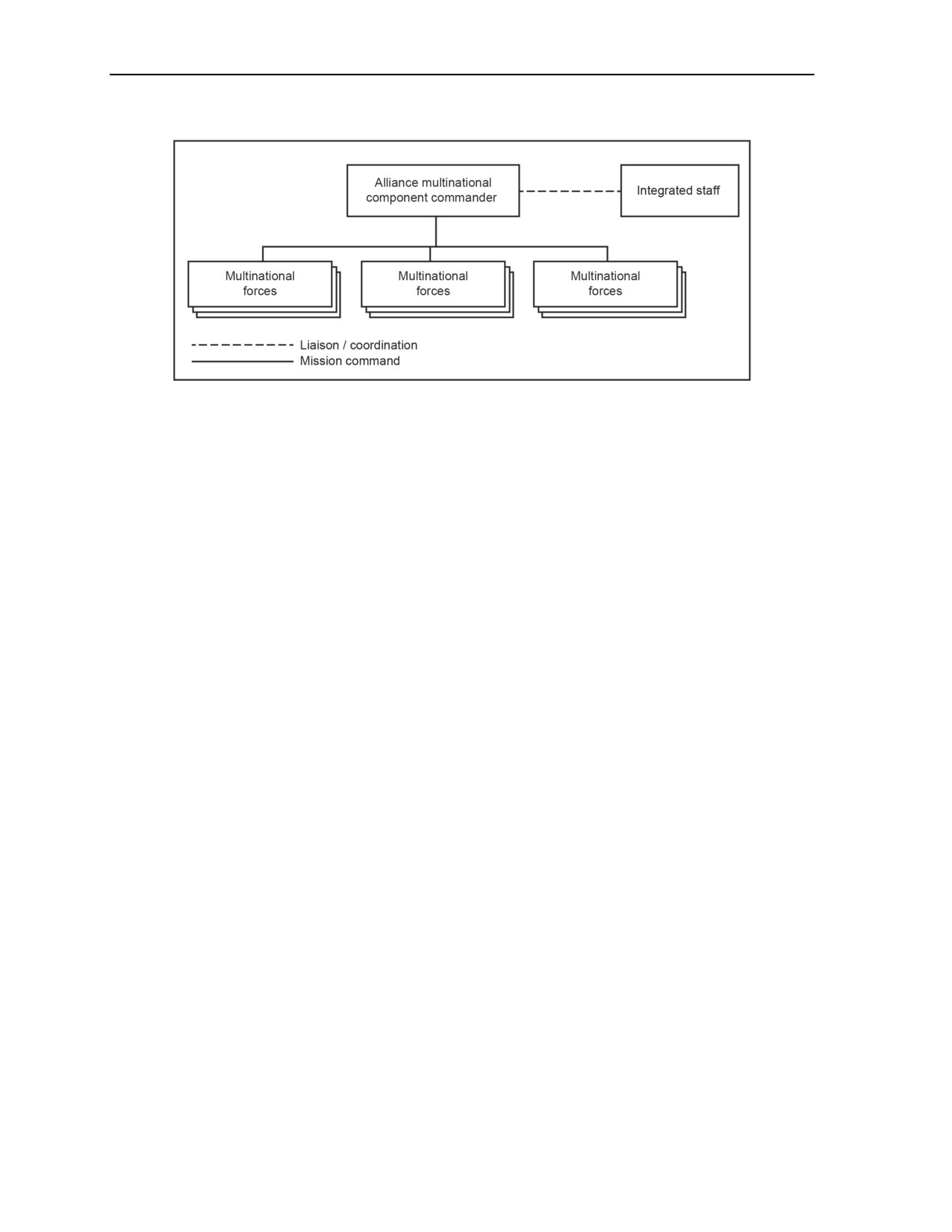
2-17. In an alliance, a coalition or UN-mandated operation, the entire staff is an integrated command
structure. The deputy commander and each primary staff officer could be a different nationality.
2-18. Using an integrated command structure in an alliance provides unity of command. The NATO
command structure is a good example of an integrated command structure. In Europe, NATO has allied
command operations, also known as supreme headquarters allied powers, Europe. It has a commander from
one of the member nations. NATO nation members are a part of the supreme headquarters allied powers,
Europe staff. This integration also occurs among the subordinate commands and staffs several levels below
supreme headquarters allied powers, Europe.
2-19. An integrated alliance command structure has—
z
A single designated commander.
z
A staff composed of representatives from all member nations.
2-20. Subordinate commands and staffs are integrated to the lowest echelon necessary to accomplish the
mission. See figure 2-1 on page 2-4.
8 April 2014
FM 3-16
2-3
Chapter 2
Figure 2-1. Integrated command structure
2-21. Another example of a standing integrated command structure is NATO's Allied Command Europe
Rapid Reaction Corps (ARRC). However, ARRC has characteristics of a lead-nation command structure.
The United Kingdom provides most of the framework of the headquarters structure and 60 percent of the
overall staff. It is an integrated command structure because the primary staff members are different
nationalities. (For example, the G-3 is a U.S. brigadier general.) The entire staff is integrated and 15 partner
nations contribute the remaining personnel. The ARRC’s two subordinate divisions, the multinational
division (central) and the multinational division (south), are also integrated. Other NATO nations provide
forces for specific operations as the mission dictates. One U.S. division coordinates with the ARRC in
peacetime for planning and training.
2-22. Another example of a standing integrated command structure is Republic of Korea/U.S. Combined
Forces Command (CFC), Korea. This integrated command structure has evolved over years of cooperation
between the U.S. and Korea. The CFC staff and the staff of its subordinate ground component command
are fully integrated.
2-23. A coalition also has an integrated command structure. An integrated staff demonstrates greater
burden sharing and commitment, but creates more friction than the other types of command structures. The
staff forms and learns to operate as a team. At the same time, staff develops every aspect of command and
control, planning, operations, and execution.
COMMAND JURISDICTION
2-24. Each participating nation in a multinational operation has its own national caveats. Each nation is
responsible to its own national legal authority for the conduct of operations, viewing the conflict based on
its own national interests. Multinational commanders consider both political and military issues during
operations. These national caveats constrain commanders. They work with the national force commander
and authority of each nation. Where these interests vary, commanders have the greatest latitude.
Commanders understand these constraints and national caveats and include these when planning.
UNITY OF EFFORT
2-25. Unity of effort is achieved in multinational operations. The principle of unity of command also
applies but is more difficult for commanders to attain. In stability tasks and NATO Article 5 Collective
Defense, government agencies have the lead. For the first time in NATO’s history, the allies invoked the
principle of Article 5 - a pact of mutual assistance in case any NATO member is the victim of an armed
attack - after the 9/11 terrorist attacks against the United States. Commanders report to a civilian chief and
employ civilian agency resources. Command arrangements do not involve a command authority due to
national and host nation interests. Commanders consider how their actions contribute to initiatives that are
2-4
FM 3-16
8 April 2014
Command and Control in Multinational Operations
also diplomatic, economic, and informational in nature. Small units conduct peace operations so all levels
understand the military-civilian relationship to avoid unnecessary and counterproductive friction.
2-26. A command relationship is sound and effective for successful multinational operations. Multinational
commanders seek assistance from governmental agencies to assess other countries’ capabilities.
Commanders consider national sensitivities and differing norms of behavior among national militaries and
civilian agencies. Multinational forces anticipate that some forces from member nations have direct and
near immediate communication from the operational area to their respective national political leaderships.
This capability eases coordination issues or becomes a source of frustration if external leaders issue
guidance directly to deployed national forces.
NATIONAL INTERESTS
2-27. The political agendas of participating countries affect multinational operations. Many nations will
not, or are reluctant to, relinquish command of their forces to other countries. On a case-by-case basis, each
country’s national government places national forces under the multinational commander’s operational
control. In such cases, parallel chains of command exist through the coalition force and national authority.
The multinational force’s challenge is to arrange the best command relationships with its subordinate forces
to ensure mission success.
2-28. The interests of nations regarding the operation are described in the terms of reference between the
contributing nations and other multinational partners or the UN if it is involved. The multinational force
develops a written document that outlines command relationships. This document could be an annex to an
operation plan, an operation order, or a campaign plan.
2-29. The multinational forces transfer authority to the multinational commander’s control. This becomes
an issue in command and control. Nations may not agree on when the transfer occurs. The earlier the
multinational force gains control, the more flexibility it has to train and conduct the operations. Differences
in national interests, objectives and policies at the national level, and the availability of forces based on
concurrent commitments delay planning and agreement to subsequent decisions.
COMMAND AUTHORITY
2-30. The Army has doctrinal definitions for command relationships. Those are the same definitions used
by the joint community (see JP 1-02). However, as a member of NATO, the U.S. agrees to NATO
definitions for command relationships. The NATO definitions are not the same as the U.S. definitions.
Additionally in Combined Forces Command (CFC), Korea and United States Forces, Korea definitions
describe command relationships. Commanders understand how each nation defines command relationships
to operate in multinational operations. Multinational force commanders understand what they can and
cannot do with each troop-contributing nation’s forces. For a further explanation of the U.S. view of
command authority, see JP 3-16.
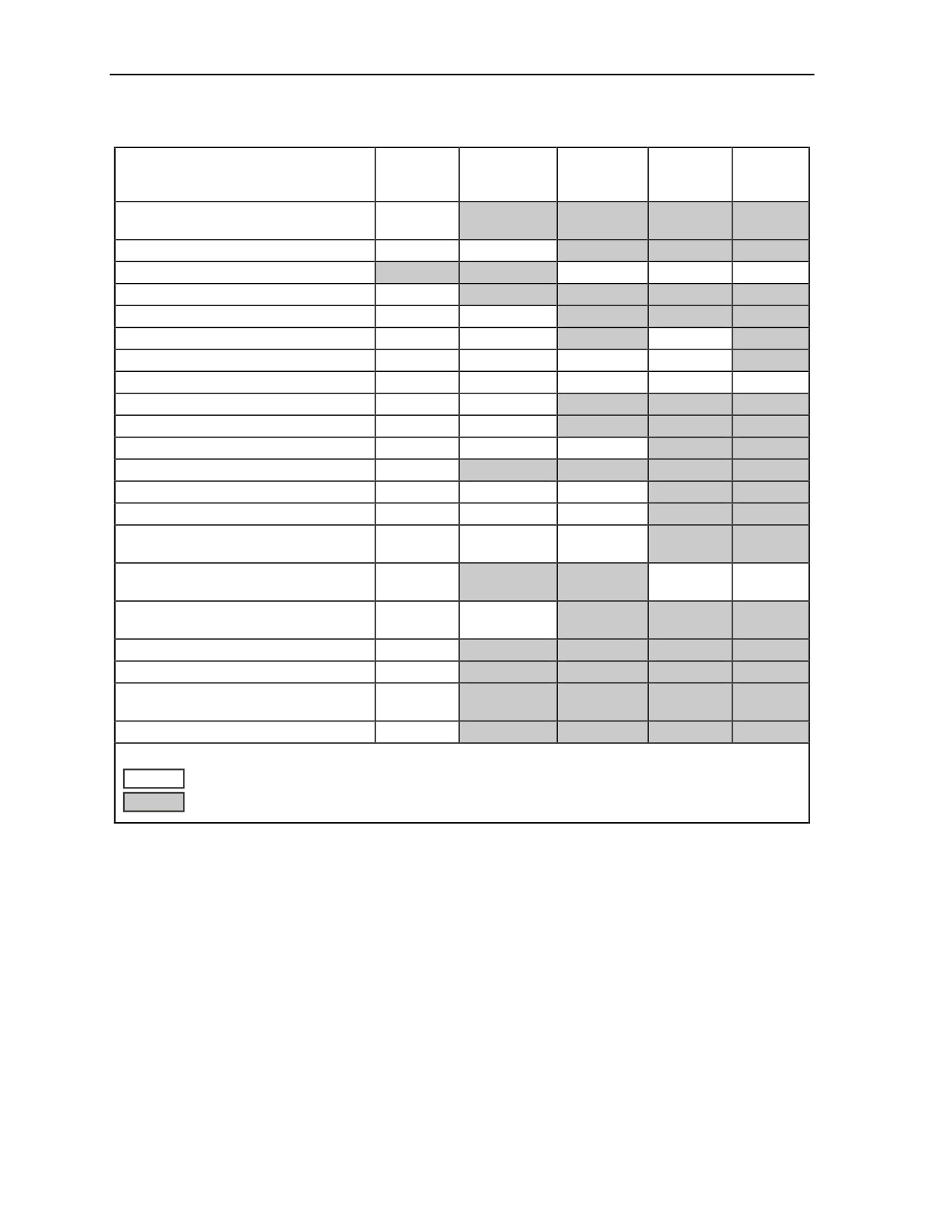
2-31. To provide an understanding of some of the issues involved in the different aspects of command
authority, see figure 2-2 on page 2-6. It provides a comparison of command authorities between U.S.,
NATO, and CFC, Korea definitions.
8 April 2014
FM 3-16
2-5
Chapter 2
Full
NATO
NATO
NATO
NATO
Authority
command
operational
operational
tactical
tactical
command
control
command
control
Direct authority to deal with nations,
X
diplomatic missions, and agencies
Granted to a command
X
X
Delegated to a command
X
X
X
Set chain of command to forces
X
Assign mission/designate objective
X
X
Assign tasks
X
X
X
Direct/employ forces
X
X
X
Establish maneuver control measures
X
X
X
X
X
Reassign forces
X
Retain operational control
X
X
Delegate operational control
X
X
X
Assign tactical command
X
Delegate tactical command
X
X
X
Retain tactical control
X
X
X
Deploy force (information/within
X
X
X
theater)
Local direction/control designated
X
X
forces
Assign separate employment of unit
X
X
components
Directive authority for logistics
X
Direct joint training
X
Assign/reassign subordinate
X
commanders/officers
Conduct internal discipline/training
X
The national authority always retains FULL COMMAND by Allied doctrine.
Has this authority
Denied authority or not specifically granted
Figure 2-2. Comparison of command authorities
NATO OPERATIONS
2-32. NATO has defined five command relationships:
z
Full command.
z
Operational command.
z
Operational control.
z
Tactical command.
z
Tactical control.
CFC, KOREA AND U.S. FORCE, KOREA OPERATIONS
2-33. Multinational operations currently employed in the Korean theater of operations use two specific
control measures:
2-6
FM 3-16
8 April 2014
Command and Control in Multinational Operations
z
Combined operational control.
z
Command less operational control.
ALLIED OPERATIONS
2-34. Refer to Allied Joint Publication AJP-01 (C), Allied Joint Doctrine. Commanders and staffs use this
publication at the operational level. Commanders and staffs can use it at any level as reference. Although
NATO forces primarily use AJP-01 (C), the doctrine is instructive and provides a useful framework for
operations conducted by a coalition of NATO, partners, non-NATO nations, and other organizations.
UNITED NATIONS OPERATIONS
2-35. The missions deployed in Thakur and Schnabel or the ISAF operation in Afghanistan constitutes the
NATO Alliance’s most significant operation to date. A UN mandate established ISAF in 2001 and it has
been under NATO leadership since August 2003. ISAF has several distinguishing features:
z
Consent and cooperation of parties to the conflict.
z
International support and support of the UN Security Council.
z
UN command and control.
z
Multinational composition of operations.
z
No use of force.
z
Neutrality of UN military between rival armies.
z
Political impartiality of the UN in relationships with rival states.
2-36. Most national authorities that provide forces to multinational operations assign national forces under
operational control of the multinational force commander. Smaller nations place their force’s operational
control to a larger force. The larger force is then under the multinational force commander’s operational
control. In the case of UN-mandated ISAF, there are regional commands in Afghanistan under the
command of Turkey, Germany, and Italy in charge of multinational forces in that region. The national
authorities assign national forces under operational control. Caveats qualify these forces from the
respective nations according to national policies. The multinational force commander’s additional
assignments to service component commanders in an operational control status are subject to approval by
the respective national governments.
2-37. The parent national commander retains the command less operational control of the national forces.
The designated national commander of the respective nations in the multinational force exercises this
command less operational control. The multinational commander and national commanders discuss and
clarify their mutual understanding of the command authorities they receive. This clarification ensures there
is common understanding of those authorities. It also precludes potential misunderstandings.
2-38. For Army forces, the U.S. commander retains command over all assigned U.S. forces in
multinational operations. The U.S. chain of command runs from the President through a combatant
commander to the U.S. national commander. The chain of command, from the President to the lowest U.S.
commander in the field, remains inviolate.
MULTINATIONAL FORCES CONTROL
2-39. Liaison networks and coordination centers improve control of multinational forces. Within ISAF, this
includes liaison officers from the major troop-contributing nations, close allies who communicate closely
with U.S. and other regional commanders, and the ISAF commander. These enhancements along with
meetings, boards, and conferences help integrate operations across the multinational force.
LIAISON NETWORK
2-40. Regardless of the command structure, effective liaison is vital in any multinational force. Using a
liaison is an invaluable confidence-building tool between the multinational force and subordinate
commands. It also—
8 April 2014
FM 3-16
2-7
Chapter 2
z
Fosters a better understanding of mission and tactics.
z
Facilitates the transfer of vital information.
z
Enhances mutual trust.
z
Develops an increased level of teamwork.
2-41. A liaison supplies significant information for the multinational force headquarters about subordinate
force readiness, training, and other factors. Early establishment reduces the fog and friction caused by
incompatible communications systems, doctrine, and operating procedures.
2-42. The command and its higher headquarters, adjacent units, supporting and attached forces, and other
appropriate host nation and intergovernmental organizations establish its liaison early. For U.S. forces,
liaison with the U.S. ambassador, if there is one, is essential.
2-43. The command identifies and requests liaison personnel early. The request includes specific
qualifications. Differences in doctrine, organization, equipment, and training among the multinational
nations demand a hardier liaison structure to facilitate operations than in a national force. Liaison teams
cover many functions on a 24-hour basis. This requires more liaison personnel than a force normally has
assigned. Liaison personnel must have equipment compatible with the multinational force.
2-44. Liaison personnel understand the capabilities and limitations of parent units and nations, including
the structure, capabilities, weapon systems, logistics, and planning methods employed and their national
interests. Whether personnel are language qualified or have interpreter support, they understand the
language and culture of the multinational headquarters they are attached to. This ensures successful liaison
operations. However, professional knowledge and functional expertise are far more important. Officers
who have participated in schools and training with other multinational nations or have experience in
multinational operations provide this expertise depending on their experience. Careful selection of fully
qualified liaison officers, who are Army professionals in competence, character, and commitment, is
important to mission success. The sending command provides liaison teams with knowledge of the
language, organization, materiel, and doctrine of multinational partners and an understanding of appropriate
regional information. The liaison officers assigned to the multinational force headquarters influence
decisionmaking. These officers also possess the authority to answer routine multinational force queries on
behalf of their commands.
2-45. Once liaison is established, liaison teams directly represent their respective commanders. They
advise, help, coordinate, and monitor their commands. The liaison teams attend briefings and maintain
close contact with the multinational operations center. However, the command they become a part of does
not formally task their sending unit through the liaison officer. Formal tasking occurs through normal
command and control channels.
2-46. The commander determines whether to integrate multinational liaison personnel into the staff of the
multinational force. When integration creates a more effective organization, the multinational force
establishes an orientation program for all liaison personnel. The multinational personnel reception center
performs this requirement. The multinational force determines what staff officer or staff section is
responsible for liaison personnel reporting to the headquarters.
2-47. Special operations forces are effective in multinational operations as liaison officers or liaison teams.
Their language capabilities, cultural and customs training, and experience working and training with other
country’s militaries allow them to improve coordination and communication.
2-48. Army digital liaison detachments are assigned to selected Army Service component commands.
These detachments allow the Army commander to conduct liaison with subordinate, parallel, or higher joint
and multinational headquarters in the operational area. These detachments have 30 functional staff experts
in logistics, intelligence, airspace management, maneuver, and fires that provide advice and assistance to
supported units and ensure rapid and accurate coordination between headquarters. Digital liaison
detachments have organic transportation and Army computer systems. These detachments receive
communications support from Army theater signal units. Digital liaison detachments are augmented
qualified linguists and interpreters with specific language capabilities. In Korea, two digital liaison
detachments coordinate the specific U.S. aspects of combat, information, protection, and logistical support
in CFC, Korea.
2-8
FM 3-16
8 April 2014
Command and Control in Multinational Operations
COORDINATION CENTERS
2-49. A coordination center is a proven means to enhance stability and interaction. It also improves control
in a multinational force. A multinational commander, especially one that operates under a parallel
command structure, establishes a coordination center in the early stages of any effort and staffs it with
skilled personnel. The coordination center is for command and control. It also organizes and controls
functional areas including logistics and civil-military operations. Initially, a coordination center is the focal
point for support issues such as force sustainment, medical support, infrastructure engineering, host nation
support, and movement control. As a multinational force matures, the center’s role includes command
activities such as force provision or force deployment. Member nations provide action officers who are
familiar with its activities when a coordination center is activated. Multinational forces are encouraged to
augment this staff with linguists and interpreters along with requisite communications capabilities to
maintain contact with parent headquarters. An example of a successful coordination center is the U.S.
Central Command (USCENTCOM) headquarters at MacDill Air Force Base to support operations
Enduring and Iraqi Freedom.
COMMAND AND CONTROL INTEROPERABILITY
2-50. All multinational force troops understand the mission, goals, and objectives of the operation. The G-
3/S-3 develops standard operating procedures whenever appropriate. These standard operating procedures
should be easy to understand and address multinational procedures, not single-nation procedures. The lead
nation uses its standard operating procedures for most purposes.
2-51. Even with standard operating procedures, the lead nation provides a forum for deconflicting and
resolving misunderstandings. This requires more than a platform to express ideas. It includes commanders
from multinational forces who do not have a working understanding of English. The multinational force
must use some mechanism, such as sand tables, as a tool to overcome language deficiencies when
describing operational requirements. Regardless of the mechanism used, the multinational force
commander and staff need patience and detailed explanations to ensure understanding. A robust liaison
team bridges command and control interoperability gaps.
2-52. Terminology is also a problem between multinational forces and other organizations. For example,
using acronyms could pose a problem between organizations. Therefore, all military forces and the
agencies they work with develop and distribute a lexicon of mutually agreed terms. Commanders and staffs
of Army headquarters serving as joint task force or multinational headquarters also refer to applicable joint
or multinational doctrine on command and control of joint or multinational forces. Selected joint and Army
terms and definitions appear in both the glossary and the text. The glossary in this manual provides a
common basis for understanding. Other terms and definitions are found in ADRP 1-02 and JP 1-02.
2-53. The multinational force headquarters location is important. The multinational force protects itself
against various threats. However, it should be in a position to work with both the political and military
sides of the operation.
2-54. The multinational force remembers that many countries are not staffed or equipped to offer full
support. They do not possess a full array of warfighting functions assets, maps of the projected area of
operations (AO), or the capability to obtain or use intelligence and imagery data of the type commonly used
by other multinational forces. These military forces look to other nations for equipment and supplies. With
regard specifically to UN operations, the agreements that exist between the UN and these militaries before
arrival in the projected AO are very important for the multinational forces.
2-55. The multinational force commander will see what nations offer special capabilities such as airlift,
special operations, information collection, communication, security, and logistics. These capabilities offset
other countries’ shortfalls and enhance overall operational competence. Multinational force commanders
have difficulty removing particular forces or individuals from the force unless these forces or individuals
are from their own nation.
8 April 2014
FM 3-16
2-9
Chapter 2
AGENCY COOPERATION AND COORDINATION
2-56. Multinational force commanders focus on cooperation and coordination rather than command and
control when dealing with most nonmilitary agencies. These agencies have their own missions and goals.
Coalition commanders have limited ability to influence these agencies’ actions. Commanders seek agency
cooperation to ensure that they accomplish the mission and end state while allowing these agencies to do
the same. It also requires that each agency and multinational force staff coordinate to prevent interference
in one another’s missions. Additionally, these agencies help commanders accomplish the mission. A civil-
military operations center is one way of achieving cooperation and coordination with nonmilitary agencies.
The civil-military operations center, described in detail in Chapter 9, provides a single point of contact
between these agencies and the commander.
MULTINATIONAL FORCE STAFFING
2-57. The multinational staff organization is based on what option is used to form the headquarters, either
the lead-nation concept or a composite headquarters. The commander has a choice if the establishing
authority designates an organization. If the establishing authority uses the lead-nation concept, the lead
nation’s doctrine assigns the commander and staff’s duties. The doctrine is modified as necessary for the
specific situation. If the establishing authority uses a composite headquarters, the commander and staff
specify duties in more detail. The multinational functions’ names change based on sensitivities when
working with organizations such as the UN.
2-58. Appropriate members in key positions from each country that provide forces are a part of the
multinational staff. Each country represents and influences the force. These positions stem from the
mission and type of operations conducted. Multinational commanders look at force composition as it
applies to capabilities, limitations, and required support. The importance of knowing, trusting, and quickly
reaching a comfort level with staff members makes it desirable for the multinational commander to choose
members of the staff such as the chief of staff or G-3.
2-59. When mission requirements exceed staff capabilities, the commander requests the necessary
personnel, facilities, and equipment from either the national chain of command or the multinational
establishing authorities. These commands and authorities have a “cell” of experts prepared to augment a
multinational force to provide assistance in the early stages of organization and planning. The staff includes
experienced operators for the command and control information systems. Personnel nominated to fill
multinational augmentation billets possess the following attributes:
z
Knowledge, confidence, and forcefulness.
z
Professionalism, character and commitment.
z
Preparedness to represent their nations and units.
z
Understanding that they are the de facto country “experts.”
z
Ability to work as part of a multinational team without country parochialism.
2-60. The command establishes a staff orientation program to ensure that all individuals joining the staff
become familiar with their surroundings. Establishing a multinational personnel reception center under the
G-1/S-1 accomplishes this. The “buddy system” is another program that the command establishes with the
reception center or by itself. This system assigns an experienced staff member to a new staff member to
help with familiarization.
MULTINATIONAL FORCE COMMANDER
2-61. The multinational force commander is responsible to the member nations to accomplish the mission.
The following responsibilities are a guide. These responsibilities are adapted to the specific mission and
forces assigned:
z
Make recommendations to the establishing authorities on the proper employment of assigned
and attached forces for mission accomplishment. This includes identifying requirements for
additional forces as needed.
2-10
FM 3-16
8 April 2014
Command and Control in Multinational Operations
z
Exercise control over assigned and attached forces. The commander determines when to transfer
forces to the multinational force operational control or tactical control.
z
Develop an operation order or campaign plan in the planning guidelines as directed by the
establishing authorities. The commander determines applicability of existing operation plans, if
any, to maximize the benefits of prior deliberate planning.
z
Request supplemental rules of engagement (ROE) needed to accomplish the mission.
z
Establish combat identification measures.
z
Notify the establishing authorities when prepared to assume responsibility for the AO.
z
Ensure cross-nation support.
z
Ensure the force operates as an effective, mutually supporting multinational team.
z
Determine the requirement for and provide guidance on establishing the necessary boards,
centers, and bureaus (such as multinational visitor’s bureau or multinational movement center).
If a staff proposes creating an organization, the commander requires that the staff provide
criteria, supporting rationale, and membership. The commander makes the final decision. If it is
not required, the commander does not establish it.
z
Define the subordinate AOs for each subordinate force, including the special operations force.
The commander—
Ensures accurate accountability of forces deployed.
Monitors the operational situation and maintains daily contact with the establishing
authorities.
Coordinates with forces and agencies not assigned or attached, including friendly forces and
governments, multinational nation agencies, nongovernmental organizations, or
intergovernmental organizations as appropriate.
Builds a cohesive team, including nongovernmental organizations, intergovernmental
organizations, and others.
DEPUTY MULTINATIONAL FORCE COMMANDER
2-62. Normally, the deputy commander is from a different country than the commander. The selection is
based on the mission or the number and type of forces in the multinational force. The deputy usually is of
equal or senior rank to the subordinate force commanders. The deputy possesses a broad understanding of
the operation. The deputy performs special duties as directed by the commander. Examples of these duties
include the following:
z
Chairing committees.
z
Coordinating with liaison personnel.
z
Coordinating for incoming and outgoing requirements.
z
Coordinating interagency requirements.
CHIEF OF STAFF
2-63. In most cases, the chief of staff comes from the same country or command as the commander.
Because the staff has officers from different nations, the chief of staff places special emphasis on training,
coordinating, and directing the staff’s work. The chief of staff establishes routine procedures to ensure
necessary coordination and review staff actions for completeness and clarity.
G-1/S-1 HUMAN RESOURCES
2-64. See Chapter 3, Human Resources Challenges of Multinational Operations, for details. It discusses
human resources, financial, legal, and religious support to the command.
G-2/S-2 INTELLIGENCE
2-65. See Chapter 4, Intelligence Concerns for Multinational Operations, for details.
8 April 2014
FM 3-16
2-11
Chapter 2
G-3/S-3 OPERATIONS
2-66. See Chapter 5, Planning Challenges of Multinational Operations, for details.
G-4/S-4 SUSTAINMENT
2-67. See Chapter
6, Sustainment Challenges in Multinational Operations, for details. This chapter
includes health service support and operational contract support.
G-5/S-5 PLANS
2-68. See Chapter 5, Planning Considerations for Multinational Operations, for details.
G-6/S-6 SIGNAL
2-69. See JP 3-16 [Multinational Operations], Chapter 2, “Command and Coordination Relationships,” for
details of establishing communications.
G-7/S-7 INFORM AND INFLUENCE ACTIVITIES
2-70. See Chapter 7, Inform and Influence Challenges in Multinational Operations, for details.
G-8 RESOURCE MANAGEMENT
2-71. See Chapter 10, Resource management Challenges in Multinational Operations, for details.
G-9 OR S-9, CIVIL AFFAIRS OPERATIONS
2-72. See Chapter 9, Civil Affairs Operations, for details.
COMMANDER’S PERSONAL AND SPECIAL STAFF
2-73. The commander’s personal and special staff groups includes the following:
z
Political advisor.
z
Inspector general.
z
Command historian.
z
Engineer.
z
Public affairs officer.
z
Surgeon.
z
Chaplain.
z
Linguists and interpreters.
z
Others as directed.
2-74. Each member has specific tasks and responsibilities. In addition to the G-1, Chapter 3 covers the
chaplain, chapter 11 covers the surgeon, and chapter 12 covers the engineer.
Political Advisor
2-75. Commanders routinely work directly with political authorities in the region. The commander
establishes a close, efficient, and effective relationship with the political advisor. The political advisor—
z
Works with the commander and helps the national government create policies that meet
multinational objectives and can be executed.
z
Acts as the principal contact with ambassadors and informs the appropriate diplomatic personnel
of multinational force plans in the AO.
z
Supplies information about policy goals and objectives of the diplomatic agencies relevant to the
operation.
2-12
FM 3-16
8 April 2014
Command and Control in Multinational Operations
Inspector General
2-76. The inspector general is a confidential advisor and fact finder for the commanding general. This
individual is an extension of the commander's eyes, ears, voice, and conscience. The inspector general
informs the commander of observations, findings, and impressions on all aspects of the command. When
directed by the commanding general, the inspector general—
z
Assesses the operational and administrative effectiveness of the command.
z
Informs the commanding general on all matters affecting mission accomplishment.
z
Inquires into the reports on the state of the economy, efficiency, discipline, morale, esprit de
corps, and quality of command management and leadership of all assigned and attached units
and organizations.
z
Assists the commanding general in sustaining readiness by taking care of Soldiers, civilians, and
family members.
z
Advises the commanding general on inspections policy and effectiveness of the organization’s
inspections program.
Command Historian
2-77. All too often, historians, leadership, or other personnel do not record important events, important
decisions, and lessons learned from an operation. These events, decisions, and lessons learned are not
available for the multinational forces in future operations to use as learning tools. The commander
establishes a staff section to collect historical information and lessons learned about the operation from
initial planning to redeployment. A command historian leads this section. The historian—
z
Captures and records events for historical purposes (including photographs).
z
Collects lessons learned and ensures turnover files are properly developed.
z
Helps develop standard operating procedures.
2-78. Additionally, the historian records all daily events. Historians create records at the time of each
event. It includes available sources and a synopsis of rationale for actions taken. This staff section is not
part of decisionmaking.
Public Affairs and the Media
2-79. The modern battlefield and the media’s ability to report from the battlefield have changed
dramatically in the last 20 years. Technological advances ensure that future operations unfold on a global
stage before a worldwide audience. Tactical actions and the hardships of Soldiers and civilians alike have
an increasing impact on strategic decisionmaking. Real-time visual images of operations, both positive and
negative, continue to influence public understanding and support.
2-80. Media presence on the battlefield is a factor that commanders consider during mission planning.
Commanders must understand and account for media capabilities and requirements. Failure will not
prevent the media from covering multinational operations. It will ensure that the media uses alternate
sources for information and multinational forces lose the ability to influence the outcome.
Information Environments
2-81. The global information environment has been present throughout history. It is often forgotten or
thought of as a new phenomenon. This environment consists of physical dimension, information
dimension, and cognitive dimension. The information environment has become more important for military
planning, operations, and execution with the added availability of internet, wireless communication, and
information technology. Any activities occurring by, through, or within means of the information
environment have consequential effect on the operational environment and impact military operations,
decisions, and outcomes. Commanders, staff, leaders, and Soldiers fully understand their operational
environment. This understanding includes the information environment and the potential impacts it has on
current, planned, or future operations. The information environment is the aggregate of individuals,
organizations, and systems that collect, process, disseminate, or act on information (JP 3-13). Inform and
8 April 2014
FM 3-16
2-13
Chapter 2
influence activities are a key factor in the global information environment and essential in the military
information environment for a commander to achieve success.
2-82. Commanders understand the pervasiveness and capability of the media, not only in its ability to
report on an operation, but also on its ability to influence target audiences with respect to the legitimacy of
that operation. Commanders anticipate how adversaries use the media to achieve their own version of
inform and influence activities. Commanders counter these attempts at misinformation and propaganda to
mitigate the effects on the morale of the troops.
Public Affairs Objectives
2-83. Public affairs is the principal contributor to inform line of effort in the commander’s inform and
influence tasks. The public affairs office seizes the initiative with respect to media operations and puts
programs in place to—
z
Protect Soldiers and local civilians from the effects of enemy propaganda, misinformation, and
rumor.
z
Support open, independent reporting and access to units and Soldiers (within the limits of
operations security).
z
Establish the conditions leading to confidence in the multinational force.
z
Provide a balanced, fair, and credible presentation of information that communicates the
multinational force’s story and messages through an expedited flow of complete, accurate, and
timely information.
Public Affairs Operations
2-84. Public affairs operations help the commander understand and operate in the global information
environment. These operations support the commander’s efforts to meet the information requirements of
internal and external audiences without compromising the mission.
2-85. The perception of an operation is as important as the execution of the operation. Public affairs staff
supports the commander by monitoring media perceptions and reporting trends. The staff prepares and
disseminates clear and objective messages about the operation to target audiences to address any instances
of misinformation or imbalanced reporting.
2-86. Successful operations require an accurate public affairs assessment of the situation. The public affairs
assessment is the continual analysis of the global information environment and its potential impact on the
operation. This assessment provides the commander with a thorough examination of critical public affairs
factors such as—
z
The number, types, and nationalities of news media representatives in theater.
z
The identification of media personalities and their respective reporting trends or biases.
z
Media needs and limitations.
z
Media transportation and communication capabilities or requirements.
z
The perception of past, current, or potential operations by internal and external audiences.
2-87. The chief challenge for the multinational public affairs staff is to develop a plan that supports the
commander’s concept of operations and considers the public affairs requirements of the multinational
partners.
2-88. The multinational forces are familiar with their own national media organizations and methods, but
not necessarily with those of other nations. Commanders and public affairs consider these differences when
developing working relationships to allow open and accurate reporting. Commanders and public affairs
staff develop ground rules to ensure operations security. Public affairs develop policies on media
accreditation and release or non-release of information at the multinational force headquarters level. All
units in the command adhere to these policies, regardless of nationality.
2-89. Public affairs operations consist of planning, media operations, internal communications, and
training.
2-14
FM 3-16
8 April 2014
Command and Control in Multinational Operations
z
Planning. Public affairs planning is important to operational planning. It is included at the very
beginning of planning. Public affairs officers establish the conditions that lead to confidence in
the multinational force. They expedite the flow of complete, accurate, and timely information
that communicates the multinational force’s perspective. This ensures media understanding of
the events covered and contributes to fair and balanced reporting. The requirement to provide
issues management and crisis communications advice to the commander and senior staff on a
wide range of issues, both operational and nonoperational, is included in this planning element.
z
Media operations. Commanders and their staffs accurately assess the level and intensity of media
interest in their operation. Media operations advise the commander on the likely implications of
media reporting on the chosen course of action. Media operations involve the following:
Facilitating media coverage of operations by anticipating and responding to the needs of the
media. This includes providing access to official spokespersons and subject matter experts. In-
theater media has additional requirements such as transportation, accommodation, and
emergency medical treatment. Most media organizations are prepared with either the necessary
logistic support or the money to buy it. However, whatever level of support is provided to the
media, it is important to apply it.
Verifying media accreditation and assisting with accreditation, as required.
Discussing the “ground rules” of media coverage of ongoing operations. This includes
written acknowledgement and enforcement, as required.
Establishing and operating an information bureau.
z
Internal communication. Public affairs has an essential and constant requirement to inform
multinational troops on operational issues and national and international events. This is an
important function because it contributes directly to morale. It also helps counter rumors and
misinformation.
z
Training. There is a lot of media interest in military operations. All Soldiers learn how to deal
effectively with the media on and off the battlefield. Soldiers of all ranks receive media
awareness training before deployment. Leadership pays attention to individuals selected as
“official” spokespersons. However, the potential exists for Soldiers to respond to media queries
regarding their jobs and personal experiences.
Information Bureau
2-90. The multinational force establishes a multinational information bureau staffed by public affairs
officers with necessary logistic support. It verifies media credentials and assists with accreditation. It also
facilitates media coverage by communicating with media agencies outside the AO. The bureau expands its
capability with deploying forces when using the principles of modularity and flexibility. It addresses the
potential for a large number of media deployed throughout the AO. The bureau establishes subbureaus, if
required.
2-91. Information is important to multinational force personnel and their families at home. The bureau
ensures that the international media, including the national media of the multinational partners, receive
information on multinational force activities. Family members influence a multinational force member’s
morale when reporting what they have seen or heard on television and radio. Release authority for
information is preestablished. It does not compromise operations security parameters and next of kin
process or investigative procedures. The bureau addresses the language requirements of the various target
audiences.
Public Affairs, Civil Affairs, and Military Information Support Operations
2-92. The common ground between public affairs, civil affairs, and military information support operations
(MISO) is information. Civil affairs operations use information to inform the intratheater public on
assistance programs and reconstruction projects in their area. Public affairs uses information to manage
issues and inform the troops and the international media community. MISO uses information to change the
perceptions, opinions, attitudes, behavior, and beliefs of a population to gain support for civil tasks,
military activities, and partner nation governments.
8 April 2014
FM 3-16
2-15
Chapter 2
2-93. MISO uses government or military means to produce and disseminate messages. MISO also uses
information from the media to reinforce its messages. Public affairs is not used to disseminate MISO
messages. Coordination is essential between civil affairs, public affairs, and MISO to ensure that no
contradictions or divergences occur. The information operations coordination cell
(chaired by the
multinational J-39 or G-7) normally coordinates these activities.
Public Affairs Guidance
2-94. The media will want to talk to commanders and troops. Commanders must avoid a staged show
because experienced media will recognize any scripted or staged information. The troops receive public
affairs guidance and then talk to the media. The troops also talk to the media after the accredited media
receives and understands the “ground rules” for reporting. Public affairs planners provide the ground rules
and other guidance in the public affairs annex to the operations order. Public affairs guidance to Soldiers
include the following:
z
The Soldier’s right to talk to the media.
z
Everything said is “on the record” and quoted by name.
z
Classified or sensitive information and comments on policy are off limits.
z
Always be honest.
z
If Soldiers do not know the answer, they say so.
z
Do not speculate and stay in the area of expertise.
z
Listen to the question carefully. If unsure of a question, ask the reporter to clarify it.
z
Treat the media as professionals and respect their deadlines.
z
Respect host nation sensitivities and speak slowly when necessary.
z
Keep your answers brief and to the point.
z
Always maintain eye contact with the interviewer.
z
Avoid military or technical jargon.
z
Relax and be friendly.
Linguists and Interpreters
2-95. Linguists and interpreters are critical to mission success. Communication with the local populace and
multinational forces is hindered without them. Language barriers cause difficulties when working with
other armies and the host nation. Language problems make it difficult to sustain a rapid decision cycle.
Even common tasks, such as sharing intelligence, await translation before the command shares it. This
slows the development of plans and execution. Language capability speeds command, reduces confusion,
and contributes to mutual respect. Forces exchange commands and other information to work successfully
together. Few linguists have the technical expertise and depth of understanding to be fully understood while
crossing both language and doctrinal boundaries.
2-96. Planners consider liaison officers, foreign area officers, and language-capable personnel to fill these
positions. Planners determine requirements for language-trained personnel early in the planning cycle.
Planners are scarce and there is a long-lead time to deploy the requirements. These language-qualified
personnel require a training period to become familiar with technical terms and procedures of the
organization. Language is more than the direct translation of words. Word choice and mannerisms also
convey information.
2-97. Linguistic or interpreter requirements do not exist only in liaison teams or headquarters elements.
Stability tasks and logistics functions need linguists or interpreters to coordinate with local authorities,
civilian transportation coordinators, refugee and relief centers, medical staffs, legal offices, and local police
forces. A military linguist translates from a foreign language into English within a relatively static
environment, while an interpreter interactively works to facilitate communication between a foreign party
and a command representative.
2-98. Linguist training differs from interpreter training. The linguist translates into English (one-directional
translation), whereas an interpreter fluently converts the communication into English from the foreign
language and the reverse based on the interpreter’s linguistic capabilities (two-directional translation).
2-16
FM 3-16
8 April 2014
Command and Control in Multinational Operations
2-99. The time it takes to acquire enough linguists and interpreters has been a problem. This impacts both
personnel tempo and multinational operations. The staff conducts its initial joint task force mission analysis
and planning and identifies all linguist support requirements early in planning. Early planning ensures
availability and timeliness for deployment. (See JP 3-33, Joint Task Force Operations, Chapter II - Forming
and Organizing the Joint Task Force Headquarters.)
2-100. Host nation linguists and interpreters are important for multinational operations. While this is
acceptable for many requirements, some sensitive positions require military linguists with appropriate
security clearances. In cases of less common languages, multinational components require parent country
or other country augmentation. Trust between host nation personnel and members of the multinational force
is a consideration. Without a means of building trust, multinational forces are vulnerable.
COMMUNICATION ESTABLISHMENT
2-101. Communication is fundamental to successful multinational operations. It is important to prepare
for communication during planning. Mission analysis and assessment provide the opportunity for the
communications officer to identify communication requirements and evaluate in-country capability.
INITIAL CONSIDERATIONS
2-102. Many communication issues are resolved through equipment exchange and liaison teams.
Continual liaison between communication planners helps alleviate interoperability issues. Communication
requirements vary with the mission, composition, and geography of the AO. Interoperability is constrained
by the least technologically advanced nation. The multinational force addresses the need for integrated
communications among all forces early in the operation’s planning phase.
2-103. In a multinational force, a primary communication link is between the lead nation and the national
contingent headquarters. The ability for commanders, staffs, and subordinates to communicate with civilian
agencies across all operations is important. The lead nation and contingent headquarters consider the
transition to subsequent units, commercial communications, or to agencies such as the UN early in the
operation.
2-104. The multinational force plans for adequate communication to include using voice (secure and
nonsecure), data, and video teleconferencing. The force needs a deployable communication capability and
enough trained operators for sustained operations with multiple means of communication to avoid the
possibility of a single point failure.
ADEQUATE EQUIPMENT
2-105. In addition to problems of compatibility and security, many units do not have enough
communication equipment to meet mission requirements. During initial planning stages, planners identify
required communications, issues of spectrum management, and controls on access to information. Liaison
teams, with adequate communication gear, reduce the severity of some of these problems. Satellite
communications provide communication between higher-level headquarters, whether Army, joint, or
multinational. Other space-based services, such as weather reporting and use of global positioning systems,
are also needed.
2-106. Communications planners anticipate these requirements during initial planning, evaluate host
nation communication resources, and integrate the requirements into the communications plan. These
means must satisfy operational requirements. Common user communications are used for operations if
there is sufficient capacity to ensure acceptable reaction times. Although many combined communications
doctrine and procedures exist, there are some differences in operating standards.
NATIONAL CAPABILITIES
2-107. The national capabilities include national representative involvement in planning and integration of
each nation. Each one is discussed in detail in paragraphs 2-108-2-119.
8 April 2014
FM 3-16
2-17
Chapter 2
NATIONAL REPRESENTATIVE INVOLVEMENT IN PLANNING
2-108. Representatives of each nation are present during planning. If a unit has a mission it cannot
accomplish, the plan will not work. National representatives ensure that taskings are appropriate to the
force. If possible, national representatives are available in each staff element. They must thoroughly
understand their nation’s capabilities and limitations.
INTEGRATION OF EACH NATION
2-109. Each of the multinational member nations provides its own distinct units and capabilities to a
multinational force. These capabilities differ based on national interests, objectives, arms control
limitations, doctrine, organization, training, leader development, equipment, history, defense budget, and
domestic politics. To integrate these capabilities into multinational operations, the member understands the
differences in organization, capabilities, and doctrine. The greater the number of nations involved, the
greater these differences will be for the multinational force.
2-110. Understanding these differences determines if multinational operations succeed or fail. Units of the
same type in one nation’s army may not perform the same functions as units in another army. An engineer
unit in one army may have capabilities to build roads or buildings, while another may be limited to laying
out minefields or building defensive positions.
2-111. The commander of the multinational force integrates force capabilities to achieve the desired end
state. Selecting the right mix is a challenge. The multinational staff understands the capabilities and
limitations of the nations in the multinational force.
2-112. Doctrine is another important issue. If a nation does not understand or train for a mission, it fails.
National forces operate using their own doctrine internally, while externally their actions conform to the
overall direction of the multinational force. To make this work, however, multinational commanders must
know the differences in the other nation’s doctrine. Liaison officers or augmentees and/or supplemental
staff officers help accomplish this. When U.S. forces operate with NATO or American, British, Canadian,
Australian, and New Zealand (ABCA) countries as part of a multinational military command, they follow
the doctrine and procedures embedded in U.S. field manuals from previously ratified standardization
agreements and ABCA standards. If time permits, learning and understanding the doctrine of NATO and
multinational partners is important to use for operations. Nonetheless, nothing replaces being sound in
Army doctrine. It is a part of NATO and multinational doctrine in many instances. At a minimum, it is a
framework to use at initiation of operations.
2-113. Conventional multinational force capabilities include the following assets and operations:
z
Air defense.
z
Armor.
z
Aviation.
z
Engineer.
z
Field artillery.
z
Infantry.
z
Intelligence.
z
Medical.
z
Military police.
z
Chemical, biological, radiological, nuclear, and high-yield explosives (CBRNE) defense.
z
Linguists.
z
Interpreters.
z
Ordnance.
z
Personnel.
z
Quartermaster.
z
Signal.
z
Transportation.
2-18
FM 3-16
8 April 2014
Command and Control in Multinational Operations
z
Aviation.
2-114. The following are aviation information requirements needed before deployment:
z
Determine the aviation assets, capabilities, and requirements of the multinational force.
z
Identify the aviation logistics capabilities of the multinational force.
z
Identify current and projected requirements for communication.
z
Determine aviation support required from multinational forces.
z
Identify the intended base of operations.
z
Identify the personnel recovery plan in the theater of operations. (Rotary-wing units execute
organic personnel recovery or depending on capabilities, theater-wide recovery.)
z
Identify secure communications capabilities of the higher headquarters and supported units.
Engineers
2-115. Quadripartite Standardization Agreement
1175 covers engineer support capabilities, utilities
requirements, and other information required before deployment. This quadripartite standardization
agreement is equally applicable to phases during operations with little modification. In addition to
Quadripartite Standardization Agreement 1175, information on obstacles; equipment capabilities; future
engineer planning; engineer threat characteristics; and command, control, communications, and intelligence
is required. The following engineer information is required before a deployment:
z
Identify terrain visualization requirements.
z
Determine types and capabilities of engineer units for the multinational and other Services.
z
Determine the facility support requirements, such as latrines and base camp construction, from
the multinational force and its supported units.
z
Determine the condition of and requirements for infrastructure in the stability tasks such as
roads, airfields, ports, and power generation facilities.
z
Identify the availability and type of engineer resources in the operating area.
z
Determine real estate support requirements.
z
Identify humanitarian and nation assistance engineering requirements.
Special Operations Forces
2-116. Special operations forces are valuable to a multinational force. These forces have capabilities to
complement conventional capabilities. Selected special operations forces are regionally oriented and have
personnel experienced and conversant in the languages and cultures of the AO. These forces help with
liaison to facilitate interoperability with multinational forces. When using special operations forces is
considered, it is very important to understand their capabilities and properly apply those capabilities.
2-117. The multinational force commander designates a joint special operations task force composed of
forces from more than one Service to carry out a special operation or prosecute special operations to
support a theater campaign or other operations in the AO. This commander commands with the
preponderance of special operations forces and the requisite command and control. The commander
exercises day-to-day command and control of assigned or attached special operations forces and allocates
forces against tasks to support the command. The command defines a special operations area for use by the
special operations forces. Establishing a joint special operations area delineates and facilitates simultaneous
conventional and special operations in the same general operational area.
2-118. The commander determines where certain special operations forces best fit in the organization.
The G-3 or S-3 integrates both civil affairs operations and MISO developed by the respective staff officers
into the operation order. Due to the political sensitivity of these areas, the multinational establishing
authorities approve authority for these operations.
2-119. At the earliest opportunity, the command’s higher headquarters identifies the requirement for civil
affairs operations, MISO units, public affairs operations, and staff augmentation. These units require
reserve component augmentation for full capability. This is considered when requesting these assets
because of the lead-time necessary to obtain. Civil affairs operations, MISO, and public affairs actions
8 April 2014
FM 3-16
2-19
Chapter 2
dramatically affect the perceived legitimacy of peace operations. Civil affairs operations reinforce and are
reinforced by MISO themes and actions. MISO themes and actions are coordinated with public affairs
office initiatives to avoid creating a dichotomy, whether real or perceived.
CHECKLIST
2-120. Commanders participating in a multinational operation should answer the following questions
about the force’s participation in the operation.
COMMAND
z
What is the command structure? Is it a lead nation, parallel command, combined, or integrated
command structure?
z
What political motivations are responsible for each nation’s participation in the operation? What
potential conflicts arise?
z
Have the implications of national and regional culture on contemplated multinational operations
been assessed?
z
Have appropriate orientation briefings from civilian agencies been requested?
z
Have status-of-forces agreements
(SOFA) been agreed to? If not, who should conduct
negotiations? Is there an alternative (for example, technical agreements) that provide adequate
protection?
z
What interoperability factors (for example, command, control, communications, or logistics)
affect the mission?
z
Are there cultural barriers that prevent a harmonious relationship? What force structure
minimizes friction between partners?
z
Have supported and supporting relationships been established or referred to higher authority to
resolve inadequacies?
z
Have linguist and interpreter needs been identified?
z
What are the capabilities to obtain more linguists and interpreters as needed?
z
What specific capabilities does a national contingent bring to the multinational force?
z
What constraints are imposed on multinational forces by their national authorities?
z
Have standards for operational or logistic capabilities been established for certifying units to
participate in the operation? Have nations with deficiencies indicated a method of resolution?
z
Have national caveats on use of multinational forces been identified and disseminated
throughout the command?
z
Have deficiencies with multinational commanders been negotiated for resolution?
z
Have command and control arrangements been made including the multinational ambassadors,
military attaches, and nonmilitary government officials in coordinating functions?
z
Are forces, logistic support, and command, control, and communications capabilities robust
enough to respond to increased levels of operational intensity?
z
Have all multinational legal constraints been considered in planning for command and control?
z
Have the personnel for the multinational staff been chosen to reflect the required functional
skills, training level, language skill, and avoidance of historic animosities?
z
Have minimum communications capabilities been established for each multinational member to
enable successful 24-hour operations?
z
Has the command structure been designed to minimize the number of layers?
COMMAND RELATIONSHIPS
z
Have command relationships for the control of forces been defined?
z
Is there an initiating directive that clearly articulates the command arrangements?
z
Have the command relationships been defined and analyzed for the following?
Feasibility of achieving unity of command or unity of effort.
2-20
FM 3-16
8 April 2014
Command and Control in Multinational Operations
Feasibility of accomplishing the mission under the command relationships.
Assistance required from the national government to negotiate unity of command or effort at
the strategic level.
Clarity of relationships and understanding on the part of all multinational elements.
LIAISON
z
What liaison officers must be sent to multinational force headquarters and adjacent, supporting,
and supported units?
z
Do liaison elements on the staff possess requisite authorities? Do the liaison elements have a full
understanding of both national interest and multinational objectives?
z
Do liaison elements have appropriate communications, linguistic, logistics, and office support
capabilities in place?
z
Have liaison officers been identified? Have key liaison officers been interviewed for suitability?
z
What are the requirements for interagency and multinational coordination? Does the force have
adequate liaison officers or liaison officer teams to meet required coordination?
z
Have Army forces mobile liaison teams been requested?
LANGUAGE
z
What language will be used for force wide communication?
z
At what command level will each force resort to its national language? Are there sufficient
interpreters for planning and execution?
COMMUNICATIONS
z
What areas come under multinational control and what areas remain national issues?
z
What is the requirement for portable communication devices such as cell phones?
z
Will commercial companies establish telephone service for use by multinational forces?
z
If the multinational force establishes a multinational visitor’s bureau, what communications
capability is required?
z
Do national laws require agreements defining payments for using the information systems
networks or military satellite communication assets?
z
Who is responsible for funding additional communications capability?
z
Will nations be expected to provide communications capabilities to other nations’ military forces
or civilian agencies?
z
What are the plans for expanding the communication system if needed?
z
What is the policy on morale calls? Who supports them?
z
What steps have been taken to ensure procedural compatibility?
z
What is the common identification of friend or foe procedure?
z
What are the data-link protocols?
z
What is the communication equipment capability between forces?
z
Has coordination been accomplished regarding frequency assignment?
z
What command and control information systems are required to support diminishing
multinational force presence?
z
Will command channels be used only for execution and national channels for reporting status
and requesting support?
z
Are there a means and a plan to provide all forces with a common operational picture?
z
Do multinational partners with a lesser command and control capability have appropriate liaison
officers, interpreters, operators, and maintainers to enable adequate command and control in the
multinational force?
8 April 2014
FM 3-16
2-21
Chapter 2
z
Is there a policy or plan for the control, release, and dissemination of sensitive information and
cryptographic materials, especially to civilian agencies that require some access to classified
material to accomplish their missions?
z
Has the language exchange point been determined?
z
Are there sufficient interpreters available for both planning and execution?
z
Has the terrain and environment been considered while planning for the command and control
network?
z
Has the rapid dissemination of targeting materials been provided for?
z
Have arrangements been made for staff communication?
z
Have common databases been provided for?
z
Has the nation most capable of providing an integrated, interoperable command and control
network been selected to serve as network manager for the multinational command and control
infrastructure?
z
Have arrangements been made to allow contract host nation employees to work on command
and control staffs without exposing them to automated data processing and classified
information used in daily operations?
z
Has the multinational established a standard datum? Will all products be on that datum?
z
Is there a multinational force geospatial information and services plan that designates all
mapping, charting, and geodesy products for use?
z
Have the command relationships, locations of headquarters and the type of services required
such as tactical satellite, telephone, facsimile, amplitude modulation, and frequency
modulation/modulated been determined?
z
What are the frequency requirements and planning ranges for equipment?
z
Has the multinational force communications coordinator requested frequencies?
z
How will the multinational force conduct spectrum management? This must account for
frequencies already in use by civilian agencies.
z
How will the multinational force achieve automated data processing software compatibility to
facilitate file transfers?
z
How will the multinational force achieve communication interoperability? Will the system
satisfy communications requirements from the national authorities to the lowest information
exchange requirement?
z
If civilian agencies have separate communications networks and the multinational force provides
security for these agencies, how will they request assistance during emergencies?
z
How will the multinational ensure adequate redundancy? Multiple assets must be available and
used during operations to ensure information flow.
z
How will the multinational handle incompatible communications equipment among
organizations and multinational forces?
z
What communication support will be provided to civilian agencies? Will support be provided
through the civil-military operations center?
z
How and when will the multinational force establish its communications architecture?
z
How will the multinational force account for and use communication networks established by
civilian agencies? This includes commercially leased circuits, commercial satellite services, high
frequency, and very high frequency radios.
z
How will the multinational force address the need for secure communications?
z
How will the command handle incidents when a person accidentally transmits classified data
over the unclassified computer network?
z
What is the policy on implementing communications blackout periods to support multinational
operations security?
z
Is there a multinational force standardized e-mail naming convention?
2-22
FM 3-16
8 April 2014
Command and Control in Multinational Operations
PUBLIC AFFAIRS
z
What areas come under multinational control and what areas remain national issues?
z
Has coordination been affected with other national public affairs officers or equivalents?
z
What is the plan for handling publicity, news correspondents, and journalists?
z
Does the public affairs plan include a list of capabilities (personnel by military occupational
specialty, grade, or unit type and size) to execute the plan?
z
Does the capability requirements assessment include consideration of doctrinal employment of
personnel and units?
z
Does the capabilities assessment include using units’ organic and theater-level assets?
z
What are the biographical backgrounds of multinational force senior leaders? What specific
equipment do they have or require?
z
Has the senior public affairs officer met the multinational force senior leaders?
z
Who is the senior spokesperson for the multinational force?
z
Has the multinational force information bureau been established?
z
Has a coordinated media policy, including a system to provide credentials for the media, been
established? This allows some control over who attends multinational force briefings.
z
Does the media understand the end state and how the force is progressing toward it?
z
Has the command aggressively countered inaccurate information with subject matter experts?
z
Has media awareness training been conducted before deployment? Has sustainment training
been conducted in the AO?
z
Has the senior public affairs officer identified points of contact with agencies that operate in the
AO to arrange referrals of media queries regarding their operations?
z
Has release of information authority for accidents or incidents and notification of next-of-kin
and investigative procedures been established?
z
Will media be embedded in units? What are the procedures for dealing with this situation?
z
Has translation/interpretation support for media ground rules, as well as other documents, been
established?
z
Does the command have a public affairs plan that includes crisis management? Is the senior
public affairs officer a member of the crisis management team?
z
Does the public affairs plan reflect the cultural differences of all troop-contributing nations and
the host nation?
z
Does the public affairs plan consider the impact of print, radio, televised, and internet media?
z
Does the command have a public affairs plan that does the following:
Provides a contingency statement to use in response to media queries before initial public
release of information concerning the multinational force and its mission?
States who (which nation and when, or all nations simultaneously) makes the initial public
release concerning the multinational force and its mission?
States agreed-upon procedures for the subsequent release of information concerning the
multinational force and its national components?
States requirements for combat camera support, to include communicating the need for
operational documentation to subordinate units?
Ensures full utilization of all assets available - television, radio, cell phone messaging, text
messages, and fliers?
Establishes priority of usage of assets with canned messages prepared for events?
8 April 2014
FM 3-16
2-23
///////////////////////////////////////