FM 21-10 MCRP 4-11.1D FIELD HYGIENE AND SANITATION (June 2000) - page 2
FM 21-10/MCRP 4-11.1D
Keep skin dry.
Use foot powder on your feet, especially if you have had
fungal infections on your feet in the past.
Use talcum powder in areas where wetness is a problem (such
as between the thighs, and for females, under the breasts).
Wear proper clothing.
Wear loose fitting uniforms; they allow for better ventilation. Tight fitting uniforms
reduce blood circulation and ventilation.
Do not wear nylon or silk-type undergarments in hot or humid environments.
PREPARE FOR THE FIELD
All service members need to bring toilet articles such as soap, shampoo, washcloths,
towels, toothbrush, dental floss and fluoride toothpaste, and talcum powder and foot
powder, with them. Do not share these items to prevent the spreading of infections.
Males need a razor and blades. Females need sanitary napkins or tampons.
Remember, during a deployment, you may not be able to easily obtain
these items if you run out; bring at least a 2-month supply.
2-32
FM 21-10/MCRP 4-11.1D
PREVENT DENTAL DISEASE
Tooth decay and gum infections can cause severe illness if not prevented or treated early.
Brush teeth and gums after meals, or at least once a day. Use fluoride toothpaste.
If toothpaste is not available, brush without it.
Use dental floss at least once a day.
Rinse your mouth with potable water after brushing and flossing;
also, rinse frequently during the day when drinking water.
Remember, consuming sugary food and drink requires more
frequent cleaning of teeth and gums.
PREVENT GENITAL AND URINARY TRACT INFECTIONS
For males:
Wash the head of your penis when washing your genitals. If uncircumcised, pull
the foreskin back before washing.
Protect yourself from sexually transmitted diseases (STD). Avoid sexual contact or
use a condom; condoms reduce the chance of STD transmission.
2-33
FM 21-10/MCRP 4-11.1D
For females:
Wash your genital area daily.
Do not use perfumed soaps or feminine deodorants in the field; they cause irritation
and attract arthropods.
Protect yourself from STD. Avoid sexual contact, or at least insist that your sex
partner uses a condomcondoms help prevent STD transmission.
DO NOT douche unless directed by medical personnel.
DO NOT wear nylon or silk undergarments; cotton undergarments are more
absorbent and allow the skin to dry.
NOTE
Some individuals do not drink enough fluids and tend to
hold their urine due to a lack of privacy in the field.
Urinary tract infections are one of the most frequent
medical problems females face in the field. Drinking
extra fluids and urinating more often will help prevent
these infections.
2-34
FM 21-10/MCRP 4-11.1D
SLEEP WHEN YOU CAN
Follow your leaders instructions and share tasks with buddies so everyone gets
some time to sleep safely.
Sleep whenever possible.
Take catnaps as the mission allows, but expect to need a few minutes to fully
wake up.
Sleep as much as you can before going on a mission that may prevent sleep.
Learn and practice techniques to relax yourself quickly.
NOTE
Only sleep in safe and/or designated areas. Never sleep in parked vehicles
while the motor is running.
MEASURES AGAINST THE EFFECTS OF SLEEP LOSS
Protect against the temporary effects of sleep loss on alertness, mood, and task performance.
Take short stretch breaks or get light exercise in place.
2-35
FM 21-10/MCRP 4-11.1D
Do not trust your memory; write things down. Get into the habit of writing
things down that you must remember (except crucial details that might compromise
the mission if they were lost or captured). Double-check your communications and
calculations.
Watch out for your mind playing tricks (seeing things that are not there) when very
tired; check strange observations before acting.
IMPROVE RESISTANCE TO STRESS
Fear and physical signs or symptoms of stress are normal reactions before and
during combat or other dangerous/life-threatening situations. You should not let
fear or stress keep you from doing your job.
Talk about what is happening with your buddies,
especially during after-action debriefings.
Learn ways to relax quickly.
Integrate new replacements into your group and
get to know them quickly.
If you must join a new group, be active in
establishing friendships.
2-36
FM 21-10/MCRP 4-11.1D
Give each other moral support.
Care for your buddies and work together to provide everyone food, water, sleep,
and shelter, and to protect against heat, cold, poor sanitation, and enemy action.
NOTE
See FM 21-11 for first-aid procedures for stress reactions.
Section VII. NOISE
OVERVIEW
If you have to raise your voice to be understood, it is too noisy. Put on hearing protectors.
The use of hearing protective devices will enhance hearing and comprehension in the
presence of a hazardous noise.
PROTECT YOURSELF AND YOUR MISSION FROM NOISE
Wear properly fitted earplugs. Different types include single
flange, triple flange, and hand formed.
2-37
FM 21-10/MCRP 4-11.1D
Use vehicle headgear such as a helicopter crew helmet, an armor
crew helmet, or earmuffs.
Keep earplugs and earmuffs clean to prevent ear infections.
Avoid noise or limit time around noise to only critical tasks.
Section VIII. TOXIC INDUSTRIAL CHEMICALS/MATERIALS
OVERVIEW
Consider risk management in planning all operations; identify potential sources of danger
or mission hazards that can be anticipated in performing a mission. Always weigh the
risks and benefits and establish controls to reduce unnecessary hazards.
RECOGNIZE AND PREPARE FOR TOXIC INDUSTRIAL CHEMICALS/
MATERIAL THREATS
Occupational hazards.
Exhaust from engines and fuel space heaters.
2-38
FM 21-10/MCRP 4-11.1D
Gases from weapons firing, such as rockets and M8 smoke.
NOTE
When using M8 smoke in training or operations, follow unit standing
operating procedures (SOPs) and leaders and controllers instructions for
use of protective masks and for moving through smoky areas, especially in
buildings and tunnels.
Solvents used to clean weapons.
Greases and oil from vehicle maintenance repair.
Detergents used to clean equipment.
Industrial hazards.
Compressed gases.
Industrial solvents.
Hazardous chemical waste.
2-39
FM 21-10/MCRP 4-11.1D
Materials used at water treatment plants.
Materials and water used at waste sewage and water treatment plants.
Biological/radiological hazards.
Medical waste.
Materials used at medical research facilities.
Radioactive isotopes.
Substances at nuclear power plants.
Depleted uranium.
RECOGNIZE THE INJURY
Carbon monoxide is colorless, odorless, and tasteless. It causes headache,
sleepiness, coma, and death.
Hydrogen chloride is a very irritating gas that reacts with water (body fluids) to
produce hydrochloric acid in the throat, lungs, and eyes. It causes coughing, tissue
acid burns, and flu-like lung disease.
2-40
FM 21-10/MCRP 4-11.1D
M8 smoke is a very irritating gas. It can cause severe coughing, wheezing, and
lung damage, if inhaled.
Bore/gun gases cause the same effects as carbon monoxide and hydrogen chloride.
Solvents, greases, and oils cause skin rashes, burns, drying, and infections. They
cause damage to the liver, blood, and brain. Also, many are poisons that may
cause cancer.
Medical waste causes disease.
Radioactive materials cause radiation illness.
PROTECT YOURSELF AND YOUR MISSION FROM TOXIC INDUSTRIAL
CHEMICALS/ MATERIALS
NOTE
Service members should always be aware that material safety data sheets
(MSDS) accompany stores of toxic chemicals when units are deployed,
and they serve as an immediate reference in cases of exposure or injury.
Once a unit is deployed and set up, these MSDS should be kept as part of
the units SOP when handling the specified chemicals/materials.
2-41
FM 21-10/MCRP 4-11.1D
Carbon monoxide.
Run engines outdoors or with shop doors/windows open.
Keep sleeping area windows slightly open where you sleep for ventilation and air
movement.
DO NOT sleep in vehicles with the engine running or use engine exhaust for heat.
DO NOT park vehicles near air intakes to tents, trailers, or environmental control units.
Bore/gun gases.
Use onboard vehicle ventilation systems.
Keep bore evacuator well maintained.
Try to keep some air movement in gun emplacements or in protected batteries.
Solvents, greases, and oils.
Use safety Stoddard solvent.
Never substitute one solvent for a better one; for example, never use benzene or
fuel in place of Stoddard.
2-42
FM 21-10/MCRP 4-11.1D
Wear coveralls, if available, and rubber gloves.
Wash or change clothing often, especially when soiled by chemicals or fuel.
Always follow label instructions for use and safety precautions.
Use ventilation systems in areas where fumes are present or when conditions and
materials dictate.
Biological waste.
Always use disposable rubber gloves when working with biological materials.
Wear coveralls/rubberized aprons, as necessary.
Wear goggles or safety glasses, as necessary.
Wear facemasks and air-filtered breathing masks approved for specific tasks, as
necessary, when removing/working with biological waste.
Dispose of biological waste materials according to unit SOPs and product label
instructions.
2-43
FM 21-10/MCRP 4-11.1D
CHAPTER 3
LEADERS PREVENTIVE MEDICINE MEASURES
NOTE
In addition to the specific measures that follow, leaders must remember
and apply the principle that the most effective PMM they can apply is to
visibly set the example in the use of all the individual PMM that are
discussed throughout this FM.
Section I. HEAT INJURIES
PLAN FOR THE HEAT
Maximize physical fitness and heat acclimatization before deployment.
Use your FST to train individuals and their leaders in PMM against heat.
Acclimatize personnel to high temperatures as gradually as the mission will allow.
3-1
FM 21-10/MCRP 4-11.1D
Brief service members on dangers of sunburn and skin rashes and the importance of
good personal field hygiene.
Obtain weather forecast for time/area of training/mission.
Ensure adequate supplies of potable water are available (up to 3 gallons per day per
service member just for drinking) (See Table 3-1). Issue a second canteen to
service members in hot weather operations. In the desert, additional canteens may
be required.
Know the location of water distribution points.
Set up a buddy system to maximize rehydration and minimize heat injuries.
Ensure medical support is available for treatment of heat injuries.
Plan the placement of leaders to observe for and react to heat injuries in dispersed
training (road marches), or operational missions.
If the mission permits, plan to
Train during the cooler morning hours.
3-2
FM 21-10/MCRP 4-11.1D
Serve heavy meals in the evening, rather than at noon.
OBTAIN AND USE HEAT CONDITION INFORMATION
Obtain heat condition information per your units SOP or contact the local supporting
PVNTMED detachment or section. Heat condition may be reported as--
Category:
1, 2, 3, 4, and/or 5.
Wet bulb globe temperature (WBGT) index.
Use heat condition information to determine required water intake and work/rest
cycles (Table 3-1).
NOTE
Training by lecture or demonstration, maintenance procedures on
equipment, or personal hygiene activities (such as skin and foot care) can
be performed during rest periods.
3-3

FM 21-10/MCRP 4-11.1D
Table 3-1. Fluid Replacement Guidelines for Warm Weather Training
(Applies to Average Acclimated Service Member Wearing Hot Weather Uniform)
EASY WORK
MODERATE WORK
HARD WORK
HEAT
WBGT
CATEGORY
INDEX
WORK/
WATER
WORK/
WATER
WORK/
WATER
DEGREES F
REST
INTAKE
REST
INTAKE
REST
INTAKE
MIN
QT/HR
MIN
QT/HR
MIN
QT/HR
1
78-81.9
NL
1/2
NL
3/4
40/20
3/4
2
82-84.9
NL
1/2
50/10
3/4
30/30
1
(GREEN)
3
85-87.9
NL
3/4
40/20
3/4
30/30
1
(YELLOW)
4
88-89.9
NL
3/4
30/30
3/4
20/40
1
(RED)
5
> 90
50/10
1
20/40
1
10/50
1
(BLACK)
The work/rest times and fluid replacement volumes will sustain performance and hydration for at least
4 hours of work in the specified heat category. Individual water needs will vary ± 1/4 quart/hour.
NL= no limit to work time per hour.
Rest means minimal physical activity (sitting or standing) accomplished in shade, if possible.
CAUTION: Hourly fluid intake should not exceed 11/4 quarts.
Daily fluid intake should not exceed 12 liters.
Wearing body armor adds 5° F to WBGT Index.
Wearing all MOPP overgarments adds 10° F to WBGT Index.
3-4
FM 21-10/MCRP 4-11.1D
Table 3-1. Fluid Replacement Guidelines for Warm Weather Training (Continued)
(Applies to Average Acclimated Service Member Wearing Hot Weather Uniform)
EASY WORK
MODERATE WORK
HARD WORK
WEAPON MAINTENANCE
WALKING LOOSE SAND AT 2.5
WALKING HARD SURFACE AT
MPH, NO LOAD
3.5 MPH, ³ 40 LB LOAD
WALKING HARD SURFACE AT
2.5 MPH, £ 30 LB LOAD
WALKING HARD SURFACE AT
WALKING ON LOOSE SAND AT
3.5 MPH, £ 40 LB LOAD
2.5 MPH WITH LOAD
GUARD DUTY
CALISTHENICS
FIELD ASSAULTS
MARKSMANSHIP TRAINING
PATROLLING
DRILL AND CEREMONY
INDIVIDUAL MOVEMENT
TECHNIQUES, SUCH AS
LOW CRAWL, HIGH CRAWL
DEFENSIVE POSITION
CONSTRUCTION
WARNING
Hourly fluid intake should not exceed 11/4 quarts. Daily fluid
intake should not exceed 12 liters.
3-5
FM 21-10/MCRP 4-11.1D
ENFORCE INDIVIDUAL PREVENTIVE MEDICINE MEASURES
Leaders must
Enforce water intake by
Observing service members drinking required amounts. Encourage frequent
drinking of water in small amounts.
Ensuring that service members practice good field hygiene.
Providing cool water; if desired, you can add flavoring after disinfection to
enhance consumption. Personnel should use their canteen cup for consumption
of flavored water. DO NOT add flavoring to canteen water; use only plain
water in canteen.
Ensuring troops drink water before starting any hard work or mission (in the
morning, with/after meals).
Ensuring buddy system is being used.
Frequently checking service members canteens for water; not beverages.
3-6
FM 21-10/MCRP 4-11.1D
Making sure service members have adequate time to eat and drink as mission
permits. Permit personnel to consume carbohydrate/electrolyte beverages (sports
drinks) as supplemental nutrients under conditions of extreme calorie and water
requirements; such as extremely vigorous activities.
Reduce heat injuries by
Enforcing work/rest cycles when the mission permits. Permitting personnel to
work/rest in the shade, if possible.
Encouraging service members to eat all meals for needed salts.
Adjusting workload to size of individuals, when possible.
Be prepared for heat casualties and decreased performance when water and
work/rest cycle recommendations cannot be met.
MODIFY WEAR OF THE UNIFORM
Direct/authorize service members to
Keep skin covered while in sun.
Keep uniform loose at neck, wrists, and lower legs (unblouse pants).
3-7
FM 21-10/MCRP 4-11.1D
NOTE
If the medical threat from biting arthropods is high, keep sleeves rolled
down and pants bloused in boots.
IDENTIFY SPECIAL CONSIDERATIONS
Identify and modify training/physical activity for service members with high-risk conditions
of heat injuries, such as
Diseases/injuries, especially fevers, vomiting, diarrhea, heat rash, or sunburn.
Use of alcohol within the last 24 hours.
Overweight/unfit.
Over 40 years old.
Fatigue/lack of sleep.
Taking medication (especially for high blood pressure, colds, or diarrhea).
Previous heatstroke/severe heat exhaustion.
Lack of recent experience in a hot environment.
3-8
FM 21-10/MCRP 4-11.1D
Section II. COLD INJURIES
PLAN FOR THE COLD
Use your FST to train individuals and their leaders in PMM against cold.
Obtain weather forecast for time/area of training/mission.
Ensure the following are available as the tactical situation permits:
Covered vehicles for troop transport, if tactical situation permits.
Cold weather clothing.
Laundry services.
Warming tents/areas.
Hot rations/hot beverages.
Drinking water.
Inspect service members (before starting training/mission) to ensure
Availability, proper fit, and wear of cold weather gear.
3-9
FM 21-10/MCRP 4-11.1D
Clean, dry, proper-fitting clothing.
Each service member has several pairs of socks, depending on the nature and
duration of the mission.
Frequently rotate guards or other service members performing inactive duties.
Ensure medical support is available for treatment should cold weather injuries occur.
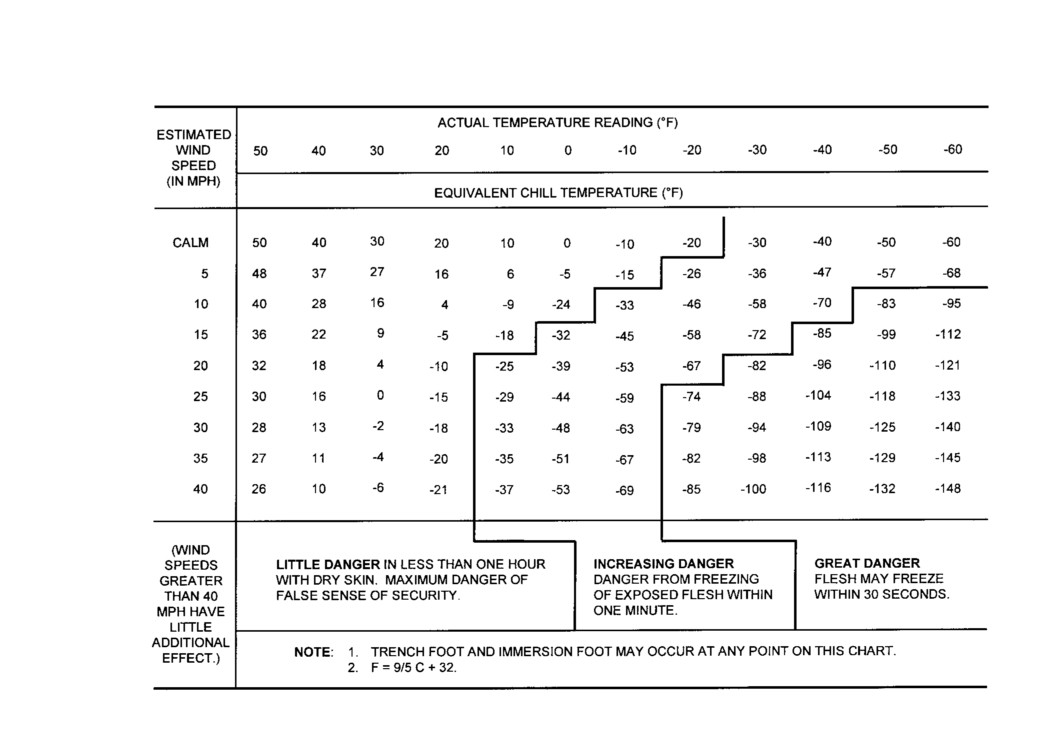
DETERMINE AND USE WINDCHILL FACTOR
Obtain temperature and wind speed information as directed by your units SOP or
contact the local supporting PVNTMED detachment or section.
Calculate windchill from Table 3-2.
NOTE
Cold injuries can and do occur in nonfreezing temperatures. Hypothermia
can occur in mildly cool weather.
3-10
FM 21-10/MCRP 4-11.1D
Table 3-2. Windchill Chart
3-11
FM 21-10/MCRP 4-11.1D
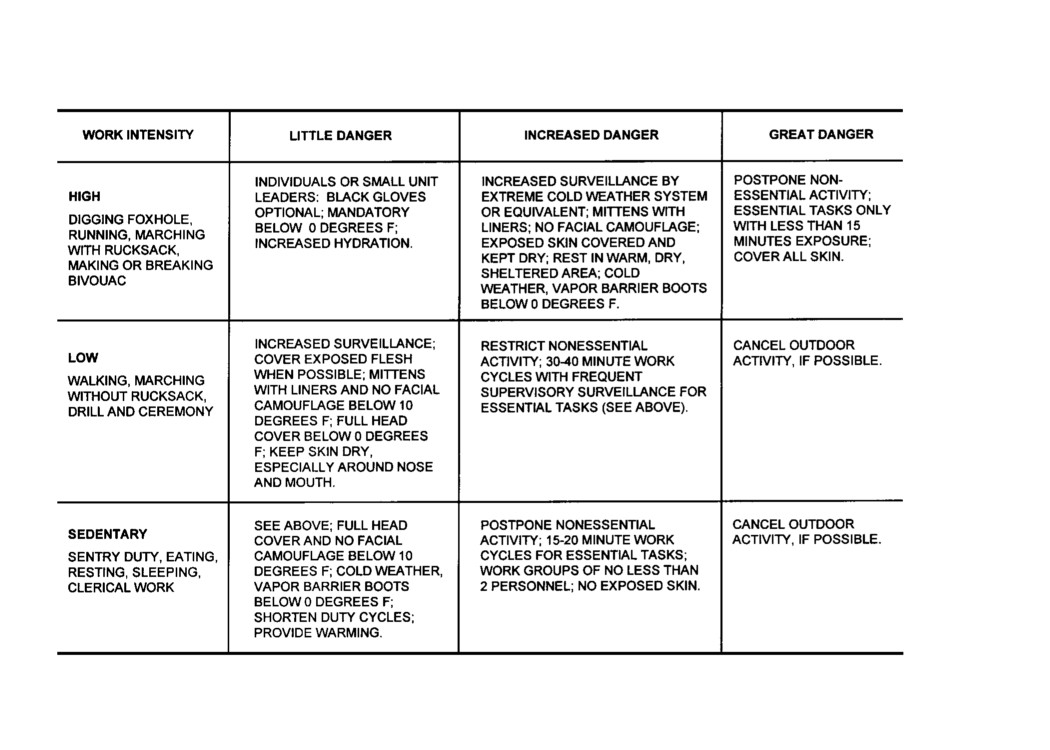
Table 3-3. Windchill Categories (See Windchill Table)
3-12
FM 21-10/MCRP 4-11.1D
These guidelines are generalized for worldwide use. Commanders of units with extensive
extreme cold weather training and specialized equipment may opt to use less conservative
guidelines.
Then use Table 3-4 to apply PMM guidance:
Table 3-4. Windchill Preventive Medicine Measures
WINDCHILL
PREVENTIVE MEDICINE MEASURES
30° F AND BELOW ALERT PERSONNEL TO THE POTENTIAL FOR COLD INJURIES.
25° F AND BELOW LEADERS INSPECT PERSONNEL FOR WEAR OF COLD WEATHER CLOTHING.
PROVIDE WARM-UP TENTS/AREAS/HOT BEVERAGES.
0° F AND BELOW LEADERS INSPECT PERSONNEL FOR COLD INJURIES. INCREASE THE FREQUENCY
OF GUARD ROTATIONS TO WARMING AREAS. DISCOURAGE SMOKING.
-10° F AND BELOW INITIATE THE BUDDY SYSTEMHAVE PERSONNEL CHECK EACH OTHER FOR COLD
INJURIES.
-20° F AND BELOW MODIFY OR CURTAIL ALL BUT MISSION-ESSENTIAL FIELD OPERATIONS.
3-13
FM 21-10/MCRP 4-11.1D
The windchill index gives the equivalent temperature of the cooling power of wind
on exposed flesh.
Any movement of air has the same effect as wind (running, riding in open
vehicles, or helicopter downwash).
Any dry clothing (mittens, scarves, masks) or material which reduces wind
exposure will help protect the covered skin.
Trench foot injuries can occur at any point on the windchill chart and
Are much more likely to occur than frostbite at LITTLE DANGER windchill
temperatures, especially on extended exercises/missions and/or in wet
environments.
Can lead to permanent disability, just like frostbite.
IDENTIFY SPECIAL CONSIDERATIONS
Conditions that place service members at high risk of cold injuries include
Previous trench foot or frostbite.
3-14
FM 21-10/MCRP 4-11.1D
Fatigue.
Use of alcohol.
Significant injuries.
Poor nutrition.
Use of medications that cause drowsiness.
Little previous experience in cold weather.
Immobilized or subject to greatly reduced activity.
Service members wearing wet clothing.
Sleep deprivation.
Identify the special hazards of carbon monoxide poisoning and fire that may affect
your cold weather operations.
ENFORCE INDIVIDUAL PREVENTIVE MEDICINE MEASURES
Ensure service members wear clean and dry uniforms in loose layers.
3-15
FM 21-10/MCRP 4-11.1D
Ensure service members remove outer layer(s) before starting hard work or when in
heated areas (before sweating).
Have service members inspect their socks and feet at least daily when operating in
cold and/or wet environments.
Ensure service members to
Wash their feet daily.
Wear clean and dry socks.
Use warming areas when available.
Eat all meals to ensure sufficient calories are consumed to maintain body heat.
Drink plenty of water and/or nonalcoholic fluids. In cold weather, fluid intake
is often neglected, leading to dehydration.
Exercise their big muscles or at least their toes, feet, fingers, and hands to keep
warm.
Institute the buddy system in cold weather operations. Service members taking care
of each other decrease cold injuries.
3-16
FM 21-10/MCRP 4-11.1D
Section III. ARTHROPODS AND OTHER ANIMALS
OF MEDICAL IMPORTANCE
PLAN FOR THE ARTHROPOD, RODENT, AND OTHER ANIMAL THREAT
Obtain information on biting and stinging arthropods and other animals (such as
snakes, domestic and wild animals, or birds) which could be a threat
Through unit medical channels from the command PVNTMED representative.
From the health service support (HSS) annex to operation plan/order.
Use your FST
Train your service members in PMM.
Control insects and other medically important arthropods in your AO.
Control rodents and other medically important animals in your AO.
Remind service members to avoid handling insects, arthropods, snakes, and
other animals to prevent bites or injury. Animals that appear to be healthy may
transmit rabies and other zoonotic diseases.
3-17
FM 21-10/MCRP 4-11.1D
Keep personnel from eating in sleeping/work areas; prevent attracting insects,
rodents, and other animals.
Animal mascots should not be kept or maintained unless cleared by veterinary
personnel.
Ensure that
Each service member has a bed net in good repair and treated with permethrin
repellent.
Immunizations are current. Prophylaxis (for example, anti-malaria tablets) is
available for issue as required.
Laundry and bathing facilities are available.
Field sanitation team supplies and equipment are available and can be replenished.
Request assistance from a PVNTMED unit (through medical or command channels)
when control of biting arthropods, rodents, or other animals is beyond the capabilities
of your unit.
ENFORCE INDIVIDUAL PREVENTIVE MEDICINE MEASURES
Ensure all uniforms are impregnated with permethrin before field training or deployment.
3-18
FM 21-10/MCRP 4-11.1D
Ensure each service member has DOD skin (DEET) and clothing (permethrin)
insect repellent and uses them. However, cooks, other food handlers, and kitchen
police personnel must not use repellent on their hands when preparing and serving
food, or when cleaning food service utensils, dishes, and food serving areas.
Direct service members to keep
Shirts buttoned.
Sleeves rolled down.
Pants bloused inside boots.
Ensure service members
Bathe/shower regularly (field expedients will do); a field shower or bath with a
clean change of uniform should be accomplished once each week to control
body lice.
Discontinue the use of aftershave lotions, colognes, perfumes, and scented soaps;
they attract insects.
Use permethrin treated bed nets and the DOD-approved aerosol insect
(Insecticide, d-Phenothrin, 2%, Aerosol, NSN 6840-01-412-4634); spray inside
the net if necessary.
3-19
FM 21-10/MCRP 4-11.1D
Observe service members taking anti-malaria pills or other prophylaxis (when
prescribed by the medics).
Use your FST to identify suspected lice infestations and refer for medical treatment.
MINIMIZE EXPOSURE TO ARTHROPOD, RODENT, AND ANIMAL THREAT
If the mission permits
Use your FST to assist you in selecting bivouac sites.
Occupy areas distant from insect/arthropod breeding areas such as natural bodies
of water.
Avoid areas with high grass or dense vegetation.
Use FST recommendations and assistance in applying pesticides for area control
around living areas and in natural bodies of water.
Drain or fill in temporary standing water sites in occupied area (empty cans,
used tires, or wheel ruts after rains).
Clear vegetation in and around occupied area.
3-20
FM 21-10/MCRP 4-11.1D
Maintain area sanitation by enforcing good sanitation practices.
Properly dispose of all waste.
Protect all food supplies.
Police area regularly.
Exclude pests (rats, mice, lice, and flies).
NOTE
See Appendix A for performance of tasks relating to PMM against
arthropods and rodents.
Section IV. POISONOUS PLANTS AND TOXIC FRUITS
Obtain information on poisonous plants and toxic fruits that could be a threat
Through unit medical channels from the command PVNTMED representative.
From the HSS annex to operation plan/order.
3-21
FM 21-10/MCRP 4-11.1D
Use your FST to
Train your service members in PMM.
Display and provide information on the kinds of dangerous plants and fruits in
the unit area.
Enforce individual PMM by
Proper wearing of the uniform.
Avoidance of poisonous plants where possible.
Avoidance of consuming potentially dangerous vegetation and fruits.
Avoidance of putting grasses and twigs in the mouth.
Section V. FOOD-/WATER-/WASTEBORNE DISEASE/ILLNESS
PLAN FOR SAFE WATER
Know the location of approved water distribution points.
3-22
FM 21-10/MCRP 4-11.1D
Make sure your unit has an adequate supply of
Iodine water purification tablets (1 bottle for each individual).
Field chlorination kits.
Bulk chlorine.
Chlor-Floc® kits.
Ensure water trailers and tankers
(400 gallon and above) are inspected by
PVNTMED personnel semiannually.
Inspect water containers before use.
Check the residual chlorine of bulk water supplies (5-gallon cans, water pillows, water
trailer) before drinking and at least daily thereafter. (See Tasks 7 and 8, Appendix A.)
PLAN FOR SAFE FOOD
Ensure food service personnel maintain foods at safe temperatures.
Inspect food service personnel daily and refer for medical evaluation those with
illness and/or skin infections.
3-23
FM 21-10/MCRP 4-11.1D
Make sure foods, drinks, and ice purchased from civilian vendors are approved by
the command medical authority.
Supervise the use of the mess kit laundry/sanitation center.
Ensure food service personnel and service members use handwashing devices.
Ensure all food waste is transported to an approved disposal site, buried, or burned
daily (at least 30 meters from food preparation area and water source).
PLAN FOR THE CONSTRUCTION AND MAINTENANCE OF FIELD SANITATION
DEVICES
Determine type of field waste disposal devices required.
The primary type of human waste disposal devices in bivouac areas are the
chemical toilets. Individual waste collection bags are the primary type used
when on the march.
The type of improvised waste disposal used will depend on the mission, length
of stay in the area, terrain, and weather conditions. When chemical toilets are
not available, the burn-out latrine is the preferred improvised waste disposal
device.
3-24
FM 21-10/MCRP 4-11.1D
NOTE
Always check local, state, federal, or host-nation regulations for restrictions
or prohibitions on using standard or improvised field devices and waste
disposal in the field.
Select locations for field latrines.
As far from food operations as possible (100 meters or more). Downwind and
down slope, if possible.
Down slope from wells, springs, streams, and other water sources (30 meters or
more).
Set up, construct, and maintain latrines (see Task 9, Appendix A, for requirements).
As soon as the unit moves into a new area, detail service members to set up
chemical toilets or dig latrines.
(See previous NOTE.)
Detail service members to clean latrines daily.
Instruct the FST to spray the latrines with insecticide as necessary (not the pit
contents).
Always provide handwashing facilities at the food service facilities and the
latrines. Make use of handwashing devices at latrines mandatory.
3-25
FM 21-10/MCRP 4-11.1D
Cover, transport, burn, or bury waste daily.
Use the FST to train service members and unit leaders in PMM against food-/
water-/wasteborne diseases.
NOTE
See Appendix A for performance of tasks relating to PMM against food-/
water-/wasteborne diseases.
Section VI. PERSONAL HYGIENE AND PHYSICAL
AND MENTAL FITNESS
KEEP YOUR UNIT PHYSICALLY FIT
Ensure that leaders at all levels recognize the benefits of physical fitness. Leaders
must be role models, leading by example.
Take a positive approach to physical fitness with service members. A physically fit
service member is less likely to be a combat loss from disease or injury.
3-26
FM 21-10/MCRP 4-11.1D
NOTE
See FM 21-20 for more information.
PLAN FOR PERSONAL HYGIENE
Provide shower/bathing facilities in the field. All personnel must bathe at least once
a week and have a clean change of clothing to reduce the health hazard associated
with body lice.
Inspect service members personal equipment to ensure they have sufficient personal
hygiene suppliessoap, washcloths, towels, a toothbrush, dental floss, fluoride
toothpaste, and razor and razor blades (females should have sanitary napkins or
tampons).
Ensure undergarments are cotton (not silk, nylon, or polyester).
Ensure uniforms fit properly (not tight).
Ensure service members have several pairs of issue boot socks; the number will
depend on the type and length of the mission.
Use your FST to train your service members in personal hygiene.
3-27
FM 21-10/MCRP 4-11.1D
Ensure service members receive annual dental examinations and needed oral health
care. Make sure all oral health appointments are kept. Use low operational
requirement periods to ensure all personnel maintain a good oral health status.
ENFORCE SLEEP DISCIPLINE
The mission, unit readiness, and individual security must come first, but never miss
a chance to give everyone in the unit time to sleep.
When feasible, set work/rest shifts.
Do not allow service members to sleep in areas where they may be run over by
vehicles, or in other unsafe areas.
During continuous operations, set shifts and rotate jobs to allow everyone at least 3
to 4 hours uninterrupted sleep per 24-hour period.
During brief (up to 48 hours) sustained operations when shifts are impossible, rotate
jobs so all individuals catnap as safely and comfortably as possible. The loss of
sleep will reduce the service members ability to perform his duties and the leaders
ability to make decisions.
3-28