FM 4-02.1 ARMY MEDICAL LOGISTICS (December 2009) - page 4
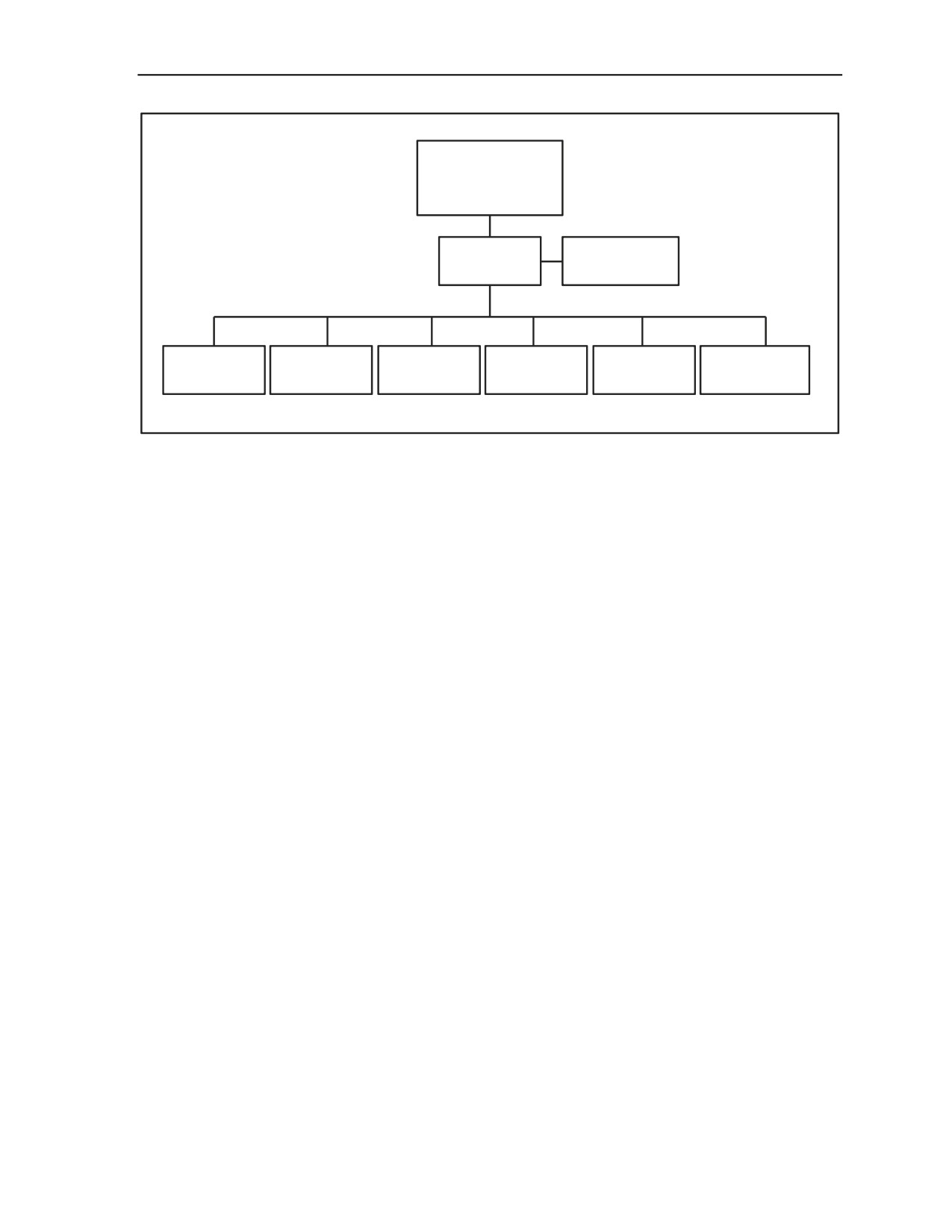
Legacy Medical Logistics Force Designs
HEADQUARTERS AND
HEADQUARTERS
DETACHMENT,
MEDICAL BATTALION,
LOGISTICS
COMMAND
DETACHMENT
SECTION
HEADQUARTERS
SIGNAL
BATTALION
SUPPORT
S-1
S-2/S-3
S-4
SUPPORT
MAINTENANCE
OPERATIONS
SECTION
SECTION
SECTION
SECTION
SECTION
SECTION
Figure B-10. Headquarters and headquarters detachment, medical battalion, logistics
(Table of Organization and Equipment 08496A000)
B-20. The support operations section is responsible for all coordination of operational day-to-day customer
support and quality assurance functions, to include monitoring supported unit locations and inventory
management for Class VIII within the AO. It is responsible for the installation and operation of logistics
information processing systems for the battalion. This section also provides liaison for distribution of
Class VIII supplies, and blood and blood products to the TSC. When designated by the combatant
commander and augmented by USAF/Navy personnel, the support operations section performs customer
support functions of the distribution management portion of the SIMLM mission. In the theater, the HHD,
MEDLOG battalion is assigned to a headquarters and headquarters company MEDBDE or at the EAB
level, the headquarters and headquarters company of the MEDCOM (DS). This unit of assignment applies
to all deployed MEDLOG battalions.
LOGISTICS SUPPORT COMPANY, MEDICAL BATTALION, LOGISTICS
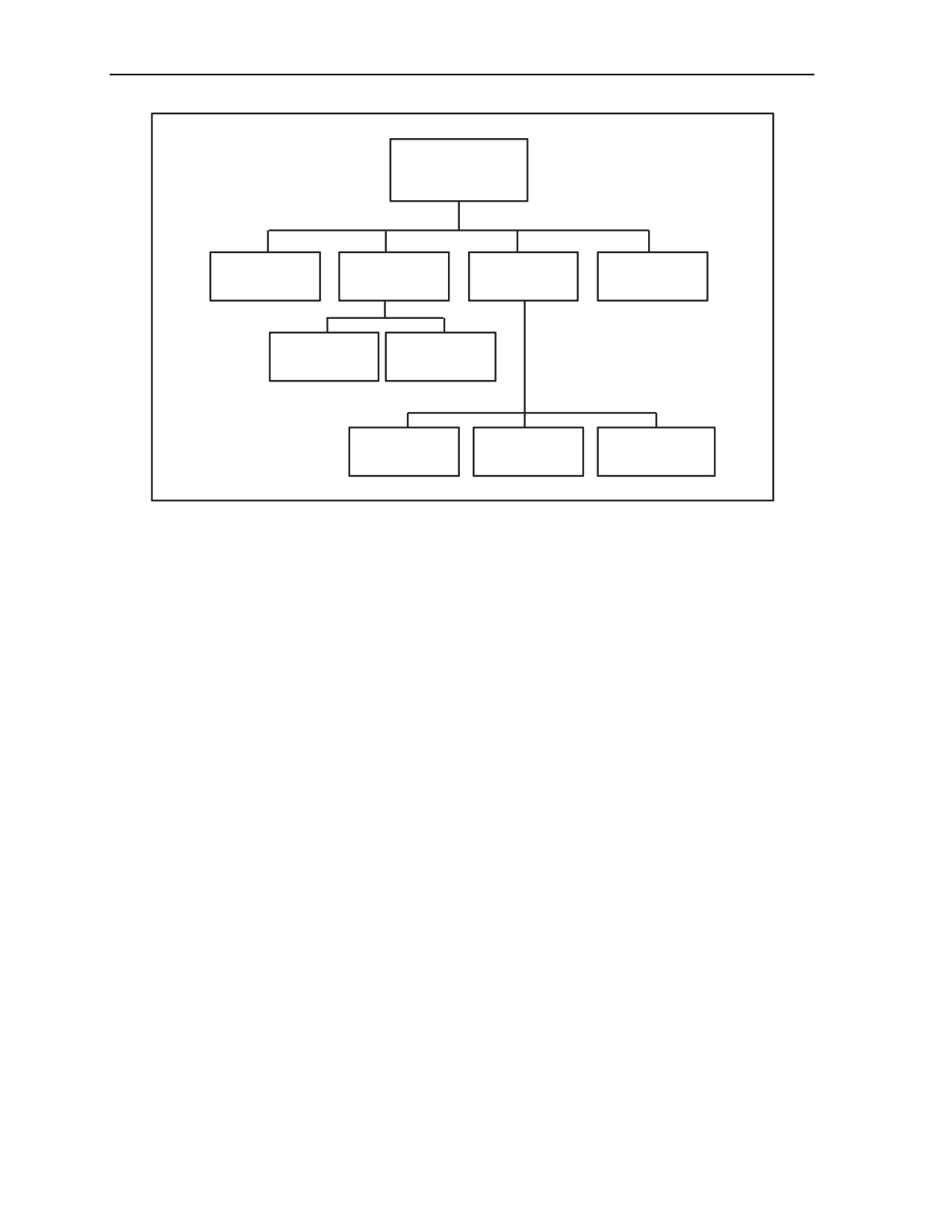
B-21. The logistics support company (Figure B-11) provides medical materiel, medical maintenance, and
optical lens fabrication and repair to EAB medical units operating within the AO. It also provides backup
support to the MLC (TOE 08488A000). The logistics support company is assigned to the HHD,
MEDLOG battalion or senior medical headquarters in the AO. The logistics support company has no
internal automation capability for MEDLOG management. It is dependent upon the HHD, MEDLOG
battalion, for their logistics automation. Five divisions will normally require two logistics support
companies under the C2 of a HHD, MEDLOG battalion.
8 December 2009
FM 4-02.1
B-11
Appendix B
LOGISTICS SUPPORT
COMPANY,
MEDICAL BATTALION,
LOGISTICS
LOGISTICS
OPTICAL
COMPANY
SUPPORT
MAINTENANCE
LABORATORY
HEADQUARTERS
PLATOON HQ
PLATOON
SECTION
RECEIVING/
SHIPPING
STORAGE
SECTION
SECTION
MEDICAL
ORGANIZATIONAL
PLATOON
MAINTENANCE
MAINTENANCE
HEADQUARTERS
SECTION
SECTION
Figure B-11. Logistics support company, medical battalion, logistics
(Table of Organization and Equipment 08497A000)
B-22. The logistics support company is composed of the following elements:
z
Company headquarters provides C2 of the logistics support company. Company personnel
supervise and perform unit plans/operations and general supply functions. This company
provides food service for the HHD, MEDLOG battalion, the blood support detachment and other
assigned or attached units.
z
Logistics support platoon headquarters ensures that stocks remain in an issuable condition while
in storage. This includes the planning prior to receipt of supplies, locating stocks to provide
first-in/first-out handling, using space efficiently, and maintaining segregation and disposition of
stock. This platoon consists of the following sections:
Receiving/storage section processes receiving documents for incoming shipments. It is also
responsible for the storage, preservation, location, and accountability for medical supplies
and equipment. This section is capable of deploying a five-person mobile forward cell for
split-based operations.
Shipping section plans and coordinates for release of materiel to transportation, stages
shipments for pickup, and prepares movement documents. This section is capable of
deploying a five-person mobile forward support cell in support of split-based operations.
Optical laboratory section provides C2 and quality assurance over the optical fabrication
mission within the AO. It also provides optical fabrication and repair. All requisitions for
contact lenses (for AH-64 aviators only) are submitted to and approved by this section.
z
Maintenance platoon headquarters is responsible for field and sustainment medical maintenance
on an area basis and organizational equipment maintenance within the company.
z
Medical maintenance section performs limited sustainment medical maintenance services to all
units within the company’s AO. It also performs field medical maintenance services for units in
its AO that do not have organic medical equipment maintenance personnel assigned or attached
or not supported by medical equipment repairmen from other units. This section can deploy
three mobile support teams.
z
Organizational maintenance section is responsible for vehicle maintenance, equipment records
and repair parts, internal refueling operations, and power generation repair.
B-12
FM 4-02.1
8 December 2009
Appendix C
Automatic Identification Technology
Radio frequency-automatic identification technology is an assemblage of
commercial-off-the-shelf equipment built around identification tags that have
embedded data of container contents, shipment information, and vehicle
identification. This appendix describes the contributions that automatic identification
technology can make to distribution management operations and the different types
of automatic identification technology equipment, hardware, and technology
available to the force.
SECTION I — AUTOMATIC IDENTIFICATION TECHNOLOGY DATA STORAGE
DEVICES
C-1. The RFID tags are mounted on containers, equipment, or vehicles at the source (such as a shipping
depot or supply point for supply items) and can be read by fixed or mobile RFID tag readers/interrogators
located at various en route locations, ports of embarkation, ports of debarkation, installations, and at the
final destination. Data input for the RFID tags is generated at the source supply activity. For sustainment
shipments flowing from EAB, supply item data is entered through a fixed burn station into the RFID tag.
For remote EAB supply locations, supply item data may be entered using a portable handheld interrogator.
C-2. Automatic identification technology captures identification information for individual items of
materiel and materiel consolidated for shipment to ensure ITV can be established. Information is captured
electronically and passed to distribution-related AISs, where it is incorporated with other information
relevant to that item or shipment. Automatic identification technology includes a variety of read and write
data storage technologies used to process asset identification information. These technologies include bar
codes, magnetic strips, integrated circuit or smart cards; optical memory cards (OMCs), RFID tags, and
magnetic storage media. These identification tools are used for marking or tagging individual items,
multipacks, unit equipment, air pallets, or containers. Automatic identification technology offers a wide
range of data storage capacities, from a few characters to thousands of bytes. The information on each
automatic identification technology device can extend from something as small as a single part number up
to a self-contained data base.
C-3. As automatic identification technology devices are interrogated, their information is fed
electronically into AISs to update status records. The primary function of automatic identification
technology is the storage of information in a device that accepts storage in a coded form that can be
retrieved by being read, either by scanning or interrogation. The device is hand carried by personnel or
attached in some way to equipment and containers. The following lists four basic components of automatic
identification technology:
z
Automatic identification data storage device (such as, bar code label, OMC, smart card, RFID
tag, or contact memory button).
z
Automatic identification technology hardware used to write information onto the data storage
devices and later, read the data from the devices.
z
Automatic information systems that can receive and use automatic identification technology
data.
z
Reliable communications infrastructure linking the automatic identification technology hardware
to the AISs and further connection to global in-transit and TAV systems.
C-4. The automatic identification technology enablers allow the Transportation Coordinator’s Automated
Information for Movement System II users to create and attach RFID tags on cargo and equipment. When
the tags are interrogated, the tag data is sent to appropriate CONUS/regional ITV servers, which in turn
sends the interrogated tag data to the GTN. The GTN updates the Global Command and Control System.
8 December 2009
FM 4-02.1
C-1

Appendix C
The automatic identification technology, in conjunction with the Transportation Coordinator’s Automated
Information for Movement System
II, will ultimately provide the theater with
a joint transportation system
capability supporting
the force with
visibility of transportation
assets in the distribution pipeline. A goal of
logistics transformation is to have the nodes of the DOD global distribution system to
read and write
to/from
automatic identification technology devices.
SECTION II — BAR CODED DATA
C-5.
The DOD and
the Army use
two types of bar codes; linear and two-dimensional (2-D). All logistics
nodes
are used to read and write
both types.
Each node of
the DOD transportation system, including
commercial vendors, reads and
writes linear
and 2-D bar
coded shipping labels that contain both
transportation and supply information. Reader equipment scans the bar code, decodes it, and transfers the
data to
supporting AISs.
LINEAR BAR CODE
C-6.
The linear bar
code provides item identification and document control information
for individual
items
and shipments. Linear bar codes have limited storage capacity, normally consisting of approximately
20 characters. The commercial automatic identification manufacturer’s bar code-1 (Code 39), the standard
for linear bar codes, is used throughout the DOD. Linear bar codes are used to represent essential data
elements
(for example a national
stock number, document number, or transportation control number).
Figure
C-1 shows an
example of linear bar code.
Figure C-1. Linear bar code
example
TWO-DIM
ENSIONAL
BAR CODE
C-7.
A 2-D bar code has a much greater data
storage capacity than a linear bar code.
It is currently
capable of holding
1,850 characters. A 2-D bar code can sustain considerable damage and still be read
because of the redundancy of data
within the bar
code. The DOD standard 2-D bar code is
the commercial
standard Portable Data File
417
The 2-D symbology provides comprehensive data
on documents,
individual items, or
shipments, and
consolidation
data on multipacks and air
pallets. Figure C-2 shows an
example of a 2-D bar code matrix.
Figure C-2. Two-dimensional bar code example
C-2
FM 4-02.1
8 December 2009
Automatic Identification Technology
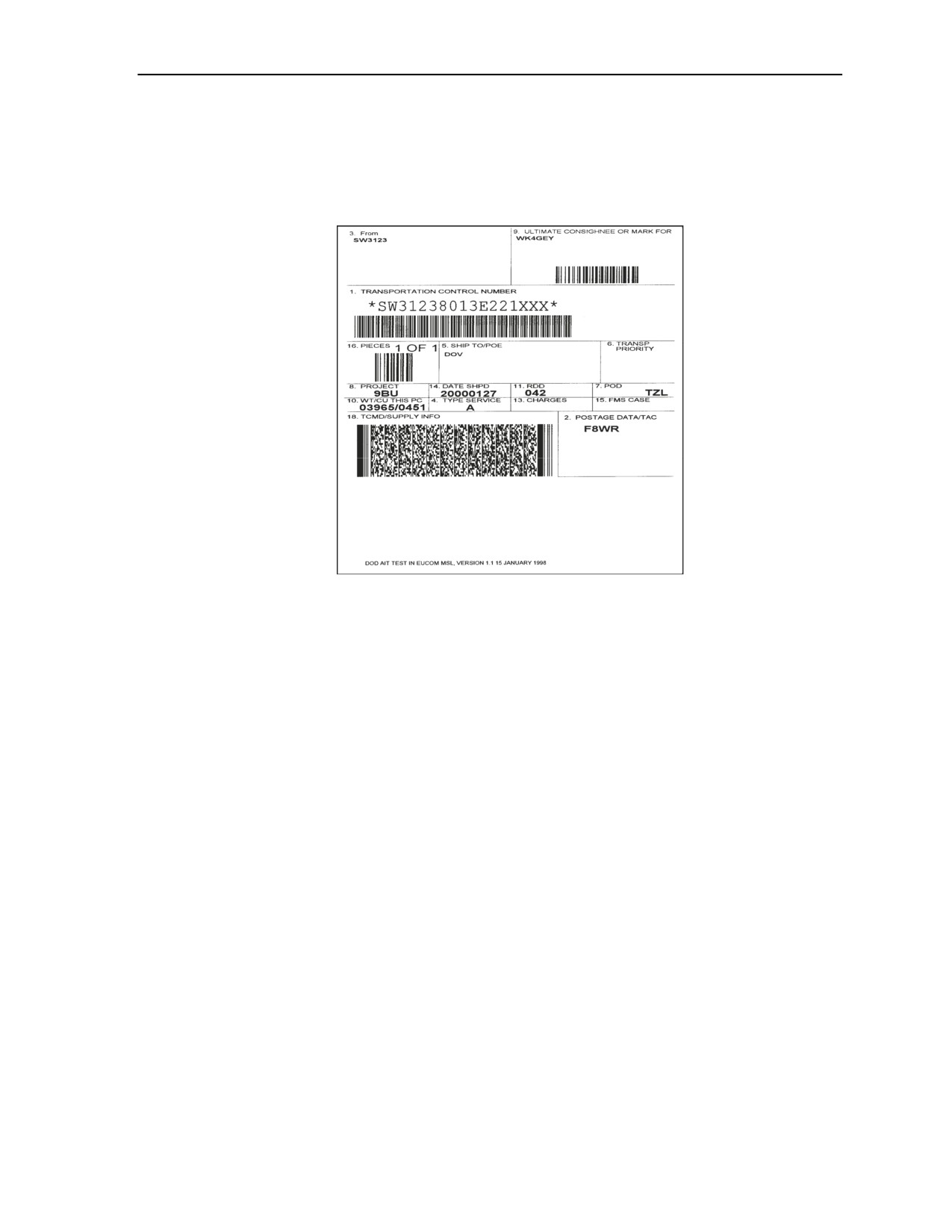
C-8. Military shipping labels incorporate 2-D bar code fields, as well as linear bar codes. Figure C-3
shows an example of a military shipping label with linear bar codes used in blocks 1, 9, and 16; and 2-D
bar code technology being used in block 18. Using bar code redundancy on the military shipping label
ensures against the loss of shipping data.
Figure C-3. Military shipping label using both two-dimensional and linear bar code
C-9. The OMCs use compact disk technology. Data is etched into the card with a high-intensity laser
creating a series of pits in the card. A low-power light beam is used to read the pits and collect the data.
Data is written to an OMC in sequential order. As changes occur, all the shipment data is rewritten on the
card (data on the card cannot be overwritten). The card can be reused until all available memory space is
filled. The OMC has a very large data capacity (2.4 megabytes), and DOD accepts the Drexler European
License Association standard format. Optical memory cards are relatively inexpensive, reusable, and
unaffected by climatic changes. They are best used to carry large amounts of shipment data to facilitate
receipt processing at final destination. Optical memory cards are normally used for sustainment cargo that
is being containerized. Army supply practices strive to create single consignee packs that can be
throughput to the end user’s location.
C-10. Optical memory cards can also be used to support container movement in a unit movement operation.
Optical memory cards can be used to account for detailed container and pallet content. The unit movement
officer uses the Transportation Coordinator’s Automated Information for Movement System II handheld
reader to scan bar codes as items are packed into the container. Once the container is loaded, the unit
movement officer coordinates to produce OMCs for containers, using the supporting Transportation
Coordinator’s Automated Information for Movement System II.
(This scenario would require advance
coordination with intermediate and destination nodes, as OMC use for unit packed containers is not a
normal business practice.)
SMART CARDS
C-11. A smart card (also known as the common access card) is a plastic card similar in shape to a credit
card. Unlike a credit card, the smart card contains an integrated circuit chip with an 8-bit embedded
microprocessor and 1 to 8 kilobyte memory capacities. Smart cards may also contain one or more other
methods (such as magnetic strip, bar code, digitized photo, printed information) for storing information
related to the cardholder. Newer cards will have 16- and 32-bit microprocessors and a data storage
capacity between 16 and 32 kilobytes. In addition to memory capacity, smart cards can contain security
8 December 2009
FM 4-02.1
C-3
Appendix C
measures such as personal identification numbers, passwords, encrypted data, photos, or thumb print
technology.
SECTION III — RADIO FREQUENCY IDENTIFICATION TECHNOLOGY
C-12. Radio frequency identification technology is used to provide automated data capture of movements
at transportation nodes. Radio frequency identification technology also provides commanders container or
pallet content visibility and can be used to locate tagged items in congested ports, container yards, or
staging areas.
TECHNOLOGY ENABLERS
C-13. Radio frequency identification technology tags contain a microchip, a long-life battery, and an RFID
transceiver. The microchip contains unique tag identification information and can be loaded with data to
identify the items traveling with the tag. Frequency identification technology write stations are used at the
point of origin to write supply and transportation data to the tag and to report the same information to a
central database. As the tag passes an interrogator during movement, the tag responds by sending data to
the interrogator. The interrogator then passes this information and a date-time stamp to a supporting AIS or
a regional ITV server. The interrogator can also be set to activate a tag beeper for all the tags within its
range or activate a specific tag number. Using this option, operators can find specific tags and associated
equipment.
TYPES OF RADIO FREQUENCY IDENTIFICATION TAGS
C-14. The Army is currently using two RFID tags, the Seal Tag II and the Tag 410. Eventually the Army
intends to transition to a single tag. Both tags hold data in the same format and transmit the data on the
same frequency. Each tag has a unique tag number, has a beeper option, and can store up to 128 kilobytes
of data. The tags have an omnidirectional, unobstructed range of approximately 300 feet. The battery life
of the tag is approximately nine years, based on two collections per day. Battery life is an important
consideration and should be checked closely when source data is written to the tag. The organization
writing the tag should ensure that low batteries are replaced. Additionally, the theater ITV plan will
identify nodes in the force projection process where the battery life should be checked and low batteries
replaced. Battery life can be checked by a fixed or handheld interrogator or by viewing the regional ITV
server low battery pages.
CONTACT MEMORY BUTTONS
C-15. Contact memory buttons are an automatic identification technology tool used by the Department of
the Navy. The Naval Supply Systems Command attaches the buttons to pieces of equipment to provide
ready access to a component’s maintenance history. The Army Logistics Integration Agency and the Army
maintenance community are currently exploring the use of contact memory buttons for similar purposes on
Army equipment. A contact memory button is a very small, fast, read-write data storage device impervious
to the elements in most harsh operating environments. It has a data storage capacity of between 128 and
32,000 bytes. A button does not require a battery to retain its memory and has a life expectancy of 100
years or one million read-write cycles. Contact memory buttons cannot be read remotely. Data is read
from the button by touching a probe to the outside of the container. Contact memory buttons can be read-
only, write-once-read-many-times, or read/write to allow updates.
AUTOMATIC IDENTIFICATION TECHNOLOGY HARDWARE
C-16. Automatic identification technology hardware consists of tools used by operators to write
information to automatic identification technology data storage devices and to interrogate and read the data
stored on the data storage device. Some of the tools currently used by the Army are discussed in the
paragraphs below.
C-4
FM 4-02.1
8 December 2009
Automatic Identification Technology
RADIO FREQUENCY IDENTIFICATION WRITE STATION
C-17. The RFID write station is a hardware interface unit called a tag docking station, which is connected
to AISs. The tag docking station is used to write data to RFID tags, one tag at a time. The tags are inserted
into the docking station and data is transferred.
Note. It is normally not recommended to change information on a tag using a handheld
interrogator unless it is certain that the changed data will be uploaded to the regional ITV server.
If the data is not uploaded, viewers of the tag data on the regional ITV server (via the World
Wide Web) will see different tag information than what is actually on the tag.
SECTION IV — RADIO FREQUENCY RELAY
C-18. The radio frequency (RF) relay functions as a wireless modem and is used as a substitute for cable
connections between fixed interrogators and the host computer. The RF relay has a 7,500-foot range
(unobstructed). Radio frequency relays can be used in pairs to form a repeater for data transmission over
longer distances or around obstructions.
HANDHELD INTERROGATORS, SCANNERS, AND DATA
COLLECTION DEVICES
C-19. Handheld interrogators and scanners operate much like fixed interrogators but are not directly
connected to the host computer. Data from handheld interrogators are downloaded to the host computer
using a cable or infrared port. The handheld interrogators can be used to locate a specific tag, view the tag
details, or to locate a specific item contained within one of several tagged containers or pallets. The tag
data on handheld interrogators can change (update) without using a tag docking station, and can write data
to a new RFID tag (see note above). Handheld interrogators are also used to scan bar codes if that feature
is available.
C-20. Handheld data collection devices are used by personnel to scan and record bar coded data. Some of
the devices are directly connected to the computer (tethered), while others are portable. The portable
devices store information for a connected download to the computer system or they may have the ability to
transmit data directly to the computer using a wireless local area network.
BAR CODE LABEL PRINTER
C-21. Bar code readability is affected by print quality, smears, poor contrast, improper label stock,
incorrect ink, and poor printer adjustment. Operational tests have found these factors can cause as much as
50 percent of the bar coded labels printed at some locations to be unreadable. Proper printer maintenance
and care is important for producing readable bar codes.
ENABLING DISTRIBUTION MANAGEMENT WITH RADIO
FREQUENCY IDENTIFICATION TECHNOLOGY
C-22. Radio frequency identification technology equipment supports the function of TAV for the
movement of materiel. Radio frequency identification’s main purpose is to provide stand-off in-the-box
visibility of container contents, as well as ITV of the container and its contents. The RF tags and
interrogators (handheld or fixed) are used to identify cargo and monitor movement from the point of origin
to the POE to the port of debarkation to theater nodes. A fixed RFID interrogator transmits queries to and
receives data from all active RFID tags in its area. The maximum unobstructed radius is approximately
300 feet. At the depot or distribution terminal, air pallet and container content data is written to the RF tag
by radio frequency or docking station and the tag is attached to the container/pallet. Omnidirectional
interrogators, installed at key transportation and supply nodes, read the tagged containers as they arrive and
depart those nodes. The interrogators pass data to a regional server in support of the Army TAV program.
Fixed RFID interrogators are positioned permanently in warehouses, central receiving points, and selected
points within transportation networks. The interrogator operates by sending a wake-up signal to the RFID
8 December 2009
FM 4-02.1
C-5
Appendix C
tag, which then transmits data back to the interrogator on a different frequency. In some configurations,
such as a Gate Reader, a motion sensor is included to activate the interrogator for data collection of tags on
vehicles approaching the sensor. The RF relay functions as a wireless modem and is used as a substitute
for cable connections between fixed interrogators and the host computer.
C-23. Automatic identification technology devices enhance the visibility and control of assets during the
logistical process from the identification of cargo to receipt by the user. Some automatic identification
technology devices use RF as the method of communicating data to AISs. Automatic identification
technology is used virtually anywhere the requirement exists to capture data automatically that otherwise
would require manual labor to capture and turn it into usable information. Automatic identification
technology includes a wide range of capabilities, which may or may not require an operator as part of the
data entry or retrieval. Automatic identification means that a single event can result in the capture of a
stream of data. It eliminates many of the manual techniques used in all retail and wholesale logistics
operations. Automatic identification technology supports all operations of SSAs, ports, terminals,
warehouses, installations, and depots.
C-24. A satellite-tracking system provides the ability to track the exact location of sustainment vehicles and
convoys. The latitude and longitude locations of trucks, trains, and other transportation assets equipped
with a transceiver are transmitted periodically via a satellite to a ground station. Some systems also
provide two-way communications between a vehicle operator and a ground station for safety, security, and
rerouting. Satellite tracking uses a cellular or satellite-based transmitter or transceiver unit to communicate
positional information, encoded and text messages, and (in the case of sensitive DOD ordnance movements
in the CONUS) emergency messages from in-transit conveyances to the ground station. Transceiver-based
technologies also permit communications from a ground station to the in-transit conveyance. A user can
compose, transmit, and receive messages with small handheld devices or with units integrated with
computers.
C-25. At the SSA, automatic identification technology is integrated into operations to provide a paperless,
automated capability for data identification, collection, entry, processing, storage, and retrieval. Automatic
identification technology is used at one or more locations within the overall distribution system. At the
EAB SSA, the predominant technology will be RFID, which is omnidirectional; read/write radio frequency
for ITV; and inside the box visibility. Tactical units place demands for supplies and equipment on a
designated SSA responsible for providing field support on a unit or area basis. The operational efficiency
of the field/sustainment unit support may be enhanced by the suite of automatic identification technology
(RFID, Automated Manifest System readers/writers, and interrogators, handheld and fixed). This
information, along with other pertinent data unique to the requisitions, is to be uploaded into GCSS-Army,
which manages the commodity, including the Logistics Intelligence File and the GTN. All of these
systems will be alerted to shipment actions as they occur or are about to occur. This process represents the
upward flow of information. The downward flow of information is initiated at the wholesale supply level.
Commodities are prepared for shipment based on requisitions that reach wholesale level. This is after
requisitions have not been satisfied at intermediate levels or replenishment requisitions have not been filled.
Automatic identification technology enables distribution management by coupling a network of laser cards
and RF tags/interrogators with the Movement Tracking System and the Standard Army Retail Supply
System. The laser cards note the individual contents of a multipack and tie the multipack to a tracking
control number. The tracking control number is subsequently assigned to a specific conveyance (pallet,
flatrack, or container). The RF tag, which carries transportation control and movement documents and
individual DD Form 1348-6 (DOD Single Line Item Requisition System Document (Manual Long Form) )
record information, is then attached to the conveyance. The RF interrogators are placed at appropriate
distribution nodes, railheads, bridges, and trailer transfer points. They detect the arrival/departure of the
conveyance and pass this information to a web-based ITV server and GCSS-Army. The Movement
Tracking System is being enhanced with direct tag reading and tag reporting capability that will also feed
information to the ITV server.
C-26. Key activities for automatic identification technology application include critical item identification
for arriving supplies at the SSA, researching NSNs, and finding sources of supply. In addition, automatic
identification technology assists in arrival status activities, stockage (sorting, binning, and accounting),
updating the Standard Army Retail Supply System, and shipping activities. Other Standard Army Retail
Supply System functions supported by automatic identification technology are requisition routes, lateral
C-6
FM 4-02.1
8 December 2009
Automatic Identification Technology
searches, visibility of excess position, summary record asset visibility of sub- Standard Army Retail Supply
System activities, and selective item visibility.
C-27. The Automated Manifest System is a multimodular cargo inventory control and release notification
system for sea, air, and rail carriers. The Automated Manifest System speeds the flow of cargo and entry
processing and provides participants with electronic authorization to move cargo prior to arrival. The
Automated Manifest System facilitates the intermodal movement and delivery of cargo by rail and trucks
through the in-bound system.
C-28. The Automated Manifest System reduces reliance on paper documents and speeds the processing of
manifest and waybill data. As a result, cargo remains on the dock for less time, participants realize faster
tracking, and logisticians provide better service to the deployed force. Although not as visible at the EAB
level, the Automated Manifest System provides the input for the Transportation Coordinator’s Automated
Information for Movement System II and Movement Tracking System to pick-up once the cargo is in-
country.
8 December 2009
FM 4-02.1
C-7
Appendix D
Medical Logistics Planning
The intense planning and management of all aspects of MEDLOG support within a
developing or mature theater is essential. Continuous logistics planning is a must
given the probable change in requirements as the theater matures. This appendix is
intended to provide general planning considerations for MEDLOG support, a sample
MEDLOG operations plan, and the latest Class VIII planning factors that can be used
to assist in the planning process. See FM 8-55 for a detailed description of AHS
support planning requirements.
SECTION I — GENERAL PLANNING
ARMY HEALTH SYSTEM SUPPORT PLANNING
D-1. The provision of AHS support is a complex process that requires continuous coordination and
comprehensive planning. Army Health System planners must be involved early-on in the planning process
and be prepared to support numerous types of operations simultaneously. By taking part in the
development of the operations plan, the medical planner can determine the capabilities needed and plan for
assets required to support the mission. To ensure effective and efficient support, medical plans must
adhere to the principles of AHS support, the commander’s planning guidance, medical intelligence related
to the operational area, and other planning considerations.
D-2. Development of the AHS support estimate and concept of operations are important steps in the
planning process. The medical planner must also conduct planning to address unforeseen contingencies
and ensure coordination of efforts among the Services to maximize the use of available resources.
Normally, in joint operations each Service operates its own health care delivery system. However, medical
support (such as medical facilities, medical equipment and supplies, and personnel) may be provided on a
joint basis.
D-3. The theater evacuation policy, health threat, troop strength or size of the population supported, the
type, intensity, and duration of the operation are some of the factors that must be considered when
determining medical requirements to support the operations plan. The medical staff’s running estimates
and medical workload (patient estimates) are also developed during planning. The patient estimate is
derived from the casualty estimate which is prepared and disseminated by the G-1 (human resources staff
officer). In-depth analysis is critical at every level of the operation to ensure the flexibility to quickly react
to changes in the mission and continue to provide the required support. The observations of commanders,
disease and nonbattle injury rates, and running estimates are the primary means of assessing an operation to
ensure that the concept of operations, mission, and commander’s intent are met. These factors and
continuous analysis help to make certain that once developed, the plan includes the right number and
combination of medical assets to support the operation.
D-4. The key to mission success is anticipation of requirements and the synchronization of AHS support
to the tactical commander’s mission. Availability of information and open lines of communication are also
vital. Common data and information must be shared among the various elements of command from the
tactical to the strategic level. The commanders and medical planners must maintain situational awareness,
in-transit visibility and tracking of patients and equipment, and a COP of the AO. This information is
obtained through various plans, reports, and information systems available to commanders and planners to
facilitate the decision making process. See FM 8-55 for additional information on the medical planning
process.
8 December 2009
FM 4-02.1
D-1
Appendix D
SECTION II — MEDICAL LOGISTICS PLANNING
MEDICAL LOGISTICS SUPPORT PLANNING
D-5. Resupply to the theater is preplanned and defined in appropriate logistical plans. Due to the
technical nature of the MEDLOG system, coupled with the likelihood of a rapidly changing operating
environment, planners must build flexibility into the plans. The MEDLOG planner must have a
comprehensive understanding of operational and tactical plans as well as a thorough knowledge of the
entire logistics system (including those organizations and activities responsible for specific aspects of
support).
D-6. Planning for mobilization of MEDLOG units to arrive early in the time-phased force and deployment
data flow and the buildup of MEDLOG support will need to be synchronized to support the flow of the
medical force. To enhance Class VIII support, the MEDLOG planner will—
z
Identify the specified and implied time-phased materiel requirements necessary to support the
operations plan.
z
Identify the capabilities, limitations, and requirements of aerial and sea ports of debarkation.
z
Ensure coordination for the movement of supplies and equipment.
z
Identify pre-positioned stocks in theater.
z
Identify host-nation support, if available.
z
Identify joint and multinational logistics support requirements to include the distribution plan.
D-7. Class VIII supply support (including blood management/distribution), optical fabrication, medical
maintenance, medical contracting, and health facilities planning are all key aspects of the MEDLOG
support plan, which is a part of the AHS support plan. When approved, the MEDLOG plan becomes a
directive to medical logisticians in subordinate commands and serves as a guide for working out the details
involved in the provision of Class VIII supply support for the command.
MEDICAL LOGISTICS CONSIDERATIONS
D-8. The following is a list of considerations for use in developing the MEDLOG plan (this list is
provided as a guide only and is not intended to be all inclusive):
z
Are procedures unique to medical supply described?
z
Are resupply procedures established?
z
Does the command address ASL objectives?
z
Are special medical supply requirements identified based on the mission and the AO?
z
Are special storage requirements satisfied?
z
Is the transportation support system described?
z
Have the proper quantities of special containers and materiel packaging equipment needed to
support distribution been identified and planned?
z
Are special handling procedures for cold-chain managed materiel properly described in the
appropriate annexes so they can be followed by transportation personnel tasked to support Class
VIII distribution?
z
Are procedures in place to ensure proper handling of controlled and regulated Class VIII
materiel items (including maintaining the proper chain-of-custody)?
z
Are medical oxygen requirements identified and resupply procedures described?
z
How are blood management functions conducted?
z
Which unit is responsible for optical fabrication support?
z
Are procedures identified for handling medical materiel and equipment captured from the
enemy?
z
What are the support requirements for collection and disposal of medical waste?
z
Do disposal procedures meet applicable environmental standards?
D-2
FM 4-02.1
8 December 2009
Medical Logistics Planning
z
Is local purchase an option?
z
Have individuals been trained/appointed for local procurement?
z
Has the command established local purchase procedures?
z
Are there adequate provisions in the plan for contracting support?
z
Have an adequate number of contracting officers with the proper warrants been provided?
z
Are procedures in place for managing the reverse flow (retrograde operations) of medical
equipment and materiel?
MEDICAL MAINTENANCE CONSIDERATIONS
D-9. The following are a list of considerations for use in developing the medical maintenance support
portion of the MEDLOG plan (this list is not intended to be all inclusive, but to serve as a guide only):
z
Are special medical maintenance requirements addressed?
z
Are mandatory parts lists or bench stock requirements specified?
z
Have power requirements been identified (voltage, phase, frequency, and anticipated load)?
z
Does the plan cover TMDE repair and calibration?
z
Does the plan address how field and sustainment maintenance is to be provided?
z
Are MEDSTEP procedures or reparable items covered (including evacuation of reparable
items)?
z
Are replacement items addressed?
z
Is contractor support integrated into the maintenance plan?
HEALTH FACILITIES PLANNING CONSIDERATIONS
D-10. Health facility planning, design, and management decisions must be executable and sustainable.
The construction, maintenance, and operations capabilities within the theater of operations must also be
adequate to ensure that the facility will meet the needs of the health care mission. Planning, design, and
management considerations include:
z
Site selection.
Does the site drain water adequately?
Is there appropriate access to the building/campus site for helicopters, ground ambulances,
ambulance buses, and pedestrians?
z
Function and flow.
Does the layout of the facility support the natural flow of patients through the facility?
Are ancillary services adjacent to the departments they support?
Is a proper sterilization path provided to prevent the crossing of clean and dirty functions?
z
Architectural elements.
Are the interior finishes durable and cleanable?
Are seamless finishes provided in critical care areas?
Are the doors in the emergency, radiology, surgical, and intensive care areas of sufficient
durability to withstand extreme use and regular contact with beds and equipment?
z
Electrical systems.
Are 110 voltage alternating current and/or 220 voltage alternating current power required
for the facility? The equipment plan needs to be coordinated with the electrical plan to ensure
adequate power is provided in order to avoid overloaded circuits.
What is the source of primary power?
Is back-up power required?
How is back-up power being provided?
z
Mechanical systems.
How are temperature and humidity controls being provided within the building?
How are positive and negative pressures being provided?
How is filtration being provided in critical care areas?
8 December 2009
FM 4-02.1
D-3
Appendix D
How will waste anesthesia gas be removed from the operating rooms?
How is suction being provided?
z
Plumbing systems.
How is steam being provided for sterilization?
Do surgical and hand washing sinks have goose neck faucets, touchless controls, and/or
paddle handles to facilitate appropriate hand washing?
z
Medical gas systems.
How will medical gases be provided within the facility?
If hard piped gases are desired, is a certified installer available within the theater of
operations?
z
Medical equipment.
What DEPMEDS equipment is going to be used?
What non-DEPMEDS equipment is going to be used? Coordinate the mechanical,
electrical, and plumbing requirements for each piece of equipment with the building’s design.
Which organization is responsible for coordinating and funding the initial outfitting and
transition of equipment?
z
Facility management.
Has a command facility management policy been established?
Has a unit-level point of contact been identified for facilities work order submissions?
Are work orders reconciled (at least monthly) for follow-up or close out?
What organization is responsible for performing operations and maintenance for the
facility?
What organization is responsible for funding regular operations and maintenance?
MEDICAL LOGISTICS SUPPORT PLAN
D-11. Figure D-1 below is an example that can be used when developing the MEDLOG support plan. The
sample follows the operations order/operations plan format provided in FM 5-0. At a minimum the plan
should provide special general supply instructions applicable to medical units; special medical supply
procedures applicable to the current operation
(such as procedures for procurement, storage, and
distribution); transportation instructions; details for the provision of medical maintenance support; optical
support; and blood distribution support. The plan should also include policy statements for the inspection
of locally procured items, captured medical supplies, and CBRN contaminated Class VIII. Figure D-2
depicts an example of a joint MEDLOG operations plan and Figure D-3 provides an example of a blood
support appendix to the joint MEDLOG operations plan. These figures can also be used to assist in the
planning process.
D-4
FM 4-02.1
8 December 2009
Medical Logistics Planning
(Classification)
TAB H (MEDICAL LOGISTICS) TO APPENDIX 6 (MEDICAL) TO ANNEX I (SERVICE SUPPORT) TO
OPERATIONS ORDER ## [code name]—[issuing headquarters]
Time zone used throughout the operations plan/operations order:
The time zone used throughout the operations plan/operations order (including attachments) is the same time zone applicable
to the operation. Operations across several time zones use universal (ZULU) time. Place the classification and short title of
the plan/order at the top of the second and any subsequent pages of the base operations plan/operations order.
Task Organization: List the number and coordinates of medical units here or in a trace or overlay. If you do not list units
here, omit this heading).
1.
SITUATION.
(State the general factors affecting medical logistics
(MEDLOG) support for the operation.
Include any information essential to understanding the current situation as it influences MEDLOG support. This information
can be taken from paragraph 1 of the related operations plan/operations order.)
a.
Enemy forces.
(Refer to the appropriate operations plan/operations order or its intelligence annex, if
published. List the available information about the composition, disposition, location, movements, estimated strengths, and
identification of enemy forces. List the enemy capabilities that could influence the MEDLOG support mission, such as
enemy activity on or near main supply routes. If available, list the enemy logistics situation, to include information on how
well supplied the enemy/opposition force is with food, clothing, or other vital logistics factors. It may also include the
financial backing and availability of future support from outside individuals/groups/nations.)
b.
Friendly forces. (List pertinent information concerning friendly forces [other than those referenced in the
operations plan/operations order or that subsequent paragraphs of this plan/order include] that might directly influence the
MEDLOG support mission. This is addressed from the perspective of the host nation or US-backed group and US national
interests. Emphasis should also be placed on Class VIII supply support operations and responsibilities for higher and
adjacent units. Also list the logistics situation as it relates to friendly forces. Since medical evacuation vehicles are used to
conduct emergency resupply of forward deployed medical units, the MEDLOG planner must maintain visibility of the
availability of medical evacuation assets.)
c.
Environment.
(1)
Terrain. (Refer to related operations plan/operations order or the related engineer annex. List all
critical terrain aspects that would impact MEDLOG support operations.)
(2)
Weather.
(Refer to related operations plan/operations order or its intelligence annex. List all
critical weather aspects that would impact MEDLOG support operations.)
(3)
Civil considerations.
(Refer to related operations plan/operations order or its civil-military
operations annex. List all critical civil considerations that would impact MEDLOG support operations.)
d.
Attachments and detachments. (Refer to related operations plan/operations order.)
e.
Assumptions. (Service support or operations plan only. List any assumptions that apply to the operation.
Refer to related operations plan/operations order)
2.
MISSION. (Statement of the overall MEDLOG support mission — the type of activity to be supported [such as
offensive, defensive, stability or civil support operations].)
3.
EXECUTION.
a.
Concept of operations.
(Outline the general plan for Class VIII supply support and any instructions that
succeeding paragraphs do not adequately cover.)
(Classification)
Figure D-1. Example of a medical logistics support plan
8 December 2009
FM 4-02.1
D-5
Appendix D
(Classification)
TAB H (MEDICAL LOGISTICS) TO APPENDIX 6 (MEDICAL) TO ANNEX I (SERVICE SUPPORT) TO
OPERATIONS ORDER ## [code name]—[issuing headquarters]
b.
Coordinating instructions.
(List only instructions applicable to two or more units and not covered in the
unit’s tactical standing operating procedures.)
4.
SERVICE SUPPORT.
a.
Materiel and services.
(1)
Supply.
(Refer to tactical standing operating procedures or another annex whenever practical.
Class VIIIB or blood support, can be addressed here or in a separate tab.)
(a)
General supply.
(Provide special instructions applicable to the unit. Also consider
stockage levels for all classes of supply, as units will be operating in an austere environment and at extended distances from
the full compliment of medical resources.)
(b)
Class VIII (to include blood and blood products).
(Provide special procedures
applicable to the operation.)
1.
Requirements.
(Provide details of materiel required to sustain US and
multinational forces including resupply and stockage levels required. This includes estimates of the population to be
supported or the number of patients anticipated to be treated as well as any supplies required for teaching or training.)
2.
Procurement.
(Provide detailed discussion of procedures and/or contracting
support for the operation. Funding sources should be identified and procedures for obtaining the supplies described, as well
as any limitations or restrictions on the use of the supplies, should be included.)
3.
Storage.
(Special procedures and equipment
[such as cold storage,
refrigeration, or other special handling] requirements for maintaining storage and the appropriate shelf life of medical
materiel in an austere environment should be included.)
4.
Distribution.
(This should include the method of distribution and any
limitations or restrictions that are applicable. Additionally, if special transportation requirements exist, they should also be
noted. )
5.
Coordination. (Inter-service, allied forces, US agencies, multinational forces,
host nation government, nongovernmental organizations, and means of communicating requests for supply.)
(c) Supplies required for stability operations missions and not for support of US or
multinational force. (This includes foreign humanitarian assistance, disaster relief, or other stability operations missions.)
(d)
Medical logistics activities.
(This includes the location of the medical supply support
activity supporting the AO and means of communicating requests for resupply.)
(e)
Salvaged medical equipment and supplies. (Ensure policy and procedures are in place
for classification, storage, and use of such items.) Example… Recaptured US medical supplies will be turned over to the
nearest medical treatment facility for determination of further use. Samples will be forwarded through command intelligence
channels to the National Center for Medical Intelligence.
(f)
Captured medical supplies.
(This should include disposition instructions.) Example…
Captured medical supplies and equipment will not be destroyed. Units having custody of enemy supplies and equipment will
turn them over to the supporting medical facility. Local or captured Class VIII materiel will only be used to support enemy
prisoners of war or civilian detained/retained personnel.
(Classification)
Figure D-1. Example of a medical logistics support plan (continued)
D-6
FM 4-02.1
8 December 2009
Medical Logistics Planning
(Classification)
TAB H (MEDICAL LOGISTICS) TO APPENDIX 6 (MEDICAL) TO ANNEX I (SERVICE SUPPORT) TO
OPERATIONS ORDER ## [code name]—[issuing headquarters]
(g)
Civilian medical materiel. (This may include information or policy on purchasing
medical supplies on the local economy. NOTE: The procurement of medical supplies on the local economy must be
approved by the command surgeon. Due to Food and Drug Administration stringent standards for medications, the local
procurement of these products is usually not feasible.) Example…Transfer of Class VIII to host nation: Units are forbidden
by US laws, DOD directives, and Army policy from giving Class VIII supplies and equipment to host nation personnel except
under limited authorizations or in order to prevent mission failure. Units must follow published guidance and seek legal
review prior to transfer of any Class VIII.
(h)
Other medical logistics matters. (This can include the receipt, repackaging, storing and
distribution of donated medical supplies for use in foreign humanitarian assistance operations. Requesting procedures should
also be included. Other multinational concerns [such as supplies and equipment provided by the United Nations] and/or
interagency operations should be considered).
(i)
Medical equipment maintenance and repair.
(This should describe equipment
maintenance capability available for supported units including procedures for the requisition of required medical equipment
and responsibilities for medical equipment repair. Include in separate subparagraphs the location, mission, hours of opening
or closing of medical maintenance and/or repair teams.)
(j) Optical fabrication and spectacle repair.
(Is this service available in the theater? If not,
where are the supporting facilities located and what procedures are used to request this support.)
(k) Class VIIIB, blood and blood products.
(This includes location of blood support units,
reporting requirements, requisition procedures, coordination requirements [with other Services].)
(2)
Services to Army Health System units and facilities. (Include information on the following
services: laundry, bath, utilities, fire fighting, construction, real estate, graves registration religious, personnel, and finance.)
(3)
Transportation. (This includes use of various transportation assets and avenues [such as ground,
rail, water, and air] available for resupply of Class VIII.)
(a)
Movement control and traffic regulation, if applicable.
(This can include
requirements for armed escort; requirements for crossing international boundaries, convoy restrictions, or other circumstances
affecting transport or supply route operations.)
(b)
Security requirements. (Include information on physical security requirements for the
storage of Class VIII.)
(4)
Labor.
(Include policies with any restriction on using civilian internees or detainees and enemy
prisoners of war in labor units. Allocate and prioritize available labor. Include designation and location of available labor
units. Depending on the scenario, it may be possible to contract nonmedical personnel for support positions.)
(5)
Maintenance.
(This includes priority of maintenance, location of facilities, collection points,
maintenance time lines, and evacuation procedures.)
(Classification)
Figure D-1. Example of a medical logistics support plan (continued)
8 December 2009
FM 4-02.1
D-7
Appendix D
(Classification)
TAB H (MEDICAL LOGISTICS) TO APPENDIX 6 (MEDICAL) TO ANNEX I (SERVICE SUPPORT)
TO OPERATIONS ORDER ## [code name]—[issuing headquarters]
5.
COMMAND AND SIGNAL
a.
Command. (State the map coordinates for command post locations and at least one future
location for each CP. Identify the chain of command if not addressed in unit standing operating procedures.)
b.
Signal.
(Refer to appropriate operations plan/operations order. When not included in the
basic operations plan/operations order, include the headquarters location and movements, liaison arrangements,
recognition and identification instructions, and general rules concerning the use of communications and other
electronic equipment, if necessary. Use an annex when appropriate.)
MISCELLANEOUS. (Address areas of support not previously mentioned which may be required or needed
by subordinate elements in the execution of their respective MEDLOG support mission such as command post
locations, signal instructions, medical intelligence, claims, and special reports that may be required and
international or host-nation support agreements affecting MEDLOG support.)
ACKNOWLEDGE: (Include instructions for the acknowledgement of the plan or order by addressees. The
word “acknowledge” may suffice or you may refer to the message reference number. Acknowledgement of a
plan or order means that it has been received and understood. The commander or authorized representative
signs the original copy. If the representative signs the original, add the phrase “For the Commander”.)
(The signed copy is the historical copy and remains filed in headquarters files. Use only if the commander does
not sign the original order. If the commander signs the original, no further authentication is required and only
the last name and rank of the commander appear in the signature block.)
(Commander’s last name)
(Commander’s rank)
OFFICIAL:
(Authenticator’s Name)
(Authenticator’s Position)
(Use only if the commander does not sign the original order. If the commander signs the original, no further
authentication is required. If the commander does not sign, the signature of the preparing staff officer requires
authentication and only the last name and rank of the commander appear in the signature block.)
DISTRIBUTION: (Furnish distribution copies either for action or for information. List in detail those who
are to receive the plan or order. If necessary, also refer to an annex containing the distribution list or to a
standard distribution list or standing operating procedure. When referring to a standardized distribution list,
show distribution to reinforcing, supporting, and adjacent units, since that list does not normally include these
units. When distribution includes a unit from another nation or from a NATO command, cite the distribution
list in full.)
(Classification)
Figure D-1. Example of a medical logistics support plan (continued)
D-8
FM 4-02.1
8 December 2009
Medical Logistics Planning
CJCSM 3122.03C
17 August 2007
(Format, Medical Logistics (Class 8A) System Appendix)
CLASSIFICATION
HEADQUARTERS, US EUROPEAN COMMAND
APO AE 09128
25 May 200X
APPENDIX 5 TO ANNEX Q TO USCINCEUR OPLAN 4999-05
MEDICAL LOGISTICS (CLASS 8A) SYSTEM
References: List documents essential to this appendix.
1. Situation
a. Facilities. Identify available medical logistic facilities. Outline what medical logistic units are introduced
early in the deployment process to augment existing resources.
b. Assumptions. List any critical assumptions or command-unique definitions.
2. Mission
3. Execution
a. Organization and Function. Describe the organization of health logistics throughout the theater to include
Single Integrated Medical Logistics Management (SIMLM) responsibilities, if applicable; address medical
supply and resupply.
b. Tasks. Identify tasks for organizations and agencies providing medical materiel support.
c. Coordinating Instructions.
4. Administration and Logistics
a. Medical Materiel Sustainability Assessment. Describe briefly the number of days that existing theater
stocks can support the combatant command.
b. Policy. Outline the command policies for provision of medical materiel support, list of pharmaceuticals,
minimum-essential accompanying supplies for deploying troops and priorities for use of in-theater medical
materiel stocks.
CLASSIFICATION
Figure D-2. Example of a joint medical logistics operations plan
8 December 2009
FM 4-02.1
D-9
Appendix D
CLASSIFICATION
CJCSM 3122.03C
17 August 2007
5. Command and Control. Outline the chain of command for all theater medical logistics support units; this
may require regional breakouts. Identify communications requirements to support medical resupply.
Tab {Note: Format not provided, tab corresponds with a MAT table.}
A- - Time-phased Class 8A Requirements
CLASSIFICATION
Figure D-2. Example of a joint medical logistics operations plan (continued)
D-10
FM 4-02.1
8 December 2009
Medical Logistics Planning
CJCSM 3122.03C
17 August 2007
CLASSIFICATION
HEADQUARTERS, US EUROPEAN COMMAND
APO AE 09128
25 May 200X
APPENDIX 2 TO ANNEX Q OF US EUROPEAN COMMMAND OPERATIONS PLAN 4999-05
JOINT BLOOD PROGRAM
References: List documents essential to this appendix.
1. Situation
a. Friendly. Identify available capabilities.
b. Assumptions. Identify unique assumptions for the joint blood program.
2. Mission
3. Execution
a. Concept of Operations. Describe the joint blood program concept and how it supports the mission.
b. Tasks. Assign tasks by sub-unified or component command, including administrative, funding, communications,
staffing, and logistics support.
c. Coordinating Instructions. Identify other organizations with which coordination must occur to ensure effective blood
or blood component support.
(1) Storage and inventory levels by level of care
(2) Document and record management
(3) Use of DBSS
(4) Emergency whole blood collections and retrospective testing
(5) Transfusion of non-US, FDA blood
4. Administration and Logistics
a. Provide requirements and shortfalls.
b. Describe the blood or blood component distribution throughout the theater.
c. List work force personnel requirements and responsibilities by component.
CLASSIFICATION
Figure D-3. Example of an appendix for joint blood support
8 December 2009
FM 4-02.1
D-11
Appendix D
CJCSM 3122.03C
17 August 2007
CLASSIFICATION
d. Identify blood program facility requirements.
5. Command and Control.
a. Command Relationships. Describe the command line through the Joint Blood Program Office (JBPO) to
the lowest level blood organization in theater.
b. Communications. Identify communications requirements using the following:
(1) Specify US Message Text Formats.
(2) Specify level of classification of messages.
(3) List communication system support requirements.
(4) State direct communication policy.
(5) Delineate modes and priorities available to transmit information.
Tabs {Note: Formats not provided, tab corresponds with a MAT table.}
A--Joint Blood Program Operational Structure
B--Blood Requirements and Capabilities
C--Theater Blood Distribution System
D--Joint Blood Program Manpower Requirements
CLASSIFICATION
Figure D-3. Example of an appendix for joint blood support (continued)
SECTION III — CLASS VIII CONSUMPTION COMPUTATION
D-12. There are several considerations used by MEDLOG planners when determining Class VIII support
requirements. These include the computation of MEDLOG support and transportation requirements and
the use of MRSs during early-entry operations. Medical resupply sets and preconfigured push-packages
are the primary means of resupply within the BCT prior to the establishment of line item requisitioning.
Demand history, casualty estimates, and specialty sets are used when basic mission requirements become
more definitive.
MEDICAL LOGISTICS SUPPORT AND TRANSPORTATION
REQUIREMENTS
D-13. A pounds-per-Soldier-per-day and pounds per wounded in action admitted computation is used by
medical logisticians when planning for Class VIII support and transportation requirements. The patient
D-12
FM 4-02.1
8 December 2009

Medical Logistics Planning
estimate (derived from the casualty estimate) is the basis for applying these computations as discussed in
Section I of this appendix. Table D-1 lists the Class VIII planning factor for each role of care and
illustrates the consumption computation for the wounded in action patient category. The Class VIIIA
(excludes Class VIIIB blood) planning factors presented here are no longer tied to a specific Total Army
Analysis patient stream. They were developed using generic patient streams that are intended to include
various types of patients.
Table D-1. Class VIII planning factors
CLASS VIII PLANNING FACTOR PERCENTAGES BY ROLE OF CARE
ROLE OF
Wounded in
Disease and
Blister
Nerve
CARE
Action Planning
Nonbattle
Planning
Planning
Factor =
Injuries Planning
Factor =
Factor =
477 pounds/
Factor =
36 pounds/
110 pounds/
Hospital
122 pounds/
Hospital
Hospital
Admission
Hospital
Admission
Admission
Admission
Roles 1 and 2
12%
22%
7%
6%
Role 3
67%
69%
55%
81%
Role 4
21%
9%
38%
13%
Note. Population Supported Items Planning Factor = 0.19 Pounds per Soldier per day (such as sunscreen, foot powder,
and other items as provided under Common Table of Allowance 8-100).
ILLUSTRATION
12%
57 lbs Roles 1 and 2
477 Pounds of Class VIII Per
Wounded in Action
67%
320 lbs Role 3
Hospital Admission
21%
100 lbs Role 4
Note. The percentages and information presented in this section are provided as a guide and are
not intended as a substitute for more specific data.
D-14. These planning factors are primarily used by medical planners at EAB to determine support
requirements such as the number of MLCs necessary to support a specific mission based on their short ton
delivery capability. These factors can also be applied to planning Class VIII distribution support when
weight limitations are a factor (such as sling load or other aerial resupply operations). Table D-2 expands
on the information provided in Table D-1 by converting the percentages to pounds per type of admission.
8 December 2009
FM 4-02.1
D-13

Appendix D
Table D-2. Class VIII pounds per admission type
Disease and
Wounded in Action
Nonbattle Injuries
Planning Factor as
Planning Factor as
Blister Planning
Nerve Planning
Pounds/Wounded
pounds/ Disease
Factor as pounds/
Factor as pounds/
in Action Hospital
and Nonbattle Injury
Blister Hospital
Nerve Hospital
Roles of Care
Admission
Hospital Admission
Admission
Admission
Roles 1 and 2
57 pounds
27 pounds
3 pounds
7 pounds
Role 3
320 pounds
84 pounds
19 pounds
89 pounds
Role 4
100 pounds
11 pounds
14 pounds
14 pounds
Note. Population Supported Items Planning Factor = 0.19 Pounds per Soldier per day.
MEDICAL RESUPPLY SET AND PUSH-PACKAGE PLANNING
D-15. When estimating Class VIII requirements for MCOs in the BCT, it is more practical to base initial
planning on unit MES and MRS capabilities. Medical equipment sets and MRSs apply to TOE units only
and are designed and updated based on historical precedents (patient numbers, mission types, and injury
types from past MCOs), operational experience, and emerging medical technologies. Periodic review of
these sets by medical subject matter experts insure that the contents continue to meet the needs of medical
professionals supporting the deployed force. Medical assemblage is also a term used to describe these
medical sets as well as dental equipment sets, MMSs, OESs, and others. An Army medical assemblage is
an identified grouping of medical and nonmedical supplies and or equipment designated to facilitate a
specific health care function based on a unit’s minimum mission essential wartime requirements to support
MCOs. The Army has two types of medical assemblages, minor and major assemblages.
MINOR MEDICAL ASSEMBLAGES
D-16. Minor medical assemblages or MESs are Army-unique assemblages consisting of a grouping of
medical and nonmedical items under a single stock number including expendable (consumable) supplies,
durables, and nonexpendable equipment developed to support a certain TOE mission or clinical function.
Medical equipment sets are managed by the AMEDD and used primarily by the Army. Each MES is
designed to meet minimum mission essential wartime requirements to sustain MCOs or high intensity
conflict for 72 hours or 3 days. They are used primarily in the BCT Roles 1 and 2 MTFs and the ASMC.
MAJOR MEDICAL ASSEMBLAGES
D-17. Major medical assemblages or MMSs are DEPMEDS equivalent Army-unique sets that consist of a
grouping of medical and nonmedical items under a single stock number managed by the AMEDD and are
used primarily by the Army. Each MMS is developed specifically for EAB medical units and is designed
to meet the minimum mission essential wartime requirements to sustain MCOs or high intensity conflict for
72 hours or 3 days. Potency and dated medical materiel is not included in the MMS, but is provided
separately upon deployment as part of the UDP (refer to Chapter 3 for a description of the UDP). These
assemblages are traditionally found in the CSH at EAB.
MEDICAL RESUPPLY SETS
D-18. The MRS is a preconfigured list of supplies designed to refill MESs (minor sets) for medical units
operating at brigade and below (Roles 1 and 2 MTFs including the ASMC). There are no resupply sets for
the MMSs (major sets) used by EAB medical units. Each MRS is designed by the AMEDD and is
developed to replace consumable items in the MES. The MRS constitutes an additional 7 days of supply
and is typically used until line item requisitioning is established. The MRS is intended to operationally
D-14
FM 4-02.1
8 December 2009
Medical Logistics Planning
sustain the MES for which it was developed (such as the MRS, Trauma, which would be used to resupply
the MES, Trauma). The MRS is used for contingency planning, does not have an assigned line item
number, and is not authorized by TOE/modified TOE.
PUSH-PACKAGES
D-19. Push-packages are a predetermined amount of supplies designed and managed by the using unit in
coordination with the supporting IMSA or SSA. Ideally, these packages are coordinated for by the unit
prior to deployment and issued during early-entry operations on a scheduled basis or upon request.
SPECIALTY SETS
D-20. Stability and civil support operations require more definitive or tailored assemblages such as
Humanitarian Assistance Sets. There are three types of Humanitarian Assistance Sets, the—
z
Humanitarian Assistance Surgical Augmentation Set.
z
Humanitarian Assistance Pediatric Augmentation Set.
z
Humanitarian Assistance Adult Augmentation Set.
D-21. These sets were established to augment an existing CSH and are not intended for use as standalone
sets. They contain special medical and surgical supplies and equipment that are not currently authorized in
DEPMEDS-equipped hospitals, but are essential for providing AHS support to a civilian population during
stability or civil support operations. Humanitarian Assistance Sets do not have an assigned line item
number and are not authorized by TOE/modified TOE. There is no basis of issue for these sets. Units
must determine if there is a need for the sets during planning or as dictated by OTSG and medical mission
requirements. Humanitarian Assistance Sets are managed by USAMMA. The Army Deputy Chief of
Staff, Logistics (G-4) is the release authority for these sets. For the latest information and questions
concerning Humanitarian Assistance Sets refer to the USAMMA website at www.usamma.army.mil.
TRANSITION TO LINE ITEM REQUISITION
D-22. As operations stabilize or transition from MCO to stability operations, the Class VIII system will
transition from MRS and push-package use to line item requisitioning. This type of resupply relies upon
an on-hand stock or ASL (100 to 300 lines of critical line items) located at the BMSO and established
resupply channels between higher levels of Class VIII sustainment.
ADDITIONAL INFORMATION
D-23. The USAMMA website has several automated tools that provide unit assemblages, functional
descriptions, and detailed component listing reports. These component listings provide both hospital
(Role 3) and nonhospital (Roles 1 and 2) unit assemblage reports. To research a particular set the Unit
Assemblage database provides listings for multiple years under the same line item number. To research
specific medical equipment items the Medical Services Information Logistics System (MEDSILS) provides
a database that cross-references key unit assemblage component materiel data. Both databases have on-
line tutorials. For additional information access the USAMMA website at www.usamma.army.mil.
8 December 2009
FM 4-02.1
D-15
Appendix E
Medical Logisticians in the Army Service Component
Command, Theater Sustainment Command, Sustainment
Brigade, and Brigade Combat Team
Department of the Army Pamphlet 611-21 provides information on the classification of
all Army personnel including a description of each position and the duties involved.
This appendix focuses on the medical logistician or health services materiel officer and
the medical logistics specialist. It expands on the information found in the DA
Pamphlet and provides actual tasks performed by medical logisticians at various levels
of command within the AO, including the ASCC, TSC/ESC, sustainment brigade, and
the brigade support battalion. The duties of the medical logisticians in the MEDCOM
(DS), MEDBDE, MMB, MLC and other MEDLOG elements are covered in previous
chapters in this FM as well as FM 4-02.12 and will not be included in this appendix.
The tasks listed are not intended to be all inclusive, but are provided as a guide for
medical logisticians in the operational force.
SECTION I — MEDICAL LOGISTICIANS IN THE ARMY SERVICE COMPONENT
COMMAND
E-1. The ASCC serves as the Army component headquarters for a GCC. The command develops and
coordinates requirements, plans, and participation of US forces, and when so designated, Joint/Combined
forces. The ASCC is also responsible for developing MEDLOG plans and policy for all units and
operations within the theater. There are three health services materiel officers and two medical logistics
specialists in the ASCC.
SUPPORT OPERATIONS BRANCH
E-2. The medical logisticians within the ASCC are part of the support operations branch. The MEDLOG
personnel within the support operations branch are responsible for—
z
Providing policy and plans for the use of medical organizations within the theater. The branch
also plans for and promulgates policy for the prevention of disease, treatment and movement of
patients, hospitalization, return to duty, evacuation, dental, veterinary and laboratory services.
z
Ensuring the provision of health care support to all medical units and facilities.
z
Advising the commander on health care support activities.
z
Planning and managing health care and medical resource management programs.
z
Ensuring that medical units and facilities are requesting and receiving the proper resources to
meet mission requirements.
z
Providing deputy chief of staff, medical representation in the RSOI of medical materiel (the
exact functions to be performed will be determined by mission, enemy, terrain and weather,
troops and support available-time available and civil considerations).
z
Planning, directing, and supervising health delivery activities within the operational area.
8 December 2009
FM 4-02.1
E-1
Appendix E
z
Keeping the commander informed of health or health delivery concerns.
z
Performing management of stock record/warehouse functions pertaining to receipt, storage,
distribution, and issue of medical inventory for the command.
E-3. The primary mission of MEDLOG personnel within the ASCC is to provide oversight or C2 of all
Class VIII supply support functions within the theater.
SECTION II — MEDICAL LOGISTICIANS IN THE THEATER SUSTAINMENT
COMMAND/EXPEDITIONARY SUSTAINMENT COMMAND
E-4. The role of the TSC/ESC is to provide forward-based C2 of TSC logistics forces. The ESC’s
organizational structure mirrors the TSC with fewer personnel assigned.
DISTRIBUTION MANAGEMENT CENTER
E-5. The ESC’s distribution integration branch, under the DMC, coordinates and synchronizes the
movement of all personnel, equipment, and supplies, provides capacity visibility, and ensures an
uninterrupted flow of logistics support into and out of the AO or the joint operations area. The MEDLOG
personnel in the DMC are responsible for managing Class VIII storage and distribution operations for the
command as well as the following—
z
Providing materiel distribution management of the Class VIII commodity by synchronizing
medical materiel requirements with distribution capabilities and tracking the supplies and
equipment to their final destination.
z
Assisting the MLMC forward support team in expediting critical medical supplies.
z
Examining current sustainment operations to ensure that the MEDLOG support provided
contributes to the desired effects of the supported commander.
z
Maintaining situational awareness of the Class VIII commodity through the use of TAV/ITV
AISs.
E-6. Theater-level management of Class VIII is accomplished by the MLMC forward support team that
collocates with the TSC/ESC DMC. The MLMC forward support team provides visibility and control of
all Class VIII inventory for the MEDCOM (DS) and the capability to integrate Class VIII distribution
requirements with those of the TSC/ESC. The medical logisticians in the ESC provide support for the TSC
and its supported units.
SECTION III — MEDICAL LOGISTICIANS IN THE SUSTAINMENT BRIGADE
E-7. The sustainment brigade headquarters synchronizes, monitors, and controls sustainment support for
all assigned and attached units. The health services materiel officers within the sustainment brigade are
part of the brigade surgeon’s section.
SUSTAINMENT BRIGADE SURGEON SECTION
E-8. The role of the MEDLOG personnel in the surgeon’s section is to coordinate, synchronize, and
execute Class VIII resupply operations for all supported units operating within the supported AO as well as
the following—
z
Advise the sustainment brigade commander on all issues related to MEDLOG readiness.
z
Develop all support plans for optical fabrication, medical equipment maintenance and Class VIII
supply support for the brigade.
z
Provide liaison support between internal and external points of contact for all medical logistics
related issues.
z
Coordinate resourcing of medical logistics support for organic units and supported units within
the brigade AO.
E-2
FM 4-02.1
8 December 2009
Medical Logisticians in the Army Service Component Command, Theater
Sustainment Command, Sustainment Brigade, and Brigade Combat Team
z
Analyze Class VIII replenishment operations, identifying trends in performance, and providing
technical advice, as necessary.
z
Analyze medical maintenance operations, identifying trends in performance, and providing
technical advice, as necessary.
SECTION IV — MEDICAL LOGISTICIANS IN THE BRIGADE SUPPORT
BATTALION
E-9. The medical logisticians within the brigade support battalion of the BCT are found in the support
operations section and the BMSO of the BSMC. The health services materiel officers and medical logistics
specialists in the brigade support battalion are responsible for the coordination, synchronization, and
execution of Class VIII resupply operations for all supported units operating within the supported area.
SUPPORT OPERATIONS SECTION
E-10. The MEDLOG personnel assigned to the support operations section of the brigade support battalion
perform the following tasks:
z
Advise the brigade surgeon and brigade support battalion commander on issues related to
medical supply and equipment readiness.
z
Coordinate for external MEDLOG support for organic units and supported units within the
brigade AO.
z
Develop support plans for optical fabrication, blood, medical equipment maintenance and Class
VIII supply support for the brigade.
z
Coordinate resourcing of medical logistics support.
z
Provide oversight on aspects of BMSO operations and ensure continuous synchronization with
the brigade OPLAN.
z
Manage equipment fielding, modernization, and reset operations for the brigade in support of
ARFORGEN.
BRIGADE MEDICAL SUPPLY OFFICE
E-11. The MEDLOG personnel in the BMSO perform the following tasks:
z
Advise the support operations section MEDLOG officer and BSMC commander on issues
related to medical supply and equipment support operations in the AO.
z
Manage the execution of support plans for medical equipment maintenance and Class VIII
support for the brigade.
z
Manage customer support requirements for organic/supported units within the brigade AO.
z
Provide oversight on the internal aspects of BMSO operations ensuring proper management of
pharmaceuticals, medical/surgical items, compressed medical gasses, scheduled/unscheduled
medical maintenance support, maintenance repair parts and controlled substances.
z
Analyze Class VIII replenishment operations, identify trends in performance, and provide
technical advice as necessary.
z
Conduct distribution planning in coordination with the support operations section.
z
Develop MEDLOG related policies and procedures including the management of the MEDLOG
standing operating procedure for the BCT.
z
Manage Class VIII special handling procedures including disposition and destruction of expired
medical supplies.
z
Manage warehousing including receipt, storage, distribution, and turn-in of supplies.
z
Provide support for customer service including direct interface with customers to establish
accounts and maintain updated signature cards.
z
Provide internal quality control operations, Medical Material Quality Control message
distribution, and oversee narcotics receipt, storage, and distribution.
z
Execute Class VIII special handling procedures, disposition documentation, and destruction of
expired medical supplies.
8 December 2009
FM 4-02.1
E-3
Appendix F
Medical Logistics Considerations in a Chemical,
Biological, Radiological, and Nuclear Environment
Proper logistics planning and preparation is extremely important to ensure effective
medical support in a CBRN environment. Logistics plans should provide not only
for medical supplies and equipment but also general supplies, such as food, clothing,
water purification apparatus, radiation detection and measurement instruments,
communications equipment, and modes of transportation.
GENERAL CONSIDERATIONS
F-1. Medical logistics personnel must be prepared to provide logistical support in preparation for and in
response to a CBRN incident. Medical treatment personnel and MTFs may have a limited stock of
pharmaceuticals, blood and blood expanders, burn kits, dressings, medical equipment, and other Class VIII
items on hand. Therefore, the supply system must be prepared to respond to increased demand for these
items as well as individual protective clothing, decontamination equipment, radiation detection indication
and computation instruments, improved chemical agent monitors, M8 detector tape, and M222A Automatic
Chemical Agent Detector Alarms. Whether or not a CBRN attack actually occurs, the threat alone will
increase the demand for chemical suits, masks, filters, decontamination apparatus, and other related
equipment.
F-2. There will also be a dramatic increase in the demand for Class VI items. Bathing, shaving, and
sanitation supplies may become mission essential items since maintaining a close shave is necessary to
obtain a proper fit when wearing the protective mask. Soldiers will need more than what is provided in
health and comfort packs as keeping clean takes on a new meaning. Such items must be readily available
for continuous response in the event of a CBRN attack.
PROTECTION OF SUPPLIES AND EQUIPMENT
F-3. Most medical supplies and equipment are not protected or hardened against CBRN contamination.
Medical personnel and supporting units must be prepared to address contaminated or damaged equipment
in the event of a CBRN attack. Alternative or uncontaminated equipment must be provided for use in
patient decontamination and treatment operations.
F-4. In the presence of a CBRN threat, equipment and supplies should be kept in unopened, sealed or
covered containers until required for use. During shipment, supplies can be protected by placement inside
military vans or cargo containers, in covered enclosed vehicles, or by wrapping them in several layers of
plastic, tarpaulins, or other protective material. The use of chemical agent resistant material will provide
good protection against liquid contamination and the use of conventional tentage will significantly reduce
liquid agent contamination for a limited period. Medical logistics and other sustainment units must plan
for additional use of tarpaulins and plastic sheeting to reduce radioactive dust or CBRN contamination of
supplies and equipment.
F-5. When personnel are in mission-oriented protective posture gear, more time is required to perform
normal activities such as equipment operation, maintenance and repair, and supply operations of any type.
Sleep deprivation also becomes a real issue because of the endless false or real alerts and suiting up into
the resulting mission-oriented protective posture Level 4 posture. All personnel should receive, at a
minimum, 7 to 8 hours of continuous sleep within a 24-hour period. See FM 6-22.5 for more definitive
information.
8 December 2009
FM 4-02.1
F-1
Appendix F
F-6. Sustainment units, under these conditions, find it difficult to conduct unit distribution. Therefore,
resupply by LOGPACs every 24 hours may have to be coordinated based on the tactical situation. For
example, delivery of hot meals may have to be planned in accordance with the pace of the operation.
Water resupply schedules and methods may also need to be flexible if the local water utility is damaged.
Delivery of Class IV materials, such as concertina wire, and sandbags will become important items for
increasing the physical security of unit perimeters.
NONMEDICAL EQUIPMENT
F-7. Nonmedical equipment and supplies required to provide medical support may include such items as
garden hoses, shower heads mounted on pipe stands, disposable gowns, or toxicological agent protective
aprons, liquid soap, wash cloths, high test hypochlorite/hypochlorite solution or household bleach,
sponges, brushes, buckets, and bath towels for patient decontamination at the receiving MTF. High-test
hypochlorite or household bleach can be used to clean patient equipment. See FM 4-02.7 and FM 3-11.5
for patient/equipment decontamination procedures. Individual protective equipment must be provided for
medical staff including mission-oriented protective posture and/or Environmental Protection Agency
Levels A, B, C, and D ensembles, depending on the operational environment. Tarpaulins and protective
material such as rolls of plastic material can be used for covering supplies that cannot be stored inside
containers or buildings.
AUTOMATED INFORMATION SYSTEMS
F-8. Conservation of limited supplies requires efficient stock control procedures. Medical logistics AIS’
are available to assist in achieving the necessary degree of control. However, when these systems are
employed, consideration must be given to the establishment of protected sites, alternate facilities, and
hardening to reduce vulnerability. Only a limited number of computer facilities will be available and their
protection is essential.
F-9. Where possible, all communications assets and hardware must be hardened against the
electromagnetic pulse effects of a nuclear blast, and all units should have redundant data storage media and
data storage locations. Further, at a minimum, MEDLOG managers must know the basics of operating a
manual system as outlined in AR 710-2 and related publications. Dispersion among units is one of the best
defenses against any type of CBRN attack; it reduces the possibility of the enemy delivering a knock-out
blow. However, dispersion reduces coordination between units. It also increases distance between units,
which in turn, hampers operational area security efforts. This increases the demand for concertina wire,
barrier materials, and sandbags as units attempt to provide for a greater degree of security. Dispersion also
lengthens lines of communications escalating delivery times and exposing convoys to more enemy attacks.
PHARMACEUTICALS AND BLOOD
F-10. Advanced planning for critical materiel is a key element of MEDLOG preparedness. Therefore,
antidotes, pretreatments, therapeutics, barrier creams, blood and blood expanders must be made available
before a CBRN event occurs. See FM 4-02.33, FM 4-02.283, FM 8-284, FM 4-02.285, and FM 4-02.7 for
detailed information on essential pharmaceuticals. Regardless of the operational environment, blood and
pharmaceuticals should have environmentally controlled warehouses or covered shelters to reduce the
vulnerability to contamination. Host-nation agreements will play a large part in securing needed protection
for these supply items.
F-11. Blood support operations in a chemical environment will be the same as in any other conflict.
However, when personnel are placed in mission-oriented protective posture, the CBRN environment will
have a detrimental impact on blood banking capabilities. All procedures may be performed until mission-
oriented protective posture Level 4 is reached. After mission-oriented protective posture Level 4 is
reached, procedures requiring intricate manual manipulations such as deglycerolizing, thawing, and
crosshatching procedures will be difficult. Chemically-protected overwraps for the standard liquid blood
shipping container are available (blood box liner, NSN 6530-01-325-4360) and should be used to cover all
unprotected boxes of blood in the event of a possible CBRN attack.
F-2
FM 4-02.1
8 December 2009
Medical Logistics Considerations in a Chemical,
Biological, Radiological, and Nuclear Environment
MEDICAL EQUIPMENT MAINTENANCE
F-12. When a CBRN threat is present, medical equipment will be stored as identified in paragraph F-5
above. While the equipment is in storage, periodic checks/services must be performed on critical operating
systems such as patient monitors, infusion pumps, ventilators, anesthesia machines, and lab equipment. All
these systems are critical to patient diagnosis, treatment, and survival under any type of CBRN attack.
Failure to perform these checks/services increases the risk of medical equipment failure at the most critical
moment, initial emergency response to a CBRN incident.
F-13. Medical maintenance personnel will perform checks/services in a CBRN secured working
environment in order to ensure the physical and clinical security and internal integrity of the medical
equipment. All possibly contaminated medical equipment or equipment used in the actual treatment of a
CBRN incident will be decontaminated internally and externally prior to being turned over to medical
equipment maintenance personnel for services. Medical maintenance personnel will also program for an
adequate number of MEDSTEP assets to support a CBRN incident and maintain a constant state of medical
readiness. These MEDSTEP items will not be used for programmable expansion missions unless directed
by the commander.
F-14. For more information concerning medical operations in a CBRN environment, refer to FM 4-02.7
and the US Army Center for Health Promotion and Preventive Medicine Technical Guide 244, CBRN
Medical Battlebook.
8 December 2009
FM 4-02.1
F-3
Glossary
SECTION I — ACRONYMS AND ABBREVIATIONS
2-D
two-dimensional
ABCA
American, British, Canadian, Australian, and New Zealand
ABCS
Army Battle Command System
AHS
Army Health System
AIS
automated information system
AJBPO
Area Joint Blood Program Office
AMEDD
Army Medical Department
AO
area of operations
APS
Army pre-positioned stocks
AR
Army regulation
ARFORGEN
Army force generation
ASCC
Army Service component command
ASL
authorized stockage list
ASMC
area support medical company
AWRS
Army War Reserve Sustainment
BAS
battalion aid station
BCS3
Battle Command Sustainment Support System
BCT
brigade combat team
BMSO
brigade medical supply office
BSMC
brigade support medical company
C
celsius
C2
command and control
CBRN
chemical, biological, radiological, and nuclear
CONUS
continental United States
COP
common operational picture
CRT
contact repair team
CSH
combat support hospital
DA
Department of the Army
DCAM
Defense Medical Logistics Standard Support Customer Assistance Module
DD
Department of Defense
DEPMEDS
Deployable Medical Systems
DHIMS
Defense Health Information Management System
DLA
Defense Logistics Agency
DMC
distribution management center
DMLSS
Defense Medical Logistics Standard Support
DOD
Department of Defense
8 December 2009
FM 4-02.1
Glossary-1
Glossary
DODAAC
Department of Defense Activity Address Code
DS
direct support
EA
Executive Agent
EAB
echelons above brigade
EBTC
Expeditionary Blood Transshipment Center (United States Air Force)
ESC
expeditionary sustainment command
FFP
fresh frozen plasma
FHP
force health protection
FM
field manual
FST
forward surgical team
FWB
fresh whole blood
GCC
geographic combatant command
GCSS
Global Combat Support System
GCSS-Army
Global Combat Support System-Army
GCSS-AV
Global Command Support System-Asset Visibility
GCSS (CC/JTF)
Global Combat Support System Combatant Command/Joint Task Force
GTN
Global Transportation Network
HHD
headquarters and headquarters detachment
HSS
health service support
ISO
International Organization for Standardization
ITV
in-transit visibility
JBPO
Joint Blood Program Office
JP
joint publication
JTF
joint task force
LBE
left behind equipment
LOGCAP
Logistics Civil Augmentation Program
MAC
maintenance allocation charts
MCDM
medical chemical defense materiel
MC4
Medical Communications for Combat Casualty Care
MCO
major combat operation
MEDBDE
medical brigade
MEDCOM (DS)
medical command (deployment support)
MEDLOG
medical logistics
MEDSTEP
Medical Standby Equipment Program
MER
medical equipment repairer
MES
medical equipment set
MHS
Military Health System
MLC
medical logistics company
MLMC
medical logistics management center
MLST
medical logistics support team
MMB
medical battalion (multifunctional)
Glossary-2
FM 4-02.1
8 December 2009
Glossary
MMS
medical materiel set
MOS
military occupational specialty
MRS
medical resupply set
MTF
medical treatment facility
NATO
North Atlantic Treaty Organization
NSN
national stock number
OCONUS
outside the continental United States
OES
optical equipment sets
OMC
optical memory card
OTSG
Office of The Surgeon General
P&D
potency and dated
PMCS
preventive maintenance checks and services
PMI
patient movement items
PMITS
Patient Movement Item Tracking System
RBC
red blood cells
RCHD
Reserve Component Hospital Decrement
RF
radio frequency
RFID
radio frequency identification
Rh
rhesus
RSOI
reception, staging, onward movement, and integration
S-1
personnel staff officer
S-2
intelligence staff officer
S-3
operations staff officer
S-4
logistics staff officer
SALE
Single Army Logistics Enterprise
SB
supply bulletin
SIMLM
single integrated medical logistics manager
SSA
supply support activity
STANAG
standardization agreement
TAMMIS
Theater Army Medical Management Information System
TAV
total asset visibility
TDA
table of distribution and allowances
TLAMM
theater lead agent for medical materiel
TM
technical manual
TMDE
test, measurement, and diagnostic equipment
TOE
table of organization and equipment
TSC
theater sustainment command
TSG
The Surgeon General
UA
unit assemblage
UDP
unit deployment package
US
United States
8 December 2009
FM 4-02.1
Glossary-3
Glossary
USAF United States Air Force
USAMC United States Army Materiel Command
USAMEDDC&S United States Army Medical Department Center and School
USAMEDCOM United States Army Medical Command
USAMMA United States Army Medical Material Agency
USAMRMC United States Army Medical Research and Materiel Command
USTRANSCOM United States Transportation Command
SECTION II — TERMS
Army Health System
(Army) A component of the Military Health System that is responsible for operational management of
the health service support and force health protection missions for training, predeployment,
deployment, and postdeployment operations. Army Health System support includes all mission
support services performed, provided, or arranged by the Army Medical Department to support health
service support and force health protection mission requirements for the Army and as directed, for
joint, intergovernmental agencies, coalitions, and multinational forces. (FM 1-02)
force health protection
(joint) Measures to promote, improve, or conserve the mental and physical well-being of service
members. These measures enable a healthy and fit force, prevent injury and illness, and protect the
force from health hazards.
(JP
1-02)
(Army) Force health protection encompasses measures to
promote, improve, conserve or restore the mental or physical well-being of Soldiers. These measures
enable a healthy and fit force, prevent injury and illness, and protect the force from health hazards.
These measures also include the prevention aspects of a number of Army Medical Department
functions (preventive medicine, including medical surveillance and occupational and environmental
health surveillance; veterinary services, including the food inspection and animal care missions, and
the prevention of zoonotic disease transmissible to man;combat and operational stress control; dental
services [preventive dentistry]; and laboratory services [area medical laboratory support]) (FM 1-02).
health service support
(joint) All services performed, provided, or arranged to promote, improve, conserve, or restore the
mental or physical well-being of personnel. These services include, but are not limited to the
management of health services resources, such as manpower, monies, and facilities; preventive and
curative health measures; evacuation of the wounded, injured, or sick; selection of the medically fit
and disposition of the medically unfit; blood management; medical supply, equipment, and
maintenance thereof; combat and operational stress control and medical, dental, veterinary, laboratory,
optometry, nutrition therapy, and medical intelligence services.
(JP 1-02) (Army) Health service
support encompasses all support and services performed, provided, and arranged by the Army Medical
Department to promote, improve, conserve, or restore the mental and physical well-being of personnel
in the Army. Additionally, as directed, provide support in other Services, agencies, and organizations.
This includes casualty care (encompassing a number of Army Medical Department functions—organic
and area medical support, hospitalization, the treatment aspects of dental care and behavioral
/neuropsychiatric treatment, clinical laboratory services, and treatment of chemical, biological,
radiological, and nuclear patients), medical evacuation, and medical logistics. (FM 1-02)
Glossary-4
FM 4-02.1
8 December 2009
Glossary
installation medical supply activity
In the continental United States, the installation medical support activity is the supply support activity
for medical materiel for an installation or geographic area. Outside the continental United States, it is
normally the primary supply support activity for medical materiel for a designated geographic area.
in-transit visibility
(joint) The ability to track the identity, status, and location of Department of Defense units and nonunit
cargo (excluding bulk petroleum, oils, and lubricants) and passengers; patients; and personal property
from origin to consignee or destination across the range of military operations. (JP 4-01.2)
*Medical Standby Equipment Program
This program includes end items, components, or assemblies used to support activities with
serviceable items when the primary item is unserviceable and is economically repairable (previously
called operational readiness float).
patient movement items
(joint) Medical equipment and supplies required to support a patient during evacuation. The patient
movement items accompany a patient throughout the chain of evacuation from the originating facility
to the destination treatment facility. (JP 4-02)
total asset visibility
(Army) Total asset visibility provides the capability for both operational and logistics managers to
obtain and act on information on the location, quantity, condition, movement, and status of assets
throughout the Department of Defense’s logistics system. Total asset visibility includes all levels and
all secondary items, both consumable and reparable. (FM 4-0)
8 December 2009
FM 4-02.1
Glossary-5