FM 4-02.1 ARMY MEDICAL LOGISTICS (December 2009) - page 2
Medical Logistics Operations
initiatives begin to exert a major influence on the sustainment environment. This environment consists of
the ASCC and the TSC, its primary logistics staff agency. The TSC with its DMC is the Army’s major
player at the operational level. However, to smooth the strategic to operational transition, it is not unusual
for the strategic base to deploy some of its assets to work as part of the operational-level support force. For
example, the DLA may send contingency support teams and the USAMC may deploy logistics support
elements to ensure that timely support is provided to the GCC. This practice is sometimes referred to as
the theater-strategic level of sustainment.
3-12. The various operational-level sustainment agencies are assigned their logistics responsibilities in
accordance with Title 10, United States Code, DODDs, interagency agreements, and applicable federal
laws. Within these guidelines, the combatant commander has many options when establishing the theater
support system. For example, the combatant commander may use either the dominant-user or the most-
capable Service concept to assign Service-specific joint responsibilities. The Army is usually assigned the
role of theater petroleum provider. The TSC, if directed, would provide specific sustainment requirements
for the Army, as well as those for the joint community.
TACTICAL LEVEL
3-13. All activities required in support of Soldiers and systems are planned and synchronized at the tactical
level. The managers at this level are geared to satisfy specific tactical requirements and needs tend to be
more immediate. Therefore, the tactical level relies very heavily on the effective application of agility,
velocity, and situational awareness. The support units assigned to the sustainment brigade have a
functional, modular structure. The brigade support battalions are also modular and multifunctional. The
organizational structure of tactical-level sustainment units within the BCT is fixed and they deploy with
their embedded supported units. This type of support relationship rarely changes.
3-14. Automatic identification technology/AISs are also heavily employed at the tactical level. At this
level the focus is almost entirely on the distribution system because there are few stockpiles and
commanders require the up-to-date status on what and how much is coming and when it is to arrive.
SECTION II — INTEGRATED MEDICAL LOGISTICS MANAGEMENT
3-15. Medical logistics support is normally a Service responsibility. However, in joint operations, a
SIMLM may be designated by the combatant commander to provide centralized MEDLOG support to all
Services and multinational partners (when directed) operating in the operational area. The SIMLM is
established to promote supply chain efficiency and minimize the theater MEDLOG footprint. The
activation of the SIMLM mission is dependent upon the time phased force deployment list supporting the
contingency. As the dominant user, the Army has been formally tasked by the DOD to perform the
peacetime SIMLM mission through the MEDLOG centers in Europe and Korea.
3-16. The SIMLM system encompasses the provision of Class VIII (medical supplies, medical equipment
maintenance and repair, blood management, and optical fabrication) to all joint forces within the theater,
except Navy gray hull ships. Medical logistics support can be provided to Navy hospital ships for
common, demand-supported medical supplies in the later stages of theater development.
3-17. When directed, the SIMLM, in coordination with the ASCC surgeon, DOD EA, and supporting
TLAMM (if designated), will develop the theater MEDLOG support plan and identify additional
requirements necessary to provide MEDLOG support to forward medical elements and all designated
customers in theater. The assignment of the SIMLM is mission-specific and depends on the composition
of the supported force and the complexity of intratheater distribution.
3-18. The TLAMM, like the SIMLM, is designated by the combatant commander (in coordination with the
DOD EA). The TLAMM serves as a major theater medical distribution node and provides the face to the
customer for MEDLOG and supply chain management. The TLAMM also serves as the single point of
contact between supported customers and numerous national-level industry partners. It stores and manages
the distribution of medical materiel through close coordination with theater transportation and movement
management activities in support of the GCC’s logistics plan.
8 December 2009
FM 4-02.1
3-3
Chapter 3
3-19. The TLAMM provides theater- or strategic-level medical materiel management and distribution for
the GCC, while the SIMLM mission extends the supply chain forward into the theater in support of tactical
units. Refer to Joint Publication (JP) 4-02 for additional information on SIMLM and TLAMM operations.
SECTION III — MEDICAL LOGISTICS MANAGEMENT IN THE OPERATIONAL
ENVIRONMENT
UNITED STATES ARMY MEDICAL MATERIEL AGENCY MEDICAL
LOGISTICS SUPPORT TEAM
3-20. The MLST will be deployed from USAMMA in support of RSOI of APS in the AO. The MLST
provides medical materiel and maintenance capability, equipment accountability, and transfer support of
reception operations at aerial ports of debarkation/sea ports of debarkation. This provides pre-positioned
mission-ready medical supplies and equipment for deploying units.
3-21. The USAMMA Forward Logistics Support Element may also be deployed to serve as a liaison with
the ASCC, MEDCOM (DS), and the Army field support brigade. This support frees up the MLST,
allowing them to focus on APS. See SB 8-75-S7 for additional information.
MEDICAL COMMAND (DEPLOYMENT SUPPORT)
3-22. The MEDCOM (DS) (TOE 08640G000) serves as the senior medical command within the theater in
support of the ASCC. The MEDCOM (DS), as the theater medical force provider, delivers the medical C2
necessary to provide quality health care in support of deployed forces. The MEDCOM (DS) is a dedicated,
regionally focused command with a basis of allocation of one per theater and provides subordinate medical
organizations that operate under the MEDBDE and/or MMB, and forward surgical teams (FSTs) or other
augmentation required by supported units. The MEDCOM (DS) is a versatile, modular medical C2
structure composed of a main command post and an operational command post (OCP). The main
command post and OCP are standard requirements code identified modules capable of providing scalable
medical C2 to the GCC. The OCP can be early deployed as the medical element of the MEDCOM (DS).
The main command post can be deployed to augment the OCP or remain in sanctuary as the primary C2
medical element of the headquarters and headquarters company, MEDCOM (DS). Both modules are 100
percent mobile.
3-23. The role of the MEDCOM (DS) in MEDLOG support is to control and supervise Class VIII supply
and resupply (including blood management) within the theater. The health services materiel officers and
MEDLOG specialists (Military Occupational Specialty [MOS]) (68J) within the MEDCOM (DS) are
responsible for the coordination and orchestration of MEDLOG operations to include Class VIII supply,
distribution, medical maintenance and repair support, optical fabrication, and blood management including
planning and support for the SIMLM, when designated. Refer to FM 4-02.12 for more definitive
information.
3-24. The MEDLOG functions of the MEDCOM (DS) are AO/joint operations area focused providing
oversight or C2 of MEDLOG functions within subordinate units including the functions of the MLMC.
The MEDCOM (DS) maintains the command link between the MEDBDE and the coordination link with
the TSC through the MLMC. Medical logistics support operations within the MEDCOM (DS) are
conducted by MEDLOG personnel within the office of the deputy chief of staff, logistics and the
MEDLOG support section. Medical logistics personnel are assigned within the main command post and
OCP and deploy with the element to which they are assigned.
MEDICAL LOGISTICS SUPPORT SECTION
3-25. The MEDLOG support section of the MEDCOM (DS) establishes policy, monitors, coordinates, and
facilitates MEDLOG operations within the theater including Class VIII supply and resupply, blood
management, medical equipment maintenance, and optical fabrication. This section also—
3-4
FM 4-02.1
8 December 2009
Medical Logistics Operations
z
Establishes a liaison with the TSC, through the MLMC forward support team.
z
Coordinates with and provides MEDLOG support for all Services deployed in the AO including
planning and support for the SIMLM mission (when the Army is designated).
z
Coordinates with the theater distribution centers for all transportation issues related to the
distribution of Class VIII materiel in the theater.
z
Coordinates the fielding of APS.
z
Provides health facility planning support for the theater.
z
Coordinates for area medical laboratory support.
z
Coordinates and facilitates contracting operations in support of the theater medical mission.
MEDICAL LOGISTICS MANAGEMENT CENTER FORWARD
SUPPORT TEAM
3-26. The MLMC operates in a split-based mode, with an MLMC base organization and two forward
support teams. The MLMC forward support team provides centralized management of medical materiel
and services, medical maintenance, and MEDLOG planning and coordination in support of medical
contracting for the theater. The MLMC, in conjunction with the MLC or MMB and supported by the
MEDCOM (DS), may be designated by the combatant commander to serve as the SIMLM for joint
operations.
3-27. The MLMC support team will have the capability to prioritize, redirect shipments, and direct
theaterwide cross-leveling of Class VIII assets. The MLMC forward support team is subordinate to the
MEDCOM (DS) and collocates with the DMC of the TSC/ESC serving as the strategic to operational link
for Class VIII materiel and medical maintenance.
MEDICAL BRIGADE
3-28. The MEDBDE (TOE 08420G000) provides a scalable expeditionary medical C2 capability for
assigned and attached medical functional organizations task-organized for support of the BCTs and
supported units at EAB. The MEDBDE provides all of the medical C2 and planning capabilities necessary
to deliver responsive and effective AHS support. The MEDBDE ensures the right mixture of medical
professional (operational, technical, and clinical) expertise to synchronize the complex system of medical
functions required to maintain the health of the force by promoting fitness, preventing casualties from
DNBI, and promptly treating and evacuating those injured on the battlefield.
3-29. The design and flexibility of the MEDBDE facilitates the AHS’s ability to meet expeditionary health
care support requirements in support of early-entry forces. As the supported forces grow in both size and
complexity, the MEDBDE can deploy additional modules that build upon one another to support full
spectrum operations. The MEDBDE provides the appropriate medical C2 to continue to build medical
force capabilities through the integration of Army, joint, and multinational medical forces to ensure the
identification and countermeasures to address any health threats in the AO. This permits the MEDBDE to
transition from expeditionary health care support operations to providing quality AHS support in the AO.
The MEDBDE in coordination with the MEDCOM (DS) provides health facility planning support to the
theater. See Chapter 8 for health facility planning support provided in the theater.
3-30. The MEDBDE consists of an early entry module, expansion module, and campaign module. These
modules enable the commander to tailor the unit to meet the requirements of a specific mission based on
mission, enemy, terrain and weather, troops and support available-time available and civil considerations.
When required, an MMB may be employed to provide medical C2 and operational planning for task-
organized medical functional teams, detachments, and companies.
3-31. The role of the MEDBDE in MEDLOG operations is to plan, coordinate, and supervise Class VIII
supply and resupply (including blood management) support within the unit’s AO. Medical logistics
operations within the MEDBDE are conducted by the S-4 logistics operations branch and the S-4 logistics
plans branch within the MEDBDE S-4 shop. The MEDBDE can also serve as the SIMLM, when
designated by the combatant commander. See FM 4-02.12 for a full description of the MEDBDE.
8 December 2009
FM 4-02.1
3-5
Chapter 3
S-4 LOGISTICS OPERATIONS BRANCH
3-32. The S-4 logistics operations branch within the MEDBDE monitors, coordinates, and facilitates
MEDLOG operations within the command. The logistics operations branch plans, coordinates, controls,
and manages the functional areas pertaining to the highly specialized and technical materiel and services
used in support of the health care delivery system. The logistics operations branch chief exercises staff
responsibility for units engaged in medical supply, optical fabrication, medical maintenance, blood support,
quality control operations and other MEDLOG support. The MEDLOG personnel assigned to the S-4
logistics operations branch also—
z
Ensure the acquisition, receipt, storage, and issue of all Class VIII medical supply, optical
fabrication support, blood support, and medical maintenance support.
z
Provide command policy and monitor the collection, evacuation, and accountability of all
MEDLOG items of supply classified as salvage, surplus, abandoned, or uneconomically
repairable.
z
Plan, direct, and implement the multifunctional areas of medical materiel management and their
integration into the overall DOD logistics system, as well as the support interface between the
deployed medical logistics resources and reach to the wholesale logistics system and industry in
the CONUS-support base.
z
Provide oversight of units engaged in the production, acquisition, receipt, storage and
preservation, issue, and distribution of medical equipment, medical equipment maintenance and
repair parts, and medical supplies.
z
Serve as the focal point for medical property management and accountability procedures.
z
Synchronize formularies within the theater with the logistics support available to ensure
efficiencies are met and pharmacological supply requests are processed accurately.
z
Provide the status of all Class VIII items, critical item shortages, and the status of the automated
supply systems.
z
Develop, coordinate, and supervise the supply support portion of the integrated logistics support
plan.
z
Provide planning, direction, and guidance for medical equipment maintenance programs for the
MEDBDE.
S-4 LOGISTICS PLANS BRANCH
3-33. The S-4 logistics plans branch completes the logistics staffing within the MEDBDE. This branch—
z
Monitors, coordinates, and facilitates MEDLOG operations within the MEDBDE including
Class VIII supply and resupply, blood management and distribution, medical equipment
maintenance and repair, medical gases, and optical lens fabrication and repair.
z
Plans general logistics support for the MEDBDE and its assigned or attached units.
z
Monitors internal MEDLOG support and readiness in conjunction with the S-4 section.
z
Coordinates MEDBDE distribution of medical supplies with subordinate units.
MEDICAL BATTALION (MULTIFUNCTIONAL)
3-34. The MMB (TOE 08485G000) is designed as a multifunctional medical battalion headquarters. It
provides medical C2, administrative assistance, MEDLOG support, and technical supervision for assigned
and attached medical functional organizations (companies, detachments, and teams) task-organized for
support of BCTs in its area of responsibility. The MMB has an S-4 section responsible for monitoring
general logistics and internal MEDLOG support and readiness as well as the MEDLOG section within the
FHP operations section. It can also be deployed to provide medical C2 to expeditionary forces in early-
entry operations and facilitate the RSOI of theater medical forces. All EAB medical companies,
detachments, and teams in theater may be assigned, attached, or placed under the operational command of
an MMB. The MMB is under the C2 of the MEDBDE/MEDCOM (DS). Refer to FM 4-02.12 for
additional information.
3-6
FM 4-02.1
8 December 2009
Medical Logistics Operations
S-4 SECTION
3-35. The S-4 section of the MMB is responsible for management, control, and coordination of general
logistics for the MMB and its assigned or attached units. This section monitors MEDLOG support and
readiness internal to the MMB in conjunction with the FHP operation’s MEDLOG section. The S-4
section is responsible for the following:
z
Maintenance of a consolidated property book for assigned or attached units.
z
Logistics and maintenance planning and operations for the unit.
z
Oversight of battalion motor maintenance including advice on equipment system compatibility,
replacement, and economical retention as well as the evaluation of equipment performance and
quality.
MEDICAL LOGISTICS SECTION
3-36. The MEDLOG section of the MMB is part of the FHP operations section and is responsible for
planning, coordination, and execution of the Class VIII mission within the MMB AO. The MEDLOG
personnel assigned to this section are responsible for—
z
Accountability and management of stock control activities for assigned or attached MEDLOG
units.
z
Medical logistics support operations and the SIMLM mission, when designated.
z
Providing direction and guidance for medical equipment maintenance and repair programs in the
MMB.
z
Facilitation of RSOI operations and coordination with subordinate MEDLOG units for the
distribution of medical supplies.
z
Oversight of pharmacy operations within the battalion to ensure compliance with regulatory
requirements and establishing policy and procedures for dispensing over-the-counter drugs.
z
Implementation of the MMB Quality assurance program for all optical fabrication production
within the battalion AO.
z
Management of blood and blood products as well as consultation services, technical advice for
medical laboratory operations, and coordination for area medical laboratory services.
MEDICAL LOGISTICS COMPANY
3-37. The MLC is the principle MEDLOG unit that serves as the SSA for medical units within the AO and
is assigned to an MMB. The MLC provides limited Class VIII storage and distribution, medical
maintenance, and optical fabrication. It can partner with another MLC in the AO to operate a theater hub
or deploy forward to provide medical materiel distribution and services in direct support of division-level
operations or support on an area basis.
3-38. The MLC has the capability to build customized support packages to meet incoming requests and
throughput them to the unit. Once supplies are identified and configured for movement to the customer,
the MLC will coordinate through the MMB AHS operations section for appropriate transportation assets
for distribution.
SECTION IV — CLASS VIII SUPPORT DURING INITIAL EMPLOYMENT
3-39. Medical resupply sets
(MRS) and preconfigured push-packages are used to support initial
sustainment operations and are not intended to replace the existing theater sustainment process. The MRS
for initial sustainment operations are maintained by the USAMMA as part of the APS program’s Army
War Reserve Sustainment (AWRS) stocks. The AWRS stock is used to resupply a unit after they have
consumed their unit basic load and is discussed further in Section IX.
3-40. During the initial employment phase, the brigade support medical company (BSMC) of the BCT
receives medical resupply sets or preconfigured push-packages, as needed, from the supporting SSA (MLC
or higher). During early-entry operations supported medical units/elements operate from planned,
8 December 2009
FM 4-02.1
3-7
Chapter 3
prescribed loads and existing APS identified in applicable logistics plans. Initial resupply efforts may
consist of preconfigured medical support packages tailored to meet specific mission requirements.
Anticipatory logistics facilitates the shipment of medical resupply sets and push-packages directly from
CONUS to BSMCs and area support medical companies
(ASMCs) until replenishment line-item
requisitioning is established. Class VIII resupply may also be directed from OCONUS sources, such as the
MEDLOG centers in Germany and Korea.
3-41. Resupply by push-package is intended to provide support during early-entry operations, but may
continue through the initial phase
(as needed). Continuation may be dictated by operational needs
(mission, enemy, terrain and weather, troops and support available-time available and civil considerations)
and in accordance with patient estimates. Planning for such a contingency must be directly coordinated
between the medical operations officer and the health services materiel officer (area of concentration
[AOC] 70K67) located in the support operations section of the brigade support area, who will then
coordinate further Class VIII resupply requirements with the supporting MLC (refer to Appendix D for
Class VIII planning factors).
PURE PALLETING
3-42. Pure palleting is a process that collects Classes II, III (P), IV, VIII, and IX supply requisitions for a
given Department of Defense Activity Address Code (DODAAC), configures standard support packages
and other supply items into a single load and throughputs them to their destination. Packages that do not
fill a whole pallet may be combined with other packages to produce mixed loads destined for multiple
SSAs or DODAACs. The time limit for the collection process is usually 3 to 5 days. Mixed loads are
broken down in theater, combined with other partial loads, then throughput to the servicing SSA. Pure
palleting is used for the following supplies—
z
Class II (CBRN, clothing, and religious supplies).
z
Class III (P) (packaged petroleum, oils, and lubricants).
z
Class IV (construction and barrier materials).
z
Class VIII (medical).
z
Class IX (batteries and repair parts).
SECTION V — MEDICAL LOGISTICS SUPPORT FOR ROLES 1 AND 2
MEDICAL TREATMENT FACILITY OPERATIONS
CLASS VIII SUPPLY OPERATIONS FOR ROLES 1 AND 2 MEDICAL
TREATMENT FACILITIES
3-43. The Class VIII supply functions for medical units/elements operating Roles 1 and 2 MTFs are
primarily the management of MESs and basic ordering for replenishment. The replenishment function
within the BCT is performed by the BMSO of the BSMC. Medical equipment maintenance and repair,
optical fabrication, and blood support will not be addressed in this chapter. See Chapters 5, 6, and 7 for
definitive information concerning these functions.
COMBAT LIFESAVER
3-44. The combat lifesaver is a nonmedical Soldier trained to perform enhanced first aid and lifesaving
procedures beyond the level of self-aid or buddy aid. Although not a health care provider, he is a recipient
or consumer of medical materiel. The combat lifesaver assigned to a unit with organic medical support
receives normal resupply through the medical platoon. Combat lifesavers assigned to units without organic
medical support will be resupplied by the medical element providing area medical support. The combat
medic can also provide emergency resupply to the combat lifesaver. This type of resupply should not be
practiced on a routine basis as it presents logistical problems for the combat medic. It should be noted that
the combat medic may not carry all of the exact medical items carried by the combat lifesaver.
3-8
FM 4-02.1
8 December 2009
Medical Logistics Operations
COMBAT MEDIC
3-45. The combat medic requests Class VIII supplies from the medical platoon/battalion aid station (BAS).
The requests are communicated to the BAS by whatever means available and can be oral or written.
Usually the ambulance team returning to the BAS with patients will pass along the request. Ambulances
may be used to transport the requester’s supplies forward from the BAS as the ambulance returns to the
maneuver unit. The combat medic in the maneuver company should use the Force XXI battle command
brigade and below application to coordinate Class VIII resupply with their supporting medical platoon.
The ambulance crew can also resupply the combat medic from supplies in the ambulance MES. The
ambulance crew can then replenish its Class VIII stock upon returning to the BAS.
MEDICAL PLATOON/SECTION/BATTALION AID STATION
3-46. The medical platoons/sections of a BCT operating Role 1 MTFs/BASs request their Class VIII
supplies from the BMSO of the BSMC. The medical platoons/sections have limited capability for internal
MEDLOG management and are primarily customers of the BMSO. Routine requisitions are sent by the
Role 1 MTFs/BASs via digital request to the supporting BMSO. If a high priority request cannot be filled
by the BMSO, it is sent to the next higher MEDLOG SSA that can fill the requisition and meet the
requirement. Emergency requisition of Class VIII supplies for the BCT is completed in accordance with
the theater and unit tactical standing operating procedure.
3-47. Class VIII materiel is packed and configured for distribution to the requesting unit through available
distribution channels. In-transit visibility of medical materiel moving through the distribution pipeline is
provided through GTN and the Army ITV system, both of which are visible through the Battle Command
Sustainment Support System (BCS3).
BRIGADE SUPPORT MEDICAL COMPANY
3-48. The BSMC’s medical supply element is the BMSO. The BMSO is an informal SSA and serves as
the forward distribution point responsible for facilitating the resupply and distribution of all Class VIII
materiel for the brigade. The BMSO maintains a small authorized stockage list (ASL) of Class VIII
materiel that is managed as a safety level and released to support the brigade when routine replenishment
operations do not meet mission requirements. The ASL has a limited amount of supplies (100 to 300 lines
of critical line items) to support Roles 1 and 2 medical requirements for the BCT. The MESs organic to
the treatment and ambulance platoons in the BSMC can also be used as a backup source of supply for
emergency resupply to the medical platoons operating Role 1 MTFs/BASs.
3-49. The BMSO, upon arrival into the theater, will be resupplied by medical resupply sets or
preconfigured push-packages until line item requisitioning is established. Once the automated ordering
system is implemented, the BMSO will begin the immediate requisition of materiel to replace consumed
line items. These orders will be routed to the supporting MLC. Critical line items will be filled from the
ASL maintained by the BMSO where the customer wait time exceeds mission requirements and an
immediate resupply to the unit for these lines is required. Routine supply ordering procedures that are used
by the unit prior to deployment will also be used upon arrival in theater when Nonsecure Internet Protocol
Router connectivity is established. Upon receipt of a requisition, the supporting MLC/SSA will fill and
package the items for distribution to the requesting unit. The BMSO receives and accounts for this
materiel upon arrival to the distribution control point located in the sustainment area. The BMSO will then
integrate the materiel with other critical Class VIII supply items and nonmedical materiel and forward it
(via the established battlefield distribution flow of materiel) to the battalions. The BMSO also receives
packaged materiel for issue to medical elements located within the BSMC, as well as materiel packaged as
replacement stock for the ASL.
3-50. The BSMC in the Stryker BCT does not have the BMSO and full MEDLOG support staffing that
exists in the other BCTs. The MEDLOG personnel in the Stryker BCT are assigned to the headquarters
section of the BSMC. The health services materiel officer (O-2/70K), MEDLOG NCO (E-6/68J) and the
pharmacy NCO (E-5/68Q) normally assigned in a BMSO are not present in the Stryker BCT. However,
the Stryker BCT does have a MEDLOG NCO (E-5/68J), two MEDLOG specialists (one E-4/68J and one
8 December 2009
FM 4-02.1
3-9
Chapter 3
E-3/68J), and one biomedical equipment specialist (E-4/68A) assigned to the headquarters section of the
BSMC and is expected to provide the same level of MEDLOG support as outlined above. See Appendix E
for additional information on MEDLOG support provided by the brigade support battalion.
AREA SUPPORT MEDICAL COMPANY (AREA TREATMENT SQUADS/TEAMS)
3-51. Area support medical companies may be assigned to the MMB and provide AHS support to EAB
units. Each medical company maintains its own basic load that includes three days of medical supplies.
Class VIII resupply must be coordinated directly with the supporting MLC. The area support treatment
squads and teams deployed throughout EAB AOs request medical supplies from their supporting MLC
using the procedures identified for digital request of Class VIII. The MEDLOG element in each company
maintains a small ASL of medical supplies that may be used to resupply these elements. The MESs
organic to the treatment and ambulance platoons of the ASMC can be used as a backup source of supply
for emergency resupply to these treatment squads and teams.
SECTION VI — MEDICAL LOGISTICS SUPPORT FOR MEDICAL UNITS
OPERATING ROLE 3 MEDICAL TREATMENT FACILITIES
CLASS VIII SUPPLY OPERATIONS FOR ROLE 3 MEDICAL
TREATMENT FACILITIES
3-52. Class VIII support for the Role 3 MTFs is a vital part of its mission and includes management of a
commodity that must be adapted to specific theater health care requirements and to the distribution plans
and capabilities provided by theater sustainment organizations.
3-53. During port operations and RSOI, these medical units must be capable of operations immediately
upon initial entry of forces. Therefore, MEDLOG support must be included in planning for port opening
and early-entry operations. Port operations may also include the issue of medical unit sets from APS,
integration of P&D, refrigerated, and controlled substances with those assemblages. In almost every
operation, lessons learned reflect that theater MEDLOG units must also provide Class VIII materiel for
unit shortages that were not filled prior to unit deployment.
3-54. Class VIII sustainment of combat support hospitals (CSH) present the most complex medical
materiel requirements and may consume materiel at a tremendous rate when providing trauma care in
support of combat operations. Specialty care for burn injuries, orthopedic injuries and surgeries, and
neurosurgery often require materiel and equipment that is not standard and may not have been anticipated
or stocked in sufficient quantities prior to deployment. Combat support hospitals are typically made direct
customers of a MEDLOG company/element that is capable of meeting the unit’s mission requirements.
3-55. Theater hospitalization is provided by CSHs that operate Role 3 MTFs. Army CSHs are located at
EAB. Forward surgical teams deployed from the CSH are dependent on their supporting medical company
for Class VIII resupply, medical equipment maintenance and repair, and blood distribution support.
SECTION VII — DELIVERY OF CLASS VIII
3-56. General support transportation assets are the primary means of transportation for sustainment
resupply of Class VIII materiel. The MLC must coordinate shipment of medical supplies with their
supporting movement control team. Usually, theater transportation assets will be used to deliver medical
supplies from the sustainment area to the supported units. In some instances, air ambulances from the
general support aviation battalion may be used to transport emergency Class VIII resupply to requesting
units. The MLC is the Class VIII SSA for the BCTs. Once requests are received by the MLC, a materiel
release order is printed and the stock is issued to the unit. For items not available for issue, the requests are
forwarded to the next higher level of supply. All emergency requests are immediately processed by either
the BSMC or the MLC based on how the requisition is submitted and issued to the requesting unit. The
health services materiel officer in the support operations section of the brigade support area is responsible
3-10
FM 4-02.1
8 December 2009
Medical Logistics Operations
for monitoring all emergency requirements not immediately filled by the MLC. The MLC coordinates with
the support operations section of the brigade support area for standard and emergency transportation of
Class VIII supplies, as required.
3-57. It is important for MEDLOG units to have trained and certified 463L pallet loaders (Air Force
pallets) to ensure the proper load distribution and height of pallets when loaded. Personnel must also be
trained in proper marking, handling, and transportation of hazardous material as many Class VIII items are
considered hazardous.
SECTION VIII — RETROGRADE OPERATIONS
3-58. The USAMC coordinates, monitors, controls, receives, accounts for, and arranges the retrograde
shipment of all materiel when released by the maneuver force commander and/or theater combatant
commander. This includes inspection, condition coding, repackaging, preservation, marking, coding,
documentation, loading, and accountability to ensure the orderly and timely movement of all materiel and
munitions no longer required in the theater.
3-59. The ASCC is responsible for establishing a military customs inspection program to perform US
customs preclearance and US Department of Agriculture inspection and wash down on all materiel
retrograded to the US in accordance with Defense Transportation Regulation 4500.9-R (Part V). An
approved military customs inspection program must be in place prior to redeployment to preclear
redeployment materiel and battle damaged equipment for shipment back to CONUS for repair. The
customs inspection may also include host-nation or other inspection requirements.
3-60. Retrograde equipment and materiel is consolidated at the lowest level SSA and reported through
support operations channels to the designated commodity manager for distribution instructions. The SSA
packages, documents, labels, and produces radio frequency-tags for retrograde items for shipment based on
distribution instructions received. Retrograde cargo must be cleaned, inventoried, inspected and packed in
containers for shipment to demobilization/home station or another theater of operations. All containers
must be marked with the appropriate ITV marker. Once the containers are inspected and sealed for
movement to the port of embarkation they cannot be reopened until they reach the demobilization/home
station or their ultimate destination without repeating the inspection process.
3-61. All medical equipment will be inspected and serviced in accordance with Technical Manual (TM)
10- and
20-series standards. Shortages or nonmission capable equipment will be documented on
appropriate shortage annexes to assist home stations during reset or inform the gaining unit in another
theater of possible deficiencies. All equipment and shortage information will be loaded into the designated
AIS prior to shipment.
3-62. The rapid return of reparable medical equipment to repair facilities is critical to maintain unit
readiness levels. The Army Sustainment Command can designate specific major end items to be sent
directly to the depot for repair/rebuild/refurbishment. Once designated, those end items will be removed
from the unit’s property book.
3-63. Disposal of Class VIII items must be carefully monitored and coordinated by MEDLOG personnel.
This is especially important because of the sensitivity and health risks associated with the materiel.
Expired nonradioactive and unusable medical supplies (exception Federal Supply Classification 6505
[drugs and biologicals]) are disposed of through Defense Reutilization and Marketing Service activities.
Federal Supply Classification 6505 items will be returned to the supporting SSA for consideration for turn-
in to prime vendor. Due to the sensitivity of some medical items, hazardous materials, environmental
hazards, and their potential use by terrorist organizations, retrograde and disposal may be required.
SECTION IX — CLASS VIII CONTINGENCY MATERIEL
3-64. The CONUS-support base provides logistics support to the ASCC. This support base is composed
of numerous elements responsible for providing support to US forces in the theater. These elements are
commonly referred to as wholesale logistics elements and have defined lines of C2. The USAMC is
responsible for the operation of the logistical structure
(less Class VIII) that supports the Army’s
8 December 2009
FM 4-02.1
3-11
Chapter 3
operational forces. It directs the activities of its depots, nonmedical laboratories, arsenals, manufacturing
facilities, maintenance shops, proving grounds, test ranges, and procurement offices throughout the world.
The OTSG is responsible for the Class VIII portion of the logistical structure. Both the Army and the
OTSG have established specific programs to support contingency operations. These programs are
designed to work together to meet the needs of deploying units. The two main programs discussed in this
section are APS and TSG’s Contingency Stock.
ARMY PRE-POSITIONED STOCK
3-65. The APS program supports mobilization requirements and sustains operations until resupply can be
established and expanded. Depending on requirements, these stocks can be stored in theater (usually land-
based), afloat, or in the CONUS. These stocks are strategically located within a potential theater to support
the requirements of the combatant commander in that location. At or near the start of an operation, they
are released to the TSC where they are stored. In a theater, the MEDLOG planner is responsible to the
ASCC surgeon for management of pre-positioned Class VIII stocks. Pre-positioned sets are complete unit
sets of end items, supplies, and secondary items. They are designed in such a way that a unit’s personnel
can leave their equipment at home station and quickly fall in on this new set of equipment, thus greatly
reducing deployment lift requirements. The four categories of APS include pre-positioned brigade and unit
sets, operational projects, AWRS stocks, and APS for allies. The APS for allies are contingency stocks
available through cross-servicing agreements to assist our allies in acquiring and maintaining the readiness
necessary to be an effective partner in times of conflict.
3-66. In May 1992, the Chief of Staff of the Army directed a reduction in War Reserve and operational
project stocks and transferred management and accountability responsibilities for this materiel to the
USAMC and OTSG for Class VIII. The USAMMA was designated as the agency responsible for Class
VIII materiel and manager of the Class VIII portion of the Army War Reserve Program in accordance with
AR 710-1. As the program manager, the USAMMA provides total item property records for Class VIII
and ensures coordinated and central materiel requirements determination, acquisition, accountability, and
funding for care of supplies in storage and other support costs. This Class VIII materiel is centrally
managed by USAMMA as directed by Headquarters, Department of the Army. The USAMMA must
receive approval from Headquarters, Department of the Army prior to release of any APS stocks.
Note. In 1998, the Army War Reserve Program was redesignated or renamed APS. In 2004,
APS-3 was designated as Army Regional Flotilla and redesignated in 2005 as Army Strategic
Flotilla.
3-67. The objective of the Chief of Staff of the Army’s APS management policy is to change the use and
ownership of APS materiel from specific GCCs and theaters to a common-user stockpile of equipment and
supplies that can support the worldwide requirements of any GCC. These stocks now fall under the broad
heading of APS materiel and are grouped into five regions. The regions are—
z
Army Pre-positioned Stocks-1 consists of CONUS-based stocks.
z
Army Pre-positioned Stocks-2 is stored in Europe.
z
Army Pre-positioned Stocks-3 is pre-positioned aboard ships.
z
Army Pre-positioned Stocks-4 is located in the Pacific Region.
z
Army Pre-positioned Stocks-5 covers Southwest Asia.
3-68. The APS Program materiel managed by the USAMMA encompasses pre-positioned brigade/unit
sets, operational project stocks, and AWRS stocks. The brigade/unit sets are documented as unmanned
TOE units. They have a unit identification code and USAMC does the unit status report on these sets since
the majority of the materiel within the brigade is under USAMC management.
3-69. Operational projects are authorization documents that provide the combat unit commander a way to
identify additional materiel authorized for a specific mission. Operational projects include equipment that
is not part of a unit’s modified TOE, but are used to support operations, contingencies, and war plans.
Army operational project stocks can contain many of the same items as pre-positioned sets; however, it is
3-12
FM 4-02.1
8 December 2009
Medical Logistics Operations
not necessarily stored in unit sets. The operational project stocks will contain not only TOE but also TDA
items, as well as common tables of allowance stock. These stocks are structured to meet specific plans or
contingencies.
3-70. The AWRS stocks are the primary source of resupply until the supply chain can support operational
demand rates. These stocks contain large amounts of Class VIII materiel and are used to resupply a unit’s
basic load and other Class VIII requirements. The USAMMA develops an AWRS requirement based on
the time phased force and deployment data.
3-71. Policies and procedures for the management of APS are described in ARs 710-1, 710-2, and 40-61.
Also refer to the SB 8-75 series, published annually by the USAMMA, for additional information.
THE SURGEON GENERAL’S CONTINGENCY STOCK
3-72. The OTSG is responsible for the centralized funding, management, and distribution of medical P&D
materiel for early deploying medical units at EAB deploying in the first 31 days of an operation. The
OTSG is the release authority for its contingency programs. In 1997, the OTSG designated the USAMMA
to execute these programs, which include the—
z
Centrally Managed Medical Potency and Dated Materiel Program.
z
Medical Chemical, Biological, Radiological, and Nuclear Defense Materiel.
z
Reserve Component Hospital Decrement (RCHD).
CENTRALLY MANAGED MEDICAL POTENCY AND DATED MATERIEL PROGRAM
3-73. The USAMMA developed the Centrally Managed Medical P&D Materiel Program that provides
UDPs for early deploying EAB medical units deploying from CONUS home stations. Unit deployment
package is a term coined within the Centrally Managed Medical P&D Materiel Program that represents a
unit’s basic load of medical P&D materiel. In the event of a deployment, this program gives USAMMA
the ability to push UDPs (minus support kit items) to early deploying EAB medical units at home station or
another location. The UDP quantities are based on the same unit days of supply schedule as the unit
assemblages (UAs) the unit is authorized. The USAMMA AWRS stocks, in conjunction with theater
SIMLM operations, support and maintain the medical requirements of deployed units after initial issue of a
UDP.
3-74. A UDP consists of medical and nonmedical P&D materiel with medical unit assemblage group codes
1 and 4 through 9 and a shelf-life code (SLC) of less than 60 months (SLC A through H, J through N, P
through S for Type I NSNs, and 1 through 9 for Type II NSNs). Regular Army, Reserve Component, and
National Guard early deploying EAB units will receive Type I and II medical, as well as nonmedical UDP
items (medical unit assemblage group 1) with a shelf life of less than 60 months.
3-75. Strategies for providing this materiel include the positioning of supplies at various CONUS and
OCONUS locations and contracting for specific NSN items. Based on the time phased force and
deployment list and projected funding, the USAMMA develops UDP requirements by P&D NSNs in UAs
for generic early deploying EAB medical unit through deployment plus 31. The OTSG is the release
authority for this materiel and the UDPs are released at no cost for validated EAB units that deploy on or
before deployment plus 31 of a declared contingency operation or conflict. The UDPs may also be
released to support humanitarian relief efforts.
3-76. While the Centrally Managed Medical P&D Materiel Program will provide materiel to those units
deploying on or before deployment plus 31, units must keep in mind that the time phased force and
deployment list is a flexible and fluctuating schedule. Should a unit with an initial deployment date sooner
than deployment plus 31 suddenly find itself deploying beyond deployment plus 31, that unit will be
deleted from USAMMA’s list of units scheduled to receive a UDP. Therefore, units must plan
appropriately.
3-77. The Centrally Managed P&D Materiel Program does not include support kits for authorized UA
equipment. Medical P&D support items are now recognized components of the UA and as such are
8 December 2009
FM 4-02.1
3-13
Chapter 3
components of the UDP. Refer to SB 8-75 S7 for definitive information pertaining UDPs and the Centrally
Managed P&D Materiel Program.
MEDICAL CHEMICAL, BIOLOGICAL, RADIOLOGICAL AND NUCLEAR DEFENSE MATERIEL
3-78. The OTSG sustains the initial issue inventory of consumable medical CBRN materiel
countermeasures for all Army Forces that deploy in support of GCC theater-strategic and operational
requirements. These countermeasures provide the individual Soldier with the capability to administer self-
aid or buddy aid or combat lifesaver care to treat injuries resulting from CBRN warfare agents. The OTSG
also sustains the initial issue of P&D CBRN items for the MES, Chemical Agent Patient Treatment, which
provides deploying medical units with the capability to treat and protect chemical casualties.
3-79. The USAMMA was designated by the OTSG to execute the program and act as the Army Program
Manager for the initial issue MCDM for Soldiers and the MES, Chemical Agent Patient Treatment. The
USAMMA is responsible for the acquisition, storage, release, and overall accountability of Army-owned
initial issue MCDM stock. The USAMMA tracks materiel stockpiled by lot number and expiration date
and provides this information to the OTSG for budgeting, replacement of the materiel, and readiness.
3-80. The initial issue P&D MCDM assets are strategically stored at select SSA/MTFs throughout the
world, based on the Army Campaign Plan. The OTSG and USAMMA determine the MCDM inventory at
each SSA/MTF based on requirements needed to support deploying units and forward deployed forces.
3-81. The MCDM points of contact at the SSAs/MTFs are the accountable item managers for the initial
issue MCDM stock. They are responsible for the physical accountability and management of materiel
placed in their care. The SSA/MTF MCDM point of contact is responsible for identifying MCDM stock
levels at their locations according to their deployment forecast and will release initial issue MCDM to
deploying and forward deployed forces as required, at no cost, and when authorized by OTSG. Refer to
SB 8-75 S7 for definitive information concerning this program. See Appendix F for information related to
MEDLOG considerations in a CBRN environment.
RESERVE COMPONENT HOSPITAL DECREMENT
3-82. In April 1993, the USAMMA was tasked with the mission of managing the RCHD program.
General responsibilities for this program include the modernization, sustainment, care of supplies in
storage, preparation of decrement feeder data reports, and the coordination of materiel movement.
3-83. The RCHD stocks consist of Deployable Medical Systems (DEPMEDS) MMSs and medical and
nonmedical associated support items of equipment. The RCHD Program does not include other support
equipment such as trucks and communications equipment. The RCHD stocks are used to bring the Army
Reserve Component units from their peacetime authorized levels to their full required level for MMSs and
medical and nonmedical associated support items of equipment. These RCHD stocks serve as a decrement
to a unit’s minimum essential equipment for training sets. The RCHD is the difference between the
required and authorized materiel on the modified TOE for MMSs and associated support items of
equipment.
3-84. The OTSG directs the release of RCHD materiel in coordination with Forces Command and the US
Army Reserve Command to meet contingency, emergency, and peacetime requirements. Forces Command
develops deployment plans for RCHD units and provides guidance to the US Army Reserve Command.
Refer to SB 8-75 S7 for additional information pertaining to the RCHD Program.
SECTION X — HOST-NATION SUPPORT
3-85. Host-nation support is the civil and military assistance provided by host nations to multinational
forces and organizations. This support may occur in any operational environment. The US continues to
rely on allies to supplement the organic support capabilities of its forces. Host-nation support in an MCO
may be used in such areas as transportation, maintenance, construction, civilian labor, communications,
facilities, utilities, air/seaport operations, sustainment area security, and the movement of US forces and
materiel between the ports of debarkation and operational areas. The location of forces on the battlefield
3-14
FM 4-02.1
8 December 2009
Medical Logistics Operations
generally determines whether you can use host-nation support. Secure areas are ideal for this support. In
an austere theater, host-nation support may be used wherever needed. Army Regulation 570-9 outlines DA
policies and responsibilities for host-nation support. In the past, US forces relied on organic support.
Today, logisticians must keep abreast of agreements on how host-nations can help support the operation
logistically.
AGREEMENTS
3-86. Normally, international agreements are used to document commitments for host-nation support.
Through agreements, the host nation sets forth its intent and willingness to support US requirements.
Support available in a given theater will depend on the host nation’s political climate; national laws;
industrial development; and military, civilian, and commercial resources.
LOGISTICS CIVIL AUGMENTATION PROGRAM
3-87. In the event host-nation support in wartime is incapable of satisfying all support requirements, the
LOGCAP will be initiated to fill the shortfalls. The LOGCAP is a program designed to obtain civilian
contractual assistance in peace to meet US crisis and wartime support requirements worldwide through the
advanced identification, planned acquisition, and use of global corporate assets. Primarily LOGCAP
supports infrastructure and distribution but not supply support. Logistics Civil Augmentation Program
planning must include considerations to ensure that no violations of Title 10, United States Code occur.
Refer to AR 700-137 and JP 4-08 for additional information pertaining to agreements and host-nation
support.
SECTION XI — CIVIL SUPPORT OPERATIONS
CIVIL SUPPORT
3-88. Civil support is DOD support to US civil authorities for domestic emergencies, designated law
enforcement, and other activities. Civil support operations focus on the consequences of natural or
manmade disasters, accidents, terrorist attacks, and incidents within the US and its territories. Army forces
conduct civil support operations when the size and scope of events exceed the capabilities or capacities of
the local and state civil authorities requiring federal disaster relief. The key to employing military forces in
civil support operations is recognizing that the civil authorities have primary authority and responsibility
for domestic operations. Within the US, military operations are limited by laws such as the declaration of
martial law, the Posse Comitatus Act, and the Insurrection Act which substantially limit the powers of the
federal government to use the military in certain circumstances. However, when authorized, Army forces
can conduct civil support operations (limited to supporting civil authorities and law enforcement agencies
and preventing civil disturbances) and provide Army resources, expertise, and capabilities in support of the
lead agency.
3-89. Under the National Response Framework, the lead organization responsible for acting in response to
a health threat is the Department of Health and Human Services. The DOD is a participating coordinating
agent under Emergency Support Function #8 in support of the National Response Framework. Additional
information on the National Response Framework, DOD corresponding tasks, and the National Disaster
Medical System can be found at http://www.dhs.gov/xprepresp/committees/editorial_0566.shtm.
MEDICAL LOGISTICS SUPPORT DURING CIVIL SUPPORT
OPERATIONS
3-90. The DLA is the DOD Executive Agent for Medical Materiel. During civil support operations the
USAMEDCOM is the designated TLAMM to US Northern Command
(NORTHCOM). The
NORTHCOM commander may designate one of the Service components to be the SIMLM. The TLAMM
and SIMLM work together to develop the MEDLOG support plan that synchronizes medical
8 December 2009
FM 4-02.1
3-15
Chapter 3
requirements/capabilities, and Class VIII flow/distribution to joint task force (JTF) supported medical units
and defense support of civil authorities operations.
3-91. The TLAMM uses the Army MEDLOG system of existing Class VIII support infrastructure,
contracts, and relationships in coordination with DOD logistics and transportation organizations and
regional SSAs. The TLAMM may designate one or more of USAMEDCOM’s four master ordering
facilities (Womack Army Medical Center, Brooke Army Medical Center, Madigan Army Medical Center,
and Martin Army Community Hospital) to provide MEDLOG support to NORTHCOM’s JTF deploying
medical units. The master ordering facility provides Class VIII support through DLA prime vendor
contracted suppliers and other habitual sources of supply. The SIMLM synchronizes MEDLOG support
requirements of all deployed medical forces in the NORTHCOM joint operations area. The SIMLM
coordinates with the TLAMM and supported medical forces to develop the Class VIII concept of support.
The MMB, MLMC early entry element of the forward support team, MLC, and the TSC DMC are some of
the enablers in providing MEDLOG support to JTFs in support of defense support of civil authorities
operations. This capability helps ensure uninterrupted medical operations for all DOD medical units.
3-92. Other Class VIII resources and medical materiel assets are also available for civil support operations
such as federally managed stocks within the Centers for Disease Control and Prevention’s Strategic
National Stockpile and other pre-positioned assets that may be used depending on the situation and size of
additional information.
3-93. The primary DOD requisitioning system is DMLSS. Deployed medical units requiring Class VIII
must establish accounts with their supporting activity. Supported units use DCAM to requisition Class
VIII supplies. Class VIII requisitions flow through the TLAMM designated master ordering facilities to
the DLA prime vendor medical supply contracts to fill the requisitions. The supporting master ordering
facilities are part of the defense working capital fund which is used for financial accounting, tracking, and
auditing of Class VIII supplies expended in support of Army deployed forces for reimbursement. The
TLAMM conducts a post operational financial reconciliation with other Service components as required.
Units deploy with their full unit basic load of Class VIII. It is the Service component’s responsibility to
resupply their forces with Class VIII until the TLAMM/SIMLM supply chain is established and
operational.
3-94. Medical equipment maintenance is accomplished by the medical equipment maintenance section of
the MLC. Medical maintenance support that is beyond the capability of the MLC is provided by the master
ordering facility designated by the TLAMM. If tasked, the MLC can assist in civilian medical equipment
evaluation and services.
3-16
FM 4-02.1
8 December 2009
Chapter 4
Medical Logistics Information Systems and
Communications
The success of AHS operations is dependent on the medical logistician’s ability to
monitor the operations, coordinate, and communicate with the staffs of higher
headquarters, supporting and supported units, and other sustainment units. The
MEDLOG information management and communications systems and applications
are part of a larger family of medical systems being implemented under the DHIMS
and MC4 in support of the Army’s current and future force. The communication
assets and AISs used to support MEDLOG operations are designed to work with
current and future communication systems. These communications assets include
high frequency and very high frequency frequency-modulated radios, Tri-Service
Tactical Communications Program, mobile subscriber equipment, and interim
commercial technologies used as a bridge to the future capabilities of the Warfighter
Information Network-Tactical. The goal of these systems is to provide reliable,
redundant, and timely net-centric communications leveraging the power of the Global
Information Grid. This chapter describes the current operational- and tactical-level
Army-unique communications and information management systems, the planned
replacement tri-service systems, and the TAMMIS as the current information
management system for MEDLOG used by selected medical units/elements at EAB.
SECTION I — CURRENT SYSTEMS
DEFENSE HEALTH INFORMATION MANAGEMENT SYSTEM
4-1. The DHIMS is a joint family of systems designed to aid deployed medical personnel in all roles of
care in theater, including complete clinical care documentation, medical supply and equipment tracking,
patient movement visibility, and health surveillance.
The program’s primary purpose is to
integrate/develop medical information systems to capture medical records. The program will also link all
theater roles of care in an integrated, interoperable fashion to provide enhanced medical care to deployed
forces. The DHIMS software will be used on the Global Command and Control System/Global Combat
Support System (GCSS) backbone and Service computer/communications infrastructure. This will allow
deployed medical units to monitor and maintain theater medical situational awareness.
4-2. The DHIMS software supports all aspects of AHS support. However, the Army MEDLOG
applications within the program are the primary focus of this chapter. The DHIMS applications developed
for MEDLOG are based on those applications developed by DMLSS for the generating force or TDA side
of the MHS. These applications were developed under the oversight of the Program Executive Office,
Joint Medical Information Systems, which is responsible for providing the MHS with patient/provider
focused information technology solutions to support the full range of medical support missions. The
MEDLOG applications in DHIMS include—
z
Defense Medical Logistics Standard Support.
z
Defense Medical Logistics Standard Support Customer Assistance Module.
z
Theater Defense Blood Support System.
z
Joint Medical Asset Repository.
8 December 2009
FM 4-02.1
4-1
Chapter 4
z
Patient Movement Item Tracking System (PMITS) PlexusD.
z
Spectacle Request Transmission System-II.
4-3. The Army is also in the process of developing a new set of capabilities integrated into what is known
as the SALE. The SALE initiative will bring about a single logistics enterprise technology ensemble for all
Army supply support processes. This initiative will use a commercial enterprise resource planning
software product that will standardize and reduce the current number of individual Standard Army
Management Information System applications employed Armywide at the tactical and strategic logistics
levels.
COMMUNICATIONS SUPPORT
4-4. Communications support for organizations within a theater is based on a unit’s level of operations.
Signal support for an EAB unit is coordinated through the theater Deputy Chief of Staff for Operations and
the Deputy Chief of Staff for Information Management. Units assigned at EAB will request signal support
through the theater assistant chief of staff, network operations or the supporting signal brigade/battalion.
For additional information on theater signal support refer to FMI 6-02.45.
4-5. The Army’s MEDLOG AISs at all roles of care must be web-based and net-centric and provide
store-and-forward capability, as well as support mobile users. Interconnectivity of information systems is
critical in garrison and field environments. Communications must provide reliable connectivity for a
seamless flow of information throughout the strategic, operational, and tactical levels. Tactical logistics
automation systems currently rely on a mix of tactical and local communications systems. In a deployed
environment, tactical communications systems provide the majority of the communications support.
Communications Planning
4-6. Extensive communications planning is required for all military operations.
The unit’s
operations/communications designee is responsible to the commander for all
aspects of
coordination/planning for communications requirements and usage. Each phase of military operations—
predeployment, deployment, sustainment operations, and redeployment must be addressed in all
contingency plans. A host-nation commercial communications system may be available for use by the unit
in communications planning. The communications networks should interface with existing joint and
combined communications systems and any available local host-nation telephone systems. This interface
is accomplished as outlined in applicable STANAGs and host-nation support agreements. It should be
noted that military, civilian agencies, and civilian law enforcement communications systems may not be
interoperable and could require additional coordination. Each unit staff element is responsible for adhering
to the unit’s tactical standing operating procedure and signal support policies during their daily operations.
Command and Control
4-7. At all levels, applications within the DHIMS family of systems will automatically provide
information such as MEDLOG status, evacuation status, current unit fitness for combat, and hazard
exposure information to assist commanders in maintaining situational awareness. This information will be
provided to the commander from the DHIMS functional systems through Global Combat Service Support-
Army (GCSS-Army) to BCS3. Commanders, for the first time, will have a better picture of the AO, which
will allow them to accurately influence current operations while synchronizing AHS support with other
activities.
MEDICAL COMMUNICATIONS FOR COMBAT CASUALTY CARE
4-8. Medical Communications for Combat Casualty Care integrates the software applications in the
DHIMS family of systems onto the Army’s MC4 hardware. It integrates, fields, and supports a medical
information management system for Army tactical medical forces. Thereby, enabling a comprehensive,
lifelong electronic medical record for all Soldiers and enhancing medical situational awareness for
operational commanders. The MC4 support staff performs systems engineering and integration with
DHIMS and other software developers to ensure compatibility between software applications and reliable
4-2
FM 4-02.1
8 December 2009
Medical Logistics Information Systems and Communications
hardware devices, such as ruggedized servers, printers, notebook computers, and portable handheld
devices. They also provide new equipment training on newly fielded equipment as part of the
implementation process.
4-9. The MC4 system offers deployable medical units a wide range of integrated systems that bridge the
tactical and sustaining base information management and information technology health care systems. The
MC4 infrastructure consists of hardware, software, communications, and training support items to
implement DHIMS applications within Army tactical medical units. Medical Communications for Combat
Casualty Care has the following mission:
z
Provide the Army computer infrastructure to enable automated medical data collection and
sharing throughout the continuum of medical care, from the point of injury to the sustaining
base.
z
Provide computer infrastructure for the Army’s implementation of the DHIMS.
z
Provide timely medical situational awareness and unit status information to commanders at all
levels.
z
Provide medical units the ability to capture and transmit high-density medical data to higher
roles of medical care. This is an interim requirement until future improvements in the Army
communications infrastructure capable of handling this type of high-density data are adequately
fielded.
THEATER ARMY MEDICAL MANAGEMENT INFORMATION
SYSTEM
4-10. The TAMMIS application is the Army’s primary MEDLOG legacy system at EAB. It supports the
current information management requirements of field medical units in peacetime and war. The TAMMIS
application, as a legacy system, is not a part of the DHIMS family of systems and is only intended as a
short-term solution until it can be replaced. The application provides intermediate-level supply
management capabilities in support of Class VIII SSAs, as well as internal supply operations for the CSH.
Intermediate-level supply capabilities include the ability to process orders from external retail-level
customers, warehouse management, quality control, and manage the materiel release/customer issue
process.
4-11. The TAMMIS application is an automated, batch, interactive system designed to assist commanders
and staff by providing timely, accurate, and relevant medical supply information. To ensure security, the
application has various levels of access based on the user’s duty assignment within the unit. During setup,
the system administrator establishes each user’s access through system setup files. The user may review
only the portion of the system that pertains to that user’s responsibilities within the unit. The local
manager can also adjust the unit’s system to accommodate local requirements and the operating
environment.
4-12. The TAMMIS application has flexible communication capabilities and can relay information
between units in various ways. The preferred medium is via local area network or a mobile subscriber
equipment system. When direct electronic communications links are not available, users may pass
information by courier via electronic media or hard copy.
4-13. The TAMMIS application supports selected Role 3 MTFs at EAB. The application’s use at Role 3 is
limited to the CSH and the MLC. The TAMMIS Medical Supply module supports medical supply
operations as described in paragraph 4-15. It is not present in brigade-level units.
4-14. The TAMMIS Medical Supply module automates the comprehensive management and requisitioning
of medical materiel required to support deployable medical units. It is operated at the MLC and CSH on
commercial-off-the-shelf automation equipment. Functions supported include quality control, ordering,
receiving, storing, accounting for, and issuing medical supplies and equipment. The TAMMIS application
was replaced by the DMLSS application in TDA MTFs.
8 December 2009
FM 4-02.1
4-3
Chapter 4
DEFENSE MEDICAL LOGISTICS STANDARD SUPPORT
4-15. The DMLSS system is a fully integrated suite of MEDLOG applications that support the
management of medical supply, medical equipment maintenance, medical assembly management, property
accountability, and facility management at the unit or MTF level. The DMLSS AIS is the primary support
system for all MEDLOG functions associated with TDA MTFs and is deployed to virtually all CONUS
and OCONUS treatment facilities worldwide. Only the DCAM application is deployed to movement and
maneuver units in support of MEDLOG requirements. The DMLSS application does not have the
intermediate-level supply capabilities necessary to operate a medical SSA and currently cannot replace
TAMMIS in theater or operational MEDLOG units. Therefore, only the DMLSS modules used by the
deployed force will be discussed in this section.
4-16. The DCAM application provides secure communication and auditing capability and operates as the
remote customer module for the DHIMS/MC4 MEDLOG support system. The DCAM application allows
the electronic exchange of files back and forth between two separate DCAM devices to facilitate the
transfer of automated information between Roles 1 and 2 MTFs. The DCAM portion of DMLSS is the
primary module used by deployed units.
4-17. The DCAM application also—
z
Allows remote supported units that have no other MEDLOG automation to create automated
Class VIII requests with minimal hardware requirements (requires a laptop computer with a
network connection).
z
Permits users to view the suppliers’ catalogs and provides the capability to perform basic
customer-level medical supply functions such as ordering, receiving, managing dues-in, and
inventory control.
z
Allows units to perform functions off-line and exchange files with the supporting SSA when
Nonsecure Internet Protocol Router communications are available. This exchange includes the
download of selected catalog files from the SSA’s TAMMIS or DMLSS application, which
makes it possible for customers to research the catalog for prime and substitute items. When
Nonsecure Internet Protocol Router capability is not available, customer files can be exported to
floppy disk, compact disk, or printed copy for physical delivery to the supporting SSA.
z
Automates the Class VIII supply process at Roles 1 and 2 and allows nonlogisticians, who
maintain their medical supplies as an additional duty, to electronically exchange, catalog, order,
and status information with their supply activity.
4-18. The DMLSS modules to be used by the deployed force are the—
z
Customer Area Inventory Management module, which automates the management of customer
stockage levels in the fixed MTFs. This module is envisioned to support customer areas within
our deployable and fixed hospitals at the EAB level.
z
Inventory Management module, which is the TDA TAMMIS replacement that will automate the
comprehensive inventory and supply management of medical materiel in fixed MTFs. The
Inventory Management module is being reconfigured to operate in the CSH.
z
Equipment and Technology Management module, which is the TDA AMEDD Property
Accounting System replacement that automates the comprehensive property and medical
maintenance functions within TDA MTFs.
z
System Services Module manages the supported customer data, DMLSS communication
manager, and table maintenance utility.
THEATER DEFENSE BLOOD STANDARD SYSTEM
4-19. The Theater Defense Blood Support System is an information system developed to automate and
standardize the blood management functions of the Armed Services Blood Program. The primary goal of
this system is to ensure a safe blood supply for Soldiers and other MHS beneficiaries. The system provides
management of donor center operations, patient and transfusion service data, component processing and
inventory distribution, and infectious disease look-backs. The Theater Defense Blood Support System
4-4
FM 4-02.1
8 December 2009
Medical Logistics Information Systems and Communications
automates blood bank operations and is currently fielded to blood support units and both deployable and
TDA MTFs with a blood bank/donor center support mission. This application will be modernized and
integrated on the DHIMS server for use in ASMCs, BSMCs, blood support detachments, and CSHs.
JOINT MEDICAL ASSET REPOSITORY
4-20. The Joint Medical Asset Repository serves as a component of the DMLSS AIS that supports the
military’s joint MEDLOG information management effort and the MHS. This repository provides total
visibility of DOD-wide medical asset data. This web-based application provides access to integrated joint
Service medical asset information for any user, any time, and on any machine. The DOD recognizes Joint
Medical Asset Repository as the single integrated, authoritative source for joint medical logistics
information provided to the joint total asset visibility system. The Joint Medical Asset Repository
application receives data daily from a multitude of government legacy systems including DMLSS and
TAMMIS. This application is constantly evolving and currently has report and ad hoc asset query
capabilities for assemblages, blood, facilities, inventory, prime vendor, medical maintenance, global
transportation visibility, and materiel and asset visibility that can be queried. In the near future, the Joint
Medical Asset Repository will be replaced with a data warehouse which will have increased capability to
perform more extensive data mining and contain detailed supply transaction data for use within the MHS.
PATIENT MOVEMENT ITEM TRACKING SYSTEM
4-21. The PMITS PlexusD application tracks the storage of PMIs during peacetime and their movement
during contingency and wartime operations. This directly supports the sustainment mission by ensuring
critical patient movement equipment is available to evacuate critically injured Soldiers. Commanders use
PMITS PlexusD to manage and redistribute PMI assets in order to avoid shortages during patient
evacuations. The PMITS PlexusD application has the ability to show location and status of PMI assets to
assist in eliminating shortages and overages of essential patient evacuation equipment.
SPECTACLE REQUEST TRANSMISSION SYSTEM
4-22. The Spectacle Request Transmission System-II application automates the patient record portion of
the optical prescription and order transmission process to MEDLOG units and optical fabrication
laboratories at EAB.
SECTION II — EXTERNAL ENABLERS
SINGLE ARMY LOGISTICS ENTERPRISE
4-23. The SALE initiative represents the Army’s vision of a fully integrated knowledge environment that
builds, sustains, and generates operational capability by joining tactical- and strategic-level logistics
systems into a unified, cohesive environment. The SALE applications are used to achieve an integrated
enterprise environment that brings the data and processes of logistics organizations together as one
(including the incorporation of data from all SSAs).
4-24. The SALE consists of three components, the USAMC’s Logistics Modernization Program, the
GCSS-Army, and the Army Enterprise System Integration Program (formerly the GCSS-Army Product
Life Cycle Management Plus). The GCSS-Army and Logistics Modernization Program are linked together
by the Army Enterprise System Integration Program. All three components are configured using the same
enterprise resource planning software applications and are designed to work together in a seamless,
integrated web-based environment.
4-25. The GCSS-Army is the tactical component of the SALE end-to-end concept that reengineers more
than a dozen outdated Army logistics Standard Army Management Information Systems. The GCSS-Army
modernizes automated logistics processes by streamlining supply and maintenance operations, property
accountability and logistics management, and integration procedures. The GCSS-Army will be fielded to
all units currently operating Standard Army Management Information Systems and will eventually replace
all of the Army’s existing independent (or stand-alone) legacy supply and maintenance systems.
8 December 2009
FM 4-02.1
4-5
Chapter 4
4-26. The Logistics Modernization Program incorporates all strategic materiel support processes currently
performed in individual purpose standalone systems. Incorporation of processes at the strategic level will
result in terminating more than 2,000 individual purpose systems while centralizing all processes in one
widespread logistics enterprise system.
4-27. The Army Enterprise System Integration Program is the key component used to bring the strategic-
level and tactical components together into a single logistics integrated environment. The Army Enterprise
System Integration Program provides a single point of entry for continued use of other individual purpose
automation systems. The application also provides master data sharing of logistics processes in a single
COP visible at the strategic, national, and tactical levels. This set of capabilities significantly improves
logistics processing linking the national and tactical supply chain together while reducing the number of
individual purpose systems currently employed Armywide.
AUTOMATIC IDENTIFICATION TECHNOLOGY
4-28. The automatic identification technology applications, including radio frequency identification
(RFID) technology, identify specific assets (such as equipment, laboratory samples, medication, and
patients) and share the status and location of the assets throughout the MEDLOG supply chain. This
allows greater efficiency and productivity. The DMLSS research and exploration with this technology has
shown potential benefits of increased shipment accuracy, better ITV, faster receiving, and higher resource
utilization by leveraging people and equipment. In its full implementation, it will greatly reduce costs,
improve safety, and increase productivity.
GLOBAL TRANSPORTATION NETWORK
4-29. The GTN supports ITV as one of its primary missions. In-transit visibility provides information
needed to answer status-of-movement questions for customers around the world, including US Forces
deployed to remote locations. The GTN also supports USTRANSCOM’s mission as the C2 headquarters
for the Defense Transportation System. The GTN creates ITV information by consolidating and
integrating data from many other computer system sources called GTN data feeds. They each provide data
to the GTN as an ancillary mission, because they exist for some other specific purpose. The information
collected by the GTN is housed and managed within a database. In-transit visibility information in the
GTN database lends itself to a question-and-answer format. In the terminology of AISs, this is called
query-response. The GTN’s current configuration is predominantly a query-response format that
specifically facilitates the retrieval of ITV information. This format provides assistance in obtaining GTN
information related to movements in the Defense Transportation System. The GTN is accessed via the
Internet via a web browser.
BATTLE COMMAND SUSTAINMENT SUPPORT SYSTEM
4-30. The BCS3 supports the C2 warfighting function and operation management process by rapidly
processing large volumes of logistical, personnel, and medical information. The BCS3 facilitates quicker,
more accurate decisionmaking by providing an effective means for force-level commanders (logistics,
sustainment, and medical commanders) to determine the sustainability and supportability of current and
planned operations. Qualitative improvements attributed to the BCS3 are measured by positive assessment
by a substantial majority of commanders and their staffs. The BCS3 collects and processes selected
logistics and sustainment data in a seamless manner from logistics and sustainment Standard Army
Management Information System and manual systems/processes, and other related source data and
hierarchical automated C2 systems (such as Force XXI battle command—brigade and below and the
Global Command and Control System family of systems). Based on these inputs, the BCS3 generates and
disseminates near real-time logistics and sustainment C2 reports and responses to logistics and sustainment
related ad hoc queries, updates the database an average of every 3 hours, and provides logistics and
sustainment warfighting function information in support of the Army Battle Command System (ABCS)
COP. The latter capability represents the essence of ABCS and serves to ensure that all force-level
commanders and staffs see and understand the operational area and gain dominant situational awareness in
the AO by sharing pertinent data.
4-6
FM 4-02.1
8 December 2009
Medical Logistics Information Systems and Communications
4-31. Within ABCS, the BCS3 is the capstone C2 decision support system for all command and staff
matters associated with logistics and sustainment operations and/or projections. Since we train in peace as
we will fight in war, the BCS3 provides commanders with a decision support system tool for everyday use
in support of their logistics and sustainment mission and C2 requirements. Further, the force-level
information feature of BCS3 also gives commanders the capability to exercise C2 over their subordinate
units and/or operations. Force-level information is defined as a level of warfighting function proponent
information for which an ABCS user has access to and input responsibilities for, such as brigade and EAB.
The COP is an ABCS universal product based on the selected sharing of warfighting function proponent
force-level information amongst and common to the other ABCS warfighting functions. Army Battle
Command System COP products include situational maps (terrain, disposition of friendly and enemy
forces), battle resource reports, and other intelligence products. The ABCS COP is the mainstay for the
synchronization of leadership situational awareness. Access to Army force-level information and the COP
displays support the effective assessment and integration of the warfighting functions, such as movement
and maneuver, fire support, protection, sustainment, C2, and intelligence.
SECTION III — COMMON OPERATIONAL PICTURE
4-32. Field Manual 3-0 defines COP as a single display of relevant information within a commander’s area
of interest tailored to the user’s requirements and based on common data and information shared by more
than one command. A logistics COP is a single accounting of logistics capabilities, requirements, and
shortfalls in an AO shared between supporting and supported elements. Information systems or computer-
generated data is the most widely used format for communicating the COP. The COP, observations of
commanders, and running estimates are the primary means of assessing an operation to ensure that the
concept of operations, mission, and commander’s intent are met. Running estimates provide information,
conclusions, and recommendations from the perspective of each staff section. These estimates help to
refine the COP and supplement that information with data that is not readily displayed. The logistics COP
allows supporting units to determine unit capabilities, project requirements, coordinate movements, and
disseminate information that improves situational awareness of commanders on multiple levels of
command within the AO. Once gathered, this information enables commanders to make informed
decisions on how best to apply resources and focus efforts to accomplish the mission. Information systems
are continually being modernized throughout the DOD to give leaders the information necessary to
enhance and focus the support required to sustain the force. These information systems also allow
subordinates to see the overall operation and their contributions to it as the mission progresses.
JOINT LOGISTICS COMMON OPERATIONAL PICTURE
4-33. The joint logistics COP is among the initiatives undertaken by the DOD as part of the systems
modernization effort. The DOD’s Joint C2 system of record, the Global Combat Support System-Joint and
the Global Combat Support System Combatant Command/Joint Task Force (GCSS [CC/JTF]) provides
end-to-end information interoperability across and between C2 and sustainment functions. The GCSS
(CC-JTF) application is a software intensive system designed to support the logistics needs of the joint
community and to provide visibility of retail and unit-level sustainment capability up through the national
strategic level. The GCSS (CC/JTF) provides interoperability, facilitates integration, and promotes data
sharing across all classes of supply.
4-34. The GCSS suite of applications provides dynamic access to disparate data from authoritative sources
and decision support tools that allow the joint force to make rapid decisions. The GCSS Nonsecure
Internet Protocol Router network initial capability includes a portal and single sign-on access to DLA’s
asset visibility and integrated data environment and USTRANSCOM’s Global Transportation Network,
Single Mobility System, Intelligent Road/Rail Information System, and ITV. The GCSS Secret Internet
Protocol Router Network provides capabilities that enable the user to query multiple disparate databases
for information related to the visibility of materiel and personnel during mobilization, deployment,
employment, sustainment, and redeployment. Current GCSS capabilities include applications such as
Watchboard, Order of Battle, the Joint Engineering Planning and Execution System, Asset Visibility,
Knowledge Management and a query tool.
8 December 2009
FM 4-02.1
4-7
Chapter 4
4-35. Medical materiel, equipment, and maintenance data is resident in several systems, including
DMLSS, TAMMIS, Property Book Unit Supply Enhanced, the Logistics Information Warehouse and
several others. The Global Combat Support System-Asset Visibility (GCSS-AV) application consolidates
information from all of these applications. The GCSS-AV is part of the GCSS-Joint family of systems and
replaces the Joint Total Asset Visibility Program.
4-36. The GCSS-AV application supports DOD-wide materiel visibility and is a major source for logistics
data. The key customers of GCSS-AV are DOD logistics managers, combatant commanders, military
Service personnel, and Defense and federal agency personnel. Access to GCSS-AV can be obtained by
visiting the GCSS web site at https://gcss61.csd.disa.mil/gcssportal/. Secret Internet Protocol Router
Network access is required.
MEDICAL LOGISTICS COMMON OPERATIONAL PICTURE
4-37. Currently, there is no single Army system available to obtain readiness information across all
MEDLOG functions (including Class VIII supply/resupply, optical fabrication, medical maintenance, and
blood management). This information is collected using a combination of systems over several disparate
channels. In most cases, the information is not reconciled or timely.
4-38. The ultimate goal of a MEDLOG COP is to provide real-time and relevant situational awareness at
all levels, making it possible for commanders to assess the readiness of their command at a glance. This
new capability should enable commanders to identify large-scale MEDLOG challenges and drill down to
detect lower level issues. Once developed, this application must be net-centric and available for use
throughout the AHS to assess and analyze MEDLOG capabilities and readiness.
SECTION IV — EMERGING MEDICAL LOGISTICS APPLICATION
THEATER ENTERPRISE-WIDE LOGISTICS SYSTEM
4-39. The Theater Enterprise-Wide Logistics System application is designed to transfer the capability for
theater-level Class VIII supply chain management from TAMMIS into a Systems Applications and
Products-based enterprise architecture. The Theater Enterprise-Wide Logistics System AIS will build on
the enterprise resource planning implementation started at the USAMMA in May 2002 and would bring
theater Class VIII management into the same system architecture that is used for the production of Army
MESs and MMSs. The Theater Enterprise-Wide Logistics System AIS supports the intermediate
MEDLOG functions for distribution and materiel management and ties together the national, regional, and
deployed units into a single business environment. It supports the development, production, and ultimate
theater sustainment of medical assemblages that are the basic building blocks of operational medical
capabilities. The Theater Enterprise-Wide Logistics System AIS will also support the operation of all
Army organizations serving as the TLAMM and provide materiel management within a single operational
instance or COP for tactical-level MLCs. Upon completion, the Theater Enterprise-Wide Logistics System
application will migrate as an Army-sponsored initiative into the DMLSS program as the DMLSS theater-
level solution for medical supply chain management.
SECTION V — MEDICAL LOGISTICS AUTOMATED INFORMATION SYSTEM
OPERATIONAL CONCEPT
ROLE 1 MEDICAL LOGISTICS
4-40. The present MEDLOG system for the combat lifesaver and the combat medic at Role 1 is a manual
system. At the BAS, DCAM is the preferred method for submission of Class VIII requisitions. However,
requests may be sent to the BMSO for fill by any means available. Under DHIMS, the combat medic will
use Force XXI battle command—brigade and below to request medical supplies from the BAS. This
request will be a built-in report on the Force XXI battle command—brigade and below system. At the
BAS, requests for medical resupply will be made using DCAM. This automation will not only speed the
4-8
FM 4-02.1
8 December 2009
Medical Logistics Information Systems and Communications
resupply process, but will also allow commanders to maintain visibility of their unit’s MEDLOG status,
either through Force XXI battle command—brigade and below or through the DHIMS link to BCS3
through GCSS-Army.
ROLE 2 MEDICAL LOGISTICS
4-41. At Role 2 MTFs (BSMCs and ASMCs), the DHIMS provides the same applications for MEDLOG
support as those seen at Role 1 and may be augmented with a forward distribution team from the MLC.
The DHIMS also provides limited blood management and optical requisitioning capability at Role 2.
ROLE 3 MEDICAL LOGISTICS
4-42. Medical care at Role 3 consists of the CSH and all of the specialized medical units required to
support the theater. The DHIMS/MC4 will link all of the medical functions and equip users with mobile
computers for the collection and forwarding of medical information to the supporting MTF. The
DHIMS/MC4 devices will be loaded with the appropriate software and functionality to provide a seamless
Class VIII
(including medical supply and equipment tracking, patient movement visibility, optical
requisitioning capability, and blood management) automated system linking the theater to the CONUS-
sustaining base.
MEDICAL LOGISTICS COMPANY
4-43. The MLC is a flexible organization and serves as the principle SSA responsible for providing
MEDLOG support to the brigades. The MLC also serves as the primary SSA responsible for providing
support to Role 3 MTFs. The MLC will use TAMMIS until it is replaced.
4-44. The MMB, using many of the same automated tools as the other commodity managers, assists and
coordinates distribution of Class VIII resupply through the battlefield distribution system. The DHIMS
will automate linkage of Class VIII supply to the transportation system. Management of complex medical
sets and quality control of Class VIII materiel is also automated, improving efficiency over the current
manual system.
COMBAT SUPPORT HOSPITAL
4-45. Some CSHs are currently using the DCAM application and TAMMIS to provide Class VIII in
support of the hospital. The MLC serves as the primary SSA responsible for providing MEDLOG support
for the CSH.
MEDICAL LOGISTICS MANAGEMENT CENTER FORWARD SUPPORT TEAM
4-46. The MLMC forward support team serves as the theater Class VIII manager and operates TAMMIS
until it can be replaced.
8 December 2009
FM 4-02.1
4-9
This page intentionally left blank.
Chapter 5
Medical Equipment Maintenance
In today’s Army, maintenance elements are increasingly required to anticipate,
analyze, and tailor available resources for effective and timely support of complex
medical systems. The Army’s two-level maintenance concept (on or near system
replacement and off system repair of components and end items) allows operating
forces to continue with the mission. Medical treatment of wounded Soldiers in the
current and future force relies heavily on the AHS’s ability to rapidly respond,
project, and maintain the latest medical equipment on the battlefield. The technology
used to develop medical equipment is changing rapidly. This new technology
requires well trained and highly skilled health service maintenance technicians (MOS
670A) and MERs (MOS 68A) for lifecycle and maintenance management, field and
sustainment maintenance support, and calibration verification. These Soldiers must
be able to quickly and accurately diagnose and remedy equipment faults and manage
the lifecycle of the medical equipment in the force. The technological advancements
made in the AISs being employed provide situational understanding to the MEDLOG
managers across the battlefield, enabling quick and responsive support. The
MEDCOM (DS), MEDBDEs, MMBs, MLCs, MLMC base and support teams,
national maintenance points (medical), and other maintenance support agencies will
be able to monitor the workload and equipment status of all medical units from the
generating to the operating force and all medical assets in the pipeline. Total asset
visibility, equipment/repair parts, and workload status, combined with situational
understanding of the tactical commander’s effort, will facilitate the maintenance
manager’s ability to provide anticipatory/predictive and responsive medical
maintenance support. This chapter describes medical equipment maintenance
support provided within an AO to include external CONUS-based support for all
medical units in theater and the generating force.
Note. Under Title 10 of the US Code medical equipment maintenance is the responsibility of
TSG. Therefore, other than operator preventive maintenance checks and services (PMCS), no
other MOSs are authorized to perform scheduled or unscheduled medical equipment
maintenance, calibration, and verification/certification on medical equipment.
SECTION I — ROLE OF MEDICAL EQUIPMENT MAINTENANCE
ARMY MEDICAL DEPARTMENT MAINTENANCE SYSTEM
5-1. Medical equipment maintenance is a core function of the Army MEDLOG system and critical to
AHS operations. Maintenance supports the readiness of Army medical elements by sustaining systems and
equipment as effectively, responsively, economically, and as close to the point of use as the situation
permits.
8 December 2009
FM 4-02.1
5-1
Chapter 5
5-2. Materiel readiness is defined as the availability of materiel required by a military organization to
support its wartime activities or contingencies, disaster relief (floods, earthquakes, and so on), or other
emergencies. Maintenance of medical materiel includes medical maintenance engineering and medical
maintenance operations. Medical maintenance operations are primarily based on the policies contained in
AR 750-1, Technical Bulletin (Medical) (TB MED) 750-2 for modified TOE units, and AR 40-61.
Specific objectives of the AMEDD maintenance system are to—
z
Provide a more responsive maintenance system; improve operational readiness, and increase
mobility and flexibility at the lowest overall cost.
z
Establish a vertical maintenance management structure through which maintenance can be
performed effectively and economically ensuring the highest level of care available.
z
Establish procedures where equipment is supported in peacetime as in war commensurate with
available time and other resources.
z
Optimize repair by component replacement of medical equipment in the BCTs and units
operating at EAB.
z
Integrate the forward support maintenance concept (AR 750-1) to maximize equipment service
time.
z
Establish equipment design criteria that emphasize modular design of end items that will
promote the following maintenance priorities: repair forward, evacuate, and replace with
MEDSTEP assets, if available.
Note. The MEDSTEP involves positioning end items, components, assemblies, and
subassemblies with the MLC and CSH for sustainment medical maintenance in support of
theater operations. These MEDSTEP assets are the medical equivalent of operational readiness
float assets.
MEDICAL MAINTENANCE CAPABILITIES
5-3. Health care delivery at every role of the AHS relies heavily on specialized and highly technical
medical equipment requiring service and repair that can only be provided by appropriately trained MERs.
Efforts made by the Army, along with the other Services, to standardize equipment and MER training have
increased the AHS’s capabilities for joint interoperability, providing technicians and repairers that are
exceptionally versatile and better prepared to support technology demands. In addition to the maintenance
and repair of medical equipment, MERs are also responsible for the set-up and distribution of power,
networking systems with medical equipment, production of medical gasses, equipment fielding, and
conducting new equipment training for clinical personnel once the fieldings are completed.
5-4. Medical logistics planners must understand the organic medical equipment maintenance capabilities
of medical units throughout the AO to ensure that resources are properly scaled to support the mission.
This helps to avoid interruptions in the availability of essential medical equipment.
5-5. At forward locations, MER capabilities are limited to first response diagnosis, component exchange,
and relatively simple repair. Medical companies in theater have an MER that is normally capable of
providing field maintenance for organic equipment. Limitations may exist with highly specialized systems
used in laboratory and diagnostic imaging services.
5-6. Theater MEDLOG capabilities are provided by the TLAMM and/or operational MLC which have
personnel and expertise to provide medical maintenance support to medical units on a direct support or
area basis. They also maintain theater assets for equipment exchange, calibrate highly sophisticated
equipment such as anesthesia machines and imaging systems, and manage critical repair parts needed to
maintain equipment used in theater. Theater medical maintenance functions include both maintenance
operations and the provision of contact repair teams to support forward units and manage or coordinate
contractor support provided by theater or national-level contracting activities.
5-2
FM 4-02.1
8 December 2009
Medical Equipment Maintenance
5-7. National-level medical maintenance capabilities are provided by the national maintenance point
(medical), USAMMA, and the Defense Supply Center Philadelphia. Capabilities at this level include—
z
Equipment acquisition and integrated logistics support.
z
Service-level maintenance operations that also support new equipment acquisition and fielding.
z
Coordination with original equipment manufacturers and third party maintenance vendors.
z
Provision of national contracts and/or one-time contracts for maintenance and repair services.
5-8. These MEDLOG agencies are also able to project medical equipment maintenance assistance teams
into the theater at the request of the combatant commander.
MAINTENANCE FACTORS
5-9. Responsive maintenance is the result of the combined efforts of many individuals. The actions of
these individuals are guided and influenced by factors common to all maintenance operations. These
factors function like a chain. If one area is neglected, the overall system is weakened.
Command Interest
5-10. This is the active involvement of commanders and supervisors at all levels of medical equipment
maintenance operations for which they are responsible. The commander is responsible for the readiness of
medical equipment assigned to the unit whether it is a reportable end item, subassembly, or component of a
MMS or MES. To ensure deployable readiness, commanders must provide written emphasis, set goals,
objectives, and priorities in support of the maintenance program. Commanders are required to publish a
commander’s maintenance directive in accordance with Technical Bulletin (Medical) 750-2. They must
stay informed of maintenance requirements, status, and capabilities and provide guidance, motivation, and
direction to unit personnel. The leadership or interest of unit commanders, supervisors, and maintenance
managers helps to motivate personnel to accomplish the maintenance objectives. Commanders must also
develop training plans that ensure appropriate personnel receive training and certification on equipment.
Management
5-11. Managers use available resources to accomplish the mission in the most efficient manner.
Maintenance management involves all members of the chain of command, as well as designated
individuals who manage the maintenance resources under their control in accordance with command
supply discipline. The manager plans, organizes, directs, coordinates, and controls resources to accomplish
the maintenance mission.
Supervision
5-12. Maintenance supervisors ensure that personnel perform required tasks in a correct, safe, and timely
manner. Supervisors also take an active interest in the training and welfare of their personnel. Supervisors
should set goals to maximize the training and certification of section personnel on assigned equipment.
Skill
5-13. Skill is the technical ability of personnel to perform the tasks required by their duty position. Skill
development is important to all personnel but particularly to inexperienced Soldiers joining the unit.
Commanders and supervisors must provide continuous technical training, licensing programs, and medical
proficiency training to ensure that learned skills are sustained over time.
Resources
5-14. Resources include personnel, publications, consumables, repair parts, tools, test, measurement, and
diagnostic equipment (TMDE), facilities, training, and time. Commanders and supervisors at all levels
must ensure that their subordinates are adequately resourced to accomplish the mission they are assigned.
8 December 2009
FM 4-02.1
5-3
Chapter 5
SECTION II — LEVELS OF MEDICAL EQUIPMENT MAINTENANCE AND
RESPONSIBILITIES OF EACH LEVEL
5-15. Army transformation requires that the AMEDD has the capability to deploy powerful forces quickly,
without a large logistics footprint. The future operational environment will likely be a noncontiguous AO
and have long and often unsecured lines of communication. Army maintenance transformation
consolidates the current four-level maintenance system at the direct support level into two consolidated
maintenance levels, which are field and sustainment maintenance. These two levels are key to keeping
equipment in a mission-ready condition, restoring equipment to a serviceable condition, and providing
approved equipment modifications. The goal of the two-level maintenance system is a simplified structure
that provides a reduced repair-cycle time with greater efficiency in all maintenance processes.
FIELD MAINTENANCE
5-16. Field maintenance is the first and most critical level of the Army maintenance system focusing on
on-system repair. The greatest enabler of field maintenance is operator/crew PMCS. The operator/crew
PMCS provides the most rapid identification of equipment faults and engagement of the maintenance
repair system. Commanders are responsible for providing resources, assigning responsibility, and training
their Soldiers to operator-level standards to conduct PMCSs. Commanders are also responsible for
ensuring that adequate time is set aside for Soldiers to conduct operator-level PMCS. The basic task of
field maintenance is to perform scheduled periodic services and other maintenance functions (TM 10- and
20-series publications) required to attain a high level of operational readiness. All repair functions for
medical equipment beyond operator/crew PMCS is the sole responsibility of the MOS
670A/68A.
Responsibilities include the requirement to—
z
Schedule and perform PMCS.
z
Perform electrical safety inspections and tests, calibration, verification, and certification
services.
z
Provide diagnosis and fault isolation as authorized by the maintenance allocation charts (MAC)
prior to evacuation. Emphasis is placed on early consideration of equipment replacement with
MEDSTEP assets.
z
Replace unserviceable components, modules, and assemblies as authorized by the MAC.
z
Inspect by sight and touch external and other easily accessible components per the TM 10-series
publications.
z
Lubricate, clean, preserve, tighten, replace, and make minor adjustments authorized by the
MAC.
z
Requisition, receive, store, account for, and issue repair parts to include managing ASL/bench
stock for medical equipment.
z
Maintain a technical library for medical equipment.
z
Perform technical inspections on new or transferred medical equipment in accordance with AR
40-61.
z
Maintain required manual equipment files and automated equipment files in the medical
equipment management AIS.
z
Request, manage, maintain, and report MEDSTEP assets.
z
Perform management and maintenance functions on PMI located within the operational area.
z
Report materiel condition and status codes to include operational readiness in accordance with
AR 700-138.
z
Inspect items to verify serviceability.
z
Report items rendered unserviceable due to other than fair wear and tear through the chain of
command. Any equipment not located during scheduled services will be reported to the
commander or property book officer monthly to ensure property accountability. If negligence or
willful misconduct is suspected, repair will not be made until a release statement is received per
AR 735-5.
5-4
FM 4-02.1
8 December 2009
Medical Equipment Maintenance
z
Determine economic reparability in accordance with Technical Bulletin (Medical) 750-2.
z
Repair unserviceable economically reparable end items per MAC. Equipment will be repaired
and returned to the user.
z
Provide proactive materiel readiness and technical assistance to unit maintenance elements
including—
Visits to supported units on a regular basis.
Advice to supported units in proper methods for performing maintenance and related
logistics support.
Coordination with supported units to perform technical inspections when requested.
On-site assistance to supported units.
Area support to other field units and evacuate equipment requiring support to sustainment
maintenance units, as necessary.
SUSTAINMENT MAINTENANCE
5-17. Sustainment support maintenance focuses on repairing components, assemblies, modules, and end
items in support of the supply system. Sustainment support maintenance is characterized as off system and
repair rear. The intent of this level is to perform commodity-oriented repairs on all supported items to one
standard that provides a consistent and measurable level of reliability. The sustainment maintenance
function can be employed at any point in the distribution pipeline. Ideally, sustainment maintenance
activities (MLC and CSH) would support closest to the AO, however, the operational pace and technical
requirements may dictate that sustainment maintenance activities are located in CONUS (depot) to provide
the required repair support. Responsibilities include the requirement to—
z
Diagnose, isolate, and repair faults within modules/components per MACs.
z
Repair selected line replaceable units and printed circuit boards per the MACs.
z
Provide area maintenance support to include technical assistance and on-site maintenance as
required or requested.
z
Collect and classify Class VIII materiel for proper disposition.
z
Operate cannibalization points, when authorized by the Army command, ASCC, or direct
reporting unit (in accordance with AR 710-2).
z
Evacuate unserviceable end items and components through the appropriate supply support
activity.
z
Fabricate or manufacture repair parts, assemblies, components, jigs, and fixtures when approved
by the Army command, ASCC, or direct reporting unit.
z
Request depot or manufacturer technical support as required.
z
Repair all economically reparable components when MAC F-coded-level repair will return the
items to a serviceable condition. These items will be repaired and returned to the requesting
maintenance or supply activity.
z
Provide fabrication as identified by the appropriate TM.
z
Provide overhaul and rebuild end items and components in support of the wholesale supply
system and as repair and return actions.
z
Perform special inspections, tests, and modification program actions.
z
Perform maintenance services and functions for the wholesale supply system.
z
Provide end items, components, and repair parts through established programs in support of
both TOE and TDA medical units.
z
Provide on-site medical maintenance CRTs to support BCTs/forward operating bases and
logistics assistance representatives on an as required basis.
8 December 2009
FM 4-02.1
5-5
Chapter 5
SECTION III — MEDICAL EQUIPMENT MAINTENANCE SUPPORT
MEDICAL EQUIPMENT MAINTENANCE SUPPORT AT ROLES 1
AND 2
MEDICAL PLATOON/SECTION/BATTALION AID STATION
5-18. At the Role 1 MTF/BAS, the medical platoon leader is responsible for ensuring that operator
maintenance is performed on assigned equipment and that a medical maintenance support plan is
established and coordinated between the BSMC and the MMB. The medical platoon is composed of
treatment teams, which are authorized trauma and sick call MESs. Multiple maintenance significant items
are contained in these sets. When a repair is needed, the medical platoon leader will report the equipment
down immediately to the BMSO via the logistics status report. The medical equipment will be transported
to the BSMC via logistics or medical vehicle, if available. If the medical equipment cannot be evacuated to
the BSMC, a CRT from the MLC (collocated with the BSMC) will be dispatched to diagnose and remedy
the fault through on-system repair or MEDSTEP replacement. Any medical element operating in the
sustainment area of the supported BCT will follow these procedures.
5-19. The medical platoon requests medical maintenance support from the supporting BCT BMSO.
Medical maintenance support will be possible on a limited basis while the treatment squad is forward
deployed in the AO. However, during stand-down periods, the MERs/CRT from the MLC provide full
field and limited sustainment maintenance at the unit’s location. Normally, minimal equipment contained
in these sets requires sustainment maintenance. User/operator maintenance tasks and field maintenance
repair parts will be identified in the TM or operator manuals and applicable materiel fielding plans.
5-20. The MES ground ambulance used by the ambulance squads in the BASs and BSMC contain several
maintenance-significant items. User/operator personnel are not trained to repair malfunctions using
standard operator-level repair parts and therefore are not authorized to repair medical equipment contained
in these sets. The ambulance squads request repairs to medical equipment through the BMSO in the BCT
or directly from the MLC. However, due to the nature of these units and the limited space available,
medical maintenance services provided by the BCT are restricted and must be coordinated to ensure
maximum support. The MLC CRTs are primarily responsible for medical equipment maintenance for all
units (including medical equipment maintenance support for air ambulance units) in the BCT area other
than the BSMC. Figure 5-1 depicts medical maintenance support at Roles 1 and 2.
5-6
FM 4-02.1
8 December 2009
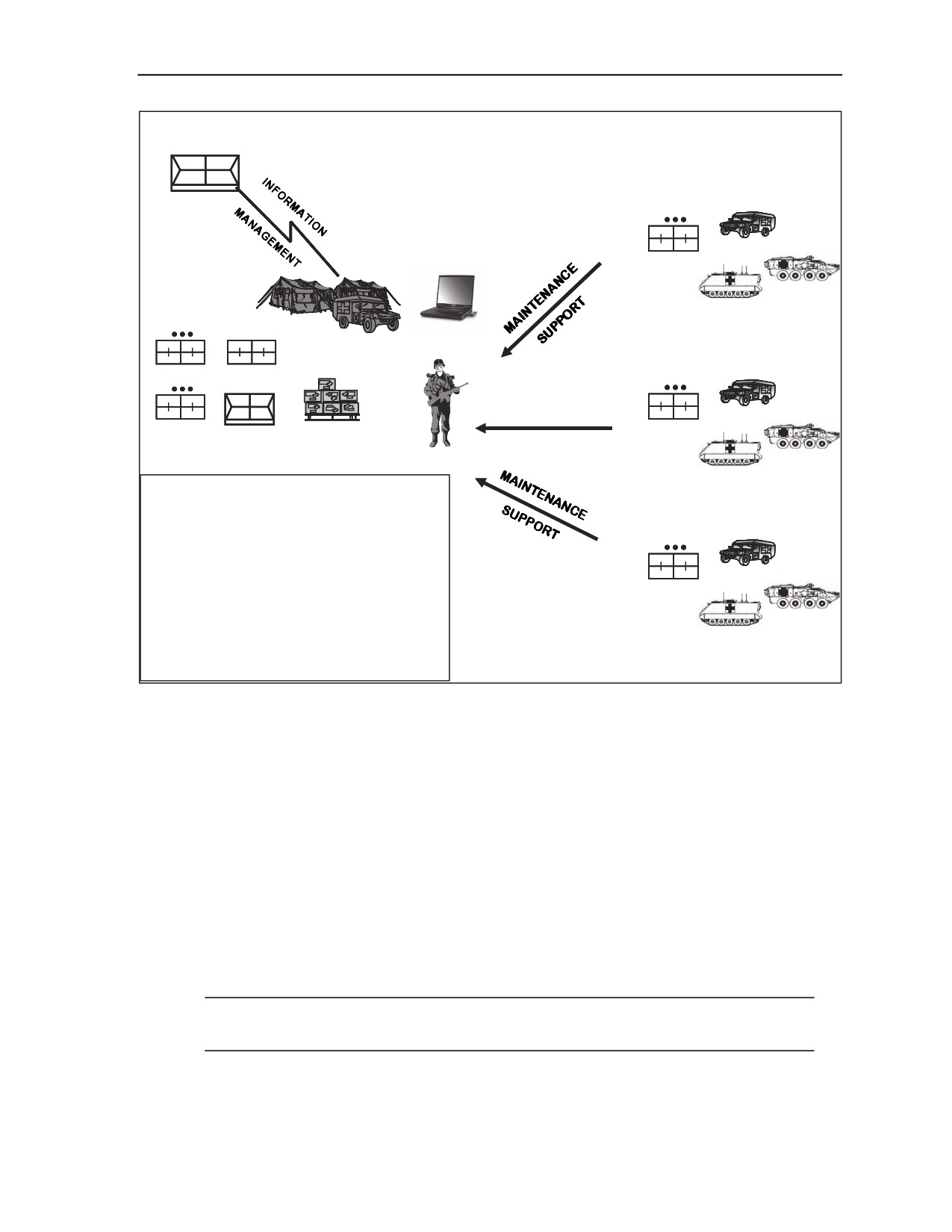
Medical Equipment Maintenance
ROLE 2
ROLE 1
I
MLC
=
TRMT TEAM X 3
BAS
AMB X 6
TRMT TEAM X 3
MAINTENANCE
Ø
MODULE
BSMC
(BMSO)
TRMT PLT
FST
Ø
MAINTENANCE
=
TRMT TEAM X 3
AMB PLT
PMI
BAS
CRT
SUPPORT
68A10
AMB X 6
TRMT TEAM X 3
LEGEND
AMB: ambulance
AMB PLT: ambulance platoon
BAS: battalion aid station
BSMC: brigade support medical company
BMSO: brigade medical supply office
=
TRMT TEAM X 3
CRT: contact repair team
BAS
FST: forward surgical team
MLC: medical logistics company
AMB X 6
TRMT PLT: treatment platoon
TRMT TEAM X 3
TRMT Team: treatment team
PMI: patient movement item
Figure 5-1. Roles 1 and 2 medical maintenance support
BRIGADE SUPPORT MEDICAL COMPANY
5-21. The BSMC’s BMSO provides primary field maintenance for the company and may provide
emergency medical equipment maintenance for the medical platoons in the BCT. The BMSO provides
medical equipment reporting and oversight for all medical equipment within the brigade. Units within the
BCT that do not have organic medical equipment repair capabilities will coordinate with the BMSO for
field and sustainment maintenance from the MLC CRTs through the supporting MMB. The BMSO will
carry minimal Class VIII repair parts in support of the brigade. Class VIII repair parts will be requested
from the supporting MLC. All medical equipment within the brigade shall be reported through the theater-
approved AIS to the supporting MLC. All command maintenance reports will be submitted using the
approved medical maintenance management system. Medical specific TMDE, MEDSTEP, medical
equipment turn-in, and PMIs are supported through the MLC. The BMSO is responsible for ensuring that
an accurate density list of all medical equipment in the BCT is developed, accounted for, and forwarded to
the MLC through the medical maintenance AIS daily.
Note. All maintenance significant medical equipment will be reported through the appropriate
AIS to the MLMC regardless of specific identification in AR 220-1 and AR 700-138.
8 December 2009
FM 4-02.1
5-7
Chapter 5
5-22. The MER at the BSMC is responsible for field maintenance (scheduled and unscheduled) on medical
equipment within the unit. The MER also maintains PMI assets as deemed necessary, as well as the
following:
z
Troubleshoot the equipment in accordance with the MAC.
z
Repair and return the equipment if the repair is within the scope of field maintenance and the
parts are on hand.
z
Turn the equipment in to the logistics staff officer (S4) for evacuation to the MLC, if the repair
exceeds field-level capabilities.
z
Issue a MEDSTEP item from the supporting MLC, if the equipment is a critical item.
z
Generate a parts requisition through MEDLOG channels if a part is needed and the equipment is
not a critical item.
5-23. When the BSMC is deployed and an FST is attached, a CRT is dispatched from the MLC to the
BSMC’s location. The CRT remains with the BSMC and FST while forward engaged to provide the
necessary medical equipment maintenance support to all units in the BCT’s AO. The CRT can be called
forward of the BSMC to support medical evacuation platforms and other medical assets, then return to the
BSMC location once repairs are made.
5-24. The BSMC in the Stryker BCT does not have the BMSO and full MEDLOG support staffing that is
present in the BMSOs of the other BCTs. However, it does have an MER assigned to the headquarters
section of the BSMC and is fully capable of providing the same level of medical equipment maintenance
support as outlined above.
AREA SUPPORT MEDICAL COMPANY (AREA TREATMENT SQUADS/TEAMS)
5-25. Area treatment squads/teams of the ASMC are also authorized trauma and sick call MESs. Multiple
maintenance significant items are contained in these sets. As with the BSMC, all medical equipment
within the ASMC is reported to the supporting MLC. All command maintenance reports will be submitted
using the approved medical maintenance management system. Medical specific TMDE, MEDSTEP,
medical equipment turn-in, and PMIs are supported through the MLC.
5-26. The MER assigned to the ASMC (and the MLC) is responsible for all field medical maintenance
(scheduled and unscheduled) to include PMI assets within the ASMC. The CRTs from the MLC are
primarily responsible for maintenance of medical elements deployed away from the ASMC. The MER
troubleshoots the equipment based on the Soldier’s level of training and the TMDE available in accordance
with the MAC.
z
If the—
Repair is within the scope of field maintenance and the parts are on hand, the MER will
repair and return the equipment to the supported unit.
Repair exceeds field maintenance capabilities, the MER will request CRT support from the
supporting MLC.
Equipment is a mission critical item, a MEDSTEP item is issued from the supporting
CRT/MLC.
z
When a repair part is needed and the equipment is not a critical item, the MER generates a parts
requisition through MEDLOG channels.
MEDICAL EQUIPMENT MAINTENANCE SUPPORT AT ROLE 3
5-27. Medical units assigned a medical maintenance mission at EAB include the MLC, CSH, ASMC, and
dental company (area support). Of the units listed, the CSH is the only Role 3 MTF operating at EAB.
COMBAT SUPPORT HOSPITAL
5-28. The MER and the health services maintenance technician at the CSH are responsible for field
maintenance for medical equipment assigned or attached to the CSH including the FST that is collocated
5-8
FM 4-02.1
8 December 2009
Medical Equipment Maintenance
with the CSH when it is not deployed to supported units. When deployed, the FST is collocated with a
medical company and receives medical maintenance support through that company and the MLC covering
that supported area. The CSH provides limited field maintenance for special and augmentation medical
equipment on an area basis. Medical elements assigned or attached to the CSH may include head and neck
teams (computed tomography scan), special care teams, pathology teams, renal hemodialysis teams,
infectious disease team, ambulance squads, and treatment teams. The CSH also maintains PMI assets and
automated maintenance records on assigned medical equipment and supported medical units or elements in
the approved medical maintenance management system. The MLC provides sustainment maintenance and
MER augmentation support for the CSH.
MEDICAL LOGISTICS COMPANY
5-29. The MLC is responsible for maintaining MEDSTEP items and PMIs, deploying CRTs, and
providing field and limited sustainment maintenance to units within the BCT and EAB areas including
blood support detachments and units operating within the area without organic MERs. Equipment is
evacuated through supply channels to the MLC if repairs exceed the field and sustainment maintenance
level in accordance with the MAC or as defined in AR 750-1 or AR 40-61. Parts are requisitioned through
MEDLOG channels.
5-30. The MLC is staffed with required MERs (MOS 68A) and a health services maintenance technician,
Warrant Officer MOS 670A. They are equipped with the appropriate tools and TMDE to perform field
and sustainment maintenance in accordance with the MAC. The MLC is staffed and equipped to provide
four fully operational CRTs with expandable tactical vehicles. The MLC maintains automated
maintenance records on all assigned medical equipment and the equipment of supported medical units or
elements within the company AO.
MEDICAL BATTALION (MULTIFUNCTIONAL)
5-31. The MMB provides MEDLOG oversight and medical C2 to include—
z
Providing transportation.
z
Facilitating ITV of Class VIII repair parts and equipment.
z
Providing medical CRT missions.
z
Ensuring medical equipment quality control for units task organized under the MMB.
z
Establishing medical maintenance priorities for equipment repair or exchange.
z
Monitoring maintenance distribution flow for supported units.
z
Coordinating electronics, calibration, and automotive maintenance operations.
z
Directing the cross-leveling of medical assets (parts or equipment).
z
Contracting medical maintenance support and integrating host-nation support as required.
z
Assisting in medical equipment readiness sustainment and reporting.
z
Ensuring viable medical equipment maintenance.
z
Ensuring that MER training programs are in place.
MEDICAL BRIGADE
5-32. The medical equipment maintenance personnel in the MEDBDE—
z
Conduct planning and provide direction and guidance for medical equipment maintenance and
unit maintenance programs for the MEDBDE.
z
Develop and evaluate brigade maintenance policies, training, and maintenance support resources
in support of the theater mission plan.
z
Manage repair parts and maintenance for all medical equipment within the MEDBDE.
z
Compile operational status reports and direct the disposition of unserviceable medical
equipment.
8 December 2009
FM 4-02.1
5-9
Chapter 5
MEDICAL LOGISTICS MANAGEMENT CENTER FORWARD SUPPORT TEAM
5-33. The MLMC support team provides maintenance management capabilities and advice to the ASCC
surgeon. Responsibilities include maintaining visibility of units and medical assets in the theater,
recommending cross-leveling of assets, redirecting shipments, coordinating contractor support, and
providing a direct link back to CONUS AIS support. The maintenance posture of the theater is managed
and monitored through AISs under MC4.
5-34. The medical equipment maintenance personnel in the MLMC provide the following support:
z
Establish and provide oversight for medical equipment maintenance information systems plans
and architecture.
z
Plan, organize, and conduct technical inspections.
z
Plan, supervise, and conduct training in all phases of medical equipment maintenance
management.
z
Develop operating procedures and analyze/interpret technical data pertaining to medical
equipment maintenance for the theater.
MEDICAL COMMAND (DEPLOYMENT SUPPORT)
5-35. The medical equipment maintenance personnel in the MEDCOM (DS)—
z
Provide senior leadership, guidance, and technical expertise for supported elements, staff
agencies, and commanders at all levels within the theater.
z
Evaluate and develop theater maintenance policies and training.
z
Develop medical equipment support plans for the theater.
z
Provide oversight for medical maintenance quality assurance operations.
z
Coordinate, publish, and enforce maintenance directives.
z
Develop and coordinate materiel training, support, and personnel implementation plans for the
theater.
NONSTANDARD REPAIR PARTS
5-36. Over ninety-eight percent of Army medical equipment is commercial-off-the-shelf and often
requires nonstandard Class VIII repair parts that are not part of the medical catalogue. Units requiring
nonstandard repair parts can obtain instructions for ordering these parts through the US Army Medical
www.usamma.army.mil.
5-37. When internet access is not available, Class VIII repair parts requests should be submitted directly to
the MLC or CSH. Table 5-1 provides a sample Class VIII repair parts request that lists the information
units must provide when submitting a request. Except where indicated, all information listed in the sample
must be provided.
5-10
FM 4-02.1
8 December 2009
Medical Equipment Maintenance
Table 5-1. Sample Class VIII repair parts request
New Item Request
(Class VIII Repair Parts Request)
Contact Information
Unit Name
Department of Defense Activity
Address Code (DODAAC)
Signal Code
Supplementary Address (optional)
Army Procurement Code
(APC)/Fund Code
Point of Contact
Alternate Point of Contact
Phone Number
Email Address
Manufacturer Information
Manufacturer Name
Manufacturer Address
Manufacturer Web Site (optional)
Manufacturer Email Address
(optional)
Manufacturer Phone Number
(optional)
End Item Information
Nomenclature
Model Number
Serial Number
Equipment (Voltage [None, 110 Volt,
220 Volt, Dual Voltage])
Equipment Type (dental, laboratory,
medical surgical, optical, test
measurement and diagnostic
equipment (TMDE), other)
Part/Accessory Information
Item Category (Class VIII repair part
or accessory)
Date Required (month/day/year)
Part Nomenclature
Part Number
Unit of Issue (each, box, package)
Estimated Price $ (optional)
Quantity Needed
Estimated Monthly Usage
Document Number (enter without
dashes or spaces)
8 December 2009
FM 4-02.1
5-11