FM 4-02 (ATTP 4-02) Army Health System (August 2013) - page 3
Chapter 3
practicable, treatment of detainees should be guided by professional judgments and standards
similar to those applied to personnel of the U.S. Armed Forces.
z
Health care personnel shall not be involved in any professional provider-patient treatment
relationship with detainees the purpose of which is not solely to evaluate, protect, or improve
their physical and BH.
z
Health care personnel, whether or not in a professional provider-patient treatment relationship,
shall not apply their knowledge and skills in a manner that is not applicable law or the standards
set forth in DODD 2310.01E.
z
Health care personnel shall not certify, or participate in the certification of, the fitness of
detainees for any form of treatment or punishment that is not in consonance with applicable law,
or participate in any way in the administration of any such treatment or punishment.
z
Health care personnel shall not participate in any procedure for applying physical restraints to
the person of a detainee unless such a procedure is determined to be necessary for the protection
of the physical or BH or the safety of the detainee, or necessary for the protection of other
detainees or those treating, guarding, or otherwise interacting with them. Such restraints, if
used, shall be applied in a safe and professional manner.
3-42. Health care personnel engaged in a professional provider-patient treatment relationship with
detainees shall not participate in detainee-related activities for purposes other than health care. Such health
care personnel shall not actively solicit information from detainees for other than medical purposes. Health
care personnel engaged in nontreatment activities, such as forensic psychology, behavioral science
consultation, forensic pathology, or similar disciplines, shall not engage in any professional provider-
patient treatment relationship with detainees (except in emergency circumstances in which no other health
care providers can respond adequately to save life or prevent permanent impairment).
z
During the initial screening of detainees any preexisting medical conditions, wounds, fractures,
and bruises should be noted. Documentation of these injuries/conditions provides a baseline for
each detainee which facilitates the identification of injuries which may have occurred in the
internment facility.
z
Detainees who report for routine sick call should be visually examined to determine if any
unusual or suspicious injuries are apparent. If present, the health care provider should determine
from the detainee how the injuries occurred. Any injuries which cannot be explained or for
which the detainee is providing evasive responses should be noted in the medical record and
should be reported to the chain of command, technical medical channels, and U.S. Army
Criminal Investigation Command.
z
Health care personnel may enter the holding areas of the facility for a variety of reasons. These
can include, but are not limited to, conducting sanitary inspections, providing TC3, and
dispensing medications. When in the holding areas of the facility, health care personnel must be
observant. Should they observe anything suspicious which might indicate that detainees are
being mistreated, they should report these suspicions immediately to the chain of command.
Should they observe a detainee being mistreated, they should take immediate action to stop the
abuse and then report the incident.
3-43. Detained personnel must have access to the same available standard of medical care as the U.S. and
multinational forces to include respect for their dignity and privacy. In general, the security of detainees’
medical records and confidentiality of medical information will be managed the same way as for the U.S.
and multinational forces. During detainee operations, the patient administrator, the U.S. Army Criminal
Investigation Command, the International Committee of the Red Cross, and the medical chain of command
can have access to detainee medical records besides the treating health care personnel.
3-44. Health care personnel shall safeguard patient confidences and privacy within the constraints of the
law. Under U.S. and international law and applicable medical practice standards, there is no absolute
confidentiality of medical information for any person. Detainees shall not be given cause to have incorrect
expectations of privacy or confidentiality regarding their medical records and communications. However,
whenever patient-specific medical information concerning detainees is disclosed for purposes other than
treatment, health care personnel shall record the details of such disclosure, including the specific
3-12
FM 4-02
26 August 2013
Army Health System and the Effects of the Law of Land Warfare and Medical Ethics
information disclosed, the person to whom it was disclosed, the purpose of the disclosure, and the name of
the medical unit commander (or other designated senior medical activity officer) approving the disclosure.
Similar to legal standards applicable to U.S. citizens, permissible purposes include preventing harm to any
person, maintaining public health and order in detention facilities, and any lawful law enforcement,
intelligence, or national security-related activity.
3-45. In any case in which the medical unit commander (or other designated senior medical activity
officer) suspects that the medical information to be disclosed may be misused, he should seek a senior
command determination that the use of the information will be consistent with the applicable standards.
3-46. The information disclosed to a physician during the course of the relationship between physician and
patient is confidential to the greatest possible degree. The patient should feel free to make a full disclosure
of information to the physician in order that the physician may most effectively provide needed services.
The patient should be able to make this disclosure with the knowledge that the physician will respect the
confidential nature of the communication. The physician should not reveal confidential communications or
information without the express consent of the patient, unless required to do so by law. The obligation to
safeguard patient confidences is subject to certain exceptions, which are ethically and legally justified
because of overriding social considerations. Where a patient threatens to inflict serious bodily harm to
another person or to himself and there is a reasonable probability that the patient may carry out the threat,
the physician should take reasonable precautions for the protection of the intended victim, including
notification of law enforcement authorities.
3-47. Patient consent for the release of medical records is not required. The MTF commander or
commander’s designee, usually the patient administrator, determines what information is appropriate for
release. Only that specific medical information or medical record required to satisfy the terms of a
legitimate request will be authorized for disclosure.
3-48. Because the chain of command is ultimately responsible for the care and treatment of detainees, the
internment facility chain of command requires some medical information. For example, detainees
suspected of having infectious diseases such as tuberculosis should be separated from other detainees.
Guards and other personnel who come into contact with such patients should be informed about their
health risks and how to mitigate those risks.
3-49. Releasable medical information on internees includes that which is necessary to supervise the
general state of health, nutrition, and cleanliness of internees and to detect contagious diseases. Such
information should be used to provide health care; to ensure health and safety of internees, Soldiers,
employees, or others at the facility; to ensure law enforcement on the premises; and to ensure the
administration and maintenance of the safety, security, and good order of the facility.
3-50. For additional information on medical ethics refer to the Textbooks of Military Medicine: Military
Medical Ethics, Volumes I and II, and The Emergency War Surgery Handbook. Both of these publications
are available electronically at: http://www.bordeninstitute.army.mil/.
3-51. The provision of health care to detainees within MTFs or other facilities (such as dispensaries
located within internment or holding facilities) is a unique role within the military structure. This role is
governed by rules and regulations designed to ensure the provision of health care while ensuring personal
safety and maintenance of security, custody, and discipline in an internment/holding facility environment.
Health care personnel must ensure that their actions, both on- and off-duty, do not undermine their ability
to function effectively among detainees or compromise established health care, safety, security, and
custody guidelines.
26 August 2013
FM 4-02
3-13
Chapter 4
Generating Force Support to the Operational Army
The AMEDD has a long tradition of providing world-class medical care across global
AOs, OEs, and under austere and challenging conditions. Wherever an injured or ill
American Soldier is located, the U.S. Army will project its resources to locate,
acquire, treat, stabilize, and evacuate our wounded Warriors to MTFs capable of
providing world-class health care to enhance the Soldier’s prognosis, mitigate
disability, and empower him to lead a full and productive life.
Historically, the AMEDD has provided acute trauma care, curative, restorative,
rehabilitative, and convalescent care within the AO. Soldiers were not evacuated for
care in the CONUS-support base unless their recovery time exceeded the theater
evacuation policy (in some cases up to 60 days). With the advent of technological
innovations in transportation and medicine, Soldiers can be stabilized and rapidly
evacuated from austere OEs to world-class fixed MTFs in CONUS or other safe
havens in a matter of hours to days from the time of injury or wounding. These
advancements have—
z
Enabled the essential care in the AO concept to be implemented.
z
Reduced the medical footprint present in a deployed setting without reducing
the quality of medical care provided to our Soldiers.
z
Optimized the use of scarce medical resources.
z
Enabled wounded and ill Soldiers to more rapidly be reunited with their
Families and personal support structures to facilitate and enhance the healing
process.
MISSION FOCUS
4-1. The mission of the generating force is to generate and sustain operational Army capabilities. The
Army does not organize the generating force into standing organizations with a primary focus on specific
operations. Rather, when the generating force capabilities perform specific functions or missions in
support of and at the direction of joint force commanders, it is for a limited period of time. Upon
completion of the mission, the elements and assets of those generating force capabilities revert to their
original function.
4-2. All elements of the Army, whether the generating force or operational Army, perform functions
specified by U.S. law. The practical distinction is that the execution of these functions and others implied
by law constitutes the primary purpose of the generating force organizations. Title 10 is not the only
statute that governs the generating force, nor is the list of functions in Figure 4-1 exhaustive.
26 August 2013
FM 4-02
4-1
Chapter 4
Recruiting
Organizing
Supplying
Equipping (including research and development)
Training
Servicing
Mobilizing
Demobilizing
Administering (including morale and welfare of personnel)
Maintaining
Constructing, maintaining, repairing buildings, structures, utilities, and acquiring real property and interests in real
property necessary to carry out the responsibilities specified in this section.
Figure 4-1. Title 10 functions
4-3. The USAMEDCOM provides operational reach to the generating force to leverage the resources
(personnel, infrastructure, and materiel) within the command and its subordinate research, educational, and
training institutions and assets to ensure Soldiers receive the best possible health care possible regardless of
their geographic location.
SUPPORT TO THE TACTICAL COMMANDER
4-4. The generating force fulfills numerous critical roles with regards to supporting the Soldiers deployed
in an AO. The USAMEDCOM organizations conduct operational development activities and medical
research and development to discover and field advanced technologies to mitigate the health threat faced
by our deployed forces. They also facilitate and enhance the medical readiness of all Soldiers through the
promotion of fitness and healthy lifestyles, the performance triad (paragraphs 2-19 through 2-25), and the
prevention of diseases and injuries. They provide mobilization and predeployment support to ensure that
Soldiers are mentally and physically ready to be deployed
(immunizations, predeployment health
assessments, dental, vision, and hearing readiness testing and treatment, and health risk communications on
health hazards which exist in the deployment area). During deployments, they provide reachback support
within all medical specialty areas and can deploy teams comprised of physicians, scientists, technicians,
and other health care providers to provide solutions to unique health threats or medical conditions and
issues occurring during the deployment.
EDUCATION
4-5. The educational requirements within the health care professions are significantly more complex than
in other branches of the Army. Formal schooling is required for all fields within the AMEDD and this
education is received in both civilian educational and DOD medical organizations. Medical education is a
lengthy process, which is often accomplished in phases
(such as, medical school, internship, and
residency). Medical professionals require credentialing and licensure before they can practice medicine
and these credentials are most often obtained from non-DOD affiliated civilian organizations. The health
professions also require continuing education to maintain certification. The USAMEDCOM and the Office
of The Surgeon General facilitate this process by providing opportunities to fulfill the continuing education
requirements of all health care professionals including those in deployed AOs.
TRAINING
4-6. All medical military occupational specialties require school training. Medical skills are considered
perishable and require continual practice and refresher training. The USAMEDDC&S provides military
occupational specialty-specific training for award of medical military occupational specialties and provides
refresher training for some of the low-density medical specialties when Reserve Component forces and
U.S. Army National Guard are mobilized. Additionally, the USAMEDDC&S develops and fields
collective training materials and distance learning programs. In some medical specialty areas, the didactic
4-2
FM 4-02
26 August 2013
Generating Force Support to the Operational Army
portion is completed at the USAMEDDC&S while the resident phase is provided at USAMEDCOM
MTFs.
WARRIOR TRANSITION UNITS
ARMY MEDICAL ACTION PLAN
4-7. The Office of The Surgeon General established the Army Medical Action Plan Campaign Planning
Group to develop an action plan to establish an integrated and comprehensive continuum of care and
services for Warriors and their Families. These Warriors and their Families are being treated at DA MTFs
in conjunction with DOD, Department of Veterans Affairs, and civilian medical facilities in order to
provide world-class care and services that match the quality of service the Warriors and their Families
provide the Nation. In support of this plan, the Army chief of staff approved the actions to be implemented
to include—
z
Establishing and institutionalizing a mission command structure for Warriors undergoing long-
term definitive, rehabilitative, and convalescent care.
z
Prioritizing mission support and creating ownership of actions and processes.
z
Flexing housing policies and focusing on Family support issues.
z
Developing training and doctrine to facilitate and ensure a system which provides timely and
effective support.
z
Creating full patient visibility throughout the process and facilitating the continuum of care.
z
Improving the medical evaluation board process and eliminating delays in the process.
4-8. The intent of this action plan is for the Army to provide a continuum of integrated care and services
from point of injury, illness, or disease to return to duty or transition from active duty. It is vital that the
Army coordinates execution of the necessary changes at the strategic, operational, and tactical level to
ensure a simultaneous transformation of care and services over all lines of operations to achieve the desired
end state—
z
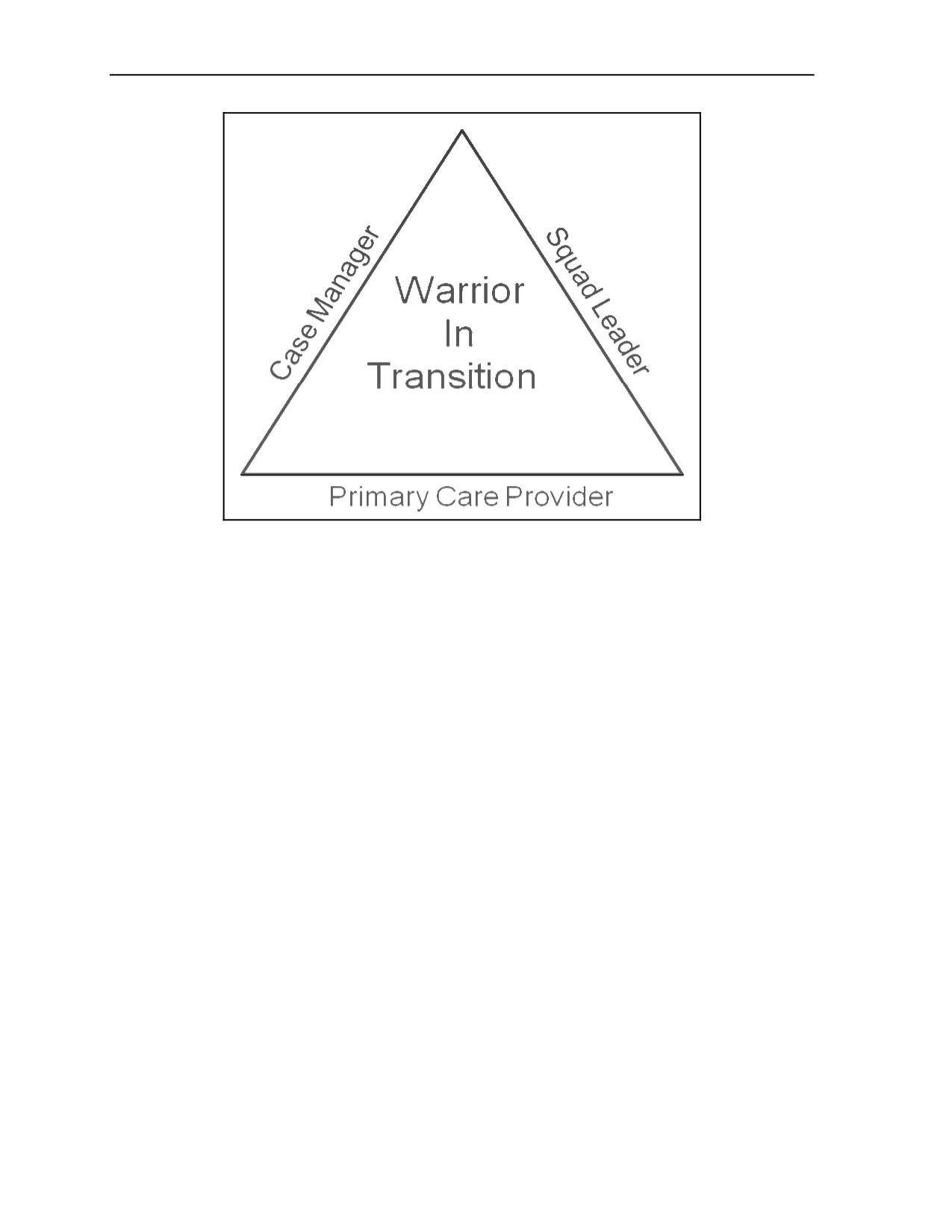
Establish Warrior transition units along with the triad of Warrior support consisting of a
primary care manager, a nurse case manager, and a squad leader. See Figure 4-2.
z
Streamline issues affecting Family care and disposition.
z
Establish Soldier and Family Assistance Centers as entry points for Warriors in Transition.
z
Restore the American people’s confidence in the U.S. Army.
26 August 2013
FM 4-02
4-3
Chapter 4
Figure 4-2. Triad of Warrior support
WARRIOR TRANSITION UNITS
4-9. The Warrior transition unit is a transition assistance unit aimed at overseeing the health, welfare, and
morale of patients at an Army MTF. By design, the unit has a robust cadre, which allows physicians and
nurses to focus on medical care, nurse case managers to manage medical care, and unit cadre to focus on
meeting all mission command functions.
4-10. The Warrior transition unit consists of a triad of support, a triad of care, and a triad of leadership.
The triad of support consists of a platoon sergeant/squad leader, case manager, and primary care manager.
The triad of care consists of a primary care manager, a case manager, and a platoon sergeant/squad leader.
The triad of leadership consists of senior commanders/command sergeants major, MTF commanders/
command sergeants major, and Warrior transition unit commanders/command sergeants major/first
sergeants. All work together to ensure advocacy for Warriors, continuity of care, and a seamless transition
into the force or return to a productive civilian life.
4-4
FM 4-02
26 August 2013
Chapter 5
Medical Intelligence
Medical intelligence is defined as a component of all-source intelligence. Medical
intelligence results from collection, evaluation, analysis, and interpretation of foreign
medical, bioscientific, and environmental information that is of interest to strategic
planning and to military medical planning. This information is pertinent to
operations for the conservation of the fighting strength of friendly forces and the
formation of assessments of foreign medical capabilities in both military and civilian
sectors. Military intelligence includes only finished intelligence products produced
by an authorized agency. To develop medical intelligence, information is gathered,
evaluated, and analyzed on the following subjects:
z
Endemic and epidemic diseases, public health standards and capabilities, and
the quality and availability of medical services.
z
Foreign military and civilian medical capabilities, including MTFs, medical
personnel, emergency and disaster responses, MEDLOG (to include blood
processing), and medical pharmaceutical industries.
z
Integrated databases on all medical treatment, training, pharmaceutical, and
research and production facilities.
z
Environmental risks that can degrade force health or effectiveness including:
chemical and microbial contamination of the environment, toxic industrial
materials and radiation accidents, and environmental terrorism.
z
Impact of foreign environmental health issues and trends on environmental
security and national policy.
z
Infectious disease risks that can degrade mission effectiveness of deployed
forces.
z
Foreign and applied biomedical and biotechnological developments of
military medical importance.
z
Foreign scientific and technological medical advances for defense against
CBRN warfare agents.
SIGNIFICANCE OF MEDICAL INTELLIGENCE
5-1. At the strategic level, the objective of medical intelligence is to contribute to the formulation of
national-based policy. The policy will be based in part on assessments of foreign military and civilian
capabilities of the medical or bioscientific community.
5-2. At the operational level, the objective of medical intelligence is to support the development of AHS
strategies that—
z
Identify the health threat.
z
Are responsive to the unique aspects of a particular AO.
z
Enable the commander to accomplish his operation.
z
Conserve the fighting strength of friendly forces.
26 August 2013
FM 4-02
5-1
Chapter 5
SOURCES OF MEDICAL INTELLIGENCE
5-3. Medical intelligence is provided to the AHS planner by intelligence organizations. The AHS planner
must identify the intelligence requirements and provide that request to the supporting intelligence element
within the command. In an emergency, up-to-date medical intelligence assessments can be obtained by
contacting Director, Defense Intelligence Agency, ATTN: Director, National Center for Medical
Intelligence, Fort Detrick, Maryland
21702-5000. The National Center for Medical Intelligence can
provide health service assessments, infectious disease assessments, infectious disease alerts, environment
health risk assessments, medical intelligence notes, medical intelligence imagery briefs, and foreign
medical facility assessments. The AHS planner should use all available intelligence elements to obtain
needed intelligence to support the military operation. The National Center for Medical Intelligence 24-
hour service/request for information telephone number is commercial (301) 619-7574 or Defense Switched
Network 343-7574.
5-4. An additional source of information on deployment OEH hazards/threats is the U.S. Army Public
Health Command. Information can be requested from the Global Threat Assessment Program Office at
commercial telephone
(410)
436-3177 or Defense Switched Network 584-3177, or e-mail address:
IPH-DHRM-GTAP (IP-RGT)@amedd.army.mil.
5-5. A supporting intelligence element should exist at some point in the AHS unit’s chain of command.
This element will be the primary source for the AHS planner to access the necessary intelligence for the
execution of AHS support operations.
MEDICAL ASPECTS OF INTELLIGENCE PREPARATION OF THE
BATTLEFIELD
5-6. Consideration of the medical aspects of the intelligence preparation of the battlefield is a systematic
process that is designed to aid AHS planners in analyzing various enemy, environmental, and health threats
in a specific AO. Determining the medical aspects of the intelligence preparation of the battlefield process
is the first step in the mission analysis phase of the military decision-making process. The information
derived from conducting a proper assessment of the medical aspects of the intelligence is based on and
specific to a country. The Phase I assessments that are part of the medical aspects of intelligence
preparation of the battlefield are the cornerstone to developing detailed and effective AHS estimates and
plans. Some portions of the template will be more or less applicable depending on the assigned mission.
The Phase I assessments that are part of the medical aspects of intelligence preparation of the battlefield are
to—
z
Define an OE.
z
Describe the operational effects on deployed forces and AHS operations.
z
Conduct threat integration (enemy and health) and information consolidation.
DEFINE THE OPERATIONAL ENVIRONMENT
IDENTIFY SIGNIFICANT CHARACTERISTICS OF THE OPERATIONAL ENVIRONMENT
5-7. The first task of the AHS planner is to define an OE. The AHS planner identifies and describes the
significant characteristics of the environment to be able to assess the impact on AHS support operations
and the health of the command.
5-8. The significant characteristics of the OE include viewing them from both a military perspective and a
civilian perspective. The AHS planner must determine what aspects of the OE will impact the delivery of
health care to U.S. forces and conversely what impact military medical operations will have on the civilian
population in the AO. As the provision of medical care is a humanitarian activity, the patient workload of
deployed forces can be affected when forces are deployed in medically underserved areas or in areas where
the civilian medical infrastructure has been disrupted or is underdeveloped. The AHS planner can use the
memory aid political, military, economic, social, information, infrastructure, physical environment, time
5-2
FM 4-02
26 August 2013
Medical Intelligence
(operational variables) (normally used at the strategic level) or mission, enemy, terrain and weather, troops
and support available, time available, and civil considerations factors (used at the operational level) to
frame the analysis of the OE. For the AHS planner, the civil considerations must be thoroughly explored
and analyzed, even if the immediate mission does not recognize a requirement for the provision of health
services to a host-nation population. The AHS planner must be prepared to provide support or have a plan
in place in the event a civilian medical emergency should arise and the military forces are directed to
provide support. Without prior planning, the diversion of military medical assets to support civilian
medical emergencies will adversely impact the AHS support provided to deployed forces and could
potentially overwhelm available medical resources. The AHS plan must not only conform to the tactical
commander’s concept of operation and scheme of maneuver, it must also be in consonance with the
combatant commander’s theater engagement strategy so that any humanitarian activities conducted are not
done haphazardly and are part of the regional strategy for the AO.
Geospatial Information
5-9. Geospatial information includes hydrological data, elevation data, soil composition, and vegetation.
Geography and Weather
5-10. The geography and weather factors include climate, weather, terrain (to include urban terrain), and
altitude.
They may also contain information on possible weather/environmental threats such as
earthquakes, volcanoes, monsoons, or other such conditions.
Climate and Weather Effects
5-11. Information contained in the climate and weather effects includes the effects of extreme
heat/cold/humidity; effects of the predominant weather patterns (such as monsoons) on AHS operations
(such as medical evacuation); effects of heavy rains or snow; the phase of the moon and its effect on
operations (such as fullness/brightness when military forces are infiltrating an area); how the weather may
affect enemy biological and chemical warfare agents use; and climatic effects on medical supplies and
equipment.
Terrain Analysis
5-12. Terrain analysis includes determining the effect on friendly/enemy maneuver capability; effect on
friendly/enemy ability to sustain health care; effects on timely medical evacuation; natural lines of patient
drift; impact on MTF site selection factors; where the mobility corridors are located and their effects on
friendly/enemy actions; effects of weather conditions on terrain/mobility; effect of overhead cover
(canopy) and vegetation; effect of projected combat action on terrain/mobility; and where potential sources
of potable water are located.
Altitude Effects
5-13. Altitude effects include effect of high-altitude operations on force capability, rotary-wing medical
evacuation assets, medical evacuation procedures and methods (higher incidence of litter evacuation and
longer evacuation times for manual evacuation), and standard medical treatment protocols.
DESCRIBE THE BATTLEFIELD EFFECTS
5-14. The purpose of this phase of the intelligence preparation of the battlefield process is to analyze and
integrate various factors of the OE. Detailed analysis of these factors, to determine the military significant
effects, results in intelligence upon which the commander can make informed decisions. The emphasis is
on the medical aspects of the effects on friendly forces, as well as friendly and enemy actions.
26 August 2013
FM 4-02
5-3
Chapter 5
LIMITS OF COMMAND
5-15. The command AO is the geographic area where the commander is assigned the responsibility and
authority to conduct military operations. The AHS planner must identify the—
z
Geographic AO that may include the macroview or the microview depending upon the level of
command and the size of the geographic area.
z
Total population at risk which includes all U.S. and multinational forces, local civilian
population, dislocated persons, DOD and other U.S. governmental employees and/or
contractors, and nongovernmental organizations personnel. In addition to identifying the total
population at risk, the planner must also determine what the supported population at risk is
(those individuals/groups deemed as eligible beneficiaries for health care provided by U.S.
Army medical assets [paragraphs 1-38 through 1-43]). The supported population includes—
All supported U.S. units which include sister Services and elements from U.S.
governmental agencies and DOD contractors.
All supported multinational units/elements. This paragraph should discuss unit troop
strengths, locations, and missions. It may also include organic medical resources and
capabilities; multinational medical assets
(military, paramilitary, and civilian) which are
approved for use for U.S. personnel; identification of multinational (military, paramilitary, and
civilian) requirements; identification of unique medical support requirements (such as endemic
diseases in the multinational force that are not present in the deployment [host-nation] AO); and
the current level of health and dental fitness among the supported populations.
All personnel in U.S. custody (EPWs and detainees).
z
Others as directed.
LIMITS OF THE AREA OF INFLUENCE AND THE AREA OF INTEREST
5-16. The area of influence and the area of interest are geographic areas from which information is
required to facilitate planning. The area of influence and the area of interest usually fall outside the AO
and may or may not be applicable to a particular operation. Army Health System support outside the AO
includes—
z
Army Health System support provided by organizations/elements outside of the AO. This can
include organizations such as CONUS-support base or other safe haven hospitals, MEDLOG
support (Defense Logistics Agency or U.S. Army Medical Materiel Agency), and global patient
regulating support (such as the Global Patient Movement Requirements Center).
z
Location and time/distance factors for medical resources that could be used for augmenting/
reinforcing/reconstituting AHS units/personnel within the AO. This information can include
discussions on units/elements in the CONUS-support base or adjacent AOs.
z
Coordination and synchronization with mission command assets outside the AO which assures
the reach capability within the AHS and the ability to rapidly deploy medical specialty care
resources as the need arises in the AO.
z
Follow-on operations or operations being conducted simultaneously outside the AO which can
include a range of military operations.
5-17. Army Health System planners—
z
Identify the level of detail required and the time available to conduct the medical aspects of the
intelligence preparation of the battlefield.
z
Evaluate existing information/intelligence of medical significance and identify intelligence gaps.
(Sources include: National Center for Medical Intelligence; Defense Intelligence Agency; U.S.
Army Public Health Command; country studies; supporting intelligence staff officer/assistant
chief of staff, intelligence or military intelligence unit; Central Intelligence Agency World Fact
Book; open source information system; tourist maps and brochures; preventive medicine
resources; World Health Organization; Pan American Health Organization; Department of State;
and internet, libraries, and other informational sources.)
5-4
FM 4-02
26 August 2013
Medical Intelligence
z
Identify and submit collection requirements to the supporting intelligence staff section/element/
unit.
z
Collect required information to fill gaps.
Note. If medical personnel gain information of potential intelligence value through casual
observation of activities in plain view while in the performance of their humanitarian duties,
they are required to report it to their supporting intelligence staff officer/assistant chief of staff,
intelligence.
POLITICAL AND SOCIOECONOMIC SITUATION
Population Demographics
5-18. Population demographics include the effect on the delivery of health care to supported forces and the
effect on the AHS if required to support the local populace and nongovernmental organizations. It also
includes the political effects of providing care/not providing care to the host-nation populace,
nongovernmental organizations, and dislocated persons and the effects of cultural, religious, or language
barriers on medical treatment. Other AHS population demographic concerns include:
z
Condition of the general population (and/or supported population) to include an analysis of the
health of the general population and the impact of it on deployed forces; analysis of the infant
mortality rate as this serves as an indicator of the overall health of the population; leading causes
of death; identification of the status of nutrition; and state of advancement of the medical
infrastructure.
z
What affect will clans, tribes, gangs, opposition groups, or paramilitary organizations/groups
and organized crime have on the ability to provide AHS support to deployed forces and other
eligible beneficiaries?
z
What affect/additional requirements will dislocated persons, retained and detained personnel,
and EPWs have on the AHS system? This is of particular importance for the preventive
medicine arena as camps require sanitation, pest management, and potable water support. Other
requirements include the provision of sick call services, outpatient treatment, hospitalization,
medical evacuation, MEDLOG support (to include sorting, repackaging, inventorying, and
disseminating donated medical supplies and equipment), and other functional concerns. Within
the veterinary arena, this may include the types of domesticated and wild animals, as well as
farm animals.
Threat Forces Capabilities/Effects
5-19. The effects of enemy ideology, goals, and missions includes an analysis of the enemy’s will to fight;
what they are trying to accomplish and why
(military objectives); compliance with the Geneva
Conventions (to include respect and protection of medical personnel, units, and transports); type of enemy
forces (such as paramilitary, conventional, special operations, and/or terrorists); philosophy concerning
collateral damage, civilian casualties, disruption of utilities (sewage, waste disposal, sanitation, water,
electricity, and gas), and generating dislocated persons. Threat forces capabilities/effects encompass the
following:
z
The threat characteristics include the affects enemy doctrine has on deployed forces, to include
AHS personnel and units. This information facilitates forecasting what units/elements/
organizations are most likely to sustain heavy casualties.
z
Enemy force structure and weapons systems include the analysis of the accuracy and range of
enemy weapons systems; analysis of the size and composition of the enemy force; and what
types of friendly wounds will be generated by enemy weapons systems (such as piercing, blast
injuries, concussion, blunt trauma, burns, or combined injuries).
z
Enemy medical doctrine/capabilities include the analysis of enemy medical doctrine and
capabilities; priority and availability of medical care and medical evacuation; status of the
26 August 2013
FM 4-02
5-5
Chapter 5
medical infrastructure and training to accomplish the medical mission; and the potential for the
enemy to treat their own casualties or to leave them in the care of friendly forces.
z
Effects of enemy CBRN weapons to include an analysis of enemy CBRN capabilities; effect of
enemy CBRN use on friendly forces; the likelihood of its use; whether the enemy can continue
the mission in a CBRN environment; and whether the enemy’s delivery systems are accurate,
reliable, and effective.
z
Military information support operations and unconventional warfare capabilities and effects
include an analysis of the probable impact of psychological operations on friendly forces;
analysis of unconventional warfare capabilities; probability of unconventional warfare forces
targeting friendly areas and AHS assets/resources; and the effect unconventional warfare will
have on the delivery of health care.
INFRASTRUCTURE
5-20. The infrastructure includes transportation systems (land, sea, and air); communications systems
(telephone, cellular, digital, mass media, and electronic means); and, utilities
(water, electricity, and
sanitation).
Transportation
5-21. Transportation systems include the effect of available transportation systems on timely medical
evacuation and/or casualty evacuation, MEDLOG supply/resupply operations (to include time-sensitive
blood distribution and other perishable and dated pharmaceuticals; analysis of likely avenues of approach;
effect of the transportation system on mobility and military operations; effect of military operations on the
transportation system; and impact of transportation networks on enemy/friendly courses of action).
Communications Systems
5-22. Communication systems architecture includes the communications networks that are established in
the AO; the level of technology for these systems; and the level of access of the communications
infrastructure by the population (for example, if the civilian population does not have telephones, radios,
televisions, or computers, other methods for disseminating public health information and health risk
communications information must be established).
Utilities
5-23. Utilities (water, electricity, and sanitation) include the analysis of water quality (potability) and
distributions systems; analysis of the reliability of electrical power generation; effectiveness and efficiency
of sanitation systems; effects of enemy/friendly military actions on the utilities infrastructure; and the
impact a disruption of utilities would have on the health of the general population and/or deployed forces.
Industry
5-24. Industry includes the types of industry present, their effect on the economy, and the potential threat
from toxic industrial materials either used in the manufacturing process or as an end product.
Medical Infrastructure
5-25. A checklist for assessing the foreign medical infrastructure is provided in Table 5-1.
5-26. A checklist for assessing foreign MTF capabilities and services is provided in Table 5-2 (page 5-8).
5-6
FM 4-02
26 August 2013

Medical Intelligence
Table 5-1. Checklist for assessing a foreign medical infrastructure
Public Health and
Number of public health personnel, facilities, and capabilities.
Health Threat
Names and titles of key personnel within the public and private health care
infrastructures.
Leading causes of death of the general population or specified subpopulations.
Prevalence of endemic and epidemic diseases in the area of operations.
Prevalence of human immunodeficiency virus/acquired immunodeficiency
syndrome.
Environmental health risk (to include heat and cold injury, exposure to toxic
industrial materials, and poisonous or toxic flora and fauna).
Hospitalization/
Nutritional status of the general population or specified subpopulations.
Medical Clinics
Immunization level of general population or specified subpopulations.
Infant mortality rate and other indices.
Hospitals by type and location (such as general medical, psychiatric, or
orthopedic).
Number of hospital beds by type (such as surgical, intensive care, or general
medicine).
Number of operating room tables and table hours.
Medical clinics (private or public), locations, and accessibility.
Services/Providers
Number of physicians per population.
Number of physicians by specialty.
Ancillary services available (such as physical therapy, occupational therapy,
orthotics capability, community/public health nurses, magnetic resonance
imaging, computed tomography scan, or respiratory therapy).
Number of nonphysician health care providers (such as physician assistants,
physical therapists, occupational therapists, nurse practitioners, podiatrists, or
optometrists) by type.
Number of dental providers and types of dental care available (such as
emergency and essential care and/or oral surgery).
Number of behavioral/mental health clinics and available services.
Number and types of behavioral/mental health personnel (such as psychologists,
social workers, and the like).
Veterinary medicine personnel, facilities, and capabilities.
Medical Evacuation
Medical evacuation/casualty transport systems (public, private, and dedicated
military ground and air ambulances or platforms of opportunity).
Medical Research/
Number and types of medical research facilities.
Education
What toxic industrial materials does the facility use and/or produce (chemical,
biological, and nuclear/radiation hazards).
Number, types, and location of medical schools or medical training centers.
26 August 2013
FM 4-02
5-7
Chapter 5
Table 5-2. Checklist for assessing foreign medical treatment facility capabilities and services
Is the medical treatment facility a private, public, or military institution?
Is the medical treatment facility a hospital, clinic (such as outpatient, emergency, or substance abuse), doctor’s office, or
long-term/rehabilitative care facility?
Where is the medical treatment facility located? How accessible is it (such as on a major thoroughfare, on side streets, or
accessible by air)?
What type of care does the medical treatment facility provide (such as emergency and general medicine, surgical,
orthopedic, maternity/obstetrics, psychiatric, pediatric, rehabilitative, or long-term care)?
What are the number and types of beds (such as surgical, intensive care, intermediate care, minimal care, or general
medicine)?
What ancillary services are available (such as physical therapy, occupational therapy, respiratory therapy, diagnostic x-ray,
nuclear medicine, pharmacy services, or diagnostic laboratory services)?
What is the staffing level of the medical treatment facility?
Does the medical treatment facility provide outpatient services? If so, what types of care?
What is the standard of care provided at the medical treatment facility? How does it compare to U.S. facilities?
How are medical professionals credentialed? What is their scope of practice?
What is the nosocomial infection disease rate for the medical treatment facility?
Does the medical treatment facility have the capability to isolate infectious disease patients?
What is the patient accident/injury rate for the medical treatment facility (such as falling out of bed, injury caused by faulty
equipment, or the like)?
What types of medical equipment are available in the medical treatment facility (such as diagnostic computed tomography
scan or magnetic resonance imaging, rehabilitative, or patient care [ventilators, respirators, or orthopedic])?
What types of support services are available (such as laundry, housekeeping, or food service)? Are these services shared
services with another medical treatment facility? If not, how are patients fed (such as by relatives)?
Does the medical treatment facility have an emergency room? Is it staffed and equipped to provide trauma care?
What is the capacity of the medical treatment facility to respond to a mass casualty situation (resulting from urban
operations, terrorist incidents, man-made or natural disasters, or employment of CBRN weapons)?
What is the level of medical supplies maintained within the medical treatment facility (days of supply)?
How is the medical treatment facility resupplied with expendable and nonexpendable medical supplies? Are medicines
readily available or must they be obtained on an individual case basis? Is local vegetation collected and used for
medical purposes?
Does the medical treatment facility have the capability to collect, test, and store blood? What diseases is the blood tested
for?
If the medical treatment facility cannot collect and test blood, where do blood and blood products come from? Has it been
tested? Does the medical treatment facility have a refrigerated storage capability? What is the maximum number of
units of blood which can be stored?
Does the medical treatment facility have its own ambulances (number and type [air and ground]) or is this a service which is
provided by another agency/business?
Is the medical treatment facility accredited by its parent nation and/or hospital organization (such as in the U.S. by the Joint
Commission on the Accreditation of Health Care Organizations)?
Does the medical treatment facility perform its own medical equipment maintenance or must it be sent out for repair?
Does the medical treatment facility have dependable electric service? Does it have a backup generator for power outages?
Does the medical treatment facility have running water? If not, from what source does the staff obtain water? Is it potable
or does it require treatment before use? Does the medical treatment facility have access to sterile water?
Does the medical treatment facility have a working environmental control system? Heat? Air conditioning?
What sanitation facilities are available in the medical treatment facility? Restrooms for patients and staff?
Bathtubs/showers for patients? Handwashing stations/capabilities in patient care areas? Disposal capabilities for
general, medical, and human waste? Disposal capabilities for waste water?
Does the medical treatment facility have a pest management problem (rats, ants, flies, lice, and/or other animals and
insects)?
Does the hospital have its own oxygen generation capability? If not, how are medical gases supplied?
Describe the physical plan of the medical treatment facility. Does it have flooring materials or dirt floors, adequate
ventilation, operational damage, or any other situation which would impact patient care?
Other. Any other issues, concerns, or situations which affect the specific medical treatment facility being evaluated?
5-8
FM 4-02
26 August 2013
Medical Intelligence
5-27. Analysis of local medical supply and equipment sources includes an analysis of local quantity,
quality, and availability of medical supplies and equipment; analysis of the availability of blood and blood
products; availability of supplies for use for local populace, dislocated persons, retained and detained
persons, and EPWs (to include donated supplies or those of a nongovernmental organization/international
organization such as the United Nations); availability of supplies approved for use by U.S. forces; analysis
of local medical supply production facilities; impact of military operations on the local medical supply
infrastructure; and availability and quality of medical gases.
5-28. Analysis of medical evacuation services includes the analysis of local medical evacuation services
and capabilities; training and education level of medical attendants; coordination and synchronization of
local evacuation services/resources to evacuate civilian patients; availability of and quality of local MTFs;
and impact of military operations on local evacuation services.
5-29. Effects of disease and other OEH threats include the identification of disease and OEH threats that
affect friendly forces and the delivery of medical support; identification of preventive medicine measures
which are required to counter the health threat; analysis of the effect of preventive medicine measures on
friendly forces; analysis of the impact that disease and environmental threats have on enemy actions; and
the identification of additional disease and environmental health hazards which may be created and/or
aggravated by military operations and the analysis of services provided by nongovernmental organizations
and other international organizations.
INTEGRATION
5-30. The object of threat integration is to relate how essential elements of information identified in
analysis of the medical aspects of intelligence preparation of the operational area process will affect the
health of the command, the employment of AHS resources, as well as enemy/friendly courses of action as
they pertain to medical issues. Further, information that is gathered relating to resources and background
information should be consolidated in a usable format for use as the need arises. Some useful formats for
managing information and medical intelligence include overlays, spreadsheets, matrices, and databases.
5-31. Threat integration can be broken down into three major categories. It is important to note that in
each category the threat relates only to the health of the command or medical issues. Similarly, the type of
threat can vary greatly with the type of mission or operation (offensive, defensive, and stability tasks).
These categories are—
z
What friendly courses of action are best supported from a AHS standpoint? What friendly AHS
courses of action best support the mission?
z
What probable enemy courses of action could affect friendly AHS units/resources/services?
z
Geographic-related threat issues include climatic/weather-related threats and their impact on the
need for and delivery of AHS and terrain-related issues that can best be depicted by creating a
modified combined obstacle overlay.
CONSOLIDATION
5-32. Understanding and consolidating additional elements of medical information/intelligence into
concise formats assists the planner in future planning efforts or other possible contingencies. Databases are
particularly useful for managing general information.
26 August 2013
FM 4-02
5-9
Chapter 6
Army Health System Operations
Army Health System support is provided across the range of military operations and
various types of mission support (traditional support to a deployed force, operations
predominantly characterized by stability tasks, and defense support of civil
authorities) may be provided simultaneously in various locations throughout the AO.
Army Health System planners must anticipate the types of support that may be
required and develop flexible plans that can be rapidly adjusted to changes in the
level of violence and operational tempo, as well as to transition from one type of task
to the next.
SECTION I — PLANNING FOR ARMY HEALTH SYSTEM SUPPORT
UNIFIED LAND OPERATIONS
6-1. Unified land operations describe the character of the dominant major operation being conducted at
anytime within the land force commander’s AO. The range of military operations helps convey the nature
of the major operation to the force to facilitate common understanding of how the commander broadly
intends to operate. See ADP 3-0 on unified land operations for an in-depth discussion of the range of
military operations. Further, refer to AHS doctrine for medical planning considerations.
6-2. Unified land operations are executed through decisive action by means of Army core competencies
that are guided by mission command.
6-3. As all major operations are joint in nature, the range of military operations can be used to group
similar types of activities under a predominant theme. Major operations normally are characterized by the
offensive and defensive tasks, but may also include stability tasks. Further, within the OE all three types of
tasks can be occurring simultaneously.
OPERATIONAL VARIABLES
6-4. As the OE is comprised of all of the factors, both military and civilian, that affect the conduct of
military operations in an AO, the medical commander must define how the different elements will impact
on the concept of operations. The operational variables are a means for exploring and describing an OE
that focuses on the human aspects of the environment. Commanders and planners can use political,
military, economic, social, information, infrastructure, physical environment, time (operational variables)
to ensure all elements are considered. The operational variables are used by strategic planners in the
development of plans and information may be broader than required for mission analysis at the tactical
level. However, as medical issues often have a regional focus and may be the result of environmental,
socioeconomic, political, and religious practices, it is essential for the AHS planner to consider the medical
aspects of an operation on a much broader scale than the immediate AO. The MEDCOM (DS) provides
this regional focus in support of the combatant commander’s theater engagement strategy. For a detailed
discussion of each of the political, military, economic, social, information, infrastructure, physical
environment, time (operational variables) considerations, refer to ADRP 5-0.
26 August 2013
FM 4-02
6-1

Chapter 6
This paragraph implements NATO STANAG 2131.
6-5. Table 6-1 provides medical aspects for consideration in relation to the operational variables and
subvariables. This table is not an all-inclusive listing but does provide the AHS planner with some initial
considerations.
Table 6-1. Medical aspects of the operational variables
Variable
Subvariables
Medical Aspects
Political
Attitude toward the United States.
Health status of population.
Centers of political power.
Public health issues.
Type of government.
Accessibility to health care.
Government effectiveness and
Nutritional status of the population and/or subgroups of
legitimacy.
the population.
Influential political groups.
International relationships.
Military
Military forces.
Development of military medical infrastructure.
Government paramilitary forces.
Level of education and training of military medical
personnel.
Nonstate paramilitary forces.
Trauma care capabilities.
Unarmed combatants.
Medical evacuation (ground and air).
Nonmilitary armed combatants.
Forward surgical/damage control surgical capabilities.
Military functions.
Hospitalization capabilities.
• Command and control
(mission command).
Disease and nonbattle injury rates.
• Maneuver.
Identification and treatment of mild traumatic brain
injuries and traumatic brain injuries.
• Information warfare.
Dental care services.
• Reconnaissance,
Blood supply and blood-banking capabilities.
intelligence, and target
acquisition.
Organic medical assets.
• Fire support.
Area medical support capabilities.
• Protection.
Availability of medical supplies and equipment.
Medical equipment and repair.
• Logistics.
Medical logistics system to include medical gases and
optical fabrication and repair.
Behavioral health and treatment of combat and
operational stress reaction capabilities.
Rehabilitative and convalescent care capabilities to
include prosthetics.
Veterinary care for military working dogs and other
government-owned animals and veterinary preventive
medicine capabilities pertaining to zoonotic disease
transmissible to man.
6-2
FM 4-02
26 August 2013

Army Health System Operations
Table 6-1. Medical aspects of the operational variables (continued)
Variable
Subvariables
Medical Aspects
Economic
Economic diversity.
The economic base can affect health care for both the
human and the animal populations in the nation.
Employment status.
The types of injuries and health issues may vary
Economic activity.
significantly based upon whether it is an agricultural
Illegal economic activity.
society or an industrialized nation and/or region. This
Banking and finance.
affects the types of health care available including
restorative and rehabilitative services and programs and
the availability of health care to the populace.
The gross national product and the per capita income of
the population affect the availability of resources for the
government to expend on public health concerns and
health care in general.
When the Army Health System planner examines the
economic factors of a nation or region, it is important to
determine what influence it has on how much money is
expended in the health sector (both private and public)
as this will affect health care, medical equipment, and
pharmaceuticals availability.
Social
Demographic mix.
Age, gender, and genetics affect how individuals are
affected by disease and existing environmental factors.
Social volatility.
Religion affects how people view medical intervention; it
Education level.
can affect how a person will comply with medical
Ethnic diversity.
treatment regimens and whether they will accept
Religious diversity.
recommended treatments (such as the use of blood
Population movement.
transfusions).
Common languages.
Persons who are uprooted may be more susceptible to
disease because of lowered immunity status due to
Criminal activity.
fatigue, restricted food intake, poor living conditions,
Human rights.
inadequate shelters, and poor sanitation.
Centers of social power.
If public health and disease prevention programs are
Basic cultural norms and values.
not instituted, the general health of the population or the
affected subpopulation will decrease.
Populations where education and literacy are not
widespread will often have a lower standard of living,
less appreciation for public health and disease
prevention practices, less skilled workers, and be more
difficult to reach with public health alerts and programs.
Cultural, ethnic, and religious beliefs often influence
who will seek medical care and who will not. Privacy
issues may require that consideration of the provider’s
gender is relevant in addressing women's health issues.
Providers must be cautious in using graphic aids to
communicate with their patients, as the explicit graphics
may be considered offensive.
26 August 2013
FM 4-02
6-3

Chapter 6
Table 6-1. Medical aspects of the operational variables (continued)
Variable
Subvariables
Medical Aspects
Social
Medical personnel should develop a guide for asking
(continued)
medical questions in the local language dialect.
North Atlantic Treaty Organization Standardization
Agreement 2131 is a multilingual phrase book for
medical questions in the various North Atlantic
Treaty Organization languages. It should be
adapted to include phrasing from the local
language/dialect in the area of operations.
Information
Public communications media.
Availability of mass communications enablers for
public health warnings, alerts, and information.
Information warfare.
• Telephones.
• Electronic warfare.
• Televisions.
• Computer warfare.
• Radios.
• Information attack.
• Newspapers/periodicals.
• Deception.
• Computers/e-mail.
• Physical destruction.
• Protection and security
measures.
• Perception management.
• Intelligence.
• Information management.
Infrastructure1
Construction pattern.
Availability of electricity and running water.
Urban zones.
Number of medical providers (by category).
Urbanized building density.
Numbers of primary, secondary, and tertiary medical
treatment facilities.
Utilities present.
Status of waste disposal.
Utility level.
Sanitation practices and standards (availability of
Transportation architecture.
toilets, showers, and bathing facilities).
Urbanization can increase the spread of infectious
diseases due to inadequate living space, improper
ventilation, poor sanitation practices, and lowered
immunity.
Accessibility issues (roads [paved and unpaved],
commercial transportation systems [buses, taxis,
rail, and air], vehicles and/or pack animals, and
natural barriers [mountains, streams, jungles, and
deserts]).
Availability of transportation assets for medical
evacuation or other medical purposes in the event of
natural or man-made disaster or other mass
casualty situation.
Physical
Terrain
Are brick and mortar structures available for use as
environment
medical treatment facilities?
•
*Observation and fields of fire.
Climate and weather effects on—
•
*Avenues of approach.
• Disease vectors.
•
*Key terrain.
• Categories and types of injuries.
•
*Obstacles.
• Acclimatization issues pertaining to heat,
•
*Cover and concealment.
cold, or altitude.
• Landforms.
• Medical evacuation operations.
• Vegetation.
6-4
FM 4-02
26 August 2013

Army Health System Operations
Table 6-1. Medical aspects of the operational variables (continued)
Variable
Subvariables
Medical Aspects
Physical
• Terrain complexity.
Topography and hydrology considerations
environment
include—
• Mobility classification.
(continued)
• Character and types of injuries to be
Natural hazards.
encountered.
Climate.
• Natural barriers to medical evacuation.
• Lines of patient drift.
Weather.
• Suitable for farming and for grazing
•
*Precipitation.
animals.
•
*High temperature—heat index.
Natural resources to include the availability of
medicinal herbs.
•
*Low temperature—chill index.
Presence of toxic plants and animals and whether
•
*Wind.
they pose a health hazard to deployed troops.
•
*Visibility.
•
*Cloud cover.
•
*Relative humidity.
Time
Cultural perception of time.
Time affects not only the provision of medical care,
but also may affect the types of diseases and
Information offset.
injuries which may occur. Short duration operations
Tactical exploitation of time.
require emphasis on rapidly treating Soldiers with
Key dates, time periods, or events.
traumatic injuries, while longer duration operations
require emphasis on disease prevention and the
management of chronic medical conditions.
NOTE: Subvariables marked with an asterisk (*) are also the military aspects of terrain and weather used in analyzing
mission, enemy, terrain and weather, troops and support available, time available, and civil considerations.
MISSION VARIABLES
6-6. Mission variables are used by AHS planners to determine the impact they will have on medical
operations. Mission variables describe characteristics of the AO, focusing on how they might affect a
mission. The mission variables are discussed below. In Table 6-1, the subvariables which are the same as
mission variable considerations are marked with an asterisk (*). For an in-depth discussion of the mission
variables, refer to ADRP 5-0.
MISSION
6-7. The mission refers to the overall mission of the tactical commander, as well as the specific mission
of the supporting AHS unit. In order to develop a flexible and responsive support plan, the AHS planner
must have a clear understanding of the tactical mission, the purpose of that mission, and the tasks/actions to
be performed and the rationale for accomplishing those actions. The AHS planner must be able to forecast
where AHS support assets should be positioned to best support the tactical commander’s plan and also
anticipate if augmentation of medical resources will be required and preplan, coordinate, and synchronize
the employment of this augmentation support should the need arise.
ENEMY
6-8. The second variable the AHS planner must consider is the enemy. The elements of dispositions
(including organization, strength, location, and tactical mobility), doctrine, equipment, capabilities,
vulnerabilities, and probable courses of action are considered by the tactical planners and the important
factors are normally reflected in the OPORD. The AHS planner must also analyze the potential impacts on
the provision of AHS support to our forces. The enemy weapons systems will indicate the types of wounds
which U.S. forces may experience (conventional weapons, blast, CBRN, or improvised weapons [such as
punji sticks used in Vietnam that resulted in countless numbers of infected wounds and improvised
explosive devices used in Operation Iraqi Freedom, Operation New Dawn, and Operation Enduring
Freedom]) and give an indication on the types and quantities of medical supplies that will be required. If
26 August 2013
FM 4-02
6-5
Chapter 6
enemy forces have been issued any chemoprophylaxis, barrier creams, or pretreatments, it may indicate the
types of CBRN weaponry available to them and their likelihood of using those types of weapons. The
morale of the enemy and its likelihood of engaging in sustained combat is often dependent upon the
nutritional status of the enemy and the availability of medical aid should they become injured. A
malnourished enemy with little hope of being rescued and surviving his injuries will normally not have the
will to continue the fight. Medical personnel must also be knowledgeable about the enemy doctrine in
respect to whether it is likely to abide by the provisions of international law and the Geneva Conventions
pertaining to the protection and respect of medical personnel.
(Refer to Chapter 3 for a discussion of the
Geneva Conventions.)
TERRAIN AND WEATHER
6-9. The military aspects of terrain and weather are listed in Table
6-1. The AHS planner must
continuously plan for changes in weather and terrain conditions when conducting AHS support operations.
The AHS’s effectiveness and efficiency are based on a system of progressively increasing the complexity
of medical resources and services available from the point of injury or wounding through the theater AHS
to definitive, restorative, and rehabilitative care in the CONUS-support base. The fully integrated ground
and air medical evacuation system sustains the care provided at a lower role as the patient is evacuated to a
role of care capable of providing the required support. This continuum of care is effective in reducing
morbidity and mortality, mitigating long-term disability, and restoring a Soldier’s health and fitness. Any
factor that disrupts this continuum can have an adverse impact on a Soldier’s prognosis and long-term
disability. Therefore, the AHS planner must develop contingency plans for all types of weather scenarios,
changes in topography due to weather (flooding, thawing, or freezing), trafficability/nontrafficability of
evacuation routes, availability of resources (rotary-wing aircraft may be grounded due to visibility issues,
sandstorms, or other weather phenomenon). The types of medical supplies required for an operation may
vary depending upon the terrain/weather. Operations conducted in mountainous terrain may result in more
crush injuries, while operations conducted in jungles may result in significantly higher rates of infection.
The disruption or cessation of medical evacuation operations would result in a requirement for holding the
injured or ill in place until medical evacuation operations could be resumed. This circumstance would
require that the treatment elements be augmented with additional holding capability, more medical
supplies, and possible increased surgical or other medical specialty capability. For an AHS planner, this
type of contingency planning, coordinating, and synchronizing needs to occur prior to an operation, as the
health of a patient is perishable and may not withstand delays in treatment and evacuation.
TROOPS AND SUPPORT AVAILABLE
6-10. The AHS planner must not only consider the traditional populations which require support (such as
U.S. forces or multinational forces) but must also determine the population at risk in a more broad context.
During each operation, the population at risk may vary due to political, social, economic, religious, and
humanitarian considerations. The AHS planner must develop his traditional support plan, but he must also
develop a number of contingency plans in the event the population at risk and population support changes
during the operation. If the AHS planner does not anticipate an increase in nontraditional populations
supported, the diversion of AHS resources can adversely impact the delivery of health care to our U.S.
forces. The support requirements (food, medicines, and medical supplies) for a civilian population who is
malnourished, has pediatric, obstetrics/gynecological, and geriatric patients, and patients with chronic
medical conditions varies significantly from the items available in the medical equipment sets routinely
carried by U.S. Army AHS units. Prior planning, coordinating, and synchronization with CONUS-based
organizations is required to ensure the appropriate mix of medical items can be deployed to rapidly
augment U.S. AHS units.
TIME AVAILABLE
6-11. Military commanders assess the time available for planning, preparing, and executing tasks and
operations. This includes the time required to assemble, deploy, and maneuver units in relationship to the
enemy and conditions. Army Health System planners also view time in relationship to the continuum of
care and timeframes required to treat and evacuate patients. For example, if an FST is to operate on a
6-6
FM 4-02
26 August 2013
Army Health System Operations
seriously injured Soldier, the FST will not be able to displace and move for at least six hours, as the Soldier
will require a period of time to become hemodynamically stable following surgery if he is to survive the
rigors of evacuation.
CIVIL CONSIDERATIONS
6-12. Civil considerations are the influence of man-made infrastructure, civilian institutions, and activities
of civilian leaders, populations, and organizations within the AO on the conduct of military operations. As
discussed in paragraph 6-4, political, military, economic, social, information, infrastructure, physical
environment, time is a model used at the strategic level to analyze the civil aspects of the area. Another
model expressed in the memory aid area, structures, capabilities, organizations, people, and events is often
used at the tactical level. Field Manual 3-24 provides an in-depth analysis of area, structures, capabilities,
organizations, people, and events. The AHS planner must always analyze the local and the regional
medical aspects in any given AO. Although the immediate local considerations are important, in the
medical arena the regional aspects may be just as important. Areas such as blood supply, type, species, and
virulence of disease vectors may vary across the AO and adversely impact the health of U.S. forces.
TASK-ORGANIZATION
6-13. Task-organization is a tool used by commanders to tailor their forces to specific mission
requirements. Task-organization is a temporary grouping of forces designed to accomplish a particular
mission. Traditionally, task-organization was accomplished by combining entire units; however with the
advent of modularity, commanders are task-organizing elements of the organization rather than the entire
organization. This enables a commander to extract the individual capabilities required for a specific
mission, to project the smallest footprint possible, yet still be able to effectively and efficiently accomplish
the mission. Modularly designed units with deployable functional elements identified with a standard
requirements code can be easily integrated into the time phased force deployment list process to ensure the
rapid movement of both the unit’s/element’s personnel and equipment. Characteristics to examine when
task-organizing the force include, but are not limited to: training, experience, equipage, sustainability, OE,
enemy threat, and mobility. Additional considerations include constraints on manpower (troop ceilings),
ability for a unit or element to be self-sufficient (for example, FST must be collocated with a medical
company for power generation, x-ray, laboratory, and other services), and the population at risk (additional
augmentation is required to support chronic medical conditions [present in the contractor and civilian
employee force], pediatric, geriatric, and obstetric patients).
6-14. The MMB is a versatile mission command organization which can serve as the parent unit when
developing a medical task force. The MMB has a diverse staff which can provide the planning and
administrative support for the medical functional elements assigned to the medical task force.
SECTION II — SUPPORT TO DECISIVE ACTION
6-15. Decisive action is the simultaneous combination of offense, defense, and stability or defense support
of civil authority tasks. These tasks require versatile, adaptive medical support, and flexible leadership.
6-16. Operational experience demonstrates that AHS forces trained exclusively for offensive and defensive
tasks are not as proficient at stability tasks. Effective medical training reflects a balance among the
elements of decisive action that produces and sustains proficiency in all the tasks. See ADP 3-0 and ADRP
3-0 for additional information on decisive action.
6-17. The traditional and primary AMEDD mission is to conserve the fighting strength of the tactical
commander. The AMEDD battle rhythm is that of the tactical commander. Casualties begin to occur
immediately upon engagement with the enemy. Due to the necessity to perform lifesaving interventions
for Soldiers suffering combat trauma within minutes of wounding or injury, AHS resources must be
arrayed in close proximity to the forces supported. This also permits the AHS assets to rapidly clear the
battlefield of casualties and enhances the tactical commander’s ability to quickly take advantage of
opportunities which present themselves during the battle.
26 August 2013
FM 4-02
6-7

Chapter 6
6-18. Army Health System planners must be included early-on in the planning cycle for tactical operations
and must fully participate in rehearsals conducted by the combat forces being supported. To ensure
effective and efficient AHS support within the OE, AHS support plans must adhere to the AHS principles.
Within noncontiguous operations, the linear array of AHS units will not always occur and AHS units must
fully understand the various support relationships described in the OPORDs to ensure that a seamless
continuum of health care is established and can be maintained.
6-19. The medical evacuation plan for the tactical operation includes both rotary-wing air ambulances and
ground ambulances. The preferred means of evacuation is the air ambulance; however its availability can
be affected by air superiority issues and environmental factors such as visibility, winds, and dust. The
evacuation plan must address the use of ground ambulances when feasible and/or the simultaneous use of
both platforms. For example, if a wounded Soldier cannot be evacuated by air ambulance for at least
1 hour, the combat medic may evacuate the patient first to the supporting Role 1 (or Role 2) MTF to arrive
within 20 minutes for advanced trauma management performed by the physician assigned to the battalion
aid station to further stabilize the patient before he is evacuated by air ambulance.
OFFENSIVE TASKS
6-20. An offensive task is a task conducted to defeat and destroy enemy forces and seize terrain, resources,
and population centers. The direct action offensive tasks are depicted in Table 6-2 along with key medical
considerations for these types of tasks. For additional information on offensive tasks, refer to ADRP 3-0.
Table 6-2. Offensive tasks, purposes, and key medical considerations
Offensive Tasks
Purposes
Key Medical Considerations
Movement to contact
Dislocate, isolate, disrupt, and
All medical functions fully synchronized by
destroy enemy forces.
medical mission command.
Attack
Seize key terrain.
Medical information management to document
Exploitation
health threat exposures and medical encounters,
Deprive the enemy of
Pursuit
to report health surveillance data and information
resources.
on the health of the command, and to accomplish
Develop intelligence.
medical regulating and patient tracking
Deceive and divert the enemy.
operations.
Create a secure environment
Locate, acquire, stabilize, treat, and evacuate
for stability tasks.
injured or ill Soldiers from the battlefield to
facilitate the tactical commander’s ability to
exploit opportunities on the battlefield.
Trauma care, forward resuscitative care, and en
route medical care to sustain the patient through
medical evacuation to the appropriate role of
care.
Responsive medical logistics which facilitates
and sustains the treatment of combat casualties
during the fight.
Theater hospitalization to provide essential care
in theater to all categories of patients.
DEFENSIVE TASKS
6-21. A defensive task is a task conducted to defeat an enemy attack, gain time, economize forces, and
develop conditions favorable for offensive or stability tasks.
6-22. Army Health System support operations for defensive tasks are similar to those for offensive tasks;
however, normally the timeframe in which the tasks must be conducted is compressed. The only means for
increasing the mobility of AHS units is to evacuate the patients they are holding. When it is anticipated
that rapid shifts will occur in the OE, AHS units must evacuate patients from the potentially affected units
6-8
FM 4-02
26 August 2013
Army Health System Operations
to ensure their agility and to enhance their capacity for newly arriving patients. Table 6-3 depicts the
defensive tasks, purposes, and medical considerations when preparing for these types of tasks.
Table 6-3. Defensive tasks, purposes, and key medical considerations
Defensive Tasks
Purposes
Key Medical Considerations
Mobile defense
Deter or defeat enemy offense.
All medical functions fully synchronized by
medical mission command.
Area defense
Gain time.
Medical information management to document
Retrograde
Achieve economy of force.
health threat exposures and medical encounters,
Retain key terrain.
to report health surveillance data and information
Protect the populace, critical
on the health of the command, and to accomplish
assets, and infrastructure.
medical regulating and patient tracking
operations.
Develop intelligence.
Emphasis is placed on the rapid acquisition,
stabilization, and evacuation of patients
generated by units in contact. This enhances the
mobility of supporting Army Health System units
and facilitates the commander’s ability to exploit
opportunities and leverage the momentum to
mount a counterattack or perform other
maneuvers.
Responsive medical logistics which facilitates
and sustains the treatment of combat casualties
during the fight.
Theater hospitalization to provide essential care
in theater to all categories of patients.
STABILITY TASKS
6-23. Stability is an overarching term encompassing various military missions, tasks, and activities
conducted outside the U.S. in coordination with other instruments of national power to maintain or
reestablish a safe and secure environment, and provide essential governmental services, emergency
infrastructure reconstruction, and humanitarian relief.
6-24. The AMEDD has historically conducted humanitarian assistance operations when deployed in
overseas areas. In some scenarios, medical forces may be deployed prior to the deployment of maneuver
forces as the medical forces, due to the humanitarian nature of their activities, are more acceptable to a host
nation than the deployment of combat forces. Although the medical commander can provide the combatant
commander assistance in planning for the primary stability tasks to restore essential services and support to
economic and infrastructure development, the assistant chief of staff, CA is the responsible staff agency for
developing and planning CA operations. This ensures that all stability activities conducted are in
consonance with the combatant commander’s theater engagement strategy.
6-25. The importance of stability tasks in achieving U.S. national goals and objectives is discussed in
DODI 3000.05, DODI 6000.16, and ADPs and ADRPs 3-0 and 3-07. Stability task considerations were
included in the design of the MEDCOM (DS) which has CA officers assigned to the staff. The command
maintains a regional focus on medical issues arising within the combatant commander’s area of
responsibility.
6-26. Table 6-4 depicts stability tasks, purposes, and medical considerations for the preparation for the
conduct of these tasks.
26 August 2013
FM 4-02
6-9

Chapter 6
Table 6-4. Stability tasks, purposes, and key medical considerations
Stability Tasks
Purposes
Key Medical Considerations
Establish civil security
Provide a secure environment.
Regionally focused medical mission command to
(including security
promote unity of purpose of all engaged medical
Secure land areas.
force assistance)
assets.
Meet the critical needs of the
Establish civil control
Medical information management to document
populace.
health threat exposures and medical encounters,
Restore essential
Gain support for host-nation
to report health surveillance data and information
services
government.
on the health of the command, and to accomplish
Support to
Shape the environment for
medical regulating and patient tracking
governance
operations.
interagency and host-nation
Support to economic
success.
Traditional medical support to a deployed force
and infrastructure
engaged in performing these tasks.
development
Medical expertise and consultation to enhance
building partnership capacity in public, private,
and military health sectors of the host nation.
Development of regional theater security
cooperation plans aimed at mitigating or
resolving the underlying causes of health issues
prevalent within the region.
DEFENSE SUPPORT OF CIVIL AUTHORITIES
6-27. Defense support of civil authorities is support provided by U.S. Federal military forces, DOD
civilians, DOD contract personnel, DOD component assets, and National Guard forces (when the Secretary
of Defense, in coordination with the Governors of the affected States, elects and requests to use those
forces in Title 32, U.S. Code, status). This support is in response to requests for assistance from civil
authorities for domestic emergencies, law enforcement support, and other domestic activities, or from
qualifying entities for special events. Defense support of civil authorities is a task that takes place only in
the homeland, although some of its tasks are similar to stability tasks. Table 6-5 identifies defense support
of civil authorities tasks, purposes, and medical considerations. For additional information on these types
of tasks, refer to ADP 3-28, ADRP 3-0, and Graphic Training Aids (GTAs) 90-01-020 and 90-01-021.
Table 6-5. Defense support of civil authorities tasks, purposes, and key medical
considerations
Defense Support of
Civil Authorities
Purposes
Key Medical Considerations
Task
Provide support for
Save lives.
Medical mission command to coordinate, integrate, and
domestic disasters
synchronize Army Health System resources into the
Restore essential
interagency efforts. Further, providing medical expertise to
Provide support for
services.
identify and analyze critical needs emerging within the
domestic chemical,
Maintain or restore
operational area.
biological,
law and order.
radiological, and
Medical information management to facilitate medical
nuclear incidents
Protect infrastructure
regulating of victims to facilities outside of the
and property.
disaster/incident site and to document medical treatment.
Provide support for
domestic civilian law
Maintain or restore
Assist affected medical infrastructure in saving lives,
local government.
enforcement agencies
reducing long-term disability, and alleviating human
Shape the
suffering.
Provide other
designated support
environment for
Assist the local government in conducting rescue
interagency
operations and providing medical evacuation of victims to
success.
facilities capable of providing the required care.
Preventive measures to respond to and resolve emerging
health threats caused by the disaster/incident.
6-10
FM 4-02
26 August 2013
Army Health System Operations
6-28. Army Health System support to defense support of civil authorities tasks will include both AHS
operational Army and the generating AHS forces. The USAMEDCOM is the mission command
headquarters for all tables of distribution and allowances MTFs and medical research facilities within
CONUS.
SECTION III — THEATER OPENING, EARLY ENTRY, AND EXPEDITIONARY
MEDICAL OPERATIONS
6-29. Theater opening, early entry, and expeditionary medical operations require the AHS planner to
develop flexible, agile, and comprehensive plans to provide effective and efficient AHS support in an
austere environment. Many of the AHS forces deployed will be the organic medical assets of the
maneuver forces conducting the operation; however, the MEDCOM (DS) as the medical force pool
provider will deploy sufficient medical resources to provide the required support.
6-30. Figure 6-1 provides an example of the types of AHS activities which may be conducted in these
types of operations.
THEATER OPENING AND EARLY ENTRY OPERATIONS
6-31. Theater opening operations involve two types of AHS forces: those organic to the maneuver force
and those AHS organizations deployed to establish the initial medical infrastructure within the theater and
to support theater opening forces during reception, staging, onward movement, and integration.
6-32. The organic medical resources of the maneuver units provide Roles 1 and 2 AHS support to their
parent organizations. While these organizations are at the port of debarkation/embarkation, tactical
assembly areas, or other in-transit locations, AHS support is provided on an area support basis by the AHS
organizations supporting port operations. Army Health System units accompanying the intransit force
normally do not unload and setup their medical equipment and supplies, but rather rely on area support to
accomplish their immediate AHS support mission.
6-33. The focus of AHS support to theater opening operations is to establish a medical infrastructure
which facilitates the smooth transition of incoming AHS assets, provides real-time HSS and FHP data
(medical and occupational and environmental health surveillance), health risk communications, subsistence
inspection programs, and integrates medical materiel
(supplies, blood, and equipment) requisition,
distribution, and maintenance.
6-34. Medical evacuation during theater opening operations may be delayed during initial entry with
patients being held in the operational area for evacuation out of theater on airframes of opportunity.
Evacuation at Roles 1 and 2 will be accomplished by organic air and ground evacuation assets. Forward
resuscitative surgery assets will be critical to stabilize nontransportable patients.
EXPEDITIONARY MEDICAL OPERATIONS
6-35. Expeditionary operations are operations that are inherently joint and require strategic reach. During
crisis response, joint force commanders rely on contingency expeditionary forces to respond promptly. The
Army provides ready forces able to operate in any environment—from urban areas to remote, rural regions.
Health service support/FHP planning during expeditionary medical operations must remain flexible and
coordinated, but it must also be adaptable to unique support arrangements which capitalize on the strengths
of all units employed in the AO.
26 August 2013
FM 4-02
6-11

Chapter 6
Early Entry Modules
Theater-Level Capabilities
Operational command post, medical command
Medical command (deployment support)/medical
(deployment support), medical logistics
brigade, medical logistics management center team,
management center team, medical logistics
medical logistics company, medical detachment (blood
company (-), Roles 1 and 2 medical care, forward
support) (-), Roles 1 and 2 medical care, operational
surgical team, combat support hospital
dental support, forward surgical team, combat support
(-), casualty prevention (preventive medicine,
hospital, casualty prevention (preventive medicine,
combat and operational stress control, and
combat and operational stress control, and veterinary
veterinary services), and medical evacuation.
services), medical evacuation (ground and air), and
area medical laboratory services.
Theater Opening
Expeditionary
Army Health System support during reception,
Force rotation (reception, staging, onward movement,
staging, onward movement, and integration.
and integration).
Provide Roles 1 and 2 medical treatment on an
Roles 1 and 2 medical treatment on an area basis.
area support basis for units without organic
Provide forward resuscitative surgery to stabilize
medical resources and/or units entering theater
nontransportable patients for evacuation out of theater.
and deploying to other areas within the
operational environment.
Medical and/or casualty evacuation from point of injury
to medical treatment facility based on availability of
Medical evacuation and/or casualty evacuation
medical evacuation platforms.
from point of injury to medical treatment facility
based on availability of medical evacuation
Patient evacuation (between medical treatment
facilities).
platforms.
Sustainment of Army Health System support operations
Patient evacuation (between medical treatment
(possible nontraditional sources of support from other
facilities).
Services, multinational forces, or host nation without
Provide forward resuscitative surgery to stabilize
habitual support relationships).
nontransportable patients for evacuation out of
Primary care.
theater.
Tactical combat casualty care and advanced trauma
Emergency movement of Class VIII (to include
management.
blood), medical personnel, and medical
equipment.
Medical specialty care.
Coordinate medical evacuation plan with the
Increased emphasis on liaison and coordination with
combat aviation brigade for air ambulance
nontraditional sources.
support.
Training prior to deployment as there is decreased time
Coordinate with United States Air Force for
for in-country training.
strategic aeromedical evacuation and medical
Adjustment of distribution channels may be required
regulating.
depending on source of support.
Manage patient movement items.
Unit reconstitution may be accomplished using modular
Conduct medical and occupational and
teams.
environmental health surveillance.
Manage patient movement items.
Conduct health risk assessment and
Care for enemy prisoners of war and detainees
communications.
(increased requirements for preventive medicine
Provide veterinary medicine for military working
support, primary care, care of chronic
dogs.
diseases/conditions).
Conduct subsistence inspections to ensure
Casualty prevention measures to include medical and
quality assurance, food safety, and food defense.
occupational and environmental health surveillance.
Veterinary support for the inspection of subsistence and
the treatment of military working dogs.
Coordination with United States Air Force for strategic
aeromedical evacuation and medical regulating.
Figure 6-1. Example of Army Health System activities which may be conducted in theater
opening and expeditionary medical operations
6-12
FM 4-02
26 August 2013

Army Health System Operations
6-36. Army Medical Department personnel with an expeditionary and joint mindset have the confidence,
skills, and knowledge to adapt and overcome unique medical challenges in providing a seamless continuum
of care to our deployed forces. During expeditionary medical operations, units may be required to
accomplish missions or coordinate support which they traditionally have not been required to accomplish.
For example, the ability to project surgical resources into austere locations and the extended distances
required to affect medical evacuation may necessitate Role 2 medical treatment facilities and FSTs to
coordinate directly with USAF aeromedical liaison teams and the supporting Theater Patient Movement
Requirements Center for patient movement.
6-37. The array of AHS units in the current force was designed under three force design initiatives,
Medical Force 2000, Medical Reengineering Initiative, and the Modular Force. Capabilities in like units
under the three initiatives may vary, but the medical leadership can maximize and capitalize on the
strengths of the various force designs, while minimizing the weaknesses to ensure the tactical commander
is provided the most effective and efficient AHS support.
6-38. One of the keys to success in expeditionary medical operations is to ensure that support relationships
are clearly defined in the OPLAN and OPORD. The medical commander must be cognizant of the various
types of support relationships defined in ADRP 5-0 to facilitate the seamless provision of health care.
Another key to the successful accomplishment of the AHS mission is the synchronization of health care
activities through mission command and the technical supervision of ongoing clinical operations. Medical
mission command provides a conduit to obtain reachback medical technical support during early entry and
expeditionary operations conducted in austere environments prior to deployment of some medical specialty
care assets.
SECTION IV — SUPPORT TO DETAINEE OPERATIONS
FOCUS
6-39. It is DOD policy that the U.S. military Services shall comply with the principles, spirit, and intent of
the international law of war, both customary and codified, to include the Geneva Conventions. As such,
captured or detained personnel will be accorded an appropriate legal status under international law and
conventions. Personnel in U.S. custody will receive medical care consistent with the standard of medical
care that applies for U.S. military personnel in the same geographic area. See DODD 2310.01E, DODD
2311.01E, DODI 2310.08E, JP 3-63, JP 4-02, AR 40-400, AR 190-8, and FM 27-10.
6-40. The focus of AHS support to detainee operations is depicted in Table 6-6.
Table 6-6. Focus of Army Health System support to detainee operations
Detainee Collection
Detainee
Theater Internment
Medical Activity
Remarks
Point
Holding Area
Facility
Triage
Yes
Yes
Yes
Tactical combat
Yes
Yes
Yes
casualty care
Screening
Yes1
Yes1
Yes
Monthly weigh-in.
Nutrition status.
Vision.
Medications
Yes2
Yes2
Yes3
If approved by medical
personnel, detainees may
retain emergency medicines
such as fast acting inhalers or
cardiac medicines.
Routine sick call
Yes1
Yes1
Yes
Preventive medicine
Yes
Yes
Yes
Emphasis is on field hygiene
measures
and sanitation, disposal of
waste, and personal hygiene
practices.
26 August 2013
FM 4-02
6-13

Chapter 6
Table 6-6. Focus of Army Health System support to detainee operations (continued)
Medical evacuation
Yes3
Yes3
Yes3
Nonmedical guards are
required.
Hospitalization
No
No
Yes
Hospitalization is not available
at collecting points or holding
areas. Detainees requiring
hospitalization are medically
evacuated.
Medical specialty
No
No
Yes
Augmentation of treatment
care
assets may be required.
1 Dependent upon length of stay.
2 Detainees may not have medications on their person. Any medications the detainee has when detained are collected,
tagged, and identified and provided to medical personnel. Medications are dispensed by medical personnel.
3 Detainees whose medical condition is such that they must be moved to a medical treatment facility for medical care will be
evacuated through medical channels. The echelon commander must provide guards for all detainees evacuated through
medical channels.
MEDICAL PERSONNEL ORGANIC TO MANUEVER UNITS
6-41. Medical personnel organic to maneuver units may be required to provide TC3, area medical support,
and medical evacuation at the point of contact/injury and to temporary concentrations of detainees at
detainee collection points and detainee holding areas. In early-entry operations, the senior medical officer
(brigade surgeon) serves as the detainee operations medical director until follow-on forces are deployed
and a detainee operations medical director is designated for the AO.
6-42. The medical resources required to support detainee operations are task-organized based on mission,
enemy, terrain and weather, troops and support available, time available, and civil considerations. The
detainee operations medical director determines the medical support requirements and develops and
provides technical guidance for all medical resources engaged in detainee medical operations. This
guidance is directed to appropriate medical personnel through their technical channels.
6-43. The detainee operations medical director is normally designated by the MEDCOM (DS) commander
to develop and provide technical guidance on the medical aspects of detainee operations conducted
throughout the AO. Technical guidance is exercised throughout all echelons of medical channels and
affects all medical personnel and units delivering health care to detainee populations. Technical guidance
encompasses—
z
All medical services provided at detainee collection points and detainee holding areas, to include
limited medical screening, TC3, preventive medicine measures (hygiene and sanitation), and
medical evacuation of seriously injured or ill detainees. The echelon commander must provide
guards and/or escorts when detainees are evacuated through medical channels; medical
personnel cannot perform guard functions.
z
All medical services provided in the internment facility, to include—
Initial medical examinations.
Medical treatment (routine care, sick call, emergency services, hospitalization, medical
consultation, and specialty care requirements).
Medical evacuation.
Preventive medicine
(such as medical surveillance, OEH surveillance, hygiene and
sanitation standards and practices, pest management activities, and inspection of water
potability, dining facility and services hygiene, and food preparation practices).
Dental services.
Veterinary support (food inspection and quality assurance, veterinary preventive medicine,
and animal medical care).
Behavioral health care.
Neuropsychiatric treatment and stress prevention, as required.
Medical logistics
(such as medical supplies, pharmaceuticals, medical equipment and
medical equipment maintenance and repair, blood management, and optical lens fabrication).
6-14
FM 4-02
26 August 2013
Army Health System Operations
Medical laboratory support.
z
All medical services provided in U.S. military MTFs which are not part of established
internment facilities.
This can include TC3 by combat medics and advanced trauma
management provided at battalion aid stations and Role 2 MTFs (medical companies) and
forward resuscitative surgery provided by FSTs to stabilize the patient for further evacuation
and hospitalization.
z
All medical administrative matters such as the establishment and maintenance of medical
records, documentation of preexisting injuries (to include medical photography, if deemed
appropriate), restrictions on activities based on medical conditions (similar to medical profiles),
and documentation required for legal purposes (such as monthly height and weight records).
Note. All documentation pertaining to detainees must be identified with either the capture tag
number or the detainee’s internment serial number.
z
Procedural guides and SOPs that are developed and disseminated for reporting suspected
detainee abuse. Medical personnel are trained on procedures to identify injuries resulting from
abuse and the ethical considerations of treating personnel with suspected abuse.
z
Procedural guides and SOPs that are developed to standardize the credentialing of health care
providers, to define the scope of practice of medical personnel, and to establish the scope of
practice for retained medical personnel.
z
Standards of medical care throughout internment facilities within the AO that are established,
inspected, and enforced (the standards used are the same as those for U.S. Armed Forces).
z
Procedures that are established and disseminated for identifying, reporting, and resolving
medical ethics and other legal issues.
z
Procedures that are established for ensuring medical proficiencies and competencies, identifying
deficiencies, and providing required training to resolve deficiencies.
z
Programs of instruction that are developed to ensure that all medical personnel engaged in
detainee health care have appropriate orientation and training in the detainee’s culture, language
(and/or linguist support), social order, and religion.
MEDICAL PERSONNEL ORGANIC TO MILITARY POLICE UNITS
6-44. The internment/resettlement battalion has organic medical personnel to provide a limited Role 1
medical care capability and preventive medicine services within the internment facility. When a detainee
operations medical director has been designated within the AO, these medical personnel are under the
technical guidance of the detainee operations medical director.
6-45. The medical personnel assigned to the internment/resettlement battalion assist with inprocessing
detainees by providing the initial medical examination. They provide routine sick call services and TC3
and coordinate with the supporting AHS units for Role 2 and above care. They maintain medical records,
to include DA Form 2664-R (Weight Register). When the supporting AHS unit is collocated with the
internment facility, the unit’s scope of practice, schedule, and duty assignments are coordinated through the
supporting AHS unit.
ARMY HEALTH SYSTEM UNITS IN SUPPORT OF DETAINEE
OPERATIONS
6-46. The MEDCOM (DS) is the senior AHS mission command medical organization within the AO. The
MEDCOM (DS) is responsible for ensuring that the medical care provided to EPWs and other personnel in
U.S. custody (such as detained or retained personnel) is provided in compliance with international and U.S.
law and military policies and regulatory guidance. The MEDCOM (DS) plans for and coordinates support
for internment facilities located within its AO. The MEDBDE (SPT) coordinates medical issues related to
26 August 2013
FM 4-02
6-15
Chapter 6
detainee operations being conducted by subordinate units with the MEDCOM (DS) detainee operations
medical director.
6-47. The MEDCOM (DS) commander or his designee (normally the deputy commander, professional
services) serves as the detainee operations medical director and provides oversight, guidance, and policy on
medical ethics issues, standards and availability of care, requirements for field hygiene and sanitation,
nutrition and maintenance of weigh-in registers, and all other medical aspects of confinement health care.
6-48. The MEDBDE (SPT) coordinates medical issues related to detainee operations being conducted by
subordinate units with the MEDCOM (DS) detainee operations medical director.
6-16
FM 4-02
26 August 2013
PART TWO
Health Service Support
With the development and emergence of the Army warfighting functions which
replaced the battlefield operating systems and the publication of the 2008 edition of
FM 3-0, Operations, the mission sets of the AMEDD (which historically had been
shown under the combat service support battlefield operating system) were divided
between the sustainment and protection warfighting functions. This change more
closely aligned the AMEDD mission sets with the overall warfighting functions of the
Army. The health service support mission set is discussed in Part Two of this
publication, while the FHP mission set is discussed in Part Three. Although Parts
Two and Three discuss the mission sets as separate entities, the medical personnel
and staffs that plan, coordinate, and synchronize these operations are responsible
for the execution of both mission sets as the medical functions (as discussed in Part
One) are interrelated and interdependent.
Health service support pertains to the treatment and medical evacuation of patients
from the battlefield and the required Class VIII supplies, equipment, and services to
necessary to sustain these operations. Health service support encompasses three
components—casualty care, medical evacuation, and medical logistics.
This part of the publication discusses—
● Casualty care aspects of the AHS mission. It includes all of the treatment
aspects of the medical functions to include medical treatment (organic and area
support), hospitalization, the treatment aspects of dental services, treatment of
BH/neuropsychiatric patients, clinical laboratory services and support, and the
treatment of CBRN patients.
● Medical evacuation, medical regulating, and the provision of en route care to
patients being transported.
● Medical logistics inclusive of all functional subcomponents and services.
Chapter 7
Casualty Care
The mission set of casualty care comprises the medical functions of hospitalization,
medical treatment (organic and area support), the treatment aspects of dental services
and BH/neuropsychiatric treatment (COSC), clinical medical laboratory services, and
the treatment of CBRN casualties. Although these medical functions are aligned with
specific tasks, the execution of the individual functions are interrelated,
26 August 2013
FM 4-02
7-1

Chapter 7
interconnected, and independent and require close coordination and integration to
facilitate effective and efficient provision of AHS support.
SECTION I — MEDICAL TREATMENT (ORGANIC AND AREA SUPPORT)
ORGANIZATION AND PERSONNEL
7-1. The medical treatment function encompasses Roles 1 and 2 medical treatment support. These roles
of care are provided by organic assets (medical platoons of maneuver forces and treatment teams assigned
to sustainment units) or on an area support basis from supporting medical companies or detachments.
Within the BCTs and EAB AHS units, this support is provided by the medical company (brigade support
battalion) and the medical company (area support). The area support function encompasses TC3, advanced
trauma management, routine sick call, emergency dental care, preventive medicine, and COSC support.
(At Role 2 MTFs, in addition to the Role 1 capabilities, these additional services are available: x-ray,
medical laboratory, essential dental care, and patient holding capability. Medical companies may also be
augmented with physical therapy services and optometry services and collocated with an FST.)
7-2. During operations, each medical company is assigned a specific AO to ensure all personnel receive
adequate medical care. Within each company AO, the treatment platoon with its medical treatment squads,
area support treatment squad (dental, x-ray, laboratory, and patient-holding capability) forms the core of
the company’s support scheme. The medical treatment squads are employed geographically to best support
the troop population. Company ambulances are collocated with medical elements to provide a ground
medical evacuation capability or to evacuate patients to the Role 2 MTF established by the area support
section of the medical company for further treatment or holding.
PRIMARY TASKS
7-3. Table 7-1 discusses the primary tasks of the medical treatment (organic and area support) function.
Table 7-1. Primary tasks and purposes of the medical treatment
(organic and area support) function
Primary Task
Purpose
First aid
Decrease killed-in-action rate. This task is performed by nonmedical Soldiers
performing self-aid, buddy aid, and/or combat lifesaver support prior to arrival of the
combat medic and/or other health care personnel.
Tactical combat
Provide lifesaving intervention at the point of injury or wounding. This task is
casualty care
performed by the combat medic who locates, acquires, stabilizes, and evacuates
patients with combat trauma. At echelons above brigade, this task is referred to as
emergency medical treatment in noncombat operations.
Advanced trauma
Provide physician-directed trauma care to stabilize patients for evacuation to a higher
management
role of care. This care is provided at the supporting Role 1 and/or Role 2 medical
treatment facilities. A Role 2 medical treatment facility provides a greater
resuscitative capability than is available at Role 1. At Role 2 medical treatment
facilities, blood, x-ray, and medical laboratory support are available.
Forward resuscitative
Provide a damage control surgery capability close to the point of injury or wounding.
surgery
This care is provided by a forward surgical team collocated with a Role 2 medical
treatment facility.
Routine sick call
Provide primary care services as close to patient’s unit as possible.
Patient holding
Provide a short-term holding capability (not to exceed 72 hours) for patients requiring
minimal care prior to returning to duty.
Casualty prevention
Promote wellness and enhance Soldier medical readiness to decrease morbidity and
measures
mortality. There are no preventive medicine or combat and operational stress control
assets at Role 1; however, they are available at Role 2.
Medical evacuation
Provide medical evacuation by ground ambulance on an area support basis and to
provide en route medical treatment during transport.
7-2
FM 4-02
26 August 2013
Casualty Care
Table 7-1. Primary tasks and purposes of the medical treatment
(organic and area support) function (continued)
Physical therapy
Role 2 medical treatment facilities may be augmented with a physical therapy team to
provide assistance in strengthening the Soldier’s physical resiliency, assistance in the
prevention of neuromusculoskeletal injuries, and treatment of Soldiers with
neuromusculoskeletal injuries allowing them to return to duty as soon as possible.
SECTION II — HOSPITALIZATION
COMBAT SUPPORT HOSPITAL
7-4. In the AO, hospitalization is provided by the CSHs operating within the AO. The CSH provides
essential care within the AO to treat and return to duty those patients who can be treated within the theater
evacuation policy and stabilize and evacuate those patients requiring definitive, convalescent, and
rehabilitative care in CONUS or other safe haven. The CSH capabilities include triage/emergency care,
outpatient services, inpatient care, pharmacy, clinical laboratory, blood banking, radiology, physical
therapy, MEDLOG, operational dental care (emergency and essential dental care), oral and maxillofacial
surgery, nutrition care, and patient administration services.
AUGMENTATION TEAMS
7-5. The CSH may be augmented by one or more medical detachments, hospital augmentation teams, or
medical teams. These may include—
z
Medical detachment (minimal care) that is capable of providing minimal/convalescent care,
nursing, and rehabilitative services in support of Role 3 MTFs.
z
Forward surgical team that is available to augment the surgical services of the CSH with
general surgery and orthopedic surgery capabilities when not deployed forward with medical
companies to provide forward resuscitative surgical care and damage control surgery.
z
Hospital augmentation team (head and neck) provides special surgical care for ear, nose, and
throat surgery, neurosurgery, and eye surgery to support the CSH, plus specialty consultative
services, as required. The hospital team (head and neck) is the only organization authorized a
computerized tomography scanner.
z
Hospital augmentation team (special care) provides the additional health care providers to
support operations characterized predominantly with stability tasks.
z
Hospital augmentation team
(pathology) provides pathology support to the CSH clinical
laboratory and specialty consultative services, as required.
z
Medical team (renal hemodialysis) provides renal hemodialysis care for patients with acute renal
failure and consultative services on an area basis.
z
Medical team (infectious disease) provides infectious disease investigation, takes measures to
control the spread of the disease, assures access to health services, and provides consultative
services to the AHS unit to which attached. This team may include or partner with special care
teams with a preventive medicine/public health nurse when public health measures are required.
PRIMARY TASKS
7-6. Table 7-2 discusses the primary tasks of the hospitalization function.
26 August 2013
FM 4-02
7-3

Chapter 7
Table 7-2. Primary tasks and purposes of the hospitalization function
Primary Task
Purpose
Hospitalization
Provide definitive medical care for Soldiers capable of being returned to duty and to
provide essential care for patients who must be stabilized for medical evacuation out
of the area of operations because they cannot recover within the time period
established by the theater evacuation policy.
Forward resuscitative
Provide initial emergency resuscitative surgery and damage control surgery to save
surgery
life, limb, and eyesight.
Clinical laboratory
Analyze body fluids and tissues or identify microorganisms as an adjunct in the
services
diagnosis and treatment of patients and in the prevention of disease.
Blood bank
Manage the classification, collection, processing, storage, shipment, and use of
blood and blood components.
Radiology services
Provide radiology support for acute care; interpret x-ray films; and provide the final
reading and interpretation of all films taken at the facility.
Pharmacy support
Provide general pharmaceutical support (to include all controlled substances);
package and dispense medication for patient evacuations and discharge-to-duty
patients and/or other ambulatory patients; provide parenteral admixture services;
generate intravenous-quality fluids in the area of operations; and provide parenteral
nutritional solutions.
Nutritional care
Provide hospital food service support for patients and staff; prepare special diets for
hospitalized Soldiers; provide support to command health promotion program; and
provide nutrition counseling and advice to patients and staff.
Medical logistics
Provide medical supply operations, medical equipment maintenance and repair,
optical fabrication and repair, contracting services, regulated medical or hazardous
waste management and disposal, and production and distribution of medical gases.
Patient administration
Provide admission and disposition processing; schedule patient evacuation; collect,
safeguard, and account for patient’s funds and valuables; provide custodianship of
inpatient and outpatient treatment records, redeployment of medical records, and
maintenance of medical records and files; collect and report medical statistical data;
manage casualty reporting and decedent affairs, line of duty investigations, and
submission of special reports and other patient-related activities.
Respiratory care
Provide support for patients that require supplementation of oxygen, administration
of aerosolized medicines, and general care of the patient with ventilatory
compromise.
Optometry
Provide optometry support for glasses, contact lenses, or gas mask inserts, and
ophthalmological support to perform surgical repair of eye and adnexal injuries.
Physical therapy
Provide services to injured Soldiers to develop, maintain, and restore maximum
movement and functional ability thereby reducing morbidity.
Preventive medicine
Provide monitoring techniques necessary to investigate, prevent, and/or mitigate
nosocomial infectious outbreaks within the hospital; and provide public health
nursing.
Hospital augmentation
Provide ear, nose, and throat surgery, neurosurgery, and eye surgery augmentation
team (head and neck)
in support of theater hospitals and consultative services, as required.
Hospital augmentation
Augment a medical treatment facility with the necessary health personnel and
team (special care)
equipment to provide medical care during operations characterized predominantly
by stability tasks. This unit provides—
• Pediatric inpatient, consultation, and nurse practitioner services.
• Obstetrics/gynecology and specialty nursing services.
• Preventive medicine services.
• Public health nursing services.
• Family physician services.
7-4
FM 4-02
26 August 2013