FM 3-52.3 JATC MULTI-SERVICE PROCEDURES FOR JOINT AIR TRAFFIC CONTROL (JULY 2003) - page 2
Appendix B
ARMY TACTICAL AIR TRAFFIC SERVICES
1. Mission
Army ATS units are a strategic asset with a global mission. Today’s ATS tasks
include TACT operations, force projection airfield operations, and battlespace
trafficability operations. ATS units, both active and reserve, provide a full range of
fixed-based and tactical services before, during and after deployment of forces in
support of Army, joint, and Multinational Operations. Army air traffic service units
promote safe, flexible, and efficient use of airspace. ATC units also enhance air
operations for ground force initiatives, and are responsible for conducting Army
Airspace Command and Control (A2C2) and ATS.
2. Doctrine
Army ATS are an extremely important function in the synchronization of combat
power. ATS tasks will endure to provide the full range of fixed-based and tactical
services before, during, and after deployment of forces in support of Army, joint, and
Multinational Operations. Army will remain the core enabler for A2C2, ensuring
synchronized access of the increasingly congested joint airspace. ATS tactical units
function as an integral element of joint, multinational, and interagency forces. As a
tailored force, ATS supports the Army during all phases of operations. ATS tactical
units coordinate airspace requirements, provide an interface for airspace coordination
during execution, and provide a terminal (VFR/IFR) instrument recovery airfield
capability. ATS battalions provide real-time situational awareness and airspace
information services to support flight following, national assistance, airspace
coordination, and A2C2 interface throughout the force projection stages. Army ATS
Tactical Aviation Control Teams are specially trained and equipped to deploy into
austere environments to establish assault zones with ATC capabilities, emplace en-
route and terminal navigations aids, and perform limited Army Airspace Command and
Control.
3. Army Air Traffic Controllers Training
Initial training for Army air traffic controllers is conducted at Fort Rucker,
Alabama. Upon completion of initial training, a graduate is qualified for worldwide
assignment to a fixed base tower, GCA radar, or a tactical ATC unit. FM 3-04.303
covers the requirements and qualifications of individuals completing this training. The
individual qualification and skill identifiers are listed in table B-1.
B-1

Table B-1 Army ATC Skill Identifiers
Qualification - Officers
Army Skill Identifier
ATS Group Commander
15B Colonel
ATS Battalion Commander/LNO/Staff
15B Lieutenant Colonel
ATS Group/ Battalion XO/S-3/Staff
15B Major
ATS Company Commander/LNO/Staff
15B Captain
Qualification - Enlisted
Army Skill Identifier
Aviation Operations Sergeant/Sergeant Major
**93P50 (E-8, E-9)
ATS Platoon Sergeant/Facility Chief/A2C2 LNO
*93C40 (E-7)
Facility Chief Tower, Radar, AIC
*93C30 (E-6)
Shift Leader Tower, Radar, AIC
*93C20 (E-5)
Air Traffic Controller Tower, Radar, AIC
*93C10 (E-1-E-4)
NOTE:
*93C10--93C40 becomes 15Q10 -15Q40 in FY04
**93P50 will become 15P50 in FY04
F7 Pathfinder, Q8 Airspace Management, and 2S Battlestaff
are additional skill identifiers that all enlisted personnel above
may also have
4. Organization
Army tactical ATS forces consist of a combination of active, reserve component, and
multi-component units. Current force structure consists of two ATS Groups and four
ATS Battalions. Army ATS units are located in CONUS, European, and Pacific
Theaters.
a. Air Traffic Services Group. The Air Traffic Services Group consists of a
headquarters company and air traffic services battalions. There are currently two ATS
Groups-164th ATS Group and the 204th ATS Group.
(1) Overarching responsibilities include:
(a) C2 of all theater Army ATS assets.
(b) Advising the ARFOR commander on airspace/ATC implementation and
employment.
(c) Implementing the ARFOR commander’s guidance. Providing liaison
teams to the CAOC (J3-Air), the BCD at the CAOC, and the CRC (theater support
company) to perform ATS and A2C2 planning and coordination.
(2) ATS Group C2. The group headquarters exercises command, control, and
supervision of all subordinate ATS battalions; functions as a coordination center for
logistical, personnel, and administrative actions; provides staff planning for group
operations; and supports airspace management operations. It also provides A2C2
liaison to the joint Services BCD and the land component command G-3 cell.
b. Air Traffic Services Battalion. The ATS battalion normally consists of a
headquarters company and three or more ATS companies. There are four ATS
Battalions: 1-58 ATS Battalion, 3-58 ATS Battalion, 1-245 ATS Battalion, and 2-114
ATS Battalion. Each battalion consists of ATS companies responsible for providing
forward ATS support, airspace information center operations, instrumented airfields
and army airspace command and control operations. Each battalion variation is
B-2
uniquely configured to support a particular EAC, corps and/or division. The companies
are corps units but are habitually aligned with the appropriate echelons. The ATS
battalion furnishes an A2C2 liaison team to the EAC, corps, and division A2C2 element.
(1) Overarching responsibilities include:
(a) Advising corps/division commanders on airspace/air traffic
implementation/employment.
(b) Implementing corps/division commanders’ guidance.
(c) Providing LNO team to Corps A2C2 element.
• Responsible to G-3 Air.
• Integrates activities within A2C2 element.
• De-conflicts, synchronizes, and integrates all airspace users.
• Represents air traffic requirements to corps, BCD/AOC, and CRC.
• Disseminates ACP and ACO/SPINS as required.
(d) Publishes Aviation Procedures Guide for JOA.
(e) Provides quality assurance (QA) for ATS ratings, standard, procedures,
TERPS and training.
(f) Reviews and forwards terminal instrument procedures developed by
subordinate elements through A2C2 elements to AOC for integration in joint
procedures.
(g) Coordinates Army ATS locations, capabilities, and status.
(2) ATS Battalion C2. The ATS battalion headquarters provide command and
control, supervision, and staff planning for all organic units. At Corps level, the ATS
battalion is employed in support of Corps operations with companies in direct support of
a division, the corps, and the theater area of operations.
c. Air Traffic Services Company. The ATS company provides air traffic services to
division, corps, EAC, and/or communication zone AO. There may be slight variations of
each battalion organization and capabilities based on the echelon that it supports.
(1) Overarching responsibilities include:
(a) Implementing battalion commander’s guidance.
(b) Providing inputs to corps/division planning.
(c) Providing liaison team to division A2C2 element.
• Responsible to G-3 Air.
• Integrates activities within A2C2 element.
• De-conflicts, synchronizes, and integrates all airspace users.
• Represents air traffic requirements to corps, BCD/AOC, and CRC.
• Disseminates ACP and ACO/SPINS as required.
• Coordinates Army ATS locations, capabilities, and status.
B-3
(d) Providing tactical terminal control teams.
(e) Providing instrumented tactical airfields.
(f) Airspace information services.
(2) ATC Company Missions. The ATC company provides en route air traffic
services and NAVAIDS for the distribution of timely airspace management information
for divisional, corps, and/or theater aircraft, A2C2, tower services, ground controlled
approach (GCA) services, airspace information services and terminal NAVAIDS to
sequence arriving and departing flights. The ATS company is organized with a
headquarters platoon, terminal control platoon, and airspace information platoon. The
company headquarters provide command, control, and coordinate activities of the ATS
company. It also provides an A2C2 element to division and corps headquarters. The
A2C2 element deploys with the supported division A2C2 element and serves as the
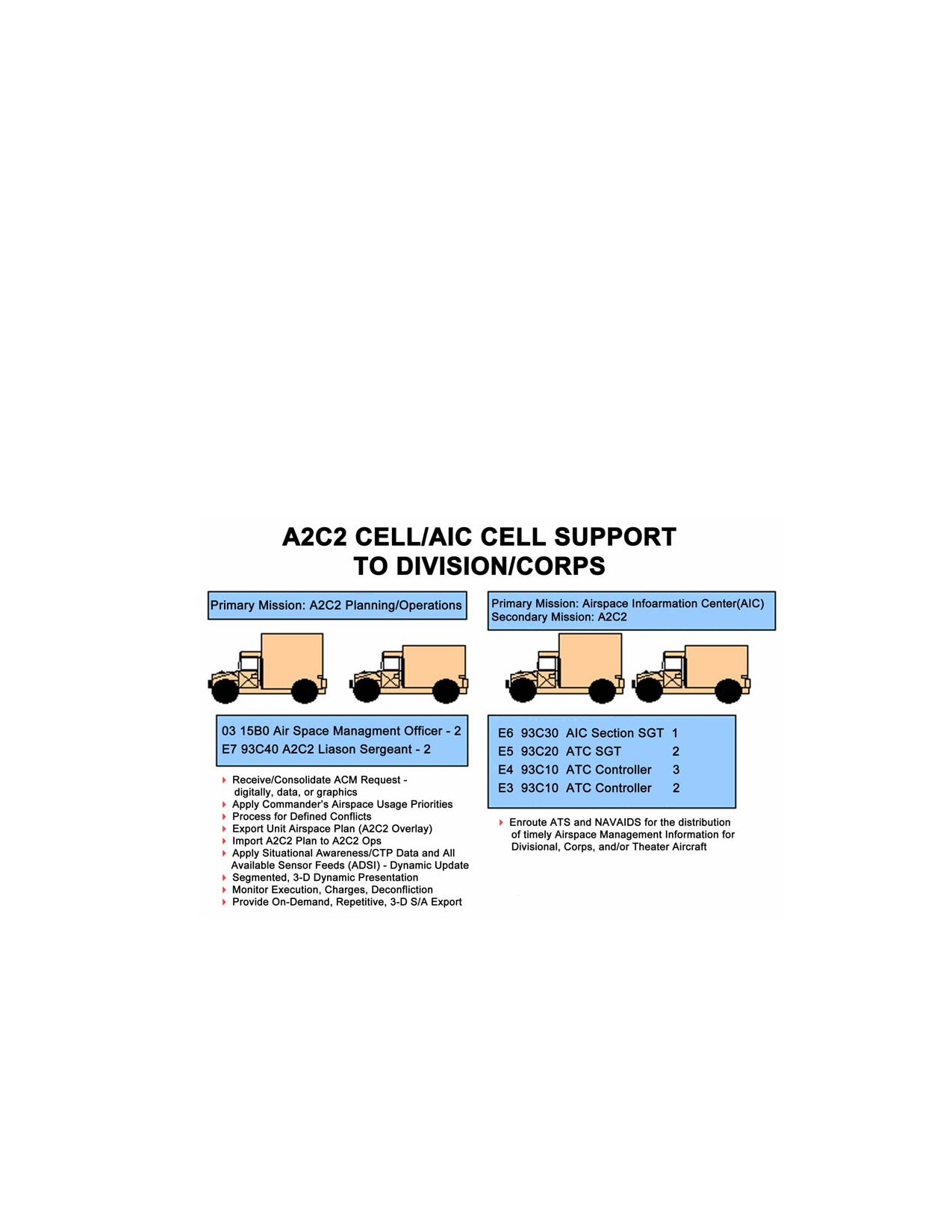
A2C2/ATS subject matter expertise to the division/corps. The A2C2 element consist of 4
personnel: two 15B O-3s and two 93C40 E-7s. They perform the A2C2 planning and
execution using the AN/TSQ-221 Tactical Airspace Integration System (TAIS) vehicle.
See figure B-1 for A2C2Cell organizational structure. Additionally, the EAC ATS
company provides an A2C2 liaison team to the theater’s CRC.
Figure B-1 A2C2 Cell/AIC Cell Support to Division/Corps
5. Communications Architecture
a. Command, Control, Communications, and Computers (C4) Requirements
(group/battalion). Command and control is vital in the synchronization of Army ATS
operations.
(1) ATS group/battalion commanders and staff must be able to communicate
with their subordinate battalions/companies and separate companies.
B-4
(2) ATS units must be able to communicate with local airspace authorities and
host-nation airspace infrastructures using telephones and radios.
(3) Army ATS units have certain C4 requirements that support the force with
real-time airspace information. These requirements enhance the synchronization of
combat power.
(a) ATS Battalions are responsible for coordinating with their sister
battalions and parent group to ensure there is positive control and coordination of the
airspace throughout the theater.
(b) Radio normally is the primary means of internal and external
communications.
• ATS units require FM, dual HF for simultaneous voice and data
transmission and reception, UHF, VHF, common-user systems, and internal wire to
expedite command and control.
• The group and battalion also requires UHF-FM demand-assigned
multiple access satellite communications intelligence and weather broadcasts. Satellite
communication (SATCOM) serves as the non-line-of-sight (NLOS communications HF)
backup means of communications.
• The dual HF requirement also supports the air coordination A2C2 net
(ground-to-ground) and NLOS requirements for ground-to-air. Additionally, ATS
requires one primary SATCOM Net to pass critical flight information among airspace
control elements and also pass safety of flight information to aircrews transitioning
throughout the theater area of operations (AO) (Theater Airspace Information Net).
b. Army tactical ATS architecture overview. See figure B-2.
c. ATS communications capabilities. See table B-2.
B-5
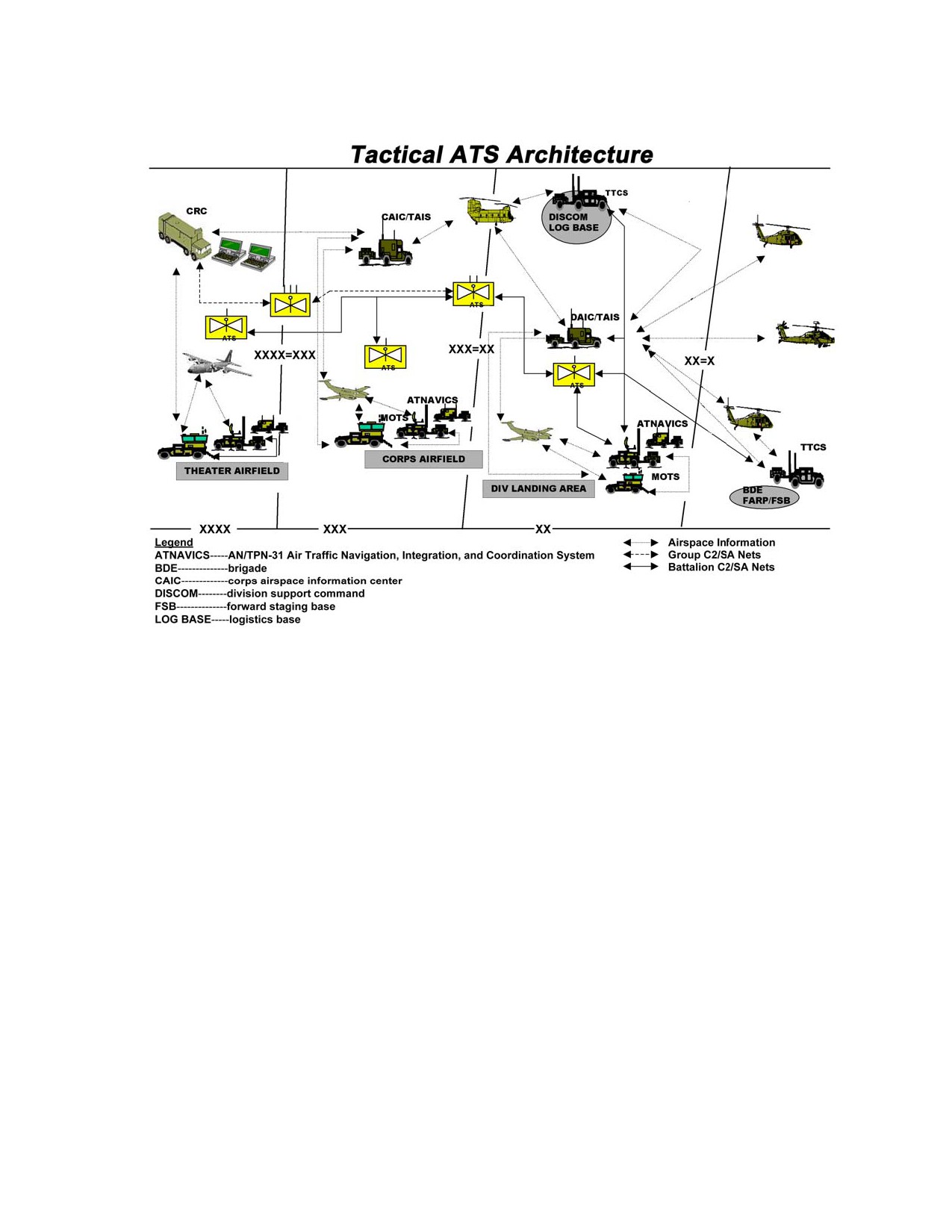
Figure B-2 Army Tactical ATS Architecture
B-6

Table B-2 Army Communications Capabilities
Army Communications Capabilities
Equipment
ATS GP
ATS BN
TAIS
TTCS
ATNAVICS
MOTS
AN/VRC-90F
X
X
X
X
SINCGARS
AN/VRC-92E
X
X
X
X
X
X
SINCGARS
AN/VRC-83 Have-
X
X
X
X
X
quick radio set
AN/ARC-220 HF
X
X
X
X
Radio set
TADIL A, HF
X
(95-S)
SATCOM, UHF
X
X
X
X
(PSC-5)
AN/PRC-117, VHF
X
UHF/VHF COMM
X
(URC 200)
AN/VSQ-2 EPLRS
X
X
X
Radio Set
Secure telephones
X
X
X
X
X
GPS
X
X
X
X
X
X
FAAD
X
ABCS
X
X
X
TBMCS
X
6. Tactical ATS Points of Contact
d. Doctrine /Training. USAAVNC; ATZQ-TDS; Ft Rucker, AL 36362; DSN 558-
3320
e. School.
93C School. 1-13th Aviation Battalion; ATZQ-BDE-E; Ft Rucker, AL
36362; DSN 558-1314
f. Organization. USAAVNC; ATZQ-CDO; Ft Rucker, AL 36362; DSN 558-2220
g. Material. USAAVNC; ATZQ-CDM; Ft Rucker, AL 36362; DSN 558-9568
h. Soldier. USAAVNC; ATZQ-AP; Ft Rucker, AL 36362; DSN 558-3423
i.
Command. ATS Command (Provisional); AFATS-C, Ft. McPherson, GA 36330;
DSN 367-2272
B-7
Appendix C
MARINE CORPS AIR TRAFFIC CONTROL
1. Doctrine
The Marine Corps organizes its forces for employment by integrating four functional
elements: ground combat, aviation combat, combat service support, and command into
one cohesive task force, the Marine air-ground task force (MAGTF). A MAGTF can
range in size from small special purpose units to large Marine expeditionary forces
(MEFs). The MAGTF is organized to meet the continuing demands of modern combat
by integrating a diverse array of assets under the control of a single commander.
a. The aviation combat element (ACE). The ACE adds a unique capability and
dimension to the MAGTF by dramatically increasing its firepower, mobility, and area of
influence. This common theme links the six major functional responsibilities of Marine
aviation and establishes the foundation for aviation support. The Marine Air Command
and Control System (MACCS) provides units required to command, control, and
communicate within the ACE. Marine ATC functions as a critical part of the MACCS
operating as the principal terminal control agency at airfields and assault zones.
b. Marine ATC. Marine ATC provides initial, transition, and sustained air traffic
support for joint and MAGTF air operations in any environment. Depending on the
scope of operations, it is often necessary to establish ATC service at a main air base, air
facility, and air site but also at assault zones, a FARP, rapid ground refueling (RGR)
points, and laager points.
(1) Support Operations. Marine ATC is capable of deploying and operating
independent of the MAGTF, joint force, or JTF to provide ATC support for various types
of operations. Examples of this type of ATC support include:
(a) Providing ATC service to assist humanitarian efforts and military
operations other than war (MOOTW).
(b) Assisting other joint/allied Services with air traffic operations.
(c) Supporting intergovernmental ATC requirements.
(d) Airspace/ATC liaison to host nation and civil ATC agencies.
c. MACCS. The employment of a MAGTF requires the close integration of air and
ground force operations. The MAGTF commander employs the MACCS to monitor,
supervise, and influence ACE air operations. The MACCS is not a piece of hardware
but rather an integrated group of C2 agencies. The MACCS provides the ACE
commander with the air C2 support facilities and infrastructure necessary to command,
coordinate, and control air operations within an assigned area of operation or airspace
sector and to coordinate MAGTF air operations with other Services. Principal MACCS
agencies are provided, operated, and maintained by a Marine air control group (MACG).
See figure C-1.
C-1
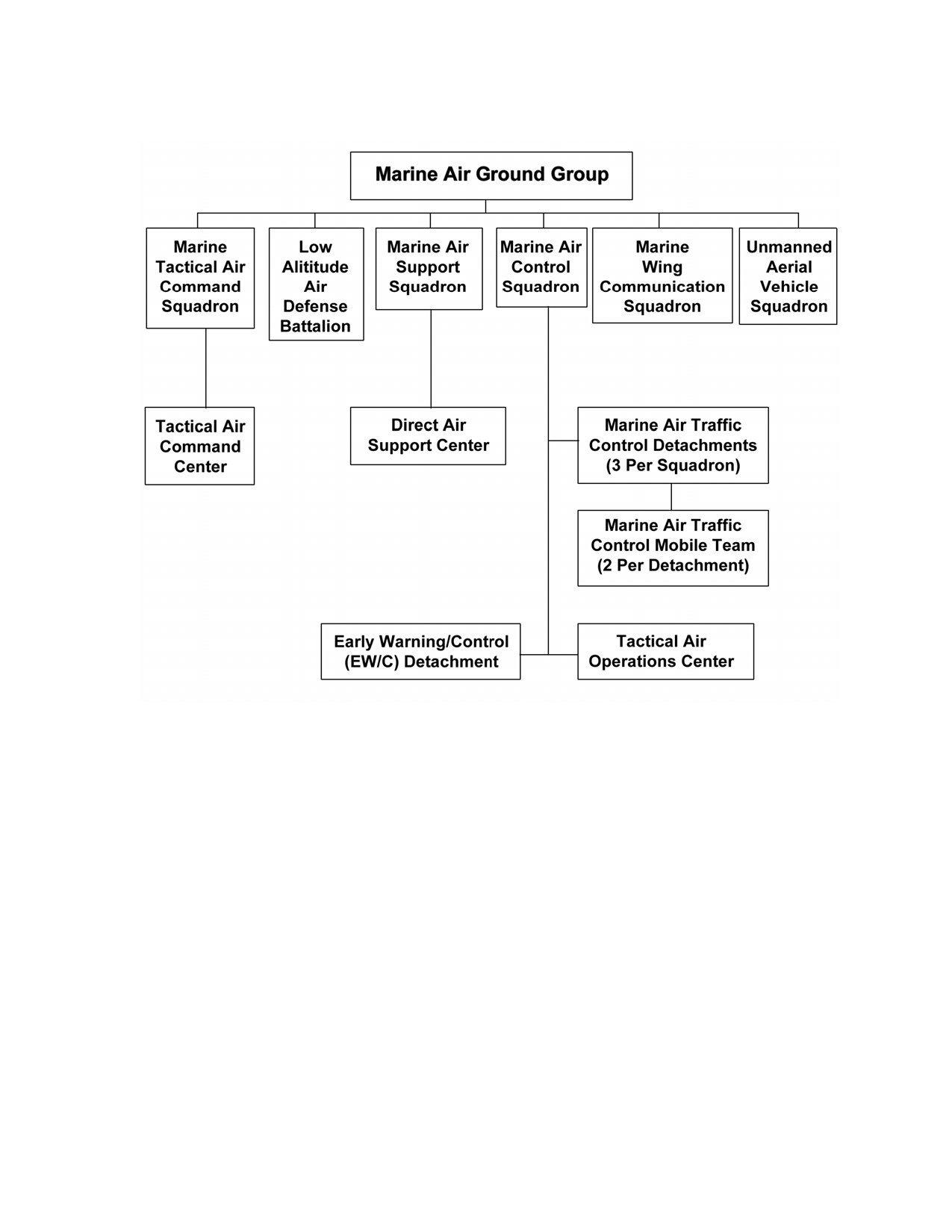
Figure C-1 Marine Air Control Group Subordinate Agencies and Detachments
(1) When deployed within the traditional MAGTF, the ATC detachment provides
critical airspace and ATC services as a part of the MACCS. The MACCS gives the ACE
commander the ability to exercise centralized command and decentralized control of
MAGTF air assets and operations. The MACCS allows interface of MAGTF air with
joint or combined operations. The MACCS is an air C2 system, which provides the ACE
commander the means to command, coordinate, and control all air operations within an
assigned sector as directed by the JFC. It allows the ACE commander to coordinate air
operations with other Services. See figure C-2.
C-2
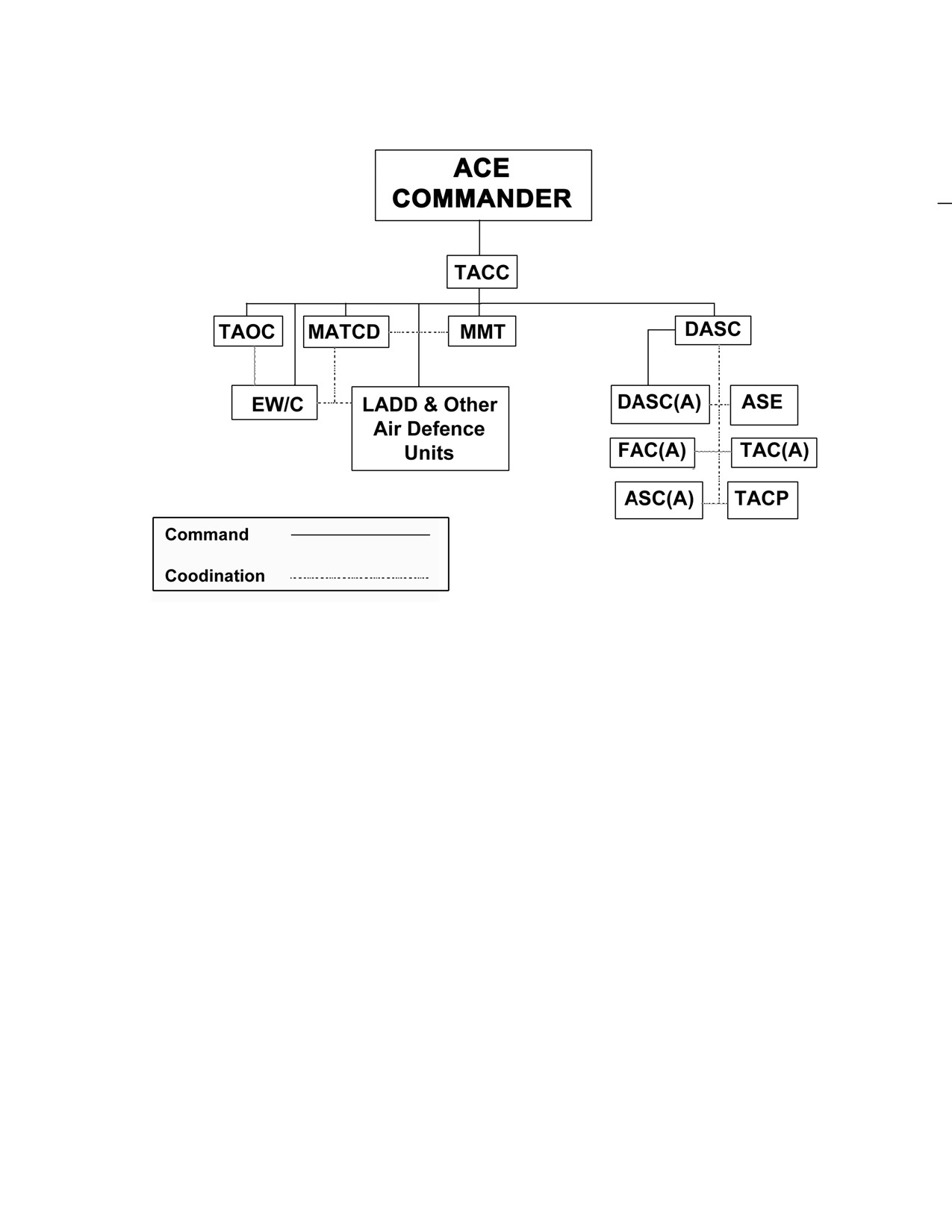
Figure C-2 Marine Air Command and Control System (MACCS)
(2) The Marine ATC detachment (MATCD). The MATCD is the principal
terminal ATC organization within the MACCS. Three MATCDs are structured to
operate as subordinate elements of the Marine Air Control Squadron (MACS). There
are eight active duty and one reserve MATCDs. Each MATCD is organized and
equipped to provide continuous all-weather ATC services to an independent and
geographically separated main air base or air facility and/or remote air site or point.
The MATCD also functions as an integral part of a MAGTF Integrated Air Defense
System (IADS) by providing its surveillance radar information to other units through
tactical digital information links (TADIL) and participating in air defense operations.
Marine ATC equipment is maintained by MATCD personnel and supported by NAVAIR.
(a) If deployed independently in a joint environment, MATCDs will operate
as a part of the theater’s command and control system in accordance with the ACP and
ACO. If deployed as a part of the MACCS, MATCDs will fulfill their traditional role of
supporting MATGF air operations. Regardless of who is being supported, Marine ATC
will operate in accordance with FAA, ICAO, host nation, Service specific, and joint
directives.
(b) The MATCD’s assigned mission and supporting task organization
determine the ATC element’s exact crew requirements. The MATCD is headed by a
detachment commander who coordinates detachment activities and supervises the
detachment’s ATC watch officers. Watch officers are crew managers. ATC crews are
operationally organized into command, radar control, and tower control sections.
C-3
• Command section. The command section supervises and coordinates
each MATCDs’ activities. It is composed of an ATC watch officer, a radar supervisor,
and a tower supervisor.
• Radar control section. The radar control section is responsible for the
management of assigned/designated airspace and is composed of an approach controller,
an arrival/departure controller, final controller(s), and a data link/flight data
coordinator. The radar control section conducts radar ATC, transmits information via
data link or voice crosstell (coordination) to other air control agencies, supervises
MATCD execution of the emission control (EMCON) conditions set by the Marine
tactical air command center (TACC), and employs electronic protection measures as
appropriate.
• Tower control section. The tower control section is responsible for the
control of friendly aircraft operating within the tower’s assigned airspace. This airspace
is typically limited to an area that can be visually observed and surveyed from the
tower, approximately a 5-mile radius from the airport up to an altitude of 2,500 feet
above ground level. The tower control section is also responsible for air and vehicular
traffic operating on runways, taxiways, and other designated areas of the airfield. The
tower control section is composed of a local controller, ground controller, and a flight
data operator.
(c) Detachment organization. Each detachment is organized to provide the
MAGTF with two MMTs. The MMT is a task-organized sub-element of the MATCD.
Normally the lead element in establishing initial ATC service, the MMT is responsible
for rapidly establishing and controlling tactical landing zones (TLZs) for fixed-wing
aircraft, helicopter landing zones (HLZs) for rotary-wing aircraft, and vertical/short
takeoff and landing aircraft in remote locations under both VMC and IMC. MMTs also
deploy independently of the MATCD while assigned with a special operations capable
MEU(SOC) or in support of MAGTF/joint operations/exercises.
2. Capabilities
a. Air Traffic Control. Detachments may be tasked to provide ATC services for any
joint, coalition, or MAGTF air operation. In addition, Marine ATC personnel can
provide airspace and air traffic liaisons for critical billets within the joint staff, air
operations center, or host nation/civil ATC system.
b. Air Defense. The MATCD plays a critical role in air defense and command and
control. Utilizing TADIL B, the ATC detachment participates in the theater recognized
air picture by providing surveillance radar coverage out to 60 nm. Additionally, the
MATCD operates in close coordination with air defense units to provide for a base
defense zone. Utilizing the TPS-73 radar system and a composite radar picture from
other theater radar surveillance assets, Marines work closely with air defense units to
provide radar cueing for early engagement of enemy aircraft.
c. Marine Liaison Officers. MARLOs are one of the most important elements of
both airspace planning and control provided to the CAOC and other key organizations.
In accordance with JFACC/AADC/ACA directives, MARLOs at the CAOC will affect the
largest portion of the control and coordination relative to Marine Corps ATC issues. As
issues come up the chain of command (warfighting), the MARLO has the ability to
C-4
coordinate ATC issues as part of or directly with the airspace control cell within the
CAOC.
d. TERPS. Each MATCD and Marine Corps air station employs fully certified
TERPS specialists. Detachments are capable of conducting detailed site surveys, and
producing terminal instrument procedures for airfields worldwide. Instrument
procedures are submitted and approved in accordance with FAA regulations and are
flight certified in accordance with FAA Order 8200.1A (NAVAIR 16-1-520).
3. Functions
The MATCD functions as an integral part of the MAGTF’s airspace management
and air defense networks. In the accomplishment of its mission, the MATCD:
a. Provides control tower, radar, and non radar approach/departure control services
within its assigned airspace.
b. Provides precision and non precision NAVAIDS.
c. Provides ground control approach and automatic landing system approaches
under all-weather conditions.
d. Displays and disseminates appropriate air and ground situation information to
designated higher and adjacent air C2 agencies to include Marine TACC, tactical air
operations center (TAOC), DASC, and low altitude air defense units while functioning
as an integral element of the MACCS. This information may also be provided to
joint/combined C2 agencies as the mission dictates.
e. Serves as the operational liaison between the MAGTF and national/international
ATC agencies.
f. Coordinates the activation of the airfield base defense zone (BDZ).
g. Provides airspace control, management, and surveillance within its designated
airspace sector.
h. Provides navigational assistance to friendly aircraft, to include en route ATC
services.
i.
Interfaces with the MACCS, other military air control agencies, and/or civilian
agencies/authorities, as necessary.
j.
Provides required ATC services in support of MAGTF operations.
k. Provides personnel to the survey liaison reconnaissance party (SLRP) team to
ensure MATCD siting criteria and TERPS are considered and addressed during the site
survey.
4. Employment
The MATCD can be task organized to meet any number of different contingency
operations. The ATC services required at a forward operating base (FOB) will dictate
the specific number of personnel and types of equipment necessary to support the
mission. While a particular MATCD configuration may normally be associated with a
Marine Expeditionary Force (MEF), Marine Expeditionary Brigade (MEB), special
C-5
purpose MAGTF , or MEU(SOC), the specific requirements for a given tactical situation
will dictate the actual configuration suitable for mission success.
a. Each MATCD is capable of providing the full range of terminal ATC services.
Primary employment options may include, but are not limited to:
(1) Full Service MATCD. This detachment is designed to support continuous all-
weather ATC services at a main air base. Services provided by these detachments
typically include-control tower, tactical air navigation (TACAN), radar approach, and
arrival/departure control, precision/non precision, and instrument approaches. Each
detachment also maintains the capability to survey, and create TERPS.
(2) Tower and TACAN Detachment. This detachment’s capabilities focus on
providing all-weather ATC services at a designated site. Services provided by these
detachments include control tower and TACAN instrument approaches and departures.
(3) Marine MMT. The MMT is trained and equipped to provide initial rapid
response ATC, and command, control and communications in support of MAGTF and
joint missions. The MMT’s small logistic footprint is conducive to rapid site
establishment and retrogrades. The MMT is equipped to operate for 72 hours without
resupply or augmentation. It is capable of supporting a variety of ATC missions as an
independent unit or as a part of a larger force in joint/multinational operations. Like all
Marine air traffic operations, the MMT provides FAA certified ATC specialists who have
been uniquely trained in rapid tactical ATC operations. The MMT can provide positive
and procedural ATC services up to 40 nm from a TLZ using portable NAVAIDS. The
MMT is specifically designed for insertion into remote locations to support MAGTF and
joint air operations. Common methods of insertion include:
(a) Tactical Vehicle. To facilitate movement of personnel and equipment to
the air point, each MMT is equipped with a high mobility multipurpose wheeled vehicle
(HMMWV). Normally, all MMT personnel and equipment will fit within a single
HMMWV.
(b) Air Insert. Air insert operations deliver the MMT to their assigned air
point by fixed- or rotary-wing aircraft. During these operations, the MMT is typically
inserted with the first air element into the objective area. The early establishment of
ATC service at the air point ensures that all succeeding aviation elements have ATC
and navigational guidance available, thus enhancing the safe and expeditious flow of air
traffic into and out of the air point and surrounding airspace.
(4) The MMT is typically task organized to provide ATC services for airfield
seizures, noncombatant evacuation operations, humanitarian/civil assistance
operations, MOOTW, and opposed entry operations as a part of a larger force. The
MMT is specifically trained and task organized to:
(a) Recommend/assist in Assault Zone (TLZ/HLZ) site selection. Determine
each site’s operational suitability for both numbers and types of aircraft.
(b) Conduct TLZ/HLZ and assault zone surveys. Surveys determine the
suitability of the landing surface for operations, annotate hazards to aviation to include
obstructions /obstacles, and to provide operational data.
(c) Mark and operate Assault Zones (TLZ’s/HLZ’s) for fixed and rotary-wing
aircraft.
C-6
(d) Provide terminal NAVAIDS and beacons.
(e) Coordinate with civil and military control agencies.
(f) Establish ground-to-air and ground-to-ground communications to link
austere sites with higher and adjacent command and control agencies.
(g) Provide ATC services at designated Assault Zones (TLZ/HLZ’s) to
include formulating ATC procedures, and issuing clearances, instructions, and
advisories to effect safe, orderly, and expeditious movement of air traffic in their
assigned airspace.
(h) Provide positive control of personnel and equipment within the FOB, air
site, air point, FARP, RGR, or lagger area.
(i) Establishing a terminal control area around each Assault Zone
(TLZ/HLZ) and controlling all air traffic within this area under VFR and IFR conditions.
This task may be extended to include procedural control services.
(j) Developing terminal instrument procedures for Assault Zones
(TLZs/HLZs).
(k) Providing limited weather observations and information.
(l) May act as the Air Boss if an aviator is not available.
5. Expeditionary operations
a. Units supported by ATC. Coordination of MAGTF air operations during MEF-
sized operations requires a considerable amount of ATC support. Typically, the MAGTF
bases all ATC support upon the number of FOBs from which Marine aircraft are
operating. Normally, three full MATCDs will deploy in support of a MEF to provide
continuous, all-weather ATC services at up to three main air bases. The three
detachments can also field two MMTs (six total) to provide limited ATC services at air
facilities or air sites as required. Two MATCDs normally support the forward element
of a MEF or MEB. The two detachments can provide continuous, fully capable ATC
services at up to two main air bases and four MMTs for ATC support at four air
facilities or air sites. A special purpose MAGTF is normally supported by a task-
organized MATCD ranging in capability from an MMT to a full MATCD. Its mission
and tasks are situational dependent. Limited ATC services are typically provided to the
MEU(SOC) by one MMT. The MMT’s mission and tasks are dependent on the situation.
b. The MAGTF commander. The commander uses MAGTF aviation to assist efforts
in support of the amphibious task force, the naval expeditionary force commander, or
the JFC in preparing and defending the battlespace. In its most common employment,
the MATCD will operate in support of expeditionary operations ashore. Each MATCD
has the capability of supporting two remote air sites or points with MMT’s.
(1) MATCD. The detachment has a full range of ATC capabilities to include air
surveillance radar, IFF, automatic carrier landing system radar, communications,
NAVAIDS, and control towers. This equipment provides a MATCD with positive
airspace control capabilities out to 60 nm from a main air base using radar control
procedures and out to the limits of MACTD designated airspace using non radar
procedures (procedural control).
C-7
(2) Elements of the MATCD. Elements of the MATCD, notably the MMT and
liaison officers, may be among the first MACCS air control capabilities introduced
ashore. MMTs used in either a stand-alone role or as a precursor for a buildup for a
larger MATCD are initially established to coincide with initiation of FOB air operations
or short duration aviation operations. As required, phase additional ATC capabilities
into the amphibious objective area (AOA)/AO to provide additional, continuous ATC
services for Marine, joint, and allied Service aircraft operating from AOA/AO airfields.
In situations where MAGTF aviation elements are forward based at an allied nation’s
airfield located in proximity to the AOA/AO, assign MATCD personnel as liaisons to the
host nation’s ATC administration. With the introduction of ATC radars into the
MAGTF/joint Force’s AO, the MATCD will coordinate for the requisite voice and data
links necessary to contribute to the force’s IADS through the Marine/joint sector air
defense facility (SADF) , or as may be designated by the JFACC.
6. ATC Detachment Equipment
Expeditionary equipment. The MATCD equipment consists of the Marine Air
Traffic Control and Landing System (MATCALS), NAVAIDS, ATC towers, mobile
electric power, and maintenance shelters. MATCD equipment is deployed by
conventional ground, rail, air, and sealift means. Additionally, Marine CH-53E
helicopters can transport all MATCD equipment. All MATCD radars and
communications-electronics shelters are considered oversized cargo. A principal
concern, when deploying the MATCD, is ensuring that adequate transportation and
materials handling equipment are available to support the carriers loading and off
loading, movement to the site, and equipment emplacement.
a. Marine Air Traffic Control and Landing System. The MATCALS provides
continuous radar approach, arrival/departure, and en route ATC capabilities.
MATCALS collects, evaluates, and displays air track data and disseminates information
to other air control agencies. MATCALS consists of three subsystems: AN/TPS-73, ATC
subsystem, AN/TPN-22; all-weather landing subsystem; and the AN/TSQ-131, control
and communications subsystem. A description of these systems and a variety of other
MATCD systems and equipment are contained in appendix E.
b. Marine Air Traffic Control Mobile Team equipment. The equipment assigned to
MMT is either man portable or highly mobile via HMMWV. The equipment can be
deployed to mark and control runways for fixed-wing and landing zones for rotary-wing
assets. This equipment includes portable airfield lighting, UHF/VHF/HF/SATCOM
communications, NAVAIDS, and portable beacons.
(1) Core Package. The core package can provide ATC services for 72 hours
without resupply or augmentation. This package includes 6 personnel, HMMWV,
NAVAIDS, portable radios, and portable airfield lighting. Resupply of consumable
items is required after 72 hours. This package can be deployed in several different
configurations dependant upon the mission.
7. Training and Proficiency
Marine ATC personnel control aircraft at Marine Corps Air Stations maintaining
their controlling proficiency through daily air operations. Marine Corps Air Stations,
and MATCDs, work closely together to provide controllers with tactical training on
C-8

expeditionary equipment and procedures. Upon commencement of hostilities or
assignment to an operation or exercise, controllers detach from Air Stations and are
assigned to their tactical units. Through this unique relationship, MATCDs and MMTs
are manned with fully qualified and FAA certified ATC personnel. See qualifications in
table C-1. The following list supplies a synopsis of controller training, but is not all-
inclusive.
a. Air Traffic Controller Course. Marine air traffic controller training is conducted
at Naval Air Technical Training Center Pensacola, Florida, in the Air Traffic Controller
“A” Course. Basic ATC trainees receive 16 weeks of training. The trainees receive the
basic skills and knowledge required to perform routine duties in the control and
handling of aircraft in a tower and radar environment in accordance with FAA
standards. Officers receive a basic introduction the MACCS, and ATC management
issues.
b. MATCALS Basic Operators Course. This is a 1-week course that provides
Marine ATC personnel with familiarization training on the MATCALS following entry
level schooling. Marines receive instruction on the operation of MATCALS equipment
and are introduced to the mission and structure of Marine aviation.
c. ATC On-The-Job Training. Upon successful completion of this course, personnel
are assigned to an ATC facility, or a MACS for reservists assigned to the 4th Marine Air
Wing, New Orleans, Louisiana. At their assigned duty station, enlisted personnel
receive further training and become qualified for MOS 7257 Air Traffic Controller Basic,
MOS 7252 Air Traffic Controller- Tower, MOS 7253 Air Traffic Controller-Radar, MOS
7254 Air Traffic Controller-Radar Approach and officers become qualified for MOS 7220
Air Traffic Control Officer. This training combines on the job training and formal
instruction.
Table C-9 Marine ATC Military Occupational Specialties (MOS)
Qualification
Marine MOS
Air Traffic Controller Basic
7257 (enlisted)
Air Traffic Controller- Tower
7252 (enlisted)
Air Traffic Controller-Radar
7253 (enlisted)
Air Traffic Controller-Radar Approach
7254 (enlisted)
Air Traffic Control Officer
7220 (officer)
d. Advanced Radar ATC Course. Selected air traffic controllers receive nine weeks
of training in Course C1, Advanced Radar ATC (ARATC). This phase of training
provides students with the skill and knowledge to perform at a basic level as radar
approach controller at all operating positions at a radar approach facility.
e. MATCALS Advanced Operators Course. This is a four-week course that provides
senior Marine ATC personnel with comprehensive training on the employment and
operation of MATCALS. Students receive instruction on the operation, capabilities, and
limitations of the MATCALS. Students are also instructed on developing/designing US
Standard TERPS.
f. Marine MMT Leaders Course. This is a six-week course that provides Marine
officers and mid-level enlisted personnel comprehensive training in tactics and
employment of MMT. Students receive instruction in employment concepts in support
C-9
of MAGTF/joint forces, contingency planning processes, communications, weapons, joint
ATC procedures, and threat systems.
g. Weapons and Tactics Instructor Course. This is a six-week course that provides
Marine officers and senior enlisted personnel comprehensive training in tactics and
employment of the Marine ATC detachment and the MACCS. Students receive
comprehensive training in concepts of employment for the detachment and the MACCS,
joint operational doctrine, contingency planning processes, interoperability issues, and
threat systems.
8. Planning
Specific information on the MAGTF planning process and the documents useful in
conducting MAGTF and ACE planning are contained in MCWP 5-1 Marine Corps
Planning, MCWP 5-11.1MAGTF Aviation Planning, and , MCRP 5-11.1A MAGTF
Aviation Planning Documents. MCO 3501.9B, Marine Corps Combat Readiness
Evaluation System (MCCRES), outlines MATCD specific planning requirements.
Though the planning phases outlined below may occur in sequence, most of these steps
are conducted concurrently.
a. Initial Planning. Considerations for the initial planning phase include:
(1) Conducting a mission analysis, utilizing mission, enemy, terrain and
weather, troops and support available - time available (METT-T) and including specified
and implied tasks, based on the MAGTF and ACE commander’s intent and concept of
operations.
(2) Identifying assumptions necessary for continuation of the planning process.
These assumptions should supplement assumptions already addressed by higher
headquarters and be in concert with the planning guidance received by higher
headquarters.
(3) Analyzing the friendly force composition from the joint/multinational level
down to the MACCS and addressing integration/interface requirements with the
MAGTF and/or joint force planners (specifically the ACA, the area air defense
commander [AADC], and adjacent air control agencies).
(4) Conducting initial coordination/liaison with the ICAO, host nation ATC
facilities, and the FAA for airspace and liaison requirements.
(5) Analyzing the threat’s air and ground order of battle and electronic warfare
(EW), reconnaissance, and unconventional warfare capabilities.
(6) Analyzing the AOA/AO, with particular emphasis on the ACA’s guidance to
begin initial planning for terminal control airspace, Class D airspace, and minimum
risk routes (MRRs). Class D airspace is that airspace from the surface to 2,500 feet
above the airport elevation surrounding those airports/airfields that have an
operational control tower.
(7) Identifying communications requirements for subordinate, adjacent, and
higher level circuits with the ACE/MAGTF communications planners. Initial
communications planning should focus on the critical information flow and the desired
connectivity necessary to achieve this flow.
C-10
(8) Providing ATC specialist input to aviation estimates of supportability for all
assigned operations. Input should summarize significant aviation aspects of the
situation that might influence any course of action (COA) proposals. The input is also
used to evaluate and determine how aviation units can best be employed to support
contemplated MAGTF COAs. The aviation estimate is prepared by the ACE
commander, his staff, and subordinate elements. The end product of the aviation
estimates of supportability will include recommending a COA to the MAGTF
commander. At a minimum, aviation estimates of supportability will include:
(a) Which contemplated COA(s) can best be supported by the ACE.
(b) Salient disadvantages of less desirable COAs.
(c) Significant aviation limitations (including command and control) and
problems of an operational or logistical nature.
b. Intelligence Planning. MATCD personnel will coordinate intelligence planning
with the squadron S-2 or higher headquarters. Intelligence planning considerations
include:
(1) Obtaining preliminary and detailed aviation intelligence estimates.
(2) Identifying intelligence requirements and submitting them to the squadron
S-2 in the form of simple, concise requests. Intelligence requirements should state the
preferred product format.
(3) Determining the MATCD staff’s requirements for maps, charts, photographs,
and other graphic aids.
(4) Obtaining a complete enemy order of battle including information on the
threat’s missiles, aviation assets, EW, naval, and ground force capabilities.
(5) Preparing a detailed rear area assessment for the MATCD and any deployed
sites within its assigned sector.
(6) Determining the enemy’s access to and the overhead times for satellite
systems and the enemy’s processing time for the imagery.
c. Communications Planning. Communications planning involves a coordinated
effort between MATCD/MACS representatives and communications planners within the
MACCS and ACE/MAGTF staffs. Communications planning considerations include—
(1) Establishing required communications connectivity between adjacent
MACCS agencies, as well as those agencies external and internal to the supported
airfield (including civil ATC agencies).
(2) Determining required communications nets, as well as a prioritization and
restoration plan for the use of these nets.
(3) Determining data link connectivity requirements for both TADIL B and
TADIL C.
(4) Developing a security control of air traffic and NAVAIDS plan. The security
control plan will include procedures for silent aircraft taxi, launch, and recovery
procedures for day and night operations, secured NAVAIDs, and the securing authority
for the NAVAIDs.
C-11
(5) Identifying communications security material. Planners should address
required encryption hardware and software, authentication tables, brevity codes, and
challenge/password changeover times.
(6) Ensuring the MATCD is included on distribution lists for the automated
communications electronics operating instruction and air tasking order (ATO).
(7) Addressing ATC unique frequency requirements with ACE/MAGTF
communications planners. The necessity for like communications media between the
MATCD and civil aviation authorities requires MATCD planning for using frequencies
within the VHF(AM) frequency spectrum (116-134 MHz w/50 kHz spacings). This
frequency band is used for the control of civil aircraft; 50 kHz spacing may also be
necessary for the UHF band for communicating with allied nations’ aircraft.
d. Electronic Warfare Planning. When the enemy has a known EW and electronics
intelligence capability, planning considerations may include:
(1) Requesting an assessment of the enemy’s electronic order of battle
(communications and radar jamming capabilities, antiradiation missile capabilities, and
delivery profiles).
(2) Submitting recommendations for EMCON and radiation control standards
within the MATCD’s assigned sector. EMCON and radiation control plans should
incorporate all ground-based sensors operating within the sector and consider the
antiradiation missile threat to maintain effective sector surveillance. Planning
considerations should address:
(a) Minimum communications procedures.
(b) Use of brevity codes and authentication devices.
(c) Use and security of communications security (COMSEC) materials.
(d) Delegation of EMCON authority.
(e) Signals security.
(f) Beadwindow calls.
(g) Gingerbread procedures.
(h) Employment of directional antennas.
(i) Circuit discipline.
(j) Appropriate radio wattage.
(k) Radar blinking and blanking.
(l) Use of frequency diversity and frequency agile radios.
(m) Physical dispersion and appropriate siting of communications emitters
(including radars, radios, and NAVAIDs).
(n) Available demand features on NAVAIDs and their use.
(3) Considering the EW threat when determining the locations of MATCD
radars.
(4) Providing input to the MAGTF command and control warfare plan.
C-12
(5) Ensuring that planners, operators, and users of electronic equipment
thoroughly understand the EW threat and the EMCON/electronic protection measures
techniques used to counter that threat.
e. Site Selection Planning. The site selection process begins once the MATCD’s
sector is assigned. Planners must ensure adequate space for site establishment, access
to the site, and radar coverage of the sector are maximized. The site selection process
includes:
(1) Conducting surveys using maps, aerial photos, charts, and other graphic aids
to identify candidate sites.
(2) Producing/obtaining radar coverage diagrams from the tactical aviation
mission planning system, joint Electronics Office, other automated sources, or manual
computations.
(3) Determining optimum siting locations for communications connectivity with
higher/adjacent and subordinate agencies using applicable computer programs, line of
sight (LOS) diagrams, and HF frequency propagation predictions.
(4) Submitting a list of candidate sites to the ACE commander based on map
surveys and other studies. MATCD siting considerations should encompass all task-
organized equipment and personnel in both movement and physical requirements.
Physical site characteristics considerations include:
(a) Radar coverage of the assigned airspace.
(b) Ground that has no more than 10 degrees of slope.
(c) Spatial requirements (e.g., antennas or radio frequency hazards).
(d) Logistics supportability.
(e) Camouflage and concealment.
(f) Trafficability and access.
(g) Emergency destruction and/or movement.
(h) Drainage.
(i) Defensibility.
(5) In addition to the physical geography of the site, planners should consider the
candidate site’s proximity to related activities occurring in or around the forward
operating base. These functional site considerations should address the locations of:
(a) Fuel points and fuel storage areas.
(b) Ordnance storage areas.
(c) Arming/dearming areas.
(d) Air lift control element locations.
(e) Pre-existing NAVAIDs.
(f) Arresting gear.
(g) Medical evacuation areas.
C-13
(h) Search and rescue aircraft.
(i) Crash, fire, and rescue units/hot spots.
(j) Field weather observation services.
(k) Field of view.
(l) Obstructions.
(6) Requesting radar frequency authorization from the appropriate authorities.
(7) Establishing a phased plan of equipment arrival at the site to facilitate rapid
commencement of operational capabilities and communications.
(8) Selecting an advanced party to conduct physical reconnaissance, locate
positions for equipment, and plan specific equipment sites.
(9) Preparing diagrams or models that depict equipment locations and are the
basis for set up crew briefings.
(10)
Ensuring site plans consider maximum dispersal and remoting of
equipment to reduce electromagnetic and infrared signatures.
(11)
Designating alternate site locations.
f. Airspace Management Planning. Airspace management planning involves
segmenting assigned airspace by volume and/or time for the safe and expeditious flow of
air traffic. Airspace management also involves establishing various air defense control
measures, which are designed to protect friendly installations from enemy air attack.
Planning considerations include:
(1) Analyzing the AOA/AO to determine dimensions, suitable airfields within,
possible conflicts with civil aviation, unmanned aerial vehicles (UAV), and preferred
routings for friendly aircraft.
(2) Determining the size and shape of terminal control airspace. Usable
NAVAIDs, civil air traffic patterns, UAVs, and conflicts with other users of this airspace
will affect the airspace’s configuration.
(3) Determining the size and shape of Class D airspace. Military (manned and
unmanned aircraft) and applicable civil traffic patterns should be considered.
(4) Ascertaining the size and shape of the BDZ. BDZ dimensions are normally
determined by the effective engagement envelope of the supporting air defense systems
(e.g., Stinger) and anticipated air traffic patterns. Establish entry and exit procedures,
including safe lanes and IFF mode and code requirements, during BDZ construction.
(5) Coordinating with local ground-based air defense unit(s) for BDZ early
warning cueing.
(6) Preparing TERPs for designated airfields and submitting the approach plates
to the Naval Flight Information Group for approval and publication.
(7) Participating with other MACCS agencies in the planning and development
of MRRs. Planning should include consideration of UAV and civil aircraft routing.
(8) Coordinating with ICAO, host nation ATC, and/or FAA authorities for the
effective use of existing airspace.
C-14
(9) Coordinating with higher headquarters to publish ATC procedures in the
airspace control order/airspace control plan (ACO/ACP) and pilot controller handbook.
(10)
Developing procedures for handling transient aircraft within the
MAGTF/joint AO.
g. External Support Planning. MATCD-unique external support planning
considerations include:
(1) Identifying and coordinating sufficient transportation and materials handling
equipment necessary to rapidly emplace the MATCD.
(2) Coordinating aviation supply/logistics support for Naval Air Systems
Command-supported equipment through the Marine aviation logistics squadron.
(3) Multi-channel communications support for data link operations.
(4) Ground security requirements.
h. Joint/Multinational Operations Planning
(1) The MAGTF must ensure its operations are integrated and coordinated with
joint/multinational forces. Include MAGTF air command and control representatives as
part of the joint operations planning (e.g., development of the joint air operations plan,
ACP, or the air defense plan). The ACE commander, his staff, and/or MACCS agencies
normally provide these subject matter experts. They also identify MAGTF capabilities
and requirements relative to airspace control and air defense operations.
Joint/multinational operations plans must specifically—
(a) Integrate with and complement the joint/multinational force’s mission.
(b) Ensure the interoperability of equipment and personnel.
(c) Ensure the common use and understanding of terminology.
(d) Allow responsiveness and the massing of firepower whenever and
wherever needed.
(e) Identify the proper liaison and staff/agency representation between joint
force components. Representatives from each component must enable and improve the
information flow and provide expertise.
(f) Outline procedures for airspace control and air defense degradation.
(g) Facilitate transition from peacetime conditions to hostilities.
(h) Delineate logistical support.
(2) Integrate air operations, airspace, and air defense planning with the joint
force’s planning cycle. Consolidate and integrate input from all components into the
joint air operations plan, the ACP, and the air defense plan. The ACP and air defense
plan are part of the joint air operations plan, and must be included in the joint force
operations plan. The ACO is published and disseminated based on guidelines
established in the ACP. As an integral part of the joint ATO, integrated tasking order,
or air tasking message (NATO), the ACO may be distributed as a part of these
documents or may be issued separately.
C-15
9. Equipment selection and siting considerations
Upon receipt of a warning order, or after initial tasking, MATCD planners begin
determining the equipment needed to support operations. Generally, equipment
requirements are based on the detachment’s mission, location(s), available lift and
logistics support, anticipated duration, and space available at the site. The MATCD
commander and maintenance officer will conduct a mission analysis utilizing METT-T
to determine the equipment suites necessary to support operations, necessary
maintenance facilities, mobile electric power support, and parts pack-up. The initial
equipment plan is briefed to the MACS commanding officer for initial approval. Specific
concerns for selecting potential sites that follow apply to all MATCD operations,
whether the MATCD is operating in a garrison or tactical situation.
a. Surveys. Two types of surveys are necessary for determining the equipment
needed to support operations: the map imagery and the physical survey.
(1) The map imagery is normally conducted concurrently with initial equipment
planning. Map imagery of potential airfields/air sites are used to gain an initial
impression of the surrounding terrain, runways, taxiways, and parking aprons and to
determine how these factors influence MATCD equipment siting and air traffic flow.
The goal of the map imagery is to ascertain the practicality of providing unobstructed
“views” for the tower and radars and to identify potential locations for the detachment’s
equipment as well as maximizing ATC procedures. Key considerations to be addressed
during the map imagery include identification of the limitations on equipment
separation based on cable length, etc., safety zones around radiation hazards, and
potential of electromagnetic interference from other radio-electronic sources.
(2) When practical, conduct a physical site survey to confirm or refute site
locations identified during the map survey. The physical survey affords MATCD
personnel the opportunity to update site information that was not available from a map,
adjust equipment locations, and determine the types of support, such as commercial
power and telephone access, available at the airfield/air site. Physical site surveys
conducted by qualified MATCD personnel are recommended prior to deployment of the
detachment’s equipment.
b. Equipment Siting. When conducting the map and physical surveys and during
the actual equipment emplacement, MATCD Marines should consider unique properties
associated with the various equipment.
(1) AN/TSQ-120 (ATC Control Tower). When siting the control tower, give
priority to the controller’s field of vision. A clear view of runways, movement areas, and
approach surfaces is paramount. Tower personnel should have unobstructed views of
taxiways, ramp areas, and arming/dearming sites to enhance safe movement in and
around the airfield. The tower requires a 10-foot x 15-foot level area with firm soil for
erection. Keep the tower height as low as practical to reduce its vulnerability as a
target.
(2) AN/TRN-44 (TACAN). The TACAN is an LOS transmitter. Antenna height
is determined by local terrain and obstacles. Like the control tower, do not raise it
higher than necessary. To achieve the best approach possible, a straight-in approach to
the minimum distance of 1 mile, 500 feet, the TACAN must be located within 1 mile of
the airport reference point. The site should be a clear, flat area free of obstructions; e.g.,
C-16
buildings or trees, for 1/4 mile if possible. Avoid hard surfaces; e.g., runways or
taxiways, especially if constructed of metal matting, due to reflections that distort the
TACAN’s pattern.
(3) Radars. Siting of the radars is generally more difficult than the other
equipment suites, due to their susceptibility to terrain effects, necessary logistics
support, and limitations to interface with other equipment suites. An operational
analysis of the airfield, number of approaches to different runways, number of
touchdown points, and desired landing minimums should be made before selecting
radar sites. The primary instrument runway is selected after taking into account
factors such as weather, terrain, and obstacles. Normally, this runway will have the
least restrictive (lowest) landing minimums. Secondary instrument runways and their
attendant touchdown points are identified and covered if possible. Two key factors for
radar site consideration are the landing operations to be supported and physical and
electromagnetic effects on a radar’s tracking. Place the airport surveillance radar so
that radar blind spots are eliminated. Site the precision approach radar to maximize
coverage and preclude drop-tracks due to clutter. Clear all obstructions from the
approach corridor for the primary instrument runway. The TPN-22 precision approach
radar’s siting is the most critical as it provides terminal guidance for aircraft landing in
adverse weather and/or poor visibility situation.
10. Points of Contact
a. Commandant of the Marine Corps (APC); Attn: ATC Action Officer;
Headquarters Marine Corps; Washington, DC 20380; DSN: 224-1850
b. Marine Aviation Weapons and Tactics Squadron One; Attn: C-3 MATC Division;
P.O. Box 99200; Yuma, AZ 85369-9200; DSN: 269-2957
C-17
Appendix D
NAVY AIR TRAFFIC CONTROL
1. Doctrine
a. Navy Amphibious Groups (PHIBGRUs)
(1) PHIBGRU 1 is located at Naval Amphibious Base (NAB) Coronado, San
Diego, CA. Its subordinate units are tactical air control squadrons (TACRONs).
TACRONs Eleven and Twelve are squadrons under Group 1. The TACRONs deploy as
detachments throughout the Pacific Fleet AOR to provide centralized planning, control,
and integration of all air operations in support of amphibious operations.
(2) PHIBGRU 2 is located at NAB Little Creek, Norfolk, VA. Its subordinate
units are TACRONs. TACRONs Twenty-one and Twenty-two are squadrons under
Group 2. The TACRONs deploy as detachments throughout the Atlantic Fleet AOR to
provide centralized planning, control, and integration of all air operations in support of
amphibious operations.
b. Amphibious Control. There are basically two levels of operations for the tactical
air control group, squadron, or detachments. They are identified as MEU(SOC) or MEF
level operations. The MEU(SOC) comprises the landing force for an amphibious ready
groups PHIBGRU/TACRON. Support for MEU(SOC) level operations will normally
consist of a detachment. MEFs, as part of an amphibious force, are much larger and
often have special support requirements and PHIBGRU/TACRON support for these
levels of operations will be necessary to successfully complete the mission.
(1) Amphibious Ready Group. Typically, a TACRON deploys as one of numerous
embarked elements onboard an amphibious carrier. The detachment officer-in-charge
(OIC) is normally assigned as the amphibious commander’s air officer. The amphibious
squadron commander is operationally in command of the group. The group may consist
of a variety of ships to include the following:
(a) General-purpose amphibious assault ship (LHA).
(b) General-purpose amphibious assault ship (with transport dock)--(LHD).
(c) Amphibious assault ship, landing platform helicopter (LPH).
(d) Landing ship dock (LSD).
(e) Amphibious transport dock (LPD).
(2) The Amphibious Ready Group also has a MEU(SOC) embarked, which
consists of approximately 2100 Marines in ground, air, and support elements. The
group is capable of landing and supporting combat troops from both the air and sea.
(3) Control. When an amphibious operation has been identified and an
AOA/HIDACZ or AOR has been delineated (including all of its control points), the
TACRON becomes responsible for the control, monitoring, and coordination of all fixed-
wing assets entering, exiting, or operating within the assigned area. Typically this
function is performed in the TACC aboard LHA, LHD, and LPH class ships. Control of
D-1
helicopters is generally retained by the ship’s air operations control center
(AOCC)/helicopter direction center (HDC). All aircraft will check-in with the tactical air
traffic control (TATC) before entering assigned airspace in order to receive control
instructions, traffic deconfliction, mission information/briefing, and transfer to
subsequent control agencies. Transition control may be a function of another
individual, such as the tactical air director (TAD), within the TACC or it may be an
outside agency. Following mission completion, aircraft will check out of the area via the
TATC in order to ensure that required information is passed to affect aircrews.
c. Aircraft Carrier Control. Airspace around a carrier battle group (CVBG) is
monitored, controlled, and defended by the air warfare commander (AWC). The AWC is
usually the commanding officer of an AEGIS Cruiser or Destroyer. The AWC releases
operational tasking (OPTASKs) and daily intention messages that describe the air
posture, airspace restrictions, and general air procedures to be followed by CVBG air
assets. The AWC usually has in place a positive identification and radar advisory zone
(PIRAZ). The AWC and PIRAZ control units are usually collocated. A PIRAZ allows the
AWC to identify all aircraft operating in the defended area as well as maintain track
integrity. The PIRAZ circuit is UHF, usually callsign “RED-CROWN.” Contact “RED-
CROWN” when entering or exiting airspace around a CVBG.
(1) Carrier ATC. Carrier ATC is the mission of the carrier air traffic control
center (CATCC). Navy air traffic controllers man CATCC. CATCC positions include
approach, departure, marshal, and final control. All ATC control frequencies and
various administrative circuits for special aircrew information/instructions are UHF.
During VMC conditions, the tower controls airspace within 5 miles of the carrier.
Aircraft requesting landing, transit, or fly-by must contact tower before entering this
airspace. Additionally, a 50-mile radius around the carrier is considered the control
area and is under the control of CATCC and the combat direction center (CDC).
(2) Other Considerations. In addition to CATCC, the air resource element
coordinator maintains an administrative UHF circuit for passing aircraft status,
amending recovery times, coordinating non-organic assets (for example, KC-135), etc.
This circuit is called “Strike.” The tactical action officer (TAO) controls this.
Frequencies for CATCC, “RED-CROWN,” “STRIKE,” and the tower can be found in the
standing OPTASK COMMUNICATIONS, daily-intentions messages, or carrier
communication kneeboard cards. SPINS often list some of these frequencies when a
CVBG is operating in support of a joint operation.
2. Forces
Forces available for Naval ATC operations are derived from two Amphibious Groups
(PHIBGRUs). PHIBGRUs or TACRONs will deploy aboard amphibious flag or
amphibious command ships for operations in direct support of amphibious force
operations when directed. They are responsible for providing centralized command,
control, and planning coordination of all air support and airspace required for
amphibious operations for numbered fleet Commanders. When the
PHIBGRU/TACRON deploys, it will be composed of elements of each TACRON or the
entire group.
a. Tactical Air Control Squadron. Typically a TACRON has approximately 15-20
officers and 60-70 enlisted personnel assigned. Officer manning is comprised of naval
D-2
aviators and naval flight officers of nearly every warfare specialty and Marine aviators.
Enlisted manning consists primarily of air traffic controllers (ATC) and operations
specialists, but squadrons also have personnel assigned to provide operational and
administrative support. Some of the important positions in the TACRON and its
detachments are described later in this chapter.
b. Ashore. Ashore, the TACRON is typically organized like any other command
with administrative operations, training, and other supporting departments.
Detachment composition, while deployed, generally is as follows: OIC (0-5) and 4-5 other
officers and 18-22 enlisted personnel. Manning will vary somewhat, depending on the
ship embarked.
c. Tactical Action Officer (TAO). The TACRON commanding officer deploys as the
TAO, in support of amphibious group commanders. The TACRON will man and operate
a TACC to provide centralized planning, control, coordination, and integration of all air
operations in support of amphibious operations, training, and transits. Each squadron
is currently capable of providing two detachments a year with a projected cycle of 6
months deployed and 12 months in port as directed by the Chief of Naval Operations.
Detachments are required continuously.
(1) Tactical air control squadron detachments. These detachments, as
operational units of a TACRON, deploy in support of amphibious squadron
commanders. The detachment OIC shall serve as the TAO while deployed. The
detachment will staff and operate the TACC to provide centralized planning control
coordination and integration of all air operations in support of amphibious operations,
training and transits. A detachment will be tailored to meet the tasking and will reflect
the ship type assigned for the deployment. TACC is divided into the following five
functional areas (sections):
(a) Helicopter Coordination Section. This section is responsible for the
coordination of all helicopter operations conducted by HDCs and other subordinate
control agencies within the amphibious ready group and the operational control of
specific helicopter missions when required.
(b) Air Traffic Control Section (ATCS). The section responsible for
controlling all air traffic entering, operating within, or traversing the assigned
operating area and for coordination of search and rescue (SAR) operations.
(c) Air Support Control Section. The section responsible for controlling all
fixed-wing and rotary-wing aircraft assigned to close and deep air support missions.
(d) Air Warfare Section. The section responsible for coordinating and
evaluating all air warning reports and controlling all air warfare assets including
fighter aircraft, anti-aircraft missiles and guns, and electronic attack assigned. Air
Warfare Section personnel supervise qualified TACRON, flagship, and staff personnel
that are integrated into the section.
(e) Plans and Support Section. The plans and support section is responsible
for all communications support, conducting current and future planning, and
assembling and distributing current air operations data and reports.
d. Capabilities. The TACRONs operate in and as part of a joint or unified force.
They are capable of operating as an element of the JFACC, providing air control and
D-3
planning in a unified or multinational theater of operations. Helicopters are employed
in the moving of troops and materiel ashore while fixed-wing aircraft provide close air
support (CAS) for friendly ground forces and ensure air superiority by employing
combat air patrols. They are capable of performing all assigned primary missions
simultaneously while maintaining continuous readiness conditions I, IA, III
(wartime/deployment/cruising readiness) or IV (peacetime steaming) at sea, and V (in
port). In addition, the TACRONs maintain the capability to temporarily staff and
operate an existing ATC facility ashore or augment a remote facility ashore with
personnel to control air traffic in support of other military, emergency, or disaster relief
operations.
e. Equipment. With the exception of PRC-113s, TACRONs do not own any ATC
equipment. Amphibious ATC equipment is installed on LHA-1 (Tarawa-San Diego),
LHA-2 (Saipan-Norfolk), LHA-3 (Belleau Wood-Japan), LHA-4 (Nassau-Norfolk), LHA-5
(Peleliu-San Diego), LHD-1 (Wasp-Norfolk), LHD-2 (Essex-San Diego), LHD-3
(Kearsarge-Norfolk), LHD-4 (Boxer-San Diego), LHD-5 (Bataan-Norfolk), LHD-6 (Bon
Homme Richard-San Diego); and LHD-7 (Iwo Jima-Norfolk)
f. Acquisition Programs. Current radar displays are undergoing updating on
several ships. Some updating has been completed at the time of this printing.
3. Training
a. General. Consistent with the Navy’s mission, training is oriented toward all
aspects of ATC to provide a competent sea and shore based training program. This
section outlines all aspects of Navy ATC training to allow comparison/familiarity by
other personnel and other users of this manual.
b. Population. Navy/Marine ATC personnel are located around the globe at
Naval/Marine Corps Air Stations, with CATCC aboard every aircraft carrier (CV/CVN),
and at amphibious ATC centers (AATCC) aboard every large deck amphibious ship
(LHA/LHD/LPH) and TACRONs. In addition, there are unique locations such as Fleet
Area Control and Surveillance Facility that are responsible for US-based over-water
control of fleet air assets. In general, where Navy ATC personnel are required to fill
land-based positions as directed by the JFC, the Navy provides only l ATC combat
control from shore-based TACRON detachments. Familiarity with the information
contained in this chapter is needed if a non-United States Navy (USN) ATC
organization is expected to assume control of established TACRON ATC operations.
c. Training. All phases of Navy air traffic controller training are conducted at
NATTC, Pensacola, Florida. Initial ATC training consists of 16 weeks of basic AC “A1”
school. This is the foundation of the controller training process. Upon graduation, Navy
controllers possess the basic skills and core knowledge of FAA ATC procedures in both
tower and radar facilities.
d. Advanced Courses. Additionally, there are four ATC advanced courses, CATCC
Operations (CV/CVN personnel)-NEC 6902, AATCC Operations (TACRON and
LHA/LHD/LPH/MCS personnel)-NEC 6903, ARATC (approach control personnel), NEC
6901, ATCMAN (ATC Managers Course)-NEC-6904. Advanced courses are all
approximately 6 weeks in length. In most instances, newly designated Navy air traffic
controllers are sent directly to the fleet (sea or shore). Senior controllers may attend
advanced courses when en route to their next duty assignment. CATCC Operations and
D-4

AATCC Operations courses both offer a 2-week, team-training course that is used to
provide refresher training necessary to retain overall team performance and individual
skill proficiency in performing ATC operations at sea. The appropriate fleet type
commander (TYCOM) schedules this course throughout the year.
e. Proficiency Training. JATC planners must understand there are two types of
proficiency training necessary to bring any ATC personnel up to maximum efficiency:
qualification training and proficiency training.
(1) Qualification training refers to obtaining the initial qualification training to
achieve an initial level of proficiency.
(2) Proficiency training refers to training on specific ATC equipment to achieve
proficiency on that particular equipment. Proficiency training can also be related to
learning specific local area procedures and including standard operating procedures
(SOP), flight advisories, etc. Qualifications are listed in table D-1.
Table D-1 US Navy ATC Naval Experience Codes
Qualification
Naval Experience Code (NEC)
ARATC (approach control personnel)
NEC 6901
CATCC Operations (CV/CVN personnel)
NEC 6902
AATCC Operations (TACRON and LHA/LHD/LPH/MCS
NEC 6903
personnel)
ATCMAN (ATC Managers Course)
NEC-6904
4. Navy Tactical Air Control Squadron Operating Positions
a. Tactical Air Control Officer (TAC). The TAC is the senior officer in the TACC,
responsible for management and execution of air operations within and around the
AOA. Except in very large operations, most detachment OICs will fill both TAO and
TAC billets. The TAC receives notification of and initiates SAR missions, notifying the
amphibious squadron staff of fixed and rotary-wing assets available. He determines the
need for rescue combat air patrol. The TAC also coordinates the use of airspace
coordination areas. For underway operations, the TAC has overall responsibility for
TACRON operations. There are three main areas that are managed by the TAC and
subordinates: helicopter coordination, air warfare, and CAS. Each of these three areas
is headed by a coordinator to ensure safety and mission accomplishment and all are
functions of the TACC.
b. Air Support Coordinator (ASC). The ASC supervises the Air Support Control
Section and advises supporting arms coordinator (SAC) on the use of close air support
aircraft.
c. Assistant Air Support Coordinator (AASC). The AASC is responsible to the ASC.
Functions of the AASC include:
(1) Exercising supervision and direction over all aircraft assigned to the CAS
section.
D-5
(2) Monitoring performance, fuel, and weaponry of CAS aircraft.
(3) Recommending to ASC all units that are best suited to carry out assigned
missions.
(4) Assigning aircraft for strike and support missions.
(5) Advising ASC on the execution status of air support missions.
(6) Directing orbiting, air refueling, and/or return to base.
(7) Aiding ASC in coordination and use of airspace coordination area(s).
d. Tactical Air Control Center Supervisor (TACC SUP). Functions of the TACC
SUP include:
(1) Ensuring all air traffic services provided are safe, orderly, and expeditious.
(2) Monitoring all air operations and services provided in the AOA.
(3) Qualifying at all positions in ATC coordination.
(4) Being responsible for the safe and expeditious handling of all aircraft
operating within the AOA.
(5) Supervising the tactical air control section.
(6) Being responsible over tactical air traffic controllers (TATCs) and tactical air
direction controllers.
(7) Keeping the TAC and TACC watch officers informed regarding all aspects of
TACC operations, from helicopter coordination to SAR operations.
e. Tactical Air Traffic Control Controller. The TATC controller is responsible for
separation and coordination of air traffic during approach to, operations within, and
retirement from the AOA/HIDACZ/AOR. This function is performed normally under
radar airspace management conditions. The TATC controller, with the concurrence of
TACC Supervisor, will assign entry, holding, and exit points for all aircraft. He
identifies and checks-in all aircraft entering the AOA, and passes the following:
weather, diverts, deconfliction information, changes to the expected route, altitude
information, and traffic. He separates and controls all inbound and outbound aircraft
and effects hand over to the TAD, air intercept controller (AIC), air warfare coordinator,
or to a point clear of the AOA. He coordinates with air warfare coordinator all combat
air patrol arrival/departure missions. He also coordinates airspace usage for mission
deconfliction and route and altitude for safety, separation, deconfliction, and efficiency.
The TATC section is responsible for tactical ATC and for the dissemination of all
tactical information to aircraft that check into the AOA. The TATC controller will pass
control over to the TAD.
f. Tactical Air Director. The TAD coordinates with TATC, as required, to ensure
the safe, efficient, and orderly control of tactical air traffic. TACRONs normally plan for
manning of two TAD positions in operations of any size. The coordination and
movement of strike aircraft is TATC-to-TAD direct.
(1) Duties include—
D-6
(a) Providing separation and direction of aircraft assigned
(b) Coordinating and deconflicting traffic situations as required
(c) Coordinating and directing assistance during SAR and emergency
operations.
(2) The TAD passes control of CAS mission flights to the TACP for individual
tasks. The TAD responds directly to tasking provided by the ASC. The ASC ensures
that aircraft carrying the proper ordnance are assigned appropriate targets. This
requires a thorough knowledge of the different types and uses of ordnance and also air
delivery methods.
(3) The ASC passes the target location to the TAD who directs the aircraft to
their assigned targets. Upon completion of the aircraft mission, the aircraft checks in
with the TAD who receives the battle damage assessment and passes this information
to the ASC to determine if additional aircraft are needed to ensure target destruction.
g. Helicopter Coordinator. A typical amphibious assault will employ multiple
waves of helicopters. The helicopter coordinator is responsible for the coordination of all
helicopter traffic within the assigned AOA; including, passing direction to the
HDC/AOCC, who provides direct radar control of the assault force helicopters.
HDC/AOCC is a function of every LHA/LHD and LPH within the US Navy and
provides ATC to the helicopters. The helicopter coordinator utilizes the console for
monitoring the progress of the aircraft ashore. It is also the coordinator’s function to
prepare and ensure the ATO is carried out and disseminated.
h. Air Warfare (AW) Coordinator. The AW section is manned by an AW coordinator
whose responsibility it is to ensure every air contact within the area is positively
identified. In the event of a hostile contact, it is the AW coordinator’s function to
destroy the threat with all the assets that are available. Directly under the air warfare
coordinator is the air intercept control supervisor who assists the AW coordinator in the
employment of fighter aircraft and surface to air systems through use of a senior
operations specialists who is assigned to the position of AW console operator.
5. Tactical Air Control Squadron Required Operational Capabilities
The TACRON controls, manages, and creates air space within an amphibious
objective area in support of amphibious operations from the sea and/or shore. During
amphibious ops, the TACRON is responsible for the safe control of all aircraft within the
AOA. The TACRON’s air traffic controllers are responsible for the safe, orderly, and
speedy movement of aircraft into and around landing areas. In order to accomplish its
mission, the TACRON has required operational capabilities that include: air warfare,
amphibious warfare, surface warfare, undersea warfare, fleet support operations,
intelligence, non-combat operations, and strike warfare.
a. Air Warfare*.
(1) Provide air defense in cooperation with other forces.
(a) Coordinate air defense planning as air warfare coordinator for Battle
Group convoy amphibious operations.
(2) Provide air defense of a geographic area (zone) in cooperation with other
forces.
D-7
(3) Engage air targets during battle group operations in cooperation with other
forces.
(4) Control combat air patrol.
(a) Support/conduct air intercept missions against multiple aircraft and
subsurface, surface, or air launched missiles.
(b) Provide continuous multiple air intercept control capability.
(5) Coordinate the overall conduct of AW operations with all other warfare
requirements of the amphibious force commander; allocate air assets as required to
counter threats to the ATF.
*Note: Amphibious Group 2 TACRONs are not manned to support the AW
Commander.
b. Amphibious Warfare.
(1) In Amphibious Warfare, provide air control and coordination of air operations
in an AOA and in transit.
(a) Provide ATC, control all air support aircraft, and coordinate helicopter
operations in an AOA and in transit.
(b) Provide coordination of AW, surface warfare (SUW), and under sea
warfare (USW) air assets for protection of the force in an AOA.
(c) Control air search and rescue operations in AOA. Coordinate air assets
in the AOA with supporting arms to provide safe, coordinated action.
(2) Provide for air operations in support of amphibious operations.
(a) Control aircraft under all conditions of active jamming.
(b) Provide air strike control to direct or assist attack aircraft.
(3) Conduct tactical recovery of aircraft and personnel.
c. Surface Warfare.
(1) Support surface ship defense of geographical area in cooperation with other
forces.
(2) Provide for air operations in support of surface attack operations.
(a) Provide air strike control to direct or assist attack aircraft.
(b) Perform duties of aircraft control unit for aircraft involved in SUW
operations.
d. Under Sea Warfare.
(1) Provide for USW defense in support of amphibious operations.
e. Command, Control, Communications.
(1) Coordinate and control the operations of the task organization or functional
force to carry out assigned missions.
D-8
(2) Coordinate the reconnaissance of multiple surface, subsurface and/or air
contacts
(3) Function as air warfare coordinator for force or sector.
(4) Function as on-scene commander for a SAR operation.
(5) Establish a TACC and/or TADC, as appropriate, to support the TAO. TACC
will control and/or coordinate all fixed-wing air assets within the AOA and in transit.
(6) Establish a Helicopter Coordination Section to support the TAO; that section
will coordinate helicopter operations within the AOA and in transit during multi-deck
operations.
(7) Control close air support aircraft in support of amphibious operations; control
function will include coordination with other supporting arms.
(8) Coordinate and control air SAR operations in the AOA.
(9) Function as either Air Element Coordinator, LAMPS Element Coordinator, or
both.
(10)
Assist in the planning of AW, SUW, and USW for the coordination of air
operations in the AOA and transit.
f. Fleet Support Operations.
(1) Support/conduct search and rescue operations in a combat/noncombat
environment.
(2) Support/conduct combat/non-combat SAR operations by fixed or rotary-wing
aircraft.
(3) Acquire and display distress data.
(4) Report situation assessment.
(5) Coordinate SAR operations.
(6) Conduct multi-unit SAR operation.
g. Intelligence.
(1) Support/conduct unarmed reconnaissance (weather, visual, battle damage
assessment, etc.).
(2) Support the processing of surveillance and reconnaissance information.
(3) Support the dissemination of surveillance and reconnaissance information.
(4) Operate a contingency planning cell to support fleet commanders.
h. Mobility.
(1) Operate from a ship with a helicopter platform.
(2) Operate from a ship capable of supporting air control activities in support of
amphibious operations.
(3) Conduct operations ashore in climatic extremes ranging from cold weather to
tropical to desert environments.
D-9
i.
Non-combat Operation.
(1) Under non-combat operations, provide disaster assistance and evacuation.
(a) Man ATC facilities ashore.
(2) Support/provide for the evacuation of noncombatant personnel in areas of
civil or international crisis.
(a) Support/conduct helicopter/boat evacuation of noncombatant personnel
as directed by higher authority from areas of civil or international crisis.
(b) Support/conduct day/night rotary-wing aircraft operations.
(c) Support/conduct rotary-wing aircraft flight operations during all
EMCON conditions.
(3) Conduct counter narcotic and other law enforcement support operations in
conjunction with other forces.
(a) Conduct operations with Coast Guard units.
(4) Detect and monitor suspicious air contacts.
j.
Strike Warfare.
(1) Support and conduct air strikes by supporting/participating in conventional
air strike operations or major air strike operations under all conditions of readiness.
(2) Provide for air operations in support of air strike operations by providing
control of all aircraft en route to and returning from assigned missions.
6. Navy ATC Duties, Responsibilities, and C2 Relationships
a. Introduction. C2 of Navy ATC assets and personnel will be closely related to the
C2 structure for airspace control. As such, decision making, asset allocation and
implementation will flow through the existing airspace control infrastructure.
Additionally, in most operations the amount of land based Navy ATC, relative to the
other Services, will be smaller with most assets and effort sea-based. Once Marines are
established ashore, ATC operations become a subset of the existing airspace control
organization and will rely on that organization for communications and coordination.
b. Sea-based. For the Navy, ATC facilities (sea-based) are resident in the specific
platforms that are capable of launching and recovering aircraft. The two biggest
platforms are the aircraft carrier and the “large deck” amphibious assault carrier.
These two platforms form the preponderance of sea-based ATC. There are smaller ships
that launch and recover aircraft; however, their capabilities are generally restricted to
terminal approach and landing on their specific platform. Sea-based airspace control
nodes are built around sensor assets and capabilities including the ability to receive and
transmit data. These are also centered on the larger ships in the battle group; however,
most of the other ships can provide information via data link to these larger ships.
c. NTACS. Figure D-1 illustrates the Navy Tactical Air Control System (NTACS).
This is the primary airspace control and communications structure designed as
warfighting entities. Not shown in the diagram, and illustrated below, are two key
links that join Navy sea-based airspace control and coordination (war fighting) with sea-
based ATC entities:
D-10
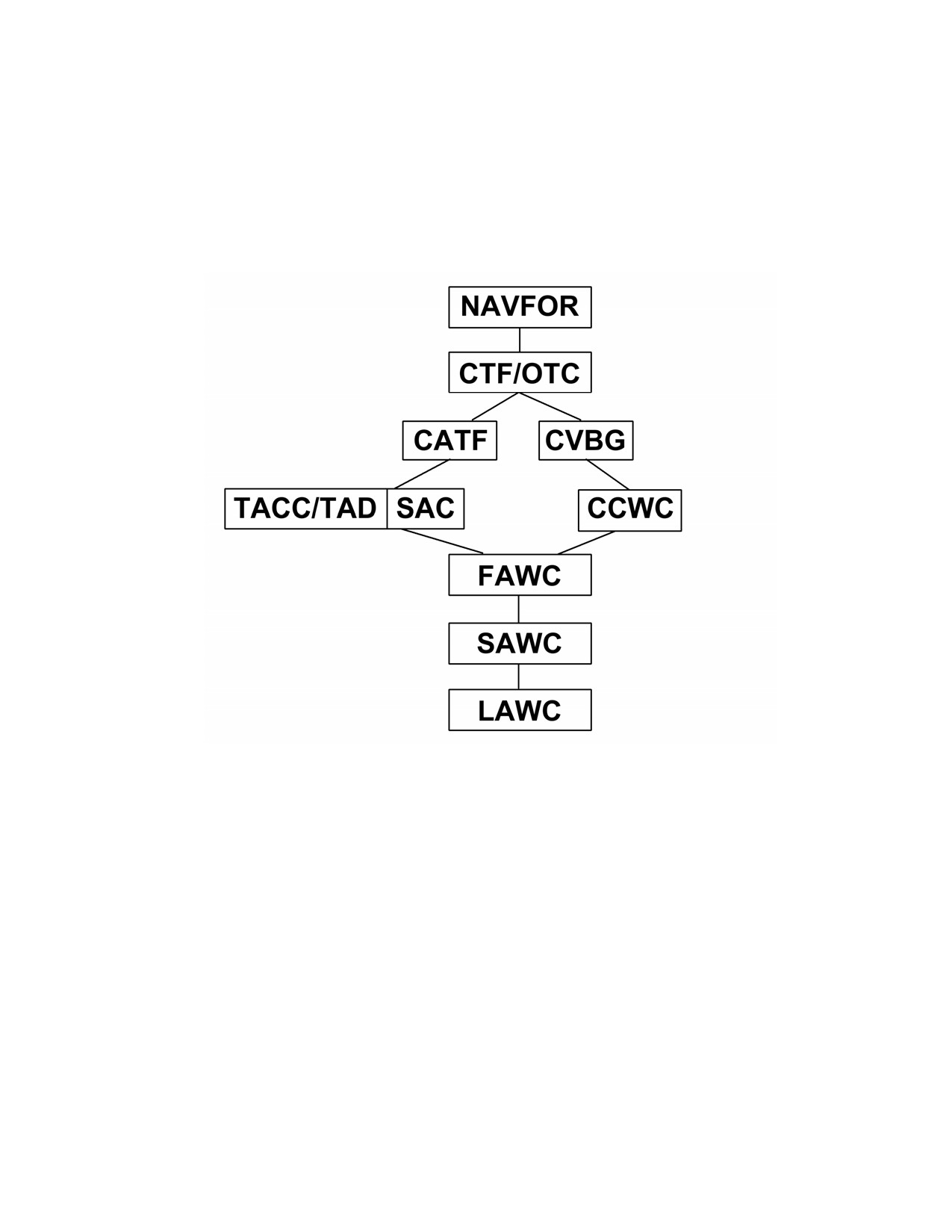
(1) Carrier: CWCCVBG/ CDCcarrier ATC center (CATCC).
(2) Amphib: CWCTACC/CDC amphibious ATC center (AATCC).
(3) (War fighting/Airspace Control)ATC coordination
d. Because of these key links, any ATC coordination and control can use the same
channels of communication within a JTF that the war fighting C2 uses.
Figure D-1 Navy Tactical Air Control System
7. Navy POCs
e. PHIBGRU 2; 2600 Tarawa Court, Building 1602; NAB Little Creek; Norfolk, VA
23521; (757) 462-7403; DSN 253-7403.
D-11