FM 3-52.3 JATC MULTI-SERVICE PROCEDURES FOR JOINT AIR TRAFFIC CONTROL (JULY 2003) - page 1
*FM 3-52.3 (FM 100-104)
*MCRP 3-25A
*NTTP 3-56.3
*AFTTP(I) 3-2.23
FM 3-52.3
US Army Training and Doctrine Command
Fort Monroe, Virginia
MCRP 3-25A
Marine Corps Combat Development Command
Quantico, Virginia
NTTP 3-56.3
Navy Warfare Development Command
Newport, Rhode Island
AFTTP(I) 3-2.23
Headquarters Air Force Doctrine Center
Maxwell Air Force Base, Alabama
17 July 2003
JATC
MULTI-SERVICE PROCEDURES
FOR JOINT AIR TRAFFIC CONTROL
TABLE OF CONTENTS
Page
EXECUTIVE SUMMARY
VIII
CHAPTER I
PLANNING
I-1
Background
I-1
Command and Control Relationships
I-1
Suggested Organization
I-3
Planning Considerations
I-6
CHAPTER II
INITIAL DEPLOYMENT
II-1
Background
II-1
Initial Entry Planning Considerations
II-1
Initial Operations
II-1
Transition to Sustained Operations
II-4
CHAPTER III
AIR TRAFFIC CONTROL TRANSITION OPERATIONS
III-1
Background
III-1
* This publication supersedes FM 100-104, MCRP 3-25A, NWP 3-56.3, and AFTTP(I) 3-2.23, dated 25 January 1999.
iv
Forces and timelines
III-1
Transfer of Control
III-1
Example of Air Traffic Control Transition
III-2
Additional Considerations
III-3
CHAPTER IV
SUSTAINMENT OF AIR TRAFFIC CONTROL
OPERATIONS
IV-1
Background
IV-1
Sustained Operations
IV-1
End of Operations
IV-2
APPENDIX A
AIR FORCE AIR TRAFFIC CONTROL
A-1
Doctrine
A-1
Forces
A-1
Training
A-2
Air Force ATC Duties and Command and Control
Relationships
A-3
Future Plans
A-5
Deployed locations
A-6
Air Force ATC Points of Contact
A-6
APPENDIX B
ARMY TACTICAL AIR TRAFFIC SERVICES
B-1
Mission
B-1
Doctrine
B-1
Army Air Traffic Controllers Training
B-1
Organization
B-2
Communications Architecture
B-4
Tactical ATS Points of Contact
B-7
APPENDIX C
MARINE CORPS AIR TRAFFIC CONTROL
C-1
Doctrine
C-1
Capabilities
C-4
Functions
C-5
Employment
C-5
Expeditionary operations
C-7
ATC Detachment Equipment
C-8
Training and Proficiency
C-8
Planning
C-10
Equipment selection and siting considerations
C-16
Points of Contact
C-17
APPENDIX D
NAVY AIR TRAFFIC CONTROL
D-1
Doctrine
D-1
Forces
D-2
Training
D-4
Navy Tactical Air Control Squadron Operating Positions
D-5
v
Tactical Air Control Squadron Required Operational
Capabilities
D-7
Navy ATC Duties, Responsibilities, and C2 Relationships
D-10
Navy POCs
D-11
APPENDIX E
AIR TRAFFIC CONTROL EQUIPMENT
E-1
Army ATC Equipment
E-1
Marine ATC Equipment
E-4
Navy Amphibious ATC Equipment
E-9
General Purpose Air Force ATC Equipment
E-10
Communications Capabilities
E-23
APPENDIX F
SAMPLE ATC HANDOVER CHECKLIST
F-1
APPENDIX G
SAMPLE NOTICE TO AIRMEN
G-1
APPENDIX H
SAMPLE LETTER OF AGREEMENT
H-1
REFERENCES
............................................................................................ Reference-1
GLOSSARY
..............................................................................................Glossary-1
INDEX
.................................................................................................... Index-1
FIGURES
Figure I-1 Example Regional Air Movement Control Center
Manning
I-5
Figure II-1 Scenario With Example Timeline for Initial ATC
Capability
II-2
Figure III-1 Scenario With Transition to Sustained ATC
Operations
III-2
Figure III-2 Planners' Transition Checklist
III-3
Figure IV-1 Sustainment Options
IV-2
Figure A-1 Air Force ATC Structure
A-3
Figure A-2 Special Tactics Squadron C2 Structure (SOF
JATC)
A-5
Figure B-1 A2C2 Cell/AIC Cell Support to Division/Corps
B-4
Figure B-2 Army Tactical ATS Architecture
B-6
Figure C-1 Marine Air Control Group Subordinate Agencies
and Detachments
C-2
Figure C-2 Marine Air Command and Control System
(MACCS)
C-3
Figure D-1 Navy Tactical Air Control System
D-11
Figure E-1 AN/MSN-7 Tower Restoral Vehicle
E-14
Figure E-2 AN/MPN-26 Mobile Air Traffic Control System
E-20
vi
TABLES
Table I-1 JATC Planning Considerations
I-9
Table I-2 Service ATC Capabilities
I-10
Table II-1 Initial JATC Capabilities
II-3
Table III-1 Service Capabilities to Transition to Sustained
JATC Operations
III-4
Table A-1 Air Force ATC Special Experience Identifiers
(SEI)
A-2
Table A-2 Air Force Specialty Codes (AFSC) Referenced in
JATC MTTP
A-3
Table B-1 Army ATC Skill Identifiers
B-2
Table B-2 Army Communications Capabilities
B-7
Table C-9 Marine ATC Military Occupational Specialties
(MOS)
C-9
Table D-1 US Navy ATC Naval Experience Codes
D-5
Table E-1 AMPHIBIOUS ATC EQUIPMENT
E-10
Table E-2 Service-Specific Communications Capabilities
E-23
vii
EXECUTIVE SUMMARY
JATC
Multi-Service Tactics, Techniques, and
Procedures for Joint Air Traffic Control
• Provides basic background information on JATC operations
• Outlines the duties, responsibilities, and command and control relationships that
influence JATC operations and handover procedures
• Illustrates how Service ATC forces are deployed and employed to perform ATC
operations
• Describes how Service ATC forces conduct ATC during initial, transition, and
sustained operations, and provides example timelines
• Outlines how to synchronize and integrate JATC forces within the theater or AOR
• Explains how to integrate the Services’ ATC equipment and ATC force
• Describes each Service’s ATC doctrine, forces, capabilities, training, and
equipment used to perform JATC operations and any additional information and
considerations deemed appropriate by individual Services
Joint force planners must understand the elements of each Service’s ATC capabilities
and be able to synchronize and integrate them to effectively support the joint force
commander’s requirements. A general understanding of how these forces fit into the flow of
a developing theater is required to execute this responsibility. This publication provides
the Service-unique information a planner requires in order to employ air traffic services
(ATS) in a joint environment. Included are considerations and checklists for planning and
executing ATC services during the initial, transition, and sustained phases of operation.
Planning
Chapter I addresses organization modifications; specifically of primary importance is
the suggested establishment of an Airspace Integration Entity (specialty team or cell) and a
Regional Air Movement Control Center (RAMCC)(especially for nations with a non-
functioning civil ATC system) to ensure ATC issues are handled competently. It also
details the command and control relationships and planning considerations for tasking ATC
capabilities of all four Services, and includes a snapshot of their capabilities. Finally, the
chapter details planning considerations for providing instrument navigational aids and/or
instrument procedures within a theater or AOR.
Initial Deployment
Chapter II describes how individual Service’s ATC capabilities are initially employed in
the joint environment. It discusses that, unlike flight operations, where aircraft from
several Services may share an airfield, the ATC support is normally provided by a single
viii
Service. Also, the individual Services have not previously pursued joint ATC operations
doctrine and efficiencies, which may produce enhanced capabilities and improved flight
safety resulting from the combination of multi-Service ATC functions when feasible. It
recommends that, now, due to strains in manning, equipment, and mission requirements,
the joint planners/multi-Service ATC community should consider joint ATC operations.
The chapter also provides planning considerations, Service initial capabilities, and an
example scenario for initial ATC operations.
Air Traffic Control Transition Operations
Chapter III describes transitional ATC operations conducted from the time the initial
entry ATC resources require replacement, replenishment, augmentation, or upgrade of ATC
services until the time that sustainment ATC forces are established. It provides an
example transition timeline, transition checklists, Service transition capabilities, and
considerations.
Sustainment of Air Traffic Control Operations
Chapter IV covers sustained, long-term ATC operations, through termination of ATC
services and end-state considerations. It includes considerations for synchronization,
integration, and interoperability of ATC forces within the theater or AOR.
Service Doctrine, Forces, Capabilities, Training, Equipment, etc., and
Examples
The appendices provide details on the four Services’ ATC doctrine, forces, capabilities,
equipment, and training, as well as helpful example checklists and documents. The
appendices provide a baseline understanding of component capabilities for conducting ATC
operations in a joint environment by providing a description of:
• The doctrinal framework which each Service uses to execute JATC operations
• The Service-specific forces capable of deploying and executing JATC operations
• The Service-specific equipment and systems used to control air traffic in the
theater or AOR
• The specific ATC organizations and capabilities each Service has available
• The training each Service provides for ATC personnel
• Additional information and considerations deemed appropriate by individual
Services
• ATC operations handover checklists
• Sample NOTAMs
• Memorandum/Letter of Agreement
ix
PROGRAM PARTICIPANTS
The following commands and agencies participated in the development of this
publication:
Joint
US Transportation Command, Scott AFB, IL
Army
US Army Training and Doctrine Command, DCSDCS (ATDO-A), Ft Monroe, VA
US Army Aviation Center, Directorate of Combat Developments (ATZQ-CD), Ft
Rucker, AL
US Army Air Traffic Services Command (Provisional) (AFATS-C), Ft McPherson,
GA
Marine Corps
Marine Corps Combat Development Command, Joint Doctrine Br (C427), Quantico,
VA
Marine Aviation Weapons and Tactics Squadron 1, C-3 MATC Division, Yuma AZ
Navy
Commander, Navy Warfare Development Command, Newport, RI
Commander, Tactical Air Control Group 2, NAB Little Creek, Norfolk, VA
Commander, Tactical Air Control Squadron 22, NAB Little Creek, Norfolk, VA
Air Force
Air Force Doctrine Center, Detachment 1, Langley AFB, VA
Headquarters Air Combat Command (DOR), Langley AFB, VA
Headquarters Air Force Special Operations Command (DOOF), Hurlburt Field, FL
Headquarters United States Air Force (XOOS), Washington, DC
720th Special Tactics Group, Hurlburt Field, FL
Air Force Flight Standard Agency, Andrews AFB, MD
Aerospace Command and Control Agency, Langley AFB, VA
Air National Guard
Headquarters Air National Guard (C4A), Washington, DC
x
Chapter I
PLANNING
1. Background
a. When planning the deployment of air traffic services (ATS), it is crucial for a joint
planner to know the condition and capabilities of airfields, navigational aids, airspace
considerations, and other air traffic control (ATC) resources in the area of operations (AO).
This information enables the joint force planner to determine the types and mix of assets
required to support initial operations up until the time in which a full ATC sustainment
package is deployed.
b. This chapter details the command and control (C2) relationships and planning
considerations for tasking ATC capabilities of all four Services and includes a snapshot of
their capabilities for conducting joint air traffic control (JATC).
2. Command and Control Relationships
a. Relationships. The following guidance outlines duties and responsibilities during a
joint operation. Discussion of an airspace integration entity (specialty team or cell) and a
RAMCC will be covered in section 3.
(1) Combatant Commander: The Combatant Commander’s joint forces air
component commander (JFACC) determines initial ATC requirements at specific
deployment locations based upon the operational requirements.
(2) Joint Force Commander (JFC). A general term applied to a combatant
commander, subunified commander, or joint task force (JTF) commander authorized to
exercise combatant command (command authority) or operational control over a joint force
(Joint Publication [JP] 1-02). In addition, the JFC exercises operational control (OPCON)
over assigned forces, and normally over attached forces, to include ATC forces. The JFC
directs employment of ATC assets and handoff of responsibility from one unit to another
(single Service, joint, multinational [coalition or allied], or host nation) through the airspace
control plan (ACP), published by the airspace control authority (ACA). Additionally, the
JFC establishes requirements for liaisons in inter-Service, coalition, and host nation
facilities.
(3) Joint Force Air Component Commander . The commander, within a unified
command, subordinate unified command, or joint task force responsible to the establishing
commander for making recommendations on the proper employment of assigned, attached,
and/or made available for tasking air forces; planning and coordinating air operations; or
accomplishing such operational missions as may be assigned. The JFACC is given the
authority necessary to accomplish missions and tasks assigned by the establishing
commander. (JP 1-02)
(4) Airspace Control Authority. The commander designated to assume overall
responsibility for the operation of airspace control system in the airspace control area (JP 1-
02). When the JFC designates a JFACC, the JFACC normally assumes ACA
responsibilities since airspace control is an integral part of joint air operations. As the
designated commander for joint air operations, the responsibility for planning,
coordinating, and developing airspace control procedures and operating an airspace control
I-1
system also rests with the JFACC. When the situation dictates, the JFC may designate a
separate ACA. In those joint operations where separate commanders are required and
designated, close coordination between the JFACC and ACA is essential for unity of effort,
prevention of fratricide, and deconfliction of joint air operations (JP 3-30). Broad
responsibilities include coordinating and integrating the use of the airspace control area,
establishing an airspace control system (ACS), and developing the ACP and implementing
it through the airspace control order (ACO), which must be complied with by all
components. Additionally, the JFACC should coordinate with ICAO to plan for and ensure
deconfliction of flights by civilian aircraft within or near the combat zone. This
coordination is critical to enhance aviation safety for military aircraft and aircraft from
humanitarian assistance (HA) and other international organization/non-governmental
organization (IO/NGO) sponsored flights. ACA activities are conducted with JFC guidance
and with J-3 authority. All missions are subject to the ACO; however, centralized direction
by the ACA does not imply OPCON or tactical control (TACON) over any air assets. The
ACA promulgates JFC requirements, plans, and tasks for ATC units through the ACP and
ACO (see discussion on ACP and ACO, below).
(5) Air Operations Center (AOC). The principal air operations installation from
which aircraft and air warning functions of combat air operations are directed, controlled,
and executed. It is the senior agency of the Air Force Component Commander from which
command and control of air operations are coordinated with other components and Services.
(JP 1-02).
(6) Functional Component Command. A command normally, but not necessarily,
composed of forces of two or more Military Departments that may be established across the
range of military operations to perform particular operational missions that may be of short
duration or may extend over a period of time (JP 1-02).
(7) Service Component Command. A command consisting of the Service component
commander and all those Service forces, such as individuals, units, detachments,
organizations, and installations under that command, including the support forces that
have been assigned to a combatant command or further assigned to a subordinate unified
command or JTF (JP 1-02). The Service component command retains TACON of component
forces and advises JFC on employment of component forces and direction and control of
those forces. Service component command functions include:
(a) Coordinating and deconflicting the employment of assigned and attached
forces with other subordinate commands as required by the operational situation.
(b) Providing ATC in areas designated by the ACA in accordance with
directives and/or procedures in the ACP.
(c) Developing detailed ATC instructions, plans, and procedures in accordance
with guidance in the ACP.
(d) Providing necessary facilities and personnel for ATC in assigned areas of
operations and identifies these facilities and personnel to the ACA for inclusion in the ACP.
(e) Providing ATC liaisons to the other components to ensure component
capabilities, limitations, needs, and desires are considered in planning and execution at all
levels of C2.
I-2
(8) Component Liaison Elements. The component liaison elements to the JFACC
(for example, the special operations liaison element [SOLE], the battlefield coordination
detachment [BCD], naval and amphibious liaison element [NALE], and the Marine liaison
officer (MARLO)), may also provide representation to the ACA if the JFACC has been
designated the ACA by the JFC or is collocated in the joint air operations center (JAOC)
(For simplicity, combined air operations center [CAOC] will be used in this publication from
this point forward to represent any such unit to include a joint air operations center or
simply an air operations center). Otherwise, additional liaison elements may be required.
All components are not required to send a liaison to the control reporting center (CRC).
(9) ATC Unit. This unit provides ATC service to aircraft operating within airspace
defined in the ACP. The unit develops local operating procedures in accordance with ICAO,
Federal Aviation Administration (FAA), host nation, Service-specific, and joint directives,
as well as the ACP, air tasking order (ATO), ACO, and other applicable ACA/JFC
instructions. The unit is also responsible for coordinating and establishing communication
links with adjacent air defense units and fire support elements to ensure identification
criteria are implemented in accordance with standing directives and are useable and
understandable. The ATC unit also establishes procedures for interoperability with
adjacent collateral, subordinate, and superior component, joint, coalition, and host nation
ATC facilities.
b. JFC Products. The following JFC-approved products contain guidance supplemental
to ICAO, FAA, host nation, and Service specific, and joint directives:
(1) Airspace Control Plan. The document approved by the JFC that provides specific
planning guidance and procedures for the airspace control system (ACS) for the joint force
area of responsibility (AOR) and/or joint operations area (JOA) (JP 1-02). The ACP is
developed by the ACA and approved by the JFC to establish procedures for the ACS in the
joint force AOR/ JOA. The ACP must consider procedures and interfaces with the
international or regional air traffic systems necessary to effectively support air logistics,
augmenting forces, and JFC objectives. One broad area of concern for developing the ACP
is familiarity with capabilities and procedures of military and civil ATC systems. The ACP
establishes initial ATC system structure, outlines procedures for transition from peacetime
to wartime ATC operations (if required), and details procedures for handing-off ATC
responsibility from one ATC unit to another (if required). The ACP should provide
procedures to fully integrate the resources of the military ATC facility responsible for
terminal-area airspace control. ATC facilities should interface and link with ACS
communications to form a system that ensures safe efficient flow of air traffic supporting
the combat effort while permitting maximum combat flexibility.
(2) Airspace Control Order. An order implementing the airspace control plan that
provides the details of the approved requests for airspace control measures. It is published
either as part of the air tasking order or as a separate document (JP 1-02).
(3) Special Instructions (SPINS). Special instructions provide details of the
approved requests for special airspace control measures (ACM). It is published either as
part of the ATO or as a separate document.
3. Suggested Organization
a. While the four Services have extensive ATC-specific expertise, individuals with such
skills are usually not assigned to unified command staffs. Having embedded ATC expertise
I-3
in a staff can help to overcome the difficulties associated with either establishing an ATC
system where none exists or integrating an existing civil aviation structure with US and/or
coalition operations. To address these difficulties, an airspace integration entity should be
established, composed of appropriate representatives from the Service’s and/or coalition
partners involved in the operation (whether the airspace integration function is stood up as
a specialty team or cell is dependent upon both the nature of the operations and also the
recommendation of the JFACC and approval of the JFC, unless a separate ACA is
designated). Airspace integration personnel perform the key functions of ATC coordination,
airspace management, and TERPS liaison. A RAMCC may also be required (especially for
nations with a non-functioning civil ATC system). The airspace integration entity will
coordinate with the appropriate CAOC divisions (and the RAMCC, if established).
b. Airspace Integration Entity. The airspace integration entity responsibilities include
the following:
(1) Planning for the full range of ATC operations to support deliberate and crisis
action planning, deployment, employment, sustainment, and redeployment of ATC forces
(reference AFDD 2-1.7, Airspace Control in the Combat Zone, 4 Jun 1998.).
(2) Coordinating host nation integration of the civil ATC system to include host
nation agreements and international and national air traffic coordination and negotiation
of international level agreements.
(3) Collaborating with combat plans division to integrate airspace design in
development of the airspace control plan.
(4) Coordinating terminal instrument procedures (TERPS). This includes
coordinating airfield and environmental obstacle surveys, and deployable ATC and landing
system (DATCALS). This could include surveys, host nation coordination, host nation
/Jeppesen instrument procedures or review and publication of procedures.
(5) Coordinating FAA flight checks.
(6) Coordinating with ICAO, civil ATC authorities, and nongovernmental
organizations (NGOs)/private volunteer organizations for integration of humanitarian air
missions.
(7) Overseeing airspace management (ATC) personnel in the CAOC.
Note: Personnel with ATC expertise should perform airspace integration within the
CAOC. See tables A-1 for Air Force special experience identifiers (SEI), A-2
for Air Force specialty codes (AFSC), B-1 for Army skill identifiers, C-1 for
Marine military occupational specialties (MOS), and D-1 for Navy
designators and Navy enlisted codes (NECs).
I-4
c. Airspace Integration Entity (Specialty Team or Cell) recommended composition.
(1) Airspace Integration Chief. Field grade officer (O-4 to O-6) with ATC/airspace
experience (see Annex A through D for Service-specific qualification identifier codes).
Responsible for oversight of ATC Coordination and Airspace Management Cadre, TERPS,
and airspace management (ATC) personnel within the CAOC.
(2) ATC Coordination and Airspace Management Cadre. One field grade and three
to five company grade officers/ Senior NCOs. All personnel should have ATC experience
(TERPS experience desired).
(3) TERPS liaison (if required). Manning: as necessary. Usually only one in-
theater coordinator is required as most TERPS work is done at the Services and regional
offices level.
(See Para I-4.a. Terminal Instrument Procedures of this publication)
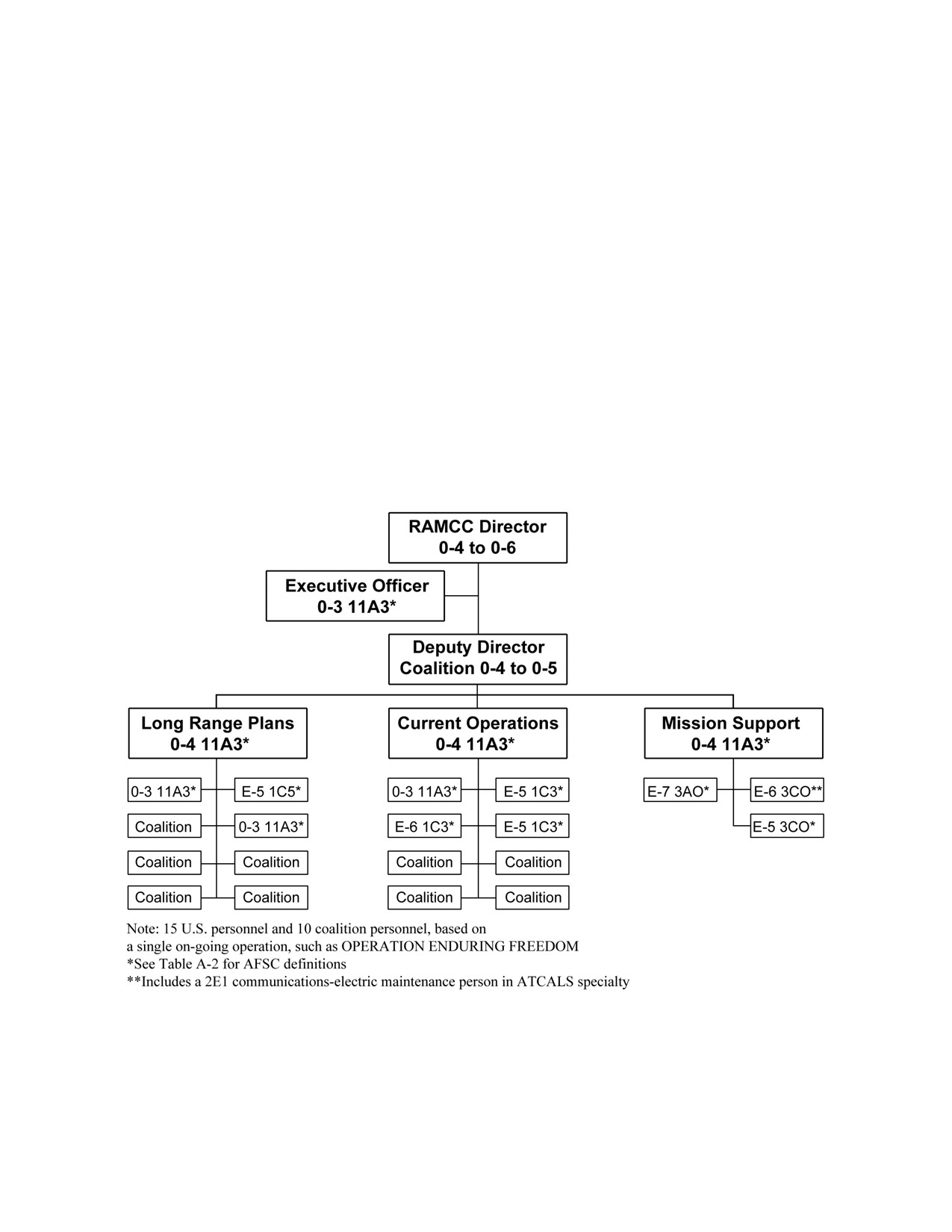
(4) RAMCC. A RAMCC may be established to provide a centralized facility to
coordinate arrival and departure times to help de-conflict both military and civilian air
traffic at designated airfields in a particular operational area. It also provides visibility on
this traffic to ground-based and airborne air control units. Figure I-1 provides a notional
organization and rank structure for a RAMCC.
Figure I-1 Example Regional Air Movement Control Center Manning
I-5
4. Planning Considerations
Many factors need to be considered before determining the type of ATC required for
mission success. At the end of this chapter, table I-1 outlines JATC planning
considerations, and table I-2 provides a snapshot of Service ATC capabilities. However, if
instrument navigational aids (NAVAIDS) and/or instrument flight rules (IFR) procedures
are necessary, the following two areas are required:
a. Terminal Instrument Procedures. Survey-qualified TERPS specialists (Marine,
Army, Air Force, and National Imagery and Mapping Agency (NIMA)) conduct/participate
in initial site surveys.
(NIMA may be able to provide geodetic control for the airfield, which
could prove valuable for Global Positioning System (GPS) precision approaches in the
future). TERPS specialists use the site survey information to develop approach procedure
packages and forward them to the appropriate higher headquarters TERPS office
responsible for the designated AOR. Authorization to use the procedures ultimately
remains with the appropriate flying operations authority and/or the commander exercising
operational control of the aircraft. During contingency operations, an in-theater TERPS
liaison may be established to develop and approve instrument procedures and scheduling
flight inspections. Ideally, this liaison will work within the airspace integration entity.
b. Flight Inspection. Flight Inspection aircraft certify instrument procedures and their
associated NAVAIDS. The flight inspections ensure the safety of NAVAIDS signals and
published instrument procedures for IFR use (especially for use during instrument
meteorological conditions (IMC) and night operations). Coordinate flight inspection aircraft
as early as possible in the planning process to ensure they are available when required.
The Air Force’s headquarters (HQ) Air Force flight standards agency (AFFSA), detachment
(Det) 1, has military flight check aircraft (C-29) and aircrews within the FAA Flight Check
Center in Oklahoma City, OK. The Army also has one flight check aircraft (C-12) based at
Ft Rucker, AL. Flight Inspection has both operational and legal ramifications. Flight
inspection of instrument procedures is required in accordance with Air Force instruction
(AFI) 11-230, Instrument Procedures, August 01; Air Force manual (AFMAN) 11-225;
United States Standard Flight Inspection Manual, January 03; (FAAO 8200.1,
NAVAIR 16-1-520, and Army TM 95-225) and Office of the Chief of Naval Operations
(OPNAV) 3722.16C, United States Standards for Terminal Instrument Procedures, August
1993 (Army TM 95-226, FAAH 8260.3). Flight inspection verifies that the performance of
air navigation services and their associated instrument flight procedures conform to
prescribed standards documented in FAA and department of defense DOD directives, and
in Annex 10 to the Convention on ICAO. The following four options reflect the different
degrees of flight inspection available to the JFACC (listed from higher to lower risk).
Note: Options 1 and 2 are available in cases where a flight inspection is
impossible/limited and military operations must be conducted. However,
Options 1 and 2 do not eliminate the requirement to conduct a flight
inspection. The flight inspection requirement is postponed until the situation
permits inspection in accordance with (IAW) Options 3 or 4.
(1) Option 1. Approval without Flight Inspection. Commanders have the final
authority and responsibility for accomplishing their assigned mission. If the military
situation dictates, the JFC may approve the use of a NAVAIDS/approach without a flight
inspection (see Note above). This can be approved only for military aircraft under the JFC
OPCON. Aircrews who fly the procedures should be advised that flight inspection
I-6
certification has not been accomplished, and the instrument procedures should be labeled
and limited to those aircrews specifically authorized. Other aircraft (FAA/Civil Reserve Air
Fleet (CRAF)/ICAO, etc.) would not be authorized to use the procedure.
(2) Option 2. Military Emergency Flight Inspection. In accordance with AFMAN
11-225, when it is deemed necessary by military authorities the abbreviated flight
inspection procedures of Section 109 may be used. However, as soon as the conditions
allow, the NAVAIDS and instrument procedures must be re-inspected using normal
procedures and tolerances. The JFC may approve the use of Section 109 abbreviated flight
inspection procedures. For additional flexibility, radar approaches and certain new
instrument procedures may be certified using a local military aircraft with a flight
inspector riding on the flight deck. This option is intended to permit a commander to
continue flight operations while waiting for a restricted or normal commissioning inspection
(see Note below). This inspection will allow a theater commander to have temporary IFR
capability for aircraft under OPCON of the JFC/JFACC. However, other aircraft
(FAA/CRAF/ICAO, etc.) may be authorized to use the facility at the discretion of the JFC.
Note: Nearly all flight inspections must be performed during daylight hours and
require visual meteorological conditions (VMC) weather. An inspection of a
single NAVAID normally takes ½ day and 1 sortie to complete.
(3) Option 3. Restricted Facility Commissioning. This inspection certifies the
facility using normal procedures, but only to the extent necessary to support a minimal
number of IFR approach procedures. Optimally it will take 1 day and 2 sorties (in VMC
weather) to complete. The restricted facility commissioning inspection permits use by any
aircraft. Areas that are evaluated to be acceptable are certified for use, and the remaining
areas/procedures not evaluated are restricted. The local (deployed) airfield operations/ATC
manager will publish the restrictions in appropriate NOTAM.
(4) Option 4. Normal Commissioning. This is the certification of all procedures
(arrival/approach/departure) and areas of NAVAID coverage. Optimally this inspection
takes 2 to 3 days and 4 to 5 sorties (VMC weather) to complete. This inspection is required
for full use by DOD, CRAF, FAA, and ICAO aircraft.
c. Flight Inspection Bed Down. Specific UTC for deliberate planning exist to task and
deploy flight inspection assets if a long-term inspection capability is deemed necessary. If a
limited number of flight inspections are required, or inspections will be infrequent, the
requirement can be tasked via a message to the FAA and HQ AFFSA. Notification of
possible tasking is encouraged and may be made via telephone to AFFSA Det 1, collocated
with the FAA International Flight Inspection Office in Oklahoma City, OK. The FAA can
supply mobility readiness spares package (MRSP) equipment for operations, but depends
upon the military for airlift. For contingency operations, aircraft maintenance support
should be located outside hostile areas with an optimum bed-down location within 300
miles of airfields to be flight inspected. The requesting ATC representative must provide
approach procedures packages, NAVAID facility data, and specific airfield site survey data
to flight inspection aircrews, the FAA International Flight Inspection Office in Oklahoma
City, OK and the flight inspection liaison at the CAOC, before flight inspection can begin.
I-7
Note: Details on tasking flight inspection assets, including FAA contact procedures,
can be found in AFMAN 13-220. Deployment of airfield Operations, 1997.
The FAA office responsible for flight inspection is Aviation System Standards
(AVN) based at the Mike Monroney Aeronautical Center in Oklahoma City,
OK.
d. Distribution of Approaches. The AOR TERPS office completes the TERPS database
using survey information and develops an approach procedure. The developed approach
procedure is transmitted to the airfield for flyability check/flight inspection as required.
Based on results of flyability check/flight inspection, and if required, JFACC approval, the
AOR TERPS office disseminates the completed procedure(s) to theater aircrews through
various means.
Note: Procedures developed by the AOR TERPS office only apply to aircraft under
operational control of the JFC (after his approval) until a flight inspection
can be accomplished (see AFMAN 11-225, Section 109 and FAAO 8200.1 for
flight inspection requirements).
I-8

Table I-1 JATC Planning Considerations
JATC Planning Considerations
Length of Operation
[Initial Operations] Short duration (<14 days)
- Consider STS, TACT, MMT (man portable capability), NOTAM dissemination
[Transitional] Mid-term (<180 days)
- Service ATC unit rotations
[Sustainment] Long-term (>180 days)
- Service ATC taskings, coalition ATC units, contract services
Type of Operations
Main base, FOB, FARP, equipment, reliability, back-up capability, communications
connectivity, etc., drives need for robustness
Complexity of Area
Mixture and volume of existing civilian structure, services, navigational aides
Type/Density of Traffic
__ Rotary, fixed-wing, UAVs
__ Primary users: SOF, Fighters, Cargo, ISR, Fueling, unique
__ Civilian, coalition, humanitarian (What avionics are aboard the using aircraft?)
Type of Service
(VFR/IFR) Radar/non-radar, terminal, precision/non-precision approaches, en route,
overflight traffic
Future Mission of Base
Will base transition to different use with different Service/equipment requirements?
(i.e. humanitarian relief)
Environment
Permissive/non-permissive, terrain (mountainous/flat), climatology (VMC, IMC,
winds, temperature/density altitude)
Adjacent Nation ATC
Does existing adjacent nation capability meet mission needs? Can adjacent nations
Capabilities
provide en route services? Does political will/host nation agreements allow
usage?(Also drives the number of ATC liaison requirements)
Interface Between Terminal
Who can provide en route support? Naval assets? Adjacent nations? Airborne
and En Route ATC Systems
assets?
Base Operations Support
Equipment support: power, protection, supply, maintenance personnel support:
billeting, security, medical, food/water
Host Nation Airspace/ATC
Airfields and areas approved for use (or restricted); Agreements with adjoining
Agreements/Directives
nations/ICAO; Determine regulatory guidance to be used by ATC (common
operating procedures? ICAO? FAA? other?)
Existing Host Nation
Equipment, reliability, backup capability; Ability and confidence of host nation
Capabilities/Procedures
controller and pilot skills & language ability; Are existing procedures acceptable?
Existing Site Surveys
(refer to Services/coalition/MAJCOMS or air staff databases)
Frequency Requirements
Requesting timelines, radio, radar, NAVAIDs, nets, etc.
Airfield Lighting
Night time and IFR services require airfield lighting
Redeployment of Air Traffic
Recommended practice is to leave follow on/sustainment equipment in place (i.e.
Services(I.E. DATCALS, Etc)
DATCALS, etc.) when rotating personnel. This reduces repetitive airlift and flight
inspection requirements.
Intertheater Transportation
The process and procedures for intertheater transportation of JATC requirements
are contained in Joint Pub 4-01, "Joint Doctrine for the Defense Transportation
System."
Precision Approach
Consideration for defining whether requirement is for single or multiple precision
approach capability
Legend
FARP
forward arming and refueling point
MMT
Marine ATC mobile team
FOB
forward operation/operating base
UAV
unmanned aerial vehicle
STS
special tactics squadron
ISR
intelligence, surveillance, and
TACT
tactical aviation control team
reconnaissance
I-9

Table I-2 Service ATC Capabilities
Air Traffic Control Capabilities
Service
TERPS
Day
Tactical
Limited
Airfield
Airfield
Full IFR
Site
TERPS
/Night
Airfield
IFR
PAR5
Managem
Survey
Services4
Survey
VFR4
Lighting
Services4
ent
Air Force1
Special Tactics
X
X2
X
X11
X6
X7,9
Teams (STT)
Combat
X
X
X
X
X
X
X8
X5
Communications
Fixed Base10
X
X
X
X
X8
X
Air National
X
X
X
X
X
X
X8
X
Guard
Army
X
X
X
X
X
X
X
Marine Corps
Marine ATC Det
X
X
X
X
X11
X
X
X
X
Marine ATC
Mobile Team
X
X2
X
X11
X6
X7
(MMT)
Navy
X3
X3
X3
X3
X9
1 TERPS specialists (Air Force SEI 361) should also be used to conduct site surveys. If possible, utilize the same personnel
for the survey and to build the approaches.
2 Basic airfield survey done during initial entry phase, which is not a formal site survey that may be used to gather data for
TERPS certified approaches.
3 Navy AATCC’s/TACC’s aboard LHA/LHD class ships primarily provide ATC services to aircraft in support of the
amphibious force and have the capability to provide approach control services to land-based satellite airports. TACRONs
are capable of temporarily staffing (or augmenting) and operating shore-based ATC facilities.
4 Requires tactical airfield lighting or operational host nation lighting or aircrew NVG systems are required.
5 Airfield management services at austere locations may be provided by Air Mobility Command (AMC) Tanker-Airlift Control
Element (TALCE).
6 Limited to TACAN, NDB, or MMLS systems. No approach control or precision approach radar (PAR) functions. May be
limited to non-radar operations that may hamper operational tempo.
7 Limited to tactical airfield markings, lighting, runway surveillance, and landing surface evaluations.
8 Air Force PAR controllers require SEI 365 and must be tasked accordingly to ensure qualified controllers are deployed.
9 Air Force airfield management personnel are tasked by the same command authority as ATC personnel. Navy controllers
are qualified in both specialties.
10 Fixed-base UTCs consist of personnel only that normally join with Air Force Combat Communications equipment in the
forward area or may be tailored (TPFDD) to work in host nation or inter-Service facilities.
11 STS and MMT carry man portable, battery operated, short duration, airfield lighting (all others require tactical lighting
systems or operational host-nation systems).
I-10
Chapter II
INITIAL DEPLOYMENT
1. Background
This chapter describes how individual Services’ ATC capabilities are initially
employed in the joint environment. Unlike flight operations, where aircraft from
several Services may share an airfield, a single Service normally provides the ATC
support. The individual Services have not previously pursued joint ATC doctrine and
efficiencies, which could produce enhanced capabilities and improved flight safety,
resulting from the combination of multi-Service ATC functions when feasible. The joint
planners/multi-Service ATC communities need to consider joint ATC functions due to
manning, equipment, and mission requirements. This chapter discusses the initial
deployment of ATC assets.
2. Initial Entry Planning Considerations
a. In the preplanning or during the initial process of implementing the JTF
commander’s decisions, the following are considerations for the joint planner: A team
from the Air Force special tactics squadron (STS), Marine ATC mobile team (MMT), a
full Marine ATC Det, or an Army tactical aviation control team (TACT) must conduct an
initial deployment assessment, preferably on-site. Then a determination of the required
force mix must be made. Minimal airfield operations and ATC services should be
provided until sustaining DATCALS arrive. Small, lightweight, minimum capability
and highly mobile packages will provide initial VFR or limited (procedural control
rather than positive control) IFR ATC. Airborne deployed fighting forces and
supporting units deploying in initial phases of a crisis should be self-sufficient, bringing
enough food, water, shelter, etc. for up to 72 hours. After this time, the ATC forces will
require resupply and/or augmentation controllers to continue operations. These initial
ATC assets may or may not remain at the location after initial deployment airflow is
complete.
b. The initial entry phase would normally end with sustainment or transition ATC
forces deploying to relieve initial ATC forces, usually providing greater or more robust
airfield capability in the process. The joint planner must consider resources required to
support a transition period if sustainment assets are not available to relieve the initial
deployment capability. Requirements of higher priority forces may delay the arrival of
sustainment ATC assets. Reliance on the initially deployed ATC asset delays the full
capability of an airfield until the more robust sustainment package arrives in theater.
The paradox is that the equipment required to provide full IFR capability is airlift
intensive.
3. Initial Operations
a. For the purposes of this publication and the timeline demonstration scenario
(figure II-1), initial entry is defined as military actions required to airland forces with
inter- or intra-theater airlift to meet the JFC’s strategic or operational objectives.
Initial entry starts with deployment of ATC assets into an airfield through opposed or
unopposed entry. This deployment could be accomplished through use of surface,
amphibious, airborne, airland, or heliborne operations.
II-1

b. The Army, Marine Corps, and Air Force have the capability of providing an
initial airfield ATC capability, either stand-alone or jointly. Initial ATC forces are
normally short duration and require follow-on sustainment (<14 days). As an example,
a scenario is provided in figure II-1 to illustrate a notional timeline for initial stand-up
of an ATC capability at a bare base airfield.
Example Scenario: Establish IFR-Capable Airfield for Inter-theater & Theater Airlift
Timeline
ATC Services/Actions
D-72 to
H
1 HR
TBD
5
5-12
12-24
24
48
72
12HRS
HOUR
HRS
HRS
HRS
HRS
HRS
HRS
Initial Forces (STS, MMT,
X
TACT) Alerted
Gather Intel
X
Forces Deploy/Employ
X
Airfield Seizure
X
Airfield Assessment, Comm
X
Established
Marking/Lights, Beacon,
X
& TACAN Operational
Airfield Ready To Receive
X, 1
Traffic
Airfield Secure w/ Light
X, 2
Hostilities
Initial Day/Night VFR ATC
X, 3
Begins
Airland Additional
X
Forces/Equipment
Airland Additional Ground
X
X
X
X
X
X
Forces/Equipment
MMLS/TACAN/NDB/GCA
X
Operational
TERPS Information
X
Forwarded
NAVAIDS/Procedures Flight
X, 4
X, 4
X, 4
Checked
AMC TALCE Arrives
X
AMC TALCE Operational
X
MMLS Approach Approved
X, 4
X, 4
X, 4
X, 4
LIMITED IFR Services
X, 4
X, 4
X, 4
X, 4
Available
1 - Determined by ATC
2 - Determined by ground forces commander (GFC)
3 - Determined jointly by ATC, GFC, and air mission commander
4 - JFC risk acceptance, flyability check, or FAA flight check required
Figure II-1 Scenario With Example Timeline for Initial ATC Capability
c. General Capabilities. All Services have initial ATC radio communications
deployment capability. The initially deployable ATC systems/DATCALS limit the
airfield IFR capability. These systems are matched to very specific aircraft systems
such as the TACAN, the Marine Corps’ ARA-63 airborne radar, the Army nondirectional
beacon (NDB), or the Air Force mobile microwave landing system (MMLS). The Marine
Corps and Air Force special tactics teams (STT) have packable/portable airfield lighting
systems organic to their units, allowing them to provide a complete initial airfield-
II-2

operating package. Coordinate the layout of the deployed tactical airfield lighting and
marking patterns among the initial ATC unit and follow-on aircrews to ensure the
arriving aircrews have the equipment and familiarity with the set marking patterns
(Reference AFI 13-217, or Marine ATC Mobile Team Tactical Standard Operating
Procedures [MMT TACSOP]).
(1) Subsequent replacement or augmentation should occur within approximately
14 days for the initially-deployed ATC forces. Contingency planners should program
ATC transition packages carefully because deployment of sustainment ATC forces for
both the Air Force and Marines require significant airlift assets and may not be a high
priority in the air flow or time-phased force and deployment data (TPFDD). For
example, if initial entry forces need airport surveillance radar (ASR) or precision
approach radar (PAR) early in the entry, the Army radar system is the most compact
and capable of early deployment. On initial entry, Army ATC forces are capable of VFR
(tower)/IFR NDB airfield operations.
(2) Table II-1 provides a quick reference of individual Service’s initial
capabilities. Paragraphs d through g explain individual Services’ capabilities in greater
detail.
Table II-1 Initial JATC Capabilities
Service
Voice Communication
Visual
Limited
VHF
UHF
FM
Deployable
Runway
Flight
Instrument
(Secure)
(Secure)
(Secure)
NAVAIDS
Lighting
Rules
Flight Rules
(VFR)
(IFR)
Army
YES
YES
YES
NDB
NO
YES
YES
Air
YES
YES
YES
MMLS,
YES
YES
YES
Force
TACAN
Marine
YES
YES
YES
MRAALS,
YES
YES
YES
TACAN
d. Air Force Special Tactics Teams. Although all Services are capable of providing
an initial ATC capability, Air Force STT are highly trained and specifically equipped to
provide initial airfield operations for inter- and intra-theater airlift in a joint
environment. Another Service’s initial ATC capability can augment Air Force STT,
depending on the method of insertion and type of aircraft in the airflow.
(1) Air Force STT will be organized under the OPCON of the Special Operations
Command or TACON to the JFACC. When these forces are air-dropped into the
objective area, security forces will secure the area and the Air Force STT will initiate
setup of the communications, runway lighting system, tactical air navigation (TACAN),
MMLS, and initiate the TERPS process for the landing zone/airfield. To complete the
process of preparing for air operations, the responsible authority must determine the
acceptable level of risk. Once the Air Force STT establishes the airfield and the ground
forces commander determines the area is secure (acceptable risk level), airland
operations may begin.
e. Marine ATC Mobile Team. MMTs are trained and equipped to provide initial
rapid response ATC. One MMT is available for direct deployment to the AO from each
continental United States (CONUS) base and each Marine Expeditionary Unit (MEU).
II-3
While all MEUs are usually highly trained, most also receive additional training to be
designated as special operations capable (SOC). MMTs will establish landing
zones/airfields in accordance with established doctrine. MMTs are self-sustaining for up
to 72 hours without re-supply. Rotary-wing, fixed-wing, or surface vehicles can insert
the MMT. MMTs can provide NAVAID capabilities in the form of a man portable
TACAN and/or the Marine Remote Area Automatic Landing System (MRAALS) (see
appendix E for descriptions). The team gathers initial data for TERPS development for
possible transitional and sustainment operations. MMTs attached to the MEU(SOC)
remain TACON to the MEU(SOC) commander, while teams activated directly to the AO
will be TACON to the senior Marine/joint air control agency.
f. Army Tactical Aviation Control Team. Army ATC forces can integrate into
either the initial entry forces or during the transition period, based on special
requirements in the initial entry or based on the need to prepare for forward
deployment of Army forces (ARFOR) arriving after the landing zone (LZ)/airfield is
established. TACTs are capable of providing non-precision approaches and VFR ATC
functions. They are also capable of airdropping into the objective area and
simultaneously assisting in the TERPS and establishment of a LZ/airfield. The Army
alone could not provide a limited-IFR airfield capability for other Services’ aircraft
without significant resourcing from another Service for equipment such as runway
lighting and airfield marking. Army ATC forces can establish an instrumented airfield
with limited fixed-wing capability using only organic equipment.
g. Navy Tactical Air Control Squadron (TACRON): During the initial entry phase,
Navy TACRON controllers perform their duties aboard the amphibious flagship for
operations in direct support of amphibious force operations. They are responsible for
providing centralized command, control, planning, and coordination of all air support
and airspace required for amphibious operations. Navy TACRON control continues
until control is passed ashore, normally to a Marine direct air support center (DASC).
TACRONs maintain the capability to temporarily staff and operate an existing ATC
facility ashore or augment a remote facility ashore with personnel to control air traffic
during the sustained operations phase.
4. Transition to Sustained Operations
Transitioning to sustained operations may require additional personnel and
equipment to supplement the initially deployed capabilities, such as providing a positive
control IFR capability or dual runway precision approach capability. The sustained
operations plan should consider requirements for full base airfield operations support
for an extended period of time. A full range of terminal (including mobile control tower),
ASR, precision landing capabilities, and/or NAVAIDS, and transmission medium
equipment is normally included for the sustained operations phase. Airfield
management augmentation personnel, normally from CONUS bases, are required for a
transition to sustained operations. Chapters 3 and 4 identify planning considerations
for transition and sustained operations.
II-4
Chapter III
AIR TRAFFIC CONTROL TRANSITION OPERATIONS
1. Background
Transition operations are defined as operations during the period where the initial
entry ATC resources require replacement, replenishment, augmentation, or upgrade of
ATC services until sustainment ATC forces are established. For planning purposes,
transitional ATC operations could be for an extended period of time based on the
intended time frame of the operation or availability of airlift or sealift resources to
deploy sustainment ATC forces. Planners should consider initial entry capabilities to
meet the desired operational requirements. However, initial ATC forces will require
relief to reconstitute the initial entry capability, and to provide a sustained or more
capable conventional airfield environment.
2. Forces and timelines
The synchronization of ATC resources to produce maximum operational
effectiveness requires special attention to differences in individual Service capabilities
to ensure a smooth transition. Timelines for replacement of initial ATC forces are
situation dependent. Airborne deployed fighting forces and supporting units deploying
in initial phases of a crisis should be self-sufficient with enough food, water, shelter, etc.
for up to 72 hours. After this time, the ATC forces will require resupply and/or
augmentation controllers to continue operations.
a. Air Force STT should be relieved at approximately D+14. Air Force STT are
normally unable to conduct extended operations based on higher HQ tasking to move
forward. To ensure uninterrupted services, have transition ATC forces in place and
ready to begin assumption of responsibility for ATC by D+10 and able to relieve all
initial forces by D+30.
b. Army TACTs are force packaged and task organized. Extended ATC operations
will require minimal logistical support no later than (NLT) D+3.
c. Marine MMTs will be task organized to meet mission requirements. MMTs
attached to a MEU(SOC) will require resupply of food, water, batteries, etc. NLT D+3.
MMTs attached to a MEU(SOC) should be relieved NLT D+14 to allow reconstitution
and re-tasking. MMTs deployed directly to the AOR from CONUS will conduct
operations in preparation for transitional/sustainment operations. MMTs are the
precursor for additional ATC forces entering the AOR.
d. Update the ACO and ACP to reflect new sustainment ATC capability. If
required, release national or international NOTAMS.
3. Transfer of Control
Under ideal conditions, ATC operations will flow from initial to sustained operations
without the need for a distinct transition phase (figure III-1). Transitional ATC
operations require procedures to transfer control of operations from one ATC Service
provider to another. See appendix F for sample ATC transition checklists.
III-1

Transition to Sustained ATC Operations (Best-Case Example)
OBJECTIVE: Initial ATC Forces relieved, and more robust (IFR service) systems in place
from Air Force, Marine, or Army tactical ATC Units
ACTION
TIMELINE
3-7
8-14
15-25
45+
Days
Days
Days
Days
Sustainment ATC Forces/Equipment Arrives
X
Air Force Combat Communications
X
Marine ATC
X
Army ATC
X
Transitional ATC Begins
X
Transition to Sustainment Forces
X
Initial ATC Forces Relieved/Forward
X
Deploy/Reassigned
Sustainment NAVAIDS Operational
X
GCA/RAPCON Operational
X
PAR Operational
X
TACAN/NDB/MMLS Operational
X
PAR/GCA/TERPS Approaches Approved
X
Host Nation Resumes ATC Services
X
Sustainment ATC Redeploys
X
Figure III-1 Scenario With Transition to Sustained ATC Operations
4.
Example of Air Traffic Control Transition
The following steps demonstrate bridging the gap between the initial entry force and
the sustaining ATC force, and are built around a worst-case, medium threat, IMC
scenario example. For discussion purposes, the initial entry force has conducted a
forced entry, secured the airfield, and established limited instrument approach
procedures (Marine MMT, Air Force STT, or Army TACT could accomplish this). The
objective is to eventually land inter-theater airlift aircraft and conduct operations until
sustainment forces assume responsibility for the airfield.
a. The JFC temporarily authorizes use of instrument procedures without any flight
inspection because of mission necessity. This is accomplished using flight inspection
option 1 identified in chapter 1 (see chapter 1, section 4b).
b. Sustainment forces begin arriving within 3 to 7 days. The sustainment forces
immediately begin the transition to assume ATC responsibility. The following occurs
simultaneously (airflow dependent):
(1) New controllers are integrated into the initial ATC force’s work shifts. The
personnel immediately become familiar and certified in required ATC positions by
existing controllers.
(2) ATC management personnel use the ATC transition checklist in appendix F
to gather required information for assumption of duties.
(3) Sustainment ATC and landing systems (ATCALS) are sited and set up.
III-2

(4) Additional instrument procedures are built and all procedures and NAVAIDS
are certified for IFR use by flight inspection. JFC rescinds previous flight inspection
waiver.
c. Transition continues through D+12 as initial controller force is replaced with
new controllers. At D+13, enough sustainment controllers are certified to meet ATC
mission requirements and the ATC management personnel from both forces agree on a
final transition date of D+14. Initial ATC forces redeploy and reconstitute for follow-on
missions.
5. Additional Considerations
a. Integration and Interoperability. ATC systems are highly complex and may
require extensive research into equipment capabilities and support requirements.
Service systems are designed as stand-alone with some limited connectivity. Planners
must first identify what systems are in place and what capabilities are required. The
key to solving integration and interoperability issues lies within each Service. A limited
description of each Service's equipment is included in appendix E.
b. Additional Issues. All possible contingencies could not be incorporated into the
ATC transition scenario described in Paragraph 4, above. Some additional issues to
consider when resourcing a transition force, including planner’s checklists and Service
capabilities, can be found in figure III-2 and table III-1.
PLANNERS’ TRANSITION CHECKLIST
(Issues to consider when sourcing a transition force)
Mission
Airflow: aircraft type/volume/type of ATC service
Environment
Hostile/permissive/base support/terrain/weather
Time (airlift)
Airflow availability and timeliness
TACS Interface
ATC with air defense, AEW, WOC, etc
Host Nation
Compatibility with host nation ATC systems
ATC & NOTAM
Communication connectivity, automation, and interoperability
Interface
Transfer
ATC transition checklist
Key contacts (maintenance, communications, weather, etc)
Procedures (ATC, air defense, etc)
Airspace
Flight inspections
Communication capability/interoperability/automation
Coordination requirements/procedures with adjacent facilities
Base support
Rules of engagement (ROE)/standard operating procedures (SOP)
Equipment left behind (who will maintain it?)
What equipment is compatible/incompatible
Overlap, continuity of service
Figure III-2 Planners' Transition Checklist
III-3

Table III-1 Service Capabilities to Transition to Sustained JATC Operations
Service/System
Approach
GCA
Tower
Limitations
See appendix B
Army
X
X
See AFMAN 13-220,
Air Force
X
X
X
Deployment of Airfield
Operations, 1997
See MCWP 3-25.8,
Marine Air Traffic Control
Marine
X
X
X
Detachment Handbook,
Aug 97
III-4
Chapter IV
SUSTAINMENT OF AIR TRAFFIC CONTROL OPERATIONS
1. Background
Sustained ATC operations are defined as those operations in which sustainable ATC
forces have achieved the desired operational capability. They conclude when operations
requiring ATC services are terminated. Sustainable ATC operations can occur through
multiple venues: continuous military rotation, returning services to host nation
responsibility (which may still require US oversight, assistance or support) or through
contracted service. Establishing a sustainable ATC capability requires significant
planning to ensure appropriate resources are available to meet the JFC’s requirements.
Sustainment of airfield operations requires long-term ATC support.
2. Sustained Operations
a. Service Capabilities. Services can provide VFR and IFR service to all aircraft
through mobile control towers, radar systems, and communications connectivity. All
forces are limited by the extent they can be re-supplied/maintained. Navy shipboard
systems are only limited by the ability of the ship to remain on station, and to maintain
the operational health of its systems. Air Force and Marine ATC sustainment
equipment is extremely robust and provides complete ATC service to support a theater
airbase mission, but requires extensive airlift to deploy. Currently, the Army does not
have the capability to provide an approach control, and airfield lighting. However, the
Army can provide a fully instrumented airfield, which includes a tower and radar
services. Because of these limitations, the Army requires less airlift assets to deploy.
The fielding of the Portable Airfield Lighting System (PALS), scheduled to begin in
2005, will provide lighted landing areas on improved or unimproved airfields for fixed or
rotary-wing aircraft. Variants of the system will be fielded with the Tactical Terminal
Control System (TTCS) and Mobile Tower System (MOTS). As the Army transforms
into the interim and objective force, the fielding of new ATC systems will make Army
air traffic service (ATS) units even lighter and more capable (see appendix E).
b. Synchronization. The planning considerations for a sustained ATC operations
phase are the same as for the transition phase. Equipment availability is only one of
the major planning factors in determining the airfield/ATC capability. ATC equipment
support requirements are critical logistical considerations. Replacement parts and
trained maintenance technicians are Service-specific, and often equipment-specific.
Sustainable ATC operations require base support to be in place (power,
communications, supply, and personnel). Depending on the equipment deployed, setup
time will vary from hours to 2 days (in good weather conditions) and then requires a
complete flight check. Therefore, plan flight operations requiring a sustained ATC
capability to begin no sooner than 3 days after the arrival of sustainment ATC
equipment.
c. Integration. Determination of an air base’s purpose may require joint Service
integration. If the base is strictly a single Service location (an Army, Air Force, Marine,
or Navy base), then joint Service integration may not be a consideration. However, if
multi-Service flight operations will occur, appropriate Service ATC augmentation could
be required in the ATC facilities. While English is one of the international flight
IV-1
languages, working host nation/ATC issues may require a foreign language-qualified
individual.
d. Interoperability. Current deployable ATC systems are not fully compatible with
other ATC systems. Each Service’s equipment has different capabilities. Landlines and
radios can provide inter-facility voice communications. The Marine ATC radar system
can data link with other tactical air control systems via tactical digital information link
(TADIL) B to provide radar surveillance and other information to the theater recognized
air picture. However, other Services’ data links and procedures do not exist to connect
tactical air control systems with deployable ATC systems, or Radar ATC systems with
each other. Finally, due to distinct differences between aircraft performance and
procedures, planners should request experienced controllers who are current with
anticipated traffic types (e.g., rotary-wing, fighter, transport, unmanned aerial vehicle
[UAV], etc.).
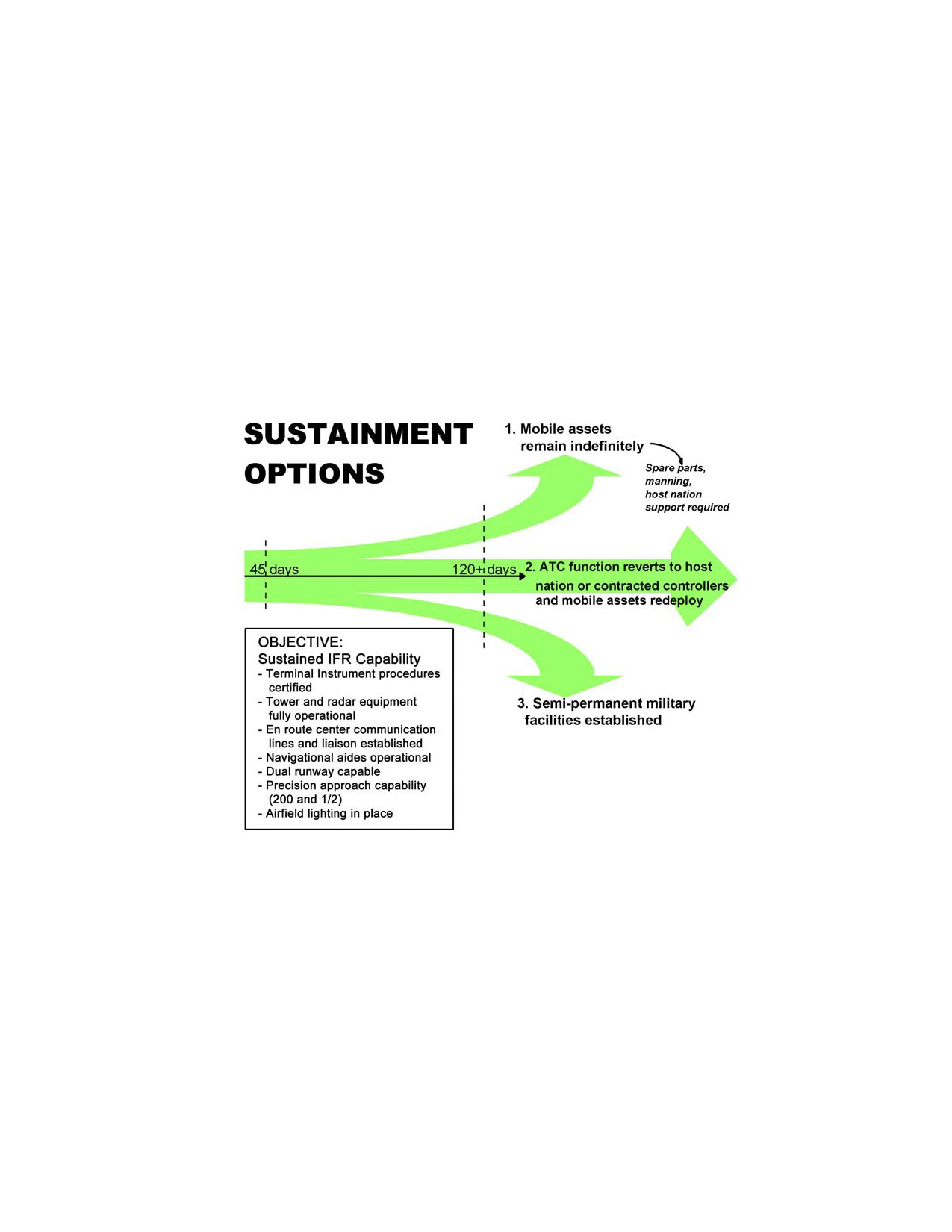
Figure IV-1 Sustainment Options
3. End of Operations
a. Planning considerations. Begin planning for the transition/restoration back to
civil ATC services and/or cessation of military ATC operations early and continually
throughout operations. Consider coordinating with ICAO, NGO, and JFC planners for
the restoration or contracting of ATC services to relieve military ATC units once
hostilities end. ICAO should survey airfield and ATC facility infrastructure to
determine needed improvements to ensure these facilities will meet ICAO standards
and recommended practices (SARPs).
b. Continued responsibility. The sustainment phase does not end when military
ATC personnel and equipment are completely redeployed. With host nation or
IV-2
contracted services, there is still a responsibility of oversight, quality assurance
evaluation, procedures review, host nation agreements, etc. The sustainment phase
ends when the JFC determines the mission is complete.
c. Draw down. Draw down of operations may require reversing the buildup process
and necessitate the second deployment of initial entry ATC assets who are able to
operate without base support (for example, Marine MTT, Army TACT, Air Force STT).
End of operations will require a handover or phase-out of ATC services. See appendix F
for sample handover checklists. The deployed ATC equipment may be redeployed to
another location, returned to home station, or even transferred to the host nation as
determined by higher authority.
IV-3
Appendix A
AIR FORCE AIR TRAFFIC CONTROL
1. Doctrine
The Air Force provides ATC services in support of theater tactical combat operations
and combat airspace management, similar to what the Service’s fixed-base facilities
provide in CONUS and overseas. The Air Force ATC is involved in a multitude of
missions from combat to military operations other than war (MOOTW). Reserve
components play a key role in ATC operations and in some cases could be tasked instead
of active duty forces.
2. Forces
The Air Force has 17 DATCALS. Seven systems are located at three Combat
Communications Groups (CCG) and 10 systems are located at the Air National Guard
(ANG) ATC squadrons across the country. The remaining ATC personnel are dispersed
across various units, to include Air Force Special Operations Command’s special tactics
squadrons, active duty combat ATC units, and DATCALS-augmentees from fixed-based
MAJCOM operations support squadrons, and communications squadrons.
a. Initial Forces. Air Force STT provides initial ATC capability and executes
missions for both SOF and conventional forces/operations. Air Force STS are ground
combat forces assigned to Air Force Special Operations Command, Hurlburt Field,
Florida. Air Force STT consist of combat control, pararescue, and combat weather
personnel who are organized, trained and equipped to establish and control the air-
ground interface and provide airmanship skills in the objective area. Combat
controllers provide the ATC capability. Combat controllers are parachute and combat
diver qualified personnel trained and equipped to quickly establish and control terminal
air objectives (drop or landing zones) in austere or hostile environments. They perform
reconnaissance, surveillance, and survey and assessment of potential terminal airheads
(airfields or assault zones). They conduct ATC, terminal attack control, and initial C2
communications during assault operations. They can also perform limited weather
observations and obstacle or ordinance removal with demolitions.
b. Sustainment Forces. These forces are comprised of combat communications
groups, air national guard/reserve units, fixed base maintainers, and fixed base air
traffic controllers. These units/individuals normally provide sustainment ATC after a
handoff from STT; however, in some cases, they can provide the initial ATC service at
permissible locations.
(1) Combat Communications Groups (CCGs). These ACC/SC or US Air Forces
Europe Director of Operations units can deploy as either an entire airfield package
including tower, TACAN, and radar approach control; or as individual tower, TACAN,
and radar packages. The tower and radar UTCs include a limited number of air traffic
controllers. All UTCs come with an initial cadre of maintenance personnel. Source ATC
augmentees from MAJCOM UTC-tasked fixed base assets to operate. CCGs can
provide a full range of ATC service and positive control capabilities (see appendix E).
A-1

(2) Air National Guard/Reserve. The ANG units normally deploy as complete
squadrons comprised of deployable radar/tower facilities, maintenance, and air traffic
controllers. They are aligned under Air Combat Command and provide ATC service and
positive control capabilities. Although Reserve units are utilized to support airfield
management UTCs, Reserve units do not normally deploy in support of ATC operations.
(3) Fixed Base Controllers. The preponderance of controllers are located at fixed
base locations and assigned to facility-specific UTCs designed to support a wide range of
ATC taskings. They are identified and trained to support DATCALS, ATC liaison, and
combat airspace requirements.
3. Training
a. General Training. The foundation of Air Force controller training process is the
ATC technical training center at Keesler Technical Training Center, Biloxi, Mississippi.
Upon graduation, apprentice controllers possess basic skills and core knowledge of FAA
ATC procedures. These fundamentals and principals are expanded upon in unit
training programs and with meeting local unit facility and qualification training
requirements. Training requirements for all Air Force controllers are defined in AFI 13-
203. SEIs are critical to the Air Force ATC planning process as they can identify
controllers who meet the specific ATC qualification requirements at a deployed location
(see table A-1). When SEIs are not used, poor utilization of controllers can result in
greatly extended training time and degraded service to air operations at the deployed
location.
Table A-1 Air Force ATC Special Experience Identifiers (SEI)
Air Force ATC Special Experience Identifiers (SEI)
Enlisted
Position
SEI
Tower Controller
056
Tower Watch Supervisor
055
GCA Controller
053
GCA Supervisor
054
Radar Approach Controller
364
Radar Approach Control Watch Supervisor
362
Air Route Traffic Control Center
363
Airspace Management
350
Combat Airspace Management
900
Precision Approach Radar (PAR)
365
TERPS
361
Automation Specialist
376
Officers
Position
SEI
Airfield Management
OCH
Combat Airspace Management
OCK
Airspace Management
OUL
A-2
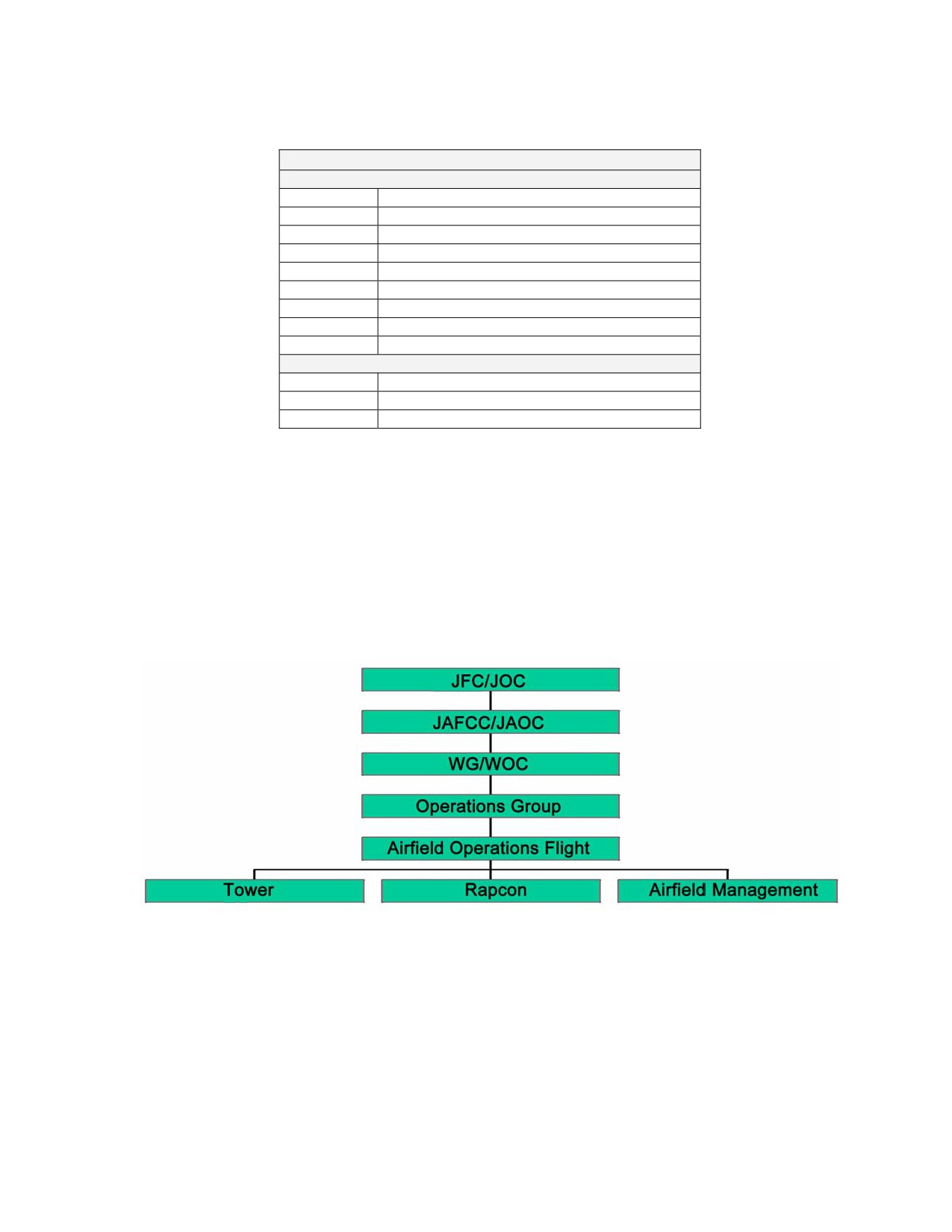
Table A-2 Air Force Specialty Codes (AFSC) Referenced in JATC MTTP
Air Force Specialty Codes (AFSC) referenced JATC
Enlisted
AFSC
Description
1C1
ATC
1C151
ATC Journeyman (“5-level”)
1C171
ATC Craftsman (“7-level”)
1C3
Command Post
2E1
Communications/Electric Maintenance
2E071
Ground radar Systems Craftsman
3A0
Information Management
3C0
Communications/Computer System Operations
Officers
AFSC
Description
11A3
Airlift Pilot
13M3
Air Traffic Control
b. Advanced Training. The MAJCOMs/numbered air forces should promote “joint”
exercises and ensure integration of the DATCALS into training exercises whenever
feasible. Exercises should use realistic planning, deployment, and maintenance
training for DATCALS UTCs. Field exercises whereby deployable equipment usage and
skills are taught are important in the training process to practice how the USAF will
fight. UTCs tasked to support DATCALS and combat airspace/liaison positions must be
indoctrinated through exercises prior to “real world” deployments if they will be
responsible for establishing/managing these systems while deployed.
Figure A-1 Air Force ATC Structure
4. Air Force ATC Duties and Command and Control Relationships
The Air Force ATC system provides service and coordination from CONUS, through
en route locations and international airspace, to the bed-down locations for combat
aircraft, to aerial ports of debarkation, to forward-deployed austere airfields, and
return. While combat and force enhancement aircraft (all Services) usually conduct a
singular deployment/re-deployment to the theater, ongoing passenger (flown by both
CRAF and military aircraft) and cargo flights comprise the steady stream
A-3
transcontinental air traffic. Therefore, the Air Force focuses on both the en route and
distant end, deployed ATC service. Requesting additional ATC officers/senior enlisted
personnel to serve as liaisons for areas of operations is an important planning
consideration.
The theater-based Air Force ATC is aligned primarily within the wing operations
center (WOC). Generally, in a JOA, air traffic and airspace C2 systems are integrated
under a single combined/joint forces airspace control authority. Since ATC units are
subordinate to the WOC, their facilities and personnel (fixed, tactical, and augmented),
in some theaters, become a part of the Theater Air Control System (TACS). It is only
through this relationship that they are considered part of the TACS. Controllers
perform terminal air traffic operations, or liaison/augmentation at host nation control
facilities. ATC planning, training, and operating procedures must reflect this concept
and any additional mission/roles, prioritized in the Defense Planning Guidance;
MOOTW, such as humanitarian relief and disaster response; operational readiness
inspections; and test or demonstrations. See figure A-1 for the Air Force ATC structure.
a. En Route Support. Provide a liaison to the FAA and host nation ATC
organizations or facilities when deploying large numbers of military aircraft. The Air
Force has liaisons in all the FAA regions and a central contingency cell at the flow
control office in Washington Center. Part of their function is to ensure enough FAA
controllers are available to meet unusual military traffic loads. Additionally, the Air
Force has ATC liaisons in several foreign ATC facilities to assist host nation controllers
in understanding of US military aircraft requirements/procedures. Furthermore, ATC
liaisons can deploy into theater to coordinate with the deployed US ATC units, the
CAOC, the host nation ATC system, the US Embassy, the Air Force Air Mobility
Command’s Tanker Airlift Control Center, and other ATC liaisons to de-conflict air flow
problems.
b. Deployed Terminal Locations. At the deployed base the senior Air Force ATC
representative, normally the airfield operations flight commander, will coordinate:
(1) Terminal instrument procedure and flight check support.
(2) Any change in airfield status immediately with the CAOC airspace
management and ATC specialty team.
(3) Terminal area operation procedures with the base defense operations center
for integration into the base air defense and air base ground defense plans and
operations.
(4) Integration into the Theater Air Control System IAW CAOC guidance
contained in the ACP.
(5) With the host Service for host-provided base operating support to include
billeting and messing facilities, fuel, power production, vehicle support, secure
communications, and security.
A-4
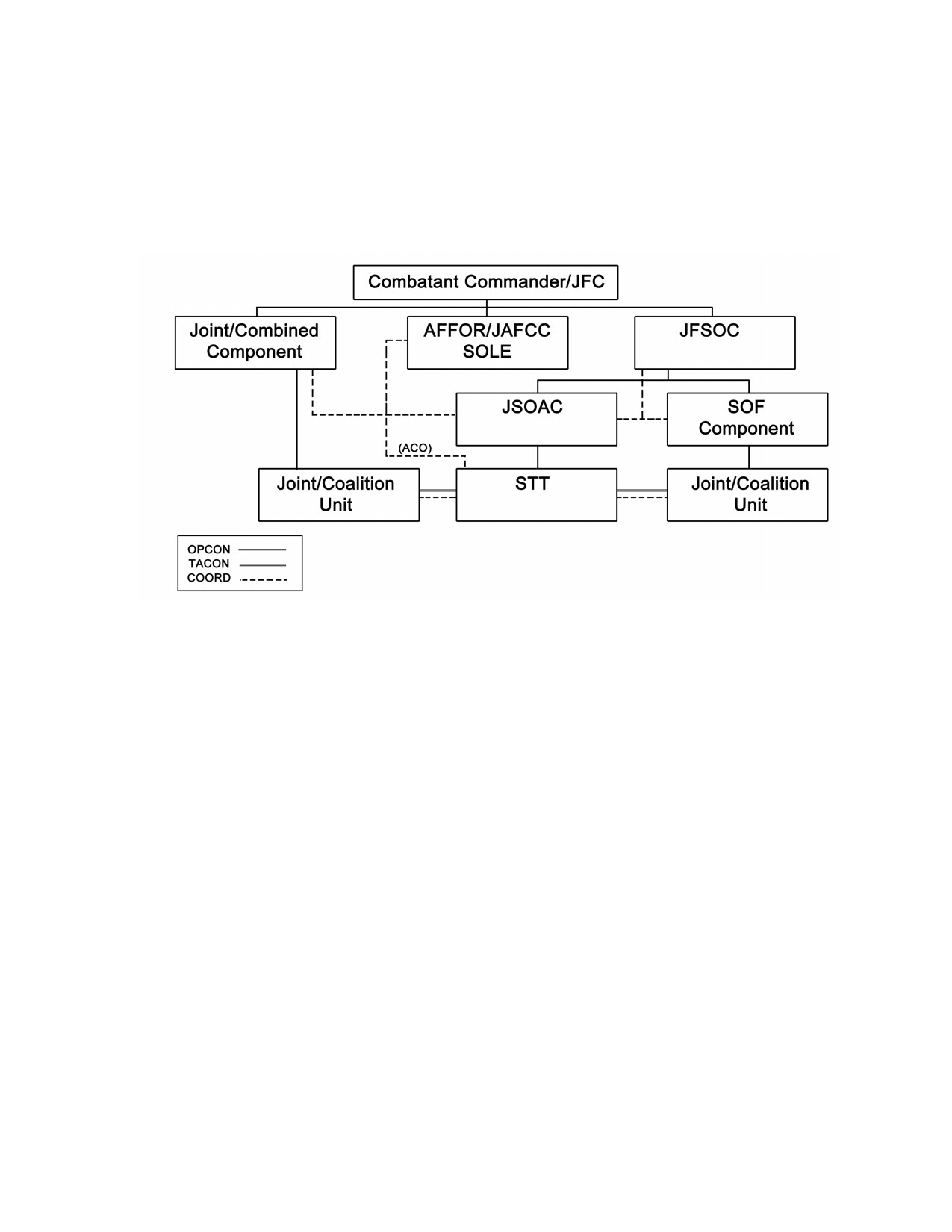
c. Air Force Special Tactics Squadron. Air Force STS forces will normally plan,
deploy/employ, and operate as part of a joint/combined force. Air Force STT usually
deploys to the intermediate staging base (ISB) for joint employment into the AO or
target area; however, units may employ directly from home station if required. See
figure A-2 for the STS forces C2 structure.
Figure A-2 Special Tactics Squadron C2 Structure (SOF JATC)
5. Future Plans
a. Global Mobility Task Force Initiative and Force Module Initiative. The Air Force
is undergoing structural changes that will improve its ability to conduct force beddown
for contingency operations. This includes Global Mobility Task Force and Force Module
initiatives that will improve the transition phase from the STS mission to the
sustainment mission. To replace the STS mission, the task force is establishing a short-
notice deployment capability to stand up IFR flight operations within 72 hours. To
relieve the task force, the Force Module initiative is establishing a force beddown
package required to sustain flight operations for the long-term. This sustainment
mission could consist of activating ANG assets, combat communication groups,
MAJCOM contingency response units, the development of a squadron specifically
designed to provide full airfield operations support at a bare base, or an expeditionary
airfield operations squadron.
b. Expeditionary Airfield Operations Squadron. The Air Force is evaluating the
possibility of creating expeditionary airfield operations squadrons. These squadrons
would be built by consolidating DATCALS from Air Mobility Command and Air Combat
Command’s Combat Communications Groups’ Airfield Systems Flights into a new
squadron structure that provides a focused management of airfield operations
equipment and robust force module support. The squadrons would consist of DATCALS
(radar systems, towers and NAVAIDS) airfield lighting, weather equipment, and a
combat-ready pool of deployable airfield operations personnel (airfield manager, air
traffic controllers, DATCALS maintainers, TERPS, civil engineers, airfield support
A-5
personnel, and weather specialists). Personnel would require specialized training
through establishment of a combat skill training course and exercise participation.
Most personnel assigned to these squadrons would be attached to a wing in peacetime.
During contingencies, they would return to the squadron, as required, to establish a
squadron to deploy in the Force Module construct. The new squadron structure would
provide a fully trained and easily deployable contingency response force. This future
proposal does not affect Air Force Special Tactics ATC personnel or their structure.
6. Deployed locations
Host nation regulations and procedures apply to Air Force controllers who augment
a civil or foreign ATC facility. In addition, Air Force controllers who augment a host
Service facility will comply with the procedures of the host Service branch (See Air
Force Doctrine Document 2-1.7, Airspace Control in the Combat Zone, May 2001).
7. Air Force ATC Points of Contact
a. Air Force Flight Standards Agency: Andrews AFB, MD. DSN 857-2155 or
Commercial (301) 240-2155.
b.
720 Special Tactics Group: 223 Cody Ave, Hurlburt Field, FL, 32544.
DSN 579-3706, Commercial (850) 884-3706.
A-6
///////////////////////////////////////