FM 3-11.22 Weapons of Mass Destruction–Civil Support Team Operations (December 2007) - page 3
Appendix D
Communications Section
Communications dominate war; broadly considered, they are the most important single
element in strategy, political and military.
—Alfred Thayer Mahan
This appendix provides information regarding the mission, organization, key
equipment, capabilities, employment considerations, and operational phases of the
communications section, UCS, and ADVON vehicle. The communications section,
USC, and ADVON vehicle provide tactical and emergency communications support
to the WMD-CST commander and as requested by the site IC. The communications
section also acts as the command and control hub, establishing a COP for planning
and executing an incident response by providing voice, data, and video
communications through a variety of networks designed to support WMD-CST
operations and civil and military agencies.
MISSION
D-1. The mission of the communications section is to act as a common support communications node at
an incident site to maintain interteam and intrateam communications. The communications section
conducts the following primary tasks:
z
Assists with requests to expedite the arrival of additional state and federal assets to help save
lives, prevent human suffering, and mitigate property damage.
z
Provides voice, data, and video communications through a variety of networks designed to
support WMD-CST operations and civil and military agencies.
z
Establishes and maintains communications within the section and with higher headquarters,
other responding elements, and reachback SMEs.
z
Maintains COMSEC equipment and keying material to ensure secure communications.
z
Establishes secure communications links, as required and maintains classified documents.
z
Augments IC communications as available and within its capabilities.
z
Coordinates with civil and military agencies for follow-on support.
ORGANIZATION
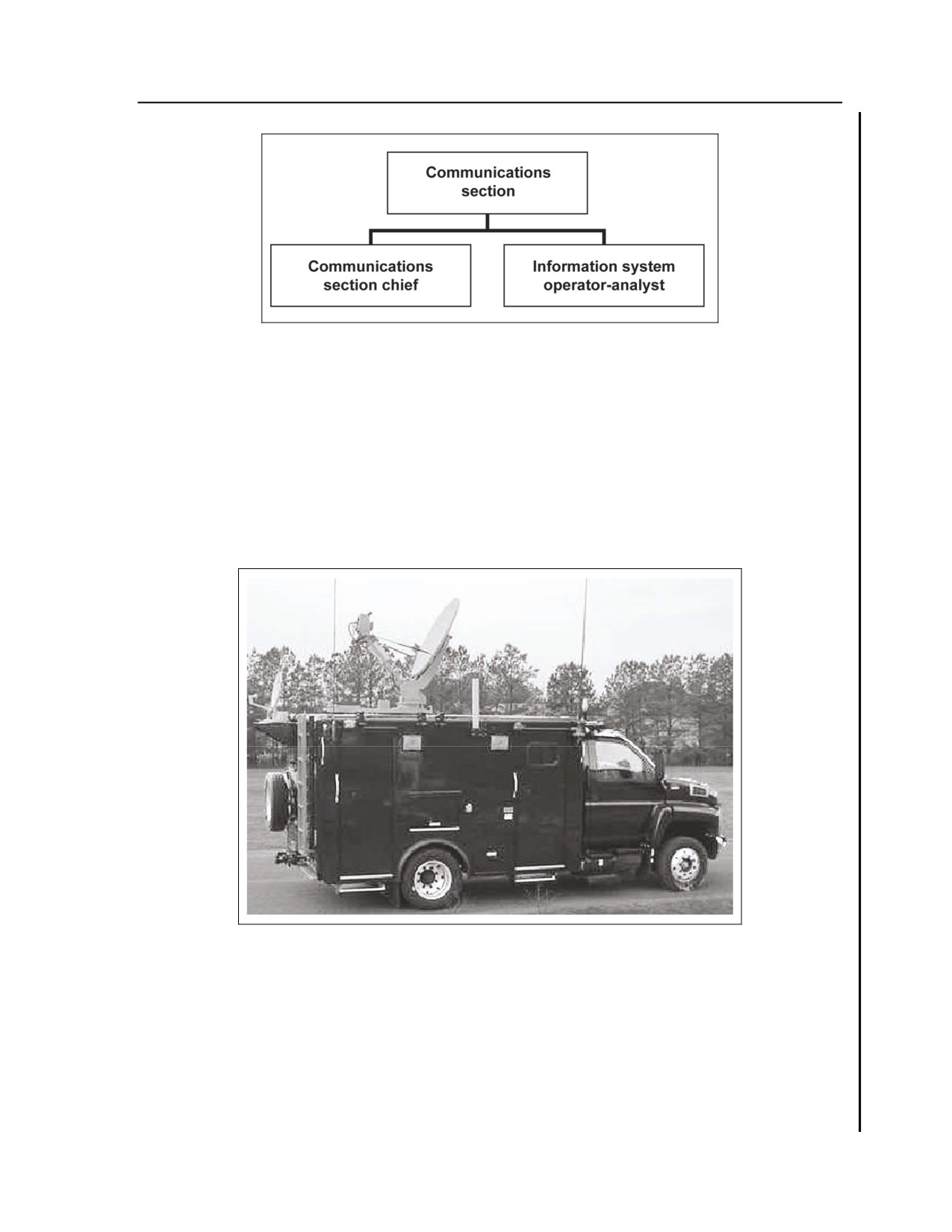
D-2. The communications section is a two-member team comprised of a communications section chief
and an information system operator-analyst. (See Figure D-1, page D-2.)
29 March 2009
FM 3-11.22, C1
D-1
Appendix D
Figure D-1. Communications Section
KEY EQUIPMENT
D-3. The UCS is a self-contained, stand-alone C-130 air-mobile, fielded communications system
employed in training and tactical environments. The UCS operates in urban and undeveloped areas using
portable and fixed equipment. The UCS (see Figure D-2) provides real-time voice, data, and video
communications (unclassified through secret information) among the following information elements:
z
WMD-CST members.
z
Local and state emergency response agencies.
z
LFAs.
z
Supporting military activities.
Figure D-2. UCS
D-4. The UCS is equipped with state-of-the-art radio, satellite, and telephone communications subsystems
that provide dedicated line of sight
(LOS) and non-LOS and secure and nonsecure intrateam and
intravehicle voice and data reachback. The UCS has voice, data, and video reachback capabilities with the
WMD-CST operations center; incident command post; various military forces; federal, state, and local law
enforcement; and emergency services units that are supporting the incident response. These
communications subsystems are operated in handheld, base station, and vehicle configurations capable of
interoperating with military and commercial radio communications systems in various terrain and urban
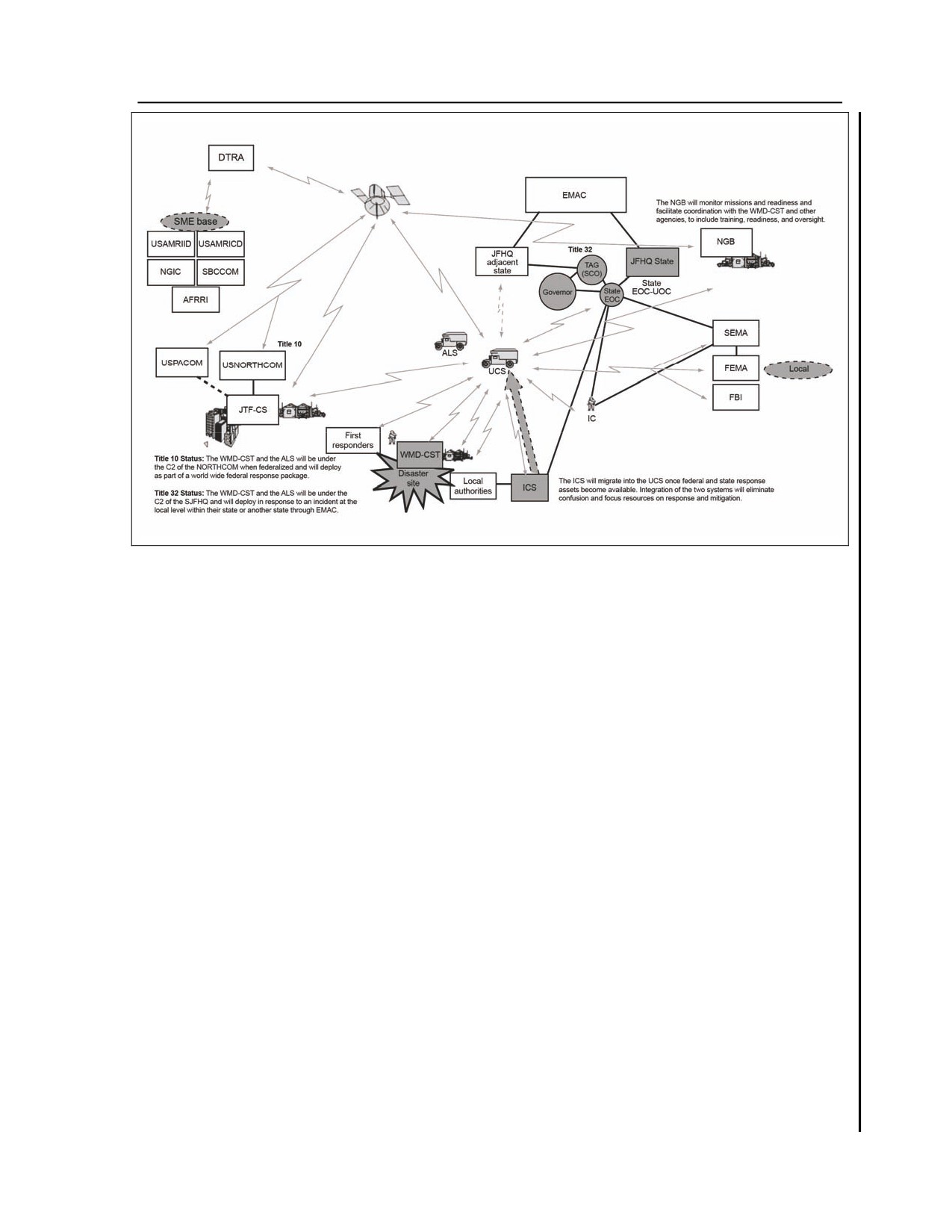
environments. (See Figure D-3 for connectivity requirements supported by the UCS.)
D-2
FM 3-11.22, C1
29 March 2009
Communications Section
Figure D-3. UCS Nodal Connectivity
D-5. The UCS is equipped with the following systems:
z
A self-contained power generation and distribution system.
z
A radio frequency (RF) communications subsystem, including VHF.
z
An LOS voice net with a base station, radio repeater system, and handheld radios that are
compatible with the base station and UHF LOS voice net with three base stations.
z
A telephone subsystem (nonsecure) and an international maritime satellite
(INMARSAT)
terminal that provides wide-area telephone connectivity and secure phone, secure telephone
equipment, and desktop terminals to support tactical planning and reporting.
z
An automatic data processing (ADP) subsystem, including LAN/wireless area network (WAN)
connectivity to military and commercial systems that provide secure and nonsecure operations
that are all fully interoperable with standard DOD and federal architectures and protocols.
z
Communications ports for direct cable link to the ALS.
z
An ancillary equipment subsystem.
z
A location-reporting subsystem, including an automated force-tracking tool capable of reporting
latitude, longitude, and altitude.
z
Rechargeable batteries dedicated to C2 information systems.
z
An air conditioning/heating system.
z
A storage area.
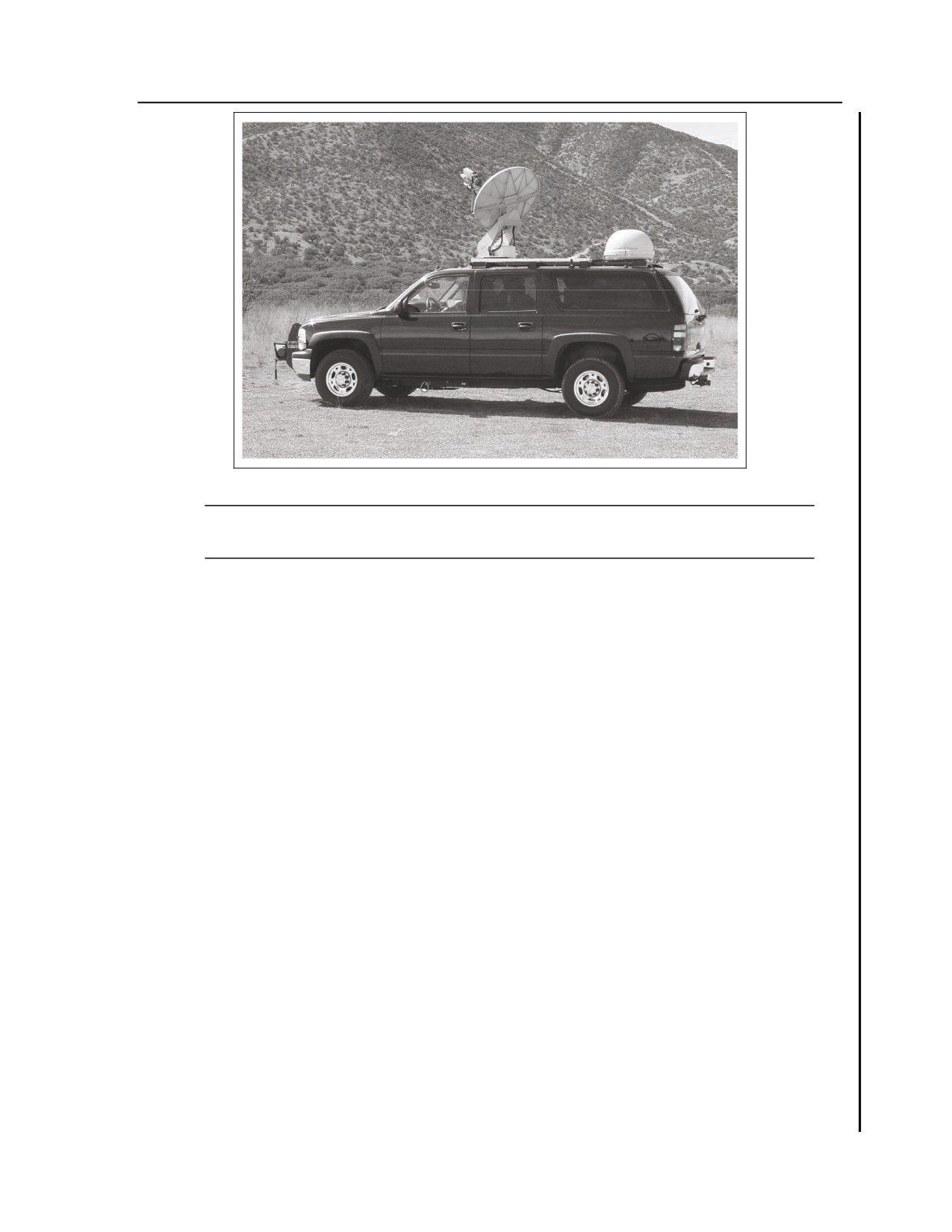
D-6. The ADVON vehicle is a suburban sport utility vehicle with capabilities similar to the UCS, but with
limited secure capabilities. It is a rapidly deployable, ground, mobile communications system with an
integrated communications suite that is interoperable with the UCS and first responder agencies. The
ADVON vehicle provides WMD-CSTs with the primary means of voice, data, and video communications
support until the UCS arrives and is fully established. (See Figure D-4, page D-4.) After the UCS is
established, the ADVON vehicle is used as a backup means of communication. Both en route and on-scene
capabilities are provided.
29 March 2009
FM 3-11.22, C1
D-3
Appendix D
Figure D-4. ADVON Vehicle
Note. At a minimum, the ADVON team is comprised of the commander and the CST modeler
(operations NCO), who are in the command section.
D-7. En route ADVON capabilities allow mobile voice and data INMARSAT, satellite telephone
communications, a media center with onboard navigational information, and intrateam communications.
The ADVON package is in a minimally modified, General Services Administration, suburban platform
vehicle.
D-8. On-scene ADVON capabilities provide WMD-CST commanders with a rapidly deployable, high-
speed data communications system that operates within a wireless network and provides an RF crossband
repeater for merging disparate radio systems. The vehicle-based power system provides alternating-current
(AC) and direct-current (DC) power to communications equipment components and ancillary equipment
using a communications equipment suite battery that is isolated from the vehicle battery. The power system
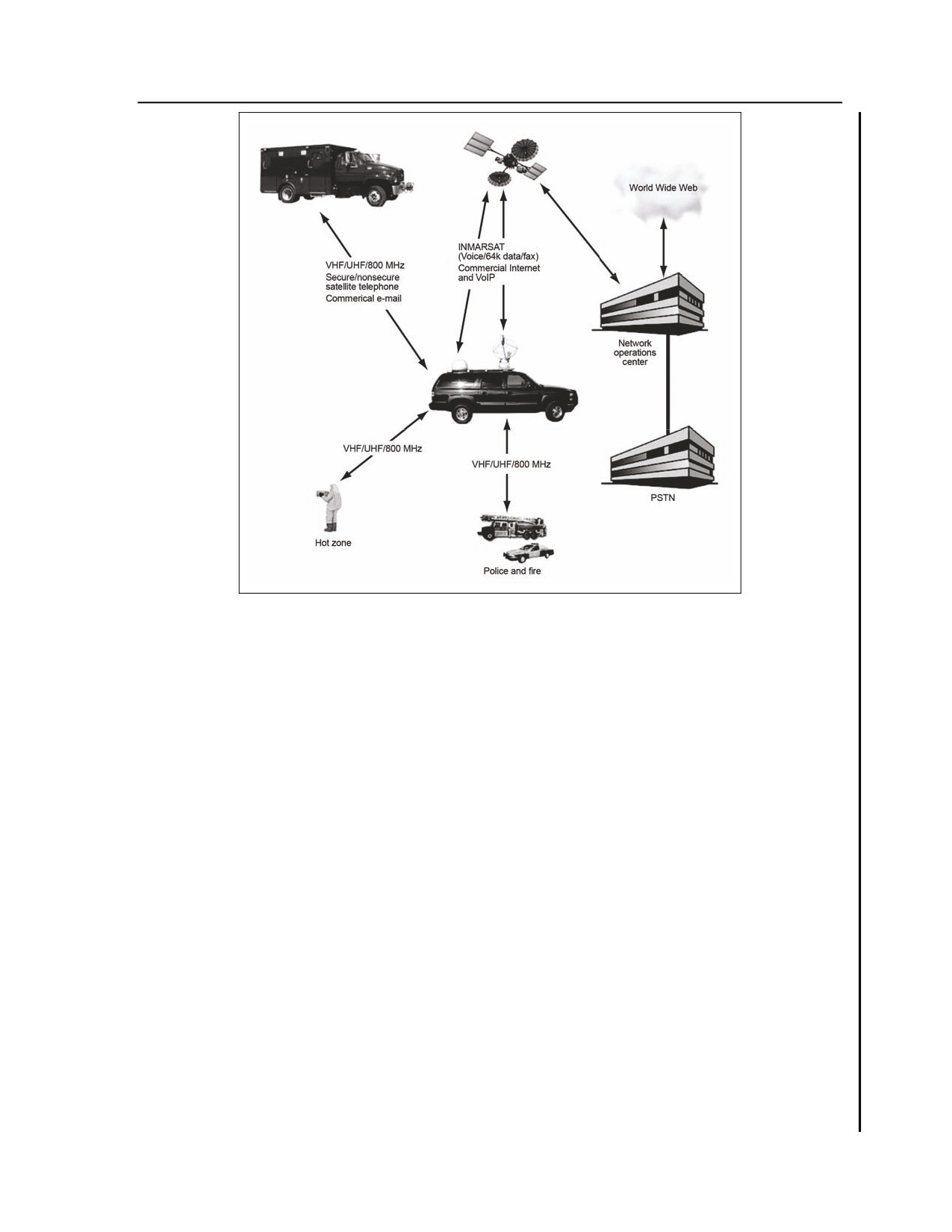
allows connection to a shore-based AC power source during extended fixed-site operations. (Figure D-5
depicts the nodal connectivity that the ADVON vehicle can provide at the incident site.)
D-4
FM 3-11.22, C1
29 March 2009
Communications Section
Figure D-5. ADVON Nodal Connectivity
CAPABILITIES
D-9 The following capabilities are associated with the communications team:
z
Advising civil authorities of the capability of potential additional support assets and assisting
with requests for such assets.
z
Providing incident-related technical and situational awareness information to and from
nationwide sources while at home station, en route, and on site through organic communications
capabilities.
z
Linking to and augmenting civil responder communications systems as required.
z
Maintaining real-time operational secure and nonsecure communications with higher
headquarters and reachback networks.
z
Rapidly deploying via organic vehicles and/or nonorganic transportation assets.
z
Commanding and controlling WMD-CST elements and limited augmentation assets and
coordinating administrative and logistic support to CST members.
z
Participating in advanced planning, coordination, and training processes with potential
supported or supporting local, state, and federal agencies; other WMD-CSTs; and DOD
response elements.
z
Executing capabilities according to applicable state and federal laws within a state or territory or
at a CONUS military installation.
D-10. The following capabilities are associated with the UCS and ADVON vehicle:
z
Providing internal C2 for the WMD-CST.
z
Facilitating information flow from local authorities up to state and federal agencies.
z
Assisting emergency response officials and organizations.
29 March 2009
FM 3-11.22, C1
D-5

Appendix D
z
Providing communications support to the IC with radio, telephone, and data links to higher
civilian authorities, military authorities, SMEs, and team members.
z
Integrating and interoperating with the ICS as part of the UCS structure to reduce confusion,
improve safety, organize and coordinate actions, and facilitate effective management of the
incident.
z
Interfacing with state and local civil responders to support unity of effort and provide situational
awareness by reducing first responder information gaps and communication shortfalls.
EMPLOYMENT CONSIDERATIONS
D-11. The following employment considerations apply to the communications team:
z
The team is a two-member, crew-served system.
Note. The WMD-CSTs are required to conduct 24-hour continuous operations independently
for up to 72 hours. Additional UCS operators are recommended if continuous operations extend
beyond 18 hours. Commanders should plan and implement adequate work/rest cycles.
z
The team is one deep in most specialty functions. Factors such as ongoing training (including
required schools), mission preparation requirements, leave, illness, and personal emergencies
reduce the number of personnel available for missions where there is no advance notice.
D-12. The following employment considerations apply to the communications section equipment
(including the UCS and ADVON):
z
The vehicles are not equipped with an overpressure system and must be located within the cold
zone.
DANGER
Failure to locate these vehicles in the cold zone could expose the
crew to potential downrange hazards.
z
Insufficient fresh air exchange inside a shelter can cause carbon monoxide poisoning.
Symptoms may be nausea, dizziness, or headache. Use an exhaust hose extension for the
generator exhaust so that carbon monoxide and vehicle exhaust do not enter the shelter.
DANGER
Exhaust entering a shelter can lead to carbon monoxide
poisoning, which can be hazardous or fatal.
z
High-powered radio and satellite transmissions are required.
z
A generator is required for the system’s internal power.
z
The system must be replaced if contaminated.
z
While in operations the UCS and ADVON vehicles must be physically secured at all times.
z
COMSEC must be maintained when working with classified information and material.
z
The commander has the discretion to determine whether or not encryption should be used
during WMD-CST response operations
Note. According to AR 25-2, WMD-CSTs are not required to be encrypted when conducting
activities with civil agencies.
z
The UCS is grounded according to the applicable UCS manufacturer’s manual.
z
Communications personnel maintain current certifications per DOD guidance.
D-6
FM 3-11.22, C1
29 March 2009
Communications Section
OPERATIONAL PHASES
D-13. A mission typically consists of three operational phases: preoperational, operational, and
postoperational.
PREOPERATIONAL PHASE
D-14. During the preoperational phase, the communications section—
z
Ensures that communications, COMSEC, and classified cryptological information
(CCI)
equipment is serviceable and ready to respond.
z
Maintains WMD-CST software for backup purposes.
z
Coordinates remote communications and distributed learning (dL) activities.
z
Conducts UCS proficiency and new-technology training.
z
Conducts communications surveys of possible infrastructure targets.
z
Provides communications logistics to support unit and section requirements.
z
Coordinates, integrates, and incorporates the UCS into any incident.
z
Accounts for and maintains essential communications equipment.
z
Maintains databases and information support systems.
z
Fulfills required duties for UCS accreditation.
OPERATIONAL PHASE
D-15. During the operational phase, the communications section—
z
Establishes a communications plan.
z
Maintains communications with supporting agencies.
z
Configures its equipment for any means or mode of travel.
z
Conducts preventive maintenance checks and services (PMCS).
z
Ensures that alternate power supplies and power systems are available.
z
Plans for the production of the WMD-CST OPORD (signal portion) and signal operating
instructions (SOI).
z
Implements the site communications plan that supports the commander’s intent.
z
Provides communications support during the mission.
z
Determines incident-specific communications requirements.
z
Assesses existing capabilities.
z
Manages other communications-related matters, such as assigned frequencies.
z
Develops call signs and radio nets from the SOI.
z
Provides push-to-talk communications equipment or handheld radios to assigned team personnel
to support internal communications requirements.
z
Conducts a 100 percent COMSEC and CCI inventory. The communications team chief prepares
for the emergency destruction of COMSEC and CCI.
POSTOPERATIONAL PHASE
D-16. During the postoperational phase, the communications section—
z
Cleans and inventories communications equipment, including COMSEC and CCI equipment.
z
Disposes of lithium batteries according to the unit SOP.
z
Submits required closing reports prior to departure.
z
Notifies the COMSEC custodian of changes in COMSEC status.
z
Completes required inspections.
z
Addresses equipment readiness issues.
z
Repacks equipment and vehicles and prepares them for movement and future missions.
z
Closes communications nets upon returning to the home station, as directed by the commander.
29 March 2009
FM 3-11.22, C1
D-7
Appendix E
Troop-Leading Procedures
Let all things be done decently and in order.
—I Corinthians, 14-40
Bible, King James Version
This chapter describes the steps involved in troop-leading procedures.
STEP 1: RECEIVE THE MISSION
E-1. The leader may receive a WARNO, OPORD, or FRAGO. The leader immediately analyzes the mission
using METT-TC factors to answer the following questions:
What is the mission?
What is known about the enemy?
How will terrain and weather affect the operation?
What troops and support are available?
How much time is available?
What civilian considerations should be addressed?
E-2. The leader should use no more than one-third of the time available for planning and issuing the OPORD.
The remaining two-thirds of the time should be reserved for subordinates to plan and prepare for the operation.
Leaders should also consider other factors, such as available daylight, rehearsals, and travel time. In scheduling
preparation activities, the leader should use reverse planning to ensure that enough time is provided for the unit
to complete each required task before departure.
STEP 2: ISSUE A WARNING ORDER
E-3. The leader provides initial instructions in a WARNO. The WARNO contains enough information to
begin preparation as soon as possible. Unit SOPs should prescribe who is to attend all WARNO briefings and
the actions that must be taken upon receipt of the WARNO. Examples include checking analytical equipment,
issuing rations and water, and checking communications equipment.
E-4. There is no specific format for the WARNO. One possibility is to use the five-paragraph OPORD format.
The leader issues the WARNO with all the information available at the time and provides updates as often as
necessary. The leader never waits for information to fill a specific format.
E-5. If available, the following information may be included in a WARNO:
Mission or nature of the operation.
Participants in the operation.
Time of the operation.
Time and place for issuing the OPORD.
STEP 3: MAKE A TENTATIVE PLAN
E-6. The leader develops an estimate of the situation to use as the basis for the tentative plan. The estimate is
the MDMP, consisting of seven steps:
Step 1: Mission receipt.
Step 2: Mission analysis.
10 December 2007
FM 3-11.22
E-1
Appendix E
Step 3: COA development.
Step 4: COA analysis.
Step 5: COA comparison.
Step 6: COA approval.
Step 7: Orders production.
E-7. The decision represents the tentative plan. The leader continuously updates the estimate and refines the
plan accordingly, then uses the plan as the starting point for coordination, reconnaissance, task organization (if
required), and movement instructions. The leader works through the problem-solving sequence in as much
detail as time allows. METT-TC factors are considered as the basis of the estimate.
STEP 4: START THE NECESSARY MOVEMENT
E-8. The main unit body may need to begin movement while the leader and the advanced party is still
performing liaison with the ICS. A movement officer may bring the unit forward to a staging area while waiting
for further guidance. During this time, subordinate leaders prepare their sections for the upcoming mission.
This step could occur anytime during the troop-leading procedures.
STEP 5: RECONNOITER
E-9. If time allows, the leader conducts a personal reconnaissance to verify the terrain analysis, adjust the
plan, confirm the usability of routes, and time any critical movements. If time does not allow, the leader must
perform a map reconnaissance.
STEP 6: COMPLETE THE PLAN
E-10. The leader completes the plan based on the reconnaissance and any changes in the situation. The leader
should review the mission as it was received to ensure that the plan meets the requirements of the mission and
the commander’s intent.
STEP 7: ISSUE THE COMPLETE ORDER
E-11. Section leaders normally issue oral OPORDs. To aid subordinates in understanding the concept for the
mission, leaders should issue the order within sight of the objective. When this is impossible, they should use a
terrain model or sketch. Leaders must ensure that subordinates understand the mission, the commander’s intent,
the concept of the operation, and their assigned tasks. Leaders may require subordinates to repeat all or part of
the order or demonstrate their understanding of the operation on the model or sketch. They should also quiz
Soldiers to ensure that they understand the mission.
STEP 8: SUPERVISE
E-12. The leader supervises unit preparation for the mission by conducting rehearsals and inspections.
Rehearsals include having section members brief their planned actions in execution sequence to the section
leaders. Leaders should conduct rehearsals on terrain that resembles the actual ground and in similar light
conditions. The unit or sections may begin rehearsals of battle drills and other SOPs before receiving the
OPORD. Once the order has been issued, the unit can rehearse mission-specific tasks. Section leaders should
conduct initial inspections shortly after receiving the WARNO.
E-13. The leader uses rehearsals to—
Practice essential tasks (improve performance).
Reveal weaknesses or problems in the plan.
Coordinate the actions of subordinate elements.
Improve Soldier understanding of the concept of the operation (foster confidence in Soldiers).
E-2
FM 3-11.22
10 December 2007
Troop-Leading Procedures
E-14. Some important tasks to rehearse include—
Actions in the area of suspected contamination.
Decontamination procedures.
Rescue operations and emergency triage.
Actions on unexpected enemy contact.
E-15. Inspections include—
Weapons and ammunition, if applicable.
Uniforms and equipment.
Soldier understanding of the mission and specific responsibilities.
Communications.
Rations and water.
Deficiencies noted during earlier inspections.
10 December 2007
FM 3-11.22
E-3

Appendix F
Assessment
If I am able to determine the enemy’s dispositions while at the same time I conceal my own,
then I can concentrate and he must divide.
—Sun Tzu
The Art of War, 600-501 Before Christ (BC)
This appendix guides the user through a format for conducting WMD-CST assessments
using the IPB process; an assessment checklist is provided in Figure F-1. Information on
U.S. citizens is not gathered during a WMD-CST assessment. The WMD-CST is
prohibited from collecting, processing, retaining, or distributing information regarding
the activities of U.S. citizens as set forth in Executive Order 12333.
Define the environment
Limits of the AO (ground, air, water)
Limits of the AI (ground, air, water)
Terrain
Weather
Population centers
Weather effects on CBRNE
Weather effects on response operations
Extent of the incident (during and postincident assessment only)
Choke points (traffic congestion and limited avenues of approach)
Permissive or hostile environment to DOD assets (primarily used for assessment conducted
during an incident)
High-risk and potential HVTs (event, political or governmental organization, or critical
infrastructure). This is not normally applicable for an assessment conducted on a specific HVT or
TAI.
High-risk and potential TAIs (facilities, areas, unoccupied structures [sports arenas], unoccupied
infrastructures). This is not normally applicable for an assessment conducted on a specific HVT
or TAI.
Law enforcement capabilities (municipal, county, state, special teams)
Fire department capabilities (HAZMAT, USAR)
Water supplies
Emergency services capabilities
Medical infrastructure
Hospital capabilities
Populations and census data
Current intelligence reports (threat TTP)
Figure F-1. Assessment Checklist
10 December 2007
FM 3-11.22
F-1

Appendix F
Define the environment
Gaps in the current intelligence summary
DOD and non-DOD assets to fill voids in the assessment data
Electrical power resources
Landline phone resources
Utilities and services
Logistical infrastructure
Sources for food, water, and supplies organic to the AO
Location, activity, and capability of care distribution sites contained in federal, state, and local
emergency response plans and/or the IC’s OPORD
Potential rotary- and fixed-wing LZs
Describe the environmental effects on operations
Environment within the identified AO and AI
Terrain and weather
Limitations for the WMD-CST
Limitations for the threat
Opportunities for the WMD-CST
Opportunities for the threat
Geography and infrastructure
Limitations for the WMD-CST
Limitations for the threat
Opportunities for the WMD-CST
Opportunities for the threat
Output
Population density/status overlay
Weather analysis matrix
MCOO (This product includes HVTs, hospitals, and critical infrastructures [EOCs, fire
departments, schools]; an individual overlay can be constructed for each of these.)
CBRNE COA overlay (light/heavy, day/night plumes)
Threat TTP COA overlay (based on previous terrorist attacks and real-world intelligence)
Evaluate the threat
Historical data relevant to the threat
Threat models (Identify possible threat strategies, tactics, procedures, and weapons. Depict how
threat forces prefer to conduct operations under ideal conditions.)
Evaluation (Evaluate the strengths, weaknesses, and vulnerabilities of the threat, including an
evaluation of typical HVTs.)
Figure F-1. Assessment Checklist (continued)
F-2
FM 3-11.22
10 December 2007
Assessment
Determine threat COAs
Develop three likely threat COAs (ingress/egress routes, preferred or likely targets, method or
means of attack, possible goals of the threat)
WMD-CST plan
Develop end-state products
Detailed terrain and infrastructure analysis
Climate summaries
Study of the threat TTP&E
Event matrix synchronized with sensor and background or sample collection plan
Figure F-1. Assessment Checklist (continued)
10 December 2007
FM 3-11.22
F-3
Appendix G
Reports
Reports are not self-executive.
—Florence Nightingale
The WMD-CST must receive and transmit timely and accurate information to effectively
support a response. The completion of reports during and immediately following a
response is very important. This appendix provides guidance on reports, report formats,
and procedures to standardize and minimize communications and properly frame events
at an incident site.
Note. FM 6-99.2 is the Army capstone manual for standardized report and message formats. It
provides a standard, readily available reference from which users can extract report and message
templates.
Note. U.S. Northern Command
(USNORTHCOM) Operational Reporting System
(NORS)
procedures and reports are aligned with the joint reporting structure
(JRS) and governed by
Chairman of the Joint Chiefs of Staff Manual (CJCSM) 3150.03B.
REPORTS AND FORMS
G-1. Table G-1 describes the uses of various types of reports and forms. This table should not be considered
all-inclusive.
10 December 2007
FM 3-11.22
G-1

Appendix G
Table G-1. Uses of Reports and Forms
Event
Type of report or form
Uses
SA provided to higher HQ in
Commander’s SITREP
Used to provide timely
regards to unit actions and
information on critical situations
(Figure G-1, page G-6)
activities
and military operations
Notified of an RFI
RFI
Used to request information
(Figure G-2, page G-8)
Response to a request for
RRI
Used to reply to a request for
information
information (If the information is
(Figure G-3, page G-9)
contained in a previous
message, the RRI should
reference that message in Line
6.)
Sharing of general administrative
GENADMIN
Used to pass information not
information
found in any other USMTF; used
(Figure G-4, page G-10)
for free text messages
Information to higher
CLOSEREP
Used to inform a commander of
headquarters on unit level of
the status of unit movement and
(Figure G-5, page G-11)
preparedness after a mission has
the capability of the unit to
recently been completed
conduct future operations
During the occurrence of a
SIR
Used to provide early notice to
serious incident
the highest levels of command
(Figure G-6, page G-12)
that a serious incident has
(See AR 190-45.)
occurred or may have occurred
Significant events and incidents,
OPREP-3, including, but not
Used to report significant events
including CBRNE-related events
limited to, pinnacle reports
and incidents to the highest
levels of command
(Figure G-7, page G-15)
Terrorist threats
OPREP-3
Used when a command receives
credible information concerning a
(See AR 525-13, Appendix D.)
(Figure G-7, page G-15)
planned terrorist attack against
U.S. Army personnel (Soldiers,
civilian employees, or their
Family Members), facilities, or
other assets
Terrorist incidents
OPREP-3
Used when a terrorist incident or
a suspected terrorist incident
(See AR 525-13, Appendix D.)
(Figure G-7, page G-15)
occurs that involves U.S. Army
personnel (Soldiers, civilian
employees, or their Family
Members) or facilities
Note. See FM 6-99.2 for U.S. Army report and message formats.
G-2
FM 3-11.22
10 December 2007
Reports
AFTER-ACTION REPORT
G-2. The data contained in the after-action report is critical for postmission analysis, equipment performance
reviews, mission cost reimbursement, and lessons learned. Within five duty days after terminating an operation,
WMD-CSTs complete an after-action report that provides a thorough review of unit operations from the first
alert through the return to home station. Equipment usage and cost accounting associated with the deployment
are included.
Note. After-action reports, which contain comprehensive discussions of lessons learned, are
forwarded by major Army commands to HQ, Department of the Army (HQDA) (DAMO-ODL-FP)
and the Center for Army Lessons Learned within 30 days of an actual reported terrorist threat or
terrorist incident according to AR 525-13, Appendix D.
TERMINATION REPORT
G-3. Before leaving the incident site, the WMD-CST commander provides the ICS with a detailed summary
(termination report) of WMD-CST activities while on-scene. This report includes, at a minimum, the WMD-
CST commander’s follow-on recommendations with appropriate supporting documents (computer models,
detailed sample analysis results, instrument readings, a site safety plan, an IAP, an itemized list of expended
equipment, a list of all contacted supporting agencies, and a description of any hazardous or nonhazardous
waste left behind).
Note. Include a copy of the termination report as an enclosure to the after-action report.
INCIDENT COMMAND SYSTEM REPORTS
G-4. The ICS is used by local, state, and federal emergency response communities to manage operations at an
incident site. Federal law (29 CFR 1910.120) requires the use of the ICS for response to HAZMAT incidents.
ICS reports allow for and provide commonality and interoperability among emergency response agencies. The
IC should identify which ICS reports are to be used by all agencies on-scene during an incident. WMD-CST
commanders incorporate ICS reports into their internal operations and maintain copies as references and
historical data.
Note. Include copies of all ICS reports (submitted or used) as enclosures to the after-action report.
REQUEST FOR ASSISTANCE
G-5. An RFA from civil authorities is coordinated through the NRP process. Requests for WMD-CST support
generally originate from officials in an affected community through an EOC. The state EMA, working in close
coordination with the JFHQ-S JOC, processes RFAs. The governor or a designated representative can approve
a request and have the WMD-CST deploy to the incident site. Federal requests may originate from any federal
agency, but they must be validated by the DCO. An NGB Form 500 (Figure G-8, page G-16) must be prepared,
and all questions must be answered to ensure the validity of the request. The WMD-CST can help develop the
RFAs that are forwarded to the appropriate coordinating officer.
REPORT FORMATS
G-6. Report and message formats identified in FM 6-99.2 consist of three main parts:
Heading. The heading is the administrative portion of the format. Its purpose is to identify the
message source, destination, type, and importance. The heading contains the message addressee,
10 December 2007
FM 3-11.22
G-3
Appendix G
originator, and precedence. It also includes the message classification, if required. The completed
heading is normally included when sending a hard copy message. It must also be included in voice
messages.
Body. The body contains the information the originator wants to send to the addressee. In a properly
prepared message, the information is in the line-by-line format established for the message type.
When sending voice messages, the line number is normally transmitted. The line name is not
transmitted unless the name itself is necessary information.
Conclusion. The conclusion consists of the message authentication. An authentication is normally an
alphanumeric identifier from the unit SOI. The last line of every format is the authentication line (the
conclusion) of the message. Upon receiving a complete message that is properly authenticated, the
addressee signifies receipt with a response.
RESPONSIBILITIES
G-7. WMD-CSTs use FM 6-99.2 report and message formats for all tactical communications. WMD-CSTs do
not modify these formats unless authorized by the unit commander for critical information requirements.
G-8. The WMD-CST or section submitting the reports must ensure that they are timely, concise, and include
sufficient information to allow action addressees to fully understand the situation and provide information to
other levels as required. The report must provide time-sensitive information on which to base an appropriate
response to any significant event or incident that has occurred or is in progress.
G-9. WMD-CST commanders must ensure that accurate and detailed operational mission records are
maintained for at least two years. All reports transmitted (tracking log)/submitted (hard copy or electronic)
during tactical operations should be included as part of mission records. In addition, WMD-CST commanders
retain copies of all ICS reports used during an incident as references and historical data and compile these with
the final after-action report.
Note. Copies of all orders, OPLANs, alert notifications, OPORDs, and execution orders issued to the
WMD-CST and published by the JFHQ-S should be furnished to the NGB JOC for appropriate
distribution.
SUBMISSION SEQUENCE
G-10. During operations, the reporting sequence is from the WMD-CST to the JFHQ-S JOC for initial/internal
distribution and to the NGB JOC for external transmission. The NGB JOC assembles the provided information
and disseminates/transmits it according to regulatory requirements. The development, handling, and distribution
of ICS reports in support of the IC requirements must be addressed in the command and signal portion of the
OPORD/OPLAN.
Note. The JFHQ-S JOC ensures that the NGB JOC is kept in the communications/reporting loop as
information is disseminated.
Note. A change in status of the WMD-CST from Title 32 USC to Title 10 USC affects reporting
procedures/requirements. The OPORD/OPLAN specifies the reporting chain.
MEANS OF COMMUNICATION
G-11. The WMD-CST organic secure communications assets are the primary means used to communicate
classified information.
G-4
FM 3-11.22
10 December 2007
Reports
Note. OPREP-3 reports are completed by the fastest means available, consistent with security
constraints. Reporting methodology is a voice report “as soon as possible” by appropriate secure
and/or nonsecure means followed by an amplified record copy communication.
CLASSIFICATION
G-12. WMD-CSTs use the classification guide found in NGR 500-3/ANGI 10-2503. For additional assistance,
see AR 380-5 and AR 25-55. The WMD-CST assigns the proper security classification to each report and
includes downgrading or declassification instructions according to DOD Regulation 5200.1R.
TIMELINES
G-13. The WMD-CST transmits reports according to the timelines specified in applicable OPLANs/OPORDs
and/or found in NGR 500-3/ANGI 10-2503. Timeline requirements are also outlined in AR 190-45 in regards to
OPREP-3 reports, commander’s SITREPs, and SIRs.
10 December 2007
FM 3-11.22
G-5
Appendix G
FROM: Identification of WMD-CST and its home state.
THRU: JFHQ-S JOC supporting the mission (report may also go through a JTF-S)
TO: NGB-JOC
FOR:
CLASSIFICATION:
Commander’s Situation Report [SITREP]
REPORT NUMBER: C035 {USMTF # C400}
GENERAL INSTRUCTIONS: Use to keep the commander’s higher and lower staff updated and
advised on the reporting commander’s critical situation. References: FM 100-15, FM 3-90.6, and FM 3-
90.2.
LINE 1 - DATE AND TIME (DTG)
LINE 2 - UNIT (Unit making report)
LINE 3 - REFERENCE (Provide reference: report, originator, and DTG)
LINE 4 - ORIGINATOR (Unit identification code of the unit originating the report)
LINE 5 - REPORTED UNIT (Unit identification code of the reported unit)
LINE 6 - HOME LOCATION (UTM or six-digit grid coordinate with MGRS grid zone designator for the
home location of the reported unit)
LINE 7 - PRESENT LOCATION (UTM or six-digit grid coordinate with MGRS grid zone designator
for the present location of the reported unit)
LINE 8 - ACTIVITY (Brief description of reported unit’s current activity)
LINE 9 - EFFECTIVE (Commander’s evaluation of the reported unit’s combat effectiveness)
LINE 10 - OWN SITUATION DISPOSITION/STATUS (A summary updating changes to or not
previously reported major combatant and support force locations; significant mission readiness
degradation on units; current deployments; proposed deployments; changes in task force designations;
organization or operational control (CHOP); and projected requirements for additional forces)
(Continued on next page)
Figure G-1. Sample SITREP Format
G-6
FM 3-11.22
10 December 2007
Reports
LINE 11 - LOCATION (UTM or six-digit grid coordinate with MGRS grid zone designator)
LINE 12 - SITUATION OVERVIEW (A brief overall assessment of the situation, to include
circumstances or conditions which increase or materially detract from the capability and readiness of
forces assigned or under operational control of the command or service)
LINE 13 - OPERATIONS (A brief description and results of offensive and defensive operations
carried out by major combatant elements during the period of the report; information on allied forces’
operations; summary of plans for combat operations during next 24 hours including objectives and
probable enemy reaction; deviations or variations from previously reported intentions/plans)
LINE 14 - INTELLIGENCE/RECONNAISSANCE (Brief overview of the situation, including
operations, order of battle, capabilities, and threat changes; reference: any significant spot
intelligence reports [SPIREPs] or intelligence reports [INTREPs] submitted in previous 24 hours)
LINE 15 - LOGISTICS (Significant deficiencies affecting support for planned operations; problem
areas beyond the commander’s or services’ capability to overcome or alleviate in a timely manner)
LINE 16 - COMMUNICATIONS/CONNECTIVITY (Significant outages, traffic volume,
incompatibilities, and quantitative equipment deficiencies; an assessment of the mission impact
caused by communications outages and degradations should be provided by the commander’s
J-6/J-3 staff and contained in this section)
LINE 17 - PERSONNEL (Factors affecting readiness of forces/units; mobilization status; daily battle
casualties [Example: KIA, WIA, MIA] aggregated by service and impact of all casualties sustained
[battle, nonbattle, critical skills, key personnel upon the commands’ mission capability])
LINE 18 - SIGNIFICANT POLITICAL/MILITARY/ DIPLOMATIC EVENTS (Events not reported by
OPREP-3 PINNACLE but which could result in U.S. and local and international public reaction;
results/decisions of key allied or other foreign government meetings; civil unrest indications of civil
defense measures contemplated or implemented; large-scale military exercises; events emphasizing
interests of key segments of the society)
LINE 19 - CDR’S EVAL (Summary of key points from paragraphs 12 through 19 highlighting areas
requiring JCS and NCA actions or decisions; continuity of operations [COOP] implementation
intentions on execution)
LINE 20 - NARRATIVE (Free text for information required for clarification of report)
LINE 21 - AUTHENTICATION (Report authentication)
Figure G-1. Sample SITREP Format (continued)
10 December 2007
FM 3-11.22
G-7
Appendix G
FROM: Identification of WMD-CST and its home state.
THRU: JFHQ-S JOC supporting the mission (report may also go through a JTF-S)
TO:
FOR:
CLASSIFICATION:
Request For Information [RFI]
REPORT NUMBER: R055 {USMTF # F014}
GENERAL INSTRUCTIONS: Use to request information from requesting unit’s command post or
other units. Reference: FM 5.0.
LINE 1 - DATE AND TIME (DTG)
LINE 2 - UNIT (Unit making request)
LINE 3 - REQUEST (Desired information [specific order or request])
LINE 4 - PRIORITY (Requestor’s priority: ONE, TWO, THREE, or FOUR)
LINE 5 - BY (DTG information required)
LINE 6 - LTIOV (DTG of latest time of intelligence/information value)
LINE 7 - NARRATIVE (Free text for additional information required for clarification of report)
LINE 8 - AUTHENTICATION (Report authentication)
Figure G-2. Sample RFI Format
G-8
FM 3-11.22
10 December 2007
Reports
FROM: Identification of WMD-CST and its home state.
THRU: JFHQ-S JOC supporting the mission (report may also go through a JTF-S)
TO:
FOR:
CLASSIFICATION:
Response To Request For Information [RRI]
REPORT NUMBER: R060 {USMTF # F015}
GENERAL INSTRUCTIONS: Use to reply to requests for information. If the information is contained
in a previous message, the RRI should reference that message in Line 6. References: FM 34-3 and
FM 5.0.
LINE 1 - DATE AND TIME (DTG)
LINE 2 - UNIT (Unit making report)
LINE 3 - REQUEST (Request number of originator)
LINE 4 - RESPONSE (Answer to requested information)
LINE 5 í DTG (DTG of originator request)
LINE 6 - NARRATIVE (Free text for additional information required for clarification of report)
LINE 7 - AUTHENTICATION (Report authentication)
Figure G-3. Sample RRI Format
10 December 2007
FM 3-11.22
G-9
Appendix G
FROM: Identification of WMD-CST and its home state.
THRU: JFHQ-S JOC supporting the mission (report may also go through a JTF-S)
TO: NGB-JOC
FOR:
CLASSIFICATION:
General Administrative Message [GENADMIN]
REPORT NUMBER: G001 {USMTF # F002}
GENERAL INSTRUCTIONS: Use to pass information not found in any other report and message
format. Use for free text message as required. Reference: FM 5.0.
LINE 1 - DATE AND TIME (DTG)
LINE 2 - UNIT (Unit making report)
LINE 3 - REFERENCE (If applicable, DTG of referenced report or document)
LINE 4 - SUBJECT (Subject matter of this report)
LINE 5 - NARRATIVE (Free text for additional information required for clarification of report)
LINE 6 - AUTHENTICATION (Report authentication)
Figure G-4. Sample GENADMIN Format
G-10
FM 3-11.22
10 December 2007
Reports
FROM: Identification of WMD-CST and its home state.
THRU: JFHQ-S JOC supporting the mission (report may also go through a JTF-S)
TO: NGB-JOC
FOR:
CLASSIFICATION:
Closure Report [CLOSEREP]
REPORT NUMBER: C030
GENERAL INSTRUCTIONS: Use to inform commander of status of movement and capability of the
unit to conduct future operations. Submit upon completion of movement as directed by commander.
References: FM 3-90.2 and FM 3-90.6.
LINE 1 - DATE AND TIME (DTG)
LINE 2 - UNIT (Unit making report)
LINE 3 - SP (UTM or six-digit grid coordinate with MGRS grid zone designator to the start point and
SP time if required)
LINE 4 - RP (UTM or six-digit grid coordinate with MGRS grid zone designator to the release point
and RP time if required)
LINE 5 - COMMAND POST (Command post location)
LINE 6 - CLOSING DTG (Closing DTG)
LINE 7 - ACCIDENTS (Accidents/incidents/enemy activity encountered)
LINE 8 - ETA TO CONTINUE OPERATIONS (Estimated time unit will be reconstituted and ready to
continue operations)
LINE 9 - SENSITIVE ITEMS STAT (Weapons and sensitive items inventory complete YES/NO/ANY
LOSS)
LINE 10 - NARRATIVE (Free text for additional information required for clarification of report)
LINE 11 - AUTHENTICATION (Report authentication)
Figure G-5. Sample CLOSEREP Format
10 December 2007
FM 3-11.22
G-11
Appendix G
FROM: Identification of WMD-CST and its home state.
THRU: JFHQ-S JOC supporting the mission (report may also go through a JTF-S)
TO: NGB-JOC
FOR:
CLASSIFICATION:
Accident Report/Serious Incident Report [SIR]
REPORT NUMBER: A001
GENERAL INSTRUCTIONS: Use to convey flash traffic to the commander and command post
relating to an accident or serious incident within the command. Use FLASH precedence on CMD
nets. For all other stipulations and instructions, refer to AR 190-45 and AR 385-10.
LINE 1 - DATE AND TIME (DTG of report)
LINE 2 - UNIT (Unit making report)
LINE 3 - CATEGORY (Category 1 or 2)
LINE 4 - TYPE (Type of incident)
LINE 5 - TIME OF INCIDENT (DTG of incident)
WEEKEND/HOLIDAY (Indicate YES or NO and include holiday name)
LINE 6 - LOCATION (UTM or six-digit grid coordinate with MGRS grid zone designator)
LINE 7 - PERSONNEL (Personnel involved)
a. (SUBJECT)
(1) (Name, injury, fatality)
(2) (Pay grade)
(3) (SSN)
(4) (Race)
(5) (Sex)
(6) (Age)
(7) (Position [CDR, PSG, gunner])
(8) (Security clearance)
(9) (Unit, station, and MACOM assigned)
(10) (Duty status [leave])
(Continued on next page)
Figure G-6. Sample Accident Report/SIR Format
G-12
FM 3-11.22
10 December 2007
Reports
b. (VICTIM)
(1) (Name, injury, fatality)
(2) (Pay grade)
(3) (SSN)
(4) (Race)
(5) (Sex)
(6) (Age)
(7) (Position [CDR, PSG, gunner])
(8) (Security clearance)
(9) (Unit, station, and MACOM assigned)
(10) (Duty status [Leave])
Repeat lines 7a (1-10) through 7b (1-10) up to four times to transmit multiple data sets. Assign
sequential line numbers to succeeding iterations; for example, first iteration a (1) through a (10) or b
(1) through b (10); second iteration a (11) through a (20) or b (11) through b (20); third iteration a (21)
through a (30) or b (21) through b (30); fourth iteration a (31) through a (40) or b (31) through b (40).
LINE 8 - SUMMARY (Summary of incident)
LINE 9 - PUBLICITY (Adverse or anticipated publicity)
LINE 10 - COMMANDER (Commander reporting)
LINE 11 - POC (Unit POC/duty position)
LINE 12 - DOWNGRADE (Downgrading instructions)
LINE 13 - NARRATIVE (Free text for additional information required for clarification of report
LINE 14 - AUTHENTICATION (Report authentication)
ACCIDENT SUPPLEMENT (GROUND [GRND]/AIRCRAFT [AC])
LINE 14A -POC (e-mail, phone, DSN)
LINE 14B -MACOM (TRADOC, FORSCOM, USAREUR)
LINE 14C - ACCIDENT CLASS (GRND/AC— A or B AC— C)
LINE 14D -WEATHER (Visibility, light level, precipitation, wind)
(Continued on next page)
Figure G-6. Sample Accident Report/SIR Format (continued)
10 December 2007
FM 3-11.22
G-13
Appendix G
LINE 14E - NIGHT VISION DEVICE (YES [type, nomenclature; for example, NVG-AN/PVS-5,
Abrams Thermal Viewer] or NO)
LINE 14F - MILITARY INSTALLATION (Nearest site)
LINE 14G - EXPLOSIVE, HAZARDOUS MATERIAL (Involved: YES or NO; Secured: YES or NO)
LINE 14H - ACCIDENT SITE SECURED IAW AR 385-10 (YES or NO)
LINE 14I - ACCIDENT SITE DISTURBED (YES or NO)
LINE 14J - PHOTOS OF DISTURBING SCENE (YES or NO)
LINE 14K - FLIGHT DATA RECORDER INSTALLED (YES or NO)
LINE 14L - LOCAL ACCIDENT INVESTIGATION BOARD APPT (YES or NO)
LINE 14M - NEAREST AIRFIELD (4,000 ft minimum runway)
LINE 14N - NEAREST COMMERCIAL AIRFIELD (Name, town, state)
LINE 14O - TYPE OF EQUIPMENT (M1 Abrams, AH64, 30KW generator)
LINE 14P - AC SERIAL NUMBER (Serial, tail number)
LINE 14Q - TYPE MISSION (Training, service, single ship, multiship)
LINE 14R - NAP OF THE EARTH (YES or NO)
LINE 14S - FLIGHT RULES (VFR/IFR)
Figure G-6. Sample Accident Report/SIR Format (continued)
G-14
FM 3-11.22
10 December 2007
Reports
FROM: Identification of WMD-CST and its home state.
THRU: JFHQ-S JOC supporting the mission (report may also go through a JTF-S)
TO: NGB-JOC
FOR:
CLASSIFICATION:
Operation Report [OPREP]
REPORT NUMBER: O005
GENERAL INSTRUCTIONS: Use to report operational situations, problems, recommended or
intended courses of action, and other items not reported elsewhere. Send as determined by higher
headquarters or by necessity of subordinate headquarters. References: FM 100-15, FM 71-100, and
FM 5.0.
LINE 1 - DATE AND TIME (DTG)
LINE 2 - UNIT (Unit making report)
LINE 3 - COMMAND POST (CP/LZ locations for TAC CP, main CP, and rear CP)
LINE 4 - FLOT (FLOT at least three grids)
LINE 5 - FEBA (FEBA at least three grids)
LINE 6 - OPSUM (Brief summary of reporting unit’s activity and task organization)
LINE 7 - ENEMY (Enemy activity in reporting unit’s area of interest and operation)
LINE 8 - UNIT STAT (Unit statistics)
PERSONNEL
EQUIPMENT
CLASS OF SUPPLY
LINE 9 - EVALUATION (Reporting commander’s overall evaluation, to include mission;
commander’s overall evaluation of reporting unit’s ability to accomplish its mission)
LINE 10 - NARRATIVE (Free text for additional information required for clarification of report)
LINE 11 - AUTHENTICATION _______________________________ (Report authentication)
Figure G-7. Sample OPREP Format
10 December 2007
FM 3-11.22
G-15
Appendix H
Unique Situations
No man is entitled to the blessings of freedom unless he be vigilant in its preservation.
—General Douglas MacArthur
WMD-CSTs may encounter diverse environments and unique situations that have an
impact on mission planning and execution. Each WMD-CST operates in an environment
that depends on its geographical location. Since WMD-CSTs maintain interoperability to
support each other, each team must become familiar with operational considerations
associated with environments that may not impact the AO and conduct training in these
environments after thorough mission analysis. This appendix presents some of these
situations and environments and addresses them through a standard set of operational
considerations, environmental effects, equipment capabilities and limitations,
communications, logistical considerations, training, and safety. When planning for
operations in any of the following environments, commanders should take advantage of
existing checklists, SOPs, and lessons learned from WMD-CSTs that routinely conduct
operations in these environments due to their geographical locations.
DESERT, SUBTROPICAL, EXTREME HEAT AND COLD, HIGH
ALTITUDE
H-1. Selected operational considerations that commanders should take into account before establishing
operations are—
Environmental effects.
Extreme climate conditions may limit hot-zone entry time and increase personnel recovery time
(work/rest cycles) due to hydration requirements and heat- or cold-related injuries.
Snow, ice, or freezing rain may increase response time and limit maneuverability.
Potential degradation of PPE is possible due to extreme environments.
Decontamination solution contact time may change. (See FM 3-11.5, Appendix C.)
Climate conditions and operational restrictions may require the use of a dry decontamination
technique. Consider the use of a dual-purpose (wet and dry) decontamination line and techniques
that limit decontamination cycle times.
High altitudes may affect self-contained breathing apparatus (SCBA) and respiratory fitness.
Agent volatility and the spread of contamination may increase due to the presence or lack of
natural barriers (open desert, dense tropical vegetation).
Sampling protocols and procedures for preservation (bioassay usage) may change, liquid samples
may freeze, and sample transport procedures may change.
Decontamination footprints (terrain, linear environments) may be limited.
Waste disposal/termination operations may need to be modified.
Incident location may require air delivery of personnel and equipment due to the lack of
developed infrastructure or postincident ground maneuver restrictions.
Viable samples may be absent in certain environments.
10 December 2007
FM 3-11.22
H-1
Appendix H
Equipment capabilities and limitations.
Operating temperature ranges and humidity sensitivity issues may limit the utility of organic
detection equipment. (See specific technical manuals.)
Increased equipment maintenance may be required in dusty or sandy conditions.
Maneuverability of organic wheeled vehicles may decrease in sandy terrain.
Oxygen readings may decrease in substantially high-altitude environments.
Communications.
Heat and cold affect communications equipment and battery life.
Desert environments may maximize the wireless communication range due to the line of sight.
The range may be limited in subtropical/high-altitude environments due to dense vegetation and
mountainous terrain, requiring the extensive use of repeater systems.
Proper line of sight for satellite dish emplacement must be obtained.
Logistics.
Air-conditioning equipment for personnel and temperature-sensitive equipment/samples.
Water supplies for consumption and decontamination.
Shelter from the elements.
Logistical shortages and resupply mechanisms
(transportation, medical resources, power
generation) to support sustained operations due to the distance from infrastructures.
Organizational clothing and individual equipment requirements for extreme heat and cold.
Increased battery usage in extreme environments.
Training.
Accessibility for WMD-CST training in desert, artic, subtropical, and jungle environments.
Training that supports very short entry times and strict work/rest cycles.
Reverse-cycle training that supports operations in desert environments where it may be prudent to
operate during hours of darkness to limit the effects of heat on personnel and/or exposure to
volatile agents.
Modifications to SOPs and load plans.
Rotary/fixed-wing transport to remote locations.
Mountaineering/high-angle operations.
High-altitude medical awareness training.
High-angle rescue operations.
Safety.
Increased medical monitoring and recovery time.
Hydration plans and work/rest cycles.
Frequent casualty evacuation drills.
Snow and ice slip, trip, and fall hazards.
Medical resources for high-altitude operations.
Increased medical monitoring for altitude sickness
(acute mountain sickness), high-altitude
pulmonary edema, high-altitude cerebral edema, cold weather injuries). (See FM 3-97.61.)
High-altitude/high-angle rescue equipment.
Acclimation requirements for personnel.
Portable heaters for operations in cold weather.
H-2
FM 3-11.22
10 December 2007
Unique Situations
URBAN, HIGH RISE, SUBTERRANEAN, COLLAPSED STRUCTURE,
CONFINED SPACE
H-2. Selected operational considerations that commanders should take into account before establishing
operations are—
Environmental effects.
Irregular/swirling wind patterns in metropolitan areas
(effects on cross contamination, unit
emplacement, and modeling projections).
Modeling projections for the spread of contamination given subway air flow patterns.
Absence of natural light in subterranean and confined spaces.
Extended reconnaissance times for multistory dwellings with no pinpoint source of contaminant.
Congested traffic patterns and limited access in and out of metropolitan areas, which may
necessitate the air delivery of WMD-CST personnel and equipment.
Inner city operations that may require linear or widely dispersed unit emplacement techniques.
Casualty evacuation complications.
Movement tracking of entry teams in a subterranean environment.
Stratification environments (sewers, confined-space environments).
Unpredictable dissemination of contamination from collapsed structures.
Equipment capabilities/limitations.
Radiological survey conditions
(interference with building materials, shielding, historical
background readings); shielding through the use of buildings that may be advantageous during
unit emplacement.
Restricted vehicular maneuverability and wide dispersal that may increase movement time from
unit locations to target sites for entry personnel in PPE, limiting hot-zone operational time and
increasing air time.
False readings/alarms and oversaturation of monitoring equipment in confined spaces.
Communications.
Use of repeater systems in complex structures (high-rise buildings, stadiums, shopping malls,
subterranean environments).
Secure communications/operational security in high-density population areas.
Internal communication challenges (high-noise environments, working subway systems).
Logistics.
Effects of halting commercial enterprise due to WMD-CST operations in metropolitan areas.
Mass casualty decontamination and medical treatment of civilian casualties, which have an effect
on WMD-CST operations, security, and force protection.
Special equipment sets for confined-space operations.
Casualty evacuation/rescue equipment.
Additional lighting requirements for confined-space and subterranean situations.
Training.
Required confined-space training and annual recertifications.
Emergency vehicle operations course.
Increased awareness/training with TIM (and subsets thereof) common to the environment.
Urban transportation network familiarization.
Public works training for familiarity with various infrastructure systems and the identification of
agencies and personnel responsible for/knowledgeable in their employment.
Limited availability of key infrastructures for training, which may require innovative training
scenarios that replicate some of the environmental conditions.
10 December 2007
FM 3-11.22
H-3
Appendix H
Preincident networking and liaison activities with a multitude of diverse agency stakeholders in
metropolitan areas.
Preincident identification of major venue safety plans, evacuation plans, and mass casualty
response procedures.
Air load planning and the movement of WMD-CST personnel and equipment.
Aerial resupply techniques.
Safety.
PPE damage/breach in collapsed structures and confined-space environments.
Claustrophobia.
Personnel and equipment movement up and down stairs.
Unpredictable wind patterns and the rapid spread of contamination.
Force protection and security in high-density population centers.
MARITIME
H-3. Selected operational considerations that commanders should take into account before establishing
operations are—
Environmental effects.
Dry versus wet decontamination and disposal issues.
High winds.
Alternate decontamination procedures (if target vessel does not present a suitable footprint area).
Alternate load plans.
Combined reconnaissance and sampling entry due to limited access.
Language barriers on foreign vessels.
Awareness of international water zones and U.S. Coast Guard (USCG) geographical spans of
control seaward and inland.
Perimeter monitoring team (PMT) procedures (if target vessel has sufficient footprint space).
PMT may need to monitor before boarding from shore to ship.
Decentralized C2 in shore-to-ship incidents.
Sampling technique modifications.
Equipment capabilities/limitations.
False readings/alarms with monitoring equipment.
Increased equipment maintenance in wet/saltwater environments.
Monitoring in stratification/confined-space environments.
Streamlining basic equipment load for the shore-to-ship party.
Methods of transport (rotary-wing, rigid inflatable hull, tug, barge) from shore to ship that dictate
boarding-party size and equipment haul capacity.
Confined-space rescue equipment availability.
Communications.
Use of repeaters.
Limitations of wireless-data transmissions in the depths and holds of a marine platform that may
alter abort criteria or require repeaters.
Internal communication challenges (high-noise environments, engine rooms).
Use of onboard/fixed communications systems that may augment organic assets on-scene.
COMSEC.
Logistics.
Limited resupply capabilities.
Time constraints for shore-to-ship mission continuity.
Marine platform man-down extraction equipment.
H-4
FM 3-11.22
10 December 2007
Unique Situations
Waterproof containment for equipment.
Training.
Marine platform familiarization course. USCG and maritime academies are excellent resources
for this basic skills/overview orientation for the entire unit.
Vertical delivery training (sponsored by most USCG stations). It provides WMD-CSTs with the
necessary training in water survival and personnel/equipment delivery techniques to facilitate
maritime operations.
USCG national strike team TTP for marine response and joint training/exercising opportunities.
USCG open-water survival course.
Man-overboard and casualty evacuation battle drills.
Confined-space training.
USCG interagency training.
International chamber of shipping—guide to helicopter/ship operations.
Unit physical fitness program that incorporates waterborne skills enhancement and confidence
training.
Safety.
Note. See FM 55-501 and FM 55-502.
Casualty evacuation. Casualty evacuation onboard marine platforms is resource-intensive, given
the interior construction of most vessels. Alternate medical response procedures may be required
for an emergency evacuation situation.
Sea sickness (aspiration in SCBA).
Force protection. The platform must not present an “opposed entry” situation.
High-risk boarding issues via pilot’s door and “Jacob’s ladder” routes of entry.
Safety lines for personnel working on-deck.
USCG-approved personal flotation and cold-water protection devices (“mustang suits”).
Operations on a ship underway or static.
SENSITIVE
H-4. Jurisdictional and interoperability considerations could impact working in sensitive locations. Sensitive
locations could include—
Embassies (continental United States [CONUS]).
Border-crossing points.
Indian reservations.
Restricted (classified) areas.
Military or federal property.
H-5. Selected considerations that could impact working on federal property are—
Weapons control.
C2.
Jurisdiction.
Restricted areas.
Nuclear exclusion zones.
10 December 2007
FM 3-11.22
H-5

Appendix I
Symbology
You can ask me for anything you like, except time.
—Napoleon
Military symbology allows commanders and staffs to graphically display certain
elements of the operational picture. Situational maps, overlays, and annotated
aerial photographs are used to express an OPLAN, OPORD, concept, or friendly
or hostile (enemy) situation. The combination of unit and equipment symbols,
control measures and other military symbols creates an indispensable tool for
quickly portraying military operations.
I-1. In FM 1-02, symbology is broken down into unit and equipment symbols, graphic control
measures, installation symbols, and stability operations symbols. It does not include every possible
symbol, but provides rules for building military symbols and allows flexibility to create symbols to
meet operational needs.
I-2. The symbols for a WMD-CST, a UCS, and an ALS are shown in Figure I-1. Use FM 1-02 and
these symbols to build additional WMD-CST symbols as required.
WMD
WMD
WMD
93
HI
UCS
93/HI
ALS
93/HI
CST
CST
CST
Figure I-1. Building Blocks for WMD-CST Symbols
10 December 2007
FM 3-11.22
I-1
This page is intentionally left blank.