FM 24-17 Tactical Record Traffic System (TRTS) (September 1991) - page 3
FM 24-17 Chptr 9 EAC Tactical TCC Fundamentals
http://www.adtdl.army.mil/cgi-bin/atdl.dll/fm/24-17/Ch9.htm (6 of 7) [1/11/2002 1:55:42 PM]
FM 24-17 Chptr 9 EAC Tactical TCC Fundamentals
http://www.adtdl.army.mil/cgi-bin/atdl.dll/fm/24-17/Ch9.htm (7 of 7) [1/11/2002 1:55:42 PM]
Chapter 10
Messenger Service Fundamentals and Procedures
10-1. Introduction
This chapter provides information on messenger service. Features are listed, types are defined, ways of
employment are given, transportation modes are identified, routing is recommended, and miscellaneous
information is presented.
The supporting signal officer/ISSO is responsible for ensuring that messenger service is provided with
necessary augmentation by the supported organization. Requirements for messenger service is
coordinated by the ISSO/BSO with the G3/S3 who tasks unit assets to provide messenger service
personnel/equipment. Due to the expected high number of CTs and LDFs to be in service across the
tactical battlefield and associated heavy increase in record traffic, anyone can and may become a courier
on the battlefield. Procedures are required to ensure messenger service/courier techniques are known and
integrated, when and where necessary, into the TRTS.
For success in battle, uninterrupted availability of information paths for the effective performance of C2
functions is mandatory. When other electrical means of passing record traffic are not available to the
commander, messenger service becomes vital to the record traffic system. It is a secure means to--
● Deliver record traffic when electrical transmission means are inoperable because of jamming,
interference, or equipment failures.
● Deliver bulky items such as large oversized maps.
10-2. Messenger Service
A main feature of messenger service is that all units have assets to provide on-demand messenger service
when the unit needs the service. Other features of messenger service are-
● Reliability.
http://www.adtdl.army.mil/cgi-bin/atdl.dll/fm/24-17/Ch10.htm (1 of 6) [1/11/2002 1:55:47 PM]
FM 24-17 Chptr 10 Messenger Service Fundamentals and Procedures
● Flexibility.
● Security. (It is the most secure means available to units.)
The main advantages of messenger service are that it can handle large volumes of information and can
transport long messages and oversized items to other locations.
10-3. Types of Messenger Service
Scheduled messengers follow prearranged and published time schedules, travel designated routes, and
stop at predesignated points and headquarters. They normally pick up and deliver pouches of record
traffic as directed by the signal officer or G1/S1. If messenger service is required on a recurring basis, the
supporting signal officer determines if a unit’s location and requirements can be added as a scheduled
messenger service requirement.
Special messengers do not operate on fixed schedules. They are used when scheduled service has not
been established or to augment scheduled service. Special messengers are employed when the urgency of
record traffic cannot wait for transmission by other means.
10-4. Messenger Employment
The effectiveness of messenger service depends on the proper employment of messengers to meet the
requirements of each message or groups of messages. Classification of material being transported and
any special considerations or precautions that must be taken must be explained to messengers. Note that
the messenger must have the same security clearance as the highest classification of the material being
transported. Figure 10-1 is a messenger service checklist to assist supervisors in messenger employment.
http://www.adtdl.army.mil/cgi-bin/atdl.dll/fm/24-17/Ch10.htm (2 of 6) [1/11/2002 1:55:47 PM]
FM 24-17 Chptr 10 Messenger Service Fundamentals and Procedures
The type of messenger employed is determined by the urgency of the message, size of the message,
terrain to be covered, weather conditions (current and future), and availability of transportation.
Messengers are classified as foot, motor, or air messengers.
Foot messengers are ordinarily used for short distances when the terrain is impassable for vehicles. When
foot messengers are used to carry messages over long distances, a message relay system is employed.
Small tactical units depend on foot messengers for command post distribution and interplatoon
communications.
Motor messengers are used between headquarters or echelons when the distance and the bulk of traffic
warrants them. If the tactical situation or traffic load requires it, the supporting signal officer may
establish daily scheduled motor messenger service.
Scheduled and special air messenger services are used for the delivery of record traffic over relatively
long distances or where terrain features prohibit the use of motor or foot messengers. Air messenger
service is used frequently during tactical operations. Fixed and rotary wing aircraft may be used and the
pilot, observer, or passenger may be employed as the air messenger. Personnel traveling between CPs are
excellent resources for transporting distribution. Unit SOPs should identify procedures personnel will
follow to pick up distribution prior to travel.
Messengers will be armed, normally with their assigned weapons, and usually accompanied by an armed
assistant. Messenger and assistant should be issued compasses and maps.
Messengers will be briefed on the tactical situation and any special considerations prior to departure.
Messengers will not leave the couriered material unattended at any time. They will maintain personal
custody of the material until it is properly delivered to an authorized individual at the messenger
destination.
Prior to departure, the messenger will be advised of actions to take in the event of an emergency situation
such as hostile action or adverse weather conditions. See paragraph 10-8 for double messenger
procedures.
10-5. Messenger Transportation and Equipment
Vehicles and personnel used for motor messengers will be tasked by subordinate commands and
supervised by unit signal officers. (Tactical situations may dictate that the CT/LDF user provide the
vehicle and messenger/driver.) Official messenger signs will be displayed on vehicles while they are
engaged in official messenger activities.
http://www.adtdl.army.mil/cgi-bin/atdl.dll/fm/24-17/Ch10.htm (4 of 6) [1/11/2002 1:55:47 PM]
FM 24-17 Chptr 10 Messenger Service Fundamentals and Procedures
Aircraft use is coordinated by the supporting signal officer and the organization's aviation section.
Aircraft will normally be furnished as the need arises and as the tactical situation permits. The signal
officer must be aware of and plan around supported unit aviation assets and mission.
10-6. Messenger Routes
The selection and reconnaissance of messenger routes should be accomplished by experienced officers or
noncommissioned officers. Maps, sketches, and verbal instructions are used to indicate what routes the
messengers should follow in delivering record traffic. Messengers should be experienced in land
navigation and trained to use other expedients in following their route. Messengers should be skilled in-
● Using night vision goggles at night in difficult terrain.
● Using assistance and following directions from the military police.
● Following field wire lines in rear areas.
● Knowing how to read/identify wire tagging methods to identify wire lines leading to their
destination.
The following factors should influence the supervisor/planner when selecting messenger routes:
● Type of messenger to be used.
● Cover and concealment of the area that would provide protection from hostile action and
observation.
● Availability of the route under existing weather and traffic conditions.
● Length and condition of the route.
● Tactical situation of the area.
● Items to be transported.
10-7. Messenger Posts
Messenger relay posts are established to minimize interruptions caused by vehicle failure, messenger
fatigue, and messenger casualties. The number of relay posts required along the route and the provision
of personnel for these installations are determined by the signal officer or ISSO.
http://www.adtdl.army.mil/cgi-bin/atdl.dll/fm/24-17/Ch10.htm (5 of 6) [1/11/2002 1:55:47 PM]
FM 24-17 Chptr 10 Messenger Service Fundamentals and Procedures
10-8. Double Messengers
Double messengers are used when the record traffic items to be delivered are of vital importance to C2 or
when the route to be traveled exposes a messenger to hostile fire. Although traveling within contact
distance of each other, messengers should maintain a sufficient interval to protect them from
simultaneous exposure to enemy fire or ambush.
Each messenger carries a copy of the message to be delivered. When practical, one of the messengers
may be sent by an alternate route. Each messenger should be briefed on what methods to take to avoid
hostile contact and to prevent record traffic from being lost, delayed, or compromised.
http://www.adtdl.army.mil/cgi-bin/atdl.dll/fm/24-17/Ch10.htm (6 of 6) [1/11/2002 1:55:47 PM]
Chapter 11
Basic Emergency Procedures
11-1. Introduction
This chapter sets forth the procedures for preparing, practicing, and executing emergency plans. CT,
LDF, and TCC supervisors will ensure that these procedures are considered when drafting and
implementing their local emergency plans or when updating current emergency plans upon receipt of
TRTS equipment.
Basic emergency plans (BEPs) are a command responsibility. The organization SOP must include
emergency plans that provide for--
● Emergency destruction of classified material and equipment.
● Emergency evacuation of classified material and equipment.
● Precautionary destruction of classified material and equipment.
11-2. Purpose
The overall purpose of having a BEP is to prevent loss or capture of classified material or sensitive
equipment during hostile action. The following factors influence the decision to conduct either
destruction, evacuation, or precautionary destruction of material.
● Level and sensitivity of classified material held by the organization.
● Proximity of hostile forces and their intent towards aggressive actions.
11-3. BEP Provisions
The following provisions will be incorporated into the organization emergency plans.
http://www.adtdl.army.mil/cgi-bin/atdl.dll/fm/24-17/Ch11.htm (1 of 4) [1/11/2002 1:55:49 PM]
FM 24-17 Chptr 11 Basic Emergency Procedures
● Assignment of specific responsibilities by duty rather than by name with alternates designated.
This is important in multilevel access CTs and TCCs where several people may be on duty when
the emergency or hostile action occurs.
● Authorization for the senior member present to implement the emergency plan.
● Removal of classified record traffic files.
● Location of security container combinations.
● Instructions for purging CTs and actions to take in formatting extra ASCs and floppy disks as well
as disposition of controlled cryptographic items (CCI).
● Instructions for thermate and thermite incendiaries for destruction of terminals, equipment, and
classified holdings.
The initial step in BEP is the reduction of the amount of classified material held. The CT and TCC
should not have command reading files or be a storage area for excessive holdings of classified record
traffic.
The following information should be incorporated into the BEP.
Evacuation instructions. Evacuation consists of removal of material to a safe/secure location. Removal is
conducted in a systematic manner based on the following factors:
● Time available.
● Future requirements for the equipment and material.
● Degree of hazard involved in the evacuation.
● Security at new location.
● Means of transportation available.
● Evacuation routes (primary and alternate) available.
Priority of destruction instructions. The priority for emergency destruction is TOP SECRET first,
SECRET second, followed by CONFIDENTIAL, and then unclassified record traffic. (If time permits,
all unclassified record traffic will be destroyed.) Whenever hostile action is imminent, it is highly
desirable to take prompt action to reduce classified holdings to the minimum amount necessary to
http://www.adtdl.army.mil/cgi-bin/atdl.dll/fm/24-17/Ch11.htm (2 of 4) [1/11/2002 1:55:49 PM]
FM 24-17 Chptr 11 Basic Emergency Procedures
continue operations. Reduction of holding should be IAW--
● AR 380-5 for destruction of classified defense information.
● TB 380-41-3 and AR 380-40 for destruction of cryptographic keying material.
● TB 380-40-22 for the destruction of CCI.
● TM 750-244-2 for the destruction of TOE equipment.
11-4. BEP Coordination
Emergency plans involving TRTS and TCC classified record traffic, as well as sensitive equipment, must
be coordinated with or incorporated into command emergency plans to ensure the plans may be
effectively and securely accomplished if hostile action occurs. As a minimum, the G2/S2 and supporting
signal officer should be coordinating addressees on BEPs.
11-5. Action Subsequent to BEP Implementation
Higher headquarters should be notified by immediate message of all actions taken under the
organization’s emergency plan. Information in the formal record traffic report will include--
● Material lost or destroyed.
● Method and degree to which material was destroyed.
● Circumstances which caused BEP to be implemented.
Reports of incidents that result in an insecurity or compromise of classified material will be submitted
IAW AR 380-5.
11-6. BEP Proficiency
Supervisors will ensure all assigned personnel are aware of actions to take if hostile action or emergency
situations occur which endangers classified/sensitive material or equipment. Personnel must be aware
that the CT is classified (normally TOP SECRET) unless purged and that loss of a CT or associated
record traffic could cause serious damage to the national security of the United States.
Training should be accomplished by conducting dry runs of procedures and required actions to take in
case of an emergency. Realistic training and supervision of actions taken during training will result in
classified material and equipment being better safeguarded during hostile actions.
http://www.adtdl.army.mil/cgi-bin/atdl.dll/fm/24-17/Ch11.htm (3 of 4) [1/11/2002 1:55:49 PM]
FM 24-17 Chptr 11 Basic Emergency Procedures
CT and TCC personnel should know not only what actions to take if hostile action occurs but also what
actions are required to protect equipment and material in the event of fires in or around their equipment.
http://www.adtdl.army.mil/cgi-bin/atdl.dll/fm/24-17/Ch11.htm (4 of 4) [1/11/2002 1:55:49 PM]
Appendix A
Military Lettering and Phonetic Alphabet
A-1. Military Lettering
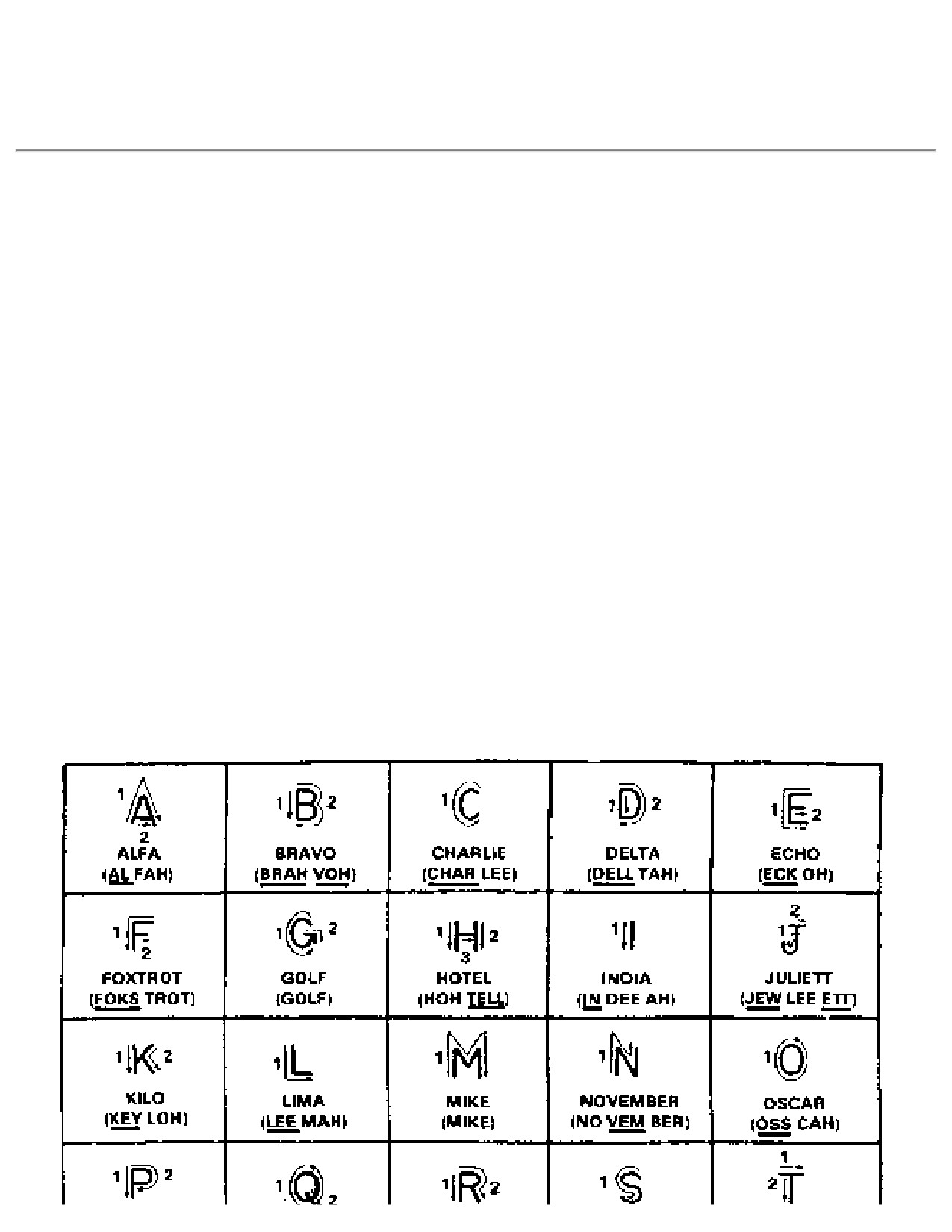
Legibility is important in making handprinted entries in logs, registers, and number sheets. Entries should
be typed or legibly handprinted. Most letters are formed with a straight line as the foundation stroke.
Other letters require a round or circular line as the foundation stroke. The letter Z has a line through the
center to distinguish it from the number 2. Numerals must be distinct. They are made with either a
straight or circular stroke. The numeral 1 always has a line under it to distinguish it from the letter I. A
zero has a line diagonally through it to distinguish it from the letter O.
A-2. Phonetic Alphabet
Certain letters of the alphabet have similar sounds and often are confused in telephone conversations.
Figure A-1 shows the word to be used in voice communications to represent letters of the alphabet and
numbers.
http://www.adtdl.army.mil/cgi-bin/atdl.dll/fm/24-17/Appa.htm (1 of 2) [1/11/2002 1:55:52 PM]
Appendix B
World Time Zones and Time Conversion Table
B-1. Date and Time
In messages, these are expressed as six digits followed by the ZULU (Z) zone suffix. The first pair of
digits denotes the date, the second pair the hour (24-hour clock), the third pair the minutes past the hour.
Example of a DTG is 201132Z.
B-2. Greenwich Mean Time (GMT)
This time is accepted as the basis for measuring time throughout the world. Time groups expressing
GMT are designated by the letter suffix Z immediately following the last digit of the group. Any other
suffix used after a 4-digit DTG (corresponding to the Z of GMT) indicates the zone in which the local
civil time is expressed. It does not designate location on the earth’s surface. The proper suffix can be
determined from the time zone map and the time conversion table. (See Figures B-1 and B-2.)
http://www.adtdl.army.mil/cgi-bin/atdl.dll/fm/24-17/Appb.htm (1 of 4) [1/11/2002 1:56:00 PM]
B-3. Difference in Time
Numerals in the zone indicate the number of hours that local time differs from GMT. Time zones extend
east and west from Greenwich to the 180th meridian. If a given zone lies east of the prime meridian, the
appropriate number is added to convert it to local time. In converting local time to GMT, the appropriate
number is subtracted. For zones west of the prime meridian, the process is reversed. Deviation in time
shown on the time zone map will occur because of local policies or conditions.
B-4. Conversion of Time
The time conversion table converts time in one zone to time in any other zone. Vertical columns indicate
time zones. Zone Z is GMT. Time in each successive zone to the right of zone Z is 1 hour later, to the left
of zone Z is 1 hour earlier. Time in each successive shaded area to the right is 1 day (24 hours) later, to
the left is 1 day (24 hours ) earlier. To determine the time in zone Z when it is 0500 hours in zone 1,
proceed as follows: Find 0500 in column I and locate figure 2000 in the corresponding line in column Z.
Since 2000 is not in a shaded area, the time is 2000 hours yesterday. (See Figure B-2.)
http://www.adtdl.army.mil/cgi-bin/atdl.dll/fm/24-17/Appb.htm (4 of 4) [1/11/2002 1:56:00 PM]
Appendix C
Precedence Assignment Guide
C-1. Precedence Categories
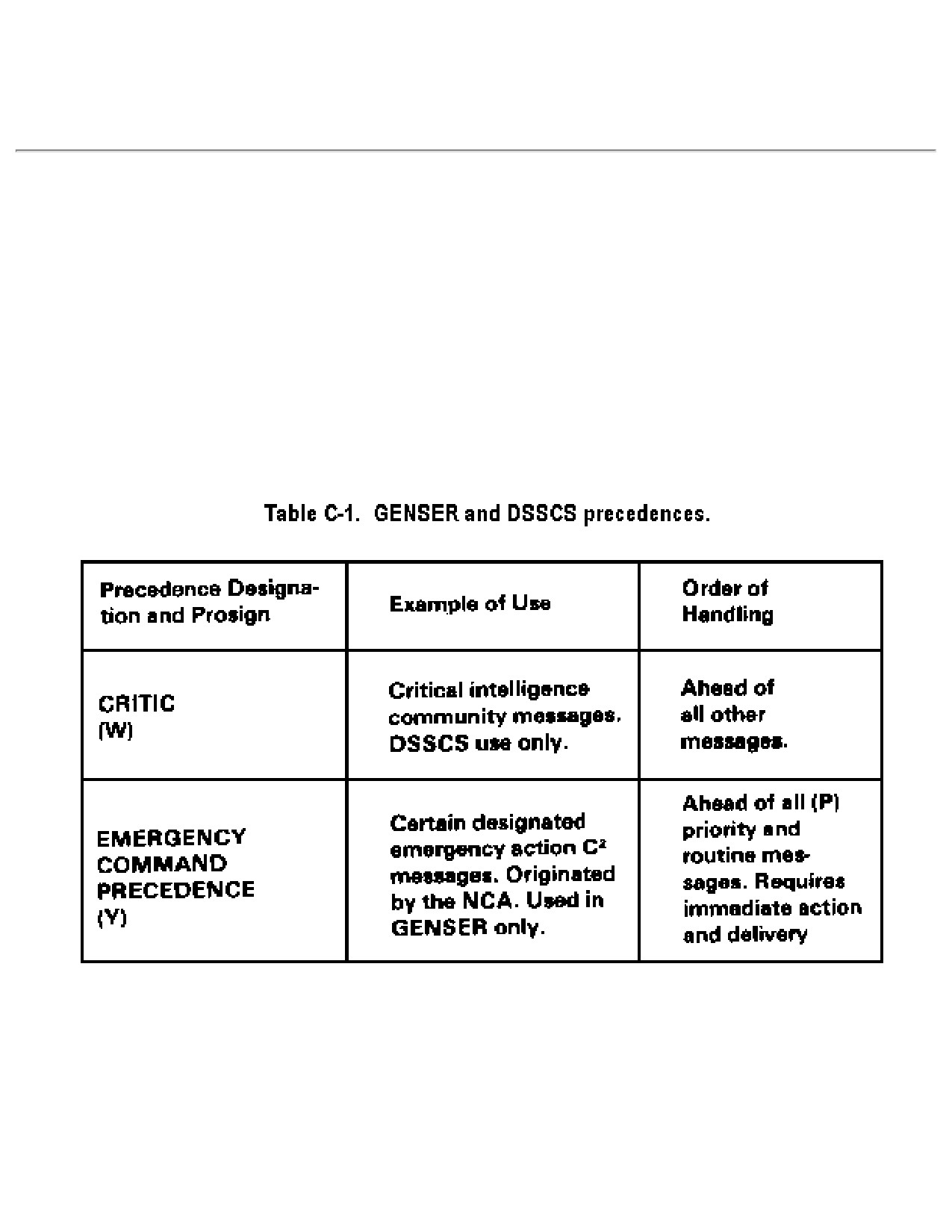
There are six precedence categories within the two record traffic communities (GENSER and DSSCS).
The precedences and examples are shown in Table C-1.
http://www.adtdl.army.mil/cgi-bin/atdl.dll/fm/24-17/Appc.htm (1 of 3) [1/11/2002 1:56:02 PM]
C-2. Precedence Abuse
Messages of like precedence are handled on a first in, first out basis. All immediate messages received at
the AN/TYC-39( ) message switch will be received, stored, and relayed in the order received. It has been
common practice in the past for message originators to OVER PRECEDENCE their messages thinking
the message will get to an addressee faster. What happens is too many messages of the same precedence
http://www.adtdl.army.mil/cgi-bin/atdl.dll/fm/24-17/Appc.htm (2 of 3) [1/11/2002 1:56:02 PM]
FM 24-17 Appendix C
will actually delay message delivery because the switch is saturated with an over abundance of high
precedence record traffic. Message originators are encouraged to assign a precedence which accurately
reflects the speed of delivery and speed of action required or requested of the message addressee.
C-3. Precedence Assignment
CT and TCC personnel should be aware that overall responsibility of assigning a precedence to record
traffic is the message originator. No record traffic message will be delayed due to questions regarding the
validity of a message precedence. All messages are processed IAW the precedence assigned to the
message, based on the first in, first out, by precedence guidelines.
http://www.adtdl.army.mil/cgi-bin/atdl.dll/fm/24-17/Appc.htm (3 of 3) [1/11/2002 1:56:02 PM]
Appendix D
Use of Passwords with CT
D-1. CT Passwords
The CT uses passwords to limit access to different setups, functions, and levels of classified material
processed and stored by the CT. Password control allows the CT owner to permit certain individuals
access to different levels of classified material and to make changes to the operating parameters without
giving all operators access to TOP SECRET material.
There are nine passwords used in the CT. These passwords control access to such functions as changing
the GUARDED menu, enabling different classification levels for the terminal, changing the PLA/RI
table, setting different passwords for the classification level of the operators, transmitting messages, and
entering the Disk Operating System (DOS).
Passwords are critical to the CT security. Persons having passwords must be instructed on password
sensitivity, protection, and personal responsibility for their security. For security reasons, passwords will
be treated as more valuable than safe combinations.
Functions which require one or more passwords to access them are listed below.
DOS. The password to access DOS should be limited to a minimum number of personnel as it is not
required for routine message processing.
GUARDED. The password to access this function must be strictly controlled and issued to a minimum
number of personnel. The GUARDED menu is where initialization items are entered or changed and
where the PLA/RI table is updated (additional password is required for this function).
ENABLE. The password to access the ENABLE function will be strictly controlled and issued only to
those personnel requiring specific access. All personnel who are authorized to compose messages for a
given level of classification will have the same password for this function. A different password is used
for each level of access with a user having automatic access to all classifications at or lower than what
they are authorized. Access to SECRET means the user can access SECRET and CONFIDENTIAL but
not TOP SECRET.
http://www.adtdl.army.mil/cgi-bin/atdl.dll/fm/24-17/Appd.htm (1 of 2) [1/11/2002 1:56:04 PM]
FM 24-17 Appendix D
PLA/RI. The password to access this function will be controlled by the security manager. The PLA/RI
password is used to add, delete, and make changes to the PLA/RI table.
SET PASS. The password to access this function is limited to CT personnel with a TOP SECRET
clearance and a need to know. This password allows the CT manager to change any of the current
passwords prior to changing to new passwords.
D-2. CT Password Control
The security manager or ISSO is responsible for the generation, issuance, and control of all system
passwords, CT passwords require the following procedures to be in effect:
● Randomly generated (never common words or phrases).
● Classify at the highest level as the granted access.
● Require strict receipt procedures.
● Change at least semiannually or upon departure of an individual having knowledge of a password.
Password generation and control is outlined in paragraph 2-15 of AR 380-19.
The CT manager, using stringent password control, will be able to limit access to the different CT
functions. Restricted access will reduce the possibility of unauthorized parameter alterations, and
compromise of information, while still allowing multiple users to process outgoing and incoming record
traffic efficiently.
http://www.adtdl.army.mil/cgi-bin/atdl.dll/fm/24-17/Appd.htm (2 of 2) [1/11/2002 1:56:04 PM]
Appendix E
Commonly Used Operating Z Signals
Operating Z signals are three-letter signals starting with the letter Z and used to expedite
communications. They are also used to convey frequently used requests and information relating to
communications. When preceded by the prosign INT, Z signals form a request or ask a question.
EXAMPLE: INT ZDK -- Request retransmission. When Z signals are used alone, they convey an order
or make a positive statement. Table E-1 lists commonly used operating Z signals. (See ACP 131 for a
more thorough listing and definitions of Z signals.)
http://www.adtdl.army.mil/cgi-bin/atdl.dll/fm/24-17/Appe.htm (1 of 3) [1/11/2002 1:56:07 PM]
Appendix F
Example of Operations Order for CT
This appendix provides examples of work sheets used with operation orders (OPORDs) for the CT.
Table F-1 contains columns for the 45 initialization table items the user must enter to initialize the CT.
This work sheet should be used when preparing an OPORD deploying the CT.
http://www.adtdl.army.mil/cgi-bin/atdl.dll/fm/24-17/Appf.htm (1 of 5) [1/11/2002 1:56:10 PM]
Table F-2 is the PLA/RI entry work sheet. This work sheet contains space for 20 entries. If more entries
are needed, a second blank work sheet can be used. This work sheet is used during initialization and
whenever a PLA/RI is updated.
http://www.adtdl.army.mil/cgi-bin/atdl.dll/fm/24-17/Appf.htm (4 of 5) [1/11/2002 1:56:10 PM]
Close coordination with the supporting signal officer is required to obtain correct initialization and
PLA/RI table entries.
http://www.adtdl.army.mil/cgi-bin/atdl.dll/fm/24-17/Appf.htm (5 of 5) [1/11/2002 1:56:10 PM]
Appendix G
Alarms and Indicators
When a significant action or an error occurs, the CT user is informed by an indicator appearing within
the windows on the top three lines of the terminal or by an audible alarm. Table G-1 shows a listing of
the AN/UGC-144 alarms and indicators, their causes, and additional information on causes or responses
as appropriate. The common response for all alerts, and often the only response, is to press the ALARM
RESET button.
http://www.adtdl.army.mil/cgi-bin/atdl.dll/fm/24-17/Appg.htm (1 of 5) [1/11/2002 1:56:13 PM]
Appendix H
Initialization Table Entries
H-1. Background
In the operating environment, the CT can be connected to one of the following equipments: DSVT,
DNVT, or DLED. Tables H-1 through H-9 show the suggested settings for the initialization settings for
the CT dependent upon the mission of the unit that owns the CT. Initialization table changes are required
when operating in certain formats and modes.
FM 24-17 Appendix H
H-2. Table Contents
Tables H-1 through H-7 show initialization entries for the CT using the DSVT connected through an
AN/TTC-39( ).
Table H-8 shows changes to the initialization table for a CT using a DLED going through an AN/TYC-
39( ). Only items shown need to be changed from those shown in Tables H-3 and H-4.
The following change is made to the initialization table entries (Table H-4) when the CT uses a DSVT in
MSE.
The following change is made to the initialization table entries (Table H-4) when the CT uses a DNVT in
MSE.
http://www.adtdl.army.mil/cgi-bin/atdl.dll/fm/24-17/Apph.htm (10 of 11) [1/11/2002 1:56:26 PM]
FM 24-17 Appendix H
Table H-9 shows the changes to be made to the initialization table entries (Table H-3) when the CT is set
for ACP 127 or MODE II JANAP 128/DOI 103 format when a message must pass through an AN/TYC-
39( ) or through AUTODIN.
http://www.adtdl.army.mil/cgi-bin/atdl.dll/fm/24-17/Apph.htm (11 of 11) [1/11/2002 1:56:26 PM]
Appendix I
CT Factory Default Setting
When a CT arrives at the authorized location, some initialization items will already be preset in the CT’s
memory. When a CT is turned into maintenance or zeroized for storage, the CT must be reset to the
factory default settings. Table I-1 is provided for the CT operator to use as required. Failure to reset the
CT to factory options prior to storage or return the terminal to maintenance will constitute a reportable
security violation. See AR 380-5 for reporting procedures.
Appendix J
Security and Protection Measures for Diskettes
J-1. In addition to procedures listed in Chapter 2 of this manual, the following procedures amplify
requirements and must be followed at all times the CT is being used.
Security procedures. Diskettes containing classified or sensitive material must be afforded the same level
of security that paper copy material is provided.
Diskettes containing sensitive Privacy Act data will be marked "FOR OFFICIAL USE ONLY-Privacy
Act Data." Both the label on the diskette and its protective jacket will be appropriately marked.
Diskettes containing classified data will be handled and marked IAW AR 380-5. Both the label on the
diskette and its protective jacket will be appropriately marked.
Diskettes will be stored to prevent unauthorized access, damage, modification, or destruction.
If diskettes become defective and are to be destroyed, the media should also be reformatted, reinitialized,
or degaussed before being shredded or placed in a container for destruction.
"Deleting" or "killing" a file does not remove the data contained in that file from the diskette. It is simply
"marked" as deleted, so that normal DOS operations cannot access the file.
Utilities exist that can recover the file. Therefore, diskettes containing sensitive information must be
reformatted, reinitialized, or degaussed prior to reuse.
Backup copies of sensitive data should always be maintained and stored away from work areas. Backup
copies of sensitive data must be protected in the same manner as the original data.
Diskettes will not be removed from the organization without written approval from the ISSO/B SO.
On multiuser systems, each user should maintain his own diskettes. Those data files maintained on the
hard disk should be write-protected to avoid damage or destruction by other users.
http://www.adtdl.army.mil/cgi-bin/atdl.dll/fm/24-17/Appj.htm (1 of 2) [1/11/2002 1:56:30 PM]
FM 24-17 Appendix J
As an item of government property, diskettes are subject to inspection/examination for the presence of
unauthorized data or software. Diskettes and the files contained therein should be marked and labeled
IAW MARKS.
Protection procedures. Diskettes must be protected when removed from their protective jackets. The
following actions must be taken in order to properly protect diskettes. Do not place diskettes on
terminals, in books, or under equipment. Do not toss a diskette loosely in a drawer.
Do not place diskettes near any magnetic source such as telephones, radios, tape recorders, or
loudspeakers of any kind.
Do not touch exposed areas of diskettes or try to wipe them clean, as they are easily scratched.
Do not place diskettes in direct sunlight and keep them away from extreme heat or cold.
Do not write directly on a diskette with ball point pen, lead pencil, or other hard writing instruments.
Instead, use a felt tip pen and a label.
Do not leave diskettes containing sensitive information unattended in PCs or word processors.
Do not expose diskettes to cigarette smoke, ashes, or liquids of any kind. Accumulated particles on the
diskette surface can damage the disk drive heads or the diskette or both.
J-2. The ISSO/BSO will provide training to ensure CT users are aware of and comply with required
security and protection procedures associated with data diskettes.
J-3 . If a diskette marked as FORMATTED contains classified information and has not been protected at
the highest level of classification of the material contained on the disk, a report will be initiated to
supervisory/security personnel in accordance with AR 380-5.
http://www.adtdl.army.mil/cgi-bin/atdl.dll/fm/24-17/Appj.htm (2 of 2) [1/11/2002 1:56:30 PM]
Glossary
Acronyms, Abbreviations, and Definitions
addressee -
The activity or individual to whom a message is directed by the record traffic originator.
Addressees are indicated as either ACTION or INFORMATION.
ADDS
Army Data Distribution System
admin
administrative
ADP
automatic data processing
AFATDS
Advanced Field Artillery Tactical Data System
AFFOR
Air Force forces
AFSOB
Air Force Special Operational Base
Allied Communications Publication (ACP) -
http://www.adtdl.army.mil/cgi-bin/atdl.dll/fm/24-17/Gloss.htm (1 of 21) [1/11/2002 1:56:33 PM]
FM 24-17 Glossary
A series of publications designed for standardized communications procedures between the
United States and its allies. ACPs govern the operations of signal systems in support of combined
operations. ACP 201 is an index of ACPs, CT and TCC operators are obligated to use and follow
the instructions contained in ACPs.
AMPSSO
automated message processing special security officer
ANDVT
advanced narrowband digital voice terminal
Area Common-User System (ACUS) -
ACUS is a secure, multiuser, high volume C2, administrative, logistics, operations, and
intelligence voice and data traffic system. It is an integrated switching system from the battalion
through theater Army. ACUS provides interface points with access to the strategic and sustaining
base environments.
ARFOR
Army forces
Army Tactical Command and Control System (ATCCS) -
The C2 system for AirLand Operations (corps/tactical area of information management area).
ASAS
All Source Analysis System
ASCII -
American standard code for information interchange. A standard code using a coded character set
consisting of 7-bit coded characters used for information interchange among data processing
systems, data communications systems, and associated equipment. The ASCII set consists of
control characters and graphic characters.
AUD
http://www.adtdl.army.mil/cgi-bin/atdl.dll/fm/24-17/Gloss.htm (2 of 21) [1/11/2002 1:56:33 PM]
FM 24-17 Glossary
audio
audit trail -
A chronological record of activities that will enable the reconstruction, review, and examination
of the sequence of events concerning each step in the process, transmission, receipt, and delivery
of record traffic.
authentication -
A security measure designed to protect a communications system against fraudulent transmissions
or simulation by establishing the validity of a transmission, message, or originator.
autodial -
A function that allows for the automatic dialing of telephone numbers. An expanded version of
programmed dialing found in commercial telephone instruments.
automatic digital network (AUTODIN) -
A worldwide automatic communications network for DOD end-to-end message switched digital
data communications. There are 15 AUTODIN switching centers in various locations worldwide.
automatic voice network (AUTOVON) -
A worldwide automatic switched nonsecure voice communications system for end-to-end, voice
connections for the DOD. It is part of the DCS. It is now designated the Defense Switched
Network (DSN) (q.v.).
auxiliary storage cassette (ASC) -
A component of a communications terminal on which to record/store record traffic.
basic emergency plan (BEP) -
A series of plans of action that should be simple, capable of rapid execution and include priorities,
methods, and levels of destruction, or evacuation to prevent unauthorized access to classified
material or sensitive equipment.
battlefield automated systems (BAS) -
http://www.adtdl.army.mil/cgi-bin/atdl.dll/fm/24-17/Gloss.htm (3 of 21) [1/11/2002 1:56:33 PM]
FM 24-17 Glossary
These systems are used on the battlefield at corps, division, and brigade levels to collect, process,
and distribute information required by commanders and staffs. Examples of BAS systems are the
ASAS, TACCs, TACFIRE, and the AFATDS.
BSO
brigade/battalion signal officer
CEWI
Combat Electronic Warfare and Intelligence
CHS
common hardware and software
CIP
Communications Improvement Plan
circuit switching -
A method of handling record traffic through a switching center, either from local users or from
other switching centers, whereby a connection is established between the using terminals. The
circuit will stay in use until the connection is released by one of the users. Primarily oriented to
single connection to single destinations.
clk
clock
combat net radio (CNR) -
This term covers a wide range of single-channel radio systems which provide immediate real-time
C2 voice capability.
communications security (COMSEC) -
The protection resulting from all measures designed to deny unauthorized persons information of
value that might be derived from the possession and study of telecommunications, or to mislead
unauthorized persons in their interpretation of the results of such possession and study. COMSEC
http://www.adtdl.army.mil/cgi-bin/atdl.dll/fm/24-17/Gloss.htm (4 of 21) [1/11/2002 1:56:33 PM]
FM 24-17 Glossary
includes cryptosecurity, transmission security, emission security, and communications physical
security of COMSEC material and information.
communications terminal (CT) -
AN/UGC-144 computer terminal used to process formal tactical record traffic. Contains
preformatted message headings to facilitate entry into the TRTS.
compromise -
The known or suspected unauthorized disclosure or loss of sensitive defense information.
controlled area -
A restricted area, adjacent to, or encompassing limited or exclusion areas where security controls
have been applied to provide protection to an information processing system’s equipment.
controlled cryptographic item (CCI) -
A controlled COMSEC item that is unclassified when unkeyed. Although unclassified, the CCI is
controlled to prevent loss or theft. When CCI is keyed, it becomes classified at the same level as
the keying material within the CCI.
Corps/Theater ADP Service Center Phase II (CTASC II) -
Administrative and logistical network that interfaces through the MSE and other message/circuit
switching.
CRITIC -
A precedence used for critical intelligence record traffic. This information includes but is not
limited to strong indications of the imminent outbreak of hostilities of any type, aggression of any
nature against a country, or indication or use of NBC weapons.
CRITICOM
critical intelligence communications friendly
cryptosecurity -
The component of COMSEC that results from the provision of technically sound cryptosystems
http://www.adtdl.army.mil/cgi-bin/atdl.dll/fm/24-17/Gloss.htm (5 of 21) [1/11/2002 1:56:33 PM]