FM 24-17 Tactical Record Traffic System (TRTS) (September 1991) - page 2
The CT has built-in preformatted selections for service messages which the operator can call up from the
EDIT menu. These are listed in a subsequent paragraph. In most cases, these preformatted service
messages will meet the CT operator’s needs in accomplishing service actions. The CT operator calls
them up and uses them in the following manner.
● From the MAIN menu, select the EDIT menu.
● From the EDIT menu, press SERVICE function key. Either the GENSER or DSSCS service
message menu is displayed depending on the terminal network.
● Move UP and DOWN arrow keys to highlight the service message needed.
● Press SELECT function key. A prompt to select a service message appears.
● Press SELECT function key to extract data service message or NO MSG to manually enter
information.
● Enter service information/action/Z signal as needed. When you are finished, the service message
is displayed.
● Press MENU key to return to service menu and prepare to send the service message as an
outgoing message.
The following preformatted service messages are available:
● Voluntary Correction of Transmitted Message
-Portion of message
-Entire message
● Misrouted Message
-Corrected and resent (relayed)
-Unable to relay
● Missent Message
● Suspected Duplicate
http://www.adtdl.army.mil/cgi-bin/atdl.dll/fm/24-17/Ch6.htm (2 of 13) [1/11/2002 1:55:24 PM]
FM 24-17 Chptr 6 Formal Service Message Fundamentals
● Receipt of Unmarked Duplicate Messages
● Notification of Garbled Message
● Request Retransmission
● Retransmission
● Readdress Multiple Page
The service messages that an operator can select are explained below.
Voluntary correction (VOL CCN) of transmitted messages.
For Portion of Message
RTTUZYVW RADADAA003 0012109-UUUU--RAASSAA.
ZNR UUUUU
BT
UNCLAS SVC NON-INTELLIGENCE
ZUI RADADAA0002 0011837 0118372 JAN 90
VOL CCN CHANGE LINE SEVEN WORD SIX TO READ
FOXTROT
VICE GOLF.
BT
#0003
--OR-
For Entire Message
RTTUZYVW RADADAA003 0012109-UUUU--RAASSAA.
ZNR UUUUU
BT
UNCLAS SVC NON-INTELLIGENCE
VOL CCN RADADAA0002 0011837Z JAN 90
R 011837Z JAN 90
(ORIGINAL MESSAGE TEXT WITH CORRECTIONS MADE)
BT
#0003
http://www.adtdl.army.mil/cgi-bin/atdl.dll/fm/24-17/Ch6.htm (3 of 13) [1/11/2002 1:55:24 PM]
FM 24-17 Chptr 6 Formal Service Message Fundamentals
A VOL CCN of a transmitted message saves time by correcting a portion of a message that was already
transmitted. When you select this service message, you add your change after VOL CCN.
VOL CCN service messages are used when significant errors which affect the substance of a message are
detected after transmission.
An entire message may be corrected by using the procedures shown in the example above.
After receiving a VOL CCN service message, the CT operator processes the service message ahead of
outgoing messages of the same or lower precedence.
The CT operator takes the following actions:
● Retrieves the original message received from the received message file.
● Makes the necessary corrections.
● Marks the corrected message as a CORRECTED COPY .
● Redistributes the message to the original addressee(s).
● Optionally may add CORRECTION UNDERLINED.
● DESTROYS ALL OTHER COPIES.
Misrouted message.
Corrected and Resent (Relayed)
RTTUZYVW RADADAA0004 0012114-UUUU--RAASSAA.
ZNR UUUUU
BT
UNCLAS SVC NON-INTELLIGENCE
ZUI RADADAA0002 0011837 011837Z JAN 90
ZEQ-3 RUADAAA 0211734
BT
#0004
--OR--
Unable to Relay
RTTUZYVW RADADAA0004 0012114-UUUU--RAASSAA.
http://www.adtdl.army.mil/cgi-bin/atdl.dll/fm/24-17/Ch6.htm (4 of 13) [1/11/2002 1:55:24 PM]
FM 24-17 Chptr 6 Formal Service Message Fundamentals
ZNR UUUUU
BT
UNCLAS SVC NON-INTELLIGENCE
ZUI RADADAA0002 0011837 011837Z JAN 90
ZEQ-4
BT
#0004
A service message for a misrouted message informs the sending terminal that the receiving station is not
the addressee on the message, and that the wrong RI has been used.
Upon receiving a misrouted message, the receiving CT is responsible for one of two actions.
● Relay the message and inform sending station of action taken. The ZEQ-3 example informs the
sending station of the message being received at the wrong station and the receiving CT relaying
the message to the correct CT. The time of relay is placed after the correct CT’s RI to alert the
sending CT of the time relayed.
● Notify originating station that message has been misrouted and no other action taken. The ZEQ-4
service message is sent to the originating CT to inform the terminal that the message has been
misrouted, the correct RI is unknown, the addressees correct RI must be determined, and the
message must be retransmitted to the correct RI.
The receiving CT is responsible for delivering a received message or notifying the originating CT that
the message has not been delivered because an incorrect RI has been used.
A copy of the service message is attached to the original misrouted message and is placed in the
RECEIVED MESSAGE FILE .
Missent message.
RTTUZYVW RADADAA0005 0012116-UUUU--RAASSAA.
ZNR UUUUU
BT
UNCLAS SVC NON-INTELLIGENCE
ZUI RAASSAA0002 0011837 011837Z JAN 90
ZEQ-1 TOR 0212321Z
HEADER FOLLOWS
RTTUZYUW RADADAA0002 0011837-UUUU--RADFDAA.
#0005
http://www.adtdl.army.mil/cgi-bin/atdl.dll/fm/24-17/Ch6.htm (5 of 13) [1/11/2002 1:55:24 PM]
FM 24-17 Chptr 6 Formal Service Message Fundamentals
A missent message is a message that has the correct RI but has been inadvertently transmitted by the
automated message switch.
The receiving CT is responsible for relaying a missent message as a suspected duplicate (ZFD) and
sending a service message (ZEQ-1) to the originating CT to inform them of the time of relay.
Suspected duplicate.
RTTUZFDY RADADAA0002 0011837-UUUU--RAASSAA.
ZNR UUUUU
R 011837Z JAN 90 ZFD
FM CDR 5TH CORPS FRANKFURT GE//IAESA//
TO RAASSAA/CDR FT HOOD TX//AEBADT//
BT
UNCLAS NON-INTELLIGENCE
(ORIGINAL MESSAGE TEXT)
BT
#0002
A suspected duplicate message is sent out when one or more addressees claim they never received the
original transmission, or if the CT operator is relaying a missent message.
● The message is resent because the addressee claims the message was never received.
● The Z signal ZFD tells CT addressees that they may have already received the message.
● After the message has been selected from the MSG directory, the CT automatically makes the
changes to the header. No further changes are required by the CT operator.
The CT operator processes and delivers messages marked as SUSPECTED DUPLICATE to alert
addressees that the message may have already been received.
Receipt of unmarked duplicate message.
http://www.adtdl.army.mil/cgi-bin/atdl.dll/fm/24-17/Ch6.htm (6 of 13) [1/11/2002 1:55:24 PM]
FM 24-17 Chptr 6 Formal Service Message Fundamentals
RTTUZYVW RADADAA0006 0012119-UUUU--RAASSAA.
ZNR UUUUU
BT
UNCLAS SVC NON-INTELLIGENCE
ZUI RAASSAA0002 0011837 0118372 JAN 90
RECEIVED UNMARKED DUPLICATE
TOR 011901Z AND 011912Z
HEADER FOLLOWS
RTTUZYUW RAASSAA0002 0011837-UUUU--RADADAA.
BT
#0006
A service message showing receipt of an unmarked duplicate message informs the sending CT that a
message has been received twice.
When a CT receives a service message reporting receipt of an unmarked duplicate, the CT operator
checks the HISTORY file to ensure the message has not been retransmitted twice by mistake. If only one
transmission has been made, the CT user sends a routine message to the connected message
switch/parent or alternate AN/TYC-39( ) and cites the-
● Complete header of the message.
● Time transmitted.
● Information to identify the CT who received the duplicate messages.
● Time of receipt of both messages.
Duplicate messages will be delivered to the addressee as a SUSPECTED DUPLICATE. The addressee,
not the CT operator, makes the final determination as to what (if any) action is required, or if the
message has already been received and action taken.
A copy of this service message is attached to the previous service message to indicate the completed
action.
Notification of garbled message.
http://www.adtdl.army.mil/cgi-bin/atdl.dll/fm/24-17/Ch6.htm (7 of 13) [1/11/2002 1:55:24 PM]
FM 24-17 Chptr 6 Formal Service Message Fundamentals
RTTUZYVW RADADAA0007 0012121-UUUU--RAASSAA.
ZNR UUUUU
UNCLAS SVC NON-INTELLIGENCE
ZUI RAASSAA0002 0011837 0118372 JAN 90
ZES-2
BT
#0007
The garbled message (ZES-2) service message informs the originating CT that you have received the
message and the text is unreadable.
A copy of this service message must be kept in a suspense file until a readable copy of the message is
received for delivery. Appropriate follow-up action must be taken periodically until the suspense action
is cleared. Follow-up action will be taken based on the precedence of the garbled message.
After a corrected copy is received, the original message, the service message, and the correct copy will
be attached and placed in the RECEIVED MESSAGE FILE.
Messages having a precedence of PRIORITY and above will be delivered as received with the message
marked DELIVERED SUBJECT TO CORRECTION. Garbled or incomplete high precedence messages
will not be held by the CT operator for service actions.
Request retransmission.
RTTUZYVW RADADAA003 0011839-UUUU--RASSAA.
ZNR UUUUU
R 0118382 JAN 90
FM CDR 5TH CORPS FRANKFURT GE//IAESA//
TO RAASSAA/CDR FT HOOD TX//AEDBA//
BT
UNCLAS NON-INTELLIGENCE
ZUI RASSAA0005 R 010848Z JAN 90. ZES-2 INT ZDK
(ORIGINAL MESSAGE TEXT)
BT
#0003
A request retransmission message asks the distant terminal to complete an action. INT means
REQUEST.
The example above shows a CT requesting retransmission of a message from CDR FT HOOD CT due to
receiving a garbled message (ZES-2) in Germany.
http://www.adtdl.army.mil/cgi-bin/atdl.dll/fm/24-17/Ch6.htm (8 of 13) [1/11/2002 1:55:24 PM]
FM 24-17 Chptr 6 Formal Service Message Fundamentals
Had the received message been incomplete, the Z signal ZES-1 would have been used.
Retransmission (of a previously transmitted message).
RTTUZDKW RADADAA0002 0011837-UUUU--RASSAA.
ZNR UUUUU
R 0118372 JAN 90
FM CDR 5TH CORPS FRANKFURT GE//IAESA//
TO RAASSAA/CDR FT HOOD TX//AEDBA//
BT
UNCLAS NON-INTELLIGENCE
(ORIGINAL MESSAGE TEXT)
BT
#0002
Retransmission of a previously transmitted message is used to resend a message in response to a request
retransmission request by a distant CT. The example above indicates that the message has been corrected
and retransmitted in response to a ZES-2 request.
Upon receipt of a ZDKW message, the CT operator must determine if a service action (ZES-2) has been
originated by the CT. If the ZDKW is in response to your ZES-2 service, pull the service, process, and
deliver the ZDKW as a CORRECTED COPY. Attach a copy of the service message to the garbled
message and the ZDKW message for file.
If the receiving CT did not request a retransmitted message (ZES-2 action not originated by your CT),
deliver the ZDKW as a SUSPECTED DUPLICATE to the addressee.
Readdressing messages (single page or multiple page).
RTTUZYUW RADADAA001l 0081949-UUUU--RAASSAA.
ZNR UUUUU
R 081948Z JAN 90
FM CDR 5TH CORPS FRANKFURT GE//IAESA//
TO RUSNBAA/CDR 19TH CORPS SEOUL KOR//ITIT//
BT
UNCLAS NON-INTELLIGENCE
(ORIGINAL MESSAGE TEXT)
BT
#00ll
http://www.adtdl.army.mil/cgi-bin/atdl.dll/fm/24-17/Ch6.htm (9 of 13) [1/11/2002 1:55:24 PM]
FM 24-17 Chptr 6 Formal Service Message Fundamentals
A readdressed message is a message that needs to be sent to an addressee that was originally listed on the
message, but the RI was not included in the original transmission.
The above example shows a message that was sent to a different addressee than was originally
transmitted. The original header remains on the message so that all personnel are aware of who has
received the message.
Single and multiple page readdressals look the same and the same information is needed for both.
6-3. CT to CT Service Message Procedures
To send a service message to another CT, use the EDIT menu, select new message, and type what type
action is needed and on what message. Select the JANAP 128AP for the header.
Supervisors should ensure training covers service message actions to enable improved speed-of-service
to CT addressees.
6-4. CT to TCC Service Message Procedures
To send a service message to a TCC, use the appropriate operating signals and procedures found in
Chapter 4 of JANAP 128.
6-5. Automatically Generated Service Messages
The AN/TYC-39( ) and AUTODIN message switches have the capability to automatically generate
service messages on messages that have been transmitted by the CT. These service messages are sent to
the CT when there is an error in the message header or end of a message which does not allow the
message to pass through the AN/TYC-39( ) or AUTODIN.
Examples of automatically generated service messages and the required operator responses follow with a
brief explanation. It is important that CT users are familiar and comply with the required actions to
process automatically generated service messages. Failure to respond within speed-of-service
requirements may adversely impact on the owning organization’s mission.
Format or MODE II in JANAP 128 and DOI 103 format.
http://www.adtdl.army.mil/cgi-bin/atdl.dll/fm/24-17/Ch6.htm (10 of 13) [1/11/2002 1:55:24 PM]
FM 24-17 Chptr 6 Formal Service Message Fundamentals
PTTUZYVW RUEBCSD0002 0081948-UUUU--RUEBDEA.
ZNR UUUUU
UNCLAS SVC RUEBDEA 12340081947
INVALID CSN EXPECTED DEA125 RCVD DEA129 ACC
#0003
NNNN
This service message is received when a message with the incorrect CSN has been received by the
connected AN/TYC-39( ). If the incorrect CSN has a higher out-of-sequence number than the next-in-
sequence CSN expected, the AN/TYC-39( ) will accept the message and process it. Your next CSN
would be DEA130.
PTTUZYVW RUEBCSD0002 0081948-UUUU--RUEBDEA.
ZNR UUUUU
UNCLAS SVC RUEBDEA1234 0081946
INVALID CSN EXPECTED DEA145 RCVD DEA129 REJ
#0002
NNNN
This service message is received when a message with the incorrect CSN has been received by the
AN/TYC-39( ). The message switch will reject the message and the CT operator will have to resend the
message using the next CSN of DEA146. In both examples above, the automatically generated service
message was a result of the CT operator not monitoring the DA Form 5651 and crossing out the CSN
number that corresponds to the next outgoing message being sent to or through a message switch.
Open CSN.
OTTUZYVW RUEBCSD0042 0081945-UUUU--RUEBDEA.
ZNR UUUUU
UNCLAS SVC
ZFX DEA015 THRU DEA023
#0042
NNNN
This service message is received by the CT when a message with an invalid CSN has been received by
the AN/TYC-39( ). If you have transmitted a message using the CSN’s DEA015 through DEA023, then
you must retransmit the messages with a new CSN starting with the next valid CSN from the DA Form
5651.
http://www.adtdl.army.mil/cgi-bin/atdl.dll/fm/24-17/Ch6.htm (11 of 13) [1/11/2002 1:55:24 PM]
FM 24-17 Chptr 6 Formal Service Message Fundamentals
Invalid security field.
OTTUZYVW RUDOCSD0008 0081948-UUUU--RUDDABA.
ZNR UUUUU
UNCLAS SVC ABA008 RUDOABC1234 0081944
INVALID SECURITY FIELD REJ
#0008
NNNN
This service message--a reject--is received when an error occurs with the operating signals ZNR or ZNY
and security redundancies codes not matching. The CT operator must correct the error and retransmit the
message into the TRTS .
Invalid header.
RTTUZYVW RUCLCSD0004 0091948-UUUU--RUCLABA.
ZNR UUUUU
UNCLAS SVC ABA004 RUCLABC1234 0091947
INVALID HEADER REJ
#0004
NNNN
This service message--a reject--is received when there is an error in the header of the message. An extra
space or one in the wrong location will cause the message to be rejected. The CT operator must correct
the error and retransmit the message.
Invalid routing.
RTTUZYVW RUCLCSD00005 0091948-UUUU--RUCLABA.
ZNR UUUUU
UNCLAS SVC ABA004 RUCLABC1234 0081948
INVALID ROUTING REPROTECT TO: RUCLAAA
#0005
NNNN
This service message is received when an incorrect RI is used. If the RI was obtained from your PLA
table, contact your supporting signal officer for updating of the PLA tables.
Note that the invalid routing message will in most cases inform you of the correct RI to be used to
retransmit the message.
http://www.adtdl.army.mil/cgi-bin/atdl.dll/fm/24-17/Ch6.htm (12 of 13) [1/11/2002 1:55:24 PM]
FM 24-17 Chptr 6 Formal Service Message Fundamentals
High precedence message accept.
OTTUZYVW RUFTCSD0059 0081920-UUUU--RUCLAI3A.
ZNR UUUUU
UNCLAS SVC R Z ABA009 RUFTABC2012 0081919
#0059
NNNN
This service message is received by the CT operator as an acknowledgement of receipt for a message
transmitted from the CT with a precedence of FLASH or higher.
R Z means the message was received at the AN/TYC-39( ) for forwarding to the intended addressee.
6-6. Service Message Logs
Incoming and outgoing service messages should be controlled by the CT operator in a manner that will
allow for the clearing or timely follow-up of service actions. A service suspense file of terminated and
originated service messages is to be maintained until requested or required actions are completed. DA
Form 4016 can be adapted to serve as incoming and outgoing service message logs.
All actions relating to a service message must be filed with the original message to give a complete
historical picture of the message and actions taken to properly and correctly deliver the message. If the
CT operator receives a garbled message, a copy of the outgoing service message and the corrected copy
will be attached to the original message received prior to placing in the file. Only the marked corrected
copy will be delivered to the addressees.
http://www.adtdl.army.mil/cgi-bin/atdl.dll/fm/24-17/Ch6.htm (13 of 13) [1/11/2002 1:55:24 PM]
Chapter 7
Defense Special Security Communications System
CT Facilities
7-1. Introduction
This chapter prescribes security procedures in addition to those procedures and requirements found in
DOI 101 and DOI 103. When CTs process DSSCS messages, additional security precautions must be
afforded to preclude adverse impact upon national security.
Units which have CTs that process DSSCS record traffic present lucrative and vulnerable targets for
espionage and enemy operations. The Director, NSA/Chief, Central Security Service (CSS) have
prescribed special rules and procedures for handling and reporting loss, storage, and access to DSSCS
record traffic and associated communications equipment. DSSCS terminal supervisors must be aware of
and enforce required security measures to protect record traffic from loss or compromise.
7-2. Responsibilities
The unit/organization automated message processing special security officer (AMPSSO) is responsible
for overall CT security. The AMPSSO receives guidance from the local special security officer (SSO) and
is the security controller for the DSSCS CT.
7-3. Special Procedures
Two-person integrity. National policy requires two people working near each other to provide mutual
support in maintaining the integrity of the CT processing/storing DSSCS communications. The two-
person integrity is in effect at all times when processing and storing TS/SCI defense information. AR 380-
5 contains additional information for the implementation requirements for two-person integrity, while the
unit’s AMPSSO provides local guidance.
Physically separate. DSSCS and GENSER record traffic will be physically separated at all times. (This
also includes physical separation of CTs.) Each CT maintains separate files and records. The provisions of
DOI 103 for file copies, ASCs, and floppy disks of DSSCS messages are in effect.
http://www.adtdl.army.mil/cgi-bin/atdl.dll/fm/24-17/Ch7.htm (1 of 5) [1/11/2002 1:55:26 PM]
ASCs and floppy disks are never to contain both DSSCS and GENSER messages. ASCs and floppy disks
containing SCI messages will be controlled and stored by the SSO.
Entry to processing or storing DSSCS record traffic on the CT is restricted to-
● Personnel whose duties justify their access.
● Personnel who have had their security clearances to SCI defense information verified by the SSO.
Cleared CT operators processing SCI will ensure that noncleared personnel are not allowed in or near the
CT until all record traffic processing is completed. (A strict need-to-know policy will be enforced at all
times.) Access rosters will be provided by the SSO and maintained next to the CT. Personnel not listed on
access rosters will be required to sign DA Form 1999-R.
CTs that have processed SCI must be sanitized after the message processing is completed and before the
next non-SCI multilevel user is permitted to operate the terminal. Cleared personnel will make a thorough
security check of the area to ensure all SCI-related material, including classified trash, is removed from
the area and properly secured.
Use DA Form 1999-R to record personnel authorized by the commander/SSO to have access to the CT.
The SSO should sign as the authorizing officer. Figure 7-1 is a sample of a completed DA Form 1999-R.
TB 380-41-5 contains a blank form and instructions for use.
http://www.adtdl.army.mil/cgi-bin/atdl.dll/fm/24-17/Ch7.htm (2 of 5) [1/11/2002 1:55:26 PM]
All DSSCS messages, except service messages, are processed and delivered to the SSO who is
responsible for reproduction and dissemination. DA Form 4011 is used to control direct traffic.
DSSCS message delivery to the SSO. The SSO may additional delivery instructions for SCI record
Compromise, possible compromise, or any security violations involving DSSCS/SCI material will
immediately be reported to the SSO.
7-4. Security Indoctrination and Training
Organizations with DSSCS CTs must have a supervised and documented training program to indoctrinate
CT user personnel in their individual security responsibilities. This training will include the following:
● Safeguarding the CT and associated ASCs and floppy disks from unauthorized access.
● Basic emergency planning for emergency destruction, evacuation, and storage.
● Reporting procedures, channels, and time frames to report any incidents of compromise or
insecurities involving the CT, ASCs, floppy disks, or record traffic files.
http://www.adtdl.army.mil/cgi-bin/atdl.dll/fm/24-17/Ch7.htm (3 of 5) [1/11/2002 1:55:26 PM]
SSOs will conduct and document security briefings to provide CT users with a clear understanding of
what is expected and required to protect the DSSCS message equipment and system. Briefings will be
conducted at least quarterly or as prescribed by DSSCS regulations.
The DSSCS CT supervisor/SSO will conduct an ongoing training program for the preparation and
transmission of CRITIC messages IAW DOI 103. Assistance in establishing or conducting a CRITIC
program can be provided upon request to: Director, NSA/CSS, ATTN: DDT , Fort George G. Meade,
Maryland, 20755-5000. Normally, the SSO will be the CRITIC control officer who will monitor the level
of CRITIC message processing proficiency at consolidated CTs.
7-5. Tactical Sensitive Compartmented Information Facilities (SCIFs)
CTs initialized for and processing DSSCS tactical record traffic must be located in a SCIF. While in a
garrison environment and depending upon the unit’s formal record traffic requirements, the CT may be
utilized either within an accredited fixed SCIF or inside a tactical vehicle collocated with an accredited
SCIF. The tactical vehicle must be parked near or, if possible, collocated next to the garrison SCIF. If the
CT is not used in garrison for record traffic or training, the CT must be purged of all memory and the
tactical vehicle completely sanitized of all DSSCS files and associated administrative documents. Upon
deployment to an exercise or tactical location where the CT will be initialized, a tactical SCIF must be
formally established prior to the CT processing DSSCS record traffic. Refer to Defense Intelligence
Agency Manual (DIAM) 50-3 for the required information to be forwarded through command channels to
establish a tactical SCIF.
A tactical SCIF is defined as, but not limited to, one of the configurations listed below. The exact type of
tactical SCIF depends primarily upon the commander’s requirements for DSSCS record traffic and the
tactical situation.
● Tactical vans, shelters, or closed-in vehicles.
● Tents or operations in vacated civilian or military buildings. (See first paragraph under DSSCS
Tactical Security Considerations below.)
● Aircraft (fixed or rotary) or bunkers.
● The following are examples of tactical SCIFs.
● TOCs.
● Special security communications and information processing vans.
http://www.adtdl.army.mil/cgi-bin/atdl.dll/fm/24-17/Ch7.htm (4 of 5) [1/11/2002 1:55:26 PM]
FM 24-17 Chptr 7 Defense Special Security Communications System CT Facilities
● Telecommunications facilities used for processing SCI voice and data traffic.
● Airborne and ground command posts or emergency relocation activities used for command,
control, communications, and intelligence operations.
DSSCS tactical security considerations.
Operation of a tactical SCIF and associated CTs requires continuous 24-hour per day operation for the
entire period of operations/activation. Two indoctrinated individuals will be present for duty within the
tactical SCIF. These individuals must be armed at all times if the tactical SCIF is located in a tent.
Overall security of a tactical SCIF is not at the same degree as at fixed (sustaining/strategic) SCIFs. To
enhance security in a tactical situation, the SCIF, where operationally possible, will be located within the
supported headquarters defensive perimeter and as close to the TOC as the tactical situation dictates.
Tactical SCIFs will be located within an area that uses a physical barrier around the SCIF and provides
for a single access point. An armed guard will be on duty at all times to limit access to the area. Strict
access control procedures will be used to restrict unauthorized personnel from gaining access to the SCIF
or security perimeter. Personnel who may enter the tactical SCIF area without escort will be identified on
a current access roster provided to the guard by the SSO.
Record traffic produced within the tactical SCIF, both in paper copy and the information/data maintained
on ASCs or floppy disks, will be limited to that needed to support, sustain, and document tactical
operations. CT-produced paper copy, ASCs, and floppy disks will be afforded a rapid and thorough
means of destruction under tactical conditions or hostile actions.
CT users will ensure large volumes of DSSCS traffic, ASCs, and floppy disks do not accumulate within
the tactical SCIF.
AMPSSO/SSOs will coordinate with the supporting information service support officer (ISSO)/signal
officer to ensure that a system of controls are established to monitor and control the paper and disk
holdings produced by the CT and maintained within the tactical SCIF. The Modern Army Recordkeeping
System (MARKS) will be used to identify procedures for maintenance, retirement, and destruction of CT
record traffic files.
http://www.adtdl.army.mil/cgi-bin/atdl.dll/fm/24-17/Ch7.htm (5 of 5) [1/11/2002 1:55:26 PM]
Chapter 8
Informal TRTS
8-1. Introduction
This chapter covers informal record traffic--what equipment is used, how it’s accounted for, how it’s
transferred across the system, how it interfaces with formal record traffic systems, and how it’s passed to
strategic and tactical packet networks. Also covered is the role of personal computers and the
interconnection with the ATCCS.
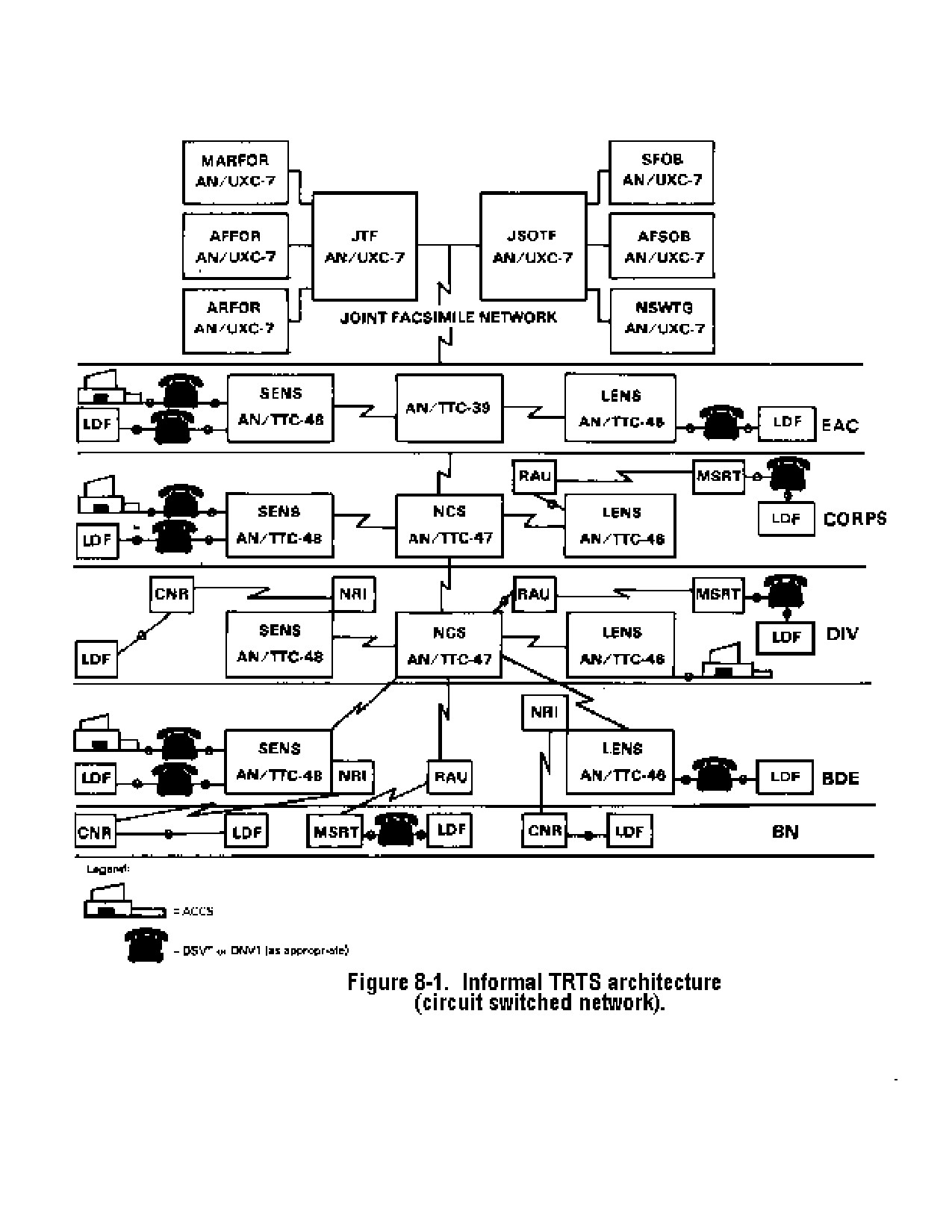
Informal record traffic capability is primarily limited to users within combat net radio (CNR) and the
ACUS. The informal record traffic capability is implemented from maneuver battalions through EAC for
users who have a requirement to send C2 information but not authorized access to formal TRTS. (See
Figure 8-1.)
http://www.adtdl.army.mil/cgi-bin/atdl.dll/fm/24-17/Ch8.htm (1 of 13) [1/11/2002 1:55:37 PM]
Informal TRTS allows commanders and their staffs to originate and terminate narrative text, map,
graphic, and operational overlay messages which support battlefield missions. No specific format for
http://www.adtdl.army.mil/cgi-bin/atdl.dll/fm/24-17/Ch8.htm (2 of 13) [1/11/2002 1:55:37 PM]
FM 24-17 Chptr 8 Informal TRTS
informal record traffic exists. An example of informal record traffic is a photograph with comments
handwritten on the document surface, then transmitted over the tactical circuit switched network.
Another example is narrative text prepared by the battalion S3 and transmitted by the circuit switched
network to the brigade S3.
8-2. Informal TRTS Message Equipment
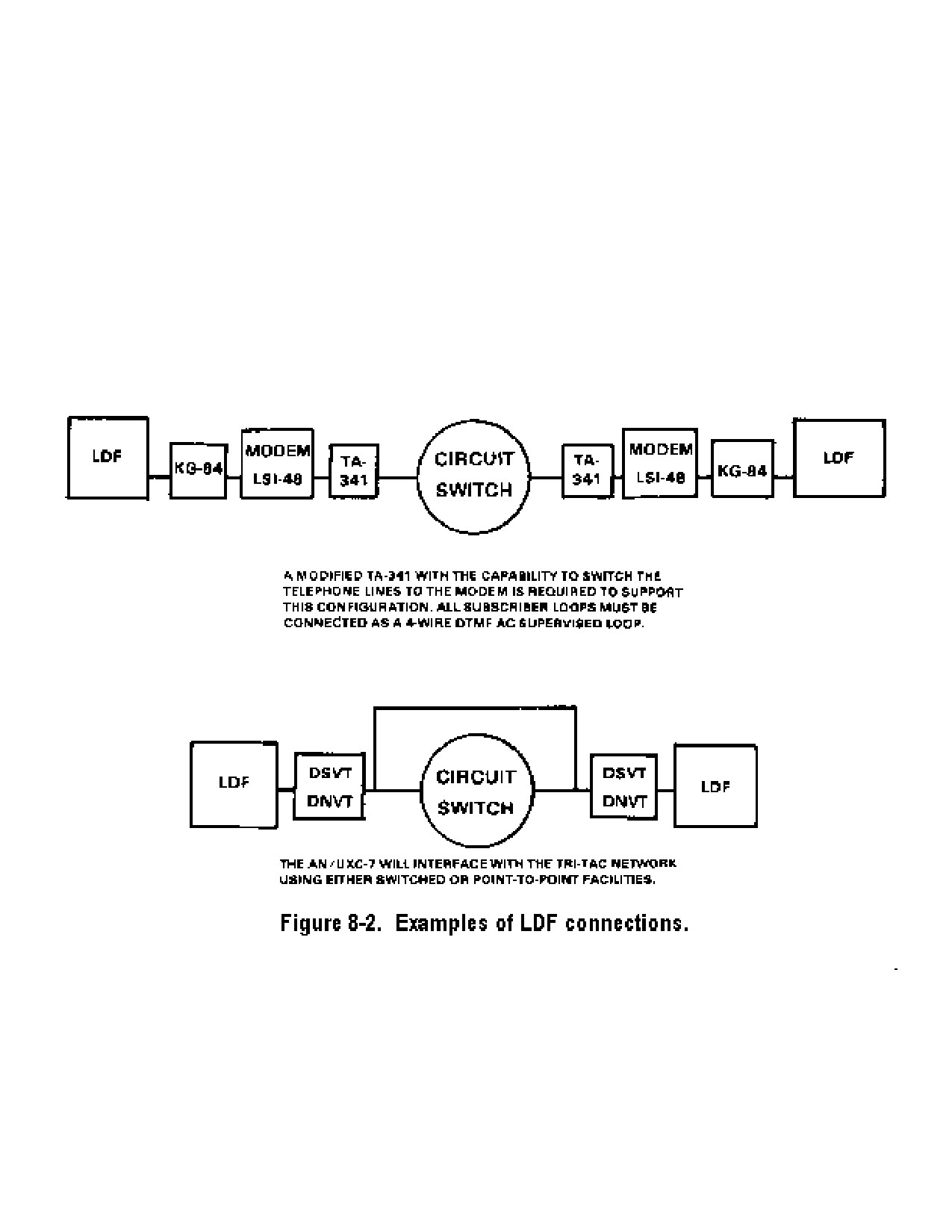
The LDF serves as the user’s primary input/output device for informal message traffic. To transfer an
informal message, a user connects the origination LDF to the destination LDF by the dial-up ACUS,
CNR, or interfaces between the two systems. Figure 8-2 shows examples of LDF connections. Once
connections are complete, the user coordinates the transmission, transmits the record traffic, and
terminates the call. Acknowledging the receipt may or may not be required.
LDF is the standard equipment used to pass informal record traffic communications. However, users who
have a requirement to pass informal record traffic may use authorized GP user-owned and -operated
terminal equipment at their locations. In addition, the following equipment may be used if prior approval
is obtained by the unit signal office.
● Desktop or laptop PCs.
http://www.adtdl.army.mil/cgi-bin/atdl.dll/fm/24-17/Ch8.htm (3 of 13) [1/11/2002 1:55:37 PM]
FM 24-17 Chptr 8 Informal TRTS
● Unit PCs which can be connected DNVT data port.
● Stand-alone CTs (no standard format used).
8-3. Informal TRTS Message Accountability
Because the LDF does not connect to a DSVT or to a message switch or other formal record traffic
device, informal message transmissions are not automatically documented. However, some means of
transmission/receipt documentation may be required to provide an audit trail for facsimile messages.
Therefore, LDF users should maintain an audit record of messages that are transmitted and received at
their LDF. This provides record traffic load statistics along with documentation of what is received and
to whom the record traffic is delivered. As more automated methods to trace and verify transmissions of
informal record traffic are developed, manual recordkeeping will be replaced. Local users will prescribe
whatever method suits the unit’s need/operational requirements.
All messages passed over LDF should be voice coordinated before transmission. This coordination
should include precedence of the message traffic, number of pages in the transmission, and verification
of the receiving operator’s name or call sign. In addition, exact delivery instructions can be required for
classified or sensitive information. The operator should use authentication procedures when passing
classified information. The unit signal operation instructions (SOI) supplemental instructions contain
these procedures.
LDF users should precede each transmission with a Facsimile Transmittal Header Sheet to aid in delivery
and security.
A Facsimile Transmittal Header Sheet will be locally made and reproduced by the user unit or DA Form
3918-R may be used. Minimum required information on the Facsimile Transmittal Header Sheet will
include--
● FROM addressee (name and office symbol).
● TO addressee (name and office symbol).
● Classification of fax transmission.
● Delivery instructions (optional). These instructions may include such entries as DELIVER
IMMEDIATELY or HOLD AND DELIVER FIRST DUTY HOUR.
● DATE-TIME/MONTH/YEAR (for control/account ability purposes.) Each fax message should
have a unique DTG.
http://www.adtdl.army.mil/cgi-bin/atdl.dll/fm/24-17/Ch8.htm (4 of 13) [1/11/2002 1:55:37 PM]
FM 24-17 Chptr 8 Informal TRTS
● Number of pages. Always include the Facsimile Transmittal Header Sheet as one of the total
number of pages in the transmission. This will enable continuous page accountability.
● Authorized releaser’s signature.
The Facsimile Transmittal Header Sheet may serve as a user/operator record copy of the transmission
and the addressee. If manual recordkeeping is maintained, the fax operator may return all copies of faxed
material.
Fax is an informal system and will not be used to pass record traffic not previously originated or
terminated within formal record traffic system channels. Coordination for formal messages may be
effected by fax users whenever the need exists.
8-4. Informal Message Transfer
Single Channel Ground and Airborne Radio System (SINCGARS) and the mobile subscriber
radiotelephone terminal (MSRT) are the primary means of transmitting fax traffic between users in
mobile situations. A single broadcast can provide the information to several addressees simultaneously
when required.
LDF users should transmit fax data over wire to the ACUS, when available, to reduce electronic
signatures.
FM 11-32 outlines procedures for placing NRI calls from the radio and telephone sides of NRI systems.
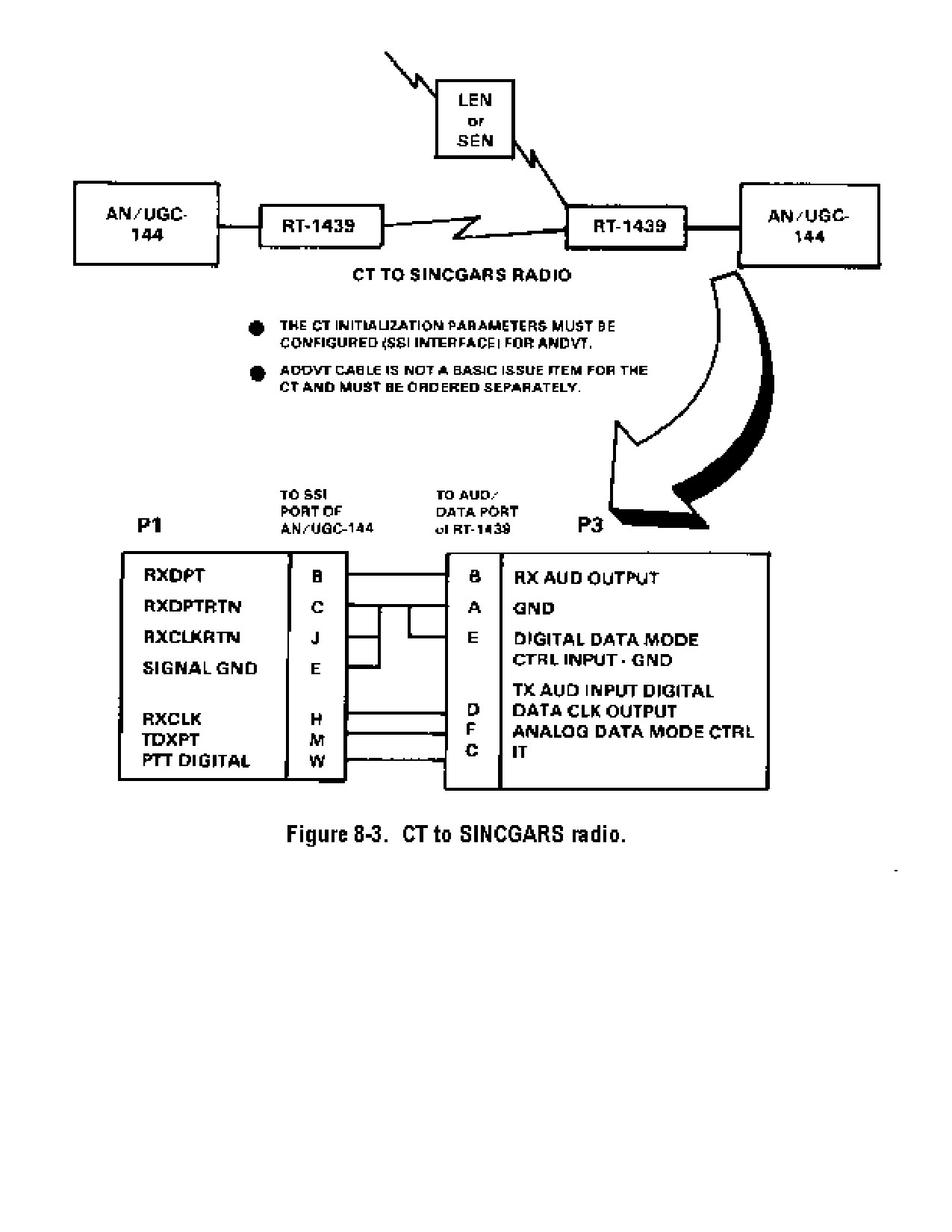
CT to SINCGARS transmission may be accomplished following procedures shown in Figure 8-3.
http://www.adtdl.army.mil/cgi-bin/atdl.dll/fm/24-17/Ch8.htm (5 of 13) [1/11/2002 1:55:37 PM]
FM 24-17 Chptr 8 Informal TRTS
8-5. Informal/Formal TRTS Interface
Record traffic passes from the informal to formal TRTS (or vice versa) whenever a requirement exists to
cross system channels. The following procedures outline the transfer between two systems:
Informal to formal TRTS. When the LDF user requires transfer of a message into the formal TRTS, the
message text is couriered to a CT for proper message formatting and entry into the formal network. The
CT may be at the LDF user’s level or at the next higher echelon. Coordination with the LDF organization
signal officer is necessary for informal message traffic to be accepted at the CT. This coordination is
necessary to ensure only official authorized messages are entered into the formal TRTS. The CT user
http://www.adtdl.army.mil/cgi-bin/atdl.dll/fm/24-17/Ch8.htm (6 of 13) [1/11/2002 1:55:37 PM]
FM 24-17 Chptr 8 Informal TRTS
will be responsible for properly formatting/processing the LDF user’s message into the formal system.
Formal to informal TRTS. A formal message received by a CT will be printed out on hard copy and
couriered or faxed over the ACUS to the destination LDF. Message accountability procedures will be
observed by the receiving CT. CTs will be collocated with or have direct access to the LDF to effect
transfer of record traffic into the informal system.
8-6. Informal TRTS Over Strategic and Tactical Packet Networks
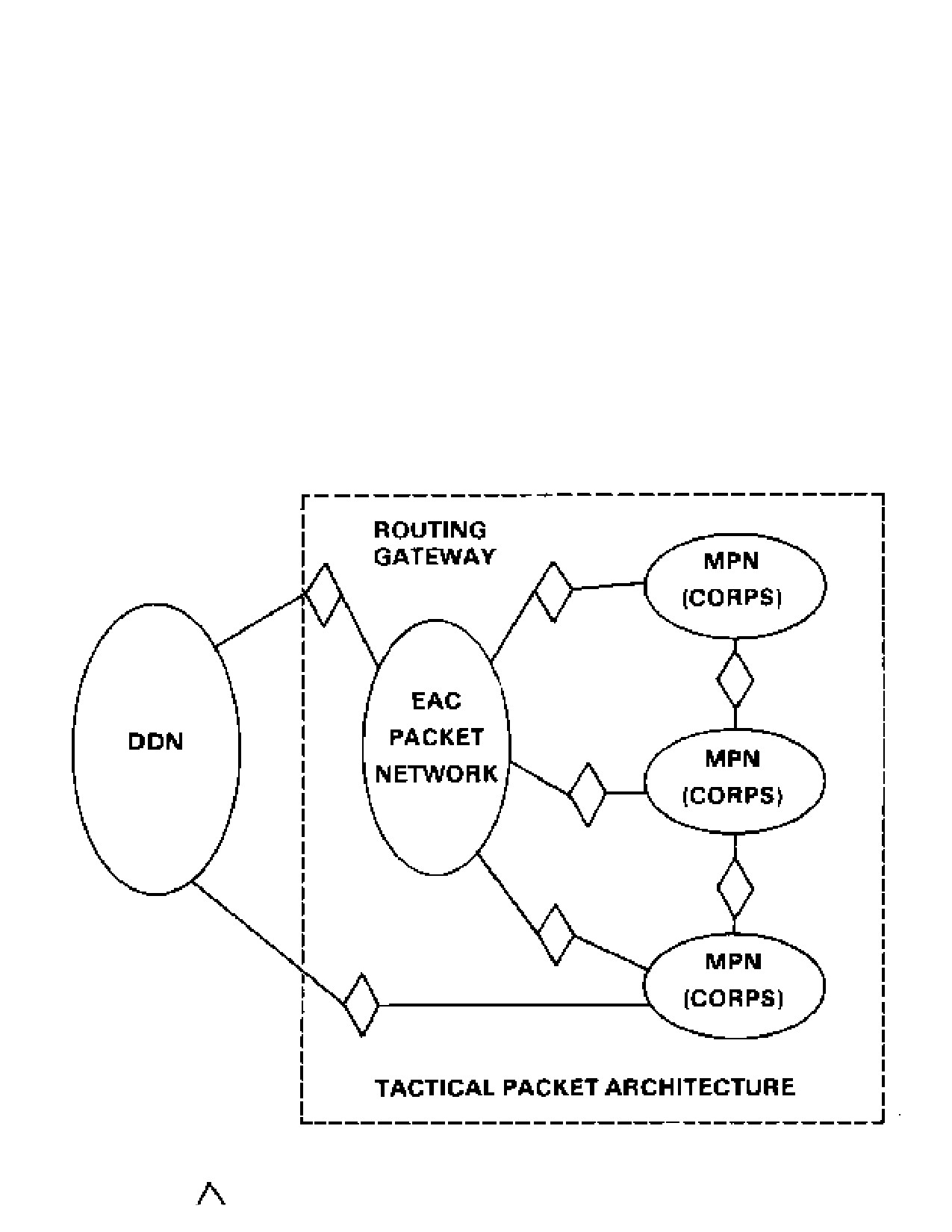
The tactical packet network (TPN) is the battlefield packet network capable of handling traffice classified
through SECRET. It overlays on the EAC and ECB voice communications network. DDN consists of
two packet networks--the defense secure network (DSNET) and the military network (MILNET) which
is unclassified. Objectively, TPN will connect to both DDN networks as shown in Figure 8-4. From a
user’s viewpoint, the networks will be totally transparent. Users will access their computer, compose
messages, and transmit the messages.
http://www.adtdl.army.mil/cgi-bin/atdl.dll/fm/24-17/Ch8.htm (7 of 13) [1/11/2002 1:55:37 PM]
FM 24-17 Chptr 8 Informal TRTS
TPN fielding to ECB is scheduled to start in September 1991 with full fielding expected by October
1992. Fielding to EAC is scheduled for the FY 93 to FY 94 time frame.
Packet switching is a data handling technique. Users send messages to the packet switch to which they
are connected. The packet switch divides the message into packets and treats each packet as an individual
transaction. Using network routing that adapts rapidly to the traffic loading and circuit connectivity,
packet switching provides--
● Efficient use of limited communications capacity.
● Guaranteed data delivery.
● Fast delivery service for small amounts of data such as database updates.
Packet switching techniques are not designed for large database dumps or continuous data streams from
sensors. The time delay imposed by the packet switches becomes so great that dedicated circuits are
more efficient.
8-7. Informal TRTS Using PCs
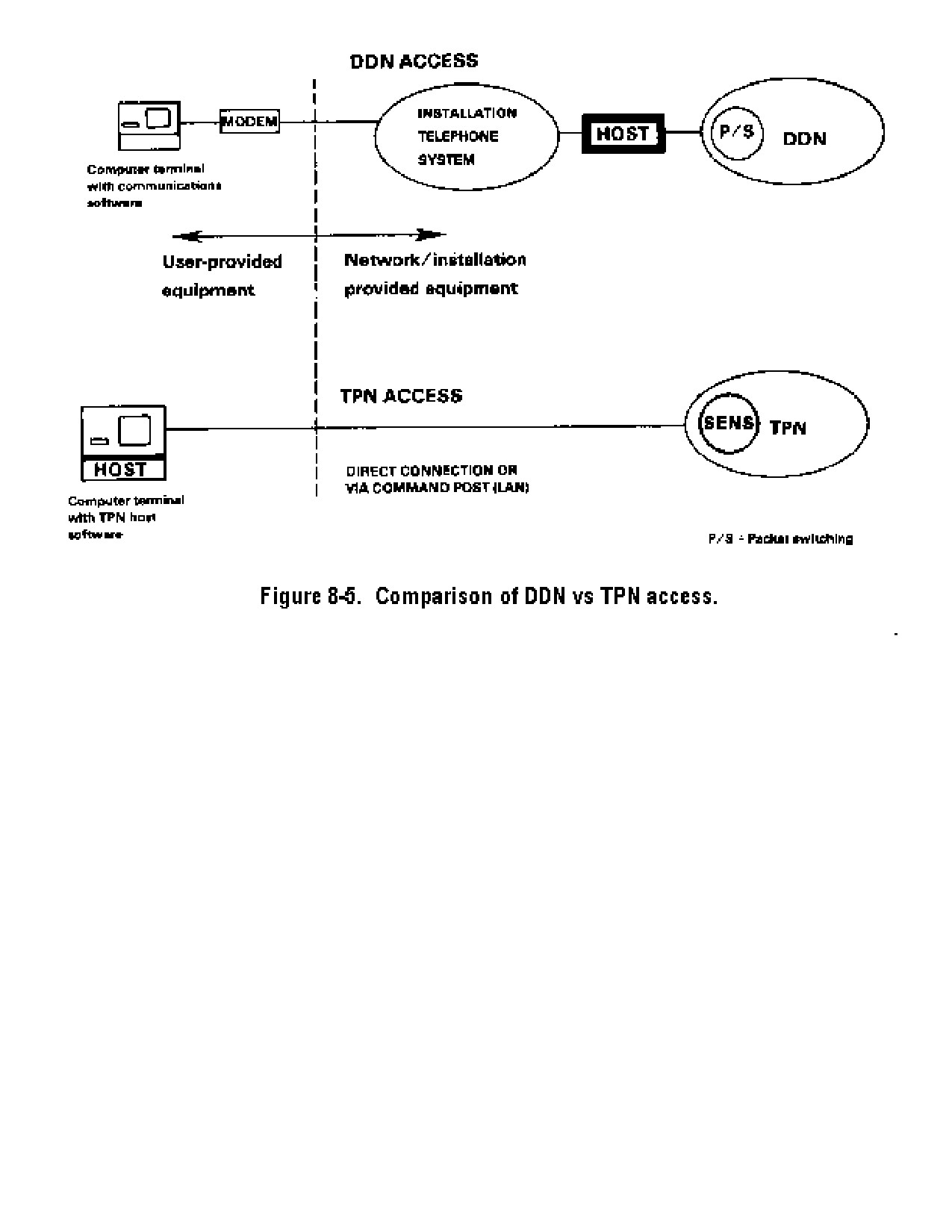
There is a difference in the connectivity of PCs to DDN and TPN as illustrated in Figure 8-5.
http://www.adtdl.army.mil/cgi-bin/atdl.dll/fm/24-17/Ch8.htm (8 of 13) [1/11/2002 1:55:37 PM]
FM 24-17 Chptr 8 Informal TRTS
In garrison, PCs connected to DDN are used as simple terminals. PC software has to be loaded into the
PC’s hard disk drive memory to allow the user to interoperate correctly with the DDN. The ISSO/BSO
must be contacted to ensure the PC is properly configured for the appropriate terminal settings. They will
also provide guidance in connection of the PC to a terminal access controller (TAC) or other associated
host terminal.
The PC user must understand how to use a PC communications package so the PC can
interoperate/interface with the DDN.
In addition to understanding that the PC is not a host or access terminal, the PC user must be aware that
the host or TAC connection alone does not give access capabilities to DDN. To access a host or a TAC
from a PC, the user must have an authorized account (address and password) and this information must
be registered by the ISSO/BSO with the host/TAC terminal.
When deployed to the field, PCs must be capable of operating as hosts. All PCs connected to TPN must
have installed the TPN registration and TPN host-specific software. PCs are connected directly or via a
command post (CP) LAN. Each PC has its own name and address compatible with the DDN format.
Unlike the strategic network, TPN users are mobile and there is no habitual relationship between a packet
http://www.adtdl.army.mil/cgi-bin/atdl.dll/fm/24-17/Ch8.htm (9 of 13) [1/11/2002 1:55:37 PM]
FM 24-17 Chptr 8 Informal TRTS
switch and the users.
TPN has developed a registration process that maps user names to physical address. Users affiliate to the
network and their physical location is recorded. The records are queried by users who wish to send
messages but do not know the physical location of the recipient. Registration and querying of records is
an automated function transparent to the user. It is performed automatically by the communications
package of the host computer.
The objective of total interoperability between TPN users and users of MILNET and DSNET requires the
development of a multilevel secure (MLS) device. The MLS device will enable TPN users requiring
access to both networks from passing classified information to the MILNET .
8-8. User and DDN/TPN Connectivity
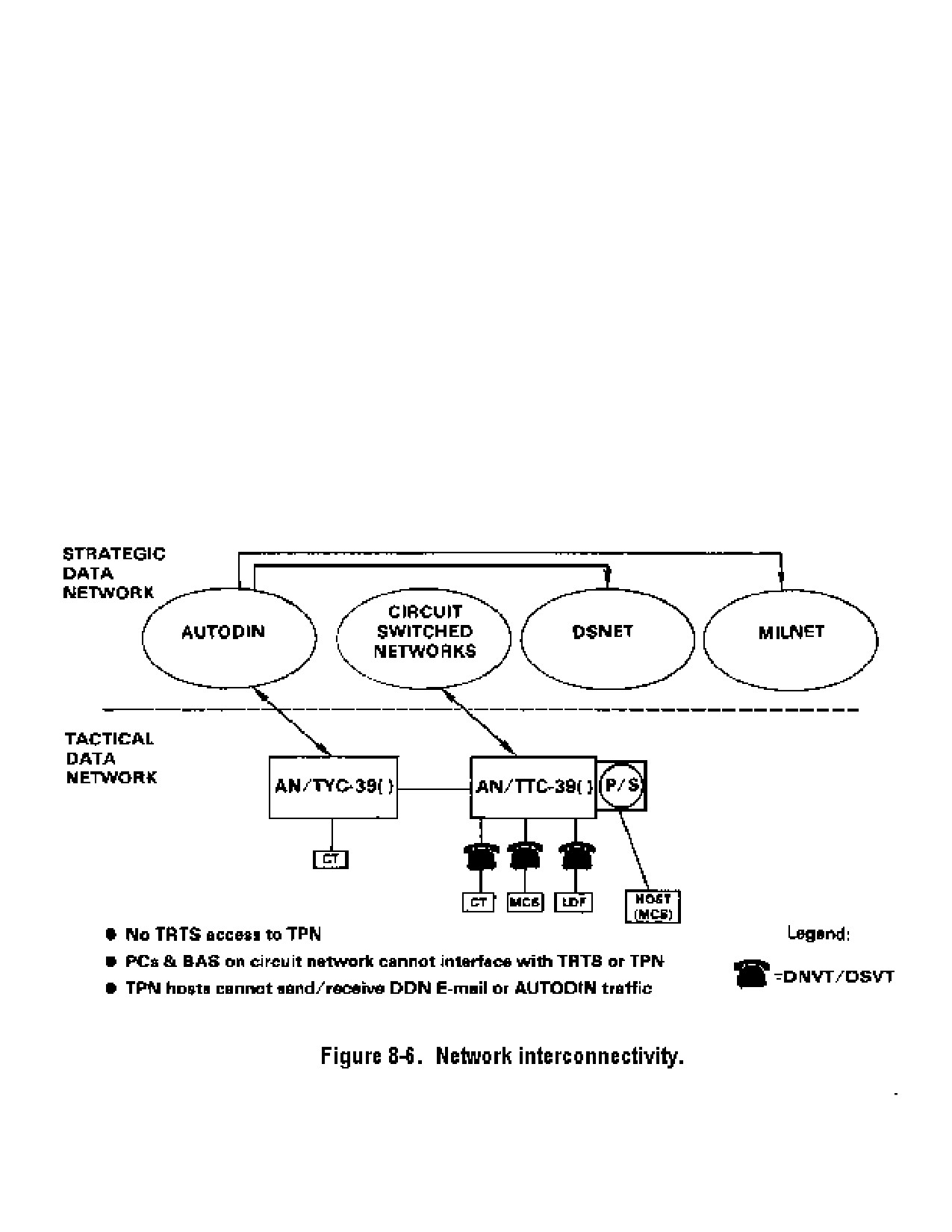
Figure 8-6 is a realistic depiction of the interconnection of automation devices on the battlefield. Note
that many of the devices are designed to communicate only with other like devices and cannot send data
to any other device on the battlefield.
CTs can only exchange information with other CTs.
http://www.adtdl.army.mil/cgi-bin/atdl.dll/fm/24-17/Ch8.htm (10 of 13) [1/11/2002 1:55:37 PM]
FM 24-17 Chptr 8 Informal TRTS
The only means of transferring data from a PC to a maneuver control system (MCS) device is by
carrying a floppy disk from one to the other. MCS could be used to distribute informal record traffic
received from a CT. On CTs so equipped, the CT operator would have to download the message to a
floppy disk and carry the disk over to the MCS terminal. The MCS operator could then upload the
message and distribute it over the circuit switch or packet network. (Note: At publication time of this
manual, not all CTs were equipped with floppy diskette drives. Eventually, all CTs will be retrofitted
with 3.5 inch diskette drives.)
Distribution has the following drawbacks:
The MCS operator can send the message only to users on his network (either circuit or packet) unless the
MCS device is connected to both networks.
● The MCS operator cannot send the message to fax users.
● The MCS operator cannot send the message to PC or CT users.
When all the battlefield functional area C2 systems are using the packet network, informal traffic should
be sent via the packet network. The packet network delivers to multiple addresses and stores messages
temporarily for mobile users. The problem is that none of the TRTS components can interoperate with
the packet network. File transfer via floppy disk will be the only TRTS to TPN interface.
8-9. TRTS Integration Across the Battlefield
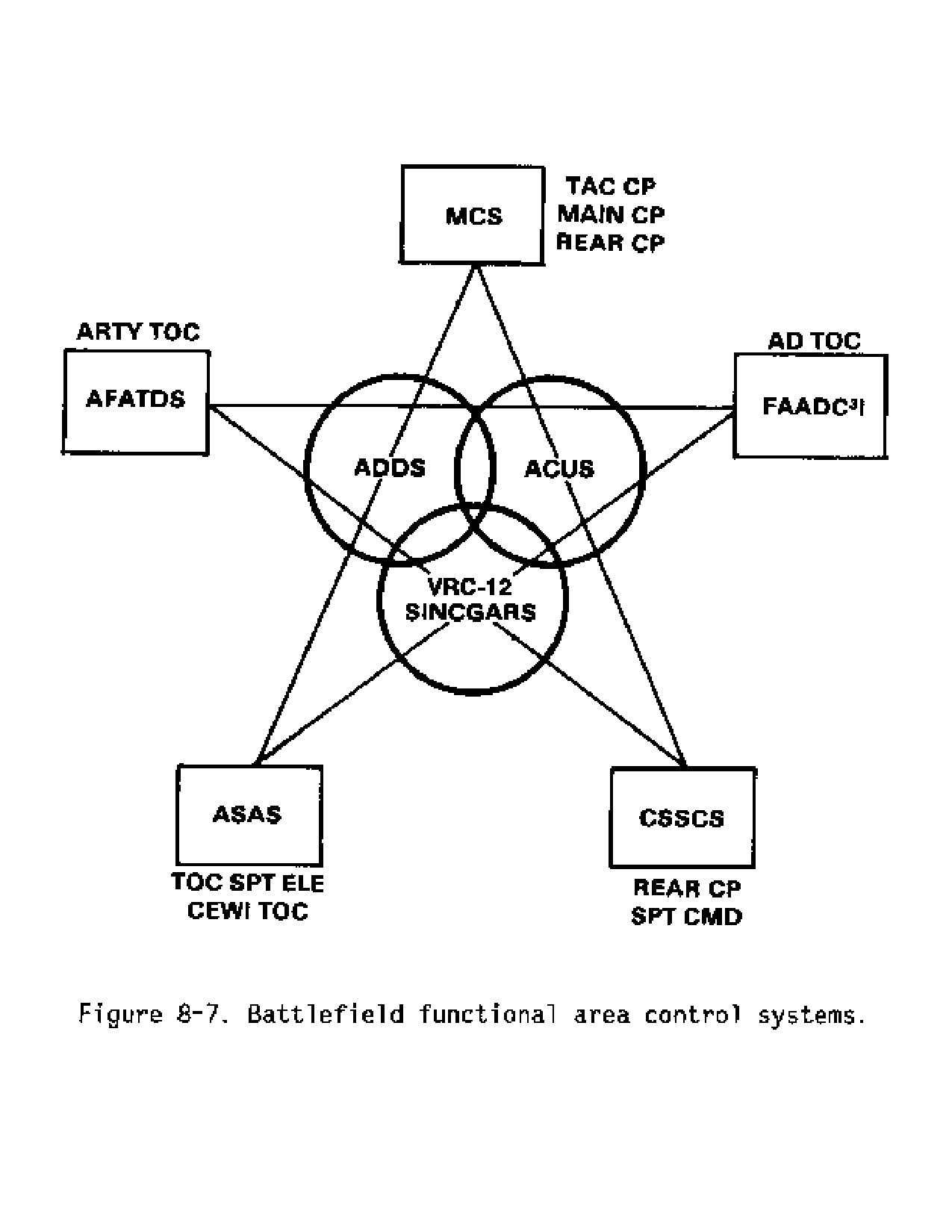
A major step towards interoperable automated systems is the fielding of the ATCCS. This system is
made up of common hardware and software components that allow users to rapidly exchange relevant C2
information across the battlefield between standardized CPs. ATCCS is composed of five battlefield
functional area control systems designed for specific functional areas:
● MCS.
● Advanced Field Artillery Tactical Data System (AFATDS).
● All Source Analysis System (ASAS).
● Combat Service Support Control System (CSSCS).
● Forward Area Air Defense Command, Control, Communications, and Intelligence (FAADC3I).
Figure 8-7 shows where each system will be deployed and interoperate/interconnect across the
battlefield. ATCCS will be integrated into each users’ CP where the system will network and interface
http://www.adtdl.army.mil/cgi-bin/atdl.dll/fm/24-17/Ch8.htm (11 of 13) [1/11/2002 1:55:37 PM]
FM 24-17 Chptr 8 Informal TRTS
with CNR, MSE, tactical switchboards, and commercial telephone lines. Total integration with ATCCS
will allow multiple access to a single corporate battlefield information database where commanders will
be able to select and retrieve the information needed for immediate or sound decision making.
Major functions of ATCCS software.
In the text edit/integrated business package and joint automated message processing modes, the user will
be able to create, print, save, distribute, route, and edit messages, spreadsheets, and databases.
http://www.adtdl.army.mil/cgi-bin/atdl.dll/fm/24-17/Ch8.htm (12 of 13) [1/11/2002 1:55:37 PM]
FM 24-17 Chptr 8 Informal TRTS
In the graphics mode, users will be able to have a map of the area of operations stored within computer
memory. This map can be called up, edited or updated, and transmitted to other ATCCS stations. Also,
the user may compose graphics displays to either transmit to other stations or provide briefing materials.
ATCCS facilitates information management as users can manipulate their databases to produce situation,
battle resource, and summary reports for commanders and staff across the battlefield.
Procedures on how to set up, initialize, and maintain each system is being fielded as each system is
fielded. (Currently only the MCS portion of ATCCS has been tested, fielded, and used in both training
and real world wartime missions.) MCS is to be used at other battlefield functional areas until individual
functional area BASS are fielded. Once each functional area has their portions of ATCCS fully fielded, a
total integration across the battlefield will be achieved, as a total interaction of functional area C2 will be
realized.
http://www.adtdl.army.mil/cgi-bin/atdl.dll/fm/24-17/Ch8.htm (13 of 13) [1/11/2002 1:55:37 PM]
Chapter 9
EAC Tactical TCC Fundamentals
9-1. Introduction
This chapter covers tactical TCC organization and operation and communications means relating to the
EAC environment.
The Signal Corps-operated over-the-counter TCCs are scheduled to be phased out as MSE, EAC-
Communications Improvement Plan (CIP), BAS, and TRTS communications systems are fielded. Phase
out will be ongoing into the mid-to-late 1990s or until the slower, less efficient tactical TCCs are
replaced with user-owned, -operated, and -maintained terminal equipment. Tactical TCCs will remain in
operation until units have received their authorized user-owned and -operated PCs and digital facsimile
equipment. Until AirLand Operations become more automated and the TRTS network is fully fielded,
the tactical TCCs will continue to provide over-the-counter record traffic support.
Until tactical TCCs are replaced at EAC and theater Army locations, procedures in this chapter will be in
effect for those remaining TCCs. Procedures in this chapter augment the procedures for message
processing found in-
● FM 11-490-2.
● JANAP 128( ).
● DOI 103.
9-2. Organization
The table(s) of organization and equipment (TOE) of the signal battalion or signal brigade determine the
mission of the unit, the number of people, and the types of equipment. Each TCC will have a flexible
mission as determined by the organization’s AirLand Operations mission. Regardless of what mission the
unit may have, a typical TCC will have a message section, a transmit-receive (means) section, and a
messenger section. In larger TCCs, sections may be physically separated; in a smaller TCC, the sections
http://www.adtdl.army.mil/cgi-bin/atdl.dll/fm/24-17/Ch9.htm (1 of 7) [1/11/2002 1:55:42 PM]
FM 24-17 Chptr 9 EAC Tactical TCC Fundamentals
may be collocated in one area. Paragraph 9-5 provides additional information on each of the three TCC
sections.
9-3. Operational Objectives
The principal objectives in TCC operation are accuracy, speed, security, and reliability in the
accomplishment of the mission. An effective training plan, to include cross-training of all platoon
personnel, will greatly enhance the TCCs in meeting required objectives. Continuous and realistic
training of TCC personnel will improve the overall level of proficiency within the communications
platoon. TCC training must reinforce and emphasize--
● Accuracy in message processing of transmitted and received messages.
● Speed of service in processing messages.
● Security practices to include proper use of COMSEC (physical, cryptographic, and transmission
emission security).
● Reliability of service through operator preventive maintenance and scheduled maintenance
programs.
9-4. Communications Means
A tactical TCC may have one or more of the following means to communicate narrative, data, voice, or
facsimile messages:
● Teletypewriter (TTY) facilities use wire, radio, or a combination as a transmission means. TTY
equipment is secured by on-line cryptographic equipment as determined by the TOE. The
AN/UGC-74 is a TTY used to compose, edit, store, transmit, receive, and print messages. It is
designed to interface/operate with the older TTY sets that use standard keyboards or transmitters-
distributors for preparing and transmitting prepunched paper tape messages.
● Radio teletypewriter (RATT) is a means of transmitting information by keyboard or perforated
tape over high frequency (HF) radio circuits. International Morse Code may also be transmitted
by HF RATT equipment. RATT is primarily in operation at EAC for backup communications for
C2 and to interface with allied forces. RATT is used in some applications for access to
operations/intelligence and administrative/logistics networks. RATT has a very high electronic
signature and is used more and more as a backup system. Some division GP RATT nets are being
used until MSE is fielded.
● Telephones (secure and nonsecure instruments) vary from the sound-powered TA-1/TP to the full-
http://www.adtdl.army.mil/cgi-bin/atdl.dll/fm/24-17/Ch9.htm (2 of 7) [1/11/2002 1:55:42 PM]
FM 24-17 Chptr 9 EAC Tactical TCC Fundamentals
duplex voice/DSVT KY-68. Tactical telephones are designed primarily as a common user system.
● Messenger service is grouped in categories according to the way the messenger travels--foot,
motor, and air messengers. Messengers provide a secure means of delivering large bulky items,
but messengers are relatively slow and are limited by the transportation means available.
● Modern tactical facsimile now operates over existing standard voice radios and wire circuits.
Newer equipment is lightweight, rugged, portable, and low power. The systems are capable of
operating from standard and vehicular power. Facsimile enables electronic transmission/reception
of typed or handwritten record traffic, maps, overlays, drawings, photographs, and other types of
documents containing black and white, color, or gray shades.
No matter what means the TCC uses to transmit or receive communications, overall objectives remain
the same--accuracy, speed, security, message privacy, and reliability.
9-5. Organization and Operation
Telecommunications functions and operating procedures are contained in Chapter 10 of FM 11-490-2.
Each tactical TCC publishes local procedures to meet local message processing requirements. All
functions prescribed in FM 11-490-2 must be performed by the tactical TCC to support the TCC mission.
However, all positions described in Chapter 10 may not be required by a tactical TCC.
Each TCC has the following three sections assigned:
Message center section.
The message center section processes all message traffic handled by the TCC; selects how the message is
to be transmitted (TTY, facsimile, voice, or messenger); maintains TCC files, maps (for messenger
routes), communications status logs, and official headquarters time.
Outgoing messages originated in the headquarters or incoming messages addressed to the headquarters
served are passed directly between the headquarters and the message center section.
The message center section is the administrative element of the TCC. Records are maintained to facilitate
traffic delivery and to record the handling of each message. Staff reference files are not maintained in the
message center section. The following functions are performed by one or more personnel assigned to the
message center:
● Acceptance and delivery clerk.
● Reproduction clerk.
http://www.adtdl.army.mil/cgi-bin/atdl.dll/fm/24-17/Ch9.htm (3 of 7) [1/11/2002 1:55:42 PM]
FM 24-17 Chptr 9 EAC Tactical TCC Fundamentals
● Outgoing routing clerk.
● Collator and sorting clerk.
● Internal router.
● Traffic checker.
Means section.
The means section consists of the operating personnel and the terminal facilities for transmitting and
receiving messages. The terminal facilities that may be employed are RATT, continuous wave (CW),
TTY, and facsimile. The receivers and transmitters are usually remotely located and connected to the
terminal equipment by wire or cable.
Message processing steps and procedures contained in Chapter 11, Sections II and III of FM 11-490-2
should be incorporated into the TCC SOP.
Service message procedures are contained in Chapter 15 of FM 11-490-2. Automatically generated
service message procedures for TCCs connected to an AN/TYC-39( ) message switch are contained in
Chapter 6 of this manual. Additional information concerning automatically generated service messages
can be found in JANAP 128.
Facsimile procedures for processing and transmitting messages in common user and dedicated operations
are found in Chapter 14 of FM 11-490-2.
RATT and radiotelegraph message procedures are found in applicable ACP 117 manuals. The following
functions are performend by one or more personnel assigned to the means section:
● Keyboard operator.
● Proofreader.
● Transmit operator.
● File clerk.
● Receive operator.
● Service message clerk.
http://www.adtdl.army.mil/cgi-bin/atdl.dll/fm/24-17/Ch9.htm (4 of 7) [1/11/2002 1:55:42 PM]
FM 24-17 Chptr 9 EAC Tactical TCC Fundamentals
Messenger section.
The messenger section of the TCC consists of the messengers and equipment essential to an efficient and
effective delivery service. Although this section is a part of the TCC, messenger service and supporting
equipment are an unresourced mission for the Signal Corps. (See Chapter 10 for messenger service
procedures.)
9-6. TCC and TRTS Message Transfer
Properly formatted and addressed message traffic is transmitted to a connected AN/TYC-39( ) for relay
to the CT or vice versa. All messages to a TCC will be formal record traffic.
9-7. Outgoing and Incoming Message Flow
Figure 9-1 shows manual narrative originate (outgoing) message flow. Figure 9-2 shows manual
narrative terminate (incoming) message flow. These charts represent how record traffic should move
from one processing step to the final disposition. These charts are applicable for record traffic processed
within a CT or TCC.
http://www.adtdl.army.mil/cgi-bin/atdl.dll/fm/24-17/Ch9.htm (5 of 7) [1/11/2002 1:55:42 PM]