FM 24-17 Tactical Record Traffic System (TRTS) (September 1991) - page 1
FM 24-17
Field Manual
Headquarters
No 24-17
Department of the Army
Washington, DC, 17 September 1991
FM 24-17
Tactical Record
Traffic System
(TRTS)
Unless otherwise stated, whenever the masculine gender is used, both men and women are
included.
Editor's Note: Distribution Restriction changed to
"Approved for public release; distribution is unlimited" per
HQ TRADOC (ATCD-K) Memorandum, 18 Jul 1991,
Doctrinal Publications with Incorrect Distribution
Restrictions, and HQ TRADOC Foreign Disclosure Office
e-mail, 10 Jan 2001, Documents Approved for Public
Release.
http://www.adtdl.army.mil/cgi-bin/atdl.dll/fm/24-17/toc.htm (1 of 6) [1/11/2002 1:54:37 PM]
FM 24-17 Table of Contents
Table of Contents
Preface
Chapter 1 Tactical Record Traffic System (TRTS) Fundamentals
1-1. Introduction
1-2. Battlefield Automated Systems (BAS) Integration into TRTS
1-3. Procedures
1-4. Responsibilities
Chapter 2 Formal TRTS Operational Concept
2-1. Introduction
2-2. Formal TRTS Equipment
2-3. Formal TRTS Switching Systems
2-4. CT Security
Chapter 3 Formal TRTS Message Fundamentals
3-1. Introduction
3-2. Preparing Outgoing Messages
3-3. Originated Message Register
3-4. Outgoing Message Flow
Chapter 4 Transmitting Formal Messages Within TRTS
http://www.adtdl.army.mil/cgi-bin/atdl.dll/fm/24-17/toc.htm (2 of 6) [1/11/2002 1:54:37 PM]
FM 24-17 Table of Contents
4-1. Introduction
4-2. Transferring Formal TRTS Messages
4-3. Autodialing
4-4. Transmitting CT Messages by AN/TYC-39( ) Switches
Chapter 5 Formal TRTS Message Receipt Fundamentals
5-1. Introduction
5-2. Message Privacy Requirements
5-3. Message Retention/Audit Trail
5-4. Record Traffic Journal
Chapter 6 Formal Service Message Fundamentals
6-1. Introduction
6-2. CT Preformatted Service Messages
6-3. CT to CT Service Message Procedures
6-4. CT to TCC Service Message Procedures
6-5. Automatically Generated Service Messages
6-6. Service Message Logs
Chapter 7 Defense Special Security Communications System CT
Facilities
7-1. Introduction
http://www.adtdl.army.mil/cgi-bin/atdl.dll/fm/24-17/toc.htm (3 of 6) [1/11/2002 1:54:37 PM]
FM 24-17 Table of Contents
7-2. Responsibilities
7-3. Special Procedures
7-4. Security Indoctrination and Training
7-5. Tactical Sensitive Compartmented Information Facilities (SCIFs)
Chapter 8 Informal TRTS
8-1. Introduction
8-2. Informal TRTS Message Equipment
8-3. Informal TRTS Message Accountability
8-4. Informal Message Transfer
8-5. Informal/Formal TRTS Interface
8-6. Informal TRTS Over Strategic and Tactical Packet Networks
8-7. Informal TRTS Using PCs
8-8. User and DDN/TPN Connectivity
8-9. TRTS Integration Across the Battlefield
Chapter 9 EAC Tactical TCC Fundamentals
9-1. Introduction
9-2. Organization
9-3. Operational Objectives
9-4. Communications Means
http://www.adtdl.army.mil/cgi-bin/atdl.dll/fm/24-17/toc.htm (4 of 6) [1/11/2002 1:54:37 PM]
FM 24-17 Table of Contents
9-5. Organization and Operation
9-6. TCC and TRTS Message Transfer
9-7. Outgoing and Incoming Message Flow
Chapter 10 Messenger Service Fundamentals and Procedures
10-1. Introduction
10-2. Messenger Service
10-3. Types of Messenger Service
10-4. Messenger Employment
10-5. Messenger Transportation and Equipment
10-6. Messenger Routes
10-7. Messenger Posts
10-8. Double Messengers
Chapter 11. Basic Emergency Procedures
11-1. Introduction
11-2. Purpose
11-3. BEP Provisions
11-4. BEP Coordination
11-5. Action Subsequent to BEP Implementation
11-6. BEP Proficiency
http://www.adtdl.army.mil/cgi-bin/atdl.dll/fm/24-17/toc.htm (5 of 6) [1/11/2002 1:54:37 PM]
FM 24-17 Table of Contents
Appendix A Military Lettering and Phonetic Alphabet
Appendix B World Time Zones and Time Conversion Table
Appendix C Precedence Assignment Guide
Appendix D Use of Passwords with CT
Appendix E Commonly Used Operating Z Signals
Appendix F Example of Operations Order for CT
Appendix G Alarms and Indicators
Appendix H Initialization Table Entries
Appendix I CT Factory Default Settings
Appendix J Security and Protection Measures for Diskettes
GLOSSARY
REFERENCES
AUTHORIZATION LETTER
* This publication supersedes FM 24-17, 31 August 1987.
http://www.adtdl.army.mil/cgi-bin/atdl.dll/fm/24-17/toc.htm (6 of 6) [1/11/2002 1:54:37 PM]
Preface
Purpose and Scope
This publication provides guidance and doctrine for the Tactical Record Traffic System (TRTS). It
provides signal and nonsignal personnel an overview of the TRTS. It gives the reader necessary
procedures to standardize operations when processing, transmitting, and delivering tactical record traffic
in hard copy and soft copy format. (Hard copy is printed copy; soft copy is data stored on magnetic
disks.)
This publication covers tactics, techniques, and procedures for operating various TRTS subscriber
terminals. It also provides information on the evolution of the record traffic communications system
towards a totally integrated, automated, and synchronized communications system.
User Information
The proponent of this publication is HQ TRADOC. Send comments and recommendations on DA Form
2028 directly to Commander, United States Army Signal Center and Fort Gordon, ATTN: ATZH-DTL,
Fort Gordon, Georgia 30905-5075. Key comments and recommendations to pages and lines of text to
which they apply. If DA Form 2028 is not available, a letter is acceptable. Provide reasons for your
comments to ensure a complete understanding and proper evaluation.
http://www.adtdl.army.mil/cgi-bin/atdl.dll/fm/24-17/Pref.htm [1/11/2002 1:54:46 PM]
Chapter 1
Tactical Record Traffic System (TRTS)
Fundamentals
1-1. Introduction
Record traffic is the term for messages that are permanently or semi-permanently being maintained by the
message originator or addressee. Record traffic is used primarily by staff organizations to conduct unit
business and may exist in page form or reside on floppy disks or within computer memory. With the
advent of the TRTS, users of the TRTS can process record traffic communications within an automated,
decentralized, highly mobile and extended communications environment far removed from the older over-
the-counter record communications services provided by the Signal Corps. In this TRTS architecture,
record traffic subscriber terminals are user-owned, user-deployed, and user-operated.
The TRTS, the Army Tactical Command and Control System (ATCCS), and the Defense Data Network
(DDN) are new systems systematically replacing the tactical telecommunications centers (TCC) and the
over-the-counter record communications services. These new systems provide rapid flow of command
and control (C2) communications across all Army echelons of AirLand Operations. These new systems,
combined with desktop and laptop personal computers (PCs), lightweight digital facsimile (LDF)
machines, and digital telephones provide tactical commanders and their staff the capability to transmit
and receive administrative, logistical, intelligence, and operational C2 communications. This allows them
to meet their operational and tactical mission requirements.
The TRTS is either formal or informal. Chapter 9 discusses how the two communications systems are
interchangeable if procedures for message transfer are followed.
The formal TRTS uses communications terminals (CTS) as terminal devices for the transmission of
properly formatted Joint Army-Navy-Air Force Publication (JANAP) 128, Allied Communication
Publication (ACP) 127 GENSER, Defense Operating Instructions (DOI) 103 DSSCS messages, and US
joint message text format.
The informal TRTS may use any approved subscriber terminal device available to send and receive
nonformatted text, pictures, maps, and so forth. Devices include facsimile machines, PCs, and other user-
http://www.adtdl.army.mil/cgi-bin/atdl.dll/fm/24-17/Ch1.htm (1 of 8) [1/11/2002 1:54:50 PM]
FM 24-17 Chptr 1 Tactical Record Traffic System (TRTS) Fundamentals
owned equipment.
Transfer of record communications with tactical or garrison units is effected through user-owned and -
operated terminal equipment connected to the area common-user system (ACUS) circuit and message
switches.
Tactical organizations having a requirement to process record traffic between communications facilities
connected by the Defense Communications System/automatic digital network (DCS/AUTODIN) message
switches will receive the AN/UGC-144 CT. This user-friendly, menu-driven equipment allows the
organization to prepare, transmit, and receive formal record traffic communications. Formal record traffic
communications are those which comply with established procedural requirements to be processed within
AUTODIN. To aid the general-purpose (GP) user, the CT has preformatted message headers and endings.
Preinstalled message routing protocols allow record traffic to be properly routed to the intended
addressees without delay. Two separately configured CTs provide service for either the general service
(GENSER) or the Defense Special Security Communications System (DSSCS) . Unit mission
requirements dictate the communications environment in which the CT operates. User-owned CTs
connect into the ACUS network of message switches. This provides access into the AUTODIN network
of continental United States (CONUS) or overseas computerized message switching equipment.
Tactical organizations with a requirement to process message traffic which will not enter the AUTODIN
message switching network will have access to the ACUS dial-up circuit switched network. This circuit
switched network provides a fast, reliable, and secure means of transmitting and receiving informal
tactical record traffic. Informal record traffic does not have specified procedural formats or requirements
and may exist in many types of media. Connection into the informal TRTS will be extended from
echelons above corps (EAC) down to battalion level.
Organizations will have access to the formal record traffic system and also to the informal record traffic
system based on assigned mission and available equipment. Some units will operate in both garrison and
tactical situations, while other units may use their equipment only during tactical deployments.
Communications terminals, facsimile equipment, and digital telephones may be located in tactical vans,
bunkers, tents, aircraft, or buildings. This can include any associated controlled cryptographic items such
as communications security (COMSEC) equipment. The equipment can easily be moved from one
location or operating environment to another depending on mission requirements. Personnel operating
TRTS equipment will be unit personnel normally assigned to current operations cells in tactical
operations centers (TOCs), or personnel assigned to administrative, logistical, or intelligence duties where
TRTS equipment is located. Proper message preparation, transmission, receipt, records management, and
distribution procedures must be known and adhered to regardless of where the TRTS equipment is
deployed. Multilevel access and password controls make it possible to restrict access to TRTS equipment,
but it is possible for almost all organizational personnel to be involved with processing formal and
informal tactical record communications.
TRTS record communications pass over one or more transparent, processor-driven automatic switches.
http://www.adtdl.army.mil/cgi-bin/atdl.dll/fm/24-17/Ch1.htm (2 of 8) [1/11/2002 1:54:50 PM]
FM 24-17 Chptr 1 Tactical Record Traffic System (TRTS) Fundamentals
These switches include, but are not limited to the following:
● Strategic defense switched network (DSN) switches. (This system was previously known as the
automatic voice network [AUTOVON].)
● Strategic AUTODIN message switches. (This system is being changed to the Defense Message
System [DMS].)
● DDN system of packet switches. (Only the E-mail processing/transfer portion of DDN is part of
DMS.)
● Mobile subscriber equipment (MSE) family of tactical circuit switches.
● AN/TTC-39( ) joint tactical communications (TRI-TAC) family of tactical circuit switches.
● AN/TYC-39( ) (TRI-TAC) family of tactical message switches.
Circuit and message switches form the hub of today’s worldwide tactical and strategic record traffic
communications networks. This network is linked globally by strategic and tactical transmission and
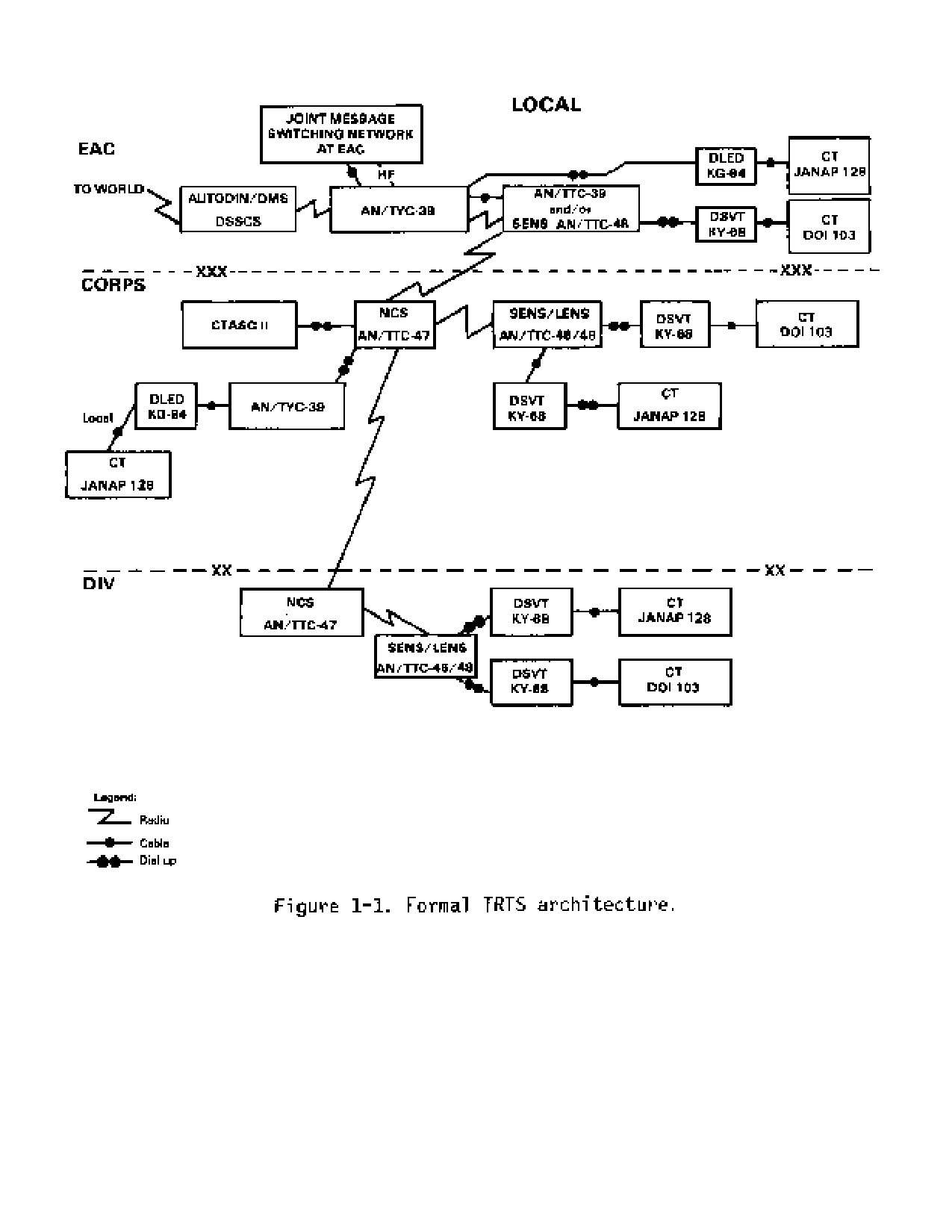
switching systems which allow operability throughout the DCS and the ACUS. Figure 1-1 shows the CT
formal TRTS architecture as it extends from division up to EAC and on to CONUS/sustaining bases
throughout the world. Because the Army fights under joint, unified, or combined command authority, the
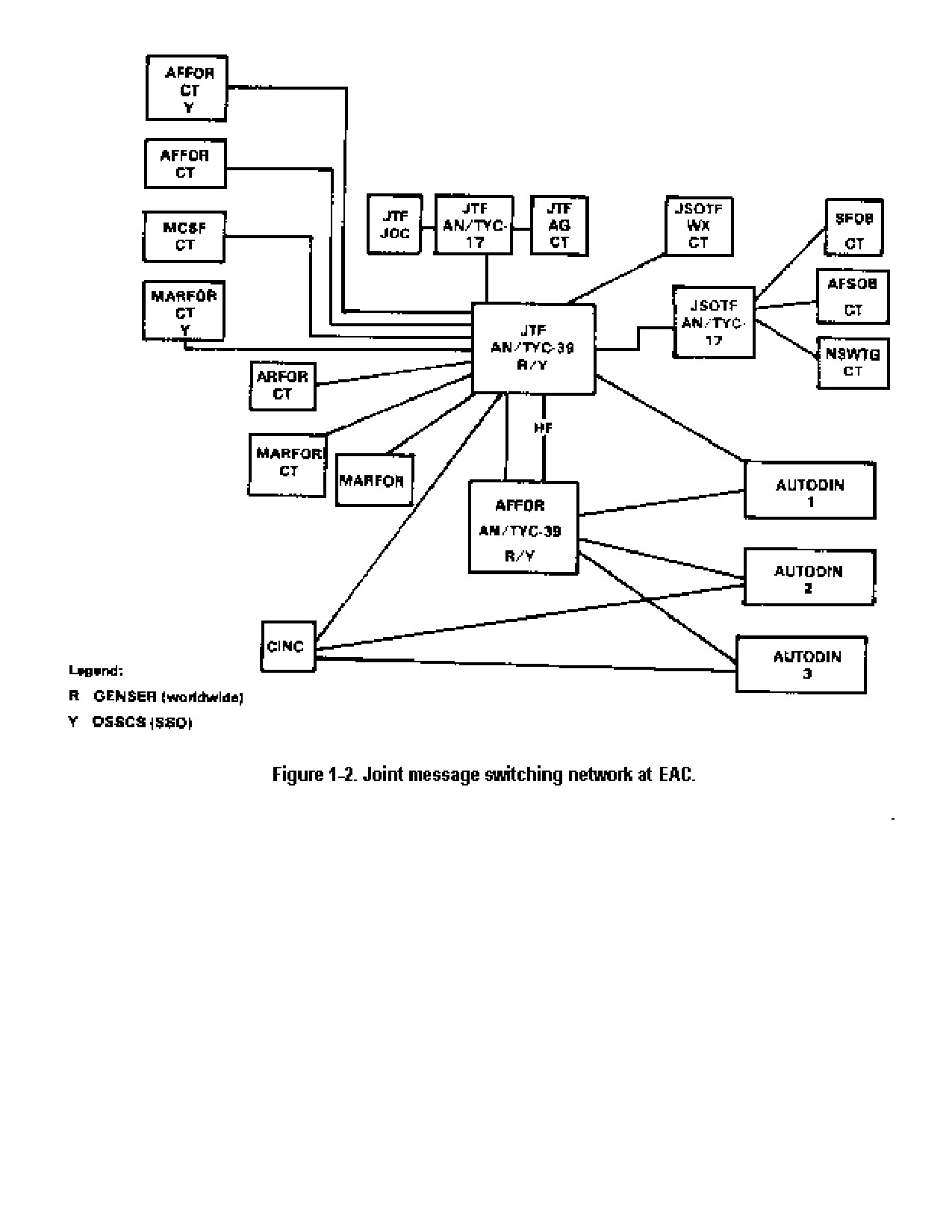
TRTS extends to major forces collocated at EAC. Army forces (ARFOR), Air Force forces (AFFOR), and
Marine forces (MARFOR) interconnect to the joint message switch network using either interswitch
trunks or standard MODE I circuits, depending on whether or not the component has a message switch.
Figure 1-2 shows how the joint forces generally are connected and have access to the TRTS.
http://www.adtdl.army.mil/cgi-bin/atdl.dll/fm/24-17/Ch1.htm (3 of 8) [1/11/2002 1:54:50 PM]
FM 24-17 Chptr 1 Tactical Record Traffic System (TRTS) Fundamentals
http://www.adtdl.army.mil/cgi-bin/atdl.dll/fm/24-17/Ch1.htm (4 of 8) [1/11/2002 1:54:50 PM]
FM 24-17 Chptr 1 Tactical Record Traffic System (TRTS) Fundamentals
1-2. Battlefield Automated Systems (BAS) Integration into TRTS
The modern battlefield is systematically and rapidly moving towards total automation with the application
of battlefield automated systems that can and do interoperate with each other in real time. This greatly
extends and enhances the commander’s ability to collect, process, and distribute information to fight and
win the battles of AirLand Operations.
Functional integration of BAS is becoming a reality at all echelons. The fielding of user-owned and -
operated CTs that pass record traffic communications over existing communications links is an initial
move toward BAS integration.
Battlefield automated systems provide interoperability across the battlefield. This continues to evolve and
http://www.adtdl.army.mil/cgi-bin/atdl.dll/fm/24-17/Ch1.htm (5 of 8) [1/11/2002 1:54:50 PM]
FM 24-17 Chptr 1 Tactical Record Traffic System (TRTS) Fundamentals
transition with the fielding of new equipment and systems. Tactical and strategic subscribers can
communicate with each other in real time. The two record communications systems--fixed and tactical--
will eventually be one worldwide record traffic system, connected by BAS, that will use common
hardware and software. Record traffic communications will be passed over local and wide area networks
(LAN/WAN) or through gateways to other networks. Doctrine, tactics, and techniques will be published
and fielded to the user as battlefield automated systems become a total reality.
1-3. Procedures
Procedures in this manual apply to all user-owned and -operated subscriber terminals used to pass formal
or informal record message traffic by the TRTS. TCCs will adhere to established procedures in effect at
tactical TCCs and as prescribed in this manual.
Procedures contained in this manual augment the procedures contained in--
● JANAPs.
● ACPs and supplements.
● DOIs.
● Critical intelligence communications (CRITICOM) operating instructions.
This manual identifies the following forms required (and recommended) to maintain an audit trail within
TRTS.
● DA Form 5651-1.
● DA Form 4016.
● DA Form 4011.
● DA Form 5651.
● DA Form 1999-R.
● CT Initialization Table Entry Work Sheet. (See Appendix F.)
● CT PLA/RI Table Entry Work Sheet. (See Appendix F.)
http://www.adtdl.army.mil/cgi-bin/atdl.dll/fm/24-17/Ch1.htm (6 of 8) [1/11/2002 1:54:50 PM]
FM 24-17 Chptr 1 Tactical Record Traffic System (TRTS) Fundamentals
When a CT is configured to process GENSER record communications, JANAP 128 procedures apply. At
DSSCS-configured CTs , the procedures contained in DOIs are mandatory. Current ACPs and JANAPs
will be procured along with Defense Information Systems Agency (DISA) and Defense Intelligence
Agency (DIA) publications. Those publications may reside at the CT or be partially located at the signal
office or Information Service Support Office.
1-4. Responsibilities
The TRTS operator and individuals directly responsible for the operation of TRTS equipment must be
aware that TRTS literally links a soldier in the field with the national command authority (NCA).
The user is responsible for--
● Installing, operating, and completing user-level maintenance of TRTS equipment. This is
accomplished in both tactical and garrison environments while in support of the unit mission.
● Maintaining liaison with the organization signal officer to ensure TRTS needs are identified and
met.
● Establishing a standing operating procedure (SOP) which allows for accuracy, speed, security,
reliability, and message privacy of record traffic communications. The unit SOP will augment
procedures found in this manual. (See paragraph 1-3.)
● Coordinating with the supporting signal officer to ensure unit information is programmed at the
unit’s connected AN/TYC-39( ) message switch.
● Coordinating with the unit signal officer for employing nonstandard terminal devices on circuit
and message switching equipment provided by the Signal Corps.
The organization signal officer is responsible for--
● Coordinating with user organizations to ensure the user is provided a telephone/plain language
address and routing indicator (PLA/RI) directory.
● Coordinating user participation in communications training development and management of
automated systems to ensure user confidence and competence in equipment and procedures.
● Providing staff management of information management areas.
● Ensuring all supported units comply with the security and operational requirements of TRTS, to
include properly initializing CTs each time the terminal is deployed.
http://www.adtdl.army.mil/cgi-bin/atdl.dll/fm/24-17/Ch1.htm (7 of 8) [1/11/2002 1:54:50 PM]
FM 24-17 Chptr 1 Tactical Record Traffic System (TRTS) Fundamentals
The signal unit providing AN/TYC-39( ) support is responsible for maintaining and updating PLA and RI
databases.
http://www.adtdl.army.mil/cgi-bin/atdl.dll/fm/24-17/Ch1.htm (8 of 8) [1/11/2002 1:54:50 PM]
Chapter 2
Formal TRTS Operational Concept
2-1. Introduction
This chapter describes features of the CT and associated interface equipment and systems. It also
discusses operational security measures of the CT.
Formal TRTS capability will extend to independently deployed separate brigades and armored cavalry
regiments through EAC. Although access is based upon AUTODIN and DSSCS user requirements, all
users may communicate with other tactical users as well as strategic users since they compose a
worldwide network.
Formal TRTS includes tactical and strategic/sustaining base TCCs that process standardized formatted
record communications message traffic.
2-2. Formal TRTS Equipment
The CT is a user-owned and -operated message terminal. Through menu-driven input screens and
passwords, it allows composition, transmission, and receipt of formal record traffic. The CT possesses 3
megabytes internal random access memory (RAM) and 40 megabytes of hard disk storage. Each CT has a
digital subscriber voice terminal (DSVT) KY-68 which provides autodial encryption capability. The CT
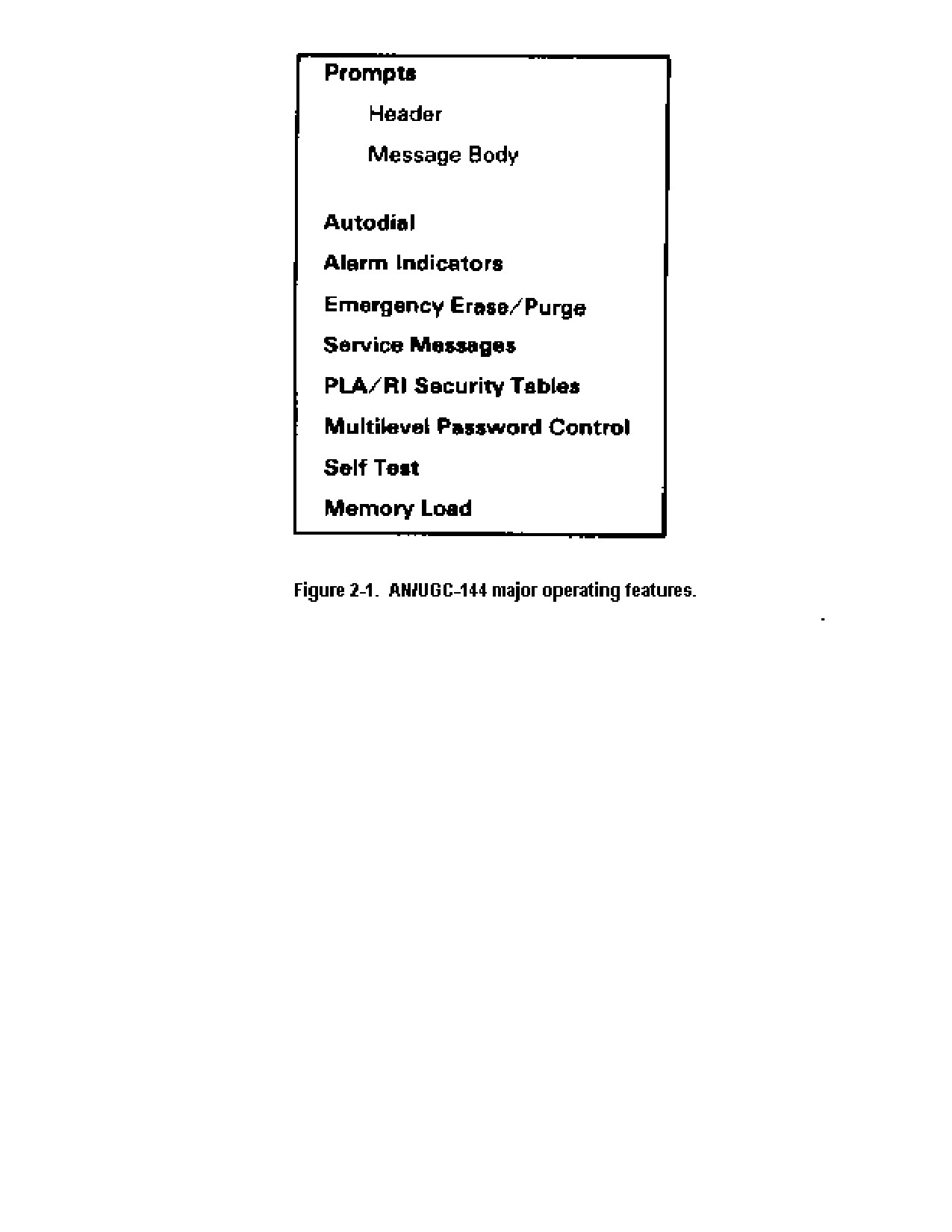
is man-portable and can serve as a stand-alone PC. Figure 2-1 summarizes the AN/UGC-144’s major
operating features. See TM 11-7025-267-12 for further information on CT operations.
http://www.adtdl.army.mil/cgi-bin/atdl.dll/fm/24-17/Ch2.htm (1 of 5) [1/11/2002 1:54:54 PM]
FM 24-17 Chptr 2 Formal TRTS Operational Concept
The CT uses an ink jet printer with a disposable printhead, a supply of fan-fold paper, and a 6-foot
terminal cable.
The single subscriber interface (SSI) interacts with a DSVT, a digital non secure voice terminal (DNVT)
TA-1035, a dedicated loop encryption device (DLED) KG-84, or an advanced narrowband digital voice
terminal (ANDVT). Three different cable assemblies are used to connect equipment to the SSI. The SSI
is an internal component of the CT and has its own menu functions.
The DSVT is used for encrypting/decrypting voice traffic and provides secure digitized data capability. It
operates as a full-duplex or half-duplex subscriber terminal. The DSVT provides a digital
communications interface with TRI-TAC and MSE circuit switches.
2-3. Formal TRTS Switching Systems
The following overview of the automatic message switching systems, from division through corps and
EAC, explains how TRTS functions with each system. Detailed information on each system is contained
in the associated field manuals and technical manuals.
EAC switching systems. TRTS users should be aware that each automatic message switch central
http://www.adtdl.army.mil/cgi-bin/atdl.dll/fm/24-17/Ch2.htm (2 of 5) [1/11/2002 1:54:54 PM]
FM 24-17 Chptr 2 Formal TRTS Operational Concept
AN/TYC-39( ) is normally connected to at least two other message switches through the dual-home
feature.
Message switch AN/TYC-39( ). This switch provides secure, automatic message switching of narrative
record and data traffic at major corps and theater Army nodes. The AN/TYC-39( ) will automatically
accept, process, store, deliver, and account for record traffic through 50 lines of narrative header and
textual information.
Parent AN/TYC-39( ). A parent AN/TYC-39( ) is located at the user’s parent corps (or theater). The CT
user transmits messages directly by the dial-up ACUS. The parent AN/TYC-39( ) automatically routes
message traffic to the intended addressees.
Alternate AN/TYC-39( ). Should the parent AN/TYC-39( ) be destroyed or become inoperable, the CT
user will transmit multiple addressee traffic to an alternate AN/TYC-39( ) across corps or EAC
boundaries within the ACUS network. The alternate AN/TYC-39( ) will perform message routing.
Gateway AN/TYC-39( ). A gateway AN/TYC-39( ) is normally located at EAC. The gateway AN/TYC-
39( ) will provide the entry into the AUTODIN or DSSCS networks. Although any CT’s parent AN/TYC-
39( ) can perform as a gateway, not every switch will perform this function.
AN/TTC-39( ) and small extension node (SENS) AN/TTC-48 circuit switches. These switches provide
switching and MSE network access/interface with the Secure Voice System (SVS), existing tactical
switches (manual and automatic), and commercial central offices.
Corps/division switching systems. Node center AN/TTC-47 combines digital switching capability with
flood search routing and subscriber management into one switching function. The SENS can interface
with a node control switch (NCS) AN/TTC-47 at echelons corps and below (ECB) via CX-11230/C
cable, line of sight, or tactical satellite. Additional TRTS switching to North Atlantic Treaty Organization
(NATO) telephone systems and net radio interface (NRI) can be accomplished where TRTS subscribers
coordinate with services. Along the supporting signal officer for these with an extension node, the
AN/TTC-47 provides TRTS voice, data, and facsimile communications to corps, division, and brigade
level command posts. NRI capability may be installed depending on mission and user requirements. In
non-MSE divisions, the AN/TTC-41 automatic telephone central office provides automatic switching for
TRTS users.
Record traffic passes over many transmission paths and through one or more circuit or message switches.
The user will not normally be aware of the circuit paths as these equipments are transparent to the user. In
an MSE network, tactical users may send record traffic to one or more units within a 37,500 square
kilometer area. (See FM 11-30 for additional information on how record traffic passes over line of sight
or cable through one or more of 42 major node centers.) Connectivity is based on close coordination with
the supporting signal officer and each user making their requirements known and validated.
http://www.adtdl.army.mil/cgi-bin/atdl.dll/fm/24-17/Ch2.htm (3 of 5) [1/11/2002 1:54:54 PM]
FM 24-17 Chptr 2 Formal TRTS Operational Concept
2-4. CT Security
AR 380-5 provides guidance pertaining to protecting and safeguarding classified material stored in the
CT’s memory or on the auxiliary storage cassette (ASC) or 3.5 inch floppy disks of CTs so equipped. The
CT is unclassified upon receipt at the unit. (See Appendix I for factory default settings.) When classified
information is stored in the CT or on an ASC or floppy disk, the equipment and disk must be protected
and safeguarded as required by AR 380-5 and AR 380-19 in accordance with (IAW) the highest level of
information.
As a minimum, the unit SOP should include specific guidance for safeguarding the CT and to protect the
equipment before, during, and after tactical deployment. When documenting procedures for protecting the
CT and associated record traffic/residue, follow procedures in AR 190-13, AR 380-5, and AR 380-19.
When operating the CT, ensure that unauthorized personnel do not gain access to the terminal, hard disk,
ASCs, floppy disks, or passwords needed to access the system. The entire CT must be safeguarded IAW
AR 380-5 and AR 380-19 to prevent disclosure of passwords and classified information or material to
unauthorized personnel. (See TM 11-7025-267-12 for instructions on denying unauthorized screen
viewing and how to recover from a manually blacked-out terminal screen.)
Whenever the CT is unattended or not in operation, take the following precautions to prevent inadvertent
disclosure of classified information to unauthorized personnel.
● All spare ASCs and floppy disks will be formatted and marked as Formatted YY MM DD (year,
month, day). This is accomplished by using the FORMAT function in the CT directory. (See
Appendix J for additional security and protection of ASCs and data disks.)
● All information placed on the hard disk must be saved on ASCs or floppy disks before storage.
The ASCs and floppy disks must be safeguarded IAW AR 380-5 or protected under the Privacy
Act of 1974. All ASCs and floppy disks containing information must be marked with the highest
security classification of the information contained on them.
● Local SOP should provide disposition instructions for all message traffic, paper, and other CT
generated waste. Classified waste material, such as handwritten message drafts, notes, and carbon
paper will be destroyed as classified trash. Destroy classified material IAW security provisions of
AR 380-5. CT users should coordinate with the unit intelligence officer and security officers for
compliance with authorized destruction procedures.
The CT employs security measures within its operational software to ensure classified traffic is not
transmitted to unauthorized users. The AN/TYC-39( ) will not route messages to improperly classified
CTs and a CT will not allow receipt of traffic which exceeds its terminal classification.
http://www.adtdl.army.mil/cgi-bin/atdl.dll/fm/24-17/Ch2.htm (4 of 5) [1/11/2002 1:54:54 PM]
FM 24-17 Chptr 2 Formal TRTS Operational Concept
ACUS COMSEC measures secure all TRTS traffic up to a level of SECRET. Standard COMSEC
measures include radio link encryption and Protected Wire Distribution Systems (PWDS).
The following requirements provide TRTS users access to DSSCS and the capability to transmit TOP
SECRET/sensitive compartmented information (TS/SCI) message traffic when authorized by the
National Security Agency (NSA). (See Chapter 7 for additional guidance on actual record traffic
processing procedures.)
● Compartmented key on an end-to-end basis using KY-68s (that is, S variable). (Contact the signal
officer or unit COMSEC custodian for additional information on secure voice S variables.)
● Dedicated COMSEC equipment and superencryption procedures as authorized by the unit.
● A direct trunk to EAC AN/TYC-39( ) with SCI KG-84 subscribers for EAC users.
http://www.adtdl.army.mil/cgi-bin/atdl.dll/fm/24-17/Ch2.htm (5 of 5) [1/11/2002 1:54:54 PM]
Chapter 3
Formal TRTS Message Fundamentals
3-1. Introduction
This chapter provides information on the preparation of formal messages in the TRTS.
AR 25-11 prescribes the policies, responsibilities, and procedures governing the record communications
preparation, approval, and process within the Department of the Army (DA). CT users must be aware of
and comply with those procedures contained in AR 25-11 and this chapter to correctly process record
traffic within the formal TRTS.
Supervisors of CTs should incorporate message flow procedures from Chapter 9 and message
preparation requirements from AR 25-11 into their local SOPs. This will ensure all formal TRTS record
communications prepared at their CT are properly prepared and processed in an accurate and timely
manner. Deviations from established procedures may result in deficiencies that adversely impact on the
record traffic system (delayed, misrouted, or lost messages). Supervisors must establish, supervise, and
maintain an effective quality control program that will ensure CT users are in compliance with prescribed
operating procedures and practices.
Messages within TRTS will be handled with the utmost privacy. The message contents cannot be
provided to anyone except by the originator or addressee.
When a message is originated from the CT, it must be entered into the CT’s memory. Messages to be
transmitted will be provided to the CT operators IAW the unit SOP .
Note: For the operator to prepare and transmit a message, two different passwords must be
known and used. To enter the appropriate level of classification and to enable the transmit
function in the ACCESS menu, the operator must have access to two passwords.
Outgoing messages can be manually entered through the CT keyboard or, if the CT is equipped with a
disk drive, the text can be delivered on a disk, inserted into the disk drive, and loaded onto the CT screen
for processing. The following information must be available or known by the CT operator before
http://www.adtdl.army.mil/cgi-bin/atdl.dll/fm/24-17/Ch3.htm (1 of 5) [1/11/2002 1:54:58 PM]
FM 24-17 Chptr 3 Formal TRTS Message Fundamentals
composing formal record traffic into the proper format for transmission into the TRTS.
Security classification. The message writer is responsible for determining the proper security
classification for each message IAW AR 380-5. A CT operator should never accept a message for
transmission unless the security classification is known. The security classification must be indicated for
manual message processing. Written messages will have the security classification stamped or marked at
the top and bottom of the paper copy. If the message is prepared on floppy disk, the disk will be properly
labeled with the security classification clearly marked. This will prevent transmission of an improperly
classified message. Releaser date-time group (DTG). This reflects the time the message was processed by
the releaser and will be expressed in date/time (ZULU )/month/year. NO two messages from the same
office/unit should have the same DTG. (See Appendix B for construction of ZULU time and how to
convert local time to ZULU.) CT users may use the internal clock time as a DTG or the user unit may
assign their own.
Precedence. The precedence for the action addressee is a mandatory entry. The precedence will be used
to indicate the order in which a message will be processed and the speed at which the message must be
handled by the CT user and noted by the addressee. The lowest precedence should be used whenever
possible. (See Appendix C for examples of precedence assignment.)
Flash (Z), CRITIC (W), and ECP (Y) messages will be handled/processed as fast as possible with an
objective of 10 minutes for Flash and 3 minutes for CRITIC and ECP messages.
Immediate (O) messages should be processed within 30 minutes.
Priority (P) messages have a time objective of 3 hours.
Routine (R) messages have a time objective of 6 hours.
FROM PLA. This is normally the unit command title, location, and one office symbol which is enclosed
within double slants; for example, CDR 1ST ID WASH DC//DCG//.
TO PLA. In most cases, this is the commander of the command, installation, or agency for whom the
message is intended. DA Pam 25-11 contains message address designators and is used to construct the
PLA/RI tables.
Office symbols will be included as part of the address designator.
Information such as ATTN MAJ SMITH or FOR COL JONES will not be used in place of office
symbols. When names are required, they will be included in the internal/handling instructions of the
message text.
http://www.adtdl.army.mil/cgi-bin/atdl.dll/fm/24-17/Ch3.htm (2 of 5) [1/11/2002 1:54:58 PM]
FM 24-17 Chptr 3 Formal TRTS Message Fundamentals
INFO PLA (if required). Releaser. The releaser is designated by the unit to release messages for
transmission in the TRTS. No message will be entered into TRTS without being properly released/signed
by an authorized individual. The unit SOP should state that no member will knowingly transmit or cause
to be transmitted, or deliver or cause to be delivered, a false or forged message.
3-2. Preparing Outgoing Messages
Most of the information needed to compose a message was entered when the initialization table entries
were made. To compose a message, the operator/CT user takes the following steps:
From the main menu, select EDIT by using the F7 key.
From the EDIT menu, select NEW MESSAGE by using the F2 key.
When the next screen appears, start typing the message text. The message text starts with the line directly
after the SUBJECT line. When you reach the bottom, the screen will automatically scroll.
When the message text has been the header function using the F1 key.
If the CT is set up as a GENSER completed, select terminal. the four options for the message header are
JANAP 128P, JANAP 128AP, ACP 127-1, and ACP 127-3. If the terminal is set up for DOI 103 format,
the selections will be DOI 103S or DOI 103C.
After selecting the correct message format, enter information from the message form. The following
prompts will appear on the CT screen. Select the appropriate entry.
● ENTER CLASSIFICATION. Enter a character U, E, C, S, or T. This entry is taken from the
CLASS block of the message form. The letter must match the overall message security
classification.
● ENTER THE NEXT CHANNEL SEQUENCE NUMBER (CSN). This entry only appears, and is
required, if the message is ACP 127 format or MODE II of JANAP 128 and DOI 103.
● ENTER TRANSMISSION RELEASE CODE (TRC). Enter N. This will be a standard entry for
this menu location.
● ENTER PRECEDENCE. Enter a character R, P, O, Z, or Y. This entry is taken from the
PRECEDENCE (ACT) block of the message form.
● ENTER INFO PRECEDENCE . Enter precedence code shown on the PRECEDENCE (INFO)
block of the message form. If the message is intended for a single addressee, repeat the letter
http://www.adtdl.army.mil/cgi-bin/atdl.dll/fm/24-17/Ch3.htm (3 of 5) [1/11/2002 1:54:58 PM]
FM 24-17 Chptr 3 Formal TRTS Message Fundamentals
previously used in PRECEDENCE.
● ENTER STATION SERIAL NUMBER (SSN). This entry is automatically placed by the CT.
Press RETURN.
● ENTER SPECIAL CATEGORY (SPECAT). Enter A for TOP SECRET, B for SECRET, or N if
the message is not SPECAT. This entry is taken from the SPECAT block of the message form.
AR 105-31 contains additional information on SPECAT messages.
● ENTER DATE . The CT will show the current date. The DTG/RELEASER TIME (DATE-TIME,
MONTH, and YR blocks from the message form) can be manually entered.
● ENTER TIME. Same as information in paragraph above.
● ENTER THE SUBJECT LINE. This entry cannot be more than one line. If the subject is more
than one line, the operator must, after finishing the message, go in and EDIT the message text by
adding the remaining subject lines.
● ENTER Y TO ADD PLAs/RIs. This is where the PLA/RI table is used to speed message
processing. If you select Y, the CT will enter the PLA/RI table and will allow you to select the
PLA and RI for the addressees. If the PLA/RI are not in the tables, then press any key and the CT
will prompt you to enter the PLA and RI. After the first PLA/RI, the CT will ask if that is all. If
there is an INFO addressee, continue to add PLAs/RIs. Use the PLA/RI shown on the TO line and
(if required/used) the INFO lines on the message form.
After the message text has been typed, the message should be saved to an ASC or a floppy disk. This
prevents having to retype the entire message should a power failure occur which would erase the
message from the CT screen.
It is highly recommended that someone other than the operator who typed the message proofread the
message text and initial that they have done so.
3-3. Originated Message Register
Use DA Form 4016 to aid the CT operator in providing an audit trail and historical information for
outgoing record traffic. (See Figure 3-1.)
http://www.adtdl.army.mil/cgi-bin/atdl.dll/fm/24-17/Ch3.htm (4 of 5) [1/11/2002 1:54:58 PM]
FM 24-17 Chptr 3 Formal TRTS Message Fundamentals
CT supervisors can use information from the DA Form 4016 to identify record traffic speed-of-service
trends or as an aid to insecurity investigations should the need ever arise. DA Forms 4016 should be filed
with individual monthly record traffic hard copies or diskettes. Automated procedures, such as saving a
message to CT memory and printing a directory listing, may meet some units’ needs for maintaining an
originated message register.
3-4. Outgoing Message Flow
Originated messages must follow a logical and established path/flow from the message originator/drafter
throughout required staffing to the CT operator. The CT operator either types the message text or loads
an ASC or a floppy disk containing the message into the CT memory.
Formal record traffic administrative procedures must be standardized at the user’s CT to prevent message
delays or losses.
http://www.adtdl.army.mil/cgi-bin/atdl.dll/fm/24-17/Ch3.htm (5 of 5) [1/11/2002 1:54:58 PM]
Chapter 4
Transmitting Formal Messages Within TRTS
4-1. Introduction
This chapter covers how messages are transmitted by the CT and message switches within the TRTS.
Message traffic can be received and transmitted at the same time, except when the CT is connected to an
ANDVT which operates in half-duplex (send or receive mode). TM 11-7025-267-12 contains the
required machine functions to follow when transmitting a formal CT message within TRTS. Formal
TRTS can be passed over a variety of user-owned and Signal Corps-owned equipment depending on the
echelon at which the CT is located.
The CT must be enabled for transmission in the ACCESS menu. In order to transmit a message, you
must have the correct passwords.
In the formal TRTS, the preferred method of message transmission between users is terminal to terminal
or direct dial up using only the circuit switched network. Whenever possible, the CT operator uses the
direct dial up of destination terminals. This method will greatly lessen the processing burden of the
AN/TYC-39( ) message switch. The user must coordinate with the supporting signal officer to ensure the
CT has been included in the parent AN/TYC-39( ) database. The following types of messages can be sent
to an AN/TYC-39( ) message switch, by dial up through the circuit switched network, for delivery to
required addressees.
● Multiple address messages with two or more addressees.
● Messages intended for delivery through the AUTODIN network.
● Messages that cannot be sent by terminal to terminal direct dial up after one or more attempts to
transmit the message have been made.
● Messages to TRTS terminals that do not have assigned telephone numbers. Addressees in this
type of message must be identified by an RI.
http://www.adtdl.army.mil/cgi-bin/atdl.dll/fm/24-17/Ch4.htm (1 of 4) [1/11/2002 1:55:03 PM]
FM 24-17 Chptr 4 Transmitting Formal Messages Within TRTS
A CT with dial-up access to the tactical communications network is connected to the data port of the
DSVT or DNVT. A station with direct access to an AN/TYC-39( ) message switch is connected through
a DLED.
4-2. Transferring Formal TRTS Messages
CT to CT. Once the terminal is properly accessed and the message is formatted correctly, the CT user can
transmit record traffic directly to the single addressee CT by the dial-up ACUS.
CT to multiple addressees. When sending multiple addressee record traffic, the CT user will transmit
properly formatted messages directly to the user’s parent corps or theater AN/TYC-39( ). See paragraph
4-3 for autodial procedures for multiple addressees.
CT to AUTODIN or DSSCS addressees. The properly formatted and addressed CT message will be
transmitted to a designated gateway AN/TYC-39( ), normally located at EAC, for entry into the
AUTODIN or DSSCS networks.
CT to LDF addressee. The CT user will prepare a properly formatted message for delivery by refile to an
LDF. The messenger takes the message to the nearest LDF location for delivery by facsimile.
4-3. Autodialing
When a formal message is transmitted to more than one addressee, the CT operator has the option of
using the CT’s AUTODIAL option. This method allows the operator to manually select up to eight
phone numbers (consisting of up to 10 numbers each). The CT automatically dials each phone number
and transmits the properly formatted message to each of the intended addressees. CT users should be
aware that when transmitting messages direct (user to user) via the circuit switching dial-up procedures,
there will be no record of that message having been transmitted at the circuit switch. Therefore, if the
message is lost or mishandled, it cannot be traced through Signal Corps facilities. The only messages
which may be traced through the switching systems are those which transit the AN/TYC-39( ) message
switch.
TM 11-7025-267-12 contains additional information on autodialing procedures.
4-4. Transmitting CT Messages by AN/TYC-39( ) Switches
CSNs must be used when you process a message in the ACP 127-1 and ACP 127-3 formats.
CSNs must also be used if your CT is operating in MODE II. In this mode of operation, the connected
message switch automatically detects a faulty CSN, header, or end of transmission situation. Since the
message switch cannot stop a transmitting CT, it will send an automatic computer-generated service
http://www.adtdl.army.mil/cgi-bin/atdl.dll/fm/24-17/Ch4.htm (2 of 4) [1/11/2002 1:55:03 PM]
FM 24-17 Chptr 4 Transmitting Formal Messages Within TRTS
message to advise the CT user that the message has been rejected or accepted.
CSNs are managed by the CT operator to ensure messages are not lost or delayed at the message switch.
To accomplish this, the CT operator uses DA Form 5651. To know the last CSN used and also to know
what the next good CSN is, the numbers will be marked off or lined through as numbers are used for
each message being transmitted through a message switch. Invalid or out-of-sequence channel numbers
cause messages to be rejected at the switch and requires operator correction for retransmission. It is
important to keep the CSNs correct at all times.
If the CT user has a large amount of message traffic and problems are encountered with out-of-sequence
channel numbers causing message rejects, the CT supervisor of a MODE II configured CT may elect to
use two separate DA Forms 5651 to keep messages separated from the switched and direct dialed
networks.
Figure 4-1 shows an example of how DA Form 5651 is completed to keep track of CSNs. This example
shows CSN 004 as the next valid CSN of a formal message to be transmitted through an AN/TYC-39( ).
http://www.adtdl.army.mil/cgi-bin/atdl.dll/fm/24-17/Ch4.htm (3 of 4) [1/11/2002 1:55:03 PM]
Chapter 5
Formal TRTS Message Receipt Fundamentals
5-1. Introduction
This chapter presents procedures for processing received record traffic messages. It provides instructions
relating to procedures, security, privacy, and maintenance of an audit trail.
The unit SOP provides local procedures to enhance accountability and privacy within the organization.
The CT user/operator is held personally and legally responsible for the initial accountability, security,
and privacy of received messages until properly delivered to the authorized and intended addressee.
The CT supervisor must coordinate with the organization signal officer to have a terminal/unit routing
guide published. This aids the CT operator in determining the proper routing and delivery of incoming
messages. Routing guides should include action and information addressees for specific subject areas and
number of copies to be delivered.
As a minimum, the CT operator should process received formal record traffic messages as shown below.
The CT operator visually scans all received messages. This ensures the message is in fact intended for
that terminal, is not garbled, is not incomplete, and is not misrouted. See Chapter 6 for processing
misrouted messages.
The CT operator processes messages by precedence. Higher precedence messages are processed ahead of
lower precedence messages. In most cases and depending on organizational mission, an incoming
IMMEDIATE precedence message is processed and delivered before an outgoing IMMEDIATE
precedence message. The local SOP indicates if received messages take precedence over outgoing
messages. A received PRIORITY precedence message always takes precedence over a received
ROUTINE precedence message.
Received service messages take priority over outgoing service messages and outgoing record traffic of
the same or lower precedence.
http://www.adtdl.army.mil/cgi-bin/atdl.dll/fm/24-17/Ch5.htm (1 of 5) [1/11/2002 1:55:20 PM]
FM 24-17 Chptr 5 Formal TRTS Message Receipt Fundamentals
Signal officers will not conduct internal distribution. They write the policy and procedures that staff or
CP sections use in the field which govern both electronic and manual means. Individual staff sections
generate their own copies and transport them using their own resources to selected distribution points
(that is, drop boxes if applicable). Each staff section picks up its own distribution per the unit SOP. If the
Army or a unit resources the signal brigade/battalion with messengers and transportation, signal will
publish a messenger service plan. Signal organizations are not resourced with messenger augmentation.
Individual staff sections coordinate their own resources for transporting messages. The signal officer
coordinates with supported staff elements to develop an internal distribution routing guide. This routing
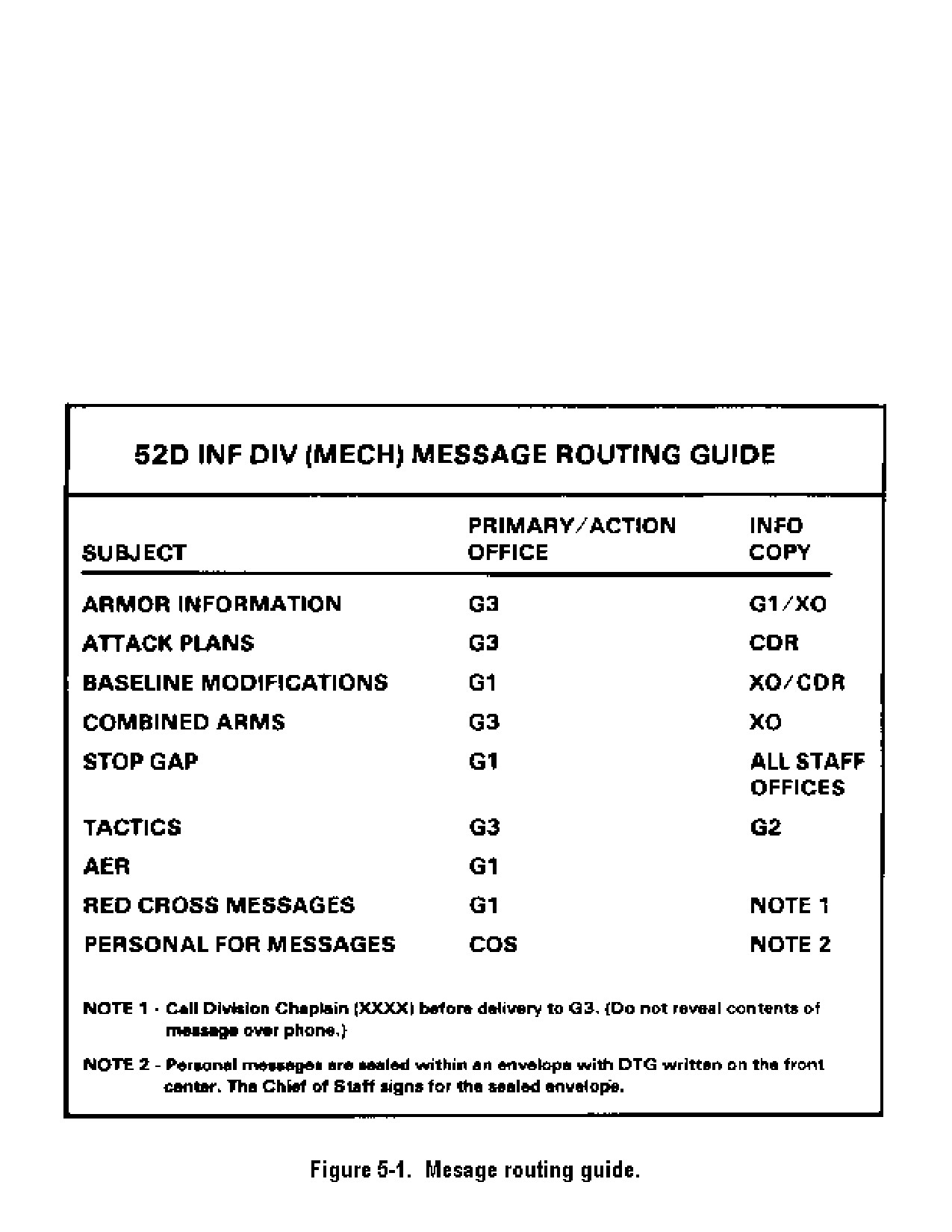
guide shows CT operators how to make the required number of copies. Figure 5-1 shows an example of a
message routing guide. Individual units develop their own procedures to accomplish the commander’s
intended mission. This routing guide enables personnel to effectively deliver or make the required
notification when receiving sensitive/important record traffic communications at the CT.
http://www.adtdl.army.mil/cgi-bin/atdl.dll/fm/24-17/Ch5.htm (2 of 5) [1/11/2002 1:55:20 PM]
FM 24-17 Chptr 5 Formal TRTS Message Receipt Fundamentals
High precedence (IMMEDIATE and FLASH) delivery instructions should be provided to the CT
operator. This speeds delivery service to the intended addressee and ensures that messages are acted on
by the correct office/section.
The unit security officer provides the CT operator with a current security clearance roster. This roster
identifies personnel authorized to receive classified messages.
● A classified message is never released to an unauthorized person. A SECRET message is never
released to an individual with less than a SECRET security clearance. A classified message is
never delivered to an individual until his security clearance is verified or known.
● All classified messages are delivered with the appropriate level classified cover sheet attached.
Received messages are the responsibility of the CT operator until delivered to the addressee or placed
into internal distribution center distribution boxes. The signal officer and his staff is responsible for
internal unit distribution boxes.
5-2. Message Privacy Requirements
CT operators are not to discuss or to reveal the contents of a received message except to the addressee or
to an authorized representative.
A strict need-to-know policy is followed and documented as directed in the SOP. Personnel, regardless
of rank or position, are not given access to information copies of messages unless authorized by the
addressee. CT operators release messages only to those organizations or individuals as stated in the CT
routing guide. The addressee makes all additional distribution as required.
5-3. Message Retention/Audit Trail
The CT operator can store a record of message transactions (sent and received messages) in the
terminal’s HISTORY file. In some CT configurations, this function is automatic. To have an audit trail of
received messages, the CT operator should print a HISTORY file as indicated in the unit SOP.
HISTORY files do not show the subject matter of a message. To assist in locating or retrieving a
received message, the CT operator should keep a copy of each message received. (See paragraph 5-4.) A
copy of the HISTORY file and a copy of each received message should be kept on file in the CT area for
a period of time determined by the unit SOP. This speeds up message retrieval and service action should
a service message be received requiring action to be taken on a previously received or transmitted
message.
http://www.adtdl.army.mil/cgi-bin/atdl.dll/fm/24-17/Ch5.htm (3 of 5) [1/11/2002 1:55:20 PM]
FM 24-17 Chptr 5 Formal TRTS Message Receipt Fundamentals
Classified messages must be filed and protected IAW AR 380-5.
All files must be maintained IAW AR 25-400-2. CT operators are to maintain an internal records system
to support the TRTS mission and information mission area requirements as published by the signal
officer.
The unit commander or signal officer may require additional internal logs, records, and files to be
maintained in support of the CT. These may be historical or reference files and must be maintained IAW
AR 25-400-2.
To assist in an audit trail, the CT operator releases received messages to the addressee or a designated
representative on DA Form 4011. Figure 5-2 shows a sample of DA Form 4011 with required entries.
http://www.adtdl.army.mil/cgi-bin/atdl.dll/fm/24-17/Ch5.htm (4 of 5) [1/11/2002 1:55:20 PM]
FM 24-17 Chptr 5 Formal TRTS Message Receipt Fundamentals
Personnel signing for messages are to sign their payroll signature and place a time and date next to their
name.
CT operators must initial the DA Forms 4011 to indicate which messages they released to addressees.
5-4. Record Traffic Journal
The record traffic journal can be maintained as a multipart folder or three-ring binder. This journal keeps
the oncoming shift informed of ongoing actions and serves as a quick information source for the
command/staff personnel. The CT operator arranges the journal as follows:
● Copies of outgoing record traffic.
● Copies of incoming record traffic.
● Copies of delivery lists showing when and to whom record traffic was delivered.
● DA Form 1594 may be used to provide detailed information the CT operator wants to document.
Retain messages in accordance with established records management procedures. Journals may be of
significant historical value or as documentation of lessons learned on particular tactical deployments. CT
operators should protect journals and message retention files IAW the highest level of classified
messages contained in the file.
http://www.adtdl.army.mil/cgi-bin/atdl.dll/fm/24-17/Ch5.htm (5 of 5) [1/11/2002 1:55:20 PM]
Chapter 6
Formal Service Message Fundamentals
6-1. Introduction
This chapter presents information regarding service messages, the use of operating signals, and service
message logs .
Service messages are short concise messages between CTs, switches, or TCCs requesting action be taken
on a previously sent or received message. For example, service messages are sent to request
RETRANSMISSION of a received and garbled message or to advise a CT they have sent a message to
the wrong addressee/CT.
Service messages contain one or more combinations of letters called operating signals (or Z signals).
Operators use Z signals instead of lengthy message text to state a problem or request certain action be
taken. Z signals represent questions, answers, or requests for information over communications paths.
ACP 131 ( ) contains hundreds of Z signals that can be used in JANAP and DOI 103 messages.
Normally, only a few Z signals are used frequently in message switching networks. CT users must be
familiar with the more commonly used Z signals so as to provide a quicker response time on serviced
messages. Appendix E contains a list of commonly used operating signals and their meanings.
One copy of each service message received or transmitted is attached to the original message being
referenced in the service message. Any action that is required must be processed and the message
delivered to the intended addressees within the speed-of-service requirements of each precedence level.
Incoming service messages are an indicator of operator training requirements and levels. Supervisors
should closely monitor the number and types of service messages and ensure all assigned CT operators
are aware of service message procedures and requirements. When CT operators know what actions are
required for various service messages, writer-to-reader processing times are decreased.
6-2. CT Preformatted Service Messages
http://www.adtdl.army.mil/cgi-bin/atdl.dll/fm/24-17/Ch6.htm (1 of 13) [1/11/2002 1:55:24 PM]
///////////////////////////////////////