ICAC2 MULTISERVICE PROCEDURES FOR INTEGRATED COMBAT AIRSPACE COMMAND AND CONTROL (June 2000) - page 4
Appendix G
FIRE SUPPORT COORDINATING MEASURES
1.
Fire Support Coordinating Measures (FSCMs)
Locations and implementing instructions for FSCMs are disseminated electronically by
message, data base update, and/or overlay through both command and fire support
channels to higher, lower, and adjacent maneuver and supporting units. Typically, they are
further disseminated to each level of command, to include the establishing command and all
concerned fire support agencies. Not all measures may apply to a joint operation. However,
knowledge of the various FSCMs used by each Service is necessary for the effective use of
fire support.
a. Planning and Coordination Considerations. Establishment or change of an FSCM
established by the ground commander is typically initiated through the J-3, G-3, and/or S-3
operations cell and ultimately approved by the appropriate commander (See Joint Pub 3-09,
Chapter III, “Planning and Coordination”). FSCMs enhance the expeditious attack of
targets; protect forces, populations, critical infrastructure, and sites of religious or cultural
significance; and set the stage for future operations. Commanders position and adjust
FSCMs consistent with the operational situation and in consultation with superior,
subordinate, supporting, and affected commanders. The operations cell informs
coordination elements of the change and effective time. Conditions which dictate the
change of FSCMs are also coordinated with the other agencies and components as
appropriate. As conditions are met, the new FSCM effective time can be projected and
announced. Following direction to execute the change, the operations cell should confirm
with all liaison elements that the FSCM changes have been disseminated. This ensures
that affected units are aware of new FSCM locations, associated positive control measures
are being followed, and also reduces risk of fratricide.
b. STANAG 2099 and Quadripartite Standardization Agreement 531. Some FSCMs
described here have not yet been agreed to by NATO and American, British, Canadian, and
Australian allies. Before commencing operations both joint force and component staff
members must verify the status of FSCMs in a multinational operation.
2.
Permissive Measures
a. Coordinated Fire Line (CFL).
(1) Purpose. The CFL is a line beyond which conventional surface fire support
means (both direct and indirect systems) may fire at any time within the boundaries of the
establishing headquarters without additional coordination. The purpose of the CFL is to
expedite the surface-to-surface attack of targets beyond the CFL without coordination with
the ground commander in whose area of operation the targets are located.
(2) Establishment. The CFL is usually established by a brigade or division
commander equivalent, but it can also be established, especially in amphibious operations,
by a maneuver battalion. It is located as close to the establishing unit as possible without
G-1
interfering with the maneuver forces. There is no requirement for the CFL to be placed on
identifiable terrain. However, additional considerations include the limits of ground
observation, the location of the initial objectives in the offense, and the requirement for
maximum flexibility in both maneuver and the delivery of supporting fires. Higher
headquarters may consolidate CFLs.
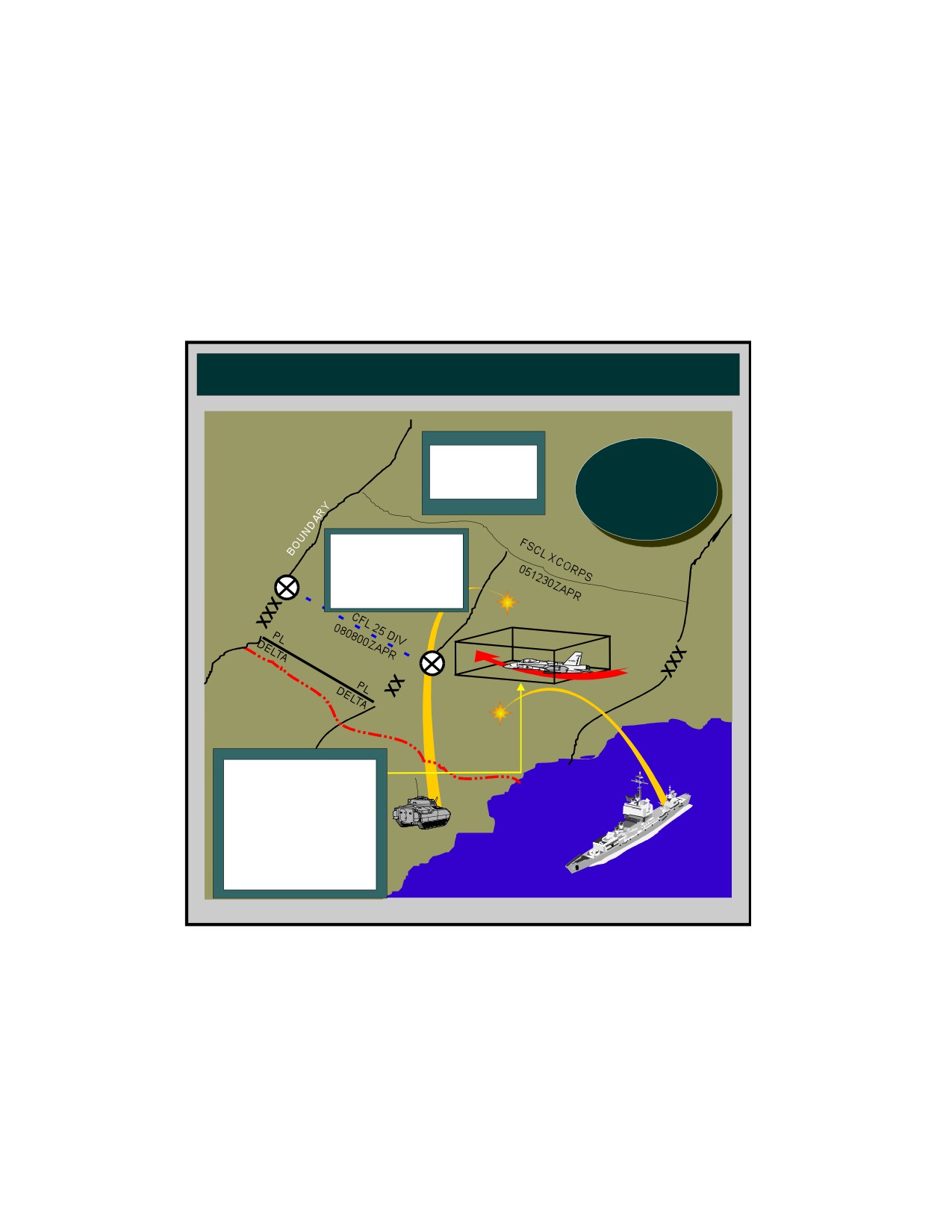
(3) Graphic Portrayal. The CFL is graphically portrayed by a dashed black line, with
“CFL” followed by the establishing headquarters above the line and the effective date-time
group (DTG) below the line. See Figure G-1.
FIRE SUPPORT AND CONTROL MEASURES
NFA
RFA
3D Mech Div
3D Mech Div
EFF 0800ZAUG
080800ZAUG
To
100800ZAUG
FFA
XCorps
080800-081600ZAUG
Or
EFF-080800ZAUG
MAX ALT
MIN ALT
ACA
XCorps
MIN ALT 300FT
MAX ALT 4000
MA00000000 to
MA00000000
MA00000000 to
MA00000000
EFF 091200ZAUG
Figure G-1. Fire support and Control Measures
b. Fire Support Coordination Line (FSCL).
(1) Purpose. FSCLs facilitate the expeditious attack of targets of opportunity
beyond the coordinating measure. An FSCL does not divide an AO. The FSCL applies to all
fires of air-, land-, and sea-based weapon systems using any type of ammunition against
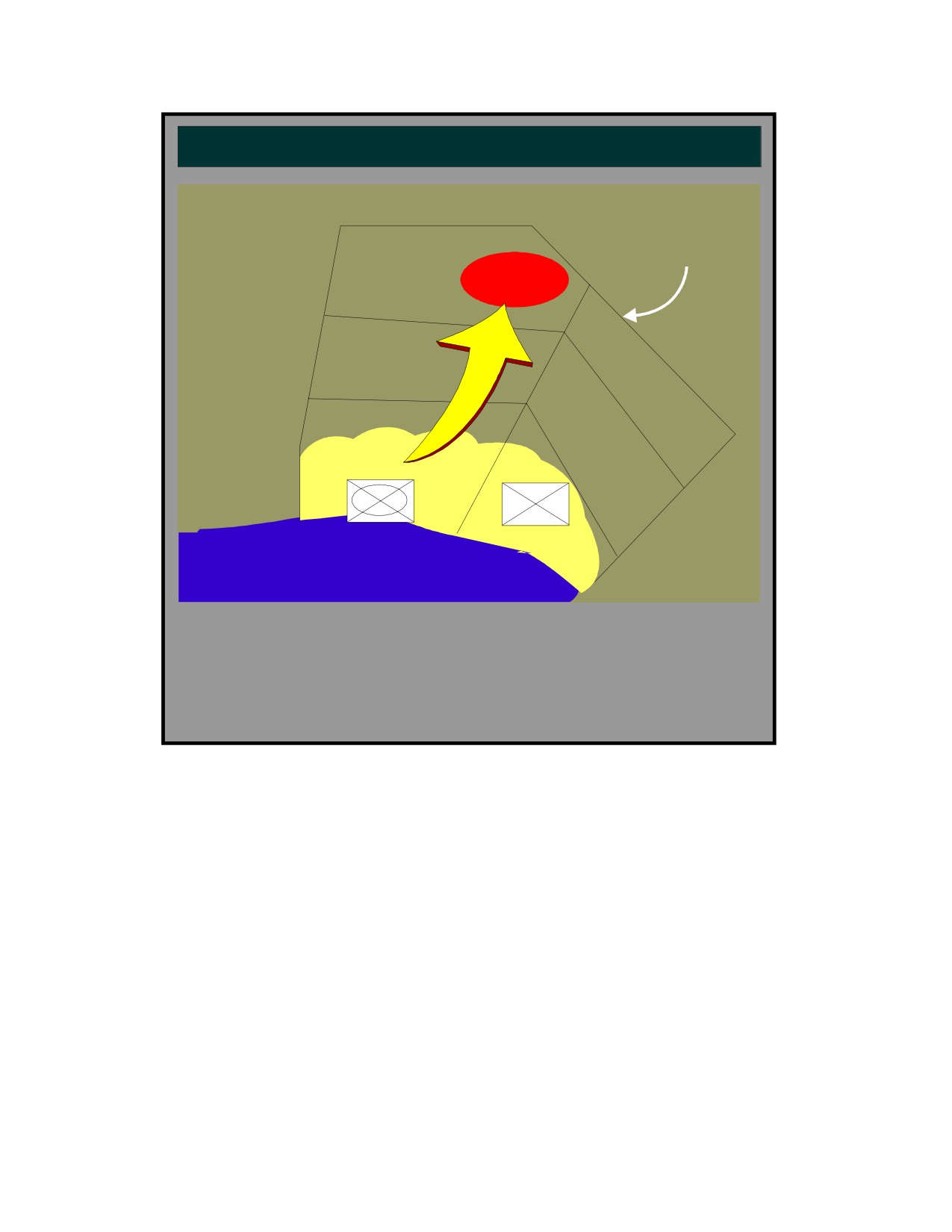
surface targets. See Figure G-2.
G-2
FIRE SUPPORT COORDINATION LINE
PERMISSIVE
Forward
Fire Support
Boundary
Coordination
Objective
Measure
XX
Not A
XX
XX
Boundary
O/O FSCL
FSCL
Enhances the expeditious attack of targets and sets the stage
•
future operations
Established
by appropriate level commander in consultation
•
superior, subordinate, and supporting
Forces attacking targets beyond an FSCL must inform all
•
commanders.
Figure G-2. Fire Support Coordination Line
(2) Establishment. An FSCL is established and adjusted by appropriate land or
amphibious force commanders within their boundaries in consultation with superior,
subordinate, supporting, and affected commanders. The FSCL is a term oriented to air-land
operations; no similar term is used at sea. If possible, the FSCL should follow well-defined
terrain features to assist identification from the air. In amphibious operations the FSCL is
normally established by the CLF after coordination with the CATF. Changes to the FSCL
require notification of all affected forces within the AO and must allow sufficient time for
these forces and/or components to incorporate the FSCL change. Generally 6 hours is
adequate in order to coordinate an FSCL change. Whenever possible, restrictive measures
are employed by commanders to enhance the protection of friendly forces operating beyond
the FSCL—measures such as restrictive fire areas (RFAs) and no-fire areas (NFAs).
(3) Graphic Portrayal. The FSCL is graphically portrayed by a solid black line
extending across the assigned areas of the establishing headquarters. The letters “FSCL”
are followed by the establishing headquarters above the line and the effective DTG below
G-3
the line. FSCLs do not have to follow “traditional” straight-line paths. Curved and/or
enclosed FSCLs have applications in nonlinear joint operations. See Figure G-2.
(4) Employment. Use of an FSCL is not mandatory. Forces attacking targets beyond
an FSCL must inform all affected commanders in sufficient time to allow necessary reaction
to avoid fratricide, both in the air and on the ground. In exceptional circumstances, the
inability to conduct this coordination will not preclude the attack of targets beyond the
FSCL. However, failure to do so may increase the risk of fratricide and waste limited
resources. Short of an FSCL, all air-to-ground and surface-to-surface attack operations are
controlled by the appropriate land or amphibious force commander. This control is
exercised through the operations staff or with predesignated procedures. The FSCL is not a
boundary. The synchronization of operations on either side of the FSCL is the responsibility
of the establishing commander out to the limits of the land or amphibious force boundary.
The establishment of an FSCL does not create a “free-fire area” beyond the FSCL. When
targets are attacked beyond an FSCL, supporting element’s attacks must not produce
adverse effects on or to the rear of the line. Attacks beyond the FSCL must be consistent
with the establishing commander’s priorities, timing, and desired effects and deconflicted
whenever possible with the supported headquarters.
(5) Considerations. The decision on where to place or even whether to use an FSCL
requires careful consideration. If used, its location is based on estimates of the situation
and concept of operations. The commander considers location of enemy forces, anticipated
rates of movement, concept and tempo of the operation, organic weapon capabilities, and
other factors. The FSCL is normally positioned closer to the forward line of own troops in
the defense than in the offense; however, the exact positioning depends on the situation.
Placing the FSCL at greater depths typically requires support from higher organic
headquarters and other supporting commanders.
(a) Air strikes short of the FSCL (both CAS and air interdiction [AI]) must be
under positive or procedural control to ensure proper clearance of fires (e.g., forward air
controllers, TACPs). Ground commanders must consider the need for extra control
measures. Also, when the FSCL is positioned at greater depth, there is greater requirement
for detailed coordination with the establishing commander.
(b) By establishing an FSCL close in yet at sufficient depth so as to not limit high-
tempo maneuver, land or amphibious force commanders ease the coordination requirements
for attack operations within their AOs by forces not under their control, such as naval
surface fire support (NSFS) or AI.
(c) Coordination of attacks beyond the FSCL is especially critical to commanders
of air, land, and SOF units operating beyond the FSCL. Such coordination is also important
when attacking forces are employing wide-area munitions or those with delayed effects.
Finally, this coordination assists in avoiding conflicting or redundant attack operations.
(d) The establishing commander adjusts the location of the FSCL as required to
keep pace with operations. In high-tempo maneuver operations, the FSCL may change
frequently. A series of pre-disseminated on-order FSCLs will help accelerate the
coordination required. The establishing commander quickly transmits the change to higher,
lower, adjacent, and supporting headquarters to ensure attack operations are appropriately
G-4
coordinated by controlling agencies. Anticipated adjustments to the location of the FSCL
are normally transmitted to other elements of the joint force sufficiently early to reduce
potential disruptions in their current and near-term operations. Careful planning and
coordination is essential for changes to the FSCL. This planning is necessary to minimize
the risk of fratricide and avoid disrupting operations.
(e) Varying capabilities for acquisition and attack may exist among adjacent
commanders in a multi-corps environment or multinational operation. Normally, corps
level commanders may establish an FSCL to support their operations. Layered FSCLs and
multiple, separate, non-contiguous corps and/or MEF FSCLs positioned at varying depths
create a coordination and execution challenge for supporting commanders; e.g., tracking
effective times, lateral boundaries, and multiple command guidance. In cases such as these
when the components share a mutual boundary, the JFC or JFLCC may consolidate the
theater and/or JOA operational requirements of subordinates to establish a single FSCL.
This FSCL may be noncontiguous, to reflect the varying capabilities of subordinate
commands. A single FSCL facilitates air support, accommodates subordinate deep
operations requirements, and eases coordination of FSCL changes.
c. Free-Fire Area (FFA).
(1) Purpose. An FFA is a specific designated area into which any weapon system may
fire without additional coordination with the establishing headquarters. It is used to
expedite fires and to facilitate emergency jettison of aircraft munitions.
(2) Establishment. An FFA may be established only by the military commander with
jurisdiction over the area (usually, a division or higher commander). Preferably, the FFA
should be located on identifiable terrain; however it may be designated by grid coordinates.
(3) Graphic Portrayal. The FFA is graphically portrayed by a solid black line
defining the area and the letters “FFA” within, followed by the establishing headquarters
and the effective DTG. See Figure G-1.
3.
Restrictive Measures
a. Restrictive Fire Line (RFL).
(1) Purpose. The RFL is a line established between converging friendly forces—one
or both may be moving—that prohibits fires or the effects of fires across the line without
coordination with the affected force. The purpose of the line is to prevent fratricide and
duplication of attacks by converging friendly forces.
(2) Establishment. The commander common to the converging forces establishes
the RFL. It is located on identifiable terrain when possible. In link-up operations, it is
usually closer to the stationary force to allow maximum freedom of action for the maneuver
and fire support of the linkup force.
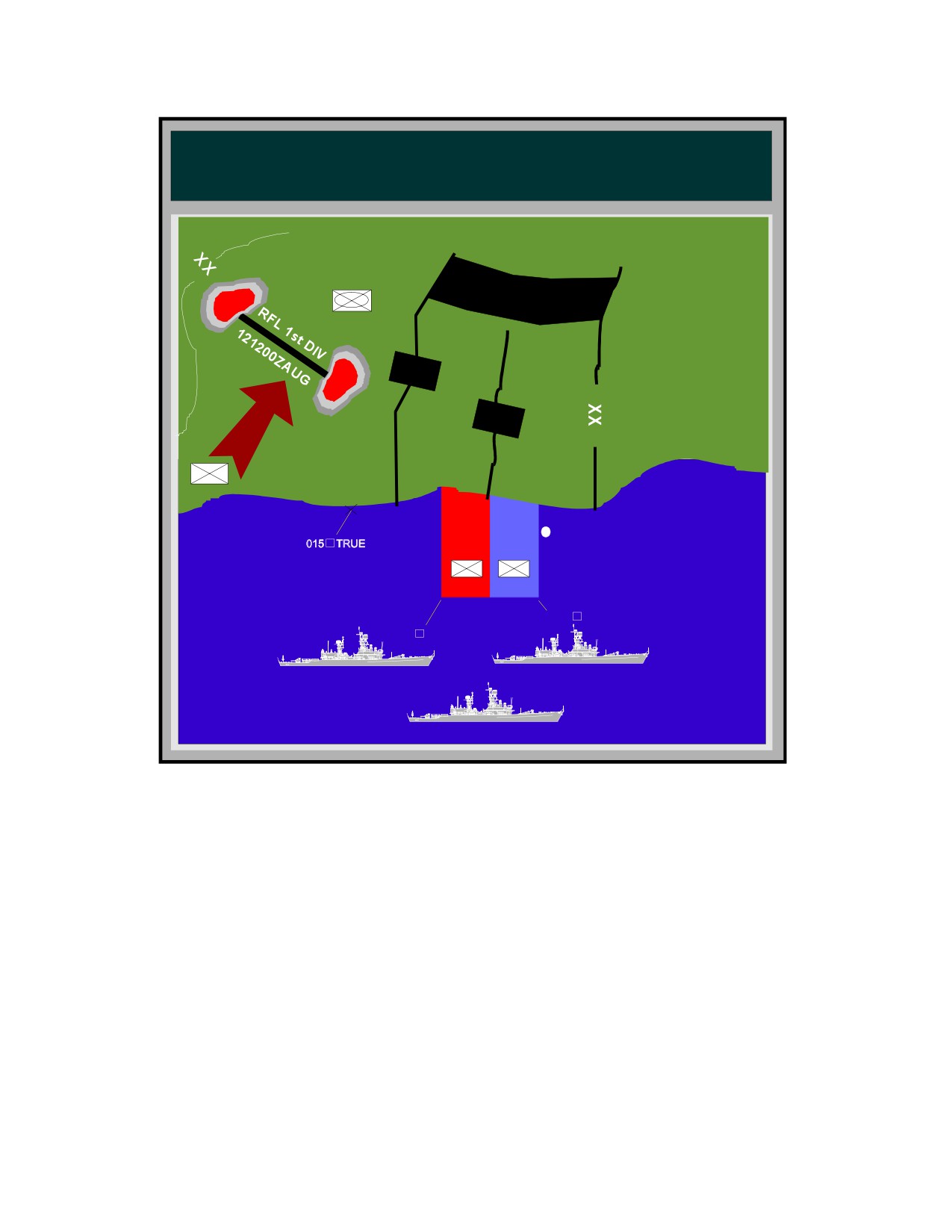
(3) Graphic Portrayal. The RFL is graphically portrayed by a solid black line, with
“RFL” followed by the establishing headquarters above the line and the effective DTG below
the line. See Figure G-3.
G-5
RESTRICTIVE FIRE LINE, FIRE SUPPORT AREA,
AND ZONE OF FIRE
ZF- 6
ZF- 3
ZF- 4
RED 1
BLUE 2
FSS
FSA
II
FSA
LOD
LOD
I
015
TRUE
015 TRUE
DS
DS
GS
Fig G-3. Restrictive Fire Line, Fire Support Area, and Zone of Fire
b. No-Fire Area (NFA).
(1) Purpose. The purpose of the NFA is to prohibit fires or their effects into an
area. There are two exceptions:
(a) When the establishing headquarters approves fires within the NFA on a
mission-by-mission basis.
(b) When an enemy force within the NFA engages a friendly force and the
engaged commander determines there is a requirement for immediate protection and
responds with the minimal force needed to defend his force.
(2) Establishment. Usually, a division or corps equivalent establishes an NFA. If
possible, the NFA is established on identifiable terrain. It may also be located by grid or by
a radius from a center point.
G-6
(3) Graphic Portrayal. The NFA is graphically portrayed as an area outlined with a
solid black line with black diagonal lines inside. The letters “NFA” are within, followed by
the establishing headquarters and the effective DTG. See Figure G-1.
c. Airspace Coordination Area. The airspace coordination area is the primary FSCM
which reflects the coordination of airspace for use by air support and indirect fires.
(1) Purpose. Airspace coordination areas are used to ensure aircrew safety and the
effective use of indirect supporting surface fires by deconfliction through time and space.
The airspace coordination area is a block or corridor of airspace in which friendly aircraft
are reasonably safe from friendly surface fires. A formal airspace coordination area (a
three-dimensional box of airspace) requires detailed planning. More often an informal
airspace coordination area is established using time, lateral separation, or altitude to
provide separation between surface-to-surface and air-delivered weapon effects. For
additional information on the airspace coordination area, see Joint Pub 3-09.3, Joint Tactics,
Techniques, and Procedures for Close Air Support (CAS), and Joint Pub 3-52, Doctrine for
Joint Airspace Control in the Combat Zone.
(2) Establishment. The airspace control authority establishes formal airspace
coordination areas at the request of the appropriate ground commander. Airspace
coordination areas require detailed planning. Though not always necessary, formal airspace
coordination areas could be considered. Vital information defining the formal airspace
coordination area includes minimum and maximum altitudes, a baseline designated by grid
coordinates at each end, the width (on either side of the baseline), and the effective times.
When time for coordination is limited, an informal airspace coordination area is used. In an
informal airspace coordination area, aircraft and surface fires may be separated by time or
distance (lateral, altitude, or a combination of the two). The informal airspace coordination
area can be requested by the maneuver commander requesting CAS or employing
helicopters and is approved at battalion or higher level. Both types of airspace coordination
areas are constructed with the assistance of the air liaison officer to ensure they meet the
technical requirements of the aircraft and weapon systems.
(3) Graphic Portrayal. A formal airspace coordination area is shown as an area
enclosed by a solid black line. Depicted inside the enclosed area are “airspace coordination
area,” the establishing headquarters, the minimum and maximum altitudes, the grid
coordinates for each end of the baseline, and the effective DTG or the words “on order.”
Informal airspace coordination areas are not normally displayed on maps, charts, or
overlays. See Figure G-1.
d. Restrictive Fire Area (RFA).
(1) Purpose. An RFA is an area where specific restrictions are imposed and in
which fires (or the effects of fires) that exceed those restrictions will not be delivered
without coordination with the establishing headquarters. The purpose of the RFA is to
regulate fires into an area according to the stated restrictions.
(2) Establishment. A maneuver battalion or higher echelon normally establishes an
RFA. Usually, the RFA is located on identifiable terrain, by grid, or by a radius from a
G-7
center point. To facilitate rapidly changing operations, on-call RFAs may be used. The
dimensions, locations, and restrictions of the on-call RFA are prearranged.
(3) Graphic Portrayal. The RFA is graphically portrayed by a solid black line
defining the area and the letters “RFA” within, followed by the establishing headquarters
and the effective DTG. The restrictions may be included within the graphic if space allows,
or reference may be made to a specific OPORD or OPLAN. See Figure G-1.
e. Zone of Fire.
(1) Purpose. A zone of fire is an FSCM usually used during amphibious operations
and includes the area within which a designated ground unit or fire support ship delivers,
or is prepared to deliver, fire support. Fire may or may not be observed. Land is divided
into zones of fire which are assigned to gunfire support ships and units as a means to
coordinate their efforts with each other and with the scheme of maneuver of the supported
ground unit. Units and ships assigned zones of fires are responsible for attacking known
targets and targets of opportunity according to their mission and the guidance of the
supported commander.
(2) Establishment. The commander of the naval task force providing NSFS
establishes and assigns zones of fire for the forces. The zone of fire for an artillery battalion
or a ship assigned the mission of direct support (DS) normally corresponds to the AO of the
supported unit. The zone of fire for an artillery battalion or a ship assigned the mission of
general support (GS) should be within the boundaries of the supported unit. When used in
conjunction with naval gunfire, the size and shape of a zone of fire will depend on the
following:
(a) Boundaries. In order to permit ready identification by the spotter and the
individual fire support ship, the boundaries of the zones of fire should be recognizable both
on the terrain and on a map. It may be necessary to divide a large zone of fire into two or
more smaller zones due to considerations discussed below. The boundaries of zones of fire of
DS ships should correspond to the zones of action of the landing force units supported.
(b) Size. The size of each zone should be such that the fire support ships, or ships
assigned to observe and/or destroy targets, will be able to accomplish the mission in the
time allocated. When zones of fire are delineated, known or suspected targets scheduled for
destruction in each zone are plotted, and then the number and type of targets are compared
to the capability of the ship.
(c) Visibility. Observation from seaward is a desirable feature for zones of fire,
since it permits a ship to deliver more accurate and rapid fire.
(d) Accessibility to Fire. The zones of fire must be accessible to the trajectory of
the fire support ship(s) assigned to the zone.
(3) Graphic Portrayal. Zones of fire are delineated by the use of broken lines (solid
lines if unit boundaries are used) and are designated by Arabic numerals, e.g., “ZF3”. See
Figure G-3.
G-8
4.
Maneuver Control Measures
a. Boundaries.
(1) Purpose. A boundary is a maneuver control measure. In land warfare, it is a
line by which surface AOs between adjacent units and/or formations are defined.
Boundaries designate the geographical limits of the AO of a unit. Within their own
boundaries, units may execute fire and maneuver without close coordination with
neighboring units unless otherwise restricted. Normally units do not fire across
boundaries unless the fires are coordinated with the adjacent unit or the fires
are beyond a FSCM, such as a CFL. These restrictions apply to conventional and
special munitions and their effects. When fires such as smoke and illumination affect an
adjacent unit, coordination with that unit is normally required. A commander can, in
certain situations, decide to fire across boundaries at positively identified enemy elements
without coordination. However, direct and observed fires should be used when firing across
boundaries at positively identified enemy forces when there is no time to coordinate with
adjacent friendly units.
(2) Establishment and/or Portrayal. Any commander given an AO can establish
boundaries for subordinate units. These boundaries will be respected by all Service and
functional components. Boundaries are depicted as solid black lines with a symbol placed
on the boundary to show the size and designation of the highest echelons that have the
boundary in common. If the units are of unequal size, the symbol of the higher unit is
shown and the designation of the lower unit is given completely. See Figure G-1.
b. Phase Lines (PL).
(1) Purpose. A PL is a maneuver control measure used by land forces for control
and coordination of military operations. It is usually a recognizable terrain feature
extending across the zone of action. Units normally report crossing PLs, but do not halt
unless specifically directed. PLs can be used to identify limits of advance, control fires or
define an AO. The purpose of each PL and any actions required by forces affected by the PL
will be specified on the operation order of the establishing headquarters.
(2) Establishment and/or Portrayal. Any commander given an AO can establish
PLs. A PL is depicted as a solid black line labeled “PL” and assigned letters, numbers, or
code name designations. See Figure G-1.
c. Fire Support Area (FSA) and/or Fire Support Station (FSS).
(1) Purpose. A FSA is an appropriate maneuver area assigned to fire support ships
by the naval force commander from which they deliver NSFS to an operation ashore. An
FSA is normally associated with amphibious operations but can be used whenever it is
desirable to have a fire support ship occupy a certain geographic position. A FSS is a
specific location at sea within an FSA from which a fire support ship delivers fire. This
designation is used to station ships within boat lanes of the assaulting force, or in areas
where maneuvering room is restricted by other considerations.
G-9
(2) Establishment. The officer in tactical command, typically the CATF, establishes
FSAs and FSSs. In amphibious operations when attack groups are formed and separate
landing areas are designated, the CATF may assign each attack group commander the
responsibility for control of naval gunfire support within the area.
(3) Graphic Portrayal. FSAs are designed with Roman numerals (FSA I, II, III) and
are shown on the naval gunfire support operations overlay. FSSs are designated by Arabic
numerals (FSS 1, 2, 3) and are shown on the NSFS operations overlay as a black dot
indicating the exact position of the ship. See Figure G-3.
5.
Airspace Control Measures
a. Airspace Control Measures (ACMs). ACMs are nominated from subordinate
headquarters through component command headquarters, and forwarded to the airspace
control authority (ACA) in accordance with the air control plan (ACP). Most ACMs impact
on indirect fires trajectories and unmanned reconnaissance aircraft because of their
airspace use. Some ACMs may be established to permit surface fires or UAV operations.
The component commanders ensure that ACM nominations support and do not conflict with
ground operations prior to forwarding to the JAOC. The airspace control authority
approves formal ACM nominations and includes them in the airspace control order (ACO).
The ACA consolidates, coordinates, and deconflicts the airspace requirements of the
components and publishes the ACMs in the ACO. The ACO is normally published at least
daily and is often distributed both separately and as a section of the air tasking order
(ATO). See Joint Pub 3-52, Doctrine for Joint Airspace Control in the Combat Zone, and
Joint Pub 3-56.1, Command and Control for Joint Air Operations, for further information on
C2 of air operations.
b. Normally, ACMs such as low-level transit routes will terminate in the vicinity of the
FSCL. However, the situation may require establishing active and planned ACMs beyond
the FSCL to facilitate rapid change of both the FSCL and ACM. ACMs may be established
to facilitate operations between the FSCL and the land force commander’s forward
boundary. Ground infiltration and aerial insertion and/or extraction of SOF or long-range
surveillance teams as well as attack helicopter maneuver are operational examples.
c. Changes to ACMs within a land force AO are initiated by the component’s air control
element with ACA approval. One common procedural ACM that impacts on the delivery of
fire support is a coordinating altitude. A coordinating altitude separates fixed- and rotary-
wing aircraft. The JFC approves the coordinating altitude, which is normally specified in
the ACP. The ACA is the final approving authority for changes, which are requested
through airspace coordination channels. Fixed- or rotary-wing aircraft planning extended
operations penetrating this altitude should, whenever possible, notify the appropriate
airspace control facility; however, approval acknowledgment is not required.
G-10
Appendix H
THE BULLSEYE REFERENCE SYSTEM
1.
Background
The Bullseye Reference System can be used to provide components with a common
perspective of the battlespace and allow for common identification of mutually accessible
attack areas. In addition, it can be used to identify the center point for the establishment of
an appropriate FSCM/ACM. The Bullseye Reference System is normally used during
counterair engagements for situational awareness on targeted and untargeted airborne
threats. However, it has application in attacks against surface time-critical targets (TCTs)
and is commonly used by all theater aircraft as a means of relaying position and threat
identification. The bullseye concept is similar to the US Army Terrain Index Reference
System as well as the target reference point concept, that are used to quickly identify a
target off of a known geographic point.
2.
Bullseye Design
Bullseyes may be established throughout the JOA/AOR by selecting geographic
points of reference and encoding them with code words or alphanumerics. If multiple
bullseyes are required, each bullseye can be labeled with a specific code word. For example,
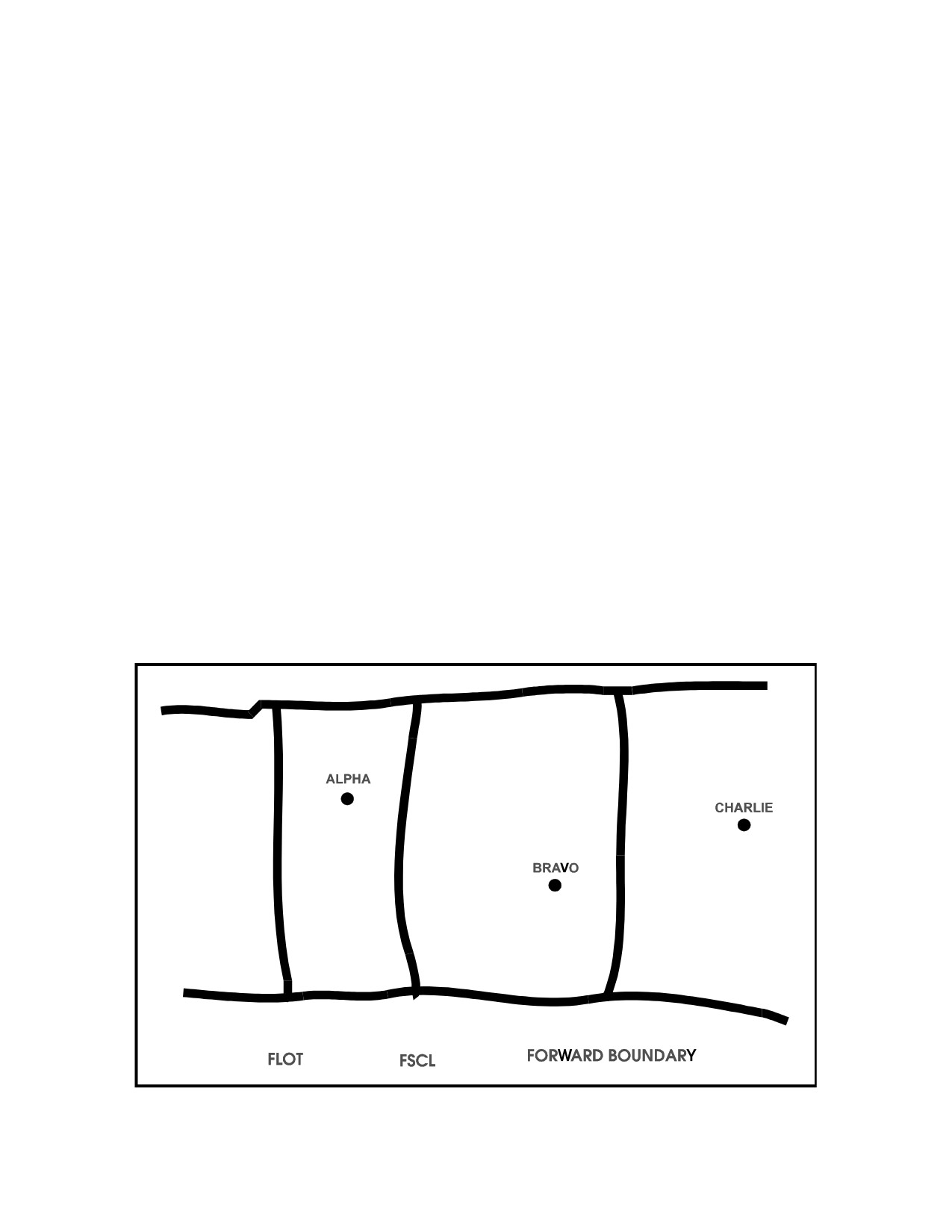
three bullseyes can be designated as Bullseyes Alpha, Bravo, and Charlie. See Figure H-1.
These geographic points should be incorporated into operational graphics and overlays of
component C2 systems, such as AFATDS, TAPS, AETACS databases, and the ACP.
Figure H-1. Bullseye Reference System
H-1
3.
Bullseye Development
Any component can develop bullseyes. To be effective during cross-component
coordination and deconfliction, these bullseyes must be communicated to other components,
preferably in advance of combat operations.
4.
Bullseye Execution
Any surface TCT or attack can be referenced by its bearing and distance from a
selected bullseye. Bearings should be described reference magnetic north and distance in
nautical miles. Selected targets or attacks can then be rapidly coordinated and deconflicted
using the bullseye as a common reference.
5.
Bullseye Errors
The utility of a bullseye system is greatly hampered when targets are identified a
significant distance from the specified bullseye point. As distance from the point increases,
the larger the surface area per degree occurs, and consequently, the higher probability of
error. The formula for error is as follows: one degree of azimuth error = one NM of
horizontal distance error at a range of 60 NM (“60 to 1” rule). Therefore, a one degree of
azimuth error at a range of 12 NM from a selected bullseye is equivalent to an 0.2 NM
location error. However, a one-degree of azimuth error at a range of 120 NM from a selected
bullseye results in a significantly greater location error. In this case, it equates to 2 NM.
Essentially, the potential for error increases in direct proportion to any increase in range. If
the range increases by a factor of 10, any degree of azimuth error will likewise increase the
location error by a factor of 10. Therefore, it is best to use the bullseye technique in smaller
areas, AOs, AOAs.
6.
Bullseye Examples
The following are examples of component descriptions of surface TCT targets while
using a Bullseye Reference System. Provided that each component understands the
common bullseye reference points, coordination and deconfliction can occur. However, this
process is much more fluid and inexact than the grid box procedure.
a. Example 1. A surface TCT located 20 NM south of Bullseye Alpha should be referred
to as Target, Bullseye Alpha, 180 degrees for 20 NM. See Figure H-2. Fighter aircraft are
then assigned to search for and attack the surface TCT. Appropriate FSCMs and/or ACMs
can be established as in the grid box procedure.
b. Example 2. ATACMS attacks intended for a target northwest of Bullseye Charlie
should be coordinated and deconflicted with other components by communicating ATACMS
attack, Bullseye Charlie, 335 degrees for 55 NM. See Figure H-3. (Note: Actual targeting
data [that is, specific target coordinates] is much more detailed. This information does not
have to be transmitted for area deconfliction.) Similarly, ATACMS PAH, route of flight, and
TAH can be cleared via the BCD and the JAOC. Appropriate FSCMs and/or ACMs can be
established as before (RFAs and ROZs).
H-2
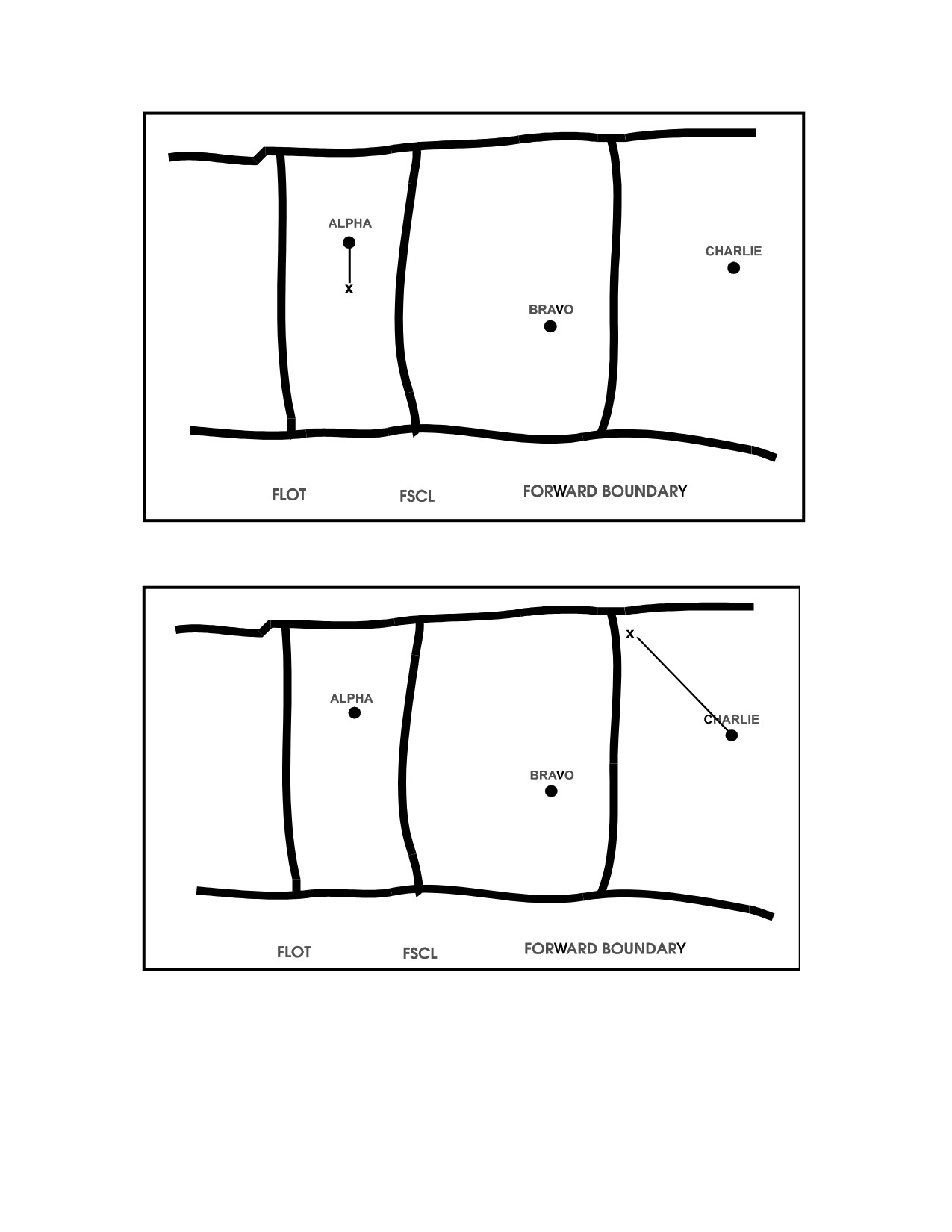
Figure H-2. Bullseye Example One
Figure H-3. Bullseye Example Two
c. Example 3. In extreme cases, bullseye calls can be transmitted on GUARD
frequencies (UHF 243.0 and VHF 122.5) to warn aircraft of impending ATACMS, CALCM,
or TLAM attacks in their area. This should only be used as a last resort when prior
coordination and deconfliction could not have been accomplished.
H-3
REFERENCES
Joint
CJCSM 6120.01A, Joint Multi-Tactical Digital Information Link (TADIL) Operating
Procedures
JP 1-02, DOD Dictionary of Military and Associated Terms
JP 3-0, Doctrine for Joint Operations
JP 3-02, Joint Doctrine for Amphibious Operations
JP 3-07, Joint Doctrine for Military Operations Other Than War
JP 3-09, Doctrine for Joint Fire Support
JP 3-52, Doctrine for Joint Airspace Control in a Combat Zone
JP 3-55.1, Joint Tactics, Techniques and Procedures for Unmanned Aerial Vehicles
JP 3-56.1, Command and Control for Joint Air Operations
Multiservice
Multiservice Procedures for the Theater Air Ground System (TAGS)
Muliservice Procedures for Joint Air Traffic Control (JATC)
Targeting: The Joint Targeting Process and Procedures for targeting Time-Critical Targets
Army
FM 1-100, Army Aviation Operations
FM 44-1-2, Air Defense Artillery Reference Handbook
Marine Corps
MCWP 3-25, Control of Aircraft and Missiles
MCWP 3-25.4, Marine TACC Handbook
MCWP 3-25.7, Marine TAOC Handbook
MCWP 3-25.9, Marine Air Command and Control System Communications Handbook
Navy
NWP 3-03.1, Tomahawk Land Attack Missile Employment Manual
TACMEMO TD0000-12-97, Air Control Procedures and tactics for CV/ARG Integrated
Battle Group
Air Force
AFPD 13-1, Theater Air Control System
AFPD 13-2, Air Traffic Control, Airspace, Airfield and Range Management
AFI 13-106, Air Support Operations Centers and Tactical Air control Parties
AFI 13-201, Air Force Airspace Management
References-1
Glossary
PART I—ABBREVIATIONS AND ACRONYMS
A
A2C2
Army airspace command and control
AADC
area air defense commander
AAGS
Army air-ground system
AAMDC
Army Air and Missile Defense Command
AAW
antiair warfare
ABCCC
airborne battlefield command and control center
ACA
airspace control authority
ACE
aviation combat element (MAGTF)
ACM
airspace control measure
ACMREQ
airspace control means request
ACO
airspace control order
ACP
airspace control plan
AD
air defense
ADA
air defense artillery (USA)
ADC
air defense commander
ADIZ
air defense identification zone
ADP
air defense plan
ADS
air defense section
AETACS
airborne elements of the Theater Air Control System
AFATDS
Advanced Field Artillery Tactical Data System
AFDC
Air Force Doctrine Center
AFSOC
Air Force special operations component
AFSOF
Air Force special operations forces
AGL
above ground level
AI
air interdiction
AIC
airspace information center
AIRSUPREQ
air support request
ALO
air liaison officer
ALSA
Air Land Sea Application Center
AM
amplitude modulation
AMD
Air Mobility Division
AO
area of operations
AOA
amphibious objective area
AOC
air operations center (USAF)
AOCC
air operations control center
AOR
area of responsibility
APG
air procedures guide
APS
Afloat Planning System
AREC
air resource element coordinator (USN)
ARG
amphibious ready group
ARSOF
Army special operations forces
ASC
air support coordinator
ASC(A)
assault support coordinator (airborne)
Glossary-1
ASCS
air support control section
ASE
air support element
ASOC
air support operations center
ATACMS
Army Tactical Missile System
ATACS
amphibious tactical air control system
ATC
air traffic control
ATCS
air traffic control section
ATF
amphibious task force
ATO
air tasking order
ATS
air traffic services
AWACS
Airborne Warning and Control System
B
BCD
battlefield coordination detachment
BDA
battle damage assessment
BDZ
base defense zone
BG
battle group
C
C2
command and control
C2W
command and control warfare
C2WC
command and control warfare commander
C3
command, control, and communications
C4I
command, control, communications, computers, and intelligence
CA
coordinating altitude
CAG
carrier air wing commander
CAIC
corps airspace information center
CALCM
conventional air-launched cruise missile
CAS
close air support
CATF
commander, amphibious task force
CE
command element
CFL
coordinated fire line
CIC
combat information center
CINC
commander in chief; commander of a combatant command
CLF
commander, landing force
COD
combat operations division
COE
common operating environment
COMAFFOR
Commander, Air Force Forces
COMARFOR
Commander, Army Forces
COMNAVFOR
Commander, Naval Forces
CONUS
continental United States
CP
command post
CPD
combat plans division
CRC
control and reporting center
CRE
control and reporting element
CS
combat support
CSAR
combat search and rescue
Glossary-2
CSS
combat service support
CSSE
combat service support element
CTAPS
contingency theater automated planning system
CV
aircraft carrier; carrier
CVBG
aircraft carrier battle group; carrier battle group
CVN
aircraft carrier (nuclear propulsion)
CWC
composite warfare commander
CXF
commander, numbered fleet
D
DAIC
Division Airspace Information Center
DAS
deep air support (USMC)
DASC
direct air support center (USMC)
DASC(A)
direct air support center (airborne)
DATCALS
deployable air traffic control and landing system
DESRON
destroyer squadron
DII
defense information infrastructure
DOCC
deep operations coordination cell
DS
direct support
DTD
data transport devices
DTG
date-time group
DZ
drop zone
E
E2C
Navy Airborne Warning and Control System
EAC
echelons above corps
ENCOM
emission control
ETPP
electronic Tomahawk planning package
F
FA
field artillery
FAC
forward air controller
FAC(A)
forward air controller (airborne)
FADC
force air defense commander
FARP
forward arming and refueling point
FEZ
fighter engagement zone
FFA
free-fire area
FLOT
forward line of own troops
FLTSATCOM
fleet satellite communications
FM
frequency modulation; field manual
FOB
forward operations base
FSA
fire support area
FSCC
fire support coordination center
FSCL
fire support coordination line
FSCM
fire support coordinating measure
FSCOORD
fire support coordinator
Glossary-3
FSE
fire support element
FSO
fire support officer
FSS
fire support station
G
G-3
Army or Marine Corps component operations staff officer;
Army division or higher staff, Marine brigade or higher staff
GCE
ground combat element
GS
general support
GTACS
Ground Theater Air Control System
H
HC
helicopter coordinator
HCS
helicopter coordination section
HDC
helicopter direction center
HEC
helicopter employment coordinator
HF
high frequency
HIDACZ
high-density airspace control zone
HIMEZ
high-altitude missile engagement zone
HN
host nation
HQ
headquarters
HST
helicopter support team
I
IADS
integrated air defense system
ICAC2
integrated combat airspace command and control
ICAO
International Civil Aviation Organization
IFF
identification, friend or foe
IFR
instrument flight rules
ISR
intelligence, surveillance, reconnaissance
J
J-3
operations directorate of a joint staff
JAOC
joint air operations center
JASC
Joint Actions Steering Committee
JCS
Joint Chiefs of Staff
JEZ
joint engagement zone
JFACC
joint force air component commander
JFC
joint force commander
JFLCC
joint force land component commander
JFMCC
joint force maritime component commander
JFSOCC
joint force special operations component commander
JOA
joint operations area
JSOAC
joint special operations air component
JOSACC
joint special operations air component commander
Glossary-4
JSOTF
joint special operations task force
JSTARS
joint surveillance target attack radar system
JTCB
joint targeting coordination board
JTF
joint task force
JTIDS
joint tactical information distribution system
JTSG
joint targeting steering group
K
km
kilometer
L
LAAD
low-altitude air defense (USMC)
LAC
launch area coordinator
LADC
local area defense commander
LAMPS
Light Airborne Multipurpose System (SH-60)
LAN
local area network
LCC
land component commander
LF
landing force
LHA
general purpose amphibious assault ship
LHD
general purpose amphibious assault ship (with internal dock)
LLTR
low level transit route
LOMEZ
low-altitude missile engagement zone
LPD
amphibious transport dock
LPH
amphibious assault ship, landing platform helicopter
LRS
launch and recovery site
LSD
landing ship, dock
LZ
landing zone
LZCT
landing zone control team
M
MAAP
master air attack plan
MACCS
Marine air command and control system
MACG
Marine air control group
MACS
Marine air control squadron
MAGTF
Marine air-ground task force
MARFOR
Marine Corps forces
MARLO
Marine liaison officer
MASS
Marine air support squadron
MATCD
Marine air traffic control detachment
MCCDC
Marine Corps Combat Development Command
MDS
mission distribution system
MEDEVAC
medical evacuation
MEF
Marine expeditionary force
MEU(SOC)
Marine expeditionary unit (special operations capable)
MEZ
missile engagement zone
Glossary-5
MI
military intelligence
MML
master mission library (USN)
MOOTW
military operations other than war
MPR
mission planning request
MRR
minimum risk route
MTACS
Marine tactical air command squadron
MTTP
multiservice tactics, techniques, and procedures
MWCS
Marine wing communications squadron
MWSS
Marine wing support squadron
N
NACCE
Navy airborne command and control elements
NALE
naval and amphibious liaison element
NATO
North Atlantic Treaty Organization
NAVAIDS
navigational aids
NAVSOF
Naval special operations forces
NCA
National Command Authorities
NCC
naval component commander
NFA
no-fire area
NM
nautical miles
NSFS
naval surface fire support
NWDC
Navy Warfare Development Command
O
OAS
offensive air support (USMC)
OIC
officer in charge
OPGEN
formatted general operational message
OPLAN
operation plan
OPORD
operation order
OPR
office of primary responsibility
OPTASK
operational tasking message
OTC
officer in tactical command
P
PAH
position area hazard
PHIBRON
amphibious squadron
PIRAZ
positive identification radar advisory zone
PL
phase line
POC
point of contact
PSS
plans and support section
PSYOP
psychological operations
PZ
pickup zone
Glossary-6
R
R2P2
rapid response planning process
RADC
regional air defense commander
RFA
restrictive fire area
RFL
restrictive fire line
RISTA
reconnaissance, intelligence, surveillance, and target
acquisition
ROA
restricted operations area
ROE
rules of engagement
ROZ
restricted operations zone
RRP
rapid refueling point
RTF
return to force
S
SAAFR
standard use Army aircraft flight route
SAAWC
sector air defense warfare coordinator (USMC)
SACC
supporting arms coordination center (USN)
SADC
sector air defense commander
SADO
senior air defense officer
SAR
search and rescue
SATCOM
satellite communications
SCC
sea combat commander
SEAD
suppression of enemy air defenses
SEAL
sea-air-land
SHORAD
short-range air defense
SHORADEZ
short-range air defense engagement zone
SOA
special operations aviation
SOC
special operations capable; special operations commander
SOCA
support (submarine) operations coordinating authority
SOCCE
special operations command and control element
SOF
special operations forces
SOLE
special operations liaison element
SOP
standard operating procedure
SPINS
special instructions
SPMAGTF
special purpose MAGTF (USMC)
STANAG
standardization agreement (NATO)
STT
special tactics team (USAF)
STW
strike warfare
STWC
strike warfare commander
SUBOPAUTH
submarine operating authority
SUW
surface warfare
SUWC
surface warfare commander
Glossary-7
T
TAADCOORD
theater Army air defense coordinator
TAC
terminal air controller
TAC(A)
tactical air coordinator (airborne)
TACAN
tactical air navigation
TACC
tactical air command center (USMC); tactical air control
center (USN); tanker/airlift control center (USAF)
TACGRU
tactical air control group
TACOPDAT
tactical operational data
TACP
tactical air control party
TACRON
tactical air control squadron
TACS
Theater Air Control System (USAF); tactical air control
system (USN)
TACT
tactical aviation control team (USA)
TAD
tactical air direction
TADC
tactical air direction center
TADIL
tactical digital information link
TAGS
theater air-ground system
TAH
target area hazard
TAIC
theater airspace information center
TAOC
tactical air operations center (USMC)
TATC
tactical air traffic control
TBMCS
Theater Battle Management Core System
TCA
terminal control areas
TCI
Tomahawk command information
TCT
time-critical target
TDS
tactical data system
TEA
Tomahawk executive agent
TLAM
Tomahawk land attack missile
TLO
Tomahawk liaison officer
TRADOC
United States Army Training and Doctrine Command
TRI-TAC
Tri-Service Tactical Communications Program
TSC
TLAM strike coordinator
TTDBM
Tomahawk tactical data base manager
TTP
tactics, techniques, and procedures
U
UAV
unmanned aerial vehicle
UHF
ultra high frequency
US
United States
USAF
United States Air Force
USMC
United States Marine Corps
USMTF
United States message text format
USW
undersea warfare
USWC
undersea warfare commander
Glossary-8
V
VHF
very high frequency
W
WAN
wide area network
WCS
weapons control status
WEZ
weapons engagement zone
WOC
wing operations center (USAF)
Glossary-9
PART II - TERMS AND DEFINITIONS
air operations center. The principal air operations installation from which aircraft and
air warning functions of combat air operations are directed, controlled, and executed. It is
the senior agency of the Air Force Component Commander from which command and
control of air operations are coordinated with other components and Services. Also called
AOC. (Joint Publication 1-02)
airspace control authority. The commander designated to assume overall responsibility
for the operation of airspace control system in the airspace control area. (Joint Publication
1-02)
airspace control order. An order implementing the airspace control plan that provides
the details of the approved requests for airspace control measures. It is published either as
part of the air tasking order or as a separate document. Also called ACO. (Joint Publica-
tion 1-02)
airspace control plan. The document approved by the joint force commander that pro-
vides specific planning guidance and procedures for the airspace control system for the joint
force area of responsibility/joint operations area. Also called ACP. (Joint Publication 1-02)
airspace information center. The ATS facility that performs the primary A2C2 Services
mission and the secondary airspace information services mission.
air tasking order. A method used to task and disseminate to components, subordinate
units, and command and control agencies projected sorties/capabilities/forces to targets and
specific missions. Normally provides specific instructions to include call signs, targets,
controlling agencies, etc., as well as general instructions. Also called ATO. (Joint Publica-
tion 1-02)
air traffic control and landing systems. Department of Defense facilities, personnel,
and equipment (fixed, mobile, and seaborne) with associated avionics to provide safe, or-
derly, and expeditious aerospace vehicle movements worldwide. Also called ATCALS.
(Joint Publication 1-02)
amphibious objective area. A geographical area, delineated in the initiating directive
for purposes of command and control, within, which is, located the objective(s) to be secured
by the amphibious task force. This area must be of sufficient size to ensure
accomplishment of the amphibious task force’s mission and must provide sufficient area for
conducting necessary sea, air, and land operations. (Joint Publication 1-02)
Army air-ground system. The Army system which provides for interface between Army
and tactical air support agencies of other Services in the planning, evaluating, processing,
and coordinating of air support requirements and operations. It is composed of appropriate
staff members, including G-2 air and G-3 air personnel, and necessary communications
equipment. (Joint Publication 1-02)
Army airspace command and control. Those actions that ensure the synchronized use
of airspace and enhance the command and control of those forces using airspace. This
Glossary-10
system includes those organizations, personnel, facilities, and procedures required to per-
form the airspace control function.
battlefield coordination detachment. An Army liaison provided by the Army compo-
nent commander to the Air Operations Center (AOC) and/or to the component designated
by the joint force commander to plan, coordinate, and deconflict air operations. The battle-
field coordination detachment processes Army requests for tactical air support, monitors
and interprets the land battle situation for the AOC, and provides the necessary interface
for exchange of current intelligence and operational data. Also called BCD. (Joint Publica-
tion 1-02)
control and reporting center. A mobile command, control, and communications radar
element of the US Air Force theater air control system subordinate to the air operations
center. The control and reporting center possesses four Modular Control Equipment opera-
tions modules and integrates a comprehensive air picture via multiple data links from air-,
sea-, and land-based sensors as well as from its surveillance and control radars. It per-
forms decentralized command and control of joint operations by conducting threat warning,
battle management, theater missile defense, weapons control, combat identification, and
strategic communications. Also called CRC. (Joint Publication 1-02)
control and reporting element. A mobile radar element of the TACS that is subordinate
to the CRC. It is normally deployed into forward areas to extend radar coverage and to
provide control of air operations, early warning surveillance, and gap filler service. (USAF)
coordinating altitude. A procedural airspace control method to separate fixed- and
rotary-wing aircraft by determining an altitude below which fixed-wing aircraft will nor-
mally not fly and above which rotary-wing aircraft normally will not fly. The coordinating
altitude is normally specified in the airspace control plan and may include a buffer zone for
small altitude deviations. (Joint Publication 1-02)
fighter engagement zone. In air defense, that airspace of defined dimensions within
which the responsibility for engagement of air threats normally rests with fighter aircraft.
Also called FEZ. (Joint Publication 1-02)
fires. The effects of lethal or nonlethal weapons. (Joint Publication 1-02.)
fire support. Fires that directly support land, maritime, amphibious, and special opera-
tion forces to engage enemy forces, combat formations, and facilities in pursuit of tactical
and operational objectives. (Joint Publication 1-02)
joint fire support. Joint fires that assist land, maritime, amphibious, and special opera-
tions forces to move, maneuver, and control territory, populations, and key waters. (Joint
Publication 1-02.)
joint force air component commander. The joint force air component commander
derives authority from the joint force commander who has the authority to exercise
operational control, assign missions, direct coordination among subordinate commanders,
redirect and organize forces to ensure unity of effort in the accomplishment of the overall
Glossary-11
mission. The joint force commander will normally designate a joint force air component
commander. The joint force air component commander’s responsibilities will be assigned by
the joint force commander (normally these would include, but not be limited to, planning,
coordination, allocation, and tasking based on the joint force commander’s apportionment
decision). Using the joint force commander’s guidance and authority, and in coordination
with other Service component commanders and other assigned or supporting commanders,
the joint force air component commander will recommend to the joint force commander
apportionment of air sorties to various missions or geographic areas. Also called JFACC.
(Joint Publication 1-02)
Link-4A. TADIL C (NATO Link 4A) is a netted, time division data transmission link
between control station and controlled aircraft that can operate in either one-to-one or one-
to-many/many-to-one modes. It provides the capability for automatic transmission of
orders, status, and other information. Data exchange is accomplished on a fully automatic
link at 5,000 BPS, using serial transmission. TADIL C is a nonsecure link that operates in
the UHF frequency range. It has unique message standards and protocols and does not
interface directly with TADIL A, B, and J.
Link-11. TADIL A (NATO Link 11) is a half-duplexed, netted link that normally operates
by roll call from a Net Control Station (NCS). TADIL A can also operate in the broadcast
mode. The roll-call mode of operation used in the TADIL A interface requires that each PU
respond in turn while all other stations are receiving. A NCS initiates the roll call by
addressing and transmitting an interrogation message to a specific PU that then responds
by transmitting its data. The NCS then interrogates the next PU in the prescribed roll call.
TADIL A can be transmitted on high frequency (HF) and/or ultra high frequency (UHF)
bands. Data speed can be selected from bit rates of 2,250 or 1,364 bits per second (BPS).
Dual side band diversity operation and Doppler shift correction features improve reliability
and accuracy of data exchange.
Link-16. TADIL J (NATO Link 16) is a nodeless, high-capacity, multifunctional, secure, jam-
resistant tactical data link designed for the exchange of fixed format and voice messages
using the Joint Tactical Information Distribution System (JTIDS) Class 2/multifunctional
Information Distribution System (MIDS) terminal. JTIDS uses the principle of Time Division
Multiple Access (TDMA), an architecture that employs time slot interleaving to provide
multiple, simultaneous communications nets. Since JTIDS is an UHF system, transmitted
messages can only be received by units that are within Line of Sight (LOS). However, JTIDS
provides a means to relay beyond LOS. All JUs are preassigned sets of multiple time slots in
which to transmit their data and in which to receive data from other units. The time slots of
a net can be parceled out to one or more Network Participation Groups (NPGs). An NPG is
defined by its function and also by the types of messages that will be transmitted on it. This
division of the net into functional groups allows JUs to participate only on the NPGs for the
functions they perform.
low level transit route. A temporary corridor of defined dimensions established in the
forward area to minimize the risk to friendly aircraft from friendly air defenses or surface
forces.
(Joint Publication 1-02)
Glossary-12
minimum-risk route. A temporary corridor of defined dimensions recommended for use
by high-speed, fixed-wing aircraft that presents the minimum known hazards to low-flying
aircraft transiting the combat zone. Also called MRR. (Joint Publication 1-02)
positive control. A method of airspace control which relies on positive identification,
tracking, and direction of aircraft within an airspace, conducted with electronic means by
an agency having the authority and responsibility therein. (Joint Publication 1-02)
procedural control. A method of airspace control which relies on a combination of
previously agreed and promulgated orders and procedures. (Joint Publication 1-02)
special tactics team. An Air Force team composed primarily of special operations combat
control and pararescue personnel. The team supports joint special operations by selecting,
surveying, and establishing assault zones; providing assault zone terminal guidance and air
traffic control; conducting direct action missions; providing medical care and evacuation;
and, coordinating, planning, and conducting air, ground, and naval fire support operations.
(Joint Publication 1-02)
theater air-ground system. A system of systems consisting of the theater air control
system (TACS) (USAF), the Army air ground system (AAGS) (USA), the Marine air com-
mand and control system (MACCS) (USMC), and the Navy tactical air control system
(NTACS) (USN).
unmanned aerial vehicle. A powered, aerial vehicle that does not carry a human
operator, uses aerodynamic forces to provide vehicle lift, can fly autonomously or be piloted
remotely, can be expendable or recoverable, and can carry a lethal or nonlethal payload.
Ballistic or semiballistic vehicles, cruise missiles, and artillery projectiles are not
considered unmanned aerial vehicles. Also called UAV. (Joint Publication 1-02)
weapon engagement zone. In air defense, airspace of defined dimensions within which
the responsibility for engagement of air threats normally rests with a particular weapon
system. Also called WEZ. (Joint Publication 1-02)
Glossary-13