FM 4-20.167 Airdrop of Supplies and Equipment: Rigging Tracked Personnel–Cargo Carriers (November 2006) - page 3
Chapter 2
2
3
4
2
3
1
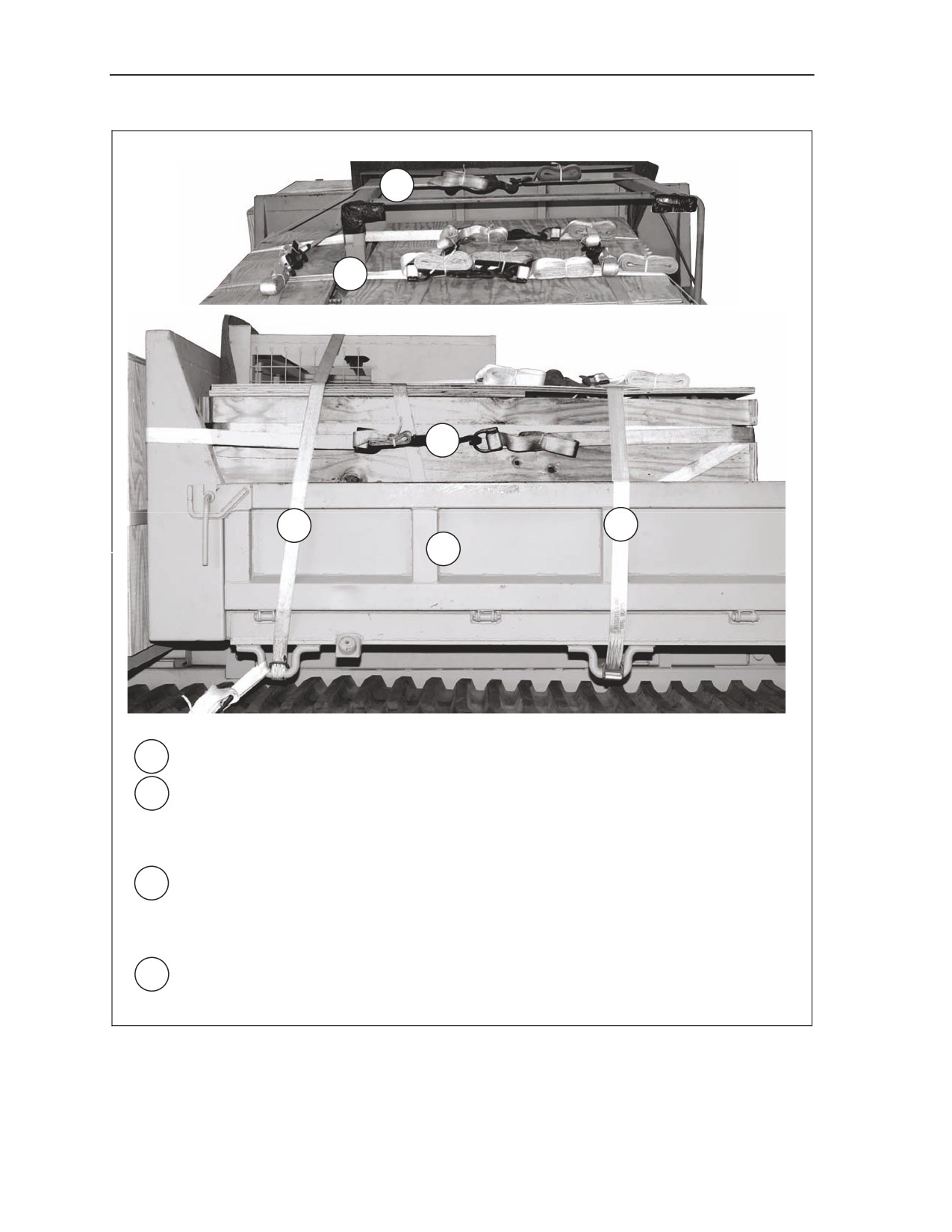
1 Lift the side panels of the dump and secure them in place with their locking devices.
2 Route a 15-foot lashing through the front tiedown under the dump bed and through its own
D-ring. Repeat for the opposite side. Route the lashing up and over the top of the
accompanying load and over the ROPs. Secure the lashings with two D-rings and a load
binder between the top legs of the ROPs.
3 Route a 15-foot lashing through the middle tiedown under the dump bed and through its
own D-ring. Repeat for the opposite side. Route the lashing up and over the top of the
accompanying load and secure the lashings on top of the load with two D-rings and a load
binder.
4 Form a 30-foot lashing and route the lashing around the accompanying load. Route the
lashing through the top cutouts and around the front of the bulkhead of the dump bed.
Secure the lashing with two D-rings and a load binder on the left side of the vehicle.
Figure 2-18. Side Panels Positioned and Accompanying Load Lashed
2-28
FM 4-20.167/TO 13C7-16-171
16 November 2006
Rigging IC45-2 IHI Crawler Carrier on a Type V Platform for Low-Velocity Airdrop
2
1
3
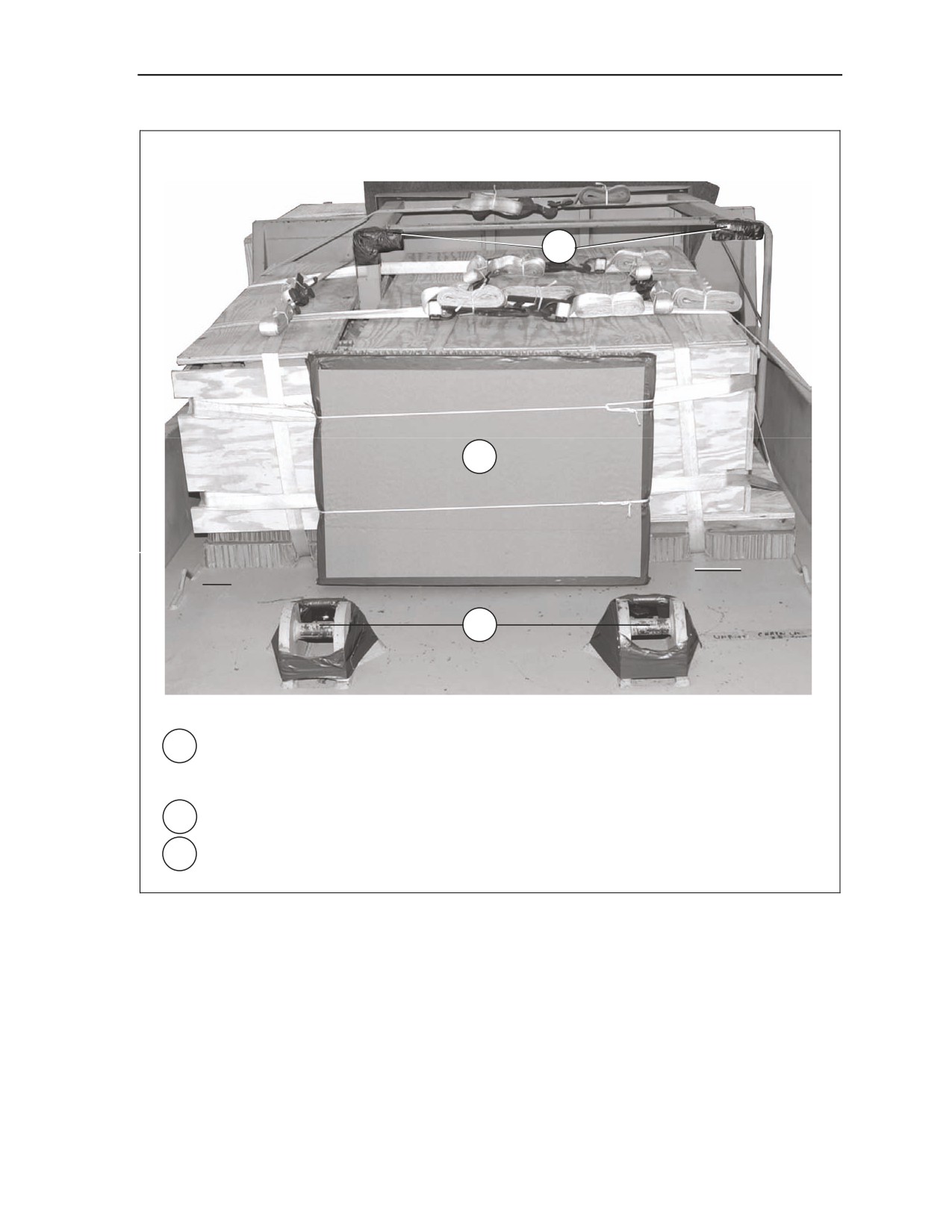
1 Cut and place a 25- by 36-inch piece of honeycomb with the edges taped on the rear end
of the endboard to cover the load binders. Secure the piece to the lashings with type III
nylon cord.
2 Pad the bottom of the ROPs frame legs with felt and tape in place.
3 Tape the rear lifting points around the bottom portion. Leave the bar inside the lifting point
exposed for lifting and positioning.
Figure 2-19. Lifting Points Taped and ROPS Padded
16 November 2006
FM 4-20.167/TO 13C7-16-171
2-29
Chapter 2
1
1
2
2
3
4
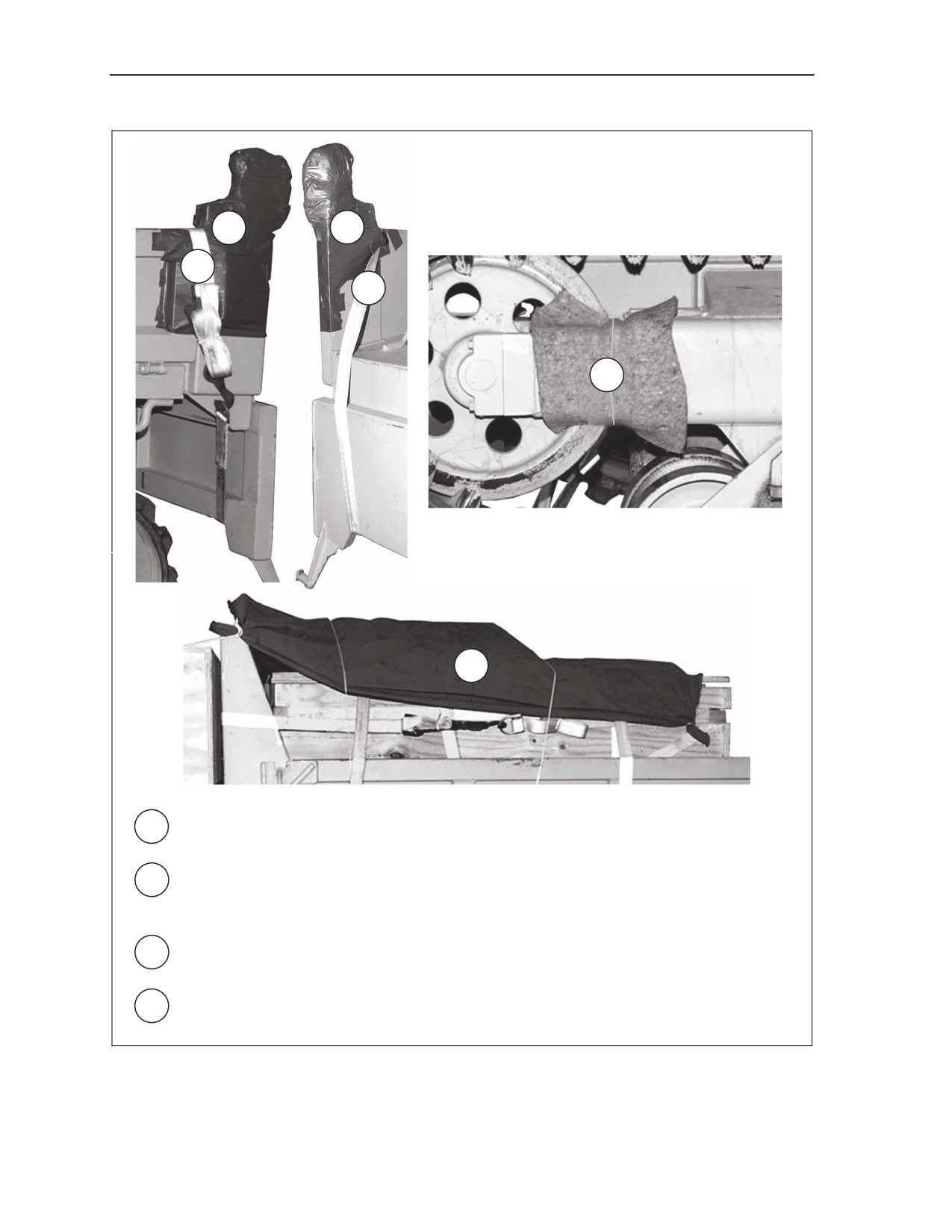
1 Lower the tailgate and pad the tailgate latch and handle assembly on both sides of the
vehicle with felt and tape.
2 Route a 15-foot lashing around the tailgate latch, downward and to the inside, up and
around the tailgate latch point, and secure with a D-ring and load binder on the outside of
the dump body. Repeat for the opposite side.
3 Pad the rear part of the track roller bar on with felt and secure with type III nylon cord.
Repeat on the opposite side of the vehicle.
4 Construct a 72- by 155-inch piece of canvas. Position the piece over the accompanying
load. Secure the piece with type III nylon cord to convenient places on the load.
Figure 2-20. Tailgate Lashed, Track Roller Bar Padded and Cover Placed
2-30
FM 4-20.167/TO 13C7-16-171
16 November 2006
Rigging IC45-2 IHI Crawler Carrier on a Type V Platform for Low-Velocity Airdrop
INSTALLING LIFTING AND SUSPENSION SLINGS
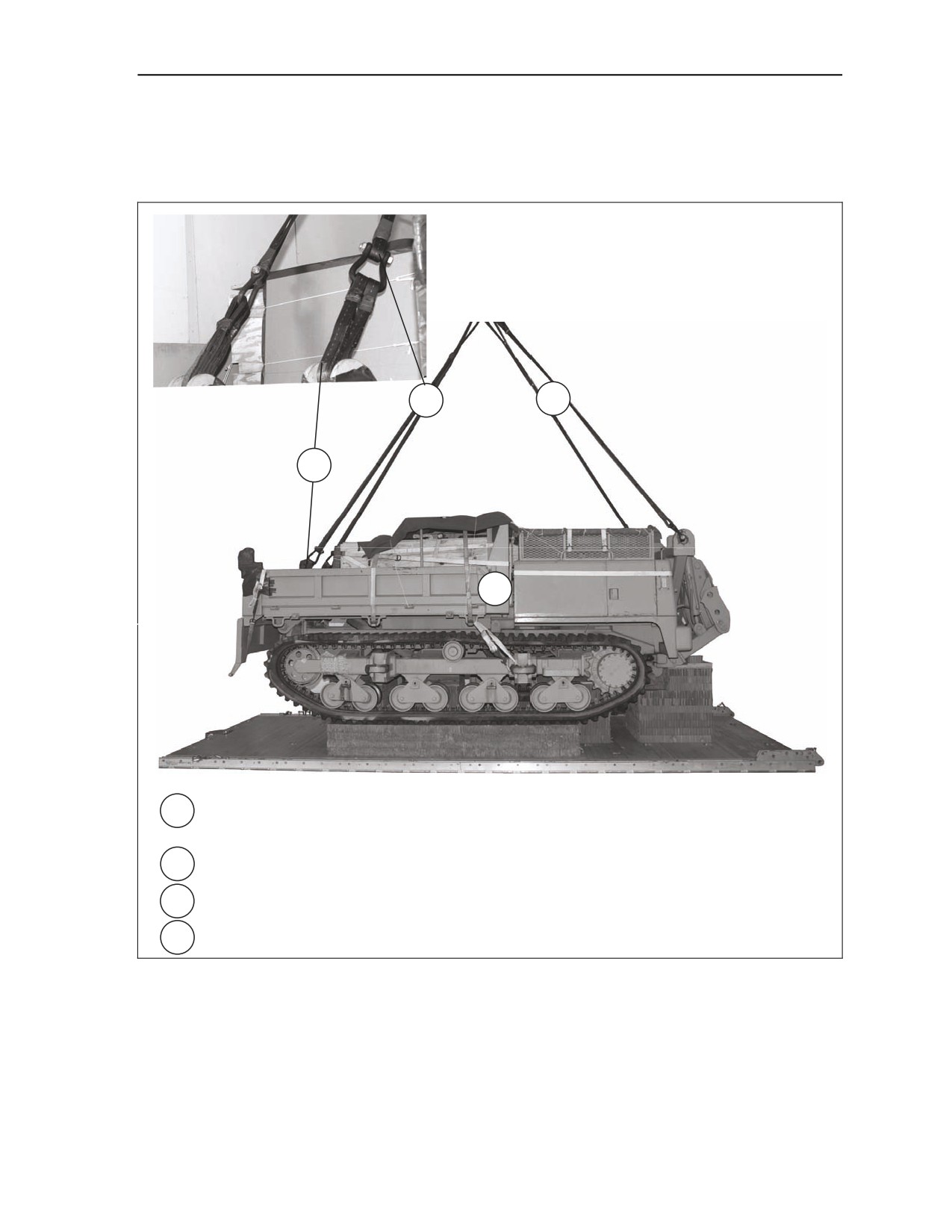
2-5. Install the lifting and suspension slings and position as shown in Figure 2-21.
3
1
2
4
1 Attach a 11-foot, (4-loop), type XXVI nylon sling to the right lifting point assembly on front of
the vehicle with a large clevis. Repeat for the other side.
2 Route a 3-foot, (4-loop), type XXVI nylon sling through both dump bed rear lifting points.
3 Attach an 11-foot, (4-loop), type XXVI nylon sling to the 3-foot sling with a large clevis.
4 Raise the slings and position the vehicle on the stacks.
Figure 2-21. Lifting and Suspension Slings Installed and Vehicle Positioned
16 November 2006
FM 4-20.167/TO 13C7-16-171
2-31
Chapter 2
5
8
6
7
7
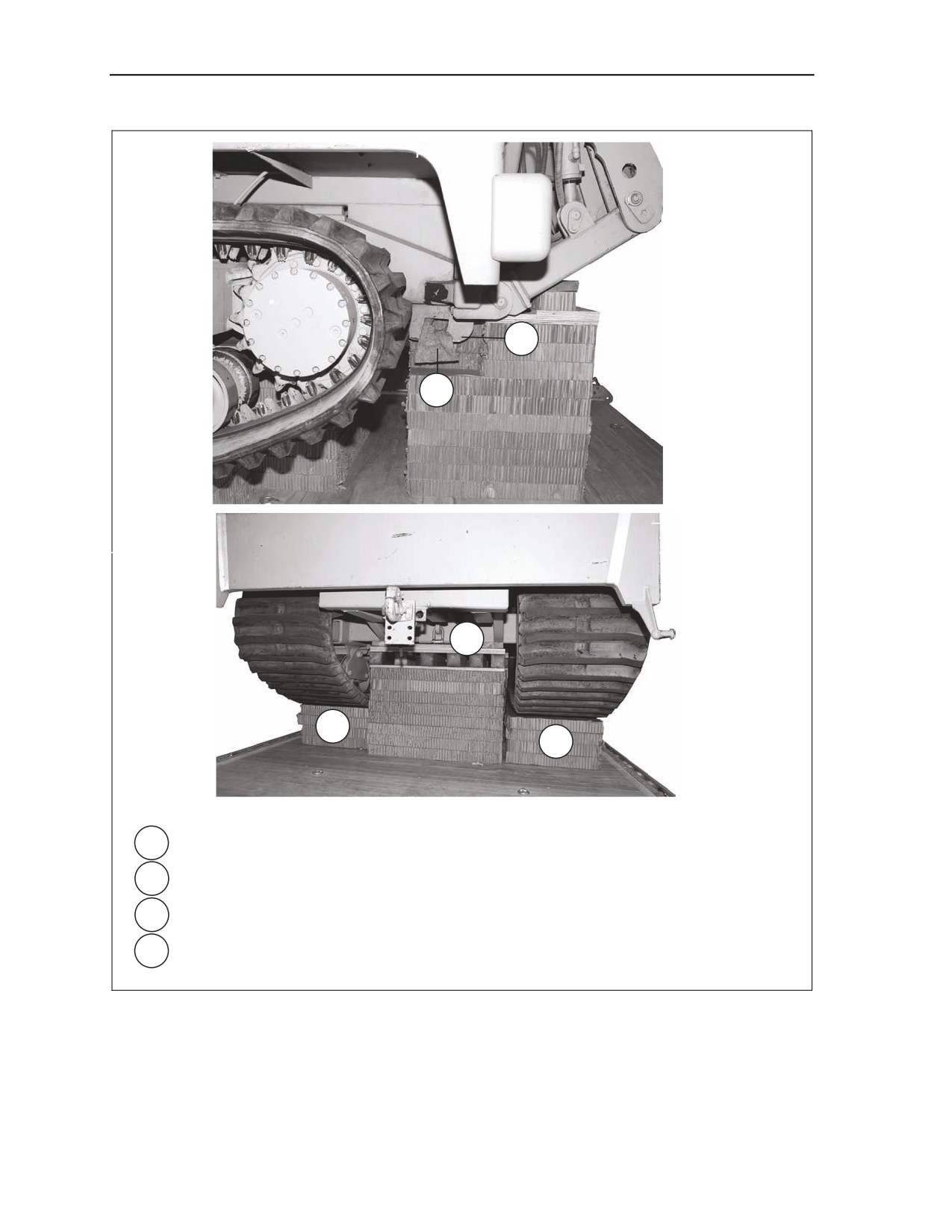
5 The tiedown points under the attachment assembly fit into the cutouts of stack number 1.
6 The rear frame will set flush with the rear edge of stack number 4.
7 You may have to adjust the stacks slightly for the tracks to set squarely on stacks 5 and 6.
8 Pad the tiedown point holes under the attachment assembly with felt.
Figure 2-21. Lifting and Suspension Slings Installed and Vehicle Positioned (Continued)
2-32
FM 4-20.167/TO 13C7-16-171
16 November 2006
Rigging IC45-2 IHI Crawler Carrier on a Type V Platform for Low-Velocity Airdrop
LASHING IC45-2 IHI CRAWLER CARRIER
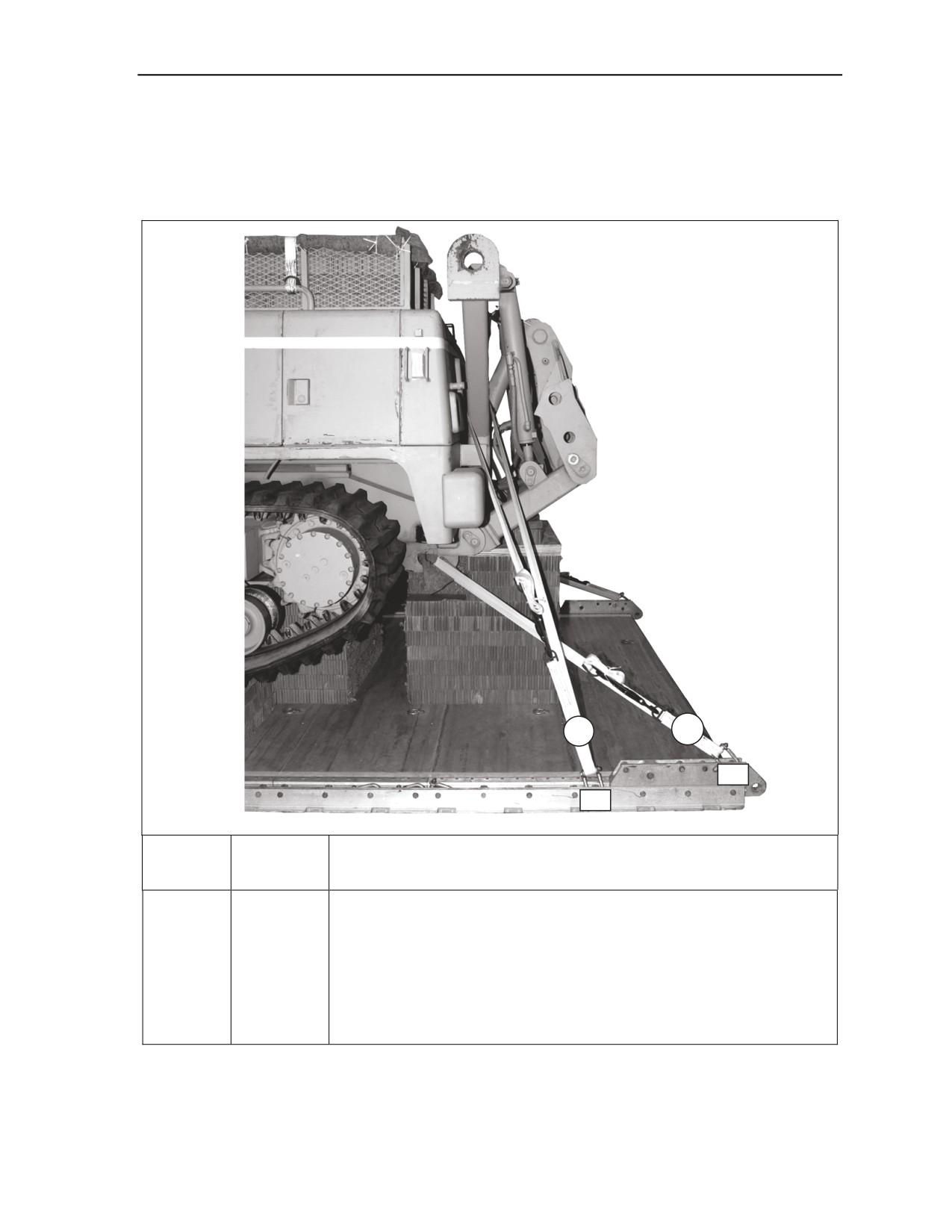
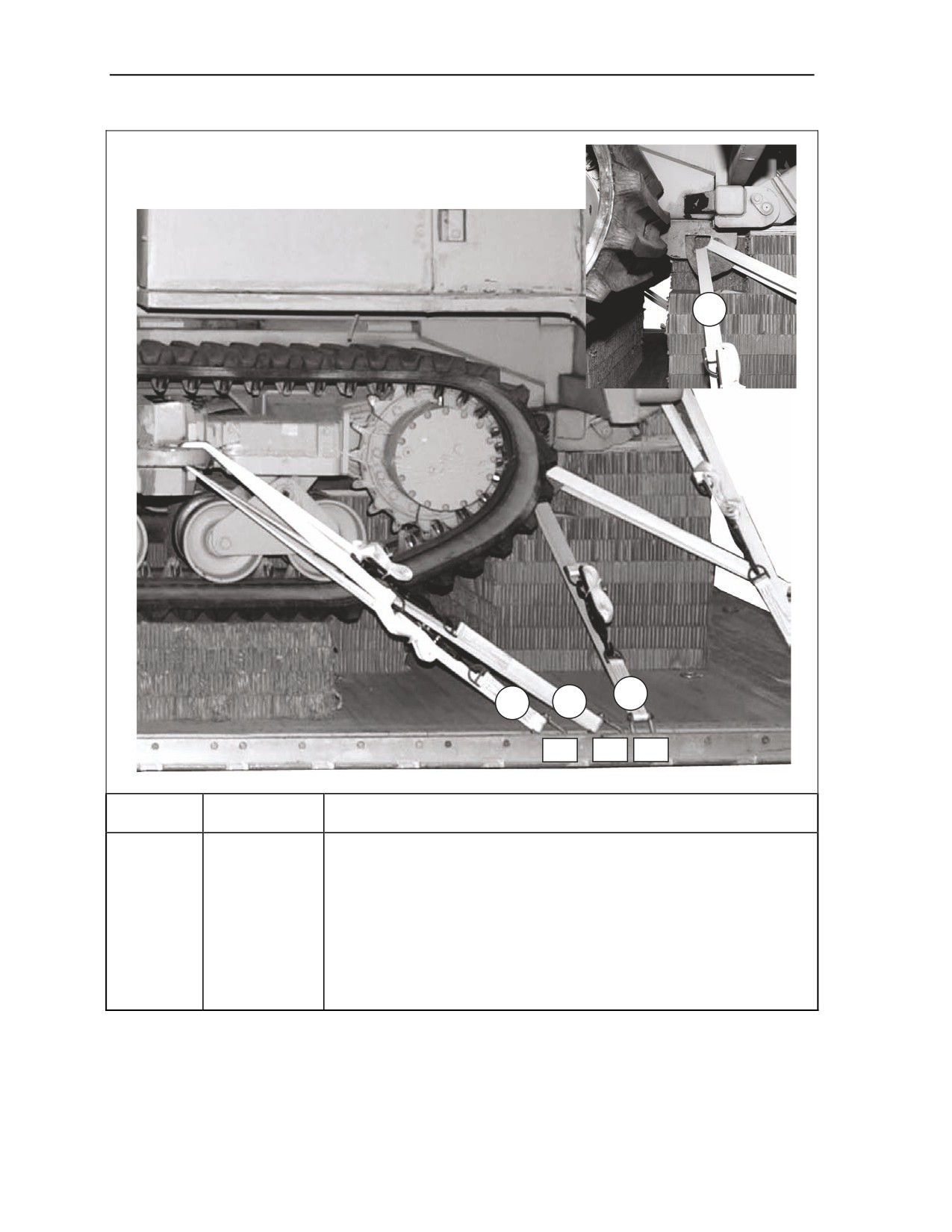
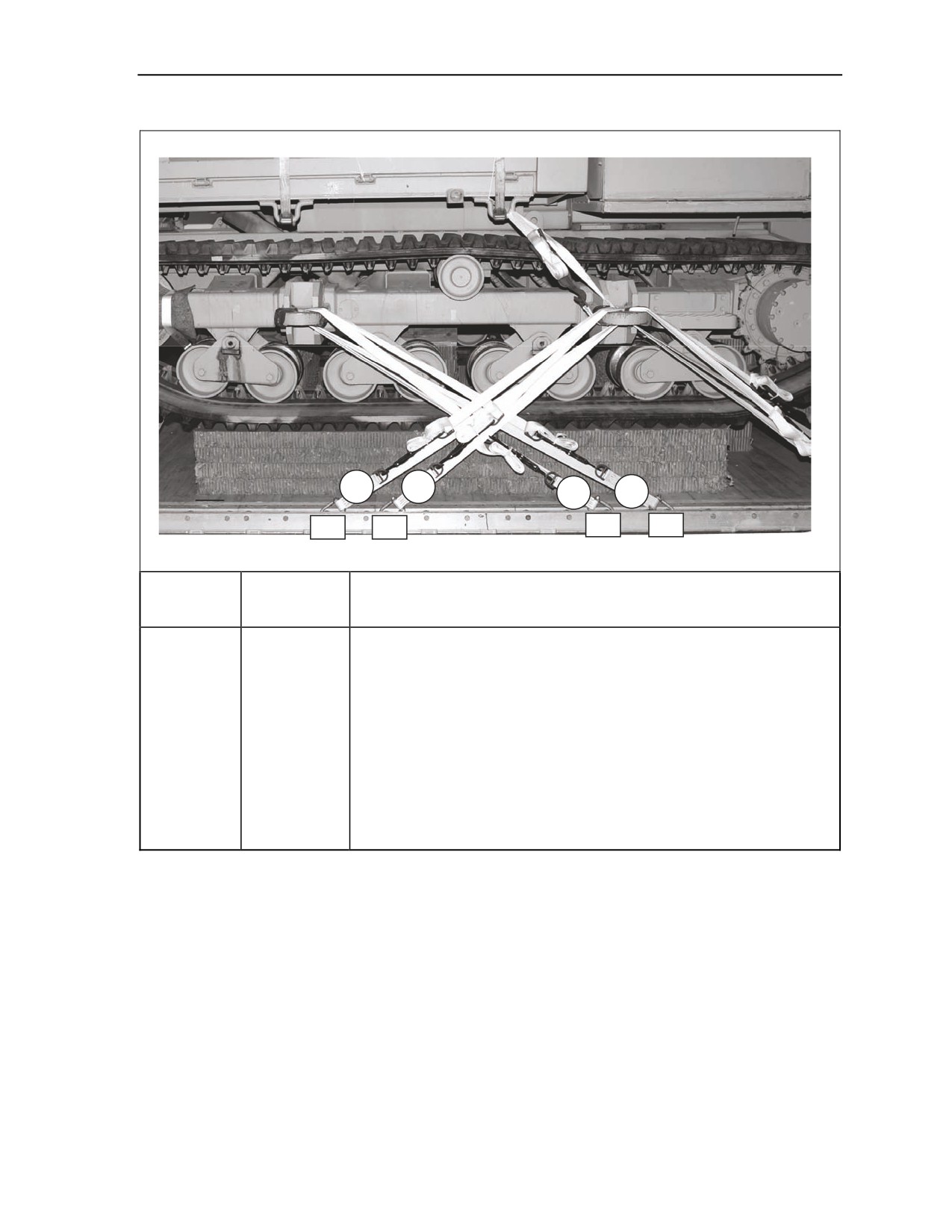
2-6. Lash the IC45-2 IHI crawler carrier with twenty-eight 15-foot tiedown assemblies as shown in
Figures 2-22 through 2-26.
3
1
1
2
Tiedown
Lashing
Clevis
Instructions
Number
Number
Pass lashing:
1
1
Through the right front tiedown point under the attachment assembly.
2
1A
Through the left front tiedown point under the attachment assembly.
3
2
Around the attachment assembly adapter linkage in the Y shaped part
on the right side.
4
2A
Around the attachment assembly adapter linkage in the Y shaped part
on the left side.
Figure 2-22. Lashings 1 Through 4 Installed
16 November 2006
FM 4-20.167/TO 13C7-16-171
2-33
Chapter 2
5
5
9
7
5
4
3
Lashing
Tiedown Clevis
Instructions
Number
Number
Pass lashing:
5
3
Through the right tiedown point under the attachment assembly.
6
3A
Through the left tiedown point under the attachment assembly.
7
4
Through the front track tiedown point on the right side.
8
4A
Through the front track tiedown point on the left side.
9
5
Through the front track tiedown point on the right side.
10
5A
Through the front track tiedown point on the left side.
Figure 2-23. Lashings 5 Through 10 Installed
2-34
FM 4-20.167/TO 13C7-16-171
16 November 2006
Rigging IC45-2 IHI Crawler Carrier on a Type V Platform for Low-Velocity Airdrop
17
15
13
11
9
8
7
6
Tiedown
Lashing
Clevis
Instructions
Number
Number
Pass lashing:
11
6
Through the rear track tiedown point on the right side.
12
6A
Through the rear track tiedown point on the left side.
13
7
Through the rear track tiedown point on the right side.
14
7A
Through the rear track tiedown point on the left side.
15
8
Through the front track tiedown point on the right side.
16
8A
Through the front track tiedown point on the left side.
17
9
Through the front track tiedown point on the right side.
18
9A
Through the front track tiedown point on the left side.
Figure 2-24. Lashings 11 Through 18 Installed
16 November 2006
FM 4-20.167/TO 13C7-16-171
2-35
Chapter 2
20
19
10A
10
Tiedown
Lashing
Clevis
Instructions
Number
Number
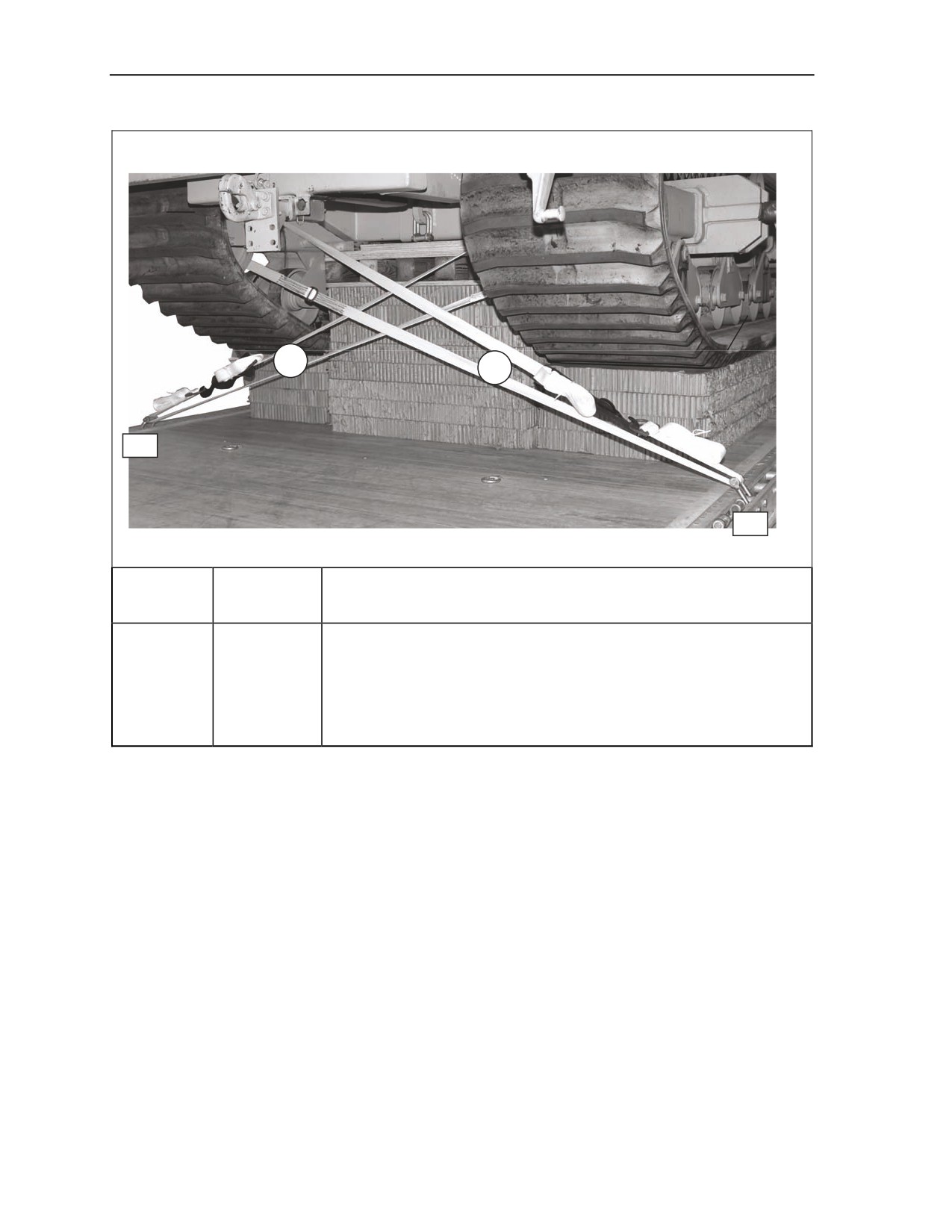
Pass a 30-foot lashing:
19
10
Through clevis 10 and around the padded part of the track roller bar
on the left side.
20
10A
Through clevis 10A and around the padded part of the track roller
bar on the right side.
Figure 2-25. Lashings 19 and 20 Installed
2-36
FM 4-20.167/TO 13C7-16-171
16 November 2006
Rigging IC45-2 IHI Crawler Carrier on a Type V Platform for Low-Velocity Airdrop
26
25
27
25
23
21
14
13
12
11
Tiedown
Lashing
Clevis
Instructions
Number
Number
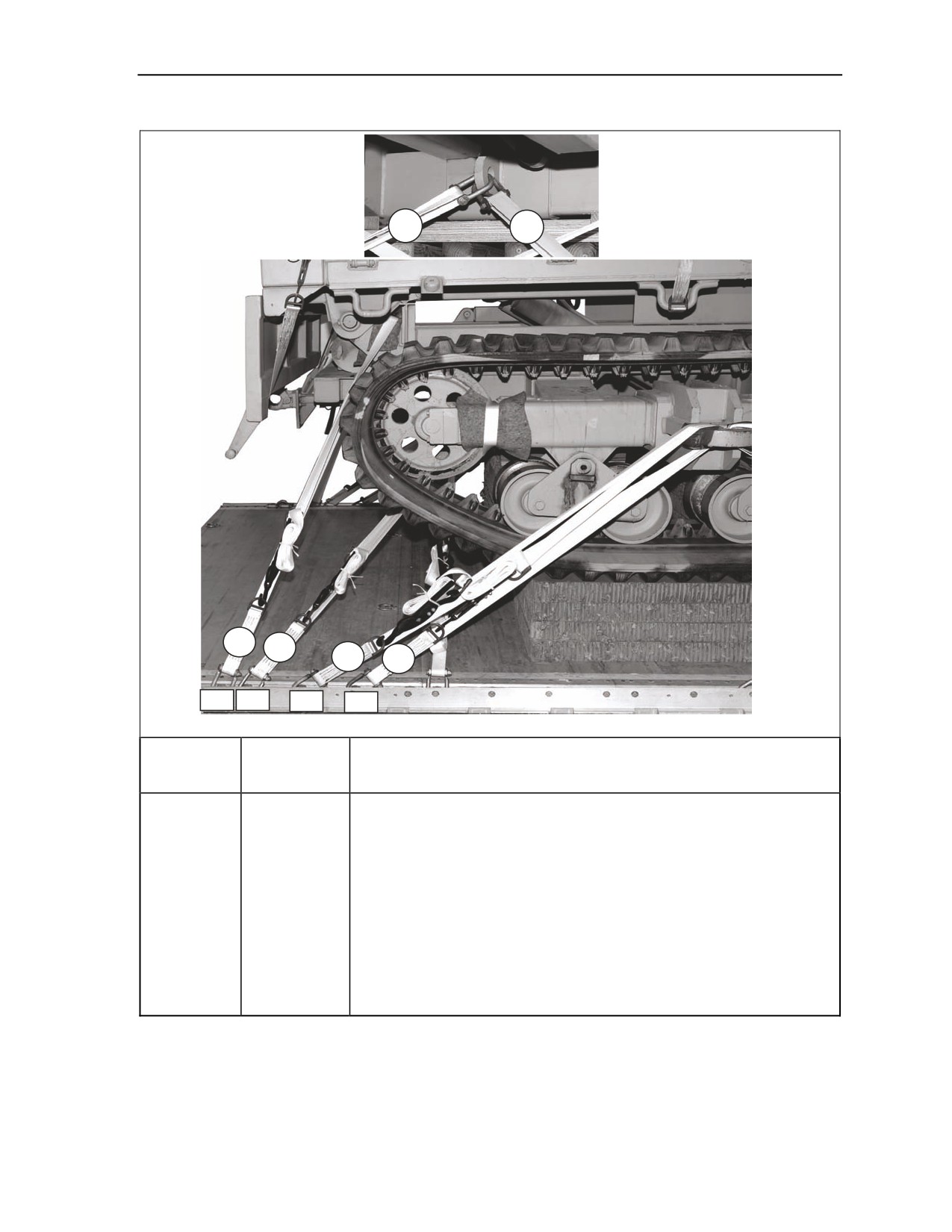
Pass lashing:
21
11
Through the rear track tiedown point on the right side.
22
11A
Through the rear track tiedown point on the left side.
23
12
Through the rear track tiedown point on the right side.
24
12A
Through the rear track tiedown point on the left side.
25
13
To one of the double clevises on the rear frame tiedown point.
26
13A
To the remaining double clevis on the rear frame tiedown point.
27
14
To the tailgate hinge support previously padded on the right side.
28
14A
To the tailgate hinge support previously padded on the left side.
Figure 2-26. Lashings 21 Through 28 Installed
16 November 2006
FM 4-20.167/TO 13C7-16-171
2-37
Chapter 2
BUILDING THE PARACHUTE STOWAGE PLATFORM
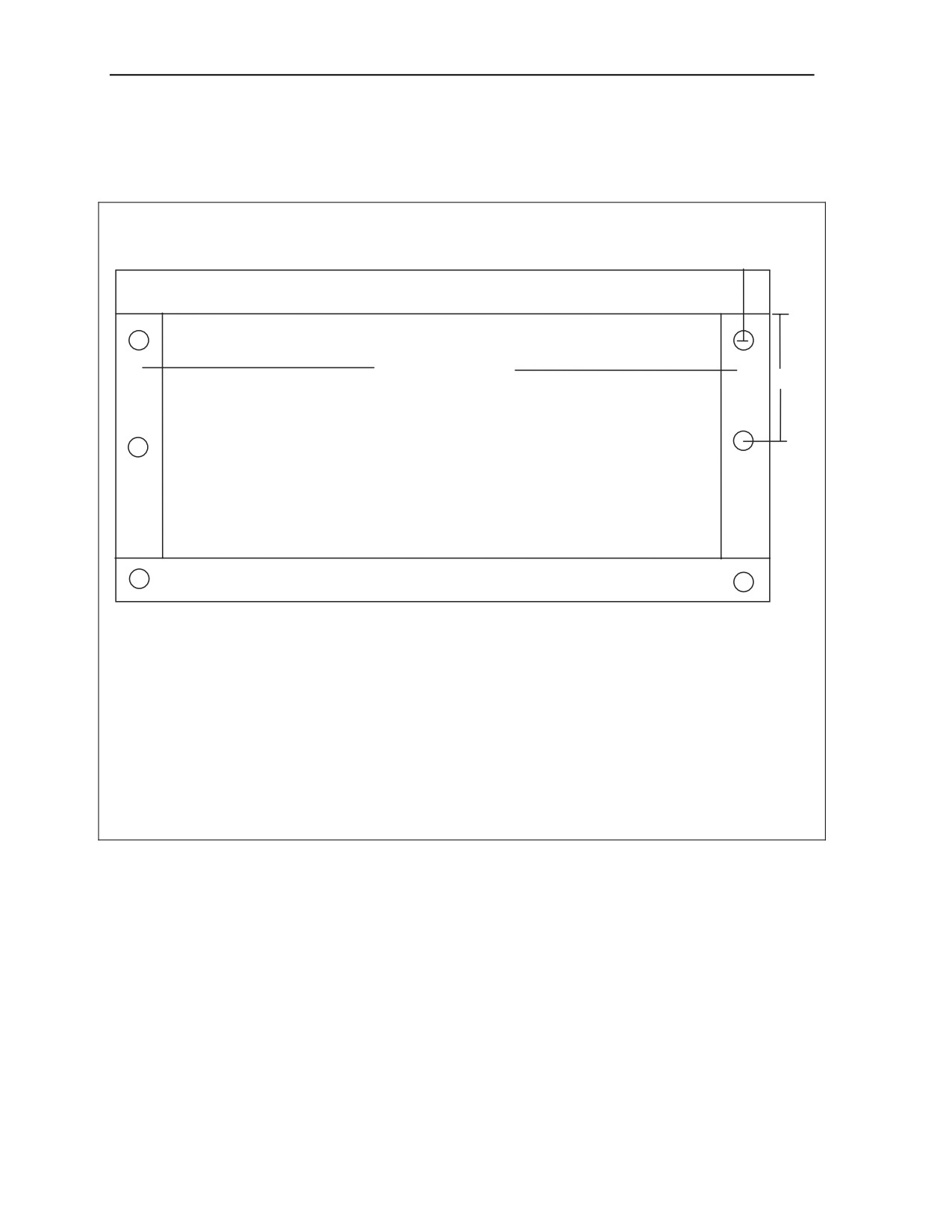
2-7. Build a parachute stowage platform as shown in Figure 2-27.
Notes.
1. Not drawn to scale.
2. All dimensions are given in inches.
2 x 6 x 76 lumber
9
2 x 6 x 37 lumber
18 ½
48 x 76 x ¾ plywood
2 x 6 x 76 lumber
Steps:
1. Cut a 48- by 76- by ¾-inch sheet of plywood as a base.
2. Cut two 2- by 6- by 76-inch pieces of lumber. Nail each piece of lumber flush with the front, rear and
sides using 8d nails.
3. Cut two 2- by 6- by 37-inch pieces of lumber. Nail the lumber flush with one piece on each side
between the front and rear pieces using 8d nails.
4. Drill six 2-inch holes centered as shown.
Figure 2-27. Parachute Stowage Platform Built
2-38
FM 4-20.167/TO 13C7-16-171
16 November 2006
Rigging IC45-2 IHI Crawler Carrier on a Type V Platform for Low-Velocity Airdrop
INSTALLING AND RESTRAINING THE PARACHUTE STOWAGE
PLATFORM
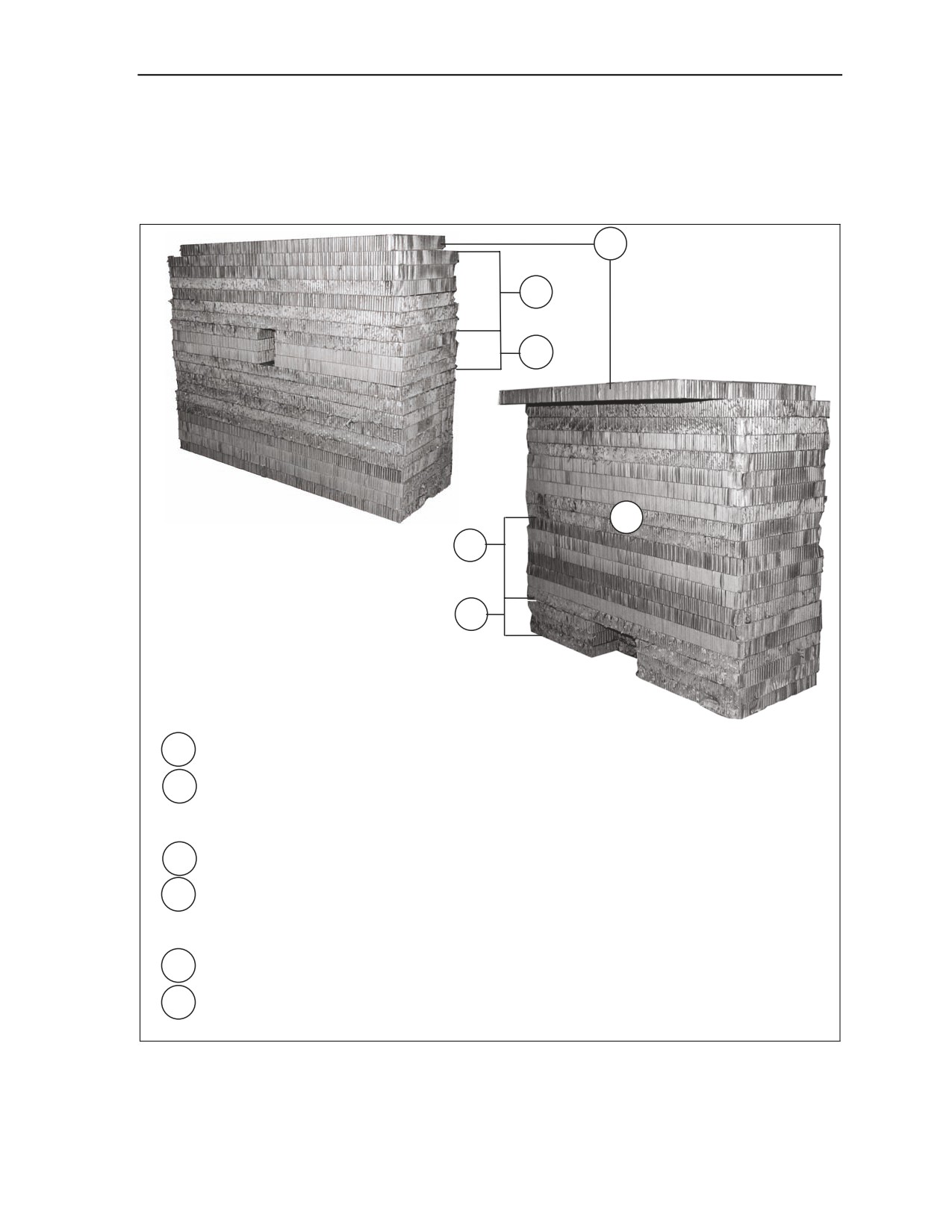
2-8. Install and restrain the parachute stowage platform as shown in Figure 2-28.
6
5
4
FRONT
1
3
2
REAR
1 Cut nineteen 26- by 75-inch pieces and one 35- by 64 ½-inch piece of honeycomb.
2 Make a 16- by 8-inch cut out in the center of three 26- by 75-inch pieces of honeycomb for
access to the extraction force transfer coupling (EFTC) extraction bracket. Glue these
three together to form the base.
3 Glue place seven 26- by 75-inch pieces of honeycomb to the base.
4 Make a 6- by 8-inch cut out in the center of three 26- by 75-inch pieces of honeycomb for
the pintle hook. Place and glue these on the base with the cut out on the opposite side of
the 8- by 16-inch notch made in step 2.
5 Glue and place the remaining six 26- by 75-inch pieces of honeycomb on top of the stack.
6 Glue the 35- by- 64 ½-inch piece of honeycomb on top of the stack with the 64 ½ inch
edge two inches in from front edge and centered.
Figure 2-28. Parachute Stowage Platform Installed and Restrained
16 November 2006
FM 4-20.167/TO 13C7-16-171
2-39
Chapter 2
8
9
10
7
16
15
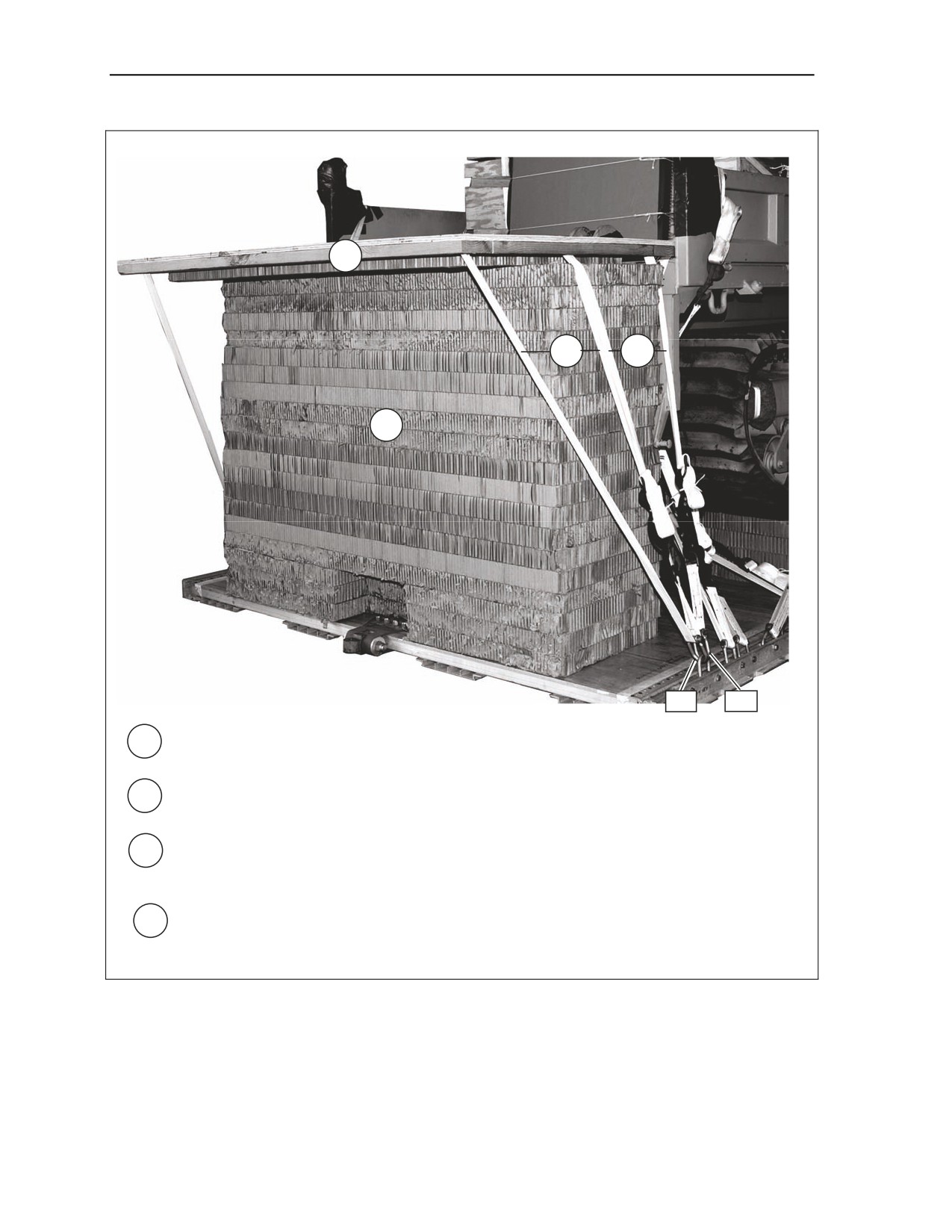
7 Position the stack, with the notch in honeycomb layers 1 through 3, centered over the EFTC
bracket and flush with the rear edge of the platform.
8 Position the parachute stowage platform, Figure 2-27, on top of the honeycomb stack with
the lumber on the bottom. The top layer of honeycomb will fit inside the lumber.
9 Route a 15-foot lashing through clevis 16, up through the rear hole, down through the center
hole. Secure the lashing with a D-ring and a load binder. Repeat on the left side using
clevis 16A.
10 Route a 15-foot lashing through clevis 15, up through the center hole, down through the front
hole. Secure the lashing with a D-ring and a load binder. Repeat on the left side using
clevis 15A.
Figure 2-28. Parachute Stowage Platform Installed and Restrained (Continued)
2-40
FM 4-20.167/TO 13C7-16-171
16 November 2006
Rigging IC45-2 IHI Crawler Carrier on a Type V Platform for Low-Velocity Airdrop
PADDING, SECURING AND SAFETY TIEING SUSPENSION SLINGS
2-9.
Pad, secure and safety tie the suspension slings according to FM 4-20.102/MCRP 4-
11.3J/NAVSEA SS400-AB-MMO-010/TO 13C7-1-5 and as shown in Figure 2-29.
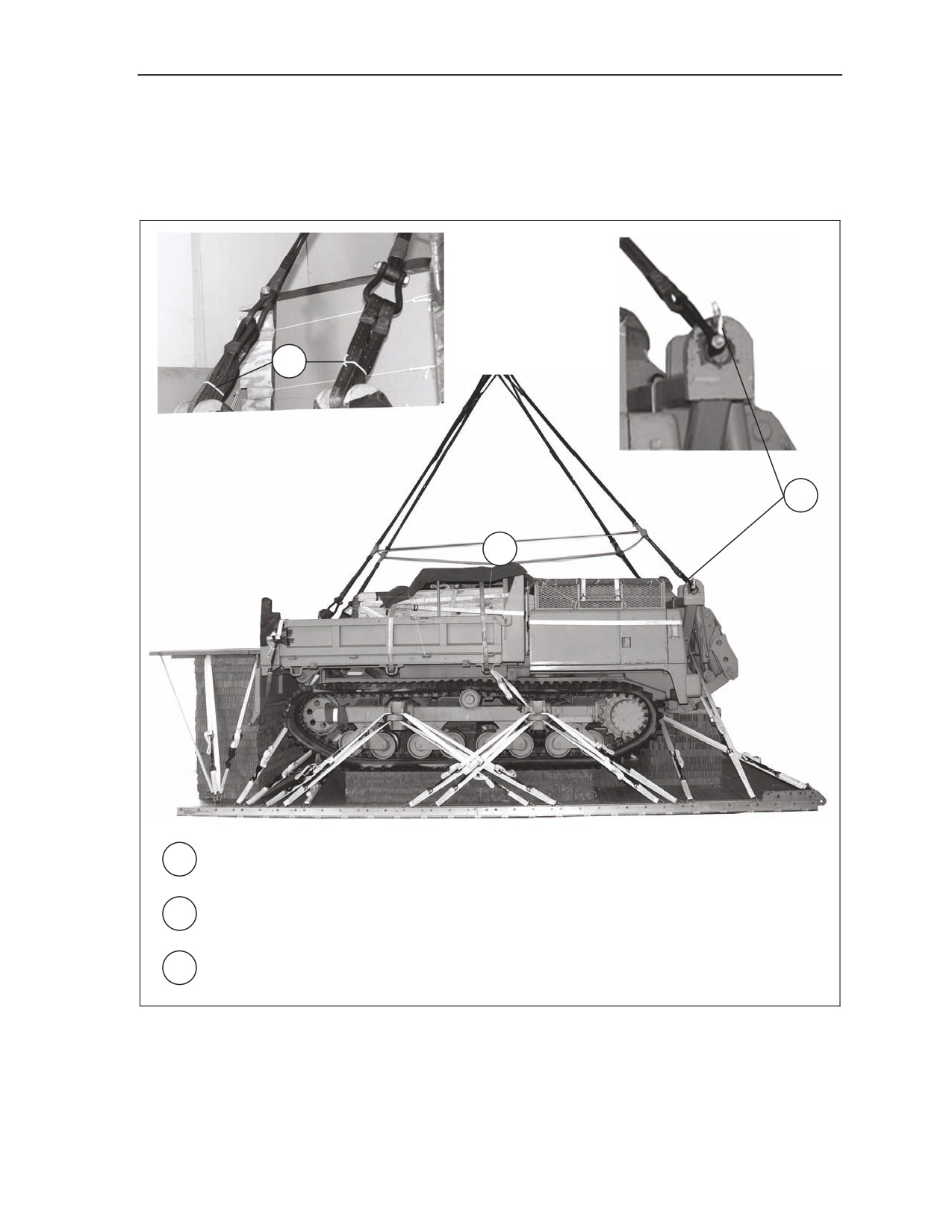
3
2
1
1 Raise the suspension slings installed in Figure 2-21 and install the deadman’s safety tie
according to FM 4-20.102/MCRP 4-11.3J/NAVSEA SS400-AB-MMO-010/TO13C7-1-5.
2 Safety tie the large clevises attached to the attachment assembly with ½-inch tubular nylon
webbing.
3 Safety tie the 3-foot slings attached to the dump bed rear lifting points with Type 1, ¼-inch
cotton webbing.
Figure 2-29. Suspension Slings Padded, Secured and Safety tied
16 November 2006
FM 4-20.167/TO 13C7-16-171
2-41
Chapter 2
STOWING CARGO PARACHUTES
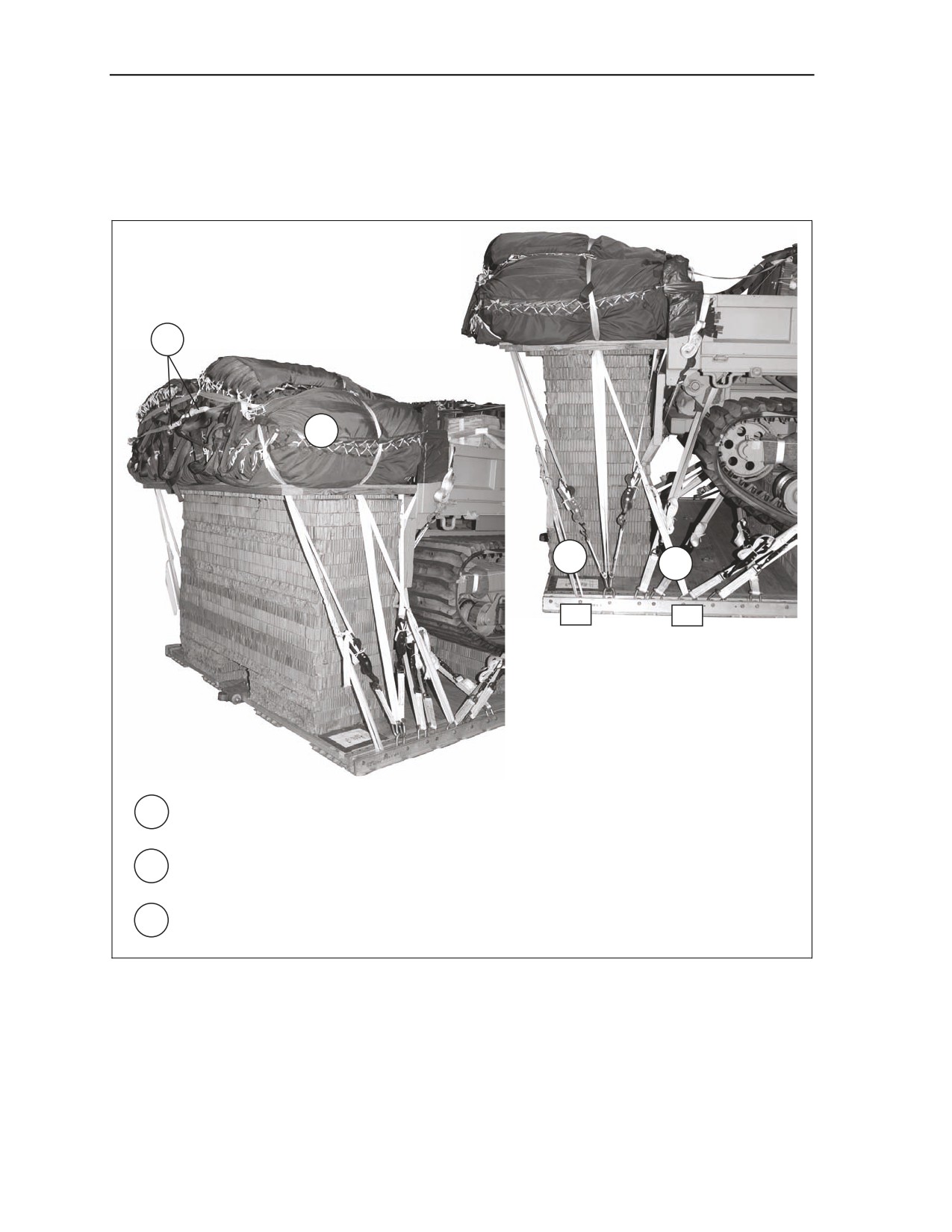
2-10. Prepare, stow, cluster, and restrain five G-11 cargo parachutes according to FM 4-20.102/ MCRP
4-11.3J/NAVSEA SS400-AB-MMO-010/TO 13C7-1-5 and as shown in Figure 2-30.
3
1
2
2
39
12
1 Prepare, position, and cluster, five G-11 cargo parachutes according to FM 4-
20.102/MCRP 4-11.3J/NAVSEA SS400-AB-MMO-010/TO 13C7-1-5.
2 Restrain the parachutes according to FM 4-20.102/ MCRP 4-11.3J/NAVSEA SS400-AB-
MMO-010/TO 13C7-1-5 using clevises 12, 12A, bushings 39 and 39A.
3 Install the multicut parachute release straps according to FM 4-20.102/ MCRP 4-
11.3J/NAVSEA SS400-AB-MMO-010/TO 13C7-1-5.
Figure 2-30. Cargo Parachutes Stowed and Restrained
2-42
FM 4-20.167/TO 13C7-16-171
16 November 2006
Rigging IC45-2 IHI Crawler Carrier on a Type V Platform for Low-Velocity Airdrop
INSTALLING EXTRACTION SYSTEM
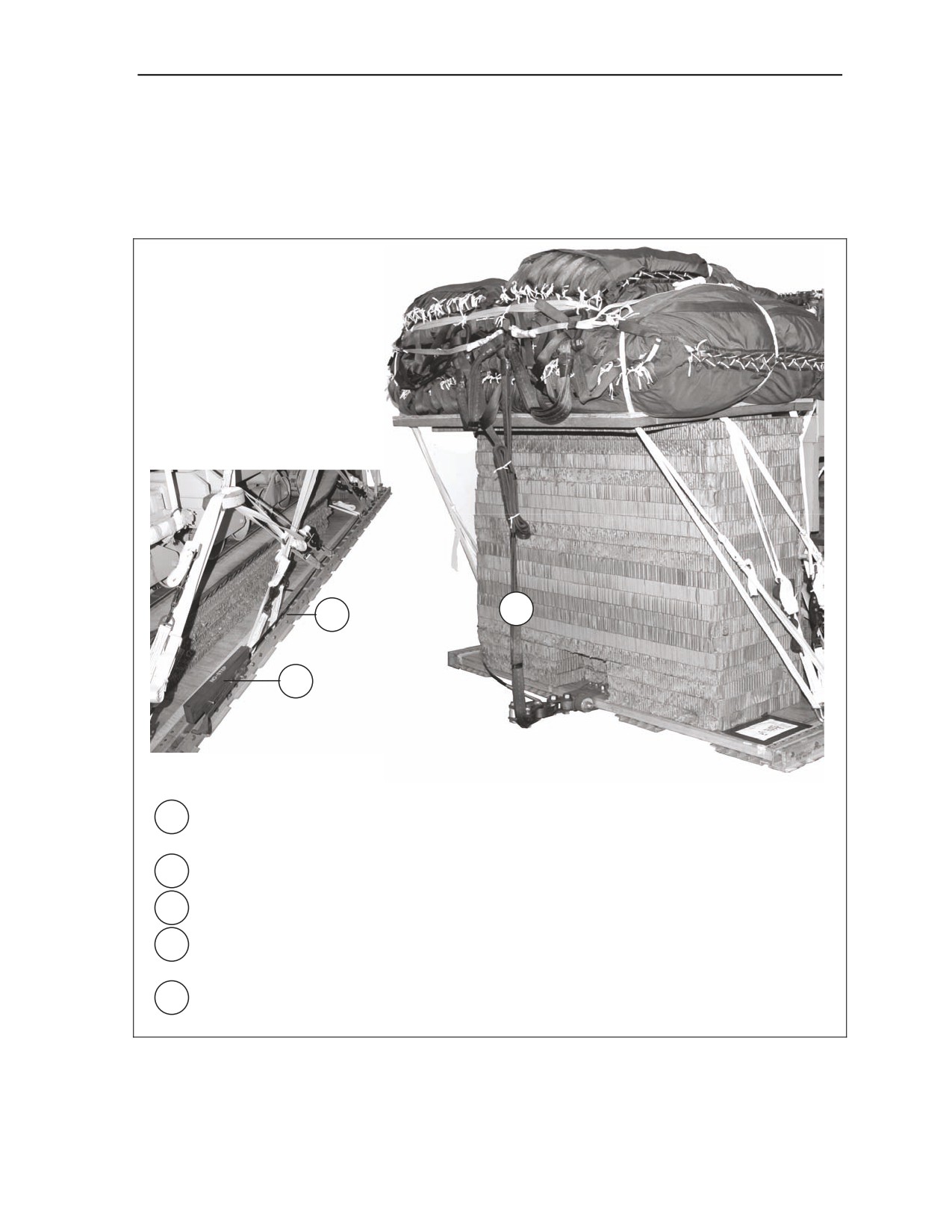
2-11. Install the EFTC system according to FM 4-20.102/ MCRP 4-11.3J/NAVSEA SS400-AB-MMO-
010/TO 13C7-1-5 and as shown in Figure 2-31. Install the EPJS according to FM 4-20.102/MCRP 4-
11.3J/ NAVSEA SS400-AB-MMO-010/TO 13C7-1-5 if applicable.
5
2
3
1 Install the EFTC actuator mounting brackets using the rear mounting holes according to FM
4-20.102/ MCRP 4-11.3J/NAVSEA SS 400-AB-MMO-010/TO 13C7-1-5. (Not Shown)
2 Install a 20-foot release cable.
3 Install the actuator assembly to the actuator mounting bracket.
4 Safety tie the cable according to FM 4-20.102/ MCRP 4-11.3J/NAVSEA SS400-AB-MMO-
010/TO 13C7-1-5. (Not Shown)
5 Attach a 9-foot (2 loop), type XXVI nylon sling as the deployment line. Fold and secure the
excess line with Type I, ¼ -inch cotton webbing.
Figure 2-31. Extraction System Installed
16 November 2006
FM 4-20.167/TO 13C7-16-171
2-43
Chapter 2
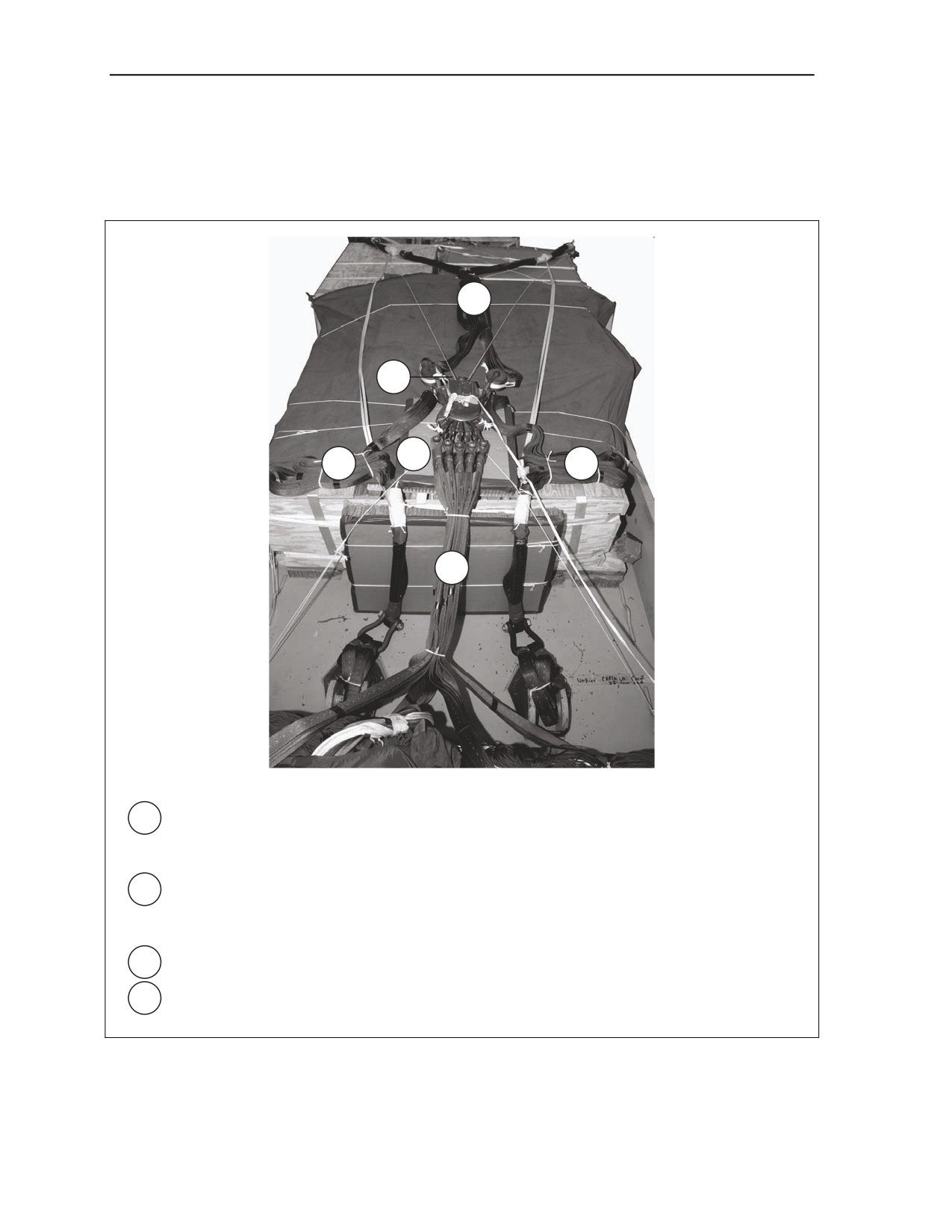
INSTALLING M-2 RELEASE ASSEMBLY
2-12. Install the M-2 parachute release assembly according to FM 4-20.102/ MCRP 4-11.3J/NAVSEA SS
400-AB-MMO-010/TO 13C7-1-5 and as shown in Figure 2-32.
3
2
1
3
3
4
1 Cut a 20- by 24-inch piece of honeycomb to use as a base. Tape the edges and place the
honeycomb on the rear of the accompanying load. Secure the honeycomb with type III nylon
cord routed under the suspension sling and safety tie to a convenient point on the load.
2 Install an M-2 parachute release. Attach the suspension slings and riser extensions
according to FM 4-20.102/ MCRP 4-11.3J/NAVSEA SS 400-AB-MMO-010/TO 13C7-1-5.
Restrain the release with type III nylon cord to convenient points on the load.
3 Fold the suspension slings and secure with a length of Type I, ¼-inch cotton webbing.
4 Tie the exposed riser extensions with lengths of Type I, ¼-inch cotton webbing.
Figure 2-32. M-2 Parachute Release Assembly Installed
2-44
FM 4-20.167/TO 13C7-16-171
16 November 2006
Rigging IC45-2 IHI Crawler Carrier on a Type V Platform for Low-Velocity Airdrop
INSTALLING PROVISIONS FOR EMERGENCY RESTRAINTS
2-13. Install the provisions for the emergency restraints on the platform according to FM 4-20.102/ MCRP
4-11.3J/NAVSEA SS400-AB-MMO-010/TO 13C7-1-5.
PLACING EXTRACTION PARACHUTE
2-14. Select the extraction parachute and extraction line according to FM 4-20.102/MCRP 4-
11.3J/NAVSEA SS400-AB-MMO-010/TO13C7-1-5. Place the extraction parachute and extraction line on
the load for installation in the aircraft. If a drogue parachute and drogue line are required, place them on
the load for installation in the aircraft.
MARKING RIGGED LOAD
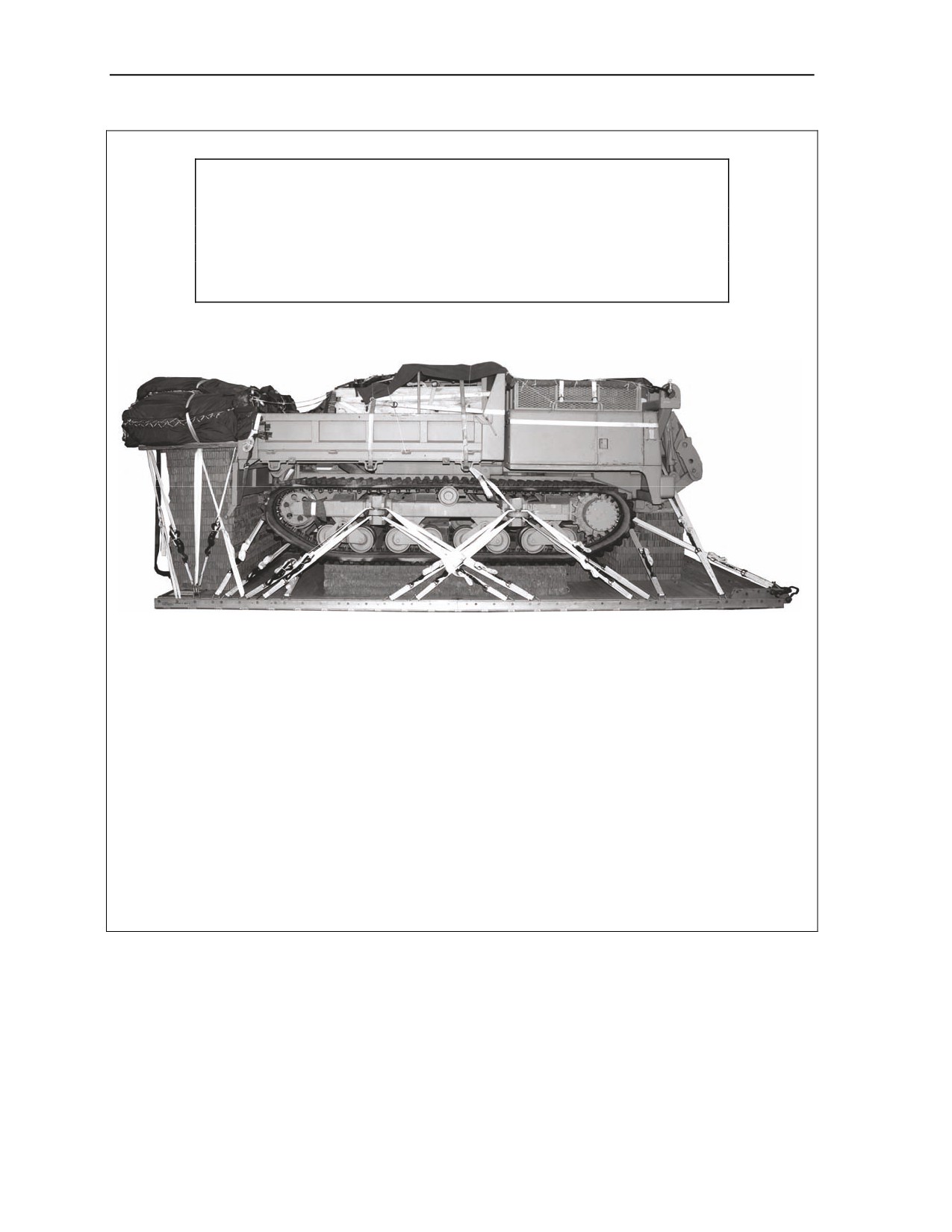
2-15. Mark the rigged load according to FM 4-20.102/ MCRP 4-11.3J/NAVSEA SS 400-AB-MMO-
010/TO 13C7-1-5 and as shown in Figure 2-33. Complete the Shipper’s Declaration for Dangerous
Goods. If the load varies from the one shown, the weight, height, center of balance (CB) and parachute
requirements must be recomputed.
16 November 2006
FM 4-20.167/TO 13C7-16-171
2-45
Chapter 2
CAUTION
Make the final rigger inspection required by FM 4-20.102/MCRP 4-
11.3J/NAVSEA SS400-AB-MM0-010/TO 13C7-1-5 and AR 59-4/
OPNAVINST 4630.24C/AFJ 13-210(I)/MCO 13480.1B before the load
leaves the rigging site.
RIGGED LOAD DATA
Weight
21,480 pounds
Maximum Weight
22,900 pounds
Height
97 ½ inches
Width
108 inches
Length
262 inches
Overhang: Front
0 inches
Rear (Parachute platform)
22 inches
Rear (EPJS)
30 inches
Center of Balance (from front edge of platform)
125 inches
Figure 2-33. IC45-2 IHI Crawler Carrier Rigged on a Type V Platform for Low-Velocity Airdrop
EQUIPMENT REQUIRED
2-16. Use the equipment listed in Table 2-3 to rig this load.
2-46
FM 4-20.167/TO 13C7-16-171
16 November 2006
Rigging IC45-2 IHI Crawler Carrier on a Type V Platform for Low-Velocity Airdrop
Table 2-3. Equipment Required for Rigging the IC 45-2 IHI Crawler Carrier on a Type V
Platform for Low-Velocity Airdrop
National Stock Number
Item
Quantity
8040-00-273-8713
Adhesive, paste, 1-gal
As required
1670-01-035-6054
Bridle, extraction line lead, (line bag for DES)
1
Clevis:
4030-00-090-5354
large
7
4030-00-678-8562
medium
6
8305-00-184-2034
Cloth, Cotton Duck, 12.29oz, OD 60”
As required
8135-00-664-6958
Cushioning material, packaging, cellulose wadding
As required
1670-00-360-0328
Cover, clevis, large
5
Extraction Force Transfer Coupling System
1670-00-434-5787
Coupling assembly, airdrop, EFTC, w / 20-ft cable
1
1670-01-475-1990
Extraction Parachute Jettison System (EPJS)
1
Felt:
8305-00-191-1101
½ inch
As required
8305-00-290-5584
3/16 inch
As required
1670-00-003-4391
Knife, parachute bag (For DES)
2
5340-00-040-8219
Knife, multi-parachute release strap, webbing
2
1670-01-183-2678
Leaf, extraction line (line bag)(add 2 for DES)
2
Line Multi-Loop:
For deployment line:
1670-01-062-6304
9-ft (2-loop), type XXVI nylon webbing
1
For drogue:
1670-01-064-4452
60-ft 1-loop, type XXVI nylon webbing (DES)
1
For extraction:
1670-01-062-6313
60-ft (3-loop), type XXVI nylon (C-130 aircraft)
1
1670-01-107-7651
140-ft (6-loop), type XXVI nylon (C-17 aircraft)
1
For riser extension:
1670-01-062-6313
60-ft (3-loop), type XXVI nylon webbing
5
For suspension:
1670-01-062-6306
3-ft (4-loop), type XXVI nylon webbing
2
1670-01-062-6310
11-ft (4-loop), type XXVI nylon webbing
4
Link:
1670-01-493-6418
Assembly small, two-point, 3 ¾-inch (drogue)
1
1670-01-493-6420
Assembly large, two-point 5 ½-inch
1
1670-01-072-5637
Jettison, C-130 (DES)
1
1670-01-483-8259
Link, Parachute connector (TRM H-block) (C-17)
1
Lumber:
5510-00-220-6146
2-by 4-inch
3
5510-00-220-6148
2-by 6-inch
1
5510-00-220-6274
4-by 4-inch
5
16 November 2006
FM 4-20.167/TO 13C7-16-171
2-47
Chapter 2
Table 2-3. Equipment Required for Rigging the IC 45 -2 IHI Crawler Carrier on a Type V
Platform for Low-Velocity Airdrop (Continued)
National Stock Number
Item
Quantity
5530-00-128-4981
Plywood, ¾-inch sheet
9
5530-00-914-5118
Plywood, 1-inch sheet
1
Nail, steel wire, common:
5315-00-010-4659
8d
As required
1670-00-753-3928
Pad, energy-dissipating, honeycomb,
29 sheets
Parachute:
1670-01-016-7841
G-11
5
1670-00-040-8135
28-ft, extraction, heavy-duty
1
1670-01-063-3717
15-ft, Extraction Drogue (DES)
1
Platform, airdrop, type V, 20-ft:
1
1670-01-353-8425
Bracket assembly, component (EFTC)
1
1670-01-353-8424
Bracket, assembly, extraction
1
1670-01-162-2372
Clevis, load tiedown
34
1670-01-162-2381
Link, Tandem, link sups. assembly
2
1670-01-097-8817
Release, cargo parachute, M-2,
1
7510-00-266-5016
Tape, adhesive, 2-in
As required
1670-00-937-0271
Tiedown assembly, 15-ft webbing
69
5365-00-937-0147
D-ring, heavy duty, 10,000-lb
69
1670-00-937-0272
Binder, load, 10,000-lb
52
Webbing:
4020-00-240-2146
Cord, nylon, type III, 550-lb
As required
8305-00-268-2411
Cotton, type I, ¼- inch
As required
8305-00-082-5752
Nylon, tubular, ½- in, natural
As required
8305-00-263-3591
Nylon, type VIII
As required
2-48
FM 4-20.167/TO 13C7-16-171
16 November 2006
Chapter 3
Rigging M973A, 1 ½ -Ton Cargo Carrier Small Unit Support
Vehicle (SUSV) on a Type V Platform for Low-Velocity
Airdrop
DESCRIPTION OF LOAD
3-1.
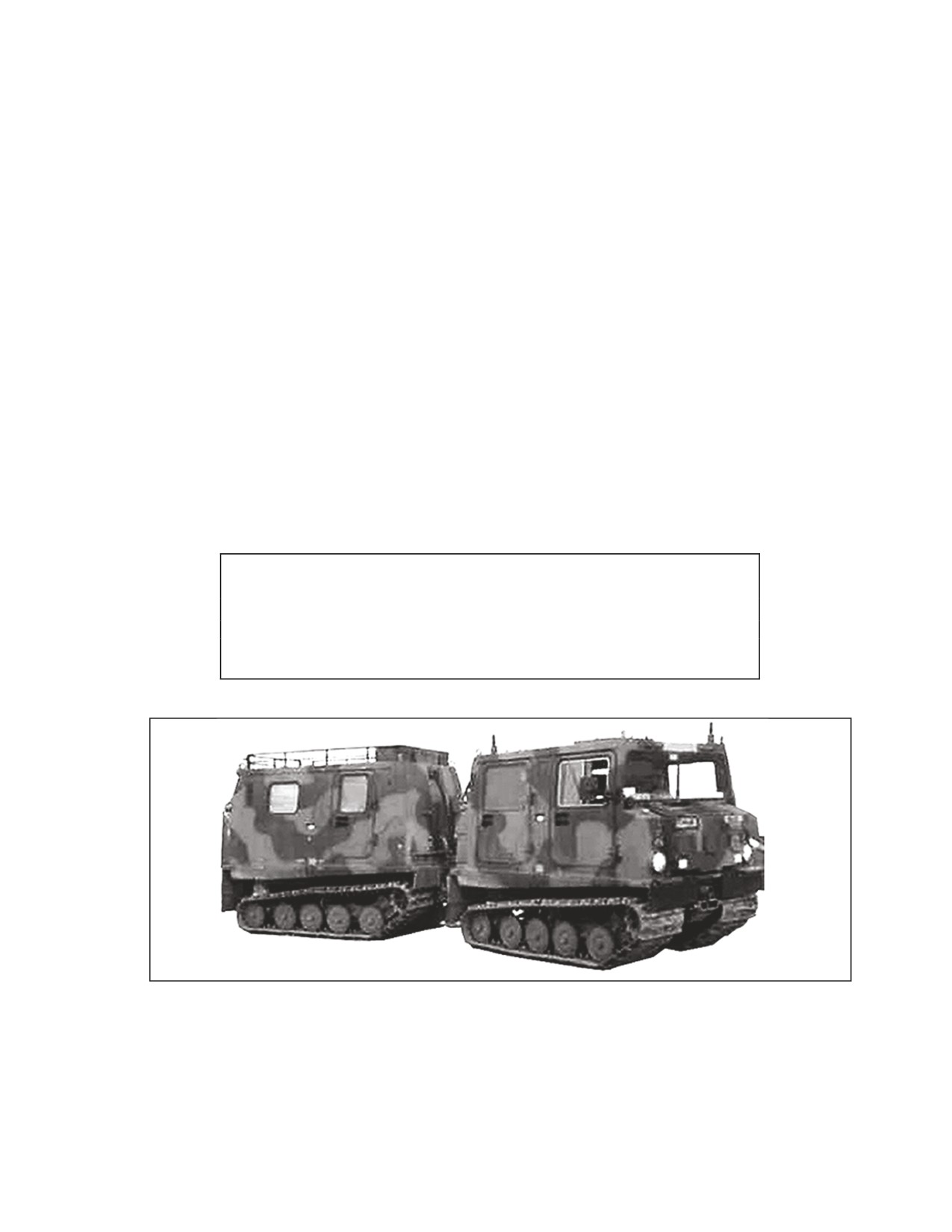
The small unit support vehicle (SUSV), Figure 3-1, is a tracked vehicle with a driver’s
compartment and a cargo-troop carrier compartment attached to the rear. The vehicle is 271 inches long,
74 inches wide, 90 ½ inches high, and weighs 10,000 pounds. The SUSV is rigged on a 28-foot, type V
airdrop platform using four G-11 cargo parachutes for low-velocity airdrop from C-130 and C-17 aircraft.
The vehicle must be rigged with an accompanying load that weighs 2,000 pounds but not more than 2,100
pounds. The accompanying load is 105-millimeter ammunition rigged on the front end of the platform;
however other equipment may be used.
CAUTION
Only ammunition listed in FM 4-20.153/MCRP 4-11.3B/TO 13C7-18-41
may be airdropped.
Figure 3-1. SUSV
16 November 2006
FM 4-20.167/TO 13C7-16-171
3-1
Chapter 3
PREPARING PLATFORM
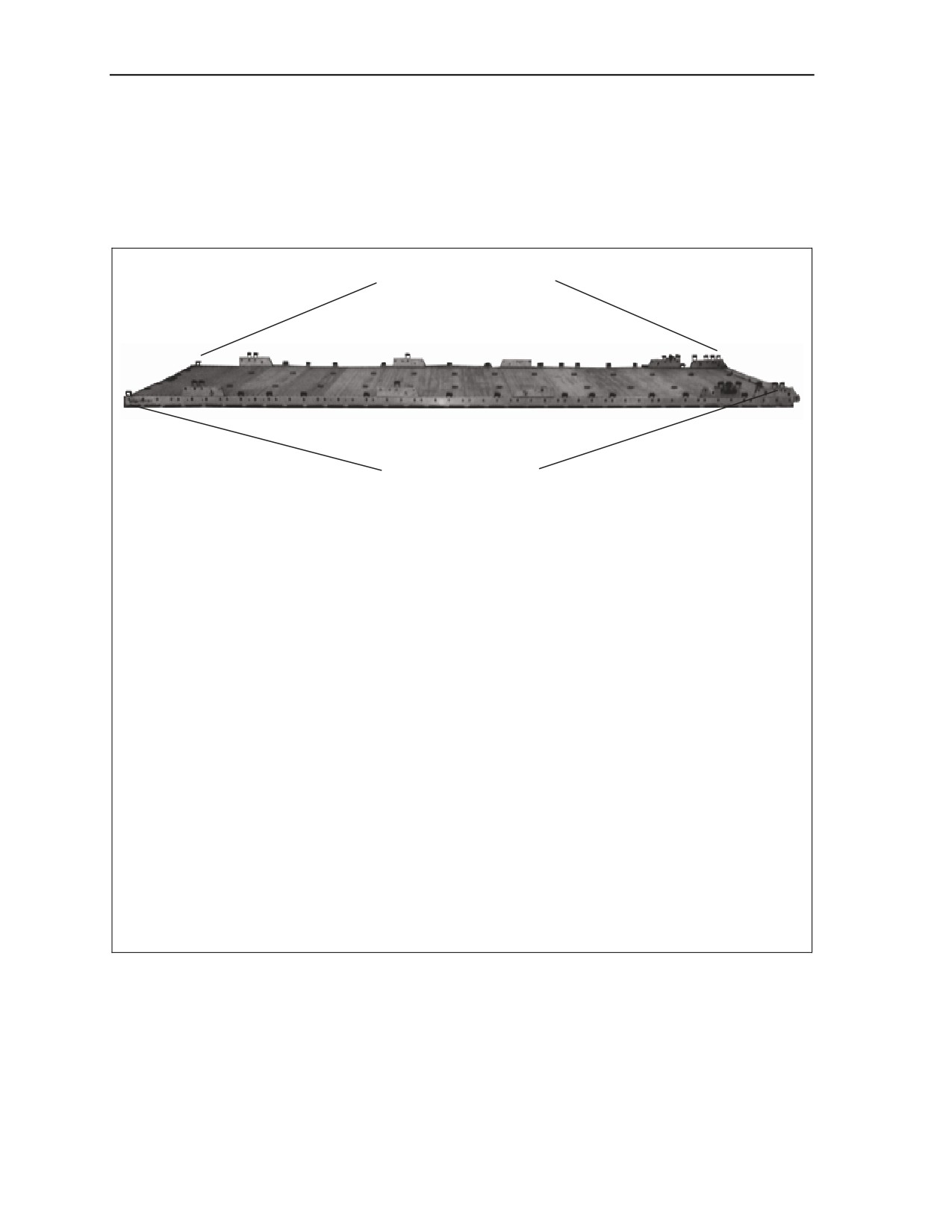
3-2. Prepare a 28-foot, type V airdrop platform according to TM 10-1670-268-20&P/TO 13C7-52-22.
Install two tandem links, eight suspension brackets and 50 tiedown clevis assemblies as shown in Figure
3-2.
Clevises 24A through 1A
Left
REAR
FRONT
Right
Clevises 24 through 1
Steps:
1. Inspect, or assemble and inspect, the platform according to TM 10-1670-268-20&P/TO 13C7-52-
22.
2. Install a tandem link on the front of each platform side rail using holes 1, 2, and 3.
3. Install four suspension brackets on each side rail using bushing holes 6, 7, and 8; 22, 23, and 24; 33,
34, and 35; 49, 50, and 51.
4.
Install a clevis on bushings 1, 2, 3 and 4 on each front tandem link.
5. Install a clevis on bushings 1, 2 (triple), and 3 on the first set of suspension brackets.
6. Install a clevis on bushing 2 on the third set of suspension links.
7. Install a clevis on bushings 2 and 3 on the fourth set of suspension links.
8. Starting at the front of each platform side rail, install clevises on each bushing bolted on holes 5, 10,
13, 16, 18, 20, 26, 30, 37, 42, 45, 47, and 56.
9. Starting at the front of each platform side, number the clevises bolted to the right side rail from 1
through 24 and those bolted to the left side from 1A through 24A.
10. Label the tiedown rings according to FM 4-20.102/ MCRP 4-11.3J/NAVSEA SS 400-AB-MMO-
010/TO 13C7-1-5.
Figure 3-2. Platform Prepared
3-2
FM 4-20.167/TO 13C7-16-171
16 November 2006
Rigging M973A, 1 ½ -Ton Cargo Carrier Small Unit Support Vehicle (SUSV) on a Type V Platform for Low-
Velocity Airdrop
BUILDING AND POSITIONING HONEYCOMB STACKS
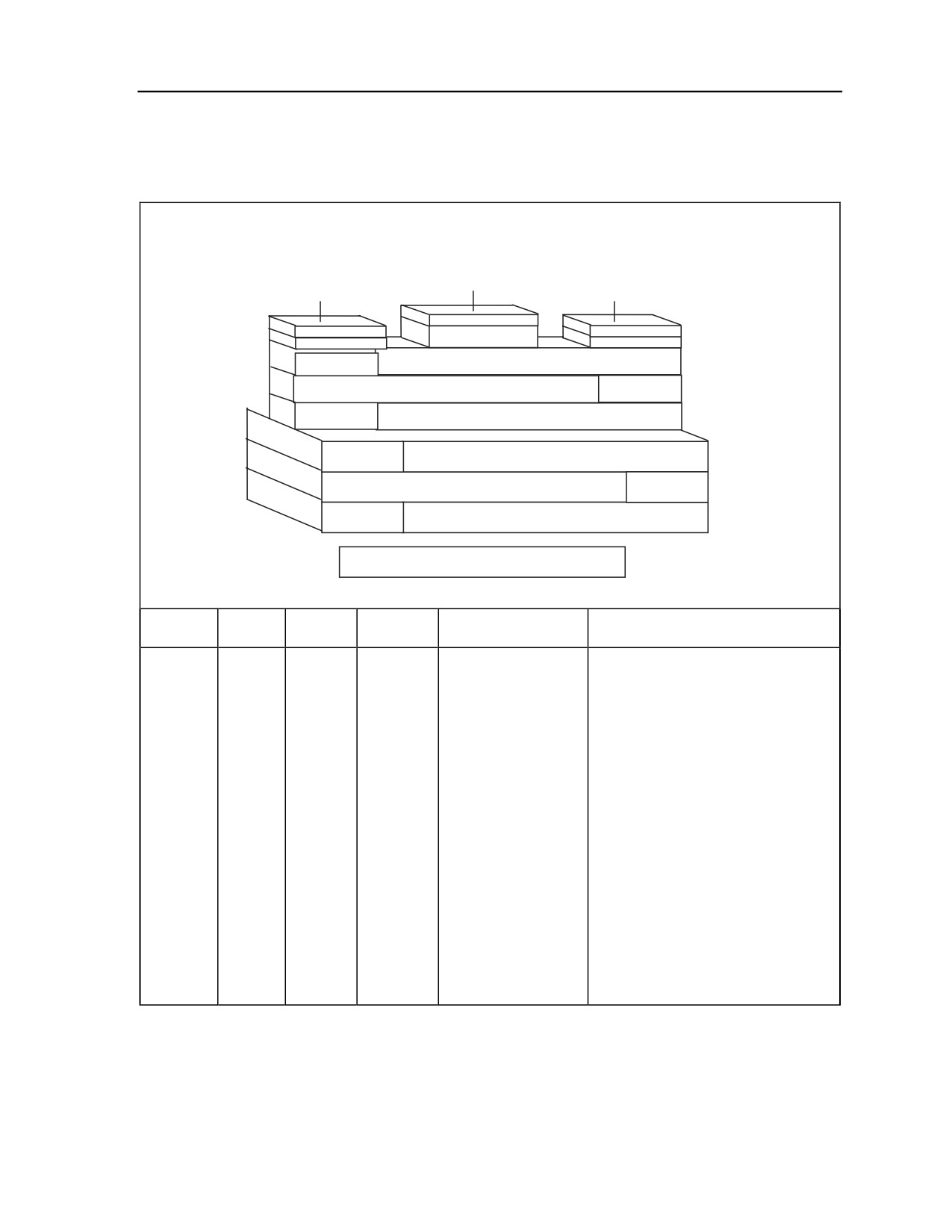
3-3. Build six honeycomb stacks and place them on the platform as shown in Figures 3-3 and 3-4.
Notes.
1. Not drawn to scale.
2. All dimensions are given in inches.
12 X 54 X ¾
12 X 32 X ¾
12 X 32 X ¾
(1 EACH)
(2 EACH)
(2 EACH)
12 X 54
12 X 24
12 X 96
12 X 96
12 X 24
12 X 24
12 X 96
18 X 24
18 X 96
18 X 96
18 X 24
18 X 24
18 X 96
18 X 88 Stacks 3, 4, 5, and 6
Stack
Pieces
Width
Length
Material
Instructions
Number
(Inches)
(Inches)
1 and 2
3
18
96
Honeycomb
Alternate pieces of honeycomb as
3
18
24
Honeycomb
shown to form a base.
3
12
96
Honeycomb
Center and alternate honeycomb
3
12
24
Honeycomb
pieces on base.
4
12
32
¾-Inch Plywood
Place two pieces on each end of
the stack.
1
12
54
Honeycomb
Center the piece of honeycomb
between the 12- by 32-inch
pieces of plywood.
1
12
54
¾-Inch Plywood
Center the piece of plywood on
the 12- by 54-inch piece of
honeycomb.
3, 4, 5,
1
18
88
Honeycomb
Stand alone stacks.
and 6
Figure 3-3. Honeycomb Stacks 1 through 6 Prepared
16 November 2006
FM 4-20.167/TO 13C7-16-171
3-3
Chapter 3
Notes.
1. Not drawn to scale.
2. All dimensions are given in inches.
206
Stack 5
Stack 3
62
REAR
Stack 2
24
Stack 1
38
FRONT
6
Stack 6
Stack 4
62
206
Stack
Position of Stacks on the Platform
Number
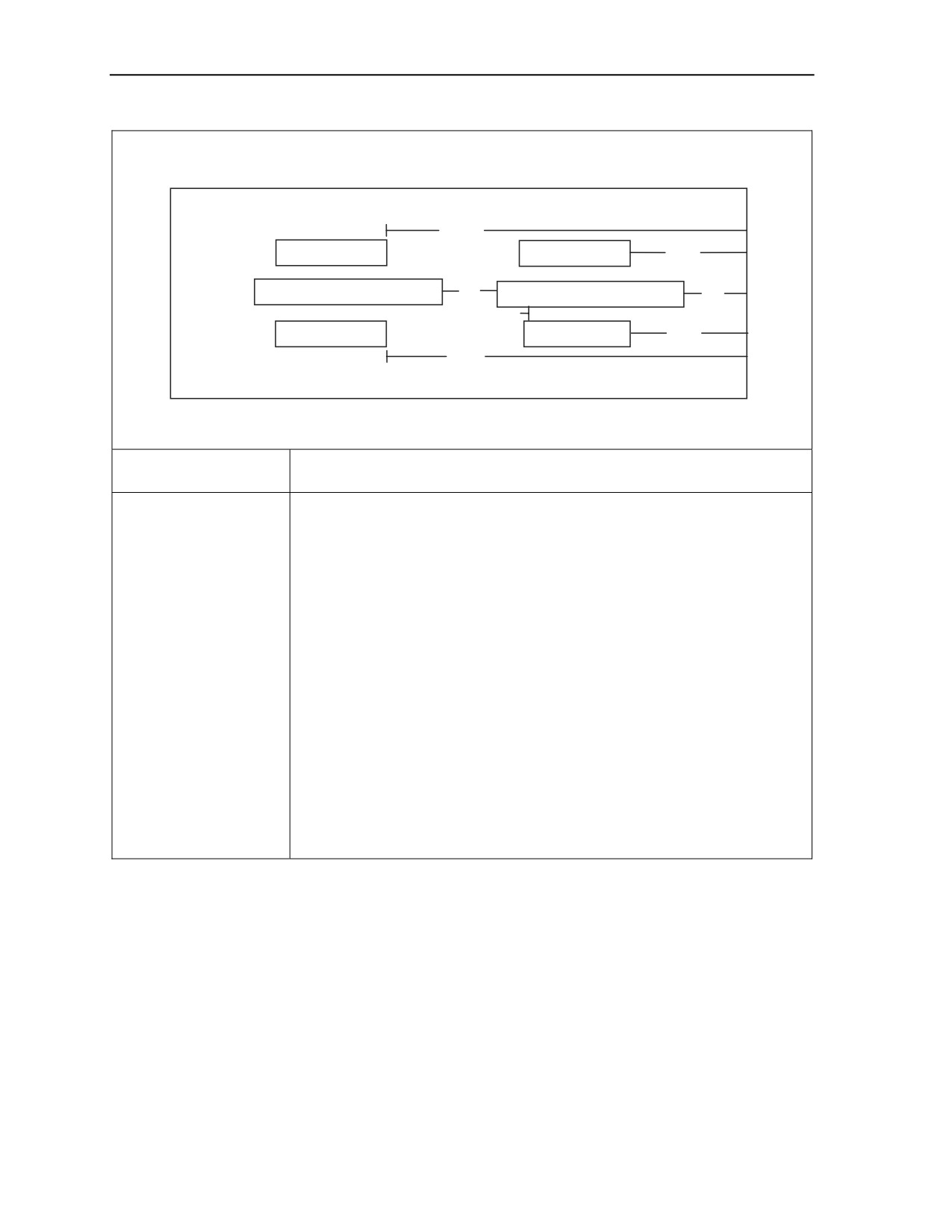
Place stack:
1
Centered 38 inches from the front edge of the platform.
2
Centered 24 inches from stack 1 or 182 inches from the front edge of the
platform.
3
Centered 62 inches from the front edge of the platform and 6 inches left
of stack 1.
4
Centered 62 inches from the front edge of the platform and 6 inches right
of stack 1.
5
Centered 206 inches from the front edge of the platform and 6 inches left
of stack 2.
6
Centered 206 inches form the front edge of the platform and 6 inches
right of stack 2.
Figure 3-4. Honeycomb Stacks Positioned on Platform
3-4
FM 4-20.167/TO 13C7-16-171
16 November 2006
Rigging M973A, 1 ½ -Ton Cargo Carrier Small Unit Support Vehicle (SUSV) on a Type V Platform for Low-
Velocity Airdrop
POSITIONING ACCOMPANYING LOAD ON THE PLATFORM
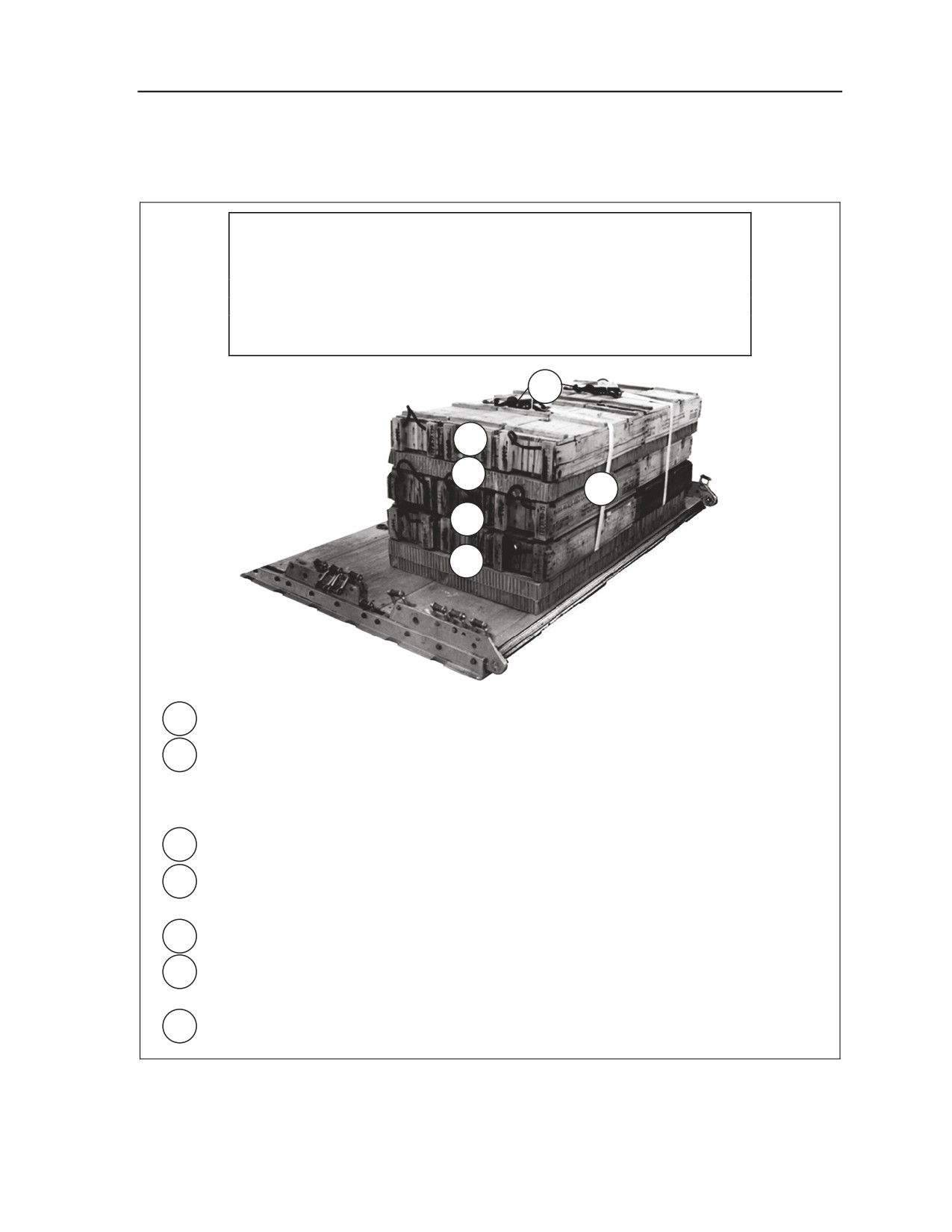
3-4. Position and secure 18 boxes of 105-MM ammunition on the platform as shown in Figure 3-5.
CAUTION
The accompanying load must weigh at least 2,000 pounds, but not
more than 2,100 pounds. The center of balance is critical for this
load.
7
6
5
3
4
FRONT
2
1 Cut three 78 ½- by 36-inch pieces of honeycomb. (Not Shown)
2 Center two 78 ½- by 36-inch pieces of honeycomb 1 inch from the front edge of the
platform.
Note: Leave room for the front end board to set on the platform.
3 Evenly space two 15-foot lashings on the honeycomb.
4 Position 12 boxes of ammunition on the pre-positioned lashings to form two layers of
ammunition.
5 Place a 78 ½- by 36-inch piece of honeycomb on top of the second layer of ammunition.
6 Position six boxes of ammunition on top of the 78 ½- by 36-inch piece of honeycomb to
form a third layer of ammunition.
7 Secure the pre-positioned lashings on top of the boxes of ammunition.
Figure 3-5. Accompanying Load Positioned on the Platform
16 November 2006
FM 4-20.167/TO 13C7-16-171
3-5
Chapter 3
BUILDING ENDBOARDS AND LASHING THE ACCOMPANYING
LOAD
3-5.
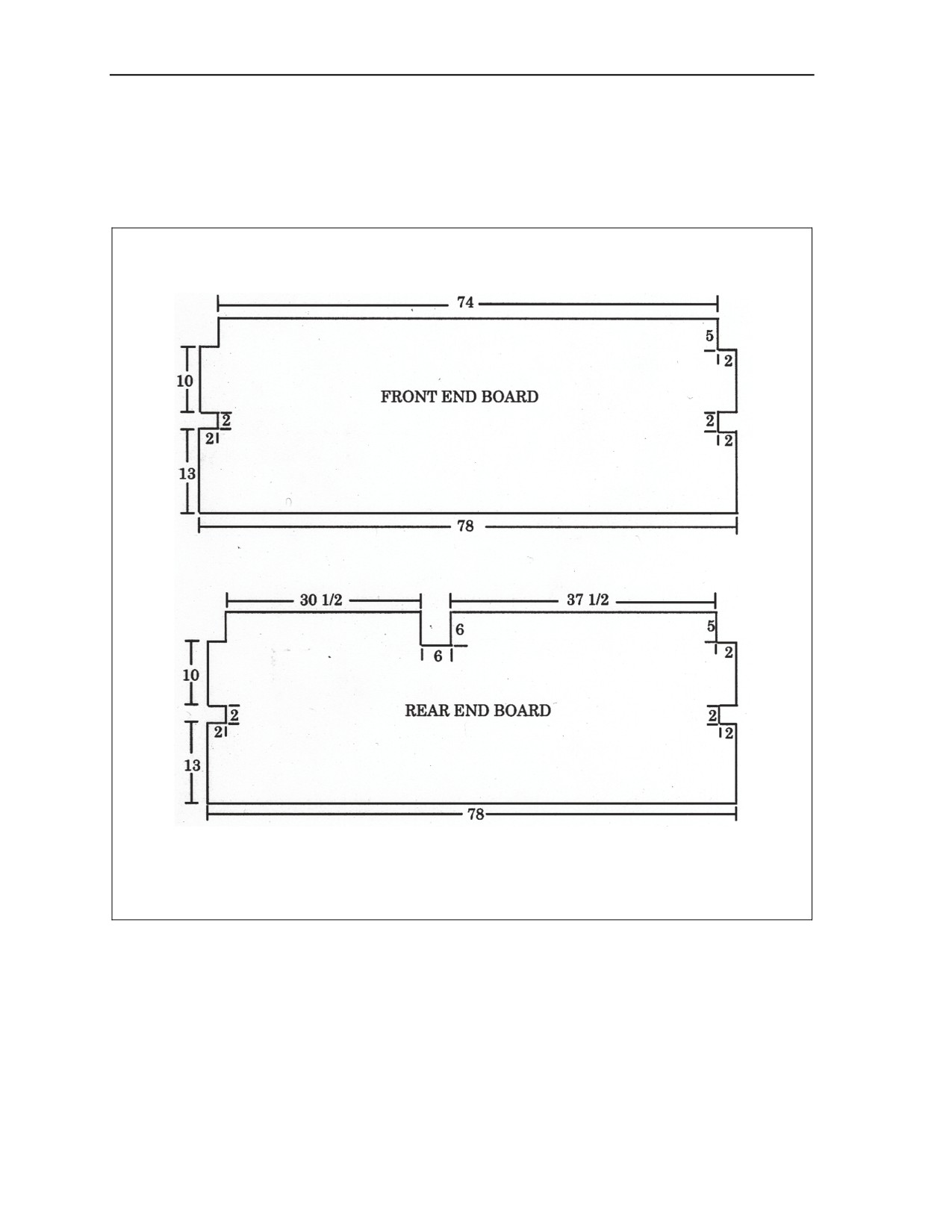
Build the endboards for accompanying load as shown in Figure 3-6.
Notes.
1. Not drawn to scale.
2. All dimensions are given in inches.
Step:
1. Construct two end boards using 30- by 78- by ¾ inch plywood.
Figure 3-6. Endboards for Accompanying Load Built
3-6
FM 4-20.167/TO 13C7-16-171
16 November 2006
Rigging M973A, 1 ½ -Ton Cargo Carrier Small Unit Support Vehicle (SUSV) on a Type V Platform for Low-
Velocity Airdrop
LASHING THE ACCOMPANYING LOAD
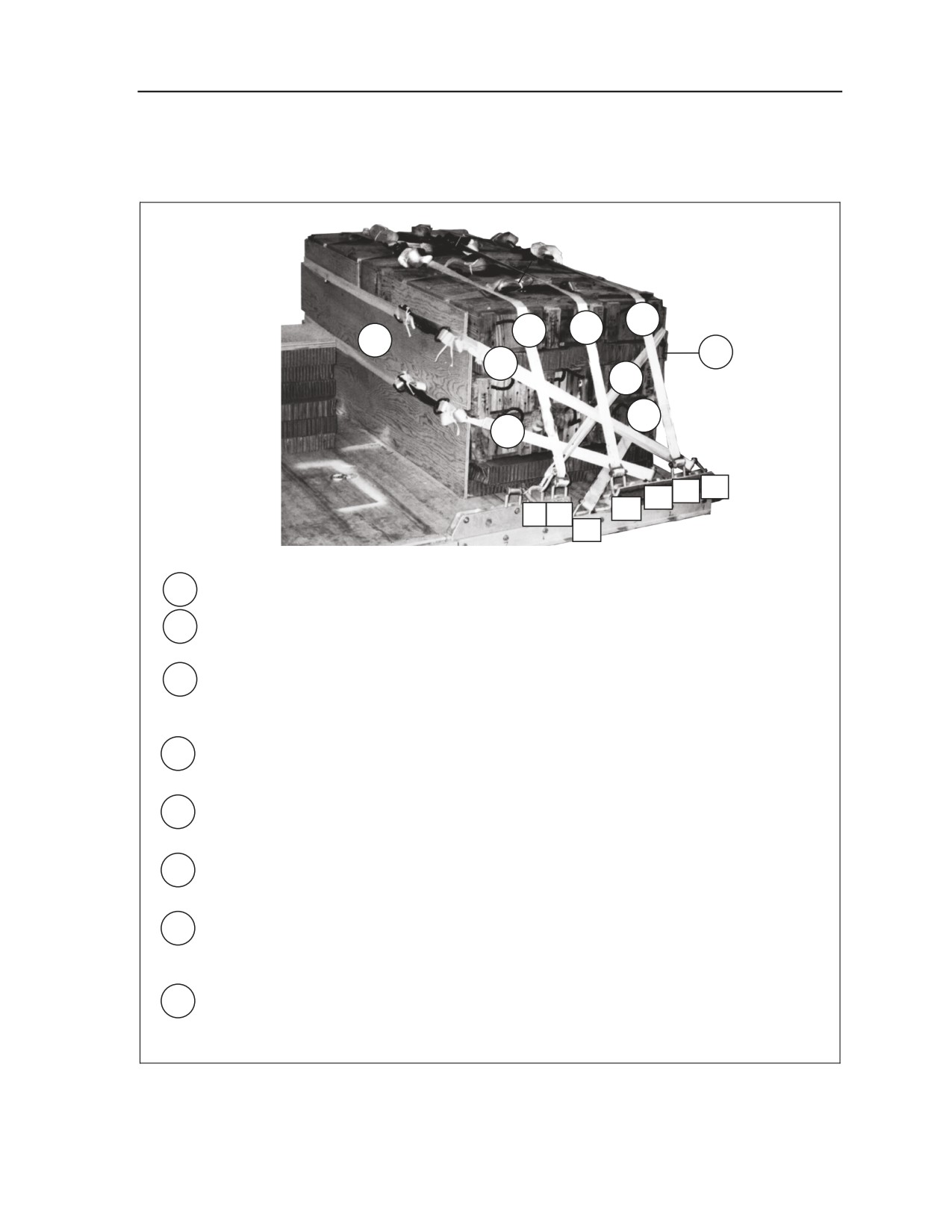
3-6. Lash the accompanying load as shown in Figure 3-7.
6
8
7
1
1
4
5
3
FRONT
2
1
2
3
4
7
6
5
1
Position the end boards against the front and rear of the ammunition boxes.
2
Route a 30 foot lashing through the bottom notches of the rear end board, through clevises
3 and 3A. Secure the lashings with two D-rings and a load binder on the rear end board.
3
Route a 30 foot lashing through the bottom notches of the front end board, through
clevises 5 and 5A. Secure the lashings with two D-rings and a load binder on the front
end board.
4
Route a 30 foot lashing through the top notches of the rear end board, through clevises 1
and 1A. Secure the lashings with two D-rings and a load binder on the rear end board.
5
Route a 30 foot lashing through the top notches of the front end board, through clevises
7 and 7A. Secure the lashing with two D-rings and a load binder on the front end board.
6
Route two lashings, one through clevis 2, the other through clevis 2A, back through
their own D-rings and up between the carrying handle and the box on the top layer of
ammunition. Secure the lashings with two D-rings and a load binder on top of the load.
7
Route two lashings, one through clevis 4, the other through clevis 4A, then back through
their own D-rings behind the carrying handle on the top layer of ammunition. Secure the
lashings with two D-rings and a load binder on top of the load.
8
Route two lashings, one through clevis 6 and the other through clevis 6A, then back
through their own D-rings behind the carrying handle on the top layer of ammunition.
Secure the lashings with two D-rings and a load binder on top of the load.
Figure 3-7. Accompanying Load Lashed
16 November 2006
FM 4-20.167/TO 13C7-16-171
3-7
Chapter 3
PREPARING THE SUSV
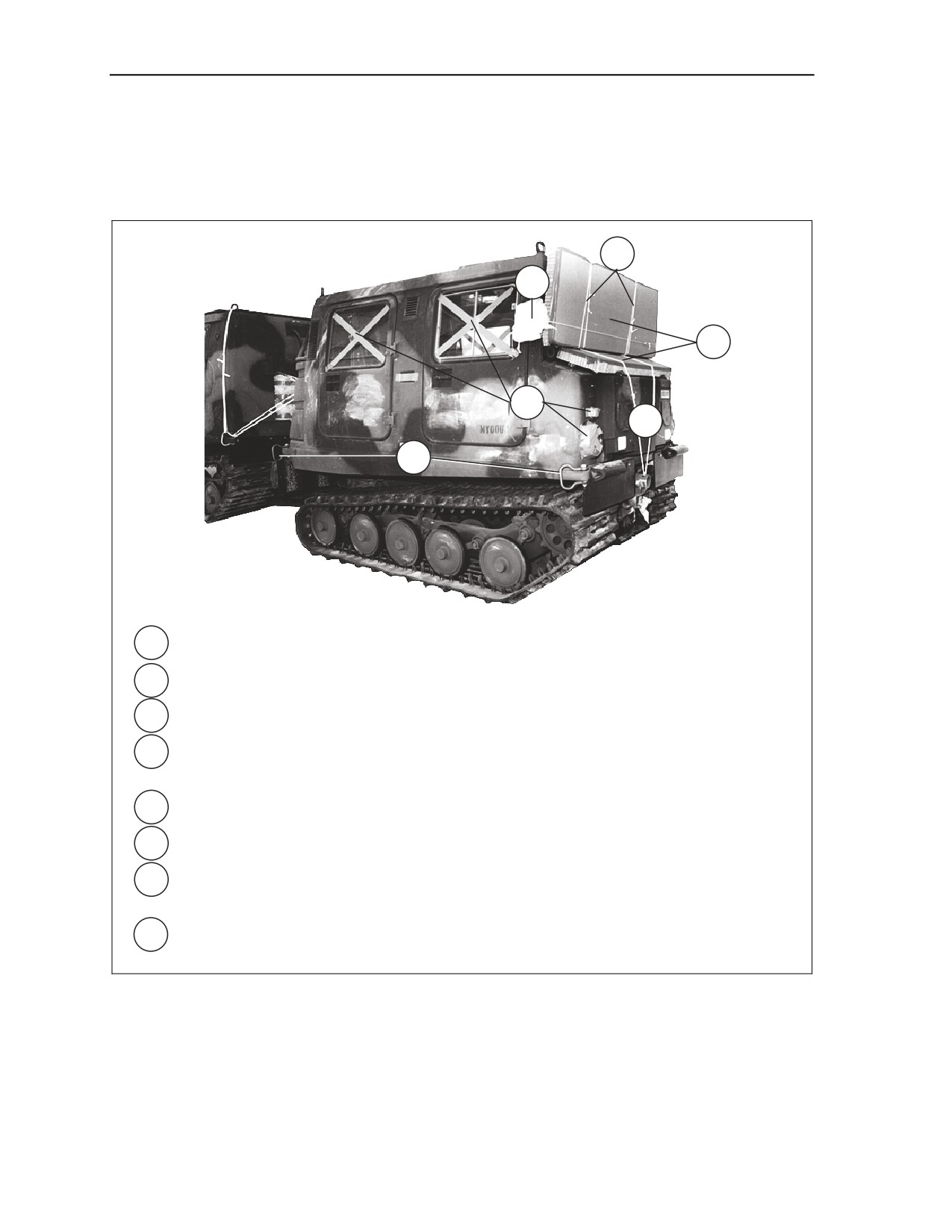
3-7. Prepare the SUSV as follows: Prepare the front car as shown in Figures 3-8 and 3-9. Prepare the
rear car as shown in Figures 3-10 through 3-12. Prepare the inside of the rear car as shown in Figure 3-13.
4
3
4
2
4
FRONT
5
1 Make sure each of the two fuel tanks are ¾ full. (Not Shown)
2 Tape the front headlights, turn signals, windows, and side reflectors.
3 Pad and tape both outside mirrors with cellulose wadding.
4 Fit and position two pieces of honeycomb to cover the windshield and front grill and secure
in place using type III nylon cord.
5 Install a medium clevis in each of the four holes on the four corners of the front car.
6 Tape the instrument panel gauges inside the driver’s compartment. (Not Shown)
7 Tape the opening on the left side of the air breather on the rear of the front car. (Not
Shown)
8 Secure the steering wheel to the seat frame with type III nylon cord. (Not Shown)
Figure 3-8. Front Car Prepared
3-8
FM 4-20.167/TO 13C7-16-171
16 November 2006
Rigging M973A, 1 ½ -Ton Cargo Carrier Small Unit Support Vehicle (SUSV) on a Type V Platform for Low-
Velocity Airdrop
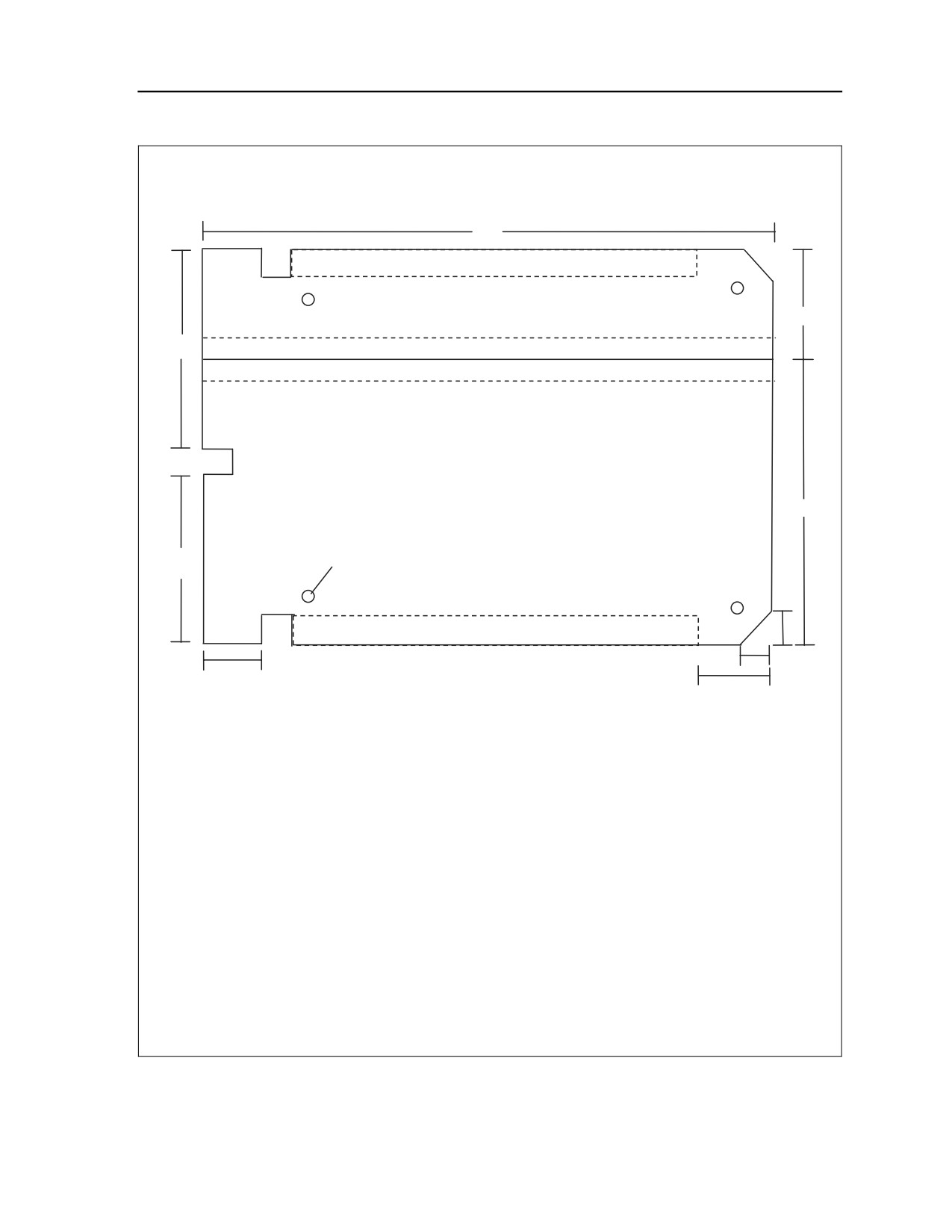
Notes.
1. Not drawn to scale.
2. All dimensions are given in inches.
3. All holes are 1 inch in diameter.
4. Use 8d nail
96
4
2 X 4 X 72
4
14 X 96 X ¾ INCH PLYWOOD
14
29 ½
2 X 6 X 96
FRONT CAR
4
5
48 X 96 X ¾ INCH PLYWOOD
48
28 ½
1 INCH HOLE
4
4
2 X 4 X 72
4
12
8
Steps:
1. Prepare a roof protector board for the front car using a 48- by 96- by ¾- inch piece of plywood and a
14- by 96- by ¾- inch piece of plywood.
2. Join the pieces of plywood in step 1 by nailing a 2- by 6- by 96-inch piece of lumber on the bottom
of the seam.
3. Make the cutouts in the plywood using the above dimensions.
4. Cut 1 inch holes in the locations shown.
5. Nail a 2- by 4- by 72-inch piece of lumber to the bottom left side of the roof protector 12 inches
from the front edge and flush with the side.
6. Nail a 2- by 4- by 72-inch piece of lumber to the bottom right side of the roof protector 12 inches
from the front edge and flush with the side.
7. The plywood roof protector board for the front car will be positioned and secured after the load is
positioned on the platform. (Not shown)
Figure 3-9. Front Car Roof Protector Board Built
16 November 2006
FM 4-20.167/TO 13C7-16-171
3-9
Chapter 3
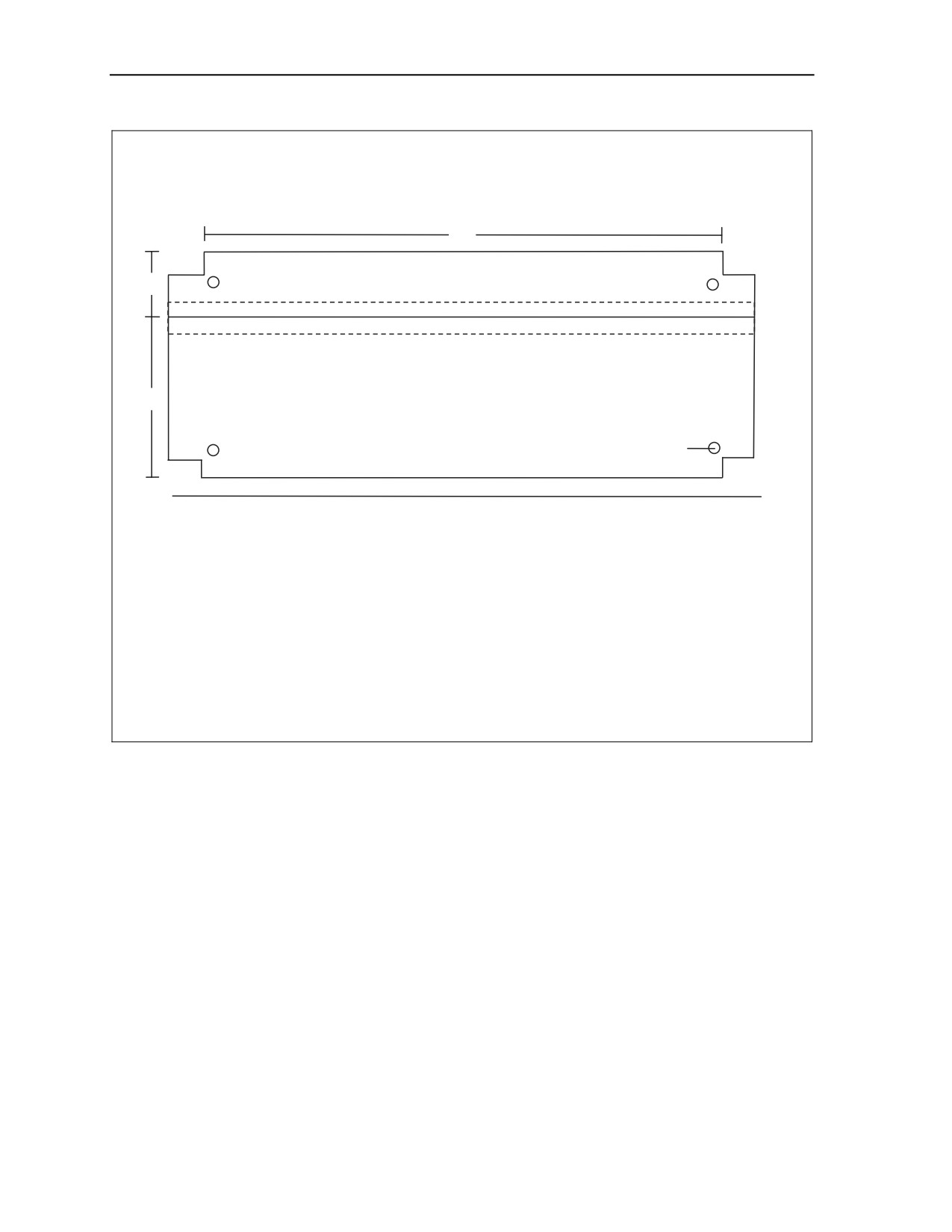
Notes.
1. Not drawn to scale.
2. All dimensions are given in inches.
3. All holes are 1 inch in diameter.
86
2
14
14 X 96 X ¾ INCH PLYWOOD
5
8 X 96 X ¾ INCH PLYWOOD
48 X 96 X ¾ INCH PLYWOOD
48
REAR CAR
1 INCH HOLE
Steps:
1. Build a roof protector board for the rear car using a 48- by 96- by ¾ -inch piece and a 14- by 96- by
¾ -inch piece of plywood.
2. Join the pieces of plywood in step 1 by nailing a 8- by 96- by ¾ -inch piece of plywood on top of
the seam.
3. Make cutouts on the corners of the plywood using dimensions given above.
4. Cut 1 inch holes in the locations shown.
Figure 3-10. Rear Car Roof Protector Board Built
3-10
FM 4-20.167/TO 13C7-16-171
16 November 2006
Rigging M973A, 1 ½ -Ton Cargo Carrier Small Unit Support Vehicle (SUSV) on a Type V Platform for Low-
Velocity Airdrop
FRONT
3
4
6
1
5
2
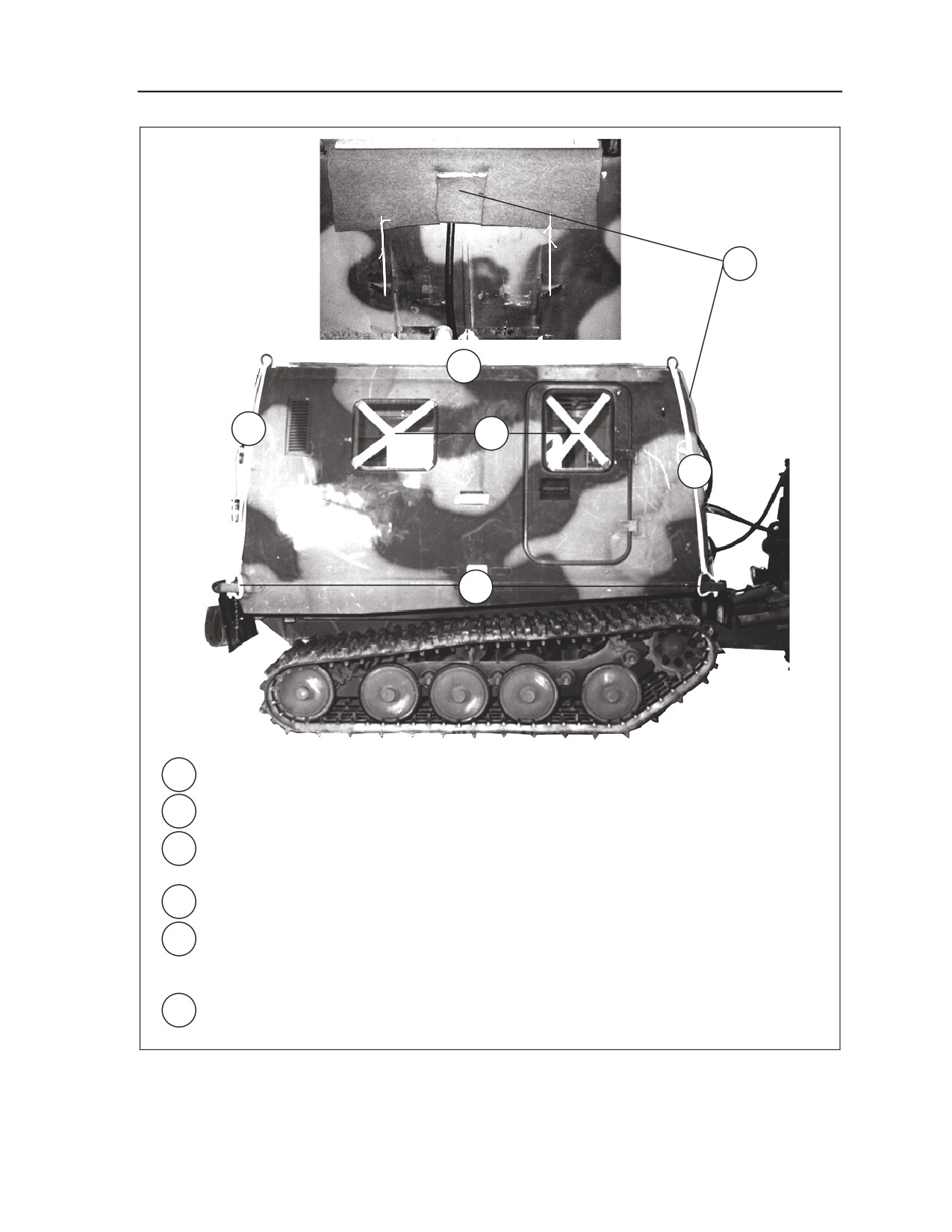
1 Tape the turn signals, windows and side reflectors.
2 Install a medium clevis in each of the four holes on each corner of the rear car.
3 Place a piece of 25- by 96-inch felt padding over the front of the rear car. Secure the felt
with type III nylon.
4 Position the roof protector board made in Figure 3-10 on top of the rear car.
5 Secure the roof protector board by passing a length of ½-inch tubular nylon webbing
through the right rear hole of the protector board, through the right front lifting point and
medium clevis of the rear car.
6 Repeat step 5 for the other three corners of the car.
Figure 3-11. Rear Car Roof Protector Board Secured
16 November 2006
FM 4-20.167/TO 13C7-16-171
3-11
Chapter 3
REAR
FRONT
2
3
1
4
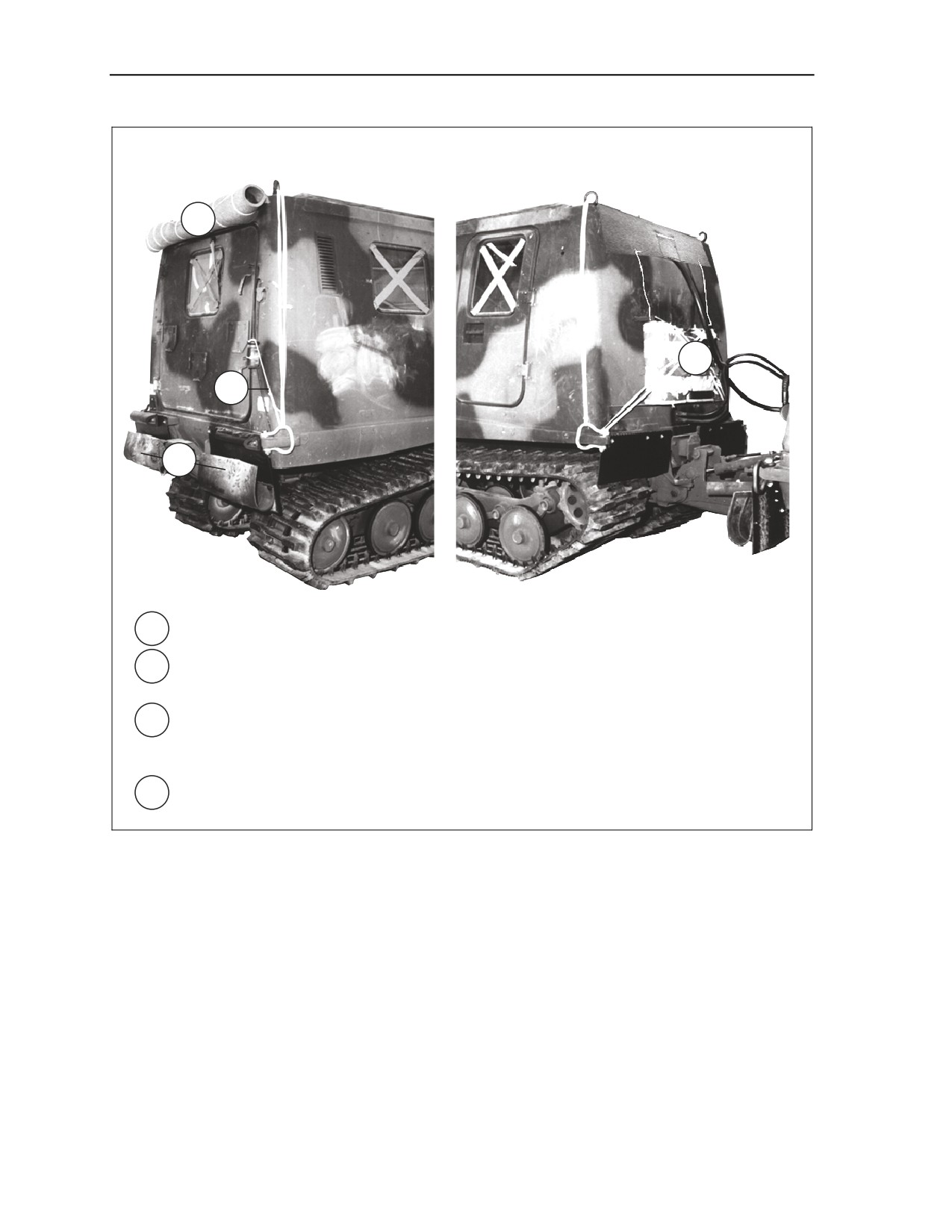
1 Secure the trailer tail light cord with a length of type III nylon cord.
2 Wrap a 18- by 57-inch piece of felt padding over the rear tail lights. Secure the felt
padding in place using pieces of type III nylon cord.
3 Pad and tape two fuel cans with cellulose wadding. Strap the fuel cans on the front of the
rear car in their stowage compartments. Secure the fuel cans using two lengths of ½-inch
tubular nylon webbing.
4 Raise the rear mud flaps and secure them in place with their own hook buttons.
Figure 3-12. Rear Car Prepared
3-12
FM 4-20.167/TO 13C7-16-171
16 November 2006
Rigging M973A, 1 ½ -Ton Cargo Carrier Small Unit Support Vehicle (SUSV) on a Type V Platform for Low-
Velocity Airdrop
6
1
2
3
5
4
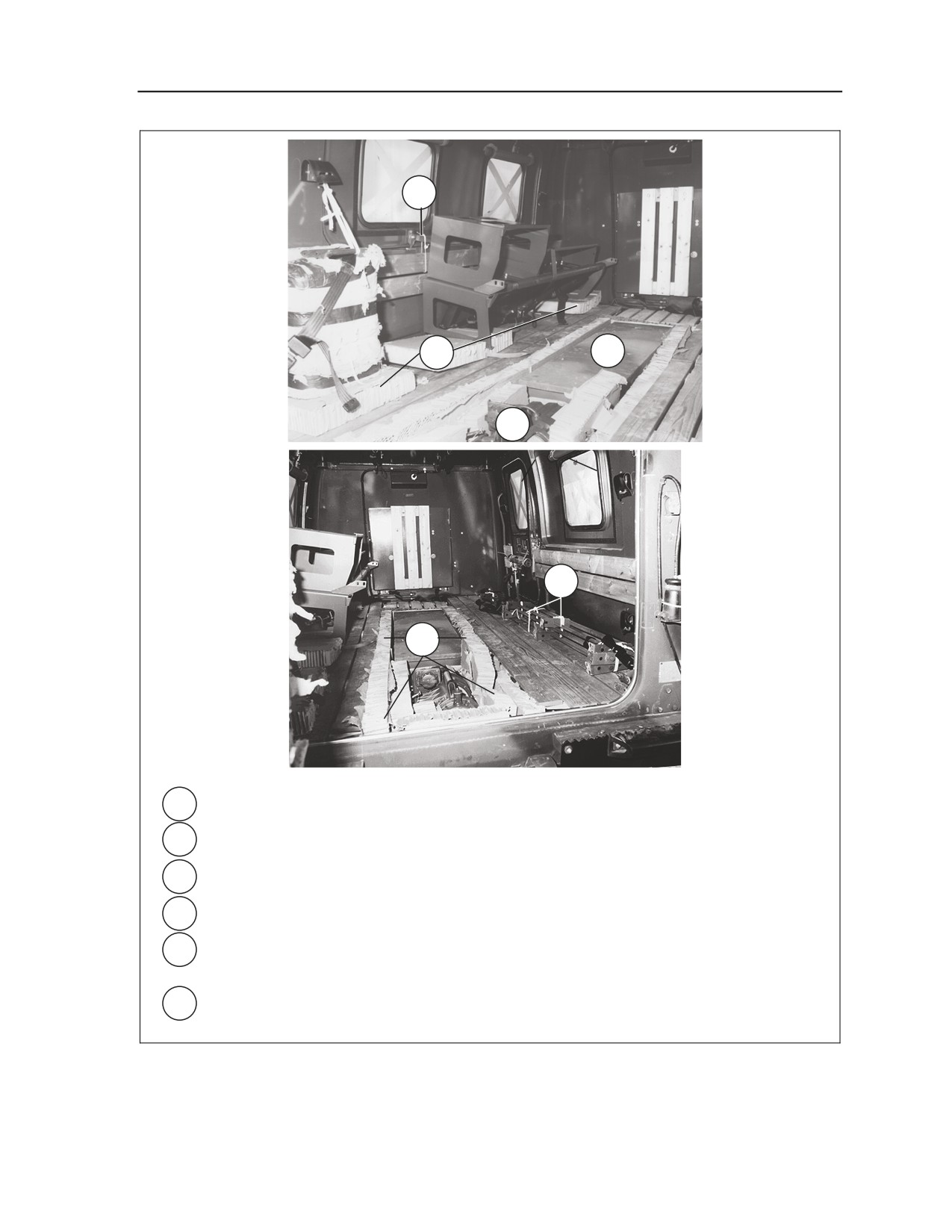
1 Place a layer of honeycomb under the troop seats in the rear car.
2 Place the operator’s vehicle maintenance (OVM) box between the troop seats.
3 Disconnect the winch and place it to the rear of the OVM box.
4 Use pieces of honeycomb as filler around the OVM box and the winch.
5 Place the rear car roof racks on the right troop seats. Secure the racks to the seats using
½-inch tubular nylon.
6 Secure the emergency escape window handles using type III nylon cord to the back of the
left troop seats.
Figure 3-13. Inside of Rear Car Prepared
16 November 2006
FM 4-20.167/TO 13C7-16-171
3-13
Chapter 3
7
8
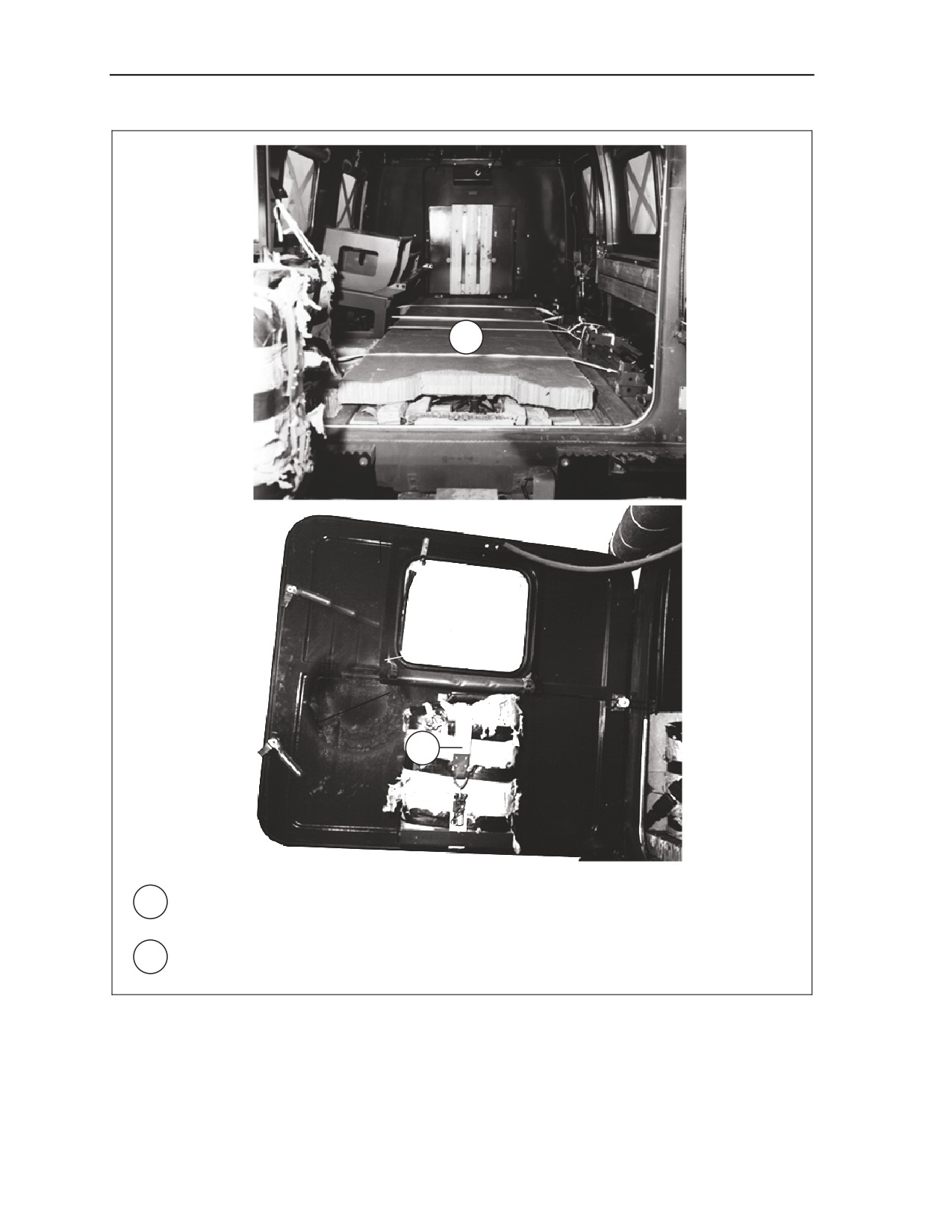
7 Place a layer of honeycomb on top of the OVM box and winch. Secure the honeycomb in
place using four pieces of ½-inch tubular nylon webbing.
8 Pad and tape an additional fuel can with cellulose wadding. Place the fuel can on the
inside of the rear door and secure it with the securing straps provided.
Figure 3-13. Inside of Rear Car Prepared (Continued)
3-14
FM 4-20.167/TO 13C7-16-171
16 November 2006