FM 4-30.1 MUNITIONS DISTRIBUTION IN THE THEATER OF OPERATIONS (DECEMBER 2003) - page 3
_____________________________________________
Interim Objective Force Munitions Operation
3-70. As a force multiplier, it provides a modular ammunition platoon access
to expert load planning guidance. The logistics units will be able to adapt to
changes in the maneuver course of action plans to provide rapid and ensured
distribution of munitions as required without negatively impacting the battle
plan. It supports the distribution need to rapidly configure loads by user
need, reduces CWTs, and provides logistics support to the end user.
MUNITIONS SURVIVABILITY SOFTWARE
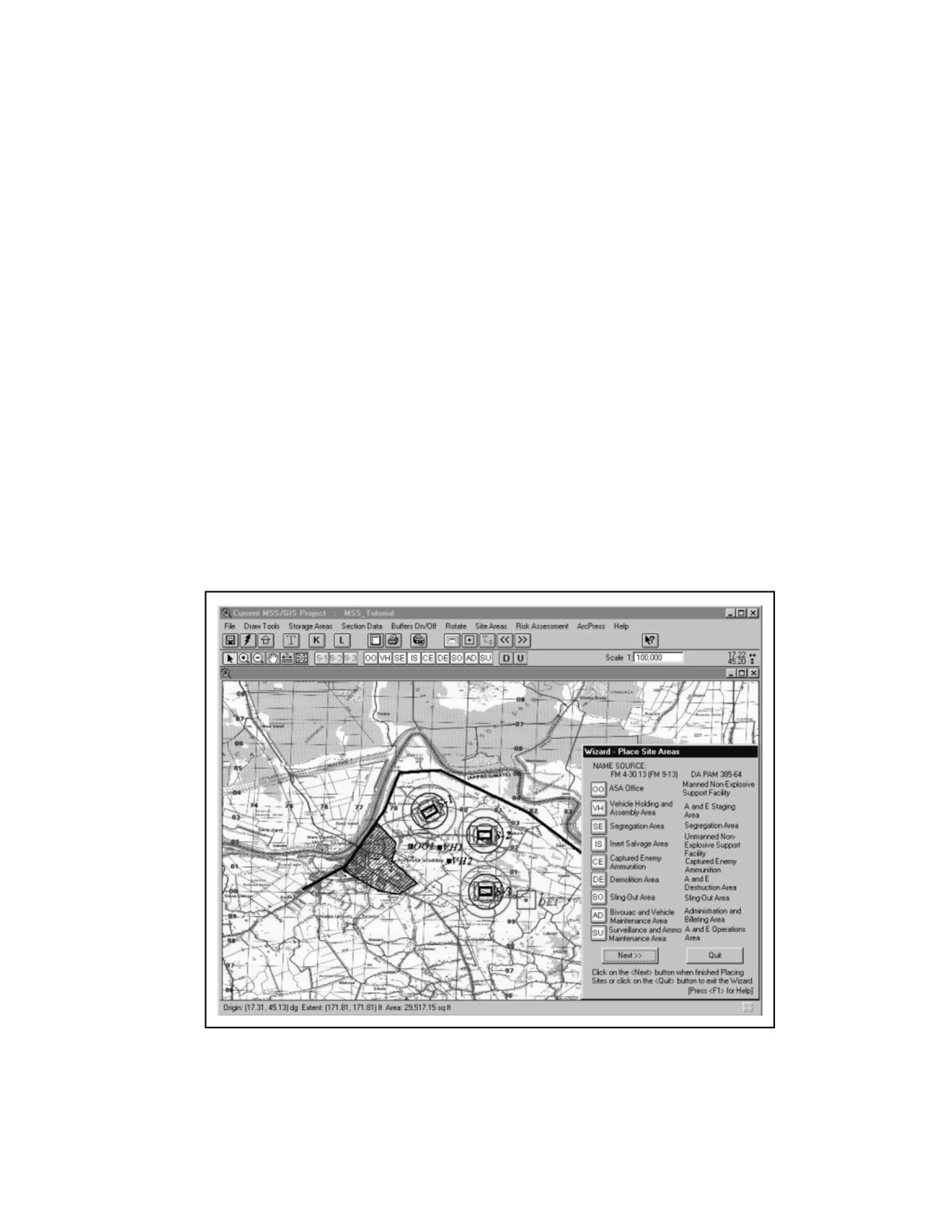
3-71. Munitions survivability software
(MSS) is a computer program
designed to aid the soldier or ammunition logistician in quickly establishing
safe field ammunition storage areas. MSS automates quantity distance
calculations ensuring ammunition storage areas have maximum
survivability and a reduced logprint. Personnel can use the software to
analyze the stockage objective and plan ammunition storage areas in
advance, as well as react quickly and correctly to changing situations. This
system will provide a 3-D display of the supply or staging area with overlays
of unique geography features and structures, recommended areas for storage,
overlays of safety protocols that will point out risk areas, and a set of
recommended actions that will mitigate the risk areas that are determined.
MSS is designed to interface with the ammunition accountable system,
SAAS-MOD, and operates from the SAAS-MOD computer. MSS 2, is an
improved and more capable program, and will be capable of operating on the
SAAS-MOD or stand-alone computers. Figure
3-9 illustrates munitions
survivability software.
Figure 3-9. Munitions Survivability Software
3-21
FM 4.30-1 (FM 9-6) __________________________________________________________________
DIGITIZED AMMUNITION TRACKING
3-72. Ammunition movement will be tracked within the CONUS from initial
storage depots and production/assembly plants, through intermodal
convergence points at airports and seaports of embarkation (APOEs/SPOEs)
to subsequent loading on rapid movement aircraft and ships by battle
command logisticians. Tracking will continue through movement to combat
theater airports and seaports of debarkation (APODs/SPODs) through battle
command logistics activities in the theater and, ultimately, to the combat
units or ammunition distribution points. Receipt at the combat user or an
ammunition distribution point will be reported back through the knowledge-
based digital network system.
3-73. A critical element in this advanced knowledge-based digital network
system will be attaining and maintaining ITV and TAV of all ammunition
within the system. ITV and TAV will be achieved due to advanced microchip
technology in logistics applications (MITLA) used with advanced computer
technology, satellite tracking, and advanced satellite communications.
MITLA-embedded containers will be tracked from their loading in the
CONUS through their movement within the entire transportation system,
and finally to their arrival at the combat user. MITLA will constantly
monitor the status of each container’s movement in the logistics management
system and will provide real-time requisition status for all ammunition in
the supply pipeline.
PRECISION AND MULTIPURPOSE MUNITIONS
3-74. Ammunition design and acquisition for the future will continue to focus
on advanced technology and devastating lethality for smart and brilliant
munitions. Future applications include increasing the use of particle beam,
electric rail guns, and weapon lasers; replacing solid propellant with liquid
propellant; integrating robotics into ammunition operations; and replacing
various fuzes with a single multifunctional fuze fitted to a multifunctional
projectile. The single multifunctional fuze will also be able to self-destruct if
the round does not function as designed. Self-destruct fuzes will reduce
unexploded ordnance
(UXO) problems encountered during maneuver
operation post-battle cleanups. Design and acquisition will also aggressively
focus on developing a stand-alone, integrated, multifunctional cannon
artillery round that requires no component assembly. This integrated round
will replace the current multicomponent round, and reduce the large volume
and high tonnage components used today. Design and acquisition will also
focus on improved packaging techniques, increased ballistic protection, and
easier handling procedures.
3-22
Chapter 4
Munitions Planning
The objective of the munitions distribution system is to provide munitions
at the right time, place, and quantity to ensure the success of an
operation. Munitions planning and operations must be versatile. They
must complement combat plans and operations, and improve the ability of
the supported unit to accomplish its mission. The supported commander’s
concept of operations, priorities, and allocations dictate the actions of the
ammunition planner. Ammunition planning includes—
z
Determining ammunition requirements.
z
Echeloning capabilities and ammunition units.
z
Establishing split-based operations.
z
Preconfiguring ammunition basic loads and resupply amounts.
z
When required, using civilian, contractor, allied, and HN capabilities.
PLANNING CLASS V REQUIREMENTS—CONVENTIONAL AMMUNITION
ALLOCATIONS
4-1. The Army G8 is responsible for developing munitions programming and
budgeting requirements. The Army G3 determines the requirements
essential to support a strategy, campaign, or operation. During a conflict,
resupply quantities must constantly
CONTENTS
be reviewed and adjusted based on
Planning Class V Requirements—
historical usage data gathered as the
Conventional Ammunition
conflict progresses.
Allocations
4-1
Transition to Full Spectrum
OPERATIONAL PLANNING FACTORS
Operations
4-4
4-2. The United States Army
Post-Operational Transition
4-5
Combined Arms Support Command
(USACASCOM) validates the munitions operational planning factor. The
Army G4 is the approving agency. The automated operational logistics
(OPLOG) planner is the authorized method for determining munitions
planning data at all levels. FM 101-10-1 (FM 101-10-2) is no longer an
authorized tool for determining operational ammunition planning factors.
Ammunition consumption rates for all operations, including stability and
support operations, are determined using the OPLOG planner. Units base
their ammunition requirements on METT-TC, their projected mission, and
the supported commander’s concept of the operation and intent. Developing
ammunition requirements for using units is the responsibility of their
operations section.
AMMUNITION BASIC LOAD
4-3. The ammunition basic load (ABL) is that quantity of ammunition either
allocated or issued (depending on the MACOM policy) to a unit to sustain its
4-1
FM 4.30-1 (FM 9-6) __________________________________________________________________
operations in combat until it can be resupplied. Basic load requirements are
based on the unit weapon density and mission requirements. Units must be
able to transport ABLs using organic vehicles, equipment, and personnel.
MUNITIONS CONTROL PROCEDURES
4-4. To sustain tactical operations for specific periods, units determine their
munitions requirements and submit a RSR. The RSR is the amount of
ammunition that a maneuver commander estimates will be needed to sustain
tactical operations without ammunition expenditure restrictions over a
specified time. The RSR is expressed as rounds per weapon (on-hand) per
day, or as a bulk allotment per day or per mission. RSR computations and
routing are performed by unit S3s/G3s. As such, it is not a logistics function,
but the S4/G4 should assist in the process. RSRs can be computed using
manual or automated procedures. Weapon density (WD) and mission are key
to determining the RSR.
DETERMINING THE RSR/CSR
4-5. RSRs are developed by maneuver commanders and submitted to the
next higher HQ. HQ at each level reviews, adjusts, and consolidates RSR
information and forwards it through command channels. The ARFOR
determines the CSR by comparing the total unrestricted ammunition
requirements against the total ammunition assets on-hand or due-in. Several
factors limit the amount of ammunition available for an operation (such as
stockage or lift capabilities). Accordingly, ammunition issues are controlled
by CSRs. The ARFOR establishes the CSR, which is based on the amount of
munitions available for issue. When a munitions item is in short supply, the
CSR is low. The commander determines who receives the ammunition. The
DAO informs the G3 of the quantity available.
4-6. The ARFOR commander gives the corps commanders the CSR for each
ammunition item. The CSR may vary from corps to corps, based on the
mission objectives and corps priorities, the projected threat, and ammunition
availability. The corps gives subordinate combat commanders their unit CSR.
Each combat commander gives the CSR to each subordinate combat
commander. Commanders making CSR allocations to subordinate units
should retain a portion of the CSR to meet unforeseen contingencies. The
CSR is disseminated to units through the OPORD. The CSR should appear in
the OPORD in paragraph 4, or in either the service support or fire support
annex. The ammunition requirements of other services and coalition
members must be considered when computing the RSR and CSR.
PLANNING MUNITIONS SUPPORT OPERATIONS
4-7. A review of U.S. Army involvement in recent operations clearly indicates
the need to improve logistical planning. Plans must be developed to support
all levels of combat operations/stability and support operations. It is critical
that Class V support planning be detailed and threat-based. For more
information, refer to FM 3-0.
4-8. Ammunition units will apply this guidance when developing plans to
support the ASCC or combatant commander’s plans and priorities.
4-9. Ammunition support planners must anticipate support requirements for
operational campaigns by planning for forward logistics bases and extending
lines of support. As tactical developments render earlier support plans
4-2
________________________________________________________________Munitions Planning
obsolete, ammunition support planners formulate new ones. For more
information on CSS, refer to FM 4-0.
4-10. The unit commander must identify the logistical support structure that
will sustain the unit. This type of contingency planning must be established
during peacetime so the unit can develop detailed SOPs and plans. At a
minimum, the following factors must be considered during planning:
z
Local points of contact (POCs) for unit support (such as computer;
engineer; signal; security; defense; transportation; and petroleum,
oils, and lubricants [POL]).
z
Status charts for unit personnel, equipment, and ammunition,
including organic basic load (see FM 4-30.13, appendix A).
z
Replacements for equipment, personnel, authorized stockage list
(ASL), and prescribed load list (PLL).
z
Factors affecting the mission
(such as stock objectives, chain of
command, site locations/grid coordinates of supported units,
identifying supporting MMC, corps movement control battalion
[CMCB], QASAS, and hazardous materiel
[HAZMAT] certified
personnel).
z
Equipment staging location and procedures.
z
Organization of march units.
z
Organization of duties for advance and rear parties and the
reconnaissance element.
z
Densities and speeds for different types of moves.
z
C4ISR procedures.
z
Actions to take in the event of attack.
z
Accident and maintenance procedures.
z
Messing and refueling procedures.
z
Communications methods.
z
Load plans for personnel, equipment, and ammunition-related
materiel.
z
Night operations.
z
Continuity of operations plan (COOP).
z
Directional signs, fire symbols, and stack signs sufficient for three
storage locations.
z
Retrograde operations.
z
Identification of QASAS source organization and the method of
acquiring support.
STANDING OPERATING PROCEDURES
4-11. External SOPs of ammunition units are based on logistical SOPs of the
command organizational element. They provide guidance in developing SOPs
for supported units to facilitate the ammunition support process. At a
minimum, external SOPs must cover the following:
z
Unit and Class V WHNS.
z
Communications, engineer, and transportation support.
z
Safety.
z
Ammunition issue and turn-in procedures.
z
Protecting ammunition from the elements.
z
Emergency resupply procedures.
4-3
FM 4.30-1 (FM 9-6) __________________________________________________________________
4-12. At a minimum, internal SOPs must cover the following:
z
Deployment (such as staging) procedures.
z
Field setup (including storage, perimeter defense, and storage facility
layout plans).
z
Operational procedures
(including ammunition receipt, storage,
issue, and maintenance operations).
z
Links to the C2 element.
z
Routine and emergency destruction plans.
z
Fire-protection plans and other safety concerns.
z
Air resupply procedures.
z
Logistical plans for required augmentation elements (such as QASAS
personnel).
z
Coordination for security with external agencies/units.
TRANSPORTATION
4-13. Modular ammunition platoons are
100 percent mobile, minus
ammunition stocks. They must coordinate unit movement through their
supporting higher HQ. For information on motor transportation request
procedures, see FM 4-01.30 (FM 55-10).
TRANSITION TO FULL SPECTRUM OPERATIONS
4-14. The transition from a peacetime mission to a wartime mission, and the
move from an installation, post, camp, or activity are major steps for
ammunition units. Commanders must ensure that officers and NCOs
understand the transition process, and that unit training is given priority.
This understanding and training prepare the unit to deploy to its assigned
area, and perform its mission effectively and efficiently. During movement,
units must continue to execute contingency plans and tactical operations.
When a move is to be made, the following must be considered:
z
Planning.
z
Equipment and personnel.
z
Transportation.
z
Reconnaissance and site selection.
z
Area preparation and layout.
z
Defense, security, and area damage control.
4-15. Command elements analyze many factors when making decisions
concerning unit deployment. These factors include the following:
z
Location or theater of deployment.
z
Operational situation (such as forced or permissive entry).
z
Date and time of deployment.
z
Support structure in the theater.
4-16. Many deployment decisions are made based on answers to critical
questions. Questions that must be addressed prior to deployment include the
following:
z
Will the deployment be as a unit, and will advance, main, and rear
parties be required?
z
Will the deployment be in phases?
z
What organization will act as the POC in the theater?
z
What is the deployment mission (such as forward in support of a
brigade-, corps-, or division-size force)?
4-4
________________________________________________________________Munitions Planning
z
What is the theater situation?
4-17. The warning order for deployment normally includes the general
location of the area in which the unit will conduct its operations, the
movement date, and a list of special requirements or instructions. When
notified of an impending move, the unit commander alerts unit personnel
and initiates planning. The move is coordinated with the supporting C2
element and transportation activity. The commander determines the type of
move to be made (unless specified), requests additional transportation as
necessary, takes steps to phase out current operations, and schedules a
reconnaissance of the area.
4-18. Rapid, efficient deployments are subject to the detailed contingency
planning and preparation of simplified field SOPs. To ensure a successful
move under stressful conditions, unit training must employ these
contingency plans and SOPs, making adjustments as necessary, until
procedures are understood thoroughly by all unit personnel. See FM 4-30.13,
appendix B, for guidance commanders can use in preparing for deployment.
It is probable there will be a continuing need to forecast and manage training
ammunition effectively. See FM 4-30.13, appendix C, for information and
guidance.
POST-OPERATIONAL TRANSITION
4-19. One of the major missions of ammunition support units, following
completion of combat operations/stability and support operations, is the
retrograde of Class V materiel and components. Retrograde operations often
signal the beginning of the redeployment process (see chapter 5). The same
amount of detail given to transitioning to combat operations/stability and
support operations should be given to redeployment operations. Post-
combat/stability and support operations transitions may constantly change.
Unit commanders must maintain close coordination and contact with their
C2 element to ensure their unit deployment is carried out as smoothly as
possible. Briefings should be conducted frequently to control rumors and
prevent erroneous information from having a negative effect on morale and
operations.
4-20. Command emphasis must be given to training for transition to and
from combat operations/stability and support operations. Scenario-based
training is often the most effective method since preplanning and transitions
can be emphasized separately. A unit’s ability to develop situational SOPs
may be dependent on logistical guidance from their C2 element and higher
logistical HQ. However, it is always appropriate to maintain a standard SOP
package that can be tailored to meet operational requirements. Preplanning
and training can ease the strain and stress characteristic of deployment, unit
movement, and redeployment.
4-21. Combat operations and stability and support operations require
detailed munitions support planning consistent with Army doctrine, logistics
characteristics, and support considerations. Support planners must adapt
quickly to changing requirements as a result of tactical successes.
Combat/stability and support operations and post-combat/stability and
support operations transitions are major missions of munitions units.
4-5
Chapter 5
Miscellaneous Munitions Operations
During Operation Just Cause, Operation Urgent Fury, Operation Desert
Shield, Operation Desert Storm, and Operation Joint Endeavor, huge
amounts of munitions were requisitioned, shipped, received in theater,
and issued to deploying forces. During Operation Desert Storm, selective
dunnage (wood and steel I beams) was removed from containers, used as
overhead cover for fighting positions, and never recovered. A large part of
these munitions were not expended. An extensive retrograde operation for
a lengthy period of time was required to recover, restore, and prepare
these munitions for return to depots in the CONUS and preposition
storage sites in other theaters.
PURPOSE AND SCOPE
5-1. Retrograde operations must be included during the initial planning of
every exercise and operation, not when the exercise/operation is drawing to a
close. Planning and responsibility for
retrograde operations depends on the
CONTENTS
theater. Based on the mission
Purpose and Scope
5-1
Redeployment and Retrograde
5-1
requirements and characteristics of
the force
to
be supported,
responsibility
can
range from an
ammunition group to a platoon. Retrograde operations of munitions are a
major logistics challenge. Prevention of soldier casualties from improper
handling and repackaging of munitions is a leader responsibility. Leaders
often fail to enforce discipline during the unpacking, restoration, and
reconstitution of ammunition.
5-2. This chapter provides information on what leaders must do to return
ammunition to a serviceable condition upon termination of a conflict. Well
before the operation ends, leaders must develop plans outlining retrograde
procedures. These plans must identify the tasks required to return
ammunition to its original packing configuration.
REDEPLOYMENT AND RETROGRADE
5-3. Upon completion of combat operations or stability and support
operations, the tedious job of identifying, preparing, repackaging,
requisitioning, collecting, loading, and shipping ammunition begins. These
tasks constitute the redeployment process and signal the start of the
munitions retrograde program within the ammunition supply system.
FM 4-30.13 provides detailed instructions on the munitions retrograde
program.
5-1
FM 4.30-1 (FM 9-6) __________________________________________________________________
5-4. Tremendous resources are needed to restore and repackage ammunition.
Planners may consider the use of indigenous assets, and contractor and HNS
assets. Before a redeployment begins and while combat operations are
raging, logistical planners monitor the levels of munitions in the theater and
estimate the packing materials needed to retrograde munitions to a CONUS
depot. During retrograde operations, munitions units continue to provide
munitions to security forces while relocating the excess to a CSA or TSA. To
support forward units, CSAs stock limited amounts of munitions behind with
selected combat forces or security forces.
RETROGRADE PLANNING
5-5. Operational planning incorporates a vast array of critical issues and
concerns. One of the key issues planners must address during the initial
phase is how to recover and retrograde ammunition remaining after the
operation or exercise ends. Redeployment plans differ significantly from the
deployment plans established before leaving the CONUS. Personnel, time,
equipment, and materiel become more important when the main effort is
directed at returning personnel and equipment to the CONUS, or other
theaters, as quickly as possible. At a minimum, planners should consider the
following:
z
Begin planning before the last battle.
z
Develop a retrograde system that consolidates materiel at various
stages (for example at the unit level to return to an ATP area).
z
Assign condition codes as far forward as possible. Also, make
decisions about which ASP should get certain items for further
consolidation or reconditioning.
5-6. For planning purposes, assume the following about the condition of
munitions in the unit’s or soldier’s possession:
z
Munitions have been removed from original packing.
z
Packing materials have not been retained by the users.
z
Munitions will require a serviceability or classification inspection.
5-7. At all levels, plans must incorporate retrograde operations. These plans
should include—
z
Retrograde responsibilities of HQ.
z
Obtaining and providing empty storage containers.
z
Structuring retrograde planning cells.
z
Identifying special requirements for classified, Category I, or critical
sensitive items.
z
Contacting the USALC to request specialized teams or personnel to
assist in retrograde.
z
Assigning responsibilities for the recovery of packing materials.
5-8. During the various stages of build-up and actual conflict, arrangements
must be established for the recovery and storage of packing materials. These
materials can occupy an extraordinary amount of space. Plans must be
implemented to backhaul packing materials to a central location or they
must be stored in a separate area near the CSA, or in any other area having
the capability and capacity. The following factors should be considered before
actual retrograde operations begin:
z
Existing logistical support: facilities, transportation assets, road
networks, communications requirements, and so forth.
z
Shipping point from theater.
5-2
___________________________________________________Miscellaneous Munitions Operations
z
Available HNS.
z
Available LOGCAP support.
5-9. Visibility and accountability must begin at the returning unit level. The
SPBS-R is the system used to gain accountability of munitions that have
been issued to units. If the ammunition is not accounted for on the SPBS-R,
accountability must begin at the ATP/ASP level. This is particularly true
with Category I
(GMLRs) and serial-numbered items. Accountability
problems increase during war; however, as much as possible, the
accountability of packing materials must be maintained. If this is done
successfully, shortages will be easier to identify and correct.
5-10. Generally, packing materials used by opposing forces should not be
used; they can be misidentified and usually are not of the proper size or
quality for U.S. items. However, they can be used for retrograde of captured
enemy items. A quality assurance specialist, ammunition surveillance
(QASAS) or other qualified person must make condition code decisions.
Munitions must be inspected to determine their serviceability, and every
effort should be made to provide packing materials as early as possible in the
retrograde process. If the munitions are in serviceable condition but have no
lot number, a local lot number may be assigned. These munitions are
considered as serviceable. During retrograde operations, unserviceable
munitions are typically destroyed. The responsible ammunition company
must request disposition instructions through the MMC to the USALC before
destroying the munitions.
Retrograde Turn-In
5-11. Using units normally return munitions identified for retrograde to the
ASA that provides their ammunition support. However, because of the
changing requirements of the modern battlefield, units may be directed to
turn in the identified ammunition and explosives to the nearest ASA. ASAs
collect, consolidate, and ship this ammunition as directed.
Captured Enemy Munitions
5-12. Captured enemy ammunition (CEA) must be kept separate from U.S.
munitions; however, it must be accounted for, stored, and guarded using the
same criteria that applies to U.S. munitions. If contractor/HNS is used for
retrograde operations, it must be negotiated early in the operation. During
retrograde operations, leaders must ensure safety policies and procedures are
carefully observed. These operations can be particularly hazardous for the
following reasons:
z
Careless attitudes may prevail. During Operation Desert Storm
numerous casualties occurred to coalition forces as a result of
mishandling captured and UXO.
z
Collection of battlefield souvenirs may include dangerous UXO.
z
Taking dangerous shortcuts may result in serious injury.
CAPTURED ENEMY AMMUNITIONS STORAGE
5-13. Enemy ammunition found is considered excess and treated as such.
AR 381-26 requires that one of three options be taken when there is excess
ammunition on the battlefield: use, destroy, or secure and retrograde. Except
for use, all of these options apply to CEA. CEA includes all types of
munitions. Assessing the serviceability of CEA will require the support of the
QASAS.
5-3
__________________________________________________________________
FM 4.30-1 (FM 9-6)
5-14. The ammunition company will require close support of EOD prior to
any CEA handling operation to ensure safety of munitions personnel in
accordance with FM 4-3.13, chapter 12. This mission requires TECHINT
support out of INSCOM.
5-15. When an enemy ammunition cache is found or captured, the
commander must assess the combat situation. He must decide whether to
destroy the CEA because of the situation, or to secure it and request EOD
support. If the commander notifies EOD, he must provide the following
information:
z
Grid coordinates.
z
Estimated quantity of munitions.
z
Initial estimate of the different types of CEA in the cache.
5-16. EOD analyzes and identifies the types of munitions in the cache and
determines the following:
z
If the munitions present a hazard to friendly forces (booby-trapped or
nuclear, biological, chemical [NBC]).
z
If the items are safe to transport.
5-17. EOD then evaluates CEA for possible technical intelligence
exploitation. If any of the munitions are identified for technical exploitation,
EOD forwards a technical intelligence report to the assistant chief of staff
(intelligence)
(G2/J2). The G2/J2 coordinates the evacuation of any CEA
identified for exploitation. Also, civilian or military ammunition inspectors
may assist in inspecting the cache after EOD has determined there are no
extraordinary hazards
(booby-traps, time-delay devices, and/or armed
munitions). All hazardous enemy ammunition should be segregated and
disposed of by trained personnel.
5-18. If the cache is to be retrograded, ammunition units in the corps are
tasked to provide QASAS, MHE, and ammunition handlers to inspect,
segregate, and load the captured stocks. Also, corps transportation assets are
tasked to move the CEA. Working together, these corps assets load and
transport the CEA to the designated ASA. Once the CEA arrives at the ASA,
it is stored in a designated secure area separate from the area containing
U.S. munitions. Regardless of its condition, CEA cannot be intermingled with
U.S. munitions stocks.
5-19. CEA certified or cleared by EOD, QASAS, or military inspectors must
be receipted, inspected, and accounted for in the same way as U.S. munitions.
Once the CEA is identified as accurately as possible, it is entered into the
SAAS-MOD for accountability and control. This procedure must be performed
as soon as possible after receipt. Reporting and disposition instructions for
CEA are the same as for friendly munitions. Close control of CEA is required.
5-20. Positively identified and serviceable CEA may be compatible for use in
U.S. or allied forces weapon systems. These munitions can greatly ease the
burden on the ammunition supply system. Also, CEA can be used as a
substitute for bulk explosives during demolition operations. See FM 4-30.13
for more information.
DESTRUCTION OF AMMUNITION
5-21. Commanders must follow applicable environmental regulations when
destroying munitions. Failure to obey environmental laws and regulations
may subject commanders to fines and/or imprisonment. AR 200-1, AR 200-2,
5-4
___________________________________________________Miscellaneous Munitions Operations
FM 3-100.4, and TC 3-34.489 provide detailed information on environmental
laws and guidelines that must be followed by commanders and their
subordinate personnel. Munitions that have delay devices or anti-disturbance
mechanisms are sometimes used and could cause incidents. These munitions
include—
z
Unexploded bombs, shells, torpedoes, and other devices.
z
Improvised munitions.
z
Mines and booby-traps (EOD personnel do not have to dispose of
mines and booby-traps, but they may be asked to assist).
z
UXO in downed aircraft.
z
Unexploded missiles and sabotage devices.
z
Hazardous explosive materials in fires and explosions.
z
False reports on all of the above munitions.
FM 9-15 contains detailed information on EOD missions and responsibilities
during destruction of UXO.
5-22. The two categories of ammunition destruction are
“routine” and
“emergency.” The destruction of ammunition is based on the METT-TC
considerations. However, a general plan for the destruction of unserviceable
ammunition and a cost effective analysis (CEA) must be prepared for every
storage activity. The destruction site should be carefully selected so explosive
fragments, debris, and toxic vapors do not become a hazard to personnel,
materiel, facilities, or operations. For more information on selecting a
destruction site, see FM 5-250 and FM 4-30.13.
5-23. Ammunition personnel must receive permission from their chain of
command before destroying unserviceable ammunition. Ammunition
destruction should be supervised by a QASAS. For information on the
emergency destruction of storage sites, see FM 4-30.13 and TM 43-0002-33.
At the segregation area, unexpended ammunition is identified and
segregated by type and lot number, checked for non-standard or hazardous
conditions, and repacked or palletized and stored in accordance with
distances outlined in established theaters of operations.
5-24. Surveillance activities are controlled by QASASs; they inspect and
classify ammunition and its components during movement, storage, and
maintenance operations. Also, they inspect equipment, facilities, and
operations. An 89B sergeant first class (SFC) or above, or a QASAS, visually
inspects all opened ammunition, and determines the serviceability of both
the ammunition and its containers. Also, inspectors must check for
compatibility and ammunition in a hazardous condition. TB 9-1300-278
identifies added precautions that must be taken when handling ammunition
containing depleted uranium (DU).
Emergency Destruction
5-25. Emergency destruction of ammunition, as outlined in TM 43-0002-33,
prevents the ammunition from being captured by enemy forces. Only division
commanders and above have the authority to order the emergency
destruction of ammunition. This authority may be delegated to subordinate
commanders. If it is necessary to conduct emergency destruction operations,
the ammunition must be rendered unserviceable. When possible, emergency
destruction should be planned and conducted to impede enemy troop
movements without creating hazards to friendly troops. The first priority for
emergency destruction is classified ammunition and its associated
5-5
FM 4.30-1 (FM 9-6) __________________________________________________________________
documents. The second priority is ammunition the enemy could immediately
use against friendly forces, such as hand grenades or land mines, and any
ammunition the enemy could use in their weapons.
Routine Destruction
5-26. The destruction of ammunition is based on METT-TC. However, a
general plan for the destruction of unserviceable ammunition and CEA must
be prepared for every storage activity. FM 5-250 and FM 4-30.13 provide
extensive information on site selection and destruction procedures.
TB 9-1300-278 provides guidance on handling ammunition containing DU.
TM 43-0002-33 provides guidance on emergency destruction of ammunition.
AMMUNITION MAINTENANCE
5-27. Maintenance must sometimes be performed after the ammunition is
inspected to ensure it is returned to a high state of readiness. Maintenance
operations include minor packaging and preservation (P&P) operations:
z
Cleaning
z
Minor rust and corrosion repair.
z
Repair and replacement of boxes and crates.
z
Restenciling of containers.
z
Desiccant replacement.
5-28. Maintenance may also include major operations, such as complete
renovation. Ammunition units will perform P&P operations as required to
prevent further ammunition deterioration. All units that have ammunition
on-hand, including using units, perform organizational maintenance with
technical assistance from ammunition units. Ammunition units perform
maintenance operations, as required, to prevent further ammunition
deterioration. If additional maintenance is required, it will be accomplished
as determined by operational support command (OSC). All maintenance
operations are performed under the supervision of a qualified ammunition
inspector as approved by the commander.
TRAINING MUNITIONS
Forecasting and Managing Training Ammunition
5-29. Units are authorized (by AR 5-13) to use conventional ammunition
during readiness training for combat. The Army training goal is a combat-
ready force prepared to mobilize and deploy on short notice, and to fight and
defeat the enemy. The training ammunition management information
system (TAMIS) provides allocation and authorization data for training
ammunition.
Training Standards and Strategies
5-30. The Standards in Weapons Training Commission
(STRAC) was
established in 1982. Its mission is to determine quantities and types of
munitions required for soldiers, crews, and units to attain and sustain
weapon proficiency relative to readiness levels. Weapon committees (such as
Air Defense, Armor, Aviation, Engineer, Field Artillery and Infantry) develop
weapon training standards and strategies that are reviewed and approved by
the STRAC Steering Committee. DA Pam 350-38 and DA Pam 350-39 discuss
training strategies for weapons. These pamphlets contain policy and
procedures for planning, resourcing, and executing training. They include
weapon qualification standards, suggested training programs, and
5-6
___________________________________________________Miscellaneous Munitions Operations
ammunition requirements for the attainment and sustainment of weapon
proficiency. The programs also incorporate training devices and simulators.
5-31. Training strategy tables reflect generic requirements. DA Pam 350-38
and DA Pam 350-39 contain requirements computation data for training
ammunition. Figures are based on the number of weapon systems assigned,
readiness levels, and quantities of ammunition needed to sustain weapon
readiness standards. Factors affecting annual authorizations for training
ammunition include—
z
STRAC strategies.
z
Budgetary constraints.
z
Unit priority.
z
Historical expenditures.
z
War reserves.
Forecasting Training Ammunition
5-32. Forecasting training ammunition requirements is a peacetime
procedure. It is based on data in the pamphlets cited above and on projected
training events, such as individual weapon qualification, field training
exercises
(FTXs), and crew weapon qualification. Training ammunition
requirements are determined using DA Form 5514-R (TAMIS Training
Ammunition Forecast Report). AR 5-13 describes how major Army commands
(MACOMs) modify and provide requirements to Headquarters, Department
of the Army
(HQDA) before the beginning of each fiscal year. To get
ammunition for training, units must prepare training ammunition forecasts
in accordance with DA Pam 710-2-1 and submit them as directed by the
MACOMs. Timeframes for submitting forecasts are also prescribed by the
MACOMs. Generally, the process is predicated upon the following
considerations and activities incorporated into the unit annual training plan.
They may consists of, but are not limited to, the following:
z
Soldier and crew proficiency.
z
Historical and actual ammunition consumption data from previous
training exercises.
z
Training objectives.
z
Equipment/weapon system availability.
z
Range time.
z
Determining planned training requirements for each of the next 12
months.
z
Determining the DODIC and the quantity needed for each training
requirement.
z
Ensuring quantities remaining on the authorized allocation for the
current fiscal year are not exceeded.
z
Coordinating with the S3/S4, G4, or DOL to ensure forecasted
quantities are not excessive.
z
Using DA Form 5514-R to record the total for each DODIC.
z
Submitting the completed forecast to the next higher HQ.
5-7
FM 4.30-1 (FM 9-6) __________________________________________________________________
Managing Training Ammunition
5-33. Units that request and receive ammunition from an ASA must
maintain training ammunition management and control documents. The
following documents are used to manage training ammunition and missile
authorizations:
z
DA Form 5203 (DODIC Master/Lot Locator Record).
z
DA Form 581 or automated equivalent.
z
DA Form 581-1 (Request for Issue and Turn-In of Ammunition
[Continuation Sheet]).
z
DA Form 3151-R.
z
DA Forms 5515 (Training Ammunition Control Document).
z
DA Form 2064 (Document Register for Supply Actions).
5-34. The TAMIS-R authorization report is used to maintain a running
balance of the annual training authorization by deducting, from the initial
authorization, issues from the ASA. The G3 training or installation DOL
usually manages this computer-based report. Refer to the TAMIS-R end user
manual for additional information on the system capability to manage
training ammunition. Units should plan for training ammunition when they
are deployed to contingency operations.
Physical Security and Amnesty Programs
5-35. Upon departure from the ASA, the receiving unit must provide physical
security for ammunition in accordance with AR 190-11 and DA Pam 710-2-1.
At the discretion of their MACOMs, active component
(AC) and Army
National Guard (ARNG) units located OCONUS are authorized home storage
of training ammunition. The same storage and inventory procedures that
apply to basic load ammunition apply to training ammunition. AR 190-11
outlines construction requirements for ammunition storage rooms and
magazines. DA Pam 710-2-1 provides guidance on field storage and use of
residue items for training. See DA Pam
710-2-1 for more guidance on
establishing an amnesty program.
5-36. The physical security requirements for ammunition during combat
operations and following the end of hostilities is consistent with the physical
security of training ammunition. The enemy threat changes when the war is
over. Even though the enemy has been officially defeated, there may be
pockets of resistance, guerrilla units, or terrorists that want to continue the
fight. Leaders must keep this in mind and develop effective physical security
plans to prevent the capture or destruction of munitions stocks. AR 190-11
and FM 3-19.30 provide detailed guidance for the physical security of
ammunition and explosives.
5-37. Commanders of ammunition units must ensure their unit has
developed an effective security plan based on applicable regulations,
command directives, and the tactical situation. At a minimum, the plan must
include the following:
z
Unit mission.
z
Current tactical situation.
z
Level of threat expected.
z
Available resources.
z
Unit vulnerability.
5-8
___________________________________________________Miscellaneous Munitions Operations
5-38. The security plan must consider all aspects of physical security. These
include—
z
Access control.
z
Guard force operations.
z
Personnel screening.
z
Document and materiel accountability.
z
Emergency actions.
5-39. Category I and II munitions items require special consideration in
accordance with AR 190-11. Category I items include non-nuclear missiles
and rockets in a “ready-to-fire” configuration. They also include explosive
complete rounds for these missiles, such as the Stinger, light antitank
weapon (LAW), and AT-4. Category II items include highly explosive and
white phosphorous hand and rifle grenades, antitank and antipersonnel
mines with an unpacked weight of
50 pounds or less, and demolition
explosives.
Transportation and Storage
5-40. When transporting or storing ammunition and explosives for
retrograde, follow the same precautions and procedures used for munitions
during the theater build-up phase. Theater/corps trucks retrograde
munitions stocks to designated locations. The CMCC/transportation
movement control center (TMCC) regulate all highway movement during the
retrograde operation. It identifies evacuation routes, publishes movement
schedules, and designs a battlefield circulation plan. The theater/corps
transportation system will be severely taxed by the movement of units,
supplies, and equipment, and the CMCC/TMCC may need to request
additional transportation from HN or theater transportation assets. The
ASCC, theater movement control agency
(TMCA), and Transportation
Command (TRANSCOM) coordinates with HQDA agencies and the NICP for
instructions on relocating ammunition to the CONUS or other theaters for
subsequent operations.
Containers and Packing Materials
5-41. ASAs normally are the primary consolidation hubs for turned-in or
backup ammunition storage containers and packing materials. Also,
materials for building or repairing pallets and storage containers are
consolidated at ASAs.
5-9
Chapter 6
Environment, Safety, Risk Management, Maintenance,
and Surveillance Operations
Arming the force is perhaps the most important of the five basic CSS
functions. Effective and efficient distribution of munitions within a
theater of operations could be the decisive factor in a battle, or the war.
Incorporating the environmental ethic and stewardship principles in day-
to-day operations and ensuring compliance may seem at odds with this
focus. What must be remembered, however, is that where we operate and
fight today may be where we work or live tomorrow.
Munitions and Army operations have the potential to cause considerable
damage to the environment. Thus, the Army has become a national leader
in the areas of environmental and natural resource stewardship. This role
is an integral part of the Army mission for both present and future
generations. Concurrent with this responsibility is the continuing need to
exercise extreme caution to prevent accidental damage to the
environment.
STEWARDSHIP IN THE OPERATIONAL ENVIRONMENT
6-1. In day-to-day CONUS operations, or when coordinating operations
within a HN or coalition scenario OCONUS, commanders must promote and
inspire a keen awareness of the
CONTENTS
environment. Many Federal, state,
Stewardship in the Operational
local, and HN laws hold commanders
Environment
6-1
legally responsible for environmental
Safety Responsibilities
6-2
damage caused by inadequate
Maintenance and Surveillance
planning or supervision of operations
Operations
6-2
and training. Penalties can include
fines or imprisonment, or both. To
avoid adverse environmental impact when planning or executing operations,
leaders must comply with the provisions of AR 200-1, AR 200-2, FM 3-100.4,
40 CFR, and guidance for unit leaders contained in other applicable manuals.
6-2. Providing ammunition in the theater of operations is essential. When
doing so, leaders must follow applicable provisions of the Resource
Conservation and Recovery Act (RCRA), to include the military munitions
rule. The RCRA establishes the framework for managing hazardous wastes.
It sets the standards for hazardous waste identification, classification,
transportation, storage, treatment, and disposal. When munitions or
munitions operations fall under RCRA purview, full compliance includes
requirements for permits and storage. The operational commander
determines the need for, and environmental impact of, the destruction of
6-1
FM 4.30-1 (FM 9-6) __________________________________________________________________
ammunition or other explosives to prevent capture by the enemy, or injury to
military or civilian personnel. Operational requirements must be applied and
environmental considerations should be followed when time permits,
especially if imminent and substantial danger to the environment exists.
6-3. Environmental damage occurring as a result of enemy actions or
accidents involving munitions should be repaired. Containment, cleanup, and
restoration of the immediate area allows the area to be used for future
operations. Commanders must follow guidance in applicable publications and
use environmental risk assessment matrices to assess possible damage. Such
assessments allow leaders to minimize environmental damage while
optimizing performance and mission completion. TC
5-400, chapter
5,
discusses risk management in depth and provides instructions on using the
risk-assessment matrix.
SAFETY RESPONSIBILITIES
6-4. Safety, including risk assessment and accident reporting, is an inherent
responsibility of commanders at all levels. Its importance is intensified for
units and personnel engaged in munitions-related activities. The following
discussion provides guidance on both general and munitions-related safety
issues.
6-5. Munitions handlers must be alert to the danger associated with depleted
uranium rounds. Since these rounds present a potential radiological hazard,
proper storage and handling are critical. See TB 9-1300-278 for information
on the hazards and appropriate safety measures.
MAINTENANCE AND SURVEILLANCE OPERATIONS
MAINTENANCE
6-6. Maintenance of munitions includes all actions necessary to ensure that
stocks are serviceable, or that unserviceable stocks are restored to a
serviceable condition. Maintenance responsibilities are assigned to
ammunition units based on the unit’s primary mission and the availability of
personnel, skills, time, tools, equipment, and supplies.
6-7. Maintenance operations for ammunition units are based on METT-TC
considerations. The preservation, packaging, marking, and minor spot
painting of items are standard. Situations calling for more than minor
maintenance are handled and coordinated through command channels.
6-8. Ammunition maintenance planning must be aligned closely with the
operational needs of the supported units. Maintenance planners must
consider the availability of supplies and maintenance resources. A decrease
in ammunition maintenance increases the amount of ammunition needed
from the supply system. The maintenance planner must recognize the
interdependence of maintenance and munitions support.
CONCEPTS
6-9. Combat units must have serviceable ammunition. Maintenance of
munitions is a necessary and vital task that must be performed to maintain a
high state of readiness. Maintenance includes minor operations (such as
cleaning and rust removal) and major operations
(such as complete
6-2
________________Environment, Safety, Risk Management, Maintenance, and Surveillance Operations
renovation). Provisions must be made to conduct as much maintenance as
possible at the storage location.
6-10. In some cases, ammunition must be evacuated for maintenance.
However, since the movement of ammunition consumes transportation
assets, it is inefficient to adopt a maintenance program geared totally toward
evacuation.
6-11. Modular ammunition units may initiate and conduct maintenance
operations and programs when operating in the corps and theater areas. In
these forward areas, maintenance functions are limited to maintenance
operations
(such as replacing broken banding or minor pallet repair or
replacement).
SURVEILLANCE
6-12. Ammunition surveillance is the observation, inspection, and
classification of ammunition and its components during movement, storage,
and maintenance operations. This definition also covers inspection
equipment, facilities, and operations. Surveillance activities are conducted by
all theater activities that store, maintain, dispose of, or ship ammunition and
its components. Surveillance ends only when the ammunition is expended or
destroyed.
6-13. The theater support command (TSC) is responsible for supervising
ammunition surveillance in the theater of operations. The CSB or CSG
closely supervises this function in its command. In established theaters of
operations, surveillance activities are under the control of DA civilian (DAC)
QASAS assigned to MACOM HQ. In theater ammunition units, surveillance
is performed by attached civilians and assigned military inspectors.
6-14. The commander of any ammunition battalion must administer a QA
ammunition surveillance program that covers all ammunition operations
assigned to that command. The QASAS in charge has the overall
responsibility for the program and reports directly to the commander. Since
QASAS training is much more extensive than that of the military inspector,
the QASAS performs the more complicated inspections and most functional
tests. The QASAS certifies the results of any inspections or tests performed
by the military inspectors. In some commands, certain inspection results and
functional test reports can be signed only by a QASAS. When in an immature
or developing theater, all surveillance functions are performed by 89Bs in a
modular ammunition company.
UNSERVICEABLE AMMUNITION STORAGE
6-15. Unserviceable ammunition may have been manufactured with defects
or made unserviceable by improper storage, handling, packaging, or
transportation. Shipments of ammunition received from other supply
facilities should be inspected for serviceability. When it is not possible to
inspect the ammunition at the time of receipt, unit turn-ins should be stored
in a segregated area for later inspection. Ammunition specialists should be
familiar with indications of unserviceability and report them.
6-16. Unserviceable ammunition must be segregated from serviceable
ammunition for safety reasons and to reduce re-handling. Also, inspectors
must segregate the ammunition by the DODIC and lot number, followed by
serviceability classification. Ammunition that cannot be positively identified
by lot number is automatically classified as pending disposition (condition
6-3
FM 4.30-1 (FM 9-6) __________________________________________________________________
code K). Exceptions may be made based on METT-TC and the type, quantity,
and condition of the ammunition.
6-17. The same safety precautions and principles used for storage of
serviceable ammunition are used for the storage of unserviceable
ammunition. Proper records must be maintained on all unserviceable items
stored at a supply facility.
6-18. Ammunition that requires maintenance should be segregated and
marked to prevent issuing. Minor preservation and packaging are performed
at field locations, TSAs, CSAs, or ASPs. Extensive maintenance is usually
performed at a depot storage facility.
6-19. The unit packages and preserves the ammunition, if that is the only
requirement. If time permits, unserviceable ammunition that is reparable is
retrograded for repair. Ammunition abandoned by using units is treated as
unserviceable until it is inspected. The procedures that apply to unit turn-ins
also apply to abandoned ammunition. Unserviceable ammunition is reported
through proper channels for disposition instructions. Hazardous,
unserviceable ammunition is reported immediately through proper channels
to EOD companies for destruction. A demolition area is designated and
cleared for the safe destruction of ammunition.
SUSPENDED AMMUNITION STORAGE
6-20. Specific lots of ammunition and components are withdrawn from issue
when they are determined to be unsafe or otherwise defective. Storing
ammunition by lot number enables the rapid withdrawal from issue of those
items that are unsafe, defective, or suspected of being defective.
6-21. The authority to suspend any lot of conventional ammunition is vested
in the commander, OSC. However, a local suspension may be placed on a
suspected lot of ammunition by the installation or area commander. A
preliminary report, and later, a detailed report, is forwarded through the
supporting MMC to the ARFOR. The ammunition remains in local
suspension unless its status is changed by higher HQ. See TB 9-1300-385 for
instructions in preparing suspension reports. TB 9-1300-385 lists suspended
lots of conventional ammunition and components. Added notices of
suspensions or restrictions are produced as supplemental changes to TB 9-
1300-385.
6-22. Ammunition lots that are stored and later placed under suspension
need not be moved to a segregated area unless the suspension notice so
orders. Stacks of suspended ammunition must be clearly marked on all sides.
This is accomplished by using DD Form 1575 (Suspended Tag—Materiel) and
DA Form 3782 (Suspended Notice), or facsimile-formatted documents (taped
to the materiel) to show the items have been suspended or restricted from
issue. When foreign nationals are employed, locally-produced bilingual tags
should be used. Suspended or restricted-issue items returned by the firing
units, or items received from other supply facilities, should be segregated
upon receipt. These items should be marked using the forms mentioned
above and stored in the segregation area. DA Form 3020-R (Magazine Data
Card), or a facsimile-formatted document, (taped to the materiel) should be
posted showing the suspension date, suspension number, and authority.
6-4
Chapter 7
Force Protection
The Achilles’ heel of the U.S. Army is the CS and CSS personnel and
units. This support is also the aorta of the theater force. General
MacArthur once said that nine times out of ten the reason an army is
annihilated is that they are cut off from their logistics support. Our
enemies learned, once again, in Operation Desert Storm that it is
unhealthy to confront the combat formations of the U.S. Army.
But the attack on the USS Cole and the World Trade Centers has also
taught them that we, as a nation, can be hurt when they attack our soft
underbelly. This is not only true of the
United States as a nation but it is also true
CONTENTS
Organizing for Defense of the Rear
of our forces on the battlefield. Why attack
Area
7-2
our powerful combat formations when
Defining the Threat
7-3
potentially more harm can be done attacking
Responding to the Threat
7-3
our CS and CSS assets? Indeed, U.S. Army
Security Types
7-4
Intelligence Gathering and
doctrine now tightly embraces this concept.
Dissemination
7-4
Operational Security
7-5
Until the Mid-1980s the U.S. Army had no
Special Force Protection Issues in
published doctrine concerning the security of
Desert and MOUT Environments
7-5
the rear areas of a combat formation. Our
adversary planned on focused attacks on
service support and unprotected soldiers. Threat forces preyed on soldiers
poorly trained in basic infantry skills. Ambushes could be expected while
conducting resupply operations or moving in poorly guarded convoys. It
was not until we learned that our old enemy, the USSR, was targeting
this very weakness that we began to experiment and develop tactics to
address this serious threat. Doctrine was written for the linear combat
formations of the AOE force. However, the CS and CSS units found it
hard to implement. The lack of combat power and reliable
communications among support units were the two major reasons
impeding implementation. Further, the “warfighters” were hesitant to
commit combat forces to the security of the rear area when front line
tactical units where already outnumbered.
With the advent of Force XXI, the combat formations have gotten even
stronger; however, securing the rear remains, and arguably, has become a
larger problem. First, because the combat units have become more
powerful, they are an even less desirable target for our adversaries.
Second, the non-contiguous battlefield leaves our CS and CSS forces even
more open to attack. It is true that, with less of a footprint, there will be
7-1
FM 4.30-1 (FM 9-6) __________________________________________________________________
less CS and CSS resources to secure, but a decreased footprint brings
decreased redundancy, so even small losses of CS or CSS forces will cause
serious harm to the force as a whole.
Unfortunately, the solution to the problem is very complex. It involves a
delicate balance of providing adequate CS and CSS support without
unnecessarily impeding either the support or security mission.
ORGANIZING FOR DEFENSE OF THE REAR AREA
7-1. CS and CSS units have no assets with an expressed combat mission but
they are expected to provide a level of defense while maintaining their
primary support mission. Providing this defense begins with organization.
REAR OPERATIONS CENTER
7-2. Every echelon having a significant amount of CS and CSS resources will
have a rear operations center (ROC). The division or separate brigade is
usually the first organization to have a formal ROC. In each case, the ROC
HQ is built around the highest-level logistics element of that command, for
example, the DISCOM, COSCOM or TSC. The overall commander is usually
the general officer with overall support responsibility for that command, such
as the assistant division commander for support (ADC-S).
7-3. This HQ structure is much like that of a maneuver element TOC
because its functions are very similar. For example, it will have a fully
staffed fire coordination cell with the responsibility to develop and coordinate
the overall fire plan for the AOR. The ROC will also have a robust
intelligence operations section
(G2/S2) because, with the lack of combat
power, CS and CSS units can ill-afford to be surprised and not be prepared to
defend themselves. Further, based on METT-TC, the ROC should also be
given its fair share of combat and construction engineers and air defense
artillery assets; as with the field artillery, these assets should come with the
appropriate planning and liaison resources.
7-4. Though the ROC is structured around a senior logistics unit, it assumes
the terrain management mission in its capacity as an operational/tactical
HQ. In this role, the ROC actually assigns units to specific areas and keeps
track of these units as they come, go, and move within the AO. It is a
particularly difficult role because the ROC must consider the best location for
that unit-specific mission and which organic weapons it has that can best
complement its defense and that of other units within its proximity.
BASES AND BASE CLUSTERS
7-5. CS and CSS organizations are further organized into base clusters made
up of separate units called bases. The clusters, usually battalion-size units,
report to the ROC and the bases report to the cluster commander. The cluster
commander is usually the highest echelon commander within the cluster, but
some consideration should be given to combat training and experience.
7-6. Base cluster commanders are responsible for coordinating the activities
and fires of their constituent bases to enhance mutual security. They are also
responsible for constituting and employing a quick reaction force (QRF).
Further, cluster commanders must ensure individual bases implement basic
self-defense measures (such as establishing a perimeter with appropriate
checkpoints, using proper communications security measures—challenges
7-2
__________________________________________________________________Force Protection
and passwords, having a quick reaction plan, and at a minimum, having
designated fighting positions with range cards for all crew-served weapons).
7-7. Base commanders must have trained all personnel to be competent, not
only in their MOS, but also in basic infantry fighting skills. This should
include individual weapon proficiency, basic patrolling techniques, cover and
concealment, and small unit tactics. Once employed, the base commander
must employ the unit to—
z
Fulfill the assigned support mission.
z
Provide for self-defense.
z
Contribute to the defense of the cluster.
z
Be able to shift priority efficiently between missions as METT-TC
dictates.
DEFINING THE THREAT
7-8. Before a response to a threat can be formulated, the threat must be
defined. Within the context of rear security, the threat is defined as Level 1,
Level 2, or Level 3.
Level 1 threat involves the activities of agents, saboteurs, and terrorists.
Bases and/or base clusters are expected to defeat this level of threat.
Level 2 This threat involves sabotage, raid, ambush, and reconnaissance
operations usually conducted by special purpose, unconventional, or lightly
armed reconnaissance forces. Response forces, typically military police with
supporting fires, are tasked to defeat this threat. They will usually work
under the command of the cluster commander.
Level 3 threat originates from air assault, airborne or penetrations by major
enemy forces, many times the expressed mission is the destruction of CS and
CSS units of U.S. forces. The response is the commitment of combat
formations and assets. Generally, specific combat forces will be assigned an
on-call mission to assist in the defeat of a Level 3 threat. However, if METT-
TC dictates, the ROC will have assigned combat units employed to protect
the rear. In this scenario, the combat unit will be centrally located within the
area of highest threat on an MSR and use aggressive patrolling techniques to
find the enemy before damage occurs in the AO. When combat units are
employed, command in the area of conflict reverts to the maneuver
commander; the base cluster commander concentrates on protecting the
cluster and supporting the scheme of maneuver, as required.
7-3
FM 4.30-1 (FM 9-6) __________________________________________________________________
RESPONDING TO THE THREAT
7-9. The primary mission of CS and CSS units is to provide support for
combat units. When CS and CSS units are distracted from their support
mission, that mission is degraded. Therefore, it is important that CS and CSS
units are not involved with the threat any more than what is necessary to
maintain the support mission. Rarely will they be offensively-minded; rather
they will maintain a passive defensive posture employing only the force
necessary to provide for their defense. A series of three protective postures
(PPs) have been established to aid units to quickly and efficiently react to a
changing threat level.
z
PP-1. Crew-served weapons are emplaced and manned; hasty
individual fighting positions are prepared but not manned; the QRF
is designated; and checkpoints are established at vehicular points of
egress with no perimeter wire.
z
PP-2. Same as above with the QRF assembled and ready to fight.
z
PP-3. Same as above with individual hasty fighting positions manned
and perimeter wire installed. As time permits, all fighting positions
will be constantly improved. This task is well suited to HNS or
contract labor.
SECURITY TYPES
7-10. CS and CSS units perform three types of security: point, main supply
route (MSR), and activity. The declared threat level will determine the
intensity of these actions.
z
Point security involves continuously securing HQ and the actual
perimeter of CS and CSS units.
z
Route security involves securing the MSRs, freeing convoys and
support vehicles of the threat of ambush and/or damage to bridges
and similar structures. The intensity to which this is accomplished
can vary from active patrolling to simply debriefing drivers,
depending on the threat level.
z
Activity security involves temporary activities performed at specific
replenishment or support locations outside a support unit’s
perimeter. A forward area refueling point (FARP), logistics release
point (LRP), or ATP are activities requiring temporarily heightened
security until the action is completed.
INTELLIGENCE GATHERING AND DISSEMINATION
7-11. The importance of intelligence to the successful execution of the force
protection mission cannot be exaggerated. An inaccurate logistics estimate
can either unnecessarily involve support personnel in a heightened security
role or result in needless damage to scant CS or CSS resources, because of
lack of preparedness. In either case, the enemy’s goal of disrupting the
support mission is achieved. Therefore, the processing of data to produce an
accurate and timely intelligence picture, and disseminating this information
to subordinate units accompanied with a declaration of the correct threat
level is a priority mission.
7-12. When developing an accurate intelligence estimate, there must be a
seamless flow of information from higher to lower and visa versa. The higher
HQ will have access to high-tech non-line of sight command, control,
communications, computer, intelligence, surveillance, and reconnaissance
(NLOS-C4ISR) resources. This information must be quickly disseminated to
7-4
__________________________________________________________________Force Protection
subordinate units through the FBCB2 system and other communications
resources. Just as important, subordinate units must use similar means to
pass intelligence information, primarily human intelligence (HUMIT), up to
higher HQ to ensure this valuable data is processed, and contributes to the
intelligence estimate and the declaration of the proper threat level. HUMIT
can come from many sources:
z
Patrols/checkpoints.
z
Driver/convoy debriefings.
z
Military police.
z
Local populace/civilian informants.
z
Host nation sources.
7-13. Having the correct intelligence picture will be invaluable in developing
a common operational picture (COP) from which situational understanding
(SU) can be achieved. As has been said before, achieving a sound SU allows
all commanders to understand the threat level and, therefore, make sound
decisions as to the proper PP in relation to the ongoing CS and CSS mission.
Dedicating excess assets to protection limits the unit’s ability to accomplish
the CS/CSS mission.
7-14. SU also plays a role in determining which means of support are
available and which are not. For example, in a high man-portable air
defense system (MANPADS) threat environment, aerial delivery of supplies
could be limited; if the threat involved lightly-armed reconnaissance forces
capable of ambushes, aerial delivery would be a better choice than truck
convoys.
OPERATIONAL SECURITY
7-15. The goal of operational security is to keep the enemy guessing as to
friendly activities and intentions. Avoid activities that signal upcoming
events or, when unavoidable, minimize the threat’s reaction time between
the signal activity and the ensuing event. Vary convoy start times, routes,
composition, and security hand-off locations. Vary the frequency and push
order sustainment to the brigades. Vary the method used to push
sustainment to the brigades; inserting the occasional aerial delivery can
mitigate the negative effect of a limited number of routes for convoy
operations. Hide the nature of the cargo on vehicles; high payoff cargo, such
as ammunition and bulk fuel, are priority targets for destruction or
hijacking. Disperse valuable cargo throughout the convoy and equip the
convoy with weapons and escorts consistent with the threat level. Brief all
drivers and other personnel as to actions on contact. Vary the locations
requiring activity security; occupy them as close to the time they are to be
used as practicable; and vacate them as soon afterwards as possible.
SPECIAL FORCE PROTECTION ISSUES IN DESERT AND MOUT
ENVIRONMENTS
7-16. In the desert, the openness of the terrain and ease of observation
makes site selection a primary issue. Since force protection for CS and CSS
units is passive/defensive in nature, they must blend in with the surrounding
terrain. Their operations must conform to the local ground patterns and
avoid regular spacing, straight lines, right angles, and vertical stacks, all of
which signal human activity and are visible for considerable distances. When
possible, select sites along, and confine vehicle operations to, existing trails
and tracks to avoid telegraphing the existence of new or increased activity.
7-5
__________________________________________________________________
FM 4.30-1 (FM 9-6)
7-17. Many times the openness of the desert will encourage a unit to spread
out its operation, making it more difficult for the enemy to cause critical
damage; however, it also results in a large perimeter difficult to defend with
minimum personnel. An extensive perimeter in the desert also requires many
crew-served weapons because of the multiple high-speed avenues of
approach; unfortunately, CS and CSS units have few of these particular
weapons.
7-18. Military operations in urban terrain
(MOUT) present the opposite
environment but the same result. Desert terrain is characterized by a
scarcity of features, whereas urban terrain presents an overabundance of
features in the form of buildings and other structures, and adds the
dimensions of subterranean and vertical elements. Such features present
opportunities to increase efficiencies, protect personnel and equipment from
the inclement weather, and conceal/blend SPT OPS within the urban
environment. However, there are negative tradeoffs. For example, the
perimeter requires large numbers of personnel to defend because of the
multiplicity of access routes. In addition, an urban environment can cause
critical assets to be overly concentrated, thus providing a high payoff target.
Further, the large number of civilians in cities makes it difficult to identify
the enemy and OPSEC becomes more complex due to the close proximity of
civilians to military operations.
7-19. Navigating and convoy operations in both the desert and MOUT can be
difficult; again the environment is different but the result is the same.
Because of featureless terrain, map reading and following a course in the
desert can be impossible without high-tech instruments (such as GPS). The
many features in an urban environment can also make navigating difficult.
The best of locally-procured street maps can become worthless when the
effects of civil disturbances and combat damage alter the landscape.
7-20. The desert and MOUT, with their opposing environments, can also
make defending convoys complicated. In the desert, the openness of the
terrain provides extended ranges for both observation and direct fire
weapons. Therefore, more terrain must be defended to allow for a convoy’s
safe passage. MOUT provides congested terrain but opportunities for
observation and ambush are numerous. Further, MOUT allows a greater
probability for MSRs. This can hinder the enemy’s convoy interdiction
attempts, but can also make it more difficult to defend because of the
increased number of routes that must be secured and maintained.
7-6
__________________________________________________________________Force Protection
Navigating the Urban Landscape
On the surface, the urban landscapes encountered by U.S. troops in Mogadishu, Somalia (1992-
1994) and Russian troops in Grozny, Chechnya (1994-1996 and 1999-2000) seem profoundly
different. Mogadishu epitomized the lowest tier of third world cities—warrens of low, rambling
structures crowding narrow, dusty streets—while Grozny was the proto-typical Soviet-style city—
downtown, a mixture of older, elegant buildings and newer, drab office buildings; the suburbs, ranks
of similar 10- to 12-story apartment blocks lining broad avenues. Mogadishu had a small seaport, an
airport, a soccer stadium and only a handful of industrial facilities—all in disrepair, as were its limited
utility systems. Grozny, at least prior to December 1994, was a reasonably intact, modern city. It had
a wide variety of industrial and commercial installations and functioning, large-scale utility systems.
Like most Soviet-era cities, Grozny suffered from a lack of re-investment to maintain and upgrade its
systems, but, by and large, everything functioned.
Despite these differences, the remarkably similar feature these two cities shared—the tie that binds
all cities together for forces attempting military operations—is the tremendous difficulty they present
to the task of getting from point “A” to point “B,” especially when the indigenous population or an
opposing force is actively working to thwart that effort. Simply knowing the locations (no matter how
precisely) of
“A” and
“B” and dispatching convoys along likely routes between them are not
guarantees of success. Rather, getting and using real-time knowledge and understanding of route
conditions, threat/local populace activity and their likely intentions, and applying weapons, equipment,
tactics, techniques and procedures appropriate to the situation, are keys to success.
FRATRICIDE
7-21. Fratricide, the unintentional killing or wounding of friendly personnel
by friendly firepower (Blue on Blue), can be a serious problem among CS and
CSS units, largely because of the general lack of basic individual infantry
skills such as—
z
Weapon proficiency.
z
Use of challenge and passwords.
z
Use of range cards.
z
Calls for fire support.
7-22. Further, the staffs of ROCs, base clusters, and bases are not trained to
function in the same fashion as a maneuver unit in basic areas (such as
coordination and fire support planning). This lack of training can also result
in large numbers of friendly casualties. For example, if soldiers do not know
the maximum range of the weapon employed and/or the trace of the
neighboring unit’s perimeter, friendly-on-friendly fire fights can easily occur.
Even if this information is known but range cards are not used (or perhaps
misused), the result can be the friendly-on-friendly fire fights. Inaccurate
calls for fire are particularly troubling because they fall on unsuspecting
personnel who have not taken measures to protect themselves and, therefore,
the result can be particularly devastating. Calls for fire can also be very
dangerous if locations of units
(or ongoing support activities) are not
generally disseminated throughout a base cluster; this may result in friendly
activity (for example an LRP) being mistaken for enemy action. This lack of
information could also allow aviation assets flying through the “white space”
looking for targets of opportunity to fire inadvertently on FARPs, ATPs, and
even friendly convoys.
7-23. Training and coordination is the primary solution to the serious
problem of fratricide. Individual infantry skills are a must, and CS and CSS
ROC-related staffs must function as their tactical counterparts. A combat
brigade S3 staff is a model from which necessary ROC-related skills can be
7-7
FM 4.30-1 (FM 9-6) __________________________________________________________________
determined and training developed to improve the tactical skills of CS and
CSS staffs.
UNEXPLODED ORDNANCE (UXO)
7-24. UXOs are hazards whether on the battlefield or in designated impact
areas. UXO includes ordnance items that have been fired, projected, dropped,
or placed in such a way that they could become armed and detonate. Whether
in an area by design or accident, these items have not yet functioned.
Whatever the reason, UXO poses the risk of injury or death to all personnel.
7-25. In wartime there are two types of UXO threat, passive and active. The
passive threat refers to any ordnance found by personnel as they move across
the battlefield. The active threat refers to any ordnance that remains in the
area after a direct attack on a position. All units must be able to react to both
types of UXO threats to survive on the battlefield. Guidance and procedures
for preparing and reacting to UXO are outlined in FM 21-16 (FM 4-30.11).
Commanders at all levels must incorporate measures and plan conducting
unit operations fully aware of the UXO threat.
7-8
Appendix A
Standard Army Ammunition System—Modernized
The SAAS is a computer-based information system used at the operation
and management levels in a theater of operations and at installations. It
provides an integrated ammunition management and control capability
for ammunition support operations. The primary purpose of the system is
to satisfy the conventional ammunition tactical information requirements
of commanders in wartime conditions. It provides information processing
support for conventional ammunition logistical support applications at
installations, divisions, corps, and EAC. FM 4-30.13 and the SAAS end
user manual (EM) provide detailed information on the SAAS.
The SAAS is a management system designed for conventional
ammunition, GMLRs, and related C&P materials. SAAS procedures are
designed to provide accurate, near real-time stock status for ammunition
on hand and in transit to a theater of operations. The SAAS is the
management tool used to provide TAV and stock record accounting for
ammunition at the retail level. It provides data to the worldwide
ammunition reporting system (WARS), the CCSS, the CSSCS, and the
TAMIS. Each SAAS operating level (theater MMC, CMMC, ASP, or DAO)
functions within its own definition. However, when communications or
the supporting next higher level are not available, the SAAS can operate
independently of the next level.
The SAAS provides formal stock record accountability, asset visibility,
management control, and automatic reporting capabilities for
ammunition stored at the retail level. Management functions supported
include basic load, war reserve, and operational stock management. The
SAAS supports Class V conventional ammunition missions for units
ranging from a brigade-size TF to a theater. The SAAS provides timely
and accurate Class V management information in support of wartime
operations, automation and procedural standardization for Class V
management, and the ability to test wartime scenarios on existing
databases without disrupting real-time accountability. The SAAS also
provides all interfaces between the NICP and the DS/GS supply level.
OPERATING ENVIRONMENT
A-1. The SAAS-MOD allows commanders and ammunition managers
to
produce accurate, timely, and near real-time Class V information during
peacetime and contingency operations, as well as wartime operations on a
highly mobile battlefield. It provides management and stock control for
conventional ammunition, GMLR, and C&P materials. The SAAS-MOD
operates at all of the following functional levels in the theater of operations:
z
Corps and theater MMCs (or MACOM-equivalent).
z
DAO and ATP.
A-1
FM 4.30-1 (FM 9-6) __________________________________________________________________
z
ASA (TSA, CSA, or ASP).
z
Installation ASA.
SAAS AREA FUNCTIONS
A-2. The SAAS-MOD supports ammunition managers at three functional
levels in a theater of operations (MMC, ASP, and DAO) by providing the
capability to pass and receive near real-time data. System functions are
divided into the following ammunition management areas:
z
General core operations.
z
Materiel management.
z
Requirements management.
z
Primary operations.
z
Ammunition surveillance management.
z
SAAS interface.
GENERAL CORE OPERATIONS
A-3. General core operations are performed at the three functional levels of
the SAAS to ensure the system produces accurate and timely information.
They cover establishment and maintenance of the military organizational
structure: facility resources; reference data; and ammunition requirements,
authorizations, and assets for all functional levels within a theater or corps.
These operations include—
z
Organization management.
z
Security management.
z
Information support.
z
System administration.
z
Maintenance resources.
z
Accounting functions.
MATERIEL MANAGEMENT
A-4. Ammunition materiel management functions are performed only at
theater and corps MMCs. These functions relate to the overall management
of authorizations, requirements, and redistribution of ammunition assets
within the theater. They may be performed at a lower level but only when
authorized. Materiel management functions include—
z
Identifying excesses and shortages.
z
Requisitions.
z
Directives.
z
Background processes.
REQUIREMENTS MANAGEMENT
A-5. The functions of managing ammunition requirements are performed at
the DAO and ATP. They include maintaining ammunition requirements, and
visibility and distribution within the division. The DAO is responsible for
distributing ammunition, verifying unit requirements, and tracking
ammunition coming into the division. Requirements management functions
described include—
z
Task force support.
z
Requirements in wartime operations.
z
Requirements in peacetime operations.
A-2
_________________________________________Standard Army Ammunition System—Modernized
PRIMARY OPERATIONS
A-6. Primary operations functions, also referred to as ammunition asset
management, are normally performed at the ASP. They are used to receive,
store, issue, and account for ammunition in a retail ammunition stock record
account. The account may be located at an ammunition DS/GS company or
the responsible installation organization. Functions include—
z
Stock control processes.
z
Storage management.
AMMUNITION SURVEILLANCE MANAGEMENT
A-7. On-site ammunition inspectors perform ammunition surveillance
management functions. These tasks are associated with acquiring and
maintaining the records of ammunition quality and safety at ATPs or ASPs.
QASAS management functions are normally performed by the on-site
ammunition surveillance inspectors. These tasks deal with acquiring and
maintaining the records of ammunition quality and safety at ATPs or ASPs.
The QASAS also assists in developing and administering the explosive and
fire safety program, and the equipment operations and safety program for
vehicles transporting ammunition. Detailed information on surveillance
actions is contained in chapter 5.
SAAS COMMUNICATIONS
A-8. The SAAS-MOD receives and transmits data from/to several systems at
each functional level. The SAAS-MOD uses magnetic media, remote access
service (RAS), and communications networks to accomplish all interfaces.
SAAS interfaces are identified in paragraph A-12.
SYSTEM PERFORMANCE
A-9. The SAAS-MOD provides a standard ammunition management tool
capable of the following actions:
z
Maintain current status of all ammunition within the command
ASAs and ATPs.
z
Provide data used by the manager to determine redistribution of
assets.
z
Maintain data on U.S. and foreign munitions for use in determining
Q-D, and new computations and weapon systems interoperability.
z
Support surveillance stockpile management.
z
Support ad hoc query, including data imported and exported to other
systems.
z
Theater support command materiel management center (TSCMMC)
requisitions from the NICP; if a CMMC is acting as the theater
MMC, it requisitions from the NICP.
z
Maintain asset visibility aboard transport vehicles passing data.
INTERFACES
A-10. The SAAS-MOD receives and sends data to several systems. When the
communications link is down, operators can input data manually if it is
received off-line. All data received by communications is normally batch-
processed after the communications portion of the interface is complete. All
A-3
FM 4.30-1 (FM 9-6) __________________________________________________________________
SAAS activities within a theater provide data for each other. The SAAS-MOD
contains the following interfaces:
z
The SPBS-R provides major end item data at the battalion level and
above, and basic load information. The SPBS-R provides on-hand
quantities at the unit. This system is also used for accountability
when the ammunition is issued by the ATP to the using unit.
z
The ULLS-S4 passes ammunition requests to the SAAS-MOD (this
interface is presently a manual mode of operations).
Note: SPBSR and ULLS-S4 will be replaced by the Property Book and Unit
Supply Enhanced (PBUSE) System.
z
The CCSS acts on SAAS-MOD daily reportable transactions that are
passed to the standard depot system (SDS).
z
The logistics support activity
(LSA) provides catalog data to the
SAAS-MOD via the Defense logistics information service and Federal
Logistics (FEDLOG).
z
The WARS processes SAAS-MOD transaction data.
z
The TAMIS forwards training ammunition requests and forecasting
requirements to the SAAS-MOD (currently, this interface is a manual
mode of operations).
z
The CSSCS provides automated support for the dual role of the CSS
commander:
It supports the C2 of subordinate organizations as they support
operations.
It also provides critical CSS resource information to the tactical-
level commander for decisionmaking and battle planning
processes.
z
The CSSCS provides important C2 information to the TSC, and other
commanders and their staffs based on data received from the SAAS-
MOD.
z
The Department of the Army Movements Management System-
Redesign
(DAMMS-R)/Transportation Coordinator Automated
Information for Movements Systems (TC-AIMS II):
The DAMMS-R provides highway scheduling, convoy planning,
and communications data.
The DAMMS-R will be replaced and its functions incorporated
into TC-AIMS II.
The TC-AIMS II will provide movement control organizations
within a battlespace with an automated capability to forecast the
arrival of personnel and inter-theater cargo and containerized
shipments, and to maintain visibility of command-interest cargo
throughout the theater.
MOVEMENT TRACKING SYSTEM
A-11. Although the MTS does not interface with the SAAS-MOD, the MTS is
a critical logistics in-transit information node and supports distribution
management through the full spectrum of military operations (figure A-1).
The system integration with the TC-AIMS II and GCSS-A provides
commanders and distribution managers with improved movement tracking,
A-4
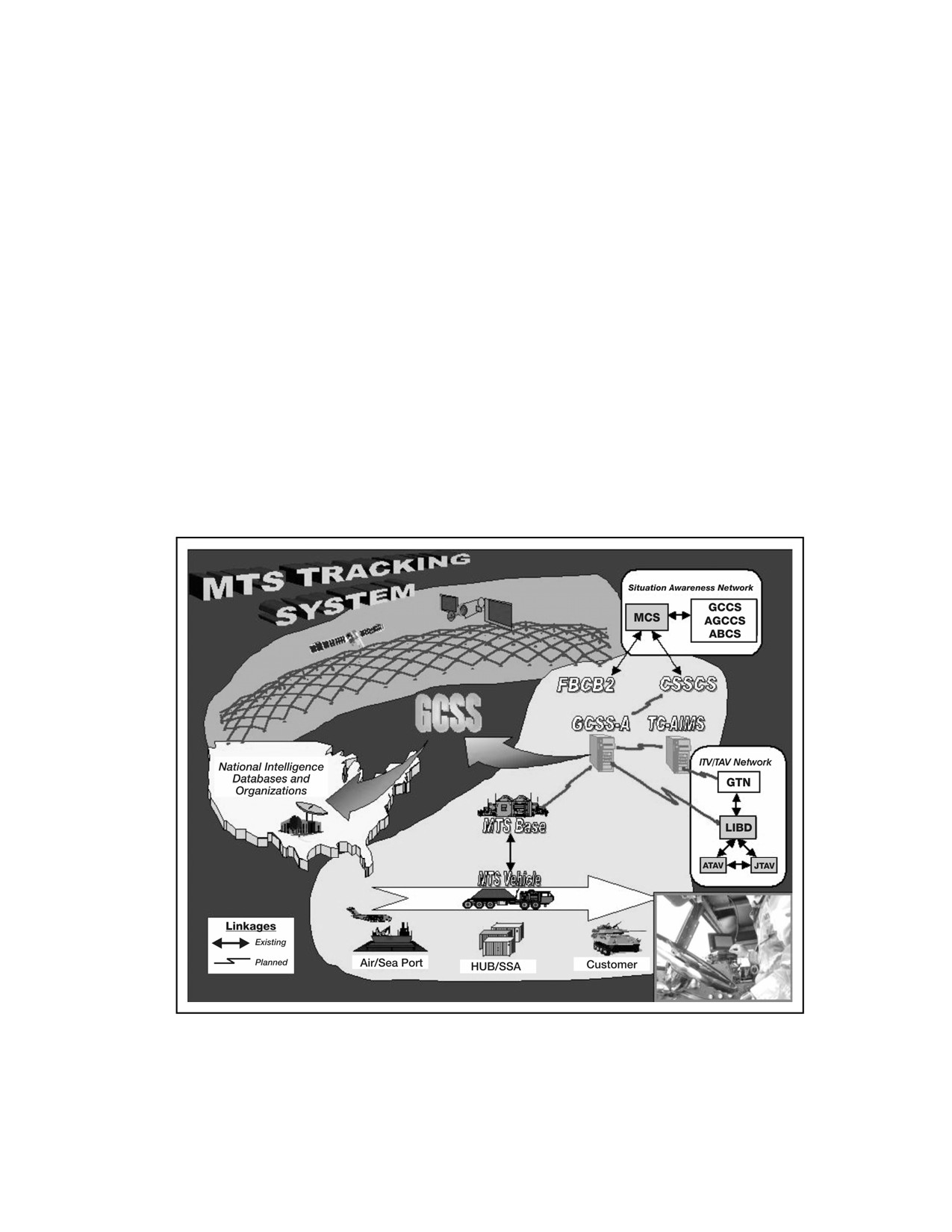
_________________________________________Standard Army Ammunition System—Modernized
control, and management capability. It provides near real-time information
on the location and status of distribution platforms using cabin console-
mounted hardware and satellite technology. The MTS incorporates various
technologies including GPS AIT, vehicle diagnostics, and non-line-of-sight
communication and mapping.
REQUIRED HARDWARE
A-12. The non-developmental item (NDI) hardware required to operate the
SAAS is purchased through a DOD computer contract that provides complete
systems. The user gets the most modern equipment available on the contract
at the time of purchase and installation. The equipment is tailored for each of
the three functional levels and to the site that operates it. Quantities of
hardware at each location (see figures A-2, A-3, and A-4) are based on unit
missions and are outlined in the BOIP capstone for the SAAS. The
equipment described in this paragraph is subject to change because of
improvements in technology.
z
Theater/corps.
z
Division ammunition office/ammunition transfer point.
z
Ammunition supply point.
z
Contingency requirements.
Figure A-1. MTS Information Distribution
A-5
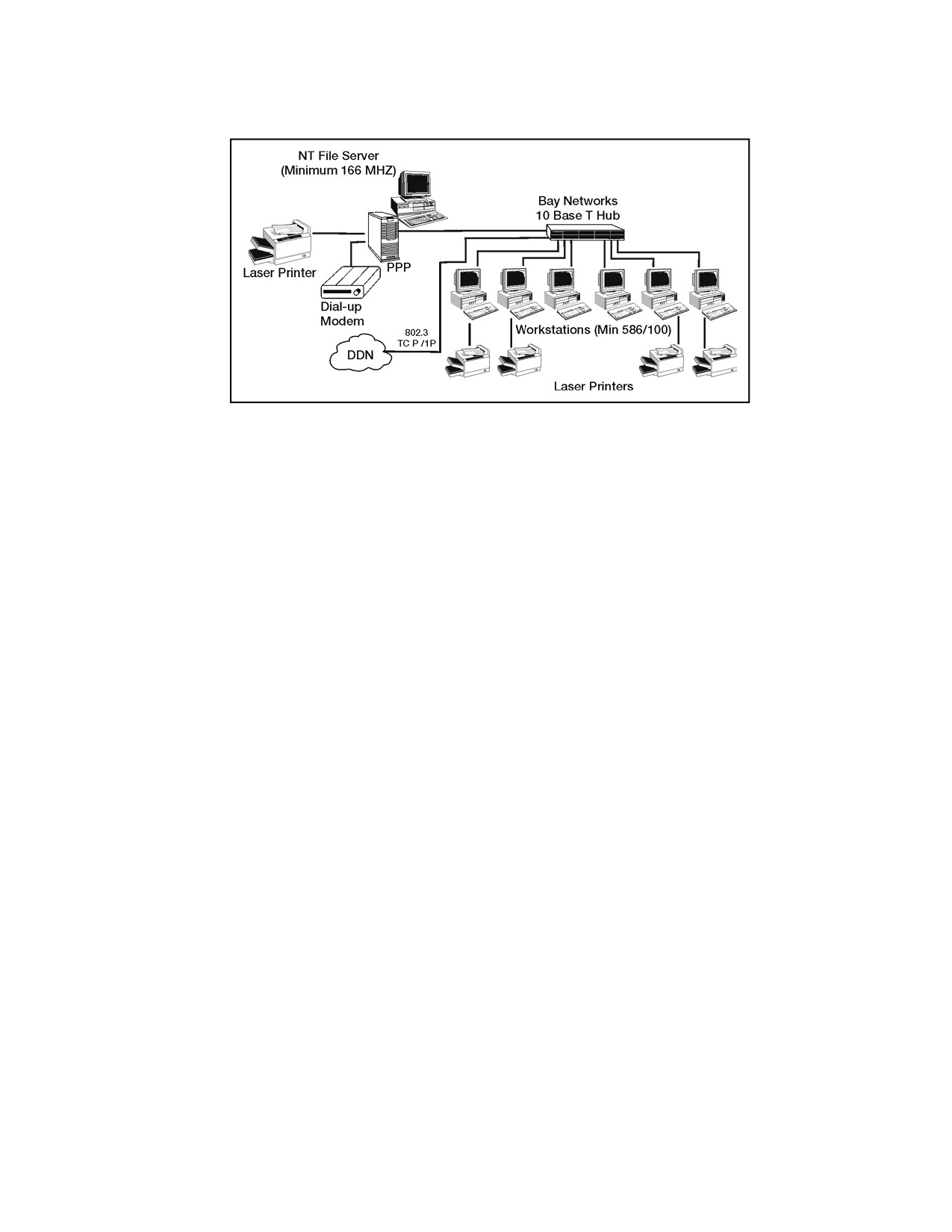
_________________________________________Standard Army Ammunition System—Modernized
Figure A-4. Theater/Corps MMC Configuration
REQUIRED SOFTWARE
A-13. The SAAS end user manual and the system administrator manual can
be viewed and downloaded at http://www.gcss-army.lee.army.mil/saashdbk/
default.htm. This manual identifies all software required to operate or
continue operations in an emergency. See the system administrator manual
for more information on software requirements.
PROBLEM REPORTS
A-14. All SAAS-MOD users are responsible for identifying and reporting
problems and submitting recommended changes on an engineering change
proposal—software
(ECP-S) for software enhancements. Automated or
manual control logs are maintained by all system operators and units
submitting problem reports and ECP-S. Report formats are contained in
FM 4-30.13 and the SAAS EM.
A-7
Glossary
AB
aviation brigade
ABCS
Army battle command system
ABL
ammunition basic load
AC
active component
ACC
Army component commander
ADC-S
assistant division commander for support
AIN
ammunition information notice
airhead
designated location in an area of operations used as a
base for supply and evacuation by air
AIS
automated information system(s)
AIT
automated information technology
AMC
Army Materiel Command
AMCOM
Aviation and Missile Command
ammo
ammunition
ammunition basic load
quantity of conventional ammunition authorized and
required to be on hand in a unit to meet combat needs
until resupply can be accomplished; specified by the TA
and expressed in rounds for ammunition items fired by
weapons and in other units of measure for bulk allotment
ammunition supply point
area designated to receive, store, and issue Class V
materiel; normally located at (or near) the division area
and operated by the corps direct support ammunition
company
ammunition support
one of the storage areas (CSA/TSA/ASP) whose primary
activity
mission is to receive, store, issue, and maintain theater
conventional ammunition stocks
ammunition transfer
designated site where ammunition is transferred and
holding point
temporarly stored
ammunition transfer
designated temporary site where munitions are
point
transferred from corps transportation to issuing unit
vehicles; forward ATP is normally located in the brigade
area, operated by either the supply company, the FSB in
a heavy division, the forward supply company of the S&T
battalion in a light division, or the S&T company of the
support battalion of a separate brigade; the rear ATP is
normally located in the division area, operated by the
ordnance company, ammunition (DS)
AO
area of operations
AOR
area of responsibility
APOD
aerial port of debarkation
APOE
aerial port of embarkation
APS
Army prepositioned stocks
Glossary-1