FM 4-30.1 MUNITIONS DISTRIBUTION IN THE THEATER OF OPERATIONS (DECEMBER 2003) - page 1
*FM 4-30.1 (FM 9-6)
Field Manual
Headquarters
Department of the Army
No 4-30.1 (FM 9-6)
Washington, DC, 16 December 2003
Munitions Distribution in the
Theater of Operations
Contents
PAGE
PREFACE
IV
Chapter 1
MUNITIONS OPERATIONAL ENVIRONMENT
1-1
Purpose and Scope
1-2
Full Spectrum Operations
1-2
Combat Service Support Characteristics
1-2
Munitions Support Mission
1-3
Support Environment
1-5
Support Structures
1-5
Strategic Munitions Planning
1-6
Logistics Preparation of the Theater
1-6
Logistics Preparation of the Theater Responsibilities
1-7
Enabling Technologies
1-12
Configured Loads
1-12
Communications and Automation
1-13
Chapter 2
MUNITIONS FORCE STRUCTURE
2-1
Current Force Munitions Operation
2-1
Support Structure Overview
2-1
Class V Flow
2-17
Aerial Resupply
2-23
Command and Support Relationships
2-23
Chapter 3
INTERIM OBJECTIVE FORCE MUNITIONS OPERATION
3-1
Determining/Requesting Battalion Ammunition Requirements
3-1
Objective Force Munitions Distribution
3-8
Chapter 4
MUNITIONS PLANNING
4-1
Planning Class V Requirements—Conventional Ammunition Allocations
4-1
Transition to Full Spectrum Operations
4-4
Post-Operational Transition
4-5
DISTRIBUTION RESTRICTION: Approved for public release; distribution is unlimited.
*This publication supersedes FM 9-6, 20 March 1998.
i
FM 4-30.1 (FM 9-6) __________________________________________________________________________
Chapter 5
MISCELLANEOUS MUNITIONS OPERATIONS
5-1
Purpose and Scope
5-1
Redeployment and Retrograde
5-1
Chapter 6
ENVIRONMENT, SAFETY, RISK MANAGEMENT, MAINTENANCE, AND
SURVEILLANCE OPERATIONS
6-1
Stewardship in the Operational Environment
6-1
Safety Responsibilities
6-2
Maintenance and Surveillance Operations
6-2
Chapter 7
FORCE PROTECTION
7-1
Organizing for Defense of the Rear Area
7-2
Defining the Threat
7-3
Responding to the Threat
7-4
Security Types
7-4
Intelligence Gathering and Dissemination
7-4
Operational Security
7-5
Special Force Protection Issues in Desert and MOUT Environments
7-5
Appendix A STANDARD ARMY AMMUNITION SYSTEM—MODERNIZED
A-1
GLOSSARY
Glossary-1
REFERENCES
References-1
INDEX
Index-1
ii
________________________________________________________________________Contents
Figures
Figure 1-1. Distribution Operations
1-10
Figure 1-2. SAAS-MOD Current Data Flow
1-14
Figure 1-3. The GCSS-Army
1-15
Figure 1-4. CSSCS Consolidated Class V Report
1-15
Figure 1-5. CSSCS Ammunition Supply Point Status
1-16
Figure 1-6. GCSS-A Ammunition Module and CSSCS
1-17
Figure 1-7. The FBCB2 System
1-18
Figure 1-8. Logistics Situation Report Screen
1-19
Figure 1-9. SAAS-MOD ITV/AIT Integration
1-20
Figure 2-1. Munitions Flow in the Theater of Operations
2-3
Figure 2-2. Ordnance Group, Ammunition (DS/GS) (TOE 09662L000)
2-9
Figure 2-3. Ordnance Battalion, Ammunition (DS/GS) (TOE 09466L000)
2-11
Figure 2-4. Ordnance Group, Ammunition (DS/GS) (TOE 09662L000)
2-12
Figure 2-5. Modular Ammunition Company Headquarters Platoon
2-13
Figure 2-6. Modular Ammunition Ordnance, Medium Lift Platoon
2-14
Figure 2-7. Modular Ammunition Platoon (Heavy Lift)
2-15
Figure 2-8. Headquarters, Modular Ammunition Company for an ASP
2-15
Figure 2-9. Headquarters, Modular Ammunition Company for a CSA
2-15
Figure 2-10. Headquarters, Modular Ammunition Company for a TSA
2-16
Figure 2-11. Class V Distribution Flow (Modular)
2-18
Figure 2-12. Headquarters and Headquarters Detachment, Ordnance
Battalion, Ammunition (WHNS) (DS/GS)
2-20
Figure 2-13. Munitions Supply Rate Flow
2-22
Figure 3-1. Smart Distribution System - Subsystems
3-13
Figure 3-2. Intelligent Materiel Handling Equipment
3-14
Figure 3-3. CROP Aircraft Interface Kit
3-15
Figure 3-4. The Modular Platform System
3-16
Figure 3-5. Rapid Load Tie-Down Hardware
3-17
Figure 3-6. The FTTS with the Intelligent Load Handling System
3-18
Figure 3-7. Enhanced Delivery System—Air
3-19
Figure 3-8. Reporting Munitions Readiness
3-20
Figure 3-9. Munitions Survivability Software
3-21
Figure A-1. MTS Information Distribution
A-5
Figure A-2. Division Level/ATP Configuration
A-6
Figure A-3. ASP Configuration
A-6
Figure A-4. Theater/Corps MMC Configuration
A-7
Tables
Table 2-1. MAN/MHE Team Life Capabilities by STONs Per Day
2-16
Table 2-2. Modular Ammunition Platoon Lift Capabilities
2-17
iii
Preface
This manual prescribes doctrine for munitions support. It explains in general terms how
munitions units operate and interact to provide munitions to the user. It is the basis for
munitions doctrine, materiel, training, and organizational development. This manual addresses
munitions unit missions, operations, and interactions between the various levels of munitions
support.
This manual explains to combat arms (CA), combat support (CS), and combat service support
(CSS) commanders and their staffs how and where they receive munitions support. It establishes
guidelines and procedures for munitions unit commanders and their staffs while operating the
munitions support structure.
This manual also discusses the modular ammunition platoon concept. There are two types of
modular platoons: heavy lift and medium lift. The heavy lift platoon (HLP) is best suited for
port, theater storage area (TSA), and corps storage area (CSA) operations. The medium lift
platoons
(MLPs) operate in TSAs and CSAs when needed, and are designed to operate
ammunition supply points (ASPs). These platoons are capable of deploying and operating
independently from their company headquarters, but require external support for sustainment.
They allow the Army to effectively take advantage of technology such as the palletized loading
system (PLS), configured loads (CLs), and containerized roll-on/-off platforms (CROPs). These
palletized loads can be shipped to TSAs, CSAs, and ASPs. The type and number of platoons
deployed is based on mission, enemy, terrain and weather, troops and support available, time
available, civil considerations (METT-TC) and the commander’s intent. Modular units provide a
flexible design tailorable to the theater commander’s intent. They allow the theater commander
to expand and contract the ammunition supply capability when and where needed to meet
operational requirements.
This publication implements the following standardization agreements (STANAGs):
• STANAG 2034 - Land Forces Procedures for Allied Supply Transactions, Edition 4, 20
December 1982.
• STANAG 2135 - Procedures for Emergency Logistics Assistance, Edition
3,
12
February 1982.
• STANAG 2827 - Materials Handling in the Field, Edition 2, 12 February 1980.
• STANAG 2829 - Materials Handling Equipment, Edition 2, 20 March 1978.
• STANAG 2834 - The Operation of the Explosive Ordnance Disposal Technical
Information Center (EODTIC), Edition 2, 26 March 1990.
• STANAG 2928 - Land Forces Ammunition Interchangeability Catalogue in Wartime,
Edition 3, 9 June 1995.
• STANAG 2961 - Classes of Supply of NATO Land Forces, Edition 1, 11 December 1984.
The proponent for this publication is United States Army Training and Doctrine Command
(TRADOC). Send comments and recommendations on DA Form 2028 (Recommended Changes to
Publications and Blank Forms)
(or in
2028 format) directly to Commander, CASCOM,
Directorate of Combat Development, DCD-OD, 3901 A Avenue, Fort Lee, VA 23801-1713.
Unless this publication states otherwise, masculine nouns and pronouns do not refer exclusively
to men.
iv
Chapter 1
Munitions Operational Environment
The digitized, force projection Army of the future requires efficient logistics
organizations that are quickly adaptable to the warfighter's needs. Our Army has
moved from a threat-based force to a capabilities-based force able to dominate
across the spectrum of conflict. Leading this will be the digitized Army XXI division—
the backbone of the Army's capabilities-based force. It eventually will be supported
by a hybrid of forces (special operations, strike, contingency light, and contingency
heavy forces). Our logistics organization must be capability-based, modular for
flexibility, able to anticipate and predict logistics requirements sooner, have pipeline
visibility, focus limited logistics resources at the point of need, and able to react faster
than ever before. The recent creation of forward support companies in the digitized
Army XXI division will employ many of these attributes. Our overarching objective is
to achieve a single CSS [combat service support] operator at each echelon to
facilitate maximum throughput and follow-on sustainment.
Army Logistician
The ammunition logistics system provides the right type and quantity of
ammunition to the force in any contingency
CONTENTS
from general war to military operations
Purpose and Scope
1-2
other than war (MOOTW) engaging the “full
Full Spectrum Operations
1-2
spectrum of operations.” The challenge is to
Combat Service Support
Characteristics
1-2
move required amounts of modern high
Munitions Support Mission
1-3
lethality ammunition into a theater from the
Support Environment
1-5
continental
United States
(CONUS)
Support Structures
1-5
sustaining base and other prepositioned
Strategic Munitions Planning
1-6
Logistics Preparation of the
sources in a timely manner to support a
Theater
1-6
CONUS-based contingency response force.
Logistics Preparation of the
The system must also be flexible enough to
Theater Responsibilities
1-6
meet changing ammunition requirements in
Enabling Technologies
1-11
simultaneous operations around the world.
Configured Loads
1-12
Communications and Automation .. 1-12
The objective of the system is to provide
configured Class V support forward to the
force as economically and responsively as
possible with a minimum of handling or reconfiguration. Effective and
efficient ammunition support requires integrated information and
distribution management at all levels from the national
provider/industrial base to the combat user.
1-1
FM 4.30-1 (FM 9-6) __________________________________________________________________
PURPOSE AND SCOPE
1-1. Munitions are the dominant factor in determining the outcome of
combat or stability and support operations. It is a critical component of fire
and maneuver operations performed by the force projection Army. Munitions
provide the means to defeat, as well as destroy, the enemy, and provide the
force with the ability to block, screen, or protect itself. Major military
operations will be joint or coalition and based on unexpected contingencies.
These operations will require the munitions logistics system to be modular,
tailored, easily deployed, and flexible.
FULL SPECTRUM OPERATIONS
1-2. Army commanders at all echelons may combine different types of
operations simultaneously and sequentially to accomplish missions in war
and MOOTW/stability and support operations. Throughout a campaign,
offensive, defensive, stability, and support missions occur simultaneously.
When conducting full spectrum operations, commanders combine and
sequence these operations to accomplish the mission. For each mission, the
joint force commander
(JFC) and Army component commander
(ACC)
determine the emphasis Army forces place on each type of operation.
Offensive, defensive, support, and stability (ODSS) operations represent the
range of decisive operations that comprise full spectrum operations. The
predominant decisive operations associated with war are offensive and
defensive operations, while MOOTW/stability and support operations
encompass a wide range of military actions taken to deter war, resolve
conflict, and promote peace. MOOTW/stability and support operations may
include offensive and defensive operations, but the major effort is generally
on stability operations and support operations
1-3. Future military operations will require that ammunition units be
effective, efficient, highly mobile organizations. Battles may be non-linear in
non-contiguous environments and require rapid movement, multiple
relocations, and the ability to support and sustain maneuver forces in a
variety of mission profiles. Thus, ammunition support units must be capable
of adapting to many scenarios and configurations. Depending on the size of
the supported force, an ammunition unit may conduct sustainment
operations in either a company or modular configuration. Modular
configurations will be based on operational needs. This may mean that a
single modular platoon could be deployed to support a brigade contingency,
or a number of platoons and/or companies could be deployed to support a
mature theater. When deployed separately or modular, the heavy lift or
medium lift platoons are supported by the organizational headquarters to
which they are tasked organized. When deployed with the headquarters
modular ammunition company, the food service support will come from this
element. For all other support they will rely on their support from
appropriate elements of the corps or theater support for religious, combat,
legal, health support, and finance personnel and administrative services in
any deployment scenario.
COMBAT SERVICE SUPPORT CHARACTERISTICS
1-4. Force commanders apply the CSS principles to visualize and describe
the concept of logistics support with CSS commanders. Commanders view
CSS characteristics from the perspective of the overall operation and use
1-2
____________________________________________________Munitions Operational Environment
these characteristics to help describe the considerations required to plan,
prepare, execute, and assess successful operations. They guide prudent
planning and assist the staff in developing the CSS plan. CSS characteristics
include—
z
Responsiveness.
z
Simplicity.
z
Flexibility.
z
Attainability.
z
Sustainability.
z
Survivability.
z
Economy.
z
Integration.
MUNITIONS SUPPORT MISSION
1-5. The role of the ammunition logistics system is to provide the right type
and quantity of ammunition to the force in any contingency, from full scale
contingencies to MOOTW/stability and support operations. The challenge is
to move required amounts of ammunition into a theater from the CONUS
sustaining base and other prepositioned sources in a timely manner to
support a CONUS-based contingency response force. The system must also
be flexible enough to meet changing ammunition requirements in
simultaneous operations around the world. The objective of the system is to
provide mission-configured load
(MCL) support forward to the force as
economically and responsively as possible to minimize handling and
reconfiguration. The unique characteristics of ammunition complicate the
system of ammunition distribution. These factors include its size, weight, and
hazardous nature. It requires special handling, storage, accountability,
quality assurance, and security.
1-6. The Army’s ability to react and sustain the battle improves the chances
of conducting a successful operation. The munitions logistical support plan
must mesh the tactical level commander’s plan to the operational and
strategic plans. This helps ensure timely support and sustains the operation.
Commanders, with advice from logisticians, tailor support packages to meet
theater requirements for a variety of strategic contingency plans. The use of
modular ammunition units/platoons increases our ability to meet theater
munitions requirements. They will deploy based on operational needs that
ease strategic lift requirements. Chapter 2 contains detailed information on
munitions unit missions and organization.
1-7. Similar to any other logistical support, ammunition support requires
that the unit have the appropriate mix of personnel, military occupational
specialty (MOS) skills, and tools and equipment to accomplish the mission.
Modular platoons and companies are 100 percent mobile; however, they are
only sustainable for a short period of time.
FORCE XXI MUNITIONS STRUCTURE
1-8. When based on modularity, Force XXI munitions structure meets the
needs of a force projection Army more effectively. The headquarters (HQ),
modular ammunition ordnance company efficiently supports a more flexible
munitions distribution system. The concept of modular units permits the
building of ammunition units tailored for specific functions. Modules
1-3
FM 4.30-1 (FM 9-6) __________________________________________________________________
consisting of HLPs, MLPs, or a combination of both, with companies can be
deployed to support forces as required. This HQ platoon will always be
located with a minimum of one MLP or HLP. This organization allows for
modules to be sent forward to support other munitions units when required.
In an area of operations (AO), the condition of facilities may be uncertain and
operational support may be unstable for an undetermined period of time.
Since there is no one scenario for combat operations/stability and support
operations, ammunition units must be prepared to support operations
ranging from peacekeeping to regional conflicts to major war. Chapter 2 of
this manual and FM 4-30.13 provide detailed information on munitions unit
structure and capabilities.
OBJECTIVE FORCE MUNITIONS
1-9. The objective force will challenge the Army’s ability to meet its force
projection requirements. Highly mobile, multifunctional organizations must
be capable of projecting munitions support anywhere in the world. The
converging challenges of the objective force have been described as—
z
Distinctions between conventional and unconventional.
z
Symmetric and asymmetric.
z
Traditional and non-traditional.
z
Expeditionary and homeland security.
z
Fading tactical/operational/strategic operations.
1-10. This blurring emphasizes the need for full spectrum forces with special
purpose capabilities. To meet this myriad of challenges, munitions units will
continue to evolve, improving efficiency and maximizing the use of
technological enablers, integrated communications, and seamless logistics
automated systems to meet the munitions demands of the deployed forces
during decisive operations.
SUPPORTED UNITS
1-11. Every unit on the battlefield requires munitions. Providing sufficient
types and quantities at the right place and on time is critical to the success of
combat, and stability and support operations. When the Army fights as part
of a joint, multinational, or combined force, munitions units may support
other U.S. services and allied forces. Class V requirements for possible
contingencies are determined during peacetime planning. Planners consider
the concepts of operation and organization, including the projected force
deployment sequences; the availability of stocks and storage locations, and
deployability into various theaters; and the responsiveness of the production
base to meet shortfalls. As the force receives new weapon systems and
munitions, there will be an evolving mix of “high-low” technology munitions,
which the logistics system must be able to support. FM 3-0, FM 4-0, and FM
4-30.13 detail supported unit characteristics and planning considerations.
Joint Operations
1-12. Joint integration of ammunition support is crucial to unity of effort.
Army ammunition units support the requirements of other services during
joint operations. In computing the required supply rate (RSR)/controlled
supply rate (CSR), these requirements must be forecasted and considered.
Failure to plan for this support may result in severe shortages of critical
ammunition items and handling capability. Plans must consider efficiencies
gained by having integrated ammunition support. The plans must be
1-4
____________________________________________________Munitions Operational Environment
coordinated with the various services involved to ensure adequacy of
personnel, storage requirements, materiel-handling equipment
(MHE),
accountability procedures, and safety.
Multinational Operations
1-13. Combined and coalition logistics operations require integration for
unity of effort. Procedures for ammunition support must be worked out
during the planning phase of a deployment or operation. This ensures
interoperability and availability of handling equipment. Multinational forces
may not be able to utilize efficiencies of U.S. logistics technologies, such as
the PLS or container/materiel handling equipment (C/MHE). Ammunition
planners must integrate these factors into the logistics preparation of the
theater (LPT). During emergency deployments there may not be time to
develop formal inter-country agreements. Planners must develop methods to
preclude competition for resources, particularly infrastructure and lines of
communication (LOC) that could adversely affect operations. Planners should
consider options for contracting, acquiring host nation support (HNS), or
obtaining support from other national forces, then integrating this support
into the multinational force as outlined in FM 100-7.
SUPPORT ENVIRONMENT
1-14. To retain maximum flexibility and mobility for future combat
operations, ammunition units must maintain minimum essential stocks
throughout the distribution system. The need to protect ammunition support
activities from rear area threat activities complicates munitions support
operations. Ammunition units require augmentation to provide security for
ammunition support activities. Ammunition units may find themselves close
to combat. In such situations, units must continue to provide essential
munitions support while relocating away from the threat. Disruptions from
threat forces are likely to occur throughout the theater of operations; from
brigade support areas
(BSAs) to deep within the communications zone
(COMMZ). Chapter 2 contains detailed information on the doctrinal layout of
a mature ammunition system in a developed theater.
SUPPORT STRUCTURES
1-15. Munitions support units are organized to meet mission support
requirements. Each unit has the appropriate mix of personnel, MOS skills,
tools, and equipment to accomplish assigned missions. The types of
ammunition support activities in theater include TSAs, CSAs, and ASPs.
The goal of an ammunition transfer point (ATP) is to provide, as closely as
possible, 100 percent of the ammunition requirements to all units within its
sector.
1-16. The TSA encompasses storage facilities located in the COMMZ, where
the bulk of the theater reserve ammunition stocks are located. TSAs are
operated and maintained by modular ammunition companies with a mixture
of HLPs/MLPs. Besides shipping ammunition to CSAs, the TSA provides
area ammunition support to units operating in the COMMZ. The Army
service component commander
(ASCC) determines the TSA stockage
objective.
1-17. The CSA is the primary source of high-tonnage ammunition for the
division and corps. CSAs receive 50 percent of their ammunition from the
1-5
FM 4.30-1 (FM 9-6) __________________________________________________________________
port of debarkation (POD) and 50 percent from the TSA. Containers will go
only as far forward as the CSA.
1-18. In the division area, ASPs receive, store, issue, and maintain a one- to
three day supply of ammunition. ASP stockage levels are based on tactical
plans, availability of ammunition, and the threat to the resupply operations.
ASPs provide 25 percent of each ATP ammunition requirement in the form of
MCLs.
1-19. ATPs are located in/near each BSA with an additional rear ATP for the
division support area (DSA) that comes from the MLP the mission of each
ATP is to provide 100 percent of the ammunition required by all units in its
sector. ATPs receive 75 percent of their ammunition from the CSA and 25
percent from the ASP. These munitions are kept loaded on semitrailers,
CROPs, or PLS flatracks until ATP personnel transload it to using unit
vehicles. If the situation demands, the ammunition can be transferred
immediately to using unit tactical vehicles. Detailed information on
ammunition support activities (ASAs) and ammunition units is contained in
chapter 2 and FM 4-30.13.
STRATEGIC MUNITIONS PLANNING
1-20. For the ammunition planner at the Department of the Army (DA) level,
planning is based on the Defense planning guidance (DPG). DPG provides
scenarios modeled and integrated into Army force structure, budgeting,
procurement actions, and operational plans
(OPLANs). Ammunition
planning at the DA level considers the following:
z Priorities.
z
Mission synchronization.
z
Threat capabilities.
z
Production base.
z
Transportation assets.
z
Consumption rates determined by the U.S. Army Concepts Analysis
Agency (USACAA).
z
Depot stocks.
z
Prepositioned stocks afloat.
z
Worldwide ammunition stocks.
z
Echeloning of units using time-phased force deployment (TPFD).
LOGISTICS PREPARATION OF THE THEATER
1-21. The LPT process is an evolving continuum of logistics planning and
execution, and is vitally important to the continuous resolution of
sustainment challenges and opportunities. This process includes all actions
taken by CSS personnel to maximize the methods supporting the
commander’s plan. These actions include identification and preparation of
bases of operations and LOC, forecasting and building reserves forward and
afloat, and improving theater infrastructure. LPT involves two closely
related types of activities: information gathering and management activities
required to prepare the theater to receive and sustain forces.
1-6
____________________________________________________Munitions Operational Environment
LOGISTICS PREPARATION OF THE THEATER RESPONSIBILITIES
1-22. The primary responsibility for LPT is handled at theater, strategic, and
operational levels by the combatant commander’s and ASCC support staffs.
The combatant commander’s staff considers available resources and
requirements across all services. This staff ensures limited resources reach
the organization’s most essential accomplishment The ASCC staff performs
LPT activities in accordance with the combatant commander’s priorities. See
FM 4-0, FM 100-10-1, and FM 100-16 for detailed information on the LPT
process.
INFORMATION GATHERING AND MANAGEMENT
1-23. CSS personnel require several types of information to develop theater
support plans. This information includes all factors influencing support
requirements and the conduct of CSS operations. These factors include
terrain and climate, and any theater-specific agreements to provide support
to joint or multinational forces. Critical information also includes all
information on available resources in the operational area.
RESOURCE AVAILABILITY
1-24. The CSS process consists of making arrangements to gain access to the
resources identified in the information-gathering stage. Resource availability
information also includes data on the geographical area’s infrastructure. This
encompasses a wide-ranging set of considerations including—
z
Seaport and airport capacities.
z
Transportation networks.
z
Communications networks.
z
Fuel storage and distribution facilities.
z
Utility systems.
z
Medical facilities.
z
Billeting facilities.
z
Financial institutions.
z
Postal systems.
z
Other fixed facilities.
HOST NATION CONSIDERATIONS
1-25. CSS personnel must know any factors that may influence access to
local resources, such as political or economical conditions. Another critical
category of information relates to any arrangements currently in place that
affect support to the theater of operations, such as HNS, foreign national
(third country) support agreements, interservice support agreements,
multinational force compatibility agreements, security assistance
agreements, the Logistics Civilian Augmentation Program (LOGCAP), and
prepositioned stocks. Informational sources for the aforementioned will vary.
INTELLIGENCE PREPARATION OF THE BATTLEFIELD
1-26. Intelligence preparation of the battlefield (IPB) provides weather and
terrain information to the LPT process. Intelligence also identifies the
vulnerability of CSS sites and operations to enemy action, in both forward
and rear areas. CSS personnel carefully manage information flows.
FM 34-130 and FM 100-16 provide additional information on IPB.
1-7
FM 4.30-1 (FM 9-6) __________________________________________________________________
THEATER PREPARATION ACTIVITIES
1-27. Logistics preparation
(LPT) includes negotiating specific HNS
agreements. It also includes coordinating with strategic-level CSS managers
to gain access to prepositioned stocks or assets received through national-
level agreements. The initial lodgment or support base requires adequate
port facilities capable of supporting the throughput requirement identified in
the operations plan. The base should include container handling capabilities,
secure facilities for maintenance operations, soldier support functions, and
storage of ammunition.
1-28. Transportation networks from potential base locations to forward areas
must be capable of handling theater onward movement requirements.
Network elements include roads, nets with adequate capacities, bridges, rail
nets, inland waterways if applicable, and MHE.
INFRASTRUCTURE ENHANCEMENT
1-29. Army capabilities must include improvements accomplished IAW
combatant commander-established priorities. The first elements to deploy
should be terminal operators or engineers to enhance the base’s capability to
receive additional forces. The requirement for adequate CSS capability is
especially critical in the early stages of operations. In addition, support
planners consider opportunities for training that also serve as nation-
building activities in austere environments. Such environments may be the
best locations for realistic training conditions for activities, such as building
or repairing airstrips, piers, and roads, and preparing marshaling sites. For
more information, refer to FM 3-0.
Movement of Munitions Stocks
1-30. The number of theater HLPs must be considered prior to requesting
containerized ammunition. Containerization significantly improves delivery
times of munitions and other selected cargo to the AO by reducing handling,
shipload, and discharge times. However, effective use of the system requires
advanced planning to ensure necessary C/MHE is available. For more
information on this aspect of planning, see FM 100-16 (will be revised as
FM 3-100.16).
Operational and Tactical Munitions Planning
1-31. At the operational and tactical levels, logistics preparation of the
battlefield (LPB) is as critical as IPB. The ammunition planner uses the
tactical commander’s mission analysis to ensure a complete understanding of
what must be accomplished. The ammunition planner participates in the
orders process by preparing the munitions piece of the logistics estimate.
Chapter
2 and FM
4-30.13 detail the doctrinal layout of a mature
ammunition system in a developed theater.
Logistics Preparation of the Battlefield
1-32. Tactical CSS planners depend on information gathered in the LPT
process. Tactical-level support personnel employ LPT methods as the LPB.
LPB is a conscious effort to identify and assess the factors that facilitate,
inhibit, or deny support to forces at the tactical and, sometimes, operational
levels. Thorough information gathering in the early stages of LPB ensures
adequate information is available to the concept of support. LPB also
includes establishment of bases, including any forward logistics bases,
1-8
____________________________________________________Munitions Operational Environment
required to reduce distances supported elements must travel. In general,
many of the factors listed above for LPT also apply to LPB.
DISTRIBUTION OPERATIONS
1-33. Distribution is the process of synchronizing all elements of the CSS
system to deliver the “right things” to the “right place” at the “right time,” in
support of the combatant commander. The distribution system, as displayed
in figure 1-1, is a complex of networks tailored to meet the requirements of
the military force across the range of operations. Distribution is inherent in
the LPT process and continues throughout CSS activities at all levels of
operations. Distribution includes the receipt, storage, and maintenance of
equipment in transit, and the movement and control of resources between the
receipt of materiel and personnel into the system until final delivery to the
user. Distribution is the key to CSS operations. FM 4-0 and FM 100-10-1
(FM 4-01.1) detail distribution operations and the planning process.
1-34. Distribution is defined in JP 1-02 as that functional phase of logistics
that embraces the act of dispensing materiel, facilities, and services; and the
process of assigning military personnel to activities, units, or billets.
FM 100-10-1 (will be revised as FM 4-01.1) describes the transition of the
theater distribution system from a mass and stovepipe-oriented functional
system to a distribution-based CSS system leveraging available automation
and information technology. The ultimate goal of both requirements’
determination and acquisition of resources is the provision of personnel,
materiel, and services to the supported force. Identification of available
resources (and in some cases, requirements for certain types of support)
depends on the capability of the distribution system. FM 100-10-1 (will be
revised as FM 4-01.1) provides extensive detail on distribution operations.
1-9
FM 4.30-1 (FM 9-6) __________________________________________________________________
Figure 1-1. Distribution Operations
MUNITIONS DISTRIBUTION MANAGEMENT
1-35. Materiel managers located in the distribution management centers
(DMCs) at theater, corps, and division support commands along with other
functional organizations/directorates and control center elements, are
responsible for managing theater distribution by balancing the existing
capabilities of the distribution infrastructure with the current and projected
operational requirements. Distribution management is the process of
planning and synchronizing the time-definite delivery of materiel,
equipment, units, personnel, and services to and within the AO. FM 10-1
(will be revised as FM 4-20) provides extensive detail on the functions of the
DMCs at each echelon. Theater DMCs work with CSS resource managers
and movement controllers to—
z
Provide an integrated distribution information network. Leverage all
available distribution infrastructure and optimize pipeline flow to
meet requirements/priorities by implementing distribution
management theories and practices.
z
Project distribution pipeline volume, flow rates, contents, and
associated node and port handling requirements. Integrate force
generation and force sustainment operations. Manage operations and
the flow of multiconsignee shipments.
1-10
____________________________________________________Munitions Operational Environment
z
Coordinate, align, and reconcile receipts of CSS resources with in-
theater movement control operations.
z
Ensure effective cross-leveling of supplies, and efficient retrograde
and redeployment of equipment, personnel, supplies, and services.
z
Establish theater-specific, time-definite delivery schedules for routine
and high-priority requirements through the use of intra-theater
distribution and inter-theater surface/air express networks.
1-36. To meet these requirements, distribution managers apply the following
principles.
PRINCIPLES OF DISTRIBUTION
1-37. The principles of distribution emphasize centralized management,
optimized infrastructure, maximized throughput, minimized forward
stockpiling, and a continuous and seamless flow of materiel. Successful
distribution must be both effective and efficient. Anticipation, integration,
continuity, responsiveness, and improvisation facilitate effective and efficient
distribution operations. Commanders and support personnel who integrate
CSS concepts and operations with strategic, operational, and tactical plans
must anticipate requirements, maintain visibility of the distribution pipeline,
and be able to effect rapid and positive control within the distribution
system. The theater distribution system allows units to request, receive, sort,
maintain, distribute, retrograde, and control the flow of resources between
the point of entry into the theater system and the theater destination.
COMPONENTS OF DISTRIBUTION MANAGEMENT
1-38. The scope of a distribution plan is limited to explaining exactly how the
DMC will maintain asset visibility; adjust relative capacity; and control the
flow of supplies, services, and support capabilities in theater. Distribution
management operations are broadly described as a function of three critical
components: visibility, capacity, and control.
Visibility
1-39. Visibility must begin where resources start their movement to the AO,
whether that is a depot, commercial vendor, storage facility, APS stockpile,
or a CONUS/OCONUS unit power projection platform. The information must
be digitized and subsequently entered into the necessary CSS information
systems.
Capacity Management
1-40. Capacity management deals with balancing distribution system
capacity against evolving changes in theater support requirements. The
ability to anticipate distribution bottlenecks, disruptions, and changes in the
distribution operational scheme is a key factor in allowing the successful
distribution manager to optimize a theater’s distribution capacity. Theater
and corps ammunition supply activities provide the foundation for the in-
theater distribution plan.
Control
1-41. The responsiveness of a control process is comparable to the timeliness
of management visibility. When changing directions, the manager includes
time for the physical actions of the directional change to occur. Theater
1-11
FM 4.30-1 (FM 9-6) __________________________________________________________________
distribution managers use asset visibility, JFC policy, and service
cooperation to apply control measures to the theater distribution system.
1-42. Enabling technologies are used to determine how effectively the
distribution system operates and maintains itself. Situational understanding
(SU) is improved significantly using a combination of current and emerging
technologies. The DMC is the focal point for controlling the continuity of the
Army distribution pipeline through situational understanding (SU) resulting
from joint total asset visibility (JTAV)/Army total asset visibility (ATAV).
ENABLING TECHNOLOGIES
1-43. Enabling technologies and the ability to integrate current and new
systems into CSS distribution systems is essential to developing and
maintaining effective distribution operations. Fielding key equipment
enablers focused on high speed delivery and efficient distribution of supplies
is changing the way logisticians approach the planning for seamless logistics
distribution on the battlefield. The battlefield distribution concept is
predicated on several key technological platform enablers. The PLS is a
mobile, self-contained, materiel handling system engineered to transport,
drop, and retrieve flatrack loads. The PLS dramatically reduces transloading
and the multiple handling of cargo, expediting the delivery of supplies to the
user. The container handling unit (CHU) is an add-on kit for the PLS and
load handling system (LHS), and is used to drop, retrieve, and transport 20-
foot containers.
1-44. The CROP is a redesign of the PLS platform, allowing conformance to
the interior capacity of a standard International Standards Organization
(ISO) freight container. Strategic, operational, and tactical movements of
munitions are greatly enhanced, resulting in increased logistics velocity and
throughput of supplies to the user.
1-45. The movement tracking system (MTS) is a satellite-based, two-way
communications system that uses global positioning technology to track and
control ground transportation assets anywhere in the world. The MTS
provides near real-time transportation asset location, movement data, and
SU of munitions in the distribution pipeline.
CONFIGURED LOADS
1-46. FM
100-10-1 describes how munitions are configured into MCLs,
packaged on a container/LHS (PLS, CROP), and shipped in a standard 20-
foot ISO to a theater of operations. Delivery of CLs of unit-matched packages
of ammunition in a complete round configuration is transported as single
units and quickly throughput to the user. CLs are preplanned loads of
supplies built to anticipated or actual needs, intended for maximum
throughput with minimal reconfiguration. The loads may be built for a
specific mission (MCL) or for a specific unit (unit-configured load [UCL]). The
Army has developed sufficient CLs, reference that support the warfighting
units.
1-47. The AMC has maximized the tonnage capacity of the containers being
shipped from CONUS depots. Although each CL is designed to meet unit and
mission requirements, planners must be aware that cargo vehicles (PLS)
assigned to the artillery units supporting field support command (FSC) have
a cargo capacity of 16½ short tons (STONs) per flatrack, while cargo vehicles
1-12
____________________________________________________Munitions Operational Environment
(LHS) assigned to the maneuver units supporting FSC have a cargo capacity
of only 11 STONs per flatrack.
1-48. DMCs located within theater/corps management centers and the DSA
manage the theater distribution system by accessing asset and in-transit
visibility
(AV/ITV) system, tracking shipments as necessary. They also
establish priorities to ensure theater infrastructure is balanced with the
resource flow requirements. This is accomplished through DMC staff
supervision of distribution terminals and control centers, and in close
coordination with the functional elements.
(For access to the CASCOM
“Distribution
Based Logistics Configured Loads Concept Battle Book.”)
COMMUNICATIONS AND AUTOMATION
Building stovepipe systems is a “prerevolutionary” business practice none of us can
afford again. The full success of the single seamless logistics system will be
measured by how well GCSS-Army ties into other critical automation tools such as
the Combat Service Support Control System
(CSSCS) and the Transportation
Coordinator’s Automated Information for Movements System-II (TC AIMS-II). The
ability to pass the logistics STAMIS-type information through GCSS-Army, and then
share a portion of it with CSSCS, will start giving future logisticians a “common
logistics picture” across all echelons. The same concept applies to getting critical
transportation movement information through the TC AIMS-II and into CSSCS,
thereby giving the future logistician information dominance (ID).
Army Logistician
1-49. Situational understanding (SU) of support personnel and their ability
to manage CSS operations depends on effective communications and
automated systems that will interface with all services’ automated CSS
systems, global transportation network, global positioning system, and
theater command and control
(C2) systems. FM
4-0 and FM 100-10-1
describe the importance of the voice and data communications systems to
seamless logistics operations. Nodes within the distribution system must be
able to communicate with each other within specified time and design
parameters.
COMMUNICATIONS
1-50. Ammunition units must have reliable communications to accomplish
their mission. Effective communications networks must be established to
ensure the success of ammunition support in the theater of operations. These
networks must relay accurate and timely information between supported and
supporting units, the DMCs, and the division ammunition officer (DAO).
They must also interface with the combat and combat support networks of
units supported by ammunition units. The most critical link is the one
between the accountable standard Army ammunition system (SAAS) level
and those responsible for stock status reporting. This link provides necessary
data to the ASCC, enabling critical decisions to be determined in support of
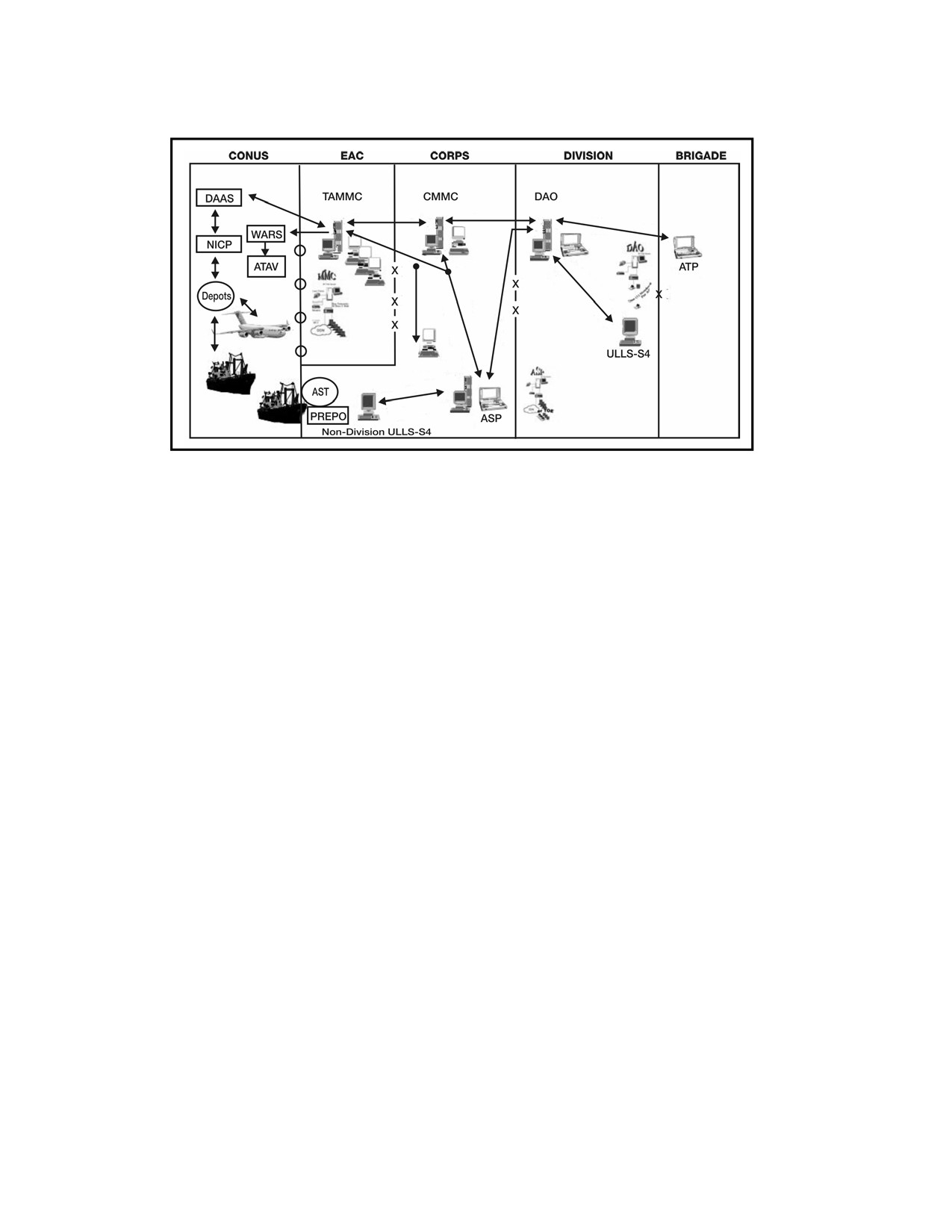
the combat forces. Figure
1-2 illustrates standard Army ammunition
system—modernized (SAAS-MOD) data flow.
1-13
FM 4.30-1 (FM 9-6) __________________________________________________________________
Figure 1-2. SAAS-MOD Current Data Flow
SYSTEMS INTERFACE
1-51. Improved SU gained through the use of innovative logistics automation
systems allows distribution managers at all levels to monitor the logistical
distribution system from the “factory to the foxhole.” CSS also depends on
requirements generated by, and managed through, the respective standard
Army management information systems (STAMIS). The objective automated
environment will greatly enhance the ability of CSS commanders and staffs
to communicate current status and near-term capabilities to force
commanders, as well as to anticipate requirements. The Combat Service
Support Control System (CSSCS), a component of the Army Battle Command
System (ABCS), provides critical CSS information for theater and force-level
commanders.
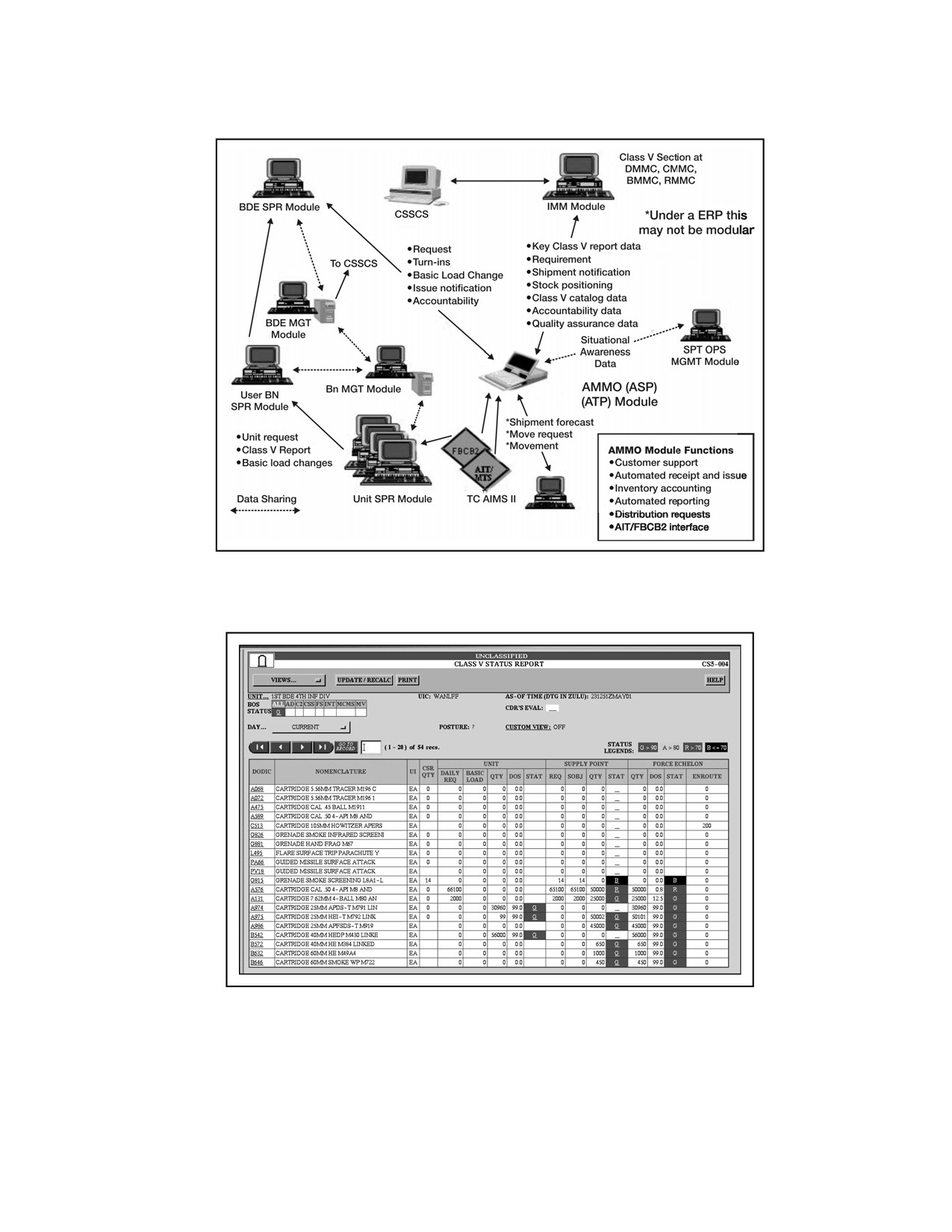
1-52. At unit level, the Battle Command Sustainment and Support System
(BCS3) tracks those munitions items (figure 1-3) appearing on the BCS3
commander’s tracked items list
(CTIL). Additionally, ammunition asset
displays report assets for all forces (figure 1-4). As a result of its interface
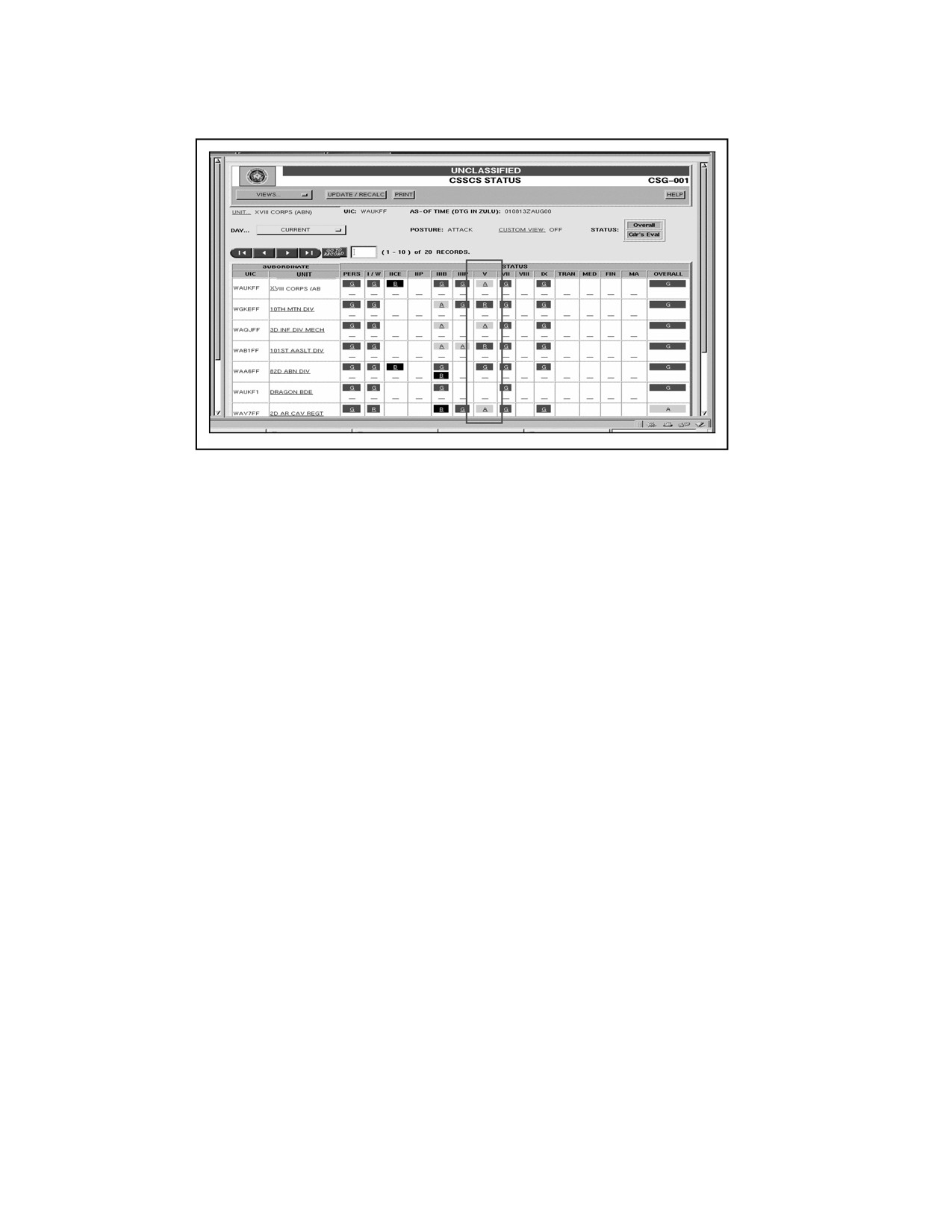
with the SAAS, the BCS3 provides status displays of Class V assets
(figure 1-5) within the division and corps areas. Ammunition stockage data
flows from CSAs and ASPs to the battalion, the group, the corps support
command (COSCOM) operations section, and the corps materiel management
center (CMMC).
1-14
____________________________________________________Munitions Operational Environment
Figure 1-3. The GCSS-Army
Figure 1-4. CSSCS Consolidated Class V Report
1-15
FM 4.30-1 (FM 9-6) __________________________________________________________________
Figure 1-5. CSSCS Ammunition Supply Point Status
1-53. The BCS3 displays assets located in supply points and all the
Department of Defense activity address codes
(DODAACs) or weapon
categories on hand in subordinate units. COSCOM munitions support branch
officers use CSSCS force-level displays to assess the current or projected
availability of ammunition assets for the force. They assess the unique
situation at a particular ammunition supply unit or the status at a particular
CSA, ASP, or ATP. This allows them to better tailor stockage levels to
support requirements. The COSCOM operations officer uses CSSCS force-
level displays to recommend adjustments to distribution plans, allowing
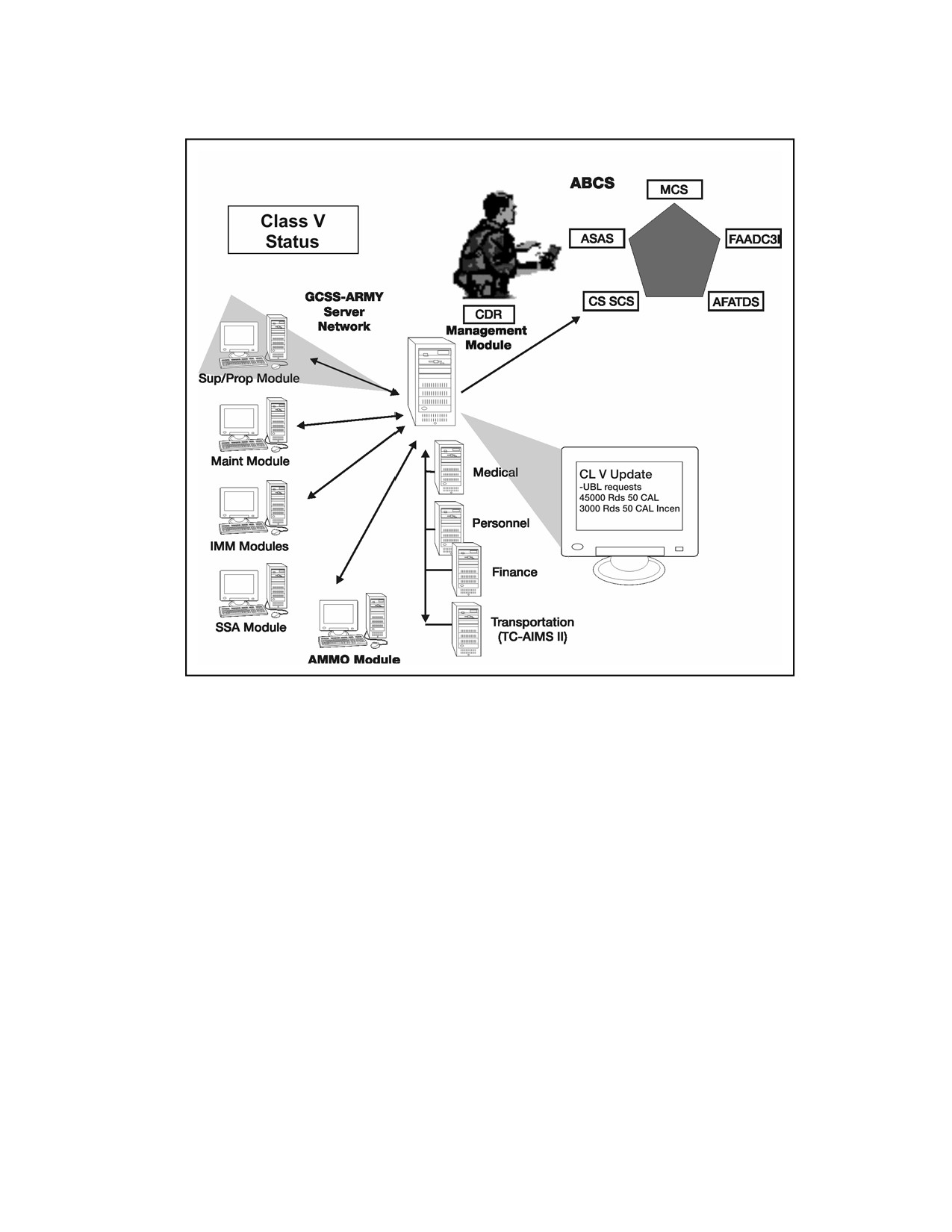
additional supply of ammunition to committed units. Figure 1-6 illustrates
the interface between the GCSS-A ammunition module and the CSSCS.
FM 63-3, FM 63-2, and the SAAS EM provide detailed information on the
munitions data flow.
1-16
____________________________________________________Munitions Operational Environment
Figure 1-6. GCSS-A Ammunition Module and CSSCS
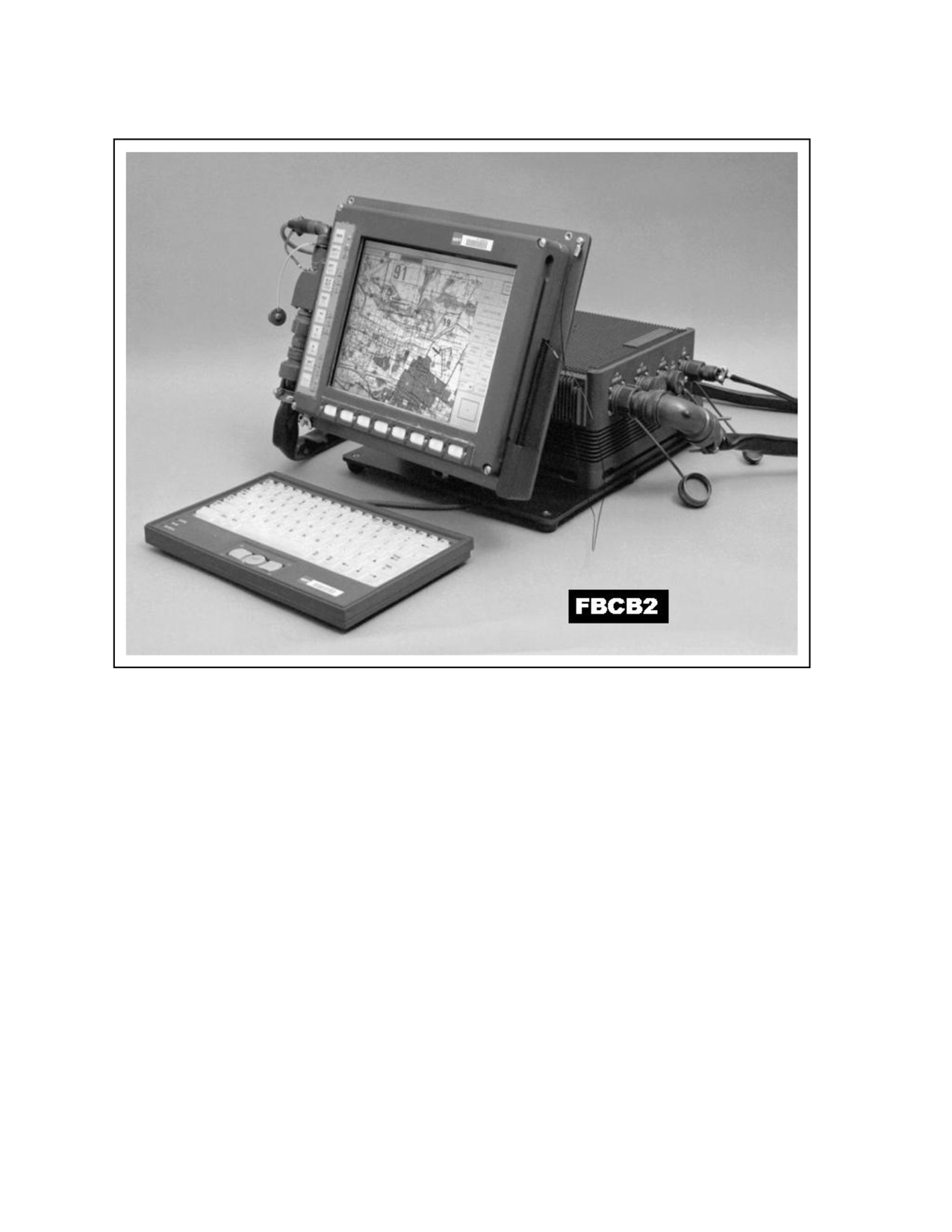
1-54. Force XXI battle command brigade and below (FBCB2) (figure 1-7)
provides real-time ammunition on hand/consumption data to the CSSCS. It
will include a full set of sensors within weapon system platforms that report
weapon status in terms of readiness, required maintenance, fuel, manning,
and ammunition. Tactical-level logisticians obtain the same logistics SU as
provided to the tactical commander. This data provides the logisticians with
the SU required to maintain asset visibility, direct and redirect logistics
platforms, and conduct traffic management within the brigade area.
1-17
FM 4.30-1 (FM 9-6) __________________________________________________________________
Figure 1-7. The FBCB2 System
1-55. Information will be transmitted to either the Global Combat Service
Support System-Army (GCSS-A) or BCS3, or both, depending on the specific
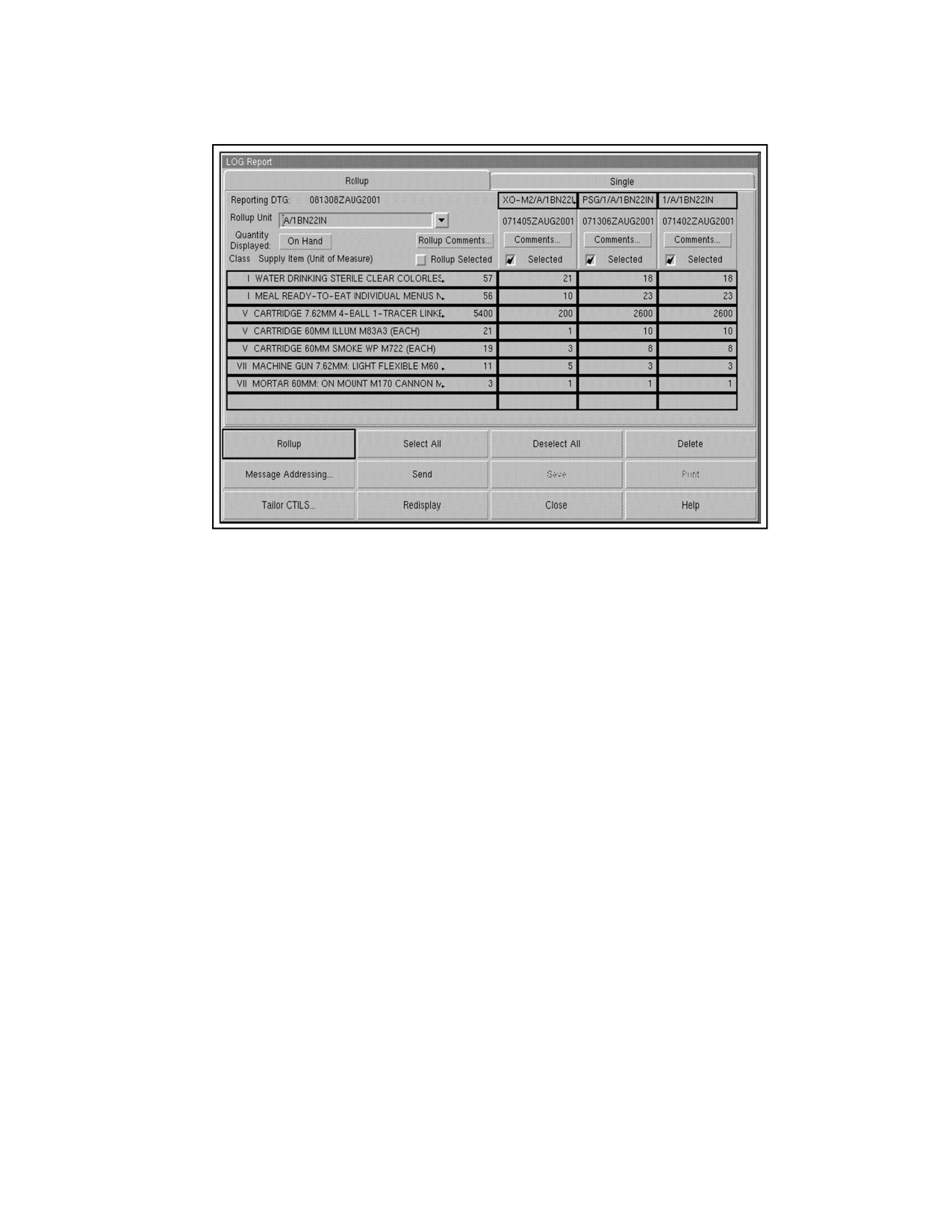
information. For example, munitions status (figure 1-8) would go to the BCS3
for battalion S4s and forward support battalion (FSB) support operations
personnel to track status and plan resupply operations; on-hand or
expenditure data would go to the GCSS-A for initiation of ammunition
requests. Details on each STAMIS at each echelon are in the related support
organization manual. For example, FM 63-3 covers the role of CSS STAMIS
at corps, and FM 63-2 and FM 63-2-1 detail STAMIS at the division level.
1-18
____________________________________________________Munitions Operational Environment
Figure 1-8. Logistics Situation Report Screen
STANDARD ARMY AMMUNITION SYSTEM—MODERNIZED (SAAS-MOD)
1-56. The SAAS is a computer-based information system used at the
operation and management levels in a theater of operations and at
installations. It provides an integrated ammunition management and control
capability for ammunition support operations. The system’s primary purpose
is to satisfy the conventional ammunition tactical information requirements
of commanders under wartime conditions. FM 4-30.13 and the SAAS end
users manual (EM) provide additional information on the environment,
functions, and employment of the SAAS. Detailed information on SAAS
functions is contained in appendix A.
Operating Environment
1-57. The SAAS-MOD provides information processing support for
conventional ammunition logistical support applications at installations,
divisions, corps, and echelon above corps
(EAC). The SAAS-MOD gives
commanders and ammunition managers the capability for producing
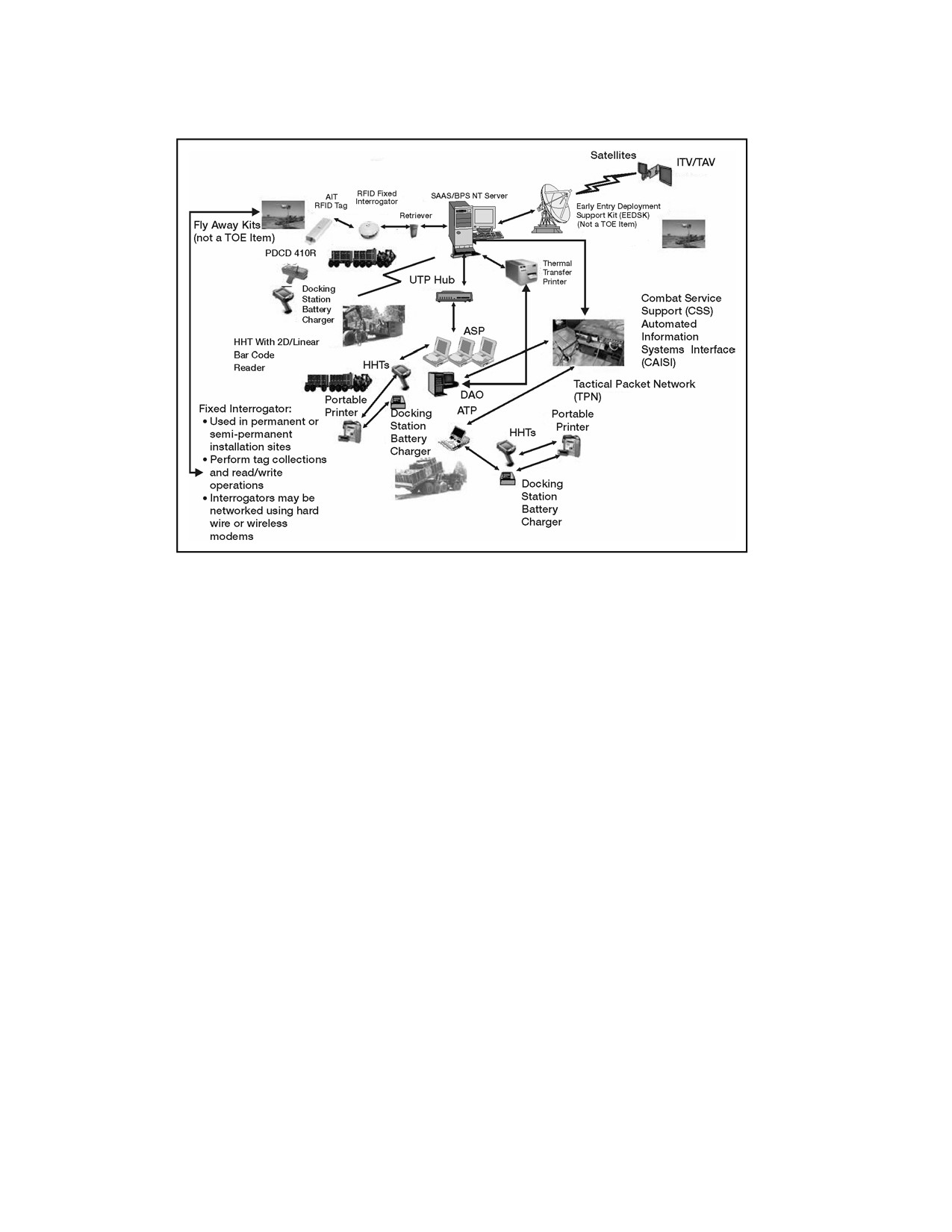
accurate, timely, and near real-time Class V information (figure 1-9) during
peacetime, contingency operations, and wartime operations on a highly-
mobile battlefield. It provides management and stock control for conventional
ammunition, guided missiles and large rockets (GMLRs), and component and
packaging (C&P) materials. The SAAS-MOD operates at all of the following
functional levels in the theater of operations. Refer to figure 1-2 for an
illustration of SAAS-MOD integration.
z
Corps and theater materiel management centers
(MMCs) or
MACOM-equivalent.
z
ASA (TSA, CSA, or ASP).
z
Installation ASA.
z
DAO and ATP.
1-19
FM 4.30-1 (FM 9-6) __________________________________________________________________
Figure 1-9. SAAS-MOD ITV/AIT Integration
Materiel Management
1-58. In the current SAAS, ammunition materiel management functions are
performed only at theater and CMMCs. These functions relate to the overall
management of authorizations, requirements, and redistribution of
ammunition assets within the theater. The current SAAS is designed for
major operations with the theater currently in place or in a deployed corps.
Management functions may be performed at a lower level only when
authorized.
Requirements Management
1-59. The functions of managing ammunition requirements are performed at
the DAO and ATP. They include maintaining ammunition requirements,
visibility, and distribution within the division. The DAO is responsible for
distributing ammunition, verifying unit requirements, and tracking
ammunition coming into the division. Once ammunition is shipped from the
ASP to the ATP, visibility is maintained until munitions are issued and
consumed by the user. The standard property book system-redesign (SPBS-
R) provides accountability for ammunition basic load
(ABL) and/or
operational load munitions at the user level.
Logistics Systems Interfaces
1-60. The SAAS-MOD receives and sends data to several systems. All data
received by communications is normally batch-processed after the
communications portion of the interface is complete. All SAAS activities
within a theater provide data for each other. The SAAS-MOD performs the
following interfaces:
1-20
____________________________________________________Munitions Operational Environment
z
The Worldwide Ammunition Reporting System
(WARS) receives
SAAS transactions that affect assets daily.
z
Military Standard Requisitioning and Issue Procedures (MILSTRIP)
data is received and sent to the Commodity Command Standard
System (CCSS).
z
MILSTRIP and Military Standard Transportation and Movement
Procedures
(MILSTAMP) data is sent and received through the
Defense Automated Address System (DAAS).
z
The Logistics Support Agency (LOGSA) provides up-to-date catalog
information.
z
The training ammunition management information system-revised
(TAMIS-R) provides allocation and authorization data for training
ammunition.
z
The CSSCS provides a manual interface that keeps tactical
commanders informed on the status of selected ammunition stocks.
z
The SPBS-R provides on-hand quantities of the ABL/operational load
at the unit.
z
ASAs/ATPs that provide training ammunition support send training
expenditure information to the TAMIS-R.
Hardware Configuration
1-61. The SAAS EM describes how SAAS equipment is tailored for each of
the three functional levels and to the site that operates it. Quantities of
hardware at each location are based on unit missions. They are outlined in
the basis of issue plan (BOIP) for the SAAS and are contained in appendix A.
SAAS equipment is subject to change because of technology improvements.
The computer hardware at the theater and CMMC levels consists of a
network file server, PCs for user terminals, laser printers, an uninterruptible
power supply
(UPS), a surge suppressor, local area network
(LAN)
equipment, and modems. The computer hardware at the DAO and ATP levels
consists of similar equipment plus a laptop for each ATP, the LAN
equipment, the modems, and the automatic information technology (AIT)
equipment. AIT equipment includes the following:
z
RF interrogator (ASA only), hand-held terminal (HHT), and docking
stations.
z
Portable printer.
z
Thermal printer (ASA only).
1-21
Chapter 2
Munitions Force Structure
This chapter describes the munitions support structure and distribution
system. Modular ammunition units are the major topic. Also discussed is
the flow of munitions, information, and documents, as well as the
responsibilities of distribution managers at each echelon.
CURRENT FORCE MUNITIONS OPERATION
2-1.Major operations and deployments create a tremendous demand on
CONUS ammunition activities (depots, plants, and arsenals). The Army no
longer has massive stockpiles of mu-
CONTENTS
nitions outside CONUS (OCONUS),
Current Force Munitions Operation...2-1
and the amount of APS is limited.
Support Structure Overview
2-2
This leaves stateside ammunition ac-
Class V Flow
2-17
tivities to provide most of the muni-
Aerial Resupply
2-23
tions required in an operation. Very
Command and Support
early in the deployment process,
Relationships
2-24
planners must provide augmentation
support to these ammunition activities. A significant number of Army
munitions units are in the Reserve Component (RC); therefore, RC units
should assist in the planning process. RC munitions units will probably as-
sist in providing both planning and support at the ammunition activity.
When planning to use RC units to provide support, planners must consider
the time required to mobilize and deploy the units. Normally, it takes RC
units at least two weeks to complete the mobilization process. This time must
be factored into all operational plans. With the modular munitions unit
concept implanted, one or more ammunition MLPs or HLPs may be assigned
to each ammunition activity requiring augmentation. The numbers assigned
will depend on several factors:
z
The projected size and duration of the operation.
z
The projected amount and configuration of munitions to be shipped.
z
The size of the depot or port, and the facilities, equipment, and
personnel organic to the depot or port.
z
The readiness level of augmented units.
2-2. Providing support to CONUS ammunition activities is critical for the
success of any operation. Ammunition sitting in stateside storage facilities
does not win battles; the failure to get it to the theater of operations may
result in unnecessary casualties and an unsuccessful operation.
SUPPORT STRUCTURE OVERVIEW
2-3. The mission of the munitions support structure is to provide the required
type and amount of munitions to the combat user at the time and location
2-1
FM 4.30-1 (FM 9-6) __________________________________________________________________
(when and where) it is needed. This requires an efficient, effective, and
flexible munitions distribution system. To meet the needs of combat
commanders, munitions distribution must adhere to sustainment presented
in FM 4-0 and chapter 1 of this manual.
2-4. Three types of ASAs are in the theater: TSAs, CSAs, and ASPs. An ATP
is not considered an ASA because of its temporary nature. The ASA mission
is to receive, store, issue, and maintain the theater conventional ammunition
stocks. Also, ASAs can configure ammunition into CLs. Once configured, CLs
are shipped forward to ATPs for issue to combat units.
THEATER STORAGE AREA OPERATIONS
2-5. The TSA is the largest munitions storage facility in the theater. It is
operated by a HQ, modular munitions company, with several HLPs and
possibly an MLP. The TSA provides direct support (DS) by area, to units
operating in the COMMZ and provides general support (GS) to the corps
within the theater. The number, size, and stockage objective of a TSA is
METT-TC driven and determined by the ASCC. It is assigned to an area
support group (ASG).
2-6. The TSA is normally a permanent or semi-permanent storage facility. It
may expand to cover approximately 40-square kilometers. In a combat
environment, the TSA may be relocated to a field environment where
ammunition stocks are kept in open storage. To ensure smooth shipment
operations, the TSA should be located where there is ready access to
highway, rail, air, and port facilities. The TSA receives 100 percent of its
ammunition from the POD, whether it is seaport, airhead, or logistics-over-
the-shore (LOTS) operations. The ammunition and components received are
either containerized, break-bulk, or a combination of both. The ammunition
arrives at the TSA on theater transportation assets, primarily railcars and
trucks. Ammunition sent from the TSA to the CSA and ASP is shipped as
single Department of Defense identification code (DODIC) loads or CLs.
2-7.Containers received at the TSA must be efficiently managed by
transportation and ammunition personnel to ensure accountability and
recovery for reuse. Ammunition ISO containers are shipped only to the TSA
or CSA.
CORPS STORAGE AREA
2-8. The CSA is the primary source of high-tonnage Class V for the division
and the corps. It is operated by a HQ, modular ammunition company, with a
combination of MLPs and HLPs. The CSA also provides DS, by area, to units
operating in the corps. Initially, the stockage objective of the CSA should be
from 10 to 15 days of supply (DOS). After the initial combat drawdown, the
CSA should maintain 7 to 10 DOS. The number, size, and actual stockage
objective of CSAs are METT-TC dependent. One CSA is normally required to
support ASP and ATP operations for each committed division. When a CSA
wartime stockage objective exceeds 25,000 STONs, a second CSA should be
established.
2-9. In established theaters, initial stockage of the CSA is in the form of CLs
or break-bulk from APS. Once the supply system is established, the CSA
receives approximately 50 percent of its ammunition from the POD. The
remainder is from the TSA. Ammunition resupply from the POD is both
break-bulk and CLs. Ammunition is shipped from the CSA to an ASP in CLs
2-2
___________________________________________________________Munitions Force Structure
and single-DODIC loads. The ammunition shipped from the CSA to the ATPs
is configured into MCLs. The CSA can expand to encompass approximately
40-square kilometers. The storage environment depends on the tactical
situation. It allows for enough room for the CSA to configure MCLs for
onward movement. A medium truck company should be identified to work in
DS of the CSA, and should be collocated in or near the CSA. With modular
ammunition units, the number of MLPs and HLPs will be based on workload.
At a minimum, one MLP will be required at each CSA to meet the MCL
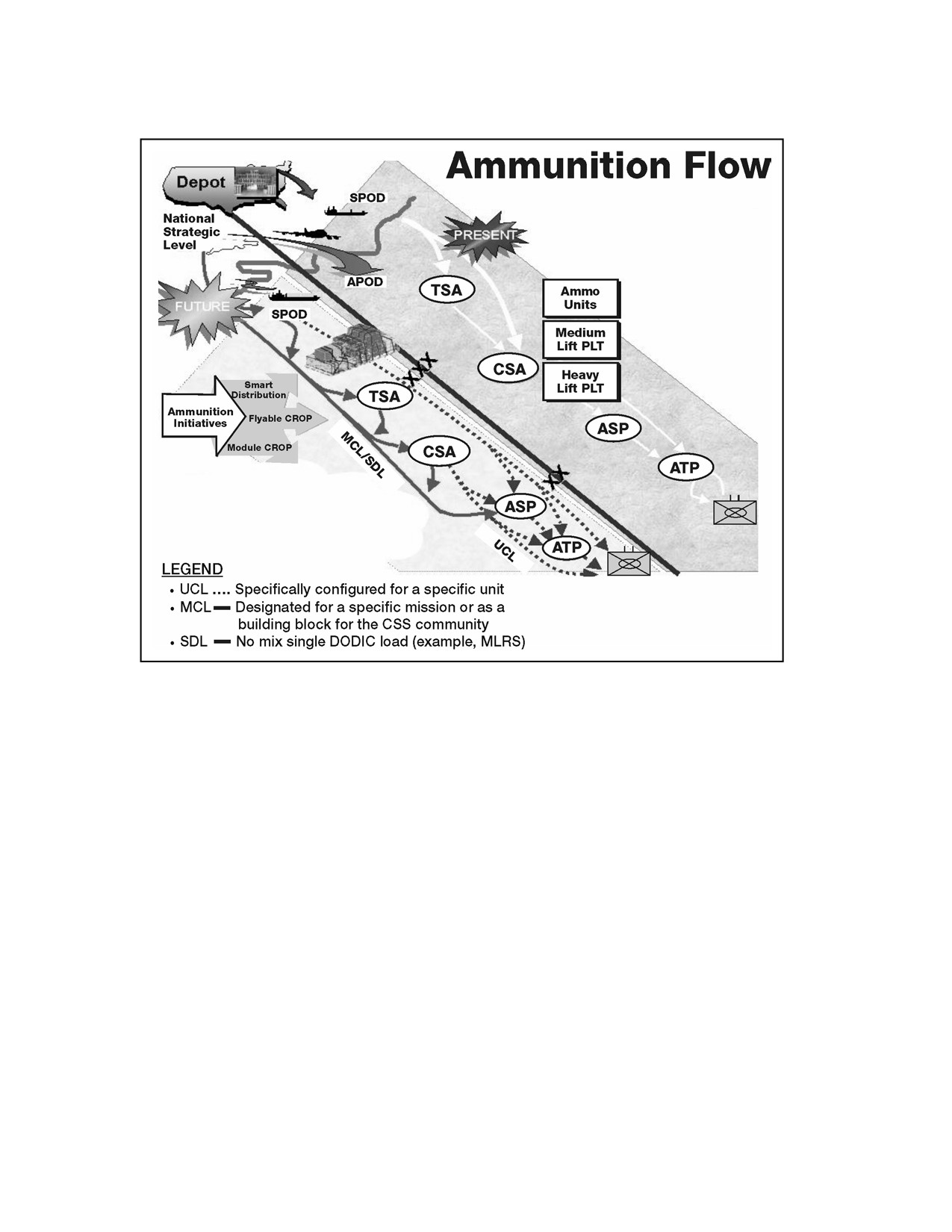
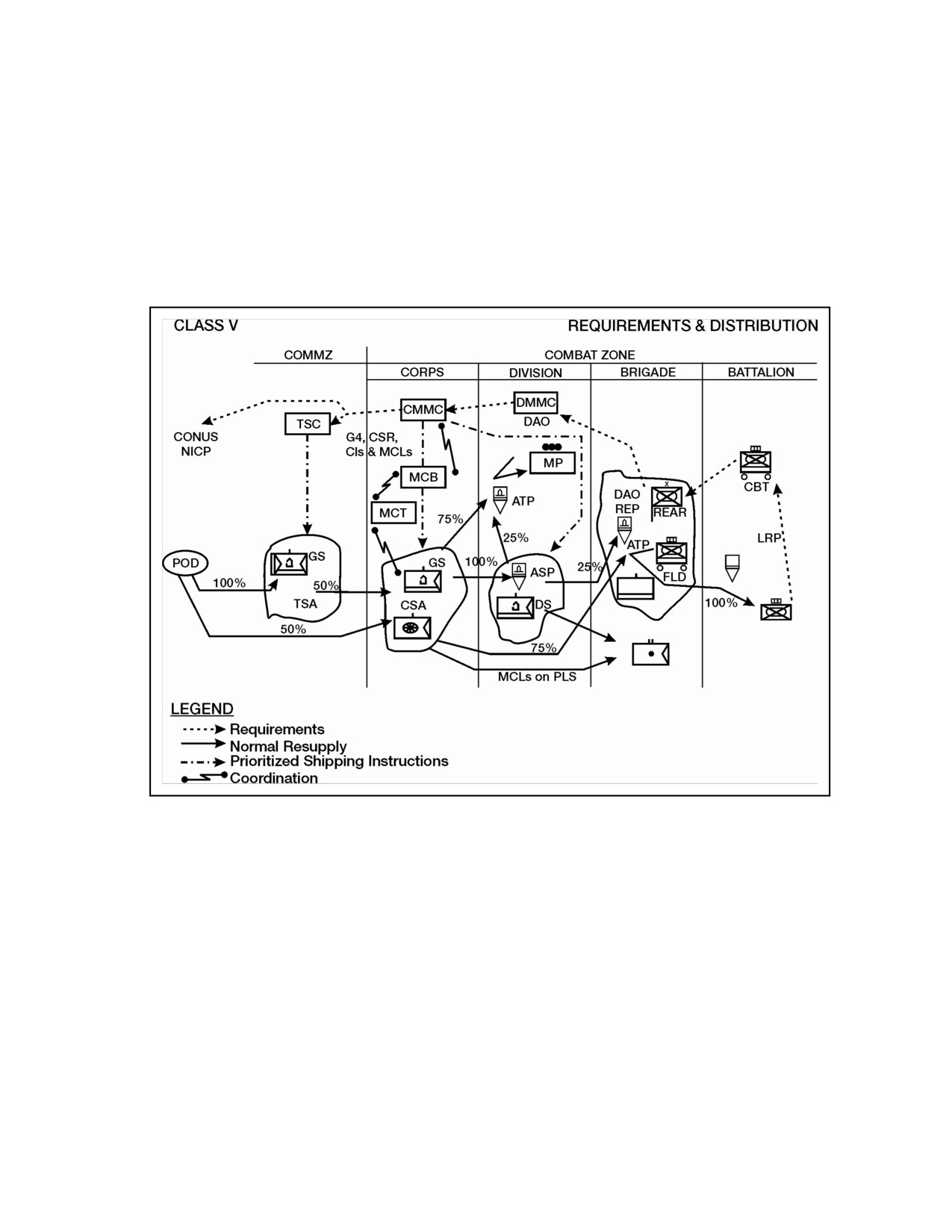
workload. Figure 2-1 illustrates munitions flow in the theater of operations.
Figure 2-1. Munitions Flow in the Theater of Operations
AMMUNITION SUPPLY POINT
2-10. The ASP is located in the division rear and operated by a MLP from a
modular ammunition company. The ASP provides Class V support to corps,
divisional, and non-divisional units. Normally, three MLPs are required to
support a division and to provide manning for the division rear ATP. Each
ASP is a field site and operated by one or more MLPs. During the ASP site
selection process, commanders should focus on locations that minimize the
need for engineer support. It should be located near an improved road
network to ensure access by theater/corps transportation assets. It maintains
a one-to-three day supply of ammunition to meet a routine surge and
emergency requirements for supported units. The actual stockage level and
size of an ASP are METT-TC dependent. The ASP can expand to five- or six-
square kilometers, or larger, depending on the METT-TC factors. Unlike the
2-3
FM 4.30-1 (FM 9-6) __________________________________________________________________
CSA and TSA, ASP stocks are most often stored on the ground on
unimproved surfaces. Under current doctrine, the ASP receives 100 percent
of its requirements from a supporting CSA. Once in the ASP, the ammunition
is issued in single DODIC loads or as MCLs.
AMMUNITION TRANSFER POINT
2-11. Each brigade combat team (BCT) is authorized an ATP located near
the brigade support area (BSA) and operated by the Class V section of the
supply company of the forward support battalion (FSB), and a division
ammunition office
(DAO) representative from the division materiel
management center
(DMMC). The ATP provides
100 percent of the
ammunition requirements to all units within the brigade sector.
2-12. The modular ammunition company operates one ATP in the division
rear, usually near the division support area (DSA). The ATP is organized by
combining the rear ATP sections of the three MLPs within the ammunition
company. This ATP receives mission guidance and responds to the priorities
established by the DAO. The DAO representative from the DMMC and the
ATP section fulfils the ammunition requirements for all divisional, non-
divisional, and corps elements (artillery, aviation, and so forth) operating in
the division rear area.
2-13. ATPs are the most mobile and responsive of all Class V supply
facilities. They must be able to move and provide support to the brigade as it
moves. They receive about 75 percent of their ammunition as throughput
from the CSA. The other 25 percent comes from an ASP in the form of MCLs.
The ammunition is loaded on flatracks, brought forward to the ATP on corps
transportation assets; the ammunition is transferred to the receiving unit’s
organic vehicles. If the gaining unit’s vehicle is not available, their flatracks
are placed on the ground temporarily. The ATP gains visibility of the
shipment using automated information technology (AIT) by using RF tags or
conducting an inventory using the handheld terminals (bar code scanner).
The ATP personnel assist units without the PLS to transload munitions.
2-14. The brigade S4, with the assistance of the DAO representative
(RSR/CSR guidance), consolidates the ammunition requests from the
battalion S4s within the BCT and forwards the brigade ammunition request
to the DAO in the DMMC. Additionally, the DAO representative, in
conjunction with the FSB support operations officer and the movement
control team (MCT), coordinates with the units and informs them when
munitions will arrive at the ATP. The DAO representative issues the
ammunition in accordance with the RSR/CSR and reports the receipt and
issue transactions to the DAO in the DMMC, using the communication
process in SAAS-ATP.
2-15. Corps units employed in the brigade area pick up their ammunition at
the forward ATP. Their ammunition requirements must be pre-coordinated
with the division ammunition office and the brigade S4.
2-16. Units arriving at the ATP to pick up munitions drop off empty, or
partially empty, flactracks and retrieve fully loaded flatracks. The SPO and
MCT will coordinate with the corps transportation to facilitate the return of
empty or partially empty flatracks back to the nearest ASP, CSA, or TSA.
2-4
___________________________________________________________Munitions Force Structure
ARMY SERVICE COMPONENT COMMANDER
2-17. The ASCC has overall responsibility for in-theater receipts,
accountability, and management of munitions stocks. The ASCC is also
responsible for the following functions:
z
Establishing ASPs, CSAs, and TSAs.
z
Coordinating distribution between storage sites and forward ATPs,
and coordinating direct issue to using units on an area support basis.
OPERATIONAL-LEVEL MATERIEL MANAGEMENT CENTER
2-18. The operational-level MMC is the support unit responsible for
providing theater-wide munitions supply management and allocation.
Support is based on priorities established by the theater combatant
commander. The MMC is the prime interface between the theater and the
CONUS sustaining base, which includes the Defense Logistics Agency (DLA),
national inventory control points
(NICPs), and U.S. Army Logistics
Command (USALC). The operational-level MMC communicates with the
operational-level movement control agency
(MCA), the theater support
command (TSC), CMMCs, and the CONUS sustainment base. The MMC
provides initial resupply to the corps from several possible theater
ammunition sources:
z
Army prepositioned stocks include either ammunition pre-configured
on logistics ships available for rapid delivery to the theater or
prepositioned ammunition available on a regional basis to support
contingencies worldwide.
z
Sustainment-based production stocks include ammunition either off
the production line or stored in depots. These stocks are shipped to
the theater as needed.
CORPS MATERIEL MANAGEMENT CENTER
2-19. When a corps is the Army Forces
(ARFOR), the CMMC is the
operational-level MMC. In a theater with more than one corps, the ASCC
may establish a centralized MMC to which CMMCs report. The CMMC
provides centralized control of munitions and all other classes of supply
within the corps. It is the interface between corps units and the
theater/operational-level MMC.
MISSILE AND MUNITIONS DIVISION
2-20. In the CMMC, the missile and munitions division includes three
branches: the missile and munitions support branch; the missile and
munitions parts supply branch; and the missile and munitions maintenance
branch (see FM 63-3).
2-21. The missile and munitions division is responsible for ammunition
management, to include the following:
z
Processing requisitions.
z
Reviewing the RSR.
z
Directing the storage and distribution of ammunition.
z
Coordinating with the CMMC to integrate ammunition movement
requirements into movement programs.
z
Enforcing the CSR.
2-5
__________________________________________________________________
FM 4.30-1 (FM 9-6)
z
Directing the CSA(s)/ASP(s) to fill ammunition requests from
supported divisions and corps elements.
2-22. The munitions support branch exercises staff supervision over
munitions support operations. These include supply and maintenance
operations relating to munitions, missiles, special weapons, and associated
repair parts, special tools, and test equipment. Responsibilities include—
z
Developing plans and policies involving munitions supply and
maintenance.
z
Providing staff input for munitions planning to the corps support
command (COSCOM) CSS plans staff branch.
z
Developing munitions surveillance policies.
z
Maintaining a running estimate of munitions requirements.
z
Coordinating munitions requirements with the corps G3 and G4
staffs.
z
Establishing ammunition supply levels based on corps directives.
z
Recommending ammunition supply and storage site locations to the
corps rear command post (CP) CSS cell.
2-23. Missile and munitions officers assigned to the munitions support
branch develop operating procedures and plans to implement munitions
supply policies prescribed in AR
710-1, AR 710-2, and SAAS technical
manuals (TMs). Other duties include—
z
Providing technical advice and assistance to ammunition officers in
subordinate corps support groups (CSGs) and ammunition supply
units.
z
Coordinating with CSG ammunition officers on cross-level munitions
support personnel and equipment.
z
Recommending establishment and movement of ASAs as the
situation dictates.
z
Reviewing and updating ammunition planning factors to the theater
scenario.
z
Monitoring ammunition suspensions.
z
Recommending adjustments to munitions stockage levels.
z
Coordinating resupply of munitions stocks for attrited units at
regeneration sites.
AMMUNITION BATTALION MATERIEL OFFICE
2-24. In the absence of an ordnance group in theater, the conventional
ammunition battalion is normally assigned to the COSCOM/TSC to establish
and operate ammunition supply activities. The materiel officer (MATO) of
this battalion serves as the initial point of coordination for resolving
ammunition support problems. The MATO acts in concert with the COSCOM
staff and CMMC munitions and transportation managers to accomplish the
following:
z
Coordination of assets.
z
Monitoring and cross-leveling of stocks.
z
Directing the implementation of COSCOM/TSC support operations
(SPT OPS) directives, CMMC/TAMMC taskings, and CMMC/theater
Army movement control center (TAMCC) commitments.
2-6
___________________________________________________________Munitions Force Structure
2-25. MATO responsibilities include the following:
z
Analyzing CSSCS data, which interfaces with the SAAS to determine
the trends and efficiency of stock operations.
z
Monitoring supply status data on munitions stocks at ASAs.
z
Assisting in synchronizing activities of subordinate ammunition units
with habitually supporting truck companies.
z
Providing technical assistance and monitoring quality assurance,
ammunition surveillance, and ammunition maintenance programs of
subordinate units.
z
Coordination with the COSCOM/TSC on cross-leveling munitions
support personnel and equipment.
z
Coordination to the COSCOM/TSC; when in-transit, ammunition
stocks should be diverted based on METT-TC factors.
SUPPORT OPERATIONS OFFICE
2-26. Under the control of the SPT OPS officer, the division SPT OPS office
provides overall total asset visibility (TAV) and in-transit visibility (ITV) for
all commodities, movements, and units within, assigned, or inbound to the
AO. The critical focus of this section is on establishing and maintaining a
“logistical fusion center” to collect, collate, and analyze TAV/ITV information
for the DISCOM SPT OPS, and in coordinating with, gaining information
from, and integrating the efforts of all other elements of the SPT OPS staff.
CLASS V SUPPLY BRANCH
2-27. The Class V supply branch maintains records and stock control of all
ammunition allocations, and receipts current ATP operations and
expenditures for Class V items through automated and digitized information
systems. It provides technical assistance and advice on ammunition, and
provides overall supervision to ATP and other ammunition operations. This
section is tailored to meet the management needs of brigade combat teams
and division troops.
DIVISION AMMUNITION OFFICER
2-28. The DAO is responsible for ammunition resupply for all units operating
in the division AO. He represents the MMC and DISCOM commanders on all
ammunition-related matters. The DAO has five broad missions:
z
Consolidate division ammunition requirements.
z
Assist the S4/G4 in preparing plans and procedures for ammunition
operations.
z
Maintain ammunition visibility through stock records and reports
(SAAS-MOD data entry point). (See appendix A.)
z
Conduct and supervise ammunition operations.
z
Validate ammunition requests and enforce the CSR.
2-29. The DAO maintains liaison with the ASAs supporting the division and
with ammunition staff officers at the corps.
2-7
FM 4.30-1 (FM 9-6) __________________________________________________________________
2-30. Brigade S3 ammunition responsibilities include—
z
Determining brigade ammunition requirements based on input from
subordinate battalions and knowledge of upcoming tactical
operations.
z
Determining the consolidated brigade RSR and submitting it to the
division G3 and the DAO.
z
Determining the best location for the BSA.
z
Providing security for the ATP.
2-31. Brigade S4 ammunition responsibilities include—
z
Consolidating and forwarding daily ammunition requirements to the
DAO.
z
Coordinating an issue schedule with the SPT OPS office, FSB, and
modular ammunition company ATP.
z
Providing a unit issue priority list to the DAO and forwarding the
consolidated unit ammunition requirements to the DAO.
z
Providing subordinate battalion S4s with their allocations of the
brigade CSR. (This information is also provided to the DAO so
battalion units do not exceed their authorizations when transloading
at the ATP.)
FORWARD SUPPORT BATTALION
2-32. The Class V section of the FSB supply company operates one ATP near
the BSA. It provides area support to division and corps units. Each ATP has
DAO representatives assigned to control the flow of ammunition.
2-33. When munitions arrive at the ATP, the FSB Class V section inspects,
inventories, and signs for the shipment. A copy of the shipping document is
returned to the originating ASA. The DAO representative receipts the
ammunition on the SAAS-ATP and sends the transactional data to the DAO
via the communications process within the SAAS-MOD.
2-34. The brigade S4 coordinates with the FSB SPT OPS officer to establish
an issue schedule. When supported units arrive at the ATP, they submit
ammunition requests that have been authenticated by the battalion S4.
Before a unit is issued ammunition, the DAO representative at the ATP
validates the request. Once ammunition is issued to a unit, the unit assumes
accountability and uses its transportation assets to move the ammunition
forward.
HEADQUARTERS AND HEADQUARTERS COMPANY (HHC), ORDNANCE GROUP
(AMMUNITION) (DS/GS)
2-35. The mission of the headquarters and headquarters company (HHC),
ordnance group
(ammunition), is to command and control assigned or
attached DS and GS ammunition units (see figure 2-2). The ordnance group
is primarily responsible for the ordnance support structure for ordnance
units assigned to EAC. It is responsible for TSA operations. The group also
commands, controls, and plans ammunition missions, to include the
following:
z
Retrograde activities.
z
Enemy ammunition inspection, processing, and shipping.
z
Operating ASAs for COMMZ transient units.
z
Advising ASCC on theater-wide ammunition policy.
2-8
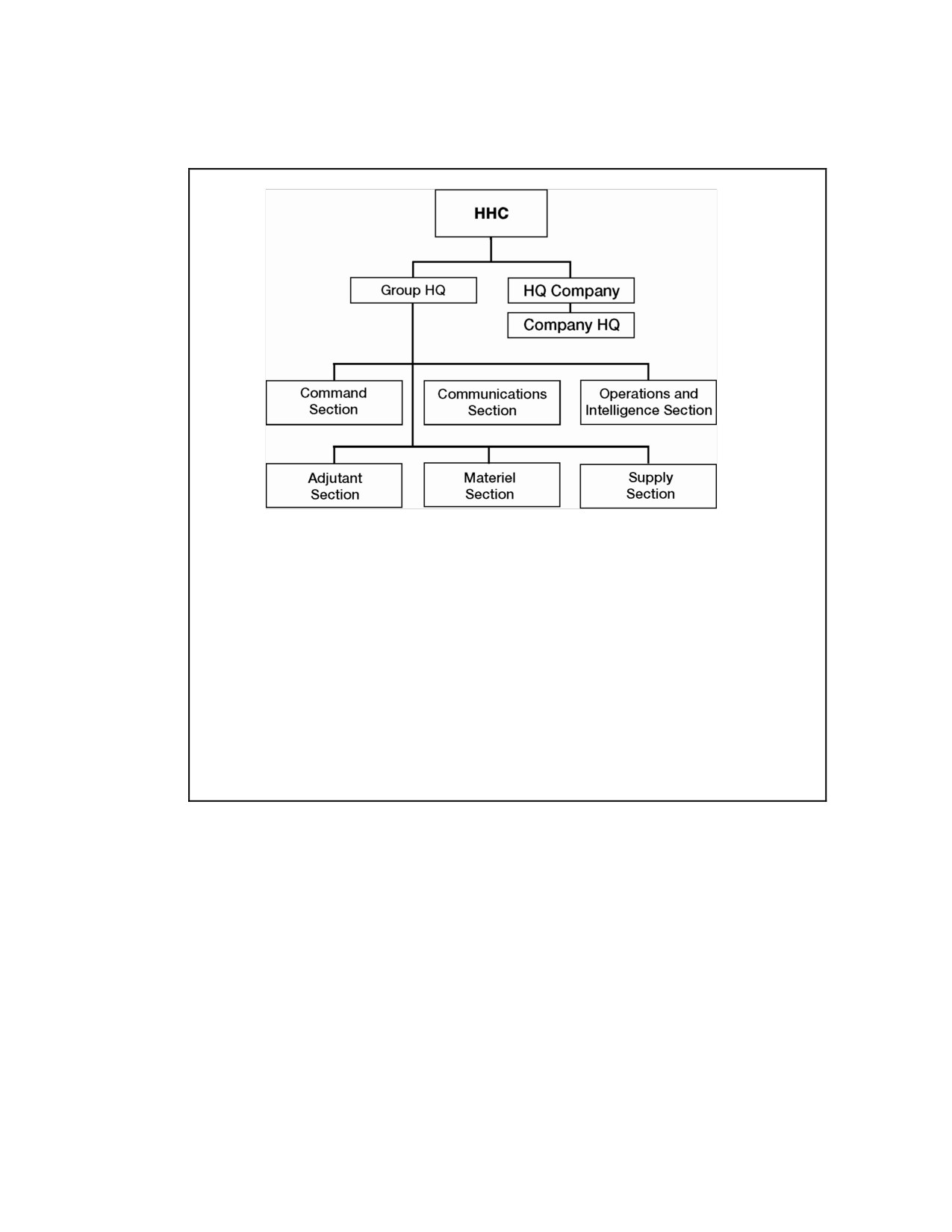
___________________________________________________________Munitions Force Structure
z
Establishing ammunition supply and maintenance procedures
consistent with the policies and directives of the ASCC and the corps.
Mission: Command and control assigned or attached DS and GS ammunition units or
other attached units.
Assignment: Assigned to a TSC.
Capabilities: At 100 percent of assigned personnel, this unit can provide—
• Command, control, and staff planning for up to six subordinate units.
• Technical direction over ammunition support missions of subordinate units,
except for inventory management functions for which the operational level MMC
is responsible.
Basis of Allocation: Normally one per TSC or one per two to six battalions commanded.
Mobility: This unit is required to move 50 percent of its TOE equipment and personnel in
a single lift, using organic vehicles.
Figure 2-2. Ordnance Group, Ammunition (DS/GS) (TOE 09662L000)
2-36. The ordnance group executes missions through subordinate ordnance
battalions or in coordination with ASGs. The ordnance group provides
technical assistance through the materiel section to ASG ordnance planners.
The group can also provide coordination for resolving support problems
between subordinate units, supported units, and CONUS depots.
2-9
///////////////////////////////////////