FM 4-30.1 MUNITIONS DISTRIBUTION IN THE THEATER OF OPERATIONS (DECEMBER 2003) - page 2
FM 4.30-1 (FM 9-6) __________________________________________________________________
2-37. Ordnance group technical assets can be deployed before, during, and
after operations to work in concert with the TSC, the logistics support
elements (LSEs), and the theater support command materiel management
center (TSCMMC). The ordnance group (ammunition) is assigned to a TSC. It
is allocated one per theater or one per two to six battalions commanded. At
100 percent of assigned personnel, ammunition group missions include the
following:
z
Command, control, and staff planning for up to six subordinate units.
z
Technical direction of subordinate unit ammunition support
operations, except for inventory management functions for which the
TSC MMC is responsible.
HEADQUARTERS AND HEADQUARTERS DETACHMENT, ORDNANCE BATTALION
(AMMUNITION) (DS/GS)
2-38. The mission of the HHD, ordnance battalion
(ammunition)
(TOE
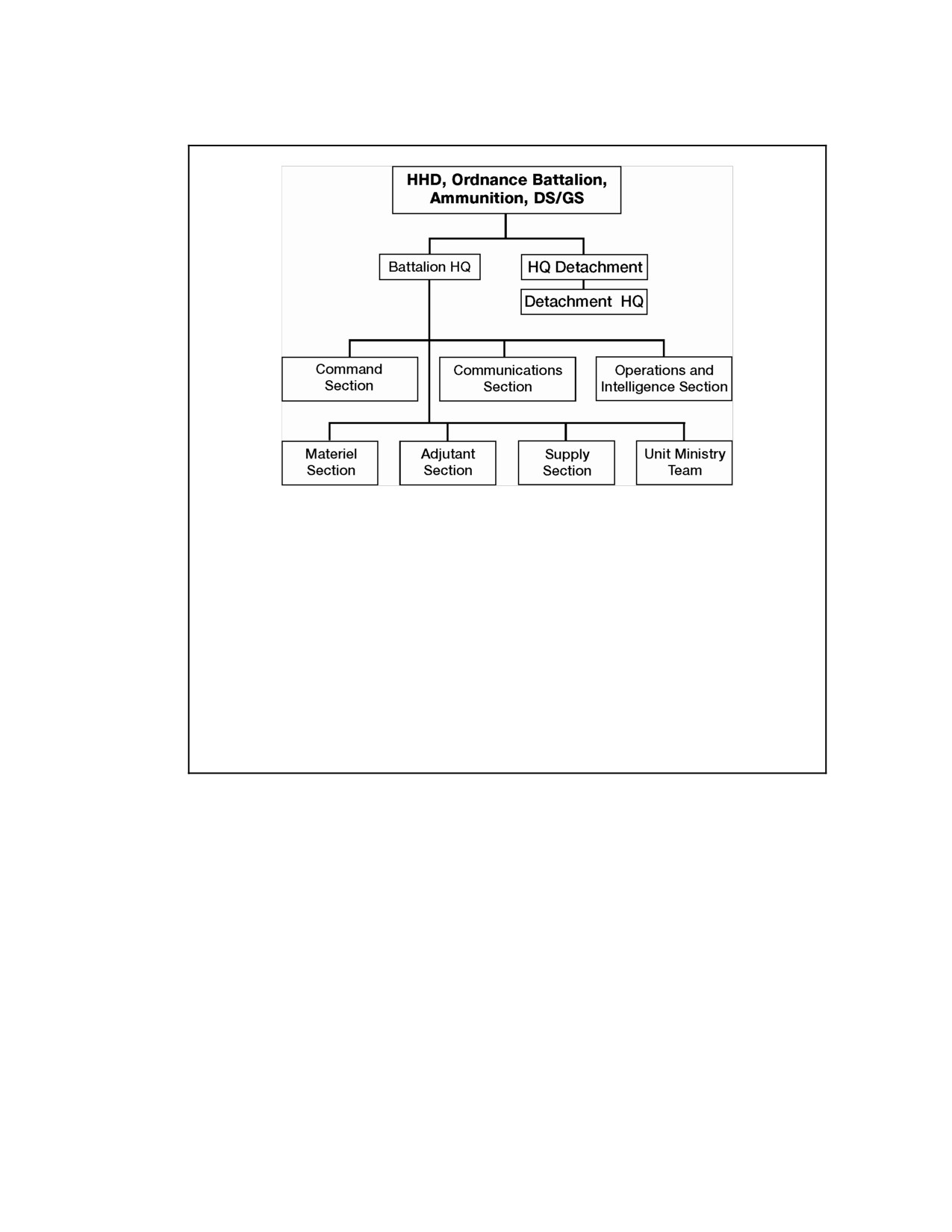
09466L000 or TOE 09666L000) (see figures 2-3 and 2-4, respectively), is to
command and control assigned units, attached DS ammunition units, or
other attached units. These units ensure compliance with ammunition supply
and maintenance procedures established by the TSC. This unit is assigned to
a COSCOM or a CSG. It may also be assigned to a TSC, normally attached to
an HHC, conventional ammunition group
(DS). A minimum of one
ammunition battalion is required per COSCOM to support a fully deployed
corps. This battalion is allocated one per three to five companies commanded.
It can provide—
z
Command, control, and staff planning for up to five subordinate
units.
z
Technical direction over ammunition support operations of
subordinate units (the exception is inventory management functions,
for which the operational-level MMC is responsible).
z
Ordnance battalion, ammunition (DS/GS) (TOE 09466L000).
z
Ordnance battalion, ammunition (DS/GS) (TOE 09666L000).
2-10
___________________________________________________________Munitions Force Structure
Mission: Command and control of assigned or attached companies or modular
ammunition platoons or other attached units.
Assignment: Assigned to a CSG.
Capabilities: At 100 percent of assigned personnel, this unit can provide—
• Command, control, and staff planning for two to five subordinate units.
• Technical direction over ammunition support missions of subordinate units,
except for inventory management functions for which the operational level MMC
is responsible.
Basis of Allocation: Normally one per two to five companies commanded.
Mobility: This unit is required to move 50 percent of its TOE equipment and personnel in
a single lift, using organic vehicles.
Figure 2-3. Ordnance Battalion, Ammunition (DS/GS) (TOE 09466L000)
2-11
FM 4.30-1 (FM 9-6) __________________________________________________________________
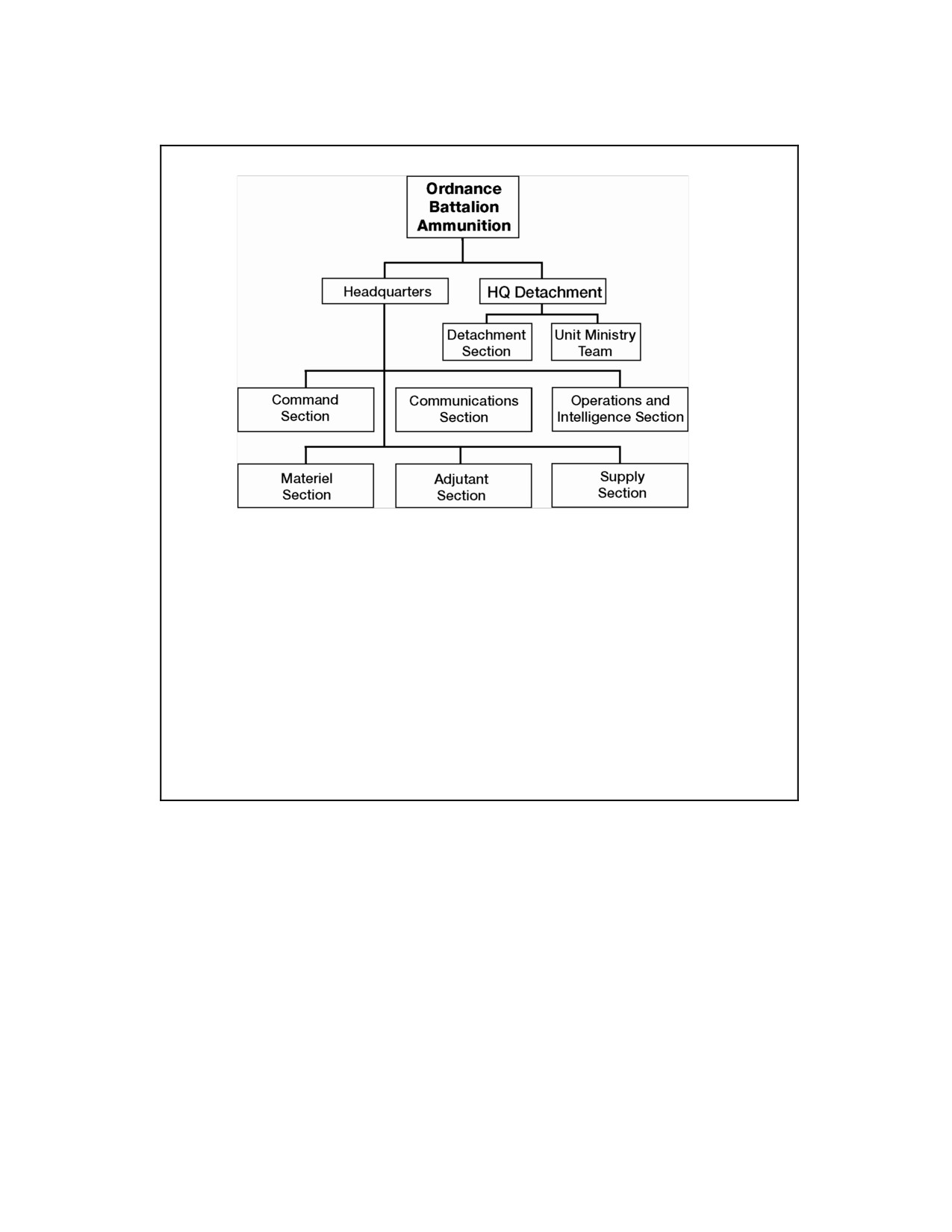
Mission: Command and control assigned or attached ammunition companies or modular
ammunition platoons or other attached units.
Assignment: Assigned to a TSC or ordnance ammunition group.
Capabilities: At 100 percent of assigned personnel, this unit can provide—
• Command, control, and staff planning for two to five subordinate units.
• Technical direction over ammunition support missions of subordinate units,
except for inventory management function for which the operational level MMC is
responsible.
Basis of Allocation: Normally one per two to five companies commanded.
Mobility: This unit is required to move 50 percent of its TOE equipment and personnel in
a single lift, using organic vehicles.
Figure 2-4. Ordnance Group, Ammunition (DS/GS) (TOE 09662L000)
MODULAR AMMUNITION UNITS
2-39. Under the modularity concept, only the number of platoons needed to
support the forces is deployed. This might mean deploying a single platoon to
support a brigade contingency or a company with added platoons attached to
support a mature theater. The initial deployment of modular ammunition
units to a theater will consist of one or more platoons. Heavy lift modular
platoons are capable of loading and moving 20-foot ISO containers. The MLP
has no container handling capabilities. As the theater matures and more
modular ammunition units arrive in-theater, a conventional C2 structure is
established, and the modular platoons are formed into company-size units.
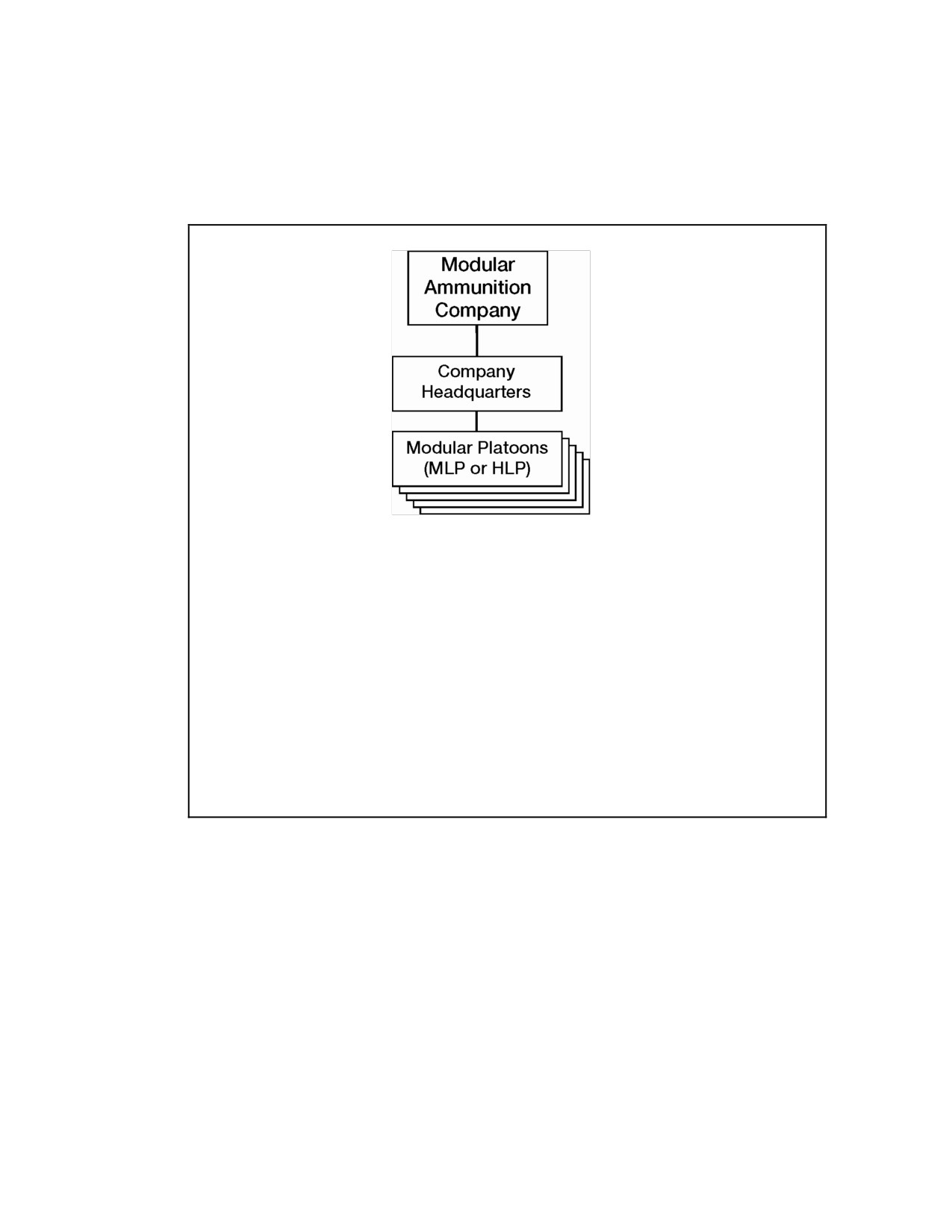
2-40. The headquarters platoon (see figure 2-5) provides C2, administrative,
planning, and logistical support for two to five geographically separated or
2-12
___________________________________________________________Munitions Force Structure
centrally located modular ammunition platoons
(MLPs, HLPs, or a
combination of both) in either the corps or COMMZ areas. This section
operates the unit supply, and provides limited construction and fire-fighting
equipment for assigned platoons. It will collocate with at least one platoon for
logistics support.
Mission: Provide command, control, administrative planning, and logistical support for
two to five modular ammunition platoons.
Assignment: Depends on the assigned mission.
• When assigned to ASP functions, the unit is assigned to a CSB
(TOE
63426L000).
• When assigned to the CSA function, the unit is assigned to a CSB (TOE
63426L000) or a corps ammunition battalion (TOE 09666L000).
• When assigned to the TSA function, the unit is assigned to an ammunition
battalion (EAC) (TOE 09666L000).
Basis of Allocation: As required by theater operations and the number of modular
ammunition platoons deployed.
Mobility: The company headquarters is 100 percent mobile.
Figure 2-5. Modular Ammunition Company Headquarters Platoon
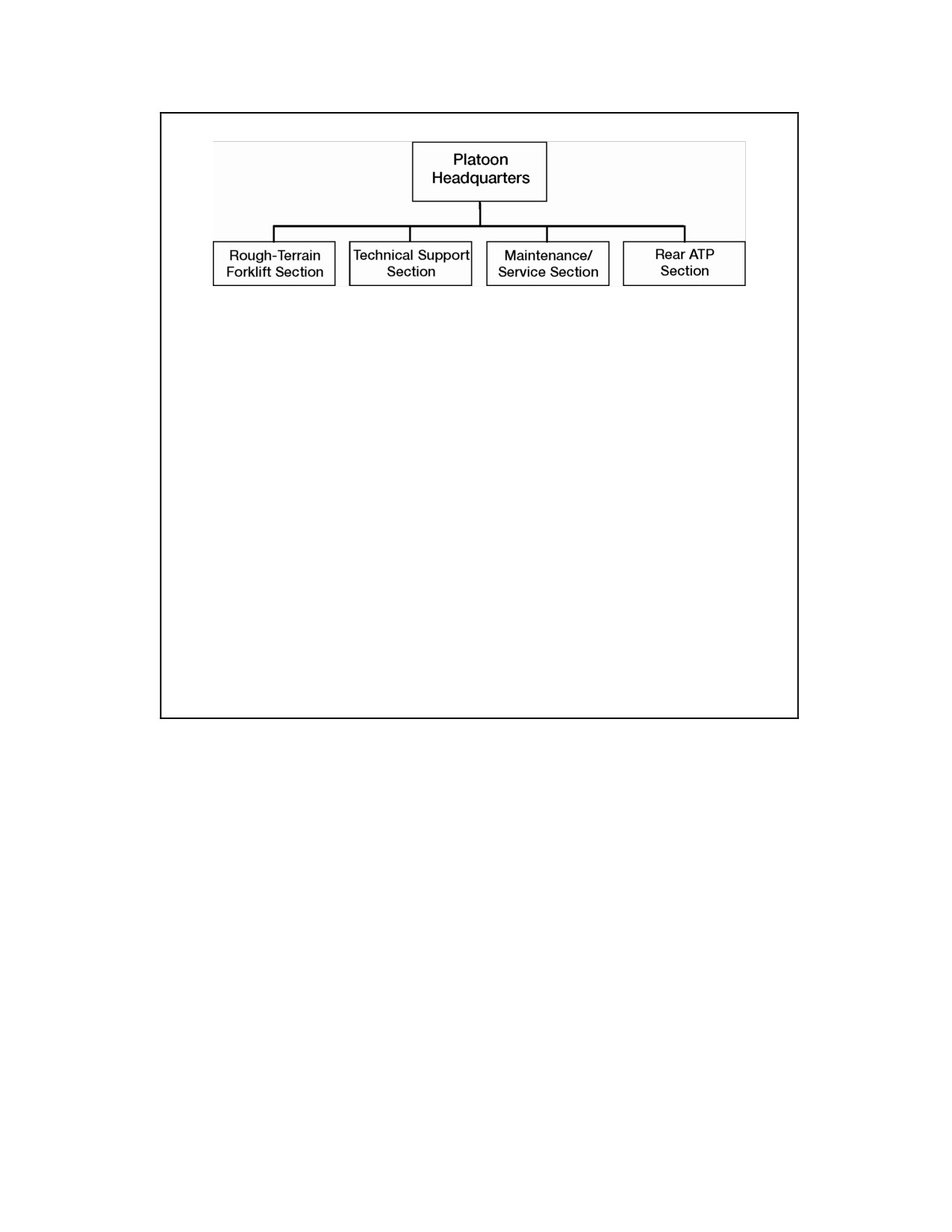
2-41. The MLP does not have container handling equipment (see figure 2-6).
The MLP receives, configures, inspects, manages, issues, ships, and
retrogrades non-containerized ammunition. This platoon operates one ASP
and one-third of a rear ATP. This platoon will combine with two other MLPs
in support of a division. After the platoon provides the one-third of a rear
ATP, it will have a total lift capability of 1,128 STONs daily. With the one-
third slice it has a lift capability of 1,521 STONs daily. The MLP can operate
independently from the modular HQ, but it will require outside support for
sustainment. MLPs can collocate with HLPs to operate a CSA or TSA.
2-13
FM 4.30-1 (FM 9-6) __________________________________________________________________
Mobility: The company headquarters is 100 percent mobile.
Mission: Receives, configures, inspects, issues, manages, ships, and retrogrades
noncontainerized ammunition stocks. Operates independently or as part of a large unit.
Assignment: Assigned to a modular ammunition company headquarters
(TOE
0948L000).
• When deployed independently or as part of a unit to perform the ASP or the CSA
function, platoons are assigned to a CSB (TOE 63426L000); or when deployed to
perform the CSA function, platoons are assigned to an ammunition battalion
(corps) (TOE 09466L000).
• When deployed independently or as a unit to perform the TSA function, the unit is
assigned to an ammunition battalion (EAC) (TOE 09666L000).
Capabilities: When operating in a CSA or TSA with no ATP mission, the MLP has a total
life capability of 1,521 STONs (507 STONs per mission). When the ATP section of the
MLP is employed separately, it has a life capability of 393 STONs per day. Each MLP can
provide one-third of a rear ATP. Figures are based on 24-hour operations.
Basis of Allocation: As required by the theater of operations, daily tonnage lift
requirements, or theater ammunition stockage requirements.
Mobility: The platoon is 100 percent mobile, minus ammunition stocks. Unit depends on
nonorganic transportation assets to move any ammunition supplies on hand. This platoon
should expect to move every 3 to 10 days.
Figure 2-6. Modular Ammunition Ordnance, Medium Lift Platoon
MODULAR AMMUNITION ORDNANCE, HEAVY LIFT PLATOON
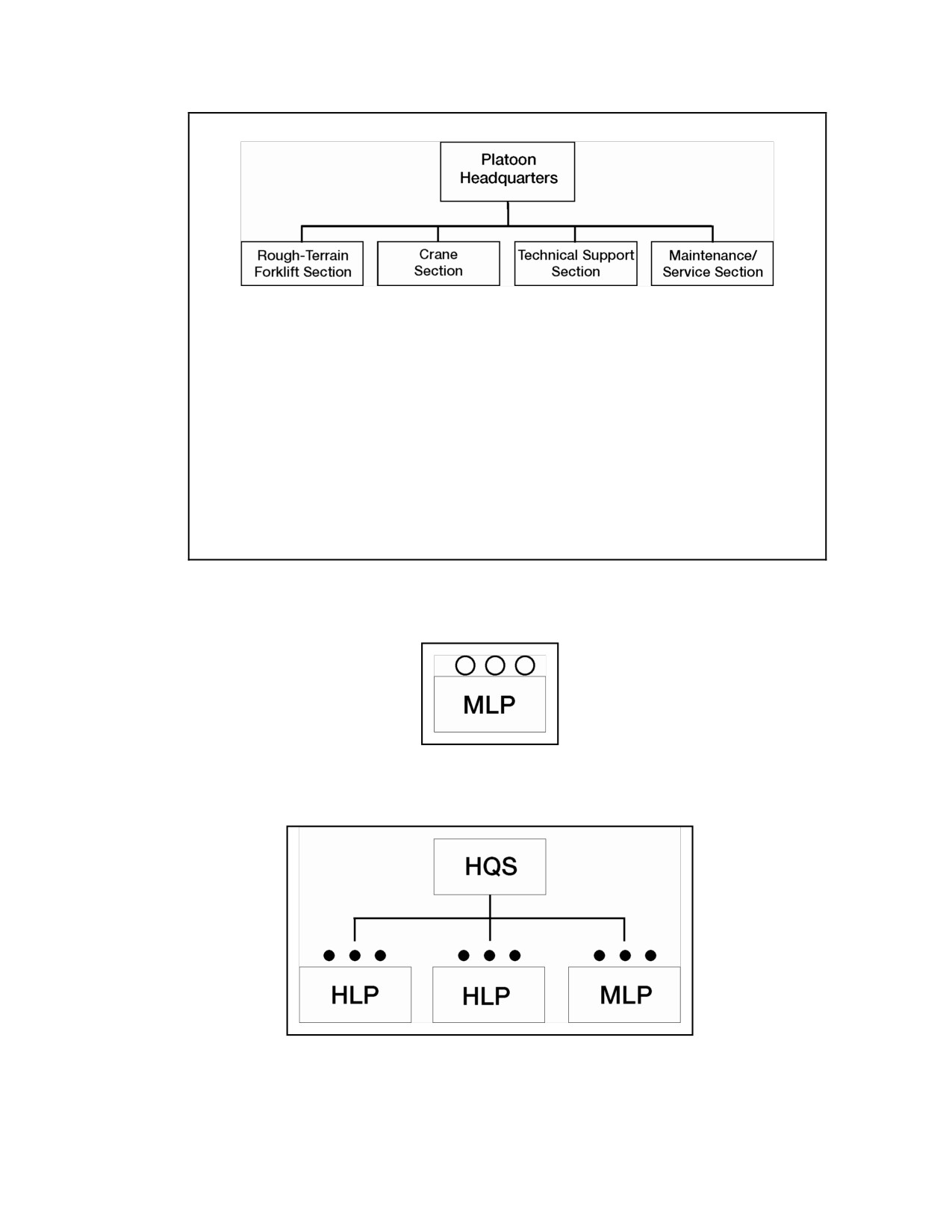
2-42. The HLP (see figure 2-7) receives, ships, configures, inspects, manages,
issues, and retrogrades containerized ammunition. It operates independently
or as a part of a large unit. This platoon has a total lift capability of 2,658
STONs per day. Similar to the MLP, it can operate independently from the
modular HQ
(see figure
2-8), but will require outside support for
sustainment. It requires a military police combat support company that
provides security on an area basis unless the site is designated by the TF
commander as a critical site. The TF commander commits military police
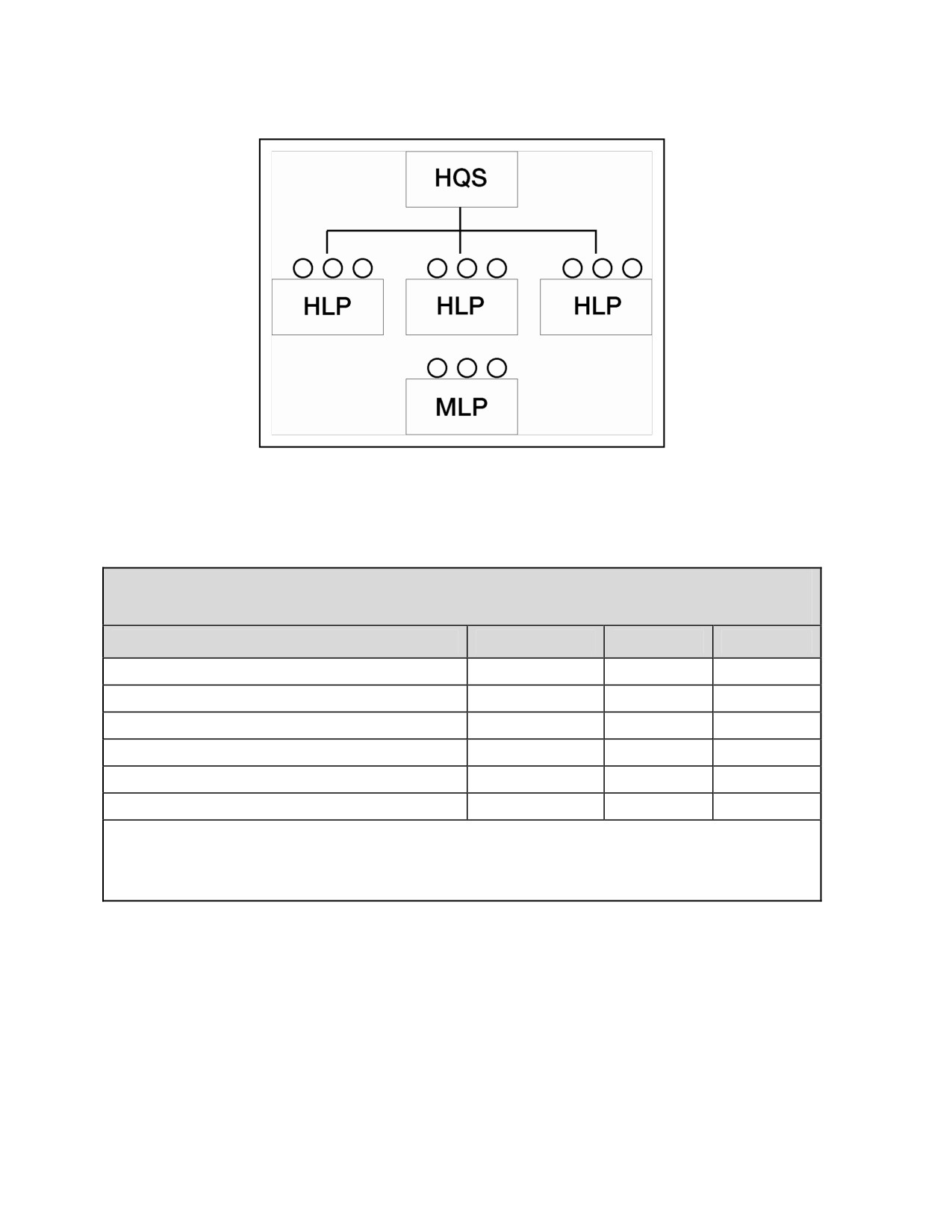
assets to guard the site. Figure 2-9 provides an illustration of CSAs and
figure 2-10 illustrates a TSA.
2-14
___________________________________________________________Munitions Force Structure
Mission: Receives and ships containerized ammunition. Configures, inspects, issues,
manages, ships, and retrogrades ammunition stocks. Operates independently or as part
of a larger unit.
Assignment: Assigned to a modular ammunition company headquarters
(TOE
09408L000). When deployed independently to perform the TSA function, the unit is
assigned to an ammunition battalion (EAC) (TOE 09666L000).
Capabilities: When deployed independently, this platoon has a total lift capability of
2,658 STONs.
Basis of Allocation: As required by theater operations, daily tonnage lift requirements or
theater ammunition stockage requirements.
Mobility: The platoon is 100 percent mobile minus ammunition stocks. The unit depends
on nonorganic transportation assets to move any ammunition supplies on-hand.
Figure 2-7. Modular Ammunition Platoon (Heavy Lift)
Figure 2-8. Headquarters, Modular Ammunition Company for an ASP
Figure 2-9. Headquarters, Modular Ammunition Company for a CSA
2-15
FM 4.30-1 (FM 9-6) __________________________________________________________________
Figure 2-10. Headquarters, Modular Ammunition Company for a TSA
2-43. Tables
2-1 and
2-2 illustrate modular ammunition platoon life
capabilities and MAN/MHE team life capabilities by STONs per day.
Table 2-1. MAN/MHE Team Life Capabilities by STONs Per Day
MHE
TSA/CSA
ASP
ATP
6,000-pound variable-reach forklift
187
119
88
7 ½-ton rough-terrain crane
NA
219
NA
65-ton container crane
295
NA
`NA
10,000-pound rough-terrain forklift
116
52
NA
5-ton rough-terrain crane
NA
200
NA
20-ton rough-terrain crane
257
NA
NA
Note: When forklifts are operated, all forklift MAN/MHE teams require two persons per forklift plus a
ground assistant. Crane MAN/MHE teams require three persons per crane: an operator and two
ground assistant operators. Ground assistants are for safety purposes; any personnel in the area
may perform this task.
2-16

___________________________________________________________Munitions Force Structure
Table 2-2. Modular Ammunition Platoon Lift Capabilities
Mission
Lift Capacity
Heavy Lift Platoon
Receive
886 STONs
Re-warehouse/configure
886 STONs
Issue
886 STONs
Total Lift Capability
2,658 STONs
Medium Lift Platoon
Receive
376 STONs
Re-warehouse/reconfigure
376 STONs
Issue
376 STONs
ATP
393 STONs
Total Lift Capability
1,521 STONs
Maximum Storage Per Platoon
Heavy Lift Platoon
11,363 STONs
Medium Lift Platoon
11,273 STONs
Notes:
1. STONs per day.
2. When operating in a CSA or TSA with no ATP mission, the MLP has a total life
capability of 1,521 STONs (507 STONs per mission). When the ATP section of the MLP is
employed separately, it has a lift capability of 393 STONs/day. Each MLP can provide
one-third of a rear ATP.
3. This capacity represents a portion of the designated level of the theater stockage
objective.
CLASS V FLOW
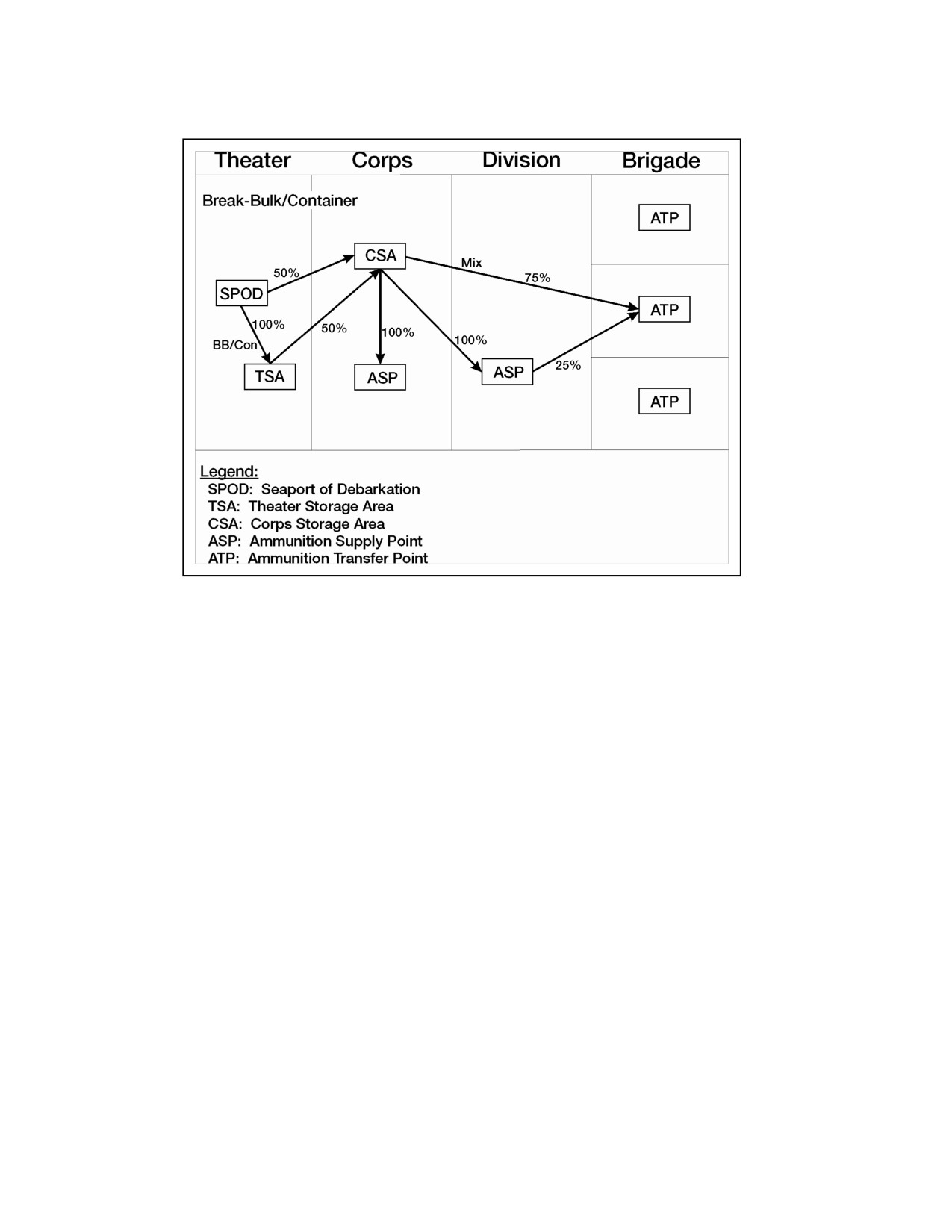
2-44. Ammunition issued to users must be replaced by ammunition moved
up from rear storage areas. In turn, ammunition stockage levels at the rear
storage areas must be maintained by shipments from the CONUS or out of
other theater locations. The quantity of ammunition shipped forward is
determined by the amount on hand, current and projected expenditures, and
the CSR. A layout of a Class V simplified distribution flow is shown in figure
2-11.
2-17
FM 4.30-1 (FM 9-6) __________________________________________________________________
Figure 2-11. Class V Distribution Flow (Modular)
2-45. Each battalion S4 transmits a request for resupply of ammunition
(usually CLs) for organic and attached combat units through the brigade S4
to the DAO in the DMMC. The DAO coordinates and controls the use of Class
V supplies for the division, consolidates the division’s requests, and submits
them to the corps MMC. The CMMC, in coordination with the corps G4,
reviews all requests and balances them against the CSR issued by the
theater. The corps issues the CSR to support the maneuver units; some
ammunition requirements are prioritized due to scarcity, and some may not
be issued due to unavailability. The DAO and CMMC coordinate for the
shipment of ammunition to the designated ATP for pickup by the requesting
unit. In some situations, the CMMC may designate an ASP, rather than an
ATP, to provide more responsive ammunition resupply to the units in the
division rear. Most issues to the brigade (75 percent) will be performed
through CLs from the CSA. Use of CLs does not preclude ordering single
DODIC loads required for specific missions or contingencies.
2-46. The USALC ammunition support team arrives at immature theater
PODs before prepositioned munitions vessels, sustainment shipments, or
munitions units. It establishes a point at which the PODs munitions stocks
can be accounted. Also, the team coordinates the off-loading and distribution
of stocks either to storage areas or for direct issue to units from the PODs.
Early arrival of ammunition units is essential to move Class V from the port
area. The concept for employing the ammunition support team is dissimilar
to employment of all other LSE organizations.
2-18
___________________________________________________________Munitions Force Structure
2-47. During the early stages of any contingency operation requiring APS
munitions, the ammunition support team deploys with the necessary
accountable records and quality assurance
(QA) specialist
(ammunition
surveillance) (QASAS) support. Normally, this coincides with the deployment
of the LSE advance party. The early departure of the ammunition support
team from the CONUS is necessary to ensure its arrival is prior to port
acceptance of the Army APS vessels. The ammunition support team provides
technical expertise and assistance in the following areas:
z
Supply.
z
Storage.
z
Maintenance.
z
Surveillance.
z
Demilitarization.
z
Transportation.
z
Security.
z
Explosive safety.
z
Supplies.
z
Packaging.
z
Accountability for munitions materiel and associated equipment.
2-48. Ammunition support team responsibilities may include, but are not
limited to, the following activities:
z
Providing theater munitions units with technical assistance in
establishing and managing ASAs.
z
Conducting inventories and maintaining initial theater-accountable
records.
z
Providing for the transfer of DA-owned, NIPC-accountable Army
reserve stocks assigned to the theater.
z
Developing and administering contract statements of work (SOWs).
z
Planning and executing retrograde operations.
2-49. Deployment of the ammunition support team (AST) should be based on
the tempo of logistical operations in the theater. The major functions of the
AST include the following:
z
Preparing for overseas deployment.
z
Deploying to theater PODs.
z
Setting up the support team base of operations.
z
Transferring the accountability of APS assets from NICP-accountable
officers to theater-accountable officers.
z
Providing initial theater accountability and SAAS operations.
z
Linking the CONUS sustainment base and the combat logisticians.
z
Submitting status reports through NICP to HQ, USALC, and HQDA.
z
Coordinating joint munitions operations as required.
z
Providing initial QASAS support to the theater.
2-50. Once the AST has established itself in the theater, the ground
component commander may expand the AST mission based on the specialized
training and technical expertise of the team. Any expansion of
responsibilities must be coordinated with the parent organization at the
time, either the LSE or the U.S. Army Materiel Command (USAMC).
2-19
FM 4.30-1 (FM 9-6) __________________________________________________________________
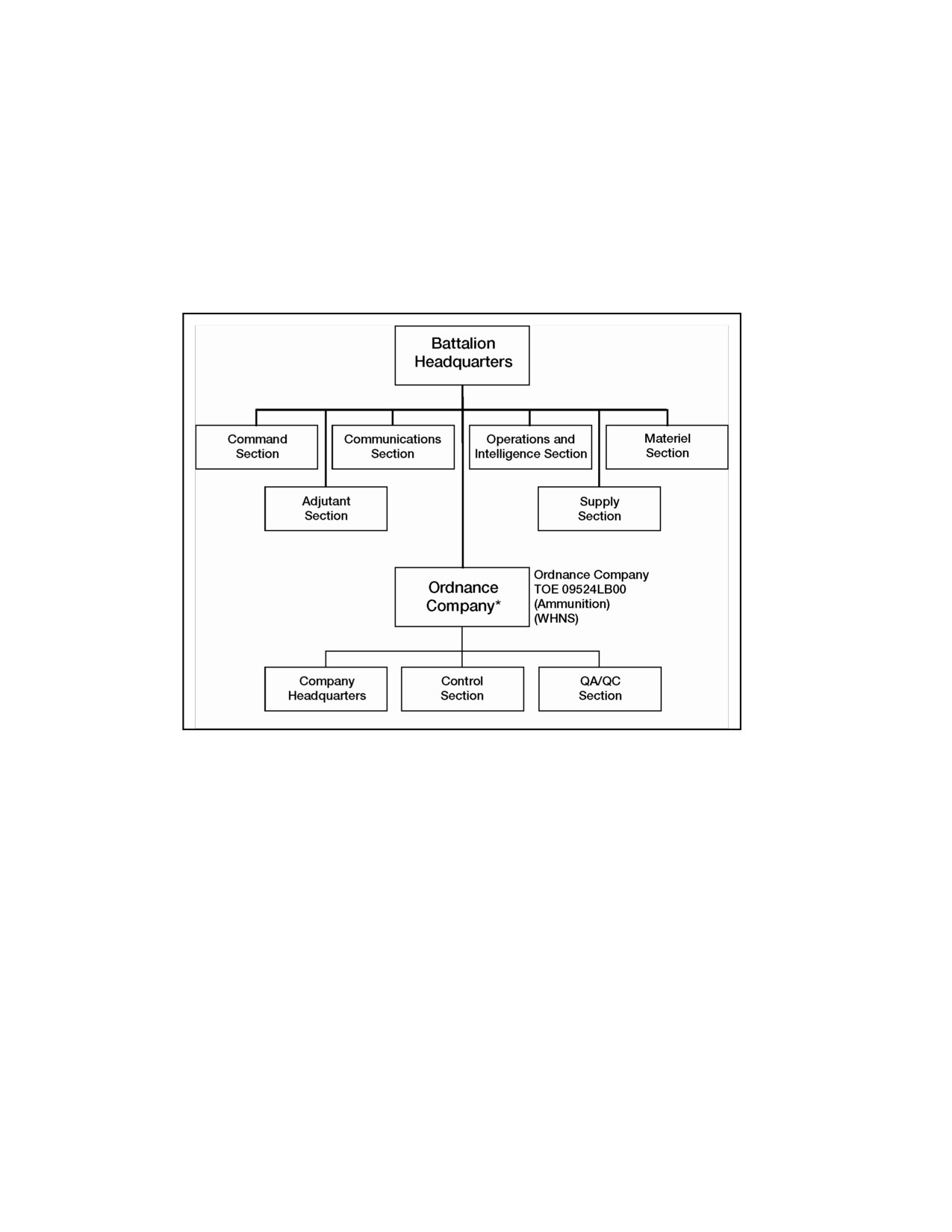
2-51. The mission of the headquarters and headquarters detachment,
ordnance battalion (ammunition) (wartime host nation support [WHNS]) is
to command and control to assigned or attached units (see figure 2-12). This
unit provides—
z
Command, control, and staff planning for up to nine ammunition
companies (TOE 09574LB00).
z
Technical directions over ammunition SPT OPS of subordinate units
(the exception is inventory management functions for which the
operational-level MMC is responsible).
Figure 2-12. Headquarters and Headquarters Detachment, Ordnance Battalion,
Ammunition (WHNS) (DS/GS)
2-52. This detachment is also involved in the coordination and management
of U.S.-owned Class V stocks received, stored, and issued by HN ammunition
units. It can be assigned to a CSG; it can also be assigned to an ammunition
group in the TSC.
2-53. The mission of the ordnance company (ammunition) (WHNS) is to
provide operational control over U.S.-owned ammunition stocks received,
stored, and issued by HN units to U.S. force combat units. This company is
assigned to an ordnance battalion (TOE 09574LA00) with one company
allocated per HN ammunition company. On a 24-hour basis, this unit
provides—
z
Expertise required to perform stock accountability, stock status
reporting, and QA/QC functions for U.S.-owned ammunition stocks
received, stored, warehoused, and issued by HN ammunition units.
z
Coordination needed for maintenance support for U.S. equipment
operated by HN units.
2-20
___________________________________________________________Munitions Force Structure
z
Coordination for operational taskings.
2-54. The theater receives munitions from the CONUS or OCONUS locations
through air and water ports or by LOTS operations. From there, munitions
are transported to the appropriate munitions support activity. Several factors
determine the quantity of munitions moved forward. These factors are as
follows:
z
Quantity of munitions on-hand.
z
Current and projected consumption.
z
Available transportation.
z
Available personnel and equipment.
DETERMINING OR REQUESTING MUNITIONS REQUIREMENTS
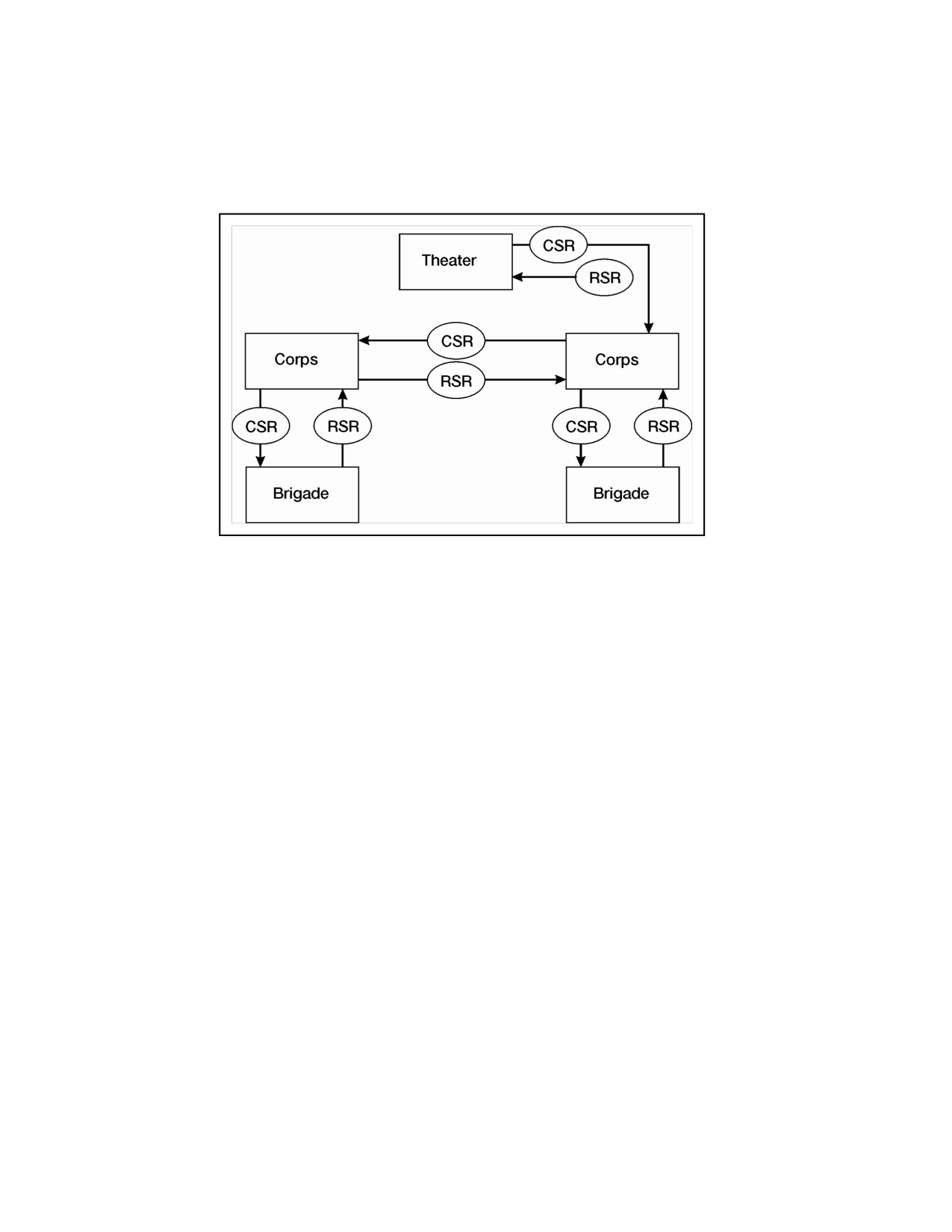
2-55. Combat commanders control the flow of ammunition in their areas of
responsibility (AORs) by using two ammunition supply rates: the RSR and
the CSR. Commanders at each level submit their RSR to the next higher HQ.
At the ASCC level, the total unrestricted ammunition requirements are
compared against the total ammunition assets available
(on-hand or
expected) to develop the CSR.
2-56. To request ammunition, each unit consolidates its own on-hand
quantities and forwards its report to the battalion supply officer (S4), with
information copies to the battalion commander and the operations (S3).
Company commanders indicate in their situation report (SITREP) remarks
any critical munitions or forecasted changes in munitions requirements.
2-57. The battalion S4 requisitions ammunition based on information
provided in the company SITREPs and guidance received from the battalion
commander and S3. The battalion S4 consolidates the entire battalion
munitions requirement and submits it to the brigade S4. When necessary,
battalion commanders cross-level within companies or throughout the
battalion to meet mission requirements. The battalion S4 also reports the
unit on-hand quantities by DODIC or nomenclature, along with any critical
shortages and any forecasted changes in requirements in the battalion
SITREP to the brigade.
2-58. The brigade S4 consolidates the requests for ammunition and passes
them to the DAO. An information copy is forwarded to the support operations
officer. The CMMC uses the information copy to determine if on-hand stocks
in the ASP are sufficient, or if munitions from the CSA or TSA will be
required. The brigade S4 monitors the munitions on the CTIL requiring
special attention, such as emergency resupply. The SPT OPS officer
consolidates the brigade munitions requirements and forwards them to the
DISCOM.
CONTROLLED SUPPLY RATE/PRIORITY OF ISSUE
2-59. The SPT OPS officer, with guidance from the brigade S3 and S4,
informs the DAO about the brigade CSR breakout and unit priority of
munitions resupply. Forecasted critical shortages and changes in
requirements, as reported in the brigade SITREP, are provided to the DAO.
MUNITIONS RESUPPLY
2-60. The preferred method of munitions resupply is to deliver as far forward
as possible. Ammunition containers are shipped only to the TSA or CSA.
2-21
FM 4.30-1 (FM 9-6) __________________________________________________________________
There they are unpacked, and the ammunition configured into CLs is sent to
forward ASAs and ATPs. If the situation requires or transportation assets
are available, munitions may be throughput as close to the unit as possible.
Figure 2-13 depicts an example munitions supply rate flow.
Figure 2-13. Munitions Supply Rate Flow
2-61. The CMMC determines whether the munitions resupply will come from
the ASP or the CSA. If the munitions are coming from the CSA and ASP, the
CMMC prepares a materiel release order (MRO) directing the munitions
shipment. After ammunition has been loaded, the radio frequency (RF) tags
are verified along with the correct cargo and destination. All ammunition
shipments are tracked through ITV and the MTS. The delivery coordinates
and time are forwarded to the receiving unit or activity, with information
copies furnished to the DAO, the FSB support operations officer, the DAO
representative, and the S4. If an ammunition shipment must be diverted
within the brigade, the brigade commander, or designated representative,
retains sole authority to do so. This is accomplished through the FSB SPT
OPS officer. Ammunition shipments that must be diverted within the
division are directed by the division commander to the DISCOM commander
for implementation.
EMERGENCY RESUPPLY
2-62. Emergency resupply requests for ammunition should be for immediate
consumption to continue the fight or a mission above normal operation or
tempo. Emergency resupply requests should not be used as a means to
circumvent the normal supply “pipeline.” There are two means of requesting
an emergency resupply. One method uses the unit organic lift capability and
the other uses corps lift assets. The requesting units should attempt to cross-
level ammunition within the division prior to submitting an emergency
request, because in many cases cross-leveling can be accomplished sooner
than the approval/movement of ammunition to the unit. Normally, an
emergency ammunition request exceeds the RSR/CSR and to exceed
RSR/CSR requires corps G4 approval.
2-22
___________________________________________________________Munitions Force Structure
Procedures for Use of Organic Unit Lift Assets
2-63. The unit forwards an emergency resupply request to the brigade S4.
The S4 validates the request, forwards it to the division G4, and sends a
courtesy copy to the DAO. Upon validation, the division G4 submits the
request to the corps G4 for approval. The DAO forwards a copy to the CMMC.
Once the request is approved, the corps G4 will inform the division G4 of the
approval and the location to which to send the aircraft, and the CMMC is
instructed to release the ammunition. The division G4 informs the G3 and
the G3 tasks the aviation brigade to conduct the mission. Once the
ammunition departs the CSA or ASP, the CMMC will notify the DAO.
Procedures for Use of Corps Lift Assets
2-64. When the corps G4 approves an emergency resupply to an organization
using corps air assets, the supporting CSA or ASP is responsible for
providing the equipment (sling/cargo nets and so forth) to transport the
ammunition to the organization. An agreement on how the sling load
equipment will be returned must be formalized prior to the mission.
AERIAL RESUPPLY
2-65. When the corps G4 approves an emergency resupply and the
requesting unit provides the air assets to move the ammunition, the FSB
must provide the equipment to perform the sling-load operation. Once the
division G3 tasks the aviation brigade to perform the aerial resupply, the
FSB will prepare the equipment for transportation to the CSA or ASP. The
aviation brigade through coordination of the DTO and MCO will receive the
equipment from the FSB and fly to the CSA or ASP and provide the
equipment to the CSA or ASP personnel to prepare the ammunition for sling
load. The FSB will recover the equipment once the resupply has taken place.
2-66. Emergency requests are passed through supply channels in the same
manner as routine requests. However, emergency requests are also passed
simultaneously through command channels from the user to the G3. The G3
approves emergency requests and tasks the aviation brigade to perform the
mission. Simultaneously, the G4 coordinates with the DISCOM SPT OPS
branch so it can task the appropriate supply activity to prepare the
shipment. A liaison officer from the aviation brigade coordinates with the
MCO and the requesting unit. Prerigged loads of standard resupply packages
may reduce response time for emergency air resupply. For more details on
requests for aerial resupply, see FM 55-30.
COMMAND AND SUPPORT RELATIONSHIPS
2-67. Army, joint, and/or combined units or elements may be required to
perform their missions within the AO of a corps, division, brigade, or
battalion, with which they have no formal command or support relationship.
Unless attached for logistical support, parent units are responsible for
providing support to their elements dispersed throughout the battlefield. At
times, mission requirements may exceed the organic support capabilities of
the parent unit. When this occurs, the parent unit must coordinate support
for its elements with the HQ controlling that element AO. Once coordination
is accomplished, the HQ assumes responsibility for providing logistical
support for the units in the AO. The rear CP facilitates support of non-
2-23
FM 4.30-1 (FM 9-6) __________________________________________________________________
divisional units by identifying the name and location of the divisional
coordinating staff element or host unit.
2-68. Munitions support for non-divisional units operating in the division AO
is coordinated by the DAO. Non-divisional units attached to, or supporting,
the brigade combat trains (BCTs) forward their munitions requests through
the FSB SPT OPS officer to the DAO. Non-divisional units attached to or
supporting the division and operating in the division rear area forward their
munitions requests through the DISCOM SPT OPS officer to the DAO.
Specific procedures for supporting non-divisional units are detailed in the
Class V section of the service and support annex of the OPORD.
2-24
Chapter 3
Interim Objective Force Munitions Operation
The division operates four ammunition transfer holding points (ATHPs).
These are usually arrayed to support one maneuver brigade each, and one
supports the division aviation support battalion (DASB) and division
cavalry squadron. A DAO representative manages each ATHP. In
addition to the division ATHPs, the MLP establishes an ATHP that
provides Class V support to both divisional and non-divisional troops in
the division rear area. The corps direct support
(DS) ammunition
company also operates an ASP to provide support to the division ATHPs
and as an alternative source of Class V to units not supported by an
ATHP. Both the ASP and the rear ATHP are corps assets. The Class V
ATHP section of the DASB provides the ammunition transfer capability
from corps or EAC transportation assets to the units supported by the
DASB. It provides unit distribution of ammunition to the attack battalion
and the cavalry squadron. This section cannot arm aircraft. Emergency
arming must be coordinated externally.
DETERMINING/REQUESTING BATTALION AMMUNITION REQUIREMENTS
3-1. The BN/TF S4 determines ammunition resupply requirements, based on
information provided in the unit logistics situation report (LOGSITREP) and
guidance received from the battalion
commander and S3. The BN/TF S4
CONTENTS
consolidates the entire battalion
Determining/Requesting Battalion
Ammunition Requirements
3-1
ammunition requirements
and
Objective Force Munitions
submits the battalion roll-up
Distribution
3-8
ammunition resupply to the brigade
S4. The brigade S4 consolidates the
ammunition requests and passes the consolidated request to the SPT OPS
officer located in the supporting DASB. Units in the division rear submit
their requests through the LOGSITREP/logistics status (LOGSTAT) to the
DSB SPT OPS officer. The SPT OPS officer for the FSB, DASB, and DSB
requests ammunition support from the DAO in the Class V section of the
DMMC. The DAO compares the request with the CSR. If the request is
within the limits of the RSR/CSR, the DAO orders the ammunition from
corps to be shipped directly to the ATP, or to replace stocks issued from the
AHPs located in the FSBs, DASB, or the rear ATP.
3-2. The ATP, operated by the headquarters distribution company in the
FSB, is responsible for supporting all units located in the brigade that are
assigned, attached, have established a support relationship, or as directed by
the DISCOM commander. The ATP in the DASB supports the aviation
brigade (AB) and division cavalry squadron. The rear ATP, operated by corps,
3-1
FM 4.30-1 (FM 9-6) __________________________________________________________________
is responsible for supporting all divisional and non-divisional units in the
division rear. The ATP is designed to provide the required lift and transload
capability associated with high-volume and high tonnage. The SPT OPS
officer of the FSBs and DASB, in conjunction with the DAO NCO
representative, will coordinate directly with those non-organic units
supported by the ATP. The SPT OPS officer/DAO representative consolidates
their ammunition requirements, and their request for resupply is “rolled-up”
with the brigade request. Ammunition and explosives are accounted for and
provided proper physical security at all times.
AMMUNITION REQUEST VALIDATION
3-3. The DAO validates the brigade ammunition requests by comparing the
amount of ammunition requested against the RSR/CSR and the on-hand
stocks in the FSB ATP, the DASB ATP, and the rear ATP; then the DAO
considers the current mission posture, scheduled/future mission posture, and
operational guidance. After all of these factors are analyzed, the DAO either
validates the request or adjusts it to meet the situation in coordination with
the brigade S4 and supported units. The DAO determines, based on METT-
TC and transportation availability, whether the ammunition resupply will be
throughput to the appropriate ATP or to a forward rear point. Ammunition
can be throughput to a cache (a storage location where corps transportation
drops flatracks loaded with ammunition; the ammunition will be closer to the
maneuver unit to reduce transit time) unless the tactical situation does not
allow delivery that far forward. “Prep-fire” ammunition is delivered as close
to the batteries as possible to prevent the artillery ammunition carriers from
having to up-load after the “prep-fire.” The ammunition resupply requests
and transportation requests are sent to the CMMC/corps movement control
center (CMCC) with information copies to the brigade DAO representatives,
and the brigade and battalion S4s. The brigade DAO representatives notifies
the HDC ATP (FSBs), HSC ATHP (DASB), or rear ATP section (run by corps)
of any scheduled ammunition deliveries.
AMMUNITION RESUPPLY
3-4. The CMMC verifies the request is within the RSR/CSR and the using
SAAS-MMC determines whether the ammunition resupply comes from the
CSA or ASP, then generates a MRO directing the ammunition shipment.
The ammunition arrives in the theater in configured loads. Either the CSA
or ASP configures the CLs into mission configured loads (MCLs) prior to
shipment forward to the ATP.
3-5. The CMMC schedules resupply in accordance with priorities established
by the corps commander. The corps movement control center (CMCC)
notifies the CSA and ASP where and when transportation will arrive. After
ammunition is loaded, the RF tags are verified along with the correct cargo
and destination. All ammunition shipments should be tracked through the
MTS delivery, coordinates, and time.
AMMUNITION SUPPLY POINT OPERATIONS
3-6. The ASP is located in the vicinity of the DSA, but is non-organic to the
division and run by corps assets. The ASP is run by the corps DS ammunition
company and provides support to the division ATPs and units not supported
by an ATP.
3-2
_____________________________________________ Interim Objective Force Munitions Operation
AMMUNITION TRANSFER HOLDING POINT OPERATIONS
3-7. ATHPs function mainly as temporary distribution points, conveniently
located to facilitate rapid issue to the users. ATHPs are operated by the
HDCs FSBs for maneuver brigades, and the HSC DASB for the aviation
brigade and division cavalry squadron. When utilized, the rear ATHP is
located in the vicinity of the DSA. It is established and operated by the
corpsDS ammunition company. The rear ATHP is responsible for providing
Class V support to divisional and non-divisional assets located in the
division rear. One DAO representative will be located at each ATHP. These
DAO representatives manage the issues of ammunition.
3-8. The ATHP is used when forward deliveries are not required. Units
directed to pick up ammunition from the ATHP follow the normal request
procedures outlined previously, and prepare a DA Form 581 ( Request for
Issue and Turn-In of Ammunition), which is sent to the DAO
representative at the ATHP. The requesting unit submits the DA Form 581
through the BN/TF S4, who approves the request and either forwards it to
the brigade S4 or has the unit hand-carry it to the brigade S4 for approval.
The DAO representative confirms the request through the DAO prior to
issue.
3-9. If the unit has a heavy extended mobility tactical truck (HEMTT)/LHS,
it is directed to the appropriate “rack” for pick-up. If the unit requires a
“break bulk” issue, the ATHP section issues munitions based on the DA
Form
3151-R
(Ammunition Stores Slip) provided by the DAO
representative. The DAO representative goes to the respective SPT OPS
section and uses the CSSCS or MSE to coordinate and confirm.
Coordination on the location, amount, and type of ammunition received at
the ATHP is determined among the DAO, CMMC, and the respective SPT
OPS officer, based on guidance from the DISCOM commander, and the
division G4 and G3. Ammunition is delivered on flatracks by corps
transportation assets using PLS trucks and trailers.
3-10. ATHP personnel will interrogate RF tags of arriving PLS shipments
to gain immediate visibility of the shipment and enable it to immediately
identify the organization where it will be issued. Units arrive at the ATHP
to pick up ammunition, drop off empty or partially empty ammunition
flatracks, and receive fully loaded flatracks. ATHP personnel assist the
unit PLS in transloading ammunition. The ATHP section reconfigures
loads to meet mission requirements on a limited basis only. The flatracks
are normally issued as shipped. If partially empty flatracks are returned
and the returned ammunition is required within the brigade, the ATHP
section may consolidate the ammunition from the partially empty flatracks
and make full loads for issue within the brigade. All empty flatracks are
shipped back to the ASP or CSA as soon as possible.
3-11. The ATHP representative reports all issues and turn-ins. Corps
transportation assets used to deliver ammunition resupply pick up the unit
turn-ins and return them to their respective SPT OPS and the DAO for
immediate retrograde. When time and equipment permit, the ATHP
representative will attach RF tags to the retrograde shipments. The MTS
tracks the ammunition vehicle returns as they are retrograded to the rear.
The MTS provides the ability to redirect the shipment if needed. The ATHP
maintains the ammunition stocks they can transport.
3-3
FM 4.30-1 (FM 9-6) __________________________________________________________________
STRYKER BRIGADE COMBAT TEAM—BRIGADE SUPPORT BATTALION
Brigade Ammunition Office
3-12. The brigade ammunition officer (BAO) manages ATHP operations. The
BAO acts in concert with the ARFOR, transportation managers, and the
ATHP to accomplish coordination of assets, monitoring and cross-leveling of
stocks, monitoring supply status data/accountability on munitions stock at
the ATHP, providing technical assistance and monitoring ammunition
surveillance, and validating ammunition requests.
Ammunition Officer
3-13. When the Stryker brigade combat team
(SBCT) is independently
deployed, a BAO, normally a warrant officer, and an ammunition logistics
NCO in the BSB SPT OPS section functions as the brigade ammunition office
responsible for Class V commodity management. The BAO will function as a
member of the DAO staff when the SBCT is not independently deployed.
3-14. The BAO acts as the principle munitions staff officer for the brigade
and provides assistance in all matters pertaining to munitions support,
munitions requirements, and availability. The BAO maintains direct liaison
with the SBCT S3/S4, the BSB S3/S4, and supported units within limits
defined by the SBCT commander. The BAO provides input on the proper
positioning of the ATHP and ensures it is positioned to most effectively
support maneuver elements of the SBCT consistent with METT-TC. The
BAO should also provide input to OPLAN development, specifically to those
sections or annexes that identify munitions support to maneuver elements.
The duties of the brigade ammunition officer (BAO) include the following:
z
Preparing plans and procedures for ammunition operations.
z
Maintaining ammunition stocks records and reports through SAAS-
MOD.
z
Supervising ammunition operations.
z
Consolidating and validating ammunition requests.
3-15. The BAO is equipped with a SAAS-DAO. The SAAS-DAO allows the
BAO to manage brigade or task force (TF) organization, produce and manage
reports, compute and maintain training ammunition requirements during
extended support and stability operations, and submit electronic DA Forms
581 to a SAAS-ASP. The ATHP uses the SAAS-ASP to account for any turn-
in of unused ammunition from using units, and all gains/losses until the
corps slice arrives.
3-16. The ammunition logistics NCO is the principle enlisted assistant to the
BAO. He performs duties as assigned consistent with the responsibilities of
the brigade ammunition office, and may be designated to act on behalf of the
BAO in his absence. Additional responsibilities might include—
z
Developing an operational SOP for ATHP operations.
z
Providing technical assistance, coordination, and advice on ATP
operations.
z
Monitoring munitions flow into and out of the ATHP.
z
Ensuring ATHP operations comply with SOPs.
z
Establishing primary and back-up communication linkages.
z
Coordinating with transportation elements.
z
Coordinating munitions receipt and handling at the aerial port of
debarkation (APOD).
3-4
_____________________________________________
Interim Objective Force Munitions Operation
Ammunition Transfer Holding Point Section
3-17. The ATHP section is equipped with a SAAS-ASP hardware suite
capable of operating either the SAAS-ASP or SAAS-ATP. The decision to
select which platform to use is based on METT-TC and command guidance.
Additionally, each platform has different capabilities that should be weighed
when making this decision. This flexibility allows the ATHP section to
initially operate the SAAS-ASP in a new and austere theater. By doing so,
ammunition transaction data is made available to the supporting MMC,
which provides echelons above brigade (EAB) visibility of what the brigade
has received, and facilitates the anticipatory logistics process. Additionally,
TAV resolution is enhanced because the SAAS-ASP operates in a retail mode.
Operating the SAAS-ASP also allows the ATHP to support ammunition flow
out of the brigade area as well as into it, such as might be necessary when
sustainment is called forward and is held at the ATHP; or may include
support to non-brigade units operating in the BSA.
3-18. When the brigade is augmented with a corps ammunition element, the
ATHP may pass off their data to the inbound element platform. The ATHP
can then re-establish their system as a SAAS-ATP platform that is more
appropriate to a mature or maturing theater.
Ammunition Transfer Holding Point
3-19. The functions of the SBCT ATHP differ from the rear ATP in that the
SBCT ATHP performs more like an ASP.
z
Ammunition receipt.
z
Ammunition issue.
z
Ammunition reconfiguration.
z
Inventories.
z
Transload.
z
Split-based operations.
z
Supervision of ammunition supply operations.
ATHP DISPLACEMENT
3-20. The relocation requirements for the SBCT’s ATHP are no different
from AOE or Force XXI doctrine. The ATHP provides dedicated support to
users as far forward as possible. Brigade transportation assets assists the
ATHP section to relocate. The ATHP moves as the force maneuvers. In a
combat scenario, the ATHP should be prepared to move every 24 hours for
security reasons or when it is unable to support operations from its location.
In a stability operation or support operation, there may be little or no
requirement for movement. When it does have to move, the ATHP requires
external transportation support. Detailed plans should be established to
allow for quick, orderly movement under pressure.
3-21. Evacuation and/or emergency destruction priorities should be
established for the most critical munitions, dependent on METT-TC.
Communications must be maintained between the EAB munitions support
structure and supported units. Munitions flow in support of the brigade must
not be disrupted. An ATHP may be moved in three phases; pre-movement,
movement, and post-movement, as described below.
3-22. Planning input, coordination, and guidance are provided by the BAO,
BSB SPO, S3, S4, and ATHP section to ensure a coordinated, safe, and quick
3-5
FM 4.30-1 (FM 9-6) __________________________________________________________________
relocation is conducted. The BAO must communicate with using units and
EAB munitions support structure to ensure the flow of munitions is not
disrupted. The BAO also assists in site reconnaissance and site selection. The
coordination loop for BSB transportation assets must be closed to assist with
the relocation. The ATHP requires more than one lift to relocate. With
guidance, ATHP personnel will conduct the relocation.
3-23. The BSB organizes convoy support and security for movement to the
new site. Movement operations depend on the tactical requirement for
uninterrupted munitions support. If continued support to the brigade is
required, the BAO establishes an advanced element at the new site and
coordinates the arrival of MHE, personnel, and munitions. EAB munitions
support structure begins shipment to the new site as required. On closure at
the new site, the BAO and ATHP section establish operations and ensure all
required MHE, personnel, and stocks have been relocated.
STRYKER BRIGADE COMBAT TEAM MUNITIONS SUPPORT
3-24. The SBCT has utility in all operational environments against all
projected future threats. The many possibilities for utilization require that
the SBCT receive munitions support that ensures the right types of
munitions arrive in the right quantities at the right place and at the right
time. The SBCT is optimized primarily for employment in SSC operations in
complex terrain, confronting low-end and mid-range threats that may employ
both conventional and asymmetric capabilities. It deploys rapidly, executes
early entry, and conducts effective combat operations immediately upon
arrival to prevent, contain, stabilize, or resolve a conflict through shaping
and decisive operations. It also participates with appropriate augmentation
in stability and support operations as an interim entry force and/or as a
guarantor to provide security for stability forces by means of its extensive
combat capabilities. The SBCT participates in MTW as a subordinate
maneuver component within a division or corps, but only with augmentation.
Initial Support
3-25. Initial munitions support is required to ensure the SBCT deploys with
the prescribed, combat-ready amount, and type of munitions necessary to
ensure successful, decisive action. The SBCT must deploy rapidly by air to a
theater of operations within 96 hours. To be able to conduct effective combat
operations upon arrival in the AO, the SBCT deploys with a full combat load
of ammunition.
3-26. The urgency of the deployment and the requirement for decisive action
may dictate initiating combat operations immediately upon APOD roll-off in
an AO, without waiting for offloading, forward staging, positioning, and
distribution from the APOD to the ATHP. This roll-off combat capability
requires that the SBCT deploy with an uploaded combat load of munitions. A
combat load is the MACOM-designated quantity of munitions and items
authorized to be carried by unit personnel and combat vehicles (turret-load).
Troop-carried munitions to accompany troops (TAT) are those issued before
departure from the aerial port of embarkation (APOE). Turret-load/combat-
load munitions are those authorized for transportation in thick-skinned
vehicles for deployment purposes.
3-27. While an uploaded deployment provides capability for immediate
mobility and lethality, it requires an assessment to determine the impact on
maximum on the ground (MOG) capacity at the APOE. Additional weight of
3-6
_____________________________________________
Interim Objective Force Munitions Operation
uploaded combat vehicles and increased safety risks may negatively impact
airflow and ultimately impact the
96-hour deployment timeframe.
International clearances and waivers must be carefully preplanned for an
uploaded deployment.
Sustainment Support
3-28. Upon arrival at the APOD, 463L pallets are received by U.S. Army
elements and transloaded onto CROPs or flatracks. Munitions may have to
be staged or spotted and held briefly at a munitions holding area prior to
transportation to the ATHP. It is essential that appropriate MHE be
available at the APOD and the holding area to conduct the receipt,
offloading/staging, and transportation missions. Due to the brigade limited
CSS footprint, transportation capabilities will be limited. The brigade will
utilize CSS reach concepts and exploit regionally available support assets for
movement of munitions from the APOD to the ATHP. The brigade
ammunition officer is responsible for ensuring accountability, security, and
proper loading/handling procedures are enforced at the APOD, and for the
implementation of measures to ensure that ITV is maintained. The brigade
ammunition office maintains direct liaison with the brigade and BSB staffs
to facilitate movement.
3-29. Upon arrival at the ATHP, munitions are inspected and accountability
is established through SAAS-MOD
(to be replaced by the GCSS-A
ammunition module). Munitions are segregated into maneuver battalion/unit
sets and held at the ATHP until called forward. Munitions must be
periodically inspected to ensure serviceability and safe storage. The safety
guidance in DA Pam 385-64 should be used to develop SOPs.
Follow-on Sustainment Support
3-30. Follow-on munitions sustainment support beyond the unit basic load
(UBL) of ammunition may be required. Sustainment flow is based on
previous RSRs/CSRs. Follow-on munitions support to the SBCT involves two
basic functions: planning and execution. The brigade ammunition office
planning function focuses on how to logistically support the tactical plan to
ensure the right quantity and type of munitions are available at the right
time and at the right place. The execution function is used to monitor the
distribution and flow of munitions, and to determine the amount of
munitions needed to support the brigade.
3-31. Current and anticipated tactical operations drive SBCT sustainment
munitions requirements. Sustainment munitions are provided to the brigade
from EAB support activities. Requirements are determined in coordination
with the BSB SPO, S2/S3, and the BAO. The S4 of each maneuver battalion
requests munitions based on consolidated user requirements needed to
support tactical operations. Based on requests submitted by battalions and
munitions allocations to users (based on CSRs), the BAO determines the type
and numbers of MCL packages, then submits these requirements to EAB
support activities. MCL configurations continue to flow until they are
changed in type and/or quantity.
3-32. These munitions may be configured in the CONUS, an intermediate
staging base (ISB), or other location(s) within the theater of operations. The
ATHP has very limited configuration capability based on available MHE and
personnel. Typically, these munitions would be configured as required,
documented, loaded, and organized on ready-to-deploy CROP flatracks/463L
3-7
__________________________________________________________________
FM 4.30-1 (FM 9-6)
pallets that can be moved forward quickly via strategic or intra-theater
transportation to the designated APOD. Procedures for transportation,
handling, and accountability of follow-on munitions once they arrive at the
APOD and ATHP are essentially the same as for the receipt of initial
munitions.
User Resupply
3-33. The S4 of each maneuver battalion requests munitions based on
consolidated user requirements needed to support tactical operations. Users
forward their requirements in the LOGSITREP to their battalion S4. The
LOGSITREP should include on-hand quantities, critical shortages, and
forecasted changes in munitions requirements based on command guidance.
The maneuver battalion S4 consolidates the battalion munitions
requirements and submits them to the BAO within authorized quantities
(the CSR), if established. The BAO verifies that the request is within the unit
CSR and that the ATHP has the required types and amounts.
3-34. The BAO notifies the ATHP section of a pending resupply mission and
identifies the required type of MCL and quantity. The transportation platoon
is tasked to move munitions and dispatches a HEMTT-LHS to the ATHP.
Loaded LHS flatracks are dropped at a designated battalion release point
(BRP). Close coordination with supported units is required to establish the
location and time of delivery. Using units assume accountability upon receipt
and use their organic personnel/equipment assets to re-arm. The BAO, in
conjunction with the ARFOR, determines if on-hand stocks in the ATHP are
sufficient to meet requirements or if munitions from an EAB support activity
will be required.
OBJECTIVE FORCE MUNITIONS DISTRIBUTION
3-35. The objective force is organized, manned, equipped, and trained to be
more strategically responsive, deployable, agile, versatile, lethal, survivable,
and sustainable across the full spectrum of military operations. The objective
force will be comprised of modular, scalable, tailorable organizations
equipped and trained for prompt and sustained land operations that can
transition quickly between changes in task, purpose, and directions,
maneuvering into and out of contact, without sapping operational
momentum. Decisions will be determined by trained, equipped leaders and
soldiers at the lowest levels.
3-36. The Army will bring a campaign quality to the fight, ensuring long
term dominance over evolving, sophisticated threats with asymmetric
capabilities, maximizing the effectiveness of standoff while maneuvering on a
non-contiguous distributed battlefield against an adaptive enemy. The team
requires an integrated seamless joint C4ISR—a revolutionary architecture
with linkages to current and Stryker forces, joint, interagency, and
multinational forces. The Army knowledge enterprise will enable this
knowledge-based force through an architecture that connects “factory to
foxhole” and
“space to mud.” Soldiers will have the prerequisite
communications equipment to receive and send the right information, at the
right time, and the right place.
3-37. Objective force systems will support decisive maneuver (horizontal and
vertical, day and night) in all weather and terrain as a dismounted or
mounted combined arms team without compromising unit integrity. The
3-8
_____________________________________________
Interim Objective Force Munitions Operation
systems will provide the best combination of low observable, ballistic
protection, long-range acquisition and targeting, and first round hit-and-kill
technologies. They will be capable of destroying enemy formations at longer
ranges with smaller caliber, greater precision, and more devastating target
effects. Commonality of systems and components, and interoperability with
multinational forces reduces demand for fuel, ammunition, and power
generation. Advanced sustainment technologies will reduce the logprint in
theater.
3-38. The objective force will be strategically and operationally responsive;
an Army that can deploy a unit of action (UA) in 96 hours, a division in 120
hours, and 5 divisions in 30 days using a mix of air, sea, and land movement,
and prepositioned equipment. It will arrive at multiple entry points as a
coherent, integrated combined arms team capable of rapidly concentrating
combat power and fighting upon arrival. The UA must be self-sustainable for
three to seven days of operations and maintain combat power with
dramatically reduced theater stockpiles through reach-back access to
supplies, sustained distribution management, and real-time tracking of
supplies, equipment, and personnel (military, DOD civilian, and contractor).
3-39. The objective force will meet national and defense requirements, and
accomplish the goals of the Defense planning guidance, joint and Army
visions. The objective force will incorporate the Reserve Component as part of
a joint, interagency, and multinational team in support of rapid deployment
and operations against a range of threats, including defense of the homeland.
The objective force is an offensively-oriented, integrated combined arms,
multi-dimensional maneuver force that will employ revolutionary operational
concepts enabled by technology. The force will possess the inherent capability
to conduct decisive maneuver by closing with and destroying enemy forces
through assured overmatch, tactical standoff, and close combat assault
synchronized with Army and joint fires to dominate any point on the
spectrum of operations.
DISTRIBUTION AND SUPPLY
3-40. Improvements in weapon systems and munitions capabilities require
changes in ammunition distribution methods. The introduction of combat or
platform CLs and weapon systems that can perform self-rearm will enable
UAs to eliminate organic Class V logistics support. In addition, the UAs will
rely on reach-back (out of the UA AO) and increased responsiveness of the
supply and distribution system.
3-41. FCS weapon systems must be designed with ammunition handling
capabilities that provide the potential to conduct self-transloading of modular
ammunition packages, from weapon system to weapon system, from
distribution platform to weapon system, from ground to weapon system, and
vice versa. Embedded sensors in the objective force platforms will enable
continuous monitoring of ammunition status from the consumer to the
provider. Additionally, modular ammunition packages and munitions will be
designed to allow crew cross-leveling of ammunition from system to system
within the battlespace, and by the unit of employment (UE) ammunition
resupply section and/or echelons above the UE.
3-42. If a pod concept is used, pods will be either collapsible or expendable,
and/or will be designed to allow direct transloading of single munitions from
3-9
__________________________________________________________________
FM 4.30-1 (FM 9-6)
a distribution platform to a pod within the weapon system. This will reduce
or eliminate pod or flatrack retrograde requirements.
3-43. In the UA, there will be no organic Class V handling or distribution
force structure. Ammunition will be distributed through either cross-leveling
or transloading. Cross-leveling consists of the using unit transferring single
or multiple munitions from system to system and modular ammunition
package to modular ammunition package in accordance with command
priorities. Transloading consists of the transfer of fully or partially loaded
modular ammunition packages from the distribution platform to the using
unit.
3-44. Units will deploy with the required ammunition to self-sustain for
three days of high OPTEMPO operations. Resupply will occur at the
sustainment replenishment site
(SRS) or mission staging site
(MSS) in
accordance with the unit OPLAN. In addition to distribution by the
ammunition resupply section of the UE, units and crews will conduct cross-
leveling of ammunition to create full loads while in the SRS or MSS. These
actions can occur before or simultaneously with the ammunition resupply
operations.
3-45. The brigade HQ combat power cell in coordination with the FSB
sustainment cell will be responsible for monitoring ammunition status of
weapon systems, directing cross-leveling activities within the UA, and
coordinating with the UE for ammunition resupply activities. Should the
need arise, ammunition can be prepared for aerial delivery directly into the
battlespace. Weapon system crews will be responsible for conducting self-
transloading from the ground to the weapon system.
3-46. ASPs and/or CSAs may be established at an ISB (if utilized), by the
UE, METT-TC dependent. At the ASP and/or CSA, ammunition will be
configured in weapon system CLs for distribution to the UE1 and UA. The
ammunition resupply section of the UE has limited organic capability to
reconfigure loads.
3-47. Once at the SRS or MSS, modular ammunition packages will be
transloaded from the distribution platform to the weapon system platform
using on-board transloading capabilities. If the weapon system is not capable
of receiving the ammunition, the loads will be placed on the ground, and the
weapon system platform will have the capability to self-load without external
MHE or other handling requirements. Limited and extremely temporary
ammunition holding areas may be established in the MSS, METT-TC
dependent. There will be no ammunition holding areas established in a SRS.
3-48. Explosive ordnance disposal (EOD) capability is not routinely organic
to a deployed unit. This capability is accessed through operational channels
and may come from U.S. military or multinational EOD elements in the UE.
U.S. military EOD elements will utilize reach to access ammunition depots
and arsenals, as well as the CONUS-based technical intelligence agency for
information on EOD issues.
MATERIEL HANDLING SYSTEM
3-49. Each future combat system (FCS) platform must have the automated
capability to self-load or exchange preconfigured sustainment packages (both
up-load and down-load) from grounded stocks, and tactical wheeled vehicle or
compatible intermodal delivery platform (in accordance with O&O 6.1.6.9).
3-10
_____________________________________________
Interim Objective Force Munitions Operation
Rationale: Minimizes MHE and soldier exposure, and enhances soldier
protection while reducing the logprint. Leverage preconfiguration packaging,
and platform-embedded materiel handling and lift for rapid, accurate, and
agile resupply that minimizes demand on soldiers. This requirement
contributes to eliminating the requirement for MHE in the battlespace. This
speeds sustainment replenishment “pit stop” operations and rapidly returns
FCS platforms to the fight.
Reason for Change: Clarity. The grounded stocks requirement had been
included but was omitted in the final version. It must be incorporated to
ensure the complete potential required of the automated capability.
3-50. FCS developmental ammunition must function with no degradation
after 10 years in depot-level protected storage, or after two years (threshold)
and three years
(objective) field storage/uploaded on the vehicle. The
ammunition must meet operational performance requirements within the
operating range of -32 degrees Centigrade to +65 degrees Centigrade after
having been stored within the extreme range of -51 degrees Centigrade to
+71 degrees Centigrade.
Rationale: Ensures FCS ammunition is ready for use in all conditions in
which the UA may operate. Also supports long-term storage for readily
accessible ammunition resupply in support of Army operations worldwide
and for industrial base considerations. The reason that the FCS
developmental ammunition functionality threshold is 10 years instead of the
20-year lifespan associated with conventional ammunition is that much of
the FCS ammunition is considerably more technically-sophisticated with
seeker and guidance/control electro-mechanical components like those of
advanced missile systems that require inspection/upgrades. A
20-year
unattended life span is not technically feasible at this time.
Reason for Change: Technical performance numbers were developed by the
U.S. Army Tank-Automotive Command
(TACOM) Armament Research,
Development, and Engineering Center (ARDEC) reliability and assurance
team and are now the established performance range for FCS ammunition.
3-51. Ammunition packaging must be durable, easily reusable, and
compatible with all Army distribution platforms.
Rationale: To ensure timely and effective delivery in accordance with the
Army’s distribution-based supply system.
Reason for Change: A reduction in packaging materials requirements.
3-52. Diagnostics and prognostics either embedded within the munitions or
in either the packaging or distribution system are required for FCS missiles
and primary munitions to monitor health and reliability data of these critical
assets. This capability must allow for remote monitoring, particularly when
in long-term storage.
Rationale: Diagnostics/prognostics of FCS ammunition will ensure efficient
storage and delivery of critical munitions that perform as designed when
3-11
FM 4.30-1 (FM 9-6) __________________________________________________________________
needed. This capability will reduce life cycle costs by avoiding historical
trends of destroying suspected faulty munitions due to the lack of knowledge
on the legacy munitions health. Diagnostics/prognostics
(RRAPDS type
device) may be on an inter-model pallet or flatrack for bulk items, as these
devices are too costly to place on every depot pack of ammunition; however,
ammunition status must still be known to ensure reliability of stock.
Reason for Change: Provides a clearer definition of the requirement and
allows for some flexibility to minimize costs.
KEY DISTRIBUTION ENABLERS
3-53. Successful logistical support of Force XXI, interim, and the objective
force units into the 21st century will require a “living” vision that charts and
adjusts the critical path to future doctrine, organization, training, materiel,
leadership, personnel, and facilities (U.S. DOD) (DOTMLPF) requirements.
Performance and technological enhancements continue to evolve and must be
incorporated as enablers, leveraging digitally produced logistics information
and 21st-century technology to achieve munitions support in a seamless CSS
battlespace.
3-54. Logisticians will use enhanced SU to take anticipatory and responsive
actions to provide focused logistics support to engaged forces. New support
concepts using
21st-century business practices call for centralized
management and decentralized operations on a global scale. The ordnance
corps will provide responsive, flexible, and precise support to the field by
integrating technological enablers that enhance focused logistical support
that masses effects rather than units. The Army will continue to rely on its
soldiers and civilian work force to find innovative ways of combining
available, and sometimes new, technologies to achieve warfighting success.
Key Enablers
3-55. Enabling technologies and the ability to integrate these new systems
into the CSS distribution system is key to achieving success in reducing the
logprint on the battlefield and providing the amount of logistics required by
combat units at the right place and time. The battlefield distribution concept
is predicated on several key technological enablers. Munitions automation
systems and related C2 automation systems, to include the CSSCS and the
Force XXI FBCB2 system, are described in chapter 1 and appendix A of this
manual.
Smart Distribution System
3-56. Objective force operations require a logistics system with timely, rapid,
and pulsed delivery of supplies. Incompatibilities between transportation
modes, MHE, and cargo platforms in the current system will force the
inefficient rehandling of supplies by soldiers and require a variety of
equipment at each logistics node. Key to success is the use of technology to
transform the current cumbersome, seamed, and inefficient distribution
operations system to a seamless, inter-modal smart distribution system. As
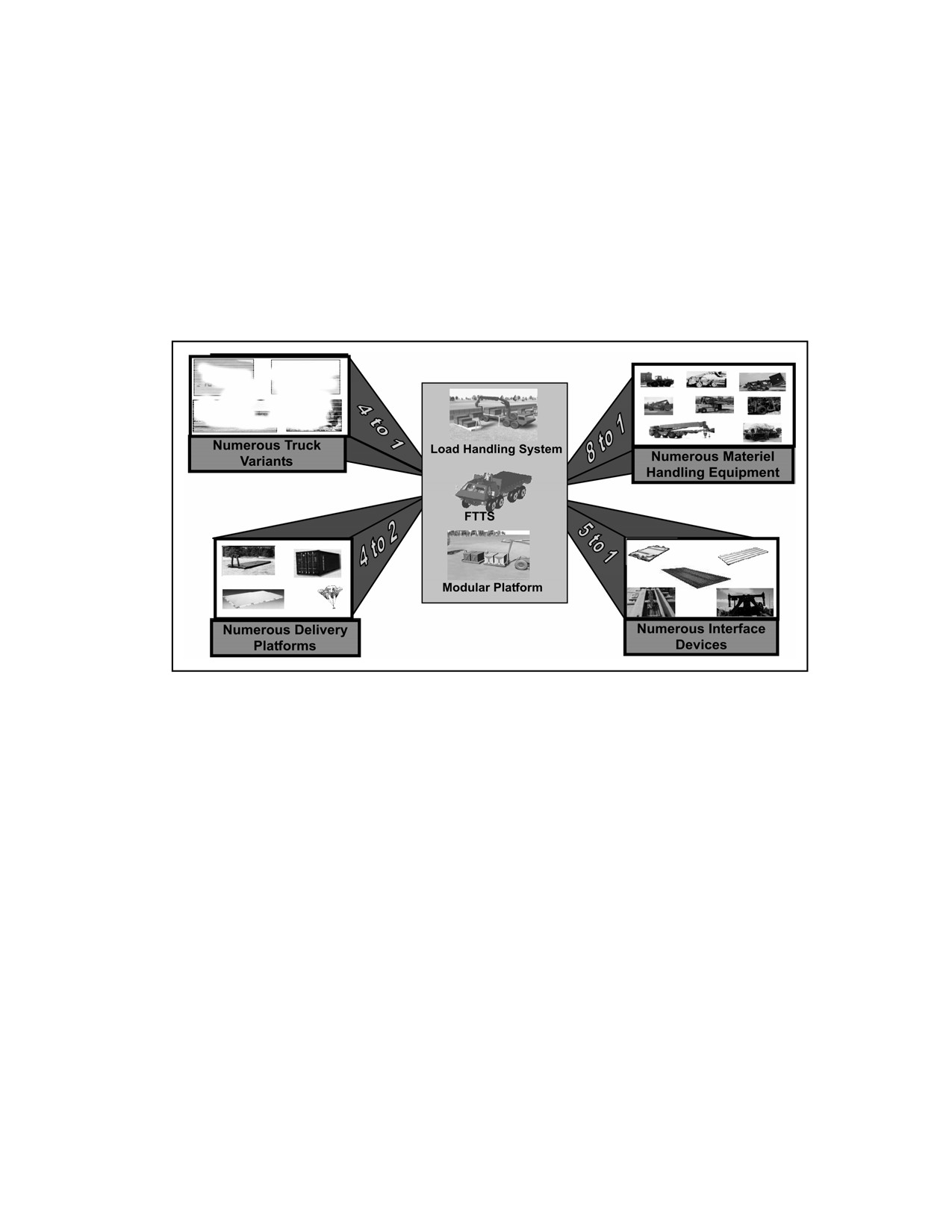
indicated in figure 3-1, the transformation of these three distribution system
components through technological and equipment enhancements will reduce
the equipment variants, provide timely support, reduce the logprint within
the battlespace, and improve the efficiency of the distribution system. Each
of the subsystems addresses particular problems within the distribution
3-12
_____________________________________________
Interim Objective Force Munitions Operation
system. Benefits derived from the implementation of smart distribution
include the following:
z
Responsiveness - streamlined sustainment process supporting the
objective force.
z
Deployability - increased efficiency in distribution nodes.
z
Agility - ability to respond to changing unit needs to maintain battle
rhythm.
z
Lethality
- reduced disengagement time enables continuous
operations.
z
Operations.
Figure 3-1. Smart Distribution System - Subsystems
Intelligent Materiel Handling Equipment
3-57. In current distribution operations, numerous types of MHE are
required to either transfer cargo platforms between transportation modes or
to reconfigure loads on the platforms. Manning and maintaining MHE adds
to the logprint at each distribution node. Additionally, personnel spend
numerous hours determining safe and stable cargo configurations for
shipment on flatracks or CROPs. The components of the intelligent LHS help
to reduce the personnel and equipment requirements for accomplishing these
distribution tasks.
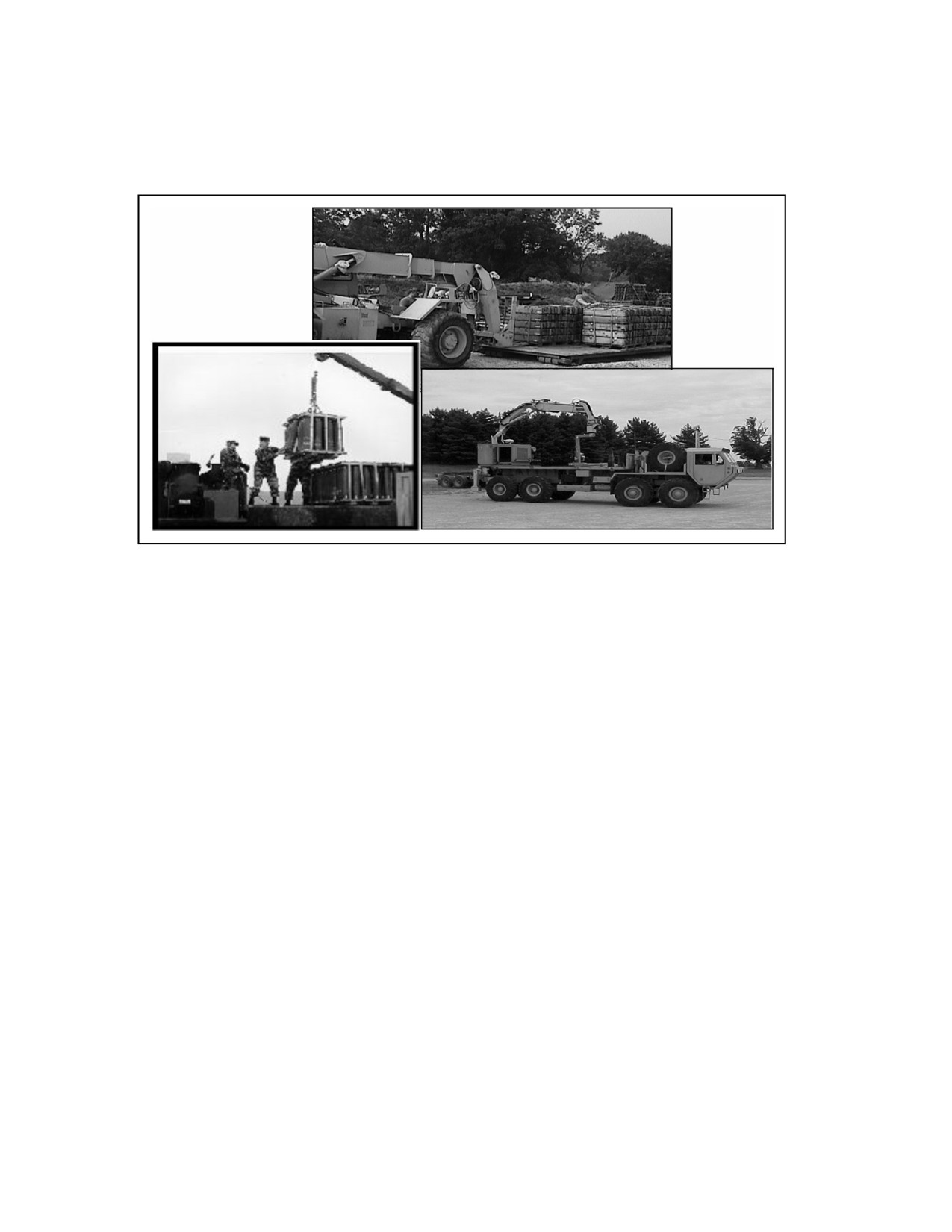
3-58. The intelligent LHS
(see figure
3-2) has two components: the
articulated load handling arm and CL building software. The articulated arm
will perform the same function as the LHS on the PLS and HEMTT-LHS by
loading modular platforms or ISO-compatible containers onto the future
tactical truck system (FTTS). As an improvement over the current LHS, the
articulated arm movements will allow the FTTS to load or unload platforms
from C-130s (and other aircraft) without obstruction by the aircraft tail. The
articulated arm will also have a materiel handling capability. The arm will
be capable of lifting supply modules on and off of a platform loaded onto the
FTTS. Through machine vision and sensors on the arm, the FTTS operator
3-13
FM 4.30-1 (FM 9-6) __________________________________________________________________
will pick up loads from the ground, then robotics will place the load at a
predetermined location on the platform as determined by the CL building
software.
Figure 3-2. Intelligent Materiel Handling Equipment
Modular Platform System
3-59. Current incompatibilities require numerous interface devices for cargo
platforms, such as PLS flatracks and CROPs, to be transported on aircraft
and watercraft. This will force soldiers to rehandle all classes of supply using
numerous types of MHE from the national provider to the objective force UA.
Interface devices add to the cargo handling time by requiring additional steps
to connect or disconnect them in distribution operations, thus creating a
larger logprint in terms of the soldiers required to perform these extra steps.
Examples of these enhancing interface devices include the following:
z
Container handling unit (CHU) for the PLS and the HEMTT.
z
LHS to carry ISO containers.
z
Roller platform for air deployment (RPAD) for ISO containers.
z
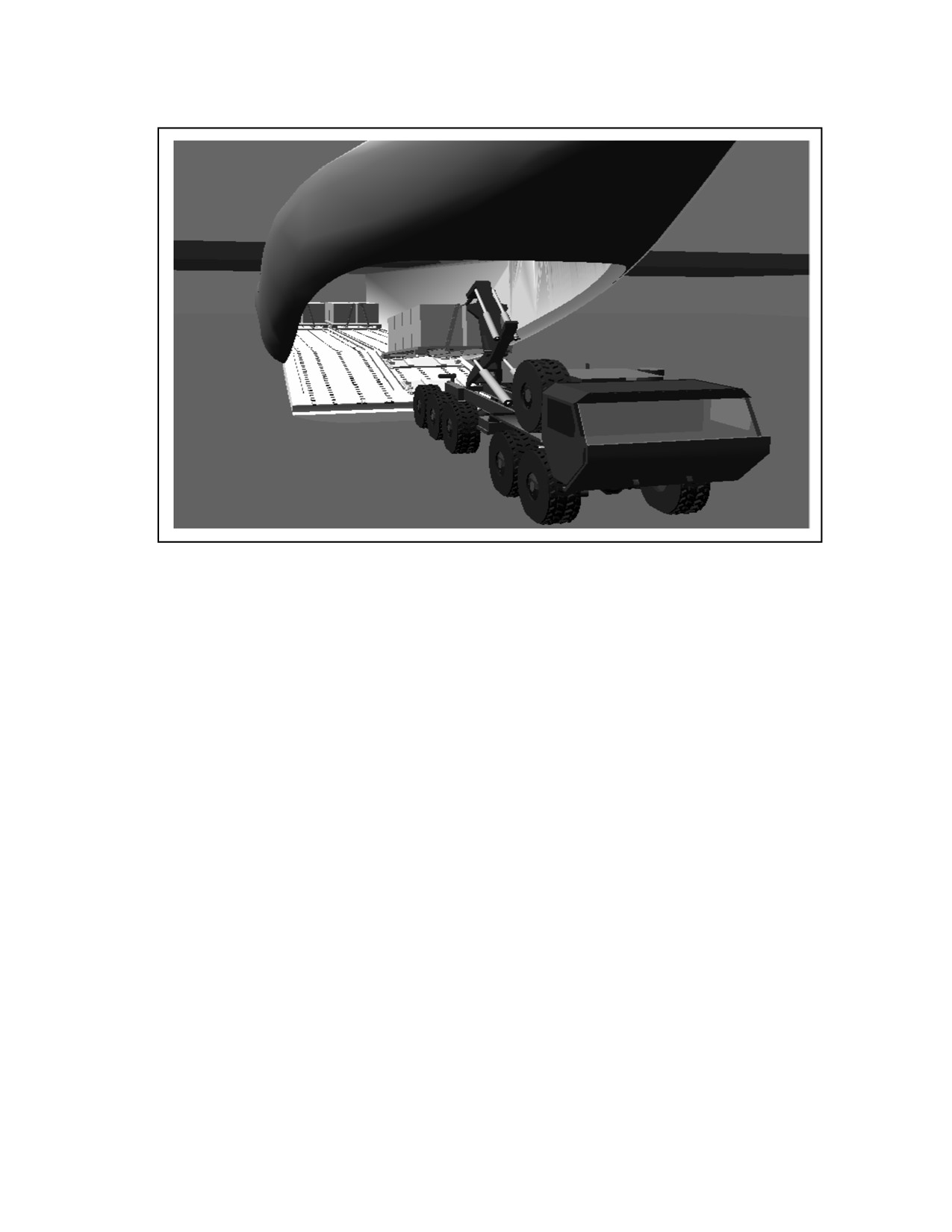
CROP aircraft interface kit
(CAIK)
(see figure
3-3) for
loading/unloading a CROP on a C-17 or C-130 (also known as a
Slipper device).
z
Flatrack aircraft interface kit (FRAIK) for aircraft loading/unloading
the wider flatrack.
z
Transportation container transfer kit
(TC TK) rails for loading
containers on PLS trailers using the CHU.
3-14
_____________________________________________
Interim Objective Force Munitions Operation
Figure 3-3. CROP Aircraft Interface Kit
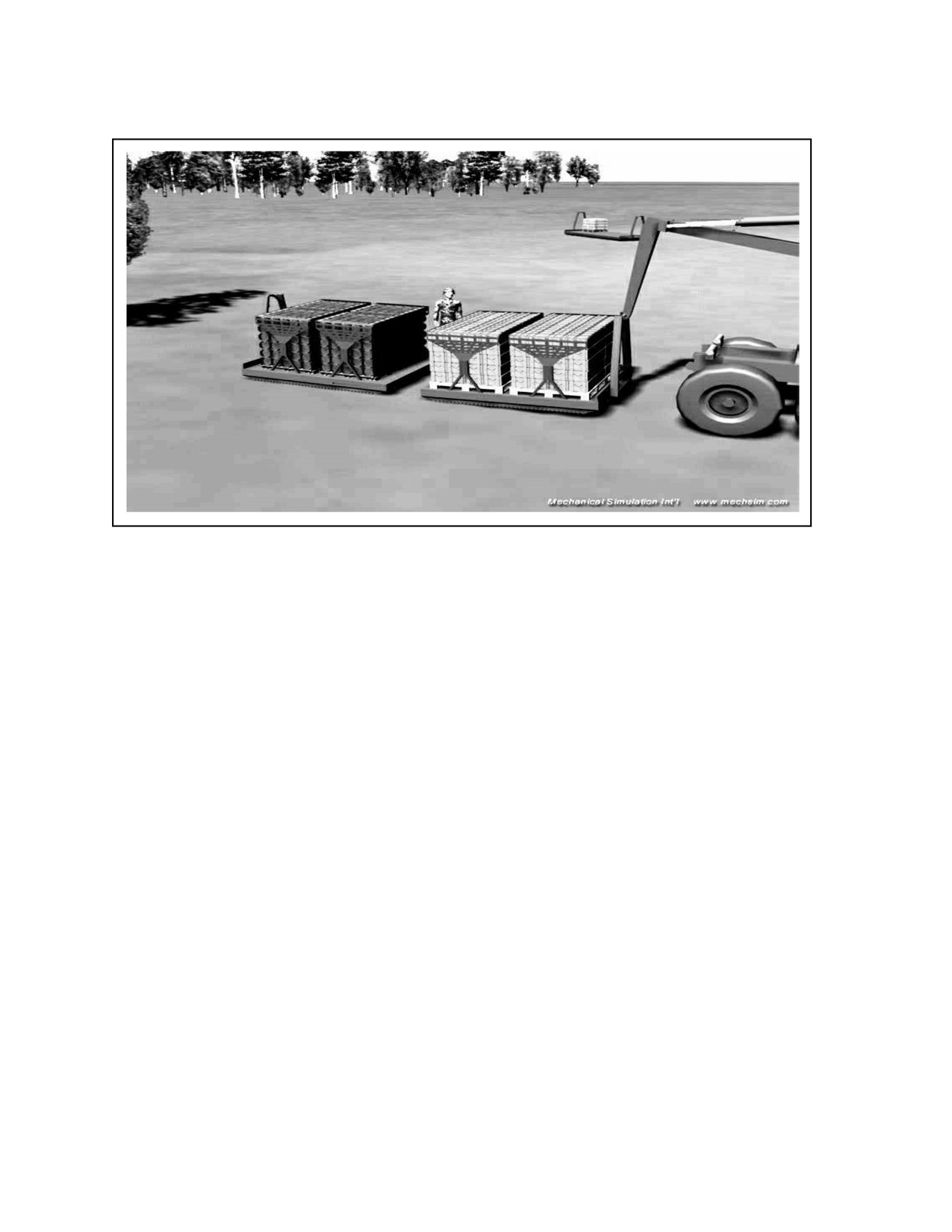
3-60. The Modular platform system (see figure 3-4) will address interface
issues through its design characteristics. The platform itself will be designed
to interface directly with the logistics rails in Air Force aircraft. Additionally,
the platform will be capable of being loaded onto a PLS or HEMTT-LHS
making it compatible with legacy and interim systems that will be present
during the transition to the objective force. The platform will be modular and
capable of disconnecting a portion of the platform and loading the remainder
of the platform back onto the FTTS, as described in the next paragraph. This
will provide a less-than-truckload capability not available with the CROP or
flatrack variants. Additional capabilities being designed into the modular
platform are for it to be air-droppable and sling-loadable to reduce the
numerous types of platforms in the distribution system.
3-15
FM 4.30-1 (FM 9-6) __________________________________________________________________
Figure 3-4. The Modular Platform System
3-61. The slipsheet is an innovative concept of operation that includes using
a prime mover to attach to and pull a 20-foot slipsheet, with load, from the
ISO container in a single pull. The slipsheet can slide directly onto an
awaiting flatrack. Two 20-foot slipsheets can be placed in a 40-foot box and
slide individually from the ISO container. MHE used by logistical elements
will be greatly improved over today’s most modern versions. Future MHE
will enhance lift and handling capabilities throughout the ammunition
logistics pipeline. Robotic remote-controlled MHE, multipurpose MHE
(forklift/crane/container/handler), and exoskeleton devices will expedite the
rapid handling of ammunition through the logistical pipeline. Soldier
personal computer aides will play an important role in all phases of
ammunition logistics. Personal computer aides will be used in the
management of receipts, issues, storage, inventory, safety, and
environmental controls.
3-62. Hardware enhancements provide streamlining opportunities that may
decrease deployment time for logistics support of the SBCT. The Slipper and
the Shoe are hardware enhancements evaluated for use with the CROP on
C-17 and C-130 aircraft. The Slipper locks in directly with the logistics rails
of the C-17 and can be chained between the logistics rails of the C-130. The
Shoe locks in directly with the logistics rails of the C-130 and can fit down
the center of the C-17 rails. Relative to pallets and airlifting CROPs, the
Slipper has the capability to double the strategic lift capacity of a C-17. The
Shoe and Slipper demonstrated the capability to double the tactical lift
capacity of the C-130 aircraft. Both devices, when employed, greatly reduce
deployment time and reduce MHE requirements compared to a 463L-based
distribution system.
3-16
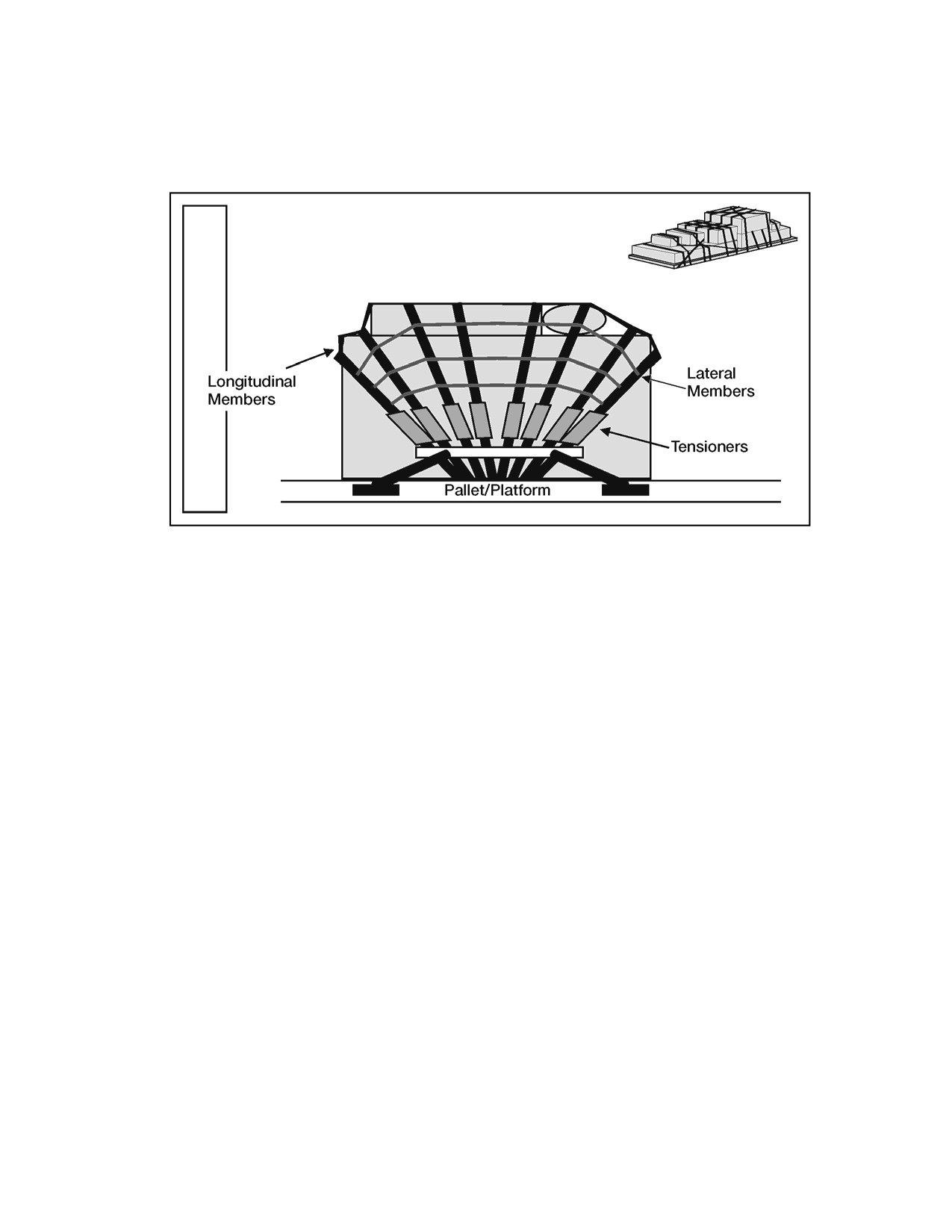
_____________________________________________
Interim Objective Force Munitions Operation
Rapid Load Technology
3-63. Use of load-conforming smart tie-down systems (figure 3-5) reduce
loading time and enable rapid securing of CLs.
Figure 3-5. Rapid Load Tie-Down Hardware
Future Tactical Truck System
3-64. In legacy and interim organizations, numerous truck families comprise
the transportation links in the ground distribution system. The PLS, HEMTT
variants, and the FMTV all have their own maintenance and repair parts
stockage requirements that collectively create a larger logprint. The future
tactical truck system (FTTS) will be a single, common-chassis family of
vehicles that will meet ground transportation requirements for distribution
in the objective force. A combination of embedded diagnostics and hybrid-
electric power will further reduce the sustainment requirements for the
FTTS. Smart distribution adds a vehicle alignment system to the FTTS (see
figure 3-6). This system consists of a series of sensors enabling the FTTS to
quickly align with modular platforms, containers, Air Force aircraft, trailers,
or other trucks for loading, unloading, or transloading. This will reduce the
need for additional personnel to guide the vehicle and help reduce the
amount of time required to acquire loads.
3-17
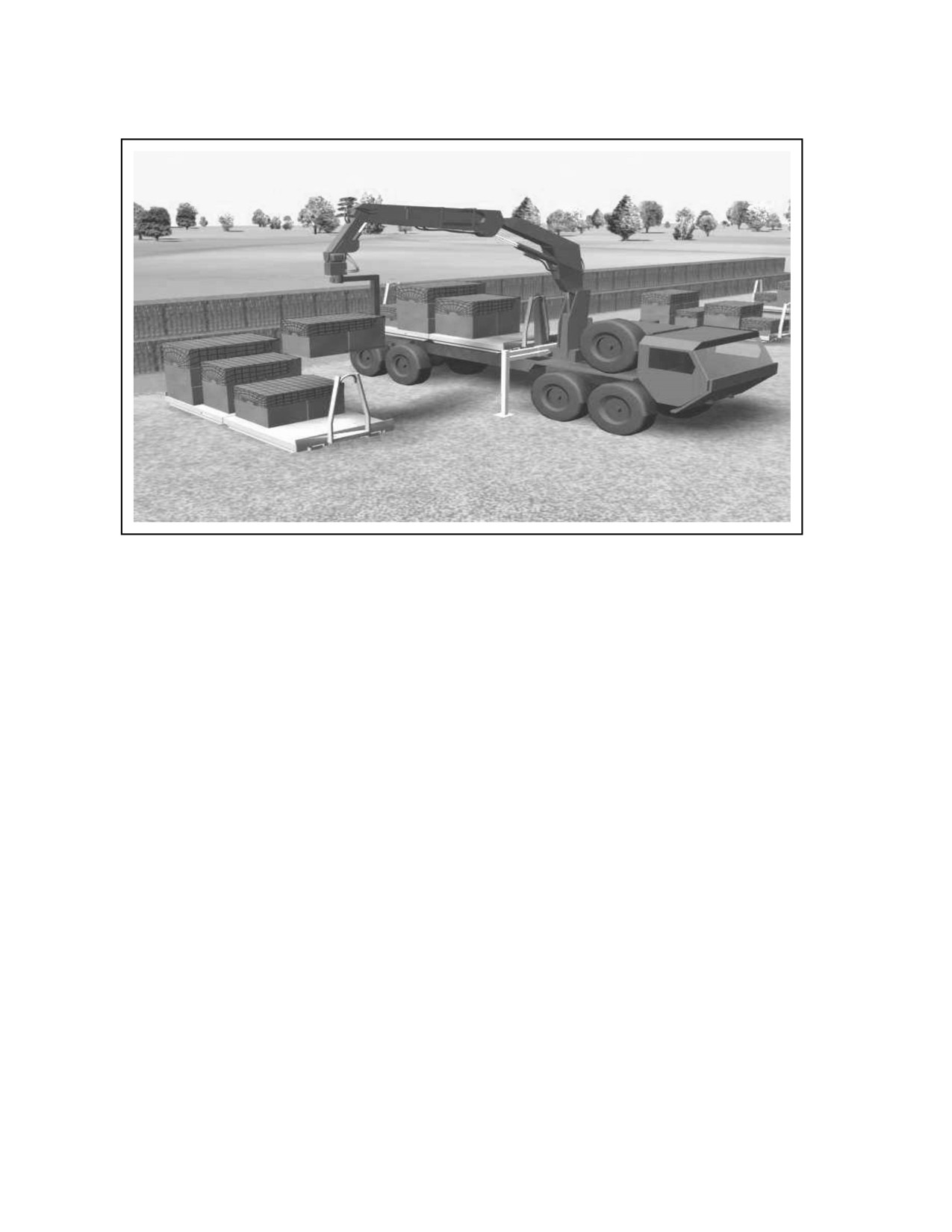
FM 4.30-1 (FM 9-6) __________________________________________________________________
Figure 3-6. The FTTS with the Intelligent Load Handling System
ENHANCED DELIVERY SYSTEM—AIR
3-65. The enhanced delivery system—air (EDS-A) (see figure 3-7) initiative is
focused on providing modular, lightweight, air mobile flatracks, with an
aircraft-compatible LHS. Rapid deployability and rapid distribution are the
principal objectives reducing the need for double handling and MHE. This
initiative supports the transportation system need for a seamless
transportation/distribution system and the distribution need to reduce
customer wait time
(CWT). Enhanced strategic responsiveness and the
ability to achieve deployment timelines are encouraging outcomes of this
initiative. In-theater payoffs for the warfighter have been estimated as—
z
Forty percent fewer sortie equivalents.
z
Soldier productivity increased by four times.
z
Forty-five percent faster on-the-ground delivery.
3-18
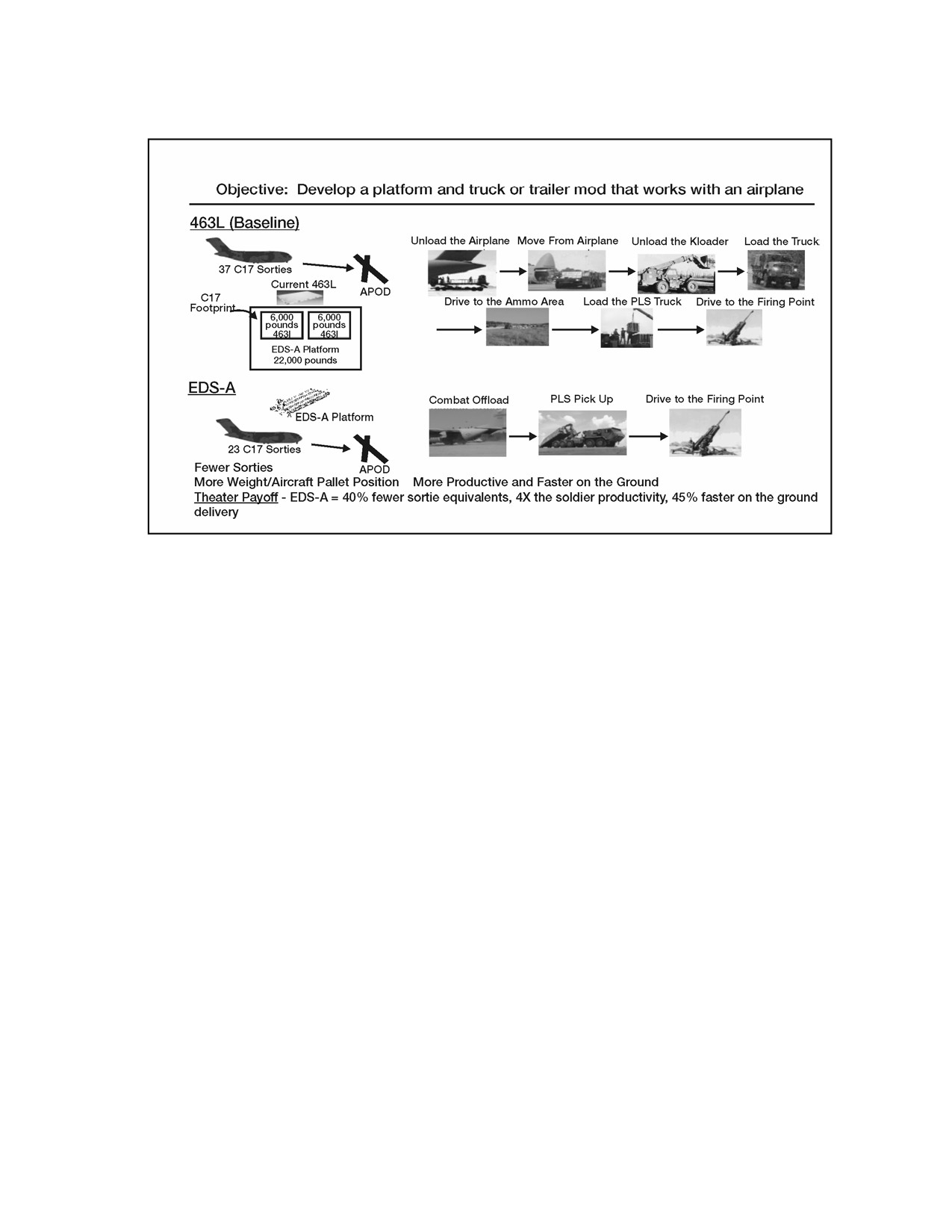
_____________________________________________
Interim Objective Force Munitions Operation
Figure 3-7. Enhanced Delivery System—Air
AMMUNITION PREDICTIVE TECHNOLOGY
3-66. Ammunition predictive technology is a scientific-based discipline that
provides the tools and methodology aimed at reducing premature
degradation and/or failure of munitions under storage conditions or
operational environments. This effort ensures safety, reliability, and
readiness by predicting and evaluating the service/shelf life of munitions (see
figure 3-8). Life models will be developed for integration into smart sensors to
provide real-time indicators of munitions readiness. Extreme environmental
exposure histories can degrade all, or portions of, munitions to a degree that
results in significantly reduced performance or even critical failure, hence
jeopardizing mission success. Currently, there is no way to know the extent
to which munitions are degraded because their exposure histories are not
monitored. This enabler will improve/enhance munitions inspection, tests,
and surveillance. Simplistic munitions readiness indicators (such as green
equals good-to-go and red equals stop) will enhance soldier confidence. This
program also enhances warfighting capability or readiness by ensuring the
highest quality munitions are available at any given time/place.
3-19
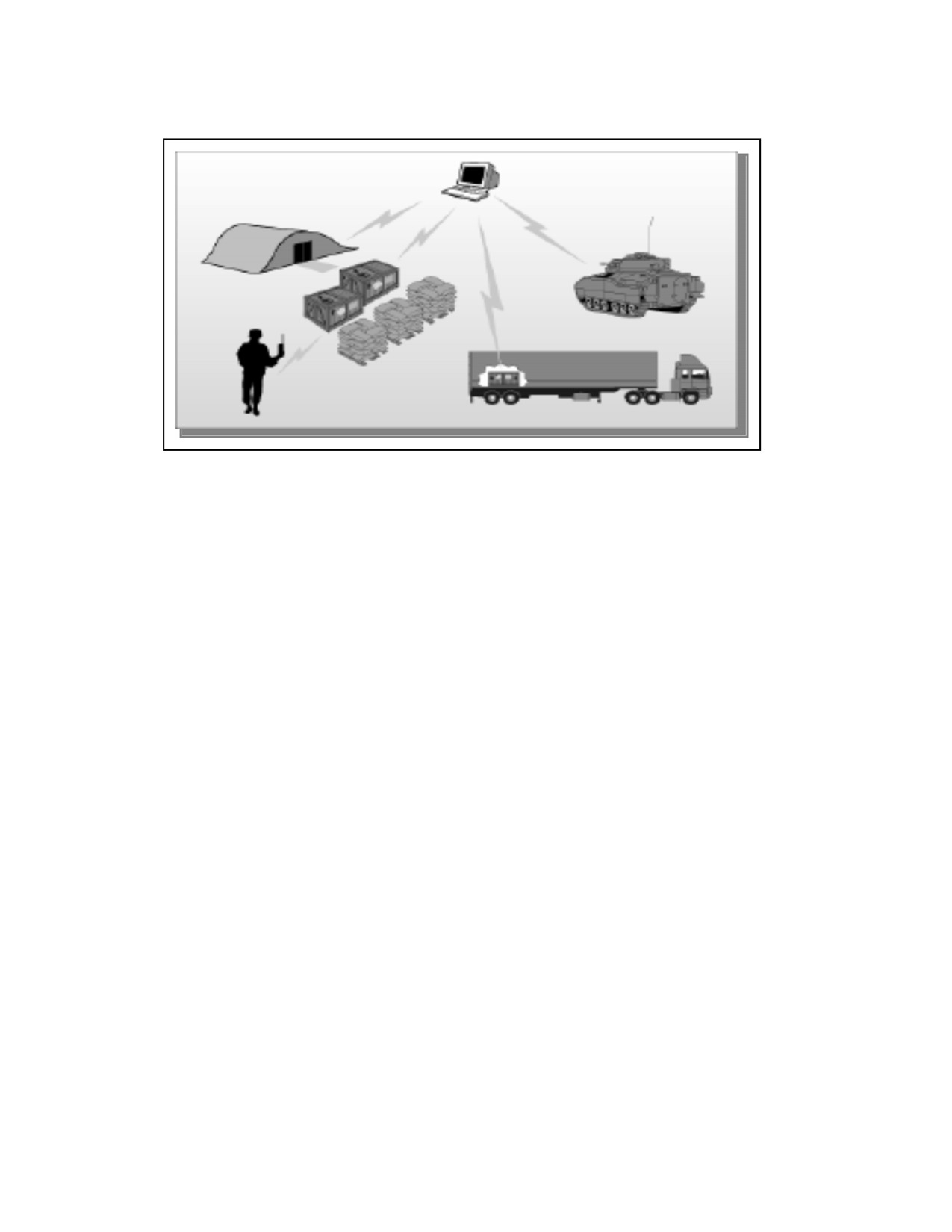
FM 4.30-1 (FM 9-6) __________________________________________________________________
Figure 3-8. Reporting Munitions Readiness
3-67. This enhancement also provides TAV, improves first round effects on
targets, ensures precision strike capability, and improves the logistician’s
capability to provide anticipatory logistics and reduced operating and support
(O&S) costs. Manpower requirements will be reduced at field and wholesale
levels with sensors and predictive models for inspection, test, and
surveillance; rapid and ensured distribution using on-board readiness and
assurance sensors assist with distribution decisions. This enabler should
reduce supply requirements for munitions and subsequently reduce the
weight and volume of Class V delivered on the battlefield. Consequently,
preventive maintenance requirements for munitions will also be reduced by
introduction and use of munitions predictive technology.
3-68. Ammunition surveillance information system munitions history
program (ASIS MHP) is an Internet accessible inspection application that
collects and communicates munitions mission-capable status and RRAPDS
environmental sensor data directly from the field to command level through
the munitions accountability systems of SDS, SAAS-MOD, future WLMP and
GCSS. The ASIS MHP reduces the logprint and replenishment cycle time,
ensuring a more strategically, deployable, agile, and sustainable force for the
future combat system.
CONFIGURED LOAD BUILDING SOFTWARE
3-69. This software provides efficiencies for munitions handling operations
that will reduce the labor hours currently required to configure custom loads
and increase the distribution velocity of ammunition shipments through the
ISB, CSA, and ASPs. This technology will increase the efficiency of the
munitions distribution systems and distribution management by providing a
planning and decision support tool to enable anticipatory logistics. It will also
enhance strategic responsiveness by providing increased throughput of
ammunition at storage sites when building custom CLs, and reduce the cost
of performing CS/CSS without reducing warfighting capability or readiness
by reducing load planning times.
3-20