FM 3-01.48 DIVISIONAL AIR AND MISSILE DEFENSE SENTINEL PLATOON OPERATIONS (DECEMBER 2003) - page 2
FM 3-01.48
to support the staff estimate and MDMP. Most intelligence requirements are
generated as a result of the IPB process and its interrelationship with the
decision-making process. The IPB process consists of four steps described in
the following paragraphs.
DEFINE THE BATTLEFIELD ENVIRONMENT
2-33. The battlefield environment is defined in order to further analyze the
specific features of the environment or activities within it, and the physical
space where they exist that may influence available COAs or commander’s
decisions. During this phase, the ADO identifies the area of operations (AO),
area of interest (AI), and the battlespace from an air and missile defense
perspective.
2-34. The AO is the geographical area where the commander is assigned
the responsibility and authority to conduct military operations. The AO for
the ADO extends vertically up to the maximum altitude of the friendly AMD
systems and can include engagements horizontally beyond unit boundaries.
2-35. The AI is the area from which information and intelligence are
required to permit planning or successful conduct of missions. The ADO’s AI
is generally larger than the AO or battlespace due to the great distances that
threat air and missile systems can rapidly cover. The air AI extends
vertically to cover the maximum service ceilings of trajectories of aircraft,
UAVs, and missile systems. Horizontally, it extends to cover the maximum
range of aircraft, UAVs, and missiles, to include threat airfields, forward
arming and refueling points, navigation aids, and potential missile launch
sites.
2-36. Battlespace is a physical volume that expands or contracts in relation
to the ability to acquire and engage the threat. It varies in width, depth, and
height as the commander positions and moves assets over time. The ADO’s
battlespace is the maximum effective range of his acquisition and weapon
systems. For example, the maximum range of the Sentinel radar, given
terrain restrictions, would be considered as the extent of the battlespace. If
the Sentinel is receiving an external air picture JTIDS, ADSI, or Patriot link,
the ADO’s battlespace will be even larger.
DESCRIBE THE BATTLEFIELD’S EFFECTS
2-37. Battlefield effects are evaluated to determine how the battlefield
environment influences both threat and friendly operations. A detailed
analysis of both terrain and weather is conducted, and then evaluated to
determine their effects on friendly and enemy COAs.
2-38. The military aspects of terrain are analyzed using the observation
and fields of fire, cover, concealment, obstacles, key terrain, and avenues of
approach methodology. The ADO analyzes the effects of terrain on threat air
and support systems, and friendly weapon systems.
2-39. These aspects relate to the influence of terrain on visibility, target
acquisition, and engagements. The ADO considers both visual and device-
aided acquisition when conducting his analysis. Line-of-sight acquisition is
essential for both air and missile defense weapon and surveillance systems,
2-8
FM 3-01.48
and enemy air platforms. The air and missile defense workstation LOS
analysis option provides planners with an excellent tool for identifying good
observation positions for Sentinels. Once these positions are identified, ADOs
should mark them for possible use during the operation or any contingency
missions.
2-40. Cover provides protection from the effects of direct and indirect fires.
Concealment provides protection from observation. The ADO identifies
portions of the terrain such as hills, wood lines, and built-up areas that act as
both cover and concealment for threat air platforms. These areas provide
threat air platforms with the ability to mask, conduct pop-up attacks, and
establish reverse slope loitering positions. The ADO also identifies terrain
where threat air platforms can fly nap-of-the-earth flight profiles,
maintaining concealment for rapid and undetected ingress into and egress
from the AO.
2-41. Obstacles are any natural or manmade features that stop, impede, or
divert military movement. The ADO identifies obstacles that impede the
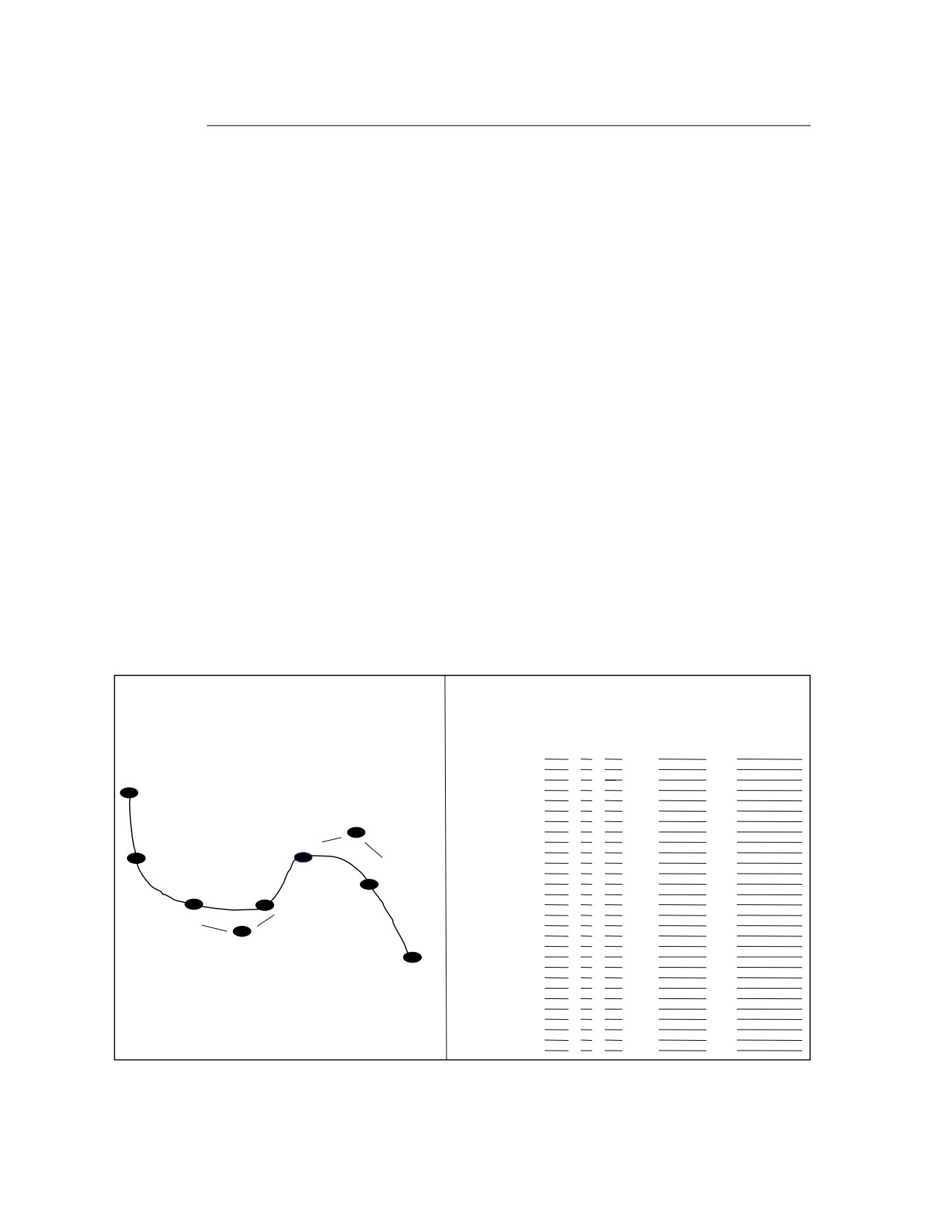
movement of Sentinels to positions on the battlefield
(terrain contour,
vegetation, water sources, and mine fields), and identifies obstacles that
restrict NOE flight profiles (mountains, cities, trees, telephone and power
lines).
2-42. Key terrain is defined as any locality or area, the seizure, retention,
or control of which affords a marked advantage to either combatant. The
ADO considers terrain that canalizes air threat systems, possible attack by
fire, surveillance, loitering, FARP positions, and potential LZ, DZ, or forward
air base locations as key terrain. In addition, positions that provide excellent
surveillance by Sentinels are also considered as possible key terrain.
EVALUATE THE THREAT
2-43. Threat evaluation is conducted to determine threat force capabilities
and the doctrinal principles and TTP threat forces prefer to employ. This step
consists of developing threat models
(doctrinal templates, description of
preferred tactics and options, and identification of high-value targets) and
identifying threat capabilities.
2-44. A doctrinal template illustrates the deployment pattern and
disposition preferred by the threat’s normal tactics when not constrained by
the effects of the battlefield environment. ADOs consider the following when
developing doctrinal templates for threat air operations:
• Types of threat.
• Typical ordnance delivery techniques.
• Air threat missions and objectives.
• Threat air order of battle.
• Typical sizes of threat packages.
• Locations of FARP and preferred flight profiles.
2-45. A description of preferred tactics and options is a narrative, matrix,
or time-event chart describing the threat's preferred tactics. The ADO's
description provides a detailed, time-sequenced explanation of the doctrinal
2-9
FM 3-01.48
template, addresses phases of threat air operations, and describes preferred
branches and sequels based on the success or failure of operations.
2-46. HVTs are assets that the threat commander requires for successful
completion of the mission. ADOs develop HVT lists by mentally war gaming
the operation and identifying assets that are critical to threat air success.
Some typical HVTs include FARP, forward airfields, forward air controllers,
UAV ground control stations, SEAD aircraft, and cruise missile-capable
aircraft.
2-47. Threat capabilities are the broad COAs that the threat can take to
influence the accomplishment of the friendly mission. They take the form of
statements such as the following:
• The enemy has the capability to conduct coordinated, nighttime air
and missile attacks.
• The enemy can generate up to 18 fixed-wing sorties and 24 rotary-
wing sorties per day for up to three days.
• The enemy can conduct sustained 24-hour surveillance operations
with their UAV force.
DETERMINE THREAT COURSES OF ACTION
2-48. This step consists of identifying the threat objectives, identifying
available threat COAs, prioritizing COAs, and identifying initial collection
requirements.
2-49. When identifying the threat objectives, the ADO must have a clear
understanding of the objectives one echelon above and two echelons below the
supported force. He will then analyze how threat air will support the
accomplishment of those objectives.
2-50. When identifying available air threat COAs, the ADO considers how
air will support the threat’s most likely, most dangerous, and least likely
COAs. Threat COAs are evaluated based on suitability, feasibility,
acceptability, uniqueness, and consistency with threat doctrine along with
recent threat trends. Air threat COAs are never determined in isolation from
the maneuver forces they support.
2-51. The development of threat COAs generates a situation template,
SITEMP narrative (or enemy synchronization matrix), and a listing of HVTs
for each COA. Each COA is prioritized and analyzed for strengths,
weaknesses, centers of gravity, and decisive points. The battlefield effects
need to be incorporated as you generate these COAs (assumptions).
2-52. The event template is a tool developed to assist in indicating which
COA the enemy will choose based on a series of named areas of interest.
NAIs identify locations where specific activities will occur in conjunction with
a specific COA. A series of NAIs is associated with each COA to assist in
determining which COA is being adopted by the threat force. An event matrix
that includes descriptions of anticipated activities, when they will occur, and
assigns observation responsibility to specific elements accompanies the event
template. These two products are used to build collection and R&S plans.
ADOs develop air event templates focusing on specific air-related activities to
2-10
FM 3-01.48
assist in determining threat COAs. This also assists in guiding the
positioning of Sentinels that are used to monitor the air NAIs.
MISSION ANALYSIS COMPLETION
2-53. The ADO’s ability to “see the enemy” provides the foundation for a
successful plan. At the conclusion of mission analysis, a second WARNO is
disseminated to subordinate elements to assist in the parallel planning
process.
COA DEVELOPMENT AND ANALYSIS
2-54. The COA development phase develops a plan to accomplish the
assigned mission with a focus on defeating the enemy and protecting the
force. The end state is to integrate and synchronize all combat functions.
COA development consists of: analysis of relative combat power, generation
of options, arraying of initial forces, developing schemes of maneuver, and
preparing COA statements and sketches. In addition, the ADO arrays AMD
assets in conjunction with possible friendly COAs, develops AMD schemes of
maneuver, and provides AMD input into the supported unit COA statements
and sketches.
2-55. Once COAs are developed, they are compared and analyzed through a
war game session. The war gaming session facilitates the synchronization of
all BOSs and develops a shared vision of the battlefield. It also assists the
commander and staff with maximizing combat power while protecting the
force, visualizing and anticipating battlefield events, determining conditions
and resource requirements, determining where and when to apply
capabilities, and determining the most flexible COA.
2-56. War gaming is normally recorded using a synchronization matrix.
The synchronization matrix developed during the war gaming process
provides a detailed description of the operation, which allows the entire staff
to share a common vision and coordinate specific actions with other staff
members.
2-57. A decision support template and decision support matrix are also
developed during war gaming. These products aid the commander and staff
in making battlefield decisions. Combined, they provide a list of decision
points, the location of the DPs, the criteria to be evaluated at the point of
decision, the actions or options to occur, and identifies the unit that is to act
and that has responsibility to observe the point. The DST and DSM also
capture targeted areas of interest. TAIs are areas or points where successful
interdiction will cause the threat to either abandon a particular COA or
require him to use specialized engineer support to continue, where he can be
acquired and engaged by friendly forces.
2-58. War gaming is an effective tool for the ADO. It enables the ADO to
explain his use of direct support and general support assets, triggers for
movement, and articulate the enemy air threat at a given time and place.
Additionally, the flow of the battle and critical decisive points, which may
trigger movements of GS assets (Avengers or Sentinels), is articulated to the
division or brigade staffs. Finally, it provides an opportunity for the ADO to
address force protection, movement sequencing and C2 for the radars. For
2-11
FM 3-01.48
example, “Team 1 will be OPCON for movement to TF 1-22 and will trail the
Alpha Company/Team.” At the conclusion of the war gaming session, a third
WARNO is disseminated to the subordinate elements.
PLANNING CONSIDERATIONS
2-59. Planning Sentinel employment is a complex process; however, proper
planning is absolutely essential to the air defense mission. The following are
some planning considerations for successful Sentinel management planning:
•
The divisional AMD battalion or battery commanders must
incorporate the Sentinel platoon leader or team sergeant in the
planning process. At a minimum, he should attend the war gaming,
which will provide him with a comprehensive vision of the fight.
•
“See the enemy.” A thorough understanding of threat capabilities and
trends is required. Enemy trends are depicted in the air event
template and matrix and provide the ADO with a better visualization
of the Sentinel movement scheme.
•
The ADO must have an appreciation for the terrain. A thorough LOS
analysis (preferably electronic) is conducted prior to deploying into a
hostile theater. Develop a favorable air defense fire unit or radar
position overlay. This overlay will facilitate C2 for the commander in
a fluid fight.
•
Know the supported unit’s scheme of maneuver. The Sentinel’s
position and movement scheme must be integrated with the
maneuver force to successfully provide digitized early warning and
force protection. Thus, if the Sentinel platoon leader is not integrated
into the planning process, his platoon’s capability will not be used to
full potential.
•
Develop clearly defined triggers and orientation for the Sentinel
radar. This can be a modified event template or a specific Sentinel
platoon template. The triggers will allow radars to be in the “right
position” at the “right time” to provide the necessary early warning.
The use of aerial NAIs and AAA provide guidance to the Sentinel
team chiefs on orientation.
•
The communications architecture for the digitized air picture is a
critical planning item. Planning distances for SINCGARS (5 to 7
kilometers) versus EPLRS
(10 to
20 kilometers) are important.
Failure to take the limitations of the communications system into
account may result in Sentinels being in the “right place,” but unable
to pass an air picture to anyone. A potential solution may be an
EPLRS or SINCGARS retransmission system to support the data
communications. Dependent upon METT-TC, it is often critical to
mission success to emplace a retransmission network. Also, the
autonomous versus correlated air picture requirements are different
for the air defenders and the requirement to actually link your
handheld terminal unit to a specific radar.
•
Arranging force protection for radars is a critical task. Force
protection must be addressed to the division or brigade combat team.
Engineer support or security requirements in support of Sentinels
2-12
FM 3-01.48
must become a standing operating procedure item and must be
captured during the war gaming process.
• Sentinel teams movement planning is critical to providing effective
early warning to the supported AMD force regardless of the mission.
During the planning process, commanders must consider how long it
will take a Sentinel team to travel to a position, emplace, and become
operational. Detailed time phase lines are developed by the
commander taking cross country mobility; obstacles; enemy
disposition and composition; and emplacement and march order times
into consideration. The ADO and Sentinel platoon leader must also
consider the movement rate of the supported force when planning
Sentinel employment, ensuring sufficient coverage is provided
throughout the depth of the battlefield. In almost all cases, Sentinel
teams will never move unsupported.
• Logistical support for Sentinel teams must be coordinated with the
supported AMD force or the adjacent task force, or brigade combat
team. Logistics is addressed in Chapter 4.
• Battalion or higher echelon dictates an emission control plan for
Sentinels, based on METT-TC. The EMCON plan is designed to
reduce the ability of the enemy to target the Sentinels by limiting the
radar signature.
FAAD C3I SUPPORT FOR PLANNING
2-60. For digitized divisional AMD battalions, the MDMP process will be
greatly enhanced with the aid of the C3I software. The C3I software allows for
the scripting of simulated air tracks, fire unit positions, and battle
management messages into a single node called the Simulation Control
Source. This allows the ADO, Sentinel platoon leader, or section sergeants to
script scenarios of expected air threat actions against deployed divisional
AMD forces. It provides the planner with the ability to visualize the products
of the planning process and refine the plan to ensure Sentinels and shooters
are properly employed to defeat the threat.
SCENARIO GENERATION
2-61. The divisional AMD Sentinel SCS can be used to create new
scenarios, to support analysis of current plans, to allow the planner to
retrieve old scenarios to provide a historical perspective, and to allow the
planner to edit or modify previously generated scenarios to meet current
requirements. Scenarios can be designed consisting of a variety of
information and data.
Configuration of Air and Missile Defense Forces
2-62. Generated scenario scripts of air and missile defense forces are
previewed to evaluate the relative effectiveness of Sentinel positioning on
specific terrain and weapon system line of sight against a defined air track
threat. Furthermore, the script allows the planner to evaluate fire unit
positioning relative to Sentinel positioning and compute the number of
potential engagement opportunities available against a specific threat
2-13
FM 3-01.48
scenario. This greatly assists leaders with employment planning in
unfamiliar environments.
Air Track Script Generation
2-63. Air track scripts can be either added or modified to support any
required scenario. The operator quickly scans through existing track scripts
in the exercise script file and modifies selected air tracks; adjusts injection
times; adds duplicates; or adds entirely new air track scripts as required. Air
track scripts generally include the following information:
• Aircraft class (unknown/FW/RW/missile [default is FW]).
• Raid size (unknown/single/few/many [default is single]).
• Track
source
(Sentinel/Adjacent
divisional
AMD/E-3A
[AWACS]/Sentinel/PPLI/TADIL-B [default is Sentinel]).
• Track Quality (01-15 with 15 being the highest quality).
2-64. The data for each track can consist of injection time; start location
and up to 10 successive waypoints; altitude; setback distance for start and
end of a turn; speed; and air track identity.
Quick View Screen
2-65. The SCS operator can review any track that has been defined. A
graphic presentation of the over-the-ground trajectory is provided with
waypoint data and start/end turn points. The primary purpose of this screen
is to see if the track data entered is free of input errors and has produced the
desired simulated flight path. See Figure 2-1.
QUICK VIEW
WAYPOINTS LOCATION
ALTITUDE
TIME
0
P
1
1
P
1
2
2
P
2
3
3
P
3
4
4
P
4
5
5
P
5
6
6
P
6
7
7
P
7
8
8
P
8
9
9
9
P
10
Figure 2-1. Quick View
2-14
FM 3-01.48
2-66. The following vignette discusses Sentinel planning. It was prepared
by the ADO from the 1-44 ADA during a recent National Training Center
rotation.
Sentinel Planning Vignette
During a rotation to the National Training Center, the 1st Brigade, 4th Infantry
Division, staff was planning a brigade attack. The attack would take place in the
central and northern corridors of the training area. A high ridge that provided good
pop-up points for RW aircraft and clear delineation for the FW AAA separated the
two corridors. We were conducting a joint heavy/light rotation with armor,
mechanized infantry, and a light infantry battalion.
Upon receipt of the new mission, I generated a FRAGO to assist in the parallel
planning process for my platoon leaders. Knowing that we would be fighting all
three corridors, I had my Sentinel platoon leader and team sergeant develop a list
of quality air defense positions. The positions were developed using the LOS
analysis capability on the air and missile defense workstation. The Sentinel
leadership had developed approximately 20 positions in each corridor. These
positions or “check points” would be very helpful during the fight.
During the mission analysis, the S2 and I jointly determined the enemy air
SITEMPs. I determined that we would receive the following air threat, targeting the
maneuver formations (tanks, Bradleys), artillery, C2, and air defense systems.
4 to 6 FW sorties in the central corridor to disrupt (H hour−H+1.5)
2 to 4 RW sorties in the Brown-Debman Passes/central corridor to support
initial enemy defensive positions (NAIs 2, 3, and 5) (H+2−H+3)
2 to 4 FW sorties in the central/northern corridors (H+2.5−H+3.5)
4 to 6 RW sorties in the central corridor in support of main defensive area
(H+3.5−H+4.5)
During the mission analysis briefing, I received clear guidance from the 1st Brigade
commander on air defense priorities. Armed with a clear understanding of the
mission, the weather and terrain, brigade commander’s air defense priorities, and
the enemy’s COAs, I felt very confident as I generated my second WARNO.
As the staff generated COA statements and supporting sketches, I began to
formulate a plan that would support the operation. As we prepared for the war-
gaming process, I notified the Sentinel platoon leader and team sergeant of the
time and location, to ensure attendance. Two facts that we identified in the
planning process were we would have to position a Sentinel forward to support the
crossing of the LD/LC, and a SINCGARS Sentinel would have to be closely located
to support the SINCGARS-based light task force. The initial Sentinel emplacement
would trigger the subsequent bound of the following Sentinel. This bound would be
critical because it would have to move through the Brown-Debman Passes and
emplace to provide an air picture to the forward TF. The terrain limited the
Sentinel's 40± km range. Even in the desert environment, it was terrain−restricted
and that is why the LOS analysis is so critical. The speed of the tracked vehicles
moving over the desert terrain compared to the Sentinel’s two HMMWVs with
towed loads caused the teams to use maximum convoy speed. The two COAs that
we war gamed consisted of two TFs attacking abreast or TFs in column in the
2-15
FM 3-01.48
central corridor and one light TF attacking in the northern corridor. The Sentinel
team sergeant immediately began analyzing the potential positions for Sentinel
emplacement that would best support the scheme of maneuver. We discussed
where in the sequence of march the Sentinel should be and what type of force
protection the brigade could support me with. As the battery commander, the
Sentinel is only one aspect of your planning process. I decided on a piece of high
ground 2 to 3 kilometers from the LD/LC for the initial Sentinel placement with the
second EPLRS Sentinel ready for movement. The second Sentinel would move
behind the lead TF and would be OPCON for movement to the lead TF until it hit
its release point. Once the second EPLRS Sentinel was emplaced, the first EPLRS
Sentinel would march order and move behind the trail TF through the Brown-
Debman Passes and emplace. This Sentinel would be OPCON for movement to
the trail TF. The command relationship helped ensure that the Sentinels moved as
part of the brigade combat team/TF, increasing survivability. Once emplaced, the
second EPLRS Sentinel would bound forward to its final position providing a
digitized air picture overlooking the objective. The emplaced SINCGARS Sentinel
provided an air picture until H-1, and then moved with the light TF. It moved behind
the TF and emplaced
3 to
5 kilometers behind their positions providing a
SINCGARS-digitized air picture.
During the war game, I addressed Sentinel locations and triggers and identified
potential requirements for maintenance and/or logistical support (also captured this
in the brigade base order). The Sentinel platoon leader and team sergeant
attended the war gaming. Their attendance was critical because it ensured they
understood the fight. Once the war gaming was complete, a WARNO with a
synchronization matrix and decision support template was disseminated.
The COA decision brief to the brigade commander resulted in choosing COA 2:
two TFs in column with the light TF in the northern corridor. The OPORD was
disseminated and all GS assets arrived to attend the brigade rehearsal. The
Sentinel platoon leader, team sergeant, and the Avenger platoon leader attended
the rehearsal. We then reviewed the operation, specifically discussing triggers and
contingency operations.
The battery rehearsal was conducted via FM. The brigade and battalion timelines
and distances involved did not allow for a rock drill. The battery rehearsal format
was captured in our SOP. It ensured the DS platoon leaders understood the GS
scheme of maneuver; where the Sentinels and Avengers were going to be located;
and what the triggers were for movement. After a successful battery rehearsal was
conducted, we were prepared to conduct the mission.
TROOP-LEADING PROCEDURES
2-67. Troop-leading procedures are designed to focus the Sentinel platoon
leader’s effort, given the time available, on preparations for the mission. At
the Sentinel team level, many actions are based on SOPs and standard unit
drills. These include evacuation of wounded soldiers, rearming and resupply
procedures, and Sentinel team individual soldier responsibilities. This allows
the Sentinel teams to operate quickly and efficiently without constant
guidance from the section sergeants.
2-16
FM 3-01.48
2-68. Troop-leading procedures are the basis of the dynamic process by
which units develop plans and orders at every level of leadership. This
process, although discussed here with the eight steps in traditional order, is
not rigid and the steps are not necessarily sequential. The tasks involved in
some steps (such as initiate movement, issue the digital warning order, and
conduct digital reconnaissance) may recur several times during the process.
Although listed as the last step, activities associated with supervising and
refining the plan and other preparations occur throughout troop leading.
2-69. Troop-leading procedures begin when the platoon leader receives the
first indication of an upcoming operation (often by warning order from higher
headquarters) and continue throughout the planning, preparation, and
execution phases of the mission. The platoon leader maximizes the available
planning time by starting as soon as the first bit of information becomes
available. He normally uses one-third of the available time to plan, prepare,
and issue the order. His section sergeants then have the remaining two-
thirds of the time available to conduct their own troop-leading procedures.
This time allocation is known as the “one-third/two-thirds” rule of planning
and preparation. The following discussion provides a step-by-step overview of
troop-leading procedures.
STEP 1—RECEIVE AND ANALYZE THE MISSION
2-70. The platoon leader receives his orders in a digital, oral, or written
form in an operation order, FRAGO, or warning order. Upon receipt of the
order, he begins analyzing the mission using the factors of mission, enemy,
terrain (and weather), troops, time available, and civil considerations.
STEP 2—ISSUE A WARNING ORDER
2-71. After the platoon leader has analyzed his orders and worked out his
mission and related tasks, he must quickly pass this information to his
section sergeants either by digital or hard copy. This is accomplished through
the warning order. As a minimum, the following information must be
included:
• Elements and individuals to whom the warning order applies.
• Enemy situation as stated in the task force order.
• The time and nature of the operation.
• The earliest time of movement.
• Coordinating instructions, including an initial time line.
• The time and place the OPORD will be issued.
STEP 3—MAKE A TENTATIVE PLAN
2-72. Based on results of his mission analysis, the platoon leader develops
possible courses of action that address all specified, implied, and essential
tasks, and sufficiently support the supported force.
STEP 4—INITIATE MOVEMENT
2-73. After issuing a warning order and making a tentative plan, the
platoon leader initiates any required movement. Movement includes
2-17
FM 3-01.48
positioning teams at preselected coordinates to broadcast EW, linking up
with force protection assets, pre-positioning with supported assets, and
dispatching an advance party to a new assembly area. Proper positioning and
timely linkups are essential to early warning integration.
STEP 5— CONDUCT RECONNAISSANCE
2-74. This step of the troop-leading procedures allows the platoon leader to
confirm the validity of his tentative plan and to refine the plan. When
possible, the platoon leader should conduct the reconnaissance with his
section sergeants. This will allow them to see the terrain and develop a better
visualization of the projected plan. At a minimum, the platoon leader
conducts this step as a detailed map reconnaissance. Reconnaissance includes
evaluation of the initial march route to the LD, identified movement
corridors, initial positions, and all possible subsequent positions.
2-75. If section sergeants cannot personally conduct onsite reconnaissance,
they should make the most efficient use of available time by tasking their
teams to accomplish specific reconnaissance requirements. An example of
this is tasking a Sentinel team to reconnoiter and ascertain time routes to the
SP. The section sergeant must conduct the reconnaissance with an open
mind; not everything he sees will match the Sentinel platoon leader's
tentative plan. He must be flexible enough to change and competent enough
to work out new plans rapidly.
STEP 6—COMPLETE THE PLAN
2-76. The platoon leader refines his plan based on the results of the
reconnaissance. He then completes the plan using these results and any new
information from the supported force, the higher headquarters staff, and the
members of his sections. He should keep the plan as simple as possible, at the
same time ensuring that it effectively supports the commander’s intent.
STEP 7—ISSUE THE ORDER
2-77. The platoon leader issues the order to all section sergeants. Revised
operation graphics are distributed to teams prior to issuing the order. Each
section sergeant ensures that each team overlay matches his overlay. To use
his time most efficiently, the platoon leader should use a walk-through
rehearsal as part of his briefing of paragraph 3 of the order.
2-78. If the platoon leader can issue the order from a favorable vantage
point, he or the section sergeants can physically indicate the ground over
which the teams will maneuver. If a vantage point is not available, he can
use a terrain cloth, sand table, or a map as a reference. The platoon leader or
section sergeants should have a briefing kit available to build a model of the
area of operations. Items in the kit might include the following:
• Nylon rope and nails or spikes.
• Preconstructed Plexiglas squares for units and equipment (blue for
friendly elements, red for enemy forces).
•
“Micro” armor vehicles or other models.
•
Pens and markers.
2-18
FM 3-01.48
• Stakes.
• Engineer tape.
• Operational symbol cutouts.
• Dry eraser board.
2-79. The order is issued in the five-paragraph OPORD format. To ensure
complete understanding of the operation, leaders should end the order with a
backbrief of key points by their team chiefs.
STEP 8—SUPERVISE AND REFINE
2-80. Flexibility is the key to effective operations. The platoon or section
sergeant must be able to refine his plan whenever new information becomes
available. If they adjust the plan, they must inform the teams and supervise
implementation of the changes. Once the operation has begun, the section
sergeants must be able to direct their sections in response to new situations.
BACKBRIEFS, REHEARSALS, AND INSPECTIONS
2-81. Backbriefs, rehearsals, and inspections are essential elements of the
supervision process as the team prepares for the mission. The following
paragraphs discuss these procedures in detail.
BACKBRIEFS
2-82. The backbrief is, in effect, a reverse briefing process. Those who
receive an OPORD confirm their understanding of it by repeating and
explaining details of the operation for their section sergeants. In a Sentinel
section, the section sergeants should conduct backbriefs after their teams
have received the OPORD, but before the team rehearsal begins.
REHEARSALS
2-83. A rehearsal is the act or process of practicing an action in preparation
for the actual performance of that action. Rehearsing key combat actions
allows the Sentinel teams to become familiar with the operation and to
translate the relatively dry recitation of the tactical plan into visual
impression. This visual impression assists the Sentinel teams in orienting
themselves to both their environment and to other units during the execution
of the operation. Moreover, the repetition of combat tasks during the
rehearsal leaves a lasting mental picture of the sequence of key actions
within the operation. Rehearsals also provide a forum to analyze the tactical
plan, to ascertain its feasibility, common sense, and the adequacy of its
command and control measures before it is too late. To be effectively and
efficiently employed in combat, rehearsals need to become habitual in
training. The Sentinel platoon should routinely train and practice a variety of
rehearsal techniques. The local SOP should identify appropriate rehearsal
techniques and standards for execution. Time is probably the most precious
resource available to the Sentinel teams. Rehearsals take time. The time
required for rehearsal varies with the complexity of the task to be rehearsed,
the type of rehearsal, and the level of participation. For this reason, the
emphasis on rehearsals should be at the lowest level possible, using the most
2-19
FM 3-01.48
thorough technique possible given the time available. The Sentinel teams use
well-planned, efficiently run rehearsals to accomplish the following:
• Reinforce training and increase proficiency in critical tasks.
• Reveal weaknesses or problems in the plan.
• Synchronize the actions of subordinate elements.
• Improve each soldier’s understanding of the concept of the operation.
2-84. The section sergeants can choose among several techniques in
conducting rehearsals, which should follow the crawl-walk-run training
methodology to prepare the sections for increasingly difficult conditions. The
following discussion examines the available rehearsal techniques.
Full−Dress Rehearsal
2-85. A full-dress rehearsal is the most effective form of rehearsal.
However, it consumes the most time and resources. This technique may
involve up to every Sentinel team soldier taking part in the operation. If
possible, the Sentinel platoon conducts the full-dress rehearsal under the
conditions (weather, time of day, terrain) expected to be encountered during
the actual operation. In defensive operations, the platoon can conduct a full-
dress rehearsal over the actual terrain. In an offensive operation, the platoon
conducts the rehearsal on any available terrain that closely matches the
terrain of the zone of operations. These rehearsals are the most productive
type of rehearsal; however, they are also the most resource- and time-
intensive.
Map Rehearsal
2-86. A map rehearsal has two variations. The most common is to use a
large-scale
(1:25,000) map and operations overlay, laid horizontally with
Sentinel team chiefs seated around it. This technique is especially suited for
inclement weather or at night, since the rehearsal can take place in a tent or
building. A marker (such as a cardboard cutout or micro armor) is used to
track each radar as it moves and each key event as it happens. Each team
chief is responsible for placing and moving his own markers. Another option
is to move to a location that allows a view of the area of operations, with each
team chief following the rehearsal using his own map and operations overlay.
This technique has the added advantage of terrain familiarization for the
team chiefs, but it has the disadvantage of allowing potential
misinterpretations and terrain management conflicts. The section sergeants
also use the map and overlay to guide themselves as they backbrief their role
in the operation. If necessary, they can use a sketch map.
Radio Rehearsal
2-87. A radio rehearsal is less time- and resource-intensive than the map
rehearsal, but is not as desirable because Sentinel team chiefs do not share
information face-to-face. The battalion, battery, or maneuver brigade can
conduct a radio rehearsal anytime, a technique used extensively by fire
support units. To conduct a radio rehearsal, the Sentinel platoon leader and
his team chiefs transmit an interactive verbal execution of critical portions of
the operation over the FM radio net. For this technique to be effective, every
2-20
FM 3-01.48
Sentinel platoon member must have operable communications, a copy of the
appropriate OPORD, and all appropriate overlays. The supported unit
rehearses only the essential/critical phases of the operation. Prolonged FM
radio communications even when conducted with secure radios may offer the
enemy vital intelligence and targeting information on the operation. The
Sentinel platoon leader should use this method only as a last resort. In some
cases, radio rehearsals are essential to verify the communications system will
work. If you intend to execute the plan digitally, use a radio rehearsal to test
the system.
Sand Table
2-88. This technique employs a small-scale table or model that depicts
graphic control measures and important terrain features for reference and
orientation. Participants walk or move micro armor around the table or
model to practice the actions of their own vehicles in relation to other
members of the section.
Mounted Rehearsal
2-89. A mounted rehearsal is also time-consuming. However, if time
permits, a mounted rehearsal presents a way for every soldier in the team to
gain a clear understanding of the plan and the concept of the operation. It
allows team chiefs to maneuver their vehicles and rehearse critical events.
INSPECTIONS
2-90. Precombat inspections allow section sergeants to check the teams'
operational readiness. The intent is to ensure that soldiers and vehicles are
fully prepared to execute the upcoming mission. The section sergeants make
sure the entire chain of command conducts precombat checks and per SOP.
The following are examples of procedures that can be covered in PCCs and
PCIs:
• Perform before-operation maintenance checks and report or repair
deficiencies.
• Perform prepare-to-fire checks for all weapons and report or repair
deficiencies. Make sure weapons are boresighted and all sights are
calibrated. Machine guns should be test-fired, if possible.
• Upload vehicles per SOP.
• Conduct resupply of rations, water, fuel, oil, weapons, ammunition,
pyrotechnics, first aid kits, and equipment batteries (for such items
as flashlights, night-vision devices, mine detectors, and NBC alarms).
• Make radio checks, when possible.
• Make sure team members are in the correct uniform and mission-
oriented protective posture level.
2-21
Chapter 3
Sentinel Coverage in Offensive and
Defensive Operations
This chapter discusses Sentinel employment in support of both offensive
and defensive operations. In order to provide effective support to
maneuver forces conducting offensive and defensive operations, air and
missile defense leaders must clearly understand all aspects of the
offensive and defensive fight, and ensure Sentinel assets are properly
integrated into the supported force’s scheme of maneuver.
OFFENSIVE OPERATIONS
3-1.
The offense is the primary means of gaining and maintaining the
initiative on the battlefield. Through constant offensive pressure on the
enemy, the commander is able to force the enemy to conform to his intent and
retain his own freedom of maneuver. Based on the dynamics and tempo of
offensive operations, the Sentinel platoon will normally attach two Sentinel
teams (one section) to the divisional AMD firing batteries in support of the
brigade combat team. This section describes how the digitized Sentinel teams
integrate and operate with the divisional AMD battery during offensive
operations.
SENTINEL EMPLOYMENT IN THE OFFENSE
3-2.
Proper employment of Sentinel teams during offensive operations
requires considerable planning and coordination. Factors include the form of
the offensive operation being conducted, forms of maneuver, movement
formations, reconnaissance and surveillance (R&S) plans, and all products of
the intelligence preparation of the battlefield (IPB) process. This section
describes Sentinel section employment based on the four forms of offensive
operations (movement to contact, attack, exploitation, and pursuit).
MOVEMENT TO CONTACT
3-3.
A movement to contact is conducted when the enemy situation in the
objective area is vague and friendly forces are attempting to gain or
reestablish contact with the enemy. It is used to develop the situation early to
provide an advantage before decisive engagement. A movement to contact is
characterized by decentralized control and the rapid commitment of forces
from the march. Upon contact with the enemy, the operation ends in an
attack, a defense, a withdrawal, or a bypass.
3-4.
Based on the tempo, depth, and uncertainty of movements to contact,
Sentinel teams will normally move using bounding overwatch techniques in
order to ensure adequate early warning and coverage throughout the depth of
the battlefield. The divisional AMD battery commander (with guidance from
the AMD battalion S3 and BCT S3) will identify a number of positions
3-1
FM 3-01.48
throughout the assigned area of operations (AO) (preferably no more than
20 kilometers apart) which best supports R&S planning and the scheme of
maneuver. These positions must be located on suitable terrain allowing
Sentinels to focus on air avenues of approach (AAAs), NAIs, and pop-up-
points (PUPs) identified during the IPB process.
3-5.
Dependent upon terrain and the overall enemy situation, an initial
Sentinel team can either be employed forward of the line of departure (LD)
with reconnaissance elements or remain in a position behind the LD prior to
the start of the mission. As Sentinel Team One provides reconnaissance and
early warning for the BCT and divisional AMD battery, Sentinel Team Two
moves forward to the previously designated location identified by the battery
commander during the planning process. Once emplaced and operational,
Sentinel Team One march orders and moves forward to its previously
designated location. This process will continue until the movement to contact
is complete.
ATTACK
3-6.
An attack is an offensive operation characterized by coordinated
movement supported by fire. The principal attack options include hasty
attack, deliberate attack, raid, feint, and demonstration. Sentinel team
employment may or may not vary based on the attack option being executed.
Hasty Attack
3-7.
A hasty attack is conducted to gain or maintain the initiative and is
usually conducted following a movement to contact. To maintain momentum,
a hasty attack is conducted with the resources immediately available.
3-8.
Since the hasty attack is usually the culmination of a movement to
contact, Sentinel team employment will normally only require refinement.
Commanders need to reevaluate the Sentinel team employment plan upon
the execution of a hasty attack to ensure that previously designated positions
can adequately support the operation. Slight modifications may be required
due to the uncertainty of enemy activity during the initial planning process.
Enemy forces bypassed by the BCT will also require special consideration as
they pose a particular threat to Sentinel teams moving to forward positions.
Deliberate Attack
3-9.
A deliberate attack is a fully synchronized operation conducted when
the enemy situation is known. It is characterized by the planned employment
of firepower and maneuver to close with and destroy the enemy. It involves a
detailed reconnaissance effort, evaluation of all available intelligence and
relative combat strength, analysis of various courses of action, and other
factors affecting the situation.
3-10. Sentinel team employment during a deliberate attack is similar to
employment during a movement to contact. The divisional AMD battery
commander (with guidance from the AMD battalion S3 and BCT S3)
identifies positions throughout the assigned AO that support R&S planning
and the scheme of maneuver. Positions are identified on suitable terrain that
3-2
FM 3-01.48
allows Sentinels to focus on AAAs, NAIs, and PUPs identified during the IPB
process.
3-11. Dependent on the depth of the battlefield during a deliberate attack,
the divisional AMD battery commander may choose not to bound Sentinel
teams to cover the movement forward of the BCT. However, planning for the
movement of Sentinels to cover the BCT upon seizing the objective is a must.
This involves a detailed analysis of enemy counterattack options and
probable counterattack AAAs, NAIs, and PUPs. Proper planning for enemy
counterattacks will require that Sentinel Team One move forward with the
BCT during the attack in order to be emplaced and operational in time to be
of any significant value during the counterattack. Once the forward Sentinel
team is emplaced and operational, Sentinel Team Two will move forward to
support Sentinel Team One, and if required, position to support exploitation
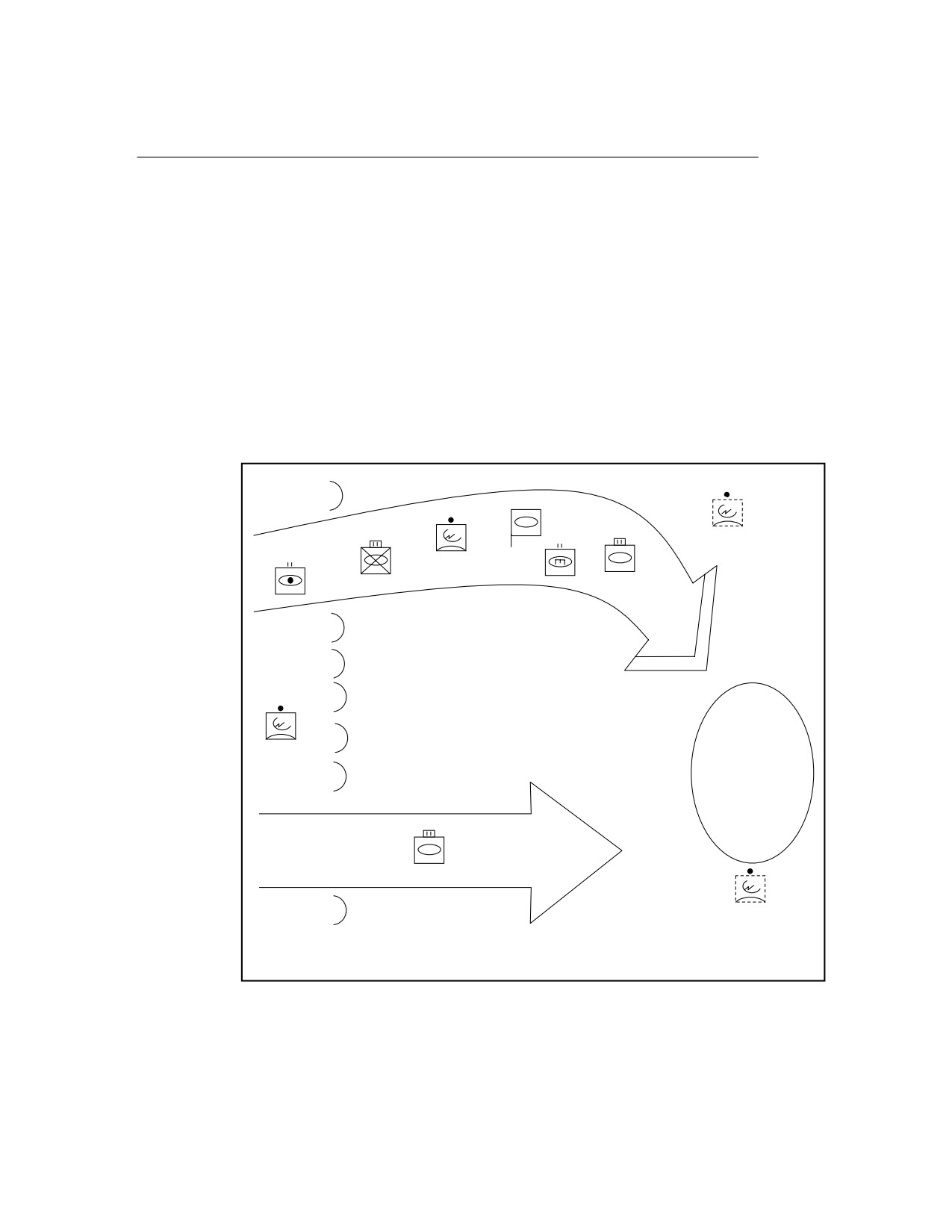
and pursuit missions. See Figure 3-1.
**
X
TM 2
TM 2
MAIN ATTACK
TM 1
OBJECTIVE
COUNTERATTACK
**
TM 1
* Sentinel Team 1 covers while Team 2 moves forward.
** Team 1 moves forward to cover counterattack once Team 2 begins broadcasting.
Figure 3-1. Deliberate Attack
Raid
3-12. A raid is usually a "small scale" offensive tactical operation involving
swift movement into hostile territory and ending with a planned withdrawal.
3-3
FM 3-01.48
Raids are normally short in both distance and duration and limited in
support and logistics. Raids are conducted to—
• Capture prisoners, installations, or enemy materiel.
• Destroy enemy materiel or installations.
• Obtain specific information (location, disposition, strength, operating
scheme) on threat forces.
• Deceive or harass threat forces.
• Liberate friendly, captured personnel.
3-13. Based on the characteristics of a raid, Sentinel teams are rarely
employed as far forward as the objective. The tempo of a raid dictates that
only those systems capable of providing overwhelming firepower with the
ability to rapidly ingress and egress move forward to the objective. Sentinel
teams in support of a raid are initially positioned along the FEBA or FLOT.
Dependent on the depth of the operation, the battery commander, in
conjunction with the AMD battalion and BCT S3, determines if any further
movement is required to ensure adequate coverage and early warning for the
maneuver force. If the decision is made to move a Sentinel forward, positions
are identified far enough forward to provide visibility 20 kilometers beyond
the objective, but not too close to the enemy FLOT as to put the Sentinel at
excessive risk. METT-TC will be the deciding factor as to how far forward
Sentinels will actually be placed.
3-14. If a Sentinel team is placed forward during a raid, Sentinel team
planning must include both coverage of the force moving forward, and
coverage during the withdrawal. During the movement forward, one Sentinel
team emplaces along the FLOT while the other team moves forward with the
BCT. Once in position, the forward team provides the necessary coverage of
the final stages of the raid. Upon completion of the raid and initiation of the
withdrawal, the forward Sentinel team march orders and prepares to fall in
with the withdrawing forces. The rear Sentinel team assumes coverage of
the AO for the remainder of the operation. The battery commander must
synchronize the withdrawal of the forward Sentinel team with the BCT S3
ensuring linkup with the returning maneuver forces. The section sergeants
should ensure a smooth linkup occurs between the Sentinel team and the
returning forces.
Feint
3-15. A feint is a limited objective attack. It is a show of force intended to
deceive the enemy and draw attention away from the main attack. A feint
must be conducted with sufficient strength and composition to cause the
desired enemy reaction. Feints must appear real; therefore, some contact
with the enemy is required. Brigades execute feints as part of a corps or
division attack.
3-16. Since a feint replicates a legitimate deliberate attack, it is likely that
there will be an air threat response by enemy forces. Therefore, Sentinel
teams are employed during a feint just as they are during a deliberate attack.
In addition, active radar emissions during a feint add to the deception
objective desired by the corps or division commander. Specific attention
3-4
FM 3-01.48
during Sentinel employment planning must be given to ensure that Sentinel
teams are not overcommitted during a feint since it is a limited objective
operation.
Demonstration
3-17. A demonstration is an attack or show of force in an area where a
decision is not being sought. It is conducted with the intention of deceiving
the enemy; however, no contact with enemy forces is made.
3-18. Sentinel teams are employed and active during demonstrations in
order to meet the commander’s deception intent. Sentinel teams are usually
not employed forward of the FEBA during a demonstration, but commanders
must ensure positioning of Sentinels provides adequate coverage of AAAs,
NAIs, and PUPs.
EXPLOITATION
3-19. Exploitation is an offensive operation that follows a successful attack
to take advantage of weakened or collapsed enemy defenses. Its purpose is to
prevent reconstitution of enemy defenses, prevent enemy withdrawal, secure
deep objectives, and destroy command and control facilities and enemy forces.
Exploitation maintains relentless pressure on the enemy, bypassing small
pockets of resistance, and focusing on the final objective.
3-20. The battery commander's initial planning drives Sentinel team
employment during the exploitation. Since exploitation opportunities are
difficult to anticipate, battery commanders must consider the possibility of
exploitation operations during the planning process and visualize how the
operation will take place. The battery commander’s air IPB will not only
focus on the close fight, but also look at the entire depth of the battlefield.
Possible Sentinel positions are identified initially and refined as necessary
during execution of the exploitation. Based on the likelihood that the enemy
will employ rotary wing aircraft to cover withdrawing forces, Sentinels must
be in position early to provide sufficient early warning for the exploiting
force. Special consideration needs to be given to force protection during the
exploitation due to the likely number of bypassed enemy forces by the
exploitation force.
PURSUIT
3-21. The pursuit normally follows a successful exploitation. The primary
function of the pursuit is to complete the destruction of the enemy forces.
Unlike the exploitation, which is focused more on destroying the enemy
support system, the pursuit is focused on the destruction of the main force.
The pursuit is ordered when the enemy can no longer maintain its position
and tries to escape. Brigades conduct pursuit operations as part of a corps or
division pursuit, functioning as either the direct pressure or encircling force.
3-22. Sentinel team employment during a pursuit is conducted in the same
manner as in the exploitation. Prior planning and the continuous updating of
the air IPB by the battery commander provide the groundwork for Sentinel
team employment in support of the pursuit.
3-5
FM 3-01.48
DEFENSIVE OPERATIONS
3-23. Defensive operations defeat an enemy attack, buy time, economize
forces, or develop conditions favorable for offensive operations. Defensive
operations alone normally cannot achieve a decision. Their purpose is to
create conditions for a counteroffensive that regains the initiative. The
Sentinel platoon supports defensive operations by providing air and missile
defense early warning to the force throughout the planning, preparation, and
execution process. This section describes how Sentinel teams integrate and
operate with the divisional AMD battalion and or battery during both area
and mobile defensive operations.
SENTINEL SUPPORT OF DEFENSIVE OPERATIONS
3-24. Proper employment of Sentinel teams during defensive operations
requires considerable planning and coordination. Due to the sheer complexity
of defensive operations, each and every defense may dictate a different
Sentinel employment method. Therefore, when planning Sentinel support of
the defense, leaders must consider all the factors of METT-TC, to include the
size of the defending force and the type of defense to be conducted.
3-25. Defensive operations can be conducted by virtually any size of force,
but are normally conducted at the division or corps level. In this case,
brigades and battalions execute defensive operations as part of the larger
force. When brigade or smaller size forces conduct defensive operations, AMD
commanders normally attach a Sentinel section to the AMD element in
support of that defending force to provide required early warning. However,
since defensive operations are normally conducted at the division or corps
level, the decision on how to employ Sentinel is much more complex.
3-26. During division and corps defensive operations, brigade and battalion
size elements will be required to execute a myriad of mobile tasks. Brigade or
battalion size forces conduct counterreconnaissance fights, spoiling attacks,
act as reserves, and possibly conduct counterattacks, all in support of the
overall defensive mission. Based on the number and size of maneuvering
elements in the defense, along with the size of the AO, AMD battalion
commanders must develop Sentinel employment plans that support mobility,
provide flexibility, and allow for overlapping and redundant early warning to
ensure adequate coverage of the supported force. Maintaining the entire
Sentinel platoon in general support to the division normally ensures the
greatest employment flexibility and helps to ensure better overlapping and
redundant coverage. Battalion commanders can easily move Sentinel teams
throughout the division’s AO as required, and ensure sufficient coverage of
AAAs when Sentinels are employed in a GS role. However, there may be
increased risk to the mobility and survivability of Sentinel teams when
employed in this manner. Sentinel teams employed forward during the
preparation phase and counterreconnaissance fight must be prepared to
conduct a rearward passage of lines as the enemy force approaches the MBA.
Due to the complex nature of this task and increased risk of fratricide, it is
usually easier to attach these Sentinel teams to AMD elements supporting
the counterreconnaissance force. This way, the receiving AMD elements can
ensure linkups and passages are properly coordinated and executed.
3-6
FM 3-01.48
3-27. There are three basic types of defensive operations: area, mobile, and
retrograde. Although each type of defensive operation includes elements of
the other two, all three types differ significantly in concept, posing unique
challenges when planning Sentinel employment.
AREA DEFENSE
3-28. An area defense is a type of defense operation that concentrates on
denying an enemy force access to designated terrain for a specific amount of
time rather than destroying the enemy outright. Area defenses are normally
conducted by corps, divisions, or separate brigades. Subordinate unit
echelons defend within their assigned area of operations as part of a larger
echelon operation.
Planning
3-29. In planning for the area defense, the commander decides where to
concentrate efforts and take risks, allowing him to fully synchronize the
effects of combat and supporting systems and apply overwhelming combat
power at decisive times to destroy the enemy. Commanders organize an area
defense in depth or forward.
3-30. A defense in depth is usually the preferred organization since it
provides the commander flexibility and the ability to absorb the enemy's
momentum through a series of mutually supporting positions. However,
based on constraints imposed by mission or terrain, the commander may be
forced to conduct a forward defense where forces strive to deny penetration
and destroy the enemy through violent counterattacks.
3-31. The AMD officer likewise determines where to concentrate Sentinel
coverage and where to assume risk in order to provide the best air threat
early warning to the supported force and shape the battlefield for decisive
victory. AMD officers plan Sentinel employment with emphasis on
synchronizing coverage and movements with the supported force
commander's concept, scheme of maneuver, and surveillance plans. Sentinels
are placed no more than 60 kilometers apart (terrain dependent), with a
minimum distance of 5 kilometers between Sentinels and high−power RF
sources. Sentinel employment plans are also coordinated and synchronized
with the supporting divisional AMD forces to ensure that all AMD weapon
systems are captured in the Sentinel broadcast zones. Since both Sentinels
and AMD weapon systems will be required to move at different times during
any operation, detailed coordination must be made to ensure these links are
maintained. AMD officers ensure that Sentinel employment plans can
adequately support AMD weapon systems in both primary and alternate
positions and when moving. When Sentinels are required to move, AMD
systems linked to those Sentinels are transferred to alternate Sentinels so
that there is no significant break in broadcast links and early warning. The
key to successful Sentinel and weapon system hand-offs on the battlefield the
level of training of order dissemination, and the quality of the rehearsal.
3-32. When conducting a defense in depth, AMD officers select Sentinel
positions that are mutually supporting and allow for continuous coverage
3-7
FM 3-01.48
during individual Sentinel displacement. As enemy forces and forward
Sentinels displace, the AMD officer ensures rear Sentinels are properly
positioned to cover AAAs and PUPs dropped by the forward Sentinel. Since a
defense in depth requires frequent Sentinel movement, the number of
Sentinels broadcasting at one time will be reduced. Therefore, AMD officers
must prioritize Sentinel coverage and possibly assume risk with reduced
coverage on less likely AAAs. When conducting a forward defense, AMD
officers also identify Sentinel positions that are mutually supportive, but
since the depth of a forward defense does not require frequent Sentinel
displacement, they can usually provide Sentinel coverage of most, if not all,
possible AAAs.
Preparation
3-33. Since a unit normally transits to the defense following offensive
operations, significant preparation is required to properly execute the
defense. Counterreconnaissance forces are employed to deny enemy
observation of activities, sustaining forces rearm and refuel weapon systems
and pre-position ammunition, and engineers build position obstacles and
engagement areas. Defending forces are particularly vulnerable to aerial
surveillance and attack during the preparation phase. Therefore, Sentinel
teams must be in position and broadcasting early warning to the force as
early as possible. It is vitally important that Sentinel emplacement is tied to
the division or brigade combat team event matrix, so that it will always
support the concept of the operation.
3-34. ADOs employ forward Sentinel teams using scouts and counter-
reconnaissance forces to provide security as they move to positions outside of
the MBA. The ADO identifies Sentinel positions far enough forward of the
MBA to allow radar coverage at least ten kilometers beyond the
counterreconnaissance force. A minimum of two Sentinel teams should be
employed forward to cover division level counterreconnaissance efforts.
Sentinel teams also employ in the vicinity of the MBA to cover possible
flanking AAAs where threat air platforms can ingress and attack preparation
efforts. All Sentinel positions, forward or in the MBA, must be located on
suitable terrain, allowing Sentinels to focus on AAAs, NAIs, and PUPs
identified during the IPB process. ADOs must apply METT-TC, because
history has shown that AMD forces, when moved forward with
counterreconnaissance in corps battle simulations, suffer high levels of
attrition.
3-35. As the enemy main attack is initiated, forward-deployed Sentinels
withdraw to the MBA. As forward Sentinel teams march order and prepare to
fall in with the withdrawing counterreconnaissance forces, rear Sentinel
teams maintain coverage of the AO. The ADO must synchronize the
withdrawal of the forward Sentinel teams with the division GS/BCT S3,
ensuring linkup with the returning maneuver forces. The Sentinel team chief
coordinates directly with linkup forces and coordinates linkup points and any
other specific requirements to avoid confusion or possible fratricide.
3-8
FM 3-01.48
Execution
3-36. Commanders execute an area defense by combining static elements to
control, stop, or canalize the attacking force and dynamic elements to strike
and defeat the attacker. Defending forces fight mainly from prepared
positions to concentrate combat power and deny enemy forces the ability to
flank or break through the MBA. Mobile forces are employed in the defense to
cover gaps, reinforce positions, and counterattack the enemy from
unanticipated directions.
3-37. During the execution of an area defense, ADOs rely primarily on
Sentinels that were not employed forward of the MBA during the preparation
phase to provide early warning to the force. Sentinels returning with the
counterreconnaissance force are directed to positions supportive of Sentinels
already employed in the MBA, or to cover dead space in existing coverage.
ADOs consider the depth of planned counterattacks and determine whether
or not positioning of Sentinels in the MBA can adequately cover the attacking
force. If positioned Sentinels cannot adequately cover a counterattack, the
ADO may choose to hold a Sentinel in reserve so that it is available to move
forward when required. ADOs also consider the possible requirement to
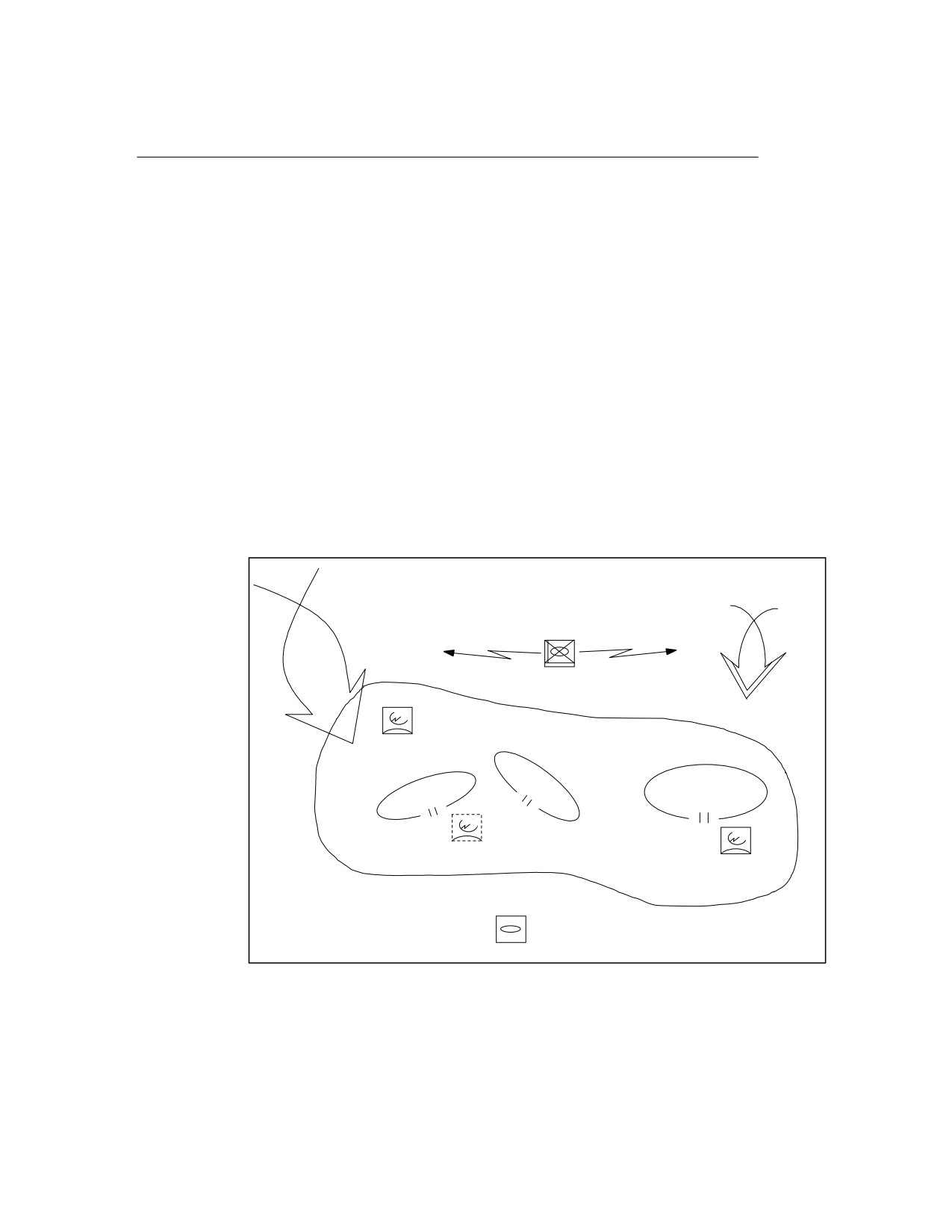
support retrograde operations. See Figure 3-2.
COUNTERRECONNAISSANCE
SENTINEL
SENTINEL
SENTINEL
BRIGADE RESERVE
Figure 3-2. Brigade Area Defense
MOBILE DEFENSE
3-38. A mobile defense is a type of defense operation that concentrates on
the destruction or defeat of enemy forces through a decisive attack by a
striking force. It focuses on destroying the attacking force by permitting the
enemy to advance into a position that exposes him to counterattack and
3-9
FM 3-01.48
envelopment. Commanders normally choose to use a mobile defense when
defending against an enemy with greater combat power but less mobility, or
when the terrain is open with no well-defined avenues of approach. Based on
the complexity of a mobile defense and the requirement to execute multiple
simultaneous engagements, elements smaller than a corps do not normally
conduct a mobile defense. Divisions and brigades participate as part of the
mobile defense by conducting either area defensive operations as the fixing
force, or attack operations as the striking force.
3-39. The commander plans the positioning of both the fixing and striking
force taking into consideration the size of the enemy force and the depth to
which the commander wishes to strike the attacker. He then organizes his
forces allocating the bulk of available combat power to the striking force.
3-40. Because the overall mobile defense is normally conducted at the corps
level, ADOs at division level and below plan Sentinel employment based on
the mission assigned to the supported unit either in support of an attacking
force or a force conducting an area defense. ADOs plan Sentinel employment
with emphasis on synchronizing coverage and movement with the supported
force commander’s concept, scheme of maneuver, and surveillance plans.
Sentinel employment plans are also coordinated and synchronized with the
supporting divisional AMD forces to ensure that all AMD weapon systems
are captured in the Sentinel broadcast zones.
3-41. Although coordinating Sentinel coverage with adjacent and higher
echelon Sentinels is required in all offensive and defensive operations, initial
coordination of Sentinel positioning is essential when participating in a
mobile defense. Sentinels supporting the striking force will normally employ
to cover possible flanking AAAs, NAIs, and PUPs, and cover routes used by
the striking force. However, they will normally be forced to rely on an air
picture generated by Sentinels covering the fixing force for sufficient early
warning during the actual attack. Therefore, coordination must be made
between ADOs on Sentinel positioning and broadcast frequencies to ensure
continuous coverage is maintained.
RETROGRADE OPERATIONS
3-42. Retrograde is a type of defensive operation that involves organized
movement away from the enemy. The operation may either be forced by the
enemy or voluntarily executed by the commander. There are in essence three
different forms of retrograde that can be conducted by a commander: delay,
withdrawal, and retirement. A delay is a form of retrograde in which a
force under pressure trades space for time by slowing the enemy's momentum
and inflicting maximum damage on the enemy without becoming decisively
engaged. A withdrawal is a planned operation in which a force in contact
disengages from an enemy force. A retirement is conducted when a force not
in contact with the enemy moves away from the enemy.
3-43. In each form of retrograde, friendly forces are either in contact with
enemy forces, or are likely to be confronted by the enemy in some manner.
Enemy forces will likely attempt to exploit perceived successes during delays
and withdrawals by committing threat aircraft. During retirements, the
enemy may attempt to interdict the retiring element with air strikes or air
3-10
FM 3-01.48
assaults. Therefore, regardless of the form of retrograde being conducted, it is
essential that Sentinel teams be well integrated with the operation.
3-44. ADOs plan Sentinel employment during retrograde operations with
emphasis on providing coverage as far as possible without leaving teams in
positions where they are vulnerable to enemy direct fire. During all types of
retrograde operations, ADOs should plan to employ Sentinel teams in echelon
with the most forward team located in the vicinity of second echelon friendly
forces. This allows Sentinels to provide sufficient coverage of forward forces,
but still provides the forward-deployed team with sufficient time to march
order and displace once first echelon forces disengage or begin their
withdrawal. As the forward Sentinel march orders, AMD assets are linked to
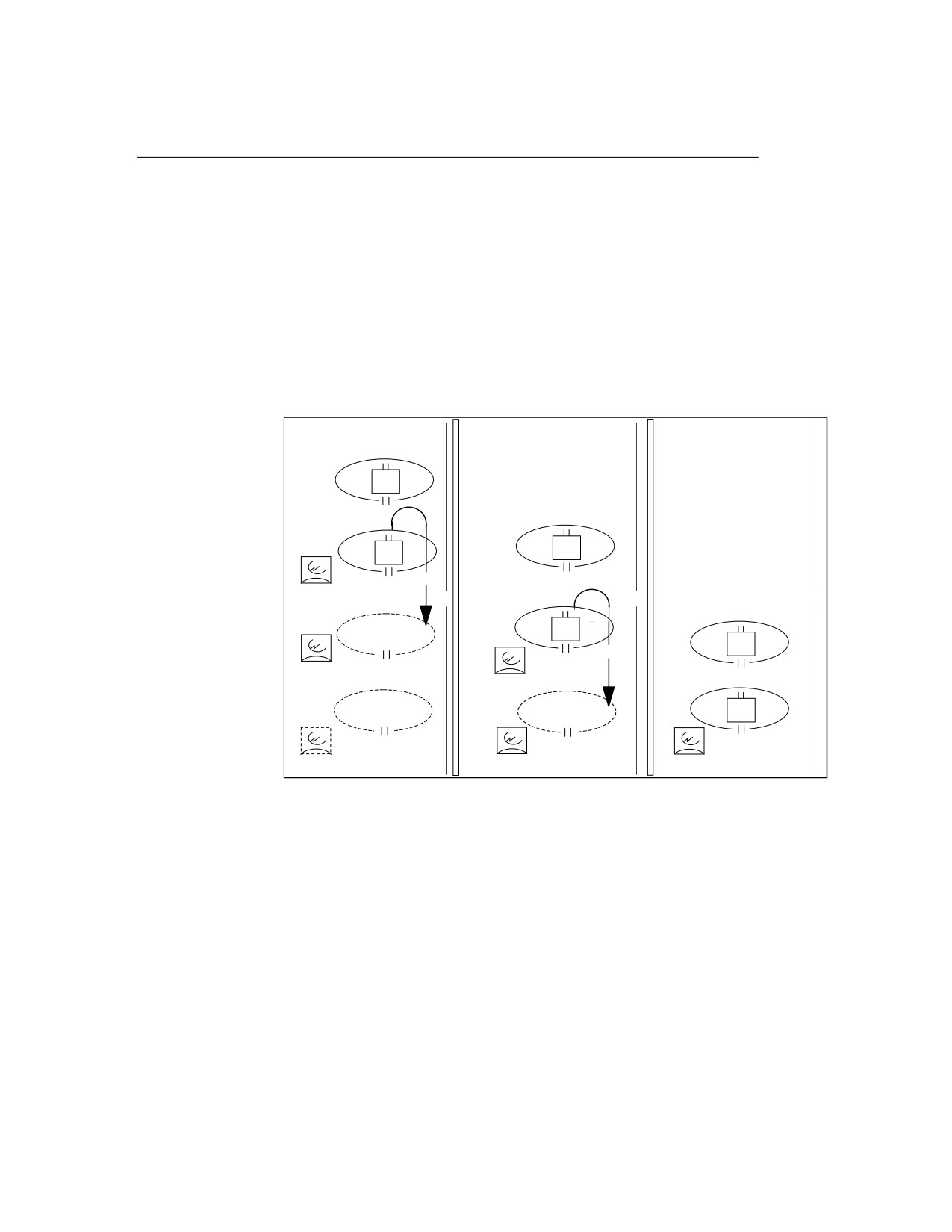
other rear Sentinels that assume coverage of the force. See Figure 3-3.
A
B
B
1
D
SENTINEL
X
X
X
A
2
A
2
D
SENTINEL
SENTINEL
B
1
1
SENTINEL
SENTINEL
SENTINEL
Figure 3-3. Delay Operation
SUPPORT OF LIGHT AND SPECIAL OPERATIONS
3-45. Light and special operations present some unique challenges to AMD
leaders when employing Sentinel teams on the battlefield. Although Sentinel
planning considerations in light and special operations remain consistent
with those used in heavy operations, battlespace construct and missions
assigned often require AMD leaders to employ Sentinel differently then they
would during heavy operations.
BATTLESPACE CONSTRUCT
3-46. Light and special operations are unique in the fact that the
battlespace is often much more condensed than the battlespace in heavy
operations. Although the condensed terrain minimizes the requirement to
move Sentinel teams to provide continuous support to attacking forces, this
same terrain minimizes the options available to commanders for employing
3-11
FM 3-01.48
radars. This condensed battlespace limits the planner's ability to maximize
the Sentinel’s capabilities, and reduces the availability of employment
positions within the assigned AO. Furthermore, light and special operations
are often conducted in areas of wooded terrain, urban environments, and
mountainous areas that further limit employment options due to
trafficability and radar masking.
3-47. When planning Sentinel employment in support of light and special
operations, battery commanders must consider the depth of the battlespace
ensuring that Sentinel teams can adequately support the entire force while
maintaining coverage of identified threat AAAs. Commanders must also
consider the distance between employed Sentinel teams. When Sentinels are
positioned within five kilometers of each other, one must counterrotate when
both are operational. Terrain masking must also be considered not only from
the perspective of acquiring an air picture, but also from the perspective of
broadcasting the air picture to the supported fire units.
3-48. When employing Sentinel teams in restrictive terrain, the number
one concern for the battery commander from a planning perspective is the
ability to provide the force with a continuous air picture. Sentinel teams must
be positioned in clearings, or far enough away from built-up areas so that
radars are not masked. Oftentimes, these positions will be away from the
bulk of the supported force, so commanders must make special arrangements
for the force protection of these assets.
SUPPORT OF DIVERSE MISSIONS
3-49. Light and special divisions are likely to conduct or participate in a
variety of missions. These missions provide particular challenges to leaders
planning Sentinel employment. Some of these missions include supporting
airborne and air assault, mountain, MOUT, and stability and support
operations.
Airborne and Air Assault Operations
3-50. Airborne and air assault missions provide their own unique set of
challenges to the AMD planner, and require special consideration when
planning Sentinel team employment. These missions are executed over vast
distances, usually in non-secure areas, and are greatly dependent on airlift
availability. Due to the fact that there is limited availability of lift assets,
AMD leaders must be prepared to operate with reduced radar coverage for
extended periods of time until additional Sentinels are brought in. When
planning Sentinel coverage of these operations, leaders must employ the
initial Sentinel to cover the most likely enemy air avenue of approach. When
a single most likely avenue of approach cannot be identified, leaders should
employ the initial Sentinel in a position that provides the best overall area
surveillance of the battlespace rather than oriented on a specific avenue.
Likewise, when a most likely avenue has been identified but terrain around
that avenue limits visibility of other possible avenues, leaders should
normally position the Sentinel to provide area coverage. As follow-on
Sentinels are employed, leaders can position Sentinels to cover individual
avenues of approach and specific NAIs.
3-12
FM 3-01.48
Mountain Operations
3-51. The terrain in a mountainous environment serves to canalize air
movements reducing the options of available AAAs and minimizing cross-
movement between AAAs. However, the terrain does provide ideal PUPs and
loitering positions for threat rotary wing aircraft. In order for commanders to
effectively counter the threat in mountainous terrain, they must identify
opportunities to defeat the threat forward as they traverse the defined AAAs.
3-52. Employment of Sentinel teams in a mountainous environment
provide significant challenges to the planner. Based on the severely limited
trafficability of terrain, getting assets into appropriate positions where they
can adequately cover defined AAAs is difficult. Commanders must coordinate
and plan for the employment of Sentinel teams through the use of rotary
wing lift assets in order to ensure teams can occupy the best early warning
positions. Positioning Sentinels by air will often dictate that they be
employed without the C2I node and therefore must rely on a SINCGARS data
link to the C2 node or direct link to the AMD fire unit through the ECIU and
SINCGARS.
3-53. When employing Sentinel teams by air, the individual Sentinel team
chief must ensure that systems are placed accurately in position according to
the developed plan. Furthermore, they must ensure that positions do not
silhouette the system. Once in place, Sentinels are difficult to displace.
Therefore, positions should be selected that can support the offensive
operation through multiple phases. Teams should also be equipped to conduct
sustained operations.
3-54. Another significant challenge associated with employing Sentinel in
mountainous terrain is the establishment of line-of-sight
(LOS)
communications between Sentinels, and from Sentinels to fire units.
Planners must ensure the communication architecture established allows for
continuous early warning dissemination to the entire force. One possible
solution that must be planned for in order to assist in minimizing
communication problems is the establishment of a data retransmission
(retrans) site.
Military Operations in Urban Terrain
3-55. Light infantry units are ideal for conducting military operations in
urban terrain (MOUT); therefore, it is likely that the Sentinel units in a LID
may be utilized to support such an operation. Dense built-up areas
characterize urban terrain. These built-up areas limit suitable employment
positions, and negate the ability to achieve sufficient radar line of sight.
Furthermore, LOS to other Sentinels and fire units is also degraded.
3-56. Employment of Sentinels in support of MOUT operations will vary
according to the size of the urban area. However, planners should attempt to
employ Sentinels outside of the built-up area. Sentinels should be employed
initially on order to cover the movement of forces forward to secure the
terrain surrounding the built-up area. Once the surrounding areas are
secure, Sentinels can bound forward and occupy positions that provide the
best LOS coverage of threat AAAs.
3-13
FM 3-01.48
3-57. When urban areas are too large or terrain surrounding the built-up
area does not support the employment of Sentinels on adjacent terrain, at
least one, if not both of the Sentinels may need to be employed within the
built-up area. Employment should not be thought of as an either/or, but as
two techniques that may be combined. The difficulty in clearing and securing
urban terrain will place the Sentinel sections at risk to snipers. Therefore,
when employing Sentinels in urban terrain, leaders must be cautious to not
commit the Sentinels too early. They must ensure that Sentinels do not enter
the built-up area prior to the area being relatively secure. The use of a
decision support template and matrix can greatly assist leaders in deciding
when to commit Sentinels. For example, once sector one and two are secure,
Sentinel Team One moves to BP 1.
3-58. Selecting adequate positions for Sentinels is often difficult in urban
terrain. In order to effectively support military operations in urban terrain,
Sentinels will often need to be employed on rooftops to achieve effective line
of sight. Therefore, coordination for lift support is required. Once placed on
rooftops, Sentinel team chiefs must ensure that positions are away from
edges of the building to avoid making the system susceptible to small arms or
sniper fire. Furthermore, as with mountain operations, once Sentinels are in
place they are difficult to displace. Therefore, rooftops should be selected that
can support the operations through multiple phases. Teams should also be
equipped to conduct sustained operations.
Stability and Support Operations
3-59. Stability and support operations require AMD soldiers to be
thoroughly trained on passive and active air defense measures. AMD soldiers
must be trained to standard concerning visual aircraft recognition and ROE
due to the possibility of like aircraft being flown by more than one of the
forces involved and the digital air picture being less than perfect. Air and
missile defense considerations are of greater importance in peace
enforcement operations that deny or guarantee movement or enforce
sanctions.
3-60. Confrontational parties may employ extensive measures such as
cover and concealment, hand-held surface−to−air missiles, and light AMD
artillery weapons to protect themselves from air attack. Since many targets
will be in confrontational non-contiguous controlled areas, commanders with
supporting AMD leaders must weigh the potential loss rate of aircraft against
the returns that air interdiction missions might produce. Nevertheless, they
should also consider that limitation of rotary and low−level fixed operations
may be one of the goals of the confrontation. AMD leaders must also consider
the use of unconventional air defense tactics, such as air defense ambushes at
key IPB air avenues of approach, and the use of rocket−propelled grenades (if
no MANPADS is available) against helicopters.
3-14
Chapter 4
Combat Service Support (Logistics)
This chapter discusses logistical concerns in employing Sentinels at the
section level
(two teams per section). Normally, a Sentinel platoon
supports a divisional AMD battalion in support of divisional operations.
Because of the scope of the divisional operations area
(up to
200 x 400 kilometers), Sentinel sections are task-organized to each
battery, METT-TC dependent. Coordinating and planning logistics is as
important as tactical planning. A unit may be able to survive the first
engagement, but unless it has properly coordinated logistical support, it
will not survive the second fight. The logistical challenges for the Sentinel
sections are based on the large distances involved and the lack of
resources available to provide logistical support.
FUNCTIONAL OVERVIEW
4-1.
Logistics is the acquisition, distribution, and care of material in
storage and the salvage of supplies. Logistics includes the determination of
kind and quantity of materials. It includes all items necessary to equip,
maintain, and operate a military command. Logistical operations are
conducted at all levels of command throughout the theater of operations and
beyond. Of greatest concern to the Sentinel sections is how logistical
operations take place internally within the division.
DIVISION LEVEL
4-2.
The Division Support Command (DISCOM) provides division-level
logistics to all organic and attached elements of the division. All DISCOMs
consists of a Headquarters and Material Management Center (MMC), a main
Support Battalion (MSB), three Forward Support Battalions (FSBs), and an
Aviation Support Battalion (ASB) or Aviation Intermediate Maintenance
(AVIM) organization. The DISCOM support operations section, MMC, and
division medical operations center provide planning, management, and
coordination to ensure support for all divisional and attached units.
MATERIAL MANAGEMENT CENTER
4-3.
The MMC is organic to DISCOM. The MMC provides centralized and
integrated material management for Class I (including water and Class VI
management), Class II (including unclassified map supply and COMSEC
software aids), and Classes III, IV, V, VII, and IX supplies. It does not
manage Class VIII
(medical) supplies and classified maps. The MMC
determines requirements for development and technical supervision of
division-authorized stockage lists, and operational readiness float lists,
prescribed load lists, and operational readiness float lists. The MMC
4-1
FM 3-01.48
requisitions all supplies requested by the division for which the center is
responsible and directs their distribution.
MAIN SUPPORT BATTALION
4-4.
The MSB provides division-level logistics support for divisional, and
as necessary, non-divisional units located in the division support area. The
base of operations for the MSB is the division support area (DSA). The DSA
is normally in the division rear adjacent to air landing facilities and main
supply routes
(MSRs). The MSB medical company provides Echelon II
medical care as well as preventive medicine, combat stress control, health
service logistics, and optical fabrication support in the division area. The
MSB maintenance companies perform divisionwide maintenance tasks to
include providing direct support maintenance for division units in the
division rear, and providing support that is beyond the capabilities of the
FSB/ASB maintenance companies. These companies also maintain the
authorized stockage list of Class IX supplies for the division. Other functions
of the MSB include—
• Provide division-level logistics support of Class I, II, III, IV, VII, VIII,
and IX supplies. See paragraph 4-30 for a description of classes of
supply.
• Execute intermediate direct support maintenance for common and
missile materiel to organic units in the DSA.
• Provide division-level and unit-level health service support on an
area basis for troops located in the DSA.
• Operate material collection and classification facilities.
• Provide CSS information and advice to the DISCOM commander and
staff on support capabilities provided by the battalion.
• Operate field services such as clothing exchange, bath,
decontamination, and graves registration as required.
• Provide motor transport for the distribution of supplies, movement of
reserves, assistance in the displacement of units, and to supplement
the transport means available to division units as required.
FORWARD SUPPORT BATTALION
4-5.
There is a forward support battalion
(FSB) for each maneuver
brigade within the division. The FSB consists of a supply company that
handles all classes of supply (less engineer construction material and Class
VIII); a maintenance company that provides DS maintenance of equipment
organic to the supported brigade and conducts limited evacuation; and a
medical company that provides combat health support to the supported
brigade and provides Class VIII supplies as required.
4-6.
The base of operations for the FSB is the brigade support area. The
BSA is generally on a main supply route in the brigade rear area. In certain
circumstances, FSB elements also provide critical support from forward
logistics bases, usually on a temporary basis. This technique requires the
FSB to echelon its assets with forward logistics elements operating from
locations closer to supported units. This organization serves to reduce the
4-2
FM 3-01.48
distance units must travel to receive support when fast-paced operations
result in extended distances between supported units and the BSA.
AVIATION SUPPORT BATTALION
4-7.
Heavy divisions are evolving to a structure which includes an ASB.
Like an FSB, the ASB provides supply and ground maintenance. It also
provides aviation intermediate maintenance to the division aviation brigade.
It operates in the division rear near the aviation brigade’s base of operations.
FM 63-23 addresses the ASB.
AVIATION INTERMEDIATE MAINTENANCE
4-8.
The aircraft maintenance company is either organic to the ASB or a
separate company under the DISCOM. It provides AVIM support for the
division aviation brigade aircraft, aircraft armament, avionics, and aircraft-
peculiar items of ground support equipment. It also provides aircraft repair
parts, aircraft and item support, and reinforces aviation unit maintenance.
BRIGADE AND BATTALION LEVEL
4-9.
The heart of logistical operations within the maneuver brigade lies in
the BSA. The BSA contains combat service support elements from the FSB,
maneuver and combat support unit field trains, and selected division and
corps resources. The BSA also consists of the brigade trains, forward area
support teams, and other combat and combat support units.
4-10. Logistics operations in combat and combat support battalions are
normally organized into support trains. Portions of support elements from the
companies and the battalion headquarters displace from the combat elements
into either field trains or combat trains. The support and supplies available
vary greatly between the field and combat trains.
FIELD TRAINS
4-11. The field trains consist of the bulk of the battalion CSS elements. The
field trains for all task forces and battalions operating as part of a brigade
combat team (BCT) are located in the forward part of the BSA. Battalion field
trains are organized to provide, manage, and execute overall logistical
support for the battalion task force. Elements of the battalion S1, S4 (mess
and supply), maintenance, and other support assets not positioned forward
operate from the field trains.
COMBAT TRAINS
4-12. Battalion/TF combat trains are organized to provide immediate
critical support for combat operations. They carry the minimum amount of
supplies and equipment needed to sustain the force for short periods. Combat
trains are positioned on the battlefield where they can quickly move forward
and provide essential support to fighting forces. Combat trains provide
battlefield recovery, maintenance, medical services, and some Class III and V
support to the forward fighting force. Other elements of the combat trains
4-3
FM 3-01.48
may include NBC decontamination assets, a communications team, and
support elements from the FSB. The battalion S4 controls the combat trains,
with assistance from the S1.
UNIT MAINTENANCE COLLECTION POINT
4-13. The battalion maintenance officer controls and organizes the UMCP
to provide maintenance support for combat operations. The UMCP locates
forward on the battlefield in the vicinity of, or collocated with, the combat
trains to facilitate immediate availability of repair, recovery, and evacuation
services.
LOGPAC OPERATIONS
4-14. The most effective means of pushing supplies forward to units on the
battlefield is through the use of logistics packages (LOGPACs). LOGPACs
consist of predetermined supply packages to include replacement personnel;
returned-to-duty soldiers; supplies; repair parts; fuel and other petroleum,
oils, and lubricants
(POL) products; ammunition; and Class I supplies.
LOGPACs are organized and put together at the field trains.
4-15. LOGPAC operations are a simple, effective way to accomplish routine
resupply operations. The battery, battalion, and brigade standing operating
procedures (SOPs) normally specify the exact composition and disposition of
LOGPACs. LOGPAC operations are centrally organized at the BSA, and are
structured to contain all anticipated supplies required to sustain a unit for a
specified time (usually 24 hours or until the next LOGPAC operation). The
battalion S4 plans and coordinates LOGPAC operations to ensure they fully
support the commander’s tactical plans.
4-16. LOGPACs move along main supply routes to a logistics release point
(LRP) where the battery executive officer or team sergeant (depending on
echelon being resupplied) takes control of his LOGPAC. The supported force
S4, based on the tactical situation, determines LRP locations. LRPs normally
are well forward and easily located. LRPs are planned and identified on the
logistics support operations overlay.
4-17. In an AMD battery, the first sergeant assembles the LOGPAC in
conjunction with the supported force's support team chief. Once the LOGPAC
is prepared for movement, the battery ammunition sergeant moves the
LOGPAC as part of the supported force's resupply convoy, which is led by the
support team leader. In emergencies, a battery LOGPAC may be dispatched
individually, but this technique is not recommended. When moving alone, the
LOGPAC is especially vulnerable to attack, loss of communications, and
disorientation.
SENTINEL LOGISTICS
4-18. Logistics operations for the Sentinel sections pose significant
challenges to both the Sentinel section sergeants’ leadership and the air
defense leadership throughout the division. A Sentinel section, designed to
support a brigade divisional AMD battery, will often be required to operate
4-4
FM 3-01.48
within the division area of 200 x 400 kilometers. Based on this large area,
coupled with the lack of adequate internal logistical resources available, air
defense leaders must ensure that all elements of the Sentinel sections are
integrated thoroughly into the existing divisional support structure.
4-19. Existing command and support relationships do not allow for much
flexibility in how logistical support is provided. With the exception of an
attached command relationship, there are no command or support
relationships that provide doctrinally-based logistical support for the
Sentinel sections. Furthermore, although the establishment of an attached
command relationship may benefit logistical operations, it often proves to be
tactically unsound because it also gives positioning authority of the attached
Sentinels to the receiving unit. Therefore, the Sentinel sections will most
likely provide support to the division as a whole, or be attached to a
divisional AMD battery as opposed to some other element of the maneuver
force.
4-20. Employment of Sentinels on the battlefield cannot be planned solely
with the intent to ease logistical burdens. However, during the planning
process, the ADO and Sentinel section sergeants must consider the
availability of logistical support to Sentinel teams when developing the
Sentinel scheme of maneuver. Depending on the command and support
relationship established, there is a variety of battlefield assets can be used to
help reduce the logistical burden imposed on the teams. Some of the most
likely battlefield candidates for logistical support assistance to Sentinel
teams include—
• DS AMD batteries supporting a maneuver brigade.
• DS AMD teams supporting maneuver TFs.
• General support AMD team elements (if operating near the GS
element).
• The AMD battery's rear CP (typically located in the supported unit's
BSA).
TEAM RESPONSIBILITIES
4-21. The Sentinel section sergeants and team chiefs are responsible for the
planning and execution of CSS operations for the teams. The Sentinel section
sergeants conduct logistics planning with the assistance of the team chiefs.
The Sentinel section sergeants implement the logistics plan. In order to
effectively plan logistics operations for the Sentinel teams, the Sentinel team
leadership must understand the complete logistical framework from division
through battalion/TF level, and conduct detailed coordination with applicable
support units. The Sentinel resupply plan must get captured within the
logistics rehearsal.
4-22. Although there are a variety of organizations throughout the division
that the Sentinel teams can turn to for logistical assistance and support,
AMD batteries in support of maneuver brigades will most often be required to
manage the bulk of the support. Regardless of command and support
relationships, Sentinel sections will normally operate forward in brigade
4-5
FM 3-01.48
areas making the AMD battery the most likely candidate to provide the
support required.
4-23. Considering the likelihood that Sentinel sections will receive most of
their support through AMD batteries, certain actions by the Sentinel sections
and teams are essential to ensuring support operations function smoothly.
The Sentinel leadership must be proactive with establishing a good working
relationship and not wait to act until the time support is required.
Additionally, the AMD battery must ensure that Sentinel assets are fully
integrated into the battery and BCT.
4-24. Sentinel section sergeants must identify as early as possible whose
sector the Sentinel sections will be operating in. Once identified, they must
ensure that sections understand the logistical SOPs and plan (to include
CASEVAC) used by the AMD battery in that area. Furthermore, the battery
already will have established a habitual relationship with their supported
maneuver brigade. Therefore, it is critical that sections also understand the
brigade SOPs and logistics plan. For example, if the brigade is using different
colored flags for casualty identification, sections need to know what they are
and have them on- hand.
4-25. In addition to being knowledgeable on brigade and AMD battery
logistical plans, the Sentinel section sergeants also require a working
knowledge of how AMD teams and supported TFs conduct CSS operations.
This will ensure that the Sentinel teams are prepared for any contingencies
and help alleviate concerns if there are changes in logistical support
providers.
4-26. Once Sentinel personnel have developed a clear understanding of the
logistical support structure of their adjacent or supported units, they need to
further analyze any unique characteristics of logistical operations during the
assigned mission. This includes identifying CSS locations, triggers for
movement of CSS assets, and any modifications to established SOPs dictated
by the type of mission. AMD rehearsals, along with the maneuver brigade/TF
command and CSS rehearsals, help to clarify these unique characteristics.
Therefore, it is essential that Sentinel team chiefs and section sergeants
attend and participate at these rehearsals.
4-27. Once it has been determined that Sentinel sections are operating in
the AMD battery's AO, the battery commander must coordinate the section's
logistical support requirements with the supported brigade commander.
Since the command and support relationship established will likely not
dictate support requirements of the Sentinel teams or the battery itself, the
battery commander must be prepared to articulate the criticality of receiving
such support through the already established brigade CSS structure. The
battery commander should address the lack of an organic AMD support
structure to accomplish the mission, address the importance of the Sentinel
assets and how they support the BCT’s efforts, and present the commander
with a viable plan for integrating AMD assets.
4-28. An AMD battery will use one of two approaches to conduct logistical
support operations. The first is an approach in which the battery integrates
itself into the existing brigade support structure. This method allows for
timelier and less burdensome CSS operations since there is no requirement
4-6
FM 3-01.48
for the battery staff to fully develop and execute support operations. By
integrating, the battery simply provides some of its available support assets
into the existing support structure. It moves as part of established LOGPACs,
and receives equipment into the brigade from the divisional support
structure. The second approach is to set up a separate battery train that
supports the AMD battery. Although possible at times, this method places a
tremendous burden on the battery itself, reduces the timeliness of overall
CSS operations, and increases risk to the battery support assets. Regardless
of the method, the Sentinel teams and sections must understand which
logistical support system is being used.
4-29. During brigade and TF level rehearsals, AMD battery commanders
and section sergeants must brief the scheme of maneuver for any Sentinel
assets operating in the supported unit’s AO. Furthermore, the battery
commanders and section sergeants need to address logistical requirements of
the Sentinels to the brigade/TF XO/S4 as part of the CSS rehearsal, and
ensure the leadership knows the criticality of Sentinels to the overall mission.
CLASSES OF SUPPLY
4-30. The grouping of logistics into 10 classes provides meaningful major
categories of types of supplies. Through this grouping method, items can be
readily identified to each particular class. The following provides a
description of each class of supplies:
• Class I
Subsistence
• Class II
General supplies, to include clothing, tentage, tools,
administrative supplies.
• Class III Petroleum, fuels, and lubricants.
• Class IV Construction and barrier materials.
• Class V
Ammunition.
• Class VI
Personal demand items.
• Class VII
Major end items (vehicles, radars, et cetera).
• Class VII
Medical material.
• Class IX
Repair parts and components.
• Class X
Nonmilitary program material.
OBTAINING LOGISTICS
4-31. The Sentinel section sergeant or the team chief is the combat CSS
coordinator for the teams. The team chief digitally informs the section
sergeant of logistical requirements and keeps the section sergeant digitally
informed on the personnel and equipment status. The section sergeant should
do all CSS coordination for the teams. See Figure 4-1.
4-7