FM 3-11 Flame, Riot Control Agents and Herbicide Operations - page 4
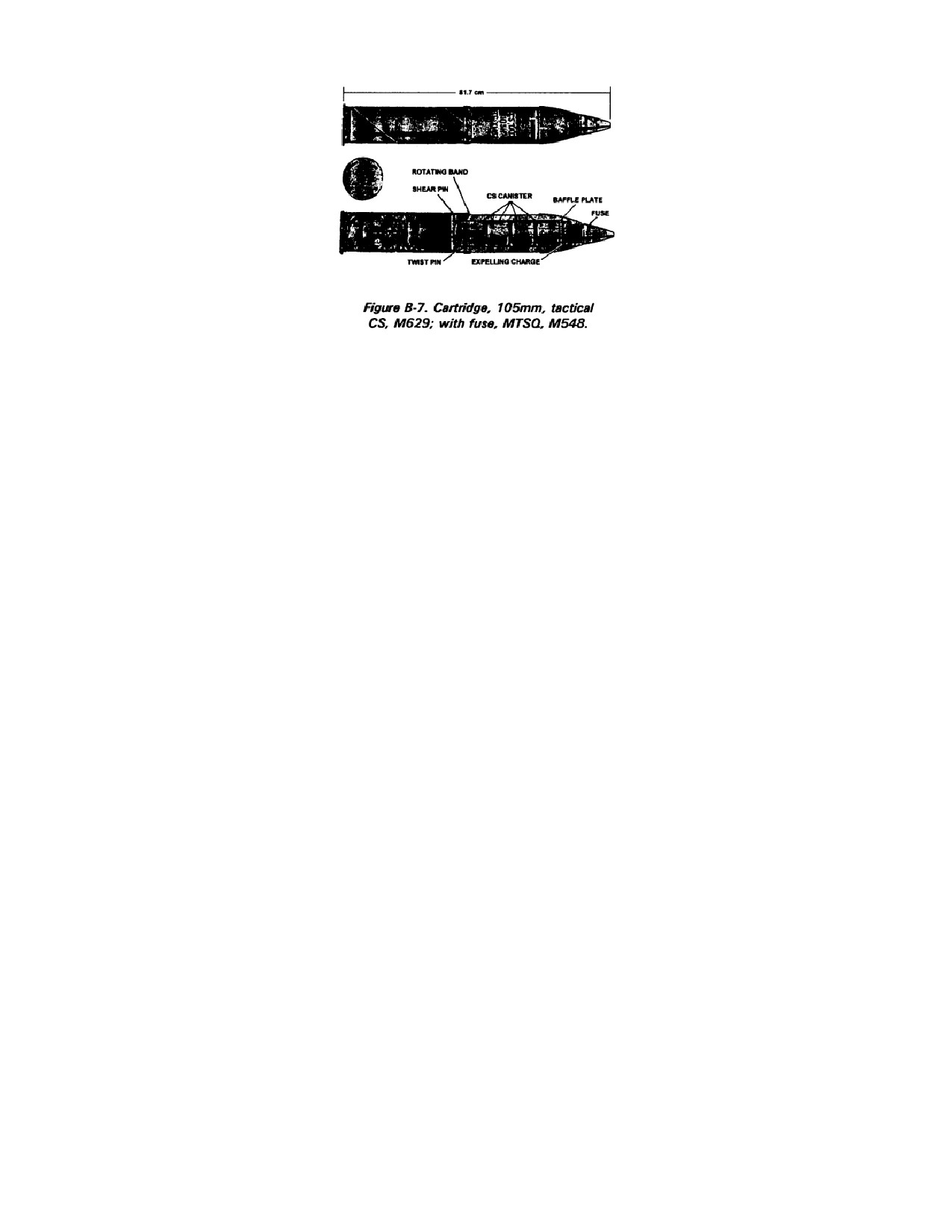
The 105mm cartridge can be used to route the enemy from cover, for close support, and
is especially effective in search and clear operations. It is also used for harassing and
interdiction and counter-battery and counter-mortar fire.
LAUNCHERS
E8 Launcher and
35mm Cartridge:
Tactical CS
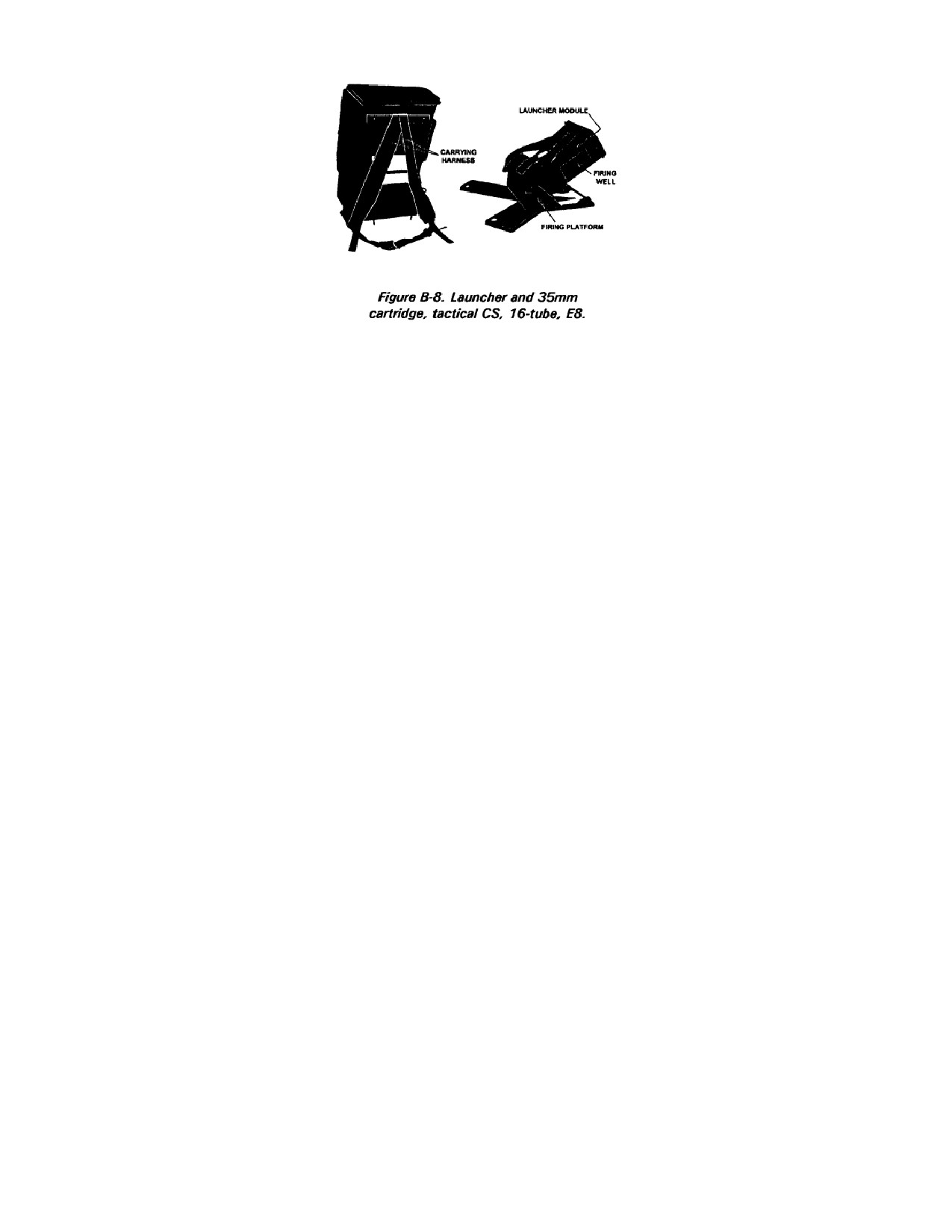
The E8 launcher (Figure B-8) is a man-portable (34 pounds), ground employed,
expendable munition that can be fired either electrically or manually. The E8 launcher is
a short-range weapon that can be used to place quantities of CS on point and small area
targets in conjunction with assault by ground forces. The launcher may be emplaced,
sighted, and fired by one man. The E8 consists of a launcher module and a firing platform
with a carrying harness and backpack attached. The launcher module has 16 tubes, each
containing four E23, 35mm CS cartridges, for a total of 64 cartridges. Each cartridge is
filled with 38 grams of a CS pyrotechnic mix of which 15 grams are pure CS. The total
fill (CS pyrotechnic mix) is .97 kg (2.1 pounds). The expelling charge propels the
cartridge from the launcher and ignites a 5-to-6-second delay fuse in the cartridge. The
CS pyrotechnic mix burns from 10 to 15 seconds. The cartridges contain different
amounts of propellant charge to give a wider dispersion in the target area. The elliptical
pattern created from the cartridges fired from the E8 launcher is relatively independent of
meteorological conditions. However, the period of effective agent concentration on a
target area is dependent upon existing meteorological conditions. The range of this
launcher is from point blank to 250 meters based on adjustable firing notch position (six
positions available).
Area coverage: At 40° elevation, 40m wide by 125-175m deep. Use: Its use has been
quite effective in perimeter and convoy security, counter-ambush, combat assault. The E8
has also been used in ambushes and to break contact.
M234
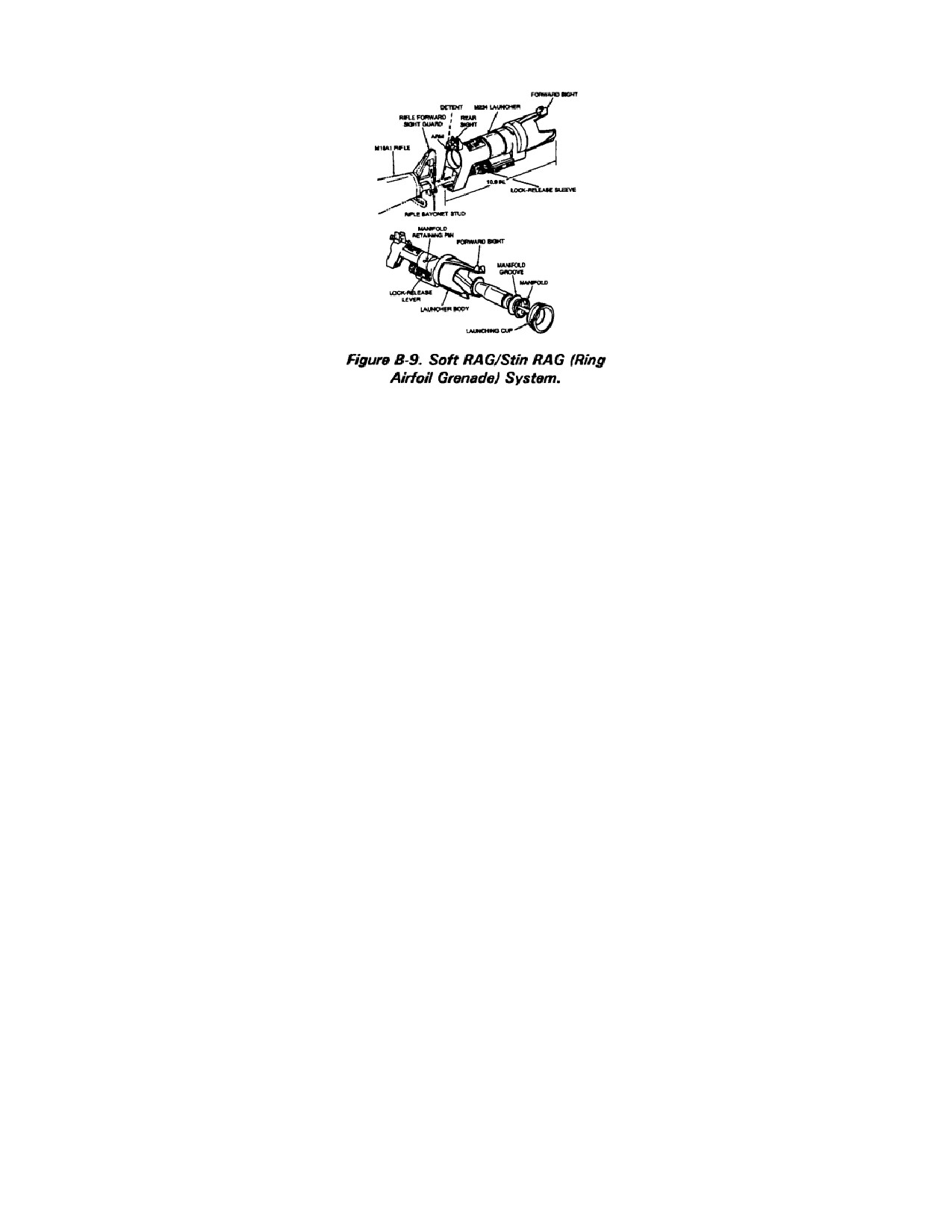
The M234, NSN 1010431-014-6506, system consists of the M234 64mm projectile
launcher, the M743 64mm kinetic energy projectile, the M742 64mm kinetic energy
projectile filled with CS1, and the M755 blank cartridge.
The M234 64mm projectile launcher is a launcher from which 64mm projectiles can be
fired from an M16A1 rifle. It is aluminum-tasted, cylindrical, and weights approximately
2.5 pounds. A nut and latch mechanism holds the launcher onto the barrel of the M16A1
from which the M742 or M743 projectiles are fired.
The M743 64mm kinetic energy projectile, (Figure B-9) also called the Sting Rag (ring
airfoil grenade), was designed to inflict a painful blow upon impacting on a target
individual. It consists of a rubber-like plastic material, 64mm in diameter, molded in the
form of a ring airfoil. The airfoil shape of the spinning projectile provides life during the
flight, enabling it to overcome gravity and result in a relatively straight trajectory. Upon
target impact, the circumferential breakband fractures, allowing the projectile to deflect
and spread the impact load, inflicting pain but minimizing the possibility of causing
serious injury. It can be aimed accurately at individuals up to 40 meters away and up to
60 meters for groups of personnel. It has a maximum range of 100 meters. This projectile
is called a kinetic energy projectile since it has nearly the same energy impact at effective
ranges as it has at launch, due to its airfoil shape that results in a low draft profile.
The M742 64mm kinetic energy projectile filled with CS1, also called the Soft Rag, is
designed to deliver small quantities of CS1 to target personnel at ranges identical to that
of the M743. The projectile is filled with approximately 2 grams of powdered CS1 which
is equally distributed in 18 pockets or compartments around the circumference. The
breakband is designed to rupture on impact and release the CS1 in a 3 to 5 feet diameter
cloud. This item was designed for use in controlling individuals and crowds during civil
disturbances. It has some applications for special operating forces and point-type targets
when casualties are not desired.
The M755 blank cartridge provides the propelling force for the projectile and is
specifically designed to launch it from the M16A1 rifle. Ball ammunition must not be
issued to soldiers using the M234.
DISPERSERS
Dispersers provide another means for disseminating RCAs in sufficient quantities to
provide effective coverage in a variety of situations and conditions. The dispersers vary
from small hand-held units to aircraft-mounted spray tanks. Generally, dispersers are
employed when a larger amount of agent or a greater area coverage is required. Care
must be taken by the operators that intolerable concentrations of RCAs are not released
since the larger dispersers can release large amounts in a very short time. The dispersers
are designed to disseminate RCAs by aerosolizing them. However, dispersion of liquid
RCAs increases operational flexibility since solutions can be disseminated with more
control to a target area than powdered aerosol clouds. Aerosol clouds are more affected
by wind conditions than liquids.
M32
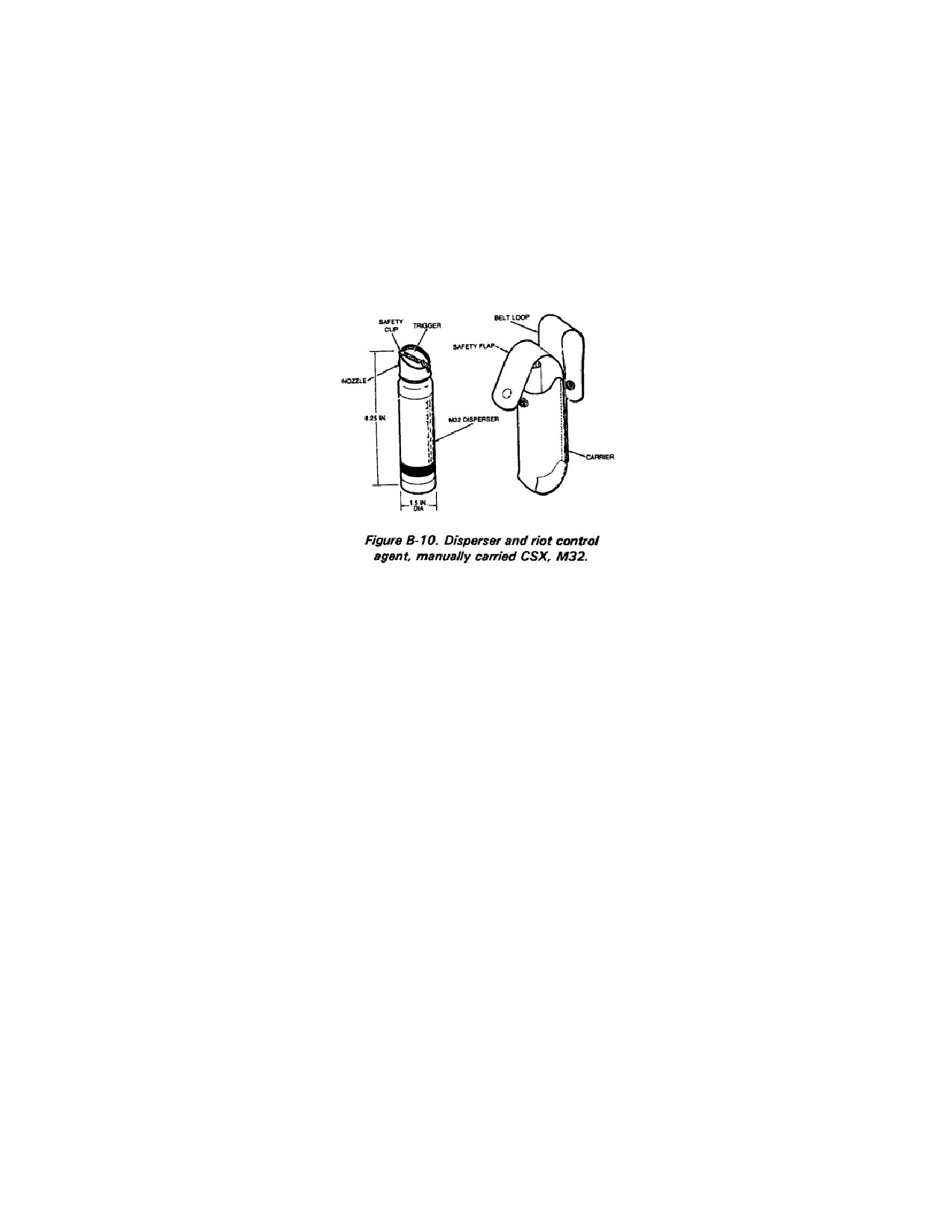
The M32 disperser (Figure B-10) is a hand-held pressurized can capable of dispensing
CSX solution. The M32 was designed to apprehend, control, or subdue unruly persons,
trespassers, and rioters by spraying them with CSX. The M32 disperser consists of an
aluminum cylindrical container (6.4-inch length by 1.5-inch diameter) filled with
approximately 60 grams (2 ounces) of CSX pressurized with nitrogen gas. The CSX
solution is discharged as a jet stream through the nozzle by the trigger on top of the
disperser. When the pressure on the trigger is released, the valve closes and the jet stream
is shut off. The range of the jet stream is 10 to 12 feet. It will operate continuously for 14
to 20 seconds or approximately 20 to 25 times in short, one-second bursts.
M36
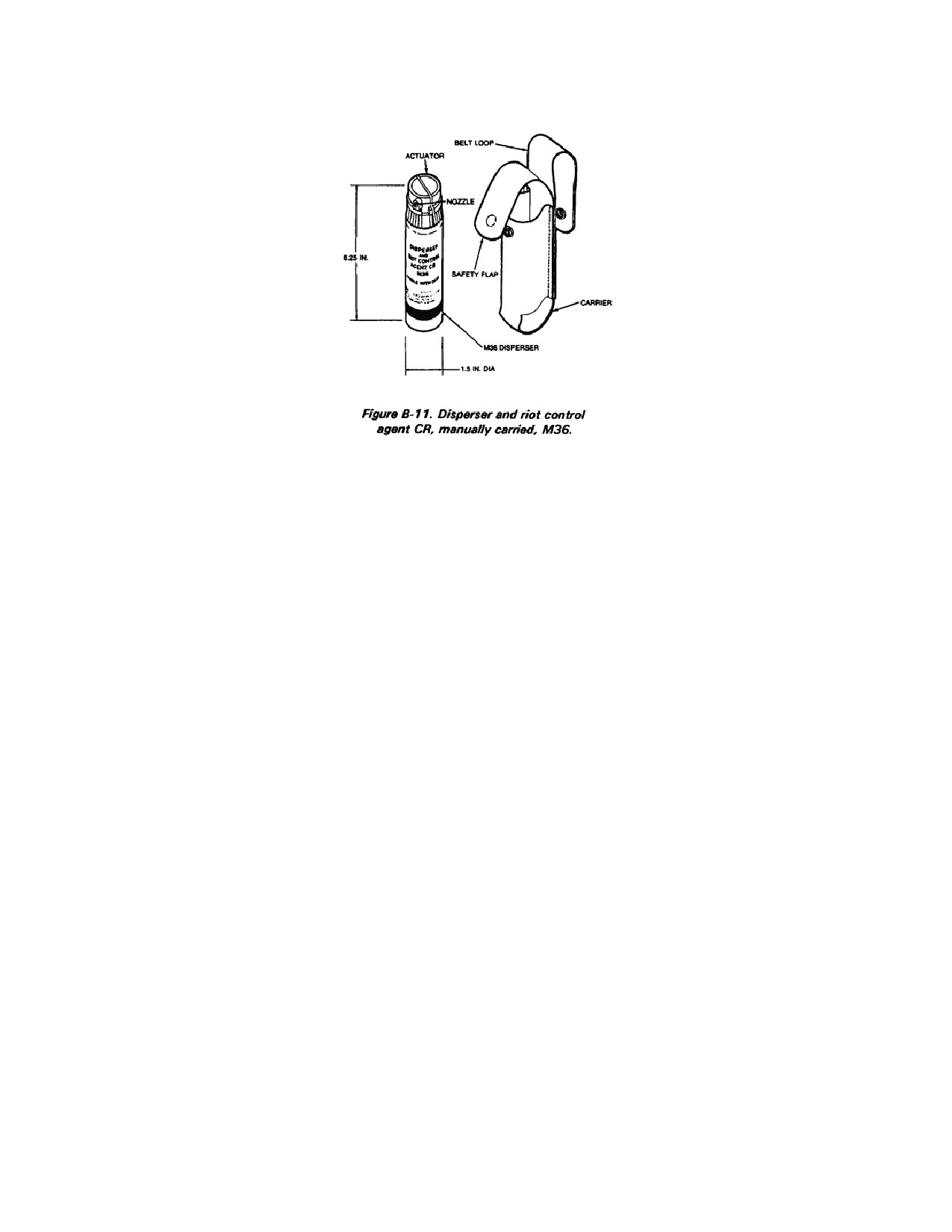
The M36 disperser (Figure B-11), NSN 1365-00-283-9046, is quite similar to the M32 in
that it also is a hand-held, pressurized container dispensing the RCA solution, CR (0.1
percent solution in propylene glycol and water). It was designed to apprehend, control, or
subdue unruly persons, trespassers, and rioters. The M36 disperser is an aluminum
cylinder (6.0-inch length by 1.5-inch diameter) containing approximately 68 grams of CR
solution. The cylinder is pressurized with nitrogen gas which causes the CR to discharge
through the nozzle in a jet stream upon pressing the actuator. It has a range of 10 to 12
feet. Maintaining finger pressure on the acutator, the operator can dispense the CR
solution in a continuous stream lasting 14 to 24 seconds. The operator can also apply 15
to 25 bursts lasting about 1 second each. The M32 and M36 have limited tactical uses,
primarily in enemy prisoners of war (EPW) control, specialized defensive roles and
special operating forces when casualties are not desired.
Both the M32 and M36 are small enough to be carried and operated with one hand. To
use these dispersers effectively, the soldier holds the can upright, aims at the target
person's face, and presses the actuator or trigger in 1 second bursts. The bursts are more
effective than the continuous spray since the operator can adjust aim with a minimum of
RCA waste.
M33/M33A1
The M33 and M33A1 (Figure B-12), NSN (M33A1) 1040-00-148-9824, are lightweight,
RCA dispersers that disseminate pressurized riot control agents. The M33A1 looks and
functions like the M33. The difference is in the units' capabilities. The M33A1 disperser's
modular design allows quick replacement of empty agent and pressure containers. The
M33A1 can disperse CS1 or CR solution; however, the M33 cannot disperse solutions.
The M33A1 is replacing the M33 on a one-for-one basis as the M33s wear out.
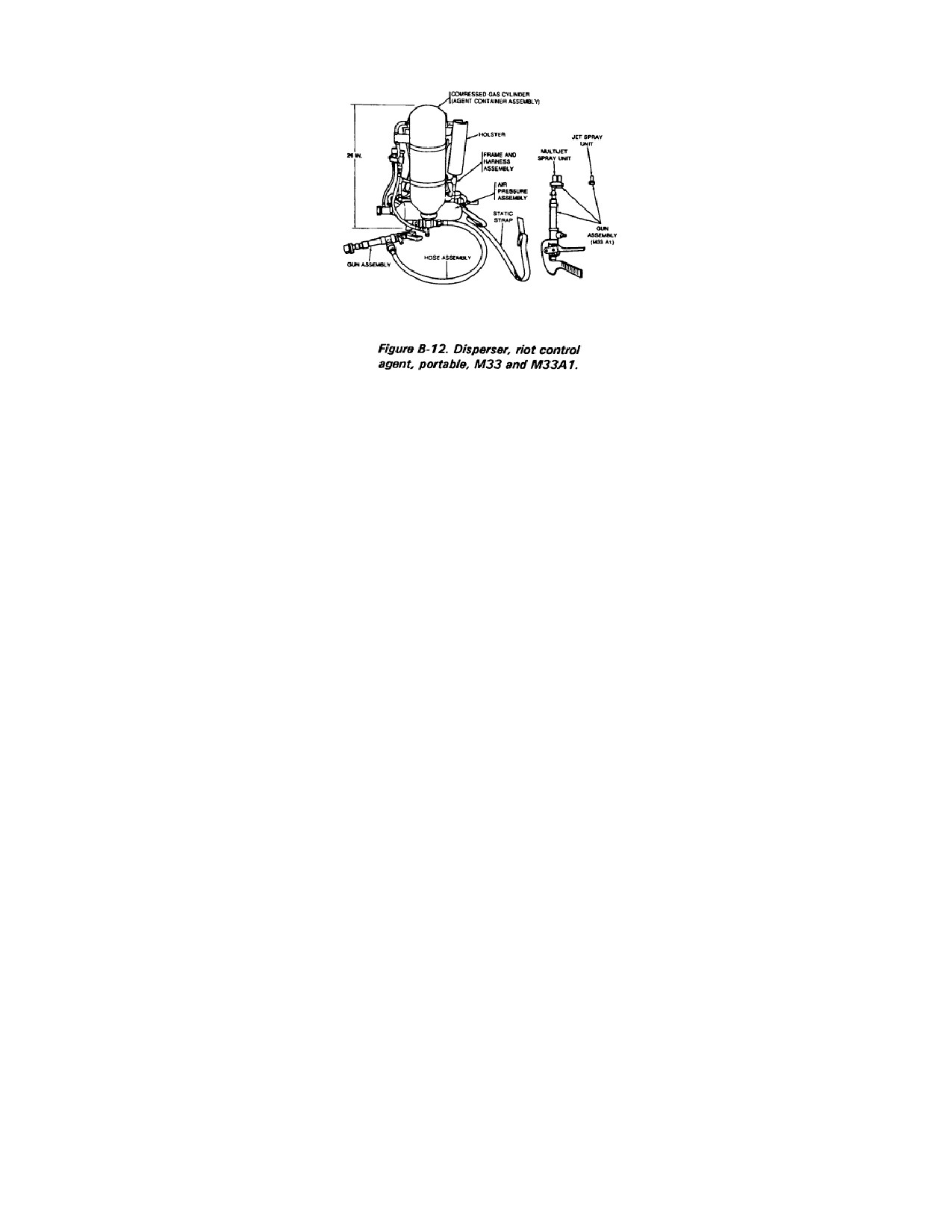
The dispersers consists of a frame and harness assembly, an agent container assembly,
and a gun and hose assembly. The disperser weights 22 pounds empty. A long check
valve assembly and multijet spray unit are issued with the M33A1 disperser for spraying
solutions. The M33 does not have these items. A short check valve assembly, an agent
agitator, and a single jet spray are used to disperse powders. An extra agent container and
compressed gas cylinder are provided to disperse two agent fills per mission. The
compressed gas cylinder of the air pressure assembly is pressurized with compressed air.
The operator opens a valve on the air pressure assembly and pulls the trigger on the gun
assembly. Pressurized air from the air pressure assembly forces the RCA from the agent
container, through the hose and gun assembly and out the spray unit. The agent container
on the M33A1 unit can hold 48 pounds of CR solution, and can fire to a maximum range
of 40 feet for a duration of 60 seconds. Both the M33A1 and the M33 agent containers
can hold 30 pounds of CS1 and can fire to a maximum range of 40 feet in still air for a
duration of 40 seconds. For training purposes, talc can be used in place of CS1. The
dissemination characteristics of talc with the M33A1 and M33 are very similar to that of
CS1.
The M33 and M33A1 are best used in small unit operations against small area and point
targets. They can be very effective in reducing resistance from fortifications, tunnels, and
urban complexes. The optimum distance for firing the disperser to produce the greatest
effect depends on the wind speed and the operator's freedom of movement across the
front of the target area. As wind speed increases, dilution of the powder becomes more
rapid. To minimize this effect, the distance between the target area and the operator must
be reduced so that an effective concentration can be placed on the target. Close
observation must be made of the agent's dispersal pattern and effect on the target.
M3
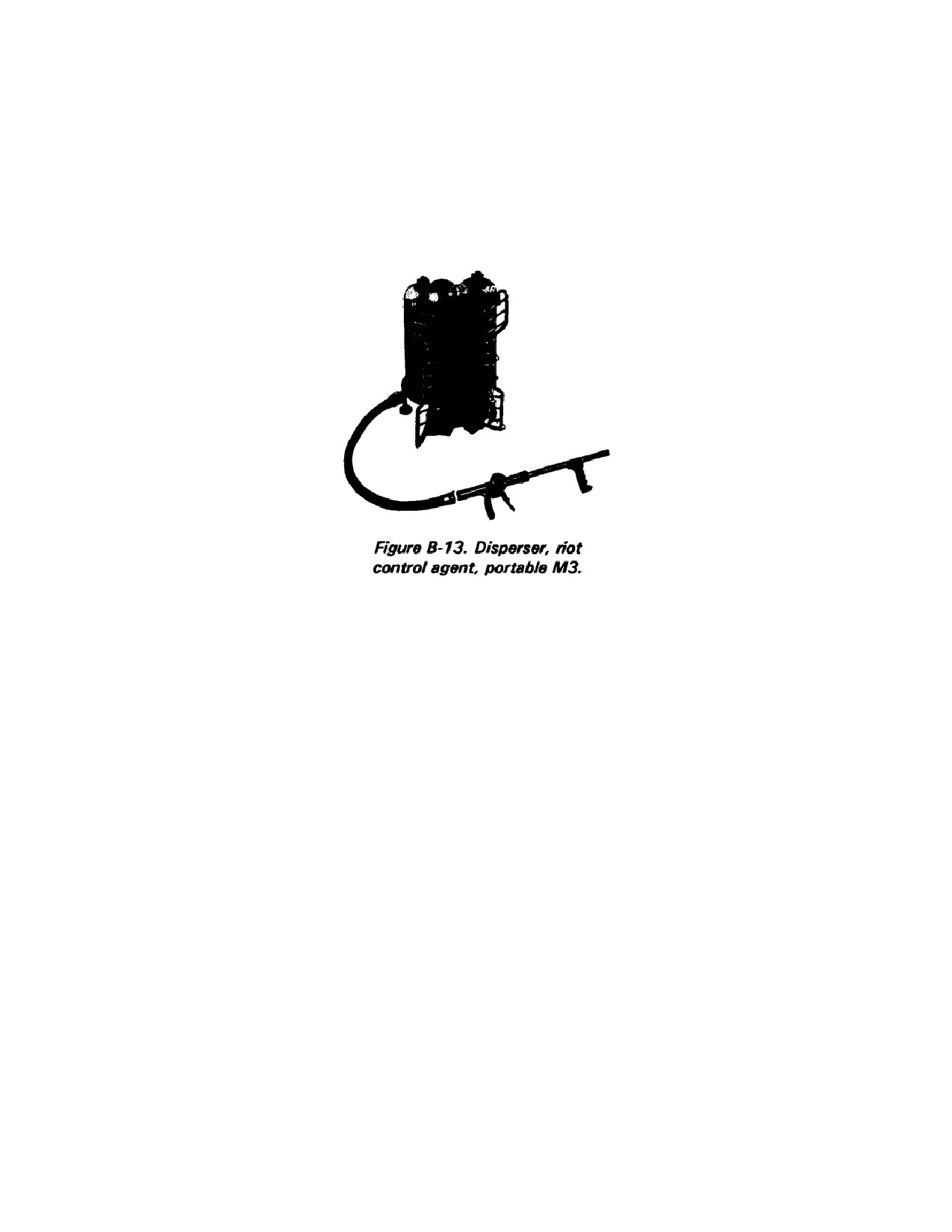
The M3 disperser (Figure B-13), NSN 1040-00-711-8296, is used to spray CS1 or CS2
from a backpacked container toward or upon targets. The disperser consists of an M2A1
and contains two aluminum agent tanks, a pressure tank and valve assembly, and a carrier
section with a frame and harness. The dispersal of agent works in the same manner as the
M33 and M33A1 with the agent being forced out of the agent tank through the gun group
from the pressurized air tank. The disperser is capable of disseminating approximately 8
pounds of CS1 or CS2 in one continuous burst of 19 seconds, or in intermittent bursts for
30 seconds. The agent is projected about 10 meters (40 feet) before it billows out into a
cloud. The M3 weighs 47 pounds empty and 55 pounds when filled with agent.
The M3 can be used effectively against small area targets and poorly defined point
targets. With an optimum wind speed of 3 to 5 knots, the M3 can cover an area of 2,300
to 3,800 square meters.
M5
The M5 helicopter-or vehicle-mounted RCA disperser (Figure B-14), NSN 1040-00-805-
3019, is used to disperse CS1 or CS2 into the atmosphere from either a low-flying cargo
helicopter or a moving ground vehicle. The disperser consists of an agent container tank,
a pressure group with two air cylinders, a tubular aluminum frame, an M9 gun with a 12-
foot hose for vehicle mounting, a 12-foot discharge hose for helicopter mounting, and
various controls and instruments. The RCA is dispersed by forcing the powdered agent
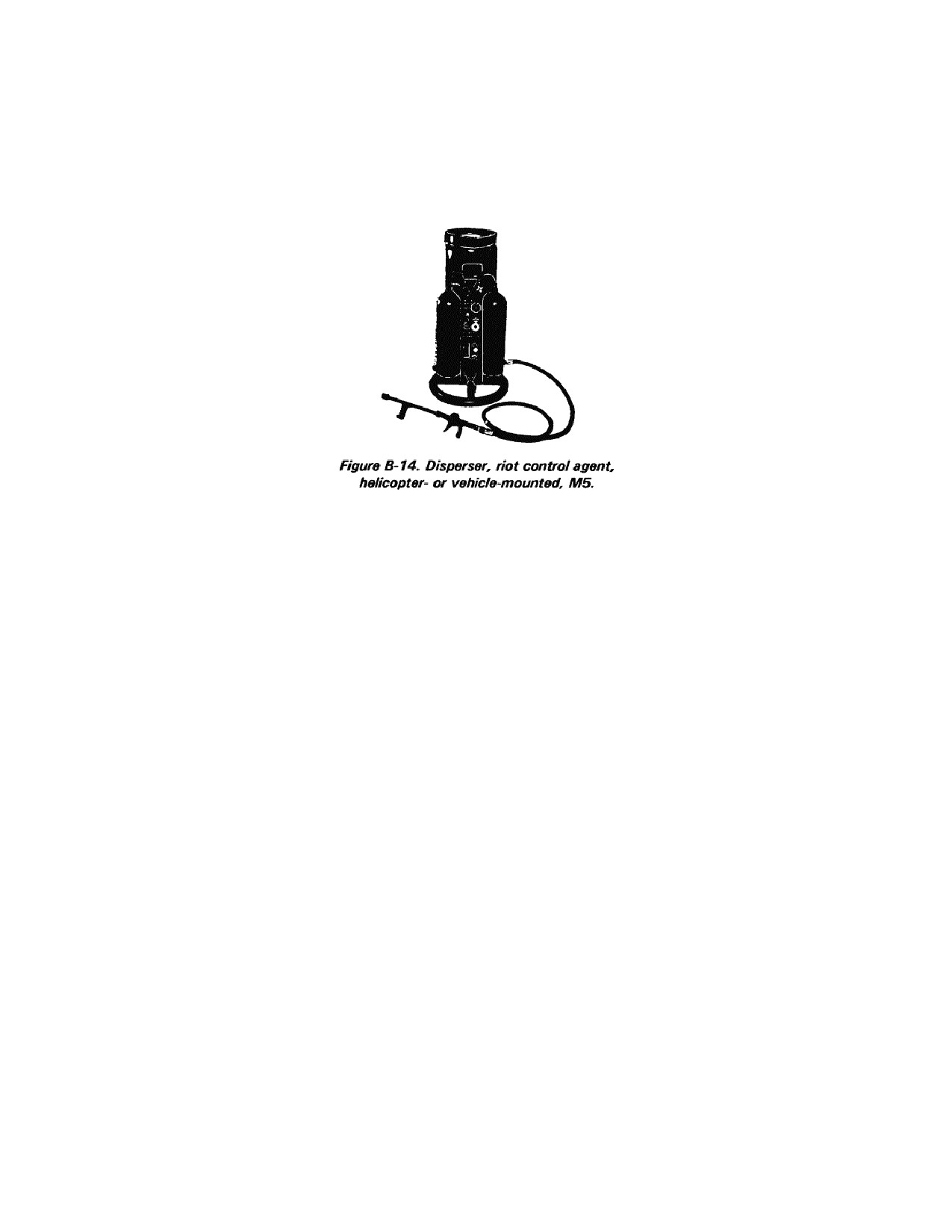
from the agent container into the atmosphere through the discharge hose with pressurized
air from the air tanks. The agent tank holds approximately 50 pounds of CS1 or CS2 and
weights 223 pounds when filled with agent. The M5 disperser has a range of about 12
meters in still air (with gun unit) and 15 to 46 meters from a helicopter at an elevation of
75 to 100 feet. The duration of fire per fill is two minutes with the M9 gun and 20
seconds with the helicopter delivery hose. The M5 is used against area targets and large
urban complexes for immediate effects. It can also be used to enhance security by
contaminating perimeters.
When a helicopter is used, the agent can be released from either a hovering position
above or on the windward side of the target area or along a line above or on the windward
side of the target. When mounted on a vehicle and employed against open-area targets,
the disperser is operated from positions slightly in front of target areas or formations.
Operating dispersers from a helicopter while it is hovering or flying at low speeds may
contaminate the helicopter, the crew, and the occupants due to circulation of the agent in
the rotor wash. Therefore, the pilot and the copilot should wear a protective mask.
Large concentrations can build up very quickly when the wind is calm and when the
target area is partially enclosed by buildings or fortifications. The operator must
remember that 1 pound of CS is the equivalent of pound burning-type (M7A3) CS
grenades and that 50 pounds of CS can be released in two minutes or less with the M5.
FIELD EXPEDIENTS
The field expedient devices included in this section were developed in Vietnam to
compensate for shortages of standard munitions. Any device which provides a container
for the RCA and a means of releasing the RCA at the desired time and place will work.
The 1st Infantry Division built the "Big Red 1 Alpha" (BRIA) device consisting of 38
combined grenades as a substitute for canister clusters which were in short supply. Area
coverage approximates that of the M 158 cluster cannister. Nineteen M7A3 CS grenades
are placed on a precut plywood base. Nylon line (500 pound test) is wrapped twice
around the 19 CS grenades. Both wraps of nylon are threaded through an M22 cutter
power-activated (10-second delay). After a square knot has been tied and the two loose
ends tied into three half-hitch knots, a piece of wood is placed between the two wraps of
nylon line and twisted to tighten the line around the CS grenades. The grenade safety pins
are then pulled. After completion of two modules, a sandwich is made by placing (in this
order): one board, one CS module, one board, one CS module, and one board. A ripcord
is fastened to the two reefing line cutters on the side of the BRIA and connected to a D-
ring on the floor of a helicopter. To activate the BRIA, pull the three safety pins, activate
the cutter on top of the BRIA, wait two to four seconds, and then push the munition out
of the helicopter. Optimum release height for the BRIA is about 1,900 feet AGL.
A "Box Full of Grenades" (BFOG) was developed by the 4th Infantry Division along
similar lines with 25 M7A3 grenades in a plywood box that was also dropped by
helicopter. It was also developed to supplement the short supply of canister cluster
munitions.
In other efforts, can bombs were made by cutting bulk CS cans in half and taping them
back together. The cans were dropped from helicopters and the tape would split on
impact, resulting a crude but effective dissemination of CS.
The bunker use restriction bomb (BURB) was a field expedient device developed in
Vietnam to meet a requirement for a small munition which could be carried by foot
soldiers and used to contaminate a bunker complex with CS2. The original BURB
consisted of a shipping container from a 2.75-inch rocket warhead filled with
approximately 1 pound of CS2 and fitted with a timed-delay nonelectric blasting cap
detonator. This BURB was deemed too bulky for the troops. Another BURB was made
using the layers of the free-fall water bag (an 8-layer plastic bag used to drop water from
helicopters). Half of a one-layer bag was filled with 1 pound of CS2. This method proved
unsatisfactory because of difficulties in filling and knotting the bags. A request made for
a CS2 -filled munition resulted in the development of an aluminum foil cloth-type bag
sealed in the middle, Some users in the field cut the BURB in half along the heat sealed
portion and used the half BURB. About 2,300 ready-made BURBs were shipped to
Vietnam.
APPENDIX C
Safety
FIRE AND BURN SAFETY
Unlike raw gasoline, thickened flame fuel is not extremely volatile. However, the
residual burning time of thickened fuel is greatly increased when the fuel gels. Thickened
fuel will stick to an object and continue to burn. Soldiers must understand the existing
dangers of FFE fuel and react quickly to extinguish fires on clothing, skin, or equipment.
You cannot stamp out globs or puddles of burning fuel with a boot. You must extinguish
these fires by covering them with dirt or sand, or by discharging a CO2 fire extinguisher
at the base of the flame.
Personnel
If burning fuel splashes on a person, he or she must immediately fall to the ground and
attempt to smother the flame. Prevent oxygen from feeding the flame by smothering it.
When fuel is burning both on the front and back sides of a person, alternately smother the
flames on both sides. Done quickly, only minimal injury may occur. Panicking and
running can only result in extensive and severe burns. Soldiers not affected by the flame
must react quickly to help their buddies in this life-threatening situation. During training,
keep canvas, containers of sand, and CO2 fire extinguishers readily available. Under
combat conditions, use battledress uniform or shelter halves to smother the flame.
Equipment
Use standard Army CO2 fire extinguishers to put out FFE fires on equipment. Expedient
methods include the use of water, sand, dirt, and other nonflammable dry substances.
EXPLOSIVES SAFETY
The safe handling, transport, and storage of explosive items must conform to AR 385-63,
Policies and Procedures for Firing Ammunition for Training, Target Practice, and
Combat, and those local regulations governing individual installations.
Personnel handling or employing explosives, blasting caps, or demolitions must strictly
follow safety rules. They also must follow post regulations and local unit SOPs.
Blast Effects
Generally, the greatest danger to personnel is from missiles thrown by the explosion.
Personnel with minimum protection generally will not be in danger from blast effects.
For further information refer to AR 385-63.
Missile Hazards
Explosives can propel lethal missiles great distances. The distance an explosion-propelled
missile travels in the air depends primarily on the relationship between its weight, shape,
density, initial angle of projection, and initial speed. Under normal conditions the missile
hazard from steel cutting charges extends a greater distance than the hazard from
cratering, quarrying, or surface charges of bare explosives.
CONTENTS
Fire and Burn Safety
Explosives Safety
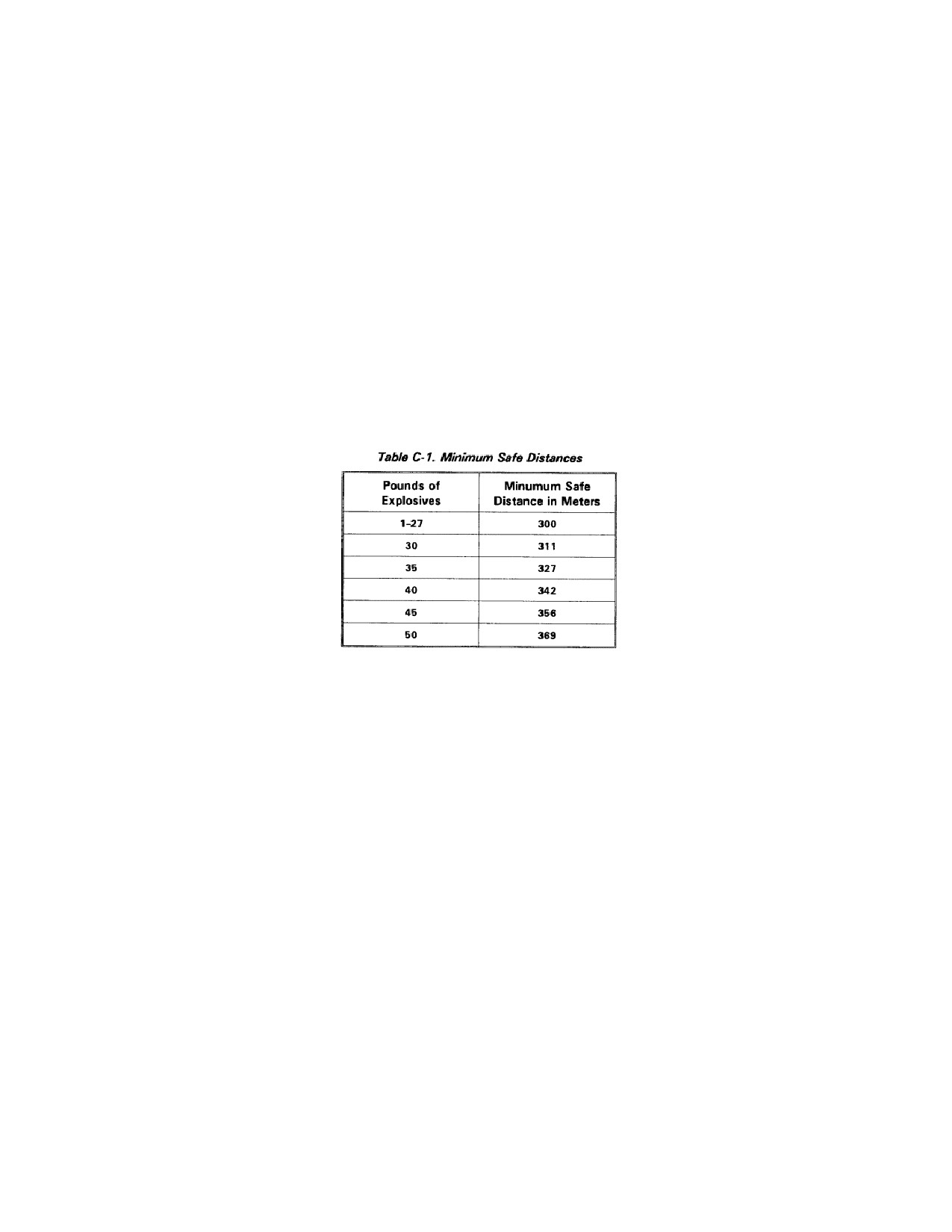
Safe Distances
Table C-1 gives distances at which personnel in the open are relatively safe from missiles
created by bare charges placed in or on the ground, regardless of type or condition of the
soil (see AR 385-63 and FM 5-250).
GLOSSARY
A
absorption--
the process of taking up or soaking up, for example, a sponge taking up water;
taking or receiving through molecular or chemical action or change
actuator handle--
the handle of a blasting machine that must be turned or depressed to activate the
blasting machine
AFPMB--Armed Forces Pest Management Board
AGL--above ground level
aging period--
the time required for newly mixed flame fuel to change from an applesauce
appearance to a smooth syrupy gel
agitate--
to rapidly stir or briskly move flame fuel to and fro during the mixing process
ammunition lot--
a supply of one specific type of ammunition manufactured under the same
specifications
AR--Army regulation
ASP--ammunition supply point
ampere--
a measure of electrical current
B
BFOG--"box full of grenades"
blast site--
a particular location designated for the detonation of an explosive charge
blasting cap--
a small tubular device containing explosive mixtures used to detonate an
explosive charge
binding post--
spring-loaded receptacle on a blasting machine designed to secure firing wires
BRIA--"Big Red 1 Alpha"
brisance--
the shattering power of high explosives
branch line--
a length of detonating cord that is joined to another length of detonating cord
bubbling--
the mechanical mixing of flame fuel using a source of compressed air to agitate
the fuel
C
CINC--Commander-in-Chief
canalizing--
to drive an enemy force into a preplanned kill zone
circuit--
the complete path of an electrical current, shared equally by two or more electrical
blasting caps
contact device--
an exploding device that can be initiated through the use of trip wire
continuity check--
the test of an electrical firing circuit
crimp--
to join a nonelectric blasting cap with time fuse by crushing the base of the cap
around the fuse with an M2 cap crimper
D
DA--Department of the Army
debris--
solid objects blown into the air as a result of an explosion
decanting--
method of separating water from MOGAS before mixing flame fuel
DODAC--Department of Defense Ammunition Code
DODIC--Department of Defense Identification Code
dual priming--
method of preparing an explosive charge for detonation using more than one
blasting cap
E
EO --Executive Order
EPA--Environmental Protection Agency
EPW--enemy prisoners of war
F
F--Fahrenheit
FFE--flame field expedient
firing system--
electrical or nonelectrical method of priming an explosive charge with blasting
caps
FLOT--forward line of own troops
FM--field manual
fougasse--
a land mine in which the charge is overlaid by stones or other missiles so placed
as to be hurled in the desired direction An exploding directional FFE
fragmentation--
the shattering of a metal FFE container upon detonation
G
gage--
a measurement of the thickness of the steel used in the manufacture of 55-gallon
drums
girth-hitch--
a double half-hitch with an additional turn
gpm--gallons per minute
H
hasty emplacement--
a flame device (exploding or illuminating), constructed quickly with available
items, and designed to hinder enemy offensive operations
hasty whip--
as shown in FM 5-250, an alternate method for priming a block of explosive with
detonating cord
hp--horsepower
I
illuminator--
an expedient flame device used to provide light on the battlefield
impulse--
a sudden involuntarily action
induce current--
to produce an electrical charge in a neighboring charge without having physical
contact with that charge
ingenuity--
cleverness or skillfulness
insoluble--
cannot be dissolved
IPSS--Improved Pesticide Spray System
L
lead wire--
wire from an electrical blasting cap
leap frog--
method of connecting blasting caps to detonate several explosive charges
LIC--low-intensity conflict
LDS--lightweight decontamination system
M
main-line--
a single line of detonating cord to which other branch lines of detonating cord are
connected
MEA--monoethanolamine
misfire--
a primed explosive charge that fails to detonate
MOGAS--motor gasoline
MOUT--military operations on urban terrain
MRE--meals, ready-to-eat
MSD--minimum safe distance urban terrain
mylar film--
a durable wrapping material that covers composition C4 explosives
N
napalm--
a highly flammable jellylike substance used as flame fuel
NBC--nuclear, biological, and/or chemical
NEO --Noncombatants Evacuation Operations
NSN--national stock number
P
PDDA--power-driven decontaminating apparatus
PDU--pesticide dispersal unit
PETN--
explosive component contained in detonating cord
ppm--parts per million
prime--
to prepare an explosive charge for detonation
priming adapter--
a small plastic device used to combine blasting caps and explosives
propellant charge container--
an artillery powder charge container
psi--pounds per square inch
pusher plate--
a wooden object used to propel FFE fuel from a directional FFE
psychological impact (of FFE) --
the human fear of fire
R
RCA--riot control agents
RDX--
commonly called cyclonite, a highly sensitive explosive and one of the most
powerful military explosives It is used alone as the base charge in military
blasting caps Its principal use is in composite explosives such as composition A,
B, and C explosives
residual--
fires that remain after the detonation of an exploding FFE
resistance--
the opposition offered by a substance to the passage through it of a steady electric
current
RF--radio frequency
ring main--
a ring of detonating cord to which branch lines are connected to ensure a positive
detonation
rule-of-thumb--
field formula used in the mixing of flame fuel
RVN--Republic of Vietnam
S
screw picket--
a metal stake used to secure concertina wire
shard--
a sharp, twisted piece of metal resulting from the detonation of an FFE device
having a metal container
shipping plug--
a small plastic plug that protects the time fuze receptacle in an M60 fuze igniter
shunt--
the twisting together of electrical firing wires to close a circuit
siphoning--
the removal of water from MOGAS before mixing flame fuel
site--
to locate or place an FFE device to support a combat operation
SOP--standing operating procedure
split colle--
the small cone shaped holder in an M60 fuze igniter that grips and holds time fuze
spoon handle--
the handle of an M49 trip flare
static electricity--
the electricity contained or produced by charged bodies such as that found in
atmospheric disturbances
T
tamping--
packing mud around a charge to keep the explosive force confined
TEA--
triethylaluminum, a thickened pyrophoric agent used in the M74 rocket A
substance similar to white phosphorus (WP) because it burns spontaneously when
exposed to air
thickened fuel--
a syrupy, sticky liquid composed of MOGAS and M4 thickening compound used
in FFE devices
TM--technical manual
TNT--trinitrotoluene
TOF--trioctyl phosphate
U
unthickened fuel--
a 60:40 mixture of MOGAS and oil used in FFE devices
V
V-trench--
a shallow trench in the ground the size of a 55-gallon drum dug at an angle with
the back deeper than the front
volatility--
rapid evaporation of a flammable liquid, changing into vapor, as in FFE fuel
W
WP--white phosphorus
REFERENCES
Sources Used
These are the sources quoted or paraphrased in this publication.
Army Publications
FM 5-250, Explosives and Demolitions, Jun 1992
AR 55-355, Defense Traffic Management Regulation, Jul 1986
AR 75-1, Malfunction Involving Ammunition and Explosives, Aug 1993
AR 310-50, Authorized Abbreviations and Brevity Codes, Nov 1985.
AR 350-41, Training in Units, Mar 1993.
AR 385-63, Policies and Procedures for Firing Ammunition for Training, Target
Practice, and Combat, Oct 1983
FM 3-4, NBC Protection w/C2, May 1992.
FM 3-5, NBC Decontamination, Nov 1993.
FM 3-100, Chemical Operation, Principles, and Fundamental, 8 May 1996.
FM 3-101, Chemical Sta ffs and Units, Nov 1993.
FM 5-20, Camouflage, May 1968
FM 5-250, Explosives and Demolitions, 15 June 1992.
FM 19-15, Civil Disturbances, Nov 1985.
FM 21-11, First Aid for Soldiers with Changes 1 and 2, Oct 1988.
FM 101-5-1, Operational Terms and Symbols, Oct 1985.
TC 23-2, 66mm Rocket Launcher M202A1 w/C2, 25 Apr 1980
TM 3-1055-456-12, Operator's & Organizational Maintenance Manual (Launcher,
Rocket: 60mm), Mar 1975
TM 5-629, Weed Control and Plant Growth Regulation, 24 May 1989.
TM 9-1010-224-10, Operator's Manual for Launcher, Projectile, 64mm: Riot Control,
M234, Oct 1980.
TM 9-1300-200, Ammunition, General, Oct 1969
TM 9-1300-206, Ammunition and Explosives Standard, Aug 1973
TM 9-1300-214, Military Explosives, Sep 1984
TM 9-1375-200, Demolition Materials, Jan 1964
TM 43-0001-29, Army Ammunition Data Sheets for Grenades, Apr 1994.
TM 43-0001-26-2, Army Equipment Data Sheets for Chemical Weapons and Munitions,
Apr 1982.
TB 3-1310-255-10, Launcher and 35mm Cartridges: Tactical CS, 16-tube, E8, Aug 1966.
STP 21-1-SMCT, Soldier's Manual of Common Tasks, SL1, Oct 1994.
STP 21-24-SMCT, Soldier's Manual of Common Tasks, SL2-4, Oct 1992.
STP 21-II-MQS, Military Qualification Standards II, Manual of Common Tasks, Jan
1991.
Other
ERDEC -S P-030, Chemical Agents, Weapons and Defense material Type Classified,
Adopted, or Obsoleted, April 1995.
Technical Report 118, Defoliation Studies: III. Screening of Defoliants, Herbicides, and
Desiccants, US Army Biological Defense Research center, Fort Detrick, MD, May 1971.
Deseret Test Center, Study of Riot Control Agents - Phase III, Aug 1971.
Documents Needed
These documents must be available to the intended users of this publication.
DA Form 2028. Recommended Changes to Publications and Blank Forms, Feb 1974.
Readings Recommended
These readings contain relevant supplemental information.
FM 3-100, NBC Defense, Chemical Warfare, Smoke and Flame Operations, May 1991.
FM 100-5, Operations, Jun 1993.