FM 3-11 Flame, Riot Control Agents and Herbicide Operations - page 3
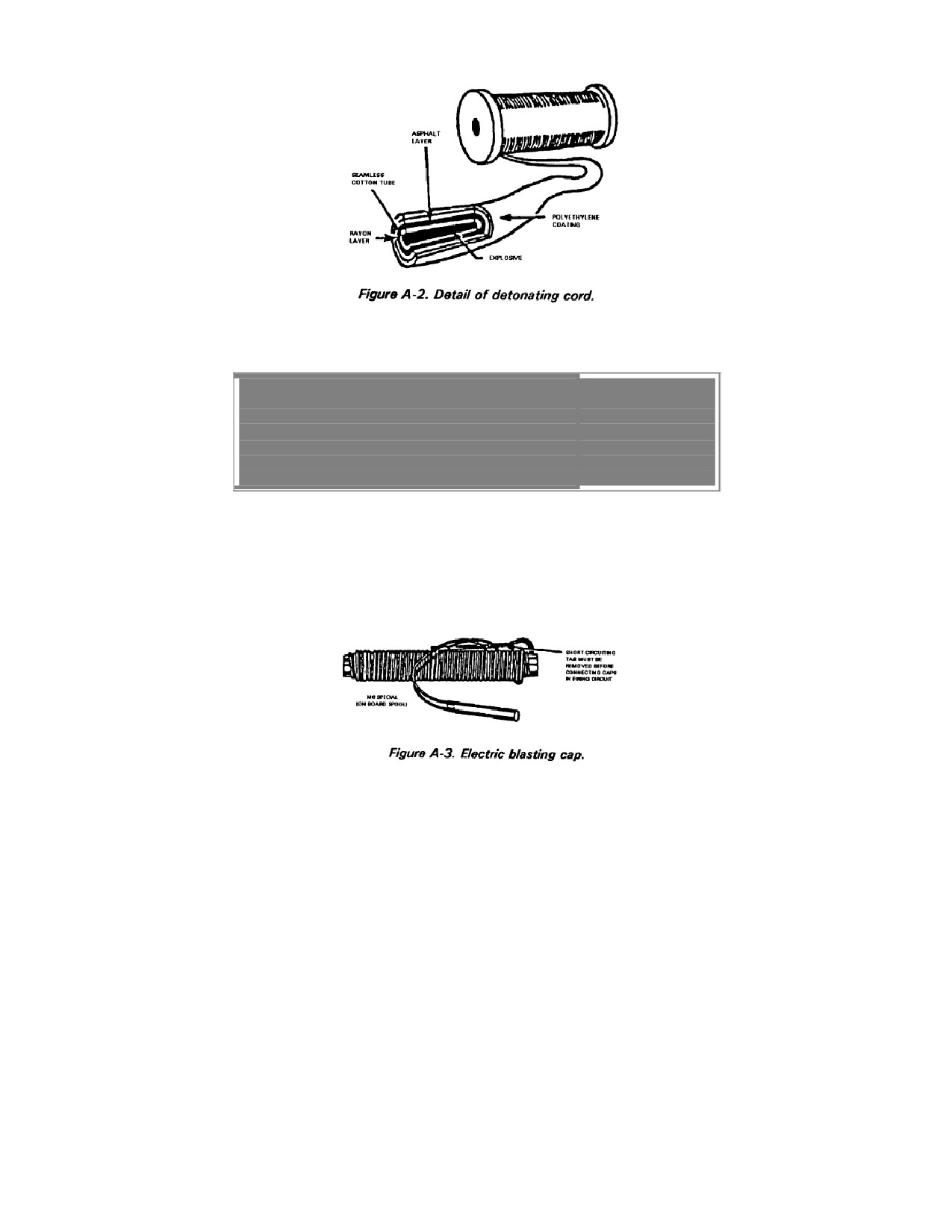
Detonating cord is packed in 1,000-foot spools, one spool per package, three packages
(2,000 feet) per wooden box.
CAUTION
When using detonating cord to detonate underwater charges left in place several
hours before firing, seal the ends with a waterproof sealing compound to keep out
moisture. A 6-inch free end will also protect the remainder of the line from moisture
for 24 hours. In priming, kinks or short bends that may sharply change the
direction of detonation and thus cause misfires should be avoided.
Blasting Caps
Blasting caps are used for detonating high explosives. They are designed for insertion
into cap wells and are also the detonating element in certain firing devices. Use the
special military blasting caps to ensure positive detonation of the generally less-sensitive
military explosives. Two types--electric (M6) and nonelectric (M7)--are used in military
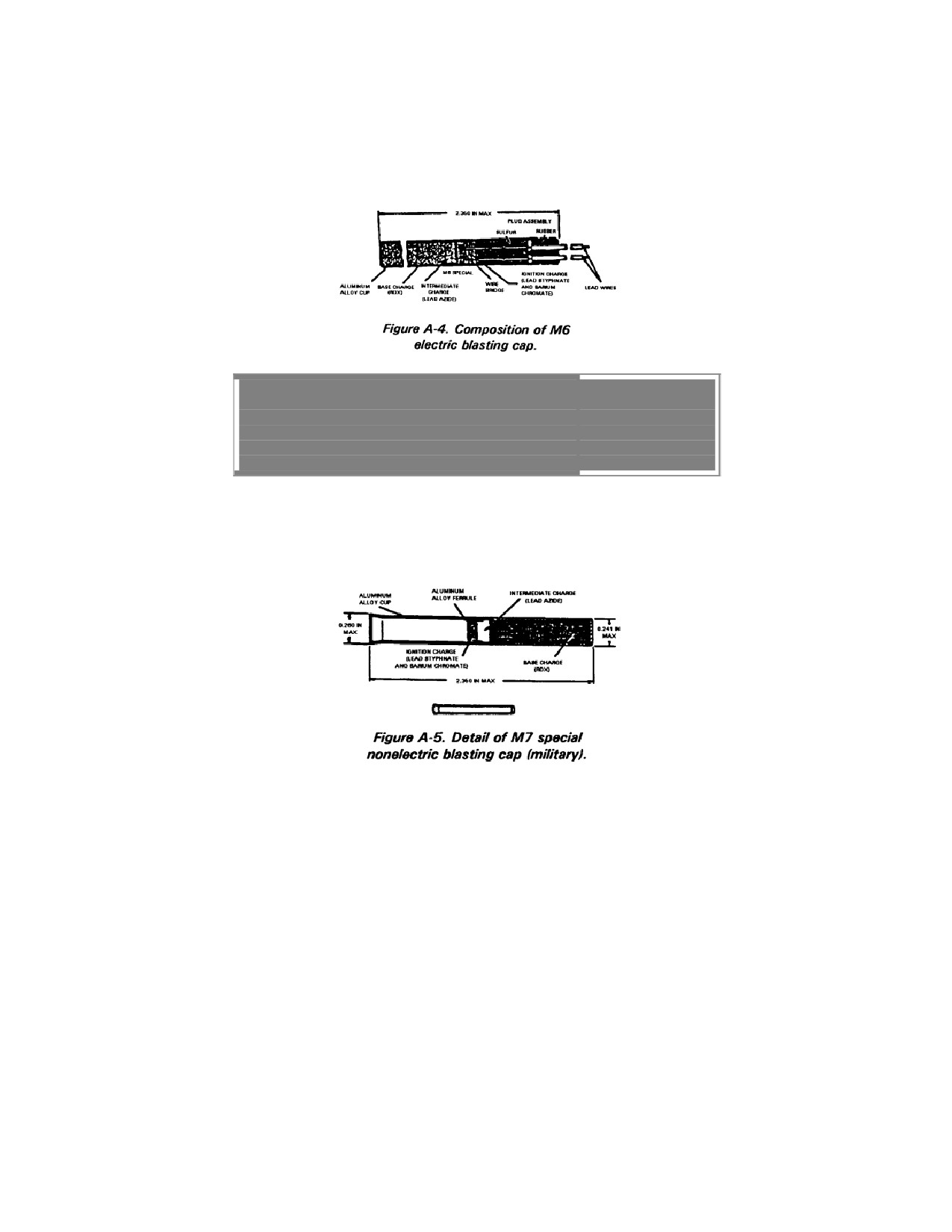
operations. Electric blasting caps are packed six per package (Figure A-3).
M6 Electric Blasting Cap
Electric blasting caps have lead wires of various lengths for connection into a circuit. The
most commonly used are 12 feet long. To prevent accidental firing, they have a short-
circuiting shunt that you must remove before using the cap. If the cap is without a shunt,
you may twist the bare ends of the lead wires together to provide the shunting action. The
M6 special electric blasting cap (Figure A-4) is the standard issue electric blasting cap.
CAUTION
Handle electric blasting caps with care. Blasting caps are extremely sensitive and
may explode unless handled carefully. Like all blasting caps, electric blasting caps
must not be tampered with and must be protected from shock, static electricity, and
extreme heat.
M7 Nonelectric Blasting Cap
You may initiate nonelectric blasting caps by time blasting fuse, firing devices, and
detonating cord. The M7 special blasting caps (Figure A-5) are flared at the open end to
easily insert the time fuse. M7 caps are the standard issue nonelectric blasting caps.
CAUTION
Handle nonelectric caps with care. Blasting caps are extremely sensitive and may
explode unless handled carefully. Do not tamper with caps and protect them from
shock and extreme heat. Because they are difficult to waterproof, do not use these
caps to prime charges placed underwater or in wet areas.
M2 Cap Crimper
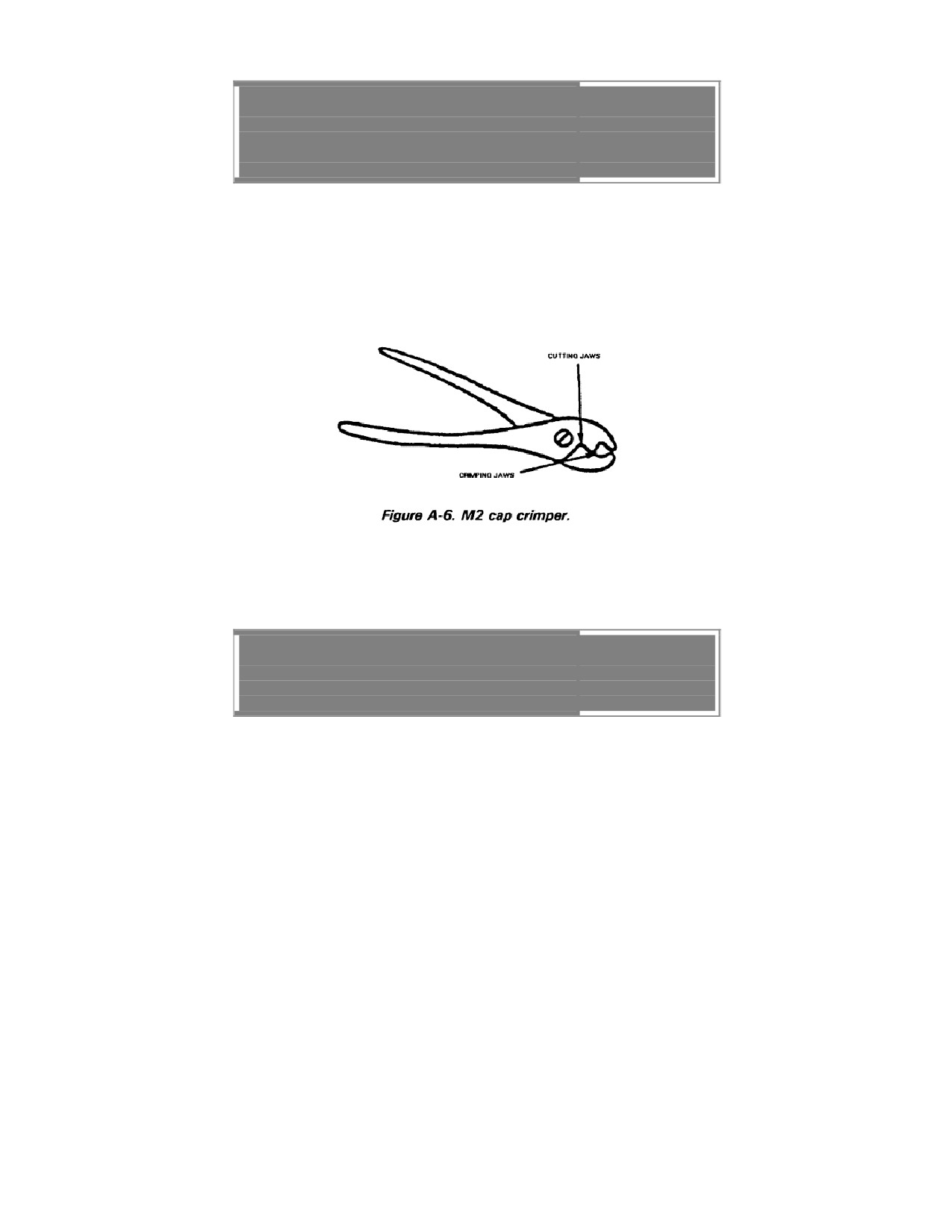
The rear portion of each M2 cap crimper jaw (Figure A-6) is shaped and sharpened for
cutting time fuses. Use the front portion of the jaw for crimping nonelectric blasting caps.
A stop on the handle limits the closing of the jaws to prevent interference with the
burning of the powder train in the fuse or detonation of the cord when crimping
nonelectric blasting caps. One leg of the handle is pointed for use in punching cap wells
in explosive materials for easy insertion of blasting caps.
Use the M2 cap crimpers to squeeze the shell of a nonelectric blasting cap around the
time blasting fuse or detonating cord securely enough to keep it from being pulled off.
The squeeze must not be enough to interfere with the burning of the powder train in the
fuse or the detonation of the cord.
CAUTION
Because they are made of soft, nonsparking metal that will conduct electricity, do
not use cap crimpers as pliers for any other purpose, as this damages the crimping
surface.
M51 Blasting Cap
Test Set
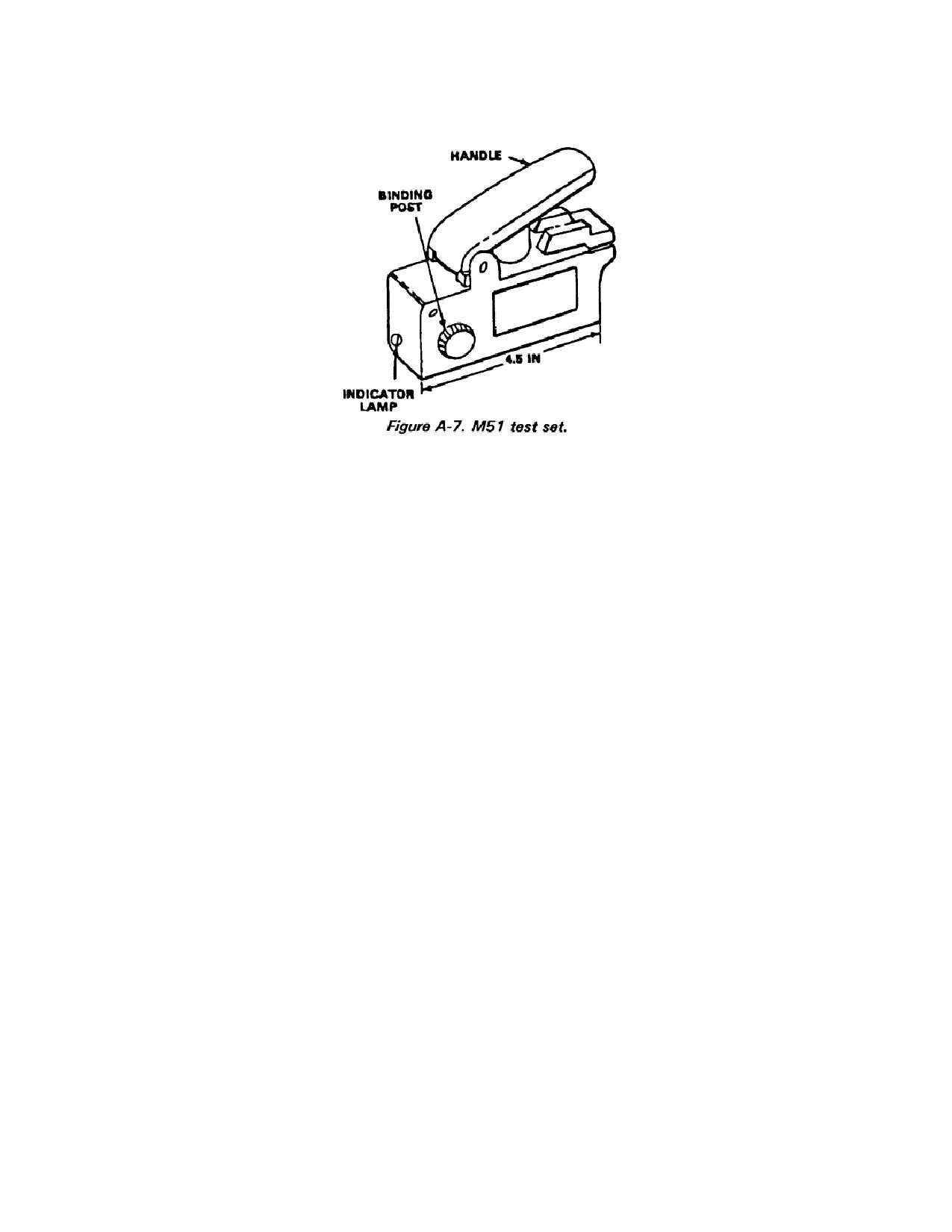
The M51 test set (Figure A-7) is a self-contained unit with a magneto-type impulse
generator and two binding posts for attachment of firing leads. The test set is waterproof
and may be used at temperatures as low as minus 40°F.
The test set was developed to replace the galvanometers for continuity testing of
electrical firing circuits.
To ensure optimum useful life of the test set, keep it dry and handle it with care. Before
using the set, ensure that it is in operating condition by following these three steps:
Step 1. Connect a piece of bare wire between the binding posts.
Step 2. Sharply depress handle while observing indicator lamp. If set is operative, lamp
will flash.
Step 3. Remove wire and proceed to test firing circuit.
To perform continuity testing, connect the firing wires to the test set binding posts and
depress the handle sharply. If there is a continuous, intact circuit, even one created by a
short, the indicator lamp will flash.
M34 50-cap
Blasting Machine
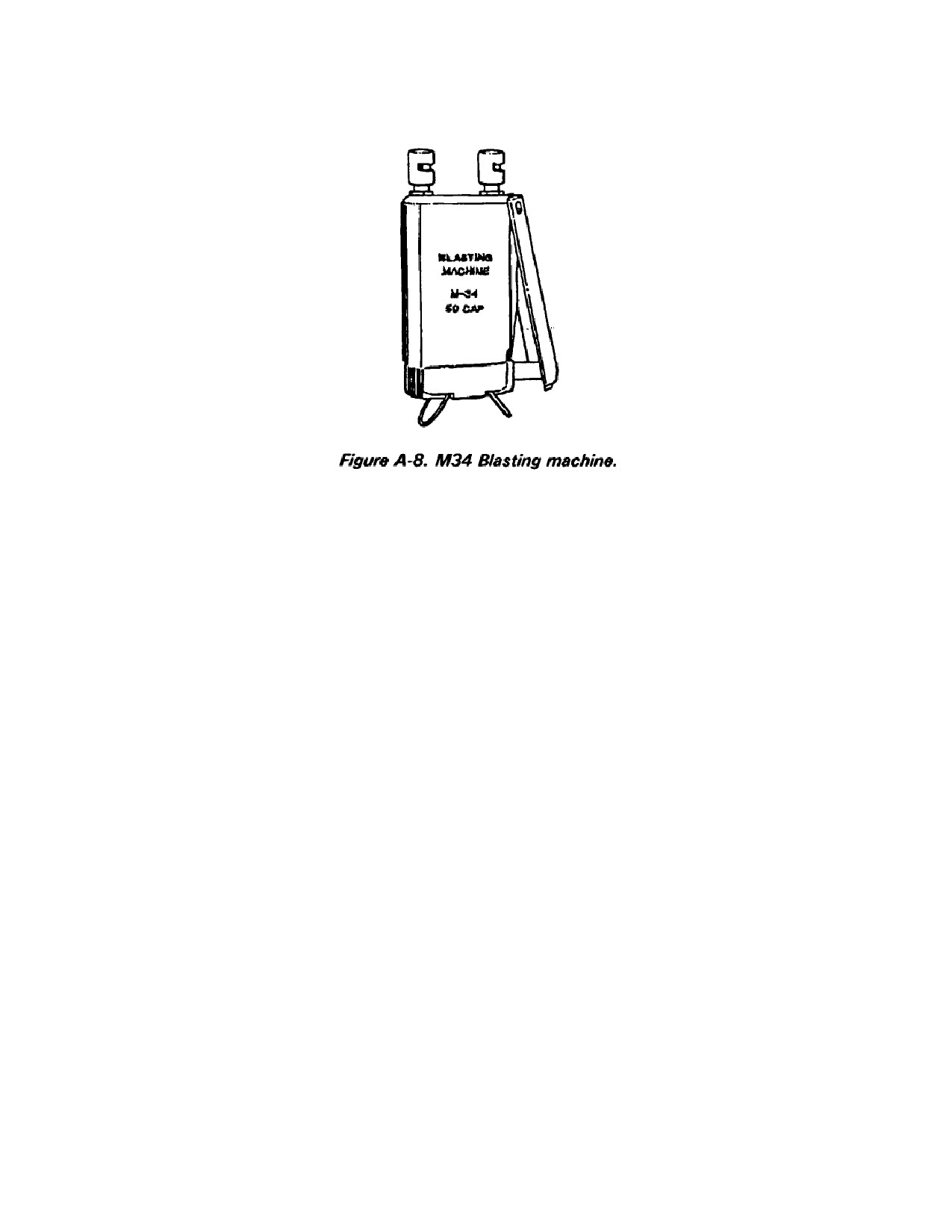
The M34 blasting machine (Figure A-8) is a small DC electrical generator that produces
adequate current (1.5 amperes) to initiate 50 electric blasting caps connected in series. It
is 5 inches high and 2.5 inches wide.
The M34 blasting machine is designed to detonate charges primed with electric blasting
caps.
To ensure the machine works properly, perform steps 2 and 3 (do not connect firing
wires). To detonate charges:
Step 1. Fasten the firing wires tightly to the terminals.
Step 2. Release the safety band from the handle bottom.
Step 3. Grasp the M34 blasting machine firmly with both hands and squeeze the handle
vigorously several times until detonation occurs.
Detonating
Cord Clip
The clip (Figure A-9) is a metal device that is approximately 2 inches long and 1 inch
wide. It has a U-shaped bend at the top called a trough and a bend at the bottom called a
tongue. The M1 detonating cord clip is used to hold strands of detonating cord either
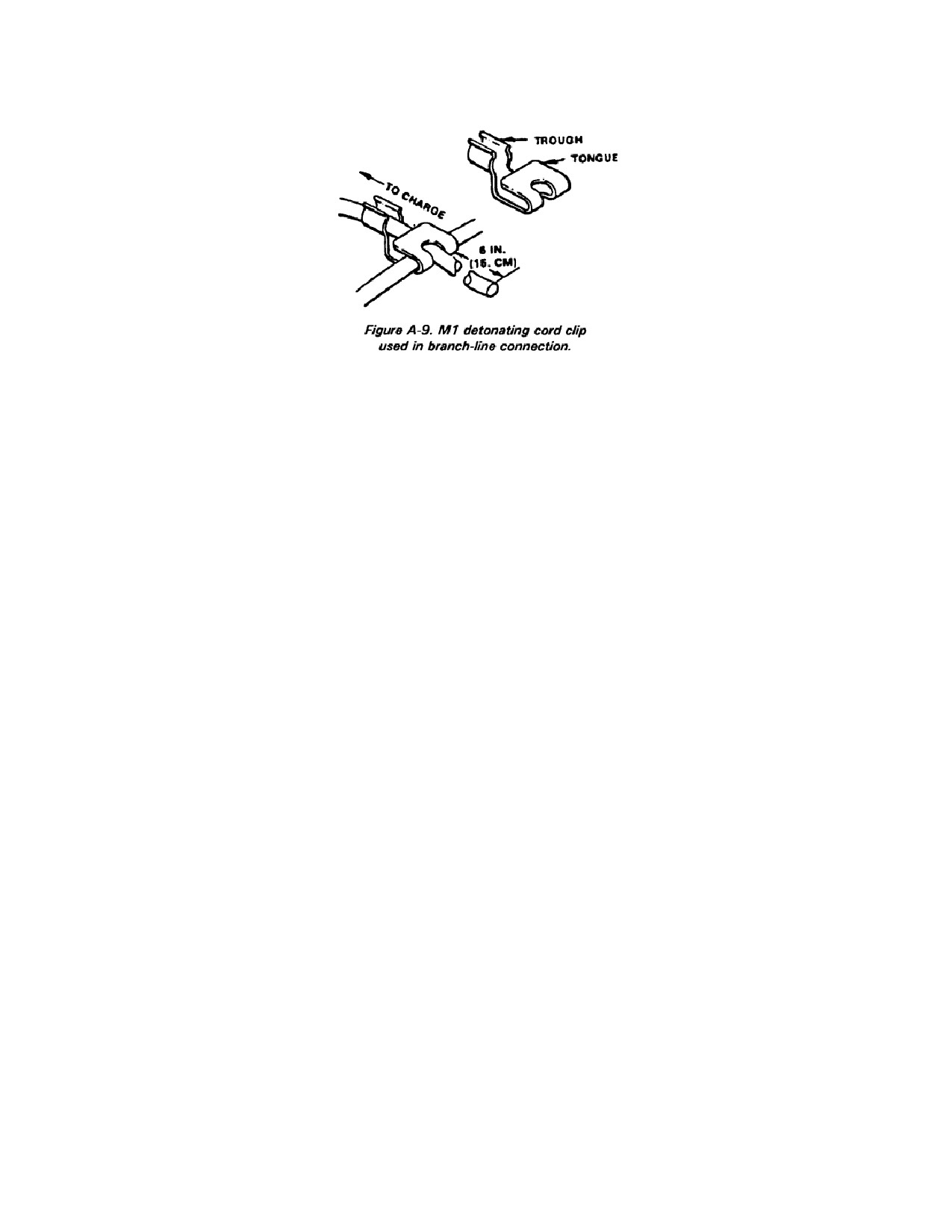
parallel or at right angles to each other. You can make connections more quickly with
these clips than with knots.
Branch Lines
Connect branch lines by clipping the branch line with the U-shaped trough of the clip and
the main line with the tongue of the clip.
Connecting Two Ends
Splice ends of detonating cord by overlapping them about 12 inches, using two clips, one
at each end of the overlap, and bending the tongues of the clips firmly over both strands.
M60 Weatherproof
Fuse Igniter
The M60 fuse igniter (Figure A-10) has a plastic body (barrel) 5 inches long with a safety
pin attached through the barrel and the plunger. The plunger has a pull ring attached to it
for easy use. The NSN is 1375-00-691-1671 and the DODAC is 1375-M766.
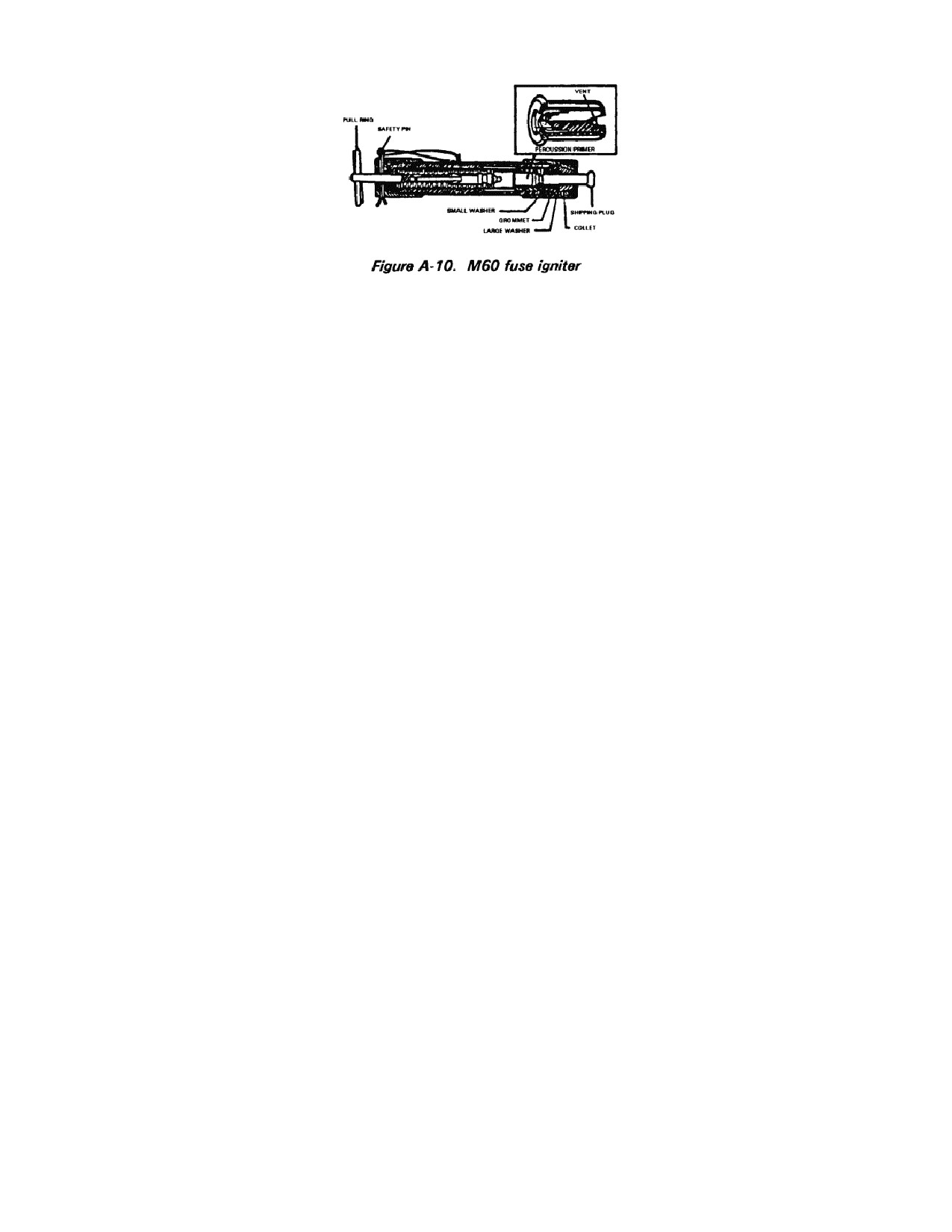
The fuse igniter is designed to ignite time blasting fuses in any weather conditions and
underwater if waterproofed. Operation is as follows:
Step 1. Unscrew fuse holder cap two or three turns but do not remove it. Press the
shipping plug into the igniter to release the split collet, and rotate the plug as it is
removed.
Step 2. Insert the free end of the time fuse in place of the plug until it rests against the
primer.
Step 3. Tighten the cap sufficiently to hold the fuse in place, thus weatherproofing the
joint.
Step 4. To fire, remove the safety pin, hold the barrel in one hand, and pull on the pull
ring with the other, taking up the slack before making the final strong pull.
If there is a misfire, the M60 fuse igniter can be reset quickly without disassembly. Reset
operation is as follows:
Step 1. Push the plunger all the way in and attempt to fire as before.
Step 2. If the M60 does not fire after three or four attempts to reset it, replace the igniter.
One-Gallon
Mine
The 1-gallon mine (Figure A-11) is a rectangular 1-gallon can, 6 inches wide, 4 1/8
inches deep, and 10 9/16 inches high, fitted with a carrying handle and a threaded cap.
Solder two short wires to the backside of the can for use when attaching a burster. You
may fill one-gallon mine cans with thickened fuel to construct a flame mine field. The
NSN is 1345-00-289-6938 and the DODAC is 1345-K260.
M4 Field
Incendiary Burster
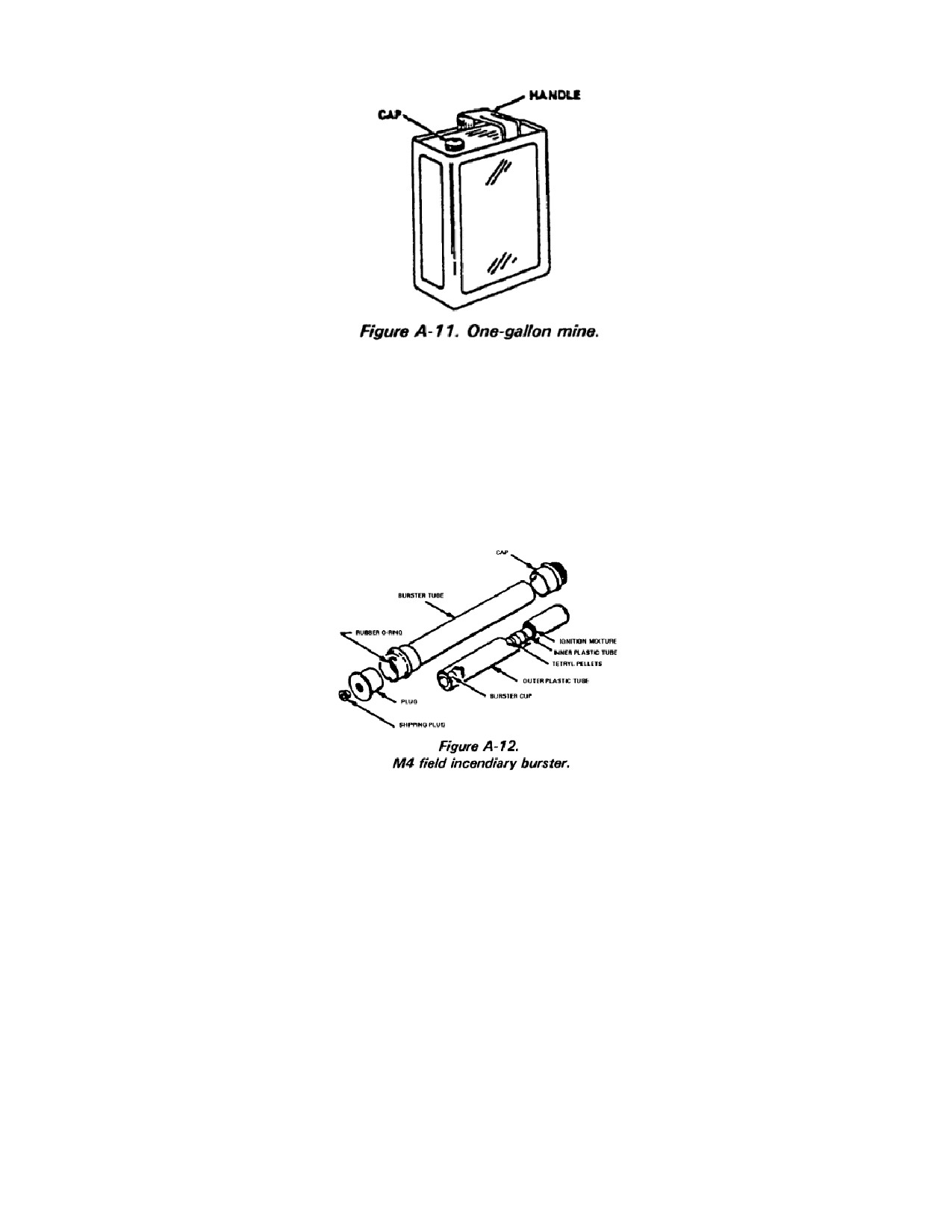
The M4 field incendiary burster (Figure A-12) consists of a 12.25-inch by 1.25-inch
burster tube assembly containing a plastic tube filled with tetryl pellets surrounded by a
column of incendiary mix. It weighs 2.25 pounds. The burster tube has two bayonet-type
fittings, a cap at one end, and a plug at the other. You may join two or more bursters
together by removing the plug from one burster and the cap from another and coupling
the open ends. A hole in the plug fitting accommodates the firing device, which may be a
fuse, blasting cap, or detonating cord. A steel blasting cap adapter is furnished for each
burster. The NSN is 1345-00-690-6909 and the DODAC is 1345-K010.
M4 field incendiary bursters are used primarily with field-improvised incendiary
munitions filled with thickened fuel. The M4 bursts the fuel container, ignites the fuel,
and scatters it over a large area. Each M4 burster has a bursting radius of 35 meters.
The M4 burster has a high-explosive filler. Handle it using the precautions given to high
explosives.
WARNING
Handle with caution. The M4 burster has a high-explosive filler.
M4
Thickening
Compound
M4 thickening compound is a fine, white powder. This dialuminum acid soap of
isooctanic acid is a by-product of petroleum. It contains additives to prevent lumping. M4
thickening compound is used to convert liquid fuels to gels for use in flame field
expedients. The NSN for the 2.5-pound can is 1365-00-926-4076, and the DODAC is
1365-K917. The NSN for the 25-pound pail is 1365-00-143-7139, and the DODAC is
1365-K920.
Demolition
Materials
Units should plan in advance for the use of explosives and their components. (For
training ammunition, base requisition procedures on unit and installation policies.) Two
types of explosives used in the construction of flame field expedients are trinitrotoluene
(TNT) and composition C4.
Trinitrotoluene
TNT is the most commonly used military explosive. It is employed as a bursting charge
in constructing flame field expedients and as a standard explosive against which all other
military high explosives are rated. TNT block demolition charges are issued in three
sizes.
Uses. TNT block demolition charges are standard demolition charges and are used for all
types of demolition work. The quarter-pound charge is used primarily for training
purposes.
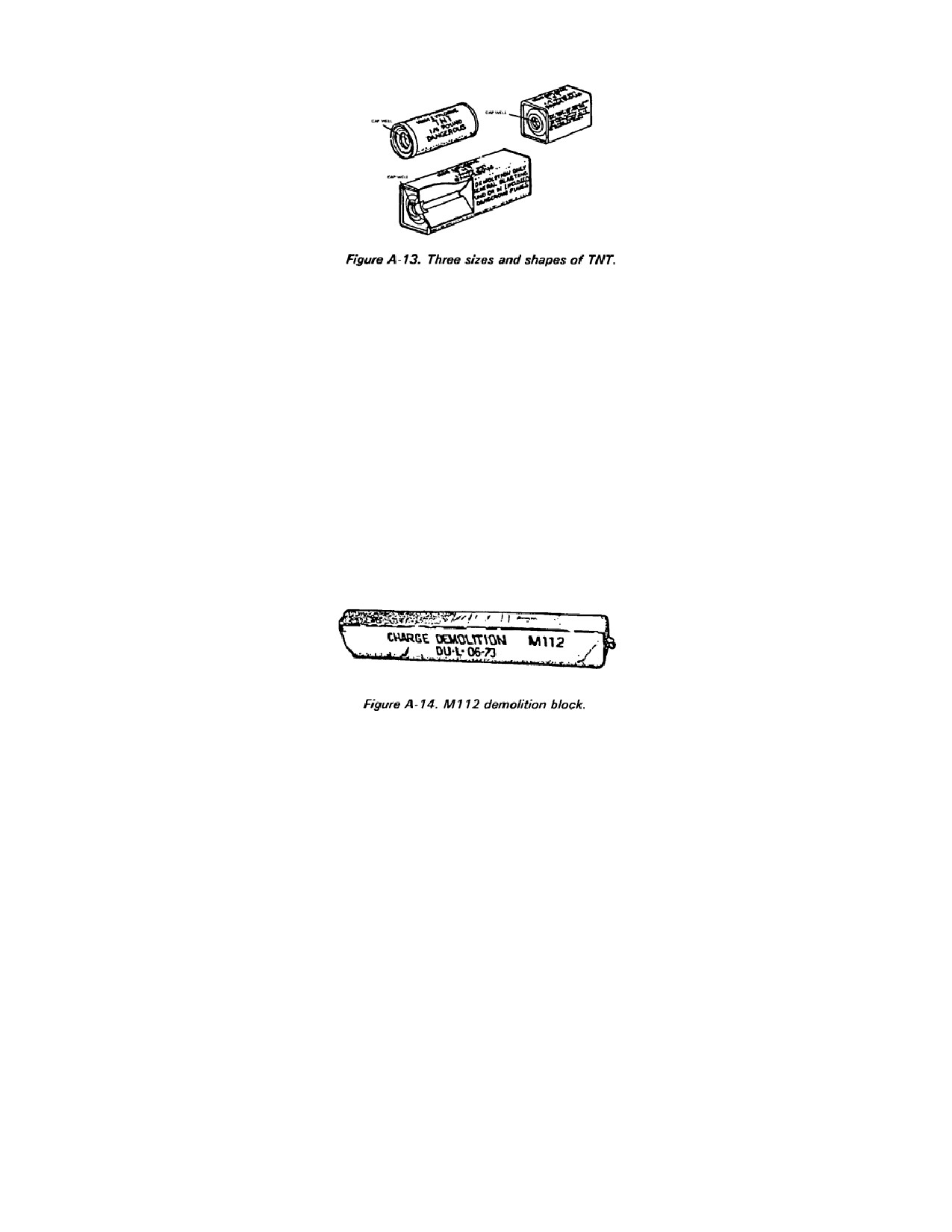
Advantages. TNT demolition charges (Figure A-13) have a high detonating velocity, are
stable, and are relatively insensitive to shock or friction. TNT also has excellent water
resistance and comes in convenient sizes, shapes, and packages.
Limitations. Block demolition charges cannot be molded and are difficult to use on an
irregularly shaped object. TNT is not recommended for use in closed spaces because the
explosive gases are poisonous.
Composition C4
Composition C4 is a composite explosive containing 91 percent RDX and 9 percent
nonexplosive plasticizers. Composition C4 replaced composition C3 as a demolition
charge and may be used as a bursting charge. It is issued in two sizes: M112, 1.25
pounds, and M5A1, 2.5 pounds.
M112 Block
Demolition Charge
The M112 (Figure A-14) block demolition charge consists of 1.25 pounds of composition
C4 packed in a mylar film bag. On one surface there is pressure-sensitive adhesive tape
protected by a peelable paper cover for quick emplacement. Composition C4 charges of
old manufacturing dates are colored dull gray and are in a clear mylar bag. Charges of
recent manufacture are white and packed in an olive drab mylar bag.
Uses. The M112 demolition block is used in all types of demolition work, primarily for
cutting and breaching. Because of its moldability and high brisance (shattering effect), C4
is ideally suited for use as a bursting or propellent charge for exploding flame devices.
Advantages. M112 demolition block has an efficient shape and a handy size. It can be
cut and molded for easy attachment to irregularly shaped objects. The color of the
wrapper aids in camouflage.
Limitations. Its odd weight makes calculation of M112 charge weights difficult. Also,
the adhesive tape will not adhere to wet or frozen surfaces. In addition, you should not
use M112 in closed spaces because the explosion produces poisonous gases.
M5A1 Block
Demolition Charge
The M5A1 consists of 2.5 pounds of C4 encased in a clear plastic container with a
threaded cap well in each end. You can get bulk explosive by cutting open the plastic
container.
Uses. Use the M5A1 in all types of demolition work, primarily for cutting and breaching.
Because of its moldability and high brisance, C4 is ideally suited for cutting steel charges
and for cutting irregularly shaped objects. C4 is insoluble in water and can be used for
underwater demolitions.
Advantages. C4 is moldable from -20°F to +170°F. Because of its plasticity it can be cut
and molded for easy attachment to irregularly shaped objects.
Limitations. The white color of C4 in demolition charge M5A1 is difficult to
camouflage. Running water will erode C4 if it is not protected.
MISFIRES
Firing systems, whether electric or nonelectric, may occasionally fail to function
properly. This creates a very hazardous situation. Handle misfires with extreme caution.
You can reduce the possibility of a misfire by using combination dual-firing systems. To
avoid misfires where charges are placed underground, use detonating cord to prime the
explosive, keeping the blasting caps above ground.
Nonelectric
Firing Systems
The most hazardous blasting operation is working on or near a misfire. If there is a
misfire, delay investigation for at least 30 minutes after the expected time of detonation.
This delay allows ample time for any explosion delayed because of a defective powder
train in the fuse. Under certain combat conditions, however, immediate investigation may
be necessary.
· Check all igniters and time fuses to determine if any did not burn.
· Check location of the blasting cap to determine if the primary was inadequate.
· For systems with detonating cord, locate the primed end of the detonating cord to
determine if the blasting cap detonated but did not initiate the cord, or if the fault
is in the initiating assembly.
WARNING
1. Only the individual who placed the charge should investigate and correct
nonelectric misfires.
2. Anyone attempting to clear a nonelectric misfire must be trained in safe handling
of explosives as well as the construction of nonelectric firing systems.
If the misfired charge is not tamped, lay a primed, l-pound charge beside it without
moving or disturbing it, and again attempt to detonate the charge.
If the misfired charge has no more than a foot of tamping, try to explode it by detonating
a new 2-pound charge placed on top. If this method is impractical, carefully remove the
tamping using wooden or nonmetallic tools. Avoid accidentally digging into the charge.
A constant check of the depth of the hole from ground level to the top of the charge will
minimize the danger of striking the charge. When the charge has been uncovered to
within 1 foot, insert and detonate a new 2-pound primer. Whenever possible, use
detonating cord to prime underground charges and place the blasting cap above ground.
An alternate method of reaching a deep misfire is to dig a new hole within 1 foot of the
charge and at the same depth. Place a 2-pound prime charge in the new hole to detonate
the misfired charge. Use extreme care in digging the new hole to avoid striking the old
misfired charge or placing the new charge too far away to induce detonation.
Electric
Firing Systems
To prevent misfires, one individual should be responsible for all electrical wiring of an
FFE circuit. He or she should do all splicing to ensure--
· All blasting caps are included in the firing circuit.
· All connections between blasting cap wires, connecting wires, and firing wires are
properly made. Short circuits are avoided.
· The number of blasting caps in any circuit does not exceed the rated capacity of
the power source on hand.
Causes
Common causes of electric misfires include
· Blasting machine or power source inoperative or producing weak circuit output.
· Blasting machine or power source improperly operated.
· Defective and damaged connections causing a short circuit, a break in the circuit,
or high resistance with resulting low current.
· Faulty blasting caps.
· Using blasting caps made by different manufactures on the same tiring circuit.
· Using more blasting caps than the power source permits.
Clearing
Because of the hazards from burning charges and delayed explosions, you must clear
electric misfires with extreme caution. A burning charge may occur with the use of
electric as well as nonelectric caps. Clear misfires of FFE charges primed with detonating
cord and fired by electric blasting caps as follows:
Dual-Primed
Charges
If the FFE charge is dual-primed electrically and below ground, wait 30 minutes before
investigating; a burning charge may set off the second cap causing the main charge to
detonate.
Single-Primed
Charges
If the electric misfire is above ground and the FFE charge is not dual-primed, investigate
immediately. If the system is below ground and not dual-primed, proceed as follows (12
steps):
Step 1. Check firing wire connections to the blasting machine or power source terminals
to be sure contacts are good.
Step 2. Make two or three more attempts to fire the circuits.
Step 3. Attempt to fire again, using another blasting machine or source.
Step 4. Disconnect blasting machine firing wire. Before moving on to the FFE site, be
sure you have shunted firing wires at the power source end of the circuit to avoid any
possible static electric detonation.
Step 5. Check entire circuit, including the firing wire, for breaks and short circuits.
Step 6. If the fault is not above ground, very carefully remove the tamping material, if
any, from around the FFE device, and avoid striking the electric blasting cap.
Step 7. Make no attempt to remove the primer or charge.
Step 8. If the malfunction is not located by removing the tamping material to within 1
foot of the charge, place a new electric primer and 2 pounds of explosive at this point.
Step 9. Disconnect blasting cap wires of the original primer from the circuit, and shunt
the cap lead wires.
Step 10. Connect wires of the new primer in their place.
Step 11. Replace tamping material.
Step 12. Initiate detonation. Detonation of the new primer will fire the original charge.
Detonating Cord
Nonelectric or electric blasting caps attached to detonating cord may fail to function.
Nonelectric Blasting Cap
If a nonelectric blasting cap attached to detonating cord fails to function, follow these
three steps:
Step 1. Delay investigation at least 30 minutes.
Step 2. Cut the detonating cord main line between the blasting cap and the charge.
Step 3. Fasten a new blasting cap with time fuse on the detonating cord.
Electric Blasting Cap
If an exposed electric blasting cap fastened to detonating cord fails to fire, follow these
four steps:
Step 1. Disconnect the blasting machine immediately and investigate.
Step 2. Test the blasting circuit for any break or short circuit.
Step 3. Shunt the firing wire leads before leaving firing position to correct the problem.
Step 4. If necessary, replace the original blasting cap.
Failure of Branch Line
If the detonating cord main line detonates but a branch line fails, fasten a new blasting
cap to the branch line; and fire separately.
Failure of Charge to Explode
If the charge is above ground and the detonating cord leading to the charge detonates but
the charge fails to explode, follow these 5 steps:
Step 1. Delay investigation until certain the charge is not burning.
Step 2. If the charge is in the ground, wait 30 minutes.
Step 3. If the charge is intact, insert a new primer.
Step 4. If the charge is scattered by the detonation of the original detonating cord, re-
assemble as much of the original charge as possible, place a new charge if necessary, and
reprime.
Step 5. Make every attempt possible to recover all explosives scattered by misfire,
particularly those used in training exercises.
Premature
Detonation
Induced currents, lightning, or electric power lines may cause premature detonation.
Induced Current
The premature detonation of electric blasting caps by induced current from radio
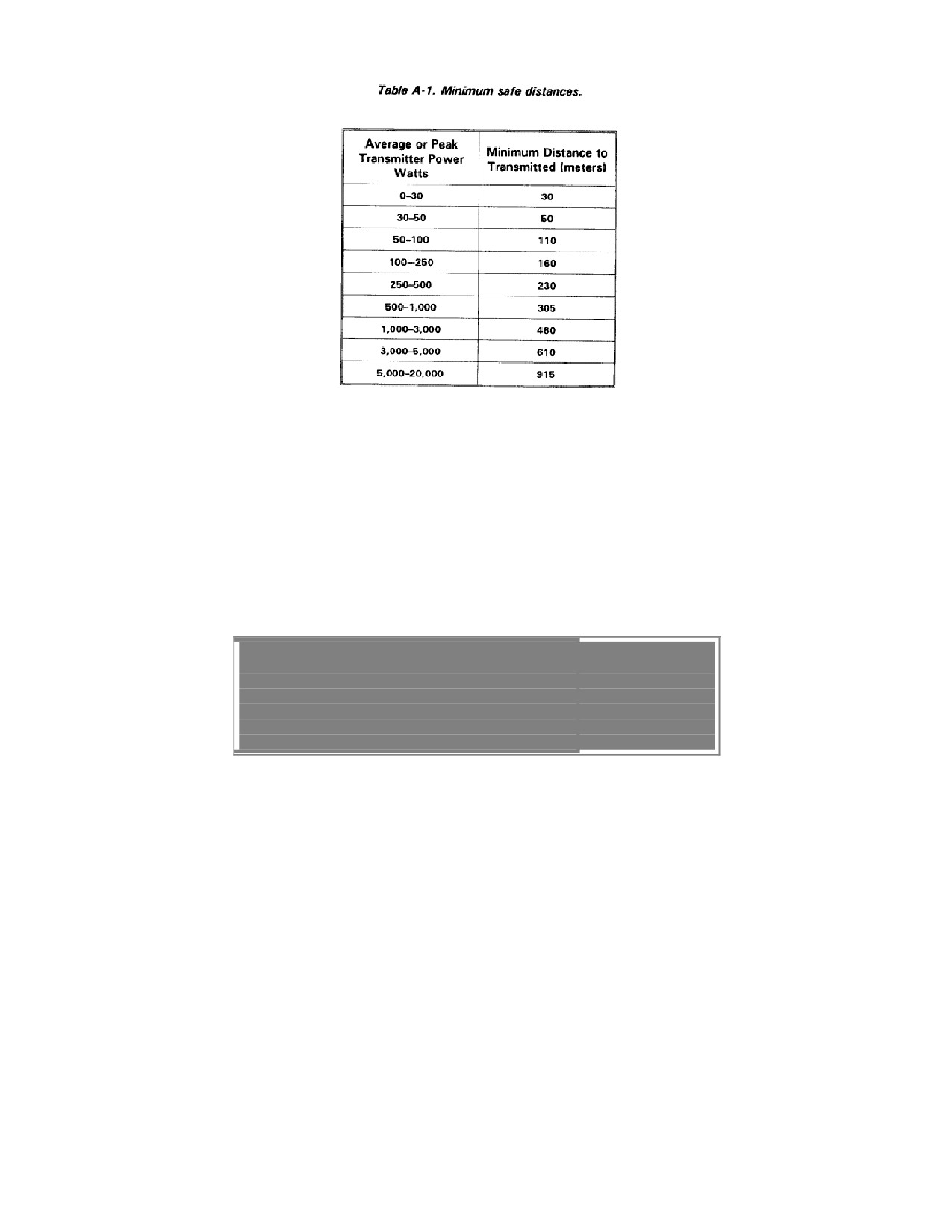
frequency (RF) signals is possible. Table A-1 shows the minimum safe distances in
respect to transmitter power and indicates the distances beyond which it is safe to conduct
electrical blasting, even under the most adverse conditions. This table applies to operating
radio, radar, and television transmitting equipment.
Mobile transmitters and portable transmitters are prohibited within 50 meters of any
electric blasting caps or electrical firing system. If blasting distances are less than those
shown in the table, the only safe procedure is to use a nonelectric system that cannot be
prematurely detonated by RF currents.
Lightning
Lightning is a hazard to both electric and nonelectric blasting charges. A strike or a near
miss is almost certain to initiate either type of system. Lightning strikes, even at remote
locations, may cause extremely high local earth currents and shock waves that might
initiate electric firing circuits. The effects of remote lightning strikes are multiplied by
proximity to conducting elements, such as those found in buildings, fences, railroads,
bridges, streams, and underground cables or conduit. The only safe procedure is to
suspend all blasting activities during impending electrical storms.
WARNING
If you must transport electric blasting caps near operating transmitters or in
vehicles (including helicopters) in which a transmitter is operated, then you must
place the caps in a metal can with a snug depth of one-half inch. DO not remove the
caps from the container near an operating transmitter unless the hazard has been
evaluated and estimated to be acceptable.
Electric Power Lines
Do not conduct electric firing within 155 meters of energized power transmission lines.
When it is necessary to conduct blasting operations at distances closer than 155 meters to
electric power lines, use nonelectric firing systems or have the power lies shut off (see
AR 385-63).
FIRING SYSTEMS
There are two types of firing systems: electric and nonelectric. Under normal conditions,
construct FFE weapons using a dual-priming system.
Dual priming consists of two complete systems independent of each other and each
capable of firing the same charge. It can be two electric systems, two nonelectric systems,
or an electric and a nonelectric system. Dual priming increases the probability of a
successful firing. Under emergency conditions or when equipment constraints make dual
priming impossible, you may use single priming.
An electric dual-priming firing system consists of two independent electric circuits each
with an electric blasting cap connected to a charge. The firing of either circuit will
detonate all charges. Separate the firing wires for the two circuits to prevent the system
from being cut by a single bullet or shell fragment. Place firing points at separate
locations.
A nonelectric dual-priming firing system consists of two independent nonelectric systems
for tiring a single charge or set of charges. If you are firing two or more charges
simultaneously, lay out two detonating cord ring mains, and tie a branch line from each
charge into each ring main.
A combination dual-priming firing system consists of an electric and nonelectric tiring
system. Prime each charge both electrically and nonelectrically. Both electric and
nonelectric systems are entirely independent of each other.
Electric
Firing Systems
Electric firing systems detonate an explosive charge with an electric blasting cap. The
basic priming materials consist of an electric blasting cap and a detonating cord.
Electric firing system basic assembly instructions include the following five steps:
Step 1. Prepare and place all explosive charges.
Step 2. Lay out firing wire from the charges to a predetermined firing position.
Step 3. Test firing wire as described in this appendix under "Testing Procedure."
Step 4. Test blasting caps that are to be used as described in FM 5-250.
Step 5. After blasting caps have been tested, twist the free ends of the cap lead wires
together or shunt them with the short-circuit shunt provided to prevent an electric charge
from building up in the cap lead wires.
Use the common series method to connect two or more charges fired electrically by a
single blasting machine. Prepare a common series circuit by connecting one blasting cap
lead wire from the first cap to one lead wire from the second cap and so on until only two
end wires are free; then connect the free ends of the cap lead wires to the ends of the
firing wire.
Nonelectric
Firing Systems
Nonelectric systems prime an explosive charge for detonation with a nonelectric blasting
cap. The basic priming materials consist of --
· Nonelectric blasting cap and a time blasting fuse.
· M60 time blasting fuse igniter.
· Detonating cord (if more than one charge is to be detonated simultaneously).
To assemble the nonelectric firing system, follow these 10 basic assembly steps:
Step 1. Cut and discard a 6-inch length from the blasting fuse to prevent a misfire caused
by the exposed powder absorbing moisture from the air.
Step 2. Cut off 3 feet of time blasting fuse to check the burning rate.
· With an M60 fuse igniter, attach the fuse to the igniter. Fire the M60 igniter and
time the burning rate. Then compute the burning rate per foot by dividing the time
in seconds by the length in feet.
· Without an M60 fuse igniter, split the end of the fuse, insert a match head into the
split, light the match with another match, and note the time it takes the fuse to
burn. Then compute the burning rate per foot by dividing the time in seconds by
the length in feet.
Step 3. Cut the time blasting fuse long enough to permit the person detonating the charge
to reach a safe distance by walking at a normal pace before the explosion. Make this cut
squarely across the time fuse.
Step 4. Take a blasting cap from the cap box, and inspect it by looking into the open end.
If foreign matter or dirt is present, hold the cap with the open end down and shake it
gently or bump one hand against the other.
Step 5. Hold the time blasting fuse vertically with the square-cut end up and slip the
blasting cap gently down over it so the flash charge in the cap is in contact with the end
of the time fuse. It may misfire if not in contact. Never force the time fuse into the
blasting cap by twisting or any other method. If the end is flattened or is too large to enter
the blasting cap freely, roll it between the thumb and finger until the size is reduced to
permit free entry.
Step 6. After seating the blasting cap, grasp the time blasting fuse between the thumb and
third finger of the left hand and extend the forefinger over the end of the cap to hold it
firmly against the end of the time fuse. Keep a slight pressure on the closed end of the
cap with the forefinger.
Step 7. Slide the second finger down the outer edge of the blasting cap to guide the
crimpers and thus ensure accrate crimping even in darkness.
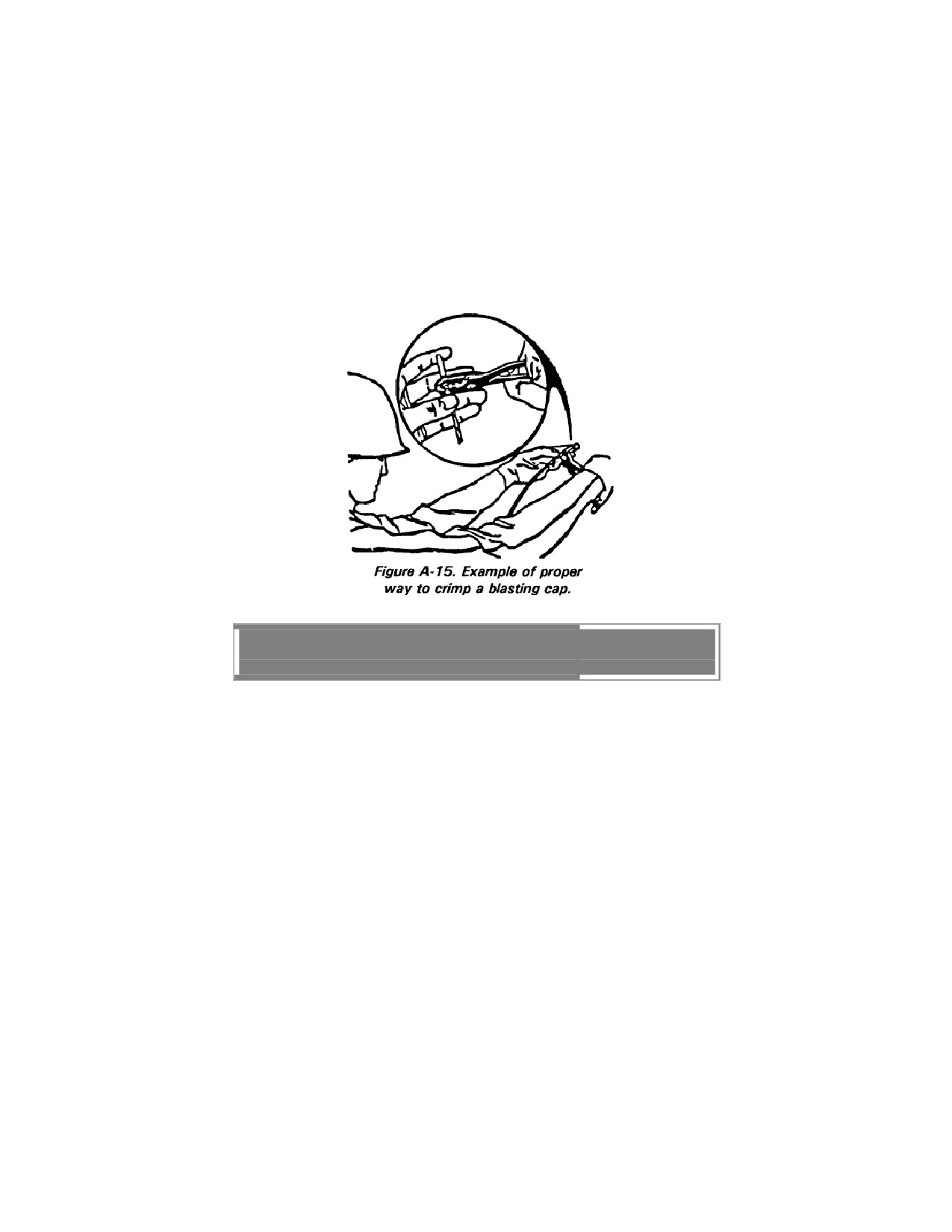
Step 8. Crimp the blasting cap at a point 1/8 to 1/4 inch from the open end (Figure A-15).
Point the cap out and away from the body during crimping.
WARNING
A crimp too near the explosive in the blasting cap may cause detonation
Step 9. Pass end of the time blasting fuse through the priming adapter. Then pull the cap
into the cap well of the explosive, and screw the adapter into place. If no priming adapter
is available, insert the blasting cap into the cap well and tie it in place with a string or
fasten it with adhesive tape or other available material.
Step 10. Attach the M60 weatherproof fuse igniter as follows:
· Unscrew the fuse holder cap two or three turns but do not remove it. Press
shipping plug into the igniter to release the split collet, and rotate the plug as it is
removed.
· Insert free end of the time fuse in place of the plug until it rests against the primer.
· Tighten the cap sufficiently to hold the fuse in place and thus weatherproof the
joint.
To fire the nonelectric system, remove the safety pin, hold barrel in one hand, and pull on
the pull ring with the other, taking up the slack before making the final strong pull. If
there is a misfire, the M60 can be reset quickly without disassembly by pushing the
plunger all the way in and attempting to fire as before.
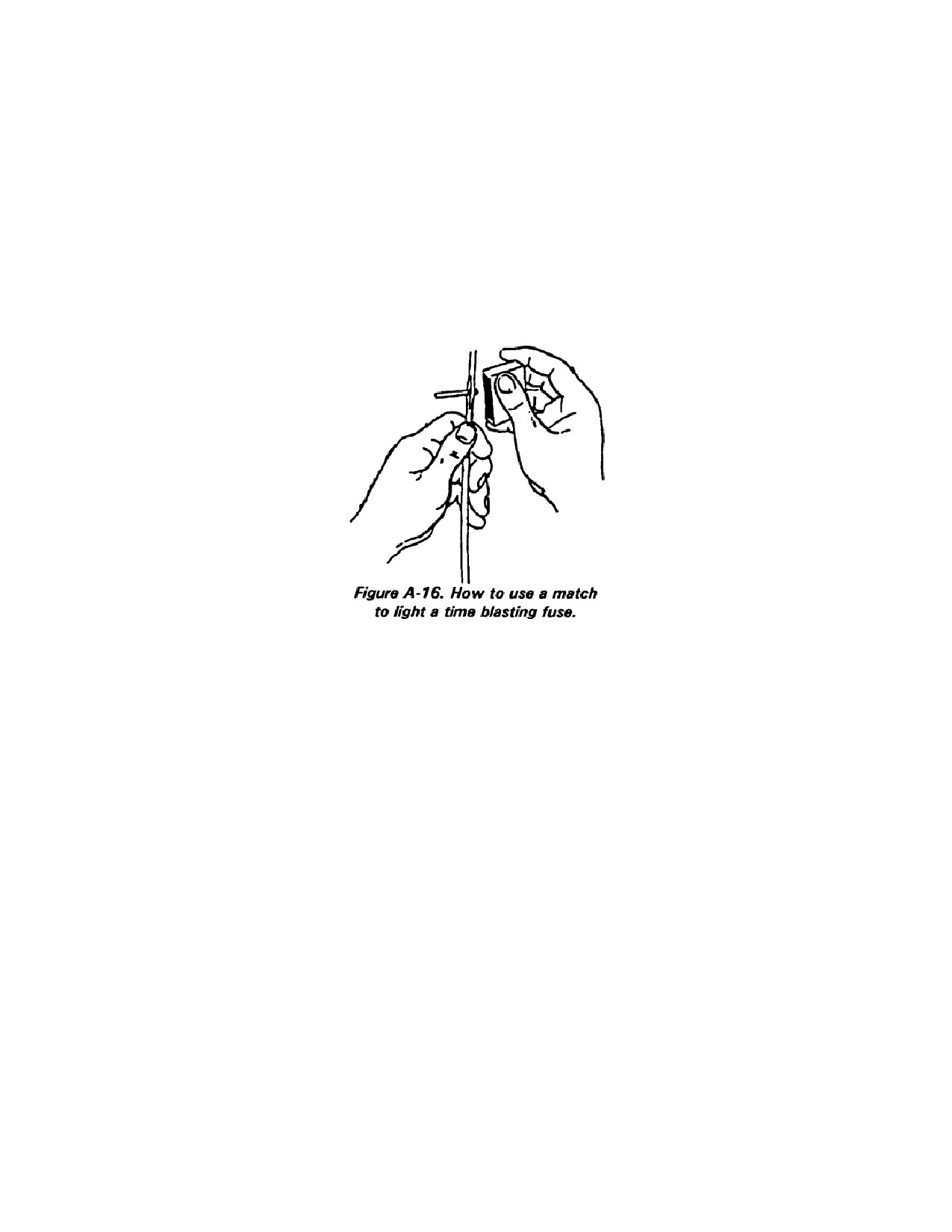
If a fuse igniter is not available, light the time blasting fuse with a match, using the
following procedure: Split the fuse at the end, placing the head of an unlighted match in
the powder train, and then light the inserted match head with a flaming match or by
rubbing the abrasive on the match box against it (Figure A-16).
Detonating Cord
Firing Systems
A detonating cord firing system is one of the most versatile and easily installed of all
firing systems. It contains
· An electric system (an electric blasting cap, initiated by a blasting machine or
other power source).
· A nonelectric system (a nonelectrical blasting cap initiated by a fuse igniter and a
length of time blasting fuse). Use this method to initiate the detonating cord.
· Blasting caps, electric or nonelectric, attached to a point 6 inches from the free
end of the detonating cord by numerous wraps of string, wire, cloth, or tape. The
tip end of the cap must be in contact with the detonating cord.
Splices
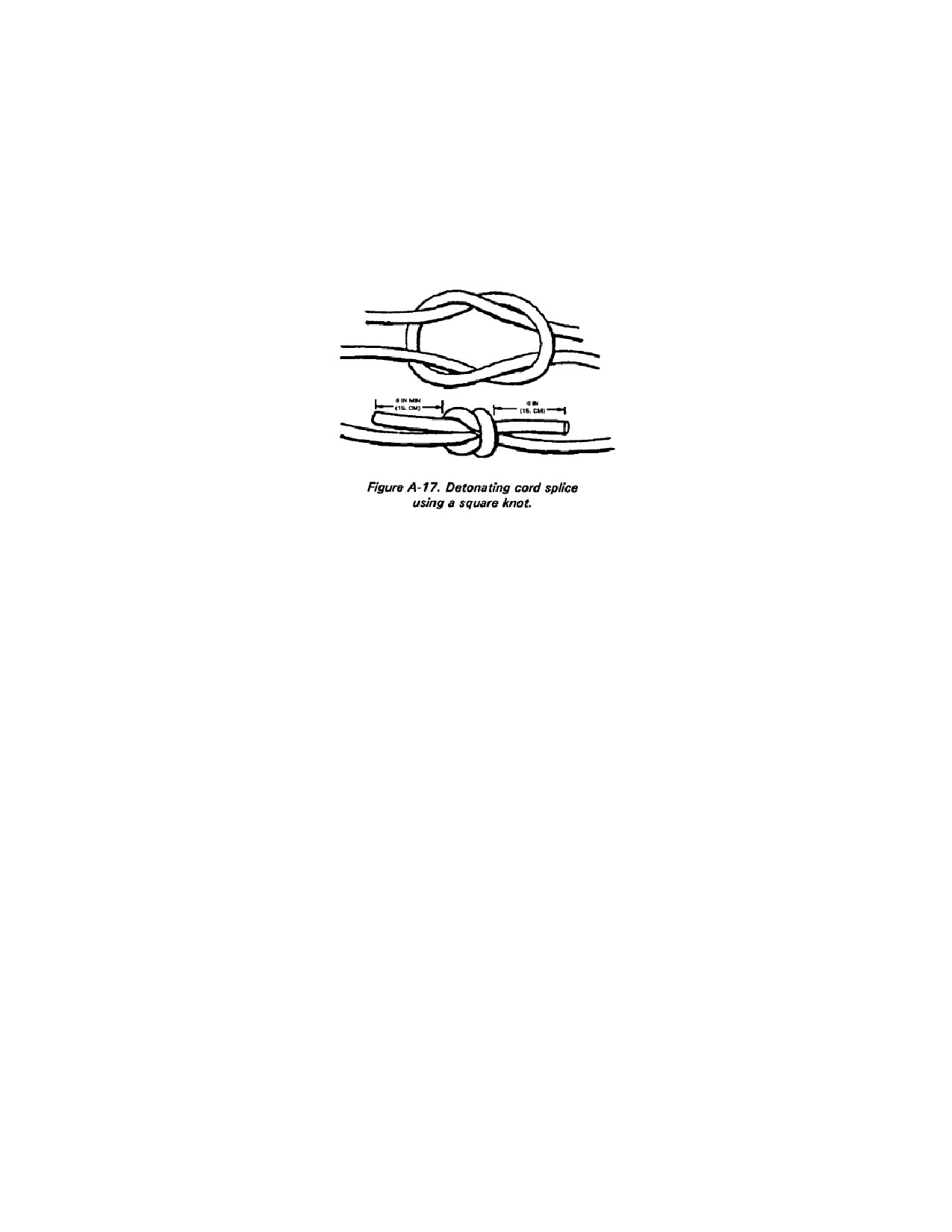
Use a detonating cord clip or a square knot pulled tightly to splice the ends of detonating
cord (Figure A-17). At least a 6-inch length must be left free at both sides of the knot.
Then tape the free ends to prevent them from crossing over the detonating cord and thus
cutting off the detonating wave at that point.
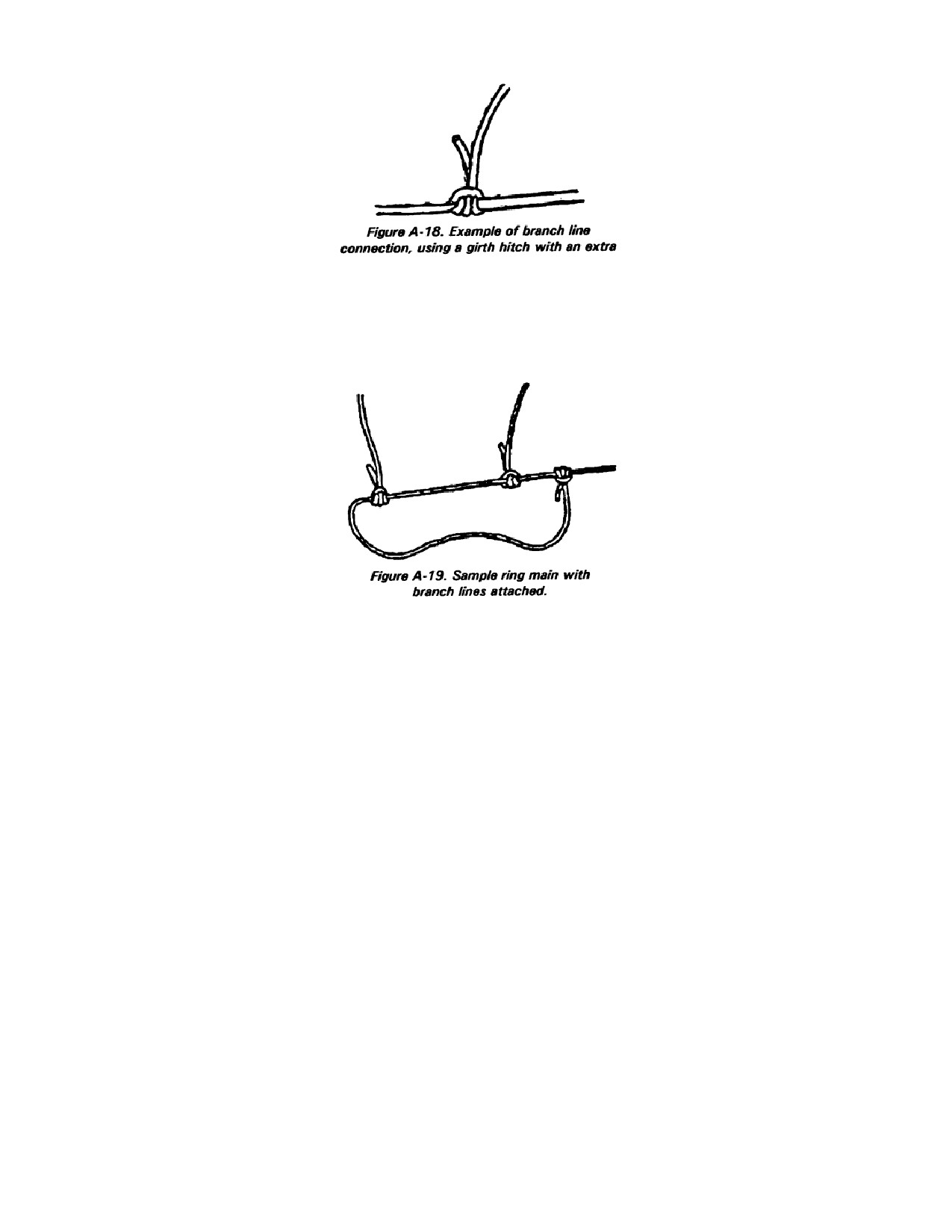
Fasten a branch line to a main line with a clip or a girth hitch with an extra turn (Figure
A-18). The angle formed by the branch line must not be less than 90 degrees from the
direction from which the blast is coming; at a smaller angle, the branch line may be
blown off the main line without being detonated. At least 6 inches of the running end of
the branch line is left free beyond the tie and taped down.
Ring Main
Make a ring main by bringing the main line back in a loop and attaching it to itself with a
girth hitch with an extra turn (Figure A-19). This will detonate an unlimited number of
charges.
The ring main makes the detonation of all charges more likely because the detonating
wave approaches the branch lines from both directions and the charges will detonate even
if there is a break in the ring main. Make branch line connections perpendicular to the
ring main. Avoid kinks in the lines, and curves and angles must not be sharp.
When making detonating cord branch line connections, avoid crossing lines. The cords
may cut themselves and destroy the firing system.
TESTING PROCEDURES
Before priming an explosive charge electrically, carefully check all firing components.
You must accomplish test procedures in the proper sequence. Otherwise, failure of the
system or a premature detonation may occur.
Firing Wire
Use these procedures to test the firing wire of the M51 blasting cap test set and of the
blasting galvanometers.
M51 Blasting Cap Test Set
Step 1. Check test set by connecting a piece of bare wire across the binding posts. The
indicator lamp should flash when you squeeze the handle.
Step 2. Separate firing wire conductors at both ends and connect those at one end to the
test set binding posts. Turn on the test set. Indicator lamp should not flash. If it flashes,
the firing wire has a short circuit.
Step 3. Twist wires together at one end, connect those at the other end to the test set
binding posts. Turn on the test set. Indicator lamp should flash. If it does not flash, the
firing wire has a break.
Blasting Galvanometer
Step 1. Check galvanometers by holding a piece of metal across its terminals. If battery is
good, the neddle will show a wide deflection of approximately 25 units (zero ohms).
Step 2. Separate firing conductors at both ends and touch those at one end to the
galvanometers terminals. The needle should not move. If it moves, the firing wire has a
short circuit.
Step 3. Twist the wires together at one end and touch those at the other end to the
galvanometers terminals. This should cause a wide deflection of the needle-about 6.5
ohms or 23 to 24 units for a 500-foot length. No movement of the needle indicates a
break, and slight movement indicates a point of high resistance that may be caused by a
dirty wire, loose wire connection, or wires with several strands broken off at connections.
Electric
Blasting Cap
Use the following procedures to test the blasting cap of the M51 test set and of the
blasting galvanometers.
M51 Blasting Cap Test Set
Step 1. Check the test set.
Step 2. Use the pointed handle of the M2 crimpers, make a hole in the ground deep
enough to hold the entire blasting cap or have one sandbag handy.
Step 3. Remove electric cap from cardboard tube, wrap lead wires around fingers, and
unwind lead wires from cardboard tube.
Step 4. Place the electric cap either in hole or under sandbag.
Step 5. Remove short circuit shunt from the lead wires of blasting cap.
Step 6. Attach one cap lead wire to one binding post and tie other lead wire to the other
post. Squeeze test set handle. If the indicator lamp flashes, the blasting cap is satisfactory.
If it does not flash, the cap is defective and you should not use it.
Step 7. Reshunt lead wires by twisting them together.
Step 8. Wrap lead wires loosely around cardboard tube and reinstall cap into tube. The
blasting cap has now been tested and is ready for use.
Blasting Galvanometer
Step 1. Check the galvanometers for serviceability.
Step 2. Follow steps 2 through 5 described for the M51 test set.
Step 3. Touch one cap lead wire to one galvanometers post and the other lead wire to the
other post. If the galvanometers needle deflects slightly less than it did when the
instrument was tested, the blasting cap is satisfactory. If not, the cap is defective and you
should not use it.
Step 4. Follow steps 7 and 8 described for the M51 test set.
Series Circuit
Follow these procedures to test series circuits of the M51 test set and the blasting
galvanometers.
M51 Blasting Cap Test Set
Attach blasting caps lead wires to one binding post and tie other lead wire to the other
post. Squeeze the test set handle. Indicator lamp should flash.
Blasting Galvanometer
Touch the free ends of blasting cap lead wires to one galvanometers post and the other
lead wire to the other post. This should cause wide deflection in the galvanometers. If the
galvanometers does not deflect widely, the circuit is defective.
Entire Circuit
Use the following procedure to test the entire circuit:
Step 1. Splice firing wires into a series circuit and move to firing position.
Step 2. When using the M51 blasting cap test set, connect the free ends of the firing wire
to the binding posts. Squeeze the test set handle. Indicator lamp should flash. If the lamp
does not flash, the circuit is defective.
Step 3. If the circuit is defective, shunt the wires. Then go down range and recheck the
circuit. If you find a defective cap, replace it. Continue to test all caps and wires in the
circuit. Then test the entire circuit again to make sure that you have found all defects
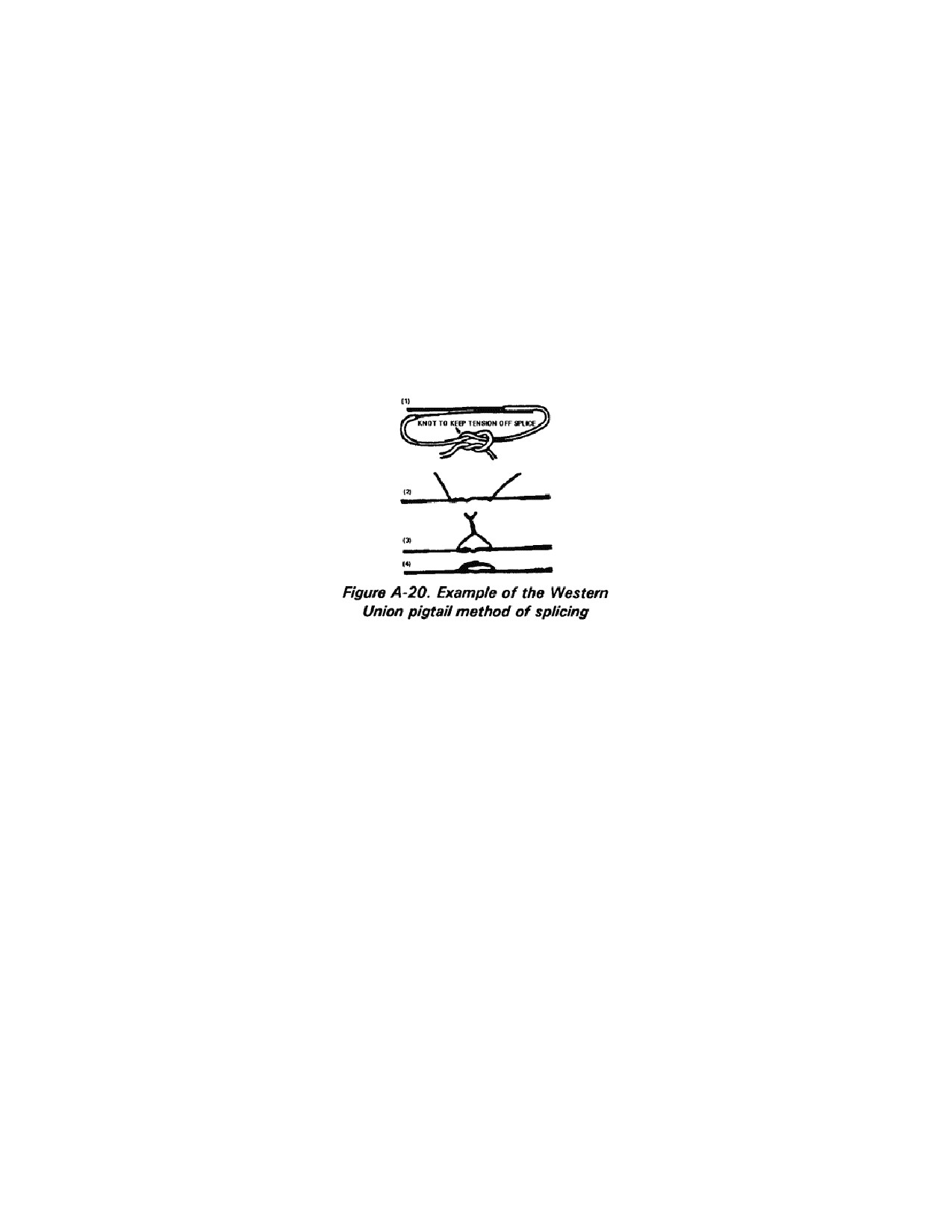
before attempting to fire the charge. If you find a defective splice, resplice the wires
using the Western Union pigtail method (Figure A-20).
Step 4. If you find a defective cap, replace it. Continue to test all caps and wires in the
circuit. Then test the entire circuit again to make sure that you have located all breaks
before attempting to fire the charge.
PRIMING PROCEDURES
You can accomplish the priming of high explosives through several approved techniques.
The guidelines contained in this appendix explain and illustrate these procedures.
TNT
Demolition
Blocks
You can prime TNT demolition blocks either electrically, nonelectrically, or with
detonating cord.
Electric Priming
As before, demolition blocks may or may not have threaded cap wells. If the blocks have
threaded cap wells, use priming adapters if available. Proceed as follows:
Step 1. Untwist free ends of the lead wire and fasten them to the tiring wire.
Step 2. Pass the lead wires through the adapter slot and pull the cap into place in the
adapter.
Step 3. Insert blasting cap into the explosive cap well and screw the adapter into place.
For demolition blocks without cap wells or priming adapters, complete the following
procedures:
Step 1. If the block does not have a cap well, make one in the manner described for
nonelectric firing.
Step 2. Untwist the free ends of the lead wire and fasten them to the firing wire.
Step 3. Insert the electric cap into the cap well and tie the lead wires around the block
with two half hitches or a girth hitch with an extra turn. Allow some slack in the wires
between the blasting cap and tie the wires to prevent any pull on the blasting cap.
Nonelectric Priming
Demolition blocks may or may not have threaded caps wells. Use priming adapters, if
available, to secure the nonelectric blasting caps and the time blasting fuse to the
demolition blocks with threaded caps wells.
If priming adapters are not available but blocks have threaded cap wells, prime them as
follows (three steps):
Step 1. Wrap string or tape tightly around the block and tie it securely leaving about 6
inches loose on each end after making the tie.
Step 2. Insert the blasting cap with fuse attached into the cap well.
Step 3. Tie the loose string or tape around the fuse to prevent blasting cap from being
separated from the block.
If demolition blocks do not have cap wells, follow this four-step procedure:
Step 1. With the pointed handle of the M2 crimpers, make a hole in the end of the block
large enough to contain the blasting cap.
Step 2. Using string, wrap several turns around the explosive and tie any knot (or use
tape). Position the tie so it will beat the top of the hole when the fused cap is inserted.
Step 3. Insert fused cap into the hole.
Step 4. Tie string (or use tape) around the time fuse at the top of the hole, with two half
hitches.
Detonating
Cord Priming
You may prime demolition blocks with detonating cord in several ways. The method that
offers the greatest assurance of detonation is to affix a nonelectric blasting cap to the end
of the detonating cord and place it in the demolition block similar to nonelectric priming
methods. The system is then initiated by a nonelectric or electric assembly.
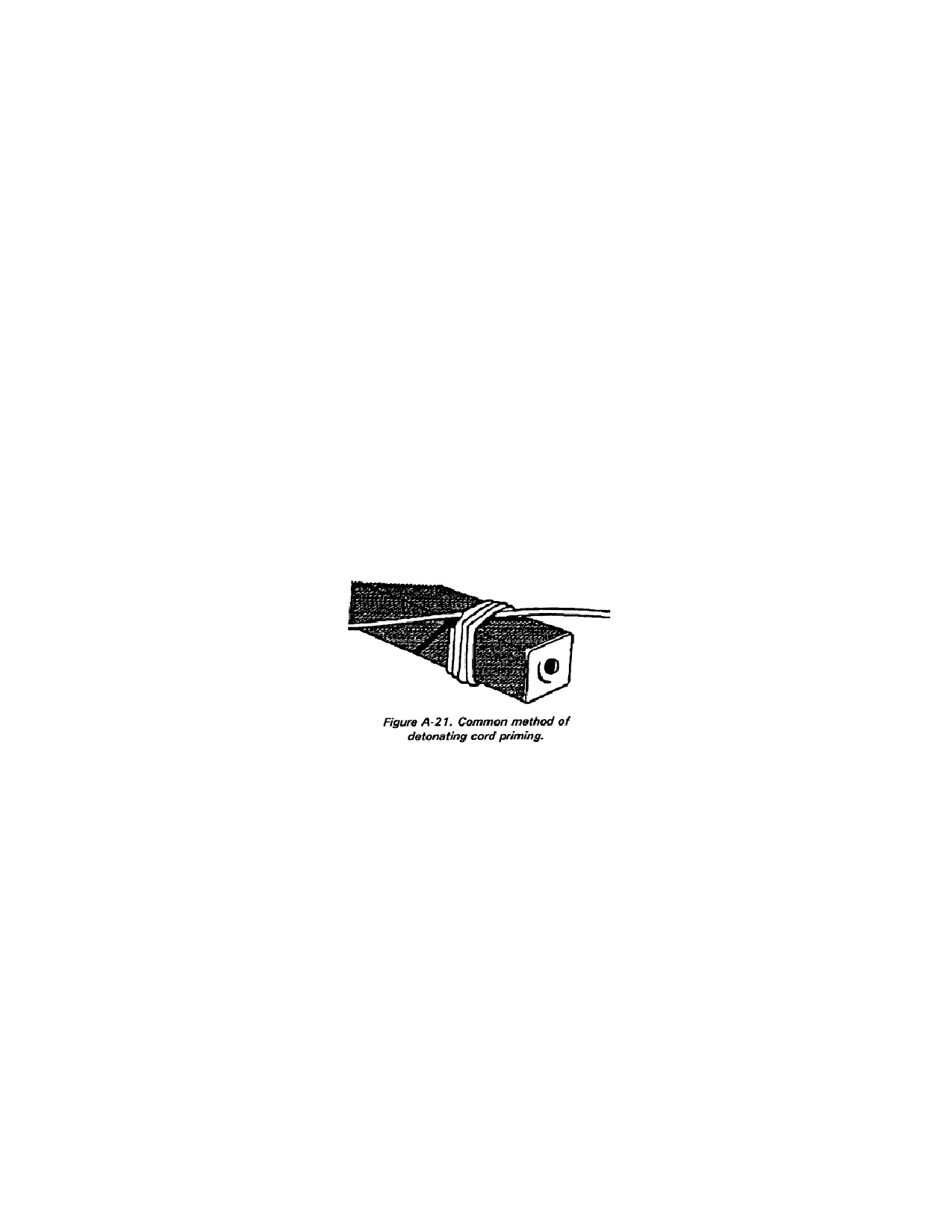
Common Method
To prime detonating cord with the common method, lay one end of a 4-foot length of
detonating cord at an angle across the explosive. Give the running end three wraps
around the block with the ends laying at an angle. On the fourth wrap, slip the running
end under all wraps parallel to the other end and tighten it (Figure A-21). Initiate by an
electric or nonelectric system.
Alternate Method 1
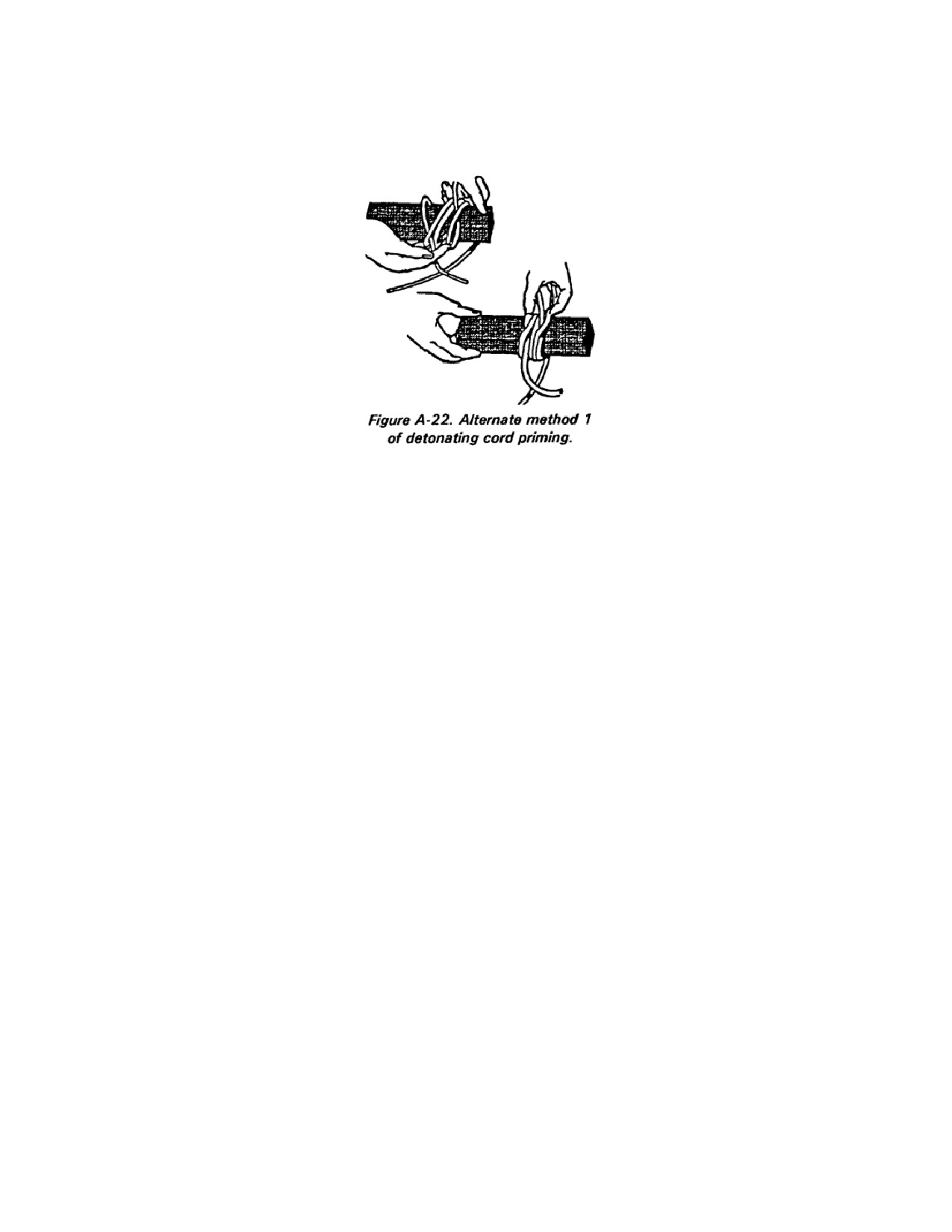
To use the first alternate method, tie the detonating cord around the explosive block (on
top of the booster if present) with a clove hitch with two extra turns. The cord must fit
snugly against the block and the loops must be pushed close together (Figure A-22). Use
an electric or nonelectric firing system taped into the loop made in the detonating cord to
initiate the charge.
Alternate Method 2 (Hasty Whip)
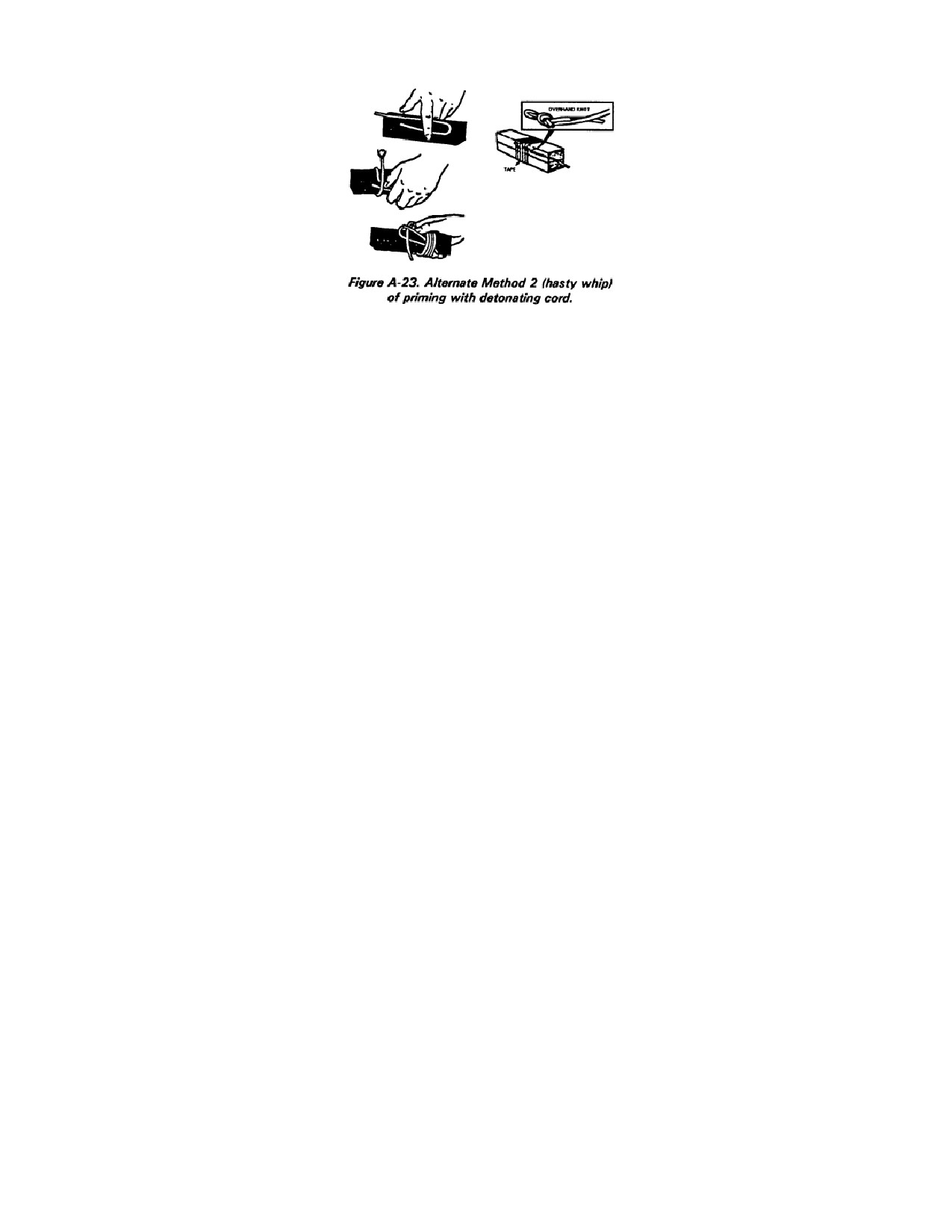
To use the hasty whip method, place a loop of detonating cord on the explosive with four
wraps around the block and loop (Figure A-23). Pull the running end through the eye of
the loop and tighten it. This method is also initiated by an electric or nonelectric system
that is taped into a loop made in the detonating cord.
Composition C4
Demolition Blocks
You can prime composition C4 demolition blocks either electrically, nonelectrically, or
with detonating cord.
Electric and Nonelectric Priming
Whenever whole or portions of C4 blocks are used, prime similarly to demolition blocks
without cap wells. You can cut C4 with a knife and then form it into almost any shape.
Detonating Cord Priming
To prime composition C4 explosive with detonating cord, form the knot. Insert the knot
into the block of explosive. Ensure there is at least a half inch of explosive on all sides of
the knot.
APPENDIX B
Riot Control Agent
Munitions and Delivery Systems
RCA MUNITIONS SYSTEMS
RCA munitions come in various forms such as bombs, spray tanks, artillery shells, mortar
shells, rockets, grenades, and cartridges. The following systems are issuable RCA
munitions currently available in the US Army, Navy, or Air Force inventory. Area
coverages cited in munitions descriptions are areas where concentrations of at least 5-10
mg/m3 occur (ICT 50).
HAND GRENADES
RCA grenades are classified either as burning type or bursting types. They are used
against enemy personnel or material at relatively short ranges. Burning type grenades are
usually fitted with igniting fuses which function with a 1-to-5 second delay. These
grenades are usually thrown by hand or projected by a grenade launcher to the upwind
side of the target. Upon ignition, the filler is ignited and sufficient pressure is created to
uncover the gas ports and allow the RCA to escape. Burning type grenades will cause
fires if employed around flammable material. Bursting type grenades are fused with delay
fuses (1 to 2 seconds) which contain a low explosive detonator. The detonator ruptures
the grenade body and dispenses the filler. These grenade are thrown into the air so that
the burst occurs several feet over the target. Generally in a wind of 5 knots, the burning
type grenade covers an area of about 10 meters wide to a downwind distance of 25
meters. Under the same conditions, the bursting-type grenade can cover an area about 5
meters in width to a downwind distance up to 15 meters.
M7A3
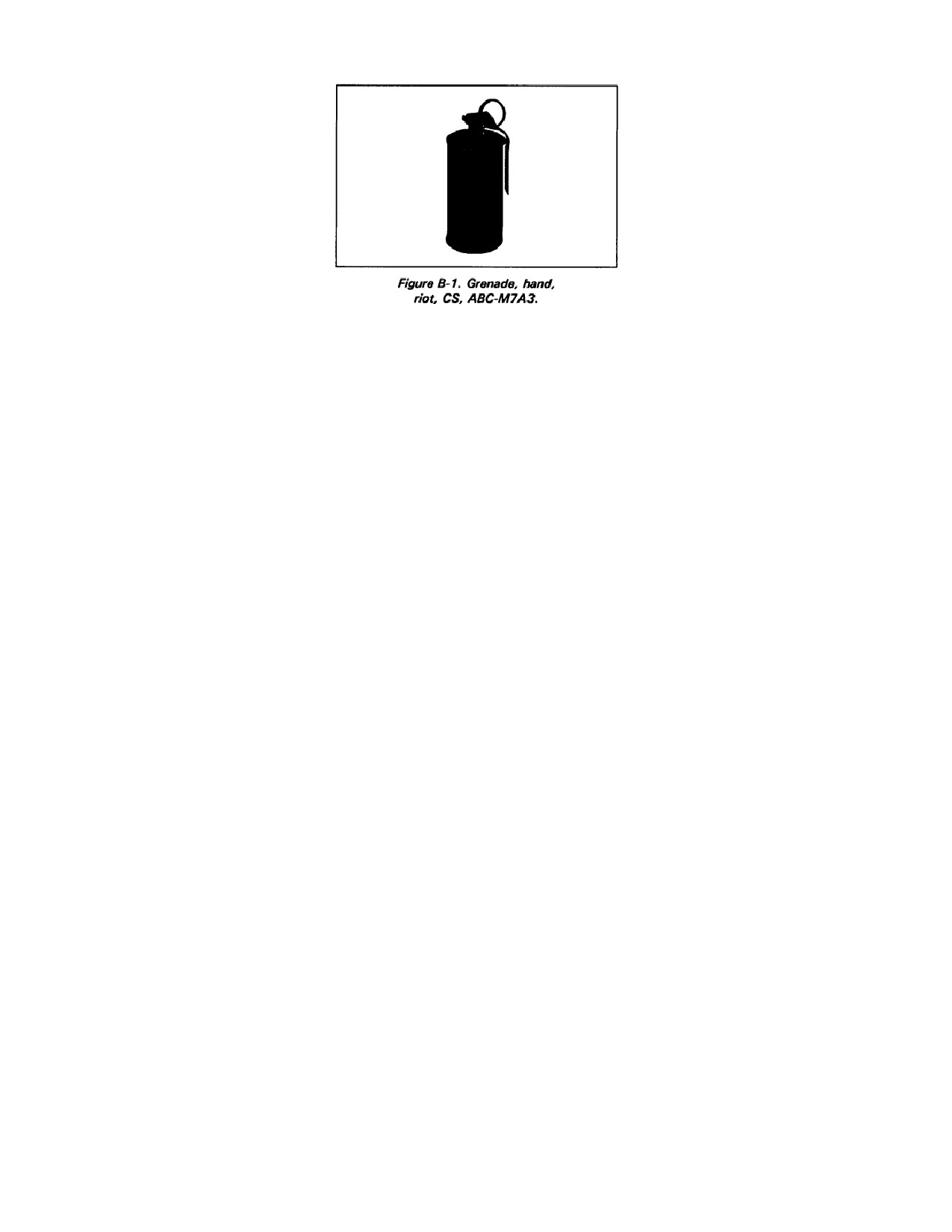
The M7A3 (Figure B-1), NSN 1330-00-965-0802, is a burning type grenade filled with
approximately 270 grams (9.5 ounces) of pyrotechnic CS mix. In that mix there is about
116g (4.1 oz.) of pelletized CS. Housed in a metal cylindrical container, the M7A3 has a
l-to-2 second delay fuse and a 15-to-35-second bum time. The throwing range of this
grenade is about 35 meters. Area coverage: At a windspeed of 4 knots, the M7A3
grenade will produce an effective concentration over about 60m 2 in an elliptical pattern
approximately 18 by 4 meters maximum crosswind width. At higher windspeeds, the
pattern will be longer and narrower.
M47
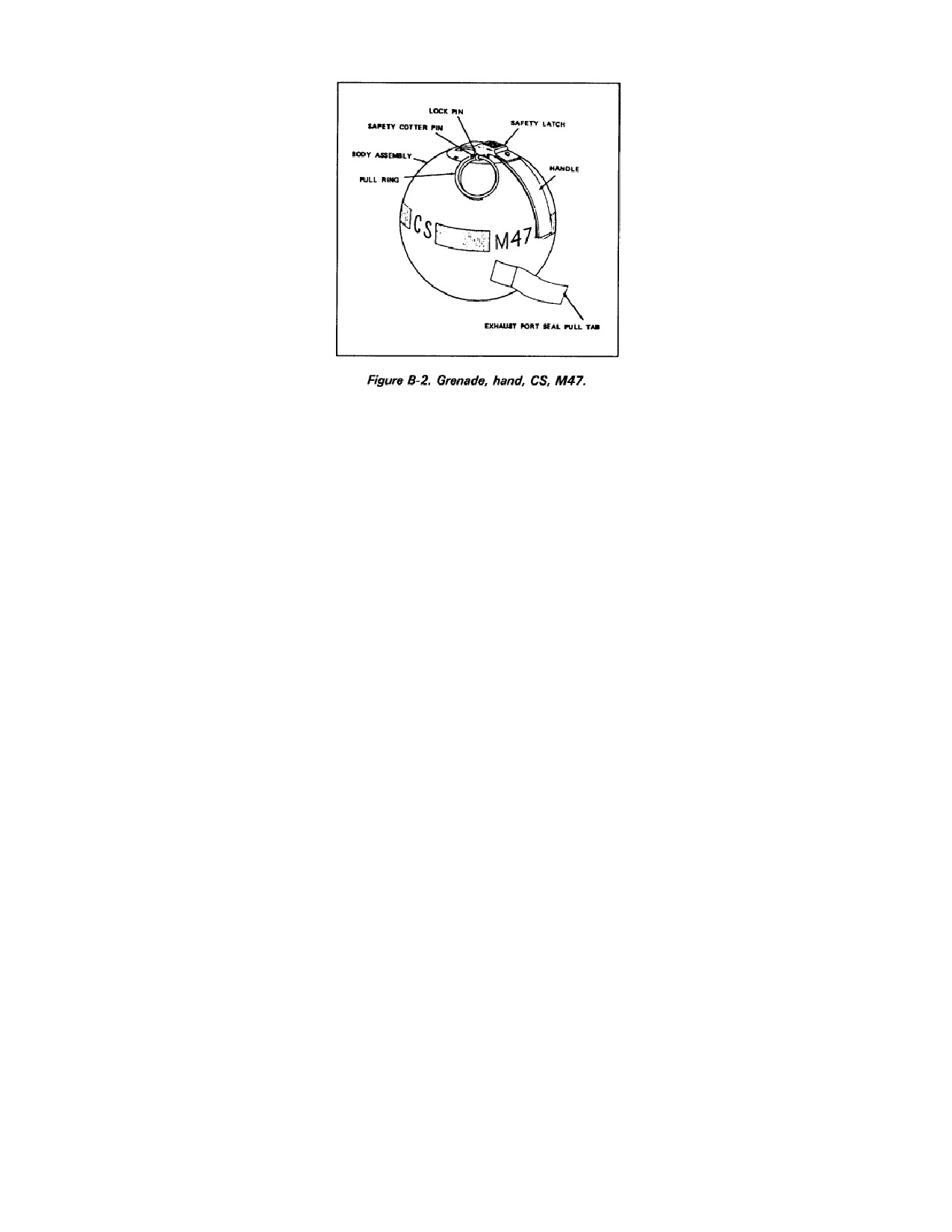
The M47 grenade (Figure B-2), NSN 1330-00-477-6704, is a special purpose, burning-
type munitions used for control of rioters and counter-insurgents. It is filled with a CS
pyrotechnic mix weighing about 410 grams (14.4 ounces) that contains approximately
120 grams of CS. The M47 consists of a rubber body assembly with a fuse delay of about
2 to 3 seconds before ignition. Discharge of the CS results in a random "skittering" of the
grenade. The speed of the discharge through the ports prevents target personnel from
picking up the grenade and throwing it back. The manner in which this grenade explodes
also eliminates fragmentation side effects and minimizes fire hazards. The grenade bums
from 8 to 20 seconds. Hand-throwing range of the grenade is about 35 to 45 meters. Area
coverage: approximately 150 square meters. (Coverage may vary with field conditions
and burn time.)
CONTENTS
RCA Munitions Systems
Hand Grenades
Cartridges
Mortar and Artillery CS Cartridges
Launchers
Dispersers
Field Expedients
M54
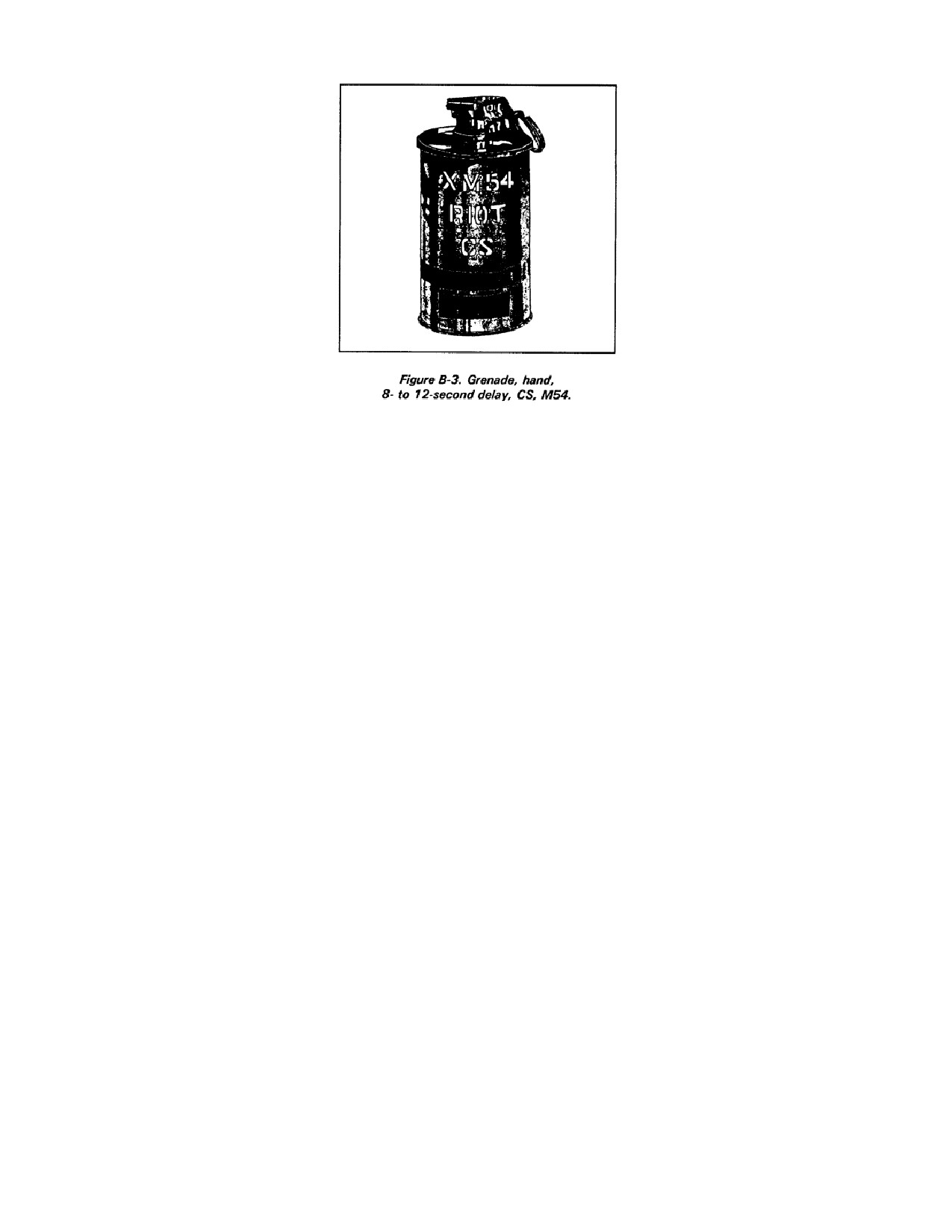
The M54 (Figure B-3) consists of an M7A3 grenade modified to accept an 8-to-12-
second delay fuse. This modification permits hand-drop of the grenades from low
performance aircraft at altitudes up to 1,500 feet, providing additional safety to aircrews.
When dropped from this altitude, it begins to emit a cloud of CS at 50 to 100 feet. Like
the M7A3, the M54 weighs about 1 pound and is filled with 115 g (4.1 ounces) of
pelletized CS in a pyrotechnic mix. It burns for about 15 to 35 seconds. Area coverage:
Same as the M7A3.
CARTRIDGES
The cartridges described below are projectiles filled with RCA that can be launched from
rifle-equipped grenade launchers, and allows deposition of RCAs on targets with
increased accuracy and at ranges beyond grenade throwing distances. Due to the
projectile's high velocity, it will penetrate barriers of wood and glass. Exercise caution
when using these projectiles in training and riot control situations. They can cause serious
injury or death at close range. These cartridges are especially effective when fired into
enclosed areas such as buildings, houses, bunkers, caves.
M651
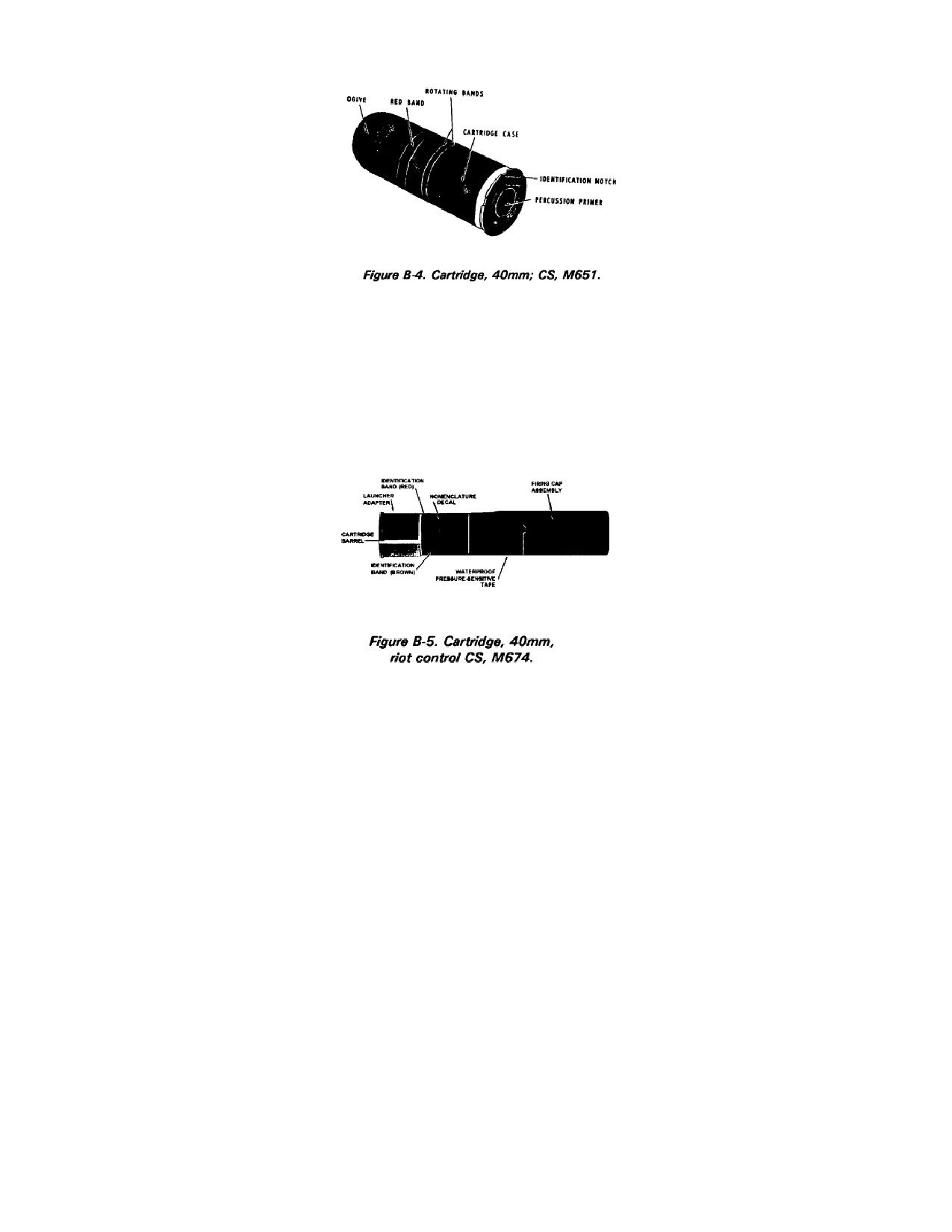
The M651 (Figure B-4), NSN 1310-00-849-2083, is a 40mm, 11.3-cm-long aluminum
cartridge filled with about 53 grams (2 ounces) of CS pyrotechnic mix containing
approximately 21 grams of CS. It is equipped with a point detonating fuse (M581) and
can be fired from the M79 and M203 grenade launchers. Maximum accuracy is obtained
at ranges up to 200 meters. Area targets may be engaged up to 400 meters. This projectile
can penetrate window glass or up to 3/4 inch-thick pine at 200 meters and still release
CS. Following impact, a cloud of CS is emitted for approximately 25 seconds. Area
coverage: approximately 120 square meters. Two cartridges effectively placed will
incapacitate 95 percent of unmasked personnel in an enclosure of 15 by 30 by 20 feet
within 60 seconds after functioning.
M674
The M674 (Figure B-5), NSN 1310-00-935-9229, also known as the Handy Andy is an
aluminum tube that contains a rubber projectile filled with about 90 grams of CS
pyrotechnic mix (about 36-45 grams CS). It can be fired from the M79 grenade launcher,
from the AN-M8 pyrotechnic pistol, or thrown by hand. It has a 2-to-7 second delay
before the CS pyrotechnic mix ignites, and a range of about 70 meters. Unreliable ranges
and lack of precision make the M674 a much less effective munition than the M651. If
the M651 is not available, the M674 can be used on targets similar to those attacked with
the M651. Area coverage: approximately 120 square meters.
MORTAR AND ARTILLERY CS CARTRIDGES
M630
The M630 (Figure B-6) is fired from an M30 4.2-inch mortar and ejects four l-pound CS-
filled pyrotechnic mix canisters either on impact or at a preset altitude of 120 meters
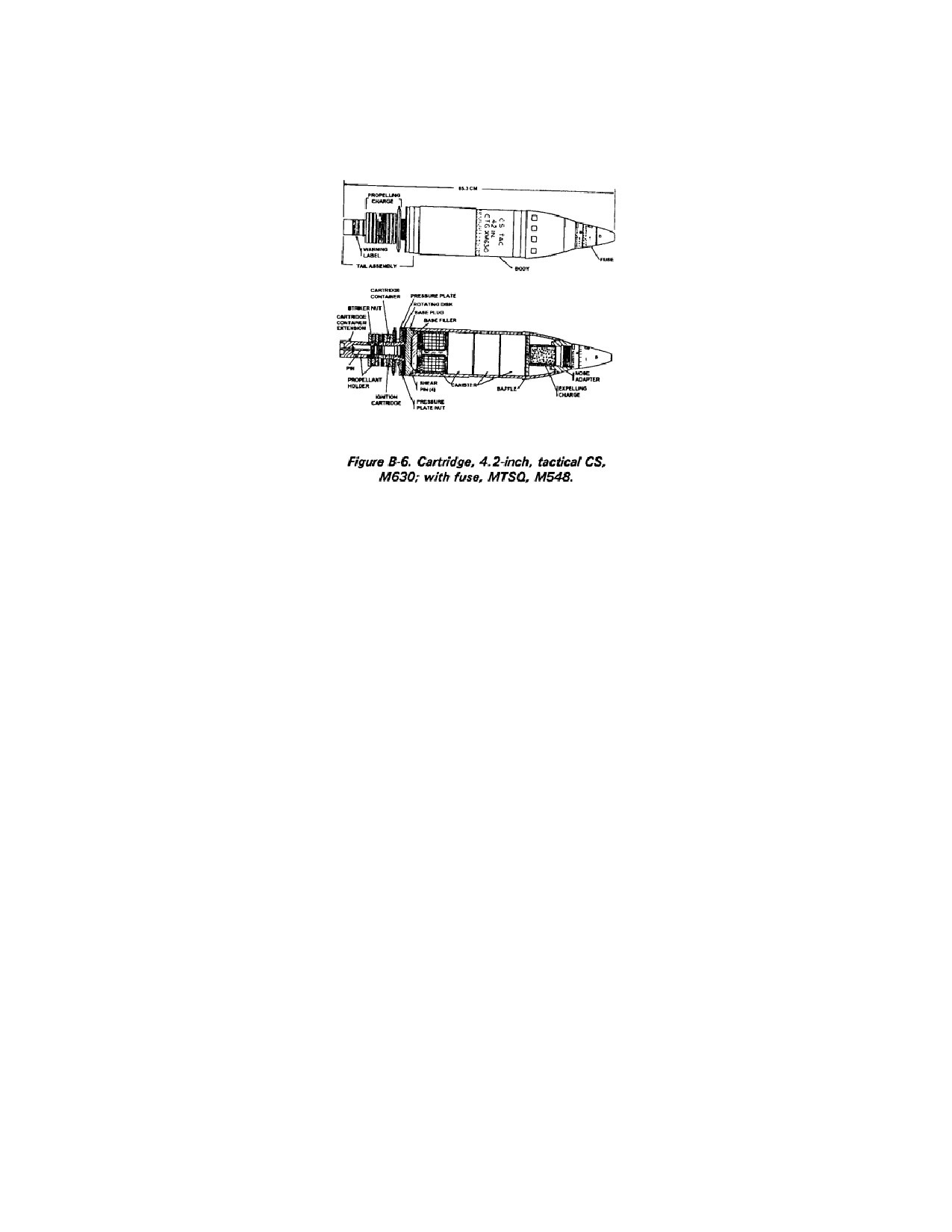
above ground level. A total of 1.6 pounds of CS can be dispersed with this cartridge. The
M630 cartridge consists of the M633 projectile, M2A2 ignition cartridge with an M36A1
propelling charge, and the M548 variable time fuse. The fuse functions at either a preset
time or upon impact to ignite the mix which will burn for about 60 seconds. It has a
maximum range of 5,650 meters.
The M630 is used for direct support of maneuver elements on known or suspected targets
to harass or confuse the enemy so that his ability to fire and maneuver is degraded and his
vulnerability to friendly fires is increased. The M630 will penetrate a triple canopy jungle
and is effective against enemy night attacks. It is also used for counter-battery and
counter-mortar fire. It can be used in both an offensive and defensive role.
M629
The M629 (Figure B-7) is a semi-fixed, base ejecting round designed for use in all
105mm howitzers. The main components of the round are the M632 projectile containing
four M8 pyrotechnic filled canisters (each containing about 375 grams of mix), a
cartridge case, and an M548 variable time fuse. A total of 1.3 pounds of CS is contained
in the cartridge. The fuse functions either at a set time or upon impact to ignite the
expelling charge. The pyrotechnic mix burns for about 60 seconds.