FM 3-11 Flame, Riot Control Agents and Herbicide Operations - page 2
In combat situations, Claymore mine (M18A1) components can be used as the explosive
charge at the drum bottom; it will detonate the expedient device and increase
fragmentation effects. However, some method of ignition, such as an M49 trip flare or
M34 WP grenade, is preferred.
Contact Devices
You may emplace all exploding flame devices for contact detonation as improvised flame
mines. Since a lone soldier usually detonates a contact device, a 5-gallon oil can
containing thickened fuel is sufficient. This weapon is most effective when positioned in
open areas where obstructions will not decrease the fragmentation effect against
personnel.
You will obtain the best results when you use the device in well-camouflaged positions
approximately 2 meters (6 feet) above the ground in branches of trees, bushes, or hedges.
BUNKER BOMBS
Some forms of exploding flame devices lend themselves to a nonelectrical firing system
rather than the electric method. One such device is the "bunker bomb." See Appendix A
for further information on the nonelectrical firing system.
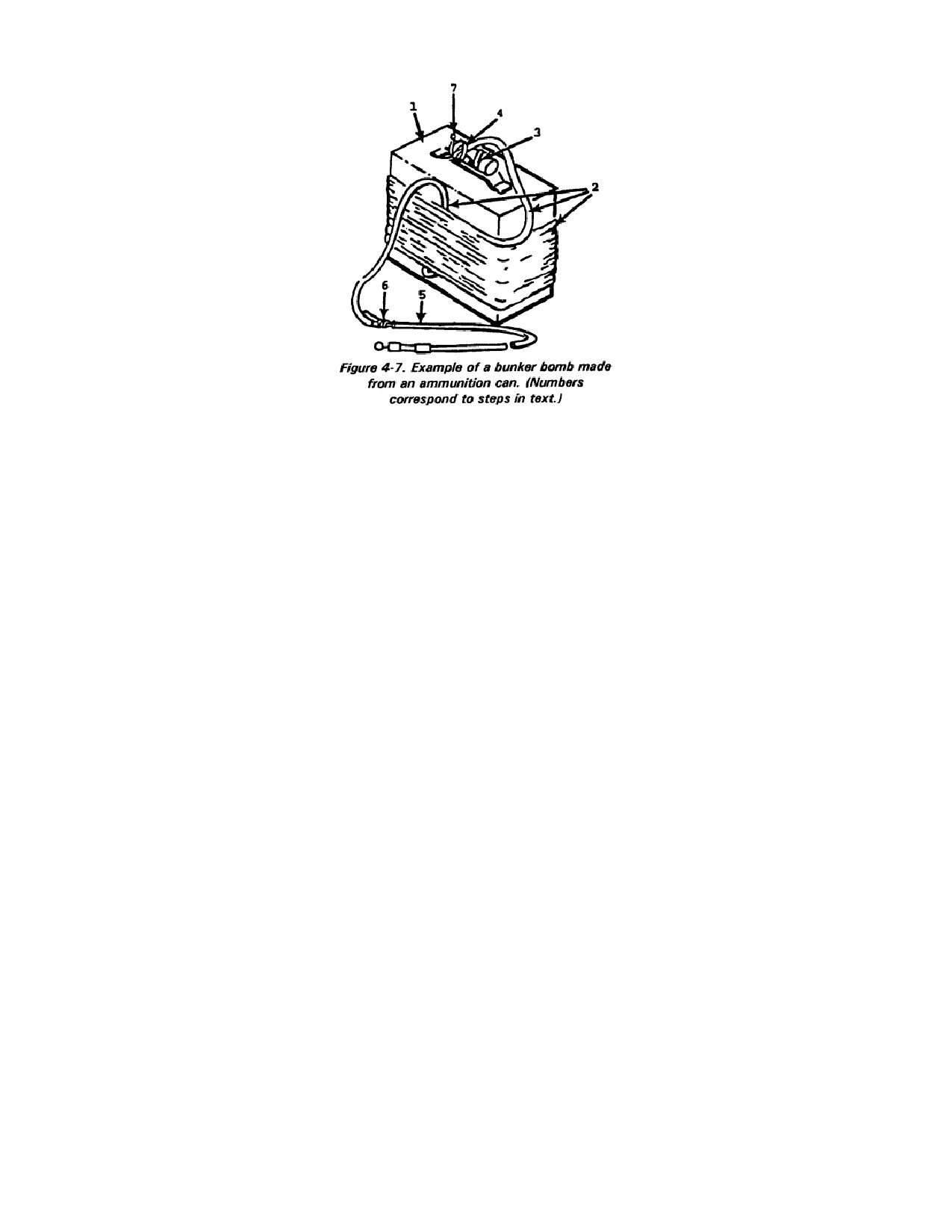
To construct the bunker bomb (Figure 4-7), follow these 7 steps:
Step 1. Fill the ammunition can three-fourths full with thickened flame fuel and secure
the lid.
Step 2. Hasty whip the device with 15 turns of detonating cord around the center of the
container, using 50 feet of detonating cord. Leave 2-foot pigtails for attaching the igniter
and the nonelectrical blasting cap.
Step 3. Tape the igniter (M49 trip flare or (in combat) M34 WP grenade to the container
handle.
Step 4. Place one detonating cord pigtail end over the igniter spoon handle. Tape it in
place.
Step 5. Attach the M60 fuse igniter and the nonelectrical blasting cap to the M700 time
fuse.
Step 6. Attach the nonelectrical firing system to the other pigtail by making a loop in the
detonating cord and attaching the blasting cap to it.
Step 7. Remove the safety pin from the igniter (M49 trip flare or M34 WP grenade (in
combat)). The device is ready to be fired.
WARNING
1. Carry the device only by the handle. Never use the igniter as a handle.
2. Remove the trip flare igniter safety pin only when it is time to use the device.
3. Use extreme caution when handling or carrying nonelectrical firing systems.
Protect blasting caps from shock and extreme heat. Do not allow the time fuse to
kink or become knotted. Doing so may disrupt the powder train and cause a misfire.
4. Prime detonating cord only when it is time to use the device.
5. Remove the time fuse igniter safety pin when it is time to use the device.
One ammunition can flame bunker bomb requires the following eight items:
· Small-arms ammunition container.
· Gallon of gasoline.
· Fifty feet of detonating cord.
· Nonelectric blasting cap.
· M60 fuse igniter.
· Seven and a half feet of M700 time fuse.
· Three ounces of M4 thickening compound.
· M49 trip flare or (in combat) M34 WP grenade.
Area coverage is approximately 5 to 10 meters in diameter. The bunker bomb is designed
as a portable FFE device to be used during mobile defensive operations or raids into
enemy rear areas during deep operations. This device is ideally suited for use in built-up
areas during mobile operations in urban terrain.
CHAPTER 5
Flame Illuminators
The main purpose of flame illuminators is to provide extended burning time with
maximum illumination, although they may also produce casualties. You may use flame
illuminators for warning as well as illumination by contact detonation. This chapter
discusses some improvised flame illumination devices used for limited battlefield
illumination.
Flame illuminators vary and may be constructed of many differing components. FFE
illuminators include 5- or 55-gallon flame illuminators, hasty flame illuminators, water
illuminators, field expedient illuminators, Husch flares, and illuminated signal arrows.
5- OR 55-GALLON FLAME ILLUMINATORS
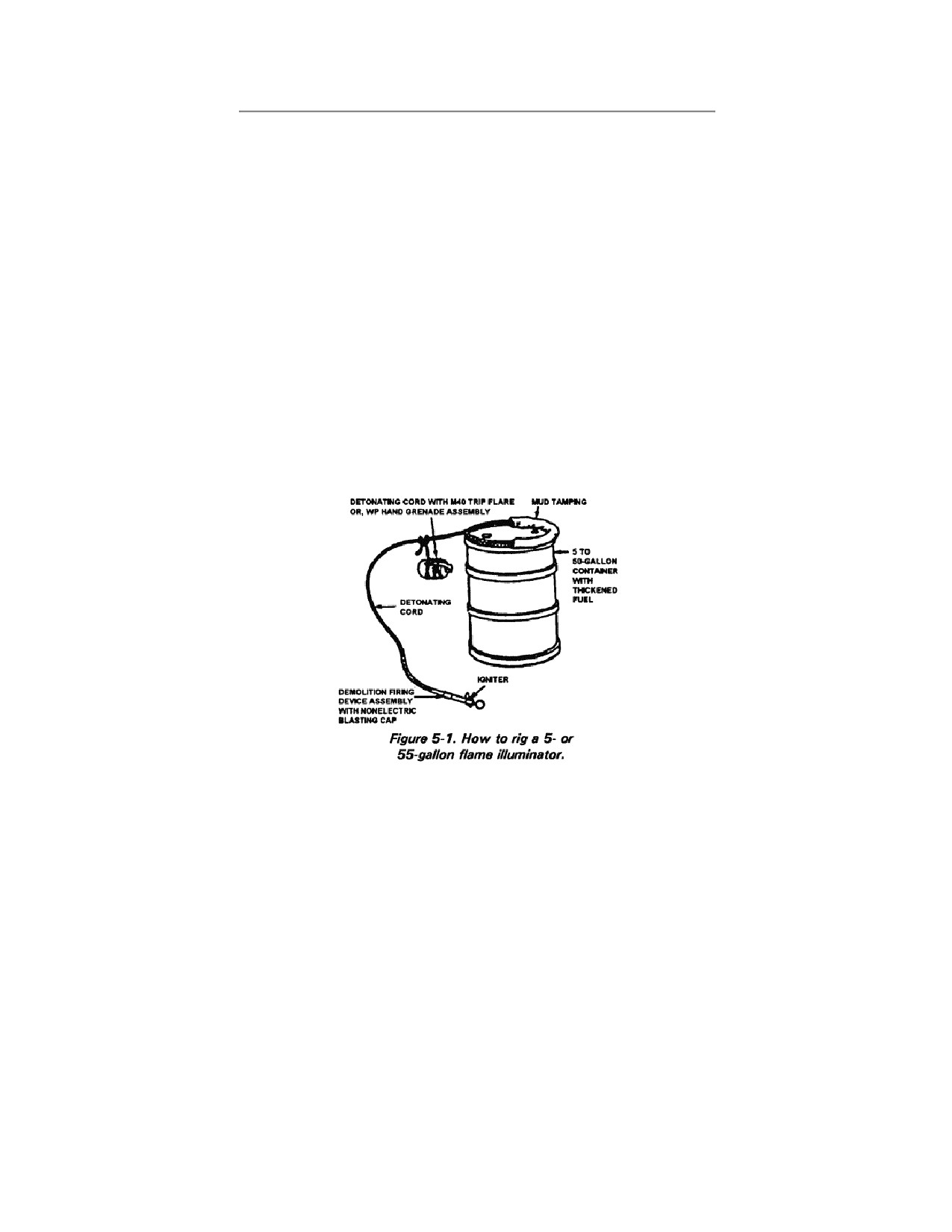
You can construct a flame illuminator (Figure 5-1) from a 5-gallon or a 55-gallon drum
filled with thickened fuel, tightly sealed, and set into a hole with the top slightly below
ground. Five turns of detonating cord are wound around the inside edge of the drum top
and tightly tamped with mud. When detonated, the detonating cord cuts off the drum top
and an M49 trip flare or M34 WP grenade (in combat only) placed on top of the drum,
ignites the thickened fuel.
The fuel will burn for several hours. However, you may control burning time somewhat
by the size of container used, the thickness of the fuel mixture, and the addition of straw
or dirt to the thickened fuel.
Each 55-gallon flame illuminator requires the following ammunition:
·
100 foot of detonating cord.
·
Nonelectric blasting cap.
·
Seven and a half feet of M700 time fuse.
·
M60 fuse igniter.
· Electric blasting cap.
·
150 ounces M4 thickening compound.
·
M49 trip flare.
·
M34 WP grenade (in combat).
·
50 gallons of gasoline
CONTENTS
5- or 55-Gallon Flame Illuminator
Hasty Flame Illuminators
Water Illuminators
Field Expedient Illuminators
Husch Flares
Illuminated Signal Arrows
HASTY FLAME ILLUMINATORS
Construct hasty flame illuminators (fired within 24 hours after emplacement) by digging
shallow holes or trenches in selected avenues of approach, filling with thickened fuel, and
adding an igniter system. Can be ignited with electric blasting caps.
Ammunition requirements depend on the number of holes or trenches dug. Each device
requires the following ammunition:
· Five feet of detonating cord.
· Nonelectric blasting cap.
· Seven and a half feet of M700 time fuse.
· M60 fuse igniter.
· Electric blasting cap.
· M49 trip flare.
· M34 WP grenade (in combat).
· Gasoline as required.
WATER ILLUMINATORS
Water illuminators are devices made by pouring gasoline, oil, or thickened fuel on the
surface of calm water and igniting it. This hasty illuminator not only provides
illumination but can be a formidable obstacle as well. Water illuminators should be used
in combat only and not in training.
FIELD EXPEDIENT ILLUMINATORS
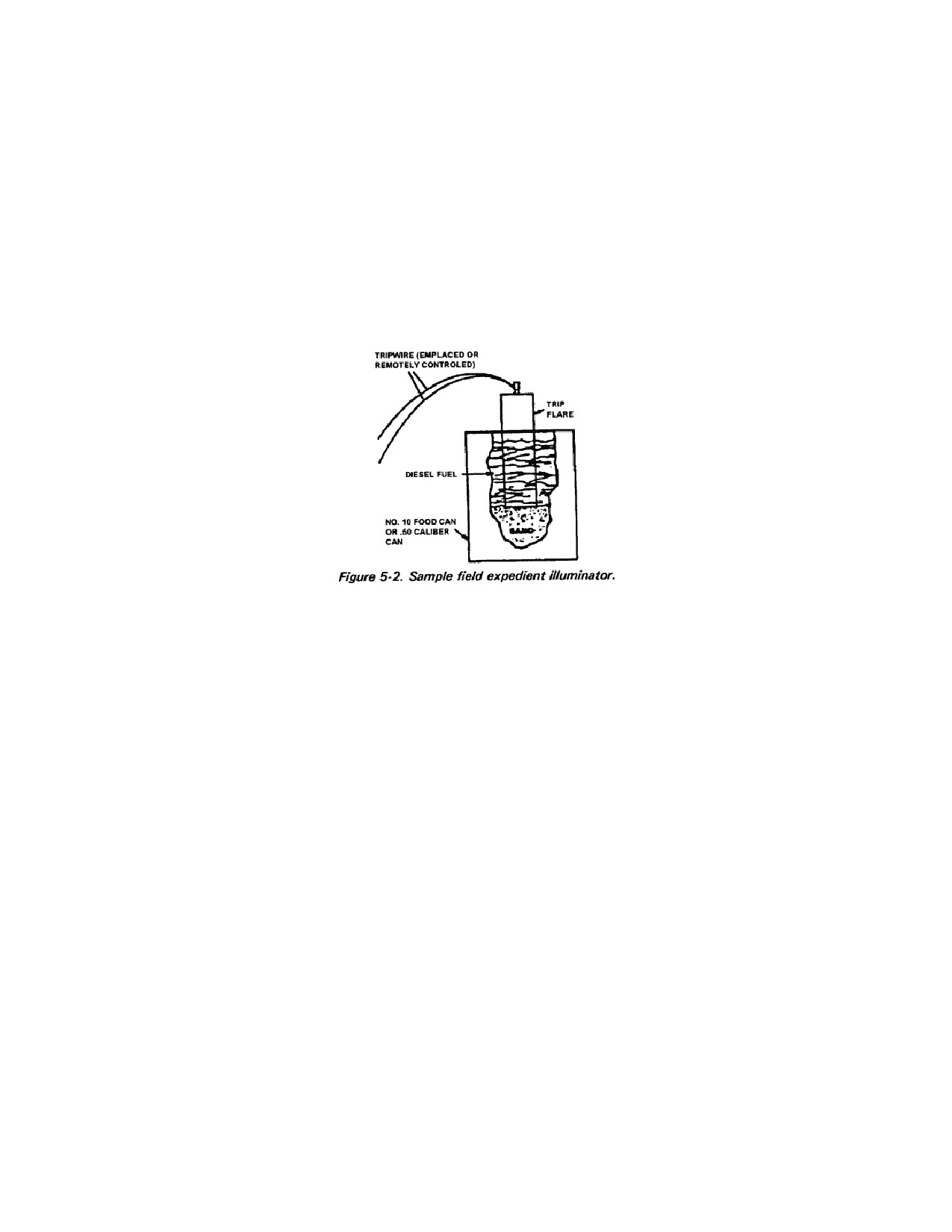
Use field expedient illuminators for defensive perimeters. Construct these devices using
number 10 food cans, empty .50-caliber ammunition cans, or similar containers (Figure
5-2).
Construct field expedient illuminators by filling the container halfway with sand, then
filling the remaining with diesel fuel, and covering with paper. A trip flare is used to
ignite the fuel. Each container should be strategically placed (with trip wires or wires for
command-controlled detonation) at 50-meter intervals within the forward edge of a
defensive perimeter.
On activation, these devices provide illumination for about 45 minutes.
HUSCH FLARES
The Husch flare (Figure 5-3) uses burning vapor of thickened flame fuel to provide
battlefield illumination.
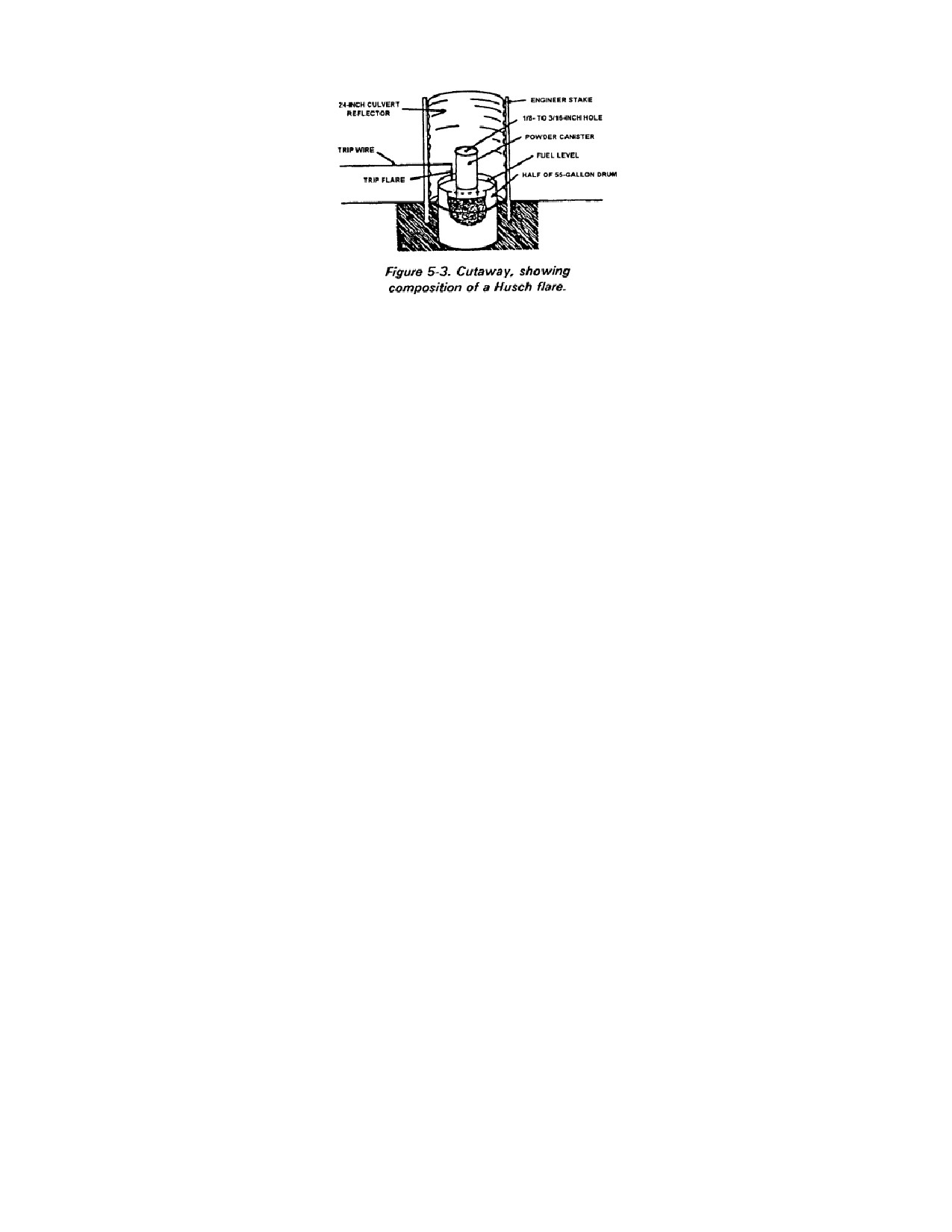
Each Husch flare is constructed from a sealed metal container (powder canister) that is
three-quarters full of thickened fuel and has a 1/8- to 3/16-inch hole in the top. Place the
canister cap down in half of a 55-gallon drum that is three-quarters full of thickened fuel.
A reflector assembly made from 24-inch culvert should extent about 24 inches above the
top rim of the drum half. Husch flares can also be constructed with other similar
components.
When you ignite the fuel in the drum half, heat from the burning fuel produces vapors
within the canister. This vapor is expelled as a burning jet through the hole in the powder
canister. Fuel in the drum half can be ignited with a trip flare.
The Husch flare, which is reusable, illuminates an area with a radius of about 50 meters
for four to five hours. You can control burning time to some extent by the size of the
container, the thickness of the fuel mixture, and the addition of straw or dirt.
ILLUMINATED SIGNAL ARROWS
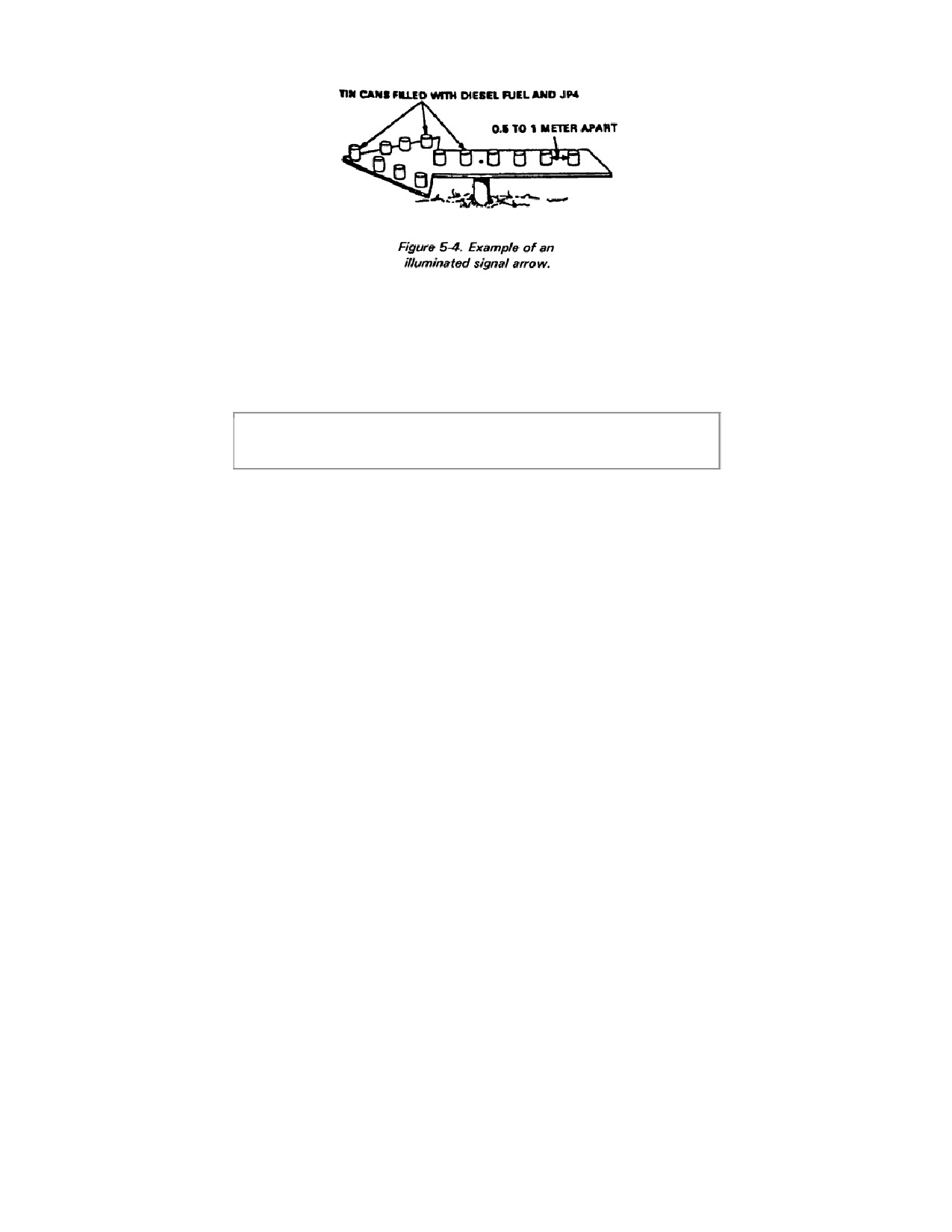
An illuminated signal arrow (Figure 5-4) consists of a series of empty tin cans filled with
an equal mixture of diesel fuel and JP4 (or equivalent) fuel. The number of cans on the
stem of the arrow indicates the number of meters or increments to the enemy location (for
example, each can may represent 100 meters).
When a unit is under attack, you must rapidly point the illuminated signal arrow in the
direction of the attack and ignite the fuel in the cans. The arrow can be clearly seen by
pilots of close air support aircraft. You may also use the signal arrow to mark landing
zones and supply drop zones.
As the situation permits, you may arrange cans on an arrow-shaped board mounted on a
spindle (Figure 5-4).
NOTE:
Distances per can should be stipulated in the unit SOP, SOI, or other guidance.
CHAPTER 6
Riot Control Agents
Riot control agents disable hostile forces or rioting personnel for limited periods of time
by producing temporary disabling physiological effects when they come into contact with
the eyes or skin or when they are inhaled. Their effects are typically peripheral, such as
irritation to the eyes, mucosa, respiratory tract, or skin. The effects generally subside
quickly once the individual is removed from the atmosphere of the RCA. On the other
hand, incapacitating concentrations can act systemically, have longer lasting, more
profound physiological effects such as immobilization of limbs, systemic interference of
breathing, disruption of cognitive function or any of several other centrally controlled
effects. The physiological effects may continue after personnel leave the target area. RCA
levels at 5-10 milligrams per cubic meter (mg/m3) achieve incapacitating concentrations.
Training concentrations (1-3 mg/m3) for CS are irritating concentrations normally found
in chamber or field training exercise settings. In tactical concentrations, RCAs do not
permanently injure personnel but should be used like incapacitating agents. In enclosed
places, prolonged exposure to the resulting high dosages of RCAs can kill or disable
personnel and can cause serious physiological reactions. Detailed descriptions of RCA
munitions systems can be found in Appendix B.
STANDARD AGENTS
The standard RCAs currently in the US Army inventory are CS, CSX, CS1, CS2, and
CR. The physiological effects desired and the dissemination means available determine
the choice of RCA to use in a particular situation. Individuals having respiratory
problems (such as colds, asthma, lung congestion, or heart conditions) may experience
increased irritation and incapacitation upon exposure to these agents. Agent CN
(popularly known as mace or tear gas) and its analog are considered obsolete for military
employment; most CN munitions have been phased out of the system.
CS
In 1959, the US Army adopted CS (orthochlorobenzalmalononitrile) for combat training
and riot control purposes. The Army has found it to be both safe and effective, especially
for training and creating combat realism in low concentrations. Only CS in a capsule
form may be used in the CS chamber. In Vietnam, CS was an effective incapacitant while
its variable persistency made it an economical contaminant. Different forms of CS have
different persistence characteristics, due to their formulation, dissemination, and rate of
hydrolysis. CS is normally used either as a pure powder in bulk form or as pellets in a
pyrotechnic mixture for employment in burning grenades and bomblets. A yellowish
powdered solid in pure form, CS has a characteristic pungent pepper-like odor. Employed
in aerosol form, CS irritates the eyes, nose, throat, and (if used in sufficiently high
concentration) will cause militarily significant incapacitation. By weight, the
effectiveness of CS is about 10 times that of CN. The symptoms of exposure to training
concentrations of CS are--
· Extreme burning of the eyes, with much tearing, coughing, and difficulty in
breathing with tightness in the chest and pain in breathing.
· Involuntary closing of the eyes.
· Heavy mucous formation in the nose with sinus and nasal drip.
· Stinging or burning on moist skin areas.
CONTENTS
Standard Agents
Oleoresin Capsicum
Protection Against RCAs
Physiological and Safety Considerations
Treatment
Operational Considerations
Exposure to field concentrations may cause nausea and vomiting and prolonged exposure
to CS on skin may cause severe irritation and blistering. Incapacitation is caused by the
individual's inability to see or preoccupation with the agent's effects. Effects of the agent
appear almost immediately and will continue as long as the individual is exposed.
Affected individuals usually recover within 10 minutes in fresh air. CS has been specially
formulated for varied dissemination characteristics and/or effects as CSX, CS1, and CS2.
CSX is a form of CS developed for dissemination as a liquid rather than a powder. One
gram of powdered CS is dissolved in 99 grams of solvent trioctyl phosphate (TOF) and is
dispersed as a liquid aerosol from the M32 hand-held disperser (see Appendix B). As
with CS, CSX causes stinging and irritation of the eyes, skin, nose, throat, and lungs of
exposed personnel. It is only available in M32 hand-held dispersers.
Variations in the formulation of CS result in different persistencies for CS, CS1, and
CS2. CS originating from burning munitions is disseminated only as an airborne cloud
and its persistence depends mainly on air movement. The aerosol particles, once
contacting the ground or other surfaces, adhere and do not re-aerosolize. Due to the
relatively low volatility and rapid rate of hydrolysis, the CS aerosol usually presents a
negligible residual hazard. However, a certain amount of caution must be exercised, since
pockets of the airborne agent may linger in closed structures or other places where
movement of air is slight.
CS1
CS1 has been specially formulated to prolong persistency and increase effectiveness.
Unlike CS, CS1 is free-flowing agent powder (95 percent CS to 5 percent silica aerogel),
that is readily usable in disseminating devices (for example, spray tanks) that require a
free-flowing material. CS1 is CS blended with silicone-treated silica aerogel which not
only prevents coagulation and increases fluidity, but also markedly increases its
resistance to water. This form of CS prolongs the effectiveness for both immediate and
surface contamination effects for direct and residual use. As CS1 settles out of the air, it
readily contaminates terrain, vegetation, personnel, and equipment. When disturbed, CS1
re-aerosolizes to cause respiratory and eye effects.
CS1 exhibits typical CS activity for several days on dry ground at initial incapacitating
concentrations (5-10 mg/m3). Persistency tests have shown that CS1 can remain effective
for about 14 days when used inside a dry tunnel or bunker and about 7 days on open
terrain under ideal environmental conditions.
CS2
CS2 is far more resistant to water degradation, maintaining an effectiveness for a period
approximately double that of an equivalent initial concentration of CS1. It is so resistant
to wetting that when spread upon the surface of a body of water, agitation of the surface
by wind or wading may regenerate an effective aerosol. CS2 will remain effective on
open terrain under suitable conditions for about 30 days. Although rain does not
effectively dissolve the agent, it may physically wash away from the site of deposit. High
winds will dissipate it.
CR
In 1974, the US Army approved the use of CR (dibenz (b, f-1, 4-oxazepine) in riot
control situations. CR has a stronger harassing action than CS. In addition, the toxicity of
CR is lower than that of CS. CR is not used in its pure form (a yellow powder) but is
dissolved in a solution of 80 percent propylene glycol and 20 percent water to forma 0.1
percent CR solution. As a solution, the operational flexibility of CR increases since it can
be dispersed on the target areas as a liquid rather than as an aerosol cloud. CR is a highly
potent irritant that affects the eyes, respiratory tract, and exposed skin. Eye pain,
discomfort, and excessive tearing occur with sometimes painful sensitivity to strong light.
Nasal irritation, coughing, sneezing, and nasal drip also occur. Exposure of the skin to
CR results in a stinging or burning sensation with increased irritation on moist skin.
Sometimes these symptoms are accompanied by nausea and vomiting, and can persist
from 15 to 30 minutes. Severity of symptoms increases with the CR solution
concentration in an environment of high temperature and humidity.
CR is quite persistent in the environment. The CR solution provides effective wetting and
spreading of this agent on all surfaces. It does not degrade in water and can be considered
as persistent or more persistent than CS2. Under suitable conditions, CR can persist on
certain surfaces (especially porous material) for up to 60 days.
OLEORESIN CAPSICUM
A possible nonstandard riot control agent is oleoresin capsicum (OC or pepper spray).
This agent is most often used by the military police for incapacitating violent or
threatening subjects, but also has applications for special forces and stability and support
operations. OC is a naturally occurring substance found in the oily resin of cayenne and
other varieties of peppers (can also be produced synthetically).
Contact with OC particles in a sprayed mist incapacitates subjects by inducing an almost
immediate burning sensation of the skin and burning, tearing, and swelling of the eyes.
When inhaled, the respiratory tract becomes inflamed causing the mucous membranes to
swell. This restricts breathing to short, shallow breaths.
As stated earlier, standard RCAs also cause tearing and respiratory discomfort (irritant
effects), but do not induce the inflammation and swelling effects of OC. When sprayed
(OC is dispersed in hand-held canister similar to M32/36) most people cannot keep their
eyes open unless they physically hold their eyelids apart due to the swelling. Fear and
disorientation often result from this temporary blindness. Affected personnel may also
lose strength and coordination due to the shortness of breath.
Treatment and decontamination procedures:
· Move to uncontaminated air.
· Flush face with cool water; if burning persists, use icepack.
· Do not rub area.
· Remove contacts, if applicable.
· Decon required areas with soap and water.
OC effects usually last approximately 15 to 45 minutes. If symptoms have not abated
within 45 minutes, seek medical attention.
Limits of OC include:
· Alcohol-based sprays must not be used around flames/sparks.
· Effective range of OC is 4 to 6 feet (maximum range is approximately 25 feet).
· Personnel should not spray an individual closer than 2 feet from themselves to
prevent being affected.
· Rain and wind decrease effectiveness.
· Eyeglasses/sunglasses may deflect agent (shift aim to nose/mouth).
· Perspiration may cause longer agent effects.
· OC may have detrimental effects on people with pre-existing respiratory
problems.
As with any RCA, personnel must be properly trained on OC's capabilities/employment,
limitations, and applicable rules of engagement/ARs prior to use.
PROTECTION AGAINST RCAs
Use the following measures to protect against RCAs. Protect the eyes and respiratory
passages from CS by immediate masking. A dry field uniform will usually provide
adequate protection for a short time in most tactical situations. Those personnel handling
and loading bulk CS should wear protective clothing, masks, and gloves. Personnel
exposed to CS1, CS2, and CR should wear protective clothing, masks, hoods, and gloves.
Protective clothing should be secured at the neck, wrists, and ankles.
PHYSIOLOGICAL AND SAFETY CONSIDERATIONS
RCAs produce effects that must be considered for both tactical and training uses. The
RCAs in training concentrations will produce temporary, irritating effects to normal,
healthy individuals. These personnel will recover from the exposure quite rapidly.
However, individuals with a common cold, asthma, lung congestion, high blood pressure,
or cardiovascular problems will experience increased effects and may suffer longer
recovery times. Therefore, they should not be exposed to these agents during training
exercises. Pregnant soldiers with an exempt letter from a doctor should also be exempt
from training with RCAs.
Particles of CS remaining on exposed skin for long periods can cause severe burns. CS
should be immediately flushed from the skin with cold water.
Prolonged, continuous, or even intermittent exposure to field concentrations of CS
combined with a high temperature and humidity may result in a cumulative effect (more
intense stinging, tearing, watering of the eyes).
Food and drink contaminated with CS can be detected easily since it is quite repulsive to
the taste. When food items are suspected to have been contaminated by CS in training,
check them using the following procedures: (Do not use these procedures in combat
when chemical or biological agents may also be present.)
· If packaged, clean the package and check for leaks or damage. If no odor is
present, the food is probably not contaminated. If the package is damaged or
leaking, unpack the contents and inspect them.
· If unpacked, sniff to detect RCA odor. If none the food may be safe to eat.
However, when in doubt, discard the package. If the food is contaminated, you
may be able to trim the food and remove the contaminated portions. The same
procedures apply to food immersed in water or in covered containers. CR should
be stored in nonporous containers on nonporous surfaces. It will leach into porous
material and can be extremely persistent.
TREATMENT
Personnel exposed to RCAs should administer self aid/first aid and decontaminate as
soon as possible. When exposed to CS, CS1, or CS2, personnel should administer self
aid/first aid and decontaminate as follows: Upon exposure to these agents, don the
protective mask, clear it, and try to keep the eyes open as much as possible. With or
without the availability of a protective mask, move out of the contaminated area into
fresh air and face the wind. When in a safe area, remove the mask and blot away tears; do
not rub the eyes. If CS has entered the eyes, force them open and flush with water.
Contact lenses are not approved for wear during training with CS. Minute particles can be
trapped in the fluid between lens and eye, causing intense prolonged effects.
Chest discomfort can usually be relieved merely by talking. If exposure has been heavy,
significant skin reactions may develop. Immediately flush the skin or exposed areas with
large amounts of cold water. A 5-or 10-percent sodium bicarbonate solution in water or a
specially prepared wash solution (6.7 percent sodium bicarbonate, 3.3 percent sodium
carbonate, and 0.1 percent benzalkonium chloride in cold water) is superior to water and
should be used only in small amounts. Do not use these solutions in the eyes. Oil-based
lotions and skin decontamination kits containing bleach should not be used. CS reacts
with bleach to form a combination more toxic to the skin than CS alone.
Decontaminate CS, CS1, and CS2 on surfaces and equipment using soap and water,
especially for large area or surface decontamination. The higher the basicity of the
decontaminant, the better. A more effective decontaminant for these RCAs on soil and
clothing consists of 18 percent sodium hydroxide and 82 percent isopropyl alcohol (20
minute contact time). An alternate solution of cold water containing 10 percent
monoethanolamine (MEA) and 0.3 percent non-ionic detergent (such as triton X-100 or
Igepal CO-630) requires 30 minutes contact to be effective. Do not use chlorine bleach,
oxygen bleach, standard decontaminants, or detergents containing bleach to clean up CS.
These materials can react with CS to form chemicals that are more toxic than CS ( for
example, expoxides which cause vesicant (blistering) injuries).
Personnel exposed to CR should administer self aid/first aid and decontaminate as
follows--
· Upon exposure to CR, personnel should mask (if available) and remove
themselves from the contaminated area into fresh air. If CR has entered the eyes,
flush them with large amounts of cold water or water containing 2 percent sodium
carbonate while holding the eyelids opened.
· If the skin is exposed to CR, wash the exposed area gently with soap and cold
water or use a deluge shower if available. Individuals who have ingested CR
should be given lots of water or milk. Do not induce vomiting. Do not use bleach,
bleach containing decontaminants, detergents, or peroxides for decontamination;
this combination releases toxic fumes.
Physical removal of the CR solution is the only approved method of decontamination. To
decontaminate CR on equipment or on surfaces, remove CR by using towels, rags,
absorbent paper, or any other method such as scraping, shoveling, or sweeping. If
available, wipe the area with rags soaked in propylene glycol or an automotive antifreeze
solution, then wipe with rubbing alcohol, and then scrub with non-bleach detergent and
hot water before rinsing with large amounts of cold water. Even though physical removal
eliminates most of the hazard, enough CR will remain to irritate the eyes. Wash hands
thoroughly with soap and cold water before touching the face, eyes, or groin. Place all
contaminated materials used to decontaminate in an approved storage container where
they cannot affect personnel.
Soldiers who become highly contaminated with CS spray should remove their clothing as
soon as feasible and take a shower or bath using plenty of soap and water. If
contaminated, flush the eyes with large amounts of water. If exposure has been heavy,
significant percutaneous (through the skin) reactions may develop. The individual may
prevent this by immediately rinsing the skin with large amounts of water. However, 5
percent sodium bicarbonate or sodium carbonate in water or a specially prepared
cutaneous wash solution is superior to water and is needed only in small amounts. Do not
use such solutions in the eyes.
To prepare the cutaneous wash solution, add 100 grams of sodium bicarbonate, 50 grams
of sodium carbonate, and 15 milliliters of 10 percent benzalkonium chloride to 1,500
milliliters of distilled water. This solution is stable and is prepared in advance, if needed.
The pharmacy may issue without prescription. CS agents affect the eyes, the respiratory
tract, and moist skin areas of the body. A field protective mask and field clothing with
collar and cuffs buttoned and trouser legs tucked into boots will protect against field
concentrations of the agents. Personnel handling or dispensing bulk CS wear rubber
gloves, hood, rubber boots, rubber apron, protective mask, and field clothing secured at
the neck, wrists, and ankles.
Those affected by CS should move to fresh air and face into the wind for 5 to 10 minutes,
avoid rubbing eyes, and keep well apart from other affected personnel. If gross accidental
contamination with CS agent occurs, promptly rinse the body with cool water. Remove
the remainder of the agent, except in and around the eyes, with a 5 percent sodium
bisulphite solution, then rinse the body with water. If sodium bisulphite is not available,
use a 1 percent solution of sodium carbonate, sodium bicarbonate, or yellow general issue
soap and water. When showering after any exposure to a CS agent, first rinse the body
with cool water for 3 to 5 minutes before proceeding with normal showering. If agent
residue is on the clothing, remove the clothing to prevent unmasked personnel from being
affected. Showering and laundering of clothing after exercises will minimize the risk of
skin irritation following exposure to CS. Soldiers who may be exposed to CS can reduce
skin exposure by rolling down sleeves.
OPERATIONAL CONSIDERATIONS
The behavior and tactical effectiveness of RCAs in support of military operations are
affected by the weather, by the terrain in the target area, and by the defense posture and
training of target population. Understanding weather effects on RCA agent behavior is
essential to ensure maximum effectiveness in planning and conducting operations.
Conditions that are most favorable for RCA dispersion and placement on a target would
be stable (inversion) atmospheric conditions where the wind speed is less than 5 to 8
knots. Under neutral atmospheric conditions with low windspeed and smooth terrain,
large areas may be covered with RCAs. Neutral conditions may be the best for military
planning purposes since these conditions usually occur more often than stable or unstable
conditions. The least favorable conditions for RCA employment are heavy rains and
unstable (lapse) atmospheric conditions where windspeeds are greater than 10 knots.
Although light rains will not seriously degrade the effectiveness of most RCAs, heavy
rains will wash RCAs out of the air and off surfaces.
Temperature also has an effect on RCAs. Although the rate of evaporation of liquid
RCAs increases with increasing temperatures, humans perspire more freely at higher
temperatures, increasing skin effects from RCA exposure. In contrast, at lower
temperatures, personnel will be wearing multi-layered clothing that provides a more
effective barrier to skin exposure. In this case, RCAs may still be employed effectively
for delayed harassing effects against troops who must eventually remove their
contaminated clothing.
Terrain, contour, and surface areas also influence the effectiveness of RCAs. Under
stable weather conditions, the agent cloud tends to flow over rolling terrain and down
valleys. Higher concentrations tend to flow around obstacles such as hills and persist in
hollows, low ground, depressions, and foxholes. In urban areas, the dominating terrain
(buildings, streets, and trees) tends to channel wind and create eddies and currents that
can be very unpredictable and cause the agent cloud to dissipate more rapidly.
Turbulence on the downwind sides of buildings will tend to pool RCA concentration
close to the buildings, and may penetrate closed structures through doors and windows.
Rough ground and ground covered with tall grass or brush tends to deflect and retard
cloud movement, while flat terrain and open water (under stable or neutral conditions)
allows an even, steady cloud movement and flow.
When RCAs are employed into wooded areas, the thickness and height of foliage
determines agent effectiveness. A dense canopy tends to create a physical barrier that
resists penetration of aerosol and particulate clouds from the outside while preventing
escape of RCAs already under the canopy. The agent clouds released from munitions
within woods and jungles are generally smaller and higher in concentration (by as much
as three times) than those released in the open. Wooded and jungle environments also
require larger munition expenditures because some rounds will detonate on treetops with
less agent penetrating to ground level.
Soil type and condition also affect the efficiency of RCA munitions. For instance, point
detonating devices tend to bury into the porous surfaces and evaporate more slowly than
from nonporous surfaces. As a result, a decrease in the cloud size and area coverage
could occur. When this soil is disturbed by traffic, the RCAs may become airborne with
renewed effectiveness.
The overall utility of RCAs is greatly influenced by the discipline, motivation, and degree
of readiness of the soldier. RCAs have been shown to be least useful against well-trained
and well-equipped soldiers. Test results have shown that a very high level of adaptation
or tolerance to CS may develop under conditions of extreme motivation or where escape
to clean air is not possible. However, RCAs in surprise dosages can still incapacitate
significant numbers of well-trained and equipped soldiers. Performance degradation will
be achieved when enemy soldiers are forced to don protective clothing and masks.
Enemy use of terrain may also be restricted. RCAs can also be used to complement or
enhance other munitions beyond the effectiveness or either used alone.
In many tactical situations, the employment of RCAs cannot wait for optimum
environmental conditions. Their effectiveness often depends on immediate use when and
where the situation demands. When employed under adverse conditions, additional
munition expenditures and off-target attacks may increase on-target RCA effects.
However, RCA employment depends primarily on the tactical situation, regardless of the
conditions that exist at the time.
CHAPTER 7
RCA
Employment
Specific techniques for employing RCAs in different situations are addressed in this
section. This is only after the appropriate authority has given release for use of RCAs or a
rules of engagement has been established.
AMBUSH RELIEF
Friendly forces may not be able to react with lethal fires because of the danger of
collateral injuries. Mounted forces can react to ambushes with RCAs. E8 launchers can
be placed on vehicles and properly oriented for immediate firing to the flanks. These E8-
equipped vehicles are then spaced at intervals throughout the convoy, and can be
command detonated if the convoy is ambushed. CS can also be used in support of
withdrawal operations.
RIOT CONTROL
In conducting riot control operations the main objective is to "control" the rioting crowd
into doing what we want, be that dispersing, grouping, moving, or channelizing. For
further riot control guidance, see FM 19-15, Civil Disturbances, Nov 85.
Dispersing
The purpose of dispersing a rioting crowd is to have it break up and move off into
different unorganized directions. The psychology behind a crowd is such that an
individual is less emboldened to react with hostile intentions when alone than with a
group of supporters.
In order to produce this dispersion, you must create a chaotic effect in the mind of the
rioter so that he does not know which way to go or which way his comrades are going.
To do this you can:
· Lob RCA agents into the center of the crowd.
· Attack the crowd with RCAs from different sides in coordinated staggered time
intervals (as opposed to simultaneously).
Grouping
The purpose of causing a rioting crowd to group is to contain the area they will be able to
affect, thus lessening the impact of their rioting and allowing you to focus your resources
onto a smaller area.
In order to do this you must use RCAs to cut off different avenues of escape until you
have contained the crowd.
CONTENTS
Ambush Relief
Riot Control
Rescue Missions
Convoy Protection
Nuclear Weapons Security Operations
Military Operations in Urban Terrain
Base/Perimeter Defense
Terrain Restriction
Employing Small Area Munitions
Employing Dispersers
Moving
Moving the rioting crowd is akin to grouping, but instead of cutting off all avenues of
escape for the rioting crowd, you leave obvious avenues open for the crowd to take.
These obvious open avenues lead to where you want the crowd to go. This moving
technique is used when you need to occupy the area the crowd is currently in or want
them to move to a different location but do not have the assets to totally control them.
You can do this by first attacking the crowd from the opposite side you want the crowd to
go as well as any avenues you do not want them to go.
Channelizing
This technique is used when you want a rioting crowd to move to a location you have
chosen. Do this by cutting off avenues of escape with RCAs, blockades, and forces, as
well as pushing the crowd from behind by using advancing forces and RCAs.
This technique can be resource intensive and cannot normally be accomplished without
an adequate amount of available manpower and logistics.
RESCUE MISSIONS
For this manual's purposes, rescue missions are the tactical rescue of an encircled military
force by another force which has freedom of movement.
An example would be a convoy that becomes surrounded and pinned down during
movement. Unable to escape on its own, a rescue mission is required.
RCAs can be used in two ways to support a rescue mission:
· Supporting the concentration of combat power at the breakout point, used by the
rupture force and support force.
· Supporting the delaying action of the rear guard.
The best time to conduct your rescue operation is as soon as possible to the actual
encirclement. This limits the amount of time an enemy has to organize.
Supporting the
Breakout Point
In supporting the breakout point or breach, RCAs may be used to cause confusion in the
area where the rescuing force can concentrate his combat power. The RCAs are used by
the rescuing force to break a hole in the enemy's lines, widen, and secure it.
Supporting the
Delaying Action
Once the rescue force has successfully extracted the encircled force in order to further
cripple the enemy's pursuit, RCAs may be used to delay and hinder their organization and
movement. This is done by having the rear guard attack any pursuing forces with RCAs.
CONVOY PROTECTION
The key to protecting a convoy is immediate action when confronted with a situation
which may endanger your mission or the lives of your soldiers.
In a situation where the road is being blocked and the convoy is being physically attacked
(rocks, vehicles being shaken...) the use of RCAs can provide the necessary force to
break contact with the attacking crowd. In breaking contact you should have your soldiers
mask, deploy RCAs in your immediate area and in the direction you plan to move. Then
move out in that direction, continuing to use RCAs along your path until it is clear.
NUCLEAR WEAPONS SECURITY OPERATIONS
Of all the instances where you may be allowed to use RCAs, this is probably the most
serious. In protecting and recovering nuclear weapons, the use of deadly force will most
likely already be authorized.
In protecting nuclear weapons, there must be clearly defined levels of force you will use--
each level building on the last. The use of RCAs will be the last step in the escalation to
the use of deadly force.
The rules of engagement given to you in the safeguarding and recovery of nuclear
weapons will give you the guidelines for RCA use. You must understand that if you
eventually must use lethal force, the phase of using RCAs must end and lethal force
begin. There must be a clear distinction between the two operations (using RCAs and
using lethal force), not only for legal purposes but for the psychological purpose of
showing to the aggressor that the odds have changed. This in itself may cause an
aggressor, not truly committed to this venue, to discontinue his actions.
MILITARY OPERATIONS IN URBANIZED TERRAIN
Combat in cities imposes unique demands because of urban setting. There are greater
restrictions on the commander in the application of force for political and military
reasons.
RCA use in cities can cause reduced effectiveness among enemy soldiers if they remain
in the affected areas. Unprotected personnel, particularly those who do not have
protective masks readily available, will probably move from cover or concealment--either
to find their masks or to escape from the effects of the RCAs. The probable confusion
and shock reaction among the enemy should also be detrimental to the enemy's
effectiveness in holding an urban area.
RCAs may be preferable over conventional high explosives during MOUT. They can
provide excellent capabilities for forcing hostile forces out of basements, sewers, and
other subterranean systems. From historical accounts during Operation Hue City,
missions were characterized by close, intense house-to-house fighting with engagements
usually ranging from 20 to 150 meters. The closeness of the enemy and bad weather
limited air and artillery support.
CS delivered by E8 launchers and grenades was employed extensively. When soldiers
discovered the effectiveness of the CS delivered by launchers, CS was in high demand
and had to be rationed. Assaults were usually preceded by direct and indirect fire,
followed by CS, then a short pause followed by an infantry assault.
Smoke and RCAs may be employed together to obscure the vision of enemy direct tire
gunners and forward observers. Smoke can also be used to screen RCA delivery. When
the artillery displaces to positions behind the built-up area, RCAs and smoke can be used
to screen their withdrawal. From battle reports, CS in 105mm projectiles was used in a
counter-rocket and counter-mortar role during the defense of Saigon in March 1969.
The enemy placed his firing positions as close as possible to congested areas. Because
conventional munitions would have caused significant property damage and could have
inflicted casualties among civilians, CS was used successfully to suppress the enemy
rocket and mortar fire.
BASE/PERIMETER DEFENSE
RCAs can provide valuable defensive fires when integrated into the perimeter defense of
various types of fixed installations, including communications centers, airfield
complexes, firebases, and support facilities. RCAs provide a rapid response to enemy
activity when the exact locations of enemy or friendly personnel outside the defensive
perimeter is not known. When used in this role, the munitions should be integrated into a
deliberate defense plan.
TERRAIN RESTRICTION
The greatest amount of agent CS used in Vietnam was bulk CS1 and CS2, primarily for
terrain and fortification restriction. Missions involving bulk CS were not directly
exploited by maneuver units, largely because these missions supplemented economy of
force activities.
The assessment of area restriction through use of CS was determined by observation of
enemy movement in the target area. Intelligence reports, including airborne personnel
detector readings and aerial photographs from Vietnam, indicated the enemy ceased to
use lines of communication and other contaminated terrain after bulk CS bombing
missions.
The enemy was sometimes observed using new trails to bypass interdicted routes. He was
observed on other deeper targets scraping trails with bulldozers and washing down others
in an attempt to regain unrestricted trafficability. These efforts were largely successful,
but time consuming and costly, particularly when roads were covered by recon looking
for targets of opportunity.
Occasionally, aerial reconnaissance of an CS-contaminated area revealed footprints and
vehicle tracks in the agent, indicating that the enemy had traversed the contamination
with no apparent attempt to remove the CS. This indicates that while contamination can
restrict the use of terrain, only physical occupation by ground forces can deny its use. A
determined enemy with masks would not be deterred from penetrating an area covered by
CS. However, enemy troops would probably not stay long in an area heavily covered by
CS.
CS2 can also be used to create contamination on the surface of stagnant or slowly moving
water (for example, swamps, marshes, ponds). CS2 is highly resistant to degradation in
water and will float on these surfaces for days. If the surface of the water is disturbed by
foot or vehicle traffic, the CS2 powder will become airborne, renewing the inhalation
hazard. CS2 will eventually absorb water, lump up, and drift to the water's edge, but it
can restrict use of water for short operations.
EMPLOYING SMALL AREA MUNITIONS
The following employment techniques are imperative for proper tactical use of small area
RCA munitions such as grenades, launchers, and backpack dispersers:
· Sufficient munitions should be employed to completely cover the target area
periphery, ensuring denial of escape routes and thorough coverage of the target's
outer edges.
· Sufficient munitions should be employed against moving targets to blanket the
entire area of possible movement.
· Use of reserve (additional) munitions should be planned to allow for wind drift of
the agent cloud and to attack targets of opportunity.
· The agent cloud's similarity to white smoke should be exploited in helping to
reduce target acquisition.
· The downwind incapacitation of enemy forces not in the target area should be
considered in planning RCA employment against separate targets within a larger
enemy formation or position.
· Timely exploitation of munitions effects by fire or maneuver. (About 10 to 15
minutes after the agent is employed, the physiological effects of CS no longer
preclude military tasks from being performed.)
EMPLOYING DISPERSERS
Currently available dispersers are capable of delivering a high volume of CS or CR on
crowds or terrain. They are designed to disperse agents from a position close to the target.
Security should always be provided to the dispersing team.
CHAPTER 8
Herbicides for
Contingency Use
Herbicides are chemical compounds used to kill/damage plants. They can be used to dry
foliage, stimulate/inhibit plant growth, or sterilize soil.
Herbicides are grouped on the basis of required selectivity and modes of action. Required
selectivity is broken into selective and nonselective. Selective herbicides target specific
plant types, while nonselective herbicides affect all plant types. Modes of action are
contact, translocated, soil sterilant, and pre-emergence. Contact herbicides require
physical contact with the plant to be effective. A translocated herbicide is absorbed
through the plant walls (stalk or leaves) and spread throughout the plant. Soil sterilant
herbicides mail soil incapable of supporting plant life, while pre-emergence herbicides
affect plants that have not germinated.
The Armed Forces Pest Management Board has approved three herbicides for
contingency use: glyphosate, bromacil, and paraquat.
GLYPHOSATE
Glyphosate is the primary tactical herbicide that is used when feasible. Characteristics
(see also Table 8-1):
· Relatively nonselective, translocated herbicide with little or no pre-emergence
impact (crops can be planted/seeded directly onto treated areas following
application)
· Applied as spray; visible effects usually occur within 7 to 10 days; however,
effects are delayed by cool or cloudy weather. Available as a 41% solution that is
further diluted with water before use.
· Applied through boom equipment in area spray missions on a spray-to-wet
method.
· Controls vegetation for 2 to 4 weeks.
· Rainfall within 6 hours of application may wash it away.
· Mechanical agitators may cause excessive foaming.
· Corrosive to iron and galvanized steel and should not be stored for long periods in
unlined containers. Flush sprayer parts with water after use.
· Leaching is very low and has strong soil absorption, but is subject to
microbiological decomposition.
· Half life normally is 60 days or less.
Toxicity:
· Very low oral toxicity with no cases of poisoning being reported/observed. There
is no specific antidote for oral ingestion.
· Avoid contact with skin, eyes, or clothing. In case of eye contact, flush with water
for at least 15 minutes.
· No noticeable impact on wildlife/fish.
CONTENTS
Glyphosate
Bromacil
Paraquat
Availability
Mixing
Storage
Disposal
BROMACIL
This herbicide is the second choice of use. Characteristics (see also Table 8-1):
· Nonselective soil sterilant.
· Inhabits photosynthesis with effects appearing in 21-30 days; carried to root zone
by moisture.
· Controls wide range of annuals, perennials, and certain woody plant species for
about 12 months.
· Most readily absorbed through root system, but is also absorbed through leaves
and stems; adding surfactant to spray will enhance foliar activity.
· Applied as spray on soil surface, preferably just before/during periods of active
plant growth; available as 41% liquid solution that is further diluted with water
before use.
· May be applied using spray tanks, boom sprayers, hand-held or high-volume
equipment.
· Requires agitation only until mixed.
· Prolonged exposure to air can cause loss of water volubility.
· May corrode aluminum spray equipment.
· Flush spray equipment with several changes of water after use; clean glass with
detergent followed by acetone rinse.
· Less subject to soil absorption than many other herbicides; is subject to
microbiological decomposition, but usually persists for more than one growing
season.
· Six months half-life.
Toxicity:
· Liquid form is harmful/fatal is swallowed.
· Eye, nose, throat, and skin irritant; wash thoroughly after handling.
· In case of contact, flush skin with water, flush eyes for 15 minutes, and get
medical attention.
· Avoid breathing mist and avoid contact with clothing.
· Do not reuse containers.
· Do not apply, drain, or flush spray equipment around desirable vegetation; do not
contaminate water supplies or bury empty containers near water.
· Open dumping is prohibited.
· Combustible; extinguish with chemical foam, dry chemicals, or carbon dioxide;
firefighters must use self-contained breathing apparatuses.
· Slightly toxic to fish; no noticeable effects on wildlife.
PARAQUAT
A restricted-use herbicide used only in emergencies when benefits outweigh safety
hazards. Characteristics (See also Table 8-1):
· Nonselective, contact herbicide with some pre-emergence and translocated
effects.
· Only effective when applied to the aerial plant parts and action is light-dependent;
in bright sunlight, first effects can be seen within an hour of treatment. However,
plant death does occur slowly in the dark (most effective when applied in late
after/early evening).
· Tenaciously bound by soil components by means of base exchange; considered to
be biologically inactive in most soils, therefore, leaves no residue which would
affect new seedlings or established crops.
· On broad leaf plants, 25 to 50% breakdown occurs in about 3 weeks.
· Readily absorbed by foliage and very resistant to rain removal; therefore, is ideal
when rapid effects are needed or weather conditions are unfavorable for other
herbicides.
· Applied on leaves during ground/aerial large-spray system, hand-held, or high-
volume equipment. Available as a 20.1% solution which is further diluted with
water before use.
· Non-ionic/cationic surfactant is recommended.
· Concentrated aqueous solutions are corrosive to many metals, including mild
steel, tinplate, galvanized iron, and aluminum. Best kept in original container if
undiluted.
· If diluted, is virtually noncorrosive to spray equipment.
· Slightly sensitive to ultraviolet light. Store in shady areas.
Toxicity:
· Highly toxic. One swallow can kill (symptoms include burning sensation in
mouth followed by vomiting, diarrhea, and retching). However, inhalation or
contact should cause no serious injury except when grossly exposed (inhalation
effects are headache, nose bleeding, sore throat, and coughing. Systemic toxicity
is not likely to occur from inhalation).
· Eye contact causes irritation/inflammation in 12 to 24 hours, but slow recovery
usually follows while repeated/prolonged skin contact cause edema/erythema,
cracking of fingernails/toenails. Immediately flush skin/eyes with water for 15
minutes and get medical attention.
· If swallowed, drink multiple glasses of water and induce vomiting. Repeat until
vomitus is clear. Get medical attention. Reduce internal absorption by
administering bentonite or activated charcoal.
· Serious poisoning may cause 2 to 3 weeks of transient kidney failure/liver
complications with progressive pulmonary changes. Death is usually due to
pulmonary fibrosis.
· Sprayers/handlers should wear full protective equipment (civilian or military).
· Concentrated paraquat is toxic to fish/wildlife; relatively safe when grossly
diluted.
· Do not reuse containers. Untreated spill material can dry to form irritating dust.
Mix spills with clay/clay soil and dispose as waste.
AVAILABILITY
· Herbicides are available through Defense General Supply Center (contingency
stocks are not maintained).
· Procured in small containers of concentrate for shipment ease (heavily diluted
before use).
· Normal mixtures are 5 gallon concentrate to 100 gallons water, but varies
according to selected herbicide/application rate.
MIXING
When mixing water-soluble formulations, fill tank half full of water, add chemical
slowly, and stir to dissolve. If detergent is recommended, add 1/4 to 1/2 pound of
household detergent per 100 gallons spray. For aquatic weed control, herbicide
concentration is often referred to as parts per million ppm), which is the number of parts
(by volume weight) of chemical in one million parts dilute (mg/L). Use mixed solution as
soon as possible due to strength loss/decomposition.
STORAGE
Store liquid formulations on pallets or duckboards to keep metal containers from rusting.
Ensure containers are tightly closed (plug any air vents punched/opened to facilitate
pouring) to prevent leaks.
Even small amounts of water contamination in concentrates/oil solutions can make them
jell, causing container deterioration. Chemicals may crystallize out of solution below 32
degrees Fahrenheit. If this happens, warm concentrate and roll/shake containers. Crystals
should return to solution. At high temperatures, chemicals may expand causing drum
heads to bulge or leak, or at any temperatures above 95 degrees Fahrenheit, the chemicals
may deteriorate. High temperatures may reduce any emulsifier's effectiveness and hasten
container corrosion.
DISPOSAL
Herbicide waste, including contaminated soil/clothing and runoff, are mixed with
absorbents (Fuller's earth, clay, and so forth) and buried in appropriate, approved landfills
(IAW Federal, state, and/or local laws). Ensure containers are crushed/destroyed to
prevent future use.
CHAPTER 9
Herbicide
Delivery Systems
Systems available for the herbicide application can be broken into two general categories
-- ground-based and aerial spray systems.
GROUND-BASED SPRAY SYSTEMS
Ground-based systems allow exact placement of herbicides and minimize downwind
drift. Ground sprayers are employed in areas occupied and controlled by friendly soldiers
on terrain traversable by the spray apparatus. A 500-meter buffer distance is
recommended between the treated area and desirable vegetation. Applications are not
made near desirable vegetation, in winds over 10 knots, or if it is about to rain. See
Appendix D for a listing of ground sprayers.
Several hand-operated pump and pressure sprayers are available to deliver limited
amounts of herbicides. Hand sprayers are suitable for spot spraying and for applying
spray close to desirable vegetation. Sprayers could include sprinkling cans, compressed
air sprayers of 1 to 5 gallon capacity, and knapsack sprayers with hand-operated pumps.
Compressed air and knapsack sprayers are well adapted for herbicide use along
highways, runways, or railroad tracks. A cone-type nozzle on a hand sprayer delivers 2.5
to 6 gallons per hour at 20 to 30 pounds per square inch (psi). If devices are issued for
insect control purposes, clean them thoroughly after each use so that crops and vegetative
camouflage are not damaged when they are used to spray insecticides.
Boomless sprayers with nozzle clusters are well adapted for spraying roadsides and ditch
banks, under utility lines, and along fence rows. They are less expensive, simple to
operate, and have less nozzle trouble than boom sprayers. They can pass between trees,
maneuver close to obstacles, and are practical for rough terrain. They spray a broad swath
of 20 to 30 feet with large volumes that provide moderately good coverage. The
conventional equipment consists of a piston-type hydraulic sprayer equipped with 3/4-
inch high-pressure hose and a 15 gallon-per-minute (gpm) pump for a 3/16-inch nozzle
opening. Thirty-five to 60 gpm pumps are used for 1/4 inch, 5/16 inch, and 15/16 inch
nozzle openings. The equipment is mounted on wheeled vehicles and the spray stream is
greatly affected by the wind.
Truck-mounted boom sprayers are adapted for large areas where complete coverage is
necessary, such as airfields, railyards, and depots. Arm booms are available for roadside
and ditch spraying. Mounting the nozzles off-center enables the operator to spray 15 to
20 feet to one side. Use a larger boom mounted vertically to treat taller vegetation.
Handguns at about 100 psi can vary delivery from a broad mist to a narrow coarse stream
from a stationary truck to reach into tight spaces. Higher pressures will increase drift and
reduce delivery effectiveness.
Mist blowers are power-driven systems that disperse highly concentrate sprays. The
herbicide is carried principally in an air stream instead of a liquid. These sprayer are free
from boom and nozzle troubles and are very useful against weeds and woody plants in
swamps and rocky areas along roadsides and under power lines. Mist blowers use very
little water and cover vegetation rapidly. They are used to treat areas inaccessible to
hydraulic power equipment and cost less. Mist blowers in sizes of 5 to 12 horse power
(hp) are useful for brush treatment when drift is not a problem. A 2-hp knapsack mist
blower is effective against brush up to 30 feet tall for spot spraying and for retreating.
CONTENTS
Ground-Based Spray Systems
Aerial Spray Systems
Any combination of pumps and spray nozzles may be mounted on any vehicle that has
the capacity to transport them and the herbicide to the site of application and may be used
as ground field expedients. Expedient systems are also used to spray fuels to bum treated
or untreated vegetation. A standard highway watering truck can be adapted for herbicides
by equipping it with a loading pump to circulate the spray material and standard asphalt
nozzles that deliver a fan spray. Power-driven decontamination apparatuses (PDDA) are
self-contained spray systems used to apply decontaminants. The M12A1 and the M17
lightweight decontamination system (LDS) are both adaptable for vegetation control.
Tank capacities range from 200 to 1,250 gallons. The M12A1 also has a 35 gpm pump
that can be remoted out from the prime mover to pump herbicides to pressures up to 800
psi. Delivery is made through two hoses with adjustable nozzles. The PDDA can be used
to control vegetated minefield, defensive perimeters, airfields, and roadsides.
Applications are made at volumes of 50 to 100 gallons per acre (as required) to
completely wet the foliage. After using PDDAs for herbicide operations, clean them
thoroughly to prevent damage to seals, hoses, and pumps. Once PDDAs have been used
to deliver herbicides, they are no longer safe for transporting drinking or shower water.
The PDDA is tagged with a warning and the warning is entered in the logbook.
AERIAL SPRAY SYSTEMS
Aerial spray offers rapid treatment of large areas for quick results at a lower cost. It also
allows treatment of inaccessible areas and areas under enemy control. The obvious
advantages of aerial spray systems are offset to some degree by the hazards to the pilot
and the damage from the drift. A helicopter needs no runway and can fly better at low
altitudes and in low visibility than fixed-wing aircraft, but at greater risk to the crew. For
helicopter and small fixed-wing aircraft, area coverage is less than 5,000 acres per sortie.
To achieve predictable herbicide deposit, aircraft should fly into the wind under
conditions as calm and stable as possible. See Appendix D for a partial listing of spray
systems.
The only large fixed-wing aerial spray capability in DOD is maintained by the USAF in
the Air Force Reserve. Specially modified C-130H Aircraft are equipped to use the
Modular Aerial Spray System (MASS). The MASS can carry 2,000 gallons of spray
liquid and can be configured to use wing and/or fuselage booms. The MASS has the
capability of applying liquid from one-quarter ounce to 30 gallons/acre. Droplet sizes
sprayed can vary from as little as 20 microns for ultra-low volume missions to as much as
3,000 microns for ultra-high volume missions. For aerial spraying, the C-130H is
normally flown 200 knots constant ground speed 100-150 feet above the ground.
The US Army Pesticide Dispersal Unit (PDU) is a multi-capability unit that can be slung
from the cargo hook of any helicopter using a six-foot nylon strap. It can be used to
deliver liquids or solids and is configured in the high-volume mode using a 33.75-foot
boom with up to 34 nozzles. The PDU operates in the ultra low-volume mode using a six-
foot boom with two rotary atomizers and in the solid mode using a rotary disc slinger.
The unit is self-powered by a 10 hp engine and is remote controlled by helicopter crew.
The PDU has a liquid payload of 150 gallons and flow rates range from 0.48 gpm to 52.4
gpm. Since the PDU is an external load, contamination, jettison, and refilling problems
are solved. The unit attaches in 15 seconds to all UH-1, UH-60, OH-58, and CH-47
helicopters. It is issued to preventive medicine units for pest control and can be used for
herbicide operations along lines of communication, restrictive terrain, and in heavy
vegetated areas to enhance intelligence collection and security.
A number of field expedient devices have been used in helicopters to spray small areas
such as fields of fire around defensive perimeters, helicopter landing zones, and small
crop destruction missions. These devices range from a 55-gallon drum equipped with a
spray bar for temporary mounting across the skids of a UH-1 helicopter to a 400-gallon
metal tank or 500-gallon collapsible fuel bladder with power-driven fuel transfer pumps
and improvised booms for use on CH-47s.
CHAPTER 10
Tactical Employment
of Herbicides
Upon proper approval authority, possible herbicide employment techniques may
accomplish the following:
· Kill the vegetation bordering roads, paths, trails, railroads and waterways, thereby
reducing possible sites from which friendly forces may be ambushed.
· Kill the vegetation surrounding vulnerable base camps, communications
complexes, pipelines, supply points, assault strips, landing zones, and air defense
sites. Use of herbicides would enhance security of these sites.
· Control vegetation in fields of fire and avenues of approach to create kill lanes
which channelize enemy approaches and withdrawals. Properly integrated with
terrain, obstacles, and fire support barrier plans, herbicides can enhance the
lethality of direct and indirect fire weapons.
· Destroy large areas of dense vegetation for major construction projects or for
health and sanitation programs. Herbicides may be used to mark areas through
which roads are to be built. Herbicides may be used on enemy held terrain to
support retaliatory operations by defoliating large area targets to improve
intelligence gathering. Increased visibility, vertical and horizontal, in densely
vegetated areas should make observation of enemy movements easier. Herbicide
operation could also potentially restrict enemy use of ambush sites and infiltration
routes.
Defoliation operations also support killing vegetation on friendly objectives and
suspected enemy positions. Restricting the concealment opportunities often increased the
chances of locating targets. Exposure of enemy supply depots, base camps, and other
operations will make him more vulnerable to air attack.
Destroying enemy food supplies and cash crops when such objectives constitute proper
military objectives is another option for use of herbicides. Herbicides reduce the enemy's
ability to maintain an army in the field when food crops fail to mature and cash crops,
such as drugs, cannot be sold to purchase arms and munitions.
Presidential approval is always required to employ herbicides in war, but host nation
agreements may also require allied approval. Local civilian officials should be kept
abreast of the effects of herbicide operations. Civil affairs provisions are made to provide
food or money to families whose crops are accidentally damaged by herbicides
operations.
Defoliation of heavily vegetated areas by use of herbicides is the primary means of
obtaining visual observation of enemy forces, facilities, roads, ambush sites, infiltration
routes, and other enemy locations from the air, ground, or water. The use of herbicides
for defoliation--
· Enhances security. Defoliation of vegetation bordering and overhanging roads,
path, trails, waterways, and railroads enhances security around friendly base
camps, airfields, ammunition dumps, ports, along railroads, waterways and other
locations by providing defense fields of fire and reducing possible ambush sites.
· Improve military intelligence. Defoliation of large-area targets improves military
intelligence for plan and operations by increasing vertical and horizontal visibility
in heavily forested or dense jungle areas. Defoliation also provides data for
correcting existing maps for preparing new ones.
· Reduces enemy resistance. In defoliated areas, soldiers will meet less enemy
resistance than in areas that have not been defoliated, and fewer soldiers will be
required for operations. Exposure of the enemy's supply depots, base camps, and
other locations will make him more vulnerable to air strikes and resultant damage,
harassment, and threat of attack may cause him to move out of an area.
· Facilitates movement of military supplies. Defoliation along highways, railroads,
and main shipping channels will facilitate movement of supplies and decrease the
number of convoy guards required. Herbicides can also be used to reduce the
enemy's food and industrial crops. This could cause him to divert combat
manpower to production of food, depend on local food resources, become more
stationary because of the necessity to cultivate hidden crops, and reduce
production of war munitions.
APPENDIX A
Demolition Skills
for Constructing
Flame Field Expedients
Demolition Skills
for Constructing
Flame Field Expedients This appendix provides the basic demolition skills required to
construct flame field expedients. For further information on explosives and demolitions,
See FM 5-250, Explosives and Demolitions, Jun 92.
DEMOLITION ACCESSORIES
Available demolition accessories include time blasting fuses, detonating cord, blasting
caps, a cap crimper, a blasting cap test set, two blasting machines, a detonating cord clip,
a weatherproof fuse lighter, a l-gallon mine, a field incendiary burster, thickening
compound, and demolition materials. This appendix describes these items, their
packaging, and any precautions.
M700 Time
Blasting Fuse
A time blasting fuse sends a flame from a match or igniter to a nonelectric blasting cap or
other explosive charge and provides a time delay. The delay allows soldiers to move to a
safe distance before the explosion.
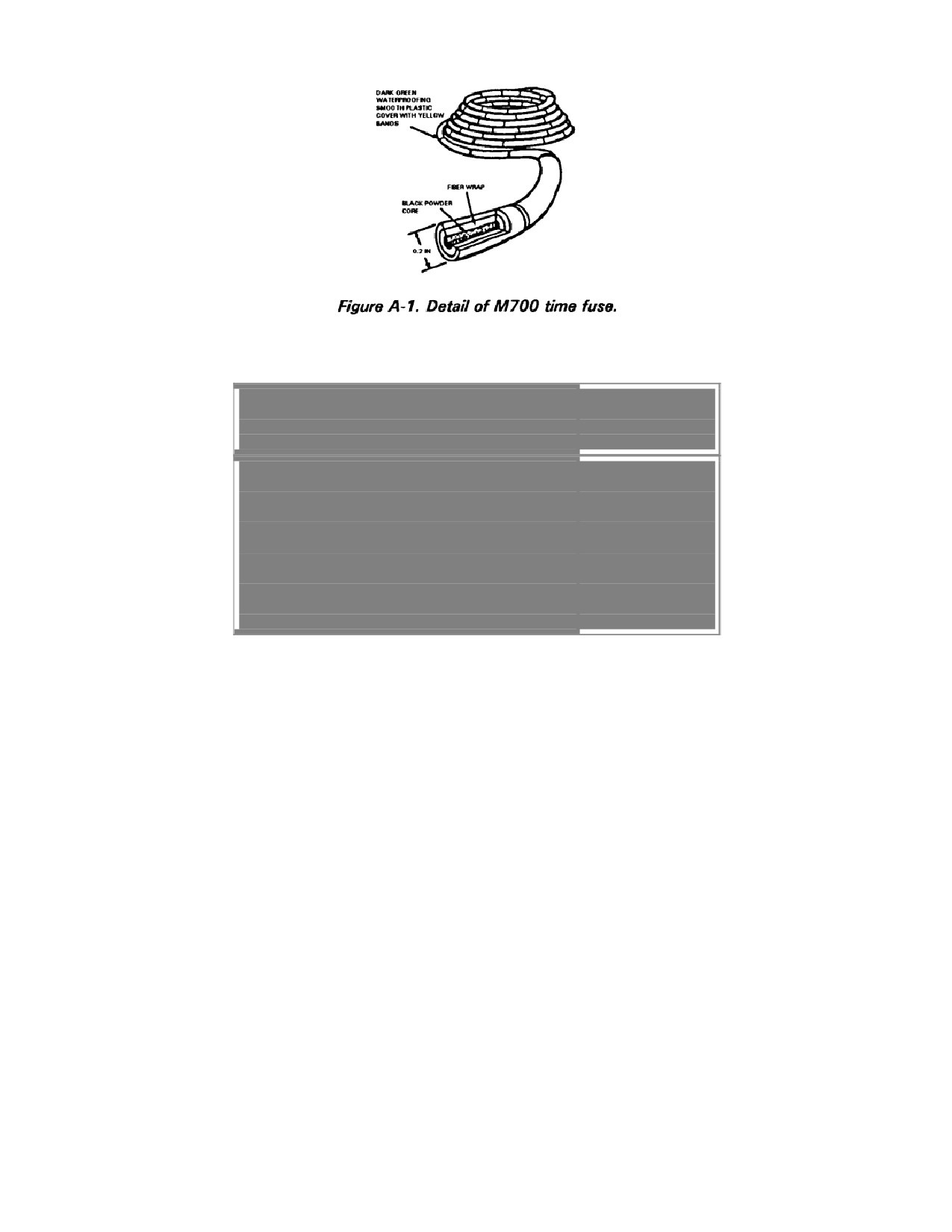
The M700 time fuse (Figure A-1) is a dark green cord, 0.2 inches in diameter, with a
plastic cover. Depending on the time of manufacture, the cover may be smooth with
single bands around the outside at l-foot or 18-inch intervals and double bands at 5-foot
or 90-inch intervals. The bands provide easy measuring. The burning rate is
approximately 40 seconds per foot.
Time fuse M700 is packed in 50-foot coils, two coils per package, five packages per
sealed container, and eight containers (4,000 feet) per wooden box.
CAUTION
You must always test the burning rate in the same manner as for a safety fuse. If
burn rate is faster than 30 seconds per foot, do not use.
CONTENTS
Demolition Accessories
Misfires
Firing Systems
Te sting Procedures
Priming Procedures
Detonating Cord
Detonating cord (Figure A-2) consists of a core of PETN or RDX in a textile tube coated
with a thin layer of asphalt. Over this is an outer textile cover finished with a wax gum
composition or plastic coating. Detonating cord transmits a detonating wave from one
point to another at a rate of between 20,000 and 24,000 feet per second. Use it to prime
and detonate other explosive charges. When you detonate its explosive core with a
blasting cap or other explosive device, the detonation wave transmits to an unlimited
number of explosive charges.