FM 4-20.158 AIRDROP OF SUPPLIES AND EQUIPMENT: RIGGING WATER PURIFICATION UNITS (MAY 2005) - page 2
FM 4-20.158/TO 13C7-7-61
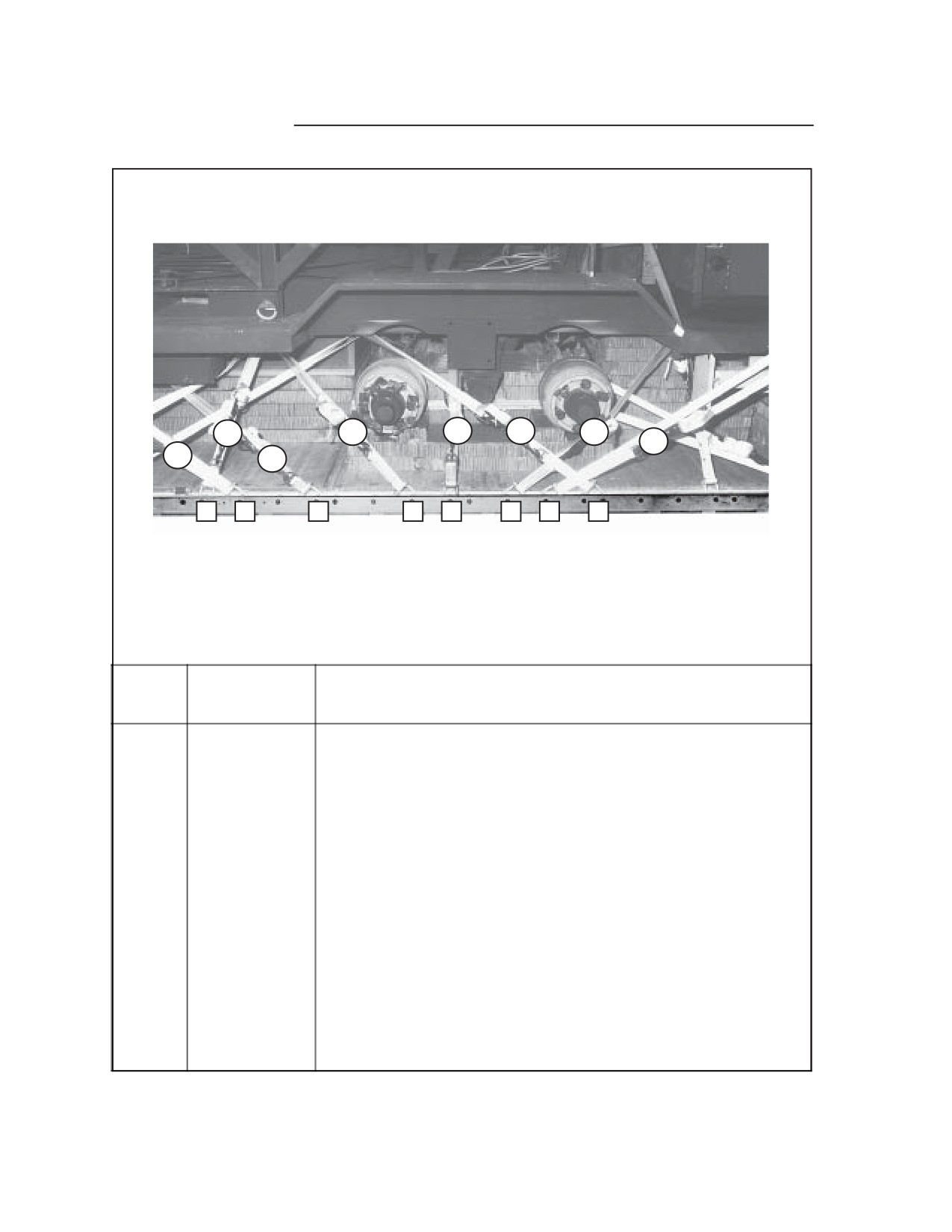
Note: When routing lashings ensure all suspension and lifting points are padded and
taped.
23
17
15
9
13
11
21
19
17
16
15
14
13
12
11
10
Lashing
Tiedown Clevis
Instructions
Number
Number
Pass lashing through:
9
10
Tiedown provision number 3 right side.
10
10A
Tiedown provision number 3 left side.
11
11
Rear lifting eye.
12
11A
Rear lifting eye.
13
12
Tiedown provision number 4 right side.
14
12A
Tiedown provision number 4 left side.
15
13
Around leaf spring.
16
13A
Around leaf spring.
17
14
Tiedown provision number 2 right side.
18
14A
Tiedown provision number 2 left side.
19
15
Tiedown provision number 1 right side.
20
15A
Tiedown provision number 1 left side.
21
16
Front lifting eye.
22
16A
Front lifting eye.
23
17
Tiedown provision number 2 right side.
24
17a
Tiedown provision number 2 left side.
Figure 1-26. Lashings 9 through 24 Installed
1-30
11 May 2005
FM 4-20.158/TO 13C7-7-61
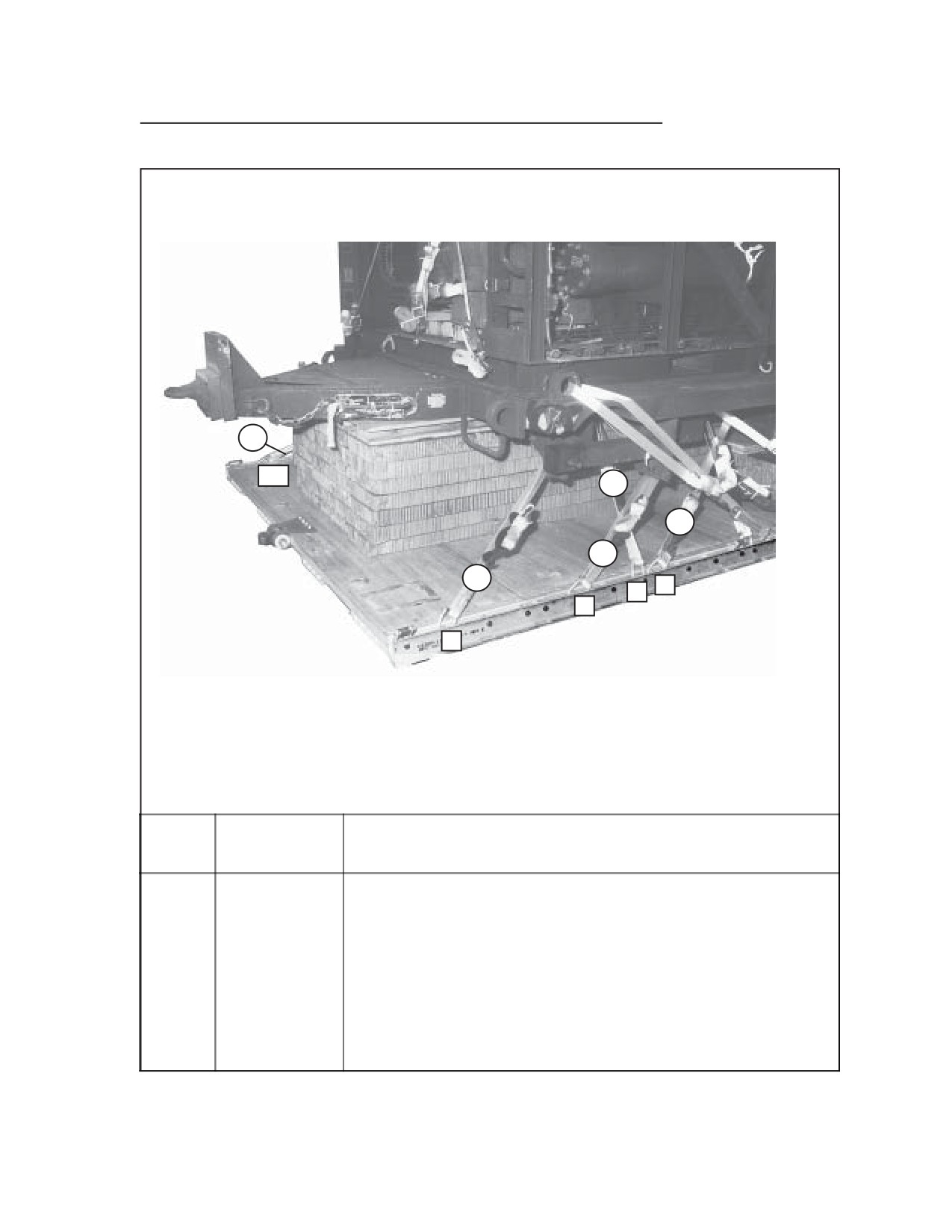
Note: When routing lashings ensure all suspension and lifting points are padded and
taped.
32
22A
27
25
29
31
19
20
21
22
Lashing
Tiedown Clevis
Instructions
Number
Number
Pass lashing through:
25
19
Tiedown provision 3 right side.
26
19A
Tiedown provision 3 left side.
27
20
Tiedown provision 1 right side.
28
20A
Tiedown provision 1 left side.
29
21
Tiedown provision 2 right side.
30
21A
Tiedown provision 2 left side.
31
22
Tiedown provision 1 right side.
32
22A
Tiedown provision 1 left side.
Figure 1-27. Lashings 25 through 32 Installed
1-31
11 May 2005
FM 4-20.158/TO 13C7-7-61
CONSTRUCTING ENDBOARDS AND STOWING AND LASHING TIRES
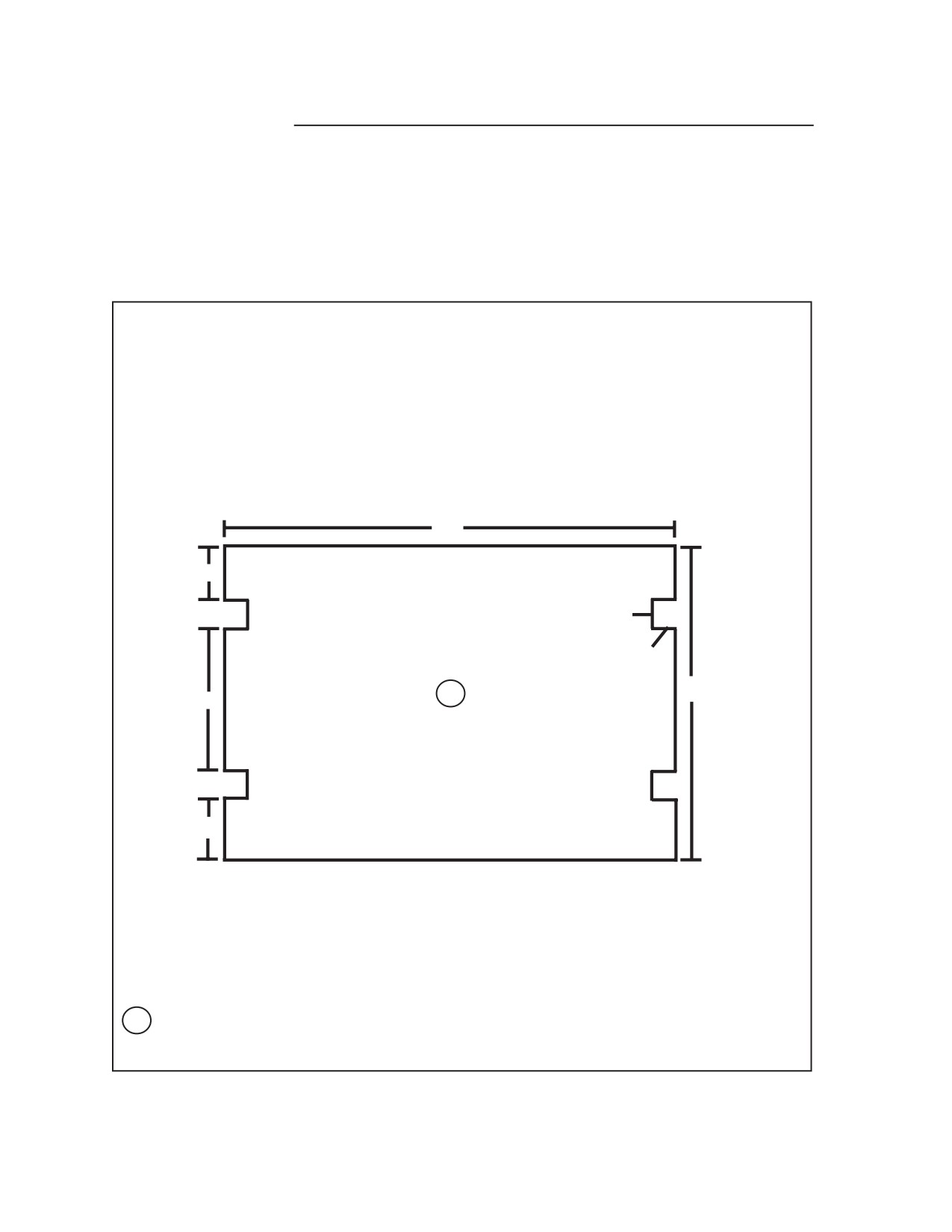
1-7. Construct the endboards and stow and lash the tires as described below.
a. Construct two endboards as shown in Figure 1-28.
Notes:
1. This drawing is not to scale.
2. All dimensions are in inches.
48
8
3
3
36
1
14
8
1
Cut two pieces of 3/4- by 36- by 48-inch plywood. Cut four 3- by 3-inch notches in each
endboard. Make the notches 8 inches from the top and bottom of the board.
Figure 1-28. Endboards Constructed
1-32
11 May 2005
FM 4-20.158/TO 13C7-7-61
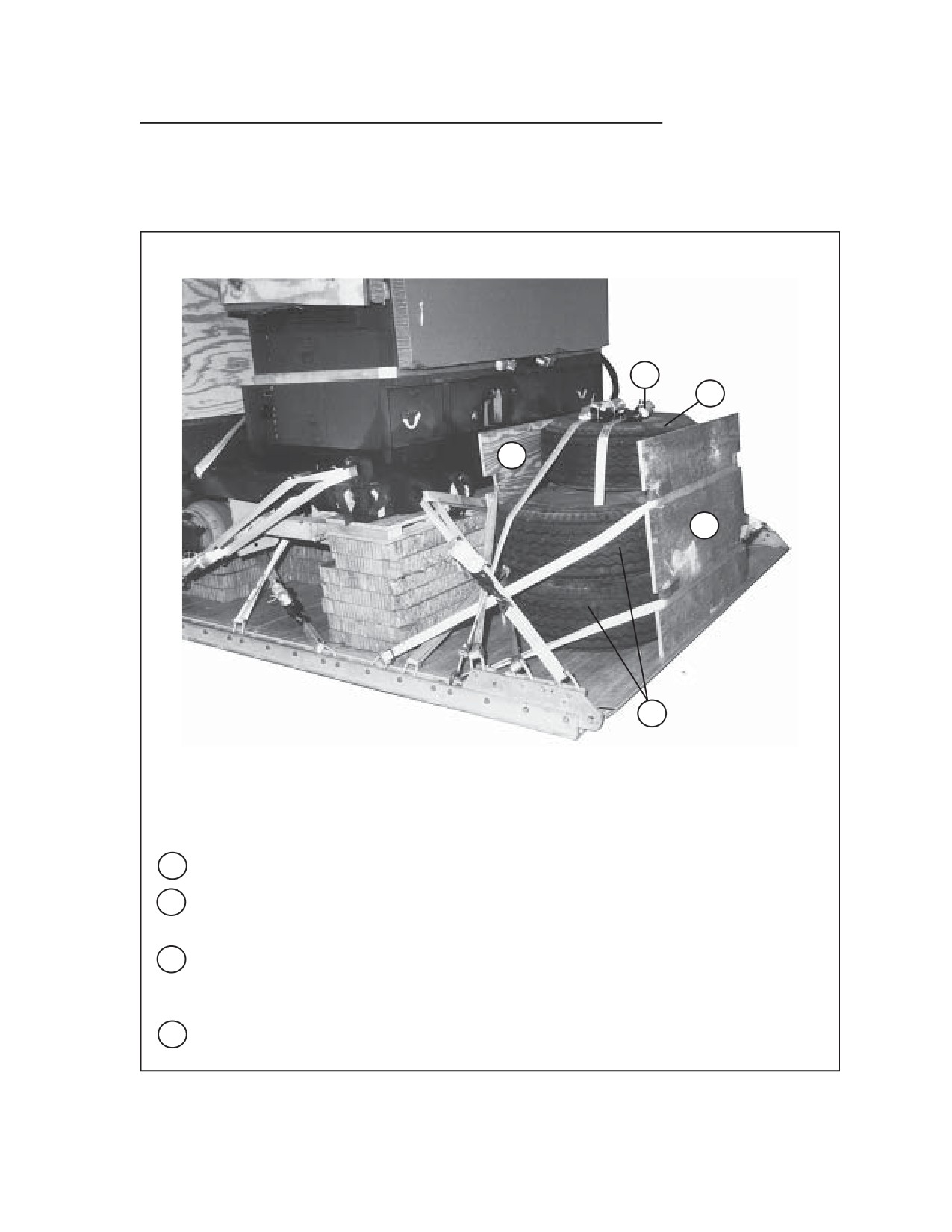
b. Position the endboards and stow the tires as shown in Figure 1-29.
3
2
1
4
2
1
Position one endboard against the rear of the ROWPU and honeycomb stack 1.
2
Stow the five tires on the front of the platform against the endboard. Ensure the spare
tire is placed and centered on top.
3
Pass a 15-foot lashing through the centers of the four tires and secure on top of the
spare using a single D-ring and loadbinder. Ensure that the lashing is routed through
the side rings of all four tires.
4
Position the second endboard against the front of the tires.
Figure 1-29. Endboards Positioned and Tires Stowed
1-33
11 May 2005
FM 4-20.158/TO 13C7-7-61
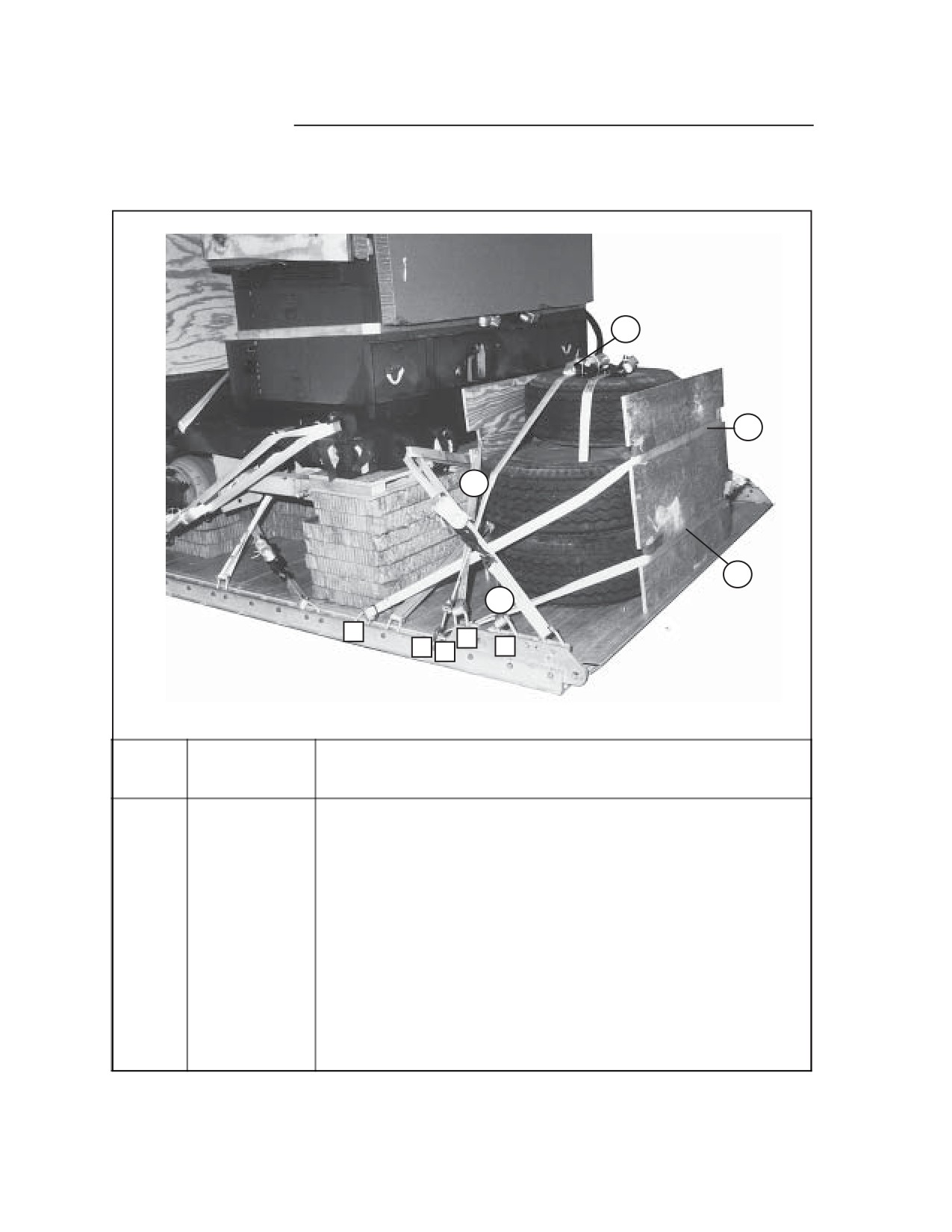
c. Lash the tires as shown in Figure 1-30.
5
4
3
2
1
FRONT
7
3
5
2
4
Lashing
Tiedown Clevis
Instructions
Number
Number
Pass lashing through:
1
2 to 2A
Its own D-ring through the rear bottom cutouts to clevis 2A.
2
4 to 4A
Its own D-ring through the front bottom cutouts to clevis 4A.
3
3 to 3A
Its own D-ring through the rear top cutouts to clevis 3A.
4
7 to 7A
Its own D-ring through the front top cutouts to clevis 7A.
5
5 to 5A
Clevis 5 and its own D-ring and run over the top of the tire. Pass
second lashing through clevis 5A and its own D-ring and run over the
top of the tires. Secure to lashing from clevis 5 on top of the tires with
two D-rings and a loadbinder.
Figure 1-30. Lashings 1 through 5 Installed
1-34
11 May 2005
FM 4-20.158/TO 13C7-7-61
PREPARING, CONSTRUCTING AND POSITIONING PARACHUTE
STOWAGE PLATFORM
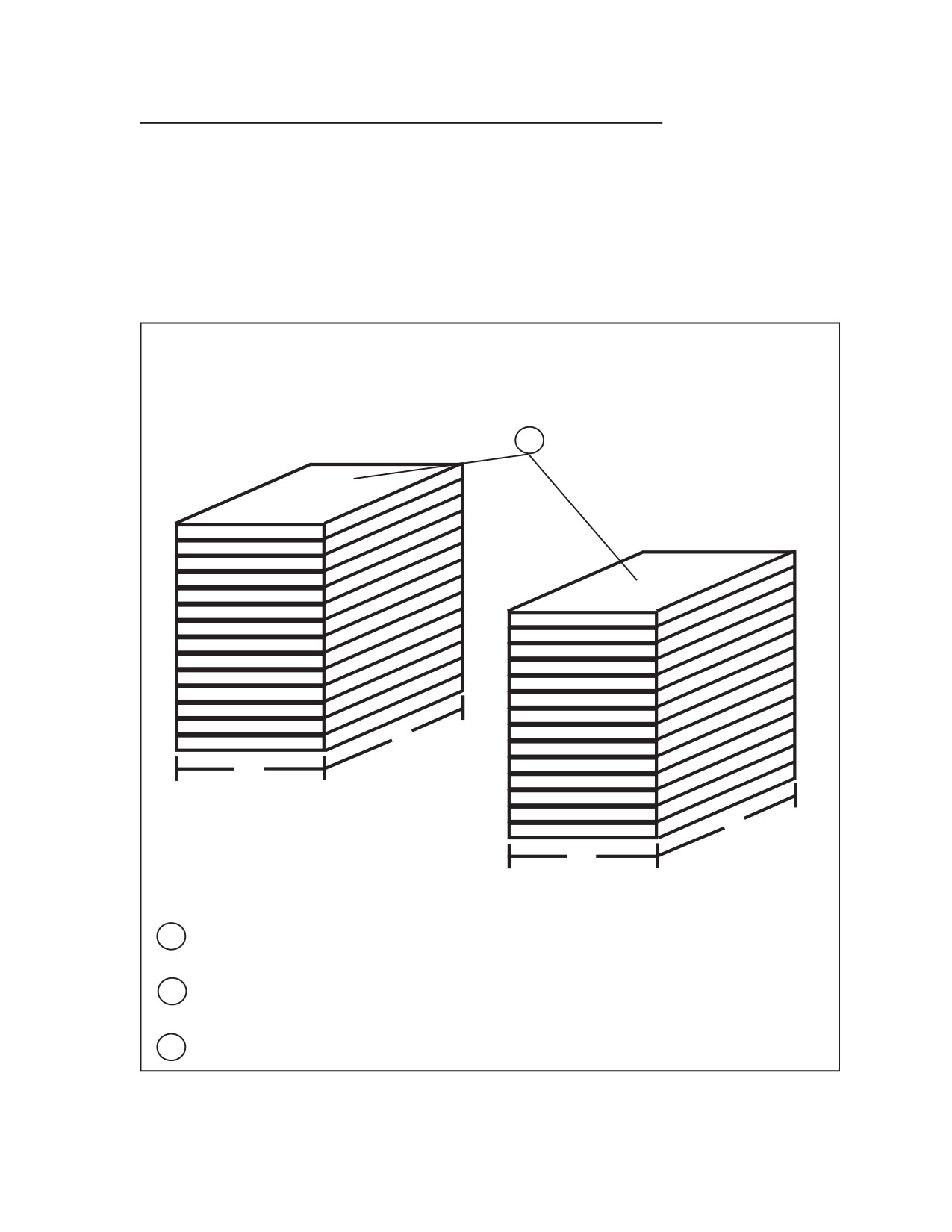
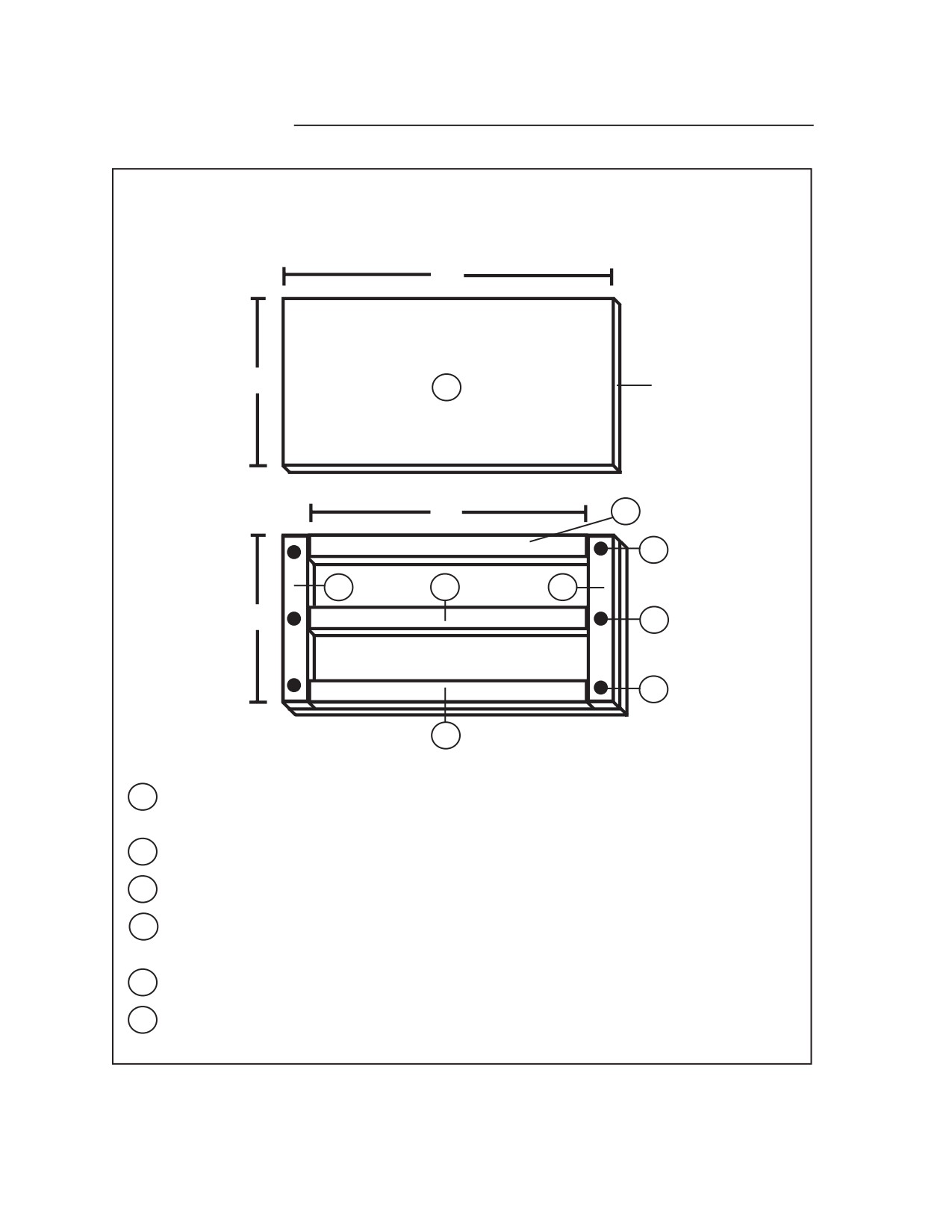
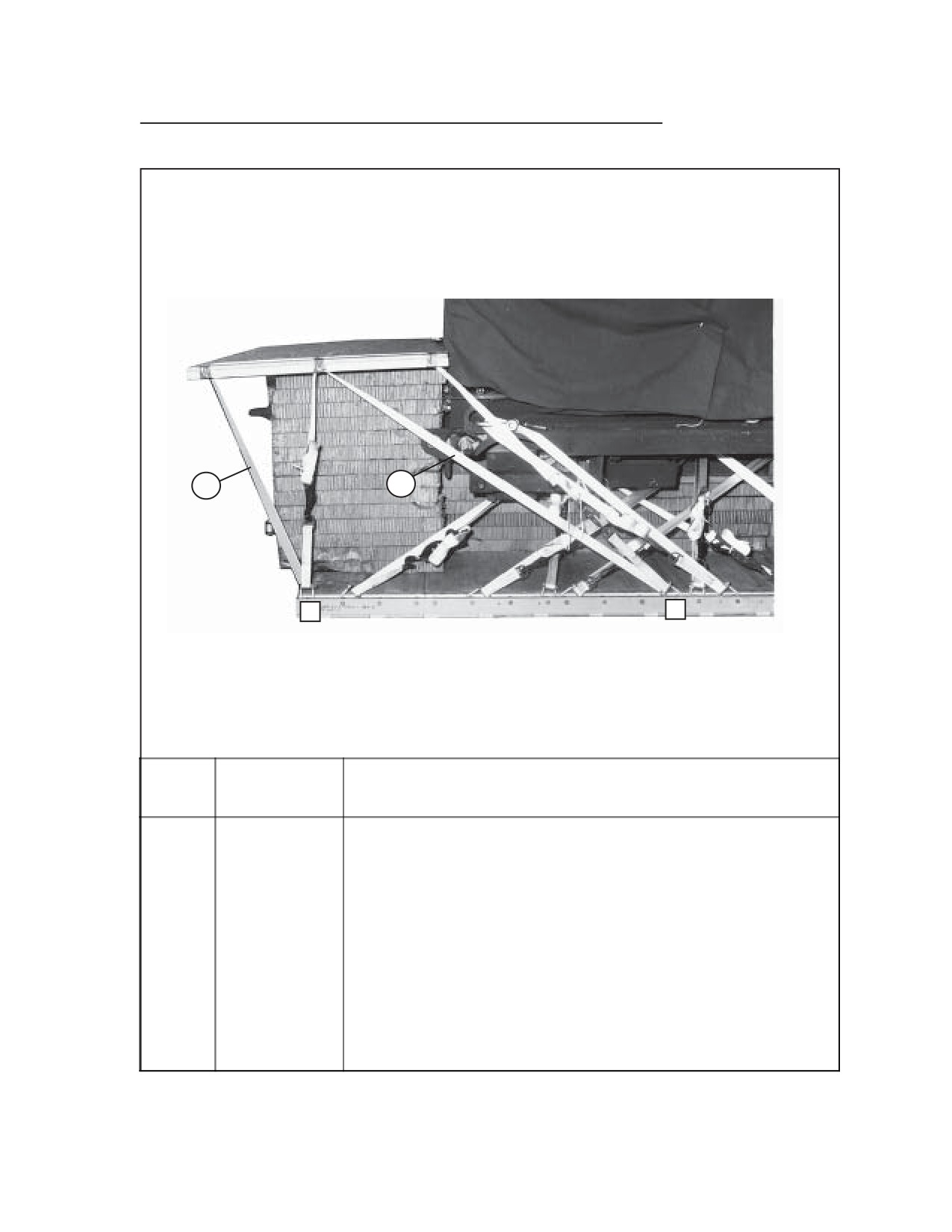
1-8. Prepare the honeycomb stacks for the parachute stowage platform as shown
in Figure 1-31. Construct the parachute stowage platform as shown in Figure 1-
32. Lash the parachute stowage platform as shown in Figure 1-33.
Notes:
1. This drawing is not to scale.
2. All dimensions are in inches.
1
34
13
34
13
1
Cut 28 pieces of 13- by 34-inch honeycomb. Place 14 pieces of honeycomb in each stack
and glue them together.
2
Set each stack on the rear of the platform inside the trailer's front tiedown eyes and
flush with the front of the trailer (not shown).
3
Center the stowage platform on top of each of the honeycomb stacks (not shown).
Figure 1-31. Honeycomb Stacks for Parachute Platform Prepared
1-35
11 May 2005
FM 4-20.158/TO 13C7-7-61
Notes:
1. This drawing is not to scale.
2. All dimensions are in inches.
3. All nailing is done from the plywood side to maintain a smooth surface using 8d nails.
96
48
1
3/4
85
3
5
2
4
2
48
6
5
3
1
Start construction of the parachute stowage platform using a 3/4- by 48- by 96-inch
piece of plywood.
2
Nail a 2- by 6- by 48-inch piece of lumber along each 48-inch side of the plywood.
3
Nail a 2- by 6- by 85-inch piece of lumber along each 96-inch side of the plywood.
4
Center a 2- by 6- by 85-inch of lumber between the other two 2- by 6- by 85-inch pieces
of lumber and nail it to the plywood.
5
Drill 2-inch holes 3 inches from each corner.
6
Drill one 2-inch hole centered between the corner holes on each 48-inch side of the
plywood.
Figure 1-32. Parachute Stowage Platform Constructed
1-36
11 May 2005
FM 4-20.158/TO 13C7-7-61
Note: Tape all cutouts in the stowage platform prior to routing lashings.
3
1
REAR
23
18
Lashing
Tiedown Clevis
Instructions
Number
Number
Pass lashing through:
1
18
Clevis 18, up through the right center hole, down through the right
front hole. Secure with a D-ring and loadbinder.
2
18A
Repeat for the left side using clevis 18A.
3
23
Clevis 23, up through the right rear hole, down through the right
center hole. Secure with a D-ring and loadbinder.
4
23A
Repeat for the left side using clevis 23A.
Figure 1-33. Parachute Stowage Platform Constructed
1-37
11 May 2005
FM 4-20.158/TO 13C7-7-61
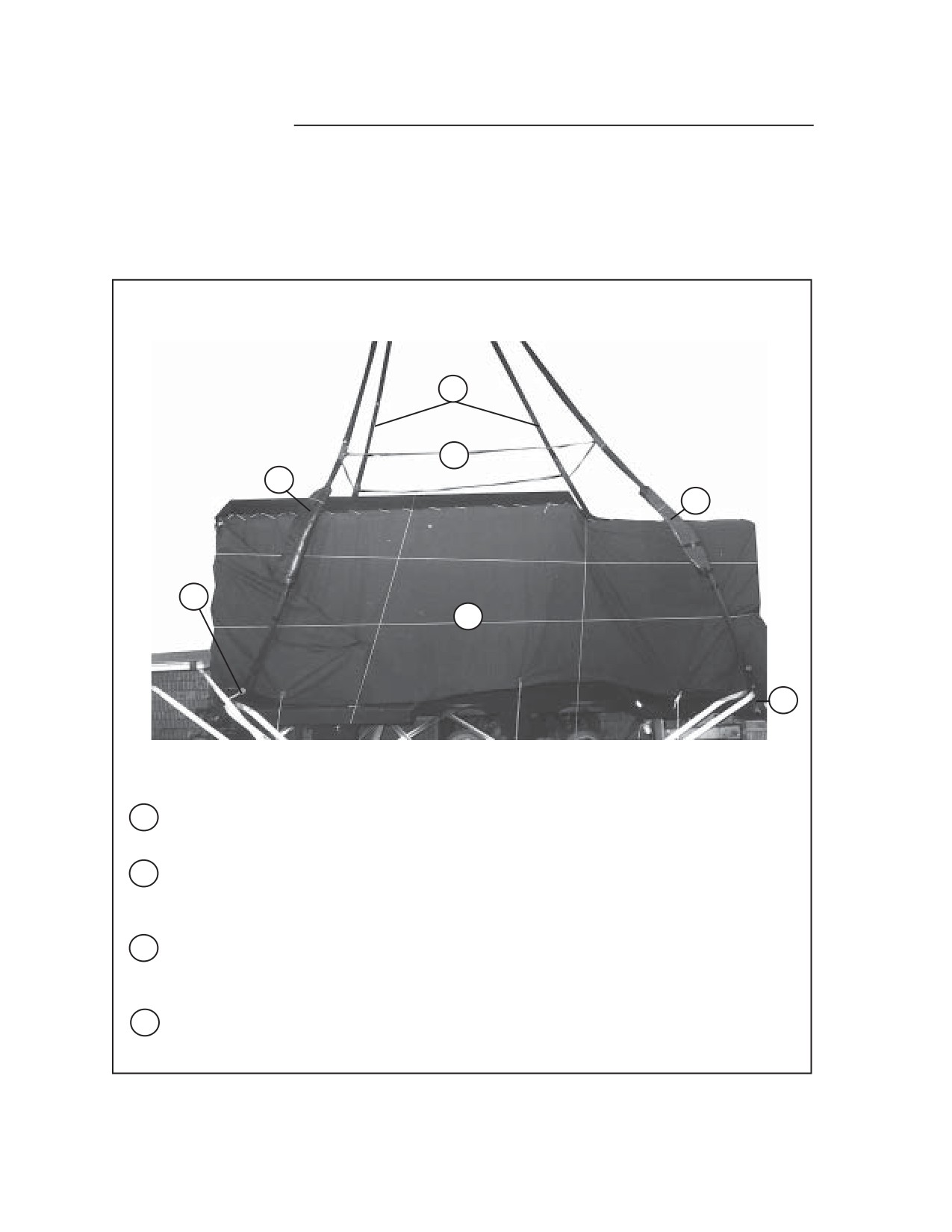
INSTALLING LOAD COVER, SUSPENSION SLINGS AND SAFETY TIE
1-9. Cover the load, install the suspension slings and safety tie as shown in Figure
1-34.
2
4
3
3
2
1
REAR
2
1
Place a 17- by 35-foot canvas cover over the load from the generator to the front of the
ROWPU. Secure the cover in place using type III nylon cord.
2
Attach a 16-foot (4-loop), type XXVI nylon suspension sling to each lifting point with a
large clevis. Attach the clevis with the bell of the clevis through the lifting point and
secure the bolt through the plies of the sling.
3
Pad the front and rear suspension slings using four 36- by 10-inch pieces of felt and
tape in place. Place the felt where the slings come in contact with the top of the
ROWPU. Extend the tape beyond the top and bottom of the felt to secure in place.
4
Raise the suspension slings and install the deadman's tie according to FM 4-20.102/
NAVSEA SS400-AB-MMO-010/TO 13C7-1-5.
Figure 1-34. Load Cover, Suspension Slings and Safety Tie Installed
1-38
11 May 2005
FM 4-20.158/TO 13C7-7-61
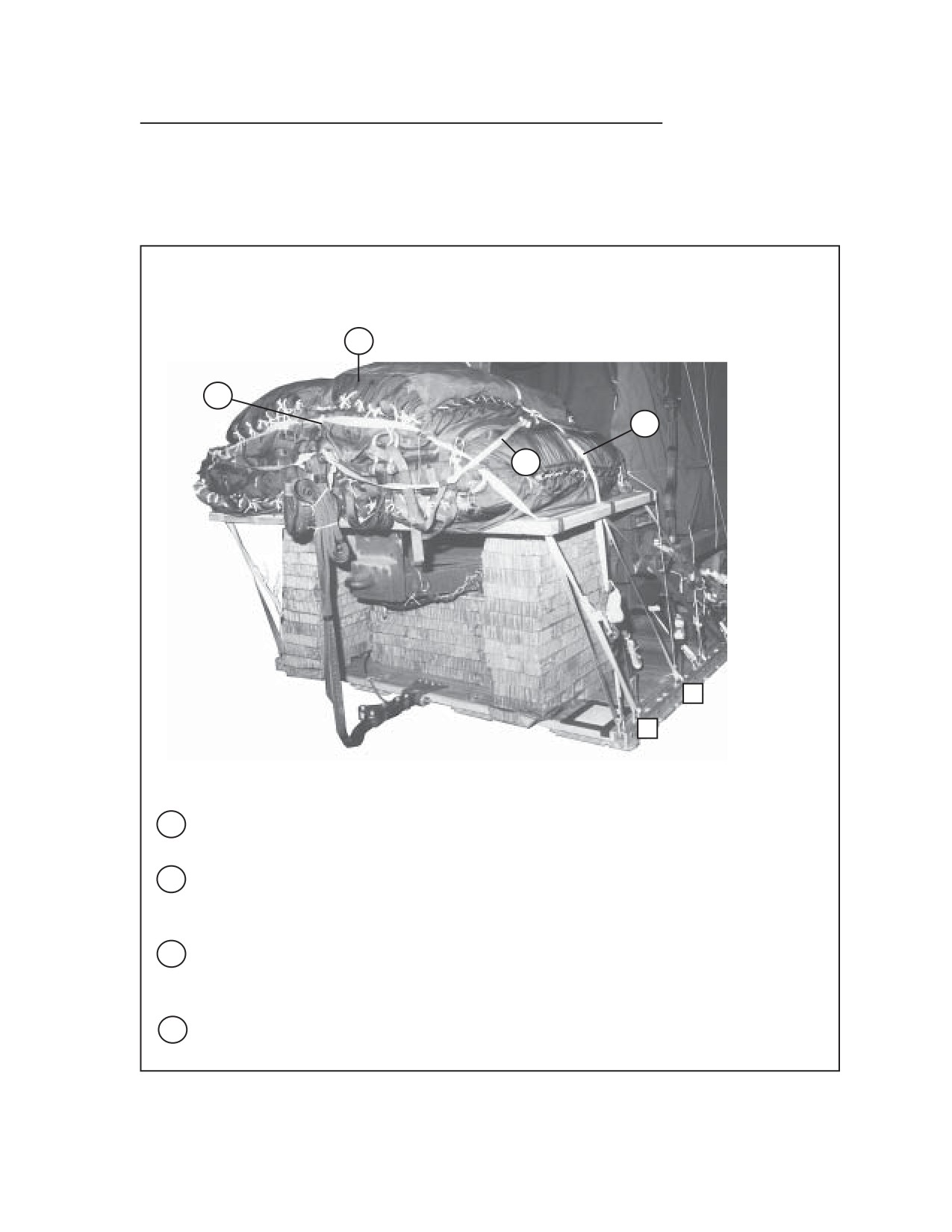
PREPARING AND STOWING CARGO PARACHUTES
1-10. Prepare and stow the cargo parachutes as shown in Figure 1-35.
1
2
3
4
21
22
1
Prepare, position and stow five G-11C cargo parachutes on the parachute stowage
platform according to FM 4-20.102/NAVSEA SS400-AB-MMO-010/TO 13C7-1-5.
2
Using type VIII nylon webbing install the cargo parachute restraint through the front
carrying handles to clevises 22 and 22A according to FM 4-20.102/NAVSEA SS400-AB-
MMO-010/TO 13C7-1-5.
3
Using type VIII nylon webbing install the cargo parachute restraint through the center
carrying handles to clevises 21 and 21A according to FM 4-20.102/NAVSEA SS400-AB-
MMO-010/TO 13C7-1-5.
4
Install the parachute release straps according to FM 4-20.102/NAVSEA SS400-AB-
MMO-010/TO 13C7-1-5.
Figure 1-35. Cargo Parachutes Prepared and Stowed
1-39
11 May 2005
FM 4-20.158/TO 13C7-7-61
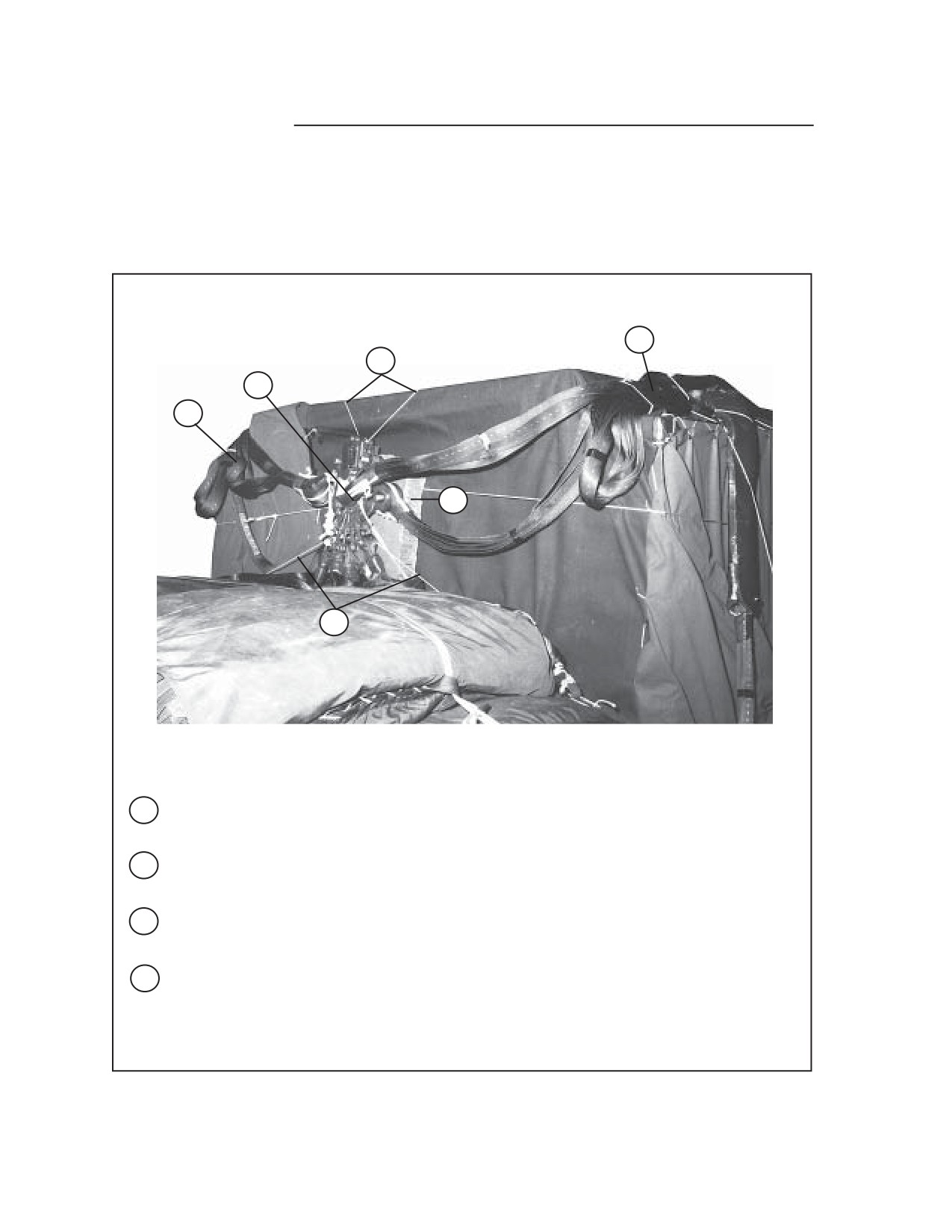
INSTALLING THE RELEASE SYSTEM
1-11. Prepare, attach and safety an M-2 cargo parachute release according to FM
4-20.102/NAVSEA SS400-AB-MMO-010/TO13C7-5-1 and as shown in Figure 1-
36.
3
4
2
3
1
4
1
Center a 24- by 24-inch piece of honeycomb on the front of the ROWPU. Tape the edges
of the honeycomb and secure using type III cord.
2
Prepare and install the M-2 cargo parachute release according to FM 4-20.102/
NAVSEA SS400-AB-MMO-010/TO 13C7-1-5. Center the assembly on top of honeycomb.
3
S-fold and tie any excess in the suspension slings using one turn single type I, 1/4-inch
cotton webbing.
4
Safety the M-2 cargo parachute release to a convenient point on the load using type III
nylon cord according to FM 4-20.102/ NAVSEA SS400-AB-MMO-010/TO 13C7-1-5.
Note: All slings must be safetied in such a manner as not to increase the height of the load.
Figure 1-36. Cargo Parachute Release Installed
1-40
11 May 2005
FM 4-20.158/TO 13C7-7-61
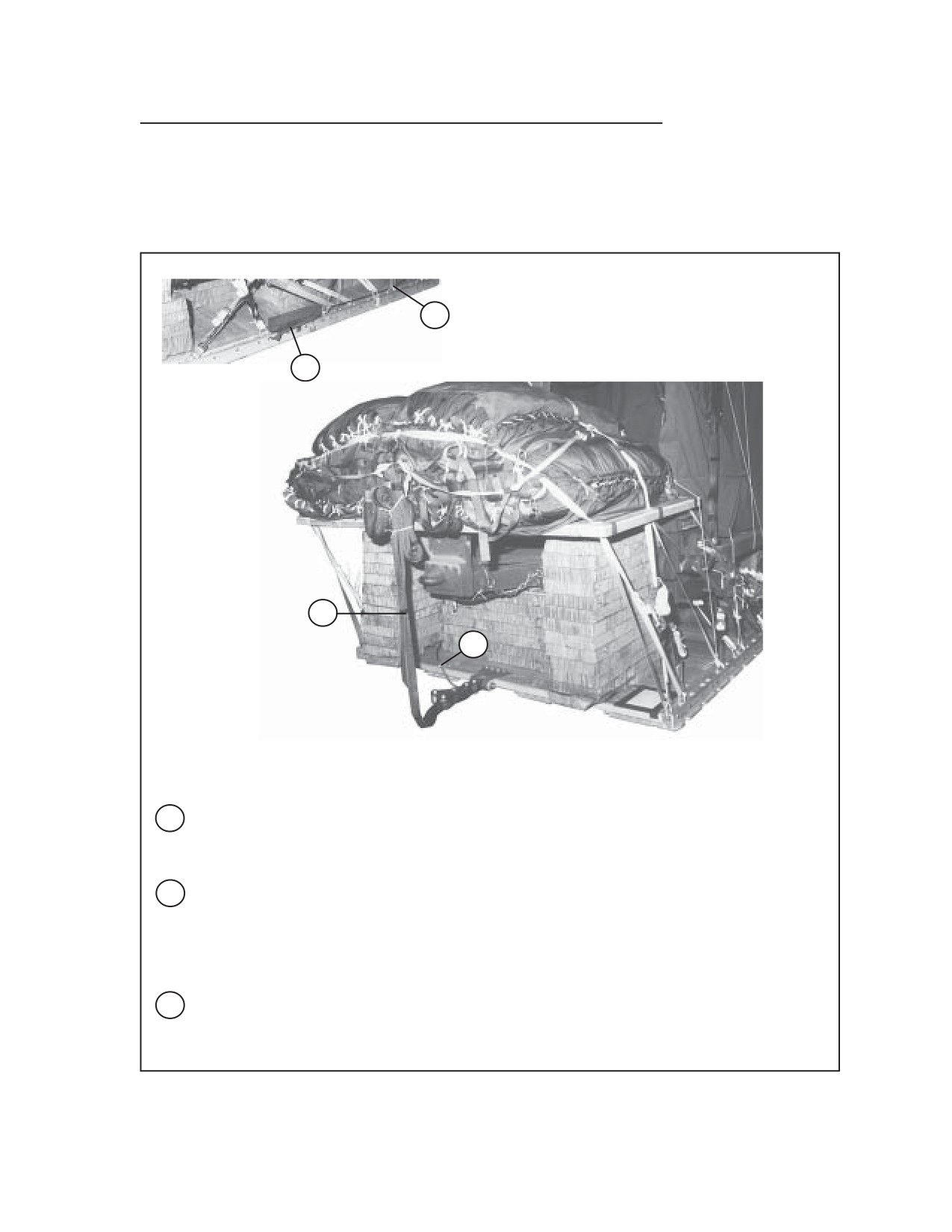
INSTALLING THE EXTRACTION SYSTEM
1-12. Install the extraction system as shown in Figure 1-37.
2
LEFT
1
3
2
REAR
1
Install the components of the extraction force transfer coupling (EFTC) according to
FM 4-20.102/NAVSEA SS400-AB-MMO-010/TO 13C7-1-5. Use the rear mounting holes
on the left side of the platform for the EFTC brackets.
2
Install a 20-foot EFTC cable according to FM 4-20.102/NAVSEA SS400-AB-MMO-
010/TO 13C7-1-5 and safety the cable to convenient places on the platform with one turn
of type I, 1/4-inch cotton webbing.
Note: Safety the cable to tiedown ring C10 using type I, 1/4-inch cotton webbing.
3
Attach a 9-foot (2-loop) type XXVI nylon sling according to FM 4-20.102/NAVSEA SS400-
AB-MMO-010/TO 13C7-1-5 to be used as a deployment line. S-fold the excess and tie it in
two places with type I, 1/4-inch cotton webbing.
Figure 1-37. Extraction System Installed
1-41
11 May 2005
FM 4-20.158/TO 13C7-7-61
PLACING EXTRACTION PARACHUTE
1-13. Select the extraction parachute and extraction line needed using the extraction
line requirements table in FM 4-20.102/ NAVSEA SS400-AB-MMO-010/TO 13C7-1-5.
Place the extraction parachute and line on the load for installation in the aircraft.
INSTALLING PROVISIONS FOR EMERGENCY RESTRAINTS
1-14. Select and install the provisions for the emergency aft restraints according to
the emergency aft restraint requirements table in FM 4-20.102/NAVSEA SS400-AB-
MMO-010/TO 13C7-1-5.
MARKING RIGGED LOAD
1-15. Mark the rigged load according to FM 4-20.102/NAVSEA SS400-AB-
MMO-010/TO 13C7-1-5, and as shown in Figure 1-38. Complete Shipper's
Declaration for Dangerous Goods. If the load varies from the one shown, the weight,
height, center of balance (CB) and parachute requirements must be recomputed.
EQUIPMENT REQUIRED
1-16. Use the equipment listed in Table 1-1 to rig this load.
1-42
11 May 2005
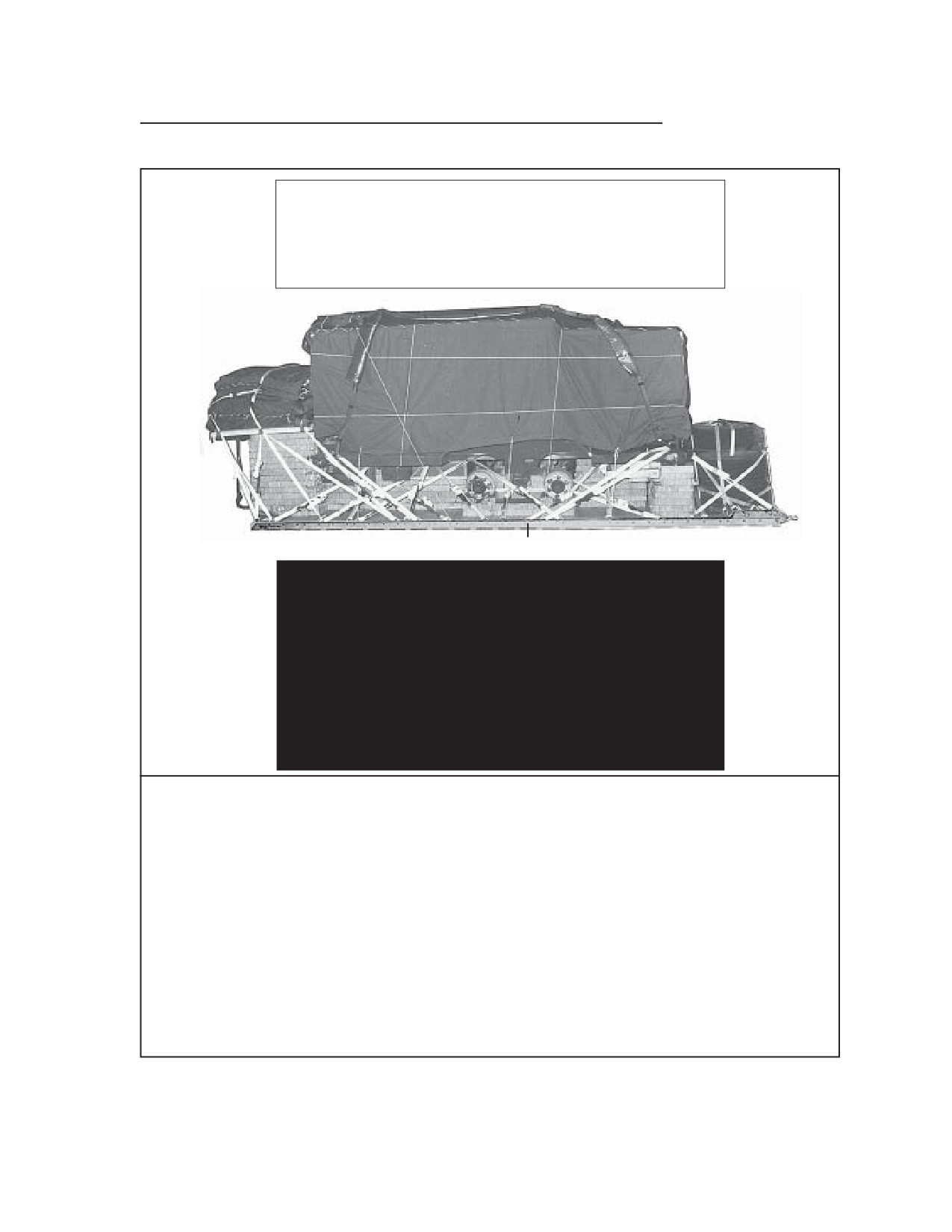
FM 4-20.158/TO 13C7-7-61
CAUTION
Make the final rigger inspection required by AR 59-4/
OPNAVINST 4630.24C/AFJ 13-210(I)/MCO 13480.1B and
FM 4-20.102/NAVSEA SS400-AB-MMO-010/TO 13C7-1-5
before the load leaves the rigging site.
CB
NOTICE OF EXCEPTION
The height limitation of this load is greater than what is
authorized in FM 4-20.102/NAVSEA SS400-AB-MMO-010/
TO13C7-1-5. The overall rigged height of the 600-GPH
ROWPU will not exceed 101 inches for a distance of not
more than 40 inches aft of the CB. All high points should be
verified each time this load is placed on the aircraft. An
exception to FM 4-20.102/NAVSEA SS400-AB-MMO-010/
TO 13C7-1-5 is granted. The procedures in this paragraph
must be followed.
RIGGED LOAD
Weight:
Load shown:
21,780 pounds
Maximum weight:
23,030 pounds
Height:
101 inches
Width:
108 inches
Length:
275 inches
Overhang:
Front:
5 inches
Rear:
35 inches
CB (from front edge of platform):
130 inches
Figure 1-38. Reverse Osmosis Water Purification Unit (ROWPU) Rigged on a 20-Foot, Type V
Platform for Low-Velocity Airdrop
1-43
11 May 2005
FM 4-20.158/TO 13C7-7-61
Table 1-1. Equipment Required for Rigging a Reverse Osmosis Water Purification Unit
(ROWPU) on a 20-Foot, Type V Platform for Low-Velocity Airdrop
Items
Quantity
National Stock
Number
8040-00-273-8713
Adhesive paste, 1-gallon
As required
4030-00-678-8562
Clevis, 3/4-inch medium
6
4030-00-090-5354
Clevis, 1-inch large
7
4020-00-240-2146
Cord, nylon, type III, 550-lb.
As required
1670-00-434-5783
Coupling, airdrop extraction force transfer, w 20-ft. cable
1
1670-00-360-0328
Cover, clevis
5
8135-00-664-6958
Cushioning material (Cellulose wadding)
As required
8305-00-958-3685
Felt, 1/2-inch thick
As required
1670-01-183-2678
Leaf, extraction line (line bag) (for C-130)
1
1670-01-183-2678
Leaf, extraction line (line bag) (for C-17)
2
1670-00-003-4391
Knife, parachute bag (for C-17)
1
Line extraction:
1670-01-062-6313
60-foot (3-loop), type XXVI (for C-130)
1
1670-01-107-7651
140-foot (3-loop), type XXVI (for C-17)
1
1670-01-064-4452
60-foot (1-loop), type XXVI (for C-17), (drogue line)
1
Link assembly:
1670-01-493-6420
Two-point, 5 1/2-in (for C-130 and C-17)
2
1670-01-493-6418
Two-point, 3 3/4-in (for C-17), drogue line
1
Lumber:
5510-00-220-6146
2- by 4- by 96-in
As required
5510-00-220-6148
2- by 6-in
As required
5510-00-220-6246
2- by 8-in
As required
5530-00-618-8073
Plywood, 3/4-in
As required
5315-00-010-4659
Nail, steel wire, common, 8d
As required
1670-00-753-3928
Pad, energy dissipating, honeycomb, 3- by 36- by 96-in
40 sheets
Parachute:
Cargo:
1670-01-016-7841
G-11C
5
1-44
11 May 2005
FM 4-20.158/TO 13C7-7-61
Table 1-1. Equipment Required for Rigging a Reverse Osmosis Water Purification Unit
(ROWPU) on a 20-Foot, Type V Platform for Low-Velocity Airdrop (Continued)
Items
Quantity
National Stock
Number
Parachute, cargo extraction:
1670-00-040-8135
28-ft (for C-130)
1
1670-00-040-8135
28-ft. (for C-17)
1
1670-00-063-3715
15-ft. (for C-17),(drogue parachute)
1
Platform, airdrop, type V, 20-ft:
1670-01-162-2372
Clevis assembly
46
1670-01-353-8424
Extraction bracket assembly
1
1670-01-162-2381
Tandem link assembly (multipurpose link)
2
1670-01-097-8817
Release, cargo parachute, M-2
1
Sling, cargo, airdrop:
1670-01-062-6304
9-ft. (2-loop), type XXVI
1
1670-01-062-6308
16-ft. (4-loop), type XXVI
4
1670-01-062-6311
120-ft. (2-loop), type XXVI
5
1670-01-062-6301
3-ft. (2-loop), type XXVI
2
1670-00-040-8219
Strap, parachute release, multicut
2
7510-00-266-5016
Tape, adhesive, 2-in
As required
Textile;
8305-00-433-5986
Cloth, cotton muslin, type III (for C-17)
As required
8310-00-917-3945
Thread, cotton, ticket no 8/7 (for C-17)
As required
1670-00-937-0271
Tiedown assembly, 15-ft.
60
1670-01-483-8259
Towplate release mechanism (h-block) (C-17 only)
1
Webbing:
8305-00-268-2411
Cotton, 1/4-inch, type I
As required
8305-00-082-5752
Nylon, tubular, 1/2-inch
As required
8305-00-261-8585
Type VIII nylon
As required
1-45
11 May 2005
This page intentionally left blank.
FM 4-20.158/TO 13C7-7-61
CHAPTER 2
RIGGING LIGHTWEIGHT WATER PURIFIER (LWP) ON A 12-
FOOT, TYPE V PLATFORM FOR LOW-VELOCITY AIRDROP
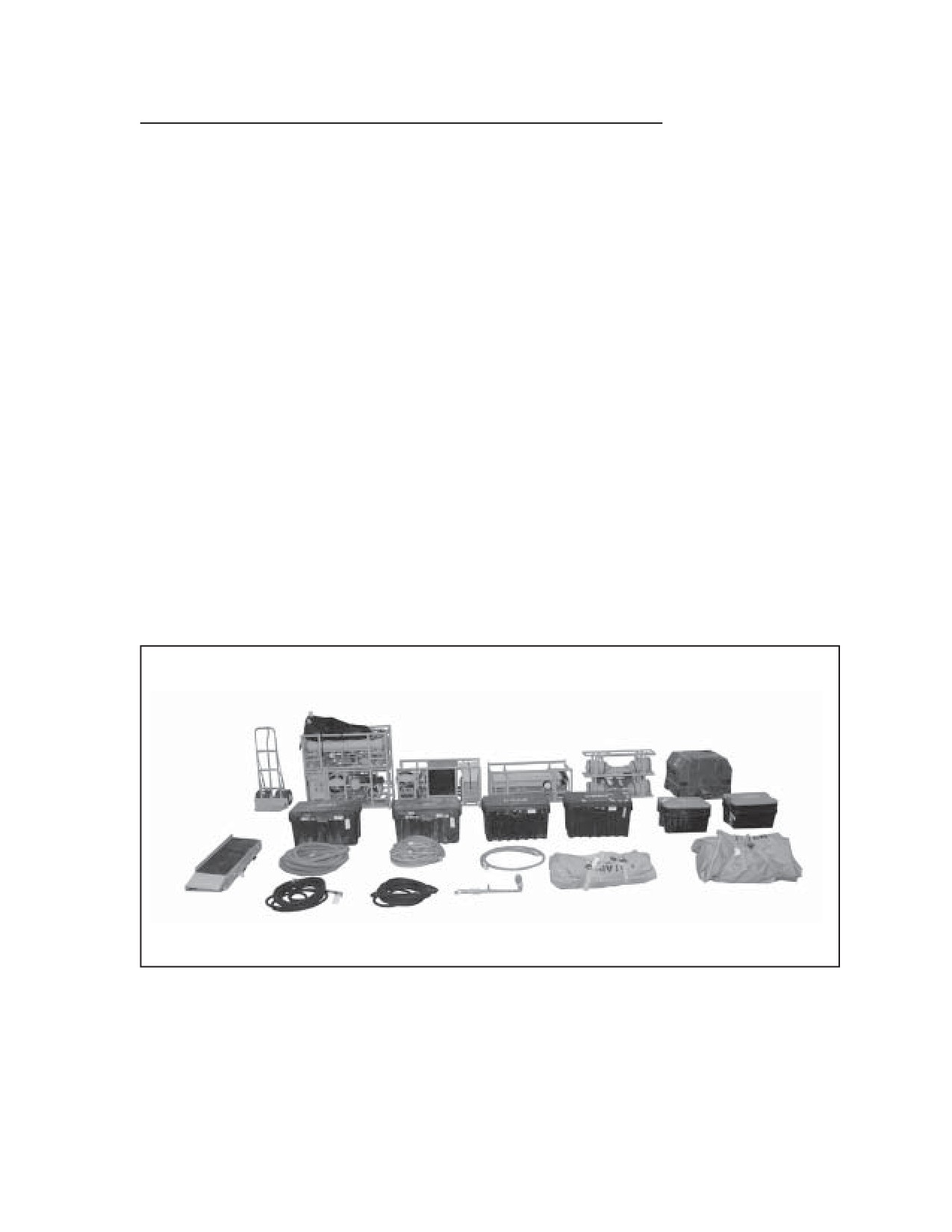
DESCRIPTION OF LOAD
2-1. The lightweight water purifier (Figure 2-1) is rigged on a 12-foot, type V
platform. The lightweight water purifier consists of equipment as shown in Figure
2-1. The total weight of the lightweight water purifier is approximately 2,052
pounds. The total rigged weight of the load is 6,140 pounds. The load is 92 inches
high, 108 inches wide, 144 inches long, and the center of balance is 70 inches from
the front edge of the platform. Refer to FM 4-20.102/NAVSEA SS400-AB-MMO-
010/TO 13C7-1-5 for the weight limitations and for the number of parachutes to be
used.
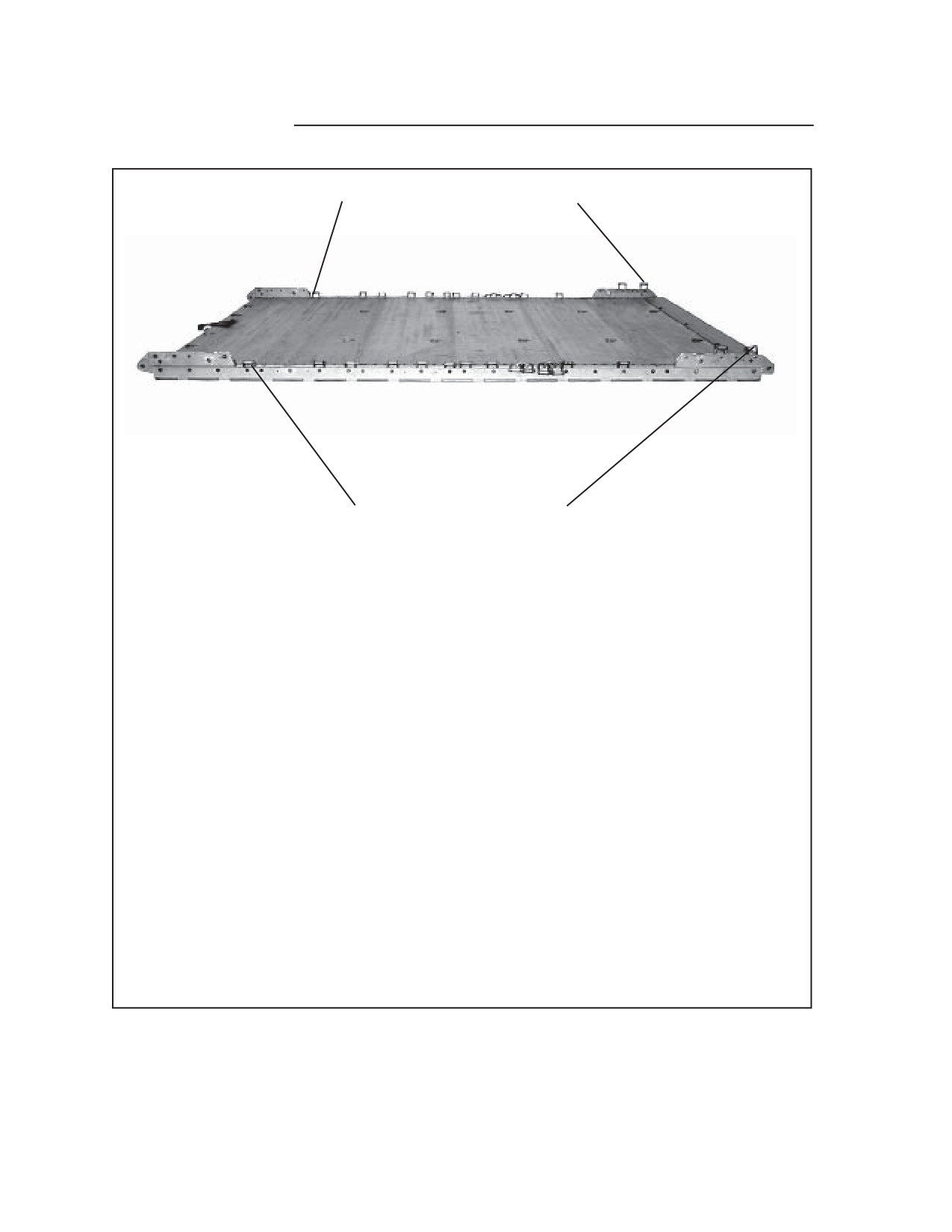
PREPARING PLATFORM
2-2. Prepare a 12-foot, type V platform as shown in Figure 2-2.
Figure 2-1. Lightweight Water Purifier (LWP)
2-1
11 May 2005
FM 4-20.158/TO 13C7-7-61
CLEVISES 16A THROUGH 1A
LEFT
REAR
FRONT
RIGHT
CLEVISES 16 THROUGH 1
Step:
1.
Inspect, or assemble and inspect, a 12-foot, type V platform as outlined in
TM 10-1670-268-20&P/TO 13C7-52-22.
2.
Inspect and install a tandem link to the front of each platform side rail
using holes 1,2, and 3.
3.
Inspect and install a tandem link to the rear of each platform side rail
using holes 22, 23 and 24.
4.
Install clevises on bushings 1 and 3 of each front tandem link.
5.
Starting at the front of each platform side rail, install clevises on the
bushings bolted on holes 6, 8, 9 (tripled), 10 (tripled), 11, 12, 13, 14, 15, 17,
18, and 21.
6.
Starting at the front of each platform side rail, number the clevises 1
through 16 on the right side and 1A through 16A on the left side.
7.
Label the tiedown rings according to FM 4-20.102/NAVSEA SS400-AB-
MMO-010/TO 13C7-1-5.
Figure 2-2. Platform Prepared
2-2
11 May 2005
FM 4-20.158/TO 13C7-7-61
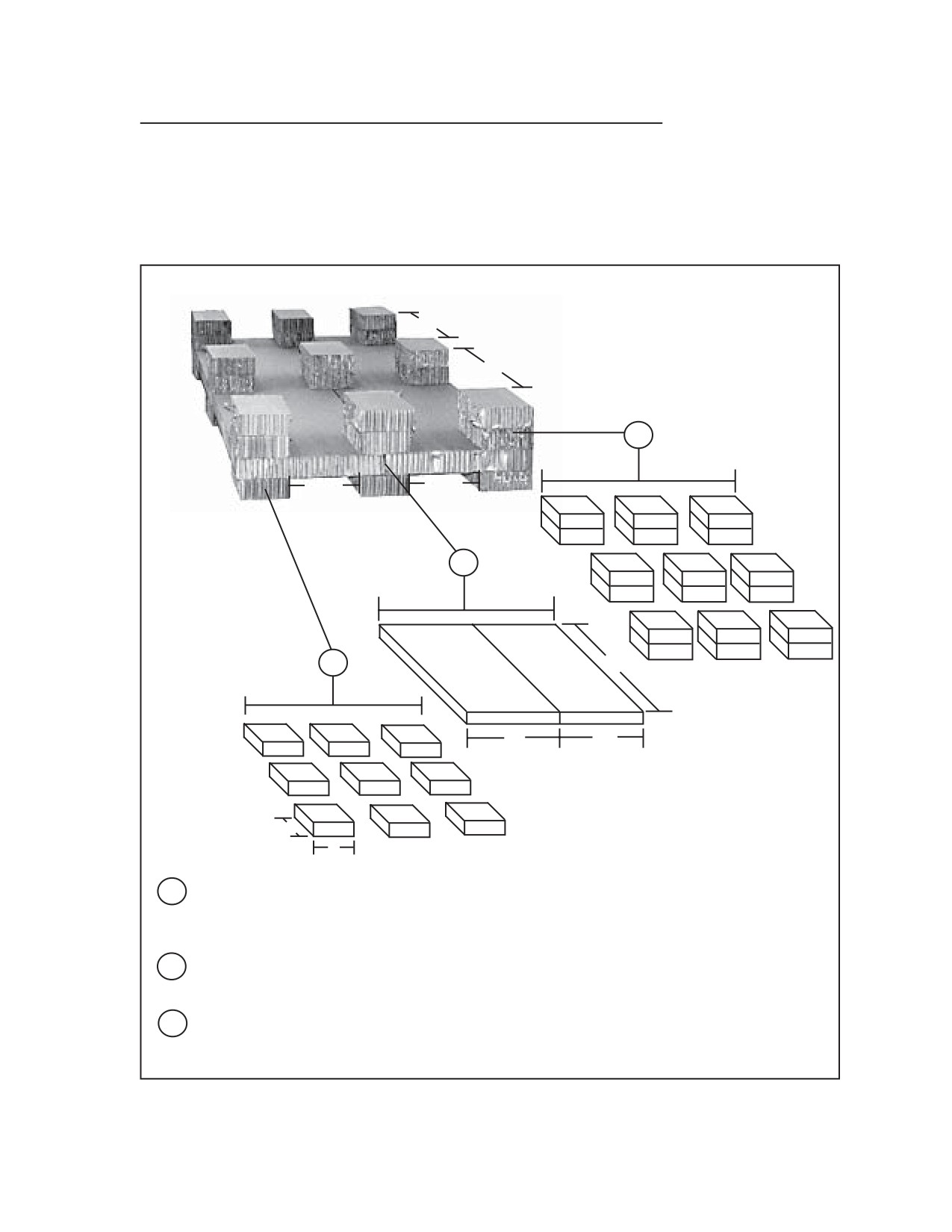
PREPARING AND PLACING HONEYCOMB STACK 1
2-3. Prepare honeycomb stack 1 as shown in Figure 2-3. Position stack 1 as shown
in Figure 2-4.
Notes:
1. This drawing is not to scale.
2. All dimensions are in inches.
28
28
REAR
FRONT
3
9 1/2
9 1/2
2
1
92
20
20
12
7
1
Cut nine pieces of 7- by 12-inch honeycomb. Place the honeycomb to form three rows of
three. Leave 9 1/2 inches between the pieces from front to rear and 28 inches between
pieces from right to left.
2
Cut two pieces of 20- by 92-inch honeycomb. Place the pieces side by side to form a 40-
by 92-inch piece of honeycomb. Glue the pieces to the honeycomb placed in step 1.
3
Cut and glue eighteen pieces of 7- by 12-inch honeycomb to form nine two layer stacks.
Position and glue the honeycomb on top of the 40- by 92-inch piece of honeycomb as
described in step 1.
Figure 2-3. Honeycomb Stack 1 Prepared
2-3
11 May 2005
FM 4-20.158/TO 13C7-7-61
Notes:
1. This drawing is not to scale.
2. All dimensions are in inches.
40
3. Use 8d nails.
92
REAR
FRONT
7
6
5
TOP
4
BOTTOM
4
Cut a 40- by 92- by 3/4-inch piece of plywood to form the base for the strongback.
5
Position and nail five 2- by 4- by 92-inch pieces of lumber evenly spaced on top of the
plywood in step 4.
6
Cut a 40- by 92- by 3/4-inch piece of plywood and place on top of the 2- by 4-inch lumber
placed in step 5. Nail flush in place with 8d nails.
7
Position and glue the strongback built in steps 4, 5, and 6 on top of the honeycomb
stack built in step 3.
Figure 2-3. Honeycomb Stack 1 Prepared (Continued)
2-4
11 May 2005
FM 4-20.158/TO 13C7-7-61
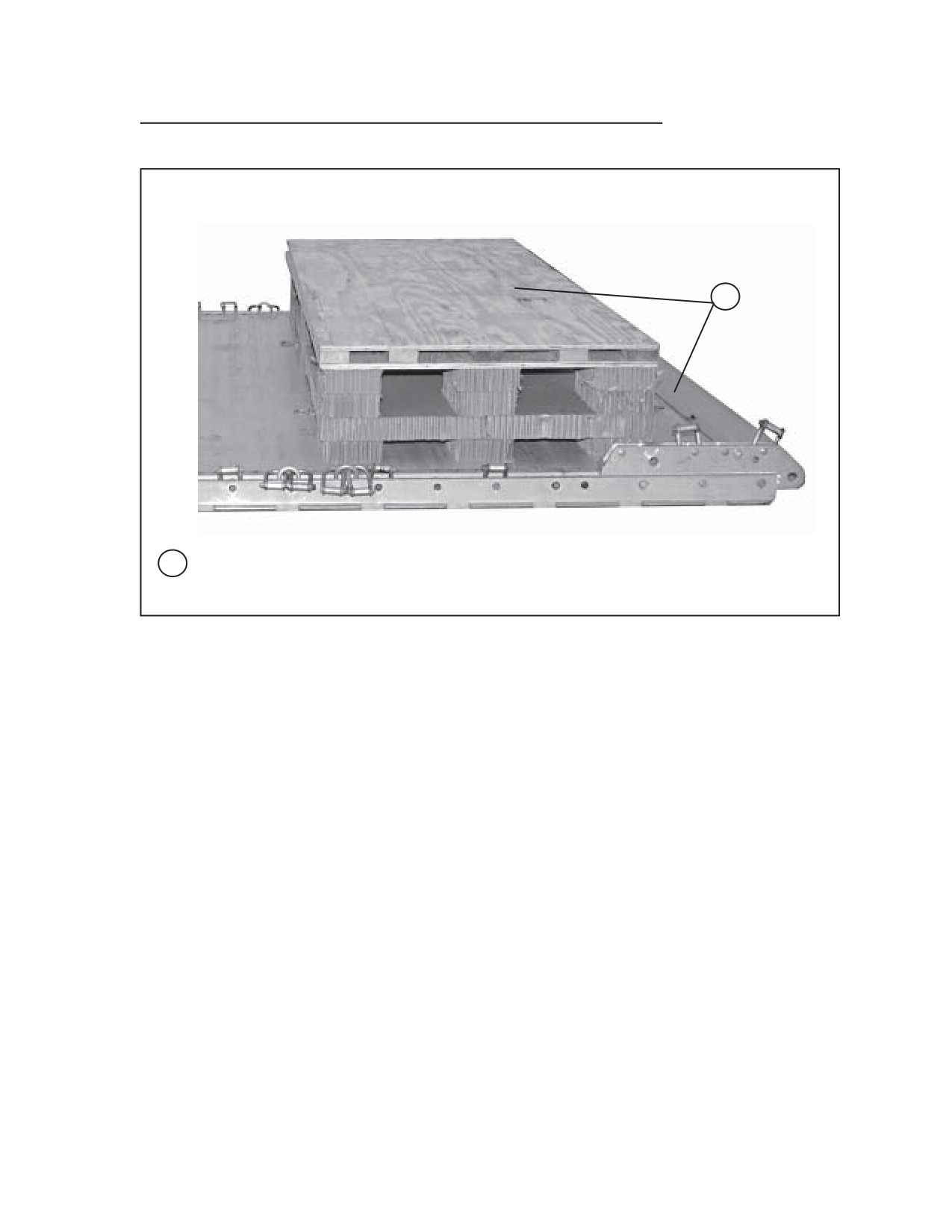
1
1
Position the front edge of stack one 13 inches from the front edge of the platform and
centered.
Figure 2-4. Honeycomb Stack 1 Positioned on Platform
2-5
11 May 2005
FM 4-20.158/TO 13C7-7-61
CONSTRUCTING AND POSITIONING EQUIPMENT BOX 1
2-4. Construct the individual components of equipment box 1 as shown in Figures
2-5 and 2-6. Assemble and position equipment box 1 as shown in Figure 2-7.
Notes:
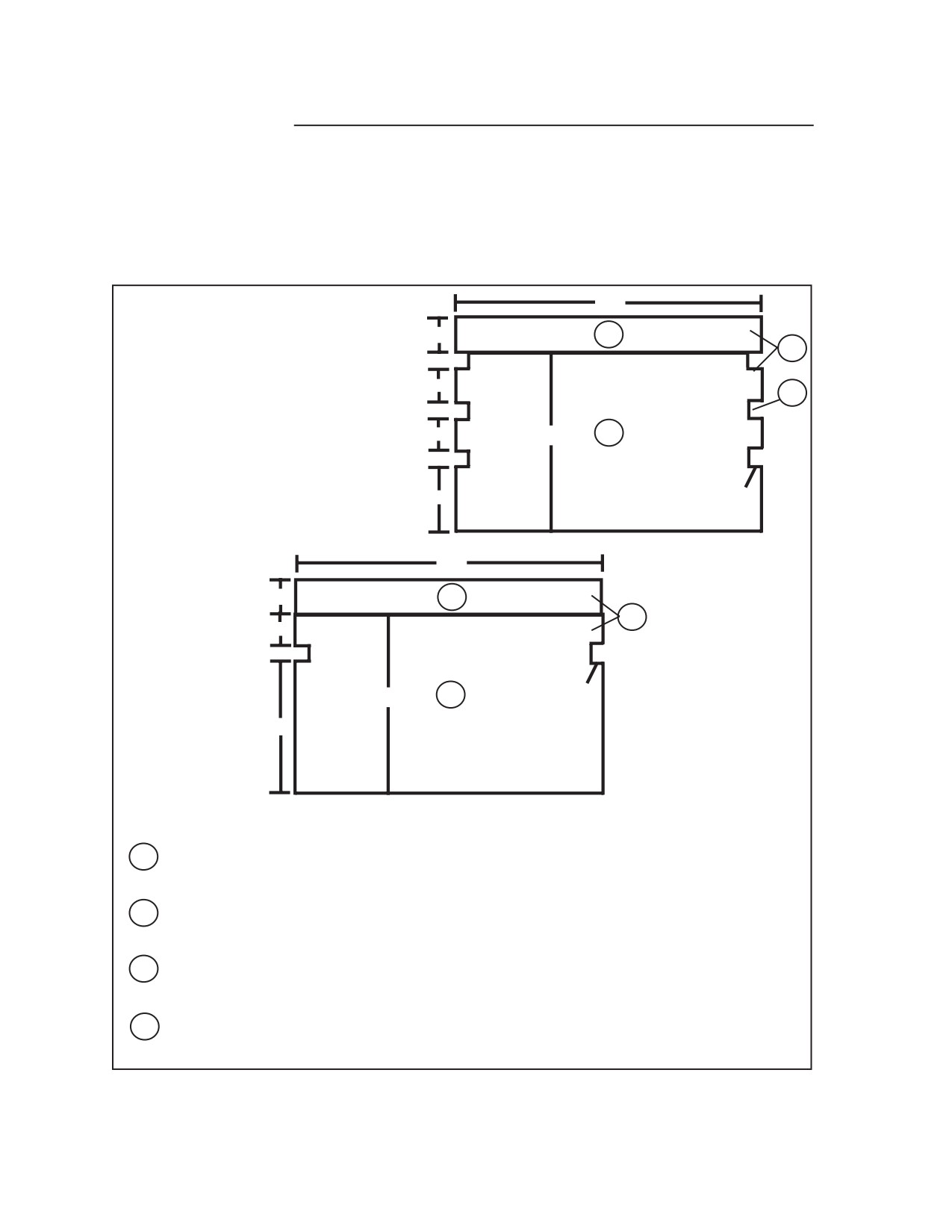
96
1. This drawing is not to scale.
2. All dimensions are in inches.
12
1
4
2
10
3
2
2
12
48
2
2
20
2
FRONT
96
12
1
4
12
2
2
2
48
34
REAR
1
Cut two 3/4- by 12- by 96-inch pieces of plywood. Face the finished side of the plywood
up.
2
Cut two 3/4- by 48- by 96-inch pieces of plywood. Face the finished side of the plywood
up.
3
Make 2- by 2-inch cutouts as shown in the plywood previously cut in step 2.
4
Lay the plywood previously cut in steps 1, 2 and 3 flush lengthwise to form two 60- by
96-inch pieces of plywood. Face the finished sides of the plywood up.
Figure 2-5. Equipment Box 1 Front and Rear Constructed
2-6
11 May 2005
FM 4-20.158/TO 13C7-7-61
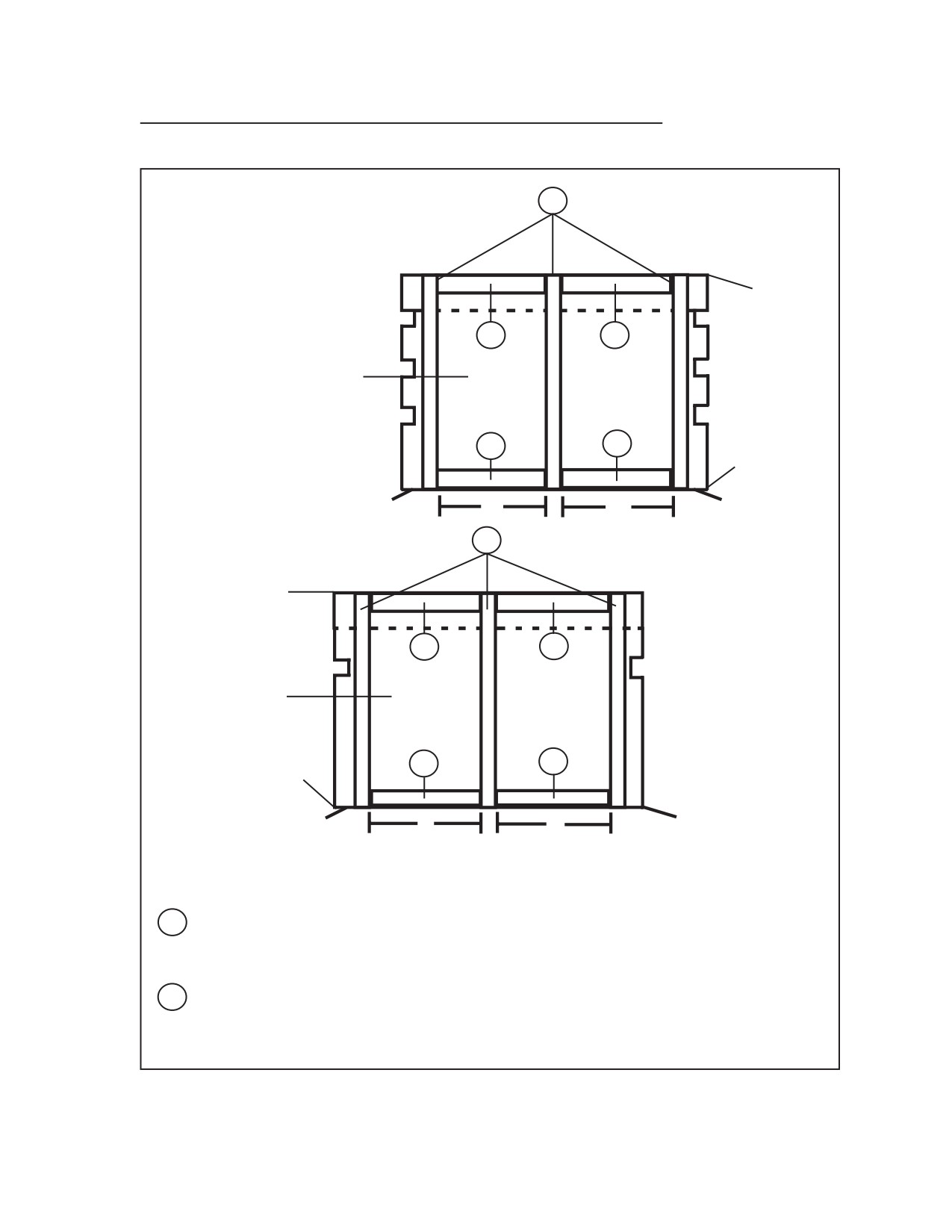
Notes:
1. This drawing is not to scale.
5
2. All dimensions are in inches.
3. Use 8d nails.
TOP
6
6
FRONT
6
6
BOTTOM
2 3/4
40
40
2 3/4
5
TOP
6
6
REAR
6
6
BOTTOM
2
3/4
40
40
2 3/4
5
Cut six 2- by 4- by 60-inch pieces of lumber. Nail four of the pieces 2 3/4 inches from the
edge of the plywood positioned in step 4. Nail the remaining two pieces centered between
the previously nailed pieces. Ensure there are 40 inches between pieces.
6
Cut eight 2- by 4- by 40-inch pieces of lumber. Nail the pieces flush between the pieces
positioned in step 5. Ensure the lumber is aligned along the top and bottom exterior
edges of the plywood.
Figure 2-5. Equipment Box 1 Front and Rear Constructed (Continued)
2-7
11 May 2005
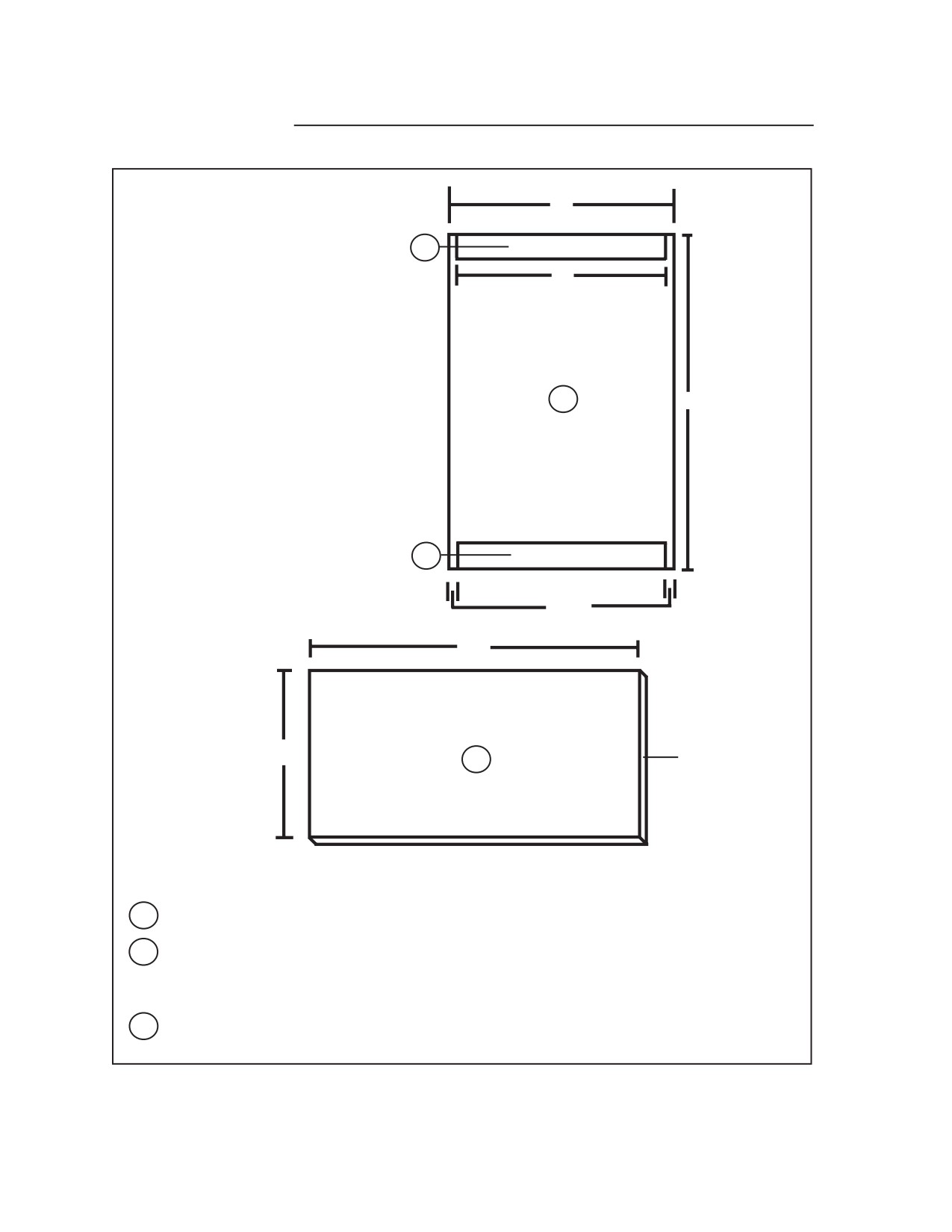
FM 4-20.158/TO 13C7-7-61
Notes:
41
1. This drawing is not to scale.
2. All dimensions are in inches.
3. Use 8d nails.
2
38
1
60
2
1 1/2
92
42 1/2
3
3/4
1
Cut two 3/4- by 41- by 60-inch pieces of plywood to make the sides of the equipment box.
2
Nail a 2- by 4- by 38-inch piece of lumber along the top and bottom edges of each of the
two side pieces with 8d nails as shown. Allow the plywood to extend past the lumber 1
1/2 inches on each side.
3
Cut two 3/4- by 42 1/2- by 92-inch pieces of plywood to make the top and bottom of
equipment box 1.
Figure 2-6. Equipment Box 1 Sides,Top and Bottom Constructed
2-8
11 May 2005
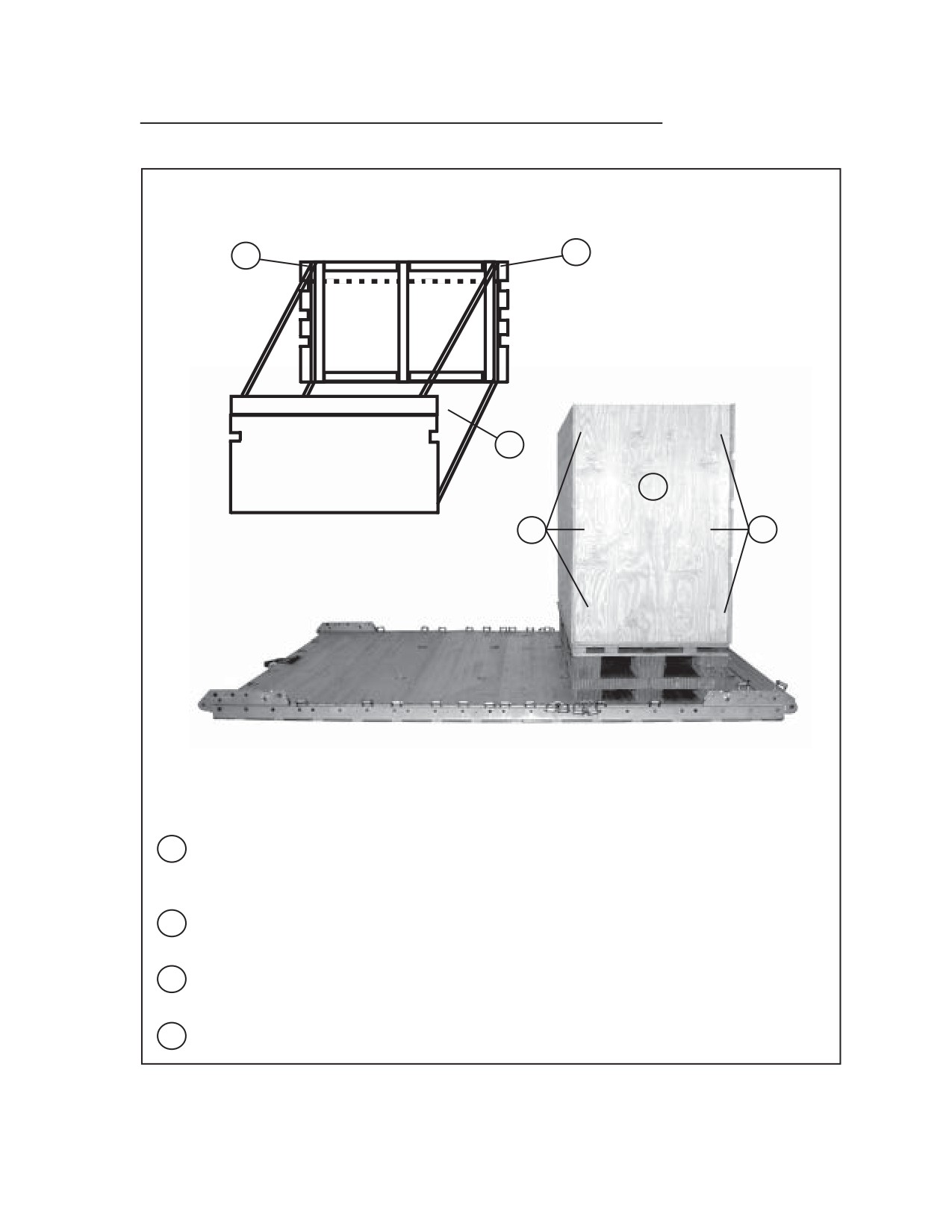
FM 4-20.158/TO 13C7-7-61
Notes:
1. This drawing is not to scale.
2. Use 8d nails.
FRONT
1
1
LEFT
RIGHT
20
3
34
4
REAR
2
2
Note: The side boards are transparent for clarity during construction.
1
Assemble the box. When positioning the ends, ensure that the 20-inch cutout is posi-
tioned at the front bottom and the 34-inch cutout is positioned at the rear bottom
portion of the box.
2
Nail the pieces positioned in step 1 together with 8d nails through the sides of the box
and into the vertical lumber pieces in the front and rear of the box.
3
Position and center the plywood for the bottom of the box on the horizontal lumber
supports and nail in place with 8d nails.
4
Position and center equipment box 1 on top of honeycomb stack 1 as shown.
Figure 2-7. Equipment Box 1 Partially Assembled and Positioned for Loading
2-9
11 May 2005
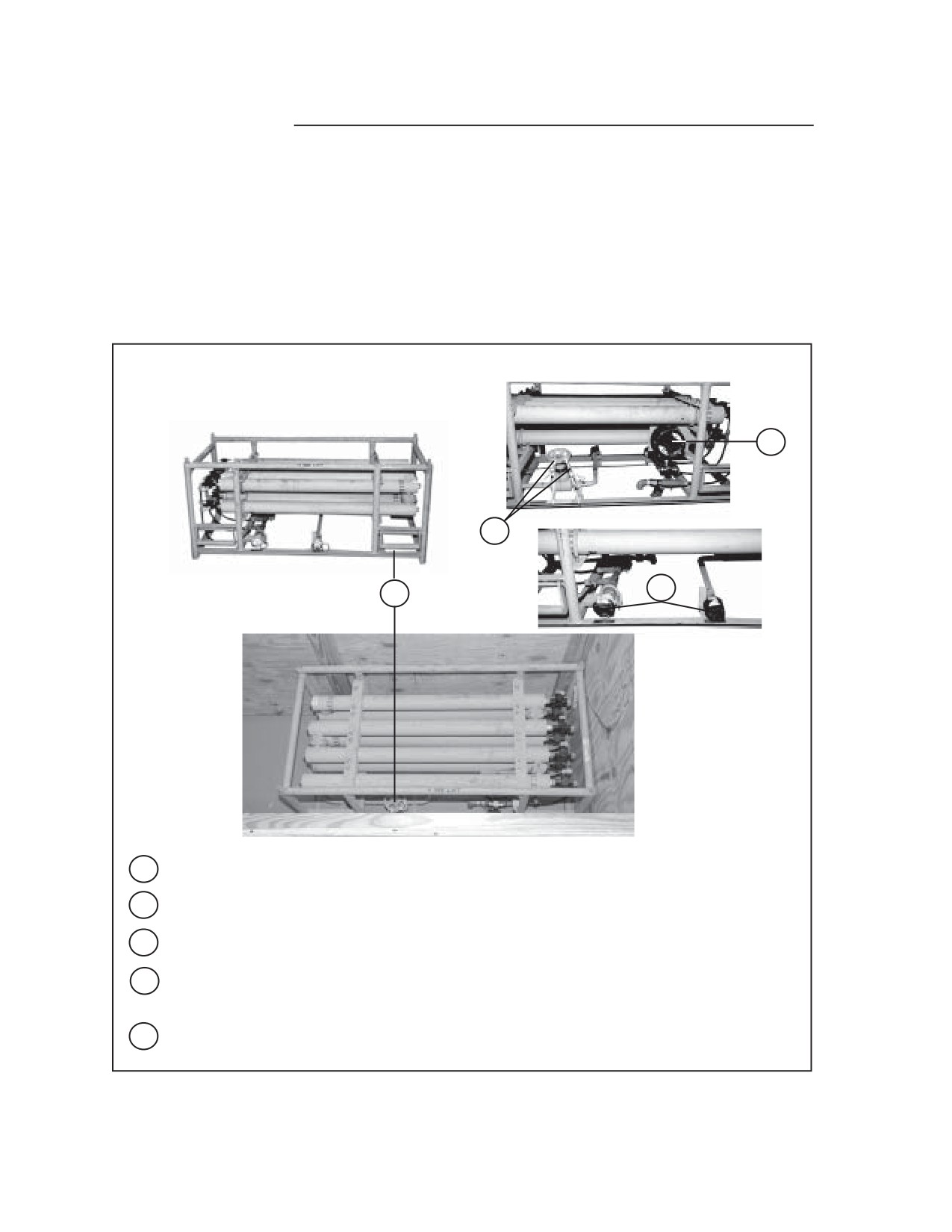
FM 4-20.158/TO 13C7-7-61
PREPARING AND STOWING THE EQUIPMENT FOR EQUIPMENT
BOX 1
2-5. Prepare the components for equipment box 1 and stow them in the container
as described below.
a. PREPARING REVERSE OSMOSIS ELEMENT MODULE. Prepare
the reverse osmosis element module, and stow in the container as shown
in Figure 2-8.
Note: The total weight of the module is 189 pounds.
2
1
3
5
FRONT
LEFT
RIGHT
REAR
1
Secure the reject control valve with type III nylon cord as shown.
2
Place a piece of 2-inch adhesive or masking tape over the pressure gauge.
3
Tape the permeate and reject outlets with 2-inch adhesive tape.
4
Cut and position a 36- by 87 1/2-inch piece of honeycomb in the bottom of equipment box
1 (not shown).
5
Position the reverse osmosis element module to the right front corner of equipment box
1 with the reject control valve facing to the rear of the box.
Figure 2-8. Reverse Osmosis Element Module Prepared and Stowed
2-10
11 May 2005
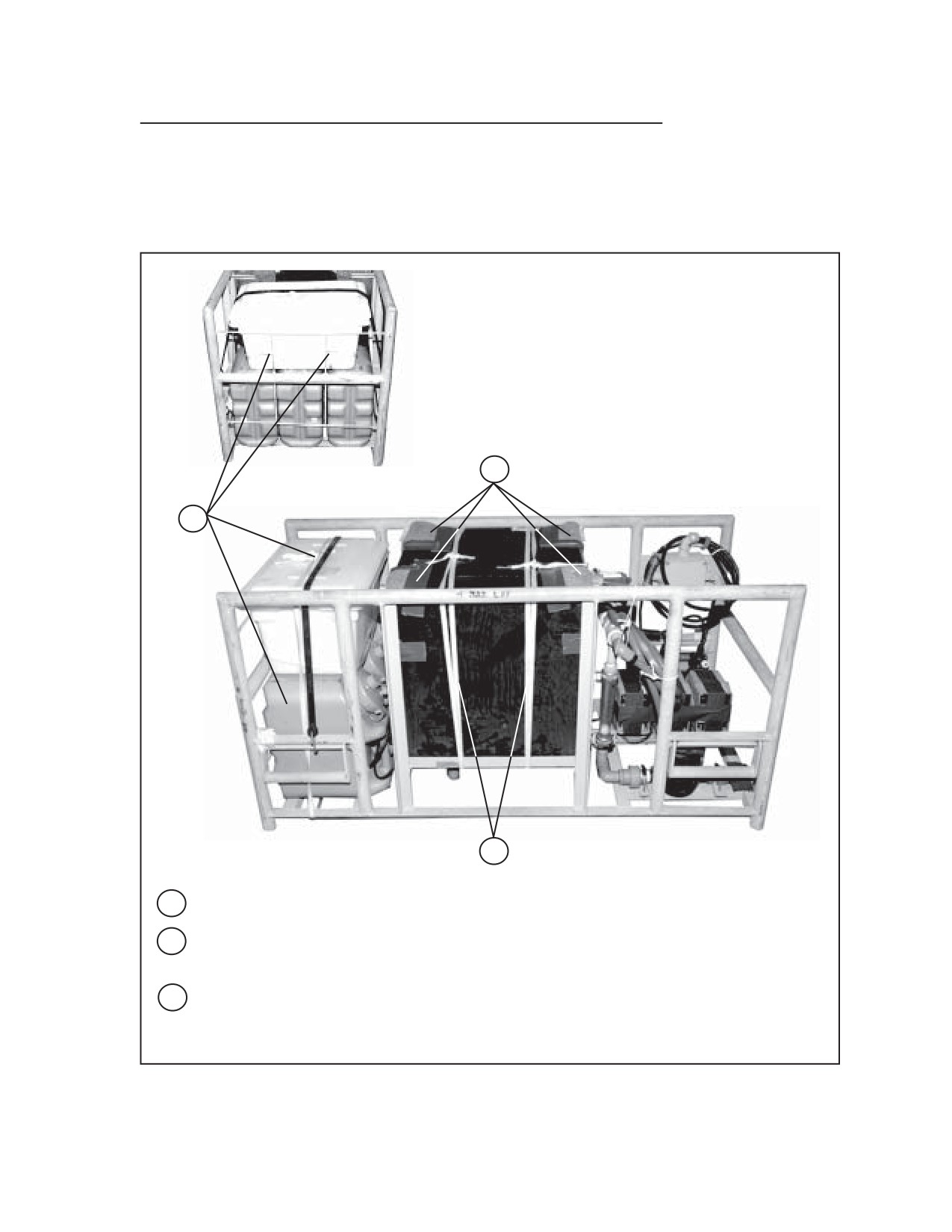
FM 4-20.158/TO 13C7-7-61
b. PREPARING CHEMICAL INJECTION CLEANING MODULE.
Prepare the chemical injection cleaning module and stow in the container
as shown in Figure 2-9.
Note: The total weight of the module is 124 pounds.
2
3
1
1
Secure the cleaning tank to the module frame using 1/2-inch tubular nylon webbing.
2
Pad each top corner of the cleaning tank with felt and tape in place with 2-inch adhe-
sive tape.
3
Secure the three tanks (anti-scalant, coagulant, and hypochlorite) and the plastic
storage box using 1/2-inch tubular nylon webbing to the module frame so they will not
move.
Figure 2-9. Chemical Injection Cleaning Module Prepared and Stowed
2-11
11 May 2005
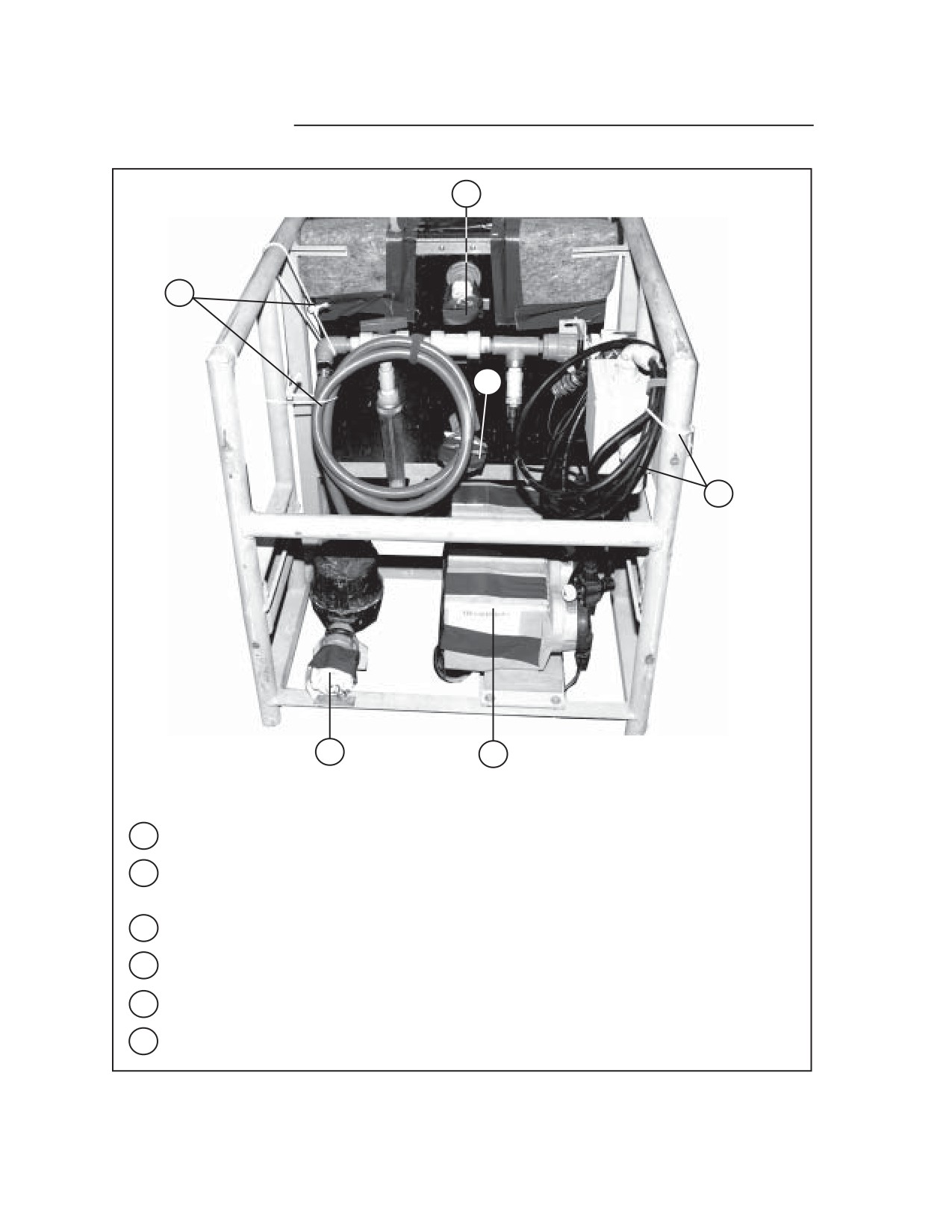
FM 4-20.158/TO 13C7-7-61
9
4
6
7
8
5
4
Secure the hose from the diverter valve to the frame using type III nylon cord.
5
Tape the three injection pumps (anti-scalant, coagulant, and hypochlorite) with 2-inch
adhesive tape.
6
Tape the pressure gauge on the cleaning tank with 2-inch adhesive tape.
7
Secure the hose from the junction box to the frame using type III nylon cord.
8
Tape the product water-in valve using 2-inch adhesive tape.
9
Tape the cleaning inlet valve on the cleaning tank using 2-inch adhesive tape.
Figure 2-9. Chemical Injection Cleaning Module Prepared and Stowed (Continued)
2-12
11 May 2005
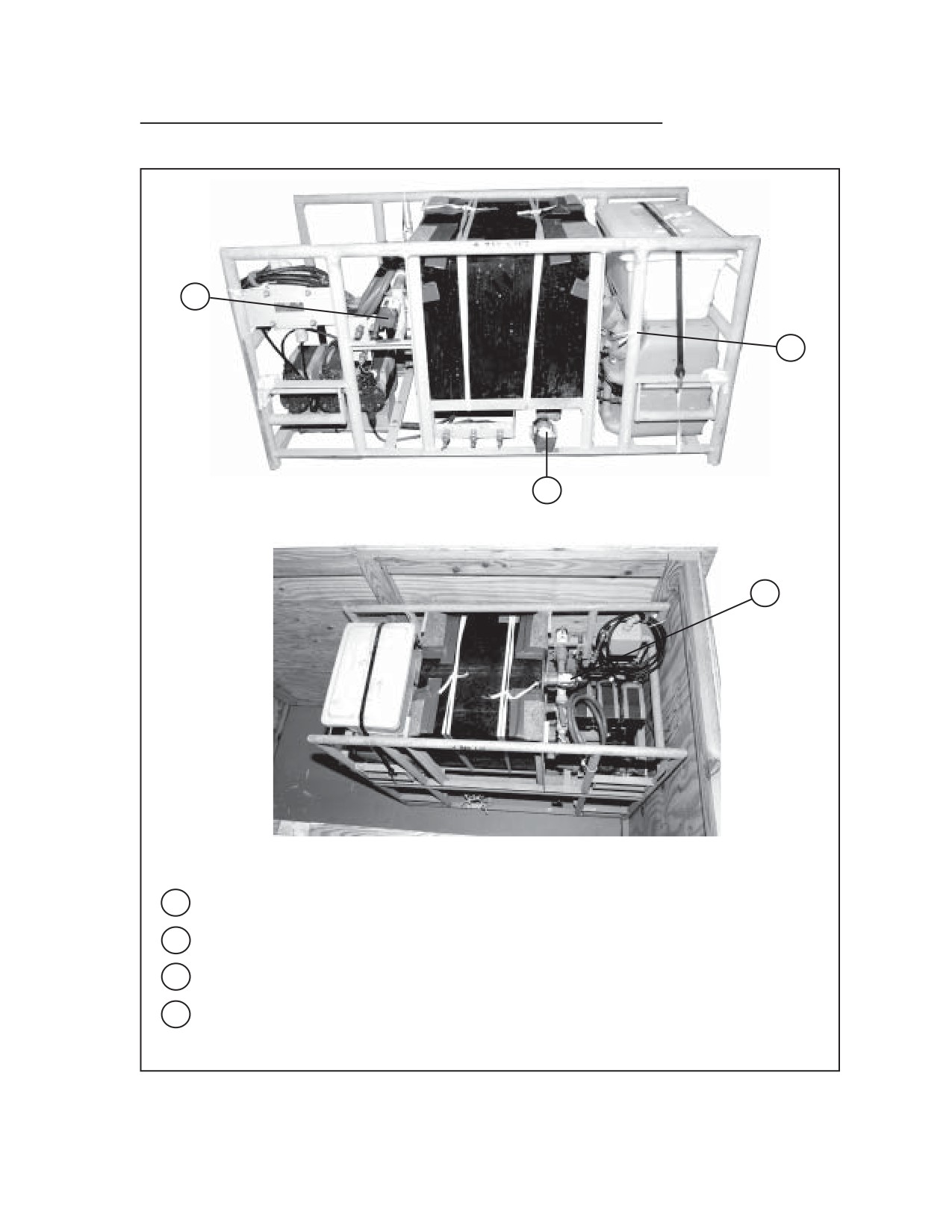
FM 4-20.158/TO 13C7-7-61
10
12
11
FRONT
13
LEFT
RIGHT
REAR
10
Tape the product water-out valve with 2-inch adhesive tape.
11
Tape the drain outlet valve with 2-inch adhesive tape.
12
Secure any loose hoses to the frame using type III nylon cord.
13
Position the chemical injection cleaning module on top of the reverse osmosis element
module and ensure the product water-in valve faces to the right side of equipment box 1.
Figure 2-9. Chemical Injection Cleaning Module Prepared and Stowed (Continued)
2-13
11 May 2005
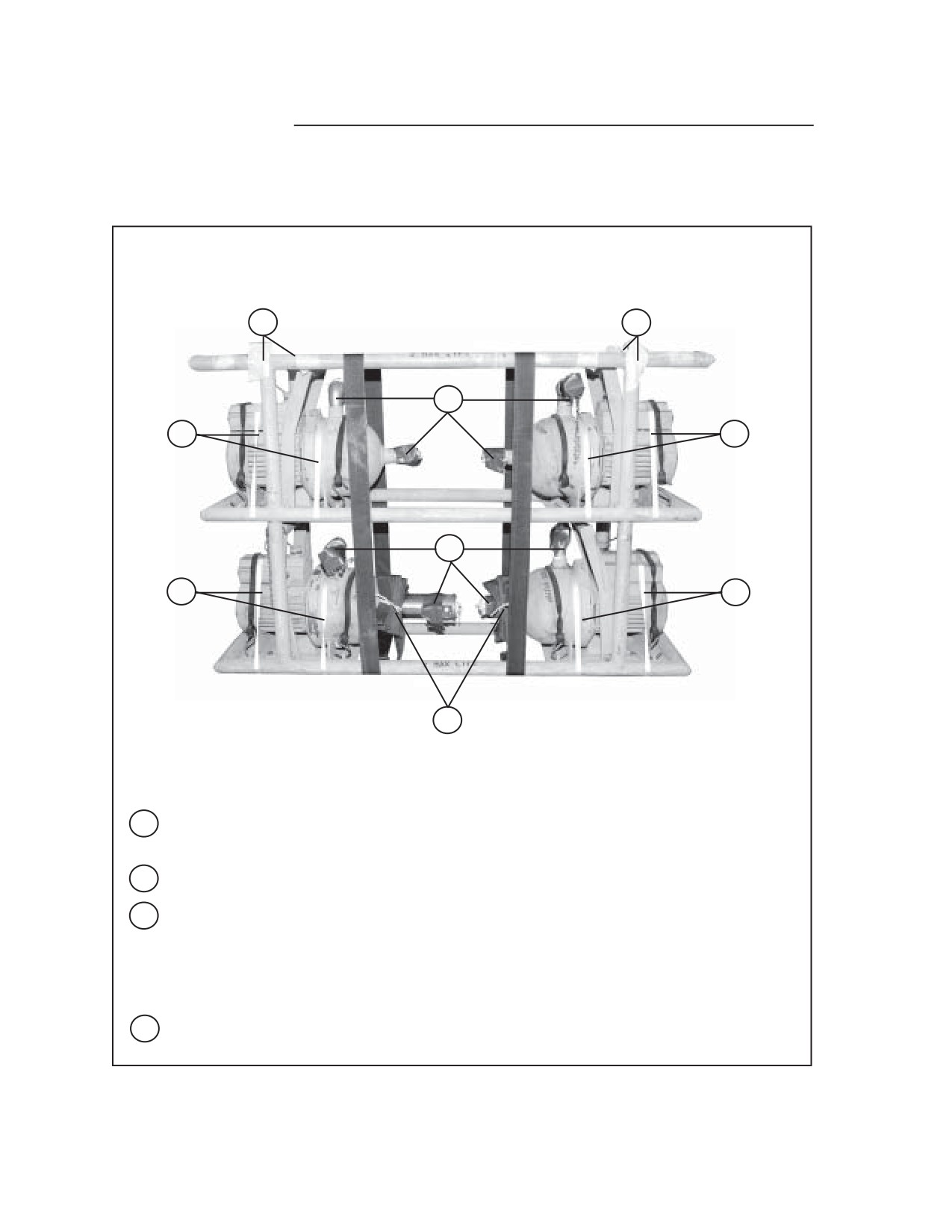
FM 4-20.158/TO 13C7-7-61
c. PREPARING PUMP MODULE. Prepare the pump module and stow in
the container as shown in Figure 2-10.
Note: The total weight of the module is 152 pounds.
4
4
2
1
1
2
1
1
3
1
Secure each individual pump to the module frame using two lengths of 1/2-inch tubular
nylon webbing.
2
Tape all valves with 2-inch adhesive tape.
3
Secure two A-7A straps vertically around the center of the module frame.
Note: Ensure the friction adapter of the A-7A strap is positioned at the bottom of the module
frame and secure the excess webbing to the bottom inside valves using type I, 1/4-inch
cotton webbing.
4
Tape the male portions of the frame using 2-inch masking tape.
Figure 2-10. Pump Module Prepared and Stowed
2-14
11 May 2005
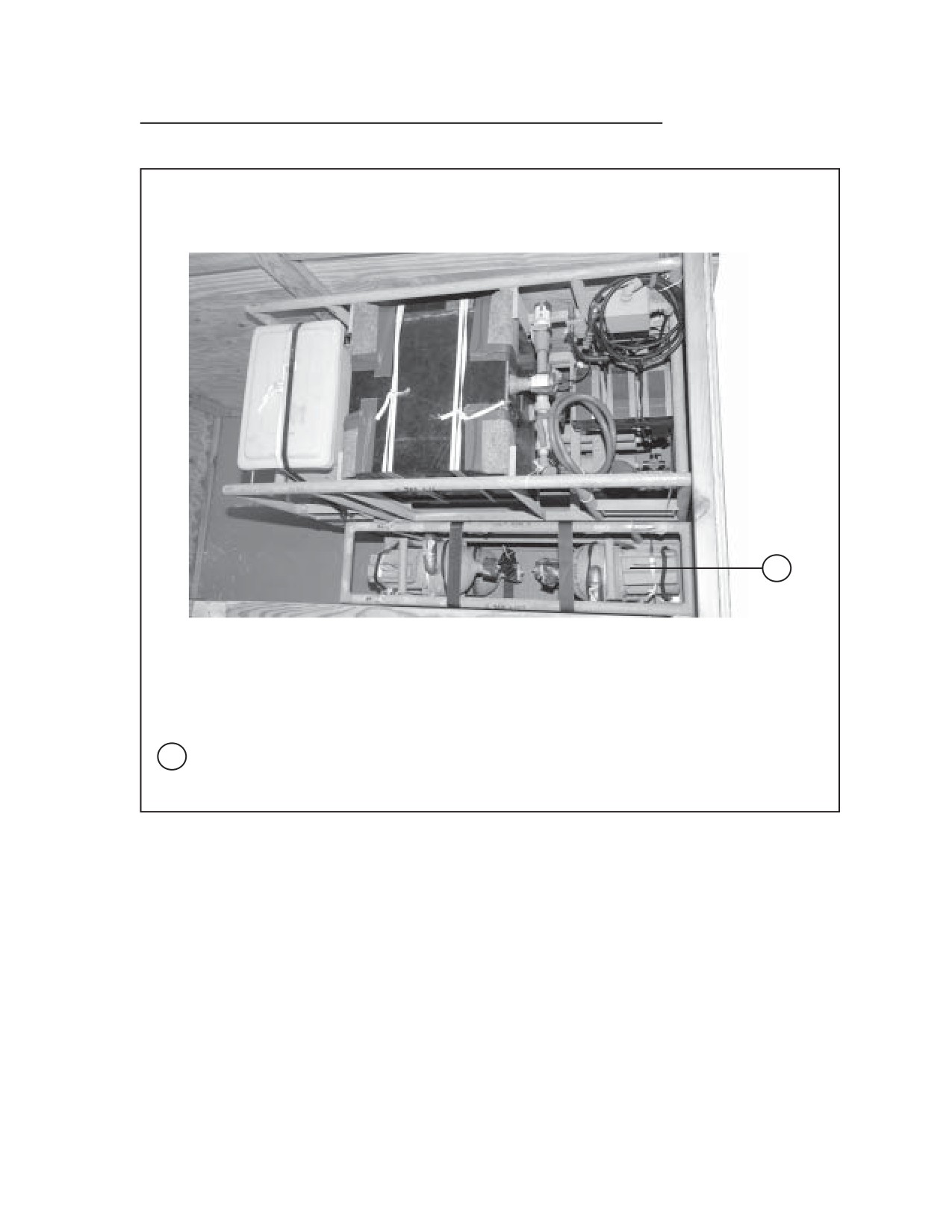
FM 4-20.158/TO 13C7-7-61
FRONT
RIGHT
5
REAR
5
Position the pump module to the rear of the reverse osmosis element module and flush
against the right rear corner of equipment box 1.
Figure 2-10. Pump Module Prepared and Stowed (Continued)
2-15
11 May 2005
FM 4-20.158/TO 13C7-7-61
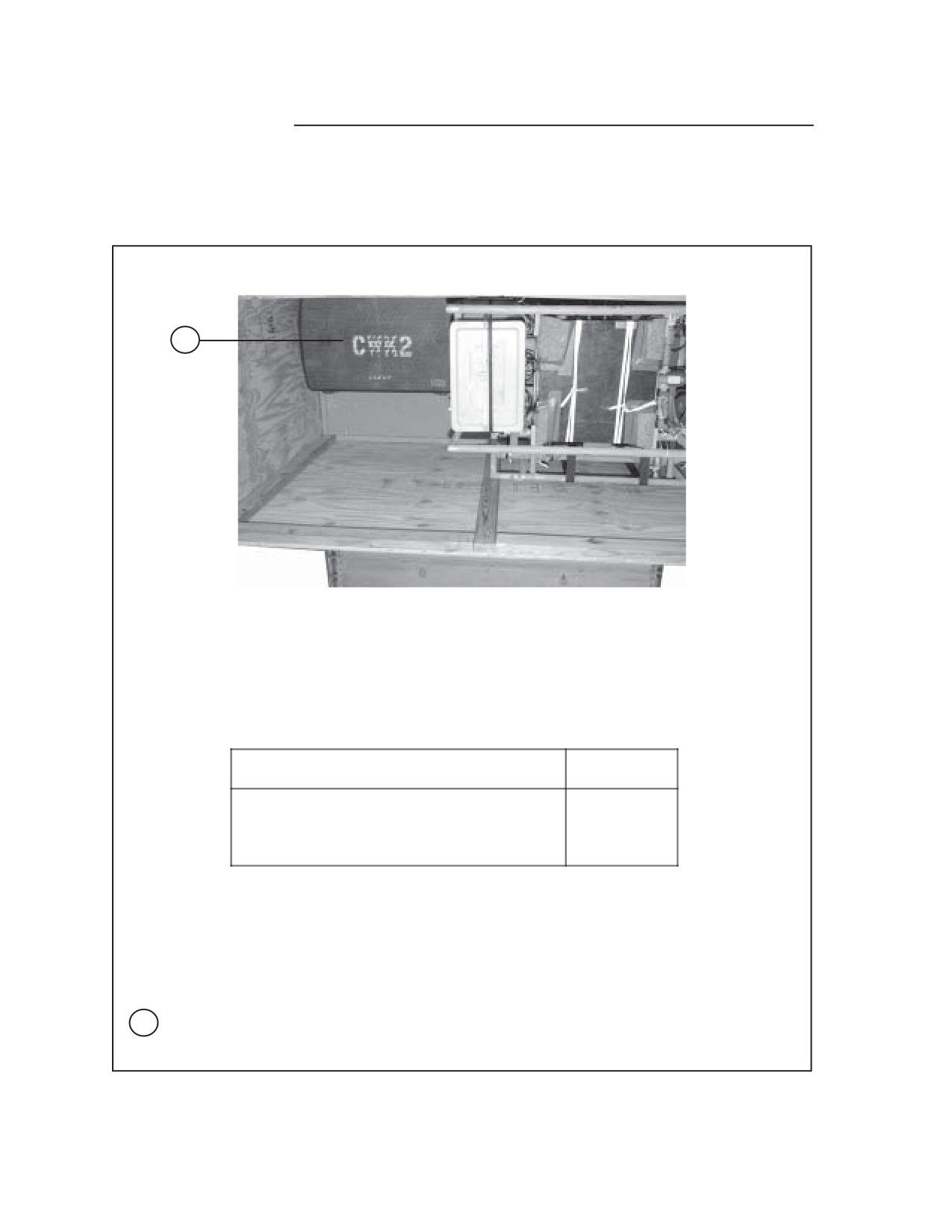
d. STOWING COLD WEATHER KIT 2 (CWK2) BOX AND COLD
WEATHER KIT 3 (CWK3) BOX. Stow the CWK2 box and the CWK3
box in the container as shown in Figure 2-11.
FRONT
1
LEFT
RIGHT
REAR
Note: The components listed below are stored inside the overpack kit box of CWK2. The
total weight of the CWK2 box is 64 pounds.
Item Description
Quantity
Thermal blanket, 10-feet, 0.75-inch hose
2
Thermal blanket, 20-feet, 0.75-inch hose
4
Note: Ensure the CWK2 box is flush against the front and left side of the container.
1
Position the CWK2 box to the left front of the container.
Figure 2-11. CWK2 Box and CWK3 Box Stowed
2-16
11 May 2005
FM 4-20.158/TO 13C7-7-61
FRONT
2
LEFT
RIGHT
REAR
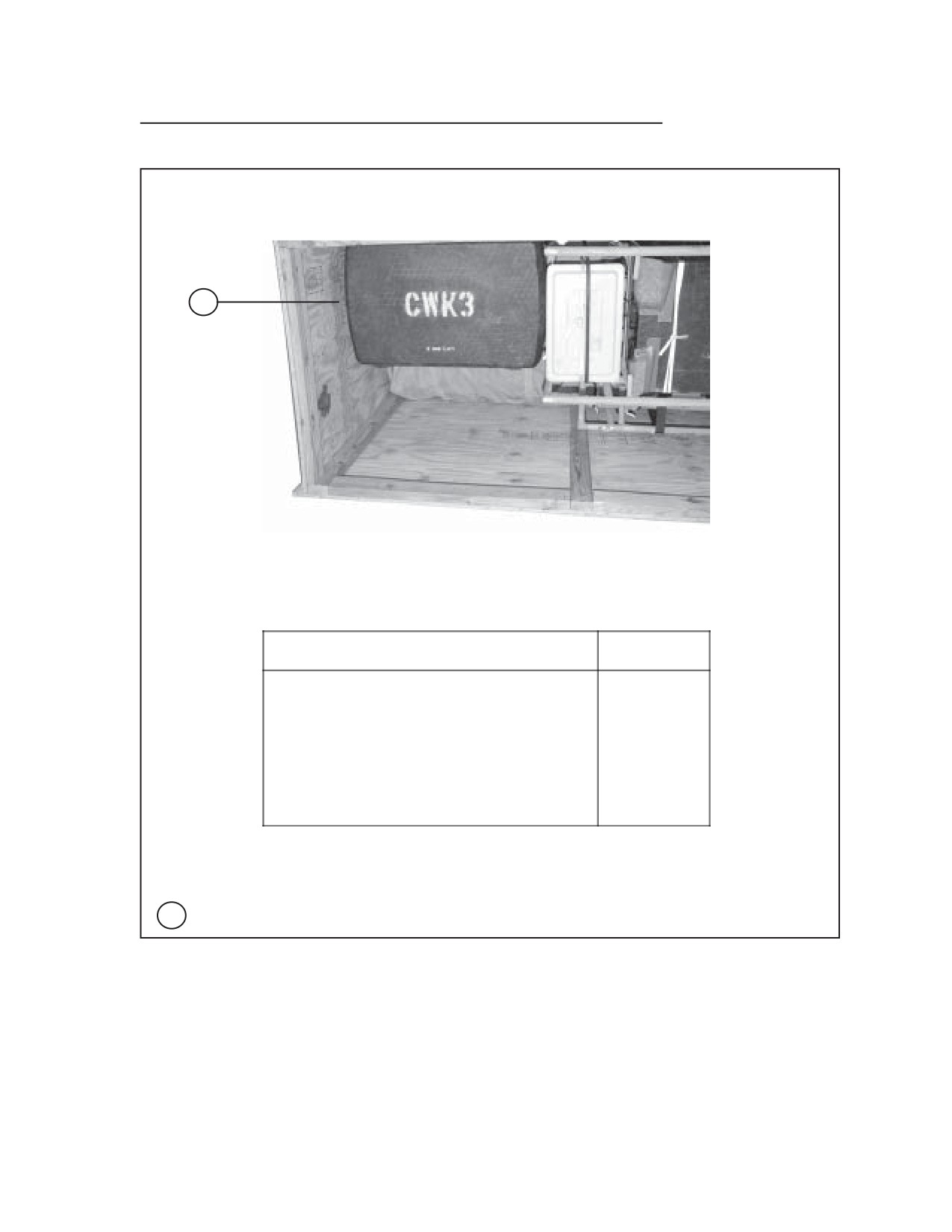
Note: The components listed below are stored inside the overpack kit box of CWK3. The
total weight of the CWK3 box is 61 pounds.
Item Description
Quantity
Thermal blanket, 10-feet, 1.5-inch hose
1
Thermal blanket, 20-feet, 1.5-inch hose
2
Thermal blanket, 10-feet, 1-inch hose
1
Thermal blanket, 20-feet, 1-inch hose
2
2
Position the CWK3 box on top of the CWK2 box.
Figure 2-11. CWK2 Box and CWK3 Box Stowed (Continued)
2-17
11 May 2005
FM 4-20.158/TO 13C7-7-61
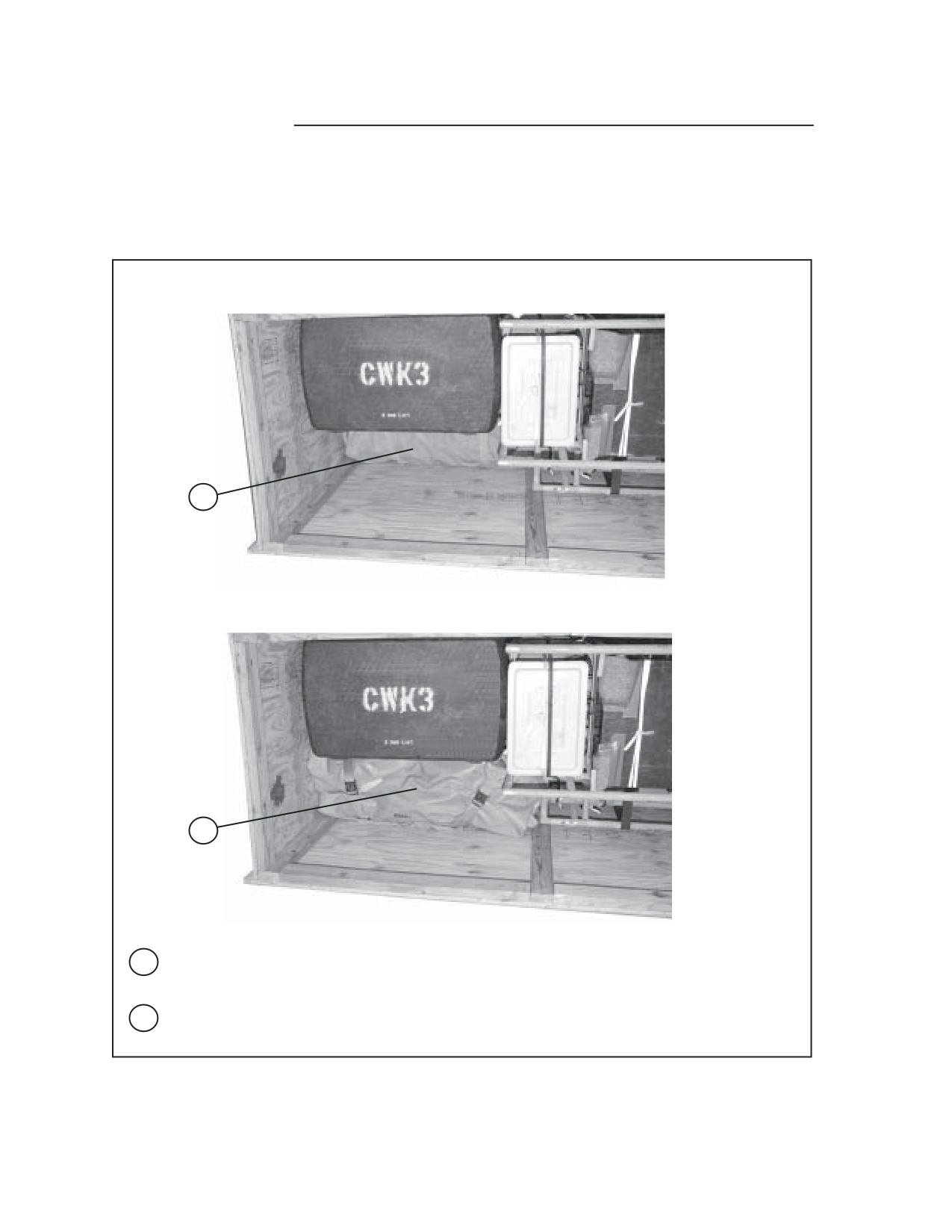
e. STOWING 1,000-GALLON COLLAPSIBLE RAW WATER AND
PRODUCT FABRIC TANKS. Stow the 1,000-gallon collapsible raw
water and product fabric tanks in the container as shown in Figure 2-12.
Note: The total weight of the 1,000-gallon collapsible raw water fabric tank is 59 pounds.
1
Note: The total weight of the 1,000-gallon collapsible product fabric tank is 50 pounds.
2
1
Position the 1,000-gallon collapsible raw water fabric tank to the rear of the CWK2 box
and the CWK3 box.
2
Position the 1,000-gallon collapsible product fabric tank on top of the 1,000-gallon
collapsible raw water fabric tank.
Figure 2-12. 1,000-Gallon Collapsible Raw Water and Product Fabric Tank Stowed
2-18
11 May 2005