FMI 6-02.45, C1 Signal Support to Theater Operations (May 2008) - page 7
 

  Главная      Manuals     FMI 6-02.45, C1 Signal Support to Theater Operations (May 2008)


Search            copyright infringement  


Content      ..     5      6      7     


FMI 6-02.45, C1 Signal Support to Theater Operations (May 2008) - page 7


Theater LandWarNet Equipment Overview 

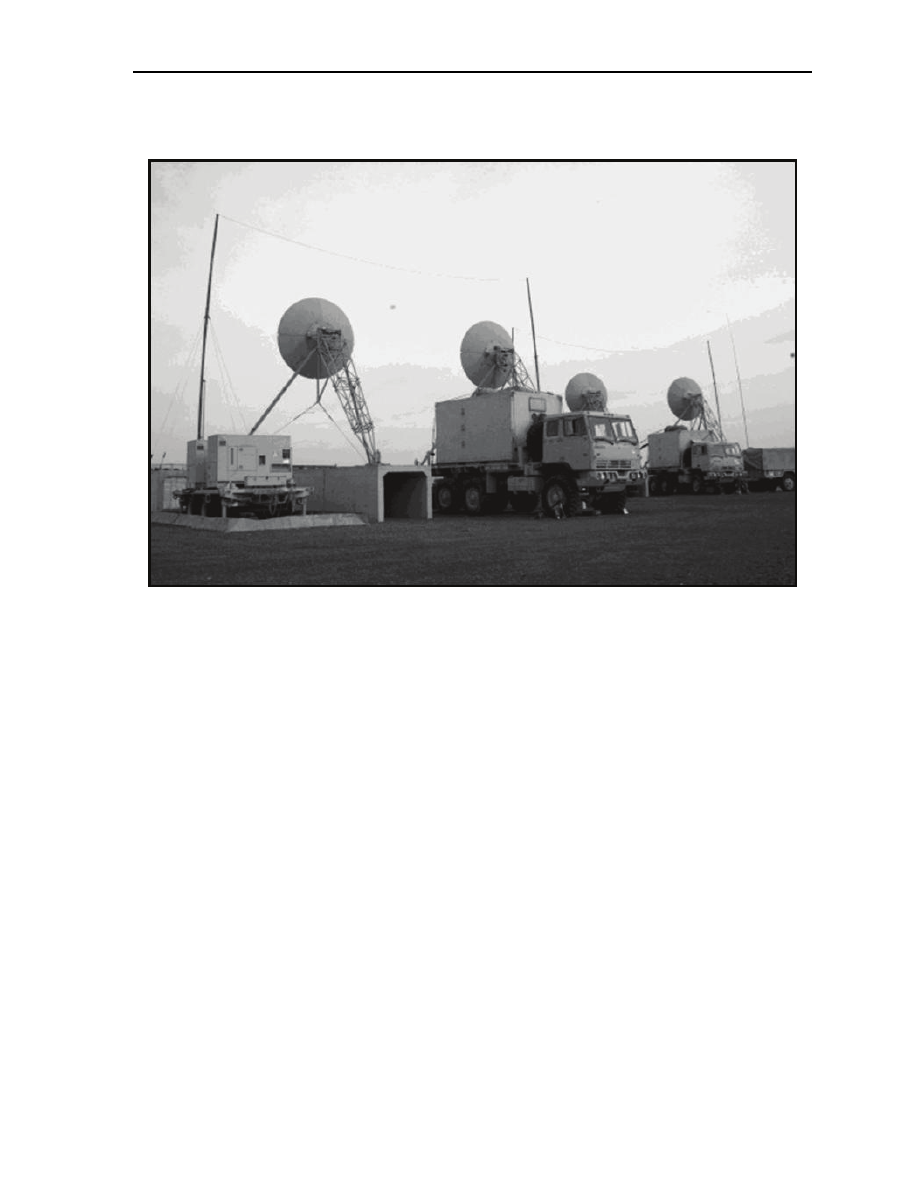
extended range (skip node) communications. The AN/TRC-170(V)2 (see Figure B-10) replaces the 
AN/TRC-132 TROPO. The AN/TRC-170(V)3 (see Figure B-11) replaces the AN/TRC-112/121 TROPO. 

Figure B-10. AN/TRC-170(V)2 Heavy TROPO 

5 July 2007 

FMI 6-02.45 

B-11 

Appendix B 

Figure B-11. AN/TRC-170(V)3 Light TROPO 

SECTION IV - SWITCHING AND DATA TERMINAL CENTERS 

AN/TTC-56 SINGLE SHELTER SWITCH 

B-16. The AN/TTC-56 single shelter switch (SSS) (see Figure B-12) is a downsized, improved, mobile 
tactical digital circuit switch that includes a packet switch and a packet gateway designed to replace the 
AN/TTC-39D circuit switch. The AN/TTC-56 interfaces with DSN, NATO, commercial and tactical 
telephone switches, switchboards, and various subscribers’ telephones. It is housed in a lightweight, 
multipurpose shelter and mounted on an M1113 expanded capacity vehicle. The SSS provides voice and 
packet switching capability using small, lightweight, and modular switching equipment. It tows a trailer-
mounted diesel engine generator set that provides 10 kW primary operating power for the system. The SSS 
signal interface provides inputs for multi-conductor and coaxial cable connections made at the signal entry 
panel which carry the signals through the shelter wall. Inside each signal entry panel, electrical surge 
arrestors and high voltage assemblies on the individual signal lines protect electrical equipment from 
transient high voltage pulses. All panel connector receptacles are waterproof. A hinged cover extends over 
the panel to provide additional protection against the environment. A grounding stud is located on each 
signal entry panel. 

B-12 

FMI 6-02.45 

5 July 2007 

Theater LandWarNet Equipment Overview 

Figure B-12. AN/TTC-56 SSS 

B-17. The following subscriber features are possible through the capabilities of the SSS:  

z

Subscriber profiles. 

z

Multilevel precedence and preemption. 

z

Precedence level dialing. 

z

Conference calling. 

z

Call security. 

z

Call forwarding. 

z

Zone restriction. 

z

Commercial network access. 

z

Compressed dialing. 

z

Direct dialing. 

Note. 

It is possible to connect a much larger number of subscriber loops to the AN/TTC-56. 

Different units have experienced varying degrees of success in doing so. 

AN/TTC-48(V)2 SEN SWITCH 

B-18. The SEN switch (see Figure B-13) is an attended mobile communications system comprised of an 
S-250(A)/E shelter transported on a M-1037 HMMWV that provides switching, multiplexing, and 
COMSEC equipment which supports secure digital communications, automatic local secure switching, and 
wire subscriber access to MSE networks. The SEN C(V)1 and C(V)3 provide connections for 26 
subscribers, while the SEN A(V)2, C(V)2, and C(V)4 provide connections for 41 subscribers. Specially 
configured SEN switches interface with an AN/TTC-39D and operate at 32 kbps data rate. Theater level 
SEN switches are equipped with a digital nonsecure voice terminal (DNVT) TA-1042 rather than the TA-
1035/U used in division MSE SEN systems. The SEN switch also has provisions to access directly 
commercial switching offices, interface with the CNR system, interface with a TACSAT terminal, and 
interface with an analog to digital converter. Individual computers, called host systems, and LANs 
interface with the SEN using the packet switch and its associated devices, the signal data converter, and 
transceivers. Power is provided by a PU-753/M, 10 kW, trailer-mounted, diesel generator set. 

5 July 2007 

FMI 6-02.45 

B-13 

Appendix B 

Figure B-13. AN/TTC-48(V)2 SEN 

AN/TTC-58(V) BASE-BAND NODE 

B-19. The AN/TTC-58(V) base-band node (BBN) (see Figure B-14) is being developed to address urgent 
CCDR requirements for quality of bandwidth at a tactical data capability standard. Current requirements 
are often met by ad hoc packages of COTS equipment, which the Army wholesale supply and maintenance 
system does not fully support. The AN/TTC-58(V) provides a highly mobile self-contained single data 
package that will serve as the backbone of the conversion of theater tactical signal forces to the ITSB or 
ESB structure. The BBN will combine voice, data, and video switching with existing and emerging organic 
transmission capabilities to provide a smaller, lighter, more capable system to augment today’s ACUS, 
TRI-TAC, and MSE communications systems network. Additionally, the BBN will meet the requirement 
for improved tactical-to-strategic interoperability and inter- and intra-service data network interoperability. 
The BBN will provide a high-speed data and video/imagery communications solution that will include a 
capability to accommodate higher throughput for data networks and provide a method for the effective use 
and allocation of bandwidth. 

B-14 

FMI 6-02.45 

5 July 2007 

Theater LandWarNet Equipment Overview 

Figure B-14. AN/TTC-58(V) BBN 

AN/TTC-59 JNN 

B-20. The JNN (see Figure B-15) is a lightweight modular shelter mounted on an M1113 HMMWV. Its 
equipment also includes several transit and transport cases that are not shelter mounted. It tows a trailer-
mounted diesel engine-generator set that provides 10 kW primary operating power for the system. The 
JNN is a suite of communications equipment to exercise effective control over the communication links, 
trunks, and groups within a deployed network. The JNN provides capabilities to interface those sources 
with satellite and terrestrial transmission resources to establish a robust network. This network incorporates 
a SATCOM backbone and updated routing and switching equipment to provide higher bandwidth and 
more mobile communications and enables the network to interoperate with strategic networks and joint 
tactical networks. 

Figure B-15. AN/TTC-59 JNN 

5 July 2007 

FMI 6-02.45 

B-15 

Appendix B 

SECTION V - MISCELLANEOUS SYSTEMS AND COMPONENTS 

ENHANCED SATELLITE HUB MULTIPLEXER SHM-1337 

B-21. The Enhanced Satellite Hub Multiplexer, Model SHM-1337, is a direct replacement for the TD-1337 
and provides enhanced multiplexer features per MIL-STD-188-168 and is interoperable with the current 
TD-1337 multiplexers installed in the AN/TSC-85C, AN/TSC-93C, and AN/TSC-143 TACSAT terminals. 
It provides multiplexer features per MIL-STD-188-168 and is interoperable with legacy TSSP 
multiplexers. The SHM-1337 has two standard operating modes which are selectable from the front panel: 

z

Enhanced mode - Supports fully connected mesh networks with up to seven nodes, multiplexes 
12 user groups into a single aggregate stream, and is interoperable with legacy and enhanced 
multiplexers. 

z

Legacy mode - Interoperable with and replaces the legacy TD-1337, TSSP. 

B-22. The SHM-1337supports up to 12 active user ports using hub (nodal) configuration (one multiplexer, 
six demultiplexers operating 16 kbps secure digital voice orderwire. It supports point-to-point, hub-spoke, 
mesh and hybrid networks with bit error rate monitoring capability, and provides aggregate interfaces 
(enhanced and current) to satellite terminals using balanced or unbalanced NRZ, conditioned diphase, 
bipolar, and T-Carrier 3 (T1)/European Basic Multiplex Rate (E1). 

PROMINA® 800 AND PROMINA® 400 MULTISERVICE ACCESS 

PLATFORM 

B-23. The Promina 800 and 400, as shown in Figure B-16, are COTS components that serve as a 
communications hub or extension multiplexer. As a multi-service access platform, the Promina 800 allows 
varied types of communications systems and media to connect to DISN services and serves as a network 
hub. Typical customers would be a CCDR/JTF size headquarters. The Promina 400 normally supports 
remote spokes in a typical hub-spoke network configuration. The Promina high-speed shelf and multiple 
extended expansion shelves accommodate redundant alternating current/direct current power supplies, 
common processor, interconnect modules, switching equipment, up to 16 standard interfaces, applications, 
and trunk modules.  

B-24. Promina systems support— 

z

Local voice subscriber loops, voice processing and switching, data, video, fax, and modem. 

z

IP LAN and integrated service digital network, as well as asynchronous transfer mode and frame 
relay networking. 

z

Imaging traffic. 

z

Advanced bandwidth management and multi-protocol routing and bridging. 

B-16 


FMI 6-02.45 

5 July 2007 

Theater LandWarNet Equipment Overview 

Figure B-16. Promina 400 and Promina 800 

TIME DIVISION MULTIPLEXER AN/FCC-100 

B-25. The AN/FCC-100 (see Figure B-17) is a rack-mountable, stand-alone unit used to perform 
multiplexing, de-multiplexing, timing, synchronizing, framing, monitoring, and alarm reporting. It 
terminates up to 16 full-duplex circuits and supports digital port operations (synchronous NRZ, 
conditioned diphase, and TRI-TAC conditioned diphase, asynchronous, and isochronous) and analog port 
modulation encoding/decoding (PCM and continuous variable slope delta). This multiplexer normally 
supports remote spokes and JTF extensions and uses AN/TSC-93C or TROPO/LOS radios as a 
transmission medium. 

Figure B-17. AN/FCC 100 

5 July 2007 

FMI 6-02.45 

B-17 

Glossary 

SECTION I – ACRONYMS AND ABBREVIATIONS 

3SOPS 

3d Space Operation Squadron 

4SOPS 

4

th

 Space Operation Squadron 

ACERT 

Army Computer Emergency Response Team 

ACUS 

Area Common User System 

ADCON 

administrative control 

AFFOR 

Air Force forces 

AFSPACE 

United States Space Command Air Force 

A-GNOSC 

Army Global Network Operations and Security Center 

AO 

area of operations 

AOR 

area of responsibility 

APOD 

aerial port of debarkation 

APOE 

aerial port of embarkation 

ARFOR 

Senior Army Headquarters 

ARNG 

Army National Guard 

ARSTRAT 

Army Forces Strategic Command 

ASA-INSCOM 

Army Signal Activity - United States Army Intelligence and Security 
Command 

ASCC 

Army Service component command 

AUTODIN 

Automatic Digital Network 

BBN 

base-band node 

BCT 

brigade combat team 

BDE 

brigade 

BFT 

Blue Force Tracking 

BLOS 

beyond line of sight 

BN 

battalion 

C2 

command and control 

C2 ConstellationNet 

Command and Control Constellation Network 

CA 

civil affairs 

CAW 

Certification Authorization Workstation 

CBR 

chemical, biological, and radiological 

CCDR 

combatant commander 

CDR 

commander 

C-E 

communications-electronics 

CENTCOM 

United States Central Command 

CENTRIXS 

Combined Enterprise Regional Information Exchange System 

CIO 

Chief Information Officer 

CJCS 

Chairman of the Joint Chiefs of Staff 

5 July 2007 

FMI 6-02.45 

Glossary-1 

Glossary 

CJCSI 

Chairman of the Joint Chiefs of Staff instruction 

CJCSM 

Chairman of the Joint Chiefs of Staff manual 

CJTF 

combined joint task force 

C-LAN 

coalition local area network 

cmd 

command 

CMST 

Communications Management Support Team 

CND 

computer network defense 

CNR 

combat net radio 

co 

company 

COA 

course of action 

COCOM 

combatant command (command authority) 

COMCAM 

Combat Camera 

COMSEC 

communications security 

CONOPS 

concept of operations 

CONPLAN 

concept plan 

CONUS 

continental United States 

COOP 

continuity of operations 

COTS 

commercial off-the-shelf 

CP 

command post 

CPN 

Command Post Node 

CS 

content staging  

CSCE 

communications systems control element 

CSS 

Combat Service Support 

CUWTF 

combined unconventional warfare task force 

C-WAN 

coalition wide-area network 

DA 

Department of the Army 

DCS 

Defense Communications System 

DHS 

Department of Homeland Security 

DIA 

Defense Intelligence Agency 

DIN 

defense intelligence notice 

DISA 

Defense Information Systems Agency 

DISN 

Defense Information Systems Network 

DIV 

division  

DMS 

defense message system 

DMS-A 

defense message system-Army 

DNS 

domain name services 

DNVT 

digital nonsecure voice terminal 

DOD 

Department of Defense 

DOIM 

director of information management 

DRSN 

Defense Red Switched Network 

DSC 

division signal company 

Glossary-2 

FMI 6-02.45 

5 July 2007  

Glossary 

DSCS 

Defense Satellite Communications System

DSD 

Deployment Support Division 

DSN 

Defense Switched Network 

DSVT 

digital subscriber voice terminal 

EAC 

echelons above corps 

EAM 

emergency action message 

EHF 

extremely high frequency

e-mail 

electronic mail 

EMS 

electromagnetic spectrum 

ESB 

expeditionary signal battalion 

ESM 

enterprise systems management 

ESP 

expeditionary signal platoon 

ESTA 

Enterprise Systems Technology Activity 

EW 

electronic warfare 

FBCB2-BFT 

Force XXI battle command-brigade and below – Blue Force Tracking 

FCC 

functional combatant commander 

FM 

field manual 

FMI 

field manual interim 

FORSCOM 

United States Army Forces Command 

FRHN 

fixed regional hub node 

G-1 

Assistant Chief of Staff, Personnel 

G-2 

Assistant Chief of Staff, Intelligence 

G-3 

Assistant Chief of Staff, Operations and Plans 

G-4 

Assistant Chief of Staff, Logistics 

G-5 

Assistant Chief of Staff, Plans 

G-6 

Assistant Chief of Staff, Command and Control (C2) and Information 
Management 

G-8 

Assistant Chief of Staff, Resource Manager 

GBS 

Global Broadcast Service 

GCC 

geographic combatant commander 

GCCS 

Global Command and Control System 

GCCS-J 

Global Command and Control System-Joint

GCM 

Global Content Management

GEM 

GIG Enterprise Management

GIG 

Global Information Grid 

GISMC 

Global Information Grid Infrastructure Service Management Center 

GMF 

ground mobile force 

GNC 

Global Network Operations Center 

GNCC 

Global Network Operations Control Center 

GND 

Global Information Grid Network Defense 

GNSC 

Global Network Operations Support Center 

5 July 2007 

FMI 6-02.45 

Glossary-3 

Glossary 

GSSC 

global satellite communications support center 

HCLOS 

high capacity line-of-sight 

HF 

high frequency 

HHC 

headquarters and headquarters company 

HMDA 

high mobility digital group multiplex assemblage 

HMMWV 

high mobility multipurpose wheeled vehicle 

HQ 

headquarters 

HQDA 

Headquarters, Department of the Army 

IA 

information assurance 

IC-IRC 

Intelligence Community – Incident Response Center 

IDM 

information dissemination management 

IM 

information management 

IMCOM 

Installation Management Command 

INSCOM 

United States Army Intelligence and Security Command 

INTELSAT 

International Telecommunications Satellite Organization 

IO 

information operations 

IOM-D 

install, operate, maintain and defend 

IP 

internet protocol 

IS 

information superiority 

IT 

information technology 

ITSB 

integrated theater signal battalion 

ITSB-J 

Integrated Theater Signal Battalion – Joint Network Node 

ITW&A 

integrated tactical warning and assessment 

J-2 

intelligence directorate of a joint staff 

J-3 

operations directorate of a joint staff 

JBFSA 

Joint Blue Force Situational Awareness 

JCS 

Joint Chiefs of Staff 

JFACC 

joint force air component commander 

JFC 

joint force commander 

JFLCC 

joint force land component commander 

JLOTS 

joint logistics over-the-shore 

JNCC 

Joint Network Operations Control Center 

JNN 

Joint Network Node 

JNN-N 

Joint Network Node–Network 

JNTC-S 

Joint Network Transport Capability – Spiral 

JOA 

joint operations area 

JOPES 

Joint Operation Planning and Execution System 

JP 

Joint Publication 

JSOTF 

joint special operations task force 

JTF 

joint task force 

JTF-GNO 

Joint Task Force-Global Network Operations 

Glossary-4 

FMI 6-02.45 

5 July 2007  

Glossary 

JWICS 

Joint Worldwide Intelligence Communications System 

kbps 

kilobits per second 

kW 

kilowatt 

LAN 

local area network 

LNO 

liaison officer 

LOGNET 

Logistics Data Network 

LOS 

line of site 

LWN 

LandWarNet 

MARFOR 

Marine Corps forces 

MC4 

Medical Communications for Combat Casualty Care 

MCO 

major combat operations 

MDMP 

military decisionmaking process 

MEB 

Marine Expeditionary Brigade 

METT-TC 

mission, enemy, terrain and weather, troops available and civilian 

MI 

military intelligence 

MILSATCOM 

military satellite communications 

MOA 

memorandum of agreement 

MOP 

Memorandum of Policy 

MP 

military police 

MRHN 

mobile regional hub node 

MSE 

mobile subscriber equipment 

MTS 

Movement Tracking System 

NATO 

North Atlantic Treaty Organization 

NAVFOR 

Navy forces 

NAVSOC 

Naval Special Operations Command 

NCS 

National Communications System 

NETCOM 

Network Enterprise Technology Command 

NETOPS 

network operations 

NIPRNET 

Non-Secure Internet Protocol Router Network 

NNSOC 

Naval Network and Space Operations Command 

NOSC 

Network Operations and Security Center 

NRZ 

non-return-to-zero 

OCONUS 

outside the continental United States 

OPCON 

operational control 

OPLAN 

operation plan 

OPORD 

operation order 

PCM 

pulse code modulation 

PIP 

primary injection point 

POP 

point of presence 

RCERT 

Regional Computer Emergency Response Team 

RCIO 

regional chief information officer 

5 July 2007 

FMI 6-02.45 

Glossary-5 

Glossary 

RF 

radio frequency 

RHN 

regional hub node 

ROA 

restricted operations area 

RSOI 

reception, staging, onward movement, and integration 

RSSC 

regional satellite communications support center 

S-1 

personnel staff officer 

S-2 

intelligence staff officer 

S-3 

operations staff officer 

S-4 

logistics staff officer 

SATCOM 

satellite communications 

SBDE 

support brigade 

SC(A) 

Signal Command (Army) 

SC(T) 

Signal Command (Theater) 

SecDef 

Secretary of Defense 

SEN 

small extension node 

SHF 

super-high frequency 

SINCGARS 

single-channel ground and airborne radio system 

SIPRNET 

SECRET Internet Protocol Router Network 

SOF 

special operations forces 

SOM 

Satellite Communications Operational Manager 

SPIRIT 

Special Purpose Integrated Remote Intelligence Terminal 

SPOD 

seaport of debarkation 

SPOE 

seaport of embarkation 

SSE 

Satellite Communications Systems Expert 

SSS 

single shelter switch 

STB 

special troops battalion 

STEP 

standardized tactical entry point 

STU 

secure telephone unit 

SUC 

sub-unified command 

sust 

sustainment 

SWA 

Southwest Asia 

SYSCON 

systems control 

TAA 

tactical assembly area 

TAC 

tactical command post 

TACON 

tactical control 

TACSAT 

tactical satellite 

THN 

tactical hub node 

TIB 

Theater Intelligence Brigade 

TIC 

Tactical Integration Cell 

TIN 

Tactical Installation and Network 

TIP 

Theater Injection Point 

Glossary-6 

FMI 6-02.45 

5 July 2007  

Glossary 

TLT 

Tactical Liaison Team 

TMIP 

Theater Medical Information Program 

TMS 

tactical message system 

TNC 

Theater Network Operations Center 

TNCC 

Theater Network Operations Control Center 

TNOSC 

Theater Network Operations and Security Center 

TNT 

Tactical Network Team 

TOC 

tactical operations center 

TPFDD 

time-phased force and deployment data 

TRI-TAC 

Tri-Service Tactical Communications Program 

TROPO 

Tropospheric Scatter 

TS SCI 

top secret sensitive compartmented information 

TSC 

theater sustainment command 

TSCIF 

tactical sensitive compartmented information facility 

TSMC 

theater signal maintenance company 

TSSB 

theater strategic signal brigade 

TSSP 

tactical satellite signal processor 

TSSR 

tropospheric scatter-satellite support radio 

TTP 

tactics, techniques, and procedures 

TTSB 

theater tactical signal brigade 

UAS 

unmanned aircraft system 

UHF 

ultrahigh frequency 

US 

United States 

USAF 

United States Air Force 

USAG 

United States Army Garrison 

USAR 

Army Reserve 

USARC 

United States Army Reserve Command 

USARCENT 

United States Army, Central Command 

USAREUR 

United States Army, European Command 

USARPAC 

United States Army, Pacific Command 

USARSO 

United States Army South 

USCENTCOM 

United States Central Command 

USEUCOM 

United States European Command 

USFK 

United States Forces, Korea 

USMC 

United States Marine Corps 

USN 

United States Navy 

USNORTHCOM 

United States Northern Command 

USPACOM 

United States Pacific Command 

USSOUTHCOM 

United States Southern Command 

USSTRATCOM 

United States Strategic Command 

Version 

5 July 2007 

FMI 6-02.45 

Glossary-7 

Glossary 

VI 

visual information 

VoIP 

Voice over Internet Protocol 

VSAT 

very small aperture terminal 

VTC 

video teleconferencing 

WAN 

wide-area network 

WGS 

wideband global satellite system 

WIN-T 

Warfighter Information Network-Tactical 

WMD 

weapons of mass destruction 

WSOC 

wideband satellite communications operations center 

SECTION II – TERMS 

coalition 

An ad hoc arrangement between two or more nations for common action (JP 1-02). 

continuity of operations (COOP) 

The degree or state of being continuous in the conduct of functions, tasks, or duties necessary to 
accomplish a military action or mission in carrying out the national military strategy. It includes the 
functions and duties of the commander, as well as the supporting functions and duties performed by 
the staff and others acting under the authority and direction of the commander (JP 1-02). 

electronic warfare (EW) 

Any military action involving the use of electromagnetic and directed energy to control the EMS or to 
attack the enemy (JP 1-02). 

foreign humanitarian assistance  

Programs conducted to relieve or reduce the results of natural or manmade disasters or other endemic 
conditions such as human pain, disease, hunger, or privation that might present a serious threat to life 
or that can result in great damage to or loss of property. Foreign humanitarian assistance provided by 
US forces is limited in scope and duration. The foreign assistance provided is designed to supplement 
or complement the efforts of the host-nation civil authorities or agencies that may have the primary 
responsibility for providing foreign humanitarian assistance. Foreign humanitarian assistance 
operations are those conducted outside the US, its territories, and possessions (JP 1-02). 

full spectrum operations 

A combination of offense, defense, and stability or civil support operations (FM 3-0). 

information environment 

The aggregate of individuals, organizations, and systems that collect, process, or disseminate 
information, including the information itself (JP 1-02). 

information operations (IO) 

IO is the integrated employment of the core capabilities of EW, computer NETOPS, PSYOP, military 
deception, and operations security, in concert with specified supporting and related capabilities (JP 1-
02) to affect or defend information and information systems and to influence decision making. 

information superiority (IS) 

The capability to collect, process, and disseminate an uninterrupted flow of information while 
exploiting or denying an adversary’s ability to do the same (JP 1-02). The degree of dominance in the 
information domain which permits the conduct of operations without effective opposition (FM 1-02). 

Glossary-8 

FMI 6-02.45 

5 July 2007  

Glossary 

information system 

The entire infrastructure, organization, personnel, and components that collect, process, store, transmit, 
display, disseminate, and act on information (JP 1-02). 

infostructure 

The underlying hardware and software that supports a large-scale computer system or network 
(information + infrastructure). 

lines of operations 

Lines that define the directional orientation of the force in time and space in relation to the enemy. 
They connect the force with its base of operations and its objectives (FM 1-02).  

multinational operations 

A collective term to describe military actions conducted by forces of two or more nations, usually 
undertaken within the structure of a coalition or alliance (JP 1-02). 

operational environment 

A composite of all the conditions, circumstances, and influences that affect the employment of military 
forces and bear on the decisions of the unit commander. 

peace operations 

A broad term that encompasses peacekeeping operations and peace enforcement operations conducted 
in support of diplomatic efforts to establish and maintain peace (JP 1-02). 

reachback 

The process of obtaining products, services, and applications, or forces, or equipment, or material from 
organizations that are not forward deployed (JP 1-02). 

time-phased force and deployment data (TPFDD) 

The JOPES database portion of an OPLAN; it contains time-phased force data, non-unit related cargo 
and personnel data, and movement data for the OPLAN, including the following: a. In-place units; b. 
Units to be deployed to support the OPLAN with a priority indicating the desired sequence for their 
arrival at the port of debarkation; c. Routing of forces to be deployed; d. Movement data associated 
with deploying forces; e. Estimates of non-unit-related cargo and personnel movements to be 
conducted concurrently with the deployment of forces; and f. Estimate of transportation requirements 
that must be fulfilled by common-user lift resources as well as those requirements that can be fulfilled 
by assigned or attached transportation resources (JP 1-02). 

Warfighter 

Any individual, regardless of rank or position, who is responsible for making operational decisions 
which result in the use of military force. This includes everyone from the President, deciding whether 
or not to commit troops to battle, to the individual soldier, airman or marine deciding whether or not to 
fire. 

weapons of mass destruction (WMD) 

Weapons that are capable of a high order of destruction and/or of being used in such a manner as to 
destroy a large number of people. WMD can be high explosives or nuclear, biological, chemical, and 
radiological weapons, but exclude the means of transporting or propelling the weapon where such 
means is a separable and divisible part of the weapon (JP 1-02). 

5 July 2007 

FMI 6-02.45 

Glossary-9 


Content      ..     5      6      7