FM 3-22 ARMY SUPPORT TO SECURITY COOPERATION (JANUARY 2013) - page 2
Chapter 3
z
Connect posture changes to DOD’s global and regional strategies and provide a vehicle for
continuously reassessing posture needs, refining those needs, and updating DOD and regional
posture plans accordingly.
z
Enable DOD to synchronize all geographic combatant command theater strategies with current
priorities to appropriately allocate resources addressed through branch plans
(contingency
plans).
3-5. During traditional campaign or contingency planning, the joint force commander (JFC) establishes
conditions, objectives, or events for transitioning from one phase to another and plans sequels and branches
for potential contingencies. Phases are designed to be conducted sequentially, but some activities from a
phase may begin in a previous phase and continue into subsequent phases. The JFC adjusts the phases to
exploit opportunities presented by the adversary and operational situation or to react to unforeseen
conditions. (See JP 3-0 for further discussion on phasing joint operations. See JP 5-0 for more on joint
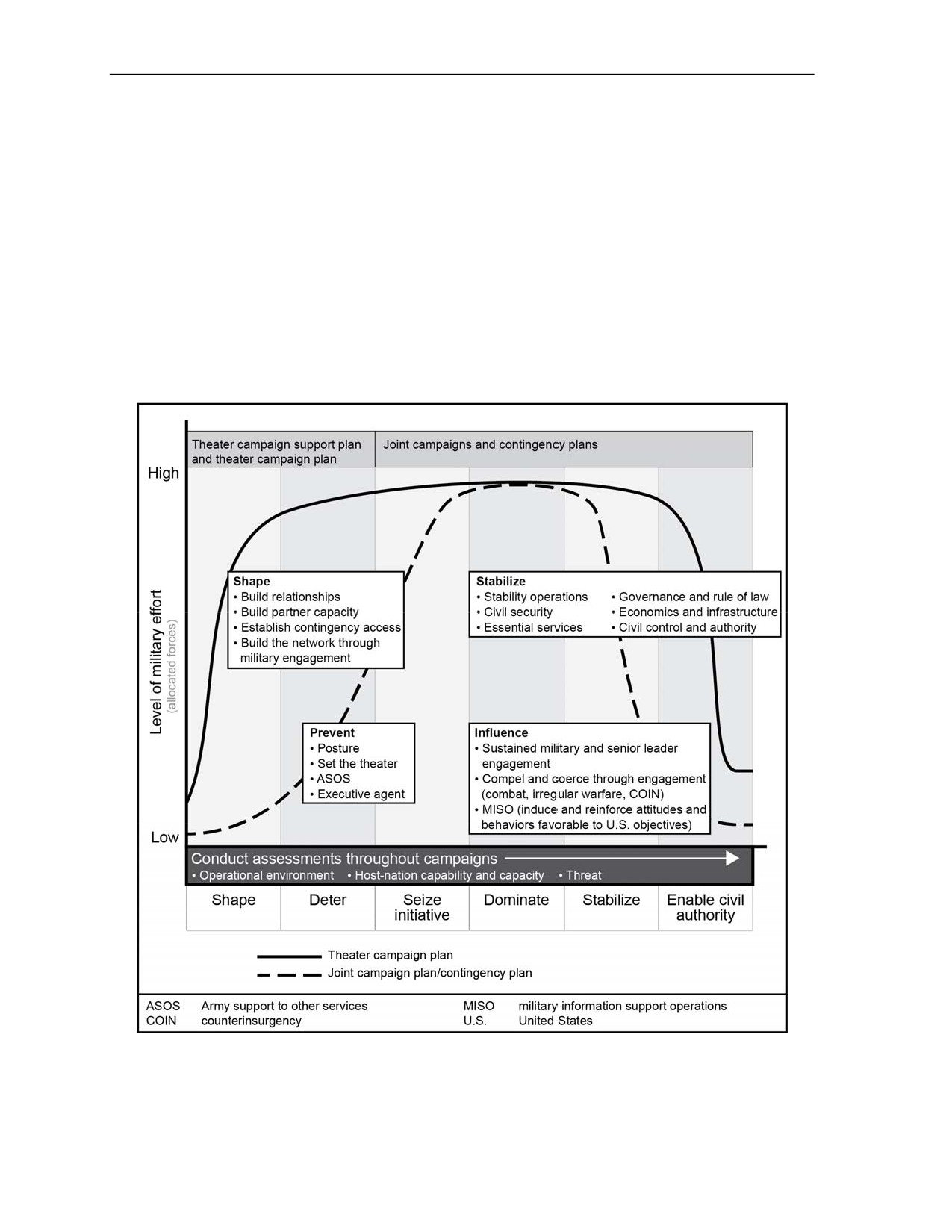
planning and phases.) Figure 3-1 illustrates the level of effort required to support a theater campaign plan
versus the level of effort required over the phases of a campaign and contingency described in JP 3-0.
Figure 3-1. Theater campaign plan and joint campaign and contingency plans
3-2
FM 3-22
22 January 2013
Planning and Assessment Considerations
THEATER CAMPAIGN SUPPORT PLANNING
3-6. The GEF directs the combatant command to write theater campaign plans, and each of the Services
to develop campaign support plans. Theater armies develop a theater campaign support plan, an annex to
the theater campaign plan. The theater campaign support plan serves as the mechanism between Army
planning, programming, budgeting, and execution by, with, or through the theater army and supported by
Headquarters, Department of the Army, ASCC; Army command; direct reporting unit; and National Guard
Bureau plans. The purpose is to resource security cooperation activities that shape the operational
environment and achieve theater campaign plan objectives and GEF end states.
3-7. The Army’s overarching framework for exercising mission command is the operations process—the
major mission command activities performed during operations: planning, preparing, executing, and
continuously assessing the operation (ADP 5-0). Theater army security cooperation planners use the
fundamentals and processes described in ADRP 5-0 and incorporate guidance from the geographic
combatant command they support as a point of departure for theater campaign support planning. Planners
focus their efforts on the broader theater campaign planning objectives that: 1) build defense and security
relationships that promote specific U.S. security interests, 2) build allied and friendly military capabilities
for self-defense and multinational operations, and 3) provide U.S. forces with peacetime and contingency
access to host nations.
3-8. For every operation, commanders gain a detailed situational understanding of the operational
environment, including a thorough understanding of the partner capacity and capability. Commanders then
visualize a desired end state and craft a broad concept for shaping the current conditions toward that end
state. Thorough conceptual design coupled with mission analysis provides the “big picture” and focuses the
planning efforts thereafter. Successful mission analysis is crucial to developing well-formed objectives and
establishing their causal relationship to particular theater strategic end states. Thorough, well-conducted
mission analysis provides the security cooperation planners answers to the following questions:
z
What has the combatant command been tasked to accomplish, and how does the theater army
support and resource those requirements?
z
What specific results are desired, and what is the desired strategic effect?
z
Where and when must the combatant command achieve these results?
z
Why was the combatant command given this task?
z
What limitations, i.e. authorities, have been placed on the combatant command, and why have
they been placed on it?
3-9. Theater campaign support plans provide an important link to the resources necessary to implement
the commander’s strategy. Because combatant commands control only a very small portion of the DOD
resources in any given area of responsibility (AOR), combatant commanders rely on the theater army, the
theater special operations command (TSOC), the generating force and Reserve Components to undertake
the majority of activities that create the real world effects they are trying to achieve. Theater campaign
plans, enabled by theater campaign support plans, provide the mechanism to underpin the interactions with
other U.S. government agencies in order to coordinate activities. Theater campaign plans also provide clear
direction on the combatant commanders strategy as a way to establish guidance and accountability with
regard to activities conducted in the AOR.
MISSION ANALYSIS
3-10. The theater army should coordinate with its geographic combatant commander to determine the
objectives for which the theater army has primary and supporting responsibilities. Those responsibilities
should be specified in a geographic combatant command task order or other directive document that is the
authoritative basis for resourcing. The theater army’s objectives are the basis of the theater campaign
support plan.
3-11. Commanders develop a comprehensive, situational understanding of their operational environment,
which also includes a thorough understanding of the partner capacity and capability. Mission analysis helps
commanders define the problems that must be addressed during planning and execution. Commanders then
visualize a desired end state and craft a broad concept for shaping the current conditions toward that end
22 January 2013
FM 3-22
3-3
Chapter 3
state. Thorough mission analysis should provide the “big picture” and focus the planning efforts thereafter.
Successful mission analysis is crucial to developing well-formed objectives and establishing their
relationship to particular theater strategic end states. Thorough mission analysis provides the security
cooperation planners answers to the following questions:
z
What exactly has the combatant command been tasked to accomplish, and how does the theater
army support it?
z
Where and when must the combatant command achieve the desired results?
z
Why was the combatant command given its task?
z
What limitations—such as what authorities—constrain the combatant command, and for what
reasons?
z
What conditions define the end state for the theater army’s mission, what are the strategic
objectives supported, and what are the capabilities
(resources) required to accomplish the
mission?
z
How does the theater army sustain the security cooperation activities, and what Army executive
agent responsibilities are associated with that sustainment?
OPERATIONAL ENVIRONMENTS
3-12. An operational environment is a composite of the conditions, circumstances, and influences that
affect the employment of capabilities and bear on the decisions of the commander (JP 3-0). Commanders at
all levels have their own operational environments for their particular operations. An operational
environment for any specific operation is not just isolated conditions of interacting variables that exist
within a specific area of operations. It also involves interconnected influences from the global or regional
perspective (for example, politics and economics) that impact on conditions and operations there. Thus,
each commander’s operational environment is part of a higher commander’s operational environment.
Likewise, operational environments of commanders at all levels are part of the overall strategic
environment, which encompasses general conditions, circumstances, and influences throughout the world
that can affect all operations. (See ADRP 3-0 for a discussion of operational environments.)
3-13. Security cooperation and the associated programs, activities, and missions play a key role in
understanding and shaping the operational environment. Effective security cooperation planning and
assessments allow commanders to gain situational understanding of their operational environment,
including the region and specific countries—including existing defense relationships, partner military
capacity and capabilities for internal and external self-defense, and peacetime and contingency access—all
of which are critical to planning unified land operations and achieving combatant commander’s objectives
and GEF end states. Commanders strive for a clear understanding of the conditions that make up the
current situation, including the relevant population, foreign security forces (FSF), and other factors. From
this understanding, commanders visualize desired conditions that represent a desired end state. The host
nation or regional security organization helps to determine desired conditions associated with the FSF.
After envisioning a desired end state, commanders then design and conceptualize how to influence the
current situation to achieve that end state.
3-14. The changing nature of each operational environment affects the execution of security cooperation
programs, activities, and missions. When considering the operational environment, a key planning factor
for security cooperation is the foreign defense establishment’s capabilities and capacity to support and
participate in multinational operations where interoperability is essential to success. This includes a
thorough understanding of the regional security organizations, the history, the culture, the language as well
as the host-nation leadership, political, economic and social dynamics. The conditions of the operational
environment can rapidly change, and those planning and those executing security cooperation activities
must assess these changes continuously. They must measure and evaluate the effectiveness of programs
that prevent and deter and determine whether further means should be applied towards meeting the
combatant commander’s objectives. Two types of environments underpin the operational environment.
3-15. A permissive environment is an operational environment in which host country military and law
enforcement agencies have control as well as the intent and capability to assist security cooperation
operations that a unit intends to conduct (JP 3-0). Under this condition, maximum support of the host
3-4
FM 3-22
22 January 2013
Planning and Assessment Considerations
country to security cooperation operations is expected, and thus the operation would require little or no
assembly of combat forces in country. In such an environment, a land force commander can expect the
hosting nation concurrence and possible support. The land force commander’s primary concerns may be
logistic functions involving emergency medical treatment, transportation, administrative processing, and
coordination with Department of State (DOS) and other agencies involved in the evacuation. While a
minimum number of security forces may be used, prudent preparations should be in place to enable the
force conducting Security Cooperation operations to respond to threats as required. Land force
commanders should anticipate resource scarcity, language barriers and reluctance to adopt, more
disciplined, professional practices being the major barriers to continued progress.
3-16. An uncertain environment is an operational environment in which the hosting government security
forces, whether opposed to or receptive to operations that a unit intends to conduct, do not have totally
effective control of the territory and population in the intended operational area (JP 3-0). An uncertain
environment is most likely to be found in less developed countries that have lost government control of an
area following a disaster, or in areas that traditionally harbor insurgents or terrorist elements that may
oppose U.S. presence regardless of the humanitarian mission. Because of the uncertainty, the land forces
commander may elect to reinforce the evacuation force with additional security units or a reaction force.
Approved rules of engagement (ROE) are disseminated early to ensure that the land force has knowledge of
and is sufficiently trained and proficient in application of the ROE. Planning for security cooperation
operations conducted in an uncertain environment should take into consideration the possibility for
escalation to a hostile environment. In an uncertain environment the land force may anticipate opposition
from insurgents, warlords, criminal gangs, outside forces, or others desiring instability. Usually, a military
show of force is sufficient to maintain control of the situation. Prudent employment of military information
support operations can prevent the degeneration of a permissive or uncertain environment into a hostile
environment.
3-17. Security cooperation activities have often been regarded largely as shaping activities during times of
peace to prevent conflict. However, the Army supports security cooperation across the range of military
operations.
OPERATIONAL VARIABLES
3-18. Army planners describe conditions of an operational environment in terms of operational variables.
Operational variables are those aspects of an operational environment, both military and nonmilitary, that
may differ from one operational area to another and affect operations. Operational variables describe not
only the military aspects of an operational environment but also the population’s influence on it. Army
planners analyze an operational environment in terms of eight interrelated operational variables: political,
military, economic, social, information, infrastructure, physical environment, and time
(PMESII-PT).
Operational variables are those broad aspects of the operational environment, both military and
nonmilitary, that may differ from one operational area to another and affect campaigns and major
operations. Depending on the relationship with a given country, situations may exist where a country may
be a good partner and share similar interests, but access is not granted for the purpose of training and
equipping FSF.
3-19. Commanders must be aware of the specific constraints, such as authorities, and capabilities of the
forces of participating nations, and consider these differences when assigning missions and conducting
operations. Throughout the operations process, commanders (supported by their staffs and subordinate
commanders) seek to build and maintain situational understanding. Situational understanding is the product
of applying analysis and judgment to relevant information to determine the relationships among the
operational and mission variables to facilitate decisionmaking
(ADRP 6-0). Building situational
understanding includes establishing context—the unique surrounding circumstances that influence and help
clarify the meaning of an event or situation. Each context provides a different interpretation or frame of
reference in which commanders develop and communicate their understanding and make decisions.
Political Considerations
3-20. Because of the complexity of relationships between formal and informal political actors, operating
forces may lack sufficient knowledge to understand the political dynamics within partner nation institutions
22 January 2013
FM 3-22
3-5
Chapter 3
affecting a given operation. Generating force organizations provide analyses of political institutions, actors,
issues, and dynamics at the local, regional, and national level in the operational area. The range of such
analyses can run from the entire operational area to a single urban area or region within it. These analyses
address not only formal and tangible factors but also the underlying social and cultural attitudes that confer
or deny legitimacy to systems for the exercise of political authority.
3-21. Important political considerations include—
z
What are recent changes in the nature of U.S. bilateral and multilateral security relations with
nations and international organizations in the region?
z
What international and acquisition agreements exist?
z
Do they support access, sustainment and freedom of movement?
z
How important is national security to the state compared to economic and social issues?
z
What does the regional security architecture look like—regional security organizations and
country relationships?
z
What are the desired regional outcomes, what are the external drivers, and was there a change in
the security environment?
z
What is the dominant political party in the area?
z
Is the government effective at influencing the people? Do the people support it? Is there a
shadow government in place, and is it the source of power?
Military Considerations
3-22. The military variable explores the military capabilities of all relevant actors in a given operational
environment. Army forces seek to thoroughly understand the evolving defense and security capabilities of
partners and adversaries. The Army’s joint and multinational partners may accurately describe their
capabilities without being fully aware of the implications for landpower. Additionally, partners
continuously adapt their capabilities. The Army must analyze the resulting implications.
3-23. Important military considerations include—
z
What is the balance of military power in the region, and what are the security relationships
between regional neighbors?
z
Are appropriate authorities in place to facilitate training and equipping FSF?
z
What FSF operate in the area of operations?
z
What are the foreign security force’s capabilities, and what are the requirements associated with
internal and external defense?
z
What are the institutional capabilities with respect to doctrine, organization, training, materiel,
leadership and education, personnel, and facilities?
z
Does the foreign security force being advised have jurisdiction?
z
What is the division of labor between civil, police, and military units in the area of operations?
z
Have insurgents or militia infiltrated the FSF and other partners in the area?
z
What are the insurgents’ lines of communications and support?
z
What threats exist, including “insider threats,” and how will they infiltrate and fight both
multinational and FSF?
z
What multinational units operate in the area of operations, what are their capabilities, and what
can be expected from them?
Social Considerations
3-24. The social variable describes the cultural, religious, and ethnic makeup within an operational
environment. Understanding the social factors of a society or a group within a society can significantly
improve the force’s ability to accomplish the mission. Culture is the lens through which information is
transmitted, processed, and understood. However, Army units’ knowledge and understanding of cultures in
their areas of operations tend to be relatively limited due to the time needed to develop that knowledge and
understanding. The Army’s generating force can help Army units develop their understanding of foreign
3-6
FM 3-22
22 January 2013
Planning and Assessment Considerations
cultures, based on its own expertise and access to significant analytical capability and capacity from DOD
and other sources outside the DOD. The uncertainty surrounding the outbreak of future conflicts and the
long lead-time associated with developing a useful degree of cultural understanding cause the Army’s
knowledge of foreign cultures to be relatively limited.
3-25. Understanding the sociocultural aspects of a particular society or group within a society can
significantly improve the force’s ability to accomplish the mission. Important social and cultural
considerations include—
z
How popular is the military institution amongst the society?
z
What is the human context based on the country’s history, culture (shared beliefs, values,
customs, and behaviors), and language(s)?
z
Is there a tribal network in the area of operations?
z
Who leads or manages the families and tribes?
z
Does the presence of women and children in the streets indicate stability, or merely the
perception of it?
z
Is there a dominant religious or ethnic group, and, if so, from where does it get support?
z
What is the ethnic composition of neighborhoods or villages?
z
Where do the sectarian fault lines exist?
z
Who are the powerful individuals and groups within the area of operations? Who are the civilian
decisionmakers (such as sheiks, imams, political leaders, military leaders, teachers, or police)?
z
Are Soldiers restricted from interacting with any people in the area of operations without
government approval?
Economic Considerations
3-26. An economic system encompasses individual behaviors and aggregate phenomena related to the
production, distribution, and consumption of resources. Successful conduct of operations depends, in part,
on understanding the economic aspects of an operational environment.
3-27. Important economic considerations include—
z
What does the economic architecture consist of, in terms of regional security organizations and
regional economic organizations?
z
What are the relationships between the countries in the region?
z
Do international agreements exist that facilitate access and freedom of movement?
z
What is the extent of poverty in the area of operations?
z
What is the primary source of income for most civilians?
z
What criminal activities exploit the area of operations
(such as corruption, prostitution,
extortion, illegal fuel sales, or bombmaking)?
z
What collective job opportunities exist to employ the young and disenfranchised?
z
What role do FSF currently have regarding corruption within the economic arena in the area of
operations?
z
What corruption is best left alone in the interest of mission accomplishment?
Information Considerations
3-28. This variable describes the nature, scope, characteristics, and effects of individuals, organizations,
and systems that collect, process, disseminate, or act on information. The information environment relevant
to a specific campaign or major operation typically extends beyond the joint operations area. Adversaries
and enemies establish their information operations capabilities in sanctuaries in neutral countries. They
attempt to conduct information operations against the United States worldwide, making the defense of
enterprise network capabilities relevant to the ongoing joint operations.
22 January 2013
FM 3-22
3-7
Chapter 3
3-29. Important information considerations include—
z
What regulations guide intelligence and information sharing (foreign disclosure requirements by
country, category of information, and classification level)?
z
What is the state of communications management and media relations? How does this relate to
intelligence and information sharing capabilities?
z
Are there any local news media in the area?
z
How do the people receive their news?
z
What is the state of social media used to turn communication into interactive dialogue?
z
How can Army forces effectively use inform and influence activities?
z
What is the enemy using to influence information in the area of operations?
z
What are the FSF doing to promote a positive perception of security?
z
What are the FSF or partner units doing that detracts from promoting a positive perception of
security?
Infrastructure Considerations
3-30. The infrastructure system is composed of the basic facilities, services, and installations needed for
the functioning of a community or society. A stable, functioning civil society requires adequate
infrastructure. It is likely that Army forces will be employed in areas where infrastructure is inadequate,
damaged, or destroyed. Important considerations include—
z
What is the state of public transportation, utilities, sustainment, health care, and communications
facilities?
z
What is the current assessment of sewage, water, electricity, and trash pickup services in the area
of operations?
z
What projects must be supported by the FSF?
z
What projects require multinational support?
z
Is the area of operations more urban or agrarian, and what effect does the geography have on an
insurgency?
z
What are the road conditions?
z
Are there any political offices, sensitive sites, or otherwise restricted areas?
Physical Environment Considerations
3-31. The physical environment consists of the physical circumstances and conditions that influence the
conduct of operations throughout the domains of air, land, sea, space and cyberspace. Key factors of the
land domain are complex terrain, including urban settings (supersurface, surface, and subsurface features),
weather, topography, hydrology, and environmental conditions.
3-32. The structural complexity of the physical environment requires capabilities to assess, repair,
maintain, and even develop infrastructures. Important considerations include—
z
How can Army forces mitigate environmental hazards, including chemical, biological,
radiological, and nuclear hazards?
z
How can Army forces provide essential services?
z
How can Army operations enhance the legitimacy of partner governments?
Time Considerations
3-33. Time considerations influence military operations within an operational environment in terms of the
decision cycles, operating tempo, and planning horizons. Time also influences endurance or protraction of
operations since any actor in a conflict may exhaust its resources over time.
3-8
FM 3-22
22 January 2013
Planning and Assessment Considerations
3-34. Important time considerations include—
z
Is there a sense of urgency from the people in the area of operations?
z
How does the host-nation culture or cultures view time?
z
What time constraints do multinational partners have?
z
What time constraints do the FSF have?
MISSION VARIABLES
3-35. Upon receipt of a warning order or mission, Army leaders filter relevant information categorized by
the operational variables into the categories of the mission variables used during mission analysis. They use
the mission variables to refine their understanding of the situation. The mission variables consist of
mission, enemy, terrain and weather, troops and support available, time available, and civil considerations
(METT-TC). Incorporating the analysis of the operational variables with METT-TC ensures Army leaders
consider the best available relevant information about the mission.
ANALYZING HIGHER GUIDANCE
3-36. Planners analyze higher-level guidance from the theater campaign plans, which is derived from the
GEF and the JSCP. The GEF translates global security objectives and priorities established in the National
Security Strategy, National Defense Strategy, Quadrennial Defense Review Report, and other national
guidance into planning guidance for the combatant commands, Military Departments and their Services,
and other DOD components. The JSCP translates broad GEF guidance into specific strategic and
operational planning directives to combatant commanders. Both the GEF and the JSCP link strategic
guidance and the joint operation planning activities and products that implement the guidance.
3-37. DOD planning guidance for theater campaign plans include, among other things, theater strategic end
states, major assumptions, and country of emphasis designations for security cooperation focus areas.
Additionally, the GEF provides direction for preparing theater campaign plans and contingency plans for
review and assessment. Theater army resource security cooperation activities shape the operational
environment to achieve theater campaign plan objectives and end states.
3-38. Planners should also recognize the role played in the AOR by key interagency partners, especially
DOS and USAID. Planners should review applicable DOS regional and country goals, which are outlined
in its bureau strategic resource plans and integrated country strategy.
Bureau Strategic Resource Plan
3-39. A bureau strategic resource plan (known as BSRP) covers geographic regions similar in scope to
geographic combatant command AORs and outlines DOS key foreign policy goals and the resources
necessary to achieve them. A bureau strategic resource plan identifies the principal U.S. government
agencies and programs involved in advancing U.S. interests, and lists the key countries where U.S.
government efforts are focused. Bureau strategic resource plans describe DOS and USAID bureaus’ most
significant foreign policy and management goals, as well as the resources required to achieve those goals.
Integrated Country Strategy
3-40. The integrated country strategy (known as ICS), formerly referred to as the mission strategic
resource plan
(MSRP), is the country team’s strategy, budget, and performance document. Security
cooperation planners nest security cooperation activities with lines of effort to help the commander
visualize how the activities achieve combatant commander objectives and GEF end states. It is the
interagency country team’s initial step in establishing an annual planning and budget formulation process
and multiyear forecast for both DOS operations and foreign assistance funding.
22 January 2013
FM 3-22
3-9
Chapter 3
IDENTIFYING CHALLENGES TO THEATER STRATEGIC END STATES
3-41. Mission analysis should involve identifying and describing threats and opportunities associated with
the theater strategic end states. Planners should identify political, military, economic, or other factors in the
region that facilitate or hinder progress toward the achievement of theater strategic end states such as key
audience perceptions and reactions.
3-42. Commanders must be aware of the specific constraints and capabilities of the forces of participating
nations, and consider these differences when assigning missions and conducting operations. Building
situational understanding includes establishing context—the unique surrounding circumstances that
influence and help clarify the meaning of an event or situation. Each context provides a different
interpretation or frame of reference in which commanders develop and communicate their understanding
and make decisions.
3-43. Each operational environment comprises an interactively complex system of systems, in which
changes to any one variable may cause cascading changes to other variables and their relationship to one
another. Understanding a conflict’s military system requires understanding the other related systems and
variables that expand beyond U.S. interests to the partner nation. Security cooperation planners should also
consider how the national interests of countries both in and outside the AOR compete with or support U.S.
objectives in the AOR and determine shared interests. Furthermore, security cooperation planners should
take into account the global challenges found outside the AOR that can affect the achievement of theater
strategic end states, such as transnational threats (such as weapons of mass destruction proliferation and
illicit trafficking).
IDENTIFYING KEY ASSUMPTIONS
3-44. Security cooperation planners will never have all the information they need for planning. All
planning is based on imperfect knowledge and assumptions about the future. Planning cannot predict
exactly what all the effects of the operation will be. Therefore, plans cannot remain static. During
preparation, assumptions made during planning may be proven valid or invalid. Plans must adapt to
changing circumstances, and they must take into account how current operations will affect future
operations.
3-45. To ensure that planning can continue under rapidly changing circumstances, planners need to fill in
their knowledge gaps with explicit assumptions. Assumptions should be both valid (Is the assumption
plausible?) and necessary (Is it impossible to continue planning without the assumption?). They can span a
wide range of topics, including the political conditions in the region or in priority countries, the military
capabilities of critical partners or actors of concern, and the timelines of events.
IDENTIFYING RESOURCES AVAILABLE
3-46. Before planning begins, security cooperation planners should have an understanding of the resources
available to support the implementation of the theater campaign plan. One of the main objectives is to
identify and articulate resource requirements to execute the steady-state activities needed to implement the
combatant commander’s theater strategy. A thorough understanding of the types and quantities of resources
available should inform, but not constrain, concept design and mission analysis. Security cooperation
resources are a key planning consideration in mission analysis. Theater armies must coordinate with their
geographic combatant command for funding with the authority to support capacity-building activities that
train, equip, and build infrastructure.
3-47. Steady-state authorities and funding are typically associated with DOD security cooperation
programs. These programs enable combatant commands to conduct certain types of activities (from
seminars to formal security assistance training), and to pay for certain expenses associated with executing
these activities. Finally, theater campaign planning, theater campaign support planning, and country
planning should not be limited by resource availability. Rather, such planning should identify the resource
requirements (whether at the theater or country level), with emphasis on prioritization of activities should
resources be limited.
3-10
FM 3-22
22 January 2013
Planning and Assessment Considerations
3-48. DOD resources that support steady-state activities generally fall into the categories of forces,
authorities, funding, and posture. (For allocated rotational forces, planners should consult AR 525-29.)
3-49. Significant resources that support theater campaign plan implementation are also found outside
DOD. A large portion of these resources are provided by other U.S. government agencies. For example,
DOS security assistance programs, such as foreign military financing grants, international military
education and training, and Global Peace Operations Initiative directly support efforts to build the capacity
of and strengthen relationships with allies and partners. Foreign military financing and international
military education and training requirements are developed each year through a process managed by the
Defense Security Cooperation Agency.
3-50. Global defense posture—the forces, footprint, and agreements and treaties that support current
operations, security cooperation and other steady-state activities—is managed by the Office of the
Secretary of Defense for Policy. The process includes the development and submission of combatant
command theater posture plans as an integral part of the theater campaign plan. Theater posture plans
outline the current theater posture and proposed combatant command posture initiatives over the near, mid,
and long term.
IDENTIFYING INTERMEDIATE MILITARY OBJECTIVES AND FOCUS AREAS THAT SUPPORT
GEF END STATES
3-51. Conducting theater-wide operations without connecting them to strategic objectives leads to
uncoordinated programming and ineffective campaigns. An objective is a clearly defined, decisive, and
attainable goal toward which every operation is directed (JP 5-0). The process of translating theater
strategic end states into intermediate military objectives and further decomposing those objectives into
tasks is complex. Decisionmakers and planners at all levels must understand this process to ensure
successful integration of a wide range of activities, from large scale exercises to capacity building training
initiatives, into theater campaign plans.
3-52. The United States Government allocates resources to DOD to achieve strategic objectives. These
objectives form the backdrop against which theater campaign plans are planned and implemented. Defining
clear objectives at each level is critical to translating national strategic objectives into effective theater
campaign plan implementation. An iterative process of strategy formulation between levels can mitigate the
risk of misunderstanding or confusion. This is important to ensure that all needs and concerns are
communicated appropriately prior to final approval of guidance. An iterative process provides the Services,
through the component commands, the ability to articulate their priorities and rationale for Service-centric
activities within the AORs and harmonize those activities with the combatant commander’s overall strategy
implementation objectives.
3-53. As part of theater campaign plan development, the GEF tasks geographic combatant command
planners to identify intermediate military objectives, coupled with the associated security cooperation tasks
required to support the achievement of theater strategic end states. They are referred to as “military”
objectives because they represent the military’s unique contribution to the achievement of an end state.
Some GEF end states are not purely “military” in nature. In such cases, robust interagency involvement and
support may be critical to making progress toward or maintaining the conditions outlined by end states.
However, as the term “military” suggests combatant command planners should focus on and document
what needs to be accomplished by DOD components. This does not mean that such efforts must rely
exclusively on DOD resources. It is entirely possible to have a “military objective” that depends heavily (or
entirely) on DOS—or other government agency—resources. It is also possible for DOD efforts to
complement those of other government agencies that are working toward the same goal.
3-54. To ensure the theater army can measure its progress, intermediate military objectives and associated
security cooperation tasks need to be specific and achievable. Intermediate military objectives, therefore,
should have a higher level of fidelity than the end state they support. The mnemonic “SMART” (specific,
measurable, achievable, relevant, and time-bound), outlines a useful construct that can help planners
develop well-written intermediate military objectives.
3-55. First, well-written objectives need to be specific. An objective is specific if it is well-defined,
unambiguous, and describes exactly what is expected.
22 January 2013
FM 3-22
3-11
Chapter 3
3-56. Second, intermediate military objectives should be measurable. An objective is measurable when
success is defined with specific targets or bounds, and a reliable and affordable system is in place to assess
the degree to which the objective has been achieved. Supporting tasks should facilitate the development of
measures of performance and measures of effectiveness. A measure of performance is a criterion used to
assess friendly actions tied to measuring task accomplishment. A measure of effectiveness is a criterion
used to assess changes in system behavior, capability, or operational environment that is tied to measuring
the attainment of an end state, achievement of an objective, or creation of an effect.
3-57. Third, an intermediate military objective should be achievable. Supporting tasks should take into
account the constraints and restraints of both the United States and the partner country. A constraint is a
requirement placed on the command by a higher command that dictates an action, thus restricting freedom
of action. A restraint is a requirement placed on the command by a higher command that prohibits an
action, thus restricting freedom of action.
3-58. Fourth, an intermediate military objective should be relevant and results-oriented. An objective is
relevant and results-oriented if the achievement of the objective contributes to reaching theater strategic
end states and it is expressed in terms of what should be accomplished as opposed to what should be
applied (inputs). Supporting tasks should be supportable with resources that are available or can be
coordinated through the geographic combatant command.
3-59. Finally, objectives should be time-bound. An objective is time-bound if its accomplishment is
required within a reasonable time frame. Supporting tasks should state the time frame by which the effect is
to be achieved.
ASSESSING THEATER STRATEGIC END STATES AND INTERMEDIATE MILITARY OBJECTIVES
3-60. Planners conduct two assessments. One assessment determines what constitutes success—or
sufficiency—in achieving an end state. The second determines where the combatant command stands
initially in relation to achieving the end state—the “baseline.”
3-61. The sufficiency assessment revolves around achieving an end state. In this analysis, the planners
must “unpack” an end state and deconstruct it into a complementary set of supporting objectives. The
cumulative effect of achieving these objectives should be substantial progress toward achievement of the
end state. To derive these objectives, planners determine what constitutes “good enough” in achieving an
end state. This, in turn, requires planners to understand the requirements, characteristics, conditions or
attributes essential in realizing this end state. Developing a clear picture of the end state is critical to
developing the security cooperation activities that will support it.
3-62. Given clarity with what constitutes successful achievement of the end state, the combatant command
is ready to develop a baseline from which progress can be measured. The baseline involves developing a
thorough situational understanding of the operational environment (“where one is right now with respect to
achieving the end state”). With a goal or end state as the future target, a combatant command must know
where it stands in relation to achieving that target.
3-63. The baseline assessment has broad implications for the theater campaign plan. First, this assessment
provides the commander with an understanding of its operating environment. Second, it plays an important
role in post-implementation assessments. From this baseline, the combatant command establishes a basis of
comparison for charting progress that stems from the activities, events, operations and investments it
conducts.
3-64. Combatant commands conduct assessments for each intermediate military objective they establish.
Well-written intermediate military objectives will clearly delineate what constitutes success. Once the goal
is determined, the planners should then establish the baseline—where it stands with respect to achieving an
objective. Objectives could focus on capability building, access or freedom of action, or relationship
building.
3-12
FM 3-22
22 January 2013
Planning and Assessment Considerations
INTEGRATION OF SPECIAL OPERATIONS FORCES AND CIVIL AFFAIRS
3-65. DOD conducts security cooperation with unified action partners to meet mid-term and long-term
objectives. Army forces support theater strategic objectives through multiple security cooperation
programs, activities, and missions. Army forces conduct security cooperation activities discretely or in
concert with partners. Security cooperation activities help establish, shape, maintain, and refine relations
with other nations, which requires the close integration of conventional forces, Army special operation
forces, civil affairs, U.S. interagency partners, and the host country. Integration challenges can be many.
The faster Army forces become effective in a region, the fewer the integration challenges will be.
3-66. A common approach to plan development is the establishment of an operational planning team
(known as OPT) composed of representatives from the theater army staff under the leadership of the
organization or office with primary responsibility (known as an OPR) for developing the plan. The office
most suited for leading operational planning teams is ideally the strategy and plans division of the theater
army, which is comprised of planners with an educational background in strategic planning. Given the
broad scope of a theater campaign support plan, the composition of an operational planning team requires
the participation of the rest of the staff. This includes offices responsible for security cooperation programs,
resource management, assessments, ARSOF, civil affairs, sustainment, intelligence, and interagency
coordination. Representatives from these offices can assist with mission analysis and concept design,
including integrating phase
0 objectives, developing supporting objectives, understanding resources
available to resource theater campaign support plan execution, identifying lines of effort or focus areas, and
describing the role of steady-state activities.
Conventional Forces and Army Special Operations Forces Integration
3-67. In multinational operations, the effective integration and synchronization of available assets toward
the achievement of common objective requires unity of effort. Disparate (and occasionally incompatible)
capabilities, ROE, equipment, and procedures must be overcome. Army conventional forces and special
operations forces establish minimum capability standards and a certification process to reduce disparities
among participating forces. Identified shortcomings should be satisfied by either bilateral or multilateral
support agreements (formal or informal) prior to the deployment of forces to the operational area.
3-68. The theater army commander is the Secretary of the Army’s senior Army representative to the
combatant commander. Conventional force or special operations force commanders are both ideally suited
for conducting security force assistance. The supported commander conducting operations may be either a
conventional force or special operations force commander. Subordinate commanders and staffs of both
conventional and special operations forces may act in the supporting role to a joint force commander or the
U.S. ambassador, depending on the operational environment. The security cooperation organization or the
senior defense official/defense attaché (SDO/DATT) at the U.S. embassy oversees the security cooperation
programs and activities during phase 0 activities operations that support theater campaign plan objectives.
3-69. The theater special operations command (TSOC) normally has operational control of all special
operations forces in the theater and has primary responsibility to plan and execute special operations forces
operations that support foreign internal defense. Army special operations forces (ARSOF) units assigned to
a theater fall under the command authority of the combatant commander. The geographic combatant
commander can exercise combatant command (command authority) (known as COCOM) through the
commander of the TSOC or the theater army commander (see JP 1 for more information about COCOM).
There may be instances where certain planning requirements establish a supported and supporting
relationship between the theater army commander and theater special operations commander. This requires
ARSOF to have tactical control of supported Army units conducting security cooperation activities in an
operational area. Conversely, in situations such as joint exercises and combat operations, the ARSOF and
TSOC commanders support the theater army commander when the theater army commander is tasked as
the joint task force commander for small-scale contingency operations.
3-70. Conventional forces and ARSOF avoid integration issues by becoming effective—able to achieve
common objectives—within a region very quickly. Difficulties of integration do not necessarily arise from
differences in missions of each organization. Coordination between the TSOC commander and the theater
army is essential for effective management, sustainment, and transition of security cooperation missions,
22 January 2013
FM 3-22
3-13
Chapter 3
such as joint and multinational exercises, mobile training teams conducting security force assistance tasks,
and foreign internal defense. In the case of the theater army, the commander integrates and synchronizes
security cooperation through cross-functional working groups, which should be designed to include
membership from the across the warfighting functions, and liaisons from the TSOC and other unified
action partners outside the headquarters. Functional working groups can include, but are not limited to,
planning, assessment, security cooperation and strategic communication. Integrating cells conduct the
operations process and enable the integration and synchronization of planning, preparation, execution, and
assessment. Representatives from all warfighting functions meet regularly to develop a coherent, unified
theater army operation plan. The integrating cells and all the other warfighting functional cells are under
the staff supervision of the G-3 (assistant chief of staff, operations) to enable the synchronization and
integration in the area of operations. (See FM 3-93 for a detailed discussion of functional working groups
and integrating cells.)
3-71. ARSOF support operational preparation of the environment through a wide range of activities that
directly support unified land operations. ARSOF assess and shape operational environments by, with, or
through host nations, regional partners, and indigenous populations in a culturally attuned manner that is
both immediate and enduring. Coordination and integration between conventional forces and ARSOF
support theater objectives and unified action to prevent and deter conflict or prevail in war. Operational
preparation of the environment includes activities that enhance or enable intelligence preparation of the
battlefield and develop operational infrastructure as a pre-established architecture from which to conduct
operations. ARSOF capabilities help the theater army commander and conventional forces gain situational
understanding; conduct inform and influence activities; train FSF, partners, and allies; and support U.S.
combat operations. These activities provide a strategic bridging capability that supports U.S. interests.
ARSOF and conventional forces continuously work with friendly governments through a wide range of
activities that enhance the overall security posture of forces, nations, and regions.
3-72. When conducting mission analysis, planners determine how best to integrate conventional forces and
ARSOF to achieve theater strategic objectives. This requires considering host-nation and U.S. policies.
Planners integrate and coordinate conventional forces and ARSOF with assigned tasks based on capability
requirements to achieve theater objectives. They determine the best skill sets available among conventional
forces and ARSOF trainers and advisors. Planners leverage skill sets by integrating and coordinating
conventional and special operations units with assigned tasks. Assessment of the FSF to be trained often
suggests a two-phased, incremental approach to training. Such an approach involves a transition to the FSF
by either conventional or special operations forces using basic training in the first phase, and advanced
training in the second. The type of training depends on the needs of the FSF being trained. Planners adjust
the approach as requirements change. Integrating the advisor may be a phased process using either
conventional or special operations forces as the initial advisor. This method lends itself to the classic
“crawl-walk-run” approach to assisting FSF.
Civil Affairs Integration
3-73. The civil affairs command is theater-aligned and provides theater-level staff augmentation to the
geographic combatant command and theater army. Augmentation includes support for liaison and
coordination, education and training, and civil affairs assessments.
3-74. Army civil affairs forces are trained and educated in foreign language and culture. They can help
commanders shape their operational environments across the range of military operations. Army civil
affairs forces provide the means to interact with civilian organizations, institutions, and—most
importantly—individuals. Commanders shape the civil aspects of their operational environments using civil
affairs forces’ social, cultural, religious, and economic expertise. Using that expertise helps integrate
military operations as part of a whole-of-government approach.
3-75. Designated Army civil affairs forces provide specialized support to combatant commanders by, with
or through theater army commanders. Army civil affairs forces are organized, trained, and equipped to
support combatant commands. Civil affairs representation on the theater army staff is integrated with the
plans division and security cooperation division of the movement and maneuver cell, the G-9 (assistant
chief of staff, civil affairs) of the mission command cell of the main command post, and the civil affairs
division of the mission command cell of the contingency command post. The mission of the G-9 is to
3-14
FM 3-22
22 January 2013
Planning and Assessment Considerations
conduct military engagement and influence the civilian population by planning, executing, and assessing
civil affairs operation in support of the theater army. The civil affairs section coordinates, synchronizes,
and integrates civil-military plans, programs, and policies with external organizations. The civil affairs
section provides advice and analysis to the staff on civil affairs. It conducts cultural relations training as
required. Lastly, the civil affairs section develops civil affairs estimates, plans, and orders in support of
theater army operations and informs security cooperation assessments.
INTERAGENCY INTEGRATION AND COORDINATION
3-76. Security cooperation planners should gain an understanding of DOS and USAID planning processes
and coordination procedures for planning. Promoting and protecting U.S. interests abroad rests on the three
pillars of diplomacy, development, and defense (the three Ds), which are represented, respectively, by
DOS, USAID, and DOD. Although each organization has unique roles and responsibilities, all provide the
greatest value when their actions are mutually reinforcing. Theater campaign plans and country plans
articulate how defense strategy is to be implemented at the regional and country level. These plans
represent a significant portion of DOD’s contribution to theater planning. Therefore, the development and
implementation of these plans should be coordinated with the plans, policies, and activities of DOS,
USAID, and other government agencies.
3-77. DOD can be both the supported and supporting U.S. government agency. It often is the lead
executive agency for sustaining security cooperation activities. When tasked to provide military support to
other U.S. government agencies, Army forces perform a supporting role. Sustainment forces may be tasked
to support the U.S. ambassador that, as the President’s representative, serves as senior U.S. government
officer in a country. Whether supported or supporting, close coordination is the key to efficient and
effective interagency operations. In the absence of a U.S. embassy, or during operations in austere
environments or remote locations, the advising unit may be the only organization able to provide
sustainment of supplies (including force protection). More typically, during the early stages of the advising
unit deployment, the unit may find the U.S. embassy to be the primary source of supplies, services, and life
support.
3-78. Security cooperation planners coordinate plans with the country team. The country team normally is
the focal point for interagency coordination during country plan development. At the country level, DOD is
in a supporting role to the chief of mission (typically an ambassador). While the chief of mission or DOS
does not have formal review or approval authority over a combatant command’s country plans, the plans
should be consistent with the objectives and priorities of the chief of mission and align with the country
plans of DOS, USAID, and other government agencies working in that country. Some key government
agencies with which security cooperation planners coordinate include—
z
DOS.
z
USAID.
z
Bureau of International Narcotics and Law Enforcement Affairs.
z
Department of Justice.
z
Federal Bureau of Investigation.
z
Central Intelligence Agency.
z
Department of Homeland Security.
z
Department of Energy.
z
Department of the Treasury.
z
Department of Agriculture.
3-79. Within the Executive Branch, DOS is the lead U.S. foreign affairs agency. The Secretary of State is
the President’s principal foreign policy advisor, though other officials or individuals may have more
influence on foreign policy decisions. DOS advances U.S. objectives and interests in the world through its
primary role in developing and implementing the President’s foreign policy.
22 January 2013
FM 3-22
3-15
Chapter 3
3-80. United States Agency for International Development (USAID) is the lead United States government
agency, responsible to the Secretary of State, for administering civilian foreign aid and providing
humanitarian assistance and disaster relief. USAID often works in concert with DOD when Soldiers are
forward deployed. It can supplement civil affairs activities that DOD conducts to win the friendship of local
populations. USAID usually is networked to international and nongovernmental organizations. It
sometimes and provides financial assistance to help them offer technical assistance in developing countries.
3-81. DOS’s Bureau of International Narcotics and Law (INL) Enforcement Affairs advises the President,
Secretary of State, other bureaus in DOS, and other departments and agencies within the United States
Government on the development of policies and programs to combat international narcotics and crime. INL
programs support two of the Department’s strategic goals: (1) to reduce the entry of illegal drugs into the
United States, and (2) to minimize the impact of international crime on the United States and its citizens.
3-82. Department of Justice (DOJ) leads international legal assistance and implements some criminal
justice and rule-of-law programs in conjunction with the Department and USAID. DOJ also works with the
Department on extradition and to combat transnational crime and narcotics trafficking, including training
programs for foreign police forces. DOJ is typically networked to other international and nongovernmental
organizations such as the United Nations Office on Drugs and Crime.
3-83. Federal Bureau of Investigation is an agency of the Department of Justice. It serves as both a federal
criminal investigative body and an internal intelligence agency (counterintelligence).
3-84. Central Intelligence Agency is a civilian intelligence agency of the United States government. It is an
executive agency and reports directly to the Director of National Intelligence, with responsibility for
providing national security intelligence assessment to senior United States policymakers.
3-85. Department of Homeland Security (DHS) coordinates intelligence and law enforcement activities
and programs that help protect the United States from terrorist and other threats. DHS leads immigration,
naturalization, repatriation, border and transportation security, and biodefense efforts. It is typically
networked to international and nongovernmental organizations that work with human rights and refugees.
3-86. Department of Energy sponsors many nuclear nonproliferation programs, including the Global
Nuclear Energy Partnership, which the Department helps to implement.
3-87. Department of the Treasury (DOT) leads money-laundering and asset-seizure activities and monitors
export controls. DOT co-chairs a committee on proliferation financing. DOT chairs, and USAID
participates in, the Terrorist Finance Working Group of the Counterterrorism Security Group’s Technical
Assistance Sub-Group. DOT is typically networked to other international and nongovernmental
organizations such as the World Bank Group, the Internal Monetary Fund and the United Nations Capital
Development Fund.
3-88. The Department of Agriculture is the U.S. federal executive department responsible for developing
and executing U.S. government policy on farming, agriculture, and food. It aims to meet the needs of
farmers and ranchers, promote agricultural trade and production, work to assure food safety, protect natural
resources, foster rural communities and end hunger in the United States and abroad.
3-89. The United States Institute of Peace (known as USIP) is an independent, nonpartisan institution
established and funded by Congress to increase the nation’s capacity to manage international conflict
without violence. USIP is transforming approaches to international conflict. USIP draws on a variety of
resources in fulfilling its congressional mandate: staff, grantees, fellows, research, education, training,
innovation, outreach, publications, and national and international partnerships.
HOST-NATION SUPPORT
3-90. Commanders may be required to spend time with officials of other nations. This should be done in
close coordination with the country team in the host nation (ambassador, senior defense official/defense
attaché, and office of security cooperation chief).
3-91. Commanders consider how agreements between the United States and a host nation (and other
nations if the United States participates as a member of a multinational organization) affect military
operations outside the continental United States. International agreements address a wide range of issues
3-16
FM 3-22
22 January 2013
Planning and Assessment Considerations
from legal jurisdiction involving crimes committed by U.S. personnel to the hiring of host-nation personnel
to support an operation. International agreements can also influence the extent that Army forces use
contracting in support of military operations and activities, since agreements determine a contractor’s tax
status, freedom of movement, immunities, and customs requirements. These are all important
considerations when deciding whether to employ contractors.
3-92. Commanders also consider how host-nation support and local procurement provide sustainment,
operational support, and tactical support for Army forces. Host-nation support agreements to facilitate
access and fulfill the command requirements for support must be pre-negotiated between DOS and the host
nation. Such support arrangements are integrated into the distribution plan and coordinated with joint,
allied, and multinational partners to prevent competition for resources and ensure high priority
requirements are met. Host-nation support may include functional or area support and may involve
host-nation facilities, government agencies, civilians, or military units. Pre-established arrangements for
host-nation support can reduce the requirement for early deployment of U.S. assets and can offset
requirements for early strategic lift by reducing requirements for moving resources to the theater of
operations.
MULTINATIONAL SUPPORT
3-93. Multinational support may consist of support provided from one multinational partner to another.
One or more of the following organizational and management options facilitates multinational support:
z
National support elements provide national support.
z
Individual acquisition and cross-servicing agreements provide limited support.
z
A lead nation provides specific support to other contributing nation forces.
z
A role-specialist nation provides a specific common supply item or service.
z
A multinational integrated sustainment unit provides limited common supply and support.
z
A multinational joint sustainment center manages common-user logistic support.
SUSTAINMENT TO ENABLE STRATEGIC AND OPERATIONAL
REACH
3-94. Sustainment enables strategic and operational reach, and by extension, the Army’s ability to gain or
maintain access, and conduct security cooperation missions that build partner capacity. Operational reach is
a necessity in order to conduct decisive operations. Operational reach is the distance and duration across
which a unit can successfully employ military capabilities (JP 3-0). Force sustainment support allows the
generation, projection, and employment of personnel, materiel, and equipment in support of the theater
campaign support plan or during the conduct of a contingency operation. The generating force provides the
theater army its sustainment capabilities directly to operating forces.
3-95. Sustainment provides Army forces with the transportation lift, materiel, supplies, health services, and
other support functions necessary to sustain operations for extended periods of time. Army forces require
strategic sustainment capabilities and global distribution systems to deploy, maintain, and conduct
operations anywhere with little or no advanced notice. Extending operational reach is essential to enable
commanders conducting security cooperation activities, and serves to enhance that reach in terms of
maintaining access and freedom of maneuver. To achieve the desired end state, forces must possess the
necessary operational reach to establish and maintain conditions that define success. (See ADRP 4-0 for
more information about sustainment.)
3-96. Security cooperation planners should be familiar with the sustainment concept of support and
sustainment estimates that outline the responsibilities and requirements for maintaining access and setting
the theater where U.S. military presence is forward stationed or deployed. Setting the theater and includes
executing theater opening; reception, staging, onward movement, and integration; common user logistics;
Army support to other Services; DOD executive agent requirements; and other sustainment-related support
in the AOR. The theater army executes these responsibilities through the theater sustainment command
(TSC) during steady-state operations. During contingency operations, the TSC executes these
responsibilities through the forward-deployed command post, the expeditionary sustainment command.
22 January 2013
FM 3-22
3-17
Chapter 3
3-97. A TSC, in most cases, is assigned to a combatant command. A supporting-supported relationship is
established between the TSC
(and, by extension, the expeditionary sustainment command) and the
operational Army forces in theater. The TSC is the supporting command, and the Army forces in the area
of operations are the supported commands. Sustainment brigades are tailored to the mission, task-organized
under the expeditionary sustainment command (normally attached). It is placed in either general support of
the force on an area basis or in direct support of a specific command or group of forces. (See FM 4-94 for
more information on the TSC.)
3-98. Sustainment functions require United States Army Materiel Command (USAMC) support through
the aligned Army field support brigade (see ATP 4-91), contracting support brigade (see FM 4-92), and
logistic civil augmentation program. These organizations and programs provide national sustainment,
operational and theater contracting, and added sustainment support, respectively. USAMC plays a
significant role in the transfer of excess defense articles and presidential drawdowns. Contracting is a key
source of support for deployed forces across the range of military operations. Because of the importance
and unique challenges of operational contract support, the commander and staff need to fully understand
their role in planning for, integration, and managing of contracts and contract personnel in the operational
area. This includes understanding the types of contracted support, contract management, contractor
management, and contract close out.
3-99. Contractor management is managing and integrating contractor personnel and their equipment into
military operations. Contractor management includes planning, deployment and redeployment preparation,
in-theater management, force protection and security, and executing government support requirements.
Multiple organizations are involved in this process including commanders, their primary and special staffs
(at the theater army, down to and including battalion levels) and the supporting contracting organizations.
3-100. Contracts for theater of operations support provide support to deployed forces under prearranged
contracts or contracts awarded from the mission area. They do so through contracting officers assigned to
the contracting support brigade. Contractors for theater of operations support acquire goods, services, and
minor construction support, usually from local commercial sources, to meet the immediate needs of
operational commanders. Units conducting security cooperation activities coordinate with the theater army
to identify and coordinate funding requirements in advance with the supporting resource management staff
element to secure the correct amount and type of contract funding associated with the mission. (See
ADRP 4-0 for more information on contractor management.)
3-101. Dependent upon the analysis of the operational and mission variables, contracted support may be
either, system support, theater support, external support or a combination of such. Systems support
contracts are contracts are prearranged contracts awarded by and funded by acquisition program offices.
These contracts provide technical support, maintenance support and, in some cases, Theater support
contracts are contracts awarded by contracting officers deployed to the operational area that provide goods,
services, and minor construction from commercial sources, normally within the operational area. External
support contracts are awarded by contracting organizations whose contracting authority does not derive
directly from the theater head of contracting activity or from systems support contracting authorities.
External support service contracts provide a variety of logistic services, other services not related to
combat, and supply support. (See ATTP 4-10 for more information on system, theater, and external
support.)
3-102. Theater support contracts are the most common type of support to small scale, phase 0, security
cooperation missions. Typically, uniformed logistic support does not deploy during phase 0, security
cooperation missions, and whenever possible, this support is procured through local commercial vendors.
These contracts, generally less costly and easier to arrange than external support contracts, can be used to
foster greater local cooperation in that they generally involve local national employees and infuse money
into the local economy. Care must be taken, however, to avoid inflating local prices or monopolizing key
goods and services.
3-103. Security force assistance may require significant foreign military sales systems support contracts,
especially for equipment maintenance and training. Additionally, external support contracts can include
construction contracts and, in some cases, major training contracts. USAMC accomplishes this support
through United States Army Security Assistance Command (USASAC).
3-18
FM 3-22
22 January 2013
Planning and Assessment Considerations
3-104. USASAC manages Army security assistance, providing total program management, including
planning, delivery, and life-cycle support of equipment, services, and training to and coproduction with
U.S. multinational partners. USASAC negotiates and implements coproduction agreements, serves as
proponent for Army security assistance information management and financial policy, and provides logistic
procedural guidance to the Army security assistance community. USASAC ensures transfer of defense
articles and services to international and friendly foreign governments to promote the sharing of common
burdens and build allied capabilities for self-defense and multinational operations. For additional
information, see AR 12-1 and AR 12-7.
3-105. Defense Logistics Agency (known as DLA) provides logistics connectivity to the national supply
system.
3-106. United States Army Corps of Engineers (known as USACE) provides expertise in water security,
hydrology, humanitarian assistance and disaster relief, environment, geospatial research and development,
and civil engineering to combatant commanders. USACE also provides military-to-military assistance and
humanitarian response for foreign partners through the Foreign Assistance Act of 1961 and Arms Export
Control Act (Section 2769 of Title 22, USC, Foreign Military Construction Sales).
COUNTRY PLANS AND COUNTRY SUPPORT PLANS
3-107. The GEF, coupled with the theater campaign plan, provides guidance for country-level planning.
The requirements and insights generated from country-level planning inform the development of the
Theater campaign support plans and supporting functional ASCC support plans. Depending on the country,
the defense attaché office (sponsored by the Defense Intelligence Agency) or the security cooperation
organization (sponsored by DSCA) is the focal point for security cooperation country planning. These two
outlets for security cooperation with a country require a broad knowledge and skill baseline of the very
different international programs that are initiated, funded, and managed from throughout the DOD, its
agencies, and the Military Departments.
3-108. In its most simplistic form, DOD’s approach to planning is guided by the direction of the President
and Secretary of Defense. That is to say, planning in DOD starts with the National Security Strategy issued
by the White House and expanded upon in overarching DOD guidance documents: the National Defense
Strategy influences the GEF, which provides the parameters for combatant commands to develop their
theater and functional campaign plans, which include direction for the development of country plans. The
theater campaign plans and country plans generally do not contain specific personnel or other resource
requirements. The theater army, through the theater campaign support plan, supports geographic combatant
command theater campaign plan objectives and end states. Figure 3-2, page 3-20, depicts where objectives
overlap between the country plan, the integrated country strategy and the theater campaign plan.
22 January 2013
FM 3-22
3-19
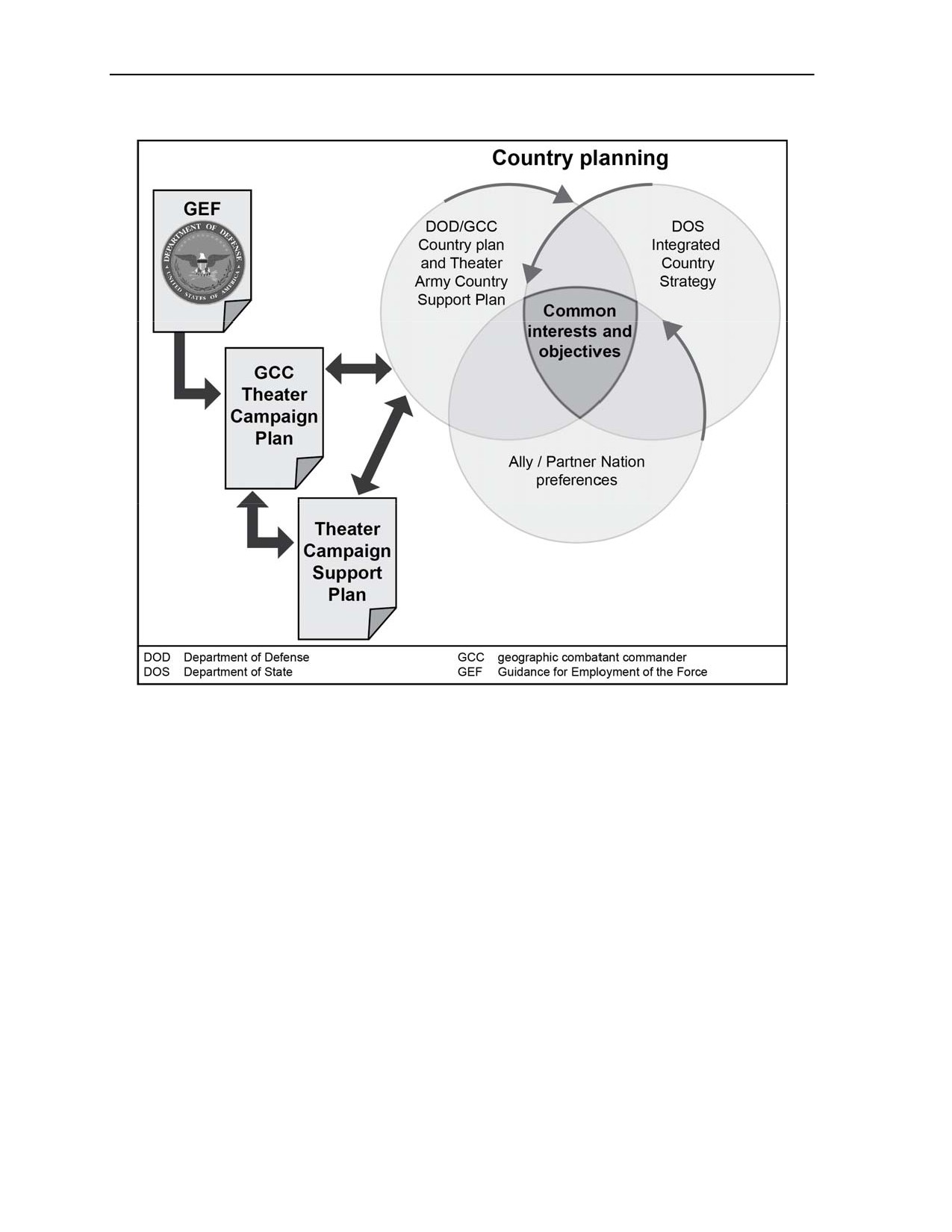
Chapter 3
Figure 3-2. Geographic combatant commander country planning
COUNTRY PLAN
3-109. Geographic combatant commands have the primary responsibility for developing country plans in
coordination with the security cooperation organization. The development and revision of country plans
and associated country support plans should occur in parallel with the development of the theater campaign
plan and theater campaign support plan. This allows planners to nest the objectives of country plans with
those theater campaign plan objectives, being informed by the higher-level discussions between the joint
force and steady-state actors. Theater campaign plans and the integrated country strategy developed by the
country team, discussed below, should be referenced directly. The example in figure 3-3, page 3-21,
illustrates geographic combatant command country plans and their relationship to the theater campaign plan
and integrated country team’s integrated country strategy.
3-20
FM 3-22
22 January 2013
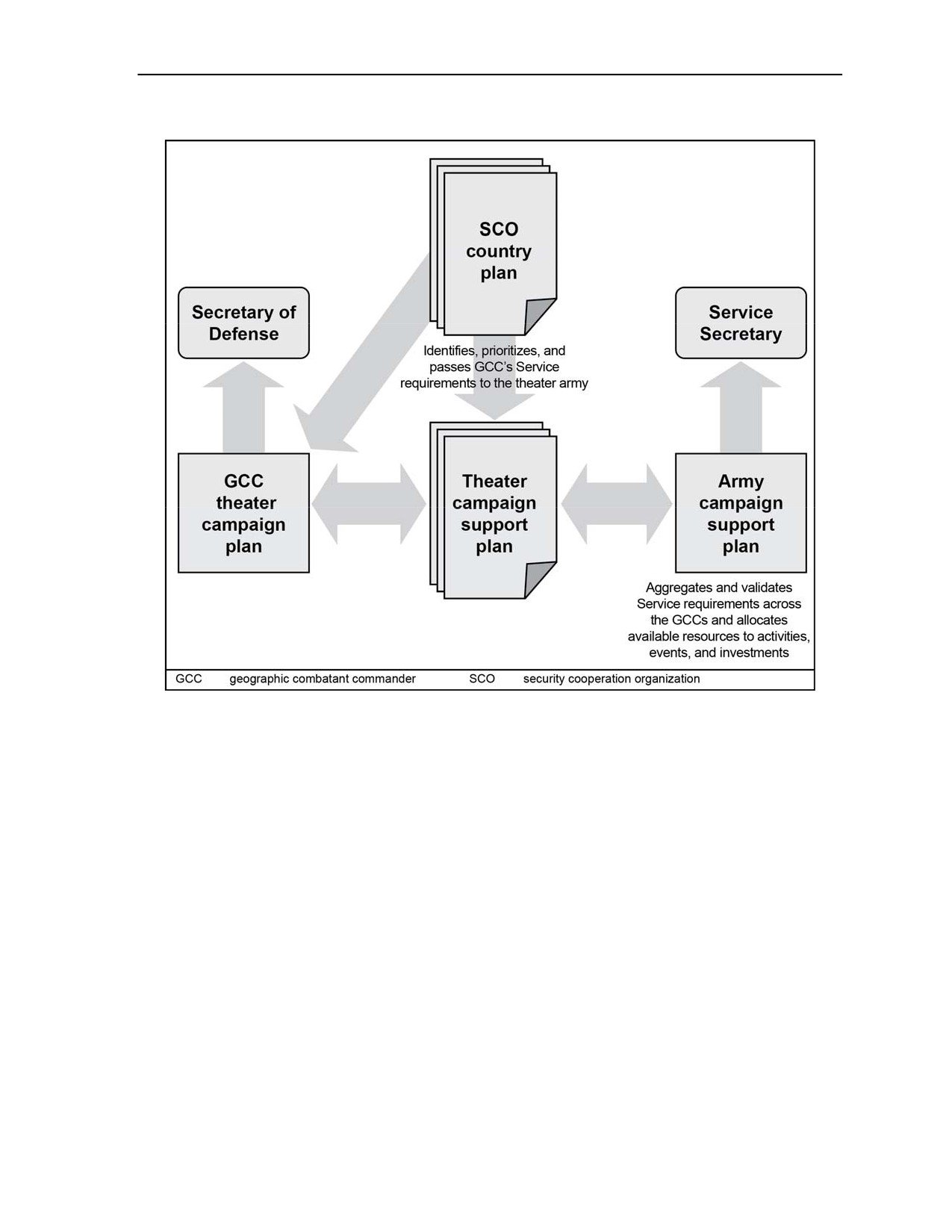
Planning and Assessment Considerations
Figure 3-3. Relationship between country plan, theater campaign plan, and integrated country
strategy
3-110. Country plan objectives should be consistent with those in the theater and regional campaign plans
and should reflect an understanding of end states and how it may be applied to the country. Country plans
focus on establishing country objectives that support the specific theater campaign plan and associated
subordinate regional and functional campaign plans.
3-111. The geographic combatant command develops lines of effort, often using security cooperation
focus areas to inform them. The command nests key security cooperation activities and tasks with those
lines of effort to achieve integrated country strategy objectives. It is important to note that security
cooperation programs, activities, or operations may support multiple lines of effort and objectives.
3-112. Depending on the country, the defense attaché office or the security cooperation organization is the
focal point for security cooperation country planning. These two outlets for security cooperation with a
country require a broad knowledge and skill baseline of the very different international programs initiated,
funded, and managed throughout the DOD, its agencies and the Military Departments.
3-113. In its simplest form, DOD’s approach to planning is guided by the direction of the President and
Secretary of Defense. Planning in DOD starts with the National Security Strategy, issued by the White
House. Overarching DOD guidance documents expand on the National Security Strategy: the National
Defense Strategy influences the GEF, which provides the parameters for combatant commands to develop
their theater and functional campaign plans, which include direction for the development of country-level
plans. The theater campaign plans and country-level plans generally do not contain specific personnel or
other resource requirements. The theater army, through the theater campaign support plan, supports
22 January 2013
FM 3-22
3-21
Chapter 3
geographic combatant command theater campaign plan objectives and GEF end states. Table 3-1 depicts a
way to integrate country planning with theater campaign planning. The elements of a country plan vary
among geographic combatant commands. Table 3-1 is not prescriptive and only provides a sample format
for a country plan.
Table 3-1. Country plan format example
Format
Definitions
Examples
1. GCC task #1
GCC task: The security
GCC task #1: Develop land
a. Assessment
cooperation activity or task
forces NCO professional military
nested with line or lines of effort
education.
b. Objective #1.a.
to achieve an objective or
Assessment: Country X land
1) Task #1.a.(1)
objectives and strategic effect or
forces lack a NCO professional
a. Activity #1.a.(1)(a)
outcome.
military education system,
b. Activity #1.a.(1)(b)
Assessment: Determination of
management structures, and
2) Task #1.a.(2)
the progress toward
doctrine.
a. Activity #1.a.(2)(a)
accomplishing a task, creating a
Objective #1.a.: Country X land
b. Activity #1.b.(2)(b)
condition, or achieving an
forces establish a professional
objective (JP 3-0).
military education system for
c. Objective #1.b.
Objective: The clearly defined,
NCOs by 1 January 2015.
1) Task #1.b.(1)
decisive, and attainable goal
Task #1.a.(1): Familiarize
a. Activity #1.b.(1)(a)
toward which every operation is
country X land forces with the
b. Activity #1.b.(1)(b)
directed (JP 5-0).
United States NCO professional
2. GCC task #2
Task: A clearly defined and
military education system by
measurable activity
January 2013.
accomplished by individuals and
Activity #1.a.(1)(a):
organizations.
• Who: United States
Activity: A function, mission,
Army Training and
action, or collection of actions
Doctrine Command.
(JP 3-0).
• What: Five-day NCO
professional military
education
military-to-military
contact event.
• When: October 2013.
• Where: Country X land
force headquarters.
LEGEND:
GCC - geographic combatant commander
JP - joint publication
NCO - noncommissioned officer
3-22
FM 3-22
22 January 2013
Planning and Assessment Considerations
COUNTRY SUPPORT PLAN
3-114. Theater armies develop country support plans, when required by the geographic combatant
command, to support each of the geographic combatant command’s country plans. The geographic
combatant command theater campaign plan, geographic combatant command country plan, country support
plan, and integrated country strategy should all be synchronized to achieve the same objectives. Each
geographic combatant command and theater army—supported by functional ASCCs—should coordinate a
process whereby geographic combatant command planners and country team officials review and concur
with the theater army’s needs assessment. To ensure proper nesting, country support plans include—
z
An overview of the country environment (including the theater security environment).
z
A broad mission statement.
z
A broad concept.
z
Intermediate military objectives and tasks.
z
Coordinating instructions.
z
A discussion of resources.
z
An assessment of conditions (conducted annually for comparison).
3-115. An overview of the country environment consists of an assessment of the current theater security
environment and relevant geostrategic trends. It includes a discussion of critical partners, alliances
(including regional security organizations), and actors of concern in relation to the country’s land
component and institution.
3-116. A broad mission statement, in narrative form, is derived from mission analysis of theater campaign
plan, the geographic combatant command country plan, and direction from the GEF, the JSCP, and other
higher guidance. This narrative should outline supporting Army objectives and how these objectives are
nested with geographic combatant command intermediate military objectives to achieve GEF end states.
3-117. A broad concept, based on operational design, outlines the commander’s operational approach. It
broadly describes the actions the theater army and joint force need to take to achieve theater objectives.
Finally, it should describe priorities for relationships, capacity building and steady-state operations, and
access supporting U.S. partners.
3-118. Intermediate military objectives and tasks describe specific categories of activities for which
subordinates and supporting organizations are responsible. They address regional or sub-regional
objectives. Objectives and tasks should describe the level of effort directly related to the priorities outlined
in the theater campaign plan.
3-119. Coordinating instructions address issues affecting the plan’s design and execution. Examples
include authorities and operating constraints, strategic communication themes, and military information
support operations considerations.
3-120. A discussion of resources, especially forces and funding, covers resources allocated to and
required by the combatant command to implement the theater campaign plan. This discussion should
address the impact of resource shortfalls—in terms of operational or strategic risk—on the achievement of
theater objectives. It should also outline how such risks might be mitigated.
3-121. An annual assessment outlines how conditions have changed over the year relative to objectives.
This assessment is based on measures of effectiveness and measures of performance.
INTEGRATED COUNTRY STRATEGY
3-122. The integrated country strategy, formerly referred to as the mission strategic resource plan (or
MSRP) is the country team’s strategy, budget, and performance document. The annual submission by a
U.S. mission abroad to the DOS which summarizes mission foreign policy priorities provides measures of
progress towards select goals, establishes forward planning performance targets, reports on results
achieved, and identifies DOS operations and foreign assistance budget requests and U.S. direct hire
position requirements related to the budget cycle. It is prepared utilizing a Web-based software application
22 January 2013
FM 3-22
3-23
Chapter 3
by the interagency country team, and is the initial step in establishing an annual planning and budget
formulation process and multiyear forecast for both state operations and foreign assistance.
3-123. Based on mission scope and complexity, the integrated country strategy comprises some of or all
of the following components:
z
Joint mission goals.
z
Diplomatic strategy.
z
Security and justice strategy (as necessary).
z
Development strategy (consisting of the USAID country development cooperation strategy,
DOS programs, and other agency programs, as necessary).
3-124. In the 2010 Quadrennial Diplomacy and Development Review (QDDR), DOS directs the chief of
mission to lead implementation of the integrated country strategy. The integrated country strategy requires
a coordinated and collaborative whole-of-government planning effort, with involvement by mission
personnel from DOS, USAID, and other U.S. government agencies operating at the missions. The
integrated country strategy serves as the foundation and framework for mission resource planning and for
the analysis and review of the annual mission resource request, reflecting each mission’s efforts to project
the regional strategy within that country. The integrated country strategy integrates annual objectives
defined in the multiyear strategies of the joint regional strategy. The joint regional strategy is a three-year
strategy developed collaboratively by DOS and USAID regional bureaus to identify the priorities, goals,
and areas of strategic focus within a region.
COUNTRY OBJECTIVES
3-125. Planners work in concert with the country team to assess the desires, objectives, and vision of
partners in an effort to work towards alignment and compatibility with U.S. objectives. Identifying
objectives are a key element of country planning. Country objectives should focus on the role that the
United States wants the partner or allied nation to play in achieving theater objectives. Country objectives
should be derived from and prioritized in accordance with higher-level guidance. Ideally they should also
be informed by and—at a minimum—consistent with the objectives and priorities of DOS (as articulated in
integrated country strategy) and other U.S. government actors. However, because a country plan describes
a bilateral partnership between the United States and a partner or allied nation rather than unilateral U.S.
actions, the security priorities and interests of the partner or allied nation need to be taken into account.
3-126. Planners should identify concrete near-term (one to two years), mid-term (three to five years) and
long-term (over five years) objectives for the country that progressively contribute to the achievement of
overarching country or theater objectives. These country objectives should be expressed in terms that are
specific, measurable, achievable, relevant, and time-bound.
3-127. Near-term objectives would be resource constrained because budget and execution year resources
were already largely allocated. Mid-term objectives would be resource-informed because the combatant
command would have ample time to work with program managers and the Services in influencing security
cooperation related investments and determining what investments are feasible. Long-term objectives will
be relatively unconstrained because resources were neither planned nor programmed beyond five years into
the future. Objectives should not focus solely on building or sustaining partner capacity.
3-128. Country objectives related to gaining access and maintaining relationships should be clearly
articulated. Moreover, in addition to security cooperation objectives, goals tied to applicable strategies and
setting conditions for contingency plans, global campaign plans, and crisis action plans should also be
considered.
3-129. The theater army provides a regionally oriented, long-term Army presence for military
engagement, security cooperation, deterrence, and limited intervention operations. It provides support to
joint and Army forces operating in joint operational areas within the geographic combatant command AOR.
Army organizations assigned to the theater army provide capabilities necessary to perform
operational-level tasks, as well as to assist and augment subordinate tactical organizations.
3-130. The theater army coordinates and provides the resources “means” and sustainment required to
support security cooperation activities, specifically those efforts focused towards building partner capacity
3-24
FM 3-22
22 January 2013
Planning and Assessment Considerations
as directed by the combatant commander. The theater army provides the geographic combatant command
with regionally aligned forces (RAF) and specially trained forces with competence in languages, cultures,
history, governments, security force assistance, foreign internal defense, and threat knowledge in areas
where conflict is likely to occur. These Army forces enable combatant commanders to shape the
operational environment by developing relationships with partner-nation governments and their security
forces. Theater armies direct the activities of theater-assigned forces and RAF to achieve country
objectives.
COUNTRY ASSESSMENT
3-131. Assessment is the determination of the progress toward accomplishing a task, creating an effect, or
achieving an objective (JP 3-0). Country support plans begin with a country assessment. Assessment
precedes and guides the other activities of the operations process. Assessment involves deliberately
comparing forecasted outcomes with actual events to determine the overall effectiveness of force
employment. More specifically, assessment helps the commander determine progress toward attaining the
desired end state, achieving objectives, and performing tasks. Assessments are conducted throughout the
range of military operations, and therefore require continuous monitoring and evaluation from planning
through execution to measure the overall effectiveness to help commanders and their staffs understand the
current situation and its evolution during operations.
3-132. Assessing security cooperation activities is a critical part of the operations process. It requires a
comprehensive analysis of the operational environment and a focus on broader tasks, effects, and objectives
such as the development of FSF capacity and capability. Security cooperation activities by themselves are
not likely to achieve an objective. However, conducting multiple security cooperation activities over time
are required to make progress towards an objective. Assessments are performed in close collaboration with
the U.S. country team, the host-nation government, and other multinational partners. Therefore, it is
important that security cooperation planners become involved in assessment working groups to help
determine whether security cooperation activities are achieving an objective or should be reconsidered.
3-133. Country assessments serve as the baseline for identifying needs—including critical shortfalls that
inform the development of country-level objectives—and measuring progress. Security cooperation
planners should attempt to understand each objective from such authoritative sources as multinational
standardization agreements, partner country doctrine, or U.S. Army doctrine, depending on the agreed
standard for achieving the intended effect or capability. Furthermore, security cooperation planners should
maintain assessments of the partner country that include force development in terms of doctrine,
organization, training, materiel, leadership and education, personnel, and facilities
(DOTMLPF)
capabilities related to the objective through estimates and in-country visits. A capability provides the means
to accomplish a mission or task decisively. Capability comes from organizations comprised of well-trained
people with superior equipment, led by competent leaders employing sound doctrine. Lessons learned, after
action reviews, training assessments from security assistance teams, U.S. embassy cables, civil affairs
assessments, and intelligence community reports can be valuable resources to support this assessment.
3-134. While every situation differs, commanders and staffs consider numerous factors throughout
planning, preparation, and execution of the operation, as well as the strategic context in which planning is
being conducted. Considerations include—
z
Regional security environment and organizations.
z
Civil considerations of the operational environment.
z
Role the United States desires the country to play in the region.
z
Estimate of country’s past or ongoing security cooperation programs.
z
Country team’s integrated country strategy objectives and efforts.
z
Objectives and efforts of other Services and United States government agencies.
z
Resources, capacity, and capability of FSF; capability gaps of the country; and national
resources available to cover gaps.
z
Methods, successes, and failures of FSF.
22 January 2013
FM 3-22
3-25
Chapter 3
z
State of training, a mission-essential task list assessment, at all levels, and the specialties and
education of leaders.
z
Equipment and priority placed on maintenance.
z
Foreign disclosure.
3-135. When assessing FSF and the defense establishment capacity and capability to provide for its own
internal and external security, DOTMLPF provides a good framework:
z
Doctrine—doctrinal principles related to intelligence, sustainment, leadership, irregular warfare,
and counterinsurgency.
z
Organization—organizational personnel and equipment requirements. Develop proposed
organization, as well as its mission and functions, and authorizations to meet the required
mission capabilities related to force structure, baseline force availability, higher headquarters,
units, number and type of weapon systems, and any capability shortfalls.
z
Training—mission-essential task list assessment, at all levels, individual training, collective
training, combined arms training.
z
Materiel—foreign security force capacity and capability gaps in intelligence collection and
weapon systems, force development and integration, acquisition and budget, and
interoperability.
z
Leadership and education—noncommissioned officer professional military education,
sergeants major academy, officer professional military education, and policy planning and
strategy development.
z
Personnel—limitations of personnel, military and defense civilian personnel requirements, and
authorizations.
z
Facilities—training centers, leadership and education institutions, sustainment, medical health
institutions, quality of life, and morale, welfare, and recreation facilities.
Table 3-2, page 3-27, illustrates an example of a FSF intelligence institution assessment using this
framework.
3-26
FM 3-22
22 January 2013

Planning and Assessment Considerations
Table 3-2. Example of DOTMLPF foreign security forces intelligence institution assessment
Current
Interim (2-5 years)
End state (5-10 years)
2015 objective force
DMI and G-2 or J-2 developing
FSF DMI and G-2 or J-2
document devoid of MI; DMI
and validating doctrine based
operating using indigenous
Doctrine
has clearly defined MI
on inputs from foreign donors
doctrine interoperable with
proponency role
regional, multinational, or
peacekeeping forces
FSF G-2 or J-2 structured
FSF G-2 or J-2 structured
G-2 or J-2 coequal with G-3
under G-3 or J-3. Extremely
under J-3. Limited MI capability
or J-3. Sufficient MI
limited MI capability in
in mission critical units, MI
capability in mission critical
Organization
mission critical units
included at training centers
units
No resident MI capability in
MI integral in training centers
training centers
No organized individual or
Organized individual and
Individual and collective MI
collective MI training
collective MI training,
training conducted and
in the GS office of primary
conducted or funded by foreign
funded by the host nation
Training
responsibility, training
donors (GS office of primary
(GS, training centers, and
centers, or mission critical
responsibility, training centers,
mission critical units)
units
mission critical units)
No training materials in the
FSF MI personnel using MI
FSF sourcing or funding for
MI office of primary
material provided by foreign
its own MI and C2
responsibility in the GS
donors, including C2 linking GS
equipment, with limited
Materiel
Reliable C2 between GS
and mission-critical units
foreign advice and
and mission critical units
assistance
necessary for functioning of
MI reporting chains
DMI and GJ2 relationships
DMI and G-2 or J-2
DMI and G-2 or J-2
currently being defined—
relationships clearly defined -
relationships—with one
Leadership
with one another, with G-3
with one another, with J-3, with
another, with J-3, with
and education
or J-3, with training centers,
training centers, with civilian
training centers, with civilian
with civilian intelligence
intelligence agencies
intelligence agencies—stable
agencies
and functional
No MI qualified faculty in
Limited qualified faculty in
Self-sustaining qualified
training centers
training centers, minimal
faculty in training centers,
Extremely limited qualified
qualified MI personnel in the
adequate qualified MI
Personnel
MI personnel in the GS,
GS, training centers, and
personnel in the GS, training
training centers, and
mission critical units
centers, mission critical units
mission critical units
Adequacy of DMI and G-2
Adequate DMI and G-3 or J-3
Adequate DMI and J-2
Facilities
or J-2 offices UNK. MI
offices. MI school under
offices, MI school fully
school to be built
construction
furnished and operational
LEGEND:
C2 - command and control
GS - general staff
DM -I director of military intelligence
J-2 - intelligence directorate of a joint staff
FSF - foreign security forces
J-3 - operations directorate of a joint staff
G-2 - assistant chief of staff, intelligence
MI - military intelligence
G-3 - assistant chief of staff, operations
22 January 2013
FM 3-22
3-27
Chapter 3
3-136. Assessment is continuous; it precedes and guides every operations process activity and concludes
each operation or phase of an operation. Broadly, assessments consist of, but are not limited to—
z
Monitoring the situation to collect relevant information.
z
Evaluating progress toward attaining end state conditions, achieving objectives, and performing
tasks.
z
Recommending actions for improvement.
(See chapter 5 of ADRP 5-0 for a discussion of assessments).
Monitoring and Evaluating
3-137. Monitoring is continuous observation of those conditions relevant to the current operation.
Monitoring within the assessment process allows staffs to collect relevant information, specifically that
information about the current situation that can be compared to the forecasted situation described in the
commander’s intent and concept of operations. Progress cannot be judged, nor effective decisions made,
without an accurate understanding of the current situation. Assessments evaluate and measure progress of
security cooperation tasks toward the end state.
3-138. Evaluating is using criteria to judge progress toward desired conditions and determining why the
current degree of progress exists. Evaluation is at the heart of the assessment process where most of the
analysis occurs. Evaluation helps commanders determine what is working and what is not working, and it
helps them gain insights into how to better accomplish the mission.
3-139. As the commander and staff continue to assess changes in the environment and the progress of
FSF and other focus areas of security cooperation, they must continually challenge their original framing of
the situation to ensure the operation is meeting the stated objectives and end state. Further, they must assess
whether the envisioned objectives continue to be appropriate to meet the end state. Finally, they must know
if the intended end state still makes sense. While measures of effectiveness and measures of performance
help assess effectiveness and performance of the plan, it is critical to assess the strategic objectives and end
state. The assessment working group informs the commander’s decisions by evaluating and re-evaluating
the stated objectives and end state against other possibilities and outcomes.
Measures of Effectiveness and Measures of Performance
3-140. Criteria in the forms of measures of effectiveness and measures of performance aid in determining
progress toward attaining end state conditions, achieving objectives, and performing tasks. Measures of
effectiveness help determine if a task is achieving its intended results. Measures of performance help
determine if a task is completed properly. Measures of effectiveness and measures of performance are
simply criteria—they do not represent the assessment itself. Measures of effectiveness and measures of
performance require relevant information in the form of indicators for evaluation.
3-141. A measure of effectiveness is a criterion used to assess changes in system behavior, capability, or
operational environment that is tied to measuring the attainment of an end state, achievement of an
objective, or creation of an effect (JP 3-0). Measures of effectiveness help the commander determine if the
force is “doing the right things,” if the FSF are capable of performing the tasks, and what was the “return
on investment.” By determining the relative “return on investment,” security cooperation planners can help
determine how resources might be better allocated and expended across the plan. In this regard, this aspect
can be especially useful in identifying how resources could be redistributed to mitigate the most serious
risks associated with plan shortfalls.
3-142. Measures of effectiveness help measure changes in conditions, both positive and negative.
Measures of effectiveness are commonly found and tracked in formal assessment plans. Security
cooperation divisions use measures of effectiveness in execution matrixes and estimates to track completed
security cooperation tasks to help inform the formal assessment. Table 3-3, page 3-29, gives an example of
developing measures of effectiveness for security cooperation.
3-28
FM 3-22
22 January 2013

Planning and Assessment Considerations
Table 3-3. Example of security cooperation measures of effectiveness
Security cooperation focus areas
Measure of effectiveness
Operational capacity and capability building
Increased in units certified for a specific mission
Human capacity and human capital
Increased number of training opportunities for desired
development
skills
Institutional capacity and security sector Reform
Decreased reports of corruption
Support to institutional capacity and civil-sector
Increased ability of local agencies to prepare for and
capacity building
respond to local crises.
Multinational operations capacity,
Increased usage of multinational forces in operations,
interoperability, and standardization
exercises, or other activities
Operational access and global freedom of
Reduced restrictions for access as identified in the
action
status of forces agreement
Intelligence and information sharing
Increased shared intelligence reports
Assurance and regional confidence building
Increased maneuver notifications
International armaments cooperation
Increased acquisition of foreign technologies and
cost-sharing
International suasion and collaboration
Increased positive media reporting of security
cooperation events
3-143. A measure of performance is a criterion used to assess friendly actions that is tied to measuring
task accomplishment (JP 3-0). Measures of performance answer questions such as “Was the action taken?”
or “Were the tasks completed to standard?” A measure of performance helps confirm or deny that a task
has been properly performed. Measures of performance focus on the friendly force. However, measures of
performance can be just as effective in evaluating FSF to determine if they are performing well enough.
Measures of performance and effectiveness can help determine what tasks FSF are performing and whether
they are doing them correctly. In general, evaluating task accomplishment using measures of performance
is relatively straightforward and often results in a yes or no answer.
3-144. Security cooperation divisions use measures of performance in execution matrixes and estimates to
track completed security cooperation tasks, which informs the formal assessment. Headquarters
Department of the Army, theater armies, and generating force organizations use software tools such as the
Theater Security Cooperation Management Information System (known as TSCMIS) and Army Global
Outlook System (known as ARGOS). These tools have the capability to facilitate assessments of security
cooperation activities (See AR 11-31 for Army policy on security cooperation.) Table 3-4 shows an
example of measures of performance for security cooperation.
Table 3-4. Example of security cooperation measures of performance
Security cooperation focus areas
Measure of performance
Operational capacity and capability building
Training event conducted?
Human capacity and human capital development
Education course conducted?
Institutional capacity and security sector reform
Advisor embedded in partner country general staff?
Support to institutional capacity and civil-sector
Crisis management tabletop exercise conducted?
capacity building
Multinational operations capacity, interoperability,
North Atlantic Treaty Organization (NATO) standard
and standardization
agreement adopted?
Operational access and global freedom of action
Status-of-forces agreement (SOFA) signed?
Intelligence and information sharing
Multinational network provided?
Assurance and regional confidence building
Hot-line communications in service?
International armaments cooperation
Armaments coordination agreement conducted?
International suasion and collaboration
Major annual regional security conference
conducted?
22 January 2013
FM 3-22
3-29
Chapter 4
Preparation and Execution Considerations
This chapter discusses preparation and execution considerations, including functional
considerations for achieving goals and objectives, security force assistance tasks, and
security force assistance elements.
FUNCTIONAL CONSIDERATIONS FOR ACHIEVING GOALS AND
OBJECTIVES
4-1. Security cooperation activities include security assistance, security force assistance, foreign internal
defense, and security sector reform. The tactical doctrine in this field manual emphasizes conducting
security force assistance tasks because of their relationship to other security cooperation tasks and strategic
goals and objectives. U.S. forces may achieve regional security through partnerships with a particular
country, by building its capability and capacity to provide for internal and external defense. Actions that
provide a particular country with an internal and external defense capability contribute to the goal of
maintaining stability in a region. On the other hand, creating an offensive capability may be
counterproductive and actually destabilize the region. The ultimate goal of security force assistance is to
create foreign security forces (FSF) that are competent, capable, committed, and confident (see table 4-1)
and that have a security apparatus that supports U.S. policy related to achieving regional stability.
Table 4-1. Security force assistance goal
U.S. forces strive to develop foreign security forces that are—
Competent
Across all levels from ministerial to the individual soldier or police officer.
Across all warfighting functions.
Capable and
Appropriately sized and effective enough to accomplish missions.
sustainable
Sustainable over time.
Resourced within partner-nation capabilities.
To security of all the people and survival of the state.
Committed
To preservation of the liberties and human rights of the citizens.
To peaceful transition of power.
In themselves to secure the country
Trusted by the citizens, that their security force will provide security and be
professional.
Confident
Trusted by the partner-nation government, which is confident it has the correct
security force.
Trusted by the international community, which believes the nation’s security
force is a force for good.
4-2. While few foreign defense establishments and FSF are organized in the same manner as U.S. forces,
they are likely to have organizations and forces that fulfill the functions of executive direction, the
generating force and the operating force. In many FSF, the same organization tasked with executive
direction will fulfill functions in the operational force as operational and tactical headquarters, and
operating forces will be organized to fulfill the organization’s generating requirements. The security
cooperation planner requires some knowledge of how both their own executive direction, operating forces,
and generating forces work in order to recognize what capabilities are required to conduct those tasks that
will support development of specific foreign security force capabilities.
22 January 2013
FM 3-22
4-1
Chapter 4
EXECUTIVE DIRECTION
4-3. All security forces apply some level of executive direction, which empowers a generating and an
employing or operating function. Those activities direct, develop national policy for, and resource FSF.
Executive direction justifies, authorizes, and directs the parameters for generating and employing FSF.
Basic executive direction functions include advising political leadership, developing and implementing
policy, conducting strategic planning, assessing readiness, conducting current and future capability review
and analysis, and forecasting and budgeting current and future requirements.
GENERATING FORCES
4-4. U.S. generating force capabilities can help FSF develop essential generating force capabilities.
Foreign defense establishments must be able to fulfill requirements similar to the Title 10, United States
Code (USC), functions shown in table 1-1, such as recruit, organize, train, maintain, and equip. These
capabilities also include support to—
z
The development of current and future force concepts and doctrine.
z
The design of organizations to meet operational requirements.
z
Capability development and integration.
z
Materiel requirements.
z
Leader development needs and education.
z
Personnel policies.
z
Experimentation, research, and systems analysis.
z
Force development policy.
z
Budgeting and resourcing.
z
Installation management and the building and maintaining of facilities and infrastructure.
z
Other functional area expertise designed to support development of capabilities in the operating
force.
CONVENTIONAL FORCES
4-5. U.S. conventional forces employ capabilities through application of the joint functions (command
and control, intelligence, fires, movement and maneuver, protection, and sustainment) to complete tasks
and achieve assigned objectives. Conventional forces have some inherent capabilities to support
development of operational capabilities in others. However, conventional forces have limited capability to
train and sustain themselves as related to their operational role—training and sustainment depend on
generating force capabilities. This means U.S. conventional forces are more suited to develop FSF and
capabilities than they are to develop generating force capabilities.
OPERATIONAL APPROACHES
4-6. Depending on the operational environment and U.S. national objectives, the Army operational
approach to supporting the larger Department of Defense (DOD) security cooperation effort is direct or
indirect in either noncombat or combat roles across the range of military operations. While the operational
environment and national objectives determine the approach, it is possible that approaches are combined in
order to best meet U.S. objectives, expedite host-nation capability and self-sufficiency.
4-7. The operational approach conceptualizes the commander’s visualization for establishing the
conditions that define the desired end state. Some operations are conducted among the people, where
military interaction with the local populace is inherent to the mission.
Indirect Approach
4-8. Indirect approach activities involve the U.S. supporting a nation with security cooperation programs,
given legitimate authorities, designed to enhance its capability and capacity. Indirect approaches are
appropriate for environments where direct U.S. involvement is not required or may be counterproductive.
The indirect approach focuses on building strong national infrastructures through economic, military, and
4-2
FM 3-22
22 January 2013
Preparation and Execution Considerations
other capabilities that contribute to self-sufficiency. The security force assistance tasks that fall under the
indirect approach are organize, train, equip, rebuild, and advise. Programs and activities typical of the
indirect approach include—
z
Foreign military sales and financing.
z
International military education and training.
z
Multinational and joint exercises and exchange programs.
z
Peace operations.
z
Antiterrorism and counterdrug assistance.
Direct Approach
4-9. In the direct approach U.S. forces assist the host nation by conducting operations for the mutual
benefit of the host-nation and U.S. interests. These operations either provide a capability that the host
nation does not possess or increase the capacity of the host nation to conduct the operation. Direct approach
operations are normally conducted when the host nation is faced with social, economic, or military threats
beyond its handling capability. In the case of direct support, the geographic combatant commanders use
Soldiers in roles that typically assume more risks than indirect support. The security force assistance tasks
that fall under the direct approach are advise and assess. Activities typical of the direct approach include—
z
Civil affairs operations, including sociocultural efforts.
z
Foreign humanitarian assistance.
z
Intelligence and information sharing.
z
Logistical, transportation, and maintenance support.
z
Military information support operations.
Combat Operations
4-10. When the United States is authorized to conduct combat operations, security cooperation activities
continue across the range of military operations. Direct and indirect activities enable the host nation to
effectively conduct combat operations either unilaterally or as part of a multinational operation. The use of
U.S. forces in a combat role in security cooperation serves as a temporary solution until the situation is
stabilized and host-nation forces are able to provide security for their populace. In all cases, U.S. combat
operations support the host nation’s ability to provide for its internal security and external defense.
SECURITY FORCE ASSISTANCE TASKS
4-11. General developmental tasks are organize, train, equip, rebuild and build, advise and assist, and
assess (known as OTERA-A). These functional tasks serve as security force assistance capability areas.
Each element of these tasks can be used to develop, change, or improve the capability and capacity of FSF.
By conducting an assessment of the FSF through the lens of U.S. interests and objectives, coupled with
shared interests of multinational partners, U.S. forces can determine which area or areas within the
OTERA-A construct to use to improve the FSF to the desired capability and capacity. Planners should
determine what is in the best interests of the multinational partners involved, or “what is good enough” to
achieve shared objectives. In essence, U.S. forces conduct assessments of the FSF against desired
capabilities and then develop an OTERA-A plan to help FSF build capability and capacity. Planners avoid
trying to create a mirror image of U.S. forces.
4-12. Organize refers to all activities taken to create, improve, and integrate doctrinal principles,
organizational structures, capability constructs, and personnel management. This may include doctrine
development, unit and organization design, command and staff processes, and recruiting and manning.
4-13. Train refers to all activities taken to create, improve, and integrate training, leader development, and
education at the individual, leader, collective, and staff levels. This may include the development and
execution of programs of instruction, training events, and leader development activities.
22 January 2013
FM 3-22
4-3
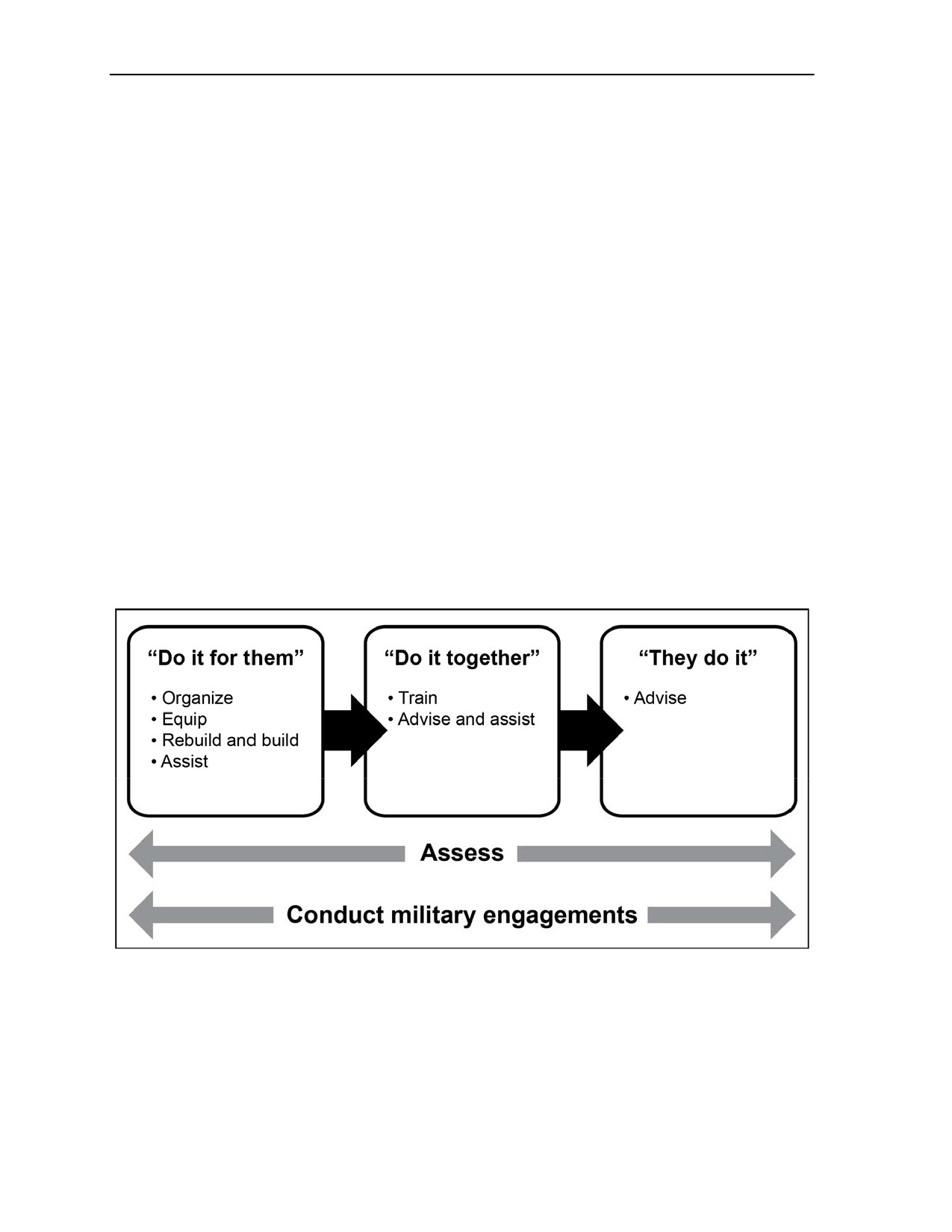
Chapter 4
4-14. Equip refers to all activities to create, improve, and integrate materiel and equipment, procurement,
fielding, accountability, and maintenance through life cycle management. This may include new equipment
fielding, operational readiness processes, repair, and recapitalization.
4-15. Rebuild and build refers to all activities to create, improve, and integrate facilities. This may include
physical infrastructures such as bases and stations, lines of communication, ranges and training complexes,
and administrative structures.
4-16. Advise and assist refers to all activities to provide subject matter expertise, mentorship, guidance,
advice, and counsel to FSF while carrying out the missions assigned to the unit or organization. Advising
occurs under combat or administrative conditions, at tactical through strategic levels, and in support of
individuals or groups.
4-17. Assess refers to all activities for determining progress toward accomplishing a task, creating an
effect, or achieving an objective using measures of effectiveness and measures of performance to evaluate
foreign security force capability. Once an objective is achieved, the focus should shift to sustaining it.
4-18. The first two tasks correspond to the idea of “do it for them,” and the next two tasks correspond to
the idea of “do it with them,” while the last two tasks are performed across the range of military operations.
Given a legitimate authority, Multinational Security Transition Command-Iraq (MNSTC-I) and Combined
Security Transition Command-Afghanistan (CSTC-A) are two recent examples of security cooperation
organizations created to accomplish these tasks given legitimate authority. MNSTC-I developed,
organized, trained, equipped, and sustained the Iraqi Security Ministries (ministries of defense and interior
and Iraqi security forces. CSTC-A is a multinational military formation. Its primary role is the training and
development of Afghan security forces such as the Afghan National Army. The Army integrates the
capabilities of the operating, institutional, and special forces to support security cooperation on two levels:
tactical and institutional. These tasks are explained in greater detail in paragraphs 4-19 to 4-74. Figure 4-1
illustrates the security force assistance tasks as building blocks to achieving security force assistance goals.
Figure 4-1. Building blocks of security force assistance
THE ORGANIZE TASK
4-19. Organization of FSF includes all activities taken to create, improve, and integrate doctrinal
principles, organizational structures, and personnel management. This may include doctrine development,
unit or organization design, mission command and staff processes, and methods and policies for recruiting
and manning the FSF.
4-4
FM 3-22
22 January 2013
Preparation and Execution Considerations
4-20. The United States provides a capability that a foreign defense establishment does not have the ability
to provide on its own. Assistance can be provided at the tactical, operational, and strategic levels in
permissive and uncertain environments. In some cases, the United States provides assistance as a bridging
solution until the host nation organizes and develops the capability on its own. The United States can
provide assistance until U.S. objectives are met, or until the foreign defense establishment develops the
capability shortfall. In other instances, the United States may provide assistance to meet specific U.S. and
foreign defense establishment requirements without the intent of organizing that capability within that
nation’s foreign defense establishment. In these cases, an enduring foreign defense establishment capability
is neither required, nor is it in the best interest of the United States.
Organize Tactically
4-21. The United States provides combat power and enablers in support of a foreign defense establishment
to enable the accomplishment of U.S. and foreign defense establishment goals. Tactical assistance can be
provided in all environments—permissive and uncertain. In noncombat roles, U.S. assistance enables other
security cooperation tasks, such as training or advising. U.S. assistance also helps accomplish noncombat
objectives, such as demining, search and rescue, or logistical support. In combat roles, U.S. assistance
supports foreign defense establishment objectives to free and protect its society from subversion,
lawlessness, insurgency, terrorism, and other treats to security. Examples of U.S. tactical assistance in
combat roles include close air support, air defense, intelligence analysis, and medical evacuation. Examples
of U.S. tactical assistance in noncombat roles include mine clearing, search and rescue, and security
provided in conjunction with a natural disaster.
Organize Institutionally
4-22. The United States provides the institutional capability to enable force generation for a foreign
defense establishment and to support the development of the foreign defense establishment’s ability to
generate forces, through the establishment of processes, institutions, and infrastructure. The United States
performs institutional assist tasks at the service headquarters level, the training and doctrine development
level, and the proponent or branch level. The United States provides institutional assistance as part of a
comprehensive security cooperation plan that includes equipping, training and advising to develop foreign
defense establishment capability.
4-23. The United States provides assistance for force management. Force management assistance includes,
but is not limited to, force development, force integration, capabilities integration, budgeting, and personnel
management. U.S. assistance for training and doctrine includes, though is not limited to, development of
doctrine and processes, training support packages, course design and development, instructor qualification
criteria, and professional career development. At the proponent or branch level, The United States provides
assistance in branch specific capabilities development and integration, using the framework of doctrine,
organization, training, materiel, leadership and education, personnel, and facilities (DOTMLPF).
4-24. Finally, the institutional assist task enables the United States to provide engineering and logistical
support to the foreign defense establishments. This support can include the repair and development of
infrastructure, power generating networks, telecommunications networks, and water management and
treatment facilities; environmental engineering support; real estate management; and transportation of
troops and materiel.
THE TRAIN TASK
4-25. The train task of FSF includes all activities taken to create, improve, and integrate training, leader
development, and education at the individual, leader, collective, and institutional levels. This may include
the development and execution of programs of instruction, training events, and leader development
activities.
4-26. At the tactical level train tasks focus on individual and collective tasks. At the operational level, the
train task focuses on planning and interoperability. At the strategic level the train task focuses on planning
and force generation. While performing security cooperation train tasks U.S. forces train themselves, train
22 January 2013
FM 3-22
4-5
Chapter 4
FSF, and train the interoperability and capacity of U.S. and FSF to work together. The three aspects of the
train task are represented by the statement “Train them, train us, and train together.”
4-27. Due to legislative and funding constraints, the source of funding determines who receives the greater
training benefit. For example, Title 10, USC, joint combined exchange training must primarily benefit U.S.
forces, while Title 22, USC, missions associated with foreign military sales and foreign military forces
must primarily benefit the purchasing nation. Some training activities conducted in a steady-state, phase 0
environment may have an incidental benefit to the capacity or capability of the partner forces, but they
generally cannot be conducted for this primary purpose.
Train Foreign Security Forces
4-28. Training FSF includes individual training, collective training, staff training, and institutional training.
Individual Training
4-29. U.S. forces train FSF on military occupational skills appropriate to their organization and equipment.
While some training may be conducted using equipment and techniques common to U.S. forces, the U.S.
forces conducting the training must integrate U.S. objectives. U.S. forces should develop tailored programs
of instruction that are appropriate for the FSF. They should include a comprehensive assessment of the FSF
being trained. In some cases, U.S. forces will train on the use and care of equipment the United States has
sold to the host nation. Conversely, there may be a requirement for U.S. forces to train FSF on foreign
weapons, such as the AK-47 (Avtomat Kalashnikova). U.S. forces conducting this training must integrate
the training program of instruction with other instruction that normally accompanies equipment sales.
Collective Training
4-30. U.S. forces train FSF on collective tasks at the battalion level and below. Similar to the conduct of
individual training, U.S. forces must ensure that training programs of instruction are appropriate for the
organization and equipment of the FSF. Collective training programs of instruction must be developed in
support of U.S. objectives and foreign security force requirements. The level and extent of the collective
training should be based on an assessment of the FSF to be trained. In many cases, appropriate venues for
collective training are not available and must be developed by the FSF and the U.S. forces conducting the
training.
Staff Training
4-31. U.S. forces train the staffs of FSF in their staff functions. This function encompasses staff training
from company level troop leading procedures through military decisionmaking at the task force level. This
type of training can be the most difficult for U.S. trainers to prepare because of the preparation required to
adapt the U.S. military decisionmaking models to foreign force requirements. Trainers can combine U.S.
and foreign force staff training or train the foreign force staff in isolation.
Institutional Training
4-32. U.S. forces train the staff of the foreign nation’s force generation structure and ministerial or
departmental staff. In many cases, this task will overlap with the Advise task as foreign force institutional
structures mature and assume responsibility of force generation for their own forces. Institutional training
will often focus on force generation, budgeting, and oversight.
Train United States Forces
4-33. U.S. forces increase their capability to train foreign forces by training foreign forces. In the process
of training foreign forces on individual, collective and institutional tasks, U.S. forces gain insights on
foreign force training and increase their ability to train other foreign forces at other times and places. As an
additional benefit, the foreign forces receiving training increase their capability and capacity at the same
time.
4-6
FM 3-22
22 January 2013
Preparation and Execution Considerations
Train Together
4-34. As the capacity and capability of FSF increase, U.S. forces conduct combined training to develop the
capacity for foreign force and U.S. force interoperability. The goal of combined training is to develop
partners with the capacity to function as part of a combined force with multinational objectives. Combined
exercises familiarize both forces with the capabilities and shortfalls of other force and develop procedures
to leverage capabilities and mitigate shortfalls. Training exercises are conducted at all levels of command,
from tactical units to large-scale combined task forces.
THE EQUIP TASK
4-35. Equip is a security cooperation task, and given legitimate authority by Congress, is conducted using
formal contracts or agreements between U.S. government and an authorized foreign purchaser. Security
assistance enables the Equip task and authorizes the United States to build the capacity and capability of a
partner nation as well as improves interoperability. Security assistance is a group of programs authorized
by the Foreign Assistance Act (known as FAA) of 1961, P.L. 87-195, as amended, and the Arms Export
Control Act (known as AECA) of 1976, P.L. 90-629, as amended, or other related statutes by which the
United States provides defense articles, military training, and other defense-related services by grant, loan,
credit, or cash sales in furtherance of national policies and objectives.
Equip Tactically
4-36. The majority of the programs and activities related to equipping fall outside the responsibility of
operational Army, however there is a tactical element to the equip task. For the distribution of military
procured equipment, sometimes U.S. forces may assist in the physical distribution, accountability and
delivery of hand receipts and how to account for and sustain the equipment.
Equip Institutionally
4-37. United States Army Materiel Command (USAMC) is the Army’s provider of materiel readiness—
technology, acquisition support, materiel development, logistics power projection, and sustainment—to the
total force, across the range of military operations. USAMC manages the Army’s multibillion dollar
foreign military sales of Army equipment and services to partners and allies of the United States. It
negotiates and implements agreements for coproduction of U.S. weapons systems by foreign nations.
USAMC also handles the majority of the Army’s contracting including a full range of contracting services
to forward deployed units, supplies and common-use information technology hardware and software. It
delegates management of Army security assistance (equipping) programs to the United States Army
Security Assistance Command (known as USASAC), a major subordinate command of USAMC, which
provides total program management to include planning, delivery, and life-cycle support of equipment.
4-38. USASAC manages Army security assistance and provides planning, delivery, and life-cycle support
of equipment, services, and training to, and coproduction with U.S. multinational partners. USASAC
negotiates and implements coproduction agreements and provides logistic procedural guidance to the Army
security assistance community. USASAC ensures transfer of defense articles and services to international
and friendly foreign governments to promote the sharing of common burdens and build allied capabilities
for self-defense and multinational operations.
4-39. USASAC uses the United States Army Security Assistance Training Management Organization
(known as USASATMO) to plan, prepare, and deploy security assistance teams (based in the continental
United States) to execute security assistance missions abroad in support of the Army Security Assistance
Enterprise. USASATMO can provide the legal expertise on foreign military sales to support forces
deployed abroad by working to keep Title 10 and Title 22 case issue overlap legal. The security
cooperation organization is required to monitor security assistance team and host-nation activities to ensure
that the stated mission is accomplished, and that the security assistance team is not diverted from its
specified mission for activities or purposes outside the specific terms of the letter of agreement, governing
statutes, or other legal agreements. The security cooperation organization is responsible for coordinating
the teams’ activities to ensure compatibility with other DOD elements in or directly related to other
ongoing in-country activities. The security cooperation organization ensures compliance with directives
22 January 2013
FM 3-22
4-7
Chapter 4
and keeps the combatant commander informed of security assistance team activities and progress. The
security cooperation organization will identify problems and recommend solutions to the USASATMO.
(For additional information, see AR 12-1 and AR 12-7.)
Equipping
4-40. The task of equipping is synchronized by the Defense Security Cooperation Agency (DSCA) in
conjunction with the security cooperation organization at each embassy, the geographic combatant
command, and the theater army. Equipping is executed by contractors, DOD civilians, and in some
instances military personnel. Contractors support the equipping process for short-term and lower-end items
such as tactical radios, night vision goggles, and unmanned aerial vehicles. DOD civilian personnel,
organized as security assistance teams, can be stationed in a foreign country to train and provide advice on
the operation, maintenance, and tactical employment of weapons systems and support equipment or in
other special skills related to military functions. The security assistance teams consists of military, civilian,
or contractor personnel, deployed to a foreign country on temporary duty less than 180 days or permanent
change of station or temporary change of station more than 179 days status. For example, a temporary duty
security assistance team could teach a two-week warrior leader course, while permanent change-of-station
security assistance team missions could support the equipping process for M1A1 (Abrams) tanks or Apache
helicopters.
Acquisition Support
4-41. Including in the security cooperation task of equipping there is the additional need for acquisition
support. USAMC and Assistant Secretary of the Army for Acquisition, Logistics, and Technology
(ASA[ALT]) provide life-cycle program management. This encompasses conceptualization, initiation,
design, development, contracting, production, deployment, logistic support, modification, and disposal of
weapons systems and other systems supplies or services.
Sustainment
4-42. Assistant Secretary of the Army for Acquisition, Logistics, and Technology also provides logistic
support to host-nation security forces. This can be accomplished through the sustainment civil
augmentation program and is accompanied by the development of foreign defense establishment
national-level sustainment capability.
THE REBUILD AND BUILD TASK
4-43. The rebuild and build task refers to all activities to related to restoring and developing foreign
security force capability, capacity, and supporting infrastructure. The specific tasks vary according to the
mission’s goals and objectives and the host nation’s needs, which must be carefully assessed. This task
often involves construction and protection of facilities. In addition to assessment, effectiveness depends on
long-range planning and allocation of sufficient resources by the host nation.
THE ADVISE AND ASSIST TASK
4-44. Advising FSF refers to all activities to provide subject matter expertise, mentorship, guidance,
advice, and counsel to FSF while carrying out the mission assigned to the individual, unit, or organization
being advised. Advising will take place across the range of military operations, at the executive direction,
generating force, or operating force levels, and in support of individuals or organizations. Advising FSF is a
core competency Army forces, typically at the battalion level and below. The cumulative scale and scope of
such efforts occasionally exceed special operations force capacity, especially with regard to large-scale
development efforts such as in Afghanistan and Iraq. In such cases, the Army may have to expand advisory
capabilities from existing resources, accepting risk with regard to alternative capabilities.
4-45. Advising is an integral component of all security force assistance tasks. Various techniques for
advising, often referred to as teaching, coaching, or mentoring, are situation-dependent based on the needs
and capabilities of the FSF. The advisor, or advisory group, mentors and guides FSF by presenting options
4-8
FM 3-22
22 January 2013
Preparation and Execution Considerations
and methods that FSF can accept, reject, or modify to meet the needs of the FSF. Attributes common to
successful advisors are described in detail in chapter 6.
4-46. In the advise task, U.S. forces interact with FSF and defense establishments in a coordinated effort to
increase the capability of the FSF in a manner consistent with U.S. strategic goals. U.S. forces advising
FSF must coordinate their efforts with the geographic combatant command and country team in order to
ensure that the United States presents clear and consistent themes and messages to the FSF.
4-47. U.S. forces can advise FSF in both permissive and uncertain environments. In each of these
capacities, the advisor does not participate directly in activities, but advises in the form of providing
mentorship, guidance, and council. However, this does not preclude U.S. forces from also performing the
security force assistance tasks of train and assist in conjunction with their advise task. An example of this
simultaneous task assignment is the advisor who provides mentorship and guidance to foreign forces while
simultaneously training those forces and assisting them by calling in fire support.
4-48. The United States provides advisors for tactical-, institutional-, and governmental-level positions.
The tactical level refers to military units. The institutional level refers to Service-level interactions with a
foreign security organization (such as an army, border patrol, or defense department headquarters or
academic institution). The governmental level refers to government departments or ministries not
responsible for security.
Tactical-Level Advising
4-49. At the tactical level, U.S. advisors provide sound tactical advice on the conduct of individual and
collective tasks and operations conducted by the FSF. In many cases, U.S. advisors live and work with the
FSF, exposed to the same risks that the FSF face.
4-50. U.S. advisors may be required to provide defense capabilities to the FSF. They will require additional
personnel and equipment to accomplish the mission. Depending upon available resources, only a portion of
the foreign security support needs will likely be met. Rarely will resources be available to meet all the
support needs so advisors must build a plan to maximize available resources and mitigate shortfalls.
Examples of common collective tasks are—
z
Fires and fire support coordination.
z
Sustainment.
z
Communications.
z
Close air support.
Fires and Fire Support Coordination
4-51. FSF may not have dedicated fire support and may not be able to use multinational fires without the
appropriate communication package or skills. When given appropriate authority, advisors can provide
access to these fires and coordinate their effective use.
Sustainment
4-52. FSF may need to use multinational transportation assets, such as aircraft, vehicles, equipment, or
resupply that is beyond their capability or capacity. The advisor team can be the link to provide assets.
However, advisors must refrain from becoming the sustainment planners and coordinators for their
counterparts. The advisor’s effectiveness decreases when forced into this role.
Communications
4-53. The advisor may have communications equipment that the FSF do not have. The advisor’s ability to
communicate with the FSF increases the effectiveness of the unit. However, over-reliance on advisors for
communications support should be avoided, as this can turn them into glorified radio operators if they are
not properly augmented.
22 January 2013
FM 3-22
4-9
Chapter 4
Close Air Support
4-54. FSF may not have the capability to provide close air support or provide terminal air control of close
air support. If the advising team is tasked to fill this role, it must be trained or augmented to perform the
task.
Institutional-Level Advising
4-55. Institutional-level advising is aimed at providing mentorship, guidance, and counsel to foreign
security force establishments at the department level, the service headquarters level, the training and
doctrine development level, and the proponent or branch level. Within these foreign security force
organizations, institutional advisors aim to develop institutional capability.
4-56. The United States provides advice for force management to include force development, force
integration, capabilities integration, budgeting, and personnel management at the service headquarters
level. The United States advises on development of doctrine and processes, training support packages,
course design and development, instructor qualification criteria, and professional career development. The
United States provides advice in branch-specific capabilities development and integration. At the proponent
or branch level, the advisor provides mentorship, guidance, and counsel on other subjects pertinent to the
foreign security defense establishment. Subjects are those that support U.S. objectives and shared interests
among multinational partners.
Governmental-Level Advising
4-57. The advise task for the governmental level is aimed at advising a foreign government’s high-ranking
personnel at their national, federal, departmental, or ministerial level. U.S. agencies outside the DOD
provide nonmilitary advice. The advise task at the governmental level must involve a whole-of-government
effort integrating U.S. agencies such as the Departments of State, Treasury, and Justice.
4-58. DOD initiated the Ministry of Defense Advisors (known as MoDA) program to forge long-term
relationships that strengthen a partner nation’s defense ministry. The United States Institute of Peace
(USIP) contributes to training. According to USIP, the Ministry of Defense Advisors program, established
to—
. . . train advisers for institution-building activities in Afghanistan . . . has incorporated
lessons learned by former advisers and emphasized four principles originally developed
for a USIP training course: supporting local ownership; designing for sustainability;
doing no harm; and demonstrating respect, humility, and empathy
It has since
evolved into an intensive seven-week preparation program for senior civilian
professionals deploying to Afghanistan as senior strategic advisers to officials in
Afghanistan’s Ministry of Defense and Ministry of Interior. Once the advisers are
trained, MoDA deploys its advisers for up to two years to help partners improve
ministerial capacity. MoDA matches civilian experts with partners and funds temporary
backfills for those civilian experts’ organizations so that the advisers’ positions are
available for them when they return.
Nadia Gerspacher, Special Report 312: Preparing Advisors for Capacity-Building
Missions, United States Institute of Peace, © August 2012
(For more information about the Ministry of Defense Advisors program, visit the program’s Web site at
Military Engagement
4-59. Military engagement (see definition in paragraph 1-18) is a long-term investment in developing
access and building partner relationship through interactions with specific foreign militaries. Army forces
conduct sustained military engagement to develop and foster defense relationships, which may lead to
improved access in the form of security agreements, further increase partner security capacity, and
contribute to combatant commander theater campaign plan objectives. The term military engagement
should not be confused with the term engagement, which refers to units engaged in combat.
4-10
FM 3-22
22 January 2013
Preparation and Execution Considerations
4-60. A myriad of activities and programs fosters military engagement. Some of these formal programs are
administered by U.S. agencies and funded and authorized specifically by law. Other military engagements
are less formal and often in the form of planned Soldier and leader engagements where U.S. forces interact
militarily with host-nation security forces.
4-61. Sustained engagement is particularly important in developing the capabilities that take the most time
to mature such as fires, sustainment, and protection. While sustained engagement may require brigade or
larger units when the host nation is threatened, smaller units and teams down to individual advisors conduct
the majority of sustained engagement activities. Three general types of military engagements are Soldier
and leader engagements, traditional commander activities, and formal programs.
Soldier and Leader Engagement
4-62. U.S. forces will often be required to coordinate with foreign leaders directly. Often referred to as key
leader engagements, the leader that the U.S. force is interacting with is likely to be a member of FSF, an
institution such as a ministry of defense, a village elder, a school teacher, a religious leader, or a business
owner. Soldier and leader engagements should be carefully planned and coordinated by the staff to achieve
a desired effect. Before meeting with a key leader, Soldiers should fully understand they represent the
United States. In addition, they should understand—
z
The objective(s) for meeting.
z
The geographic combatant command’s objectives.
z
Strategic communication messages.
z
U.S. national security interests.
Traditional Commander Activities
4-63. The combatant commander and theater army commander are authorized to conduct
military-to-military contacts and comparable activities that encourage a democratic orientation of defense
establishments and military forces of partner countries. In the course of this authorization the geographic
combatant command can designate traveling contact teams, military liaison teams, exchanges of military
and civilian personnel, seminars, and conferences within the geographic combatant command’s area of
responsibility. Funding for the traditional commander activities is provided by the Military Departments
that serve as executive agents.
Formal Programs
4-64. A variety of formal programs contribute to advising FSF. Two general categories are international
armaments cooperation programs and programs managed by DSCA.
International Armaments Cooperation Programs
4-65. The Army engages in a number of activities under international armaments cooperation, including
international cooperative research, development, and acquisition; information and data exchanges; engineer
and scientist exchange programs; and senior-level bilateral and multilateral forums and meetings such as
the North Atlantic Treaty Organization (NATO) Army Armaments Group (known as NAAG) and the
Senior National Representative (Army) meetings. The Army lead for international armaments cooperation
is the Deputy Assistant Secretary of the Army for Defense Exports and Cooperation, within Assistant
Secretary of the Army for Acquisition, Logistics, and Technology.
Programs Managed by the Defense Security Cooperation Agency
4-66. Formal programs designed to build rapport by interacting between the U.S. military and other
nations’ security forces are managed by DSCA. These include Regional Centers, Warsaw Initiative,
Combating Terrorism Fellowship, Regional International Outreach, Defense Institution Reform Initiative,
Stability Operations Fellowships, and other programs. All of these have their core the principle of
interacting with military leaders of other nations to build long-term relationships. (See chapter 2 of this FM,
AR 11-31, and the Defense Institute of Security Assistance Management’s security cooperation textbook,
The Management of Security Cooperation for more information on these programs.)
22 January 2013
FM 3-22
4-11
Chapter 4
THE ASSESS TASK
4-67. The assess task is not limited planning, preparing, or executing. Assessment is ongoing throughout
the operations process. Assessments of FSF have often been overlooked in security cooperation planning.
However, the previous ten years have provided useful insights that are essential in improving a theater
army commander’s situational understanding of the operational environment, specifically as it pertains to
assessing the capability and capacity of FSF. Before conducting security cooperation activities with a
foreign nation, theater army security cooperation planners conduct assessments to determine the
capabilities and capacity of the foreign defense establishment required to achieve the objectives and end
states defined in the theater campaign plan and country plan. These assessments should be part of a
continuous process that incorporates input from the geographic combatant command, subordinate
component commands, appropriate country team, agencies outside DOD, and post-mission reports from
previous U.S. military operations and training missions.
4-68. Assessments of FSF are driven from the top down, and informed from the bottom up. From an Army
perspective, the theater army is bested suited to conduct an assessment of FSF before executing a security
cooperation activity. Regionally aligned forces (RAF), given knowledge of culture and language, will be
best situated to assess FSF or institutional capability during and after the security cooperation activity. The
RAF provide a current evaluation of FSF and feed this evaluation to the theater army to measure the
progress towards achieving the objectives of the theater campaign support plan. This assessment enhances a
theater army commander’s situational understanding and informs development of theater campaign plans
and associated theater campaign support plans and country support plans.
4-69. Assessments of foreign defense establishments serve to inform both U.S. forces and the foreign
defense establishments themselves. For U.S. forces, regional and country assessments of foreign defense
establishments inform the design and development of theater campaign plan and theater campaign support
plan. Assessments conducted for foreign defense establishments serve as a guide for identifying areas that
require development.
4-70. Assessments should be conducted to evaluate the status of FSF capabilities and capacity. Each
assessment establishes a measurement at a particular time and can be compared to other assessments to
observe differences and progress attributable to security cooperation activities. Assessments evaluate the
effectiveness of the theater campaign support plan. In some cases, the assessment may be sensitive, so
Army units consider providing a generic assessment to the foreign defense establishment.
4-71. The FSF assessment enables the RAF to establish the right developmental objectives. Assessments of
individual units allow for the alignment of feasible developmental tasks. Collectively, the comprehensive
FSF assessment provides a thorough understanding of the FSF and presents a baseline in capability
requirements within the operational environment. The FSF assessment task flow consists of five steps.
Figure 4-2, page 4-13, illustrates the supporting and detailed task workflow of the FSF assessment.
4-12
FM 3-22
22 January 2013