FM 3-22 ARMY SUPPORT TO SECURITY COOPERATION (JANUARY 2013) - page 1
*FM 3-22 (FM 3-07.1)
Field Manual
Headquarters
Department of the Army
No. 3-22 (3-07.1)
Washington, DC, January 2013
Army Support to Security Cooperation
Contents
Page
PREFACE
iii
INTRODUCTION
v
Chapter 1
STRATEGIC CONTEXT
1-1
Security Cooperation Defined
1-1
National Strategic Direction and Guidance
1-2
Army Role in Security Cooperation
1-5
Security Cooperation Activities
1-9
Organization for Unified Action
1-13
Security Cooperation Framework
1-19
Mitigating Strategic and Operational Risk
1-23
Chapter 2
LEGAL CONSIDERATIONS
2-1
General Legal Foundation for Military Actions
2-1
Legal Authority For Security Cooperation
2-1
Host-Country Law And Status-of-Forces Agreements
2-1
Legal Constraints on Missions
2-2
Chapter 3
PLANNING AND ASSESSMENT CONSIDERATIONS
3-1
Theater Campaign Planning
3-1
Theater Campaign Support Planning
3-3
Mission Analysis
3-3
Host-Nation Support
3-16
Multinational Support
3-17
Sustainment to Enable Strategic and Operational Reach
3-17
Country Plans and Country Support Plans
3-19
Chapter 4
PREPARATION AND EXECUTION CONSIDERATIONS
4-1
Functional Considerations for Achieving Goals and Objectives
4-1
Security Force Assistance Tasks
4-3
Security Force Assistance Mission Elements
4-14
Distribution Restriction: Approved for public release; distribution is unlimited.
*This publication supersedes FM 3-07.1, dated 1 May 2009.
i
Contents
Chapter 5
CONSIDERATIONS FOR BRIGADE OPERATIONS
5-1
Deployment Activities
5-1
Employment Activities
5-8
Redeployment Activities
5-10
Postdeployment Activities
5-11
Chapter 6
CONSIDERATIONS FOR WORKING EFFECTIVELY WITH FOREIGN
SECURITY FORCES
6-1
Relationship Building
6-1
Types of Skills Needed
6-3
The Advisor
6-6
SOURCE NOTES
Source Notes-1
GLOSSARY
Glossary-1
REFERENCES
References-1
INDEX
Index-1
Figures
Figure 1-1. Regionally aligned forces
1-6
Figure 1-2. Synergy of Department of Defense country planning
1-16
Figure 1-3. Operational capacity building example
1-21
Figure 1-4. Security cooperation ends, ways, and means framework with examples
1-23
Figure 3-1. Theater campaign plan and joint campaign and contingency plans
3-2
Figure 3-2. Geographic combatant commander country planning
3-20
Figure 3-3. Relationship between country plan, theater campaign plan, and
integrated country strategy
3-21
Figure 4-1. Building blocks of security force assistance
4-4
Figure 4-2. Foreign security forces assessment workflow
4-13
Tables
Table 1-1. Title 10, United States Code, functions
1-14
Table 1-2. Categories of partnerships
1-20
Table 3-1. Country plan format example
3-22
Table 3-2. Example of DOTMLPF foreign security forces intelligence institution
assessment
3-27
Table 3-3. Example of security cooperation measures of effectiveness
3-29
Table 3-4. Example of security cooperation measures of performance
3-29
Table 4-1. Security force assistance goal
4-1
Table 4-2. Security force assistance mission elements
4-14
Table 6-1. Example of advisor assessment tool
6-9
ii
FM 3-22
22 January 2013
Preface
Field Manual (FM) 3-22 provides doctrine for Army support to Department of Defense security cooperation. It
explains how Army forces conduct security cooperation, from theater army through brigade level, including
support from Headquarters, Department of the Army, functional Army Service component commands, major
commands, and direct reporting units. Army modularity allows commanders to add selective capabilities to
assist the brigade as it conducts security cooperation activities. The brigade and any additional augmentation
required from higher echelons provide the framework for advisors to function and accomplish the mission—
building partner capacity and capability—to achieve the desired end state.
This discussion builds on the doctrine in Army Doctrine Publication (ADP) 3-0 and Army Doctrine Reference
Publication
(ADRP) 3-0, Unified Land Operations. FM 3-22 establishes context for Army missions by
explaining how security cooperation activities are an integral component of unified land operations, joint
operations, and unified action. It shows how Army support to security cooperation is nested with national
strategic direction. FM 3-22 is consistent and compatible with joint doctrine and emphasizes unified action. It
uses text and concepts developed with North Atlantic Treaty Organization and American, British, Canadian,
Australian Armies Program partners.
The principal audience for FM 3-22 is theater army security cooperation planners, division and brigade leaders
and staffs, and Soldiers assigned or attached as advisors to brigades that execute security cooperation missions.
Commanders and staffs of Army headquarters serving as joint task force or multinational headquarters should
also refer to applicable joint or multinational doctrine concerning the range of military operations and joint or
multinational forces. Trainers and educators throughout the Army will also use this manual.
Commanders, staffs, and subordinates ensure their decisions and actions comply with applicable U.S.,
international, and, in some cases, host-nation laws and regulations. Commanders at all levels ensure their
Soldiers operate in accordance with the law of war and the rules of engagement. (See FM 27-10.)
FM 3-22 uses joint terms where applicable. Selected joint and Army terms and definitions appear in both the
glossary and the text. Terms for which FM 3-22 is the proponent publication (the authority) are marked with an
asterisk (*) in the glossary, and the definitions are boldfaced in the text. For other definitions shown in the text,
the term is italicized, and the number of the proponent publication follows the definition.
FM 3-22 applies to the Active Army, the Army National Guard (ARNG)/Army National Guard of the United
States (ARNGUS), and the United States Army Reserve (USAR) unless otherwise stated.
This publication contains copyrighted material.
The proponent of FM 3-22 is the United States Army Combined Arms Center. The preparing agency is the
Combined Arms Doctrine Directorate, United States Army Combined Arms Center. Send comments and
recommendations on a DA Form 2028 (Recommended Changes to Publications and Blank Forms) to:
Commander, U.S. Army Combined Arms Center and Fort Leavenworth, ATTN: ATZL-MCK-D (FM 3-22),
300
McPherson
Avenue,
Fort
Leavenworth,
KS
66027-2337;
by
e-mail
to:
usarmy.leavenworth.mccoe.mbx.cadd-org-mailbox@mail.mil; or submit an electronic DA Form 2028.
22 January 2013
FM 3-22
iii
Preface
ACKNOWLEDGMENTS
The United States Institute of Peace has granted permission to reproduce material from Special Report 312:
Preparing Advisors for Capacity-Building Missions, by Nadia Gerspacher. © August 2012. CGSC Copyright
Registration Number 12-1115 C/E.
iv
FM 3-22
22 January 2013
Introduction
Field Manual (FM) 3-22 provides the conceptual framework for Army support to geographic combatant
commander theater campaign plan objectives and Guidance for Employment of the Force (GEF) end states.
It focuses on security cooperation assessment, planning, preparation, and execution. Moreover, it provides
the doctrinal guidance and direction for how the Army trains, advises, assists, equips and assesses foreign
security forces (FSF). The Army has a long history of conducting activities such as these. For over 100
years, providing advisors or training assistance to partner security forces has been the rule, not the
exception for the Army.
Beginning with the Philippine Insurrection in 1899, the Army became heavily involved with training and
advising indigenous troops. However, it was not until World War II that the United States began to take an
active role in building the security capacity of other nations, assuring access to overseas installations, and
providing for a common defense. The focus of Army support to security cooperation has changed as the
National Security Strategy has transformed, influenced by major global events and the changing character
of modern conflict.
At the height of the Cold War, the Army worked with allied nations and friendly countries to protect
themselves against threats to their territorial integrity and internal security, working to strengthen regional
and international security and to contain the spread of communism. Army advisors have served around the
world, most significantly in China, Greece, Turkey, Korea, and South Vietnam as part of military advisory
groups or military groups. With the demise of the Soviet Union and the end of containment, the U.S.
National Security Strategy reoriented to confront a wide range of more ambiguous threats. Consequently,
the Army developed deeper relationships with partner security forces such as those of Colombia in order to
help curtail drug production and buttress the friendly government's campaign to defeat a violent insurgency.
The terrorist attacks of September 11, 2001 further emphasized the threat posed by weak states and
ungoverned spaces, while the wars in Afghanistan and Iraq have highlighted the importance of capable
partners in multinational operations. The realities drove the Army to focus greater attention on building
partner military capabilities for self-defense and multinational operations. Army forces have participated
over the last decade in efforts to rebuild security forces in Iraq and Afghanistan while simultaneously
partnering with foreign militaries around the world to improve access, strengthen relationships, and build
partner capacity and capability. The Army, with the help of North Atlantic Treaty Organization partners
and key Asian partners, began training and advising Afghan, Iraqi, and other security forces to defend their
territories and prevent further attacks on shared interests.
Whether providing humanitarian assistance training in Southeast Asia, providing mobile training teams in
Africa, or developing interoperability with European partners and regional security organizations, the Army
as part of the joint force conducts security cooperation activities to help shape the environment and prevent
unstable situations from escalating into conflict in support of combatant commanders, and to achieve
national security objectives.
FM 3-22 contains six chapters:
Chapter 1 places security cooperation in a strategic context with national and strategic direction as it
applies to unified land operations. This chapter also discusses the Army’s role in supporting national
security goals and objectives. It defines security cooperation and related activities of security assistance,
security force assistance, internal defense and development, foreign internal defense, and security sector
reform. It explains how security cooperation partners organize for unified action and establishes a general
conceptual framework for security cooperation.
22 January 2013
FM 3-22
v
Introduction
Chapter 2 provides the legal foundations and authorities for security cooperation. Furthermore, this chapter
discusses U.S. and international law and treaties, host-nation law and status-of-forces agreements, and legal
constraints commanders need to consider when planning and conducting security cooperation activities.
Chapter 3 discusses integrated planning and assessment considerations for security cooperation activities. It
includes theater campaign and campaign support planning, mission analysis, host-nation and multinational
support, sustainment, country and country support plans, and country assessments.
Chapter 4 discusses preparation and execution considerations, focusing on functional ways to achieve goals
and objectives while conducting security force assistance tasks. It introduces security force assistance
mission elements.
Chapter
5 discusses considerations for brigade operations, focusing on activities for deployment,
employment, redeployment, and postdeployment.
Chapter 6 addresses considerations for working effectively with FSF. It emphasizes advisors but provides a
foundation for how all Soldiers working with FSF can build relationships.
The security environment is complex, competitive, and unpredictable; it will remain so for the foreseeable
future. The United States remains the preeminent global power but faces a host of complex relationships
with competitors and partners. In supporting security cooperation—
The Army is globally engaged and regionally responsive; it is an indispensible partner
and provider of a full range of capabilities to combatant commanders in a joint,
interagency, intergovernmental, and multinational (JIIM) environment. As part of the
joint force and as America’s Army, in all that we offer, we guarantee the agility,
versatility, and depth to prevent, shape and win.
2012 Army Strategic Planning Guidance
The Army’s contribution to preventing conflict and its support to combatant commanders as they shape the
security environment are simultaneous and related requirements. In order to meet the demands of a
complex environment, Army forces require capacity and capability to prevent conflict and shape the
security environment in partnership with joint and multinational forces. The Army provides enhanced
security cooperation capabilities to support the combatant commander’s theater strategic objectives. These
include building defense and security relationships and partner military capacity, gaining or maintaining
access to secure populations, protecting infrastructure, and strengthening institutions. Achieving these
common security interests contributes to preventing conflict and prevailing in war.
The Army contributes to shaping the security environment through the integration of the capabilities of
regionally aligned conventional and special operations forces. It can employ small, agile forces and teams
that can form partnerships with FSF on matters of common interest. Regionally aligning forces is an
expanded approach to the existing Army security cooperation mission and force management process. This
improves the force generation support required to meet geographic combatant commander security
cooperation requirements in a timely fashion. In addition to decisive action skills that define Army units as
the security partners of choice, regionally aligned forces prepare for their missions with language and
culture training.
The National Security Strategy (2010) calls for the United States “to invest in the capacity of strong and
capable partners.” The National Military Strategy of the United States of America (2011) directs that—
The Joint Force, Combatant Commanders, and Service Chiefs shall actively partner with
other U.S. Government agencies to pursue theater security cooperation to increase
collective security skills with a wider range of partners. We seek to facilitate interagency
and enable international interoperability before crises occur. Preparation is
indispensable when conditions demand collaboration.
National Military Strategy of the United States of America
vi
FM 3-22
22 January 2013
Introduction
In January 2012, the Secretary of Defense issued strategic guidance, which stated—
U.S. forces will conduct a sustainable pace of presence operations abroad, including
rotational deployments and bilateral and multilateral training exercises. These activities
reinforce deterrence, help to build the capacity and competence of U.S., allied, and
partner forces for internal and external defense, strengthen alliance cohesion, and
increase U.S. influence.
Sustaining U.S.Global Leadership: Priorities for 21st Century Defense
In February 2012, the Chairman of the Joint Chiefs of Staff issued the Chairman’s Strategic Direction to
the Joint Force, making security cooperation part of a key effort: “Expand the envelope of interagency and
international cooperation. Promote multilateral security approaches and architectures to deter and if
necessary, defeat aggression.”
22 January 2013
FM 3-22
vii
Chapter 1
Strategic Context
This chapter begins by defining security cooperation. Then it discusses national
strategic direction and guidance that establish context for all security cooperation
activities. Next, it explains the Army’s role in support of national objectives. After
that, it defines five general types of activities that make up security cooperation.
Then, it explains how Army forces and partners organize for unified action. This is
followed with an overall conceptual framework and a discussion of mitigating
strategic and operational risk.
SECURITY COOPERATION DEFINED
1-1. Security cooperation is all Department of Defense interactions with foreign defense establishments to
build defense relationships that promote specific US security interests, develop allied and friendly military
capabilities for self-defense and multinational operations, and provide US forces with peacetime and
contingency access to a host nation. (JP 3-22). Security cooperation (also called SC) includes all security
assistance programs administered by Department of Defense (DOD) that build defense and security
relationships that promote specific U.S. security interests. Security assistance programs include all
international armaments cooperation activities and other security assistance activities.
SECURITY COOPERATION IN SUPPORT OF COMBATANT COMMANDS
1-2. Security cooperation is a common Service function that supports combatant commands. Security
cooperation is a key element of global and theater shaping operations and is a pillar of weapons of mass
destruction nonproliferation. As the U.S. defense budget decreases, security cooperation programs,
activities, and missions that build partnerships and partner capacity are likely to become the primary focus
of all geographic combatant commands. Although the Department of State (DOS) leads and provides
oversight for security cooperation efforts through its bureaus, offices, and overseas missions, security
cooperation activities are conducted and coordinated throughout the geographic combatant command area
of responsibility (AOR) by, with, or through the theater army to—
z
Build defense relationships that promote specific U.S. security interests.
z
Develop allied and friendly military capabilities for self-defense and multinational operations.
z
Provide U.S. forces with peacetime and contingency access to a host nation.
TYPES OF SECURITY COOPERATION PROGRAMS
1-3. Department of Defense Directive (DODD) 5132.03 describes security cooperation as “activities
undertaken by the Department of Defense to encourage and enable international partners to work with the
United States to achieve strategic objectives.” This directive establishes as DOD policy that security
cooperation activities shall be planned, programmed, budgeted, and executed with the same high degree of
attention and efficiency as other integral DOD activities. DODD 5100.01 establishes policy that the Army
is the Nation’s principal land force and promotes national values and interests by conducting military
engagement and security cooperation, as well as other activities.
1-4. Examples of Title 10, United States Code (USC) security cooperation programs that build partner
capacity include—
z
Overseas Humanitarian Disaster and Civic Aid.
z
Warsaw Initiative Fund.
z
Combating Terrorism Fellowship Program.
22 January 2013
FM 3-22
1-1
Chapter 1
z
Ministry of Defense Advisors.
z
Defense Institution Reform Initiative.
z
Western Hemisphere Institute for Security Cooperation.
z
National Guard Bureau State Partnership Program.
z
Traditional combatant commander activities.
z
Combatant Commander Initiative Fund.
z
Joint Combined Exchange Training.
1-5. Examples of Title 22, USC, security assistance programs that build partner capacity include—
z
Foreign military financing.
z
Foreign military sales.
z
International military education and training.
z
Peacekeeping operations.
z
Excess defense articles.
z
Presidential drawdowns.
1-6. Examples of overseas contingency operations funded programs that build partner capacity include—
z
Afghanistan Security Forces Fund.
z
Iraq Security Forces Fund.
z
Pakistan Counterinsurgency Fund.
z
Afghanistan Infrastructure Fund.
(See chapter 2 for a discussion of legal considerations in relation to these programs.)
NATIONAL STRATEGIC DIRECTION AND GUIDANCE
1-7. Strategic direction is the processes and products by which the President, Secretary of Defense, and
Chairman of the Joint Chiefs of Staff provide strategic guidance to the Joint Staff, combatant commands,
Services, and combat support agencies (JP 5-0). It is the common thread that integrates and synchronizes
the activities of the Joint Staff, combatant commands, Services, and combat support agencies. As an
overarching term, strategic direction encompasses the processes and products by which the President,
Secretary of Defense, Chairman of the Joint Chiefs of Staff and Chief of Staff of the Army provide
strategic guidance. The function of national, strategic guidance is to identify U.S. interests and state policy
objectives to allow for the creation of strategic plans that link ends, ways, and applying the appropriate
means (resources) associated with acceptable risk. From a military perspective, this guidance should
include what constitutes success; DOD and the Services then allocate the appropriate means through
planning, programming, budgeting, execution, and the global force management process.
1-8. Strategic guidance from civilian and military policymakers is a prerequisite to develop a theater
campaign plan, traditional campaign plans, and contingency plans. National strategic direction and
guidance drive all DOD security cooperation. Planning throughout the DOD is based on top-down strategic
direction and informed by bottom-up assessment. The high-level guidance Army security cooperation
planners must follow includes—
z
National Security Strategy.
z
National Defense Strategy.
z
Quadrennial Defense Review Report.
z
National Military Strategy.
z
Guidance for Employment of the Force.
z
Joint Strategic Capabilities Plan.
z
Global force management implementation guidance.
z
Theater campaign plan.
1-2
FM 3-22
22 January 2013
Strategic Context
NATIONAL SECURITY STRATEGY
1-9. The National Security Strategy
(known as NSS) outlines the President’s vision for providing
enduring security for the American people. The
2010 National Security Strategy calls for renewed
international engagement, deepening cooperation, and an investment in the capacity of strong and capable
partners as ways to advance the enduring national and shared interest in an international order that
promotes peace, security, and opportunity.
NATIONAL DEFENSE STRATEGY
1-10. The Secretary of Defense prepares the National Defense Strategy (known as NDS). This strategy
stems from the National Security Strategy. The National Defense Strategy encompasses the Secretary’s
vision for DOD’s role in protecting the American people and U.S. interests. Strategic guidance described in
Sustaining U.S. Global Leadership: Priorities for 21st Century Defense, expands on the 2012 strategic
guidance.
QUADRENNIAL DEFENSE REVIEW REPORT
1-11. The quadrennial defense review (known as QDR) is a congressionally mandated DOD review of
strategy, programs, and resources. The 2010 Quadrennial Defense Review Report states that “Within the
range of security cooperation activities, the most dynamic in the coming years will be security force
assistance (SFA) missions . . .”
NATIONAL MILITARY STRATEGY
1-12. The National Military Strategy (known as NMS) gives the Chairman of the Joint Chiefs of Staff’s
strategic guidance that the Armed Forces of the United States should follow to support the National
Security Strategy and National Defense Strategy. This document describes ways and means to protect the
United States, prepare U.S. forces, prevent conflict and surprise attack, and prevail against adversaries who
threaten the homeland, deployed forces, allies, and friends. The Chairman’s strategic guidance augments
the National Military Strategy.
GUIDANCE FOR EMPLOYMENT OF THE FORCE
1-13. Guidance for Employment of the Force (also called the GEF) translates the national security
objectives and high-level strategy found in the National Security Strategy, National Defense Strategy,
quadrennial defense review, and other strategic reviews into DOD comprehensive planning direction for
the Military Departments, Services, combatant commands, and defense agencies. The GEF provides the
Secretary of Defense’s defense planning and policy guidance to DOD—including security cooperation
activities. It also conveys guidance approved by the President for contingency planning and directs
combatant commanders to develop theater strategies for the accomplishment of specified global strategic
end states. These strategies are translated into integrated steady-state or foundational activities,
operationalized through theater campaign plans, and supported by each Military Department’s campaign
support plan.
1-14. End states are derived from the higher-level strategic guidance (National Security Strategy and
National Defense Strategy) and the Joint Strategic Capabilities Plan (JSCP) to ensure complementary
direction from the Secretary of Defense and Chairman of the Joint Chiefs of Staff. The combatant
command’s GEF end states are designed to support the larger National Security Strategy. They are
developed in partnership and collaboration with the DOS and other interagency partners to ensure they
complement and support foreign policy objectives developed by DOS—and the broader National Security
Strategy.
JOINT STRATEGIC CAPABILITIES PLAN
1-15. The JSCP is the primary vehicle through which the Chairman of the Joint Chiefs of Staff exercises
responsibility for directing the preparation of joint plans. The JSCP provides military strategic and
operational guidance to combatant commanders Service chiefs, combat support agencies, applicable
22 January 2013
FM 3-22
1-3
Chapter 1
defense agencies, DOD field activity directors, and the Chief, National Guard Bureau, for preparation of
campaign plans and contingency plans based on current military capabilities. It serves as the link between
strategic guidance provided in the GEF and the joint operation planning activities and products to
accomplish tasks and missions based on near-term military capabilities (see JP 5-0 for more information).
The JSCP implements campaign, campaign support, contingency, and posture planning guidance reflected
in the GEF. The JSCP supports and implements the objectives of the National Security Strategy, the
National Defense Strategy, and the National Military Strategy through resulting combatant command
campaign, campaign support, posture, and contingency plans. The JSCP also serves as a coherent
framework for providing military advice to the President and the Secretary of Defense and follows,
implements, and augments guidance from the President and the Secretary of Defense, forwarded in the
GEF, Unified Command Plan, and global force management implementation guidance.
GLOBAL FORCE MANAGEMENT IMPLEMENTATION GUIDANCE
1-16. Global force management implementation guidance (known as GFMIG) integrates complementary
assignment, apportionment, and allocation information into a single global force management document.
Global force management aligns force assignment, apportionment, and allocation methodologies in support
of the National Defense Strategy, joint force availability requirements, and joint force assessments. It
provides comprehensive insights into the global availability of U.S. military resources and provides senior
decision makers a process to quickly and accurately assess the impact and risk of proposed changes in
forces assignment, apportionment, and allocation. (See JP 5-0 for more information.)
1-17. A supported commander’s force requests are allocated in a global force management allocation plan
(GFMAP) annex from the Chairman of the Joint Chief of Staff. The joint force provider (known as JFP)
publishes an annex schedule to the GFMAP to order forces to deploy. This annex schedule serves as the
deployment order for all global allocations. (See JP 5-0 for more information.)
THEATER CAMPAIGN PLAN
1-18. The theater campaign plan is the geographic combatant commander’s vehicle for operationalizing the
theater strategy. The theater campaign plan provides a framework within which geographic combatant
commands conduct security cooperation activities and military engagement with regional partners through
cooperative security and development. Military engagement is routine contact and interaction between
individuals or elements of the Armed Forces of the United States and those of another nation’s armed
forces, or foreign and domestic civilian authorities or agencies to build trust and confidence, share
information, coordinate mutual activities, and maintain influence (JP 3-0). The theater campaign plan
provides a framework within which geographic combatant commands conduct military engagement with
regional partners in cooperative military activities and development. Theater campaign plans support U.S.
national security objectives and should be aligned with other United States government efforts. This means
they ought to be informed by other U.S. agencies’ strategic planning, in particular the DOS and United
States Agency for International Development (USAID). Wherever practical, theater campaign plans should
complement and support DOS’s broader foreign policy objectives. Theater campaign plans have a large
security cooperation component, and they differ from the traditional campaign plan (described in JP 3-0) in
that they organize and align operations, activities, events, and investments in time, space, and purpose to
achieve strategic effect rather than operational effect. A theater campaign plan’s main function is to provide
guidance to coordinate phase
0 and steady-state components of contingency planning—or generally
“shaping and setting the theater” by conducting security cooperation activities across the AOR. U.S. forces
engage in security cooperation for many reasons, not just as a preventive measure, but also more frequently
to help other countries’ military forces become more professional, proficient, interoperable, and reliable in
burden-sharing.
THE ARMY POSTURE STATEMENT
1-19. Each Military Department is responsible for writing a theater posture plan (known as a TPP). The
Army Posture Statement is a summary of Army roles, missions, accomplishments, plans, and programs.
Designed to reinforce the Secretary and Chief of Staff of the Army’s posture and budget testimony before
Congress, the Army Posture Statement serves a broad audience as a basic reference on the state of the
1-4
FM 3-22
22 January 2013
Strategic Context
Army. The Army Posture Statement lays out the priorities and guiding principles for the year ahead. In the
uncertain environment the United States faces, the Army remains central to the Nation’s defense as part of
the joint force. No major conflict has been won without boots on the ground. The Army is the Nation’s
Force for decisive action and plays three essential roles in national security strategy: prevent, shape, and
win.
Prevent
1-20. The Army must prevent conflict just as it did during the Cold War. Prevention is most effective when
adversaries are convinced that conflict with friendly forces would be imprudent. The Army’s ability to win
any fight across the full range of operations as part of a joint force must never be open to challenge.
Shape
1-21. The Army must help shape the security environment to enable combatant commanders to assure
friends and contain enemies. The Army does that by conducting military engagements with partners,
fostering mutual understanding through military-to-military contacts, and helping partners build the
capacity to defend themselves. These actions are an investment in the future that the Nation cannot afford
to forego. The Army must cultivate positive relationships before they are needed. It must be a reliable,
consistent, and respectful partner to others.
Win
1-22. The Army must be ready to win decisively and dominantly. Nothing else approaches what is
achieved by winning, and the consequences of losing at war are usually catastrophic. With so much at
stake, the American people will expect what they have always expected of the Army—decisive victory.
ARMY ROLE IN SECURITY COOPERATION
1-23. Title 10, USC, provides the legal foundation for the DOD and the Armed Forces. DODD 5100.01
distills Title 10 into specific responsibilities for the Armed Forces. It spells out responsibilities for DOD
and each Armed Force. In common with all of the Services, the Army provides “conventional, strategic,
and special operations forces to conduct the range of operations as defined by the President and the
Secretary of Defense.”
1-24. Army forces are organized, trained, and equipped primarily for prompt and sustained combat
incident to operations on land, in accordance with DOD policy. The Army is responsible for the preparation
of land forces necessary for the effective prosecution of war and military operations short of war, except as
otherwise assigned. The Army is the Nation’s principal land force and promotes national values and
interests by conducting security cooperation through sustained military engagement; deterring aggression
and violence; and should deterrence fail, compelling enemy behavioral change or compliance. The Army
shall contribute forces through a rotational, cyclical readiness model that provides a predictable and
sustainable supply of modular forces to the combatant commands, and a surge capacity for unexpected
contingencies.
1-25. Per DODD 5100.01, each Military Department is directed to plan for and perform common
functions to fulfill the current and future operational requirements of the combatant commands. These
functions include recruitment, organization, training, and equipping of forces, and providing forces to
enhance military engagement and conduct security cooperation to prevent conflict. These actions shall be
coordinated with the other Military Departments, combatant commands, United States government
departments and agencies, and international partners. The Army provides forces for military missions and
detachments for service in foreign countries to support the national interests of the United States, and
provides, as directed [meaning with legitimate authority], assistance in training, equipping, and advising
the military forces of foreign nations.
1-26. Conventional forces, Army special operations forces (ARSOF), Army generating forces, and the
Reserve Component provide the bulk of DOD’s means to support and operationalize theater campaign plan
objectives. Executed early enough and in support of broad national interests and policy goals, security
22 January 2013
FM 3-22
1-5
Chapter 1
cooperation programs and activities provide an effective means for building relationships, building partner
military capacity, and providing access. This, in turn, reduces the risks associated with conflict and
promotes stability in regions.
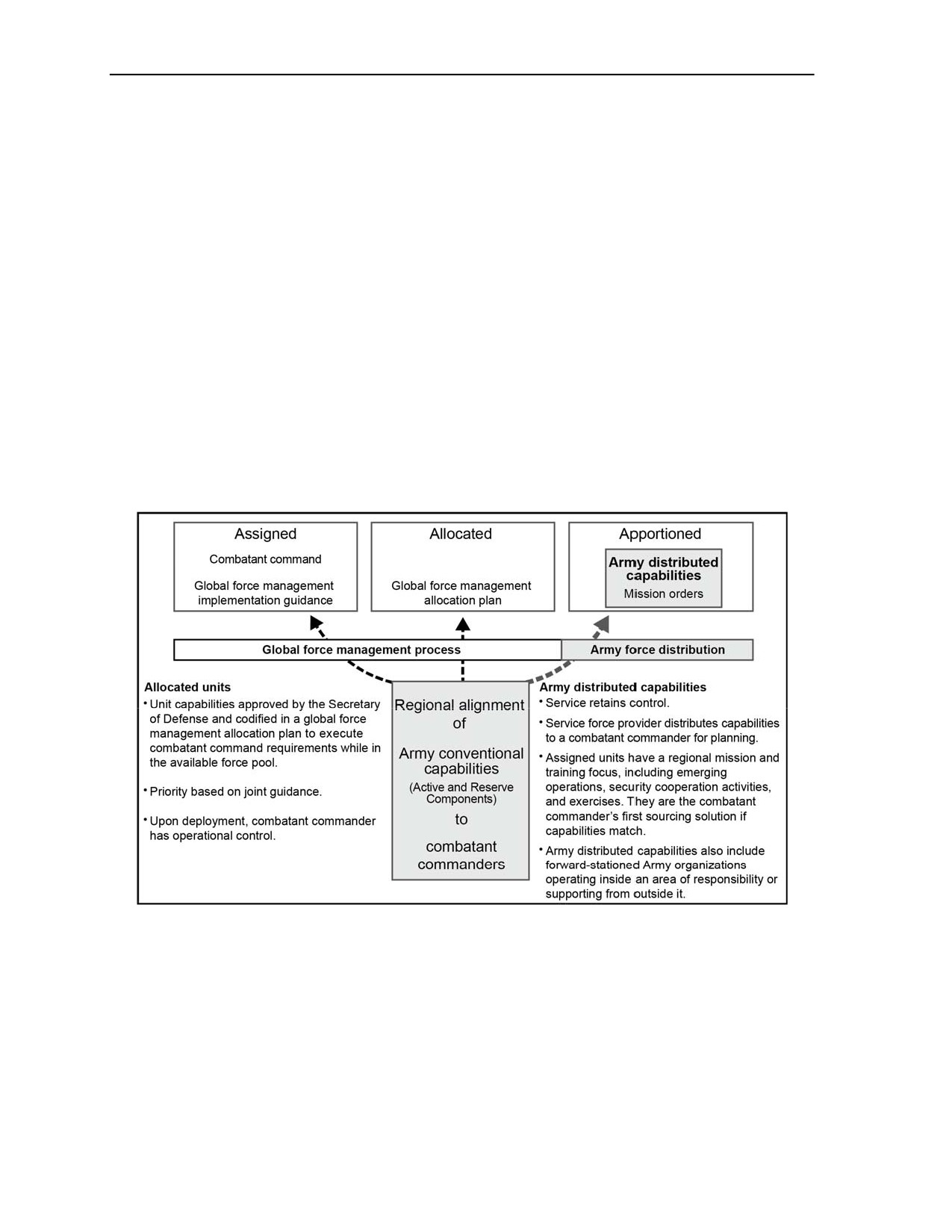
1-27. Regionally aligned forces are those forces that provide a combatant commander with up to joint
task force capable headquarters with scalable, tailorable capabilities to enable the combatant
commander to shape the environment. They are those Army units assigned to combatant commands,
those Army units allocated to a combatant command, and those Army capabilities distributed and
prepared by the Army for combatant command regional missions. (Figure 1-1 illustrates regional
alignment of forces.) Regionally aligned forces
(RAF) include Army total force organizations and
capabilities that are forward stationed; operating in a combatant command area of responsibility; supporting
from outside the area of responsibility, including providing reach-back; and prepared to support from
outside the area of responsibility. Combatant command requirements determine regional missions. RAF
maintain proficiency in wartime fundamentals, but also possess a regional mission and training focus that
includes an understanding of the languages, cultures, geography, and militaries of the countries where they
are most likely to be employed. RAF must be able to impart military knowledge and skills to others. Units
assist partners in developing their individual and unit proficiency in security operations at the tactical level.
Army generating forces assist partners in developing their institutional capacity for training, professional
education, force generation, and force sustainment. RAF assist partners in developing security sector
programs that professionalize and strengthen their ability to synchronize and sustain security operations.
Figure 1-1. Regionally aligned forces
SHAPING THE SECURITY ENVIRONMENT
1-28. The Army helps to shape the security environment by creating security conditions more favorable to
U.S. and allied interests, even in regions in which the United States is not likely to commit large numbers
of forces for major combat operations. The Army helps shape the security environment through security
cooperation activities that enable combatant commanders to assure friends, establish trust, foster mutual
understanding, and help partners build the capacity to defend themselves and prevent conflict.
1-29. Security cooperation activities that shape the security environment may include rotational
deployments for exercises and training; participation at Army institutional training and senior professional
1-6
FM 3-22
22 January 2013
Strategic Context
military education; security assistance teams overseas; security force assistance efforts that build partner
capacity; civil affairs support for stabilization, reconstruction, and development; foreign internal defense;
counterterrorism and support to counterterrorism; smaller-footprint combat operations short of major
conflict; foreign humanitarian assistance and disaster relief; and efforts to counter weapons of mass
destruction. Army forces perform all these activities while still maintaining the capability to conduct
unified land operations anywhere globally. Shaping the security environment diminishes regional tensions,
enhances stability, and contributes to the security of the homeland. Therefore, as a common Army function,
security cooperation is vital to American security interests.
1-30. The Army supports the security cooperation function through the integration of the capabilities of
regionally aligned conventional forces and ARSOF. This regional alignment will enhance relationships
between planning staffs while improving units’ familiarity with areas in which they will most likely be
employed. This ability will be further enhanced by increasing the integration of conventional forces and
special operations forces, both for the missions aimed primarily at improving the military effectiveness of
partners and U.S. missions such as counterproliferation. Aligning Army forces with regions allows the
integration of planning and training for combatant command contingencies, focuses language and cultural
training, and provides predictable and dependable capabilities to geographic combatant command and
theater army commanders. In addition, the Army will consider how to manage, train and develop Soldiers
to support regional alignment and ensure appropriate investments are made in Soldiers and leveraged by the
Army.
1-31. Based on the appropriate policy, legal frameworks, and authorities, the Army provides security force
assistance in concert with partner units, institutions, and security sector functions to build partner capacity.
Army support to security cooperation is derived from DOD policy guidance and helps the combatant
commander shape the security environment through three principal ways (listed in paragraph 1-33) to
achieve mid- to long-term objectives with partners.
1-32. Shaping the security environment diminishes regional tensions, enhances stability, and contributes to
the security of the homeland. Therefore, as a common Army function, security cooperation is vital to
United States security interests.
1-33. The United States Government has worked with allies and partners in a security cooperation context
for decades, assisting partners through various activities such as exercises, training, equipping, education,
conferences, and military staff talks to shape the environment by building their capacity in order to prevent
and deter conflict. Examples of exercises include, but are not limited to, Ulchi Focus Guardian, Bright Star,
Austere Challenge, Yama Sakura, Cobra Gold, and Flintlock. Therefore, Army support to security
cooperation plays a significant role in helping combatant commanders shape the environment by—
z
Building defense relationships that promote specific U.S. security interests.
z
Developing allied and friendly military capabilities for self-defense and multinational
operations.
z
Providing U.S. forces with peacetime and contingency access to host nations in order to prevent
and deter conflict.
Developing Defense and Security Relationships
1-34. Developing defense and security relationships that promote specific U.S. security interests, including
all international armaments cooperation activities and security assistance programs, helps the combatant
commander shape the security environment by—
z
Influencing more willing to support the United States in military operations.
z
Sending a compelling regional and often global strategic communication message of a
commitment to threat interdiction.
z
Shows U.S. support to host-nation sovereignty.
z
Promoting regional stability.
22 January 2013
FM 3-22
1-7
Chapter 1
Building Allied and Friendly Military Capabilities
1-35. Building allied and friendly military capabilities for self-defense and multinational operations helps
the combatant commander shape the security environment. The Army’s primary contribution to building
partner military capacity is to lead efforts to collaborate with foreign partners in building security capacity.
1-36. The Army integrates the capabilities of the conventional, generating, and special operations forces to
support interorganizational capacity-building efforts on three levels: tactical, institutional, and ministerial.
The Army’s contribution—
z
Builds institutional capacity in the host nation, which is fundamental to success in such
operations.
z
Develops the ability of partners to defend against internal and external threats.
z
Improves interoperability, making partners more capable of contributing to multinational
operations.
z
Assists other countries to provide for their own security.
Providing Peacetime and Contingency Access
1-37. Providing U.S. forces with peacetime and contingency access to host nations helps the combatant
commander shape the security environment. The Army contributes to the whole-of-government efforts to
gain access. Access is the ability to project military force into an operational area with sufficient freedom
of action to accomplish the mission. This helps the combatant commander by—
z
Maintaining existing cooperative security locations.
z
Facilitating realignment of the U.S. defense posture.
z
Providing for the security of the global commons.
z
Supporting contingency planning by creating the conditions for access for forward stationing of
forces, pre-positioning of U.S. equipment, staging of forces within a country for a contingency,
operating as part of a multinational force led by the United States, or granting access or
over-flight permissions.
1-38. The three ways addressed above help shape the security environment by enabling partners to develop
the capability to provide for internal and external defense, export security capacity-building regionally or
globally as appropriate, and expand access in countries or regions by, with, or through those partners where
U.S. presence may be unwelcome or impractical.
THEATER CAMPAIGN SUPPORT PLAN
1-39. The theater army develops a theater campaign support plan, an annex to the theater campaign plan.
The theater campaign support plan serves as the mechanism between planning, programming, budgeting,
and execution processes by, with, or through the theater army. It is supported by Headquarters, Department
of the Army; functional Army Service component commands; Army commands; direct reporting units; and
the Reserve Component to resource security cooperation activities that shape the operational environment
and achieve theater campaign plan objectives and GEF end states.
1-40. The Army contributes forces through a rotational, cyclical readiness model that provides a
predictable and sustainable supply of modular forces to the combatant commands, and a surge capacity for
unexpected contingencies. Land forces are typically the dominant military service of partner security
forces, and the senior military commander is from their army. As such, the Army has a unique opportunity
to partner with these forces at the tactical, institutional, and ministerial level to build trust and achieve
greater influence through land security cooperation activities.
1-41. Army support to security cooperation is conducted with a physical presence in close proximity to the
partner’s security forces, governmental agencies, and population. For this reason, Soldiers and leaders must
have an appreciation for the history, culture, language, laws, and customs of the partner to increase mutual
understanding and build and sustain relationships and trust over time. These relationships will contribute to
that partner’s willingness to participate with the United States in achieving mutual global and regional
security objectives and facilitate access to the region.
1-8
FM 3-22
22 January 2013
Strategic Context
SECURITY COOPERATION ACTIVITIES
1-42. Security cooperation contributes to the security of the homeland by building security relationships,
alliances, partner capability and capacity, and access through a broad range of interconnected and
integrated security cooperation activities that include security assistance, security force assistance, internal
defense and development, and security sector reform. The capabilities and capacity of partners are directly
related to the type of activities that are undertaken. The goals can range from creating a positive
relationship that allows freedom of action, to global security interoperability with core partners as well as
regional security organizations and alliances.
1-43. The Army provides forces to the joint force to conduct security cooperation, enhance military
engagement, and build the security capacity of partner states. Security cooperation is a common Service
function that enables combatant commanders. Certain provisions of Title 10 (see chapter 2) authorize
military engagement, multinational combined exercises, personnel exchanges, and similar security
cooperation activities in order to facilitate the performance of this function. Such activities are organized
and aligned as well as possible to support the geographic and functional end states specified for the various
combatant commanders in strategic guidance. However, their statutory justification and funding authority
typically relate to the training and readiness of U.S. forces. This tension between authorities and intended
effects can serve to limit the impact of security cooperation activities that focus on capacity-building and
other objectives specified by the combatant commanders. (These tensions between authorities are further
addressed in chapter 2.)
1-44. Security cooperation is comprised of multiple activities, programs, and missions, and it is
functionally and conceptually related to security assistance, security force assistance, internal defense and
development, foreign internal defense, and security sector reform. Army forces may be granted special
authorities and called upon to execute tasks in support of these programs that build partner capacity in
support of broader national security interests. Security cooperation activities can be executed discretely or
in concert with each other across the range of military operations, consolidating many requirements,
authorities, and force structures. The definitions of these terms and their associated relationships with each
other are explained in paragraphs 1-45 to 1-62.
SECURITY ASSISTANCE
1-45. Security assistance is a group of programs authorized by the Foreign Assistance Act of 1961, as
amended, and the Arms Export Control Act of 1976, as amended, or other related statutes by which the
United States provides defense articles, military training, and other defense-related services by grant, loan,
credit, or cash sales in furtherance of national policies and objectives. Security assistance is an element of
security cooperation funded and authorized by Department of State to be administered by Department of
Defense/Defense Security Cooperation Agency (JP 3-22). Security assistance (known as SA) programs are
typically focused on the transfer of defense articles and services to eligible foreign governments, the
provision of training and education to foreign military personnel, and the sale of construction services in
support of partner nations’ military establishments.
1-46. Department of the Army implements Title 22 security assistance programs under the direction of the
Defense Security Cooperation Agency (DSCA) and the overall management of the DOS. Examples
security assistance programs include—
z
The foreign military financing program (known as FMFP). This is an appropriated program
administered by DSCA. The program consists of congressionally appropriated grants and loans
which enable eligible foreign governments to purchase U.S. defense articles, services, and
training through either foreign military sales or direct commercial sales.
z
Foreign military sales (known as FMS) programs. These include the provision of materiel,
training, medical, and construction services to a foreign country.
z
Foreign military construction services that provide for the construction of requisite military
installations and facilities in support of a foreign military activity.
z
Leases of defense articles to friendly governments for specified missions and for specific periods
up to five years.
22 January 2013
FM 3-22
1-9
Chapter 1
z
International military education and training
(known as IMET) for professional military
education.
z
Drawdowns that allow for the transfer of excess defense articles from U.S. stockpiles to a
foreign military.
z
Other special programs and services addressed in this regulation, such as security assistance
logistics and production programs.
1-47. In special circumstances, Army forces may be directed to perform tasks related to the training or
equipping of partner military forces. Title 10 funds may be expended for this purpose only in exceptional
circumstances and consistent with legal authority. (See AR 12-1 for more information.)
SECURITY FORCE ASSISTANCE
1-48. Security force assistance is defined as—the Department of Defense activities that contribute to
unified action by the United States Government to support the development of the capacity and capability
of foreign security forces and their supporting institutions (JP 3-22). Consistent with DOD policy for
security force assistance
(known as SFA), the Army develops, maintains, and institutionalizes the
capabilities of its personnel to support DOD efforts to organize, train, equip, and advise foreign security
forces (FSF) and relevant supporting institutions. Security forces are duly constituted military, paramilitary,
police, and constabulary forces of a state (JP 3-22). When directed to do so in accordance with appropriate
legal authorities, Army forces conduct security force assistance activities in support of combatant
commanders’ campaign plans and national objectives.
1-49. Military personnel should avoid confusing security force assistance and security assistance. Security
assistance is a set of programs, authorized by law, that allow the United States to transfer defense articles,
training, and services to partner nations. Security force assistance often works in conjunction with security
assistance programs, but the focus of security force assistance is on building of the capacity and capability
of FSF and their supporting institutions. Security force assistance encompasses various activities related to
the organizing, training, advising, equipping, and assessing of FSF and their supporting institutions, from
tactical to ministerial levels. These activities contribute to unified action to generate, employ, and sustain
FSF. Foreign security forces are forces, including but not limited to, military, paramilitary, police,
and intelligence forces; border police, coast guard, and customs officials; and prison guards and
correctional personnel, that provide security for a host nation and its relevant population or support
a regional security organization’s mission. Security force assistance activities are conducted primarily to
assist host nations build the capacity to defend against internal, external, and transnational threats to
stability. However, DOD may also conduct security force assistance to assist host nations to defend against
external threats; contribute to multinational operations; or organize, train, equip, and advise a nation’s
security forces or supporting institutions.
1-50. It is DOD policy that security force assistance is a subset of DOD overall security cooperation
initiatives and that security force assistance activities directly increase the capacity or capability of FSF or
their supporting institutions. Security force assistance consists of those security cooperation activities tied
directly to the security capability and capacity of FSF. Security assistance programs, with their associated
resources and authorities, can provide a means to conduct some security force assistance tasks. Other forms
of security force assistance—specifically, advising in a hostile environment and other activities geared
toward assisting a partner nation engaged in conflict—are performed by U.S. forces using resources and
authorities specially provided to DOD for employment in support of combat operations. Global
train-and-equip funding to support the missions in Iraq and Afghanistan is a good example.
1-10
FM 3-22
22 January 2013
Strategic Context
INTERNAL DEFENSE AND DEVELOPMENT
1-51. Internal defense and development is the full range of measures taken by a nation to promote its
growth and to protect itself from subversion, lawlessness, insurgency, terrorism, and other threats to its
security
(JP
3-22). Internal defense and development
(known as IDAD) focuses on building viable
institutions (political, economic, social, and military) that respond to the needs of society. Ideally, internal
defense and development is a preemptive strategy. However, if an insurgency or other threat develops, it
becomes an active strategy to combat that threat. To support the host nation effectively, U.S. forces,
especially planners, consider the host nation’s internal defense and development strategy.
1-52. Internal defense and development focuses on building viable institutions that respond to the needs of
society. Internal defense and development is a joint doctrinal term; it is not used universally by all
countries. Internal defense and development blends four interdependent functions to prevent or counter
internal threats: balanced development, security, neutralization, and mobilization. Finally, internal defense
and development involves a cyclic interaction of execution, assessment, and adaptation. As directed, the
Army provides support to other United States government departments and agencies focused on internal
defense and development of those FSF assigned to other ministries (or their equivalents) such as interior,
justice, or intelligence services.
1-53. The country team (addressed later in this chapter), in concert with the combatant command and the
host nation, synchronizes the internal defense and development program with the theater campaign plan,
but ultimately, the internal defense and development program is the responsibility of the host nation.
Security cooperation activities, whether conducted through foreign internal defense or security force
assistance, support the host nation’s internal defense and development policy and program. If the internal
threat to the nation is primarily political and nonviolent, foreign internal defense activities may or may not
be required to support the nation’s internal defense and development program. Although always an
important (and frequently critical) part of a nation’s internal defense and development strategy, foreign
internal defense may be one of the smaller programs within the internal defense and development strategy
in terms of funding, focus, facilities, and the number of personnel committed. The Army supports DOD
efforts to create conditions whereby interagency efforts can comprehensively operate to remove the root
causes behind the problems of deteriorating security conditions.
FOREIGN INTERNAL DEFENSE
1-54. Foreign internal defense is participation by civilian and military agencies of a government in any of
the action programs taken by another government or other designated organization to free and protect its
society from subversion, lawlessness, insurgency, terrorism, and other threats to its security (JP 3-22).
1-55. Security force assistance and foreign internal defense (known as FID) have much in common in that
both enable partners’ capacity to provide for their own security, with a collective goal of contributing
effectively to broader regional or global security challenges in support of U.S. policy and interests.
However, security force assistance is not the same as foreign internal defense, but the actions to organize,
train, equip, rebuild, build, and advise—elements of security force assistance—may take place in
conjunction with foreign internal defense activities. At operational and strategic levels, both foreign
internal defense and security force assistance focus on preparing FSF to combat lawlessness, subversion,
insurgency, terrorism, and other internal threats to their security; however, security force assistance also
prepares FSF to defend against external threats and to perform as part of an international force.
1-56. Security force assistance activities support foreign internal defense efforts by increasing the capacity
and capability of partner security forces. Foreign internal defense direct support activities that involve
organizing, training, equipping, advising, and assisting FSF to combat internal threats also constitute
security force assistance. The tasks performed by U.S. forces to generate, employ, and sustain FSF are
always security force assistance, whether they are executed in a foreign internal defense context or to
confront internal threats. However, security force assistance can also assist in preparing conventional FSF
to defend against external threats and improve interoperability when conducting operations as part of a
multinational force.
1-57. Foreign internal defense includes indirect support, direct support
(not involving U.S. combat
operations), and combat operations. Foreign internal defense can occur across the range of military
22 January 2013
FM 3-22
1-11
Chapter 1
operations. Army foreign internal defense activities may be conducted unilaterally in the absence of any
other military effort or may support other ongoing military or civilian assistance efforts. Foreign internal
defense under Army decisive action may be conducted to defeat an enemy or to establish conditions
necessary to achieve the national strategic end state. Foreign internal defense is a unified action, the
synergistic application of all instruments of national and multinational power.
1-58. Foreign internal defense includes the actions of nonmilitary organizations as well as military forces.
Foreign internal defense activities may employ the indirect use of military instrument along with the
diplomatic, informational, and economic instruments of national power. Foreign internal defense is a
whole-of-government approach that nurtures partners towards democratic governance and military
deference to civilian rule. Foreign internal defense principles intend to preclude the need to deploy large
numbers of U.S. military personnel and equipment. Foreign internal defense involves the support of a
host-nation standing government and its military or paramilitary forces. Foreign internal defense is a key
supporting component of a host nation’s internal defense and development program. The focus of all U.S.
foreign internal defense efforts is to support the internal defense and development program to build
capability and capacity of the host nation to self-sufficiency. Foreign internal defense has been and remains
an ARSOF activity and an Army task that supports the range of military operations. The relevance of
foreign internal defense in the current operational environment continues to grow. (See JP 3-22 and FM
3-05.2 for a detailed discussion of foreign internal defense. See FM 7-15 for the tasks associated with
foreign internal defense.)
SECURITY SECTOR REFORM
1-59. Security sector reform is a comprehensive set of programs and activities undertaken to improve the
way a host nation provides safety, security, and justice (JP 3-07). The overall objective is to provide these
services in a way that promotes an effective and legitimate public service that is transparent, accountable to
civilian authority, and responsive to the needs of the public.
1-60. Security sector reform (known as SSR) is an umbrella term that might include integrated activities in
support of defense and armed forces reform; civilian management and oversight; justice, police,
corrections, and intelligence reform; national security planning and strategy support; border management;
disarmament; demobilizations and reintegration; or reduction of armed violence. The Army’s primary role
in security sector reform is supporting the reform, restructuring, or re-establishment of the armed forces and
the defense sector across the range of military operations. (See ADRP 3-07 for further discussion on
security sector reform.)
1-61. With the support of the host nation, U.S. and partner military forces collaborate with interagency
representatives and other civilian organizations to design and implement security sector reform strategies,
plans, programs, and activities. DOS leads and provides oversight for these efforts through its bureaus,
offices, and overseas missions. Security sector reform facilitates security cooperation and security force
assistance activities that build partner capacity. Security sector reform involves reestablishing or reforming
institutions and key ministerial positions that maintain and provide oversight for the safety and security of
the host nation and its people. Through unified action, those individuals and institutions assume an
effective, legitimate, and accountable role. Security force assistance activities help provide internal and
external security for their citizens, under the civilian control of a legitimate state authority. Effective
security sector reform enables a state to build its capacity to provide security. The desired outcome of
security sector reform programs is an effective and legitimate security sector firmly rooted within the rule
of law.
1-62. Security force assistance is a vital component of security sector reform when security sector reform
includes U.S. assistance to FSF. The military role in security sector reform is normally limited to helping
reform host-nation defense establishments and security forces.
1-12
FM 3-22
22 January 2013
Strategic Context
ORGANIZATION FOR UNIFIED ACTION
1-63. Unified action is the synchronization, coordination, and/or integration of the activities of
governmental and nongovernmental entities with military operations to achieve unity of effort (JP 1).
Unified action synchronizes, coordinates, and/or integrates joint, single-Service, and multinational
operations with the operations of other United States government agencies, nongovernmental organizations,
intergovernmental organizations (such as the United Nations), and the private sector to support national
interests. Unity of command, within the military instrument of national power, supports the national
strategic direction through close coordination with the other instruments of national power.
1-64. Unified action may require interorganizational efforts to build the capacity of partners to secure
populations, protect infrastructure, and strengthen institutions as a means of protecting common security
interests. Building partner capacity is the outcome of comprehensive interorganizational activities,
programs, and sustained military engagements over time that enhance the ability of partners for security,
governance, economic development, essential services, rule of law, and other critical government functions.
The Army integrates the capabilities of the operational and generating forces, to include special operations
forces, to support capacity-building efforts, primarily through security cooperation activities.
1-65. Unified action enhances the ability of partners for security, governance, economic development,
essential services, rule of law, and other critical government functions exemplifies security cooperation
activities that build long-term partner capacity. Effective unified action requires Army leaders who can
understand, influence, and cooperate with partners. The Army depends on its joint partners for capabilities
that do not reside within the Army, and it cannot operate effectively without their support. Likewise,
government agencies outside the DOD possess knowledge, skills, and capabilities necessary for success.
The active cooperation of partners often allows Army leaders to capitalize on organizational strengths
while offsetting weaknesses.
1-66. Unified action may require interorganizational efforts to build the capacity of partners to secure
populations, protect infrastructure, and strengthen institutions as a means of protecting common security
interests. Building partner capacity is the outcome of comprehensive interorganizational activities,
programs, and sustained military engagements over time that enhance the ability of partners for security,
governance, economic development, essential services, rule of law, and other critical government functions.
The Army integrates the capabilities of the operating and generating forces, to include special operations
forces, to support capacity-building efforts, primarily through security cooperation activities. (See ADP 3-0
for more information.)
ARMY ORGANIZATION FOR UNIFIED ACTION IN SUPPORT OF SECURITY COOPERATION
1-67. In October 2012, the Army published updated operational doctrine in ADP 3-0. It describes building
partner capacity as the outcome of comprehensive interorganizational activities, programs, and military
engagements that enhance the ability of partners for security, governance, economic development, essential
services, rule of law, and other critical government functions. ADP 3-0 describes unified land operations as
the Army’s contribution to unified action. Unified land operations is—how the Army seizes, retains, and
exploits the initiative to gain and maintain a position of relative advantage in sustained land operations
through simultaneous offensive, defensive, and stability operations in order to prevent or deter conflict,
prevail in war, and creates the conditions for favorable conflict resolution (ADP 3-0). In unified land
operations, Army conventional forces and ARSOF synchronize and integrate security cooperation activities
in concert with unified action partners throughout planning, using cross-functional working groups to
support the combatant commander’s theater campaign plan and contingency plans across the range of
military operations to prevent and deter conflict.
1-68. Operational art is the cognitive approach by commanders and staffs—supported by their skill,
knowledge, experience, creativity, and judgment—to develop strategies, campaigns, and operations to
organize and employ military forces by integrating ends, ways, and means (JP 3-0). Unified land operations
incorporates the principle that operational art is the connection between strategic objectives and tactical
actions. Operational art provides a common construct for organizing military operations to achieve those
strategic objectives. This unifying principle also connects the various security cooperation activities that
help shape the security environment and support combatant commanders’ efforts to assure friends, establish
22 January 2013
FM 3-22
1-13
Chapter 1
trust, foster mutual understanding, and help partners build the capacity to defend themselves and contain
enemies. Planning, preparing, executing, and assessing the security cooperation activities of conventional
forces, ARSOF, generating forces, and Reserve Component forces with strategic objectives is essential.
Theater Army Support
1-69. The Army normally executes its Title 10 responsibilities to organize, train, and equip operational
Army units through the theater army to support combatant commander objectives. The theater army sets
and maintains the theater for the conduct of unified land operations. A set theater includes the posture of
Army forces and conducting security cooperation activities that shape the operational environment and
prevent conflict. Setting the theater shapes the environment and produces the conditions necessary for the
joint force commander, when directed, to seize, retain, and exploit the initiative and assure freedom of
action. Sustained military engagement requires a combination of integrated regionally aligned conventional
forces and ARSOF. Military engagement, along with intelligence gathering and assured access, is critical to
enabling the force to win decisively. Maintaining the theater includes theater opening; port and terminal
operations; conducting reception, staging onward movement, and integration; force modernization and
theater-specific training; Army support to other services; as well as common user logistics to Army, joint,
and multinational forces operating in the theater.
Generating Force Support
1-70. The primary mission of generating force organizations is the long-term generation and sustainment
of operational Army capabilities, as well as the development of partner defense and security establishments
in support of the theater army requirements. This mission and generating force capabilities to execute it are
more fully described in the Army War College publication, How the Army Runs: A Senior Leader
Reference Handbook. The generating force also possesses operationally useful capabilities. However, the
Army does not organize generating forces into standing organizations with a primary focus on specific
operations. Rather, when generating force capabilities perform specific functions or missions in support of
and at the direction of joint force commanders, it is for a limited period. Upon completion of the mission,
the elements and assets of those generating force capabilities revert to their original function.
1-71. All elements of the Army, whether generating force or operational Army, perform functions
specified by law (table 1-1). The practical distinction is that the execution of these functions and others
implied by law constitutes the primary purpose of generating force organizations. Title 10, USC, is not the
only statute that governs the generating force, nor is the list of functions in table 1-1 exhaustive.
Table 1-1. Title 10, United States Code, functions
• Recruiting.
• Organizing.
• Supplying
• Equipping (including research and development.
• Training.
• Servicing.
• Mobilizing.
• Demobilizing.
• Administering (including morale, welfare, and recreation).
• Maintaining.
• Construction, outfitting, and repairing military equipment.
• Constructing, maintaining, and repairing buildings and structures.
1-14
FM 3-22
22 January 2013
Strategic Context
1-72. The future security environment requires employment of Title 10, USC, generating force capabilities
to support of broader Title 22, USC, objectives. Security cooperation missions suitable for generating force
capabilities include—
z
Developing multinational partners’ security forces and defense establishments across the
domains of doctrine, organization, training, materiel, leadership and education, personnel, and
facilities (DOTMLPF).
z
Repairing, developing, and managing infrastructure that supports security cooperation programs
as well as stability operations.
z
Adapting U.S. conventional forces across the domains of DOTMLPF to shape the environment.
1-73. Generating forces often can perform these types of missions with great effectiveness and efficiency.
Generating forces can perform Title 10, USC, functions either in generating and sustaining the operational
Army, or for supporting ongoing operations. Similarly, operational Army planners should reach back to
Army institutions to take full advantage of generating force capabilities. Those capabilities are assembled,
exercised, and employed on a regular basis to ensure they effectively support operations when required.
1-74. As with any military capability, the formal designations of organizations and capabilities as
operational Army or generating force are less important than the Soldiers’ understanding of the shared
mission and their will to accomplish it. All participants in the process of developing, maintaining, and
allocating Army capabilities for operations, whether they are part of the operational Army or generating
force, should understand that Army capabilities are most effective when they integrate the Army’s
capabilities into security cooperation planning.
SECURITY COOPERATION ORGANIZATION
1-75. Several agencies and organizations play a role in executing the multiple facets of security
cooperation. The Army supports combatant commanders while DOS leads the diplomatic relations in
support of U.S. national interests. A security cooperation organization is all Department of Defense
elements located in a foreign country with assigned responsibilities for carrying out security
assistance/cooperation management functions. It includes military assistance advisory groups, military
missions and groups, offices of defense and military cooperation, liaison groups, and defense attaché
personnel designated to perform security assistance/cooperation functions. (JP 3-22). Security cooperation
management functions fall under Section 515 of Title 10, USC. The chief of a security cooperation
organization (known as SCO) is responsible to four authorities:
z
Ambassador, United States diplomatic mission.
z
Senior defense official/defense attaché (SDO/DATT).
z
Geographic combatant commander (known as GCC).
z
Director, DSCA.
1-76. The security cooperation organization does not include units, formations, or other ad hoc
organizations that conduct security cooperation activities, such as mobile training teams, mobile education
teams, or operational units conducting security cooperation activities.
1-77. Security cooperation organizations, associated security cooperation programs, and funding vary from
country to country depending on the relationship with each country. Countries with large security
cooperation programs and those in which the United States has key strategic interests generally have larger
security cooperation organizations. In developing countries where security cooperation programs are small,
usually because of limited funding, security cooperation programs often take on a more prominent role. On
the other hand, in developed countries, the host country may be largely self-sufficient in both its financing
and management of security cooperation, so the role and responsibilities of the security cooperation
organization will take on a different tone. However, the importance of a program compared to its size may
be relative. In some countries, a small program can be as meaningful and as politically influential as larger
programs in other countries. In summary, the size of the security cooperation organization, the relationship
with the host-nation military, and the scope and volume of current programs, all combine to produce a
unique working environment.
22 January 2013
FM 3-22
1-15
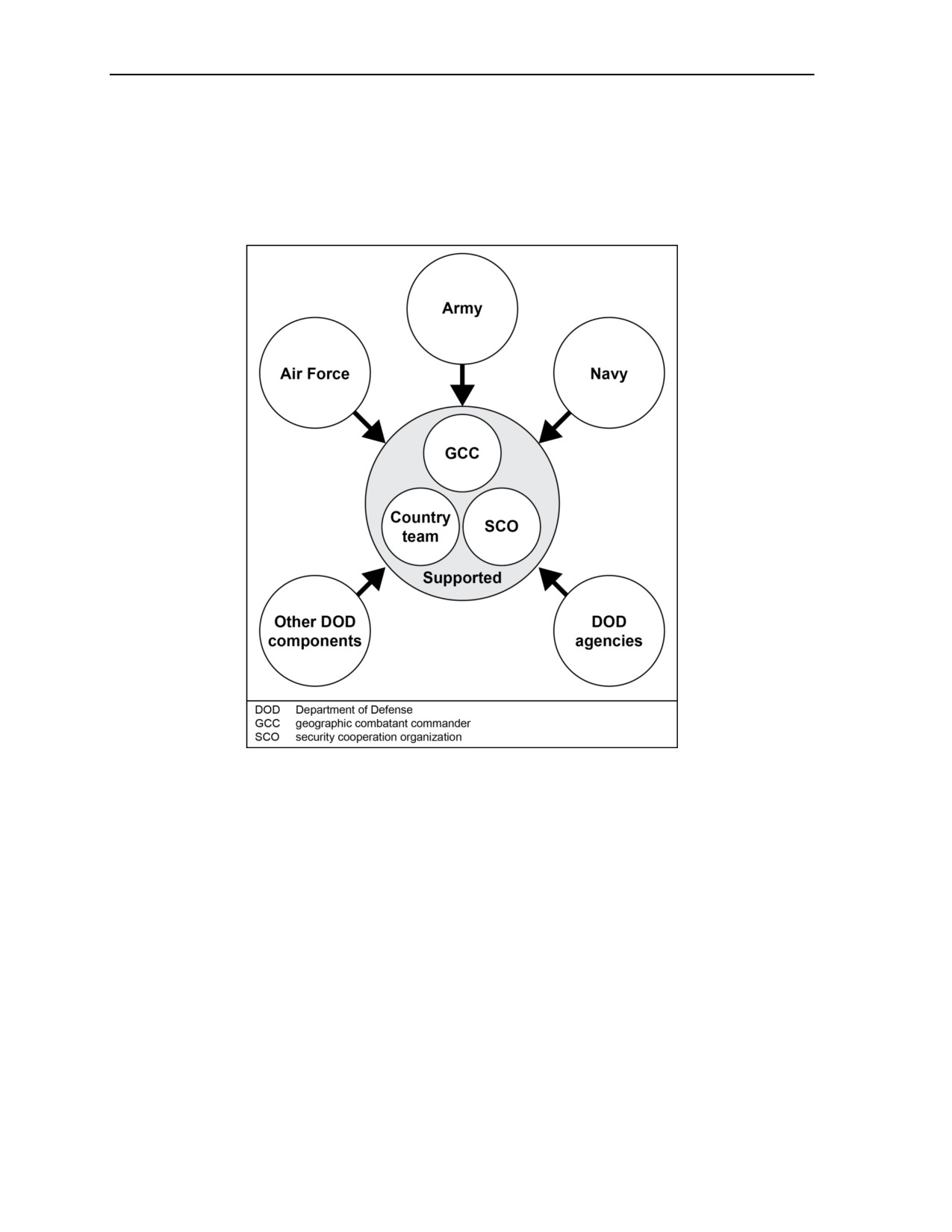
Chapter 1
1-78. Roles and relationships among United States government agencies and organizations; DOD; state,
tribal, and local governments; and the U.S. chief of mission and country team in a U.S. embassy overseas
must be clearly understood. Security cooperation organizations traditionally respond through two chains of
command: one through the embassy country team and the other through the combatant command. The
examples in figure 1-2 illustrate those organizational relationships and the synergy of DOD country
planning to achieve shared interests and objectives.
Figure 1-2. Synergy of Department of Defense country planning
HOST COUNTRY AND HOST NATION
1-79. A host nation is a nation which receives the forces and/or supplies of allied nations and/or NATO
[North Atlantic Treaty Organization] organizations to be located on, to operate in, or to transit through its
territory
(JP 3-57). A host country is a nation which permits, either by written agreement or official
invitation, government representatives and/or agencies of another nation to operate, under specified
conditions, within its borders (JP 1-02). When government representatives or agencies are permitted to
operate in a country, and military forces are not participating, host country is the preferred term.
1-80. DOD personnel in a foreign country who are not under the command of a U.S. area military
commander shall be under the authority of the chief of mission in that country. By law, this includes
security cooperation organization personnel, even though they are assigned to a geographic combatant
command. However, a formal directive delegates responsibility to one military officer in each embassy for
all DOD actions and DOD personnel in that country. The directive gives each SDO/DATT coordinating
authority over DOD elements under the direction and supervision of the chief of mission.
1-16
FM 3-22
22 January 2013
Strategic Context
AMBASSADOR, UNITED STATES DIPLOMATIC MISSION
1-81. The U.S. diplomatic mission includes representatives of all U.S. departments and agencies physically
present in the country. The U.S. ambassador (chief of the U.S. diplomatic mission), often referred to as the
chief of mission (or COM), is the principal officer in the embassy. This person oversees all United States
government programs and interactions with and in a host country. The ambassador derives authority and
responsibilities from the Foreign Service Act of 1980 (Public Law 96-465), Section 207.
1-82. The chief of mission is the personal representative of the President and the Secretary of State and
reports to the President through the Secretary of State. The chief of mission ensures all in-country activities
best serve U.S. interests, as well as regional and international objectives. Depending on the size or
economic import of a country, the United States may maintain only an embassy and no consular offices.
However, the United States may maintain one or more consular offices in some countries. Typically, Army
elements conducting security cooperation activities coordinate with embassy officials, even in nations with
a consular office. Relationships with consular offices are determined on a case-by-case basis. The same
basic entities and offices existing in the embassy are present or liaised at the consular offices.
COUNTRY TEAM
1-83. The country team is the point of coordination within the host country for the diplomatic mission. The
members of the country team vary depending on the levels of coordination needed and the conditions
within that country. The country team is usually led by the chief of mission, and it is made up of the senior
member of each represented U.S. department or agency, as desired by the chief of mission. The team may
include the SDO/DATT, the chief of the security cooperation organization, the political and economic
officers, and any other embassy personnel desired by the ambassador.
1-84. The country team informs various organizations of operations, coordinates elements, and achieves
unity of effort. Usually, the primary military members are the SDO/DATT and the chief of the security
cooperation organization. Military engagement with a host country is conducted through the security
cooperation organization. However, several other attachés and offices may be integral to security
cooperation activities, programs, and missions as well. The country team provides the foundation of local
knowledge and interaction with the host country government and population. As permanently established
interagency organizations, country teams represent the single point of coordination, integration, and
synchronization of security cooperation activities supported by combatant commands and the theater army.
SENIOR DEFENSE OFFICIAL/DEFENSE ATTACHÉ
1-85. The senior defense official is the defense attaché (referred to as the SDO/DATT) and the principal
DOD official in a U.S. embassy, as designated by the Secretary of Defense. The SDO/DATT is the chief of
mission’s principal military advisor on defense and national security issues, the senior diplomatically
accredited DOD military officer assigned to a diplomatic mission, and serves as the single point of contact
for all DOD matters involving the embassy or DOD elements assigned to or working from the embassy.
The SDO/DATT is the key figure within the embassy and the combatant command for establishing and
fostering the security cooperation relationship with the host country. This is best accomplished through
influence, advice, and expertise—and not necessarily through established authority.
1-86. DODD 5105.75 assigns the responsibilities for the operation of the DOD elements at U.S. embassies.
This directive creates the position of SDO/DATT as the principal DOD official in U.S. embassies. The
SDO/DATT is the diplomatically accredited defense attaché and chief of the security cooperation
organization. Joint responsibility for the oversight and management of the SDO/DATT is delegated to the
Under Secretary of Defense for Policy [USD(P)] and the Under Secretary of Defense for Intelligence
[USD(I)].
22 January 2013
FM 3-22
1-17
Chapter 1
1-87. Establishing a good relationship begins with a sharing of interests and ideas. The SDO/DATT should
recognize that there is a common foundation upon which to build rapport with host-nation military
counterparts, namely the responsibility to provide for internal and external security and be a responsible
member within the existing regional security architecture. The problems of DOTMLPF are common to the
armed forces of all nations. The successful SDO/DATT will take a sincere personal interest in the host
nation’s culture, history, customs, and religion, and likewise will cultivate both personal and professional
relationships with local counterparts, which often forms the basis of life-long contacts and friendships.
GEOGRAPHIC COMBATANT COMMAND
1-88. In accordance with the Unified Command Plan
(known as UCP), geographic and functional
combatant commands are established by the President, through the Secretary of Defense, with the advice
and assistance of the Chairman of the Joint Chiefs of Staff. Geographic combatant commanders are
assigned AORs and work in support of, and in close coordination with, U.S. embassies within their AORs
in order to achieve U.S. national interests and global end states as detailed in the National Security Strategy
and other guidance documents. This operational relationship is primarily related to the security cooperation
organization’s execution of the geographic combatant command’s theater campaign plan with the host
country’s military. The geographic combatant command and the ambassador ensure that the SDO/DATT
does not receive conflicting guidance, instructions, or priorities. If conflicting guidance occurs, the
SDO/DATT must seek clarification or resolution. While the SDO/DATT chief is in the occasionally
difficult position of responding to two masters, this person is also uniquely able to understand both the
geographic combatant command and the ambassador, balance their respective priorities, and leverage their
resources. A key challenge for the SDO/DATT is to respond to the direction of the ambassador while at the
same time satisfying coordination and support requirements from the combatant command.
1-89. DOD’s strategic end states support the larger National Security Strategy to ensure they complement
and support foreign policy objectives. As part of theater campaign planning, geographic combatant
commands develop country plans that align with each ambassador’s goals within the AOR because the
activities and investments typically occur at the country level. Combatant commanders with geographic
responsibilities shall exercise authority for force protection over all DOD personnel
(including their
dependents) assigned, attached, transiting through, or training in the combatant commander’s AOR, except
for those for whom the chief of mission retains security responsibility. This force protection authority
enables combatant commanders to change, modify, prescribe, and enforce force protection measures for
covered forces. Combatant commanders also provide directive authority over forces conducting exercises
in that AOR.
DEFENSE SECURITY COOPERATION AGENCY
1-90. DSCA is established as a separate agency of the DOD under the direction, authority, and control of
the USD(P). It is important to understand that the USD(P) is the principal staff assistant and advisor to the
Secretary of Defense and the Deputy Secretary of Defense for all matters on the formulation of national
security and defense policy and the integration and oversight of DOD policy and plans to achieve national
security objectives. USD(P) authority derives from Section 134 of Title 10, USC; other responsibilities are
detailed in DODD 5105.75. DSCA responsibilities include, but are not limited to—
z
Establishing overall requirements, criteria, and procedures for the selection and training of
personnel engaged in security cooperation or security assistance activities.
z
Administering and supervising security assistance planning and programs.
z
Coordinating with the geographic combatant command to establish appropriate agreements and
procedures to provide guidance to and ensure oversight of SDO/DATTs in discharging security
cooperation or security assistance programs in accordance with applicable law, regulations, and
directives. Such agreements and procedures include appropriate security cooperation or security
assistance and international armaments cooperation training.
z
Conducting periodic reviews to ensure that Military Service, inter-Service, and interagency
training available for security cooperation and security assistance personnel are adequate. This
includes the periodic curriculum review and update of Defense Institute of Security Assistance
1-18
FM 3-22
22 January 2013
Strategic Context
Management courses, the Security Cooperation Management Overseas Course, and the Security
Assistance Management Executive Course.
z
Conducting international logistics and sales negotiations with foreign countries.
z
Serving as the DOD focal point for liaison with U.S. industry with regard to security assistance
activities.
z
Administering assigned security cooperation programs.
(See DODD 5105.65 for more information about DSCA.)
SECURITY COOPERATION FRAMEWORK
1-91. This doctrine is intended to provide strategists and planners with a conceptual framework to describe
the application of means and ways to employ them in order to achieve geographic combatant command
objectives and DOD strategic end states. The Army design methodology is particularly useful as an aid to
conceptual thinking about vague, unfamiliar and abstract problems such as security cooperation. The Army
design methodology is a methodology for applying critical and creative thinking to understand, visualize,
and describe problems and approaches to solving them (ADP 5-0). Successful conduct of military
operations requires commanders to thoroughly understand and appreciate the changing nature of the
variables within an operational environment, which includes an understanding of the capability and
capacity of host-nation militaries and institutions. Commanders and their staffs use the Army design
methodology, operational variables, and mission variables to analyze an operational environment to
determine problems and achieve a desired end state. (See ADRP 5-0 for further discussion on Army design
methodology.)
1-92. Theater army planners plan and integrate security cooperation activities and articulate how those
activities fit within the broader context of an operational environment and achieve combatant commander
objectives. Security cooperation planners work in concert with combatant command planners to—
z
Set meaningful objectives with defined conditions and tied to a clearly defined role.
z
Ensure objectives are measurable, attainable and aligned with combatant command objectives.
z
Ensure objectives are realistic based on a 3- to 5-year planning horizon.
ENDS AND WAYS
1-93. DOD policy specifies three main objectives for security cooperation:
z
Build defense relationships that promote specific U.S. security interests.
z
Develop allied and friendly military capabilities for self-defense and multinational operations.
z
Provide U.S. forces with peacetime and contingency access to host nations.
Campaign Planning Priorities
1-94. The GEF also groups nations and organizations, as appropriate, into the categories of regional
partnerships, key supporting partnerships, and actors of concern. Table 1-2, page
1-20, outlines
characteristics of those partnerships.
22 January 2013
FM 3-22
1-19
Chapter 1
Table 1-2. Categories of partnerships
Critical regional partners are countries or organizations that—
• Are direct recipients of U.S. security cooperation resources.
• Cannot achieve one or more end states without engagement.
• Reflect a deliberately select group of countries or organizations.
• May be in current relationships or desired for future relationships.
• Are able to pursue partnerships during the life of current guidance (two years).
Key supporting partners are countries or organizations that—
• Assist a command in achieving one or more end states.
• May or may not be from the region under consideration.
• Provide capabilities that complement or supplement United States capabilities.
Actors of concern are countries or organizations that—
• May or may not be potential adversaries.
• Affect security cooperation and shaping (phase 0) activities designed to solve problems or
influence behavior, counter negative influences, or set the conditions for operational success.
• Pose a direct and immediate problem to a region.
Note: Depending on the context, a country or organization can fall into one or more category.
1-95. Combatant command theater campaign, functional campaign, and contingency plans specify the
objectives by which DOD will achieve end states in the theater. Security cooperation focus areas are the
ways to achieve theater campaign plan objectives and end states.
Operational Capacity and Capability Building
1-96. Army security cooperation activities develop the ability of partner countries to defend against
internal and external threats, contribute to multinational operations, and assist other countries to provide for
their security. The examples in figure 1-3, page 1-21, illustrate a way to view security cooperation tasks,
objectives, and desired strategic effects.
1-20
FM 3-22
22 January 2013
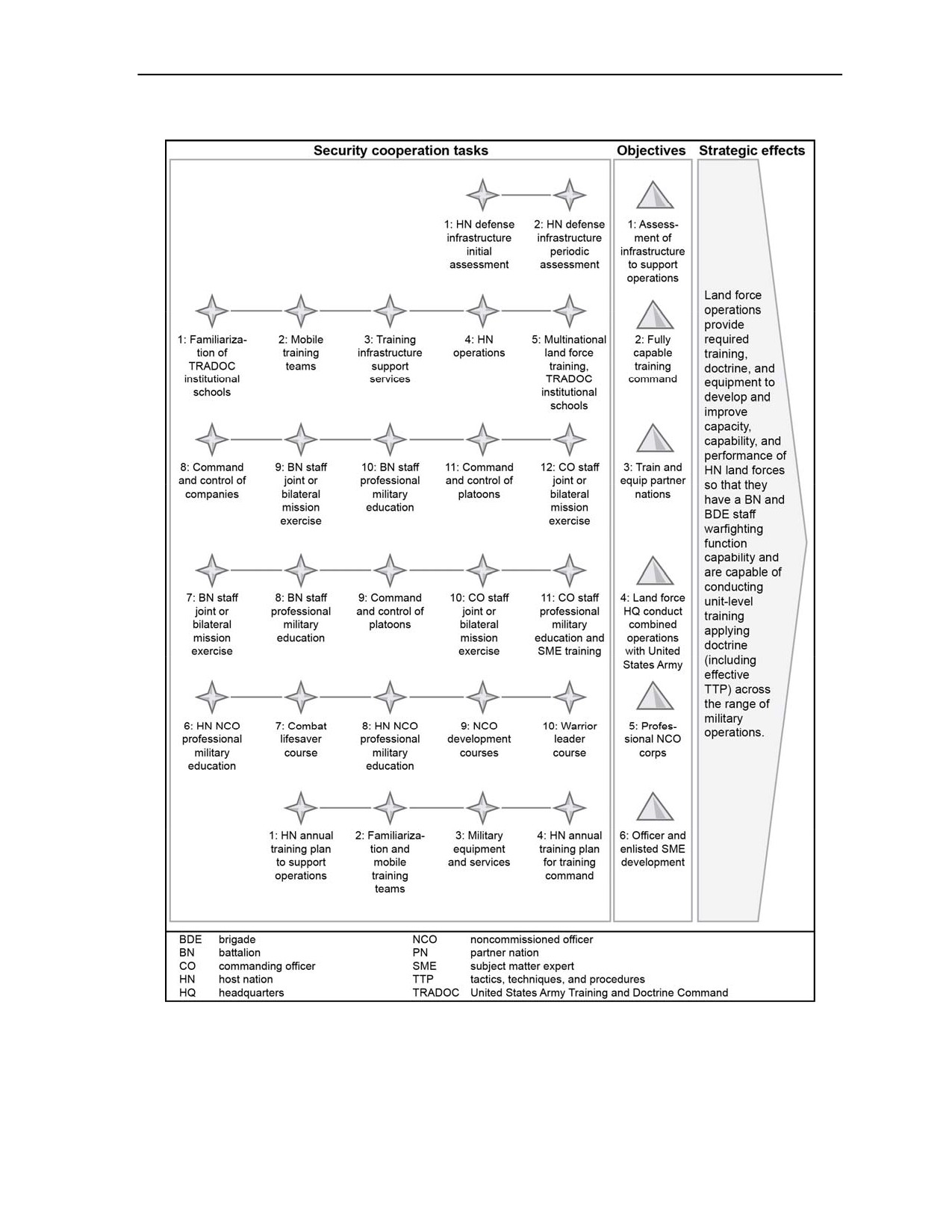
Strategic Context
Figure 1-3. Operational capacity building example
22 January 2013
FM 3-22
1-21
Chapter 1
Human Capacity and Human Capital Development
1-97. Army security cooperation activities develop the ability of partner country civilians, officers, and
noncommissioned officers as capable leaders that understand the proper role of the military in society,
promote human rights, and respect the rule of law.
Institutional Capacity and Security Sector Reform
1-98. Army security cooperation activities develop the ability of partner country headquarters and
institutional support organizations to conduct threat analysis and strategic planning, administer defense
finances, exercise internal oversight and enable public accountability, manage human resources, develop
basic military capabilities, sustain military capabilities, and manage military justice and policies.
Support to Institutional Capacity and Civil Sector Capacity Building
1-99. Army security cooperation activities develop the ability of partner country civil sector organizations
to provide services to their populations, respond to humanitarian disasters, and improve the living
conditions of their populations.
Multinational Operations Capacity, Interoperability, and Standardization
1-100. Army security cooperation activities develop the ability of partner countries to operate with U.S.
and allied military forces across the warfighting functions (movement and maneuver, intelligence, fires,
sustainment, mission command, and protection).
Operational Access and Global Freedom of Action
1-101. Army security cooperation activities facilitate realignment of the U.S. defense posture, provide for
the security of the global commons, and support contingency planning.
Intelligence and Information Sharing
1-102. Army security cooperation activities foster the development of information and intelligence
sharing agreements, enable a common understanding of the threat environment, support information
sharing on disaster response issues, and establish procedures necessary to prevent the compromise of
sensitive information.
Assurance and Regional Confidence Building
1-103. Army security cooperation activities reduce the potential for interstate conflict, expand the
community of like-minded states, build trust among states and international organizations, develop a
common understanding of threats, and demonstrate U.S. resolve to fulfill defense commitments.
International Armaments Cooperation
1-104. Army security cooperation activities reduce acquisition costs, increase interoperability, and
improve interoperability between the United States and partner countries in developing, producing, and
supporting weapon systems.
MEANS
1-105. Four categories of means support this planning framework:
z
Individuals and units.
z
Capabilities.
z
Programs.
z
Equipment.
Other resources (such as money, time, technology, and information) necessary to employ these means are
inherent within each category.
1-22
FM 3-22
22 January 2013
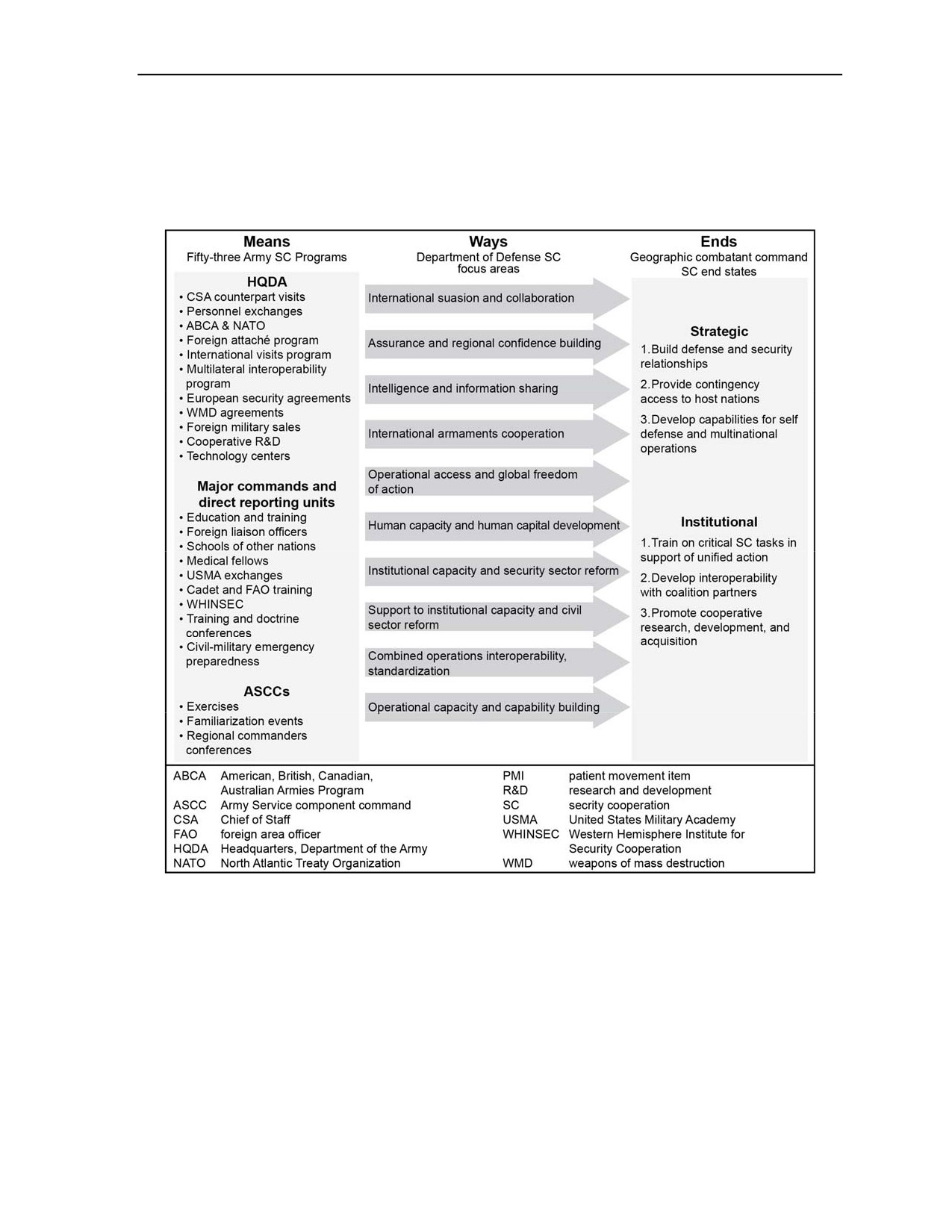
Strategic Context
1-106. A theater army derives requirements for these means from its campaign plans and requests them
through processes that validate, prioritize, and direct their provision by Headquarters, Department of the
Army; Army commands; and direct reporting units.
(See AR 11-31 for Army policy on security
cooperation.) Figure
1-4 illustrates the security cooperation ends, ways, and means framework with
examples of programs, focus areas, and end states.
Figure 1-4. Security cooperation ends, ways, and means framework with examples
MITIGATING STRATEGIC AND OPERATIONAL RISK
1-107. Effective security cooperation activities involve mitigating and managing strategic and operational
risk from force generation to mission employment. Risk mitigation does not rely on the maturity of the
force or supporting institutions as a whole but is focused on the foreign element in question. Conditions
determine when to use an element of FSF. Commanders and staffs use the assessments obtained from Army
forces to determine objectives and requirements for mitigating and managing risk. Risk applies to how well
FSF, United States government agencies, and other host-nation and partner organizations can tolerate
changes in the operational environment, as well as the challenges and conditions inherent to the operation.
Leaders of U.S. forces and FSF assess the risk associated with employment and mitigate that risk as much
as possible.
22 January 2013
FM 3-22
1-23
Chapter 1
STRATEGIC RISK MITIGATION
1-108. Security cooperation activities in one country can have an effect on the regional and global
security environment. Security cooperation can complicate relationships with other regional partners,
especially when there is tension between states within a region. Commanders and their staffs should be
aware of the possible strategic risks of security cooperation to inform decisionmakers and to mitigate the
risk where possible. This could affect the planning and execution of security cooperation in other countries
in the region.
OPERATIONAL RISK MITIGATION
1-109. Operational risks are those associated with the Army’s ability to execute strategy successfully
within acceptable human, materiel, financial, and strategic costs. Consideration of operational risk requires
assessing the Army’s ability to execute current, planned, and contingency operations in the near term. Key
issues that pose risk to Army security cooperation activities in the near term include limited security force
assistance authority, limited ability to work with forces outside the ministry of defense, and partner will.
1-110. As a foreign security force capability matures, and FSF successfully complete more autonomous
operations, the echelon and degree of partnering may decrease depending on the relationship with a
particular country and the strategic objectives. While effective coordination is always required and initial
efforts may require completely fused efforts, the objective is to build the capability and capacity of FSF to
conduct all efforts autonomously. Operations and plans are always at risk of compromise, and prudent
operational security and foreign disclosure precautions should be taken when sharing information and
intelligence.
1-111. Risk reduction measures identified in security cooperation planning add to the plan’s flexibility
during execution. A flexible plan can mitigate risk by partially compensating for a lack of information.
Security cooperation planning requires a thorough, comprehensive approach to analyzing and agreeing
upon risk reduction measures. Each security cooperation activity is distinct based on context and changes
over time. There is a risk of focusing security cooperation efforts in one area or type of relationship at the
expense of others based on short-term goals. To mitigate this risk, security cooperation activities should be
regarded as the providing means and ways to achieve meaningful mid- to long-term objectives with
partners as well as the global end states. During the Cold War, security cooperation primarily focused on
interoperability programs with core partners and less frequently on building military capabilities of a weak
and fledgling nation. In light of the events of September 11, 2001, coupled with the future security
environment, the security cooperation focus is shifting towards building partnerships and partner capacity.
1-24
FM 3-22
22 January 2013
Chapter 2
Legal Considerations
This chapter first discusses the general legal foundation and authorities for security
cooperation. It then discusses host-country law and status-of-forces agreements.
Finally, it presents legal constraints commanders need to consider when conducting
security cooperation activities.
GENERAL LEGAL FOUNDATION FOR MILITARY ACTIONS
2-1. Law and policy govern the actions of U.S. forces in all military operations, including security
cooperation. For U.S. forces to conduct operations, a legal basis must exist. This legal basis profoundly
influences many aspects of an operation. It affects the rules of engagement (ROE), how U.S. forces
organize and train foreign forces, the authority to spend funds to benefit the host nation, and the authority
of U.S. forces to detain and interrogate. Under the Constitution of the United States, the President is the
Commander in Chief of U.S. forces. Therefore, orders issued by the President or the Secretary of Defense
to a combatant commander provide the starting point in determining the legal basis. Laws are legislation
passed by Congress and signed into law by the President and treaties to which the United States is party.
Policies are executive orders, departmental directives and regulations, and other authoritative statements
issued by government officials. Following is a summary of key laws and policies that bear upon U.S.
military operations in support of security cooperation. This summary does not replace a consultation with
the unit’s supporting staff judge advocate.
LEGAL AUTHORITY FOR SECURITY COOPERATION
2-2. U.S. forces participate in security cooperation according to a number of legal authorities, most of
which are codified in Titles 10 and 22, United States Code (USC) and in provisions of the annual National
Defense Authorization Acts. All security cooperation activities must be conducted according to and comply
with these authorities, and the chief of mission must approve all security cooperation activities conducted
in a foreign country.
2-3. Title 10, USC, authorizes certain types of military-to-military contacts, exchanges, exercises, and
limited forms of humanitarian and civic assistance in coordination with the U.S. ambassador to the host
nation. In such situations, U.S. forces may be granted status as administrative and technical personnel based
on a formal agreement or an exchange of diplomatic letters with the host nation. This cooperation and
assistance is limited to liaison, contacts, training, equipping, and providing defense articles and services. It
does not include direct involvement in operations. Assistance provided to police by U.S. forces is permitted
but, generally, Department of Defense (DOD) does not serve as the lead government department. Without
receiving a deployment or execution order from the President or Secretary of Defense, U.S. forces may be
authorized to make only limited contributions during operations that involve security assistance.
HOST-COUNTRY LAW AND STATUS-OF-FORCES AGREEMENTS
2-4. After considering the type of baseline protections represented by fundamental human rights law, the
military leader must be advised in regard to the other bodies of law that leader should integrate into
planning and execution. This includes consideration of host-nation law. Because of the nature of most
international missions not involving armed conflict, commanders and staffs must understand the technical
and pragmatic significance of host-nation law within the area of operations.
22 January 2013
FM 3-22
2-1
Chapter 2
2-5. Status-of-forces agreements and other forms of agreements frequently exist. They are essentially
contractual agreements or treaties between two or more nations that establish the legal status of military
personnel in foreign countries. Topics usually covered in a status-of-forces agreement include criminal and
civil jurisdiction, taxation, and claims for damages and injuries. In the absence of an agreement or some
other arrangement with the host country, DOD personnel in foreign countries may be subject to the host
country’s laws. Commanders ensure that all personnel understand the status of U.S. forces in the area of
operations and are trained accordingly.
LEGAL CONSTRAINTS ON MISSIONS
2-6. U.S. law and regulation play a key role in establishing the parameters by which military forces may
conduct missions. These parameters tend to constitute constraints on the activities of military units. They
range from the ROE in combat situations to the authority to spend government funds in furtherance of a
training or support mission.
RULES OF ENGAGEMENT
2-7. Rules of engagement are directives issued by competent military authority that delineate the
circumstances and limitations under which United States forces will initiate and/or continue combat
engagement with other forces encountered (JP 1-04). Often these directives are specific to the operation. If
there are no operation-specific ROE, U.S. forces apply standing rules of engagement. When operating with
a multinational force, commanders must coordinate the ROE thoroughly and consider the laws of the host
country.
2-8. ROE are a critically important aspect of military operations overseas. ROE contribute directly to
mission accomplishment, enhance protection, and help ensure compliance with law and policy. While ROE
are ultimately commanders’ rules to regulate the use of force, judge advocate general personnel nonetheless
remain involved in ROE drafting, dissemination, interpretation, and training. (See FM 1-04 for further
discussion on ROE.)
AUTHORITY FOR SECURITY COOPERATION AND SECURITY ASSISTANCE
2-9. DOS has the primary responsibility, authority, and funding to conduct foreign assistance on behalf of
the United States Government. Foreign assistance encompasses any and all assistance to a foreign nation,
including security assistance (assistance to the internal police forces and military forces of the foreign
nation), development assistance (assistance to the foreign government in projects that will assist the
development of the foreign economy or their political institutions), and humanitarian assistance (direct
assistance to the population of a foreign nation). The legal authority for DOS to conduct foreign assistance
is found in the Foreign Assistance Act of 1961 (Public Law 87-195).
2-10. All training and equipping of foreign security forces (FSF) must be specifically authorized. Military
and civilian personnel, operations, and maintenance appropriations should typically provide only an
incidental benefit to those security forces. All other weapons, training, equipment, logistic support,
supplies, and services provided to foreign forces must be paid for with funds appropriated by Congress for
that purpose. Examples include the Iraq Security Forces Fund and the Afghan Security Forces Fund.
Moreover, the President must give specific authority to DOD for its role in training and equipping FSF. For
example, in 2004, the President signed National Security Presidential Directive (NSPD) 36 (note—this
publication is referenced strictly for historical context). This made the Commander of United States Central
Command—under policy guidance from the chief of mission—responsible for coordinating U.S.
government efforts to organize, train, and equip Iraqi Security Forces, including police. Absent such a
directive, DOD lacks authority to take the lead in assisting a host nation to train and equip its security
forces.
2-2
FM 3-22
22 January 2013
Legal Considerations
2-11. Title
10, USC, funds may be appropriated to DOD by Congress and managed by combatant
commands to conduct military-to-military exchanges and traditional commander’s activities. This does not
provide the authorities for U.S. forces to train or equip partner nation militaries. These programs
support cooperative military engagement, and fund material support for the following:
z
Humanitarian and civic assistance projects.
z
Participation in exercises.
z
Traditional commander activities, such as conferences, seminars or military to military
exchanges.
2-12. Operations and maintenance funds are provided by the combatant command for support of the DOD
or combatant command security cooperation programs other than security assistance in the country. These
are DOD funds traditionally provided for the purpose of operating and maintaining U.S. forces such as
salaries, exercises, training, operations, and overhead costs.
GENERAL PROHIBITION ON ASSISTANCE TO POLICE
2-13. Historically, DOD is not the lead government department for assisting foreign governments. DOS is
the lead when U.S. forces provide security assistance—military training, equipment, and defense articles
and services—to host-nation governments. The Foreign Assistance Act of 1961 specifically prohibits
assistance to foreign police forces except within specific exceptions and under a Presidential directive.
When providing assistance to training, DOS provides the lead role in police assistance through its Bureau
of International Narcotics and Law Enforcement Affairs. The President, however, may delegate this role to
other agencies, such as when NSPD 36 granted the Commander of United States Central Command
authority to train and equip Iraqi police. (For more information on police assistance, see ATTP 3-39.10.)
AUTHORITY FOR TRAINING AND EQUIPPING FOREIGN FORCES
2-14. Title 22, USC, authorizes the transfer of defense articles and services (including training) by the
United States Government to friendly foreign countries in furtherance of the security objectives of the
United States and in consonance with the principles of the United Nations Charter. All training and
equipping of FSF is specifically authorized. U.S. laws require Congress to authorize expenditures for
training and equipping foreign forces. The laws of the United States also require the DOS to verify that the
host nation receiving the assistance is not in violation of human rights. Usually, DOD involvement is
limited to a precise level of man-hours and materiel requested from the DOS under the Foreign Assistance
Act of 1961.
2-15. Defense articles and services shall be furnished or sold solely for internal security; legitimate
self-defense; preventing or hindering the proliferation of weapons of mass destruction and the means of
delivering such weapons; permitting the recipient country to participate in regional or collective
arrangements consistent with the Charter of the United Nations; or supporting economic and social
development activities by foreign military forces in less developed countries. As such, all training and
equipping of FSF must be specifically authorized. The President may authorize deployed U.S. forces to
train or advise host-nation security forces as part of the mission in accordance with the provisions of the
War Powers Act and other U.S. law. Consultation with a staff judge advocate or legal advisor early in the
mission planning process will help commanders ensure that any planned effort to train or and equip foreign
forces are funded and executed in a manner consistent with the law.
AUTHORITY FOR FOREIGN INTERNAL DEFENSE
2-16. Without receiving a deployment or execution order from the President or Secretary of Defense, U.S.
forces may be authorized to make only limited contributions during operations that involve foreign internal
defense. If the Secretary of State requests and the Secretary of Defense approves, U.S. forces can
participate in foreign internal defense. The request and approval go through standing statutory authorities in
Title 22, USC. Title 22 contains the Foreign Assistance Act, the Arms Export Control Act, and other laws.
It authorizes security assistance, developmental assistance, and other forms of bilateral aid. The request and
approval might also occur under various provisions in Title 10, USC.
22 January 2013
FM 3-22
2-3
Chapter 2
2-17. Title 10 authorizes certain types of military-to-military contacts, exchanges, exercises, and limited
forms of humanitarian and civic assistance in coordination with the U.S. ambassador to the host nation. In
such situations, U.S. forces work as administrative and technical personnel as part of the U.S. diplomatic
mission pursuant to a status-of-forces agreement or pursuant to an exchange of letters with the host nation.
This cooperation and assistance is limited to liaison, contacts, training, equipping, and providing defense
articles and services. It does not include direct involvement in operations. Assistance to foreign police
forces by U.S. forces is permitted but not with the DOD as the lead government department.
2-18. Foreign internal defense is a legislatively directed operation attributable to the Goldwater-Nichols
Department of Defense Reorganization Act of 1986 (Public Law 99-433), Section 212, Initial Review of
Combatant Commands.
FUNDING CONSTRAINTS AND PROGRAMS
2-19. Commanders and staffs planning any security cooperation mission must consult a staff judge
advocate. Security cooperation programs are governed by U.S. statute and require knowledge of the USC.
With limited exceptions, DOD may not train FSF under Title 10. All training and equipping of FSF must be
specifically authorized. DOD has limited ability to build the capacity of security forces not part of the
ministry of defense. The primary laws of concern are the Foreign Assistance Act, the Arms Export Control
Act, and various sections of Titles 10 and 22, USC.
2-20. The Leahy Amendments prohibit the United States Government from providing funds to a unit of the
security forces of a foreign country if DOS has credible evidence that the unit has committed gross
violations of human rights. The provisions restrict funding until the Secretary of State determines and
reports that the government of such country is taking effective measures to bring the responsible members
of the security forces unit to justice. In the event the security forces include members suspected of human
rights violations, the law restricts funding until the Secretary of State determines and reports that the
government of such country is taking effective measures to bring the responsible members of the security
forces unit to justice.
2-21. Congress specifically appropriates funds for foreign assistance. U.S. funds used for weapons,
training, equipment, logistic support, supplies, and services provided to foreign forces must be paid for with
funds appropriated by Congress for that purpose. The United States Agency for International Development
(USAID) expends such funds under the legal authorities in Title 22. Provisions of Title 10 may also
authorize amounts of money for these purposes. Standing funding authorities are narrowly defined and
generally require advance coordination within DOD and DOS.
2-22. Effective foreign forces need training and equipment. U.S. laws require Congress to authorize such
expenditures. U.S. laws also require DOS to verify that the host nation receiving the assistance is not in
violation of human rights.
Key Security Cooperation and Security Assistance Funding Programs
2-23. There are numerous funding sources and authorities for security cooperation. Programs funded under
Title 10 that build partner capacity include but are not limited to—
z
Combatant Commander’s Initiative Fund.
z
Joint combined exchange training.
z
Humanitarian and civic assistance.
z
The Developing Country Combined Exercise Program.
z
Traditional commander activities.
z
Multinational support funds.
z
National Guard State Partnership Program.
z
International military education and training.
z
Department of Defense Regional Centers for Security Studies.
z
Senior Service colleges and professional military education.
2-4
FM 3-22
22 January 2013
Legal Considerations
z
Military academy student exchanges.
z
United States Army Sergeants Major Academy.
2-24. The Combatant Commander’s Initiative Fund (known as CCIF) authorizes the Chairman of the Joint
Chiefs of Staff to provide select levels of funding to combatant commanders for combined exercises, select
equipment, military education and training of foreign military and related defense civilians, and the
personnel expenses of defense personnel for bilateral or regional cooperation programs.
2-25. The joint combined exchange training (known as JCET) program (Section 2010 of Title 10, USC) is
conducted overseas to fulfill U.S. forces training requirements and at the same time exchange the sharing of
skills between U.S. forces and host-nation counterparts. Joint combined exchange training includes the
deployment by U.S. special operations forces with the dual purpose of training themselves and foreign
counterparts. This funding can be used for the training of the foreign counterpart, expenses for the U.S.
deployment, and, for developing countries, the incremental expenses incurred by the country for the
training. Joint combined exchange training is carefully followed by Congress because of concerns about
inadequate civilian oversight and fears that such training might benefit units or individuals who have
committed human rights violations.
2-26. Humanitarian and civic assistance (known as HCA), during military operations, authorizes military
forces to carry out humanitarian and civic assistance projects and activities in conjunction with military
operations. The primary purpose of the program must be to train U.S. armed forces and it should
complement other forms of social or economic assistance. Assistance to the local populace provided by
predominantly U.S. forces in conjunction with military operations and exercises. This assistance is
specifically authorized by Section 401 of Title 10, USC, and funded under separate authorities.
2-27. The Developing Country Combined Exercise Program (known as DCCEP) (Section 2010 of Title 10,
USC) authorizes the Secretary of Defense, in coordination with DOS, to pay for incremental expenses by a
developing country as a direct result of participation in combined exercises.
2-28. Traditional commander activities (known as TCA) are typically referred to as military-to-military
contacts. Traditional commander activities authorize the combatant commander and theater army
commander to conduct military-to-military contacts and comparable activities that encourage a democratic
orientation of defense establishments and military forces of partner countries. In the course of this
authorization, the geographic combatant command can designate traveling contact teams, military liaison
teams, exchange of military and civilian personnel, seminars, and conferences within the geographic
combatant command’s area of responsibility (AOR). Funding for the traditional commander activities is
provided by the Military Departments that serve as executive agents.
2-29. Multinational support funds are used to reimburse countries for logistical, military, and other
expenses incurred while supporting U.S. operations.
2-30. The National Guard State Partnership Program (known as SPP) links states with partner countries for
supporting the objectives and goals of the geographic combatant command and the U.S. ambassador. The
state partnership program actively participates in training events, emergency management, environmental
remediation exercises, fellowship-style internships, educational exchanges, and civic leader visits.
2-31. International military education and training programs support theater campaign plan objectives by—
z
Fostering mutual understanding and relationships between forces.
z
Familiarizing each force with the organization, administration, and operations of the other.
z
Enhancing cultural awareness.
These programs may have long-term implications for strengthening democratic ideals and respect for
human rights among supported governments. They help strengthen foreign defense establishments through
U.S. military education with exposure to democratic values necessary for the functioning of a civilian-
controlled, apolitical, professional military. The desired strategic effect of these programs is to improve
security cooperation and interoperability between the United States and other nations. Examples include
programs conducted by DOD regional centers for security studies, senior Service colleges, and military
academy student exchanges.
22 January 2013
FM 3-22
2-5
Chapter 2
2-32. Five DOD regional centers for security studies help communicate U.S. foreign and defense policies
to international students. They provide a means for countries to give feedback and communicate their
policies to the United States. The regional centers’ activities include education, research, and outreach.
2-33. Senior Service colleges and professional military education include the United States Army War
College and the United States Army Command and General Staff College. These institutions host senior
and field grade foreign officers for academic study.
2-34. By international agreement, the military department secretaries each may authorize up to twenty-four
students annually to participate in the reciprocal exchange of cadets to attend the appropriate military
academies. The United States Army Sergeants Major Academy also host foreign cadets at each academy
class.
2-35. Security assistance programs that build partner capacity, funded under Title 22, include but are not
limited to—
z
Foreign military financing program.
z
Foreign military sales.
z
International military education and training.
z
Economic support fund.
z
Peacekeeping operations.
z
Excess defense articles.
z
Drawdowns.
2-36. The foreign military financing program (known as FMFP) authorizes the President to furnish grant
nonreimbursable military assistance to friendly foreign countries or international organizations for the
purchase of defense articles or services through either foreign military sales or direct commercial sales.
2-37. Foreign military sales (known as FMS) programs allow eligible foreign governments to purchase
defense articles, services, and training from the United States Government, administered by Defense
Security Cooperation Agency.
2-38. International military education and training authorizes the President to furnish military education
and training on a reimbursable basis to military and civilian personnel of foreign countries. The education
and training may be paid for with partner nation funds or U.S. grant assistance.
2-39. The Economic Support Fund (known as ESF) program advances U.S. interests by helping countries
meet short- and long-term political, economic, and security needs. In other words, the primary function is
to build the governance capacity of a foreign country.
2-40. Peacekeeping operations (known as PKO) authorize assistance to friendly countries and international
organizations, on such terms and conditions as the President may determine, for peacekeeping operations
and other programs carried out in furtherance of the national security interests of the United States.
2-41. The excess defense articles (known as EDA) program authorizes the President to transfer certain
defense articles designated as excess to U.S. government requirements to eligible countries on a grant basis.
This program was used during Operations Iraqi Freedom, New Dawn, and Enduring Freedom. EDAs are
sold in “as is, where is” condition.
2-42. Presidential drawdowns authorize the President to provide U.S. defense articles, services, and
training (up to a specified threshold) to friendly foreign countries and international organizations at no cost
during times of crisis. Section 506 of the Foreign Assistance Act authorizes the president to provide U.S.
government articles, services, and training to friendly countries and international organizations at no cost,
to include free transportation. This program was used during Operations Iraqi Freedom, New Dawn and
Enduring Freedom. Drawdowns are grants executed without a letter of acceptance.
Special Foreign Assistance Authorities
2-43. In addition to the aforementioned authorities, Congress has passed a number of special foreign
assistance authorities through the National Defense Authorization Act that are not made permanent law
within the USC, but rather are stand-alone authorities contained in annual authorization and appropriation
2-6
FM 3-22
22 January 2013
Legal Considerations
acts. These special authorities often contain “dual-key” or co-approval provisions that grant a certain
foreign assistance authority to Secretary of Defense, with the concurrence of Secretary of State (or in some
cases, with the concurrence of the appropriate chief of mission). Examples include—
z
Section 1206, also known as Global Train and Equip and Building Partner Capacity of Foreign
Militaries.
z
Global Security Contingency Fund.
z
Special Operations Forces Support.
z
Commander’s Emergency Response Program.
2-44. The Global Train and Equip and Building Partner Capacity of Foreign Militaries was initially
authorized by National Defense Authorization Act, FY (fiscal year) 2006, Section 1206. Section 1206
authorized the Secretary of Defense (with the concurrence of the Secretary of State) to build the capacity of
a foreign country’s national military forces. The purposes are for that country to conduct counterterrorism
operations or participate in or support military and stability operations in which U.S. forces are
participating. It is also to build the capacity of a foreign country’s maritime security forces to conduct
counterterrorism operations.
2-45. Global Security Contingency Fund (known as GSCF) is a pilot program that will operate for three
years (starting in fiscal year 2012) to deliver security sector assistance to contingency countries through a
process jointly managed by DOS and DOD. The Fund will explore how to approach building a security
sector from a holistic perspective. It will approach the entire system rather than using specific authorities to
target separately the system’s components. It will be applied in cases where emergent challenges or
opportunities arise that cannot be adequately met through existing resources. This approach will take
immense coordination and cooperation, primarily between DOS, USAID, and DOD. Coordination and
cooperation also must include other U.S. government agencies, combatant commands, and country teams,
as well as other contributing nations and multilateral organizations. As a pilot, the program will focus on
national-level priorities to prove the concept of a pooled fund and to develop the new business practices
that reflect the principles of joint formulation and shared responsibility. The Fund will be available to the
combatant command and country teams to develop and deliver security sector assistance in a coordinated
fashion. The Fund will focus on national-level priorities and draw on expertise at agencies, combatant
commands, and country teams to develop comprehensive plans that span military, security, and justice
sectors.
2-46. Special operations forces support, originally Section 1208, is often referred to as “Section 1208
funds.” This authorization is the special operations forces equivalent of “Section 1206.” Its purpose is to
provide support to foreign forces, irregular forces, groups, or individuals engaged in supporting or
facilitating ongoing operations by United States special operations forces to combat terrorism.
2-47. The Commanders’ Emergency Response Program (known as CERP) authorizes U.S. military
commanders to carry out small-scale projects designed to meet urgent humanitarian relief requirements or
urgent reconstruction requirements within their AORs.
2-48. Many different funding sources may be required for small segments of any activity, such as
transportation or lodging for participants. Determining which funding sources should be used for various
activities is challenging. Army units can avoid funding problems through early identification of and
application to funding sources for specific activities. This is essential for planning, programming,
budgeting, and execution. (See AR 11-31 for Army policy on security cooperation. In addition, visit the
Defense Institute of Security Assistance Management’s Web site at http://www.disam.dsca.mil, and click
the publications link for the Institute’s textbook, The Management of Security Cooperation [known as the
Green Book].)
22 January 2013
FM 3-22
2-7
Chapter 3
Planning and Assessment Considerations
This chapter discusses security cooperation planning and assessment considerations,
including theater campaign and campaign support planning, mission analysis,
host-nation support, multinational support, sustainment, country and country support
plans, and country assessments.
THEATER CAMPAIGN PLANNING
3-1. U.S. national, defense, and military security strategy provide the basis for the global, regional, and
functional strategic end states specified in the Department of Defense (DOD) Guidance for Employment of
the Force (GEF) and Joint Strategic Capabilities Plan (JSCP). For each strategic end state, combatant
commands must establish intermediate military objectives—goals the commands expect to achieve through
their campaigns—as milestones to measure progress toward achieving directed end states. Geographic
combatant commands develop theater campaign plans and contingency plans to achieve those end states.
3-2. Theater army and functional Army Service component command headquarters
(ASCC) staff
organizations play a critical role in the theater campaign planning process. Theater army and functional
ASCC staff organizations should be included in operational planning teams and planning conferences and
tasked through a planning order or tasking order to develop supporting plans and participate in the
combatant command development and implementation of those documents. This includes conveying
Service and DOD functional equities to the combatant command and conveying combatant command
equities to their Service, assisting with concept design
(especially tasks and activities supporting
theater-level intermediate military objectives), and with determining the resources required to execute
identified steady-state activities, and developing a synchronization plan for these activities.
3-3. The theater campaign plan differs from more traditional operational campaign plans as discussed in
JP 3-0 in that theater campaign plans are intended to organize and align operations, activities, events and
investments in time, space and purpose to achieve strategic effect rather than operational effect. While
theater campaign plans have a large component related to security cooperation, they also address posture,
ongoing combat operations where applicable, and the phase 0 component of the combatant command’s
contingency planning—or generally “setting and shaping the theater” where the theater army plays a
significant role. The actions and objectives in each area will affect the others and will need to be balanced
carefully to ensure actions and objectives in one area do not accidently undermine those of another. Theater
campaign plans that do not integrate all of these areas, instead treating them as distinct and unconnected
areas of planning risk that one area of endeavor will undermine another. Such an eventuality could have
adverse consequences at both the operational and strategic levels of war.
3-4. This “strategy-centric” planning drives a proactive cooperative security approach to prevent conflicts
from emerging in the world, with contingency plans to react to deviations from the plan. The intent of the
theater campaign plan is to “operationalize” the combatant commander’s theater strategy. The Army,
through the theater army and supported by functional ASCCs, major commands, and direct reporting units,
plays an integral role in resourcing and sustaining the security cooperation activities. The theater campaign
plan identifies steady-state force and resource requirements, and identifies those likely deviations from
desired steady state that may have to be The theater campaign plans are intended to accomplish the
following:
z
Integrate shaping activities (in phase 0) directly in support of particular contingency plans with
broad shaping and security cooperation activities.
z
Ensure combatant commander’s strategic communications are comprehensively integrated to
convey clear messages to partners, friends, and adversaries.
22 January 2013
FM 3-22
3-1
///////////////////////////////////////